
A English
Mixture and Alligation Questions in English
Competitive Exam Quantitative Aptitude · Mixture and Alligation · Mixture and Alligation
196+
Questions
English
Language
100%
With Solutions
Showing 46 of 196 questions in English
151
DifficultMCQ
$A$ person travels $285 \text{ km}$ in $6 \text{ hours}$ in two stages. In the first part of the journey,he travels by bus at a speed of $40 \text{ km/h}$. In the second part of the journey,he travels by train at a speed of $55 \text{ km/h}$. How much distance did he travel by train? (in $\text{km}$)
A
$205$
B
$145$
C
$165$
D
$185$
Solution
(C) Let the time spent traveling by bus be $t_1$ hours and the time spent traveling by train be $t_2$ hours.
Total time $t_1 + t_2 = 6 \text{ hours}$.
Total distance $= 40t_1 + 55t_2 = 285 \text{ km}$.
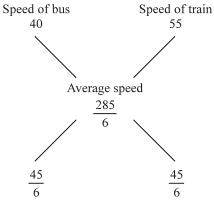
Using the alligation method:
Speed of bus $= 40 \text{ km/h}$,Speed of train $= 55 \text{ km/h}$.
Average speed $= \frac{285}{6} \text{ km/h} = 47.5 \text{ km/h}$.
Difference for bus $= |55 - 47.5| = 7.5$.
Difference for train $= |40 - 47.5| = 7.5$.
Ratio of time (bus : train) $= 7.5 : 7.5 = 1 : 1$.
Since the total time is $6 \text{ hours}$,time spent in each mode is $3 \text{ hours}$.
Distance traveled by train $= \text{Speed} \times \text{Time} = 55 \text{ km/h} \times 3 \text{ h} = 165 \text{ km}$.
Total time $t_1 + t_2 = 6 \text{ hours}$.
Total distance $= 40t_1 + 55t_2 = 285 \text{ km}$.
Using the alligation method:
Speed of bus $= 40 \text{ km/h}$,Speed of train $= 55 \text{ km/h}$.
Average speed $= \frac{285}{6} \text{ km/h} = 47.5 \text{ km/h}$.
Difference for bus $= |55 - 47.5| = 7.5$.
Difference for train $= |40 - 47.5| = 7.5$.
Ratio of time (bus : train) $= 7.5 : 7.5 = 1 : 1$.
Since the total time is $6 \text{ hours}$,time spent in each mode is $3 \text{ hours}$.
Distance traveled by train $= \text{Speed} \times \text{Time} = 55 \text{ km/h} \times 3 \text{ h} = 165 \text{ km}$.
0 likes
View Solution152
DifficultMCQ
$A$ trader has $50 \text{ kg}$ of pulses,part of which he sells at $8 \%$ profit and the rest at $18 \%$ profit. He gains $14 \%$ on the whole. What is the quantity sold at $18 \%$ profit? (in $\text{kg}$)
A
$30$
B
$25$
C
$20$
D
$40$
Solution
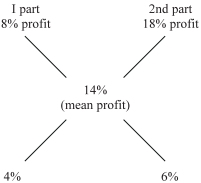
(A) Using the method of alligation:
Profit percentage of first part = $8 \%$
Profit percentage of second part = $18 \%$
Mean profit percentage = $14 \%$
Difference for first part = $|18 - 14| = 4$
Difference for second part = $|8 - 14| = 6$
Ratio of quantities = $4 : 6 = 2 : 3$
Total quantity = $50 \text{ kg}$
Quantity sold at $18 \%$ profit = $\frac{3}{2 + 3} \times 50 = \frac{3}{5} \times 50 = 30 \text{ kg}$.
Profit percentage of first part = $8 \%$
Profit percentage of second part = $18 \%$
Mean profit percentage = $14 \%$
Difference for first part = $|18 - 14| = 4$
Difference for second part = $|8 - 14| = 6$
Ratio of quantities = $4 : 6 = 2 : 3$
Total quantity = $50 \text{ kg}$
Quantity sold at $18 \%$ profit = $\frac{3}{2 + 3} \times 50 = \frac{3}{5} \times 50 = 30 \text{ kg}$.
0 likes
View Solution153
DifficultMCQ
$A$ trader has $50 \text{ kg}$ of rice,a part of which he sells at $10 \%$ profit and the rest at $5 \%$ loss. He gains $7 \%$ on the whole. What is the quantity sold at $10 \%$ gain and $5 \%$ loss? (in $\text{kg}$)
A
$30, 10$
B
$40, 15$
C
$35, 40$
D
$40, 10$
Solution
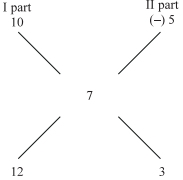
(D) Using the method of alligation:
Profit part = $10 \%$
Loss part = $-5 \%$
Mean profit = $7 \%$
Applying alligation:
$(10 - 7) = 3$ (for the loss part)
$(7 - (-5)) = 12$ (for the profit part)
Ratio of quantities sold at $10 \%$ profit to $5 \%$ loss = $12 : 3 = 4 : 1$.
Total quantity = $50 \text{ kg}$.
Quantity sold at $10 \%$ profit = $\frac{4}{4+1} \times 50 = \frac{4}{5} \times 50 = 40 \text{ kg}$.
Quantity sold at $5 \%$ loss = $\frac{1}{4+1} \times 50 = \frac{1}{5} \times 50 = 10 \text{ kg}$.
Profit part = $10 \%$
Loss part = $-5 \%$
Mean profit = $7 \%$
Applying alligation:
$(10 - 7) = 3$ (for the loss part)
$(7 - (-5)) = 12$ (for the profit part)
Ratio of quantities sold at $10 \%$ profit to $5 \%$ loss = $12 : 3 = 4 : 1$.
Total quantity = $50 \text{ kg}$.
Quantity sold at $10 \%$ profit = $\frac{4}{4+1} \times 50 = \frac{4}{5} \times 50 = 40 \text{ kg}$.
Quantity sold at $5 \%$ loss = $\frac{1}{4+1} \times 50 = \frac{1}{5} \times 50 = 10 \text{ kg}$.
0 likes
View Solution154
MediumMCQ
Mira's expenditure and savings are in the ratio $3: 2$. Her income increases by $10 \%$. Her expenditure also increases by $12 \%$. By how many $\%$ does her saving increase?
A
$7$
B
$10$
C
$9$
D
$13$
Solution
(A) Let the expenditure be $300$ and savings be $200$. Then,total income $= 300 + 200 = 500$.
After the increase,new income $= 500 \times 1.10 = 550$.
New expenditure $= 300 \times 1.12 = 336$.
New savings $= 550 - 336 = 214$.
Increase in savings $= 214 - 200 = 14$.
Percentage increase in savings $= (14 / 200) \times 100 = 7 \%$.
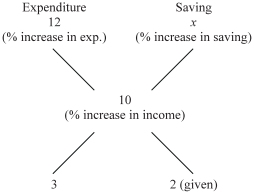
Alternatively,using the alligation method:
Let the percentage increase in savings be $x$.
By alligation rule:
$(12 - 10) / (10 - x) = 2 / 3$
$2 / (10 - x) = 2 / 3$
$10 - x = 3$
$x = 7$.
Thus,the savings increase by $7 \%$.
After the increase,new income $= 500 \times 1.10 = 550$.
New expenditure $= 300 \times 1.12 = 336$.
New savings $= 550 - 336 = 214$.
Increase in savings $= 214 - 200 = 14$.
Percentage increase in savings $= (14 / 200) \times 100 = 7 \%$.
Alternatively,using the alligation method:
Let the percentage increase in savings be $x$.
By alligation rule:
$(12 - 10) / (10 - x) = 2 / 3$
$2 / (10 - x) = 2 / 3$
$10 - x = 3$
$x = 7$.
Thus,the savings increase by $7 \%$.
0 likes
View Solution155
MediumMCQ
Solution $A$ contains $10 \%$ acid and solution $B$ contains $30 \%$ acid. In what ratio should solution $A$ be mixed with solution $B$ to obtain a mixture with $25 \%$ acid?
A
$1:2$
B
$3:1$
C
$1:3$
D
$2:1$
Solution
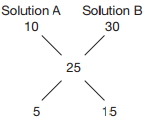
(C) Using the method of alligation:
Concentration of acid in solution $A = 10 \%$
Concentration of acid in solution $B = 30 \%$
Mean concentration of the mixture $= 25 \%$
By applying the alligation rule:
(Quantity of $A$) / (Quantity of $B$) = (Difference between $B$ and Mean) / (Difference between Mean and $A$)
(Quantity of $A$) / (Quantity of $B$) = $(30 - 25) / (25 - 10)$
(Quantity of $A$) / (Quantity of $B$) = $5 / 15$
(Quantity of $A$) / (Quantity of $B$) = $1 / 3$
Therefore,the required ratio is $1:3$.
Concentration of acid in solution $A = 10 \%$
Concentration of acid in solution $B = 30 \%$
Mean concentration of the mixture $= 25 \%$
By applying the alligation rule:
(Quantity of $A$) / (Quantity of $B$) = (Difference between $B$ and Mean) / (Difference between Mean and $A$)
(Quantity of $A$) / (Quantity of $B$) = $(30 - 25) / (25 - 10)$
(Quantity of $A$) / (Quantity of $B$) = $5 / 15$
(Quantity of $A$) / (Quantity of $B$) = $1 / 3$
Therefore,the required ratio is $1:3$.
0 likes
View Solution156
MediumMCQ
An alloy is made by mixing metal $A$ costing ₹ $2000/kg$ and metal $B$ costing ₹ $400/kg$ in the ratio $A:B = 3:1$. What is the cost (in ₹) of $8$ kilograms of this alloy?
A
$1600$
B
$9800$
C
$6400$
D
$12800$
Solution
(D) The mean cost price $(C.P.)$ per $kg$ of the alloy is calculated using the weighted average formula:
Mean $C.P. = \frac{(3 \times 2000) + (1 \times 400)}{3 + 1}$
Mean $C.P. = \frac{6000 + 400}{4} = \frac{6400}{4} = ₹ 1600/kg$
To find the cost of $8$ kilograms of this alloy,we multiply the cost per $kg$ by the total weight:
Total Cost $= 8 \times 1600 = ₹ 12800$.
Mean $C.P. = \frac{(3 \times 2000) + (1 \times 400)}{3 + 1}$
Mean $C.P. = \frac{6000 + 400}{4} = \frac{6400}{4} = ₹ 1600/kg$
To find the cost of $8$ kilograms of this alloy,we multiply the cost per $kg$ by the total weight:
Total Cost $= 8 \times 1600 = ₹ 12800$.
0 likes
View Solution157
DifficultMCQ
In what ratio should coffee powder costing ₹ $2500$ per $kg$ be mixed with coffee powder costing ₹ $1500$ per $kg$ so that the cost of the mixture is ₹ $2250$ per $kg$?
A
$1:4$
B
$4:1$
C
$3:1$
D
$1:3$
Solution
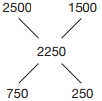
(C) Using the rule of alligation:
Cost of first type = ₹ $2500$ per $kg$
Cost of second type = ₹ $1500$ per $kg$
Mean price of mixture = ₹ $2250$ per $kg$
Applying the alligation method:
(Quantity of first type) / (Quantity of second type) = (Mean price - Cost of second type) / (Cost of first type - Mean price)
Ratio = $(2250 - 1500) / (2500 - 2250)$
Ratio = $750 / 250$
Ratio = $3 / 1$
Therefore,the required ratio is $3:1$.
Cost of first type = ₹ $2500$ per $kg$
Cost of second type = ₹ $1500$ per $kg$
Mean price of mixture = ₹ $2250$ per $kg$
Applying the alligation method:
(Quantity of first type) / (Quantity of second type) = (Mean price - Cost of second type) / (Cost of first type - Mean price)
Ratio = $(2250 - 1500) / (2500 - 2250)$
Ratio = $750 / 250$
Ratio = $3 / 1$
Therefore,the required ratio is $3:1$.
0 likes
View Solution158
DifficultMCQ
$A$ drum contains $80$ $litres$ of ethanol. $20$ $litres$ of this liquid is removed and replaced with water. $20$ $litres$ of this mixture is again removed and replaced with water. How much water (in $litres$) is present in this drum now?
A
$45$
B
$40$
C
$35$
D
$44$
Solution
(C) Initial volume of ethanol $= 80 \text{ litres}$.
After the $1^{st}$ replacement,the amount of ethanol remaining is $80 \times (1 - \frac{20}{80}) = 80 \times \frac{60}{80} = 60 \text{ litres}$.
After the $2^{nd}$ replacement,the amount of ethanol remaining is $60 \times (1 - \frac{20}{80}) = 60 \times \frac{60}{80} = 45 \text{ litres}$.
The total volume of the liquid in the drum remains $80 \text{ litres}$.
Therefore,the amount of water present in the drum is $80 - 45 = 35 \text{ litres}$.
After the $1^{st}$ replacement,the amount of ethanol remaining is $80 \times (1 - \frac{20}{80}) = 80 \times \frac{60}{80} = 60 \text{ litres}$.
After the $2^{nd}$ replacement,the amount of ethanol remaining is $60 \times (1 - \frac{20}{80}) = 60 \times \frac{60}{80} = 45 \text{ litres}$.
The total volume of the liquid in the drum remains $80 \text{ litres}$.
Therefore,the amount of water present in the drum is $80 - 45 = 35 \text{ litres}$.
0 likes
View Solution159
DifficultMCQ
Three bottles of equal capacity contain mixtures of milk and water in the ratios $2:5$,$3:4$,and $4:5$ respectively. These three bottles are emptied into a large bottle. What will be the ratio of milk and water respectively in the large bottle?
A
$73:106$
B
$73:116$
C
$73:113$
D
$73:186$
Solution
(B) Let the capacity of each bottle be $63$ litres (the $LCM$ of $7, 7, 9$).
The ratios of milk and water in the three bottles are $2:5$,$3:4$,and $4:5$.
For the $1^{\text{st}}$ bottle: Milk $= \frac{2}{7} \times 63 = 18$ litres,Water $= 63 - 18 = 45$ litres.
For the $2^{\text{nd}}$ bottle: Milk $= \frac{3}{7} \times 63 = 27$ litres,Water $= 63 - 27 = 36$ litres.
For the $3^{\text{rd}}$ bottle: Milk $= \frac{4}{9} \times 63 = 28$ litres,Water $= 63 - 28 = 35$ litres.
Total Milk $= 18 + 27 + 28 = 73$ litres.
Total Water $= 45 + 36 + 35 = 116$ litres.
Therefore,the required ratio of milk to water is $73:116$.
The ratios of milk and water in the three bottles are $2:5$,$3:4$,and $4:5$.
For the $1^{\text{st}}$ bottle: Milk $= \frac{2}{7} \times 63 = 18$ litres,Water $= 63 - 18 = 45$ litres.
For the $2^{\text{nd}}$ bottle: Milk $= \frac{3}{7} \times 63 = 27$ litres,Water $= 63 - 27 = 36$ litres.
For the $3^{\text{rd}}$ bottle: Milk $= \frac{4}{9} \times 63 = 28$ litres,Water $= 63 - 28 = 35$ litres.
Total Milk $= 18 + 27 + 28 = 73$ litres.
Total Water $= 45 + 36 + 35 = 116$ litres.
Therefore,the required ratio of milk to water is $73:116$.
0 likes
View Solution160
MediumMCQ
Two varieties of sugar are mixed together in a certain ratio. The cost of the mixture per $kg$ is ₹ $0.50$ less than that of the superior and ₹ $0.75$ more than the inferior variety. The ratio in which the superior and inferior varieties of sugar have been mixed is
A
$5:2$
B
$2:3$
C
$3:2$
D
$5:1$
Solution
(C) Let the cost of the superior variety be $x$ per $kg$ and the cost of the inferior variety be $y$ per $kg$.
Let the cost of the mixture be $M$ per $kg$.
According to the problem:
$M = x - 0.50$ $(1)$
$M = y + 0.75$ $(2)$
From $(1)$,$x - M = 0.50$.
From $(2)$,$M - y = 0.75$.
Using the rule of alligation,the ratio of the superior variety to the inferior variety is given by:
$\text{Ratio} = \frac{M - y}{x - M} = \frac{0.75}{0.50}$.
Simplifying the ratio: $\frac{0.75}{0.50} = \frac{75}{50} = \frac{3}{2}$.
Thus,the ratio is $3:2$.
Let the cost of the mixture be $M$ per $kg$.
According to the problem:
$M = x - 0.50$ $(1)$
$M = y + 0.75$ $(2)$
From $(1)$,$x - M = 0.50$.
From $(2)$,$M - y = 0.75$.
Using the rule of alligation,the ratio of the superior variety to the inferior variety is given by:
$\text{Ratio} = \frac{M - y}{x - M} = \frac{0.75}{0.50}$.
Simplifying the ratio: $\frac{0.75}{0.50} = \frac{75}{50} = \frac{3}{2}$.
Thus,the ratio is $3:2$.
0 likes
View Solution161
MediumMCQ
In what ratio should sugar at ₹ $30$ per $kg$ be mixed with sugar at ₹ $45$ per $kg$ so that on selling the mixture at ₹ $42$ per $kg$ there is a profit of $20 \%$?
A
$2:1$
B
$2:3$
C
$5:2$
D
$3:7$
Solution
(A) Given:
Selling Price $(S.P.)$ of the mixture $= ₹ 42$ per $kg$.
Profit percentage $= 20 \%$.
First,calculate the Cost Price $(C.P.)$ of the mixture:
$C.P. = \frac{S.P. \times 100}{100 + \text{Profit } \%}$
$C.P. = \frac{42 \times 100}{100 + 20} = \frac{4200}{120} = ₹ 35$ per $kg$.
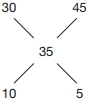
Now,apply the rule of Alligation:
Cost of first type of sugar $= ₹ 30$ per $kg$.
Cost of second type of sugar $= ₹ 45$ per $kg$.
Mean price $= ₹ 35$ per $kg$.
Using the alligation method:
Ratio of first sugar to second sugar $= (45 - 35) : (35 - 30)$
$= 10 : 5$
$= 2 : 1$.
Thus,the required ratio is $2:1$.
Selling Price $(S.P.)$ of the mixture $= ₹ 42$ per $kg$.
Profit percentage $= 20 \%$.
First,calculate the Cost Price $(C.P.)$ of the mixture:
$C.P. = \frac{S.P. \times 100}{100 + \text{Profit } \%}$
$C.P. = \frac{42 \times 100}{100 + 20} = \frac{4200}{120} = ₹ 35$ per $kg$.
Now,apply the rule of Alligation:
Cost of first type of sugar $= ₹ 30$ per $kg$.
Cost of second type of sugar $= ₹ 45$ per $kg$.
Mean price $= ₹ 35$ per $kg$.
Using the alligation method:
Ratio of first sugar to second sugar $= (45 - 35) : (35 - 30)$
$= 10 : 5$
$= 2 : 1$.
Thus,the required ratio is $2:1$.
0 likes
View Solution162
MediumMCQ
$80 \text{ litre}$ mixture of milk and water contains $10 \%$ milk. How much milk (in $\text{litre}$) must be added to make water percentage in the mixture $80 \% ?$
A
$8$
B
$9$
C
$10$
D
$12$
Solution
(C) Initial volume of mixture $= 80 \text{ litres}$.
Milk content $= 10 \% \text{ of } 80 = 8 \text{ litres}$.
Water content $= 80 - 8 = 72 \text{ litres}$.
Let $x$ be the amount of milk added.
In the new mixture,the amount of water remains $72 \text{ litres}$,which represents $80 \%$ of the new total volume.
Let the new total volume be $V$.
$0.80 \times V = 72 \implies V = \frac{72}{0.80} = 90 \text{ litres}$.
The amount of milk added $= V - 80 = 90 - 80 = 10 \text{ litres}$.
Milk content $= 10 \% \text{ of } 80 = 8 \text{ litres}$.
Water content $= 80 - 8 = 72 \text{ litres}$.
Let $x$ be the amount of milk added.
In the new mixture,the amount of water remains $72 \text{ litres}$,which represents $80 \%$ of the new total volume.
Let the new total volume be $V$.
$0.80 \times V = 72 \implies V = \frac{72}{0.80} = 90 \text{ litres}$.
The amount of milk added $= V - 80 = 90 - 80 = 10 \text{ litres}$.
0 likes
View Solution163
MediumMCQ
In what ratio should tea at ₹ $240$ per $kg$ be mixed with tea at ₹ $280$ per $kg$ so that on selling the mixture at ₹ $324$ per $kg$ there is a profit of $20 \%$?
A
$1:1$
B
$1:2$
C
$1:3$
D
$1:4$
Solution
(C) Given:
Selling Price $(S.P)$ of the mixture = ₹ $324$ per $kg$
Profit percentage = $20 \%$
Step $1$: Calculate the Cost Price $(C.P)$ of the mixture.
$C.P = \frac{S.P \times 100}{100 + \text{Profit } \%}$
$C.P = \frac{324 \times 100}{120} = \frac{3240}{12} = ₹ 270$ per $kg$
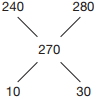
Step $2$: Apply the Alligation method.
Cost of first type of tea = ₹ $240$ per $kg$
Cost of second type of tea = ₹ $280$ per $kg$
Mean price of mixture = ₹ $270$ per $kg$
Using the rule of alligation:
Ratio = $(280 - 270) : (270 - 240)$
Ratio = $10 : 30$
Ratio = $1 : 3$
Therefore,the tea should be mixed in the ratio $1:3$.
Selling Price $(S.P)$ of the mixture = ₹ $324$ per $kg$
Profit percentage = $20 \%$
Step $1$: Calculate the Cost Price $(C.P)$ of the mixture.
$C.P = \frac{S.P \times 100}{100 + \text{Profit } \%}$
$C.P = \frac{324 \times 100}{120} = \frac{3240}{12} = ₹ 270$ per $kg$
Step $2$: Apply the Alligation method.
Cost of first type of tea = ₹ $240$ per $kg$
Cost of second type of tea = ₹ $280$ per $kg$
Mean price of mixture = ₹ $270$ per $kg$
Using the rule of alligation:
Ratio = $(280 - 270) : (270 - 240)$
Ratio = $10 : 30$
Ratio = $1 : 3$
Therefore,the tea should be mixed in the ratio $1:3$.
0 likes
View Solution164
MediumMCQ
Three boxes of capacity $24\, kg$,$36\, kg$,and $84\, kg$ are completely filled with three varieties of wheat $A$,$B$,and $C$ respectively. All three boxes were emptied,the three types of wheat were thoroughly mixed,and the mixture was put back into the three boxes. How many $kg$ of type $A$ wheat would be there in the third box?
A
$10$
B
$12$
C
$14$
D
$16$
Solution
(C) The capacities of the three boxes are $24\, kg$,$36\, kg$,and $84\, kg$.
Total weight of the mixture $= 24 + 36 + 84 = 144\, kg$.
The ratio of wheat $A$,$B$,and $C$ in the mixture is $24 : 36 : 84$,which simplifies to $2 : 3 : 7$.
The fraction of type $A$ wheat in the total mixture is $\frac{2}{2+3+7} = \frac{2}{12} = \frac{1}{6}$.
Since the mixture is distributed back into the boxes,the third box (capacity $84\, kg$) will contain the same proportion of type $A$ wheat as the total mixture.
Quantity of type $A$ wheat in the third box $= \frac{1}{6} \times 84 = 14\, kg$.
Total weight of the mixture $= 24 + 36 + 84 = 144\, kg$.
The ratio of wheat $A$,$B$,and $C$ in the mixture is $24 : 36 : 84$,which simplifies to $2 : 3 : 7$.
The fraction of type $A$ wheat in the total mixture is $\frac{2}{2+3+7} = \frac{2}{12} = \frac{1}{6}$.
Since the mixture is distributed back into the boxes,the third box (capacity $84\, kg$) will contain the same proportion of type $A$ wheat as the total mixture.
Quantity of type $A$ wheat in the third box $= \frac{1}{6} \times 84 = 14\, kg$.
0 likes
View Solution165
MediumMCQ
$A$ sugar solution of $3$ $litre$ contains $60 \%$ sugar. One litre of water is added to this solution. Then the percentage of sugar in the new solution is (in $\%$)
A
$30$
B
$45$
C
$50$
D
$60$
Solution
(B) The initial volume of the sugar solution is $3$ $litre$,and it contains $60 \%$ sugar.
Amount of sugar $= 60 \% \text{ of } 3 \text{ litre} = 0.60 \times 3 = 1.8 \text{ litre}$.
When $1$ $litre$ of water is added,the total volume of the new solution becomes $3 + 1 = 4 \text{ litre}$.
The amount of sugar remains constant at $1.8 \text{ litre}$.
Percentage of sugar in the new solution $= \left( \frac{1.8}{4} \right) \times 100 = 0.45 \times 100 = 45 \%.$
Amount of sugar $= 60 \% \text{ of } 3 \text{ litre} = 0.60 \times 3 = 1.8 \text{ litre}$.
When $1$ $litre$ of water is added,the total volume of the new solution becomes $3 + 1 = 4 \text{ litre}$.
The amount of sugar remains constant at $1.8 \text{ litre}$.
Percentage of sugar in the new solution $= \left( \frac{1.8}{4} \right) \times 100 = 0.45 \times 100 = 45 \%.$
0 likes
View Solution166
DifficultMCQ
$8$ litres of water is added to $32$ litres of a solution containing $20 \%$ of alcohol in water. What is the approximate concentration of alcohol in the solution now? (in $\%$)
A
$24$
B
$16$
C
$8$
D
$12$
Solution
(B) Initial volume of solution $= 32 \text{ litres}$.
Concentration of alcohol $= 20 \%$.
Amount of alcohol $= 32 \times 0.20 = 6.4 \text{ litres}$.
Water added $= 8 \text{ litres}$.
New total volume of solution $= 32 + 8 = 40 \text{ litres}$.
New concentration of alcohol $= \left( \frac{6.4}{40} \right) \times 100 = 16 \%$.
Concentration of alcohol $= 20 \%$.
Amount of alcohol $= 32 \times 0.20 = 6.4 \text{ litres}$.
Water added $= 8 \text{ litres}$.
New total volume of solution $= 32 + 8 = 40 \text{ litres}$.
New concentration of alcohol $= \left( \frac{6.4}{40} \right) \times 100 = 16 \%$.
0 likes
View Solution167
MediumMCQ
In what ratio should wheat at ₹ $32$ per $kg$ be mixed with wheat at ₹ $24$ per $kg$ so that on selling the mixture at ₹ $39$ per $kg$,there is a profit of $30 \%$?
A
$3:1$
B
$2:3$
C
$1:4$
D
$2:5$
Solution
(A) Given:
Selling Price $(S.P.)$ of the mixture = ₹ $39$ per $kg$
Profit percentage = $30 \%$
Step $1$: Calculate the Cost Price $(C.P.)$ of the mixture.
$C.P. = S.P. \times \frac{100}{100 + \text{Profit } \%}$
$C.P. = 39 \times \frac{100}{130} = 39 \times \frac{10}{13} = 3 \times 10 = ₹ 30$ per $kg$
Step $2$: Use the rule of Alligation:
- Cost of first type of wheat = ₹ $32$ per $kg$
- Cost of second type of wheat = ₹ $24$ per $kg$
- Mean Price ($C.P.$ of mixture) = ₹ $30$ per $kg$
By Alligation:
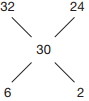
(Price of 1st) $32$ --- (Price of 2nd) $24$
\ /
$30$
/ \
(Difference) $6$ --- (Difference) $2$
Ratio = $6 : 2 = 3 : 1$
Therefore,the required ratio is $3:1$.
Selling Price $(S.P.)$ of the mixture = ₹ $39$ per $kg$
Profit percentage = $30 \%$
Step $1$: Calculate the Cost Price $(C.P.)$ of the mixture.
$C.P. = S.P. \times \frac{100}{100 + \text{Profit } \%}$
$C.P. = 39 \times \frac{100}{130} = 39 \times \frac{10}{13} = 3 \times 10 = ₹ 30$ per $kg$
Step $2$: Use the rule of Alligation:
- Cost of first type of wheat = ₹ $32$ per $kg$
- Cost of second type of wheat = ₹ $24$ per $kg$
- Mean Price ($C.P.$ of mixture) = ₹ $30$ per $kg$
By Alligation:
(Price of 1st) $32$ --- (Price of 2nd) $24$
\ /
$30$
/ \
(Difference) $6$ --- (Difference) $2$
Ratio = $6 : 2 = 3 : 1$
Therefore,the required ratio is $3:1$.
0 likes
View Solution168
MediumMCQ
$49 \ kg$ of blended tea contains Assam and Darjeeling tea in the ratio $5:2$. The quantity of Darjeeling tea to be added to the mixture to make the ratio of Assam to Darjeeling tea $2:1$ is..........$kg$.
A
$4.5$
B
$3.5$
C
$5$
D
$6$
Solution
(B) Total quantity of tea $= 49 \ kg$.
Ratio of Assam tea to Darjeeling tea $= 5:2$.
Sum of ratio parts $= 5 + 2 = 7$.
Quantity of Assam tea $= (5/7) \times 49 = 35 \ kg$.
Quantity of Darjeeling tea $= (2/7) \times 49 = 14 \ kg$.
Let $x \ kg$ of Darjeeling tea be added.
New quantity of Darjeeling tea $= 14 + x \ kg$.
According to the problem,the new ratio of Assam to Darjeeling tea is $2:1$.
So,$35 / (14 + x) = 2 / 1$.
$35 = 2(14 + x)$.
$35 = 28 + 2x$.
$2x = 35 - 28 = 7$.
$x = 7 / 2 = 3.5 \ kg$.
Ratio of Assam tea to Darjeeling tea $= 5:2$.
Sum of ratio parts $= 5 + 2 = 7$.
Quantity of Assam tea $= (5/7) \times 49 = 35 \ kg$.
Quantity of Darjeeling tea $= (2/7) \times 49 = 14 \ kg$.
Let $x \ kg$ of Darjeeling tea be added.
New quantity of Darjeeling tea $= 14 + x \ kg$.
According to the problem,the new ratio of Assam to Darjeeling tea is $2:1$.
So,$35 / (14 + x) = 2 / 1$.
$35 = 2(14 + x)$.
$35 = 28 + 2x$.
$2x = 35 - 28 = 7$.
$x = 7 / 2 = 3.5 \ kg$.
0 likes
View Solution169
MediumMCQ
In what proportion must a grocer mix sugar at ₹ $12$ per $kg$ and ₹ $7$ per $kg$ so as to make a mixture worth ₹ $8$ per $kg$?
A
$7:12$
B
$1:4$
C
$2:3$
D
$12:7$
Solution
(B) Using the rule of alligation:
Cost price of first sugar = ₹ $12$ per $kg$
Cost price of second sugar = ₹ $7$ per $kg$
Mean price of the mixture = ₹ $8$ per $kg$
Applying the alligation formula:
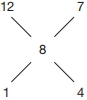
(Quantity of first sugar) : (Quantity of second sugar) = (Mean price - Cost price of second) : (Cost price of first - Mean price)
Ratio = $(8 - 7) : (12 - 8)$
Ratio = $1 : 4$
Thus,the grocer must mix the two types of sugar in the ratio $1:4$.
Cost price of first sugar = ₹ $12$ per $kg$
Cost price of second sugar = ₹ $7$ per $kg$
Mean price of the mixture = ₹ $8$ per $kg$
Applying the alligation formula:
(Quantity of first sugar) : (Quantity of second sugar) = (Mean price - Cost price of second) : (Cost price of first - Mean price)
Ratio = $(8 - 7) : (12 - 8)$
Ratio = $1 : 4$
Thus,the grocer must mix the two types of sugar in the ratio $1:4$.
0 likes
View Solution170
DifficultMCQ
Three containers whose volumes are in the ratio of $2:3:4$ are full of a mixture of spirit and water. In the $1^{st}$ container,the ratio of spirit to water is $4:1$,in the $2^{nd}$ container the ratio is $11:4$,and in the $3^{rd}$ container the ratio is $7:3$. All three mixtures are mixed in a big container. The ratio of spirit and water in the resultant mixture is:
A
$4:9$
B
$11:4$
C
$5:10$
D
$9:5$
Solution
(B) Let the volumes of the three containers be $2x, 3x,$ and $4x$ respectively.
$1^{st}$ container: Ratio of spirit to water is $4:1$. Total parts = $5$.
Spirit = $(4/5) \times 2x = 1.6x$,Water = $(1/5) \times 2x = 0.4x$.
$2^{nd}$ container: Ratio of spirit to water is $11:4$. Total parts = $15$.
Spirit = $(11/15) \times 3x = 2.2x$,Water = $(4/15) \times 3x = 0.8x$.
$3^{rd}$ container: Ratio of spirit to water is $7:3$. Total parts = $10$.
Spirit = $(7/10) \times 4x = 2.8x$,Water = $(3/10) \times 4x = 1.2x$.
Total Spirit = $1.6x + 2.2x + 2.8x = 6.6x$.
Total Water = $0.4x + 0.8x + 1.2x = 2.4x$.
Resultant ratio = $6.6x : 2.4x = 66 : 24 = 11 : 4$.
$1^{st}$ container: Ratio of spirit to water is $4:1$. Total parts = $5$.
Spirit = $(4/5) \times 2x = 1.6x$,Water = $(1/5) \times 2x = 0.4x$.
$2^{nd}$ container: Ratio of spirit to water is $11:4$. Total parts = $15$.
Spirit = $(11/15) \times 3x = 2.2x$,Water = $(4/15) \times 3x = 0.8x$.
$3^{rd}$ container: Ratio of spirit to water is $7:3$. Total parts = $10$.
Spirit = $(7/10) \times 4x = 2.8x$,Water = $(3/10) \times 4x = 1.2x$.
Total Spirit = $1.6x + 2.2x + 2.8x = 6.6x$.
Total Water = $0.4x + 0.8x + 1.2x = 2.4x$.
Resultant ratio = $6.6x : 2.4x = 66 : 24 = 11 : 4$.
0 likes
View Solution171
DifficultMCQ
In two types of brass,the ratios of Copper to Zinc are $8:3$ and $15:7$ respectively. If the two types of brass are melted and mixed in the ratio $5:2$,a new type of brass is obtained. The ratio of Copper to Zinc in this new type of brass is:
A
$3:2$
B
$2:3$
C
$3:4$
D
$5:2$
Solution
(D) Let the two types of brass be $A$ and $B$.
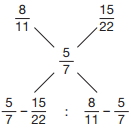
In brass $A$,the ratio of Copper to Zinc is $8:3$. The fraction of Copper is $\frac{8}{11}$ and the fraction of Zinc is $\frac{3}{11}$.
In brass $B$,the ratio of Copper to Zinc is $15:7$. The fraction of Copper is $\frac{15}{22}$ and the fraction of Zinc is $\frac{7}{22}$.
We mix these in the ratio $5:2$. Let us take $5$ units of brass $A$ and $2$ units of brass $B$.
Total Copper $= 5 \times \frac{8}{11} + 2 \times \frac{15}{22} = \frac{40}{11} + \frac{15}{11} = \frac{55}{11} = 5$.
Total Zinc $= 5 \times \frac{3}{11} + 2 \times \frac{7}{22} = \frac{15}{11} + \frac{7}{11} = \frac{22}{11} = 2$.
The ratio of Copper to Zinc in the new mixture is $5:2$.
In brass $A$,the ratio of Copper to Zinc is $8:3$. The fraction of Copper is $\frac{8}{11}$ and the fraction of Zinc is $\frac{3}{11}$.
In brass $B$,the ratio of Copper to Zinc is $15:7$. The fraction of Copper is $\frac{15}{22}$ and the fraction of Zinc is $\frac{7}{22}$.
We mix these in the ratio $5:2$. Let us take $5$ units of brass $A$ and $2$ units of brass $B$.
Total Copper $= 5 \times \frac{8}{11} + 2 \times \frac{15}{22} = \frac{40}{11} + \frac{15}{11} = \frac{55}{11} = 5$.
Total Zinc $= 5 \times \frac{3}{11} + 2 \times \frac{7}{22} = \frac{15}{11} + \frac{7}{11} = \frac{22}{11} = 2$.
The ratio of Copper to Zinc in the new mixture is $5:2$.
0 likes
View Solution172
DifficultMCQ
Rama mixes $20 \%$ of kerosene to his petrol and then he sells the whole mixture at the price of petrol. If the cost price of the kerosene is $40 \%$ of the $CP$ of petrol,what is the net profit percentage (in $\%$)?
A
$11.11$
B
$11.5$
C
$12.5$
D
$9.5$
Solution
(A) Let the cost price $(CP)$ of $1$ litre of petrol be $₹ 100$.
The cost price of $1$ litre of kerosene is $40 \%$ of $₹ 100 = ₹ 40$.
Rama mixes $20 \%$ kerosene with petrol. For $1000 \text{ ml}$ of petrol,he adds $200 \text{ ml}$ of kerosene.
The total cost price of the mixture $(1200 \text{ ml})$ is: $100 + (0.2 \times 40) = 100 + 8 = ₹ 108$.
The selling price $(SP)$ of $1200 \text{ ml}$ of the mixture (sold at the price of petrol) is: $100 + (0.2 \times 100) = ₹ 120$.
Profit $= SP - CP = 120 - 108 = ₹ 12$.
Profit percentage $= (\text{Profit} / CP) \times 100 = (12 / 108) \times 100 = 100 / 9 = 11.11 \%$.
The cost price of $1$ litre of kerosene is $40 \%$ of $₹ 100 = ₹ 40$.
Rama mixes $20 \%$ kerosene with petrol. For $1000 \text{ ml}$ of petrol,he adds $200 \text{ ml}$ of kerosene.
The total cost price of the mixture $(1200 \text{ ml})$ is: $100 + (0.2 \times 40) = 100 + 8 = ₹ 108$.
The selling price $(SP)$ of $1200 \text{ ml}$ of the mixture (sold at the price of petrol) is: $100 + (0.2 \times 100) = ₹ 120$.
Profit $= SP - CP = 120 - 108 = ₹ 12$.
Profit percentage $= (\text{Profit} / CP) \times 100 = (12 / 108) \times 100 = 100 / 9 = 11.11 \%$.
0 likes
View Solution173
DifficultMCQ
$18 \text{ litre}$ of pure water was added to a vessel containing $80 \text{ litre}$ of pure milk. $49 \text{ litre}$ of the resultant mixture was then sold,and some more quantity of pure milk and pure water was added to the vessel in the respective ratio of $2:1$. If the resultant respective ratio of milk and water in the vessel was $4:1$,what was the quantity of pure milk added in the vessel? (in $\text{litre}$)
A
$4$
B
$8$
C
$10$
D
$12$
Solution
(A) Initial volume of milk = $80 \text{ litre}$,Initial volume of water = $18 \text{ litre}$.
Total volume = $80 + 18 = 98 \text{ litre}$.
Ratio of milk to water = $80:18 = 40:9$.
When $49 \text{ litre}$ of mixture is removed,the amount of milk removed = $49 \times (40/49) = 40 \text{ litre}$.
The amount of water removed = $49 \times (9/49) = 9 \text{ litre}$.
Remaining milk = $80 - 40 = 40 \text{ litre}$.
Remaining water = $18 - 9 = 9 \text{ litre}$.
Let the quantity of milk added be $2x \text{ litre}$ and water added be $x \text{ litre}$.
According to the problem,the new ratio is $(40 + 2x) / (9 + x) = 4/1$.
$40 + 2x = 4(9 + x)$.
$40 + 2x = 36 + 4x$.
$4x - 2x = 40 - 36$.
$2x = 4 \Rightarrow x = 2$.
Quantity of milk added = $2x = 2(2) = 4 \text{ litre}$.
Total volume = $80 + 18 = 98 \text{ litre}$.
Ratio of milk to water = $80:18 = 40:9$.
When $49 \text{ litre}$ of mixture is removed,the amount of milk removed = $49 \times (40/49) = 40 \text{ litre}$.
The amount of water removed = $49 \times (9/49) = 9 \text{ litre}$.
Remaining milk = $80 - 40 = 40 \text{ litre}$.
Remaining water = $18 - 9 = 9 \text{ litre}$.
Let the quantity of milk added be $2x \text{ litre}$ and water added be $x \text{ litre}$.
According to the problem,the new ratio is $(40 + 2x) / (9 + x) = 4/1$.
$40 + 2x = 4(9 + x)$.
$40 + 2x = 36 + 4x$.
$4x - 2x = 40 - 36$.
$2x = 4 \Rightarrow x = 2$.
Quantity of milk added = $2x = 2(2) = 4 \text{ litre}$.
0 likes
View Solution174
DifficultMCQ
In a $120$ $litre$ mixture of milk and water,water is only $25 \%$. The milkman sold $20$ $litre$ of this mixture and then added $16.2$ $litre$ of pure milk and $3.8$ $litre$ of pure water to the remaining mixture. What is the percentage of water in the final mixture (in $\%$)?
A
$22$
B
$21$
C
$24$
D
$25$
Solution
(C) Initial mixture $= 120$ $litre$,water $= 25 \%$.
Water $= 0.25 \times 120 = 30$ $litre$.
Milk $= 120 - 30 = 90$ $litre$.
After selling $20$ $litre$ of the mixture,the remaining mixture $= 120 - 20 = 100$ $litre$.
In the remaining $100$ $litre$ mixture,the ratio of milk to water remains the same ($75 \%$ milk and $25 \%$ water).
Water in $100$ $litre$ mixture $= 0.25 \times 100 = 25$ $litre$.
Milk in $100$ $litre$ mixture $= 0.75 \times 100 = 75$ $litre$.
After adding $16.2$ $litre$ of milk and $3.8$ $litre$ of water:
New milk quantity $= 75 + 16.2 = 91.2$ $litre$.
New water quantity $= 25 + 3.8 = 28.8$ $litre$.
Total new mixture volume $= 91.2 + 28.8 = 120$ $litre$.
Percentage of water $= (28.8 / 120) \times 100 = 24 \%$.
Water $= 0.25 \times 120 = 30$ $litre$.
Milk $= 120 - 30 = 90$ $litre$.
After selling $20$ $litre$ of the mixture,the remaining mixture $= 120 - 20 = 100$ $litre$.
In the remaining $100$ $litre$ mixture,the ratio of milk to water remains the same ($75 \%$ milk and $25 \%$ water).
Water in $100$ $litre$ mixture $= 0.25 \times 100 = 25$ $litre$.
Milk in $100$ $litre$ mixture $= 0.75 \times 100 = 75$ $litre$.
After adding $16.2$ $litre$ of milk and $3.8$ $litre$ of water:
New milk quantity $= 75 + 16.2 = 91.2$ $litre$.
New water quantity $= 25 + 3.8 = 28.8$ $litre$.
Total new mixture volume $= 91.2 + 28.8 = 120$ $litre$.
Percentage of water $= (28.8 / 120) \times 100 = 24 \%$.
0 likes
View Solution175
MediumMCQ
$729 \, ml$ of a mixture contains milk and water in the ratio $7:2$. How much more water is to be added to get a new mixture containing milk and water in the ratio $7:3$? (in $ml$)
A
$60$
B
$71$
C
$52$
D
$81$
Solution
(D) Total volume of the mixture $= 729 \, ml$.
Ratio of milk to water $= 7:2$.
Sum of ratio parts $= 7 + 2 = 9$.
Value of one part $= 729 / 9 = 81 \, ml$.
Quantity of milk $= 7 \times 81 = 567 \, ml$.
Quantity of water $= 2 \times 81 = 162 \, ml$.
We need to add water such that the new ratio becomes $7:3$. Since the quantity of milk remains constant $(567 \, ml)$,the new ratio $7:3$ implies that $7$ parts correspond to $567 \, ml$.
Value of one part in the new ratio $= 567 / 7 = 81 \, ml$.
Required quantity of water $= 3 \times 81 = 243 \, ml$.
Water to be added $= 243 \, ml - 162 \, ml = 81 \, ml$.
Ratio of milk to water $= 7:2$.
Sum of ratio parts $= 7 + 2 = 9$.
Value of one part $= 729 / 9 = 81 \, ml$.
Quantity of milk $= 7 \times 81 = 567 \, ml$.
Quantity of water $= 2 \times 81 = 162 \, ml$.
We need to add water such that the new ratio becomes $7:3$. Since the quantity of milk remains constant $(567 \, ml)$,the new ratio $7:3$ implies that $7$ parts correspond to $567 \, ml$.
Value of one part in the new ratio $= 567 / 7 = 81 \, ml$.
Required quantity of water $= 3 \times 81 = 243 \, ml$.
Water to be added $= 243 \, ml - 162 \, ml = 81 \, ml$.
0 likes
View Solution176
MediumMCQ
$A$ shopkeeper bought $30 \text{ kg}$ of rice at the rate of $₹ 70$ per $\text{kg}$ and $20 \text{ kg}$ of rice at the rate of $₹ 70.75$ per $\text{kg}$. If he mixed the two brands of rice and sold the mixture at $₹ 80.50$ per $\text{kg}$,his total gain is (in $₹$):
A
$510$
B
$525$
C
$485$
D
$450$
Solution
(A) Step $1$: Calculate the total cost price of the mixture.
Total cost price $= (30 \times 70) + (20 \times 70.75) = 2100 + 1415 = ₹ 3515$.
Step $2$: Calculate the total selling price of the mixture.
Total quantity $= 30 + 20 = 50 \text{ kg}$.
Total selling price $= 50 \times 80.50 = ₹ 4025$.
Step $3$: Calculate the total gain.
Gain $= \text{Total Selling Price} - \text{Total Cost Price} = 4025 - 3515 = ₹ 510$.
Total cost price $= (30 \times 70) + (20 \times 70.75) = 2100 + 1415 = ₹ 3515$.
Step $2$: Calculate the total selling price of the mixture.
Total quantity $= 30 + 20 = 50 \text{ kg}$.
Total selling price $= 50 \times 80.50 = ₹ 4025$.
Step $3$: Calculate the total gain.
Gain $= \text{Total Selling Price} - \text{Total Cost Price} = 4025 - 3515 = ₹ 510$.
0 likes
View Solution177
MediumMCQ
$300$ $grams$ of sugar solution contains $40 \%$ sugar. How much sugar should be added to make the concentration $50 \%$ in the solution? (in $grams$)
A
$10$
B
$80$
C
$60$
D
$40$
Solution
(C) Initial amount of solution = $300$ $grams$.
Amount of sugar in the initial solution = $40 \%$ of $300 = 0.40 \times 300 = 120$ $grams$.
Amount of water in the initial solution = $300 - 120 = 180$ $grams$.
Let $x$ $grams$ of sugar be added to the solution.
New amount of sugar = $120 + x$ $grams$.
New total amount of solution = $300 + x$ $grams$.
According to the problem,the new concentration of sugar is $50 \%$,so:
$(120 + x) / (300 + x) = 50 / 100 = 1 / 2$.
Cross-multiplying gives: $2(120 + x) = 300 + x$.
$240 + 2x = 300 + x$.
$2x - x = 300 - 240$.
$x = 60$ $grams$.
Amount of sugar in the initial solution = $40 \%$ of $300 = 0.40 \times 300 = 120$ $grams$.
Amount of water in the initial solution = $300 - 120 = 180$ $grams$.
Let $x$ $grams$ of sugar be added to the solution.
New amount of sugar = $120 + x$ $grams$.
New total amount of solution = $300 + x$ $grams$.
According to the problem,the new concentration of sugar is $50 \%$,so:
$(120 + x) / (300 + x) = 50 / 100 = 1 / 2$.
Cross-multiplying gives: $2(120 + x) = 300 + x$.
$240 + 2x = 300 + x$.
$2x - x = 300 - 240$.
$x = 60$ $grams$.
0 likes
View Solution178
MediumMCQ
Three glasses of equal volume contain acid mixed with water. The ratios of acid to water are $2:3$,$3:4$,and $4:5$ respectively. If the contents of these glasses are poured into a large vessel,what is the ratio of acid to water in the large vessel?
A
$407:560$
B
$411:540$
C
$417:564$
D
$401:544$
Solution
(D) Let the volume of each glass be $1$ unit.
In the first glass,the amount of acid is $\frac{2}{5}$ and water is $\frac{3}{5}$.
In the second glass,the amount of acid is $\frac{3}{7}$ and water is $\frac{4}{7}$.
In the third glass,the amount of acid is $\frac{4}{9}$ and water is $\frac{5}{9}$.
Total acid in the large vessel $= \frac{2}{5} + \frac{3}{7} + \frac{4}{9} = \frac{126 + 135 + 140}{315} = \frac{401}{315}$.
Total water in the large vessel $= \frac{3}{5} + \frac{4}{7} + \frac{5}{9} = \frac{189 + 180 + 175}{315} = \frac{544}{315}$.
Therefore,the required ratio of acid to water $= \frac{401}{315} : \frac{544}{315} = 401:544$.
In the first glass,the amount of acid is $\frac{2}{5}$ and water is $\frac{3}{5}$.
In the second glass,the amount of acid is $\frac{3}{7}$ and water is $\frac{4}{7}$.
In the third glass,the amount of acid is $\frac{4}{9}$ and water is $\frac{5}{9}$.
Total acid in the large vessel $= \frac{2}{5} + \frac{3}{7} + \frac{4}{9} = \frac{126 + 135 + 140}{315} = \frac{401}{315}$.
Total water in the large vessel $= \frac{3}{5} + \frac{4}{7} + \frac{5}{9} = \frac{189 + 180 + 175}{315} = \frac{544}{315}$.
Therefore,the required ratio of acid to water $= \frac{401}{315} : \frac{544}{315} = 401:544$.
0 likes
View Solution179
MediumMCQ
$60\, kg$ of an alloy $A$ is mixed with $100\, kg$ of alloy $B.$ If alloy $A$ has lead and tin in the ratio $3:2$ and alloy $B$ has tin and copper in the ratio $1:4,$ the amount of tin in the new alloy is (in $kg$)
A
$80$
B
$53$
C
$24$
D
$44$
Solution
(D) In $60\, kg$ of alloy $A$,the ratio of lead to tin is $3:2$.
Amount of tin in alloy $A = \frac{2}{3+2} \times 60 = \frac{2}{5} \times 60 = 24\, kg$.
In $100\, kg$ of alloy $B$,the ratio of tin to copper is $1:4$.
Amount of tin in alloy $B = \frac{1}{1+4} \times 100 = \frac{1}{5} \times 100 = 20\, kg$.
Total amount of tin in the new alloy = (Tin in alloy $A$) + (Tin in alloy $B$) = $24\, kg + 20\, kg = 44\, kg$.
Amount of tin in alloy $A = \frac{2}{3+2} \times 60 = \frac{2}{5} \times 60 = 24\, kg$.
In $100\, kg$ of alloy $B$,the ratio of tin to copper is $1:4$.
Amount of tin in alloy $B = \frac{1}{1+4} \times 100 = \frac{1}{5} \times 100 = 20\, kg$.
Total amount of tin in the new alloy = (Tin in alloy $A$) + (Tin in alloy $B$) = $24\, kg + 20\, kg = 44\, kg$.
0 likes
View Solution180
DifficultMCQ
Two alloys contain tin and iron in the ratio of $1:2$ and $2:3$. If the two alloys are mixed in the proportion of $3:4$ respectively (by weight),the ratio of tin and iron in the newly formed alloy is:
A
$12:23$
B
$14:25$
C
$10:21$
D
$13:22$
Solution
(D) Let the weight of the first alloy be $3x$ and the second alloy be $4x$.
In the first alloy $(A)$,the ratio of tin to iron is $1:2$. Total parts = $1+2=3$.
Amount of tin in $A = \frac{1}{3} \times 3x = x$.
Amount of iron in $A = \frac{2}{3} \times 3x = 2x$.
In the second alloy $(B)$,the ratio of tin to iron is $2:3$. Total parts = $2+3=5$.
Amount of tin in $B = \frac{2}{5} \times 4x = \frac{8x}{5}$.
Amount of iron in $B = \frac{3}{5} \times 4x = \frac{12x}{5}$.
Total tin in the new mixture = $x + \frac{8x}{5} = \frac{13x}{5}$.
Total iron in the new mixture = $2x + \frac{12x}{5} = \frac{22x}{5}$.
The ratio of tin to iron in the new alloy = $\frac{13x}{5} : \frac{22x}{5} = 13:22$.
In the first alloy $(A)$,the ratio of tin to iron is $1:2$. Total parts = $1+2=3$.
Amount of tin in $A = \frac{1}{3} \times 3x = x$.
Amount of iron in $A = \frac{2}{3} \times 3x = 2x$.
In the second alloy $(B)$,the ratio of tin to iron is $2:3$. Total parts = $2+3=5$.
Amount of tin in $B = \frac{2}{5} \times 4x = \frac{8x}{5}$.
Amount of iron in $B = \frac{3}{5} \times 4x = \frac{12x}{5}$.
Total tin in the new mixture = $x + \frac{8x}{5} = \frac{13x}{5}$.
Total iron in the new mixture = $2x + \frac{12x}{5} = \frac{22x}{5}$.
The ratio of tin to iron in the new alloy = $\frac{13x}{5} : \frac{22x}{5} = 13:22$.
0 likes
View Solution181
DifficultMCQ
$20$ litres of a mixture contains $20 \%$ alcohol and the rest is water. If $4$ litres of water are added to it,what will be the percentage of alcohol in the new mixture?
A
$33 \frac{1}{3} \%$
B
$16 \frac{2}{3} \%$
C
$25 \%$
D
$12 \frac{1}{2} \%$
Solution
(B) In $20$ litres of the initial mixture:
Alcohol $= 20 \times \frac{20}{100} = 4$ litres.
Water $= 20 - 4 = 16$ litres.
When $4$ litres of water are added:
New quantity of water $= 16 + 4 = 20$ litres.
New total quantity of the mixture $= 20 + 4 = 24$ litres.
The percentage of alcohol in the new mixture is calculated as:
$\text{Percentage} = \left( \frac{\text{Quantity of Alcohol}}{\text{Total Quantity of Mixture}} \right) \times 100$
$\text{Percentage} = \left( \frac{4}{24} \right) \times 100 = \frac{1}{6} \times 100 = \frac{50}{3} = 16 \frac{2}{3} \%$.
Alcohol $= 20 \times \frac{20}{100} = 4$ litres.
Water $= 20 - 4 = 16$ litres.
When $4$ litres of water are added:
New quantity of water $= 16 + 4 = 20$ litres.
New total quantity of the mixture $= 20 + 4 = 24$ litres.
The percentage of alcohol in the new mixture is calculated as:
$\text{Percentage} = \left( \frac{\text{Quantity of Alcohol}}{\text{Total Quantity of Mixture}} \right) \times 100$
$\text{Percentage} = \left( \frac{4}{24} \right) \times 100 = \frac{1}{6} \times 100 = \frac{50}{3} = 16 \frac{2}{3} \%$.
0 likes
View Solution182
DifficultMCQ
There are two containers of equal capacity. The ratio of milk to water in the first container is $3:1$,and in the second container,it is $5:2$. If they are mixed,the ratio of milk to water in the mixture will be:
A
$28:41$
B
$41:28$
C
$15:41$
D
$41:15$
Solution
(D) Let the capacity of each container be $x$ litres.
In the first container:
Milk $= \frac{3}{4}x$ litres
Water $= \frac{1}{4}x$ litres
In the second container:
Milk $= \frac{5}{7}x$ litres
Water $= \frac{2}{7}x$ litres
On mixing both,the total quantity of milk is:
Milk $= \frac{3}{4}x + \frac{5}{7}x = \frac{21x + 20x}{28} = \frac{41x}{28}$ litres
The total quantity of water is:
Water $= \frac{1}{4}x + \frac{2}{7}x = \frac{7x + 8x}{28} = \frac{15x}{28}$ litres
Therefore,the required ratio of milk to water is:
$\frac{41x}{28} : \frac{15x}{28} = 41:15$
In the first container:
Milk $= \frac{3}{4}x$ litres
Water $= \frac{1}{4}x$ litres
In the second container:
Milk $= \frac{5}{7}x$ litres
Water $= \frac{2}{7}x$ litres
On mixing both,the total quantity of milk is:
Milk $= \frac{3}{4}x + \frac{5}{7}x = \frac{21x + 20x}{28} = \frac{41x}{28}$ litres
The total quantity of water is:
Water $= \frac{1}{4}x + \frac{2}{7}x = \frac{7x + 8x}{28} = \frac{15x}{28}$ litres
Therefore,the required ratio of milk to water is:
$\frac{41x}{28} : \frac{15x}{28} = 41:15$
0 likes
View Solution183
DifficultMCQ
There are two vessels $A$ and $B.$ Vessel $A$ contains $40$ $litres$ of pure milk and vessel $B$ contains $22$ $litres$ of pure water. From vessel $A,$ $8$ $litres$ of milk is taken out and poured into vessel $B.$ Then,$6$ $litres$ of the mixture (milk and water) is taken out from vessel $B$ and poured into vessel $A.$ What is the ratio of the quantity of pure milk in vessel $A$ to the quantity of pure water in vessel $B\,?$
A
$14:9$
B
$21:11$
C
$24:13$
D
$14:5$
Solution
(B) Initially:
Milk in Vessel $A = 40$ litres
Water in Vessel $B = 22$ litres
After the first operation (transferring $8$ litres of milk from $A$ to $B$):
Milk in Vessel $A = 40 - 8 = 32$ litres
Milk in Vessel $B = 8$ litres
Water in Vessel $B = 22$ litres
Total mixture in Vessel $B = 8 + 22 = 30$ litres
After the second operation (transferring $6$ litres of mixture from $B$ to $A$):
The fraction of mixture taken out is $\frac{6}{30} = \frac{1}{5}$.
Amount of milk taken out from $B = \frac{1}{5} \times 8 = \frac{8}{5}$ litres.
Amount of water taken out from $B = \frac{1}{5} \times 22 = \frac{22}{5}$ litres.
Final quantity of milk in Vessel $A = 32 + \frac{8}{5} = \frac{160 + 8}{5} = \frac{168}{5}$ litres.
Final quantity of water in Vessel $B = 22 - \frac{22}{5} = \frac{110 - 22}{5} = \frac{88}{5}$ litres.
Required ratio = $\frac{168}{5} : \frac{88}{5} = 168 : 88 = 21 : 11$.
Milk in Vessel $A = 40$ litres
Water in Vessel $B = 22$ litres
After the first operation (transferring $8$ litres of milk from $A$ to $B$):
Milk in Vessel $A = 40 - 8 = 32$ litres
Milk in Vessel $B = 8$ litres
Water in Vessel $B = 22$ litres
Total mixture in Vessel $B = 8 + 22 = 30$ litres
After the second operation (transferring $6$ litres of mixture from $B$ to $A$):
The fraction of mixture taken out is $\frac{6}{30} = \frac{1}{5}$.
Amount of milk taken out from $B = \frac{1}{5} \times 8 = \frac{8}{5}$ litres.
Amount of water taken out from $B = \frac{1}{5} \times 22 = \frac{22}{5}$ litres.
Final quantity of milk in Vessel $A = 32 + \frac{8}{5} = \frac{160 + 8}{5} = \frac{168}{5}$ litres.
Final quantity of water in Vessel $B = 22 - \frac{22}{5} = \frac{110 - 22}{5} = \frac{88}{5}$ litres.
Required ratio = $\frac{168}{5} : \frac{88}{5} = 168 : 88 = 21 : 11$.
0 likes
View Solution184
DifficultMCQ
The milk and water in two vessels $A$ and $B$ are in the ratio $4:3$ and $2:3$ respectively. In what ratio should the liquids in both the vessels be mixed to obtain a new mixture in vessel $C$ containing half milk and half water?
A
$7:5$
B
$5:2$
C
$3:11$
D
$1:2$
Solution
(A) Let the ratio in which the mixtures are mixed be $x:y$.
In vessel $A$,the fraction of milk is $\frac{4}{4+3} = \frac{4}{7}$.
In vessel $B$,the fraction of milk is $\frac{2}{2+3} = \frac{2}{5}$.
In the final mixture $C$,the ratio of milk to water is $1:1$,so the fraction of milk is $\frac{1}{1+1} = \frac{1}{2}$.
Using the rule of alligation:
Difference $1$ (between $B$ and $C$) $= \frac{1}{2} - \frac{2}{5} = \frac{5-4}{10} = \frac{1}{10}$.
Difference $2$ (between $A$ and $C$) $= \frac{4}{7} - \frac{1}{2} = \frac{8-7}{14} = \frac{1}{14}$.
The required ratio $x:y$ is the ratio of these differences:
$x:y = \frac{1}{10} : \frac{1}{14} = \frac{14}{10} = \frac{7}{5}$.
Thus,the liquids should be mixed in the ratio $7:5$.
In vessel $A$,the fraction of milk is $\frac{4}{4+3} = \frac{4}{7}$.
In vessel $B$,the fraction of milk is $\frac{2}{2+3} = \frac{2}{5}$.
In the final mixture $C$,the ratio of milk to water is $1:1$,so the fraction of milk is $\frac{1}{1+1} = \frac{1}{2}$.
Using the rule of alligation:
Difference $1$ (between $B$ and $C$) $= \frac{1}{2} - \frac{2}{5} = \frac{5-4}{10} = \frac{1}{10}$.
Difference $2$ (between $A$ and $C$) $= \frac{4}{7} - \frac{1}{2} = \frac{8-7}{14} = \frac{1}{14}$.
The required ratio $x:y$ is the ratio of these differences:
$x:y = \frac{1}{10} : \frac{1}{14} = \frac{14}{10} = \frac{7}{5}$.
Thus,the liquids should be mixed in the ratio $7:5$.
0 likes
View Solution185
MediumMCQ
In what ratio must $25 \%$ hydrochloric acid be mixed with $60 \%$ hydrochloric acid to get a mixture of $40 \%$ hydrochloric acid?
A
$5: 12$
B
$4: 3$
C
$3: 4$
D
$12: 5$
Solution
(B) Using the rule of alligation:
We have two concentrations: $25 \%$ and $60 \%$.
The mean concentration required is $40 \%$.
Difference between $60$ and $40 = 20$.
Difference between $40$ and $25 = 15$.
The ratio of the first concentration to the second concentration is $20: 15$.
Simplifying the ratio $20: 15$ by dividing both terms by $5$,we get $4: 3$.
Therefore,the required ratio is $4: 3$.
We have two concentrations: $25 \%$ and $60 \%$.
The mean concentration required is $40 \%$.
Difference between $60$ and $40 = 20$.
Difference between $40$ and $25 = 15$.
The ratio of the first concentration to the second concentration is $20: 15$.
Simplifying the ratio $20: 15$ by dividing both terms by $5$,we get $4: 3$.
Therefore,the required ratio is $4: 3$.

0 likes
View Solution186
MediumMCQ
Sourav purchased $30 \text{ kg}$ of rice at the rate of $₹ 10$ per $\text{kg}$ and $35 \text{ kg}$ at the rate of $₹ 11$ per $\text{kg}$. He mixed the two. At what price per $\text{kg}$ should he sell the mixture to make a $30\%$ profit in the transaction?
A
$12.5$
B
$13$
C
$13.7$
D
$14.25$
Solution
(C) Total cost price of $30 \text{ kg}$ rice $= 30 \times 10 = ₹ 300$.
Total cost price of $35 \text{ kg}$ rice $= 35 \times 11 = ₹ 385$.
Total cost price of the mixture $= 300 + 385 = ₹ 685$.
Total quantity of the mixture $= 30 + 35 = 65 \text{ kg}$.
To gain a $30\%$ profit,the total selling price must be $₹ 685 \times (1 + 30/100) = 685 \times 1.3 = ₹ 890.5$.
Selling price per $\text{kg} = 890.5 / 65 = ₹ 13.7$.
Total cost price of $35 \text{ kg}$ rice $= 35 \times 11 = ₹ 385$.
Total cost price of the mixture $= 300 + 385 = ₹ 685$.
Total quantity of the mixture $= 30 + 35 = 65 \text{ kg}$.
To gain a $30\%$ profit,the total selling price must be $₹ 685 \times (1 + 30/100) = 685 \times 1.3 = ₹ 890.5$.
Selling price per $\text{kg} = 890.5 / 65 = ₹ 13.7$.
0 likes
View Solution187
DifficultMCQ
In three vessels,the ratio of water and milk is $6:7$,$5:9$,and $8:7$,respectively. If the mixtures of the three vessels are combined,what will be the final ratio of water to milk?
A
$2431:3781$
B
$3691:4499$
C
$4381:5469$
D
None of these
Solution
(B) Let the total volume of each vessel be equal to the least common multiple of the sum of the parts $(13, 14, 15)$,which is $2730$.
For vessel $1$ ($6:7$,sum $= 13$): Water $= (6/13) \times 2730 = 1260$,Milk $= (7/13) \times 2730 = 1470$.
For vessel $2$ ($5:9$,sum $= 14$): Water $= (5/14) \times 2730 = 975$,Milk $= (9/14) \times 2730 = 1755$.
For vessel $3$ ($8:7$,sum $= 15$): Water $= (8/15) \times 2730 = 1456$,Milk $= (7/15) \times 2730 = 1274$.
Total Water $= 1260 + 975 + 1456 = 3691$.
Total Milk $= 1470 + 1755 + 1274 = 4499$.
The required ratio of water to milk is $3691:4499$.
For vessel $1$ ($6:7$,sum $= 13$): Water $= (6/13) \times 2730 = 1260$,Milk $= (7/13) \times 2730 = 1470$.
For vessel $2$ ($5:9$,sum $= 14$): Water $= (5/14) \times 2730 = 975$,Milk $= (9/14) \times 2730 = 1755$.
For vessel $3$ ($8:7$,sum $= 15$): Water $= (8/15) \times 2730 = 1456$,Milk $= (7/15) \times 2730 = 1274$.
Total Water $= 1260 + 975 + 1456 = 3691$.
Total Milk $= 1470 + 1755 + 1274 = 4499$.
The required ratio of water to milk is $3691:4499$.
0 likes
View Solution188
MediumMCQ
The ratio of alcohol and water in $40$ $litres$ of mixture is $5:3$. Then $8$ $litres$ of the mixture is removed and replaced with water. Now,the ratio of the alcohol and water in the resultant mixture is
A
$1:2$
B
$1:1$
C
$2:1$
D
$1:3$
Solution
(B) Initial mixture $= 40$ litres.
Ratio of alcohol to water $= 5:3$.
When $8$ litres of the mixture is removed,the remaining mixture $= 40 - 8 = 32$ litres.
In the remaining $32$ litres,the amount of alcohol $= \frac{5}{8} \times 32 = 20$ litres.
The amount of water $= \frac{3}{8} \times 32 = 12$ litres.
Now,$8$ litres of water is added to the mixture.
New amount of alcohol $= 20$ litres.
New amount of water $= 12 + 8 = 20$ litres.
Therefore,the required ratio of alcohol to water $= 20:20 = 1:1$.
Ratio of alcohol to water $= 5:3$.
When $8$ litres of the mixture is removed,the remaining mixture $= 40 - 8 = 32$ litres.
In the remaining $32$ litres,the amount of alcohol $= \frac{5}{8} \times 32 = 20$ litres.
The amount of water $= \frac{3}{8} \times 32 = 12$ litres.
Now,$8$ litres of water is added to the mixture.
New amount of alcohol $= 20$ litres.
New amount of water $= 12 + 8 = 20$ litres.
Therefore,the required ratio of alcohol to water $= 20:20 = 1:1$.
0 likes
View Solution189
DifficultMCQ
Two vessels contain milk and water in the ratio $3:2$ and $7:3$. Find the ratio in which the contents of the two vessels have to be mixed to get a new mixture in which the ratio of milk and water is $2:1$.
A
$2:1$
B
$1:2$
C
$4:1$
D
$1:4$
Solution
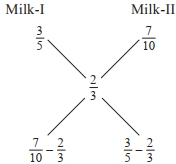
(B) Using the method of alligation,we consider the fraction of milk in each mixture.
In the first vessel,the fraction of milk is $\frac{3}{3+2} = \frac{3}{5}$.
In the second vessel,the fraction of milk is $\frac{7}{7+3} = \frac{7}{10}$.
The desired fraction of milk in the final mixture is $\frac{2}{2+1} = \frac{2}{3}$.
Applying the alligation rule:
Ratio of vessel $I$ to vessel $II = \left| \frac{7}{10} - \frac{2}{3} \right| : \left| \frac{3}{5} - \frac{2}{3} \right|$
$= \left| \frac{21-20}{30} \right| : \left| \frac{9-10}{15} \right|$
$= \frac{1}{30} : \frac{1}{15}$
$= \frac{1}{30} : \frac{2}{30}$
$= 1:2$.
In the first vessel,the fraction of milk is $\frac{3}{3+2} = \frac{3}{5}$.
In the second vessel,the fraction of milk is $\frac{7}{7+3} = \frac{7}{10}$.
The desired fraction of milk in the final mixture is $\frac{2}{2+1} = \frac{2}{3}$.
Applying the alligation rule:
Ratio of vessel $I$ to vessel $II = \left| \frac{7}{10} - \frac{2}{3} \right| : \left| \frac{3}{5} - \frac{2}{3} \right|$
$= \left| \frac{21-20}{30} \right| : \left| \frac{9-10}{15} \right|$
$= \frac{1}{30} : \frac{1}{15}$
$= \frac{1}{30} : \frac{2}{30}$
$= 1:2$.
0 likes
View Solution190
DifficultMCQ
$A$ can contains a mixture of two liquids $A$ and $B$ in the ratio $7:5$. When $9$ litres of the mixture are drawn off and the can is filled with $B$,the ratio of $A$ and $B$ becomes $7:9$. The quantity of liquid $A$ contained by the can initially was:
A
$10$
B
$20$
C
$21$
D
$25$
Solution
(C) Let the initial quantity of liquid $A$ be $7x$ litres and liquid $B$ be $5x$ litres.
Total initial quantity $= 7x + 5x = 12x$ litres.
When $9$ litres of the mixture are drawn off,the amount of $A$ removed is $\frac{7}{12} \times 9 = \frac{21}{4}$ litres,and the amount of $B$ removed is $\frac{5}{12} \times 9 = \frac{15}{4}$ litres.
Remaining quantity of $A = 7x - \frac{21}{4}$.
Remaining quantity of $B = 5x - \frac{15}{4} + 9 = 5x + \frac{21}{4}$.
According to the problem,the new ratio is $7:9$:
$\frac{7x - 21/4}{5x + 21/4} = \frac{7}{9}$.
$9(7x - 5.25) = 7(5x + 5.25)$.
$63x - 47.25 = 35x + 36.75$.
$28x = 84$.
$x = 3$.
Initial quantity of $A = 7x = 7 \times 3 = 21$ litres.
Total initial quantity $= 7x + 5x = 12x$ litres.
When $9$ litres of the mixture are drawn off,the amount of $A$ removed is $\frac{7}{12} \times 9 = \frac{21}{4}$ litres,and the amount of $B$ removed is $\frac{5}{12} \times 9 = \frac{15}{4}$ litres.
Remaining quantity of $A = 7x - \frac{21}{4}$.
Remaining quantity of $B = 5x - \frac{15}{4} + 9 = 5x + \frac{21}{4}$.
According to the problem,the new ratio is $7:9$:
$\frac{7x - 21/4}{5x + 21/4} = \frac{7}{9}$.
$9(7x - 5.25) = 7(5x + 5.25)$.
$63x - 47.25 = 35x + 36.75$.
$28x = 84$.
$x = 3$.
Initial quantity of $A = 7x = 7 \times 3 = 21$ litres.
0 likes
View Solution191
MediumMCQ
The ratio of the quantities of an acid and water in a mixture is $1:3$. If $5$ $litres$ of acid is further added to the mixture,the new ratio becomes $1:2$. The quantity of the new mixture in litres is
A
$32$
B
$40$
C
$42$
D
$45$
Solution
(D) Let the quantity of acid in the original mixture be $x$ litres and the quantity of water be $3x$ litres.
According to the problem,when $5$ litres of acid is added,the new ratio of acid to water becomes $1:2$.
So,$\frac{x+5}{3x} = \frac{1}{2}$.
Cross-multiplying,we get $2(x+5) = 3x$.
$2x + 10 = 3x$.
$3x - 2x = 10$,which gives $x = 10$.
The original quantity of the mixture was $x + 3x = 4x = 4(10) = 40$ litres.
After adding $5$ litres of acid,the quantity of the new mixture is $40 + 5 = 45$ litres.
According to the problem,when $5$ litres of acid is added,the new ratio of acid to water becomes $1:2$.
So,$\frac{x+5}{3x} = \frac{1}{2}$.
Cross-multiplying,we get $2(x+5) = 3x$.
$2x + 10 = 3x$.
$3x - 2x = 10$,which gives $x = 10$.
The original quantity of the mixture was $x + 3x = 4x = 4(10) = 40$ litres.
After adding $5$ litres of acid,the quantity of the new mixture is $40 + 5 = 45$ litres.
0 likes
View Solution192
DifficultMCQ
$A$ mixture contains $80 \%$ acid and the rest water. What part of the mixture should be removed and replaced by the same amount of water to make the ratio of acid to water $4:3$?
A
$1/7$
B
$1/8$
C
$1/9$
D
$1/10$
Solution
(A) Let the total volume of the mixture be $V$. Initially,the amount of acid is $0.8V$ and water is $0.2V$.
Let $x$ be the fraction of the mixture removed and replaced by water.
After removing $xV$ of the mixture,the remaining acid is $0.8V(1-x)$.
After adding $xV$ of water,the new amount of water is $0.2V(1-x) + xV$.
The new ratio of acid to water is given as $4:3$,so:
$\frac{0.8V(1-x)}{0.2V(1-x) + xV} = \frac{4}{3}$
$\frac{0.8(1-x)}{0.2 - 0.2x + x} = \frac{4}{3}$
$\frac{0.8(1-x)}{0.2 + 0.8x} = \frac{4}{3}$
$2.4(1-x) = 4(0.2 + 0.8x)$
$2.4 - 2.4x = 0.8 + 3.2x$
$1.6 = 5.6x$
$x = \frac{1.6}{5.6} = \frac{16}{56} = \frac{2}{7}$.
Wait,re-evaluating the ratio: $80\%$ acid means $4:1$ ratio. If we replace part $x$ with water,the acid content becomes $0.8(1-x)$. The total volume remains $V$. The new acid amount is $0.8(1-x)V$. Since the ratio is $4:3$,acid is $4/7$ of the total volume.
$0.8(1-x) = 4/7$
$4/5(1-x) = 4/7$
$1-x = 5/7$
$x = 1 - 5/7 = 2/7$.
Let $x$ be the fraction of the mixture removed and replaced by water.
After removing $xV$ of the mixture,the remaining acid is $0.8V(1-x)$.
After adding $xV$ of water,the new amount of water is $0.2V(1-x) + xV$.
The new ratio of acid to water is given as $4:3$,so:
$\frac{0.8V(1-x)}{0.2V(1-x) + xV} = \frac{4}{3}$
$\frac{0.8(1-x)}{0.2 - 0.2x + x} = \frac{4}{3}$
$\frac{0.8(1-x)}{0.2 + 0.8x} = \frac{4}{3}$
$2.4(1-x) = 4(0.2 + 0.8x)$
$2.4 - 2.4x = 0.8 + 3.2x$
$1.6 = 5.6x$
$x = \frac{1.6}{5.6} = \frac{16}{56} = \frac{2}{7}$.
Wait,re-evaluating the ratio: $80\%$ acid means $4:1$ ratio. If we replace part $x$ with water,the acid content becomes $0.8(1-x)$. The total volume remains $V$. The new acid amount is $0.8(1-x)V$. Since the ratio is $4:3$,acid is $4/7$ of the total volume.
$0.8(1-x) = 4/7$
$4/5(1-x) = 4/7$
$1-x = 5/7$
$x = 1 - 5/7 = 2/7$.
0 likes
View Solution193
DifficultMCQ
$A$ mixture contains $80 \%$ acid and the rest water. The part of the mixture that should be removed and replaced by the same amount of water to make the ratio of acid and water $4:3$ is
A
$\frac{1}{3}$
B
$\frac{3}{7}$
C
$\frac{2}{3}$
D
$\frac{2}{7}$
Solution
(D) Initially,the mixture contains $80 \%$ acid and $20 \%$ water,so the ratio of Acid : Water $= 80:20 = 4:1$.
Let the total volume of the mixture be $1$ unit. Let $x$ be the part of the mixture removed and replaced by water.
After removing $x$ part of the mixture,the remaining mixture is $(1-x)$.
The amount of acid remaining is $4(1-x)/5$ and the amount of water remaining is $(1-x)/5$.
After adding $x$ amount of water,the new amount of water is $(1-x)/5 + x$.
According to the problem,the new ratio of acid to water is $4:3$:
$\frac{4(1-x)/5}{(1-x)/5 + x} = \frac{4}{3}$
$\frac{4(1-x)}{1-x+5x} = \frac{4}{3}$
$\frac{1-x}{1+4x} = \frac{1}{3}$
$3 - 3x = 1 + 4x$
$7x = 2$
$x = \frac{2}{7}$
Let the total volume of the mixture be $1$ unit. Let $x$ be the part of the mixture removed and replaced by water.
After removing $x$ part of the mixture,the remaining mixture is $(1-x)$.
The amount of acid remaining is $4(1-x)/5$ and the amount of water remaining is $(1-x)/5$.
After adding $x$ amount of water,the new amount of water is $(1-x)/5 + x$.
According to the problem,the new ratio of acid to water is $4:3$:
$\frac{4(1-x)/5}{(1-x)/5 + x} = \frac{4}{3}$
$\frac{4(1-x)}{1-x+5x} = \frac{4}{3}$
$\frac{1-x}{1+4x} = \frac{1}{3}$
$3 - 3x = 1 + 4x$
$7x = 2$
$x = \frac{2}{7}$
0 likes
View Solution194
MediumMCQ
$A$ and $B$ are two alloys of gold and copper prepared by mixing metals in the ratio $7:2$ and $7:11$ respectively. If equal quantities of the alloys are melted to form a third alloy $C$,the ratio of gold and copper in $C$ will be
A
$5:7$
B
$5:9$
C
$7:5$
D
$9:5$
Solution
(C) Let the weight of alloy $A$ be $1 \text{ kg}$.
$\therefore$ Gold in $A = \frac{7}{9} \text{ kg}$ and copper in $A = \frac{2}{9} \text{ kg}$.
In $1 \text{ kg}$ of alloy $B$,Gold $= \frac{7}{18} \text{ kg}$ and copper $= \frac{11}{18} \text{ kg}$.
Since equal quantities are mixed,the total gold in alloy $C = \frac{7}{9} + \frac{7}{18} = \frac{14+7}{18} = \frac{21}{18} \text{ kg}$.
The total copper in alloy $C = \frac{2}{9} + \frac{11}{18} = \frac{4+11}{18} = \frac{15}{18} \text{ kg}$.
$\therefore$ Required ratio of gold to copper in $C = \frac{21}{18} : \frac{15}{18} = 21 : 15 = 7 : 5$.
$\therefore$ Gold in $A = \frac{7}{9} \text{ kg}$ and copper in $A = \frac{2}{9} \text{ kg}$.
In $1 \text{ kg}$ of alloy $B$,Gold $= \frac{7}{18} \text{ kg}$ and copper $= \frac{11}{18} \text{ kg}$.
Since equal quantities are mixed,the total gold in alloy $C = \frac{7}{9} + \frac{7}{18} = \frac{14+7}{18} = \frac{21}{18} \text{ kg}$.
The total copper in alloy $C = \frac{2}{9} + \frac{11}{18} = \frac{4+11}{18} = \frac{15}{18} \text{ kg}$.
$\therefore$ Required ratio of gold to copper in $C = \frac{21}{18} : \frac{15}{18} = 21 : 15 = 7 : 5$.
0 likes
View Solution195
MediumMCQ
In a laboratory,two bottles contain a mixture of acid and water in the ratio $2:5$ in the first bottle and $7:3$ in the second. The ratio in which the contents of these two bottles should be mixed such that the new mixture has acid and water in the ratio $2:3$ is
A
$4:15$
B
$9:8$
C
$21:8$
D
$1:2$
Solution
(C) Let the ratio of the first mixture to the second mixture be $x:y$.
In the first bottle,the fraction of acid is $\frac{2}{2+5} = \frac{2}{7}$.
In the second bottle,the fraction of acid is $\frac{7}{7+3} = \frac{7}{10}$.
In the final mixture,the fraction of acid is $\frac{2}{2+3} = \frac{2}{5}$.
Using the rule of alligation:
Difference between the second mixture and the final mixture: $\frac{7}{10} - \frac{2}{5} = \frac{7-4}{10} = \frac{3}{10}$.
Difference between the final mixture and the first mixture: $\frac{2}{5} - \frac{2}{7} = \frac{14-10}{35} = \frac{4}{35}$.
The ratio $x:y$ is $\frac{3}{10} : \frac{4}{35}$.
Multiplying both sides by $70$,we get $x:y = (\frac{3}{10} \times 70) : (\frac{4}{35} \times 70) = 21 : 8$.
In the first bottle,the fraction of acid is $\frac{2}{2+5} = \frac{2}{7}$.
In the second bottle,the fraction of acid is $\frac{7}{7+3} = \frac{7}{10}$.
In the final mixture,the fraction of acid is $\frac{2}{2+3} = \frac{2}{5}$.
Using the rule of alligation:
Difference between the second mixture and the final mixture: $\frac{7}{10} - \frac{2}{5} = \frac{7-4}{10} = \frac{3}{10}$.
Difference between the final mixture and the first mixture: $\frac{2}{5} - \frac{2}{7} = \frac{14-10}{35} = \frac{4}{35}$.
The ratio $x:y$ is $\frac{3}{10} : \frac{4}{35}$.
Multiplying both sides by $70$,we get $x:y = (\frac{3}{10} \times 70) : (\frac{4}{35} \times 70) = 21 : 8$.
0 likes
View Solution196
DifficultMCQ
The ratio of milk and water in mixtures of four containers are $5:3$,$2:1$,$3:2$,and $7:4$,respectively. In which container is the quantity of milk,relative to water,the minimum?
A
$First$
B
$Second$
C
$Third$
D
$Fourth$
Solution
(C) To find the container with the minimum quantity of milk relative to water,we calculate the fraction of milk in each mixture:
$1$. First container: $\frac{5}{5+3} = \frac{5}{8} = 0.625$
$2$. Second container: $\frac{2}{2+1} = \frac{2}{3} \approx 0.666$
$3$. Third container: $\frac{3}{3+2} = \frac{3}{5} = 0.600$
$4$. Fourth container: $\frac{7}{7+4} = \frac{7}{11} \approx 0.636$
Comparing the values: $0.600 < 0.625 < 0.636 < 0.666$.
The minimum value is $0.6$,which corresponds to the third container.
$1$. First container: $\frac{5}{5+3} = \frac{5}{8} = 0.625$
$2$. Second container: $\frac{2}{2+1} = \frac{2}{3} \approx 0.666$
$3$. Third container: $\frac{3}{3+2} = \frac{3}{5} = 0.600$
$4$. Fourth container: $\frac{7}{7+4} = \frac{7}{11} \approx 0.636$
Comparing the values: $0.600 < 0.625 < 0.636 < 0.666$.
The minimum value is $0.6$,which corresponds to the third container.
0 likes
View SolutionMixture and Alligation — Mixture and Alligation · Frequently Asked Questions
1Are these Mixture and Alligation questions useful for JEE and NEET?
Yes. All questions in this section are mapped to JEE Main and NEET exam patterns. Previous year questions from JEE Main, NEET, GUJCET and state-level exams are included with full solutions.
2Can I switch to Hindi or Gujarati for these questions?
Yes. Use the language tabs in the hero section or the sidebar to view the same questions and solutions in English, Hindi or Gujarati.
3How do I generate a question paper from this subtopic?
Use the Vedclass Exam Paper Generator — select the chapter and subtopic, set difficulty, and generate Sets A, B, C, D automatically. First 3 chapters of every subject are free.
Vedclass Products
For Students
Vedclass Test Series
Mock tests in real JEE/NEET style with performance analysis. 5-day free trial.
Start Free TrialFor Teachers
Exam Paper Generator
Generate Set A/B/C/D papers from this chapter in 2 minutes. 3 chapters free.
Try FreeFor Institutes
Online Exam Module
Live online exams with unlimited students, 360° analytics & white-label branding.
See DemoFor Teachers & Institutes
Generate a Mixture and Alligation Exam Paper in 2 Minutes
Select subtopic & difficulty — Sets A, B, C, D auto-generated with No Repeat logic.
First 3 chapters of every subject are free — no payment required.