
A English
Mixture and Alligation Questions in English
Competitive Exam Quantitative Aptitude · Mixture and Alligation · Mixture and Alligation
196+
Questions
English
Language
100%
With Solutions
Showing 50 of 196 questions in English
1
MediumMCQ
In a mixture of milk and water with a total volume of $60$ $L$,the ratio of milk to water is $7:5$. How much water must be added to make the ratio of milk to water equal $(1:1)$? (in $L$)
A
$8$
B
$10$
C
$15$
D
$20$
Solution
(B) Total volume of the mixture $= 60 \ L$.
The ratio of milk to water is $7:5$.
Sum of the ratio parts $= 7 + 5 = 12$.
Quantity of milk $= (7/12) \times 60 = 35 \ L$.
Quantity of water $= (5/12) \times 60 = 25 \ L$.
To make the ratio $1:1$,the quantity of water must be equal to the quantity of milk.
Required quantity of water $= 35 \ L$.
Water to be added $= 35 \ L - 25 \ L = 10 \ L$.
The ratio of milk to water is $7:5$.
Sum of the ratio parts $= 7 + 5 = 12$.
Quantity of milk $= (7/12) \times 60 = 35 \ L$.
Quantity of water $= (5/12) \times 60 = 25 \ L$.
To make the ratio $1:1$,the quantity of water must be equal to the quantity of milk.
Required quantity of water $= 35 \ L$.
Water to be added $= 35 \ L - 25 \ L = 10 \ L$.
0 likes
View Solution2
EasyMCQ
In a mixture of milk and water of volume $30$ $L$,the ratio of milk and water is $8:7$. How much water should be added to the mixture to make the ratio $4:5$? (in $L$)
A
$6$
B
$4.5$
C
$5$
D
$5.5$
Solution
(A) The total volume of the mixture is $30$ $L$ and the ratio of milk to water is $8:7$.
Sum of the ratio terms $= 8 + 7 = 15$.
Quantity of milk $= (8/15) \times 30 = 16$ $L$.
Quantity of water $= (7/15) \times 30 = 14$ $L$.
Let $x$ $L$ of water be added to the mixture.
The new ratio of milk to water becomes $4:5$.
So,$16 / (14 + x) = 4 / 5$.
Cross-multiplying gives: $16 \times 5 = 4 \times (14 + x)$.
$80 = 56 + 4x$.
$4x = 80 - 56 = 24$.
$x = 6$ $L$.
Therefore,$6$ $L$ of water should be added.
Sum of the ratio terms $= 8 + 7 = 15$.
Quantity of milk $= (8/15) \times 30 = 16$ $L$.
Quantity of water $= (7/15) \times 30 = 14$ $L$.
Let $x$ $L$ of water be added to the mixture.
The new ratio of milk to water becomes $4:5$.
So,$16 / (14 + x) = 4 / 5$.
Cross-multiplying gives: $16 \times 5 = 4 \times (14 + x)$.
$80 = 56 + 4x$.
$4x = 80 - 56 = 24$.
$x = 6$ $L$.
Therefore,$6$ $L$ of water should be added.
0 likes
View Solution3
EasyMCQ
In what ratio must oil at $Rs. 62$ per $kg$ be mixed with oil at $Rs. 72$ per $kg$ so that the mixture is worth $Rs. 64.50$ per $kg$?
A
$1:3$
B
$1:2$
C
$3:1$
D
$4:1$
Solution
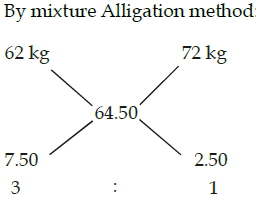
(C) Using the method of alligation:
Cost price of first oil = $Rs. 62$ per $kg$
Cost price of second oil = $Rs. 72$ per $kg$
Mean price of the mixture = $Rs. 64.50$ per $kg$
Applying the alligation rule:
Ratio of first oil to second oil = (Mean price - Cost price of second oil) : (Cost price of first oil - Mean price)
Ratio = $(72 - 64.50) : (64.50 - 62)$
Ratio = $7.50 : 2.50$
Ratio = $3 : 1$
Thus,the oil must be mixed in the ratio $3:1$.
Cost price of first oil = $Rs. 62$ per $kg$
Cost price of second oil = $Rs. 72$ per $kg$
Mean price of the mixture = $Rs. 64.50$ per $kg$
Applying the alligation rule:
Ratio of first oil to second oil = (Mean price - Cost price of second oil) : (Cost price of first oil - Mean price)
Ratio = $(72 - 64.50) : (64.50 - 62)$
Ratio = $7.50 : 2.50$
Ratio = $3 : 1$
Thus,the oil must be mixed in the ratio $3:1$.
0 likes
View Solution4
MediumMCQ
$A$ mixture of milk and water measures $60 \, ltr$. It contains $20 \%$ water. How many litres of water should be added to it so that water may be $25 \% $ (in $ltr$)?
A
$6$
B
$4$
C
$8$
D
$10$
Solution
(B) Initial quantity of water in the $60 \, ltr$ mixture is $= \frac{20}{100} \times 60 = 12 \, ltr$.
Quantity of milk in the mixture $= 60 \, ltr - 12 \, ltr = 48 \, ltr$.
In the new mixture, water is $25 \%$, which implies milk is $100 \% - 25 \% = 75 \%$.
Since only water is added, the quantity of milk remains constant at $48 \, ltr$.
Let the total quantity of the new mixture be $x \, ltr$.
According to the condition, $75 \%$ of $x = 48 \, ltr$.
$\frac{75}{100} \times x = 48 \Rightarrow \frac{3}{4} \times x = 48$.
$x = 48 \times \frac{4}{3} = 64 \, ltr$.
The amount of water to be added is the difference between the new total quantity and the initial total quantity: $64 \, ltr - 60 \, ltr = 4 \, ltr$.
Quantity of milk in the mixture $= 60 \, ltr - 12 \, ltr = 48 \, ltr$.
In the new mixture, water is $25 \%$, which implies milk is $100 \% - 25 \% = 75 \%$.
Since only water is added, the quantity of milk remains constant at $48 \, ltr$.
Let the total quantity of the new mixture be $x \, ltr$.
According to the condition, $75 \%$ of $x = 48 \, ltr$.
$\frac{75}{100} \times x = 48 \Rightarrow \frac{3}{4} \times x = 48$.
$x = 48 \times \frac{4}{3} = 64 \, ltr$.
The amount of water to be added is the difference between the new total quantity and the initial total quantity: $64 \, ltr - 60 \, ltr = 4 \, ltr$.
0 likes
View Solution5
EasyMCQ
In what ratio must a grocer mix two varieties of pulses costing $Rs. 15$ and $Rs. 20$ per $kg$ respectively so as to get a mixture worth $Rs. 16.5$ per $kg$?
A
$3:7$
B
$5:7$
C
$7:3$
D
$7:5$
Solution
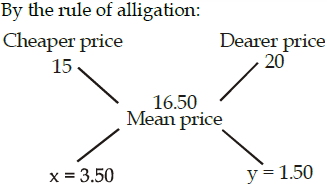
(C) By the rule of alligation:
Cheaper price $(Rs. 15)$ and Dearer price $(Rs. 20)$ are mixed to get a Mean price of $Rs. 16.50$.
Difference between Dearer price and Mean price $= 20 - 16.50 = 3.50$.
Difference between Mean price and Cheaper price $= 16.50 - 15 = 1.50$.
Required Ratio $= (\text{Difference between Dearer and Mean}) : (\text{Difference between Mean and Cheaper})$
Required Ratio $= 3.50 : 1.50 = 35 : 15 = 7 : 3$.
Cheaper price $(Rs. 15)$ and Dearer price $(Rs. 20)$ are mixed to get a Mean price of $Rs. 16.50$.
Difference between Dearer price and Mean price $= 20 - 16.50 = 3.50$.
Difference between Mean price and Cheaper price $= 16.50 - 15 = 1.50$.
Required Ratio $= (\text{Difference between Dearer and Mean}) : (\text{Difference between Mean and Cheaper})$
Required Ratio $= 3.50 : 1.50 = 35 : 15 = 7 : 3$.
0 likes
View Solution6
DifficultMCQ
$A$ dishonest milkman professes to sell his milk at cost price but he mixes it with water and thereby gains $25 \%$. The percentage of water in the mixture is?
A
$4$
B
$6$
C
$20$
D
$25$
Solution
(C) Let the cost price $(CP)$ of $1$ litre of pure milk be $1$ unit.
Since the milkman sells the mixture at the cost price of pure milk,the selling price $(SP)$ of $1$ litre of the mixture is $1$ unit.
He gains $25 \%$,so the $CP$ of $1$ litre of the mixture is given by:
$CP = \frac{SP}{1 + \text{Gain} \%} = \frac{1}{1 + 0.25} = \frac{1}{1.25} = \frac{100}{125} = \frac{4}{5}$ units.
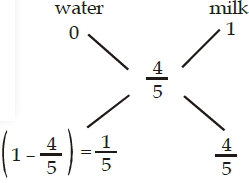
Using the rule of alligation:
- $CP$ of water = $0$
- $CP$ of milk = $1$
- Mean price = $\frac{4}{5}$
Ratio of water to milk = $(1 - \frac{4}{5}) : (\frac{4}{5} - 0) = \frac{1}{5} : \frac{4}{5} = 1 : 4$.
This means in $5$ parts of the mixture,there is $1$ part of water.
Percentage of water = $(\frac{1}{1 + 4}) \times 100 \% = \frac{1}{5} \times 100 \% = 20 \%$.
Since the milkman sells the mixture at the cost price of pure milk,the selling price $(SP)$ of $1$ litre of the mixture is $1$ unit.
He gains $25 \%$,so the $CP$ of $1$ litre of the mixture is given by:
$CP = \frac{SP}{1 + \text{Gain} \%} = \frac{1}{1 + 0.25} = \frac{1}{1.25} = \frac{100}{125} = \frac{4}{5}$ units.
Using the rule of alligation:
- $CP$ of water = $0$
- $CP$ of milk = $1$
- Mean price = $\frac{4}{5}$
Ratio of water to milk = $(1 - \frac{4}{5}) : (\frac{4}{5} - 0) = \frac{1}{5} : \frac{4}{5} = 1 : 4$.
This means in $5$ parts of the mixture,there is $1$ part of water.
Percentage of water = $(\frac{1}{1 + 4}) \times 100 \% = \frac{1}{5} \times 100 \% = 20 \%$.
0 likes
View Solution7
EasyMCQ
Find the ratio in which rice at $Rs. 7.20$ per $kg$ should be mixed with rice at $Rs. 5.70$ per $kg$ to produce a mixture worth $Rs. 6.30$ per $kg$.
A
$1:3$
B
$2:3$
C
$3:4$
D
$4:5$
Solution
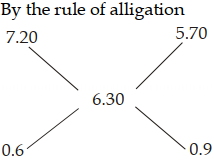
(B) Using the rule of alligation:
Cost price of first type of rice = $Rs. 7.20$ per $kg$
Cost price of second type of rice = $Rs. 5.70$ per $kg$
Mean price of the mixture = $Rs. 6.30$ per $kg$
By the rule of alligation,the ratio of the quantities is:
(Mean price - Cost price of second type) : (Cost price of first type - Mean price)
$= (6.30 - 5.70) : (7.20 - 6.30)$
$= 0.60 : 0.90$
$= 6 : 9$
$= 2 : 3$
Thus,the required ratio is $2:3$.
Cost price of first type of rice = $Rs. 7.20$ per $kg$
Cost price of second type of rice = $Rs. 5.70$ per $kg$
Mean price of the mixture = $Rs. 6.30$ per $kg$
By the rule of alligation,the ratio of the quantities is:
(Mean price - Cost price of second type) : (Cost price of first type - Mean price)
$= (6.30 - 5.70) : (7.20 - 6.30)$
$= 0.60 : 0.90$
$= 6 : 9$
$= 2 : 3$
Thus,the required ratio is $2:3$.
0 likes
View Solution8
EasyMCQ
Aditya and Sanjay started a business investing $45000$ and $30000$ respectively. What will be the ratio between their profit?
A
$2:3$
B
$3:2$
C
$4:9$
D
Cannot be determined
Solution
(B) In a business partnership, the profit is distributed in the same ratio as the capital invested by the partners.
Given investment of Aditya $= 45000$.
Given investment of Sanjay $= 30000$.
Required Ratio of profit $= \text{Investment of Aditya} : \text{Investment of Sanjay}$
$= 45000 : 30000$
$= 45 : 30$
$= 3 : 2$
Therefore, the ratio between their profit is $3:2$.
Given investment of Aditya $= 45000$.
Given investment of Sanjay $= 30000$.
Required Ratio of profit $= \text{Investment of Aditya} : \text{Investment of Sanjay}$
$= 45000 : 30000$
$= 45 : 30$
$= 3 : 2$
Therefore, the ratio between their profit is $3:2$.
0 likes
View Solution9
EasyMCQ
In what ratio must sugar at $Rs. 2$ per $kg$ be mixed with sugar at $Rs. 3.50$ per $kg$ so that the mixture is worth $Rs. 2.50$ per $kg$?
A
$2:1$
B
$1:5$
C
$3:1$
D
$2:3$
Solution
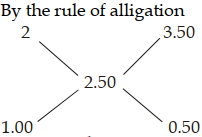
(A) Using the rule of alligation:
Cost price of first type of sugar = $Rs. 2.00$ per $kg$
Cost price of second type of sugar = $Rs. 3.50$ per $kg$
Mean price of the mixture = $Rs. 2.50$ per $kg$
By the rule of alligation:
(Quantity of first sugar) / (Quantity of second sugar) = (Price of second sugar - Mean price) / (Mean price - Price of first sugar)
Ratio = $(3.50 - 2.50) : (2.50 - 2.00)$
Ratio = $1.00 : 0.50$
Ratio = $100 : 50 = 2 : 1$
Therefore,the required ratio is $2:1$.
Cost price of first type of sugar = $Rs. 2.00$ per $kg$
Cost price of second type of sugar = $Rs. 3.50$ per $kg$
Mean price of the mixture = $Rs. 2.50$ per $kg$
By the rule of alligation:
(Quantity of first sugar) / (Quantity of second sugar) = (Price of second sugar - Mean price) / (Mean price - Price of first sugar)
Ratio = $(3.50 - 2.50) : (2.50 - 2.00)$
Ratio = $1.00 : 0.50$
Ratio = $100 : 50 = 2 : 1$
Therefore,the required ratio is $2:1$.
0 likes
View Solution10
MediumMCQ
$600 \, gm$ of sugar solution contains $40 \%$ sugar. How much sugar should be added to make the concentration $50 \%$ in the solution? (in $gm$)
A
$60$
B
$90$
C
$120$
D
$150$
Solution
(C) Initial amount of solution $= 600 \, gm$.
Initial amount of sugar $= 40 \% \text{ of } 600 = \frac{40}{100} \times 600 = 240 \, gm$.
Initial amount of water $= 600 - 240 = 360 \, gm$.
Let the amount of sugar to be added be $x \, gm$.
After adding sugar,the new amount of sugar $= 240 + x \, gm$.
The new total amount of solution $= 600 + x \, gm$.
We want the new concentration of sugar to be $50 \%$,which means the ratio of sugar to the total solution is $\frac{1}{2}$.
$\frac{240 + x}{600 + x} = \frac{50}{100} = \frac{1}{2}$.
$2(240 + x) = 600 + x$.
$480 + 2x = 600 + x$.
$2x - x = 600 - 480$.
$x = 120 \, gm$.
Initial amount of sugar $= 40 \% \text{ of } 600 = \frac{40}{100} \times 600 = 240 \, gm$.
Initial amount of water $= 600 - 240 = 360 \, gm$.
Let the amount of sugar to be added be $x \, gm$.
After adding sugar,the new amount of sugar $= 240 + x \, gm$.
The new total amount of solution $= 600 + x \, gm$.
We want the new concentration of sugar to be $50 \%$,which means the ratio of sugar to the total solution is $\frac{1}{2}$.
$\frac{240 + x}{600 + x} = \frac{50}{100} = \frac{1}{2}$.
$2(240 + x) = 600 + x$.
$480 + 2x = 600 + x$.
$2x - x = 600 - 480$.
$x = 120 \, gm$.
0 likes
View Solution11
MediumMCQ
Gold is $21$ times as heavy as water and copper is $11$ times as heavy as water. In what ratio should these metals be mixed so that the mixture may be $17$ times as heavy as water?
A
$1:2$
B
$2:1$
C
$3:1$
D
$3:2$
Solution
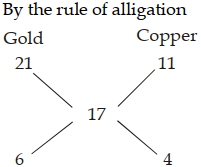
(D) Using the rule of alligation:
Density of Gold $= 21$
Density of Copper $= 11$
Mean density of mixture $= 17$
By applying the alligation rule:
(Gold) : (Copper) = $(17 - 11) : (21 - 17)$
(Gold) : (Copper) = $6 : 4$
Simplifying the ratio,we get $3 : 2$.
Density of Gold $= 21$
Density of Copper $= 11$
Mean density of mixture $= 17$
By applying the alligation rule:
(Gold) : (Copper) = $(17 - 11) : (21 - 17)$
(Gold) : (Copper) = $6 : 4$
Simplifying the ratio,we get $3 : 2$.
0 likes
View Solution12
MediumMCQ
$I$ have $100$ books of English. $I$ sold some of these at a profit of $12 \%$ and the rest at $8 \%$ loss. On the whole,$I$ got a profit of $11 \%$. How many books were sold at $12 \%$ profit by me?
A
$50$
B
$56$
C
$57$
D
$95$
Solution
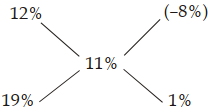
(D) Using the method of alligation:
Profit on first part = $12 \%$
Loss on second part = $-8 \%$
Overall profit = $11 \%$
Applying alligation:
Ratio of books sold at $12 \%$ profit to books sold at $8 \%$ loss = $(11 - (-8)) : (12 - 11) = 19 : 1$
Total parts = $19 + 1 = 20$
Number of books sold at $12 \%$ profit = $\frac{19}{20} \times 100 = 95$
Profit on first part = $12 \%$
Loss on second part = $-8 \%$
Overall profit = $11 \%$
Applying alligation:
Ratio of books sold at $12 \%$ profit to books sold at $8 \%$ loss = $(11 - (-8)) : (12 - 11) = 19 : 1$
Total parts = $19 + 1 = 20$
Number of books sold at $12 \%$ profit = $\frac{19}{20} \times 100 = 95$
0 likes
View Solution13
MediumMCQ
There are $3$ tubs which contain mixtures of milk and water in the ratios of $5:2, 4:3,$ and $3:1$ respectively. If the mixtures are poured into a single tub,find the ratio of milk to water.
A
$13:3$
B
$19:9$
C
$17:9$
D
Cannot be determined
Solution
(B) The ratio of milk to water in the three tubs is $5:2$,$4:3$,and $3:1$.
Fraction of milk in the first tub $= \frac{5}{5+2} = \frac{5}{7}$.
Fraction of milk in the second tub $= \frac{4}{4+3} = \frac{4}{7}$.
Fraction of milk in the third tub $= \frac{3}{3+1} = \frac{3}{4}$.
Total milk $= \frac{5}{7} + \frac{4}{7} + \frac{3}{4} = \frac{20 + 16 + 21}{28} = \frac{57}{28}$.
Fraction of water in the first tub $= \frac{2}{7}$.
Fraction of water in the second tub $= \frac{3}{7}$.
Fraction of water in the third tub $= \frac{1}{4}$.
Total water $= \frac{2}{7} + \frac{3}{7} + \frac{1}{4} = \frac{8 + 12 + 7}{28} = \frac{27}{28}$.
Ratio of milk to water $= \frac{57}{28} : \frac{27}{28} = 57 : 27 = 19 : 9$.
Fraction of milk in the first tub $= \frac{5}{5+2} = \frac{5}{7}$.
Fraction of milk in the second tub $= \frac{4}{4+3} = \frac{4}{7}$.
Fraction of milk in the third tub $= \frac{3}{3+1} = \frac{3}{4}$.
Total milk $= \frac{5}{7} + \frac{4}{7} + \frac{3}{4} = \frac{20 + 16 + 21}{28} = \frac{57}{28}$.
Fraction of water in the first tub $= \frac{2}{7}$.
Fraction of water in the second tub $= \frac{3}{7}$.
Fraction of water in the third tub $= \frac{1}{4}$.
Total water $= \frac{2}{7} + \frac{3}{7} + \frac{1}{4} = \frac{8 + 12 + 7}{28} = \frac{27}{28}$.
Ratio of milk to water $= \frac{57}{28} : \frac{27}{28} = 57 : 27 = 19 : 9$.
0 likes
View Solution14
EasyMCQ
In what proportion must sugar of $Rs. 17$ per $kg$ be mixed with sugar of $Rs. 29$ per $kg$ to make a mixture of $Rs. 20$ per $kg$?
A
$2:3$
B
$17:29$
C
$29:17$
D
$3:1$
Solution
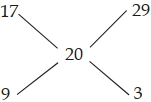
(D) Using the rule of alligation:
Cost price of first sugar = $Rs. 17/kg$
Cost price of second sugar = $Rs. 29/kg$
Mean price of mixture = $Rs. 20/kg$
Difference between mean price and cost price of second sugar = $|29 - 20| = 9$
Difference between mean price and cost price of first sugar = $|17 - 20| = 3$
The ratio of the first sugar to the second sugar is $9:3$.
Simplifying the ratio: $9:3 = 3:1$.
Therefore,the required proportion is $3:1$.
Cost price of first sugar = $Rs. 17/kg$
Cost price of second sugar = $Rs. 29/kg$
Mean price of mixture = $Rs. 20/kg$
Difference between mean price and cost price of second sugar = $|29 - 20| = 9$
Difference between mean price and cost price of first sugar = $|17 - 20| = 3$
The ratio of the first sugar to the second sugar is $9:3$.
Simplifying the ratio: $9:3 = 3:1$.
Therefore,the required proportion is $3:1$.
0 likes
View Solution15
MediumMCQ
In what proportion must pulses of $Rs. 70$ per $kg$ be mixed with pulses of $Rs. 45$ per $kg$ to get a mixture of $Rs. 60$ per $kg$?
A
$9:13$
B
$13:9$
C
$14:9$
D
$3:2$
Solution
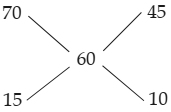
(D) Using the rule of alligation:
Cost price of first pulse $= Rs. 70/kg$
Cost price of second pulse $= Rs. 45/kg$
Mean price of mixture $= Rs. 60/kg$
Difference between mean price and second price $= 60 - 45 = 15$
Difference between first price and mean price $= 70 - 60 = 10$
Required ratio of first pulse to second pulse $= 15 : 10 = 3 : 2$.
Cost price of first pulse $= Rs. 70/kg$
Cost price of second pulse $= Rs. 45/kg$
Mean price of mixture $= Rs. 60/kg$
Difference between mean price and second price $= 60 - 45 = 15$
Difference between first price and mean price $= 70 - 60 = 10$
Required ratio of first pulse to second pulse $= 15 : 10 = 3 : 2$.
0 likes
View Solution16
MediumMCQ
$A$ shopkeeper has $50 \ kg$ of rice,a part of which he sells at $10 \%$ profit and the rest at $5 \%$ loss. He gains $7 \%$ on the whole. What is the quantity sold at $10 \%$ gain?
A
$50 \ kg$
B
$40 \ kg$
C
$10 \ kg$
D
Cannot be determined
Solution
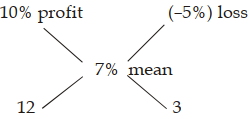
(B) Using the method of alligation:
Profit on first part = $10 \%$
Loss on second part = $-5 \%$
Overall gain = $7 \%$
Applying the alligation rule:
Ratio of quantities = $|-5 - 7| : |10 - 7| = |-12| : |3| = 12 : 3 = 4 : 1$
The total quantity is $50 \ kg$.
Quantity sold at $10 \%$ profit = $\frac{4}{4+1} \times 50 = \frac{4}{5} \times 50 = 40 \ kg$.
Profit on first part = $10 \%$
Loss on second part = $-5 \%$
Overall gain = $7 \%$
Applying the alligation rule:
Ratio of quantities = $|-5 - 7| : |10 - 7| = |-12| : |3| = 12 : 3 = 4 : 1$
The total quantity is $50 \ kg$.
Quantity sold at $10 \%$ profit = $\frac{4}{4+1} \times 50 = \frac{4}{5} \times 50 = 40 \ kg$.
0 likes
View Solution17
MediumMCQ
$A$ man buys $2$ cows for $Rs. 2700$ and sells one at a loss of $6\%$ and the other at a gain of $7.5\%$. On the whole,he neither gained nor lost. What is the cost price of the $2^{nd}$ cow?
A
$1100$
B
$1000$
C
$1200$
D
$6075$
Solution
(C) Let the cost price of the first cow be $C_1$ and the second cow be $C_2$.
Given $C_1 + C_2 = 2700$.
Since there is neither gain nor loss on the whole,the loss on the first cow equals the gain on the second cow.
$6\% \text{ of } C_1 = 7.5\% \text{ of } C_2$.
$\frac{C_1}{C_2} = \frac{7.5}{6} = \frac{75}{60} = \frac{5}{4}$.
Thus,the ratio of the cost prices is $C_1 : C_2 = 5 : 4$.
The cost price of the $2^{nd}$ cow is $C_2 = \frac{4}{5+4} \times 2700 = \frac{4}{9} \times 2700 = 4 \times 300 = Rs. 1200$.
Given $C_1 + C_2 = 2700$.
Since there is neither gain nor loss on the whole,the loss on the first cow equals the gain on the second cow.
$6\% \text{ of } C_1 = 7.5\% \text{ of } C_2$.
$\frac{C_1}{C_2} = \frac{7.5}{6} = \frac{75}{60} = \frac{5}{4}$.
Thus,the ratio of the cost prices is $C_1 : C_2 = 5 : 4$.
The cost price of the $2^{nd}$ cow is $C_2 = \frac{4}{5+4} \times 2700 = \frac{4}{9} \times 2700 = 4 \times 300 = Rs. 1200$.
0 likes
View Solution18
MediumMCQ
Aditya,Sonal,and Nutan contributed $Rs. 50,000$ for a business. Aditya contributed $Rs. 4,000$ more than Sonal,and Sonal contributed $Rs. 5,000$ more than Nutan. Out of a total profit of $Rs. 70,000$,how much did Aditya receive? (in $Rs.$)
A
$16,000$
B
$18,000$
C
$20,000$
D
$29,400$
Solution
(D) Let the investment of Nutan be $x$.
Then,Sonal's investment $= x + 5,000$.
Aditya's investment $= (x + 5,000) + 4,000 = x + 9,000$.
The total investment is $x + (x + 5,000) + (x + 9,000) = 50,000$.
$3x + 14,000 = 50,000$.
$3x = 36,000 \Rightarrow x = 12,000$.
Nutan's investment $= 12,000$.
Sonal's investment $= 12,000 + 5,000 = 17,000$.
Aditya's investment $= 12,000 + 9,000 = 21,000$.
The ratio of their investments is $21,000 : 17,000 : 12,000 = 21 : 17 : 12$.
The sum of the ratio parts is $21 + 17 + 12 = 50$.
Aditya's share of the profit $= \frac{21}{50} \times 70,000 = 21 \times 1,400 = 29,400$.
Then,Sonal's investment $= x + 5,000$.
Aditya's investment $= (x + 5,000) + 4,000 = x + 9,000$.
The total investment is $x + (x + 5,000) + (x + 9,000) = 50,000$.
$3x + 14,000 = 50,000$.
$3x = 36,000 \Rightarrow x = 12,000$.
Nutan's investment $= 12,000$.
Sonal's investment $= 12,000 + 5,000 = 17,000$.
Aditya's investment $= 12,000 + 9,000 = 21,000$.
The ratio of their investments is $21,000 : 17,000 : 12,000 = 21 : 17 : 12$.
The sum of the ratio parts is $21 + 17 + 12 = 50$.
Aditya's share of the profit $= \frac{21}{50} \times 70,000 = 21 \times 1,400 = 29,400$.
0 likes
View Solution19
EasyMCQ
The ratio in which two sugar solutions of the concentrations $15 \%$ and $40 \%$ are to be mixed to get a solution of concentration $30 \%$ is
A
$2:3$
B
$3:2$
C
$8:9$
D
$9:8$
Solution
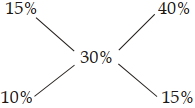
(A) Using the rule of alligation:
Concentration of first solution = $15 \%$
Concentration of second solution = $40 \%$
Mean concentration = $30 \%$
Difference between second concentration and mean = $40 - 30 = 10$
Difference between mean and first concentration = $30 - 15 = 15$
Ratio of first solution to second solution = $10 : 15$
Simplifying the ratio by dividing by $5$,we get $2 : 3$.
Therefore,the required ratio is $2 : 3$.
Concentration of first solution = $15 \%$
Concentration of second solution = $40 \%$
Mean concentration = $30 \%$
Difference between second concentration and mean = $40 - 30 = 10$
Difference between mean and first concentration = $30 - 15 = 15$
Ratio of first solution to second solution = $10 : 15$
Simplifying the ratio by dividing by $5$,we get $2 : 3$.
Therefore,the required ratio is $2 : 3$.
0 likes
View Solution20
MediumMCQ
Nikita bought $30 \text{ kg}$ of wheat at the rate of $Rs. 9.50$ per $\text{kg}$ and $40 \text{ kg}$ of wheat at the rate of $Rs. 8.50$ per $\text{kg}$ and mixed them. She sold the mixture at the rate of $Rs. 8.90$ per $\text{kg}$. Her total profit or loss in the transaction was:
A
$Rs. 2$ loss
B
$Rs. 2$ profit
C
$Rs. 7$ loss
D
$Rs. 7$ profit
Solution
(A) Cost Price $(CP)$ of $30 \text{ kg}$ of wheat $= 30 \times 9.50 = Rs. 285$.
Cost Price $(CP)$ of $40 \text{ kg}$ of wheat $= 40 \times 8.50 = Rs. 340$.
Total Cost Price $(CP)$ of $70 \text{ kg}$ of mixture $= 285 + 340 = Rs. 625$.
Selling Price $(SP)$ of $70 \text{ kg}$ of mixture $= 70 \times 8.90 = Rs. 623$.
Since $CP > SP$,there is a loss.
Loss $= CP - SP = 625 - 623 = Rs. 2$.
Cost Price $(CP)$ of $40 \text{ kg}$ of wheat $= 40 \times 8.50 = Rs. 340$.
Total Cost Price $(CP)$ of $70 \text{ kg}$ of mixture $= 285 + 340 = Rs. 625$.
Selling Price $(SP)$ of $70 \text{ kg}$ of mixture $= 70 \times 8.90 = Rs. 623$.
Since $CP > SP$,there is a loss.
Loss $= CP - SP = 625 - 623 = Rs. 2$.
0 likes
View Solution21
MediumMCQ
$A$ mixture of a certain quantity of milk with $16$ litres of water is worth $90$ $P$ per litre. If pure milk is worth $Rs. 1.08$ per litre,how much milk is there in the mixture? (in Litres)
A
$40$
B
$50$
C
$60$
D
$80$
Solution
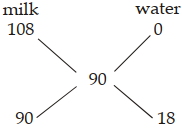
(D) Let the price of milk be $108$ paise per litre and the price of water be $0$ paise per litre.
The mean price of the mixture is $90$ paise per litre.
Using the rule of alligation:
Milk (Price: $108$) : Water (Price: $0$) = $(90 - 0) : (108 - 90) = 90 : 18 = 5 : 1$.
Given that the quantity of water is $16$ litres.
Let the quantity of milk be $x$ litres.
So,$x / 16 = 5 / 1$.
$x = 16 \times 5 = 80$ litres.
Thus,there are $80$ litres of milk in the mixture.
The mean price of the mixture is $90$ paise per litre.
Using the rule of alligation:
Milk (Price: $108$) : Water (Price: $0$) = $(90 - 0) : (108 - 90) = 90 : 18 = 5 : 1$.
Given that the quantity of water is $16$ litres.
Let the quantity of milk be $x$ litres.
So,$x / 16 = 5 / 1$.
$x = 16 \times 5 = 80$ litres.
Thus,there are $80$ litres of milk in the mixture.
0 likes
View Solution22
MediumMCQ
$A$ person has a chemical costing $Rs. 25$ per $litre$. In what ratio should water be mixed in the chemical so that by selling the mixture at $Rs. 20$ per $litre$,he may get a profit of $25\%$?
A
$14:9$
B
$16:9$
C
$9:14$
D
$9:16$
Solution
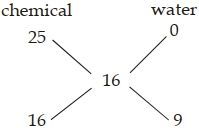
(B) Let the cost price of the chemical be $Rs. 25$ per $litre$ and the cost price of water be $Rs. 0$ per $litre$.
Given,selling price of the mixture $= Rs. 20$ per $litre$ and profit $= 25\%$.
Cost price $(CP)$ of the mixture $= \frac{100}{100 + \text{Profit}\%} \times \text{Selling Price} = \frac{100}{125} \times 20 = 16$.
Using the rule of alligation:
Chemical $(25)$ : Water $(0)$ = Mixture $(16)$
Difference between chemical and mixture $= 25 - 16 = 9$
Difference between water and mixture $= 16 - 0 = 16$
Therefore,the ratio of chemical to water is $16:9$.
Given,selling price of the mixture $= Rs. 20$ per $litre$ and profit $= 25\%$.
Cost price $(CP)$ of the mixture $= \frac{100}{100 + \text{Profit}\%} \times \text{Selling Price} = \frac{100}{125} \times 20 = 16$.
Using the rule of alligation:
Chemical $(25)$ : Water $(0)$ = Mixture $(16)$
Difference between chemical and mixture $= 25 - 16 = 9$
Difference between water and mixture $= 16 - 0 = 16$
Therefore,the ratio of chemical to water is $16:9$.
0 likes
View Solution23
MediumMCQ
$A$ mixture of $40$ $litres$ of milk and water contains $10 \%$ water. How much water must be added to make $20 \%$ water in the new mixture? (in $Liters$)
A
$3$
B
$4$
C
$5$
D
$6$
Solution
(C) Initial quantity of mixture $= 40$ $litres$.
Percentage of water $= 10 \%$,so quantity of water $= 0.10 \times 40 = 4$ $litres$.
Quantity of milk $= 40 - 4 = 36$ $litres$.
Let $x$ $litres$ of water be added to the mixture.
New quantity of water $= 4 + x$ $litres$.
New total quantity of mixture $= 40 + x$ $litres$.
According to the problem,the new percentage of water is $20 \%$,so:
$\frac{4 + x}{40 + x} = \frac{20}{100} = \frac{1}{5}$.
$5(4 + x) = 40 + x$.
$20 + 5x = 40 + x$.
$4x = 20$.
$x = 5$ $litres$.
Percentage of water $= 10 \%$,so quantity of water $= 0.10 \times 40 = 4$ $litres$.
Quantity of milk $= 40 - 4 = 36$ $litres$.
Let $x$ $litres$ of water be added to the mixture.
New quantity of water $= 4 + x$ $litres$.
New total quantity of mixture $= 40 + x$ $litres$.
According to the problem,the new percentage of water is $20 \%$,so:
$\frac{4 + x}{40 + x} = \frac{20}{100} = \frac{1}{5}$.
$5(4 + x) = 40 + x$.
$20 + 5x = 40 + x$.
$4x = 20$.
$x = 5$ $litres$.
0 likes
View Solution24
DifficultMCQ
If $2 \, kg$ of metal,of which $\frac{1}{3}$ is zinc and the rest is copper,is mixed with $3 \, kg$ of metal,of which $\frac{1}{4}$ is zinc and the rest is copper,what is the ratio of zinc to copper in the mixture?
A
$13:42$
B
$17:43$
C
$19:43$
D
$15:42$
Solution
(B) Quantity of zinc in the first metal $= \frac{1}{3} \times 2 = \frac{2}{3} \, kg$.
Quantity of copper in the first metal $= 2 - \frac{2}{3} = \frac{4}{3} \, kg$.
Quantity of zinc in the second metal $= \frac{1}{4} \times 3 = \frac{3}{4} \, kg$.
Quantity of copper in the second metal $= 3 - \frac{3}{4} = \frac{9}{4} \, kg$.
Total quantity of zinc in the mixture $= \frac{2}{3} + \frac{3}{4} = \frac{8 + 9}{12} = \frac{17}{12} \, kg$.
Total quantity of copper in the mixture $= \frac{4}{3} + \frac{9}{4} = \frac{16 + 27}{12} = \frac{43}{12} \, kg$.
Therefore,the required ratio of zinc to copper $= \frac{17}{12} : \frac{43}{12} = 17 : 43$.
Quantity of copper in the first metal $= 2 - \frac{2}{3} = \frac{4}{3} \, kg$.
Quantity of zinc in the second metal $= \frac{1}{4} \times 3 = \frac{3}{4} \, kg$.
Quantity of copper in the second metal $= 3 - \frac{3}{4} = \frac{9}{4} \, kg$.
Total quantity of zinc in the mixture $= \frac{2}{3} + \frac{3}{4} = \frac{8 + 9}{12} = \frac{17}{12} \, kg$.
Total quantity of copper in the mixture $= \frac{4}{3} + \frac{9}{4} = \frac{16 + 27}{12} = \frac{43}{12} \, kg$.
Therefore,the required ratio of zinc to copper $= \frac{17}{12} : \frac{43}{12} = 17 : 43$.
0 likes
View Solution25
MediumMCQ
$50 \, g$ of an alloy of gold and silver contains $80 \%$ gold (by weight). The quantity of gold,that is to be mixed with this alloy,so that it may contain $95 \%$ gold,is (in $g$)
A
$200$
B
$150$
C
$50$
D
$10$
Solution
(B) Initial weight of alloy $= 50 \, g$.
Weight of gold in the alloy $= 80 \% \text{ of } 50 \, g = 0.80 \times 50 = 40 \, g$.
Weight of silver in the alloy $= 50 - 40 = 10 \, g$.
Let the quantity of gold to be added be $x \, g$.
After adding $x \, g$ of gold,the new weight of gold $= 40 + x \, g$.
The total weight of the alloy becomes $50 + x \, g$.
According to the problem,the new percentage of gold is $95 \%$.
Therefore,the percentage of silver becomes $100 \% - 95 \% = 5 \%$.
Since the weight of silver remains constant at $10 \, g$,we can write:
$5 \% \text{ of } (50 + x) = 10 \, g$
$0.05 \times (50 + x) = 10$
$50 + x = \frac{10}{0.05} = 200$
$x = 200 - 50 = 150 \, g$.
Thus,$150 \, g$ of gold must be added.
Weight of gold in the alloy $= 80 \% \text{ of } 50 \, g = 0.80 \times 50 = 40 \, g$.
Weight of silver in the alloy $= 50 - 40 = 10 \, g$.
Let the quantity of gold to be added be $x \, g$.
After adding $x \, g$ of gold,the new weight of gold $= 40 + x \, g$.
The total weight of the alloy becomes $50 + x \, g$.
According to the problem,the new percentage of gold is $95 \%$.
Therefore,the percentage of silver becomes $100 \% - 95 \% = 5 \%$.
Since the weight of silver remains constant at $10 \, g$,we can write:
$5 \% \text{ of } (50 + x) = 10 \, g$
$0.05 \times (50 + x) = 10$
$50 + x = \frac{10}{0.05} = 200$
$x = 200 - 50 = 150 \, g$.
Thus,$150 \, g$ of gold must be added.
0 likes
View Solution26
DifficultMCQ
$A$ sum of $Rs. 6.40$ is made up of $80$ coins which are either $10$-paise or $5$-paise coins. How many $5$-paise coins are there?
A
$24$
B
$28$
C
$32$
D
$36$
Solution
(C) Let the number of $5$-paise coins be $x$ and the number of $10$-paise coins be $y$.
Given the total number of coins is $80$,so $x + y = 80$ ... $(i)$.
The total value of the coins is $Rs. 6.40$,which is $640$ paise.
Therefore,$5x + 10y = 640$ ... $(ii)$.
Divide equation $(ii)$ by $5$,we get $x + 2y = 128$ ... $(iii)$.
Subtract equation $(i)$ from equation $(iii)$:
$(x + 2y) - (x + y) = 128 - 80$
$y = 48$.
Substitute $y = 48$ into equation $(i)$:
$x + 48 = 80$
$x = 80 - 48 = 32$.
Thus,there are $32$ coins of $5$-paise.
Given the total number of coins is $80$,so $x + y = 80$ ... $(i)$.
The total value of the coins is $Rs. 6.40$,which is $640$ paise.
Therefore,$5x + 10y = 640$ ... $(ii)$.
Divide equation $(ii)$ by $5$,we get $x + 2y = 128$ ... $(iii)$.
Subtract equation $(i)$ from equation $(iii)$:
$(x + 2y) - (x + y) = 128 - 80$
$y = 48$.
Substitute $y = 48$ into equation $(i)$:
$x + 48 = 80$
$x = 80 - 48 = 32$.
Thus,there are $32$ coins of $5$-paise.
0 likes
View Solution27
MediumMCQ
How much tea at $Rs. 4$ a $kg$ should be added to $15 \, kg$ of tea at $Rs. 10$ per $kg$ so that the mixture is worth $Rs. 6.50$ a $kg$? (in $kg$)
A
$15$
B
$35$
C
$25$
D
$21$
Solution
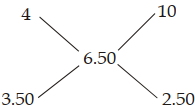
(D) Using the rule of alligation:
Price of first tea = $Rs. 4/kg$
Price of second tea = $Rs. 10/kg$
Mean price of mixture = $Rs. 6.50/kg$
Applying alligation:
(Price of second tea - Mean price) : (Mean price - Price of first tea)
$= (10 - 6.50) : (6.50 - 4)$
$= 3.50 : 2.50$
$= 35 : 25 = 7 : 5$
Let the quantity of tea at $Rs. 4/kg$ be $x \, kg$.
Given,quantity of tea at $Rs. 10/kg = 15 \, kg$.
Ratio of quantities = $x : 15 = 7 : 5$
$x / 15 = 7 / 5$
$x = (7 \times 15) / 5$
$x = 7 \times 3 = 21 \, kg$.
Therefore,$21 \, kg$ of tea should be added.
Price of first tea = $Rs. 4/kg$
Price of second tea = $Rs. 10/kg$
Mean price of mixture = $Rs. 6.50/kg$
Applying alligation:
(Price of second tea - Mean price) : (Mean price - Price of first tea)
$= (10 - 6.50) : (6.50 - 4)$
$= 3.50 : 2.50$
$= 35 : 25 = 7 : 5$
Let the quantity of tea at $Rs. 4/kg$ be $x \, kg$.
Given,quantity of tea at $Rs. 10/kg = 15 \, kg$.
Ratio of quantities = $x : 15 = 7 : 5$
$x / 15 = 7 / 5$
$x = (7 \times 15) / 5$
$x = 7 \times 3 = 21 \, kg$.
Therefore,$21 \, kg$ of tea should be added.
0 likes
View Solution28
MediumMCQ
Gold is $19$ times as heavy as water and copper is $9$ times as heavy as water. In what ratio should these metals be mixed so that the mixture may be $15$ times as heavy as water?
A
$2:3$
B
$3:2$
C
$2:4$
D
$4:2$
Solution
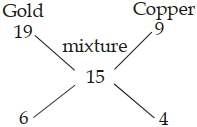
(B) Using the rule of alligation:
$1$. The density of gold relative to water is $19$.
$2$. The density of copper relative to water is $9$.
$3$. The desired density of the mixture relative to water is $15$.
Applying the alligation method:
- Difference between copper and mixture $= |9 - 15| = 6$
- Difference between gold and mixture $= |19 - 15| = 4$
Therefore,the ratio of gold to copper is $6:4$.
Simplifying the ratio $6:4$ gives $3:2$.
Thus,the metals should be mixed in the ratio $3:2$.
$1$. The density of gold relative to water is $19$.
$2$. The density of copper relative to water is $9$.
$3$. The desired density of the mixture relative to water is $15$.
Applying the alligation method:
- Difference between copper and mixture $= |9 - 15| = 6$
- Difference between gold and mixture $= |19 - 15| = 4$
Therefore,the ratio of gold to copper is $6:4$.
Simplifying the ratio $6:4$ gives $3:2$.
Thus,the metals should be mixed in the ratio $3:2$.
0 likes
View Solution29
DifficultMCQ
$A$ pot contains $81$ $\text{litres}$ of pure milk. $\frac{1}{3}$ of the milk is replaced by the same amount of water. Again $\frac{1}{3}$ of the mixture is replaced by that amount of water. The ratio of the milk and water in the new mixture is?
A
$1:2$
B
$1:1$
C
$2:1$
D
$4:5$
Solution
(D) Initial quantity of milk $(x)$ = $81$ $\text{litres}$.
Amount replaced in each operation $(y)$ = $\frac{1}{3} \times 81 = 27$ $\text{litres}$.
Number of operations $(n)$ = $2$.
Using the formula for the quantity of milk left after $n$ operations: $Milk_{left} = x(1 - \frac{y}{x})^n$.
$Milk_{left} = 81(1 - \frac{27}{81})^2 = 81(1 - \frac{1}{3})^2 = 81 \times (\frac{2}{3})^2$.
$Milk_{left} = 81 \times \frac{4}{9} = 9 \times 4 = 36$ $\text{litres}$.
Quantity of water in the mixture = Total volume - Quantity of milk = $81 - 36 = 45$ $\text{litres}$.
Required ratio of milk to water = $36 : 45$.
Dividing both by $9$, we get $4 : 5$.
Amount replaced in each operation $(y)$ = $\frac{1}{3} \times 81 = 27$ $\text{litres}$.
Number of operations $(n)$ = $2$.
Using the formula for the quantity of milk left after $n$ operations: $Milk_{left} = x(1 - \frac{y}{x})^n$.
$Milk_{left} = 81(1 - \frac{27}{81})^2 = 81(1 - \frac{1}{3})^2 = 81 \times (\frac{2}{3})^2$.
$Milk_{left} = 81 \times \frac{4}{9} = 9 \times 4 = 36$ $\text{litres}$.
Quantity of water in the mixture = Total volume - Quantity of milk = $81 - 36 = 45$ $\text{litres}$.
Required ratio of milk to water = $36 : 45$.
Dividing both by $9$, we get $4 : 5$.
0 likes
View Solution30
MediumMCQ
$A$ man has $60$ pens. He sells some of these at a profit of $12 \%$ and the rest at $8 \%$ loss. On the whole,he gets a profit of $11 \%$. How many pens were sold at $12 \%$ profit?
A
$47$
B
$52$
C
$55$
D
$57$
Solution
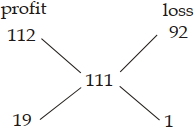
(D) Using the method of alligation:
Profit percentage $= 12 \%$,Loss percentage $= -8 \%$,Overall profit percentage $= 11 \%$.
Ratio of pens sold at profit to pens sold at loss:
$= (11 - (-8)) : (12 - 11)$
$= (11 + 8) : 1$
$= 19 : 1$
Total parts $= 19 + 1 = 20$.
Number of pens sold at $12 \%$ profit $= \frac{19}{20} \times 60 = 19 \times 3 = 57$.
Profit percentage $= 12 \%$,Loss percentage $= -8 \%$,Overall profit percentage $= 11 \%$.
Ratio of pens sold at profit to pens sold at loss:
$= (11 - (-8)) : (12 - 11)$
$= (11 + 8) : 1$
$= 19 : 1$
Total parts $= 19 + 1 = 20$.
Number of pens sold at $12 \%$ profit $= \frac{19}{20} \times 60 = 19 \times 3 = 57$.
0 likes
View Solution31
MediumMCQ
In what ratio must water be mixed with milk to gain $16 \%$ on selling the mixture at cost price?
A
$1:6$
B
$4:25$
C
$2:3$
D
$4:3$
Solution
(B) Let the cost price $(CP)$ of $1$ litre of milk be $Rs. 1$.
Since the mixture is sold at the cost price of milk,the selling price $(SP)$ of $1$ litre of the mixture is $Rs. 1$.
Given that the gain is $16 \%$,we can find the $CP$ of $1$ litre of the mixture using the formula: $CP = SP \times \frac{100}{100 + \text{gain} \%}$.
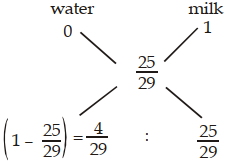
$CP = 1 \times \frac{100}{100 + 16} = \frac{100}{116} = \frac{25}{29}$.
Using the rule of alligation:
Cost of water = $0$
Cost of milk = $1$
Mean cost of mixture = $\frac{25}{29}$
Ratio of water to milk = $(\text{Cost of milk} - \text{Mean cost}) : (\text{Mean cost} - \text{Cost of water})$
Ratio = $(1 - \frac{25}{29}) : (\frac{25}{29} - 0) = \frac{4}{29} : \frac{25}{29} = 4 : 25$.
Since the mixture is sold at the cost price of milk,the selling price $(SP)$ of $1$ litre of the mixture is $Rs. 1$.
Given that the gain is $16 \%$,we can find the $CP$ of $1$ litre of the mixture using the formula: $CP = SP \times \frac{100}{100 + \text{gain} \%}$.
$CP = 1 \times \frac{100}{100 + 16} = \frac{100}{116} = \frac{25}{29}$.
Using the rule of alligation:
Cost of water = $0$
Cost of milk = $1$
Mean cost of mixture = $\frac{25}{29}$
Ratio of water to milk = $(\text{Cost of milk} - \text{Mean cost}) : (\text{Mean cost} - \text{Cost of water})$
Ratio = $(1 - \frac{25}{29}) : (\frac{25}{29} - 0) = \frac{4}{29} : \frac{25}{29} = 4 : 25$.
0 likes
View Solution32
MediumMCQ
In what ratio must a grocer mix two varieties of tea worth $Rs. 60$ per $kg$ and $Rs. 65$ per $kg$ so that by selling the mixture at $Rs. 68.20$ per $kg$ he may gain $10\%$?
A
$3:2$
B
$3:4$
C
$3:5$
D
$4:5$
Solution
(A) First,calculate the Cost Price $(CP)$ of the mixture.
Given Selling Price $(SP)$ = $Rs. 68.20$ per $kg$ and Profit = $10\%$.
$CP = \frac{100}{100 + \text{Profit}\%} \times SP$
$CP = \frac{100}{110} \times 68.20 = \frac{10}{11} \times 68.20 = Rs. 62$ per $kg$.
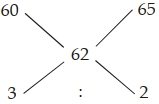
Now,apply the rule of Alligation:
Cost of first variety = $60$
Cost of second variety = $65$
Mean price = $62$
Difference between second variety and mean price = $|65 - 62| = 3$
Difference between mean price and first variety = $|62 - 60| = 2$
Therefore,the required ratio is $3:2$.
Given Selling Price $(SP)$ = $Rs. 68.20$ per $kg$ and Profit = $10\%$.
$CP = \frac{100}{100 + \text{Profit}\%} \times SP$
$CP = \frac{100}{110} \times 68.20 = \frac{10}{11} \times 68.20 = Rs. 62$ per $kg$.
Now,apply the rule of Alligation:
Cost of first variety = $60$
Cost of second variety = $65$
Mean price = $62$
Difference between second variety and mean price = $|65 - 62| = 3$
Difference between mean price and first variety = $|62 - 60| = 2$
Therefore,the required ratio is $3:2$.
0 likes
View Solution33
DifficultMCQ
$A$ milk vendor has $2$ cans of milk. The first contains $25\%$ water and the rest milk. The second contains $50\%$ water. How much milk should he mix from each of the containers so as to get $12$ litres of milk such that the ratio of water to milk is $3:5$?
A
$4$ litres,$8$ litres
B
$6$ litres,$6$ litres
C
$5$ litres,$7$ litres
D
$7$ litres,$5$ litres
Solution
(B) Let the quantity of milk taken from the first can be $x$ litres and from the second can be $(12 - x)$ litres.
In the first can,water is $25\%$,so milk is $75\% = \frac{3}{4}$.
In the second can,water is $50\%$,so milk is $50\% = \frac{1}{2}$.
The final mixture of $12$ litres has a water to milk ratio of $3:5$,which means milk is $\frac{5}{3+5} = \frac{5}{8}$ of the total volume.
Total milk in the final mixture $= 12 \times \frac{5}{8} = 7.5$ litres.
Now,set up the equation based on the milk content:
$\frac{3}{4}x + \frac{1}{2}(12 - x) = 7.5$
Multiply by $4$ to clear the denominators:
$3x + 2(12 - x) = 30$
$3x + 24 - 2x = 30$
$x = 6$ litres.
Therefore,the quantity from the first can is $6$ litres and from the second can is $12 - 6 = 6$ litres.
In the first can,water is $25\%$,so milk is $75\% = \frac{3}{4}$.
In the second can,water is $50\%$,so milk is $50\% = \frac{1}{2}$.
The final mixture of $12$ litres has a water to milk ratio of $3:5$,which means milk is $\frac{5}{3+5} = \frac{5}{8}$ of the total volume.
Total milk in the final mixture $= 12 \times \frac{5}{8} = 7.5$ litres.
Now,set up the equation based on the milk content:
$\frac{3}{4}x + \frac{1}{2}(12 - x) = 7.5$
Multiply by $4$ to clear the denominators:
$3x + 2(12 - x) = 30$
$3x + 24 - 2x = 30$
$x = 6$ litres.
Therefore,the quantity from the first can is $6$ litres and from the second can is $12 - 6 = 6$ litres.
0 likes
View Solution34
MediumMCQ
How many kilograms of sugar costing $Rs. 9$ per $kg$ must be mixed with $27\, kg$ of sugar costing $Rs. 7$ per $kg$ so that there may be a gain of $10\%$ by selling the mixture at $Rs. 9.24$ per $kg$?
A
$36$
B
$42$
C
$54$
D
$63$
Solution
(D) Let the cost price of the mixture be $CP$. Given that the selling price is $Rs. 9.24$ per $kg$ with a gain of $10\%$.
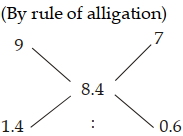
$CP = \frac{100}{110} \times 9.24 = \frac{10}{11} \times 9.24 = 8.4$.
Using the rule of alligation:
Cost of first type of sugar = $9$
Cost of second type of sugar = $7$
Mean price = $8.4$
Difference between mean price and second cost = $8.4 - 7 = 1.4$
Difference between first cost and mean price = $9 - 8.4 = 0.6$
Ratio of quantities = $1.4 : 0.6 = 14 : 6 = 7 : 3$.
Let the quantity of the first type of sugar be $x\, kg$.
Then,$\frac{x}{27} = \frac{7}{3}$.
$x = \frac{7}{3} \times 27 = 7 \times 9 = 63\, kg$.
$CP = \frac{100}{110} \times 9.24 = \frac{10}{11} \times 9.24 = 8.4$.
Using the rule of alligation:
Cost of first type of sugar = $9$
Cost of second type of sugar = $7$
Mean price = $8.4$
Difference between mean price and second cost = $8.4 - 7 = 1.4$
Difference between first cost and mean price = $9 - 8.4 = 0.6$
Ratio of quantities = $1.4 : 0.6 = 14 : 6 = 7 : 3$.
Let the quantity of the first type of sugar be $x\, kg$.
Then,$\frac{x}{27} = \frac{7}{3}$.
$x = \frac{7}{3} \times 27 = 7 \times 9 = 63\, kg$.
0 likes
View Solution35
MediumMCQ
$A$ container contains $50 \, \text{litres}$ of milk. From this container $5 \, \text{litres}$ of milk was taken out and replaced by water. This process was repeated further two times. How much milk is now contained by the container? (in $\text{litres}$)
A
$26.34$
B
$27.36$
C
$28$
D
$36.45$
Solution
(D) The formula for the quantity of milk remaining after $n$ operations is given by:
$\text{Remaining Milk} = x \left(1 - \frac{y}{x}\right)^n$
Where:
$x = 50 \, \text{litres}$ (initial quantity of milk)
$y = 5 \, \text{litres}$ (quantity replaced in each operation)
$n = 3$ (total number of operations,as the process was repeated two more times after the first)
Substituting the values:
$\text{Remaining Milk} = 50 \left(1 - \frac{5}{50}\right)^3$
$= 50 \left(1 - \frac{1}{10}\right)^3$
$= 50 \left(\frac{9}{10}\right)^3$
$= 50 \times \frac{729}{1000}$
$= \frac{729}{20} = 36.45 \, \text{litres}$
$\text{Remaining Milk} = x \left(1 - \frac{y}{x}\right)^n$
Where:
$x = 50 \, \text{litres}$ (initial quantity of milk)
$y = 5 \, \text{litres}$ (quantity replaced in each operation)
$n = 3$ (total number of operations,as the process was repeated two more times after the first)
Substituting the values:
$\text{Remaining Milk} = 50 \left(1 - \frac{5}{50}\right)^3$
$= 50 \left(1 - \frac{1}{10}\right)^3$
$= 50 \left(\frac{9}{10}\right)^3$
$= 50 \times \frac{729}{1000}$
$= \frac{729}{20} = 36.45 \, \text{litres}$
0 likes
View Solution36
MediumMCQ
In a mixture of milk and water of volume $30 \ L$,the ratio of water and milk is $3:7$. How much quantity of water should be added to the mixture to make the ratio of milk and water $1:2$ (in $L$)?
A
$23$
B
$21$
C
$12$
D
$33$
Solution
(D) Total volume of the mixture $= 30 \ L$.
The ratio of water to milk is $3:7$.
Sum of ratio parts $= 3 + 7 = 10$.
Quantity of water $= (3/10) \times 30 = 9 \ L$.
Quantity of milk $= (7/10) \times 30 = 21 \ L$.
Let the quantity of water added be $x \ L$.
New quantity of water $= 9 + x$.
New ratio of milk to water $= 1:2$.
Therefore,$\frac{\text{Milk}}{\text{Water}} = \frac{21}{9 + x} = \frac{1}{2}$.
Cross-multiplying,we get: $21 \times 2 = 9 + x$.
$42 = 9 + x$.
$x = 42 - 9 = 33 \ L$.
The ratio of water to milk is $3:7$.
Sum of ratio parts $= 3 + 7 = 10$.
Quantity of water $= (3/10) \times 30 = 9 \ L$.
Quantity of milk $= (7/10) \times 30 = 21 \ L$.
Let the quantity of water added be $x \ L$.
New quantity of water $= 9 + x$.
New ratio of milk to water $= 1:2$.
Therefore,$\frac{\text{Milk}}{\text{Water}} = \frac{21}{9 + x} = \frac{1}{2}$.
Cross-multiplying,we get: $21 \times 2 = 9 + x$.
$42 = 9 + x$.
$x = 42 - 9 = 33 \ L$.
0 likes
View Solution37
DifficultMCQ
The cost of Type $1$ rice is $Rs. 15$ per $kg$ and Type $2$ rice is $Rs. 20$ per $kg$. If both Type $1$ and Type $2$ are mixed in the ratio of $2:3$,then the price per $kg$ of the mixed variety of rice is? (in $Rs.$)
A
$18$
B
$18.50$
C
$19$
D
$19.50$
Solution
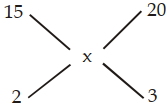
(A) Let the price per $kg$ of the mixture be $x$.
Using the weighted average formula:
Price of mixture $= \frac{(\text{Quantity}_1 \times \text{Price}_1) + (\text{Quantity}_2 \times \text{Price}_2)}{\text{Total Quantity}}$
Price of mixture $= \frac{(2 \times 15) + (3 \times 20)}{2 + 3}$
Price of mixture $= \frac{30 + 60}{5}$
Price of mixture $= \frac{90}{5} = 18$
Thus,the price per $kg$ of the mixed variety is $Rs. 18$.
Using the weighted average formula:
Price of mixture $= \frac{(\text{Quantity}_1 \times \text{Price}_1) + (\text{Quantity}_2 \times \text{Price}_2)}{\text{Total Quantity}}$
Price of mixture $= \frac{(2 \times 15) + (3 \times 20)}{2 + 3}$
Price of mixture $= \frac{30 + 60}{5}$
Price of mixture $= \frac{90}{5} = 18$
Thus,the price per $kg$ of the mixed variety is $Rs. 18$.
0 likes
View Solution38
MediumMCQ
$A$ merchant has $1000 \ kg$ of sugar,part of which he sells at $8 \%$ profit and the rest at $18 \%$ profit. If he gains $14 \%$ on the whole,then the quantity sold at $18 \%$ profit is.......$kg$.
A
$400$
B
$560$
C
$600$
D
$640$
Solution
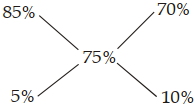
(C) Using the method of alligation:
Profit percentage of first part = $8 \%$
Profit percentage of second part = $18 \%$
Mean profit percentage = $14 \%$
Difference between second part and mean = $18 - 14 = 4$
Difference between mean and first part = $14 - 8 = 6$
Ratio of quantities = $4 : 6 = 2 : 3$
Total parts = $2 + 3 = 5$
Quantity sold at $18 \%$ profit = $\frac{3}{5} \times 1000 = 600 \ kg$.
Profit percentage of first part = $8 \%$
Profit percentage of second part = $18 \%$
Mean profit percentage = $14 \%$
Difference between second part and mean = $18 - 14 = 4$
Difference between mean and first part = $14 - 8 = 6$
Ratio of quantities = $4 : 6 = 2 : 3$
Total parts = $2 + 3 = 5$
Quantity sold at $18 \%$ profit = $\frac{3}{5} \times 1000 = 600 \ kg$.
0 likes
View Solution39
MediumMCQ
In an examination out of $900$ students,$85 \%$ of the boys and $70 \%$ of the girls passed. How many girls appeared in the examination,if the total pass percentage was $75 \% ?$
A
$400$
B
$560$
C
$600$
D
$640$
Solution
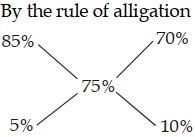
(C) Using the rule of alligation:
Boys pass percentage = $85 \%$
Girls pass percentage = $70 \%$
Total pass percentage = $75 \%$
Difference for boys = $|75 - 70| = 5$
Difference for girls = $|85 - 75| = 10$
Ratio of boys to girls = $5 : 10 = 1 : 2$
Total students = $900$
Number of girls = $\frac{2}{1 + 2} \times 900 = \frac{2}{3} \times 900 = 600$
Boys pass percentage = $85 \%$
Girls pass percentage = $70 \%$
Total pass percentage = $75 \%$
Difference for boys = $|75 - 70| = 5$
Difference for girls = $|85 - 75| = 10$
Ratio of boys to girls = $5 : 10 = 1 : 2$
Total students = $900$
Number of girls = $\frac{2}{1 + 2} \times 900 = \frac{2}{3} \times 900 = 600$
0 likes
View Solution40
MediumMCQ
$400 \, gm$ of salt solution has $40 \%$ salt in it. How much salt should be added to make the concentration $50 \%$ in the solution?
A
$60$
B
$70$
C
$65$
D
$80$
Solution
(D) Initial amount of solution $= 400 \, gm$.
Amount of salt $= 40 \% \text{ of } 400 = \frac{40}{100} \times 400 = 160 \, gm$.
Amount of water $= 400 - 160 = 240 \, gm$.
Let $x \, gm$ of salt be added.
New amount of salt $= 160 + x$.
New total amount of solution $= 400 + x$.
We want the new concentration of salt to be $50 \%$,so $\frac{160 + x}{400 + x} = \frac{50}{100} = \frac{1}{2}$.
$2(160 + x) = 400 + x$.
$320 + 2x = 400 + x$.
$x = 400 - 320 = 80 \, gm$.
Amount of salt $= 40 \% \text{ of } 400 = \frac{40}{100} \times 400 = 160 \, gm$.
Amount of water $= 400 - 160 = 240 \, gm$.
Let $x \, gm$ of salt be added.
New amount of salt $= 160 + x$.
New total amount of solution $= 400 + x$.
We want the new concentration of salt to be $50 \%$,so $\frac{160 + x}{400 + x} = \frac{50}{100} = \frac{1}{2}$.
$2(160 + x) = 400 + x$.
$320 + 2x = 400 + x$.
$x = 400 - 320 = 80 \, gm$.
0 likes
View Solution41
DifficultMCQ
Chocolates at $Rs. 12.00$ per dozen are mixed with chocolates at $Rs. 10.00$ per dozen in the ratio $3:5$. Find the price per dozen of the mixture (in $Rs.$).
A
$11.00$
B
$9.90$
C
$11.50$
D
$10.75$
Solution
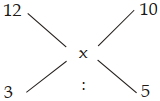
(D) Let the price per dozen of the mixture be $x$.
Using the weighted average method:
Price of mixture $= \frac{(3 \times 12) + (5 \times 10)}{3 + 5}$
Price of mixture $= \frac{36 + 50}{8}$
Price of mixture $= \frac{86}{8}$
Price of mixture $= 10.75$
Thus,the price per dozen of the mixture is $Rs. 10.75$.
Using the weighted average method:
Price of mixture $= \frac{(3 \times 12) + (5 \times 10)}{3 + 5}$
Price of mixture $= \frac{36 + 50}{8}$
Price of mixture $= \frac{86}{8}$
Price of mixture $= 10.75$
Thus,the price per dozen of the mixture is $Rs. 10.75$.
0 likes
View Solution42
MediumMCQ
Pencils at $Rs. 4.20$ per dozen are mixed with pencils at $Rs. 5.40$ per dozen in the ratio $3:5$. Find the price per dozen of the mixture (in $Rs.$).
A
$4.95$
B
$4.50$
C
$5.00$
D
$5.05$
Solution
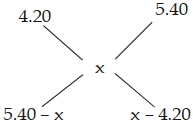
(A) Let the mean price of the mixture be $x$ per dozen.
Using the method of alligation:
Ratio of quantities = $\frac{\text{Price}_2 - x}{x - \text{Price}_1} = \frac{3}{5}$
$\frac{5.40 - x}{x - 4.20} = \frac{3}{5}$
$5(5.40 - x) = 3(x - 4.20)$
$27.00 - 5x = 3x - 12.60$
$8x = 39.60$
$x = \frac{39.60}{8} = 4.95$
Thus,the price per dozen of the mixture is $Rs. 4.95$.
Using the method of alligation:
Ratio of quantities = $\frac{\text{Price}_2 - x}{x - \text{Price}_1} = \frac{3}{5}$
$\frac{5.40 - x}{x - 4.20} = \frac{3}{5}$
$5(5.40 - x) = 3(x - 4.20)$
$27.00 - 5x = 3x - 12.60$
$8x = 39.60$
$x = \frac{39.60}{8} = 4.95$
Thus,the price per dozen of the mixture is $Rs. 4.95$.
0 likes
View Solution43
MediumMCQ
$A$ mixture of $48$ litre of milk and water contains $10 \%$ of water. How much water must be added to make $20 \%$ water in the new mixture?
A
$2$
B
$6$
C
$4$
D
$5$
Solution
(B) Initial mixture volume $= 48 \text{ litre}$.
Water content $= 10 \% \text{ of } 48 = 4.8 \text{ litre}$.
Milk content $= 48 - 4.8 = 43.2 \text{ litre}$.
Let the amount of water to be added be $x \text{ litre}$.
In the new mixture,the amount of milk remains constant at $43.2 \text{ litre}$,but this now represents $(100 - 20) \% = 80 \%$ of the total new volume.
So,$80 \% \text{ of } (48 + x) = 43.2$.
$0.8 \times (48 + x) = 43.2$.
$48 + x = \frac{43.2}{0.8} = 54$.
$x = 54 - 48 = 6 \text{ litre}$.
Water content $= 10 \% \text{ of } 48 = 4.8 \text{ litre}$.
Milk content $= 48 - 4.8 = 43.2 \text{ litre}$.
Let the amount of water to be added be $x \text{ litre}$.
In the new mixture,the amount of milk remains constant at $43.2 \text{ litre}$,but this now represents $(100 - 20) \% = 80 \%$ of the total new volume.
So,$80 \% \text{ of } (48 + x) = 43.2$.
$0.8 \times (48 + x) = 43.2$.
$48 + x = \frac{43.2}{0.8} = 54$.
$x = 54 - 48 = 6 \text{ litre}$.
0 likes
View Solution44
DifficultMCQ
$A$ vessel of $160 \text{ litres}$ is filled with milk and water. $70 \%$ of milk and $30 \%$ of water is taken out of the vessel. After this task,it is found that the vessel is now filled by $55 \%$ of its original total quantity. What is the original quantity of milk and water in the vessel respectively?
A
$60, 700$
B
$100, 60$
C
$70, 90$
D
$90, 70$
Solution
(B) Let the quantity of milk be $M$ and water be $W$. Total quantity $M + W = 160 \text{ litres}$.
By the rule of alligation:
Milk $(70 \%)$ and Water $(30 \%)$ are mixed to get a final mixture of $55 \%$.
The differences are:
$|55 - 30| = 25$
$|70 - 55| = 15$
The ratio of milk to water is $25 : 15 = 5 : 3$.
Total parts $= 5 + 3 = 8$.
Quantity of milk $= \frac{5}{8} \times 160 = 100 \text{ litres}$.
Quantity of water $= \frac{3}{8} \times 160 = 60 \text{ litres}$.
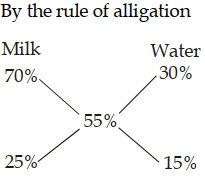
By the rule of alligation:
Milk $(70 \%)$ and Water $(30 \%)$ are mixed to get a final mixture of $55 \%$.
The differences are:
$|55 - 30| = 25$
$|70 - 55| = 15$
The ratio of milk to water is $25 : 15 = 5 : 3$.
Total parts $= 5 + 3 = 8$.
Quantity of milk $= \frac{5}{8} \times 160 = 100 \text{ litres}$.
Quantity of water $= \frac{3}{8} \times 160 = 60 \text{ litres}$.
0 likes
View Solution45
MediumMCQ
$A$ mixture of $80$ litre of milk and water contains $10 \%$ water. How much water must be added to make $20 \%$ water in the new mixture? (in $litre$)
A
$5$
B
$8$
C
$10$
D
$15$
Solution
(C) Initial mixture $= 80 \text{ litre}$.
Water content $= 10 \% \text{ of } 80 = 8 \text{ litre}$.
Milk content $= 80 - 8 = 72 \text{ litre}$.
Let the amount of water to be added be $x \text{ litre}$.
New total mixture $= 80 + x \text{ litre}$.
New water content $= 8 + x \text{ litre}$.
According to the problem,the new water content is $20 \%$ of the new mixture:
$8 + x = 0.20 \times (80 + x)$
$8 + x = 16 + 0.2x$
$x - 0.2x = 16 - 8$
$0.8x = 8$
$x = \frac{8}{0.8} = 10 \text{ litre}$.
Water content $= 10 \% \text{ of } 80 = 8 \text{ litre}$.
Milk content $= 80 - 8 = 72 \text{ litre}$.
Let the amount of water to be added be $x \text{ litre}$.
New total mixture $= 80 + x \text{ litre}$.
New water content $= 8 + x \text{ litre}$.
According to the problem,the new water content is $20 \%$ of the new mixture:
$8 + x = 0.20 \times (80 + x)$
$8 + x = 16 + 0.2x$
$x - 0.2x = 16 - 8$
$0.8x = 8$
$x = \frac{8}{0.8} = 10 \text{ litre}$.
0 likes
View Solution46
DifficultMCQ
$A$ tub contains a mixture of two liquids $P$ and $Q$ in the ratio of $4:1$. When $10 \, L$ of the mixture is taken out and $10 \, L$ of liquid $Q$ is poured into the tub,the ratio becomes $2:3$. How many litres of liquid $P$ were contained in the tub initially?
A
$10$
B
$15$
C
$20$
D
$16$
Solution
(D) Let the initial amount of liquid $P$ be $4x$ and liquid $Q$ be $x$.
When $10 \, L$ of the mixture is removed,the amount of $P$ removed is $\frac{4}{5} \times 10 = 8 \, L$ and the amount of $Q$ removed is $\frac{1}{5} \times 10 = 2 \, L$.
After removing the mixture,the remaining amount of $P$ is $4x - 8$ and the remaining amount of $Q$ is $x - 2$.
Then,$10 \, L$ of liquid $Q$ is added,so the new amount of $Q$ is $x - 2 + 10 = x + 8$.
The new ratio is given as $2:3$,so $\frac{4x - 8}{x + 8} = \frac{2}{3}$.
Cross-multiplying gives $3(4x - 8) = 2(x + 8)$,which simplifies to $12x - 24 = 2x + 16$.
$10x = 40$,so $x = 4$.
The initial quantity of liquid $P$ was $4x = 4 \times 4 = 16 \, L$.
When $10 \, L$ of the mixture is removed,the amount of $P$ removed is $\frac{4}{5} \times 10 = 8 \, L$ and the amount of $Q$ removed is $\frac{1}{5} \times 10 = 2 \, L$.
After removing the mixture,the remaining amount of $P$ is $4x - 8$ and the remaining amount of $Q$ is $x - 2$.
Then,$10 \, L$ of liquid $Q$ is added,so the new amount of $Q$ is $x - 2 + 10 = x + 8$.
The new ratio is given as $2:3$,so $\frac{4x - 8}{x + 8} = \frac{2}{3}$.
Cross-multiplying gives $3(4x - 8) = 2(x + 8)$,which simplifies to $12x - 24 = 2x + 16$.
$10x = 40$,so $x = 4$.
The initial quantity of liquid $P$ was $4x = 4 \times 4 = 16 \, L$.
0 likes
View Solution47
MediumMCQ
$A$ bottle contains $81$ litres of pure milk. $\frac{1}{3}$ of the milk is replaced by the same amount of water. Again,$\frac{1}{3}$ of the mixture is replaced by the same amount of water. The ratio of the milk and water in the new mixture is
A
$1:2$
B
$1:1$
C
$2:1$
D
$4:5$
Solution
(D) Initial quantity of milk $(x)$ = $81$ litres.
Amount replaced in each operation $(y)$ = $\frac{1}{3}$ of $81 = 27$ litres.
Number of operations $(n)$ = $2$.
The quantity of milk remaining after $n$ operations is given by the formula: $Milk_{final} = x \left(1 - \frac{y}{x}\right)^n$.
$Milk_{final} = 81 \left(1 - \frac{27}{81}\right)^2 = 81 \left(1 - \frac{1}{3}\right)^2 = 81 \times \left(\frac{2}{3}\right)^2$.
$Milk_{final} = 81 \times \frac{4}{9} = 9 \times 4 = 36$ litres.
Quantity of water in the final mixture = Total volume - Quantity of milk = $81 - 36 = 45$ litres.
Ratio of milk to water = $36 : 45$.
Dividing both by $9$,we get $4 : 5$.
Amount replaced in each operation $(y)$ = $\frac{1}{3}$ of $81 = 27$ litres.
Number of operations $(n)$ = $2$.
The quantity of milk remaining after $n$ operations is given by the formula: $Milk_{final} = x \left(1 - \frac{y}{x}\right)^n$.
$Milk_{final} = 81 \left(1 - \frac{27}{81}\right)^2 = 81 \left(1 - \frac{1}{3}\right)^2 = 81 \times \left(\frac{2}{3}\right)^2$.
$Milk_{final} = 81 \times \frac{4}{9} = 9 \times 4 = 36$ litres.
Quantity of water in the final mixture = Total volume - Quantity of milk = $81 - 36 = 45$ litres.
Ratio of milk to water = $36 : 45$.
Dividing both by $9$,we get $4 : 5$.
0 likes
View Solution48
MediumMCQ
Aditya and Manish continued in a joint business for $36$ months. Aditya contributed $Rs. 300$ for a certain time and Manish invested $Rs. 500$ for the remaining time. If out of a total profit of $Rs. 1020$,Aditya gets $Rs. 495$,then for how many months did Aditya keep his money?
A
$16$
B
$14$
C
$8$
D
$22$
Solution
(D) Total profit $= Rs. 1020$.
Aditya's share $= Rs. 495$.
Manish's share $= 1020 - 495 = Rs. 525$.
The ratio of their profit shares is equal to the ratio of their investments multiplied by time.
Let Aditya invest for $x$ months. Then Manish invests for $(36 - x)$ months.
Ratio of profit $= \frac{300 \times x}{500 \times (36 - x)} = \frac{495}{525}$.
Simplifying the fraction $\frac{495}{525}$ by dividing by $15$,we get $\frac{33}{35}$.
So,$\frac{3x}{5(36 - x)} = \frac{33}{35}$.
$\frac{x}{36 - x} = \frac{33}{35} \times \frac{5}{3} = \frac{11}{7}$.
$7x = 11(36 - x)$.
$7x = 396 - 11x$.
$18x = 396$.
$x = \frac{396}{18} = 22$.
Thus,Aditya kept his money for $22$ months.
Aditya's share $= Rs. 495$.
Manish's share $= 1020 - 495 = Rs. 525$.
The ratio of their profit shares is equal to the ratio of their investments multiplied by time.
Let Aditya invest for $x$ months. Then Manish invests for $(36 - x)$ months.
Ratio of profit $= \frac{300 \times x}{500 \times (36 - x)} = \frac{495}{525}$.
Simplifying the fraction $\frac{495}{525}$ by dividing by $15$,we get $\frac{33}{35}$.
So,$\frac{3x}{5(36 - x)} = \frac{33}{35}$.
$\frac{x}{36 - x} = \frac{33}{35} \times \frac{5}{3} = \frac{11}{7}$.
$7x = 11(36 - x)$.
$7x = 396 - 11x$.
$18x = 396$.
$x = \frac{396}{18} = 22$.
Thus,Aditya kept his money for $22$ months.
0 likes
View Solution49
DifficultMCQ
$A$ jar contained a mixture of two liquids $A$ and $B$ in the ratio $3 : 2.$ When $5$ litres of the mixture was taken out and $5$ litres of liquid $B$ was poured in the jar,this ratio became $2 : 3.$ The quantity of liquid $A$ contained in the jar initially was (in litres).
A
$4$
B
$8$
C
$9$
D
$32$
Solution
(C) Let the initial quantity of liquid $A$ be $3x$ and liquid $B$ be $2x.$ The total initial quantity is $5x.$
When $5$ litres of the mixture is removed,the amount of $A$ removed is $\frac{3}{5} \times 5 = 3$ litres,and the amount of $B$ removed is $\frac{2}{5} \times 5 = 2$ litres.
Remaining quantity of $A = 3x - 3$.
Remaining quantity of $B = 2x - 2$.
After adding $5$ litres of liquid $B$,the new quantity of $B = 2x - 2 + 5 = 2x + 3$.
The new ratio is given as $2 : 3$,so $\frac{3x - 3}{2x + 3} = \frac{2}{3}$.
Cross-multiplying gives: $3(3x - 3) = 2(2x + 3)$.
$9x - 9 = 4x + 6$.
$5x = 15$,which means $x = 3$.
The initial quantity of liquid $A = 3x = 3 \times 3 = 9$ litres.
When $5$ litres of the mixture is removed,the amount of $A$ removed is $\frac{3}{5} \times 5 = 3$ litres,and the amount of $B$ removed is $\frac{2}{5} \times 5 = 2$ litres.
Remaining quantity of $A = 3x - 3$.
Remaining quantity of $B = 2x - 2$.
After adding $5$ litres of liquid $B$,the new quantity of $B = 2x - 2 + 5 = 2x + 3$.
The new ratio is given as $2 : 3$,so $\frac{3x - 3}{2x + 3} = \frac{2}{3}$.
Cross-multiplying gives: $3(3x - 3) = 2(2x + 3)$.
$9x - 9 = 4x + 6$.
$5x = 15$,which means $x = 3$.
The initial quantity of liquid $A = 3x = 3 \times 3 = 9$ litres.
0 likes
View Solution50
MediumMCQ
$A$ man has $40 \ kg$ of tea,a part of which he sells at $5 \%$ loss and the rest at the cost price. In this business,he incurs a total loss of $3 \%$. Find the quantity of tea which he sells at the cost price (in $kg$).
A
$12$
B
$14$
C
$16$
D
$18$
Solution
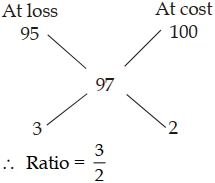
(C) Let the cost price of $1 \ kg$ of tea be $100$ units.
Total cost price of $40 \ kg$ of tea $= 40 \times 100 = 4000$ units.
He sells a part at $5 \%$ loss (i.e.,$95$ units per $kg$) and the rest at cost price (i.e.,$100$ units per $kg$).
Overall loss is $3 \%$,so the total selling price is $4000 \times 0.97 = 3880$ units.
Let $x$ be the quantity sold at $5 \%$ loss and $(40 - x)$ be the quantity sold at cost price.
$95x + 100(40 - x) = 3880$
$95x + 4000 - 100x = 3880$
$-5x = 3880 - 4000$
$-5x = -120$
$x = 24 \ kg$ (quantity sold at $5 \%$ loss).
Quantity sold at cost price $= 40 - 24 = 16 \ kg$.
Total cost price of $40 \ kg$ of tea $= 40 \times 100 = 4000$ units.
He sells a part at $5 \%$ loss (i.e.,$95$ units per $kg$) and the rest at cost price (i.e.,$100$ units per $kg$).
Overall loss is $3 \%$,so the total selling price is $4000 \times 0.97 = 3880$ units.
Let $x$ be the quantity sold at $5 \%$ loss and $(40 - x)$ be the quantity sold at cost price.
$95x + 100(40 - x) = 3880$
$95x + 4000 - 100x = 3880$
$-5x = 3880 - 4000$
$-5x = -120$
$x = 24 \ kg$ (quantity sold at $5 \%$ loss).
Quantity sold at cost price $= 40 - 24 = 16 \ kg$.
0 likes
View SolutionMixture and Alligation — Mixture and Alligation · Frequently Asked Questions
1Are these Mixture and Alligation questions useful for JEE and NEET?
Yes. All questions in this section are mapped to JEE Main and NEET exam patterns. Previous year questions from JEE Main, NEET, GUJCET and state-level exams are included with full solutions.
2Can I switch to Hindi or Gujarati for these questions?
Yes. Use the language tabs in the hero section or the sidebar to view the same questions and solutions in English, Hindi or Gujarati.
3How do I generate a question paper from this subtopic?
Use the Vedclass Exam Paper Generator — select the chapter and subtopic, set difficulty, and generate Sets A, B, C, D automatically. First 3 chapters of every subject are free.
Vedclass Products
For Students
Vedclass Test Series
Mock tests in real JEE/NEET style with performance analysis. 5-day free trial.
Start Free TrialFor Teachers
Exam Paper Generator
Generate Set A/B/C/D papers from this chapter in 2 minutes. 3 chapters free.
Try FreeFor Institutes
Online Exam Module
Live online exams with unlimited students, 360° analytics & white-label branding.
See DemoFor Teachers & Institutes
Generate a Mixture and Alligation Exam Paper in 2 Minutes
Select subtopic & difficulty — Sets A, B, C, D auto-generated with No Repeat logic.
First 3 chapters of every subject are free — no payment required.