
A English
Refraction by Lenses Questions in English
Class 12 Physics · Ray Optics and Optical Instruments · Refraction by Lenses
470+
Questions
English
Language
100%
With Solutions
Showing 50 of 470 questions in English
201
MediumMCQ
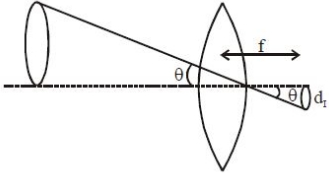
The sun subtends an angle of $(1/2)^o$ at the surface of the earth. $A$ converging lens of focal length $100\, cm$ is used to obtain an image of the sun on a screen. The diameter of the image formed is about.....$mm$.
A
$1$
B
$9$
C
$18$
D
$50$
Solution
(B) The angular diameter of the sun is given as $\theta = (1/2)^o$.
To use this in the formula,we convert it to radians:
$\theta = (1/2) \times (\pi / 180) \, \text{radians} = \pi / 360 \, \text{radians}$.
The focal length of the converging lens is $f = 100 \, cm = 1 \, m$.
The diameter of the image $d_I$ formed at the focal plane is given by the relation:
$d_I = f \times \theta$
$d_I = 100 \, cm \times (1/2) \times (\pi / 180) \, \text{radians}$
$d_I = 100 \times (1/2) \times (3.14159 / 180) \, cm$
$d_I \approx 0.8726 \, cm$
Converting to millimeters:
$d_I \approx 8.726 \, mm \approx 9 \, mm$.
Thus,the diameter of the image formed is about $9 \, mm$.
To use this in the formula,we convert it to radians:
$\theta = (1/2) \times (\pi / 180) \, \text{radians} = \pi / 360 \, \text{radians}$.
The focal length of the converging lens is $f = 100 \, cm = 1 \, m$.
The diameter of the image $d_I$ formed at the focal plane is given by the relation:
$d_I = f \times \theta$
$d_I = 100 \, cm \times (1/2) \times (\pi / 180) \, \text{radians}$
$d_I = 100 \times (1/2) \times (3.14159 / 180) \, cm$
$d_I \approx 0.8726 \, cm$
Converting to millimeters:
$d_I \approx 8.726 \, mm \approx 9 \, mm$.
Thus,the diameter of the image formed is about $9 \, mm$.
0 likes
View Solution202
AdvancedMCQ
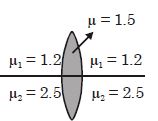
$A$ thin lens of material having refractive index $\mu = 1.5$ and focal length of $20 \ cm$ in air has two media of different refractive indices $\mu_1 = 1.2$ and $\mu_2 = 2.5$ covering the upper and lower halves of the lens,respectively,as shown in the figure. If an object is placed on the principal axis,then its two images will be formed,one after refraction from the upper part and the other after refraction from the lower part. Considering the object to be at $\infty$,the separation between the two images formed would be ...... $cm$.
A
$15$
B
$40$
C
$25$
D
$65$
Solution
(D) The focal length of a lens in a medium is given by the formula: $\frac{1}{f_m} = \left( \frac{\mu_l}{\mu_m} - 1 \right) \left( \frac{1}{R_1} - \frac{1}{R_2} \right)$.
Since the focal length in air $(f_a = 20 \ cm)$ is $\frac{1}{f_a} = (\mu - 1) \left( \frac{1}{R_1} - \frac{1}{R_2} \right)$,we can write the focal length in a medium as $f_m = f_a \frac{(\mu - 1)}{(\frac{\mu}{\mu_m} - 1)}$.
For the upper half,$\mu_m = \mu_1 = 1.2$:
$f_1 = 20 \times \frac{1.5 - 1}{\frac{1.5}{1.2} - 1} = 20 \times \frac{0.5}{1.25 - 1} = 20 \times \frac{0.5}{0.25} = 40 \ cm$.
For the lower half,$\mu_m = \mu_2 = 2.5$:
$f_2 = 20 \times \frac{1.5 - 1}{\frac{1.5}{2.5} - 1} = 20 \times \frac{0.5}{0.6 - 1} = 20 \times \frac{0.5}{-0.4} = -25 \ cm$.
Since the object is at infinity,the images are formed at the respective focal points.
The separation between the two images is $|f_1| + |f_2| = |40| + |-25| = 65 \ cm$.
Since the focal length in air $(f_a = 20 \ cm)$ is $\frac{1}{f_a} = (\mu - 1) \left( \frac{1}{R_1} - \frac{1}{R_2} \right)$,we can write the focal length in a medium as $f_m = f_a \frac{(\mu - 1)}{(\frac{\mu}{\mu_m} - 1)}$.
For the upper half,$\mu_m = \mu_1 = 1.2$:
$f_1 = 20 \times \frac{1.5 - 1}{\frac{1.5}{1.2} - 1} = 20 \times \frac{0.5}{1.25 - 1} = 20 \times \frac{0.5}{0.25} = 40 \ cm$.
For the lower half,$\mu_m = \mu_2 = 2.5$:
$f_2 = 20 \times \frac{1.5 - 1}{\frac{1.5}{2.5} - 1} = 20 \times \frac{0.5}{0.6 - 1} = 20 \times \frac{0.5}{-0.4} = -25 \ cm$.
Since the object is at infinity,the images are formed at the respective focal points.
The separation between the two images is $|f_1| + |f_2| = |40| + |-25| = 65 \ cm$.
0 likes
View Solution203
DifficultMCQ
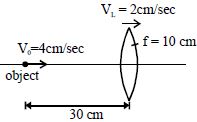
An object is moving with a velocity $V_O = 4 \text{ cm/sec}$ towards a convex lens of focal length $f = 10 \text{ cm}$. The lens is also moving with a velocity $V_L = 2 \text{ cm/sec}$ in the same direction. At the instant when the object is at a distance of $30 \text{ cm}$ from the lens,find the velocity of the image.
A
$4 \text{ cm/sec}$
B
$2.5 \text{ cm/sec}$
C
$6 \text{ cm/sec}$
D
None of the above
Solution
(B) Given: $f = +10 \text{ cm}$,$u = -30 \text{ cm}$,$V_O = +4 \text{ cm/sec}$,$V_L = +2 \text{ cm/sec}$.
Using the lens formula: $\frac{1}{v} - \frac{1}{u} = \frac{1}{f}$.
Differentiating with respect to time: $-\frac{1}{v^2} \frac{dv}{dt} + \frac{1}{u^2} \frac{du}{dt} = 0$,where $\frac{dv}{dt} = V_{I/L}$ and $\frac{du}{dt} = V_{O/L}$.
$V_{I/L} = \left(\frac{v}{u}\right)^2 V_{O/L} = m^2 V_{O/L}$.
First,find $v$: $\frac{1}{v} = \frac{1}{f} + \frac{1}{u} = \frac{1}{10} - \frac{1}{30} = \frac{2}{30} = \frac{1}{15} \implies v = +15 \text{ cm}$.
Magnification $m = \frac{v}{u} = \frac{15}{-30} = -0.5$.
Relative velocities: $V_{O/L} = V_O - V_L = 4 - 2 = +2 \text{ cm/sec}$.
$V_{I/L} = m^2 V_{O/L} = (-0.5)^2 \times 2 = 0.25 \times 2 = 0.5 \text{ cm/sec}$.
Since $V_{I/L} = V_I - V_L$,we have $V_I = V_{I/L} + V_L = 0.5 + 2 = 2.5 \text{ cm/sec}$.
Using the lens formula: $\frac{1}{v} - \frac{1}{u} = \frac{1}{f}$.
Differentiating with respect to time: $-\frac{1}{v^2} \frac{dv}{dt} + \frac{1}{u^2} \frac{du}{dt} = 0$,where $\frac{dv}{dt} = V_{I/L}$ and $\frac{du}{dt} = V_{O/L}$.
$V_{I/L} = \left(\frac{v}{u}\right)^2 V_{O/L} = m^2 V_{O/L}$.
First,find $v$: $\frac{1}{v} = \frac{1}{f} + \frac{1}{u} = \frac{1}{10} - \frac{1}{30} = \frac{2}{30} = \frac{1}{15} \implies v = +15 \text{ cm}$.
Magnification $m = \frac{v}{u} = \frac{15}{-30} = -0.5$.
Relative velocities: $V_{O/L} = V_O - V_L = 4 - 2 = +2 \text{ cm/sec}$.
$V_{I/L} = m^2 V_{O/L} = (-0.5)^2 \times 2 = 0.25 \times 2 = 0.5 \text{ cm/sec}$.
Since $V_{I/L} = V_I - V_L$,we have $V_I = V_{I/L} + V_L = 0.5 + 2 = 2.5 \text{ cm/sec}$.
0 likes
View Solution204
MediumMCQ
An illuminated object and a screen are placed $90 \, cm$ apart. What is the focal length of the lens required to produce an image on the screen,twice the size of the object?.......$cm$
A
$20$
B
$30$
C
$40$
D
$50$
Solution
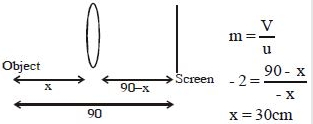
(A) Let the distance of the object from the lens be $u = -x \, cm$.
The distance of the screen from the lens is $v = +(90 - x) \, cm$.
The magnification $m$ for a real image is given by $m = \frac{v}{u} = -2$.
Substituting the values: $\frac{90 - x}{-x} = -2$.
$90 - x = 2x \Rightarrow 3x = 90 \Rightarrow x = 30 \, cm$.
Thus,$u = -30 \, cm$ and $v = 90 - 30 = 60 \, cm$.
Using the lens formula: $\frac{1}{f} = \frac{1}{v} - \frac{1}{u}$.
$\frac{1}{f} = \frac{1}{60} - \frac{1}{-30} = \frac{1}{60} + \frac{2}{60} = \frac{3}{60} = \frac{1}{20}$.
Therefore,$f = 20 \, cm$.
The distance of the screen from the lens is $v = +(90 - x) \, cm$.
The magnification $m$ for a real image is given by $m = \frac{v}{u} = -2$.
Substituting the values: $\frac{90 - x}{-x} = -2$.
$90 - x = 2x \Rightarrow 3x = 90 \Rightarrow x = 30 \, cm$.
Thus,$u = -30 \, cm$ and $v = 90 - 30 = 60 \, cm$.
Using the lens formula: $\frac{1}{f} = \frac{1}{v} - \frac{1}{u}$.
$\frac{1}{f} = \frac{1}{60} - \frac{1}{-30} = \frac{1}{60} + \frac{2}{60} = \frac{3}{60} = \frac{1}{20}$.
Therefore,$f = 20 \, cm$.
0 likes
View Solution205
DifficultMCQ
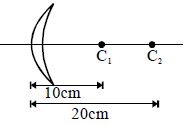
The figure shows a thin lens with centres of curvature $C_1$ and $C_2$. Find its focal length in $cm$. (Take refractive index $\mu = 1.5$)
A
$20$
B
$30$
C
$10$
D
$40$
Solution
(D) From the figure,the radii of curvature are $R_1 = 10 \ cm$ and $R_2 = 20 \ cm$. Both centers of curvature lie to the right of the lens,so by sign convention,both $R_1$ and $R_2$ are positive.
Using the lens maker's formula:
$\frac{1}{f} = (\mu - 1) \left( \frac{1}{R_1} - \frac{1}{R_2} \right)$
Substitute the given values: $\mu = 1.5$,$R_1 = 10 \ cm$,$R_2 = 20 \ cm$.
$\frac{1}{f} = (1.5 - 1) \left( \frac{1}{10} - \frac{1}{20} \right)$
$\frac{1}{f} = (0.5) \left( \frac{2 - 1}{20} \right)$
$\frac{1}{f} = 0.5 \times \frac{1}{20} = \frac{0.5}{20} = \frac{1}{40}$
Therefore,$f = 40 \ cm$.
Using the lens maker's formula:
$\frac{1}{f} = (\mu - 1) \left( \frac{1}{R_1} - \frac{1}{R_2} \right)$
Substitute the given values: $\mu = 1.5$,$R_1 = 10 \ cm$,$R_2 = 20 \ cm$.
$\frac{1}{f} = (1.5 - 1) \left( \frac{1}{10} - \frac{1}{20} \right)$
$\frac{1}{f} = (0.5) \left( \frac{2 - 1}{20} \right)$
$\frac{1}{f} = 0.5 \times \frac{1}{20} = \frac{0.5}{20} = \frac{1}{40}$
Therefore,$f = 40 \ cm$.
0 likes
View Solution206
MediumMCQ
When monochromatic red light is used instead of blue light in a convex lens, its focal length will
A
increase
B
decrease
C
remain same
D
does not depend on colour of light
Solution
(A) According to Cauchy's dispersion formula, the refractive index of a material depends on the wavelength of light. The refractive index for red light $(\mu_{R})$ is less than the refractive index for blue light $(\mu_{B})$, i.e., $\mu_{R} < \mu_{B}$.
The lens maker's formula is given by $\frac{1}{f} = (\mu - 1) \left( \frac{1}{R_{1}} - \frac{1}{R_{2}} \right)$.
Since $\mu_{R} < \mu_{B}$, the term $(\mu_{R} - 1)$ is smaller than $(\mu_{B} - 1)$.
Consequently, $\frac{1}{f_{R}} < \frac{1}{f_{B}}$, which implies $f_{R} > f_{B}$.
Therefore, when red light is used instead of blue light, the focal length of the convex lens will increase.
The lens maker's formula is given by $\frac{1}{f} = (\mu - 1) \left( \frac{1}{R_{1}} - \frac{1}{R_{2}} \right)$.
Since $\mu_{R} < \mu_{B}$, the term $(\mu_{R} - 1)$ is smaller than $(\mu_{B} - 1)$.
Consequently, $\frac{1}{f_{R}} < \frac{1}{f_{B}}$, which implies $f_{R} > f_{B}$.
Therefore, when red light is used instead of blue light, the focal length of the convex lens will increase.
0 likes
View Solution207
DifficultMCQ
An object is located in a fixed position in front of a screen. $A$ sharp image is obtained on the screen for two positions of a thin lens separated by $10\, cm$. The size of the images in the two situations are in the ratio $3 : 2$. What is the distance between the screen and the object in $cm$?
A
$124.5$
B
$144.5$
C
$65$
D
$99$
Solution
(D) Given: Separation between the two positions of the lens,$d = 10\, cm$.
Ratio of the sizes of the images in the two positions,$\frac{I_1}{I_2} = \frac{3}{2}$.
Let $D$ be the distance between the object and the screen.
Using the displacement method formula for a thin lens,the ratio of the image sizes is given by $\frac{I_1}{I_2} = \frac{(D+d)^2}{(D-d)^2}$.
Substituting the given values: $\frac{3}{2} = \frac{(D+10)^2}{(D-10)^2}$.
Taking the square root on both sides: $\sqrt{\frac{3}{2}} = \frac{D+10}{D-10}$.
This leads to $\sqrt{3}(D-10) = \sqrt{2}(D+10)$.
$D(\sqrt{3} - \sqrt{2}) = 10(\sqrt{3} + \sqrt{2})$.
$D = 10 \times \frac{\sqrt{3} + \sqrt{2}}{\sqrt{3} - \sqrt{2}} = 10 \times (\sqrt{3} + \sqrt{2})^2 = 10 \times (3 + 2 + 2\sqrt{6}) = 10(5 + 2\sqrt{6}) \approx 10(5 + 4.899) = 98.99\, cm \approx 99\, cm$.
Ratio of the sizes of the images in the two positions,$\frac{I_1}{I_2} = \frac{3}{2}$.
Let $D$ be the distance between the object and the screen.
Using the displacement method formula for a thin lens,the ratio of the image sizes is given by $\frac{I_1}{I_2} = \frac{(D+d)^2}{(D-d)^2}$.
Substituting the given values: $\frac{3}{2} = \frac{(D+10)^2}{(D-10)^2}$.
Taking the square root on both sides: $\sqrt{\frac{3}{2}} = \frac{D+10}{D-10}$.
This leads to $\sqrt{3}(D-10) = \sqrt{2}(D+10)$.
$D(\sqrt{3} - \sqrt{2}) = 10(\sqrt{3} + \sqrt{2})$.
$D = 10 \times \frac{\sqrt{3} + \sqrt{2}}{\sqrt{3} - \sqrt{2}} = 10 \times (\sqrt{3} + \sqrt{2})^2 = 10 \times (3 + 2 + 2\sqrt{6}) = 10(5 + 2\sqrt{6}) \approx 10(5 + 4.899) = 98.99\, cm \approx 99\, cm$.
0 likes
View Solution208
DifficultMCQ
The refractive index of the material of a concave lens is $\mu$. It is immersed in a medium of refractive index $\mu_1$. $A$ parallel beam of light is incident on the lens. The path of the emergent rays when $\mu_1 > \mu$ is
A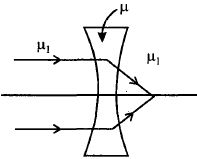
B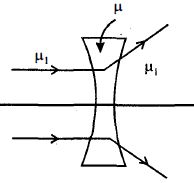
C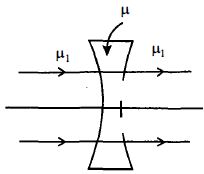
D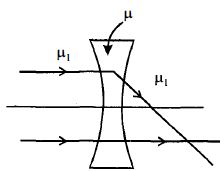
Solution
(A) The focal length $f$ of a lens of refractive index $\mu$ immersed in a medium of refractive index $\mu_1$ is given by the lens maker's formula:
$\frac{1}{f} = \left( \frac{\mu}{\mu_1} - 1 \right) \left( \frac{1}{R_1} - \frac{1}{R_2} \right)$
For a concave lens in air,the focal length is negative because $\mu > 1$ (where $\mu_1 = 1$ for air),making the term $(\frac{\mu}{\mu_1} - 1)$ positive and the bracket $(\frac{1}{R_1} - \frac{1}{R_2})$ negative.
When the lens is immersed in a medium such that $\mu_1 > \mu$,the term $(\frac{\mu}{\mu_1} - 1)$ becomes negative.
Since the geometric factor $(\frac{1}{R_1} - \frac{1}{R_2})$ remains negative for a concave lens,the product of two negative terms becomes positive,meaning the focal length $f$ becomes positive.
$A$ positive focal length indicates that the lens now acts as a converging lens. Therefore,a parallel beam of light incident on the lens will converge after passing through it. Thus,option $A$ is correct.
$\frac{1}{f} = \left( \frac{\mu}{\mu_1} - 1 \right) \left( \frac{1}{R_1} - \frac{1}{R_2} \right)$
For a concave lens in air,the focal length is negative because $\mu > 1$ (where $\mu_1 = 1$ for air),making the term $(\frac{\mu}{\mu_1} - 1)$ positive and the bracket $(\frac{1}{R_1} - \frac{1}{R_2})$ negative.
When the lens is immersed in a medium such that $\mu_1 > \mu$,the term $(\frac{\mu}{\mu_1} - 1)$ becomes negative.
Since the geometric factor $(\frac{1}{R_1} - \frac{1}{R_2})$ remains negative for a concave lens,the product of two negative terms becomes positive,meaning the focal length $f$ becomes positive.
$A$ positive focal length indicates that the lens now acts as a converging lens. Therefore,a parallel beam of light incident on the lens will converge after passing through it. Thus,option $A$ is correct.
0 likes
View Solution209
DifficultMCQ
The image of an illuminated square is obtained on a screen with the help of a converging lens. The distance of the square from the lens is $40\,cm$. The area of the image is $9$ times that of the square. The focal length of the lens is........$cm$.
A
$36$
B
$27$
C
$60$
D
$30$
Solution
(D) Let the side of the object square be $\ell$ and the side of the image square be $\ell^{\prime}$.
Given that the area of the image is $9$ times the area of the object,we have $\frac{\ell^{\prime 2}}{\ell^2} = 9$.
Taking the square root,the linear magnification $m = \frac{\ell^{\prime}}{\ell} = 3$.
Since the image is obtained on a screen,it is a real image,so $m = -3$ (for a real image formed by a single lens).
Given object distance $u = -40\,cm$.
Using magnification formula $m = \frac{v}{u}$,we get $v = m \times u = (-3) \times (-40) = 120\,cm$.
Using the lens formula $\frac{1}{f} = \frac{1}{v} - \frac{1}{u}$:
$\frac{1}{f} = \frac{1}{120} - \frac{1}{-40} = \frac{1}{120} + \frac{1}{40} = \frac{1+3}{120} = \frac{4}{120} = \frac{1}{30}$.
Therefore,the focal length $f = 30\,cm$.
Given that the area of the image is $9$ times the area of the object,we have $\frac{\ell^{\prime 2}}{\ell^2} = 9$.
Taking the square root,the linear magnification $m = \frac{\ell^{\prime}}{\ell} = 3$.
Since the image is obtained on a screen,it is a real image,so $m = -3$ (for a real image formed by a single lens).
Given object distance $u = -40\,cm$.
Using magnification formula $m = \frac{v}{u}$,we get $v = m \times u = (-3) \times (-40) = 120\,cm$.
Using the lens formula $\frac{1}{f} = \frac{1}{v} - \frac{1}{u}$:
$\frac{1}{f} = \frac{1}{120} - \frac{1}{-40} = \frac{1}{120} + \frac{1}{40} = \frac{1+3}{120} = \frac{4}{120} = \frac{1}{30}$.
Therefore,the focal length $f = 30\,cm$.
0 likes
View Solution210
MediumMCQ
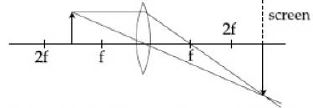
The formation of a real image using a biconvex lens is shown below:
If the whole setup is immersed in water without disturbing the object and the screen positions,what will one observe on the screen?
If the whole setup is immersed in water without disturbing the object and the screen positions,what will one observe on the screen?
A
Image disappears
B
Magnified image
C
Erect real image
D
No change
Solution
(A) According to the lens maker's formula,the focal length $f$ of a lens in a medium is given by $\frac{1}{f} = (\mu_{rel} - 1) (\frac{1}{R_1} - \frac{1}{R_2})$,where $\mu_{rel} = \frac{\mu_{lens}}{\mu_{medium}}$.
When the lens is immersed in water,the refractive index of the surrounding medium increases from $\mu_{air} \approx 1$ to $\mu_{water} \approx 1.33$. Consequently,the relative refractive index $\mu_{rel}$ decreases,which causes the focal length $f$ of the lens to increase.
Since the focal length increases,the image position shifts away from the lens. Because the positions of the object and the screen are fixed,the image will no longer be formed on the screen. Therefore,the image will disappear from the screen.
When the lens is immersed in water,the refractive index of the surrounding medium increases from $\mu_{air} \approx 1$ to $\mu_{water} \approx 1.33$. Consequently,the relative refractive index $\mu_{rel}$ decreases,which causes the focal length $f$ of the lens to increase.
Since the focal length increases,the image position shifts away from the lens. Because the positions of the object and the screen are fixed,the image will no longer be formed on the screen. Therefore,the image will disappear from the screen.
0 likes
View Solution211
DifficultMCQ
$A$ convex lens of focal length $20 \ cm$ produces images of the same magnification $2$ when an object is kept at two distances $x_1$ and $x_2$ $(x_1 > x_2)$ from the lens. The ratio of $x_1$ and $x_2$ is
A
$5 : 3$
B
$2 : 1$
C
$4 : 3$
D
$3 : 1$
Solution
(D) For a convex lens,magnification $m = \frac{f}{f+u}$.
Given $f = 20 \ cm$ and $|m| = 2$.
Case $1$: Real image,$m = -2$.
$-2 = \frac{20}{20 + x_1} \implies -40 - 2x_1 = 20 \implies -2x_1 = 60 \implies x_1 = 30 \ cm$.
Case $2$: Virtual image,$m = +2$.
$2 = \frac{20}{20 + x_2} \implies 40 + 2x_2 = 20 \implies 2x_2 = -20 \implies x_2 = 10 \ cm$.
Thus,the ratio $\frac{x_1}{x_2} = \frac{30}{10} = 3:1$.
Given $f = 20 \ cm$ and $|m| = 2$.
Case $1$: Real image,$m = -2$.
$-2 = \frac{20}{20 + x_1} \implies -40 - 2x_1 = 20 \implies -2x_1 = 60 \implies x_1 = 30 \ cm$.
Case $2$: Virtual image,$m = +2$.
$2 = \frac{20}{20 + x_2} \implies 40 + 2x_2 = 20 \implies 2x_2 = -20 \implies x_2 = 10 \ cm$.
Thus,the ratio $\frac{x_1}{x_2} = \frac{30}{10} = 3:1$.
0 likes
View Solution212
MediumMCQ
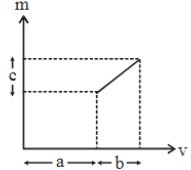
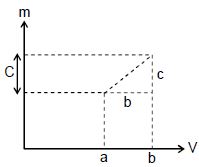
The graph shows how the magnification $m$ produced by a thin lens varies with image distance $v$. What is the focal length of the lens used?
A
$\frac {b^2}{ac}$
B
$\frac {a}{c}$
C
$\frac {b^2c}{a}$
D
$\frac {b}{c}$
Solution
(D) For a thin lens,the magnification $m$ is given by $m = \frac{v}{f} - 1$,where $v$ is the image distance and $f$ is the focal length.
This is a linear equation of the form $y = mx + c$,where the slope is $\frac{1}{f}$.
From the graph,the slope is the change in magnification divided by the change in image distance:
Slope $= \frac{\Delta m}{\Delta v} = \frac{c}{b}$.
Since the slope is also equal to $\frac{1}{f}$,we have $\frac{1}{f} = \frac{c}{b}$.
Therefore,the focal length is $f = \frac{b}{c}$.
This is a linear equation of the form $y = mx + c$,where the slope is $\frac{1}{f}$.
From the graph,the slope is the change in magnification divided by the change in image distance:
Slope $= \frac{\Delta m}{\Delta v} = \frac{c}{b}$.
Since the slope is also equal to $\frac{1}{f}$,we have $\frac{1}{f} = \frac{c}{b}$.
Therefore,the focal length is $f = \frac{b}{c}$.
0 likes
View Solution213
MediumMCQ
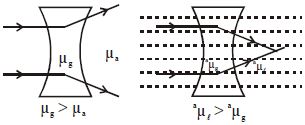
$A$ glass concave lens is placed in a liquid in which it behaves like a convergent lens. If the refractive indices of glass and liquid with respect to air are $^a{\mu _g}$ and $^a{\mu _l}$ respectively,then
A
$^a{\mu _g} = 5{\,^a}{\mu _l}$
B
$^a{\mu _g} > {\,^a}{\mu _l}$
C
$^a{\mu _g} < {\,^a}{\mu _l}$
D
$^a{\mu _g} = 2{\,^a}{\mu _l}$
Solution
(C) The focal length $f$ of a lens in a medium is given by the Lens Maker's Formula:
$\frac{1}{f} = (\frac{\mu_l}{\mu_g} - 1) (\frac{1}{R_1} - \frac{1}{R_2})$
For a concave lens,the term $(\frac{1}{R_1} - \frac{1}{R_2})$ is negative.
For the lens to behave as a convergent (convex) lens,its focal length $f$ must be positive.
This implies that the term $(\frac{\mu_g}{\mu_l} - 1)$ must be negative,which means $\frac{\mu_g}{\mu_l} < 1$,or $\mu_g < \mu_l$.
Here,$\mu_g$ is the refractive index of glass with respect to the liquid,which is $\frac{^a\mu_g}{^a\mu_l}$.
Therefore,$\frac{^a\mu_g}{^a\mu_l} < 1$,which gives $^a\mu_g < ^a\mu_l$.
$\frac{1}{f} = (\frac{\mu_l}{\mu_g} - 1) (\frac{1}{R_1} - \frac{1}{R_2})$
For a concave lens,the term $(\frac{1}{R_1} - \frac{1}{R_2})$ is negative.
For the lens to behave as a convergent (convex) lens,its focal length $f$ must be positive.
This implies that the term $(\frac{\mu_g}{\mu_l} - 1)$ must be negative,which means $\frac{\mu_g}{\mu_l} < 1$,or $\mu_g < \mu_l$.
Here,$\mu_g$ is the refractive index of glass with respect to the liquid,which is $\frac{^a\mu_g}{^a\mu_l}$.
Therefore,$\frac{^a\mu_g}{^a\mu_l} < 1$,which gives $^a\mu_g < ^a\mu_l$.
0 likes
View Solution214
MediumMCQ
$A$ bulb is located on a wall. Its image of equal size is to be obtained on a parallel wall with the help of a convex lens. The lens is placed at a distance $d$ ahead of the second wall. The required focal length will be:
A
$d/4$
B
less than $d/4$
C
only $d/2$
D
More than $d/4$ but less than $d/2$
Solution
(C) Let the distance between the two parallel walls be $D$. The bulb is on the first wall and the image is formed on the second wall.
For a convex lens to form a real image of equal size (magnification $m = -1$),the object distance $u$ and image distance $v$ must satisfy $u = v = 2f$.
The total distance between the object and the screen is $D = u + v = 2f + 2f = 4f$.
In this problem,the lens is placed at a distance $d$ from the second wall,which means the image distance $v = d$.
Since the image is of equal size,the object distance $u$ must also be equal to $d$ (because $u = v$ for $m = -1$).
Therefore,the total distance between the walls is $D = u + v = d + d = 2d$.
Using the relation $D = 4f$,we get $2d = 4f$.
Solving for $f$,we find $f = 2d / 4 = d / 2$.
For a convex lens to form a real image of equal size (magnification $m = -1$),the object distance $u$ and image distance $v$ must satisfy $u = v = 2f$.
The total distance between the object and the screen is $D = u + v = 2f + 2f = 4f$.
In this problem,the lens is placed at a distance $d$ from the second wall,which means the image distance $v = d$.
Since the image is of equal size,the object distance $u$ must also be equal to $d$ (because $u = v$ for $m = -1$).
Therefore,the total distance between the walls is $D = u + v = d + d = 2d$.
Using the relation $D = 4f$,we get $2d = 4f$.
Solving for $f$,we find $f = 2d / 4 = d / 2$.
0 likes
View Solution215
DifficultMCQ
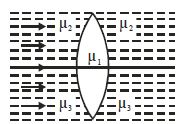
$A$ double convex lens,made of a material of refractive index $\mu_1$,is placed inside two liquids of refractive indices $\mu_2$ and $\mu_3$ as shown,where $\mu_2 > \mu_1 > \mu_3$. $A$ wide,parallel beam of light is incident on the lens from the left. The lens will give rise to:
A
a single convergent beam
B
two different convergent beams
C
two different divergent beams
D
a convergent and a divergent beam
Solution
(D) The focal length $f$ of a lens in a medium is given by the lens maker's formula: $\frac{1}{f} = (\frac{\mu_l}{\mu_m} - 1)(\frac{1}{R_1} - \frac{1}{R_2})$.
For the upper half of the lens,the surrounding medium has refractive index $\mu_2$. Since $\mu_2 > \mu_1$,the term $(\frac{\mu_1}{\mu_2} - 1)$ becomes negative. Thus,the upper half acts as a diverging lens.
For the lower half of the lens,the surrounding medium has refractive index $\mu_3$. Since $\mu_1 > \mu_3$,the term $(\frac{\mu_1}{\mu_3} - 1)$ is positive. Thus,the lower half acts as a converging lens.
Therefore,the lens produces a convergent beam from the lower half and a divergent beam from the upper half.
For the upper half of the lens,the surrounding medium has refractive index $\mu_2$. Since $\mu_2 > \mu_1$,the term $(\frac{\mu_1}{\mu_2} - 1)$ becomes negative. Thus,the upper half acts as a diverging lens.
For the lower half of the lens,the surrounding medium has refractive index $\mu_3$. Since $\mu_1 > \mu_3$,the term $(\frac{\mu_1}{\mu_3} - 1)$ is positive. Thus,the lower half acts as a converging lens.
Therefore,the lens produces a convergent beam from the lower half and a divergent beam from the upper half.
0 likes
View Solution216
MediumMCQ
An object and a screen are fixed on the uprights of an optical bench. The distance between them is $100 \, cm$. $A$ convex lens is placed in between the object and the screen and the position of the lens is so adjusted that the image of the object is formed on the screen at two conjugate positions of the lens. The distance between these conjugate positions of the lens is $40 \, cm$. What is the focal length of the lens in $cm$?
A
$15$
B
$18$
C
$21$
D
$24$
Solution
(C) In the displacement method for finding the focal length of a convex lens,the distance between the object and the screen is denoted by $D$ and the distance between the two conjugate positions of the lens is denoted by $d$.
Given:
$D = 100 \, cm$
$d = 40 \, cm$
The formula for the focal length $f$ is given by:
$f = \frac{D^2 - d^2}{4D}$
Substituting the given values:
$f = \frac{100^2 - 40^2}{4 \times 100}$
$f = \frac{10000 - 1600}{400}$
$f = \frac{8400}{400}$
$f = 21 \, cm$
Therefore,the focal length of the lens is $21 \, cm$.
Given:
$D = 100 \, cm$
$d = 40 \, cm$
The formula for the focal length $f$ is given by:
$f = \frac{D^2 - d^2}{4D}$
Substituting the given values:
$f = \frac{100^2 - 40^2}{4 \times 100}$
$f = \frac{10000 - 1600}{400}$
$f = \frac{8400}{400}$
$f = 21 \, cm$
Therefore,the focal length of the lens is $21 \, cm$.
0 likes
View Solution217
DifficultMCQ
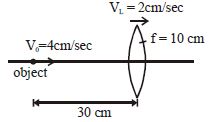
Find the velocity of the image of the given object in $cm/sec$.
A
$4$
B
$2.5$
C
$6$
D
None of the above
Solution
(B) Given: Focal length $f = +10 \ cm$,object distance $u = -30 \ cm$,velocity of object $\vec{V}_O = +4 \hat{i} \ cm/sec$,velocity of lens $\vec{V}_L = +2 \hat{i} \ cm/sec$.
Using the lens formula: $\frac{1}{v} - \frac{1}{u} = \frac{1}{f} \implies \frac{1}{v} - \frac{1}{-30} = \frac{1}{10} \implies \frac{1}{v} = \frac{1}{10} - \frac{1}{30} = \frac{2}{30} = \frac{1}{15}$.
So,$v = +15 \ cm$.
Transverse magnification $m = \frac{v}{u} = \frac{15}{-30} = -0.5$.
The formula for velocity of image with respect to the lens is $\vec{V}_{I/L} = m^2 \vec{V}_{O/L}$.
$\vec{V}_I - \vec{V}_L = m^2 (\vec{V}_O - \vec{V}_L)$.
$\vec{V}_I - 2 \hat{i} = (-0.5)^2 (4 \hat{i} - 2 \hat{i}) = 0.25 (2 \hat{i}) = 0.5 \hat{i}$.
$\vec{V}_I = 2 \hat{i} + 0.5 \hat{i} = 2.5 \hat{i} \ cm/sec$.
Using the lens formula: $\frac{1}{v} - \frac{1}{u} = \frac{1}{f} \implies \frac{1}{v} - \frac{1}{-30} = \frac{1}{10} \implies \frac{1}{v} = \frac{1}{10} - \frac{1}{30} = \frac{2}{30} = \frac{1}{15}$.
So,$v = +15 \ cm$.
Transverse magnification $m = \frac{v}{u} = \frac{15}{-30} = -0.5$.
The formula for velocity of image with respect to the lens is $\vec{V}_{I/L} = m^2 \vec{V}_{O/L}$.
$\vec{V}_I - \vec{V}_L = m^2 (\vec{V}_O - \vec{V}_L)$.
$\vec{V}_I - 2 \hat{i} = (-0.5)^2 (4 \hat{i} - 2 \hat{i}) = 0.25 (2 \hat{i}) = 0.5 \hat{i}$.
$\vec{V}_I = 2 \hat{i} + 0.5 \hat{i} = 2.5 \hat{i} \ cm/sec$.
0 likes
View Solution218
MediumMCQ
$A$ lens behaves as a converging lens in air and a diverging lens in water. The refractive index of the lens is
A
equal to unity
B
equal to $1.33$
C
between unity and $1.33$
D
greater than $1.33$
Solution
(C) The focal length of a lens in a medium is given by the Lens Maker's Formula: $\frac{1}{f} = (\frac{\mu_l}{\mu_m} - 1)(\frac{1}{R_1} - \frac{1}{R_2})$.
For a lens to change its nature (converging to diverging),the sign of the focal length must change when placed in water.
This happens if the refractive index of the lens material $\mu_l$ lies between the refractive index of air $(\mu_a \approx 1)$ and the refractive index of water $(\mu_w \approx 1.33)$.
Thus,the condition is $1 < \mu_l < 1.33$.
For a lens to change its nature (converging to diverging),the sign of the focal length must change when placed in water.
This happens if the refractive index of the lens material $\mu_l$ lies between the refractive index of air $(\mu_a \approx 1)$ and the refractive index of water $(\mu_w \approx 1.33)$.
Thus,the condition is $1 < \mu_l < 1.33$.
0 likes
View Solution219
MediumMCQ
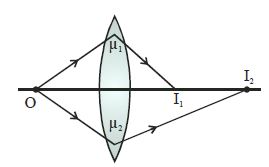
$A$ lens made up of different materials forms two images of a point object $O$ as shown in the figure. Then:
A
$\mu _1 > \mu _2$
B
$\mu _1 = \mu _2$
C
$\mu _2 > \mu _1$
D
Data insufficient
Solution
(A) The lens is composed of two different materials with refractive indices $\mu_1$ and $\mu_2$.
From the figure,the ray passing through the upper half of the lens converges at point $I_1$,while the ray passing through the lower half converges at point $I_2$.
The focal length $f$ of a lens is given by the lens maker's formula: $\frac{1}{f} = (\mu - 1) \left( \frac{1}{R_1} - \frac{1}{R_2} \right)$.
Since the geometry of the lens is the same for both halves,the focal length is inversely proportional to the refractive index,i.e.,$f \propto \frac{1}{\mu - 1}$.
From the figure,the image $I_1$ is formed closer to the lens than $I_2$,which means the focal length $f_1$ is less than $f_2$ $(f_1 < f_2)$.
Since $f \propto \frac{1}{\mu - 1}$,a smaller focal length corresponds to a larger refractive index.
Therefore,$\mu_1 > \mu_2$.
From the figure,the ray passing through the upper half of the lens converges at point $I_1$,while the ray passing through the lower half converges at point $I_2$.
The focal length $f$ of a lens is given by the lens maker's formula: $\frac{1}{f} = (\mu - 1) \left( \frac{1}{R_1} - \frac{1}{R_2} \right)$.
Since the geometry of the lens is the same for both halves,the focal length is inversely proportional to the refractive index,i.e.,$f \propto \frac{1}{\mu - 1}$.
From the figure,the image $I_1$ is formed closer to the lens than $I_2$,which means the focal length $f_1$ is less than $f_2$ $(f_1 < f_2)$.
Since $f \propto \frac{1}{\mu - 1}$,a smaller focal length corresponds to a larger refractive index.
Therefore,$\mu_1 > \mu_2$.
0 likes
View Solution220
DifficultMCQ
$A$ beam of light converges at a point $P$. Now a lens is placed in the path of the convergent beam $12 \, cm$ from $P$. At what point does the beam converge if the lens is a convex lens of focal length $20 \, cm$ (in $, cm$)?
A
$-7.5$
B
$7.5$
C
$48$
D
$-48$
Solution
(B) For a convergent beam,the point $P$ acts as a virtual object for the lens.
Since the beam is converging towards $P$,the object distance $u$ is taken as positive.
Given: $u = +12 \, cm$ and $f = +20 \, cm$ (for a convex lens).
Using the lens formula: $\frac{1}{f} = \frac{1}{v} - \frac{1}{u}$.
Substituting the values: $\frac{1}{20} = \frac{1}{v} - \frac{1}{12}$.
Rearranging for $v$: $\frac{1}{v} = \frac{1}{20} + \frac{1}{12}$.
Calculating the sum: $\frac{1}{v} = \frac{3 + 5}{60} = \frac{8}{60} = \frac{2}{15}$.
Therefore,$v = \frac{15}{2} = 7.5 \, cm$.
The beam converges at a distance of $7.5 \, cm$ from the lens.
Since the beam is converging towards $P$,the object distance $u$ is taken as positive.
Given: $u = +12 \, cm$ and $f = +20 \, cm$ (for a convex lens).
Using the lens formula: $\frac{1}{f} = \frac{1}{v} - \frac{1}{u}$.
Substituting the values: $\frac{1}{20} = \frac{1}{v} - \frac{1}{12}$.
Rearranging for $v$: $\frac{1}{v} = \frac{1}{20} + \frac{1}{12}$.
Calculating the sum: $\frac{1}{v} = \frac{3 + 5}{60} = \frac{8}{60} = \frac{2}{15}$.
Therefore,$v = \frac{15}{2} = 7.5 \, cm$.
The beam converges at a distance of $7.5 \, cm$ from the lens.
0 likes
View Solution221
DifficultMCQ
The magnification of an object placed in front of a convex lens of focal length $20 \, cm$ is $+2$. To obtain a magnification of $-2$,the object has to be moved a distance equal to.....$cm$
A
$10$
B
$20$
C
$30$
D
$40$
Solution
(B) Given: Focal length $f = 20 \, cm$.
For the first case,magnification $m_1 = +2$.
Using the formula $m = \frac{f}{f+u}$,we have $2 = \frac{20}{20+u_1}$.
$40 + 2u_1 = 20 \Rightarrow 2u_1 = -20 \Rightarrow u_1 = -10 \, cm$.
For the second case,magnification $m_2 = -2$.
Using the same formula,$-2 = \frac{20}{20+u_2}$.
$-40 - 2u_2 = 20 \Rightarrow 2u_2 = -60 \Rightarrow u_2 = -30 \, cm$.
The distance the object has to be moved is $\Delta u = |u_2 - u_1| = |-30 - (-10)| = |-20| = 20 \, cm$.
For the first case,magnification $m_1 = +2$.
Using the formula $m = \frac{f}{f+u}$,we have $2 = \frac{20}{20+u_1}$.
$40 + 2u_1 = 20 \Rightarrow 2u_1 = -20 \Rightarrow u_1 = -10 \, cm$.
For the second case,magnification $m_2 = -2$.
Using the same formula,$-2 = \frac{20}{20+u_2}$.
$-40 - 2u_2 = 20 \Rightarrow 2u_2 = -60 \Rightarrow u_2 = -30 \, cm$.
The distance the object has to be moved is $\Delta u = |u_2 - u_1| = |-30 - (-10)| = |-20| = 20 \, cm$.
0 likes
View Solution222
DifficultMCQ
$A$ thin glass (refractive index $1.5$) lens has an optical power of $-5\,D$ in air. Its optical power in a liquid medium with a refractive index of $1.6$ will be:
A
$25\,D$
B
$5/8\,D$
C
$1\,D$
D
$-1\,D$
Solution
(B) The power of a lens in air is given by the Lens Maker's Formula: $\frac{1}{f_{air}} = P_{air} = (\mu_g - 1) \left[ \frac{1}{R_1} - \frac{1}{R_2} \right]$.
Given $P_{air} = -5\,D$ and $\mu_g = 1.5$,we have: $-5 = (1.5 - 1) \left[ \frac{1}{R_1} - \frac{1}{R_2} \right] = 0.5 \left[ \frac{1}{R_1} - \frac{1}{R_2} \right]$.
Thus,$\left[ \frac{1}{R_1} - \frac{1}{R_2} \right] = \frac{-5}{0.5} = -10$.
Now,the power of the same lens in a liquid with refractive index $\mu_l = 1.6$ is given by: $P_{liquid} = \left( \frac{\mu_g}{\mu_l} - 1 \right) \left[ \frac{1}{R_1} - \frac{1}{R_2} \right]$.
Substituting the values: $P_{liquid} = \left( \frac{1.5}{1.6} - 1 \right) (-10)$.
$P_{liquid} = \left( \frac{1.5 - 1.6}{1.6} \right) (-10) = \left( \frac{-0.1}{1.6} \right) (-10) = \left( \frac{-1}{16} \right) (-10) = \frac{10}{16} = \frac{5}{8}\,D$.
Given $P_{air} = -5\,D$ and $\mu_g = 1.5$,we have: $-5 = (1.5 - 1) \left[ \frac{1}{R_1} - \frac{1}{R_2} \right] = 0.5 \left[ \frac{1}{R_1} - \frac{1}{R_2} \right]$.
Thus,$\left[ \frac{1}{R_1} - \frac{1}{R_2} \right] = \frac{-5}{0.5} = -10$.
Now,the power of the same lens in a liquid with refractive index $\mu_l = 1.6$ is given by: $P_{liquid} = \left( \frac{\mu_g}{\mu_l} - 1 \right) \left[ \frac{1}{R_1} - \frac{1}{R_2} \right]$.
Substituting the values: $P_{liquid} = \left( \frac{1.5}{1.6} - 1 \right) (-10)$.
$P_{liquid} = \left( \frac{1.5 - 1.6}{1.6} \right) (-10) = \left( \frac{-0.1}{1.6} \right) (-10) = \left( \frac{-1}{16} \right) (-10) = \frac{10}{16} = \frac{5}{8}\,D$.
0 likes
View Solution223
MediumMCQ
An object is placed at $15 \, cm$ from a convex lens of focal length $20 \, cm$. Which of the following is correct?
A
Virtual image is formed
B
Real image at $60 \, cm$ from lens is formed
C
Virtual image at $40 \, cm$ from lens is formed
D
Real image at $40 \, cm$ from lens is formed
Solution
(A) Given: Object distance $u = -15 \, cm$,Focal length $f = +20 \, cm$.
Using the lens formula: $\frac{1}{f} = \frac{1}{v} - \frac{1}{u}$.
Rearranging for $v$: $\frac{1}{v} = \frac{1}{f} + \frac{1}{u} = \frac{1}{20} - \frac{1}{15}$.
Taking the common denominator $(60)$: $\frac{1}{v} = \frac{3 - 4}{60} = -\frac{1}{60}$.
Thus,$v = -60 \, cm$.
The negative sign indicates that the image is formed on the same side as the object,which means it is a virtual image.
Using the lens formula: $\frac{1}{f} = \frac{1}{v} - \frac{1}{u}$.
Rearranging for $v$: $\frac{1}{v} = \frac{1}{f} + \frac{1}{u} = \frac{1}{20} - \frac{1}{15}$.
Taking the common denominator $(60)$: $\frac{1}{v} = \frac{3 - 4}{60} = -\frac{1}{60}$.
Thus,$v = -60 \, cm$.
The negative sign indicates that the image is formed on the same side as the object,which means it is a virtual image.
0 likes
View Solution224
DifficultMCQ
$A$ beam of light converges at a point $P$. Now a lens is placed in the path of the convergent beam $12 \, cm$ from $P$. At what point does the beam converge if the lens is a concave lens of focal length $16 \, cm$ (in $, cm$)?
A
$72$
B
$-72$
C
$48$
D
$-48$
Solution
(C) For a convergent beam,the object is virtual,so the object distance $u = +12 \, cm$.
For a concave lens,the focal length $f = -16 \, cm$.
Using the lens formula: $\frac{1}{f} = \frac{1}{v} - \frac{1}{u}$.
Substituting the values: $\frac{1}{-16} = \frac{1}{v} - \frac{1}{12}$.
Rearranging to solve for $v$: $\frac{1}{v} = \frac{1}{12} - \frac{1}{16}$.
$\frac{1}{v} = \frac{4 - 3}{48} = \frac{1}{48}$.
Therefore,$v = 48 \, cm$.
The beam converges at a point $48 \, cm$ from the lens.
For a concave lens,the focal length $f = -16 \, cm$.
Using the lens formula: $\frac{1}{f} = \frac{1}{v} - \frac{1}{u}$.
Substituting the values: $\frac{1}{-16} = \frac{1}{v} - \frac{1}{12}$.
Rearranging to solve for $v$: $\frac{1}{v} = \frac{1}{12} - \frac{1}{16}$.
$\frac{1}{v} = \frac{4 - 3}{48} = \frac{1}{48}$.
Therefore,$v = 48 \, cm$.
The beam converges at a point $48 \, cm$ from the lens.
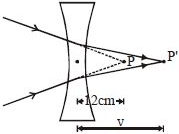
0 likes
View Solution225
DifficultMCQ
The image of a small electric bulb fixed on the wall of a room is to be obtained on the opposite wall $3\, m$ away by means of a large convex lens. What is the maximum possible focal length of the lens required for the purpose?
A
$0.50$
B
$0.75$
C
$1.33$
D
$2.00$
Solution
(B) Let the distance between the object (bulb) and the screen (opposite wall) be $D = 3\, m$. Let the distance of the lens from the object be $u$ and from the screen be $v$. Then $u + v = D = 3\, m$.
From the lens formula,$\frac{1}{f} = \frac{1}{v} - \frac{1}{u}$. Using sign convention,$u$ is negative,so $\frac{1}{f} = \frac{1}{v} + \frac{1}{u} = \frac{u+v}{uv}$.
Substituting $u+v = D$,we get $f = \frac{uv}{D}$.
Since $v = D - u$,we have $f = \frac{u(D-u)}{D} = \frac{Du - u^2}{D}$.
For a real image to be formed on the screen,the condition $D \geq 4f$ must be satisfied.
Therefore,$f \leq \frac{D}{4}$.
Substituting $D = 3\, m$,we get $f_{\max} = \frac{3}{4} = 0.75\, m$.
From the lens formula,$\frac{1}{f} = \frac{1}{v} - \frac{1}{u}$. Using sign convention,$u$ is negative,so $\frac{1}{f} = \frac{1}{v} + \frac{1}{u} = \frac{u+v}{uv}$.
Substituting $u+v = D$,we get $f = \frac{uv}{D}$.
Since $v = D - u$,we have $f = \frac{u(D-u)}{D} = \frac{Du - u^2}{D}$.
For a real image to be formed on the screen,the condition $D \geq 4f$ must be satisfied.
Therefore,$f \leq \frac{D}{4}$.
Substituting $D = 3\, m$,we get $f_{\max} = \frac{3}{4} = 0.75\, m$.
0 likes
View Solution226
DifficultMCQ
$A$ card sheet divided into squares each of size $1 \, mm^2$ is being viewed at a distance of $9 \, cm$ through a magnifying glass (a converging lens of focal length $10 \, cm$) held close to the eye. What is the magnification produced by the lens?
A
$5$
B
$10$
C
$15$
D
$20$
Solution
(B) Given: Object distance $u = -9 \, cm$,Focal length $f = 10 \, cm$.
Using the lens formula: $\frac{1}{f} = \frac{1}{v} - \frac{1}{u}$.
Substituting the values: $\frac{1}{10} = \frac{1}{v} - \frac{1}{-9} \Rightarrow \frac{1}{v} = \frac{1}{10} - \frac{1}{9} = \frac{9-10}{90} = -\frac{1}{90}$.
Thus,the image distance $v = -90 \, cm$.
The magnification $m$ is given by $m = \frac{v}{u}$.
$m = \frac{-90}{-9} = 10$.
Therefore,the magnification produced by the lens is $10$.
Using the lens formula: $\frac{1}{f} = \frac{1}{v} - \frac{1}{u}$.
Substituting the values: $\frac{1}{10} = \frac{1}{v} - \frac{1}{-9} \Rightarrow \frac{1}{v} = \frac{1}{10} - \frac{1}{9} = \frac{9-10}{90} = -\frac{1}{90}$.
Thus,the image distance $v = -90 \, cm$.
The magnification $m$ is given by $m = \frac{v}{u}$.
$m = \frac{-90}{-9} = 10$.
Therefore,the magnification produced by the lens is $10$.
0 likes
View Solution227
MediumMCQ
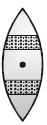
$A$ convex lens is made up of three different materials as shown in the figure. For a point object placed on its axis,the number of images formed are
A
$1$
B
$3$
C
$4$
D
$5$
Solution
(B) The lens is composed of three distinct horizontal sections,each made of a different material with a unique refractive index $(n_1, n_2, n_3)$.
Since the focal length of a lens is given by the lens maker's formula,$1/f = (n - 1)(1/R_1 - 1/R_2)$,each section will have a different focal length because the refractive index $n$ is different for each part.
When a point object is placed on the principal axis,light rays passing through each of the three sections will be refracted differently.
Consequently,each section acts as an independent lens,forming its own image at a different position along the axis.
Therefore,a total of $3$ distinct images will be formed.
Since the focal length of a lens is given by the lens maker's formula,$1/f = (n - 1)(1/R_1 - 1/R_2)$,each section will have a different focal length because the refractive index $n$ is different for each part.
When a point object is placed on the principal axis,light rays passing through each of the three sections will be refracted differently.
Consequently,each section acts as an independent lens,forming its own image at a different position along the axis.
Therefore,a total of $3$ distinct images will be formed.
0 likes
View Solution228
MediumMCQ
$A$ plane wave passes through a convex lens. The geometrical shape of the wavefront that emerges is
A
plane
B
diverging spherical
C
converging spherical
D
none of these
Solution
(C) When a plane wave is incident on a convex lens,the central part of the wavefront travels through a greater thickness of the lens compared to the edges. Since the speed of light is lower in the glass than in the air,the central part is delayed more than the edges. As a result,the wavefront bends inward,forming a converging spherical wavefront that focuses at the focal point of the lens.
0 likes
View Solution229
MediumMCQ
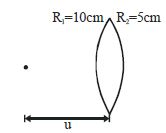
$A$ thin convex lens is made of a material of refractive index $1.6$. An object is kept at a distance of $u$ from the lens on the principal axis as shown in the figure. The radii of curvature of the surfaces are $10 \, cm$ and $5 \, cm$. Now,the lens is reversed such that the face having radius of curvature $5 \, cm$ lies close to the object. The difference in image position as obtained for both the cases is equal to ......$u$.
A
$0.4$
B
$0.6$
C
$0.8$
D
$0$
Solution
(D) According to the Lens Maker's Formula,the focal length $f$ of a thin lens is given by: $\frac{1}{f} = (\mu - 1) \left( \frac{1}{R_1} - \frac{1}{R_2} \right)$.
When the lens is reversed,the values of $R_1$ and $R_2$ are interchanged and their signs are also swapped,but the overall value of $\frac{1}{f}$ remains unchanged because the formula is symmetric with respect to the lens orientation.
Since the focal length $f$ remains the same and the object distance $u$ is kept constant,the image distance $v$ determined by the lens formula $\frac{1}{v} - \frac{1}{u} = \frac{1}{f}$ will also remain the same in both cases.
Therefore,the difference in the image position for both cases is $0$.
When the lens is reversed,the values of $R_1$ and $R_2$ are interchanged and their signs are also swapped,but the overall value of $\frac{1}{f}$ remains unchanged because the formula is symmetric with respect to the lens orientation.
Since the focal length $f$ remains the same and the object distance $u$ is kept constant,the image distance $v$ determined by the lens formula $\frac{1}{v} - \frac{1}{u} = \frac{1}{f}$ will also remain the same in both cases.
Therefore,the difference in the image position for both cases is $0$.
0 likes
View Solution230
MediumMCQ
An object is placed at a distance $m$ times the focal length of a divergent lens. The size of the image is shorter than that of the object by what factor?
A
$m$ times
B
$(m + 1)$ times
C
$(m - 1)$ times
D
$1/(m + 1)$ times
Solution
(D) For a divergent (concave) lens,the focal length $f$ is negative,so we take focal length as $-f$.
Given the object distance $u = -mf$.
Using the lens formula: $\frac{1}{v} - \frac{1}{u} = \frac{1}{f}$.
Substituting the values: $\frac{1}{v} - \frac{1}{-mf} = \frac{1}{-f}$.
$\frac{1}{v} + \frac{1}{mf} = -\frac{1}{f}$.
$\frac{1}{v} = -\frac{1}{f} - \frac{1}{mf} = -\left(\frac{m+1}{mf}\right)$.
Therefore,$v = -\frac{mf}{m+1}$.
The magnification $M$ is given by $M = \frac{v}{u}$.
$M = \frac{-mf/(m+1)}{-mf} = \frac{1}{m+1}$.
Thus,the size of the image is $\frac{1}{m+1}$ times the size of the object.
Given the object distance $u = -mf$.
Using the lens formula: $\frac{1}{v} - \frac{1}{u} = \frac{1}{f}$.
Substituting the values: $\frac{1}{v} - \frac{1}{-mf} = \frac{1}{-f}$.
$\frac{1}{v} + \frac{1}{mf} = -\frac{1}{f}$.
$\frac{1}{v} = -\frac{1}{f} - \frac{1}{mf} = -\left(\frac{m+1}{mf}\right)$.
Therefore,$v = -\frac{mf}{m+1}$.
The magnification $M$ is given by $M = \frac{v}{u}$.
$M = \frac{-mf/(m+1)}{-mf} = \frac{1}{m+1}$.
Thus,the size of the image is $\frac{1}{m+1}$ times the size of the object.
0 likes
View Solution231
MediumMCQ
The distance between an object and the screen is $80 \, cm$. $A$ lens produces an image on the screen when the lens is placed at either of the positions $20 \, cm$ apart. The focal length of the lens is ....... $cm$.
A
$18.75$
B
$20.5$
C
$10.5$
D
$24.5$
Solution
(A) Given: Distance between object and screen $D = 80 \, cm$. Distance between the two positions of the lens $x = 20 \, cm$.
Using the displacement method formula for focal length:
$f = \frac{D^2 - x^2}{4D}$
Substitute the values:
$f = \frac{80^2 - 20^2}{4 \times 80}$
$f = \frac{6400 - 400}{320}$
$f = \frac{6000}{320}$
$f = 18.75 \, cm$.
Therefore,the focal length of the lens is $18.75 \, cm$.
Using the displacement method formula for focal length:
$f = \frac{D^2 - x^2}{4D}$
Substitute the values:
$f = \frac{80^2 - 20^2}{4 \times 80}$
$f = \frac{6400 - 400}{320}$
$f = \frac{6000}{320}$
$f = 18.75 \, cm$.
Therefore,the focal length of the lens is $18.75 \, cm$.
0 likes
View Solution232
EasyMCQ
$A$ hollow convex lens of glass will behave like a
A
Convex lens
B
Concave lens
C
Glass plate
D
Mirror
Solution
(C) The focal length of a lens is given by the Lens Maker's Formula: $\frac{1}{f} = (\frac{\mu_l}{\mu_m} - 1)(\frac{1}{R_1} - \frac{1}{R_2})$.
Since the lens is hollow and filled with air,the refractive index of the medium inside the lens $(\mu_l)$ is equal to the refractive index of the surrounding medium $(\mu_m)$,assuming the lens is submerged in air.
Therefore,$\frac{\mu_l}{\mu_m} = 1$.
Substituting this into the formula: $\frac{1}{f} = (1 - 1)(\frac{1}{R_1} - \frac{1}{R_2}) = 0$.
This implies $f = \infty$.
$A$ lens with an infinite focal length acts as a plane glass plate,as it does not converge or diverge light rays.
Since the lens is hollow and filled with air,the refractive index of the medium inside the lens $(\mu_l)$ is equal to the refractive index of the surrounding medium $(\mu_m)$,assuming the lens is submerged in air.
Therefore,$\frac{\mu_l}{\mu_m} = 1$.
Substituting this into the formula: $\frac{1}{f} = (1 - 1)(\frac{1}{R_1} - \frac{1}{R_2}) = 0$.
This implies $f = \infty$.
$A$ lens with an infinite focal length acts as a plane glass plate,as it does not converge or diverge light rays.
0 likes
View Solution233
MediumMCQ
$A$ biconvex lens has a focal length $2/3$ times the radius of curvature of either surface. The refractive index of the material is:
A
$1.75$
B
$1.33$
C
$1.5$
D
$1$
Solution
(A) For a biconvex lens, the radii of curvature are $R_1 = R$ and $R_2 = -R$.
According to the Lens Maker's Formula: $\frac{1}{f} = (\mu - 1) \left( \frac{1}{R_1} - \frac{1}{R_2} \right)$.
Substituting the values, we get: $\frac{1}{f} = (\mu - 1) \left( \frac{1}{R} - \frac{1}{-R} \right) = (\mu - 1) \left( \frac{2}{R} \right)$.
Given that the focal length $f = \frac{2}{3}R$, we substitute this into the equation:
$\frac{1}{(2/3)R} = (\mu - 1) \left( \frac{2}{R} \right)$.
$\frac{3}{2R} = (\mu - 1) \frac{2}{R}$.
Multiplying both sides by $R$, we get: $\frac{3}{2} = 2(\mu - 1)$.
$0.75 = \mu - 1$.
$\mu = 1.75$.
According to the Lens Maker's Formula: $\frac{1}{f} = (\mu - 1) \left( \frac{1}{R_1} - \frac{1}{R_2} \right)$.
Substituting the values, we get: $\frac{1}{f} = (\mu - 1) \left( \frac{1}{R} - \frac{1}{-R} \right) = (\mu - 1) \left( \frac{2}{R} \right)$.
Given that the focal length $f = \frac{2}{3}R$, we substitute this into the equation:
$\frac{1}{(2/3)R} = (\mu - 1) \left( \frac{2}{R} \right)$.
$\frac{3}{2R} = (\mu - 1) \frac{2}{R}$.
Multiplying both sides by $R$, we get: $\frac{3}{2} = 2(\mu - 1)$.
$0.75 = \mu - 1$.
$\mu = 1.75$.
0 likes
View Solution234
DifficultMCQ
$A$ square card of side length $1\, mm$ is being seen through a magnifying lens of focal length $10\, cm$. The card is placed at a distance of $9\, cm$ from the lens. The axis is perpendicular to the plane of the card. The apparent area of the card through the lens is......$cm^2$
A
$1$
B
$0.81$
C
$0.27$
D
$0.60$
Solution
(A) Given: Object distance $u = -9\, cm$,Focal length $f = 10\, cm$.
Using the lens formula: $\frac{1}{v} - \frac{1}{u} = \frac{1}{f}$.
Substituting the values: $\frac{1}{v} - \frac{1}{-9} = \frac{1}{10} \Rightarrow \frac{1}{v} + \frac{1}{9} = \frac{1}{10}$.
Solving for $v$: $\frac{1}{v} = \frac{1}{10} - \frac{1}{9} = \frac{9 - 10}{90} = -\frac{1}{90}$.
Thus,$v = -90\, cm$.
The linear magnification $m$ is given by $m = \frac{v}{u} = \frac{-90}{-9} = 10$.
The area magnification is $m^2 = (10)^2 = 100$.
The original area of the card $A_0 = (1\, mm)^2 = 1\, mm^2 = 0.01\, cm^2$.
The apparent area $A_i = m^2 \times A_0 = 100 \times 0.01\, cm^2 = 1\, cm^2$.
Using the lens formula: $\frac{1}{v} - \frac{1}{u} = \frac{1}{f}$.
Substituting the values: $\frac{1}{v} - \frac{1}{-9} = \frac{1}{10} \Rightarrow \frac{1}{v} + \frac{1}{9} = \frac{1}{10}$.
Solving for $v$: $\frac{1}{v} = \frac{1}{10} - \frac{1}{9} = \frac{9 - 10}{90} = -\frac{1}{90}$.
Thus,$v = -90\, cm$.
The linear magnification $m$ is given by $m = \frac{v}{u} = \frac{-90}{-9} = 10$.
The area magnification is $m^2 = (10)^2 = 100$.
The original area of the card $A_0 = (1\, mm)^2 = 1\, mm^2 = 0.01\, cm^2$.
The apparent area $A_i = m^2 \times A_0 = 100 \times 0.01\, cm^2 = 1\, cm^2$.
0 likes
View Solution235
DifficultMCQ
An object approaches a convergent lens from the left of the lens with a uniform speed $5 \, m/s$ and stops at the focus. The image:
A
Moves away from the lens with a uniform speed $5 \, m/s$.
B
Moves away from the lens with uniform acceleration.
C
Moves away from the lens with non-uniform acceleration.
D
Moves towards the lens with non-uniform acceleration.
Solution
(C) For a convergent lens,the lens formula is given by $\frac{1}{v} - \frac{1}{u} = \frac{1}{f}$.
Differentiating with respect to time $t$,we get $-\frac{1}{v^2} \frac{dv}{dt} + \frac{1}{u^2} \frac{du}{dt} = 0$,which implies $\frac{dv}{dt} = (\frac{v}{u})^2 \frac{du}{dt}$.
Since the magnification $m = \frac{v}{u} = \frac{f}{f+u}$,the velocity of the image is $v_i = m^2 v_o$,where $v_o$ is the velocity of the object.
As the object approaches the focus $(u \to -f)$,the magnification $m$ increases towards infinity.
Since $v_i = m^2 v_o$,the image velocity $v_i$ increases rapidly as the object approaches the focus.
Because the velocity of the image is changing with time,the image moves with non-uniform acceleration.
Differentiating with respect to time $t$,we get $-\frac{1}{v^2} \frac{dv}{dt} + \frac{1}{u^2} \frac{du}{dt} = 0$,which implies $\frac{dv}{dt} = (\frac{v}{u})^2 \frac{du}{dt}$.
Since the magnification $m = \frac{v}{u} = \frac{f}{f+u}$,the velocity of the image is $v_i = m^2 v_o$,where $v_o$ is the velocity of the object.
As the object approaches the focus $(u \to -f)$,the magnification $m$ increases towards infinity.
Since $v_i = m^2 v_o$,the image velocity $v_i$ increases rapidly as the object approaches the focus.
Because the velocity of the image is changing with time,the image moves with non-uniform acceleration.
0 likes
View Solution236
MediumMCQ
The far point of a nearsighted person is $6.0 \, m$ from her eyes,and she wears contact lenses that enable her to see distant objects clearly. $A$ tree is $18.0 \, m$ away and $2.0 \, m$ high. How high is the image formed by the contact lenses?
A
$1.0$
B
$1.5$
C
$0.75$
D
$0.50$
Solution
(D) The far point of the person is $6.0 \, m$,so the contact lens must form a virtual image of a distant object at $v = -6.0 \, m$ when $u = \infty$. Thus,the focal length $f$ of the lens is $-6.0 \, m$.
Now,for a tree at $u = -18.0 \, m$ with height $h = 2.0 \, m$,we use the lens formula $\frac{1}{f} = \frac{1}{v} - \frac{1}{u}$:
$\frac{1}{-6} = \frac{1}{v} - \frac{1}{-18}$
$\frac{1}{v} = -\frac{1}{6} - \frac{1}{18} = \frac{-3-1}{18} = -\frac{4}{18}$
$v = -\frac{18}{4} = -4.5 \, m$.
The magnification $m$ is given by $m = \frac{v}{u} = \frac{-4.5}{-18} = 0.25$.
The height of the image $h'$ is $h' = m \times h = 0.25 \times 2.0 = 0.50 \, m$.
Now,for a tree at $u = -18.0 \, m$ with height $h = 2.0 \, m$,we use the lens formula $\frac{1}{f} = \frac{1}{v} - \frac{1}{u}$:
$\frac{1}{-6} = \frac{1}{v} - \frac{1}{-18}$
$\frac{1}{v} = -\frac{1}{6} - \frac{1}{18} = \frac{-3-1}{18} = -\frac{4}{18}$
$v = -\frac{18}{4} = -4.5 \, m$.
The magnification $m$ is given by $m = \frac{v}{u} = \frac{-4.5}{-18} = 0.25$.
The height of the image $h'$ is $h' = m \times h = 0.25 \times 2.0 = 0.50 \, m$.
0 likes
View Solution237
DifficultMCQ
$A$ lens is made of flint glass (refractive index $= 1.5$). When the lens is immersed in a liquid of refractive index $1.25$,the focal length
A
increases by a factor of $1.25$
B
increases by a factor of $2.5$
C
increases by a factor of $1.2$
D
decreases by a factor of $1.2$
Solution
(B) The lens maker's formula is given by $\frac{1}{f} = (\mu - 1) \left( \frac{1}{R_1} - \frac{1}{R_2} \right)$.
For the lens in air $(\mu_a = 1)$:
$\frac{1}{f_a} = (1.5 - 1) \left( \frac{1}{R_1} - \frac{1}{R_2} \right) = 0.5 \left( \frac{1}{R_1} - \frac{1}{R_2} \right)$.
When immersed in a liquid $(\mu_l = 1.25)$,the relative refractive index is $\mu_{rel} = \frac{\mu_g}{\mu_l} = \frac{1.5}{1.25} = 1.2 = \frac{6}{5}$.
For the lens in the liquid:
$\frac{1}{f_l} = (\mu_{rel} - 1) \left( \frac{1}{R_1} - \frac{1}{R_2} \right) = (1.2 - 1) \left( \frac{1}{R_1} - \frac{1}{R_2} \right) = 0.2 \left( \frac{1}{R_1} - \frac{1}{R_2} \right)$.
Taking the ratio:
$\frac{f_l}{f_a} = \frac{0.5}{0.2} = 2.5$.
Therefore,the focal length increases by a factor of $2.5$.
For the lens in air $(\mu_a = 1)$:
$\frac{1}{f_a} = (1.5 - 1) \left( \frac{1}{R_1} - \frac{1}{R_2} \right) = 0.5 \left( \frac{1}{R_1} - \frac{1}{R_2} \right)$.
When immersed in a liquid $(\mu_l = 1.25)$,the relative refractive index is $\mu_{rel} = \frac{\mu_g}{\mu_l} = \frac{1.5}{1.25} = 1.2 = \frac{6}{5}$.
For the lens in the liquid:
$\frac{1}{f_l} = (\mu_{rel} - 1) \left( \frac{1}{R_1} - \frac{1}{R_2} \right) = (1.2 - 1) \left( \frac{1}{R_1} - \frac{1}{R_2} \right) = 0.2 \left( \frac{1}{R_1} - \frac{1}{R_2} \right)$.
Taking the ratio:
$\frac{f_l}{f_a} = \frac{0.5}{0.2} = 2.5$.
Therefore,the focal length increases by a factor of $2.5$.
0 likes
View Solution238
DifficultMCQ
$A$ thin glass (refractive index $1.5$) lens has an optical power of $-5\,D$ in air. Its optical power in a liquid medium with a refractive index of $1.6$ will be: (in $,D$)
A
$-1$
B
$1$
C
$-25$
D
$25$
Solution
(B) The lens maker's formula is given by $\frac{1}{f} = (\mu_{rel} - 1) \left(\frac{1}{R_1} - \frac{1}{R_2}\right)$.
In air $(\mu_a = 1)$: $P_a = \frac{1}{f_a} = (\mu_g - 1) \left(\frac{1}{R_1} - \frac{1}{R_2}\right) = -5\,D$.
So,$(1.5 - 1) \left(\frac{1}{R_1} - \frac{1}{R_2}\right) = -5$,which gives $0.5 \left(\frac{1}{R_1} - \frac{1}{R_2}\right) = -5$,or $\left(\frac{1}{R_1} - \frac{1}{R_2}\right) = -10$.
In liquid $(\mu_m = 1.6)$: $P_m = \frac{\mu_m}{f_m} = \mu_m \left(\frac{\mu_g}{\mu_m} - 1\right) \left(\frac{1}{R_1} - \frac{1}{R_2}\right)$.
$P_m = 1.6 \left(\frac{1.5}{1.6} - 1\right) (-10)$.
$P_m = 1.6 \left(\frac{1.5 - 1.6}{1.6}\right) (-10)$.
$P_m = 1.6 \left(\frac{-0.1}{1.6}\right) (-10) = (-0.1) \times (-10) = 1\,D$.
In air $(\mu_a = 1)$: $P_a = \frac{1}{f_a} = (\mu_g - 1) \left(\frac{1}{R_1} - \frac{1}{R_2}\right) = -5\,D$.
So,$(1.5 - 1) \left(\frac{1}{R_1} - \frac{1}{R_2}\right) = -5$,which gives $0.5 \left(\frac{1}{R_1} - \frac{1}{R_2}\right) = -5$,or $\left(\frac{1}{R_1} - \frac{1}{R_2}\right) = -10$.
In liquid $(\mu_m = 1.6)$: $P_m = \frac{\mu_m}{f_m} = \mu_m \left(\frac{\mu_g}{\mu_m} - 1\right) \left(\frac{1}{R_1} - \frac{1}{R_2}\right)$.
$P_m = 1.6 \left(\frac{1.5}{1.6} - 1\right) (-10)$.
$P_m = 1.6 \left(\frac{1.5 - 1.6}{1.6}\right) (-10)$.
$P_m = 1.6 \left(\frac{-0.1}{1.6}\right) (-10) = (-0.1) \times (-10) = 1\,D$.
0 likes
View Solution239
EasyMCQ
The focal lengths of a converging lens are $f_V$ and $f_R$ for violet and red light,respectively. Which of the following relations is correct?
A
$f_V > f_R$
B
$f_V = f_R$
C
$f_V < f_R$
D
None of these
Solution
(C) According to Cauchy's equation,the refractive index $\mu$ of a material depends on the wavelength $\lambda$ of light,where $\mu$ is inversely proportional to $\lambda$. Since the wavelength of red light is greater than that of violet light $(\lambda_R > \lambda_V)$,the refractive index for red light is less than that for violet light $(\mu_R < \mu_V)$.
Using the lens maker's formula,$\frac{1}{f} = (\mu - 1)(\frac{1}{R_1} - \frac{1}{R_2})$,we see that $\frac{1}{f} \propto (\mu - 1)$.
Since $\mu_V > \mu_R$,it follows that $(\mu_V - 1) > (\mu_R - 1)$.
Therefore,$\frac{1}{f_V} > \frac{1}{f_R}$,which implies $f_V < f_R$.
Using the lens maker's formula,$\frac{1}{f} = (\mu - 1)(\frac{1}{R_1} - \frac{1}{R_2})$,we see that $\frac{1}{f} \propto (\mu - 1)$.
Since $\mu_V > \mu_R$,it follows that $(\mu_V - 1) > (\mu_R - 1)$.
Therefore,$\frac{1}{f_V} > \frac{1}{f_R}$,which implies $f_V < f_R$.
0 likes
View Solution240
MediumMCQ
Assertion: $A$ double convex lens $(\mu = 1.5)$ has a focal length of $10 \, cm$. When the lens is immersed in water $(\mu = 4/3)$,its focal length becomes $40 \, cm$.
Reason: $\frac{1}{f} = \left( \frac{\mu_l - \mu_m}{\mu_m} \right) \left( \frac{1}{R_1} - \frac{1}{R_2} \right)$
Reason: $\frac{1}{f} = \left( \frac{\mu_l - \mu_m}{\mu_m} \right) \left( \frac{1}{R_1} - \frac{1}{R_2} \right)$
A
If both Assertion and Reason are correct and the Reason is a correct explanation of the Assertion.
B
If both Assertion and Reason are correct but Reason is not a correct explanation of the Assertion.
C
If the Assertion is correct but Reason is incorrect.
D
If both the Assertion and Reason are incorrect.
Solution
(A) The Lens Maker's Formula is given by $\frac{1}{f} = \left( \frac{\mu_l}{\mu_m} - 1 \right) \left( \frac{1}{R_1} - \frac{1}{R_2} \right)$,which can be written as $\frac{1}{f} = \left( \frac{\mu_l - \mu_m}{\mu_m} \right) \left( \frac{1}{R_1} - \frac{1}{R_2} \right)$. Thus,the Reason is correct.
For the lens in air $(\mu_m = 1)$:
$\frac{1}{10} = (1.5 - 1) \left( \frac{1}{R_1} - \frac{1}{R_2} \right) \implies \frac{1}{10} = 0.5 \left( \frac{1}{R_1} - \frac{1}{R_2} \right) \implies \left( \frac{1}{R_1} - \frac{1}{R_2} \right) = \frac{1}{5} \dots (i)$
For the lens in water $(\mu_m = 4/3)$:
$\frac{1}{f'} = \left( \frac{1.5 - 4/3}{4/3} \right) \left( \frac{1}{R_1} - \frac{1}{R_2} \right)$
$\frac{1}{f'} = \left( \frac{4.5/3 - 4/3}{4/3} \right) \left( \frac{1}{5} \right) = \left( \frac{0.5/3}{4/3} \right) \left( \frac{1}{5} \right) = \left( \frac{0.5}{4} \right) \left( \frac{1}{5} \right) = \frac{1}{8} \times \frac{1}{5} = \frac{1}{40}$
Therefore,$f' = 40 \, cm$. The Assertion is also correct and the Reason explains it.
For the lens in air $(\mu_m = 1)$:
$\frac{1}{10} = (1.5 - 1) \left( \frac{1}{R_1} - \frac{1}{R_2} \right) \implies \frac{1}{10} = 0.5 \left( \frac{1}{R_1} - \frac{1}{R_2} \right) \implies \left( \frac{1}{R_1} - \frac{1}{R_2} \right) = \frac{1}{5} \dots (i)$
For the lens in water $(\mu_m = 4/3)$:
$\frac{1}{f'} = \left( \frac{1.5 - 4/3}{4/3} \right) \left( \frac{1}{R_1} - \frac{1}{R_2} \right)$
$\frac{1}{f'} = \left( \frac{4.5/3 - 4/3}{4/3} \right) \left( \frac{1}{5} \right) = \left( \frac{0.5/3}{4/3} \right) \left( \frac{1}{5} \right) = \left( \frac{0.5}{4} \right) \left( \frac{1}{5} \right) = \frac{1}{8} \times \frac{1}{5} = \frac{1}{40}$
Therefore,$f' = 40 \, cm$. The Assertion is also correct and the Reason explains it.
0 likes
View Solution241
EasyMCQ
Assertion : Position of image approaches focus of a lens,only when object approaches infinity.
Reason : Paraxial rays incident parallel to principal axis intersect at the focus after refraction from lens.
Reason : Paraxial rays incident parallel to principal axis intersect at the focus after refraction from lens.
A
If both Assertion and Reason are correct and the Reason is a correct explanation of the Assertion.
B
If both Assertion and Reason are correct but Reason is not a correct explanation of the Assertion.
C
If the Assertion is correct but Reason is incorrect.
D
If both the Assertion and Reason are incorrect.
Solution
(A) The lens formula is given by $\frac{1}{f} = \frac{1}{v} - \frac{1}{u}$.
As the object distance $u$ approaches infinity $(\infty)$,the term $\frac{1}{u}$ approaches $0$.
Substituting this into the lens formula,we get $\frac{1}{v} = \frac{1}{f}$,which implies $v = f$.
Thus,the image position approaches the focus when the object is at infinity.
This is a fundamental property of lenses,and the reason provided correctly explains that rays parallel to the principal axis (which originate from an object at infinity) converge at the focus after refraction.
Therefore,both the Assertion and the Reason are correct,and the Reason is the correct explanation of the Assertion.
As the object distance $u$ approaches infinity $(\infty)$,the term $\frac{1}{u}$ approaches $0$.
Substituting this into the lens formula,we get $\frac{1}{v} = \frac{1}{f}$,which implies $v = f$.
Thus,the image position approaches the focus when the object is at infinity.
This is a fundamental property of lenses,and the reason provided correctly explains that rays parallel to the principal axis (which originate from an object at infinity) converge at the focus after refraction.
Therefore,both the Assertion and the Reason are correct,and the Reason is the correct explanation of the Assertion.
0 likes
View Solution242
EasyMCQ
Assertion: Goggles have zero power.
Reason: Radius of curvature of both sides of the lens is same.
Reason: Radius of curvature of both sides of the lens is same.
A
If both Assertion and Reason are correct and the Reason is a correct explanation of the Assertion.
B
If both Assertion and Reason are correct but Reason is not a correct explanation of the Assertion.
C
If the Assertion is correct but Reason is incorrect.
D
If both the Assertion and Reason are incorrect.
Solution
(B) Goggles are designed to protect eyes from harmful $UV$ rays and dust, not to correct vision defects. Therefore, they are made with plane glass, which has zero power.
The reason states that the radius of curvature of both sides of the lens is the same. While this is true for a plano-concave or plano-convex lens (if both sides were flat, the radius is effectively infinite), it does not explain why the power is zero. The power of a lens is given by the lens maker's formula: $P = (n-1)(1/R_1 - 1/R_2)$. For a lens to have zero power, the focal length must be infinite, which occurs when the surfaces are plane $(R_1 = R_2 = \infty)$. The fact that the radii are equal does not necessarily imply they are infinite. Thus, the Reason is a true statement but not the correct explanation for the Assertion.
The reason states that the radius of curvature of both sides of the lens is the same. While this is true for a plano-concave or plano-convex lens (if both sides were flat, the radius is effectively infinite), it does not explain why the power is zero. The power of a lens is given by the lens maker's formula: $P = (n-1)(1/R_1 - 1/R_2)$. For a lens to have zero power, the focal length must be infinite, which occurs when the surfaces are plane $(R_1 = R_2 = \infty)$. The fact that the radii are equal does not necessarily imply they are infinite. Thus, the Reason is a true statement but not the correct explanation for the Assertion.
0 likes
View Solution243
MediumMCQ
$A$ double convex lens has a focal length of $25\; cm$. The radius of curvature of one of the surfaces is double the other. Find the radii if the refractive index of the material of the lens is $1.5$.
A
$100\; cm, 50\; cm$
B
$25\; cm, 50\; cm$
C
$18.75\; cm, 37.5\; cm$
D
$50\; cm, 100\; cm$
Solution
(C) Using the Lens Maker's Formula: $\frac{1}{f} = (\mu - 1) \left( \frac{1}{R_1} - \frac{1}{R_2} \right)$.
Given: $f = 25\; cm$,$\mu = 1.5$. For a double convex lens,$R_1 = R$ and $R_2 = -2R$.
Substituting the values: $\frac{1}{25} = (1.5 - 1) \left( \frac{1}{R} - \frac{1}{-2R} \right)$.
$\frac{1}{25} = 0.5 \left( \frac{1}{R} + \frac{1}{2R} \right) = 0.5 \left( \frac{3}{2R} \right) = \frac{1.5}{2R} = \frac{3}{4R}$.
$4R = 25 \times 3 = 75$.
$R = \frac{75}{4} = 18.75\; cm$.
Therefore,the radii are $R_1 = 18.75\; cm$ and $R_2 = 2R = 37.5\; cm$.
Given: $f = 25\; cm$,$\mu = 1.5$. For a double convex lens,$R_1 = R$ and $R_2 = -2R$.
Substituting the values: $\frac{1}{25} = (1.5 - 1) \left( \frac{1}{R} - \frac{1}{-2R} \right)$.
$\frac{1}{25} = 0.5 \left( \frac{1}{R} + \frac{1}{2R} \right) = 0.5 \left( \frac{3}{2R} \right) = \frac{1.5}{2R} = \frac{3}{4R}$.
$4R = 25 \times 3 = 75$.
$R = \frac{75}{4} = 18.75\; cm$.
Therefore,the radii are $R_1 = 18.75\; cm$ and $R_2 = 2R = 37.5\; cm$.
0 likes
View Solution244
DifficultMCQ
$A$ thin lens made of glass (refractive index $= 1.5$) of focal length $f = 16 \; cm$ is immersed in a liquid of refractive index $1.42$. If its focal length in liquid is $f_{l}$,then the ratio $f_{l} / f$ is closest to the integer:
A
$1$
B
$5$
C
$9$
D
$17$
Solution
(C) Using the Lens Maker's Formula: $\frac{1}{f} = (\mu_{g} - 1) \left( \frac{1}{R_{1}} - \frac{1}{R_{2}} \right)$.
For the lens in air $(\mu_{a} = 1)$:
$\frac{1}{f} = (1.5 - 1) \left( \frac{1}{R_{1}} - \frac{1}{R_{2}} \right) = 0.5 \left( \frac{1}{R_{1}} - \frac{1}{R_{2}} \right) \dots (1)$
For the lens in liquid $(\mu_{l} = 1.42)$:
$\frac{1}{f_{l}} = \left( \frac{1.5}{1.42} - 1 \right) \left( \frac{1}{R_{1}} - \frac{1}{R_{2}} \right) = \left( \frac{1.5 - 1.42}{1.42} \right) \left( \frac{1}{R_{1}} - \frac{1}{R_{2}} \right) = \frac{0.08}{1.42} \left( \frac{1}{R_{1}} - \frac{1}{R_{2}} \right) \dots (2)$
Dividing equation $(1)$ by equation $(2)$:
$\frac{f_{l}}{f} = \frac{0.5 \left( \frac{1}{R_{1}} - \frac{1}{R_{2}} \right)}{\frac{0.08}{1.42} \left( \frac{1}{R_{1}} - \frac{1}{R_{2}} \right)} = \frac{0.5 \times 1.42}{0.08} = \frac{0.71}{0.08} = 8.875$.
The value $8.875$ is closest to the integer $9$.
For the lens in air $(\mu_{a} = 1)$:
$\frac{1}{f} = (1.5 - 1) \left( \frac{1}{R_{1}} - \frac{1}{R_{2}} \right) = 0.5 \left( \frac{1}{R_{1}} - \frac{1}{R_{2}} \right) \dots (1)$
For the lens in liquid $(\mu_{l} = 1.42)$:
$\frac{1}{f_{l}} = \left( \frac{1.5}{1.42} - 1 \right) \left( \frac{1}{R_{1}} - \frac{1}{R_{2}} \right) = \left( \frac{1.5 - 1.42}{1.42} \right) \left( \frac{1}{R_{1}} - \frac{1}{R_{2}} \right) = \frac{0.08}{1.42} \left( \frac{1}{R_{1}} - \frac{1}{R_{2}} \right) \dots (2)$
Dividing equation $(1)$ by equation $(2)$:
$\frac{f_{l}}{f} = \frac{0.5 \left( \frac{1}{R_{1}} - \frac{1}{R_{2}} \right)}{\frac{0.08}{1.42} \left( \frac{1}{R_{1}} - \frac{1}{R_{2}} \right)} = \frac{0.5 \times 1.42}{0.08} = \frac{0.71}{0.08} = 8.875$.
The value $8.875$ is closest to the integer $9$.
0 likes
View Solution245
MediumMCQ
$A$ point object in air is in front of the curved surface of a plano-convex lens. The radius of curvature of the curved surface is $30 \; cm$ and the refractive index of the lens material is $1.5$. Then the focal length of the lens (in $cm$) is:
A
$58$
B
$62$
C
$60$
D
$67$
Solution
(C) The Lens-Maker's formula is given by $\frac{1}{f} = (\mu - 1) \left( \frac{1}{R_1} - \frac{1}{R_2} \right)$.
For a plano-convex lens,the radius of curvature of the curved surface is $R_1 = 30 \; cm$ and the flat surface has an infinite radius of curvature,so $R_2 = \infty$.
The refractive index of the lens material is $\mu = 1.5$.
Substituting these values into the formula:
$\frac{1}{f} = (1.5 - 1) \left( \frac{1}{30} - \frac{1}{\infty} \right)$
$\frac{1}{f} = (0.5) \left( \frac{1}{30} - 0 \right)$
$\frac{1}{f} = \frac{0.5}{30} = \frac{1}{60}$
Therefore,the focal length $f = 60 \; cm$.
For a plano-convex lens,the radius of curvature of the curved surface is $R_1 = 30 \; cm$ and the flat surface has an infinite radius of curvature,so $R_2 = \infty$.
The refractive index of the lens material is $\mu = 1.5$.
Substituting these values into the formula:
$\frac{1}{f} = (1.5 - 1) \left( \frac{1}{30} - \frac{1}{\infty} \right)$
$\frac{1}{f} = (0.5) \left( \frac{1}{30} - 0 \right)$
$\frac{1}{f} = \frac{0.5}{30} = \frac{1}{60}$
Therefore,the focal length $f = 60 \; cm$.
0 likes
View Solution246
Medium
$(i)$ If $f=0.5 \,m$ for a glass lens,what is the power of the lens?
$(ii)$ The radii of curvature of the faces of a double convex lens are $10 \,cm$ and $15 \,cm$. Its focal length is $12 \,cm$. What is the refractive index of glass?
$(iii)$ $A$ convex lens has $20 \,cm$ focal length in air. What is its focal length in water? (Refractive index of water $= 1.33$,refractive index of glass $= 1.5$)
$(ii)$ The radii of curvature of the faces of a double convex lens are $10 \,cm$ and $15 \,cm$. Its focal length is $12 \,cm$. What is the refractive index of glass?
$(iii)$ $A$ convex lens has $20 \,cm$ focal length in air. What is its focal length in water? (Refractive index of water $= 1.33$,refractive index of glass $= 1.5$)
Solution
(N/A) $(i)$ The power $P$ of a lens is given by $P = \frac{1}{f(m)}$. Substituting $f = 0.5 \,m$,we get $P = \frac{1}{0.5} = +2 \,D$.
$(ii)$ Given $f = +12 \,cm$,$R_1 = +10 \,cm$,and $R_2 = -15 \,cm$. Using the lens maker's formula $\frac{1}{f} = (n - 1) \left( \frac{1}{R_1} - \frac{1}{R_2} \right)$:
$\frac{1}{12} = (n - 1) \left( \frac{1}{10} - \frac{1}{-15} \right) = (n - 1) \left( \frac{3+2}{30} \right) = (n - 1) \left( \frac{5}{30} \right) = (n - 1) \frac{1}{6}$.
Thus,$n - 1 = \frac{6}{12} = 0.5$,which gives $n = 1.5$.
$(iii)$ In air: $\frac{1}{f_a} = (n_g - 1) \left( \frac{1}{R_1} - \frac{1}{R_2} \right) \implies \frac{1}{20} = (1.5 - 1) \left( \frac{1}{R_1} - \frac{1}{R_2} \right) \implies \frac{1}{20} = 0.5 \left( \frac{1}{R_1} - \frac{1}{R_2} \right) \implies \left( \frac{1}{R_1} - \frac{1}{R_2} \right) = \frac{1}{10}$.
In water: $\frac{1}{f_w} = \left( \frac{n_g}{n_w} - 1 \right) \left( \frac{1}{R_1} - \frac{1}{R_2} \right) = \left( \frac{1.5}{1.33} - 1 \right) \left( \frac{1}{10} \right) = (1.1278 - 1) \times 0.1 = 0.1278 \times 0.1 = 0.01278$.
$f_w = \frac{1}{0.01278} \approx 78.2 \,cm$.
$(ii)$ Given $f = +12 \,cm$,$R_1 = +10 \,cm$,and $R_2 = -15 \,cm$. Using the lens maker's formula $\frac{1}{f} = (n - 1) \left( \frac{1}{R_1} - \frac{1}{R_2} \right)$:
$\frac{1}{12} = (n - 1) \left( \frac{1}{10} - \frac{1}{-15} \right) = (n - 1) \left( \frac{3+2}{30} \right) = (n - 1) \left( \frac{5}{30} \right) = (n - 1) \frac{1}{6}$.
Thus,$n - 1 = \frac{6}{12} = 0.5$,which gives $n = 1.5$.
$(iii)$ In air: $\frac{1}{f_a} = (n_g - 1) \left( \frac{1}{R_1} - \frac{1}{R_2} \right) \implies \frac{1}{20} = (1.5 - 1) \left( \frac{1}{R_1} - \frac{1}{R_2} \right) \implies \frac{1}{20} = 0.5 \left( \frac{1}{R_1} - \frac{1}{R_2} \right) \implies \left( \frac{1}{R_1} - \frac{1}{R_2} \right) = \frac{1}{10}$.
In water: $\frac{1}{f_w} = \left( \frac{n_g}{n_w} - 1 \right) \left( \frac{1}{R_1} - \frac{1}{R_2} \right) = \left( \frac{1.5}{1.33} - 1 \right) \left( \frac{1}{10} \right) = (1.1278 - 1) \times 0.1 = 0.1278 \times 0.1 = 0.01278$.
$f_w = \frac{1}{0.01278} \approx 78.2 \,cm$.
0 likes
View Solution247
MediumMCQ
Double-convex lenses are to be manufactured from a glass of refractive index $1.55$,with both faces of the same radius of curvature. What is the radius of curvature (in $cm$) required if the focal length is to be $20\;cm$?
A
$11$
B
$16$
C
$28$
D
$22$
Solution
(D) Refractive index of glass,$\mu = 1.55$.
Focal length of the double-convex lens,$f = 20\; cm$.
For a double-convex lens with equal radii of curvature,let $R_1 = R$ and $R_2 = -R$.
Using the Lens Maker's formula:
$\frac{1}{f} = (\mu - 1) \left[ \frac{1}{R_1} - \frac{1}{R_2} \right]$
$\frac{1}{20} = (1.55 - 1) \left[ \frac{1}{R} - \frac{1}{-R} \right]$
$\frac{1}{20} = 0.55 \times \left[ \frac{2}{R} \right]$
$\frac{1}{20} = \frac{1.1}{R}$
$R = 1.1 \times 20 = 22\; cm$.
Thus,the required radius of curvature is $22\; cm$.
Focal length of the double-convex lens,$f = 20\; cm$.
For a double-convex lens with equal radii of curvature,let $R_1 = R$ and $R_2 = -R$.
Using the Lens Maker's formula:
$\frac{1}{f} = (\mu - 1) \left[ \frac{1}{R_1} - \frac{1}{R_2} \right]$
$\frac{1}{20} = (1.55 - 1) \left[ \frac{1}{R} - \frac{1}{-R} \right]$
$\frac{1}{20} = 0.55 \times \left[ \frac{2}{R} \right]$
$\frac{1}{20} = \frac{1.1}{R}$
$R = 1.1 \times 20 = 22\; cm$.
Thus,the required radius of curvature is $22\; cm$.
0 likes
View Solution248
Medium
$A$ beam of light converges at a point $P$. Now a lens is placed in the path of the convergent beam $12 \, cm$ from $P$. At what point does the beam converge if the lens is
$(a)$ a convex lens of focal length $20 \, cm$,and
$(b)$ a concave lens of focal length $16 \, cm$?
$(a)$ a convex lens of focal length $20 \, cm$,and
$(b)$ a concave lens of focal length $16 \, cm$?
Solution
(N/A) In the given situation,the object is virtual and the image formed is real.
Object distance,$u = +12 \, cm$.
$(a)$ Focal length of the convex lens,$f = +20 \, cm$.
Using the lens formula,$\frac{1}{v} - \frac{1}{u} = \frac{1}{f}$.
$\frac{1}{v} - \frac{1}{12} = \frac{1}{20} \implies \frac{1}{v} = \frac{1}{20} + \frac{1}{12} = \frac{3 + 5}{60} = \frac{8}{60}$.
$\therefore v = \frac{60}{8} = 7.5 \, cm$.
Hence,the beam converges $7.5 \, cm$ to the right of the lens.
$(b)$ Focal length of the concave lens,$f = -16 \, cm$.
Using the lens formula,$\frac{1}{v} - \frac{1}{u} = \frac{1}{f}$.
$\frac{1}{v} - \frac{1}{12} = -\frac{1}{16} \implies \frac{1}{v} = \frac{1}{12} - \frac{1}{16} = \frac{4 - 3}{48} = \frac{1}{48}$.
$\therefore v = 48 \, cm$.
Hence,the beam converges $48 \, cm$ to the right of the lens.
Object distance,$u = +12 \, cm$.
$(a)$ Focal length of the convex lens,$f = +20 \, cm$.
Using the lens formula,$\frac{1}{v} - \frac{1}{u} = \frac{1}{f}$.
$\frac{1}{v} - \frac{1}{12} = \frac{1}{20} \implies \frac{1}{v} = \frac{1}{20} + \frac{1}{12} = \frac{3 + 5}{60} = \frac{8}{60}$.
$\therefore v = \frac{60}{8} = 7.5 \, cm$.
Hence,the beam converges $7.5 \, cm$ to the right of the lens.
$(b)$ Focal length of the concave lens,$f = -16 \, cm$.
Using the lens formula,$\frac{1}{v} - \frac{1}{u} = \frac{1}{f}$.
$\frac{1}{v} - \frac{1}{12} = -\frac{1}{16} \implies \frac{1}{v} = \frac{1}{12} - \frac{1}{16} = \frac{4 - 3}{48} = \frac{1}{48}$.
$\therefore v = 48 \, cm$.
Hence,the beam converges $48 \, cm$ to the right of the lens.
0 likes
View Solution249
Medium
An object of size $3.0 \, cm$ is placed $14 \, cm$ in front of a concave lens of focal length $21 \, cm$. Describe the image produced by the lens. What happens if the object is moved further away from the lens?
Solution
(N/A) Size of the object,$h_1 = 3.0 \, cm$.
Object distance,$u = -14 \, cm$.
Focal length of the concave lens,$f = -21 \, cm$.
Using the lens formula,$\frac{1}{v} - \frac{1}{u} = \frac{1}{f}$.
Substituting the values: $\frac{1}{v} = \frac{1}{f} + \frac{1}{u} = \frac{1}{-21} + \frac{1}{-14} = \frac{-2 - 3}{42} = \frac{-5}{42}$.
Thus,$v = -8.4 \, cm$.
The negative sign indicates that the image is virtual and erect,formed $8.4 \, cm$ in front of the lens.
Magnification $m = \frac{v}{u} = \frac{-8.4}{-14} = 0.6$.
Image height $h_2 = m \times h_1 = 0.6 \times 3.0 = 1.8 \, cm$.
If the object is moved further away from the lens,the virtual image moves towards the focus of the lens,and the size of the image decreases.
Object distance,$u = -14 \, cm$.
Focal length of the concave lens,$f = -21 \, cm$.
Using the lens formula,$\frac{1}{v} - \frac{1}{u} = \frac{1}{f}$.
Substituting the values: $\frac{1}{v} = \frac{1}{f} + \frac{1}{u} = \frac{1}{-21} + \frac{1}{-14} = \frac{-2 - 3}{42} = \frac{-5}{42}$.
Thus,$v = -8.4 \, cm$.
The negative sign indicates that the image is virtual and erect,formed $8.4 \, cm$ in front of the lens.
Magnification $m = \frac{v}{u} = \frac{-8.4}{-14} = 0.6$.
Image height $h_2 = m \times h_1 = 0.6 \times 3.0 = 1.8 \, cm$.
If the object is moved further away from the lens,the virtual image moves towards the focus of the lens,and the size of the image decreases.
0 likes
View Solution250
EasyMCQ
The image of a small electric bulb fixed on the wall of a room is to be obtained on the opposite wall $3\;m$ away by means of a large convex lens. What is the maximum possible focal length (in $m$) of the lens required for the purpose?
A
$1.25$
B
$0.25$
C
$0.50$
D
$0.75$
Solution
(D) The distance between the object (bulb on one wall) and the image (on the opposite wall) is given as $d = 3\;m$.
For a convex lens to form a real image of an object on a screen at a fixed distance $d$,the condition for the existence of the image is $d \ge 4f$,where $f$ is the focal length of the lens.
To find the maximum possible focal length,we set $d = 4f$.
Therefore,$f_{\max} = \frac{d}{4}$.
Substituting the given value: $f_{\max} = \frac{3}{4} = 0.75\;m$.
Thus,the maximum possible focal length of the lens required is $0.75\;m$.
For a convex lens to form a real image of an object on a screen at a fixed distance $d$,the condition for the existence of the image is $d \ge 4f$,where $f$ is the focal length of the lens.
To find the maximum possible focal length,we set $d = 4f$.
Therefore,$f_{\max} = \frac{d}{4}$.
Substituting the given value: $f_{\max} = \frac{3}{4} = 0.75\;m$.
Thus,the maximum possible focal length of the lens required is $0.75\;m$.
0 likes
View SolutionRay Optics and Optical Instruments — Refraction by Lenses · Frequently Asked Questions
1Are these Ray Optics and Optical Instruments questions useful for JEE and NEET?
Yes. All questions in this section are mapped to JEE Main and NEET exam patterns. Previous year questions from JEE Main, NEET, GUJCET and state-level exams are included with full solutions.
2Can I switch to Hindi or Gujarati for these questions?
Yes. Use the language tabs in the hero section or the sidebar to view the same questions and solutions in English, Hindi or Gujarati.
3How do I generate a question paper from this subtopic?
Use the Vedclass Exam Paper Generator — select the chapter and subtopic, set difficulty, and generate Sets A, B, C, D automatically. First 3 chapters of every subject are free.
Vedclass Products
For Students
Vedclass Test Series
Mock tests in real JEE/NEET style with performance analysis. 5-day free trial.
Start Free TrialFor Teachers
Exam Paper Generator
Generate Set A/B/C/D papers from this chapter in 2 minutes. 3 chapters free.
Try FreeFor Institutes
Online Exam Module
Live online exams with unlimited students, 360° analytics & white-label branding.
See DemoFor Teachers & Institutes
Generate a Ray Optics and Optical Instruments Exam Paper in 2 Minutes
Select subtopic & difficulty — Sets A, B, C, D auto-generated with No Repeat logic.
First 3 chapters of every subject are free — no payment required.