
The refractive index of the material of a concave lens is $\mu$. It is immersed in a medium of refractive index $\mu_1$. $A$ parallel beam of light is incident on the lens. The path of the emergent rays when $\mu_1 > \mu$ is
- A
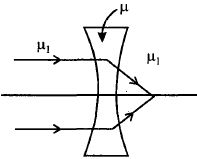
- B
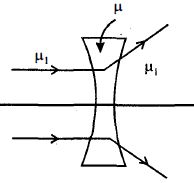
- C
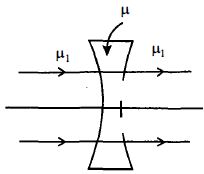
- D
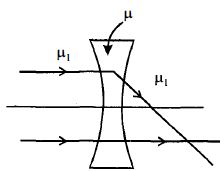
Explore More
Similar Questions
$A$ converging beam of rays is incident on a diverging lens. Having passed through the lens,the rays intersect at a point $15\, cm$ from the lens on the opposite side. If the lens is removed,the point where the rays meet will move $5\, cm$ closer to the lens. The focal length of the lens is $......\, cm$.
MediumAIPMT 2011
View Solution$A$ lens which has a focal length of $4 \; cm$ and a refractive index of $1.4$ is immersed in a liquid of refractive index $1.6$. What will be the new focal length in $cm$?
Medium
View SolutionThe graph between the lateral magnification $(m)$ produced by a lens and the distance of the image $(v)$ is given by
Medium
View Solution$A$ card sheet divided into squares each of size $1 \, mm^2$ is being viewed at a distance of $9 \, cm$ through a magnifying glass (a converging lens of focal length $10 \, cm$) held close to the eye. What is the magnification produced by the lens?
Difficult
View SolutionExplain how the image is formed by a thin convex lens and derive the lens maker's formula: $\frac{1}{f} = (n_{21} - 1) \left[ \frac{1}{R_1} - \frac{1}{R_2} \right]$.
Difficult
View SolutionVedclass Products
For Students
Vedclass Test Series
Mock tests in real JEE/NEET style with performance analysis. 5-day free trial.
Start Free TrialFor Teachers
Exam Paper Generator
Generate Set A/B/C/D exam papers from 7.5L+ questions in 2 minutes. 3 chapters free.
Try FreeFor Institutes
Online Exam Module
Live online exams with unlimited students, 360° analytics & white-label branding.
See Demo