
A English
Refraction by Lenses Questions in English
Class 12 Physics · Ray Optics and Optical Instruments · Refraction by Lenses
470+
Questions
English
Language
100%
With Solutions
Showing 50 of 470 questions in English
251
MediumMCQ
$A$ screen is placed $90 \; cm$ from an object. The image of the object on the screen is formed by a convex lens at two different locations separated by $20 \; cm$. Determine the focal length (in $cm$) of the lens.
A
$21.4$
B
$29.6$
C
$16.8$
D
$34.7$
Solution
(A) The distance between the object and the screen is $D = 90 \; cm$.
The distance between the two positions of the lens is $d = 20 \; cm$.
The focal length $f$ of the convex lens is given by the displacement method formula:
$f = \frac{D^2 - d^2}{4D}$
Substituting the given values:
$f = \frac{(90)^2 - (20)^2}{4 \times 90}$
$f = \frac{8100 - 400}{360}$
$f = \frac{7700}{360}$
$f = \frac{770}{36} \approx 21.39 \; cm$.
Rounding to one decimal place,the focal length is $21.4 \; cm$.
The distance between the two positions of the lens is $d = 20 \; cm$.
The focal length $f$ of the convex lens is given by the displacement method formula:
$f = \frac{D^2 - d^2}{4D}$
Substituting the given values:
$f = \frac{(90)^2 - (20)^2}{4 \times 90}$
$f = \frac{8100 - 400}{360}$
$f = \frac{7700}{360}$
$f = \frac{770}{36} \approx 21.39 \; cm$.
Rounding to one decimal place,the focal length is $21.4 \; cm$.
0 likes
View Solution252
Easy
What are paraxial rays?
Solution
(N/A) Paraxial rays are light rays that travel very close to the principal axis of an optical system (such as a spherical mirror or lens) and make very small angles with it.
Because these rays are close to the axis,the angle of incidence $\theta$ is small,allowing for the approximation $\sin \theta \approx \theta$ and $\tan \theta \approx \theta$.
This approximation is fundamental in deriving the mirror formula $\frac{1}{f} = \frac{1}{v} + \frac{1}{u}$ and the lens formula.
Because these rays are close to the axis,the angle of incidence $\theta$ is small,allowing for the approximation $\sin \theta \approx \theta$ and $\tan \theta \approx \theta$.
This approximation is fundamental in deriving the mirror formula $\frac{1}{f} = \frac{1}{v} + \frac{1}{u}$ and the lens formula.
0 likes
View Solution253
Difficult
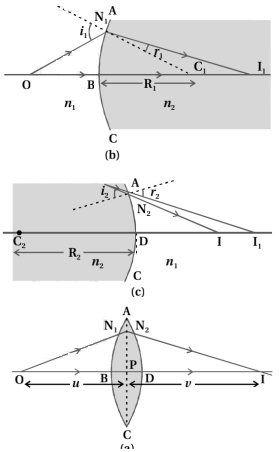
Explain how the image is formed by a thin convex lens and derive the lens maker's formula: $\frac{1}{f} = (n_{21} - 1) \left[ \frac{1}{R_1} - \frac{1}{R_2} \right]$.
Solution
(N/A) The image formation by a double convex lens can be analyzed in two steps:
$1$. The first refracting surface (with radius $R_1$) forms an image $I_1$ of the object $O$. For this surface,the refraction formula is: $\frac{n_1}{OB} + \frac{n_2}{BI_1} = \frac{n_2 - n_1}{R_1}$.
$2$. The image $I_1$ acts as a virtual object for the second refracting surface (with radius $R_2$). This surface forms the final image at $I$. For this surface,the refraction formula is: $\frac{n_2}{DI_1} + \frac{n_1}{DI} = \frac{n_1 - n_2}{R_2}$.
$3$. Assuming the lens is thin,$B$ and $D$ are very close to the optical center $P$. Thus,$BI_1 \approx DI_1$. Adding the two equations:
$\frac{n_1}{OB} + \frac{n_1}{DI} = (n_2 - n_1) \left[ \frac{1}{R_1} - \frac{1}{R_2} \right]$.
$4$. Using sign conventions,$OB = -u$ and $DI = v$. Substituting these:
$n_1 \left( \frac{1}{v} - \frac{1}{u} \right) = (n_2 - n_1) \left[ \frac{1}{R_1} - \frac{1}{R_2} \right]$.
$5$. Dividing by $n_1$ and setting $n_{21} = \frac{n_2}{n_1}$:
$\frac{1}{v} - \frac{1}{u} = (n_{21} - 1) \left[ \frac{1}{R_1} - \frac{1}{R_2} \right]$.
Since $\frac{1}{v} - \frac{1}{u} = \frac{1}{f}$,we get the lens maker's formula: $\frac{1}{f} = (n_{21} - 1) \left[ \frac{1}{R_1} - \frac{1}{R_2} \right]$.
$1$. The first refracting surface (with radius $R_1$) forms an image $I_1$ of the object $O$. For this surface,the refraction formula is: $\frac{n_1}{OB} + \frac{n_2}{BI_1} = \frac{n_2 - n_1}{R_1}$.
$2$. The image $I_1$ acts as a virtual object for the second refracting surface (with radius $R_2$). This surface forms the final image at $I$. For this surface,the refraction formula is: $\frac{n_2}{DI_1} + \frac{n_1}{DI} = \frac{n_1 - n_2}{R_2}$.
$3$. Assuming the lens is thin,$B$ and $D$ are very close to the optical center $P$. Thus,$BI_1 \approx DI_1$. Adding the two equations:
$\frac{n_1}{OB} + \frac{n_1}{DI} = (n_2 - n_1) \left[ \frac{1}{R_1} - \frac{1}{R_2} \right]$.
$4$. Using sign conventions,$OB = -u$ and $DI = v$. Substituting these:
$n_1 \left( \frac{1}{v} - \frac{1}{u} \right) = (n_2 - n_1) \left[ \frac{1}{R_1} - \frac{1}{R_2} \right]$.
$5$. Dividing by $n_1$ and setting $n_{21} = \frac{n_2}{n_1}$:
$\frac{1}{v} - \frac{1}{u} = (n_{21} - 1) \left[ \frac{1}{R_1} - \frac{1}{R_2} \right]$.
Since $\frac{1}{v} - \frac{1}{u} = \frac{1}{f}$,we get the lens maker's formula: $\frac{1}{f} = (n_{21} - 1) \left[ \frac{1}{R_1} - \frac{1}{R_2} \right]$.
0 likes
View Solution254
Medium
Derive the thin lens equation.
Solution
(N/A) For refraction at two spherical surfaces of a lens,the general equation is:
$\frac{n_{1}}{-u} + \frac{n_{1}}{v} = (n_{2} - n_{1}) \left[ \frac{1}{R_{1}} - \frac{1}{R_{2}} \right]$
Dividing both sides by $n_{1}$,we get:
$\frac{1}{-u} + \frac{1}{v} = \left( \frac{n_{2}}{n_{1}} - 1 \right) \left[ \frac{1}{R_{1}} - \frac{1}{R_{2}} \right]$
Since $n_{21} = \frac{n_{2}}{n_{1}}$,we have:
$\frac{1}{v} - \frac{1}{u} = (n_{21} - 1) \left[ \frac{1}{R_{1}} - \frac{1}{R_{2}} \right] \quad \dots (1)$
The lens maker's formula is given by:
$\frac{1}{f} = (n_{21} - 1) \left[ \frac{1}{R_{1}} - \frac{1}{R_{2}} \right] \quad \dots (2)$
By comparing equations $(1)$ and $(2)$,we obtain the thin lens equation:
$\frac{1}{f} = \frac{1}{v} - \frac{1}{u}$
Here,the distances are measured according to the sign convention,and this equation is valid for both real and virtual images formed by convex and concave lenses.
$\frac{n_{1}}{-u} + \frac{n_{1}}{v} = (n_{2} - n_{1}) \left[ \frac{1}{R_{1}} - \frac{1}{R_{2}} \right]$
Dividing both sides by $n_{1}$,we get:
$\frac{1}{-u} + \frac{1}{v} = \left( \frac{n_{2}}{n_{1}} - 1 \right) \left[ \frac{1}{R_{1}} - \frac{1}{R_{2}} \right]$
Since $n_{21} = \frac{n_{2}}{n_{1}}$,we have:
$\frac{1}{v} - \frac{1}{u} = (n_{21} - 1) \left[ \frac{1}{R_{1}} - \frac{1}{R_{2}} \right] \quad \dots (1)$
The lens maker's formula is given by:
$\frac{1}{f} = (n_{21} - 1) \left[ \frac{1}{R_{1}} - \frac{1}{R_{2}} \right] \quad \dots (2)$
By comparing equations $(1)$ and $(2)$,we obtain the thin lens equation:
$\frac{1}{f} = \frac{1}{v} - \frac{1}{u}$
Here,the distances are measured according to the sign convention,and this equation is valid for both real and virtual images formed by convex and concave lenses.
0 likes
View Solution255
Medium
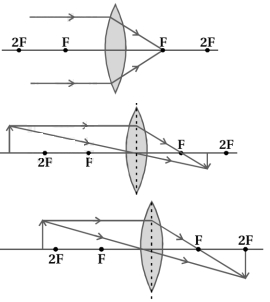
Provide the object distance,image distance,type,size,and magnification for an object placed in front of a thin convex lens for different positions.
Solution
(N/A) Convex lens:
$(i)$ Object position: At infinity $(u = \infty)$
Image position: At focus $(F)$
Image type: Real and inverted
Image size: Highly diminished
Magnification: $m \approx 0$ (negative)
(ii) Object position: Beyond $2F$ $(u > 2F)$
Image position: Between $F$ and $2F$
Image type: Real and inverted
Image size: Diminished
Magnification: $-1 < m < 0$
(iii) Object position: At $2F$ $(u = 2F)$
Image position: At $2F$
Image type: Real and inverted
Image size: Same as the object
Magnification: $m = -1$
$(i)$ Object position: At infinity $(u = \infty)$
Image position: At focus $(F)$
Image type: Real and inverted
Image size: Highly diminished
Magnification: $m \approx 0$ (negative)
(ii) Object position: Beyond $2F$ $(u > 2F)$
Image position: Between $F$ and $2F$
Image type: Real and inverted
Image size: Diminished
Magnification: $-1 < m < 0$
(iii) Object position: At $2F$ $(u = 2F)$
Image position: At $2F$
Image type: Real and inverted
Image size: Same as the object
Magnification: $m = -1$
0 likes
View Solution256
Medium
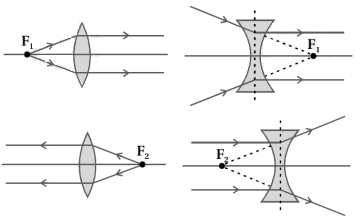
Explain the first focal point and second focal point for a lens.
Solution
(N/A) $(i)$ First focal point: It is the position of an object on the principal axis such that the rays of light originating from it become parallel to the principal axis after refraction through the lens. It is denoted by $F_{1}$.
$(ii)$ Second focal point: It is the position of a point-like image on the principal axis formed by the lens when the incident rays of light are parallel to the principal axis. It is denoted by $F_{2}$.
$(ii)$ Second focal point: It is the position of a point-like image on the principal axis formed by the lens when the incident rays of light are parallel to the principal axis. It is denoted by $F_{2}$.
0 likes
View Solution257
Medium
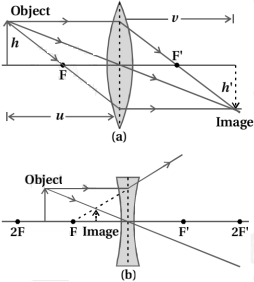
How is it convenient to obtain an image by a lens practically?
Solution
(N/A) To find the image of an object by a lens,we can in principle,take any two rays emanating from a point on an object; trace their paths using the laws of refraction and find the point where the refracted rays meet (or appear to meet). In practice,however,it is convenient to choose any two of the following rays:
$(i)$ $A$ ray emanating from the object parallel to the principal axis of the lens after refraction passes through the second principal focus $F^{\prime}$ (in a convex lens) or appears to diverge (in a concave lens) from the first principal focus $F$.
$(ii)$ $A$ ray of light,passing through the optical centre of the lens,emerges without any deviation after refraction.
$(iii)$ $A$ ray of light passing through the first principal focus (for a convex lens) or appearing to meet at it (for a concave lens) emerges parallel to the principal axis after refraction.
It must be remembered that each point on an object gives out an infinite number of rays. All these rays will pass through the same image point after refraction at the lens.
$(i)$ $A$ ray emanating from the object parallel to the principal axis of the lens after refraction passes through the second principal focus $F^{\prime}$ (in a convex lens) or appears to diverge (in a concave lens) from the first principal focus $F$.
$(ii)$ $A$ ray of light,passing through the optical centre of the lens,emerges without any deviation after refraction.
$(iii)$ $A$ ray of light passing through the first principal focus (for a convex lens) or appearing to meet at it (for a concave lens) emerges parallel to the principal axis after refraction.
It must be remembered that each point on an object gives out an infinite number of rays. All these rays will pass through the same image point after refraction at the lens.
0 likes
View Solution258
Medium
Define magnification for a lens and derive its expression.
Solution
(N/A) The ratio of the size of the image obtained by a lens to the size of the object is called linear magnification $(m)$.
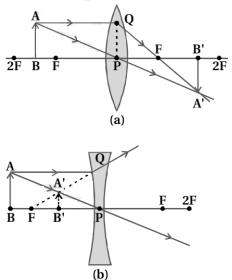
In figures $(a)$ and $(b)$,convex and concave lenses are shown respectively.
Let the object height be $AB = h$ and the image height be $A'B' = h'$.
Let the object distance be $BP = u$ and the image distance be $B'P = v$.
Right-angled triangles $\triangle ABP$ and $\triangle A'B'P$ are similar.
Therefore,$\frac{A'B'}{AB} = \frac{B'P}{BP}$.
Applying the sign convention: $AB = h$,$A'B' = -h'$ (for real image),$BP = -u$,$B'P = v$.
Substituting these values: $\frac{-h'}{h} = \frac{v}{-u}$.
Therefore,$\frac{h'}{h} = \frac{v}{u}$.
Thus,magnification $m = \frac{h'}{h} = \frac{v}{u}$.
Magnification is negative for a real image and positive for a virtual image.
In figures $(a)$ and $(b)$,convex and concave lenses are shown respectively.
Let the object height be $AB = h$ and the image height be $A'B' = h'$.
Let the object distance be $BP = u$ and the image distance be $B'P = v$.
Right-angled triangles $\triangle ABP$ and $\triangle A'B'P$ are similar.
Therefore,$\frac{A'B'}{AB} = \frac{B'P}{BP}$.
Applying the sign convention: $AB = h$,$A'B' = -h'$ (for real image),$BP = -u$,$B'P = v$.
Substituting these values: $\frac{-h'}{h} = \frac{v}{-u}$.
Therefore,$\frac{h'}{h} = \frac{v}{u}$.
Thus,magnification $m = \frac{h'}{h} = \frac{v}{u}$.
Magnification is negative for a real image and positive for a virtual image.
0 likes
View Solution259
Medium
Define power of a lens,obtain its equation and write its $SI$ unit.
Solution
(N/A) Power of a lens is a measure of the convergence or divergence,which a lens introduces in the light falling on it.
Clearly,a lens of shorter focal length bends the incident light more,converging it in the case of a convex lens and diverging it in the case of a concave lens.
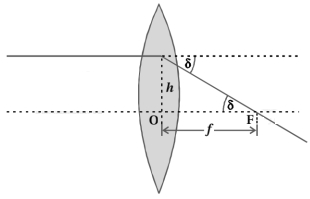
The power $P$ of a lens is defined as the tangent of the angle by which it converges or diverges a beam of light falling at unit distance from the optical centre.
From the figure,
$\tan \delta = \frac{h}{f}$. If $h = 1$,then $\tan \delta = \frac{1}{f}$.
For small values of $\delta$,$\tan \delta \approx \delta$.
Therefore,$\delta = \frac{1}{f}$. Thus,Power $P = \frac{1}{f}$.
The $SI$ unit for the power of a lens is dioptre $(D)$.
$1 \ D = 1 \ m^{-1}$.
The power of a lens of focal length $1 \ m$ is one dioptre.
Power of a lens is positive for a converging lens and negative for a diverging lens.
Clearly,a lens of shorter focal length bends the incident light more,converging it in the case of a convex lens and diverging it in the case of a concave lens.
The power $P$ of a lens is defined as the tangent of the angle by which it converges or diverges a beam of light falling at unit distance from the optical centre.
From the figure,
$\tan \delta = \frac{h}{f}$. If $h = 1$,then $\tan \delta = \frac{1}{f}$.
For small values of $\delta$,$\tan \delta \approx \delta$.
Therefore,$\delta = \frac{1}{f}$. Thus,Power $P = \frac{1}{f}$.
The $SI$ unit for the power of a lens is dioptre $(D)$.
$1 \ D = 1 \ m^{-1}$.
The power of a lens of focal length $1 \ m$ is one dioptre.
Power of a lens is positive for a converging lens and negative for a diverging lens.
0 likes
View Solution260
EasyMCQ
What is a lens?
A
$A$ transparent medium bounded by two surfaces,at least one of which is spherical.
B
$A$ mirror used for reflection.
C
$A$ device used to measure light intensity.
D
$A$ solid block of glass with flat surfaces.
Solution
(A) lens is a transparent optical medium bounded by two surfaces,of which at least one surface must be spherical.
Lenses are used to refract light and form images by converging or diverging light rays.
They are broadly classified into two types: convex (converging) lenses and concave (diverging) lenses.
Lenses are used to refract light and form images by converging or diverging light rays.
They are broadly classified into two types: convex (converging) lenses and concave (diverging) lenses.
0 likes
View Solution261
Easy
Write the lens formula for a thin lens.
Solution
(N/A) The lens formula for a thin lens relates the object distance $(u)$,the image distance $(v)$,and the focal length $(f)$ of the lens.
It is given by the equation:
$\frac{1}{f} = \frac{1}{v} - \frac{1}{u}$
Where:
$f$ is the focal length of the lens.
$v$ is the distance of the image from the optical center of the lens.
$u$ is the distance of the object from the optical center of the lens.
It is given by the equation:
$\frac{1}{f} = \frac{1}{v} - \frac{1}{u}$
Where:
$f$ is the focal length of the lens.
$v$ is the distance of the image from the optical center of the lens.
$u$ is the distance of the object from the optical center of the lens.
0 likes
View Solution262
Medium
Write the lens maker's equation for a thin lens.
Solution
(N/A) The lens maker's equation relates the focal length $(f)$ of a lens to the refractive index of the lens material $(n_2)$,the refractive index of the surrounding medium $(n_1)$,and the radii of curvature of the two lens surfaces ($R_1$ and $R_2$).
The formula is given by:
$\frac{1}{f} = \left( \frac{n_2}{n_1} - 1 \right) \left( \frac{1}{R_1} - \frac{1}{R_2} \right)$
Where:
- $f$ is the focal length of the lens.
- $n_2$ is the refractive index of the lens material.
- $n_1$ is the refractive index of the surrounding medium.
- $R_1$ and $R_2$ are the radii of curvature of the two surfaces of the lens.
The formula is given by:
$\frac{1}{f} = \left( \frac{n_2}{n_1} - 1 \right) \left( \frac{1}{R_1} - \frac{1}{R_2} \right)$
Where:
- $f$ is the focal length of the lens.
- $n_2$ is the refractive index of the lens material.
- $n_1$ is the refractive index of the surrounding medium.
- $R_1$ and $R_2$ are the radii of curvature of the two surfaces of the lens.
0 likes
View Solution263
Easy
Write the Gaussian equation for a lens.
Solution
(N/A) The Gaussian lens equation,also known as the lens formula,relates the object distance $(u)$,the image distance $(v)$,and the focal length $(f)$ of a lens. It is given by the expression:
$\frac{1}{v} - \frac{1}{u} = \frac{1}{f}$
Where:
$v$ is the distance of the image from the optical center of the lens.
$u$ is the distance of the object from the optical center of the lens.
$f$ is the focal length of the lens.
$\frac{1}{v} - \frac{1}{u} = \frac{1}{f}$
Where:
$v$ is the distance of the image from the optical center of the lens.
$u$ is the distance of the object from the optical center of the lens.
$f$ is the focal length of the lens.
0 likes
View Solution264
Medium
Explain the first focal centre (first principal focus) and second focal centre (second principal focus) for a biconvex lens and a biconcave lens with the help of diagrams.
Solution
(N/A) $1$. First Principal Focus $(F_1)$: It is a fixed point on the principal axis of a lens such that light rays starting from this point (in a convex lens) or appearing to converge towards this point (in a concave lens) become parallel to the principal axis after refraction through the lens.
$2$. Second Principal Focus $(F_2)$: It is a fixed point on the principal axis of a lens such that light rays coming parallel to the principal axis after refraction through the lens either converge to this point (in a convex lens) or appear to diverge from this point (in a concave lens).
- For a biconvex lens: The first focus is on the left side,and the second focus is on the right side.
- For a biconcave lens: The first focus is on the right side,and the second focus is on the left side.
$2$. Second Principal Focus $(F_2)$: It is a fixed point on the principal axis of a lens such that light rays coming parallel to the principal axis after refraction through the lens either converge to this point (in a convex lens) or appear to diverge from this point (in a concave lens).
- For a biconvex lens: The first focus is on the left side,and the second focus is on the right side.
- For a biconcave lens: The first focus is on the right side,and the second focus is on the left side.
0 likes
View Solution265
Easy
Write the equation and definition of lateral magnification for a lens.
Solution
(N/A) Lateral magnification $(m)$ for a lens is defined as the ratio of the height of the image $(h')$ to the height of the object $(h)$.
Mathematically,it is expressed as:
$m = \frac{h'}{h}$
For a thin lens,this can also be expressed in terms of the image distance $(v)$ and the object distance $(u)$:
$m = \frac{v}{u}$
Where:
$h'$ = height of the image
$h$ = height of the object
$v$ = distance of the image from the optical center
$u$ = distance of the object from the optical center
Mathematically,it is expressed as:
$m = \frac{h'}{h}$
For a thin lens,this can also be expressed in terms of the image distance $(v)$ and the object distance $(u)$:
$m = \frac{v}{u}$
Where:
$h'$ = height of the image
$h$ = height of the object
$v$ = distance of the image from the optical center
$u$ = distance of the object from the optical center
0 likes
View Solution266
Medium
Define power of a lens and write the $SI$ unit of power.
Solution
(N/A) The power of a lens is defined as the reciprocal of its focal length in meters. It is a measure of the degree of convergence or divergence of light rays falling on the lens.
Mathematically,$P = \frac{1}{f(m)}$,where $P$ is the power of the lens and $f$ is the focal length in meters.
The $SI$ unit of power of a lens is the Dioptre $(D)$,where $1 \ D = 1 \ m^{-1}$.
Mathematically,$P = \frac{1}{f(m)}$,where $P$ is the power of the lens and $f$ is the focal length in meters.
The $SI$ unit of power of a lens is the Dioptre $(D)$,where $1 \ D = 1 \ m^{-1}$.
0 likes
View Solution267
MediumMCQ
Is power negative or positive for a concave lens?
A
Positive
B
Negative
C
Zero
D
Infinite
Solution
(B) The power $P$ of a lens is defined as the reciprocal of its focal length $f$ in meters,given by the formula $P = \frac{1}{f(m)}$.
For a concave lens,the focal length $f$ is by convention taken as negative because the light rays appear to diverge from a point on the same side as the object.
Since $f < 0$,the power $P = \frac{1}{f}$ will also be negative.
Therefore,the power of a concave lens is always negative.
For a concave lens,the focal length $f$ is by convention taken as negative because the light rays appear to diverge from a point on the same side as the object.
Since $f < 0$,the power $P = \frac{1}{f}$ will also be negative.
Therefore,the power of a concave lens is always negative.
0 likes
View Solution268
EasyMCQ
On which does the convergence capacity of a lens depend?
A
Refractive index of the material of the lens
B
Radii of curvature of the lens surfaces
C
Both $(A)$ and $(B)$
D
None of the above
Solution
(C) The convergence capacity of a lens is defined by its power $P$,which is given by the Lens Maker's formula: $P = \frac{1}{f} = (n - 1) \left( \frac{1}{R_1} - \frac{1}{R_2} \right)$.
Here,$n$ is the refractive index of the lens material relative to the surrounding medium,and $R_1$ and $R_2$ are the radii of curvature of the two surfaces of the lens.
Since the power $P$ depends on both the refractive index $n$ and the radii of curvature $R_1$ and $R_2$,the convergence capacity depends on both factors.
Therefore,the correct option is $C$.
Here,$n$ is the refractive index of the lens material relative to the surrounding medium,and $R_1$ and $R_2$ are the radii of curvature of the two surfaces of the lens.
Since the power $P$ depends on both the refractive index $n$ and the radii of curvature $R_1$ and $R_2$,the convergence capacity depends on both factors.
Therefore,the correct option is $C$.
0 likes
View Solution269
Medium
Will the focal length of a lens for red light be more,same,or less than that for blue light?
Solution
(A) According to the lens maker's formula,the focal length $f$ is given by:
$\frac{1}{f} = (\mu - 1) \left[ \frac{1}{R_1} - \frac{1}{R_2} \right]$
Since the term $\left[ \frac{1}{R_1} - \frac{1}{R_2} \right]$ is constant for a given lens,we have $\frac{1}{f} \propto (\mu - 1)$,which implies $f \propto \frac{1}{\mu - 1}$.
According to Cauchy's dispersion formula,the refractive index $\mu$ is higher for light of shorter wavelengths (blue) and lower for light of longer wavelengths (red).
Thus,$\mu_b > \mu_r$.
Since $f$ is inversely proportional to $(\mu - 1)$,a higher refractive index results in a smaller focal length.
Therefore,$f_r > f_b$. The focal length for red light is more than that for blue light.
$\frac{1}{f} = (\mu - 1) \left[ \frac{1}{R_1} - \frac{1}{R_2} \right]$
Since the term $\left[ \frac{1}{R_1} - \frac{1}{R_2} \right]$ is constant for a given lens,we have $\frac{1}{f} \propto (\mu - 1)$,which implies $f \propto \frac{1}{\mu - 1}$.
According to Cauchy's dispersion formula,the refractive index $\mu$ is higher for light of shorter wavelengths (blue) and lower for light of longer wavelengths (red).
Thus,$\mu_b > \mu_r$.
Since $f$ is inversely proportional to $(\mu - 1)$,a higher refractive index results in a smaller focal length.
Therefore,$f_r > f_b$. The focal length for red light is more than that for blue light.
0 likes
View Solution270
MediumMCQ
An unsymmetrical double convex thin lens forms the image of a point object on its axis. Will the position of the image change if the lens is reversed?
A
Yes
B
No
C
Depends on the object distance
D
Depends on the refractive index
Solution
(B) According to the lens maker's formula,$\frac{1}{f} = (n - 1) \left( \frac{1}{R_1} - \frac{1}{R_2} \right)$.
From the lens formula,$\frac{1}{v} - \frac{1}{u} = \frac{1}{f}$.
When the lens is reversed,the new radii of curvature become $R_1' = -R_2$ and $R_2' = -R_1$. Substituting these into the lens maker's formula:
$\frac{1}{f'} = (n - 1) \left( \frac{1}{-R_2} - \frac{1}{-R_1} \right) = (n - 1) \left( \frac{1}{R_1} - \frac{1}{R_2} \right) = \frac{1}{f}$.
Since the focal length $f$ remains unchanged and the object distance $u$ is constant,the image distance $v$ remains unchanged according to the lens formula $\frac{1}{v} = \frac{1}{u} + \frac{1}{f}$.
Therefore,the position of the image will not change.
From the lens formula,$\frac{1}{v} - \frac{1}{u} = \frac{1}{f}$.
When the lens is reversed,the new radii of curvature become $R_1' = -R_2$ and $R_2' = -R_1$. Substituting these into the lens maker's formula:
$\frac{1}{f'} = (n - 1) \left( \frac{1}{-R_2} - \frac{1}{-R_1} \right) = (n - 1) \left( \frac{1}{R_1} - \frac{1}{R_2} \right) = \frac{1}{f}$.
Since the focal length $f$ remains unchanged and the object distance $u$ is constant,the image distance $v$ remains unchanged according to the lens formula $\frac{1}{v} = \frac{1}{u} + \frac{1}{f}$.
Therefore,the position of the image will not change.
0 likes
View Solution271
Medium
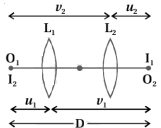
In many experimental set-ups,the source and screen are fixed at a distance $D$ and the lens is movable. Show that there are two positions for the lens for which an image is formed on the screen. Find the distance between these points and the ratio of the image sizes for these two points.
Solution
(N/A) Let the distance between the object and the screen be $D$. Let the distance of the lens from the object be $u$ and from the screen be $v$. Then $v + |u| = D$. Since $u$ is negative,$v - u = D$,or $v = D + u$.
Using the lens formula $\frac{1}{f} = \frac{1}{v} - \frac{1}{u}$,we substitute $v = D + u$:
$\frac{1}{f} = \frac{1}{D+u} - \frac{1}{u} = \frac{u - (D+u)}{u(D+u)} = \frac{-D}{uD + u^2}$.
Rearranging gives the quadratic equation $u^2 + Du + fD = 0$.
The roots are $u = \frac{-D \pm \sqrt{D^2 - 4fD}}{2}$.
For real roots,$D^2 - 4fD \ge 0$,which means $D \ge 4f$. Thus,there are two positions for the lens.
Let the two positions be $u_1$ and $u_2$. The distance between them is $d = |u_1 - u_2| = \sqrt{D^2 - 4fD}$.
The magnification $m = \frac{v}{u}$. For the two positions,$m_1 = \frac{v_1}{u_1}$ and $m_2 = \frac{v_2}{u_2}$. Since $v_1 = |u_2|$ and $v_2 = |u_1|$,we have $m_1 = \frac{|u_2|}{u_1}$ and $m_2 = \frac{|u_1|}{u_2}$. The product $m_1 m_2 = 1$,so the ratio of image sizes is $m_1^2$ or $m_2^2$.
Using the lens formula $\frac{1}{f} = \frac{1}{v} - \frac{1}{u}$,we substitute $v = D + u$:
$\frac{1}{f} = \frac{1}{D+u} - \frac{1}{u} = \frac{u - (D+u)}{u(D+u)} = \frac{-D}{uD + u^2}$.
Rearranging gives the quadratic equation $u^2 + Du + fD = 0$.
The roots are $u = \frac{-D \pm \sqrt{D^2 - 4fD}}{2}$.
For real roots,$D^2 - 4fD \ge 0$,which means $D \ge 4f$. Thus,there are two positions for the lens.
Let the two positions be $u_1$ and $u_2$. The distance between them is $d = |u_1 - u_2| = \sqrt{D^2 - 4fD}$.
The magnification $m = \frac{v}{u}$. For the two positions,$m_1 = \frac{v_1}{u_1}$ and $m_2 = \frac{v_2}{u_2}$. Since $v_1 = |u_2|$ and $v_2 = |u_1|$,we have $m_1 = \frac{|u_2|}{u_1}$ and $m_2 = \frac{|u_1|}{u_2}$. The product $m_1 m_2 = 1$,so the ratio of image sizes is $m_1^2$ or $m_2^2$.
0 likes
View Solution272
Difficult
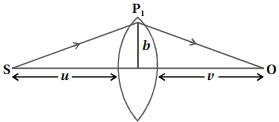
Consider a thin lens placed between a source $(S)$ and an observer $(O)$ (See figure). Let the thickness of the lens vary as $w(b) = w_0 - \alpha b^2$, where $b$ is the vertical distance from the pole. $w_0$ and $\alpha$ are constants. Using Fermat's principle, i.e., the time of transit for a ray between the source and observer is an extremum, find the condition that all paraxial rays starting from the source will converge at a point $O$ on the axis. Find the focal length.
$(ii)$ $A$ gravitational lens may be assumed to have a varying width of the form $W = K_1 \log \left( \frac{K_2}{b} \right)$ (where $b_{\min} < b < b_{\max}$). Show that an observer will see an image of a point object as a ring about the center of the lens with an angular radius $\beta = \sqrt{\frac{(n - 1)K_1 u}{v(u + v)}}$.
$(ii)$ $A$ gravitational lens may be assumed to have a varying width of the form $W = K_1 \log \left( \frac{K_2}{b} \right)$ (where $b_{\min} < b < b_{\max}$). Show that an observer will see an image of a point object as a ring about the center of the lens with an angular radius $\beta = \sqrt{\frac{(n - 1)K_1 u}{v(u + v)}}$.
Solution
(N/A) $(i)$ Let $n$ be the refractive index of the lens material. The time taken by light to travel from $S$ to $O$ through a point at distance $b$ from the axis is $T = \frac{SP_1}{c} + \frac{(n-1)w(b)}{c} + \frac{P_1O}{c}$.
Using the paraxial approximation: $SP_1 \approx u + \frac{b^2}{2u}$ and $P_1O \approx v + \frac{b^2}{2v}$.
$T = \frac{1}{c} \left[ u + \frac{b^2}{2u} + (n-1)(w_0 - \alpha b^2) + v + \frac{b^2}{2v} \right]$.
For $T$ to be an extremum, $\frac{dT}{db} = 0 \implies \frac{b}{u} + \frac{b}{v} - 2(n-1)\alpha b = 0$.
Since this must hold for all $b$, we have $\frac{1}{u} + \frac{1}{v} = 2(n-1)\alpha$. Comparing with the lens formula $\frac{1}{v} + \frac{1}{u} = \frac{1}{f}$, the focal length is $f = \frac{1}{2(n-1)\alpha}$.
$(ii)$ For the gravitational lens, the optical path length is $L = \sqrt{u^2+b^2} + \sqrt{v^2+b^2} + (n-1)W(b)$.
Using paraxial approximation: $L \approx u + v + \frac{b^2}{2u} + \frac{b^2}{2v} + (n-1)K_1 \log \left( \frac{K_2}{b} \right)$.
Extremum condition $\frac{dL}{db} = 0 \implies \frac{b}{u} + \frac{b}{v} + (n-1)K_1 \left( -\frac{1}{b} \right) = 0$.
$b^2 \left( \frac{u+v}{uv} \right) = (n-1)K_1 \implies b = \sqrt{\frac{(n-1)K_1 uv}{u+v}}$.
The angular radius is $\beta \approx \frac{b}{v} = \sqrt{\frac{(n-1)K_1 u}{v(u+v)}}$.
Using the paraxial approximation: $SP_1 \approx u + \frac{b^2}{2u}$ and $P_1O \approx v + \frac{b^2}{2v}$.
$T = \frac{1}{c} \left[ u + \frac{b^2}{2u} + (n-1)(w_0 - \alpha b^2) + v + \frac{b^2}{2v} \right]$.
For $T$ to be an extremum, $\frac{dT}{db} = 0 \implies \frac{b}{u} + \frac{b}{v} - 2(n-1)\alpha b = 0$.
Since this must hold for all $b$, we have $\frac{1}{u} + \frac{1}{v} = 2(n-1)\alpha$. Comparing with the lens formula $\frac{1}{v} + \frac{1}{u} = \frac{1}{f}$, the focal length is $f = \frac{1}{2(n-1)\alpha}$.
$(ii)$ For the gravitational lens, the optical path length is $L = \sqrt{u^2+b^2} + \sqrt{v^2+b^2} + (n-1)W(b)$.
Using paraxial approximation: $L \approx u + v + \frac{b^2}{2u} + \frac{b^2}{2v} + (n-1)K_1 \log \left( \frac{K_2}{b} \right)$.
Extremum condition $\frac{dL}{db} = 0 \implies \frac{b}{u} + \frac{b}{v} + (n-1)K_1 \left( -\frac{1}{b} \right) = 0$.
$b^2 \left( \frac{u+v}{uv} \right) = (n-1)K_1 \implies b = \sqrt{\frac{(n-1)K_1 uv}{u+v}}$.
The angular radius is $\beta \approx \frac{b}{v} = \sqrt{\frac{(n-1)K_1 u}{v(u+v)}}$.
0 likes
View Solution273
DifficultMCQ
The distance between an object and a screen is $100\, cm$. $A$ lens can produce a real image of the object on the screen for two different positions between the screen and the object. The distance between these two positions is $40\, cm$. If the power of the lens is close to $\left(\frac{N}{100}\right) D$ where $N$ is an integer,the value of $N$ is.......
A
$445$
B
$495$
C
$486$
D
$476$
Solution
(D) Using the displacement method for a convex lens,the focal length $f$ is given by the formula:
$f = \frac{D^2 - d^2}{4D}$
where $D$ is the distance between the object and the screen,and $d$ is the distance between the two positions of the lens.
Given $D = 100\, cm$ and $d = 40\, cm$.
Substituting the values:
$f = \frac{100^2 - 40^2}{4 \times 100} = \frac{10000 - 1600}{400} = \frac{8400}{400} = 21\, cm$.
The power of the lens $P$ in Diopters $(D)$ is given by $P = \frac{100}{f(cm)}$:
$P = \frac{100}{21} D$.
We are given $P = \left(\frac{N}{100}\right) D$,so:
$\frac{N}{100} = \frac{100}{21} \approx 4.7619$.
$N = \frac{10000}{21} \approx 476.19$.
Rounding to the nearest integer,$N = 476$.
$f = \frac{D^2 - d^2}{4D}$
where $D$ is the distance between the object and the screen,and $d$ is the distance between the two positions of the lens.
Given $D = 100\, cm$ and $d = 40\, cm$.
Substituting the values:
$f = \frac{100^2 - 40^2}{4 \times 100} = \frac{10000 - 1600}{400} = \frac{8400}{400} = 21\, cm$.
The power of the lens $P$ in Diopters $(D)$ is given by $P = \frac{100}{f(cm)}$:
$P = \frac{100}{21} D$.
We are given $P = \left(\frac{N}{100}\right) D$,so:
$\frac{N}{100} = \frac{100}{21} \approx 4.7619$.
$N = \frac{10000}{21} \approx 476.19$.
Rounding to the nearest integer,$N = 476$.
0 likes
View Solution274
DifficultMCQ
For a concave lens of focal length $f$,the relation between object distance $u$ and image distance $v$ from its pole can best be represented by ($u = v$ is the reference line):
A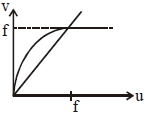
B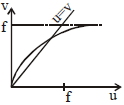
C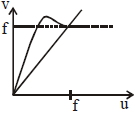
D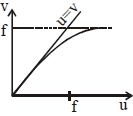
Solution
(D) The lens formula is given by $\frac{1}{v} - \frac{1}{u} = \frac{1}{f}$.
For a concave lens,the focal length $f$ is negative,so let $f = -|f|$.
Thus,$\frac{1}{v} - \frac{1}{u} = -\frac{1}{|f|}$,which simplifies to $\frac{1}{v} = \frac{1}{u} - \frac{1}{|f|} = \frac{|f|-u}{u|f|}$.
Therefore,$v = \frac{u|f|}{|f|-u}$.
As $u \to 0$,$v \to 0$.
As $u \to |f|$,$v \to \infty$.
As $u \to \infty$,$v \to -|f|$.
Since the question uses magnitudes for $u$ and $v$ in the graphs,we consider the virtual image formed by a concave lens,where $v$ is always between $0$ and $f$. The correct graphical representation for the magnitude of image distance $v$ versus object distance $u$ is shown in option $D$.
For a concave lens,the focal length $f$ is negative,so let $f = -|f|$.
Thus,$\frac{1}{v} - \frac{1}{u} = -\frac{1}{|f|}$,which simplifies to $\frac{1}{v} = \frac{1}{u} - \frac{1}{|f|} = \frac{|f|-u}{u|f|}$.
Therefore,$v = \frac{u|f|}{|f|-u}$.
As $u \to 0$,$v \to 0$.
As $u \to |f|$,$v \to \infty$.
As $u \to \infty$,$v \to -|f|$.
Since the question uses magnitudes for $u$ and $v$ in the graphs,we consider the virtual image formed by a concave lens,where $v$ is always between $0$ and $f$. The correct graphical representation for the magnitude of image distance $v$ versus object distance $u$ is shown in option $D$.
0 likes
View Solution275
MediumMCQ
$A$ double convex lens has power $P$ and same radii of curvature $R$ of both the surfaces. The radius of curvature of a surface of a plano-convex lens made of the same material with power $1.5P$ is ......$R$.
A
$0.5$
B
$2$
C
$1.5$
D
$0.33$
Solution
(D) For a double convex lens, the radii of curvature are $R_1 = R$ and $R_2 = -R$. Using the lens maker's formula, the power $P$ is given by:
$P = (\mu - 1) \left( \frac{1}{R_1} - \frac{1}{R_2} \right) = (\mu - 1) \left( \frac{1}{R} - \frac{1}{-R} \right) = (\mu - 1) \left( \frac{2}{R} \right) \quad ...(i)$
For a plano-convex lens, the radii of curvature are $R_1' = R'$ and $R_2' = \infty$. The power $P'$ is given by:
$P' = (\mu - 1) \left( \frac{1}{R'} - \frac{1}{\infty} \right) = (\mu - 1) \left( \frac{1}{R'} \right) \quad ...(ii)$
Given that $P' = 1.5P = \frac{3}{2}P$, we substitute the expressions from $(i)$ and $(ii)$:
$(\mu - 1) \left( \frac{1}{R'} \right) = \frac{3}{2} \left[ (\mu - 1) \left( \frac{2}{R} \right) \right]$
$\frac{1}{R'} = \frac{3}{R}$
Therefore, $R' = \frac{R}{3} \approx 0.33R$.
$P = (\mu - 1) \left( \frac{1}{R_1} - \frac{1}{R_2} \right) = (\mu - 1) \left( \frac{1}{R} - \frac{1}{-R} \right) = (\mu - 1) \left( \frac{2}{R} \right) \quad ...(i)$
For a plano-convex lens, the radii of curvature are $R_1' = R'$ and $R_2' = \infty$. The power $P'$ is given by:
$P' = (\mu - 1) \left( \frac{1}{R'} - \frac{1}{\infty} \right) = (\mu - 1) \left( \frac{1}{R'} \right) \quad ...(ii)$
Given that $P' = 1.5P = \frac{3}{2}P$, we substitute the expressions from $(i)$ and $(ii)$:
$(\mu - 1) \left( \frac{1}{R'} \right) = \frac{3}{2} \left[ (\mu - 1) \left( \frac{2}{R} \right) \right]$
$\frac{1}{R'} = \frac{3}{R}$
Therefore, $R' = \frac{R}{3} \approx 0.33R$.

0 likes
View Solution276
MediumMCQ
The power of a biconvex lens is $10 \; D$ and the radius of curvature of each surface is $10 \; cm$. The refractive index of the material of the lens is:
A
$3/2$
B
$4/3$
C
$9/8$
D
$5/3$
Solution
(A) The lens maker's formula is given by $\frac{1}{f} = (\mu - 1) \left( \frac{1}{R_1} - \frac{1}{R_2} \right)$.
Given power $P = 10 \; D$,the focal length $f = \frac{1}{P} = \frac{1}{10} \; m = 0.1 \; m = 10 \; cm$.
For a biconvex lens,$R_1 = +10 \; cm$ and $R_2 = -10 \; cm$.
Substituting these values into the formula:
$\frac{1}{10} = (\mu - 1) \left( \frac{1}{10} - \frac{1}{-10} \right)$
$\frac{1}{10} = (\mu - 1) \left( \frac{1}{10} + \frac{1}{10} \right)$
$\frac{1}{10} = (\mu - 1) \left( \frac{2}{10} \right)$
$1 = 2(\mu - 1)$
$0.5 = \mu - 1$
$\mu = 1.5 = \frac{3}{2}$.
Given power $P = 10 \; D$,the focal length $f = \frac{1}{P} = \frac{1}{10} \; m = 0.1 \; m = 10 \; cm$.
For a biconvex lens,$R_1 = +10 \; cm$ and $R_2 = -10 \; cm$.
Substituting these values into the formula:
$\frac{1}{10} = (\mu - 1) \left( \frac{1}{10} - \frac{1}{-10} \right)$
$\frac{1}{10} = (\mu - 1) \left( \frac{1}{10} + \frac{1}{10} \right)$
$\frac{1}{10} = (\mu - 1) \left( \frac{2}{10} \right)$
$1 = 2(\mu - 1)$
$0.5 = \mu - 1$
$\mu = 1.5 = \frac{3}{2}$.
0 likes
View Solution277
MediumMCQ
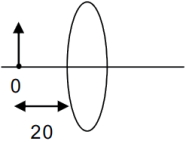
Find the magnification for the lens. The focal length is $25 \; cm$.
A
$2$
B
$5$
C
$7$
D
$12$
Solution
(B) From the given image,the object distance is $u = -20 \; cm$ and the focal length of the convex lens is $f = +25 \; cm$.
Using the lens formula:
$\frac{1}{v} - \frac{1}{u} = \frac{1}{f}$
Substituting the values:
$\frac{1}{v} - \frac{1}{-20} = \frac{1}{25}$
$\frac{1}{v} + \frac{1}{20} = \frac{1}{25}$
$\frac{1}{v} = \frac{1}{25} - \frac{1}{20}$
$\frac{1}{v} = \frac{4 - 5}{100}$
$\frac{1}{v} = -\frac{1}{100}$
$v = -100 \; cm$
The magnification $m$ is given by:
$m = \frac{v}{u}$
$m = \frac{-100}{-20}$
$m = 5$
Using the lens formula:
$\frac{1}{v} - \frac{1}{u} = \frac{1}{f}$
Substituting the values:
$\frac{1}{v} - \frac{1}{-20} = \frac{1}{25}$
$\frac{1}{v} + \frac{1}{20} = \frac{1}{25}$
$\frac{1}{v} = \frac{1}{25} - \frac{1}{20}$
$\frac{1}{v} = \frac{4 - 5}{100}$
$\frac{1}{v} = -\frac{1}{100}$
$v = -100 \; cm$
The magnification $m$ is given by:
$m = \frac{v}{u}$
$m = \frac{-100}{-20}$
$m = 5$
0 likes
View Solution278
MediumMCQ
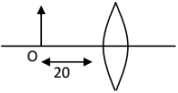
Calculate the focal length of the given lens in $cm$,if the magnification is $-0.5$.
A
$6.66$
B
$5.44$
C
$3.88$
D
$1.38$
Solution
(A) From the given figure,the object distance $u = -20 \ cm$.
The magnification $m = -0.5 = -1/2$.
For a lens,the magnification formula is $m = \frac{f}{u+f}$.
Substituting the values:
$-1/2 = \frac{f}{-20 + f}$
$-(-20 + f) = 2f$
$20 - f = 2f$
$3f = 20$
$f = \frac{20}{3} \approx 6.66 \ cm$.
Thus,the focal length of the lens is $6.66 \ cm$.
The magnification $m = -0.5 = -1/2$.
For a lens,the magnification formula is $m = \frac{f}{u+f}$.
Substituting the values:
$-1/2 = \frac{f}{-20 + f}$
$-(-20 + f) = 2f$
$20 - f = 2f$
$3f = 20$
$f = \frac{20}{3} \approx 6.66 \ cm$.
Thus,the focal length of the lens is $6.66 \ cm$.
0 likes
View Solution279
DifficultMCQ
The thickness at the centre of a plano-convex lens is $3 \, mm$ and the diameter is $6 \, cm$. If the speed of light in the material of the lens is $2 \times 10^{8} \, m/s$,the focal length of the lens is ............ $cm$.
A
$0.30$
B
$15$
C
$1.5$
D
$30$
Solution
(D) Given: Thickness $t = 3 \, mm = 0.3 \, cm$,Diameter $D = 6 \, cm$,so radius $r = 3 \, cm$. Speed of light in lens $v = 2 \times 10^{8} \, m/s$. Speed of light in vacuum $c = 3 \times 10^{8} \, m/s$.
Refractive index $\mu = \frac{c}{v} = \frac{3 \times 10^{8}}{2 \times 10^{8}} = 1.5$.
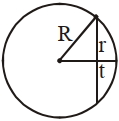
From the geometry of the lens,$R^{2} = r^{2} + (R - t)^{2}$,where $R$ is the radius of curvature.
$R^{2} = r^{2} + R^{2} + t^{2} - 2Rt$.
Neglecting $t^{2}$ as $t$ is very small,we get $2Rt = r^{2}$,so $R = \frac{r^{2}}{2t}$.
$R = \frac{3^{2}}{2 \times 0.3} = \frac{9}{0.6} = 15 \, cm$.
Using the lens maker's formula: $\frac{1}{f} = (\mu - 1) \left( \frac{1}{R} - \frac{1}{\infty} \right) = \frac{\mu - 1}{R}$.
$f = \frac{R}{\mu - 1} = \frac{15}{1.5 - 1} = \frac{15}{0.5} = 30 \, cm$.
Refractive index $\mu = \frac{c}{v} = \frac{3 \times 10^{8}}{2 \times 10^{8}} = 1.5$.
From the geometry of the lens,$R^{2} = r^{2} + (R - t)^{2}$,where $R$ is the radius of curvature.
$R^{2} = r^{2} + R^{2} + t^{2} - 2Rt$.
Neglecting $t^{2}$ as $t$ is very small,we get $2Rt = r^{2}$,so $R = \frac{r^{2}}{2t}$.
$R = \frac{3^{2}}{2 \times 0.3} = \frac{9}{0.6} = 15 \, cm$.
Using the lens maker's formula: $\frac{1}{f} = (\mu - 1) \left( \frac{1}{R} - \frac{1}{\infty} \right) = \frac{\mu - 1}{R}$.
$f = \frac{R}{\mu - 1} = \frac{15}{1.5 - 1} = \frac{15}{0.5} = 30 \, cm$.
0 likes
View Solution280
MediumMCQ
The refractive index of a converging lens is $1.4$. What will be the focal length of this lens if it is placed in a medium of the same refractive index? (Assume the radii of curvature of the faces of the lens are $R_{1}$ and $R_{2}$ respectively)
A
$1$
B
Infinite
C
$\frac{R_{1} R_{2}}{R_{1}-R_{2}}$
D
Zero
Solution
(B) According to the Lens Maker's Formula:
$\frac{1}{f} = \left( \frac{\mu_{L}}{\mu_{S}} - 1 \right) \left( \frac{1}{R_{1}} - \frac{1}{R_{2}} \right)$
Where $\mu_{L}$ is the refractive index of the lens and $\mu_{S}$ is the refractive index of the surrounding medium.
Given that the lens is placed in a medium of the same refractive index,we have $\mu_{L} = \mu_{S}$.
Substituting this into the formula:
$\frac{1}{f} = \left( \frac{\mu_{L}}{\mu_{L}} - 1 \right) \left( \frac{1}{R_{1}} - \frac{1}{R_{2}} \right)$
$\frac{1}{f} = (1 - 1) \left( \frac{1}{R_{1}} - \frac{1}{R_{2}} \right)$
$\frac{1}{f} = 0 \times \left( \frac{1}{R_{1}} - \frac{1}{R_{2}} \right) = 0$
Since $\frac{1}{f} = 0$,the focal length $f$ becomes infinite $(f = \infty)$.
Therefore,the lens behaves like a plane glass plate.
$\frac{1}{f} = \left( \frac{\mu_{L}}{\mu_{S}} - 1 \right) \left( \frac{1}{R_{1}} - \frac{1}{R_{2}} \right)$
Where $\mu_{L}$ is the refractive index of the lens and $\mu_{S}$ is the refractive index of the surrounding medium.
Given that the lens is placed in a medium of the same refractive index,we have $\mu_{L} = \mu_{S}$.
Substituting this into the formula:
$\frac{1}{f} = \left( \frac{\mu_{L}}{\mu_{L}} - 1 \right) \left( \frac{1}{R_{1}} - \frac{1}{R_{2}} \right)$
$\frac{1}{f} = (1 - 1) \left( \frac{1}{R_{1}} - \frac{1}{R_{2}} \right)$
$\frac{1}{f} = 0 \times \left( \frac{1}{R_{1}} - \frac{1}{R_{2}} \right) = 0$
Since $\frac{1}{f} = 0$,the focal length $f$ becomes infinite $(f = \infty)$.
Therefore,the lens behaves like a plane glass plate.
0 likes
View Solution281
DifficultMCQ
The same size images are formed by a convex lens when the object is placed at $20\, cm$ or at $10\, cm$ from the lens. The focal length of the convex lens is ............ $cm$.
A
$10$
B
$15$
C
$20$
D
$30$
Solution
(B) For a convex lens,the magnification $m$ is given by $m = \frac{f}{u+f}$.
When the object is placed at $u_1 = -10\, cm$,the image is real and inverted (magnification $-m$).
$-m = \frac{f}{-10+f} \quad (1)$
When the object is placed at $u_2 = -20\, cm$,the image is virtual and erect (magnification $+m$).
$+m = \frac{f}{-20+f} \quad (2)$
Dividing equation $(1)$ by $(2)$:
$-1 = \frac{-20+f}{-10+f}$
$10 - f = -20 + f$
$2f = 30$
$f = 15\, cm$.
When the object is placed at $u_1 = -10\, cm$,the image is real and inverted (magnification $-m$).
$-m = \frac{f}{-10+f} \quad (1)$
When the object is placed at $u_2 = -20\, cm$,the image is virtual and erect (magnification $+m$).
$+m = \frac{f}{-20+f} \quad (2)$
Dividing equation $(1)$ by $(2)$:
$-1 = \frac{-20+f}{-10+f}$
$10 - f = -20 + f$
$2f = 30$
$f = 15\, cm$.
0 likes
View Solution282
DifficultMCQ
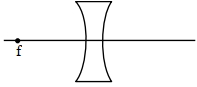
An object is placed at the focus of a concave lens having focal length $f$. What is the magnification and distance of the image from the optical centre of the lens?
A
$1, \infty$
B
Very high,$\infty$
C
$\frac{1}{2}, \frac{f}{2}$
D
$\frac{1}{4}, \frac{f}{4}$
Solution
(C) For a concave lens,the focal length is negative,so $f_{lens} = -f$.
The object is placed at the focus,so the object distance $u = -f$.
Using the lens formula: $\frac{1}{v} - \frac{1}{u} = \frac{1}{f_{lens}}$
Substituting the values: $\frac{1}{v} - \frac{1}{-f} = \frac{1}{-f}$
$\frac{1}{v} + \frac{1}{f} = -\frac{1}{f}$
$\frac{1}{v} = -\frac{1}{f} - \frac{1}{f} = -\frac{2}{f}$
$v = -\frac{f}{2}$
The distance of the image from the optical centre is $|v| = \frac{f}{2}$.
The magnification $m$ is given by $m = \frac{v}{u}$.
$m = \frac{-f/2}{-f} = \frac{1}{2}$.
The object is placed at the focus,so the object distance $u = -f$.
Using the lens formula: $\frac{1}{v} - \frac{1}{u} = \frac{1}{f_{lens}}$
Substituting the values: $\frac{1}{v} - \frac{1}{-f} = \frac{1}{-f}$
$\frac{1}{v} + \frac{1}{f} = -\frac{1}{f}$
$\frac{1}{v} = -\frac{1}{f} - \frac{1}{f} = -\frac{2}{f}$
$v = -\frac{f}{2}$
The distance of the image from the optical centre is $|v| = \frac{f}{2}$.
The magnification $m$ is given by $m = \frac{v}{u}$.
$m = \frac{-f/2}{-f} = \frac{1}{2}$.
0 likes
View Solution283
MediumMCQ
$A$ biconvex lens has radii of curvature,$20 \ cm$ each. If the refractive index of the material of the lens is $1.5$,the power of the lens is .... $D$
A
$+20$
B
$+5$
C
infinity
D
$+2$
Solution
(B) Given: Radii of curvature $R_{1} = +20 \ cm = +0.2 \ m$ and $R_{2} = -20 \ cm = -0.2 \ m$ (by sign convention for a biconvex lens).
Refractive index $\mu = 1.5 = \frac{3}{2}$.
The lens maker's formula is given by $P = \frac{1}{f} = (\mu - 1) \left( \frac{1}{R_{1}} - \frac{1}{R_{2}} \right)$.
Substituting the values: $P = (1.5 - 1) \left( \frac{1}{0.2} - \frac{1}{-0.2} \right)$.
$P = (0.5) \left( \frac{1}{0.2} + \frac{1}{0.2} \right) = (0.5) \left( \frac{2}{0.2} \right)$.
$P = (0.5) \times 10 = +5 \ D$.
Refractive index $\mu = 1.5 = \frac{3}{2}$.
The lens maker's formula is given by $P = \frac{1}{f} = (\mu - 1) \left( \frac{1}{R_{1}} - \frac{1}{R_{2}} \right)$.
Substituting the values: $P = (1.5 - 1) \left( \frac{1}{0.2} - \frac{1}{-0.2} \right)$.
$P = (0.5) \left( \frac{1}{0.2} + \frac{1}{0.2} \right) = (0.5) \left( \frac{2}{0.2} \right)$.
$P = (0.5) \times 10 = +5 \ D$.
0 likes
View Solution284
MediumMCQ
$A$ convex lens has power $P$. It is cut into two halves along its principal axis. Further,one piece (out of the two halves) is cut into two halves perpendicular to the principal axis (as shown in the figure). Choose the incorrect option for the reported pieces.
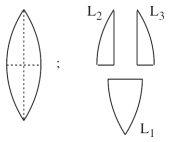
A
Power of $L_{1} = \frac{P}{2}$
B
Power of $L_{2} = \frac{P}{2}$
C
Power of $L_{3} = \frac{P}{2}$
D
Power of $L_{1} = P$
Solution
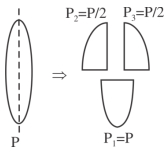
(A) When a lens is cut along its principal axis,the power of each half remains the same as the original lens,i.e.,$P' = P$.
However,if the lens is cut perpendicular to the principal axis,the power of each piece becomes half of the original power,i.e.,$P'' = \frac{P}{2}$.
In the given figure,the lens is first cut along the principal axis,resulting in two halves,each having power $P$.
Then,one of these halves is cut perpendicular to the principal axis,resulting in two pieces $L_{2}$ and $L_{3}$,each having power $\frac{P}{2}$.
The other half,$L_{1}$,remains unchanged and thus retains its power $P$.
Therefore,the incorrect option is that the power of $L_{1}$ is $\frac{P}{2}$.
However,if the lens is cut perpendicular to the principal axis,the power of each piece becomes half of the original power,i.e.,$P'' = \frac{P}{2}$.
In the given figure,the lens is first cut along the principal axis,resulting in two halves,each having power $P$.
Then,one of these halves is cut perpendicular to the principal axis,resulting in two pieces $L_{2}$ and $L_{3}$,each having power $\frac{P}{2}$.
The other half,$L_{1}$,remains unchanged and thus retains its power $P$.
Therefore,the incorrect option is that the power of $L_{1}$ is $\frac{P}{2}$.
0 likes
View Solution285
DifficultMCQ
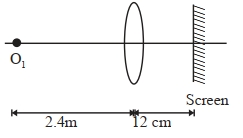
For an object placed at a distance $2.4\,m$ from a lens,a sharp focused image is observed on a screen placed at a distance $12\,cm$ from the lens. $A$ glass plate of refractive index $1.5$ and thickness $1\,cm$ is introduced between the lens and the screen such that the glass plate faces are parallel to the screen. By what distance should the object be shifted so that a sharp focused image is observed again on the screen (in $,m$)?
A
$0.8$
B
$3.2$
C
$1.2$
D
$5.6$
Solution
(B) $1$. Applying the lens formula for the initial state:
$\frac{1}{v} - \frac{1}{u} = \frac{1}{f}$
Given $v = 12\,cm = 0.12\,m$ and $u = -2.4\,m$:
$\frac{1}{0.12} - \frac{1}{-2.4} = \frac{1}{f} \Rightarrow \frac{100}{12} + \frac{1}{2.4} = \frac{1}{f} \Rightarrow \frac{25}{3} + \frac{1}{2.4} = \frac{20+1}{2.4} = \frac{21}{2.4} = \frac{1}{f} \Rightarrow f = \frac{2.4}{21} = \frac{0.8}{7}\,m$.
$2$. When a glass slab of thickness $t$ and refractive index $\mu$ is introduced,the image shifts by $\Delta x = t(1 - \frac{1}{\mu})$.
$\Delta x = 1\,cm \times (1 - \frac{1}{1.5}) = 1\,cm \times (1 - \frac{2}{3}) = \frac{1}{3}\,cm$.
$3$. The new image position $v'$ required to be on the screen is $v' = 12\,cm - \frac{1}{3}\,cm = \frac{35}{3}\,cm = \frac{35}{300}\,m = \frac{7}{60}\,m$.
$4$. Applying the lens formula again for the new object distance $u'$:
$\frac{1}{v'} - \frac{1}{u'} = \frac{1}{f}$
$\frac{60}{7} - \frac{1}{u'} = \frac{21}{2.4} = \frac{210}{24} = \frac{35}{4}$
$\frac{1}{u'} = \frac{60}{7} - \frac{35}{4} = \frac{240 - 245}{28} = -\frac{5}{28}$
$u' = -\frac{28}{5} = -5.6\,m$.
$5$. The shift in the object position is $|u' - u| = |-5.6 - (-2.4)| = |-3.2| = 3.2\,m$.
$\frac{1}{v} - \frac{1}{u} = \frac{1}{f}$
Given $v = 12\,cm = 0.12\,m$ and $u = -2.4\,m$:
$\frac{1}{0.12} - \frac{1}{-2.4} = \frac{1}{f} \Rightarrow \frac{100}{12} + \frac{1}{2.4} = \frac{1}{f} \Rightarrow \frac{25}{3} + \frac{1}{2.4} = \frac{20+1}{2.4} = \frac{21}{2.4} = \frac{1}{f} \Rightarrow f = \frac{2.4}{21} = \frac{0.8}{7}\,m$.
$2$. When a glass slab of thickness $t$ and refractive index $\mu$ is introduced,the image shifts by $\Delta x = t(1 - \frac{1}{\mu})$.
$\Delta x = 1\,cm \times (1 - \frac{1}{1.5}) = 1\,cm \times (1 - \frac{2}{3}) = \frac{1}{3}\,cm$.
$3$. The new image position $v'$ required to be on the screen is $v' = 12\,cm - \frac{1}{3}\,cm = \frac{35}{3}\,cm = \frac{35}{300}\,m = \frac{7}{60}\,m$.
$4$. Applying the lens formula again for the new object distance $u'$:
$\frac{1}{v'} - \frac{1}{u'} = \frac{1}{f}$
$\frac{60}{7} - \frac{1}{u'} = \frac{21}{2.4} = \frac{210}{24} = \frac{35}{4}$
$\frac{1}{u'} = \frac{60}{7} - \frac{35}{4} = \frac{240 - 245}{28} = -\frac{5}{28}$
$u' = -\frac{28}{5} = -5.6\,m$.
$5$. The shift in the object position is $|u' - u| = |-5.6 - (-2.4)| = |-3.2| = 3.2\,m$.
0 likes
View Solution286
DifficultMCQ
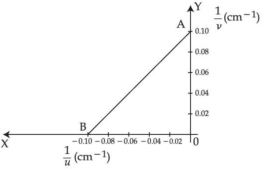
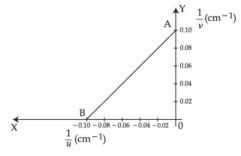
The graph between $\frac{1}{u}$ and $\frac{1}{v}$ for a thin convex lens in order to determine its focal length is plotted as shown in the figure. The refractive index of the lens is $1.5$ and both its surfaces have the same radius of curvature $R$. The value of $R$ will be in $cm$.
(Where $u =$ object distance,$v =$ image distance)
(Where $u =$ object distance,$v =$ image distance)
A
$1$
B
$10$
C
$100$
D
$1000$
Solution
(B) The lens formula is given by $\frac{1}{v} - \frac{1}{u} = \frac{1}{f}$.
From the graph,at point $A$,$\frac{1}{u} = 0$ and $\frac{1}{v} = 0.10 \, cm^{-1}$. Substituting these into the lens formula: $0.10 - 0 = \frac{1}{f} \Rightarrow f = 10 \, cm$.
At point $B$,$\frac{1}{u} = -0.10 \, cm^{-1}$ and $\frac{1}{v} = 0$. Substituting these into the lens formula: $0 - (-0.10) = \frac{1}{f} \Rightarrow \frac{1}{f} = 0.10 \Rightarrow f = 10 \, cm$.
Using the lens maker's formula: $\frac{1}{f} = (\mu - 1) \left( \frac{1}{R_1} - \frac{1}{R_2} \right)$.
For a convex lens with equal radii of curvature,$R_1 = R$ and $R_2 = -R$.
So,$\frac{1}{10} = (1.5 - 1) \left( \frac{1}{R} - \frac{1}{-R} \right) = 0.5 \left( \frac{2}{R} \right) = \frac{1}{R}$.
Therefore,$R = 10 \, cm$.
From the graph,at point $A$,$\frac{1}{u} = 0$ and $\frac{1}{v} = 0.10 \, cm^{-1}$. Substituting these into the lens formula: $0.10 - 0 = \frac{1}{f} \Rightarrow f = 10 \, cm$.
At point $B$,$\frac{1}{u} = -0.10 \, cm^{-1}$ and $\frac{1}{v} = 0$. Substituting these into the lens formula: $0 - (-0.10) = \frac{1}{f} \Rightarrow \frac{1}{f} = 0.10 \Rightarrow f = 10 \, cm$.
Using the lens maker's formula: $\frac{1}{f} = (\mu - 1) \left( \frac{1}{R_1} - \frac{1}{R_2} \right)$.
For a convex lens with equal radii of curvature,$R_1 = R$ and $R_2 = -R$.
So,$\frac{1}{10} = (1.5 - 1) \left( \frac{1}{R} - \frac{1}{-R} \right) = 0.5 \left( \frac{2}{R} \right) = \frac{1}{R}$.
Therefore,$R = 10 \, cm$.
1 likes
View Solution287
MediumMCQ
The power of a biconvex lens is $1.25\,m^{-1}$ in a particular medium. The refractive index of the lens is $1.5$ and the radii of curvature are $20\,cm$ and $40\,cm$ respectively. Find the refractive index of the surrounding medium.
A
$1.0$
B
$\frac{9}{7}$
C
$\frac{3}{2}$
D
$\frac{4}{3}$
Solution
(B) The lens maker's formula for power $P$ in a medium with refractive index $\mu_2$ is given by:
$P = \frac{1}{f} = \left( \frac{\mu_1}{\mu_2} - 1 \right) \left( \frac{1}{R_1} - \frac{1}{R_2} \right)$
Here,$\mu_1 = 1.5$ (refractive index of lens),$R_1 = 0.2\,m$,$R_2 = -0.4\,m$ (for a biconvex lens),and $P = 1.25\,m^{-1}$.
Substituting the values:
$1.25 = \left( \frac{1.5}{\mu_2} - 1 \right) \left( \frac{1}{0.2} - \frac{1}{-0.4} \right)$
$1.25 = \left( \frac{1.5 - \mu_2}{\mu_2} \right) \left( 5 + 2.5 \right)$
$1.25 = \left( \frac{1.5 - \mu_2}{\mu_2} \right) (7.5)$
$\frac{1.25}{7.5} = \frac{1.5 - \mu_2}{\mu_2}$
$\frac{1}{6} = \frac{1.5 - \mu_2}{\mu_2}$
$\mu_2 = 9 - 6\mu_2$
$7\mu_2 = 9$
$\mu_2 = \frac{9}{7}$
$P = \frac{1}{f} = \left( \frac{\mu_1}{\mu_2} - 1 \right) \left( \frac{1}{R_1} - \frac{1}{R_2} \right)$
Here,$\mu_1 = 1.5$ (refractive index of lens),$R_1 = 0.2\,m$,$R_2 = -0.4\,m$ (for a biconvex lens),and $P = 1.25\,m^{-1}$.
Substituting the values:
$1.25 = \left( \frac{1.5}{\mu_2} - 1 \right) \left( \frac{1}{0.2} - \frac{1}{-0.4} \right)$
$1.25 = \left( \frac{1.5 - \mu_2}{\mu_2} \right) \left( 5 + 2.5 \right)$
$1.25 = \left( \frac{1.5 - \mu_2}{\mu_2} \right) (7.5)$
$\frac{1.25}{7.5} = \frac{1.5 - \mu_2}{\mu_2}$
$\frac{1}{6} = \frac{1.5 - \mu_2}{\mu_2}$
$\mu_2 = 9 - 6\mu_2$
$7\mu_2 = 9$
$\mu_2 = \frac{9}{7}$
0 likes
View Solution288
MediumMCQ
In an experiment with a convex lens,the plot of the image distance $(v')$ against the object distance $(u')$ measured from the focus gives a curve $v' u' = 225$. If all the distances are measured in $cm$,the magnitude of the focal length of the lens is $cm$.
A
$14$
B
$15$
C
$18$
D
$19$
Solution
(B) According to Newton's lens formula,when distances are measured from the focus,the relationship between the image distance $(v')$ and the object distance $(u')$ is given by $v' u' = f^2$,where $f$ is the focal length of the lens.
Given the equation of the curve is $v' u' = 225$.
Comparing this with $v' u' = f^2$,we get $f^2 = 225$.
Taking the square root of both sides,$f = \sqrt{225} = 15 \, cm$.
Therefore,the magnitude of the focal length of the lens is $15 \, cm$.
Given the equation of the curve is $v' u' = 225$.
Comparing this with $v' u' = f^2$,we get $f^2 = 225$.
Taking the square root of both sides,$f = \sqrt{225} = 15 \, cm$.
Therefore,the magnitude of the focal length of the lens is $15 \, cm$.
0 likes
View Solution289
AdvancedMCQ
Consider the following statements regarding the real images formed with a converging lens.
$I$. Real images can be seen only if the image is projected onto the screen.
$II$. The real image can be seen only from the same side of the lens as that on which the object is positioned.
$III$. Real images produced by converging lenses are not only laterally but also longitudinally inverted as with mirrors.
Which of the above statement$(s)$ is/are incorrect?
$I$. Real images can be seen only if the image is projected onto the screen.
$II$. The real image can be seen only from the same side of the lens as that on which the object is positioned.
$III$. Real images produced by converging lenses are not only laterally but also longitudinally inverted as with mirrors.
Which of the above statement$(s)$ is/are incorrect?
A
Both $I$ and $III$
B
Only $II$
C
None of these
D
All of these
Solution
(C) Statement $I$ is correct: $A$ real image is formed by the actual intersection of light rays and can be captured on a screen.
Statement $II$ is correct: For a converging lens,the real image is formed on the side opposite to the object,but the light rays diverge from the image point,allowing an observer on the side of the image to see it,or if projected on a screen,it is visible from the side of the object.
Statement $III$ is correct: Real images formed by converging lenses are inverted both laterally (left-right/up-down) and longitudinally (depth-wise) relative to the object.
Since all statements are correct,none of the statements are incorrect.
Statement $II$ is correct: For a converging lens,the real image is formed on the side opposite to the object,but the light rays diverge from the image point,allowing an observer on the side of the image to see it,or if projected on a screen,it is visible from the side of the object.
Statement $III$ is correct: Real images formed by converging lenses are inverted both laterally (left-right/up-down) and longitudinally (depth-wise) relative to the object.
Since all statements are correct,none of the statements are incorrect.
0 likes
View Solution290
AdvancedMCQ
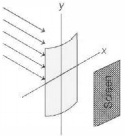
Consider a plane parallel beam of light incident on a plano-cylindrical lens as shown below. Which of the following will you observe on a screen placed at the focal plane of the lens?
A
The screen will be uniformly illuminated
B
There will be a single bright spot on the screen
C
There will be a single bright line on the screen parallel to the $X$-axis
D
There will be a single bright line on the screen parallel to the $Y$-axis
Solution
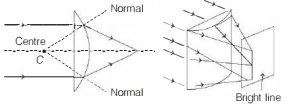
(D) cylindrical lens has curvature in only one direction (perpendicular to its axis).
When a parallel beam of light is incident on a plano-cylindrical lens,the light rays are refracted only in the plane perpendicular to the cylinder's axis.
These rays converge at the focal line of the lens.
Since the lens is oriented such that its axis is parallel to the $Y$-axis,the convergence occurs along a line parallel to the $Y$-axis on the focal plane.
Therefore,a single bright line parallel to the $Y$-axis will be observed on the screen.
When a parallel beam of light is incident on a plano-cylindrical lens,the light rays are refracted only in the plane perpendicular to the cylinder's axis.
These rays converge at the focal line of the lens.
Since the lens is oriented such that its axis is parallel to the $Y$-axis,the convergence occurs along a line parallel to the $Y$-axis on the focal plane.
Therefore,a single bright line parallel to the $Y$-axis will be observed on the screen.
0 likes
View Solution291
DifficultMCQ
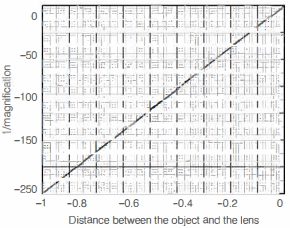
The following graph depicts the inverse of magnification $(1/m)$ versus the distance between the object and the lens $(u)$ for a setup. The focal length of the lens used in the setup is .................... $m$.
A
$250$
B
$0.004$
C
$125$
D
$0.002$
Solution
(B) Using the lens formula,$\frac{1}{v} - \frac{1}{u} = \frac{1}{f}$.
Multiplying by $u$,we get $\frac{u}{v} - 1 = \frac{u}{f}$.
Since magnification $m = \frac{v}{u}$,we have $\frac{1}{m} - 1 = \frac{u}{f}$,which implies $\frac{1}{m} = \frac{u}{f} + 1$.
Comparing this with the equation of a straight line $y = mx + c$,the slope of the graph is $\frac{1}{f}$.
From the graph,the slope is calculated as $\frac{y_2 - y_1}{x_2 - x_1} = \frac{0 - (-250)}{0 - (-1)} = \frac{250}{1} = 250$.
Therefore,$\frac{1}{f} = 250$,which gives $f = \frac{1}{250} = 0.004 \, m$.
Multiplying by $u$,we get $\frac{u}{v} - 1 = \frac{u}{f}$.
Since magnification $m = \frac{v}{u}$,we have $\frac{1}{m} - 1 = \frac{u}{f}$,which implies $\frac{1}{m} = \frac{u}{f} + 1$.
Comparing this with the equation of a straight line $y = mx + c$,the slope of the graph is $\frac{1}{f}$.
From the graph,the slope is calculated as $\frac{y_2 - y_1}{x_2 - x_1} = \frac{0 - (-250)}{0 - (-1)} = \frac{250}{1} = 250$.
Therefore,$\frac{1}{f} = 250$,which gives $f = \frac{1}{250} = 0.004 \, m$.
0 likes
View Solution292
AdvancedMCQ
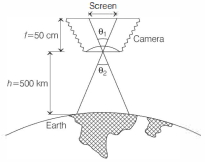
Remote sensing satellites move in an orbit that is at an average height of about $500 \, km$ from the surface of the earth. The camera onboard one such satellite has a screen of area $A$ on which the images captured by it are formed. If the focal length of the camera lens is $50 \, cm$,then the terrestrial area that can be observed from the satellite is close to ............... $A$.
A
$2 \times 10^3$
B
$10^6$
C
$10^{12}$
D
$4 \times 10^{12}$
Solution
(C) Let the height of the satellite be $h = 500 \, km = 500 \times 10^3 \, m = 5 \times 10^5 \, m$.
The focal length of the camera lens is $f = 50 \, cm = 0.5 \, m$.
Let $d_1$ be the diameter of the camera screen and $d_2$ be the diameter of the area observed on the Earth's surface.
From the geometry of the lens,the angular field of view is the same for both the screen and the terrestrial area,so $\theta_1 = \theta_2$.
Using similar triangles,we have $\frac{d_1}{f} = \frac{d_2}{h}$,which implies $\frac{d_2}{d_1} = \frac{h}{f}$.
The ratio of the terrestrial area $A_0$ to the screen area $A$ is given by the square of the ratio of their linear dimensions:
$\frac{A_0}{A} = \frac{(\pi d_2^2 / 4)}{(\pi d_1^2 / 4)} = \left( \frac{d_2}{d_1} \right)^2 = \left( \frac{h}{f} \right)^2$.
Substituting the values:
$\frac{A_0}{A} = \left( \frac{500 \times 10^3 \, m}{50 \times 10^{-2} \, m} \right)^2 = \left( \frac{5 \times 10^5}{5 \times 10^{-1}} \right)^2 = (10^6)^2 = 10^{12}$.
Thus,the terrestrial area observed is $10^{12} A$.
The focal length of the camera lens is $f = 50 \, cm = 0.5 \, m$.
Let $d_1$ be the diameter of the camera screen and $d_2$ be the diameter of the area observed on the Earth's surface.
From the geometry of the lens,the angular field of view is the same for both the screen and the terrestrial area,so $\theta_1 = \theta_2$.
Using similar triangles,we have $\frac{d_1}{f} = \frac{d_2}{h}$,which implies $\frac{d_2}{d_1} = \frac{h}{f}$.
The ratio of the terrestrial area $A_0$ to the screen area $A$ is given by the square of the ratio of their linear dimensions:
$\frac{A_0}{A} = \frac{(\pi d_2^2 / 4)}{(\pi d_1^2 / 4)} = \left( \frac{d_2}{d_1} \right)^2 = \left( \frac{h}{f} \right)^2$.
Substituting the values:
$\frac{A_0}{A} = \left( \frac{500 \times 10^3 \, m}{50 \times 10^{-2} \, m} \right)^2 = \left( \frac{5 \times 10^5}{5 \times 10^{-1}} \right)^2 = (10^6)^2 = 10^{12}$.
Thus,the terrestrial area observed is $10^{12} A$.
0 likes
View Solution293
AdvancedMCQ
Letters $A, B, C$ and $D$ are written on a cardboard as shown in the figure. The cardboard is kept at a suitable distance behind a transparent empty glass of cylindrical shape. If the glass is now filled with water,one sees an inverted image of the pattern on the cardboard when looking through the glass. Ignoring magnification effects,the image would appear as:

A
B
C
D
Solution
(D) cylindrical glass filled with water acts as a cylindrical lens.
$A$ cylindrical lens has a curvature only in one direction (horizontally).
Therefore,it causes lateral inversion of the image but does not invert the image vertically.
As a result,the letters $A$ and $C$ (which are vertically aligned) remain in their original vertical positions,while the letters $B$ and $D$ (which are horizontally aligned) are swapped laterally.
Thus,the correct appearance is as shown in option $D$.
$A$ cylindrical lens has a curvature only in one direction (horizontally).
Therefore,it causes lateral inversion of the image but does not invert the image vertically.
As a result,the letters $A$ and $C$ (which are vertically aligned) remain in their original vertical positions,while the letters $B$ and $D$ (which are horizontally aligned) are swapped laterally.
Thus,the correct appearance is as shown in option $D$.

0 likes
View Solution294
AdvancedMCQ
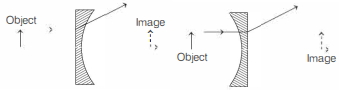
The word $KVPY$ is written on a board and viewed through different lenses such that the board is at a distance beyond the focal length of the lens.
Ignoring magnification effects,consider the following statements.
$(I)$ First image has been viewed from the planar side of a plano-concave lens and second image from the planar side of a plano-convex lens.
$(II)$ First image has been viewed from the concave side of a plano-concave lens and second image from the convex side of a plano-convex lens.
$(III)$ First image has been viewed from the concave side of a plano-concave lens and second image from the planar side of a plano-convex lens.
$(IV)$ First image has been viewed from the planar side of a plano-concave lens and second image from the convex side of a plano-convex lens.
Which of the above statements are correct?
Ignoring magnification effects,consider the following statements.
$(I)$ First image has been viewed from the planar side of a plano-concave lens and second image from the planar side of a plano-convex lens.
$(II)$ First image has been viewed from the concave side of a plano-concave lens and second image from the convex side of a plano-convex lens.
$(III)$ First image has been viewed from the concave side of a plano-concave lens and second image from the planar side of a plano-convex lens.
$(IV)$ First image has been viewed from the planar side of a plano-concave lens and second image from the convex side of a plano-convex lens.
Which of the above statements are correct?

A
Only statement $III$ is correct
B
Only statement $II$ is correct
C
Only statements $III$ and $IV$ are correct
D
All statements are correct
Solution
(D) The first image shows the word $KVPY$ as erect,which is characteristic of a diverging (concave) lens. $A$ plano-concave lens acts as a diverging lens regardless of whether the light enters from the planar side or the concave side. Thus,the first image can be formed by viewing from either side of a plano-concave lens.
The second image shows the word $KVPY$ as inverted,which is characteristic of a converging (convex) lens when the object is placed beyond the focal length. $A$ plano-convex lens acts as a converging lens regardless of whether the light enters from the planar side or the convex side. Thus,the second image can be formed by viewing from either side of a plano-convex lens.
Since both the plano-concave and plano-convex lenses produce the same type of image (erect for concave,inverted for convex) regardless of which side is facing the object,all the described scenarios $(I, II, III, IV)$ are physically possible.
Therefore,all statements are correct.
The second image shows the word $KVPY$ as inverted,which is characteristic of a converging (convex) lens when the object is placed beyond the focal length. $A$ plano-convex lens acts as a converging lens regardless of whether the light enters from the planar side or the convex side. Thus,the second image can be formed by viewing from either side of a plano-convex lens.
Since both the plano-concave and plano-convex lenses produce the same type of image (erect for concave,inverted for convex) regardless of which side is facing the object,all the described scenarios $(I, II, III, IV)$ are physically possible.
Therefore,all statements are correct.
0 likes
View Solution295
DifficultMCQ
The word $KVPY$ is written on a board and viewed through different lenses such that the board is at a distance beyond the focal length of the lens. Ignoring magnification effects,consider the following statements:
$(I)$ First image has been viewed from the planar side of a plano-convex lens and second image from the convex side of a plano-convex lens.
$(II)$ First image has been viewed from the concave side of a plano-concave lens and second image from the convex side of a plano-convex lens.
$(III)$ First image has been viewed from the concave side of a plano-concave lens and second image from the planar side of a plano-convex lens.
$(IV)$ First image has been viewed from the planar side of a plano-concave lens and second image from the convex side of a plano-convex lens.
Which of the above statements are correct?
$(I)$ First image has been viewed from the planar side of a plano-convex lens and second image from the convex side of a plano-convex lens.
$(II)$ First image has been viewed from the concave side of a plano-concave lens and second image from the convex side of a plano-convex lens.
$(III)$ First image has been viewed from the concave side of a plano-concave lens and second image from the planar side of a plano-convex lens.
$(IV)$ First image has been viewed from the planar side of a plano-concave lens and second image from the convex side of a plano-convex lens.
Which of the above statements are correct?

A
All statements are correct
B
Only statement $III$ is correct
C
Only statement $IV$ is correct
D
Only statements $II, III$ and $IV$ are correct
Solution
(D) The first image shows the word $KVPY$ as erect,which implies it is a virtual image. $A$ plano-concave lens is a diverging lens,which always forms an erect,virtual,and diminished image for any real object position.
The second image shows the word $KVPY$ as inverted,which implies it is a real image. $A$ plano-convex lens is a converging lens,which forms a real and inverted image when the object is placed at a distance greater than the focal length $(u > f)$.
Analyzing the statements:
$(I)$ $A$ plano-convex lens is a converging lens. Viewing through either side (planar or convex) will produce an inverted real image if $u > f$. Thus,the first image (which is erect) cannot be formed by a plano-convex lens. Statement $(I)$ is incorrect.
$(II)$ The first image is erect (formed by a plano-concave lens) and the second image is inverted (formed by a plano-convex lens). This is correct.
$(III)$ The first image is erect (formed by a plano-concave lens) and the second image is inverted (formed by a plano-convex lens). This is correct.
$(IV)$ The first image is erect (formed by a plano-concave lens) and the second image is inverted (formed by a plano-convex lens). This is correct.
Therefore,statements $(II), (III),$ and $(IV)$ are correct. The correct option is $D$.
The second image shows the word $KVPY$ as inverted,which implies it is a real image. $A$ plano-convex lens is a converging lens,which forms a real and inverted image when the object is placed at a distance greater than the focal length $(u > f)$.
Analyzing the statements:
$(I)$ $A$ plano-convex lens is a converging lens. Viewing through either side (planar or convex) will produce an inverted real image if $u > f$. Thus,the first image (which is erect) cannot be formed by a plano-convex lens. Statement $(I)$ is incorrect.
$(II)$ The first image is erect (formed by a plano-concave lens) and the second image is inverted (formed by a plano-convex lens). This is correct.
$(III)$ The first image is erect (formed by a plano-concave lens) and the second image is inverted (formed by a plano-convex lens). This is correct.
$(IV)$ The first image is erect (formed by a plano-concave lens) and the second image is inverted (formed by a plano-convex lens). This is correct.
Therefore,statements $(II), (III),$ and $(IV)$ are correct. The correct option is $D$.
0 likes
View Solution296
DifficultMCQ
If the image formed by a thin convex lens of power $P$ has magnification $m$,then the image distance $v$ is:
A
$v = \frac{1-m}{P}$
B
$v = \frac{1+m}{P}$
C
$v = \frac{m}{P}$
D
$v = \frac{1+2m}{P}$
Solution
(A) The magnification $m$ for a lens is given by the ratio of image distance $v$ to object distance $u$,expressed as $m = \frac{v}{u}$.
From the lens formula,$\frac{1}{f} = \frac{1}{v} - \frac{1}{u}$,we can write $\frac{1}{u} = \frac{1}{v} - \frac{1}{f} = \frac{f-v}{vf}$.
Substituting this into the magnification formula: $m = v \times \frac{f-v}{vf} = \frac{f-v}{f} = 1 - \frac{v}{f}$.
Rearranging the equation: $\frac{v}{f} = 1 - m$,which implies $v = f(1 - m)$.
Since power $P = \frac{1}{f}$ (in meters),we substitute $f = \frac{1}{P}$ into the equation.
Therefore,$v = \frac{1-m}{P}$.
From the lens formula,$\frac{1}{f} = \frac{1}{v} - \frac{1}{u}$,we can write $\frac{1}{u} = \frac{1}{v} - \frac{1}{f} = \frac{f-v}{vf}$.
Substituting this into the magnification formula: $m = v \times \frac{f-v}{vf} = \frac{f-v}{f} = 1 - \frac{v}{f}$.
Rearranging the equation: $\frac{v}{f} = 1 - m$,which implies $v = f(1 - m)$.
Since power $P = \frac{1}{f}$ (in meters),we substitute $f = \frac{1}{P}$ into the equation.
Therefore,$v = \frac{1-m}{P}$.
0 likes
View Solution297
MediumMCQ
$A$ hollow lens is made of thin glass and in the shape of a double concave lens. It can be filled with air,water of refractive index $1.33$,or $CS_2$ of refractive index $1.6$. It will act as a diverging lens,if it is
A
filled with air and immersed in water
B
filled with water and immersed in $CS_2$
C
filled with air and immersed in $CS_2$
D
filled with $CS_2$ and immersed in water
Solution
(D) The focal length $f$ of a lens is given by the lens maker's formula: $\frac{1}{f} = (\frac{\mu_l}{\mu_m} - 1)(\frac{1}{R_1} - \frac{1}{R_2})$.
For a double concave lens,the radii of curvature are $R_1 = -R$ and $R_2 = +R$,so $(\frac{1}{R_1} - \frac{1}{R_2}) = -\frac{2}{R}$.
Thus,$\frac{1}{f} = -\frac{2}{R}(\frac{\mu_l}{\mu_m} - 1)$.
For the lens to act as a diverging lens,the focal length $f$ must be negative,which implies $(\frac{\mu_l}{\mu_m} - 1) > 0$,or $\mu_l > \mu_m$.
In option $(d)$,the lens is filled with $CS_2$ $(\mu_l = 1.6)$ and immersed in water $(\mu_m = 1.33)$.
Since $1.6 > 1.33$,the condition $\mu_l > \mu_m$ is satisfied,and the lens acts as a diverging lens.
For a double concave lens,the radii of curvature are $R_1 = -R$ and $R_2 = +R$,so $(\frac{1}{R_1} - \frac{1}{R_2}) = -\frac{2}{R}$.
Thus,$\frac{1}{f} = -\frac{2}{R}(\frac{\mu_l}{\mu_m} - 1)$.
For the lens to act as a diverging lens,the focal length $f$ must be negative,which implies $(\frac{\mu_l}{\mu_m} - 1) > 0$,or $\mu_l > \mu_m$.
In option $(d)$,the lens is filled with $CS_2$ $(\mu_l = 1.6)$ and immersed in water $(\mu_m = 1.33)$.
Since $1.6 > 1.33$,the condition $\mu_l > \mu_m$ is satisfied,and the lens acts as a diverging lens.
0 likes
View Solution298
DifficultMCQ
$A$ point source of light is moving at a rate of $2 \,cm \,s^{-1}$ towards a thin convex lens of focal length $10 \,cm$ along its optical axis. When the source is $15 \,cm$ away from the lens,the image is moving at:
A
$4 \,cm \,s^{-1}$ towards the lens
B
$8 \,cm \,s^{-1}$ towards the lens
C
$4 \,cm \,s^{-1}$ away from the lens
D
$8 \,cm \,s^{-1}$ away from the lens
Solution
(B) From the lens formula,we have $\frac{1}{v} - \frac{1}{u} = \frac{1}{f} \quad \dots(i)$
Here,$f = +10 \,cm$ and $u = -15 \,cm$.
Using the lens formula: $\frac{1}{v} = \frac{1}{f} + \frac{1}{u} = \frac{1}{10} - \frac{1}{15} = \frac{3-2}{30} = \frac{1}{30}$.
Thus,$v = +30 \,cm$.
Differentiating equation $(i)$ with respect to time $t$:
$-\frac{1}{v^2} \frac{dv}{dt} + \frac{1}{u^2} \frac{du}{dt} = 0$
$\frac{dv}{dt} = \left( \frac{v^2}{u^2} \right) \frac{du}{dt}$
Given that the source is moving towards the lens,$\frac{du}{dt} = -2 \,cm \,s^{-1}$ (since $u$ is becoming less negative).
$\frac{dv}{dt} = \left( \frac{30}{-15} \right)^2 \times (-2 \,cm \,s^{-1}) = (2)^2 \times (-2 \,cm \,s^{-1}) = 4 \times (-2) = -8 \,cm \,s^{-1}$.
The negative sign indicates that the image is moving in the direction of decreasing $v$ (towards the lens). However,since the image is formed on the other side $(v = +30)$,a negative rate of change for $v$ means the image is moving towards the lens. Wait,let's re-evaluate: If $v$ is positive and $\frac{dv}{dt}$ is negative,the distance from the lens is decreasing. Therefore,the image is moving towards the lens at $8 \,cm \,s^{-1}$.
Here,$f = +10 \,cm$ and $u = -15 \,cm$.
Using the lens formula: $\frac{1}{v} = \frac{1}{f} + \frac{1}{u} = \frac{1}{10} - \frac{1}{15} = \frac{3-2}{30} = \frac{1}{30}$.
Thus,$v = +30 \,cm$.
Differentiating equation $(i)$ with respect to time $t$:
$-\frac{1}{v^2} \frac{dv}{dt} + \frac{1}{u^2} \frac{du}{dt} = 0$
$\frac{dv}{dt} = \left( \frac{v^2}{u^2} \right) \frac{du}{dt}$
Given that the source is moving towards the lens,$\frac{du}{dt} = -2 \,cm \,s^{-1}$ (since $u$ is becoming less negative).
$\frac{dv}{dt} = \left( \frac{30}{-15} \right)^2 \times (-2 \,cm \,s^{-1}) = (2)^2 \times (-2 \,cm \,s^{-1}) = 4 \times (-2) = -8 \,cm \,s^{-1}$.
The negative sign indicates that the image is moving in the direction of decreasing $v$ (towards the lens). However,since the image is formed on the other side $(v = +30)$,a negative rate of change for $v$ means the image is moving towards the lens. Wait,let's re-evaluate: If $v$ is positive and $\frac{dv}{dt}$ is negative,the distance from the lens is decreasing. Therefore,the image is moving towards the lens at $8 \,cm \,s^{-1}$.
0 likes
View Solution299
AdvancedMCQ
$A$ point object is placed $20 \,cm$ to the left of a convex lens of focal length $f=5 \,cm$. The lens is made to oscillate with a small amplitude $A$ along the horizontal axis. The image of the object will also oscillate along the axis with:
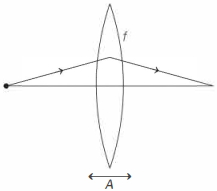
A
amplitude $A/9$,out of phase with the oscillations of the lens
B
amplitude $A/3$,out of phase with the oscillations of the lens
C
amplitude $A/3$,in phase with the oscillations of the lens
D
amplitude $A/9$,in phase with the oscillations of the lens
Solution
(A) From the lens equation,we have $\frac{1}{v} - \frac{1}{u} = \frac{1}{f}$.
Differentiating the equation with respect to time $t$,we get $\frac{dv}{dt} = \frac{v^2}{u^2} \left( \frac{du}{dt} \right) = m^2 \left( \frac{du}{dt} \right)$,where $m = \frac{v}{u}$ is the magnification.
For small oscillations,the amplitude of the image $\Delta v$ is related to the amplitude of the object $\Delta u$ by $\Delta v = m^2 \Delta u$.
Given $u = -20 \,cm$ and $f = 5 \,cm$,the magnification $m$ is given by $m = \frac{f}{f+u} = \frac{5}{5-20} = \frac{5}{-15} = -\frac{1}{3}$.
Since the lens is oscillating with amplitude $A$ relative to the object,we have $\Delta u = A$. Thus,the amplitude of the image is $\Delta v = m^2 A = \left( -\frac{1}{3} \right)^2 A = \frac{A}{9}$.
When the lens moves towards the object,the object distance $u$ decreases (becomes less negative). Since $v = \frac{fu}{f+u}$,as $u$ increases towards $0$,$v$ also changes. Specifically,for a real object placed at $u = -20 \,cm$ $(|u| > f)$,the image is real and formed on the right side. If the lens moves towards the object,the effective distance between the object and the lens decreases,causing the image to move away from the lens. Thus,the oscillations of the image are out of phase with the oscillations of the lens.
Differentiating the equation with respect to time $t$,we get $\frac{dv}{dt} = \frac{v^2}{u^2} \left( \frac{du}{dt} \right) = m^2 \left( \frac{du}{dt} \right)$,where $m = \frac{v}{u}$ is the magnification.
For small oscillations,the amplitude of the image $\Delta v$ is related to the amplitude of the object $\Delta u$ by $\Delta v = m^2 \Delta u$.
Given $u = -20 \,cm$ and $f = 5 \,cm$,the magnification $m$ is given by $m = \frac{f}{f+u} = \frac{5}{5-20} = \frac{5}{-15} = -\frac{1}{3}$.
Since the lens is oscillating with amplitude $A$ relative to the object,we have $\Delta u = A$. Thus,the amplitude of the image is $\Delta v = m^2 A = \left( -\frac{1}{3} \right)^2 A = \frac{A}{9}$.
When the lens moves towards the object,the object distance $u$ decreases (becomes less negative). Since $v = \frac{fu}{f+u}$,as $u$ increases towards $0$,$v$ also changes. Specifically,for a real object placed at $u = -20 \,cm$ $(|u| > f)$,the image is real and formed on the right side. If the lens moves towards the object,the effective distance between the object and the lens decreases,causing the image to move away from the lens. Thus,the oscillations of the image are out of phase with the oscillations of the lens.
0 likes
View Solution300
DifficultMCQ
$A$ concave lens made of material of refractive index $1.6$ is immersed in a medium of refractive index $2.0$. The two surfaces of the concave lens have the same radius of curvature $0.2 \, m$. The lens will behave as a
A
divergent lens of focal length $0.4 \, m$
B
divergent lens of focal length $0.5 \, m$
C
convergent lens of focal length $0.4 \, m$
D
convergent lens of focal length $0.5 \, m$
Solution
(D) The focal length of a lens in a medium is given by the Lens Maker's Formula:
$\frac{1}{f} = \left( \frac{n_l}{n_m} - 1 \right) \left( \frac{1}{R_1} - \frac{1}{R_2} \right)$
Given:
Refractive index of lens material,$n_l = 1.6$
Refractive index of medium,$n_m = 2.0$
For a concave lens,$R_1 = -0.2 \, m$ and $R_2 = +0.2 \, m$.
Substituting these values into the formula:
$\frac{1}{f} = \left( \frac{1.6}{2.0} - 1 \right) \left( \frac{1}{-0.2} - \frac{1}{0.2} \right)$
$\frac{1}{f} = (0.8 - 1) \left( -5 - 5 \right)$
$\frac{1}{f} = (-0.2) \times (-10)$
$\frac{1}{f} = 2$
$f = 0.5 \, m$
Since the focal length $f$ is positive,the lens behaves as a convergent lens with a focal length of $0.5 \, m$.
$\frac{1}{f} = \left( \frac{n_l}{n_m} - 1 \right) \left( \frac{1}{R_1} - \frac{1}{R_2} \right)$
Given:
Refractive index of lens material,$n_l = 1.6$
Refractive index of medium,$n_m = 2.0$
For a concave lens,$R_1 = -0.2 \, m$ and $R_2 = +0.2 \, m$.
Substituting these values into the formula:
$\frac{1}{f} = \left( \frac{1.6}{2.0} - 1 \right) \left( \frac{1}{-0.2} - \frac{1}{0.2} \right)$
$\frac{1}{f} = (0.8 - 1) \left( -5 - 5 \right)$
$\frac{1}{f} = (-0.2) \times (-10)$
$\frac{1}{f} = 2$
$f = 0.5 \, m$
Since the focal length $f$ is positive,the lens behaves as a convergent lens with a focal length of $0.5 \, m$.
0 likes
View SolutionRay Optics and Optical Instruments — Refraction by Lenses · Frequently Asked Questions
1Are these Ray Optics and Optical Instruments questions useful for JEE and NEET?
Yes. All questions in this section are mapped to JEE Main and NEET exam patterns. Previous year questions from JEE Main, NEET, GUJCET and state-level exams are included with full solutions.
2Can I switch to Hindi or Gujarati for these questions?
Yes. Use the language tabs in the hero section or the sidebar to view the same questions and solutions in English, Hindi or Gujarati.
3How do I generate a question paper from this subtopic?
Use the Vedclass Exam Paper Generator — select the chapter and subtopic, set difficulty, and generate Sets A, B, C, D automatically. First 3 chapters of every subject are free.
Vedclass Products
For Students
Vedclass Test Series
Mock tests in real JEE/NEET style with performance analysis. 5-day free trial.
Start Free TrialFor Teachers
Exam Paper Generator
Generate Set A/B/C/D papers from this chapter in 2 minutes. 3 chapters free.
Try FreeFor Institutes
Online Exam Module
Live online exams with unlimited students, 360° analytics & white-label branding.
See DemoFor Teachers & Institutes
Generate a Ray Optics and Optical Instruments Exam Paper in 2 Minutes
Select subtopic & difficulty — Sets A, B, C, D auto-generated with No Repeat logic.
First 3 chapters of every subject are free — no payment required.