
A English
Refraction by Lenses Questions in English
Class 12 Physics · Ray Optics and Optical Instruments · Refraction by Lenses
470+
Questions
English
Language
100%
With Solutions
Showing 50 of 470 questions in English
101
EasyMCQ
The minimum distance between an object and its real image formed by a convex lens is
A
$2 f$
B
$4 f$
C
$f$
D
zero
Solution
(B) Let the distance between the object and the real image be $d$.
Let the distance of the object from the lens be $u = -x$ (using sign convention).
Then the distance of the image from the lens is $v = d - x$.
Using the lens formula: $\frac{1}{f} = \frac{1}{v} - \frac{1}{u}$.
Substituting the values: $\frac{1}{f} = \frac{1}{d - x} - \frac{1}{-x} = \frac{1}{d - x} + \frac{1}{x}$.
Simplifying the equation: $\frac{1}{f} = \frac{x + d - x}{x(d - x)} = \frac{d}{dx - x^2}$.
Rearranging into a quadratic equation: $x^2 - dx + fd = 0$.
For $x$ to be a real value,the discriminant must be greater than or equal to zero: $D = b^2 - 4ac \geq 0$.
$(-d)^2 - 4(1)(fd) \geq 0$.
$d^2 - 4fd \geq 0$.
$d(d - 4f) \geq 0$.
Since $d > 0$,we must have $d \geq 4f$.
Therefore,the minimum distance between the object and its real image is $4f$.
Let the distance of the object from the lens be $u = -x$ (using sign convention).
Then the distance of the image from the lens is $v = d - x$.
Using the lens formula: $\frac{1}{f} = \frac{1}{v} - \frac{1}{u}$.
Substituting the values: $\frac{1}{f} = \frac{1}{d - x} - \frac{1}{-x} = \frac{1}{d - x} + \frac{1}{x}$.
Simplifying the equation: $\frac{1}{f} = \frac{x + d - x}{x(d - x)} = \frac{d}{dx - x^2}$.
Rearranging into a quadratic equation: $x^2 - dx + fd = 0$.
For $x$ to be a real value,the discriminant must be greater than or equal to zero: $D = b^2 - 4ac \geq 0$.
$(-d)^2 - 4(1)(fd) \geq 0$.
$d^2 - 4fd \geq 0$.
$d(d - 4f) \geq 0$.
Since $d > 0$,we must have $d \geq 4f$.
Therefore,the minimum distance between the object and its real image is $4f$.
0 likes
View Solution102
MediumMCQ
In the displacement method,a convex lens is placed between an object and a screen. If the magnifications in the two positions are $m_1$ and $m_2$ and the displacement of the lens between the two positions is $x$,then the focal length of the lens is:
A
$\frac{x}{m_1 + m_2}$
B
$\frac{x}{m_1 - m_2}$
C
$\frac{x}{(m_1 + m_2)^2}$
D
$\frac{x}{(m_1 - m_2)^2}$
Solution
(B) In the displacement method,for a fixed distance $D$ between the object and the screen,there are two positions of the lens where a sharp image is formed.
Let the object distance be $u$ and image distance be $v$ for the first position. Then $m_1 = v/u$.
For the second position,by the principle of reversibility,the object distance becomes $v$ and the image distance becomes $u$. Thus,$m_2 = u/v$.
Note that $m_1 \times m_2 = (v/u) \times (u/v) = 1$.
Given the displacement of the lens is $x = v - u$.
We know $m_1 - m_2 = v/u - u/v = (v^2 - u^2) / (uv) = (v - u)(v + u) / (uv) = x(v + u) / (uv)$.
From the lens formula,$1/f = 1/v - 1/(-u) = (u + v) / (uv)$.
Substituting this into the expression for $m_1 - m_2$,we get $m_1 - m_2 = x \times (1/f) = x/f$.
Therefore,the focal length $f = x / (m_1 - m_2)$.
Let the object distance be $u$ and image distance be $v$ for the first position. Then $m_1 = v/u$.
For the second position,by the principle of reversibility,the object distance becomes $v$ and the image distance becomes $u$. Thus,$m_2 = u/v$.
Note that $m_1 \times m_2 = (v/u) \times (u/v) = 1$.
Given the displacement of the lens is $x = v - u$.
We know $m_1 - m_2 = v/u - u/v = (v^2 - u^2) / (uv) = (v - u)(v + u) / (uv) = x(v + u) / (uv)$.
From the lens formula,$1/f = 1/v - 1/(-u) = (u + v) / (uv)$.
Substituting this into the expression for $m_1 - m_2$,we get $m_1 - m_2 = x \times (1/f) = x/f$.
Therefore,the focal length $f = x / (m_1 - m_2)$.
0 likes
View Solution103
MediumMCQ
$A$ film projector magnifies a film onto a screen of area $100 \, cm^2$. If the linear magnification is $4$,what will be the area of the image on the screen in $cm^2$?
A
$1600$
B
$800$
C
$400$
D
$200$
Solution
(A) The area magnification $(A_m)$ is the square of the linear magnification $(m)$.
Given: Linear magnification $m = 4$ and object area $A_0 = 100 \, cm^2$.
The formula for area magnification is $A_m = \frac{A_i}{A_0} = m^2$.
Therefore,the area of the image $A_i = m^2 \times A_0$.
Substituting the values: $A_i = (4)^2 \times 100 = 16 \times 100 = 1600 \, cm^2$.
Given: Linear magnification $m = 4$ and object area $A_0 = 100 \, cm^2$.
The formula for area magnification is $A_m = \frac{A_i}{A_0} = m^2$.
Therefore,the area of the image $A_i = m^2 \times A_0$.
Substituting the values: $A_i = (4)^2 \times 100 = 16 \times 100 = 1600 \, cm^2$.
0 likes
View Solution104
MediumMCQ
$A$ plano-convex lens is made of glass with a refractive index of $1.5$. The radius of curvature of its convex surface is $R$. What is its focal length?
A
$R/2$
B
$R$
C
$2R$
D
$1.5 R$
Solution
(C) The lens maker's formula is given by: $\frac{1}{f} = (\mu - 1) \left( \frac{1}{R_1} - \frac{1}{R_2} \right)$.
For a plano-convex lens,the first surface is convex $(R_1 = R)$ and the second surface is plane $(R_2 = \infty)$.
Substituting these values into the formula:
$\frac{1}{f} = (1.5 - 1) \left( \frac{1}{R} - \frac{1}{\infty} \right)$.
Since $\frac{1}{\infty} = 0$,we get:
$\frac{1}{f} = 0.5 \times \frac{1}{R} = \frac{1}{2R}$.
Therefore,the focal length is $f = 2R$.
For a plano-convex lens,the first surface is convex $(R_1 = R)$ and the second surface is plane $(R_2 = \infty)$.
Substituting these values into the formula:
$\frac{1}{f} = (1.5 - 1) \left( \frac{1}{R} - \frac{1}{\infty} \right)$.
Since $\frac{1}{\infty} = 0$,we get:
$\frac{1}{f} = 0.5 \times \frac{1}{R} = \frac{1}{2R}$.
Therefore,the focal length is $f = 2R$.
0 likes
View Solution105
MediumMCQ
$A$ convex lens is made of three different materials as shown in the figure. How many images will be formed for a point object placed on its principal axis?

A
$1$
B
$3$
C
$4$
D
$5$
Solution
(B) The lens is composed of three distinct horizontal sections,each made of a different material with a different refractive index.
Each section of the lens acts as an independent lens with its own focal length,determined by the lens maker's formula: $\frac{1}{f} = (\mu - 1) (\frac{1}{R_1} - \frac{1}{R_2})$.
Since there are three different materials,there are three different refractive indices $(\mu_1, \mu_2, \mu_3)$,which result in three different focal lengths $(f_1, f_2, f_3)$.
When a point object is placed on the principal axis,each section will form an image at a position determined by the lens formula: $\frac{1}{v} - \frac{1}{u} = \frac{1}{f}$.
Since the object distance $u$ is the same for all three sections but the focal lengths $f$ are different,the image distances $v$ will be different for each section.
Therefore,three distinct images will be formed,one by each section of the lens.
Each section of the lens acts as an independent lens with its own focal length,determined by the lens maker's formula: $\frac{1}{f} = (\mu - 1) (\frac{1}{R_1} - \frac{1}{R_2})$.
Since there are three different materials,there are three different refractive indices $(\mu_1, \mu_2, \mu_3)$,which result in three different focal lengths $(f_1, f_2, f_3)$.
When a point object is placed on the principal axis,each section will form an image at a position determined by the lens formula: $\frac{1}{v} - \frac{1}{u} = \frac{1}{f}$.
Since the object distance $u$ is the same for all three sections but the focal lengths $f$ are different,the image distances $v$ will be different for each section.
Therefore,three distinct images will be formed,one by each section of the lens.
0 likes
View Solution106
MediumMCQ
The optical axis of a thin equiconvex lens is the $x$-axis. The coordinates of the object and its image are $(-40 \, cm, 1 \, cm)$ and $(50 \, cm, -2 \, cm)$ respectively. Find the position of the lens.
A
$x = +20 \, cm$
B
$x = -30 \, cm$
C
$x = -10 \, cm$
D
Origin
Solution
(C) Let the position of the lens be at $x = L$. The object is at $x_o = -40 \, cm$ and the image is at $x_i = 50 \, cm$. The object distance is $u = -(L - x_o) = -(L + 40)$ and the image distance is $v = (x_i - L) = (50 - L)$.
The magnification $m$ is given by $m = \frac{h_i}{h_o} = \frac{-2 \, cm}{1 \, cm} = -2$.
Using the magnification formula $m = \frac{v}{u}$,we have $-2 = \frac{50 - L}{-(L + 40)}$.
This simplifies to $2 = \frac{50 - L}{L + 40}$.
$2(L + 40) = 50 - L \implies 2L + 80 = 50 - L$.
$3L = -30 \implies L = -10 \, cm$.
Thus,the lens is located at $x = -10 \, cm$.
The magnification $m$ is given by $m = \frac{h_i}{h_o} = \frac{-2 \, cm}{1 \, cm} = -2$.
Using the magnification formula $m = \frac{v}{u}$,we have $-2 = \frac{50 - L}{-(L + 40)}$.
This simplifies to $2 = \frac{50 - L}{L + 40}$.
$2(L + 40) = 50 - L \implies 2L + 80 = 50 - L$.
$3L = -30 \implies L = -10 \, cm$.
Thus,the lens is located at $x = -10 \, cm$.
0 likes
View Solution107
MediumMCQ
$A$ convex lens is immersed in water. How will its power $P$ change?
A
It will increase.
B
It will decrease.
C
It will remain unchanged.
D
It will increase for red light and decrease for blue light.
Solution
(B) The power of a lens is given by the formula $P = \frac{1}{f} = (n_l - 1) \left( \frac{1}{R_1} - \frac{1}{R_2} \right)$,where $n_l$ is the relative refractive index of the lens material with respect to the surrounding medium.
When the lens is in air,$n_l = \frac{n_g}{n_a} \approx n_g$. Since $n_g > 1$,the lens is converging.
When the lens is immersed in water,the relative refractive index becomes $n_l' = \frac{n_g}{n_w}$.
Since the refractive index of water $(n_w \approx 1.33)$ is greater than that of air $(n_a \approx 1.0)$,the relative refractive index $n_l'$ decreases $(n_l' < n_l)$.
As $P \propto (n_l - 1)$,a decrease in the relative refractive index leads to a decrease in the power $P$ of the lens.
When the lens is in air,$n_l = \frac{n_g}{n_a} \approx n_g$. Since $n_g > 1$,the lens is converging.
When the lens is immersed in water,the relative refractive index becomes $n_l' = \frac{n_g}{n_w}$.
Since the refractive index of water $(n_w \approx 1.33)$ is greater than that of air $(n_a \approx 1.0)$,the relative refractive index $n_l'$ decreases $(n_l' < n_l)$.
As $P \propto (n_l - 1)$,a decrease in the relative refractive index leads to a decrease in the power $P$ of the lens.
0 likes
View Solution108
DifficultMCQ
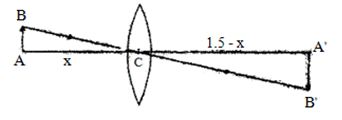
An object is placed at a distance of $1.50 \, m$ from a screen. $A$ convex lens is placed between them to form a real image four times larger than the object on the screen. The position of the lens is at a distance of ..... (in $, m$)
A
$0.12$
B
$0.7$
C
$0.3$
D
$1.1$
Solution
(C) Let the distance of the lens from the object be $x$. Then the distance of the lens from the screen is $(1.5 - x)$.
Since the image is formed on the screen,it is a real image. For a real image,the magnification $m = -4$.
Using the magnification formula $m = \frac{v}{u}$,where $v = (1.5 - x)$ and $u = -x$:
$-4 = \frac{1.5 - x}{-x}$
$4x = 1.5 - x$
$5x = 1.5$
$x = 0.3 \, m$.
Thus,the lens is placed at a distance of $0.3 \, m$ from the object.
Since the image is formed on the screen,it is a real image. For a real image,the magnification $m = -4$.
Using the magnification formula $m = \frac{v}{u}$,where $v = (1.5 - x)$ and $u = -x$:
$-4 = \frac{1.5 - x}{-x}$
$4x = 1.5 - x$
$5x = 1.5$
$x = 0.3 \, m$.
Thus,the lens is placed at a distance of $0.3 \, m$ from the object.
0 likes
View Solution109
DifficultMCQ
$A$ glass convex lens $(\mu_g = 1.5)$ has a focal length of $8\, cm$ in air. What will be its focal length when it is immersed in water (in $, cm$)? $(\mu_w = 1.33)$
A
$2$
B
$4$
C
$16$
D
$32$
Solution
(D) Using the Lens Maker's Formula: $\frac{1}{f} = (\mu - 1) \left( \frac{1}{R_1} - \frac{1}{R_2} \right)$.
In air $(f_a = 8\, cm)$: $\frac{1}{8} = (1.5 - 1) K$,where $K = (\frac{1}{R_1} - \frac{1}{R_2})$.
So,$K = \frac{1}{8 \times 0.5} = \frac{1}{4}$.
In water,the refractive index of the lens relative to water is $\mu_{rel} = \frac{\mu_g}{\mu_w} = \frac{1.5}{1.33} \approx 1.128$.
The new focal length $f_w$ is given by: $\frac{1}{f_w} = (\frac{\mu_g}{\mu_w} - 1) K$.
$\frac{1}{f_w} = (\frac{1.5}{1.33} - 1) \times \frac{1}{4} = (\frac{1.5 - 1.33}{1.33}) \times \frac{1}{4} = \frac{0.17}{1.33 \times 4} = \frac{0.17}{5.32} \approx \frac{1}{31.29}$.
Using the standard approximation $\mu_w = 4/3$,we get: $\frac{1}{f_w} = (\frac{1.5}{4/3} - 1) \times \frac{1}{4} = (1.125 - 1) \times \frac{1}{4} = 0.125 \times \frac{1}{4} = \frac{1}{8} \times \frac{1}{4} = \frac{1}{32}$.
Therefore,$f_w = 32\, cm$.
In air $(f_a = 8\, cm)$: $\frac{1}{8} = (1.5 - 1) K$,where $K = (\frac{1}{R_1} - \frac{1}{R_2})$.
So,$K = \frac{1}{8 \times 0.5} = \frac{1}{4}$.
In water,the refractive index of the lens relative to water is $\mu_{rel} = \frac{\mu_g}{\mu_w} = \frac{1.5}{1.33} \approx 1.128$.
The new focal length $f_w$ is given by: $\frac{1}{f_w} = (\frac{\mu_g}{\mu_w} - 1) K$.
$\frac{1}{f_w} = (\frac{1.5}{1.33} - 1) \times \frac{1}{4} = (\frac{1.5 - 1.33}{1.33}) \times \frac{1}{4} = \frac{0.17}{1.33 \times 4} = \frac{0.17}{5.32} \approx \frac{1}{31.29}$.
Using the standard approximation $\mu_w = 4/3$,we get: $\frac{1}{f_w} = (\frac{1.5}{4/3} - 1) \times \frac{1}{4} = (1.125 - 1) \times \frac{1}{4} = 0.125 \times \frac{1}{4} = \frac{1}{8} \times \frac{1}{4} = \frac{1}{32}$.
Therefore,$f_w = 32\, cm$.
0 likes
View Solution110
MediumMCQ
In the displacement method,the distance between the object and the screen is $70 \; cm$ and the focal length of the lens is $16 \; cm$. Find the separation between the magnified and diminished image positions of the lens. (in $; cm$)
A
$16.9$
B
$18.2$
C
$21.2$
D
$20.5$
Solution
(D) The separation $d$ between the two positions of the lens for which a sharp image is formed on the screen is given by the formula:
$d = \sqrt{D^2 - 4fD}$
where $D$ is the distance between the object and the screen and $f$ is the focal length of the lens.
Given: $D = 70 \; cm$ and $f = 16 \; cm$.
Substituting the values:
$d = \sqrt{(70)^2 - 4 \times 16 \times 70}$
$d = \sqrt{4900 - 4480}$
$d = \sqrt{420}$
$d \approx 20.49 \; cm \approx 20.5 \; cm$.
$d = \sqrt{D^2 - 4fD}$
where $D$ is the distance between the object and the screen and $f$ is the focal length of the lens.
Given: $D = 70 \; cm$ and $f = 16 \; cm$.
Substituting the values:
$d = \sqrt{(70)^2 - 4 \times 16 \times 70}$
$d = \sqrt{4900 - 4480}$
$d = \sqrt{420}$
$d \approx 20.49 \; cm \approx 20.5 \; cm$.
0 likes
View Solution111
DifficultMCQ
The focal length of a glass convex lens is $2 \, cm$. What will be its focal length in $cm$ when it is immersed in a liquid of refractive index $1.25$?
A
$5$
B
$2.4$
C
$1$
D
$4$
Solution
(A) Using the Lens Maker's Formula: $\frac{1}{f} = (\mu - 1) \left( \frac{1}{R_1} - \frac{1}{R_2} \right)$.
For a glass lens in air $(\mu_g = 1.5)$: $\frac{1}{2} = (1.5 - 1) \left( \frac{1}{R_1} - \frac{1}{R_2} \right) \implies \frac{1}{2} = 0.5 \left( \frac{1}{R_1} - \frac{1}{R_2} \right) \implies \left( \frac{1}{R_1} - \frac{1}{R_2} \right) = 1$.
When immersed in a liquid $(\mu_l = 1.25)$: $\frac{1}{f_l} = \left( \frac{\mu_g}{\mu_l} - 1 \right) \left( \frac{1}{R_1} - \frac{1}{R_2} \right)$.
Substituting the values: $\frac{1}{f_l} = \left( \frac{1.5}{1.25} - 1 \right) (1) = (1.2 - 1) = 0.2$.
Therefore,$f_l = \frac{1}{0.2} = 5 \, cm$.
For a glass lens in air $(\mu_g = 1.5)$: $\frac{1}{2} = (1.5 - 1) \left( \frac{1}{R_1} - \frac{1}{R_2} \right) \implies \frac{1}{2} = 0.5 \left( \frac{1}{R_1} - \frac{1}{R_2} \right) \implies \left( \frac{1}{R_1} - \frac{1}{R_2} \right) = 1$.
When immersed in a liquid $(\mu_l = 1.25)$: $\frac{1}{f_l} = \left( \frac{\mu_g}{\mu_l} - 1 \right) \left( \frac{1}{R_1} - \frac{1}{R_2} \right)$.
Substituting the values: $\frac{1}{f_l} = \left( \frac{1.5}{1.25} - 1 \right) (1) = (1.2 - 1) = 0.2$.
Therefore,$f_l = \frac{1}{0.2} = 5 \, cm$.
0 likes
View Solution112
MediumMCQ
$A$ convex lens is made of glass $(\mu_g = 1.5)$ and has a focal length of $4 \, cm$ in air. If it is immersed in water $(\mu_w = 1.33)$,what will be its new focal length in $cm$?
A
$4$
B
$8$
C
$16$
D
$32$
Solution
(C) Using the Lens Maker's Formula: $\frac{1}{f} = (\mu - 1) \left( \frac{1}{R_1} - \frac{1}{R_2} \right)$.
In air: $\frac{1}{f_a} = (\mu_g - 1) K$,where $K = (\frac{1}{R_1} - \frac{1}{R_2})$.
Given $f_a = 4 \, cm$ and $\mu_g = 1.5$,we have $\frac{1}{4} = (1.5 - 1) K \Rightarrow K = \frac{1}{2} = 0.5$.
In water: $\frac{1}{f_w} = (\frac{\mu_g}{\mu_w} - 1) K$.
Substituting the values: $\frac{1}{f_w} = (\frac{1.5}{1.33} - 1) \times 0.5$.
Since $1.33 \approx \frac{4}{3}$,$\frac{1.5}{1.33} \approx 1.5 \times \frac{3}{4} = 1.125$.
$\frac{1}{f_w} = (1.125 - 1) \times 0.5 = 0.125 \times 0.5 = 0.0625$.
$f_w = \frac{1}{0.0625} = 16 \, cm$.
In air: $\frac{1}{f_a} = (\mu_g - 1) K$,where $K = (\frac{1}{R_1} - \frac{1}{R_2})$.
Given $f_a = 4 \, cm$ and $\mu_g = 1.5$,we have $\frac{1}{4} = (1.5 - 1) K \Rightarrow K = \frac{1}{2} = 0.5$.
In water: $\frac{1}{f_w} = (\frac{\mu_g}{\mu_w} - 1) K$.
Substituting the values: $\frac{1}{f_w} = (\frac{1.5}{1.33} - 1) \times 0.5$.
Since $1.33 \approx \frac{4}{3}$,$\frac{1.5}{1.33} \approx 1.5 \times \frac{3}{4} = 1.125$.
$\frac{1}{f_w} = (1.125 - 1) \times 0.5 = 0.125 \times 0.5 = 0.0625$.
$f_w = \frac{1}{0.0625} = 16 \, cm$.
0 likes
View Solution113
MediumMCQ
If the focal lengths of red and violet light rays for the same lens are $f_R$ and $f_v$ respectively,then which of the following is true?
A
$f_R > f_v$
B
$f_R < f_v$
C
$f_R = f_v$
D
$f_R \ge f_v$
Solution
(A) According to the lens maker's formula,the focal length $f$ of a lens is given by $\frac{1}{f} = (\mu - 1) \left( \frac{1}{R_1} - \frac{1}{R_2} \right)$.
Since $\left( \frac{1}{R_1} - \frac{1}{R_2} \right)$ is constant for a given lens,we have $\frac{1}{f} \propto (\mu - 1)$,which implies $f \propto \frac{1}{\mu - 1}$.
According to Cauchy's dispersion formula,the refractive index $\mu$ is higher for violet light than for red light,i.e.,$\mu_v > \mu_R$.
Since $\mu_v > \mu_R$,it follows that $(\mu_v - 1) > (\mu_R - 1)$.
Therefore,$\frac{1}{f_v} > \frac{1}{f_R}$,which implies $f_R > f_v$.
Since $\left( \frac{1}{R_1} - \frac{1}{R_2} \right)$ is constant for a given lens,we have $\frac{1}{f} \propto (\mu - 1)$,which implies $f \propto \frac{1}{\mu - 1}$.
According to Cauchy's dispersion formula,the refractive index $\mu$ is higher for violet light than for red light,i.e.,$\mu_v > \mu_R$.
Since $\mu_v > \mu_R$,it follows that $(\mu_v - 1) > (\mu_R - 1)$.
Therefore,$\frac{1}{f_v} > \frac{1}{f_R}$,which implies $f_R > f_v$.
0 likes
View Solution114
DifficultMCQ
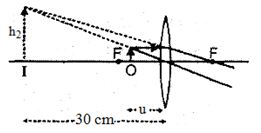
$A$ magnifying lens has a focal length of $10 \, cm$. If an image is to be formed at a distance of $30 \, cm$ from the lens,the object should be placed at a distance of ..... $cm$.
A
$6.9$
B
$8.2$
C
$7.5$
D
$10.5$
Solution
(C) In the case of a magnifying lens (convex lens used as a simple magnifier),the image formed is virtual,erect,and magnified on the same side as the object.
Given: Focal length $f = +10 \, cm$ (for a convex lens).
Since the image is virtual,the image distance $v = -30 \, cm$.
Using the lens formula: $\frac{1}{v} - \frac{1}{u} = \frac{1}{f}$
Substituting the values: $\frac{1}{-30} - \frac{1}{u} = \frac{1}{10}$
Rearranging the terms: $-\frac{1}{u} = \frac{1}{10} + \frac{1}{30}$
$-\frac{1}{u} = \frac{3 + 1}{30} = \frac{4}{30}$
$-\frac{1}{u} = \frac{2}{15}$
$u = -7.5 \, cm$
The negative sign indicates that the object is placed in front of the lens at a distance of $7.5 \, cm$.
Given: Focal length $f = +10 \, cm$ (for a convex lens).
Since the image is virtual,the image distance $v = -30 \, cm$.
Using the lens formula: $\frac{1}{v} - \frac{1}{u} = \frac{1}{f}$
Substituting the values: $\frac{1}{-30} - \frac{1}{u} = \frac{1}{10}$
Rearranging the terms: $-\frac{1}{u} = \frac{1}{10} + \frac{1}{30}$
$-\frac{1}{u} = \frac{3 + 1}{30} = \frac{4}{30}$
$-\frac{1}{u} = \frac{2}{15}$
$u = -7.5 \, cm$
The negative sign indicates that the object is placed in front of the lens at a distance of $7.5 \, cm$.
0 likes
View Solution115
EasyMCQ
$A$ thin lens is made of a material with a refractive index of $\mu = 1.5$. It is a biconvex lens. When it is immersed in water,it behaves as a/an:
A
Converging lens
B
Diverging lens
C
Rectangular slab
D
Prism
Solution
(A) The focal length of a lens in a medium is given by the Lens Maker's Formula: $\frac{1}{f_m} = (\frac{\mu_L}{\mu_m} - 1)(\frac{1}{R_1} - \frac{1}{R_2})$.
Here,$\mu_L = 1.5$ (refractive index of the lens) and $\mu_m = 1.33$ (refractive index of water).
Since $\mu_L > \mu_m$,the term $(\frac{\mu_L}{\mu_m} - 1)$ is positive.
For a biconvex lens,$(\frac{1}{R_1} - \frac{1}{R_2})$ is also positive.
Therefore,the focal length $f_m$ remains positive,which means the lens continues to behave as a converging lens.
Here,$\mu_L = 1.5$ (refractive index of the lens) and $\mu_m = 1.33$ (refractive index of water).
Since $\mu_L > \mu_m$,the term $(\frac{\mu_L}{\mu_m} - 1)$ is positive.
For a biconvex lens,$(\frac{1}{R_1} - \frac{1}{R_2})$ is also positive.
Therefore,the focal length $f_m$ remains positive,which means the lens continues to behave as a converging lens.
0 likes
View Solution116
DifficultMCQ
$A$ convex lens has a focal length of $0.3 \ m$ and a refractive index of $3/2$. Find the focal length of the lens in $m$ when it is immersed in water,which has a refractive index of $4/3$.
A
$0.8$
B
$1.2$
C
$2.8$
D
$2.1$
Solution
(B) According to the Lens Maker's formula: $\frac{1}{f} = (\mu - 1) \left[ \frac{1}{R_1} - \frac{1}{R_2} \right]$,where $\mu$ is the relative refractive index $\mu = \frac{\mu_L}{\mu_M}$.
For air: $\frac{1}{f_a} = \left( \frac{3/2}{1} - 1 \right) K = \frac{1}{2} K$,where $K = \left[ \frac{1}{R_1} - \frac{1}{R_2} \right]$.
Given $f_a = 0.3 \ m$,so $\frac{1}{0.3} = \frac{1}{2} K \implies K = \frac{2}{0.3} = \frac{20}{3}$.
For water: $\frac{1}{f_w} = \left( \frac{3/2}{4/3} - 1 \right) K = \left( \frac{9}{8} - 1 \right) K = \frac{1}{8} K$.
Substituting $K$: $\frac{1}{f_w} = \frac{1}{8} \times \frac{20}{3} = \frac{20}{24} = \frac{5}{6}$.
Therefore,$f_w = \frac{6}{5} = 1.2 \ m$.
For air: $\frac{1}{f_a} = \left( \frac{3/2}{1} - 1 \right) K = \frac{1}{2} K$,where $K = \left[ \frac{1}{R_1} - \frac{1}{R_2} \right]$.
Given $f_a = 0.3 \ m$,so $\frac{1}{0.3} = \frac{1}{2} K \implies K = \frac{2}{0.3} = \frac{20}{3}$.
For water: $\frac{1}{f_w} = \left( \frac{3/2}{4/3} - 1 \right) K = \left( \frac{9}{8} - 1 \right) K = \frac{1}{8} K$.
Substituting $K$: $\frac{1}{f_w} = \frac{1}{8} \times \frac{20}{3} = \frac{20}{24} = \frac{5}{6}$.
Therefore,$f_w = \frac{6}{5} = 1.2 \ m$.
0 likes
View Solution117
DifficultMCQ
Photographs of the ground are taken from an aircraft flying at an altitude of $2000\; m$ by a camera with a lens of focal length $50\; cm$. The size of the film in the camera is $18\; cm \times 18\; cm$. The area of the ground that can be photographed by the camera is
A
$(640\; m \times 720\; m)$
B
$(720\; m \times 640\; m)$
C
$(640\; m \times 640\; m)$
D
$(720\; m \times 720\; m)$
Solution
(D) The magnification $m$ of a camera lens is given by the ratio of the image size to the object size,which is also equal to the ratio of the image distance $v$ to the object distance $u$.
For an object at a large distance,the image is formed at the focal plane,so $v = f = 0.5\; m$.
The object distance $u = 2000\; m$.
The linear magnification $m = \frac{v}{u} = \frac{f}{u} = \frac{0.5\; m}{2000\; m} = \frac{1}{4000}$.
The linear dimensions of the ground covered are $L_{ground} = \frac{L_{film}}{m} = L_{film} \times 4000$.
Given the film size is $18\; cm \times 18\; cm = 0.18\; m \times 0.18\; m$.
Therefore,the ground dimensions are $(0.18 \times 4000\; m) \times (0.18 \times 4000\; m) = 720\; m \times 720\; m$.
For an object at a large distance,the image is formed at the focal plane,so $v = f = 0.5\; m$.
The object distance $u = 2000\; m$.
The linear magnification $m = \frac{v}{u} = \frac{f}{u} = \frac{0.5\; m}{2000\; m} = \frac{1}{4000}$.
The linear dimensions of the ground covered are $L_{ground} = \frac{L_{film}}{m} = L_{film} \times 4000$.
Given the film size is $18\; cm \times 18\; cm = 0.18\; m \times 0.18\; m$.
Therefore,the ground dimensions are $(0.18 \times 4000\; m) \times (0.18 \times 4000\; m) = 720\; m \times 720\; m$.
0 likes
View Solution118
EasyMCQ
An object is placed at a distance of $5 \, cm$ from the first principal focus of a convex lens of focal length $10 \, cm$. If a real image is formed,find its distance from the lens in $cm$.
A
$15$
B
$20$
C
$25$
D
$30$
Solution
(D) The focal length of the convex lens is $f = +10 \, cm$.
The first principal focus $(F_1)$ is at a distance of $10 \, cm$ from the optical center on the left side.
The object is placed $5 \, cm$ from $F_1$ towards the lens,so the object distance $u = -(10 + 5) = -15 \, cm$.
Using the lens formula: $\frac{1}{v} - \frac{1}{u} = \frac{1}{f}$.
Substituting the values: $\frac{1}{v} - \frac{1}{-15} = \frac{1}{10}$.
$\frac{1}{v} + \frac{1}{15} = \frac{1}{10}$.
$\frac{1}{v} = \frac{1}{10} - \frac{1}{15} = \frac{3 - 2}{30} = \frac{1}{30}$.
Therefore,$v = +30 \, cm$.
The image is formed at a distance of $30 \, cm$ from the lens.
The first principal focus $(F_1)$ is at a distance of $10 \, cm$ from the optical center on the left side.
The object is placed $5 \, cm$ from $F_1$ towards the lens,so the object distance $u = -(10 + 5) = -15 \, cm$.
Using the lens formula: $\frac{1}{v} - \frac{1}{u} = \frac{1}{f}$.
Substituting the values: $\frac{1}{v} - \frac{1}{-15} = \frac{1}{10}$.
$\frac{1}{v} + \frac{1}{15} = \frac{1}{10}$.
$\frac{1}{v} = \frac{1}{10} - \frac{1}{15} = \frac{3 - 2}{30} = \frac{1}{30}$.
Therefore,$v = +30 \, cm$.
The image is formed at a distance of $30 \, cm$ from the lens.
0 likes
View Solution119
MediumMCQ
The focal length of a convex lens is maximum for which of the following?
A
Blue light
B
Yellow light
C
Green light
D
Red light
Solution
(D) The focal length $f$ of a lens is given by the Lens Maker's Formula: $\frac{1}{f} = (n - 1) \left( \frac{1}{R_1} - \frac{1}{R_2} \right)$.
According to Cauchy's equation,the refractive index $n$ of a material is higher for light of shorter wavelengths (like blue) and lower for light of longer wavelengths (like red).
Since $n_{blue} > n_{red}$,the term $(n - 1)$ is larger for blue light than for red light.
Because the focal length $f$ is inversely proportional to $(n - 1)$,a smaller value of $(n - 1)$ results in a larger focal length.
Therefore,red light,having the longest wavelength and the smallest refractive index,results in the maximum focal length for a convex lens.
According to Cauchy's equation,the refractive index $n$ of a material is higher for light of shorter wavelengths (like blue) and lower for light of longer wavelengths (like red).
Since $n_{blue} > n_{red}$,the term $(n - 1)$ is larger for blue light than for red light.
Because the focal length $f$ is inversely proportional to $(n - 1)$,a smaller value of $(n - 1)$ results in a larger focal length.
Therefore,red light,having the longest wavelength and the smallest refractive index,results in the maximum focal length for a convex lens.
0 likes
View Solution120
DifficultMCQ
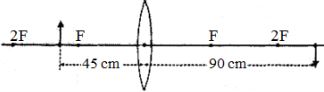
An object of height $25 \ cm$ is placed in front of a convex lens of focal length $30 \ cm$. If the height of the formed image is $50 \ cm$,then the distance between the object and the image is ..... $cm$.
A
$135$
B
$15$
C
$120$
D
$100$
Solution
(B) Given: $h_1 = 25 \ cm$,$f = 30 \ cm$,$h_2 = \pm 50 \ cm$.
Case $1$: Real image $(h_2 = -50 \ cm)$
Magnification $m = \frac{h_2}{h_1} = \frac{-50}{25} = -2$.
Using $m = \frac{f}{f + u}$,we get $-2 = \frac{30}{30 + u} \Rightarrow 30 + u = -15 \Rightarrow u = -45 \ cm$.
Using $m = \frac{v}{u}$,we get $-2 = \frac{v}{-45} \Rightarrow v = 90 \ cm$.
The distance between the object and the image is $d = |v| + |u| = 90 + 45 = 135 \ cm$.
Case $2$: Virtual image $(h_2 = +50 \ cm)$
Magnification $m = \frac{h_2}{h_1} = \frac{50}{25} = +2$.
Using $m = \frac{f}{f + u}$,we get $2 = \frac{30}{30 + u} \Rightarrow 60 + 2u = 30 \Rightarrow 2u = -30 \Rightarrow u = -15 \ cm$.
Using $m = \frac{v}{u}$,we get $2 = \frac{v}{-15} \Rightarrow v = -30 \ cm$.
The distance between the object and the image is $d = |v - u| = |-30 - (-15)| = |-15| = 15 \ cm$.
Since $15 \ cm$ is one of the options,the correct answer is $15 \ cm$.
Case $1$: Real image $(h_2 = -50 \ cm)$
Magnification $m = \frac{h_2}{h_1} = \frac{-50}{25} = -2$.
Using $m = \frac{f}{f + u}$,we get $-2 = \frac{30}{30 + u} \Rightarrow 30 + u = -15 \Rightarrow u = -45 \ cm$.
Using $m = \frac{v}{u}$,we get $-2 = \frac{v}{-45} \Rightarrow v = 90 \ cm$.
The distance between the object and the image is $d = |v| + |u| = 90 + 45 = 135 \ cm$.
Case $2$: Virtual image $(h_2 = +50 \ cm)$
Magnification $m = \frac{h_2}{h_1} = \frac{50}{25} = +2$.
Using $m = \frac{f}{f + u}$,we get $2 = \frac{30}{30 + u} \Rightarrow 60 + 2u = 30 \Rightarrow 2u = -30 \Rightarrow u = -15 \ cm$.
Using $m = \frac{v}{u}$,we get $2 = \frac{v}{-15} \Rightarrow v = -30 \ cm$.
The distance between the object and the image is $d = |v - u| = |-30 - (-15)| = |-15| = 15 \ cm$.
Since $15 \ cm$ is one of the options,the correct answer is $15 \ cm$.
0 likes
View Solution121
DifficultMCQ
The optical power of a thin glass lens (refractive index $1.5$) in air is $-5 \ D$. What will be its optical power in a liquid with a refractive index of $1.6$ (in $D$)?
A
$1$
B
$-1$
C
$25$
D
$-25$
Solution
(A) The power of a lens in air is given by $P_a = \frac{1}{f_a} = (\mu_g - 1) \left( \frac{1}{R_1} - \frac{1}{R_2} \right) = -5 \ D$.
Given $\mu_g = 1.5$,we have $-5 = (1.5 - 1) \left( \frac{1}{R_1} - \frac{1}{R_2} \right) = 0.5 \left( \frac{1}{R_1} - \frac{1}{R_2} \right)$.
Thus,$\left( \frac{1}{R_1} - \frac{1}{R_2} \right) = \frac{-5}{0.5} = -10 \ m^{-1}$.
When placed in a liquid with refractive index $\mu_l = 1.6$,the power $P_l$ is given by $P_l = \left( \frac{\mu_g}{\mu_l} - 1 \right) \left( \frac{1}{R_1} - \frac{1}{R_2} \right)$.
Substituting the values: $P_l = \left( \frac{1.5}{1.6} - 1 \right) (-10) = \left( \frac{1.5 - 1.6}{1.6} \right) (-10) = \left( \frac{-0.1}{1.6} \right) (-10) = \frac{1}{1.6} = 0.625 \ D$.
Wait,re-evaluating the formula: $P_l = \frac{\mu_l}{f_l} = \mu_l (\frac{\mu_g}{\mu_l} - 1) (\frac{1}{R_1} - \frac{1}{R_2}) = (\mu_g - \mu_l) (\frac{1}{R_1} - \frac{1}{R_2})$.
$P_l = (1.5 - 1.6) (-10) = (-0.1) (-10) = +1 \ D$.
Given $\mu_g = 1.5$,we have $-5 = (1.5 - 1) \left( \frac{1}{R_1} - \frac{1}{R_2} \right) = 0.5 \left( \frac{1}{R_1} - \frac{1}{R_2} \right)$.
Thus,$\left( \frac{1}{R_1} - \frac{1}{R_2} \right) = \frac{-5}{0.5} = -10 \ m^{-1}$.
When placed in a liquid with refractive index $\mu_l = 1.6$,the power $P_l$ is given by $P_l = \left( \frac{\mu_g}{\mu_l} - 1 \right) \left( \frac{1}{R_1} - \frac{1}{R_2} \right)$.
Substituting the values: $P_l = \left( \frac{1.5}{1.6} - 1 \right) (-10) = \left( \frac{1.5 - 1.6}{1.6} \right) (-10) = \left( \frac{-0.1}{1.6} \right) (-10) = \frac{1}{1.6} = 0.625 \ D$.
Wait,re-evaluating the formula: $P_l = \frac{\mu_l}{f_l} = \mu_l (\frac{\mu_g}{\mu_l} - 1) (\frac{1}{R_1} - \frac{1}{R_2}) = (\mu_g - \mu_l) (\frac{1}{R_1} - \frac{1}{R_2})$.
$P_l = (1.5 - 1.6) (-10) = (-0.1) (-10) = +1 \ D$.
0 likes
View Solution122
MediumMCQ
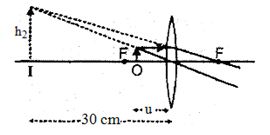
$A$ magnifying lens has a focal length of $10 \, cm$. If the image is formed at a distance of $30 \, cm$ from the lens,what is the magnification?
A
$1/3$
B
$2$
C
$3$
D
$4$
Solution
(D) For a magnifying lens (convex lens used as a simple magnifier),the object is placed between the optical center and the focus. The image formed is virtual,erect,and magnified.
Given: Focal length $f = +10 \, cm$,Image distance $v = -30 \, cm$ (since the image is virtual and on the same side as the object).
Using the lens formula: $\frac{1}{v} - \frac{1}{u} = \frac{1}{f}$
Substituting the values: $\frac{1}{-30} - \frac{1}{u} = \frac{1}{10}$
$-\frac{1}{u} = \frac{1}{10} + \frac{1}{30} = \frac{3+1}{30} = \frac{4}{30}$
$u = -\frac{30}{4} = -7.5 \, cm$
The magnification $m$ is given by: $m = \frac{v}{u}$
$m = \frac{-30}{-7.5} = 4$
Thus,the magnification is $4$.
Given: Focal length $f = +10 \, cm$,Image distance $v = -30 \, cm$ (since the image is virtual and on the same side as the object).
Using the lens formula: $\frac{1}{v} - \frac{1}{u} = \frac{1}{f}$
Substituting the values: $\frac{1}{-30} - \frac{1}{u} = \frac{1}{10}$
$-\frac{1}{u} = \frac{1}{10} + \frac{1}{30} = \frac{3+1}{30} = \frac{4}{30}$
$u = -\frac{30}{4} = -7.5 \, cm$
The magnification $m$ is given by: $m = \frac{v}{u}$
$m = \frac{-30}{-7.5} = 4$
Thus,the magnification is $4$.
0 likes
View Solution123
DifficultMCQ
$A$ plano-convex lens has a diameter of $6\, cm$ and a thickness of $3\, mm$ at the center. If the speed of light in the material of the lens is $2 \times 10^{8}\, m/s$,then the focal length of the lens is ..... $cm$.
A
$15$
B
$20$
C
$30$
D
$10$
Solution
(C) Given: Diameter $D = 6\, cm$,so radius $a = 3\, cm = 0.03\, m$. Thickness at center $t = 3\, mm = 0.003\, m$.
Speed of light in lens $v = 2 \times 10^{8}\, m/s$. Speed of light in vacuum $c = 3 \times 10^{8}\, m/s$.
Refractive index $\mu = c/v = (3 \times 10^{8}) / (2 \times 10^{8}) = 1.5$.
For a plano-convex lens,the radius of curvature $R$ is related to the radius $a$ and thickness $t$ by the formula: $R = (a^2 + t^2) / (2t)$.
Since $t$ is very small,$t^2$ is negligible,so $R \approx a^2 / (2t) = (3^2) / (2 \times 0.3) = 9 / 0.6 = 15\, cm$.
The focal length $f$ is given by the Lens Maker's Formula: $1/f = (\mu - 1)(1/R_1 - 1/R_2)$.
Here $R_1 = R = 15\, cm$ and $R_2 = \infty$.
$1/f = (1.5 - 1)(1/15 - 0) = 0.5 / 15 = 1 / 30$.
Therefore,$f = 30\, cm$.
Speed of light in lens $v = 2 \times 10^{8}\, m/s$. Speed of light in vacuum $c = 3 \times 10^{8}\, m/s$.
Refractive index $\mu = c/v = (3 \times 10^{8}) / (2 \times 10^{8}) = 1.5$.
For a plano-convex lens,the radius of curvature $R$ is related to the radius $a$ and thickness $t$ by the formula: $R = (a^2 + t^2) / (2t)$.
Since $t$ is very small,$t^2$ is negligible,so $R \approx a^2 / (2t) = (3^2) / (2 \times 0.3) = 9 / 0.6 = 15\, cm$.
The focal length $f$ is given by the Lens Maker's Formula: $1/f = (\mu - 1)(1/R_1 - 1/R_2)$.
Here $R_1 = R = 15\, cm$ and $R_2 = \infty$.
$1/f = (1.5 - 1)(1/15 - 0) = 0.5 / 15 = 1 / 30$.
Therefore,$f = 30\, cm$.
0 likes
View Solution124
MediumMCQ
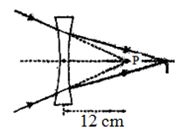
$A$ beam of light converges at a point $P$. Now a lens is placed in the path of the convergent beam $12 \, cm$ from $P$. At what point does the beam converge if the lens is a concave lens of focal length $16 \, cm$ (in $, cm$)?
A
$38$
B
$51$
C
$48$
D
$43$
Solution
(C) The incident beam is convergent,so the object is virtual. The distance of the point $P$ from the lens is $u = +12 \, cm$.
The focal length of the concave lens is $f = -16 \, cm$.
Using the lens formula: $\frac{1}{f} = \frac{1}{v} - \frac{1}{u}$
Substituting the values: $\frac{1}{-16} = \frac{1}{v} - \frac{1}{12}$
$\frac{1}{v} = \frac{1}{12} - \frac{1}{16} = \frac{4 - 3}{48} = \frac{1}{48}$
Therefore,$v = +48 \, cm$.
The beam converges at a point $48 \, cm$ from the lens.
The focal length of the concave lens is $f = -16 \, cm$.
Using the lens formula: $\frac{1}{f} = \frac{1}{v} - \frac{1}{u}$
Substituting the values: $\frac{1}{-16} = \frac{1}{v} - \frac{1}{12}$
$\frac{1}{v} = \frac{1}{12} - \frac{1}{16} = \frac{4 - 3}{48} = \frac{1}{48}$
Therefore,$v = +48 \, cm$.
The beam converges at a point $48 \, cm$ from the lens.
0 likes
View Solution125
EasyMCQ
The focal length of a plano-convex lens is equal to its radius of curvature. Find the refractive index of its material.
A
$1.33$
B
$1.6$
C
$1.5$
D
$2$
Solution
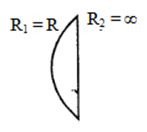
(D) For a plano-convex lens,the lens maker's formula is given by:
$\frac{1}{f} = (\mu - 1) \left( \frac{1}{R_1} - \frac{1}{R_2} \right)$
Here,$f = R$,$R_1 = R$,and $R_2 = \infty$ (for a plane surface).
Substituting these values into the formula:
$\frac{1}{R} = (\mu - 1) \left( \frac{1}{R} - \frac{1}{\infty} \right)$
Since $\frac{1}{\infty} = 0$,we get:
$\frac{1}{R} = (\mu - 1) \left( \frac{1}{R} \right)$
$1 = \mu - 1$
$\mu = 2$
$\frac{1}{f} = (\mu - 1) \left( \frac{1}{R_1} - \frac{1}{R_2} \right)$
Here,$f = R$,$R_1 = R$,and $R_2 = \infty$ (for a plane surface).
Substituting these values into the formula:
$\frac{1}{R} = (\mu - 1) \left( \frac{1}{R} - \frac{1}{\infty} \right)$
Since $\frac{1}{\infty} = 0$,we get:
$\frac{1}{R} = (\mu - 1) \left( \frac{1}{R} \right)$
$1 = \mu - 1$
$\mu = 2$
0 likes
View Solution126
EasyMCQ
An object is placed at a distance of $10 \, cm$ from a lens. The image is formed at a distance of $20 \, cm$ behind the lens. The power of the lens is ......
A
$1.5 \, D$
B
$3 \, D$
C
$-5 \, D$
D
$+15 \, D$
Solution
(D) Given: Object distance $u = -10 \, cm$,Image distance $v = +20 \, cm$ (since it is formed behind the lens).
Using the lens formula: $\frac{1}{f} = \frac{1}{v} - \frac{1}{u}$.
Substituting the values: $\frac{1}{f} = \frac{1}{20} - \frac{1}{-10} = \frac{1}{20} + \frac{1}{10} = \frac{1+2}{20} = \frac{3}{20} \, cm^{-1}$.
Power of the lens $P$ (in Diopters) is given by $P = \frac{100}{f(cm)}$.
$P = 100 \times \frac{3}{20} = 5 \times 3 = +15 \, D$.
Using the lens formula: $\frac{1}{f} = \frac{1}{v} - \frac{1}{u}$.
Substituting the values: $\frac{1}{f} = \frac{1}{20} - \frac{1}{-10} = \frac{1}{20} + \frac{1}{10} = \frac{1+2}{20} = \frac{3}{20} \, cm^{-1}$.
Power of the lens $P$ (in Diopters) is given by $P = \frac{100}{f(cm)}$.
$P = 100 \times \frac{3}{20} = 5 \times 3 = +15 \, D$.
0 likes
View Solution127
MediumMCQ
$A$ thin biconvex lens is made of glass $(\mu = 1.50)$ and both surfaces have a radius of curvature of $20 \ cm$. $A$ beam of incident light is parallel to the principal axis of the lens. The lens converges it at a distance $L \ cm$. Then $L = \dots$
A
$10$
B
$20$
C
$40$
D
$6.67$
Solution
(B) The lens maker's formula is given by: $\frac{1}{f} = (\mu - 1) \left( \frac{1}{R_1} - \frac{1}{R_2} \right)$.
Given: $\mu = 1.5$,$R_1 = +20 \ cm$,and $R_2 = -20 \ cm$.
Substituting the values: $\frac{1}{f} = (1.5 - 1) \left( \frac{1}{20} - \frac{1}{-20} \right)$.
$\frac{1}{f} = (0.5) \left( \frac{1}{20} + \frac{1}{20} \right) = (0.5) \left( \frac{2}{20} \right) = (0.5) \left( \frac{1}{10} \right) = \frac{1}{20}$.
Therefore,$f = 20 \ cm$.
Since the incident light is parallel to the principal axis,the rays converge at the focal point. Thus,$L = f = 20 \ cm$.
Given: $\mu = 1.5$,$R_1 = +20 \ cm$,and $R_2 = -20 \ cm$.
Substituting the values: $\frac{1}{f} = (1.5 - 1) \left( \frac{1}{20} - \frac{1}{-20} \right)$.
$\frac{1}{f} = (0.5) \left( \frac{1}{20} + \frac{1}{20} \right) = (0.5) \left( \frac{2}{20} \right) = (0.5) \left( \frac{1}{10} \right) = \frac{1}{20}$.
Therefore,$f = 20 \ cm$.
Since the incident light is parallel to the principal axis,the rays converge at the focal point. Thus,$L = f = 20 \ cm$.
0 likes
View Solution128
EasyMCQ
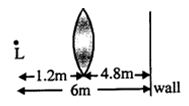
$A$ lamp is placed $6.0\; m$ from a wall. On putting a lens between the lamp and the wall at a distance of $1.2\; m$ from the lamp,a real image of the lamp is formed on the wall. The magnification of the image is
A
$3$
B
$-4$
C
$5$
D
$6$
Solution
(B) Given:
Distance between lamp and wall,$D = 6.0\; m$.
Distance of lens from the lamp,$u = -1.2\; m$ (using sign convention).
Distance of lens from the wall (where the image is formed),$v = 6.0\; m - 1.2\; m = 4.8\; m$.
Magnification $m$ is given by the formula:
$m = \frac{v}{u}$
Substituting the values:
$m = \frac{4.8\; m}{-1.2\; m} = -4$
Thus,the magnification of the image is $-4$.
Distance between lamp and wall,$D = 6.0\; m$.
Distance of lens from the lamp,$u = -1.2\; m$ (using sign convention).
Distance of lens from the wall (where the image is formed),$v = 6.0\; m - 1.2\; m = 4.8\; m$.
Magnification $m$ is given by the formula:
$m = \frac{v}{u}$
Substituting the values:
$m = \frac{4.8\; m}{-1.2\; m} = -4$
Thus,the magnification of the image is $-4$.
0 likes
View Solution129
MediumMCQ
If the radius of curvature of the convex surface of a plano-convex lens is $10 \ cm$ and its focal length is $30 \ cm$,what is the refractive index of the material of the lens?
A
$1/3$
B
$4/3$
C
$3/5$
D
$2/3$
Solution
(B) According to the Lens Maker's formula: $\frac{1}{f} = (\mu - 1) \left[ \frac{1}{R_1} - \frac{1}{R_2} \right]$
For a plano-convex lens,the radius of curvature of the plane surface is $R_2 = \infty$ and the radius of curvature of the convex surface is $R_1 = 10 \ cm$.
Given the focal length $f = 30 \ cm$,we substitute the values into the formula:
$\frac{1}{30} = (\mu - 1) \left[ \frac{1}{10} - \frac{1}{\infty} \right]$
Since $\frac{1}{\infty} = 0$,the equation becomes:
$\frac{1}{30} = (\mu - 1) \left( \frac{1}{10} \right)$
Multiplying both sides by $10$:
$\frac{10}{30} = \mu - 1$
$\frac{1}{3} = \mu - 1$
Therefore,$\mu = 1 + \frac{1}{3} = \frac{4}{3}$.
For a plano-convex lens,the radius of curvature of the plane surface is $R_2 = \infty$ and the radius of curvature of the convex surface is $R_1 = 10 \ cm$.
Given the focal length $f = 30 \ cm$,we substitute the values into the formula:
$\frac{1}{30} = (\mu - 1) \left[ \frac{1}{10} - \frac{1}{\infty} \right]$
Since $\frac{1}{\infty} = 0$,the equation becomes:
$\frac{1}{30} = (\mu - 1) \left( \frac{1}{10} \right)$
Multiplying both sides by $10$:
$\frac{10}{30} = \mu - 1$
$\frac{1}{3} = \mu - 1$
Therefore,$\mu = 1 + \frac{1}{3} = \frac{4}{3}$.
0 likes
View Solution130
DifficultMCQ
In the displacement method,the distance between the object and the screen is $70 \, cm$. The focal length of the lens is $16 \, cm$. The distance between the positions of the lens for the magnified and diminished images will be ..... $cm$.
A
$16.9$
B
$18.2$
C
$21.2$
D
$20.5$
Solution
(D) In the displacement method,the distance between the object and the screen is $D = 70 \, cm$ and the focal length of the lens is $f = 16 \, cm$.
The distance $d$ between the two positions of the lens for which a sharp image is formed on the screen is given by the formula:
$d = \sqrt{D^2 - 4fD}$
Substituting the given values:
$d = \sqrt{(70)^2 - 4 \times 16 \times 70}$
$d = \sqrt{4900 - 4480}$
$d = \sqrt{420}$
$d \approx 20.4939 \, cm$
Rounding to one decimal place,we get $d \approx 20.5 \, cm$.
The distance $d$ between the two positions of the lens for which a sharp image is formed on the screen is given by the formula:
$d = \sqrt{D^2 - 4fD}$
Substituting the given values:
$d = \sqrt{(70)^2 - 4 \times 16 \times 70}$
$d = \sqrt{4900 - 4480}$
$d = \sqrt{420}$
$d \approx 20.4939 \, cm$
Rounding to one decimal place,we get $d \approx 20.5 \, cm$.
0 likes
View Solution131
DifficultMCQ
$A$ student measures the focal length of a convex lens by obtaining an image of an object pin at a distance '$v$' from the lens,with the object placed at a distance '$u$' from the lens. What will the graph between '$u$' and '$v$' look like?
A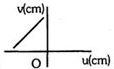
B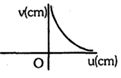
C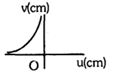
D
Solution
(B) The lens formula is given by $\frac{1}{f} = \frac{1}{v} - \frac{1}{u}$.
In the standard sign convention for a convex lens,the object distance $u$ is negative $(-u)$ and the image distance $v$ is positive $(+v)$.
Substituting these into the lens formula: $\frac{1}{f} = \frac{1}{v} - \frac{1}{-u} = \frac{1}{v} + \frac{1}{u}$.
Rearranging for $v$: $\frac{1}{v} = \frac{1}{f} - \frac{1}{u} = \frac{u-f}{fu}$.
Thus,$v = \frac{fu}{u-f}$.
As $u$ increases from $f$ to $\infty$,$v$ decreases from $\infty$ to $f$. This represents a rectangular hyperbola in the first quadrant,which corresponds to the graph shown in option $B$.
In the standard sign convention for a convex lens,the object distance $u$ is negative $(-u)$ and the image distance $v$ is positive $(+v)$.
Substituting these into the lens formula: $\frac{1}{f} = \frac{1}{v} - \frac{1}{-u} = \frac{1}{v} + \frac{1}{u}$.
Rearranging for $v$: $\frac{1}{v} = \frac{1}{f} - \frac{1}{u} = \frac{u-f}{fu}$.
Thus,$v = \frac{fu}{u-f}$.
As $u$ increases from $f$ to $\infty$,$v$ decreases from $\infty$ to $f$. This represents a rectangular hyperbola in the first quadrant,which corresponds to the graph shown in option $B$.
0 likes
View Solution132
EasyMCQ
When monochromatic red light is used instead of blue light in a convex lens,its focal length will .....
A
not depend on the color of light.
B
increase
C
decrease
D
remain unchanged
Solution
(B) The lens maker's formula is given by: $\frac{1}{f} = (\mu - 1) \left( \frac{1}{R_1} - \frac{1}{R_2} \right)$.
According to Cauchy's equation,the refractive index $\mu$ is inversely proportional to the square of the wavelength $\lambda$ (approximately $\mu \propto \frac{1}{\lambda}$).
Since the wavelength of red light $(\lambda_r)$ is greater than the wavelength of blue light $(\lambda_b)$,the refractive index for red light $(\mu_r)$ is less than the refractive index for blue light $(\mu_b)$.
From the formula,$f \propto \frac{1}{(\mu - 1)}$.
Since $\mu_r < \mu_b$,the term $(\mu_r - 1)$ is smaller than $(\mu_b - 1)$.
Therefore,the focal length for red light $(f_r)$ will be greater than the focal length for blue light $(f_b)$.
Thus,the focal length increases.
According to Cauchy's equation,the refractive index $\mu$ is inversely proportional to the square of the wavelength $\lambda$ (approximately $\mu \propto \frac{1}{\lambda}$).
Since the wavelength of red light $(\lambda_r)$ is greater than the wavelength of blue light $(\lambda_b)$,the refractive index for red light $(\mu_r)$ is less than the refractive index for blue light $(\mu_b)$.
From the formula,$f \propto \frac{1}{(\mu - 1)}$.
Since $\mu_r < \mu_b$,the term $(\mu_r - 1)$ is smaller than $(\mu_b - 1)$.
Therefore,the focal length for red light $(f_r)$ will be greater than the focal length for blue light $(f_b)$.
Thus,the focal length increases.
0 likes
View Solution133
MediumMCQ
$A$ lens of focal length $f$ and diameter $d$ forms an image of intensity $I$. If the central part of the lens of diameter $\frac{d}{2}$ is covered with a paper,what will be the new focal length and the new intensity of the image?
A
$f$ and $\frac{I}{2}$
B
$f$ and $\frac{I}{4}$
C
$\frac{3f}{4}$ and $\frac{I}{2}$
D
$f$ and $\frac{3I}{4}$
Solution
(D) The focal length $f$ of a lens depends only on the radii of curvature of its surfaces and the refractive index of the material. It is independent of the aperture (diameter) of the lens. Therefore,the focal length remains $f$.
The intensity $I$ of the image formed by a lens is directly proportional to the area of the aperture,$I \propto A$.
Initially,the area $A = \pi (\frac{d}{2})^2 = \frac{\pi d^2}{4}$.
When the central part of diameter $\frac{d}{2}$ is covered,the effective area $A'$ is the total area minus the area of the covered part:
$A' = \pi (\frac{d}{2})^2 - \pi (\frac{d/2}{2})^2 = \frac{\pi d^2}{4} - \frac{\pi d^2}{16} = \frac{3\pi d^2}{16}$.
The ratio of the new intensity $I'$ to the original intensity $I$ is:
$\frac{I'}{I} = \frac{A'}{A} = \frac{3\pi d^2 / 16}{\pi d^2 / 4} = \frac{3}{4}$.
Thus,the new intensity is $I' = \frac{3I}{4}$.
The intensity $I$ of the image formed by a lens is directly proportional to the area of the aperture,$I \propto A$.
Initially,the area $A = \pi (\frac{d}{2})^2 = \frac{\pi d^2}{4}$.
When the central part of diameter $\frac{d}{2}$ is covered,the effective area $A'$ is the total area minus the area of the covered part:
$A' = \pi (\frac{d}{2})^2 - \pi (\frac{d/2}{2})^2 = \frac{\pi d^2}{4} - \frac{\pi d^2}{16} = \frac{3\pi d^2}{16}$.
The ratio of the new intensity $I'$ to the original intensity $I$ is:
$\frac{I'}{I} = \frac{A'}{A} = \frac{3\pi d^2 / 16}{\pi d^2 / 4} = \frac{3}{4}$.
Thus,the new intensity is $I' = \frac{3I}{4}$.
0 likes
View Solution134
DifficultMCQ
$A$ convex lens has a power of $+5.0 \, D$ in air,where the refractive index of the lens material is $_a\mu_g = 1.5$. In a liquid of what refractive index should it be immersed so that it acts as a concave lens of focal length $100 \, cm$?
A
$5/3$
B
$4/3$
C
$\sqrt{3}$
D
$5/4$
Solution
(A) The power of the lens in air is $P_a = +5.0 \, D$. The focal length in air is $f_a = \frac{1}{P_a} = \frac{1}{5} \, m = 20 \, cm$.
Using the lens maker's formula ratio: $\frac{f_l}{f_a} = \frac{_a\mu_g - 1}{_l\mu_g - 1}$,where $_l\mu_g = \frac{_a\mu_g}{_a\mu_l} = \frac{1.5}{\mu_l}$.
Given that the lens acts as a concave lens of focal length $f_l = -100 \, cm$ in the liquid.
Substituting the values: $\frac{-100}{20} = \frac{1.5 - 1}{\frac{1.5}{\mu_l} - 1}$.
$-5 = \frac{0.5}{\frac{1.5}{\mu_l} - 1}$.
$-5 \left( \frac{1.5}{\mu_l} - 1 \right) = 0.5$.
$-\frac{7.5}{\mu_l} + 5 = 0.5$.
$4.5 = \frac{7.5}{\mu_l}$.
$\mu_l = \frac{7.5}{4.5} = \frac{75}{45} = \frac{5}{3}$.
Using the lens maker's formula ratio: $\frac{f_l}{f_a} = \frac{_a\mu_g - 1}{_l\mu_g - 1}$,where $_l\mu_g = \frac{_a\mu_g}{_a\mu_l} = \frac{1.5}{\mu_l}$.
Given that the lens acts as a concave lens of focal length $f_l = -100 \, cm$ in the liquid.
Substituting the values: $\frac{-100}{20} = \frac{1.5 - 1}{\frac{1.5}{\mu_l} - 1}$.
$-5 = \frac{0.5}{\frac{1.5}{\mu_l} - 1}$.
$-5 \left( \frac{1.5}{\mu_l} - 1 \right) = 0.5$.
$-\frac{7.5}{\mu_l} + 5 = 0.5$.
$4.5 = \frac{7.5}{\mu_l}$.
$\mu_l = \frac{7.5}{4.5} = \frac{75}{45} = \frac{5}{3}$.
0 likes
View Solution135
DifficultMCQ
What is the focal length (in $cm$) of a biconvex lens with a radius of curvature of $40\, cm$ and a refractive index of $1.65$?
A
$20$
B
$31$
C
$35$
D
$50$
Solution
(B) For a biconvex lens,the radius of curvature $R_1 = R$ and $R_2 = -R$. Given $R = 40\, cm$ and $\mu = 1.65$.
Using the Lens Maker's Formula: $\frac{1}{f} = (\mu - 1) \left( \frac{1}{R_1} - \frac{1}{R_2} \right)$.
Substituting the values: $\frac{1}{f} = (1.65 - 1) \left( \frac{1}{40} - \frac{1}{-40} \right)$.
$\frac{1}{f} = (0.65) \left( \frac{1}{40} + \frac{1}{40} \right) = 0.65 \times \frac{2}{40} = \frac{0.65}{20}$.
$f = \frac{20}{0.65} \approx 30.77\, cm$.
Rounding to the nearest integer,we get $f \approx 31\, cm$.
Using the Lens Maker's Formula: $\frac{1}{f} = (\mu - 1) \left( \frac{1}{R_1} - \frac{1}{R_2} \right)$.
Substituting the values: $\frac{1}{f} = (1.65 - 1) \left( \frac{1}{40} - \frac{1}{-40} \right)$.
$\frac{1}{f} = (0.65) \left( \frac{1}{40} + \frac{1}{40} \right) = 0.65 \times \frac{2}{40} = \frac{0.65}{20}$.
$f = \frac{20}{0.65} \approx 30.77\, cm$.
Rounding to the nearest integer,we get $f \approx 31\, cm$.
0 likes
View Solution136
MediumMCQ
The distance between the object and the screen is $100 \, cm$. $A$ lens produces an image on the screen when it is placed at either of two positions $40 \, cm$ apart. The power of the lens is (approximately): (in $, D$)
A
$3$
B
$5$
C
$7$
D
$9$
Solution
(B) The displacement method formula for the focal length $f$ of a lens is given by $f = \frac{D^2 - x^2}{4D}$,where $D$ is the distance between the object and the screen,and $x$ is the distance between the two positions of the lens.
Given $D = 100 \, cm$ and $x = 40 \, cm$.
Substituting these values: $f = \frac{100^2 - 40^2}{4 \times 100} = \frac{10000 - 1600}{400} = \frac{8400}{400} = 21 \, cm$.
The power $P$ of the lens in Diopters $(D)$ is given by $P = \frac{100}{f(cm)}$.
$P = \frac{100}{21} \approx 4.76 \, D$.
Rounding to the nearest integer,we get $P \approx 5 \, D$.
Given $D = 100 \, cm$ and $x = 40 \, cm$.
Substituting these values: $f = \frac{100^2 - 40^2}{4 \times 100} = \frac{10000 - 1600}{400} = \frac{8400}{400} = 21 \, cm$.
The power $P$ of the lens in Diopters $(D)$ is given by $P = \frac{100}{f(cm)}$.
$P = \frac{100}{21} \approx 4.76 \, D$.
Rounding to the nearest integer,we get $P \approx 5 \, D$.
0 likes
View Solution137
DifficultMCQ
An object is placed in front of a convex lens,and an image of height $8 \, cm$ is formed. When the lens is moved to a new position,the image height becomes $2 \, cm$. Find the height of the object in $cm$.
A
$16$
B
$8$
C
$4$
D
$2$
Solution
(C) For a convex lens,when an object is placed at two different positions to obtain a sharp image on a screen (displacement method),the height of the object $O$ is given by the geometric mean of the heights of the two images $I_1$ and $I_2$.
$O = \sqrt{I_1 \times I_2}$
Given $I_1 = 8 \, cm$ and $I_2 = 2 \, cm$.
Substituting the values:
$O = \sqrt{8 \times 2} = \sqrt{16} = 4 \, cm$.
Thus,the height of the object is $4 \, cm$.
$O = \sqrt{I_1 \times I_2}$
Given $I_1 = 8 \, cm$ and $I_2 = 2 \, cm$.
Substituting the values:
$O = \sqrt{8 \times 2} = \sqrt{16} = 4 \, cm$.
Thus,the height of the object is $4 \, cm$.
0 likes
View Solution138
DifficultMCQ
The diameter of the Sun is $1.4 \times 10^9 \, m$ and its distance from the Earth is $10^{11} \, m$. What is the diameter of the image (in $cm$) formed by a convex lens of focal length $2 \, m$?
A
$0.7$
B
$1.4$
C
$2.8$
D
$0$
Solution
(C) Let $D$ be the diameter of the Sun and $d$ be the diameter of the image formed by the lens.
The distance of the Sun from the lens is $u = 10^{11} \, m$.
The focal length of the lens is $f = 2 \, m$.
Since the Sun is at a very large distance,the image is formed at the focus of the lens.
From the geometry of the rays passing through the optical center,we have the relation:
$\tan \alpha = \frac{D}{u} = \frac{d}{f}$
Substituting the given values:
$\frac{1.4 \times 10^9}{10^{11}} = \frac{d}{2}$
$d = \frac{2 \times 1.4 \times 10^9}{10^{11}} \, m$
$d = 2.8 \times 10^{-2} \, m$
Converting to centimeters:
$d = 2.8 \times 10^{-2} \times 10^2 \, cm = 2.8 \, cm$.
The distance of the Sun from the lens is $u = 10^{11} \, m$.
The focal length of the lens is $f = 2 \, m$.
Since the Sun is at a very large distance,the image is formed at the focus of the lens.
From the geometry of the rays passing through the optical center,we have the relation:
$\tan \alpha = \frac{D}{u} = \frac{d}{f}$
Substituting the given values:
$\frac{1.4 \times 10^9}{10^{11}} = \frac{d}{2}$
$d = \frac{2 \times 1.4 \times 10^9}{10^{11}} \, m$
$d = 2.8 \times 10^{-2} \, m$
Converting to centimeters:
$d = 2.8 \times 10^{-2} \times 10^2 \, cm = 2.8 \, cm$.
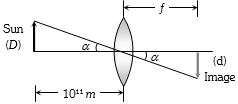
0 likes
View Solution139
MediumMCQ
$A$ boy is trying to start a fire by focusing sunlight on a piece of paper using an equiconvex lens of focal length $10\, cm$. The diameter of the sun is $1.39 \times 10^9\, m$ and its mean distance from the earth is $1.5 \times 10^{11}\, m$. What is the diameter of the sun's image on the paper?
A
$6.5 \times 10^{-5}\, m$
B
$12.4 \times 10^{-4}\, m$
C
$9.2 \times 10^{-4}\, m$
D
$6.5 \times 10^{-4}\, m$
Solution
(C) The angular diameter of the sun as seen from the earth is $\alpha = \frac{\text{Diameter of Sun}}{\text{Distance of Sun}} = \frac{1.39 \times 10^9}{1.5 \times 10^{11}} \approx 9.26 \times 10^{-3}\, \text{radians}$.
When the sunlight is focused by a lens of focal length $f = 10\, cm = 0.1\, m$,the image of the sun is formed at the focus.
The diameter of the image $d$ is given by $d = f \times \alpha$.
Substituting the values: $d = 0.1\, m \times (\frac{1.39 \times 10^9}{1.5 \times 10^{11}})$.
$d = 0.1 \times 0.926 \times 10^{-2} = 0.0926 \times 10^{-2} = 9.26 \times 10^{-4}\, m$.
Rounding to the nearest provided option,the diameter is $9.2 \times 10^{-4}\, m$.
When the sunlight is focused by a lens of focal length $f = 10\, cm = 0.1\, m$,the image of the sun is formed at the focus.
The diameter of the image $d$ is given by $d = f \times \alpha$.
Substituting the values: $d = 0.1\, m \times (\frac{1.39 \times 10^9}{1.5 \times 10^{11}})$.
$d = 0.1 \times 0.926 \times 10^{-2} = 0.0926 \times 10^{-2} = 9.26 \times 10^{-4}\, m$.
Rounding to the nearest provided option,the diameter is $9.2 \times 10^{-4}\, m$.
0 likes
View Solution140
MediumMCQ
$A$ lens having focal length $f$ and aperture of diameter $d$ forms an image of intensity $I.$ If an aperture of diameter $\frac{d}{2}$ in the central region of the lens is covered by a black paper,the focal length of the lens and the intensity of the image will be,respectively:
A
$f, \frac{I}{4}$
B
$\frac{3f}{4}, \frac{I}{2}$
C
$f, \frac{3I}{4}$
D
$\frac{f}{2}, \frac{I}{2}$
Solution
(C) The focal length of a lens depends on its refractive index and the radii of curvature of its surfaces,not on the aperture size. Therefore,the focal length remains $f$.
The intensity of the image formed by a lens is directly proportional to the area of the lens exposed to incident light.
Intensity $I \propto \text{Area} (A)$
$\frac{I_2}{I_1} = \frac{A_2}{A_1}$
Initial area $A_1 = \pi \left(\frac{d}{2}\right)^2 = \frac{\pi d^2}{4}$.
After covering the central region with a diameter $\frac{d}{2}$,the radius of the covered part is $r = \frac{d}{4}$.
Area of the covered part $A_{covered} = \pi \left(\frac{d}{4}\right)^2 = \frac{\pi d^2}{16}$.
Remaining exposed area $A_2 = A_1 - A_{covered} = \frac{\pi d^2}{4} - \frac{\pi d^2}{16} = \frac{3\pi d^2}{16}$.
Ratio of intensities: $\frac{I_2}{I_1} = \frac{A_2}{A_1} = \frac{3\pi d^2 / 16}{\pi d^2 / 4} = \frac{3}{4}$.
Thus,the new intensity $I_2 = \frac{3}{4} I$.
The intensity of the image formed by a lens is directly proportional to the area of the lens exposed to incident light.
Intensity $I \propto \text{Area} (A)$
$\frac{I_2}{I_1} = \frac{A_2}{A_1}$
Initial area $A_1 = \pi \left(\frac{d}{2}\right)^2 = \frac{\pi d^2}{4}$.
After covering the central region with a diameter $\frac{d}{2}$,the radius of the covered part is $r = \frac{d}{4}$.
Area of the covered part $A_{covered} = \pi \left(\frac{d}{4}\right)^2 = \frac{\pi d^2}{16}$.
Remaining exposed area $A_2 = A_1 - A_{covered} = \frac{\pi d^2}{4} - \frac{\pi d^2}{16} = \frac{3\pi d^2}{16}$.
Ratio of intensities: $\frac{I_2}{I_1} = \frac{A_2}{A_1} = \frac{3\pi d^2 / 16}{\pi d^2 / 4} = \frac{3}{4}$.
Thus,the new intensity $I_2 = \frac{3}{4} I$.
0 likes
View Solution141
MediumMCQ
$A$ converging beam of rays is incident on a diverging lens. Having passed through the lens,the rays intersect at a point $15\, cm$ from the lens on the opposite side. If the lens is removed,the point where the rays meet will move $5\, cm$ closer to the lens. The focal length of the lens is $......\, cm$.
A
$5$
B
$-10$
C
$15$
D
$-30$
Solution
(D) Let the position of the converging beam's focus without the lens be at distance $x$ from the lens. When the lens is present,the image is formed at $v = +15\, cm$.
When the lens is removed,the rays meet at a point $5\, cm$ closer,so the object distance for the lens is $u = 15 - 5 = +10\, cm$.
Since the beam is converging,the object is virtual,hence $u$ is positive.
Using the lens formula: $\frac{1}{v} - \frac{1}{u} = \frac{1}{f}$.
Substituting the values: $\frac{1}{15} - \frac{1}{10} = \frac{1}{f}$.
$\frac{2 - 3}{30} = \frac{1}{f}$.
$\frac{-1}{30} = \frac{1}{f}$.
Therefore,$f = -30\, cm$.
When the lens is removed,the rays meet at a point $5\, cm$ closer,so the object distance for the lens is $u = 15 - 5 = +10\, cm$.
Since the beam is converging,the object is virtual,hence $u$ is positive.
Using the lens formula: $\frac{1}{v} - \frac{1}{u} = \frac{1}{f}$.
Substituting the values: $\frac{1}{15} - \frac{1}{10} = \frac{1}{f}$.
$\frac{2 - 3}{30} = \frac{1}{f}$.
$\frac{-1}{30} = \frac{1}{f}$.
Therefore,$f = -30\, cm$.
0 likes
View Solution142
MediumMCQ
$A$ biconvex lens has a radius of curvature of magnitude $20\, cm$. Which one of the following options best describes the image formed of an object of height $2\, cm$ placed $30\, cm$ from the lens?
A
Virtual,upright,height $= 1\, cm$
B
Virtual,upright,height $= 0.5\, cm$
C
Real,inverted,height $= 4\, cm$
D
Real,inverted,height $= 1\, cm$
Solution
(C) Assuming the refractive index of the lens material is $\mu = 1.5$ and the radii of curvature are $R_1 = 20\, cm$ and $R_2 = -20\, cm$,the focal length $f$ is given by the lens maker's formula: $\frac{1}{f} = (\mu - 1)(\frac{1}{R_1} - \frac{1}{R_2}) = (1.5 - 1)(\frac{1}{20} - \frac{1}{-20}) = 0.5 \times \frac{2}{20} = \frac{1}{20}$. Thus,$f = 20\, cm$.
Using the lens formula $\frac{1}{f} = \frac{1}{v} - \frac{1}{u}$,where $u = -30\, cm$:
$\frac{1}{20} = \frac{1}{v} - \frac{1}{-30}$
$\frac{1}{v} = \frac{1}{20} - \frac{1}{30} = \frac{3 - 2}{60} = \frac{1}{60}$.
So,$v = 60\, cm$.
The magnification $m$ is given by $m = \frac{v}{u} = \frac{60}{-30} = -2$.
Since $m = \frac{h_i}{h_o}$,we have $h_i = m \times h_o = -2 \times 2\, cm = -4\, cm$.
The negative sign indicates the image is inverted,and the magnitude of the height is $4\, cm$. Since $v$ is positive,the image is real.
Using the lens formula $\frac{1}{f} = \frac{1}{v} - \frac{1}{u}$,where $u = -30\, cm$:
$\frac{1}{20} = \frac{1}{v} - \frac{1}{-30}$
$\frac{1}{v} = \frac{1}{20} - \frac{1}{30} = \frac{3 - 2}{60} = \frac{1}{60}$.
So,$v = 60\, cm$.
The magnification $m$ is given by $m = \frac{v}{u} = \frac{60}{-30} = -2$.
Since $m = \frac{h_i}{h_o}$,we have $h_i = m \times h_o = -2 \times 2\, cm = -4\, cm$.
The negative sign indicates the image is inverted,and the magnitude of the height is $4\, cm$. Since $v$ is positive,the image is real.
0 likes
View Solution143
EasyMCQ
When a biconvex lens of glass having refractive index $1.47$ is dipped in a liquid,it acts as a plane sheet of glass. This implies that the liquid must have a refractive index:
A
greater than that of glass
B
less than that of glass
C
less than one
D
equal to that of glass
Solution
(D) The focal length of a lens in a medium is given by the Lens Maker's Formula:
$\frac{1}{f} = (\frac{\mu_l}{\mu_m} - 1) (\frac{1}{R_1} - \frac{1}{R_2})$
where $\mu_l$ is the refractive index of the lens,$\mu_m$ is the refractive index of the surrounding medium,and $R_1, R_2$ are the radii of curvature.
If the lens acts as a plane sheet of glass,its focal length $f$ becomes infinite $(f \to \infty)$,which implies $\frac{1}{f} = 0$.
Substituting this into the formula: $0 = (\frac{\mu_l}{\mu_m} - 1) (\frac{1}{R_1} - \frac{1}{R_2})$.
Since the lens is biconvex,$(\frac{1}{R_1} - \frac{1}{R_2}) \neq 0$.
Therefore,$(\frac{\mu_l}{\mu_m} - 1) = 0$,which means $\frac{\mu_l}{\mu_m} = 1$,or $\mu_l = \mu_m$.
Thus,the refractive index of the liquid must be equal to the refractive index of the glass $(1.47)$.
$\frac{1}{f} = (\frac{\mu_l}{\mu_m} - 1) (\frac{1}{R_1} - \frac{1}{R_2})$
where $\mu_l$ is the refractive index of the lens,$\mu_m$ is the refractive index of the surrounding medium,and $R_1, R_2$ are the radii of curvature.
If the lens acts as a plane sheet of glass,its focal length $f$ becomes infinite $(f \to \infty)$,which implies $\frac{1}{f} = 0$.
Substituting this into the formula: $0 = (\frac{\mu_l}{\mu_m} - 1) (\frac{1}{R_1} - \frac{1}{R_2})$.
Since the lens is biconvex,$(\frac{1}{R_1} - \frac{1}{R_2}) \neq 0$.
Therefore,$(\frac{\mu_l}{\mu_m} - 1) = 0$,which means $\frac{\mu_l}{\mu_m} = 1$,or $\mu_l = \mu_m$.
Thus,the refractive index of the liquid must be equal to the refractive index of the glass $(1.47)$.
0 likes
View Solution144
EasyMCQ
An object is placed at a point distant $x$ from the focus of a convex lens and its image is formed at $I$ as shown in the figure. The distances $x$ and $x'$ satisfy the relation:
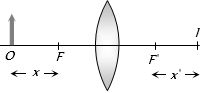
A
$\frac{x + x'}{2} = f$
B
$f = xx'$
C
$x + x' \le 2f$
D
$x + x' \ge 2f$
Solution
(D) According to Newton's lens formula,for a convex lens,the product of the distances of the object and the image from the respective foci is equal to the square of the focal length,i.e.,$xx' = f^2$.
For a real image to be formed by a convex lens,the object must be placed beyond the focus $(x > 0)$.
By the Arithmetic Mean-Geometric Mean ($AM$-$GM$) inequality,for positive real numbers $x$ and $x'$,we have $\frac{x + x'}{2} \ge \sqrt{xx'}$.
Substituting $xx' = f^2$,we get $\frac{x + x'}{2} \ge \sqrt{f^2} = f$.
Therefore,$x + x' \ge 2f$.
For a real image to be formed by a convex lens,the object must be placed beyond the focus $(x > 0)$.
By the Arithmetic Mean-Geometric Mean ($AM$-$GM$) inequality,for positive real numbers $x$ and $x'$,we have $\frac{x + x'}{2} \ge \sqrt{xx'}$.
Substituting $xx' = f^2$,we get $\frac{x + x'}{2} \ge \sqrt{f^2} = f$.
Therefore,$x + x' \ge 2f$.
0 likes
View Solution145
MediumMCQ
$A$ lens behaves as a converging lens in air but a diverging lens in water,then the refractive index $(\mu)$ of its material is
A
$\mu > 4/3$
B
$\mu > 3/2$
C
$\mu < 4/3$
D
$\mu < 3/2$
Solution
(C) The focal length of a lens is given by the Lens Maker's Formula: $\frac{1}{f} = (\mu_{rel} - 1) (\frac{1}{R_1} - \frac{1}{R_2})$,where $\mu_{rel} = \frac{\mu_{lens}}{\mu_{medium}}$.
$1$. In air,$\mu_{medium} = 1$. Since it acts as a converging lens,$f > 0$,which implies $\mu_{lens} > 1$.
$2$. In water,$\mu_{medium} = 1.33$ (or $4/3$). Since it acts as a diverging lens,$f < 0$,which implies $\mu_{rel} < 1$.
$3$. Therefore,$\frac{\mu_{lens}}{\mu_{water}} < 1$,which means $\mu_{lens} < \mu_{water}$.
$4$. Given $\mu_{water} = 4/3$,the condition is $1 < \mu_{lens} < 4/3$.
$1$. In air,$\mu_{medium} = 1$. Since it acts as a converging lens,$f > 0$,which implies $\mu_{lens} > 1$.
$2$. In water,$\mu_{medium} = 1.33$ (or $4/3$). Since it acts as a diverging lens,$f < 0$,which implies $\mu_{rel} < 1$.
$3$. Therefore,$\frac{\mu_{lens}}{\mu_{water}} < 1$,which means $\mu_{lens} < \mu_{water}$.
$4$. Given $\mu_{water} = 4/3$,the condition is $1 < \mu_{lens} < 4/3$.
0 likes
View Solution146
DifficultMCQ
$A$ bi-concave glass lens having refractive index $1.5$ has both surfaces of same radius of curvature $R$. On immersion in a medium of refractive index $1.75$,it will behave as a
A
convergent lens of focal length $3.5 R$
B
convergent lens of focal length $3.0 R$
C
divergent lens of focal length $3.5 R$
D
divergent lens of focal length $3.0 R$
Solution
(A) The focal length of a lens in a medium is given by the lens maker's formula: $\frac{1}{f} = (\frac{\mu_l}{\mu_m} - 1) (\frac{1}{R_1} - \frac{1}{R_2})$.
For a bi-concave lens,$R_1 = -R$ and $R_2 = +R$.
Given: $\mu_l = 1.5$,$\mu_m = 1.75$.
Substituting the values: $\frac{1}{f} = (\frac{1.5}{1.75} - 1) (\frac{1}{-R} - \frac{1}{R})$.
$\frac{1}{f} = (\frac{6}{7} - 1) (-\frac{2}{R}) = (-\frac{1}{7}) (-\frac{2}{R}) = \frac{2}{7R}$.
Thus,$f = 3.5 R$.
Since the focal length $f$ is positive,the lens behaves as a convergent lens.
For a bi-concave lens,$R_1 = -R$ and $R_2 = +R$.
Given: $\mu_l = 1.5$,$\mu_m = 1.75$.
Substituting the values: $\frac{1}{f} = (\frac{1.5}{1.75} - 1) (\frac{1}{-R} - \frac{1}{R})$.
$\frac{1}{f} = (\frac{6}{7} - 1) (-\frac{2}{R}) = (-\frac{1}{7}) (-\frac{2}{R}) = \frac{2}{7R}$.
Thus,$f = 3.5 R$.
Since the focal length $f$ is positive,the lens behaves as a convergent lens.
0 likes
View Solution147
DifficultMCQ
$A$ converging lens forms an image of an object on a screen. The image is real and twice the size of the object. If the positions of the screen and the object are interchanged,leaving the lens in the original position,the new image size on the screen is
A
twice the object size
B
same as the object size
C
half the object size
D
can't say as it depends on the focal length of the lens.
Solution
(C) Let the object distance be $u$ and the image distance be $v$. Given that the image is real and twice the size of the object,the magnification $m = -v/u = -2$. Thus,$v = 2u$.
According to the lens formula,$1/f = 1/v - 1/u$. Substituting $v = 2u$,we get $1/f = 1/(2u) - 1/u = -1/(2u)$,which implies $u = -2f$ and $v = 4f$.
The distance between the object and the screen is $D = |u| + v = 2f + 4f = 6f$.
When the positions of the object and the screen are interchanged,the new object distance becomes $u' = -4f$ and the new image distance becomes $v' = 2f$.
The new magnification $m' = -v'/u' = -(2f)/(-4f) = 1/2$.
Therefore,the new image size is half the size of the object.
According to the lens formula,$1/f = 1/v - 1/u$. Substituting $v = 2u$,we get $1/f = 1/(2u) - 1/u = -1/(2u)$,which implies $u = -2f$ and $v = 4f$.
The distance between the object and the screen is $D = |u| + v = 2f + 4f = 6f$.
When the positions of the object and the screen are interchanged,the new object distance becomes $u' = -4f$ and the new image distance becomes $v' = 2f$.
The new magnification $m' = -v'/u' = -(2f)/(-4f) = 1/2$.
Therefore,the new image size is half the size of the object.
0 likes
View Solution148
AdvancedMCQ
When the object is at distances $u_1$ and $u_2$ from a lens,the images formed are real and virtual respectively,and both have the same size. Then the focal length of the lens is:
A
$\frac{1}{2}\sqrt{u_1 u_2}$
B
$\frac{u_1 + u_2}{2}$
C
$\sqrt{u_1 u_2}$
D
$2(u_1 + u_2)$
Solution
(B) Let the focal length of the lens be $f$. The magnification $m$ is given by $m = \frac{v}{u}$.
For a real image at distance $u_1$,the magnification is $m_1 = \frac{f}{f - u_1}$. Since the image is real,$m_1$ is negative,so $m_1 = -\frac{f}{u_1 - f}$.
For a virtual image at distance $u_2$,the magnification is $m_2 = \frac{f}{f - u_2}$. Since the image is virtual,$m_2$ is positive,so $m_2 = \frac{f}{f - u_2}$.
Given that the sizes are the same,$|m_1| = |m_2|$.
Thus,$|-\frac{f}{u_1 - f}| = |\frac{f}{f - u_2}|$.
Since $u_1 > f$ (for real image) and $u_2 < f$ (for virtual image),we have $\frac{f}{u_1 - f} = \frac{f}{f - u_2}$.
This simplifies to $f - u_2 = u_1 - f$.
Rearranging the terms,we get $2f = u_1 + u_2$,which implies $f = \frac{u_1 + u_2}{2}$.
For a real image at distance $u_1$,the magnification is $m_1 = \frac{f}{f - u_1}$. Since the image is real,$m_1$ is negative,so $m_1 = -\frac{f}{u_1 - f}$.
For a virtual image at distance $u_2$,the magnification is $m_2 = \frac{f}{f - u_2}$. Since the image is virtual,$m_2$ is positive,so $m_2 = \frac{f}{f - u_2}$.
Given that the sizes are the same,$|m_1| = |m_2|$.
Thus,$|-\frac{f}{u_1 - f}| = |\frac{f}{f - u_2}|$.
Since $u_1 > f$ (for real image) and $u_2 < f$ (for virtual image),we have $\frac{f}{u_1 - f} = \frac{f}{f - u_2}$.
This simplifies to $f - u_2 = u_1 - f$.
Rearranging the terms,we get $2f = u_1 + u_2$,which implies $f = \frac{u_1 + u_2}{2}$.
0 likes
View Solution149
DifficultMCQ
$A$ bi-concave symmetric lens made of glass has a refractive index of $1.5$. It has both surfaces with the same radius of curvature $R$. On immersion in a liquid of refractive index $1.75$,it will behave as a:
A
Converging lens of focal length $2.5 \,R$
B
Converging lens of focal length $2.0 \,R$
C
Diverging lens of focal length $4.5 \,R$
D
None of these
Solution
(D) Given:
Refractive index of the glass lens,$n_2 = 1.5$
Refractive index of the liquid medium,$n_1 = 1.75$
Radius of curvature for a bi-concave lens: $R_1 = -R$ and $R_2 = +R$.
Using the Lens Maker's formula:
$\frac{1}{f} = \left( \frac{n_2}{n_1} - 1 \right) \left( \frac{1}{R_1} - \frac{1}{R_2} \right)$
Substituting the values:
$\frac{1}{f} = \left( \frac{1.5}{1.75} - 1 \right) \left( \frac{1}{-R} - \frac{1}{R} \right)$
$\frac{1}{f} = \left( \frac{1.5 - 1.75}{1.75} \right) \left( -\frac{2}{R} \right)$
$\frac{1}{f} = \left( \frac{-0.25}{1.75} \right) \left( -\frac{2}{R} \right)$
$\frac{1}{f} = \left( -\frac{1}{7} \right) \left( -\frac{2}{R} \right) = \frac{2}{7R}$
$f = 3.5 \,R$
Since the focal length $f$ is positive,the lens behaves as a converging lens with a focal length of $3.5 \,R$. Therefore,the correct option is $D$.
Refractive index of the glass lens,$n_2 = 1.5$
Refractive index of the liquid medium,$n_1 = 1.75$
Radius of curvature for a bi-concave lens: $R_1 = -R$ and $R_2 = +R$.
Using the Lens Maker's formula:
$\frac{1}{f} = \left( \frac{n_2}{n_1} - 1 \right) \left( \frac{1}{R_1} - \frac{1}{R_2} \right)$
Substituting the values:
$\frac{1}{f} = \left( \frac{1.5}{1.75} - 1 \right) \left( \frac{1}{-R} - \frac{1}{R} \right)$
$\frac{1}{f} = \left( \frac{1.5 - 1.75}{1.75} \right) \left( -\frac{2}{R} \right)$
$\frac{1}{f} = \left( \frac{-0.25}{1.75} \right) \left( -\frac{2}{R} \right)$
$\frac{1}{f} = \left( -\frac{1}{7} \right) \left( -\frac{2}{R} \right) = \frac{2}{7R}$
$f = 3.5 \,R$
Since the focal length $f$ is positive,the lens behaves as a converging lens with a focal length of $3.5 \,R$. Therefore,the correct option is $D$.
0 likes
View Solution150
MediumMCQ
$A$ lateral object of height $h_o = 0.5\, cm$ is placed on the optical axis of a bi-convex lens of focal length $f = 80\, cm$,at an object distance $u = -60\, cm$. The image formed is:
A
virtual,erect and $4\, cm$ high
B
virtual,inverted and $2\, cm$ high
C
virtual,erect and $2\, cm$ high
D
real,inverted and $2\, cm$ high
Solution
(C) Given: Focal length $f = +80\, cm$ (for a convex lens),object height $h_o = 0.5\, cm$,and object distance $u = -60\, cm$.
Using the lens formula: $\frac{1}{f} = \frac{1}{v} - \frac{1}{u}$.
Substituting the values: $\frac{1}{80} = \frac{1}{v} - \frac{1}{-60} \implies \frac{1}{v} = \frac{1}{80} - \frac{1}{60}$.
Calculating the common denominator: $\frac{1}{v} = \frac{3 - 4}{240} = -\frac{1}{240}$.
Thus,$v = -240\, cm$. Since $v$ is negative,the image is virtual.
Magnification $m = \frac{v}{u} = \frac{-240}{-60} = +4$.
Image height $h_i = m \times h_o = 4 \times 0.5\, cm = 2\, cm$.
Since $m$ is positive,the image is erect. Therefore,the image is virtual,erect,and $2\, cm$ high.
Using the lens formula: $\frac{1}{f} = \frac{1}{v} - \frac{1}{u}$.
Substituting the values: $\frac{1}{80} = \frac{1}{v} - \frac{1}{-60} \implies \frac{1}{v} = \frac{1}{80} - \frac{1}{60}$.
Calculating the common denominator: $\frac{1}{v} = \frac{3 - 4}{240} = -\frac{1}{240}$.
Thus,$v = -240\, cm$. Since $v$ is negative,the image is virtual.
Magnification $m = \frac{v}{u} = \frac{-240}{-60} = +4$.
Image height $h_i = m \times h_o = 4 \times 0.5\, cm = 2\, cm$.
Since $m$ is positive,the image is erect. Therefore,the image is virtual,erect,and $2\, cm$ high.
0 likes
View SolutionRay Optics and Optical Instruments — Refraction by Lenses · Frequently Asked Questions
1Are these Ray Optics and Optical Instruments questions useful for JEE and NEET?
Yes. All questions in this section are mapped to JEE Main and NEET exam patterns. Previous year questions from JEE Main, NEET, GUJCET and state-level exams are included with full solutions.
2Can I switch to Hindi or Gujarati for these questions?
Yes. Use the language tabs in the hero section or the sidebar to view the same questions and solutions in English, Hindi or Gujarati.
3How do I generate a question paper from this subtopic?
Use the Vedclass Exam Paper Generator — select the chapter and subtopic, set difficulty, and generate Sets A, B, C, D automatically. First 3 chapters of every subject are free.
Vedclass Products
For Students
Vedclass Test Series
Mock tests in real JEE/NEET style with performance analysis. 5-day free trial.
Start Free TrialFor Teachers
Exam Paper Generator
Generate Set A/B/C/D papers from this chapter in 2 minutes. 3 chapters free.
Try FreeFor Institutes
Online Exam Module
Live online exams with unlimited students, 360° analytics & white-label branding.
See DemoFor Teachers & Institutes
Generate a Ray Optics and Optical Instruments Exam Paper in 2 Minutes
Select subtopic & difficulty — Sets A, B, C, D auto-generated with No Repeat logic.
First 3 chapters of every subject are free — no payment required.