
A English
The Moving Coil Galvanometer (Sensitivity) and Ammeter and Voltmeter Conversion Questions in English
Class 12 Physics · Moving Charges and Magnetism · The Moving Coil Galvanometer (Sensitivity) and Ammeter and Voltmeter Conversion
388+
Questions
English
Language
100%
With Solutions
Showing 31 of 388 questions in English
351
DifficultMCQ
$A$ galvanometer has a coil of resistance $100 \Omega$ showing a full scale deflection at $50 \mu A$. The resistance that should be added to use it as an ammeter of range $10 \text{ mA}$ is
A
$5 \Omega$
B
$5 \times 10^{-2} \Omega$
C
$0.5 \Omega$
D
$1 \Omega$
Solution
(C) Given,resistance of galvanometer $R_g = 100 \Omega$.
Full scale deflection current $I_g = 50 \mu A = 5 \times 10^{-5} \text{ A}$.
Required range of ammeter $I = 10 \text{ mA} = 10^{-2} \text{ A}$.
To convert a galvanometer into an ammeter,a shunt resistance $R_s$ is connected in parallel.
The formula for shunt resistance is $R_s = \frac{I_g}{I - I_g} \times R_g$.
Substituting the values:
$R_s = \frac{5 \times 10^{-5}}{10^{-2} - 5 \times 10^{-5}} \times 100$
$R_s = \frac{5 \times 10^{-5}}{100 \times 10^{-4} - 0.5 \times 10^{-4}} \times 100$
$R_s = \frac{5 \times 10^{-5}}{995 \times 10^{-5}} \times 100$
$R_s = \frac{500}{995} \approx 0.5025 \Omega$.
Thus,the resistance to be added is approximately $0.5 \Omega$.
Full scale deflection current $I_g = 50 \mu A = 5 \times 10^{-5} \text{ A}$.
Required range of ammeter $I = 10 \text{ mA} = 10^{-2} \text{ A}$.
To convert a galvanometer into an ammeter,a shunt resistance $R_s$ is connected in parallel.
The formula for shunt resistance is $R_s = \frac{I_g}{I - I_g} \times R_g$.
Substituting the values:
$R_s = \frac{5 \times 10^{-5}}{10^{-2} - 5 \times 10^{-5}} \times 100$
$R_s = \frac{5 \times 10^{-5}}{100 \times 10^{-4} - 0.5 \times 10^{-4}} \times 100$
$R_s = \frac{5 \times 10^{-5}}{995 \times 10^{-5}} \times 100$
$R_s = \frac{500}{995} \approx 0.5025 \Omega$.
Thus,the resistance to be added is approximately $0.5 \Omega$.
0 likes
View Solution352
MediumMCQ
$A$ galvanometer of resistance $40 \Omega$ gives a deflection of $10 \text{ divisions per } mA$. There are $50 \text{ divisions}$ on the scale. The maximum current that can pass through the circuit when a shunt resistance of $2 \Omega$ is connected is: (in $\text{ mA}$)
A
$105$
B
$155$
C
$210$
D
$75$
Solution
(A) Given: Galvanometer resistance $R_G = 40 \Omega$, Shunt resistance $R_S = 2 \Omega$, Sensitivity $= 10 \text{ div/mA}$, Total divisions $n = 50$.
The maximum current that the galvanometer can measure without shunt is $I_G = \frac{50 \text{ div}}{10 \text{ div/mA}} = 5 \text{ mA}$.
When a shunt $R_S$ is connected in parallel, the total current $I$ is divided between the galvanometer and the shunt.
Using the principle of parallel circuits, the voltage across the galvanometer and shunt is equal: $I_G R_G = I_S R_S$.
Since $I = I_G + I_S$, we have $I_S = I - I_G$.
Substituting this: $I_G R_G = (I - I_G) R_S$.
Rearranging for $I$: $I = I_G \left( 1 + \frac{R_G}{R_S} \right) = I_G \left( \frac{R_G + R_S}{R_S} \right)$.
Substituting the values: $I = 5 \text{ mA} \times \left( \frac{40 + 2}{2} \right) = 5 \times \frac{42}{2} = 5 \times 21 = 105 \text{ mA}$.
The maximum current that the galvanometer can measure without shunt is $I_G = \frac{50 \text{ div}}{10 \text{ div/mA}} = 5 \text{ mA}$.
When a shunt $R_S$ is connected in parallel, the total current $I$ is divided between the galvanometer and the shunt.
Using the principle of parallel circuits, the voltage across the galvanometer and shunt is equal: $I_G R_G = I_S R_S$.
Since $I = I_G + I_S$, we have $I_S = I - I_G$.
Substituting this: $I_G R_G = (I - I_G) R_S$.
Rearranging for $I$: $I = I_G \left( 1 + \frac{R_G}{R_S} \right) = I_G \left( \frac{R_G + R_S}{R_S} \right)$.
Substituting the values: $I = 5 \text{ mA} \times \left( \frac{40 + 2}{2} \right) = 5 \times \frac{42}{2} = 5 \times 21 = 105 \text{ mA}$.
0 likes
View Solution353
MediumMCQ
$A$ voltmeter of resistance $R$ is to be used to measure the potential difference across a resistance $r$. In which case will the reading be nearest to the actual potential difference in the absence of the voltmeter?
A
$R < r$
B
$R > r$
C
$R = r$
D
$R = 0$
Solution
(B) When a voltmeter of resistance $R$ is connected in parallel with a resistance $r$,the equivalent resistance of the combination is $R_{eq} = \frac{Rr}{R+r}$.
The potential difference measured by the voltmeter is $V' = I \times R_{eq} = I \times \frac{Rr}{R+r}$,where $I$ is the current through the branch.
The actual potential difference across $r$ in the absence of the voltmeter is $V = I \times r$.
To make the measured potential difference $V'$ as close as possible to the actual potential difference $V$,we need the ratio $\frac{V'}{V} = \frac{R}{R+r}$ to be as close to $1$ as possible.
This occurs when $R \gg r$ (i.e.,$R$ is much greater than $r$).
Therefore,the reading is nearest to the actual value when $R > r$.
The potential difference measured by the voltmeter is $V' = I \times R_{eq} = I \times \frac{Rr}{R+r}$,where $I$ is the current through the branch.
The actual potential difference across $r$ in the absence of the voltmeter is $V = I \times r$.
To make the measured potential difference $V'$ as close as possible to the actual potential difference $V$,we need the ratio $\frac{V'}{V} = \frac{R}{R+r}$ to be as close to $1$ as possible.
This occurs when $R \gg r$ (i.e.,$R$ is much greater than $r$).
Therefore,the reading is nearest to the actual value when $R > r$.
0 likes
View Solution354
MediumMCQ
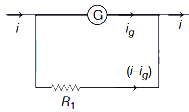
If only $\frac{1}{51}$ of the main current is to be passed through a galvanometer,then the shunt required is $R_1$. If only $\frac{1}{11}$ of the main voltage is to be developed across the galvanometer,then the resistance required is $R_2$. Find the ratio $\frac{R_2}{R_1}$.
A
$\frac{1}{500}$
B
$\frac{50}{9}$
C
$\frac{500}{3}$
D
$500$
Solution
(D) Case $I$: Shunt resistance $R_1$ for a galvanometer $G$ to pass $\frac{1}{n}$ of the main current $i$ is given by $R_1 = \frac{G}{n-1}$.
Here,$n = 51$,so $R_1 = \frac{G}{51-1} = \frac{G}{50}$.
Case $II$: Series resistance $R_2$ for a galvanometer $G$ to measure $\frac{1}{m}$ of the main voltage $V$ is given by $R_2 = G(m-1)$.
Here,$m = 11$,so $R_2 = G(11-1) = 10G$.
Now,calculating the ratio $\frac{R_2}{R_1}$:
$\frac{R_2}{R_1} = \frac{10G}{G/50} = 10G \times \frac{50}{G} = 500$.
Here,$n = 51$,so $R_1 = \frac{G}{51-1} = \frac{G}{50}$.
Case $II$: Series resistance $R_2$ for a galvanometer $G$ to measure $\frac{1}{m}$ of the main voltage $V$ is given by $R_2 = G(m-1)$.
Here,$m = 11$,so $R_2 = G(11-1) = 10G$.
Now,calculating the ratio $\frac{R_2}{R_1}$:
$\frac{R_2}{R_1} = \frac{10G}{G/50} = 10G \times \frac{50}{G} = 500$.
0 likes
View Solution355
EasyMCQ
The ratio of heats generated through shunt and galvanometer is $7: 5$ when they are connected to make an ammeter. If the resistance of the galvanometer is $112 \Omega$,then the resistance of the shunt is: (in $Omega$)
A
$80$
B
$8$
C
$15.6$
D
$1.56$
Solution
(A) Given,the ratio of heats generated through the shunt $(H_s)$ and galvanometer $(H_g)$ is $H_s : H_g = 7 : 5$.
The resistance of the galvanometer is $R_g = 112 \Omega$.
Since the shunt and galvanometer are connected in parallel to form an ammeter,the potential difference $(V)$ across both is the same.
The heat generated in a resistor is given by $H = \frac{V^2}{R} \times t$.
Therefore,the ratio of heat generated is $\frac{H_s}{H_g} = \frac{V^2 / R_s}{V^2 / R_g} = \frac{R_g}{R_s}$.
Given $\frac{H_s}{H_g} = \frac{7}{5}$,we have $\frac{R_g}{R_s} = \frac{7}{5}$.
Substituting the value of $R_g = 112 \Omega$:
$\frac{112}{R_s} = \frac{7}{5}$
$R_s = \frac{112 \times 5}{7}$
$R_s = 16 \times 5 = 80 \Omega$.
Thus,the resistance of the shunt is $80 \Omega$.
The resistance of the galvanometer is $R_g = 112 \Omega$.
Since the shunt and galvanometer are connected in parallel to form an ammeter,the potential difference $(V)$ across both is the same.
The heat generated in a resistor is given by $H = \frac{V^2}{R} \times t$.
Therefore,the ratio of heat generated is $\frac{H_s}{H_g} = \frac{V^2 / R_s}{V^2 / R_g} = \frac{R_g}{R_s}$.
Given $\frac{H_s}{H_g} = \frac{7}{5}$,we have $\frac{R_g}{R_s} = \frac{7}{5}$.
Substituting the value of $R_g = 112 \Omega$:
$\frac{112}{R_s} = \frac{7}{5}$
$R_s = \frac{112 \times 5}{7}$
$R_s = 16 \times 5 = 80 \Omega$.
Thus,the resistance of the shunt is $80 \Omega$.
0 likes
View Solution356
EasyMCQ
$A$ galvanometer of resistance $G \ \Omega$ is shunted by a resistance $S \ \Omega$. To keep the main current in the circuit unchanged,the resistance to be connected in series with the galvanometer is
A
$\frac{G^2}{S+G}$
B
$\frac{S}{S+G}$
C
$\frac{S^2}{S+G}$
D
$\frac{S G}{S+G}$
Solution
(A) Let the initial resistance of the galvanometer be $G$. When a shunt resistance $S$ is connected in parallel with the galvanometer,the equivalent resistance of the combination is $R_{eq} = \frac{G \times S}{G+S}$.
To keep the main current unchanged,the total resistance of the circuit must remain equal to the initial resistance $G$. Let a resistance $R$ be connected in series with this parallel combination.
Therefore,the total resistance is $R_{total} = R + \frac{G \times S}{G+S}$.
Setting $R_{total} = G$,we get:
$G = R + \frac{GS}{G+S}$
$R = G - \frac{GS}{G+S}$
$R = \frac{G(G+S) - GS}{G+S}$
$R = \frac{G^2 + GS - GS}{G+S}$
$R = \frac{G^2}{G+S}$
Thus,the required series resistance is $\frac{G^2}{S+G}$.
Hence,the correct option is $A$.
To keep the main current unchanged,the total resistance of the circuit must remain equal to the initial resistance $G$. Let a resistance $R$ be connected in series with this parallel combination.
Therefore,the total resistance is $R_{total} = R + \frac{G \times S}{G+S}$.
Setting $R_{total} = G$,we get:
$G = R + \frac{GS}{G+S}$
$R = G - \frac{GS}{G+S}$
$R = \frac{G(G+S) - GS}{G+S}$
$R = \frac{G^2 + GS - GS}{G+S}$
$R = \frac{G^2}{G+S}$
Thus,the required series resistance is $\frac{G^2}{S+G}$.
Hence,the correct option is $A$.

0 likes
View Solution357
EasyMCQ
$A$ galvanometer of resistance $10 \Omega$ changes its range from $1 \text{ mA}$ to $101 \text{ mA}$ when a resistive wire is connected in parallel. If the resistivity of the material of the wire and its area of cross-section are $1 \times 10^{-6} \Omega \text{ m}$ and $1 \text{ mm}^2$ respectively,then the length of the wire is (in $cm$)
A
$10$
B
$1$
C
$20$
D
$15$
Solution
(A) The galvanometer resistance is $G = 10 \Omega$. The full-scale deflection current is $I_g = 1 \text{ mA} = 1 \times 10^{-3} \text{ A}$. The new range is $I = 101 \text{ mA} = 101 \times 10^{-3} \text{ A}$.
To convert a galvanometer into an ammeter,a shunt resistance $S$ is connected in parallel.
The formula for shunt resistance is $S = \frac{I_g G}{I - I_g}$.
Substituting the values: $S = \frac{1 \times 10^{-3} \times 10}{101 \times 10^{-3} - 1 \times 10^{-3}} = \frac{10 \times 10^{-3}}{100 \times 10^{-3}} = 0.1 \Omega$.
The resistance of a wire is given by $R = \rho \frac{L}{A}$,where $\rho = 1 \times 10^{-6} \Omega \text{ m}$ and $A = 1 \text{ mm}^2 = 1 \times 10^{-6} \text{ m}^2$.
Setting $R = S = 0.1 \Omega$,we get $0.1 = (1 \times 10^{-6}) \times \frac{L}{1 \times 10^{-6}}$.
$0.1 = L$.
Thus,$L = 0.1 \text{ m} = 10 \text{ cm}$.
To convert a galvanometer into an ammeter,a shunt resistance $S$ is connected in parallel.
The formula for shunt resistance is $S = \frac{I_g G}{I - I_g}$.
Substituting the values: $S = \frac{1 \times 10^{-3} \times 10}{101 \times 10^{-3} - 1 \times 10^{-3}} = \frac{10 \times 10^{-3}}{100 \times 10^{-3}} = 0.1 \Omega$.
The resistance of a wire is given by $R = \rho \frac{L}{A}$,where $\rho = 1 \times 10^{-6} \Omega \text{ m}$ and $A = 1 \text{ mm}^2 = 1 \times 10^{-6} \text{ m}^2$.
Setting $R = S = 0.1 \Omega$,we get $0.1 = (1 \times 10^{-6}) \times \frac{L}{1 \times 10^{-6}}$.
$0.1 = L$.
Thus,$L = 0.1 \text{ m} = 10 \text{ cm}$.
0 likes
View Solution358
MediumMCQ
Two moving coil galvanometers $A$ and $B$ having identical springs are placed in magnetic fields of $0.25 \ T$ and $0.5 \ T$ respectively. If the number of turns in $A$ and $B$ are respectively $36$ and $48$,and the areas of the coils $A$ and $B$ are $2.4 \times 10^{-3} \ m^2$ and $4.8 \times 10^{-3} \ m^2$ respectively,then the ratio of the current sensitivities of the galvanometers $A$ and $B$ is
A
$3: 16$
B
$16: 3$
C
$4: 3$
D
$3: 4$
Solution
(A) The current sensitivity $(I_s)$ of a moving coil galvanometer is given by the formula: $I_s = \frac{NBA}{k}$,where $N$ is the number of turns,$B$ is the magnetic field,$A$ is the area of the coil,and $k$ is the torsional constant of the spring.
Since the springs are identical,$k_A = k_B = k$.
The ratio of current sensitivities is $\frac{I_{sA}}{I_{sB}} = \frac{N_A B_A A_A}{N_B B_B A_B}$.
Given values:
$N_A = 36, B_A = 0.25 \ T, A_A = 2.4 \times 10^{-3} \ m^2$
$N_B = 48, B_B = 0.5 \ T, A_B = 4.8 \times 10^{-3} \ m^2$
Substituting these values:
$\frac{I_{sA}}{I_{sB}} = \frac{36 \times 0.25 \times 2.4 \times 10^{-3}}{48 \times 0.5 \times 4.8 \times 10^{-3}}$
$\frac{I_{sA}}{I_{sB}} = \left(\frac{36}{48}\right) \times \left(\frac{0.25}{0.5}\right) \times \left(\frac{2.4}{4.8}\right)$
$\frac{I_{sA}}{I_{sB}} = \left(\frac{3}{4}\right) \times \left(\frac{1}{2}\right) \times \left(\frac{1}{2}\right) = \frac{3}{16}$.
Thus,the ratio is $3: 16$.
Since the springs are identical,$k_A = k_B = k$.
The ratio of current sensitivities is $\frac{I_{sA}}{I_{sB}} = \frac{N_A B_A A_A}{N_B B_B A_B}$.
Given values:
$N_A = 36, B_A = 0.25 \ T, A_A = 2.4 \times 10^{-3} \ m^2$
$N_B = 48, B_B = 0.5 \ T, A_B = 4.8 \times 10^{-3} \ m^2$
Substituting these values:
$\frac{I_{sA}}{I_{sB}} = \frac{36 \times 0.25 \times 2.4 \times 10^{-3}}{48 \times 0.5 \times 4.8 \times 10^{-3}}$
$\frac{I_{sA}}{I_{sB}} = \left(\frac{36}{48}\right) \times \left(\frac{0.25}{0.5}\right) \times \left(\frac{2.4}{4.8}\right)$
$\frac{I_{sA}}{I_{sB}} = \left(\frac{3}{4}\right) \times \left(\frac{1}{2}\right) \times \left(\frac{1}{2}\right) = \frac{3}{16}$.
Thus,the ratio is $3: 16$.
0 likes
View Solution359
EasyMCQ
$A$ galvanometer has a deflection of $25$ divisions for a current of $0.1 \ A$ flowing through it. Then the current sensitivity of the galvanometer is (in $div/A$)
A
$25$
B
$250$
C
$2.5$
D
$0.25$
Solution
(B) Current sensitivity is defined as the deflection produced per unit current flowing through the galvanometer.
It is given by the formula: $I_{S} = \frac{\theta}{I}$
Where $\theta$ is the deflection in divisions and $I$ is the current in amperes.
Given: $\theta = 25 \ div$ and $I = 0.1 \ A$.
Therefore,$I_{S} = \frac{25}{0.1} = 250 \ div/A$.
It is given by the formula: $I_{S} = \frac{\theta}{I}$
Where $\theta$ is the deflection in divisions and $I$ is the current in amperes.
Given: $\theta = 25 \ div$ and $I = 0.1 \ A$.
Therefore,$I_{S} = \frac{25}{0.1} = 250 \ div/A$.
0 likes
View Solution360
MediumMCQ
The coil of a moving coil galvanometer has an effective area of $4 \times 10^{-2} \, m^2$. It is suspended in a magnetic field of $5 \times 10^{-2} \, Wb \, m^{-2}$. If the deflection in the galvanometer coil is $0.2 \, rad$, when a current of $5 \, mA$ is passed through it, then
A
torsional constant is $8 \times 10^{-5} \, N \, m \, rad^{-1}$
B
current sensitivity is $40 \, rad \, A^{-1}$
C
torsional constant is $3 \times 10^{-3} \, N \, m \, rad^{-1}$
D
current sensitivity is $40 \, \text{deg} \, A^{-1}$
Solution
(B) Given that, for a moving coil galvanometer:
Effective area, $A = 4 \times 10^{-2} \, m^2$
Magnetic field, $B = 5 \times 10^{-2} \, Wb \, m^{-2}$
Angle of deflection, $\phi = 0.2 \, rad$
Electric current, $I = 5 \, mA = 5 \times 10^{-3} \, A$
Assuming the number of turns $N = 1$ (as not specified, we calculate the product $NAB$):
The torque balance equation is $NAB I = k \phi$, where $k$ is the torsional constant.
$k = \frac{NAB I}{\phi} = \frac{(1) \times (4 \times 10^{-2}) \times (5 \times 10^{-2}) \times (5 \times 10^{-3})}{0.2}$
$k = \frac{100 \times 10^{-7}}{0.2} = 500 \times 10^{-7} = 5 \times 10^{-5} \, N \, m \, rad^{-1}$.
Current sensitivity $S_I = \frac{\phi}{I} = \frac{0.2}{5 \times 10^{-3}} = 40 \, rad \, A^{-1}$.
Thus, the current sensitivity is $40 \, rad \, A^{-1}$.
Effective area, $A = 4 \times 10^{-2} \, m^2$
Magnetic field, $B = 5 \times 10^{-2} \, Wb \, m^{-2}$
Angle of deflection, $\phi = 0.2 \, rad$
Electric current, $I = 5 \, mA = 5 \times 10^{-3} \, A$
Assuming the number of turns $N = 1$ (as not specified, we calculate the product $NAB$):
The torque balance equation is $NAB I = k \phi$, where $k$ is the torsional constant.
$k = \frac{NAB I}{\phi} = \frac{(1) \times (4 \times 10^{-2}) \times (5 \times 10^{-2}) \times (5 \times 10^{-3})}{0.2}$
$k = \frac{100 \times 10^{-7}}{0.2} = 500 \times 10^{-7} = 5 \times 10^{-5} \, N \, m \, rad^{-1}$.
Current sensitivity $S_I = \frac{\phi}{I} = \frac{0.2}{5 \times 10^{-3}} = 40 \, rad \, A^{-1}$.
Thus, the current sensitivity is $40 \, rad \, A^{-1}$.
0 likes
View Solution361
DifficultMCQ
Two moving coil galvanometers,$X$ and $Y$,have coils with resistances $10 \Omega$ and $14 \Omega$,cross-sectional areas $4.8 \times 10^{-3} \ m^2$ and $2.4 \times 10^{-3} \ m^2$,and number of turns $30$ and $45$ respectively. They are placed in magnetic fields of $0.25 \ T$ and $0.50 \ T$ respectively. Find the ratio of their current sensitivities and the ratio of their voltage sensitivities.
A
$2 : 3, 14 : 15$
B
$5 : 7, 2 : 1$
C
$2 : 13, 1 : 2$
D
$14 : 15, 2 : 9$
Solution
(A) Current sensitivity $I_S$ is given by $I_S = \frac{NBA}{k}$. Assuming the spring constant $k$ is the same for both galvanometers,the ratio of current sensitivities is:
$\frac{I_{SX}}{I_{SY}} = \frac{N_X B_X A_X}{N_Y B_Y A_Y} = \frac{30 \times 0.25 \times 4.8 \times 10^{-3}}{45 \times 0.50 \times 2.4 \times 10^{-3}} = \frac{30}{45} \times \frac{0.25}{0.50} \times \frac{4.8}{2.4} = \frac{2}{3} \times \frac{1}{2} \times 2 = \frac{2}{3}$.
Voltage sensitivity $V_S$ is given by $V_S = \frac{I_S}{R} = \frac{NBA}{kR}$. The ratio of voltage sensitivities is:
$\frac{V_{SX}}{V_{SY}} = \frac{I_{SX}}{I_{SY}} \times \frac{R_Y}{R_X} = \frac{2}{3} \times \frac{14}{10} = \frac{2}{3} \times \frac{7}{5} = \frac{14}{15}$.
Thus,the ratios are $2 : 3$ and $14 : 15$.
$\frac{I_{SX}}{I_{SY}} = \frac{N_X B_X A_X}{N_Y B_Y A_Y} = \frac{30 \times 0.25 \times 4.8 \times 10^{-3}}{45 \times 0.50 \times 2.4 \times 10^{-3}} = \frac{30}{45} \times \frac{0.25}{0.50} \times \frac{4.8}{2.4} = \frac{2}{3} \times \frac{1}{2} \times 2 = \frac{2}{3}$.
Voltage sensitivity $V_S$ is given by $V_S = \frac{I_S}{R} = \frac{NBA}{kR}$. The ratio of voltage sensitivities is:
$\frac{V_{SX}}{V_{SY}} = \frac{I_{SX}}{I_{SY}} \times \frac{R_Y}{R_X} = \frac{2}{3} \times \frac{14}{10} = \frac{2}{3} \times \frac{7}{5} = \frac{14}{15}$.
Thus,the ratios are $2 : 3$ and $14 : 15$.
0 likes
View Solution362
MediumMCQ
The ratios of the voltage sensitivities,resistances and areas of the coils of two moving coil galvanometers $A$ and $B$ are $4:3$,$3:4$ and $1:2$ respectively. If the number of turns of the coil of galvanometer $A$ is $200$,then the number of turns of the coil of galvanometer $B$ is (All other quantities remain same in both the cases)
A
$100$
B
$150$
C
$200$
D
$400$
Solution
(A) The voltage sensitivity $(V_s)$ of a moving coil galvanometer is given by $V_s = \frac{NBA}{kR}$,where $N$ is the number of turns,$B$ is the magnetic field,$A$ is the area,$k$ is the torsional constant,and $R$ is the resistance.
Given the ratio of voltage sensitivities: $\frac{V_{sA}}{V_{sB}} = \frac{4}{3}$.
Given the ratio of resistances: $\frac{R_A}{R_B} = \frac{3}{4}$.
Given the ratio of areas: $\frac{A_A}{A_B} = \frac{1}{2}$.
Since $B$ and $k$ are constant,we have $\frac{V_{sA}}{V_{sB}} = \frac{N_A A_A R_B}{N_B A_B R_A}$.
Substituting the given values: $\frac{4}{3} = \frac{N_A}{N_B} \times (\frac{1}{2}) \times (\frac{4}{3})$.
$\frac{4}{3} = \frac{N_A}{N_B} \times \frac{2}{3}$.
$\frac{N_A}{N_B} = \frac{4}{3} \times \frac{3}{2} = 2$.
Given $N_A = 200$,then $N_B = \frac{N_A}{2} = \frac{200}{2} = 100$.
Given the ratio of voltage sensitivities: $\frac{V_{sA}}{V_{sB}} = \frac{4}{3}$.
Given the ratio of resistances: $\frac{R_A}{R_B} = \frac{3}{4}$.
Given the ratio of areas: $\frac{A_A}{A_B} = \frac{1}{2}$.
Since $B$ and $k$ are constant,we have $\frac{V_{sA}}{V_{sB}} = \frac{N_A A_A R_B}{N_B A_B R_A}$.
Substituting the given values: $\frac{4}{3} = \frac{N_A}{N_B} \times (\frac{1}{2}) \times (\frac{4}{3})$.
$\frac{4}{3} = \frac{N_A}{N_B} \times \frac{2}{3}$.
$\frac{N_A}{N_B} = \frac{4}{3} \times \frac{3}{2} = 2$.
Given $N_A = 200$,then $N_B = \frac{N_A}{2} = \frac{200}{2} = 100$.
0 likes
View Solution363
MediumMCQ
In a galvanometer,$5 \%$ of the total current in the circuit passes through it. If the resistance of the galvanometer is $G$,the shunt resistance $S$ connected to the galvanometer is
A
$19 G$
B
$\frac{G}{19}$
C
$20 G$
D
$\frac{G}{20}$
Solution
(B) Let the total current in the circuit be $I$.
The current passing through the galvanometer is $I_G = 0.05 I$.
The current passing through the shunt resistance $S$ is $I_S = I - I_G = I - 0.05 I = 0.95 I$.
Since the galvanometer and the shunt resistance are in parallel,the potential difference across them is equal:
$I_G G = I_S S$
Substituting the values:
$0.05 I \cdot G = 0.95 I \cdot S$
$S = \frac{0.05 I \cdot G}{0.95 I} = \frac{5}{95} G = \frac{1}{19} G$
Therefore,the shunt resistance is $S = \frac{G}{19}$.
The current passing through the galvanometer is $I_G = 0.05 I$.
The current passing through the shunt resistance $S$ is $I_S = I - I_G = I - 0.05 I = 0.95 I$.
Since the galvanometer and the shunt resistance are in parallel,the potential difference across them is equal:
$I_G G = I_S S$
Substituting the values:
$0.05 I \cdot G = 0.95 I \cdot S$
$S = \frac{0.05 I \cdot G}{0.95 I} = \frac{5}{95} G = \frac{1}{19} G$
Therefore,the shunt resistance is $S = \frac{G}{19}$.
0 likes
View Solution364
EasyMCQ
$A$ voltmeter of $250 mV$ range having a resistance of $10 \Omega$ is converted into an ammeter of $250 mA$ range. The value of the necessary shunt is (nearly): (in $Omega$)
A
$2$
B
$0.1$
C
$1$
D
$10$
Solution
(C) Given: Range of voltmeter $V_g = 250 mV = 0.25 V$,Resistance $G = 10 \Omega$.
First,calculate the full-scale deflection current $I_g$ of the galvanometer:
$I_g = \frac{V_g}{G} = \frac{0.25 V}{10 \Omega} = 0.025 A = 25 mA$.
We want to convert this into an ammeter of range $I = 250 mA = 0.25 A$.
The formula for the shunt resistance $S$ is:
$S = \frac{G I_g}{I - I_g}$
Substituting the values:
$S = \frac{10 \times 0.025}{0.25 - 0.025} = \frac{0.25}{0.225} = \frac{250}{225} \approx 1.11 \Omega$.
Rounding to the nearest given option,the value is $1 \Omega$.
First,calculate the full-scale deflection current $I_g$ of the galvanometer:
$I_g = \frac{V_g}{G} = \frac{0.25 V}{10 \Omega} = 0.025 A = 25 mA$.
We want to convert this into an ammeter of range $I = 250 mA = 0.25 A$.
The formula for the shunt resistance $S$ is:
$S = \frac{G I_g}{I - I_g}$
Substituting the values:
$S = \frac{10 \times 0.025}{0.25 - 0.025} = \frac{0.25}{0.225} = \frac{250}{225} \approx 1.11 \Omega$.
Rounding to the nearest given option,the value is $1 \Omega$.
0 likes
View Solution365
DifficultMCQ
The sensitivity of a galvanometer that measures current is decreased by $\frac{1}{40}$ times by using a shunt resistance of $10 \Omega$. Then,the value of the resistance of the galvanometer is (in $Omega$)
A
$400$
B
$410$
C
$30$
D
$390$
Solution
(D) The sensitivity of a galvanometer is defined by the ratio of the current through the galvanometer $(i_g)$ to the total current $(i)$.
Given that the sensitivity is decreased by $\frac{1}{40}$ times,we have $\frac{i_g}{i} = \frac{1}{40}$.
The formula for current division in a galvanometer with a shunt resistance $(S)$ is given by:
$\frac{i_g}{i} = \frac{S}{S+G}$
where $G$ is the resistance of the galvanometer.
Substituting the given values ($S = 10 \Omega$ and $\frac{i_g}{i} = \frac{1}{40}$):
$\frac{1}{40} = \frac{10}{10+G}$
$10 + G = 400$
$G = 400 - 10 = 390 \Omega$
Therefore,the resistance of the galvanometer is $390 \Omega$.
Given that the sensitivity is decreased by $\frac{1}{40}$ times,we have $\frac{i_g}{i} = \frac{1}{40}$.
The formula for current division in a galvanometer with a shunt resistance $(S)$ is given by:
$\frac{i_g}{i} = \frac{S}{S+G}$
where $G$ is the resistance of the galvanometer.
Substituting the given values ($S = 10 \Omega$ and $\frac{i_g}{i} = \frac{1}{40}$):
$\frac{1}{40} = \frac{10}{10+G}$
$10 + G = 400$
$G = 400 - 10 = 390 \Omega$
Therefore,the resistance of the galvanometer is $390 \Omega$.
0 likes
View Solution366
DifficultMCQ
The sensitivity of a galvanometer is $60 \text{ division/A}$. When a shunt is used,its sensitivity becomes $10 \text{ division/A}$. If the galvanometer is of resistance $20 \ \Omega$,the value of shunt used is (in $Omega$)
A
$4$
B
$5$
C
$20$
D
$2$
Solution
(A) The sensitivity of a galvanometer is defined as the deflection per unit current,given by $S_g = \frac{\theta}{i_g}$. When a shunt $S$ is connected in parallel with a galvanometer of resistance $G$,the new sensitivity $S'$ is given by the ratio of the current through the galvanometer $i_g$ to the total current $i$.
The current through the galvanometer is $i_g = i \left( \frac{S}{G+S} \right)$.
Therefore,the new sensitivity is $S' = \frac{i_g}{i} = \frac{S}{G+S}$.
Given,initial sensitivity $= 60 \text{ div/A}$ and final sensitivity $= 10 \text{ div/A}$.
The ratio of sensitivities is $\frac{S'}{S_g} = \frac{10}{60} = \frac{1}{6}$.
Substituting the formula: $\frac{1}{6} = \frac{S}{G+S}$.
Cross-multiplying gives $G + S = 6S$,which simplifies to $G = 5S$.
Given $G = 20 \ \Omega$,we have $20 = 5S$.
Thus,$S = \frac{20}{5} = 4 \ \Omega$.
The current through the galvanometer is $i_g = i \left( \frac{S}{G+S} \right)$.
Therefore,the new sensitivity is $S' = \frac{i_g}{i} = \frac{S}{G+S}$.
Given,initial sensitivity $= 60 \text{ div/A}$ and final sensitivity $= 10 \text{ div/A}$.
The ratio of sensitivities is $\frac{S'}{S_g} = \frac{10}{60} = \frac{1}{6}$.
Substituting the formula: $\frac{1}{6} = \frac{S}{G+S}$.
Cross-multiplying gives $G + S = 6S$,which simplifies to $G = 5S$.
Given $G = 20 \ \Omega$,we have $20 = 5S$.
Thus,$S = \frac{20}{5} = 4 \ \Omega$.
0 likes
View Solution367
DifficultMCQ
$A$ galvanometer,having a resistance of $50 \Omega$,gives a full scale deflection for a current of $0.05 \text{ A}$. The length in metre of a resistance wire of area of cross-section $2.97 \times 10^{-2} \text{ cm}^2$ that can be used to convert the galvanometer into an ammeter which can read a maximum of $5 \text{ A}$ current is: (Specific resistance of the wire $= 5 \times 10^{-7} \Omega\text{-m}$)
A
$9$
B
$6$
C
$3$
D
$1.5$
Solution
(C) Resistance of galvanometer,$G = 50 \Omega$.
Full scale current,$i_g = 0.05 \text{ A}$.
Maximum current to be measured,$i = 5 \text{ A}$.
Area of cross-section,$A = 2.97 \times 10^{-2} \text{ cm}^2 = 2.97 \times 10^{-6} \text{ m}^2$.
Specific resistance,$\rho = 5 \times 10^{-7} \Omega\text{-m}$.
To convert a galvanometer into an ammeter,a shunt resistance $S$ is connected in parallel.
$S = \frac{i_g G}{i - i_g} = \frac{0.05 \times 50}{5 - 0.05} = \frac{2.5}{4.95} = \frac{250}{495} = \frac{50}{99} \Omega$.
Using the formula for resistance,$S = \rho \frac{l}{A}$,we get $l = \frac{S \cdot A}{\rho}$.
$l = \frac{50}{99} \times \frac{2.97 \times 10^{-6}}{5 \times 10^{-7}} = \frac{50}{99} \times \frac{29.7}{5} = 10 \times 0.3 = 3 \text{ m}$.
Full scale current,$i_g = 0.05 \text{ A}$.
Maximum current to be measured,$i = 5 \text{ A}$.
Area of cross-section,$A = 2.97 \times 10^{-2} \text{ cm}^2 = 2.97 \times 10^{-6} \text{ m}^2$.
Specific resistance,$\rho = 5 \times 10^{-7} \Omega\text{-m}$.
To convert a galvanometer into an ammeter,a shunt resistance $S$ is connected in parallel.
$S = \frac{i_g G}{i - i_g} = \frac{0.05 \times 50}{5 - 0.05} = \frac{2.5}{4.95} = \frac{250}{495} = \frac{50}{99} \Omega$.
Using the formula for resistance,$S = \rho \frac{l}{A}$,we get $l = \frac{S \cdot A}{\rho}$.
$l = \frac{50}{99} \times \frac{2.97 \times 10^{-6}}{5 \times 10^{-7}} = \frac{50}{99} \times \frac{29.7}{5} = 10 \times 0.3 = 3 \text{ m}$.
0 likes
View Solution368
DifficultMCQ
$A$ moving coil galvanometer of resistance $100 \ \Omega$ shows full-scale deflection when a current of $100 \ \mu A$ passes through it. If it is intended to show full-scale deflection when a current of $1 \ mA$ passes through it,the value of shunt resistance in ohms to be connected to the galvanometer is:
A
$\frac{9}{4}$
B
$\frac{10}{3}$
C
$\frac{100}{9}$
D
$\frac{900}{7}$
Solution
(C) Given:
Resistance of the galvanometer,$G = 100 \ \Omega$.
Full-scale deflection current of the galvanometer,$I_g = 100 \ \mu A = 100 \times 10^{-6} \ A = 0.1 \times 10^{-3} \ A$.
Total current to be measured,$I = 1 \ mA = 1 \times 10^{-3} \ A$.
To convert a galvanometer into an ammeter,a shunt resistance $S$ is connected in parallel with the galvanometer.
The formula for shunt resistance is:
$S = \frac{I_g G}{I - I_g}$
Substituting the values:
$S = \frac{0.1 \times 10^{-3} \times 100}{1 \times 10^{-3} - 0.1 \times 10^{-3}}$
$S = \frac{0.1 \times 10^{-1}}{0.9 \times 10^{-3}}$
$S = \frac{10^{-2}}{0.9 \times 10^{-3}} = \frac{10}{0.9} = \frac{100}{9} \ \Omega$.
Resistance of the galvanometer,$G = 100 \ \Omega$.
Full-scale deflection current of the galvanometer,$I_g = 100 \ \mu A = 100 \times 10^{-6} \ A = 0.1 \times 10^{-3} \ A$.
Total current to be measured,$I = 1 \ mA = 1 \times 10^{-3} \ A$.
To convert a galvanometer into an ammeter,a shunt resistance $S$ is connected in parallel with the galvanometer.
The formula for shunt resistance is:
$S = \frac{I_g G}{I - I_g}$
Substituting the values:
$S = \frac{0.1 \times 10^{-3} \times 100}{1 \times 10^{-3} - 0.1 \times 10^{-3}}$
$S = \frac{0.1 \times 10^{-1}}{0.9 \times 10^{-3}}$
$S = \frac{10^{-2}}{0.9 \times 10^{-3}} = \frac{10}{0.9} = \frac{100}{9} \ \Omega$.
0 likes
View Solution369
MediumMCQ
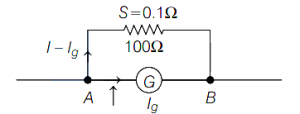
$A$ moving coil galvanometer of resistance $100 \Omega$ is used as an ammeter using a shunt resistance $0.1 \Omega$. The maximum deflection current in the galvanometer is $100 \mu A$. Find the total current in the circuit so that the ammeter shows maximum deflection. (in $mA$)
A
$100.1$
B
$1000.1$
C
$10.01$
D
$1.01$
Solution
(A) Given:
Resistance of galvanometer,$G = 100 \Omega$
Shunt resistance,$S = 0.1 \Omega$
Maximum deflection current in galvanometer,$I_g = 100 \mu A = 100 \times 10^{-6} A = 10^{-4} A$
For an ammeter,the galvanometer and shunt resistance are connected in parallel. The potential difference across both is the same:
$V_{AB} = I_g G = (I - I_g) S$
Substituting the values:
$(100 \times 10^{-6}) \times 100 = (I - 100 \times 10^{-6}) \times 0.1$
$10^{-2} = (I - 10^{-4}) \times 10^{-1}$
$0.1 = I - 0.0001$
$I = 0.1 + 0.0001 = 0.1001 A$
Converting to milliamperes:
$I = 0.1001 \times 1000 mA = 100.1 mA$
Thus,the total current in the circuit is $100.1 mA$.
Resistance of galvanometer,$G = 100 \Omega$
Shunt resistance,$S = 0.1 \Omega$
Maximum deflection current in galvanometer,$I_g = 100 \mu A = 100 \times 10^{-6} A = 10^{-4} A$
For an ammeter,the galvanometer and shunt resistance are connected in parallel. The potential difference across both is the same:
$V_{AB} = I_g G = (I - I_g) S$
Substituting the values:
$(100 \times 10^{-6}) \times 100 = (I - 100 \times 10^{-6}) \times 0.1$
$10^{-2} = (I - 10^{-4}) \times 10^{-1}$
$0.1 = I - 0.0001$
$I = 0.1 + 0.0001 = 0.1001 A$
Converting to milliamperes:
$I = 0.1001 \times 1000 mA = 100.1 mA$
Thus,the total current in the circuit is $100.1 mA$.
0 likes
View Solution370
EasyMCQ
$A$ moving coil galvanometer has a rectangular wire coil of enclosed area $0.001 \ m^2$ and $500$ turns. The coil operates in a radial magnetic field of $0.2 \ T$ and carries a current of $6 \pi \times 10^{-8} \ A$. If the torsional spring constant is $6 \times 10^{-7} \ N-m/rad$,then the angular deflection of the coil in radians is
A
$\frac{\pi}{100}$
B
$\frac{\pi}{200}$
C
$\frac{\pi}{300}$
D
$\frac{\pi}{400}$
Solution
(A) The angular deflection $\theta$ of a moving coil galvanometer is given by the formula: $\theta = \frac{NBAi}{k}$.
Here,$N = 500$ (number of turns),$B = 0.2 \ T$ (magnetic field),$A = 0.001 \ m^2$ (area),$i = 6 \pi \times 10^{-8} \ A$ (current),and $k = 6 \times 10^{-7} \ N-m/rad$ (torsional constant).
Substituting these values into the formula:
$\theta = \frac{500 \times 0.2 \times 0.001}{6 \times 10^{-7}} \times 6 \pi \times 10^{-8}$
$\theta = \frac{100 \times 0.001}{6 \times 10^{-7}} \times 6 \pi \times 10^{-8}$
$\theta = \frac{0.1}{6 \times 10^{-7}} \times 6 \pi \times 10^{-8}$
$\theta = 0.1 \times \pi \times 10^{-1} = 0.01 \pi = \frac{\pi}{100} \ rad$.
Here,$N = 500$ (number of turns),$B = 0.2 \ T$ (magnetic field),$A = 0.001 \ m^2$ (area),$i = 6 \pi \times 10^{-8} \ A$ (current),and $k = 6 \times 10^{-7} \ N-m/rad$ (torsional constant).
Substituting these values into the formula:
$\theta = \frac{500 \times 0.2 \times 0.001}{6 \times 10^{-7}} \times 6 \pi \times 10^{-8}$
$\theta = \frac{100 \times 0.001}{6 \times 10^{-7}} \times 6 \pi \times 10^{-8}$
$\theta = \frac{0.1}{6 \times 10^{-7}} \times 6 \pi \times 10^{-8}$
$\theta = 0.1 \times \pi \times 10^{-1} = 0.01 \pi = \frac{\pi}{100} \ rad$.
0 likes
View Solution371
MediumMCQ
$A$ galvanometer coil has a resistance of $10 \Omega$ and the meter shows full scale deflection for a current of $2 \text{ mA}$. What resistance needs to be connected to convert the meter into a voltmeter of range $0$ to $18 \text{ V}$ (in $Omega$)?
A
$8880$
B
$8990$
C
$9000$
D
$9010$
Solution
(B) To convert a galvanometer into a voltmeter,a high resistance $R_s$ must be connected in series with the galvanometer coil.
Given:
Galvanometer resistance $R_G = 10 \Omega$
Full scale deflection current $I_g = 2 \text{ mA} = 2 \times 10^{-3} \text{ A}$
Required voltage range $V = 18 \text{ V}$
The formula for the series resistance is $V = I_g(R_G + R_s)$.
Substituting the values:
$18 = 2 \times 10^{-3} \times (10 + R_s)$
$18 / (2 \times 10^{-3}) = 10 + R_s$
$9000 = 10 + R_s$
$R_s = 9000 - 10 = 8990 \Omega$
Thus,a resistance of $8990 \Omega$ must be connected in series.
Given:
Galvanometer resistance $R_G = 10 \Omega$
Full scale deflection current $I_g = 2 \text{ mA} = 2 \times 10^{-3} \text{ A}$
Required voltage range $V = 18 \text{ V}$
The formula for the series resistance is $V = I_g(R_G + R_s)$.
Substituting the values:
$18 = 2 \times 10^{-3} \times (10 + R_s)$
$18 / (2 \times 10^{-3}) = 10 + R_s$
$9000 = 10 + R_s$
$R_s = 9000 - 10 = 8990 \Omega$
Thus,a resistance of $8990 \Omega$ must be connected in series.
0 likes
View Solution372
MediumMCQ
Consider the two following statements $A$ and $B$,and identify the correct choice given in the answers: $(A)$ Duddell's thermo galvanometer is suitable to measure direct current only. $(B)$ Thermopile can measure temperature differences of the order of $10^{-3} {}^{\circ}C$.
A
Both $A$ and $B$ are true
B
Both $A$ and $B$ are false
C
$A$ is true but $B$ is false
D
$A$ is false but $B$ is true
Solution
(D) Statement $(A)$ is false. Duddell's thermo galvanometer is a sensitive instrument that can measure both direct current $(DC)$ and alternating current $(AC)$ by utilizing the heating effect of the current.
Statement $(B)$ is true. $A$ thermopile consists of several thermocouples connected in series,which increases the sensitivity,allowing it to detect very small temperature differences,typically on the order of $10^{-3} {}^{\circ}C$.
Statement $(B)$ is true. $A$ thermopile consists of several thermocouples connected in series,which increases the sensitivity,allowing it to detect very small temperature differences,typically on the order of $10^{-3} {}^{\circ}C$.
0 likes
View Solution373
MediumMCQ
$A$ galvanometer can be converted to a voltmeter of full-scale deflection $V_{0}$ by connecting a series resistance $R_{1}$ and can be converted to an ammeter of full-scale deflection $I_{0}$ by connecting a shunt resistance $R_{2}$. What is the current flowing through the galvanometer at its full-scale deflection?
A
$\frac{V_{0}-I_{0} R_{2}}{R_{1}-R_{2}}$
B
$\frac{V_{0}+I_{0} R_{2}}{R_{1}+R_{2}}$
C
$\frac{V_{0}-I_{0} R_{2}}{R_{2}-R_{1}}$
D
$\frac{V_{0}+I_{0} R_{1}}{R_{1}+R_{2}}$
Solution
(A) Let $G$ be the resistance of the galvanometer and $I_{g}$ be the current at full-scale deflection.
For the voltmeter conversion:
$V_{0} = I_{g}(G + R_{1})$
$G + R_{1} = \frac{V_{0}}{I_{g}}$
$G = \frac{V_{0}}{I_{g}} - R_{1} \dots (1)$
For the ammeter conversion:
$I_{g} G = (I_{0} - I_{g}) R_{2}$
$G = \frac{(I_{0} - I_{g}) R_{2}}{I_{g}} \dots (2)$
Equating $(1)$ and $(2)$:
$\frac{V_{0}}{I_{g}} - R_{1} = \frac{I_{0} R_{2}}{I_{g}} - R_{2}$
$\frac{V_{0} - I_{0} R_{2}}{I_{g}} = R_{1} - R_{2}$
$I_{g} = \frac{V_{0} - I_{0} R_{2}}{R_{1} - R_{2}}$
For the voltmeter conversion:
$V_{0} = I_{g}(G + R_{1})$
$G + R_{1} = \frac{V_{0}}{I_{g}}$
$G = \frac{V_{0}}{I_{g}} - R_{1} \dots (1)$
For the ammeter conversion:
$I_{g} G = (I_{0} - I_{g}) R_{2}$
$G = \frac{(I_{0} - I_{g}) R_{2}}{I_{g}} \dots (2)$
Equating $(1)$ and $(2)$:
$\frac{V_{0}}{I_{g}} - R_{1} = \frac{I_{0} R_{2}}{I_{g}} - R_{2}$
$\frac{V_{0} - I_{0} R_{2}}{I_{g}} = R_{1} - R_{2}$
$I_{g} = \frac{V_{0} - I_{0} R_{2}}{R_{1} - R_{2}}$
0 likes
View Solution374
MediumMCQ
The magnets of two suspended coil galvanometers are of the same strength so that they produce identical uniform magnetic fields in the region of the coils. The coil of the first one is in the shape of a square of side $a$ and that of the second one is circular of radius $\frac{a}{\sqrt{\pi}}.$ When the same current is passed through the coils,the ratio of the torque experienced by the first coil to that experienced by the second one is
A
$1: \frac{1}{\sqrt{\pi}}$
B
$1: 1$
C
$\pi: 1$
D
$1: \pi$
Solution
(B) The torque $\tau$ experienced by a current-carrying coil in a magnetic field is given by $\tau = N I A B \sin \theta$,where $N$ is the number of turns,$I$ is the current,$A$ is the area of the coil,$B$ is the magnetic field,and $\theta$ is the angle between the normal to the coil and the magnetic field.
Since the current $I$,magnetic field $B$,and number of turns $N$ are the same for both galvanometers,the ratio of the torques depends only on the ratio of the areas of the coils.
For the first coil (square of side $a$): $A_1 = a^2$.
For the second coil (circular of radius $r = \frac{a}{\sqrt{\pi}}$): $A_2 = \pi r^2 = \pi \left( \frac{a}{\sqrt{\pi}} \right)^2 = \pi \left( \frac{a^2}{\pi} \right) = a^2$.
Since $A_1 = A_2$,the torque experienced by both coils is the same.
Therefore,the ratio of the torque experienced by the first coil to that experienced by the second one is $1: 1$.
Since the current $I$,magnetic field $B$,and number of turns $N$ are the same for both galvanometers,the ratio of the torques depends only on the ratio of the areas of the coils.
For the first coil (square of side $a$): $A_1 = a^2$.
For the second coil (circular of radius $r = \frac{a}{\sqrt{\pi}}$): $A_2 = \pi r^2 = \pi \left( \frac{a}{\sqrt{\pi}} \right)^2 = \pi \left( \frac{a^2}{\pi} \right) = a^2$.
Since $A_1 = A_2$,the torque experienced by both coils is the same.
Therefore,the ratio of the torque experienced by the first coil to that experienced by the second one is $1: 1$.
0 likes
View Solution375
EasyMCQ
$A$ galvanometer having internal resistance $10 \Omega$ requires $0.01 \ A$ for a full scale deflection. To convert this galvanometer to a voltmeter of full-scale deflection at $120 \ V$,we need to connect a resistance of
A
$11990 \ \Omega$ in series
B
$11990 \ \Omega$ in parallel
C
$12010 \ \Omega$ in series
D
$12010 \ \Omega$ in parallel
Solution
(A) To convert a galvanometer into a voltmeter,a high resistance $R$ must be connected in series with the galvanometer.
Given:
Internal resistance of galvanometer,$G = 10 \ \Omega$
Full-scale deflection current,$i_g = 0.01 \ A$
Required voltage range,$V = 120 \ V$
The formula for the series resistance is $R = \frac{V}{i_g} - G$.
Substituting the values:
$R = \frac{120}{0.01} - 10$
$R = 12000 - 10$
$R = 11990 \ \Omega$
Thus,a resistance of $11990 \ \Omega$ must be connected in series.
Given:
Internal resistance of galvanometer,$G = 10 \ \Omega$
Full-scale deflection current,$i_g = 0.01 \ A$
Required voltage range,$V = 120 \ V$
The formula for the series resistance is $R = \frac{V}{i_g} - G$.
Substituting the values:
$R = \frac{120}{0.01} - 10$
$R = 12000 - 10$
$R = 11990 \ \Omega$
Thus,a resistance of $11990 \ \Omega$ must be connected in series.
0 likes
View Solution376
MediumMCQ
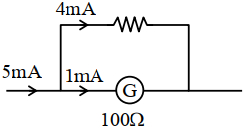
$A$ moving coil galvanometer of resistance $100 \ \Omega$ shows a full scale deflection for a current of $1 \ mA$. The value of shunt resistance required to convert this galvanometer into an ammeter,showing full scale deflection for a current of $5 \ mA$,is . . . . . . $\Omega$.
A
$25$
B
$10$
C
$0.5$
D
$2.5$
Solution
(A) Given:
Resistance of galvanometer,$G = 100 \ \Omega$
Full scale deflection current of galvanometer,$i_g = 1 \ mA$
Desired full scale deflection current of ammeter,$i = 5 \ mA$
To convert a galvanometer into an ammeter,a shunt resistance $r_s$ is connected in parallel with the galvanometer.
The formula for shunt resistance is:
$r_s = \frac{G \cdot i_g}{i - i_g}$
Substituting the given values:
$r_s = \frac{100 \times 1 \ mA}{5 \ mA - 1 \ mA}$
$r_s = \frac{100}{4} \ \Omega = 25 \ \Omega$
Thus,the required shunt resistance is $25 \ \Omega$.
Resistance of galvanometer,$G = 100 \ \Omega$
Full scale deflection current of galvanometer,$i_g = 1 \ mA$
Desired full scale deflection current of ammeter,$i = 5 \ mA$
To convert a galvanometer into an ammeter,a shunt resistance $r_s$ is connected in parallel with the galvanometer.
The formula for shunt resistance is:
$r_s = \frac{G \cdot i_g}{i - i_g}$
Substituting the given values:
$r_s = \frac{100 \times 1 \ mA}{5 \ mA - 1 \ mA}$
$r_s = \frac{100}{4} \ \Omega = 25 \ \Omega$
Thus,the required shunt resistance is $25 \ \Omega$.
0 likes
View Solution377
MediumMCQ
The dimensional formula of current sensitivity of a moving coil galvanometer is
A
$[L^2]$
B
$[M^1L^2T^{-2}A^{-1}]$
C
$[A^{-1}]$
D
$[M^1L^2T^{-2}]$
Solution
(C) Current sensitivity $I_s$ is defined as the deflection per unit current,given by $I_s = \frac{\theta}{I} = \frac{NAB}{k}$.
Here,$N$ is the number of turns (dimensionless),$A$ is the area $[L^2]$,$B$ is the magnetic field,and $k$ is the restoring torque per unit twist.
The dimensions of magnetic field $B$ are $[MT^{-2}A^{-1}]$.
The dimensions of restoring torque constant $k$ are the same as torque,which is $[ML^2T^{-2}]$.
Substituting these dimensions into the formula: $[I_s] = \frac{[L^2] \cdot [MT^{-2}A^{-1}]}{[ML^2T^{-2}]}$.
Simplifying the expression: $[I_s] = \frac{L^2 MT^{-2}A^{-1}}{ML^2T^{-2}} = [A^{-1}]$.
Thus,the dimensional formula of current sensitivity is $[A^{-1}]$.
Here,$N$ is the number of turns (dimensionless),$A$ is the area $[L^2]$,$B$ is the magnetic field,and $k$ is the restoring torque per unit twist.
The dimensions of magnetic field $B$ are $[MT^{-2}A^{-1}]$.
The dimensions of restoring torque constant $k$ are the same as torque,which is $[ML^2T^{-2}]$.
Substituting these dimensions into the formula: $[I_s] = \frac{[L^2] \cdot [MT^{-2}A^{-1}]}{[ML^2T^{-2}]}$.
Simplifying the expression: $[I_s] = \frac{L^2 MT^{-2}A^{-1}}{ML^2T^{-2}} = [A^{-1}]$.
Thus,the dimensional formula of current sensitivity is $[A^{-1}]$.
0 likes
View Solution378
MediumMCQ
In the moving coil galvanometer,if the number of turns in the coil is doubled,then the current sensitivity . . . . . . and the voltage sensitivity . . . . . . .
A
remains unchanged,will be doubled
B
will be halved,will be doubled
C
will be doubled,remains unchanged
D
will be halved,remains unchanged
Solution
(C) Current sensitivity is defined as $I_s = \frac{NAB}{k}$,where $N$ is the number of turns,$A$ is the area,$B$ is the magnetic field,and $k$ is the torsional constant.
If $N$ is doubled,$I_s$ becomes $2 \times I_s$,meaning it is doubled.
Voltage sensitivity is defined as $V_s = \frac{I_s}{R} = \frac{NAB}{kR}$,where $R$ is the resistance of the coil.
Since the resistance $R$ is directly proportional to the length of the wire,and the length is proportional to the number of turns $(R \propto N)$,doubling $N$ also doubles $R$.
Substituting these into the formula: $V_s = \frac{(2N)AB}{k(2R)} = \frac{NAB}{kR}$.
Thus,the voltage sensitivity remains unchanged.
If $N$ is doubled,$I_s$ becomes $2 \times I_s$,meaning it is doubled.
Voltage sensitivity is defined as $V_s = \frac{I_s}{R} = \frac{NAB}{kR}$,where $R$ is the resistance of the coil.
Since the resistance $R$ is directly proportional to the length of the wire,and the length is proportional to the number of turns $(R \propto N)$,doubling $N$ also doubles $R$.
Substituting these into the formula: $V_s = \frac{(2N)AB}{k(2R)} = \frac{NAB}{kR}$.
Thus,the voltage sensitivity remains unchanged.
0 likes
View Solution379
DifficultMCQ
$A$ voltmeter with internal resistance of $x\text{ }\Omega$ can be used to measure up to $20\text{ V}$. In order to increase its measuring range to $30\text{ V}$,the required modification is to . . . . . . .
A
connect a resistor of $\frac{x}{2}\text{ }\Omega$ in series with the voltmeter.
B
connect a resistor of $\frac{x}{2}\text{ }\Omega$ in parallel to the voltmeter.
C
connect a resistor of $x\text{ }\Omega$ in series with the voltmeter.
D
connect a resistor of $2x\text{ }\Omega$ in parallel to the voltmeter.
Solution
(A) To increase the range of a voltmeter from $V$ to $V'$,a high resistance $R$ must be connected in series with the voltmeter.
The formula for the required series resistance is $R = R_v (\frac{V'}{V} - 1)$,where $R_v$ is the internal resistance of the voltmeter.
Given: $R_v = x\text{ }\Omega$,$V = 20\text{ V}$,and $V' = 30\text{ V}$.
Substituting these values into the formula:
$R = x (\frac{30}{20} - 1)$
$R = x (1.5 - 1)$
$R = 0.5x = \frac{x}{2}\text{ }\Omega$.
Therefore,a resistor of $\frac{x}{2}\text{ }\Omega$ must be connected in series with the voltmeter.
The formula for the required series resistance is $R = R_v (\frac{V'}{V} - 1)$,where $R_v$ is the internal resistance of the voltmeter.
Given: $R_v = x\text{ }\Omega$,$V = 20\text{ V}$,and $V' = 30\text{ V}$.
Substituting these values into the formula:
$R = x (\frac{30}{20} - 1)$
$R = x (1.5 - 1)$
$R = 0.5x = \frac{x}{2}\text{ }\Omega$.
Therefore,a resistor of $\frac{x}{2}\text{ }\Omega$ must be connected in series with the voltmeter.
0 likes
View Solution380
DifficultMCQ
$A$ moving coil galvanometer,when shunted with a $2\text{ }\Omega$ resistance,gives a full-scale deflection for a current of $500\text{ mA}$. When a resistance of $470\text{ }\Omega$ is connected in series,it gives a full-scale deflection for a potential of $10\text{ V}$ applied across it. The value of the resistance of the galvanometer coil is . . . . . . $\Omega$.
A
$30$
B
$40$
C
$50$
D
$60$
Solution
(C) Let $G$ be the galvanometer resistance and $I_g$ be the current for full-scale deflection.
Case $1$: Shunt $S = 2\text{ }\Omega$,total current $I = 500\text{ mA} = 0.5\text{ A}$.
Using the shunt formula: $I_g G = (I - I_g)S$
$I_g G = (0.5 - I_g) \times 2$
$I_g(G + 2) = 1 \Rightarrow I_g = \frac{1}{G + 2}$ ... (Equation $1$)
Case $2$: Series resistance $R_s = 470\text{ }\Omega$,voltage $V = 10\text{ V}$.
Using Ohm's law: $I_g = \frac{V}{G + R_s}$
$I_g = \frac{10}{G + 470}$ ... (Equation $2$)
Equating Equation $1$ and Equation $2$:
$\frac{1}{G + 2} = \frac{10}{G + 470}$
$G + 470 = 10(G + 2)$
$G + 470 = 10G + 20$
$9G = 450$
$G = 50\text{ }\Omega$.
Case $1$: Shunt $S = 2\text{ }\Omega$,total current $I = 500\text{ mA} = 0.5\text{ A}$.
Using the shunt formula: $I_g G = (I - I_g)S$
$I_g G = (0.5 - I_g) \times 2$
$I_g(G + 2) = 1 \Rightarrow I_g = \frac{1}{G + 2}$ ... (Equation $1$)
Case $2$: Series resistance $R_s = 470\text{ }\Omega$,voltage $V = 10\text{ V}$.
Using Ohm's law: $I_g = \frac{V}{G + R_s}$
$I_g = \frac{10}{G + 470}$ ... (Equation $2$)
Equating Equation $1$ and Equation $2$:
$\frac{1}{G + 2} = \frac{10}{G + 470}$
$G + 470 = 10(G + 2)$
$G + 470 = 10G + 20$
$9G = 450$
$G = 50\text{ }\Omega$.
0 likes
View Solution381
DifficultMCQ
$A$ galvanometer of resistance $100 \Omega$ gives full scale deflection for a current of $1 \text{ mA}$. It is converted into an ammeter of range $0 - 10 \text{ A}$. The shunt required is: (in $\text{ }\Omega$)
A
$0.001$
B
$0.10$
C
$1.0$
D
$0.01$
Solution
(D) The shunt resistance $S$ required to convert a galvanometer into an ammeter is given by the formula $S = \frac{I_g G}{I - I_g}$.
Here, $I_g$ is the current for full scale deflection, $G$ is the galvanometer resistance, and $I$ is the maximum current to be measured by the ammeter.
Given values are $I_g = 1 \text{ mA} = 10^{-3} \text{ A}$, $G = 100 \Omega$, and $I = 10 \text{ A}$.
Substituting these values into the formula:
$S = \frac{10^{-3} \times 100}{10 - 10^{-3}}$
$S = \frac{0.1}{9.999}$
$S \approx \frac{0.1}{10} = 0.01 \Omega$.
Thus, the required shunt resistance is approximately $0.01 \Omega$.
Here, $I_g$ is the current for full scale deflection, $G$ is the galvanometer resistance, and $I$ is the maximum current to be measured by the ammeter.
Given values are $I_g = 1 \text{ mA} = 10^{-3} \text{ A}$, $G = 100 \Omega$, and $I = 10 \text{ A}$.
Substituting these values into the formula:
$S = \frac{10^{-3} \times 100}{10 - 10^{-3}}$
$S = \frac{0.1}{9.999}$
$S \approx \frac{0.1}{10} = 0.01 \Omega$.
Thus, the required shunt resistance is approximately $0.01 \Omega$.
0 likes
View SolutionMoving Charges and Magnetism — The Moving Coil Galvanometer (Sensitivity) and Ammeter and Voltmeter Conversion · Frequently Asked Questions
1Are these Moving Charges and Magnetism questions useful for JEE and NEET?
Yes. All questions in this section are mapped to JEE Main and NEET exam patterns. Previous year questions from JEE Main, NEET, GUJCET and state-level exams are included with full solutions.
2Can I switch to Hindi or Gujarati for these questions?
Yes. Use the language tabs in the hero section or the sidebar to view the same questions and solutions in English, Hindi or Gujarati.
3How do I generate a question paper from this subtopic?
Use the Vedclass Exam Paper Generator — select the chapter and subtopic, set difficulty, and generate Sets A, B, C, D automatically. First 3 chapters of every subject are free.
Vedclass Products
For Students
Vedclass Test Series
Mock tests in real JEE/NEET style with performance analysis. 5-day free trial.
Start Free TrialFor Teachers
Exam Paper Generator
Generate Set A/B/C/D papers from this chapter in 2 minutes. 3 chapters free.
Try FreeFor Institutes
Online Exam Module
Live online exams with unlimited students, 360° analytics & white-label branding.
See DemoFor Teachers & Institutes
Generate a Moving Charges and Magnetism Exam Paper in 2 Minutes
Select subtopic & difficulty — Sets A, B, C, D auto-generated with No Repeat logic.
First 3 chapters of every subject are free — no payment required.