
A English
The Moving Coil Galvanometer (Sensitivity) and Ammeter and Voltmeter Conversion Questions in English
Class 12 Physics · Moving Charges and Magnetism · The Moving Coil Galvanometer (Sensitivity) and Ammeter and Voltmeter Conversion
388+
Questions
English
Language
100%
With Solutions
Showing 49 of 388 questions in English
301
EasyMCQ
The scale of a galvanometer is divided into $100$ equal divisions. It has a current sensitivity of $10 \text{ div./mA}$ and a voltage sensitivity of $4 \text{ div./mV}$. The resistance of the galvanometer is: (in $Omega$)
A
$5$
B
$2.5$
C
$10$
D
$7.5$
Solution
(B) Given:
Current sensitivity,$S_I = \frac{d\theta}{dI} = 10 \text{ div./mA} = 10 \times 10^3 \text{ div./A}$.
Voltage sensitivity,$S_V = \frac{d\theta}{dV} = 4 \text{ div./mV} = 4 \times 10^3 \text{ div./V}$.
We know that $V = IR$,so $dV = dI \times R$,which implies $R = \frac{dV}{dI}$.
Also,$S_V = \frac{d\theta}{dV} = \frac{d\theta}{dI \cdot R} = \frac{S_I}{R}$.
Therefore,$R = \frac{S_I}{S_V} = \frac{10 \text{ div./mA}}{4 \text{ div./mV}} = \frac{10 \times 10^{-3} \text{ A}^{-1}}{4 \times 10^{-3} \text{ V}^{-1}} = \frac{10}{4} \Omega = 2.5 \Omega$.
Current sensitivity,$S_I = \frac{d\theta}{dI} = 10 \text{ div./mA} = 10 \times 10^3 \text{ div./A}$.
Voltage sensitivity,$S_V = \frac{d\theta}{dV} = 4 \text{ div./mV} = 4 \times 10^3 \text{ div./V}$.
We know that $V = IR$,so $dV = dI \times R$,which implies $R = \frac{dV}{dI}$.
Also,$S_V = \frac{d\theta}{dV} = \frac{d\theta}{dI \cdot R} = \frac{S_I}{R}$.
Therefore,$R = \frac{S_I}{S_V} = \frac{10 \text{ div./mA}}{4 \text{ div./mV}} = \frac{10 \times 10^{-3} \text{ A}^{-1}}{4 \times 10^{-3} \text{ V}^{-1}} = \frac{10}{4} \Omega = 2.5 \Omega$.
0 likes
View Solution302
EasyMCQ
The sensitivity of a moving coil galvanometer is inversely proportional to
A
current it measures.
B
number of turns in the coil.
C
magnetic induction of the horse shoe magnet.
D
torsional constant of the phosphor bronze suspension wire.
Solution
(D) The torque acting on the coil of a moving coil galvanometer is given by $\tau = nABi \sin \theta$. For small angles,$\sin \theta \approx \theta$. The restoring torque is $\tau_r = C \theta$,where $C$ is the torsional constant of the suspension wire.
Equating the torques: $C \theta = nABi$.
The current sensitivity $S_i$ is defined as the deflection per unit current: $S_i = \frac{\theta}{i} = \frac{nAB}{C}$.
From this expression,it is clear that the sensitivity $S_i$ is inversely proportional to the torsional constant $C$ of the suspension wire.
Equating the torques: $C \theta = nABi$.
The current sensitivity $S_i$ is defined as the deflection per unit current: $S_i = \frac{\theta}{i} = \frac{nAB}{C}$.
From this expression,it is clear that the sensitivity $S_i$ is inversely proportional to the torsional constant $C$ of the suspension wire.
0 likes
View Solution303
EasyMCQ
Two galvanometers $G_{1}$ and $G_{2}$ require $2 \ mA$ and $3 \ mA$ respectively to produce the same deflection. Then:
A
$G_{1}$ and $G_{2}$ are equally sensitive.
B
$G_{1}$ is more sensitive than $G_{2}$.
C
$G_{1}$ is less sensitive than $G_{2}$.
D
Sensitivity of $G_{2}$ is $\frac{3}{2}$ times that of $G_{1}$.
Solution
(B) The sensitivity of a galvanometer is defined as the deflection produced per unit current,i.e.,$S = \frac{\theta}{I}$.
Given that both galvanometers produce the same deflection $\theta$,the sensitivity is inversely proportional to the current required: $S \propto \frac{1}{I}$.
For $G_{1}$,$I_{1} = 2 \ mA$,so $S_{1} = \frac{\theta}{2 \ mA}$.
For $G_{2}$,$I_{2} = 3 \ mA$,so $S_{2} = \frac{\theta}{3 \ mA}$.
Comparing the two,since $I_{1} < I_{2}$,it follows that $S_{1} > S_{2}$.
Therefore,$G_{1}$ is more sensitive than $G_{2}$.
Given that both galvanometers produce the same deflection $\theta$,the sensitivity is inversely proportional to the current required: $S \propto \frac{1}{I}$.
For $G_{1}$,$I_{1} = 2 \ mA$,so $S_{1} = \frac{\theta}{2 \ mA}$.
For $G_{2}$,$I_{2} = 3 \ mA$,so $S_{2} = \frac{\theta}{3 \ mA}$.
Comparing the two,since $I_{1} < I_{2}$,it follows that $S_{1} > S_{2}$.
Therefore,$G_{1}$ is more sensitive than $G_{2}$.
0 likes
View Solution304
MediumMCQ
An ammeter of resistance $20 \Omega$ gives full scale deflection when $1 \text{ mA}$ current flows through it. What is the maximum current that can be measured by connecting $4$ resistors each of $16 \Omega$ in parallel with the meter (in $\text{ mA}$)?
A
$6$
B
$8$
C
$4$
D
$2$
Solution
(A) The resistance of the ammeter is $G = 20 \Omega$ and the full-scale deflection current is $i_g = 1 \text{ mA} = 10^{-3} \text{ A}$.
Four resistors of $16 \Omega$ each are connected in parallel. The equivalent shunt resistance $S$ is given by $\frac{1}{S} = \frac{1}{16} + \frac{1}{16} + \frac{1}{16} + \frac{1}{16} = \frac{4}{16} = \frac{1}{4} \Omega^{-1}$.
Thus,$S = 4 \Omega$.
For an ammeter,the shunt resistance $S$ is connected in parallel to the galvanometer $G$. The current $i$ to be measured is divided into $i_g$ through the galvanometer and $i_s$ through the shunt.
The voltage across the parallel combination is $i_s S = i_g G$.
$(i - i_g) S = i_g G$.
$(i - 10^{-3}) \times 4 = 10^{-3} \times 20$.
$i - 10^{-3} = \frac{20 \times 10^{-3}}{4} = 5 \times 10^{-3}$.
$i = 5 \times 10^{-3} + 1 \times 10^{-3} = 6 \times 10^{-3} \text{ A} = 6 \text{ mA}$.
Four resistors of $16 \Omega$ each are connected in parallel. The equivalent shunt resistance $S$ is given by $\frac{1}{S} = \frac{1}{16} + \frac{1}{16} + \frac{1}{16} + \frac{1}{16} = \frac{4}{16} = \frac{1}{4} \Omega^{-1}$.
Thus,$S = 4 \Omega$.
For an ammeter,the shunt resistance $S$ is connected in parallel to the galvanometer $G$. The current $i$ to be measured is divided into $i_g$ through the galvanometer and $i_s$ through the shunt.
The voltage across the parallel combination is $i_s S = i_g G$.
$(i - i_g) S = i_g G$.
$(i - 10^{-3}) \times 4 = 10^{-3} \times 20$.
$i - 10^{-3} = \frac{20 \times 10^{-3}}{4} = 5 \times 10^{-3}$.
$i = 5 \times 10^{-3} + 1 \times 10^{-3} = 6 \times 10^{-3} \text{ A} = 6 \text{ mA}$.
0 likes
View Solution305
EasyMCQ
In the conversion of a moving coil galvanometer into an ammeter of a required range,what is the resistance of the ammeter so formed? [$S$ = shunt resistance and $G$ = resistance of the galvanometer]
A
$\frac{S+G}{SG}$
B
$\frac{SG}{S-G}$
C
$\frac{SG}{S+G}$
D
$\frac{S-G}{SG}$
Solution
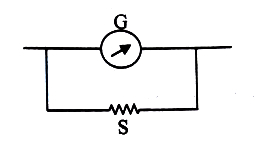
(C) To convert a moving coil galvanometer into an ammeter,a small resistance called a shunt $(S)$ is connected in parallel with the galvanometer $(G)$.
The equivalent resistance $(R)$ of the ammeter is the parallel combination of $G$ and $S$.
The formula for parallel resistance is:
$\frac{1}{R} = \frac{1}{G} + \frac{1}{S}$
Taking the common denominator:
$\frac{1}{R} = \frac{S + G}{GS}$
Therefore,the resistance of the ammeter is:
$R = \frac{GS}{G + S}$
Comparing this with the given options,the correct expression is $\frac{SG}{S+G}$,which corresponds to option $(C)$.
The equivalent resistance $(R)$ of the ammeter is the parallel combination of $G$ and $S$.
The formula for parallel resistance is:
$\frac{1}{R} = \frac{1}{G} + \frac{1}{S}$
Taking the common denominator:
$\frac{1}{R} = \frac{S + G}{GS}$
Therefore,the resistance of the ammeter is:
$R = \frac{GS}{G + S}$
Comparing this with the given options,the correct expression is $\frac{SG}{S+G}$,which corresponds to option $(C)$.
0 likes
View Solution306
MediumMCQ
Moving coil galvanometers $M_{1}$ and $M_{2}$ have resistance,number of turns,area of coil,and magnetic field as follows:
$R_{1}=10 \Omega, R_{2}=14 \Omega, N_{1}=30, N_{2}=42$
$A_{1}=3.6 \times 10^{-3} \ m^{2}, A_{2}=1.8 \times 10^{-2} \ m^{2}, B_{1}=0.25 \ T, B_{2}=0.50 \ T$
(Spring constants are same for both galvanometers).
The ratio of $(i)$ current sensitivity and (ii) voltage sensitivity for galvanometer ($M_{2}$ to $M_{1}$) is respectively:
$R_{1}=10 \Omega, R_{2}=14 \Omega, N_{1}=30, N_{2}=42$
$A_{1}=3.6 \times 10^{-3} \ m^{2}, A_{2}=1.8 \times 10^{-2} \ m^{2}, B_{1}=0.25 \ T, B_{2}=0.50 \ T$
(Spring constants are same for both galvanometers).
The ratio of $(i)$ current sensitivity and (ii) voltage sensitivity for galvanometer ($M_{2}$ to $M_{1}$) is respectively:
A
$1: 1, 1.4: 1$
B
$1: 1.4, 1: 1$
C
$4: 1, 1: 1$
D
$1.4: 1, 1: 1$
Solution
(D) Current sensitivity $I_{s} = \frac{NBA}{k}$.
Voltage sensitivity $V_{s} = \frac{I_{s}}{R} = \frac{NBA}{kR}$.
Given $k_{1} = k_{2} = k$.
Ratio of current sensitivity $\frac{I_{s2}}{I_{s1}} = \frac{N_{2}B_{2}A_{2}}{N_{1}B_{1}A_{1}} = \frac{42 \times 0.50 \times 1.8 \times 10^{-2}}{30 \times 0.25 \times 3.6 \times 10^{-3}} = \frac{21 \times 1.8 \times 10^{-2}}{7.5 \times 3.6 \times 10^{-3}} = \frac{37.8 \times 10^{-2}}{27 \times 10^{-3}} = 1.4$.
Ratio of voltage sensitivity $\frac{V_{s2}}{V_{s1}} = \frac{I_{s2}}{I_{s1}} \times \frac{R_{1}}{R_{2}} = 1.4 \times \frac{10}{14} = 1.4 \times \frac{1}{1.4} = 1$.
Thus,the ratio is $1.4: 1$ and $1: 1$.
Voltage sensitivity $V_{s} = \frac{I_{s}}{R} = \frac{NBA}{kR}$.
Given $k_{1} = k_{2} = k$.
Ratio of current sensitivity $\frac{I_{s2}}{I_{s1}} = \frac{N_{2}B_{2}A_{2}}{N_{1}B_{1}A_{1}} = \frac{42 \times 0.50 \times 1.8 \times 10^{-2}}{30 \times 0.25 \times 3.6 \times 10^{-3}} = \frac{21 \times 1.8 \times 10^{-2}}{7.5 \times 3.6 \times 10^{-3}} = \frac{37.8 \times 10^{-2}}{27 \times 10^{-3}} = 1.4$.
Ratio of voltage sensitivity $\frac{V_{s2}}{V_{s1}} = \frac{I_{s2}}{I_{s1}} \times \frac{R_{1}}{R_{2}} = 1.4 \times \frac{10}{14} = 1.4 \times \frac{1}{1.4} = 1$.
Thus,the ratio is $1.4: 1$ and $1: 1$.
0 likes
View Solution307
EasyMCQ
Two galvanometers $A$ and $B$ require currents of $4 \ mA$ and $7 \ mA$,respectively,to produce the same deflection of $20$ divisions. If $S_{A}$ and $S_{B}$ are their sensitivities,respectively,then:
A
$S_{A} > S_{B}$
B
$S_{A} = S_{B} = \frac{4}{7}$
C
$S_{B} = \frac{7}{4} = S_{A}$
D
$S_{A} < S_{B}$
Solution
(A) The sensitivity $S$ of a galvanometer is defined as the deflection per unit current,given by $S = \frac{\theta}{I}$.
Given that both galvanometers produce the same deflection $\theta = 20$ divisions.
For galvanometer $A$,$S_{A} = \frac{\theta}{I_{A}} = \frac{20}{4 \ mA} = 5 \ \text{div/mA}$.
For galvanometer $B$,$S_{B} = \frac{\theta}{I_{B}} = \frac{20}{7 \ mA} \approx 2.86 \ \text{div/mA}$.
Comparing the two,$S_{A} > S_{B}$.
Alternatively,since $S \propto \frac{1}{I}$ for a constant deflection,$\frac{S_{A}}{S_{B}} = \frac{I_{B}}{I_{A}} = \frac{7}{4} = 1.75$.
Thus,$S_{A} = 1.75 S_{B}$,which implies $S_{A} > S_{B}$.
Given that both galvanometers produce the same deflection $\theta = 20$ divisions.
For galvanometer $A$,$S_{A} = \frac{\theta}{I_{A}} = \frac{20}{4 \ mA} = 5 \ \text{div/mA}$.
For galvanometer $B$,$S_{B} = \frac{\theta}{I_{B}} = \frac{20}{7 \ mA} \approx 2.86 \ \text{div/mA}$.
Comparing the two,$S_{A} > S_{B}$.
Alternatively,since $S \propto \frac{1}{I}$ for a constant deflection,$\frac{S_{A}}{S_{B}} = \frac{I_{B}}{I_{A}} = \frac{7}{4} = 1.75$.
Thus,$S_{A} = 1.75 S_{B}$,which implies $S_{A} > S_{B}$.
0 likes
View Solution308
EasyMCQ
$A$ milliammeter of resistance $40 \Omega$ has a range $0-30 \text{ mA}$. What will be the resistance used in series to convert it into a voltmeter of range $0-15 \text{ V}$ (in $Omega$)?
A
$460$
B
$920$
C
$560$
D
$640$
Solution
(A) To convert a milliammeter into a voltmeter,a high resistance $R$ must be connected in series with the milliammeter.
Given:
Resistance of milliammeter,$G = 40 \Omega$
Full-scale deflection current,$I_g = 30 \text{ mA} = 30 \times 10^{-3} \text{ A} = 0.03 \text{ A}$
Required voltage range,$V = 15 \text{ V}$
The formula for the series resistance $R$ is:
$R = \frac{V}{I_g} - G$
Substituting the values:
$R = \frac{15}{30 \times 10^{-3}} - 40$
$R = \frac{15}{0.03} - 40$
$R = 500 - 40$
$R = 460 \Omega$
Therefore,a resistance of $460 \Omega$ should be connected in series.
Given:
Resistance of milliammeter,$G = 40 \Omega$
Full-scale deflection current,$I_g = 30 \text{ mA} = 30 \times 10^{-3} \text{ A} = 0.03 \text{ A}$
Required voltage range,$V = 15 \text{ V}$
The formula for the series resistance $R$ is:
$R = \frac{V}{I_g} - G$
Substituting the values:
$R = \frac{15}{30 \times 10^{-3}} - 40$
$R = \frac{15}{0.03} - 40$
$R = 500 - 40$
$R = 460 \Omega$
Therefore,a resistance of $460 \Omega$ should be connected in series.
0 likes
View Solution309
MediumMCQ
The deflection in a moving coil galvanometer of resistance $45 \Omega$ falls from $30$ divisions to $3$ divisions. The length of the shunt wire required to convert the galvanometer into an ammeter is [specific resistance of the material of the shunt wire $= 5 \times 10^{-7} \Omega m$ and area of cross-section of the wire $= 4 \times 10^{-7} m^2$]. (in $m$)
A
$4$
B
$6$
C
$8$
D
$2$
Solution
(A) Given: Resistance of galvanometer $G = 45 \Omega$,specific resistance $\rho = 5 \times 10^{-7} \Omega m$,area $A = 4 \times 10^{-7} m^2$.
When the deflection falls from $30$ divisions to $3$ divisions,the current through the galvanometer $I_g$ becomes $I_g = \frac{3}{30} I = \frac{1}{10} I$.
The shunt resistance $S$ is given by the formula $S = \frac{I_g G}{I - I_g}$.
Substituting the values: $S = \frac{(\frac{1}{10} I) \times 45}{I - \frac{1}{10} I} = \frac{4.5 I}{0.9 I} = 5 \Omega$.
Since $S = \frac{\rho L}{A}$,we have $L = \frac{S A}{\rho}$.
$L = \frac{5 \times 4 \times 10^{-7}}{5 \times 10^{-7}} = 4 \ m$.
When the deflection falls from $30$ divisions to $3$ divisions,the current through the galvanometer $I_g$ becomes $I_g = \frac{3}{30} I = \frac{1}{10} I$.
The shunt resistance $S$ is given by the formula $S = \frac{I_g G}{I - I_g}$.
Substituting the values: $S = \frac{(\frac{1}{10} I) \times 45}{I - \frac{1}{10} I} = \frac{4.5 I}{0.9 I} = 5 \Omega$.
Since $S = \frac{\rho L}{A}$,we have $L = \frac{S A}{\rho}$.
$L = \frac{5 \times 4 \times 10^{-7}}{5 \times 10^{-7}} = 4 \ m$.
0 likes
View Solution310
EasyMCQ
What will be the resistance of the shunt when $5 \%$ of the main current is passed through a galvanometer of resistance $G$?
A
$\frac{G}{20}$
B
$\frac{G}{21}$
C
$\frac{G}{5}$
D
$\frac{G}{19}$
Solution
(D) Let the total current be $I$.
Given that the current passing through the galvanometer is $I_{G} = 5\% \text{ of } I = 0.05 I$.
The current passing through the shunt resistance $S$ is $I_{S} = I - I_{G} = I - 0.05 I = 0.95 I$.
Since the galvanometer and the shunt are in parallel,the potential difference across them is equal:
$I_{S} S = I_{G} G$
Substituting the values:
$(0.95 I) S = (0.05 I) G$
$S = \frac{0.05 I}{0.95 I} G$
$S = \frac{5}{95} G = \frac{1}{19} G$
Therefore,the resistance of the shunt is $\frac{G}{19}$.
Given that the current passing through the galvanometer is $I_{G} = 5\% \text{ of } I = 0.05 I$.
The current passing through the shunt resistance $S$ is $I_{S} = I - I_{G} = I - 0.05 I = 0.95 I$.
Since the galvanometer and the shunt are in parallel,the potential difference across them is equal:
$I_{S} S = I_{G} G$
Substituting the values:
$(0.95 I) S = (0.05 I) G$
$S = \frac{0.05 I}{0.95 I} G$
$S = \frac{5}{95} G = \frac{1}{19} G$
Therefore,the resistance of the shunt is $\frac{G}{19}$.
0 likes
View Solution311
MediumMCQ
The range of an ammeter of resistance $G$ can be increased from $I$ to $nI$ by connecting
A
$A$ series resistance of $\frac{G}{n+1} \Omega$
B
$A$ shunt of $\frac{G}{n-1} \Omega$
C
$A$ shunt of $\frac{G}{n+1} \Omega$
D
$A$ series resistance of $\frac{G}{n-1} \Omega$
Solution
(B) To increase the range of an ammeter,a shunt resistance $S$ must be connected in parallel with the galvanometer of resistance $G$.
Let $I_g$ be the current for full-scale deflection of the galvanometer.
The formula for the shunt resistance required to increase the range from $I_g$ to $I$ is given by $S = \frac{I_g G}{I - I_g}$.
Given that the range is increased from $I_g = I$ to $I' = nI$,we substitute $I' = nI$ into the formula:
$S = \frac{I G}{nI - I} = \frac{I G}{I(n - 1)} = \frac{G}{n - 1} \Omega$.
Therefore,a shunt of $\frac{G}{n-1} \Omega$ must be connected in parallel.
Let $I_g$ be the current for full-scale deflection of the galvanometer.
The formula for the shunt resistance required to increase the range from $I_g$ to $I$ is given by $S = \frac{I_g G}{I - I_g}$.
Given that the range is increased from $I_g = I$ to $I' = nI$,we substitute $I' = nI$ into the formula:
$S = \frac{I G}{nI - I} = \frac{I G}{I(n - 1)} = \frac{G}{n - 1} \Omega$.
Therefore,a shunt of $\frac{G}{n-1} \Omega$ must be connected in parallel.
0 likes
View Solution312
MediumMCQ
$A$ galvanometer has a resistance of $100 \Omega$ and a current of $10 \text{ mA}$ produces full-scale deflection in it. The resistance to be connected to it in series,to convert it into a voltmeter of range $50 \text{ V}$,is: (in $Omega$)
A
$3900$
B
$4000$
C
$4600$
D
$4900$
Solution
(D) Given: Galvanometer resistance $G = 100 \Omega$,full-scale deflection current $i_g = 10 \text{ mA} = 10 \times 10^{-3} \text{ A}$,and desired voltage range $V = 50 \text{ V}$.
To convert a galvanometer into a voltmeter,a high resistance $R$ must be connected in series with it.
The formula for the range of the voltmeter is $V = i_g(G + R)$.
Substituting the given values: $50 = 10 \times 10^{-3} \times (100 + R)$.
$50 / (10 \times 10^{-3}) = 100 + R$.
$5000 = 100 + R$.
$R = 5000 - 100 = 4900 \Omega$.
To convert a galvanometer into a voltmeter,a high resistance $R$ must be connected in series with it.
The formula for the range of the voltmeter is $V = i_g(G + R)$.
Substituting the given values: $50 = 10 \times 10^{-3} \times (100 + R)$.
$50 / (10 \times 10^{-3}) = 100 + R$.
$5000 = 100 + R$.
$R = 5000 - 100 = 4900 \Omega$.
0 likes
View Solution313
MediumMCQ
In a moving coil galvanometer,a strong horse-shoe magnet with concave-shaped pole pieces is used to:
A
increase the space for the rotation of the coil
B
reduce the weight of the galvanometer
C
produce a magnetic field which is parallel to the plane of the coil at any position
D
make the magnetic induction weak at the centre
Solution
(C) In a moving coil galvanometer,the torque acting on the coil is given by $\vec{\tau} = \vec{M} \times \vec{B}$,which has a magnitude of $\tau = MB \sin \theta$,where $\theta$ is the angle between the magnetic moment $\vec{M}$ and the magnetic field $\vec{B}$.
To ensure that the torque is always proportional to the current,we need $\sin \theta = 1$,which means $\theta = 90^{\circ}$.
By using a strong horse-shoe magnet with concave-shaped pole pieces,the magnetic field lines are made radial.
In a radial magnetic field,the plane of the coil is always parallel to the magnetic field lines for any orientation of the coil,ensuring $\theta = 90^{\circ}$ at all times.
To ensure that the torque is always proportional to the current,we need $\sin \theta = 1$,which means $\theta = 90^{\circ}$.
By using a strong horse-shoe magnet with concave-shaped pole pieces,the magnetic field lines are made radial.
In a radial magnetic field,the plane of the coil is always parallel to the magnetic field lines for any orientation of the coil,ensuring $\theta = 90^{\circ}$ at all times.
0 likes
View Solution314
MediumMCQ
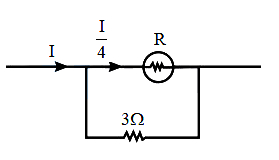
The deflection in a galvanometer falls to $\left(\frac{1}{4}\right)^{th}$ of its initial value when it is shunted by a resistor of $3 \Omega$. If an additional shunt of $2 \Omega$ is connected in parallel to the earlier shunt,the deflection in the galvanometer falls to:
A
$\frac{1}{2}$
B
$\left(\frac{1}{3}\right)^{rd}$
C
$\left(\frac{1}{4}\right)^{th}$
D
$\left(\frac{1}{8.5}\right)^{th}$
Solution
(D) Let $G$ be the resistance of the galvanometer and $I$ be the total current. When shunted by $S_1 = 3 \Omega$,the current through the galvanometer is $I_g = \frac{I}{4}$.
Using the current divider rule: $I_g = I \left( \frac{S_1}{G + S_1} \right) \Rightarrow \frac{I}{4} = I \left( \frac{3}{G + 3} \right)$.
Solving for $G$: $G + 3 = 12 \Rightarrow G = 9 \Omega$.
Now,an additional shunt $S_2 = 2 \Omega$ is connected in parallel to $S_1 = 3 \Omega$. The equivalent shunt resistance $S_{eq}$ is:
$S_{eq} = \frac{S_1 \times S_2}{S_1 + S_2} = \frac{3 \times 2}{3 + 2} = \frac{6}{5} = 1.2 \Omega$.
The new current through the galvanometer $I_g'$ is:
$I_g' = I \left( \frac{S_{eq}}{G + S_{eq}} \right) = I \left( \frac{1.2}{9 + 1.2} \right) = I \left( \frac{1.2}{10.2} \right) = I \left( \frac{12}{102} \right) = I \left( \frac{1}{8.5} \right)$.
Thus,the deflection falls to $\left(\frac{1}{8.5}\right)^{th}$ of the initial value.
Using the current divider rule: $I_g = I \left( \frac{S_1}{G + S_1} \right) \Rightarrow \frac{I}{4} = I \left( \frac{3}{G + 3} \right)$.
Solving for $G$: $G + 3 = 12 \Rightarrow G = 9 \Omega$.
Now,an additional shunt $S_2 = 2 \Omega$ is connected in parallel to $S_1 = 3 \Omega$. The equivalent shunt resistance $S_{eq}$ is:
$S_{eq} = \frac{S_1 \times S_2}{S_1 + S_2} = \frac{3 \times 2}{3 + 2} = \frac{6}{5} = 1.2 \Omega$.
The new current through the galvanometer $I_g'$ is:
$I_g' = I \left( \frac{S_{eq}}{G + S_{eq}} \right) = I \left( \frac{1.2}{9 + 1.2} \right) = I \left( \frac{1.2}{10.2} \right) = I \left( \frac{12}{102} \right) = I \left( \frac{1}{8.5} \right)$.
Thus,the deflection falls to $\left(\frac{1}{8.5}\right)^{th}$ of the initial value.
0 likes
View Solution315
EasyMCQ
The sensitivity of a moving coil galvanometer is $s$. If a shunt of $\frac{1}{8}$ of the resistance of the galvanometer is connected to the moving coil galvanometer,what will its new sensitivity be?
A
$\frac{s}{3}$
B
$\frac{s}{6}$
C
$\frac{s}{9}$
D
$\frac{s}{12}$
Solution
(C) Let the resistance of the galvanometer be $G$ and the shunt resistance be $S$. Given $S = \frac{G}{8}$.
The current sensitivity of a galvanometer is defined as the deflection per unit current. When a shunt $S$ is connected in parallel,the total current $I$ is divided such that the current through the galvanometer $I_g$ is given by $I_g = I \left( \frac{S}{S+G} \right)$.
The new sensitivity $s^{\prime}$ is the ratio of deflection $\theta$ to the total current $I$. Since $\theta = k I_g$ (where $k$ is a constant),we have $s^{\prime} = \frac{\theta}{I} = k \frac{I_g}{I} = k \left( \frac{S}{S+G} \right)$.
The original sensitivity $s = k$. Therefore,$s^{\prime} = s \left( \frac{S}{S+G} \right)$.
Substituting $S = \frac{G}{8}$:
$s^{\prime} = s \left( \frac{G/8}{G/8 + G} \right) = s \left( \frac{G/8}{9G/8} \right) = \frac{s}{9}$.
The current sensitivity of a galvanometer is defined as the deflection per unit current. When a shunt $S$ is connected in parallel,the total current $I$ is divided such that the current through the galvanometer $I_g$ is given by $I_g = I \left( \frac{S}{S+G} \right)$.
The new sensitivity $s^{\prime}$ is the ratio of deflection $\theta$ to the total current $I$. Since $\theta = k I_g$ (where $k$ is a constant),we have $s^{\prime} = \frac{\theta}{I} = k \frac{I_g}{I} = k \left( \frac{S}{S+G} \right)$.
The original sensitivity $s = k$. Therefore,$s^{\prime} = s \left( \frac{S}{S+G} \right)$.
Substituting $S = \frac{G}{8}$:
$s^{\prime} = s \left( \frac{G/8}{G/8 + G} \right) = s \left( \frac{G/8}{9G/8} \right) = \frac{s}{9}$.
0 likes
View Solution316
MediumMCQ
$A$ galvanometer of resistance $30 \Omega$ is connected to a battery of emf $2 \text{ V}$ with $1970 \Omega$ resistance in series. $A$ full-scale deflection of $20$ divisions is obtained in the galvanometer. To reduce the deflection to $10$ divisions,the total resistance in series required is: (in $Omega$)
A
$4030$
B
$4000$
C
$3970$
D
$2000$
Solution
(C) The current for full-scale deflection ($20$ divisions) is given by $I_1 = \frac{V}{R_g + R_1} = \frac{2}{30 + 1970} = \frac{2}{2000} = 1 \times 10^{-3} \text{ A} = 1 \text{ mA}$.
Since the deflection $\theta$ is directly proportional to the current $I$ $(\theta \propto I)$,to reduce the deflection from $20$ divisions to $10$ divisions,the current must be halved.
Thus,$I_2 = \frac{I_1}{2} = 0.5 \times 10^{-3} \text{ A}$.
Let the new total series resistance be $R_{total}$. Then $I_2 = \frac{V}{R_g + R_{total}}$.
$0.5 \times 10^{-3} = \frac{2}{30 + R_{total}}$.
$30 + R_{total} = \frac{2}{0.5 \times 10^{-3}} = 4000 \Omega$.
$R_{total} = 4000 - 30 = 3970 \Omega$.
Since the deflection $\theta$ is directly proportional to the current $I$ $(\theta \propto I)$,to reduce the deflection from $20$ divisions to $10$ divisions,the current must be halved.
Thus,$I_2 = \frac{I_1}{2} = 0.5 \times 10^{-3} \text{ A}$.
Let the new total series resistance be $R_{total}$. Then $I_2 = \frac{V}{R_g + R_{total}}$.
$0.5 \times 10^{-3} = \frac{2}{30 + R_{total}}$.
$30 + R_{total} = \frac{2}{0.5 \times 10^{-3}} = 4000 \Omega$.
$R_{total} = 4000 - 30 = 3970 \Omega$.
0 likes
View Solution317
MediumMCQ
$A$ voltmeter of range $3 \, V$ and resistance $200 \, \Omega$ cannot be converted to an ammeter of range
A
$10 \, mA$
B
$100 \, mA$
C
$1 \, A$
D
$10 \, A$
Solution
(A) The full-scale deflection current $(I_{g})$ of the voltmeter is calculated as:
$I_{g} = \frac{V}{R} = \frac{3 \, V}{200 \, \Omega} = 0.015 \, A = 15 \, mA$.
To convert a galvanometer (or voltmeter) into an ammeter, we connect a shunt resistance in parallel.
The range of the ammeter $(I)$ must always be greater than the full-scale deflection current $(I_{g})$ of the device being converted.
Since $I_{g} = 15 \, mA$, the ammeter cannot have a range less than $15 \, mA$.
Therefore, the voltmeter cannot be converted to an ammeter of range $10 \, mA$.
$I_{g} = \frac{V}{R} = \frac{3 \, V}{200 \, \Omega} = 0.015 \, A = 15 \, mA$.
To convert a galvanometer (or voltmeter) into an ammeter, we connect a shunt resistance in parallel.
The range of the ammeter $(I)$ must always be greater than the full-scale deflection current $(I_{g})$ of the device being converted.
Since $I_{g} = 15 \, mA$, the ammeter cannot have a range less than $15 \, mA$.
Therefore, the voltmeter cannot be converted to an ammeter of range $10 \, mA$.
0 likes
View Solution318
MediumMCQ
When a resistance of $100 \Omega$ is connected in series with a galvanometer of resistance $R$,its range is $V$. To double its range,a resistance of $1000 \Omega$ is connected in series. Find $R$. (in $Omega$)
A
$700$
B
$800$
C
$900$
D
$100$
Solution
(B) Let the full-scale deflection current of the galvanometer be $I_g$.
When a resistance of $100 \Omega$ is connected in series,the total resistance is $(100 + R)$. The voltage range $V$ is given by $V = I_g(100 + R)$ --- $(i)$
When a resistance of $1000 \Omega$ is connected in series,the new range is $2V$. The total resistance is $(1000 + R)$. Thus,$2V = I_g(1000 + R)$ --- (ii)
Dividing equation (ii) by equation $(i)$:
$\frac{2V}{V} = \frac{I_g(1000 + R)}{I_g(100 + R)}$
$2 = \frac{1000 + R}{100 + R}$
$2(100 + R) = 1000 + R$
$200 + 2R = 1000 + R$
$2R - R = 1000 - 200$
$R = 800 \Omega$
When a resistance of $100 \Omega$ is connected in series,the total resistance is $(100 + R)$. The voltage range $V$ is given by $V = I_g(100 + R)$ --- $(i)$
When a resistance of $1000 \Omega$ is connected in series,the new range is $2V$. The total resistance is $(1000 + R)$. Thus,$2V = I_g(1000 + R)$ --- (ii)
Dividing equation (ii) by equation $(i)$:
$\frac{2V}{V} = \frac{I_g(1000 + R)}{I_g(100 + R)}$
$2 = \frac{1000 + R}{100 + R}$
$2(100 + R) = 1000 + R$
$200 + 2R = 1000 + R$
$2R - R = 1000 - 200$
$R = 800 \Omega$
0 likes
View Solution319
EasyMCQ
$A$ rectangular coil of effective area $0.05 \ m^2$ is suspended freely in a radial magnetic field of $0.01 \ Wb/m^2$. The torsional constant of the suspension fiber is $5 \times 10^{-9} \ Nm/\text{degree}$. If a current of $300 \ \mu A$ is passed through it,then the angle through which the coil rotates is (in $^{\circ}$)
A
$60$
B
$30$
C
$45$
D
$90$
Solution
(B) The torque on a current-carrying coil in a magnetic field is given by $\tau = NIAB \sin \theta$. For a radial magnetic field,the plane of the coil is always parallel to the magnetic field,so $\theta = 90^{\circ}$ and $\sin 90^{\circ} = 1$.
Thus,the magnetic torque is $\tau_m = NIAB$.
The restoring torque provided by the suspension fiber is $\tau_r = K \phi$,where $K$ is the torsional constant and $\phi$ is the angle of rotation.
Equating the two torques for equilibrium: $NIAB = K \phi$.
Given: $A = 0.05 \ m^2$,$B = 0.01 \ Wb/m^2$,$K = 5 \times 10^{-9} \ Nm/\text{degree}$,$I = 300 \ \mu A = 300 \times 10^{-6} \ A$,and assuming $N = 1$.
Substituting the values: $\phi = \frac{NIAB}{K} = \frac{1 \times 300 \times 10^{-6} \times 0.01 \times 0.05}{5 \times 10^{-9}}$.
$\phi = \frac{300 \times 10^{-6} \times 5 \times 10^{-4}}{5 \times 10^{-9}} = \frac{300 \times 10^{-10}}{5 \times 10^{-9}} = 60 \times 10^{-1} = 6^{\circ}$.
Wait,re-calculating: $\phi = \frac{300 \times 10^{-6} \times 0.0005}{5 \times 10^{-9}} = \frac{150000 \times 10^{-12}}{5 \times 10^{-9}} = 30000 \times 10^{-3} = 30^{\circ}$.
Therefore,the angle of rotation is $30^{\circ}$.
Thus,the magnetic torque is $\tau_m = NIAB$.
The restoring torque provided by the suspension fiber is $\tau_r = K \phi$,where $K$ is the torsional constant and $\phi$ is the angle of rotation.
Equating the two torques for equilibrium: $NIAB = K \phi$.
Given: $A = 0.05 \ m^2$,$B = 0.01 \ Wb/m^2$,$K = 5 \times 10^{-9} \ Nm/\text{degree}$,$I = 300 \ \mu A = 300 \times 10^{-6} \ A$,and assuming $N = 1$.
Substituting the values: $\phi = \frac{NIAB}{K} = \frac{1 \times 300 \times 10^{-6} \times 0.01 \times 0.05}{5 \times 10^{-9}}$.
$\phi = \frac{300 \times 10^{-6} \times 5 \times 10^{-4}}{5 \times 10^{-9}} = \frac{300 \times 10^{-10}}{5 \times 10^{-9}} = 60 \times 10^{-1} = 6^{\circ}$.
Wait,re-calculating: $\phi = \frac{300 \times 10^{-6} \times 0.0005}{5 \times 10^{-9}} = \frac{150000 \times 10^{-12}}{5 \times 10^{-9}} = 30000 \times 10^{-3} = 30^{\circ}$.
Therefore,the angle of rotation is $30^{\circ}$.
0 likes
View Solution320
MediumMCQ
Shunt wire should be . . . . . . .
A
Thin and long
B
Thick and long
C
Thick and short
D
Thin and short
Solution
(C) The resistance of a shunt wire must be very low to allow the majority of the current to pass through it,thereby protecting the galvanometer.
From the formula for resistance,$R = \frac{\rho l}{A}$,where $\rho$ is resistivity,$l$ is length,and $A$ is the cross-sectional area.
To minimize $R$,the length $l$ should be short and the area $A$ should be large (thick).
Therefore,the shunt wire should be thick and short.
From the formula for resistance,$R = \frac{\rho l}{A}$,where $\rho$ is resistivity,$l$ is length,and $A$ is the cross-sectional area.
To minimize $R$,the length $l$ should be short and the area $A$ should be large (thick).
Therefore,the shunt wire should be thick and short.
0 likes
View Solution321
EasyMCQ
An ideal ammeter and an ideal voltmeter have resistances of . . . . . . $\Omega$ and . . . . . . $\Omega$ respectively.
A
$(0, 0)$
B
$(\infty, 0)$
C
$(\infty, \infty)$
D
$(0, \infty)$
Solution
(D) An ideal ammeter is designed to measure current without affecting the circuit,which requires it to have zero resistance. Thus,the resistance of an ideal ammeter is $0 \ \Omega$.
An ideal voltmeter is designed to measure potential difference without drawing any current from the circuit,which requires it to have infinite resistance. Thus,the resistance of an ideal voltmeter is $\infty \ \Omega$.
Therefore,the correct option is $(0, \infty)$.
An ideal voltmeter is designed to measure potential difference without drawing any current from the circuit,which requires it to have infinite resistance. Thus,the resistance of an ideal voltmeter is $\infty \ \Omega$.
Therefore,the correct option is $(0, \infty)$.
0 likes
View Solution322
EasyMCQ
The galvanometer has a resistance of $1.8 \Omega$. Calculate the value of shunt to increase the range of galvanometer by $10$ times. (in $Omega$)
A
$4$
B
$1$
C
$3$
D
$2$
Solution
(D) Given: Resistance of galvanometer,$R_G = 1.8 \Omega$.
To increase the range by $n = 10$ times,the shunt resistance $r_s$ is given by the formula:
$r_s = \frac{R_G}{n - 1}$
Substituting the values:
$r_s = \frac{1.8}{10 - 1}$
$r_s = \frac{1.8}{9}$
$r_s = 0.2 \Omega$.
Wait,checking the provided options and the original calculation:
If $R_G = 18 \Omega$,then $r_s = 18 / (10-1) = 2 \Omega$.
Given the question states $1.8 \Omega$,the correct shunt is $0.2 \Omega$. However,assuming a typo in the question where $R_G$ was intended to be $18 \Omega$,the answer is $2 \Omega$ (Option $D$).
To increase the range by $n = 10$ times,the shunt resistance $r_s$ is given by the formula:
$r_s = \frac{R_G}{n - 1}$
Substituting the values:
$r_s = \frac{1.8}{10 - 1}$
$r_s = \frac{1.8}{9}$
$r_s = 0.2 \Omega$.
Wait,checking the provided options and the original calculation:
If $R_G = 18 \Omega$,then $r_s = 18 / (10-1) = 2 \Omega$.
Given the question states $1.8 \Omega$,the correct shunt is $0.2 \Omega$. However,assuming a typo in the question where $R_G$ was intended to be $18 \Omega$,the answer is $2 \Omega$ (Option $D$).
0 likes
View Solution323
EasyMCQ
$A$ galvanometer of resistance $50 \ \Omega$ giving full scale deflection for a current of $10 \ mA$ is to be changed into a voltmeter of range $100 \ V$. $A$ resistance of . . . . . . $\Omega$ has to be connected in series with the galvanometer.
A
$9950$
B
$10025$
C
$10000$
D
$9975$
Solution
(A) To convert a galvanometer into a voltmeter,a high resistance $R_s$ must be connected in series with the galvanometer.
The formula for the series resistance is given by $R_s = \frac{V}{I_G} - G$,where $V$ is the required voltage range,$I_G$ is the full-scale deflection current,and $G$ is the resistance of the galvanometer.
Given values: $V = 100 \ V$,$I_G = 10 \ mA = 10 \times 10^{-3} \ A$,and $G = 50 \ \Omega$.
Substituting these values into the formula:
$R_s = \frac{100}{10 \times 10^{-3}} - 50$
$R_s = 10000 - 50$
$R_s = 9950 \ \Omega$.
The formula for the series resistance is given by $R_s = \frac{V}{I_G} - G$,where $V$ is the required voltage range,$I_G$ is the full-scale deflection current,and $G$ is the resistance of the galvanometer.
Given values: $V = 100 \ V$,$I_G = 10 \ mA = 10 \times 10^{-3} \ A$,and $G = 50 \ \Omega$.
Substituting these values into the formula:
$R_s = \frac{100}{10 \times 10^{-3}} - 50$
$R_s = 10000 - 50$
$R_s = 9950 \ \Omega$.
0 likes
View Solution324
EasyMCQ
$A$ galvanometer of resistance $50 \ \Omega$ is connected to a battery of $8 \ V$ along with a resistance of $3950 \ \Omega$ in series. $A$ full-scale deflection of $30$ divisions is obtained in the galvanometer. In order to reduce this deflection to $15$ divisions,the resistance in series should be . . . . . . $\Omega$.
A
$7900$
B
$1950$
C
$2000$
D
$7950$
Solution
(D) The current $I$ flowing through the galvanometer is proportional to the deflection $\phi$ in divisions,i.e.,$I \propto \phi$.
Using Ohm's law,$I = \frac{V}{R + G}$,where $V = 8 \ V$,$G = 50 \ \Omega$,and $R$ is the series resistance.
For the first case: $I_1 = \frac{V}{R_1 + G}$ with $\phi_1 = 30$ divisions and $R_1 = 3950 \ \Omega$.
For the second case: $I_2 = \frac{V}{R_2 + G}$ with $\phi_2 = 15$ divisions.
Taking the ratio: $\frac{I_1}{I_2} = \frac{\phi_1}{\phi_2} \implies \frac{R_2 + G}{R_1 + G} = \frac{30}{15} = 2$.
Substituting the values: $\frac{R_2 + 50}{3950 + 50} = 2$.
$\frac{R_2 + 50}{4000} = 2$.
$R_2 + 50 = 8000$.
$R_2 = 7950 \ \Omega$.
Using Ohm's law,$I = \frac{V}{R + G}$,where $V = 8 \ V$,$G = 50 \ \Omega$,and $R$ is the series resistance.
For the first case: $I_1 = \frac{V}{R_1 + G}$ with $\phi_1 = 30$ divisions and $R_1 = 3950 \ \Omega$.
For the second case: $I_2 = \frac{V}{R_2 + G}$ with $\phi_2 = 15$ divisions.
Taking the ratio: $\frac{I_1}{I_2} = \frac{\phi_1}{\phi_2} \implies \frac{R_2 + G}{R_1 + G} = \frac{30}{15} = 2$.
Substituting the values: $\frac{R_2 + 50}{3950 + 50} = 2$.
$\frac{R_2 + 50}{4000} = 2$.
$R_2 + 50 = 8000$.
$R_2 = 7950 \ \Omega$.
0 likes
View Solution325
EasyMCQ
$A$ galvanometer acting as a voltmeter should have . . . . . . .
A
High resistance in parallel with its coil
B
High resistance in series with its coil
C
Low resistance in parallel with its coil
D
Low resistance in series with its coil
Solution
(B) To convert a galvanometer into a voltmeter,a high resistance (multiplier) must be connected in series with the galvanometer coil.
This is done to ensure that the voltmeter draws a negligible current from the circuit,thereby maintaining the potential difference across the points to be measured.
By increasing the total resistance of the device,the current flowing through the galvanometer is limited,preventing damage and allowing it to measure higher voltages.
This is done to ensure that the voltmeter draws a negligible current from the circuit,thereby maintaining the potential difference across the points to be measured.
By increasing the total resistance of the device,the current flowing through the galvanometer is limited,preventing damage and allowing it to measure higher voltages.
0 likes
View Solution326
EasyMCQ
The resistance of an ideal voltmeter is . . . . . . .
A
Zero
B
Greater than Zero but finite value
C
Infinite
D
$5000 \Omega$
Solution
(C) An ideal voltmeter is designed to measure the potential difference between two points in a circuit without drawing any current from the circuit.
To ensure that no current flows through the voltmeter,its resistance must be infinitely high.
Therefore,the resistance of an ideal voltmeter is infinite.
To ensure that no current flows through the voltmeter,its resistance must be infinitely high.
Therefore,the resistance of an ideal voltmeter is infinite.
0 likes
View Solution327
EasyMCQ
To send $10 \%$ of the main current through a moving coil galvanometer of resistance $99 \Omega$,the shunt required is . . . . . . . (in $Omega$)
A
$9$
B
$11$
C
$108$
D
$99$
Solution
(B) The formula for the shunt resistance $S$ required to send a fraction of the total current $I$ through a galvanometer of resistance $G$ is given by:
$S = \frac{G I_G}{I - I_G}$
Given that the galvanometer current $I_G = 10 \% I = 0.1 I$ and the galvanometer resistance $G = 99 \Omega$.
Substituting these values into the formula:
$S = \frac{99 \times 0.1 I}{I - 0.1 I}$
$S = \frac{9.9 I}{0.9 I}$
$S = \frac{9.9}{0.9} = 11 \Omega$
Therefore,the required shunt resistance is $11 \Omega$.
$S = \frac{G I_G}{I - I_G}$
Given that the galvanometer current $I_G = 10 \% I = 0.1 I$ and the galvanometer resistance $G = 99 \Omega$.
Substituting these values into the formula:
$S = \frac{99 \times 0.1 I}{I - 0.1 I}$
$S = \frac{9.9 I}{0.9 I}$
$S = \frac{9.9}{0.9} = 11 \Omega$
Therefore,the required shunt resistance is $11 \Omega$.
0 likes
View Solution328
EasyMCQ
The deflection in a moving coil galvanometer falls from $50$ divisions to $10$ divisions,when a shunt of $12 \Omega$ is connected with it. The resistance of the galvanometer coil is . . . . . . . (in $Omega$)
A
$6$
B
$48$
C
$24$
D
$12$
Solution
(B) The deflection $\theta$ in a galvanometer is proportional to the current $I$ flowing through it,so $\theta \propto I$.
Initially,the current is $I$ and the deflection is $\theta_1 = 50$ divisions.
When a shunt resistance $S$ is connected in parallel,the current $I$ divides such that the galvanometer current $I_g$ corresponds to the new deflection $\theta_2 = 10$ divisions.
The ratio of the deflections is $n = \frac{\theta_1}{\theta_2} = \frac{50}{10} = 5$.
The formula relating the shunt resistance $S$,galvanometer resistance $G$,and the ratio $n$ is $S = \frac{G}{n-1}$.
Rearranging for $G$,we get $G = S(n-1)$.
Substituting the given values $S = 12 \Omega$ and $n = 5$:
$G = 12 \times (5 - 1) = 12 \times 4 = 48 \Omega$.
Thus,the resistance of the galvanometer coil is $48 \Omega$.
Initially,the current is $I$ and the deflection is $\theta_1 = 50$ divisions.
When a shunt resistance $S$ is connected in parallel,the current $I$ divides such that the galvanometer current $I_g$ corresponds to the new deflection $\theta_2 = 10$ divisions.
The ratio of the deflections is $n = \frac{\theta_1}{\theta_2} = \frac{50}{10} = 5$.
The formula relating the shunt resistance $S$,galvanometer resistance $G$,and the ratio $n$ is $S = \frac{G}{n-1}$.
Rearranging for $G$,we get $G = S(n-1)$.
Substituting the given values $S = 12 \Omega$ and $n = 5$:
$G = 12 \times (5 - 1) = 12 \times 4 = 48 \Omega$.
Thus,the resistance of the galvanometer coil is $48 \Omega$.
0 likes
View Solution329
EasyMCQ
To convert a galvanometer into an ammeter,we connect . . . . . . .
A
high resistance in parallel with it
B
high resistance in series with it
C
low resistance in parallel with it
D
low resistance in series with it
Solution
(C) To convert a galvanometer into an ammeter,a very low resistance,known as a shunt resistance $(S)$,is connected in parallel with the galvanometer coil.
This is done to ensure that the majority of the current passes through the shunt,protecting the sensitive galvanometer coil from damage due to high current.
Also,connecting a low resistance in parallel reduces the overall resistance of the circuit,which is a characteristic requirement for an ideal ammeter.
This is done to ensure that the majority of the current passes through the shunt,protecting the sensitive galvanometer coil from damage due to high current.
Also,connecting a low resistance in parallel reduces the overall resistance of the circuit,which is a characteristic requirement for an ideal ammeter.
0 likes
View Solution330
EasyMCQ
$A$ voltmeter has a resistance of $G \ \Omega$ and a range of $V \ \text{volt}$. The resistance required in series to convert it into a voltmeter of range $nV \ \text{volt}$ is . . . . . . .
A
$nG$
B
$(n-1)G$
C
$\frac{G}{n-1}$
D
$\frac{G}{n}$
Solution
(B) The correct option is $B$.
To convert a voltmeter of range $V$ and resistance $G$ into a voltmeter of range $nV$,we need to connect a resistance $R_s$ in series.
The current $I_g$ flowing through the voltmeter remains the same for the full-scale deflection.
The initial voltage is $V = I_g G$.
The new voltage is $V' = nV = I_g(G + R_s)$.
Substituting $V = I_g G$ into the new voltage equation:
$nV = I_g(G + R_s)$
$n(I_g G) = I_g(G + R_s)$
$nG = G + R_s$
$R_s = nG - G$
$R_s = (n-1)G$.
To convert a voltmeter of range $V$ and resistance $G$ into a voltmeter of range $nV$,we need to connect a resistance $R_s$ in series.
The current $I_g$ flowing through the voltmeter remains the same for the full-scale deflection.
The initial voltage is $V = I_g G$.
The new voltage is $V' = nV = I_g(G + R_s)$.
Substituting $V = I_g G$ into the new voltage equation:
$nV = I_g(G + R_s)$
$n(I_g G) = I_g(G + R_s)$
$nG = G + R_s$
$R_s = nG - G$
$R_s = (n-1)G$.
0 likes
View Solution331
EasyMCQ
$A$ galvanometer coil has a resistance of $10 \ \Omega$ and the meter shows full-scale deflection for $3 \ \text{mA}$. The value of the shunt required to convert this meter into an ammeter of range $0$ to $10 \ \text{A}$ is . . . . . . $\Omega$.
A
$4 \times 10^{-3}$
B
$2 \times 10^{-3}$
C
$3 \times 10^{-3}$
D
$1 \times 10^{-3}$
Solution
(C) Given:
Resistance of galvanometer $(G)$ = $10 \ \Omega$
Full-scale deflection current $(I_g)$ = $3 \ \text{mA} = 3 \times 10^{-3} \ \text{A}$
Range of ammeter $(I)$ = $10 \ \text{A}$
The formula for shunt resistance $(S)$ required to convert a galvanometer into an ammeter is given by:
$S = \frac{I_g \cdot G}{I - I_g}$
Substituting the values:
$S = \frac{3 \times 10^{-3} \times 10}{10 - 3 \times 10^{-3}}$
Since $3 \times 10^{-3} = 0.003 \ \text{A}$,the denominator is $10 - 0.003 = 9.997 \ \text{A}$.
$S = \frac{0.03}{9.997} \approx \frac{0.03}{10} = 0.003 \ \Omega$
Therefore,$S = 3 \times 10^{-3} \ \Omega$.
Resistance of galvanometer $(G)$ = $10 \ \Omega$
Full-scale deflection current $(I_g)$ = $3 \ \text{mA} = 3 \times 10^{-3} \ \text{A}$
Range of ammeter $(I)$ = $10 \ \text{A}$
The formula for shunt resistance $(S)$ required to convert a galvanometer into an ammeter is given by:
$S = \frac{I_g \cdot G}{I - I_g}$
Substituting the values:
$S = \frac{3 \times 10^{-3} \times 10}{10 - 3 \times 10^{-3}}$
Since $3 \times 10^{-3} = 0.003 \ \text{A}$,the denominator is $10 - 0.003 = 9.997 \ \text{A}$.
$S = \frac{0.03}{9.997} \approx \frac{0.03}{10} = 0.003 \ \Omega$
Therefore,$S = 3 \times 10^{-3} \ \Omega$.
0 likes
View Solution332
MediumMCQ
What is the value of shunt resistance required to convert a galvanometer of resistance $ 100 \Omega $ into an ammeter of range $ 1 \text{ A} $? Given: Full scale deflection of the galvanometer is $ 5 \text{ mA} $.
A
$ \frac{5}{9.95} \Omega $
B
$ \frac{9.95}{5} \Omega $
C
$ 0.5 \Omega $
D
$ 0.05 \Omega $
Solution
(A) Given: Resistance of galvanometer $ G = 100 \Omega $; Range of ammeter $ I = 1 \text{ A} $; Full scale deflection current $ I_{g} = 5 \text{ mA} = 5 \times 10^{-3} \text{ A} $.
To convert a galvanometer into an ammeter,a shunt resistance $ S $ is connected in parallel with it.
The formula for shunt resistance is $ S = \frac{I_{g} G}{I - I_{g}} $.
Substituting the given values:
$ S = \frac{5 \times 10^{-3} \times 100}{1 - 5 \times 10^{-3}} $
$ S = \frac{0.5}{1 - 0.005} $
$ S = \frac{0.5}{0.995} \Omega $
$ S = \frac{500}{995} \Omega = \frac{100}{199} \Omega $.
Wait,calculating $ \frac{0.5}{0.995} $ gives $ \frac{500}{995} = \frac{100}{199} \approx 0.5025 \Omega $.
Checking the options provided,$ \frac{5}{9.95} = \frac{500}{995} = \frac{100}{199} $. Thus,option $ A $ is correct.
To convert a galvanometer into an ammeter,a shunt resistance $ S $ is connected in parallel with it.
The formula for shunt resistance is $ S = \frac{I_{g} G}{I - I_{g}} $.
Substituting the given values:
$ S = \frac{5 \times 10^{-3} \times 100}{1 - 5 \times 10^{-3}} $
$ S = \frac{0.5}{1 - 0.005} $
$ S = \frac{0.5}{0.995} \Omega $
$ S = \frac{500}{995} \Omega = \frac{100}{199} \Omega $.
Wait,calculating $ \frac{0.5}{0.995} $ gives $ \frac{500}{995} = \frac{100}{199} \approx 0.5025 \Omega $.
Checking the options provided,$ \frac{5}{9.95} = \frac{500}{995} = \frac{100}{199} $. Thus,option $ A $ is correct.
0 likes
View Solution333
MediumMCQ
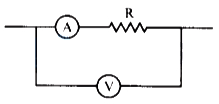
In the circuit shown below,the ammeter and the voltmeter readings are $3 \text{ A}$ and $6 \text{ V}$ respectively. Then the value of the resistance $R$ is
A
$2 \Omega$
B
$R > 2 \Omega$
C
$R < 2 \Omega$
D
$R = 2 \Omega$
Solution
(C) From the circuit diagram,the voltmeter is connected in parallel to the combination of the ammeter and the resistor $R$.
Let the resistance of the ammeter be $R_A$ and the resistance of the voltmeter be $R_V$.
The voltmeter reading $V = 6 \text{ V}$ is the potential difference across the series combination of the ammeter and the resistor $R$.
The ammeter reading $I = 3 \text{ A}$ is the current flowing through the ammeter and the resistor $R$.
According to Ohm's law for the series combination,the total resistance $R_{total} = R + R_A = \frac{V}{I} = \frac{6 \text{ V}}{3 \text{ A}} = 2 \Omega$.
Since the ammeter has some finite resistance $R_A > 0$,it follows that $R = 2 \Omega - R_A$.
Therefore,$R < 2 \Omega$.
Let the resistance of the ammeter be $R_A$ and the resistance of the voltmeter be $R_V$.
The voltmeter reading $V = 6 \text{ V}$ is the potential difference across the series combination of the ammeter and the resistor $R$.
The ammeter reading $I = 3 \text{ A}$ is the current flowing through the ammeter and the resistor $R$.
According to Ohm's law for the series combination,the total resistance $R_{total} = R + R_A = \frac{V}{I} = \frac{6 \text{ V}}{3 \text{ A}} = 2 \Omega$.
Since the ammeter has some finite resistance $R_A > 0$,it follows that $R = 2 \Omega - R_A$.
Therefore,$R < 2 \Omega$.
0 likes
View Solution334
MediumMCQ
Two similar galvanometers are converted into an ammeter and a milliammeter. The shunt resistance of the ammeter as compared to the shunt resistance of the milliammeter will be
A
Zero
B
More
C
Less
D
Equal
Solution
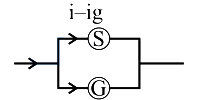
(C) galvanometer is converted into an ammeter by connecting a small shunt resistance $S$ in parallel with it.
For a galvanometer with resistance $G$ and full-scale deflection current $i_g$,if it is to measure a maximum current $i$,the shunt resistance $S$ is given by:
$S = \frac{i_g G}{i - i_g}$
From this formula,we can see that $S \propto \frac{1}{i - i_g}$.
Since an ammeter is designed to measure a larger current $(i_{ammeter})$ compared to a milliammeter $(i_{milliammeter})$,the denominator $(i - i_g)$ will be larger for the ammeter.
Therefore,the shunt resistance $S$ required for the ammeter will be less than the shunt resistance required for the milliammeter.
Thus,the shunt resistance of the ammeter is less than that of the milliammeter.
For a galvanometer with resistance $G$ and full-scale deflection current $i_g$,if it is to measure a maximum current $i$,the shunt resistance $S$ is given by:
$S = \frac{i_g G}{i - i_g}$
From this formula,we can see that $S \propto \frac{1}{i - i_g}$.
Since an ammeter is designed to measure a larger current $(i_{ammeter})$ compared to a milliammeter $(i_{milliammeter})$,the denominator $(i - i_g)$ will be larger for the ammeter.
Therefore,the shunt resistance $S$ required for the ammeter will be less than the shunt resistance required for the milliammeter.
Thus,the shunt resistance of the ammeter is less than that of the milliammeter.
0 likes
View Solution335
DifficultMCQ
$A$ galvanometer of resistance $50 \Omega$ is connected to a battery of $3 \text{ V}$ along with a resistance of $2950 \Omega$ in series. $A$ full-scale deflection of $30$ divisions is obtained in the galvanometer. In order to reduce this deflection to $20$ divisions,the resistance in series should be: (in $Omega$)
A
$5550$
B
$5050$
C
$4450$
D
$6050$
Solution
(C) Resistance of galvanometer,$R_g = 50 \Omega$.
Emf of battery,$V = 3 \text{ V}$.
Resistance connected in series,$R_s = 2950 \Omega$.
Total resistance,$R' = R_g + R_s = 50 + 2950 = 3000 \Omega$.
Therefore,the initial current,$I = \frac{V}{R'} = \frac{3}{3000} = 10^{-3} \text{ A}$.
If the deflection is reduced to $20$ divisions from $30$ divisions,the new current $I'$ will be $I' = I \times \frac{20}{30} = 10^{-3} \times \frac{2}{3} = \frac{2}{3} \times 10^{-3} \text{ A}$.
Let $R_E$ be the new total resistance of the circuit.
Using Ohm's law,$V = I' R_E \Rightarrow R_E = \frac{V}{I'} = \frac{3}{\frac{2}{3} \times 10^{-3}} = \frac{9}{2} \times 10^3 = 4500 \Omega$.
Since $R_E = R_g + R_{new}$,the new series resistance required is $R_{new} = R_E - R_g = 4500 - 50 = 4450 \Omega$.
Emf of battery,$V = 3 \text{ V}$.
Resistance connected in series,$R_s = 2950 \Omega$.
Total resistance,$R' = R_g + R_s = 50 + 2950 = 3000 \Omega$.
Therefore,the initial current,$I = \frac{V}{R'} = \frac{3}{3000} = 10^{-3} \text{ A}$.
If the deflection is reduced to $20$ divisions from $30$ divisions,the new current $I'$ will be $I' = I \times \frac{20}{30} = 10^{-3} \times \frac{2}{3} = \frac{2}{3} \times 10^{-3} \text{ A}$.
Let $R_E$ be the new total resistance of the circuit.
Using Ohm's law,$V = I' R_E \Rightarrow R_E = \frac{V}{I'} = \frac{3}{\frac{2}{3} \times 10^{-3}} = \frac{9}{2} \times 10^3 = 4500 \Omega$.
Since $R_E = R_g + R_{new}$,the new series resistance required is $R_{new} = R_E - R_g = 4500 - 50 = 4450 \Omega$.
0 likes
View Solution336
MediumMCQ
The number of turns in a coil of a galvanometer is tripled. Then:
A
Both voltage and current sensitivity remain constant.
B
Voltage sensitivity increases $3$ times and current sensitivity remains constant.
C
Both voltage and current sensitivity decrease by $33\%$.
D
Voltage sensitivity remains constant and current sensitivity increases $3$ times.
Solution
(D) The current sensitivity $(I_s)$ of a galvanometer is given by $I_s = \frac{\theta}{I} = \frac{NAB}{k}$,where $N$ is the number of turns,$A$ is the area,$B$ is the magnetic field,and $k$ is the restoring torque constant per unit twist.
If $N$ is tripled $(N' = 3N)$,then $I_s' = \frac{(3N)AB}{k} = 3 I_s$. Thus,current sensitivity increases $3$ times.
The voltage sensitivity $(V_s)$ is given by $V_s = \frac{\theta}{V} = \frac{\theta}{IR} = \frac{I_s}{R}$.
Since the resistance $R$ is proportional to the length of the wire,and the length of the wire is proportional to the number of turns $(R' = 3R)$,the new voltage sensitivity is $V_s' = \frac{3I_s}{3R} = \frac{I_s}{R} = V_s$.
Therefore,voltage sensitivity remains constant and current sensitivity increases $3$ times.
If $N$ is tripled $(N' = 3N)$,then $I_s' = \frac{(3N)AB}{k} = 3 I_s$. Thus,current sensitivity increases $3$ times.
The voltage sensitivity $(V_s)$ is given by $V_s = \frac{\theta}{V} = \frac{\theta}{IR} = \frac{I_s}{R}$.
Since the resistance $R$ is proportional to the length of the wire,and the length of the wire is proportional to the number of turns $(R' = 3R)$,the new voltage sensitivity is $V_s' = \frac{3I_s}{3R} = \frac{I_s}{R} = V_s$.
Therefore,voltage sensitivity remains constant and current sensitivity increases $3$ times.
0 likes
View Solution337
MediumMCQ
$A$ galvanometer coil has a resistance of $50 \Omega$ and the meter shows full scale deflection for a current of $5 \text{ mA}$. This galvanometer is converted into a voltmeter of range $0-20 \text{ V}$ by connecting:
A
$3950 \Omega$ in series with galvanometer
B
$4050 \Omega$ in series with galvanometer
C
$3950 \Omega$ in parallel with galvanometer
D
$4050 \Omega$ in parallel with galvanometer
Solution
(A) To convert a galvanometer into a voltmeter,a high resistance $R$ must be connected in series with the galvanometer coil.
The formula for the series resistance is given by $R = \frac{V}{I_g} - G$.
Given values are:
Voltage range $V = 20 \text{ V}$
Full scale deflection current $I_g = 5 \text{ mA} = 5 \times 10^{-3} \text{ A}$
Galvanometer resistance $G = 50 \Omega$
Substituting these values into the formula:
$R = \frac{20}{5 \times 10^{-3}} - 50$
$R = \frac{20}{0.005} - 50$
$R = 4000 - 50 = 3950 \Omega$
Thus,a resistance of $3950 \Omega$ must be connected in series with the galvanometer.
The formula for the series resistance is given by $R = \frac{V}{I_g} - G$.
Given values are:
Voltage range $V = 20 \text{ V}$
Full scale deflection current $I_g = 5 \text{ mA} = 5 \times 10^{-3} \text{ A}$
Galvanometer resistance $G = 50 \Omega$
Substituting these values into the formula:
$R = \frac{20}{5 \times 10^{-3}} - 50$
$R = \frac{20}{0.005} - 50$
$R = 4000 - 50 = 3950 \Omega$
Thus,a resistance of $3950 \Omega$ must be connected in series with the galvanometer.
0 likes
View Solution338
MediumMCQ
$A$ galvanometer of resistance $240 \Omega$ allows only $4 \%$ of the main current to pass through it after connecting a shunt resistance. The value of the shunt resistance is (in $Omega$)
A
$10$
B
$20$
C
$8$
D
$5$
Solution
(A) Given,galvanometer resistance $G = 240 \Omega$.
Let the main current be $I$ and the current through the galvanometer be $I_G$.
According to the problem,$I_G = 4 \% \text{ of } I = \frac{4}{100} I = 0.04 I$.
The shunt resistance $S$ is connected in parallel with the galvanometer.
Since they are in parallel,the potential difference across the galvanometer and the shunt resistance is the same:
$I_G G = (I - I_G) S$
Substituting the values:
$0.04 I \times 240 = (I - 0.04 I) S$
$9.6 I = 0.96 I \times S$
$S = \frac{9.6 I}{0.96 I} = 10 \Omega$.
Therefore,the value of the shunt resistance is $10 \Omega$.
Let the main current be $I$ and the current through the galvanometer be $I_G$.
According to the problem,$I_G = 4 \% \text{ of } I = \frac{4}{100} I = 0.04 I$.
The shunt resistance $S$ is connected in parallel with the galvanometer.
Since they are in parallel,the potential difference across the galvanometer and the shunt resistance is the same:
$I_G G = (I - I_G) S$
Substituting the values:
$0.04 I \times 240 = (I - 0.04 I) S$
$9.6 I = 0.96 I \times S$
$S = \frac{9.6 I}{0.96 I} = 10 \Omega$.
Therefore,the value of the shunt resistance is $10 \Omega$.
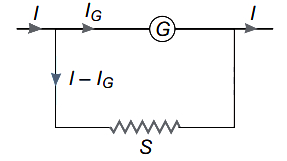
0 likes
View Solution339
MediumMCQ
Two tangent galvanometers $A$ and $B$ are identical except in their number of turns. They are connected in series. On passing a current through them,deflections of $60^{\circ}$ and $30^{\circ}$ are produced. The ratio of the number of turns in $A$ and $B$ is
A
$1: 3$
B
$3: 1$
C
$1: 2$
D
$2: 1$
Solution
(A) The principle of a tangent galvanometer is given by $I = K \tan \theta$,where $K = \frac{2rB_H}{\mu_0 N}$.
Since the galvanometers are identical except for the number of turns $N$ and are connected in series,the current $I$ flowing through them is the same.
Thus,$I = \frac{2rB_H}{\mu_0 N} \tan \theta$,which implies $N \tan \theta = \text{constant}$.
Therefore,$N_A \tan \theta_A = N_B \tan \theta_B$.
The ratio of the number of turns is $\frac{N_A}{N_B} = \frac{\tan \theta_B}{\tan \theta_A}$.
Given $\theta_A = 60^{\circ}$ and $\theta_B = 30^{\circ}$,we have $\frac{N_A}{N_B} = \frac{\tan 30^{\circ}}{\tan 60^{\circ}}$.
$\frac{N_A}{N_B} = \frac{1/\sqrt{3}}{\sqrt{3}} = \frac{1}{3}$.
Thus,the ratio is $1: 3$.
Since the galvanometers are identical except for the number of turns $N$ and are connected in series,the current $I$ flowing through them is the same.
Thus,$I = \frac{2rB_H}{\mu_0 N} \tan \theta$,which implies $N \tan \theta = \text{constant}$.
Therefore,$N_A \tan \theta_A = N_B \tan \theta_B$.
The ratio of the number of turns is $\frac{N_A}{N_B} = \frac{\tan \theta_B}{\tan \theta_A}$.
Given $\theta_A = 60^{\circ}$ and $\theta_B = 30^{\circ}$,we have $\frac{N_A}{N_B} = \frac{\tan 30^{\circ}}{\tan 60^{\circ}}$.
$\frac{N_A}{N_B} = \frac{1/\sqrt{3}}{\sqrt{3}} = \frac{1}{3}$.
Thus,the ratio is $1: 3$.
0 likes
View Solution340
EasyMCQ
$A$ certain current passing through a galvanometer produces a deflection of $100$ divisions. When a shunt of $1 \ \Omega$ is connected, the deflection reduces to $1$ division. The galvanometer resistance is: (in $\Omega$)
A
$100$
B
$99$
C
$10$
D
$9.9$
Solution
(B) Let the initial current be $I$ and the galvanometer resistance be $G$. The deflection is proportional to the current, so $I = k \times 100$, where $k$ is a constant.
When a shunt $S = 1 \ \Omega$ is connected in parallel, the new current through the galvanometer $I_g$ is given by the current divider rule: $I_g = I \left( \frac{S}{S+G} \right)$.
The new deflection is $1$ division, so $I_g = k \times 1$.
Substituting the values: $k = (k \times 100) \left( \frac{1}{1+G} \right)$.
Dividing both sides by $k$: $1 = \frac{100}{1+G}$.
$1+G = 100$.
$G = 99 \ \Omega$.
When a shunt $S = 1 \ \Omega$ is connected in parallel, the new current through the galvanometer $I_g$ is given by the current divider rule: $I_g = I \left( \frac{S}{S+G} \right)$.
The new deflection is $1$ division, so $I_g = k \times 1$.
Substituting the values: $k = (k \times 100) \left( \frac{1}{1+G} \right)$.
Dividing both sides by $k$: $1 = \frac{100}{1+G}$.
$1+G = 100$.
$G = 99 \ \Omega$.
0 likes
View Solution341
MediumMCQ
In an experiment to determine the figure of merit of a galvanometer by the half-deflection method,a student constructed the following circuit. He unplugged a resistance of $5200 \ \Omega$ in $R$. When $K_1$ is closed and $K_2$ is open,the deflection observed in the galvanometer is $26 \ \text{div}$. When $K_2$ is also closed and a resistance of $90 \ \Omega$ is removed in $S$,the deflection becomes $13 \ \text{div}$. The resistance of the galvanometer is nearly: (in $Omega$)
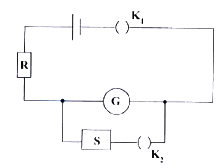
A
$45.0$
B
$103.0$
C
$91.6$
D
$116.0$
Solution
(C) In the half-deflection method,the resistance of the galvanometer $G$ is given by the formula:
$G = \frac{S \cdot R}{R - S}$
Given:
Resistance in series $R = 5200 \ \Omega$
Shunt resistance $S = 90 \ \Omega$
Initial deflection $\theta = 26 \ \text{div}$
Final deflection $\theta' = \theta/2 = 13 \ \text{div}$
Substituting the values:
$G = \frac{90 \times 5200}{5200 - 90}$
$G = \frac{468000}{5110}$
$G \approx 91.58 \ \Omega$
Rounding to the nearest option,$G \approx 91.6 \ \Omega$.
$G = \frac{S \cdot R}{R - S}$
Given:
Resistance in series $R = 5200 \ \Omega$
Shunt resistance $S = 90 \ \Omega$
Initial deflection $\theta = 26 \ \text{div}$
Final deflection $\theta' = \theta/2 = 13 \ \text{div}$
Substituting the values:
$G = \frac{90 \times 5200}{5200 - 90}$
$G = \frac{468000}{5110}$
$G \approx 91.58 \ \Omega$
Rounding to the nearest option,$G \approx 91.6 \ \Omega$.
0 likes
View Solution342
MediumMCQ
$A$ galvanometer of resistance $50 \Omega$ gives a full-scale deflection for a current of $5 \times 10^{-4} \text{ A}$. The resistance that should be connected in series with the galvanometer to read $3 \text{ V}$ is: (in $Omega$)
A
$595$
B
$5050$
C
$5059$
D
$5950$
Solution
(D) Given: Resistance of galvanometer $G = 50 \Omega$,full-scale deflection current $I_g = 5 \times 10^{-4} \text{ A}$,and target voltage $V = 3 \text{ V}$.
To convert a galvanometer into a voltmeter,a high resistance $R$ must be connected in series with it.
The formula for the total resistance is $V = I_g(R + G)$.
Rearranging for $R$: $R = \frac{V}{I_g} - G$.
Substituting the values: $R = \frac{3}{5 \times 10^{-4}} - 50$.
$R = 0.6 \times 10^4 - 50 = 6000 - 50 = 5950 \Omega$.
Thus,the required resistance is $5950 \Omega$.
To convert a galvanometer into a voltmeter,a high resistance $R$ must be connected in series with it.
The formula for the total resistance is $V = I_g(R + G)$.
Rearranging for $R$: $R = \frac{V}{I_g} - G$.
Substituting the values: $R = \frac{3}{5 \times 10^{-4}} - 50$.
$R = 0.6 \times 10^4 - 50 = 6000 - 50 = 5950 \Omega$.
Thus,the required resistance is $5950 \Omega$.
0 likes
View Solution343
MediumMCQ
$A$ moving coil galvanometer is converted into an ammeter of range $0$ to $5 \, mA$. The galvanometer resistance is $90 \, \Omega$ and the shunt resistance has a value of $10 \, \Omega$. If there are $50$ divisions in the galvanometer-turned-ammeter on either side of zero, its current sensitivity is
A
$2 \times 10^4 \, div/A$
B
$1 \times 10^5 \, A/div$
C
$2 \times 10^4 \, A/div$
D
$1 \times 10^5 \, div/A$
Solution
(D) Given: Shunt resistance $S = 10 \, \Omega$, Galvanometer resistance $G = 90 \, \Omega$, Total range $i = 5 \, mA = 5 \times 10^{-3} \, A$.
The number of divisions on one side of zero is $50$.
The current $i_g$ flowing through the galvanometer at full-scale deflection is given by the shunt formula: $i_g = \frac{S}{S+G} \times i$.
$i_g = \left( \frac{10}{10+90} \right) \times (5 \times 10^{-3} \, A) = \left( \frac{10}{100} \right) \times 5 \times 10^{-3} \, A = 0.1 \times 5 \times 10^{-3} \, A = 5 \times 10^{-4} \, A$.
Current sensitivity is defined as the number of divisions per unit current: $\text{Sensitivity} = \frac{\text{Number of divisions}}{i_g}$.
$\text{Sensitivity} = \frac{50}{5 \times 10^{-4} \, A} = 10 \times 10^4 \, div/A = 1 \times 10^5 \, div/A$.
The number of divisions on one side of zero is $50$.
The current $i_g$ flowing through the galvanometer at full-scale deflection is given by the shunt formula: $i_g = \frac{S}{S+G} \times i$.
$i_g = \left( \frac{10}{10+90} \right) \times (5 \times 10^{-3} \, A) = \left( \frac{10}{100} \right) \times 5 \times 10^{-3} \, A = 0.1 \times 5 \times 10^{-3} \, A = 5 \times 10^{-4} \, A$.
Current sensitivity is defined as the number of divisions per unit current: $\text{Sensitivity} = \frac{\text{Number of divisions}}{i_g}$.
$\text{Sensitivity} = \frac{50}{5 \times 10^{-4} \, A} = 10 \times 10^4 \, div/A = 1 \times 10^5 \, div/A$.
0 likes
View Solution344
EasyMCQ
The deflection in a moving coil galvanometer is reduced to half when it is shunted with a $40 \Omega$ coil. The resistance of the galvanometer is (in $Omega$)
A
$80$
B
$40$
C
$20$
D
$15$
Solution
(B) Let $G$ be the resistance of the galvanometer and $I$ be the total current.
When the galvanometer is shunted with a resistance $S = 40 \Omega$,the current flowing through the galvanometer $I_G$ is given by the current divider rule:
$I_G = I \left( \frac{S}{G + S} \right)$
Given that the deflection is reduced to half,the current through the galvanometer becomes half of the total current,i.e.,$I_G = \frac{I}{2}$.
Substituting this into the equation:
$\frac{I}{2} = I \left( \frac{40}{G + 40} \right)$
$\frac{1}{2} = \frac{40}{G + 40}$
$G + 40 = 80$
$G = 40 \Omega$
Therefore,the resistance of the galvanometer is $40 \Omega$.
When the galvanometer is shunted with a resistance $S = 40 \Omega$,the current flowing through the galvanometer $I_G$ is given by the current divider rule:
$I_G = I \left( \frac{S}{G + S} \right)$
Given that the deflection is reduced to half,the current through the galvanometer becomes half of the total current,i.e.,$I_G = \frac{I}{2}$.
Substituting this into the equation:
$\frac{I}{2} = I \left( \frac{40}{G + 40} \right)$
$\frac{1}{2} = \frac{40}{G + 40}$
$G + 40 = 80$
$G = 40 \Omega$
Therefore,the resistance of the galvanometer is $40 \Omega$.
0 likes
View Solution345
EasyMCQ
$A$ galvanometer of resistance $50 \Omega$ is connected to a battery of $3 \text{ V}$ along with a resistance of $2950 \Omega$ in series,showing a full-scale deflection of $30$ divisions. The additional series resistance required to reduce the deflection to $20$ divisions is: (in $Omega$)
A
$1500$
B
$4440$
C
$7400$
D
$2950$
Solution
(A) Given: Galvanometer resistance $R_G = 50 \Omega$,battery voltage $V = 3 \text{ V}$,initial series resistance $R_1 = 2950 \Omega$,initial deflection $\theta_1 = 30$ divisions.
First,calculate the current $I_1$ for $30$ divisions:
$I_1 = \frac{V}{R_G + R_1} = \frac{3}{50 + 2950} = \frac{3}{3000} = 10^{-3} \text{ A}$.
The current per division is $k = \frac{I_1}{30} = \frac{10^{-3}}{30} \text{ A/division}$.
For a deflection of $\theta_2 = 20$ divisions,the required current $I_2$ is:
$I_2 = 20 \times k = 20 \times \frac{10^{-3}}{30} = \frac{2}{3} \times 10^{-3} \text{ A}$.
Let the total resistance in the circuit be $R_{total} = R_G + R_{new}$.
Using Ohm's law: $I_2 = \frac{V}{R_{total}} \Rightarrow \frac{2}{3} \times 10^{-3} = \frac{3}{50 + R_{new}}$.
$50 + R_{new} = \frac{3 \times 3}{2 \times 10^{-3}} = 4.5 \times 1000 = 4500 \Omega$.
$R_{new} = 4500 - 50 = 4450 \Omega$.
The additional resistance required is $R_{add} = R_{new} - R_1 = 4450 - 2950 = 1500 \Omega$.
First,calculate the current $I_1$ for $30$ divisions:
$I_1 = \frac{V}{R_G + R_1} = \frac{3}{50 + 2950} = \frac{3}{3000} = 10^{-3} \text{ A}$.
The current per division is $k = \frac{I_1}{30} = \frac{10^{-3}}{30} \text{ A/division}$.
For a deflection of $\theta_2 = 20$ divisions,the required current $I_2$ is:
$I_2 = 20 \times k = 20 \times \frac{10^{-3}}{30} = \frac{2}{3} \times 10^{-3} \text{ A}$.
Let the total resistance in the circuit be $R_{total} = R_G + R_{new}$.
Using Ohm's law: $I_2 = \frac{V}{R_{total}} \Rightarrow \frac{2}{3} \times 10^{-3} = \frac{3}{50 + R_{new}}$.
$50 + R_{new} = \frac{3 \times 3}{2 \times 10^{-3}} = 4.5 \times 1000 = 4500 \Omega$.
$R_{new} = 4500 - 50 = 4450 \Omega$.
The additional resistance required is $R_{add} = R_{new} - R_1 = 4450 - 2950 = 1500 \Omega$.
0 likes
View Solution346
MediumMCQ
$A$ maximum current of $0.5 \ mA$ can pass through a galvanometer of resistance $15 \ \Omega$. The resistance to be connected in series to the galvanometer to convert it into a voltmeter of range $0-10 \ V$ is (in $Omega$)
A
$9985$
B
$20015$
C
$20000$
D
$19985$
Solution
(D) To convert a galvanometer into a voltmeter,a high resistance $R$ must be connected in series with the galvanometer.
Given:
Galvanometer resistance,$G = 15 \ \Omega$
Full-scale deflection current,$I_g = 0.5 \ mA = 0.5 \times 10^{-3} \ A = 5 \times 10^{-4} \ A$
Required voltage range,$V = 10 \ V$
The formula for the series resistance $R$ is given by:
$V = I_g(R + G)$
$R + G = \frac{V}{I_g}$
$R = \frac{V}{I_g} - G$
Substituting the values:
$R = \frac{10}{5 \times 10^{-4}} - 15$
$R = 2 \times 10^4 - 15$
$R = 20000 - 15 = 19985 \ \Omega$
Therefore,the required resistance is $19985 \ \Omega$.
Given:
Galvanometer resistance,$G = 15 \ \Omega$
Full-scale deflection current,$I_g = 0.5 \ mA = 0.5 \times 10^{-3} \ A = 5 \times 10^{-4} \ A$
Required voltage range,$V = 10 \ V$
The formula for the series resistance $R$ is given by:
$V = I_g(R + G)$
$R + G = \frac{V}{I_g}$
$R = \frac{V}{I_g} - G$
Substituting the values:
$R = \frac{10}{5 \times 10^{-4}} - 15$
$R = 2 \times 10^4 - 15$
$R = 20000 - 15 = 19985 \ \Omega$
Therefore,the required resistance is $19985 \ \Omega$.
0 likes
View Solution347
MediumMCQ
$A$ galvanometer having $30$ divisions has a current sensitivity of $0.0625 \frac{\text{div}}{\mu A}$. If it is converted into a voltmeter to read a maximum of $6 \text{ V}$,then the resistance of that voltmeter is:
A
$7.5 \text{ k}\Omega$
B
$12.5 \text{ k}\Omega$
C
$6 \text{ k}\Omega$
D
$5 \text{ k}\Omega$
Solution
(B) $1$. First,calculate the full-scale deflection current $(I_g)$ of the galvanometer.
$I_g = \frac{\text{Total divisions}}{\text{Current sensitivity}} = \frac{30 \text{ div}}{0.0625 \text{ div}/\mu A} = 480 \mu A = 480 \times 10^{-6} \text{ A} = 4.8 \times 10^{-4} \text{ A}$.
$2$. $A$ voltmeter is formed by connecting a high resistance $(R)$ in series with the galvanometer.
$3$. The total resistance of the voltmeter $(R_v)$ is given by the formula $V = I_g \times R_v$,where $V$ is the maximum voltage to be measured.
$4$. Rearranging for $R_v$: $R_v = \frac{V}{I_g} = \frac{6 \text{ V}}{4.8 \times 10^{-4} \text{ A}}$.
$5$. $R_v = \frac{6}{4.8} \times 10^4 \Omega = 1.25 \times 10^4 \Omega = 12.5 \text{ k}\Omega$.
$I_g = \frac{\text{Total divisions}}{\text{Current sensitivity}} = \frac{30 \text{ div}}{0.0625 \text{ div}/\mu A} = 480 \mu A = 480 \times 10^{-6} \text{ A} = 4.8 \times 10^{-4} \text{ A}$.
$2$. $A$ voltmeter is formed by connecting a high resistance $(R)$ in series with the galvanometer.
$3$. The total resistance of the voltmeter $(R_v)$ is given by the formula $V = I_g \times R_v$,where $V$ is the maximum voltage to be measured.
$4$. Rearranging for $R_v$: $R_v = \frac{V}{I_g} = \frac{6 \text{ V}}{4.8 \times 10^{-4} \text{ A}}$.
$5$. $R_v = \frac{6}{4.8} \times 10^4 \Omega = 1.25 \times 10^4 \Omega = 12.5 \text{ k}\Omega$.
0 likes
View Solution348
MediumMCQ
The value of shunt resistance,that allows only $10 \%$ of the main current to pass through a galvanometer of resistance $99 \Omega$,is (in $Omega$)
A
$9$
B
$4$
C
$2$
D
$11$
Solution
(D) Given: Resistance of galvanometer $G = 99 \Omega$.
Let the main current be $I$.
The current through the galvanometer is $I_g = 10 \% \text{ of } I = \frac{I}{10}$.
The current through the shunt resistance $S$ is $I_s = I - I_g = I - \frac{I}{10} = \frac{9I}{10}$.
Since the galvanometer and shunt are in parallel,the potential difference across them is equal:
$I_g \cdot G = I_s \cdot S$
$\frac{I}{10} \cdot 99 = \frac{9I}{10} \cdot S$
$99 = 9S$
$S = \frac{99}{9} = 11 \Omega$.
Thus,the required shunt resistance is $11 \Omega$.
Let the main current be $I$.
The current through the galvanometer is $I_g = 10 \% \text{ of } I = \frac{I}{10}$.
The current through the shunt resistance $S$ is $I_s = I - I_g = I - \frac{I}{10} = \frac{9I}{10}$.
Since the galvanometer and shunt are in parallel,the potential difference across them is equal:
$I_g \cdot G = I_s \cdot S$
$\frac{I}{10} \cdot 99 = \frac{9I}{10} \cdot S$
$99 = 9S$
$S = \frac{99}{9} = 11 \Omega$.
Thus,the required shunt resistance is $11 \Omega$.
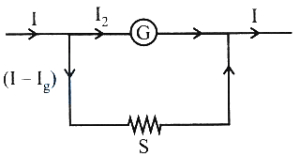
0 likes
View Solution349
DifficultMCQ
Current sensitivities of two galvanometers $G_1$ and $G_2$ of resistances $100 \ \Omega$ and $50 \ \Omega$ are $10^8 \ \text{div/A}$ and $0.5 \times 10^5 \ \text{div/A}$ respectively. The galvanometer in which the voltage sensitivity is more is
A
Same in both galvanometers
B
More in $G_2$
C
Zero
D
More in $G_1$
Solution
(D) The voltage sensitivity $(V_S)$ of a galvanometer is related to its current sensitivity $(I_S)$ and resistance $(R)$ by the formula: $V_S = \frac{I_S}{R}$.
For galvanometer $G_1$: Resistance $R_1 = 100 \ \Omega$,Current sensitivity $I_{S1} = 10^8 \ \text{div/A}$.
$V_{S1} = \frac{10^8}{100} = 10^6 \ \text{div/V}$.
For galvanometer $G_2$: Resistance $R_2 = 50 \ \Omega$,Current sensitivity $I_{S2} = 0.5 \times 10^5 \ \text{div/A}$.
$V_{S2} = \frac{0.5 \times 10^5}{50} = \frac{50000}{50} = 1000 = 10^3 \ \text{div/V}$.
Comparing the two,$V_{S1} = 10^6 \ \text{div/V}$ and $V_{S2} = 10^3 \ \text{div/V}$.
Since $10^6 > 10^3$,the voltage sensitivity is higher in $G_1$.
For galvanometer $G_1$: Resistance $R_1 = 100 \ \Omega$,Current sensitivity $I_{S1} = 10^8 \ \text{div/A}$.
$V_{S1} = \frac{10^8}{100} = 10^6 \ \text{div/V}$.
For galvanometer $G_2$: Resistance $R_2 = 50 \ \Omega$,Current sensitivity $I_{S2} = 0.5 \times 10^5 \ \text{div/A}$.
$V_{S2} = \frac{0.5 \times 10^5}{50} = \frac{50000}{50} = 1000 = 10^3 \ \text{div/V}$.
Comparing the two,$V_{S1} = 10^6 \ \text{div/V}$ and $V_{S2} = 10^3 \ \text{div/V}$.
Since $10^6 > 10^3$,the voltage sensitivity is higher in $G_1$.
0 likes
View SolutionMoving Charges and Magnetism — The Moving Coil Galvanometer (Sensitivity) and Ammeter and Voltmeter Conversion · Frequently Asked Questions
1Are these Moving Charges and Magnetism questions useful for JEE and NEET?
Yes. All questions in this section are mapped to JEE Main and NEET exam patterns. Previous year questions from JEE Main, NEET, GUJCET and state-level exams are included with full solutions.
2Can I switch to Hindi or Gujarati for these questions?
Yes. Use the language tabs in the hero section or the sidebar to view the same questions and solutions in English, Hindi or Gujarati.
3How do I generate a question paper from this subtopic?
Use the Vedclass Exam Paper Generator — select the chapter and subtopic, set difficulty, and generate Sets A, B, C, D automatically. First 3 chapters of every subject are free.
Vedclass Products
For Students
Vedclass Test Series
Mock tests in real JEE/NEET style with performance analysis. 5-day free trial.
Start Free TrialFor Teachers
Exam Paper Generator
Generate Set A/B/C/D papers from this chapter in 2 minutes. 3 chapters free.
Try FreeFor Institutes
Online Exam Module
Live online exams with unlimited students, 360° analytics & white-label branding.
See DemoFor Teachers & Institutes
Generate a Moving Charges and Magnetism Exam Paper in 2 Minutes
Select subtopic & difficulty — Sets A, B, C, D auto-generated with No Repeat logic.
First 3 chapters of every subject are free — no payment required.