
A English
Faraday's and Lenz's Law Questions in English
Class 12 Physics · Electromagnetic Induction · Faraday's and Lenz's Law
310+
Questions
English
Language
100%
With Solutions
Showing 49 of 310 questions in English
51
MediumMCQ
If a coil of $40$ turns and area $4.0 \, cm^2$ is suddenly removed from a magnetic field,it is observed that a charge of $2.0 \times 10^{-4} \, C$ flows through the coil. If the resistance of the coil is $80 \, \Omega$,the magnetic flux density in $Wb/m^2$ is:
A
$0.5$
B
$1$
C
$1.5$
D
$2$
Solution
(B) The induced charge $Q$ flowing through a circuit is given by the formula: $Q = \frac{\Delta \phi}{R}$.
Here,$\Delta \phi = N \cdot B \cdot A$,where $N$ is the number of turns,$B$ is the magnetic flux density,and $A$ is the area.
Given: $N = 40$,$A = 4.0 \, cm^2 = 4.0 \times 10^{-4} \, m^2$,$Q = 2.0 \times 10^{-4} \, C$,and $R = 80 \, \Omega$.
Substituting these values into the formula: $2.0 \times 10^{-4} = \frac{40 \times B \times 4.0 \times 10^{-4}}{80}$.
Solving for $B$: $B = \frac{2.0 \times 10^{-4} \times 80}{40 \times 4.0 \times 10^{-4}}$.
$B = \frac{160 \times 10^{-4}}{160 \times 10^{-4}} = 1 \, Wb/m^2$.
Here,$\Delta \phi = N \cdot B \cdot A$,where $N$ is the number of turns,$B$ is the magnetic flux density,and $A$ is the area.
Given: $N = 40$,$A = 4.0 \, cm^2 = 4.0 \times 10^{-4} \, m^2$,$Q = 2.0 \times 10^{-4} \, C$,and $R = 80 \, \Omega$.
Substituting these values into the formula: $2.0 \times 10^{-4} = \frac{40 \times B \times 4.0 \times 10^{-4}}{80}$.
Solving for $B$: $B = \frac{2.0 \times 10^{-4} \times 80}{40 \times 4.0 \times 10^{-4}}$.
$B = \frac{160 \times 10^{-4}}{160 \times 10^{-4}} = 1 \, Wb/m^2$.
0 likes
View Solution52
EasyMCQ
$A$ conducting square loop of side $L$ and resistance $R$ moves in its plane with a uniform velocity $v$ perpendicular to one of its sides. $A$ magnetic induction $B$ constant in time and space,pointing perpendicular and into the plane of the loop exists everywhere. The current induced in the loop is
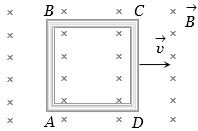
A
$\frac{BLv}{R}$ clockwise
B
$\frac{BLv}{R}$ anticlockwise
C
$\frac{2BLv}{R}$ anticlockwise
D
Zero
Solution
(D) The magnetic flux $\phi$ linked with the loop is given by $\phi = B \cdot A$,where $A = L^2$ is the area of the square loop.
Since the magnetic field $B$ is uniform in time and space,and the loop moves within this field,the area $A$ enclosed by the loop remains constant.
According to Faraday's law of electromagnetic induction,the induced electromotive force $(EMF)$ is given by $\varepsilon = -\frac{d\phi}{dt}$.
Since $\phi = B \cdot L^2$ is constant,$\frac{d\phi}{dt} = 0$.
Therefore,the induced $EMF$ $\varepsilon = 0$.
Consequently,the induced current $I = \frac{\varepsilon}{R} = 0$.
Since the magnetic field $B$ is uniform in time and space,and the loop moves within this field,the area $A$ enclosed by the loop remains constant.
According to Faraday's law of electromagnetic induction,the induced electromotive force $(EMF)$ is given by $\varepsilon = -\frac{d\phi}{dt}$.
Since $\phi = B \cdot L^2$ is constant,$\frac{d\phi}{dt} = 0$.
Therefore,the induced $EMF$ $\varepsilon = 0$.
Consequently,the induced current $I = \frac{\varepsilon}{R} = 0$.
0 likes
View Solution53
EasyMCQ
The working of a dynamo is based on the principle of
A
Electromagnetic induction
B
Conversion of energy into electricity
C
Magnetic effects of current
D
Heating effects of current
Solution
(A) The working of a dynamo is based on the principle of electromagnetic induction.
When a coil is rotated in a magnetic field,the magnetic flux linked with the coil changes continuously.
According to Faraday's law of electromagnetic induction,this change in magnetic flux induces an electromotive force $(EMF)$ and consequently an induced current in the coil.
Therefore,the correct option is $A$.
When a coil is rotated in a magnetic field,the magnetic flux linked with the coil changes continuously.
According to Faraday's law of electromagnetic induction,this change in magnetic flux induces an electromotive force $(EMF)$ and consequently an induced current in the coil.
Therefore,the correct option is $A$.
0 likes
View Solution54
EasyMCQ
The coil of a dynamo is rotating in a magnetic field. The developed induced $e.m.f.$ changes and the number of magnetic lines of force also changes. Which of the following conditions is correct?
A
Lines of force are minimum but induced $e.m.f.$ is zero.
B
Lines of force are maximum but induced $e.m.f.$ is zero.
C
Lines of force are maximum but induced $e.m.f.$ is not zero.
D
Lines of force are maximum but induced $e.m.f.$ is also maximum.
Solution
(B) According to Faraday's law of electromagnetic induction,the induced $e.m.f.$ $(e)$ is given by $e = -\frac{d\phi}{dt}$,where $\phi$ is the magnetic flux (number of magnetic lines of force).
When the coil is rotating,the magnetic flux $\phi$ varies as $\phi = BA \cos(\omega t)$.
The induced $e.m.f.$ is $e = -\frac{d}{dt}(BA \cos(\omega t)) = BA\omega \sin(\omega t)$.
When the number of magnetic lines of force is maximum,$\phi$ is maximum,which occurs when $\cos(\omega t) = 1$ (i.e.,$\omega t = 0$ or $\pi$).
At these positions,$\sin(\omega t) = 0$,so the induced $e.m.f.$ $(e)$ becomes zero.
Therefore,when the lines of force are maximum,the induced $e.m.f.$ is zero.
When the coil is rotating,the magnetic flux $\phi$ varies as $\phi = BA \cos(\omega t)$.
The induced $e.m.f.$ is $e = -\frac{d}{dt}(BA \cos(\omega t)) = BA\omega \sin(\omega t)$.
When the number of magnetic lines of force is maximum,$\phi$ is maximum,which occurs when $\cos(\omega t) = 1$ (i.e.,$\omega t = 0$ or $\pi$).
At these positions,$\sin(\omega t) = 0$,so the induced $e.m.f.$ $(e)$ becomes zero.
Therefore,when the lines of force are maximum,the induced $e.m.f.$ is zero.
0 likes
View Solution55
EasyMCQ
Two identical circular loops of metal wire are lying on a table without touching each other. $Loop-A$ carries a current which increases with time. In response,the $loop-B$
A
Remains stationary
B
Is attracted by the $loop-A$
C
Is repelled by the $loop-A$
D
Rotates about its $CM$,with $CM$ fixed ($CM$ is the centre of mass)
Solution
(C) According to Faraday's law of electromagnetic induction,a changing current in $Loop-A$ creates a changing magnetic flux through $Loop-B$.
According to Lenz's law,the induced current in $Loop-B$ will flow in such a direction as to oppose the cause producing it.
Since the current in $Loop-A$ is increasing,the magnetic flux through $Loop-B$ is increasing.
To oppose this increase,$Loop-B$ will develop an induced current that creates a magnetic field opposing the field of $Loop-A$.
Two parallel loops with currents flowing in opposite directions repel each other.
Therefore,$Loop-B$ is repelled by $Loop-A$.
According to Lenz's law,the induced current in $Loop-B$ will flow in such a direction as to oppose the cause producing it.
Since the current in $Loop-A$ is increasing,the magnetic flux through $Loop-B$ is increasing.
To oppose this increase,$Loop-B$ will develop an induced current that creates a magnetic field opposing the field of $Loop-A$.
Two parallel loops with currents flowing in opposite directions repel each other.
Therefore,$Loop-B$ is repelled by $Loop-A$.
0 likes
View Solution56
MediumMCQ
$A$ physicist works in a laboratory where the magnetic field is $2 \, T$. She wears a necklace enclosing an area of $0.01 \, m^2$ in such a way that the plane of the necklace is normal to the field,and it has a resistance $R = 0.01 \, \Omega$. Because of a power failure,the magnetic field decays to $1 \, T$ in $10^{-3} \, s$. What is the total heat produced in her necklace in Joules?
A
$10$
B
$20$
C
$30$
D
$40$
Solution
(A) The magnetic flux $\phi$ is given by $\phi = B A \cos \theta$. Since the plane is normal to the field,$\theta = 0^\circ$ and $\cos 0^\circ = 1$.
Change in magnetic flux $\Delta \phi = (B_2 - B_1) A = (1 - 2) \times 0.01 = -0.01 \, Wb$.
The induced electromotive force $(EMF)$ is given by Faraday's Law: $|\varepsilon| = |\frac{\Delta \phi}{\Delta t}| = \frac{0.01}{10^{-3}} = 10 \, V$.
The heat produced $H$ is given by the formula $H = \frac{\varepsilon^2 \Delta t}{R}$.
Substituting the values: $H = \frac{(10)^2 \times 10^{-3}}{0.01} = \frac{100 \times 10^{-3}}{0.01} = \frac{0.1}{0.01} = 10 \, J$.
Change in magnetic flux $\Delta \phi = (B_2 - B_1) A = (1 - 2) \times 0.01 = -0.01 \, Wb$.
The induced electromotive force $(EMF)$ is given by Faraday's Law: $|\varepsilon| = |\frac{\Delta \phi}{\Delta t}| = \frac{0.01}{10^{-3}} = 10 \, V$.
The heat produced $H$ is given by the formula $H = \frac{\varepsilon^2 \Delta t}{R}$.
Substituting the values: $H = \frac{(10)^2 \times 10^{-3}}{0.01} = \frac{100 \times 10^{-3}}{0.01} = \frac{0.1}{0.01} = 10 \, J$.
0 likes
View Solution57
EasyMCQ
Two identical coaxial circular loops carry current $i$ each circulating in the clockwise direction. If the loops are approaching each other,then
A
Current in each loop increases
B
Current in each loop remains the same
C
Current in each loop decreases
D
Current in one-loop increases and in the other it decreases
Solution
(C) According to Lenz's Law,the induced current in a loop opposes the change in magnetic flux that produces it.
When two identical coaxial loops carrying current in the same direction approach each other,the magnetic flux through each loop increases due to the magnetic field of the other loop.
To oppose this increase in magnetic flux,an induced current is generated in each loop in a direction opposite to the original current.
Since the original current is in the clockwise direction,the induced current will be in the counter-clockwise direction.
Therefore,the net current in each loop decreases.
When two identical coaxial loops carrying current in the same direction approach each other,the magnetic flux through each loop increases due to the magnetic field of the other loop.
To oppose this increase in magnetic flux,an induced current is generated in each loop in a direction opposite to the original current.
Since the original current is in the clockwise direction,the induced current will be in the counter-clockwise direction.
Therefore,the net current in each loop decreases.
0 likes
View Solution58
MediumMCQ
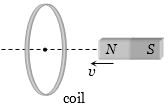
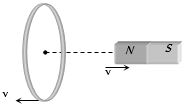
In the following figure, the magnet is moved towards the coil with a speed $v$ and the induced emf is $e$. If the magnet and the coil recede away from one another, each moving with a speed $v$, the induced emf in the coil will be
A
$e$
B
$2e$
C
$e/2$
D
$4e$
Solution
(B) According to Faraday's law of electromagnetic induction, the induced emf $e$ is proportional to the rate of change of magnetic flux, which depends on the relative velocity between the magnet and the coil.
In the first case, the magnet moves towards the stationary coil with speed $v$. The relative velocity is $v_{rel} = v$. The induced emf is $e = k \cdot v$, where $k$ is a constant.
In the second case, the magnet and the coil move away from each other, each with speed $v$. The relative velocity between them is $v'_{rel} = v - (-v) = 2v$.
Since the induced emf is directly proportional to the relative velocity, the new induced emf $e'$ will be:
$e' = k \cdot (2v) = 2(k \cdot v) = 2e$.
Therefore, the induced emf in the coil will be $2e$.
In the first case, the magnet moves towards the stationary coil with speed $v$. The relative velocity is $v_{rel} = v$. The induced emf is $e = k \cdot v$, where $k$ is a constant.
In the second case, the magnet and the coil move away from each other, each with speed $v$. The relative velocity between them is $v'_{rel} = v - (-v) = 2v$.
Since the induced emf is directly proportional to the relative velocity, the new induced emf $e'$ will be:
$e' = k \cdot (2v) = 2(k \cdot v) = 2e$.
Therefore, the induced emf in the coil will be $2e$.
0 likes
View Solution59
EasyMCQ
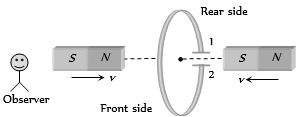
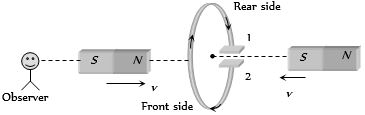
The north and south poles of two identical magnets approach a coil,containing a condenser,with equal speeds from opposite sides. Then
A
Plate $1$ will be negative and plate $2$ positive
B
Plate $1$ will be positive and plate $2$ negative
C
Both the plates will be positive
D
Both the plates will be negative
Solution
(B) According to Lenz's Law,the induced current in the coil will oppose the cause of its production.
As the $N$-pole of the left magnet approaches the coil from the front,the front face of the coil will behave like an $N$-pole to repel it. This requires an anticlockwise current when viewed from the front.
Similarly,as the $S$-pole of the right magnet approaches from the rear,the rear face of the coil will behave like an $S$-pole to repel it. This also requires an anticlockwise current when viewed from the front.
Since both magnets contribute to an anticlockwise current (viewed from the front),the current flows from plate $2$ to plate $1$ through the coil.
Therefore,plate $1$ becomes positively charged and plate $2$ becomes negatively charged.
As the $N$-pole of the left magnet approaches the coil from the front,the front face of the coil will behave like an $N$-pole to repel it. This requires an anticlockwise current when viewed from the front.
Similarly,as the $S$-pole of the right magnet approaches from the rear,the rear face of the coil will behave like an $S$-pole to repel it. This also requires an anticlockwise current when viewed from the front.
Since both magnets contribute to an anticlockwise current (viewed from the front),the current flows from plate $2$ to plate $1$ through the coil.
Therefore,plate $1$ becomes positively charged and plate $2$ becomes negatively charged.
0 likes
View Solution60
MediumMCQ
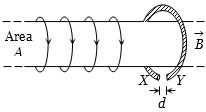
$A$ highly conducting ring of radius $R$ is perpendicular to and concentric with the axis of a long solenoid as shown in the figure. The ring has a narrow gap of width $d$ in its circumference. The solenoid has a cross-sectional area $A$ and a uniform internal magnetic field of magnitude $B_0$. Starting at $t = 0$,the solenoid current is steadily increased such that the field magnitude at any time $t$ is given by $B(t) = B_0 + \alpha t$,where $\alpha > 0$. Assuming that no charge can flow across the gap,the end of the ring which has an excess of positive charge and the magnitude of the induced e.m.f. in the ring are respectively:
A
$X, A \alpha$
B
$X, \pi R^2 \alpha$
C
$Y, A \alpha$
D
$Y, \pi R^2 \alpha$
Solution
(A) According to Faraday's law of electromagnetic induction,the induced e.m.f. is given by $|e| = |\frac{d\phi}{dt}|$,where $\phi = B \cdot A$.
Since the magnetic field $B(t) = B_0 + \alpha t$ is uniform over the area $A$ of the solenoid,the magnetic flux linked with the ring is $\phi = B(t) \cdot A = (B_0 + \alpha t)A$.
The magnitude of the induced e.m.f. is $|e| = |\frac{d}{dt}((B_0 + \alpha t)A)| = A \frac{d}{dt}(B_0 + \alpha t) = A \alpha$.
According to Lenz's law,the induced current (if the circuit were closed) would oppose the increase in magnetic flux. Since the magnetic field is directed towards the right and increasing,the induced magnetic field must be directed towards the left. By the right-hand rule,the induced current would flow in an anticlockwise direction (as viewed from the right).
In an anticlockwise current flow,positive charges accumulate at the end $X$ and negative charges at the end $Y$. Thus,end $X$ has an excess of positive charge.
Since the magnetic field $B(t) = B_0 + \alpha t$ is uniform over the area $A$ of the solenoid,the magnetic flux linked with the ring is $\phi = B(t) \cdot A = (B_0 + \alpha t)A$.
The magnitude of the induced e.m.f. is $|e| = |\frac{d}{dt}((B_0 + \alpha t)A)| = A \frac{d}{dt}(B_0 + \alpha t) = A \alpha$.
According to Lenz's law,the induced current (if the circuit were closed) would oppose the increase in magnetic flux. Since the magnetic field is directed towards the right and increasing,the induced magnetic field must be directed towards the left. By the right-hand rule,the induced current would flow in an anticlockwise direction (as viewed from the right).
In an anticlockwise current flow,positive charges accumulate at the end $X$ and negative charges at the end $Y$. Thus,end $X$ has an excess of positive charge.
0 likes
View Solution61
MediumMCQ
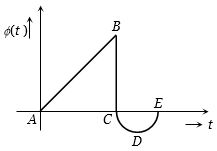
The graph shows the variation in magnetic flux $\phi(t)$ with time through a coil. Which of the statements given below is not correct?
A
There is a change in the direction as well as magnitude of the induced emf between $B$ and $D$.
B
The magnitude of the induced emf is maximum between $B$ and $C$.
C
There is a change in the direction as well as magnitude of induced emf between $A$ and $C$.
D
The induced emf is zero at $B$.
Solution
(B) According to Faraday's law of induction,the induced emf is given by $e = -\frac{d\phi}{dt}$. This means the induced emf is proportional to the slope of the $\phi-t$ graph.
$1$. Between $A$ and $B$,the slope is constant and positive,so the induced emf is constant and negative.
$2$. At point $B$,the flux changes abruptly from a positive value to zero. The slope $\frac{d\phi}{dt}$ is negative and very large (approaching infinity),so the induced emf is a large positive value.
$3$. Between $B$ and $C$,the slope is constant and negative,so the induced emf is constant and positive.
$4$. Between $C$ and $E$,the slope of the curve changes continuously,meaning the magnitude and direction of the induced emf change.
Evaluating the options:
- $(A)$ Between $B$ and $D$,the slope changes from a constant negative value to a varying value,so the magnitude and direction of emf change. This is correct.
- $(B)$ Between $B$ and $C$,the slope is constant,so the emf is constant,not maximum. This statement is incorrect.
- $(C)$ Between $A$ and $C$,the slope is constant,so the emf is constant. This statement is also incorrect as per the question's context,but $(B)$ is the most clearly false statement regarding the magnitude.
Wait,re-evaluating: The question asks for the statement that is $NOT$ correct.
- Option $(B)$ states emf is maximum between $B$ and $C$. Since the slope is constant,emf is constant. Thus,$(B)$ is incorrect.
- Option $(D)$ states emf is zero at $B$. At $B$,the derivative is undefined due to the sharp corner,but it is certainly not zero. Therefore,$(D)$ is also incorrect.
Given the standard interpretation of such problems,$(B)$ is the intended incorrect statement as the emf is constant,not maximum.
$1$. Between $A$ and $B$,the slope is constant and positive,so the induced emf is constant and negative.
$2$. At point $B$,the flux changes abruptly from a positive value to zero. The slope $\frac{d\phi}{dt}$ is negative and very large (approaching infinity),so the induced emf is a large positive value.
$3$. Between $B$ and $C$,the slope is constant and negative,so the induced emf is constant and positive.
$4$. Between $C$ and $E$,the slope of the curve changes continuously,meaning the magnitude and direction of the induced emf change.
Evaluating the options:
- $(A)$ Between $B$ and $D$,the slope changes from a constant negative value to a varying value,so the magnitude and direction of emf change. This is correct.
- $(B)$ Between $B$ and $C$,the slope is constant,so the emf is constant,not maximum. This statement is incorrect.
- $(C)$ Between $A$ and $C$,the slope is constant,so the emf is constant. This statement is also incorrect as per the question's context,but $(B)$ is the most clearly false statement regarding the magnitude.
Wait,re-evaluating: The question asks for the statement that is $NOT$ correct.
- Option $(B)$ states emf is maximum between $B$ and $C$. Since the slope is constant,emf is constant. Thus,$(B)$ is incorrect.
- Option $(D)$ states emf is zero at $B$. At $B$,the derivative is undefined due to the sharp corner,but it is certainly not zero. Therefore,$(D)$ is also incorrect.
Given the standard interpretation of such problems,$(B)$ is the intended incorrect statement as the emf is constant,not maximum.
0 likes
View Solution62
MediumMCQ
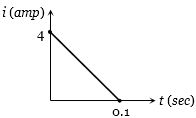
The magnetic flux through a coil of resistance $10\,\Omega$ changes. As a result,an induced current is developed in it,which varies with time as shown in the figure. The magnitude of the change in magnetic flux through the coil in webers is:
A
$2$
B
$4$
C
$6$
D
None of these
Solution
(A) The induced current $i$ is given by Faraday's law: $i = \frac{|e|}{R} = \frac{1}{R} \left| \frac{d\phi}{dt} \right|$.
Rearranging this,we get $|d\phi| = i R \, dt$.
The total change in magnetic flux $\Delta \phi$ is the integral of $i R \, dt$ over the time interval:
$\Delta \phi = R \int i \, dt$.
The integral $\int i \, dt$ represents the area under the $i-t$ graph.
From the given graph,the area is a triangle with base $t = 0.1 \, s$ and height $i = 4 \, A$.
Area $= \frac{1}{2} \times \text{base} \times \text{height} = \frac{1}{2} \times 0.1 \times 4 = 0.2 \, C$.
Therefore,the change in flux $\Delta \phi = R \times \text{Area} = 10 \times 0.2 = 2 \, Wb$.
Rearranging this,we get $|d\phi| = i R \, dt$.
The total change in magnetic flux $\Delta \phi$ is the integral of $i R \, dt$ over the time interval:
$\Delta \phi = R \int i \, dt$.
The integral $\int i \, dt$ represents the area under the $i-t$ graph.
From the given graph,the area is a triangle with base $t = 0.1 \, s$ and height $i = 4 \, A$.
Area $= \frac{1}{2} \times \text{base} \times \text{height} = \frac{1}{2} \times 0.1 \times 4 = 0.2 \, C$.
Therefore,the change in flux $\Delta \phi = R \times \text{Area} = 10 \times 0.2 = 2 \, Wb$.
0 likes
View Solution63
MediumMCQ
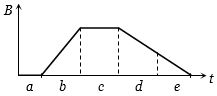
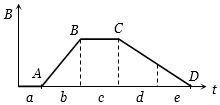
The graph shows the magnitude $B(t)$ of a uniform magnetic field that exists throughout a conducting loop,perpendicular to the plane of the loop. Rank the five regions of the graph according to the magnitude of the emf induced in the loop,greatest first.
A
$b > (d = e) > (a = c)$
B
$b > (d = e) > (a = c)$
C
$b < d < e < c < a$
D
$b > (a = c) > (d = e)$
Solution
(B) The induced emf is given by Faraday's law: $\varepsilon = A \left| \frac{dB}{dt} \right|$.
Since the area $A$ is constant,the induced emf $\varepsilon$ is directly proportional to the magnitude of the slope of the $B-t$ graph,i.e.,$\varepsilon \propto \left| \frac{dB}{dt} \right|$.
$1$. In region $b$,the slope is positive and steep,so the magnitude of the slope is high.
$2$. In regions $d$ and $e$,the slope is negative but constant,and its magnitude is smaller than that in region $b$.
$3$. In regions $a$ and $c$,the magnetic field $B$ is constant,so the slope is $0$,which means the induced emf is $0$.
Comparing the magnitudes of the slopes: $\text{slope}_b > \text{slope}_d = \text{slope}_e > \text{slope}_a = \text{slope}_c = 0$.
Therefore,the correct ranking is $b > (d = e) > (a = c)$.
Since the area $A$ is constant,the induced emf $\varepsilon$ is directly proportional to the magnitude of the slope of the $B-t$ graph,i.e.,$\varepsilon \propto \left| \frac{dB}{dt} \right|$.
$1$. In region $b$,the slope is positive and steep,so the magnitude of the slope is high.
$2$. In regions $d$ and $e$,the slope is negative but constant,and its magnitude is smaller than that in region $b$.
$3$. In regions $a$ and $c$,the magnetic field $B$ is constant,so the slope is $0$,which means the induced emf is $0$.
Comparing the magnitudes of the slopes: $\text{slope}_b > \text{slope}_d = \text{slope}_e > \text{slope}_a = \text{slope}_c = 0$.
Therefore,the correct ranking is $b > (d = e) > (a = c)$.
0 likes
View Solution64
EasyMCQ
Which law is associated with the following equation: $\oint \vec{E} \cdot d\vec{l} = -\frac{d\phi_B}{dt}$?
A
Gauss's Law for Electricity
B
Gauss's Law for Magnetism
C
Ampere's Law
D
Faraday's Law
Solution
(D) The given equation $\oint \vec{E} \cdot d\vec{l} = -\frac{d\phi_B}{dt}$ represents the integral form of Faraday's Law of electromagnetic induction.
This law states that the induced electromotive force $(EMF)$ in a closed loop is equal to the negative rate of change of magnetic flux through the loop.
Therefore,the correct option is $D$.
This law states that the induced electromotive force $(EMF)$ in a closed loop is equal to the negative rate of change of magnetic flux through the loop.
Therefore,the correct option is $D$.
0 likes
View Solution65
EasyMCQ
$A$ coil having $100$ turns and an area of $1 \times 10^{-3} \ m^2$ is placed in a magnetic field of $1 \ Wb/m^2$. If the magnetic field is reversed,what is the total charge that flows through the circuit,given that the resistance of the circuit is $10 \ \Omega$?
A
$2 \times 10^{-2} \ C$
B
$2 \times 10^{-3} \ C$
C
$2 \times 10^{-4} \ C$
D
$2 \times 10^{-5} \ C$
Solution
(A) The change in magnetic flux $\Delta \phi$ is given by $\Delta \phi = N A (B_f - B_i)$.
Given $N = 100$,$A = 1 \times 10^{-3} \ m^2$,$B_i = 1 \ Wb/m^2$,and $B_f = -1 \ Wb/m^2$.
$\Delta \phi = 100 \times 1 \times 10^{-3} \times (-1 - 1) = 0.1 \times (-2) = -0.2 \ Wb$.
The induced charge $Q$ is given by $Q = \frac{|\Delta \phi|}{R}$.
Given $R = 10 \ \Omega$,$Q = \frac{0.2}{10} = 0.02 \ C = 2 \times 10^{-2} \ C$.
Given $N = 100$,$A = 1 \times 10^{-3} \ m^2$,$B_i = 1 \ Wb/m^2$,and $B_f = -1 \ Wb/m^2$.
$\Delta \phi = 100 \times 1 \times 10^{-3} \times (-1 - 1) = 0.1 \times (-2) = -0.2 \ Wb$.
The induced charge $Q$ is given by $Q = \frac{|\Delta \phi|}{R}$.
Given $R = 10 \ \Omega$,$Q = \frac{0.2}{10} = 0.02 \ C = 2 \times 10^{-2} \ C$.
0 likes
View Solution66
DifficultMCQ
$A$ coil with an area of $500 \ cm^2$ and $1000$ turns is placed in a magnetic field of $2 \times 10^{-5} \ Wb/m^2$ perpendicular to its plane. If the coil is rotated by $180^o$ in $0.2 \ s$,the induced $emf$ in $milli-volts$ is:
A
$5$
B
$10$
C
$15$
D
$20$
Solution
(B) The induced $emf$ is given by Faraday's law: $e = -N \frac{d\phi}{dt} = -N \frac{\phi_2 - \phi_1}{\Delta t}$.
Here,$\phi = BA \cos \theta$.
Initial flux $\phi_1 = BA \cos 0^o = BA$.
Final flux $\phi_2 = BA \cos 180^o = -BA$.
Change in flux $\Delta \phi = \phi_2 - \phi_1 = -2BA$.
Given: $N = 1000$,$A = 500 \ cm^2 = 500 \times 10^{-4} \ m^2 = 0.05 \ m^2$,$B = 2 \times 10^{-5} \ Wb/m^2$,$\Delta t = 0.2 \ s$.
$e = -N \frac{-2BA}{\Delta t} = \frac{2NBA}{\Delta t}$.
$e = \frac{2 \times 1000 \times 2 \times 10^{-5} \times 0.05}{0.2} = \frac{0.002}{0.2} = 0.01 \ V$.
$0.01 \ V = 10 \ mV$.
Here,$\phi = BA \cos \theta$.
Initial flux $\phi_1 = BA \cos 0^o = BA$.
Final flux $\phi_2 = BA \cos 180^o = -BA$.
Change in flux $\Delta \phi = \phi_2 - \phi_1 = -2BA$.
Given: $N = 1000$,$A = 500 \ cm^2 = 500 \times 10^{-4} \ m^2 = 0.05 \ m^2$,$B = 2 \times 10^{-5} \ Wb/m^2$,$\Delta t = 0.2 \ s$.
$e = -N \frac{-2BA}{\Delta t} = \frac{2NBA}{\Delta t}$.
$e = \frac{2 \times 1000 \times 2 \times 10^{-5} \times 0.05}{0.2} = \frac{0.002}{0.2} = 0.01 \ V$.
$0.01 \ V = 10 \ mV$.
0 likes
View Solution67
MediumMCQ
$A$ coil of resistance $400 \,\Omega$ is placed in a magnetic field. If the magnetic flux $\phi \,(Wb)$ linked with the coil varies with time $t \,(s)$ as $\phi = 50t^2 + 4$,the current in the coil at $t = 2 \,s$ is.....$A$.
A
$0.5$
B
$0.1$
C
$2$
D
$1$
Solution
(A) Given: Resistance $R = 400 \,\Omega$,Magnetic flux $\phi = 50t^2 + 4 \,Wb$.
According to Faraday's law of electromagnetic induction,the induced electromotive force $(emf)$ is given by $\varepsilon = -\frac{d\phi}{dt}$.
$\varepsilon = -\frac{d}{dt}(50t^2 + 4) = -100t \,V$.
At time $t = 2 \,s$,the magnitude of the induced $emf$ is $|\varepsilon| = |-100(2)| = 200 \,V$.
The induced current $I$ in the coil is given by Ohm's law: $I = \frac{|\varepsilon|}{R}$.
$I = \frac{200 \,V}{400 \,\Omega} = 0.5 \,A$.
According to Faraday's law of electromagnetic induction,the induced electromotive force $(emf)$ is given by $\varepsilon = -\frac{d\phi}{dt}$.
$\varepsilon = -\frac{d}{dt}(50t^2 + 4) = -100t \,V$.
At time $t = 2 \,s$,the magnitude of the induced $emf$ is $|\varepsilon| = |-100(2)| = 200 \,V$.
The induced current $I$ in the coil is given by Ohm's law: $I = \frac{|\varepsilon|}{R}$.
$I = \frac{200 \,V}{400 \,\Omega} = 0.5 \,A$.
0 likes
View Solution68
MediumMCQ
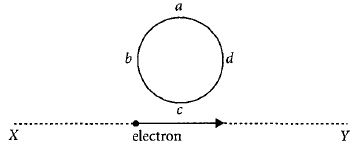
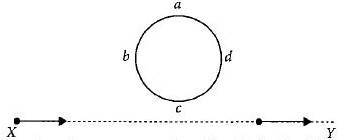
An electron moves on a straight line path $XY$ as shown. The $abcd$ is a coil adjacent to the path of the electron. What will be the direction of current,if any,induced in the coil?
A
No current induced
B
$abcd$
C
$adcb$
D
The current will reverse its direction as the electron goes past the coil.
Solution
(D) As the electron moves from $X$ to $Y$,it creates a magnetic field. According to the right-hand rule,the magnetic field lines pass through the coil $abcd$ in a direction perpendicular to the plane of the coil (into the page).
As the electron approaches the coil,the magnetic flux linked with the coil increases. According to Lenz's Law,the induced current will oppose this increase by creating a magnetic field in the opposite direction (out of the page),which corresponds to an anticlockwise direction $(adcb)$.
As the electron moves away from the coil,the magnetic flux linked with the coil decreases. The induced current will now oppose this decrease by creating a magnetic field in the same direction as the original field (into the page),which corresponds to a clockwise direction $(abcd)$.
Therefore,the current will reverse its direction as the electron goes past the coil.
As the electron approaches the coil,the magnetic flux linked with the coil increases. According to Lenz's Law,the induced current will oppose this increase by creating a magnetic field in the opposite direction (out of the page),which corresponds to an anticlockwise direction $(adcb)$.
As the electron moves away from the coil,the magnetic flux linked with the coil decreases. The induced current will now oppose this decrease by creating a magnetic field in the same direction as the original field (into the page),which corresponds to a clockwise direction $(abcd)$.
Therefore,the current will reverse its direction as the electron goes past the coil.
0 likes
View Solution69
MediumMCQ
$A$ uniform magnetic field is restricted within a region of radius $r$. The magnetic field changes with time at a rate $\frac{d\vec{B}}{dt}$. Loop $1$ of radius $R > r$ encloses the region,and loop $2$ of radius $R$ is outside the region of the magnetic field as shown in the figure. Then the $e.m.f.$ generated is:
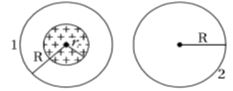
A
$-\frac{d\vec{B}}{dt}\pi R^2$ in loop $1$ and zero in loop $2$
B
$-\frac{d\vec{B}}{dt}\pi r^2$ in loop $1$ and $0$ in loop $2$
C
zero in loop $1$ and zero in loop $2$
D
$-\frac{d\vec{B}}{dt}\pi r^2$ in loop $1$ and $-\frac{d\vec{B}}{dt}\pi r^2$ in loop $2$
Solution
(B) According to Faraday's law of electromagnetic induction,the induced $e.m.f.$ is given by $\varepsilon = -\frac{d\phi}{dt}$.
For loop $1$ (radius $R > r$): The magnetic flux $\phi_1$ is linked only with the region of radius $r$ where the magnetic field exists. Thus,$\phi_1 = B \cdot A = B(\pi r^2)$.
The induced $e.m.f.$ is $\varepsilon_1 = -\frac{d}{dt}(B \pi r^2) = -\pi r^2 \frac{dB}{dt}$.
For loop $2$ (radius $R$): The loop is completely outside the region where the magnetic field exists. Therefore,the magnetic flux linked with loop $2$ is $\phi_2 = 0$.
The induced $e.m.f.$ is $\varepsilon_2 = -\frac{d\phi_2}{dt} = 0$.
For loop $1$ (radius $R > r$): The magnetic flux $\phi_1$ is linked only with the region of radius $r$ where the magnetic field exists. Thus,$\phi_1 = B \cdot A = B(\pi r^2)$.
The induced $e.m.f.$ is $\varepsilon_1 = -\frac{d}{dt}(B \pi r^2) = -\pi r^2 \frac{dB}{dt}$.
For loop $2$ (radius $R$): The loop is completely outside the region where the magnetic field exists. Therefore,the magnetic flux linked with loop $2$ is $\phi_2 = 0$.
The induced $e.m.f.$ is $\varepsilon_2 = -\frac{d\phi_2}{dt} = 0$.
0 likes
View Solution70
MediumMCQ
$A$ circular coil of radius $10 \; cm$, $500$ turns, and resistance $2 \; \Omega$ is placed with its plane perpendicular to the horizontal component of the earth's magnetic field. It is rotated about its vertical diameter through $180^{\circ}$ in $0.25 \; s$. The induced e.m.f. in the coil is (Take $B_H = 3.0 \times 10^{-5} \; T$).
A
$1.4 \times 10^{-2} \; V$
B
$2.6 \times 10^{-2} \; V$
C
$3.8 \times 10^{-3} \; V$
D
$6.6 \times 10^{-4} \; V$
Solution
(C) Given: Radius $r = 0.1 \; m$, Number of turns $N = 500$, Resistance $R = 2 \; \Omega$, Time $\Delta t = 0.25 \; s$, Magnetic field $B_H = 3.0 \times 10^{-5} \; T$.
The magnetic flux through the coil initially is $\phi_i = N B_H A \cos(0^{\circ}) = N B_H A$.
After rotating by $180^{\circ}$, the flux is $\phi_f = N B_H A \cos(180^{\circ}) = -N B_H A$.
The change in flux is $\Delta \phi = \phi_f - \phi_i = -2 N B_H A$.
According to Faraday's law, the induced e.m.f. is $\varepsilon = -\frac{\Delta \phi}{\Delta t} = \frac{2 N B_H A}{\Delta t}$.
Area $A = \pi r^2 = \pi (0.1)^2 = 0.01 \pi \; m^2$.
Substituting the values: $\varepsilon = \frac{2 \times 500 \times (3.0 \times 10^{-5}) \times (0.01 \pi)}{0.25}$.
$\varepsilon = \frac{1000 \times 3.0 \times 10^{-5} \times 0.0314}{0.25} = \frac{0.03 \times 0.0314}{0.25} = \frac{0.000942}{0.25} = 0.003768 \; V \approx 3.8 \times 10^{-3} \; V$.
The magnetic flux through the coil initially is $\phi_i = N B_H A \cos(0^{\circ}) = N B_H A$.
After rotating by $180^{\circ}$, the flux is $\phi_f = N B_H A \cos(180^{\circ}) = -N B_H A$.
The change in flux is $\Delta \phi = \phi_f - \phi_i = -2 N B_H A$.
According to Faraday's law, the induced e.m.f. is $\varepsilon = -\frac{\Delta \phi}{\Delta t} = \frac{2 N B_H A}{\Delta t}$.
Area $A = \pi r^2 = \pi (0.1)^2 = 0.01 \pi \; m^2$.
Substituting the values: $\varepsilon = \frac{2 \times 500 \times (3.0 \times 10^{-5}) \times (0.01 \pi)}{0.25}$.
$\varepsilon = \frac{1000 \times 3.0 \times 10^{-5} \times 0.0314}{0.25} = \frac{0.03 \times 0.0314}{0.25} = \frac{0.000942}{0.25} = 0.003768 \; V \approx 3.8 \times 10^{-3} \; V$.
0 likes
View Solution71
MediumMCQ
$A$ long solenoid of diameter $0.1\, m$ has $2 \times 10^4$ turns per meter. At the centre of the solenoid,a coil of $100$ turns and radius $0.01\, m$ is placed with its axis coinciding with the solenoid axis. The current in the solenoid reduces at a constant rate to $0\, A$ from $4\, A$ in $0.05\, s$. If the resistance of the coil is $10\pi^2\, \Omega$,the total charge flowing through the coil during this time is:
A
$16\, \mu C$
B
$32\, \mu C$
C
$16\pi\, \mu C$
D
$32\pi\, \mu C$
Solution
(B) Given: $n = 2 \times 10^4\, \text{turns/m}$,$I_i = 4\, A$,$I_f = 0\, A$,$N = 100$,$r = 0.01\, m$,$R = 10\pi^2\, \Omega$.
The magnetic field inside the solenoid is $B = \mu_0 n I$.
Initial magnetic flux through the coil: $\phi_i = N B_i A = N (\mu_0 n I_i) (\pi r^2)$.
Final magnetic flux through the coil: $\phi_f = N B_f A = N (\mu_0 n I_f) (\pi r^2) = 0$.
Change in flux: $|\Delta \phi| = |\phi_f - \phi_i| = N \mu_0 n I_i \pi r^2$.
$|\Delta \phi| = 100 \times (4\pi \times 10^{-7}) \times (2 \times 10^4) \times 4 \times \pi \times (0.01)^2$.
$|\Delta \phi| = 100 \times 8\pi \times 10^{-3} \times \pi \times 10^{-4} = 32\pi^2 \times 10^{-5}\, Wb$.
Induced charge $q = \frac{|\Delta \phi|}{R} = \frac{32\pi^2 \times 10^{-5}}{10\pi^2} = 3.2 \times 10^{-6}\, C = 32\, \mu C$.
The magnetic field inside the solenoid is $B = \mu_0 n I$.
Initial magnetic flux through the coil: $\phi_i = N B_i A = N (\mu_0 n I_i) (\pi r^2)$.
Final magnetic flux through the coil: $\phi_f = N B_f A = N (\mu_0 n I_f) (\pi r^2) = 0$.
Change in flux: $|\Delta \phi| = |\phi_f - \phi_i| = N \mu_0 n I_i \pi r^2$.
$|\Delta \phi| = 100 \times (4\pi \times 10^{-7}) \times (2 \times 10^4) \times 4 \times \pi \times (0.01)^2$.
$|\Delta \phi| = 100 \times 8\pi \times 10^{-3} \times \pi \times 10^{-4} = 32\pi^2 \times 10^{-5}\, Wb$.
Induced charge $q = \frac{|\Delta \phi|}{R} = \frac{32\pi^2 \times 10^{-5}}{10\pi^2} = 3.2 \times 10^{-6}\, C = 32\, \mu C$.
0 likes
View Solution72
EasyMCQ
$A$ hundred turns of insulated copper wire are wrapped around an iron cylinder of area $1 \times 10^{-3} \ m^2$ and are connected to a resistor. The total resistance in the circuit is $10 \ \Omega$. If the longitudinal magnetic induction in the iron changes from $1 \ Wb/m^2$ in one direction to $1 \ Wb/m^2$ in the opposite direction,how much charge flows through the circuit?
A
$2 \times 10^{-2} \ C$
B
$2 \times 10^{-3} \ C$
C
$2 \times 10^{-4} \ C$
D
$2 \times 10^{-5} \ C$
Solution
(A) The total charge $Q$ that flows through the circuit is given by the formula $Q = \frac{\Delta \phi}{R}$,where $\Delta \phi$ is the change in magnetic flux and $R$ is the total resistance.
Given:
Number of turns $N = 100$
Area $A = 1 \times 10^{-3} \ m^2$
Resistance $R = 10 \ \Omega$
Initial magnetic induction $B_i = 1 \ Wb/m^2$
Final magnetic induction $B_f = -1 \ Wb/m^2$ (opposite direction)
Change in magnetic induction $\Delta B = |B_f - B_i| = |(-1) - 1| = 2 \ Wb/m^2$.
The change in flux is $\Delta \phi = N \cdot A \cdot \Delta B$.
Substituting the values: $\Delta \phi = 100 \times (1 \times 10^{-3}) \times 2 = 0.2 \ Wb$.
Now,calculating the charge: $Q = \frac{0.2}{10} = 0.02 \ C = 2 \times 10^{-2} \ C$.
Given:
Number of turns $N = 100$
Area $A = 1 \times 10^{-3} \ m^2$
Resistance $R = 10 \ \Omega$
Initial magnetic induction $B_i = 1 \ Wb/m^2$
Final magnetic induction $B_f = -1 \ Wb/m^2$ (opposite direction)
Change in magnetic induction $\Delta B = |B_f - B_i| = |(-1) - 1| = 2 \ Wb/m^2$.
The change in flux is $\Delta \phi = N \cdot A \cdot \Delta B$.
Substituting the values: $\Delta \phi = 100 \times (1 \times 10^{-3}) \times 2 = 0.2 \ Wb$.
Now,calculating the charge: $Q = \frac{0.2}{10} = 0.02 \ C = 2 \times 10^{-2} \ C$.
0 likes
View Solution73
MediumMCQ
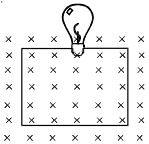
$A$ square wire loop of $10.0 \, cm$ side lies at right angles to a uniform magnetic field of $20 \, T$. $A$ $10 \, V$ light bulb is in series with the loop as shown in the figure. The magnetic field is decreasing steadily to zero over a time interval $\Delta t$. The bulb will shine with full brightness if $\Delta t$ is equal to.......$ms$.
A
$20$
B
$0.02$
C
$2$
D
$0.2$
Solution
(A) The induced electromotive force $(EMF)$ is given by Faraday's law: $e = -\frac{\Delta \phi}{\Delta t}$.
For the bulb to shine with full brightness,the induced $EMF$ must be equal to the rated voltage of the bulb,so $|e| = 10 \, V$.
The change in magnetic flux $\Delta \phi$ is $\phi_i - \phi_f = B \cdot A - 0 = B \cdot A$.
The area of the square loop is $A = (10.0 \, cm)^2 = (0.1 \, m)^2 = 0.01 \, m^2$.
The initial magnetic flux is $\phi_i = B \cdot A = 20 \, T \times 0.01 \, m^2 = 0.2 \, Wb$.
Using the formula $\Delta t = \frac{|\Delta \phi|}{|e|} = \frac{0.2 \, Wb}{10 \, V} = 0.02 \, s$.
Converting to milliseconds: $0.02 \, s = 0.02 \times 1000 \, ms = 20 \, ms$.
For the bulb to shine with full brightness,the induced $EMF$ must be equal to the rated voltage of the bulb,so $|e| = 10 \, V$.
The change in magnetic flux $\Delta \phi$ is $\phi_i - \phi_f = B \cdot A - 0 = B \cdot A$.
The area of the square loop is $A = (10.0 \, cm)^2 = (0.1 \, m)^2 = 0.01 \, m^2$.
The initial magnetic flux is $\phi_i = B \cdot A = 20 \, T \times 0.01 \, m^2 = 0.2 \, Wb$.
Using the formula $\Delta t = \frac{|\Delta \phi|}{|e|} = \frac{0.2 \, Wb}{10 \, V} = 0.02 \, s$.
Converting to milliseconds: $0.02 \, s = 0.02 \times 1000 \, ms = 20 \, ms$.
0 likes
View Solution74
AdvancedMCQ
The magnetic flux through a stationary loop with resistance $R$ varies during an interval of time $T$ as $\phi = at(T - t)$. The heat generated during this time,neglecting the inductance of the loop,will be
A
$\frac{a^2 T^3}{3R}$
B
$\frac{a^2 T^2}{3R}$
C
$\frac{a^2 T}{3R}$
D
$\frac{a^2 T^3}{R}$
Solution
(A) The magnetic flux is given by $\phi = at(T - t) = aTt - at^2$.
According to Faraday's law,the induced electromotive force $(EMF)$ is $\xi = -\frac{d\phi}{dt}$.
$\xi = -\frac{d}{dt}(aTt - at^2) = -(aT - 2at) = 2at - aT$.
The heat generated in the loop in time $dt$ is $dQ = \frac{\xi^2}{R} dt$.
Substituting the value of $\xi$,we get $dQ = \frac{(2at - aT)^2}{R} dt$.
The total heat generated $Q$ from $t = 0$ to $t = T$ is:
$Q = \int_{0}^{T} \frac{(2at - aT)^2}{R} dt = \frac{1}{R} \int_{0}^{T} (4a^2t^2 - 4a^2Tt + a^2T^2) dt$.
$Q = \frac{a^2}{R} [\frac{4t^3}{3} - 2Tt^2 + T^2t]_{0}^{T}$.
$Q = \frac{a^2}{R} [\frac{4T^3}{3} - 2T^3 + T^3] = \frac{a^2}{R} [\frac{4T^3 - 6T^3 + 3T^3}{3}] = \frac{a^2 T^3}{3R}$.
According to Faraday's law,the induced electromotive force $(EMF)$ is $\xi = -\frac{d\phi}{dt}$.
$\xi = -\frac{d}{dt}(aTt - at^2) = -(aT - 2at) = 2at - aT$.
The heat generated in the loop in time $dt$ is $dQ = \frac{\xi^2}{R} dt$.
Substituting the value of $\xi$,we get $dQ = \frac{(2at - aT)^2}{R} dt$.
The total heat generated $Q$ from $t = 0$ to $t = T$ is:
$Q = \int_{0}^{T} \frac{(2at - aT)^2}{R} dt = \frac{1}{R} \int_{0}^{T} (4a^2t^2 - 4a^2Tt + a^2T^2) dt$.
$Q = \frac{a^2}{R} [\frac{4t^3}{3} - 2Tt^2 + T^2t]_{0}^{T}$.
$Q = \frac{a^2}{R} [\frac{4T^3}{3} - 2T^3 + T^3] = \frac{a^2}{R} [\frac{4T^3 - 6T^3 + 3T^3}{3}] = \frac{a^2 T^3}{3R}$.
1 likes
View Solution75
MediumMCQ
$A$ closed planar wire loop of area $A$ and arbitrary shape is placed in a uniform magnetic field of magnitude $B$,with its plane perpendicular to the magnetic field. The resistance of the wire loop is $R$. The loop is now turned upside down by $180^o$ so that its plane again becomes perpendicular to the magnetic field. The total charge that must have flowed through the wire ring in the process is
A
$< AB/R$
B
$= AB/R$
C
$= 2AB/R$
D
None
Solution
(C) The magnetic flux through the loop initially is $\phi_i = B \cdot A \cdot \cos(0^o) = BA$.
After rotating the loop by $180^o$,the normal vector to the loop points in the opposite direction relative to the magnetic field,so the final flux is $\phi_f = B \cdot A \cdot \cos(180^o) = -BA$.
The change in magnetic flux is $\Delta \phi = \phi_f - \phi_i = -BA - BA = -2BA$.
According to Faraday's law,the induced emf is $\varepsilon = -\frac{d\phi}{dt}$.
Since $\varepsilon = I \cdot R = R \frac{dq}{dt}$,we have $R \frac{dq}{dt} = -\frac{d\phi}{dt}$.
Integrating both sides,the total charge $q$ is given by $q = \int dq = -\frac{1}{R} \int d\phi = -\frac{\Delta \phi}{R}$.
Substituting the change in flux,$q = -\frac{-2BA}{R} = \frac{2BA}{R}$.
After rotating the loop by $180^o$,the normal vector to the loop points in the opposite direction relative to the magnetic field,so the final flux is $\phi_f = B \cdot A \cdot \cos(180^o) = -BA$.
The change in magnetic flux is $\Delta \phi = \phi_f - \phi_i = -BA - BA = -2BA$.
According to Faraday's law,the induced emf is $\varepsilon = -\frac{d\phi}{dt}$.
Since $\varepsilon = I \cdot R = R \frac{dq}{dt}$,we have $R \frac{dq}{dt} = -\frac{d\phi}{dt}$.
Integrating both sides,the total charge $q$ is given by $q = \int dq = -\frac{1}{R} \int d\phi = -\frac{\Delta \phi}{R}$.
Substituting the change in flux,$q = -\frac{-2BA}{R} = \frac{2BA}{R}$.
0 likes
View Solution76
AdvancedMCQ
In the arrangement shown in the given figure,the current from $A$ to $B$ is increasing in magnitude. The induced current in the loop will
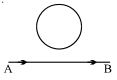
A
have clockwise direction
B
have anticlockwise direction
C
be zero
D
oscillate between clockwise and anticlockwise
Solution
(B) According to the right-hand thumb rule,the magnetic field produced by the current flowing from $A$ to $B$ in the wire is directed into the plane of the loop.
Since the current is increasing in magnitude,the magnetic flux linked with the loop increases in the inward direction.
According to Lenz's law,the induced current in the loop will flow in such a direction as to oppose this increase in magnetic flux.
To oppose the inward magnetic flux,the induced current must create an outward magnetic field.
By the right-hand thumb rule,an outward magnetic field is produced by an anticlockwise current in the loop.
Therefore,the induced current in the loop will have an anticlockwise direction.
Since the current is increasing in magnitude,the magnetic flux linked with the loop increases in the inward direction.
According to Lenz's law,the induced current in the loop will flow in such a direction as to oppose this increase in magnetic flux.
To oppose the inward magnetic flux,the induced current must create an outward magnetic field.
By the right-hand thumb rule,an outward magnetic field is produced by an anticlockwise current in the loop.
Therefore,the induced current in the loop will have an anticlockwise direction.

0 likes
View Solution77
DifficultMCQ
The adjoining figure shows two different arrangements in which two square wire frames are placed in a uniform constantly decreasing magnetic field $B$. The direction of induced current in the case $I$ is
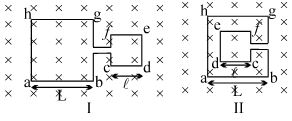
A
from $a$ to $b$ and from $c$ to $d$
B
from $a$ to $b$ and from $f$ to $e$
C
from $b$ to $a$ and from $d$ to $c$
D
from $b$ to $a$ and from $e$ to $f$
Solution
(C) According to Lenz's Law, the induced current will flow in a direction such that it opposes the change in magnetic flux.
In case $I$, the magnetic field $B$ is directed into the plane $(\otimes)$ and is decreasing.
To oppose this decrease, the induced magnetic field must also be directed into the plane $(\otimes)$.
Using the right-hand thumb rule, for the induced magnetic field to be into the plane, the induced current must flow in a clockwise direction.
For the larger square loop $(ahgb)$, the clockwise direction corresponds to the path $a \rightarrow h \rightarrow g \rightarrow b \rightarrow a$, so the current flows from $b$ to $a$ in the segment $ab$.
For the smaller square loop $(cdef)$, the clockwise direction corresponds to the path $c \rightarrow d \rightarrow e \rightarrow f \rightarrow c$, so the current flows from $d$ to $c$ in the segment $cd$.
Therefore, the current flows from $b$ to $a$ and from $d$ to $c$.
Thus, option $C$ is correct.
In case $I$, the magnetic field $B$ is directed into the plane $(\otimes)$ and is decreasing.
To oppose this decrease, the induced magnetic field must also be directed into the plane $(\otimes)$.
Using the right-hand thumb rule, for the induced magnetic field to be into the plane, the induced current must flow in a clockwise direction.
For the larger square loop $(ahgb)$, the clockwise direction corresponds to the path $a \rightarrow h \rightarrow g \rightarrow b \rightarrow a$, so the current flows from $b$ to $a$ in the segment $ab$.
For the smaller square loop $(cdef)$, the clockwise direction corresponds to the path $c \rightarrow d \rightarrow e \rightarrow f \rightarrow c$, so the current flows from $d$ to $c$ in the segment $cd$.
Therefore, the current flows from $b$ to $a$ and from $d$ to $c$.
Thus, option $C$ is correct.
0 likes
View Solution78
DifficultMCQ
The adjoining figure shows two different arrangements in which two square wire frames are placed in a uniform constantly decreasing magnetic field $B.$ The direction of induced current in the case $II$ is
A
from $a$ to $b$ and from $c$ to $d$
B
from $b$ to $a$ and from $c$ to $d$
C
from $b$ to $a$ and from $f$ to $e$
D
from $a$ to $b$ and from $d$ to $c$
Solution
(C) According to Lenz's Law,the induced current will flow in a direction such that it opposes the change in magnetic flux.
In case $II$,the magnetic field $B$ is directed into the plane (represented by $\times$) and is decreasing.
To oppose this decrease,the induced magnetic field must also be directed into the plane $(\otimes)$.
By the right-hand thumb rule,for the outer loop $abgh$,the current must flow in a clockwise direction (from $a$ to $b$ and $b$ to $g$ and $g$ to $h$ and $h$ to $a$).
For the inner loop $cdef$,the current must flow in a counter-clockwise direction to create an inward magnetic field (from $f$ to $e$ and $e$ to $d$ and $d$ to $c$ and $c$ to $f$).
Therefore,the current flows from $b$ to $a$ in the outer loop and from $f$ to $e$ in the inner loop. Thus,option $C$ is correct.
In case $II$,the magnetic field $B$ is directed into the plane (represented by $\times$) and is decreasing.
To oppose this decrease,the induced magnetic field must also be directed into the plane $(\otimes)$.
By the right-hand thumb rule,for the outer loop $abgh$,the current must flow in a clockwise direction (from $a$ to $b$ and $b$ to $g$ and $g$ to $h$ and $h$ to $a$).
For the inner loop $cdef$,the current must flow in a counter-clockwise direction to create an inward magnetic field (from $f$ to $e$ and $e$ to $d$ and $d$ to $c$ and $c$ to $f$).
Therefore,the current flows from $b$ to $a$ in the outer loop and from $f$ to $e$ in the inner loop. Thus,option $C$ is correct.
0 likes
View Solution79
MediumMCQ
Two circular coils $A$ and $B$ are facing each other as shown in the figure. The current $i$ through coil $A$ can be altered.
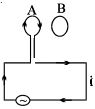
A
There will be repulsion between $A$ and $B$ if $i$ is increased.
B
There will be attraction between $A$ and $B$ if $i$ is increased.
C
There will be neither attraction nor repulsion when $i$ is changed.
D
Attraction or repulsion between $A$ and $B$ depends on the direction of current. It does not depend on whether the current is increased or decreased.
Solution
(A) When the current $i$ in coil $A$ increases,the magnetic flux linked with coil $B$ increases.
According to Lenz's law,the induced current in coil $B$ will flow in such a direction that it opposes the cause of its production,which is the increase in magnetic flux.
To oppose the increase in flux,coil $B$ will develop a magnetic polarity that repels coil $A$.
Therefore,there will be a force of repulsion between coil $A$ and coil $B$ when the current $i$ is increased.
According to Lenz's law,the induced current in coil $B$ will flow in such a direction that it opposes the cause of its production,which is the increase in magnetic flux.
To oppose the increase in flux,coil $B$ will develop a magnetic polarity that repels coil $A$.
Therefore,there will be a force of repulsion between coil $A$ and coil $B$ when the current $i$ is increased.
0 likes
View Solution80
MediumMCQ
$A$ bar magnet is moved along the axis of a copper ring placed far away from the magnet. Looking from the side of the magnet,an anticlockwise current is found to be induced in the ring. Which of the following may be true?
A
The south pole faces the ring and the magnet moves towards it.
B
The north pole faces the ring and the magnet moves towards it.
C
The south pole faces the ring and the magnet moves away from it.
D
Both $(B)$ and $(C)$.
Solution
(D) According to Lenz's law,the induced current in the ring will create a magnetic field that opposes the change in magnetic flux.
When viewed from the side of the magnet,an anticlockwise current in the ring corresponds to a magnetic North pole $(N)$ facing the magnet.
Case $1$: If the North pole of the magnet faces the ring and moves towards it,the ring will induce a North pole to repel it,resulting in an anticlockwise current.
Case $2$: If the South pole of the magnet faces the ring and moves away from it,the ring will induce a North pole to attract it,also resulting in an anticlockwise current.
Therefore,both $(B)$ and $(C)$ are correct.
When viewed from the side of the magnet,an anticlockwise current in the ring corresponds to a magnetic North pole $(N)$ facing the magnet.
Case $1$: If the North pole of the magnet faces the ring and moves towards it,the ring will induce a North pole to repel it,resulting in an anticlockwise current.
Case $2$: If the South pole of the magnet faces the ring and moves away from it,the ring will induce a North pole to attract it,also resulting in an anticlockwise current.
Therefore,both $(B)$ and $(C)$ are correct.
0 likes
View Solution81
MediumMCQ
Two identical circular loops of metal wire are lying on a table without touching each other. Loop $A$ carries a current which increases with time. In response,the loop $B$:
A
remains stationary
B
is attracted by the loop $A$
C
is repelled by the loop $A$
D
rotates about its $CM$,with $CM$ fixed
Solution
(C) According to Lenz's Law,the induced current in loop $B$ will flow in such a direction as to oppose the change in magnetic flux linked with it.
Since the current in loop $A$ is increasing with time,the magnetic flux through loop $B$ increases.
To oppose this increase in flux,loop $B$ will develop an induced current such that it creates a magnetic field opposing the field of loop $A$.
This results in a repulsive force between the two loops.
Therefore,loop $B$ is repelled by loop $A$.
Since the current in loop $A$ is increasing with time,the magnetic flux through loop $B$ increases.
To oppose this increase in flux,loop $B$ will develop an induced current such that it creates a magnetic field opposing the field of loop $A$.
This results in a repulsive force between the two loops.
Therefore,loop $B$ is repelled by loop $A$.
0 likes
View Solution82
MediumMCQ
As a result of a change in the magnetic flux linked to the closed loop as shown in the figure,an $e.m.f.$ $V$ volt is induced in the loop. The work done (in joule) in taking a charge $Q$ coulomb once along the loop is
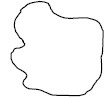
A
$QV$
B
$0$
C
$2QV$
D
$\frac{QV}{2}$
Solution
(A) The induced $e.m.f.$ $V$ in a closed loop is defined as the work done per unit charge by the induced electric field in moving a charge once around the loop.
By definition,$V = \frac{W}{Q}$,where $W$ is the work done and $Q$ is the charge.
Therefore,the work done in moving a charge $Q$ once along the loop is $W = QV$.
Since the induced electric field is non-conservative,the work done is non-zero and is equal to the product of the charge and the induced $e.m.f.$
By definition,$V = \frac{W}{Q}$,where $W$ is the work done and $Q$ is the charge.
Therefore,the work done in moving a charge $Q$ once along the loop is $W = QV$.
Since the induced electric field is non-conservative,the work done is non-zero and is equal to the product of the charge and the induced $e.m.f.$
0 likes
View Solution83
MediumMCQ
The magnetic flux passing perpendicular to the plane of the coil and directed into the paper is varying according to the relation $\phi = 3t^2 + 2t + 3$,where $\phi$ is in milliwebers $(mWb)$ and $t$ is in seconds $(s)$. The magnitude of the $emf$ induced in the loop when $t = 2 \ s$ is ...... $mV$.
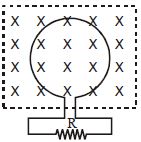
A
$31$
B
$19$
C
$14$
D
$6$
Solution
(C) According to Faraday's law of electromagnetic induction,the induced $emf$ $(E)$ is given by the negative rate of change of magnetic flux: $E = -\frac{d\phi}{dt}$.
Given $\phi = (3t^2 + 2t + 3) \times 10^{-3} \ Wb$ (since $\phi$ is in $mWb$).
Taking the derivative with respect to time $t$:
$\frac{d\phi}{dt} = \frac{d}{dt}(3t^2 + 2t + 3) \times 10^{-3} = (6t + 2) \times 10^{-3} \ Wb/s$.
Thus,the induced $emf$ is $E = -(6t + 2) \times 10^{-3} \ V = -(6t + 2) \ mV$.
The magnitude of the induced $emf$ at $t = 2 \ s$ is:
$|E| = |-(6(2) + 2)| = |-(12 + 2)| = |-14| = 14 \ mV$.
Given $\phi = (3t^2 + 2t + 3) \times 10^{-3} \ Wb$ (since $\phi$ is in $mWb$).
Taking the derivative with respect to time $t$:
$\frac{d\phi}{dt} = \frac{d}{dt}(3t^2 + 2t + 3) \times 10^{-3} = (6t + 2) \times 10^{-3} \ Wb/s$.
Thus,the induced $emf$ is $E = -(6t + 2) \times 10^{-3} \ V = -(6t + 2) \ mV$.
The magnitude of the induced $emf$ at $t = 2 \ s$ is:
$|E| = |-(6(2) + 2)| = |-(12 + 2)| = |-14| = 14 \ mV$.
0 likes
View Solution84
DifficultMCQ
$A$ square wire loop of side $10.0 \, cm$ is placed in a uniform perpendicular magnetic field of $20 \, T.$ The magnetic field decreases to zero in time interval $\Delta t.$ The bulb will glow with full brightness if the value of $\Delta t$ is.....$ms.$ (Assume the bulb requires $10 \, V$ to glow with full brightness.)
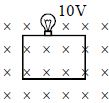
A
$2$
B
$0.2$
C
$0.02$
D
$20$
Solution
(D) The area of the square loop is $A = (10.0 \, cm)^2 = (0.1 \, m)^2 = 0.01 \, m^2.$
The initial magnetic flux is $\phi_i = B \cdot A = 20 \, T \times 0.01 \, m^2 = 0.2 \, Wb.$
The final magnetic flux is $\phi_f = 0 \, Wb$ as the field decreases to zero.
The induced electromotive force $(EMF)$ is given by Faraday's Law: $|e| = |\frac{\Delta \phi}{\Delta t}|.$
Given that the bulb glows with full brightness at $e = 10 \, V$,we have:
$10 = \frac{|0 - 0.2|}{\Delta t}$
$10 = \frac{0.2}{\Delta t}$
$\Delta t = \frac{0.2}{10} = 0.02 \, s.$
Converting to milliseconds: $\Delta t = 0.02 \times 1000 \, ms = 20 \, ms.$
The initial magnetic flux is $\phi_i = B \cdot A = 20 \, T \times 0.01 \, m^2 = 0.2 \, Wb.$
The final magnetic flux is $\phi_f = 0 \, Wb$ as the field decreases to zero.
The induced electromotive force $(EMF)$ is given by Faraday's Law: $|e| = |\frac{\Delta \phi}{\Delta t}|.$
Given that the bulb glows with full brightness at $e = 10 \, V$,we have:
$10 = \frac{|0 - 0.2|}{\Delta t}$
$10 = \frac{0.2}{\Delta t}$
$\Delta t = \frac{0.2}{10} = 0.02 \, s.$
Converting to milliseconds: $\Delta t = 0.02 \times 1000 \, ms = 20 \, ms.$
0 likes
View Solution85
MediumMCQ
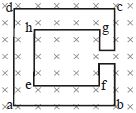
Two square wire frames $abcd$ and $efgh$ are placed in a uniformly decreasing magnetic field as shown in the figure. The direction of the induced current in both the loops is
A
Clockwise,Clockwise
B
Anticlockwise,Clockwise
C
Anticlockwise,Anticlockwise
D
Clockwise,Anticlockwise
Solution
(A) According to Lenz's law,the direction of the induced current in a coil is such that it always opposes the change in magnetic flux that produces it.
In the given diagram,the magnetic field is directed into the plane and is decreasing. Therefore,the magnetic flux linked with the loops is decreasing.
To oppose this decrease,the induced current in each loop must create an additional magnetic field directed into the plane (to support the existing field).
For the outer loop $abcd$,the current must flow in a clockwise direction to produce a magnetic field directed into the plane.
For the inner loop $efgh$,the current must also flow in a clockwise direction to produce a magnetic field directed into the plane.
Thus,the direction of the induced current in both loops is clockwise.
In the given diagram,the magnetic field is directed into the plane and is decreasing. Therefore,the magnetic flux linked with the loops is decreasing.
To oppose this decrease,the induced current in each loop must create an additional magnetic field directed into the plane (to support the existing field).
For the outer loop $abcd$,the current must flow in a clockwise direction to produce a magnetic field directed into the plane.
For the inner loop $efgh$,the current must also flow in a clockwise direction to produce a magnetic field directed into the plane.
Thus,the direction of the induced current in both loops is clockwise.
0 likes
View Solution86
MediumMCQ
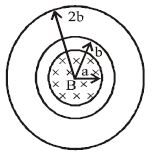
$A$ uniform magnetic field $B$ that is perpendicular to the plane of the page passes through the loops,as shown. The field is confined to a region of radius $a$,where $a < b$,and is changing at a constant rate. The induced $emf$ in the wire loop of radius $b$ is $\varepsilon$. What is the induced $emf$ in the wire loop of radius $2b$?
A
$0$
B
$\frac{\varepsilon}{2}$
C
$\varepsilon$
D
$2\varepsilon$
Solution
(C) According to Faraday's law of induction,the induced $emf$ in a loop is given by $\varepsilon = |\frac{d\phi}{dt}|$,where $\phi = B \cdot A$ is the magnetic flux.
Since the magnetic field $B$ is confined to a region of radius $a$,the magnetic flux through any loop with radius $r \ge a$ is $\phi = B \cdot (\pi a^2)$.
The induced $emf$ is $\varepsilon = \frac{d}{dt}(B \pi a^2) = \pi a^2 \frac{dB}{dt}$.
Note that the induced $emf$ depends only on the area of the region where the magnetic field exists,not on the radius of the wire loop,provided the loop encloses the entire magnetic field region.
Since both loops (of radius $b$ and $2b$) enclose the entire region of radius $a$,the magnetic flux through both loops is the same.
Therefore,the induced $emf$ in the loop of radius $2b$ is the same as the induced $emf$ in the loop of radius $b$,which is $\varepsilon$.
Since the magnetic field $B$ is confined to a region of radius $a$,the magnetic flux through any loop with radius $r \ge a$ is $\phi = B \cdot (\pi a^2)$.
The induced $emf$ is $\varepsilon = \frac{d}{dt}(B \pi a^2) = \pi a^2 \frac{dB}{dt}$.
Note that the induced $emf$ depends only on the area of the region where the magnetic field exists,not on the radius of the wire loop,provided the loop encloses the entire magnetic field region.
Since both loops (of radius $b$ and $2b$) enclose the entire region of radius $a$,the magnetic flux through both loops is the same.
Therefore,the induced $emf$ in the loop of radius $2b$ is the same as the induced $emf$ in the loop of radius $b$,which is $\varepsilon$.
0 likes
View Solution87
MediumMCQ
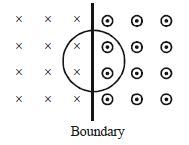
$A$ space consists of two uniform magnetic fields,as shown. $A$ conducting circular loop is placed symmetrically at the boundary.
A
If the loop is moved towards the right,the current is initially anticlockwise.
B
If the loop is moved towards the left,the current is initially anticlockwise.
C
If the loop is moved towards the right,the current is zero initially only.
D
The current will always be zero irrespective of the direction of motion and time.
Solution
(B) The magnetic flux $\phi$ through the loop is the sum of the flux due to the inward magnetic field (left side) and the outward magnetic field (right side). Let the area of the loop in the left region be $A_L$ and in the right region be $A_R$. Since the loop is symmetric,$A_L = A_R = A/2$. The total flux is $\phi = B_L A_L - B_R A_R$ (taking inward as positive).
If the loop moves to the right,the area in the right region $(A_R)$ increases and the area in the left region $(A_L)$ decreases. Thus,the outward flux increases. According to Lenz's law,the induced current will create a magnetic field to oppose this increase in outward flux,meaning it will create an inward magnetic field. By the right-hand rule,this corresponds to a clockwise current.
If the loop moves to the left,the area in the left region $(A_L)$ increases and the area in the right region $(A_R)$ decreases. Thus,the inward flux increases. To oppose this,the induced current will create an outward magnetic field,which corresponds to an anticlockwise current.
If the loop moves to the right,the area in the right region $(A_R)$ increases and the area in the left region $(A_L)$ decreases. Thus,the outward flux increases. According to Lenz's law,the induced current will create a magnetic field to oppose this increase in outward flux,meaning it will create an inward magnetic field. By the right-hand rule,this corresponds to a clockwise current.
If the loop moves to the left,the area in the left region $(A_L)$ increases and the area in the right region $(A_R)$ decreases. Thus,the inward flux increases. To oppose this,the induced current will create an outward magnetic field,which corresponds to an anticlockwise current.
0 likes
View Solution88
DifficultMCQ
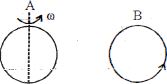
There are two coils $A$ and $B$ as shown in the figure. No current flows in $B$ if $A$ is at rest. Now,the coil $A$ is made to rotate about a vertical axis. At the shown instant $(t=0)$,what will be the direction of the current in coil $A$,when the induced current in coil $B$ is counterclockwise?
A
current is clockwise
B
current is counterclockwise
C
no current flows in $A$
D
direction of current in $A$ depends on separation between $A$ and $B$
Solution
(A) According to Lenz's law,the induced current in coil $B$ will oppose the change in magnetic flux linked with it.
Given that the induced current in coil $B$ is counterclockwise,it creates a magnetic field directed towards the observer (out of the plane).
This induced magnetic field must oppose the increase in magnetic flux caused by the rotation of coil $A$.
For the induced current in $B$ to be counterclockwise,the magnetic flux through $B$ must be increasing.
This implies that the magnetic field produced by coil $A$ at the location of $B$ must be increasing.
For the magnetic flux to increase,the current in coil $A$ must be such that it produces a magnetic field in the same direction as the induced field in $B$.
By applying the right-hand thumb rule,a counterclockwise current in $B$ corresponds to a magnetic field pointing out of the plane.
Therefore,the current in coil $A$ must be clockwise to produce a magnetic field that is initially increasing in the direction that induces a counterclockwise current in $B$ as it rotates.
Given that the induced current in coil $B$ is counterclockwise,it creates a magnetic field directed towards the observer (out of the plane).
This induced magnetic field must oppose the increase in magnetic flux caused by the rotation of coil $A$.
For the induced current in $B$ to be counterclockwise,the magnetic flux through $B$ must be increasing.
This implies that the magnetic field produced by coil $A$ at the location of $B$ must be increasing.
For the magnetic flux to increase,the current in coil $A$ must be such that it produces a magnetic field in the same direction as the induced field in $B$.
By applying the right-hand thumb rule,a counterclockwise current in $B$ corresponds to a magnetic field pointing out of the plane.
Therefore,the current in coil $A$ must be clockwise to produce a magnetic field that is initially increasing in the direction that induces a counterclockwise current in $B$ as it rotates.
0 likes
View Solution89
EasyMCQ
There are two square loops $A$ and $B$. When $A$ moves towards $B$,a current starts flowing in $B$ as shown in the figure,and the current in $B$ stops when $A$ stops moving. From this,we can infer that (Assume loop $B$ is at rest):
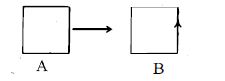
A
There is a constant current in clockwise direction in $A$.
B
There is a varying current in $A$.
C
There is no current in $A$.
D
There is a constant current in counter-clockwise direction in $A$.
Solution
(A) According to Faraday's law of electromagnetic induction,an induced current flows in a loop when the magnetic flux linked with it changes.
In this case,loop $B$ is at rest,and loop $A$ is moving towards it.
For an induced current to flow in $B$,there must be a magnetic field produced by $A$ that changes as $A$ moves.
If $A$ carried a constant current,the magnetic field produced by it would change as it moves closer to $B$,thereby changing the magnetic flux through $B$ and inducing a current.
However,the problem states that the current in $B$ stops when $A$ stops moving.
If $A$ had a constant current,the magnetic field would still exist even when $A$ is stationary,but the flux would be constant,resulting in zero induced current. This matches the observation.
Looking at the figure,the induced current in $B$ is counter-clockwise. By Lenz's law,this induced current creates a magnetic field to oppose the change in flux.
If $A$ carries a constant clockwise current,it produces a magnetic field pointing into the page. As $A$ moves towards $B$,the flux into $B$ increases. To oppose this,$B$ induces a counter-clockwise current.
Therefore,$A$ must carry a constant current.
In this case,loop $B$ is at rest,and loop $A$ is moving towards it.
For an induced current to flow in $B$,there must be a magnetic field produced by $A$ that changes as $A$ moves.
If $A$ carried a constant current,the magnetic field produced by it would change as it moves closer to $B$,thereby changing the magnetic flux through $B$ and inducing a current.
However,the problem states that the current in $B$ stops when $A$ stops moving.
If $A$ had a constant current,the magnetic field would still exist even when $A$ is stationary,but the flux would be constant,resulting in zero induced current. This matches the observation.
Looking at the figure,the induced current in $B$ is counter-clockwise. By Lenz's law,this induced current creates a magnetic field to oppose the change in flux.
If $A$ carries a constant clockwise current,it produces a magnetic field pointing into the page. As $A$ moves towards $B$,the flux into $B$ increases. To oppose this,$B$ induces a counter-clockwise current.
Therefore,$A$ must carry a constant current.
0 likes
View Solution90
MediumMCQ
$A$ flexible wire loop in the shape of a circle has a radius that grows linearly with time. There is a magnetic field perpendicular to the plane of the loop that has a magnitude inversely proportional to the distance from the center of the loop,i.e.,$B(r) \propto \frac{1}{r}$. How does the emf $E$ vary with time?
A
$E \propto t^2$
B
$E \propto t$
C
$E \propto \sqrt{t}$
D
$E$ is constant
Solution
(D) The radius of the loop grows linearly with time,so $r(t) = kt$,where $k$ is a constant.
The magnetic field is given by $B(r) = \frac{C}{r}$ for some constant $C$.
The magnetic flux $\phi$ through the loop is calculated by integrating over the area: $\phi = \int B(r) dA = \int_{0}^{r} \left(\frac{C}{r'}\right) (2\pi r' dr') = \int_{0}^{r} 2\pi C dr' = 2\pi C r$.
Substituting $r = kt$,we get $\phi = 2\pi C (kt) = (2\pi C k) t$.
The induced emf $E$ is given by Faraday's Law: $E = -\frac{d\phi}{dt}$.
$E = -\frac{d}{dt} [(2\pi C k) t] = -2\pi C k$.
Since $C$ and $k$ are constants,the emf $E$ is constant.
The magnetic field is given by $B(r) = \frac{C}{r}$ for some constant $C$.
The magnetic flux $\phi$ through the loop is calculated by integrating over the area: $\phi = \int B(r) dA = \int_{0}^{r} \left(\frac{C}{r'}\right) (2\pi r' dr') = \int_{0}^{r} 2\pi C dr' = 2\pi C r$.
Substituting $r = kt$,we get $\phi = 2\pi C (kt) = (2\pi C k) t$.
The induced emf $E$ is given by Faraday's Law: $E = -\frac{d\phi}{dt}$.
$E = -\frac{d}{dt} [(2\pi C k) t] = -2\pi C k$.
Since $C$ and $k$ are constants,the emf $E$ is constant.
0 likes
View Solution91
DifficultMCQ
Three resistances of magnitude $R$ each are connected in the form of an equilateral triangle of side $a$. The combination is placed in a magnetic field $B = B_0 e^{-\lambda t}$ perpendicular to its plane. The induced current in the circuit is given by:
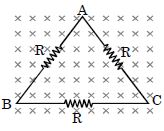
A
$\left( \frac{a^2 \lambda}{2\sqrt{3} R} B_0 \right) e^{-\lambda t}$
B
$\left( \frac{a^2 \lambda}{6 R} B_0 \right) e^{-\lambda t}$
C
$\left( \frac{a^2 B_0}{\lambda 4\sqrt{3} R} \right) e^{-\lambda t}$
D
$\left( \frac{a^2 B_0 R}{\lambda 4\sqrt{3}} \right) e^{-\lambda t}$
Solution
(B) The area of an equilateral triangle of side $a$ is $A = \frac{\sqrt{3}}{4} a^2$.
The magnetic flux $\phi$ through the triangle is $\phi = B \cdot A = (B_0 e^{-\lambda t}) \left( \frac{\sqrt{3}}{4} a^2 \right)$.
According to Faraday's law,the induced electromotive force $(EMF)$ is $\varepsilon = -\frac{d\phi}{dt} = -\frac{d}{dt} \left( B_0 e^{-\lambda t} \frac{\sqrt{3}}{4} a^2 \right) = B_0 \lambda e^{-\lambda t} \frac{\sqrt{3}}{4} a^2$.
The three resistors $R$ are connected in series in the loop,so the total resistance is $R_{eq} = 3R$.
The induced current $I$ is given by $I = \frac{\varepsilon}{R_{eq}} = \frac{B_0 \lambda e^{-\lambda t} \frac{\sqrt{3}}{4} a^2}{3R} = \frac{\sqrt{3} a^2 \lambda B_0 e^{-\lambda t}}{12R} = \frac{a^2 \lambda B_0 e^{-\lambda t}}{4\sqrt{3} R}$.
Comparing this with the options,the correct expression is $\left( \frac{a^2 \lambda}{4\sqrt{3} R} B_0 \right) e^{-\lambda t}$.
The magnetic flux $\phi$ through the triangle is $\phi = B \cdot A = (B_0 e^{-\lambda t}) \left( \frac{\sqrt{3}}{4} a^2 \right)$.
According to Faraday's law,the induced electromotive force $(EMF)$ is $\varepsilon = -\frac{d\phi}{dt} = -\frac{d}{dt} \left( B_0 e^{-\lambda t} \frac{\sqrt{3}}{4} a^2 \right) = B_0 \lambda e^{-\lambda t} \frac{\sqrt{3}}{4} a^2$.
The three resistors $R$ are connected in series in the loop,so the total resistance is $R_{eq} = 3R$.
The induced current $I$ is given by $I = \frac{\varepsilon}{R_{eq}} = \frac{B_0 \lambda e^{-\lambda t} \frac{\sqrt{3}}{4} a^2}{3R} = \frac{\sqrt{3} a^2 \lambda B_0 e^{-\lambda t}}{12R} = \frac{a^2 \lambda B_0 e^{-\lambda t}}{4\sqrt{3} R}$.
Comparing this with the options,the correct expression is $\left( \frac{a^2 \lambda}{4\sqrt{3} R} B_0 \right) e^{-\lambda t}$.
0 likes
View Solution92
MediumMCQ
Statement $-1$: When a magnet is made to fall freely through a closed coil,its acceleration is always less than acceleration due to gravity $(g)$.
Statement $-2$: Current induced in the coil opposes the motion of the magnet,as per Lenz's law.
Statement $-2$: Current induced in the coil opposes the motion of the magnet,as per Lenz's law.
A
Statement $-1$ is true,Statement $-2$ is true; Statement $-2$ is a correct explanation for Statement $-1$.
B
Statement $-1$ is true,Statement $-2$ is true; Statement $-2$ is $NOT$ a correct explanation for Statement $-1$.
C
Statement $-1$ is True,Statement $-2$ is False.
D
Statement $-1$ is False,Statement $-2$ is True.
Solution
(A) When a magnet falls through a closed coil,the changing magnetic flux through the coil induces an electromotive force $(EMF)$ and a current in the coil,according to Faraday's law of induction.
According to Lenz's law,the direction of this induced current is such that it creates a magnetic field that opposes the change in magnetic flux that produced it.
As the magnet falls,the induced current creates a magnetic force that acts upwards on the magnet,opposing its downward motion.
Because there is an upward force acting against the gravitational force $(mg)$,the net downward force on the magnet is $F_{net} = mg - F_{magnetic}$.
Since $F_{net} < mg$,the acceleration of the magnet $a = F_{net}/m$ is less than the acceleration due to gravity $(g)$.
Therefore,both statements are true,and Statement $-2$ is the correct explanation for Statement $-1$.
According to Lenz's law,the direction of this induced current is such that it creates a magnetic field that opposes the change in magnetic flux that produced it.
As the magnet falls,the induced current creates a magnetic force that acts upwards on the magnet,opposing its downward motion.
Because there is an upward force acting against the gravitational force $(mg)$,the net downward force on the magnet is $F_{net} = mg - F_{magnetic}$.
Since $F_{net} < mg$,the acceleration of the magnet $a = F_{net}/m$ is less than the acceleration due to gravity $(g)$.
Therefore,both statements are true,and Statement $-2$ is the correct explanation for Statement $-1$.
0 likes
View Solution93
DifficultMCQ
$A$ line charge ($\lambda$ per unit length) is in the form of a circular wheel of radius $a$ and moment of inertia $I$,initially at rest. It is free to rotate in a horizontal plane. There is a coaxial magnetic field $B = B_0 \hat{k}$ extending up to a radius $b$ $(b < a)$. If the magnetic field is switched off,the angular velocity $\omega$ of the wheel is given by:
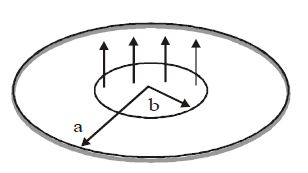
A
$\frac{\pi a^2 b \lambda B}{I}$ clockwise as seen from above
B
$\frac{\pi a b^2 \lambda B}{I}$ clockwise as seen from above
C
$\frac{\pi a b^2 \lambda B}{2I}$ anticlockwise as seen from above
D
$\frac{\pi a b^2 \lambda B}{I}$ anticlockwise as seen from above
Solution
(B) According to Faraday's Law of induction,the changing magnetic flux induces an electric field $E$ along the circumference of the wheel. The induced $EMF$ $\varepsilon$ is given by $\varepsilon = \left| -\frac{d\phi}{dt} \right| = \oint \vec{E} \cdot d\vec{l} = E(2\pi a)$.
Since $\phi = B(\pi b^2)$,we have $\varepsilon = \pi b^2 \frac{dB}{dt}$.
Equating the two,$E(2\pi a) = \pi b^2 \frac{dB}{dt}$,which gives $E = \frac{b^2}{2a} \frac{dB}{dt}$.
The force on the charge element $dq = \lambda(2\pi a)$ is $dF = E dq$. The torque $\tau$ is $\tau = a F = a(E \cdot 2\pi a \lambda) = 2\pi a^2 \lambda E$.
Substituting $E$,$\tau = 2\pi a^2 \lambda \left( \frac{b^2}{2a} \frac{dB}{dt} \right) = \pi a b^2 \lambda \frac{dB}{dt}$.
Using $\tau = I \frac{d\omega}{dt}$,we have $I \frac{d\omega}{dt} = \pi a b^2 \lambda \frac{dB}{dt}$.
Integrating both sides,$I \omega = \pi a b^2 \lambda B$,so $\omega = \frac{\pi a b^2 \lambda B}{I}$.
By Lenz's Law,the induced current creates a magnetic field opposing the change. Since the magnetic field is decreasing,the induced electric field will create a torque such that the wheel rotates in the direction that opposes the decrease in flux,which is clockwise as seen from above.
Since $\phi = B(\pi b^2)$,we have $\varepsilon = \pi b^2 \frac{dB}{dt}$.
Equating the two,$E(2\pi a) = \pi b^2 \frac{dB}{dt}$,which gives $E = \frac{b^2}{2a} \frac{dB}{dt}$.
The force on the charge element $dq = \lambda(2\pi a)$ is $dF = E dq$. The torque $\tau$ is $\tau = a F = a(E \cdot 2\pi a \lambda) = 2\pi a^2 \lambda E$.
Substituting $E$,$\tau = 2\pi a^2 \lambda \left( \frac{b^2}{2a} \frac{dB}{dt} \right) = \pi a b^2 \lambda \frac{dB}{dt}$.
Using $\tau = I \frac{d\omega}{dt}$,we have $I \frac{d\omega}{dt} = \pi a b^2 \lambda \frac{dB}{dt}$.
Integrating both sides,$I \omega = \pi a b^2 \lambda B$,so $\omega = \frac{\pi a b^2 \lambda B}{I}$.
By Lenz's Law,the induced current creates a magnetic field opposing the change. Since the magnetic field is decreasing,the induced electric field will create a torque such that the wheel rotates in the direction that opposes the decrease in flux,which is clockwise as seen from above.
0 likes
View Solution94
MediumMCQ
$A$ flexible circular loop $20 \ cm$ in diameter lies in a magnetic field of magnitude $B = 1 \ T$,directed into the plane of the page as shown. The loop is pulled at the points indicated by the arrows,forming a loop of zero area in $0.314 \ s$. The average emf induced in the loop is.....$V$
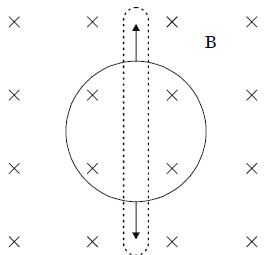
A
$0.1$
B
$0.2$
C
$1$
D
$10$
Solution
(A) The initial radius of the loop is $r = 10 \ cm = 0.1 \ m$.
The initial area of the loop is $A_i = \pi r^2 = \pi (0.1)^2 = 0.01 \pi \ m^2$.
The final area of the loop is $A_f = 0 \ m^2$.
The change in magnetic flux is $\Delta \phi = B \cdot \Delta A = B(A_f - A_i) = 1 \times (0 - 0.01 \pi) = -0.01 \pi \ Wb$.
The time taken is $\Delta t = 0.314 \ s$.
Using Faraday's law,the magnitude of the average induced emf is $|\varepsilon| = \left| -\frac{\Delta \phi}{\Delta t} \right| = \frac{0.01 \pi}{0.314}$.
Since $\pi \approx 3.14$,we have $|\varepsilon| = \frac{0.01 \times 3.14}{0.314} = \frac{0.0314}{0.314} = 0.1 \ V$.
The initial area of the loop is $A_i = \pi r^2 = \pi (0.1)^2 = 0.01 \pi \ m^2$.
The final area of the loop is $A_f = 0 \ m^2$.
The change in magnetic flux is $\Delta \phi = B \cdot \Delta A = B(A_f - A_i) = 1 \times (0 - 0.01 \pi) = -0.01 \pi \ Wb$.
The time taken is $\Delta t = 0.314 \ s$.
Using Faraday's law,the magnitude of the average induced emf is $|\varepsilon| = \left| -\frac{\Delta \phi}{\Delta t} \right| = \frac{0.01 \pi}{0.314}$.
Since $\pi \approx 3.14$,we have $|\varepsilon| = \frac{0.01 \times 3.14}{0.314} = \frac{0.0314}{0.314} = 0.1 \ V$.
0 likes
View Solution95
MediumMCQ
The magnetic flux through a coil perpendicular to its plane and directed into the paper is varying according to the relation $\phi = 5t^2 + 10t + 5$ milliweber. The $e.m.f.$ induced in the loop after $5 \, s$ is ..... $V$.
A
$0.03$
B
$0.06$
C
$0.08$
D
$0.02$
Solution
(B) The magnetic flux is given by $\phi = (5t^2 + 10t + 5) \times 10^{-3} \, Wb$.
According to Faraday's law of electromagnetic induction,the magnitude of induced $e.m.f.$ is given by $e = |\frac{d\phi}{dt}|$.
$e = \frac{d}{dt} [(5t^2 + 10t + 5) \times 10^{-3}] \, V$.
$e = (10t + 10) \times 10^{-3} \, V$.
At $t = 5 \, s$,the induced $e.m.f.$ is:
$e = (10 \times 5 + 10) \times 10^{-3} \, V$.
$e = (50 + 10) \times 10^{-3} \, V = 60 \times 10^{-3} \, V = 0.06 \, V$.
According to Faraday's law of electromagnetic induction,the magnitude of induced $e.m.f.$ is given by $e = |\frac{d\phi}{dt}|$.
$e = \frac{d}{dt} [(5t^2 + 10t + 5) \times 10^{-3}] \, V$.
$e = (10t + 10) \times 10^{-3} \, V$.
At $t = 5 \, s$,the induced $e.m.f.$ is:
$e = (10 \times 5 + 10) \times 10^{-3} \, V$.
$e = (50 + 10) \times 10^{-3} \, V = 60 \times 10^{-3} \, V = 0.06 \, V$.
0 likes
View Solution96
MediumMCQ
$A$ vertical bar magnet is dropped from the shown position on the axis of a fixed metallic coil as shown in Fig-$I$. In Fig-$II$,the magnet is fixed and a horizontal coil is dropped. If the acceleration of the magnet and coil are $a_1$ and $a_2$ respectively,then:
A
$a_1 > g, a_2 > g$
B
$a_1 > g, a_2 < g$
C
$a_1 < g, a_2 < g$
D
$a_1 < g, a_2 > g$
Solution
(C) According to Lenz's Law,the induced current in the coil always opposes the cause that produces it.
In Fig-$I$,as the magnet falls towards the fixed coil,the magnetic flux through the coil increases. The coil develops an induced current that creates a magnetic pole (North pole) on its upper face to repel the falling magnet. This repulsive force acts upwards,opposing the gravitational force. Thus,the net acceleration of the magnet is $a_1 < g$.
In Fig-$II$,as the coil falls towards the fixed magnet,the magnetic flux through the coil changes. The coil develops an induced current that creates a magnetic pole (North pole) on its lower face to repel the magnet below it. This repulsive force acts upwards on the falling coil,opposing its weight. Thus,the net acceleration of the coil is $a_2 < g$.
Therefore,both $a_1 < g$ and $a_2 < g$.
In Fig-$I$,as the magnet falls towards the fixed coil,the magnetic flux through the coil increases. The coil develops an induced current that creates a magnetic pole (North pole) on its upper face to repel the falling magnet. This repulsive force acts upwards,opposing the gravitational force. Thus,the net acceleration of the magnet is $a_1 < g$.
In Fig-$II$,as the coil falls towards the fixed magnet,the magnetic flux through the coil changes. The coil develops an induced current that creates a magnetic pole (North pole) on its lower face to repel the magnet below it. This repulsive force acts upwards on the falling coil,opposing its weight. Thus,the net acceleration of the coil is $a_2 < g$.
Therefore,both $a_1 < g$ and $a_2 < g$.
0 likes
View Solution97
DifficultMCQ
Some magnetic flux is changed through a coil of resistance $10 \, \Omega$. As a result,an induced current is developed in it,which varies with time as shown in the figure (assuming a triangular pulse with base $0.1 \, s$ and height $4 \, A$). The magnitude of the change in flux through the coil in Webers is:
A
$2$
B
$4$
C
$6$
D
None of these
Solution
(A) The induced charge $q$ flowing through a circuit is given by the relation $q = \frac{\Delta \phi}{R}$,where $\Delta \phi$ is the change in magnetic flux and $R$ is the resistance of the coil.
Rearranging the formula,we get the change in flux: $\Delta \phi = q \times R$.
The charge $q$ is equal to the area under the current-time $(I-t)$ graph.
Given the graph is a triangle with base $b = 0.1 \, s$ and height $h = 4 \, A$,the area $q = \frac{1}{2} \times \text{base} \times \text{height} = \frac{1}{2} \times 0.1 \times 4 = 0.2 \, C$.
Substituting the values into the flux equation: $\Delta \phi = 0.2 \, C \times 10 \, \Omega = 2 \, Wb$.
Rearranging the formula,we get the change in flux: $\Delta \phi = q \times R$.
The charge $q$ is equal to the area under the current-time $(I-t)$ graph.
Given the graph is a triangle with base $b = 0.1 \, s$ and height $h = 4 \, A$,the area $q = \frac{1}{2} \times \text{base} \times \text{height} = \frac{1}{2} \times 0.1 \times 4 = 0.2 \, C$.
Substituting the values into the flux equation: $\Delta \phi = 0.2 \, C \times 10 \, \Omega = 2 \, Wb$.
0 likes
View Solution98
MediumMCQ
$A$ coil has an area of $0.05\,m^2$ and it has $800\,turns$. It is placed perpendicularly in a magnetic field of strength $4 \times 10^{-5}\,Wb/m^2$. It is rotated through $90^o$ in $0.1\,s$. The average emf induced in the coil is ........... $V.$
A
$0.056$
B
$0.046$
C
$0.026$
D
$0.016$
Solution
(D) Given:
Area $A = 0.05\,m^2$
Number of turns $N = 800$
Magnetic field $B = 4 \times 10^{-5}\,Wb/m^2$
Time interval $\Delta t = 0.1\,s$
Initial magnetic flux $\phi_1 = N \cdot B \cdot A \cdot \cos(0^o) = N \cdot B \cdot A$
Final magnetic flux $\phi_2 = N \cdot B \cdot A \cdot \cos(90^o) = 0$
The average induced emf is given by Faraday's law:
$e = -\frac{\Delta \phi}{\Delta t} = -\frac{\phi_2 - \phi_1}{\Delta t} = -\frac{0 - NAB}{\Delta t} = \frac{NAB}{\Delta t}$
$e = \frac{800 \times 4 \times 10^{-5} \times 0.05}{0.1}$
$e = \frac{1600 \times 10^{-5}}{0.1} = 16000 \times 10^{-5} = 0.016\,V$
Area $A = 0.05\,m^2$
Number of turns $N = 800$
Magnetic field $B = 4 \times 10^{-5}\,Wb/m^2$
Time interval $\Delta t = 0.1\,s$
Initial magnetic flux $\phi_1 = N \cdot B \cdot A \cdot \cos(0^o) = N \cdot B \cdot A$
Final magnetic flux $\phi_2 = N \cdot B \cdot A \cdot \cos(90^o) = 0$
The average induced emf is given by Faraday's law:
$e = -\frac{\Delta \phi}{\Delta t} = -\frac{\phi_2 - \phi_1}{\Delta t} = -\frac{0 - NAB}{\Delta t} = \frac{NAB}{\Delta t}$
$e = \frac{800 \times 4 \times 10^{-5} \times 0.05}{0.1}$
$e = \frac{1600 \times 10^{-5}}{0.1} = 16000 \times 10^{-5} = 0.016\,V$
0 likes
View Solution99
MediumMCQ
In the given figure,the magnet is moved towards the coil with speed $v$ and the induced $emf$ is $e$. If the magnet and the coil recede away from one another,each moving with speed $v$,the induced $emf$ in the coil will be
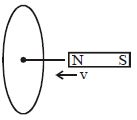
A
$e$
B
$2e$
C
$\frac{e}{2}$
D
$4e$
Solution
(B) According to Faraday's law of electromagnetic induction,the induced $emf$ is given by $e = -\frac{d\phi}{dt}$.
In the first case,the magnet moves towards the stationary coil with speed $v$. The rate of change of magnetic flux is proportional to the relative velocity,so $e \propto v$.
In the second case,both the magnet and the coil move away from each other with speed $v$. The relative velocity between them is $v_{rel} = v - (-v) = 2v$.
Since the induced $emf$ is directly proportional to the relative velocity between the magnet and the coil,the new induced $emf$ will be $e' \propto 2v$.
Therefore,$e' = 2e$.
In the first case,the magnet moves towards the stationary coil with speed $v$. The rate of change of magnetic flux is proportional to the relative velocity,so $e \propto v$.
In the second case,both the magnet and the coil move away from each other with speed $v$. The relative velocity between them is $v_{rel} = v - (-v) = 2v$.
Since the induced $emf$ is directly proportional to the relative velocity between the magnet and the coil,the new induced $emf$ will be $e' \propto 2v$.
Therefore,$e' = 2e$.
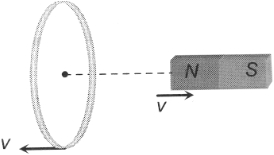
0 likes
View SolutionElectromagnetic Induction — Faraday's and Lenz's Law · Frequently Asked Questions
1Are these Electromagnetic Induction questions useful for JEE and NEET?
Yes. All questions in this section are mapped to JEE Main and NEET exam patterns. Previous year questions from JEE Main, NEET, GUJCET and state-level exams are included with full solutions.
2Can I switch to Hindi or Gujarati for these questions?
Yes. Use the language tabs in the hero section or the sidebar to view the same questions and solutions in English, Hindi or Gujarati.
3How do I generate a question paper from this subtopic?
Use the Vedclass Exam Paper Generator — select the chapter and subtopic, set difficulty, and generate Sets A, B, C, D automatically. First 3 chapters of every subject are free.
Vedclass Products
For Students
Vedclass Test Series
Mock tests in real JEE/NEET style with performance analysis. 5-day free trial.
Start Free TrialFor Teachers
Exam Paper Generator
Generate Set A/B/C/D papers from this chapter in 2 minutes. 3 chapters free.
Try FreeFor Institutes
Online Exam Module
Live online exams with unlimited students, 360° analytics & white-label branding.
See DemoFor Teachers & Institutes
Generate a Electromagnetic Induction Exam Paper in 2 Minutes
Select subtopic & difficulty — Sets A, B, C, D auto-generated with No Repeat logic.
First 3 chapters of every subject are free — no payment required.