
A English
Self Induction Questions in English
Class 12 Physics · Electromagnetic Induction · Self Induction
226+
Questions
English
Language
100%
With Solutions
Showing 50 of 226 questions in English
1
EasyMCQ
The unit of self-inductance of a coil is
A
Farad
B
Henry
C
Weber
D
Tesla
Solution
(B) The self-inductance $L$ of a coil is defined by the relation $\phi = LI$,where $\phi$ is the magnetic flux and $I$ is the current.
Therefore,$L = \frac{\phi}{I}$.
The unit of magnetic flux $\phi$ is Weber $(Wb)$ and the unit of current $I$ is Ampere $(A)$.
Thus,the unit of self-inductance is $\frac{Wb}{A}$,which is defined as Henry $(H)$.
Therefore,$L = \frac{\phi}{I}$.
The unit of magnetic flux $\phi$ is Weber $(Wb)$ and the unit of current $I$ is Ampere $(A)$.
Thus,the unit of self-inductance is $\frac{Wb}{A}$,which is defined as Henry $(H)$.
0 likes
View Solution2
MediumMCQ
The unit of self-inductance is:
A
$\frac{\text{Newton} \times \text{second}}{\text{Coulomb} \times \text{Ampere}}$
B
$\frac{\text{Joule} \times \text{second}}{\text{Coulomb} \times \text{Ampere}}$
C
$\frac{\text{Volt} \times \text{metre}}{\text{Coulomb}}$
D
$\frac{\text{Newton} \times \text{metre}}{\text{Ampere}}$
Solution
(B) The $SI$ unit of self-inductance $(L)$ is the Henry $(H)$.
From the formula for induced $EMF$,$\varepsilon = -L \frac{di}{dt}$,we have $L = \frac{\varepsilon \cdot dt}{di}$.
The units are $\frac{\text{Volt} \times \text{second}}{\text{Ampere}}$.
Since $\text{Volt} = \frac{\text{Joule}}{\text{Coulomb}}$,substituting this gives $\frac{\text{Joule}}{\text{Coulomb}} \times \frac{\text{second}}{\text{Ampere}}$.
Therefore,the correct expression is $\frac{\text{Joule} \times \text{second}}{\text{Coulomb} \times \text{Ampere}}$.
From the formula for induced $EMF$,$\varepsilon = -L \frac{di}{dt}$,we have $L = \frac{\varepsilon \cdot dt}{di}$.
The units are $\frac{\text{Volt} \times \text{second}}{\text{Ampere}}$.
Since $\text{Volt} = \frac{\text{Joule}}{\text{Coulomb}}$,substituting this gives $\frac{\text{Joule}}{\text{Coulomb}} \times \frac{\text{second}}{\text{Ampere}}$.
Therefore,the correct expression is $\frac{\text{Joule} \times \text{second}}{\text{Coulomb} \times \text{Ampere}}$.
0 likes
View Solution3
MediumMCQ
If $R$ and $L$ represent respectively resistance and self-inductance,which of the following combinations has the dimensions of frequency?
A
$R/L$
B
$L/R$
C
$\sqrt{R/L}$
D
$\sqrt{L/R}$
Solution
(A) The dimension of resistance $R$ is given by $V/I$,where $V$ is potential difference and $I$ is current.
The dimension of self-inductance $L$ is given by $V \cdot T/I$,where $T$ is time.
Taking the ratio $R/L$,we get:
$\frac{R}{L} = \frac{V/I}{V \cdot T/I} = \frac{1}{T}$.
Since the dimension of $1/T$ is $T^{-1}$,which is the dimension of frequency,the correct combination is $R/L$.
The dimension of self-inductance $L$ is given by $V \cdot T/I$,where $T$ is time.
Taking the ratio $R/L$,we get:
$\frac{R}{L} = \frac{V/I}{V \cdot T/I} = \frac{1}{T}$.
Since the dimension of $1/T$ is $T^{-1}$,which is the dimension of frequency,the correct combination is $R/L$.
0 likes
View Solution4
MediumMCQ
The back $e.m.f.$ induced in a coil,when current changes from $1 \ A$ to $0 \ A$ in $1 \ ms$,is $4 \ V$. The self-inductance of the coil is:
A
$1 \ H$
B
$4 \ H$
C
$10^{-3} \ H$
D
$4 \times 10^{-3} \ H$
Solution
(D) The formula for the back $e.m.f.$ induced in a coil is given by $e = -L \frac{di}{dt}$.
Here,the change in current $di = i_f - i_i = 0 - 1 = -1 \ A$.
The time interval $dt = 1 \ ms = 10^{-3} \ s$.
The induced $e.m.f.$ is $e = 4 \ V$.
Substituting these values into the formula:
$4 = -L \left( \frac{-1}{10^{-3}} \right)$
$4 = L \times 10^3$
$L = \frac{4}{10^3} = 4 \times 10^{-3} \ H$.
Here,the change in current $di = i_f - i_i = 0 - 1 = -1 \ A$.
The time interval $dt = 1 \ ms = 10^{-3} \ s$.
The induced $e.m.f.$ is $e = 4 \ V$.
Substituting these values into the formula:
$4 = -L \left( \frac{-1}{10^{-3}} \right)$
$4 = L \times 10^3$
$L = \frac{4}{10^3} = 4 \times 10^{-3} \ H$.
0 likes
View Solution5
EasyMCQ
An $e.m.f.$ of $5 \,V$ is produced by a self-inductance when the current changes at a steady rate from $3 \,A$ to $2 \,A$ in $1 \,ms$. The value of self-inductance is:
A
Zero
B
$5 \,H$
C
$5000 \,H$
D
$5 \,mH$
Solution
(D) The induced $e.m.f.$ $(e)$ in a coil due to self-inductance is given by the formula: $e = L \cdot \left| \frac{di}{dt} \right|$.
Given:
$e = 5 \,V$
Change in current,$di = 3 \,A - 2 \,A = 1 \,A$
Time interval,$dt = 1 \,ms = 1 \times 10^{-3} \,s$
Substituting the values into the formula:
$5 = L \cdot \frac{1 \,A}{1 \times 10^{-3} \,s}$
$5 = L \cdot 10^3$
$L = \frac{5}{10^3} \,H = 5 \times 10^{-3} \,H = 5 \,mH$.
Therefore,the correct option is $D$.
Given:
$e = 5 \,V$
Change in current,$di = 3 \,A - 2 \,A = 1 \,A$
Time interval,$dt = 1 \,ms = 1 \times 10^{-3} \,s$
Substituting the values into the formula:
$5 = L \cdot \frac{1 \,A}{1 \times 10^{-3} \,s}$
$5 = L \cdot 10^3$
$L = \frac{5}{10^3} \,H = 5 \times 10^{-3} \,H = 5 \,mH$.
Therefore,the correct option is $D$.
0 likes
View Solution6
EasyMCQ
The current passing through a choke coil of $5 \, H$ is decreasing at the rate of $2 \, A/s$. The $e.m.f.$ developed across the coil is ....... $V$.
A
$10$
B
$-10$
C
$2.5$
D
$-2.5$
Solution
(A) The induced $e.m.f.$ $(e)$ in a coil due to self-induction is given by the formula: $e = -L \frac{di}{dt}$.
Here,the inductance $L = 5 \, H$.
The rate of change of current $\frac{di}{dt} = -2 \, A/s$ (since the current is decreasing).
Substituting these values into the formula:
$e = -5 \times (-2) = 10 \, V$.
Therefore,the $e.m.f.$ developed across the coil is $10 \, V$.
Here,the inductance $L = 5 \, H$.
The rate of change of current $\frac{di}{dt} = -2 \, A/s$ (since the current is decreasing).
Substituting these values into the formula:
$e = -5 \times (-2) = 10 \, V$.
Therefore,the $e.m.f.$ developed across the coil is $10 \, V$.
0 likes
View Solution7
MediumMCQ
$A$ coil is wound as a transformer of rectangular cross-section. If all the linear dimensions of the transformer are increased by a factor of $2$ and the number of turns per unit length of the coil remains the same,the self-inductance increases by a factor of:
A
$16$
B
$12$
C
$8$
D
$4$
Solution
(C) The self-inductance $L$ of a solenoid is given by the formula $L = \mu_0 N^2 A / l$.
Since the number of turns per unit length $n = N / l$ is constant,we can write $N = nl$.
Substituting this into the formula,we get $L = \mu_0 (nl)^2 A / l = \mu_0 n^2 l A$.
Here,$l$ represents the length of the coil and $A$ represents the cross-sectional area.
When all linear dimensions are increased by a factor of $2$,the length $l$ becomes $2l$ and the area $A$ (which is proportional to the square of linear dimensions) becomes $2^2 A = 4A$.
Substituting these new values into the expression for $L$,the new inductance $L'$ is $L' = \mu_0 n^2 (2l) (4A) = 8 (\mu_0 n^2 l A) = 8L$.
Therefore,the self-inductance increases by a factor of $8$.
Since the number of turns per unit length $n = N / l$ is constant,we can write $N = nl$.
Substituting this into the formula,we get $L = \mu_0 (nl)^2 A / l = \mu_0 n^2 l A$.
Here,$l$ represents the length of the coil and $A$ represents the cross-sectional area.
When all linear dimensions are increased by a factor of $2$,the length $l$ becomes $2l$ and the area $A$ (which is proportional to the square of linear dimensions) becomes $2^2 A = 4A$.
Substituting these new values into the expression for $L$,the new inductance $L'$ is $L' = \mu_0 n^2 (2l) (4A) = 8 (\mu_0 n^2 l A) = 8L$.
Therefore,the self-inductance increases by a factor of $8$.
0 likes
View Solution8
EasyMCQ
The equivalent quantity of mass in electricity is
A
Charge
B
Potential
C
Inductance
D
Current
Solution
(C) In mechanics,mass is a measure of inertia,which is the resistance of an object to a change in its state of motion.
In electricity,inductance $(L)$ is the property of a circuit that opposes any change in the current flowing through it. This is analogous to inertia in mechanics,where mass opposes a change in velocity.
Therefore,inductance is the electrical equivalent of mass.
In electricity,inductance $(L)$ is the property of a circuit that opposes any change in the current flowing through it. This is analogous to inertia in mechanics,where mass opposes a change in velocity.
Therefore,inductance is the electrical equivalent of mass.
0 likes
View Solution9
EasyMCQ
The momentum in mechanics is expressed as $m \times v$. The analogous expression in electricity is
A
$I \times Q$
B
$I \times V$
C
$L \times I$
D
$M \times k$
Solution
(C) In mechanics,the momentum $p$ is defined as the product of mass $m$ and velocity $v$,i.e.,$p = m \times v$.
In electricity,the magnetic flux $\phi$ is defined as the product of self-inductance $L$ and current $I$,i.e.,$\phi = L \times I$.
By comparing these two expressions,we observe that mass $m$ is analogous to inductance $L$ (which represents electrical inertia),and velocity $v$ is analogous to current $I$.
Therefore,the expression analogous to momentum in electricity is $L \times I$.
In electricity,the magnetic flux $\phi$ is defined as the product of self-inductance $L$ and current $I$,i.e.,$\phi = L \times I$.
By comparing these two expressions,we observe that mass $m$ is analogous to inductance $L$ (which represents electrical inertia),and velocity $v$ is analogous to current $I$.
Therefore,the expression analogous to momentum in electricity is $L \times I$.
0 likes
View Solution10
EasyMCQ
The coefficient of self-inductance of a solenoid is $0.18\, mH$. If a core of soft iron of relative permeability $900$ is inserted,then the coefficient of self-inductance will become nearly.....$mH$.
A
$5.4$
B
$162$
C
$0.006$
D
$0.0002$
Solution
(B) The self-inductance $L$ of a solenoid is given by $L = \frac{\mu N^2 A}{l}$,where $\mu = \mu_0 \mu_r$.
Initially,$L_1 = \frac{\mu_0 N^2 A}{l} = 0.18\, mH$.
When a core of relative permeability $\mu_r = 900$ is inserted,the new self-inductance $L_2$ becomes $L_2 = \frac{\mu_0 \mu_r N^2 A}{l} = \mu_r L_1$.
Substituting the values,we get $L_2 = 900 \times 0.18\, mH = 162\, mH$.
Initially,$L_1 = \frac{\mu_0 N^2 A}{l} = 0.18\, mH$.
When a core of relative permeability $\mu_r = 900$ is inserted,the new self-inductance $L_2$ becomes $L_2 = \frac{\mu_0 \mu_r N^2 A}{l} = \mu_r L_1$.
Substituting the values,we get $L_2 = 900 \times 0.18\, mH = 162\, mH$.
0 likes
View Solution11
EasyMCQ
When the current in a coil changes from $8 \; A$ to $2 \; A$ in $3 \times 10^{-2} \; s$,the $e.m.f.$ induced in the coil is $2 \; V$. The self-inductance of the coil (in $mH$) is:
A
$1$
B
$5$
C
$20$
D
$10$
Solution
(D) The induced $e.m.f.$ in a coil is given by the formula: $e = -L \frac{di}{dt}$.
Here,the change in current $di = 2 \; A - 8 \; A = -6 \; A$.
The time interval $dt = 3 \times 10^{-2} \; s$.
The induced $e.m.f.$ $e = 2 \; V$.
Substituting these values into the formula:
$2 = -L \left( \frac{-6}{3 \times 10^{-2}} \right)$.
$2 = L \left( \frac{6}{3 \times 10^{-2}} \right)$.
$2 = L \times 200$.
$L = \frac{2}{200} = 0.01 \; H$.
Since $1 \; H = 1000 \; mH$,we have $L = 0.01 \times 1000 = 10 \; mH$.
Here,the change in current $di = 2 \; A - 8 \; A = -6 \; A$.
The time interval $dt = 3 \times 10^{-2} \; s$.
The induced $e.m.f.$ $e = 2 \; V$.
Substituting these values into the formula:
$2 = -L \left( \frac{-6}{3 \times 10^{-2}} \right)$.
$2 = L \left( \frac{6}{3 \times 10^{-2}} \right)$.
$2 = L \times 200$.
$L = \frac{2}{200} = 0.01 \; H$.
Since $1 \; H = 1000 \; mH$,we have $L = 0.01 \times 1000 = 10 \; mH$.
0 likes
View Solution12
MediumMCQ
$A$ coil of wire of a certain radius has $600$ turns and a self-inductance of $108 \, mH$. The self-inductance of a $2^{nd}$ similar coil of $500$ turns will be.........$mH$.
A
$74$
B
$75$
C
$76$
D
$77$
Solution
(B) The self-inductance $L$ of a coil is proportional to the square of the number of turns $N$,given by the formula $L \propto N^2$,assuming the radius and length remain constant.
Therefore,the ratio of self-inductances for two similar coils is given by $\frac{L_B}{L_A} = \left( \frac{N_B}{N_A} \right)^2$.
Given: $N_A = 600$,$L_A = 108 \, mH$,and $N_B = 500$.
Substituting the values into the formula:
$L_B = L_A \times \left( \frac{N_B}{N_A} \right)^2$
$L_B = 108 \times \left( \frac{500}{600} \right)^2$
$L_B = 108 \times \left( \frac{5}{6} \right)^2$
$L_B = 108 \times \frac{25}{36}$
$L_B = 3 \times 25 = 75 \, mH$.
Thus,the self-inductance of the second coil is $75 \, mH$.
Therefore,the ratio of self-inductances for two similar coils is given by $\frac{L_B}{L_A} = \left( \frac{N_B}{N_A} \right)^2$.
Given: $N_A = 600$,$L_A = 108 \, mH$,and $N_B = 500$.
Substituting the values into the formula:
$L_B = L_A \times \left( \frac{N_B}{N_A} \right)^2$
$L_B = 108 \times \left( \frac{500}{600} \right)^2$
$L_B = 108 \times \left( \frac{5}{6} \right)^2$
$L_B = 108 \times \frac{25}{36}$
$L_B = 3 \times 25 = 75 \, mH$.
Thus,the self-inductance of the second coil is $75 \, mH$.
0 likes
View Solution13
EasyMCQ
When the number of turns in a coil is doubled without any change in the length of the coil,its self-inductance becomes
A
Four times
B
Doubled
C
Halved
D
Unchanged
Solution
(A) The self-inductance $L$ of a solenoid is given by the formula $L = \frac{\mu_0 N^2 A}{l}$,where $N$ is the number of turns,$A$ is the cross-sectional area,and $l$ is the length of the coil.
Since $A$ and $l$ remain constant,we have $L \propto N^2$.
Given that the number of turns is doubled,$N_2 = 2N_1$.
Therefore,the new self-inductance $L_2$ is given by $L_2 = L_1 \left( \frac{N_2}{N_1} \right)^2 = L_1 \left( \frac{2N_1}{N_1} \right)^2 = 4L_1$.
Thus,the self-inductance becomes four times the original value.
Since $A$ and $l$ remain constant,we have $L \propto N^2$.
Given that the number of turns is doubled,$N_2 = 2N_1$.
Therefore,the new self-inductance $L_2$ is given by $L_2 = L_1 \left( \frac{N_2}{N_1} \right)^2 = L_1 \left( \frac{2N_1}{N_1} \right)^2 = 4L_1$.
Thus,the self-inductance becomes four times the original value.
0 likes
View Solution14
MediumMCQ
The average $e.m.f.$ induced in a coil in which the current changes from $2 \ A$ to $4 \ A$ in $0.05 \ s$ is $8 \ V.$ What is the self-inductance of the coil in $H$?
A
$0.1$
B
$0.2$
C
$0.4$
D
$0.8$
Solution
(B) The formula for the induced $e.m.f.$ $(e)$ in a coil due to self-inductance $(L)$ is given by $e = -L \frac{di}{dt}$.
Taking the magnitude,we have $|e| = L \frac{|di|}{dt}$.
Given:
Change in current,$di = 4 \ A - 2 \ A = 2 \ A$.
Time interval,$dt = 0.05 \ s$.
Induced $e.m.f.$,$|e| = 8 \ V$.
Substituting these values into the formula:
$8 = L \times \frac{2}{0.05}$
$8 = L \times 40$
$L = \frac{8}{40} = 0.2 \ H$.
Therefore,the self-inductance of the coil is $0.2 \ H$.
Taking the magnitude,we have $|e| = L \frac{|di|}{dt}$.
Given:
Change in current,$di = 4 \ A - 2 \ A = 2 \ A$.
Time interval,$dt = 0.05 \ s$.
Induced $e.m.f.$,$|e| = 8 \ V$.
Substituting these values into the formula:
$8 = L \times \frac{2}{0.05}$
$8 = L \times 40$
$L = \frac{8}{40} = 0.2 \ H$.
Therefore,the self-inductance of the coil is $0.2 \ H$.
0 likes
View Solution15
EasyMCQ
An $e.m.f.$ of $12$ $V$ is induced in a coil when the current in it changes at the rate of $48$ $A/min$. The self-inductance of the coil is:
A
$0.25$
B
$15$
C
$1.5$
D
$9.6$
Solution
(B) The formula for the induced $e.m.f.$ in a coil due to self-induction is given by $e = L \cdot \frac{di}{dt}$.
Given:
Induced $e.m.f.$ $(e)$ = $12$ $V$.
Rate of change of current $(\frac{di}{dt})$ = $48$ $A/min$.
First, convert the rate of change of current into $A/s$:
$\frac{di}{dt} = \frac{48 \text{ A}}{60 \text{ s}} = 0.8 \text{ A/s}$.
Now, substitute the values into the formula:
$L = \frac{e}{di/dt} = \frac{12}{0.8} = 15 \text{ H}$.
Therefore, the self-inductance of the coil is $15 \text{ H}$.
Given:
Induced $e.m.f.$ $(e)$ = $12$ $V$.
Rate of change of current $(\frac{di}{dt})$ = $48$ $A/min$.
First, convert the rate of change of current into $A/s$:
$\frac{di}{dt} = \frac{48 \text{ A}}{60 \text{ s}} = 0.8 \text{ A/s}$.
Now, substitute the values into the formula:
$L = \frac{e}{di/dt} = \frac{12}{0.8} = 15 \text{ H}$.
Therefore, the self-inductance of the coil is $15 \text{ H}$.
0 likes
View Solution16
EasyMCQ
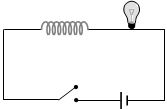
In the following circuit,the bulb will become suddenly bright if
A
Contact is made or broken
B
Contact is made
C
Contact is broken
D
Won't become bright at all
Solution
(C) When the contact is broken,the current in the circuit decreases rapidly.
According to Lenz's Law,the inductor opposes this change in current by inducing an electromotive force (emf) given by $\varepsilon = -L \frac{di}{dt}$.
Since the current drops to zero very quickly when the switch is opened,the rate of change of current $\frac{di}{dt}$ is very high.
This results in a large induced emf across the inductor,which causes a momentary surge of current through the bulb,making it glow suddenly bright.
According to Lenz's Law,the inductor opposes this change in current by inducing an electromotive force (emf) given by $\varepsilon = -L \frac{di}{dt}$.
Since the current drops to zero very quickly when the switch is opened,the rate of change of current $\frac{di}{dt}$ is very high.
This results in a large induced emf across the inductor,which causes a momentary surge of current through the bulb,making it glow suddenly bright.
0 likes
View Solution17
EasyMCQ
The self-inductance of a solenoid is:
A
Directly proportional to the current flowing through the coil
B
Directly proportional to its length
C
Directly proportional to the area of cross-section
D
Inversely proportional to the area of cross-section
Solution
(C) The self-inductance $L$ of a long solenoid is given by the formula: $L = \frac{\mu_0 N^2 A}{l}$,where $\mu_0$ is the permeability of free space,$N$ is the total number of turns,$A$ is the cross-sectional area,and $l$ is the length of the solenoid.
From this expression,it is clear that $L \propto A$. Therefore,the self-inductance is directly proportional to the area of the cross-section of the solenoid.
From this expression,it is clear that $L \propto A$. Therefore,the self-inductance is directly proportional to the area of the cross-section of the solenoid.
0 likes
View Solution18
EasyMCQ
The self-inductance of a coil is $5 \, H$. If a current of $1 \, A$ changes to $2 \, A$ within $5 \, s$ through the coil,the magnitude of the induced $e.m.f.$ will be $... \, V$.
A
$1$
B
$0.10$
C
$10$
D
$100$
Solution
(A) The formula for induced $e.m.f.$ in a coil due to self-induction is given by:
$|e| = L \left| \frac{di}{dt} \right|$
Given:
Self-inductance $L = 5 \, H$
Change in current $di = 2 \, A - 1 \, A = 1 \, A$
Time interval $dt = 5 \, s$
Substituting the values:
$|e| = 5 \times \frac{1}{5} = 1 \, V$
Therefore,the induced $e.m.f.$ is $1 \, V$.
$|e| = L \left| \frac{di}{dt} \right|$
Given:
Self-inductance $L = 5 \, H$
Change in current $di = 2 \, A - 1 \, A = 1 \, A$
Time interval $dt = 5 \, s$
Substituting the values:
$|e| = 5 \times \frac{1}{5} = 1 \, V$
Therefore,the induced $e.m.f.$ is $1 \, V$.
0 likes
View Solution19
EasyMCQ
The unit of inductance is
A
Volt/ampere
B
Joule/ampere
C
Volt-sec/ampere
D
Volt-ampere/sec
Solution
(C) The induced electromotive force $(e)$ in an inductor is given by the formula: $e = L \frac{di}{dt}$.
Rearranging this formula to solve for inductance $(L)$,we get: $L = e \cdot \frac{dt}{di}$.
The unit of electromotive force $(e)$ is Volt $(V)$,the unit of time $(dt)$ is second $(s)$,and the unit of current $(di)$ is ampere $(A)$.
Therefore,the unit of inductance is $\frac{V \cdot s}{A}$,which is Volt-sec/ampere.
Rearranging this formula to solve for inductance $(L)$,we get: $L = e \cdot \frac{dt}{di}$.
The unit of electromotive force $(e)$ is Volt $(V)$,the unit of time $(dt)$ is second $(s)$,and the unit of current $(di)$ is ampere $(A)$.
Therefore,the unit of inductance is $\frac{V \cdot s}{A}$,which is Volt-sec/ampere.
0 likes
View Solution20
EasyMCQ
The current flowing in a coil of self-inductance $0.4 \, mH$ is increased by $250 \, mA$ in $0.1 \, s$. The induced $e.m.f.$ will be:
A
$+ 1 \, V$
B
$- 1 \, V$
C
$+ 1 \, mV$
D
$- 1 \, mV$
Solution
(D) The induced $e.m.f.$ $(e)$ in a coil due to self-induction is given by the formula: $e = -L \frac{di}{dt}$.
Given:
Self-inductance $L = 0.4 \, mH = 0.4 \times 10^{-3} \, H$.
Change in current $di = 250 \, mA = 250 \times 10^{-3} \, A$.
Time interval $dt = 0.1 \, s$.
Substituting these values into the formula:
$e = -(0.4 \times 10^{-3} \, H) \times \frac{250 \times 10^{-3} \, A}{0.1 \, s}$.
$e = -(0.4 \times 10^{-3}) \times (2500 \times 10^{-3})$.
$e = -1000 \times 10^{-6} \, V$.
$e = -1 \times 10^{-3} \, V = -1 \, mV$.
Therefore,the induced $e.m.f.$ is $-1 \, mV$.
Given:
Self-inductance $L = 0.4 \, mH = 0.4 \times 10^{-3} \, H$.
Change in current $di = 250 \, mA = 250 \times 10^{-3} \, A$.
Time interval $dt = 0.1 \, s$.
Substituting these values into the formula:
$e = -(0.4 \times 10^{-3} \, H) \times \frac{250 \times 10^{-3} \, A}{0.1 \, s}$.
$e = -(0.4 \times 10^{-3}) \times (2500 \times 10^{-3})$.
$e = -1000 \times 10^{-6} \, V$.
$e = -1 \times 10^{-3} \, V = -1 \, mV$.
Therefore,the induced $e.m.f.$ is $-1 \, mV$.
0 likes
View Solution21
EasyMCQ
When the current in a coil changes from $8 \ A$ to $2 \ A$ in $3 \times 10^{-3} \ s$,the induced $e.m.f.$ in the coil is $2 \ V$. The self-inductance of the coil in millihenry $(mH)$ is:
A
$1$
B
$5$
C
$20$
D
$10$
Solution
(A) The formula for induced $e.m.f.$ in a coil due to self-inductance is given by $|e| = L \left| \frac{di}{dt} \right|$.
Given:
Initial current $i_1 = 8 \ A$
Final current $i_2 = 2 \ A$
Change in current $di = |i_2 - i_1| = |2 - 8| = 6 \ A$
Time interval $dt = 3 \times 10^{-3} \ s$
Induced $e.m.f.$ $e = 2 \ V$
Substituting the values into the formula:
$2 = L \times \frac{6}{3 \times 10^{-3}}$
$2 = L \times 2 \times 10^3$
$L = \frac{2}{2 \times 10^3} = 10^{-3} \ H$
Since $1 \ mH = 10^{-3} \ H$,the self-inductance $L = 1 \ mH$.
Given:
Initial current $i_1 = 8 \ A$
Final current $i_2 = 2 \ A$
Change in current $di = |i_2 - i_1| = |2 - 8| = 6 \ A$
Time interval $dt = 3 \times 10^{-3} \ s$
Induced $e.m.f.$ $e = 2 \ V$
Substituting the values into the formula:
$2 = L \times \frac{6}{3 \times 10^{-3}}$
$2 = L \times 2 \times 10^3$
$L = \frac{2}{2 \times 10^3} = 10^{-3} \ H$
Since $1 \ mH = 10^{-3} \ H$,the self-inductance $L = 1 \ mH$.
0 likes
View Solution22
EasyMCQ
The inductance of a coil is $60\,\mu H$. $A$ current in this coil increases from $1.0\,A$ to $1.5\,A$ in $0.1\,s$. The magnitude of the induced $e.m.f.$ is
A
$60 \times 10^{-6}\,V$
B
$300 \times 10^{-4}\,V$
C
$30 \times 10^{-4}\,V$
D
$3 \times 10^{-4}\,V$
Solution
(D) The induced $e.m.f.$ $(e)$ in a coil due to self-induction is given by the formula: $e = L \frac{di}{dt}$.
Given:
Inductance $L = 60\,\mu H = 60 \times 10^{-6}\,H$.
Change in current $di = 1.5\,A - 1.0\,A = 0.5\,A$.
Time interval $dt = 0.1\,s$.
Substituting these values into the formula:
$e = (60 \times 10^{-6}) \times \frac{0.5}{0.1}$
$e = (60 \times 10^{-6}) \times 5$
$e = 300 \times 10^{-6}\,V = 3 \times 10^{-4}\,V$.
Therefore,the magnitude of the induced $e.m.f.$ is $3 \times 10^{-4}\,V$.
Given:
Inductance $L = 60\,\mu H = 60 \times 10^{-6}\,H$.
Change in current $di = 1.5\,A - 1.0\,A = 0.5\,A$.
Time interval $dt = 0.1\,s$.
Substituting these values into the formula:
$e = (60 \times 10^{-6}) \times \frac{0.5}{0.1}$
$e = (60 \times 10^{-6}) \times 5$
$e = 300 \times 10^{-6}\,V = 3 \times 10^{-4}\,V$.
Therefore,the magnitude of the induced $e.m.f.$ is $3 \times 10^{-4}\,V$.
0 likes
View Solution23
MediumMCQ
$A$ circular coil of radius $5\, cm$ has $500$ turns of a wire. The approximate value of the coefficient of self-induction of the coil will be:
A
$25\, mH$
B
$25 \times 10^{-3}\, mH$
C
$50 \times 10^{-3}\, mH$
D
$50 \times 10^{-3}\, H$
Solution
(A) The magnetic flux linked with a coil is given by $\phi = Li$,where $L$ is the self-inductance and $i$ is the current.
Also,$\phi = NBA$,where $N$ is the number of turns,$B$ is the magnetic field,and $A$ is the area of the coil.
For a circular coil,the magnetic field at the center is $B = \frac{\mu_0 Ni}{2r}$.
The area of the coil is $A = \pi r^2$.
Equating the two expressions for flux: $Li = N \left( \frac{\mu_0 Ni}{2r} \right) (\pi r^2)$.
Simplifying,we get $L = \frac{\mu_0 N^2 \pi r}{2}$.
Given: $N = 500$,$r = 0.05\, m$,and $\mu_0 = 4\pi \times 10^{-7}\, T\cdot m/A$.
Substituting the values: $L = \frac{4\pi \times 10^{-7} \times (500)^2 \times \pi \times 0.05}{2}$.
$L = 2 \times 10^{-7} \times 250000 \times \pi^2 \times 0.05$.
Using $\pi^2 \approx 10$,$L \approx 2 \times 10^{-7} \times 250000 \times 10 \times 0.05 = 0.025\, H = 25\, mH$.
Also,$\phi = NBA$,where $N$ is the number of turns,$B$ is the magnetic field,and $A$ is the area of the coil.
For a circular coil,the magnetic field at the center is $B = \frac{\mu_0 Ni}{2r}$.
The area of the coil is $A = \pi r^2$.
Equating the two expressions for flux: $Li = N \left( \frac{\mu_0 Ni}{2r} \right) (\pi r^2)$.
Simplifying,we get $L = \frac{\mu_0 N^2 \pi r}{2}$.
Given: $N = 500$,$r = 0.05\, m$,and $\mu_0 = 4\pi \times 10^{-7}\, T\cdot m/A$.
Substituting the values: $L = \frac{4\pi \times 10^{-7} \times (500)^2 \times \pi \times 0.05}{2}$.
$L = 2 \times 10^{-7} \times 250000 \times \pi^2 \times 0.05$.
Using $\pi^2 \approx 10$,$L \approx 2 \times 10^{-7} \times 250000 \times 10 \times 0.05 = 0.025\, H = 25\, mH$.
0 likes
View Solution24
EasyMCQ
In a coil of self-inductance $0.5 \, H$,the current varies at a constant rate from $0 \, A$ to $10 \, A$ in $2 \, s$. The $e.m.f.$ generated in the coil is ... $V$.
A
$10$
B
$5$
C
$2.5$
D
$1.25$
Solution
(C) The formula for the induced $e.m.f.$ in a coil due to self-induction is given by $e = L \frac{di}{dt}$.
Given:
Self-inductance $L = 0.5 \, H$.
Change in current $\Delta i = 10 \, A - 0 \, A = 10 \, A$.
Time interval $\Delta t = 2 \, s$.
The rate of change of current is $\frac{\Delta i}{\Delta t} = \frac{10 \, A}{2 \, s} = 5 \, A/s$.
Substituting these values into the formula:
$e = 0.5 \, H \times 5 \, A/s = 2.5 \, V$.
Therefore,the generated $e.m.f.$ is $2.5 \, V$.
Given:
Self-inductance $L = 0.5 \, H$.
Change in current $\Delta i = 10 \, A - 0 \, A = 10 \, A$.
Time interval $\Delta t = 2 \, s$.
The rate of change of current is $\frac{\Delta i}{\Delta t} = \frac{10 \, A}{2 \, s} = 5 \, A/s$.
Substituting these values into the formula:
$e = 0.5 \, H \times 5 \, A/s = 2.5 \, V$.
Therefore,the generated $e.m.f.$ is $2.5 \, V$.
0 likes
View Solution25
EasyMCQ
The self-inductance of a solenoid of length $L$,area of cross-section $A$,and having $N$ turns is:
A
$\frac{\mu_0 N^2 A}{L}$
B
$\frac{\mu_0 N A}{L}$
C
$\mu_0 N^2 L A$
D
$\mu_0 N A L$
Solution
(A) The magnetic field inside a long solenoid is given by $B = \mu_0 n I$,where $n = \frac{N}{L}$ is the number of turns per unit length.
Thus,$B = \frac{\mu_0 N I}{L}$.
The magnetic flux $\phi$ through each turn is $\phi = B \cdot A = \frac{\mu_0 N I A}{L}$.
The total magnetic flux linkage is $\Phi = N \phi = \frac{\mu_0 N^2 I A}{L}$.
By definition,the self-inductance $L_{ind}$ is given by $\Phi = L_{ind} I$.
Comparing the two expressions,we get $L_{ind} = \frac{\mu_0 N^2 A}{L}$.
Thus,$B = \frac{\mu_0 N I}{L}$.
The magnetic flux $\phi$ through each turn is $\phi = B \cdot A = \frac{\mu_0 N I A}{L}$.
The total magnetic flux linkage is $\Phi = N \phi = \frac{\mu_0 N^2 I A}{L}$.
By definition,the self-inductance $L_{ind}$ is given by $\Phi = L_{ind} I$.
Comparing the two expressions,we get $L_{ind} = \frac{\mu_0 N^2 A}{L}$.
0 likes
View Solution26
EasyMCQ
The self-inductance of a coil is $L$. Keeping the length and area the same,the number of turns in the coil is increased to four times. The self-inductance of the coil will now be
A
$L/4$
B
$L$
C
$4L$
D
$16L$
Solution
(D) The self-inductance $L$ of a solenoid is given by the formula $L = \frac{\mu_0 N^2 A}{l}$,where $N$ is the number of turns,$A$ is the cross-sectional area,and $l$ is the length of the coil.
From this formula,it is clear that $L \propto N^2$,provided that the length $l$ and area $A$ remain constant.
Given that the number of turns is increased to four times,i.e.,$N' = 4N$.
Therefore,the new self-inductance $L'$ will be $L' \propto (N')^2 = (4N)^2 = 16N^2$.
Thus,$L' = 16L$.
From this formula,it is clear that $L \propto N^2$,provided that the length $l$ and area $A$ remain constant.
Given that the number of turns is increased to four times,i.e.,$N' = 4N$.
Therefore,the new self-inductance $L'$ will be $L' \propto (N')^2 = (4N)^2 = 16N^2$.
Thus,$L' = 16L$.
0 likes
View Solution27
EasyMCQ
The average $e.m.f.$ induced in a coil in which a current changes from $0$ to $2 \,A$ in $0.05 \,s$ is $8 \,V.$ The self-inductance of the coil is:
A
$0.1$
B
$0.2$
C
$0.4$
D
$0.8$
Solution
(B) The formula for the induced $e.m.f.$ in a coil due to self-induction is given by $e = -L \frac{di}{dt}$.
Here,the magnitude of the induced $e.m.f.$ is $|e| = 8 \,V$.
The change in current is $di = 2 \,A - 0 \,A = 2 \,A$.
The time interval is $dt = 0.05 \,s$.
Substituting these values into the formula: $8 = L \times \frac{2}{0.05}$.
$8 = L \times 40$.
$L = \frac{8}{40} = 0.2 \,H$.
Therefore,the self-inductance of the coil is $0.2 \,H$.
Here,the magnitude of the induced $e.m.f.$ is $|e| = 8 \,V$.
The change in current is $di = 2 \,A - 0 \,A = 2 \,A$.
The time interval is $dt = 0.05 \,s$.
Substituting these values into the formula: $8 = L \times \frac{2}{0.05}$.
$8 = L \times 40$.
$L = \frac{8}{40} = 0.2 \,H$.
Therefore,the self-inductance of the coil is $0.2 \,H$.
0 likes
View Solution28
EasyMCQ
The $SI$ unit of inductance,the henry,can be written as
A
Weber/ampere
B
Volt-second/ampere
C
Joule/(ampere)$^2$
D
All of the above
Solution
(D) The induced electromotive force $e$ is given by $e = \frac{d\phi}{dt} = L \frac{dI}{dt}$.
From this,the unit of inductance $L$ is $[L] = \frac{[\text{Weber}]}{[\text{Ampere}]}$.
Since $e = \frac{d\phi}{dt}$,we have $[\text{Volt}] = \frac{[\text{Weber}]}{[\text{Second}]}$,which implies $[\text{Weber}] = [\text{Volt} \cdot \text{Second}]$.
Substituting this,we get $[L] = \frac{[\text{Volt} \cdot \text{Second}]}{[\text{Ampere}]}$.
Also,the energy stored in an inductor is $U = \frac{1}{2} L I^2$. Thus,$[\text{Joule}] = [L] \cdot [\text{Ampere}]^2$,which implies $[L] = \frac{[\text{Joule}]}{[\text{Ampere}]^2}$.
Therefore,all the given expressions are equivalent to the henry.
From this,the unit of inductance $L$ is $[L] = \frac{[\text{Weber}]}{[\text{Ampere}]}$.
Since $e = \frac{d\phi}{dt}$,we have $[\text{Volt}] = \frac{[\text{Weber}]}{[\text{Second}]}$,which implies $[\text{Weber}] = [\text{Volt} \cdot \text{Second}]$.
Substituting this,we get $[L] = \frac{[\text{Volt} \cdot \text{Second}]}{[\text{Ampere}]}$.
Also,the energy stored in an inductor is $U = \frac{1}{2} L I^2$. Thus,$[\text{Joule}] = [L] \cdot [\text{Ampere}]^2$,which implies $[L] = \frac{[\text{Joule}]}{[\text{Ampere}]^2}$.
Therefore,all the given expressions are equivalent to the henry.
0 likes
View Solution29
EasyMCQ
$A$ varying current in a coil changes from $10 \, A$ to $0 \, A$ in $0.5 \, s$. If the average $EMF$ induced in the coil is $220 \, V$,the self-inductance of the coil is ... $H$.
A
$5$
B
$10$
C
$11$
D
$12$
Solution
(C) The formula for induced $EMF$ in a coil due to self-inductance is given by $|e| = L \left| \frac{di}{dt} \right|$.
Given:
Change in current,$di = 10 \, A - 0 \, A = 10 \, A$.
Time interval,$dt = 0.5 \, s$.
Induced $EMF$,$|e| = 220 \, V$.
Substituting these values into the formula:
$220 = L \times \frac{10}{0.5}$
$220 = L \times 20$
$L = \frac{220}{20} = 11 \, H$.
Therefore,the self-inductance of the coil is $11 \, H$.
Given:
Change in current,$di = 10 \, A - 0 \, A = 10 \, A$.
Time interval,$dt = 0.5 \, s$.
Induced $EMF$,$|e| = 220 \, V$.
Substituting these values into the formula:
$220 = L \times \frac{10}{0.5}$
$220 = L \times 20$
$L = \frac{220}{20} = 11 \, H$.
Therefore,the self-inductance of the coil is $11 \, H$.
0 likes
View Solution30
EasyMCQ
When the number of turns and the length of the solenoid are doubled keeping the area of cross-section same, the inductance
A
Remains the same
B
Is halved
C
Is doubled
D
Becomes $1/4$ times
Solution
(C) The self-inductance $L$ of a solenoid is given by the formula $L = \frac{\mu_0 N^2 A}{l}$, where $N$ is the number of turns, $A$ is the area of cross-section, and $l$ is the length of the solenoid.
Given that the new number of turns $N' = 2N$ and the new length $l' = 2l$, while the area $A$ remains constant.
The new inductance $L'$ is given by:
$L' = \frac{\mu_0 (N')^2 A}{l'} = \frac{\mu_0 (2N)^2 A}{2l} = \frac{\mu_0 (4N^2) A}{2l} = 2 \left( \frac{\mu_0 N^2 A}{l} \right) = 2L$.
Therefore, the inductance is doubled.
Given that the new number of turns $N' = 2N$ and the new length $l' = 2l$, while the area $A$ remains constant.
The new inductance $L'$ is given by:
$L' = \frac{\mu_0 (N')^2 A}{l'} = \frac{\mu_0 (2N)^2 A}{2l} = \frac{\mu_0 (4N^2) A}{2l} = 2 \left( \frac{\mu_0 N^2 A}{l} \right) = 2L$.
Therefore, the inductance is doubled.
0 likes
View Solution31
EasyMCQ
The self-inductance of a straight conductor is
A
Zero
B
Very large
C
Infinity
D
Very small
Solution
(A) The self-inductance $L$ of a coil is given by the relation $L = \frac{N \phi}{I}$.
For a straight conductor,the number of turns $N$ is effectively $0$.
Since the self-inductance is directly proportional to the number of turns ($L \propto N^2$ or $L \propto N$ depending on geometry),for a straight wire where there are no loops or turns,the magnetic flux linkage is zero.
Therefore,the self-inductance of a straight conductor is $0$.
For a straight conductor,the number of turns $N$ is effectively $0$.
Since the self-inductance is directly proportional to the number of turns ($L \propto N^2$ or $L \propto N$ depending on geometry),for a straight wire where there are no loops or turns,the magnetic flux linkage is zero.
Therefore,the self-inductance of a straight conductor is $0$.
0 likes
View Solution32
EasyMCQ
The current in a coil changes from $4 \, A$ to $0 \, A$ in $0.1 \, s$. If the average induced $e.m.f.$ is $100 \, V$,what is the self-inductance of the coil in $H$?
A
$2.5$
B
$25$
C
$400$
D
$40$
Solution
(A) The formula for the induced $e.m.f.$ in a coil due to self-inductance is given by $e = L \left| \frac{di}{dt} \right|$.
Given:
Initial current $i_1 = 4 \, A$
Final current $i_2 = 0 \, A$
Change in current $di = i_1 - i_2 = 4 \, A$
Time interval $dt = 0.1 \, s$
Induced $e.m.f.$ $e = 100 \, V$
Substituting the values into the formula:
$100 = L \times \frac{4}{0.1}$
$100 = L \times 40$
$L = \frac{100}{40} = 2.5 \, H$.
Therefore,the self-inductance of the coil is $2.5 \, H$.
Given:
Initial current $i_1 = 4 \, A$
Final current $i_2 = 0 \, A$
Change in current $di = i_1 - i_2 = 4 \, A$
Time interval $dt = 0.1 \, s$
Induced $e.m.f.$ $e = 100 \, V$
Substituting the values into the formula:
$100 = L \times \frac{4}{0.1}$
$100 = L \times 40$
$L = \frac{100}{40} = 2.5 \, H$.
Therefore,the self-inductance of the coil is $2.5 \, H$.
0 likes
View Solution33
EasyMCQ
If a current of $10 \, A$ flows in one second through a coil,and the induced $e.m.f.$ is $10 \, V$,then the self-inductance of the coil is:
A
$2/5 \, H$
B
$4/5 \, H$
C
$5/4 \, H$
D
$1 \, H$
Solution
(D) The formula for induced $e.m.f.$ $(e)$ in a coil due to self-inductance $(L)$ is given by $|e| = L \left| \frac{di}{dt} \right|$.
Given:
Induced $e.m.f.$ $(e)$ = $10 \, V$
Change in current $(di)$ = $10 \, A$
Time interval $(dt)$ = $1 \, s$
Substituting these values into the formula:
$10 = L \times \frac{10}{1}$
$10 = 10L$
$L = 1 \, H$
Therefore,the self-inductance of the coil is $1 \, H$.
Given:
Induced $e.m.f.$ $(e)$ = $10 \, V$
Change in current $(di)$ = $10 \, A$
Time interval $(dt)$ = $1 \, s$
Substituting these values into the formula:
$10 = L \times \frac{10}{1}$
$10 = 10L$
$L = 1 \, H$
Therefore,the self-inductance of the coil is $1 \, H$.
0 likes
View Solution34
EasyMCQ
The inductance of a close-packed coil of $400$ turns is $8 \, mH$. $A$ current of $5 \, mA$ is passed through it. The magnetic flux through each turn of the coil is
A
$\frac{1}{4\pi} \mu_0 \, Wb$
B
$\frac{1}{2\pi} \mu_0 \, Wb$
C
$\frac{1}{3\pi} \mu_0 \, Wb$
D
$0.4 \mu_0 \, Wb$
Solution
(A) The relationship between magnetic flux linkage and inductance is given by $N\phi = Li$,where $N$ is the number of turns,$\phi$ is the magnetic flux per turn,$L$ is the inductance,and $i$ is the current.
Given: $N = 400$,$L = 8 \, mH = 8 \times 10^{-3} \, H$,$i = 5 \, mA = 5 \times 10^{-3} \, A$.
Substituting the values into the formula:
$\phi = \frac{Li}{N} = \frac{8 \times 10^{-3} \times 5 \times 10^{-3}}{400} = \frac{40 \times 10^{-6}}{400} = 0.1 \times 10^{-6} = 10^{-7} \, Wb$.
We know that $\frac{\mu_0}{4\pi} = 10^{-7} \, T \cdot m/A$. Therefore,$10^{-7} \, Wb = \frac{\mu_0}{4\pi} \, Wb$.
Given: $N = 400$,$L = 8 \, mH = 8 \times 10^{-3} \, H$,$i = 5 \, mA = 5 \times 10^{-3} \, A$.
Substituting the values into the formula:
$\phi = \frac{Li}{N} = \frac{8 \times 10^{-3} \times 5 \times 10^{-3}}{400} = \frac{40 \times 10^{-6}}{400} = 0.1 \times 10^{-6} = 10^{-7} \, Wb$.
We know that $\frac{\mu_0}{4\pi} = 10^{-7} \, T \cdot m/A$. Therefore,$10^{-7} \, Wb = \frac{\mu_0}{4\pi} \, Wb$.
0 likes
View Solution35
EasyMCQ
When the current through a solenoid increases at a constant rate, the induced current
A
Is constant and is in the direction of the inducing current
B
Is a constant and is opposite to the direction of the inducing current
C
Increases with time and is in the direction of the inducing current
D
Increases with time and opposite to the direction of the inducing current
Solution
(B) The magnetic flux $\phi$ through a solenoid is proportional to the current $I$ flowing through it, given by $\phi = LI$, where $L$ is the self-inductance of the solenoid.
According to Faraday's Law, the induced electromotive force $(EMF)$ is $\varepsilon = -\frac{d\phi}{dt} = -L \frac{dI}{dt}$.
Since the current $I$ increases at a constant rate, $\frac{dI}{dt}$ is a positive constant.
Therefore, the induced $EMF$ $\varepsilon = -L \times (\text{constant})$ is a constant value.
According to Lenz's Law, the direction of the induced current is such that it opposes the change in magnetic flux that produced it.
Since the inducing current is increasing, the induced current will flow in the opposite direction to oppose this increase.
According to Faraday's Law, the induced electromotive force $(EMF)$ is $\varepsilon = -\frac{d\phi}{dt} = -L \frac{dI}{dt}$.
Since the current $I$ increases at a constant rate, $\frac{dI}{dt}$ is a positive constant.
Therefore, the induced $EMF$ $\varepsilon = -L \times (\text{constant})$ is a constant value.
According to Lenz's Law, the direction of the induced current is such that it opposes the change in magnetic flux that produced it.
Since the inducing current is increasing, the induced current will flow in the opposite direction to oppose this increase.
0 likes
View Solution36
MediumMCQ
If in a coil,the rate of change of area is $5 \, m^2/ms$ and the current changes from $2 \, A$ to $1 \, A$ in $2 \times 10^{-3} \, s$. If the magnitude of the magnetic field is $1 \, T$,then the self-inductance of the coil is ... $H$.
A
$2$
B
$5$
C
$20$
D
$10$
Solution
(D) The magnetic flux linked with the coil is $\phi = B \cdot A$.
For a coil with $N$ turns,the flux linkage is $N\phi = Li$,where $L$ is the self-inductance.
Differentiating with respect to time $t$,we get: $N \frac{d\phi}{dt} = L \frac{di}{dt}$.
Since $\phi = BA$,we have $NB \frac{dA}{dt} = L \frac{di}{dt}$.
Given: $\frac{dA}{dt} = 5 \, m^2/ms = 5 \times 10^3 \, m^2/s$,$B = 1 \, T$,$di = (2 - 1) \, A = 1 \, A$,$dt = 2 \times 10^{-3} \, s$,and assuming $N = 1$.
Substituting the values: $1 \times 1 \times (5 \times 10^3) = L \times \left( \frac{1}{2 \times 10^{-3}} \right)$.
$5000 = L \times 500$.
$L = \frac{5000}{500} = 10 \, H$.
For a coil with $N$ turns,the flux linkage is $N\phi = Li$,where $L$ is the self-inductance.
Differentiating with respect to time $t$,we get: $N \frac{d\phi}{dt} = L \frac{di}{dt}$.
Since $\phi = BA$,we have $NB \frac{dA}{dt} = L \frac{di}{dt}$.
Given: $\frac{dA}{dt} = 5 \, m^2/ms = 5 \times 10^3 \, m^2/s$,$B = 1 \, T$,$di = (2 - 1) \, A = 1 \, A$,$dt = 2 \times 10^{-3} \, s$,and assuming $N = 1$.
Substituting the values: $1 \times 1 \times (5 \times 10^3) = L \times \left( \frac{1}{2 \times 10^{-3}} \right)$.
$5000 = L \times 500$.
$L = \frac{5000}{500} = 10 \, H$.
0 likes
View Solution37
EasyMCQ
The inductance of a solenoid $0.5 \, m$ long of cross-sectional area $20 \, cm^2$ and with $500$ turns is......$mH$
A
$12.5$
B
$1.25$
C
$15$
D
$0.12$
Solution
(B) The formula for the self-inductance of a solenoid is given by $L = \frac{\mu_0 N^2 A}{l}$.
Given values are:
Length $l = 0.5 \, m$
Area $A = 20 \, cm^2 = 20 \times 10^{-4} \, m^2$
Number of turns $N = 500$
Permeability of free space $\mu_0 = 4\pi \times 10^{-7} \, T \cdot m/A$.
Substituting these values into the formula:
$L = \frac{4\pi \times 10^{-7} \times (500)^2 \times 20 \times 10^{-4}}{0.5}$
$L = \frac{4 \times 3.14159 \times 10^{-7} \times 250000 \times 20 \times 10^{-4}}{0.5}$
$L = \frac{12.566 \times 10^{-7} \times 500}{0.5} \approx 1.2566 \times 10^{-3} \, H = 1.2566 \, mH$.
Rounding to the nearest provided option, we get $1.25 \, mH$.
Given values are:
Length $l = 0.5 \, m$
Area $A = 20 \, cm^2 = 20 \times 10^{-4} \, m^2$
Number of turns $N = 500$
Permeability of free space $\mu_0 = 4\pi \times 10^{-7} \, T \cdot m/A$.
Substituting these values into the formula:
$L = \frac{4\pi \times 10^{-7} \times (500)^2 \times 20 \times 10^{-4}}{0.5}$
$L = \frac{4 \times 3.14159 \times 10^{-7} \times 250000 \times 20 \times 10^{-4}}{0.5}$
$L = \frac{12.566 \times 10^{-7} \times 500}{0.5} \approx 1.2566 \times 10^{-3} \, H = 1.2566 \, mH$.
Rounding to the nearest provided option, we get $1.25 \, mH$.
0 likes
View Solution38
EasyMCQ
An $e.m.f.$ of $12 \, V$ is produced in a coil when the current in it changes at the rate of $45 \, A/min$. The inductance of the coil is ....... $H$.
A
$0.25$
B
$1.5$
C
$9.6$
D
$16$
Solution
(D) The induced $e.m.f.$ $(e)$ in a coil is given by the formula: $e = L \cdot \frac{di}{dt}$.
Here,$e = 12 \, V$.
The rate of change of current is $\frac{di}{dt} = 45 \, A/min$.
First,convert the rate of change of current into $A/s$:
$\frac{di}{dt} = \frac{45 \, A}{60 \, s} = 0.75 \, A/s$.
Now,substitute the values into the formula:
$12 = L \times 0.75$.
$L = \frac{12}{0.75} = \frac{1200}{75} = 16 \, H$.
Therefore,the inductance of the coil is $16 \, H$.
Here,$e = 12 \, V$.
The rate of change of current is $\frac{di}{dt} = 45 \, A/min$.
First,convert the rate of change of current into $A/s$:
$\frac{di}{dt} = \frac{45 \, A}{60 \, s} = 0.75 \, A/s$.
Now,substitute the values into the formula:
$12 = L \times 0.75$.
$L = \frac{12}{0.75} = \frac{1200}{75} = 16 \, H$.
Therefore,the inductance of the coil is $16 \, H$.
0 likes
View Solution39
EasyMCQ
An average induced $e.m.f.$ of $1\,V$ appears in a coil when the current in it is changed from $10\,A$ in one direction to $10\,A$ in the opposite direction in $0.5\,s$. The self-inductance of the coil is.....$mH$.
A
$25$
B
$50$
C
$75$
D
$100$
Solution
(A) The formula for the average induced $e.m.f.$ in a coil due to self-inductance is given by $|e| = L \left| \frac{di}{dt} \right|$.
Here,the change in current $di = 10\,A - (-10\,A) = 20\,A$.
The time interval $dt = 0.5\,s$.
The induced $e.m.f.$ $e = 1\,V$.
Substituting these values into the formula:
$1 = L \times \frac{20}{0.5}$
$1 = L \times 40$
$L = \frac{1}{40}\,H = 0.025\,H$.
Converting to millihenry $(mH)$:
$L = 0.025 \times 1000\,mH = 25\,mH$.
Here,the change in current $di = 10\,A - (-10\,A) = 20\,A$.
The time interval $dt = 0.5\,s$.
The induced $e.m.f.$ $e = 1\,V$.
Substituting these values into the formula:
$1 = L \times \frac{20}{0.5}$
$1 = L \times 40$
$L = \frac{1}{40}\,H = 0.025\,H$.
Converting to millihenry $(mH)$:
$L = 0.025 \times 1000\,mH = 25\,mH$.
0 likes
View Solution40
EasyMCQ
$A$ solenoid of length $l$ metre has self-inductance $L$ henry. If the number of turns is doubled,its self-inductance becomes:
A
Remains the same
B
Becomes $2L$ henry
C
Becomes $4L$ henry
D
Becomes $\frac{L}{\sqrt{2}}$ henry
Solution
(C) The self-inductance $L$ of a solenoid is given by the formula $L = \frac{\mu_0 N^2 A}{l}$,where $N$ is the number of turns,$A$ is the cross-sectional area,and $l$ is the length of the solenoid.
From this formula,it is clear that the self-inductance $L$ is directly proportional to the square of the number of turns,i.e.,$L \propto N^2$.
If the number of turns $N$ is doubled $(N' = 2N)$,the new self-inductance $L'$ will be:
$L' \propto (2N)^2 = 4N^2 = 4L$.
Therefore,the self-inductance becomes $4L$ henry.
From this formula,it is clear that the self-inductance $L$ is directly proportional to the square of the number of turns,i.e.,$L \propto N^2$.
If the number of turns $N$ is doubled $(N' = 2N)$,the new self-inductance $L'$ will be:
$L' \propto (2N)^2 = 4N^2 = 4L$.
Therefore,the self-inductance becomes $4L$ henry.
0 likes
View Solution41
MediumMCQ
In a circular conducting coil,when current increases from $2 \,A$ to $18 \,A$ in $0.05 \,s$,the induced $e.m.f.$ is $20 \,V$. The self-inductance of the coil is.....$mH$.
A
$62.5$
B
$6.25$
C
$50$
D
None of these
Solution
(A) The induced $e.m.f.$ $(e)$ in a coil due to self-inductance is given by the formula: $|e| = L \frac{di}{dt}$.
Here,the change in current $di = 18 \,A - 2 \,A = 16 \,A$.
The time interval $dt = 0.05 \,s$.
The induced $e.m.f.$ $|e| = 20 \,V$.
Substituting these values into the formula:
$20 = L \times \frac{16}{0.05}$
$20 = L \times 320$
$L = \frac{20}{320} \,H = \frac{1}{16} \,H = 0.0625 \,H$.
To convert the value into $mH$,multiply by $1000$:
$L = 0.0625 \times 1000 \,mH = 62.5 \,mH$.
Here,the change in current $di = 18 \,A - 2 \,A = 16 \,A$.
The time interval $dt = 0.05 \,s$.
The induced $e.m.f.$ $|e| = 20 \,V$.
Substituting these values into the formula:
$20 = L \times \frac{16}{0.05}$
$20 = L \times 320$
$L = \frac{20}{320} \,H = \frac{1}{16} \,H = 0.0625 \,H$.
To convert the value into $mH$,multiply by $1000$:
$L = 0.0625 \times 1000 \,mH = 62.5 \,mH$.
0 likes
View Solution42
EasyMCQ
Find out the $e.m.f.$ produced when the current changes from $0$ to $1 \, A$ in $10 \, s$,given $L = 10 \, \mu H$.
A
$1 \, V$
B
$1 \, \mu V$
C
$1 \, mV$
D
$0.1 \, V$
Solution
(B) The induced $e.m.f.$ $(e)$ in an inductor is given by the formula:
$|e| = L \frac{di}{dt}$
Given:
Inductance $L = 10 \, \mu H = 10 \times 10^{-6} \, H$
Change in current $di = 1 \, A - 0 \, A = 1 \, A$
Time interval $dt = 10 \, s$
Substituting the values into the formula:
$|e| = (10 \times 10^{-6} \, H) \times \frac{1 \, A}{10 \, s}$
$|e| = 10^{-6} \, V$
$|e| = 1 \, \mu V$
Therefore,the correct option is $B$.
$|e| = L \frac{di}{dt}$
Given:
Inductance $L = 10 \, \mu H = 10 \times 10^{-6} \, H$
Change in current $di = 1 \, A - 0 \, A = 1 \, A$
Time interval $dt = 10 \, s$
Substituting the values into the formula:
$|e| = (10 \times 10^{-6} \, H) \times \frac{1 \, A}{10 \, s}$
$|e| = 10^{-6} \, V$
$|e| = 1 \, \mu V$
Therefore,the correct option is $B$.
0 likes
View Solution43
EasyMCQ
Which of the following is not the unit of self-inductance?
A
Weber/Ampere
B
Ohm-Second
C
Joule-Ampere
D
Joule Ampere$^{-2}$
Solution
(C) The self-inductance $L$ is defined by the relation $\phi = LI$,where $\phi$ is magnetic flux and $I$ is current. Thus,$L = \phi / I$. The unit of flux $\phi$ is Weber $(Wb)$ and current $I$ is Ampere $(A)$,so $L$ has units of $Wb/A$ (Henry).
Since $V = L(dI/dt)$,we have $L = V \cdot t / I$. Since $V/I = R$ (Ohm),$L$ has units of $Ohm \cdot s$.
Energy stored in an inductor is $U = \frac{1}{2}LI^2$,so $L = 2U/I^2$. Since $U$ is in Joules $(J)$,$L$ has units of $J/A^2$ or $J \cdot A^{-2}$.
Comparing these with the options,$J \cdot A$ is not a unit of self-inductance. Therefore,option $C$ is correct.
Since $V = L(dI/dt)$,we have $L = V \cdot t / I$. Since $V/I = R$ (Ohm),$L$ has units of $Ohm \cdot s$.
Energy stored in an inductor is $U = \frac{1}{2}LI^2$,so $L = 2U/I^2$. Since $U$ is in Joules $(J)$,$L$ has units of $J/A^2$ or $J \cdot A^{-2}$.
Comparing these with the options,$J \cdot A$ is not a unit of self-inductance. Therefore,option $C$ is correct.
0 likes
View Solution44
EasyMCQ
$A$ coil of $100$ turns carries a current of $5\, mA$ and creates a magnetic flux of $10^{-5} \, Wb$. The inductance is.....$mH$.
A
$0.2$
B
$2$
C
$0.02$
D
None of these
Solution
(D) The total magnetic flux linkage $(\Phi_T)$ in a coil is given by the product of the number of turns $(N)$ and the magnetic flux through a single turn $(\phi)$: $\Phi_T = N\phi$.
Given: $N = 100$, $\phi = 10^{-5} \, Wb$, and current $i = 5 \, mA = 5 \times 10^{-3} \, A$.
The formula for self-inductance $(L)$ is $\Phi_T = Li$.
Substituting the values: $N\phi = Li$.
$100 \times 10^{-5} = L \times (5 \times 10^{-3})$.
$10^{-3} = L \times 5 \times 10^{-3}$.
$L = \frac{10^{-3}}{5 \times 10^{-3}} = \frac{1}{5} = 0.2 \, H$.
Converting to $mH$: $0.2 \, H = 0.2 \times 1000 \, mH = 200 \, mH$.
Since $200 \, mH$ is not among the options, the correct choice is $D$.
Given: $N = 100$, $\phi = 10^{-5} \, Wb$, and current $i = 5 \, mA = 5 \times 10^{-3} \, A$.
The formula for self-inductance $(L)$ is $\Phi_T = Li$.
Substituting the values: $N\phi = Li$.
$100 \times 10^{-5} = L \times (5 \times 10^{-3})$.
$10^{-3} = L \times 5 \times 10^{-3}$.
$L = \frac{10^{-3}}{5 \times 10^{-3}} = \frac{1}{5} = 0.2 \, H$.
Converting to $mH$: $0.2 \, H = 0.2 \times 1000 \, mH = 200 \, mH$.
Since $200 \, mH$ is not among the options, the correct choice is $D$.
0 likes
View Solution45
EasyMCQ
In a circular coil,when the number of turns is doubled and the resistance becomes $1/4$th of the initial value,then the inductance becomes ....... times.
A
$4$
B
$2$
C
$8$
D
No change
Solution
(A) The self-inductance $L$ of a circular coil is given by the formula $L = \frac{\mu_0 N^2 A}{l}$,where $N$ is the number of turns,$A$ is the area of cross-section,and $l$ is the length of the coil.
From this relation,we see that $L \propto N^2$.
Given that the number of turns $N$ is doubled $(N' = 2N)$,the new inductance $L'$ will be $L' \propto (2N)^2 = 4N^2$.
Therefore,$L' = 4L$.
The resistance of the coil does not affect the self-inductance of the coil,as inductance depends only on the geometry and the number of turns of the coil.
Thus,the inductance becomes $4$ times the initial value.
From this relation,we see that $L \propto N^2$.
Given that the number of turns $N$ is doubled $(N' = 2N)$,the new inductance $L'$ will be $L' \propto (2N)^2 = 4N^2$.
Therefore,$L' = 4L$.
The resistance of the coil does not affect the self-inductance of the coil,as inductance depends only on the geometry and the number of turns of the coil.
Thus,the inductance becomes $4$ times the initial value.
1 likes
View Solution46
MediumMCQ
The current in a coil of inductance $5\, H$ decreases at the rate of $2\, A/s$. The induced $e.m.f.$ is....$V$
A
$2$
B
$5$
C
$10$
D
$-10$
Solution
(C) The induced $e.m.f.$ $(e)$ in a coil is given by the formula: $e = -L \frac{di}{dt}$.
Given,inductance $L = 5\, H$.
The rate of change of current $\frac{di}{dt} = -2\, A/s$ (since the current is decreasing).
Substituting these values into the formula:
$e = -5 \times (-2) = +10\, V$.
Therefore,the induced $e.m.f.$ is $10\, V$.
Given,inductance $L = 5\, H$.
The rate of change of current $\frac{di}{dt} = -2\, A/s$ (since the current is decreasing).
Substituting these values into the formula:
$e = -5 \times (-2) = +10\, V$.
Therefore,the induced $e.m.f.$ is $10\, V$.
0 likes
View Solution47
EasyMCQ
The self-induced $e.m.f.$ in a $0.1 \, H$ coil when the current in it is changing at the rate of $200 \, A/s$ is......$V$
A
$8 \times 10^{-4}$
B
$8 \times 10^{-5}$
C
$20$
D
$125$
Solution
(C) The formula for self-induced $e.m.f.$ $(e)$ in a coil is given by $e = L \frac{di}{dt}$,where $L$ is the self-inductance and $\frac{di}{dt}$ is the rate of change of current.
Given:
Self-inductance $L = 0.1 \, H$
Rate of change of current $\frac{di}{dt} = 200 \, A/s$
Substituting the values into the formula:
$e = 0.1 \times 200 = 20 \, V$
Therefore,the self-induced $e.m.f.$ is $20 \, V$.
Given:
Self-inductance $L = 0.1 \, H$
Rate of change of current $\frac{di}{dt} = 200 \, A/s$
Substituting the values into the formula:
$e = 0.1 \times 200 = 20 \, V$
Therefore,the self-induced $e.m.f.$ is $20 \, V$.
0 likes
View Solution48
EasyMCQ
An air core solenoid has $1000$ turns and is one metre long. Its cross-sectional area is $10 \, cm^2$. Its self-inductance is: (in $, mH$)
A
$0.1256$
B
$12.56$
C
$1.256$
D
$125.6$
Solution
(C) The self-inductance $L$ of a solenoid is given by the formula: $L = \frac{\mu_0 N^2 A}{l}$.
Given:
Number of turns $N = 1000 = 10^3$.
Length $l = 1 \, m$.
Area $A = 10 \, cm^2 = 10 \times 10^{-4} \, m^2 = 10^{-3} \, m^2$.
Permeability of free space $\mu_0 = 4\pi \times 10^{-7} \, T \cdot m/A$.
Substituting the values:
$L = \frac{4\pi \times 10^{-7} \times (10^3)^2 \times 10^{-3}}{1}$
$L = 4\pi \times 10^{-7} \times 10^6 \times 10^{-3}$
$L = 4\pi \times 10^{-4} \, H$
$L = 4 \times 3.14159 \times 10^{-4} \, H = 12.566 \times 10^{-4} \, H = 1.2566 \times 10^{-3} \, H$
$L = 1.2566 \, mH \approx 1.256 \, mH$.
Given:
Number of turns $N = 1000 = 10^3$.
Length $l = 1 \, m$.
Area $A = 10 \, cm^2 = 10 \times 10^{-4} \, m^2 = 10^{-3} \, m^2$.
Permeability of free space $\mu_0 = 4\pi \times 10^{-7} \, T \cdot m/A$.
Substituting the values:
$L = \frac{4\pi \times 10^{-7} \times (10^3)^2 \times 10^{-3}}{1}$
$L = 4\pi \times 10^{-7} \times 10^6 \times 10^{-3}$
$L = 4\pi \times 10^{-4} \, H$
$L = 4 \times 3.14159 \times 10^{-4} \, H = 12.566 \times 10^{-4} \, H = 1.2566 \times 10^{-3} \, H$
$L = 1.2566 \, mH \approx 1.256 \, mH$.
0 likes
View Solution49
MediumMCQ
When the current changes from $+2 \, A$ to $-2 \, A$ in $0.05 \, s$,an $e.m.f.$ of $8 \, V$ is induced in a coil. The coefficient of self-induction of the coil is ... $H$.
A
$0.1$
B
$0.2$
C
$0.4$
D
$0.8$
Solution
(A) The formula for induced $e.m.f.$ in a coil due to self-induction is given by $e = L \left| \frac{di}{dt} \right|$.
Given:
Initial current $i_1 = +2 \, A$
Final current $i_2 = -2 \, A$
Change in current $di = i_2 - i_1 = -2 - 2 = -4 \, A$
Time interval $dt = 0.05 \, s$
Induced $e.m.f.$ $e = 8 \, V$
Substituting the values into the formula:
$8 = L \times \frac{|-4|}{0.05}$
$8 = L \times \frac{4}{0.05}$
$8 = L \times 80$
$L = \frac{8}{80} = 0.1 \, H$.
Given:
Initial current $i_1 = +2 \, A$
Final current $i_2 = -2 \, A$
Change in current $di = i_2 - i_1 = -2 - 2 = -4 \, A$
Time interval $dt = 0.05 \, s$
Induced $e.m.f.$ $e = 8 \, V$
Substituting the values into the formula:
$8 = L \times \frac{|-4|}{0.05}$
$8 = L \times \frac{4}{0.05}$
$8 = L \times 80$
$L = \frac{8}{80} = 0.1 \, H$.
0 likes
View Solution50
EasyMCQ
Why does the current not rise immediately in a circuit containing inductance?
A
Because of induced emf
B
Because of high voltage drop
C
Because of low power consumption
D
Because of Joule heating
Solution
(A) The voltage across an inductor is given by $V = L \frac{di}{dt}$.
When there is a change in current,the inductor opposes this change by generating an induced electromotive force (emf) according to Lenz's Law.
If the current were to rise immediately,the rate of change of current $\frac{di}{dt}$ would be infinite,which would require an infinite induced emf.
Since the circuit cannot support an infinite emf,the current rises gradually,following an exponential growth curve until it reaches its steady-state value.
When there is a change in current,the inductor opposes this change by generating an induced electromotive force (emf) according to Lenz's Law.
If the current were to rise immediately,the rate of change of current $\frac{di}{dt}$ would be infinite,which would require an infinite induced emf.
Since the circuit cannot support an infinite emf,the current rises gradually,following an exponential growth curve until it reaches its steady-state value.
0 likes
View SolutionElectromagnetic Induction — Self Induction · Frequently Asked Questions
1Are these Electromagnetic Induction questions useful for JEE and NEET?
Yes. All questions in this section are mapped to JEE Main and NEET exam patterns. Previous year questions from JEE Main, NEET, GUJCET and state-level exams are included with full solutions.
2Can I switch to Hindi or Gujarati for these questions?
Yes. Use the language tabs in the hero section or the sidebar to view the same questions and solutions in English, Hindi or Gujarati.
3How do I generate a question paper from this subtopic?
Use the Vedclass Exam Paper Generator — select the chapter and subtopic, set difficulty, and generate Sets A, B, C, D automatically. First 3 chapters of every subject are free.
Vedclass Products
For Students
Vedclass Test Series
Mock tests in real JEE/NEET style with performance analysis. 5-day free trial.
Start Free TrialFor Teachers
Exam Paper Generator
Generate Set A/B/C/D papers from this chapter in 2 minutes. 3 chapters free.
Try FreeFor Institutes
Online Exam Module
Live online exams with unlimited students, 360° analytics & white-label branding.
See DemoFor Teachers & Institutes
Generate a Electromagnetic Induction Exam Paper in 2 Minutes
Select subtopic & difficulty — Sets A, B, C, D auto-generated with No Repeat logic.
First 3 chapters of every subject are free — no payment required.