
A English
Dynamic EMI and Periodic EMI Questions in English
Class 12 Physics · Electromagnetic Induction · Dynamic EMI and Periodic EMI
41+
Questions
English
Language
100%
With Solutions
Showing 41 of 41 questions in English
1
MediumMCQ
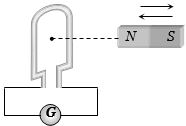
When a magnet is pushed in and out of a circular coil $C$ connected to a very sensitive galvanometer $G$ as shown in the adjoining diagram with a frequency $\nu$,then
A
Constant deflection is observed in the galvanometer.
B
Visible small oscillations will be observed in the galvanometer if $\nu$ is about $50 \, Hz$.
C
Oscillations in the deflection will be observed clearly if $\nu = 1$ or $2 \, Hz$.
D
No variation in the deflection will be seen if $\nu = 1$ or $2 \, Hz$.
Solution
(C) According to Faraday's law of electromagnetic induction,the induced electromotive force $(EMF)$ is proportional to the rate of change of magnetic flux through the coil.
When the magnet is moved in and out with a frequency $\nu$,the magnetic flux changes periodically,inducing an alternating current in the coil.
The galvanometer needle has a certain moment of inertia and damping,which limits its ability to respond to high-frequency changes.
If the frequency $\nu$ is low (e.g.,$1 \, Hz$ or $2 \, Hz$),the galvanometer needle can follow the changes in the induced current,and oscillations in the deflection will be observed clearly.
If the frequency $\nu$ is high (e.g.,$50 \, Hz$),the needle cannot keep up with the rapid oscillations due to its inertia and will remain at the zero position (or show a very small,steady deflection),making the oscillations invisible.
When the magnet is moved in and out with a frequency $\nu$,the magnetic flux changes periodically,inducing an alternating current in the coil.
The galvanometer needle has a certain moment of inertia and damping,which limits its ability to respond to high-frequency changes.
If the frequency $\nu$ is low (e.g.,$1 \, Hz$ or $2 \, Hz$),the galvanometer needle can follow the changes in the induced current,and oscillations in the deflection will be observed clearly.
If the frequency $\nu$ is high (e.g.,$50 \, Hz$),the needle cannot keep up with the rapid oscillations due to its inertia and will remain at the zero position (or show a very small,steady deflection),making the oscillations invisible.
0 likes
View Solution2
MediumMCQ
$A$ rectangular coil of $300$ turns has an average area of $25\;cm \times 10\;cm.$ The coil rotates with a speed of $50\;cps$ in a uniform magnetic field of strength $4 \times 10^{-2}\;T$ about an axis perpendicular to the field. The peak value of the induced $e.m.f.$ is (in volt): (in $\pi$)
A
$3000$
B
$300$
C
$30$
D
$3$
Solution
(C) The peak value of the induced electromotive force $(e.m.f.)$, denoted as $e_0$, is given by the formula: $e_0 = N B A \omega = N B A (2 \pi \nu)$.
Given values:
Number of turns, $N = 300$
Magnetic field strength, $B = 4 \times 10^{-2}\;T$
Area of the coil, $A = 25\;cm \times 10\;cm = 250\;cm^2 = 250 \times 10^{-4}\;m^2 = 2.5 \times 10^{-2}\;m^2$
Frequency of rotation, $\nu = 50\;cps$ (cycles per second)
Substituting these values into the formula:
$e_0 = 300 \times (4 \times 10^{-2}) \times (2.5 \times 10^{-2}) \times (2 \pi \times 50)$
$e_0 = 300 \times 0.04 \times 0.025 \times 100\pi$
$e_0 = 12 \times 0.025 \times 100\pi$
$e_0 = 0.3 \times 100\pi = 30\pi\;V$
Thus, the peak value of the induced $e.m.f.$ is $30\pi\;V$.
Given values:
Number of turns, $N = 300$
Magnetic field strength, $B = 4 \times 10^{-2}\;T$
Area of the coil, $A = 25\;cm \times 10\;cm = 250\;cm^2 = 250 \times 10^{-4}\;m^2 = 2.5 \times 10^{-2}\;m^2$
Frequency of rotation, $\nu = 50\;cps$ (cycles per second)
Substituting these values into the formula:
$e_0 = 300 \times (4 \times 10^{-2}) \times (2.5 \times 10^{-2}) \times (2 \pi \times 50)$
$e_0 = 300 \times 0.04 \times 0.025 \times 100\pi$
$e_0 = 12 \times 0.025 \times 100\pi$
$e_0 = 0.3 \times 100\pi = 30\pi\;V$
Thus, the peak value of the induced $e.m.f.$ is $30\pi\;V$.
0 likes
View Solution3
MediumMCQ
$A$ circular coil of mean radius $7 \, cm$ and having $4000$ turns is rotated at the rate of $1800$ revolutions per minute in the earth's magnetic field $(B = 0.5 \, \text{gauss})$. The maximum $e.m.f.$ induced in the coil will be .... $V$.
A
$1.158$
B
$0.58$
C
$0.29$
D
$5.8$
Solution
(B) The maximum induced $e.m.f.$ $(e_0)$ in a rotating coil is given by the formula: $e_0 = N B A \omega$.
Here,$N = 4000$,$B = 0.5 \, \text{gauss} = 0.5 \times 10^{-4} \, T$,$r = 7 \, cm = 0.07 \, m$,and the frequency $\nu = 1800 \, \text{rpm} = \frac{1800}{60} \, \text{Hz} = 30 \, \text{Hz}$.
The angular velocity $\omega = 2 \pi \nu = 2 \times \pi \times 30 = 60 \pi \, \text{rad/s}$.
The area $A = \pi r^2 = \pi \times (0.07)^2 = 0.0049 \pi \, \text{m}^2$.
Substituting these values into the formula:
$e_0 = 4000 \times (0.5 \times 10^{-4}) \times (0.0049 \pi) \times (60 \pi)$
$e_0 = 4000 \times 0.5 \times 10^{-4} \times 0.0049 \times 60 \times \pi^2$
$e_0 = 0.2 \times 0.0049 \times 60 \times 9.8696 \approx 0.58 \, V$.
Here,$N = 4000$,$B = 0.5 \, \text{gauss} = 0.5 \times 10^{-4} \, T$,$r = 7 \, cm = 0.07 \, m$,and the frequency $\nu = 1800 \, \text{rpm} = \frac{1800}{60} \, \text{Hz} = 30 \, \text{Hz}$.
The angular velocity $\omega = 2 \pi \nu = 2 \times \pi \times 30 = 60 \pi \, \text{rad/s}$.
The area $A = \pi r^2 = \pi \times (0.07)^2 = 0.0049 \pi \, \text{m}^2$.
Substituting these values into the formula:
$e_0 = 4000 \times (0.5 \times 10^{-4}) \times (0.0049 \pi) \times (60 \pi)$
$e_0 = 4000 \times 0.5 \times 10^{-4} \times 0.0049 \times 60 \times \pi^2$
$e_0 = 0.2 \times 0.0049 \times 60 \times 9.8696 \approx 0.58 \, V$.
0 likes
View Solution4
MediumMCQ
The number of turns in the coil of an $AC$ generator is $5000$ and the area of the coil is $0.25\,m^2$. The coil is rotated at the rate of $100\,cycles/sec$ in a magnetic field of $0.2\,Wb/m^2$. The peak value of the electromotive force $(EMF)$ generated is nearly......$kV$.
A
$786$
B
$440$
C
$220$
D
$157$
Solution
(D) The peak value of the induced $EMF$ $(e_0)$ in an $AC$ generator is given by the formula: $e_0 = N B A \omega$.
Here,$N = 5000$ (number of turns),$B = 0.2\,Wb/m^2$ (magnetic field),$A = 0.25\,m^2$ (area),and the frequency $\nu = 100\,Hz$.
The angular velocity $\omega = 2 \pi \nu = 2 \times 3.14 \times 100 = 628\,rad/s$.
Substituting the values: $e_0 = 5000 \times 0.2 \times 0.25 \times 628$.
$e_0 = 1000 \times 0.25 \times 628 = 250 \times 628 = 157000\,V$.
Converting to $kV$: $157000\,V = 157\,kV$.
Here,$N = 5000$ (number of turns),$B = 0.2\,Wb/m^2$ (magnetic field),$A = 0.25\,m^2$ (area),and the frequency $\nu = 100\,Hz$.
The angular velocity $\omega = 2 \pi \nu = 2 \times 3.14 \times 100 = 628\,rad/s$.
Substituting the values: $e_0 = 5000 \times 0.2 \times 0.25 \times 628$.
$e_0 = 1000 \times 0.25 \times 628 = 250 \times 628 = 157000\,V$.
Converting to $kV$: $157000\,V = 157\,kV$.
0 likes
View Solution5
MediumMCQ
In a region of uniform magnetic induction $B = 10^{-2} \, T$,a circular coil of radius $r = 30 \, cm$ and resistance $R = \pi^2 \, \Omega$ is rotated about an axis which is perpendicular to the direction of $B$ and which forms a diameter of the coil. If the coil rotates at $200 \, rpm$,the amplitude of the alternating current induced in the coil is.....$mA$.
A
$4\pi^2$
B
$30$
C
$6$
D
$200$
Solution
(C) The magnetic flux through the coil at any time $t$ is given by $\phi = NBA \cos(\omega t)$,where $\omega$ is the angular frequency.
The induced electromotive force $(EMF)$ is $e = -\frac{d\phi}{dt} = NBA\omega \sin(\omega t)$.
The amplitude of the induced $EMF$ is $e_0 = NBA\omega$.
The amplitude of the induced current is $i_0 = \frac{e_0}{R} = \frac{NBA\omega}{R}$.
Given: $B = 10^{-2} \, T$,$r = 0.3 \, m$,$A = \pi r^2 = \pi(0.3)^2 = 0.09\pi \, m^2$,$R = \pi^2 \, \Omega$,and frequency $f = \frac{200}{60} = \frac{10}{3} \, Hz$.
Angular frequency $\omega = 2\pi f = 2\pi \times \frac{10}{3} = \frac{20\pi}{3} \, rad/s$.
Assuming $N=1$ (single turn coil):
$i_0 = \frac{1 \times 10^{-2} \times (0.09\pi) \times (20\pi/3)}{\pi^2} = \frac{10^{-2} \times 0.03 \times 20 \times \pi^2}{\pi^2} = 0.006 \, A = 6 \, mA$.
The induced electromotive force $(EMF)$ is $e = -\frac{d\phi}{dt} = NBA\omega \sin(\omega t)$.
The amplitude of the induced $EMF$ is $e_0 = NBA\omega$.
The amplitude of the induced current is $i_0 = \frac{e_0}{R} = \frac{NBA\omega}{R}$.
Given: $B = 10^{-2} \, T$,$r = 0.3 \, m$,$A = \pi r^2 = \pi(0.3)^2 = 0.09\pi \, m^2$,$R = \pi^2 \, \Omega$,and frequency $f = \frac{200}{60} = \frac{10}{3} \, Hz$.
Angular frequency $\omega = 2\pi f = 2\pi \times \frac{10}{3} = \frac{20\pi}{3} \, rad/s$.
Assuming $N=1$ (single turn coil):
$i_0 = \frac{1 \times 10^{-2} \times (0.09\pi) \times (20\pi/3)}{\pi^2} = \frac{10^{-2} \times 0.03 \times 20 \times \pi^2}{\pi^2} = 0.006 \, A = 6 \, mA$.
0 likes
View Solution6
MediumMCQ
$A$ coil of area $25 \; cm \times 10 \; cm$ having $300$ turns is rotated in a magnetic field of $4 \times 10^{-2} \; T$ with an angular speed of $50 \; rps$. What is the maximum $emf$ induced (in $\pi \; V$)?
A
$3000$
B
$300$
C
$30$
D
$3$
Solution
(C) The maximum induced $emf$ $(e_0)$ in a rotating coil is given by the formula: $e_0 = N B A \omega$, where $\omega = 2\pi \nu$.
Given:
Number of turns $(N)$ = $300$
Magnetic field $(B)$ = $4 \times 10^{-2} \; T$
Area $(A)$ = $25 \; cm \times 10 \; cm = 250 \; cm^2 = 250 \times 10^{-4} \; m^2 = 2.5 \times 10^{-2} \; m^2$
Frequency $(\nu)$ = $50 \; rps$
Angular speed $(\omega)$ = $2\pi \times 50 = 100\pi \; rad/s$
Substituting the values:
$e_0 = 300 \times (4 \times 10^{-2}) \times (2.5 \times 10^{-2}) \times 100\pi$
$e_0 = 300 \times 0.04 \times 0.025 \times 100\pi$
$e_0 = 300 \times 0.001 \times 100\pi$
$e_0 = 30\pi \; V$.
Given:
Number of turns $(N)$ = $300$
Magnetic field $(B)$ = $4 \times 10^{-2} \; T$
Area $(A)$ = $25 \; cm \times 10 \; cm = 250 \; cm^2 = 250 \times 10^{-4} \; m^2 = 2.5 \times 10^{-2} \; m^2$
Frequency $(\nu)$ = $50 \; rps$
Angular speed $(\omega)$ = $2\pi \times 50 = 100\pi \; rad/s$
Substituting the values:
$e_0 = 300 \times (4 \times 10^{-2}) \times (2.5 \times 10^{-2}) \times 100\pi$
$e_0 = 300 \times 0.04 \times 0.025 \times 100\pi$
$e_0 = 300 \times 0.001 \times 100\pi$
$e_0 = 30\pi \; V$.
0 likes
View Solution7
MediumMCQ
The phase difference between the magnetic flux linked with a coil rotating in a uniform magnetic field and the induced $e.m.f.$ produced in it is
A
$\pi$
B
$\pi / 2$
C
$\pi / 3$
D
$-\pi / 6$
Solution
(B) The magnetic flux linked with a coil rotating in a uniform magnetic field is given by $\phi = BA \cos(\omega t)$,where $\omega$ is the angular velocity.
According to Faraday's law of electromagnetic induction,the induced $e.m.f.$ is given by $e = -\frac{d\phi}{dt}$.
Substituting the expression for $\phi$: $e = -\frac{d}{dt}(BA \cos(\omega t)) = BA\omega \sin(\omega t)$.
Using the trigonometric identity $\sin(\theta) = \cos(\theta - \pi/2)$,we can write the induced $e.m.f.$ as $e = BA\omega \cos(\omega t - \pi/2)$.
Comparing the phase of the flux $(\omega t)$ and the phase of the induced $e.m.f.$ $(\omega t - \pi/2)$,the phase difference is $\pi/2$.
According to Faraday's law of electromagnetic induction,the induced $e.m.f.$ is given by $e = -\frac{d\phi}{dt}$.
Substituting the expression for $\phi$: $e = -\frac{d}{dt}(BA \cos(\omega t)) = BA\omega \sin(\omega t)$.
Using the trigonometric identity $\sin(\theta) = \cos(\theta - \pi/2)$,we can write the induced $e.m.f.$ as $e = BA\omega \cos(\omega t - \pi/2)$.
Comparing the phase of the flux $(\omega t)$ and the phase of the induced $e.m.f.$ $(\omega t - \pi/2)$,the phase difference is $\pi/2$.
0 likes
View Solution8
MediumMCQ
$A$ ring of resistance $10 \Omega$,radius $10 \text{ cm}$,and $100$ turns is rotated at a rate of $100$ revolutions per second about a fixed axis which is perpendicular to a uniform magnetic field of induction $10 \text{ mT}$. The amplitude of the current in the loop will be nearly $A$ (Take $\pi^2 = 10$).
A
$200$
B
$2$
C
$0.002$
D
none of these
Solution
(B) The magnetic flux linked with the coil is given by $\phi = N A B \cos(\omega t)$.
The induced electromotive force $(EMF)$ is $e = -\frac{d\phi}{dt} = N A B \omega \sin(\omega t)$.
The amplitude of the induced $EMF$ is $e_0 = N A B \omega$.
Given values: $N = 100$,$R = 10 \Omega$,$r = 10 \text{ cm} = 0.1 \text{ m}$,$B = 10 \text{ mT} = 10^{-2} \text{ T}$,and frequency $f = 100 \text{ Hz}$.
Angular frequency $\omega = 2 \pi f = 2 \pi \times 100 = 200 \pi \text{ rad/s}$.
Area $A = \pi r^2 = \pi (0.1)^2 = 0.01 \pi \text{ m}^2$.
The amplitude of the current is $I_0 = \frac{e_0}{R} = \frac{N A B \omega}{R}$.
Substituting the values: $I_0 = \frac{100 \times (0.01 \pi) \times 10^{-2} \times (200 \pi)}{10}$.
$I_0 = \frac{100 \times 0.01 \times 200 \times \pi^2 \times 10^{-2}}{10} = \frac{200 \times 10}{10} = 2 \text{ A}$.
The induced electromotive force $(EMF)$ is $e = -\frac{d\phi}{dt} = N A B \omega \sin(\omega t)$.
The amplitude of the induced $EMF$ is $e_0 = N A B \omega$.
Given values: $N = 100$,$R = 10 \Omega$,$r = 10 \text{ cm} = 0.1 \text{ m}$,$B = 10 \text{ mT} = 10^{-2} \text{ T}$,and frequency $f = 100 \text{ Hz}$.
Angular frequency $\omega = 2 \pi f = 2 \pi \times 100 = 200 \pi \text{ rad/s}$.
Area $A = \pi r^2 = \pi (0.1)^2 = 0.01 \pi \text{ m}^2$.
The amplitude of the current is $I_0 = \frac{e_0}{R} = \frac{N A B \omega}{R}$.
Substituting the values: $I_0 = \frac{100 \times (0.01 \pi) \times 10^{-2} \times (200 \pi)}{10}$.
$I_0 = \frac{100 \times 0.01 \times 200 \times \pi^2 \times 10^{-2}}{10} = \frac{200 \times 10}{10} = 2 \text{ A}$.
0 likes
View Solution9
EasyMCQ
The $e.m.f.$ induced in a coil of wire,which is rotating in a magnetic field,does not depend on
A
the angular speed of rotation
B
the area of the coil
C
the number of turns on the coil
D
the resistance of the coil
Solution
(D) The induced $e.m.f.$ in a rotating coil is given by the formula $\varepsilon = N A B \omega \sin(\omega t)$.
Here,$N$ is the number of turns,$A$ is the area of the coil,$B$ is the magnetic field strength,and $\omega$ is the angular speed.
From the formula,it is clear that the induced $e.m.f.$ depends on $N$,$A$,$B$,and $\omega$.
It does not depend on the resistance of the coil,as resistance only affects the induced current $(I = \varepsilon / R)$,not the induced $e.m.f.$ itself.
Therefore,the correct option is $D$.
Here,$N$ is the number of turns,$A$ is the area of the coil,$B$ is the magnetic field strength,and $\omega$ is the angular speed.
From the formula,it is clear that the induced $e.m.f.$ depends on $N$,$A$,$B$,and $\omega$.
It does not depend on the resistance of the coil,as resistance only affects the induced current $(I = \varepsilon / R)$,not the induced $e.m.f.$ itself.
Therefore,the correct option is $D$.
0 likes
View Solution10
MediumMCQ
In an $AC$ generator,a coil with $N$ turns,all of the same area $A$ and total resistance $R$,rotates with frequency $\omega$ in a magnetic field $B$. The maximum value of emf generated in the coil is
A
$NAB\omega$
B
$NABR\omega$
C
$NAB$
D
$NABR$
Solution
(A) The magnetic flux $\phi$ linked with the coil at any time $t$ is given by $\phi = N B A \cos(\omega t)$.
According to Faraday's law of electromagnetic induction,the induced emf $e$ is given by $e = -\frac{d\phi}{dt}$.
Substituting the expression for $\phi$: $e = -\frac{d}{dt}(N B A \cos(\omega t))$.
$e = -N B A \frac{d}{dt}(\cos(\omega t)) = -N B A (-\omega \sin(\omega t)) = N B A \omega \sin(\omega t)$.
The maximum value of emf $(e_{\max})$ occurs when $\sin(\omega t) = 1$.
Therefore,$e_{\max} = N B A \omega$.
According to Faraday's law of electromagnetic induction,the induced emf $e$ is given by $e = -\frac{d\phi}{dt}$.
Substituting the expression for $\phi$: $e = -\frac{d}{dt}(N B A \cos(\omega t))$.
$e = -N B A \frac{d}{dt}(\cos(\omega t)) = -N B A (-\omega \sin(\omega t)) = N B A \omega \sin(\omega t)$.
The maximum value of emf $(e_{\max})$ occurs when $\sin(\omega t) = 1$.
Therefore,$e_{\max} = N B A \omega$.
0 likes
View Solution11
MediumMCQ
$A$ student pedals a stationary bicycle. The pedals of the bicycle are attached to a $100$ turn coil of area $0.10$ $m^2$. The coil rotates at half a revolution per second and it is placed in a uniform magnetic field of $0.01$ $T$ perpendicular to the axis of rotation of the coil. What is the maximum voltage generated in the coil (in $V$)?
A
$1.314$
B
$1.214$
C
$2.314$
D
$0.314$
Solution
(D) Given: Number of turns $N = 100$,Area $A = 0.10$ $m^2$,Magnetic field $B = 0.01$ $T$,Frequency $f = 0.5$ $rev/s$.
Angular frequency $\omega = 2 \pi f = 2 \times 3.14 \times 0.5 = 3.14$ $rad/s$.
The maximum induced electromotive force (voltage) is given by the formula $e_0 = N B A \omega$.
Substituting the values: $e_0 = 100 \times 0.01 \times 0.10 \times 3.14$.
$e_0 = 1 \times 0.10 \times 3.14 = 0.314$ $V$.
Thus,the maximum voltage generated in the coil is $0.314$ $V$.
Angular frequency $\omega = 2 \pi f = 2 \times 3.14 \times 0.5 = 3.14$ $rad/s$.
The maximum induced electromotive force (voltage) is given by the formula $e_0 = N B A \omega$.
Substituting the values: $e_0 = 100 \times 0.01 \times 0.10 \times 3.14$.
$e_0 = 1 \times 0.10 \times 3.14 = 0.314$ $V$.
Thus,the maximum voltage generated in the coil is $0.314$ $V$.
0 likes
View Solution12
DifficultMCQ
In a uniform magnetic field of induction $B$,a wire in the form of a semicircle of radius $r$ rotates about the diameter of the circle with angular frequency $\omega$. The axis of rotation is perpendicular to the field. If the total resistance of the circuit is $R$,the mean power generated per period of rotation is
A
$\frac{B \pi r^{2} \omega}{2 R}$
B
$\frac{(B \pi r^{2} \omega)^{2}}{8 R}$
C
$\frac{(B \pi r \omega)^{2}}{2 R}$
D
$\frac{(B \pi r \omega^{2})^{2}}{8 R}$
Solution
(B) The area of the semicircle is $A = \frac{1}{2} \pi r^{2}$.
The magnetic flux linked with the loop at time $t$ is $\phi = B A \cos(\omega t) = B \left(\frac{1}{2} \pi r^{2}\right) \cos(\omega t)$.
The induced electromotive force $(EMF)$ is given by Faraday's law: $\varepsilon = -\frac{d\phi}{dt} = \frac{1}{2} B \pi r^{2} \omega \sin(\omega t)$.
The instantaneous power generated is $P(t) = \frac{\varepsilon^{2}}{R} = \frac{(\frac{1}{2} B \pi r^{2} \omega \sin(\omega t))^{2}}{R} = \frac{B^{2} \pi^{2} r^{4} \omega^{2} \sin^{2}(\omega t)}{4 R}$.
The mean power over a full period is $\langle P \rangle = \frac{B^{2} \pi^{2} r^{4} \omega^{2}}{4 R} \langle \sin^{2}(\omega t) \rangle$.
Since the mean value of $\sin^{2}(\omega t)$ over a period is $\frac{1}{2}$,we have $\langle P \rangle = \frac{B^{2} \pi^{2} r^{4} \omega^{2}}{4 R} \cdot \frac{1}{2} = \frac{(B \pi r^{2} \omega)^{2}}{8 R}$.
The magnetic flux linked with the loop at time $t$ is $\phi = B A \cos(\omega t) = B \left(\frac{1}{2} \pi r^{2}\right) \cos(\omega t)$.
The induced electromotive force $(EMF)$ is given by Faraday's law: $\varepsilon = -\frac{d\phi}{dt} = \frac{1}{2} B \pi r^{2} \omega \sin(\omega t)$.
The instantaneous power generated is $P(t) = \frac{\varepsilon^{2}}{R} = \frac{(\frac{1}{2} B \pi r^{2} \omega \sin(\omega t))^{2}}{R} = \frac{B^{2} \pi^{2} r^{4} \omega^{2} \sin^{2}(\omega t)}{4 R}$.
The mean power over a full period is $\langle P \rangle = \frac{B^{2} \pi^{2} r^{4} \omega^{2}}{4 R} \langle \sin^{2}(\omega t) \rangle$.
Since the mean value of $\sin^{2}(\omega t)$ over a period is $\frac{1}{2}$,we have $\langle P \rangle = \frac{B^{2} \pi^{2} r^{4} \omega^{2}}{4 R} \cdot \frac{1}{2} = \frac{(B \pi r^{2} \omega)^{2}}{8 R}$.
0 likes
View Solution13
DifficultMCQ
At the centre of a fixed large circular coil of radius $R$,a much smaller circular coil of radius $r$ is placed. The two coils are concentric and are in the same plane. The larger coil carries a current $I$. The smaller coil is set to rotate with a constant angular velocity $\omega$ about an axis along their common diameter. Calculate the $emf$ induced in the smaller coil after a time $t$ of its start of rotation.
A
$\frac{\mu_0 I}{2R} \omega r^2 \sin \omega t$
B
$\frac{\mu_0 I}{4R} \omega \pi r^2 \sin \omega t$
C
$\frac{\mu_0 I}{2R} \omega \pi r^2 \sin \omega t$
D
$\frac{\mu_0 I}{4R} \omega r^2 \sin \omega t$
Solution
(C) The magnetic field $B$ at the center of the large circular coil of radius $R$ carrying current $I$ is given by $B = \frac{\mu_0 I}{2R}$.
The magnetic flux $\phi$ through the smaller coil of radius $r$ at an angle $\theta = \omega t$ with the magnetic field is $\phi = B A \cos(\omega t) = \left(\frac{\mu_0 I}{2R}\right) (\pi r^2) \cos(\omega t)$.
According to Faraday's law of electromagnetic induction,the induced $emf$ is $e = -\frac{d\phi}{dt}$.
Substituting the expression for $\phi$: $e = -\frac{d}{dt} \left[ \frac{\mu_0 I \pi r^2}{2R} \cos(\omega t) \right]$.
$e = -\frac{\mu_0 I \pi r^2}{2R} \cdot (-\omega \sin(\omega t)) = \frac{\mu_0 I}{2R} \omega \pi r^2 \sin(\omega t)$.
The magnetic flux $\phi$ through the smaller coil of radius $r$ at an angle $\theta = \omega t$ with the magnetic field is $\phi = B A \cos(\omega t) = \left(\frac{\mu_0 I}{2R}\right) (\pi r^2) \cos(\omega t)$.
According to Faraday's law of electromagnetic induction,the induced $emf$ is $e = -\frac{d\phi}{dt}$.
Substituting the expression for $\phi$: $e = -\frac{d}{dt} \left[ \frac{\mu_0 I \pi r^2}{2R} \cos(\omega t) \right]$.
$e = -\frac{\mu_0 I \pi r^2}{2R} \cdot (-\omega \sin(\omega t)) = \frac{\mu_0 I}{2R} \omega \pi r^2 \sin(\omega t)$.
0 likes
View Solution14
EasyMCQ
When a wire loop is rotated in a magnetic field,the direction of induced $emf$ changes in every
A
one revolution
B
$1/2$ revolution
C
$1/4$ revolution
D
$2$ revolutions
Solution
(B) The magnetic flux linked with the loop is given by $\Phi = BA \cos(\omega t)$.
The induced $emf$ is given by $e = -\frac{d\Phi}{dt} = BA\omega \sin(\omega t)$.
The direction of the induced $emf$ depends on the sign of $\sin(\omega t)$.
Since $\sin(\omega t)$ changes its sign after every $\pi$ radians (which corresponds to half a revolution),the direction of the induced $emf$ reverses after every $1/2$ revolution.
The induced $emf$ is given by $e = -\frac{d\Phi}{dt} = BA\omega \sin(\omega t)$.
The direction of the induced $emf$ depends on the sign of $\sin(\omega t)$.
Since $\sin(\omega t)$ changes its sign after every $\pi$ radians (which corresponds to half a revolution),the direction of the induced $emf$ reverses after every $1/2$ revolution.
0 likes
View Solution15
MediumMCQ
Which statement is correct for the phenomenon of periodic electromagnetic induction in a rotating coil?
A
Phase difference between induced $emf$ and induced current is $\pi$.
B
Phase difference between induced $emf$ and induced current is zero.
C
Phase difference between induced $emf$ and induced current is $\pi / 2$.
D
Frequency of all induced parameters is double the rotational frequency of the coil.
Solution
(B) The magnetic flux linked with a rotating coil is given by $\phi = \phi_0 \cos(\omega t)$.
According to Faraday's law of electromagnetic induction,the induced $emf$ is $e = -\frac{d\phi}{dt}$.
Substituting the expression for $\phi$,we get $e = -\frac{d}{dt}(\phi_0 \cos(\omega t)) = \phi_0 \omega \sin(\omega t)$.
Since the induced current $i = e/R$,the current is $i = \frac{\phi_0 \omega}{R} \sin(\omega t)$.
Both the induced $emf$ $(e)$ and the induced current $(i)$ are proportional to $\sin(\omega t)$.
Therefore,there is no phase difference between the induced $emf$ and the induced current,meaning the phase difference is zero.
According to Faraday's law of electromagnetic induction,the induced $emf$ is $e = -\frac{d\phi}{dt}$.
Substituting the expression for $\phi$,we get $e = -\frac{d}{dt}(\phi_0 \cos(\omega t)) = \phi_0 \omega \sin(\omega t)$.
Since the induced current $i = e/R$,the current is $i = \frac{\phi_0 \omega}{R} \sin(\omega t)$.
Both the induced $emf$ $(e)$ and the induced current $(i)$ are proportional to $\sin(\omega t)$.
Therefore,there is no phase difference between the induced $emf$ and the induced current,meaning the phase difference is zero.
0 likes
View Solution16
EasyMCQ
Which statement is correct for the phenomenon of periodic electromagnetic induction?
A
Phase difference between induced emf and induced current is $\pi$.
B
Phase difference between induced emf and linked flux is zero.
C
Phase difference between induced emf and linked flux is $\pi / 2$.
D
Frequency of all induced parameters is double the rotational frequency of the coil.
Solution
(C) The magnetic flux linked with a rotating coil is given by $\phi = BA \cos(\omega t)$,where $\omega$ is the angular speed of rotation.
According to Faraday's law of induction,the induced emf $E$ is given by $E = -\frac{d\phi}{dt}$.
$E = -\frac{d}{dt}(BA \cos(\omega t)) = -BA(-\omega \sin(\omega t)) = BA\omega \sin(\omega t)$.
We can rewrite this as $E = BA\omega \cos(\omega t - \pi / 2)$.
Comparing the phase of the flux $\phi$ (which is $\omega t$) and the phase of the induced emf $E$ (which is $\omega t - \pi / 2$),the phase difference is $\pi / 2$.
Therefore,the induced emf lags behind the magnetic flux by $\pi / 2$.
According to Faraday's law of induction,the induced emf $E$ is given by $E = -\frac{d\phi}{dt}$.
$E = -\frac{d}{dt}(BA \cos(\omega t)) = -BA(-\omega \sin(\omega t)) = BA\omega \sin(\omega t)$.
We can rewrite this as $E = BA\omega \cos(\omega t - \pi / 2)$.
Comparing the phase of the flux $\phi$ (which is $\omega t$) and the phase of the induced emf $E$ (which is $\omega t - \pi / 2$),the phase difference is $\pi / 2$.
Therefore,the induced emf lags behind the magnetic flux by $\pi / 2$.
0 likes
View Solution17
DifficultMCQ
$A$ planar loop made of wire is rotating in a uniform magnetic field. At time $t=0$,the plane of the loop is perpendicular to the magnetic field. If the loop is rotating about an axis passing through its plane with a period of $10 \; s$,at which of the following times will the induced electromotive force (emf) be maximum and minimum,respectively?
A
$2.5 \; s$ and $7.5 \; s$
B
$5.0 \; s$ and $7.5 \; s$
C
$5.0 \; s$ and $10.0 \; s$
D
$2.5 \; s$ and $5.0 \; s$
Solution
(D) The magnetic flux $\phi$ through the loop is given by $\phi = \vec{B} \cdot \vec{A} = BA \cos \theta = BA \cos(\omega t)$.
The induced emf $e$ is given by Faraday's law: $|e| = |\frac{d\phi}{dt}| = |BA\omega \sin(\omega t)|$.
The induced emf $|e|$ is maximum when $\sin(\omega t) = 1$,which occurs at $\omega t = \frac{\pi}{2}$.
Given the period $T = 10 \; s$,the angular frequency is $\omega = \frac{2\pi}{T} = \frac{2\pi}{10} = \frac{\pi}{5} \; rad/s$.
Substituting $\omega t = \frac{\pi}{2}$ gives $(\frac{\pi}{5})t = \frac{\pi}{2}$,which results in $t = 2.5 \; s$.
The induced emf $|e|$ is minimum when $\sin(\omega t) = 0$,which occurs at $\omega t = \pi$ (or $0, 2\pi, \dots$).
Substituting $\omega t = \pi$ gives $(\frac{\pi}{5})t = \pi$,which results in $t = 5.0 \; s$.
Therefore,the induced emf is maximum at $2.5 \; s$ and minimum at $5.0 \; s$.
The induced emf $e$ is given by Faraday's law: $|e| = |\frac{d\phi}{dt}| = |BA\omega \sin(\omega t)|$.
The induced emf $|e|$ is maximum when $\sin(\omega t) = 1$,which occurs at $\omega t = \frac{\pi}{2}$.
Given the period $T = 10 \; s$,the angular frequency is $\omega = \frac{2\pi}{T} = \frac{2\pi}{10} = \frac{\pi}{5} \; rad/s$.
Substituting $\omega t = \frac{\pi}{2}$ gives $(\frac{\pi}{5})t = \frac{\pi}{2}$,which results in $t = 2.5 \; s$.
The induced emf $|e|$ is minimum when $\sin(\omega t) = 0$,which occurs at $\omega t = \pi$ (or $0, 2\pi, \dots$).
Substituting $\omega t = \pi$ gives $(\frac{\pi}{5})t = \pi$,which results in $t = 5.0 \; s$.
Therefore,the induced emf is maximum at $2.5 \; s$ and minimum at $5.0 \; s$.
0 likes
View Solution18
Medium
Discuss the principle and construction of an $A.C.$ generator (dynamo). Derive the formula for the induced $emf$ in an $A.C.$ generator.
Solution
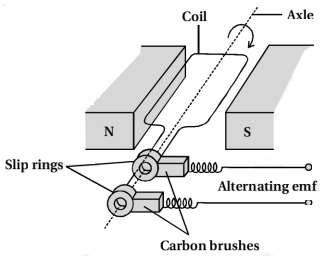
(N/A) Principle: The principle of an $A.C.$ generator is based on electromagnetic induction. When a coil is rotated in a uniform magnetic field,the magnetic flux linked with the coil changes continuously,which induces an alternating $emf$ in the coil.
Construction: An $A.C.$ generator consists of a rectangular coil (armature) placed between the pole pieces of a strong permanent magnet. The coil is mounted on a rotor shaft and can be rotated. The ends of the coil are connected to two slip rings,which rotate with the coil. Two stationary carbon brushes press against these slip rings to conduct the induced current to the external circuit.
Derivation of induced $emf$:
Let the area of the coil be $A$,the number of turns be $N$,and the magnetic field be $B$. If the coil rotates with an angular velocity $\omega$,the angle between the area vector $\vec{A}$ and the magnetic field $\vec{B}$ at any time $t$ is $\theta = \omega t$.
The magnetic flux $\phi$ linked with the coil is given by:
$\phi = N B A \cos(\theta) = N B A \cos(\omega t)$
According to Faraday's law of electromagnetic induction,the induced $emf$ $(\varepsilon)$ is:
$\varepsilon = -\frac{d\phi}{dt}$
$\varepsilon = -\frac{d}{dt} (N B A \cos(\omega t))$
$\varepsilon = -N B A (-\sin(\omega t)) \cdot \omega$
$\varepsilon = N B A \omega \sin(\omega t)$
Let $\varepsilon_0 = N B A \omega$ be the peak value of the $emf$. Then:
$\varepsilon = \varepsilon_0 \sin(\omega t)$
Construction: An $A.C.$ generator consists of a rectangular coil (armature) placed between the pole pieces of a strong permanent magnet. The coil is mounted on a rotor shaft and can be rotated. The ends of the coil are connected to two slip rings,which rotate with the coil. Two stationary carbon brushes press against these slip rings to conduct the induced current to the external circuit.
Derivation of induced $emf$:
Let the area of the coil be $A$,the number of turns be $N$,and the magnetic field be $B$. If the coil rotates with an angular velocity $\omega$,the angle between the area vector $\vec{A}$ and the magnetic field $\vec{B}$ at any time $t$ is $\theta = \omega t$.
The magnetic flux $\phi$ linked with the coil is given by:
$\phi = N B A \cos(\theta) = N B A \cos(\omega t)$
According to Faraday's law of electromagnetic induction,the induced $emf$ $(\varepsilon)$ is:
$\varepsilon = -\frac{d\phi}{dt}$
$\varepsilon = -\frac{d}{dt} (N B A \cos(\omega t))$
$\varepsilon = -N B A (-\sin(\omega t)) \cdot \omega$
$\varepsilon = N B A \omega \sin(\omega t)$
Let $\varepsilon_0 = N B A \omega$ be the peak value of the $emf$. Then:
$\varepsilon = \varepsilon_0 \sin(\omega t)$
0 likes
View Solution19
Difficult
Write down the formula for the induced $emf$ in an $AC$ generator and discuss how it varies with time.
Solution
(N/A) The formula for the induced $emf$ $(\varepsilon)$ in an $AC$ generator is given by:
$\varepsilon = \varepsilon_{0} \sin(\omega t) = \varepsilon_{0} \sin(2 \pi \nu t) \quad \dots (1)$
where $\varepsilon_{0}$ is the peak value of the $emf$,$\omega$ is the angular frequency,and $\nu$ is the frequency of rotation.
Equation $(1)$ represents the instantaneous value of the $emf$. The $emf$ varies periodically between $+\varepsilon_{0}$ and $-\varepsilon_{0}$ as the coil rotates.
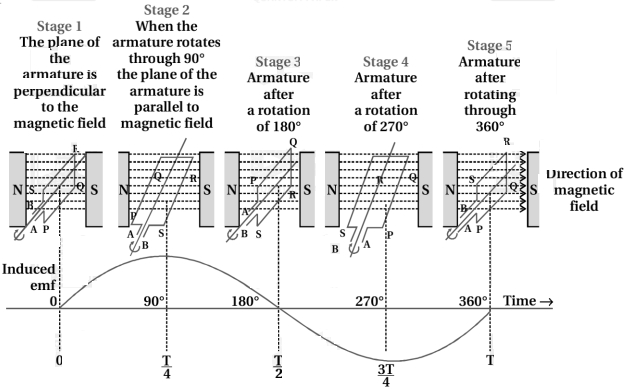
Based on the rotation of the coil in the magnetic field $\vec{B}$,we can analyze different stages:
$1$. Stage $1$ $(\omega t = 0^{\circ})$: The plane of the coil is perpendicular to the magnetic field $\vec{B}$. The magnetic flux is maximum,but the rate of change of flux is zero. Thus,$\varepsilon = \varepsilon_{0} \sin(0^{\circ}) = 0$.
$2$. Stage $2$ $(\omega t = 90^{\circ})$: The plane of the coil is parallel to the magnetic field $\vec{B}$. The rate of change of flux is maximum. Thus,$\varepsilon = \varepsilon_{0} \sin(90^{\circ}) = \varepsilon_{0}$.
$3$. Stage $3$ $(\omega t = 180^{\circ})$: The plane of the coil is again perpendicular to $\vec{B}$. Thus,$\varepsilon = \varepsilon_{0} \sin(180^{\circ}) = 0$.
$4$. Stage $4$ $(\omega t = 270^{\circ})$: The plane of the coil is parallel to $\vec{B}$,but the coil has rotated to the opposite side. Thus,$\varepsilon = \varepsilon_{0} \sin(270^{\circ}) = -\varepsilon_{0}$.
$5$. Stage $5$ $(\omega t = 360^{\circ})$: The coil returns to its initial position. Thus,$\varepsilon = \varepsilon_{0} \sin(360^{\circ}) = 0$.
$\varepsilon = \varepsilon_{0} \sin(\omega t) = \varepsilon_{0} \sin(2 \pi \nu t) \quad \dots (1)$
where $\varepsilon_{0}$ is the peak value of the $emf$,$\omega$ is the angular frequency,and $\nu$ is the frequency of rotation.
Equation $(1)$ represents the instantaneous value of the $emf$. The $emf$ varies periodically between $+\varepsilon_{0}$ and $-\varepsilon_{0}$ as the coil rotates.
Based on the rotation of the coil in the magnetic field $\vec{B}$,we can analyze different stages:
$1$. Stage $1$ $(\omega t = 0^{\circ})$: The plane of the coil is perpendicular to the magnetic field $\vec{B}$. The magnetic flux is maximum,but the rate of change of flux is zero. Thus,$\varepsilon = \varepsilon_{0} \sin(0^{\circ}) = 0$.
$2$. Stage $2$ $(\omega t = 90^{\circ})$: The plane of the coil is parallel to the magnetic field $\vec{B}$. The rate of change of flux is maximum. Thus,$\varepsilon = \varepsilon_{0} \sin(90^{\circ}) = \varepsilon_{0}$.
$3$. Stage $3$ $(\omega t = 180^{\circ})$: The plane of the coil is again perpendicular to $\vec{B}$. Thus,$\varepsilon = \varepsilon_{0} \sin(180^{\circ}) = 0$.
$4$. Stage $4$ $(\omega t = 270^{\circ})$: The plane of the coil is parallel to $\vec{B}$,but the coil has rotated to the opposite side. Thus,$\varepsilon = \varepsilon_{0} \sin(270^{\circ}) = -\varepsilon_{0}$.
$5$. Stage $5$ $(\omega t = 360^{\circ})$: The coil returns to its initial position. Thus,$\varepsilon = \varepsilon_{0} \sin(360^{\circ}) = 0$.
0 likes
View Solution20
Difficult
Discuss the characteristics of the induced $emf$ in an $AC$ generator.
Solution
(N/A) In an $AC$ generator,a coil rotates in a uniform magnetic field $B$. The magnetic flux $\phi$ linked with the coil at any time $t$ is given by $\phi = NBA \cos(\omega t)$,where $N$ is the number of turns,$A$ is the area of the coil,and $\omega$ is the angular velocity.
According to Faraday's law of induction,the induced $emf$ is $\varepsilon = -\frac{d\phi}{dt} = NBA\omega \sin(\omega t)$.
Let $\varepsilon_0 = NBA\omega$ be the peak value of the $emf$. Then $\varepsilon = \varepsilon_0 \sin(\omega t)$.
Characteristics:
$1$. The induced $emf$ varies sinusoidally with time.
$2$. At $\omega t = 0, 180^\circ, 360^\circ$,the $emf$ is zero because the plane of the coil is perpendicular to the magnetic field.
$3$. At $\omega t = 90^\circ$,the $emf$ is maximum positive $(\varepsilon_0)$ because the rate of change of flux is maximum.
$4$. At $\omega t = 270^\circ$,the $emf$ is maximum negative $(-\varepsilon_0)$ as the coil moves in the opposite direction relative to the field lines.
According to Faraday's law of induction,the induced $emf$ is $\varepsilon = -\frac{d\phi}{dt} = NBA\omega \sin(\omega t)$.
Let $\varepsilon_0 = NBA\omega$ be the peak value of the $emf$. Then $\varepsilon = \varepsilon_0 \sin(\omega t)$.
Characteristics:
$1$. The induced $emf$ varies sinusoidally with time.
$2$. At $\omega t = 0, 180^\circ, 360^\circ$,the $emf$ is zero because the plane of the coil is perpendicular to the magnetic field.
$3$. At $\omega t = 90^\circ$,the $emf$ is maximum positive $(\varepsilon_0)$ because the rate of change of flux is maximum.
$4$. At $\omega t = 270^\circ$,the $emf$ is maximum negative $(-\varepsilon_0)$ as the coil moves in the opposite direction relative to the field lines.
0 likes
View Solution21
Medium
Write the equation for the maximum $emf$ in an $AC$ generator.
Solution
(N/A) In an $AC$ generator,the magnetic flux $\phi$ linked with the coil rotating with angular velocity $\omega$ in a magnetic field $B$ is given by $\phi = NBA \cos(\omega t)$,where $N$ is the number of turns and $A$ is the area of the coil.
According to Faraday's law of induction,the induced $emf$ is $\epsilon = -\frac{d\phi}{dt}$.
Substituting $\phi$,we get $\epsilon = -\frac{d}{dt}(NBA \cos(\omega t)) = NBA\omega \sin(\omega t)$.
The maximum value of $emf$ $(\epsilon_{max})$ occurs when $\sin(\omega t) = 1$.
Therefore,the equation for maximum $emf$ is $\epsilon_{max} = NBA\omega$.
According to Faraday's law of induction,the induced $emf$ is $\epsilon = -\frac{d\phi}{dt}$.
Substituting $\phi$,we get $\epsilon = -\frac{d}{dt}(NBA \cos(\omega t)) = NBA\omega \sin(\omega t)$.
The maximum value of $emf$ $(\epsilon_{max})$ occurs when $\sin(\omega t) = 1$.
Therefore,the equation for maximum $emf$ is $\epsilon_{max} = NBA\omega$.
0 likes
View Solution22
DifficultMCQ
$A$ circular coil of radius $10\, cm$ is placed in a uniform magnetic field of $3.0 \times 10^{-5}\, T$ with its plane perpendicular to the field initially. It is rotated at a constant angular speed about an axis along the diameter of the coil and perpendicular to the magnetic field so that it undergoes half a rotation in $0.2\, s$. The maximum value of $EMF$ induced (in $\mu V$) in the coil will be close to the integer $....\mu V$.
A
$20$
B
$30$
C
$26$
D
$15$
Solution
(D) Given: Radius $r = 10\, cm = 0.1\, m$,Magnetic field $B = 3.0 \times 10^{-5}\, T$.
Time for half rotation is $0.2\, s$,so the time period $T = 0.4\, s$.
The magnetic flux through the coil at any time $t$ is $\phi = BA \cos(\omega t)$,where $A = \pi r^2$ is the area of the coil.
The induced $EMF$ is given by Faraday's law: $|\varepsilon| = |\frac{d\phi}{dt}| = |BA\omega \sin(\omega t)|$.
The maximum induced $EMF$ is $\varepsilon_{\max} = BA\omega$.
Substituting $\omega = \frac{2\pi}{T}$:
$\varepsilon_{\max} = B \times (\pi r^2) \times \frac{2\pi}{T} = \frac{2\pi^2 B r^2}{T}$.
Substituting the values: $\varepsilon_{\max} = \frac{2 \times \pi^2 \times 3.0 \times 10^{-5} \times (0.1)^2}{0.4}$.
Using $\pi^2 \approx 10$:
$\varepsilon_{\max} = \frac{2 \times 10 \times 3.0 \times 10^{-5} \times 0.01}{0.4} = \frac{6 \times 10^{-4}}{0.4} = 15 \times 10^{-6}\, V = 15\, \mu V$.
Time for half rotation is $0.2\, s$,so the time period $T = 0.4\, s$.
The magnetic flux through the coil at any time $t$ is $\phi = BA \cos(\omega t)$,where $A = \pi r^2$ is the area of the coil.
The induced $EMF$ is given by Faraday's law: $|\varepsilon| = |\frac{d\phi}{dt}| = |BA\omega \sin(\omega t)|$.
The maximum induced $EMF$ is $\varepsilon_{\max} = BA\omega$.
Substituting $\omega = \frac{2\pi}{T}$:
$\varepsilon_{\max} = B \times (\pi r^2) \times \frac{2\pi}{T} = \frac{2\pi^2 B r^2}{T}$.
Substituting the values: $\varepsilon_{\max} = \frac{2 \times \pi^2 \times 3.0 \times 10^{-5} \times (0.1)^2}{0.4}$.
Using $\pi^2 \approx 10$:
$\varepsilon_{\max} = \frac{2 \times 10 \times 3.0 \times 10^{-5} \times 0.01}{0.4} = \frac{6 \times 10^{-4}}{0.4} = 15 \times 10^{-6}\, V = 15\, \mu V$.
0 likes
View Solution23
DifficultMCQ
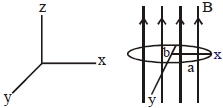
An elliptical loop having resistance $R$,semi-major axis $a$,and semi-minor axis $b$ is placed in a magnetic field as shown in the figure. If the loop is rotated about the $x$-axis with angular frequency $\omega$,the average power loss in the loop due to Joule heating is:
A
$\frac{\pi^{2} a^{2} b^{2} B^{2} \omega^{2}}{2 R}$
B
Zero
C
$\frac{\pi^{2} a^{2} b^{2} B^{2} \omega^{2}}{R}$
D
$\frac{\pi abB \omega}{R}$
Solution
(A) The magnetic flux through the loop at time $t$ is $\phi = BA \cos(\omega t)$,where $A = \pi ab$ is the area of the elliptical loop.
The induced electromotive force $(EMF)$ is given by Faraday's law: $\epsilon = -\frac{d\phi}{dt} = AB\omega \sin(\omega t)$.
The instantaneous power loss due to Joule heating is $P = \frac{\epsilon^{2}}{R} = \frac{(AB\omega \sin(\omega t))^{2}}{R} = \frac{A^{2}B^{2}\omega^{2}}{R} \sin^{2}(\omega t)$.
The average power loss over a complete cycle is $P_{avg} = \langle P \rangle = \frac{A^{2}B^{2}\omega^{2}}{R} \langle \sin^{2}(\omega t) \rangle$.
Since the average value of $\sin^{2}(\omega t)$ over a cycle is $\frac{1}{2}$,we have $P_{avg} = \frac{A^{2}B^{2}\omega^{2}}{R} \cdot \frac{1}{2}$.
Substituting $A = \pi ab$,we get $P_{avg} = \frac{(\pi ab)^{2} B^{2} \omega^{2}}{2R} = \frac{\pi^{2} a^{2} b^{2} B^{2} \omega^{2}}{2R}$.
The induced electromotive force $(EMF)$ is given by Faraday's law: $\epsilon = -\frac{d\phi}{dt} = AB\omega \sin(\omega t)$.
The instantaneous power loss due to Joule heating is $P = \frac{\epsilon^{2}}{R} = \frac{(AB\omega \sin(\omega t))^{2}}{R} = \frac{A^{2}B^{2}\omega^{2}}{R} \sin^{2}(\omega t)$.
The average power loss over a complete cycle is $P_{avg} = \langle P \rangle = \frac{A^{2}B^{2}\omega^{2}}{R} \langle \sin^{2}(\omega t) \rangle$.
Since the average value of $\sin^{2}(\omega t)$ over a cycle is $\frac{1}{2}$,we have $P_{avg} = \frac{A^{2}B^{2}\omega^{2}}{R} \cdot \frac{1}{2}$.
Substituting $A = \pi ab$,we get $P_{avg} = \frac{(\pi ab)^{2} B^{2} \omega^{2}}{2R} = \frac{\pi^{2} a^{2} b^{2} B^{2} \omega^{2}}{2R}$.
0 likes
View Solution24
MediumMCQ
$A$ circular coil of radius $8.0 \, cm$ and $20$ turns is rotated about its vertical diameter with an angular speed of $50 \, rad \, s^{-1}$ in a uniform horizontal magnetic field of $3.0 \times 10^{-2} \, T$. The maximum $emf$ induced in the coil will be $\ldots \ldots \ldots \times 10^{-2} \, V$ (rounded off to the nearest integer).
A
$140$
B
$40$
C
$60$
D
$650$
Solution
(C) The maximum induced $emf$ $(\varepsilon_{max})$ in a rotating coil is given by the formula: $\varepsilon_{max} = N \omega A B$,where $N$ is the number of turns,$\omega$ is the angular speed,$A$ is the area of the coil,and $B$ is the magnetic field strength.
Given: $N = 20$,$\omega = 50 \, rad \, s^{-1}$,$B = 3.0 \times 10^{-2} \, T$,and radius $r = 8.0 \, cm = 0.08 \, m$.
The area $A = \pi r^2 = \pi \times (0.08)^2 = 0.0064 \pi \, m^2$.
Substituting the values: $\varepsilon_{max} = 20 \times 50 \times (0.0064 \pi) \times (3.0 \times 10^{-2})$.
$\varepsilon_{max} = 1000 \times 0.0064 \times \pi \times 3.0 \times 10^{-2} = 6.4 \times \pi \times 3.0 \times 10^{-2} = 19.2 \pi \times 10^{-2}$.
Using $\pi \approx 3.14159$,$\varepsilon_{max} \approx 19.2 \times 3.14159 \times 10^{-2} \approx 60.319 \times 10^{-2} \, V$.
Rounding to the nearest integer,we get $60$.
Given: $N = 20$,$\omega = 50 \, rad \, s^{-1}$,$B = 3.0 \times 10^{-2} \, T$,and radius $r = 8.0 \, cm = 0.08 \, m$.
The area $A = \pi r^2 = \pi \times (0.08)^2 = 0.0064 \pi \, m^2$.
Substituting the values: $\varepsilon_{max} = 20 \times 50 \times (0.0064 \pi) \times (3.0 \times 10^{-2})$.
$\varepsilon_{max} = 1000 \times 0.0064 \times \pi \times 3.0 \times 10^{-2} = 6.4 \times \pi \times 3.0 \times 10^{-2} = 19.2 \pi \times 10^{-2}$.
Using $\pi \approx 3.14159$,$\varepsilon_{max} \approx 19.2 \times 3.14159 \times 10^{-2} \approx 60.319 \times 10^{-2} \, V$.
Rounding to the nearest integer,we get $60$.
0 likes
View Solution25
EasyMCQ
$A$ circular coil of $1000$ turns, each with an area of $1 \, m^{2}$, is rotated about its vertical diameter at the rate of one revolution per second in a uniform horizontal magnetic field of $0.07 \, T$. The maximum voltage generated will be ......... $V$.
A
$540$
B
$447$
C
$480$
D
$440$
Solution
(D) The maximum induced electromotive force $(EMF)$ in a rotating coil is given by the formula: $\varepsilon_{\max} = BAN\omega$.
Given:
$B = 0.07 \, T$ (Magnetic field)
$A = 1 \, m^{2}$ (Area of the coil)
$N = 1000$ (Number of turns)
$f = 1 \, \text{rev/s}$ (Frequency)
Angular velocity $\omega = 2\pi f = 2\pi(1) = 2\pi \, \text{rad/s}$.
Substituting the values:
$\varepsilon_{\max} = 0.07 \times 1 \times 1000 \times 2\pi$
$\varepsilon_{\max} = 70 \times 2\pi = 140\pi$.
Using $\pi \approx 3.14159$:
$\varepsilon_{\max} = 140 \times 3.14159 \approx 439.82 \, V$.
Rounding to the nearest integer, we get $440 \, V$.
Given:
$B = 0.07 \, T$ (Magnetic field)
$A = 1 \, m^{2}$ (Area of the coil)
$N = 1000$ (Number of turns)
$f = 1 \, \text{rev/s}$ (Frequency)
Angular velocity $\omega = 2\pi f = 2\pi(1) = 2\pi \, \text{rad/s}$.
Substituting the values:
$\varepsilon_{\max} = 0.07 \times 1 \times 1000 \times 2\pi$
$\varepsilon_{\max} = 70 \times 2\pi = 140\pi$.
Using $\pi \approx 3.14159$:
$\varepsilon_{\max} = 140 \times 3.14159 \approx 439.82 \, V$.
Rounding to the nearest integer, we get $440 \, V$.
0 likes
View Solution26
EasyMCQ
In an $AC$ generator,a rectangular coil of $100$ turns each having area $14 \times 10^{-2} \, m^2$ is rotated at $360 \, rev/min$ about an axis perpendicular to a uniform magnetic field of magnitude $3.0 \, T$. The maximum value of the emf produced will be $............ \, V$. (Take $\pi = \frac{22}{7}$)
A
$1583$
B
$1528$
C
$1584$
D
$1580$
Solution
(C) The maximum induced electromotive force (emf) in an $AC$ generator is given by the formula: $\varepsilon_{\max} = NAB\omega$.
Given:
Number of turns,$N = 100$.
Area of the coil,$A = 14 \times 10^{-2} \, m^2$.
Magnetic field,$B = 3.0 \, T$.
Frequency of rotation,$f = 360 \, rev/min = \frac{360}{60} \, rev/s = 6 \, Hz$.
Angular velocity,$\omega = 2\pi f = 2 \times \frac{22}{7} \times 6 \, rad/s$.
Substituting these values into the formula:
$\varepsilon_{\max} = 100 \times (14 \times 10^{-2}) \times 3.0 \times (2 \times \frac{22}{7} \times 6)$
$\varepsilon_{\max} = 100 \times 0.14 \times 3.0 \times (12 \times \frac{22}{7})$
$\varepsilon_{\max} = 14 \times 3.0 \times \frac{264}{7}$
$\varepsilon_{\max} = 42 \times \frac{264}{7}$
$\varepsilon_{\max} = 6 \times 264 = 1584 \, V$.
Given:
Number of turns,$N = 100$.
Area of the coil,$A = 14 \times 10^{-2} \, m^2$.
Magnetic field,$B = 3.0 \, T$.
Frequency of rotation,$f = 360 \, rev/min = \frac{360}{60} \, rev/s = 6 \, Hz$.
Angular velocity,$\omega = 2\pi f = 2 \times \frac{22}{7} \times 6 \, rad/s$.
Substituting these values into the formula:
$\varepsilon_{\max} = 100 \times (14 \times 10^{-2}) \times 3.0 \times (2 \times \frac{22}{7} \times 6)$
$\varepsilon_{\max} = 100 \times 0.14 \times 3.0 \times (12 \times \frac{22}{7})$
$\varepsilon_{\max} = 14 \times 3.0 \times \frac{264}{7}$
$\varepsilon_{\max} = 42 \times \frac{264}{7}$
$\varepsilon_{\max} = 6 \times 264 = 1584 \, V$.
0 likes
View Solution27
MediumMCQ
$A$ square-shaped coil of area $70 \, cm^2$ having $600$ turns rotates in a magnetic field of $0.4 \, Wb/m^2$,about an axis which is parallel to one of the sides of the coil and perpendicular to the direction of the field. If the coil completes $500$ revolutions in a minute,the instantaneous emf when the plane of the coil is inclined at $60^{\circ}$ with the field will be $..........V$. (Take $\pi = \frac{22}{7}$)
A
$40$
B
$42$
C
$46$
D
$44$
Solution
(D) Given: $N = 600$,$A = 70 \times 10^{-4} \, m^2$,$B = 0.4 \, T$,$f = \frac{500}{60} \, Hz$.
Angular velocity $\omega = 2 \pi f = 2 \pi \times \frac{500}{60} = \frac{50 \pi}{3} \, rad/s$.
The instantaneous emf is given by $e = N A B \omega \sin \theta$,where $\theta$ is the angle between the area vector $\vec{A}$ and the magnetic field $\vec{B}$.
Since the plane of the coil is inclined at $60^{\circ}$ with the field,the angle between the normal to the plane (area vector) and the field is $\theta = 90^{\circ} - 60^{\circ} = 30^{\circ}$.
$e = 600 \times (70 \times 10^{-4}) \times 0.4 \times (\frac{50 \pi}{3}) \times \sin(30^{\circ})$.
$e = 600 \times 0.007 \times 0.4 \times \frac{50}{3} \times \frac{22}{7} \times 0.5$.
$e = 4.2 \times 0.4 \times \frac{50}{3} \times \frac{22}{7} \times 0.5$.
$e = 1.68 \times \frac{50}{3} \times \frac{22}{7} \times 0.5 = 44 \, V$.
Angular velocity $\omega = 2 \pi f = 2 \pi \times \frac{500}{60} = \frac{50 \pi}{3} \, rad/s$.
The instantaneous emf is given by $e = N A B \omega \sin \theta$,where $\theta$ is the angle between the area vector $\vec{A}$ and the magnetic field $\vec{B}$.
Since the plane of the coil is inclined at $60^{\circ}$ with the field,the angle between the normal to the plane (area vector) and the field is $\theta = 90^{\circ} - 60^{\circ} = 30^{\circ}$.
$e = 600 \times (70 \times 10^{-4}) \times 0.4 \times (\frac{50 \pi}{3}) \times \sin(30^{\circ})$.
$e = 600 \times 0.007 \times 0.4 \times \frac{50}{3} \times \frac{22}{7} \times 0.5$.
$e = 4.2 \times 0.4 \times \frac{50}{3} \times \frac{22}{7} \times 0.5$.
$e = 1.68 \times \frac{50}{3} \times \frac{22}{7} \times 0.5 = 44 \, V$.
2 likes
View Solution28
DifficultMCQ
$A$ coil of $200$ turns and area $0.20 \ m^2$ is rotated at half a revolution per second and is placed in a uniform magnetic field of $0.01 \ T$ perpendicular to the axis of rotation of the coil. The maximum voltage generated in the coil is $\frac{2 \pi}{\beta} \ V$. The value of $\beta$ is . . . . . .
A
$3$
B
$4$
C
$5$
D
$6$
Solution
(C) The magnetic flux linked with the coil is given by $\phi = NAB \cos(\omega t)$.
The induced electromotive force $(EMF)$ is $\varepsilon = -\frac{d\phi}{dt} = NAB\omega \sin(\omega t)$.
The maximum voltage generated is $\varepsilon_{\max} = NAB\omega$.
Given:
Number of turns $N = 200$
Area $A = 0.20 \ m^2$
Magnetic field $B = 0.01 \ T$
Frequency $f = 0.5 \ rev/s$,so angular frequency $\omega = 2\pi f = 2\pi(0.5) = \pi \ rad/s$.
Substituting the values:
$\varepsilon_{\max} = 200 \times 0.20 \times 0.01 \times \pi$
$\varepsilon_{\max} = 40 \times 0.01 \times \pi = 0.4\pi = \frac{4\pi}{10} = \frac{2\pi}{5} \ V$.
Comparing this with $\frac{2\pi}{\beta}$,we get $\beta = 5$.
The induced electromotive force $(EMF)$ is $\varepsilon = -\frac{d\phi}{dt} = NAB\omega \sin(\omega t)$.
The maximum voltage generated is $\varepsilon_{\max} = NAB\omega$.
Given:
Number of turns $N = 200$
Area $A = 0.20 \ m^2$
Magnetic field $B = 0.01 \ T$
Frequency $f = 0.5 \ rev/s$,so angular frequency $\omega = 2\pi f = 2\pi(0.5) = \pi \ rad/s$.
Substituting the values:
$\varepsilon_{\max} = 200 \times 0.20 \times 0.01 \times \pi$
$\varepsilon_{\max} = 40 \times 0.01 \times \pi = 0.4\pi = \frac{4\pi}{10} = \frac{2\pi}{5} \ V$.
Comparing this with $\frac{2\pi}{\beta}$,we get $\beta = 5$.
0 likes
View Solution29
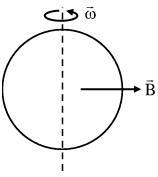
MediumMCQ
$A$ coil of area $A$ and $N$ turns is rotating with angular velocity $\omega$ in a uniform magnetic field $\overrightarrow{B}$ about an axis perpendicular to $\vec{B}$. Magnetic flux $\varphi$ and induced emf $\varepsilon$ across it,at an instant when $\overrightarrow{B}$ is parallel to the plane of the coil,are:
A
$\varphi=AB, \varepsilon=0$
B
$\varphi=0, \varepsilon=NAB \omega$
C
$\varphi=0, \varepsilon=0$
D
$\varphi=AB, \varepsilon=NAB \omega$
Solution
(B) The magnetic flux $\phi$ through a coil rotating in a magnetic field is given by $\phi = NAB \cos(\omega t)$,where $\theta = \omega t$ is the angle between the area vector and the magnetic field vector $\vec{B}$.
The induced electromotive force (emf) $\varepsilon$ is given by Faraday's law of induction: $\varepsilon = -\frac{d\phi}{dt}$.
Calculating the derivative: $\varepsilon = -\frac{d}{dt}(NAB \cos(\omega t)) = NAB \omega \sin(\omega t)$.
When the magnetic field $\vec{B}$ is parallel to the plane of the coil,the angle between the area vector (which is perpendicular to the plane) and the magnetic field $\vec{B}$ is $90^\circ$ or $\frac{\pi}{2}$ radians.
At this instant,$\theta = \omega t = \frac{\pi}{2}$.
Substituting this into the expressions:
$\phi = NAB \cos(\frac{\pi}{2}) = NAB(0) = 0$.
$\varepsilon = NAB \omega \sin(\frac{\pi}{2}) = NAB \omega(1) = NAB \omega$.
Therefore,the magnetic flux is $0$ and the induced emf is $NAB \omega$.
The induced electromotive force (emf) $\varepsilon$ is given by Faraday's law of induction: $\varepsilon = -\frac{d\phi}{dt}$.
Calculating the derivative: $\varepsilon = -\frac{d}{dt}(NAB \cos(\omega t)) = NAB \omega \sin(\omega t)$.
When the magnetic field $\vec{B}$ is parallel to the plane of the coil,the angle between the area vector (which is perpendicular to the plane) and the magnetic field $\vec{B}$ is $90^\circ$ or $\frac{\pi}{2}$ radians.
At this instant,$\theta = \omega t = \frac{\pi}{2}$.
Substituting this into the expressions:
$\phi = NAB \cos(\frac{\pi}{2}) = NAB(0) = 0$.
$\varepsilon = NAB \omega \sin(\frac{\pi}{2}) = NAB \omega(1) = NAB \omega$.
Therefore,the magnetic flux is $0$ and the induced emf is $NAB \omega$.
0 likes
View Solution30
MediumMCQ
The number of turns in the coil of an $AC$ generator are $50$ and its cross-sectional area is $2.5 \ m^2$. This coil is revolving in a uniform magnetic field of strength $0.3 \ T$ with a uniform angular velocity of $60 \ rad \ s^{-1}$. The resistance of the circuit comprising the coil is $500 \ \Omega$. The maximum induced $emf$ and maximum current produced in the generator are:
A
$2.25 \ kV, 4.5 \ A$
B
$2.25 \ kV, 2.5 \ A$
C
$4.5 \ kV, 4.5 \ A$
D
$3.25 \ kV, 2.5 \ A$
Solution
(A) Given: Number of turns $N = 50$,Area $A = 2.5 \ m^2$,Magnetic field $B = 0.3 \ T$,Angular velocity $\omega = 60 \ rad \ s^{-1}$,Resistance $R = 500 \ \Omega$.
The maximum induced $emf$ $(V_m)$ is given by the formula:
$V_m = N B A \omega$
$V_m = 50 \times 0.3 \times 2.5 \times 60$
$V_m = 50 \times 0.3 \times 150 = 2250 \ V = 2.25 \ kV$.
The maximum current $(I_m)$ is given by Ohm's law:
$I_m = \frac{V_m}{R}$
$I_m = \frac{2250 \ V}{500 \ \Omega} = 4.5 \ A$.
Thus,the maximum induced $emf$ is $2.25 \ kV$ and the maximum current is $4.5 \ A$.
The maximum induced $emf$ $(V_m)$ is given by the formula:
$V_m = N B A \omega$
$V_m = 50 \times 0.3 \times 2.5 \times 60$
$V_m = 50 \times 0.3 \times 150 = 2250 \ V = 2.25 \ kV$.
The maximum current $(I_m)$ is given by Ohm's law:
$I_m = \frac{V_m}{R}$
$I_m = \frac{2250 \ V}{500 \ \Omega} = 4.5 \ A$.
Thus,the maximum induced $emf$ is $2.25 \ kV$ and the maximum current is $4.5 \ A$.
0 likes
View Solution31
EasyMCQ
$A$ ring of resistance $10 \ \Omega$,radius $10 \ cm$ and $100$ turns is rotated at a rate of $100$ revolutions per second about its diameter perpendicular to a uniform magnetic field of induction $10 \ mT$. The amplitude of the current in the loop will be nearly $....... \ A$. (Take: $\pi^2 = 10$)
A
$200$
B
$2$
C
$40$
D
$0$
Solution
(B) Given: Resistance $R = 10 \ \Omega$,Radius $r = 10 \ cm = 0.1 \ m$,Number of turns $N = 100$,Frequency $f = 100 \ Hz$,Magnetic field $B = 10 \ mT = 10^{-2} \ T$.
Angular velocity $\omega = 2 \pi f = 2 \pi (100) = 200 \pi \ rad/s$.
Area of the loop $A = \pi r^2 = \pi (0.1)^2 = 0.01 \pi \ m^2$.
The peak electromotive force $(EMF)$ is given by $e_0 = N B A \omega$.
Substituting the values: $e_0 = 100 \times 10^{-2} \times 0.01 \pi \times 200 \pi = 1 \times 0.01 \times 200 \times \pi^2$.
Given $\pi^2 = 10$,so $e_0 = 0.01 \times 200 \times 10 = 20 \ V$.
The amplitude of the current $I_0 = \frac{e_0}{R} = \frac{20 \ V}{10 \ \Omega} = 2 \ A$.
Angular velocity $\omega = 2 \pi f = 2 \pi (100) = 200 \pi \ rad/s$.
Area of the loop $A = \pi r^2 = \pi (0.1)^2 = 0.01 \pi \ m^2$.
The peak electromotive force $(EMF)$ is given by $e_0 = N B A \omega$.
Substituting the values: $e_0 = 100 \times 10^{-2} \times 0.01 \pi \times 200 \pi = 1 \times 0.01 \times 200 \times \pi^2$.
Given $\pi^2 = 10$,so $e_0 = 0.01 \times 200 \times 10 = 20 \ V$.
The amplitude of the current $I_0 = \frac{e_0}{R} = \frac{20 \ V}{10 \ \Omega} = 2 \ A$.
0 likes
View Solution32
DifficultMCQ
$A$ circular coil of resistance $R$,area $A$,and number of turns $N$ is rotated about its vertical diameter with angular speed $\omega$ in a uniform magnetic field of magnitude $B$. The average power dissipated in a complete cycle is:
A
$\frac{N^2 A^2 B^2 \omega^2}{2 R}$
B
$\frac{BNA \omega}{R}$
C
$\frac{N^2 A B}{2 R \omega^2}$
D
$\frac{BA \omega}{2 NR}$
Solution
(A) The induced electromotive force $(e)$ in a rotating coil is given by $e = NAB \omega \sin(\omega t)$.
The peak value of the induced $EMF$ is $e_0 = NAB \omega$.
The peak current is $i_0 = \frac{e_0}{R} = \frac{NAB \omega}{R}$.
The average power dissipated in an $AC$ circuit is given by $P_{av} = \frac{e_0 i_0}{2}$ or $P_{av} = \frac{e_0^2}{2R}$.
Substituting the value of $e_0$:
$P_{av} = \frac{(NAB \omega)^2}{2R} = \frac{N^2 A^2 B^2 \omega^2}{2R}$.
The peak value of the induced $EMF$ is $e_0 = NAB \omega$.
The peak current is $i_0 = \frac{e_0}{R} = \frac{NAB \omega}{R}$.
The average power dissipated in an $AC$ circuit is given by $P_{av} = \frac{e_0 i_0}{2}$ or $P_{av} = \frac{e_0^2}{2R}$.
Substituting the value of $e_0$:
$P_{av} = \frac{(NAB \omega)^2}{2R} = \frac{N^2 A^2 B^2 \omega^2}{2R}$.
0 likes
View Solution33
EasyMCQ
$A$ circular coil of resistance $R$,area $A$,and number of turns $N$ is rotated about its vertical diameter with angular speed $\omega$ in a uniform magnetic field of magnitude $B$. The average power dissipated in a complete cycle is:
A
$\frac{N^2 A^2 B^2 \omega^2}{2 R}$
B
$\frac{B N A \omega}{R}$
C
$\frac{B N A \omega}{2 R}$
D
$\frac{N^2 A^2 B^2 \omega^2}{R}$
Solution
(A) The magnetic flux through the coil at any time $t$ is given by $\phi = N A B \cos(\omega t)$.
According to Faraday's law,the induced electromotive force $(EMF)$ is $e = -\frac{d\phi}{dt} = N A B \omega \sin(\omega t)$.
The peak $EMF$ is $e_0 = N A B \omega$.
The peak current is $i_0 = \frac{e_0}{R} = \frac{N A B \omega}{R}$.
The average power dissipated in a complete cycle is given by $P_{avg} = \frac{1}{2} e_0 i_0$.
Substituting the values,$P_{avg} = \frac{1}{2} (N A B \omega) \left( \frac{N A B \omega}{R} \right) = \frac{N^2 A^2 B^2 \omega^2}{2 R}$.
According to Faraday's law,the induced electromotive force $(EMF)$ is $e = -\frac{d\phi}{dt} = N A B \omega \sin(\omega t)$.
The peak $EMF$ is $e_0 = N A B \omega$.
The peak current is $i_0 = \frac{e_0}{R} = \frac{N A B \omega}{R}$.
The average power dissipated in a complete cycle is given by $P_{avg} = \frac{1}{2} e_0 i_0$.
Substituting the values,$P_{avg} = \frac{1}{2} (N A B \omega) \left( \frac{N A B \omega}{R} \right) = \frac{N^2 A^2 B^2 \omega^2}{2 R}$.
0 likes
View Solution34
EasyMCQ
$A$ coil having $1000$ turns and an area of $0.10 \ m^2$ rotates at half a revolution per second and is placed in a uniform magnetic field of $0.01 \ T$ perpendicular to the axis of rotation of the coil. The maximum emf voltage generated in the coil is . . . . . . $V$.
A
$0.314$
B
$5.0$
C
$3.14$
D
$0.5$
Solution
(C) Given: Number of turns $N = 1000$,Area $A = 0.10 \ m^2$,Frequency $\nu = 0.5 \ Hz$,Magnetic field $B = 0.01 \ T$.
The angular velocity $\omega$ is given by $\omega = 2 \pi \nu$.
$\omega = 2 \pi (0.5) = \pi \ rad/s$.
The maximum induced emf $\varepsilon_{\max}$ is given by the formula $\varepsilon_{\max} = N A B \omega$.
Substituting the values: $\varepsilon_{\max} = 1000 \times 0.10 \times 0.01 \times \pi$.
$\varepsilon_{\max} = 1 \times \pi = 3.14 \ V$.
The angular velocity $\omega$ is given by $\omega = 2 \pi \nu$.
$\omega = 2 \pi (0.5) = \pi \ rad/s$.
The maximum induced emf $\varepsilon_{\max}$ is given by the formula $\varepsilon_{\max} = N A B \omega$.
Substituting the values: $\varepsilon_{\max} = 1000 \times 0.10 \times 0.01 \times \pi$.
$\varepsilon_{\max} = 1 \times \pi = 3.14 \ V$.
0 likes
View Solution35
EasyMCQ
The number of turns in the coil of an $AC$ generator is $100$ and its cross-sectional area is $2.5 \ m^2$. The coil is revolving in a uniform magnetic field of strength $0.3 \ T$ with a uniform angular velocity of $60 \ rad \ s^{-1}$. The value of maximum induced emf is . . . . . . $kV$.
A
$1.25$
B
$4.5$
C
$6.75$
D
$2.25$
Solution
(B) The induced electromotive force $(\varepsilon)$ in a rotating coil is given by the formula: $\varepsilon = N B A \omega \sin(\omega t)$.
For the maximum induced emf $(\varepsilon_{\max})$, we set $\sin(\omega t) = 1$.
Thus, the formula becomes: $\varepsilon_{\max} = N B A \omega$.
Given values:
Number of turns $(N)$ = $100$
Magnetic field strength $(B)$ = $0.3 \ T$
Area $(A)$ = $2.5 \ m^2$
Angular velocity $(\omega)$ = $60 \ rad \ s^{-1}$
Substituting these values into the formula:
$\varepsilon_{\max} = 100 \times 0.3 \times 2.5 \times 60$
$\varepsilon_{\max} = 30 \times 2.5 \times 60$
$\varepsilon_{\max} = 75 \times 60 = 4500 \ V$.
Converting to $kV$:
$\varepsilon_{\max} = 4.5 \ kV$.
For the maximum induced emf $(\varepsilon_{\max})$, we set $\sin(\omega t) = 1$.
Thus, the formula becomes: $\varepsilon_{\max} = N B A \omega$.
Given values:
Number of turns $(N)$ = $100$
Magnetic field strength $(B)$ = $0.3 \ T$
Area $(A)$ = $2.5 \ m^2$
Angular velocity $(\omega)$ = $60 \ rad \ s^{-1}$
Substituting these values into the formula:
$\varepsilon_{\max} = 100 \times 0.3 \times 2.5 \times 60$
$\varepsilon_{\max} = 30 \times 2.5 \times 60$
$\varepsilon_{\max} = 75 \times 60 = 4500 \ V$.
Converting to $kV$:
$\varepsilon_{\max} = 4.5 \ kV$.
0 likes
View Solution36
EasyMCQ
When a rectangular coil is rotated in a uniform magnetic field about an axis passing through its centre and perpendicular to the field,the emf induced in the coil varies
A
linearly
B
exponentially
C
sinusoidally
D
laterally
Solution
(C) When a rectangular coil is rotated in a uniform magnetic field about an axis passing through its centre and perpendicular to the field,the magnetic flux $\phi$ associated with the coil is given by:
$\phi = B A \cos \theta = B A \cos \omega t$ ...$(i)$
According to Faraday's law of electromagnetic induction,the induced emf $e$ is given by:
$e = -\frac{d \phi}{d t} = -\frac{d}{d t} (B A \cos \omega t)$
$e = -B A \frac{d}{d t} (\cos \omega t)$
$e = -B A (-\omega \sin \omega t)$
$e = B A \omega \sin \omega t$
Let $e_0 = B A \omega$ be the peak value of the induced emf.
Then,$e = e_0 \sin \omega t$ ...(ii)
From equation (ii),it is clear that the induced emf varies sinusoidally with time.
$\phi = B A \cos \theta = B A \cos \omega t$ ...$(i)$
According to Faraday's law of electromagnetic induction,the induced emf $e$ is given by:
$e = -\frac{d \phi}{d t} = -\frac{d}{d t} (B A \cos \omega t)$
$e = -B A \frac{d}{d t} (\cos \omega t)$
$e = -B A (-\omega \sin \omega t)$
$e = B A \omega \sin \omega t$
Let $e_0 = B A \omega$ be the peak value of the induced emf.
Then,$e = e_0 \sin \omega t$ ...(ii)
From equation (ii),it is clear that the induced emf varies sinusoidally with time.
0 likes
View Solution37
EasyMCQ
What is the phase difference between the flux linked with a coil rotating in a magnetic field and the induced emf produced in it?
A
$0$
B
$\frac{\pi}{4}$
C
$\frac{\pi}{2}$
D
$\pi$
Solution
(C) The magnetic flux $\phi$ linked with a coil rotating in a magnetic field $B$ is given by $\phi = BA \cos(\omega t)$.
According to Faraday's law of electromagnetic induction,the induced emf $e$ is given by $e = -\frac{d\phi}{dt}$.
Substituting the expression for $\phi$: $e = -\frac{d}{dt} (BA \cos(\omega t)) = BA\omega \sin(\omega t)$.
Using the trigonometric identity $\sin(\theta) = \cos(\theta - \frac{\pi}{2})$,we can write $e = BA\omega \cos(\omega t - \frac{\pi}{2})$.
Comparing the phase of the flux $(\omega t)$ and the phase of the induced emf $(\omega t - \frac{\pi}{2})$,the phase difference is $\frac{\pi}{2}$.
According to Faraday's law of electromagnetic induction,the induced emf $e$ is given by $e = -\frac{d\phi}{dt}$.
Substituting the expression for $\phi$: $e = -\frac{d}{dt} (BA \cos(\omega t)) = BA\omega \sin(\omega t)$.
Using the trigonometric identity $\sin(\theta) = \cos(\theta - \frac{\pi}{2})$,we can write $e = BA\omega \cos(\omega t - \frac{\pi}{2})$.
Comparing the phase of the flux $(\omega t)$ and the phase of the induced emf $(\omega t - \frac{\pi}{2})$,the phase difference is $\frac{\pi}{2}$.
0 likes
View Solution38
EasyMCQ
$A$ long solenoid is carrying a current $I = I_0 \sin(\omega t)$,having $N$ turns per unit length and radius $R$. $A$ square loop is placed inside the solenoid with its plane perpendicular to the solenoid axis,and its corners touching the solenoid. Find the emf induced in the square coil.
A
$\mu_0 N I_0 R^2 \sin(\omega t)$
B
$2 \mu_0 N I_0 R^2 \sin(\omega t)$
C
$2 \mu_0 N I_0 R^2 \omega \cos(\omega t)$
D
$\mu_0 N I_0 R^2 \pi \omega \cos(\omega t)$
Solution
(C) The magnetic field inside a long solenoid is given by $B = \mu_0 N I$. Substituting $I = I_0 \sin(\omega t)$,we get $B = \mu_0 N I_0 \sin(\omega t)$.
The square loop has its corners touching the solenoid,meaning the diagonal of the square is equal to the diameter of the solenoid. Let $l$ be the side of the square. Then,the diagonal $d = l\sqrt{2} = 2R$.
Thus,$l = \frac{2R}{\sqrt{2}} = R\sqrt{2}$.
The area of the square loop is $A = l^2 = (R\sqrt{2})^2 = 2R^2$.
The magnetic flux linked with the loop is $\phi = B \cdot A = (\mu_0 N I_0 \sin(\omega t)) \cdot (2R^2) = 2 \mu_0 N I_0 R^2 \sin(\omega t)$.
The induced emf is $e = -\frac{d\phi}{dt} = -\frac{d}{dt} [2 \mu_0 N I_0 R^2 \sin(\omega t)]$.
Taking the magnitude,$|e| = 2 \mu_0 N I_0 R^2 \omega \cos(\omega t)$.
The square loop has its corners touching the solenoid,meaning the diagonal of the square is equal to the diameter of the solenoid. Let $l$ be the side of the square. Then,the diagonal $d = l\sqrt{2} = 2R$.
Thus,$l = \frac{2R}{\sqrt{2}} = R\sqrt{2}$.
The area of the square loop is $A = l^2 = (R\sqrt{2})^2 = 2R^2$.
The magnetic flux linked with the loop is $\phi = B \cdot A = (\mu_0 N I_0 \sin(\omega t)) \cdot (2R^2) = 2 \mu_0 N I_0 R^2 \sin(\omega t)$.
The induced emf is $e = -\frac{d\phi}{dt} = -\frac{d}{dt} [2 \mu_0 N I_0 R^2 \sin(\omega t)]$.
Taking the magnitude,$|e| = 2 \mu_0 N I_0 R^2 \omega \cos(\omega t)$.
0 likes
View Solution39
DifficultMCQ
$A$ circular coil of area $0.01 \ m^2$ and $40$ turns is rotated about its vertical diameter with an angular speed of $50 \ rad \ s^{-1}$ in a uniform horizontal magnetic field of $0.05 \ T$. If the average power loss due to Joule heating is $25 \ mW$,then the closed loop resistance of the coil is: (in $Omega$)
A
$50$
B
$12.5$
C
$75$
D
$20$
Solution
(D) The magnetic flux linked with the coil is $\phi = NBA \cos(\omega t)$.
By Faraday's law,the induced electromotive force $(EMF)$ is $e = -\frac{d\phi}{dt} = NBA\omega \sin(\omega t)$.
The maximum $EMF$ is $e_{\max} = NBA\omega$.
The root-mean-square $(RMS)$ value of the induced $EMF$ is $e_{\text{rms}} = \frac{e_{\max}}{\sqrt{2}} = \frac{NBA\omega}{\sqrt{2}}$.
The average power loss due to Joule heating is given by $P_{\text{avg}} = \frac{e_{\text{rms}}^2}{R}$.
Rearranging for resistance $R$,we get $R = \frac{e_{\text{rms}}^2}{P_{\text{avg}}} = \frac{(NBA\omega)^2}{2 \times P_{\text{avg}}}$.
Substituting the given values: $N = 40$,$B = 0.05 \ T$,$A = 0.01 \ m^2$,$\omega = 50 \ rad \ s^{-1}$,and $P_{\text{avg}} = 25 \times 10^{-3} \ W$.
$R = \frac{(40 \times 0.05 \times 0.01 \times 50)^2}{2 \times 25 \times 10^{-3}} = \frac{(1)^2}{50 \times 10^{-3}} = \frac{1}{0.05} = 20 \ \Omega$.
By Faraday's law,the induced electromotive force $(EMF)$ is $e = -\frac{d\phi}{dt} = NBA\omega \sin(\omega t)$.
The maximum $EMF$ is $e_{\max} = NBA\omega$.
The root-mean-square $(RMS)$ value of the induced $EMF$ is $e_{\text{rms}} = \frac{e_{\max}}{\sqrt{2}} = \frac{NBA\omega}{\sqrt{2}}$.
The average power loss due to Joule heating is given by $P_{\text{avg}} = \frac{e_{\text{rms}}^2}{R}$.
Rearranging for resistance $R$,we get $R = \frac{e_{\text{rms}}^2}{P_{\text{avg}}} = \frac{(NBA\omega)^2}{2 \times P_{\text{avg}}}$.
Substituting the given values: $N = 40$,$B = 0.05 \ T$,$A = 0.01 \ m^2$,$\omega = 50 \ rad \ s^{-1}$,and $P_{\text{avg}} = 25 \times 10^{-3} \ W$.
$R = \frac{(40 \times 0.05 \times 0.01 \times 50)^2}{2 \times 25 \times 10^{-3}} = \frac{(1)^2}{50 \times 10^{-3}} = \frac{1}{0.05} = 20 \ \Omega$.
0 likes
View Solution40
EasyMCQ
$A$ circular coil of area $200 \,cm^2$ and $50$ turns is rotating about its vertical diameter with an angular speed of $40 \,rad/s$ in a uniform horizontal magnetic field of magnitude $2 \times 10^{-2} \,T$. The maximum emf induced in the coil is (in $\,V$)
A
$1.2$
B
$0.8$
C
$0.6$
D
$0.3$
Solution
(B) The maximum induced electromotive force $(emf)$ in a rotating coil is given by the formula:
$e_{\max} = N B A \omega$
Where:
$N = 50$ (number of turns)
$B = 2 \times 10^{-2} \,T$ (magnetic field strength)
$A = 200 \,cm^2 = 200 \times 10^{-4} \,m^2 = 2 \times 10^{-2} \,m^2$ (area of the coil)
$\omega = 40 \,rad/s$ (angular speed)
Substituting these values into the formula:
$e_{\max} = 50 \times (2 \times 10^{-2}) \times (2 \times 10^{-2}) \times 40$
$e_{\max} = 50 \times 4 \times 10^{-4} \times 40$
$e_{\max} = 200 \times 40 \times 10^{-4}$
$e_{\max} = 8000 \times 10^{-4} = 0.8 \,V$
Therefore,the maximum induced $emf$ is $0.8 \,V$.
$e_{\max} = N B A \omega$
Where:
$N = 50$ (number of turns)
$B = 2 \times 10^{-2} \,T$ (magnetic field strength)
$A = 200 \,cm^2 = 200 \times 10^{-4} \,m^2 = 2 \times 10^{-2} \,m^2$ (area of the coil)
$\omega = 40 \,rad/s$ (angular speed)
Substituting these values into the formula:
$e_{\max} = 50 \times (2 \times 10^{-2}) \times (2 \times 10^{-2}) \times 40$
$e_{\max} = 50 \times 4 \times 10^{-4} \times 40$
$e_{\max} = 200 \times 40 \times 10^{-4}$
$e_{\max} = 8000 \times 10^{-4} = 0.8 \,V$
Therefore,the maximum induced $emf$ is $0.8 \,V$.
0 likes
View Solution41
MediumMCQ
$A$ generator with a circular coil of $100$ turns of area $2 \times 10^{-2} \,m^2$ is immersed in a $0.01 \,T$ magnetic field and rotated at a frequency of $50 \,Hz$. The maximum emf which is produced during a cycle is (in $\,V$)
A
$6.28$
B
$3.44$
C
$10$
D
$1.32$
Solution
(A) Given:
Number of turns in the circular coil $(N) = 100$
Area $(A) = 2 \times 10^{-2} \,m^2$
Magnetic field $(B) = 0.01 \,T$
Frequency of rotation $(f) = 50 \,Hz$
The maximum induced electromotive force (emf) in a rotating coil is given by the formula:
$e_{max} = N B A \omega$
Since angular frequency $\omega = 2 \pi f$, we have:
$e_{max} = N B A (2 \pi f)$
Substituting the given values:
$e_{max} = 100 \times 0.01 \times (2 \times 10^{-2}) \times 2 \times 3.14159 \times 50$
$e_{max} = 1 \times 0.02 \times 314.159$
$e_{max} = 0.02 \times 314.159 = 6.283 \,V$
Thus, the maximum emf produced is approximately $6.28 \,V$.
Number of turns in the circular coil $(N) = 100$
Area $(A) = 2 \times 10^{-2} \,m^2$
Magnetic field $(B) = 0.01 \,T$
Frequency of rotation $(f) = 50 \,Hz$
The maximum induced electromotive force (emf) in a rotating coil is given by the formula:
$e_{max} = N B A \omega$
Since angular frequency $\omega = 2 \pi f$, we have:
$e_{max} = N B A (2 \pi f)$
Substituting the given values:
$e_{max} = 100 \times 0.01 \times (2 \times 10^{-2}) \times 2 \times 3.14159 \times 50$
$e_{max} = 1 \times 0.02 \times 314.159$
$e_{max} = 0.02 \times 314.159 = 6.283 \,V$
Thus, the maximum emf produced is approximately $6.28 \,V$.
0 likes
View SolutionElectromagnetic Induction — Dynamic EMI and Periodic EMI · Frequently Asked Questions
1Are these Electromagnetic Induction questions useful for JEE and NEET?
Yes. All questions in this section are mapped to JEE Main and NEET exam patterns. Previous year questions from JEE Main, NEET, GUJCET and state-level exams are included with full solutions.
2Can I switch to Hindi or Gujarati for these questions?
Yes. Use the language tabs in the hero section or the sidebar to view the same questions and solutions in English, Hindi or Gujarati.
3How do I generate a question paper from this subtopic?
Use the Vedclass Exam Paper Generator — select the chapter and subtopic, set difficulty, and generate Sets A, B, C, D automatically. First 3 chapters of every subject are free.
Vedclass Products
For Students
Vedclass Test Series
Mock tests in real JEE/NEET style with performance analysis. 5-day free trial.
Start Free TrialFor Teachers
Exam Paper Generator
Generate Set A/B/C/D papers from this chapter in 2 minutes. 3 chapters free.
Try FreeFor Institutes
Online Exam Module
Live online exams with unlimited students, 360° analytics & white-label branding.
See DemoFor Teachers & Institutes
Generate a Electromagnetic Induction Exam Paper in 2 Minutes
Select subtopic & difficulty — Sets A, B, C, D auto-generated with No Repeat logic.
First 3 chapters of every subject are free — no payment required.