
A English
Eddy Current Questions in English
Class 12 Physics · Electromagnetic Induction · Eddy Current
44+
Questions
English
Language
100%
With Solutions
Showing 43 of 44 questions in English
1
EasyMCQ
$A$ magnet is dropped down an infinitely long vertical copper tube.
A
The magnet moves with continuously increasing velocity and ultimately acquires a constant terminal velocity.
B
The magnet moves with continuously decreasing velocity and ultimately comes to rest.
C
The magnet moves with continuously increasing velocity but constant acceleration.
D
The magnet moves with continuously increasing velocity and acceleration.
Solution
(A) When a bar magnet falls vertically through the hollow region of a long vertical copper tube,the magnetic flux linked with the copper tube changes due to the non-uniform magnetic field of the magnet.
According to Faraday's law,this change in flux induces an electromotive force $(EMF)$ in the tube,which generates eddy currents in the body of the tube.
By Lenz's law,these eddy currents oppose the motion of the falling magnet,creating an upward retarding force.
As the velocity of the magnet increases,the rate of change of flux increases,which in turn increases the magnitude of the eddy currents and the retarding force.
Eventually,the retarding force becomes equal to the weight of the magnet $(mg)$.
At this point,the net force on the magnet becomes zero,and it attains a constant terminal velocity,falling with zero acceleration.
According to Faraday's law,this change in flux induces an electromotive force $(EMF)$ in the tube,which generates eddy currents in the body of the tube.
By Lenz's law,these eddy currents oppose the motion of the falling magnet,creating an upward retarding force.
As the velocity of the magnet increases,the rate of change of flux increases,which in turn increases the magnitude of the eddy currents and the retarding force.
Eventually,the retarding force becomes equal to the weight of the magnet $(mg)$.
At this point,the net force on the magnet becomes zero,and it attains a constant terminal velocity,falling with zero acceleration.
1 likes
View Solution2
EasyMCQ
When a bar magnet falls through a long hollow metal cylinder fixed with its axis vertical,the final acceleration of the magnet is
A
Equal to zero
B
Less than $g$
C
Equal to $g$
D
Equal to $g$ in the beginning and then more than $g$
Solution
(A) When a bar magnet falls vertically through a long hollow metal cylinder,the magnetic flux linked with the metal tube changes,inducing eddy currents in the tube's body.
According to Lenz's law,these eddy currents create a magnetic field that opposes the motion of the falling magnet.
This creates a retarding force that increases with the velocity of the magnet.
As the magnet falls,the retarding force eventually equals the weight of the magnet $(mg)$.
At this point,the net force becomes zero,and the magnet reaches a constant terminal velocity.
Since the velocity is constant,the final acceleration of the magnet is zero.
According to Lenz's law,these eddy currents create a magnetic field that opposes the motion of the falling magnet.
This creates a retarding force that increases with the velocity of the magnet.
As the magnet falls,the retarding force eventually equals the weight of the magnet $(mg)$.
At this point,the net force becomes zero,and the magnet reaches a constant terminal velocity.
Since the velocity is constant,the final acceleration of the magnet is zero.
0 likes
View Solution3
EasyMCQ
Eddy currents are used in
A
Induction furnace
B
Electromagnetic brakes
C
Speedometers
D
All of these
Solution
(D) Eddy currents are currents induced in a conductor when it is subjected to a changing magnetic field.
These currents are utilized in various practical applications:
$1$. Induction furnaces: High-frequency eddy currents are used to produce intense heat for melting metals.
$2$. Electromagnetic brakes: Used in trains to provide braking by inducing eddy currents that oppose the motion of the wheels.
$3$. Speedometers: The magnetic field of a rotating magnet induces eddy currents in a metal drum,which creates a torque proportional to the speed,allowing for measurement.
Since all the given options utilize eddy currents,the correct answer is $D$.
These currents are utilized in various practical applications:
$1$. Induction furnaces: High-frequency eddy currents are used to produce intense heat for melting metals.
$2$. Electromagnetic brakes: Used in trains to provide braking by inducing eddy currents that oppose the motion of the wheels.
$3$. Speedometers: The magnetic field of a rotating magnet induces eddy currents in a metal drum,which creates a torque proportional to the speed,allowing for measurement.
Since all the given options utilize eddy currents,the correct answer is $D$.
0 likes
View Solution4
EasyMCQ
The use of eddy currents is done in the following,except:
A
Moving coil galvanometer
B
Electric brakes
C
Induction motor
D
Dynamo
Solution
(D) Eddy currents are loops of electrical current induced within conductors by a changing magnetic field in the conductor.
They are intentionally used in devices like moving coil galvanometers (for electromagnetic damping),electric brakes (to stop trains),and induction motors.
However,in a dynamo,eddy currents are generally considered undesirable as they cause energy loss in the form of heat.
Therefore,the dynamo is the exception among the given options.
They are intentionally used in devices like moving coil galvanometers (for electromagnetic damping),electric brakes (to stop trains),and induction motors.
However,in a dynamo,eddy currents are generally considered undesirable as they cause energy loss in the form of heat.
Therefore,the dynamo is the exception among the given options.
0 likes
View Solution5
EasyMCQ
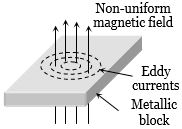
The plane of eddy currents makes an angle with the plane of magnetic lines of force equal to $...^o$.
A
$40$
B
$0$
C
$90$
D
$180$
Solution
(C) Eddy currents are induced in a metallic conductor when it is subjected to a changing magnetic flux.
According to the principles of electromagnetic induction,these currents flow in closed loops within the material in a plane perpendicular to the direction of the magnetic field lines.
As shown in the figure,the magnetic field lines pass through the metallic block,and the eddy currents circulate in a plane that is perpendicular $(90^o)$ to these field lines.
Therefore,the angle between the plane of the eddy currents and the plane of the magnetic lines of force is $90^o$.
According to the principles of electromagnetic induction,these currents flow in closed loops within the material in a plane perpendicular to the direction of the magnetic field lines.
As shown in the figure,the magnetic field lines pass through the metallic block,and the eddy currents circulate in a plane that is perpendicular $(90^o)$ to these field lines.
Therefore,the angle between the plane of the eddy currents and the plane of the magnetic lines of force is $90^o$.
0 likes
View Solution6
EasyMCQ
Which of the following is not an application of eddy currents?
A
Induction furnace
B
Galvanometer damping
C
Speedometer of automobiles
D
$X$-ray crystallography
Solution
(D) Eddy currents are loops of electrical current induced within conductors by a changing magnetic field.
$1$. Induction furnaces use eddy currents to produce high heat for melting metals.
$2$. Galvanometer damping uses eddy currents to bring the coil to rest quickly.
$3$. Speedometers in automobiles use eddy currents to measure the rotation speed of the wheels.
$4$. $X$-ray crystallography is a technique used for determining the atomic and molecular structure of a crystal,which relies on the diffraction of $X$-rays,not eddy currents.
Therefore,$X$-ray crystallography is not an application of eddy currents.
$1$. Induction furnaces use eddy currents to produce high heat for melting metals.
$2$. Galvanometer damping uses eddy currents to bring the coil to rest quickly.
$3$. Speedometers in automobiles use eddy currents to measure the rotation speed of the wheels.
$4$. $X$-ray crystallography is a technique used for determining the atomic and molecular structure of a crystal,which relies on the diffraction of $X$-rays,not eddy currents.
Therefore,$X$-ray crystallography is not an application of eddy currents.
0 likes
View Solution7
EasyMCQ
The core of a transformer is laminated to reduce energy losses due to:
A
Eddy currents
B
Hysteresis
C
Resistance in winding
D
None of these
Solution
(A) The core of a transformer is subjected to a changing magnetic flux,which induces eddy currents in the core material.
These eddy currents cause significant energy loss in the form of heat ($I^2R$ loss).
By laminating the core,the path for these eddy currents is broken into smaller sections,which increases the resistance to their flow.
Consequently,the magnitude of the eddy currents is significantly reduced,thereby minimizing energy losses.
These eddy currents cause significant energy loss in the form of heat ($I^2R$ loss).
By laminating the core,the path for these eddy currents is broken into smaller sections,which increases the resistance to their flow.
Consequently,the magnitude of the eddy currents is significantly reduced,thereby minimizing energy losses.
0 likes
View Solution8
EasyMCQ
Eddy currents are produced when
A
$A$ metal is kept in a varying magnetic field
B
$A$ metal is kept in a steady magnetic field
C
$A$ circular coil is placed in a magnetic field
D
Through a circular coil,current is passed
Solution
(A) Eddy currents are induced currents produced in a bulk piece of a conductor when the magnetic flux linked with it changes. According to Faraday's law of electromagnetic induction,a change in magnetic flux induces an electromotive force $(EMF)$. When a metal is placed in a varying magnetic field,the magnetic flux linked with the metal changes over time,which induces circulating currents within the bulk of the metal. These currents are known as eddy currents. Therefore,the correct condition is that the metal must be in a varying magnetic field.
0 likes
View Solution9
EasyMCQ
The dynamo core is laminated because:
A
Magnetic field increases
B
Magnetic saturation level in the core increases
C
Residual magnetism in the core decreases
D
Loss of energy in the core due to eddy currents decreases
Solution
(D) The core of a dynamo (or transformer) is laminated to reduce the production of eddy currents. When a magnetic flux changes through a solid metallic core,large induced currents called eddy currents are produced,which cause significant energy loss in the form of heat. By using thin,insulated metal sheets (lamination),the path for these eddy currents is broken,thereby increasing the resistance and significantly reducing the energy loss due to eddy currents.
0 likes
View Solution10
EasyMCQ
The core of a transformer is laminated so that
A
Ratio of voltage in the primary and secondary may be increased
B
Rusting of the core may be stopped
C
Energy losses due to eddy currents may be reduced
D
Change in flux is increased
Solution
(C) When magnetic flux linked with a coil changes,an induced $emf$ is produced in it,and the induced current flows through the material. These induced currents are set up in the conductor in the form of closed loops. These currents resemble eddies or whirlpools and are known as $Eddy$ currents. These currents oppose the cause of their origin; therefore,due to $Eddy$ currents,a significant amount of energy is wasted in the form of heat energy. If the core of the transformer is laminated,the path for these currents is restricted,and their effect is minimized.
0 likes
View Solution11
EasyMCQ
We can reduce eddy currents in the core of a transformer by:
A
Increasing the number of turns in the secondary coil
B
Taking a laminated core
C
Making a step-down transformer
D
Using a weak $AC$ at high potential
Solution
(B) Eddy currents are induced currents that flow in the metallic core of a transformer due to the changing magnetic flux,leading to energy loss in the form of heat.
To minimize these currents,the core is constructed using thin,insulated sheets of metal stacked together,known as a laminated core.
Lamination increases the resistance of the path for eddy currents,thereby significantly reducing their magnitude and the associated power loss.
To minimize these currents,the core is constructed using thin,insulated sheets of metal stacked together,known as a laminated core.
Lamination increases the resistance of the path for eddy currents,thereby significantly reducing their magnitude and the associated power loss.
0 likes
View Solution12
MediumMCQ
The core of any transformer is laminated so as to
A
make it light weight
B
reduce the energy loss due to eddy currents
C
make it robust and strong
D
increase the secondary voltage
Solution
(B) The core of a transformer is laminated to minimize the energy losses due to eddy currents. When a time-varying magnetic flux passes through the metallic core,it induces eddy currents in the core,which lead to heating and energy dissipation. By using thin,insulated laminated sheets,the path for these eddy currents is restricted,significantly reducing the magnitude of the currents and thus minimizing energy loss.
0 likes
View Solution13
EasyMCQ
$A$ coil is suspended in a uniform magnetic field,with the plane of the coil parallel to the magnetic lines of force. When a current is passed through the coil,it starts oscillating; it is very difficult to stop. However,if an aluminium plate is placed near the coil,it stops. This is due to:
A
development of air current when the plate is placed.
B
induction of electrical charge on the plate.
C
shielding of magnetic lines of force as aluminium is a paramagnetic material.
D
electromagnetic induction in the aluminium plate giving rise to electromagnetic damping.
Solution
(D) When the coil oscillates in the magnetic field,the magnetic flux linked with the nearby aluminium plate changes continuously.
According to Faraday's law of electromagnetic induction,this change in magnetic flux induces eddy currents in the aluminium plate.
According to Lenz's law,these eddy currents create a magnetic field that opposes the motion of the coil.
This phenomenon is known as electromagnetic damping,which causes the coil to come to rest quickly.
According to Faraday's law of electromagnetic induction,this change in magnetic flux induces eddy currents in the aluminium plate.
According to Lenz's law,these eddy currents create a magnetic field that opposes the motion of the coil.
This phenomenon is known as electromagnetic damping,which causes the coil to come to rest quickly.
0 likes
View Solution14
EasyMCQ
$A$ bar magnet is released from rest coaxially along the axis of a very long,vertical copper tube. After some time,the magnet:
A
Will move with an acceleration $g$
B
Will move with almost constant speed
C
Will stop in the tube
D
Will oscillate
Solution
(B) As the bar magnet falls through the copper tube,the change in magnetic flux linked with the tube induces eddy currents in the copper walls.
According to Lenz's law,these eddy currents create a magnetic field that opposes the motion of the falling magnet.
As the magnet gains speed,the induced electromotive force $(EMF)$ and the resulting eddy currents increase,leading to a greater opposing magnetic force.
Eventually,the upward magnetic force balances the downward gravitational force $(mg)$.
At this point,the net force on the magnet becomes zero,and it reaches a terminal velocity,moving with an almost constant speed.
According to Lenz's law,these eddy currents create a magnetic field that opposes the motion of the falling magnet.
As the magnet gains speed,the induced electromotive force $(EMF)$ and the resulting eddy currents increase,leading to a greater opposing magnetic force.
Eventually,the upward magnetic force balances the downward gravitational force $(mg)$.
At this point,the net force on the magnet becomes zero,and it reaches a terminal velocity,moving with an almost constant speed.
0 likes
View Solution15
MediumMCQ
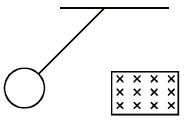
$A$ metallic ring connected to a rod oscillates freely like a pendulum. If a magnetic field is applied in the horizontal direction such that the pendulum swings through the field,the pendulum will:
A
keep oscillating with the old time period
B
keep oscillating with a smaller time period
C
keep oscillating with a larger time period
D
come to rest very soon
Solution
(D) When the metallic ring moves through the magnetic field,the magnetic flux linked with the ring changes. According to Faraday's law of electromagnetic induction,an electromotive force $(EMF)$ is induced in the ring. Since the ring is metallic,this induced $EMF$ causes eddy currents to flow within it. According to Lenz's law,these eddy currents produce a magnetic force that opposes the motion of the ring. This opposing force acts as a damping force,causing the kinetic energy of the pendulum to dissipate as heat due to the electrical resistance of the ring. Consequently,the amplitude of oscillation decreases rapidly,and the pendulum comes to rest very soon.
0 likes
View Solution16
EasyMCQ
$A$ magnet is dropped down an infinitely long vertical copper tube. Then
A
The magnet moves with continuously decreasing velocity and ultimately comes to rest.
B
The magnet moves with continuously increasing velocity and ultimately acquires a terminal velocity.
C
Magnet moves with continuously increasing velocity and acceleration.
D
Magnet moves with continuously increasing velocity but with constant acceleration.
Solution
(B) When a bar magnet falls vertically through the hollow region of a long vertical copper tube,the changing magnetic flux linked with the tube induces eddy currents in the body of the tube.
According to Lenz's law,these eddy currents oppose the motion of the falling magnet,creating a retarding force.
As the velocity of the magnet increases,the rate of change of magnetic flux increases,which in turn increases the magnitude of the eddy currents and the resulting retarding force.
Eventually,the retarding force becomes equal to the weight of the magnet.
At this point,the net force on the magnet becomes zero,and it attains a constant final terminal velocity,falling with zero acceleration.
According to Lenz's law,these eddy currents oppose the motion of the falling magnet,creating a retarding force.
As the velocity of the magnet increases,the rate of change of magnetic flux increases,which in turn increases the magnitude of the eddy currents and the resulting retarding force.
Eventually,the retarding force becomes equal to the weight of the magnet.
At this point,the net force on the magnet becomes zero,and it attains a constant final terminal velocity,falling with zero acceleration.
0 likes
View Solution17
EasyMCQ
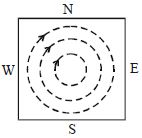
$A$ metal sheet is placed in a magnetic field that changes from zero to maximum. If the figure shows the direction of eddy currents,then the direction of the magnetic field is:
A
Perpendicular to the plane of the paper and inwards
B
Perpendicular to the plane of the paper and outwards
C
From West to East
D
From North to South
Solution
(A) According to Lenz's law,the direction of the induced eddy current is such that it opposes the change in the magnetic flux that produces it.
Given that the magnetic field is increasing from zero to maximum,the magnetic flux through the metal sheet is increasing.
To oppose this increase,the eddy current must create a magnetic field that points in the opposite direction to the external magnetic field.
The figure shows the eddy currents flowing in a counter-clockwise direction.
Using the right-hand thumb rule,a counter-clockwise current creates a magnetic field that points outwards,perpendicular to the plane of the paper.
Since the eddy current's magnetic field opposes the external field,the external magnetic field must be pointing inwards,perpendicular to the plane of the paper.
Given that the magnetic field is increasing from zero to maximum,the magnetic flux through the metal sheet is increasing.
To oppose this increase,the eddy current must create a magnetic field that points in the opposite direction to the external magnetic field.
The figure shows the eddy currents flowing in a counter-clockwise direction.
Using the right-hand thumb rule,a counter-clockwise current creates a magnetic field that points outwards,perpendicular to the plane of the paper.
Since the eddy current's magnetic field opposes the external field,the external magnetic field must be pointing inwards,perpendicular to the plane of the paper.
0 likes
View Solution18
MediumMCQ
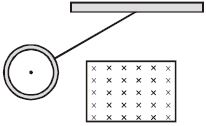
$A$ metallic ring connected to a rod oscillates freely like a pendulum. If now a magnetic field is applied in a horizontal direction so that the pendulum now swings through the field,the pendulum will
A
Keep oscillating with the old time period
B
Keep oscillating with a smaller time period
C
Keep oscillating with a larger time period
D
Come to rest very soon
Solution
(D) When the metallic ring moves through the magnetic field,the magnetic flux linked with the ring changes.
According to Faraday's law of electromagnetic induction,an induced electromotive force $(EMF)$ is produced in the ring.
Since the ring is metallic,it has some resistance,which leads to the flow of induced eddy currents.
According to Lenz's law,these eddy currents oppose the motion that causes them.
This results in a damping force acting on the pendulum,which dissipates the mechanical energy of the pendulum as heat.
Consequently,the amplitude of oscillation decreases rapidly,and the pendulum comes to rest very soon.
According to Faraday's law of electromagnetic induction,an induced electromotive force $(EMF)$ is produced in the ring.
Since the ring is metallic,it has some resistance,which leads to the flow of induced eddy currents.
According to Lenz's law,these eddy currents oppose the motion that causes them.
This results in a damping force acting on the pendulum,which dissipates the mechanical energy of the pendulum as heat.
Consequently,the amplitude of oscillation decreases rapidly,and the pendulum comes to rest very soon.
0 likes
View Solution19
EasyMCQ
Assertion: $A$ laminated core is used in transformers to increase eddy currents.
Reason: The efficiency of a transformer increases with increase in eddy currents.
Reason: The efficiency of a transformer increases with increase in eddy currents.
A
If both Assertion and Reason are correct and the Reason is a correct explanation of the Assertion.
B
If both Assertion and Reason are correct but Reason is not a correct explanation of the Assertion.
C
If the Assertion is correct but Reason is incorrect.
D
If both the Assertion and Reason are incorrect.
Solution
(D) Large eddy currents are produced in a non-laminated iron core of a transformer by the induced $emf$,as the resistance of a bulk iron core is very small.
By using thin iron sheets as a core,the electrical resistance is increased.
Laminating the core substantially reduces the eddy currents.
Eddy currents heat up the core of the transformer,leading to energy loss in the form of heat.
Therefore,more eddy currents result in greater energy loss,which decreases the efficiency of the transformer.
Since both the Assertion and the Reason are false,the correct option is $D$.
By using thin iron sheets as a core,the electrical resistance is increased.
Laminating the core substantially reduces the eddy currents.
Eddy currents heat up the core of the transformer,leading to energy loss in the form of heat.
Therefore,more eddy currents result in greater energy loss,which decreases the efficiency of the transformer.
Since both the Assertion and the Reason are false,the correct option is $D$.
0 likes
View Solution20
EasyMCQ
In which of the following devices,the eddy current effect is not used?
A
induction furnace
B
magnetic braking in train
C
electromagnet
D
electric heater
Solution
(D) Eddy currents are loops of electrical current induced within conductors by a changing magnetic field. They are utilized in induction furnaces for heating,magnetic braking systems in trains,and speedometers. An electric heater,however,operates on the principle of the Joule heating effect $(H = I^2Rt)$,where heat is produced by the resistance of a conductor to the flow of electric current,not by eddy currents.
0 likes
View Solution21
EasyMCQ
What should be the resistivity of materials used for electromagnets,and why?
A
High resistivity
B
Low resistivity
C
Zero resistivity
D
Infinite resistivity
Solution
(A) The material used for the core of an electromagnet should have high resistivity.
This is because high resistivity reduces the magnitude of eddy currents induced in the core when the magnetic flux changes.
By minimizing eddy currents,the energy loss in the form of heat is significantly reduced,thereby increasing the efficiency of the electromagnet.
This is because high resistivity reduces the magnitude of eddy currents induced in the core when the magnetic flux changes.
By minimizing eddy currents,the energy loss in the form of heat is significantly reduced,thereby increasing the efficiency of the electromagnet.
0 likes
View Solution22
Medium
What is an eddy current? Discuss the practical applications of eddy currents. What should be done to decrease the effects of eddy currents?
Solution
(N/A) We have studied electric currents induced in well-defined paths in conductors like circular loops. Even when bulk pieces of conductors are subjected to changing magnetic flux,induced currents are produced in them. However,their flow patterns resemble swirling eddies in water. This effect was discovered by physicist Foucault ($1819$-$1868$) and these currents are called eddy currents.
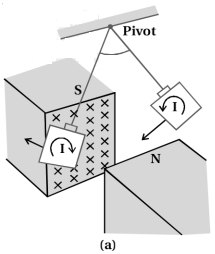
Consider the apparatus shown in the figure. $A$ copper plate is allowed to swing like a simple pendulum between the pole pieces of a strong magnet. It is found that the motion is damped and in a little while,the plate comes to a halt in the magnetic field.
We can explain this phenomenon on the basis of electromagnetic induction. The magnetic flux associated with the plate keeps on changing as the plate moves in and out of the region between magnetic poles. The flux change induces eddy currents in the plate.
The directions of eddy currents are opposite when the plate swings into the region between the poles and when it swings out of the region. Eddy currents are often undesirable since they heat up the core and dissipate electrical energy in the form of heat. To reduce these effects,the core is often laminated or slotted to break the paths of the eddy currents.
Eddy currents are used to advantage in certain applications like:
$(1)$ Magnetic braking in trains: Strong electromagnets are situated above the rails in some electrically powered trains. When the electromagnets are activated,the eddy currents induced in the rails oppose the motion of the train. As there are no mechanical linkages,the braking effect is smooth.
$(2)$ Electromagnetic damping: Certain galvanometers have a fixed core made of non-magnetic metallic material. When the coil oscillates,the eddy currents generated in the core oppose the motion and bring the coil to rest quickly.
$(3)$ Induction furnace: Induction furnaces can be used to produce high temperatures and can be utilized to prepare alloys by melting the constituent metals. $A$ high-frequency alternating current is passed through a coil which surrounds the metals to be melted. The eddy currents generated in the metals produce high temperatures sufficient to melt them.
$(4)$ Electric power meters: The shiny metal disc in the electric power meter (analogue type) rotates due to the eddy currents. Electric currents are induced in the disc by magnetic fields produced by sinusoidally varying currents in a coil.
Consider the apparatus shown in the figure. $A$ copper plate is allowed to swing like a simple pendulum between the pole pieces of a strong magnet. It is found that the motion is damped and in a little while,the plate comes to a halt in the magnetic field.
We can explain this phenomenon on the basis of electromagnetic induction. The magnetic flux associated with the plate keeps on changing as the plate moves in and out of the region between magnetic poles. The flux change induces eddy currents in the plate.
The directions of eddy currents are opposite when the plate swings into the region between the poles and when it swings out of the region. Eddy currents are often undesirable since they heat up the core and dissipate electrical energy in the form of heat. To reduce these effects,the core is often laminated or slotted to break the paths of the eddy currents.
Eddy currents are used to advantage in certain applications like:
$(1)$ Magnetic braking in trains: Strong electromagnets are situated above the rails in some electrically powered trains. When the electromagnets are activated,the eddy currents induced in the rails oppose the motion of the train. As there are no mechanical linkages,the braking effect is smooth.
$(2)$ Electromagnetic damping: Certain galvanometers have a fixed core made of non-magnetic metallic material. When the coil oscillates,the eddy currents generated in the core oppose the motion and bring the coil to rest quickly.
$(3)$ Induction furnace: Induction furnaces can be used to produce high temperatures and can be utilized to prepare alloys by melting the constituent metals. $A$ high-frequency alternating current is passed through a coil which surrounds the metals to be melted. The eddy currents generated in the metals produce high temperatures sufficient to melt them.
$(4)$ Electric power meters: The shiny metal disc in the electric power meter (analogue type) rotates due to the eddy currents. Electric currents are induced in the disc by magnetic fields produced by sinusoidally varying currents in a coil.
0 likes
View Solution23
Medium
Discuss the uses of eddy current.
Solution
(N/A) Eddy currents are loops of electrical current induced within conductors by a changing magnetic field. Despite often being considered a nuisance due to energy loss as heat,they have several practical applications:
$1$. Magnetic Braking: Used in heavy trains and roller coasters. When the magnetic field is applied to the rotating wheels,eddy currents create a magnetic force that opposes the motion,bringing the vehicle to a stop.
$2$. Induction Furnaces: Used to melt metals. $A$ high-frequency alternating current is passed through a coil surrounding the metal,inducing strong eddy currents that generate intense heat,melting the metal.
$3$. Electromagnetic Damping: Used in galvanometers to bring the coil to rest quickly. The eddy currents induced in the metallic frame of the coil create a torque that opposes the motion,providing damping.
$4$. Induction Cooktops: Used for cooking. An alternating magnetic field induces eddy currents in the base of the cooking vessel,which heats up the vessel and the food inside.
$5$. Speedometers: Used to measure the speed of vehicles. $A$ rotating magnet near a metallic drum induces eddy currents,creating a torque that deflects the speedometer needle proportional to the speed.
$1$. Magnetic Braking: Used in heavy trains and roller coasters. When the magnetic field is applied to the rotating wheels,eddy currents create a magnetic force that opposes the motion,bringing the vehicle to a stop.
$2$. Induction Furnaces: Used to melt metals. $A$ high-frequency alternating current is passed through a coil surrounding the metal,inducing strong eddy currents that generate intense heat,melting the metal.
$3$. Electromagnetic Damping: Used in galvanometers to bring the coil to rest quickly. The eddy currents induced in the metallic frame of the coil create a torque that opposes the motion,providing damping.
$4$. Induction Cooktops: Used for cooking. An alternating magnetic field induces eddy currents in the base of the cooking vessel,which heats up the vessel and the food inside.
$5$. Speedometers: Used to measure the speed of vehicles. $A$ rotating magnet near a metallic drum induces eddy currents,creating a torque that deflects the speedometer needle proportional to the speed.
0 likes
View Solution24
Difficult
Explain eddy currents using the example of a small magnet falling through an aluminium pipe.
Solution
(N/A) When a small magnet is allowed to fall through a long vertical aluminium pipe,the magnetic flux linked with the pipe changes as the magnet moves. This change in magnetic flux induces eddy currents in the pipe walls.
According to Lenz's law,these eddy currents oppose the motion of the falling magnet. The magnetic field produced by the eddy currents exerts an upward force on the magnet,which opposes its downward acceleration due to gravity. As a result,the magnet falls with a reduced acceleration,and its terminal velocity becomes much smaller than the acceleration due to gravity $(g)$.
If the pipe is cut along its length,the path for the eddy currents is broken,and the magnet will fall with an acceleration close to $g$.
According to Lenz's law,these eddy currents oppose the motion of the falling magnet. The magnetic field produced by the eddy currents exerts an upward force on the magnet,which opposes its downward acceleration due to gravity. As a result,the magnet falls with a reduced acceleration,and its terminal velocity becomes much smaller than the acceleration due to gravity $(g)$.
If the pipe is cut along its length,the path for the eddy currents is broken,and the magnet will fall with an acceleration close to $g$.
0 likes
View Solution25
Medium
What are eddy currents? Who discovered eddy currents?
Solution
(N/A) Eddy currents are loops of electrical current induced within conductors by a changing magnetic field in the conductor,according to Faraday's law of induction.
These currents flow in closed loops within conductors,in planes perpendicular to the magnetic field.
They were discovered by the French physicist $Léon$ $Foucault$ in $1851$.
These currents flow in closed loops within conductors,in planes perpendicular to the magnetic field.
They were discovered by the French physicist $Léon$ $Foucault$ in $1851$.
0 likes
View Solution26
Medium
What is electromagnetic damping?
Solution
(N/A) Electromagnetic damping is a phenomenon where the motion of a conductor (like a magnet moving near a metal) is retarded by the eddy currents induced within the conductor.
To demonstrate this,take two hollow thin cylindrical pipes of equal internal diameters made of aluminium and $PVC$ respectively. Fix them vertically with clamps on retort stands.
Take a small cylindrical magnet having a diameter slightly smaller than the inner diameter of the pipes and drop it through each pipe such that the magnet does not touch the sides.
You will observe that the magnet dropped through the $PVC$ pipe takes the same time to fall as it would in free space,because $PVC$ is an insulator and no eddy currents are generated.
However,the magnet takes a much longer time to fall through the aluminium pipe. This is because as the magnet falls,the changing magnetic flux induces eddy currents in the conducting aluminium pipe. According to Lenz's Law,these eddy currents create a magnetic field that opposes the motion of the magnet.
This retarding force,caused by the interaction between the magnet and the eddy currents,is known as electromagnetic damping.
To demonstrate this,take two hollow thin cylindrical pipes of equal internal diameters made of aluminium and $PVC$ respectively. Fix them vertically with clamps on retort stands.
Take a small cylindrical magnet having a diameter slightly smaller than the inner diameter of the pipes and drop it through each pipe such that the magnet does not touch the sides.
You will observe that the magnet dropped through the $PVC$ pipe takes the same time to fall as it would in free space,because $PVC$ is an insulator and no eddy currents are generated.
However,the magnet takes a much longer time to fall through the aluminium pipe. This is because as the magnet falls,the changing magnetic flux induces eddy currents in the conducting aluminium pipe. According to Lenz's Law,these eddy currents create a magnetic field that opposes the motion of the magnet.
This retarding force,caused by the interaction between the magnet and the eddy currents,is known as electromagnetic damping.
0 likes
View Solution27
Medium
When a small magnet is allowed to fall through an aluminium pipe,it falls with an acceleration less than $g$. Why?
Solution
(N/A) As the magnet falls through the aluminium pipe,the magnetic flux linked with the pipe changes.
This change in magnetic flux induces eddy currents in the aluminium pipe according to Faraday's law of electromagnetic induction.
According to Lenz's law,these eddy currents create a magnetic field that opposes the motion of the falling magnet.
This opposing force acts upwards,reducing the net downward force on the magnet.
Consequently,the acceleration of the magnet becomes less than the acceleration due to gravity $(g)$.
This change in magnetic flux induces eddy currents in the aluminium pipe according to Faraday's law of electromagnetic induction.
According to Lenz's law,these eddy currents create a magnetic field that opposes the motion of the falling magnet.
This opposing force acts upwards,reducing the net downward force on the magnet.
Consequently,the acceleration of the magnet becomes less than the acceleration due to gravity $(g)$.
0 likes
View Solution28
Medium
Consider a metallic pipe with an inner radius of $1 \ cm$. If a cylindrical bar magnet of radius $0.8 \ cm$ is dropped through the pipe,it takes more time to come down than it takes for a similar unmagnetised cylindrical iron bar dropped through the metallic pipe. Explain.
Solution
(N/A) When a cylindrical bar magnet is dropped through the metallic pipe,the magnetic flux linked with the pipe changes as the magnet falls.
According to Faraday's law of electromagnetic induction,this change in magnetic flux induces eddy currents in the metallic pipe.
According to Lenz's law,these eddy currents create a magnetic field that opposes the motion of the falling magnet.
Consequently,the magnet experiences an upward retarding force,causing its acceleration to be less than the acceleration due to gravity $(g)$.
In contrast,when an unmagnetised iron bar is dropped,there is no change in magnetic flux,and no eddy currents are induced.
Therefore,the unmagnetised iron bar falls with an acceleration equal to $g$,taking less time to pass through the pipe compared to the bar magnet.
According to Faraday's law of electromagnetic induction,this change in magnetic flux induces eddy currents in the metallic pipe.
According to Lenz's law,these eddy currents create a magnetic field that opposes the motion of the falling magnet.
Consequently,the magnet experiences an upward retarding force,causing its acceleration to be less than the acceleration due to gravity $(g)$.
In contrast,when an unmagnetised iron bar is dropped,there is no change in magnetic flux,and no eddy currents are induced.
Therefore,the unmagnetised iron bar falls with an acceleration equal to $g$,taking less time to pass through the pipe compared to the bar magnet.
0 likes
View Solution29
EasyMCQ
Eddy currents are induced when:
A
$A$ metal block is kept in a changing magnetic field
B
$A$ metal block is kept in a uniform magnetic field
C
$A$ coil is kept in a uniform magnetic field
D
Current is passed in a coil
Solution
(A) Eddy currents are induced in a conductor whenever the magnetic flux linked with the conductor changes.
This change in magnetic flux can occur if a metal block is placed in a time-varying magnetic field or if a metal block moves through a non-uniform magnetic field.
Therefore,when a metal block is kept in a changing magnetic field,the magnetic flux through it changes,inducing eddy currents according to Faraday's law of induction.
Thus,option $A$ is correct.
This change in magnetic flux can occur if a metal block is placed in a time-varying magnetic field or if a metal block moves through a non-uniform magnetic field.
Therefore,when a metal block is kept in a changing magnetic field,the magnetic flux through it changes,inducing eddy currents according to Faraday's law of induction.
Thus,option $A$ is correct.
0 likes
View Solution30
MediumMCQ
$A$ spherical insulating ball and a spherical metallic ball of the same size and mass are dropped from the same height. Choose the correct statement out of the following (Assume negligible air friction).
A
Time taken by them to reach the earth's surface will be independent of the properties of their materials.
B
Insulating ball will reach the earth's surface earlier than the metal ball.
C
Both will reach the earth's surface simultaneously.
D
Metal ball will reach the earth's surface earlier than the insulating ball.
Solution
(B) When a metallic ball falls through the Earth's magnetic field,the change in magnetic flux linked with it induces eddy currents within the metal.
According to Lenz's Law,these eddy currents create a magnetic force that opposes the motion of the ball.
As a result,the metallic ball experiences a retarding force,causing it to take more time to reach the ground compared to the insulating ball,which does not experience such electromagnetic damping.
Therefore,the insulating ball reaches the Earth's surface earlier than the metal ball.
According to Lenz's Law,these eddy currents create a magnetic force that opposes the motion of the ball.
As a result,the metallic ball experiences a retarding force,causing it to take more time to reach the ground compared to the insulating ball,which does not experience such electromagnetic damping.
Therefore,the insulating ball reaches the Earth's surface earlier than the metal ball.
0 likes
View Solution31
MediumMCQ
$A$ bar magnet is released from rest along the axis of a very long vertical copper tube. After some time,the magnet will:
A
Move down with almost constant speed
B
Oscillate inside the tube
C
Move down with an acceleration greater than $g$
D
Move down with an acceleration equal to $g$
Solution
(A) As the bar magnet falls through the copper tube,the changing magnetic flux through the tube induces eddy currents in the copper walls according to Faraday's law of induction.
According to Lenz's law,these eddy currents create a magnetic field that opposes the motion of the magnet.
This opposing force acts upwards,counteracting the gravitational force $(mg)$ acting downwards.
As the speed of the magnet increases,the induced eddy currents and the resulting opposing magnetic force also increase.
Eventually,the upward magnetic force becomes equal to the downward gravitational force,resulting in a net force of zero.
At this point,the magnet reaches a terminal velocity and moves down with an almost constant speed.
According to Lenz's law,these eddy currents create a magnetic field that opposes the motion of the magnet.
This opposing force acts upwards,counteracting the gravitational force $(mg)$ acting downwards.
As the speed of the magnet increases,the induced eddy currents and the resulting opposing magnetic force also increase.
Eventually,the upward magnetic force becomes equal to the downward gravitational force,resulting in a net force of zero.
At this point,the magnet reaches a terminal velocity and moves down with an almost constant speed.
0 likes
View Solution32
MediumMCQ
Given below are two statements: one is labelled as Assertion $A$ and the other is labelled as Reason $R$.
Assertion $A$: $A$ bar magnet dropped through a metallic cylindrical pipe takes more time to come down compared to a non-magnetic bar with same geometry and mass.
Reason $R$: For the magnetic bar,Eddy currents are produced in the metallic pipe which oppose the motion of the magnetic bar.
In the light of the above statements,choose the correct answer from the options given below:
Assertion $A$: $A$ bar magnet dropped through a metallic cylindrical pipe takes more time to come down compared to a non-magnetic bar with same geometry and mass.
Reason $R$: For the magnetic bar,Eddy currents are produced in the metallic pipe which oppose the motion of the magnetic bar.
In the light of the above statements,choose the correct answer from the options given below:
A
Both $A$ and $R$ are true but $R$ is $NOT$ the correct explanation of $A$
B
$A$ is true but $R$ is false
C
Both $A$ and $R$ are true and $R$ is the correct explanation of $A$
D
$A$ is false but $R$ is true
Solution
(C) When a bar magnet falls through a metallic pipe,the magnetic flux linked with the pipe changes continuously.
This change in magnetic flux induces Eddy currents in the metallic pipe according to Faraday's law of electromagnetic induction.
According to Lenz's law,these Eddy currents oppose the cause that produces them,which is the motion of the falling magnet.
This creates an upward magnetic force that opposes the gravitational force,resulting in a slower downward acceleration of the magnet compared to a non-magnetic bar.
Therefore,both Assertion $A$ and Reason $R$ are true,and $R$ is the correct explanation of $A$.
This change in magnetic flux induces Eddy currents in the metallic pipe according to Faraday's law of electromagnetic induction.
According to Lenz's law,these Eddy currents oppose the cause that produces them,which is the motion of the falling magnet.
This creates an upward magnetic force that opposes the gravitational force,resulting in a slower downward acceleration of the magnet compared to a non-magnetic bar.
Therefore,both Assertion $A$ and Reason $R$ are true,and $R$ is the correct explanation of $A$.
0 likes
View Solution33
MediumMCQ
$A$ sheet is placed on a horizontal surface in front of a strong magnetic pole. $A$ force is needed to:
$A$. hold the sheet there if it is magnetic.
$B$. hold the sheet there if it is non-magnetic.
$C$. move the sheet away from the pole with uniform velocity if it is conducting.
$D$. move the sheet away from the pole with uniform velocity if it is both,non-conducting and non-polar.
Choose the correct statement$(s)$ from the options given below:
$A$. hold the sheet there if it is magnetic.
$B$. hold the sheet there if it is non-magnetic.
$C$. move the sheet away from the pole with uniform velocity if it is conducting.
$D$. move the sheet away from the pole with uniform velocity if it is both,non-conducting and non-polar.
Choose the correct statement$(s)$ from the options given below:
A
$A$ and $C$ only
B
$A$,$C$ and $D$ only
C
$C$ only
D
$B$ and $D$ only
Solution
(A) . $A$ magnetic pole will exert an attractive or repulsive force on a magnetic sheet,so a force is required to hold it in place.
$B$. If the sheet is non-magnetic,there is no magnetic interaction,so no force is needed to hold it.
$C$. If the sheet is conducting,moving it through a magnetic field induces eddy currents. According to Lenz's Law,these currents create a force that opposes the motion. Therefore,an external force is required to move the sheet with uniform velocity.
$D$. $A$ non-conducting and non-polar sheet does not interact with the magnetic field of the pole,so no force is required to move it.
$B$. If the sheet is non-magnetic,there is no magnetic interaction,so no force is needed to hold it.
$C$. If the sheet is conducting,moving it through a magnetic field induces eddy currents. According to Lenz's Law,these currents create a force that opposes the motion. Therefore,an external force is required to move the sheet with uniform velocity.
$D$. $A$ non-conducting and non-polar sheet does not interact with the magnetic field of the pole,so no force is required to move it.
0 likes
View Solution34
AdvancedMCQ
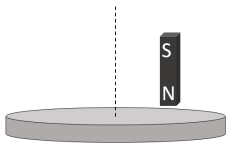
$A$ light disc made of aluminium (a nonmagnetic material) is kept horizontally and is free to rotate about its axis as shown in the figure. $A$ strong magnet is held vertically at a point above the disc away from its axis. On revolving the magnet about the axis of the disc,the disc will (figure is schematic and not drawn to scale)-
A
rotate in the direction opposite to the direction of magnet's motion
B
rotate in the same direction as the direction of magnet's motion
C
not rotate and its temperature will remain unchanged
D
not rotate but its temperature will slowly rise
Solution
(B) When the magnet is revolved above the disc,the magnetic flux linked with the aluminium disc changes continuously.
According to Faraday's law of electromagnetic induction,this change in magnetic flux induces an electromotive force $(EMF)$ in the disc.
Since the disc is a conductor,this induced $EMF$ causes eddy currents to flow within the disc.
According to Lenz's law,these eddy currents will flow in such a direction as to oppose the cause producing them,which is the relative motion between the magnet and the disc.
To oppose this relative motion,the disc experiences a torque that causes it to rotate in the same direction as the motion of the magnet.
This phenomenon is known as Arago's disc experiment.
According to Faraday's law of electromagnetic induction,this change in magnetic flux induces an electromotive force $(EMF)$ in the disc.
Since the disc is a conductor,this induced $EMF$ causes eddy currents to flow within the disc.
According to Lenz's law,these eddy currents will flow in such a direction as to oppose the cause producing them,which is the relative motion between the magnet and the disc.
To oppose this relative motion,the disc experiences a torque that causes it to rotate in the same direction as the motion of the magnet.
This phenomenon is known as Arago's disc experiment.
0 likes
View Solution35
EasyMCQ
The core used in transformers and other electromagnetic devices is laminated to
A
increase the magnetic field.
B
increase the level of magnetic saturation of the core.
C
reduce the residual magnetism in the core.
D
reduce eddy current.
Solution
(D) $1$. According to Faraday's law of induction,eddy currents are loops of electrical current induced within conductors by a changing magnetic field.
$2$. When a solid metal core is used in a transformer,the changing magnetic flux induces large eddy currents,which lead to significant energy loss in the form of heat.
$3$. By laminating the core (using thin,insulated sheets of metal),the path for these eddy currents is restricted,significantly reducing their magnitude.
$4$. Therefore,the core is laminated to reduce eddy current losses and improve the overall efficiency of the device.
$2$. When a solid metal core is used in a transformer,the changing magnetic flux induces large eddy currents,which lead to significant energy loss in the form of heat.
$3$. By laminating the core (using thin,insulated sheets of metal),the path for these eddy currents is restricted,significantly reducing their magnitude.
$4$. Therefore,the core is laminated to reduce eddy current losses and improve the overall efficiency of the device.
0 likes
View Solution36
EasyMCQ
The cores used in transformers are laminated to
A
increase the magnetic field.
B
increase the level of the magnetic saturation of the core.
C
reduce the residual magnetism in the core.
D
reduce eddy current losses in the core.
Solution
(D) In a transformer, energy is lost due to various factors, one of which is the formation of eddy currents in the iron core.
When the magnetic flux through the core changes, it induces circulating currents (eddy currents) within the bulk of the core material, leading to significant heat dissipation ($I^2R$ loss).
By laminating the core—using thin, insulated sheets of metal instead of a solid block—the path for these eddy currents is restricted.
This increase in resistance significantly reduces the magnitude of the eddy currents, thereby minimizing the energy loss in the form of heat.
When the magnetic flux through the core changes, it induces circulating currents (eddy currents) within the bulk of the core material, leading to significant heat dissipation ($I^2R$ loss).
By laminating the core—using thin, insulated sheets of metal instead of a solid block—the path for these eddy currents is restricted.
This increase in resistance significantly reduces the magnitude of the eddy currents, thereby minimizing the energy loss in the form of heat.
0 likes
View Solution37
EasyMCQ
Eddy currents are produced when
A
a thick metal plate is kept in a steady magnetic field
B
a circular coil is placed in a steady magnetic field
C
a steady current is passed through a coil
D
a thick metal plate is kept in a varying magnetic field
Solution
(D) Eddy currents are induced loops of electrical current generated within conductors by a changing magnetic field in the conductor,according to Faraday's law of induction. When a thick metal plate is subjected to a varying magnetic field,the magnetic flux linked with the plate changes,which induces electromotive force $(EMF)$ and consequently produces circulating currents known as eddy currents.
0 likes
View Solution38
MediumMCQ
$A$ copper ring is held horizontally and a bar magnet is dropped through the ring with its length along the axis of the ring. The acceleration of the falling magnet while it is passing through the ring is
A
more than acceleration due to gravity.
B
less than acceleration due to gravity.
C
depends on the diameter of ring and length of magnet.
D
depends on pole strength of magnet.
Solution
(B) According to Lenz's Law,when a bar magnet falls through a copper ring,the changing magnetic flux through the ring induces an electromotive force $(EMF)$ and a corresponding eddy current in the ring.
This induced current creates a magnetic field that opposes the change in magnetic flux that produced it.
As the magnet enters the ring,the induced magnetic field exerts an upward repulsive force on the magnet.
As the magnet leaves the ring,the induced magnetic field exerts an upward attractive force on the magnet.
In both cases,the induced magnetic force acts in a direction opposite to the motion of the magnet (upwards),while gravity acts downwards.
Therefore,the net acceleration of the magnet is $a = g - a_{induced}$,which is less than the acceleration due to gravity $(g)$.
This induced current creates a magnetic field that opposes the change in magnetic flux that produced it.
As the magnet enters the ring,the induced magnetic field exerts an upward repulsive force on the magnet.
As the magnet leaves the ring,the induced magnetic field exerts an upward attractive force on the magnet.
In both cases,the induced magnetic force acts in a direction opposite to the motion of the magnet (upwards),while gravity acts downwards.
Therefore,the net acceleration of the magnet is $a = g - a_{induced}$,which is less than the acceleration due to gravity $(g)$.
0 likes
View Solution39
EasyMCQ
$A$ hollow metal pipe is held vertically and a bar magnet is dropped through it with its length along the axis of the pipe. The acceleration of the falling magnet is ($g=$ acceleration due to gravity).
A
equal to $g$.
B
less than $g$.
C
more than $g$.
D
zero.
Solution
(B) As the bar magnet falls through the hollow metal pipe,the magnetic flux linked with the pipe changes continuously.
According to Faraday's law of electromagnetic induction,this change in magnetic flux induces an electromotive force $(emf)$ in the pipe.
Since the pipe is a conductor,this induced $emf$ causes eddy currents to flow within the body of the pipe.
According to Lenz's law,these eddy currents create a magnetic field that opposes the motion of the falling magnet.
This opposing force acts upwards,reducing the net downward force on the magnet.
Consequently,the net acceleration of the magnet is less than the acceleration due to gravity $(g)$.
According to Faraday's law of electromagnetic induction,this change in magnetic flux induces an electromotive force $(emf)$ in the pipe.
Since the pipe is a conductor,this induced $emf$ causes eddy currents to flow within the body of the pipe.
According to Lenz's law,these eddy currents create a magnetic field that opposes the motion of the falling magnet.
This opposing force acts upwards,reducing the net downward force on the magnet.
Consequently,the net acceleration of the magnet is less than the acceleration due to gravity $(g)$.
0 likes
View Solution40
MediumMCQ
The working of magnetic braking of trains is based on
A
Alternating current
B
Eddy current
C
Steady current
D
Pulsating current
Solution
(B) The working of magnetic braking of trains is based on $Eddy$ currents.
When a conductor moves through a magnetic field,the change in magnetic flux induces $Eddy$ currents within the conductor.
These currents create a magnetic field that opposes the motion of the conductor,according to $Lenz's$ law.
This opposing force acts as a braking mechanism,effectively slowing down or stopping the train.
When a conductor moves through a magnetic field,the change in magnetic flux induces $Eddy$ currents within the conductor.
These currents create a magnetic field that opposes the motion of the conductor,according to $Lenz's$ law.
This opposing force acts as a braking mechanism,effectively slowing down or stopping the train.
0 likes
View Solution41
EasyMCQ
The shiny metal disk in the electric power meter (analog type) rotates due to
A
temperature change
B
eddy currents
C
an external motor
D
pressure change
Solution
(B) The shiny metal disc in the electric power meter rotates due to eddy currents.
When the alternating magnetic field produced by the current in the coils passes through the metal disc,it induces eddy currents within the disc.
These eddy currents interact with the magnetic field to produce a torque,which causes the disc to rotate.
When the alternating magnetic field produced by the current in the coils passes through the metal disc,it induces eddy currents within the disc.
These eddy currents interact with the magnetic field to produce a torque,which causes the disc to rotate.
0 likes
View Solution42
EasyMCQ
The small energy losses in transformers due to eddy currents can be reduced by
A
winding the primary and secondary coils one over the other
B
using thick wire
C
using a laminated core
D
using magnetic material with low hysteresis loss
Solution
(C) Eddy currents are induced currents that circulate within the core of a transformer when it is subjected to a changing magnetic field,leading to energy loss in the form of heat.
To minimize these losses,the core is constructed using thin,insulated sheets of metal stacked together,known as a laminated core.
This lamination increases the electrical resistance of the path for eddy currents,thereby significantly reducing their magnitude and the associated energy dissipation.
To minimize these losses,the core is constructed using thin,insulated sheets of metal stacked together,known as a laminated core.
This lamination increases the electrical resistance of the path for eddy currents,thereby significantly reducing their magnitude and the associated energy dissipation.
0 likes
View Solution43
EasyMCQ
$A$ metal detector works on the principle of:
A
Ohm's law
B
Coulomb's law
C
Electromagnetic induction
D
Stefan's law of radiation
Solution
(C) metal detector consists of a coil that generates a time-varying magnetic field. When a metallic object is brought near the coil,the changing magnetic field induces eddy currents in the metal object. These eddy currents create their own magnetic field,which is detected by the device. This process is based on the principle of electromagnetic induction.
0 likes
View SolutionElectromagnetic Induction — Eddy Current · Frequently Asked Questions
1Are these Electromagnetic Induction questions useful for JEE and NEET?
Yes. All questions in this section are mapped to JEE Main and NEET exam patterns. Previous year questions from JEE Main, NEET, GUJCET and state-level exams are included with full solutions.
2Can I switch to Hindi or Gujarati for these questions?
Yes. Use the language tabs in the hero section or the sidebar to view the same questions and solutions in English, Hindi or Gujarati.
3How do I generate a question paper from this subtopic?
Use the Vedclass Exam Paper Generator — select the chapter and subtopic, set difficulty, and generate Sets A, B, C, D automatically. First 3 chapters of every subject are free.
Vedclass Products
For Students
Vedclass Test Series
Mock tests in real JEE/NEET style with performance analysis. 5-day free trial.
Start Free TrialFor Teachers
Exam Paper Generator
Generate Set A/B/C/D papers from this chapter in 2 minutes. 3 chapters free.
Try FreeFor Institutes
Online Exam Module
Live online exams with unlimited students, 360° analytics & white-label branding.
See DemoFor Teachers & Institutes
Generate a Electromagnetic Induction Exam Paper in 2 Minutes
Select subtopic & difficulty — Sets A, B, C, D auto-generated with No Repeat logic.
First 3 chapters of every subject are free — no payment required.