
A English
Magnetic Flux and Gauss law for Magnetism Questions in English
Class 12 Physics · Electromagnetic Induction · Magnetic Flux and Gauss law for Magnetism
60+
Questions
English
Language
100%
With Solutions
Showing 49 of 60 questions in English
1
EasyMCQ
In which of the following systems of units is $Weber$ the unit of magnetic flux?
A
$CGS$
B
$MKS$
C
$SI$
D
None of these
Solution
(C) The $Weber$ $(Wb)$ is defined as the $SI$ unit of magnetic flux. It is the amount of magnetic flux which,when linked with a circuit of one turn,would produce an electromotive force of $1 \ V$ if it were reduced to zero at a uniform rate in $1 \ s$.
0 likes
View Solution2
EasyMCQ
Which one of the following pairs of quantities and their units is a proper match?
A
Electric field - $Coulomb/m$
B
Magnetic flux - $Weber$
C
Power - $Farad$
D
Capacitance - $Henry$
Solution
(B) The $SI$ unit of Electric field is $Newton/Coulomb$ $(N/C)$ or $Volt/meter$ $(V/m)$.
The $SI$ unit of Magnetic flux is $Weber$ $(Wb)$.
The $SI$ unit of Power is $Watt$ $(W)$.
The $SI$ unit of Capacitance is $Farad$ $(F)$.
Comparing the given options,Magnetic flux is correctly matched with $Weber$.
The $SI$ unit of Magnetic flux is $Weber$ $(Wb)$.
The $SI$ unit of Power is $Watt$ $(W)$.
The $SI$ unit of Capacitance is $Farad$ $(F)$.
Comparing the given options,Magnetic flux is correctly matched with $Weber$.
0 likes
View Solution3
MediumMCQ
The dimensional formula of magnetic flux is:
A
$[M L^2 T^{-2} A^{-1}]$
B
$[M L^0 T^{-2} A^{-2}]$
C
$[M^0 L^{-2} T^{-2} A^{-3}]$
D
$[M L^2 T^{-2} A^3]$
Solution
(A) Magnetic flux $\phi$ is defined as the product of magnetic field $B$ and area $A$,i.e.,$\phi = B \cdot A$.
From the Lorentz force formula,$F = B I L$,we can write $B = \frac{F}{I L}$.
Substituting the dimensions of force $[F] = [M L T^{-2}]$,current $[I] = [A]$,and length $[L] = [L]$,we get the dimensions of $B$ as $[B] = \frac{[M L T^{-2}]}{[A] [L]} = [M T^{-2} A^{-1}]$.
Now,the dimensions of magnetic flux $\phi$ are $[B] \times [A] = [M T^{-2} A^{-1}] \times [L^2] = [M L^2 T^{-2} A^{-1}]$.
From the Lorentz force formula,$F = B I L$,we can write $B = \frac{F}{I L}$.
Substituting the dimensions of force $[F] = [M L T^{-2}]$,current $[I] = [A]$,and length $[L] = [L]$,we get the dimensions of $B$ as $[B] = \frac{[M L T^{-2}]}{[A] [L]} = [M T^{-2} A^{-1}]$.
Now,the dimensions of magnetic flux $\phi$ are $[B] \times [A] = [M T^{-2} A^{-1}] \times [L^2] = [M L^2 T^{-2} A^{-1}]$.
0 likes
View Solution4
EasyMCQ
If the magnetic flux is expressed in $Weber$,then magnetic induction can be expressed in
A
$Weber/m^2$
B
$Weber/m$
C
$Weber-m$
D
$Weber-m^2$
Solution
(A) The magnetic flux $\Phi$ is defined as the product of magnetic induction $B$ and the area $A$ perpendicular to the magnetic field,given by the formula: $\Phi = B \times A$.
From this,we can express magnetic induction $B$ as: $B = \frac{\Phi}{A}$.
Since the unit of magnetic flux $\Phi$ is $Weber$ $(Wb)$ and the unit of area $A$ is $m^2$,the unit of magnetic induction $B$ is $Weber/m^2$.
From this,we can express magnetic induction $B$ as: $B = \frac{\Phi}{A}$.
Since the unit of magnetic flux $\Phi$ is $Weber$ $(Wb)$ and the unit of area $A$ is $m^2$,the unit of magnetic induction $B$ is $Weber/m^2$.
0 likes
View Solution5
EasyMCQ
$A$ square coil of area $10^{-2} \ m^2$ is placed perpendicular to a uniform magnetic field of intensity $10^3 \ Wb/m^2$. The magnetic flux through the coil is ........ $Wb$.
A
$10$
B
$10^{-5}$
C
$10^5$
D
$100$
Solution
(A) The magnetic flux $\phi$ through a surface is given by the formula $\phi = B \cdot A \cdot \cos(\theta)$,where $B$ is the magnetic field intensity,$A$ is the area of the coil,and $\theta$ is the angle between the magnetic field vector and the area vector.
Since the coil is placed perpendicular to the magnetic field,the area vector (which is normal to the surface) is parallel to the magnetic field vector. Thus,$\theta = 0^\circ$ and $\cos(0^\circ) = 1$.
Given: $B = 10^3 \ Wb/m^2$ and $A = 10^{-2} \ m^2$.
Calculating the flux: $\phi = (10^3) \times (10^{-2}) \times \cos(0^\circ) = 10^1 = 10 \ Wb$.
Therefore,the correct option is $A$.
Since the coil is placed perpendicular to the magnetic field,the area vector (which is normal to the surface) is parallel to the magnetic field vector. Thus,$\theta = 0^\circ$ and $\cos(0^\circ) = 1$.
Given: $B = 10^3 \ Wb/m^2$ and $A = 10^{-2} \ m^2$.
Calculating the flux: $\phi = (10^3) \times (10^{-2}) \times \cos(0^\circ) = 10^1 = 10 \ Wb$.
Therefore,the correct option is $A$.
0 likes
View Solution6
EasyMCQ
The unit of magnetic flux is
A
$Weber/m^2$
B
Weber
C
Henry
D
Ampere/m
Solution
(B) The magnetic flux $\Phi_B$ through a surface is defined as the product of the magnetic field $B$ and the area $A$ perpendicular to it,given by $\Phi_B = B \cdot A$.
The $SI$ unit of magnetic field is Tesla $(T)$ and the $SI$ unit of area is square meter $(m^2)$.
Thus,the unit of magnetic flux is $Tesla \cdot m^2$,which is defined as the Weber $(Wb)$.
Therefore,the correct option is $(b)$.
The $SI$ unit of magnetic field is Tesla $(T)$ and the $SI$ unit of area is square meter $(m^2)$.
Thus,the unit of magnetic flux is $Tesla \cdot m^2$,which is defined as the Weber $(Wb)$.
Therefore,the correct option is $(b)$.
0 likes
View Solution7
EasyMCQ
The dimensions of magnetic flux are
A
$ML{T^{ - 2}}\,{A^{ - 2}}$
B
$M{L^2}{T^{ - 2}}\,{A^{ - 2}}$
C
$M{L^2}{T^{ - 1}}\,{A^{ - 2}}$
D
$M{L^2}{T^{ - 2}}\,{A^{ - 1}}$
Solution
(D) Magnetic flux is defined as $\phi = B \cdot A$.
From the Lorentz force law,$F = B I l$,we can write $B = \frac{F}{I l}$.
The dimensions of force $F$ are $[M L T^{-2}]$,current $I$ are $[A]$,and length $l$ is $[L]$.
Thus,the dimensions of magnetic field $B$ are $\frac{[M L T^{-2}]}{[A][L]} = [M T^{-2} A^{-1}]$.
Now,substituting this into the formula for magnetic flux:
$\phi = [M T^{-2} A^{-1}] \cdot [L^2] = [M L^2 T^{-2} A^{-1}]$.
From the Lorentz force law,$F = B I l$,we can write $B = \frac{F}{I l}$.
The dimensions of force $F$ are $[M L T^{-2}]$,current $I$ are $[A]$,and length $l$ is $[L]$.
Thus,the dimensions of magnetic field $B$ are $\frac{[M L T^{-2}]}{[A][L]} = [M T^{-2} A^{-1}]$.
Now,substituting this into the formula for magnetic flux:
$\phi = [M T^{-2} A^{-1}] \cdot [L^2] = [M L^2 T^{-2} A^{-1}]$.
0 likes
View Solution8
EasyMCQ
$A$ coil of $100$ turns and area $5 \text{ cm}^2$ is placed in a magnetic field $B = 0.2 \text{ T}$. The normal to the plane of the coil makes an angle of $60^o$ with the direction of the magnetic field. The magnetic flux linked with the coil is:
A
$5 \times 10^{-3} \text{ Wb}$
B
$5 \times 10^{-5} \text{ Wb}$
C
$10^{-2} \text{ Wb}$
D
$10^{-4} \text{ Wb}$
Solution
(A) The magnetic flux $\phi$ linked with a coil of $N$ turns is given by the formula: $\phi = N B A \cos \theta$,where $\theta$ is the angle between the normal to the coil and the magnetic field direction.
Given:
$N = 100$
$B = 0.2 \text{ T}$
$A = 5 \text{ cm}^2 = 5 \times 10^{-4} \text{ m}^2$
$\theta = 60^o$
Substituting the values:
$\phi = 100 \times 0.2 \times (5 \times 10^{-4}) \times \cos(60^o)$
$\phi = 20 \times 5 \times 10^{-4} \times 0.5$
$\phi = 100 \times 10^{-4} \times 0.5$
$\phi = 0.5 \times 10^{-2} \text{ Wb} = 5 \times 10^{-3} \text{ Wb}$.
Given:
$N = 100$
$B = 0.2 \text{ T}$
$A = 5 \text{ cm}^2 = 5 \times 10^{-4} \text{ m}^2$
$\theta = 60^o$
Substituting the values:
$\phi = 100 \times 0.2 \times (5 \times 10^{-4}) \times \cos(60^o)$
$\phi = 20 \times 5 \times 10^{-4} \times 0.5$
$\phi = 100 \times 10^{-4} \times 0.5$
$\phi = 0.5 \times 10^{-2} \text{ Wb} = 5 \times 10^{-3} \text{ Wb}$.
0 likes
View Solution9
EasyMCQ
The magnetic flux linked with a vector area $\overrightarrow{A}$ in a uniform magnetic field $\overrightarrow{B}$ is
A
$\overrightarrow{B} \times \overrightarrow{A}$
B
$AB$
C
$\overrightarrow{B} \cdot \overrightarrow{A}$
D
$\frac{B}{A}$
Solution
(C) Magnetic flux is defined as the measure of the total magnetic field passing through a given surface area.
Mathematically,for a uniform magnetic field $\overrightarrow{B}$ passing through a surface with area vector $\overrightarrow{A}$,the magnetic flux $\Phi$ is defined as the scalar product (dot product) of the magnetic field vector and the area vector.
Therefore,$\Phi = \overrightarrow{B} \cdot \overrightarrow{A} = BA \cos \theta$,where $\theta$ is the angle between the magnetic field vector and the normal to the surface area.
Thus,the correct expression is $\overrightarrow{B} \cdot \overrightarrow{A}$.
Mathematically,for a uniform magnetic field $\overrightarrow{B}$ passing through a surface with area vector $\overrightarrow{A}$,the magnetic flux $\Phi$ is defined as the scalar product (dot product) of the magnetic field vector and the area vector.
Therefore,$\Phi = \overrightarrow{B} \cdot \overrightarrow{A} = BA \cos \theta$,where $\theta$ is the angle between the magnetic field vector and the normal to the surface area.
Thus,the correct expression is $\overrightarrow{B} \cdot \overrightarrow{A}$.
0 likes
View Solution10
EasyMCQ
$A$ circular loop of radius $R$ carrying current $I$ lies in the $x-y$ plane with its centre at the origin. The total magnetic flux through the $x-y$ plane is:
A
Directly proportional to $I$
B
Directly proportional to $R$
C
Directly proportional to $R^2$
D
Zero
Solution
(D) circular loop carrying current $I$ behaves as a magnetic dipole.
Magnetic field lines emerge from the North pole and enter the South pole.
Since the loop lies in the $x-y$ plane,the magnetic field lines pass through the loop and then loop back around to form closed paths.
For every magnetic field line that passes through the $x-y$ plane in one direction (e.g.,upwards),an equal number of field lines must pass back through the $x-y$ plane in the opposite direction (e.g.,downwards) to complete the closed loop.
Therefore,the net magnetic flux through the entire $x-y$ plane is zero.
Magnetic field lines emerge from the North pole and enter the South pole.
Since the loop lies in the $x-y$ plane,the magnetic field lines pass through the loop and then loop back around to form closed paths.
For every magnetic field line that passes through the $x-y$ plane in one direction (e.g.,upwards),an equal number of field lines must pass back through the $x-y$ plane in the opposite direction (e.g.,downwards) to complete the closed loop.
Therefore,the net magnetic flux through the entire $x-y$ plane is zero.
0 likes
View Solution11
MediumMCQ
$A$ circular disc of radius $0.2 \; m$ is placed in a uniform magnetic field of induction $\frac{1}{\pi} \; Wb/m^2$ in such a way that its axis makes an angle of $60^{\circ}$ with $\vec{B}$. The magnetic flux linked with the disc is..... $Wb$.
A
$0.08$
B
$0.01$
C
$0.02$
D
$0.06$
Solution
(C) The magnetic flux $\phi$ is given by the formula $\phi = \vec{B} \cdot \vec{A} = BA \cos \theta$,where $\theta$ is the angle between the magnetic field vector $\vec{B}$ and the area vector $\vec{A}$ (which is normal to the surface).
Given,radius $R = 0.2 \; m$,so the area $A = \pi R^2 = \pi (0.2)^2 = 0.04\pi \; m^2$.
The magnetic field $B = \frac{1}{\pi} \; Wb/m^2$.
The axis of the disc makes an angle of $60^{\circ}$ with $\vec{B}$. Since the area vector $\vec{A}$ is along the axis of the disc,the angle $\theta$ between $\vec{B}$ and $\vec{A}$ is $60^{\circ}$.
Therefore,$\phi = B A \cos 60^{\circ} = \left(\frac{1}{\pi}\right) \times (0.04\pi) \times \cos 60^{\circ}$.
$\phi = 0.04 \times \frac{1}{2} = 0.02 \; Wb$.
Given,radius $R = 0.2 \; m$,so the area $A = \pi R^2 = \pi (0.2)^2 = 0.04\pi \; m^2$.
The magnetic field $B = \frac{1}{\pi} \; Wb/m^2$.
The axis of the disc makes an angle of $60^{\circ}$ with $\vec{B}$. Since the area vector $\vec{A}$ is along the axis of the disc,the angle $\theta$ between $\vec{B}$ and $\vec{A}$ is $60^{\circ}$.
Therefore,$\phi = B A \cos 60^{\circ} = \left(\frac{1}{\pi}\right) \times (0.04\pi) \times \cos 60^{\circ}$.
$\phi = 0.04 \times \frac{1}{2} = 0.02 \; Wb$.
0 likes
View Solution12
AdvancedMCQ
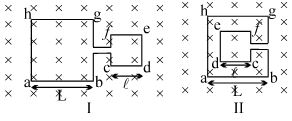
The adjoining figure shows two different arrangements in which two square wire frames are placed in a uniform constantly decreasing magnetic field $B$. The value of magnetic flux in each case is given by:
A
Case $I: \Phi = (L^2 + l^2)B; \text{ Case } II: \Phi = (L^2 - l^2)B$
B
Case $I: \Phi = (L^2 + l^2)B; \text{ Case } II: \Phi = (L^2 + l^2)B$
C
Case $I: \Phi = (L^2 - l^2)B; \text{ Case } II: \Phi = (L^2 + l^2)B$
D
Case $I: \Phi = (L+l)^2B; \text{ Case } II: \Phi = (L-l)^2B$
Solution
(A) Magnetic flux $\Phi$ through a surface area $A$ in a uniform magnetic field $B$ is given by $\Phi = B \cdot A \cdot \cos(\theta)$. Since the magnetic field is perpendicular to the plane of the loops,$\theta = 0^\circ$ and $\cos(0^\circ) = 1$,so $\Phi = B \cdot A$.
In Case $I$,the total area enclosed by the wire frame is the sum of the areas of the two squares: $A_I = L^2 + l^2$. Thus,$\Phi_I = (L^2 + l^2)B$.
In Case $II$,the smaller square is inside the larger square. The effective area enclosed by the wire frame is the area of the larger square minus the area of the smaller square: $A_{II} = L^2 - l^2$. Thus,$\Phi_{II} = (L^2 - l^2)B$.
Therefore,the correct option is $A$.
In Case $I$,the total area enclosed by the wire frame is the sum of the areas of the two squares: $A_I = L^2 + l^2$. Thus,$\Phi_I = (L^2 + l^2)B$.
In Case $II$,the smaller square is inside the larger square. The effective area enclosed by the wire frame is the area of the larger square minus the area of the smaller square: $A_{II} = L^2 - l^2$. Thus,$\Phi_{II} = (L^2 - l^2)B$.
Therefore,the correct option is $A$.
0 likes
View Solution13
MediumMCQ
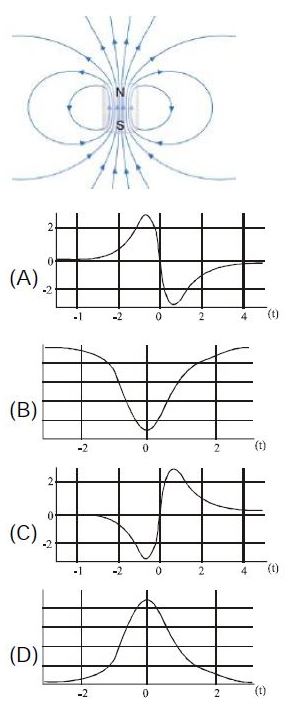
The diagram shows the magnetic field lines of a bar magnet. $A$ coil is moved from above the magnet to below it and then back to the original position. Which of the following graphs best represents the variation of magnetic flux $\Phi$ through the coil with time $t$?
A
$A$
B
$B$
C
$C$
D
$D$
Solution
(A) As the coil moves from above the magnet towards the center,the magnetic flux increases,reaches a maximum at the center,and then decreases as it moves away to the bottom. When moving back from bottom to top,the flux changes in the opposite direction (or follows a symmetric path depending on the orientation). The magnetic flux $\Phi$ is defined as $\int \vec{B} \cdot d\vec{A}$. As the coil passes through the magnet,the field lines first point in one direction and then in the opposite direction relative to the coil's area vector. Graph $A$ shows the flux increasing to a positive maximum,passing through zero (at the center of the magnet where field lines are parallel to the coil plane),and then reaching a negative minimum as it moves to the other side. This represents the change in flux correctly for a coil moving through the magnetic field of a bar magnet.
0 likes
View Solution14
DifficultMCQ
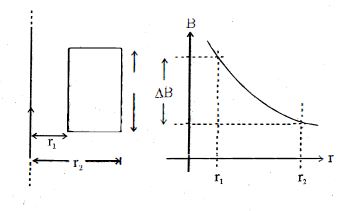
$A$ long straight wire carrying a constant current $i$ is placed in the same plane as a rectangular loop of length $l$. The distance of the sides of the loop from the wire are $r_1$ and $r_2$. If the area under the curve of the magnetic field $B$ versus distance $r$ graph between $r_1$ and $r_2$ is $A$,find the magnetic flux through the loop.
A
$Al$
B
$\frac{Al}{2}$
C
$\sqrt{3} Al$
D
Information is not sufficient to answer the question.
Solution
(A) The magnetic field $B$ at a distance $r$ from a long straight wire carrying current $i$ is given by $B = \frac{\mu_0 i}{2 \pi r}$.
The area $A$ under the $B-r$ curve between $r_1$ and $r_2$ is defined as $A = \int_{r_1}^{r_2} B \, dr = \int_{r_1}^{r_2} \frac{\mu_0 i}{2 \pi r} \, dr = \frac{\mu_0 i}{2 \pi} \ln\left(\frac{r_2}{r_1}\right)$.
The magnetic flux $\phi$ through the rectangular loop of length $l$ is given by $\phi = \int B \, dA_{loop}$.
Considering a strip of width $dr$ at a distance $r$ from the wire,the area of the strip is $dA_{loop} = l \, dr$.
Thus,the flux is $\phi = \int_{r_1}^{r_2} B \, l \, dr = l \int_{r_1}^{r_2} B \, dr$.
Since $A = \int_{r_1}^{r_2} B \, dr$,we substitute this into the flux equation:
$\phi = l \cdot A = Al$.
The area $A$ under the $B-r$ curve between $r_1$ and $r_2$ is defined as $A = \int_{r_1}^{r_2} B \, dr = \int_{r_1}^{r_2} \frac{\mu_0 i}{2 \pi r} \, dr = \frac{\mu_0 i}{2 \pi} \ln\left(\frac{r_2}{r_1}\right)$.
The magnetic flux $\phi$ through the rectangular loop of length $l$ is given by $\phi = \int B \, dA_{loop}$.
Considering a strip of width $dr$ at a distance $r$ from the wire,the area of the strip is $dA_{loop} = l \, dr$.
Thus,the flux is $\phi = \int_{r_1}^{r_2} B \, l \, dr = l \int_{r_1}^{r_2} B \, dr$.
Since $A = \int_{r_1}^{r_2} B \, dr$,we substitute this into the flux equation:
$\phi = l \cdot A = Al$.
0 likes
View Solution15
MediumMCQ
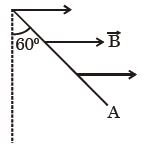
Find the magnetic flux density in $Wb/m^2$,if a magnetic flux of $2 \times 10^{-3} \ Wb$ passes through a slant area $A = 10 \ cm^2$ as shown in the figure.
A
$2$
B
$4$
C
$2 \times 10^{-4}$
D
$40$
Solution
(B) The magnetic flux $\phi$ is given by the formula $\phi = \vec{B} \cdot \vec{A} = BA \cos \theta$,where $\theta$ is the angle between the magnetic field vector $\vec{B}$ and the area vector $\vec{A}$ (which is normal to the surface).
From the figure,the angle between the surface and the vertical is $60^\circ$. The area vector $\vec{A}$ is perpendicular to the surface,so the angle between the horizontal magnetic field $\vec{B}$ and the area vector $\vec{A}$ is $\theta = 60^\circ$.
Given: $\phi = 2 \times 10^{-3} \ Wb$,$A = 10 \ cm^2 = 10 \times 10^{-4} \ m^2 = 10^{-3} \ m^2$,and $\theta = 60^\circ$.
Using $\phi = BA \cos \theta$,we have $B = \frac{\phi}{A \cos \theta}$.
Substituting the values: $B = \frac{2 \times 10^{-3}}{(10^{-3}) \cos 60^\circ} = \frac{2 \times 10^{-3}}{(10^{-3}) \times (1/2)} = \frac{2}{1/2} = 4 \ Wb/m^2$.
From the figure,the angle between the surface and the vertical is $60^\circ$. The area vector $\vec{A}$ is perpendicular to the surface,so the angle between the horizontal magnetic field $\vec{B}$ and the area vector $\vec{A}$ is $\theta = 60^\circ$.
Given: $\phi = 2 \times 10^{-3} \ Wb$,$A = 10 \ cm^2 = 10 \times 10^{-4} \ m^2 = 10^{-3} \ m^2$,and $\theta = 60^\circ$.
Using $\phi = BA \cos \theta$,we have $B = \frac{\phi}{A \cos \theta}$.
Substituting the values: $B = \frac{2 \times 10^{-3}}{(10^{-3}) \cos 60^\circ} = \frac{2 \times 10^{-3}}{(10^{-3}) \times (1/2)} = \frac{2}{1/2} = 4 \ Wb/m^2$.
0 likes
View Solution16
MediumMCQ
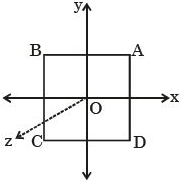
$A$ loop,made of straight edges,has four corners at $A(L, L, 0)$,$B(-L, L, 0)$,$C(-L, -L, 0)$,and $D(L, -L, 0)$. $A$ magnetic field $\vec B = B_0(\hat i + \hat k) \text{ T}$ is present in the region. The magnetic flux passing through the loop $ABCD$ is:
A
$B_0L^2 \text{ Wb}$
B
$\sqrt 2 B_0L^2 \text{ Wb}$
C
$2\sqrt 2 B_0L^2 \text{ Wb}$
D
$4 B_0L^2 \text{ Wb}$
Solution
(D) The loop lies in the $xy$-plane with corners at $(L, L, 0)$,$(-L, L, 0)$,$(-L, -L, 0)$,and $(L, -L, 0)$.
The side length of the square loop is $2L$.
Therefore,the area of the loop is $A = (2L) \times (2L) = 4L^2$.
The area vector $\vec A$ is perpendicular to the $xy$-plane,so $\vec A = 4L^2 \hat k$.
The magnetic field is given by $\vec B = B_0(\hat i + \hat k)$.
The magnetic flux $\phi$ is given by the dot product of the magnetic field and the area vector:
$\phi = \vec B \cdot \vec A$
$\phi = B_0(\hat i + \hat k) \cdot (4L^2 \hat k)$
$\phi = 4B_0L^2 (\hat i \cdot \hat k + \hat k \cdot \hat k)$
Since $\hat i \cdot \hat k = 0$ and $\hat k \cdot \hat k = 1$,we get:
$\phi = 4B_0L^2 (0 + 1) = 4B_0L^2 \text{ Wb}$.
The side length of the square loop is $2L$.
Therefore,the area of the loop is $A = (2L) \times (2L) = 4L^2$.
The area vector $\vec A$ is perpendicular to the $xy$-plane,so $\vec A = 4L^2 \hat k$.
The magnetic field is given by $\vec B = B_0(\hat i + \hat k)$.
The magnetic flux $\phi$ is given by the dot product of the magnetic field and the area vector:
$\phi = \vec B \cdot \vec A$
$\phi = B_0(\hat i + \hat k) \cdot (4L^2 \hat k)$
$\phi = 4B_0L^2 (\hat i \cdot \hat k + \hat k \cdot \hat k)$
Since $\hat i \cdot \hat k = 0$ and $\hat k \cdot \hat k = 1$,we get:
$\phi = 4B_0L^2 (0 + 1) = 4B_0L^2 \text{ Wb}$.
0 likes
View Solution17
EasyMCQ
The magnetic flux linked with a coil of $N$ turns of area of cross section $A$ held with its plane parallel to the field $B$ is
A
$\frac{NAB}{2}$
B
$NAB$
C
$\frac{NAB}{4}$
D
zero
Solution
(D) The magnetic flux $\phi$ linked with a coil is given by the formula $\phi = NBA \cos \theta$,where $\theta$ is the angle between the magnetic field vector $\vec{B}$ and the area vector $\vec{A}$ (which is normal to the plane of the coil).
Given that the plane of the coil is parallel to the magnetic field $B$,the angle between the normal to the coil and the magnetic field is $\theta = 90^{\circ}$.
Substituting this into the formula: $\phi = NBA \cos(90^{\circ})$.
Since $\cos(90^{\circ}) = 0$,the magnetic flux $\phi = 0$.
Given that the plane of the coil is parallel to the magnetic field $B$,the angle between the normal to the coil and the magnetic field is $\theta = 90^{\circ}$.
Substituting this into the formula: $\phi = NBA \cos(90^{\circ})$.
Since $\cos(90^{\circ}) = 0$,the magnetic flux $\phi = 0$.
0 likes
View Solution18
MediumMCQ
$A$ square of side $x \, m$ lies in the $x-y$ plane in a region where the magnetic field is given by $\vec B = B_0 (3\hat i + 4\hat j + 5\hat k ) \, T$,where $B_0$ is a constant. The magnitude of the magnetic flux passing through the square is:
A
$5B_0x^2 \, Wb$
B
$3B_0x^2 \, Wb$
C
$2B_0x^2 \, Wb$
D
$B_0x^2 \, Wb$
Solution
(A) The area vector $\vec A$ of a square of side $x$ lying in the $x-y$ plane is given by $\vec A = x^2 \hat k \, m^2$.
The magnetic field is given as $\vec B = B_0 (3\hat i + 4\hat j + 5\hat k) \, T$.
The magnetic flux $\phi$ is defined as the dot product of the magnetic field vector and the area vector: $\phi = \vec B \cdot \vec A$.
Substituting the values: $\phi = [B_0 (3\hat i + 4\hat j + 5\hat k)] \cdot [x^2 \hat k]$.
Using the dot product properties $(\hat i \cdot \hat k = 0, \hat j \cdot \hat k = 0, \hat k \cdot \hat k = 1)$:
$\phi = B_0 x^2 (3 \cdot 0 + 4 \cdot 0 + 5 \cdot 1) = 5 B_0 x^2 \, Wb$.
The magnetic field is given as $\vec B = B_0 (3\hat i + 4\hat j + 5\hat k) \, T$.
The magnetic flux $\phi$ is defined as the dot product of the magnetic field vector and the area vector: $\phi = \vec B \cdot \vec A$.
Substituting the values: $\phi = [B_0 (3\hat i + 4\hat j + 5\hat k)] \cdot [x^2 \hat k]$.
Using the dot product properties $(\hat i \cdot \hat k = 0, \hat j \cdot \hat k = 0, \hat k \cdot \hat k = 1)$:
$\phi = B_0 x^2 (3 \cdot 0 + 4 \cdot 0 + 5 \cdot 1) = 5 B_0 x^2 \, Wb$.
0 likes
View Solution19
EasyMCQ
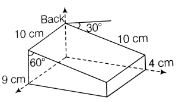
Consider the following figure. $A$ uniform magnetic field of $0.2 \, T$ is directed along the positive $x-$axis. What is the magnetic flux through the top surface of the figure in $m-Wb$?
A
$0$
B
$0.8$
C
$1$
D
$-1.8$
Solution
(C) The magnetic flux $\phi$ is given by $\phi = \vec{B} \cdot \vec{A} = B A \cos \theta$,where $\theta$ is the angle between the magnetic field vector $\vec{B}$ and the area vector $\vec{A}$ (normal to the surface).
Given: Magnetic field $B = 0.2 \, T$ along the positive $x-$axis.
The top surface is a rectangle with dimensions $10 \, cm \times 10 \, cm = 0.1 \, m \times 0.1 \, m = 0.01 \, m^2$.
The normal to the top surface makes an angle of $60^{\circ}$ with the vertical,which means it makes an angle of $90^{\circ} - 60^{\circ} = 30^{\circ}$ with the $x-$axis (or based on the geometry,the angle $\theta$ between the normal and the $x-$axis is $60^{\circ}$ as given in the diagram).
Using $\theta = 60^{\circ}$:
$\phi = B A \cos 60^{\circ} = 0.2 \times 0.01 \times \cos 60^{\circ} = 0.2 \times 0.01 \times 0.5 = 0.001 \, Wb$.
Converting to $m-Wb$: $0.001 \, Wb = 1 \, m-Wb$.
Given: Magnetic field $B = 0.2 \, T$ along the positive $x-$axis.
The top surface is a rectangle with dimensions $10 \, cm \times 10 \, cm = 0.1 \, m \times 0.1 \, m = 0.01 \, m^2$.
The normal to the top surface makes an angle of $60^{\circ}$ with the vertical,which means it makes an angle of $90^{\circ} - 60^{\circ} = 30^{\circ}$ with the $x-$axis (or based on the geometry,the angle $\theta$ between the normal and the $x-$axis is $60^{\circ}$ as given in the diagram).
Using $\theta = 60^{\circ}$:
$\phi = B A \cos 60^{\circ} = 0.2 \times 0.01 \times \cos 60^{\circ} = 0.2 \times 0.01 \times 0.5 = 0.001 \, Wb$.
Converting to $m-Wb$: $0.001 \, Wb = 1 \, m-Wb$.
0 likes
View Solution20
MediumMCQ
Imagine rolling a sheet of paper into a cylinder and placing a bar magnet near its end as shown in the figure. What can you say about the sign of $\vec B \cdot d\vec A$ for every area element $d\vec A$ on the surface of the cylinder?

A
Positive
B
Negative
C
No sign
D
Can be positive or negative
Solution
(B) The magnetic field lines originate from the North pole and terminate at the South pole of a bar magnet.
In the given figure,the South pole of the bar magnet is facing the open end of the cylinder.
Therefore,the magnetic field lines are directed towards the South pole,meaning they enter the cylinder through the open end.
By convention,the area vector $d\vec A$ for a closed surface is taken to be pointing outwards.
Since the magnetic field $\vec B$ is entering the surface and the area vector $d\vec A$ is pointing outwards,the angle between them is obtuse (greater than $90^{\circ}$).
Consequently,the dot product $\vec B \cdot d\vec A = B \, dA \cos \theta$ will be negative because $\cos \theta < 0$ for $\theta > 90^{\circ}$.
In the given figure,the South pole of the bar magnet is facing the open end of the cylinder.
Therefore,the magnetic field lines are directed towards the South pole,meaning they enter the cylinder through the open end.
By convention,the area vector $d\vec A$ for a closed surface is taken to be pointing outwards.
Since the magnetic field $\vec B$ is entering the surface and the area vector $d\vec A$ is pointing outwards,the angle between them is obtuse (greater than $90^{\circ}$).
Consequently,the dot product $\vec B \cdot d\vec A = B \, dA \cos \theta$ will be negative because $\cos \theta < 0$ for $\theta > 90^{\circ}$.
0 likes
View Solution21
EasyMCQ
Which of the following conclusions can be drawn from the result $\oint \vec{B} \cdot d\vec{A} = 0$?
A
Magnetic field is zero everywhere
B
Magnetic monopole cannot exist
C
Magnetic lines of force do not intersect each other
D
$A$ current produces magnetic field
Solution
(B) The equation $\oint \vec{B} \cdot d\vec{A} = 0$ represents Gauss's Law for magnetism.
It states that the net magnetic flux through any closed surface is always zero.
This implies that there are no isolated magnetic charges (magnetic monopoles) in nature.
Magnetic field lines always form closed loops,meaning every north pole must be accompanied by a south pole.
It states that the net magnetic flux through any closed surface is always zero.
This implies that there are no isolated magnetic charges (magnetic monopoles) in nature.
Magnetic field lines always form closed loops,meaning every north pole must be accompanied by a south pole.
0 likes
View Solution22
MediumMCQ
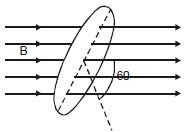
The figure represents an area $A = 0.5\,m^2$ situated in a uniform magnetic field $B = 2.0\,Wb/m^2$. The area makes an angle of $60^o$ with the magnetic field. The value of the magnetic flux through the area is equal to......$Wb$.
A
$2$
B
$\sqrt{3}$
C
$\sqrt{3}/2$
D
$0.5$
Solution
(C) The magnetic flux $\phi$ is given by the formula $\phi = B A \cos \theta$,where $\theta$ is the angle between the magnetic field vector $\vec{B}$ and the area vector $\vec{n}$ (normal to the surface).
Given that the area makes an angle of $60^o$ with the magnetic field,the angle $\theta$ between the normal to the area and the magnetic field is $\theta = 90^o - 60^o = 30^o$.
Substituting the values: $\phi = 2.0 \times 0.5 \times \cos(30^o)$.
$\phi = 1.0 \times \frac{\sqrt{3}}{2} = \frac{\sqrt{3}}{2} \, Wb$.
Given that the area makes an angle of $60^o$ with the magnetic field,the angle $\theta$ between the normal to the area and the magnetic field is $\theta = 90^o - 60^o = 30^o$.
Substituting the values: $\phi = 2.0 \times 0.5 \times \cos(30^o)$.
$\phi = 1.0 \times \frac{\sqrt{3}}{2} = \frac{\sqrt{3}}{2} \, Wb$.
0 likes
View Solution23
EasyMCQ
Consider a circular coil of wire carrying constant current $I$,forming a magnetic dipole. The magnetic flux through an infinite plane that contains the circular coil and excluding the circular coil area is given by $\phi_{i}$. The magnetic flux through the area of the circular coil area is given by $\phi_{0}$. Which of the following options is correct?
A
$\phi_{i} = -\phi_{0}$
B
$\phi_{i} = \phi_{0}$
C
$\phi_{i} < \phi_{0}$
D
$\phi_{i} > \phi_{0}$
Solution
(A) For a current-carrying circular coil,the magnetic field lines originate from the coil and form closed loops.
By Gauss's law for magnetism,the net magnetic flux through any closed surface is zero,i.e.,$\oint \vec{B} \cdot d\vec{A} = 0$.
Consider the infinite plane containing the coil. The magnetic flux passing through the area of the coil $(\phi_{0})$ is in one direction (e.g.,upward).
The magnetic flux passing through the rest of the infinite plane $(\phi_{i})$ must be in the opposite direction (downward) to ensure that the total flux through the entire infinite plane is zero.
Thus,$\phi_{0} + \phi_{i} = 0$,which implies $\phi_{i} = -\phi_{0}$.
By Gauss's law for magnetism,the net magnetic flux through any closed surface is zero,i.e.,$\oint \vec{B} \cdot d\vec{A} = 0$.
Consider the infinite plane containing the coil. The magnetic flux passing through the area of the coil $(\phi_{0})$ is in one direction (e.g.,upward).
The magnetic flux passing through the rest of the infinite plane $(\phi_{i})$ must be in the opposite direction (downward) to ensure that the total flux through the entire infinite plane is zero.
Thus,$\phi_{0} + \phi_{i} = 0$,which implies $\phi_{i} = -\phi_{0}$.
0 likes
View Solution24
MediumMCQ
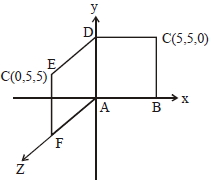
$A$ loop $ABCDEFA$ of straight edges has six corner points $A(0,0,0), B(5,0,0), C(5,5,0), D(0,5,0), E(0,5,5)$ and $F(0,0,5)$. The magnetic field in this region is $\overrightarrow{B}=(3 \hat{i}+4 \hat{k}) \; T$. The quantity of magnetic flux through the loop $ABCDEFA$ (in $\text{Wb}$) is:
A
$169$
B
$200$
C
$196$
D
$175$
Solution
(D) The loop $ABCDEFA$ consists of two planar surfaces: the rectangle $ABCD$ in the $xy$-plane and the rectangle $ADEF$ in the $yz$-plane.
The area vector for the rectangle $ABCD$ (in the $xy$-plane) is $\overrightarrow{A}_{ABCD} = (5 \times 5) \hat{k} = 25 \hat{k} \; \text{m}^2$.
The area vector for the rectangle $ADEF$ (in the $yz$-plane) is $\overrightarrow{A}_{ADEF} = (5 \times 5) \hat{i} = 25 \hat{i} \; \text{m}^2$.
The net area vector is $\overrightarrow{A}_{net} = \overrightarrow{A}_{ABCD} + \overrightarrow{A}_{ADEF} = 25 \hat{i} + 25 \hat{k} \; \text{m}^2$.
The magnetic field is given as $\overrightarrow{B} = 3 \hat{i} + 4 \hat{k} \; \text{T}$.
The magnetic flux $\phi$ is calculated using the dot product: $\phi = \overrightarrow{B} \cdot \overrightarrow{A}_{net}$.
$\phi = (3 \hat{i} + 4 \hat{k}) \cdot (25 \hat{i} + 25 \hat{k})$
$\phi = (3 \times 25) + (4 \times 25) = 75 + 100 = 175 \; \text{Wb}$.
Thus,the magnetic flux through the loop is $175 \; \text{Wb}$.
The area vector for the rectangle $ABCD$ (in the $xy$-plane) is $\overrightarrow{A}_{ABCD} = (5 \times 5) \hat{k} = 25 \hat{k} \; \text{m}^2$.
The area vector for the rectangle $ADEF$ (in the $yz$-plane) is $\overrightarrow{A}_{ADEF} = (5 \times 5) \hat{i} = 25 \hat{i} \; \text{m}^2$.
The net area vector is $\overrightarrow{A}_{net} = \overrightarrow{A}_{ABCD} + \overrightarrow{A}_{ADEF} = 25 \hat{i} + 25 \hat{k} \; \text{m}^2$.
The magnetic field is given as $\overrightarrow{B} = 3 \hat{i} + 4 \hat{k} \; \text{T}$.
The magnetic flux $\phi$ is calculated using the dot product: $\phi = \overrightarrow{B} \cdot \overrightarrow{A}_{net}$.
$\phi = (3 \hat{i} + 4 \hat{k}) \cdot (25 \hat{i} + 25 \hat{k})$
$\phi = (3 \times 25) + (4 \times 25) = 75 + 100 = 175 \; \text{Wb}$.
Thus,the magnetic flux through the loop is $175 \; \text{Wb}$.
0 likes
View Solution25
Medium
$(a)$ Magnetic field lines show the direction (at every point) along which a small magnetised needle aligns (at the point). Do the magnetic field lines also represent the lines of force on a moving charged particle at every point?
$(b)$ Magnetic field lines can be entirely confined within the core of a toroid,but not within a straight solenoid. Why?
$(c)$ If magnetic monopoles existed,how would the Gauss's law of magnetism be modified?
$(d)$ Does a bar magnet exert a torque on itself due to its own field? Does one element of a current-carrying wire exert a force on another element of the same wire?
$(e)$ Magnetic field arises due to charges in motion. Can a system have magnetic moments even though its net charge is zero?
$(b)$ Magnetic field lines can be entirely confined within the core of a toroid,but not within a straight solenoid. Why?
$(c)$ If magnetic monopoles existed,how would the Gauss's law of magnetism be modified?
$(d)$ Does a bar magnet exert a torque on itself due to its own field? Does one element of a current-carrying wire exert a force on another element of the same wire?
$(e)$ Magnetic field arises due to charges in motion. Can a system have magnetic moments even though its net charge is zero?
Solution
(N/A) No. The magnetic force is always normal to $B$ (remember magnetic force $= q(v \times B)$). It is misleading to call magnetic field lines as lines of force.
$(b)$ If field lines were entirely confined between two ends of a straight solenoid,the flux through the cross-section at each end would be non-zero. But the flux of field $B$ through any closed surface must always be zero. For a toroid,this difficulty is absent because it has no 'ends'.
$(c)$ Gauss's law of magnetism states that the flux of $B$ through any closed surface is always zero,$\int_{S} B \cdot dS = 0$. If monopoles existed,the right-hand side would be equal to the monopole (magnetic charge) $q_m$ enclosed by $S$. Analogous to Gauss's law of electrostatics,$\int_{S} B \cdot dS = \mu_0 q_m$,where $q_m$ is the magnetic charge enclosed by $S$.
$(d)$ No. There is no force or torque on an element due to the field produced by that element itself. However,there is a force (or torque) on one element of a wire due to another element of the same wire (though for a straight wire,this net force is zero).
$(e)$ Yes. The net charge in a system may be zero,yet the magnetic moments due to various current loops within the system may not cancel out. We encounter such examples in paramagnetic materials where atoms have a net dipole moment even though their net charge is zero.
$(b)$ If field lines were entirely confined between two ends of a straight solenoid,the flux through the cross-section at each end would be non-zero. But the flux of field $B$ through any closed surface must always be zero. For a toroid,this difficulty is absent because it has no 'ends'.
$(c)$ Gauss's law of magnetism states that the flux of $B$ through any closed surface is always zero,$\int_{S} B \cdot dS = 0$. If monopoles existed,the right-hand side would be equal to the monopole (magnetic charge) $q_m$ enclosed by $S$. Analogous to Gauss's law of electrostatics,$\int_{S} B \cdot dS = \mu_0 q_m$,where $q_m$ is the magnetic charge enclosed by $S$.
$(d)$ No. There is no force or torque on an element due to the field produced by that element itself. However,there is a force (or torque) on one element of a wire due to another element of the same wire (though for a straight wire,this net force is zero).
$(e)$ Yes. The net charge in a system may be zero,yet the magnetic moments due to various current loops within the system may not cancel out. We encounter such examples in paramagnetic materials where atoms have a net dipole moment even though their net charge is zero.
0 likes
View Solution26
Medium
Explain the concept of magnetic flux.
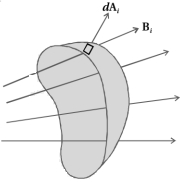
Solution
(N/A) Magnetic flux through a plane of area $A$ placed in a uniform magnetic field $B$ as shown in the figure can be written as $\Phi_{B} = \vec{B} \cdot \vec{A} = BA \cos \theta$.
Where $\theta$ is the angle between the magnetic field vector $\vec{B}$ and the area vector $\vec{A}$. The equation can be extended to curved surfaces and non-uniform fields.
If the magnetic field has different magnitudes and directions at various parts of a surface,then the magnetic flux through the surface is given by the summation of flux through small area elements $d\vec{A}_i$:
$\Phi_{B} = \sum_{i} \vec{B}_{i} \cdot d \vec{A}_{i}$
In the limit where the area elements become infinitesimally small,this summation becomes an integral:
$\Phi_{B} = \int_{S} \vec{B} \cdot d\vec{A}$
Magnetic flux is a scalar quantity. Its $SI$ unit is weber $(Wb)$,which is equivalent to tesla meter squared $(T \cdot m^2)$ or volt-second $(V \cdot s)$. Its dimensional formula is $[M^1 L^2 T^{-2} A^{-1}]$.
Definition of $1 \ Wb$: If a magnetic field of $1 \ T$ is applied perpendicularly to a surface of area $1 \ m^2$,then the magnetic flux linked with the surface is $1 \ Wb$. Thus,$1 \ Wb = 1 \ T \cdot m^2$.
Where $\theta$ is the angle between the magnetic field vector $\vec{B}$ and the area vector $\vec{A}$. The equation can be extended to curved surfaces and non-uniform fields.
If the magnetic field has different magnitudes and directions at various parts of a surface,then the magnetic flux through the surface is given by the summation of flux through small area elements $d\vec{A}_i$:
$\Phi_{B} = \sum_{i} \vec{B}_{i} \cdot d \vec{A}_{i}$
In the limit where the area elements become infinitesimally small,this summation becomes an integral:
$\Phi_{B} = \int_{S} \vec{B} \cdot d\vec{A}$
Magnetic flux is a scalar quantity. Its $SI$ unit is weber $(Wb)$,which is equivalent to tesla meter squared $(T \cdot m^2)$ or volt-second $(V \cdot s)$. Its dimensional formula is $[M^1 L^2 T^{-2} A^{-1}]$.
Definition of $1 \ Wb$: If a magnetic field of $1 \ T$ is applied perpendicularly to a surface of area $1 \ m^2$,then the magnetic flux linked with the surface is $1 \ Wb$. Thus,$1 \ Wb = 1 \ T \cdot m^2$.
0 likes
View Solution27
Medium
Write the dimensional formula for magnetic flux.
Solution
(N/A) Magnetic flux $\Phi_B$ is defined as the product of magnetic field $B$ and the area $A$ perpendicular to it,given by $\Phi_B = B \cdot A$.
From the Lorentz force law,$F = qvB$,we can express the magnetic field as $B = \frac{F}{qv}$.
The dimensional formula for force $F$ is $[M^1 L^1 T^{-2}]$.
The dimensional formula for charge $q$ is $[I^1 T^1]$.
The dimensional formula for velocity $v$ is $[L^1 T^{-1}]$.
Thus,the dimensions of $B$ are $[B] = \frac{[M^1 L^1 T^{-2}]}{[I^1 T^1][L^1 T^{-1}]} = [M^1 T^{-2} I^{-1}]$.
Since magnetic flux $\Phi_B = B \cdot A$,and the area $A$ has dimensions $[L^2]$,we have:
$[\Phi_B] = [M^1 T^{-2} I^{-1}] \cdot [L^2] = [M^1 L^2 T^{-2} I^{-1}]$.
Therefore,the dimensional formula for magnetic flux is $[M^1 L^2 T^{-2} I^{-1}]$.
From the Lorentz force law,$F = qvB$,we can express the magnetic field as $B = \frac{F}{qv}$.
The dimensional formula for force $F$ is $[M^1 L^1 T^{-2}]$.
The dimensional formula for charge $q$ is $[I^1 T^1]$.
The dimensional formula for velocity $v$ is $[L^1 T^{-1}]$.
Thus,the dimensions of $B$ are $[B] = \frac{[M^1 L^1 T^{-2}]}{[I^1 T^1][L^1 T^{-1}]} = [M^1 T^{-2} I^{-1}]$.
Since magnetic flux $\Phi_B = B \cdot A$,and the area $A$ has dimensions $[L^2]$,we have:
$[\Phi_B] = [M^1 T^{-2} I^{-1}] \cdot [L^2] = [M^1 L^2 T^{-2} I^{-1}]$.
Therefore,the dimensional formula for magnetic flux is $[M^1 L^2 T^{-2} I^{-1}]$.
0 likes
View Solution28
MediumMCQ
When the surface of a sheet is parallel to the magnetic field,what is the magnetic flux linked with it?
A
Maximum
B
Minimum
C
Zero
D
Infinite
Solution
(C) The magnetic flux $\Phi$ linked with a surface is given by the formula $\Phi = B A \cos(\theta)$,where $B$ is the magnetic field,$A$ is the area of the surface,and $\theta$ is the angle between the magnetic field vector and the area vector (normal to the surface).
When the surface of the sheet is parallel to the magnetic field,the normal to the surface makes an angle of $90^{\circ}$ with the magnetic field lines.
Therefore,$\theta = 90^{\circ}$.
Substituting this into the formula: $\Phi = B A \cos(90^{\circ})$.
Since $\cos(90^{\circ}) = 0$,the magnetic flux $\Phi = 0$.
When the surface of the sheet is parallel to the magnetic field,the normal to the surface makes an angle of $90^{\circ}$ with the magnetic field lines.
Therefore,$\theta = 90^{\circ}$.
Substituting this into the formula: $\Phi = B A \cos(90^{\circ})$.
Since $\cos(90^{\circ}) = 0$,the magnetic flux $\Phi = 0$.
0 likes
View Solution29
EasyMCQ
When does the magnetic flux become zero?
A
When the magnetic field is parallel to the area vector.
B
When the magnetic field is perpendicular to the area vector.
C
When the magnetic field is at an angle of $45^{\circ}$ to the area vector.
D
When the magnetic field is at an angle of $60^{\circ}$ to the area vector.
Solution
(B) The magnetic flux $\Phi_B$ through a surface is given by the formula $\Phi_B = \vec{B} \cdot \vec{A} = BA \cos \theta$,where $\vec{B}$ is the magnetic field vector,$\vec{A}$ is the area vector,and $\theta$ is the angle between them.
For the magnetic flux to be zero,we must have $\cos \theta = 0$.
This occurs when $\theta = 90^{\circ}$.
An angle of $90^{\circ}$ between the magnetic field vector and the area vector means the magnetic field is perpendicular to the area vector (or parallel to the plane of the surface).
Therefore,the correct option is $B$.
For the magnetic flux to be zero,we must have $\cos \theta = 0$.
This occurs when $\theta = 90^{\circ}$.
An angle of $90^{\circ}$ between the magnetic field vector and the area vector means the magnetic field is perpendicular to the area vector (or parallel to the plane of the surface).
Therefore,the correct option is $B$.
0 likes
View Solution30
MediumMCQ
$VS$ is the unit of which physical quantity?
A
Magnetic flux
B
Magnetic field
C
Electric potential
D
Electric field
Solution
(A) The unit $VS$ stands for Volt-second $(V \cdot s)$.
According to Faraday's law of electromagnetic induction,the induced electromotive force $(e)$ is given by $e = -\frac{d\Phi_B}{dt}$,where $\Phi_B$ is the magnetic flux.
Rearranging this,we get $d\Phi_B = e \cdot dt$.
The unit of magnetic flux $(\Phi_B)$ is the Weber $(Wb)$.
Since the unit of electromotive force $(e)$ is the Volt $(V)$ and the unit of time $(t)$ is the second $(s)$,we have $1 \ Wb = 1 \ V \cdot s$.
Therefore,$VS$ is the unit of magnetic flux.
According to Faraday's law of electromagnetic induction,the induced electromotive force $(e)$ is given by $e = -\frac{d\Phi_B}{dt}$,where $\Phi_B$ is the magnetic flux.
Rearranging this,we get $d\Phi_B = e \cdot dt$.
The unit of magnetic flux $(\Phi_B)$ is the Weber $(Wb)$.
Since the unit of electromotive force $(e)$ is the Volt $(V)$ and the unit of time $(t)$ is the second $(s)$,we have $1 \ Wb = 1 \ V \cdot s$.
Therefore,$VS$ is the unit of magnetic flux.
0 likes
View Solution31
Medium
Explain Gauss's law for magnetism.
Solution
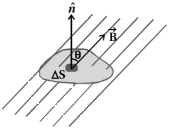
(N/A) Consider a closed surface $S$ placed in a magnetic field $\vec{B}$. We need to determine the magnetic flux associated with this surface.
Imagine the surface $S$ is divided into small area elements. For one such element $\Delta \vec{S}$, the magnetic field is $\vec{B}$. The magnetic flux $\Delta \phi_{B}$ through this element is defined as:
$\Delta \phi_{B} = \vec{B} \cdot \Delta \vec{S}$
The total magnetic flux $\phi_{B}$ through the closed surface is the sum of the fluxes through all such elements:
$\phi_{B} = \sum_{\text{all}} \Delta \phi_{B} = \sum_{\text{all}} \vec{B} \cdot \Delta \vec{S} = 0 \quad \dots (1)$
Since the number of magnetic field lines leaving the closed surface is equal to the number of lines entering it, the net magnetic flux through any closed surface is always zero.
Gauss's law for magnetism states:
"The net magnetic flux through any closed surface is zero."
In the limit where $\Delta S \rightarrow 0$, the summation becomes an integral:
$\phi_{B} = \oint_{S} \vec{B} \cdot d\vec{S} = 0$
This integral form is the mathematical representation of Gauss's law for magnetism.
Imagine the surface $S$ is divided into small area elements. For one such element $\Delta \vec{S}$, the magnetic field is $\vec{B}$. The magnetic flux $\Delta \phi_{B}$ through this element is defined as:
$\Delta \phi_{B} = \vec{B} \cdot \Delta \vec{S}$
The total magnetic flux $\phi_{B}$ through the closed surface is the sum of the fluxes through all such elements:
$\phi_{B} = \sum_{\text{all}} \Delta \phi_{B} = \sum_{\text{all}} \vec{B} \cdot \Delta \vec{S} = 0 \quad \dots (1)$
Since the number of magnetic field lines leaving the closed surface is equal to the number of lines entering it, the net magnetic flux through any closed surface is always zero.
Gauss's law for magnetism states:
"The net magnetic flux through any closed surface is zero."
In the limit where $\Delta S \rightarrow 0$, the summation becomes an integral:
$\phi_{B} = \oint_{S} \vec{B} \cdot d\vec{S} = 0$
This integral form is the mathematical representation of Gauss's law for magnetism.
0 likes
View Solution32
Medium
Write Gauss's law in equation form for electrostatics and magnetism. What is the difference between them?
Solution
(N/A) Gauss's law for electrostatics is given by:
$\oint \vec{E} \cdot d\vec{S} = \frac{q_{enclosed}}{\varepsilon_{0}}$
Where $\vec{E}$ is the electric field and $q_{enclosed}$ is the net charge enclosed by the Gaussian surface.
Gauss's law for magnetism is given by:
$\oint \vec{B} \cdot d\vec{S} = 0$
Where $\vec{B}$ is the magnetic field.
The fundamental difference is that for electrostatics,the net electric flux through a closed surface is proportional to the enclosed charge,implying the existence of electric monopoles (charges). For magnetism,the net magnetic flux through any closed surface is always zero,which implies that isolated magnetic monopoles do not exist; magnetic field lines always form continuous closed loops.
$\oint \vec{E} \cdot d\vec{S} = \frac{q_{enclosed}}{\varepsilon_{0}}$
Where $\vec{E}$ is the electric field and $q_{enclosed}$ is the net charge enclosed by the Gaussian surface.
Gauss's law for magnetism is given by:
$\oint \vec{B} \cdot d\vec{S} = 0$
Where $\vec{B}$ is the magnetic field.
The fundamental difference is that for electrostatics,the net electric flux through a closed surface is proportional to the enclosed charge,implying the existence of electric monopoles (charges). For magnetism,the net magnetic flux through any closed surface is always zero,which implies that isolated magnetic monopoles do not exist; magnetic field lines always form continuous closed loops.
0 likes
View Solution33
Easy
Write Gauss's law for magnetism.
Solution
(N/A) Gauss's law for magnetism states that the net magnetic flux through any closed surface is always zero.
Mathematically,it is expressed as: $\oint_{S} \vec{B} \cdot d\vec{A} = 0$
Here,$\vec{B}$ is the magnetic field and $d\vec{A}$ is the area vector of the closed surface $S$.
This law implies that magnetic monopoles do not exist; magnetic field lines always form closed loops,meaning every north pole is accompanied by a south pole.
Mathematically,it is expressed as: $\oint_{S} \vec{B} \cdot d\vec{A} = 0$
Here,$\vec{B}$ is the magnetic field and $d\vec{A}$ is the area vector of the closed surface $S$.
This law implies that magnetic monopoles do not exist; magnetic field lines always form closed loops,meaning every north pole is accompanied by a south pole.
0 likes
View Solution34
Medium
What is the difference between Gauss's law in electrostatics and Gauss's law in magnetism?
Solution
(N/A) Gauss's law in electrostatics states that the net electric flux through any closed surface is equal to the net charge enclosed by the surface divided by the permittivity of free space: $\oint \vec{E} \cdot d\vec{A} = \frac{q_{enclosed}}{\epsilon_0}$. This implies that electric charges exist as isolated monopoles.
Gauss's law in magnetism states that the net magnetic flux through any closed surface is always zero: $\oint \vec{B} \cdot d\vec{A} = 0$. This implies that magnetic monopoles do not exist and magnetic field lines always form continuous closed loops.
Gauss's law in magnetism states that the net magnetic flux through any closed surface is always zero: $\oint \vec{B} \cdot d\vec{A} = 0$. This implies that magnetic monopoles do not exist and magnetic field lines always form continuous closed loops.
0 likes
View Solution35
Difficult
Verify Gauss's law for the magnetic field of a point dipole of dipole moment $\vec{m}$ at the origin for a surface which is a sphere of radius $R$.
Solution
(N/A) Gauss's law of magnetism states that the net magnetic flux through any closed surface is zero: $\oint \vec{B} \cdot d\vec{S} = 0$.
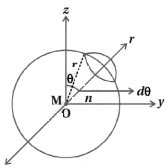
Consider a magnetic dipole of moment $\vec{m} = m \hat{k}$ placed at the origin $O$. The magnetic field $\vec{B}$ at a point $P$ on the surface of a sphere of radius $R$ (where $OP$ makes an angle $\theta$ with the $z$-axis) is given by:
$\vec{B} = \frac{\mu_0}{4\pi} \frac{m}{r^3} (2 \cos \theta \hat{r} + \sin \theta \hat{\theta})$.
The area element $d\vec{S}$ on the spherical surface is $d\vec{S} = R^2 \sin \theta d\theta d\phi \hat{r}$.
Now,calculate the flux $\Phi_B = \oint \vec{B} \cdot d\vec{S}$:
$\Phi_B = \int_0^{2\pi} \int_0^{\pi} \left( \frac{\mu_0}{4\pi} \frac{m}{R^3} (2 \cos \theta \hat{r} + \sin \theta \hat{\theta}) \right) \cdot (R^2 \sin \theta d\theta d\phi \hat{r})$.
Since $\hat{r} \cdot \hat{r} = 1$ and $\hat{\theta} \cdot \hat{r} = 0$:
$\Phi_B = \frac{\mu_0 m}{4\pi R} \int_0^{2\pi} d\phi \int_0^{\pi} 2 \cos \theta \sin \theta d\theta$.
$\Phi_B = \frac{\mu_0 m}{4\pi R} (2\pi) \int_0^{\pi} \sin(2\theta) d\theta$.
$\Phi_B = \frac{\mu_0 m}{2R} \left[ -\frac{\cos(2\theta)}{2} \right]_0^{\pi} = \frac{\mu_0 m}{4R} [-\cos(2\pi) + \cos(0)] = \frac{\mu_0 m}{4R} [-1 + 1] = 0$.
Thus,Gauss's law for magnetism is verified.
Consider a magnetic dipole of moment $\vec{m} = m \hat{k}$ placed at the origin $O$. The magnetic field $\vec{B}$ at a point $P$ on the surface of a sphere of radius $R$ (where $OP$ makes an angle $\theta$ with the $z$-axis) is given by:
$\vec{B} = \frac{\mu_0}{4\pi} \frac{m}{r^3} (2 \cos \theta \hat{r} + \sin \theta \hat{\theta})$.
The area element $d\vec{S}$ on the spherical surface is $d\vec{S} = R^2 \sin \theta d\theta d\phi \hat{r}$.
Now,calculate the flux $\Phi_B = \oint \vec{B} \cdot d\vec{S}$:
$\Phi_B = \int_0^{2\pi} \int_0^{\pi} \left( \frac{\mu_0}{4\pi} \frac{m}{R^3} (2 \cos \theta \hat{r} + \sin \theta \hat{\theta}) \right) \cdot (R^2 \sin \theta d\theta d\phi \hat{r})$.
Since $\hat{r} \cdot \hat{r} = 1$ and $\hat{\theta} \cdot \hat{r} = 0$:
$\Phi_B = \frac{\mu_0 m}{4\pi R} \int_0^{2\pi} d\phi \int_0^{\pi} 2 \cos \theta \sin \theta d\theta$.
$\Phi_B = \frac{\mu_0 m}{4\pi R} (2\pi) \int_0^{\pi} \sin(2\theta) d\theta$.
$\Phi_B = \frac{\mu_0 m}{2R} \left[ -\frac{\cos(2\theta)}{2} \right]_0^{\pi} = \frac{\mu_0 m}{4R} [-\cos(2\pi) + \cos(0)] = \frac{\mu_0 m}{4R} [-1 + 1] = 0$.
Thus,Gauss's law for magnetism is verified.
0 likes
View Solution36
Medium
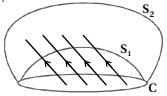
Consider a closed loop $C$ in a magnetic field as shown in the figure. The flux passing through the loop is defined by choosing a surface whose edge coincides with the loop and using the formula $\phi = \sum \vec{B}_i \cdot d\vec{A}_i$. Now,if we choose two different surfaces $S_1$ and $S_2$ having $C$ as their edge,would we get the same answer for the magnetic flux? Justify your answer.
Solution
(N/A) Yes,we would get the same answer for the magnetic flux.
According to Gauss's Law for magnetism,the net magnetic flux through any closed surface is zero $(\oint \vec{B} \cdot d\vec{A} = 0)$.
If we consider the closed surface formed by the union of surfaces $S_1$ and $S_2$,the total flux through this closed surface is zero.
Let the flux through $S_1$ be $\phi_1$ and through $S_2$ be $\phi_2$. Since the magnetic field lines enter through one surface and exit through the other,the flux through $S_1$ must equal the flux through $S_2$ in magnitude.
Therefore,the magnetic flux linked with any surface bounded by the same loop $C$ is the same,as it depends only on the number of magnetic field lines passing through the loop.
According to Gauss's Law for magnetism,the net magnetic flux through any closed surface is zero $(\oint \vec{B} \cdot d\vec{A} = 0)$.
If we consider the closed surface formed by the union of surfaces $S_1$ and $S_2$,the total flux through this closed surface is zero.
Let the flux through $S_1$ be $\phi_1$ and through $S_2$ be $\phi_2$. Since the magnetic field lines enter through one surface and exit through the other,the flux through $S_1$ must equal the flux through $S_2$ in magnitude.
Therefore,the magnetic flux linked with any surface bounded by the same loop $C$ is the same,as it depends only on the number of magnetic field lines passing through the loop.
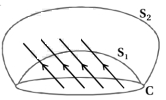
0 likes
View Solution37
MediumMCQ
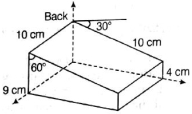
Consider the following figure. $A$ uniform magnetic field of $0.2 \, T$ is directed along the positive $X$-axis. The magnetic flux through the top surface of the figure is ....... $m-Wb$.
A
$0$
B
$0.8$
C
$1.0$
D
$1.8$
Solution
(C) The magnetic flux $\phi$ is given by $\phi = \vec{B} \cdot \vec{A} = B A \cos \theta$,where $\theta$ is the angle between the magnetic field vector $\vec{B}$ and the area vector $\vec{A}$ (normal to the surface).
The magnetic field is directed along the positive $X$-axis. The top surface is inclined at an angle of $30^{\circ}$ with the horizontal. The normal to this surface makes an angle of $\theta = 90^{\circ} - 30^{\circ} = 60^{\circ}$ with the $X$-axis.
The dimensions of the top surface are $10 \, cm \times 10 \, cm = 0.1 \, m \times 0.1 \, m = 0.01 \, m^2$.
Substituting the values:
$\phi = (0.2 \, T) \times (0.01 \, m^2) \times \cos(60^{\circ})$
$\phi = 0.002 \times 0.5 = 0.001 \, Wb$
Since $1 \, Wb = 1000 \, m-Wb$,we have:
$\phi = 0.001 \times 1000 = 1 \, m-Wb$.
The magnetic field is directed along the positive $X$-axis. The top surface is inclined at an angle of $30^{\circ}$ with the horizontal. The normal to this surface makes an angle of $\theta = 90^{\circ} - 30^{\circ} = 60^{\circ}$ with the $X$-axis.
The dimensions of the top surface are $10 \, cm \times 10 \, cm = 0.1 \, m \times 0.1 \, m = 0.01 \, m^2$.
Substituting the values:
$\phi = (0.2 \, T) \times (0.01 \, m^2) \times \cos(60^{\circ})$
$\phi = 0.002 \times 0.5 = 0.001 \, Wb$
Since $1 \, Wb = 1000 \, m-Wb$,we have:
$\phi = 0.001 \times 1000 = 1 \, m-Wb$.
0 likes
View Solution38
EasyMCQ
The unit of magnetic flux is
A
Tesla
B
Gauss
C
Weber
D
Weber $ / m^{2}$
Solution
(C) Magnetic flux $(\Phi_B)$ is defined as the product of the magnetic field $(B)$ and the area $(A)$ through which it passes, given by $\Phi_B = B \cdot A \cdot \cos(\theta)$.
The $SI$ unit of magnetic field is Tesla $(T)$ and the unit of area is square meters $(m^2)$.
Therefore, $1 \text{ Tesla} \cdot m^2 = 1 \text{ Weber}$ $(Wb)$.
Thus, the $SI$ unit of magnetic flux is Weber.
The $SI$ unit of magnetic field is Tesla $(T)$ and the unit of area is square meters $(m^2)$.
Therefore, $1 \text{ Tesla} \cdot m^2 = 1 \text{ Weber}$ $(Wb)$.
Thus, the $SI$ unit of magnetic flux is Weber.
0 likes
View Solution39
MediumMCQ
$A$ square loop of side $1\,m$ and resistance $1\,\Omega$ is placed in a magnetic field of $0.5\,T$. If the plane of the loop is perpendicular to the direction of the magnetic field,the magnetic flux through the loop is $\dots\dots$ weber.
A
$0.5$
B
$1$
C
zero
D
$2$
Solution
(A) Given:
Side length of the square loop,$l = 1\,m$.
Area of the loop,$A = l^2 = (1\,m)^2 = 1\,m^2$.
Magnetic field,$B = 0.5\,T$.
The plane of the loop is perpendicular to the magnetic field,which means the area vector $\overrightarrow{A}$ is parallel to the magnetic field vector $\overrightarrow{B}$.
Therefore,the angle $\theta$ between $\overrightarrow{B}$ and $\overrightarrow{A}$ is $0^\circ$.
The magnetic flux $\phi$ is given by the formula:
$\phi = B A \cos\theta$
Substituting the values:
$\phi = 0.5 \times 1 \times \cos(0^\circ)$
Since $\cos(0^\circ) = 1$,
$\phi = 0.5 \times 1 \times 1 = 0.5\,Wb$.
Side length of the square loop,$l = 1\,m$.
Area of the loop,$A = l^2 = (1\,m)^2 = 1\,m^2$.
Magnetic field,$B = 0.5\,T$.
The plane of the loop is perpendicular to the magnetic field,which means the area vector $\overrightarrow{A}$ is parallel to the magnetic field vector $\overrightarrow{B}$.
Therefore,the angle $\theta$ between $\overrightarrow{B}$ and $\overrightarrow{A}$ is $0^\circ$.
The magnetic flux $\phi$ is given by the formula:
$\phi = B A \cos\theta$
Substituting the values:
$\phi = 0.5 \times 1 \times \cos(0^\circ)$
Since $\cos(0^\circ) = 1$,
$\phi = 0.5 \times 1 \times 1 = 0.5\,Wb$.
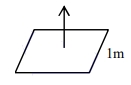
0 likes
View Solution40
EasyMCQ
Which of the following statements regarding magnetic lines of force is correct?
A
Total magnetic flux linked with a closed surface is always zero
B
They need not be perpendicular to the surface from where they start or where they meet
C
They may or may not pass through a conductor
D
All of these
Solution
(A) The correct option is $A$.
$1$. According to Gauss's Law for magnetism,the net magnetic flux through any closed surface is always zero because magnetic monopoles do not exist. This means the number of magnetic field lines entering a closed surface is equal to the number of lines exiting it. Thus,statement $A$ is correct.
$2$. Magnetic field lines are always perpendicular to the surface of a magnetic material (like a pole) at the points where they originate or terminate. Therefore,statement $B$ is incorrect.
$3$. Magnetic field lines always pass through a conductor (unless it is a superconductor exhibiting the Meissner effect). Therefore,statement $C$ is incorrect.
$4$. Since only statement $A$ is correct,the correct choice is $A$.
$1$. According to Gauss's Law for magnetism,the net magnetic flux through any closed surface is always zero because magnetic monopoles do not exist. This means the number of magnetic field lines entering a closed surface is equal to the number of lines exiting it. Thus,statement $A$ is correct.
$2$. Magnetic field lines are always perpendicular to the surface of a magnetic material (like a pole) at the points where they originate or terminate. Therefore,statement $B$ is incorrect.
$3$. Magnetic field lines always pass through a conductor (unless it is a superconductor exhibiting the Meissner effect). Therefore,statement $C$ is incorrect.
$4$. Since only statement $A$ is correct,the correct choice is $A$.
0 likes
View Solution41
MediumMCQ
$A$ coil is placed in a magnetic field such that the plane of the coil is perpendicular to the direction of the magnetic field. The magnetic flux through a coil can be changed by:
A
$A$ and $B$ only
B
$A, B$ and $C$ only
C
$A, B$ and $D$ only
D
$A, B, C$ and $D$
Solution
(D) The magnetic flux $\phi$ through a coil is given by the formula $\phi = \vec{B} \cdot \vec{A} = BA \cos \theta$,where $B$ is the magnetic field magnitude,$A$ is the area of the coil,and $\theta$ is the angle between the magnetic field vector and the area vector.
$1$. By changing the magnitude of the magnetic field $(B)$,the flux $\phi$ changes. (Statement $A$ is correct).
$2$. By changing the area of the coil $(A)$ within the magnetic field,the flux $\phi$ changes. (Statement $B$ is correct).
$3$. By changing the angle $(\theta)$ between the direction of the magnetic field and the plane of the coil (which changes the angle between the magnetic field and the area vector),the flux $\phi$ changes. (Statement $C$ is correct).
$4$. By reversing the magnetic field direction abruptly,the angle $\theta$ changes (e.g.,from $0^\circ$ to $180^\circ$),which changes the flux $\phi$. (Statement $D$ is correct).
Therefore,all four methods can change the magnetic flux through the coil.
$1$. By changing the magnitude of the magnetic field $(B)$,the flux $\phi$ changes. (Statement $A$ is correct).
$2$. By changing the area of the coil $(A)$ within the magnetic field,the flux $\phi$ changes. (Statement $B$ is correct).
$3$. By changing the angle $(\theta)$ between the direction of the magnetic field and the plane of the coil (which changes the angle between the magnetic field and the area vector),the flux $\phi$ changes. (Statement $C$ is correct).
$4$. By reversing the magnetic field direction abruptly,the angle $\theta$ changes (e.g.,from $0^\circ$ to $180^\circ$),which changes the flux $\phi$. (Statement $D$ is correct).
Therefore,all four methods can change the magnetic flux through the coil.
0 likes
View Solution42
EasyMCQ
The net magnetic flux through any closed surface is
A
$-ve$
B
$0$
C
$+ve$
D
$\infty$
Solution
(B) According to Gauss's Law for magnetism,the net magnetic flux through any closed surface is given by the surface integral of the magnetic field $\vec{B}$ over that surface.
$\oint \vec{B} \cdot d\vec{s} = 0$
This result arises because magnetic monopoles do not exist; magnetic field lines always form closed loops,meaning every field line entering a closed surface must also exit it.
Therefore,the net magnetic flux through any closed surface is always $0$.
$\oint \vec{B} \cdot d\vec{s} = 0$
This result arises because magnetic monopoles do not exist; magnetic field lines always form closed loops,meaning every field line entering a closed surface must also exit it.
Therefore,the net magnetic flux through any closed surface is always $0$.
0 likes
View Solution43
MediumMCQ
Given below are two statements $:$ one is labelled as Assertion $(A)$ and the other is labelled as Reason $(R)$.
Assertion $(A) :$ Magnetic monopoles do not exist.
Reason $(R) :$ Magnetic field lines are continuous and form closed loops.
In the light of the above statements, choose the most appropriate answer from the options given below.
Assertion $(A) :$ Magnetic monopoles do not exist.
Reason $(R) :$ Magnetic field lines are continuous and form closed loops.
In the light of the above statements, choose the most appropriate answer from the options given below.
A
Both $(A)$ and $(R)$ are correct but $(R)$ is not the correct explanation of $(A)$.
B
$(A)$ is correct but $(R)$ is not correct.
C
Both $(A)$ and $(R)$ are correct and $(R)$ is the correct explanation of $(A)$.
D
$(A)$ is not correct but $(R)$ is correct.
Solution
(C) Assertion $(A)$ is correct because, according to Gauss's Law for magnetism, the net magnetic flux through any closed surface is zero $( \oint \vec{B} \cdot d\vec{A} = 0)$. This implies that there are no isolated magnetic charges (monopoles).
Reason $(R)$ is also correct because magnetic field lines always form continuous closed loops, starting from the North pole and ending at the South pole outside the magnet, and continuing from South to North inside the magnet.
Since magnetic field lines form closed loops, they do not have a starting or ending point (source or sink), which directly explains why magnetic monopoles cannot exist. Therefore, $(R)$ is the correct explanation of $(A)$.
Reason $(R)$ is also correct because magnetic field lines always form continuous closed loops, starting from the North pole and ending at the South pole outside the magnet, and continuing from South to North inside the magnet.
Since magnetic field lines form closed loops, they do not have a starting or ending point (source or sink), which directly explains why magnetic monopoles cannot exist. Therefore, $(R)$ is the correct explanation of $(A)$.
0 likes
View Solution44
MediumMCQ
$A$ flux of $1 \ mWb$ passes through a strip having an area $A = 0.02 \ m^2$. The plane of the strip is at an angle of $60^{\circ}$ to the direction of a uniform field $B$. The value of $B$ is
A
$0.1 \ T$
B
$0.058 \ T$
C
$4.0 \ mT$
D
None of the above
Solution
(B) The magnetic flux $\Phi$ is given by the formula $\Phi = B A \cos(\theta)$,where $\theta$ is the angle between the magnetic field vector $\vec{B}$ and the area vector $\vec{A}$.
Given that the plane of the strip makes an angle of $60^{\circ}$ with the magnetic field,the angle $\theta$ between the area vector (which is perpendicular to the plane) and the magnetic field is $\theta = 90^{\circ} - 60^{\circ} = 30^{\circ}$.
Given values: $\Phi = 1 \ mWb = 10^{-3} \ Wb$,$A = 0.02 \ m^2$,and $\theta = 30^{\circ}$.
Substituting these values into the formula: $10^{-3} = B \times 0.02 \times \cos(30^{\circ})$.
Since $\cos(30^{\circ}) = \frac{\sqrt{3}}{2} \approx 0.866$,we have $10^{-3} = B \times 0.02 \times 0.866$.
$B = \frac{10^{-3}}{0.02 \times 0.866} = \frac{0.001}{0.01732} \approx 0.0577 \ T$.
Rounding this value gives $B \approx 0.058 \ T$.
Given that the plane of the strip makes an angle of $60^{\circ}$ with the magnetic field,the angle $\theta$ between the area vector (which is perpendicular to the plane) and the magnetic field is $\theta = 90^{\circ} - 60^{\circ} = 30^{\circ}$.
Given values: $\Phi = 1 \ mWb = 10^{-3} \ Wb$,$A = 0.02 \ m^2$,and $\theta = 30^{\circ}$.
Substituting these values into the formula: $10^{-3} = B \times 0.02 \times \cos(30^{\circ})$.
Since $\cos(30^{\circ}) = \frac{\sqrt{3}}{2} \approx 0.866$,we have $10^{-3} = B \times 0.02 \times 0.866$.
$B = \frac{10^{-3}}{0.02 \times 0.866} = \frac{0.001}{0.01732} \approx 0.0577 \ T$.
Rounding this value gives $B \approx 0.058 \ T$.
0 likes
View Solution45
EasyMCQ
$A$ square of side $L$ metre lies in the $x-y$ plane in a region where the magnetic field is $\vec{B} = B_0(2 \hat{i} + 3 \hat{j} + 4 \hat{k})$,where $B_0$ is a constant. The magnitude of the magnetic flux passing through the square (in weber) is: (in $B_0 L^2$)
A
$4$
B
$2$
C
$3$
D
$29$
Solution
(A) The magnetic flux $\Phi$ through a surface is given by the dot product of the magnetic field vector $\vec{B}$ and the area vector $\vec{A}$.
Given,$\vec{B} = B_0(2 \hat{i} + 3 \hat{j} + 4 \hat{k})$.
The square lies in the $x-y$ plane,so its area vector $\vec{A}$ is perpendicular to the $x-y$ plane,which is along the $z$-axis.
Thus,$\vec{A} = L^2 \hat{k}$.
The magnetic flux $\Phi$ is calculated as:
$\Phi = \vec{B} \cdot \vec{A}$
$\Phi = [B_0(2 \hat{i} + 3 \hat{j} + 4 \hat{k})] \cdot [L^2 \hat{k}]$
$\Phi = B_0 L^2 (2 \hat{i} \cdot \hat{k} + 3 \hat{j} \cdot \hat{k} + 4 \hat{k} \cdot \hat{k})$
Since $\hat{i} \cdot \hat{k} = 0$,$\hat{j} \cdot \hat{k} = 0$,and $\hat{k} \cdot \hat{k} = 1$,we get:
$\Phi = B_0 L^2 (0 + 0 + 4(1)) = 4 B_0 L^2$.
Therefore,the magnitude of the flux is $4 B_0 L^2$.
Given,$\vec{B} = B_0(2 \hat{i} + 3 \hat{j} + 4 \hat{k})$.
The square lies in the $x-y$ plane,so its area vector $\vec{A}$ is perpendicular to the $x-y$ plane,which is along the $z$-axis.
Thus,$\vec{A} = L^2 \hat{k}$.
The magnetic flux $\Phi$ is calculated as:
$\Phi = \vec{B} \cdot \vec{A}$
$\Phi = [B_0(2 \hat{i} + 3 \hat{j} + 4 \hat{k})] \cdot [L^2 \hat{k}]$
$\Phi = B_0 L^2 (2 \hat{i} \cdot \hat{k} + 3 \hat{j} \cdot \hat{k} + 4 \hat{k} \cdot \hat{k})$
Since $\hat{i} \cdot \hat{k} = 0$,$\hat{j} \cdot \hat{k} = 0$,and $\hat{k} \cdot \hat{k} = 1$,we get:
$\Phi = B_0 L^2 (0 + 0 + 4(1)) = 4 B_0 L^2$.
Therefore,the magnitude of the flux is $4 B_0 L^2$.
0 likes
View Solution46
EasyMCQ
$A$ square of side $L$ meter lies in the $x-y$ plane in a region where the magnetic field is given by $\overrightarrow{B} = B_0(2 \hat{i} + 4 \hat{j} + 3 \hat{k}) \text{ T}$,where $B_0$ is a constant. The magnitude of the magnetic flux passing through the square is . . . . . . .
A
$4 B_0 L^2 \text{ Wb}$
B
$3 B_0 L^2 \text{ Wb}$
C
$2 B_0 L^2 \text{ Wb}$
D
$\sqrt{29} B_0 L^2 \text{ Wb}$
Solution
(B) The magnetic flux $\phi$ through a surface is given by the dot product of the magnetic field vector $\overrightarrow{B}$ and the area vector $\overrightarrow{A}$.
Since the square of side $L$ lies in the $x-y$ plane,its area vector $\overrightarrow{A}$ is directed along the $z$-axis.
Therefore,$\overrightarrow{A} = L^2 \hat{k}$.
The magnetic field is $\overrightarrow{B} = B_0(2 \hat{i} + 4 \hat{j} + 3 \hat{k})$.
The magnetic flux is calculated as:
$\phi = \overrightarrow{B} \cdot \overrightarrow{A}$
$\phi = [B_0(2 \hat{i} + 4 \hat{j} + 3 \hat{k})] \cdot [L^2 \hat{k}]$
$\phi = B_0 L^2 (2 \hat{i} \cdot \hat{k} + 4 \hat{j} \cdot \hat{k} + 3 \hat{k} \cdot \hat{k})$
Since $\hat{i} \cdot \hat{k} = 0$,$\hat{j} \cdot \hat{k} = 0$,and $\hat{k} \cdot \hat{k} = 1$,we get:
$\phi = B_0 L^2 (0 + 0 + 3(1)) = 3 B_0 L^2 \text{ Wb}$.
Since the square of side $L$ lies in the $x-y$ plane,its area vector $\overrightarrow{A}$ is directed along the $z$-axis.
Therefore,$\overrightarrow{A} = L^2 \hat{k}$.
The magnetic field is $\overrightarrow{B} = B_0(2 \hat{i} + 4 \hat{j} + 3 \hat{k})$.
The magnetic flux is calculated as:
$\phi = \overrightarrow{B} \cdot \overrightarrow{A}$
$\phi = [B_0(2 \hat{i} + 4 \hat{j} + 3 \hat{k})] \cdot [L^2 \hat{k}]$
$\phi = B_0 L^2 (2 \hat{i} \cdot \hat{k} + 4 \hat{j} \cdot \hat{k} + 3 \hat{k} \cdot \hat{k})$
Since $\hat{i} \cdot \hat{k} = 0$,$\hat{j} \cdot \hat{k} = 0$,and $\hat{k} \cdot \hat{k} = 1$,we get:
$\phi = B_0 L^2 (0 + 0 + 3(1)) = 3 B_0 L^2 \text{ Wb}$.
0 likes
View Solution47
EasyMCQ
Magnetic flux is in weber,the unit of magnetic field intensity is . . . . . . .
A
$Wb \times m^2$
B
$\frac{Wb}{m}$
C
$\frac{Wb}{m^2}$
D
$Wb \times m$
Solution
(C) The correct option is $C$.
Magnetic flux $\phi$ is defined as the product of magnetic field intensity $B$ and the area $A$ perpendicular to the field,given by the formula $\phi = B \times A$.
To find the unit of magnetic field intensity $B$,we rearrange the formula: $B = \frac{\phi}{A}$.
Since the unit of magnetic flux $\phi$ is weber $(Wb)$ and the unit of area $A$ is square meters $(m^2)$,the unit of magnetic field intensity $B$ is $\frac{Wb}{m^2}$ (also known as Tesla).
Magnetic flux $\phi$ is defined as the product of magnetic field intensity $B$ and the area $A$ perpendicular to the field,given by the formula $\phi = B \times A$.
To find the unit of magnetic field intensity $B$,we rearrange the formula: $B = \frac{\phi}{A}$.
Since the unit of magnetic flux $\phi$ is weber $(Wb)$ and the unit of area $A$ is square meters $(m^2)$,the unit of magnetic field intensity $B$ is $\frac{Wb}{m^2}$ (also known as Tesla).
0 likes
View Solution48
MediumMCQ
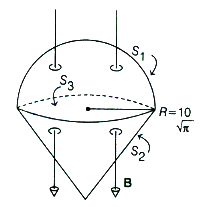
$A$ uniform magnetic field of strength $B=2 \text{ mT}$ exists vertically downwards. These magnetic field lines pass through a closed surface as shown in the figure. The closed surface consists of a hemisphere $S_1$,a right circular cone $S_2$,and a circular surface $S_3$. The magnetic flux through $S_1$ and $S_2$ are respectively:
A
$\Phi_{S_1}=-20 \mu \text{ Wb}, \Phi_{S_2}=+20 \mu \text{ Wb}$
B
$\Phi_{S_1}=+20 \mu \text{ Wb}, \Phi_{S_2}=-20 \mu \text{ Wb}$
C
$\Phi_{S_1}=-40 \mu \text{ Wb}, \Phi_{S_3}=+40 \mu \text{ Wb}$
D
$\Phi_{S_1}=+40 \mu \text{ Wb}, \Phi_{S_2}=-40 \mu \text{ Wb}$
Solution
(A) Given,$B = 2 \text{ mT} = 2 \times 10^{-3} \text{ T}$.
Radius $R = \frac{10}{\sqrt{\pi}} \text{ cm} = \frac{10}{\sqrt{\pi}} \times 10^{-2} \text{ m} = \frac{10^{-1}}{\sqrt{\pi}} \text{ m}$.
The area of the circular cross-section $S_3$ is $A = \pi R^2 = \pi \times \left(\frac{10^{-1}}{\sqrt{\pi}}\right)^2 = \pi \times \frac{10^{-2}}{\pi} = 10^{-2} \text{ m}^2$.
For the hemisphere $S_1$,the magnetic field lines enter the surface. The angle between the area vector (outward normal) and the magnetic field vector is $180^{\circ}$.
Flux $\Phi_{S_1} = B A \cos(180^{\circ}) = (2 \times 10^{-3} \text{ T}) \times (10^{-2} \text{ m}^2) \times (-1) = -2 \times 10^{-5} \text{ Wb} = -20 \times 10^{-6} \text{ Wb} = -20 \mu \text{ Wb}$.
Since the total magnetic flux through a closed surface is zero (Gauss's Law for magnetism),the flux leaving the cone $S_2$ must be equal in magnitude to the flux entering the hemisphere $S_1$.
Therefore,$\Phi_{S_1} + \Phi_{S_2} = 0 \implies \Phi_{S_2} = -\Phi_{S_1} = +20 \mu \text{ Wb}$.
Radius $R = \frac{10}{\sqrt{\pi}} \text{ cm} = \frac{10}{\sqrt{\pi}} \times 10^{-2} \text{ m} = \frac{10^{-1}}{\sqrt{\pi}} \text{ m}$.
The area of the circular cross-section $S_3$ is $A = \pi R^2 = \pi \times \left(\frac{10^{-1}}{\sqrt{\pi}}\right)^2 = \pi \times \frac{10^{-2}}{\pi} = 10^{-2} \text{ m}^2$.
For the hemisphere $S_1$,the magnetic field lines enter the surface. The angle between the area vector (outward normal) and the magnetic field vector is $180^{\circ}$.
Flux $\Phi_{S_1} = B A \cos(180^{\circ}) = (2 \times 10^{-3} \text{ T}) \times (10^{-2} \text{ m}^2) \times (-1) = -2 \times 10^{-5} \text{ Wb} = -20 \times 10^{-6} \text{ Wb} = -20 \mu \text{ Wb}$.
Since the total magnetic flux through a closed surface is zero (Gauss's Law for magnetism),the flux leaving the cone $S_2$ must be equal in magnitude to the flux entering the hemisphere $S_1$.
Therefore,$\Phi_{S_1} + \Phi_{S_2} = 0 \implies \Phi_{S_2} = -\Phi_{S_1} = +20 \mu \text{ Wb}$.
0 likes
View Solution49
EasyMCQ
$A$ square loop of side $2 \ m$ lies in the $Y-Z$ plane in a region having a magnetic field $\vec{B}=(5 \hat{i}+3 \hat{j}-4 \hat{k}) \ T$. The magnitude of magnetic flux through the square loop is (in $Wb$)
A
$20$
B
$12$
C
$16$
D
$10$
Solution
(A) The area vector $\vec{A}$ of a square loop of side $2 \ m$ lying in the $Y-Z$ plane is directed along the $X$-axis.
$\vec{A} = (2 \times 2) \hat{i} = 4 \hat{i} \ m^2$.
The magnetic field is given by $\vec{B} = (5 \hat{i} + 3 \hat{j} - 4 \hat{k}) \ T$.
The magnetic flux $\phi$ is given by the dot product of the magnetic field and the area vector:
$\phi = \vec{B} \cdot \vec{A}$
$\phi = (5 \hat{i} + 3 \hat{j} - 4 \hat{k}) \cdot (4 \hat{i})$
$\phi = (5 \times 4) + (3 \times 0) + (-4 \times 0)$
$\phi = 20 \ Wb$.
Thus,the magnitude of the magnetic flux is $20 \ Wb$.
$\vec{A} = (2 \times 2) \hat{i} = 4 \hat{i} \ m^2$.
The magnetic field is given by $\vec{B} = (5 \hat{i} + 3 \hat{j} - 4 \hat{k}) \ T$.
The magnetic flux $\phi$ is given by the dot product of the magnetic field and the area vector:
$\phi = \vec{B} \cdot \vec{A}$
$\phi = (5 \hat{i} + 3 \hat{j} - 4 \hat{k}) \cdot (4 \hat{i})$
$\phi = (5 \times 4) + (3 \times 0) + (-4 \times 0)$
$\phi = 20 \ Wb$.
Thus,the magnitude of the magnetic flux is $20 \ Wb$.
0 likes
View SolutionElectromagnetic Induction — Magnetic Flux and Gauss law for Magnetism · Frequently Asked Questions
1Are these Electromagnetic Induction questions useful for JEE and NEET?
Yes. All questions in this section are mapped to JEE Main and NEET exam patterns. Previous year questions from JEE Main, NEET, GUJCET and state-level exams are included with full solutions.
2Can I switch to Hindi or Gujarati for these questions?
Yes. Use the language tabs in the hero section or the sidebar to view the same questions and solutions in English, Hindi or Gujarati.
3How do I generate a question paper from this subtopic?
Use the Vedclass Exam Paper Generator — select the chapter and subtopic, set difficulty, and generate Sets A, B, C, D automatically. First 3 chapters of every subject are free.
Vedclass Products
For Students
Vedclass Test Series
Mock tests in real JEE/NEET style with performance analysis. 5-day free trial.
Start Free TrialFor Teachers
Exam Paper Generator
Generate Set A/B/C/D papers from this chapter in 2 minutes. 3 chapters free.
Try FreeFor Institutes
Online Exam Module
Live online exams with unlimited students, 360° analytics & white-label branding.
See DemoFor Teachers & Institutes
Generate a Electromagnetic Induction Exam Paper in 2 Minutes
Select subtopic & difficulty — Sets A, B, C, D auto-generated with No Repeat logic.
First 3 chapters of every subject are free — no payment required.