
A English
Faraday's and Lenz's Law Questions in English
Class 12 Physics · Electromagnetic Induction · Faraday's and Lenz's Law
310+
Questions
English
Language
100%
With Solutions
Showing 49 of 310 questions in English
101
DifficultMCQ
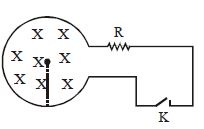
Shown in the figure is a circular loop of radius $r$ and resistance $R$. $A$ variable magnetic field of induction $B = B_0 e^{-t}$ is established inside the coil. If the key $(K)$ is closed,the electrical power developed right after closing the switch is equal to
A
$\frac{B_0^2 \pi r^2}{R}$
B
$\frac{B_0^2 \pi r^3}{R}$
C
$\frac{B_0^2 \pi^2 r^4 R}{5}$
D
$\frac{B_0^2 \pi^2 r^4}{R}$
Solution
(D) The magnetic flux $\phi$ through the loop is given by $\phi = B \cdot A = (B_0 e^{-t})(\pi r^2)$.
According to Faraday's law of induction,the induced electromotive force $(emf)$ is $E = -\frac{d\phi}{dt}$.
$E = -\frac{d}{dt} (B_0 \pi r^2 e^{-t}) = -\pi r^2 B_0 \frac{d}{dt}(e^{-t}) = \pi r^2 B_0 e^{-t}$.
At the instant the key $(K)$ is closed,$t = 0$.
Therefore,the induced $emf$ at $t = 0$ is $E_0 = \pi r^2 B_0 e^0 = \pi r^2 B_0$.
The electrical power $P$ developed in the resistor $R$ is given by $P = \frac{E_0^2}{R}$.
Substituting the value of $E_0$,we get $P = \frac{(\pi r^2 B_0)^2}{R} = \frac{B_0^2 \pi^2 r^4}{R}$.
According to Faraday's law of induction,the induced electromotive force $(emf)$ is $E = -\frac{d\phi}{dt}$.
$E = -\frac{d}{dt} (B_0 \pi r^2 e^{-t}) = -\pi r^2 B_0 \frac{d}{dt}(e^{-t}) = \pi r^2 B_0 e^{-t}$.
At the instant the key $(K)$ is closed,$t = 0$.
Therefore,the induced $emf$ at $t = 0$ is $E_0 = \pi r^2 B_0 e^0 = \pi r^2 B_0$.
The electrical power $P$ developed in the resistor $R$ is given by $P = \frac{E_0^2}{R}$.
Substituting the value of $E_0$,we get $P = \frac{(\pi r^2 B_0)^2}{R} = \frac{B_0^2 \pi^2 r^4}{R}$.
0 likes
View Solution102
MediumMCQ
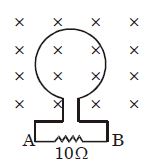
The figure shows a conducting loop placed in a magnetic field. The magnetic flux through the loop changes according to the equation $\phi = 5t - 10t^2$. What is the direction and magnitude of the induced current at $t = 0.25\, s$?
A
$0.5\, A, A \to B$
B
$0.5\, A, B \to A$
C
$1.5\, A, A \to B$
D
Zero
Solution
(D) According to Faraday's law of electromagnetic induction,the induced electromotive force $(Emf)$ is given by $E = -\frac{d\phi}{dt}$.
Given $\phi = 5t - 10t^2$.
$E = -\frac{d}{dt}(5t - 10t^2) = -(5 - 20t)$.
At $t = 0.25\, s = \frac{1}{4}\, s$,the $Emf$ is:
$E = -(5 - 20 \times 0.25) = -(5 - 5) = 0\, V$.
Since the induced $Emf$ is $0\, V$,the induced current $I = \frac{E}{R} = 0\, A$.
Given $\phi = 5t - 10t^2$.
$E = -\frac{d}{dt}(5t - 10t^2) = -(5 - 20t)$.
At $t = 0.25\, s = \frac{1}{4}\, s$,the $Emf$ is:
$E = -(5 - 20 \times 0.25) = -(5 - 5) = 0\, V$.
Since the induced $Emf$ is $0\, V$,the induced current $I = \frac{E}{R} = 0\, A$.
0 likes
View Solution103
MediumMCQ
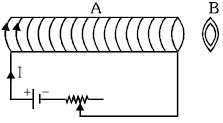
An aluminium ring $B$ faces an electromagnet $A$. The current $I$ through $A$ can be altered. Which of the following statements is correct?
A
If $I$ decreases,$A$ will repel $B$.
B
Whether $I$ increases or decreases,$B$ will not experience any force.
C
If $I$ increases,$A$ will repel $B$.
D
If $I$ increases,$A$ will attract $B$.
Solution
(C) According to Lenz's Law,the direction of the induced current in the ring $B$ will be such that it opposes the change in magnetic flux linked with it.
$1$. If the current $I$ in the electromagnet $A$ increases,the magnetic flux through the ring $B$ increases. To oppose this increase,the ring $B$ will develop an induced current such that it creates a magnetic field opposing the field of $A$. This results in a repulsive force between $A$ and $B$.
$2$. If the current $I$ in the electromagnet $A$ decreases,the magnetic flux through the ring $B$ decreases. To oppose this decrease,the ring $B$ will develop an induced current such that it creates a magnetic field that supports the field of $A$. This results in an attractive force between $A$ and $B$.
Therefore,if $I$ increases,$A$ will repel $B$.
$1$. If the current $I$ in the electromagnet $A$ increases,the magnetic flux through the ring $B$ increases. To oppose this increase,the ring $B$ will develop an induced current such that it creates a magnetic field opposing the field of $A$. This results in a repulsive force between $A$ and $B$.
$2$. If the current $I$ in the electromagnet $A$ decreases,the magnetic flux through the ring $B$ decreases. To oppose this decrease,the ring $B$ will develop an induced current such that it creates a magnetic field that supports the field of $A$. This results in an attractive force between $A$ and $B$.
Therefore,if $I$ increases,$A$ will repel $B$.
0 likes
View Solution104
EasyMCQ
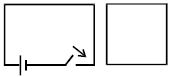
When the switch is closed in the primary circuit,the instantaneous induced current in the secondary circuit is:
A
Clockwise
B
Anticlockwise
C
No current
D
Alternating current
Solution
(B) When the switch is closed in the primary circuit,the current in the primary circuit increases from $0$ to a maximum value.
This increase in current creates an increasing magnetic flux through the secondary circuit.
According to Faraday's law of electromagnetic induction,an induced electromotive force $(EMF)$ is generated in the secondary circuit.
According to Lenz's law,the direction of the induced current is such that it opposes the cause that produces it.
Since the magnetic flux is increasing in the direction of the primary circuit's magnetic field,the secondary circuit will induce a current to create a magnetic field in the opposite direction to oppose this increase.
Based on the right-hand thumb rule,for the given configuration,the induced current in the secondary circuit will flow in the $Anticlockwise$ direction.
This increase in current creates an increasing magnetic flux through the secondary circuit.
According to Faraday's law of electromagnetic induction,an induced electromotive force $(EMF)$ is generated in the secondary circuit.
According to Lenz's law,the direction of the induced current is such that it opposes the cause that produces it.
Since the magnetic flux is increasing in the direction of the primary circuit's magnetic field,the secondary circuit will induce a current to create a magnetic field in the opposite direction to oppose this increase.
Based on the right-hand thumb rule,for the given configuration,the induced current in the secondary circuit will flow in the $Anticlockwise$ direction.
0 likes
View Solution105
MediumMCQ
$A$ circular loop of radius $r$ is moved away from a current-carrying wire. The induced current in the circular loop will be:

A
Clockwise
B
Anti-clockwise
C
Not induced
D
None of these
Solution
(A) $1$. According to the right-hand thumb rule,the magnetic field produced by the current-carrying wire at the position of the loop is directed into the plane of the loop (inward).
$2$. As the loop is moved away from the wire,the distance from the wire increases,which causes the magnetic field strength at the loop to decrease.
$3$. Consequently,the magnetic flux linked with the loop decreases.
$4$. According to Lenz's Law,the induced current will flow in a direction that opposes this decrease in magnetic flux.
$5$. To oppose the decrease of the inward magnetic field,the induced current must create an additional inward magnetic field.
$6$. By the right-hand rule,an inward magnetic field is produced by a clockwise current.
$7$. Therefore,the induced current in the circular loop will be clockwise.
$2$. As the loop is moved away from the wire,the distance from the wire increases,which causes the magnetic field strength at the loop to decrease.
$3$. Consequently,the magnetic flux linked with the loop decreases.
$4$. According to Lenz's Law,the induced current will flow in a direction that opposes this decrease in magnetic flux.
$5$. To oppose the decrease of the inward magnetic field,the induced current must create an additional inward magnetic field.
$6$. By the right-hand rule,an inward magnetic field is produced by a clockwise current.
$7$. Therefore,the induced current in the circular loop will be clockwise.
0 likes
View Solution106
MediumMCQ
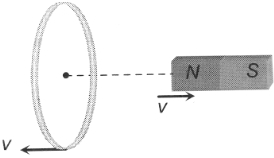
In the following figure,the magnet is moved towards the coil with a speed $v$ and the induced $emf$ is $e$. If the magnet and the coil recede away from one another,each moving with speed $v$,the induced $emf$ in the coil will be: (Assume the separation in both cases is the same)
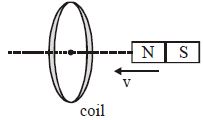
A
$e$
B
$2e$
C
$e/2$
D
$4e$
Solution
(B) According to Faraday's law of electromagnetic induction,the induced $emf$ is given by $e = -\frac{d\phi}{dt}$.
In the first case,the relative velocity between the magnet and the coil is $v$. Thus,the rate of change of magnetic flux is $\left(\frac{d\phi}{dt}\right)_1 = k \cdot v$,where $k$ is a constant depending on the magnetic field gradient and coil geometry. So,$e = k \cdot v$.
In the second case,both the magnet and the coil move away from each other with speed $v$. The relative velocity between them is $v_{rel} = v + v = 2v$.
The rate of change of magnetic flux is proportional to the relative velocity,so $\left(\frac{d\phi}{dt}\right)_2 = k \cdot (2v) = 2(k \cdot v) = 2e$.
Therefore,the induced $emf$ in the second case will be $2e$.
In the first case,the relative velocity between the magnet and the coil is $v$. Thus,the rate of change of magnetic flux is $\left(\frac{d\phi}{dt}\right)_1 = k \cdot v$,where $k$ is a constant depending on the magnetic field gradient and coil geometry. So,$e = k \cdot v$.
In the second case,both the magnet and the coil move away from each other with speed $v$. The relative velocity between them is $v_{rel} = v + v = 2v$.
The rate of change of magnetic flux is proportional to the relative velocity,so $\left(\frac{d\phi}{dt}\right)_2 = k \cdot (2v) = 2(k \cdot v) = 2e$.
Therefore,the induced $emf$ in the second case will be $2e$.
0 likes
View Solution107
MediumMCQ
$A$ coil of circular cross-section having $1000$ turns and $4 \, cm^2$ face area is placed with its axis parallel to a magnetic field which decreases by $10^{-2} \, Wb \, m^{-2}$ in $0.01 \, s$. The $e.m.f.$ induced in the coil is....$mV$
A
$400$
B
$200$
C
$4$
D
$0.4$
Solution
(A) Given: Number of turns $N = 1000$.
Face area $A = 4 \, cm^2 = 4 \times 10^{-4} \, m^2$.
Change in magnetic field $\Delta B = 10^{-2} \, Wb \, m^{-2}$.
Time interval $\Delta t = 0.01 \, s = 10^{-2} \, s$.
The induced $e.m.f.$ is given by Faraday's law: $e = N \frac{\Delta \phi}{\Delta t} = N A \frac{\Delta B}{\Delta t} \cos \theta$.
Since the axis is parallel to the magnetic field,the angle $\theta$ between the area vector and the magnetic field is $0^\circ$,so $\cos 0^\circ = 1$.
Substituting the values: $e = 1000 \times (4 \times 10^{-4} \, m^2) \times \frac{10^{-2} \, Wb \, m^{-2}}{10^{-2} \, s}$.
$e = 1000 \times 4 \times 10^{-4} = 0.4 \, V$.
Converting to $mV$: $0.4 \, V = 400 \, mV$.
Face area $A = 4 \, cm^2 = 4 \times 10^{-4} \, m^2$.
Change in magnetic field $\Delta B = 10^{-2} \, Wb \, m^{-2}$.
Time interval $\Delta t = 0.01 \, s = 10^{-2} \, s$.
The induced $e.m.f.$ is given by Faraday's law: $e = N \frac{\Delta \phi}{\Delta t} = N A \frac{\Delta B}{\Delta t} \cos \theta$.
Since the axis is parallel to the magnetic field,the angle $\theta$ between the area vector and the magnetic field is $0^\circ$,so $\cos 0^\circ = 1$.
Substituting the values: $e = 1000 \times (4 \times 10^{-4} \, m^2) \times \frac{10^{-2} \, Wb \, m^{-2}}{10^{-2} \, s}$.
$e = 1000 \times 4 \times 10^{-4} = 0.4 \, V$.
Converting to $mV$: $0.4 \, V = 400 \, mV$.
0 likes
View Solution108
MediumMCQ
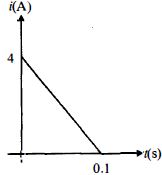
The magnetic flux through a coil of resistance $10\,\Omega$ is changed by $\Delta \phi$ in $0.1\,s$. The resulting current in the coil varies with time as shown in the figure. Then,the magnitude $\left| \Delta \phi \right|$ is equal to (in weber):
A
$6$
B
$4$
C
$2$
D
$8$
Solution
(C) According to Faraday's law of electromagnetic induction,the induced electromotive force (emf) is given by $e = \frac{\Delta \phi}{\Delta t}$.
Since the coil has a resistance $R$,the induced current is $i = \frac{e}{R}$,which implies $e = iR$.
Equating the two expressions for $e$,we get $iR = \frac{\Delta \phi}{\Delta t}$.
Rearranging the terms,we find the change in magnetic flux: $\Delta \phi = R \times (i \cdot \Delta t)$.
The term $(i \cdot \Delta t)$ represents the area under the current-time $(i-t)$ graph.
From the given graph,the area is a right-angled triangle with base $0.1\,s$ and height $4\,A$.
Area $= \frac{1}{2} \times \text{base} \times \text{height} = \frac{1}{2} \times 0.1 \times 4 = 0.2$.
Substituting the values,we get $\Delta \phi = 10 \times 0.2 = 2\,Wb$.
Therefore,the magnitude $\left| \Delta \phi \right| = 2\,Wb$.
Since the coil has a resistance $R$,the induced current is $i = \frac{e}{R}$,which implies $e = iR$.
Equating the two expressions for $e$,we get $iR = \frac{\Delta \phi}{\Delta t}$.
Rearranging the terms,we find the change in magnetic flux: $\Delta \phi = R \times (i \cdot \Delta t)$.
The term $(i \cdot \Delta t)$ represents the area under the current-time $(i-t)$ graph.
From the given graph,the area is a right-angled triangle with base $0.1\,s$ and height $4\,A$.
Area $= \frac{1}{2} \times \text{base} \times \text{height} = \frac{1}{2} \times 0.1 \times 4 = 0.2$.
Substituting the values,we get $\Delta \phi = 10 \times 0.2 = 2\,Wb$.
Therefore,the magnitude $\left| \Delta \phi \right| = 2\,Wb$.
0 likes
View Solution109
EasyMCQ
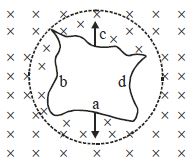
$A$ wire of irregular shape is turning into a circular shape in a magnetic field which is directed into the paper. The direction of the induced current is
A
along $abcda$
B
along $adcba$
C
into the plane of the paper
D
out of the plane of the paper
Solution
(B) When a wire of irregular shape turns into a circular loop,the area of the loop increases.
Since the magnetic field is directed into the paper,the magnetic flux linked with the loop increases as the area increases.
According to Lenz's law,the induced current will flow in a direction that opposes this increase in magnetic flux.
To oppose the inward magnetic flux,the induced magnetic field must be directed out of the paper.
Using the right-hand thumb rule,for the induced magnetic field to be directed out of the paper,the induced current must flow in the counter-clockwise direction,which is along $adcba$.
Since the magnetic field is directed into the paper,the magnetic flux linked with the loop increases as the area increases.
According to Lenz's law,the induced current will flow in a direction that opposes this increase in magnetic flux.
To oppose the inward magnetic flux,the induced magnetic field must be directed out of the paper.
Using the right-hand thumb rule,for the induced magnetic field to be directed out of the paper,the induced current must flow in the counter-clockwise direction,which is along $adcba$.
0 likes
View Solution110
EasyMCQ
$A$ conducting loop is placed in a uniform magnetic field with its plane perpendicular to the field. An $emf$ is induced in the loop if
A
it is rotated about its axis
B
it is rotated about a diameter
C
it is not moved
D
it is given translational motion in the field
Solution
(B) According to Faraday's law of electromagnetic induction,an $emf$ is induced in a loop when the magnetic flux $\Phi_B = \vec{B} \cdot \vec{A} = BA \cos \theta$ linked with the loop changes with time.
When the loop is rotated about its axis,the angle $\theta$ between the magnetic field $\vec{B}$ and the area vector $\vec{A}$ remains constant,so the flux does not change.
When the loop is rotated about a diameter,the angle $\theta$ changes with time,causing the magnetic flux to change,which induces an $emf$ in the loop.
Translational motion in a uniform magnetic field does not change the flux linked with the loop,so no $emf$ is induced.
When the loop is rotated about its axis,the angle $\theta$ between the magnetic field $\vec{B}$ and the area vector $\vec{A}$ remains constant,so the flux does not change.
When the loop is rotated about a diameter,the angle $\theta$ changes with time,causing the magnetic flux to change,which induces an $emf$ in the loop.
Translational motion in a uniform magnetic field does not change the flux linked with the loop,so no $emf$ is induced.
0 likes
View Solution111
DifficultMCQ
If a coil of $40$ turns and area $4 \, cm^2$ is suddenly removed from a magnetic field,it is observed that a charge of $2 \times 10^{-4} \, C$ flows through the coil. If the resistance of the coil is $80 \, \Omega$,the magnetic flux density in $Wb \, m^{-2}$ is:
A
$0.5$
B
$1$
C
$1.5$
D
$2$
Solution
(B) Given: Number of turns $N = 40$,Area $A = 4 \, cm^2 = 4 \times 10^{-4} \, m^2$,Charge $q = 2 \times 10^{-4} \, C$,Resistance $R = 80 \, \Omega$.
The induced charge $q$ is given by the formula $q = \frac{\Delta \phi}{R}$,where $\Delta \phi$ is the change in magnetic flux.
Since the coil is removed from the magnetic field,the final flux is $0$. Thus,$\Delta \phi = N \cdot A \cdot B$.
Substituting the values: $q = \frac{N \cdot A \cdot B}{R}$.
Rearranging for $B$: $B = \frac{q \cdot R}{N \cdot A}$.
$B = \frac{(2 \times 10^{-4} \, C) \times (80 \, \Omega)}{40 \times (4 \times 10^{-4} \, m^2)}$.
$B = \frac{160 \times 10^{-4}}{160 \times 10^{-4}} = 1 \, Wb \, m^{-2}$.
The induced charge $q$ is given by the formula $q = \frac{\Delta \phi}{R}$,where $\Delta \phi$ is the change in magnetic flux.
Since the coil is removed from the magnetic field,the final flux is $0$. Thus,$\Delta \phi = N \cdot A \cdot B$.
Substituting the values: $q = \frac{N \cdot A \cdot B}{R}$.
Rearranging for $B$: $B = \frac{q \cdot R}{N \cdot A}$.
$B = \frac{(2 \times 10^{-4} \, C) \times (80 \, \Omega)}{40 \times (4 \times 10^{-4} \, m^2)}$.
$B = \frac{160 \times 10^{-4}}{160 \times 10^{-4}} = 1 \, Wb \, m^{-2}$.
0 likes
View Solution112
MediumMCQ
The magnetic flux through a coil perpendicular to its plane and directed into the paper is varying according to the relation $\phi = (2t^2 + 4t + 6) \, mWb$. The $emf$ induced in the loop at $t = 4 \, s$ is ....... $V$.
A
$0.12$
B
$2.4$
C
$0.02$
D
$1.2$
Solution
(C) Given,the magnetic flux $\phi = (2t^2 + 4t + 6) \, mWb = (2t^2 + 4t + 6) \times 10^{-3} \, Wb$.
According to Faraday's law of electromagnetic induction,the induced $emf$ $(\varepsilon)$ is given by the magnitude of the rate of change of magnetic flux:
$\varepsilon = \left| \frac{d\phi}{dt} \right|$
$\varepsilon = \frac{d}{dt} [(2t^2 + 4t + 6) \times 10^{-3}] \, V$
$\varepsilon = (4t + 4) \times 10^{-3} \, V$
At $t = 4 \, s$:
$\varepsilon = (4 \times 4 + 4) \times 10^{-3} \, V$
$\varepsilon = (16 + 4) \times 10^{-3} \, V$
$\varepsilon = 20 \times 10^{-3} \, V = 0.02 \, V$.
According to Faraday's law of electromagnetic induction,the induced $emf$ $(\varepsilon)$ is given by the magnitude of the rate of change of magnetic flux:
$\varepsilon = \left| \frac{d\phi}{dt} \right|$
$\varepsilon = \frac{d}{dt} [(2t^2 + 4t + 6) \times 10^{-3}] \, V$
$\varepsilon = (4t + 4) \times 10^{-3} \, V$
At $t = 4 \, s$:
$\varepsilon = (4 \times 4 + 4) \times 10^{-3} \, V$
$\varepsilon = (16 + 4) \times 10^{-3} \, V$
$\varepsilon = 20 \times 10^{-3} \, V = 0.02 \, V$.
0 likes
View Solution113
MediumMCQ
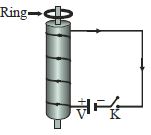
$A$ conducting ring is placed around the core of an electromagnet as shown in the figure. When key $K$ is pressed,the ring
A
Remain stationary
B
Is attracted towards the electromagnet
C
Jumps out of the core
D
None of the above
Solution
(C) When the key $K$ is pressed,the current in the solenoid increases from zero to a steady value.
This change in current produces a changing magnetic flux through the conducting ring.
According to Faraday's law of electromagnetic induction,an induced electromotive force $(EMF)$ is produced in the ring,which drives an induced current.
According to Lenz's law,the direction of this induced current is such that it opposes the cause that produced it.
In this case,the increasing magnetic flux through the ring creates a magnetic pole on the face of the ring facing the solenoid,which is of the same polarity as the pole of the electromagnet.
Since like poles repel each other,the ring experiences an upward repulsive force and jumps out of the core.
This change in current produces a changing magnetic flux through the conducting ring.
According to Faraday's law of electromagnetic induction,an induced electromotive force $(EMF)$ is produced in the ring,which drives an induced current.
According to Lenz's law,the direction of this induced current is such that it opposes the cause that produced it.
In this case,the increasing magnetic flux through the ring creates a magnetic pole on the face of the ring facing the solenoid,which is of the same polarity as the pole of the electromagnet.
Since like poles repel each other,the ring experiences an upward repulsive force and jumps out of the core.
0 likes
View Solution114
MediumMCQ
$A$ bar magnet is moved along the axis of a copper ring placed far away from the magnet. Looking from the side of the magnet,an anticlockwise current is found to be induced in the ring. Which of the following may be true?
A
The south pole faces the ring and the magnet moves towards it.
B
The north pole faces the ring and the magnet moves towards it.
C
The north pole faces the ring and the magnet moves away from it.
D
None of these.
Solution
(B) According to Lenz's law,the induced current in a loop opposes the change in magnetic flux that produces it.
When viewed from the side of the magnet,an anticlockwise current in the ring creates a magnetic field directed towards the magnet (acting as a North pole).
If the North pole of the magnet faces the ring and moves towards it,the magnetic flux through the ring increases. To oppose this,the ring induces a North pole to repel the magnet.
If the South pole of the magnet faces the ring and moves away from it,the magnetic flux through the ring decreases. To oppose this,the ring induces a North pole to attract the magnet.
Therefore,both the North pole facing the ring and moving towards it,or the South pole facing the ring and moving away from it,would result in an anticlockwise current. Among the given options,$B$ is a correct possibility.
When viewed from the side of the magnet,an anticlockwise current in the ring creates a magnetic field directed towards the magnet (acting as a North pole).
If the North pole of the magnet faces the ring and moves towards it,the magnetic flux through the ring increases. To oppose this,the ring induces a North pole to repel the magnet.
If the South pole of the magnet faces the ring and moves away from it,the magnetic flux through the ring decreases. To oppose this,the ring induces a North pole to attract the magnet.
Therefore,both the North pole facing the ring and moving towards it,or the South pole facing the ring and moving away from it,would result in an anticlockwise current. Among the given options,$B$ is a correct possibility.
0 likes
View Solution115
MediumMCQ
$A$ conducting loop is placed in a uniform magnetic field with its plane perpendicular to the field. An $emf$ is induced in the loop if:
$(a)$ It is translated (inside the field)
$(b)$ It is rotated about its axis
$(c)$ It is rotated about a diameter
$(d)$ It is deformed
$(a)$ It is translated (inside the field)
$(b)$ It is rotated about its axis
$(c)$ It is rotated about a diameter
$(d)$ It is deformed
A
$a, b$
B
$b, c$
C
$c, d$
D
$a, c, d$
Solution
(C) The induced $emf$ in a loop is given by Faraday's law: $emf = -\frac{d\phi}{dt}$,where $\phi = B A \cos\theta$.
$(a)$ If the loop is translated in a uniform magnetic field,the magnetic flux $\phi$ remains constant,so no $emf$ is induced.
$(b)$ If the loop is rotated about its axis,the angle $\theta$ between the area vector and the magnetic field remains constant,so $\phi$ does not change. No $emf$ is induced.
$(c)$ If the loop is rotated about a diameter,the angle $\theta$ changes with time,causing the flux $\phi$ to change. Thus,an $emf$ is induced.
$(d)$ If the loop is deformed,its area $A$ changes,which causes the flux $\phi$ to change. Thus,an $emf$ is induced.
Therefore,an $emf$ is induced in cases $(c)$ and $(d)$.
$(a)$ If the loop is translated in a uniform magnetic field,the magnetic flux $\phi$ remains constant,so no $emf$ is induced.
$(b)$ If the loop is rotated about its axis,the angle $\theta$ between the area vector and the magnetic field remains constant,so $\phi$ does not change. No $emf$ is induced.
$(c)$ If the loop is rotated about a diameter,the angle $\theta$ changes with time,causing the flux $\phi$ to change. Thus,an $emf$ is induced.
$(d)$ If the loop is deformed,its area $A$ changes,which causes the flux $\phi$ to change. Thus,an $emf$ is induced.
Therefore,an $emf$ is induced in cases $(c)$ and $(d)$.
0 likes
View Solution116
MediumMCQ
$A$ square loop of wire,side length $10 \, cm$,is placed at an angle of $45^{\circ}$ with a magnetic field that changes uniformly from $0.1 \, T$ to zero in $0.7 \, s$. The induced current in the loop (its resistance is $1 \, \Omega$) is ..... $mA$.
A
$1$
B
$2.5$
C
$3.5$
D
$4$
Solution
(A) Area of the square loop,$A = 10 \, cm \times 10 \, cm = 100 \, cm^2 = 10^{-2} \, m^2$.
Initial magnetic flux linked with the loop,$\phi_1 = B_1 A \cos \theta = 0.1 \times 10^{-2} \times \cos 45^{\circ} = 0.1 \times 10^{-2} \times \frac{1}{\sqrt{2}} = \frac{10^{-3}}{\sqrt{2}} \, Wb$.
Final magnetic flux linked with the loop,$\phi_2 = 0 \, Wb$ (since $B_2 = 0$).
The induced $EMF$ in the loop is $e = -\frac{d\phi}{dt} = -\frac{\phi_2 - \phi_1}{\Delta t} = -\frac{0 - \frac{10^{-3}}{\sqrt{2}}}{0.7} = \frac{10^{-3}}{0.7 \times 1.414} \approx \frac{10^{-3}}{0.99} \approx 10^{-3} \, V$.
The induced current in the loop is $I = \frac{e}{R} = \frac{10^{-3} \, V}{1 \, \Omega} = 10^{-3} \, A = 1.0 \, mA$.
Initial magnetic flux linked with the loop,$\phi_1 = B_1 A \cos \theta = 0.1 \times 10^{-2} \times \cos 45^{\circ} = 0.1 \times 10^{-2} \times \frac{1}{\sqrt{2}} = \frac{10^{-3}}{\sqrt{2}} \, Wb$.
Final magnetic flux linked with the loop,$\phi_2 = 0 \, Wb$ (since $B_2 = 0$).
The induced $EMF$ in the loop is $e = -\frac{d\phi}{dt} = -\frac{\phi_2 - \phi_1}{\Delta t} = -\frac{0 - \frac{10^{-3}}{\sqrt{2}}}{0.7} = \frac{10^{-3}}{0.7 \times 1.414} \approx \frac{10^{-3}}{0.99} \approx 10^{-3} \, V$.
The induced current in the loop is $I = \frac{e}{R} = \frac{10^{-3} \, V}{1 \, \Omega} = 10^{-3} \, A = 1.0 \, mA$.
0 likes
View Solution117
MediumMCQ
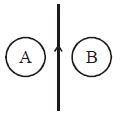
$A$ and $B$ are two metallic rings placed at opposite sides of an infinitely long straight conducting wire as shown. If current in the wire is slowly decreased,the direction of induced current will be
A
Clockwise in $A$ and anticlockwise in $B$
B
Anticlockwise in $A$ and clockwise in $B$
C
Clockwise in both $A$ and $B$
D
Anticlockwise in both $A$ and $B$
Solution
(B) $1$. According to the right-hand thumb rule,the magnetic field produced by the current in the wire is directed into the page on the right side (near ring $B$) and out of the page on the left side (near ring $A$).
$2$. When the current in the wire decreases,the magnetic flux through both rings decreases.
$3$. According to Lenz's law,the induced current will oppose this change by creating its own magnetic field to support the decreasing flux.
$4$. For ring $A$ (left side),the magnetic field is outward and decreasing. To support this,the induced current will flow in an anticlockwise direction to produce an outward magnetic field.
$5$. For ring $B$ (right side),the magnetic field is inward and decreasing. To support this,the induced current will flow in a clockwise direction to produce an inward magnetic field.
$6$. Therefore,the induced current is anticlockwise in $A$ and clockwise in $B$.
$2$. When the current in the wire decreases,the magnetic flux through both rings decreases.
$3$. According to Lenz's law,the induced current will oppose this change by creating its own magnetic field to support the decreasing flux.
$4$. For ring $A$ (left side),the magnetic field is outward and decreasing. To support this,the induced current will flow in an anticlockwise direction to produce an outward magnetic field.
$5$. For ring $B$ (right side),the magnetic field is inward and decreasing. To support this,the induced current will flow in a clockwise direction to produce an inward magnetic field.
$6$. Therefore,the induced current is anticlockwise in $A$ and clockwise in $B$.
0 likes
View Solution118
MediumMCQ
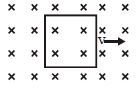
$A$ conducting square loop of side $l$ and resistance $R$ moves in its plane with a uniform velocity $v$ perpendicular to one of its sides. $A$ uniform and constant magnetic field $B$ exists perpendicular to the plane of the loop as shown in the figure. The current induced in the loop is
A
$Blv/R$ clockwise
B
$Blv/R$ anticlockwise
C
$2Blv/R$ anticlockwise
D
Zero
Solution
(D) The magnetic flux $\phi$ linked with the loop is given by $\phi = B \cdot A$,where $A$ is the area of the loop inside the magnetic field.
Since the magnetic field $B$ is uniform and constant,and the entire loop is moving within the region where the magnetic field exists,the area $A$ of the loop enclosed by the magnetic field remains constant.
As the magnetic flux $\phi = B \cdot A$ does not change with time,the rate of change of magnetic flux $d\phi/dt$ is zero.
According to Faraday's law of electromagnetic induction,the induced electromotive force $(EMF)$ is $\varepsilon = -d\phi/dt$.
Since $d\phi/dt = 0$,the induced $EMF$ $\varepsilon = 0$.
Consequently,the induced current $I = \varepsilon/R = 0$.
Therefore,no current is induced in the loop.
Since the magnetic field $B$ is uniform and constant,and the entire loop is moving within the region where the magnetic field exists,the area $A$ of the loop enclosed by the magnetic field remains constant.
As the magnetic flux $\phi = B \cdot A$ does not change with time,the rate of change of magnetic flux $d\phi/dt$ is zero.
According to Faraday's law of electromagnetic induction,the induced electromotive force $(EMF)$ is $\varepsilon = -d\phi/dt$.
Since $d\phi/dt = 0$,the induced $EMF$ $\varepsilon = 0$.
Consequently,the induced current $I = \varepsilon/R = 0$.
Therefore,no current is induced in the loop.
0 likes
View Solution119
DifficultMCQ
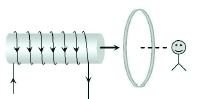
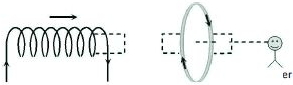
$A$ current-carrying solenoid is approaching a conducting loop as shown in the figure. The direction of the induced current as observed by an observer on the other side of the loop will be
A
Anticlockwise
B
Clockwise
C
East
D
West
Solution
(B) According to Lenz's Law,the direction of the induced current in a closed loop is such that it opposes the change in magnetic flux that produced it.
As the solenoid approaches the loop,the magnetic flux linked with the loop increases.
To oppose this increase,the loop will develop a magnetic field in the opposite direction to the solenoid's magnetic field.
The solenoid acts like a bar magnet with its North pole facing the loop.
Therefore,the loop must behave like a North pole on the side facing the solenoid to repel it.
For the loop to act as a North pole,the current must flow in an anticlockwise direction when viewed from the side of the solenoid.
However,the observer is on the other side of the loop. When viewed from the observer's side,the current will appear to flow in the opposite direction,which is clockwise.
As the solenoid approaches the loop,the magnetic flux linked with the loop increases.
To oppose this increase,the loop will develop a magnetic field in the opposite direction to the solenoid's magnetic field.
The solenoid acts like a bar magnet with its North pole facing the loop.
Therefore,the loop must behave like a North pole on the side facing the solenoid to repel it.
For the loop to act as a North pole,the current must flow in an anticlockwise direction when viewed from the side of the solenoid.
However,the observer is on the other side of the loop. When viewed from the observer's side,the current will appear to flow in the opposite direction,which is clockwise.
0 likes
View Solution120
DifficultMCQ
$A$ long solenoid of radius $2\, cm$ has $100\, turns/cm$ and carries a current of $5\, A$. $A$ coil of radius $1\, cm$ having $100\, turns$ and a total resistance of $20\, \Omega$ is placed inside the solenoid coaxially. The coil is connected to a galvanometer. If the current in the solenoid is reversed in direction,find the charge flown through the galvanometer.
A
$2 \times 10^{-4}\, C$
B
$4 \times 10^{-4}\, C$
C
$6 \times 10^{-4}\, C$
D
$8 \times 10^{-4}\, C$
Solution
(A) The magnetic field inside the solenoid is given by $B = \mu_0 n I$,where $n = 100\, turns/cm = 10^4\, turns/m$ and $I = 5\, A$.
$B = (4\pi \times 10^{-7}) \times 10^4 \times 5 = 20\pi \times 10^{-3}\, T = 0.02\pi\, T$.
The magnetic flux through the coil is $\phi = N B A_{coil}$,where $N = 100$ and $A_{coil} = \pi r^2 = \pi (0.01)^2 = \pi \times 10^{-4}\, m^2$.
When the current is reversed,the change in flux is $\Delta \phi = \phi_f - \phi_i = (-NBA) - (NBA) = -2NBA$.
The induced charge $q$ is given by $q = \frac{|\Delta \phi|}{R} = \frac{2NBA}{R}$.
Substituting the values: $q = \frac{2 \times 100 \times (0.02\pi) \times (\pi \times 10^{-4})}{20} = \frac{4 \times 10^2 \times 0.01 \times \pi^2 \times 10^{-4}}{20} = \frac{4 \times 10^{-4} \times \pi^2}{20}$.
Using $\pi^2 \approx 10$,$q = \frac{4 \times 10^{-4} \times 10}{20} = 2 \times 10^{-4}\, C$.
$B = (4\pi \times 10^{-7}) \times 10^4 \times 5 = 20\pi \times 10^{-3}\, T = 0.02\pi\, T$.
The magnetic flux through the coil is $\phi = N B A_{coil}$,where $N = 100$ and $A_{coil} = \pi r^2 = \pi (0.01)^2 = \pi \times 10^{-4}\, m^2$.
When the current is reversed,the change in flux is $\Delta \phi = \phi_f - \phi_i = (-NBA) - (NBA) = -2NBA$.
The induced charge $q$ is given by $q = \frac{|\Delta \phi|}{R} = \frac{2NBA}{R}$.
Substituting the values: $q = \frac{2 \times 100 \times (0.02\pi) \times (\pi \times 10^{-4})}{20} = \frac{4 \times 10^2 \times 0.01 \times \pi^2 \times 10^{-4}}{20} = \frac{4 \times 10^{-4} \times \pi^2}{20}$.
Using $\pi^2 \approx 10$,$q = \frac{4 \times 10^{-4} \times 10}{20} = 2 \times 10^{-4}\, C$.
0 likes
View Solution121
MediumMCQ
$A$ metallic ring is dropped down, keeping its plane perpendicular to a constant and horizontal magnetic field. The ring enters the region of magnetic field at $t = 0$ and completely emerges out at $t = T \, \text{sec}$. The current in the ring varies as
A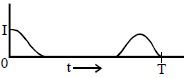
B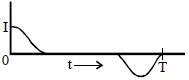
C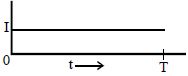
D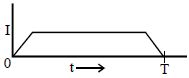
Solution
(B) When the ring enters the magnetic field, the magnetic flux linked with the ring changes, which induces an electromotive force $(emf)$ and consequently an induced current. According to Lenz's law, this current opposes the cause of its production.
Once the ring is completely inside the uniform magnetic field, the magnetic flux linked with it remains constant. Since there is no change in magnetic flux $(\frac{d\phi}{dt} = 0)$, the induced $emf$ and the induced current become zero.
When the ring starts to emerge from the magnetic field, the magnetic flux linked with it changes again. This induces an $emf$ and a current in the opposite direction compared to the entry phase.
Therefore, the current is non-zero during entry, zero while inside, and non-zero (with opposite polarity) during exit. Graph $B$ correctly represents this variation.
Once the ring is completely inside the uniform magnetic field, the magnetic flux linked with it remains constant. Since there is no change in magnetic flux $(\frac{d\phi}{dt} = 0)$, the induced $emf$ and the induced current become zero.
When the ring starts to emerge from the magnetic field, the magnetic flux linked with it changes again. This induces an $emf$ and a current in the opposite direction compared to the entry phase.
Therefore, the current is non-zero during entry, zero while inside, and non-zero (with opposite polarity) during exit. Graph $B$ correctly represents this variation.
0 likes
View Solution122
MediumMCQ
The flux linked with a coil at any instant $t$ is given by $\phi = 10t^2 - 50t + 250$. The induced $emf$ at $t = 3 \ s$ is ....... $V$.
A
$-190$
B
$-10$
C
$10$
D
$190$
Solution
(B) The magnetic flux linked with the coil is given by $\phi = 10t^2 - 50t + 250$.
According to Faraday's law of electromagnetic induction,the induced $emf$ $(e)$ is given by $e = -\frac{d\phi}{dt}$.
Differentiating the flux with respect to time $t$:
$\frac{d\phi}{dt} = \frac{d}{dt}(10t^2 - 50t + 250) = 20t - 50$.
Therefore,the induced $emf$ is $e = -(20t - 50) = 50 - 20t$.
At $t = 3 \ s$,the induced $emf$ is:
$e = 50 - 20(3) = 50 - 60 = -10 \ V$.
According to Faraday's law of electromagnetic induction,the induced $emf$ $(e)$ is given by $e = -\frac{d\phi}{dt}$.
Differentiating the flux with respect to time $t$:
$\frac{d\phi}{dt} = \frac{d}{dt}(10t^2 - 50t + 250) = 20t - 50$.
Therefore,the induced $emf$ is $e = -(20t - 50) = 50 - 20t$.
At $t = 3 \ s$,the induced $emf$ is:
$e = 50 - 20(3) = 50 - 60 = -10 \ V$.
0 likes
View Solution123
EasyMCQ
Assertion: An $emf$ $\vec{E}$ is induced in a closed loop where magnetic flux is varied. The induced $\vec{E}$ is not a conservative field.
Reason: The line integral $\oint \vec{E} \cdot d\vec{l}$ around the closed loop is nonzero.
Reason: The line integral $\oint \vec{E} \cdot d\vec{l}$ around the closed loop is nonzero.
A
If both Assertion and Reason are correct and the Reason is a correct explanation of the Assertion.
B
If both Assertion and Reason are correct but Reason is not a correct explanation of the Assertion.
C
If the Assertion is correct but Reason is incorrect.
D
If both the Assertion and Reason are incorrect.
Solution
(A) According to Faraday's law of electromagnetic induction,the induced $emf$ in a closed loop is given by $\oint \vec{E} \cdot d\vec{l} = -\frac{d\phi}{dt}$.
Since the magnetic flux $\phi$ is varying,the line integral $\oint \vec{E} \cdot d\vec{l}$ is non-zero.
$A$ field is defined as conservative if the line integral of the field around any closed loop is zero. Since the line integral here is non-zero,the induced electric field $\vec{E}$ is a non-conservative field.
Therefore,both the Assertion and the Reason are correct,and the Reason correctly explains the Assertion.
Since the magnetic flux $\phi$ is varying,the line integral $\oint \vec{E} \cdot d\vec{l}$ is non-zero.
$A$ field is defined as conservative if the line integral of the field around any closed loop is zero. Since the line integral here is non-zero,the induced electric field $\vec{E}$ is a non-conservative field.
Therefore,both the Assertion and the Reason are correct,and the Reason correctly explains the Assertion.
0 likes
View Solution124
EasyMCQ
Assertion : An induced current has a direction such that the magnetic field due to the current opposes the change in the magnetic flux that induces the current.
Reason : The above statement is in accordance with the conservation of energy.
Reason : The above statement is in accordance with the conservation of energy.
A
If both Assertion and Reason are correct and the Reason is a correct explanation of the Assertion.
B
If both Assertion and Reason are correct but Reason is not a correct explanation of the Assertion.
C
If the Assertion is correct but Reason is incorrect.
D
If both the Assertion and Reason are incorrect.
Solution
(A) The Assertion describes Lenz's Law,which states that the direction of induced current is such that it opposes the change in magnetic flux that produced it.
Lenz's Law is a direct consequence of the Law of Conservation of Energy. If the induced current were to aid the change in magnetic flux,it would lead to an infinite increase in energy,which violates the principle of conservation of energy.
Therefore,the Reason correctly explains the Assertion.
Lenz's Law is a direct consequence of the Law of Conservation of Energy. If the induced current were to aid the change in magnetic flux,it would lead to an infinite increase in energy,which violates the principle of conservation of energy.
Therefore,the Reason correctly explains the Assertion.
0 likes
View Solution125
EasyMCQ
Assertion : Lenz's law violates the principle of conservation of energy.
Reason : Induced $emf$ always opposes the change in magnetic flux responsible for its production.
Reason : Induced $emf$ always opposes the change in magnetic flux responsible for its production.
A
If both Assertion and Reason are correct and the Reason is a correct explanation of the Assertion.
B
If both Assertion and Reason are correct but Reason is not a correct explanation of the Assertion.
C
If the Assertion is correct but Reason is incorrect.
D
If both the Assertion and Reason are incorrect.
Solution
(D) Lenz's law states that the direction of the induced $emf$ is always such that it opposes the change in magnetic flux that produces it.
This law is a direct consequence of the law of conservation of energy.
If the induced $emf$ were to assist the change in flux,it would lead to an increase in energy without any external work,which is impossible.
Therefore,the Assertion is incorrect,and the Reason is correct.
This law is a direct consequence of the law of conservation of energy.
If the induced $emf$ were to assist the change in flux,it would lead to an increase in energy without any external work,which is impossible.
Therefore,the Assertion is incorrect,and the Reason is correct.
0 likes
View Solution126
EasyMCQ
Assertion : Faraday's laws are a consequence of the conservation of energy.
Reason : In a purely resistive $AC$ circuit,the current lags behind the $emf$ in phase.
Reason : In a purely resistive $AC$ circuit,the current lags behind the $emf$ in phase.
A
If both Assertion and Reason are correct and the Reason is a correct explanation of the Assertion.
B
If both Assertion and Reason are correct but Reason is not a correct explanation of the Assertion.
C
If the Assertion is correct but Reason is incorrect.
D
If both the Assertion and Reason are incorrect.
Solution
(C) Faraday's law,specifically Lenz's law,is a direct consequence of the law of conservation of energy. If this were not true,we could create energy out of nothing,which violates physical laws.
In a purely resistive $AC$ circuit,the voltage $(emf)$ and current are in the same phase. The phase difference between them is $0$. Therefore,the statement in the Reason is incorrect.
Thus,the Assertion is correct,but the Reason is incorrect.
In a purely resistive $AC$ circuit,the voltage $(emf)$ and current are in the same phase. The phase difference between them is $0$. Therefore,the statement in the Reason is incorrect.
Thus,the Assertion is correct,but the Reason is incorrect.
0 likes
View Solution127
EasyMCQ
Assertion : Faraday's laws are consequences of conservation of energy.
Reason : In a purely resistive $A.C.$ circuit,the current lags behind the $e.m.f.$ in phase.
Reason : In a purely resistive $A.C.$ circuit,the current lags behind the $e.m.f.$ in phase.
A
If both Assertion and Reason are correct and the Reason is a correct explanation of the Assertion.
B
If both Assertion and Reason are correct but Reason is not a correct explanation of the Assertion.
C
If the Assertion is correct but Reason is incorrect.
D
If both the Assertion and Reason are incorrect.
Solution
(C) Faraday's laws of electromagnetic induction are a direct consequence of the law of conservation of energy. If they were not,we could create energy out of nothing,which violates the fundamental laws of physics.
In a purely resistive $A.C.$ circuit,the current and the $e.m.f.$ (voltage) are in the same phase. The phase difference between them is $0$. The statement that current lags behind the $e.m.f.$ is incorrect,as this only happens in an inductive circuit.
Therefore,the Assertion is correct,but the Reason is incorrect.
In a purely resistive $A.C.$ circuit,the current and the $e.m.f.$ (voltage) are in the same phase. The phase difference between them is $0$. The statement that current lags behind the $e.m.f.$ is incorrect,as this only happens in an inductive circuit.
Therefore,the Assertion is correct,but the Reason is incorrect.
0 likes
View Solution128
Medium
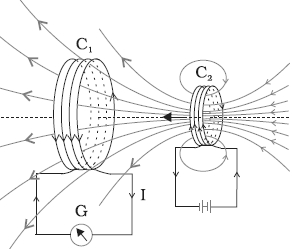
Consider the experiment shown in the figure.
$(a)$ What would you do to obtain a large deflection of the galvanometer?
$(b)$ How would you demonstrate the presence of an induced current in the absence of a galvanometer?
$(a)$ What would you do to obtain a large deflection of the galvanometer?
$(b)$ How would you demonstrate the presence of an induced current in the absence of a galvanometer?
Solution
(N/A) To obtain a large deflection,one or more of the following steps can be taken:
$(i)$ Use a rod made of soft iron inside the coil $C_2$.
$(ii)$ Connect the coil to a more powerful battery.
$(iii)$ Move the arrangement more rapidly towards or away from the test coil $C_1$.
$(b)$ Replace the galvanometer with a small bulb,such as one found in a small torch light. The relative motion between the two coils will cause the bulb to glow,thereby demonstrating the presence of an induced current.
In experimental physics,one must learn to innovate. Michael Faraday,who is ranked as one of the best experimentalists ever,was legendary for his innovative skills.
$(i)$ Use a rod made of soft iron inside the coil $C_2$.
$(ii)$ Connect the coil to a more powerful battery.
$(iii)$ Move the arrangement more rapidly towards or away from the test coil $C_1$.
$(b)$ Replace the galvanometer with a small bulb,such as one found in a small torch light. The relative motion between the two coils will cause the bulb to glow,thereby demonstrating the presence of an induced current.
In experimental physics,one must learn to innovate. Michael Faraday,who is ranked as one of the best experimentalists ever,was legendary for his innovative skills.
0 likes
View Solution129
MediumMCQ
$A$ square loop of side $10 \; cm$ and resistance $0.5 \; \Omega$ is placed vertically in the east-west plane. $A$ uniform magnetic field of $0.10 \; T$ is set up across the plane in the north-east direction. The magnetic field is decreased to zero in $0.70 \; s$ at a steady rate. Determine the magnitudes of induced emf and current during this time interval.
A
$1.0$ mV,$2$ mA
B
$2.0$ mV,$4$ mA
C
$0.5$ mV,$1$ mA
D
$1.5$ mV,$3$ mA
Solution
(A) The area of the square loop is $A = (10 \; cm)^2 = 100 \; cm^2 = 10^{-2} \; m^2$.
The angle $\theta$ between the area vector (perpendicular to the east-west plane) and the magnetic field (in the north-east direction) is $45^{\circ}$.
The initial magnetic flux is $\phi_i = B A \cos \theta = 0.10 \times 10^{-2} \times \cos(45^{\circ}) = \frac{10^{-3}}{\sqrt{2}} \; Wb$.
The final magnetic flux is $\phi_f = 0 \; Wb$.
The change in flux is $\Delta \phi = |\phi_f - \phi_i| = \frac{10^{-3}}{\sqrt{2}} \; Wb$.
The magnitude of the induced $emf$ is $\varepsilon = \frac{|\Delta \phi|}{\Delta t} = \frac{10^{-3}}{\sqrt{2} \times 0.70} \approx 1.01 \times 10^{-3} \; V \approx 1.0 \; mV$.
The magnitude of the induced current is $I = \frac{\varepsilon}{R} = \frac{1.01 \times 10^{-3} \; V}{0.5 \; \Omega} \approx 2.02 \times 10^{-3} \; A \approx 2.0 \; mA$.
The angle $\theta$ between the area vector (perpendicular to the east-west plane) and the magnetic field (in the north-east direction) is $45^{\circ}$.
The initial magnetic flux is $\phi_i = B A \cos \theta = 0.10 \times 10^{-2} \times \cos(45^{\circ}) = \frac{10^{-3}}{\sqrt{2}} \; Wb$.
The final magnetic flux is $\phi_f = 0 \; Wb$.
The change in flux is $\Delta \phi = |\phi_f - \phi_i| = \frac{10^{-3}}{\sqrt{2}} \; Wb$.
The magnitude of the induced $emf$ is $\varepsilon = \frac{|\Delta \phi|}{\Delta t} = \frac{10^{-3}}{\sqrt{2} \times 0.70} \approx 1.01 \times 10^{-3} \; V \approx 1.0 \; mV$.
The magnitude of the induced current is $I = \frac{\varepsilon}{R} = \frac{1.01 \times 10^{-3} \; V}{0.5 \; \Omega} \approx 2.02 \times 10^{-3} \; A \approx 2.0 \; mA$.
0 likes
View Solution130
Medium
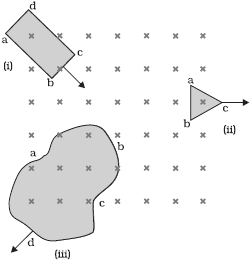
The figure shows planar loops of different shapes moving out of or into a region of a magnetic field which is directed normal to the plane of the loop away from the reader. Determine the direction of induced current in each loop using Lenz's law.
Solution
(N/A) $(i)$ The magnetic flux through the rectangular loop $abcd$ increases due to the motion of the loop into the region of the magnetic field. The induced current must flow along the path $bcdab$ so that it opposes the increasing flux.
$(ii)$ Due to the outward motion,the magnetic flux through the triangular loop $abc$ decreases,due to which the induced current flows along $bacb$ to oppose the change in flux.
$(iii)$ As the magnetic flux decreases due to the motion of the irregular-shaped loop $abcd$ out of the region of the magnetic field,the induced current flows along $cdabc$ to oppose the change in flux.
Note that there is no induced current as long as the loops are completely inside or outside the region of the magnetic field.
$(ii)$ Due to the outward motion,the magnetic flux through the triangular loop $abc$ decreases,due to which the induced current flows along $bacb$ to oppose the change in flux.
$(iii)$ As the magnetic flux decreases due to the motion of the irregular-shaped loop $abcd$ out of the region of the magnetic field,the induced current flows along $cdabc$ to oppose the change in flux.
Note that there is no induced current as long as the loops are completely inside or outside the region of the magnetic field.
0 likes
View Solution131
Medium
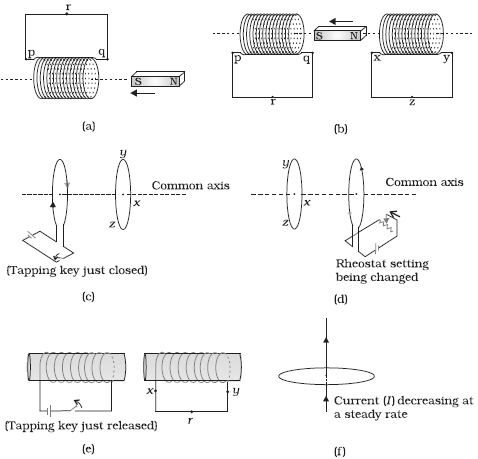
Predict the direction of induced current in the situations described by the following figures.
Solution
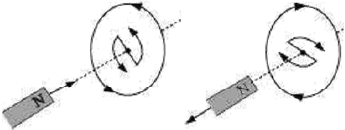
(N/A) The direction of the induced current in a closed loop is given by Lenz's law,which states that the polarity of induced emf is such that it tends to produce a current which opposes the change in magnetic flux that produced it.
$(a)$ As the North pole of the magnet moves towards the coil,the magnetic flux through the coil increases. To oppose this,the coil develops a North pole on the face towards the magnet. Thus,the induced current flows along $qrpq$.
$(b)$ As the North pole of the magnet moves away from the coil,the magnetic flux decreases. To oppose this,the coil develops a South pole on the face towards the magnet. Thus,the induced current flows along $prqp$ in the left coil and $zyxz$ in the right coil.
$(c)$ When the tapping key is just closed,the current in the left loop increases,creating an increasing magnetic field. By Lenz's law,the right loop develops an induced current to oppose this increase. The direction is along $zyxz$.
$(d)$ When the rheostat setting is changed to increase the resistance,the current in the right loop decreases,leading to a decrease in magnetic flux. The left loop develops an induced current to oppose this decrease. The direction is along $yzxy$.
$(e)$ When the tapping key is just released,the current in the primary coil drops to zero,causing a rapid decrease in magnetic flux. The secondary coil develops an induced current to oppose this change. The direction is along $xryx$.
$(f)$ No current is induced because the magnetic field lines are parallel to the plane of the loop,resulting in zero magnetic flux through the loop at all times.
$(a)$ As the North pole of the magnet moves towards the coil,the magnetic flux through the coil increases. To oppose this,the coil develops a North pole on the face towards the magnet. Thus,the induced current flows along $qrpq$.
$(b)$ As the North pole of the magnet moves away from the coil,the magnetic flux decreases. To oppose this,the coil develops a South pole on the face towards the magnet. Thus,the induced current flows along $prqp$ in the left coil and $zyxz$ in the right coil.
$(c)$ When the tapping key is just closed,the current in the left loop increases,creating an increasing magnetic field. By Lenz's law,the right loop develops an induced current to oppose this increase. The direction is along $zyxz$.
$(d)$ When the rheostat setting is changed to increase the resistance,the current in the right loop decreases,leading to a decrease in magnetic flux. The left loop develops an induced current to oppose this decrease. The direction is along $yzxy$.
$(e)$ When the tapping key is just released,the current in the primary coil drops to zero,causing a rapid decrease in magnetic flux. The secondary coil develops an induced current to oppose this change. The direction is along $xryx$.
$(f)$ No current is induced because the magnetic field lines are parallel to the plane of the loop,resulting in zero magnetic flux through the loop at all times.
0 likes
View Solution132
Medium
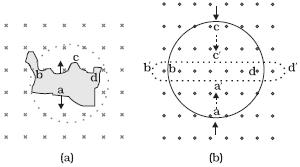
Use Lenz's law to determine the direction of induced current in the situations described by Figure:
$(a)$ $A$ wire of irregular shape turning into a circular shape;
$(b)$ $A$ circular loop being deformed into a narrow straight wire.
$(a)$ $A$ wire of irregular shape turning into a circular shape;
$(b)$ $A$ circular loop being deformed into a narrow straight wire.
Solution
(N/A) According to Lenz's law,the direction of the induced emf is such that it opposes the change in magnetic flux that produced it.
$(a)$ As the wire expands to form a circle,the area enclosed by the loop increases. Since the magnetic field is directed into the page (represented by crosses),the magnetic flux through the loop increases. To oppose this increase,the induced current must create a magnetic field directed out of the page. By the right-hand rule,this corresponds to an anticlockwise direction of current,i.e.,along $adcba$.
$(b)$ When the circular loop is deformed into a narrow straight wire,the area enclosed by the loop decreases,leading to a decrease in the magnetic flux through the loop. To oppose this decrease,the induced current must create a magnetic field directed into the page. By the right-hand rule,this corresponds to a clockwise direction of current,i.e.,along $abcda$.
$(a)$ As the wire expands to form a circle,the area enclosed by the loop increases. Since the magnetic field is directed into the page (represented by crosses),the magnetic flux through the loop increases. To oppose this increase,the induced current must create a magnetic field directed out of the page. By the right-hand rule,this corresponds to an anticlockwise direction of current,i.e.,along $adcba$.
$(b)$ When the circular loop is deformed into a narrow straight wire,the area enclosed by the loop decreases,leading to a decrease in the magnetic flux through the loop. To oppose this decrease,the induced current must create a magnetic field directed into the page. By the right-hand rule,this corresponds to a clockwise direction of current,i.e.,along $abcda$.
0 likes
View Solution133
MediumMCQ
$A$ long solenoid with $15$ turns per $cm$ has a small loop of area $2.0 \; cm^{2}$ placed inside the solenoid normal to its axis. If the current carried by the solenoid changes steadily from $2.0 \; A$ to $4.0 \; A$ in $0.1 \; s$, what is the induced $emf$ in the loop while the current is changing?
A
$6.42 \times 10^{-7} \; V$
B
$7.54 \times 10^{-6} \; V$
C
$1.94 \times 10^{-6} \; V$
D
$3.754 \times 10^{-5} \; V$
Solution
(B) The number of turns per unit length $n = 15 \; \text{turns/cm} = 1500 \; \text{turns/m}$.
The area of the small loop is $A = 2.0 \; \text{cm}^2 = 2.0 \times 10^{-4} \; \text{m}^2$.
The change in current $\Delta I = 4.0 \; \text{A} - 2.0 \; \text{A} = 2.0 \; \text{A}$.
The time interval $\Delta t = 0.1 \; \text{s}$.
The magnetic field inside a long solenoid is $B = \mu_0 n I$.
The magnetic flux through the loop is $\phi = BA = \mu_0 n I A$.
According to Faraday's law, the induced $emf$ is $e = \left| \frac{d\phi}{dt} \right| = \mu_0 n A \left( \frac{dI}{dt} \right)$.
Substituting the values:
$e = (4\pi \times 10^{-7} \; \text{T m/A}) \times (1500 \; \text{m}^{-1}) \times (2.0 \times 10^{-4} \; \text{m}^2) \times \left( \frac{2.0 \; \text{A}}{0.1 \; \text{s}} \right)$.
$e = (4 \times 3.14159 \times 10^{-7}) \times 1500 \times 2.0 \times 10^{-4} \times 20$.
$e = 7.5398 \times 10^{-6} \; \text{V} \approx 7.54 \times 10^{-6} \; \text{V}$.
The area of the small loop is $A = 2.0 \; \text{cm}^2 = 2.0 \times 10^{-4} \; \text{m}^2$.
The change in current $\Delta I = 4.0 \; \text{A} - 2.0 \; \text{A} = 2.0 \; \text{A}$.
The time interval $\Delta t = 0.1 \; \text{s}$.
The magnetic field inside a long solenoid is $B = \mu_0 n I$.
The magnetic flux through the loop is $\phi = BA = \mu_0 n I A$.
According to Faraday's law, the induced $emf$ is $e = \left| \frac{d\phi}{dt} \right| = \mu_0 n A \left( \frac{dI}{dt} \right)$.
Substituting the values:
$e = (4\pi \times 10^{-7} \; \text{T m/A}) \times (1500 \; \text{m}^{-1}) \times (2.0 \times 10^{-4} \; \text{m}^2) \times \left( \frac{2.0 \; \text{A}}{0.1 \; \text{s}} \right)$.
$e = (4 \times 3.14159 \times 10^{-7}) \times 1500 \times 2.0 \times 10^{-4} \times 20$.
$e = 7.5398 \times 10^{-6} \; \text{V} \approx 7.54 \times 10^{-6} \; \text{V}$.
0 likes
View Solution134
Medium
It is desired to measure the magnitude of the magnetic field between the poles of a powerful loudspeaker magnet. $A$ small flat search coil of area $2 \; cm^{2}$ with $25$ closely wound turns is positioned normal to the field direction and then quickly snatched out of the field region. (Equivalently,one can give it a quick $90^{\circ}$ turn to bring its plane parallel to the field direction). The total charge flown in the coil (measured by a ballistic galvanometer connected to the coil) is $7.5 \; mC$. The combined resistance of the coil and the galvanometer is $0.50 \; \Omega$. Estimate the field strength of the magnet.
Solution
(0.75 T) Given:
Area of the coil,$A = 2 \; cm^{2} = 2 \times 10^{-4} \; m^{2}$
Number of turns,$N = 25$
Total charge,$Q = 7.5 \; mC = 7.5 \times 10^{-3} \; C$
Total resistance,$R = 0.50 \; \Omega$
The induced emf is given by Faraday's law: $e = -N \frac{d\phi}{dt}$.
The induced current is $I = \frac{e}{R} = -\frac{N}{R} \frac{d\phi}{dt}$.
The total charge $Q$ is the integral of current over time: $Q = \int I \; dt = -\frac{N}{R} \int_{\phi_i}^{\phi_f} d\phi = -\frac{N}{R} (\phi_f - \phi_i)$.
Since the coil is removed from the field,the final flux $\phi_f = 0$ and the initial flux $\phi_i = BA$.
Thus,$Q = \frac{N \phi_i}{R} = \frac{NBA}{R}$.
Rearranging for the magnetic field $B$: $B = \frac{QR}{NA}$.
Substituting the values: $B = \frac{7.5 \times 10^{-3} \times 0.50}{25 \times 2 \times 10^{-4}} = \frac{3.75 \times 10^{-3}}{50 \times 10^{-4}} = \frac{3.75 \times 10^{-3}}{5 \times 10^{-3}} = 0.75 \; T$.
Therefore,the field strength of the magnet is $0.75 \; T$.
Area of the coil,$A = 2 \; cm^{2} = 2 \times 10^{-4} \; m^{2}$
Number of turns,$N = 25$
Total charge,$Q = 7.5 \; mC = 7.5 \times 10^{-3} \; C$
Total resistance,$R = 0.50 \; \Omega$
The induced emf is given by Faraday's law: $e = -N \frac{d\phi}{dt}$.
The induced current is $I = \frac{e}{R} = -\frac{N}{R} \frac{d\phi}{dt}$.
The total charge $Q$ is the integral of current over time: $Q = \int I \; dt = -\frac{N}{R} \int_{\phi_i}^{\phi_f} d\phi = -\frac{N}{R} (\phi_f - \phi_i)$.
Since the coil is removed from the field,the final flux $\phi_f = 0$ and the initial flux $\phi_i = BA$.
Thus,$Q = \frac{N \phi_i}{R} = \frac{NBA}{R}$.
Rearranging for the magnetic field $B$: $B = \frac{QR}{NA}$.
Substituting the values: $B = \frac{7.5 \times 10^{-3} \times 0.50}{25 \times 2 \times 10^{-4}} = \frac{3.75 \times 10^{-3}}{50 \times 10^{-4}} = \frac{3.75 \times 10^{-3}}{5 \times 10^{-3}} = 0.75 \; T$.
Therefore,the field strength of the magnet is $0.75 \; T$.
0 likes
View Solution135
Easy
Discuss the contribution of different scientists to electromagnetism. Define electromagnetic induction.
Solution
(N/A) For a long time,electricity and magnetism were considered separate and unrelated phenomena. In the early $19^{th}$ century,experiments by Oersted,Ampere,and others established that electricity and magnetism are interrelated,showing that moving electric charges produce magnetic fields.
Michael Faraday in England and Joseph Henry in the $USA$,around $1830$,demonstrated that electric currents are induced in closed coils when subjected to changing magnetic fields.
Electromagnetic induction is the phenomenon in which an electric current is generated in a conductor by a varying magnetic field.
Michael Faraday in England and Joseph Henry in the $USA$,around $1830$,demonstrated that electric currents are induced in closed coils when subjected to changing magnetic fields.
Electromagnetic induction is the phenomenon in which an electric current is generated in a conductor by a varying magnetic field.
0 likes
View Solution136
Easy
Which discovery did Faraday make public? Discuss the importance of electromagnetic induction.
Solution
(N/A) Faraday made public his discovery that relative motion between a bar magnet and a wire loop produces an electric current in the loop.
The phenomenon of electromagnetic induction is not merely of theoretical interest but is of immense practical utility. Imagine a world without electricity—no electric lights,no trains,no telephones,and no computers. Electromagnetic induction is the fundamental principle behind the generation of electricity.
The pioneering experiments of Faraday and Henry led directly to the development of modern-day generators,motors,and transformers. Today's civilization owes its progress to a great extent to the discovery of electromagnetic induction.
The phenomenon of electromagnetic induction is not merely of theoretical interest but is of immense practical utility. Imagine a world without electricity—no electric lights,no trains,no telephones,and no computers. Electromagnetic induction is the fundamental principle behind the generation of electricity.
The pioneering experiments of Faraday and Henry led directly to the development of modern-day generators,motors,and transformers. Today's civilization owes its progress to a great extent to the discovery of electromagnetic induction.
0 likes
View Solution137
MediumMCQ
The phenomenon of "Electromagnetic induction" was discovered by which scientist?
A
Michael Faraday
B
James Clerk Maxwell
C
Heinrich Lenz
D
Hans Christian Oersted
Solution
(A) The phenomenon of electromagnetic induction was discovered by $Michael \ Faraday$ in $1831$. He observed that a changing magnetic flux through a coil induces an electromotive force $(EMF)$ in it. Joseph Henry also discovered this phenomenon independently around the same time, but $Michael \ Faraday$ is primarily credited for the discovery and the subsequent laws.
0 likes
View Solution138
Medium
What is electromagnetic induction?
Solution
(N/A) Electromagnetic induction is the phenomenon of generating an electromotive force $(EMF)$ or current in a conductor by changing the magnetic flux linked with it.
According to Faraday's law,the magnitude of the induced $EMF$ is equal to the rate of change of magnetic flux through the circuit,given by $\varepsilon = -\frac{d\Phi_B}{dt}$.
This phenomenon is the fundamental principle behind the operation of electric generators,transformers,and induction motors.
According to Faraday's law,the magnitude of the induced $EMF$ is equal to the rate of change of magnetic flux through the circuit,given by $\varepsilon = -\frac{d\Phi_B}{dt}$.
This phenomenon is the fundamental principle behind the operation of electric generators,transformers,and induction motors.
0 likes
View Solution139
Easy
Discuss Faraday's experiment of bar magnet and coil for generation of electric current in coil.
Solution
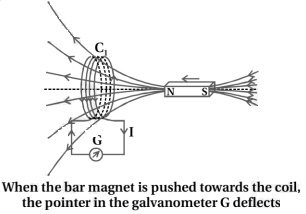
(N/A) The figure shows a coil $C_{1}$ connected to a galvanometer $G$.
When the North-pole of a bar magnet is pushed towards the coil,the pointer in the galvanometer deflects,indicating the presence of electric current in the coil. The deflection lasts as long as the bar magnet is in motion. When the magnet is pulled away from the coil,the galvanometer shows deflection in the opposite direction,which indicates a reversal of the current's direction. The galvanometer does not show any deflection when the magnet is held stationary. Moreover,when the South-pole of the bar magnet is moved towards or away from the coil,the deflections in the galvanometer are opposite to those observed with the North-pole for similar movements.
Further,the deflection (and hence current) is found to be larger when the magnet is pushed towards or pulled away from the coil faster.
Instead,when the bar magnet is held fixed and the coil $C_{1}$ is moved towards or away from the magnet,the same effects are observed.
It shows that it is the relative motion between the magnet and the coil that is responsible for the generation (induction) of electric current in the coil.
When the North-pole of a bar magnet is pushed towards the coil,the pointer in the galvanometer deflects,indicating the presence of electric current in the coil. The deflection lasts as long as the bar magnet is in motion. When the magnet is pulled away from the coil,the galvanometer shows deflection in the opposite direction,which indicates a reversal of the current's direction. The galvanometer does not show any deflection when the magnet is held stationary. Moreover,when the South-pole of the bar magnet is moved towards or away from the coil,the deflections in the galvanometer are opposite to those observed with the North-pole for similar movements.
Further,the deflection (and hence current) is found to be larger when the magnet is pushed towards or pulled away from the coil faster.
Instead,when the bar magnet is held fixed and the coil $C_{1}$ is moved towards or away from the magnet,the same effects are observed.
It shows that it is the relative motion between the magnet and the coil that is responsible for the generation (induction) of electric current in the coil.
0 likes
View Solution140
Medium
Discuss Faraday's experiment of two coils for the generation of electric current in a coil.
Solution
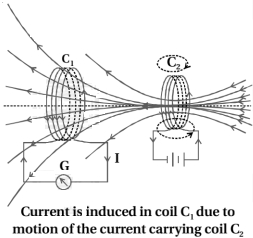
(N/A) In the figure,two coils $C_{1}$ and $C_{2}$ are shown. Coil $C_{1}$ is connected to a galvanometer $G$,and coil $C_{2}$ is connected to a battery.
The steady current in coil $C_{2}$ produces a steady magnetic field. As coil $C_{2}$ is moved towards coil $C_{1}$,the galvanometer shows a deflection. This indicates that an electric current is induced in coil $C_{1}$.
When $C_{2}$ is moved away,the galvanometer shows a deflection again,but this time in the opposite direction.
The deflection lasts as long as coil $C_{2}$ is in motion.
When coil $C_{2}$ is held fixed and $C_{1}$ is moved,the same effects are observed. Again,it is the relative motion between the coils that induces the electric current.
The steady current in coil $C_{2}$ produces a steady magnetic field. As coil $C_{2}$ is moved towards coil $C_{1}$,the galvanometer shows a deflection. This indicates that an electric current is induced in coil $C_{1}$.
When $C_{2}$ is moved away,the galvanometer shows a deflection again,but this time in the opposite direction.
The deflection lasts as long as coil $C_{2}$ is in motion.
When coil $C_{2}$ is held fixed and $C_{1}$ is moved,the same effects are observed. Again,it is the relative motion between the coils that induces the electric current.
0 likes
View Solution141
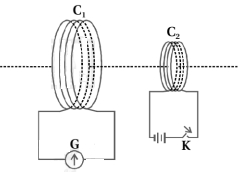
Difficult
Discuss Faraday's experiment which shows that relative motion is not an absolute requirement for electromagnetic induction.
Solution
(N/A) The figure shows two coils $C_{1}$ and $C_{2}$ held stationary. Coil $C_{1}$ is connected to a galvanometer $G$,while the second coil $C_{2}$ is connected to a battery through a tapping key $K$.
It is observed that the galvanometer shows a momentary deflection when the tapping key $K$ is pressed. The pointer in the galvanometer returns to zero immediately. If the key is held pressed continuously,there is no deflection in the galvanometer.
When the key is released,a momentary deflection is observed again,but in the opposite direction. It is also observed that the deflection increases dramatically when an iron rod is inserted into the coils along their axis.
Thus,it can be concluded from this experiment that relative motion is not an absolute requirement to induce current.
It is observed that the galvanometer shows a momentary deflection when the tapping key $K$ is pressed. The pointer in the galvanometer returns to zero immediately. If the key is held pressed continuously,there is no deflection in the galvanometer.
When the key is released,a momentary deflection is observed again,but in the opposite direction. It is also observed that the deflection increases dramatically when an iron rod is inserted into the coils along their axis.
Thus,it can be concluded from this experiment that relative motion is not an absolute requirement to induce current.
0 likes
View Solution142
MediumMCQ
Is relative motion an absolute condition for inducing an $emf$?
A
Yes,it is always required.
B
No,a time-varying magnetic field can also induce an $emf$.
C
Yes,only motion can change magnetic flux.
D
No,only electric fields can induce an $emf$.
Solution
(B) No,relative motion is not an absolute condition for inducing an $emf$. According to Faraday's Law of Induction,an $emf$ is induced whenever there is a change in the magnetic flux linked with a circuit. This change in magnetic flux can be achieved in several ways:
$1$. By changing the magnetic field $B$ with time (e.g.,using an alternating current in a nearby coil).
$2$. By changing the area $A$ of the loop in a magnetic field.
$3$. By changing the orientation (angle $\theta$) of the loop relative to the magnetic field.
Therefore,even if there is no relative motion between the source of the magnetic field and the conductor,an $emf$ can be induced if the magnetic field itself is time-varying.
$1$. By changing the magnetic field $B$ with time (e.g.,using an alternating current in a nearby coil).
$2$. By changing the area $A$ of the loop in a magnetic field.
$3$. By changing the orientation (angle $\theta$) of the loop relative to the magnetic field.
Therefore,even if there is no relative motion between the source of the magnetic field and the conductor,an $emf$ can be induced if the magnetic field itself is time-varying.
0 likes
View Solution143
MediumMCQ
If we move a magnet towards a coil with greater velocity, will the induced current increase or decrease?
A
Increase
B
Decrease
C
Remain the same
D
Become zero
Solution
(A) According to Faraday's Law of Electromagnetic Induction, the induced electromotive force $(e)$ is given by $e = -\frac{d\phi}{dt}$.
When a magnet is moved towards a coil with a greater velocity, the rate of change of magnetic flux $(\frac{d\phi}{dt})$ linked with the coil increases.
Since the induced electromotive force is directly proportional to the rate of change of magnetic flux, the induced electromotive force $(e)$ increases.
According to Ohm's Law, $I = \frac{e}{R}$, where $R$ is the resistance of the coil.
Since $e$ increases and $R$ remains constant, the induced current $(I)$ will increase.
When a magnet is moved towards a coil with a greater velocity, the rate of change of magnetic flux $(\frac{d\phi}{dt})$ linked with the coil increases.
Since the induced electromotive force is directly proportional to the rate of change of magnetic flux, the induced electromotive force $(e)$ increases.
According to Ohm's Law, $I = \frac{e}{R}$, where $R$ is the resistance of the coil.
Since $e$ increases and $R$ remains constant, the induced current $(I)$ will increase.
0 likes
View Solution144
Medium
State and explain Faraday's law of electromagnetic induction.
Solution
(N/A) Faraday's law states: "The magnitude of the induced emf in a circuit is equal to the time rate of change of magnetic flux through the circuit."
Mathematically, the induced emf $\varepsilon$ is given by:
$\varepsilon = -\frac{d \phi_{B}}{d t}$ ... $(1)$
The negative sign indicates the direction of $\varepsilon$ (Lenz's Law), which opposes the change in magnetic flux.
In the case of a closely wound coil of $N$ turns, the change of flux associated with each turn is the same. Therefore, the expression for the total induced emf is given by:
$\varepsilon = -N \frac{d \phi_{B}}{d t}$ ... $(2)$
The induced emf can be increased by increasing the number of turns $N$ of the coil or by increasing the rate of change of magnetic flux $\frac{d \phi_{B}}{d t}$.
Mathematically, the induced emf $\varepsilon$ is given by:
$\varepsilon = -\frac{d \phi_{B}}{d t}$ ... $(1)$
The negative sign indicates the direction of $\varepsilon$ (Lenz's Law), which opposes the change in magnetic flux.
In the case of a closely wound coil of $N$ turns, the change of flux associated with each turn is the same. Therefore, the expression for the total induced emf is given by:
$\varepsilon = -N \frac{d \phi_{B}}{d t}$ ... $(2)$
The induced emf can be increased by increasing the number of turns $N$ of the coil or by increasing the rate of change of magnetic flux $\frac{d \phi_{B}}{d t}$.
0 likes
View Solution145
EasyMCQ
The negative sign in Faraday's law represents which fact?
A
The induced $EMF$ is always positive.
B
The induced $EMF$ opposes the change in magnetic flux.
C
The induced $EMF$ is proportional to the magnetic field.
D
The induced $EMF$ is independent of time.
Solution
(B) Faraday's law of electromagnetic induction is given by the formula $\varepsilon = -\frac{d\Phi_B}{dt}$.
The negative sign in this equation is a mathematical representation of Lenz's Law.
Lenz's Law states that the direction of the induced current (and thus the induced $EMF$) is such that it always opposes the change in magnetic flux that produced it.
Therefore,the negative sign signifies the opposition to the change in magnetic flux.
The negative sign in this equation is a mathematical representation of Lenz's Law.
Lenz's Law states that the direction of the induced current (and thus the induced $EMF$) is such that it always opposes the change in magnetic flux that produced it.
Therefore,the negative sign signifies the opposition to the change in magnetic flux.
0 likes
View Solution146
MediumMCQ
Which scientist showed that by changing magnetic field an electric field can be obtained?
A
Michael Faraday
B
James Clerk Maxwell
C
Heinrich Hertz
D
Andre-Marie Ampere
Solution
(A) Michael Faraday discovered the phenomenon of electromagnetic induction in $1831$. He demonstrated that a changing magnetic field through a closed loop induces an electromotive force $(EMF)$,which in turn creates an electric field. This is summarized by Faraday's law of induction,which states that the induced electric field is proportional to the rate of change of the magnetic flux.
0 likes
View Solution147
Medium
If magnetic flux $\phi = (3t^2 - 2t + 5) \ Wb$,then what is the induced emf at $t = 2 \ s$?
Solution
(10 V) According to Faraday's law of electromagnetic induction,the induced emf $\varepsilon$ is given by $\varepsilon = -\frac{d\phi}{dt}$.
Given $\phi = 3t^2 - 2t + 5$.
Differentiating with respect to $t$,we get $\frac{d\phi}{dt} = \frac{d}{dt}(3t^2 - 2t + 5) = 6t - 2$.
The magnitude of induced emf is $|\varepsilon| = |6t - 2|$.
At $t = 2 \ s$,$|\varepsilon| = |6(2) - 2| = |12 - 2| = 10 \ V$.
Given $\phi = 3t^2 - 2t + 5$.
Differentiating with respect to $t$,we get $\frac{d\phi}{dt} = \frac{d}{dt}(3t^2 - 2t + 5) = 6t - 2$.
The magnitude of induced emf is $|\varepsilon| = |6t - 2|$.
At $t = 2 \ s$,$|\varepsilon| = |6(2) - 2| = |12 - 2| = 10 \ V$.
0 likes
View Solution148
Medium
State Lenz's law and prove that it is a specific representation of the law of conservation of energy.
Solution
(N/A) Lenz's law states that the polarity of induced emf is such that it tends to produce a current which opposes the change in magnetic flux that produced it.
Proof of Conservation of Energy:
Consider a bar magnet being pushed towards a closed coil. As the North-pole of the magnet moves towards the coil,the magnetic flux through the coil increases. According to Lenz's law,the induced current in the coil will flow in a direction that creates a North-pole on the face of the coil towards the magnet. This creates a repulsive force between the magnet and the coil.
To continue moving the magnet towards the coil,we must do work against this repulsive force. This mechanical work done by the external agent is converted into electrical energy,which manifests as the induced current in the coil. If the current were to flow in the opposite direction (attracting the magnet),the magnet would accelerate towards the coil,increasing the flux and the current further,leading to an infinite increase in energy without any work done,which violates the law of conservation of energy. Thus,Lenz's law is a direct consequence of the law of conservation of energy.
Proof of Conservation of Energy:
Consider a bar magnet being pushed towards a closed coil. As the North-pole of the magnet moves towards the coil,the magnetic flux through the coil increases. According to Lenz's law,the induced current in the coil will flow in a direction that creates a North-pole on the face of the coil towards the magnet. This creates a repulsive force between the magnet and the coil.
To continue moving the magnet towards the coil,we must do work against this repulsive force. This mechanical work done by the external agent is converted into electrical energy,which manifests as the induced current in the coil. If the current were to flow in the opposite direction (attracting the magnet),the magnet would accelerate towards the coil,increasing the flux and the current further,leading to an infinite increase in energy without any work done,which violates the law of conservation of energy. Thus,Lenz's law is a direct consequence of the law of conservation of energy.
0 likes
View Solution149
MediumMCQ
Lenz's law is representing which fundamental conservation law?
A
Conservation of charge
B
Conservation of momentum
C
Conservation of energy
D
Conservation of mass
Solution
(C) Lenz's law states that the direction of the induced current is such that it opposes the change in magnetic flux that produced it.
This opposition means that work must be done against the magnetic force to move a magnet or change the current in a circuit.
This work done is converted into electrical energy in the circuit.
Therefore,Lenz's law is a direct consequence of the law of conservation of energy.
This opposition means that work must be done against the magnetic force to move a magnet or change the current in a circuit.
This work done is converted into electrical energy in the circuit.
Therefore,Lenz's law is a direct consequence of the law of conservation of energy.
0 likes
View SolutionElectromagnetic Induction — Faraday's and Lenz's Law · Frequently Asked Questions
1Are these Electromagnetic Induction questions useful for JEE and NEET?
Yes. All questions in this section are mapped to JEE Main and NEET exam patterns. Previous year questions from JEE Main, NEET, GUJCET and state-level exams are included with full solutions.
2Can I switch to Hindi or Gujarati for these questions?
Yes. Use the language tabs in the hero section or the sidebar to view the same questions and solutions in English, Hindi or Gujarati.
3How do I generate a question paper from this subtopic?
Use the Vedclass Exam Paper Generator — select the chapter and subtopic, set difficulty, and generate Sets A, B, C, D automatically. First 3 chapters of every subject are free.
Vedclass Products
For Students
Vedclass Test Series
Mock tests in real JEE/NEET style with performance analysis. 5-day free trial.
Start Free TrialFor Teachers
Exam Paper Generator
Generate Set A/B/C/D papers from this chapter in 2 minutes. 3 chapters free.
Try FreeFor Institutes
Online Exam Module
Live online exams with unlimited students, 360° analytics & white-label branding.
See DemoFor Teachers & Institutes
Generate a Electromagnetic Induction Exam Paper in 2 Minutes
Select subtopic & difficulty — Sets A, B, C, D auto-generated with No Repeat logic.
First 3 chapters of every subject are free — no payment required.