
A English
Sharing of Charge in Capacitor Circuit Questions in English
Class 12 Physics · Electric Potential and Capacitance · Sharing of Charge in Capacitor Circuit
148+
Questions
English
Language
100%
With Solutions
Showing 50 of 148 questions in English
1
MediumMCQ
Two spheres $A$ and $B$ of radius $4\,cm$ and $6\,cm$ are given charges of $80\,\mu C$ and $40\,\mu C$ respectively. If they are connected by a fine wire,the amount of charge flowing from one to the other is
A
$20\,\mu C$ from $A$ to $B$
B
$16\,\mu C$ from $A$ to $B$
C
$32\,\mu C$ from $B$ to $A$
D
$32\,\mu C$ from $A$ to $B$
Solution
(D) The total charge on the system is $Q = 80\,\mu C + 40\,\mu C = 120\,\mu C$.
When two spheres are connected by a wire,charge flows until they reach the same potential $V$.
The potential of a sphere is given by $V = \frac{kQ}{r}$.
After connection,the new charges $Q'_A$ and $Q'_B$ are distributed in proportion to their radii: $\frac{Q'_A}{Q'_B} = \frac{r_A}{r_B}$.
Using the formula $Q'_A = Q \left( \frac{r_A}{r_A + r_B} \right)$:
$Q'_A = 120\,\mu C \left( \frac{4}{4 + 6} \right) = 120 \times 0.4 = 48\,\mu C$.
The charge that flowed from $A$ is $\Delta Q = Q_{initial} - Q_{final} = 80\,\mu C - 48\,\mu C = 32\,\mu C$.
Since the charge on $A$ decreased,$32\,\mu C$ of charge flowed from $A$ to $B$.
When two spheres are connected by a wire,charge flows until they reach the same potential $V$.
The potential of a sphere is given by $V = \frac{kQ}{r}$.
After connection,the new charges $Q'_A$ and $Q'_B$ are distributed in proportion to their radii: $\frac{Q'_A}{Q'_B} = \frac{r_A}{r_B}$.
Using the formula $Q'_A = Q \left( \frac{r_A}{r_A + r_B} \right)$:
$Q'_A = 120\,\mu C \left( \frac{4}{4 + 6} \right) = 120 \times 0.4 = 48\,\mu C$.
The charge that flowed from $A$ is $\Delta Q = Q_{initial} - Q_{final} = 80\,\mu C - 48\,\mu C = 32\,\mu C$.
Since the charge on $A$ decreased,$32\,\mu C$ of charge flowed from $A$ to $B$.
0 likes
View Solution2
EasyMCQ
Two insulated spheres of radii $R_1$ and $R_2$ having charges $Q_1$ and $Q_2$ respectively are connected to each other. There is:
A
No change in the energy of the system
B
An increase in the energy of the system
C
Always a decrease in the energy of the system
D
$A$ decrease in the energy of the system unless $Q_1 R_2 = Q_2 R_1$
Solution
(D) When two charged conductors are connected,charge flows from the conductor at a higher potential to the conductor at a lower potential until they reach a common potential.
Potential of sphere $1$ is $V_1 = \frac{k Q_1}{R_1}$ and potential of sphere $2$ is $V_2 = \frac{k Q_2}{R_2}$.
If $V_1 \neq V_2$ (i.e.,$\frac{Q_1}{R_1} \neq \frac{Q_2}{R_2}$),charge redistribution occurs.
During this process,some energy is always dissipated as heat in the connecting wire due to resistance.
Therefore,the total energy of the system decreases unless the potentials are already equal,which corresponds to the condition $\frac{Q_1}{R_1} = \frac{Q_2}{R_2}$ or $Q_1 R_2 = Q_2 R_1$.
Potential of sphere $1$ is $V_1 = \frac{k Q_1}{R_1}$ and potential of sphere $2$ is $V_2 = \frac{k Q_2}{R_2}$.
If $V_1 \neq V_2$ (i.e.,$\frac{Q_1}{R_1} \neq \frac{Q_2}{R_2}$),charge redistribution occurs.
During this process,some energy is always dissipated as heat in the connecting wire due to resistance.
Therefore,the total energy of the system decreases unless the potentials are already equal,which corresponds to the condition $\frac{Q_1}{R_1} = \frac{Q_2}{R_2}$ or $Q_1 R_2 = Q_2 R_1$.
0 likes
View Solution3
MediumMCQ
Two metallic charged spheres whose radii are $20\,cm$ and $10\,cm$ respectively,have each $150\,\mu C$ positive charge. The common potential after they are connected by a conducting wire is
A
$9 \times 10^6\,V$
B
$4.5 \times 10^6\,V$
C
$1.8 \times 10^7\,V$
D
$13.5 \times 10^6\,V$
Solution
(A) When two charged conductors are connected by a conducting wire,charge flows until they reach a common potential $V$.
The common potential is given by the formula: $V = \frac{Q_1 + Q_2}{C_1 + C_2}$.
Given: $Q_1 = Q_2 = 150 \times 10^{-6}\,C$,$r_1 = 0.2\,m$,$r_2 = 0.1\,m$.
The capacitance of an isolated spherical conductor is $C = 4\pi \varepsilon_0 r$.
Thus,$C_1 = 4\pi \varepsilon_0 (0.2)$ and $C_2 = 4\pi \varepsilon_0 (0.1)$.
Total charge $Q_{total} = 150 \times 10^{-6} + 150 \times 10^{-6} = 300 \times 10^{-6}\,C$.
Total capacitance $C_{total} = 4\pi \varepsilon_0 (0.2 + 0.1) = 4\pi \varepsilon_0 (0.3)$.
Using $k = \frac{1}{4\pi \varepsilon_0} = 9 \times 10^9\,N\cdot m^2/C^2$,we have $C_{total} = \frac{0.3}{9 \times 10^9}$.
$V = \frac{300 \times 10^{-6}}{0.3 / (9 \times 10^9)} = \frac{300 \times 10^{-6} \times 9 \times 10^9}{0.3} = 1000 \times 9 \times 10^3 = 9 \times 10^6\,V$.
The common potential is given by the formula: $V = \frac{Q_1 + Q_2}{C_1 + C_2}$.
Given: $Q_1 = Q_2 = 150 \times 10^{-6}\,C$,$r_1 = 0.2\,m$,$r_2 = 0.1\,m$.
The capacitance of an isolated spherical conductor is $C = 4\pi \varepsilon_0 r$.
Thus,$C_1 = 4\pi \varepsilon_0 (0.2)$ and $C_2 = 4\pi \varepsilon_0 (0.1)$.
Total charge $Q_{total} = 150 \times 10^{-6} + 150 \times 10^{-6} = 300 \times 10^{-6}\,C$.
Total capacitance $C_{total} = 4\pi \varepsilon_0 (0.2 + 0.1) = 4\pi \varepsilon_0 (0.3)$.
Using $k = \frac{1}{4\pi \varepsilon_0} = 9 \times 10^9\,N\cdot m^2/C^2$,we have $C_{total} = \frac{0.3}{9 \times 10^9}$.
$V = \frac{300 \times 10^{-6}}{0.3 / (9 \times 10^9)} = \frac{300 \times 10^{-6} \times 9 \times 10^9}{0.3} = 1000 \times 9 \times 10^3 = 9 \times 10^6\,V$.
0 likes
View Solution4
DifficultMCQ
Two spherical conductors each of capacity $C$ are charged to potentials $V$ and $-V$. These are then connected by means of a fine wire. The loss of energy will be
A
Zero
B
$\frac{1}{2}CV^2$
C
$CV^2$
D
$2CV^2$
Solution
(C) The initial energy of the system is $U_i = \frac{1}{2}CV^2 + \frac{1}{2}C(-V)^2 = CV^2$.
When connected by a fine wire,the total charge $Q_{total} = CV + C(-V) = 0$.
Since the total charge is $0$,the final potential of the system is $V_f = \frac{Q_{total}}{C_1 + C_2} = 0$.
The final energy of the system is $U_f = \frac{1}{2}(C + C)V_f^2 = 0$.
The loss of energy is $\Delta U = U_i - U_f = CV^2 - 0 = CV^2$.
When connected by a fine wire,the total charge $Q_{total} = CV + C(-V) = 0$.
Since the total charge is $0$,the final potential of the system is $V_f = \frac{Q_{total}}{C_1 + C_2} = 0$.
The final energy of the system is $U_f = \frac{1}{2}(C + C)V_f^2 = 0$.
The loss of energy is $\Delta U = U_i - U_f = CV^2 - 0 = CV^2$.
0 likes
View Solution5
EasyMCQ
Two metal spheres of capacitance $C_1$ and $C_2$ carry some charges. They are put in contact and then separated. The final charges $Q_1$ and $Q_2$ on them will satisfy
A
$\frac{Q_1}{Q_2} < \frac{C_1}{C_2}$
B
$\frac{Q_1}{Q_2} = \frac{C_1}{C_2}$
C
$\frac{Q_1}{Q_2} > \frac{C_1}{C_2}$
D
$\frac{Q_1}{Q_2} < \frac{C_2}{C_1}$
Solution
(B) When two conductors are brought into contact,charge flows from the conductor at a higher potential to the conductor at a lower potential until their potentials become equal.
Let the final common potential be $V$.
The charge on the first sphere is $Q_1 = C_1 V$.
The charge on the second sphere is $Q_2 = C_2 V$.
Taking the ratio of the two charges,we get $\frac{Q_1}{Q_2} = \frac{C_1 V}{C_2 V} = \frac{C_1}{C_2}$.
Therefore,the final charges on the spheres satisfy the relation $\frac{Q_1}{Q_2} = \frac{C_1}{C_2}$.
Let the final common potential be $V$.
The charge on the first sphere is $Q_1 = C_1 V$.
The charge on the second sphere is $Q_2 = C_2 V$.
Taking the ratio of the two charges,we get $\frac{Q_1}{Q_2} = \frac{C_1 V}{C_2 V} = \frac{C_1}{C_2}$.
Therefore,the final charges on the spheres satisfy the relation $\frac{Q_1}{Q_2} = \frac{C_1}{C_2}$.
0 likes
View Solution6
MediumMCQ
Two conducting spheres of radii $5\, cm$ and $10\, cm$ are given a charge of $15\,\mu C$ each. After the two spheres are joined by a conducting wire, the charge on the smaller sphere is.......$\mu C$.
A
$5$
B
$10$
C
$15$
D
$20$
Solution
(B) When two conducting spheres are connected by a conducting wire, charge flows until both spheres reach the same electric potential.
Let the radii be $r_1 = 5\, cm$ and $r_2 = 10\, cm$.
The total charge $Q_{total} = 15\,\mu C + 15\,\mu C = 30\,\mu C$.
After connection, the potential $V$ is the same for both: $V = \frac{k q_1}{r_1} = \frac{k q_2}{r_2}$.
This implies $\frac{q_1}{q_2} = \frac{r_1}{r_2} = \frac{5}{10} = \frac{1}{2}$.
The charge on the smaller sphere $q_1$ is given by $q_1 = Q_{total} \left( \frac{r_1}{r_1 + r_2} \right)$.
Substituting the values: $q_1 = 30\,\mu C \left( \frac{5}{5 + 10} \right) = 30 \left( \frac{5}{15} \right) = 30 \left( \frac{1}{3} \right) = 10\,\mu C$.
Let the radii be $r_1 = 5\, cm$ and $r_2 = 10\, cm$.
The total charge $Q_{total} = 15\,\mu C + 15\,\mu C = 30\,\mu C$.
After connection, the potential $V$ is the same for both: $V = \frac{k q_1}{r_1} = \frac{k q_2}{r_2}$.
This implies $\frac{q_1}{q_2} = \frac{r_1}{r_2} = \frac{5}{10} = \frac{1}{2}$.
The charge on the smaller sphere $q_1$ is given by $q_1 = Q_{total} \left( \frac{r_1}{r_1 + r_2} \right)$.
Substituting the values: $q_1 = 30\,\mu C \left( \frac{5}{5 + 10} \right) = 30 \left( \frac{5}{15} \right) = 30 \left( \frac{1}{3} \right) = 10\,\mu C$.
0 likes
View Solution7
MediumMCQ
$A$ body of capacity $4\,\mu F$ is charged to $80\,V$ and another body of capacity $6\,\mu F$ is charged to $30\,V$. When they are connected,the energy lost by the $4\,\mu F$ capacitor is.......$mJ$.
A
$7.8$
B
$4.6$
C
$3.2$
D
$2.5$
Solution
(A) Initial energy of the capacitor with capacitance $C_1 = 4\,\mu F$ charged to $V_1 = 80\,V$ is given by $U_i = \frac{1}{2} C_1 V_1^2 = \frac{1}{2} \times (4 \times 10^{-6}) \times (80)^2 = 0.0128\,J = 12.8\,mJ$.
When the two capacitors are connected,the common potential $V$ is given by $V = \frac{C_1 V_1 + C_2 V_2}{C_1 + C_2} = \frac{4 \times 80 + 6 \times 30}{4 + 6} = \frac{320 + 180}{10} = 50\,V$.
The final energy of the $4\,\mu F$ capacitor at potential $V = 50\,V$ is $U_f = \frac{1}{2} C_1 V^2 = \frac{1}{2} \times (4 \times 10^{-6}) \times (50)^2 = 0.005\,J = 5.0\,mJ$.
The energy lost by the $4\,\mu F$ capacitor is $\Delta U = U_i - U_f = 12.8\,mJ - 5.0\,mJ = 7.8\,mJ$.
When the two capacitors are connected,the common potential $V$ is given by $V = \frac{C_1 V_1 + C_2 V_2}{C_1 + C_2} = \frac{4 \times 80 + 6 \times 30}{4 + 6} = \frac{320 + 180}{10} = 50\,V$.
The final energy of the $4\,\mu F$ capacitor at potential $V = 50\,V$ is $U_f = \frac{1}{2} C_1 V^2 = \frac{1}{2} \times (4 \times 10^{-6}) \times (50)^2 = 0.005\,J = 5.0\,mJ$.
The energy lost by the $4\,\mu F$ capacitor is $\Delta U = U_i - U_f = 12.8\,mJ - 5.0\,mJ = 7.8\,mJ$.
0 likes
View Solution8
MediumMCQ
If $n$ drops, each of capacitance $C$, coalesce to form a single big drop, then the ratio of the energy stored in the big drop to that in each small drop will be
A
$n : 1$
B
$n^{1/3} : 1$
C
$n^{5/3} : 1$
D
$n^2 : 1$
Solution
(C) Let the radius of each small drop be $r$ and the charge on each be $q$. The capacitance of a small drop is $C = 4\pi\epsilon_0 r$.
The energy stored in a small drop is $u = \frac{q^2}{2C} = \frac{q^2}{8\pi\epsilon_0 r}$.
When $n$ drops coalesce, the total volume remains constant: $\frac{4}{3}\pi R^3 = n \times \frac{4}{3}\pi r^3$, so $R = n^{1/3}r$.
The total charge on the big drop is $Q = nq$.
The capacitance of the big drop is $C' = 4\pi\epsilon_0 R = 4\pi\epsilon_0 (n^{1/3}r) = n^{1/3}C$.
The energy stored in the big drop is $U = \frac{Q^2}{2C'} = \frac{(nq)^2}{2(n^{1/3}C)} = \frac{n^2 q^2}{n^{1/3} 2C} = n^{5/3} \left( \frac{q^2}{2C} \right) = n^{5/3} u$.
Therefore, the ratio $U : u = n^{5/3} : 1$.
The energy stored in a small drop is $u = \frac{q^2}{2C} = \frac{q^2}{8\pi\epsilon_0 r}$.
When $n$ drops coalesce, the total volume remains constant: $\frac{4}{3}\pi R^3 = n \times \frac{4}{3}\pi r^3$, so $R = n^{1/3}r$.
The total charge on the big drop is $Q = nq$.
The capacitance of the big drop is $C' = 4\pi\epsilon_0 R = 4\pi\epsilon_0 (n^{1/3}r) = n^{1/3}C$.
The energy stored in the big drop is $U = \frac{Q^2}{2C'} = \frac{(nq)^2}{2(n^{1/3}C)} = \frac{n^2 q^2}{n^{1/3} 2C} = n^{5/3} \left( \frac{q^2}{2C} \right) = n^{5/3} u$.
Therefore, the ratio $U : u = n^{5/3} : 1$.
0 likes
View Solution9
MediumMCQ
Two metallic spheres of radii $1\,cm$ and $2\,cm$ are given charges $10^{-2}\,C$ and $5 \times 10^{-2}\,C$ respectively. If they are connected by a conducting wire,the final charge on the smaller sphere is
A
$3 \times 10^{-2}\,C$
B
$1 \times 10^{-2}\,C$
C
$4 \times 10^{-2}\,C$
D
$2 \times 10^{-2}\,C$
Solution
(D) Given: $r_1 = 1\,cm$,$r_2 = 2\,cm$,$Q_1 = 10^{-2}\,C$,$Q_2 = 5 \times 10^{-2}\,C$.
When two spheres are connected by a conducting wire,charge flows until both reach the same potential.
The total charge $Q_{total} = Q_1 + Q_2 = 10^{-2} + 5 \times 10^{-2} = 6 \times 10^{-2}\,C$.
The final charge on the smaller sphere $(Q'_1)$ is given by the formula $Q'_1 = Q_{total} \times \frac{r_1}{r_1 + r_2}$.
Substituting the values: $Q'_1 = (6 \times 10^{-2}) \times \frac{1}{1 + 2} = (6 \times 10^{-2}) \times \frac{1}{3} = 2 \times 10^{-2}\,C$.
When two spheres are connected by a conducting wire,charge flows until both reach the same potential.
The total charge $Q_{total} = Q_1 + Q_2 = 10^{-2} + 5 \times 10^{-2} = 6 \times 10^{-2}\,C$.
The final charge on the smaller sphere $(Q'_1)$ is given by the formula $Q'_1 = Q_{total} \times \frac{r_1}{r_1 + r_2}$.
Substituting the values: $Q'_1 = (6 \times 10^{-2}) \times \frac{1}{1 + 2} = (6 \times 10^{-2}) \times \frac{1}{3} = 2 \times 10^{-2}\,C$.
0 likes
View Solution10
EasyMCQ
Two identical capacitors are joined in parallel,charged to a potential $V$ and then separated and then connected in series,i.e.,the positive plate of one is connected to the negative plate of the other. What happens to the system?
A
The charges on the free plates connected together are destroyed.
B
The charges on the free plates are enhanced.
C
The energy stored in the system increases.
D
The potential difference across the free plates becomes $2\,V$.
Solution
(D) Let the capacitance of each capacitor be $C$. Initially,they are connected in parallel and charged to potential $V$. The charge on each capacitor is $Q = CV$.
When they are separated and connected in series such that the positive plate of one is connected to the negative plate of the other,the total charge on the connected plates is $+Q + (-Q) = 0$.
Since the plates are isolated,the charge on each capacitor remains $Q = CV$.
In the series combination,the potential difference across each capacitor is $V$. Since they are connected in series with opposite polarities,the total potential difference across the free plates is $V + V = 2\,V$.
When they are separated and connected in series such that the positive plate of one is connected to the negative plate of the other,the total charge on the connected plates is $+Q + (-Q) = 0$.
Since the plates are isolated,the charge on each capacitor remains $Q = CV$.
In the series combination,the potential difference across each capacitor is $V$. Since they are connected in series with opposite polarities,the total potential difference across the free plates is $V + V = 2\,V$.
0 likes
View Solution11
MediumMCQ
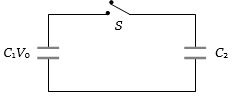
$A$ capacitor of capacity $C_1$ is charged to a potential of $V_0$. After disconnecting it from the battery,it is connected to a capacitor of capacity $C_2$ as shown in the figure. The ratio of the total energy before and after the connection of switch $S$ is:
A
$(C_1 + C_2) / C_1$
B
$C_1 / (C_1 + C_2)$
C
$C_1 C_2$
D
$C_1 / C_2$
Solution
(A) Initial energy stored in capacitor $C_1$ is $U_i = \frac{1}{2} C_1 V_0^2 = \frac{q^2}{2C_1}$,where $q = C_1 V_0$ is the charge on the capacitor.
When the switch $S$ is closed,the charge $q$ is shared between the two capacitors $C_1$ and $C_2$ connected in parallel. The total capacitance becomes $C_{eq} = C_1 + C_2$.
The final energy stored in the system is $U_f = \frac{q^2}{2 C_{eq}} = \frac{q^2}{2(C_1 + C_2)}$.
The ratio of the energies is $\frac{U_i}{U_f} = \frac{q^2 / (2C_1)}{q^2 / (2(C_1 + C_2))} = \frac{C_1 + C_2}{C_1}$.
When the switch $S$ is closed,the charge $q$ is shared between the two capacitors $C_1$ and $C_2$ connected in parallel. The total capacitance becomes $C_{eq} = C_1 + C_2$.
The final energy stored in the system is $U_f = \frac{q^2}{2 C_{eq}} = \frac{q^2}{2(C_1 + C_2)}$.
The ratio of the energies is $\frac{U_i}{U_f} = \frac{q^2 / (2C_1)}{q^2 / (2(C_1 + C_2))} = \frac{C_1 + C_2}{C_1}$.
0 likes
View Solution12
MediumMCQ
The capacities of two conductors are $C_1$ and $C_2$ and their respective potentials are $V_1$ and $V_2$. If they are connected by a thin wire,then the loss of energy will be given by
A
$\frac{C_1 C_2 (V_1 + V_2)}{2(C_1 + C_2)}$
B
$\frac{C_1 C_2 (V_1 - V_2)}{2(C_1 + C_2)}$
C
$\frac{C_1 C_2 (V_1 - V_2)^2}{2(C_1 + C_2)}$
D
$\frac{(C_1 + C_2)(V_1 - V_2)}{C_1 C_2}$
Solution
(C) Initial energy $U_i = \frac{1}{2} C_1 V_1^2 + \frac{1}{2} C_2 V_2^2$.
When connected,the common potential $V$ is given by $V = \frac{C_1 V_1 + C_2 V_2}{C_1 + C_2}$.
Final energy $U_f = \frac{1}{2} (C_1 + C_2) V^2 = \frac{1}{2} (C_1 + C_2) \left( \frac{C_1 V_1 + C_2 V_2}{C_1 + C_2} \right)^2 = \frac{(C_1 V_1 + C_2 V_2)^2}{2(C_1 + C_2)}$.
Energy loss $\Delta U = U_i - U_f = \left( \frac{1}{2} C_1 V_1^2 + \frac{1}{2} C_2 V_2^2 \right) - \frac{(C_1 V_1 + C_2 V_2)^2}{2(C_1 + C_2)}$.
Simplifying this expression: $\Delta U = \frac{C_1 C_2 (V_1 - V_2)^2}{2(C_1 + C_2)}$.
When connected,the common potential $V$ is given by $V = \frac{C_1 V_1 + C_2 V_2}{C_1 + C_2}$.
Final energy $U_f = \frac{1}{2} (C_1 + C_2) V^2 = \frac{1}{2} (C_1 + C_2) \left( \frac{C_1 V_1 + C_2 V_2}{C_1 + C_2} \right)^2 = \frac{(C_1 V_1 + C_2 V_2)^2}{2(C_1 + C_2)}$.
Energy loss $\Delta U = U_i - U_f = \left( \frac{1}{2} C_1 V_1^2 + \frac{1}{2} C_2 V_2^2 \right) - \frac{(C_1 V_1 + C_2 V_2)^2}{2(C_1 + C_2)}$.
Simplifying this expression: $\Delta U = \frac{C_1 C_2 (V_1 - V_2)^2}{2(C_1 + C_2)}$.
0 likes
View Solution13
EasyMCQ
$A$ capacitor having capacitance $C$ is charged to a voltage $V$. It is then removed and connected in parallel with another identical capacitor which is uncharged. The new charge on each capacitor is now
A
$CV$
B
$CV / 2$
C
$2 CV$
D
$CV / 4$
Solution
(B) Initially,the charge on the first capacitor is $Q = CV$.
When this charged capacitor is connected in parallel to an identical uncharged capacitor,the total charge $Q$ is shared between the two capacitors.
Since the capacitors are identical and connected in parallel,the potential difference across both capacitors becomes equal,say $V'$.
By the principle of conservation of charge,the total charge remains constant: $Q_{total} = Q_1 + Q_2$.
Since they are identical,$C_1 = C_2 = C$,the charge distributes equally: $Q_1 = Q_2 = Q / 2$.
Therefore,the new charge on each capacitor is $CV / 2$.
When this charged capacitor is connected in parallel to an identical uncharged capacitor,the total charge $Q$ is shared between the two capacitors.
Since the capacitors are identical and connected in parallel,the potential difference across both capacitors becomes equal,say $V'$.
By the principle of conservation of charge,the total charge remains constant: $Q_{total} = Q_1 + Q_2$.
Since they are identical,$C_1 = C_2 = C$,the charge distributes equally: $Q_1 = Q_2 = Q / 2$.
Therefore,the new charge on each capacitor is $CV / 2$.
0 likes
View Solution14
MediumMCQ
$A$ $2\,\mu F$ capacitor has a potential difference of $200\;V$ across its terminals. It is disconnected from the battery and then another uncharged capacitor is connected in parallel to it. If the potential difference becomes $20\;V$,the capacitance of the second capacitor is.......$\mu F$.
A
$2$
B
$4$
C
$18$
D
$10$
Solution
(C) The initial charge on the first capacitor is $Q_1 = C_1 V_1 = 2\,\mu F \times 200\;V = 400\,\mu C$.
When the second capacitor $C_2$ (initially uncharged,$V_2 = 0$) is connected in parallel,the total charge remains conserved.
The common potential $V$ is given by the formula: $V = \frac{C_1 V_1 + C_2 V_2}{C_1 + C_2}$.
Substituting the given values: $20 = \frac{2 \times 200 + C_2 \times 0}{2 + C_2}$.
$20 = \frac{400}{2 + C_2}$.
$2 + C_2 = \frac{400}{20} = 20$.
$C_2 = 20 - 2 = 18\,\mu F$.
When the second capacitor $C_2$ (initially uncharged,$V_2 = 0$) is connected in parallel,the total charge remains conserved.
The common potential $V$ is given by the formula: $V = \frac{C_1 V_1 + C_2 V_2}{C_1 + C_2}$.
Substituting the given values: $20 = \frac{2 \times 200 + C_2 \times 0}{2 + C_2}$.
$20 = \frac{400}{2 + C_2}$.
$2 + C_2 = \frac{400}{20} = 20$.
$C_2 = 20 - 2 = 18\,\mu F$.
0 likes
View Solution15
MediumMCQ
$A$ condenser having a capacity of $6\,\mu F$ is charged to $100\, V$ and is then joined to an uncharged condenser of $14\,\mu F$ and then removed. The ratio of the charges on $6\,\mu F$ and $14\,\mu F$ and the potential of $6\,\mu F$ will be
A
$6/14$ and $50\,V$
B
$14/6$ and $30\,V$
C
$6/14$ and $30\,V$
D
$14/6$ and $0\,V$
Solution
(C) Initial charge on the $6\,\mu F$ capacitor is $Q = C_1 V_0 = 6\,\mu F \times 100\,V = 600\,\mu C$.
When connected in parallel,the capacitors share charge until they reach a common potential $V$.
The common potential $V$ is given by $V = \frac{Q_{total}}{C_1 + C_2} = \frac{600\,\mu C}{6\,\mu F + 14\,\mu F} = \frac{600}{20} = 30\,V$.
The charges on the capacitors are $q_1 = C_1 V = 6\,\mu F \times 30\,V = 180\,\mu C$ and $q_2 = C_2 V = 14\,\mu F \times 30\,V = 420\,\mu C$.
The ratio of the charges is $\frac{q_1}{q_2} = \frac{C_1}{C_2} = \frac{6}{14}$.
Thus,the ratio is $6/14$ and the potential is $30\,V$.
When connected in parallel,the capacitors share charge until they reach a common potential $V$.
The common potential $V$ is given by $V = \frac{Q_{total}}{C_1 + C_2} = \frac{600\,\mu C}{6\,\mu F + 14\,\mu F} = \frac{600}{20} = 30\,V$.
The charges on the capacitors are $q_1 = C_1 V = 6\,\mu F \times 30\,V = 180\,\mu C$ and $q_2 = C_2 V = 14\,\mu F \times 30\,V = 420\,\mu C$.
The ratio of the charges is $\frac{q_1}{q_2} = \frac{C_1}{C_2} = \frac{6}{14}$.
Thus,the ratio is $6/14$ and the potential is $30\,V$.
0 likes
View Solution16
EasyMCQ
$A$ $0.2\,F$ capacitor is charged to $600\,V$ by a battery. On removing the battery,it is connected to another parallel plate capacitor of $1\,F$. The potential decreases to.........$V$.
A
$100$
B
$120$
C
$300$
D
$600$
Solution
(A) The initial charge $Q$ on the $0.2\,F$ capacitor is given by $Q = C_1 V_1 = 0.2\,F \times 600\,V = 120\,C$.
When the battery is removed and the capacitor is connected to another capacitor of $C_2 = 1\,F$,the total charge is conserved.
Let the common potential be $V$. The total capacitance of the parallel combination is $C_{eq} = C_1 + C_2 = 0.2\,F + 1\,F = 1.2\,F$.
Using the principle of charge conservation: $Q = C_{eq} V$.
$120\,C = 1.2\,F \times V$.
$V = \frac{120}{1.2} = 100\,V$.
When the battery is removed and the capacitor is connected to another capacitor of $C_2 = 1\,F$,the total charge is conserved.
Let the common potential be $V$. The total capacitance of the parallel combination is $C_{eq} = C_1 + C_2 = 0.2\,F + 1\,F = 1.2\,F$.
Using the principle of charge conservation: $Q = C_{eq} V$.
$120\,C = 1.2\,F \times V$.
$V = \frac{120}{1.2} = 100\,V$.
0 likes
View Solution17
MediumMCQ
$A$ capacitor of capacitance $10\,\mu F$ has been charged to $100\,V$. It is now connected to another uncharged capacitor in parallel. The common potential becomes $40\,V$. The capacitance of the other capacitor is......$\mu F$.
A
$15$
B
$5$
C
$10$
D
$16.6$
Solution
(A) Given: Capacitance of the first capacitor $C_1 = 10\,\mu F$,initial potential $V_1 = 100\,V$.
Capacitance of the second capacitor $C_2 = ?$,initial potential $V_2 = 0\,V$.
Common potential $V = 40\,V$.
When two capacitors are connected in parallel,the total charge is conserved.
The common potential is given by the formula: $V = \frac{C_1 V_1 + C_2 V_2}{C_1 + C_2}$.
Substituting the values: $40 = \frac{10 \times 100 + C_2 \times 0}{10 + C_2}$.
$40 = \frac{1000}{10 + C_2}$.
$40(10 + C_2) = 1000$.
$400 + 40C_2 = 1000$.
$40C_2 = 600$.
$C_2 = \frac{600}{40} = 15\,\mu F$.
Capacitance of the second capacitor $C_2 = ?$,initial potential $V_2 = 0\,V$.
Common potential $V = 40\,V$.
When two capacitors are connected in parallel,the total charge is conserved.
The common potential is given by the formula: $V = \frac{C_1 V_1 + C_2 V_2}{C_1 + C_2}$.
Substituting the values: $40 = \frac{10 \times 100 + C_2 \times 0}{10 + C_2}$.
$40 = \frac{1000}{10 + C_2}$.
$40(10 + C_2) = 1000$.
$400 + 40C_2 = 1000$.
$40C_2 = 600$.
$C_2 = \frac{600}{40} = 15\,\mu F$.
0 likes
View Solution18
DifficultMCQ
$A$ capacitor of $4\,\mu F$ charged to $50\,V$ is connected to another capacitor of $2\,\mu F$ charged to $100\,V$ with plates of like charges connected together. The total energy before and after connection in multiples of $10^{-2}\,J$ is:
A
$1.5$ and $1.33$
B
$1.33$ and $1.5$
C
$3.0$ and $2.67$
D
$2.67$ and $3.0$
Solution
(A) The total energy before connection is given by $U_i = \frac{1}{2} C_1 V_1^2 + \frac{1}{2} C_2 V_2^2$.
$U_i = \frac{1}{2} \times 4 \times 10^{-6} \times (50)^2 + \frac{1}{2} \times 2 \times 10^{-6} \times (100)^2 = 50 \times 10^{-4} + 100 \times 10^{-4} = 1.5 \times 10^{-2}\,J$.
When connected in parallel with like charges,the common potential $V$ is given by $V = \frac{C_1 V_1 + C_2 V_2}{C_1 + C_2} = \frac{4 \times 50 + 2 \times 100}{4 + 2} = \frac{400}{6} = \frac{200}{3}\,V$.
The total energy after connection is $U_f = \frac{1}{2} (C_1 + C_2) V^2$.
$U_f = \frac{1}{2} \times (4 + 2) \times 10^{-6} \times (\frac{200}{3})^2 = 3 \times 10^{-6} \times \frac{40000}{9} = \frac{40000}{3} \times 10^{-6} = 1.33 \times 10^{-2}\,J$.
$U_i = \frac{1}{2} \times 4 \times 10^{-6} \times (50)^2 + \frac{1}{2} \times 2 \times 10^{-6} \times (100)^2 = 50 \times 10^{-4} + 100 \times 10^{-4} = 1.5 \times 10^{-2}\,J$.
When connected in parallel with like charges,the common potential $V$ is given by $V = \frac{C_1 V_1 + C_2 V_2}{C_1 + C_2} = \frac{4 \times 50 + 2 \times 100}{4 + 2} = \frac{400}{6} = \frac{200}{3}\,V$.
The total energy after connection is $U_f = \frac{1}{2} (C_1 + C_2) V^2$.
$U_f = \frac{1}{2} \times (4 + 2) \times 10^{-6} \times (\frac{200}{3})^2 = 3 \times 10^{-6} \times \frac{40000}{9} = \frac{40000}{3} \times 10^{-6} = 1.33 \times 10^{-2}\,J$.
0 likes
View Solution19
MediumMCQ
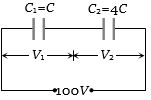
Two identical parallel plate capacitors are connected in series to a battery of $100\,V$. $A$ dielectric slab of dielectric constant $4.0$ is inserted between the plates of the second capacitor. The potential difference across the capacitors will now be respectively:
A
$50\,V, 50\,V$
B
$80\,V, 20\,V$
C
$20\,V, 80\,V$
D
$75\,V, 25\,V$
Solution
(B) Initially,both capacitors have capacitance $C$. After inserting the dielectric slab of constant $K=4$ in the second capacitor,its new capacitance becomes $C_2 = KC = 4C$. The first capacitor remains $C_1 = C$.
Since they are in series,the equivalent capacitance is $C_{eq} = \frac{C_1 C_2}{C_1 + C_2} = \frac{C \times 4C}{C + 4C} = \frac{4C}{5}$.
The total charge stored in the series combination is $Q = C_{eq} V = \frac{4C}{5} \times 100 = 80C$.
In a series circuit,the charge $Q$ is the same for both capacitors.
The potential difference across the first capacitor is $V_1 = \frac{Q}{C_1} = \frac{80C}{C} = 80\,V$.
The potential difference across the second capacitor is $V_2 = \frac{Q}{C_2} = \frac{80C}{4C} = 20\,V$.
Thus,the potential differences are $80\,V$ and $20\,V$ respectively.
Since they are in series,the equivalent capacitance is $C_{eq} = \frac{C_1 C_2}{C_1 + C_2} = \frac{C \times 4C}{C + 4C} = \frac{4C}{5}$.
The total charge stored in the series combination is $Q = C_{eq} V = \frac{4C}{5} \times 100 = 80C$.
In a series circuit,the charge $Q$ is the same for both capacitors.
The potential difference across the first capacitor is $V_1 = \frac{Q}{C_1} = \frac{80C}{C} = 80\,V$.
The potential difference across the second capacitor is $V_2 = \frac{Q}{C_2} = \frac{80C}{4C} = 20\,V$.
Thus,the potential differences are $80\,V$ and $20\,V$ respectively.
0 likes
View Solution20
DifficultMCQ
$A$ condenser of capacity $C_1$ is charged to a potential $V_0$. The electrostatic energy stored in it is $U_0$. It is connected to another uncharged condenser of capacity $C_2$ in parallel. The energy dissipated in the process is
A
$\frac{C_2}{C_1 + C_2} U_0$
B
$\frac{C_1}{C_1 + C_2} U_0$
C
$\left( \frac{C_1 - C_2}{C_1 + C_2} \right) U_0$
D
$\frac{C_1 C_2}{2(C_1 + C_2)} U_0$
Solution
(A) The initial energy stored in the capacitor $C_1$ is $U_0 = \frac{1}{2} C_1 V_0^2$.
When connected in parallel to an uncharged capacitor $C_2$,the charge redistributes until both capacitors reach a common potential $V = \frac{C_1 V_0}{C_1 + C_2}$.
The final energy stored in the system is $U_f = \frac{1}{2} (C_1 + C_2) V^2 = \frac{1}{2} (C_1 + C_2) \left( \frac{C_1 V_0}{C_1 + C_2} \right)^2 = \frac{C_1^2 V_0^2}{2(C_1 + C_2)}$.
The energy dissipated (loss of energy) is $\Delta U = U_0 - U_f$.
$\Delta U = \frac{1}{2} C_1 V_0^2 - \frac{C_1^2 V_0^2}{2(C_1 + C_2)} = \frac{C_1 V_0^2}{2} \left( 1 - \frac{C_1}{C_1 + C_2} \right) = \frac{C_1 V_0^2}{2} \left( \frac{C_2}{C_1 + C_2} \right)$.
Since $U_0 = \frac{1}{2} C_1 V_0^2$,we substitute this into the expression:
$\Delta U = \frac{C_2}{C_1 + C_2} U_0$.
When connected in parallel to an uncharged capacitor $C_2$,the charge redistributes until both capacitors reach a common potential $V = \frac{C_1 V_0}{C_1 + C_2}$.
The final energy stored in the system is $U_f = \frac{1}{2} (C_1 + C_2) V^2 = \frac{1}{2} (C_1 + C_2) \left( \frac{C_1 V_0}{C_1 + C_2} \right)^2 = \frac{C_1^2 V_0^2}{2(C_1 + C_2)}$.
The energy dissipated (loss of energy) is $\Delta U = U_0 - U_f$.
$\Delta U = \frac{1}{2} C_1 V_0^2 - \frac{C_1^2 V_0^2}{2(C_1 + C_2)} = \frac{C_1 V_0^2}{2} \left( 1 - \frac{C_1}{C_1 + C_2} \right) = \frac{C_1 V_0^2}{2} \left( \frac{C_2}{C_1 + C_2} \right)$.
Since $U_0 = \frac{1}{2} C_1 V_0^2$,we substitute this into the expression:
$\Delta U = \frac{C_2}{C_1 + C_2} U_0$.
0 likes
View Solution21
DifficultMCQ
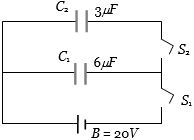
In the circuit shown here $C_1 = 6\,\mu F$,$C_2 = 3\,\mu F$ and battery $B = 20\,V$. The switch $S_1$ is first closed. It is then opened and afterwards $S_2$ is closed. What is the charge finally on $C_2$ in $\mu C$?
A
$120$
B
$80$
C
$40$
D
$20$
Solution
(C) $1$. When switch $S_1$ is closed,capacitor $C_1$ gets charged by the battery $B = 20\,V$. The charge on $C_1$ is $Q_1 = C_1 \times V = 6\,\mu F \times 20\,V = 120\,\mu C$.
$2$. When $S_1$ is opened,the charge $Q_1 = 120\,\mu C$ remains stored on $C_1$. Capacitor $C_2$ is initially uncharged $(Q_2 = 0)$.
$3$. When switch $S_2$ is closed,the charge $Q_1$ is shared between $C_1$ and $C_2$ until they reach a common potential $V'$.
$4$. The common potential $V'$ is given by $V' = \frac{Q_{total}}{C_{total}} = \frac{Q_1 + Q_2}{C_1 + C_2} = \frac{120\,\mu C + 0}{6\,\mu F + 3\,\mu F} = \frac{120}{9}\,V = \frac{40}{3}\,V$.
$5$. The final charge on $C_2$ is $Q_2' = C_2 \times V' = 3\,\mu F \times \frac{40}{3}\,V = 40\,\mu C$.
$2$. When $S_1$ is opened,the charge $Q_1 = 120\,\mu C$ remains stored on $C_1$. Capacitor $C_2$ is initially uncharged $(Q_2 = 0)$.
$3$. When switch $S_2$ is closed,the charge $Q_1$ is shared between $C_1$ and $C_2$ until they reach a common potential $V'$.
$4$. The common potential $V'$ is given by $V' = \frac{Q_{total}}{C_{total}} = \frac{Q_1 + Q_2}{C_1 + C_2} = \frac{120\,\mu C + 0}{6\,\mu F + 3\,\mu F} = \frac{120}{9}\,V = \frac{40}{3}\,V$.
$5$. The final charge on $C_2$ is $Q_2' = C_2 \times V' = 3\,\mu F \times \frac{40}{3}\,V = 40\,\mu C$.
0 likes
View Solution22
EasyMCQ
Choose the incorrect statement from the following: When two identical capacitors are charged individually to different potentials and connected in parallel to each other after disconnecting them from the source.
A
Net charge equals the sum of initial charges.
B
The net energy stored in the two capacitors is less than the sum of the initial individual energies.
C
The net potential difference across them is different from the sum of the individual initial potential differences.
D
The net potential difference across them equals the sum of the individual initial potential differences.
Solution
(D) When two capacitors of capacitance $C$ are charged to potentials $V_1$ and $V_2$ respectively,their initial charges are $q_1 = CV_1$ and $q_2 = CV_2$.
When they are connected in parallel,the common potential $V$ is given by $V = \frac{q_1 + q_2}{C + C} = \frac{C(V_1 + V_2)}{2C} = \frac{V_1 + V_2}{2}$.
Option $A$ is correct because charge is conserved.
Option $B$ is correct because energy is lost as heat during charge redistribution.
Option $C$ is correct because the final potential is the average,not the sum.
Option $D$ is incorrect because the final potential is $\frac{V_1 + V_2}{2}$,not $V_1 + V_2$.
When they are connected in parallel,the common potential $V$ is given by $V = \frac{q_1 + q_2}{C + C} = \frac{C(V_1 + V_2)}{2C} = \frac{V_1 + V_2}{2}$.
Option $A$ is correct because charge is conserved.
Option $B$ is correct because energy is lost as heat during charge redistribution.
Option $C$ is correct because the final potential is the average,not the sum.
Option $D$ is incorrect because the final potential is $\frac{V_1 + V_2}{2}$,not $V_1 + V_2$.
0 likes
View Solution23
MediumMCQ
$A$ $10\,\mu F$ capacitor and a $20\,\mu F$ capacitor are connected in series across a $200\,V$ supply line. The charged capacitors are then disconnected from the line and reconnected with their positive plates together and negative plates together,and no external voltage is applied. What is the potential difference across each capacitor?
A
$\frac{400}{9}\,V$
B
$\frac{800}{9}\,V$
C
$400\,V$
D
$200\,V$
Solution
(B) Initially,when connected in series,the charge $Q$ on each capacitor is the same.
Equivalent capacitance $C_{eq} = \frac{C_1 C_2}{C_1 + C_2} = \frac{10 \times 20}{10 + 20} = \frac{200}{30} = \frac{20}{3}\,\mu F$.
The total charge $Q = C_{eq} V = \frac{20}{3} \times 200 = \frac{4000}{3}\,\mu C$.
The potential difference across $C_1$ is $V_1 = \frac{Q}{C_1} = \frac{4000/3}{10} = \frac{400}{3}\,V$.
The potential difference across $C_2$ is $V_2 = \frac{Q}{C_2} = \frac{4000/3}{20} = \frac{200}{3}\,V$.
When reconnected in parallel with positive plates together,the total charge $Q_{total} = Q_1 + Q_2 = \frac{4000}{3} + \frac{4000}{3} = \frac{8000}{3}\,\mu C$ (since both capacitors were charged with the same magnitude of charge $Q$ in series).
The common potential $V = \frac{Q_{total}}{C_1 + C_2} = \frac{8000/3}{10 + 20} = \frac{8000}{3 \times 30} = \frac{800}{9}\,V$.
Equivalent capacitance $C_{eq} = \frac{C_1 C_2}{C_1 + C_2} = \frac{10 \times 20}{10 + 20} = \frac{200}{30} = \frac{20}{3}\,\mu F$.
The total charge $Q = C_{eq} V = \frac{20}{3} \times 200 = \frac{4000}{3}\,\mu C$.
The potential difference across $C_1$ is $V_1 = \frac{Q}{C_1} = \frac{4000/3}{10} = \frac{400}{3}\,V$.
The potential difference across $C_2$ is $V_2 = \frac{Q}{C_2} = \frac{4000/3}{20} = \frac{200}{3}\,V$.
When reconnected in parallel with positive plates together,the total charge $Q_{total} = Q_1 + Q_2 = \frac{4000}{3} + \frac{4000}{3} = \frac{8000}{3}\,\mu C$ (since both capacitors were charged with the same magnitude of charge $Q$ in series).
The common potential $V = \frac{Q_{total}}{C_1 + C_2} = \frac{8000/3}{10 + 20} = \frac{8000}{3 \times 30} = \frac{800}{9}\,V$.
0 likes
View Solution24
MediumMCQ
$A$ $10\,\mu F$ capacitor is charged to a potential difference of $50\;V$ and is connected to another uncharged capacitor in parallel. Now the common potential difference becomes $20\;V$. The capacitance of the second capacitor is....$\mu F$
A
$10$
B
$20$
C
$30$
D
$15$
Solution
(D) When two capacitors are connected in parallel,the total charge is conserved.
Let $C_1 = 10\,\mu F$ and $V_1 = 50\;V$.
Let the second capacitor have capacitance $C_2$ and initial potential $V_2 = 0\;V$.
The common potential $V$ is given by the formula:
$V = \frac{C_1 V_1 + C_2 V_2}{C_1 + C_2}$
Substituting the given values:
$20 = \frac{10 \times 50 + C_2 \times 0}{10 + C_2}$
$20 = \frac{500}{10 + C_2}$
$20(10 + C_2) = 500$
$200 + 20C_2 = 500$
$20C_2 = 300$
$C_2 = 15\,\mu F$
Let $C_1 = 10\,\mu F$ and $V_1 = 50\;V$.
Let the second capacitor have capacitance $C_2$ and initial potential $V_2 = 0\;V$.
The common potential $V$ is given by the formula:
$V = \frac{C_1 V_1 + C_2 V_2}{C_1 + C_2}$
Substituting the given values:
$20 = \frac{10 \times 50 + C_2 \times 0}{10 + C_2}$
$20 = \frac{500}{10 + C_2}$
$20(10 + C_2) = 500$
$200 + 20C_2 = 500$
$20C_2 = 300$
$C_2 = 15\,\mu F$
0 likes
View Solution25
MediumMCQ
$A$ capacitor of $20\,\mu F$ is charged to $500\,V$ and connected in parallel with another capacitor of $10\,\mu F$ which is charged to $200\,V$. The common potential is.......$V$.
A
$200$
B
$300$
C
$400$
D
$500$
Solution
(C) When two charged capacitors are connected in parallel,the total charge is conserved.
The formula for the common potential $V$ is given by:
$V = \frac{C_1V_1 + C_2V_2}{C_1 + C_2}$
Given:
$C_1 = 20\,\mu F, V_1 = 500\,V$
$C_2 = 10\,\mu F, V_2 = 200\,V$
Substituting the values:
$V = \frac{(20 \times 500) + (10 \times 200)}{20 + 10}$
$V = \frac{10000 + 2000}{30}$
$V = \frac{12000}{30} = 400\,V$
The formula for the common potential $V$ is given by:
$V = \frac{C_1V_1 + C_2V_2}{C_1 + C_2}$
Given:
$C_1 = 20\,\mu F, V_1 = 500\,V$
$C_2 = 10\,\mu F, V_2 = 200\,V$
Substituting the values:
$V = \frac{(20 \times 500) + (10 \times 200)}{20 + 10}$
$V = \frac{10000 + 2000}{30}$
$V = \frac{12000}{30} = 400\,V$
0 likes
View Solution26
MediumMCQ
$A$ $20\,F$ capacitor is charged to $5\,V$ and isolated. It is then connected in parallel with an uncharged $30\,F$ capacitor. The decrease in the energy of the system will be.......$J$
A
$25$
B
$200$
C
$125$
D
$150$
Solution
(D) The initial energy stored in the $20\,F$ capacitor is given by $U_i = \frac{1}{2} C_1 V_1^2 = \frac{1}{2} \times 20 \times 5^2 = 250\,J$.
When connected in parallel,the common potential $V$ is given by $V = \frac{C_1 V_1 + C_2 V_2}{C_1 + C_2} = \frac{20 \times 5 + 30 \times 0}{20 + 30} = \frac{100}{50} = 2\,V$.
The final energy of the system is $U_f = \frac{1}{2} (C_1 + C_2) V^2 = \frac{1}{2} \times (20 + 30) \times 2^2 = \frac{1}{2} \times 50 \times 4 = 100\,J$.
The decrease in energy is $\Delta U = U_i - U_f = 250\,J - 100\,J = 150\,J$.
Alternatively,using the formula $\Delta U = \frac{C_1 C_2}{2(C_1 + C_2)} (V_1 - V_2)^2 = \frac{20 \times 30}{2(20 + 30)} (5 - 0)^2 = \frac{600}{100} \times 25 = 6 \times 25 = 150\,J$.
When connected in parallel,the common potential $V$ is given by $V = \frac{C_1 V_1 + C_2 V_2}{C_1 + C_2} = \frac{20 \times 5 + 30 \times 0}{20 + 30} = \frac{100}{50} = 2\,V$.
The final energy of the system is $U_f = \frac{1}{2} (C_1 + C_2) V^2 = \frac{1}{2} \times (20 + 30) \times 2^2 = \frac{1}{2} \times 50 \times 4 = 100\,J$.
The decrease in energy is $\Delta U = U_i - U_f = 250\,J - 100\,J = 150\,J$.
Alternatively,using the formula $\Delta U = \frac{C_1 C_2}{2(C_1 + C_2)} (V_1 - V_2)^2 = \frac{20 \times 30}{2(20 + 30)} (5 - 0)^2 = \frac{600}{100} \times 25 = 6 \times 25 = 150\,J$.
0 likes
View Solution27
MediumMCQ
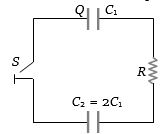
Two capacitors $C_1$ and $C_2 = 2C_1$ are connected in a circuit with a switch $S$ between them as shown in the figure. Initially,the switch is open and $C_1$ holds charge $Q$. The switch is closed. At steady state,the charge on each capacitor will be
A
$Q, 2Q$
B
$Q/3, 2Q/3$
C
$3Q/2, 3Q$
D
$2Q/3, 4Q/3$
Solution
(B) Initially,capacitor $C_1$ has charge $Q$ and $C_2$ is uncharged.
When the switch $S$ is closed,the capacitors $C_1$ and $C_2$ are connected in parallel.
In a parallel combination,the potential difference across both capacitors becomes equal.
Let the final charges on $C_1$ and $C_2$ be $Q_1$ and $Q_2$ respectively.
Since the total charge is conserved,$Q_1 + Q_2 = Q$.
For parallel connection,$V = Q_1 / C_1 = Q_2 / C_2$.
Substituting $C_2 = 2C_1$,we get $Q_1 / C_1 = Q_2 / (2C_1)$,which implies $Q_2 = 2Q_1$.
Substituting this into the conservation equation: $Q_1 + 2Q_1 = Q$,so $3Q_1 = Q$.
Thus,$Q_1 = Q/3$ and $Q_2 = 2Q/3$.
When the switch $S$ is closed,the capacitors $C_1$ and $C_2$ are connected in parallel.
In a parallel combination,the potential difference across both capacitors becomes equal.
Let the final charges on $C_1$ and $C_2$ be $Q_1$ and $Q_2$ respectively.
Since the total charge is conserved,$Q_1 + Q_2 = Q$.
For parallel connection,$V = Q_1 / C_1 = Q_2 / C_2$.
Substituting $C_2 = 2C_1$,we get $Q_1 / C_1 = Q_2 / (2C_1)$,which implies $Q_2 = 2Q_1$.
Substituting this into the conservation equation: $Q_1 + 2Q_1 = Q$,so $3Q_1 = Q$.
Thus,$Q_1 = Q/3$ and $Q_2 = 2Q/3$.
0 likes
View Solution28
MediumMCQ
Two capacitors of capacitances $3 \mu F$ and $6 \mu F$ are charged to a potential of $12 V$ each. They are now connected to each other,with the positive plate of each joined to the negative plate of the other. The potential difference across each will be $volt$.
A
$6$
B
$4$
C
$3$
D
$0$
Solution
(B) The initial charges on the capacitors are $Q_1 = C_1 V_1 = 3 \mu F \times 12 V = 36 \mu C$ and $Q_2 = C_2 V_2 = 6 \mu F \times 12 V = 72 \mu C$.
Since the positive plate of one is connected to the negative plate of the other,the net charge on the system is $Q_{net} = |Q_2 - Q_1| = |72 \mu C - 36 \mu C| = 36 \mu C$.
The equivalent capacitance of the parallel combination is $C_{eq} = C_1 + C_2 = 3 \mu F + 6 \mu F = 9 \mu F$.
The common potential difference across the capacitors is $V = \frac{Q_{net}}{C_{eq}} = \frac{36 \mu C}{9 \mu F} = 4 V$.
Since the positive plate of one is connected to the negative plate of the other,the net charge on the system is $Q_{net} = |Q_2 - Q_1| = |72 \mu C - 36 \mu C| = 36 \mu C$.
The equivalent capacitance of the parallel combination is $C_{eq} = C_1 + C_2 = 3 \mu F + 6 \mu F = 9 \mu F$.
The common potential difference across the capacitors is $V = \frac{Q_{net}}{C_{eq}} = \frac{36 \mu C}{9 \mu F} = 4 V$.
0 likes
View Solution29
MediumMCQ
$A$ capacitor of $10\,\mu F$ charged up to $250\,V$ is connected in parallel with another capacitor of $5\,\mu F$ charged up to $100\,V$. The common potential is.....$V$.
A
$500$
B
$400$
C
$300$
D
$200$
Solution
(D) When two charged capacitors are connected in parallel,the total charge is conserved.
The total charge $Q_{total} = Q_1 + Q_2 = C_1V_1 + C_2V_2$.
The total capacitance of the parallel combination is $C_{eq} = C_1 + C_2$.
The common potential $V$ is given by the formula $V = \frac{C_1V_1 + C_2V_2}{C_1 + C_2}$.
Substituting the given values: $C_1 = 10\,\mu F$,$V_1 = 250\,V$,$C_2 = 5\,\mu F$,$V_2 = 100\,V$.
$V = \frac{(10 \times 250) + (5 \times 100)}{10 + 5} = \frac{2500 + 500}{15} = \frac{3000}{15} = 200\,V$.
The total charge $Q_{total} = Q_1 + Q_2 = C_1V_1 + C_2V_2$.
The total capacitance of the parallel combination is $C_{eq} = C_1 + C_2$.
The common potential $V$ is given by the formula $V = \frac{C_1V_1 + C_2V_2}{C_1 + C_2}$.
Substituting the given values: $C_1 = 10\,\mu F$,$V_1 = 250\,V$,$C_2 = 5\,\mu F$,$V_2 = 100\,V$.
$V = \frac{(10 \times 250) + (5 \times 100)}{10 + 5} = \frac{2500 + 500}{15} = \frac{3000}{15} = 200\,V$.
0 likes
View Solution30
MediumMCQ
$A$ capacitor of capacity $C_1$ is charged up to $V$ volt and then connected to an uncharged capacitor of capacity $C_2$. The final potential difference across each will be:
A
$\frac{C_2 V}{C_1 + C_2}$
B
$\left( 1 + \frac{C_2}{C_1} \right) V$
C
$\frac{C_1 V}{C_1 + C_2}$
D
$\left( 1 - \frac{C_2}{C_1} \right) V$
Solution
(C) When two capacitors are connected,charge flows from the higher potential to the lower potential until they reach a common potential $V'$.
By the principle of conservation of charge,the total charge before connection equals the total charge after connection.
Initial charge $Q_{total} = C_1 V + C_2 (0) = C_1 V$.
Total capacitance after connection $C_{total} = C_1 + C_2$.
Common potential $V' = \frac{Q_{total}}{C_{total}} = \frac{C_1 V}{C_1 + C_2}$.
By the principle of conservation of charge,the total charge before connection equals the total charge after connection.
Initial charge $Q_{total} = C_1 V + C_2 (0) = C_1 V$.
Total capacitance after connection $C_{total} = C_1 + C_2$.
Common potential $V' = \frac{Q_{total}}{C_{total}} = \frac{C_1 V}{C_1 + C_2}$.
0 likes
View Solution31
MediumMCQ
$A$ $10\ \mu F$ capacitor is charged to a potential difference of $1000\ V$. The terminals of the charged capacitor are disconnected from the power supply and connected to the terminals of an uncharged $6\ \mu F$ capacitor. What is the final potential difference across each capacitor in $V$?
A
$167$
B
$100$
C
$625$
D
$250$
Solution
(C) The initial charge on the $10\ \mu F$ capacitor is given by $Q = C_1 V_1$.
$Q = 10 \times 10^{-6}\ F \times 1000\ V = 10^{-2}\ C$.
When the two capacitors are connected in parallel,the charge is redistributed until they reach a common potential $V$.
The common potential is given by the formula $V = \frac{C_1 V_1 + C_2 V_2}{C_1 + C_2}$.
Since the second capacitor is uncharged,$V_2 = 0$.
$V = \frac{10 \times 10^{-6} \times 1000 + 6 \times 10^{-6} \times 0}{10 \times 10^{-6} + 6 \times 10^{-6}} = \frac{10^{-2}}{16 \times 10^{-6}} = \frac{10000}{16} = 625\ V$.
$Q = 10 \times 10^{-6}\ F \times 1000\ V = 10^{-2}\ C$.
When the two capacitors are connected in parallel,the charge is redistributed until they reach a common potential $V$.
The common potential is given by the formula $V = \frac{C_1 V_1 + C_2 V_2}{C_1 + C_2}$.
Since the second capacitor is uncharged,$V_2 = 0$.
$V = \frac{10 \times 10^{-6} \times 1000 + 6 \times 10^{-6} \times 0}{10 \times 10^{-6} + 6 \times 10^{-6}} = \frac{10^{-2}}{16 \times 10^{-6}} = \frac{10000}{16} = 625\ V$.
0 likes
View Solution32
EasyMCQ
Consider the situation shown in the figure. Capacitor $A$ has a charge $q$ on it,whereas $B$ is uncharged. The charge appearing on capacitor $B$ a long time after the switch $S$ is closed is
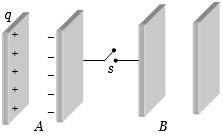
A
Zero
B
$q/2$
C
$q$
D
$2q$
Solution
(A) The charges $\pm q$ on the plates of capacitor $A$ are bound charges due to the electric field between them.
Since capacitor $B$ is initially uncharged and is isolated from any external source of charge,closing the switch $S$ connects the inner plate of $A$ to the inner plate of $B$.
However,because the charges on the plates of $A$ are bound by the electrostatic attraction between them,they cannot move to plate $B$.
Therefore,no charge will flow to capacitor $B$,and it will remain uncharged.
Thus,the charge on $B$ is zero.
Since capacitor $B$ is initially uncharged and is isolated from any external source of charge,closing the switch $S$ connects the inner plate of $A$ to the inner plate of $B$.
However,because the charges on the plates of $A$ are bound by the electrostatic attraction between them,they cannot move to plate $B$.
Therefore,no charge will flow to capacitor $B$,and it will remain uncharged.
Thus,the charge on $B$ is zero.
0 likes
View Solution33
DifficultMCQ
Two conducting spheres of radii $R_1$ and $R_2$ are charged with charges $Q_1$ and $Q_2$ respectively. When they are brought into contact with each other:
A
The energy of the system does not change.
B
If $Q_1R_2 \neq Q_2R_1$,the energy of the system increases.
C
The energy of the system always decreases.
D
If $Q_1R_2 \neq Q_2R_1$,the energy of the system decreases.
Solution
(D) When two charged conductors are brought into contact,charge flows from the conductor at a higher potential to the one at a lower potential until their potentials become equal.
Let the initial potentials be $V_1 = \frac{kQ_1}{R_1}$ and $V_2 = \frac{kQ_2}{R_2}$.
If $V_1 \neq V_2$ (i.e.,$\frac{Q_1}{R_1} \neq \frac{Q_2}{R_2}$ or $Q_1R_2 \neq Q_2R_1$),charge redistribution occurs.
The total energy of the system is $U = \frac{1}{2} C_1 V_1^2 + \frac{1}{2} C_2 V_2^2$.
When connected,the final potential $V$ is given by $V = \frac{Q_1 + Q_2}{C_1 + C_2}$.
The final energy is $U' = \frac{1}{2} (C_1 + C_2) V^2 = \frac{1}{2} \frac{(Q_1 + Q_2)^2}{C_1 + C_2}$.
It can be mathematically shown that the loss in energy $\Delta U = U - U' = \frac{1}{2} \frac{C_1 C_2}{C_1 + C_2} (V_1 - V_2)^2$.
Since $(V_1 - V_2)^2$ is always positive,$\Delta U > 0$,meaning energy is always lost (decreases) when charge flows between conductors at different potentials.
Let the initial potentials be $V_1 = \frac{kQ_1}{R_1}$ and $V_2 = \frac{kQ_2}{R_2}$.
If $V_1 \neq V_2$ (i.e.,$\frac{Q_1}{R_1} \neq \frac{Q_2}{R_2}$ or $Q_1R_2 \neq Q_2R_1$),charge redistribution occurs.
The total energy of the system is $U = \frac{1}{2} C_1 V_1^2 + \frac{1}{2} C_2 V_2^2$.
When connected,the final potential $V$ is given by $V = \frac{Q_1 + Q_2}{C_1 + C_2}$.
The final energy is $U' = \frac{1}{2} (C_1 + C_2) V^2 = \frac{1}{2} \frac{(Q_1 + Q_2)^2}{C_1 + C_2}$.
It can be mathematically shown that the loss in energy $\Delta U = U - U' = \frac{1}{2} \frac{C_1 C_2}{C_1 + C_2} (V_1 - V_2)^2$.
Since $(V_1 - V_2)^2$ is always positive,$\Delta U > 0$,meaning energy is always lost (decreases) when charge flows between conductors at different potentials.
0 likes
View Solution34
DifficultMCQ
Circuits $(a)$ and $(b)$ have charged capacitors with capacitances $C, 2C$ and $3C$ as shown,with an open switch $S$. When the switch is closed,determine the direction of charge flow for each circuit.
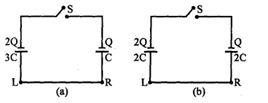
A
In both $(a)$ and $(b)$,charge flows from $L$ to $R$.
B
In $(a)$,no charge flows,but in $(b)$,charge flows from $R$ to $L$.
C
In $(a)$,no charge flows,but in $(b)$,charge flows from $L$ to $R$.
D
In $(a)$,charge flows from $R$ to $L$,and in $(b)$,charge flows from $L$ to $R$.
Solution
(D) Charge flows from higher potential to lower potential. The potential of a capacitor is given by $V = Q/C$.
For circuit $(a)$:
Potential of left capacitor $V_L = (2Q)/(3C) = 0.67(Q/C)$.
Potential of right capacitor $V_R = Q/C = 1.0(Q/C)$.
Since $V_R > V_L$,charge flows from $R$ to $L$.
For circuit $(b)$:
Potential of left capacitor $V_L = (2Q)/(2C) = Q/C$.
Potential of right capacitor $V_R = Q/(2C) = 0.5(Q/C)$.
Since $V_L > V_R$,charge flows from $L$ to $R$.
For circuit $(a)$:
Potential of left capacitor $V_L = (2Q)/(3C) = 0.67(Q/C)$.
Potential of right capacitor $V_R = Q/C = 1.0(Q/C)$.
Since $V_R > V_L$,charge flows from $R$ to $L$.
For circuit $(b)$:
Potential of left capacitor $V_L = (2Q)/(2C) = Q/C$.
Potential of right capacitor $V_R = Q/(2C) = 0.5(Q/C)$.
Since $V_L > V_R$,charge flows from $L$ to $R$.
0 likes
View Solution35
EasyMCQ
Two spheres of radii $1 \, cm$ and $2 \, cm$ are charged with $1.5 \times 10^{-8} \, C$ and $0.3 \times 10^{-7} \, C$ of positive charge,respectively. When they are connected by a wire,the charge will flow:
A
From the first sphere to the second sphere
B
From the second sphere to the first sphere
C
Will not flow
D
From the first to the second or from the second to the first
Solution
(C) The flow of charge between two conductors connected by a wire depends on their electric potentials,not their total charge. Charge flows from a higher potential to a lower potential.
The potential $V$ of a spherical conductor is given by $V = \frac{kQ}{R}$.
For the first sphere $(R_1 = 1 \, cm = 0.01 \, m)$:
$Q_1 = 1.5 \times 10^{-8} \, C$
$V_1 = \frac{k \times 1.5 \times 10^{-8}}{0.01} = k \times 1.5 \times 10^{-6} \, V$
For the second sphere $(R_2 = 2 \, cm = 0.02 \, m)$:
$Q_2 = 0.3 \times 10^{-7} = 3 \times 10^{-8} \, C$
$V_2 = \frac{k \times 3 \times 10^{-8}}{0.02} = k \times 1.5 \times 10^{-6} \, V$
Since $V_1 = V_2$,there is no potential difference between the two spheres. Therefore,no charge will flow between them.
The potential $V$ of a spherical conductor is given by $V = \frac{kQ}{R}$.
For the first sphere $(R_1 = 1 \, cm = 0.01 \, m)$:
$Q_1 = 1.5 \times 10^{-8} \, C$
$V_1 = \frac{k \times 1.5 \times 10^{-8}}{0.01} = k \times 1.5 \times 10^{-6} \, V$
For the second sphere $(R_2 = 2 \, cm = 0.02 \, m)$:
$Q_2 = 0.3 \times 10^{-7} = 3 \times 10^{-8} \, C$
$V_2 = \frac{k \times 3 \times 10^{-8}}{0.02} = k \times 1.5 \times 10^{-6} \, V$
Since $V_1 = V_2$,there is no potential difference between the two spheres. Therefore,no charge will flow between them.
0 likes
View Solution36
MediumMCQ
Two charged spheres of radii $a$ and $b$ are connected by a wire. The ratio of the electric fields on their surfaces $E_a/E_b$ is:
A
$a/b$
B
$b/a$
C
$a^2/b^2$
D
$b^2/a^2$
Solution
(B) When two charged spheres are connected by a conducting wire,charge flows until both spheres reach the same electric potential,$V$.
The electric potential $V$ on the surface of a sphere of radius $r$ is given by $V = \frac{1}{4\pi\epsilon_0} \frac{Q}{r}$.
The electric field $E$ on the surface of a sphere of radius $r$ is given by $E = \frac{1}{4\pi\epsilon_0} \frac{Q}{r^2}$.
By substituting $Q = V(4\pi\epsilon_0 r)$ into the electric field equation,we get $E = \frac{V}{r}$.
Since $V$ is the same for both spheres,the electric field $E$ is inversely proportional to the radius $r$ $(E \propto 1/r)$.
Therefore,the ratio of the electric fields is $\frac{E_a}{E_b} = \frac{b}{a}$.
The electric potential $V$ on the surface of a sphere of radius $r$ is given by $V = \frac{1}{4\pi\epsilon_0} \frac{Q}{r}$.
The electric field $E$ on the surface of a sphere of radius $r$ is given by $E = \frac{1}{4\pi\epsilon_0} \frac{Q}{r^2}$.
By substituting $Q = V(4\pi\epsilon_0 r)$ into the electric field equation,we get $E = \frac{V}{r}$.
Since $V$ is the same for both spheres,the electric field $E$ is inversely proportional to the radius $r$ $(E \propto 1/r)$.
Therefore,the ratio of the electric fields is $\frac{E_a}{E_b} = \frac{b}{a}$.
0 likes
View Solution37
MediumMCQ
$A$ capacitor of capacitance $C$ is charged to a potential $V$. It is then disconnected and connected in parallel with an identical uncharged capacitor. Find the charge on each capacitor.
A
$CV$
B
$CV/2$
C
$CV/8$
D
$CV/4$
Solution
(B) Initially,the charge on the first capacitor is $Q = CV$ and the second capacitor is uncharged $(Q_2 = 0)$.
When connected in parallel,the total charge $Q_{total} = CV + 0 = CV$ is shared between the two identical capacitors.
Since the capacitors are identical,the potential difference across both capacitors becomes equal,and the charge is distributed equally.
Therefore,the charge on each capacitor is $Q' = \frac{Q_{total}}{2} = \frac{CV}{2}$.
When connected in parallel,the total charge $Q_{total} = CV + 0 = CV$ is shared between the two identical capacitors.
Since the capacitors are identical,the potential difference across both capacitors becomes equal,and the charge is distributed equally.
Therefore,the charge on each capacitor is $Q' = \frac{Q_{total}}{2} = \frac{CV}{2}$.
0 likes
View Solution38
MediumMCQ
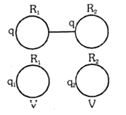
Two spheres of radii $R_1$ and $R_2$ have the same initial charge $q$. They are connected by a copper wire. After they are disconnected,the potential of each sphere is $V$. What was the initial charge $q$ on each sphere?
A
$\frac{V}{k}(R_1 + R_2)$
B
$\frac{V}{2k}(R_1 + R_2)$
C
$\frac{V}{3k}(R_1 + R_2)$
D
$\frac{V}{k}\frac{R_1 R_2}{R_1 + R_2}$
Solution
(B) Let the initial charge on each sphere be $q$. The total charge of the system is $q + q = 2q$.
When connected,the spheres reach a common potential $V$. The final charges on the spheres are $q_1 = C_1 V = \frac{R_1 V}{k}$ and $q_2 = C_2 V = \frac{R_2 V}{k}$,where $k = \frac{1}{4\pi\epsilon_0}$.
By the law of conservation of charge,the total initial charge equals the total final charge:
$2q = q_1 + q_2$
$2q = \frac{R_1 V}{k} + \frac{R_2 V}{k}$
$2q = \frac{V}{k}(R_1 + R_2)$
$q = \frac{V}{2k}(R_1 + R_2)$
When connected,the spheres reach a common potential $V$. The final charges on the spheres are $q_1 = C_1 V = \frac{R_1 V}{k}$ and $q_2 = C_2 V = \frac{R_2 V}{k}$,where $k = \frac{1}{4\pi\epsilon_0}$.
By the law of conservation of charge,the total initial charge equals the total final charge:
$2q = q_1 + q_2$
$2q = \frac{R_1 V}{k} + \frac{R_2 V}{k}$
$2q = \frac{V}{k}(R_1 + R_2)$
$q = \frac{V}{2k}(R_1 + R_2)$
0 likes
View Solution39
DifficultMCQ
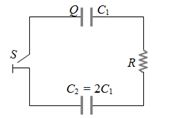
Two capacitors $C_1$ and $C_2 = 2C_1$ are connected with a switch $S$ as shown in the figure. Initially,the switch is open and the charge on capacitor $C_1$ is $Q$. Now,when the switch is closed,the final charges on the capacitors are:
A
$Q, 2Q$
B
$Q/3, 2Q/3$
C
$3Q/2, 3Q$
D
$2Q/3, 4Q/3$
Solution
(B) Initially,capacitor $C_1$ has charge $Q$ and capacitor $C_2$ is uncharged. When the switch $S$ is closed,the two capacitors are connected in parallel across each other (or effectively form a closed loop where charge redistributes until potentials are equal).
Since the capacitors are connected in parallel,they will have the same potential difference $V$ across them.
The total charge $Q_{total} = Q$ is conserved.
Let the final charges be $Q_1'$ and $Q_2'$.
$Q_1' = C_1 V$ and $Q_2' = C_2 V = 2C_1 V = 2Q_1'$.
Since $Q_1' + Q_2' = Q$,we have $Q_1' + 2Q_1' = Q$,which gives $3Q_1' = Q$.
Therefore,$Q_1' = Q/3$ and $Q_2' = 2Q/3$.
Since the capacitors are connected in parallel,they will have the same potential difference $V$ across them.
The total charge $Q_{total} = Q$ is conserved.
Let the final charges be $Q_1'$ and $Q_2'$.
$Q_1' = C_1 V$ and $Q_2' = C_2 V = 2C_1 V = 2Q_1'$.
Since $Q_1' + Q_2' = Q$,we have $Q_1' + 2Q_1' = Q$,which gives $3Q_1' = Q$.
Therefore,$Q_1' = Q/3$ and $Q_2' = 2Q/3$.
0 likes
View Solution40
MediumMCQ
There are two conducting spheres of radii $10 \ cm$ and $20 \ cm$. One sphere is given a charge of $150 \ \mu C$ and is connected to the other sphere by a wire. What will be their common potential?
A
$9 \times 10^6 \ V$
B
$4.5 \times 10^6 \ V$
C
$1.8 \times 10^6 \ V$
D
$1.35 \times 10^9 \ V$
Solution
(B) The capacitance of a spherical conductor is given by $C = 4\pi \epsilon_0 R$.
When two spheres are connected by a wire,charge flows until they reach a common potential $V$.
The common potential is given by $V = \frac{Q_{total}}{C_1 + C_2}$.
Here,$Q_{total} = 150 \ \mu C = 150 \times 10^{-6} \ C$,$R_1 = 0.1 \ m$,and $R_2 = 0.2 \ m$.
The capacitances are $C_1 = 4\pi \epsilon_0 R_1$ and $C_2 = 4\pi \epsilon_0 R_2$.
Thus,$V = \frac{Q_{total}}{4\pi \epsilon_0 (R_1 + R_2)} = \frac{k \cdot Q_{total}}{R_1 + R_2}$,where $k = 9 \times 10^9 \ N \cdot m^2/C^2$.
Substituting the values: $V = \frac{9 \times 10^9 \times 150 \times 10^{-6}}{0.1 + 0.2} = \frac{9 \times 150 \times 10^3}{0.3} = \frac{1350 \times 10^3}{0.3} = 4500 \times 10^3 \ V = 4.5 \times 10^6 \ V$.
When two spheres are connected by a wire,charge flows until they reach a common potential $V$.
The common potential is given by $V = \frac{Q_{total}}{C_1 + C_2}$.
Here,$Q_{total} = 150 \ \mu C = 150 \times 10^{-6} \ C$,$R_1 = 0.1 \ m$,and $R_2 = 0.2 \ m$.
The capacitances are $C_1 = 4\pi \epsilon_0 R_1$ and $C_2 = 4\pi \epsilon_0 R_2$.
Thus,$V = \frac{Q_{total}}{4\pi \epsilon_0 (R_1 + R_2)} = \frac{k \cdot Q_{total}}{R_1 + R_2}$,where $k = 9 \times 10^9 \ N \cdot m^2/C^2$.
Substituting the values: $V = \frac{9 \times 10^9 \times 150 \times 10^{-6}}{0.1 + 0.2} = \frac{9 \times 150 \times 10^3}{0.3} = \frac{1350 \times 10^3}{0.3} = 4500 \times 10^3 \ V = 4.5 \times 10^6 \ V$.
0 likes
View Solution41
EasyMCQ
Two metal spheres have radii of $20\, cm$ and $10\, cm$ respectively, and each sphere carries a charge of $150\, \mu C$. After connecting them with a conducting wire, the common potential on them will be:
A
$9 \times 10^6\, V$
B
$4.5 \times 10^6\, V$
C
$1.8 \times 10^7\, V$
D
$13.5 \times 10^6\, V$
Solution
(A) When two charged conductors are connected by a wire, charge flows until they reach a common potential $V$.
The common potential is given by the formula: $V = \frac{\text{Total Charge}}{\text{Total Capacitance}}$.
Total charge $Q_{total} = Q_1 + Q_2 = 150\, \mu C + 150\, \mu C = 300\, \mu C = 300 \times 10^{-6}\, C$.
The capacitance of a spherical conductor is $C = 4\pi \epsilon_0 R$.
Total capacitance $C_{total} = C_1 + C_2 = 4\pi \epsilon_0 (R_1 + R_2)$.
Given $R_1 = 0.2\, m$ and $R_2 = 0.1\, m$, so $R_1 + R_2 = 0.3\, m$.
$V = \frac{300 \times 10^{-6}}{4\pi \epsilon_0 (0.3)} = \frac{300 \times 10^{-6} \times 9 \times 10^9}{0.3}$.
$V = \frac{2700 \times 10^3}{0.3} = 9000 \times 10^3 = 9 \times 10^6\, V$.
The common potential is given by the formula: $V = \frac{\text{Total Charge}}{\text{Total Capacitance}}$.
Total charge $Q_{total} = Q_1 + Q_2 = 150\, \mu C + 150\, \mu C = 300\, \mu C = 300 \times 10^{-6}\, C$.
The capacitance of a spherical conductor is $C = 4\pi \epsilon_0 R$.
Total capacitance $C_{total} = C_1 + C_2 = 4\pi \epsilon_0 (R_1 + R_2)$.
Given $R_1 = 0.2\, m$ and $R_2 = 0.1\, m$, so $R_1 + R_2 = 0.3\, m$.
$V = \frac{300 \times 10^{-6}}{4\pi \epsilon_0 (0.3)} = \frac{300 \times 10^{-6} \times 9 \times 10^9}{0.3}$.
$V = \frac{2700 \times 10^3}{0.3} = 9000 \times 10^3 = 9 \times 10^6\, V$.
0 likes
View Solution42
MediumMCQ
Two capacitors of capacitance $3 \ \mu F$ and $6 \ \mu F$ are charged to a potential of $12 \ V$. They are then connected by joining their positive plates together and their negative plates together. What will be the potential difference across each capacitor in $V$?
A
$3$
B
$0$
C
$6$
D
$12$
Solution
(D) Given: $C_1 = 3 \ \mu F$,$C_2 = 6 \ \mu F$,$V_1 = 12 \ V$,$V_2 = 12 \ V$.
Since the capacitors are connected in parallel with their positive plates together and negative plates together,the common potential $V_{CM}$ is given by the formula:
$V_{CM} = \frac{C_1 V_1 + C_2 V_2}{C_1 + C_2}$
Substituting the values:
$V_{CM} = \frac{(3 \ \mu F \times 12 \ V) + (6 \ \mu F \times 12 \ V)}{3 \ \mu F + 6 \ \mu F}$
$V_{CM} = \frac{36 + 72}{9} = \frac{108}{9} = 12 \ V$.
Thus,the potential difference across each capacitor remains $12 \ V$.
Since the capacitors are connected in parallel with their positive plates together and negative plates together,the common potential $V_{CM}$ is given by the formula:
$V_{CM} = \frac{C_1 V_1 + C_2 V_2}{C_1 + C_2}$
Substituting the values:
$V_{CM} = \frac{(3 \ \mu F \times 12 \ V) + (6 \ \mu F \times 12 \ V)}{3 \ \mu F + 6 \ \mu F}$
$V_{CM} = \frac{36 + 72}{9} = \frac{108}{9} = 12 \ V$.
Thus,the potential difference across each capacitor remains $12 \ V$.
0 likes
View Solution43
MediumMCQ
$A$ $3\ \mu F$ capacitor is charged to a potential of $300\ V$ and a $2\ \mu F$ capacitor is charged to $200\ V$. They are then connected in parallel with plates of opposite polarity joined together. What is the amount of charge (in $\mu C$) that flows through the connecting wires?
A
$1300$
B
$800$
C
$600$
D
$300$
Solution
(C) Initial charges on the capacitors are:
$Q_1 = C_1 V_1 = 3\ \mu F \times 300\ V = 900\ \mu C$
$Q_2 = C_2 V_2 = 2\ \mu F \times 200\ V = 400\ \mu C$
Since they are connected with opposite polarities,the net charge is $Q_{net} = Q_1 - Q_2 = 900\ \mu C - 400\ \mu C = 500\ \mu C$.
The common potential $V$ after connection is given by:
$V = \frac{Q_{net}}{C_1 + C_2} = \frac{500\ \mu C}{3\ \mu F + 2\ \mu F} = 100\ V$.
The final charge on the $3\ \mu F$ capacitor is $Q_1' = C_1 V = 3\ \mu F \times 100\ V = 300\ \mu C$.
The charge that flows through the wire is the change in charge on one of the capacitors:
$\Delta Q = Q_1 - Q_1' = 900\ \mu C - 300\ \mu C = 600\ \mu C$.
$Q_1 = C_1 V_1 = 3\ \mu F \times 300\ V = 900\ \mu C$
$Q_2 = C_2 V_2 = 2\ \mu F \times 200\ V = 400\ \mu C$
Since they are connected with opposite polarities,the net charge is $Q_{net} = Q_1 - Q_2 = 900\ \mu C - 400\ \mu C = 500\ \mu C$.
The common potential $V$ after connection is given by:
$V = \frac{Q_{net}}{C_1 + C_2} = \frac{500\ \mu C}{3\ \mu F + 2\ \mu F} = 100\ V$.
The final charge on the $3\ \mu F$ capacitor is $Q_1' = C_1 V = 3\ \mu F \times 100\ V = 300\ \mu C$.
The charge that flows through the wire is the change in charge on one of the capacitors:
$\Delta Q = Q_1 - Q_1' = 900\ \mu C - 300\ \mu C = 600\ \mu C$.
0 likes
View Solution44
MediumMCQ
Two capacitors of capacitance $2 \ \mu F$ and $5 \ \mu F$ are charged to $2 \ V$ and $10 \ V$ respectively. Find the ratio of their charges after they are connected by a wire.
A
$3/4$
B
$5/2$
C
$2/5$
D
$4/3$
Solution
(C) When two capacitors are connected by a wire,charge flows until they reach a common potential,$V_{com}$.
After connection,the potential across both capacitors becomes the same $(V_{com})$.
The charge on the first capacitor is $Q'_1 = C_1 V_{com}$.
The charge on the second capacitor is $Q'_2 = C_2 V_{com}$.
The ratio of their charges is given by:
$\frac{Q'_1}{Q'_2} = \frac{C_1 V_{com}}{C_2 V_{com}} = \frac{C_1}{C_2}$.
Substituting the given values:
$\frac{Q'_1}{Q'_2} = \frac{2 \ \mu F}{5 \ \mu F} = \frac{2}{5}$.
After connection,the potential across both capacitors becomes the same $(V_{com})$.
The charge on the first capacitor is $Q'_1 = C_1 V_{com}$.
The charge on the second capacitor is $Q'_2 = C_2 V_{com}$.
The ratio of their charges is given by:
$\frac{Q'_1}{Q'_2} = \frac{C_1 V_{com}}{C_2 V_{com}} = \frac{C_1}{C_2}$.
Substituting the given values:
$\frac{Q'_1}{Q'_2} = \frac{2 \ \mu F}{5 \ \mu F} = \frac{2}{5}$.
0 likes
View Solution45
EasyMCQ
Two capacitors of values $C_1$ and $C_2$ are charged to potentials $V_1$ and $V_2$ respectively. When they are connected in parallel,there will be no change in which of the following?
A
$C_1 = C_2$
B
$C_1 V_1 = C_2 V_2$
C
$V_1 = V_2$
D
$\frac{C_1}{V_1} = \frac{C_2}{V_2}$
Solution
(C) When two capacitors are connected in parallel,charge flows from the capacitor at higher potential to the one at lower potential until both reach a common potential $V$.
If the initial potentials are equal,i.e.,$V_1 = V_2$,then there is no potential difference between the plates when they are connected.
Consequently,no charge flows between the capacitors,and there is no redistribution of charge or energy.
Therefore,if $V_1 = V_2$,there will be no change in the state of the system.
If the initial potentials are equal,i.e.,$V_1 = V_2$,then there is no potential difference between the plates when they are connected.
Consequently,no charge flows between the capacitors,and there is no redistribution of charge or energy.
Therefore,if $V_1 = V_2$,there will be no change in the state of the system.
0 likes
View Solution46
EasyMCQ
$A$ $10 \ \mu F$ capacitor is charged to a potential difference of $50 \ V$ and connected in parallel to another uncharged capacitor. The common potential difference becomes $20 \ V$. The capacitance of the second capacitor is ........ $\mu F$.
A
$10$
B
$20$
C
$30$
D
$15$
Solution
(D) When two capacitors are connected in parallel,the total charge is conserved.
The formula for the common potential $V_{CM}$ is given by: $V_{CM} = \frac{C_1 V_1 + C_2 V_2}{C_1 + C_2}$.
Given values: $C_1 = 10 \ \mu F$,$V_1 = 50 \ V$,$V_2 = 0 \ V$ (uncharged),and $V_{CM} = 20 \ V$.
Substituting these values into the formula:
$20 = \frac{(10 \times 50) + (C_2 \times 0)}{10 + C_2}$
$20 = \frac{500}{10 + C_2}$
$20(10 + C_2) = 500$
$200 + 20 C_2 = 500$
$20 C_2 = 300$
$C_2 = \frac{300}{20} = 15 \ \mu F$.
Therefore,the capacitance of the second capacitor is $15 \ \mu F$.
The formula for the common potential $V_{CM}$ is given by: $V_{CM} = \frac{C_1 V_1 + C_2 V_2}{C_1 + C_2}$.
Given values: $C_1 = 10 \ \mu F$,$V_1 = 50 \ V$,$V_2 = 0 \ V$ (uncharged),and $V_{CM} = 20 \ V$.
Substituting these values into the formula:
$20 = \frac{(10 \times 50) + (C_2 \times 0)}{10 + C_2}$
$20 = \frac{500}{10 + C_2}$
$20(10 + C_2) = 500$
$200 + 20 C_2 = 500$
$20 C_2 = 300$
$C_2 = \frac{300}{20} = 15 \ \mu F$.
Therefore,the capacitance of the second capacitor is $15 \ \mu F$.
0 likes
View Solution47
MediumMCQ
$A$ capacitor of capacitance $6\ \mu F$ is charged to $100\, V$. It is then connected to another uncharged capacitor of capacitance $14\ \mu F$. Find the ratio of charges on the $6\ \mu F$ and $14\ \mu F$ capacitors and the potential across the $6\ \mu F$ capacitor.
A
$6/14$ and $50\, V$
B
$14/6$ and $30\, V$
C
$6/14$ and $30\, V$
D
$14/6$ and $0\, V$
Solution
(C) Initial charge on the $6\ \mu F$ capacitor is $Q = C_1 V_0 = 6\ \mu F \times 100\, V = 600\ \mu C$.
When connected in parallel,both capacitors reach a common potential $V$.
The charge on the capacitors will be $q_1 = C_1 V$ and $q_2 = C_2 V$.
The ratio of charges is $\frac{q_1}{q_2} = \frac{C_1 V}{C_2 V} = \frac{C_1}{C_2} = \frac{6}{14}$.
By conservation of charge,$q_1 + q_2 = Q = 600\ \mu C$.
$C_1 V + C_2 V = 600\ \mu C \Rightarrow V(6 + 14) = 600$.
$V = \frac{600}{20} = 30\, V$.
Thus,the ratio is $6/14$ and the potential is $30\, V$.
When connected in parallel,both capacitors reach a common potential $V$.
The charge on the capacitors will be $q_1 = C_1 V$ and $q_2 = C_2 V$.
The ratio of charges is $\frac{q_1}{q_2} = \frac{C_1 V}{C_2 V} = \frac{C_1}{C_2} = \frac{6}{14}$.
By conservation of charge,$q_1 + q_2 = Q = 600\ \mu C$.
$C_1 V + C_2 V = 600\ \mu C \Rightarrow V(6 + 14) = 600$.
$V = \frac{600}{20} = 30\, V$.
Thus,the ratio is $6/14$ and the potential is $30\, V$.
0 likes
View Solution48
MediumMCQ
Two hollow metallic spheres of radii $20 \ cm$ and $10 \ cm$ each carry a charge of $150 \ \mu C$. If they are connected by a conducting wire,the common potential is ...... $V$.
A
$9 \times 10^6$
B
$4.5 \times 10^6$
C
$1.8 \times 10^6$
D
$13.5 \times 10^6$
Solution
(A) The capacitance of a spherical conductor is given by $C = 4\pi\epsilon_0 R = \frac{R}{k}$,where $k = \frac{1}{4\pi\epsilon_0} = 9 \times 10^9 \ N \cdot m^2/C^2$.
Given: $R_1 = 0.2 \ m$,$R_2 = 0.1 \ m$,$q_1 = 150 \times 10^{-6} \ C$,$q_2 = 150 \times 10^{-6} \ C$.
When connected by a wire,the total charge $Q = q_1 + q_2 = 300 \times 10^{-6} \ C$ is shared,and the total capacitance is $C_{eq} = C_1 + C_2 = \frac{R_1 + R_2}{k}$.
The common potential $V$ is given by $V = \frac{Q}{C_{eq}} = \frac{q_1 + q_2}{(R_1 + R_2)/k} = \frac{k(q_1 + q_2)}{R_1 + R_2}$.
Substituting the values: $V = \frac{9 \times 10^9 \times (300 \times 10^{-6})}{0.2 + 0.1} = \frac{9 \times 10^9 \times 300 \times 10^{-6}}{0.3}$.
$V = \frac{2700 \times 10^3}{0.3} = 9000 \times 10^3 = 9 \times 10^6 \ V$.
Given: $R_1 = 0.2 \ m$,$R_2 = 0.1 \ m$,$q_1 = 150 \times 10^{-6} \ C$,$q_2 = 150 \times 10^{-6} \ C$.
When connected by a wire,the total charge $Q = q_1 + q_2 = 300 \times 10^{-6} \ C$ is shared,and the total capacitance is $C_{eq} = C_1 + C_2 = \frac{R_1 + R_2}{k}$.
The common potential $V$ is given by $V = \frac{Q}{C_{eq}} = \frac{q_1 + q_2}{(R_1 + R_2)/k} = \frac{k(q_1 + q_2)}{R_1 + R_2}$.
Substituting the values: $V = \frac{9 \times 10^9 \times (300 \times 10^{-6})}{0.2 + 0.1} = \frac{9 \times 10^9 \times 300 \times 10^{-6}}{0.3}$.
$V = \frac{2700 \times 10^3}{0.3} = 9000 \times 10^3 = 9 \times 10^6 \ V$.
0 likes
View Solution49
DifficultMCQ
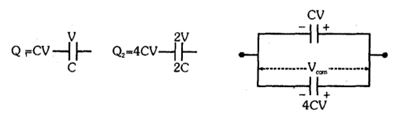
$A$ parallel plate capacitor of capacitance $C$ is charged to a potential $V$ by a battery. Another capacitor of capacitance $2C$ is charged to a potential $2V$ by another battery. After removing the batteries,they are connected in parallel such that the positive plate of one is connected to the negative plate of the other. Calculate the final energy of the system.
A
$3/2 \ CV^2$
B
$5/2 \ CV^2$
C
$7/3 \ CV^2$
D
$4/5 \ CV^2$
Solution
(A) Initial charges on the capacitors are $Q_1 = CV$ and $Q_2 = (2C)(2V) = 4CV$.
Since they are connected with opposite polarities,the net charge on the system is $Q_{net} = |Q_2 - Q_1| = |4CV - CV| = 3CV$.
The equivalent capacitance of the system in parallel is $C_{eq} = C + 2C = 3C$.
The common potential is $V_{com} = \frac{Q_{net}}{C_{eq}} = \frac{3CV}{3C} = V$.
The final energy stored in the system is $U = \frac{1}{2} C_{eq} V_{com}^2 = \frac{1}{2} (3C) (V)^2 = \frac{3}{2} CV^2$.
Since they are connected with opposite polarities,the net charge on the system is $Q_{net} = |Q_2 - Q_1| = |4CV - CV| = 3CV$.
The equivalent capacitance of the system in parallel is $C_{eq} = C + 2C = 3C$.
The common potential is $V_{com} = \frac{Q_{net}}{C_{eq}} = \frac{3CV}{3C} = V$.
The final energy stored in the system is $U = \frac{1}{2} C_{eq} V_{com}^2 = \frac{1}{2} (3C) (V)^2 = \frac{3}{2} CV^2$.
0 likes
View Solution50
DifficultMCQ
$A$ parallel plate capacitor of capacitance $C$ is charged to a potential difference $V$ by connecting it to a battery. Another capacitor of capacitance $2C$ is charged to a potential difference $2V$ by connecting it to another battery. Now,the charging batteries are removed and the capacitors are connected in parallel such that the positive plate of one is connected to the negative plate of the other and the negative plate of the first is connected to the positive plate of the second. Find the final energy of this configuration.
A
Zero
B
$25 CV^2/6$
C
$3 CV^2/2$
D
$9 CV^2/2$
Solution
(C) Initial charges on the capacitors are $Q_1 = CV$ and $Q_2 = 2C(2V) = 4CV$.
When connected with opposite polarities,the net charge on the system is $Q_{net} = Q_2 - Q_1 = 4CV - CV = 3CV$.
The equivalent capacitance of the parallel combination is $C_{eq} = C + 2C = 3C$.
The common potential $V'$ is given by $V' = Q_{net} / C_{eq} = 3CV / 3C = V$.
The final energy $U_f$ of the configuration is $U_f = \frac{1}{2} C_{eq} (V')^2 = \frac{1}{2} (3C) V^2 = \frac{3}{2} CV^2$.
When connected with opposite polarities,the net charge on the system is $Q_{net} = Q_2 - Q_1 = 4CV - CV = 3CV$.
The equivalent capacitance of the parallel combination is $C_{eq} = C + 2C = 3C$.
The common potential $V'$ is given by $V' = Q_{net} / C_{eq} = 3CV / 3C = V$.
The final energy $U_f$ of the configuration is $U_f = \frac{1}{2} C_{eq} (V')^2 = \frac{1}{2} (3C) V^2 = \frac{3}{2} CV^2$.
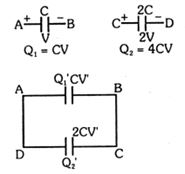
0 likes
View SolutionElectric Potential and Capacitance — Sharing of Charge in Capacitor Circuit · Frequently Asked Questions
1Are these Electric Potential and Capacitance questions useful for JEE and NEET?
Yes. All questions in this section are mapped to JEE Main and NEET exam patterns. Previous year questions from JEE Main, NEET, GUJCET and state-level exams are included with full solutions.
2Can I switch to Hindi or Gujarati for these questions?
Yes. Use the language tabs in the hero section or the sidebar to view the same questions and solutions in English, Hindi or Gujarati.
3How do I generate a question paper from this subtopic?
Use the Vedclass Exam Paper Generator — select the chapter and subtopic, set difficulty, and generate Sets A, B, C, D automatically. First 3 chapters of every subject are free.
Vedclass Products
For Students
Vedclass Test Series
Mock tests in real JEE/NEET style with performance analysis. 5-day free trial.
Start Free TrialFor Teachers
Exam Paper Generator
Generate Set A/B/C/D papers from this chapter in 2 minutes. 3 chapters free.
Try FreeFor Institutes
Online Exam Module
Live online exams with unlimited students, 360° analytics & white-label branding.
See DemoFor Teachers & Institutes
Generate a Electric Potential and Capacitance Exam Paper in 2 Minutes
Select subtopic & difficulty — Sets A, B, C, D auto-generated with No Repeat logic.
First 3 chapters of every subject are free — no payment required.