
A English
Mix Examples-Haloalkanes and Haloarenes Questions in English
Class 12 Chemistry · Haloalkanes and Haloarenes · Mix Examples-Haloalkanes and Haloarenes
128+
Questions
English
Language
100%
With Solutions
Showing 47 of 128 questions in English
51
DifficultMCQ
Consider the following statements:
$(1)$ Bridgehead halides are inert towards both $S_{N^1}$ and $S_{N^2}$ reactions (until one of the ring size is an eight-membered ring).
$(2)$ The first step in both $S_{N^1}$ and $E_1$ reactions is the same.
$(3)$ $S_{N^2}$ reactions proceed with total retention of configuration.
$(4)$ $E_2$ eliminations are favored by the use of a solvent of low polarity and a high concentration of a strong base.
Which of the above statements are correct?
$(1)$ Bridgehead halides are inert towards both $S_{N^1}$ and $S_{N^2}$ reactions (until one of the ring size is an eight-membered ring).
$(2)$ The first step in both $S_{N^1}$ and $E_1$ reactions is the same.
$(3)$ $S_{N^2}$ reactions proceed with total retention of configuration.
$(4)$ $E_2$ eliminations are favored by the use of a solvent of low polarity and a high concentration of a strong base.
Which of the above statements are correct?
A
$1, 2$ and $4$
B
$1$ and $3$
C
$2, 3$ and $4$
D
$1, 2, 3$ and $4$
Solution
(A) $(1)$ Bridgehead halides are inert because the formation of a planar carbocation $(S_{N^1})$ at the bridgehead is geometrically restricted (Bredt's rule),and $S_{N^2}$ attack is sterically hindered.
$(2)$ Both $S_{N^1}$ and $E_1$ reactions involve the rate-determining step of ionization to form a common carbocation intermediate.
$(3)$ $S_{N^2}$ reactions proceed with inversion of configuration (Walden inversion),not retention.
$(4)$ $E_2$ reactions are bimolecular and are favored by high concentrations of strong bases and solvents that do not stabilize the transition state excessively,often low polarity solvents.
Therefore,statements $(1), (2),$ and $(4)$ are correct.
$(2)$ Both $S_{N^1}$ and $E_1$ reactions involve the rate-determining step of ionization to form a common carbocation intermediate.
$(3)$ $S_{N^2}$ reactions proceed with inversion of configuration (Walden inversion),not retention.
$(4)$ $E_2$ reactions are bimolecular and are favored by high concentrations of strong bases and solvents that do not stabilize the transition state excessively,often low polarity solvents.
Therefore,statements $(1), (2),$ and $(4)$ are correct.
0 likes
View Solution52
MediumMCQ
Identify the products formed and comment on the optical activity of the products for the following reaction: $3$-phenylcyclopent-$2$-en-$1$-one + $H_2$ $(2-3 \ atm)$ $\xrightarrow{10\% Pd/C, \text{Ethanol}}$ ?
A
Diastereomers
B
Racemic mixture
C
Meso
D
Optically pure enantiomer
Solution
(B) The reaction involves the catalytic hydrogenation of the $C=C$ double bond in $3$-phenylcyclopent-$2$-en-$1$-one using $10\% Pd/C$ under $2-3 \ atm$ pressure of $H_2$.
The benzene ring remains inert under these mild hydrogenation conditions.
The hydrogenation of the double bond creates a chiral center at the $C-3$ position of the cyclopentanone ring.
Since the catalyst can approach the planar double bond from either the top or the bottom face with equal probability,both $(R)$ and $(S)$ enantiomers are formed in equal amounts.
Therefore,the product is a racemic mixture,which is optically inactive.
The benzene ring remains inert under these mild hydrogenation conditions.
The hydrogenation of the double bond creates a chiral center at the $C-3$ position of the cyclopentanone ring.
Since the catalyst can approach the planar double bond from either the top or the bottom face with equal probability,both $(R)$ and $(S)$ enantiomers are formed in equal amounts.
Therefore,the product is a racemic mixture,which is optically inactive.
0 likes
View Solution53
MediumMCQ
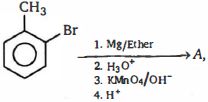
Product $A$ is
A
$2-$hydroxybenzoic acid
B
$2-$methylphenol
C
benzoic acid
D
benzene
Solution
(C) $1$. The reaction of $2$-bromotoluene with $Mg$ in ether forms the Grignard reagent,$2$-methylphenylmagnesium bromide.
$2$. Hydrolysis of the Grignard reagent with $H_3O^+$ yields toluene $(methylbenzene)$.
$3$. Oxidation of the methyl group in toluene using alkaline $KMnO_4$ followed by acidification with $H^+$ converts the methyl group into a carboxylic acid group,resulting in the formation of benzoic acid.
$2$. Hydrolysis of the Grignard reagent with $H_3O^+$ yields toluene $(methylbenzene)$.
$3$. Oxidation of the methyl group in toluene using alkaline $KMnO_4$ followed by acidification with $H^+$ converts the methyl group into a carboxylic acid group,resulting in the formation of benzoic acid.
0 likes
View Solution54
DifficultMCQ
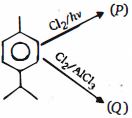
Identify the major products $(P)$ and $(Q)$ respectively for the given reaction.
A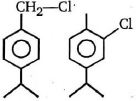
B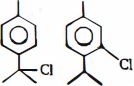
C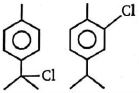
D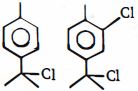
Solution
(D) The reaction with $Cl_2/hv$ follows a free radical substitution mechanism. The tertiary hydrogen on the isopropyl group is the most reactive towards free radical abstraction,leading to the formation of $2-$chloro$-2-$($4$-methylphenyl)propane as the major product $(P)$.
The reaction with $Cl_2/AlCl_3$ is an electrophilic aromatic substitution $(EAS)$. The methyl group is ortho/para directing,and the isopropyl group is also ortho/para directing. Due to the steric hindrance of the isopropyl group,the electrophile $(Cl^+)$ attacks the position ortho to the methyl group,leading to $2-$chloro$-1-$methyl$-4-$isopropylbenzene as the major product $(Q)$.
The reaction with $Cl_2/AlCl_3$ is an electrophilic aromatic substitution $(EAS)$. The methyl group is ortho/para directing,and the isopropyl group is also ortho/para directing. Due to the steric hindrance of the isopropyl group,the electrophile $(Cl^+)$ attacks the position ortho to the methyl group,leading to $2-$chloro$-1-$methyl$-4-$isopropylbenzene as the major product $(Q)$.
0 likes
View Solution55
DifficultMCQ
Which of the following statements is wrong?
A
Ethyl chloride on reduction with $Zn-Cu$ couple and alcohol gives ethane.
B
The reaction of methyl magnesium bromide with acetone gives butanol-$2$.
C
Alkyl halides follow the following reactivity sequence on reaction with alkenes: $R-I > R-Br > R-Cl > R-F$.
D
$C_2H_4Cl_2$ may exist in two isomeric forms.
Solution
(B) $1$. Ethyl chloride $(C_2H_5Cl)$ on reduction with $Zn-Cu$ couple and alcohol gives ethane $(C_2H_6)$. This is correct.
$2$. The reaction of methyl magnesium bromide $(CH_3MgBr)$ with acetone $(CH_3COCH_3)$ gives tert-butanol ($2$-methylpropan-$2$-ol),not butanol-$2$. Thus,statement $B$ is wrong.
$3$. Alkyl halides follow the reactivity sequence $R-I > R-Br > R-Cl > R-F$ due to the decreasing bond dissociation energy of the $C-X$ bond. This is correct.
$4$. $C_2H_4Cl_2$ exists as two isomers: $1,1$-dichloroethane and $1,2$-dichloroethane. This is correct.
$2$. The reaction of methyl magnesium bromide $(CH_3MgBr)$ with acetone $(CH_3COCH_3)$ gives tert-butanol ($2$-methylpropan-$2$-ol),not butanol-$2$. Thus,statement $B$ is wrong.
$3$. Alkyl halides follow the reactivity sequence $R-I > R-Br > R-Cl > R-F$ due to the decreasing bond dissociation energy of the $C-X$ bond. This is correct.
$4$. $C_2H_4Cl_2$ exists as two isomers: $1,1$-dichloroethane and $1,2$-dichloroethane. This is correct.
0 likes
View Solution56
MediumMCQ
Which of the following is not formed in the given reaction?
$C_6H_5CH_2Cl + CH_3Cl \xrightarrow{Na, \text{dry ether}}$
$C_6H_5CH_2Cl + CH_3Cl \xrightarrow{Na, \text{dry ether}}$
A
$C_6H_5CH_2CH_3$
B
$C_6H_5CH_2CH_2C_6H_5$
C
$CH_3-CH_3$
D
$C_6H_5CH_2C_6H_5$
Solution
(D) The given reaction is a Wurtz-Fittig type reaction involving benzyl chloride $(C_6H_5CH_2Cl)$ and methyl chloride $(CH_3Cl)$ in the presence of sodium and dry ether.
This reaction proceeds via the formation of free radicals:
$1$. $C_6H_5CH_2Cl \rightarrow C_6H_5CH_2^{\bullet} + Cl^{\bullet}$
$2$. $CH_3Cl \rightarrow CH_3^{\bullet} + Cl^{\bullet}$
These radicals can combine in different ways:
- Combination of two benzyl radicals: $C_6H_5CH_2^{\bullet} + C_6H_5CH_2^{\bullet} \rightarrow C_6H_5CH_2CH_2C_6H_5$ ($1$,$2$-diphenylethane)
- Combination of two methyl radicals: $CH_3^{\bullet} + CH_3^{\bullet} \rightarrow CH_3-CH_3$ (ethane)
- Combination of one benzyl and one methyl radical: $C_6H_5CH_2^{\bullet} + CH_3^{\bullet} \rightarrow C_6H_5CH_2CH_3$ (ethylbenzene)
Compound $C_6H_5CH_2C_6H_5$ (diphenylmethane) is not formed in this reaction because the radical $C_6H_5CH_2^{\bullet}$ does not undergo coupling with a phenyl radical $(C_6H_5^{\bullet})$ in this specific reaction mixture.
This reaction proceeds via the formation of free radicals:
$1$. $C_6H_5CH_2Cl \rightarrow C_6H_5CH_2^{\bullet} + Cl^{\bullet}$
$2$. $CH_3Cl \rightarrow CH_3^{\bullet} + Cl^{\bullet}$
These radicals can combine in different ways:
- Combination of two benzyl radicals: $C_6H_5CH_2^{\bullet} + C_6H_5CH_2^{\bullet} \rightarrow C_6H_5CH_2CH_2C_6H_5$ ($1$,$2$-diphenylethane)
- Combination of two methyl radicals: $CH_3^{\bullet} + CH_3^{\bullet} \rightarrow CH_3-CH_3$ (ethane)
- Combination of one benzyl and one methyl radical: $C_6H_5CH_2^{\bullet} + CH_3^{\bullet} \rightarrow C_6H_5CH_2CH_3$ (ethylbenzene)
Compound $C_6H_5CH_2C_6H_5$ (diphenylmethane) is not formed in this reaction because the radical $C_6H_5CH_2^{\bullet}$ does not undergo coupling with a phenyl radical $(C_6H_5^{\bullet})$ in this specific reaction mixture.
0 likes
View Solution57
MediumMCQ
$C_3H_7I$ $(P)$ $\xrightarrow[\text{alc. } KOH]{\Delta}$ $Q$ $\xrightarrow{NBS}$ $R$ $\xrightarrow{KCN}$ $CH_2 = CH - CH_2 - CN$. $P$ can be:
A
$CH_3-CH(I)-CH_3$
B
$CH_3-CH_2-CH_2-I$
C
$CH_2=CH-CH_2-I$
D
$A$ and $B$ both
Solution
(D) $1$. $P$ is $C_3H_7I$.
$2$. Reaction with alc. $KOH$ is a dehydrohalogenation reaction (elimination).
$3$. If $P$ is $CH_3-CH_2-CH_2-I$ ($n$-propyl iodide),$Q$ is $CH_3-CH=CH_2$ (propene).
$4$. $NBS$ ($N$-Bromosuccinimide) performs allylic bromination. $CH_3-CH=CH_2 \xrightarrow{NBS} Br-CH_2-CH=CH_2$ $(R)$.
$5$. $R$ reacts with $KCN$ to give $CH_2=CH-CH_2-CN$ (allyl cyanide).
$6$. If $P$ is $CH_3-CH(I)-CH_3$ (isopropyl iodide),$Q$ is also $CH_3-CH=CH_2$ (propene),leading to the same product.
$7$. Thus,both $A$ and $B$ can be $P$.
$2$. Reaction with alc. $KOH$ is a dehydrohalogenation reaction (elimination).
$3$. If $P$ is $CH_3-CH_2-CH_2-I$ ($n$-propyl iodide),$Q$ is $CH_3-CH=CH_2$ (propene).
$4$. $NBS$ ($N$-Bromosuccinimide) performs allylic bromination. $CH_3-CH=CH_2 \xrightarrow{NBS} Br-CH_2-CH=CH_2$ $(R)$.
$5$. $R$ reacts with $KCN$ to give $CH_2=CH-CH_2-CN$ (allyl cyanide).
$6$. If $P$ is $CH_3-CH(I)-CH_3$ (isopropyl iodide),$Q$ is also $CH_3-CH=CH_2$ (propene),leading to the same product.
$7$. Thus,both $A$ and $B$ can be $P$.
0 likes
View Solution58
EasyMCQ
In which of the following compounds does the carbon atom attached to the halogen possess $sp^2$ hybridization?
A
$1-$Bromocyclohex$-1-$ene
B
Vinyl chloride
C
Bromobenzene
D
All of the above
Solution
(D) In $1-$bromocyclohex$-1-$ene,the carbon attached to the bromine is part of a double bond,hence it is $sp^2$ hybridized.
In vinyl chloride $(CH_2=CH-Cl)$,the carbon attached to the chlorine is part of a double bond,hence it is $sp^2$ hybridized.
In bromobenzene $(C_6H_5Br)$,the carbon attached to the bromine is part of the aromatic ring,which is $sp^2$ hybridized.
Therefore,all the given compounds contain a halogen atom attached to an $sp^2$ hybridized carbon.
In vinyl chloride $(CH_2=CH-Cl)$,the carbon attached to the chlorine is part of a double bond,hence it is $sp^2$ hybridized.
In bromobenzene $(C_6H_5Br)$,the carbon attached to the bromine is part of the aromatic ring,which is $sp^2$ hybridized.
Therefore,all the given compounds contain a halogen atom attached to an $sp^2$ hybridized carbon.
0 likes
View Solution59
DifficultMCQ
Which of the following compounds is a tertiary alkyl halide?
A
$(1-$chloro$-1-$methyl ethyl) benzene
B
$2-$chloro$-2-$methyl propane
C
$(1-$chloro ethyl) benzene
D
Both $A$ and $B$
Solution
(D) tertiary alkyl halide is a compound where the halogen atom is attached to a carbon atom that is bonded to three other carbon atoms.
In $(1-$chloro$-1-$methyl ethyl) benzene,the structure is $C_6H_5-C(CH_3)_2-Cl$. Here,the carbon atom attached to the chlorine is bonded to two methyl groups and one phenyl group,making it a tertiary carbon.
In $2-$chloro$-2-$methyl propane,the structure is $(CH_3)_3C-Cl$. Here,the carbon atom attached to the chlorine is bonded to three methyl groups,making it a tertiary carbon.
Therefore,both $A$ and $B$ are tertiary alkyl halides.
In $(1-$chloro$-1-$methyl ethyl) benzene,the structure is $C_6H_5-C(CH_3)_2-Cl$. Here,the carbon atom attached to the chlorine is bonded to two methyl groups and one phenyl group,making it a tertiary carbon.
In $2-$chloro$-2-$methyl propane,the structure is $(CH_3)_3C-Cl$. Here,the carbon atom attached to the chlorine is bonded to three methyl groups,making it a tertiary carbon.
Therefore,both $A$ and $B$ are tertiary alkyl halides.
0 likes
View Solution60
AdvancedMCQ
Reaction of $o$-toluic acid with $Br_2/Fe$ gives:
A
B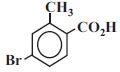
C
D
Solution
(B) The reaction of $o$-toluic acid ($2$-methylbenzoic acid) with $Br_2/Fe$ is an electrophilic aromatic substitution reaction.
In $o$-toluic acid,the $-CH_3$ group is ortho/para-directing,and the $-COOH$ group is meta-directing.
Both groups direct the incoming electrophile $(Br^+)$ to the same position,which is the position para to the $-CH_3$ group and meta to the $-COOH$ group.
This position is the $5$-position of the ring (relative to the carboxylic acid group at position $1$ and methyl at position $2$).
Therefore,the product formed is $5$-bromo-$2$-methylbenzoic acid,which corresponds to structure $B$.
In $o$-toluic acid,the $-CH_3$ group is ortho/para-directing,and the $-COOH$ group is meta-directing.
Both groups direct the incoming electrophile $(Br^+)$ to the same position,which is the position para to the $-CH_3$ group and meta to the $-COOH$ group.
This position is the $5$-position of the ring (relative to the carboxylic acid group at position $1$ and methyl at position $2$).
Therefore,the product formed is $5$-bromo-$2$-methylbenzoic acid,which corresponds to structure $B$.
0 likes
View Solution61
DifficultMCQ
The reaction of the compound shown in the image with $alc. KOH$ yields:
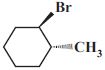
A
$1-$methylcyclohexene (major product)
B
$1-$methylcyclohexane only
C
$3-$methylcyclohexene (major product)
D
$3-$methylcyclohexane only
Solution
(A) The given compound is $2-$methylbromocyclohexane (specifically the trans isomer based on the wedge/dash representation).
Reaction with $alc. KOH$ is a dehydrohalogenation reaction ($E2$ mechanism).
In an $E2$ mechanism,the leaving group $(Br)$ and the $\beta$-hydrogen must be anti-periplanar.
There are two types of $\beta$-hydrogens available: one at $C-1$ (bearing the $CH_3$ group) and one at $C-3$.
Removal of the $\beta$-hydrogen from $C-1$ leads to the more substituted alkene,$1-$methylcyclohexene,which is the Saytzeff product and is more stable.
Removal of the $\beta$-hydrogen from $C-3$ leads to the less substituted alkene,$3-$methylcyclohexene,which is the Hofmann product.
According to Saytzeff's rule,the more substituted alkene is the major product.
Therefore,$1-$methylcyclohexene is the major product.
Reaction with $alc. KOH$ is a dehydrohalogenation reaction ($E2$ mechanism).
In an $E2$ mechanism,the leaving group $(Br)$ and the $\beta$-hydrogen must be anti-periplanar.
There are two types of $\beta$-hydrogens available: one at $C-1$ (bearing the $CH_3$ group) and one at $C-3$.
Removal of the $\beta$-hydrogen from $C-1$ leads to the more substituted alkene,$1-$methylcyclohexene,which is the Saytzeff product and is more stable.
Removal of the $\beta$-hydrogen from $C-3$ leads to the less substituted alkene,$3-$methylcyclohexene,which is the Hofmann product.
According to Saytzeff's rule,the more substituted alkene is the major product.
Therefore,$1-$methylcyclohexene is the major product.
0 likes
View Solution62
DifficultMCQ
Arrange the following reactants in increasing order of reactivity towards $S_{N^1}$ solvolysis reaction with methanol.
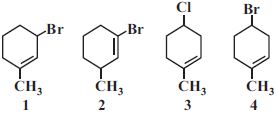
A
$3 < 2 < 4 < 1$
B
$2 < 3 < 4 < 1$
C
$4 < 3 < 2 < 1$
D
$2 < 4 < 3 < 1$
Solution
(B) The rate of $S_{N^1}$ reaction depends on the stability of the carbocation intermediate formed after the leaving group departs.
$1$. Compound $1$ is an allylic bromide. Upon loss of $Br^-$,it forms a stable allylic carbocation.
$2$. Compound $2$ is a vinylic bromide. Vinylic halides are extremely unreactive towards $S_{N^1}$ because the resulting vinylic carbocation is highly unstable due to the $sp$ hybridization of the carbon atom.
$3$. Compound $3$ is an allylic chloride. It forms an allylic carbocation,but $Cl^-$ is a poorer leaving group than $Br^-$,making it less reactive than $1$.
$4$. Compound $4$ is an allylic bromide. It forms a secondary allylic carbocation. Comparing $1$ and $4$,$1$ forms a more substituted (more stable) allylic carbocation than $4$.
Thus,the order of stability of carbocations (and reactivity) is $2 < 3 < 4 < 1$.
$1$. Compound $1$ is an allylic bromide. Upon loss of $Br^-$,it forms a stable allylic carbocation.
$2$. Compound $2$ is a vinylic bromide. Vinylic halides are extremely unreactive towards $S_{N^1}$ because the resulting vinylic carbocation is highly unstable due to the $sp$ hybridization of the carbon atom.
$3$. Compound $3$ is an allylic chloride. It forms an allylic carbocation,but $Cl^-$ is a poorer leaving group than $Br^-$,making it less reactive than $1$.
$4$. Compound $4$ is an allylic bromide. It forms a secondary allylic carbocation. Comparing $1$ and $4$,$1$ forms a more substituted (more stable) allylic carbocation than $4$.
Thus,the order of stability of carbocations (and reactivity) is $2 < 3 < 4 < 1$.
0 likes
View Solution63
DifficultMCQ
Identify the product of the following reaction:
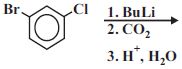
A
$3-$chlorobenzoic acid
B
$3-$bromobenzoic acid
C
benzene$-1,3-$dicarboxylic acid
D
All of these
Solution
(A) The starting material is $1$-bromo-$3$-chlorobenzene.
$1$. Treatment with $n$-butyllithium $(n-BuLi)$ leads to a halogen-metal exchange reaction. Since bromine is more electropositive and forms a more stable organolithium intermediate than chlorine,the lithium atom selectively replaces the bromine atom,forming $3$-chlorophenyllithium.
$2$. The resulting $3$-chlorophenyllithium reacts with carbon dioxide $(CO_2)$ to form a lithium carboxylate intermediate.
$3$. Subsequent acidic workup $(H^+, H_2O)$ protonates the carboxylate to yield $3$-chlorobenzoic acid as the final product.
$1$. Treatment with $n$-butyllithium $(n-BuLi)$ leads to a halogen-metal exchange reaction. Since bromine is more electropositive and forms a more stable organolithium intermediate than chlorine,the lithium atom selectively replaces the bromine atom,forming $3$-chlorophenyllithium.
$2$. The resulting $3$-chlorophenyllithium reacts with carbon dioxide $(CO_2)$ to form a lithium carboxylate intermediate.
$3$. Subsequent acidic workup $(H^+, H_2O)$ protonates the carboxylate to yield $3$-chlorobenzoic acid as the final product.
0 likes
View Solution64
AdvancedMCQ
The possible products formed in the following reaction are:
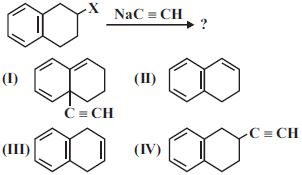
A
$I, III, IV$
B
$II, III, IV$
C
$II, IV$
D
$III, IV$
Solution
(B) The reactant is a secondary alkyl halide ($2^\circ$ halide) attached to a tetralin ring system.
$NaC \equiv CH$ is a strong base and a nucleophile.
Since the substrate is a secondary halide,both $S_N2$ (substitution) and $E2$ (elimination) reactions can occur.
$1$. $S_N2$ reaction: The acetylide ion acts as a nucleophile and attacks the carbon atom,resulting in the substitution of $X$ with the $-C \equiv CH$ group. This gives product $(IV)$.
$2$. $E2$ reaction: The acetylide ion acts as a base and abstracts a proton from the adjacent carbon atoms.
- Abstraction of a proton from the $C_1$ position leads to the formation of a double bond between $C_1$ and $C_2$,resulting in product $(III)$.
- Abstraction of a proton from the $C_3$ position leads to the formation of a double bond between $C_2$ and $C_3$,resulting in product $(II)$.
Product $(I)$ is not possible as it involves a rearrangement of the aromatic ring.
Therefore,the possible products are $(II)$,$(III)$,and $(IV)$.
$NaC \equiv CH$ is a strong base and a nucleophile.
Since the substrate is a secondary halide,both $S_N2$ (substitution) and $E2$ (elimination) reactions can occur.
$1$. $S_N2$ reaction: The acetylide ion acts as a nucleophile and attacks the carbon atom,resulting in the substitution of $X$ with the $-C \equiv CH$ group. This gives product $(IV)$.
$2$. $E2$ reaction: The acetylide ion acts as a base and abstracts a proton from the adjacent carbon atoms.
- Abstraction of a proton from the $C_1$ position leads to the formation of a double bond between $C_1$ and $C_2$,resulting in product $(III)$.
- Abstraction of a proton from the $C_3$ position leads to the formation of a double bond between $C_2$ and $C_3$,resulting in product $(II)$.
Product $(I)$ is not possible as it involves a rearrangement of the aromatic ring.
Therefore,the possible products are $(II)$,$(III)$,and $(IV)$.
0 likes
View Solution65
AdvancedMCQ
Assertion : Alkylbenzene is not prepared by Friedel-Crafts alkylation of benzene.
Reason : Alkyl halides are less reactive than acyl halides.
Reason : Alkyl halides are less reactive than acyl halides.
A
If both Assertion and Reason are correct and the Reason is a correct explanation of the Assertion.
B
If both Assertion and Reason are correct but Reason is not a correct explanation of the Assertion.
C
If the Assertion is correct but Reason is incorrect.
D
If both the Assertion and Reason are incorrect.
Solution
(D) The Assertion is incorrect because alkylbenzene $CAN$ be prepared by Friedel-Crafts alkylation,although it has limitations such as polyalkylation and rearrangement.
The Reason is also incorrect because alkyl halides are generally more reactive or comparable in reactivity to acyl halides in the context of Friedel-Crafts reactions,but the primary issue with alkylation is the formation of polyalkylated products due to the activating nature of the alkyl group added to the benzene ring.
Therefore,both the Assertion and the Reason are incorrect.
The Reason is also incorrect because alkyl halides are generally more reactive or comparable in reactivity to acyl halides in the context of Friedel-Crafts reactions,but the primary issue with alkylation is the formation of polyalkylated products due to the activating nature of the alkyl group added to the benzene ring.
Therefore,both the Assertion and the Reason are incorrect.
0 likes
View Solution66
Easy
Draw the structures of major monohalo products in each of the following reactions:
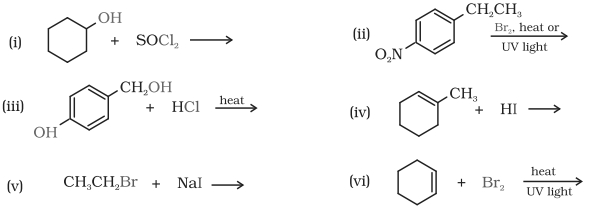
Solution
(N/A) $(i)$ Cyclohexanol reacts with $SOCl_2$ to form chlorocyclohexane: $\text{Cyclohexanol} + SOCl_2 \rightarrow \text{Chlorocyclohexane} + SO_2 + HCl$.
$(ii)$ $4-\text{Ethylnitrobenzene}$ undergoes free radical bromination at the benzylic position: $4-\text{Ethylnitrobenzene} + Br_2 \xrightarrow{\text{heat or UV light}} 4-(1-\text{Bromoethyl})\text{nitrobenzene} + HBr$.
$(iii)$ $4-\text{Hydroxymethylphenol}$ reacts with $HCl$ to replace the alcoholic $-OH$ group: $4-\text{Hydroxymethylphenol} + HCl \xrightarrow{\text{heat}} 4-\text{Chloromethylphenol} + H_2O$.
$(iv)$ $1-\text{Methylcyclohexene}$ undergoes electrophilic addition with $HI$ following Markovnikov's rule: $1-\text{Methylcyclohexene} + HI \rightarrow 1-\text{Iodo}-1-\text{methylcyclohexane}$.
$(v)$ $CH_3CH_2Br$ reacts with $NaI$ in acetone (Finkelstein reaction): $CH_3CH_2Br + NaI \rightarrow CH_3CH_2I + NaBr$.
$(vi)$ Cyclohexene undergoes allylic bromination with $Br_2$ under heat or $UV$ light: $\text{Cyclohexene} + Br_2 \xrightarrow{\text{heat or UV light}} 3-\text{Bromocyclohexene} + HBr$.
$(ii)$ $4-\text{Ethylnitrobenzene}$ undergoes free radical bromination at the benzylic position: $4-\text{Ethylnitrobenzene} + Br_2 \xrightarrow{\text{heat or UV light}} 4-(1-\text{Bromoethyl})\text{nitrobenzene} + HBr$.
$(iii)$ $4-\text{Hydroxymethylphenol}$ reacts with $HCl$ to replace the alcoholic $-OH$ group: $4-\text{Hydroxymethylphenol} + HCl \xrightarrow{\text{heat}} 4-\text{Chloromethylphenol} + H_2O$.
$(iv)$ $1-\text{Methylcyclohexene}$ undergoes electrophilic addition with $HI$ following Markovnikov's rule: $1-\text{Methylcyclohexene} + HI \rightarrow 1-\text{Iodo}-1-\text{methylcyclohexane}$.
$(v)$ $CH_3CH_2Br$ reacts with $NaI$ in acetone (Finkelstein reaction): $CH_3CH_2Br + NaI \rightarrow CH_3CH_2I + NaBr$.
$(vi)$ Cyclohexene undergoes allylic bromination with $Br_2$ under heat or $UV$ light: $\text{Cyclohexene} + Br_2 \xrightarrow{\text{heat or UV light}} 3-\text{Bromocyclohexene} + HBr$.
0 likes
View Solution67
Easy
How will you bring about the following conversions?
$(i)$ Ethanol to but$-1-$yne
$(ii)$ Ethane to bromoethene
$(iii)$ Propene to $1-$nitropropane
$(iv)$ Toluene to benzyl alcohol
$(v)$ Propene to propyne
$(vi)$ Ethanol to ethyl fluoride
$(vii)$ Bromomethane to propanone
$(viii)$ But$-1-$ene to but$-2-$ene
$(ix)$ $1-$Chlorobutane to $n-$octane
$(x)$ Benzene to biphenyl.
$(i)$ Ethanol to but$-1-$yne
$(ii)$ Ethane to bromoethene
$(iii)$ Propene to $1-$nitropropane
$(iv)$ Toluene to benzyl alcohol
$(v)$ Propene to propyne
$(vi)$ Ethanol to ethyl fluoride
$(vii)$ Bromomethane to propanone
$(viii)$ But$-1-$ene to but$-2-$ene
$(ix)$ $1-$Chlorobutane to $n-$octane
$(x)$ Benzene to biphenyl.
Solution
(N/A) $(i)$ $CH_3CH_2OH \xrightarrow{SOCl_2, \text{Pyridine}} CH_3CH_2Cl + SO_2 + HCl$; $HC \equiv CH + NaNH_2 \xrightarrow{\text{Liq. } NH_3} HC \equiv C^{-}Na^{+}$; $CH_3CH_2Cl + HC \equiv C^{-}Na^{+} \to CH_3CH_2C \equiv CH + NaCl$
$(ii)$ $CH_3-CH_3$ $\xrightarrow{Br_2/UV\ light} CH_3-CH_2Br + HBr$ $\xrightarrow{KOH(alc), \Delta} CH_2=CH_2$ $\xrightarrow{Br_2/CCl_4} BrCH_2-CH_2Br$ $\xrightarrow{KOH(alc), \Delta} CH_2=CHBr$
$(iii)$ $CH_3-CH=CH_2 + HBr$ $\xrightarrow{\text{Peroxide}} CH_3-CH_2-CH_2Br$ $\xrightarrow{AgNO_2} AgBr + CH_3-CH_2-CH_2NO_2$
$(iv)$ Toluene $\xrightarrow{Cl_2/UV\ light} \text{Benzyl chloride}$ $\xrightarrow{NaOH(aq)} \text{Benzyl alcohol}$
$(v)$ $CH_3-CH=CH_2$ $\xrightarrow{Br_2/CCl_4} CH_3-CH(Br)-CH_2Br$ $\xrightarrow[\Delta]{2KOH(alc)} CH_3-C \equiv CH$
$(vi)$ $CH_3-CH_2-OH$ $\xrightarrow{PCl_5} CH_3-CH_2-Cl$ $\xrightarrow{AgF} CH_3-CH_2-F$
$(vii)$ $CH_3-Br$ $\xrightarrow{KCN(alc)} CH_3-CN$ $\xrightarrow{CH_3MgBr} CH_3-C(CH_3)=NMgBr$ $\xrightarrow{H_3O^{+}} CH_3-CO-CH_3$
$(viii)$ $CH_3CH_2CH=CH_2$ $\xrightarrow{HBr} CH_3CH_2CH(Br)CH_3$ $\xrightarrow{KOH(alc), \Delta} CH_3CH=CHCH_3$
$(ix)$ $2CH_3CH_2CH_2CH_2Cl + 2Na \xrightarrow{\text{dry ether}} CH_3(CH_2)_6CH_3 + 2NaCl$
$(x)$ Benzene $\xrightarrow{Br_2/Fe, \text{dark}} \text{Bromobenzene}$ $\xrightarrow{Na, \text{dry ether}} \text{Biphenyl}$
$(ii)$ $CH_3-CH_3$ $\xrightarrow{Br_2/UV\ light} CH_3-CH_2Br + HBr$ $\xrightarrow{KOH(alc), \Delta} CH_2=CH_2$ $\xrightarrow{Br_2/CCl_4} BrCH_2-CH_2Br$ $\xrightarrow{KOH(alc), \Delta} CH_2=CHBr$
$(iii)$ $CH_3-CH=CH_2 + HBr$ $\xrightarrow{\text{Peroxide}} CH_3-CH_2-CH_2Br$ $\xrightarrow{AgNO_2} AgBr + CH_3-CH_2-CH_2NO_2$
$(iv)$ Toluene $\xrightarrow{Cl_2/UV\ light} \text{Benzyl chloride}$ $\xrightarrow{NaOH(aq)} \text{Benzyl alcohol}$
$(v)$ $CH_3-CH=CH_2$ $\xrightarrow{Br_2/CCl_4} CH_3-CH(Br)-CH_2Br$ $\xrightarrow[\Delta]{2KOH(alc)} CH_3-C \equiv CH$
$(vi)$ $CH_3-CH_2-OH$ $\xrightarrow{PCl_5} CH_3-CH_2-Cl$ $\xrightarrow{AgF} CH_3-CH_2-F$
$(vii)$ $CH_3-Br$ $\xrightarrow{KCN(alc)} CH_3-CN$ $\xrightarrow{CH_3MgBr} CH_3-C(CH_3)=NMgBr$ $\xrightarrow{H_3O^{+}} CH_3-CO-CH_3$
$(viii)$ $CH_3CH_2CH=CH_2$ $\xrightarrow{HBr} CH_3CH_2CH(Br)CH_3$ $\xrightarrow{KOH(alc), \Delta} CH_3CH=CHCH_3$
$(ix)$ $2CH_3CH_2CH_2CH_2Cl + 2Na \xrightarrow{\text{dry ether}} CH_3(CH_2)_6CH_3 + 2NaCl$
$(x)$ Benzene $\xrightarrow{Br_2/Fe, \text{dark}} \text{Bromobenzene}$ $\xrightarrow{Na, \text{dry ether}} \text{Biphenyl}$
0 likes
View Solution68
Easy
Write the structure of the major organic product in each of the following reactions:
$(i)$ $CH_3-CH_2-CH_2-Cl + NaI \xrightarrow[\text{heat}]{\text{acetone}}$
$(ii)$ $CH_3-C(CH_3)_2-Br + KOH \xrightarrow[\text{heat}]{\text{ethanol}}$
$(iii)$ $CH_3-CH(Br)-CH_2-CH_3 + NaOH \xrightarrow{\text{water}}$
$(iv)$ $CH_3-CH_2-Br + KCN \xrightarrow{\text{aq. ethanol}}$
$(v)$ $C_6H_5-ONa + C_2H_5-Cl \longrightarrow$
$(vi)$ $CH_3-CH_2-CH_2-OH + SOCl_2 \longrightarrow$
$(vii)$ $CH_3-CH_2-CH=CH_2 + HBr \xrightarrow{\text{peroxide}}$
$(viii)$ $CH_3-CH=C(CH_3)_2 + HBr \longrightarrow$
$(i)$ $CH_3-CH_2-CH_2-Cl + NaI \xrightarrow[\text{heat}]{\text{acetone}}$
$(ii)$ $CH_3-C(CH_3)_2-Br + KOH \xrightarrow[\text{heat}]{\text{ethanol}}$
$(iii)$ $CH_3-CH(Br)-CH_2-CH_3 + NaOH \xrightarrow{\text{water}}$
$(iv)$ $CH_3-CH_2-Br + KCN \xrightarrow{\text{aq. ethanol}}$
$(v)$ $C_6H_5-ONa + C_2H_5-Cl \longrightarrow$
$(vi)$ $CH_3-CH_2-CH_2-OH + SOCl_2 \longrightarrow$
$(vii)$ $CH_3-CH_2-CH=CH_2 + HBr \xrightarrow{\text{peroxide}}$
$(viii)$ $CH_3-CH=C(CH_3)_2 + HBr \longrightarrow$
Solution
(D) The major organic products for the given reactions are as follows:
| $Sr. \ No.$ | Reaction and Major Organic Product |
|---|---|
| $(i)$ | $CH_3-CH_2-CH_2-Cl + NaI \xrightarrow{\text{acetone, heat}} CH_3-CH_2-CH_2-I + NaCl$ |
| $(ii)$ | $CH_3-C(CH_3)_2-Br + KOH \xrightarrow{\text{ethanol, heat}} CH_3-C(CH_3)=CH_2 + KBr + H_2O$ |
| $(iii)$ | $CH_3-CH(Br)-CH_2-CH_3 + NaOH \xrightarrow{\text{water}} CH_3-CH(OH)-CH_2-CH_3 + NaBr$ |
| $(iv)$ | $CH_3-CH_2-Br + KCN \xrightarrow{\text{aq. ethanol}} CH_3-CH_2-CN + KBr$ |
| $(v)$ | $C_6H_5-ONa + C_2H_5-Cl \rightarrow C_6H_5-O-C_2H_5 + NaCl$ |
| $(vi)$ | $CH_3-CH_2-CH_2-OH + SOCl_2 \rightarrow CH_3-CH_2-CH_2-Cl + SO_2 + HCl$ |
| $(vii)$ | $CH_3-CH_2-CH=CH_2 + HBr \xrightarrow{\text{peroxide}} CH_3-CH_2-CH_2-CH_2-Br$ |
| $(viii)$ | $CH_3-CH=C(CH_3)_2 + HBr \rightarrow CH_3-CH_2-C(Br)(CH_3)_2$ |
0 likes
View Solution69
Easy
How can the following conversions be carried out?
$(i)$ Propene to propan$-1-$ol
$(ii)$ Ethanol to but$-1-$yne
$(iii)$ $1-$Bromopropane to $2-$bromopropane
$(iv)$ Toluene to benzyl alcohol
$(v)$ Benzene to $4-$bromonitrobenzene
$(vi)$ Benzyl alcohol to $2-$phenylethanoic acid
$(vii)$ Ethanol to propanenitrile
$(viii)$ Aniline to chlorobenzene
$(ix)$ $2-$Chlorobutane to $3,4-$dimethylhexane
$(x)$ $2-$Methyl$-1-$propene to $2-$chloro$-2-$methylpropane
$(xi)$ Ethyl chloride to propanoic acid
$(xii)$ But$-1-$ene to $n-$butyliodide
$(xiii)$ $2-$Chloropropane to $1-$propanol
$(xiv)$ Isopropyl alcohol to iodoform
$(xv)$ Chlorobenzene to $p-$nitrophenol
$(xvi)$ $2-$Bromopropane to $1-$bromopropane
$(xvii)$ Chloroethane to butane
$(xviii)$ Benzene to diphenyl
$(xix)$ tert-Butyl bromide to isobutyl bromide
$(xx)$ Aniline to phenylisocyanide
$(i)$ Propene to propan$-1-$ol
$(ii)$ Ethanol to but$-1-$yne
$(iii)$ $1-$Bromopropane to $2-$bromopropane
$(iv)$ Toluene to benzyl alcohol
$(v)$ Benzene to $4-$bromonitrobenzene
$(vi)$ Benzyl alcohol to $2-$phenylethanoic acid
$(vii)$ Ethanol to propanenitrile
$(viii)$ Aniline to chlorobenzene
$(ix)$ $2-$Chlorobutane to $3,4-$dimethylhexane
$(x)$ $2-$Methyl$-1-$propene to $2-$chloro$-2-$methylpropane
$(xi)$ Ethyl chloride to propanoic acid
$(xii)$ But$-1-$ene to $n-$butyliodide
$(xiii)$ $2-$Chloropropane to $1-$propanol
$(xiv)$ Isopropyl alcohol to iodoform
$(xv)$ Chlorobenzene to $p-$nitrophenol
$(xvi)$ $2-$Bromopropane to $1-$bromopropane
$(xvii)$ Chloroethane to butane
$(xviii)$ Benzene to diphenyl
$(xix)$ tert-Butyl bromide to isobutyl bromide
$(xx)$ Aniline to phenylisocyanide
Solution
$(i)$ Propene $\xrightarrow{HBr/\text{Peroxide}}$ $1-$Bromopropane $\xrightarrow{Aq. KOH, \Delta}$ Propan$-1-$ol.
$(ii)$ Ethanol $\xrightarrow{PBr_3}$ Bromoethane $\xrightarrow{Mg, \text{ether}}$ Ethylmagnesium bromide $\xrightarrow{\text{Ethylene oxide}, H_3O^+}$ Butan$-1-$ol $\xrightarrow{P/I_2}$ $1-$Iodobutane $\xrightarrow{alc. KOH}$ But$-1-$ene $\xrightarrow{Br_2/CCl_4}$ $1,2-$Dibromobutane $\xrightarrow{NaNH_2}$ But$-1-$yne.
$(iii)$ $1-$Bromopropane $\xrightarrow{alc. KOH}$ Propene $\xrightarrow{HBr}$ $2-$Bromopropane.
$(vii)$ Ethanol $\xrightarrow{PBr_3}$ Bromoethane $\xrightarrow{KCN, \text{ethanol}}$ Propanenitrile.
$(ix)$ $2-$Chlorobutane $\xrightarrow{2Na, \text{dry ether}}$ $3,4-$Dimethylhexane.
$(x)$ $2-$Methylpropene $\xrightarrow{HCl}$ $2-$Chloro$-2-$methylpropane.
$(xi)$ Ethyl chloride $\xrightarrow{KCN}$ Propanenitrile $\xrightarrow{H_3O^+}$ Propanoic acid.
$(xii)$ But$-1-$ene $\xrightarrow{HBr, \text{Peroxide}}$ $1-$Bromobutane $\xrightarrow{NaI, \text{acetone}}$ $1-$Iodobutane.
$(xiii)$ $2-$Chloropropane $\xrightarrow{alc. KOH}$ Propene $\xrightarrow{HBr, \text{Peroxide}}$ $1-$Bromopropane $\xrightarrow{Aq. KOH}$ Propan$-1-$ol.
$(xiv)$ Isopropyl alcohol $\xrightarrow{[O]}$ Acetone $\xrightarrow{I_2/NaOH}$ Iodoform.
$(xvi)$ $2-$Bromopropane $\xrightarrow{alc. KOH}$ Propene $\xrightarrow{HBr, \text{Peroxide}}$ $1-$Bromopropane.
$(xvii)$ Chloroethane $\xrightarrow{2Na, \text{dry ether}}$ Butane.
$(xix)$ tert-Butyl bromide $\xrightarrow{alc. KOH}$ $2-$Methylpropene $\xrightarrow{HBr, \text{Peroxide}}$ Isobutyl bromide.
$(ii)$ Ethanol $\xrightarrow{PBr_3}$ Bromoethane $\xrightarrow{Mg, \text{ether}}$ Ethylmagnesium bromide $\xrightarrow{\text{Ethylene oxide}, H_3O^+}$ Butan$-1-$ol $\xrightarrow{P/I_2}$ $1-$Iodobutane $\xrightarrow{alc. KOH}$ But$-1-$ene $\xrightarrow{Br_2/CCl_4}$ $1,2-$Dibromobutane $\xrightarrow{NaNH_2}$ But$-1-$yne.
$(iii)$ $1-$Bromopropane $\xrightarrow{alc. KOH}$ Propene $\xrightarrow{HBr}$ $2-$Bromopropane.
$(vii)$ Ethanol $\xrightarrow{PBr_3}$ Bromoethane $\xrightarrow{KCN, \text{ethanol}}$ Propanenitrile.
$(ix)$ $2-$Chlorobutane $\xrightarrow{2Na, \text{dry ether}}$ $3,4-$Dimethylhexane.
$(x)$ $2-$Methylpropene $\xrightarrow{HCl}$ $2-$Chloro$-2-$methylpropane.
$(xi)$ Ethyl chloride $\xrightarrow{KCN}$ Propanenitrile $\xrightarrow{H_3O^+}$ Propanoic acid.
$(xii)$ But$-1-$ene $\xrightarrow{HBr, \text{Peroxide}}$ $1-$Bromobutane $\xrightarrow{NaI, \text{acetone}}$ $1-$Iodobutane.
$(xiii)$ $2-$Chloropropane $\xrightarrow{alc. KOH}$ Propene $\xrightarrow{HBr, \text{Peroxide}}$ $1-$Bromopropane $\xrightarrow{Aq. KOH}$ Propan$-1-$ol.
$(xiv)$ Isopropyl alcohol $\xrightarrow{[O]}$ Acetone $\xrightarrow{I_2/NaOH}$ Iodoform.
$(xvi)$ $2-$Bromopropane $\xrightarrow{alc. KOH}$ Propene $\xrightarrow{HBr, \text{Peroxide}}$ $1-$Bromopropane.
$(xvii)$ Chloroethane $\xrightarrow{2Na, \text{dry ether}}$ Butane.
$(xix)$ tert-Butyl bromide $\xrightarrow{alc. KOH}$ $2-$Methylpropene $\xrightarrow{HBr, \text{Peroxide}}$ Isobutyl bromide.
0 likes
View Solution70
Easy
What happens when
$(i)$ $n$-butyl chloride is treated with alcoholic $KOH$.
$(ii)$ bromobenzene is treated with $Mg$ in the presence of dry ether.
$(iii)$ chlorobenzene is subjected to hydrolysis.
$(iv)$ ethyl chloride is treated with aqueous $KOH$.
$(v)$ methyl bromide is treated with sodium in the presence of dry ether.
$(vi)$ methyl chloride is treated with $KCN$?
$(i)$ $n$-butyl chloride is treated with alcoholic $KOH$.
$(ii)$ bromobenzene is treated with $Mg$ in the presence of dry ether.
$(iii)$ chlorobenzene is subjected to hydrolysis.
$(iv)$ ethyl chloride is treated with aqueous $KOH$.
$(v)$ methyl bromide is treated with sodium in the presence of dry ether.
$(vi)$ methyl chloride is treated with $KCN$?
Solution
$(i)$ When $n$-butyl chloride is treated with alcoholic $KOH$,the formation of but-$1$-ene takes place. This reaction is a dehydrohalogenation reaction.
$CH_3-CH_2-CH_2-CH_2-Cl \xrightarrow[Dehydrohalogenation]{KOH(alc)/\Delta} CH_3-CH_2-CH=CH_2 + KCl + H_2O$
$(ii)$ When bromobenzene is treated with $Mg$ in the presence of dry ether,phenylmagnesium bromide is formed.
$C_6H_5Br + Mg \xrightarrow[Dry\ ether]{} C_6H_5MgBr$
$(iii)$ Chlorobenzene does not undergo hydrolysis under normal conditions. However,it undergoes hydrolysis when heated in an aqueous sodium hydroxide solution at a temperature of $623 \ K$ and a pressure of $300 \ atm$ to form phenol.
$C_6H_5Cl \xrightarrow[623 \ K, 300 \ atm]{NaOH(aq)} C_6H_5OH + NaCl$
$(iv)$ When ethyl chloride is treated with aqueous $KOH$,it undergoes hydrolysis to form ethanol.
$CH_3-CH_2-Cl + KOH(aq) \rightarrow CH_3-CH_2-OH + KCl$
$(v)$ When methyl bromide is treated with sodium in the presence of dry ether,ethane is formed. This reaction is known as the Wurtz reaction.
$2CH_3-Br + 2Na \xrightarrow[Dry\ ether]{} CH_3-CH_3 + 2NaBr$
$(vi)$ When methyl chloride is treated with $KCN$,it undergoes a substitution reaction to give methyl cyanide.
$CH_3-Cl + KCN \rightarrow CH_3-CN + KCl$
$CH_3-CH_2-CH_2-CH_2-Cl \xrightarrow[Dehydrohalogenation]{KOH(alc)/\Delta} CH_3-CH_2-CH=CH_2 + KCl + H_2O$
$(ii)$ When bromobenzene is treated with $Mg$ in the presence of dry ether,phenylmagnesium bromide is formed.
$C_6H_5Br + Mg \xrightarrow[Dry\ ether]{} C_6H_5MgBr$
$(iii)$ Chlorobenzene does not undergo hydrolysis under normal conditions. However,it undergoes hydrolysis when heated in an aqueous sodium hydroxide solution at a temperature of $623 \ K$ and a pressure of $300 \ atm$ to form phenol.
$C_6H_5Cl \xrightarrow[623 \ K, 300 \ atm]{NaOH(aq)} C_6H_5OH + NaCl$
$(iv)$ When ethyl chloride is treated with aqueous $KOH$,it undergoes hydrolysis to form ethanol.
$CH_3-CH_2-Cl + KOH(aq) \rightarrow CH_3-CH_2-OH + KCl$
$(v)$ When methyl bromide is treated with sodium in the presence of dry ether,ethane is formed. This reaction is known as the Wurtz reaction.
$2CH_3-Br + 2Na \xrightarrow[Dry\ ether]{} CH_3-CH_3 + 2NaBr$
$(vi)$ When methyl chloride is treated with $KCN$,it undergoes a substitution reaction to give methyl cyanide.
$CH_3-Cl + KCN \rightarrow CH_3-CN + KCl$
0 likes
View Solution71
Easy
Explain two differences between haloalkanes and haloarenes.
Solution
(N/A) The two main differences between haloalkanes and haloarenes are as follows:
$1$. Structure: In haloalkanes,the halogen atom is bonded to an $sp^3$ hybridized carbon atom of an alkyl group. In haloarenes,the halogen atom is directly bonded to an $sp^2$ hybridized carbon atom of an aromatic ring.
$2$. Reactivity towards Nucleophilic Substitution: Haloalkanes are generally more reactive towards nucleophilic substitution reactions compared to haloarenes. Haloarenes show low reactivity due to resonance effects,which give the $C-X$ bond partial double bond character,and the instability of the phenyl cation.
$1$. Structure: In haloalkanes,the halogen atom is bonded to an $sp^3$ hybridized carbon atom of an alkyl group. In haloarenes,the halogen atom is directly bonded to an $sp^2$ hybridized carbon atom of an aromatic ring.
$2$. Reactivity towards Nucleophilic Substitution: Haloalkanes are generally more reactive towards nucleophilic substitution reactions compared to haloarenes. Haloarenes show low reactivity due to resonance effects,which give the $C-X$ bond partial double bond character,and the instability of the phenyl cation.
0 likes
View Solution72
Medium
Match the items of Column-$I$ and Column-$II$.
| Column-$I$ | Column-$II$ |
|---|---|
| $A$. $S_N1$ reaction | $1$. vic-dibromides |
| $B$. Chemicals in fire extinguisher | $2$. gem-dihalides |
| $C$. Bromination of alkenes | $3$. Racemisation |
| $D$. Alkylidene halides | $4$. Saytzeff rule |
| $E$. Elimination of $HX$ from alkyl halide | $5$. Chlorobromocarbons |
Solution
(A-3, B-5, C-1, D-2, E-4) $A-3, B-5, C-1, D-2, E-4$
$A$. $S_N1$ reactions proceed through the formation of a carbocation intermediate,which leads to the formation of a racemic mixture (Racemisation).
$B$. Chlorobromocarbons are commonly used as chemicals in fire extinguishers.
$C$. Bromination of alkenes involves the addition of bromine across the double bond to form vic-dibromides.
$D$. Alkylidene halides are also known as gem-dihalides,where two halogen atoms are attached to the same carbon atom.
$E$. The elimination of $HX$ from an alkyl halide follows the Saytzeff rule,which states that the more substituted alkene is the major product.
$A$. $S_N1$ reactions proceed through the formation of a carbocation intermediate,which leads to the formation of a racemic mixture (Racemisation).
$B$. Chlorobromocarbons are commonly used as chemicals in fire extinguishers.
$C$. Bromination of alkenes involves the addition of bromine across the double bond to form vic-dibromides.
$D$. Alkylidene halides are also known as gem-dihalides,where two halogen atoms are attached to the same carbon atom.
$E$. The elimination of $HX$ from an alkyl halide follows the Saytzeff rule,which states that the more substituted alkene is the major product.
0 likes
View Solution73
Difficult
Complete the following reactions:
$(1)$ Isopropyl bromide $\xrightarrow[{KOH, \Delta}]{{\text{alcoholic}}} X$ $\xrightarrow[{peroxide}]{{HBr}} Y$
$(2)$ $n$-propyl alcohol $\xrightarrow[{443 \ K}]{{\text{Conc. } H_2SO_4}} X$ $\xrightarrow{{HBr}} Y$
$(1)$ Isopropyl bromide $\xrightarrow[{KOH, \Delta}]{{\text{alcoholic}}} X$ $\xrightarrow[{peroxide}]{{HBr}} Y$
$(2)$ $n$-propyl alcohol $\xrightarrow[{443 \ K}]{{\text{Conc. } H_2SO_4}} X$ $\xrightarrow{{HBr}} Y$
Solution
(N/A) For reaction $(1)$:
Isopropyl bromide $(CH_3-CH(Br)-CH_3)$ undergoes dehydrohalogenation with alcoholic $KOH$ to form propene $(CH_3-CH=CH_2)$ as $X$.
Propene reacts with $HBr$ in the presence of peroxide (Kharasch effect/anti-Markovnikov addition) to form $1$-bromopropane $(CH_3-CH_2-CH_2Br)$ as $Y$.
For reaction $(2)$:
$n$-propyl alcohol $(CH_3-CH_2-CH_2OH)$ undergoes dehydration with conc. $H_2SO_4$ at $443 \ K$ to form propene $(CH_3-CH=CH_2)$ as $X$.
Propene reacts with $HBr$ (Markovnikov addition) to form $2$-bromopropane $(CH_3-CH(Br)-CH_3)$ as $Y$.
Isopropyl bromide $(CH_3-CH(Br)-CH_3)$ undergoes dehydrohalogenation with alcoholic $KOH$ to form propene $(CH_3-CH=CH_2)$ as $X$.
Propene reacts with $HBr$ in the presence of peroxide (Kharasch effect/anti-Markovnikov addition) to form $1$-bromopropane $(CH_3-CH_2-CH_2Br)$ as $Y$.
For reaction $(2)$:
$n$-propyl alcohol $(CH_3-CH_2-CH_2OH)$ undergoes dehydration with conc. $H_2SO_4$ at $443 \ K$ to form propene $(CH_3-CH=CH_2)$ as $X$.
Propene reacts with $HBr$ (Markovnikov addition) to form $2$-bromopropane $(CH_3-CH(Br)-CH_3)$ as $Y$.
0 likes
View Solution74
Medium
Complete the following reactions:
$(1)$ $1$-Chloropropane $\xrightarrow[{KOH}]{{\text{ethanol}}} (B)$ $\xrightarrow[{CCl_4}]{{Br_2}} (C)$
$(2)$ Ethane $\xrightarrow[{hv}]{{Cl_2}} (B)$ $\xrightarrow[{Na, \text{ether}}]{} (C)$
$(1)$ $1$-Chloropropane $\xrightarrow[{KOH}]{{\text{ethanol}}} (B)$ $\xrightarrow[{CCl_4}]{{Br_2}} (C)$
$(2)$ Ethane $\xrightarrow[{hv}]{{Cl_2}} (B)$ $\xrightarrow[{Na, \text{ether}}]{} (C)$
Solution
(N/A) $(1)$ $1$-Chloropropane $(CH_3CH_2CH_2Cl)$ undergoes dehydrohalogenation with alcoholic $KOH$ to form propene $(CH_3CH=CH_2)$ as $(B)$. Propene then reacts with $Br_2$ in $CCl_4$ to form $1,2$-dibromopropane $(CH_3CHBrCH_2Br)$ as $(C)$.
$(2)$ Ethane $(CH_3CH_3)$ undergoes free radical chlorination in the presence of $hv$ to form chloroethane $(CH_3CH_2Cl)$ as $(B)$. Chloroethane then undergoes the Wurtz reaction with $Na$ in dry ether to form $n$-butane $(CH_3CH_2CH_2CH_3)$ as $(C)$.
$(2)$ Ethane $(CH_3CH_3)$ undergoes free radical chlorination in the presence of $hv$ to form chloroethane $(CH_3CH_2Cl)$ as $(B)$. Chloroethane then undergoes the Wurtz reaction with $Na$ in dry ether to form $n$-butane $(CH_3CH_2CH_2CH_3)$ as $(C)$.
0 likes
View Solution75
Difficult
Provide the chemical reactions for the following conversions:
$1$. $2$-bromopropane and $1$-bromopropane from propene.
$2$. $2$-bromopropane from $1$-bromopropane.
$1$. $2$-bromopropane and $1$-bromopropane from propene.
$2$. $2$-bromopropane from $1$-bromopropane.
Solution
(N/A) $1$. Conversion of propene to $2$-bromopropane and $1$-bromopropane:
- For $2$-bromopropane: Propene reacts with $HBr$ in the presence of $CCl_4$ (Markovnikov addition) to form $2$-bromopropane.
$CH_3CH=CH_2 + HBr \xrightarrow{CCl_4} CH_3CH(Br)CH_3$
- For $1$-bromopropane: Propene reacts with $HBr$ in the presence of organic peroxide (Anti-Markovnikov addition) to form $1$-bromopropane.
$CH_3CH=CH_2 + HBr \xrightarrow{\text{Peroxide}} CH_3CH_2CH_2Br$
$2$. Conversion of $1$-bromopropane to $2$-bromopropane:
- First,$1$-bromopropane undergoes dehydrohalogenation with alcoholic $KOH$ to form propene.
$CH_3CH_2CH_2Br + KOH (\text{alc.}) \rightarrow CH_3CH=CH_2 + KBr + H_2O$
- Then,propene reacts with $HBr$ (Markovnikov addition) to form $2$-bromopropane.
$CH_3CH=CH_2 + HBr \rightarrow CH_3CH(Br)CH_3$
- For $2$-bromopropane: Propene reacts with $HBr$ in the presence of $CCl_4$ (Markovnikov addition) to form $2$-bromopropane.
$CH_3CH=CH_2 + HBr \xrightarrow{CCl_4} CH_3CH(Br)CH_3$
- For $1$-bromopropane: Propene reacts with $HBr$ in the presence of organic peroxide (Anti-Markovnikov addition) to form $1$-bromopropane.
$CH_3CH=CH_2 + HBr \xrightarrow{\text{Peroxide}} CH_3CH_2CH_2Br$
$2$. Conversion of $1$-bromopropane to $2$-bromopropane:
- First,$1$-bromopropane undergoes dehydrohalogenation with alcoholic $KOH$ to form propene.
$CH_3CH_2CH_2Br + KOH (\text{alc.}) \rightarrow CH_3CH=CH_2 + KBr + H_2O$
- Then,propene reacts with $HBr$ (Markovnikov addition) to form $2$-bromopropane.
$CH_3CH=CH_2 + HBr \rightarrow CH_3CH(Br)CH_3$
0 likes
View Solution76
Medium
Give the chemical reactions for the following conversions:
$(1)$ $m$-nitrobenzoic acid from toluene
$(2)$ $m$-chloronitrobenzene from benzene
$(3)$ $n$-propyl bromide from $1, 2$-dibromopropane
$(1)$ $m$-nitrobenzoic acid from toluene
$(2)$ $m$-chloronitrobenzene from benzene
$(3)$ $n$-propyl bromide from $1, 2$-dibromopropane
Solution
(N/A) $(1)$ Toluene $\xrightarrow[\text{Alkali, } \Delta]{\text{KMnO}_4, [O]}$ Benzoic acid $\xrightarrow[\text{Conc. H}_2\text{SO}_4, \Delta]{\text{Conc. HNO}_3}$ $m$-Nitrobenzoic acid
$(2)$ Benzene $\xrightarrow[\text{FeCl}_3, \Delta]{\text{Cl}_2}$ Chlorobenzene $\xrightarrow[\text{H}_2\text{SO}_4, \Delta]{\text{HNO}_3}$ $m$-Chloronitrobenzene
$(3)$ $1, 2$-Dibromopropane $\xrightarrow[\Delta]{Zn, -ZnBr_2}$ Propene $\xrightarrow[\text{Peroxide}]{\text{HBr}}$ $1$-Bromopropane ($n$-Propyl bromide)
$(2)$ Benzene $\xrightarrow[\text{FeCl}_3, \Delta]{\text{Cl}_2}$ Chlorobenzene $\xrightarrow[\text{H}_2\text{SO}_4, \Delta]{\text{HNO}_3}$ $m$-Chloronitrobenzene
$(3)$ $1, 2$-Dibromopropane $\xrightarrow[\Delta]{Zn, -ZnBr_2}$ Propene $\xrightarrow[\text{Peroxide}]{\text{HBr}}$ $1$-Bromopropane ($n$-Propyl bromide)
0 likes
View Solution77
Difficult
Match the reactions given in Column-$I$ with the types of reactions given in Column-$II$.
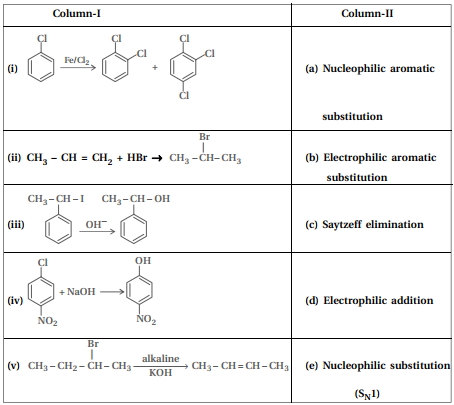
Solution
(A) The correct matching is as follows:
$(i)$ Chlorination of chlorobenzene is an electrophilic aromatic substitution reaction: $i-b$.
(ii) Addition of $HBr$ to propene follows Markovnikov's rule,which is an electrophilic addition reaction: $ii-d$.
(iii) Substitution of $I$ by $OH^-$ in $1$-phenylethanol is a nucleophilic substitution reaction $(S_N1)$: $iii-e$.
(iv) Nucleophilic aromatic substitution of $Cl$ by $OH^-$ in $p$-nitrochlorobenzene: $iv-a$.
$(v)$ Dehydrohalogenation of $2$-bromobutane to form but-$2$-ene is a Saytzeff elimination reaction: $v-c$.
Thus,the correct match is $i-b, ii-d, iii-e, iv-a, v-c$.
$(i)$ Chlorination of chlorobenzene is an electrophilic aromatic substitution reaction: $i-b$.
(ii) Addition of $HBr$ to propene follows Markovnikov's rule,which is an electrophilic addition reaction: $ii-d$.
(iii) Substitution of $I$ by $OH^-$ in $1$-phenylethanol is a nucleophilic substitution reaction $(S_N1)$: $iii-e$.
(iv) Nucleophilic aromatic substitution of $Cl$ by $OH^-$ in $p$-nitrochlorobenzene: $iv-a$.
$(v)$ Dehydrohalogenation of $2$-bromobutane to form but-$2$-ene is a Saytzeff elimination reaction: $v-c$.
Thus,the correct match is $i-b, ii-d, iii-e, iv-a, v-c$.
0 likes
View Solution78
Difficult
Match the reactions given in Column-$I$ with the names given in Column-$II$.
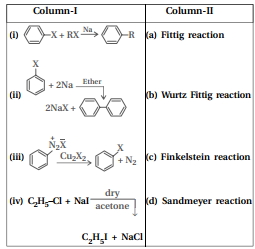
Solution
(A) The correct matches are as follows:
$(i)$ The reaction of an aryl halide with an alkyl halide in the presence of sodium metal is known as the Wurtz-Fittig reaction. Thus,$(i)$ matches with $(b)$.
(ii) The reaction of two moles of aryl halide with sodium metal in the presence of dry ether to form diphenyl is known as the Fittig reaction. Thus,(ii) matches with $(a)$.
(iii) The reaction of a diazonium salt with $Cu_2X_2$ to form an aryl halide is known as the Sandmeyer reaction. Thus,(iii) matches with $(d)$.
(iv) The reaction of an alkyl chloride with sodium iodide in the presence of dry acetone is known as the Finkelstein reaction. Thus,(iv) matches with $(c)$.
Therefore,the correct sequence is $(i-b, ii-a, iii-d, iv-c)$.
$(i)$ The reaction of an aryl halide with an alkyl halide in the presence of sodium metal is known as the Wurtz-Fittig reaction. Thus,$(i)$ matches with $(b)$.
(ii) The reaction of two moles of aryl halide with sodium metal in the presence of dry ether to form diphenyl is known as the Fittig reaction. Thus,(ii) matches with $(a)$.
(iii) The reaction of a diazonium salt with $Cu_2X_2$ to form an aryl halide is known as the Sandmeyer reaction. Thus,(iii) matches with $(d)$.
(iv) The reaction of an alkyl chloride with sodium iodide in the presence of dry acetone is known as the Finkelstein reaction. Thus,(iv) matches with $(c)$.
Therefore,the correct sequence is $(i-b, ii-a, iii-d, iv-c)$.
0 likes
View Solution79
Medium
Match the reactants in Column-$I$ with their products in Column-$II$.
| Column-$I$ (Reactants) | Column-$II$ (Products) |
| $A$. $H_2C=CH_2 + Br_2 \xrightarrow{CCl_4}$ | $i$. $CH_3CH_2CH_2Br$ |
| $B$. $CH_3CH=CH_2 + HI \rightarrow$ | $ii$. $BrCH_2-CH_2Br$ |
| $C$. $C_6H_5N_2^+X^- + KI \rightarrow$ | $iii$. $CH_3CHICH_3$ |
| $D$. $CH_3CH=CH_2 + HBr \xrightarrow{peroxide}$ | $iv$. $C_6H_5I$ |
Solution
(A-II, B-III, C-IV, D-I) The reactions are matched as follows:
$A$. $H_2C=CH_2 + Br_2 \xrightarrow{CCl_4} BrCH_2-CH_2Br$ (Vicinal dihalide formation) $\rightarrow ii$
$B$. $CH_3CH=CH_2 + HI \rightarrow CH_3CHICH_3$ (Markovnikov addition) $\rightarrow iii$
$C$. $C_6H_5N_2^+X^- + KI \rightarrow C_6H_5I + N_2 + KX$ (Sandmeyer-type reaction) $\rightarrow iv$
$D$. $CH_3CH=CH_2 + HBr \xrightarrow{peroxide} CH_3CH_2CH_2Br$ (Anti-Markovnikov addition) $\rightarrow i$
Therefore,the correct matching is: $A-ii, B-iii, C-iv, D-i$.
$A$. $H_2C=CH_2 + Br_2 \xrightarrow{CCl_4} BrCH_2-CH_2Br$ (Vicinal dihalide formation) $\rightarrow ii$
$B$. $CH_3CH=CH_2 + HI \rightarrow CH_3CHICH_3$ (Markovnikov addition) $\rightarrow iii$
$C$. $C_6H_5N_2^+X^- + KI \rightarrow C_6H_5I + N_2 + KX$ (Sandmeyer-type reaction) $\rightarrow iv$
$D$. $CH_3CH=CH_2 + HBr \xrightarrow{peroxide} CH_3CH_2CH_2Br$ (Anti-Markovnikov addition) $\rightarrow i$
Therefore,the correct matching is: $A-ii, B-iii, C-iv, D-i$.
0 likes
View Solution80
Medium
Match the reactions given in Column-$I$ with their names in Column-$II$:
| Column-$I$ (Reactants) | Column-$II$ (Name) |
| $A$. $R-X + NaI \xrightarrow{\text{dry acetone}} R-I + NaX$ | $i$. Electrophilic addition |
| $B$. $H_3C-Br + AgF \to H_3C-F + AgBr$ | $ii$. Finkelstein reaction |
| $C$. $H_3C-CH_3 + Cl_2 \xrightarrow{hv} H_3C-CH_2Cl + HCl$ | $iii$. Swarts reaction |
| $D$. $CH_2=CH_2 + Br_2 \to BrCH_2-CH_2Br$ | $iv$. Free radical substitution |
Solution
(A-II, B-III, C-IV, D-I) The correct matches are:
$A \to ii$: Finkelstein reaction involves the exchange of halogen with $I^-$ in dry acetone.
$B \to iii$: Swarts reaction involves the synthesis of alkyl fluorides using metallic fluorides like $AgF$.
$C \to iv$: Free radical substitution occurs in alkanes under $UV$ light $(hv)$.
$D \to i$: Electrophilic addition occurs across the double bond of alkenes with halogens.
Therefore,the correct sequence is $A-ii, B-iii, C-iv, D-i$.
$A \to ii$: Finkelstein reaction involves the exchange of halogen with $I^-$ in dry acetone.
$B \to iii$: Swarts reaction involves the synthesis of alkyl fluorides using metallic fluorides like $AgF$.
$C \to iv$: Free radical substitution occurs in alkanes under $UV$ light $(hv)$.
$D \to i$: Electrophilic addition occurs across the double bond of alkenes with halogens.
Therefore,the correct sequence is $A-ii, B-iii, C-iv, D-i$.
0 likes
View Solution81
Difficult
Match the reactants in Column-$(I)$ with the products formed in Column-$(II)$.
| Column-$(I)$ (Reactants) | Column-$(II)$ (Major Products) |
|---|---|
| $(A)$ $C_6H_5CH_3 + X_2 \xrightarrow{Fe, \text{dark}}$ | $(i)$ $C_6H_5CH(Br)CH_3$ |
| $(B)$ $C_6H_5NH_2 \xrightarrow{NaNO_2, HX, 273-278 \ K}$ | $(ii)$ $C_6H_5N_2^+X^-$ |
| $(C)$ $C_6H_5N_2^+X^- \xrightarrow{Cu_2X_2}$ | $(iii)$ $p-X-C_6H_4CH_3 + o-X-C_6H_4CH_3$ |
| $(D)$ $C_6H_5CH_2CH_3 \xrightarrow{Br_2, \Delta \text{ or } UV \text{ light}}$ | $(iv)$ $C_6H_5X$ |
Solution
(A-III, B-II, C-IV, D-I) $(A \rightarrow iii)$: Electrophilic aromatic substitution of toluene with $X_2$ in the presence of $Fe$ (dark) gives ortho and para halo-substituted toluene.
$(B \rightarrow ii)$: Aniline reacts with $NaNO_2$ and $HX$ at $273-278 \ K$ to form benzene diazonium salt.
$(C \rightarrow iv)$: Sandmeyer reaction of benzene diazonium salt with $Cu_2X_2$ yields aryl halide $(C_6H_5X)$.
$(D \rightarrow i)$: Free radical bromination of ethylbenzene with $Br_2$ under light/heat occurs at the benzylic position to form $1$-bromo-$1$-phenylethane.
$(B \rightarrow ii)$: Aniline reacts with $NaNO_2$ and $HX$ at $273-278 \ K$ to form benzene diazonium salt.
$(C \rightarrow iv)$: Sandmeyer reaction of benzene diazonium salt with $Cu_2X_2$ yields aryl halide $(C_6H_5X)$.
$(D \rightarrow i)$: Free radical bromination of ethylbenzene with $Br_2$ under light/heat occurs at the benzylic position to form $1$-bromo-$1$-phenylethane.
0 likes
View Solution82
Medium
Match the type of reaction given in Column-$I$ with the reaction in Column-$II$.
| Column-$I$ (Reactants) | Column-$II$ (Type of Reaction) |
|---|---|
| $(A)$ $C_6H_5NH_2 \xrightarrow{NaNO_2, HX, 273-278 K} C_6H_5N_2^+X^-$ | $(i)$ Wurtz-Fittig reaction |
| $(B)$ $C_6H_5N_2^+X^- \xrightarrow{Cu_2X_2} C_6H_5X$ | $(ii)$ Diazotization |
| $(C)$ $C_6H_6 + 2Na + RX \xrightarrow{\text{dry ether}} C_6H_5R$ | $(iii)$ Sandmeyer reaction |
| $(D)$ $2C_6H_6 + 2Na \xrightarrow{\text{dry ether}} C_6H_5-C_6H_5$ | $(iv)$ Fittig reaction |
Solution
(A-II, B-III, C-I, D-IV) The conversion of aniline to benzene diazonium salt is known as Diazotization $(ii)$.
$(B)$ The conversion of benzene diazonium salt to haloarene using $Cu_2X_2$ is known as the Sandmeyer reaction $(iii)$.
$(C)$ The reaction of an aryl halide with an alkyl halide in the presence of sodium and dry ether is the Wurtz-Fittig reaction $(i)$.
$(D)$ The coupling of two aryl halide molecules in the presence of sodium and dry ether is the Fittig reaction $(iv)$.
Therefore,the correct matching is: $(A-ii, B-iii, C-i, D-iv)$.
$(B)$ The conversion of benzene diazonium salt to haloarene using $Cu_2X_2$ is known as the Sandmeyer reaction $(iii)$.
$(C)$ The reaction of an aryl halide with an alkyl halide in the presence of sodium and dry ether is the Wurtz-Fittig reaction $(i)$.
$(D)$ The coupling of two aryl halide molecules in the presence of sodium and dry ether is the Fittig reaction $(iv)$.
Therefore,the correct matching is: $(A-ii, B-iii, C-i, D-iv)$.
0 likes
View Solution83
Difficult
Match the reactions in Column-$I$ with their mechanisms in Column-$II$.
| Column-$I$ (Reaction) | Column-$II$ (Mechanism) |
| $(A)$ $OH^- + CH_3Cl \to HOCH_3 + Cl^-$ | $(1)$ $S_N2$ mechanism |
| $(B)$ $(CH_3)_3CBr + OH^- \to (CH_3)_3COH + Br^-$ | $(2)$ $S_E2$ aromatic |
| $(C)$ $CH_3CH_2Br \xrightarrow[ethanol]{KOH} CH_2 = CH_2$ | $(3)$ $S_N1$ mechanism |
| $(D)$ $C_6H_6 + Br_2 \xrightarrow{Fe} C_6H_5Br + HBr$ | $(4)$ $\beta$-elimination (dehydrohalogenation) |
Solution
(A-1, B-3, C-4, D-2) $(A)-(1), (B)-(3), (C)-(4), (D)-(2)$
$(A)$ $OH^- + CH_3Cl \to HOCH_3 + Cl^-$: This is a primary alkyl halide reacting with a strong nucleophile,following the $S_N2$ mechanism.
$(B)$ $(CH_3)_3CBr + OH^- \to (CH_3)_3COH + Br^-$: This is a tertiary alkyl halide,which undergoes substitution via the $S_N1$ mechanism due to the formation of a stable carbocation.
$(C)$ $CH_3CH_2Br \xrightarrow[ethanol]{KOH} CH_2 = CH_2$: This is an elimination reaction (dehydrohalogenation) of an alkyl halide in the presence of a base,known as $\beta$-elimination.
$(D)$ $C_6H_6 + Br_2 \xrightarrow{Fe} C_6H_5Br + HBr$: This is an electrophilic aromatic substitution reaction ($S_E2$ aromatic) where benzene reacts with bromine in the presence of a Lewis acid catalyst.
$(A)$ $OH^- + CH_3Cl \to HOCH_3 + Cl^-$: This is a primary alkyl halide reacting with a strong nucleophile,following the $S_N2$ mechanism.
$(B)$ $(CH_3)_3CBr + OH^- \to (CH_3)_3COH + Br^-$: This is a tertiary alkyl halide,which undergoes substitution via the $S_N1$ mechanism due to the formation of a stable carbocation.
$(C)$ $CH_3CH_2Br \xrightarrow[ethanol]{KOH} CH_2 = CH_2$: This is an elimination reaction (dehydrohalogenation) of an alkyl halide in the presence of a base,known as $\beta$-elimination.
$(D)$ $C_6H_6 + Br_2 \xrightarrow{Fe} C_6H_5Br + HBr$: This is an electrophilic aromatic substitution reaction ($S_E2$ aromatic) where benzene reacts with bromine in the presence of a Lewis acid catalyst.
0 likes
View Solution84
Medium
Match the reactants in Column-$I$ with the products in Column-$II$.
| Column-$I$ (Reactants) | Column-$II$ (Products) |
|---|---|
| $(A) CH_3CH_2Br + Mg \xrightarrow{\text{dry ether}}$ | $(i) \text{Cyclohexylmagnesium bromide}$ |
| $(B) 2RX + 2Na \xrightarrow{\text{dry ether}}$ | $(ii) CH_3CH_2MgBr$ |
| $(C) CH_3CH_2Br \xrightarrow{\text{alc. KOH}}$ | $(iii) R-R + 2NaX$ |
| $(D) \text{Bromocyclohexane} + Mg \xrightarrow{\text{dry ether}}$ | $(iv) CH_2=CH_2 + H_2O + KBr$ |
Solution
(A-II, B-III, C-IV, D-I) $(A) CH_3CH_2Br + Mg \xrightarrow{\text{dry ether}} CH_3CH_2MgBr$ (Grignard reagent formation),so $(A \rightarrow ii)$.
$(B) 2RX + 2Na \xrightarrow{\text{dry ether}} R-R + 2NaX$ (Wurtz reaction),so $(B \rightarrow iii)$.
$(C) CH_3CH_2Br \xrightarrow{\text{alc. KOH}} CH_2=CH_2 + H_2O + KBr$ (Dehydrohalogenation),so $(C \rightarrow iv)$.
$(D) \text{Bromocyclohexane} + Mg \xrightarrow{\text{dry ether}} \text{Cyclohexylmagnesium bromide}$ (Grignard reagent formation),so $(D \rightarrow i)$.
Therefore,the correct matching is $(A$ $\rightarrow ii, B$ $\rightarrow iii, C$ $\rightarrow iv, D$ $\rightarrow i)$.
$(B) 2RX + 2Na \xrightarrow{\text{dry ether}} R-R + 2NaX$ (Wurtz reaction),so $(B \rightarrow iii)$.
$(C) CH_3CH_2Br \xrightarrow{\text{alc. KOH}} CH_2=CH_2 + H_2O + KBr$ (Dehydrohalogenation),so $(C \rightarrow iv)$.
$(D) \text{Bromocyclohexane} + Mg \xrightarrow{\text{dry ether}} \text{Cyclohexylmagnesium bromide}$ (Grignard reagent formation),so $(D \rightarrow i)$.
Therefore,the correct matching is $(A$ $\rightarrow ii, B$ $\rightarrow iii, C$ $\rightarrow iv, D$ $\rightarrow i)$.
0 likes
View Solution85
MediumMCQ
The total number of monohalogenated organic products (including stereoisomers) formed in the following reaction is:
$A$ (simplest optically active alkene) $\xrightarrow[(ii) X_2/\Delta ]{(i) H_2/Ni/\Delta }$
$A$ (simplest optically active alkene) $\xrightarrow[(ii) X_2/\Delta ]{(i) H_2/Ni/\Delta }$
A
$8$
B
$6$
C
$10$
D
$12$
Solution
(C) $1$. The simplest optically active alkene is $3$-methylpent-$1$-ene.
$2$. Hydrogenation of $3$-methylpent-$1$-ene with $H_2/Ni/\Delta$ gives $3$-methylpentane.
$3$. Free radical chlorination of $3$-methylpentane $(CH_3-CH_2-CH(CH_3)-CH_2-CH_3)$ produces various monochlorinated isomers:
- Substitution at $C_1$: $Cl-CH_2-CH_2-CH(CH_3)-CH_2-CH_3$ ($1$ chiral center,$2$ enantiomers).
- Substitution at $C_2$: $CH_3-CHCl-CH(CH_3)-CH_2-CH_3$ ($2$ chiral centers,$4$ stereoisomers).
- Substitution at $C_3$: $CH_3-CH_2-CCl(CH_3)-CH_2-CH_3$ ($1$ chiral center,$2$ enantiomers).
- Substitution at $C_4$ (methyl group): $CH_3-CH_2-CH(CH_2Cl)-CH_2-CH_3$ ($1$ chiral center,$2$ enantiomers).
$4$. Total number of stereoisomers = $2 + 4 + 2 + 2 = 10$.
$2$. Hydrogenation of $3$-methylpent-$1$-ene with $H_2/Ni/\Delta$ gives $3$-methylpentane.
$3$. Free radical chlorination of $3$-methylpentane $(CH_3-CH_2-CH(CH_3)-CH_2-CH_3)$ produces various monochlorinated isomers:
- Substitution at $C_1$: $Cl-CH_2-CH_2-CH(CH_3)-CH_2-CH_3$ ($1$ chiral center,$2$ enantiomers).
- Substitution at $C_2$: $CH_3-CHCl-CH(CH_3)-CH_2-CH_3$ ($2$ chiral centers,$4$ stereoisomers).
- Substitution at $C_3$: $CH_3-CH_2-CCl(CH_3)-CH_2-CH_3$ ($1$ chiral center,$2$ enantiomers).
- Substitution at $C_4$ (methyl group): $CH_3-CH_2-CH(CH_2Cl)-CH_2-CH_3$ ($1$ chiral center,$2$ enantiomers).
$4$. Total number of stereoisomers = $2 + 4 + 2 + 2 = 10$.
0 likes
View Solution86
MediumMCQ
In the reaction shown below,the structural formula of $(A)$,$X$ and $Y$ respectively are:
$C_7H_7N_2OCl + C_2H_5OH \rightarrow \text{Anisole} + N_2 + X + Y$
$C_7H_7N_2OCl + C_2H_5OH \rightarrow \text{Anisole} + N_2 + X + Y$
A
$p-\text{methoxyphenyl diazonium chloride}, CH_3CHO, HCl$
B
$p-\text{methoxyphenyl diazonium chloride}, \text{ethylene oxide}, HCl$
C
$p-\text{methoxyphenyl diazonium chloride}, CH_3CHO, H_2O$
D
$p-\text{methoxyphenyl diazonium chloride}, \text{ethylene oxide}, H_2O$
Solution
(A) The reaction of $p-\text{methoxyphenyl diazonium chloride}$ with ethanol $(C_2H_5OH)$ is a reduction reaction where the diazonium group is replaced by a hydrogen atom to form anisole.
The reaction is as follows:
$CH_3O-C_6H_4-N_2^+Cl^- + CH_3CH_2OH \rightarrow CH_3O-C_6H_5 + N_2 + CH_3CHO + HCl$
Here,$(A)$ is $p-\text{methoxyphenyl diazonium chloride}$,$X$ is acetaldehyde $(CH_3CHO)$,and $Y$ is hydrogen chloride $(HCl)$.
The reaction is as follows:
$CH_3O-C_6H_4-N_2^+Cl^- + CH_3CH_2OH \rightarrow CH_3O-C_6H_5 + N_2 + CH_3CHO + HCl$
Here,$(A)$ is $p-\text{methoxyphenyl diazonium chloride}$,$X$ is acetaldehyde $(CH_3CHO)$,and $Y$ is hydrogen chloride $(HCl)$.
0 likes
View Solution87
EasyMCQ
Match List-$I$ with List-$II$:
Choose the correct answer from the options given below:
| List-$I$ | List-$II$ |
|---|---|
| $a$. Benzenediazonium chloride $\xrightarrow{Cu_2Cl_2/HCl}$ Chlorobenzene $+ N_2$ | $i$. Wurtz reaction |
| $b$. Benzenediazonium chloride $\xrightarrow{Cu/HCl}$ Chlorobenzene $+ N_2$ | $ii$. Sandmeyer reaction |
| $c$. $2 CH_3CH_2Cl + 2 Na \xrightarrow{Ether} C_2H_5-C_2H_5 + 2 NaCl$ | $iii$. Fittig reaction |
| $d$. $2 C_6H_5Cl + 2 Na \xrightarrow{Ether} C_6H_5-C_6H_5 + 2 NaCl$ | $iv$. Gatterman reaction |
Choose the correct answer from the options given below:
A
$a$ $\rightarrow iii, b$ $\rightarrow i, c$ $\rightarrow iv, d$ $\rightarrow ii$
B
$a$ $\rightarrow ii, b$ $\rightarrow i, c$ $\rightarrow iv, d$ $\rightarrow iii$
C
$a$ $\rightarrow ii, b$ $\rightarrow iv, c$ $\rightarrow i, d$ $\rightarrow iii$
D
$a$ $\rightarrow iii, b$ $\rightarrow iv, c$ $\rightarrow i, d$ $\rightarrow ii$
Solution
(C) . Benzenediazonium chloride reacting with $Cu_2Cl_2/HCl$ is the Sandmeyer reaction $(a \rightarrow ii)$.
$b$. Benzenediazonium chloride reacting with $Cu/HCl$ is the Gatterman reaction $(b \rightarrow iv)$.
$c$. The reaction of alkyl halides with $Na$ in ether to form alkanes is the Wurtz reaction $(c \rightarrow i)$.
$d$. The reaction of aryl halides with $Na$ in ether to form diaryls is the Fittig reaction $(d \rightarrow iii)$.
Therefore,the correct matching is $a$ $\rightarrow ii, b$ $\rightarrow iv, c$ $\rightarrow i, d$ $\rightarrow iii$.
$b$. Benzenediazonium chloride reacting with $Cu/HCl$ is the Gatterman reaction $(b \rightarrow iv)$.
$c$. The reaction of alkyl halides with $Na$ in ether to form alkanes is the Wurtz reaction $(c \rightarrow i)$.
$d$. The reaction of aryl halides with $Na$ in ether to form diaryls is the Fittig reaction $(d \rightarrow iii)$.
Therefore,the correct matching is $a$ $\rightarrow ii, b$ $\rightarrow iv, c$ $\rightarrow i, d$ $\rightarrow iii$.
0 likes
View Solution88
MediumMCQ
In the given reaction sequence,the major product $C$ is ..... .

A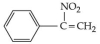
B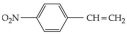
C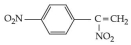
D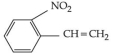
Solution
(B) The starting material $C_8H_{10}$ is ethylbenzene.
$1$. Nitration of ethylbenzene with $HNO_3/H_2SO_4$ gives $p$-nitroethylbenzene as the major product $(A)$.
$2$. Radical bromination of $p$-nitroethylbenzene with $Br_2/\Delta$ occurs at the benzylic position to form $1-(4-nitrophenyl)ethyl$ bromide $(B)$.
$3$. Dehydrohalogenation of $B$ with alcoholic $KOH$ yields $p$-nitrostyrene $(C)$ as the major product.
$1$. Nitration of ethylbenzene with $HNO_3/H_2SO_4$ gives $p$-nitroethylbenzene as the major product $(A)$.
$2$. Radical bromination of $p$-nitroethylbenzene with $Br_2/\Delta$ occurs at the benzylic position to form $1-(4-nitrophenyl)ethyl$ bromide $(B)$.
$3$. Dehydrohalogenation of $B$ with alcoholic $KOH$ yields $p$-nitrostyrene $(C)$ as the major product.
0 likes
View Solution89
MediumMCQ
In the following reaction sequence,
$Br-CH_2-CH(Br)-Ph$ $\xrightarrow[2. NaNH_2]{1. Alc. KOH} X$ $\xrightarrow[4. Conc. HNO_3/H_2SO_4]{3. HgSO_4/dil. H_2SO_4, Heat} Y$
$X$ and $Y$ respectively are,
$Br-CH_2-CH(Br)-Ph$ $\xrightarrow[2. NaNH_2]{1. Alc. KOH} X$ $\xrightarrow[4. Conc. HNO_3/H_2SO_4]{3. HgSO_4/dil. H_2SO_4, Heat} Y$
$X$ and $Y$ respectively are,
A
$Ph-C \equiv C-H$ and $m-NO_2-C_6H_4-CO-CH_3$
B
$Ph-CH(OH)-CH_2-NH_2$ and $m-NO_2-C_6H_4-CO-CH_2-NH_2$
C
$Ph-CH(NH_2)-CH_2-OH$ and $p-NO_2-C_6H_4-CH(NH_2)-CHO$
D
$Ph-CH(OH)-CH_2-NH_2$ and $p-NO_2-C_6H_4-CHO$
Solution
(A) $1$. The starting material $Br-CH_2-CH(Br)-Ph$ undergoes dehydrohalogenation with $Alc. KOH$ followed by $NaNH_2$ to form the alkyne $X$,which is phenylacetylene $(Ph-C \equiv C-H)$.
$2$. The alkyne $X$ $(Ph-C \equiv C-H)$ undergoes acid-catalyzed hydration $(HgSO_4/dil. H_2SO_4, \Delta)$ to form an enol intermediate,which tautomerizes to acetophenone $(Ph-CO-CH_3)$.
$3$. Acetophenone is then subjected to nitration using $Conc. HNO_3/H_2SO_4$. Since the acetyl group $(-CO-CH_3)$ is a meta-directing group,the nitro group $(-NO_2)$ is introduced at the meta-position,yielding $m-nitroacetophenone$ $(Y)$.
$2$. The alkyne $X$ $(Ph-C \equiv C-H)$ undergoes acid-catalyzed hydration $(HgSO_4/dil. H_2SO_4, \Delta)$ to form an enol intermediate,which tautomerizes to acetophenone $(Ph-CO-CH_3)$.
$3$. Acetophenone is then subjected to nitration using $Conc. HNO_3/H_2SO_4$. Since the acetyl group $(-CO-CH_3)$ is a meta-directing group,the nitro group $(-NO_2)$ is introduced at the meta-position,yielding $m-nitroacetophenone$ $(Y)$.
0 likes
View Solution90
MediumMCQ
Match List-$I$ with List-$II$:
| List-$I$ | List-$II$ |
| :--- | :--- |
| $A$. $C_6H_5Cl + CH_3Cl + 2Na \rightarrow C_6H_5CH_3 + 2NaCl$ | $I$. Wurtz-Fitting reaction |
| $B$. $2C_6H_5Cl + 2Na \rightarrow C_6H_5-C_6H_5 + 2NaCl$ | $II$. Fitting reaction |
| $C$. $C_6H_5N_2^+Cl^- \xrightarrow{Cu_2Cl_2} C_6H_5Cl + N_2$ | $III$. Sandmeyer reaction |
| $D$. $C_2H_5Cl + NaI \rightarrow C_2H_5I + NaCl$ | $IV$. Finkelstein reaction |
| List-$I$ | List-$II$ |
| :--- | :--- |
| $A$. $C_6H_5Cl + CH_3Cl + 2Na \rightarrow C_6H_5CH_3 + 2NaCl$ | $I$. Wurtz-Fitting reaction |
| $B$. $2C_6H_5Cl + 2Na \rightarrow C_6H_5-C_6H_5 + 2NaCl$ | $II$. Fitting reaction |
| $C$. $C_6H_5N_2^+Cl^- \xrightarrow{Cu_2Cl_2} C_6H_5Cl + N_2$ | $III$. Sandmeyer reaction |
| $D$. $C_2H_5Cl + NaI \rightarrow C_2H_5I + NaCl$ | $IV$. Finkelstein reaction |
A
$A-I, B-II, C-III, D-IV$
B
$A-II, B-I, C-III, D-IV$
C
$A-I, B-II, C-IV, D-III$
D
$A-II, B-I, C-IV, D-III$
Solution
(A) The correct matches are:
$A$. The reaction of an aryl halide with an alkyl halide in the presence of sodium is known as the Wurtz-Fitting reaction. Thus,$A-I$.
$B$. The reaction of two molecules of aryl halide with sodium to form a diaryl is known as the Fitting reaction. Thus,$B-II$.
$C$. The conversion of benzene diazonium chloride to chlorobenzene using $Cu_2Cl_2$ is the Sandmeyer reaction. Thus,$C-III$.
$D$. The reaction of an alkyl halide with $NaI$ in acetone to form an alkyl iodide is the Finkelstein reaction. Thus,$D-IV$.
Therefore,the correct matching is $A-I, B-II, C-III, D-IV$.
$A$. The reaction of an aryl halide with an alkyl halide in the presence of sodium is known as the Wurtz-Fitting reaction. Thus,$A-I$.
$B$. The reaction of two molecules of aryl halide with sodium to form a diaryl is known as the Fitting reaction. Thus,$B-II$.
$C$. The conversion of benzene diazonium chloride to chlorobenzene using $Cu_2Cl_2$ is the Sandmeyer reaction. Thus,$C-III$.
$D$. The reaction of an alkyl halide with $NaI$ in acetone to form an alkyl iodide is the Finkelstein reaction. Thus,$D-IV$.
Therefore,the correct matching is $A-I, B-II, C-III, D-IV$.
0 likes
View Solution91
DifficultMCQ
Identify the correct order of reactivity for the following pairs towards the respective mechanism:
$(A)$ $S_{N}2$: Isobutyl bromide > tert-Butyl bromide
$(B)$ $S_{N}1$: Benzyl bromide > $2-$Phenylethyl bromide
$(C)$ Electrophilic substitution: Chlorobenzene > $1-$Chloro$-4-$nitrobenzene
$(D)$ Nucleophilic substitution: Bromobenzene < $1-$Bromo$-4-$nitrobenzene
Choose the correct answer from the options given below:
$(A)$ $S_{N}2$: Isobutyl bromide > tert-Butyl bromide
$(B)$ $S_{N}1$: Benzyl bromide > $2-$Phenylethyl bromide
$(C)$ Electrophilic substitution: Chlorobenzene > $1-$Chloro$-4-$nitrobenzene
$(D)$ Nucleophilic substitution: Bromobenzene < $1-$Bromo$-4-$nitrobenzene
Choose the correct answer from the options given below:
A
$A$,$B$ and $D$ only
B
$A$,$B$,$C$ and $D$
C
$A$,$C$ and $D$ only
D
$B$,$C$ and $D$ only
Solution
(B) All the given orders are correct:
$(A)$ $S_{N}2$ reaction rate decreases with increase in steric hindrance. Primary alkyl halide (isobutyl bromide) is more reactive than tertiary alkyl halide (tert-butyl bromide).
$(B)$ $S_{N}1$ reaction rate depends on the stability of the carbocation. Benzyl carbocation is resonance stabilized,whereas the carbocation from $2-$phenylethyl bromide is less stable.
$(C)$ Electrophilic aromatic substitution $(EAS)$ rate decreases with a decrease in electron density on the ring. The $-NO_2$ group is strongly electron-withdrawing,reducing the electron density of the ring in $1-$chloro$-4-$nitrobenzene compared to chlorobenzene.
$(D)$ Nucleophilic aromatic substitution rate increases with the presence of electron-withdrawing groups at ortho and para positions. The $-NO_2$ group at the para position activates the ring towards nucleophilic substitution.
$(A)$ $S_{N}2$ reaction rate decreases with increase in steric hindrance. Primary alkyl halide (isobutyl bromide) is more reactive than tertiary alkyl halide (tert-butyl bromide).
$(B)$ $S_{N}1$ reaction rate depends on the stability of the carbocation. Benzyl carbocation is resonance stabilized,whereas the carbocation from $2-$phenylethyl bromide is less stable.
$(C)$ Electrophilic aromatic substitution $(EAS)$ rate decreases with a decrease in electron density on the ring. The $-NO_2$ group is strongly electron-withdrawing,reducing the electron density of the ring in $1-$chloro$-4-$nitrobenzene compared to chlorobenzene.
$(D)$ Nucleophilic aromatic substitution rate increases with the presence of electron-withdrawing groups at ortho and para positions. The $-NO_2$ group at the para position activates the ring towards nucleophilic substitution.
0 likes
View Solution92
MediumMCQ
The number of possible isomeric products formed when $3$-chloro-$1$-butene reacts with $HCl$ through carbocation formation is $.............$.
A
$4$
B
$2$
C
$1$
D
$5$
Solution
(A) The reaction of $3$-chloro-$1$-butene with $HCl$ proceeds via the formation of a carbocation intermediate.
First,the $H^+$ ion from $HCl$ adds to the double bond to form a carbocation.
This carbocation can undergo a $1,2$-hydride shift to form a more stable carbocation.
$1$. The initial carbocation reacts with $Cl^-$ to form $2,3$-dichlorobutane. This product has two chiral centers,leading to $3$ stereoisomers ($d, l$ and $meso$ forms).
$2$. The rearranged carbocation reacts with $Cl^-$ to form $2,2$-dichlorobutane,which is an achiral product ($1$ isomer).
Total number of possible isomeric products $= 3 + 1 = 4$.
First,the $H^+$ ion from $HCl$ adds to the double bond to form a carbocation.
This carbocation can undergo a $1,2$-hydride shift to form a more stable carbocation.
$1$. The initial carbocation reacts with $Cl^-$ to form $2,3$-dichlorobutane. This product has two chiral centers,leading to $3$ stereoisomers ($d, l$ and $meso$ forms).
$2$. The rearranged carbocation reacts with $Cl^-$ to form $2,2$-dichlorobutane,which is an achiral product ($1$ isomer).
Total number of possible isomeric products $= 3 + 1 = 4$.
0 likes
View Solution93
MediumMCQ
Identify the product in the following reaction:
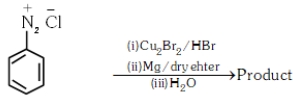
A
$4-$Bromophenol
B
Phenol
C
Benzene
D
Phenylmagnesium bromide
Solution
(C) The reaction proceeds in three steps:
$1$. Benzenediazonium chloride reacts with $Cu_2Br_2/HBr$ (Sandmeyer reaction) to form bromobenzene.
$2$. Bromobenzene reacts with $Mg$ in the presence of dry ether to form phenylmagnesium bromide (a Grignard reagent).
$3$. Phenylmagnesium bromide undergoes hydrolysis with $H_2O$ to yield benzene as the final product.
$1$. Benzenediazonium chloride reacts with $Cu_2Br_2/HBr$ (Sandmeyer reaction) to form bromobenzene.
$2$. Bromobenzene reacts with $Mg$ in the presence of dry ether to form phenylmagnesium bromide (a Grignard reagent).
$3$. Phenylmagnesium bromide undergoes hydrolysis with $H_2O$ to yield benzene as the final product.
0 likes
View Solution94
DifficultMCQ
The total number of hydrogen atoms in product $A$ and product $B$ is $ . . . . . . $.

A
$5$
B
$6$
C
$10$
D
$12$
Solution
(C) The reaction of $CH_3CH_2Br$ with $NaOH$ in the presence of $C_2H_5OH$ (alcoholic $NaOH$) undergoes dehydrohalogenation to form ethene $(CH_2=CH_2)$ as product $A$.
Product $A$ has $4$ hydrogen atoms.
The reaction of $CH_3CH_2Br$ with $NaOH$ in the presence of $H_2O$ (aqueous $NaOH$) undergoes nucleophilic substitution to form ethanol $(CH_3CH_2OH)$ as product $B$.
Product $B$ has $6$ hydrogen atoms.
The total number of hydrogen atoms in product $A$ and product $B$ is $4 + 6 = 10$.
Product $A$ has $4$ hydrogen atoms.
The reaction of $CH_3CH_2Br$ with $NaOH$ in the presence of $H_2O$ (aqueous $NaOH$) undergoes nucleophilic substitution to form ethanol $(CH_3CH_2OH)$ as product $B$.
Product $B$ has $6$ hydrogen atoms.
The total number of hydrogen atoms in product $A$ and product $B$ is $4 + 6 = 10$.
0 likes
View Solution95
MediumMCQ
Identify the correct set of reagents or reaction conditions '$X$' and '$Y$' in the following set of transformation.

A
$X = \text{conc. alc. } NaOH, 80^{\circ} C, Y = Br_2 / CHCl_3$
B
$X = \text{dil. aq. } NaOH, 20^{\circ} C, Y = HBr / \text{acetic acid}$
C
$X = \text{conc. alc. } NaOH, 80^{\circ} C, Y = HBr / \text{acetic acid}$
D
$X = \text{dil. aq. } NaOH, 20^{\circ} C, Y = Br_2 / CHCl_3$
Solution
(C) Step $1$: The starting material $CH_3-CH_2-CH_2-Br$ ($1$-bromopropane) undergoes dehydrohalogenation with concentrated alcoholic $NaOH$ at $80^{\circ} C$ to form propene $(CH_3-CH=CH_2)$.
Step $2$: Propene reacts with $HBr$ in the presence of acetic acid (or as a solvent) via electrophilic addition following Markovnikov's rule to yield $2-$bromopropane $(CH_3-CHBr-CH_3)$.
Step $2$: Propene reacts with $HBr$ in the presence of acetic acid (or as a solvent) via electrophilic addition following Markovnikov's rule to yield $2-$bromopropane $(CH_3-CHBr-CH_3)$.
0 likes
View Solution96
DifficultMCQ
Choose the correct option$(s)$ for the following set of reactions:
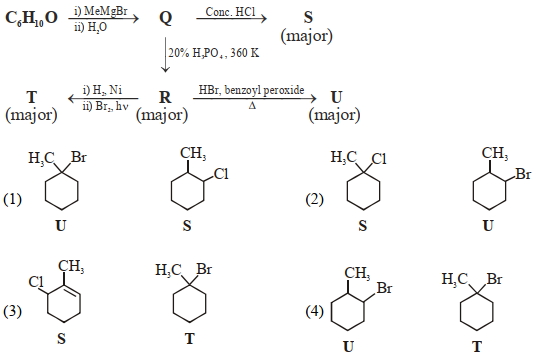
A
$2,4$
B
$2,3$
C
$1,2$
D
$1,4$
Solution
(A) $1$. The starting material $C_6H_{10}O$ is cyclohexanone. Reaction with $CH_3MgBr$ followed by $H_2O$ gives $1$-methylcyclohexanol $(Q)$.
$2$. $Q$ reacts with $conc. HCl$ to form $1$-chloro-$1$-methylcyclohexane $(S)$. This matches structure $(2)$.
$3$. $Q$ undergoes acid-catalyzed dehydration with $20\% H_3PO_4$ at $360 \ K$ to form $1$-methylcyclohexene $(R)$.
$4$. $R$ reacts with $HBr$ in the presence of benzoyl peroxide (anti-Markovnikov addition) to form $1$-bromo-$2$-methylcyclohexane $(U)$. This matches structure $(4)$.
$5$. $R$ undergoes hydrogenation $(H_2, Ni)$ to form methylcyclohexane,followed by radical bromination $(Br_2, h\nu)$ to form $1$-bromo-$1$-methylcyclohexane $(T)$.
$6$. Comparing the structures: $S$ is $(2)$,$U$ is $(4)$,and $T$ is $(1)$. The correct set is $(2, 4)$.
$2$. $Q$ reacts with $conc. HCl$ to form $1$-chloro-$1$-methylcyclohexane $(S)$. This matches structure $(2)$.
$3$. $Q$ undergoes acid-catalyzed dehydration with $20\% H_3PO_4$ at $360 \ K$ to form $1$-methylcyclohexene $(R)$.
$4$. $R$ reacts with $HBr$ in the presence of benzoyl peroxide (anti-Markovnikov addition) to form $1$-bromo-$2$-methylcyclohexane $(U)$. This matches structure $(4)$.
$5$. $R$ undergoes hydrogenation $(H_2, Ni)$ to form methylcyclohexane,followed by radical bromination $(Br_2, h\nu)$ to form $1$-bromo-$1$-methylcyclohexane $(T)$.
$6$. Comparing the structures: $S$ is $(2)$,$U$ is $(4)$,and $T$ is $(1)$. The correct set is $(2, 4)$.
0 likes
View Solution97
DifficultMCQ
Consider the following sequence of reactions:
Nitrobenzene $\xrightarrow[(ii) NaNO_2, HCl, 0^{\circ}C]{(i) Sn + HCl} \text{Benzenediazonium chloride}$ $\xrightarrow{(iii) Cu_2Cl_2} \text{Chlorobenzene}$ $\xrightarrow{(iv) Na, \text{Ether}} A$
Molar mass of the product formed $(A)$ is $.............. \ g \ mol^{-1}$.
Nitrobenzene $\xrightarrow[(ii) NaNO_2, HCl, 0^{\circ}C]{(i) Sn + HCl} \text{Benzenediazonium chloride}$ $\xrightarrow{(iii) Cu_2Cl_2} \text{Chlorobenzene}$ $\xrightarrow{(iv) Na, \text{Ether}} A$
Molar mass of the product formed $(A)$ is $.............. \ g \ mol^{-1}$.
A
$154$
B
$150$
C
$180$
D
$120$
Solution
(A) The reaction sequence is as follows:
$1$. Nitrobenzene is reduced by $Sn + HCl$ to form aniline $(C_6H_5NH_2)$.
$2$. Aniline reacts with $NaNO_2 + HCl$ at $0-5^{\circ}C$ to form benzenediazonium chloride $(C_6H_5N_2^+Cl^-)$.
$3$. Benzenediazonium chloride reacts with $Cu_2Cl_2$ (Sandmeyer reaction) to form chlorobenzene $(C_6H_5Cl)$.
$4$. Chlorobenzene reacts with $Na$ in dry ether (Wurtz-Fittig reaction) to form biphenyl $(C_6H_5-C_6H_5)$.
The final product $(A)$ is biphenyl $(C_{12}H_{10})$.
Molar mass of biphenyl = $(12 \times 12) + (10 \times 1) = 144 + 10 = 154 \ g \ mol^{-1}$.
$1$. Nitrobenzene is reduced by $Sn + HCl$ to form aniline $(C_6H_5NH_2)$.
$2$. Aniline reacts with $NaNO_2 + HCl$ at $0-5^{\circ}C$ to form benzenediazonium chloride $(C_6H_5N_2^+Cl^-)$.
$3$. Benzenediazonium chloride reacts with $Cu_2Cl_2$ (Sandmeyer reaction) to form chlorobenzene $(C_6H_5Cl)$.
$4$. Chlorobenzene reacts with $Na$ in dry ether (Wurtz-Fittig reaction) to form biphenyl $(C_6H_5-C_6H_5)$.
The final product $(A)$ is biphenyl $(C_{12}H_{10})$.
Molar mass of biphenyl = $(12 \times 12) + (10 \times 1) = 144 + 10 = 154 \ g \ mol^{-1}$.
0 likes
View SolutionHaloalkanes and Haloarenes — Mix Examples-Haloalkanes and Haloarenes · Frequently Asked Questions
1Are these Haloalkanes and Haloarenes questions useful for JEE and NEET?
Yes. All questions in this section are mapped to JEE Main and NEET exam patterns. Previous year questions from JEE Main, NEET, GUJCET and state-level exams are included with full solutions.
2Can I switch to Hindi or Gujarati for these questions?
Yes. Use the language tabs in the hero section or the sidebar to view the same questions and solutions in English, Hindi or Gujarati.
3How do I generate a question paper from this subtopic?
Use the Vedclass Exam Paper Generator — select the chapter and subtopic, set difficulty, and generate Sets A, B, C, D automatically. First 3 chapters of every subject are free.
Vedclass Products
For Students
Vedclass Test Series
Mock tests in real JEE/NEET style with performance analysis. 5-day free trial.
Start Free TrialFor Teachers
Exam Paper Generator
Generate Set A/B/C/D papers from this chapter in 2 minutes. 3 chapters free.
Try FreeFor Institutes
Online Exam Module
Live online exams with unlimited students, 360° analytics & white-label branding.
See DemoFor Teachers & Institutes
Generate a Haloalkanes and Haloarenes Exam Paper in 2 Minutes
Select subtopic & difficulty — Sets A, B, C, D auto-generated with No Repeat logic.
First 3 chapters of every subject are free — no payment required.