
A English
Mix Examples-Haloalkanes and Haloarenes Questions in English
Class 12 Chemistry · Haloalkanes and Haloarenes · Mix Examples-Haloalkanes and Haloarenes
128+
Questions
English
Language
100%
With Solutions
Showing 27 of 128 questions in English
101
MediumMCQ
Match the List-$I$ with List-$II$:
Choose the correct answer from the options given below:
| List-$I$ Name reaction | List-$II$ Product obtainable |
| $A.$ Swarts reaction | $I.$ Ethyl benzene |
| $B.$ Sandmeyer's reaction | $II.$ Ethyl iodide |
| $C.$ Wurtz Fittig reaction | $III.$ Cyanobenzene |
| $D.$ Finkelstein reaction | $IV.$ Ethyl fluoride |
Choose the correct answer from the options given below:
A
$A-II, B-III, C-I, D-IV$
B
$A-IV, B-I, C-III, D-II$
C
$A-IV, B-III, C-I, D-II$
D
$A-II, B-I, C-III, D-IV$
Solution
(C) The correct matches are as follows:
$A.$ Swarts reaction: Used for the preparation of alkyl fluorides,e.g.,$CH_3CH_2F$ (Ethyl fluoride).
$B.$ Sandmeyer's reaction: Used to convert diazonium salts to aryl halides or cyanides,e.g.,$C_6H_5CN$ (Cyanobenzene).
$C.$ Wurtz-Fittig reaction: Used for the synthesis of alkyl benzenes,e.g.,$C_6H_5CH_2CH_3$ (Ethyl benzene).
$D.$ Finkelstein reaction: Used for the preparation of alkyl iodides from alkyl chlorides/bromides,e.g.,$CH_3CH_2I$ (Ethyl iodide).
Therefore,the correct sequence is $A-IV, B-III, C-I, D-II$.
$A.$ Swarts reaction: Used for the preparation of alkyl fluorides,e.g.,$CH_3CH_2F$ (Ethyl fluoride).
$B.$ Sandmeyer's reaction: Used to convert diazonium salts to aryl halides or cyanides,e.g.,$C_6H_5CN$ (Cyanobenzene).
$C.$ Wurtz-Fittig reaction: Used for the synthesis of alkyl benzenes,e.g.,$C_6H_5CH_2CH_3$ (Ethyl benzene).
$D.$ Finkelstein reaction: Used for the preparation of alkyl iodides from alkyl chlorides/bromides,e.g.,$CH_3CH_2I$ (Ethyl iodide).
Therefore,the correct sequence is $A-IV, B-III, C-I, D-II$.
0 likes
View Solution102
MediumMCQ
Match List-$I$ with List-$II$:
Choose the correct answer from the options given below:
| List-$I$ (Reaction) | List-$II$ (Name of reaction) |
|---|---|
| $A$. $2C_6H_5X + 2Na \xrightarrow{\text{Dry Ether}} C_6H_5-C_6H_5 + 2NaX$ | $I$. Lucas reaction |
| $B$. $ArN_2^{+} X^{-} \xrightarrow[HCl]{Cu} ArCl + N_2 \uparrow + CuX$ | $II$. Finkelstein reaction |
| $C$. $C_2H_5Br + NaI \xrightarrow{\text{Acetone}} C_2H_5I + NaBr$ | $III$. Fittig reaction |
| $D$. $(CH_3)_3COH \xrightarrow[ZnCl_2]{HCl} (CH_3)_3CCl + H_2O$ | $IV$. Gatterman reaction |
Choose the correct answer from the options given below:
A
$A-III, B-IV, C-II, D-I$
B
$A-III, B-II, C-IV, D-I$
C
$A-IV, B-III, C-I, D-II$
D
$A-IV, B-I, C-II, D-III$
Solution
(A) The correct matches are:
$A$. The reaction $2C_6H_5X + 2Na \xrightarrow{\text{Dry Ether}} C_6H_5-C_6H_5 + 2NaX$ is the Fittig reaction $(III)$.
$B$. The reaction $ArN_2^{+} X^{-} \xrightarrow[HCl]{Cu} ArCl + N_2 \uparrow + CuX$ is the Gatterman reaction $(IV)$.
$C$. The reaction $C_2H_5Br + NaI \xrightarrow{\text{Acetone}} C_2H_5I + NaBr$ is the Finkelstein reaction $(II)$.
$D$. The reaction $(CH_3)_3COH \xrightarrow[ZnCl_2]{HCl} (CH_3)_3CCl + H_2O$ is the Lucas reaction $(I)$.
Therefore,the correct sequence is $A-III, B-IV, C-II, D-I$.
$A$. The reaction $2C_6H_5X + 2Na \xrightarrow{\text{Dry Ether}} C_6H_5-C_6H_5 + 2NaX$ is the Fittig reaction $(III)$.
$B$. The reaction $ArN_2^{+} X^{-} \xrightarrow[HCl]{Cu} ArCl + N_2 \uparrow + CuX$ is the Gatterman reaction $(IV)$.
$C$. The reaction $C_2H_5Br + NaI \xrightarrow{\text{Acetone}} C_2H_5I + NaBr$ is the Finkelstein reaction $(II)$.
$D$. The reaction $(CH_3)_3COH \xrightarrow[ZnCl_2]{HCl} (CH_3)_3CCl + H_2O$ is the Lucas reaction $(I)$.
Therefore,the correct sequence is $A-III, B-IV, C-II, D-I$.
0 likes
View Solution103
MediumMCQ
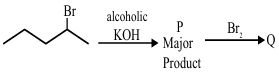
Consider the above sequence of reactions. $151 \ g$ of $2-$bromopentane is made to react. The yield of the major product $P$ is $80 \%$ whereas the yield of $Q$ is $100 \%$. The mass of product $Q$ obtained is $........ \ g$. (Given molar mass in $g \ mol^{-1}$: $H: 1, C: 12, Br: 80$)
A
$256$
B
$485$
C
$184$
D
$284$
Solution
(C) The molar mass of $2-$bromopentane $(C_5H_{11}Br)$ is $(5 \times 12) + (11 \times 1) + 80 = 60 + 11 + 80 = 151 \ g \ mol^{-1}$.
Given mass of $2-$bromopentane = $151 \ g$,so moles of $2-$bromopentane = $1 \ mol$.
Reaction $1$: $2-$bromopentane $\xrightarrow{\text{alc. KOH}}$ pent-$2-$ene $(P)$ + $HBr$.
Since the yield of $P$ is $80 \%$,moles of $P$ formed = $0.8 \ mol$.
Reaction $2$: Pent-$2-$ene $(P)$ $\xrightarrow{Br_2}$ $2,3-$dibromopentane $(Q)$.
Since the yield of $Q$ is $100 \%$,moles of $Q$ formed = $0.8 \ mol$.
The molar mass of $Q$ $(C_5H_{10}Br_2)$ is $(5 \times 12) + (10 \times 1) + (2 \times 80) = 60 + 10 + 160 = 230 \ g \ mol^{-1}$.
Mass of $Q$ = $\text{moles} \times \text{molar mass} = 0.8 \ mol \times 230 \ g \ mol^{-1} = 184 \ g$.
Given mass of $2-$bromopentane = $151 \ g$,so moles of $2-$bromopentane = $1 \ mol$.
Reaction $1$: $2-$bromopentane $\xrightarrow{\text{alc. KOH}}$ pent-$2-$ene $(P)$ + $HBr$.
Since the yield of $P$ is $80 \%$,moles of $P$ formed = $0.8 \ mol$.
Reaction $2$: Pent-$2-$ene $(P)$ $\xrightarrow{Br_2}$ $2,3-$dibromopentane $(Q)$.
Since the yield of $Q$ is $100 \%$,moles of $Q$ formed = $0.8 \ mol$.
The molar mass of $Q$ $(C_5H_{10}Br_2)$ is $(5 \times 12) + (10 \times 1) + (2 \times 80) = 60 + 10 + 160 = 230 \ g \ mol^{-1}$.
Mass of $Q$ = $\text{moles} \times \text{molar mass} = 0.8 \ mol \times 230 \ g \ mol^{-1} = 184 \ g$.
0 likes
View Solution104
DifficultMCQ
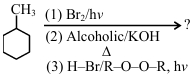
Predict the major product of the following reaction sequence $:-$
A
$1-$bromo$-1-$methylcyclohexane
B
$2-$bromomethylcyclohexane
C
$1-$bromo$-2-$methylcyclohexane
D
Bromocycloheptane
Solution
(C) The reaction sequence proceeds as follows:
$1$. Free radical bromination of methylcyclohexane with $Br_2/h\nu$ occurs at the tertiary carbon to form $1$-bromo-$1$-methylcyclohexane.
$2$. Dehydrohalogenation with alcoholic $KOH$ and $\Delta$ (heat) leads to the formation of $1$-methylcyclohexene via an $E2$ mechanism.
$3$. The addition of $HBr$ in the presence of peroxide $(R-O-O-R)$ and $h\nu$ follows an anti-Markovnikov addition mechanism,resulting in the formation of $1$-bromo-$2$-methylcyclohexane as the major product.
$1$. Free radical bromination of methylcyclohexane with $Br_2/h\nu$ occurs at the tertiary carbon to form $1$-bromo-$1$-methylcyclohexane.
$2$. Dehydrohalogenation with alcoholic $KOH$ and $\Delta$ (heat) leads to the formation of $1$-methylcyclohexene via an $E2$ mechanism.
$3$. The addition of $HBr$ in the presence of peroxide $(R-O-O-R)$ and $h\nu$ follows an anti-Markovnikov addition mechanism,resulting in the formation of $1$-bromo-$2$-methylcyclohexane as the major product.
0 likes
View Solution105
MediumMCQ
The reactions which cannot be applied to prepare an alkene by elimination are: Choose the correct answer from the options given below $:$
$A.$ $2$-bromomethylcyclohexane + $NaOEt$
$B.$ $2$-bromobutane + $KOH$ (aq.)
$C.$ $2$-bromo-$2$-methylpropane + $NaOMe$
$D.$ Phenol + $Na_2Cr_2O_7 / H_2SO_4$
$E.$ $2$-methylpropan-$2$-ol + $Cu$ at $573 \ K$
$A.$ $2$-bromomethylcyclohexane + $NaOEt$
$B.$ $2$-bromobutane + $KOH$ (aq.)
$C.$ $2$-bromo-$2$-methylpropane + $NaOMe$
$D.$ Phenol + $Na_2Cr_2O_7 / H_2SO_4$
$E.$ $2$-methylpropan-$2$-ol + $Cu$ at $573 \ K$
A
$B \& E$ Only
B
$B, C \& D$ Only
C
$A, C \& D$ Only
D
$B \& D$ Only
Solution
(D) Let us analyze each reaction:
$A.$ $2$-bromomethylcyclohexane with $NaOEt$ undergoes $E2$ elimination to form an alkene.
$B.$ $2$-bromobutane with aqueous $KOH$ undergoes nucleophilic substitution ($SN^2$ or $SN^1$) to form butan-$2$-ol,not an alkene.
$C.$ $2$-bromo-$2$-methylpropane with $NaOMe$ undergoes $E2$ elimination to form $2$-methylpropene (an alkene).
$D.$ Phenol with $Na_2Cr_2O_7 / H_2SO_4$ undergoes oxidation to form $p$-benzoquinone,not an alkene.
$E.$ $2$-methylpropan-$2$-ol with $Cu$ at $573 \ K$ undergoes dehydration to form $2$-methylpropene (an alkene).
Thus,reactions $B$ and $D$ do not produce an alkene.
$A.$ $2$-bromomethylcyclohexane with $NaOEt$ undergoes $E2$ elimination to form an alkene.
$B.$ $2$-bromobutane with aqueous $KOH$ undergoes nucleophilic substitution ($SN^2$ or $SN^1$) to form butan-$2$-ol,not an alkene.
$C.$ $2$-bromo-$2$-methylpropane with $NaOMe$ undergoes $E2$ elimination to form $2$-methylpropene (an alkene).
$D.$ Phenol with $Na_2Cr_2O_7 / H_2SO_4$ undergoes oxidation to form $p$-benzoquinone,not an alkene.
$E.$ $2$-methylpropan-$2$-ol with $Cu$ at $573 \ K$ undergoes dehydration to form $2$-methylpropene (an alkene).
Thus,reactions $B$ and $D$ do not produce an alkene.
0 likes
View Solution106
EasyMCQ
Choose the correct option:
| $A$. $ROH + SOCl_2 \rightarrow$ | $P$. Darzen process |
| $B$. $RX (Cl, Br) + NaI \rightarrow$ | $Q$. Finkelstein reaction |
| $C$. $RX (Cl, Br) + AgF \rightarrow$ | $R$. Swarts reaction |
| $D$. $ArX + RX + Na \rightarrow$ | $S$. Wurtz-Fittig reaction |
A
$A$ $\rightarrow P, B$ $\rightarrow Q, C$ $\rightarrow R, D$ $\rightarrow S$
B
$A$ $\rightarrow Q, B$ $\rightarrow P, C$ $\rightarrow S, D$ $\rightarrow R$
C
$A$ $\rightarrow P, B$ $\rightarrow Q, C$ $\rightarrow S, D$ $\rightarrow R$
D
$A$ $\rightarrow S, B$ $\rightarrow R, C$ $\rightarrow Q, D$ $\rightarrow P$
Solution
(A) The reactions are matched as follows:
$A$. $ROH + SOCl_2 \rightarrow RCl + SO_2 + HCl$ is the Darzen process $(P)$.
$B$. $RX + NaI \rightarrow RI + NaX$ is the Finkelstein reaction $(Q)$.
$C$. $RX + AgF \rightarrow RF + AgX$ is the Swarts reaction $(R)$.
$D$. $ArX + RX + 2Na \rightarrow Ar-R + 2NaX$ is the Wurtz-Fittig reaction $(S)$.
Therefore,the correct matching is $A$ $\rightarrow P, B$ $\rightarrow Q, C$ $\rightarrow R, D$ $\rightarrow S$.
$A$. $ROH + SOCl_2 \rightarrow RCl + SO_2 + HCl$ is the Darzen process $(P)$.
$B$. $RX + NaI \rightarrow RI + NaX$ is the Finkelstein reaction $(Q)$.
$C$. $RX + AgF \rightarrow RF + AgX$ is the Swarts reaction $(R)$.
$D$. $ArX + RX + 2Na \rightarrow Ar-R + 2NaX$ is the Wurtz-Fittig reaction $(S)$.
Therefore,the correct matching is $A$ $\rightarrow P, B$ $\rightarrow Q, C$ $\rightarrow R, D$ $\rightarrow S$.
0 likes
View Solution107
MediumMCQ
Alkyl halide $\xrightarrow[\text{Ether}]{Mg}$ Grignard Reagent $\xrightarrow{H_2O}$ Propane,then alkyl halide may be :-
A
$n-$propyl iodide
B
$n-$propyl chloride
C
Isopropyl chloride
D
$b$ and $c$ both
Solution
(D) The reaction sequence is: $R-X + Mg$ $\xrightarrow{\text{Ether}} R-MgX$ $\xrightarrow{H_2O} R-H + Mg(OH)X$.
Here,the final product is Propane $(CH_3-CH_2-CH_3)$,which contains $3$ carbon atoms.
Therefore,the alkyl halide $(R-X)$ must contain $3$ carbon atoms.
Both $n-$propyl chloride $(CH_3-CH_2-CH_2-Cl)$ and isopropyl chloride $(CH_3-CHCl-CH_3)$ contain $3$ carbon atoms.
Both will form their respective Grignard reagents,which upon hydrolysis with $H_2O$ will yield Propane.
Here,the final product is Propane $(CH_3-CH_2-CH_3)$,which contains $3$ carbon atoms.
Therefore,the alkyl halide $(R-X)$ must contain $3$ carbon atoms.
Both $n-$propyl chloride $(CH_3-CH_2-CH_2-Cl)$ and isopropyl chloride $(CH_3-CHCl-CH_3)$ contain $3$ carbon atoms.
Both will form their respective Grignard reagents,which upon hydrolysis with $H_2O$ will yield Propane.
0 likes
View Solution108
MediumMCQ
Which of the following is $NOT$ obtained when a mixture of chloroethane and $1-$chloropropane is treated with sodium metal in dry ether?
A
Propane
B
Butane
C
Pentane
D
Hexane
Solution
(A) The reaction of a mixture of alkyl halides with sodium metal in dry ether is known as the Wurtz reaction. When a mixture of chloroethane $(CH_3CH_2Cl)$ and $1-$chloropropane $(CH_3CH_2CH_2Cl)$ is treated with sodium in dry ether,the following products are formed due to the coupling of alkyl radicals:
$1$. Coupling of two chloroethane molecules: $CH_3CH_2-CH_2CH_3$ ($n-$butane).
$2$. Coupling of two $1-$chloropropane molecules: $CH_3CH_2CH_2-CH_2CH_2CH_3$ ($n-$hexane).
$3$. Cross-coupling of chloroethane and $1-$chloropropane: $CH_3CH_2-CH_2CH_2CH_3$ ($n-$pentane).
Propane is not formed in this reaction because it would require the loss of a carbon atom or a different mechanism not associated with the Wurtz coupling of these specific reactants.
$1$. Coupling of two chloroethane molecules: $CH_3CH_2-CH_2CH_3$ ($n-$butane).
$2$. Coupling of two $1-$chloropropane molecules: $CH_3CH_2CH_2-CH_2CH_2CH_3$ ($n-$hexane).
$3$. Cross-coupling of chloroethane and $1-$chloropropane: $CH_3CH_2-CH_2CH_2CH_3$ ($n-$pentane).
Propane is not formed in this reaction because it would require the loss of a carbon atom or a different mechanism not associated with the Wurtz coupling of these specific reactants.
0 likes
View Solution109
MediumMCQ
Which among the following is $NOT$ obtained when bromobenzene is treated with bromoethane and sodium in the presence of dry ether?
A
$n$-butane
B
Diphenyl
C
Toluene
D
Ethylbenzene
Solution
(C) The reaction of bromobenzene $(C_6H_5Br)$ and bromoethane $(C_2H_5Br)$ with sodium in the presence of dry ether is a Wurtz-Fittig reaction.
In this reaction,a mixture of alkyl halide and aryl halide reacts with sodium to form an alkylbenzene.
Possible products are formed by the coupling of the radicals generated:
$1$. Coupling of two bromoethane molecules gives $n$-butane $(CH_3CH_2CH_2CH_3)$.
$2$. Coupling of two bromobenzene molecules gives diphenyl $(C_6H_5-C_6H_5)$.
$3$. Coupling of one bromobenzene and one bromoethane molecule gives ethylbenzene $(C_6H_5-C_2H_5)$.
Toluene $(C_6H_5CH_3)$ cannot be formed because it would require the use of bromomethane $(CH_3Br)$ instead of bromoethane $(C_2H_5Br)$.
Therefore,toluene is $NOT$ obtained.
In this reaction,a mixture of alkyl halide and aryl halide reacts with sodium to form an alkylbenzene.
Possible products are formed by the coupling of the radicals generated:
$1$. Coupling of two bromoethane molecules gives $n$-butane $(CH_3CH_2CH_2CH_3)$.
$2$. Coupling of two bromobenzene molecules gives diphenyl $(C_6H_5-C_6H_5)$.
$3$. Coupling of one bromobenzene and one bromoethane molecule gives ethylbenzene $(C_6H_5-C_2H_5)$.
Toluene $(C_6H_5CH_3)$ cannot be formed because it would require the use of bromomethane $(CH_3Br)$ instead of bromoethane $(C_2H_5Br)$.
Therefore,toluene is $NOT$ obtained.
0 likes
View Solution110
MediumMCQ
The compound which is $NOT$ formed when a mixture of $n$-butyl bromide and ethyl bromide is treated with sodium metal in the presence of dry ether is:
A
Butane
B
Octane
C
Hexane
D
Ethane
Solution
(D) The Wurtz reaction involves the coupling of alkyl halides with sodium metal in dry ether to form higher alkanes.
When a mixture of $n$-butyl bromide $(CH_3CH_2CH_2CH_2Br)$ and ethyl bromide $(CH_3CH_2Br)$ is treated with sodium,the following products are formed:
$1$. Coupling of two ethyl bromide molecules: $CH_3CH_2-CH_2CH_3$ ($n$-butane).
$2$. Coupling of two $n$-butyl bromide molecules: $CH_3CH_2CH_2CH_2-CH_2CH_2CH_2CH_3$ ($n$-octane).
$3$. Cross-coupling of ethyl bromide and $n$-butyl bromide: $CH_3CH_2-CH_2CH_2CH_2CH_3$ ($n$-hexane).
Ethane $(CH_3CH_3)$ is not formed in this reaction mixture.
When a mixture of $n$-butyl bromide $(CH_3CH_2CH_2CH_2Br)$ and ethyl bromide $(CH_3CH_2Br)$ is treated with sodium,the following products are formed:
$1$. Coupling of two ethyl bromide molecules: $CH_3CH_2-CH_2CH_3$ ($n$-butane).
$2$. Coupling of two $n$-butyl bromide molecules: $CH_3CH_2CH_2CH_2-CH_2CH_2CH_2CH_3$ ($n$-octane).
$3$. Cross-coupling of ethyl bromide and $n$-butyl bromide: $CH_3CH_2-CH_2CH_2CH_2CH_3$ ($n$-hexane).
Ethane $(CH_3CH_3)$ is not formed in this reaction mixture.
0 likes
View Solution111
EasyMCQ
How many $(\sigma)$ and $(\pi)$ bonds are present in the structure of $DDT$ respectively?
A
$28 \sigma, 6 \pi$
B
$29 \sigma, 6 \pi$
C
$30 \sigma, 6 \pi$
D
$21 \sigma, 6 \pi$
Solution
(B) The chemical structure of $DDT$ is $1,1,1-\text{trichloro}-2,2-\text{bis}(p-\text{chlorophenyl})\text{ethane}$.
Its molecular formula is $C_{14}H_9Cl_5$.
In the structure,there are two benzene rings,each containing $3$ $(\pi)$ bonds,totaling $6$ $(\pi)$ bonds.
Counting the $(\sigma)$ bonds: There are $29$ $(\sigma)$ bonds in the entire molecule,including the $C-C$,$C-H$,and $C-Cl$ bonds.
Thus,the correct answer is $29$ $(\sigma)$ and $6$ $(\pi)$ bonds.
Its molecular formula is $C_{14}H_9Cl_5$.
In the structure,there are two benzene rings,each containing $3$ $(\pi)$ bonds,totaling $6$ $(\pi)$ bonds.
Counting the $(\sigma)$ bonds: There are $29$ $(\sigma)$ bonds in the entire molecule,including the $C-C$,$C-H$,and $C-Cl$ bonds.
Thus,the correct answer is $29$ $(\sigma)$ and $6$ $(\pi)$ bonds.
0 likes
View Solution112
DifficultMCQ
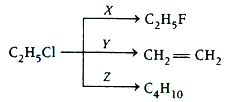
In the following scheme of reaction,$X, Y$ and $Z$ respectively are:
A
$AgF$,alcoholic $KOH$ and benzene
B
$HF$,aqueous $KOH$ and $Na$ in dry ether
C
$Hg_2F_2$,alcoholic $KOH$ and $Na$ in dry ether
D
$CoF_2$,aqueous $KOH$ and benzene
Solution
(C) The given reaction scheme shows three different reactions of ethyl chloride $(C_2H_5Cl)$:
$1$. The conversion of $C_2H_5Cl$ to $C_2H_5F$ is a Swarts reaction,which uses a metallic fluoride like $Hg_2F_2$ or $AgF$. Thus,$X = Hg_2F_2$.
$2$. The conversion of $C_2H_5Cl$ to ethene $(CH_2=CH_2)$ is a dehydrohalogenation reaction,which occurs in the presence of alcoholic $KOH$. Thus,$Y = \text{alcoholic } KOH$.
$3$. The conversion of $C_2H_5Cl$ to butane $(C_4H_{10})$ is a Wurtz reaction,which uses $Na$ in dry ether. Thus,$Z = Na \text{ in dry ether}$.
Therefore,the correct sequence is $Hg_2F_2$,alcoholic $KOH$ and $Na$ in dry ether.
$1$. The conversion of $C_2H_5Cl$ to $C_2H_5F$ is a Swarts reaction,which uses a metallic fluoride like $Hg_2F_2$ or $AgF$. Thus,$X = Hg_2F_2$.
$2$. The conversion of $C_2H_5Cl$ to ethene $(CH_2=CH_2)$ is a dehydrohalogenation reaction,which occurs in the presence of alcoholic $KOH$. Thus,$Y = \text{alcoholic } KOH$.
$3$. The conversion of $C_2H_5Cl$ to butane $(C_4H_{10})$ is a Wurtz reaction,which uses $Na$ in dry ether. Thus,$Z = Na \text{ in dry ether}$.
Therefore,the correct sequence is $Hg_2F_2$,alcoholic $KOH$ and $Na$ in dry ether.
0 likes
View Solution113
EasyMCQ
Which one of the following is not formed when a mixture of methyl bromide and bromobenzene is heated with sodium metal in the presence of dry ether?
A
Diphenyl
B
Propane
C
Toluene
D
Ethane
Solution
(B) The reaction of a mixture of methyl bromide $(CH_3Br)$ and bromobenzene $(C_6H_5Br)$ with sodium metal in dry ether is a combination of Wurtz and Fittig reactions,known as the Wurtz-Fittig reaction.
Possible products include:
$1$. Wurtz reaction: $2CH_3Br + 2Na \rightarrow CH_3-CH_3 + 2NaBr$ (Ethane is formed).
$2$. Wurtz-Fittig reaction: $C_6H_5Br + CH_3Br + 2Na \rightarrow C_6H_5-CH_3 + 2NaBr$ (Toluene is formed).
$3$. Fittig reaction: $2C_6H_5Br + 2Na \rightarrow C_6H_5-C_6H_5 + 2NaBr$ (Diphenyl is formed).
Propane $(C_3H_8)$ cannot be formed in this reaction as there is no source of a three-carbon chain.
Possible products include:
$1$. Wurtz reaction: $2CH_3Br + 2Na \rightarrow CH_3-CH_3 + 2NaBr$ (Ethane is formed).
$2$. Wurtz-Fittig reaction: $C_6H_5Br + CH_3Br + 2Na \rightarrow C_6H_5-CH_3 + 2NaBr$ (Toluene is formed).
$3$. Fittig reaction: $2C_6H_5Br + 2Na \rightarrow C_6H_5-C_6H_5 + 2NaBr$ (Diphenyl is formed).
Propane $(C_3H_8)$ cannot be formed in this reaction as there is no source of a three-carbon chain.
0 likes
View Solution114
MediumMCQ
Identify the major product formed from the sequence of reactions given below:
$C_6H_5NH_2$ $\xrightarrow[(ii) Cu_2Cl_2]{(i) NaNO_2/HCl, 273 K}$ $\xrightarrow{(iii) Na/dry ether} \text{Product}$
$C_6H_5NH_2$ $\xrightarrow[(ii) Cu_2Cl_2]{(i) NaNO_2/HCl, 273 K}$ $\xrightarrow{(iii) Na/dry ether} \text{Product}$
A
Chlorobenzene
B
Biphenyl
C
Diphenylmethane
D
Diphenylamine
Solution
(B) The reaction sequence is as follows:
$1$. Aniline $(C_6H_5NH_2)$ reacts with $NaNO_2/HCl$ at $273-278 \ K$ to form benzenediazonium chloride $(C_6H_5N_2^+Cl^-)$.
$2$. Benzenediazonium chloride reacts with $Cu_2Cl_2$ (Sandmeyer reaction) to form chlorobenzene $(C_6H_5Cl)$.
$3$. Chlorobenzene reacts with $Na$ in the presence of dry ether (Wurtz-Fittig reaction) to form biphenyl $(C_6H_5-C_6H_5)$.
$1$. Aniline $(C_6H_5NH_2)$ reacts with $NaNO_2/HCl$ at $273-278 \ K$ to form benzenediazonium chloride $(C_6H_5N_2^+Cl^-)$.
$2$. Benzenediazonium chloride reacts with $Cu_2Cl_2$ (Sandmeyer reaction) to form chlorobenzene $(C_6H_5Cl)$.
$3$. Chlorobenzene reacts with $Na$ in the presence of dry ether (Wurtz-Fittig reaction) to form biphenyl $(C_6H_5-C_6H_5)$.
0 likes
View Solution115
EasyMCQ
What are $X$ and $Y$ respectively in the following reaction sequence?
$C_3H_6$ $\xrightarrow[\text{(C}_6\text{H}_5\text{CO)}_2\text{O}_2]{\text{HBr}} X$ $\xrightarrow{\text{Na/ dry ether}} Y$
$C_3H_6$ $\xrightarrow[\text{(C}_6\text{H}_5\text{CO)}_2\text{O}_2]{\text{HBr}} X$ $\xrightarrow{\text{Na/ dry ether}} Y$
A
$CH_3CH(Br)CH_3$,propylbenzene
B
$CH_3CH(Br)CH_3$,isopropylbenzene
C
$CH_3CH_2CH_2Br$,isopropylbenzene
D
$CH_3CH_2CH_2Br$,propylbenzene
Solution
(D) The first step is the addition of $HBr$ to propene $(C_3H_6)$ in the presence of benzoyl peroxide,which follows the anti-Markovnikov rule. This results in the formation of $1$-bromopropane $(CH_3CH_2CH_2Br)$ as $X$.
In the second step,$1$-bromopropane reacts with bromobenzene in the presence of $Na$ and dry ether. This is a Wurtz-Fittig reaction,which couples the alkyl group to the benzene ring,forming propylbenzene as $Y$.
In the second step,$1$-bromopropane reacts with bromobenzene in the presence of $Na$ and dry ether. This is a Wurtz-Fittig reaction,which couples the alkyl group to the benzene ring,forming propylbenzene as $Y$.
0 likes
View Solution116
MediumMCQ
Identify the major product formed from the following reaction sequence:

A
$1-$iodopropane
B
$2,3-$dimethylbutane
C
$1,2-$diiodopropane
D
$n-$hexane
Solution
(D) The reaction sequence is as follows:
$1.$ Propan$-1-$ol reacts with Lucas reagent $(HCl / ZnCl_2)$ to form $1-$chloropropane.
$2.$ $1-$chloropropane undergoes Finkelstein reaction with $NaI$ in dry acetone to form $1-$iodopropane.
$3.$ $1-$iodopropane undergoes Wurtz reaction in the presence of $Na$ and dry ether to form $n-$hexane $(CH_3CH_2CH_2CH_2CH_2CH_3)$.
$1.$ Propan$-1-$ol reacts with Lucas reagent $(HCl / ZnCl_2)$ to form $1-$chloropropane.
$2.$ $1-$chloropropane undergoes Finkelstein reaction with $NaI$ in dry acetone to form $1-$iodopropane.
$3.$ $1-$iodopropane undergoes Wurtz reaction in the presence of $Na$ and dry ether to form $n-$hexane $(CH_3CH_2CH_2CH_2CH_2CH_3)$.
0 likes
View Solution117
MediumMCQ
Match the following lists:
| List-$I$ | List-$II$ |
|---|---|
| $(A)$ Benzene | $1$. Phosgene |
| $(B)$ Ethylene | $2$. Silver mirror |
| $(C)$ Acetaldehyde | $3$. Mustard gas |
| $(D)$ Chloroform | $4$. $(4n + 2) \pi$ electrons |
| $5$. Carbylamine |
A
$A-4, B-3, C-2, D-1$
B
$A-3, B-2, C-1, D-4$
C
$A-2, B-4, C-5, D-3$
D
$A-5, B-1, C-4, D-3$
Solution
(A) The correct matching is:
$(A)$ Benzene matches with $4$. $(4n + 2) \pi$ electrons: Benzene has $6 \pi$ electrons,which follows the Huckel rule $(4n + 2) \pi$ electrons.
$(B)$ Ethylene matches with $3$. Mustard gas: Ethylene reacts with $S_2Cl_2$ to form mustard gas.
$(C)$ Acetaldehyde matches with $2$. Silver mirror: Acetaldehyde gives a positive silver mirror test with Tollen's reagent.
$(D)$ Chloroform matches with $1$. Phosgene: Chloroform on oxidation gives phosgene,which is a poisonous gas.
Therefore,the correct sequence is $A-4, B-3, C-2, D-1$.
$(A)$ Benzene matches with $4$. $(4n + 2) \pi$ electrons: Benzene has $6 \pi$ electrons,which follows the Huckel rule $(4n + 2) \pi$ electrons.
$(B)$ Ethylene matches with $3$. Mustard gas: Ethylene reacts with $S_2Cl_2$ to form mustard gas.
$(C)$ Acetaldehyde matches with $2$. Silver mirror: Acetaldehyde gives a positive silver mirror test with Tollen's reagent.
$(D)$ Chloroform matches with $1$. Phosgene: Chloroform on oxidation gives phosgene,which is a poisonous gas.
Therefore,the correct sequence is $A-4, B-3, C-2, D-1$.
0 likes
View Solution118
DifficultMCQ
Match the following reactions in List-$I$ with their major products in List-$II$.
The correct match is:
| List-$I$ (Reaction) | List-$II$ (Major product) |
|---|---|
| $A. \ CH_3CH=CH_2 \xrightarrow{HI}$ | $I. \ 1\text{-bromo-}2\text{-phenylethane}$ |
| $B. \ C_6H_5CH_2CH_3 \xrightarrow{Br_2/\Delta}$ | $II. \ 1\text{-iodopropane}$ |
| $C. \ C_6H_5CH=CH_2 \xrightarrow{HBr}$ | $III. \ 2\text{-iodopropane}$ |
| $IV. \ 1\text{-bromo-}1\text{-phenylethane}$ |
The correct match is:
A
$A-III, B-I, C-IV$
B
$A-III, B-IV, C-IV$
C
$A-II, B-I, C-I$
D
$A-II, B-IV, C-IV$
Solution
(B) The addition of $HI$ to propene follows Markownikoff's rule,proceeding via the formation of a $2^{\circ}$ carbocation,which is more stable than a $1^{\circ}$ carbocation. The major product is $2\text{-iodopropane}$ $(III)$.
$(B)$ The reaction of ethylbenzene $(C_6H_5CH_2CH_3)$ with $Br_2$ under heating $(\Delta)$ is a free radical substitution at the benzylic position. The $1\text{-phenylethyl}$ radical is stabilized by resonance,leading to $1\text{-bromo-}1\text{-phenylethane}$ $(IV)$.
$(C)$ The addition of $HBr$ to styrene $(C_6H_5CH=CH_2)$ follows Markownikoff's rule. The electrophilic addition of $H $ forms a stable benzylic carbocation $(C_6H_5CH^ CH_3)$,which then reacts with $Br^-$ to form $1\text{-bromo-}1\text{-phenylethane}$ $(IV)$.
Therefore,the correct match is $A-III, B-IV, C-IV$.
$(B)$ The reaction of ethylbenzene $(C_6H_5CH_2CH_3)$ with $Br_2$ under heating $(\Delta)$ is a free radical substitution at the benzylic position. The $1\text{-phenylethyl}$ radical is stabilized by resonance,leading to $1\text{-bromo-}1\text{-phenylethane}$ $(IV)$.
$(C)$ The addition of $HBr$ to styrene $(C_6H_5CH=CH_2)$ follows Markownikoff's rule. The electrophilic addition of $H $ forms a stable benzylic carbocation $(C_6H_5CH^ CH_3)$,which then reacts with $Br^-$ to form $1\text{-bromo-}1\text{-phenylethane}$ $(IV)$.
Therefore,the correct match is $A-III, B-IV, C-IV$.
0 likes
View Solution119
MediumMCQ
Match the reactions in List-$I$ with the major products in List-$II$:
| List-$I$ | List-$II$ (Major Product) |
| :--- | :--- |
| $(A)$ $CH_3-CHBr-CH_2Br \xrightarrow{KOH/C_2H_5OH}$ | $(I)$ $1^{\circ}$-alkyl bromide |
| $(B)$ $CH_3-CH_2-CH=CH_2 \xrightarrow{HBr, (C_6H_5CO)_2O_2, \Delta}$ | $(II)$ $2^{\circ}$-alkyl bromide |
| $(C)$ $CH_3CH_2CH_3 \xrightarrow{Br_2, h\nu}$ | $(III)$ Allyl bromide |
| $(D)$ $CH_3-CH=CH_2 \xrightarrow{NBS, \Delta}$ | $(IV)$ Alkenyl bromide |
| List-$I$ | List-$II$ (Major Product) |
| :--- | :--- |
| $(A)$ $CH_3-CHBr-CH_2Br \xrightarrow{KOH/C_2H_5OH}$ | $(I)$ $1^{\circ}$-alkyl bromide |
| $(B)$ $CH_3-CH_2-CH=CH_2 \xrightarrow{HBr, (C_6H_5CO)_2O_2, \Delta}$ | $(II)$ $2^{\circ}$-alkyl bromide |
| $(C)$ $CH_3CH_2CH_3 \xrightarrow{Br_2, h\nu}$ | $(III)$ Allyl bromide |
| $(D)$ $CH_3-CH=CH_2 \xrightarrow{NBS, \Delta}$ | $(IV)$ Alkenyl bromide |
A
$A-IV, B-I, C-II, D-III$
B
$A-I, B-II, C-III, D-IV$
C
$A-IV, B-II, C-I, D-III$
D
$A-III, B-I, C-II, D-IV$
Solution
(A) The reactions are analyzed as follows:
$(A)$ $CH_3-CHBr-CH_2Br \xrightarrow{alc. KOH} CH_3-C \equiv CH$ or $CH_3-CH=CHBr$. This is a dehydrohalogenation reaction yielding an alkenyl bromide $(IV)$.
$(B)$ $CH_3-CH_2-CH=CH_2 \xrightarrow{HBr, \text{peroxide}} CH_3-CH_2-CH_2-CH_2Br$. This is Anti-Markovnikov addition,yielding a $1^{\circ}$-alkyl bromide $(I)$.
$(C)$ $CH_3-CH_2-CH_3 \xrightarrow{Br_2, h\nu} CH_3-CHBr-CH_3$. Free radical bromination occurs preferentially at the $2^{\circ}$ carbon to form a $2^{\circ}$-alkyl bromide $(II)$.
$(D)$ $CH_3-CH=CH_2 \xrightarrow{NBS, \Delta} BrCH_2-CH=CH_2$. $NBS$ ($N$-Bromosuccinimide) performs allylic bromination,yielding allyl bromide $(III)$.
Therefore,the correct matching is $A-IV, B-I, C-II, D-III$.
$(A)$ $CH_3-CHBr-CH_2Br \xrightarrow{alc. KOH} CH_3-C \equiv CH$ or $CH_3-CH=CHBr$. This is a dehydrohalogenation reaction yielding an alkenyl bromide $(IV)$.
$(B)$ $CH_3-CH_2-CH=CH_2 \xrightarrow{HBr, \text{peroxide}} CH_3-CH_2-CH_2-CH_2Br$. This is Anti-Markovnikov addition,yielding a $1^{\circ}$-alkyl bromide $(I)$.
$(C)$ $CH_3-CH_2-CH_3 \xrightarrow{Br_2, h\nu} CH_3-CHBr-CH_3$. Free radical bromination occurs preferentially at the $2^{\circ}$ carbon to form a $2^{\circ}$-alkyl bromide $(II)$.
$(D)$ $CH_3-CH=CH_2 \xrightarrow{NBS, \Delta} BrCH_2-CH=CH_2$. $NBS$ ($N$-Bromosuccinimide) performs allylic bromination,yielding allyl bromide $(III)$.
Therefore,the correct matching is $A-IV, B-I, C-II, D-III$.
0 likes
View Solution120
DifficultMCQ
Which of the following reactions is $NOT$ correctly represented?
A
$3-$methylcyclohexene + $Br_2, h\nu \rightarrow$ $3-$(bromomethyl)cyclohexene
B
Benzenediazonium chloride + $Cu_2Br_2/HBr \rightarrow$ Bromobenzene
C
Toluene + $Br_2, h\nu \rightarrow$ Benzyl bromide
D
Toluene + $Br_2, Fe, \text{dark} \rightarrow$ Ortho and para bromotoluene
Solution
(A) In reaction $(1)$,the starting material is $3$-methylcyclohexene. Under radical bromination conditions $(Br_2, h\nu)$,the reaction proceeds via the formation of a free radical. The most stable radical is the tertiary $(3^\circ)$ radical formed at the $C-3$ position. Therefore,the major product should be $3$-bromo-$3$-methylcyclohexene,not $3$-(bromomethyl)cyclohexene. Thus,reaction $(1)$ is incorrectly represented.
0 likes
View Solution121
DifficultMCQ
Given below are two statements:
Statement $I$: $C-Cl$ bond is stronger in $CH_2=CH-Cl$ than $CH_3-CH_2-Cl$.
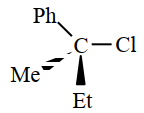
Statement $II$: The given optically active molecule on hydrolysis gives a solution that can rotate the plane polarized light.
In the light of the above statements,choose the correct answer from the options given below.
Statement $I$: $C-Cl$ bond is stronger in $CH_2=CH-Cl$ than $CH_3-CH_2-Cl$.
Statement $II$: The given optically active molecule on hydrolysis gives a solution that can rotate the plane polarized light.
In the light of the above statements,choose the correct answer from the options given below.
A
Statement $I$ is false but Statement $II$ is true
B
Both Statement $I$ and Statement $II$ are true
C
Both Statement $I$ and Statement $II$ are false
D
Statement $I$ is true but Statement $II$ is false
Solution
(D) Statement $I$: In $CH_2=CH-Cl$ (vinyl chloride),the lone pair on chlorine atom participates in resonance with the double bond,giving the $C-Cl$ bond a partial double bond character. This makes it shorter and stronger than the $C-Cl$ bond in $CH_3-CH_2-Cl$ (ethyl chloride),where only a single bond exists. Thus,Statement $I$ is true.
Statement $II$: The given molecule is a chiral alkyl halide. Hydrolysis of such a molecule typically proceeds via an $S_N1$ mechanism,which involves the formation of a planar carbocation intermediate. Nucleophilic attack on this carbocation occurs from both sides with equal probability,leading to the formation of a racemic mixture. $A$ racemic mixture is optically inactive and cannot rotate plane polarized light $(PPL)$. Thus,Statement $II$ is false.
Statement $II$: The given molecule is a chiral alkyl halide. Hydrolysis of such a molecule typically proceeds via an $S_N1$ mechanism,which involves the formation of a planar carbocation intermediate. Nucleophilic attack on this carbocation occurs from both sides with equal probability,leading to the formation of a racemic mixture. $A$ racemic mixture is optically inactive and cannot rotate plane polarized light $(PPL)$. Thus,Statement $II$ is false.
0 likes
View Solution122
DifficultMCQ
Given below are four compounds:
$(a)$ $n$-propyl chloride,
$(b)$ $iso$-propyl chloride,
$(c)$ $sec$-butyl chloride,
$(d)$ $neo$-pentyl chloride.
Percentage of carbon in the one which exhibits optical isomerism is:
$(a)$ $n$-propyl chloride,
$(b)$ $iso$-propyl chloride,
$(c)$ $sec$-butyl chloride,
$(d)$ $neo$-pentyl chloride.
Percentage of carbon in the one which exhibits optical isomerism is:
A
$52$
B
$56$
C
$46$
D
$40$
Solution
(A) $sec$-butyl chloride ($2$-chlorobutane) is the only compound among the given options that contains a chiral carbon atom and thus exhibits optical isomerism.
The molecular formula of $sec$-butyl chloride is $C_4H_9Cl$.
Molar mass of $C_4H_9Cl = (4 \times 12) + (9 \times 1) + 35.5 = 48 + 9 + 35.5 = 92.5 \ g/mol$.
Percentage of carbon $= \frac{\text{Mass of carbon}}{\text{Molar mass}} \times 100 = \frac{48}{92.5} \times 100 \approx 51.89 \%$.
Rounding to the nearest integer,we get $52 \%$.
The molecular formula of $sec$-butyl chloride is $C_4H_9Cl$.
Molar mass of $C_4H_9Cl = (4 \times 12) + (9 \times 1) + 35.5 = 48 + 9 + 35.5 = 92.5 \ g/mol$.
Percentage of carbon $= \frac{\text{Mass of carbon}}{\text{Molar mass}} \times 100 = \frac{48}{92.5} \times 100 \approx 51.89 \%$.
Rounding to the nearest integer,we get $52 \%$.
0 likes
View Solution123
DifficultMCQ
Correct statements regarding alkyl halides ($R-X$) among the following are:
A. Alcohol being less polar solvent as compared to water, alcoholic $KOH$ favours elimination reaction with $R-X$.
B. Order of reactivity towards $S_N1$ mechanism is $C_6H_5-CH_2-Cl > C_6H_5-CHCl-C_6H_5$.
C. Non substituted aryl halides exhibit properties similar to alkyl halides.
D. Vinyl chloride is an example of haloalkene and allyl chloride is an example of haloalkyne.
E. $R-Cl$ can be prepared by reacting $R-OH$ with $SOCl_2$ but $Ar-Cl$ cannot be prepared by reacting $Ar-OH$ with $SOCl_2$.
Choose the correct answer from the options given below:
A
A, B and C Only
B
B and D Only
C
A and E Only
D
D and E Only
Solution
A is true: alcoholic $KOH$ is a stronger base and promotes elimination. E is true: $SOCl_2$ works well for alcohols, but phenols are not effectively converted to aryl chlorides this way. C is false: aryl halides are very different (less reactive). D is false: allyl chloride is a haloalkene, not a haloalkyne.
0 likes
View Solution124
MediumMCQ
Match the List-$I$ with List-$II$:
Choose the correct answer from the options given below:
| List-$I$ | List-$II$ |
| $A$. Finkelstein reaction | $I$. $SbF_3$ |
| $B$. Swarts reaction | $II$. $Na$,dry ether |
| $C$. Sandmeyer's reaction | $III$. $NaI$ |
| $D$. Fittig reaction | $IV$. $Cu_2Cl_2$ |
Choose the correct answer from the options given below:
A
$A-I, B-IV, C-III, D-II$
B
$A-III, B-I, C-IV, D-II$
C
$A-IV, B-II, C-I, D-III$
D
$A-I, B-III, C-II, D-IV$
Solution
(B) . Finkelstein reaction involves the exchange of halogen atoms,typically using $NaI$ in acetone to prepare alkyl iodides.
$B$. Swarts reaction is used to prepare alkyl fluorides by treating alkyl chlorides or bromides with metallic fluorides like $SbF_3$ or $AgF$.
$C$. Sandmeyer's reaction involves the conversion of diazonium salts into aryl halides using copper$(I)$ salts like $Cu_2Cl_2$.
$D$. Fittig reaction involves the coupling of two aryl halide molecules in the presence of $Na$ metal and dry ether to form diaryls.
Therefore,the correct matching is $A-III, B-I, C-IV, D-II$.
$B$. Swarts reaction is used to prepare alkyl fluorides by treating alkyl chlorides or bromides with metallic fluorides like $SbF_3$ or $AgF$.
$C$. Sandmeyer's reaction involves the conversion of diazonium salts into aryl halides using copper$(I)$ salts like $Cu_2Cl_2$.
$D$. Fittig reaction involves the coupling of two aryl halide molecules in the presence of $Na$ metal and dry ether to form diaryls.
Therefore,the correct matching is $A-III, B-I, C-IV, D-II$.
0 likes
View Solution125
MediumMCQ
Given below are two statements:
Statement $I$: Due to increase in van der Waals forces,the order of boiling points is $CH_3CH_2CH_2I > CH_3CH_2I > CH_3I$.
Statement $II$: As $para$-dichlorobenzene is more symmetric,its melting point is higher than $ortho$-dichlorobenzene,however its boiling point is lower than $ortho$-dichlorobenzene.
In the light of the above statements,choose the correct answer from the options given below:
Statement $I$: Due to increase in van der Waals forces,the order of boiling points is $CH_3CH_2CH_2I > CH_3CH_2I > CH_3I$.
Statement $II$: As $para$-dichlorobenzene is more symmetric,its melting point is higher than $ortho$-dichlorobenzene,however its boiling point is lower than $ortho$-dichlorobenzene.
In the light of the above statements,choose the correct answer from the options given below:
A
Both Statement $I$ and Statement $II$ are true
B
Both Statement $I$ and Statement $II$ are false
C
Statement $I$ is true but Statement $II$ is false
D
Statement $I$ is false but Statement $II$ is true
Solution
(A) Statement $I$ is true: Boiling point increases with an increase in molecular mass due to stronger van der Waals forces. Since the molecular mass of $CH_3CH_2CH_2I$ $(170 \text{ g/mol})$ > $CH_3CH_2I$ $(156 \text{ g/mol})$ > $CH_3I$ $(142 \text{ g/mol})$,the order is correct.
Statement $II$ is true: $p$-dichlorobenzene is more symmetric than $o$-dichlorobenzene,which allows it to pack more efficiently in the crystal lattice,resulting in a higher melting point. However,boiling points are determined by intermolecular forces and molecular shape; $o$-dichlorobenzene has a higher dipole moment than $p$-dichlorobenzene,leading to stronger dipole-dipole interactions and a higher boiling point.
Statement $II$ is true: $p$-dichlorobenzene is more symmetric than $o$-dichlorobenzene,which allows it to pack more efficiently in the crystal lattice,resulting in a higher melting point. However,boiling points are determined by intermolecular forces and molecular shape; $o$-dichlorobenzene has a higher dipole moment than $p$-dichlorobenzene,leading to stronger dipole-dipole interactions and a higher boiling point.
0 likes
View Solution126
DifficultMCQ
Given below are two statements:
Statement $I$: $3$-phenylpropene reacts with $HBr$ and gives secondary alkyl bromide having a chiral carbon atom as the major product.
Statement $II$: Aryl chlorides and aryl cyanides can be prepared by Sandmeyer reaction as well as Gattermann reaction.
Statement $I$: $3$-phenylpropene reacts with $HBr$ and gives secondary alkyl bromide having a chiral carbon atom as the major product.
Statement $II$: Aryl chlorides and aryl cyanides can be prepared by Sandmeyer reaction as well as Gattermann reaction.
A
Both Statement $I$ and Statement $II$ are true
B
Both Statement $I$ and Statement $II$ are false
C
Statement $I$ is true but Statement $II$ is false
D
Statement $I$ is false but Statement $II$ is true
Solution
(A) Statement $I$: $3$-phenylpropene $(C_6H_5CH_2CH=CH_2)$ reacts with $HBr$ via electrophilic addition following Markovnikov's rule.
The intermediate carbocation formed at $C-2$ $(C_6H_5CH_2CH^+CH_3)$ is more stable due to the inductive effect and hyperconjugation compared to the primary carbocation at $C-1$.
The major product is $2$-bromo-$3$-phenylpropane $(C_6H_5CH_2CH(Br)CH_3)$,which contains a chiral center at $C-2$.
Thus,Statement $I$ is true.
Statement $II$: The Sandmeyer reaction uses $Cu_2Cl_2/HCl$ or $Cu_2(CN)_2/KCN$ to convert diazonium salts to aryl chlorides or aryl cyanides.
The Gattermann reaction is a modification of the Sandmeyer reaction that uses copper powder $(Cu)$ in the presence of the corresponding acid ($HCl$ or $HCN$).
Both reactions are standard methods for the preparation of aryl halides and cyanides.
Thus,Statement $II$ is true.
The intermediate carbocation formed at $C-2$ $(C_6H_5CH_2CH^+CH_3)$ is more stable due to the inductive effect and hyperconjugation compared to the primary carbocation at $C-1$.
The major product is $2$-bromo-$3$-phenylpropane $(C_6H_5CH_2CH(Br)CH_3)$,which contains a chiral center at $C-2$.
Thus,Statement $I$ is true.
Statement $II$: The Sandmeyer reaction uses $Cu_2Cl_2/HCl$ or $Cu_2(CN)_2/KCN$ to convert diazonium salts to aryl chlorides or aryl cyanides.
The Gattermann reaction is a modification of the Sandmeyer reaction that uses copper powder $(Cu)$ in the presence of the corresponding acid ($HCl$ or $HCN$).
Both reactions are standard methods for the preparation of aryl halides and cyanides.
Thus,Statement $II$ is true.
0 likes
View Solution127
DifficultMCQ
In the following reaction sequence,$X$ and $Z$,respectively,are:
$CH_{3}CH_{2}CH_{2}-OH + PCl_{5} \rightarrow CH_{3}CH_{2}CH_{2}Cl + X + HCl$
$CH_{3}CH_{2}CH_{2}Cl \xrightarrow{alc. KOH, \Delta} Y$
$Y \xrightarrow{HBr, (C_{6}H_{5}CO)_{2}O_{2}} Z$
$CH_{3}CH_{2}CH_{2}-OH + PCl_{5} \rightarrow CH_{3}CH_{2}CH_{2}Cl + X + HCl$
$CH_{3}CH_{2}CH_{2}Cl \xrightarrow{alc. KOH, \Delta} Y$
$Y \xrightarrow{HBr, (C_{6}H_{5}CO)_{2}O_{2}} Z$
A
$X = POCl_{3}$; $Z = CH_{3}-CH(Br)-CH_{3}$
B
$X = POCl_{3}$; $Z = CH_{3}CH_{2}CH_{2}-Br$
C
$X = H_{3}PO_{3}$; $Z = CH_{3}-CH(Br)-CH_{3}$
D
$X = H_{3}PO_{3}$; $Z = CH_{3}CH_{2}CH_{2}-Br$
Solution
(B) $1$. The reaction of propan$-1-$ol $(CH_{3}CH_{2}CH_{2}OH)$ with phosphorus pentachloride $(PCl_{5})$ is given by:
$CH_{3}CH_{2}CH_{2}OH + PCl_{5} \rightarrow CH_{3}CH_{2}CH_{2}Cl + POCl_{3} + HCl$
Thus,$X = POCl_{3}$.
$2$. The product $CH_{3}CH_{2}CH_{2}Cl$ reacts with alcoholic $KOH$ upon heating to undergo dehydrohalogenation,forming propene $(Y = CH_{3}CH=CH_{2})$.
$3$. Propene $(CH_{3}CH=CH_{2})$ reacts with $HBr$ in the presence of peroxide $((C_{6}H_{5}CO)_{2}O_{2})$ via the anti-Markownikoff addition mechanism to yield $1-$bromopropane $(Z = CH_{3}CH_{2}CH_{2}Br)$.
Therefore,$X = POCl_{3}$ and $Z = CH_{3}CH_{2}CH_{2}Br$.
$CH_{3}CH_{2}CH_{2}OH + PCl_{5} \rightarrow CH_{3}CH_{2}CH_{2}Cl + POCl_{3} + HCl$
Thus,$X = POCl_{3}$.
$2$. The product $CH_{3}CH_{2}CH_{2}Cl$ reacts with alcoholic $KOH$ upon heating to undergo dehydrohalogenation,forming propene $(Y = CH_{3}CH=CH_{2})$.
$3$. Propene $(CH_{3}CH=CH_{2})$ reacts with $HBr$ in the presence of peroxide $((C_{6}H_{5}CO)_{2}O_{2})$ via the anti-Markownikoff addition mechanism to yield $1-$bromopropane $(Z = CH_{3}CH_{2}CH_{2}Br)$.
Therefore,$X = POCl_{3}$ and $Z = CH_{3}CH_{2}CH_{2}Br$.
0 likes
View SolutionHaloalkanes and Haloarenes — Mix Examples-Haloalkanes and Haloarenes · Frequently Asked Questions
1Are these Haloalkanes and Haloarenes questions useful for JEE and NEET?
Yes. All questions in this section are mapped to JEE Main and NEET exam patterns. Previous year questions from JEE Main, NEET, GUJCET and state-level exams are included with full solutions.
2Can I switch to Hindi or Gujarati for these questions?
Yes. Use the language tabs in the hero section or the sidebar to view the same questions and solutions in English, Hindi or Gujarati.
3How do I generate a question paper from this subtopic?
Use the Vedclass Exam Paper Generator — select the chapter and subtopic, set difficulty, and generate Sets A, B, C, D automatically. First 3 chapters of every subject are free.
Vedclass Products
For Students
Vedclass Test Series
Mock tests in real JEE/NEET style with performance analysis. 5-day free trial.
Start Free TrialFor Teachers
Exam Paper Generator
Generate Set A/B/C/D papers from this chapter in 2 minutes. 3 chapters free.
Try FreeFor Institutes
Online Exam Module
Live online exams with unlimited students, 360° analytics & white-label branding.
See DemoFor Teachers & Institutes
Generate a Haloalkanes and Haloarenes Exam Paper in 2 Minutes
Select subtopic & difficulty — Sets A, B, C, D auto-generated with No Repeat logic.
First 3 chapters of every subject are free — no payment required.