
A English
Mix Examples of Amines Questions in English
Class 12 Chemistry · Amines · Mix Examples of Amines
160+
Questions
English
Language
100%
With Solutions
Showing 50 of 160 questions in English
51
DifficultMCQ
The product $(Y)$ of the following reaction is:
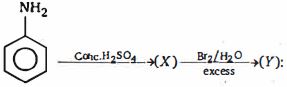
A
$2,4-$dibromo$-6-$sulfobenzenamine
B
$2,6-$dibromo$-4-$sulfobenzenamine
C
$2,4,6-$tribromobenzenamine
D
$2,3,4-$tribromo$-5-$sulfobenzenamine
Solution
(C) $1$. Aniline reacts with concentrated $H_2SO_4$ to form $p$-aminobenzenesulfonic acid (sulfanilic acid) as the major product $(X)$ due to the protection of the amino group by protonation,which prevents it from being highly activating and directs the substitution to the para position.
$2$. When $(X)$ is treated with excess $Br_2/H_2O$,the highly activating $-NH_2$ group directs the bromination to the ortho positions. Due to the high reactivity of the intermediate,the $-SO_3H$ group is displaced by a bromine atom,a process known as ipso-substitution.
$3$. Thus,the final product $(Y)$ is $2,4,6$-tribromobenzenamine.
$2$. When $(X)$ is treated with excess $Br_2/H_2O$,the highly activating $-NH_2$ group directs the bromination to the ortho positions. Due to the high reactivity of the intermediate,the $-SO_3H$ group is displaced by a bromine atom,a process known as ipso-substitution.
$3$. Thus,the final product $(Y)$ is $2,4,6$-tribromobenzenamine.
0 likes
View Solution52
DifficultMCQ
The product $(B)$ is:
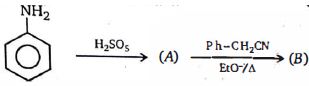
A
$Ph-N=C(CN)-Ph$
B
$Ph-N=C(Ph)_2$
C
$Ph-N=N-Ph$
D
$Ph-CH=CH-Ph$
Solution
(A) $1$. Aniline $(Ph-NH_2)$ reacts with Caro's acid $(H_2SO_5)$ to form nitrosobenzene $(Ph-N=O)$ as product $(A)$.
$2$. Nitrosobenzene then undergoes a condensation reaction with benzyl cyanide $(Ph-CH_2CN)$ in the presence of a base $(EtO^-)$ and heat.
$3$. The base abstracts a proton from the $\alpha$-carbon of benzyl cyanide to form a carbanion $(Ph-CH^-(CN))$.
$4$. This carbanion attacks the electrophilic nitrogen of the nitroso group in $Ph-N=O$.
$5$. Subsequent steps involving proton transfer and elimination of water lead to the formation of the final product,$Ph-N=C(CN)-Ph$.
$2$. Nitrosobenzene then undergoes a condensation reaction with benzyl cyanide $(Ph-CH_2CN)$ in the presence of a base $(EtO^-)$ and heat.
$3$. The base abstracts a proton from the $\alpha$-carbon of benzyl cyanide to form a carbanion $(Ph-CH^-(CN))$.
$4$. This carbanion attacks the electrophilic nitrogen of the nitroso group in $Ph-N=O$.
$5$. Subsequent steps involving proton transfer and elimination of water lead to the formation of the final product,$Ph-N=C(CN)-Ph$.
0 likes
View Solution53
DifficultMCQ
When you ingest aspirin,it passes through your stomach,which has an acidic $pH$,before traveling through the basic environment of your intestine. Provide the structure form as it exists in the intestine.
A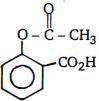
B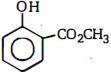
C
D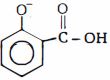
Solution
(C) Aspirin is acetylsalicylic acid,which contains a carboxylic acid group $(-COOH)$.
In the basic environment of the intestine,the carboxylic acid group undergoes an acid-base reaction with the base to form a carboxylate ion $(-COO^-)$.
The structure that exists in the intestine is the one where the carboxylic acid group is deprotonated to form the carboxylate anion,while the ester group remains intact.
Therefore,the correct structure is the one with the $-COO^-$ group.
In the basic environment of the intestine,the carboxylic acid group undergoes an acid-base reaction with the base to form a carboxylate ion $(-COO^-)$.
The structure that exists in the intestine is the one where the carboxylic acid group is deprotonated to form the carboxylate anion,while the ester group remains intact.
Therefore,the correct structure is the one with the $-COO^-$ group.
0 likes
View Solution54
MediumMCQ
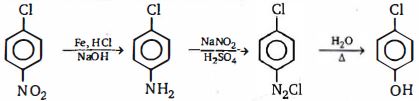
Which of the following sets of reagents, used in the order shown, would enable the preparation of $p$-chlorophenol from $p$-chloronitrobenzene?
A
$1. Fe, HCl; 2. NaOH; 3. NaNO_2, H_2SO_4; 4. H_3PO_2$
B
$1. Fe, HCl; 2. NaOH; 3. NaNO_2, H_2SO_4; 4. H_2O, \Delta$
C
$1. Fe, HCl; 2. NaOH; 3. NaNO_2, H_2SO_4; 4. \text{ethanol}$
D
$1. NaOH, \Delta; 2. HCl$
Solution
(B) The conversion of $p$-chloronitrobenzene to $p$-chlorophenol involves the following steps:
$1$. Reduction of the nitro group $(-NO_2)$ to an amino group $(-NH_2)$ using $Fe/HCl$ to form $p$-chloroaniline.
$2$. Diazotization of $p$-chloroaniline using $NaNO_2$ and $H_2SO_4$ (or $HCl$) at $0-5^{\circ}C$ to form $p$-chlorobenzenediazonium salt.
$3$. Hydrolysis of the diazonium salt by heating with water $(H_2O, \Delta)$ to yield $p$-chlorophenol.
Therefore, the correct sequence is $1. Fe, HCl; 2. NaNO_2, H_2SO_4; 3. H_2O, \Delta$. Option $B$ matches this sequence (noting that the $NaOH$ step in the options is redundant or implied for neutralization if needed, but the core reagents for the transformation are $Fe/HCl$, $NaNO_2/H_2SO_4$, and $H_2O/\Delta$).
$1$. Reduction of the nitro group $(-NO_2)$ to an amino group $(-NH_2)$ using $Fe/HCl$ to form $p$-chloroaniline.
$2$. Diazotization of $p$-chloroaniline using $NaNO_2$ and $H_2SO_4$ (or $HCl$) at $0-5^{\circ}C$ to form $p$-chlorobenzenediazonium salt.
$3$. Hydrolysis of the diazonium salt by heating with water $(H_2O, \Delta)$ to yield $p$-chlorophenol.
Therefore, the correct sequence is $1. Fe, HCl; 2. NaNO_2, H_2SO_4; 3. H_2O, \Delta$. Option $B$ matches this sequence (noting that the $NaOH$ step in the options is redundant or implied for neutralization if needed, but the core reagents for the transformation are $Fe/HCl$, $NaNO_2/H_2SO_4$, and $H_2O/\Delta$).
0 likes
View Solution55
MediumMCQ
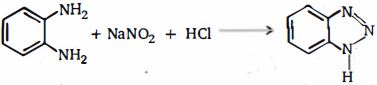
This reaction is an example of:
A
Intermolecular $C-N$ coupling
B
Intramolecular $C-N$ coupling
C
Intermolecular $N-N$ coupling
D
Intramolecular $N-N$ coupling
Solution
(D) The reaction of $o-$phenylenediamine with $NaNO_2$ and $HCl$ leads to the formation of a diazonium salt intermediate at one of the amino groups.
The lone pair on the adjacent amino group then attacks the diazonium nitrogen atom,resulting in the formation of a new $N-N$ bond within the same molecule.
Since this cyclization occurs within the same molecule,it is classified as an intramolecular $N-N$ coupling reaction,yielding benzotriazole.
The lone pair on the adjacent amino group then attacks the diazonium nitrogen atom,resulting in the formation of a new $N-N$ bond within the same molecule.
Since this cyclization occurs within the same molecule,it is classified as an intramolecular $N-N$ coupling reaction,yielding benzotriazole.
0 likes
View Solution56
DifficultMCQ
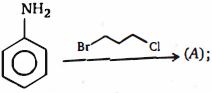
The product $(A)$ of the given reaction is:
A
$1,2,3,4-$tetrahydroquinoline
B
$1,2,3,4-$tetrahydroisoquinoline
C
Indoline
D
$4-$chlorobutylbenzene
Solution
(A) The reaction involves the nucleophilic substitution of aniline with $1$-bromo-$4$-chlorobutane.
First,the lone pair on the nitrogen atom of aniline attacks the carbon atom attached to the bromine atom,displacing the bromide ion to form $N$-($4$-chlorobutyl)aniline.
Subsequently,an intramolecular Friedel-Crafts alkylation occurs. The nitrogen atom directs the alkyl chain to the ortho position of the benzene ring.
The lone pair on the nitrogen facilitates the formation of a cyclic intermediate,which then undergoes cyclization to form $1,2,3,4$-tetrahydroquinoline.
Thus,the correct product $(A)$ is $1,2,3,4$-tetrahydroquinoline.
First,the lone pair on the nitrogen atom of aniline attacks the carbon atom attached to the bromine atom,displacing the bromide ion to form $N$-($4$-chlorobutyl)aniline.
Subsequently,an intramolecular Friedel-Crafts alkylation occurs. The nitrogen atom directs the alkyl chain to the ortho position of the benzene ring.
The lone pair on the nitrogen facilitates the formation of a cyclic intermediate,which then undergoes cyclization to form $1,2,3,4$-tetrahydroquinoline.
Thus,the correct product $(A)$ is $1,2,3,4$-tetrahydroquinoline.
0 likes
View Solution57
DifficultMCQ
The product $(A)$ of the given reaction is:
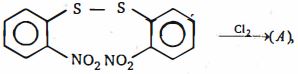
A
$2-$nitrobenzenethiol
B
$2-$nitrobenzenesulfenyl chloride
C
$4-$nitrobenzenethiol
D
$1,2-$dinitrobenzene
Solution
(B) The reaction involves the cleavage of the disulfide bond $(S-S)$ in bis($2$-nitrophenyl) disulfide by chlorine $(Cl_2)$.
The chlorine molecule acts as an electrophile,attacking the sulfur atom.
This leads to the formation of two molecules of $2-$nitrobenzenesulfenyl chloride $(o-NO_2C_6H_4SCl)$ as the product $(A)$.
The chlorine molecule acts as an electrophile,attacking the sulfur atom.
This leads to the formation of two molecules of $2-$nitrobenzenesulfenyl chloride $(o-NO_2C_6H_4SCl)$ as the product $(A)$.
0 likes
View Solution58
DifficultMCQ
$Ph-NH_2$ $\xrightarrow{CH_3Cl \ (2 \ mole)} (A)$ $\xrightarrow{Ph-N_2^+ Cl^-} (B) \ (\text{major})$
Butter yellow is the product of the above reaction.
Butter yellow is the product of the above reaction.
A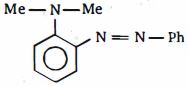
B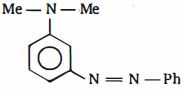
C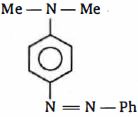
D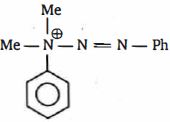
Solution
(D) $1$. The reaction of aniline $(Ph-NH_2)$ with $2 \ mole$ of $CH_3Cl$ leads to the formation of $N,N$-dimethylaniline as product $(A)$.
$Ph-NH_2 + 2CH_3Cl \rightarrow Ph-N(CH_3)_2 + 2HCl$
$2$. $N,N$-dimethylaniline $(A)$ then undergoes an electrophilic aromatic substitution reaction with benzenediazonium chloride $(Ph-N_2^+ Cl^-)$.
$3$. The $-N(CH_3)_2$ group is a strong activating group and is ortho/para directing. Due to steric hindrance,the para-substitution is the major product.
$4$. The resulting product $(B)$ is $p$-dimethylaminoazobenzene,which is commonly known as Butter Yellow.
Structure of $(B)$: $Ph-N=N-C_6H_4-N(CH_3)_2$ (para-substituted).
$Ph-NH_2 + 2CH_3Cl \rightarrow Ph-N(CH_3)_2 + 2HCl$
$2$. $N,N$-dimethylaniline $(A)$ then undergoes an electrophilic aromatic substitution reaction with benzenediazonium chloride $(Ph-N_2^+ Cl^-)$.
$3$. The $-N(CH_3)_2$ group is a strong activating group and is ortho/para directing. Due to steric hindrance,the para-substitution is the major product.
$4$. The resulting product $(B)$ is $p$-dimethylaminoazobenzene,which is commonly known as Butter Yellow.
Structure of $(B)$: $Ph-N=N-C_6H_4-N(CH_3)_2$ (para-substituted).
0 likes
View Solution59
MediumMCQ
$p$-Toluidine reacts with benzene diazonium chloride to form a compound,which on boiling with $aq. H_2SO_4$ gives ........ products.
A
$3$
B
$2$
C
$4$
D
$5$
Solution
(A) $p$-Toluidine reacts with benzene diazonium chloride to form a diazoamino compound $(p-CH_3-C_6H_4-NH-N=N-Ph)$.
This compound exists in tautomeric equilibrium with the aminoazo form $(p-CH_3-C_6H_4-N=N-NH-Ph)$.
On boiling with $aq. H_2SO_4$ (acidic hydrolysis),both tautomers undergo cleavage.
The diazoamino form cleaves to give $p$-toluidine and benzene diazonium salt (which further decomposes to phenol and nitrogen,but the question asks for the products of the cleavage of the formed compound).
Looking at the provided reaction scheme,the hydrolysis of the diazoamino form yields $p$-toluidine and toluene (via reduction/decomposition pathways in specific conditions),while the aminoazo form yields $p$-toluidine and $p$-cresol.
Counting the distinct organic products formed across the pathways shown in the reaction scheme: $p$-toluidine,toluene,and $p$-cresol are the distinct organic products.
Thus,the total number of products is $3$.
This compound exists in tautomeric equilibrium with the aminoazo form $(p-CH_3-C_6H_4-N=N-NH-Ph)$.
On boiling with $aq. H_2SO_4$ (acidic hydrolysis),both tautomers undergo cleavage.
The diazoamino form cleaves to give $p$-toluidine and benzene diazonium salt (which further decomposes to phenol and nitrogen,but the question asks for the products of the cleavage of the formed compound).
Looking at the provided reaction scheme,the hydrolysis of the diazoamino form yields $p$-toluidine and toluene (via reduction/decomposition pathways in specific conditions),while the aminoazo form yields $p$-toluidine and $p$-cresol.
Counting the distinct organic products formed across the pathways shown in the reaction scheme: $p$-toluidine,toluene,and $p$-cresol are the distinct organic products.
Thus,the total number of products is $3$.
0 likes
View Solution60
MediumMCQ
The product $(C)$ of the following reaction is:
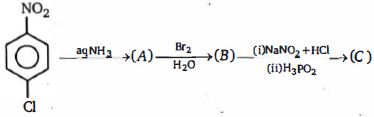
A
$1-$bromo$-4-$nitrobenzene
B
$1,2-$dibromo$-4-$nitrobenzene
C
$1,3-$dibromo$-5-$nitrobenzene
D
$1,2-$dibromo$-3-$nitrobenzene
Solution
(C) Step $1$: Reaction of $1-chloro-4-nitrobenzene$ with $aq. NH_3$ undergoes nucleophilic aromatic substitution $(S_NAr)$ to form $4-nitroaniline$ as product $(A)$.
Step $2$: $4-nitroaniline$ reacts with $Br_2/H_2O$ to form $2,6-dibromo-4-nitroaniline$ as product $(B)$ due to the strong activating effect of the $-NH_2$ group.
Step $3$: The reaction of $(B)$ with $(i) NaNO_2 + HCl$ followed by $(ii) H_3PO_2$ involves diazotization of the $-NH_2$ group followed by deamination (reduction of the diazonium salt to a hydrogen atom).
Thus,the final product $(C)$ is $1,3-dibromo-5-nitrobenzene$.
Step $2$: $4-nitroaniline$ reacts with $Br_2/H_2O$ to form $2,6-dibromo-4-nitroaniline$ as product $(B)$ due to the strong activating effect of the $-NH_2$ group.
Step $3$: The reaction of $(B)$ with $(i) NaNO_2 + HCl$ followed by $(ii) H_3PO_2$ involves diazotization of the $-NH_2$ group followed by deamination (reduction of the diazonium salt to a hydrogen atom).
Thus,the final product $(C)$ is $1,3-dibromo-5-nitrobenzene$.
0 likes
View Solution61
MediumMCQ
Product $(B)$ of this reaction is:
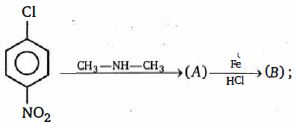
A
$1-$chloro$-4-$(dimethylamino)benzene
B
$4-$(dimethylamino)aniline
C
$3-$(dimethylamino)aniline
D
$2-$(dimethylamino)aniline
Solution
(B) The reaction proceeds in two steps:
$1$. The first step is a nucleophilic aromatic substitution $(S_NAr)$ reaction where $1-chloro-4-nitrobenzene$ reacts with dimethylamine $(CH_3-NH-CH_3)$. The dimethylamino group replaces the chlorine atom at the para position,forming $N,N-dimethyl-4-nitroaniline$ as product $(A)$.
$2$. The second step is the reduction of the nitro group $(-NO_2)$ to an amino group $(-NH_2)$ using $Fe/HCl$. This converts $N,N-dimethyl-4-nitroaniline$ into $N,N-dimethyl-p-phenylenediamine$ (also known as $4-(dimethylamino)aniline$) as product $(B)$.
$1$. The first step is a nucleophilic aromatic substitution $(S_NAr)$ reaction where $1-chloro-4-nitrobenzene$ reacts with dimethylamine $(CH_3-NH-CH_3)$. The dimethylamino group replaces the chlorine atom at the para position,forming $N,N-dimethyl-4-nitroaniline$ as product $(A)$.
$2$. The second step is the reduction of the nitro group $(-NO_2)$ to an amino group $(-NH_2)$ using $Fe/HCl$. This converts $N,N-dimethyl-4-nitroaniline$ into $N,N-dimethyl-p-phenylenediamine$ (also known as $4-(dimethylamino)aniline$) as product $(B)$.
0 likes
View Solution62
MediumMCQ
Product $A$ is
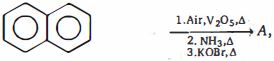
A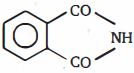
B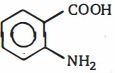
C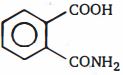
D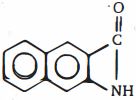
Solution
(C) The reaction sequence is as follows:
$1$. Naphthalene undergoes catalytic oxidation with $Air/V_2O_5$ at high temperature to form phthalic anhydride.
$2$. Phthalic anhydride reacts with $NH_3$ followed by heating to form phthalimide.
$3$. Phthalimide reacts with $KOBr$ (Hofmann bromamide degradation) to form $2$-aminobenzoic acid (anthranilic acid).
Thus,the final product $A$ is $2$-aminobenzoic acid.
$1$. Naphthalene undergoes catalytic oxidation with $Air/V_2O_5$ at high temperature to form phthalic anhydride.
$2$. Phthalic anhydride reacts with $NH_3$ followed by heating to form phthalimide.
$3$. Phthalimide reacts with $KOBr$ (Hofmann bromamide degradation) to form $2$-aminobenzoic acid (anthranilic acid).
Thus,the final product $A$ is $2$-aminobenzoic acid.
0 likes
View Solution63
DifficultMCQ
Predict the major product $G$ of the following reaction sequence starting from $p$-nitrotoluene.

A
$2-$chloro$-4-$bromotoluene
B
$3-$chloro$-4-$bromotoluene
C
$2-$chloro$-5-$bromotoluene
D
$3-$chloro$-5-$bromotoluene
Solution
(C) The reaction sequence is as follows:
$1$. $p$-Nitrotoluene reacts with $Cl_2/AlCl_3$ to give $2$-chloro-$4$-nitrotoluene $(A)$.
$2$. Reduction of $A$ with $Fe/HCl$ followed by $NaOH$ gives $2$-chloro-$4$-aminotoluene $(B)$.
$3$. Acetylation of $B$ with acetic anhydride (implied) gives $2$-chloro-$4$-acetamidotoluene $(C)$.
$4$. Bromination of $C$ with $Br_2/FeBr_3$ gives $2$-chloro-$4$-acetamido-$5$-bromotoluene $(D)$.
$5$. Hydrolysis of $D$ with $NaOH$ gives $2$-chloro-$4$-amino-$5$-bromotoluene $(E)$.
$6$. Diazotization of $E$ with $NaNO_2/H_2SO_4$ at $0-5^{\circ}C$ gives the diazonium salt $(F)$.
$7$. Reduction of $F$ with $H_3PO_2/H_2O$ removes the amino group to give $2$-chloro-$5$-bromotoluene $(G)$.
$1$. $p$-Nitrotoluene reacts with $Cl_2/AlCl_3$ to give $2$-chloro-$4$-nitrotoluene $(A)$.
$2$. Reduction of $A$ with $Fe/HCl$ followed by $NaOH$ gives $2$-chloro-$4$-aminotoluene $(B)$.
$3$. Acetylation of $B$ with acetic anhydride (implied) gives $2$-chloro-$4$-acetamidotoluene $(C)$.
$4$. Bromination of $C$ with $Br_2/FeBr_3$ gives $2$-chloro-$4$-acetamido-$5$-bromotoluene $(D)$.
$5$. Hydrolysis of $D$ with $NaOH$ gives $2$-chloro-$4$-amino-$5$-bromotoluene $(E)$.
$6$. Diazotization of $E$ with $NaNO_2/H_2SO_4$ at $0-5^{\circ}C$ gives the diazonium salt $(F)$.
$7$. Reduction of $F$ with $H_3PO_2/H_2O$ removes the amino group to give $2$-chloro-$5$-bromotoluene $(G)$.
0 likes
View Solution64
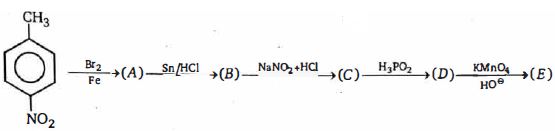
MediumMCQ
Product $(E)$ is
A
$2-$bromobenzoic acid
B
$3-$bromobenzoic acid
C
$4-$bromobenzoic acid
D
benzene$-1,4-$dicarboxylic acid
Solution
(A) $1$. The starting material is $1$-methyl-$4$-nitrobenzene. Bromination in the presence of $Fe$ gives $2$-bromo-$1$-methyl-$4$-nitrobenzene $(A)$.
$2$. Reduction of the nitro group with $Sn/HCl$ converts $(A)$ to $2$-bromo-$4$-methylaniline $(B)$.
$3$. Treatment with $NaNO_2/HCl$ at $0-5 \ ^\circ C$ converts the amine group to a diazonium salt $(C)$.
$4$. Reduction of the diazonium salt with $H_3PO_2$ removes the $-N_2^+$ group,yielding $2$-bromotoluene $(D)$.
$5$. Oxidation of the methyl group with $KMnO_4/HO^-$ followed by acidification yields $2$-bromobenzoic acid $(E)$.
$2$. Reduction of the nitro group with $Sn/HCl$ converts $(A)$ to $2$-bromo-$4$-methylaniline $(B)$.
$3$. Treatment with $NaNO_2/HCl$ at $0-5 \ ^\circ C$ converts the amine group to a diazonium salt $(C)$.
$4$. Reduction of the diazonium salt with $H_3PO_2$ removes the $-N_2^+$ group,yielding $2$-bromotoluene $(D)$.
$5$. Oxidation of the methyl group with $KMnO_4/HO^-$ followed by acidification yields $2$-bromobenzoic acid $(E)$.
0 likes
View Solution65
DifficultMCQ
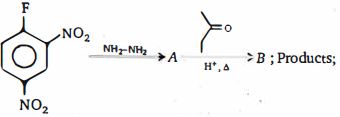
The incorrect statement regarding the reaction shown below is:
A
Product $A$ is $2, 4-DNP$ ($2$,$4$-dinitrophenylhydrazine).
B
$A$ to $B$ is a dehydration reaction.
C
In the conversion of $A$ to $B$,geometrical isomerism is obtained in the product.
D
$B$ is known as an oxime.
Solution
(D) $1$. The reaction of $1-fluoro-2, 4-dinitrobenzene$ with hydrazine $(NH_2-NH_2)$ proceeds via nucleophilic aromatic substitution to form $2, 4-dinitrophenylhydrazine$ $(A)$. Thus,statement $A$ is correct.
$2$. The reaction of $2, 4-dinitrophenylhydrazine$ $(A)$ with $butanone$ in the presence of $H^+$ and heat is a condensation reaction (dehydration) that forms a hydrazone $(B)$. Thus,statement $B$ is correct.
$3$. The product $B$ is a hydrazone,not an oxime (oximes are formed from hydroxylamine,$NH_2OH$). Thus,statement $D$ is incorrect.
$4$. The hydrazone formed $(B)$ contains a $C=N$ bond with different groups on the nitrogen and carbon atoms,allowing for geometrical isomerism ($syn$ and $anti$ forms). Thus,statement $C$ is correct.
$2$. The reaction of $2, 4-dinitrophenylhydrazine$ $(A)$ with $butanone$ in the presence of $H^+$ and heat is a condensation reaction (dehydration) that forms a hydrazone $(B)$. Thus,statement $B$ is correct.
$3$. The product $B$ is a hydrazone,not an oxime (oximes are formed from hydroxylamine,$NH_2OH$). Thus,statement $D$ is incorrect.
$4$. The hydrazone formed $(B)$ contains a $C=N$ bond with different groups on the nitrogen and carbon atoms,allowing for geometrical isomerism ($syn$ and $anti$ forms). Thus,statement $C$ is correct.
0 likes
View Solution66
MediumMCQ
$E \xleftarrow{KOH/Br_2} D \xleftarrow{H_2O_2/OH^{-} \atop (Partial \ Hydrolysis)} C \xleftarrow{NaCN} C_2H_5-Cl$ $\xrightarrow{AgCN} A$ $\xrightarrow{LiAlH_4} B$
What is the relationship between $B$ and $E$?
What is the relationship between $B$ and $E$?
A
Isomer
B
Homologue
C
Having same general formula
D
Chemical properties are same
Solution
(B) $1$. Reaction of $C_2H_5-Cl$ with $NaCN$ gives $C_2H_5CN$ $(C)$.
$2$. Partial hydrolysis of $C_2H_5CN$ with $H_2O_2/OH^-$ gives $C_2H_5CONH_2$ $(D)$.
$3$. Hofmann bromamide degradation of $C_2H_5CONH_2$ $(D)$ with $KOH/Br_2$ gives $C_2H_5NH_2$ $(E)$.
$4$. Reaction of $C_2H_5-Cl$ with $AgCN$ gives $C_2H_5NC$ $(A)$.
$5$. Reduction of $C_2H_5NC$ $(A)$ with $LiAlH_4$ gives $C_2H_5NHCH_3$ $(B)$.
$6$. $E$ is $C_2H_5NH_2$ (primary amine) and $B$ is $C_2H_5NHCH_3$ (secondary amine).
$7$. Both $E$ $(C_2H_7N)$ and $B$ $(C_3H_9N)$ are amines,but they differ by a $-CH_2-$ group,making them homologues.
$2$. Partial hydrolysis of $C_2H_5CN$ with $H_2O_2/OH^-$ gives $C_2H_5CONH_2$ $(D)$.
$3$. Hofmann bromamide degradation of $C_2H_5CONH_2$ $(D)$ with $KOH/Br_2$ gives $C_2H_5NH_2$ $(E)$.
$4$. Reaction of $C_2H_5-Cl$ with $AgCN$ gives $C_2H_5NC$ $(A)$.
$5$. Reduction of $C_2H_5NC$ $(A)$ with $LiAlH_4$ gives $C_2H_5NHCH_3$ $(B)$.
$6$. $E$ is $C_2H_5NH_2$ (primary amine) and $B$ is $C_2H_5NHCH_3$ (secondary amine).
$7$. Both $E$ $(C_2H_7N)$ and $B$ $(C_3H_9N)$ are amines,but they differ by a $-CH_2-$ group,making them homologues.
0 likes
View Solution67
MediumMCQ
Which of the following statements is correct?
A
Hinsberg reagent can be used to separate $1^o, 2^o$ and $3^o$ amines.
B
Hinsberg reagent cannot be used to distinguish $1^o, 2^o$ and $3^o$ amines.
C
Volatile nature of isomeric amines is $1^o > 2^o > 3^o$.
D
Primary amines and secondary amines cannot be distinguished by Liebermann nitroso test.
Solution
(A) The Hinsberg reagent is benzene sulfonyl chloride $(C_6H_5SO_2Cl)$.
It reacts with $1^o$ amines to form a sulfonamide which is soluble in alkali.
It reacts with $2^o$ amines to form a sulfonamide which is insoluble in alkali.
It does not react with $3^o$ amines.
Thus,it is used to distinguish and separate $1^o, 2^o$ and $3^o$ amines.
Regarding volatility,$1^o$ amines have two $H$-atoms,$2^o$ have one,and $3^o$ have none,leading to intermolecular hydrogen bonding strength $1^o > 2^o > 3^o$,which makes $3^o$ amines more volatile. Thus,the order of volatility is $3^o > 2^o > 1^o$.
It reacts with $1^o$ amines to form a sulfonamide which is soluble in alkali.
It reacts with $2^o$ amines to form a sulfonamide which is insoluble in alkali.
It does not react with $3^o$ amines.
Thus,it is used to distinguish and separate $1^o, 2^o$ and $3^o$ amines.
Regarding volatility,$1^o$ amines have two $H$-atoms,$2^o$ have one,and $3^o$ have none,leading to intermolecular hydrogen bonding strength $1^o > 2^o > 3^o$,which makes $3^o$ amines more volatile. Thus,the order of volatility is $3^o > 2^o > 1^o$.
0 likes
View Solution68
DifficultMCQ
The product $(A)$ is:
A
$3-$methylbutan$-2-$ol
B
$2-$methylbutan$-2-$ol
C
$2-$methylbutan$-1-$ol
D
All of these
Solution
(D) The starting material is $3$-methylbutan-$2$-amine,which is a primary aliphatic amine.
When a primary aliphatic amine reacts with nitrous acid $(HNO_2)$,it forms a highly unstable diazonium salt.
This diazonium salt rapidly loses nitrogen gas $(N_2)$ to form a carbocation.
In this case,the initial carbocation formed is a secondary carbocation: $(CH_3)_2CH-CH^+(CH_3)$.
This secondary carbocation can undergo a $1,2$-hydride shift to form a more stable tertiary carbocation: $(CH_3)_2C^+-CH_2CH_3$.
Both the secondary and tertiary carbocations can be attacked by water $(H_2O)$ to form alcohols.
The secondary carbocation leads to $3$-methylbutan-$2$-ol,and the tertiary carbocation leads to $2$-methylbutan-$2$-ol.
Therefore,a mixture of products is formed,including $3$-methylbutan-$2$-ol and $2$-methylbutan-$2$-ol.
Since the question asks for the product $(A)$ and lists multiple possibilities,the correct answer is that all of these (or a mixture) can be formed.
When a primary aliphatic amine reacts with nitrous acid $(HNO_2)$,it forms a highly unstable diazonium salt.
This diazonium salt rapidly loses nitrogen gas $(N_2)$ to form a carbocation.
In this case,the initial carbocation formed is a secondary carbocation: $(CH_3)_2CH-CH^+(CH_3)$.
This secondary carbocation can undergo a $1,2$-hydride shift to form a more stable tertiary carbocation: $(CH_3)_2C^+-CH_2CH_3$.
Both the secondary and tertiary carbocations can be attacked by water $(H_2O)$ to form alcohols.
The secondary carbocation leads to $3$-methylbutan-$2$-ol,and the tertiary carbocation leads to $2$-methylbutan-$2$-ol.
Therefore,a mixture of products is formed,including $3$-methylbutan-$2$-ol and $2$-methylbutan-$2$-ol.
Since the question asks for the product $(A)$ and lists multiple possibilities,the correct answer is that all of these (or a mixture) can be formed.
0 likes
View Solution69
DifficultMCQ
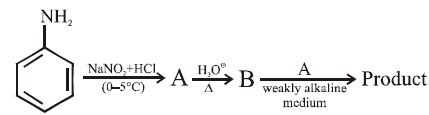
The structure of the product will be:
A
p-Nitroaniline
B
p-Aminoazobenzene
C
p-Hydroxyazobenzene
D
$4$,$4$'-Dihydroxyazobenzene
Solution
(C) $1$. Aniline reacts with $NaNO_2 + HCl$ at $0-5^{\circ}C$ to form benzenediazonium chloride $(A)$.
$2$. Benzenediazonium chloride $(A)$ on heating with $H_3O^+$ undergoes hydrolysis to form phenol $(B)$.
$3$. Phenol $(B)$ reacts with benzenediazonium chloride $(A)$ in a weakly alkaline medium to undergo an electrophilic aromatic substitution reaction (coupling reaction) to form $p$-hydroxyazobenzene as the final product.
$2$. Benzenediazonium chloride $(A)$ on heating with $H_3O^+$ undergoes hydrolysis to form phenol $(B)$.
$3$. Phenol $(B)$ reacts with benzenediazonium chloride $(A)$ in a weakly alkaline medium to undergo an electrophilic aromatic substitution reaction (coupling reaction) to form $p$-hydroxyazobenzene as the final product.
0 likes
View Solution70
MediumMCQ
Which of the following compounds can form alcohol with $NaNO_2/HCl$?
A
$(CH_3)_3C-NH_2$
B
$(CH_3)_2CH-NH_2$
C
$CH_3-CH_2-NH_2$
D
All of these
Solution
(D) Primary aliphatic amines react with nitrous acid $(NaNO_2/HCl)$ to form unstable diazonium salts,which immediately decompose to form alcohols with the evolution of $N_2$ gas.
All the given compounds are primary amines:
$1$. $(CH_3)_3C-NH_2$ is a primary amine (tert-butylamine).
$2$. $(CH_3)_2CH-NH_2$ is a primary amine (isopropylamine).
$3$. $CH_3-CH_2-NH_2$ is a primary amine (ethylamine).
Since all of them are primary aliphatic amines,they all react with $NaNO_2/HCl$ to form their respective alcohols.
All the given compounds are primary amines:
$1$. $(CH_3)_3C-NH_2$ is a primary amine (tert-butylamine).
$2$. $(CH_3)_2CH-NH_2$ is a primary amine (isopropylamine).
$3$. $CH_3-CH_2-NH_2$ is a primary amine (ethylamine).
Since all of them are primary aliphatic amines,they all react with $NaNO_2/HCl$ to form their respective alcohols.
0 likes
View Solution71
DifficultMCQ
Identify the product $B$ in the following reaction:
$C_6H_5NH_2$ $\xrightarrow[0^\circ-5^\circ C]{NaNO_2/HCl} A$ $\xrightarrow{Ph-N(CH_3)_2} B$
$C_6H_5NH_2$ $\xrightarrow[0^\circ-5^\circ C]{NaNO_2/HCl} A$ $\xrightarrow{Ph-N(CH_3)_2} B$
A
$4-$(Dimethylamino)biphenyl
B
$4-$(Dimethylamino)phenol
C
$4-$(Dimethylamino)-$4$'-aminobiphenyl
D
$N,N$-Dimethyl$-4-$phenylazoaniline
Solution
(D) $1$. The reaction of aniline $(C_6H_5NH_2)$ with $NaNO_2/HCl$ at $0^\circ-5^\circ C$ is a diazotization reaction,which produces benzenediazonium chloride $(A = C_6H_5N_2^+Cl^-)$.
$2$. The subsequent reaction of benzenediazonium chloride with $N,N$-dimethylaniline $(Ph-N(CH_3)_2)$ is an electrophilic aromatic substitution reaction known as a coupling reaction.
$3$. The diazonium ion acts as an electrophile and attacks the para-position of the $N,N$-dimethylaniline ring to form an azo dye.
$4$. The product $B$ is $p$-(dimethylamino)azobenzene,which is also known as $N,N$-dimethyl$-4-$phenylazoaniline.
$2$. The subsequent reaction of benzenediazonium chloride with $N,N$-dimethylaniline $(Ph-N(CH_3)_2)$ is an electrophilic aromatic substitution reaction known as a coupling reaction.
$3$. The diazonium ion acts as an electrophile and attacks the para-position of the $N,N$-dimethylaniline ring to form an azo dye.
$4$. The product $B$ is $p$-(dimethylamino)azobenzene,which is also known as $N,N$-dimethyl$-4-$phenylazoaniline.
0 likes
View Solution72
DifficultMCQ
$CH_3CH_2CONH_2$ $\xrightarrow{Br_2 / KOH_{(aq)}} X$ $\xrightarrow{C_6H_5COCl} Y$. Which statement is true?
A
Formation of $X$ is Hofmann degradation
B
Formation of $Y$ is Schotten-Baumann reaction
C
$X$ is more basic than $Y$
D
All
Solution
(D) In the given reaction sequence:
$1.$ $CH_3CH_2CONH_2 \xrightarrow{Br_2 / KOH} CH_3CH_2NH_2 (X)$. This is the Hofmann bromamide degradation reaction,where an amide is converted to a primary amine with one less carbon atom.
$2.$ $CH_3CH_2NH_2 (X) \xrightarrow{C_6H_5COCl} C_6H_5CONHCH_2CH_3 (Y)$. The reaction of an amine with an acid chloride (like benzoyl chloride) in the presence of a base is known as the Schotten-Baumann reaction.
$3.$ $X$ (Ethylamine) is an aliphatic amine,while $Y$ ($N$-ethylbenzamide) is an amide. Amines are much more basic than amides because the lone pair of electrons on the nitrogen atom in an amide is delocalized through resonance with the carbonyl group $(C=O)$.
Therefore,all the given statements are correct.
$1.$ $CH_3CH_2CONH_2 \xrightarrow{Br_2 / KOH} CH_3CH_2NH_2 (X)$. This is the Hofmann bromamide degradation reaction,where an amide is converted to a primary amine with one less carbon atom.
$2.$ $CH_3CH_2NH_2 (X) \xrightarrow{C_6H_5COCl} C_6H_5CONHCH_2CH_3 (Y)$. The reaction of an amine with an acid chloride (like benzoyl chloride) in the presence of a base is known as the Schotten-Baumann reaction.
$3.$ $X$ (Ethylamine) is an aliphatic amine,while $Y$ ($N$-ethylbenzamide) is an amide. Amines are much more basic than amides because the lone pair of electrons on the nitrogen atom in an amide is delocalized through resonance with the carbonyl group $(C=O)$.
Therefore,all the given statements are correct.
0 likes
View Solution73
MediumMCQ
Which of the following statements is correct?
A
Aniline is more soluble in water as compared to methylamine.
B
Ethylamine is more soluble in water than ethanol.
C
Chlorobenzene has more dipole moment than cyclohexyl chloride.
D
All of the above.
Solution
(NONE) $1$. Aniline $(C_6H_5NH_2)$ is less soluble in water than methylamine $(CH_3NH_2)$ because the large hydrophobic phenyl group in aniline hinders hydrogen bonding with water. Thus,statement $A$ is incorrect.
$2$. Ethanol $(C_2H_5OH)$ forms stronger hydrogen bonds with water than ethylamine $(C_2H_5NH_2)$ because oxygen is more electronegative than nitrogen. Thus,statement $B$ is incorrect.
$3$. In chlorobenzene,the $C-Cl$ bond is attached to an $sp^2$ hybridized carbon,which is more electronegative,and the lone pairs on $Cl$ are in resonance with the benzene ring,reducing the dipole moment. In cyclohexyl chloride,the $C-Cl$ bond is attached to an $sp^3$ hybridized carbon,which is less electronegative,resulting in a higher dipole moment. Thus,statement $C$ is incorrect.
$4$. Since all statements $A$,$B$,and $C$ are incorrect,none of the options provided are correct. However,based on standard chemistry curriculum,if this is a multiple-choice question where one must be selected,there might be an error in the question framing. Given the options,none are factually correct.
$2$. Ethanol $(C_2H_5OH)$ forms stronger hydrogen bonds with water than ethylamine $(C_2H_5NH_2)$ because oxygen is more electronegative than nitrogen. Thus,statement $B$ is incorrect.
$3$. In chlorobenzene,the $C-Cl$ bond is attached to an $sp^2$ hybridized carbon,which is more electronegative,and the lone pairs on $Cl$ are in resonance with the benzene ring,reducing the dipole moment. In cyclohexyl chloride,the $C-Cl$ bond is attached to an $sp^3$ hybridized carbon,which is less electronegative,resulting in a higher dipole moment. Thus,statement $C$ is incorrect.
$4$. Since all statements $A$,$B$,and $C$ are incorrect,none of the options provided are correct. However,based on standard chemistry curriculum,if this is a multiple-choice question where one must be selected,there might be an error in the question framing. Given the options,none are factually correct.
0 likes
View Solution74
DifficultMCQ
In the given reaction,$A$ is:
$A$ $\xrightarrow{\text{Reduction}} B$ $\xrightarrow{HNO_2} C_2H_5OH$
$A$ $\xrightarrow{\text{Reduction}} B$ $\xrightarrow{HNO_2} C_2H_5OH$
A
$CH_3CN$
B
$CH_3NC$
C
$C_2H_5CN$
D
$CH_3NO_2$
Solution
(A) The reaction sequence is as follows:
$CH_3-CN$ $\xrightarrow{\text{Reduction}} CH_3-CH_2-NH_2$ $\xrightarrow{HNO_2} CH_3-CH_2-OH$
Here,$A$ is $CH_3CN$ (acetonitrile),which upon reduction gives $B$ ($CH_3CH_2NH_2$,ethylamine). Ethylamine reacts with nitrous acid $(HNO_2)$ to form $C_2H_5OH$ (ethanol).
$CH_3-CN$ $\xrightarrow{\text{Reduction}} CH_3-CH_2-NH_2$ $\xrightarrow{HNO_2} CH_3-CH_2-OH$
Here,$A$ is $CH_3CN$ (acetonitrile),which upon reduction gives $B$ ($CH_3CH_2NH_2$,ethylamine). Ethylamine reacts with nitrous acid $(HNO_2)$ to form $C_2H_5OH$ (ethanol).
0 likes
View Solution75
MediumMCQ
Amine compounds exhibit ............ isomerism.
A
Positional isomerism
B
Functional isomerism
C
Metamerism
D
All the above
Solution
(D) Amines exhibit various types of structural isomerism:
$1$. Positional isomerism: Due to the different positions of the amino group $(-NH_2)$ on the carbon chain.
$2$. Functional isomerism: Primary,secondary,and tertiary amines with the same molecular formula are functional isomers of each other.
$3$. Metamerism: Due to the different distribution of alkyl groups attached to the nitrogen atom in secondary and tertiary amines.
Therefore,amines exhibit all the above types of isomerism.
$1$. Positional isomerism: Due to the different positions of the amino group $(-NH_2)$ on the carbon chain.
$2$. Functional isomerism: Primary,secondary,and tertiary amines with the same molecular formula are functional isomers of each other.
$3$. Metamerism: Due to the different distribution of alkyl groups attached to the nitrogen atom in secondary and tertiary amines.
Therefore,amines exhibit all the above types of isomerism.
0 likes
View Solution76
MediumMCQ
Which of the following statements is not true?
A
At room temperature,formyl chloride exists as $CO$ and $HCl$.
B
Acetamide behaves as a weak base as well as a weak acid.
C
$CH_3CONH_2 \xrightarrow{LiAlH_4} CH_3CH_2NH_2$
D
None of the above.
Solution
(D) . Formyl chloride $(HCOCl)$ is unstable at room temperature and decomposes into $CO$ and $HCl$.
$B$. Acetamide $(CH_3CONH_2)$ is amphoteric; it can be protonated by strong acids to form $CH_3CONH_3^+Cl^-$ (base) and deprotonated by strong bases (acid).
$C$. Reduction of acetamide with $LiAlH_4$ yields ethylamine $(CH_3CH_2NH_2)$.
Since all statements $A$,$B$,and $C$ are correct,the correct answer is $D$.
$B$. Acetamide $(CH_3CONH_2)$ is amphoteric; it can be protonated by strong acids to form $CH_3CONH_3^+Cl^-$ (base) and deprotonated by strong bases (acid).
$C$. Reduction of acetamide with $LiAlH_4$ yields ethylamine $(CH_3CH_2NH_2)$.
Since all statements $A$,$B$,and $C$ are correct,the correct answer is $D$.
0 likes
View Solution77
DifficultMCQ
Ethanoic acid on heating with ammonia forms compound $A$ which on treatment with bromine and sodium hydroxide gives compound $B$. Compound $B$ on treatment with $NaNO_2/dil. HCl$ gives compound $C$. The compounds $A, B$ and $C$ respectively are
A
ethanamide,methanamine,methanol
B
propanamide,ethanamine,ethanol
C
$N$-ethylpropanamide,methaneisonitrile,methanamine
D
ethanamine,bromoethane,ethanediazonium chloride
Solution
(A) $CH_3COOH \xrightarrow[\Delta]{NH_3} CH_3CONH_2 (A)$ (Ethanamide)
$CH_3CONH_2 \xrightarrow{Br_2/NaOH} CH_3NH_2 (B)$ (Methanamine) via Hofmann bromamide degradation.
$CH_3NH_2 \xrightarrow{NaNO_2/dil. HCl} CH_3OH (C)$ (Methanol) via diazotization followed by hydrolysis.
$CH_3CONH_2 \xrightarrow{Br_2/NaOH} CH_3NH_2 (B)$ (Methanamine) via Hofmann bromamide degradation.
$CH_3NH_2 \xrightarrow{NaNO_2/dil. HCl} CH_3OH (C)$ (Methanol) via diazotization followed by hydrolysis.
0 likes
View Solution78
MediumMCQ
Which of the following amines will not give $N_2$ gas on treatment with nitrous acid $(NaNO_2 + HCl)$?
A
$C_2H_5NH_2$
B
$CH_3NH_2$
C
$(CH_3)_2CHNH_2$
D
All will give $N_2$
Solution
(D) All aliphatic primary amines react with nitrous acid $(NaNO_2 + HCl)$ to form unstable alkyl diazonium salts,which decompose to liberate $N_2$ gas.
$RNH_2 + HONO \longrightarrow R-OH + N_2 + H_2O$
Since all the given options ($C_2H_5NH_2$,$CH_3NH_2$,and $(CH_3)_2CHNH_2$) are aliphatic primary amines,they all will evolve $N_2$ gas.
$RNH_2 + HONO \longrightarrow R-OH + N_2 + H_2O$
Since all the given options ($C_2H_5NH_2$,$CH_3NH_2$,and $(CH_3)_2CHNH_2$) are aliphatic primary amines,they all will evolve $N_2$ gas.
0 likes
View Solution79
Difficult
$(i)$ Write structures of different isomeric amines corresponding to the molecular formula,$C_{4}H_{11}N$. $(ii)$ Write $IUPAC$ names of all the isomers. $(iii)$ What type of isomerism is exhibited by different pairs of amines?
Solution
(A) $(i), (ii)$ The structures and their $IUPAC$ names of different isomeric amines corresponding to the molecular formula,$C_{4}H_{11}N$ are:
$(a)$ $CH_{3}CH_{2}CH_{2}CH_{2}NH_{2}$: $\text{Butan-1-amine } (1^{\circ})$
$(b)$ $CH_{3}CH_{2}CH(NH_{2})CH_{3}$: $\text{Butan-2-amine } (1^{\circ})$
$(c)$ $(CH_{3})_{2}CHCH_{2}NH_{2}$: $\text{2-Methylpropan-1-amine } (1^{\circ})$
$(d)$ $(CH_{3})_{3}CNH_{2}$: $\text{2-Methylpropan-2-amine } (1^{\circ})$
$(e)$ $CH_{3}CH_{2}CH_{2}NHCH_{3}$: $\text{N-Methylpropan-1-amine } (2^{\circ})$
$(f)$ $CH_{3}CH_{2}NHCH_{2}CH_{3}$: $\text{N-Ethylethanamine } (2^{\circ})$
$(g)$ $CH_{3}CH(CH_{3})NHCH_{3}$: $\text{N-Methylpropan-2-amine } (2^{\circ})$
$(h)$ $CH_{3}CH_{2}N(CH_{3})_{2}$: $\text{N,N-Dimethylethanamine } (3^{\circ})$
$(iii)$ The pairs $(a)$ and $(b)$,and $(e)$ and $(g)$ exhibit position isomerism.
The pairs $(a)$ and $(c)$,$(a)$ and $(d)$,$(b)$ and $(c)$,and $(b)$ and $(d)$ exhibit chain isomerism.
The pairs $(e)$ and $(f)$,and $(f)$ and $(g)$ exhibit metamerism.
Primary,secondary,and tertiary amines exhibit functional isomerism with each other.
$(a)$ $CH_{3}CH_{2}CH_{2}CH_{2}NH_{2}$: $\text{Butan-1-amine } (1^{\circ})$
$(b)$ $CH_{3}CH_{2}CH(NH_{2})CH_{3}$: $\text{Butan-2-amine } (1^{\circ})$
$(c)$ $(CH_{3})_{2}CHCH_{2}NH_{2}$: $\text{2-Methylpropan-1-amine } (1^{\circ})$
$(d)$ $(CH_{3})_{3}CNH_{2}$: $\text{2-Methylpropan-2-amine } (1^{\circ})$
$(e)$ $CH_{3}CH_{2}CH_{2}NHCH_{3}$: $\text{N-Methylpropan-1-amine } (2^{\circ})$
$(f)$ $CH_{3}CH_{2}NHCH_{2}CH_{3}$: $\text{N-Ethylethanamine } (2^{\circ})$
$(g)$ $CH_{3}CH(CH_{3})NHCH_{3}$: $\text{N-Methylpropan-2-amine } (2^{\circ})$
$(h)$ $CH_{3}CH_{2}N(CH_{3})_{2}$: $\text{N,N-Dimethylethanamine } (3^{\circ})$
$(iii)$ The pairs $(a)$ and $(b)$,and $(e)$ and $(g)$ exhibit position isomerism.
The pairs $(a)$ and $(c)$,$(a)$ and $(d)$,$(b)$ and $(c)$,and $(b)$ and $(d)$ exhibit chain isomerism.
The pairs $(e)$ and $(f)$,and $(f)$ and $(g)$ exhibit metamerism.
Primary,secondary,and tertiary amines exhibit functional isomerism with each other.
0 likes
View Solution80
Difficult
How will you convert:
$(i)$ Benzene into aniline
$(ii)$ Benzene into $N,N$-dimethylaniline
$(iii)$ $Cl-(CH_2)_4-Cl$ into hexane-$1,6$-diamine?
$(i)$ Benzene into aniline
$(ii)$ Benzene into $N,N$-dimethylaniline
$(iii)$ $Cl-(CH_2)_4-Cl$ into hexane-$1,6$-diamine?
Solution
(N/A) $(i)$ Benzene $\xrightarrow{Conc. HNO_3 / Conc. H_2SO_4}$ Nitrobenzene $\xrightarrow{H_2/Pd, Ethanol}$ Aniline.
$(ii)$ Benzene $\xrightarrow{Conc. HNO_3 / Conc. H_2SO_4}$ Nitrobenzene $\xrightarrow{H_2/Pd, Ethanol}$ Aniline $\xrightarrow{2CH_3Cl}$ $N,N$-Dimethylaniline.
$(iii)$ $Cl-(CH_2)_4-Cl$ $\xrightarrow{Ethanolic NaCN}$ $NC-(CH_2)_4-CN$ $\xrightarrow{H_2/Ni}$ $H_2N-(CH_2)_6-NH_2$ (Hexane-$1,6$-diamine).
$(ii)$ Benzene $\xrightarrow{Conc. HNO_3 / Conc. H_2SO_4}$ Nitrobenzene $\xrightarrow{H_2/Pd, Ethanol}$ Aniline $\xrightarrow{2CH_3Cl}$ $N,N$-Dimethylaniline.
$(iii)$ $Cl-(CH_2)_4-Cl$ $\xrightarrow{Ethanolic NaCN}$ $NC-(CH_2)_4-CN$ $\xrightarrow{H_2/Ni}$ $H_2N-(CH_2)_6-NH_2$ (Hexane-$1,6$-diamine).
0 likes
View Solution81
Difficult
Convert:
$(i)$ $3-$Methylaniline into $3-$nitrotoluene.
$(ii)$ Aniline into $1,3,5-$tribromobenzene.
$(i)$ $3-$Methylaniline into $3-$nitrotoluene.
$(ii)$ Aniline into $1,3,5-$tribromobenzene.
Solution
(N/A) $(i)$ Conversion of $3-$Methylaniline to $3-$nitrotoluene:
$1.$ $3-$Methylaniline reacts with $NaNO_2$ and $HCl$ at $273-278 \ K$ to form $3-$methylbenzenediazonium chloride.
$2.$ This diazonium salt reacts with $HBF_4$ to form $3-$methylbenzenediazonium tetrafluoroborate.
$3.$ Finally,treatment with $NaNO_2$ in the presence of $Cu$ and heat (Schiemann-like reaction variant) yields $3-$nitrotoluene.
$(ii)$ Conversion of Aniline to $1,3,5-$tribromobenzene:
$1.$ Aniline reacts with $Br_2/H_2O$ to form $2,4,6-$tribromoaniline.
$2.$ $2,4,6-$tribromoaniline is treated with $NaNO_2/HCl$ to form $2,4,6-$tribromobenzenediazonium chloride.
$3.$ Reduction of this diazonium salt with $H_3PO_2$ and $H_2O$ removes the diazonium group,yielding $1,3,5-$tribromobenzene.
$1.$ $3-$Methylaniline reacts with $NaNO_2$ and $HCl$ at $273-278 \ K$ to form $3-$methylbenzenediazonium chloride.
$2.$ This diazonium salt reacts with $HBF_4$ to form $3-$methylbenzenediazonium tetrafluoroborate.
$3.$ Finally,treatment with $NaNO_2$ in the presence of $Cu$ and heat (Schiemann-like reaction variant) yields $3-$nitrotoluene.
$(ii)$ Conversion of Aniline to $1,3,5-$tribromobenzene:
$1.$ Aniline reacts with $Br_2/H_2O$ to form $2,4,6-$tribromoaniline.
$2.$ $2,4,6-$tribromoaniline is treated with $NaNO_2/HCl$ to form $2,4,6-$tribromobenzenediazonium chloride.
$3.$ Reduction of this diazonium salt with $H_3PO_2$ and $H_2O$ removes the diazonium group,yielding $1,3,5-$tribromobenzene.
0 likes
View Solution82
Medium
Write $IUPAC$ names of the following compounds and classify them into primary,secondary,and tertiary amines.
$(i)$ $(CH_3)_2CHNH_2$
$(ii)$ $CH_3(CH_2)_2NH_2$
$(iii)$ $CH_3NHCH(CH_3)_2$
$(iv)$ $(CH_3)_3CNH_2$
$(v)$ $C_6H_5NHCH_3$
$(vi)$ $(CH_3CH_2)_2NCH_3$
$(vii)$ $m-BrC_6H_4NH_2$
$(i)$ $(CH_3)_2CHNH_2$
$(ii)$ $CH_3(CH_2)_2NH_2$
$(iii)$ $CH_3NHCH(CH_3)_2$
$(iv)$ $(CH_3)_3CNH_2$
$(v)$ $C_6H_5NHCH_3$
$(vi)$ $(CH_3CH_2)_2NCH_3$
$(vii)$ $m-BrC_6H_4NH_2$
Solution
(A) $(i)$ $1-$Methylethanamine ($1^{\circ}$ amine)
$(ii)$ Propan$-1-$amine ($1^{\circ}$ amine)
$(iii)$ $N-$Methylpropan$-2-$amine ($2^{\circ}$ amine)
$(iv)$ $2-$Methylpropan$-2-$amine ($1^{\circ}$ amine)
$(v)$ $N-$Methylbenzenamine or $N-$methylaniline ($2^{\circ}$ amine)
$(vi)$ $N-$Ethyl$-N-$methylethanamine ($3^{\circ}$ amine)
$(vii)$ $3-$Bromobenzenamine or $3-$bromoaniline ($1^{\circ}$ amine)
$(ii)$ Propan$-1-$amine ($1^{\circ}$ amine)
$(iii)$ $N-$Methylpropan$-2-$amine ($2^{\circ}$ amine)
$(iv)$ $2-$Methylpropan$-2-$amine ($1^{\circ}$ amine)
$(v)$ $N-$Methylbenzenamine or $N-$methylaniline ($2^{\circ}$ amine)
$(vi)$ $N-$Ethyl$-N-$methylethanamine ($3^{\circ}$ amine)
$(vii)$ $3-$Bromobenzenamine or $3-$bromoaniline ($1^{\circ}$ amine)
0 likes
View Solution83
Medium
Arrange the following:
$(i)$ In decreasing order of the $pK_{b}$ values:
$C_{2}H_{5}NH_{2}, C_{6}H_{5}NHCH_{3}, (C_{2}H_{5})_{2}NH$ and $C_{6}H_{5}NH_{2}$
$(ii)$ In increasing order of basic strength:
$C_{6}H_{5}NH_{2}, C_{6}H_{5}N(CH_{3})_{2}, (C_{2}H_{5})_{2}NH$ and $CH_{3}NH_{2}$
$(iii)$ In increasing order of basic strength:
$(a)$ Aniline,$p-$nitroaniline and $p-$toluidine
$(b)$ $C_{6}H_{5}NH_{2}, C_{6}H_{5}NHCH_{3}, C_{6}H_{5}CH_{2}NH_{2}$
$(iv)$ In decreasing order of basic strength in gas phase:
$C_{2}H_{5}NH_{2}, (C_{2}H_{5})_{2}NH, (C_{2}H_{5})_{3}N$ and $NH_{3}$
$(v)$ In increasing order of boiling point:
$C_{2}H_{5}OH, (CH_{3})_{2}NH, C_{2}H_{5}NH_{2}$
$(vi)$ In increasing order of solubility in water:
$C_{6}H_{5}NH_{2}, (C_{2}H_{5})_{2}NH, C_{2}H_{5}NH_{2}$
$(i)$ In decreasing order of the $pK_{b}$ values:
$C_{2}H_{5}NH_{2}, C_{6}H_{5}NHCH_{3}, (C_{2}H_{5})_{2}NH$ and $C_{6}H_{5}NH_{2}$
$(ii)$ In increasing order of basic strength:
$C_{6}H_{5}NH_{2}, C_{6}H_{5}N(CH_{3})_{2}, (C_{2}H_{5})_{2}NH$ and $CH_{3}NH_{2}$
$(iii)$ In increasing order of basic strength:
$(a)$ Aniline,$p-$nitroaniline and $p-$toluidine
$(b)$ $C_{6}H_{5}NH_{2}, C_{6}H_{5}NHCH_{3}, C_{6}H_{5}CH_{2}NH_{2}$
$(iv)$ In decreasing order of basic strength in gas phase:
$C_{2}H_{5}NH_{2}, (C_{2}H_{5})_{2}NH, (C_{2}H_{5})_{3}N$ and $NH_{3}$
$(v)$ In increasing order of boiling point:
$C_{2}H_{5}OH, (CH_{3})_{2}NH, C_{2}H_{5}NH_{2}$
$(vi)$ In increasing order of solubility in water:
$C_{6}H_{5}NH_{2}, (C_{2}H_{5})_{2}NH, C_{2}H_{5}NH_{2}$
Solution
(N/A) $(i)$ The basic strength order is $C_{6}H_{5}NH_{2} < C_{6}H_{5}NHCH_{3} < C_{2}H_{5}NH_{2} < (C_{2}H_{5})_{2}NH$. Since $pK_{b} \propto 1/\text{basic strength}$,the decreasing order of $pK_{b}$ is: $C_{6}H_{5}NH_{2} > C_{6}H_{5}NHCH_{3} > C_{2}H_{5}NH_{2} > (C_{2}H_{5})_{2}NH$.
$(ii)$ Basic strength order: $C_{6}H_{5}NH_{2} < C_{6}H_{5}N(CH_{3})_{2} < CH_{3}NH_{2} < (C_{2}H_{5})_{2}NH$.
$(iii)$ $(a)$ $p-$Nitroaniline $ < $ Aniline $ < $ $p-$Toluidine. $(b)$ $C_{6}H_{5}NH_{2} < C_{6}H_{5}NHCH_{3} < C_{6}H_{5}CH_{2}NH_{2}$.
$(iv)$ In gas phase,basicity depends on $+I$ effect: $(C_{2}H_{5})_{3}N > (C_{2}H_{5})_{2}NH > C_{2}H_{5}NH_{2} > NH_{3}$.
$(v)$ Boiling point depends on $H$-bonding: $(CH_{3})_{2}NH < C_{2}H_{5}NH_{2} < C_{2}H_{5}OH$.
$(vi)$ Solubility depends on $H$-bonding and hydrophobic part: $C_{6}H_{5}NH_{2} < (C_{2}H_{5})_{2}NH < C_{2}H_{5}NH_{2}$.
$(ii)$ Basic strength order: $C_{6}H_{5}NH_{2} < C_{6}H_{5}N(CH_{3})_{2} < CH_{3}NH_{2} < (C_{2}H_{5})_{2}NH$.
$(iii)$ $(a)$ $p-$Nitroaniline $ < $ Aniline $ < $ $p-$Toluidine. $(b)$ $C_{6}H_{5}NH_{2} < C_{6}H_{5}NHCH_{3} < C_{6}H_{5}CH_{2}NH_{2}$.
$(iv)$ In gas phase,basicity depends on $+I$ effect: $(C_{2}H_{5})_{3}N > (C_{2}H_{5})_{2}NH > C_{2}H_{5}NH_{2} > NH_{3}$.
$(v)$ Boiling point depends on $H$-bonding: $(CH_{3})_{2}NH < C_{2}H_{5}NH_{2} < C_{2}H_{5}OH$.
$(vi)$ Solubility depends on $H$-bonding and hydrophobic part: $C_{6}H_{5}NH_{2} < (C_{2}H_{5})_{2}NH < C_{2}H_{5}NH_{2}$.
0 likes
View Solution84
Easy
How will you convert:
$(i)$ Ethanoic acid into methanamine
$(ii)$ Hexanenitrile into $1$-aminopentane
$(iii)$ Methanol to ethanoic acid
$(iv)$ Ethanamine into methanamine
$(v)$ Ethanoic acid into propanoic acid
$(vi)$ Methanamine into ethanamine
$(vii)$ Nitromethane into dimethylamine
$(viii)$ Propanoic acid into ethanoic acid?
$(i)$ Ethanoic acid into methanamine
$(ii)$ Hexanenitrile into $1$-aminopentane
$(iii)$ Methanol to ethanoic acid
$(iv)$ Ethanamine into methanamine
$(v)$ Ethanoic acid into propanoic acid
$(vi)$ Methanamine into ethanamine
$(vii)$ Nitromethane into dimethylamine
$(viii)$ Propanoic acid into ethanoic acid?
Solution
(N/A) $(i)$ $\text{CH}_3\text{COOH}$ $\xrightarrow{\text{SOCl}_2} \text{CH}_3\text{COCl}$ $\xrightarrow{\text{NH}_3} \text{CH}_3\text{CONH}_2$ $\xrightarrow{\text{Br}_2/\text{NaOH}} \text{CH}_3\text{NH}_2$
$(ii)$ $\text{C}_5\text{H}_{11}\text{CN}$ $\xrightarrow{\text{H}^+/\text{H}_2\text{O}} \text{C}_5\text{H}_{11}\text{COOH}$ $\xrightarrow{\text{SOCl}_2} \text{C}_5\text{H}_{11}\text{COCl}$ $\xrightarrow{\text{NH}_3} \text{C}_5\text{H}_{11}\text{CONH}_2$ $\xrightarrow{\text{Br}_2/\text{KOH}} \text{C}_5\text{H}_{11}\text{NH}_2$
$(iii)$ $\text{CH}_3\text{OH}$ $\xrightarrow{\text{PCl}_5} \text{CH}_3\text{Cl}$ $\xrightarrow{\text{KCN}} \text{CH}_3\text{CN}$ $\xrightarrow{\text{H}^+/\text{H}_2\text{O}} \text{CH}_3\text{COOH}$
$(iv)$ $\text{CH}_3\text{CH}_2\text{NH}_2$ $\xrightarrow{\text{NaNO}_2/\text{HCl}} \text{CH}_3\text{CH}_2\text{OH}$ $\xrightarrow{\text{KMnO}_4} \text{CH}_3\text{COOH}$ $\xrightarrow{\text{NH}_3, \Delta} \text{CH}_3\text{CONH}_2$ $\xrightarrow{\text{Br}_2/\text{NaOH}} \text{CH}_3\text{NH}_2$
$(v)$ $\text{CH}_3\text{COOH}$ $\xrightarrow{\text{LiAlH}_4} \text{CH}_3\text{CH}_2\text{OH}$ $\xrightarrow{\text{PCl}_5} \text{CH}_3\text{CH}_2\text{Cl}$ $\xrightarrow{\text{KCN}} \text{CH}_3\text{CH}_2\text{CN}$ $\xrightarrow{\text{H}^+/\text{H}_2\text{O}} \text{CH}_3\text{CH}_2\text{COOH}$
$(vi)$ $\text{CH}_3\text{NH}_2$ $\xrightarrow{\text{NaNO}_2/\text{HCl}} \text{CH}_3\text{OH}$ $\xrightarrow{\text{PCl}_5} \text{CH}_3\text{Cl}$ $\xrightarrow{\text{KCN}} \text{CH}_3\text{CN}$ $\xrightarrow{\text{H}_2/\text{Ni}} \text{CH}_3\text{CH}_2\text{NH}_2$
$(vii)$ $\text{CH}_3\text{NO}_2$ $\xrightarrow{\text{Sn/HCl}} \text{CH}_3\text{NH}_2$ $\xrightarrow{\text{CHCl}_3/\text{KOH}} \text{CH}_3\text{NC}$ $\xrightarrow{\text{Na/C}_2\text{H}_5\text{OH}} \text{CH}_3\text{NHCH}_3$
$(viii)$ $\text{CH}_3\text{CH}_2\text{COOH}$ $\xrightarrow{\text{NH}_3, \Delta} \text{CH}_3\text{CH}_2\text{CONH}_2$ $\xrightarrow{\text{Br}_2/\text{KOH}} \text{CH}_3\text{CH}_2\text{NH}_2$ $\xrightarrow{\text{NaNO}_2/\text{HCl}} \text{CH}_3\text{CH}_2\text{OH}$ $\xrightarrow{\text{KMnO}_4} \text{CH}_3\text{COOH}$
$(ii)$ $\text{C}_5\text{H}_{11}\text{CN}$ $\xrightarrow{\text{H}^+/\text{H}_2\text{O}} \text{C}_5\text{H}_{11}\text{COOH}$ $\xrightarrow{\text{SOCl}_2} \text{C}_5\text{H}_{11}\text{COCl}$ $\xrightarrow{\text{NH}_3} \text{C}_5\text{H}_{11}\text{CONH}_2$ $\xrightarrow{\text{Br}_2/\text{KOH}} \text{C}_5\text{H}_{11}\text{NH}_2$
$(iii)$ $\text{CH}_3\text{OH}$ $\xrightarrow{\text{PCl}_5} \text{CH}_3\text{Cl}$ $\xrightarrow{\text{KCN}} \text{CH}_3\text{CN}$ $\xrightarrow{\text{H}^+/\text{H}_2\text{O}} \text{CH}_3\text{COOH}$
$(iv)$ $\text{CH}_3\text{CH}_2\text{NH}_2$ $\xrightarrow{\text{NaNO}_2/\text{HCl}} \text{CH}_3\text{CH}_2\text{OH}$ $\xrightarrow{\text{KMnO}_4} \text{CH}_3\text{COOH}$ $\xrightarrow{\text{NH}_3, \Delta} \text{CH}_3\text{CONH}_2$ $\xrightarrow{\text{Br}_2/\text{NaOH}} \text{CH}_3\text{NH}_2$
$(v)$ $\text{CH}_3\text{COOH}$ $\xrightarrow{\text{LiAlH}_4} \text{CH}_3\text{CH}_2\text{OH}$ $\xrightarrow{\text{PCl}_5} \text{CH}_3\text{CH}_2\text{Cl}$ $\xrightarrow{\text{KCN}} \text{CH}_3\text{CH}_2\text{CN}$ $\xrightarrow{\text{H}^+/\text{H}_2\text{O}} \text{CH}_3\text{CH}_2\text{COOH}$
$(vi)$ $\text{CH}_3\text{NH}_2$ $\xrightarrow{\text{NaNO}_2/\text{HCl}} \text{CH}_3\text{OH}$ $\xrightarrow{\text{PCl}_5} \text{CH}_3\text{Cl}$ $\xrightarrow{\text{KCN}} \text{CH}_3\text{CN}$ $\xrightarrow{\text{H}_2/\text{Ni}} \text{CH}_3\text{CH}_2\text{NH}_2$
$(vii)$ $\text{CH}_3\text{NO}_2$ $\xrightarrow{\text{Sn/HCl}} \text{CH}_3\text{NH}_2$ $\xrightarrow{\text{CHCl}_3/\text{KOH}} \text{CH}_3\text{NC}$ $\xrightarrow{\text{Na/C}_2\text{H}_5\text{OH}} \text{CH}_3\text{NHCH}_3$
$(viii)$ $\text{CH}_3\text{CH}_2\text{COOH}$ $\xrightarrow{\text{NH}_3, \Delta} \text{CH}_3\text{CH}_2\text{CONH}_2$ $\xrightarrow{\text{Br}_2/\text{KOH}} \text{CH}_3\text{CH}_2\text{NH}_2$ $\xrightarrow{\text{NaNO}_2/\text{HCl}} \text{CH}_3\text{CH}_2\text{OH}$ $\xrightarrow{\text{KMnO}_4} \text{CH}_3\text{COOH}$
0 likes
View Solution85
Easy
Accomplish the following conversions:
$(i)$ Nitrobenzene to benzoic acid
$(ii)$ Benzene to $m-$bromophenol
$(iii)$ Benzoic acid to aniline
$(iv)$ Aniline to $2,4,6-$tribromofluorobenzene
$(v)$ Benzyl chloride to $2-$phenylethanamine
$(vi)$ Chlorobenzene to $p-$chloroaniline
$(vii)$ Aniline to $p-$bromoaniline
$(viii)$ Benzamide to toluene
$(ix)$ Aniline to benzyl alcohol.
$(i)$ Nitrobenzene to benzoic acid
$(ii)$ Benzene to $m-$bromophenol
$(iii)$ Benzoic acid to aniline
$(iv)$ Aniline to $2,4,6-$tribromofluorobenzene
$(v)$ Benzyl chloride to $2-$phenylethanamine
$(vi)$ Chlorobenzene to $p-$chloroaniline
$(vii)$ Aniline to $p-$bromoaniline
$(viii)$ Benzamide to toluene
$(ix)$ Aniline to benzyl alcohol.
Solution
(N/A) $(i)$ Nitrobenzene $\xrightarrow{Sn/HCl}$ Aniline $\xrightarrow{NaNO_2/HCl, 0-5^{\circ}C}$ Benzenediazonium chloride $\xrightarrow{CuCN}$ Benzonitrile $\xrightarrow{H_3O^+}$ Benzoic acid.
$(ii)$ Benzene $\xrightarrow{HNO_3/H_2SO_4}$ Nitrobenzene $\xrightarrow{Br_2/FeBr_3}$ $m-$Bromonitrobenzene $\xrightarrow{Sn/HCl}$ $m-$Bromoaniline $\xrightarrow{NaNO_2/HCl, 0-5^{\circ}C}$ $m-$Bromobenzenediazonium chloride $\xrightarrow{H_2O, \Delta}$ $m-$Bromophenol.
$(iii)$ Benzoic acid $\xrightarrow{NH_3, \Delta}$ Benzamide $\xrightarrow{Br_2/KOH}$ Aniline.
$(iv)$ Aniline $\xrightarrow{Br_2/H_2O}$ $2,4,6-$Tribromoaniline $\xrightarrow{NaNO_2/HCl, 0-5^{\circ}C}$ $2,4,6-$Tribromobenzenediazonium chloride $\xrightarrow{HBF_4, \Delta}$ $2,4,6-$Tribromofluorobenzene.
$(v)$ Benzyl chloride $\xrightarrow{KCN}$ Phenylacetonitrile $\xrightarrow{LiAlH_4}$ $2-$Phenylethanamine.
$(vi)$ Chlorobenzene $\xrightarrow{HNO_3/H_2SO_4}$ $p-$Nitrochlorobenzene $\xrightarrow{Sn/HCl}$ $p-$Chloroaniline.
$(vii)$ Aniline $\xrightarrow{(CH_3CO)_2O/Pyridine}$ Acetanilide $\xrightarrow{Br_2/CH_3COOH}$ $p-$Bromoacetanilide $\xrightarrow{H_3O^+}$ $p-$Bromoaniline.
$(viii)$ Benzamide $\xrightarrow{LiAlH_4}$ Benzylamine $\xrightarrow{NaNO_2/HCl}$ Benzyl alcohol $\xrightarrow{PCl_5}$ Benzyl chloride $\xrightarrow{Mg/ether, then H_2O}$ Toluene.
$(ix)$ Aniline $\xrightarrow{NaNO_2/HCl, 0-5^{\circ}C}$ Benzenediazonium chloride $\xrightarrow{CuCN}$ Benzonitrile $\xrightarrow{LiAlH_4}$ Benzylamine $\xrightarrow{HNO_2}$ Benzyl alcohol.
$(ii)$ Benzene $\xrightarrow{HNO_3/H_2SO_4}$ Nitrobenzene $\xrightarrow{Br_2/FeBr_3}$ $m-$Bromonitrobenzene $\xrightarrow{Sn/HCl}$ $m-$Bromoaniline $\xrightarrow{NaNO_2/HCl, 0-5^{\circ}C}$ $m-$Bromobenzenediazonium chloride $\xrightarrow{H_2O, \Delta}$ $m-$Bromophenol.
$(iii)$ Benzoic acid $\xrightarrow{NH_3, \Delta}$ Benzamide $\xrightarrow{Br_2/KOH}$ Aniline.
$(iv)$ Aniline $\xrightarrow{Br_2/H_2O}$ $2,4,6-$Tribromoaniline $\xrightarrow{NaNO_2/HCl, 0-5^{\circ}C}$ $2,4,6-$Tribromobenzenediazonium chloride $\xrightarrow{HBF_4, \Delta}$ $2,4,6-$Tribromofluorobenzene.
$(v)$ Benzyl chloride $\xrightarrow{KCN}$ Phenylacetonitrile $\xrightarrow{LiAlH_4}$ $2-$Phenylethanamine.
$(vi)$ Chlorobenzene $\xrightarrow{HNO_3/H_2SO_4}$ $p-$Nitrochlorobenzene $\xrightarrow{Sn/HCl}$ $p-$Chloroaniline.
$(vii)$ Aniline $\xrightarrow{(CH_3CO)_2O/Pyridine}$ Acetanilide $\xrightarrow{Br_2/CH_3COOH}$ $p-$Bromoacetanilide $\xrightarrow{H_3O^+}$ $p-$Bromoaniline.
$(viii)$ Benzamide $\xrightarrow{LiAlH_4}$ Benzylamine $\xrightarrow{NaNO_2/HCl}$ Benzyl alcohol $\xrightarrow{PCl_5}$ Benzyl chloride $\xrightarrow{Mg/ether, then H_2O}$ Toluene.
$(ix)$ Aniline $\xrightarrow{NaNO_2/HCl, 0-5^{\circ}C}$ Benzenediazonium chloride $\xrightarrow{CuCN}$ Benzonitrile $\xrightarrow{LiAlH_4}$ Benzylamine $\xrightarrow{HNO_2}$ Benzyl alcohol.
0 likes
View Solution86
Easy
Give the structures of $A$,$B$ and $C$ in the following reactions:
$(i)$ $CH_3CH_2I$ $\xrightarrow{NaCN} A$ $\xrightarrow[Partial\,hydrolysis]{OH^{-}} B$ $\xrightarrow{NaOH+Br_2} C$
$(ii)$ $C_6H_5N_2Cl$ $\xrightarrow{CuCN} A$ $\xrightarrow{H_2O/H^{+}} B$ $\xrightarrow[\Delta]{NH_3} C$
$(iii)$ $CH_3CH_2Br$ $\xrightarrow{KCN} A$ $\xrightarrow{LiAlH_4} B$ $\xrightarrow[0\ ^oC]{HNO_2} C$
$(iv)$ $C_6H_5NO_2$ $\xrightarrow{Fe/HCl} A$ $\xrightarrow[273\ K]{NaNO_2+HCl} B$ $\xrightarrow[\Delta]{H_2O/H^{+}} C$
$(v)$ $CH_3COOH$ $\xrightarrow[\Delta]{NH_3} A$ $\xrightarrow{NaOBr} B$ $\xrightarrow{NaNO_2/HCl} C$
$(vi)$ $C_6H_5NO_2$ $\xrightarrow{Fe/HCl} A$ $\xrightarrow[273\ K]{HNO_2} B$ $\xrightarrow{C_6H_5OH} C$
$(i)$ $CH_3CH_2I$ $\xrightarrow{NaCN} A$ $\xrightarrow[Partial\,hydrolysis]{OH^{-}} B$ $\xrightarrow{NaOH+Br_2} C$
$(ii)$ $C_6H_5N_2Cl$ $\xrightarrow{CuCN} A$ $\xrightarrow{H_2O/H^{+}} B$ $\xrightarrow[\Delta]{NH_3} C$
$(iii)$ $CH_3CH_2Br$ $\xrightarrow{KCN} A$ $\xrightarrow{LiAlH_4} B$ $\xrightarrow[0\ ^oC]{HNO_2} C$
$(iv)$ $C_6H_5NO_2$ $\xrightarrow{Fe/HCl} A$ $\xrightarrow[273\ K]{NaNO_2+HCl} B$ $\xrightarrow[\Delta]{H_2O/H^{+}} C$
$(v)$ $CH_3COOH$ $\xrightarrow[\Delta]{NH_3} A$ $\xrightarrow{NaOBr} B$ $\xrightarrow{NaNO_2/HCl} C$
$(vi)$ $C_6H_5NO_2$ $\xrightarrow{Fe/HCl} A$ $\xrightarrow[273\ K]{HNO_2} B$ $\xrightarrow{C_6H_5OH} C$
Solution
(N/A) $(i)$ $CH_3CH_2I$ $\xrightarrow{NaCN} \underset{(A)}{CH_3CH_2CN}$ $\xrightarrow[Partial\,hydrolysis]{OH^{-}} \underset{(B)}{CH_3CONH_2}$ $\xrightarrow{NaOH+Br_2} \underset{(C)}{CH_3NH_2}$
$(ii)$ $C_6H_5N_2Cl$ $\xrightarrow{CuCN} \underset{(A)}{C_6H_5CN}$ $\xrightarrow{H_2O/H^{+}} \underset{(B)}{C_6H_5COOH}$ $\xrightarrow[\Delta]{NH_3} \underset{(C)}{C_6H_5CONH_2}$
$(iii)$ $CH_3CH_2Br$ $\xrightarrow{KCN} \underset{(A)}{CH_3CH_2CN}$ $\xrightarrow{LiAlH_4} \underset{(B)}{CH_3CH_2CH_2NH_2}$ $\xrightarrow[0\ ^oC]{HNO_2} \underset{(C)}{CH_3CH_2CH_2OH}$
$(iv)$ $C_6H_5NO_2$ $\xrightarrow{Fe/HCl} \underset{(A)}{C_6H_5NH_2}$ $\xrightarrow[273\ K]{NaNO_2+HCl} \underset{(B)}{C_6H_5N_2^+Cl^-}$ $\xrightarrow[\Delta]{H_2O/H^{+}} \underset{(C)}{C_6H_5OH}$
$(v)$ $CH_3COOH$ $\xrightarrow[\Delta]{NH_3} \underset{(A)}{CH_3CONH_2}$ $\xrightarrow{NaOBr} \underset{(B)}{CH_3NH_2}$ $\xrightarrow{NaNO_2/HCl} \underset{(C)}{CH_3OH}$
$(vi)$ $C_6H_5NO_2$ $\xrightarrow{Fe/HCl} \underset{(A)}{C_6H_5NH_2}$ $\xrightarrow[273\ K]{HNO_2} \underset{(B)}{C_6H_5N_2^+Cl^-}$ $\xrightarrow{C_6H_5OH} \underset{(C)}{p-C_6H_5-N=N-C_6H_4OH}$
$(ii)$ $C_6H_5N_2Cl$ $\xrightarrow{CuCN} \underset{(A)}{C_6H_5CN}$ $\xrightarrow{H_2O/H^{+}} \underset{(B)}{C_6H_5COOH}$ $\xrightarrow[\Delta]{NH_3} \underset{(C)}{C_6H_5CONH_2}$
$(iii)$ $CH_3CH_2Br$ $\xrightarrow{KCN} \underset{(A)}{CH_3CH_2CN}$ $\xrightarrow{LiAlH_4} \underset{(B)}{CH_3CH_2CH_2NH_2}$ $\xrightarrow[0\ ^oC]{HNO_2} \underset{(C)}{CH_3CH_2CH_2OH}$
$(iv)$ $C_6H_5NO_2$ $\xrightarrow{Fe/HCl} \underset{(A)}{C_6H_5NH_2}$ $\xrightarrow[273\ K]{NaNO_2+HCl} \underset{(B)}{C_6H_5N_2^+Cl^-}$ $\xrightarrow[\Delta]{H_2O/H^{+}} \underset{(C)}{C_6H_5OH}$
$(v)$ $CH_3COOH$ $\xrightarrow[\Delta]{NH_3} \underset{(A)}{CH_3CONH_2}$ $\xrightarrow{NaOBr} \underset{(B)}{CH_3NH_2}$ $\xrightarrow{NaNO_2/HCl} \underset{(C)}{CH_3OH}$
$(vi)$ $C_6H_5NO_2$ $\xrightarrow{Fe/HCl} \underset{(A)}{C_6H_5NH_2}$ $\xrightarrow[273\ K]{HNO_2} \underset{(B)}{C_6H_5N_2^+Cl^-}$ $\xrightarrow{C_6H_5OH} \underset{(C)}{p-C_6H_5-N=N-C_6H_4OH}$
0 likes
View Solution87
Difficult
An aromatic compound $A$ on treatment with aqueous ammonia and heating forms compound $B$,which on heating with $Br_2$ and $KOH$ forms a compound $C$ of molecular formula $C_6H_7N$. Write the structures and $IUPAC$ names of compounds $A, B$,and $C$.
Solution
(N/A) The reaction of compound $B$ with $Br_2$ and $KOH$ to form compound $C$ $(C_6H_7N)$ is a Hoffmann bromamide degradation reaction. This indicates that $C$ is an amine and $B$ is an amide. The amine with molecular formula $C_6H_7N$ is aniline $(C_6H_5NH_2)$,which has the $IUPAC$ name benzenamine.
Since $C$ is aniline,the corresponding amide $B$ must be benzamide $(C_6H_5CONH_2)$.
Benzamide is formed by heating benzoic acid $(A)$ with aqueous ammonia. Thus,compound $A$ is benzoic acid $(C_6H_5COOH)$.
The structures and names are:
$A$: Benzoic acid $(C_6H_5COOH)$
$B$: Benzamide $(C_6H_5CONH_2)$
$C$: Benzenamine or Aniline $(C_6H_5NH_2)$
The reaction sequence is:
$C_6H_5COOH$ $\xrightarrow{NH_3, \Delta} C_6H_5CONH_2$ $\xrightarrow{Br_2, KOH} C_6H_5NH_2$
Since $C$ is aniline,the corresponding amide $B$ must be benzamide $(C_6H_5CONH_2)$.
Benzamide is formed by heating benzoic acid $(A)$ with aqueous ammonia. Thus,compound $A$ is benzoic acid $(C_6H_5COOH)$.
The structures and names are:
$A$: Benzoic acid $(C_6H_5COOH)$
$B$: Benzamide $(C_6H_5CONH_2)$
$C$: Benzenamine or Aniline $(C_6H_5NH_2)$
The reaction sequence is:
$C_6H_5COOH$ $\xrightarrow{NH_3, \Delta} C_6H_5CONH_2$ $\xrightarrow{Br_2, KOH} C_6H_5NH_2$
0 likes
View Solution88
Easy
Complete the following reactions:
$(i)$ $C_{6}H_{5}NH_{2} + CHCl_{3} +$ alc. $KOH \rightarrow$
$(ii)$ $C_{6}H_{5}N_{2}Cl + H_{3}PO_{2} + H_{2}O \rightarrow$
$(iii)$ $C_{6}H_{5}NH_{2} + H_{2}SO_{4}$ (conc.) $\rightarrow$
$(iv)$ $C_{6}H_{5}N_{2}Cl + C_{2}H_{5}OH \rightarrow$
$(v)$ $C_{6}H_{5}NH_{2} + Br_{2(aq)} \rightarrow$
$(vi)$ $C_{6}H_{5}NH_{2} + (CH_{3}CO)_{2}O \rightarrow$
$(vii)$ $C_{6}H_{5}N_{2}Cl \xrightarrow[(ii) NaNO_{2}/Cu, \Delta ]{(i) HBF_{4}}$
$(i)$ $C_{6}H_{5}NH_{2} + CHCl_{3} +$ alc. $KOH \rightarrow$
$(ii)$ $C_{6}H_{5}N_{2}Cl + H_{3}PO_{2} + H_{2}O \rightarrow$
$(iii)$ $C_{6}H_{5}NH_{2} + H_{2}SO_{4}$ (conc.) $\rightarrow$
$(iv)$ $C_{6}H_{5}N_{2}Cl + C_{2}H_{5}OH \rightarrow$
$(v)$ $C_{6}H_{5}NH_{2} + Br_{2(aq)} \rightarrow$
$(vi)$ $C_{6}H_{5}NH_{2} + (CH_{3}CO)_{2}O \rightarrow$
$(vii)$ $C_{6}H_{5}N_{2}Cl \xrightarrow[(ii) NaNO_{2}/Cu, \Delta ]{(i) HBF_{4}}$
Solution
(N/A) $(i)$ $\underset{\text{Aniline}}{C_{6}H_{5}NH_{2}} + CHCl_{3} + 3 \text{ alc. } KOH$ $\xrightarrow{\text{Carbylamine reaction}} 3H_{2}O + 3KCl + \underset{\text{Phenyl isocyanide}}{C_{6}H_{5}NC}$
$(ii)$ $\underset{\text{Benzenediazonium chloride}}{C_{6}H_{5}N_{2}Cl} + H_{3}PO_{2} + H_{2}O$ $\rightarrow \underset{\text{Benzene}}{C_{6}H_{6}} + N_{2} + H_{3}PO_{3} + HCl$
$(iii)$ $\underset{\text{Aniline}}{C_{6}H_{5}NH_{2}} + \text{conc. } H_{2}SO_{4}$ $\rightarrow \underset{\text{Anilinium hydrogen sulphate}}{C_{6}H_{5}NH_{3}^{+}HSO_{4}^{-}}$
$(iv)$ $\underset{\text{Benzenediazonium chloride}}{C_{6}H_{5}N_{2}Cl} + \underset{\text{Ethanol}}{C_{2}H_{5}OH}$ $\rightarrow \underset{\text{Benzene}}{C_{6}H_{6}} + \underset{\text{Ethanal}}{CH_{3}CHO} + N_{2} + HCl$
$(v)$ $C_{6}H_{5}NH_{2} + 3Br_{2(aq)} \rightarrow \text{2,4,6-Tribromoaniline} + 3HBr$
$(vi)$ $\underset{\text{Aniline}}{C_{6}H_{5}NH_{2}} + \underset{\text{acetic anhydride}}{(CH_{3}CO)_{2}O}$ $\rightarrow \underset{\text{N-Phenylethanamide}}{C_{6}H_{5}NHCOCH_{3}} + \underset{\text{acetic acid}}{CH_{3}COOH}$
$(vii)$ $\underset{\text{Benzenediazonium chloride}}{C_{6}H_{5}N_{2}Cl}$ $\xrightarrow[(ii) NaNO_{2}/Cu, \Delta ]{(i) HBF_{4}} \underset{\text{Nitrobenzene}}{C_{6}H_{5}NO_{2}} + N_{2} + NaBF_{4}$
$(ii)$ $\underset{\text{Benzenediazonium chloride}}{C_{6}H_{5}N_{2}Cl} + H_{3}PO_{2} + H_{2}O$ $\rightarrow \underset{\text{Benzene}}{C_{6}H_{6}} + N_{2} + H_{3}PO_{3} + HCl$
$(iii)$ $\underset{\text{Aniline}}{C_{6}H_{5}NH_{2}} + \text{conc. } H_{2}SO_{4}$ $\rightarrow \underset{\text{Anilinium hydrogen sulphate}}{C_{6}H_{5}NH_{3}^{+}HSO_{4}^{-}}$
$(iv)$ $\underset{\text{Benzenediazonium chloride}}{C_{6}H_{5}N_{2}Cl} + \underset{\text{Ethanol}}{C_{2}H_{5}OH}$ $\rightarrow \underset{\text{Benzene}}{C_{6}H_{6}} + \underset{\text{Ethanal}}{CH_{3}CHO} + N_{2} + HCl$
$(v)$ $C_{6}H_{5}NH_{2} + 3Br_{2(aq)} \rightarrow \text{2,4,6-Tribromoaniline} + 3HBr$
$(vi)$ $\underset{\text{Aniline}}{C_{6}H_{5}NH_{2}} + \underset{\text{acetic anhydride}}{(CH_{3}CO)_{2}O}$ $\rightarrow \underset{\text{N-Phenylethanamide}}{C_{6}H_{5}NHCOCH_{3}} + \underset{\text{acetic acid}}{CH_{3}COOH}$
$(vii)$ $\underset{\text{Benzenediazonium chloride}}{C_{6}H_{5}N_{2}Cl}$ $\xrightarrow[(ii) NaNO_{2}/Cu, \Delta ]{(i) HBF_{4}} \underset{\text{Nitrobenzene}}{C_{6}H_{5}NO_{2}} + N_{2} + NaBF_{4}$
0 likes
View Solution89
Medium
Give a plausible explanation for each of the following:
$(i)$ Why are amines less acidic than alcohols of comparable molecular masses?
$(ii)$ Why do primary amines have higher boiling points than tertiary amines?
$(iii)$ Why are aliphatic amines stronger bases than aromatic amines?
$(i)$ Why are amines less acidic than alcohols of comparable molecular masses?
$(ii)$ Why do primary amines have higher boiling points than tertiary amines?
$(iii)$ Why are aliphatic amines stronger bases than aromatic amines?
Solution
(N/A) $(i)$ Amines undergo deprotonation to give amide ions (amide anions).
$R-NH_2 \to R-NH^- + H^+$
Similarly,alcohol loses a proton to give an alkoxide ion.
$R-OH \to R-O^- + H^+$
In an amide ion,the negative charge is on the $N$ atom,whereas in an alkoxide ion,the negative charge is on the $O$ atom. Since $O$ is more electronegative than $N$,$O$ can accommodate the negative charge more easily than $N$. As a result,the amide ion is less stable than the alkoxide ion. Hence,amines are less acidic than alcohols of comparable molecular masses.
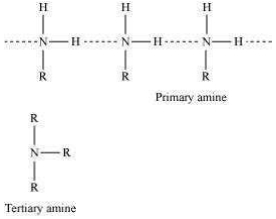
$(ii)$ In a molecule of a tertiary amine,there are no $H$ atoms attached to the nitrogen atom,whereas in primary amines,two hydrogen atoms are present. Due to the presence of $N-H$ bonds,primary amines undergo extensive intermolecular hydrogen bonding.
As a result,extra energy is required to separate the molecules of primary amines. Hence,primary amines have higher boiling points than tertiary amines.
$(iii)$ Due to the $-R$ (resonance) effect of the benzene ring,the lone pair electrons on the $N$ atom are delocalized into the ring in aromatic amines. Therefore,the electrons on the $N$ atom in aromatic amines are less available for donation. This explains why aliphatic amines are stronger bases than aromatic amines.
$R-NH_2 \to R-NH^- + H^+$
Similarly,alcohol loses a proton to give an alkoxide ion.
$R-OH \to R-O^- + H^+$
In an amide ion,the negative charge is on the $N$ atom,whereas in an alkoxide ion,the negative charge is on the $O$ atom. Since $O$ is more electronegative than $N$,$O$ can accommodate the negative charge more easily than $N$. As a result,the amide ion is less stable than the alkoxide ion. Hence,amines are less acidic than alcohols of comparable molecular masses.
$(ii)$ In a molecule of a tertiary amine,there are no $H$ atoms attached to the nitrogen atom,whereas in primary amines,two hydrogen atoms are present. Due to the presence of $N-H$ bonds,primary amines undergo extensive intermolecular hydrogen bonding.
As a result,extra energy is required to separate the molecules of primary amines. Hence,primary amines have higher boiling points than tertiary amines.
$(iii)$ Due to the $-R$ (resonance) effect of the benzene ring,the lone pair electrons on the $N$ atom are delocalized into the ring in aromatic amines. Therefore,the electrons on the $N$ atom in aromatic amines are less available for donation. This explains why aliphatic amines are stronger bases than aromatic amines.
0 likes
View Solution90
Medium
Write the chemical reactions for the following conversions:
$1.$ Aniline to Picric acid
$2.$ Ethanal to Butan$-2-$ol
$1.$ Aniline to Picric acid
$2.$ Ethanal to Butan$-2-$ol
Solution
(N/A) $1.$ Aniline to Picric acid:
Aniline is first converted to benzene diazonium chloride using $NaNO_2$ and $HCl$ at $273-278 \ K$. This is then hydrolyzed with water to form phenol. Phenol undergoes nitration with concentrated $HNO_3$ to yield $2,4,6-$trinitrophenol,commonly known as picric acid.
$2.$ Ethanal to Butan$-2-$ol:
Ethanal reacts with ethylmagnesium bromide (a Grignard reagent) to form an addition product. Subsequent hydrolysis of this product yields butan$-2-$ol.
Aniline is first converted to benzene diazonium chloride using $NaNO_2$ and $HCl$ at $273-278 \ K$. This is then hydrolyzed with water to form phenol. Phenol undergoes nitration with concentrated $HNO_3$ to yield $2,4,6-$trinitrophenol,commonly known as picric acid.
$2.$ Ethanal to Butan$-2-$ol:
Ethanal reacts with ethylmagnesium bromide (a Grignard reagent) to form an addition product. Subsequent hydrolysis of this product yields butan$-2-$ol.
0 likes
View Solution91
Medium
Match the reactions given in Column-$I$ with the statements given in Column-$II$.
| Column-$I$ | Column-$II$ |
|---|---|
| $A$. Ammonolysis | $1$. Amine with lesser number of carbon atoms |
| $B$. Gabriel phthalimide synthesis | $2$. Detection test for primary amine |
| $C$. Hoffmann Bromamide reaction | $3$. Reaction of phthalimide with $KOH$ and $R-X$ |
| $D$. Carbylamine reaction | $4$. Reaction of alkyl-halides with $NH_3$ |
Solution
(A-4, B-3, C-1, D-2) $A-4, B-3, C-1, D-2$
$A$. Ammonolysis: The process of cleavage of the $C-X$ bond by an ammonia molecule is known as ammonolysis. It involves the reaction of alkyl halides with $NH_3$.
$B$. Gabriel phthalimide synthesis: This involves the reaction of phthalimide with $KOH$ followed by reaction with $R-X$ to synthesize primary amines.
$C$. Hoffmann Bromamide reaction: This reaction is used to convert amides to amines with a lesser number of carbon atoms.
$R-CONH_2 + Br_2 + 4NaOH \rightarrow R-NH_2 + Na_2CO_3 + 2NaBr + 2H_2O$
$D$. Carbylamine reaction: This is a specific detection test for primary amines.
$R-NH_2 + CHCl_3 + 3KOH \xrightarrow{\text{Heat}} R-NC + 3KCl + 3H_2O$
$A$. Ammonolysis: The process of cleavage of the $C-X$ bond by an ammonia molecule is known as ammonolysis. It involves the reaction of alkyl halides with $NH_3$.
$B$. Gabriel phthalimide synthesis: This involves the reaction of phthalimide with $KOH$ followed by reaction with $R-X$ to synthesize primary amines.
$C$. Hoffmann Bromamide reaction: This reaction is used to convert amides to amines with a lesser number of carbon atoms.
$R-CONH_2 + Br_2 + 4NaOH \rightarrow R-NH_2 + Na_2CO_3 + 2NaBr + 2H_2O$
$D$. Carbylamine reaction: This is a specific detection test for primary amines.
$R-NH_2 + CHCl_3 + 3KOH \xrightarrow{\text{Heat}} R-NC + 3KCl + 3H_2O$
0 likes
View Solution92
Difficult
$A$ hydrocarbon $'A'$ $(C_4H_8)$ on reaction with $HCl$ gives a compound $'B'$ $(C_4H_9Cl)$,which on reaction with $1 \ mol$ of $NH_3$ gives compound $'C'$ $(C_4H_{11}N)$. On reacting with $NaNO_2$ and $HCl$ followed by treatment with water,compound $'C'$ yields an optically active alcohol,$'D'$. Ozonolysis of $'A'$ gives $2 \ mols$ of acetaldehyde. Identify compounds $'A'$ to $'D'$. Explain the reactions involved.
Solution
(A) The reactions are as follows:
$1$. Ozonolysis of $'A'$ $(C_4H_8)$ gives $2 \ mols$ of acetaldehyde $(CH_3CHO)$,which indicates that $'A'$ is $CH_3-CH=CH-CH_3$ (but$-2-$ene).
$2$. $CH_3-CH=CH-CH_3 + HCl \rightarrow CH_3-CH_2-CHCl-CH_3$ (Compound $'B'$,$2$-chlorobutane).
$3$. $CH_3-CH_2-CHCl-CH_3 + NH_3 \rightarrow CH_3-CH_2-CH(NH_2)-CH_3$ (Compound $'C'$,butan-$2$-amine).
$4$. $CH_3-CH_2-CH(NH_2)-CH_3 + NaNO_2/HCl$ $\rightarrow [CH_3-CH_2-CH(N_2^+)-CH_3]$ $\xrightarrow{H_2O} CH_3-CH_2-CH(OH)-CH_3$ (Compound $'D'$,butan-$2$-ol,which is optically active).
The structures are:
$'A': CH_3-CH=CH-CH_3$
$'B': CH_3-CH_2-CHCl-CH_3$
$'C': CH_3-CH_2-CH(NH_2)-CH_3$
$'D': CH_3-CH_2-CH(OH)-CH_3$
$1$. Ozonolysis of $'A'$ $(C_4H_8)$ gives $2 \ mols$ of acetaldehyde $(CH_3CHO)$,which indicates that $'A'$ is $CH_3-CH=CH-CH_3$ (but$-2-$ene).
$2$. $CH_3-CH=CH-CH_3 + HCl \rightarrow CH_3-CH_2-CHCl-CH_3$ (Compound $'B'$,$2$-chlorobutane).
$3$. $CH_3-CH_2-CHCl-CH_3 + NH_3 \rightarrow CH_3-CH_2-CH(NH_2)-CH_3$ (Compound $'C'$,butan-$2$-amine).
$4$. $CH_3-CH_2-CH(NH_2)-CH_3 + NaNO_2/HCl$ $\rightarrow [CH_3-CH_2-CH(N_2^+)-CH_3]$ $\xrightarrow{H_2O} CH_3-CH_2-CH(OH)-CH_3$ (Compound $'D'$,butan-$2$-ol,which is optically active).
The structures are:
$'A': CH_3-CH=CH-CH_3$
$'B': CH_3-CH_2-CHCl-CH_3$
$'C': CH_3-CH_2-CH(NH_2)-CH_3$
$'D': CH_3-CH_2-CH(OH)-CH_3$
0 likes
View Solution93
Advanced
$A$ colourless substance $'A'$ $(C_6H_7N)$ is sparingly soluble in water and gives a water-soluble compound $'B'$ on treating with mineral acid. On reacting with $CHCl_3$ and alcoholic potash,$'A'$ produces an obnoxious smell due to the formation of compound $'C'$. Reaction of $'A'$ with benzenesulphonyl chloride gives compound $'D'$ which is soluble in alkali. With $NaNO_2$ and $HCl$,$'A'$ forms compound $'E'$ which reacts with phenol in an alkaline medium to give an orange dye $'F'$. Identify compounds $'A'$ to $'F'$.
Solution
(A) The substance $'A'$ is $C_6H_5NH_2$ (Aniline).
$1$. $C_6H_5NH_2 + HCl \rightarrow C_6H_5NH_3^+Cl^-$ (Anilinium chloride,$'B'$).
$2$. $C_6H_5NH_2 + CHCl_3 + 3KOH \rightarrow C_6H_5NC + 3KCl + 3H_2O$ (Phenyl isocyanide,$'C'$).
$3$. $C_6H_5NH_2 + C_6H_5SO_2Cl \rightarrow C_6H_5NHSO_2C_6H_5 + HCl$ ($N$-phenylbenzenesulphonamide,$'D'$).
$4$. $C_6H_5NH_2 + NaNO_2 + 2HCl \xrightarrow{273-278 \ K} C_6H_5N_2^+Cl^- + NaCl + 2H_2O$ (Benzenediazonium chloride,$'E'$).
$5$. $C_6H_5N_2^+Cl^- + C_6H_5OH \xrightarrow{OH^-} C_6H_5-N=N-C_6H_4OH$ ($p$-hydroxyazobenzene,orange dye,$'F'$).
$1$. $C_6H_5NH_2 + HCl \rightarrow C_6H_5NH_3^+Cl^-$ (Anilinium chloride,$'B'$).
$2$. $C_6H_5NH_2 + CHCl_3 + 3KOH \rightarrow C_6H_5NC + 3KCl + 3H_2O$ (Phenyl isocyanide,$'C'$).
$3$. $C_6H_5NH_2 + C_6H_5SO_2Cl \rightarrow C_6H_5NHSO_2C_6H_5 + HCl$ ($N$-phenylbenzenesulphonamide,$'D'$).
$4$. $C_6H_5NH_2 + NaNO_2 + 2HCl \xrightarrow{273-278 \ K} C_6H_5N_2^+Cl^- + NaCl + 2H_2O$ (Benzenediazonium chloride,$'E'$).
$5$. $C_6H_5N_2^+Cl^- + C_6H_5OH \xrightarrow{OH^-} C_6H_5-N=N-C_6H_4OH$ ($p$-hydroxyazobenzene,orange dye,$'F'$).
0 likes
View Solution94
DifficultMCQ
Three isomers $A$,$B$,and $C$ (molecular formula $C_8H_{11}N$) give the following results:
$A$ and $C$ $\xrightarrow{\text{Diazotization}}$ $P + Q$ $\xrightarrow[(ii) \text{ oxidation } (KMnO_4 + H^{+})]{(i) \text{ Hydrolysis}}$ $R$ (product of $A$) and $S$ (product of $C$)
Identify $A$,$B$,and $C$ from the given options.
$A$ and $C$ $\xrightarrow{\text{Diazotization}}$ $P + Q$ $\xrightarrow[(ii) \text{ oxidation } (KMnO_4 + H^{+})]{(i) \text{ Hydrolysis}}$ $R$ (product of $A$) and $S$ (product of $C$)
Identify $A$,$B$,and $C$ from the given options.
A
$A$ = $o$-ethylaniline,$B$ = $m$-ethylaniline,$C$ = $p$-ethylaniline
B
$A$ = $o$-ethylaniline,$B$ = $N$-methylbenzylamine,$C$ = $p$-ethylaniline
C
$A$ = $p$-ethylaniline,$B$ = $N$-ethylaniline,$C$ = $o$-ethylaniline
D
$A$ = $m$-ethylaniline,$B$ = $N$-methylbenzylamine,$C$ = $o$-ethylaniline
Solution
(B) The molecular formula $C_8H_{11}N$ corresponds to several isomers.
$1$. $A$ and $C$ undergo diazotization followed by hydrolysis and oxidation to form $R$ and $S$. This sequence $(Ar-NH_2$ $\rightarrow Ar-N_2^+$ $\rightarrow Ar-OH$ $\rightarrow Ar-COOH)$ indicates that $A$ and $C$ are primary aromatic amines with an alkyl group on the ring.
$2$. $A$ forms $R$ (salicylic acid derivative with intramolecular $H$-bonding),which implies $A$ is $o$-ethylaniline.
$3$. $C$ forms $S$ (p-hydroxybenzoic acid derivative with intermolecular $H$-bonding),which implies $C$ is $p$-ethylaniline.
$4$. $B$ is an isomer that does not follow this path. Based on the provided options and the reaction of $N$-methylbenzylamine with $Ph-SO_2Cl$ forming a solid sulfonamide,$B$ is identified as $N$-methylbenzylamine.
Thus,$A = o$-ethylaniline,$B = N$-methylbenzylamine,and $C = p$-ethylaniline.
$1$. $A$ and $C$ undergo diazotization followed by hydrolysis and oxidation to form $R$ and $S$. This sequence $(Ar-NH_2$ $\rightarrow Ar-N_2^+$ $\rightarrow Ar-OH$ $\rightarrow Ar-COOH)$ indicates that $A$ and $C$ are primary aromatic amines with an alkyl group on the ring.
$2$. $A$ forms $R$ (salicylic acid derivative with intramolecular $H$-bonding),which implies $A$ is $o$-ethylaniline.
$3$. $C$ forms $S$ (p-hydroxybenzoic acid derivative with intermolecular $H$-bonding),which implies $C$ is $p$-ethylaniline.
$4$. $B$ is an isomer that does not follow this path. Based on the provided options and the reaction of $N$-methylbenzylamine with $Ph-SO_2Cl$ forming a solid sulfonamide,$B$ is identified as $N$-methylbenzylamine.
Thus,$A = o$-ethylaniline,$B = N$-methylbenzylamine,and $C = p$-ethylaniline.
0 likes
View Solution95
MediumMCQ
Identify $A$ and $B$ in the following reaction sequence:
Aniline $\xrightarrow[KCN]{NaNO_2/HCl} (A)$ $\xrightarrow{SnCl_2/HCl/H_3O^+} (B)$
Aniline $\xrightarrow[KCN]{NaNO_2/HCl} (A)$ $\xrightarrow{SnCl_2/HCl/H_3O^+} (B)$
A
$(A)$: Phenyl diazonium chloride,$(B)$: Benzaldehyde
B
$(A)$: Phenyl diazonium chloride,$(B)$: Chlorobenzene
C
$(A)$: Benzonitrile,$(B)$: Benzaldehyde
D
$(A)$: Benzonitrile,$(B)$: Chlorobenzene
Solution
(C) $1$. The reaction of aniline with $NaNO_2/HCl$ at $0-5^{\circ}C$ is a diazotization reaction,which produces benzene diazonium chloride $(C_6H_5N_2^+Cl^-)$.
$2$. The reaction of benzene diazonium chloride with $KCN$ (in the presence of $CuCN$) yields benzonitrile $(C_6H_5CN)$. Thus,$(A)$ is benzonitrile.
$3$. The reduction of benzonitrile with $SnCl_2/HCl$ followed by hydrolysis $(H_3O^+)$ is the Stephen reduction,which converts the nitrile group $(-CN)$ into an aldehyde group $(-CHO)$. Thus,$(B)$ is benzaldehyde.
$4$. Therefore,$(A)$ is benzonitrile and $(B)$ is benzaldehyde.
$2$. The reaction of benzene diazonium chloride with $KCN$ (in the presence of $CuCN$) yields benzonitrile $(C_6H_5CN)$. Thus,$(A)$ is benzonitrile.
$3$. The reduction of benzonitrile with $SnCl_2/HCl$ followed by hydrolysis $(H_3O^+)$ is the Stephen reduction,which converts the nitrile group $(-CN)$ into an aldehyde group $(-CHO)$. Thus,$(B)$ is benzaldehyde.
$4$. Therefore,$(A)$ is benzonitrile and $(B)$ is benzaldehyde.
0 likes
View Solution96
MediumMCQ
The major product of the following reaction is:
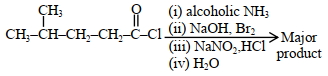
A
$CH_3-CH(Br)-CH(CH_3)-CH_2OH$
B
$CH_3-CH(CH_3)-CH_2-CH_2-CH_2OH$
C
$CH_3-CH(CH_3)-CH_2-CH_2OH$
D
$CH_3-CH(CH_3)-CH_2-CH_2Cl$
Solution
(C) The reaction proceeds as follows:
$1$. Reaction with alcoholic $NH_3$ converts the acid chloride $(R-COCl)$ into an amide $(R-CONH_2)$: $CH_3-CH(CH_3)-CH_2-CH_2-COCl \xrightarrow{NH_3} CH_3-CH(CH_3)-CH_2-CH_2-CONH_2$.
$2$. The Hofmann bromamide degradation reaction $(NaOH, Br_2)$ converts the amide into a primary amine $(R-NH_2)$: $CH_3-CH(CH_3)-CH_2-CH_2-CONH_2 \xrightarrow{NaOH, Br_2} CH_3-CH(CH_3)-CH_2-CH_2-NH_2$.
$3$. Treatment with $NaNO_2/HCl$ at low temperature converts the primary aliphatic amine into a diazonium salt,which is unstable and decomposes in the presence of water $(H_2O)$ to form an alcohol: $CH_3-CH(CH_3)-CH_2-CH_2-NH_2$ $\xrightarrow{NaNO_2, HCl} [CH_3-CH(CH_3)-CH_2-CH_2-N_2^+Cl^-]$ $\xrightarrow{H_2O} CH_3-CH(CH_3)-CH_2-CH_2-OH$.
Thus,the major product is $CH_3-CH(CH_3)-CH_2-CH_2OH$.
$1$. Reaction with alcoholic $NH_3$ converts the acid chloride $(R-COCl)$ into an amide $(R-CONH_2)$: $CH_3-CH(CH_3)-CH_2-CH_2-COCl \xrightarrow{NH_3} CH_3-CH(CH_3)-CH_2-CH_2-CONH_2$.
$2$. The Hofmann bromamide degradation reaction $(NaOH, Br_2)$ converts the amide into a primary amine $(R-NH_2)$: $CH_3-CH(CH_3)-CH_2-CH_2-CONH_2 \xrightarrow{NaOH, Br_2} CH_3-CH(CH_3)-CH_2-CH_2-NH_2$.
$3$. Treatment with $NaNO_2/HCl$ at low temperature converts the primary aliphatic amine into a diazonium salt,which is unstable and decomposes in the presence of water $(H_2O)$ to form an alcohol: $CH_3-CH(CH_3)-CH_2-CH_2-NH_2$ $\xrightarrow{NaNO_2, HCl} [CH_3-CH(CH_3)-CH_2-CH_2-N_2^+Cl^-]$ $\xrightarrow{H_2O} CH_3-CH(CH_3)-CH_2-CH_2-OH$.
Thus,the major product is $CH_3-CH(CH_3)-CH_2-CH_2OH$.
0 likes
View Solution97
DifficultMCQ
The correct sequence of reagents for the following transformation is:
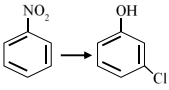
A
$i. Fe, HCl; ii. NaNO_{2}, HCl, 0^{\circ} C; iii. H_{2}O / H^{+}; iv. Cl_{2}, FeCl_{3}$
B
$i. Cl_{2}, FeCl_{3}; ii. NaNO_{2}, HCl, 0^{\circ} C; iii. Fe, HCl; iv. H_{2}O / H^{+}$
C
$i. Fe, HCl; ii. Cl_{2}, HCl; iii. NaNO_{2}, HCl, 0^{\circ} C; iv. H_{2}O / H^{+}$
D
$i. Cl_{2}, FeCl_{3}; ii. Fe, HCl; iii. NaNO_{2}, HCl, 0^{\circ} C; iv. H_{2}O / H^{+}$
Solution
(D) The transformation involves converting nitrobenzene to $3$-chlorophenol.
Step $1$: Chlorination of nitrobenzene using $Cl_{2} / FeCl_{3}$ gives $m$-chloronitrobenzene because the $-NO_{2}$ group is meta-directing.
Step $2$: Reduction of the nitro group using $Fe / HCl$ yields $m$-chloroaniline.
Step $3$: Diazotization of $m$-chloroaniline using $NaNO_{2} / HCl$ at $0^{\circ} C$ produces $m$-chlorobenzenediazonium chloride.
Step $4$: Hydrolysis of the diazonium salt using $H_{2}O / H^{+}$ results in the formation of $3$-chlorophenol.
Thus,the correct sequence is $i. Cl_{2}, FeCl_{3}; ii. Fe, HCl; iii. NaNO_{2}, HCl, 0^{\circ} C; iv. H_{2}O / H^{+}$.
Step $1$: Chlorination of nitrobenzene using $Cl_{2} / FeCl_{3}$ gives $m$-chloronitrobenzene because the $-NO_{2}$ group is meta-directing.
Step $2$: Reduction of the nitro group using $Fe / HCl$ yields $m$-chloroaniline.
Step $3$: Diazotization of $m$-chloroaniline using $NaNO_{2} / HCl$ at $0^{\circ} C$ produces $m$-chlorobenzenediazonium chloride.
Step $4$: Hydrolysis of the diazonium salt using $H_{2}O / H^{+}$ results in the formation of $3$-chlorophenol.
Thus,the correct sequence is $i. Cl_{2}, FeCl_{3}; ii. Fe, HCl; iii. NaNO_{2}, HCl, 0^{\circ} C; iv. H_{2}O / H^{+}$.
0 likes
View Solution98
DifficultMCQ
An organic compound $A$ contains nitrogen and chlorine. It dissolves readily in water to give a solution that turns litmus red. Titration of compound $A$ with standard base indicates that the molecular weight of $A$ is $131 \pm 2$. When a sample of $A$ is treated with aqueous $NaOH$,a liquid separates which contains $N$ but not $Cl$. Treatment of the obtained liquid with nitrous acid followed by phenol gives an orange precipitate. The compound $A$ is:
A
$C_6H_5NH_3Cl$
B
$C_6H_5CH_2NH_2 \cdot HCl$
C
$o-Cl-C_6H_4NH_2$
D
$p-Cl-C_6H_4NH_3Cl$
Solution
(A) $1$. The compound $A$ contains $N$ and $Cl$ and forms an acidic solution in water,suggesting it is an amine hydrochloride salt $(R-NH_3^+Cl^-)$.
$2$. The molecular weight of $C_6H_5NH_3Cl$ is $77 + 14 + 3 + 35.5 = 129.5$,which matches the given $131 \pm 2$.
$3$. Treatment with $NaOH$ releases the free amine: $C_6H_5NH_3Cl + NaOH \rightarrow C_6H_5NH_2 + NaCl + H_2O$. The liquid $C_6H_5NH_2$ (aniline) contains $N$ but no $Cl$.
$4$. Aniline reacts with nitrous acid $(HNO_2)$ at $0-5^{\circ}C$ to form benzenediazonium chloride,which then couples with phenol in basic medium to form $p$-hydroxyazobenzene,an orange dye.
$5$. Thus,$A$ is $C_6H_5NH_3Cl$ (anilinium chloride).
$2$. The molecular weight of $C_6H_5NH_3Cl$ is $77 + 14 + 3 + 35.5 = 129.5$,which matches the given $131 \pm 2$.
$3$. Treatment with $NaOH$ releases the free amine: $C_6H_5NH_3Cl + NaOH \rightarrow C_6H_5NH_2 + NaCl + H_2O$. The liquid $C_6H_5NH_2$ (aniline) contains $N$ but no $Cl$.
$4$. Aniline reacts with nitrous acid $(HNO_2)$ at $0-5^{\circ}C$ to form benzenediazonium chloride,which then couples with phenol in basic medium to form $p$-hydroxyazobenzene,an orange dye.
$5$. Thus,$A$ is $C_6H_5NH_3Cl$ (anilinium chloride).
0 likes
View Solution99
MediumMCQ
Match List-$I$ with List-$II$:
Choose the correct answer from the options given below.
| List-$I$ | List-$II$ |
|---|---|
| $A$. Benzenesulphonyl chloride | $I$. Test for primary amines |
| $B$. Hoffmann bromamide reaction | $II$. Anti Saytzeff |
| $C$. Carbylamine reaction | $III$. Hinsberg reagent |
| $D$. Hoffmann orientation | $IV$. Known reaction of isocyanates |
Choose the correct answer from the options given below.
A
$A-IV, B-III, C-II, D-I$
B
$A-IV, B-II, C-I, D-III$
C
$A-III, B-IV, C-I, D-II$
D
$A-IV, B-III, C-I, D-II$
Solution
(C) . Benzenesulphonyl chloride $\rightarrow$ $III$. Hinsberg reagent
$B$. Hoffmann bromamide reaction $\rightarrow$ $IV$. Known reaction of isocyanates
$R-CONH_2 + Br_2 + 4NaOH \rightarrow R-NH_2 + 2NaBr + Na_2CO_3 + 2H_2O$
Intermediate: $R-N=C=O$ (isocyanate)
$C$. Carbylamine reaction $\rightarrow$ $I$. Test for primary amine
$R-NH_2 + CHCl_3 + 3KOH \rightarrow RNC + 3KCl + 3H_2O$
$D$. Hoffmann orientation $\rightarrow$ $II$. Anti Saytzeff (Formation of less substituted alkene as major product)
Therefore,the correct matching is $A-III, B-IV, C-I, D-II$.
$B$. Hoffmann bromamide reaction $\rightarrow$ $IV$. Known reaction of isocyanates
$R-CONH_2 + Br_2 + 4NaOH \rightarrow R-NH_2 + 2NaBr + Na_2CO_3 + 2H_2O$
Intermediate: $R-N=C=O$ (isocyanate)
$C$. Carbylamine reaction $\rightarrow$ $I$. Test for primary amine
$R-NH_2 + CHCl_3 + 3KOH \rightarrow RNC + 3KCl + 3H_2O$
$D$. Hoffmann orientation $\rightarrow$ $II$. Anti Saytzeff (Formation of less substituted alkene as major product)
Therefore,the correct matching is $A-III, B-IV, C-I, D-II$.
0 likes
View Solution100
MediumMCQ
Which among the following represents reagent $A$ in the given reaction?
$C_6H_5N_2^+Cl^- + A \xrightarrow{NaOH} \text{Product (Orange-red dye)}$
$C_6H_5N_2^+Cl^- + A \xrightarrow{NaOH} \text{Product (Orange-red dye)}$
A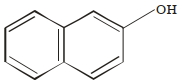
B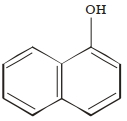
C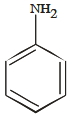
D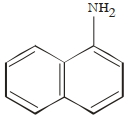
Solution
(A) The given reaction is a coupling reaction of benzene diazonium chloride with a phenol or amine in a basic medium to form an azo dye.
The reaction of benzene diazonium chloride with $\beta$-naphthol in the presence of $NaOH$ (basic medium) yields an orange-red azo dye.
The chemical equation is:
$C_6H_5N_2^+Cl^- + \beta\text{-Naphthol} \xrightarrow{NaOH} \text{Orange-red dye}$
The reaction of benzene diazonium chloride with $\beta$-naphthol in the presence of $NaOH$ (basic medium) yields an orange-red azo dye.
The chemical equation is:
$C_6H_5N_2^+Cl^- + \beta\text{-Naphthol} \xrightarrow{NaOH} \text{Orange-red dye}$
0 likes
View SolutionAmines — Mix Examples of Amines · Frequently Asked Questions
1Are these Amines questions useful for JEE and NEET?
Yes. All questions in this section are mapped to JEE Main and NEET exam patterns. Previous year questions from JEE Main, NEET, GUJCET and state-level exams are included with full solutions.
2Can I switch to Hindi or Gujarati for these questions?
Yes. Use the language tabs in the hero section or the sidebar to view the same questions and solutions in English, Hindi or Gujarati.
3How do I generate a question paper from this subtopic?
Use the Vedclass Exam Paper Generator — select the chapter and subtopic, set difficulty, and generate Sets A, B, C, D automatically. First 3 chapters of every subject are free.
Vedclass Products
For Students
Vedclass Test Series
Mock tests in real JEE/NEET style with performance analysis. 5-day free trial.
Start Free TrialFor Teachers
Exam Paper Generator
Generate Set A/B/C/D papers from this chapter in 2 minutes. 3 chapters free.
Try FreeFor Institutes
Online Exam Module
Live online exams with unlimited students, 360° analytics & white-label branding.
See DemoFor Teachers & Institutes
Generate a Amines Exam Paper in 2 Minutes
Select subtopic & difficulty — Sets A, B, C, D auto-generated with No Repeat logic.
First 3 chapters of every subject are free — no payment required.