
A English
Mix Examples of Amines Questions in English
Class 12 Chemistry · Amines · Mix Examples of Amines
160+
Questions
English
Language
100%
With Solutions
Showing 10 of 160 questions in English
151
DifficultMCQ
$A$ student has planned to prepare acetanilide from aniline using acetic anhydride. The student has started from $9.3 \ g$ of aniline. However,the student has managed to obtain $11 \ g$ of dry acetanilide. The $\%$ yield of this reaction is $.....$ (in $\%$)
A
$81.5$
B
$97.5$
C
$59.5$
D
$72.5$
Solution
(A) The chemical reaction for the preparation of acetanilide from aniline is: $C_6H_5NH_2 + (CH_3CO)_2O \rightarrow C_6H_5NHCOCH_3 + CH_3COOH$.
$1$. Calculate the moles of aniline used:
$n_{\text{aniline}} = \frac{\text{mass}}{\text{molar mass}} = \frac{9.3 \ g}{93 \ g/mol} = 0.1 \ mol$.
$2$. Since the stoichiometry of the reaction is $1:1$,the theoretical yield of acetanilide is $0.1 \ mol$.
$3$. Calculate the actual moles of acetanilide obtained:
$n_{\text{acetanilide}} = \frac{11 \ g}{135 \ g/mol} \approx 0.08148 \ mol$.
$4$. Calculate the percentage yield:
$\text{Percentage yield} = \left( \frac{\text{Actual yield}}{\text{Theoretical yield}} \right) \times 100 = \left( \frac{0.08148 \ mol}{0.1 \ mol} \right) \times 100 = 81.48 \% \approx 81.5 \%$.
$1$. Calculate the moles of aniline used:
$n_{\text{aniline}} = \frac{\text{mass}}{\text{molar mass}} = \frac{9.3 \ g}{93 \ g/mol} = 0.1 \ mol$.
$2$. Since the stoichiometry of the reaction is $1:1$,the theoretical yield of acetanilide is $0.1 \ mol$.
$3$. Calculate the actual moles of acetanilide obtained:
$n_{\text{acetanilide}} = \frac{11 \ g}{135 \ g/mol} \approx 0.08148 \ mol$.
$4$. Calculate the percentage yield:
$\text{Percentage yield} = \left( \frac{\text{Actual yield}}{\text{Theoretical yield}} \right) \times 100 = \left( \frac{0.08148 \ mol}{0.1 \ mol} \right) \times 100 = 81.48 \% \approx 81.5 \%$.
0 likes
View Solution152
DifficultMCQ
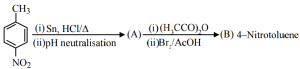
Consider the following sequence of reactions. Assuming that the reaction proceeds to completion,then $137 \ mg$ of $4-$nitrotoluene will produce . . . . . . $mg$ of $B$. (Given molar mass in $g \ mol^{-1}: H = 1, C = 12, N = 14, O = 16, Br = 80$)
A
$301$
B
$146$
C
$228$
D
$208$
Solution
(C) $1$. The starting material is $4-$nitrotoluene $(C_7H_7NO_2)$,which has a molar mass of $(7 \times 12) + (7 \times 1) + 14 + (2 \times 16) = 84 + 7 + 14 + 32 = 137 \ g \ mol^{-1}$.
$2$. Reduction of $4-$nitrotoluene with $Sn/HCl$ gives $p-$toluidine ($A$,$C_7H_9N$).
$3$. Acetylation of $p-$toluidine with $(CH_3CO)_2O$ gives $N-(p-tolyl)acetamide$ $(C_9H_{11}NO)$.
$4$. Bromination of $N-(p-tolyl)acetamide$ with $Br_2/AcOH$ gives $2-bromo-4-methylacetanilide$ ($B$,$C_9H_{10}BrNO$).
$5$. The molar mass of $B$ $(C_9H_{10}BrNO)$ is $(9 \times 12) + (10 \times 1) + 14 + 80 + 16 = 108 + 10 + 14 + 80 + 16 = 228 \ g \ mol^{-1}$.
$6$. Moles of $4-$nitrotoluene $= \frac{137 \times 10^{-3} \ g}{137 \ g \ mol^{-1}} = 0.001 \ mol$.
$7$. Since the stoichiometry is $1:1$,moles of $B = 0.001 \ mol$.
$8$. Mass of $B = 0.001 \ mol \times 228 \ g \ mol^{-1} = 0.228 \ g = 228 \ mg$.
$2$. Reduction of $4-$nitrotoluene with $Sn/HCl$ gives $p-$toluidine ($A$,$C_7H_9N$).
$3$. Acetylation of $p-$toluidine with $(CH_3CO)_2O$ gives $N-(p-tolyl)acetamide$ $(C_9H_{11}NO)$.
$4$. Bromination of $N-(p-tolyl)acetamide$ with $Br_2/AcOH$ gives $2-bromo-4-methylacetanilide$ ($B$,$C_9H_{10}BrNO$).
$5$. The molar mass of $B$ $(C_9H_{10}BrNO)$ is $(9 \times 12) + (10 \times 1) + 14 + 80 + 16 = 108 + 10 + 14 + 80 + 16 = 228 \ g \ mol^{-1}$.
$6$. Moles of $4-$nitrotoluene $= \frac{137 \times 10^{-3} \ g}{137 \ g \ mol^{-1}} = 0.001 \ mol$.
$7$. Since the stoichiometry is $1:1$,moles of $B = 0.001 \ mol$.
$8$. Mass of $B = 0.001 \ mol \times 228 \ g \ mol^{-1} = 0.228 \ g = 228 \ mg$.
0 likes
View Solution153
DifficultMCQ
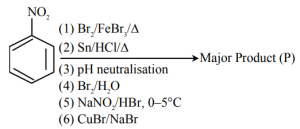
Consider the above sequence of reactions. The number of bromine atom$(s)$ in the final product $(P)$ will be:
A
$1$
B
$6$
C
$5$
D
$3$
Solution
(C) Step $1$: $Nitrobenzene$ reacts with $Br_2/FeBr_3$ to give $m-bromonitrobenzene$.
Step $2$: Reduction with $Sn/HCl$ converts the $-NO_2$ group to $-NH_2$,yielding $m-bromoaniline$.
Step $3$: $pH$ neutralisation is performed.
Step $4$: $m-bromoaniline$ reacts with $Br_2/H_2O$ to give $2,4,6-tribromo-3-bromoaniline$ (which is $2,3,4,6-tetrabromoaniline$).
Step $5$: Diazotization with $NaNO_2/HBr$ at $0-5^{\circ}C$ converts $-NH_2$ to $-N_2^+Br^-$.
Step $6$: Sandmeyer reaction with $CuBr/NaBr$ replaces the diazonium group with a $Br$ atom.
The final product is $1,2,3,4,5-pentabromobenzene$ (or $1,2,3,4,6-pentabromobenzene$ depending on numbering,but it contains $5$ bromine atoms).
Thus,the number of $Br$ atoms in the final product $(P)$ is $5$.
Step $2$: Reduction with $Sn/HCl$ converts the $-NO_2$ group to $-NH_2$,yielding $m-bromoaniline$.
Step $3$: $pH$ neutralisation is performed.
Step $4$: $m-bromoaniline$ reacts with $Br_2/H_2O$ to give $2,4,6-tribromo-3-bromoaniline$ (which is $2,3,4,6-tetrabromoaniline$).
Step $5$: Diazotization with $NaNO_2/HBr$ at $0-5^{\circ}C$ converts $-NH_2$ to $-N_2^+Br^-$.
Step $6$: Sandmeyer reaction with $CuBr/NaBr$ replaces the diazonium group with a $Br$ atom.
The final product is $1,2,3,4,5-pentabromobenzene$ (or $1,2,3,4,6-pentabromobenzene$ depending on numbering,but it contains $5$ bromine atoms).
Thus,the number of $Br$ atoms in the final product $(P)$ is $5$.
0 likes
View Solution154
DifficultMCQ
$A$ is a neutral organic compound $(M.F.: C_8H_9ON)$. On treatment with aqueous $Br_2 / HO^{(-)}$,$A$ forms a compound $B$ which is soluble in dilute acid. $B$ on treatment with aqueous $NaNO_2 / HCl$ $(0-5^{\circ}C)$ produces a compound $C$ which on treatment with $CuCN / NaCN$ produces $D$. Hydrolysis of $D$ produces $E$ which is also obtainable from the hydrolysis of $A$. $E$ on treatment with acidified $KMnO_4$ produces $F$. $F$ contains two different types of hydrogen atoms. The structure of $A$ is
A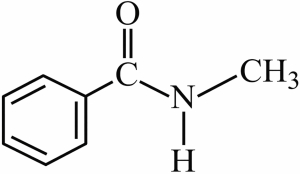
B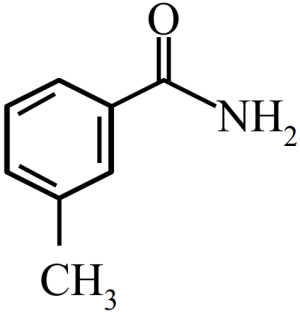
C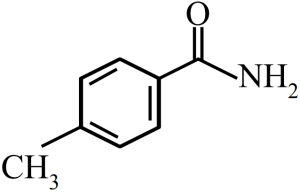
D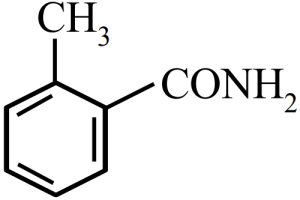
Solution
(C) $1$. The molecular formula $C_8H_9ON$ and the reaction with $Br_2 / HO^{(-)}$ (Hofmann bromamide degradation) suggest that $A$ is an amide.
$2$. The product $B$ is an amine,which is soluble in dilute acid.
$3$. The reaction sequence $B$ $\xrightarrow{NaNO_2/HCl} C$ $\xrightarrow{CuCN} D$ $\xrightarrow{H_3O^+} E$ is the standard conversion of an amine to a carboxylic acid via a diazonium salt and nitrile.
$4$. $E$ is also obtained from the hydrolysis of $A$,confirming $A$ is an amide.
$5$. $E$ on oxidation with $KMnO_4$ gives $F$. If $E$ is $p$-toluic acid,oxidation gives terephthalic acid $(F)$,which has two types of hydrogen atoms (aromatic and carboxylic).
$6$. Based on the reaction path,$A$ must be $p$-methylbenzamide.
$2$. The product $B$ is an amine,which is soluble in dilute acid.
$3$. The reaction sequence $B$ $\xrightarrow{NaNO_2/HCl} C$ $\xrightarrow{CuCN} D$ $\xrightarrow{H_3O^+} E$ is the standard conversion of an amine to a carboxylic acid via a diazonium salt and nitrile.
$4$. $E$ is also obtained from the hydrolysis of $A$,confirming $A$ is an amide.
$5$. $E$ on oxidation with $KMnO_4$ gives $F$. If $E$ is $p$-toluic acid,oxidation gives terephthalic acid $(F)$,which has two types of hydrogen atoms (aromatic and carboxylic).
$6$. Based on the reaction path,$A$ must be $p$-methylbenzamide.
0 likes
View Solution155
MediumMCQ
Benzyl isocyanide can be obtained from which of the following reactions? Choose the correct answer from the options given below:
$A$. Benzyl bromide + $AgCN$
$B$. Benzylamine + $CHCl_3$ + $Aq. NaOH$
$C$. Bromobenzene + $AgCN$
$D$. Aniline + $CHCl_3$ + $Aq. NaOH$
$E$. $2-$Phenylethyl bromide + $KCN$
$A$. Benzyl bromide + $AgCN$
$B$. Benzylamine + $CHCl_3$ + $Aq. NaOH$
$C$. Bromobenzene + $AgCN$
$D$. Aniline + $CHCl_3$ + $Aq. NaOH$
$E$. $2-$Phenylethyl bromide + $KCN$
A
$A$ and $B$ Only
B
$A$ and $C$ Only
C
$B$ and $D$ Only
D
$D$ and $E$ Only
Solution
(A) $1$. Reaction $A$: Benzyl bromide $(C_6H_5CH_2Br)$ reacts with $AgCN$ to form benzyl isocyanide $(C_6H_5CH_2NC)$. This is because $AgCN$ is a covalent compound,and the nucleophilic attack occurs through the nitrogen atom of the ambident $CN^-$ ion.
$2$. Reaction $B$: Benzylamine $(C_6H_5CH_2NH_2)$ undergoes the carbylamine reaction with $CHCl_3$ and $KOH$ (or $NaOH$) to form benzyl isocyanide $(C_6H_5CH_2NC)$.
$3$. Reaction $C$: Bromobenzene does not undergo nucleophilic substitution with $AgCN$ under normal conditions due to the partial double bond character of the $C-Br$ bond.
$4$. Reaction $D$: Aniline $(C_6H_5NH_2)$ undergoes the carbylamine reaction to form phenyl isocyanide $(C_6H_5NC)$,not benzyl isocyanide.
$5$. Reaction $E$: $2-$Phenylethyl bromide reacts with $KCN$ to form $3-$phenylpropanenitrile $(C_6H_5CH_2CH_2CN)$.
Therefore,benzyl isocyanide is obtained from reactions $A$ and $B$.
$2$. Reaction $B$: Benzylamine $(C_6H_5CH_2NH_2)$ undergoes the carbylamine reaction with $CHCl_3$ and $KOH$ (or $NaOH$) to form benzyl isocyanide $(C_6H_5CH_2NC)$.
$3$. Reaction $C$: Bromobenzene does not undergo nucleophilic substitution with $AgCN$ under normal conditions due to the partial double bond character of the $C-Br$ bond.
$4$. Reaction $D$: Aniline $(C_6H_5NH_2)$ undergoes the carbylamine reaction to form phenyl isocyanide $(C_6H_5NC)$,not benzyl isocyanide.
$5$. Reaction $E$: $2-$Phenylethyl bromide reacts with $KCN$ to form $3-$phenylpropanenitrile $(C_6H_5CH_2CH_2CN)$.
Therefore,benzyl isocyanide is obtained from reactions $A$ and $B$.
0 likes
View Solution156
DifficultMCQ
Match List-$I$ with List-$II$.
| List-$I$ (Mixture of Compounds) | List-$II$ (Reagent used to distinguish) |
|---|---|
| $A$. Diethyl amine + Ethyl amine | $I$. Bromine water |
| $B$. Acetaldehyde + Acetone | $II$. $CHCl_3 + KOH, \Delta$ |
| $C$. Ethanol + Phenol | $III$. Neutral $FeCl_3$ |
| $D$. Benzoic acid + Cinnamic acid | $IV$. Ammonical silver nitrate |
A
$A-II, B-IV, C-III, D-I$
B
$A-IV, B-II, C-III, D-I$
C
$A-II, B-IV, C-I, D-III$
D
$A-IV, B-II, C-I, D-III$
Solution
$(A)$. Diethyl amine (secondary amine) and Ethyl amine (primary amine) can be distinguished using the Carbylamine test $(CHCl_3 + KOH, \Delta)$; only primary amines react to form an isocyanide with a foul smell $(A-II)$.
$B$. Acetaldehyde (aldehyde) and Acetone (ketone) can be distinguished using Tollens' test (Ammonical silver nitrate); only acetaldehyde reacts to form a silver mirror $(B-IV)$.
$C$. Ethanol and Phenol can be distinguished using Neutral $FeCl_3$; phenol gives a characteristic violet color with neutral $FeCl_3$ $(C-III)$.
$D$. Benzoic acid and Cinnamic acid can be distinguished using Bromine water; cinnamic acid contains a carbon-carbon double bond (unsaturation) and decolorizes bromine water, whereas benzoic acid does not $(D-I)$.
Therefore, the correct matching is $A-II, B-IV, C-III, D-I$.
$B$. Acetaldehyde (aldehyde) and Acetone (ketone) can be distinguished using Tollens' test (Ammonical silver nitrate); only acetaldehyde reacts to form a silver mirror $(B-IV)$.
$C$. Ethanol and Phenol can be distinguished using Neutral $FeCl_3$; phenol gives a characteristic violet color with neutral $FeCl_3$ $(C-III)$.
$D$. Benzoic acid and Cinnamic acid can be distinguished using Bromine water; cinnamic acid contains a carbon-carbon double bond (unsaturation) and decolorizes bromine water, whereas benzoic acid does not $(D-I)$.
Therefore, the correct matching is $A-II, B-IV, C-III, D-I$.
0 likes
View Solution157
DifficultMCQ
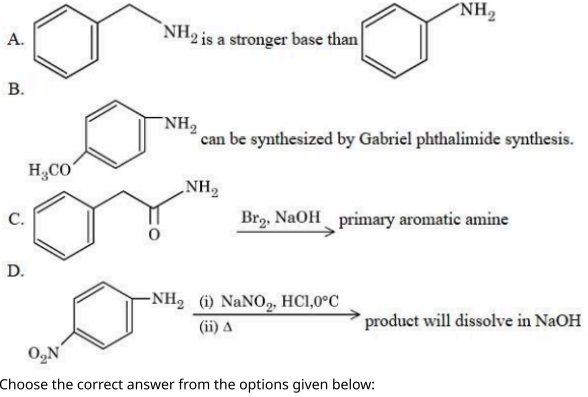
Identify the incorrect statements.
A
$A$ and $D$ Only
B
$A$ and $C$ Only
C
$B$ and $C$ Only
D
$A$ and $B$ Only
Solution
(C) Let's analyze each statement:
$(A)$ Benzylamine $(C_6H_5CH_2NH_2)$ is a stronger base than aniline $(C_6H_5NH_2)$ because in benzylamine,the lone pair on nitrogen is not involved in resonance with the benzene ring,whereas in aniline,it is delocalized. Thus,statement $(A)$ is correct.
$(B)$ Gabriel phthalimide synthesis is used for the preparation of primary aliphatic amines. It cannot be used for the preparation of aromatic primary amines because aryl halides do not undergo nucleophilic substitution with the phthalimide anion. Thus,statement $(B)$ is incorrect.
$(C)$ The Hofmann bromamide degradation reaction is used to convert primary amides $(RCONH_2)$ into primary amines $(RNH_2)$. The reaction shown involves phenylacetamide $(C_6H_5CH_2CONH_2)$,which would yield benzylamine. However,the product is labeled as a 'primary aromatic amine',which is incorrect as the amine formed is a primary aliphatic amine. Thus,statement $(C)$ is incorrect.
$(D)$ The diazotization of $4-$nitroaniline followed by hydrolysis gives $4-$nitrophenol. $4-$Nitrophenol is acidic and will dissolve in $NaOH$. Thus,statement $(D)$ is correct.
Therefore,the incorrect statements are $(B)$ and $(C)$.
$(A)$ Benzylamine $(C_6H_5CH_2NH_2)$ is a stronger base than aniline $(C_6H_5NH_2)$ because in benzylamine,the lone pair on nitrogen is not involved in resonance with the benzene ring,whereas in aniline,it is delocalized. Thus,statement $(A)$ is correct.
$(B)$ Gabriel phthalimide synthesis is used for the preparation of primary aliphatic amines. It cannot be used for the preparation of aromatic primary amines because aryl halides do not undergo nucleophilic substitution with the phthalimide anion. Thus,statement $(B)$ is incorrect.
$(C)$ The Hofmann bromamide degradation reaction is used to convert primary amides $(RCONH_2)$ into primary amines $(RNH_2)$. The reaction shown involves phenylacetamide $(C_6H_5CH_2CONH_2)$,which would yield benzylamine. However,the product is labeled as a 'primary aromatic amine',which is incorrect as the amine formed is a primary aliphatic amine. Thus,statement $(C)$ is incorrect.
$(D)$ The diazotization of $4-$nitroaniline followed by hydrolysis gives $4-$nitrophenol. $4-$Nitrophenol is acidic and will dissolve in $NaOH$. Thus,statement $(D)$ is correct.
Therefore,the incorrect statements are $(B)$ and $(C)$.
0 likes
View Solution158
AdvancedMCQ
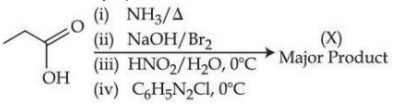
Consider the following organic reaction sequence. Choose the final product $(X)$ from the following (consider the major product in all intermediate reactions).
A
Benzene
B
Phenol
C
Propanol
D
Chlorobenzene
Solution
(C) The reaction sequence starting from propanoic acid $(CH_3CH_2COOH)$ is as follows:
$1$) Reaction with $NH_3/\Delta$ gives propanamide $(CH_3CH_2CONH_2)$.
$2$) Hofmann bromamide degradation with $NaOH/Br_2$ converts propanamide to ethanamine $(CH_3CH_2NH_2)$.
$3$) Reaction with nitrous acid ($HNO_2$,from $NaNO_2/HCl$) at $0^\circ C$ converts ethanamine to ethanol $(CH_3CH_2OH)$.
$4$) The reaction of ethanol with benzenediazonium chloride $(C_6H_5N_2Cl)$ at $0^\circ C$ is not a standard textbook reaction for producing the given options. However,if the question intended to ask for the product after step $(iii)$,the product is ethanol. Given the options provided,there is no correct match for the final product. Assuming a potential error in the question's options or reagents,the most logical intermediate product is ethanol,which is not listed. Therefore,the question is flawed.
$1$) Reaction with $NH_3/\Delta$ gives propanamide $(CH_3CH_2CONH_2)$.
$2$) Hofmann bromamide degradation with $NaOH/Br_2$ converts propanamide to ethanamine $(CH_3CH_2NH_2)$.
$3$) Reaction with nitrous acid ($HNO_2$,from $NaNO_2/HCl$) at $0^\circ C$ converts ethanamine to ethanol $(CH_3CH_2OH)$.
$4$) The reaction of ethanol with benzenediazonium chloride $(C_6H_5N_2Cl)$ at $0^\circ C$ is not a standard textbook reaction for producing the given options. However,if the question intended to ask for the product after step $(iii)$,the product is ethanol. Given the options provided,there is no correct match for the final product. Assuming a potential error in the question's options or reagents,the most logical intermediate product is ethanol,which is not listed. Therefore,the question is flawed.
0 likes
View Solution159
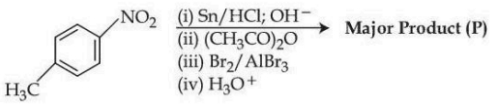
DifficultMCQ
Consider the following reaction sequence starting from $p$-nitrotoluene:
$(i)$ $\text{Sn/HCl; OH}^-$
(ii) $(\text{CH}_3\text{CO})_2\text{O}$
(iii) $\text{Br}_2/\text{AlBr}_3$
(iv) $\text{H}_3\text{O}^+$
When the final product $(P)$ is subjected to Carius analysis using $\text{AgNO}_3$,$1.0 \text{ g}$ of the product $(P)$ will produce . . . . . . $\text{g}$ of the precipitate of $\text{AgBr}$. (Nearest Integer)
(Given: molar mass in $\text{g mol}^{-1}$: $\text{C} = 12, \text{H} = 1, \text{O} = 16, \text{N} = 14, \text{Br} = 80, \text{Ag} = 108$)
$(i)$ $\text{Sn/HCl; OH}^-$
(ii) $(\text{CH}_3\text{CO})_2\text{O}$
(iii) $\text{Br}_2/\text{AlBr}_3$
(iv) $\text{H}_3\text{O}^+$
When the final product $(P)$ is subjected to Carius analysis using $\text{AgNO}_3$,$1.0 \text{ g}$ of the product $(P)$ will produce . . . . . . $\text{g}$ of the precipitate of $\text{AgBr}$. (Nearest Integer)
(Given: molar mass in $\text{g mol}^{-1}$: $\text{C} = 12, \text{H} = 1, \text{O} = 16, \text{N} = 14, \text{Br} = 80, \text{Ag} = 108$)
A
$0.5$
B
$1$
C
$1.5$
D
$2$
Solution
(B) The starting material is $p$-nitrotoluene $(CH_3-C_6H_4-NO_2)$.
$(i)$ Reduction of $-NO_2$ to $-NH_2$ gives $p$-toluidine $(CH_3-C_6H_4-NH_2)$.
(ii) Acetylation of the amino group with acetic anhydride gives $p$-methylacetanilide $(CH_3-C_6H_4-NHCOCH_3)$.
(iii) Bromination occurs at the ortho position relative to the $-NHCOCH_3$ group,yielding $2$-bromo-$4$-methylacetanilide.
(iv) Hydrolysis of the acetamido group gives $2$-bromo-$4$-methylaniline $(C_7H_8BrN)$.
This product $(P)$ is $2$-bromo-$4$-methylaniline. Its molar mass is $(7 \times 12) + (8 \times 1) + 80 + 14 = 84 + 8 + 80 + 14 = 186 \text{ g/mol}$.
In Carius analysis,$1 \text{ mole}$ of $P$ produces $1 \text{ mole}$ of $\text{AgBr}$.
Moles of $P = 1.0 \text{ g} / 186 \text{ g/mol} \approx 0.005376 \text{ mol}$.
Moles of $\text{AgBr} = 0.005376 \text{ mol}$.
Mass of $\text{AgBr} = 0.005376 \times (108 + 80) = 0.005376 \times 188 \approx 1.01 \text{ g}$.
The nearest integer is $1$.
$(i)$ Reduction of $-NO_2$ to $-NH_2$ gives $p$-toluidine $(CH_3-C_6H_4-NH_2)$.
(ii) Acetylation of the amino group with acetic anhydride gives $p$-methylacetanilide $(CH_3-C_6H_4-NHCOCH_3)$.
(iii) Bromination occurs at the ortho position relative to the $-NHCOCH_3$ group,yielding $2$-bromo-$4$-methylacetanilide.
(iv) Hydrolysis of the acetamido group gives $2$-bromo-$4$-methylaniline $(C_7H_8BrN)$.
This product $(P)$ is $2$-bromo-$4$-methylaniline. Its molar mass is $(7 \times 12) + (8 \times 1) + 80 + 14 = 84 + 8 + 80 + 14 = 186 \text{ g/mol}$.
In Carius analysis,$1 \text{ mole}$ of $P$ produces $1 \text{ mole}$ of $\text{AgBr}$.
Moles of $P = 1.0 \text{ g} / 186 \text{ g/mol} \approx 0.005376 \text{ mol}$.
Moles of $\text{AgBr} = 0.005376 \text{ mol}$.
Mass of $\text{AgBr} = 0.005376 \times (108 + 80) = 0.005376 \times 188 \approx 1.01 \text{ g}$.
The nearest integer is $1$.
0 likes
View Solution160
MediumMCQ
The major product $Z$ formed in the following sequence of reactions is:

A
$C_2H_5-N=N-OH$
B
$C_2H_5OH$
C
$C_2H_5NO_2$
D
$C_2H_5NH_2$
Solution
(B) $1$. $C_2H_6 \xrightarrow{Cl_2, UV \text{ light}} C_2H_5Cl$ ($X$ is ethyl chloride).
$2$. $C_2H_5Cl \xrightarrow{NH_3} C_2H_5NH_2$ ($Y$ is ethylamine).
$3$. $C_2H_5NH_2 \xrightarrow{(i) NaNO_2/HCl, (ii) H_2O} C_2H_5OH$.
Diazotization of ethylamine followed by hydrolysis yields ethanol $(Z)$.
$2$. $C_2H_5Cl \xrightarrow{NH_3} C_2H_5NH_2$ ($Y$ is ethylamine).
$3$. $C_2H_5NH_2 \xrightarrow{(i) NaNO_2/HCl, (ii) H_2O} C_2H_5OH$.
Diazotization of ethylamine followed by hydrolysis yields ethanol $(Z)$.
0 likes
View SolutionAmines — Mix Examples of Amines · Frequently Asked Questions
1Are these Amines questions useful for JEE and NEET?
Yes. All questions in this section are mapped to JEE Main and NEET exam patterns. Previous year questions from JEE Main, NEET, GUJCET and state-level exams are included with full solutions.
2Can I switch to Hindi or Gujarati for these questions?
Yes. Use the language tabs in the hero section or the sidebar to view the same questions and solutions in English, Hindi or Gujarati.
3How do I generate a question paper from this subtopic?
Use the Vedclass Exam Paper Generator — select the chapter and subtopic, set difficulty, and generate Sets A, B, C, D automatically. First 3 chapters of every subject are free.
Vedclass Products
For Students
Vedclass Test Series
Mock tests in real JEE/NEET style with performance analysis. 5-day free trial.
Start Free TrialFor Teachers
Exam Paper Generator
Generate Set A/B/C/D papers from this chapter in 2 minutes. 3 chapters free.
Try FreeFor Institutes
Online Exam Module
Live online exams with unlimited students, 360° analytics & white-label branding.
See DemoFor Teachers & Institutes
Generate a Amines Exam Paper in 2 Minutes
Select subtopic & difficulty — Sets A, B, C, D auto-generated with No Repeat logic.
First 3 chapters of every subject are free — no payment required.