
A English
Mix Examples of Amines Questions in English
Class 12 Chemistry · Amines · Mix Examples of Amines
160+
Questions
English
Language
100%
With Solutions
Showing 49 of 160 questions in English
1
DifficultMCQ
How many isomeric forms of $C_7H_9N$ contain a benzene ring?
A
$4$
B
$5$
C
$6$
D
$7$
Solution
(B) The molecular formula $C_7H_9N$ corresponds to a degree of unsaturation of $4$,which is consistent with a benzene ring ($4$ degrees of unsaturation).
There are $5$ isomers that contain a benzene ring:
$1$. Benzylamine $(C_6H_5CH_2NH_2)$
$2$. $o$-Methylaniline ($o$-toluidine)
$3$. $m$-Methylaniline ($m$-toluidine)
$4$. $p$-Methylaniline ($p$-toluidine)
$5$. $N$-Methylaniline $(C_6H_5NHCH_3)$
Thus,the correct option is $B$.
There are $5$ isomers that contain a benzene ring:
$1$. Benzylamine $(C_6H_5CH_2NH_2)$
$2$. $o$-Methylaniline ($o$-toluidine)
$3$. $m$-Methylaniline ($m$-toluidine)
$4$. $p$-Methylaniline ($p$-toluidine)
$5$. $N$-Methylaniline $(C_6H_5NHCH_3)$
Thus,the correct option is $B$.
0 likes
View Solution2
MediumMCQ
Alkyl halide on heating with alc. $NH_3$ in a sealed tube results in...
A
$1^o$ amine
B
$2^o$ amine
C
$3^o$ amine
D
All of these
Solution
(D) Ammonia acts as a nucleophile and reacts with alkyl halides $(RX)$ in a nucleophilic substitution reaction $(S_N2)$.
$RX + NH_3 \rightarrow RNH_2 + HX$
$RNH_2 + RX \rightarrow R_2NH + HX$
$R_2NH + RX \rightarrow R_3N + HX$
$R_3N + RX \rightarrow R_4N^+X^-$
Since the reaction continues until all hydrogen atoms on the nitrogen are replaced by alkyl groups,the final product is a mixture of primary $(1^o)$,secondary $(2^o)$,and tertiary $(3^o)$ amines,along with quaternary ammonium salts.
$RX + NH_3 \rightarrow RNH_2 + HX$
$RNH_2 + RX \rightarrow R_2NH + HX$
$R_2NH + RX \rightarrow R_3N + HX$
$R_3N + RX \rightarrow R_4N^+X^-$
Since the reaction continues until all hydrogen atoms on the nitrogen are replaced by alkyl groups,the final product is a mixture of primary $(1^o)$,secondary $(2^o)$,and tertiary $(3^o)$ amines,along with quaternary ammonium salts.
0 likes
View Solution3
MediumMCQ
An aromatic amine $(A)$ was treated with alcoholic potash and another compound $(Y)$ to form a foul-smelling gas with the formula $C_6H_5NC$. Compound $(Y)$ was formed by reacting a compound $(Z)$ with $Cl_2$ in the presence of slaked lime. The compound $(Z)$ is:
A
$C_6H_5NH_2$
B
$C_2H_5OH$
C
$CH_3OCH_3$
D
$CHCl_3$
Solution
(B) The reaction described is the carbylamine test,which is characteristic of primary amines.
The reaction is: $C_6H_5NH_2 + 3 KOH + CHCl_3 \to C_6H_5NC + 3 KCl + 3 H_2O$.
Here,$(Y)$ is $CHCl_3$ (chloroform).
Chloroform $(Y)$ is prepared by the haloform reaction using ethanol $(Z)$ and chlorine in the presence of slaked lime $(Ca(OH)_2)$:
$C_2H_5OH + Cl_2$ $\xrightarrow{Ca(OH)_2} CH_3CHO$ $\xrightarrow{Cl_2} CCl_3CHO$ $\xrightarrow{Ca(OH)_2} CHCl_3$.
Thus,the compound $(Z)$ is $C_2H_5OH$ (ethanol).
The reaction is: $C_6H_5NH_2 + 3 KOH + CHCl_3 \to C_6H_5NC + 3 KCl + 3 H_2O$.
Here,$(Y)$ is $CHCl_3$ (chloroform).
Chloroform $(Y)$ is prepared by the haloform reaction using ethanol $(Z)$ and chlorine in the presence of slaked lime $(Ca(OH)_2)$:
$C_2H_5OH + Cl_2$ $\xrightarrow{Ca(OH)_2} CH_3CHO$ $\xrightarrow{Cl_2} CCl_3CHO$ $\xrightarrow{Ca(OH)_2} CHCl_3$.
Thus,the compound $(Z)$ is $C_2H_5OH$ (ethanol).
0 likes
View Solution4
DifficultMCQ
$C_3H_9N$ represents
A
Primary amine
B
Secondary amine
C
Tertiary amine
D
All of these
Solution
(D) $C_3H_9N$ can form all three types of amines.
$1^o$ amine: $CH_3CH_2CH_2NH_2$ (propan$-1-$amine)
$2^o$ amine: $CH_3CH_2NHCH_3$ ($N$-methylethanamine)
$3^o$ amine: $(CH_3)_3N$ ($N$,$N$-dimethylmethanamine)
$1^o$ amine: $CH_3CH_2CH_2NH_2$ (propan$-1-$amine)
$2^o$ amine: $CH_3CH_2NHCH_3$ ($N$-methylethanamine)
$3^o$ amine: $(CH_3)_3N$ ($N$,$N$-dimethylmethanamine)
0 likes
View Solution5
DifficultMCQ
Ethylamine can be obtained by the:
A
Action of $NH_3$ on ethyl iodide
B
Action of $NH_3$ on ethyl alcohol
C
Both $(a)$ and $(b)$
D
None of the above
Solution
(C) Ethylamine $(C_2H_5NH_2)$ can be prepared by the ammonolysis of alkyl halides and the catalytic amination of alcohols.
$1$. Action of $NH_3$ on ethyl iodide: $C_2H_5I + NH_3 \to C_2H_5NH_2 + HI$
$2$. Action of $NH_3$ on ethyl alcohol: $C_2H_5OH + NH_3 \xrightarrow[\Delta]{Al_2O_3} C_2H_5NH_2 + H_2O$
Therefore,both $(a)$ and $(b)$ are correct methods.
$1$. Action of $NH_3$ on ethyl iodide: $C_2H_5I + NH_3 \to C_2H_5NH_2 + HI$
$2$. Action of $NH_3$ on ethyl alcohol: $C_2H_5OH + NH_3 \xrightarrow[\Delta]{Al_2O_3} C_2H_5NH_2 + H_2O$
Therefore,both $(a)$ and $(b)$ are correct methods.
0 likes
View Solution6
DifficultMCQ
When $methyl$ $iodide$ is heated with $ammonia$,the product obtained is
A
Methylamine
B
Dimethylamine
C
Trimethylamine
D
$A$ mixture of the above three amines
Solution
(D) The reaction of $methyl$ $iodide$ $(CH_3I)$ with $ammonia$ $(NH_3)$ is a nucleophilic substitution reaction known as $Hofmann$ $ammonolysis$.
Since the primary amine $(CH_3NH_2)$ formed is more nucleophilic than $ammonia$,it further reacts with $CH_3I$ to form secondary and tertiary amines.
Therefore,the reaction proceeds as follows:
$CH_3I + NH_3 \rightarrow CH_3NH_2 + HI$
$CH_3NH_2 + CH_3I \rightarrow (CH_3)_2NH + HI$
$(CH_3)_2NH + CH_3I \rightarrow (CH_3)_3N + HI$
Thus,a mixture of primary,secondary,and tertiary amines is obtained.
Since the primary amine $(CH_3NH_2)$ formed is more nucleophilic than $ammonia$,it further reacts with $CH_3I$ to form secondary and tertiary amines.
Therefore,the reaction proceeds as follows:
$CH_3I + NH_3 \rightarrow CH_3NH_2 + HI$
$CH_3NH_2 + CH_3I \rightarrow (CH_3)_2NH + HI$
$(CH_3)_2NH + CH_3I \rightarrow (CH_3)_3N + HI$
Thus,a mixture of primary,secondary,and tertiary amines is obtained.
0 likes
View Solution7
MediumMCQ
Which of the following reactions does not yield an amine?
A
$RX + NH_3 \rightarrow RNH_2 + HX$
B
$RCH = NOH + 4[H] \xrightarrow{Na/C_2H_5OH} RCH_2NH_2 + H_2O$
C
$RCN + 2H_2O \xrightarrow{H^{+}} RCOOH + NH_3$
D
$RCONH_2 + 4[H] \xrightarrow{LiAlH_4} RCH_2NH_2 + H_2O$
Solution
(C) The reaction $RCN + 2H_2O \xrightarrow{H^{+}} RCOOH + NH_3$ represents the acid-catalyzed hydrolysis of a nitrile,which yields a carboxylic acid and ammonia,not an amine.
$A$. $RX + NH_3 \rightarrow RNH_2$ (Ammonolysis of alkyl halides yields amines).
$B$. $RCH = NOH + 4[H] \xrightarrow{Na/C_2H_5OH} RCH_2NH_2 + H_2O$ (Reduction of oximes yields primary amines).
$D$. $RCONH_2 + 4[H] \xrightarrow{LiAlH_4} RCH_2NH_2 + H_2O$ (Reduction of amides yields primary amines).
$A$. $RX + NH_3 \rightarrow RNH_2$ (Ammonolysis of alkyl halides yields amines).
$B$. $RCH = NOH + 4[H] \xrightarrow{Na/C_2H_5OH} RCH_2NH_2 + H_2O$ (Reduction of oximes yields primary amines).
$D$. $RCONH_2 + 4[H] \xrightarrow{LiAlH_4} RCH_2NH_2 + H_2O$ (Reduction of amides yields primary amines).
0 likes
View Solution8
MediumMCQ
Which of the following reactions will not give a primary amine?
A
$CH_3CONH_2 \xrightarrow{KOH, Br_2}$
B
$CH_3CN \xrightarrow{LiAlH_4}$
C
$CH_3NC \xrightarrow{LiAlH_4}$
D
$CH_3CONH_2 \xrightarrow{LiAlH_4}$
Solution
(C) . $CH_3CONH_2 \xrightarrow{KOH, Br_2} CH_3NH_2$ (primary amine,Hofmann bromamide degradation).
$B$. $CH_3CN \xrightarrow{LiAlH_4} CH_3CH_2NH_2$ (primary amine).
$C$. $CH_3NC \xrightarrow{LiAlH_4} CH_3NHCH_3$ (secondary amine).
$D$. $CH_3CONH_2 \xrightarrow{LiAlH_4} CH_3CH_2NH_2$ (primary amine).
Therefore,option $C$ does not yield a primary amine.
$B$. $CH_3CN \xrightarrow{LiAlH_4} CH_3CH_2NH_2$ (primary amine).
$C$. $CH_3NC \xrightarrow{LiAlH_4} CH_3NHCH_3$ (secondary amine).
$D$. $CH_3CONH_2 \xrightarrow{LiAlH_4} CH_3CH_2NH_2$ (primary amine).
Therefore,option $C$ does not yield a primary amine.
0 likes
View Solution9
DifficultMCQ
$A$ nitrogen-containing organic compound gave an oily liquid on heating with bromine and potassium hydroxide solution. On shaking the product with acetic anhydride,an antipyretic drug was obtained. The reactions indicate that the starting compound is
A
Aniline
B
Benzamide
C
Acetamide
D
Nitrobenzene
Solution
(B) The reaction of an amide with $Br_2$ and $KOH$ is the $Hofmann$ bromamide degradation reaction,which produces a primary amine.
$C_6H_5CONH_2 + Br_2 + 4KOH \to C_6H_5NH_2 + K_2CO_3 + 2KBr + 2H_2O$
The product $C_6H_5NH_2$ (aniline) is an oily liquid.
When aniline is treated with acetic anhydride,it undergoes acetylation to form acetanilide $(CH_3CONHC_6H_5)$,which is a well-known antipyretic drug.
$C_6H_5NH_2 + (CH_3CO)_2O \to CH_3CONHC_6H_5 + CH_3COOH$
Therefore,the starting compound is benzamide.
$C_6H_5CONH_2 + Br_2 + 4KOH \to C_6H_5NH_2 + K_2CO_3 + 2KBr + 2H_2O$
The product $C_6H_5NH_2$ (aniline) is an oily liquid.
When aniline is treated with acetic anhydride,it undergoes acetylation to form acetanilide $(CH_3CONHC_6H_5)$,which is a well-known antipyretic drug.
$C_6H_5NH_2 + (CH_3CO)_2O \to CH_3CONHC_6H_5 + CH_3COOH$
Therefore,the starting compound is benzamide.
0 likes
View Solution10
MediumMCQ
Which one of the following methods is neither meant for the synthesis nor for separation of amines?
A
Hinsberg method
B
Hofmann method
C
Wurtz reaction
D
Curtius reaction
Solution
(C) The $Wurtz$ reaction is used to prepare alkanes from alkyl halides.
$2 R - X + 2 Na \xrightarrow{\text{Dry ether}} R - R + 2 NaX$
Here,$R$ is an alkyl group and $X$ is a halide.
$Hinsberg$ method is used for the separation of amines.
$Hofmann$ method and $Curtius$ reaction are used for the synthesis of amines.
$2 R - X + 2 Na \xrightarrow{\text{Dry ether}} R - R + 2 NaX$
Here,$R$ is an alkyl group and $X$ is a halide.
$Hinsberg$ method is used for the separation of amines.
$Hofmann$ method and $Curtius$ reaction are used for the synthesis of amines.
0 likes
View Solution11
DifficultMCQ
In the reaction sequence $CH_3CH_2Br$ $\xrightarrow{AgCN} A$ $\xrightarrow{H_3O^+} HCOOH + B; B$ $\xrightarrow{CHCl_3/KOH} A$ $\xrightarrow{Reduction} C$,what are $A, B,$ and $C$ respectively?
A
Ethyl isocyanide,Ethylamine,and $N$-methylethanamine
B
Ethyl isocyanide,Ethylamine,and $N$-ethylethanamine
C
Ethyl cyanide,Ethylamine,and $N$-methylethanamine
D
Ethyl isocyanide,Methylamine,and $N$-methylethanamine
Solution
(A) $CH_3CH_2Br \xrightarrow{AgCN} CH_3CH_2NC (A)$
$CH_3CH_2NC (A) \xrightarrow{H_3O^+} HCOOH + CH_3CH_2NH_2 (B)$
$CH_3CH_2NH_2 (B) \xrightarrow{CHCl_3/KOH} CH_3CH_2NC (A)$
$CH_3CH_2NC (A) \xrightarrow{Reduction} CH_3CH_2NHCH_3 (C)$
Therefore,$A$ is ethyl isocyanide,$B$ is ethylamine,and $C$ is $N$-methylethanamine.
$CH_3CH_2NC (A) \xrightarrow{H_3O^+} HCOOH + CH_3CH_2NH_2 (B)$
$CH_3CH_2NH_2 (B) \xrightarrow{CHCl_3/KOH} CH_3CH_2NC (A)$
$CH_3CH_2NC (A) \xrightarrow{Reduction} CH_3CH_2NHCH_3 (C)$
Therefore,$A$ is ethyl isocyanide,$B$ is ethylamine,and $C$ is $N$-methylethanamine.
0 likes
View Solution12
MediumMCQ
$(a) \, CH_3CONH_2 + KOH + Br_2 \rightarrow$
$(b) \, CH_3COOH + \text{Soda lime} \rightarrow$
$(c) \, CH_3COOAg + Br_2 \rightarrow$
What is the common feature in the above three reactions?
$(b) \, CH_3COOH + \text{Soda lime} \rightarrow$
$(c) \, CH_3COOAg + Br_2 \rightarrow$
What is the common feature in the above three reactions?
A
Decrease in the number of carbon atoms
B
Increase in the number of carbon atoms
C
Both of the above
D
None of these
Solution
(A) This is the Hofmann bromamide degradation reaction,which converts an amide to an amine with one less carbon atom.
$(b)$ This is the decarboxylation reaction using soda lime,which removes $CO_2$ and results in an alkane with one less carbon atom.
$(c)$ This is the Hunsdiecker reaction,which converts a silver salt of a carboxylic acid to an alkyl bromide with one less carbon atom.
Therefore,all three reactions result in a decrease in the number of carbon atoms.
$(b)$ This is the decarboxylation reaction using soda lime,which removes $CO_2$ and results in an alkane with one less carbon atom.
$(c)$ This is the Hunsdiecker reaction,which converts a silver salt of a carboxylic acid to an alkyl bromide with one less carbon atom.
Therefore,all three reactions result in a decrease in the number of carbon atoms.
0 likes
View Solution13
DifficultMCQ
Match List-$I$ with List-$II$ and select the correct answer.
| List-$I$ | List-$II$ |
|---|---|
| $1.$ Aniline | $a.$ Used in the preparation of azo dyes |
| $2.$ Nitrobenzene | $b.$ Sulpha drug |
| $3.$ Sulphanilamide | $c.$ Solvent in Friedel-Crafts reaction |
| $4.$ Trinitrotoluene | $d.$ Used as an explosive |
A
$1-a, 2-c, 3-b, 4-d$
B
$1-a, 2-b, 3-c, 4-d$
C
$1-c, 2-d, 3-a, 4-b$
D
$1-d, 2-c, 3-b, 4-a$
Solution
(A) $1.$ Aniline is used in the preparation of azo dyes via diazotization.
$2.$ Nitrobenzene is often used as a solvent in Friedel-Crafts reactions.
$3.$ Sulphanilamide is a well-known sulpha drug.
$4.$ Trinitrotoluene $(TNT)$ is widely used as an explosive.
Therefore,the correct matching is $1-a, 2-c, 3-b, 4-d$.
$2.$ Nitrobenzene is often used as a solvent in Friedel-Crafts reactions.
$3.$ Sulphanilamide is a well-known sulpha drug.
$4.$ Trinitrotoluene $(TNT)$ is widely used as an explosive.
Therefore,the correct matching is $1-a, 2-c, 3-b, 4-d$.
0 likes
View Solution14
MediumMCQ
The ammonolysis of alcohol is represented by the reaction $xCH_3OH + yNH_3 \xrightarrow[Al_2O_3/ThO_2]{300-400^{\circ}C} \text{Products}$. The products formed are:
A
$CH_3NH_2$
B
$(CH_3)_2NH$
C
$(CH_3)_3N$
D
$A$ mixture of amines
Solution
(D) The reaction of alcohols with ammonia in the presence of a catalyst like $Al_2O_3$ or $ThO_2$ at $300-400^{\circ}C$ is a catalytic ammonolysis process.
This reaction does not stop at the primary amine stage.
The primary amine formed $(CH_3NH_2)$ further reacts with the alcohol to form secondary amine $((CH_3)_2NH)$ and tertiary amine $((CH_3)_3N)$.
Therefore,the final product is a mixture of primary,secondary,and tertiary amines.
This reaction does not stop at the primary amine stage.
The primary amine formed $(CH_3NH_2)$ further reacts with the alcohol to form secondary amine $((CH_3)_2NH)$ and tertiary amine $((CH_3)_3N)$.
Therefore,the final product is a mixture of primary,secondary,and tertiary amines.
0 likes
View Solution15
MediumMCQ
Which of the following compounds does not produce an amine upon hydrolysis?
A
Acetanilide
B
Acetonitrile
C
Acetamide
D
Phenyl isocyanide
Solution
(B) Hydrolysis of nitriles $(R-CN)$ gives carboxylic acids and ammonia.
Hydrolysis of amides $(R-CONH_2)$ gives carboxylic acids and ammonia.
Hydrolysis of acetanilide $(CH_3CONHC_6H_5)$ gives acetic acid and aniline (a primary amine).
Hydrolysis of phenyl isocyanide $(C_6H_5NC)$ gives a primary amine $(C_6H_5NH_2)$ and formic acid $(HCOOH)$.
However,the question asks which does not produce an amine. Actually,all listed compounds can produce amines or are related to amine chemistry. Re-evaluating: Acetonitrile $(CH_3CN)$ on hydrolysis produces acetic acid and ammonia,not an amine. Therefore,$B$ is the correct answer.
Hydrolysis of amides $(R-CONH_2)$ gives carboxylic acids and ammonia.
Hydrolysis of acetanilide $(CH_3CONHC_6H_5)$ gives acetic acid and aniline (a primary amine).
Hydrolysis of phenyl isocyanide $(C_6H_5NC)$ gives a primary amine $(C_6H_5NH_2)$ and formic acid $(HCOOH)$.
However,the question asks which does not produce an amine. Actually,all listed compounds can produce amines or are related to amine chemistry. Re-evaluating: Acetonitrile $(CH_3CN)$ on hydrolysis produces acetic acid and ammonia,not an amine. Therefore,$B$ is the correct answer.
0 likes
View Solution16
MediumMCQ
In which of the following reactions is a tertiary amine formed?
A
Aniline $\xrightarrow{CH_3I}$ $\xrightarrow{CH_3I}$
B
Aniline $\xrightarrow{CH_3I}$
C
Nitrobenzene $\xrightarrow{Sn/HCl}$
D
None of these
Solution
(A) The reaction of aniline $(C_6H_5NH_2)$ with methyl iodide $(CH_3I)$ is an alkylation reaction.
Step $1$: Aniline reacts with $CH_3I$ to form $N$-methylaniline (a secondary amine).
Step $2$: $N$-methylaniline reacts with another molecule of $CH_3I$ to form $N,N$-dimethylaniline (a tertiary amine).
Therefore,the reaction sequence $Aniline$ $\xrightarrow{CH_3I}$ $\xrightarrow{CH_3I}$ leads to the formation of a tertiary amine.
Step $1$: Aniline reacts with $CH_3I$ to form $N$-methylaniline (a secondary amine).
Step $2$: $N$-methylaniline reacts with another molecule of $CH_3I$ to form $N,N$-dimethylaniline (a tertiary amine).
Therefore,the reaction sequence $Aniline$ $\xrightarrow{CH_3I}$ $\xrightarrow{CH_3I}$ leads to the formation of a tertiary amine.
0 likes
View Solution17
MediumMCQ
An organic compound $A$ reacts with $NH_3$ on heating to give $B$. Compound $B$ reacts with $Br_2$ in the presence of $KOH$ to give $CH_3CH_2NH_2$. What is $A$?
A
$CH_3COOH$
B
$CH_3CH_2CH_2COOH$
C
$CH_3-CH(CH_3)-COOH$
D
$CH_3CH_2COOH$
Solution
(D) The reaction of $B$ with $Br_2$ and $KOH$ is the Hofmann bromamide degradation reaction,which converts an amide $(RCONH_2)$ into a primary amine $(RNH_2)$ with one carbon atom less.
Given that the product is $CH_3CH_2NH_2$ (ethanamine),the amide $B$ must be $CH_3CH_2CONH_2$ (propanamide).
Since $A$ reacts with $NH_3$ on heating to form propanamide $(B)$,$A$ must be propanoic acid $(CH_3CH_2COOH)$.
The reaction sequence is: $CH_3CH_2COOH + NH_3$ $\xrightarrow{\Delta} CH_3CH_2CONH_2 (B)$ $\xrightarrow{Br_2/KOH} CH_3CH_2NH_2$.
Given that the product is $CH_3CH_2NH_2$ (ethanamine),the amide $B$ must be $CH_3CH_2CONH_2$ (propanamide).
Since $A$ reacts with $NH_3$ on heating to form propanamide $(B)$,$A$ must be propanoic acid $(CH_3CH_2COOH)$.
The reaction sequence is: $CH_3CH_2COOH + NH_3$ $\xrightarrow{\Delta} CH_3CH_2CONH_2 (B)$ $\xrightarrow{Br_2/KOH} CH_3CH_2NH_2$.
0 likes
View Solution18
DifficultMCQ
What is the product obtained when the product of alkaline hydrolysis of $C_2H_5 - N = C = O$ is reacted with $t$-butyl magnesium bromide?
A
$t$-butylamine
B
$n$-butylamine
C
Isobutane
D
$n$-butane
Solution
(C) The alkaline hydrolysis of ethyl isocyanate $(C_2H_5 - N = C = O)$ yields ethylamine $(C_2H_5NH_2)$.
$C_2H_5 - N = C = O + 2KOH \rightarrow C_2H_5NH_2 + K_2CO_3$.
When ethylamine $(C_2H_5NH_2)$ reacts with $t$-butyl magnesium bromide $((CH_3)_3CMgBr)$,the Grignard reagent acts as a base and abstracts the acidic proton from the amine group.
$C_2H_5NH_2 + (CH_3)_3CMgBr \rightarrow (CH_3)_3CH + C_2H_5NHMgBr$.
The product formed is isobutane $((CH_3)_3CH)$.
$C_2H_5 - N = C = O + 2KOH \rightarrow C_2H_5NH_2 + K_2CO_3$.
When ethylamine $(C_2H_5NH_2)$ reacts with $t$-butyl magnesium bromide $((CH_3)_3CMgBr)$,the Grignard reagent acts as a base and abstracts the acidic proton from the amine group.
$C_2H_5NH_2 + (CH_3)_3CMgBr \rightarrow (CH_3)_3CH + C_2H_5NHMgBr$.
The product formed is isobutane $((CH_3)_3CH)$.
0 likes
View Solution19
MediumMCQ
Which set of products will be obtained in the following reactions?
$RCN \xrightarrow{\text{reduction}} (a)$
$RCN \xrightarrow[(ii) H_2O]{(i) CH_3MgBr} (b)$
$RNC \xrightarrow{\text{hydrolysis}} (c)$
$RNH_2 \xrightarrow{HNO_2} (d)$
$RCN \xrightarrow{\text{reduction}} (a)$
$RCN \xrightarrow[(ii) H_2O]{(i) CH_3MgBr} (b)$
$RNC \xrightarrow{\text{hydrolysis}} (c)$
$RNH_2 \xrightarrow{HNO_2} (d)$
A
$1^o$ amine,methyl ketone,$1^o$ amine,alcohol
B
$1^o$ amine,methyl ketone,$1^o$ amine,alcohol
C
$2^o$ amine,methyl ketone,$2^o$ amine,acid
D
$2^o$ amine,methyl ketone,$2^o$ amine,aldehyde
Solution
(B) $R-CN \xrightarrow{\text{reduction}} R-CH_2NH_2$ ($1^o$ amine) $(a)$
$R-CN$ $\xrightarrow[(ii) H_2O]{(i) CH_3MgBr} R-C(CH_3)=NMgBr$ $\xrightarrow{H_2O} R-C(=O)CH_3$ (methyl ketone) $(b)$
$R-NC \xrightarrow{\text{hydrolysis}} R-NH_2 + HCOOH$ ($1^o$ amine) $(c)$
$R-NH_2 \xrightarrow{HNO_2} R-OH$ (alcohol) $(d)$
Thus,the correct set is: $(a) = 1^o$ amine,$(b) = \text{methyl ketone}, (c) = 1^o$ amine,$(d) = \text{alcohol}$.
$R-CN$ $\xrightarrow[(ii) H_2O]{(i) CH_3MgBr} R-C(CH_3)=NMgBr$ $\xrightarrow{H_2O} R-C(=O)CH_3$ (methyl ketone) $(b)$
$R-NC \xrightarrow{\text{hydrolysis}} R-NH_2 + HCOOH$ ($1^o$ amine) $(c)$
$R-NH_2 \xrightarrow{HNO_2} R-OH$ (alcohol) $(d)$
Thus,the correct set is: $(a) = 1^o$ amine,$(b) = \text{methyl ketone}, (c) = 1^o$ amine,$(d) = \text{alcohol}$.
0 likes
View Solution20
MediumMCQ
Which of the following chemicals are responsible for the production of methyl isocyanate,which caused the Bhopal gas tragedy?
A
$(i)$ and $(iii)$
B
$(iii)$ and $(iv)$
C
$(i)$ and $(ii)$
D
$(ii)$ and $(iv)$
Solution
(C) Methyl isocyanate is produced by the reaction of methylamine with phosgene.
$CH_3NH_2 + COCl_2$ $\xrightarrow{-HCl} [CH_3NH-CO-Cl]$ $\xrightarrow{\Delta, -HCl} CH_3-N=C=O$
$CH_3NH_2 + COCl_2$ $\xrightarrow{-HCl} [CH_3NH-CO-Cl]$ $\xrightarrow{\Delta, -HCl} CH_3-N=C=O$
0 likes
View Solution21
DifficultMCQ
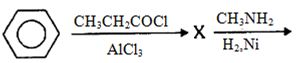
In the given reaction,identify the final product.
A
$C_6H_5-NH-CH_2-CH_2-COCl$
B
$C_6H_5-CH(NHCH_3)-CH_2-CH_3$
C
$C_6H_5-CH_2-CH_2-CONHCH_3$
D
$C_6H_5-CO-CH_2-CH_2-NHCH_3$
Solution
(B) Step $1$: The reaction of benzene with $CH_3CH_2COCl$ in the presence of $AlCl_3$ is a Friedel-Crafts acylation reaction. The product $X$ is propiophenone $(C_6H_5COCH_2CH_3)$.
Step $2$: The reaction of $X$ $(C_6H_5COCH_2CH_3)$ with $CH_3NH_2$ followed by reduction with $H_2, Ni$ is a reductive amination process. The ketone group $(C=O)$ reacts with the amine $(CH_3NH_2)$ to form an imine intermediate,which is then reduced to an amine. The final product is $N$-methyl$-1-$phenylpropan$-1-$amine,represented as $C_6H_5-CH(NHCH_3)-CH_2-CH_3$.
Step $2$: The reaction of $X$ $(C_6H_5COCH_2CH_3)$ with $CH_3NH_2$ followed by reduction with $H_2, Ni$ is a reductive amination process. The ketone group $(C=O)$ reacts with the amine $(CH_3NH_2)$ to form an imine intermediate,which is then reduced to an amine. The final product is $N$-methyl$-1-$phenylpropan$-1-$amine,represented as $C_6H_5-CH(NHCH_3)-CH_2-CH_3$.
0 likes
View Solution22
MediumMCQ
What does the molecular formula $C_3H_9N$ represent?
A
Only primary amines
B
Only secondary amines
C
Only tertiary amines
D
Primary,secondary,and tertiary amines
Solution
(D) The molecular formula $C_3H_9N$ corresponds to the general formula $C_nH_{2n+3}N$,which represents saturated amines.
It can form various isomers:
$1$. Primary $(1^\circ)$ amines: $CH_3CH_2CH_2NH_2$ (propan$-1-$amine) and $CH_3CH(NH_2)CH_3$ (propan$-2-$amine).
$2$. Secondary $(2^\circ)$ amine: $CH_3CH_2NHCH_3$ ($N$-methylethanamine).
$3$. Tertiary $(3^\circ)$ amine: $(CH_3)_3N$ ($N$,$N$-dimethylmethanamine).
Thus,it represents all three types of amines.
It can form various isomers:
$1$. Primary $(1^\circ)$ amines: $CH_3CH_2CH_2NH_2$ (propan$-1-$amine) and $CH_3CH(NH_2)CH_3$ (propan$-2-$amine).
$2$. Secondary $(2^\circ)$ amine: $CH_3CH_2NHCH_3$ ($N$-methylethanamine).
$3$. Tertiary $(3^\circ)$ amine: $(CH_3)_3N$ ($N$,$N$-dimethylmethanamine).
Thus,it represents all three types of amines.
0 likes
View Solution23
MediumMCQ
What is the total number of possible amines (excluding stereoisomers) for the molecular formula $C_3H_9N$?
A
$2$
B
$3$
C
$4$
D
$5$
Solution
(C) The molecular formula $C_3H_9N$ corresponds to the general formula $C_nH_{2n+3}N$,which indicates a saturated amine.
Possible isomers are:
$1$. Primary amines $(1^{\circ})$: $CH_3CH_2CH_2NH_2$ (propan$-1-$amine) and $CH_3CH(NH_2)CH_3$ (propan$-2-$amine).
$2$. Secondary amines $(2^{\circ})$: $CH_3CH_2NHCH_3$ ($N$-methylethanamine).
$3$. Tertiary amines $(3^{\circ})$: $(CH_3)_3N$ ($N$,$N$-dimethylmethanamine).
Total number of isomers = $2 + 1 + 1 = 4$.
Possible isomers are:
$1$. Primary amines $(1^{\circ})$: $CH_3CH_2CH_2NH_2$ (propan$-1-$amine) and $CH_3CH(NH_2)CH_3$ (propan$-2-$amine).
$2$. Secondary amines $(2^{\circ})$: $CH_3CH_2NHCH_3$ ($N$-methylethanamine).
$3$. Tertiary amines $(3^{\circ})$: $(CH_3)_3N$ ($N$,$N$-dimethylmethanamine).
Total number of isomers = $2 + 1 + 1 = 4$.
0 likes
View Solution24
MediumMCQ
In the hydrolysis of aniline,the reagent used is:
A
Dil. $HCl$
B
Acetyl chloride
C
$CH_3OH$
D
None of these
Solution
(D) Aniline is a weak base. $C_6H_5NH_2$ reacts with mineral acids like $HCl$ to form anilinium chloride,which is a salt. This process is essentially a salt formation reaction,not hydrolysis. Therefore,none of the reagents listed are used for the hydrolysis of aniline,as aniline does not undergo hydrolysis under these conditions.
0 likes
View Solution25
DifficultMCQ
Match the compounds given in List-$I$ with their characteristic reactions given in List-$II$. Select the correct option.
| List-$I$ (Compounds) | List-$II$ (Reactions) |
| $A. \ CH_3(CH_2)_3NH_2$ | $(i)$ Alkaline hydrolysis |
| $B. \ CH_3C\equiv CH$ | $(ii)$ With $KOH$ (alc.) and $CHCl_3$ produces bad smell |
| $C. \ CH_3CH_2COOCH_3$ | $(iii)$ Gives white ppt. with ammoniacal $AgNO_3$ |
| $D. \ CH_3CH(OH)CH_3$ | $(iv)$ With Lucas reagent cloudiness appears after $5 \ minutes$ |
A
$A-(ii), B-(i), C-(iv), D-(iii)$
B
$A-(iii), B-(ii), C-(i), D-(iv)$
C
$A-(ii), B-(iii), C-(i), D-(iv)$
D
$A-(iv), B-(ii), C-(iii), D-(i)$
Solution
(C) $A. \ CH_3(CH_2)_3NH_2$ is a primary amine,which gives the carbylamine test with $KOH$ (alc.) and $CHCl_3$ to produce a foul-smelling isocyanide $(ii)$.
$B. \ CH_3C\equiv CH$ is a terminal alkyne,which reacts with ammoniacal $AgNO_3$ to form a white precipitate of silver acetylide $(iii)$.
$C. \ CH_3CH_2COOCH_3$ is an ester,which undergoes alkaline hydrolysis to form an alcohol and a carboxylate salt $(i)$.
$D. \ CH_3CH(OH)CH_3$ is a secondary alcohol,which reacts with Lucas reagent $(ZnCl_2 + conc. HCl)$ to produce cloudiness within $5-10 \ minutes$ $(iv)$.
Thus,the correct matching is $A-(ii), B-(iii), C-(i), D-(iv)$.
$B. \ CH_3C\equiv CH$ is a terminal alkyne,which reacts with ammoniacal $AgNO_3$ to form a white precipitate of silver acetylide $(iii)$.
$C. \ CH_3CH_2COOCH_3$ is an ester,which undergoes alkaline hydrolysis to form an alcohol and a carboxylate salt $(i)$.
$D. \ CH_3CH(OH)CH_3$ is a secondary alcohol,which reacts with Lucas reagent $(ZnCl_2 + conc. HCl)$ to produce cloudiness within $5-10 \ minutes$ $(iv)$.
Thus,the correct matching is $A-(ii), B-(iii), C-(i), D-(iv)$.
0 likes
View Solution26
AdvancedMCQ
$A$ given nitrogen-containing aromatic compound $A$ reacts with $Sn/HCl,$ followed by $HNO_2$ to give an unstable compound $B$. $B,$ on treatment with phenol,forms a beautiful coloured compound $C$ with the molecular formula $C_{12}H_{10}N_2O.$ The structure of compound $A$ is
A
Aniline
B
Nitrobenzene
C
Benzonitrile
D
Benzamide
Solution
(B) The reaction sequence is as follows:
$1$. Compound $A$ reacts with $Sn/HCl$ (a reducing agent) to form an amine. This indicates that $A$ is a nitro compound,specifically nitrobenzene $(C_6H_5NO_2)$.
$2$. Nitrobenzene $(C_6H_5NO_2)$ is reduced to aniline $(C_6H_5NH_2)$.
$3$. Aniline reacts with $HNO_2$ (nitrous acid) at $0-5^{\circ}C$ to form benzenediazonium chloride $(C_6H_5N_2^+Cl^-)$,which is the unstable compound $B$.
$4$. Benzenediazonium chloride $(B)$ undergoes a coupling reaction with phenol $(C_6H_5OH)$ in a basic medium to form $p$-hydroxyazobenzene $(C_6H_5-N=N-C_6H_4OH)$,which is the coloured compound $C$ with molecular formula $C_{12}H_{10}N_2O$.
Therefore,compound $A$ is nitrobenzene.
$1$. Compound $A$ reacts with $Sn/HCl$ (a reducing agent) to form an amine. This indicates that $A$ is a nitro compound,specifically nitrobenzene $(C_6H_5NO_2)$.
$2$. Nitrobenzene $(C_6H_5NO_2)$ is reduced to aniline $(C_6H_5NH_2)$.
$3$. Aniline reacts with $HNO_2$ (nitrous acid) at $0-5^{\circ}C$ to form benzenediazonium chloride $(C_6H_5N_2^+Cl^-)$,which is the unstable compound $B$.
$4$. Benzenediazonium chloride $(B)$ undergoes a coupling reaction with phenol $(C_6H_5OH)$ in a basic medium to form $p$-hydroxyazobenzene $(C_6H_5-N=N-C_6H_4OH)$,which is the coloured compound $C$ with molecular formula $C_{12}H_{10}N_2O$.
Therefore,compound $A$ is nitrobenzene.
0 likes
View Solution27
DifficultMCQ
In a reaction of aniline,a coloured product $C$ was obtained as shown below:
$A$ $\xrightarrow{NaNO_2/HCl} B$ $\xrightarrow{N,N-dimethylaniline, \text{cold}} C$
The structure of $C$ would be:
$A$ $\xrightarrow{NaNO_2/HCl} B$ $\xrightarrow{N,N-dimethylaniline, \text{cold}} C$
The structure of $C$ would be:
A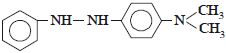
B
C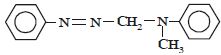
D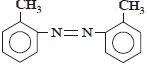
Solution
(B) $1$. The reaction of aniline $(A)$ with $NaNO_2$ and $HCl$ at $0-5^{\circ}C$ (cold conditions) produces benzene diazonium chloride $(B)$.
$2$. Benzene diazonium chloride $(B)$ undergoes an electrophilic aromatic substitution (coupling reaction) with $N,N$-dimethylaniline.
$3$. The coupling occurs at the para-position of the $N,N$-dimethylaniline ring to form $p$-dimethylaminoazobenzene,which is a yellow-coloured dye known as 'Butter yellow' $(C)$.
$4$. The structure of $C$ is $Ph-N=N-C_6H_4-N(CH_3)_2$.
$2$. Benzene diazonium chloride $(B)$ undergoes an electrophilic aromatic substitution (coupling reaction) with $N,N$-dimethylaniline.
$3$. The coupling occurs at the para-position of the $N,N$-dimethylaniline ring to form $p$-dimethylaminoazobenzene,which is a yellow-coloured dye known as 'Butter yellow' $(C)$.
$4$. The structure of $C$ is $Ph-N=N-C_6H_4-N(CH_3)_2$.
0 likes
View Solution28
DifficultMCQ
Major end product of the following sequence of reaction is: $CH_3-CH_2-CH_2-CONH_2$ $\xrightarrow{Ca(OH)_2, Cl_2, \Delta} X$ $\xrightarrow{HNO_2} Z$
A
$CH_3-CH_2-CH_2-NH_2$
B
$CH_3-CH_2-CH_2-OH$
C
$CH_3-CH(OH)-CH_3$
D
$CH_3-CH_2-COOH$
Solution
(C) $CH_3-CH_2-CH_2-CONH_2$ (Butanamide) undergoes Hofmann bromamide (chloramide) degradation with $Ca(OH)_2$ and $Cl_2$ to form $CH_3-CH_2-CH_2-NH_2$ (Propan$-1-$amine) as $X$.
Reaction of $X$ with $HNO_2$ forms a primary carbocation $CH_3-CH_2-CH_2^+$,which rearranges via a $1,2$-hydride shift to a more stable secondary carbocation $CH_3-CH^+ -CH_3$.
Nucleophilic attack by water on this carbocation yields Propan$-2-$ol $(CH_3-CH(OH)-CH_3)$ as the major product $Z$.
Reaction of $X$ with $HNO_2$ forms a primary carbocation $CH_3-CH_2-CH_2^+$,which rearranges via a $1,2$-hydride shift to a more stable secondary carbocation $CH_3-CH^+ -CH_3$.
Nucleophilic attack by water on this carbocation yields Propan$-2-$ol $(CH_3-CH(OH)-CH_3)$ as the major product $Z$.
0 likes
View Solution29
MediumMCQ
The number of primary,secondary,and tertiary amines possible with the molecular formula $C_3H_9N$ is:
A
$1, 2, 2$
B
$1, 2, 1$
C
$2, 1, 1$
D
$3, 0, 1$
Solution
(C) For the molecular formula $C_3H_9N$,the possible isomers are:
$1$. Primary amines $(1^{\circ})$: $CH_3CH_2CH_2NH_2$ (propan$-1-$amine) and $CH_3CH(NH_2)CH_3$ (propan$-2-$amine). Total = $2$.
$2$. Secondary amine $(2^{\circ})$: $CH_3CH_2NHCH_3$ ($N$-methylethanamine). Total = $1$.
$3$. Tertiary amine $(3^{\circ})$: $(CH_3)_3N$ ($N,N$-dimethylmethanamine). Total = $1$.
Thus,the number of primary,secondary,and tertiary amines are $2, 1, 1$ respectively.
$1$. Primary amines $(1^{\circ})$: $CH_3CH_2CH_2NH_2$ (propan$-1-$amine) and $CH_3CH(NH_2)CH_3$ (propan$-2-$amine). Total = $2$.
$2$. Secondary amine $(2^{\circ})$: $CH_3CH_2NHCH_3$ ($N$-methylethanamine). Total = $1$.
$3$. Tertiary amine $(3^{\circ})$: $(CH_3)_3N$ ($N,N$-dimethylmethanamine). Total = $1$.
Thus,the number of primary,secondary,and tertiary amines are $2, 1, 1$ respectively.
0 likes
View Solution30
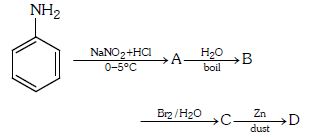
DifficultMCQ
Compound $D$ is
A
$2,4,6-$Tribromophenol
B
Phenol
C
$1,3,5-$Tribromobenzene
D
$1,3,5-$Trihydroxybenzene
Solution
(C) $1$. Aniline reacts with $NaNO_2 + HCl$ at $0-5^{\circ}C$ to form benzene diazonium chloride $(A)$.
$2$. Benzene diazonium chloride $(A)$ on boiling with water gives phenol $(B)$.
$3$. Phenol $(B)$ reacts with $Br_2/H_2O$ to form $2,4,6-$tribromophenol $(C)$.
$4$. $2,4,6-$tribromophenol $(C)$ on treatment with $Zn$ dust undergoes reduction to form $1,3,5-$tribromobenzene $(D)$.
$2$. Benzene diazonium chloride $(A)$ on boiling with water gives phenol $(B)$.
$3$. Phenol $(B)$ reacts with $Br_2/H_2O$ to form $2,4,6-$tribromophenol $(C)$.
$4$. $2,4,6-$tribromophenol $(C)$ on treatment with $Zn$ dust undergoes reduction to form $1,3,5-$tribromobenzene $(D)$.
0 likes
View Solution31
MediumMCQ
What is the major product of the following reaction? $C_2H_5-CONH_2$ $\xrightarrow{Br_2 / KOH} A$ $\xrightarrow{CHCl_3 / KOH} \text{Major Product}$
A
$CH_3-CN$
B
$C_2H_5-NC$
C
$C_2H_5-CN$
D
$CH_3-NC$
Solution
(B) The reaction sequence involves the Hofmann Bromamide Degradation followed by the Carbylamine reaction.
Step $1$: $C_2H_5-CONH_2 \xrightarrow{Br_2 / KOH} C_2H_5-NH_2$ (Ethylamine).
Step $2$: $C_2H_5-NH_2 \xrightarrow{CHCl_3 / KOH} C_2H_5-NC$ (Ethyl isocyanide).
Therefore,the major product is $C_2H_5-NC$.
Step $1$: $C_2H_5-CONH_2 \xrightarrow{Br_2 / KOH} C_2H_5-NH_2$ (Ethylamine).
Step $2$: $C_2H_5-NH_2 \xrightarrow{CHCl_3 / KOH} C_2H_5-NC$ (Ethyl isocyanide).
Therefore,the major product is $C_2H_5-NC$.
0 likes
View Solution32
DifficultMCQ
Identify $C$ in the following reaction sequence:
$Cyclohexanone$ $\xrightarrow[\text{Alkaline medium}]{HCN} A$ $\xrightarrow{LiAlH_4} B$ $\xrightarrow{NaNO_2/HCl} C$
$Cyclohexanone$ $\xrightarrow[\text{Alkaline medium}]{HCN} A$ $\xrightarrow{LiAlH_4} B$ $\xrightarrow{NaNO_2/HCl} C$
A
$1-$(aminomethyl)cyclohexanol
B
$1-$(aminomethyl)cyclohexan$-1-$ol
C
cyclohexane$-1,2-$diol
D
$1-$(hydroxymethyl)cyclohexan$-1-$ol
Solution
(D) $1$. The reaction starts with cyclohexanone.
$2$. Addition of $HCN$ to cyclohexanone in an alkaline medium gives the cyanohydrin,$A$,which is $1-hydroxycyclohexanecarbonitrile$.
$3$. Reduction of the nitrile group $(-CN)$ with $LiAlH_4$ converts it into a primary amine $(-CH_2NH_2)$,yielding $B$,which is $1-(aminomethyl)cyclohexan-1-ol$.
$4$. Treatment of a primary aliphatic amine with $NaNO_2/HCl$ (nitrous acid) at low temperature leads to the formation of a diazonium salt,which is highly unstable and decomposes to form a carbocation. This carbocation then reacts with water to form an alcohol.
$5$. The product $C$ is $1-(hydroxymethyl)cyclohexan-1-ol$.
$2$. Addition of $HCN$ to cyclohexanone in an alkaline medium gives the cyanohydrin,$A$,which is $1-hydroxycyclohexanecarbonitrile$.
$3$. Reduction of the nitrile group $(-CN)$ with $LiAlH_4$ converts it into a primary amine $(-CH_2NH_2)$,yielding $B$,which is $1-(aminomethyl)cyclohexan-1-ol$.
$4$. Treatment of a primary aliphatic amine with $NaNO_2/HCl$ (nitrous acid) at low temperature leads to the formation of a diazonium salt,which is highly unstable and decomposes to form a carbocation. This carbocation then reacts with water to form an alcohol.
$5$. The product $C$ is $1-(hydroxymethyl)cyclohexan-1-ol$.
0 likes
View Solution33
DifficultMCQ
$(A)$ $\xrightarrow{KOBr} (B)$ $\xrightarrow[KOH]{CHCl_3} (C)$ $\xrightarrow{LiAlH_4} \text{Structure of } (C) \text{ is}$
A
p-methylbenzonitrile
B
p-methylphenyl isocyanide
C
$N$-methyl-m-toluidine
D
o-methylbenzonitrile
Solution
(B) $1$. The reaction sequence starts with $(A)$,which is $p$-methylbenzamide $(CH_3-C_6H_4-CONH_2)$.
$2$. Hofmann bromamide degradation: $(A) \xrightarrow{KOBr} (B)$. This converts the amide group $(-CONH_2)$ to a primary amine group $(-NH_2)$. Thus,$(B)$ is $p$-toluidine $(CH_3-C_6H_4-NH_2)$.
$3$. Carbylamine reaction: $(B) \xrightarrow{CHCl_3/KOH} (C)$. Primary amines react with chloroform and alcoholic $KOH$ to form isocyanides (isonitriles). Thus,$(C)$ is $p$-methylphenyl isocyanide $(CH_3-C_6H_4-NC)$.
$4$. Reduction: $(C) \xrightarrow{LiAlH_4} \text{Product}$. Isocyanides are reduced to secondary amines $(R-NH-CH_3)$. Therefore,the final product is $N$-methyl-$p$-toluidine $(CH_3-C_6H_4-NHCH_3)$.
$5$. The question asks for the structure of $(C)$,which is $p$-methylphenyl isocyanide.
$2$. Hofmann bromamide degradation: $(A) \xrightarrow{KOBr} (B)$. This converts the amide group $(-CONH_2)$ to a primary amine group $(-NH_2)$. Thus,$(B)$ is $p$-toluidine $(CH_3-C_6H_4-NH_2)$.
$3$. Carbylamine reaction: $(B) \xrightarrow{CHCl_3/KOH} (C)$. Primary amines react with chloroform and alcoholic $KOH$ to form isocyanides (isonitriles). Thus,$(C)$ is $p$-methylphenyl isocyanide $(CH_3-C_6H_4-NC)$.
$4$. Reduction: $(C) \xrightarrow{LiAlH_4} \text{Product}$. Isocyanides are reduced to secondary amines $(R-NH-CH_3)$. Therefore,the final product is $N$-methyl-$p$-toluidine $(CH_3-C_6H_4-NHCH_3)$.
$5$. The question asks for the structure of $(C)$,which is $p$-methylphenyl isocyanide.
0 likes
View Solution34
DifficultMCQ
Primary and secondary amines are distinguished by
$(i)$ Hinsberg test
$(ii)$ Carbyl amine test
$(iii)$ Hofmann mustard oil test
$(iv)$ $HNO_2$ test
$(i)$ Hinsberg test
$(ii)$ Carbyl amine test
$(iii)$ Hofmann mustard oil test
$(iv)$ $HNO_2$ test
A
$i$ and $iii$ only
B
$i, ii$ and $iv$ only
C
$i, ii, iii$ and $iv$ only
D
$ii$ and $iii$ only
Solution
(C) The distinction between primary $(1^{\circ})$ and secondary $(2^{\circ})$ amines is as follows:
$(i)$ Hinsberg test: $1^{\circ}$ amines react with benzenesulfonyl chloride to form a sulfonamide soluble in alkali,while $2^{\circ}$ amines form a sulfonamide insoluble in alkali.
$(ii)$ Carbyl amine test: Only $1^{\circ}$ amines give this test (foul-smelling isocyanide),while $2^{\circ}$ amines do not.
$(iii)$ Hofmann mustard oil test: Only $1^{\circ}$ amines give this test,while $2^{\circ}$ amines do not.
$(iv)$ $HNO_2$ test: $1^{\circ}$ aliphatic amines react with $HNO_2$ to evolve $N_2$ gas,whereas $2^{\circ}$ amines form $N$-nitrosamines (yellow oily liquids).
Since all four tests can distinguish between $1^{\circ}$ and $2^{\circ}$ amines,the correct option is $C$.
$(i)$ Hinsberg test: $1^{\circ}$ amines react with benzenesulfonyl chloride to form a sulfonamide soluble in alkali,while $2^{\circ}$ amines form a sulfonamide insoluble in alkali.
$(ii)$ Carbyl amine test: Only $1^{\circ}$ amines give this test (foul-smelling isocyanide),while $2^{\circ}$ amines do not.
$(iii)$ Hofmann mustard oil test: Only $1^{\circ}$ amines give this test,while $2^{\circ}$ amines do not.
$(iv)$ $HNO_2$ test: $1^{\circ}$ aliphatic amines react with $HNO_2$ to evolve $N_2$ gas,whereas $2^{\circ}$ amines form $N$-nitrosamines (yellow oily liquids).
Since all four tests can distinguish between $1^{\circ}$ and $2^{\circ}$ amines,the correct option is $C$.
0 likes
View Solution35
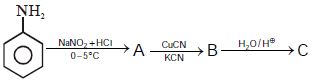
DifficultMCQ
In the given reaction,the end product $(C)$ is:
A
Phenylmethanamine
B
Benzoic acid
C
Phenol
D
Benzonitrile
Solution
(B) $1$. The reaction starts with aniline $(C_6H_5NH_2)$.
$2$. Treatment with $NaNO_2 + HCl$ at $0-5^{\circ}C$ performs diazotization to form benzene diazonium chloride $(A)$,which is $C_6H_5N_2^+Cl^-$.
$3$. Reaction of $A$ with $CuCN/KCN$ (Sandmeyer reaction) replaces the diazonium group with a cyano group to form benzonitrile $(B)$,which is $C_6H_5CN$.
$4$. Acidic hydrolysis of benzonitrile $(B)$ with $H_2O/H^+$ converts the cyano group $(-CN)$ into a carboxylic acid group $(-COOH)$,resulting in benzoic acid $(C)$,which is $C_6H_5COOH$.
$2$. Treatment with $NaNO_2 + HCl$ at $0-5^{\circ}C$ performs diazotization to form benzene diazonium chloride $(A)$,which is $C_6H_5N_2^+Cl^-$.
$3$. Reaction of $A$ with $CuCN/KCN$ (Sandmeyer reaction) replaces the diazonium group with a cyano group to form benzonitrile $(B)$,which is $C_6H_5CN$.
$4$. Acidic hydrolysis of benzonitrile $(B)$ with $H_2O/H^+$ converts the cyano group $(-CN)$ into a carboxylic acid group $(-COOH)$,resulting in benzoic acid $(C)$,which is $C_6H_5COOH$.
0 likes
View Solution36
MediumMCQ
Number of structural isomers of $C_4H_{11}N$.
A
$4$
B
$8$
C
$6$
D
$10$
Solution
(B) $1.$ Primary Amines $(R-NH_2)$:
$CH_3CH_2CH_2CH_2NH_2$ ($n$-butylamine)
$CH_3CH_2CH(NH_2)CH_3$ ($sec$-butylamine)
$(CH_3)_2CHCH_2NH_2$ (isobutylamine)
$(CH_3)_3CNH_2$ ($tert$-butylamine)
$2.$ Secondary Amines $(R-NH-R')$:
$CH_3CH_2CH_2NHCH_3$ ($N$-methylpropan$-1-$amine)
$(CH_3)_2CHNHCH_3$ ($N$-methylpropan$-2-$amine)
$CH_3CH_2NHCH_2CH_3$ ($N$-ethylethanamine)
$3.$ Tertiary Amines $(R-N(R')-R'')$:
$CH_3CH_2N(CH_3)_2$ ($N,N$-dimethylethanamine)
Total structural isomers = $4$ (primary) + $3$ (secondary) + $1$ (tertiary) = $8$.
$CH_3CH_2CH_2CH_2NH_2$ ($n$-butylamine)
$CH_3CH_2CH(NH_2)CH_3$ ($sec$-butylamine)
$(CH_3)_2CHCH_2NH_2$ (isobutylamine)
$(CH_3)_3CNH_2$ ($tert$-butylamine)
$2.$ Secondary Amines $(R-NH-R')$:
$CH_3CH_2CH_2NHCH_3$ ($N$-methylpropan$-1-$amine)
$(CH_3)_2CHNHCH_3$ ($N$-methylpropan$-2-$amine)
$CH_3CH_2NHCH_2CH_3$ ($N$-ethylethanamine)
$3.$ Tertiary Amines $(R-N(R')-R'')$:
$CH_3CH_2N(CH_3)_2$ ($N,N$-dimethylethanamine)
Total structural isomers = $4$ (primary) + $3$ (secondary) + $1$ (tertiary) = $8$.
0 likes
View Solution37
MediumMCQ
The correct order of basic strengths of the given amines is:
A
$Me_2NH$ $(2^o)$ > $MeNH_2$ $(1^o)$ > $Me_3N$ $(3^o)$ > $NH_3$ (in polar protic solvent)
B
$Et_2NH$ $(2^o)$ > $Et_3N$ $(3^o)$ > $EtNH_2$ $(1^o)$ > $NH_3$ (in polar protic solvent)
C
$Me_3N > Me_2NH > MeNH_2 > NH_3$ (in gas phase)
D
All are correct
Solution
(D) The basic strength of amines depends on the inductive effect,solvation effect,and steric hindrance.
$(a)$ For methyl-substituted amines in a polar protic solvent,the order is $Me_2NH > MeNH_2 > Me_3N > NH_3$.
$(b)$ For ethyl-substituted amines in a polar protic solvent,the order is $Et_2NH > Et_3N > EtNH_2 > NH_3$.
$(c)$ In the gas phase,the solvation effect is absent,and the basicity is determined by the inductive effect of alkyl groups,leading to the order $3^o > 2^o > 1^o > NH_3$ (i.e.,$Me_3N > Me_2NH > MeNH_2 > NH_3$).
Since all these statements are correct,the correct option is $D$.
$(a)$ For methyl-substituted amines in a polar protic solvent,the order is $Me_2NH > MeNH_2 > Me_3N > NH_3$.
$(b)$ For ethyl-substituted amines in a polar protic solvent,the order is $Et_2NH > Et_3N > EtNH_2 > NH_3$.
$(c)$ In the gas phase,the solvation effect is absent,and the basicity is determined by the inductive effect of alkyl groups,leading to the order $3^o > 2^o > 1^o > NH_3$ (i.e.,$Me_3N > Me_2NH > MeNH_2 > NH_3$).
Since all these statements are correct,the correct option is $D$.
0 likes
View Solution38
MediumMCQ
The most reactive amine towards dilute hydrochloric acid is ..........
A
B
C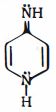
D
Solution
(C) The reactivity of an amine towards dilute hydrochloric acid $(HCl)$ depends on its basicity. The more basic the amine,the more readily it will accept a proton $(H^+)$ from the acid to form a salt.
$1$. $C_6H_5CH_2NH_2$ (Benzylamine) is a primary aliphatic amine,which is relatively basic.
$2$. $C_6H_5CONH_2$ (Benzamide) is an amide,where the lone pair on nitrogen is involved in resonance with the carbonyl group,making it very weakly basic.
$3$. $C_6H_5NH_2$ (Aniline) is an aromatic amine,where the lone pair on nitrogen is involved in resonance with the benzene ring,making it weakly basic.
$4$. $4-aminopyridine$ has two nitrogen atoms. The nitrogen in the ring (pyridine-like) is basic,and the amino group $(NH_2)$ can donate its lone pair into the ring,significantly increasing the electron density on the ring nitrogen. Upon protonation at the ring nitrogen,the resulting cation is stabilized by resonance,which includes an aromatic form. This makes it significantly more basic than the other options.
$1$. $C_6H_5CH_2NH_2$ (Benzylamine) is a primary aliphatic amine,which is relatively basic.
$2$. $C_6H_5CONH_2$ (Benzamide) is an amide,where the lone pair on nitrogen is involved in resonance with the carbonyl group,making it very weakly basic.
$3$. $C_6H_5NH_2$ (Aniline) is an aromatic amine,where the lone pair on nitrogen is involved in resonance with the benzene ring,making it weakly basic.
$4$. $4-aminopyridine$ has two nitrogen atoms. The nitrogen in the ring (pyridine-like) is basic,and the amino group $(NH_2)$ can donate its lone pair into the ring,significantly increasing the electron density on the ring nitrogen. Upon protonation at the ring nitrogen,the resulting cation is stabilized by resonance,which includes an aromatic form. This makes it significantly more basic than the other options.
0 likes
View Solution39
MediumMCQ
Predict the stereochemistry of the product when a $d$ and $l$-amine mixture reacts with an $l$-acid.
A
Diastereomers
B
Meso
C
Racemic
D
Pure Enantiomer
Solution
(A) The $d$ and $l$-amine mixture is a racemic mixture.
When a racemic mixture reacts with an optically active compound (like $l$-acid),it forms a mixture of diastereomers.
This is because the $d$-amine reacts with $l$-acid to form a $(d,l)$-salt,and the $l$-amine reacts with $l$-acid to form an $(l,l)$-salt.
These two salts are diastereomers of each other.
When a racemic mixture reacts with an optically active compound (like $l$-acid),it forms a mixture of diastereomers.
This is because the $d$-amine reacts with $l$-acid to form a $(d,l)$-salt,and the $l$-amine reacts with $l$-acid to form an $(l,l)$-salt.
These two salts are diastereomers of each other.
0 likes
View Solution40
DifficultMCQ
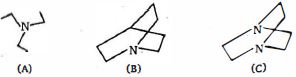
The relative rate of reaction of the following amines with methyl iodide is:
A
$A > B > C$
B
$A > C > B$
C
$B > C > A$
D
$B > A > C$
Solution
(D) The reaction of amines with methyl iodide is a nucleophilic substitution reaction $(S_N2)$.
For the same nucleophilic atom (nitrogen),the nucleophilicity is directly proportional to the basicity of the amine.
Structure $(A)$ is triethylamine,which is a flexible tertiary amine.
Structure $(B)$ is quinuclidine,a rigid bicyclic amine where the lone pair is more available due to less steric hindrance compared to $(A)$ and $(C)$.
Structure $(C)$ is $DABCO$ ($1$,$4$-diazabicyclo[$2.2$.$2$]octane),where the lone pair on one nitrogen is involved in resonance/inductive effects of the other nitrogen,reducing its basicity and nucleophilicity compared to $(B)$.
Thus,the order of basicity and nucleophilicity is $B > A > C$.
For the same nucleophilic atom (nitrogen),the nucleophilicity is directly proportional to the basicity of the amine.
Structure $(A)$ is triethylamine,which is a flexible tertiary amine.
Structure $(B)$ is quinuclidine,a rigid bicyclic amine where the lone pair is more available due to less steric hindrance compared to $(A)$ and $(C)$.
Structure $(C)$ is $DABCO$ ($1$,$4$-diazabicyclo[$2.2$.$2$]octane),where the lone pair on one nitrogen is involved in resonance/inductive effects of the other nitrogen,reducing its basicity and nucleophilicity compared to $(B)$.
Thus,the order of basicity and nucleophilicity is $B > A > C$.
0 likes
View Solution41
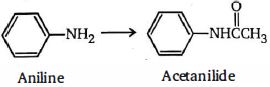
MediumMCQ
All but one of the following compounds react with aniline to give acetanilide. Which one does not?
A
$CH_3COCl$
B
$(CH_3CO)_2O$
C
$CH_3CHO$
D
$CH_3COOC_6H_5$
Solution
(C) Aniline $(C_6H_5NH_2)$ undergoes acetylation to form acetanilide $(C_6H_5NHCOCH_3)$ when reacted with acetylating agents like acetyl chloride $(CH_3COCl)$,acetic anhydride $((CH_3CO)_2O)$,or phenyl acetate $(CH_3COOC_6H_5)$.
However,reaction with acetaldehyde $(CH_3CHO)$ leads to the formation of a Schiff base (imine) via nucleophilic addition followed by dehydration:
$C_6H_5NH_2 + CH_3CHO \to C_6H_5N=CHCH_3 + H_2O$
Therefore,acetaldehyde does not produce acetanilide.
However,reaction with acetaldehyde $(CH_3CHO)$ leads to the formation of a Schiff base (imine) via nucleophilic addition followed by dehydration:
$C_6H_5NH_2 + CH_3CHO \to C_6H_5N=CHCH_3 + H_2O$
Therefore,acetaldehyde does not produce acetanilide.
0 likes
View Solution42
MediumMCQ
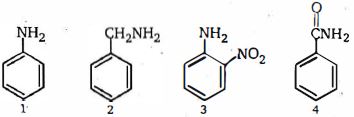
Rank the following compounds in order of increasing basic strength. (weakest $\to$ strongest)
A
$4 < 2 < 1 < 3$
B
$4 < 3 < 1 < 2$
C
$4 < 1 < 3 < 2$
D
$2 < 1 < 3 < 4$
Solution
(B) The compounds are:
$(1)$ Aniline $(C_6H_5NH_2)$: The lone pair on nitrogen is involved in resonance with the benzene ring,making it a weak base.
$(2)$ Benzylamine $(C_6H_5CH_2NH_2)$: The lone pair on nitrogen is not involved in resonance,making it the strongest base among the given compounds.
$(3)$ $o$-Nitroaniline $(o-NO_2-C_6H_4NH_2)$: The $-NO_2$ group is a strong electron-withdrawing group ($-M$ and $-I$ effect). Additionally,the ortho effect further decreases its basicity.
$(4)$ Benzamide $(C_6H_5CONH_2)$: The lone pair on nitrogen is involved in resonance with the carbonyl group $(C=O)$,which is a very strong electron-withdrawing group,making it the weakest base.
Comparing the basicity:
$(4)$ is the weakest due to strong resonance with the carbonyl group.
$(3)$ is weaker than $(1)$ due to the electron-withdrawing $-NO_2$ group and ortho effect.
$(1)$ is weaker than $(2)$ because $(2)$ is an aliphatic amine where the lone pair is localized.
Thus,the order of increasing basic strength is $4 < 3 < 1 < 2$.
$(1)$ Aniline $(C_6H_5NH_2)$: The lone pair on nitrogen is involved in resonance with the benzene ring,making it a weak base.
$(2)$ Benzylamine $(C_6H_5CH_2NH_2)$: The lone pair on nitrogen is not involved in resonance,making it the strongest base among the given compounds.
$(3)$ $o$-Nitroaniline $(o-NO_2-C_6H_4NH_2)$: The $-NO_2$ group is a strong electron-withdrawing group ($-M$ and $-I$ effect). Additionally,the ortho effect further decreases its basicity.
$(4)$ Benzamide $(C_6H_5CONH_2)$: The lone pair on nitrogen is involved in resonance with the carbonyl group $(C=O)$,which is a very strong electron-withdrawing group,making it the weakest base.
Comparing the basicity:
$(4)$ is the weakest due to strong resonance with the carbonyl group.
$(3)$ is weaker than $(1)$ due to the electron-withdrawing $-NO_2$ group and ortho effect.
$(1)$ is weaker than $(2)$ because $(2)$ is an aliphatic amine where the lone pair is localized.
Thus,the order of increasing basic strength is $4 < 3 < 1 < 2$.
0 likes
View Solution43
DifficultMCQ
$A$ nitrile $X$ is treated with $LiAlH_{4}$ to obtain compound $Y$ $(C_{2}H_{7}N)$. In a separate reaction,$X$ is hydrolyzed in an acidic medium to obtain $Z$. The product obtained after mixing $Y$ and $Z$ will be:
A
$CH_{3}CONHCH_{2}CH_{3}$
B
$CH_{3}CH_{2}CONHCH_{2}CH_{3}$
C
$(CH_{3}COO^{-})(CH_{3}CH_{2}NH_{3}^{+})$
D
$(CH_{3}CH_{2}COO^{-})(CH_{3}NH_{3}^{+})$
Solution
(C) $1$. The nitrile $X$ is $CH_{3}CN$ (acetonitrile or ethanenitrile).
$2$. Reduction of $CH_{3}CN$ with $LiAlH_{4}$ gives $CH_{3}CH_{2}NH_{2}$ (ethanamine),which is $Y$ $(C_{2}H_{7}N)$.
$3$. Acidic hydrolysis of $CH_{3}CN$ gives $CH_{3}COOH$ (ethanoic acid),which is $Z$.
$4$. When $Y$ (an amine,$CH_{3}CH_{2}NH_{2}$) and $Z$ (a carboxylic acid,$CH_{3}COOH$) are mixed,an acid-base reaction occurs to form a salt: $CH_{3}COOH + CH_{3}CH_{2}NH_{2} \rightarrow CH_{3}COO^{-}CH_{3}CH_{2}NH_{3}^{+}$.
$5$. Thus,the product is $(CH_{3}COO^{-})(CH_{3}CH_{2}NH_{3}^{+})$.
$2$. Reduction of $CH_{3}CN$ with $LiAlH_{4}$ gives $CH_{3}CH_{2}NH_{2}$ (ethanamine),which is $Y$ $(C_{2}H_{7}N)$.
$3$. Acidic hydrolysis of $CH_{3}CN$ gives $CH_{3}COOH$ (ethanoic acid),which is $Z$.
$4$. When $Y$ (an amine,$CH_{3}CH_{2}NH_{2}$) and $Z$ (a carboxylic acid,$CH_{3}COOH$) are mixed,an acid-base reaction occurs to form a salt: $CH_{3}COOH + CH_{3}CH_{2}NH_{2} \rightarrow CH_{3}COO^{-}CH_{3}CH_{2}NH_{3}^{+}$.
$5$. Thus,the product is $(CH_{3}COO^{-})(CH_{3}CH_{2}NH_{3}^{+})$.
0 likes
View Solution44
MediumMCQ
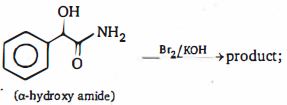
The product of this Hoffmann bromamide reaction is:
A
$Ph-CO-CH_3$
B
$Ph-CHO$
C
$Ph-CH(OH)-NO_2$
D
$Ph-CH_2-NH_2$
Solution
(B) The Hoffmann bromamide degradation reaction converts an amide $(R-CONH_2)$ into a primary amine $(R-NH_2)$ with one carbon atom less.
In this specific case,the starting material is $\alpha$-hydroxy amide,$Ph-CH(OH)-CONH_2$.
Upon treatment with $Br_2/KOH$,the $-CONH_2$ group is converted into an $-NH_2$ group attached to the $\alpha$-carbon.
This yields the intermediate $\alpha$-hydroxy amine,$Ph-CH(OH)-NH_2$.
This intermediate is unstable because it has an $-OH$ and an $-NH_2$ group on the same carbon atom (a geminal amino alcohol).
Such compounds readily eliminate ammonia $(NH_3)$ to form a carbonyl compound.
Therefore,$Ph-CH(OH)-NH_2 \to Ph-CHO + NH_3$.
The final product is benzaldehyde $(Ph-CHO)$.
In this specific case,the starting material is $\alpha$-hydroxy amide,$Ph-CH(OH)-CONH_2$.
Upon treatment with $Br_2/KOH$,the $-CONH_2$ group is converted into an $-NH_2$ group attached to the $\alpha$-carbon.
This yields the intermediate $\alpha$-hydroxy amine,$Ph-CH(OH)-NH_2$.
This intermediate is unstable because it has an $-OH$ and an $-NH_2$ group on the same carbon atom (a geminal amino alcohol).
Such compounds readily eliminate ammonia $(NH_3)$ to form a carbonyl compound.
Therefore,$Ph-CH(OH)-NH_2 \to Ph-CHO + NH_3$.
The final product is benzaldehyde $(Ph-CHO)$.
0 likes
View Solution45
EasyMCQ
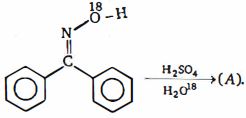
The product $(A)$ of the reaction is:
A
$Ph-NH-CO-Ph$
B
$Ph-NH-C(^{18}O)-Ph$
C
$(Ph)_2-C(OH)-NH_2$
D
$Ph-CH_2-NH-Ph$
Solution
(B) The reaction is a Beckmann rearrangement of benzophenone oxime in the presence of $H_2SO_4$ and $H_2^{18}O$.
In the Beckmann rearrangement,the oxime undergoes protonation followed by the migration of a phenyl group to the nitrogen atom,resulting in the formation of a nitrilium ion.
This nitrilium ion is then attacked by the labeled water molecule $(H_2^{18}O)$.
After the loss of a proton,an imidic acid intermediate is formed,which tautomerizes to the final amide product,$N$-phenylbenzamide,containing the $^{18}O$ isotope in the carbonyl group: $Ph-NH-C(^{18}O)-Ph$.
In the Beckmann rearrangement,the oxime undergoes protonation followed by the migration of a phenyl group to the nitrogen atom,resulting in the formation of a nitrilium ion.
This nitrilium ion is then attacked by the labeled water molecule $(H_2^{18}O)$.
After the loss of a proton,an imidic acid intermediate is formed,which tautomerizes to the final amide product,$N$-phenylbenzamide,containing the $^{18}O$ isotope in the carbonyl group: $Ph-NH-C(^{18}O)-Ph$.
0 likes
View Solution46
DifficultMCQ
$NBS \xrightarrow{KOBr} (A)$. The product $(A)$ is:
A
B
C
D
Solution
(B) The reaction of $N$-bromosuccinimide $(NBS)$ with $KOBr$ (which provides $Br_2$ and $OH^-$) involves the hydrolysis of the imide ring. The $OH^-$ attacks one of the carbonyl carbons,leading to the opening of the succinimide ring. This results in the formation of $4$-amino$-4-$oxobutanoate (or its protonated form depending on pH),which is represented by the structure in option $B$.
0 likes
View Solution47
AdvancedMCQ
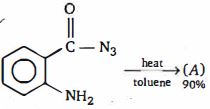
Heating the acyl azide in dry toluene under reflux for $3$ hours gives a $90\%$ yield for a heterocyclic product. Identify the product $(A)$.
A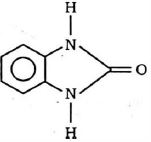
B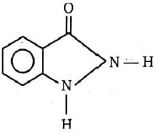
C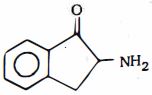
D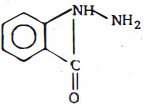
Solution
(A) The reaction is an intramolecular Curtius rearrangement.
$1$. Upon heating,the acyl azide undergoes loss of $N_2$ to form an acyl nitrene or directly rearranges to an isocyanate intermediate.
$2$. The ortho-amino group then performs a nucleophilic attack on the electrophilic carbon of the isocyanate group.
$3$. This cyclization results in the formation of a cyclic urea derivative,specifically $1,3$-dihydro-$2H$-benzimidazol-$2$-one.
$1$. Upon heating,the acyl azide undergoes loss of $N_2$ to form an acyl nitrene or directly rearranges to an isocyanate intermediate.
$2$. The ortho-amino group then performs a nucleophilic attack on the electrophilic carbon of the isocyanate group.
$3$. This cyclization results in the formation of a cyclic urea derivative,specifically $1,3$-dihydro-$2H$-benzimidazol-$2$-one.
0 likes
View Solution48
MediumMCQ
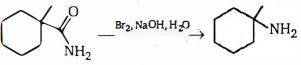
Which of the following species would not be involved in the Hoffmann rearrangement shown below?
A
$N$-bromocyclohexanecarboxamide
B
Cyclohexyl isocyanate
C
Nitrene intermediate
D
All of the above are involved in the reaction.
Solution
(D) The Hoffmann rearrangement involves the following steps:
$1$. Formation of $N$-bromamide by the reaction of amide with $Br_2$ and $NaOH$.
$2$. Formation of an acyl nitrene or direct rearrangement of the $N$-bromoamide anion to an isocyanate.
$3$. The isocyanate is then hydrolyzed to the amine.
Looking at the provided mechanism in the solution image,the species involved are:
$(a)$ $N$-bromocyclohexanecarboxamide
$(b)$ The conjugate base of the $N$-bromoamide
$(c)$ Cyclohexyl isocyanate
Since all these species are intermediates or products in the mechanism of the Hoffmann rearrangement,option $D$ is the correct answer.
$1$. Formation of $N$-bromamide by the reaction of amide with $Br_2$ and $NaOH$.
$2$. Formation of an acyl nitrene or direct rearrangement of the $N$-bromoamide anion to an isocyanate.
$3$. The isocyanate is then hydrolyzed to the amine.
Looking at the provided mechanism in the solution image,the species involved are:
$(a)$ $N$-bromocyclohexanecarboxamide
$(b)$ The conjugate base of the $N$-bromoamide
$(c)$ Cyclohexyl isocyanate
Since all these species are intermediates or products in the mechanism of the Hoffmann rearrangement,option $D$ is the correct answer.
0 likes
View Solution49
DifficultMCQ
The end product $(C)$ is

A
Anthraquinone
B
Anthrone
C
Benzophenone
D
o-Benzoylbenzoic acid
Solution
(B) $1$. The reaction of benzene with phthalic anhydride in the presence of $AlCl_3$ (Friedel-Crafts acylation) gives $o$-benzoylbenzoic acid as product $(A)$.
$2$. Reduction of $(A)$ with $Zn-Hg/HCl$ (Clemmensen reduction) reduces the carbonyl group of the ketone to a methylene group,yielding $o$-benzylbenzoic acid as product $(B)$.
$3$. Treatment of $(B)$ with $SOCl_2$ converts the $-COOH$ group to $-COCl$. Subsequent intramolecular Friedel-Crafts acylation in the presence of $AlCl_3$ followed by hydrolysis yields anthrone as the final product $(C)$.
$2$. Reduction of $(A)$ with $Zn-Hg/HCl$ (Clemmensen reduction) reduces the carbonyl group of the ketone to a methylene group,yielding $o$-benzylbenzoic acid as product $(B)$.
$3$. Treatment of $(B)$ with $SOCl_2$ converts the $-COOH$ group to $-COCl$. Subsequent intramolecular Friedel-Crafts acylation in the presence of $AlCl_3$ followed by hydrolysis yields anthrone as the final product $(C)$.
0 likes
View SolutionAmines — Mix Examples of Amines · Frequently Asked Questions
1Are these Amines questions useful for JEE and NEET?
Yes. All questions in this section are mapped to JEE Main and NEET exam patterns. Previous year questions from JEE Main, NEET, GUJCET and state-level exams are included with full solutions.
2Can I switch to Hindi or Gujarati for these questions?
Yes. Use the language tabs in the hero section or the sidebar to view the same questions and solutions in English, Hindi or Gujarati.
3How do I generate a question paper from this subtopic?
Use the Vedclass Exam Paper Generator — select the chapter and subtopic, set difficulty, and generate Sets A, B, C, D automatically. First 3 chapters of every subject are free.
Vedclass Products
For Students
Vedclass Test Series
Mock tests in real JEE/NEET style with performance analysis. 5-day free trial.
Start Free TrialFor Teachers
Exam Paper Generator
Generate Set A/B/C/D papers from this chapter in 2 minutes. 3 chapters free.
Try FreeFor Institutes
Online Exam Module
Live online exams with unlimited students, 360° analytics & white-label branding.
See DemoFor Teachers & Institutes
Generate a Amines Exam Paper in 2 Minutes
Select subtopic & difficulty — Sets A, B, C, D auto-generated with No Repeat logic.
First 3 chapters of every subject are free — no payment required.