
A English
Mix Examples of Amines Questions in English
Class 12 Chemistry · Amines · Mix Examples of Amines
160+
Questions
English
Language
100%
With Solutions
Showing 45 of 160 questions in English
101
MediumMCQ
Among the compounds given below,the order of basicity is:
$(I)$ Piperidine
$(II)$ Pyridine
$(III)$ Morpholine
$(IV)$ Pyrrole
$(I)$ Piperidine
$(II)$ Pyridine
$(III)$ Morpholine
$(IV)$ Pyrrole
A
$I > III > II > IV$
B
$III > II > IV > I$
C
$II > IV > I > III$
D
$II > I > III > IV$
Solution
(A) The correct order of basicity is $I > III > II > IV$.
In compounds $I$ (piperidine) and $III$ (morpholine),the nitrogen atom is $sp^3$-hybridized,making them more basic than compounds $II$ and $IV$.
Between $I$ and $III$,compound $III$ is less basic than $I$ due to the electron-withdrawing effect of the oxygen atom present in the ring.
In compounds $II$ (pyridine) and $IV$ (pyrrole),the nitrogen atom is $sp^2$-hybridized.
In compound $II$,the lone pair on the nitrogen atom is in an $sp^2$ orbital and is not involved in resonance,making it available for protonation.
In compound $IV$,the lone pair on the nitrogen atom is involved in the aromatic sextet (resonance),making it the least basic.
Thus,the order is $I > III > II > IV$.
In compounds $I$ (piperidine) and $III$ (morpholine),the nitrogen atom is $sp^3$-hybridized,making them more basic than compounds $II$ and $IV$.
Between $I$ and $III$,compound $III$ is less basic than $I$ due to the electron-withdrawing effect of the oxygen atom present in the ring.
In compounds $II$ (pyridine) and $IV$ (pyrrole),the nitrogen atom is $sp^2$-hybridized.
In compound $II$,the lone pair on the nitrogen atom is in an $sp^2$ orbital and is not involved in resonance,making it available for protonation.
In compound $IV$,the lone pair on the nitrogen atom is involved in the aromatic sextet (resonance),making it the least basic.
Thus,the order is $I > III > II > IV$.
0 likes
View Solution102
Advanced
You have been given four bottles marked $A, B, C$ and $D$ each containing one of the organic compounds given below:
The following observations were made:
$(i)$ The compound in bottle $A$ did not dissolve in either $1 \ N \ NaOH$ or $1 \ N \ HCl$.
$(ii)$ The compound in bottle $B$ dissolved in $1 \ N \ NaOH$ but not in $1 \ N \ HCl$.
$(iii)$ The compound in bottle $C$ dissolved in both $1 \ N \ NaOH$ and $1 \ N \ HCl$.
$(iv)$ The compound in bottle $D$ did not dissolve in $1 \ N \ NaOH$ but dissolved in $1 \ N \ HCl$.
$(a)$ Indicate the compounds in: bottle $A = \dots$,bottle $B = \dots$,bottle $C = \dots$ and bottle $D = \dots$.
$(b)$ The compound with the highest solubility in distilled water is .......
| $I: C_6H_5CH_2NH_2$ | $II: C_6H_5CH_2COOH$ |
| $III: C_6H_5CH_2CH_3$ | $IV: C_6H_5CH_2CH(NH_2)COOH$ |
The following observations were made:
$(i)$ The compound in bottle $A$ did not dissolve in either $1 \ N \ NaOH$ or $1 \ N \ HCl$.
$(ii)$ The compound in bottle $B$ dissolved in $1 \ N \ NaOH$ but not in $1 \ N \ HCl$.
$(iii)$ The compound in bottle $C$ dissolved in both $1 \ N \ NaOH$ and $1 \ N \ HCl$.
$(iv)$ The compound in bottle $D$ did not dissolve in $1 \ N \ NaOH$ but dissolved in $1 \ N \ HCl$.
$(a)$ Indicate the compounds in: bottle $A = \dots$,bottle $B = \dots$,bottle $C = \dots$ and bottle $D = \dots$.
$(b)$ The compound with the highest solubility in distilled water is .......
Solution
(D) The solubility of organic compounds in $1 \ N \ NaOH$ (a base) and $1 \ N \ HCl$ (an acid) depends on their acidic or basic nature.
$(i)$ Compound $A$ is neutral as it does not react with either acid or base. Thus,$A = III$ $(C_6H_5CH_2CH_3)$.
$(ii)$ Compound $B$ is acidic as it dissolves in $NaOH$ but not $HCl$. Thus,$B = II$ $(C_6H_5CH_2COOH)$.
$(iii)$ Compound $C$ is amphoteric as it dissolves in both $NaOH$ and $HCl$. Thus,$C = IV$ $(C_6H_5CH_2CH(NH_2)COOH)$.
$(iv)$ Compound $D$ is basic as it dissolves in $HCl$ but not $NaOH$. Thus,$D = I$ $(C_6H_5CH_2NH_2)$.
$(b)$ The compound with the highest solubility in distilled water is $IV$ $(C_6H_5CH_2CH(NH_2)COOH)$ because it exists as a zwitterion $(C_6H_5CH_2CH(NH_3^+)COO^-)$ in water,which is highly polar.
$(i)$ Compound $A$ is neutral as it does not react with either acid or base. Thus,$A = III$ $(C_6H_5CH_2CH_3)$.
$(ii)$ Compound $B$ is acidic as it dissolves in $NaOH$ but not $HCl$. Thus,$B = II$ $(C_6H_5CH_2COOH)$.
$(iii)$ Compound $C$ is amphoteric as it dissolves in both $NaOH$ and $HCl$. Thus,$C = IV$ $(C_6H_5CH_2CH(NH_2)COOH)$.
$(iv)$ Compound $D$ is basic as it dissolves in $HCl$ but not $NaOH$. Thus,$D = I$ $(C_6H_5CH_2NH_2)$.
$(b)$ The compound with the highest solubility in distilled water is $IV$ $(C_6H_5CH_2CH(NH_2)COOH)$ because it exists as a zwitterion $(C_6H_5CH_2CH(NH_3^+)COO^-)$ in water,which is highly polar.
0 likes
View Solution103
MediumMCQ
Benzyl isocyanide can be obtained by:
Choose the correct answer from the options given below:
Choose the correct answer from the options given below:
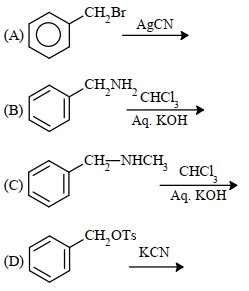
A
$A$ and $D$
B
Only $B$
C
$A$ and $B$
D
$B$ and $C$
Solution
(C) The synthesis of benzyl isocyanide $(C_6H_5CH_2NC)$ can be achieved through the following reactions:
$(A)$ Benzyl bromide $(C_6H_5CH_2Br)$ reacts with $AgCN$ to form benzyl isocyanide $(C_6H_5CH_2NC)$ as the major product because $AgCN$ is a covalent compound.
$(B)$ Benzylamine $(C_6H_5CH_2NH_2)$ is a primary amine. Primary amines undergo the carbylamine reaction when heated with chloroform $(CHCl_3)$ and alcoholic $KOH$ to form isocyanides $(R-NC)$. Thus,benzylamine gives benzyl isocyanide.
$(C)$ $N$-methylbenzylamine is a secondary amine and does not undergo the carbylamine reaction.
$(D)$ Benzyl tosylate $(C_6H_5CH_2OTs)$ reacts with $KCN$ (an ionic compound) to form benzyl cyanide $(C_6H_5CH_2CN)$ as the major product.
Therefore,benzyl isocyanide is obtained in reactions $(A)$ and $(B)$.
$(A)$ Benzyl bromide $(C_6H_5CH_2Br)$ reacts with $AgCN$ to form benzyl isocyanide $(C_6H_5CH_2NC)$ as the major product because $AgCN$ is a covalent compound.
$(B)$ Benzylamine $(C_6H_5CH_2NH_2)$ is a primary amine. Primary amines undergo the carbylamine reaction when heated with chloroform $(CHCl_3)$ and alcoholic $KOH$ to form isocyanides $(R-NC)$. Thus,benzylamine gives benzyl isocyanide.
$(C)$ $N$-methylbenzylamine is a secondary amine and does not undergo the carbylamine reaction.
$(D)$ Benzyl tosylate $(C_6H_5CH_2OTs)$ reacts with $KCN$ (an ionic compound) to form benzyl cyanide $(C_6H_5CH_2CN)$ as the major product.
Therefore,benzyl isocyanide is obtained in reactions $(A)$ and $(B)$.
0 likes
View Solution104
DifficultMCQ
How many of the transformations given below would result in aromatic amines?
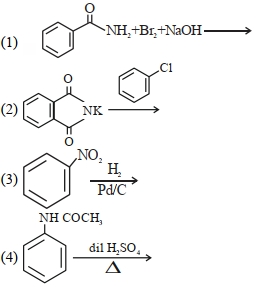
A
$1$
B
$2$
C
$3$
D
$4$
Solution
(C) Let us analyze each reaction:
$1$. Benzamide reacts with $Br_2$ and $NaOH$ (Hofmann bromamide degradation) to form aniline,which is an aromatic amine.
$2$. Potassium phthalimide does not react with chlorobenzene because aryl halides are poor substrates for $S_N2$ reactions due to the partial double bond character of the $C-Cl$ bond.
$3$. Nitrobenzene undergoes catalytic hydrogenation with $H_2/Pd-C$ to form aniline,which is an aromatic amine.
$4$. Acetanilide undergoes acid-catalyzed hydrolysis with $dil. H_2SO_4$ and heat to form aniline and acetic acid. Aniline is an aromatic amine.
Thus,reactions $1$,$3$,and $4$ result in the formation of aromatic amines. The total count is $3$.
$1$. Benzamide reacts with $Br_2$ and $NaOH$ (Hofmann bromamide degradation) to form aniline,which is an aromatic amine.
$2$. Potassium phthalimide does not react with chlorobenzene because aryl halides are poor substrates for $S_N2$ reactions due to the partial double bond character of the $C-Cl$ bond.
$3$. Nitrobenzene undergoes catalytic hydrogenation with $H_2/Pd-C$ to form aniline,which is an aromatic amine.
$4$. Acetanilide undergoes acid-catalyzed hydrolysis with $dil. H_2SO_4$ and heat to form aniline and acetic acid. Aniline is an aromatic amine.
Thus,reactions $1$,$3$,and $4$ result in the formation of aromatic amines. The total count is $3$.
0 likes
View Solution105
MediumMCQ
Match List-$I$ with List-$II$ :
Choose the correct answer from the options given below :
| List-$I$ | List-$II$ |
| $a$. Gabriel synthesis | $i$. Benzaldehyde |
| $b$. Kolbe synthesis | $ii$. Ethers |
| $c$. Williamson synthesis | $iii$. Primary amines |
| $d$. Etard reaction | $iv$. Salicylic acid |
Choose the correct answer from the options given below :
A
$a-iii, b-i, c-ii, d-iv$
B
$a-ii, b-iii, c-i, d-iv$
C
$a-iv, b-iii, c-i, d-ii$
D
$a-iii, b-iv, c-ii, d-i$
Solution
(D) The correct matches are:
$a$. Gabriel synthesis is used for the preparation of $1^{\circ}$ amines $(iii)$.
$b$. Kolbe synthesis (Kolbe-Schmitt reaction) is used for the preparation of salicylic acid $(iv)$.
$c$. Williamson synthesis is used for the preparation of ethers $(ii)$.
$d$. Etard reaction is used for the oxidation of toluene to benzaldehyde $(i)$.
Therefore,the correct matching is $a-iii, b-iv, c-ii, d-i$.
$a$. Gabriel synthesis is used for the preparation of $1^{\circ}$ amines $(iii)$.
$b$. Kolbe synthesis (Kolbe-Schmitt reaction) is used for the preparation of salicylic acid $(iv)$.
$c$. Williamson synthesis is used for the preparation of ethers $(ii)$.
$d$. Etard reaction is used for the oxidation of toluene to benzaldehyde $(i)$.
Therefore,the correct matching is $a-iii, b-iv, c-ii, d-i$.
0 likes
View Solution106
DifficultMCQ
In the above conversion,the correct sequence of reagents to be added is:
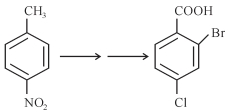
A
$(i) Fe / H^{+}, (ii) HONO, (iii) CuCl, (iv) KMnO_4, (v) Br_2$
B
$(i) KMnO_4, (ii) Br_2 / Fe, (iii) Fe / H^{+}, (iv) Cl_2$
C
$(i) Br_2 / Fe, (ii) Fe / H^{+}, (iii) HONO, (iv) CuCl, (v) KMnO_4$
D
$(i) Br_2 / Fe, (ii) Fe / H^{+}, (iii) KMnO_4, (iv) Cl_2$
Solution
(C) The conversion of $p$-nitrotoluene to $3$-bromo-$4$-chlorobenzoic acid involves the following steps:
$1$. Electrophilic aromatic substitution: Bromination of $p$-nitrotoluene using $Br_2 / Fe$ introduces a bromine atom at the ortho position relative to the methyl group.
$2$. Reduction: The nitro group $(-NO_2)$ is reduced to an amino group $(-NH_2)$ using $Fe / H^+$.
$3$. Diazotization: The amino group is converted to a diazonium salt $(-N_2^+Cl^-)$ using $HONO$ (nitrous acid) at $0-5 \ ^\circ C$.
$4$. Sandmeyer reaction: The diazonium group is replaced by a chlorine atom using $CuCl$.
$5$. Oxidation: The methyl group $(-CH_3)$ is oxidized to a carboxylic acid group $(-COOH)$ using $KMnO_4$.
Thus,the correct sequence is $(i) Br_2 / Fe, (ii) Fe / H^{+}, (iii) HONO, (iv) CuCl, (v) KMnO_4$.
$1$. Electrophilic aromatic substitution: Bromination of $p$-nitrotoluene using $Br_2 / Fe$ introduces a bromine atom at the ortho position relative to the methyl group.
$2$. Reduction: The nitro group $(-NO_2)$ is reduced to an amino group $(-NH_2)$ using $Fe / H^+$.
$3$. Diazotization: The amino group is converted to a diazonium salt $(-N_2^+Cl^-)$ using $HONO$ (nitrous acid) at $0-5 \ ^\circ C$.
$4$. Sandmeyer reaction: The diazonium group is replaced by a chlorine atom using $CuCl$.
$5$. Oxidation: The methyl group $(-CH_3)$ is oxidized to a carboxylic acid group $(-COOH)$ using $KMnO_4$.
Thus,the correct sequence is $(i) Br_2 / Fe, (ii) Fe / H^{+}, (iii) HONO, (iv) CuCl, (v) KMnO_4$.
0 likes
View Solution107
DifficultMCQ
The final product $A$, formed in the following multistep reaction sequence is:
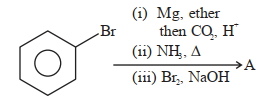
A
Benzamide
B
Aniline
C
Benzoyl bromide
D
Benzoic acid
Solution
(B) $1$. Bromobenzene reacts with $Mg$ in ether to form phenylmagnesium bromide $(C_6H_5MgBr)$.
$2$. Phenylmagnesium bromide reacts with $CO_2$ followed by acid hydrolysis $(H^+)$ to yield benzoic acid $(C_6H_5COOH)$.
$3$. Benzoic acid reacts with $NH_3$ and heat $(\Delta)$ to form benzamide $(C_6H_5CONH_2)$.
$4$. Benzamide undergoes the Hoffmann bromamide degradation reaction with $Br_2$ and $NaOH$ to form aniline $(C_6H_5NH_2)$.
Therefore, the final product $A$ is aniline.
$2$. Phenylmagnesium bromide reacts with $CO_2$ followed by acid hydrolysis $(H^+)$ to yield benzoic acid $(C_6H_5COOH)$.
$3$. Benzoic acid reacts with $NH_3$ and heat $(\Delta)$ to form benzamide $(C_6H_5CONH_2)$.
$4$. Benzamide undergoes the Hoffmann bromamide degradation reaction with $Br_2$ and $NaOH$ to form aniline $(C_6H_5NH_2)$.
Therefore, the final product $A$ is aniline.
0 likes
View Solution108
MediumMCQ
From $6.55 \ g$ of aniline,the maximum amount of acetanilide that can be prepared will be _ $\times 10^{-1} \ g$.
A
$90$
B
$96$
C
$97$
D
$95$
Solution
(D) The reaction of aniline $(C_6H_5NH_2)$ with acetic anhydride forms acetanilide $(C_6H_5NHCOCH_3)$.
Molar mass of aniline $(C_6H_5NH_2)$ = $93 \ g/mol$.
Molar mass of acetanilide $(C_6H_5NHCOCH_3)$ = $135 \ g/mol$.
According to the stoichiometry,$1 \ mol$ of aniline produces $1 \ mol$ of acetanilide.
$93 \ g$ of aniline produces $135 \ g$ of acetanilide.
Therefore,$6.55 \ g$ of aniline produces $\frac{135}{93} \times 6.55 \ g = 9.508 \ g \approx 9.5 \ g$.
Converting to the required format: $9.5 \ g = 95 \times 10^{-1} \ g$.
Molar mass of aniline $(C_6H_5NH_2)$ = $93 \ g/mol$.
Molar mass of acetanilide $(C_6H_5NHCOCH_3)$ = $135 \ g/mol$.
According to the stoichiometry,$1 \ mol$ of aniline produces $1 \ mol$ of acetanilide.
$93 \ g$ of aniline produces $135 \ g$ of acetanilide.
Therefore,$6.55 \ g$ of aniline produces $\frac{135}{93} \times 6.55 \ g = 9.508 \ g \approx 9.5 \ g$.
Converting to the required format: $9.5 \ g = 95 \times 10^{-1} \ g$.
0 likes
View Solution109
MediumMCQ
$X \ g$ of ethanamine was subjected to reaction with $NaNO_2 / HCl$ followed by hydrolysis to liberate $N_2$ and $HCl$. The $HCl$ generated was completely neutralized by $0.2 \ mol$ of $NaOH$. $X$ is . . . .
A
$7$
B
$8$
C
$9$
D
$10$
Solution
(C) The reaction of ethanamine $(CH_3CH_2NH_2)$ with $NaNO_2 / HCl$ produces ethyl diazonium chloride,which upon hydrolysis yields ethanol,$N_2$,and $HCl$.
The overall reaction is: $CH_3CH_2NH_2 + NaNO_2 + HCl \rightarrow CH_3CH_2OH + N_2 + NaCl + H_2O$.
Wait,the question states $HCl$ is liberated and neutralized by $0.2 \ mol$ of $NaOH$. Based on the stoichiometry,$1 \ mol$ of ethanamine produces $1 \ mol$ of $HCl$.
Given that $0.2 \ mol$ of $NaOH$ is required to neutralize the $HCl$,it implies $0.2 \ mol$ of $HCl$ was produced.
Therefore,$0.2 \ mol$ of ethanamine was used.
The molar mass of ethanamine $(CH_3CH_2NH_2)$ is $12 \times 2 + 1 \times 7 + 14 = 45 \ g/mol$.
Mass $X = \text{moles} \times \text{molar mass} = 0.2 \ mol \times 45 \ g/mol = 9 \ g$.
Thus,$X = 9$.
The overall reaction is: $CH_3CH_2NH_2 + NaNO_2 + HCl \rightarrow CH_3CH_2OH + N_2 + NaCl + H_2O$.
Wait,the question states $HCl$ is liberated and neutralized by $0.2 \ mol$ of $NaOH$. Based on the stoichiometry,$1 \ mol$ of ethanamine produces $1 \ mol$ of $HCl$.
Given that $0.2 \ mol$ of $NaOH$ is required to neutralize the $HCl$,it implies $0.2 \ mol$ of $HCl$ was produced.
Therefore,$0.2 \ mol$ of ethanamine was used.
The molar mass of ethanamine $(CH_3CH_2NH_2)$ is $12 \times 2 + 1 \times 7 + 14 = 45 \ g/mol$.
Mass $X = \text{moles} \times \text{molar mass} = 0.2 \ mol \times 45 \ g/mol = 9 \ g$.
Thus,$X = 9$.
0 likes
View Solution110
MediumMCQ
$9.3 \ g$ of pure aniline upon diazotisation followed by coupling with phenol gives an orange dye. The mass of orange dye produced (assume $100\%$ yield/conversion) is . . . . . $g$. (nearest integer)
A
$20$
B
$25$
C
$30$
D
$35$
Solution
(A) The reaction sequence is as follows:
Aniline $(C_6H_5NH_2)$ $\xrightarrow{NaNO_2 + HCl, T < 5^{\circ}C}$ Benzenediazonium chloride $(C_6H_5N_2^+Cl^-)$
Benzenediazonium chloride + Phenol $(C_6H_5OH)$ $\rightarrow$ $p$-Hydroxyazobenzene (Orange dye,$C_{12}H_{10}N_2O$)
From the stoichiometry,$1 \text{ mole}$ of aniline produces $1 \text{ mole}$ of orange dye.
Molar mass of aniline $(C_6H_5NH_2)$ = $93 \ g \ mol^{-1}$.
Moles of aniline = $\frac{9.3 \ g}{93 \ g \ mol^{-1}} = 0.1 \ mol$.
Molar mass of orange dye ($p$-Hydroxyazobenzene,$C_{12}H_{10}N_2O$) = $(12 \times 12) + (10 \times 1) + (2 \times 14) + 16 = 144 + 10 + 28 + 16 = 198 \ g \ mol^{-1}$.
Since $1 \text{ mole}$ of aniline gives $1 \text{ mole}$ of dye,$0.1 \text{ mole}$ of aniline will produce $0.1 \text{ mole}$ of dye.
Mass of orange dye = $0.1 \ mol \times 198 \ g \ mol^{-1} = 19.8 \ g$.
Rounding to the nearest integer,we get $20 \ g$.
Aniline $(C_6H_5NH_2)$ $\xrightarrow{NaNO_2 + HCl, T < 5^{\circ}C}$ Benzenediazonium chloride $(C_6H_5N_2^+Cl^-)$
Benzenediazonium chloride + Phenol $(C_6H_5OH)$ $\rightarrow$ $p$-Hydroxyazobenzene (Orange dye,$C_{12}H_{10}N_2O$)
From the stoichiometry,$1 \text{ mole}$ of aniline produces $1 \text{ mole}$ of orange dye.
Molar mass of aniline $(C_6H_5NH_2)$ = $93 \ g \ mol^{-1}$.
Moles of aniline = $\frac{9.3 \ g}{93 \ g \ mol^{-1}} = 0.1 \ mol$.
Molar mass of orange dye ($p$-Hydroxyazobenzene,$C_{12}H_{10}N_2O$) = $(12 \times 12) + (10 \times 1) + (2 \times 14) + 16 = 144 + 10 + 28 + 16 = 198 \ g \ mol^{-1}$.
Since $1 \text{ mole}$ of aniline gives $1 \text{ mole}$ of dye,$0.1 \text{ mole}$ of aniline will produce $0.1 \text{ mole}$ of dye.
Mass of orange dye = $0.1 \ mol \times 198 \ g \ mol^{-1} = 19.8 \ g$.
Rounding to the nearest integer,we get $20 \ g$.
0 likes
View Solution111
MediumMCQ
An amine $(X)$ is prepared by ammonolysis of benzyl chloride. On adding $p-$toluenesulphonyl chloride to it,the solution remains clear. The molar mass of the amine $(X)$ formed is $g \ mol^{-1}$. (Given molar mass in $g \ mol^{-1}$: $C=12, H=1, O=16, N=14, S=32, Cl=35.5$)
A
$287$
B
$288$
C
$289$
D
$290$
Solution
(A) Ammonolysis of excess benzyl chloride $(C_6H_5CH_2Cl)$ with ammonia $(NH_3)$ leads to the formation of a tertiary amine,tribenzylamine,$(C_6H_5CH_2)_3N$.
This is a $3^{\circ}$ amine,which does not react with $p-$toluenesulphonyl chloride (Hinsberg's reagent) because it lacks an acidic hydrogen atom attached to the nitrogen.
Therefore,the solution remains clear.
The chemical formula of the amine $(X)$ is $(C_6H_5CH_2)_3N$,which is $C_{21}H_{21}N$.
The molar mass is calculated as: $(21 \times 12) + (21 \times 1) + (1 \times 14) = 252 + 21 + 14 = 287 \ g \ mol^{-1}$.
This is a $3^{\circ}$ amine,which does not react with $p-$toluenesulphonyl chloride (Hinsberg's reagent) because it lacks an acidic hydrogen atom attached to the nitrogen.
Therefore,the solution remains clear.
The chemical formula of the amine $(X)$ is $(C_6H_5CH_2)_3N$,which is $C_{21}H_{21}N$.
The molar mass is calculated as: $(21 \times 12) + (21 \times 1) + (1 \times 14) = 252 + 21 + 14 = 287 \ g \ mol^{-1}$.
0 likes
View Solution112
AdvancedMCQ
$STATEMENT-1$: Aniline on reaction with $NaNO_2 / HCl$ at $0^{\circ} C$ followed by coupling with $\beta$-naphthol gives a dark blue coloured precipitate.
$STATEMENT-2$: The colour of the compound formed in the reaction of aniline with $NaNO_2 / HCl$ at $0^{\circ} C$ followed by coupling with $\beta$-naphthol is due to the extended conjugation.
$STATEMENT-2$: The colour of the compound formed in the reaction of aniline with $NaNO_2 / HCl$ at $0^{\circ} C$ followed by coupling with $\beta$-naphthol is due to the extended conjugation.
A
$STATEMENT-1$ is True,$STATEMENT-2$ is True; $STATEMENT-2$ is correct explanation for $STATEMENT-1$
B
$STATEMENT-1$ is True,$STATEMENT-2$ is True; $STATEMENT-2$ is $NOT$ a correct explanation for $STATEMENT-1$
C
$STATEMENT-1$ is True,$STATEMENT-2$ is False
D
$STATEMENT-1$ is False,$STATEMENT-2$ is True
Solution
(D) Aniline reacts with $NaNO_2 / HCl$ at $0-5^{\circ} C$ to form benzene diazonium chloride $(C_6H_5N_2^+Cl^-)$.
This diazonium salt undergoes coupling reaction with $\beta$-naphthol in alkaline medium to form a dye.
The dye formed is $1$-phenylazo-$2$-naphthol,which has a scarlet red colour,not dark blue.
Therefore,$STATEMENT-1$ is False.
$STATEMENT-2$ is True because the colour of azo dyes is indeed due to the extended conjugation between the two aromatic rings through the $-N=N-$ group.
This diazonium salt undergoes coupling reaction with $\beta$-naphthol in alkaline medium to form a dye.
The dye formed is $1$-phenylazo-$2$-naphthol,which has a scarlet red colour,not dark blue.
Therefore,$STATEMENT-1$ is False.
$STATEMENT-2$ is True because the colour of azo dyes is indeed due to the extended conjugation between the two aromatic rings through the $-N=N-$ group.
0 likes
View Solution113
AdvancedMCQ
Match each of the compounds in Column $I$ with its characteristic reaction$(s)$ in Column $II$.
| Column $I$ | Column $II$ |
|---|---|
| $A$. $CH_3CH_2CH_2CN$ | $p$. Reduction with $Pd-C/H_2$ |
| $B$. $CH_3CH_2OCOCH_3$ | $q$. Reduction with $SnCl_2/HCl$ |
| $C$. $CH_3-CH=CH-CH_2OH$ | $r$. Development of foul smell on treatment with chloroform and alcoholic $KOH$ |
| $D$. $CH_3CH_2CH_2CH_2NH_2$ | $s$. Reduction with diisobutylaluminium hydride $(DIBAL-H)$ |
| $t$. Alkaline hydrolysis |
A
$A-p, q, s; B-t; C-p, s; D-r$
B
$A-p, q, s; B-t; C-p; D-r$
C
$A-q, s; B-t; C-p, s; D-r$
D
$A-p, q, s; B-t; C-s; D-r$
Solution
(A) . $CH_3CH_2CH_2CN$ (nitrile) undergoes reduction with $Pd-C/H_2$ $(p)$,$SnCl_2/HCl$ (Stephen reduction,$q$),and $DIBAL-H$ $(s)$.
$B$. $CH_3CH_2OCOCH_3$ (ester) undergoes alkaline hydrolysis $(t)$.
$C$. $CH_3-CH=CH-CH_2OH$ (allylic alcohol) undergoes reduction of the double bond with $Pd-C/H_2$ $(p)$ and can be reduced with $DIBAL-H$ $(s)$.
$D$. $CH_3CH_2CH_2CH_2NH_2$ (primary amine) gives the carbylamine test (foul smell) with $CHCl_3/alc. KOH$ $(r)$.
$B$. $CH_3CH_2OCOCH_3$ (ester) undergoes alkaline hydrolysis $(t)$.
$C$. $CH_3-CH=CH-CH_2OH$ (allylic alcohol) undergoes reduction of the double bond with $Pd-C/H_2$ $(p)$ and can be reduced with $DIBAL-H$ $(s)$.
$D$. $CH_3CH_2CH_2CH_2NH_2$ (primary amine) gives the carbylamine test (foul smell) with $CHCl_3/alc. KOH$ $(r)$.
0 likes
View Solution114
AdvancedMCQ
$A$ trinitro compound,$1,3,5$-tris-($4$-nitrophenyl)benzene,on complete reaction with an excess of $Sn/HCl$ gives a major product,which on treatment with an excess of $NaNO_2/HCl$ at $0^{\circ} C$ provides $P$ as the product. $P$,upon treatment with excess of $H_2O$ at room temperature,gives the product $Q$. Bromination of $Q$ in aqueous medium furnishes the product $R$. The compound $P$ upon treatment with an excess of phenol under basic conditions gives the product $S$.
The molar mass difference between compounds $Q$ and $R$ is $474 \ g \ mol^{-1}$ and between compounds $P$ and $S$ is $172.5 \ g \ mol^{-1}$.
$(1)$ The number of heteroatoms present in one molecule of $R$ is . . . . .
[Use: Molar mass (in $g \ mol^{-1}$): $H=1, C=12, N=14, O=16, Br=80, Cl=35.5$
Atoms other than $C$ and $H$ are considered as heteroatoms]
$(2)$ The total number of carbon atoms and heteroatoms present in one molecule of $S$ . . . . . .
[Use: Molar mass in $g \ mol^{-1}$]: $H=1, C=12, N=14, O=16, Br=80, Cl=35.5$
Atoms other than $C$ and $H$ are considered as heteroatoms
Give the answer for question $(1)$ and $(2)$.
The molar mass difference between compounds $Q$ and $R$ is $474 \ g \ mol^{-1}$ and between compounds $P$ and $S$ is $172.5 \ g \ mol^{-1}$.
$(1)$ The number of heteroatoms present in one molecule of $R$ is . . . . .
[Use: Molar mass (in $g \ mol^{-1}$): $H=1, C=12, N=14, O=16, Br=80, Cl=35.5$
Atoms other than $C$ and $H$ are considered as heteroatoms]
$(2)$ The total number of carbon atoms and heteroatoms present in one molecule of $S$ . . . . . .
[Use: Molar mass in $g \ mol^{-1}$]: $H=1, C=12, N=14, O=16, Br=80, Cl=35.5$
Atoms other than $C$ and $H$ are considered as heteroatoms
Give the answer for question $(1)$ and $(2)$.
A
$8, 50$
B
$9, 51$
C
$7, 60$
D
$6, 45$
Solution
(B) $1$. The starting material is $1,3,5$-tris-($4$-nitrophenyl)benzene. Reduction with $Sn/HCl$ converts the three $-NO_2$ groups to $-NH_2$ groups.
$2$. Treatment with $NaNO_2/HCl$ at $0^{\circ} C$ converts the three $-NH_2$ groups to diazonium salt groups $(-N_2^+Cl^-)$,forming compound $P$.
$3$. Hydrolysis of $P$ with $H_2O$ replaces the diazonium groups with $-OH$ groups,forming $Q$ ($1,3,5$-tris-($4$-hydroxyphenyl)benzene).
$4$. Bromination of $Q$ in aqueous medium occurs at the ortho positions relative to the $-OH$ groups. Since there are three $-OH$ groups and each has two ortho positions,a total of $6$ $Br$ atoms are added. Thus,$R$ is $1,3,5$-tris-($3,5$-dibromo-$4$-hydroxyphenyl)benzene.
$5$. Heteroatoms in $R$: $3$ oxygen atoms (from $-OH$) and $6$ bromine atoms. Total heteroatoms = $3 + 6 = 9$.
$6$. Coupling of $P$ with phenol in basic medium forms the azo dye $S$. The structure $S$ contains $42$ carbon atoms and $9$ heteroatoms ($3$ azo groups $-N=N-$ and $3$ $-OH$ groups,total $6$ nitrogen and $3$ oxygen atoms). Total atoms = $42 + 9 = 51$.
$2$. Treatment with $NaNO_2/HCl$ at $0^{\circ} C$ converts the three $-NH_2$ groups to diazonium salt groups $(-N_2^+Cl^-)$,forming compound $P$.
$3$. Hydrolysis of $P$ with $H_2O$ replaces the diazonium groups with $-OH$ groups,forming $Q$ ($1,3,5$-tris-($4$-hydroxyphenyl)benzene).
$4$. Bromination of $Q$ in aqueous medium occurs at the ortho positions relative to the $-OH$ groups. Since there are three $-OH$ groups and each has two ortho positions,a total of $6$ $Br$ atoms are added. Thus,$R$ is $1,3,5$-tris-($3,5$-dibromo-$4$-hydroxyphenyl)benzene.
$5$. Heteroatoms in $R$: $3$ oxygen atoms (from $-OH$) and $6$ bromine atoms. Total heteroatoms = $3 + 6 = 9$.
$6$. Coupling of $P$ with phenol in basic medium forms the azo dye $S$. The structure $S$ contains $42$ carbon atoms and $9$ heteroatoms ($3$ azo groups $-N=N-$ and $3$ $-OH$ groups,total $6$ nitrogen and $3$ oxygen atoms). Total atoms = $42 + 9 = 51$.
0 likes
View Solution115
DifficultMCQ
Amongst the compounds given,the one that would form a brilliant colored dye on treatment with $NaNO_2$ in dil. $HCl$ followed by addition to an alkaline solution of $\beta$-naphthol is
A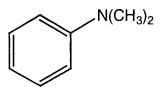
B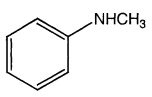
C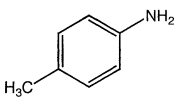
D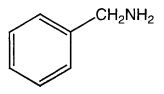
Solution
(C) The reaction described is the azo coupling reaction,which is characteristic of primary aromatic amines.
Primary aromatic amines react with $NaNO_2$ and $HCl$ at $0-5 \ ^{\circ}C$ to form stable diazonium salts.
These diazonium salts then undergo electrophilic substitution (coupling) with electron-rich aromatic compounds like $\beta$-naphthol in an alkaline medium to form intensely colored azo dyes.
Among the given options:
$A$ is $N,N$-dimethylaniline (tertiary aromatic amine).
$B$ is $N$-methylaniline (secondary aromatic amine).
$C$ is $p$-toluidine (primary aromatic amine).
$D$ is benzylamine (primary aliphatic amine,which forms an unstable diazonium salt that decomposes to form alcohols).
Thus,$p$-toluidine $(C)$ is the correct compound that forms a stable diazonium salt and subsequently an azo dye.
Primary aromatic amines react with $NaNO_2$ and $HCl$ at $0-5 \ ^{\circ}C$ to form stable diazonium salts.
These diazonium salts then undergo electrophilic substitution (coupling) with electron-rich aromatic compounds like $\beta$-naphthol in an alkaline medium to form intensely colored azo dyes.
Among the given options:
$A$ is $N,N$-dimethylaniline (tertiary aromatic amine).
$B$ is $N$-methylaniline (secondary aromatic amine).
$C$ is $p$-toluidine (primary aromatic amine).
$D$ is benzylamine (primary aliphatic amine,which forms an unstable diazonium salt that decomposes to form alcohols).
Thus,$p$-toluidine $(C)$ is the correct compound that forms a stable diazonium salt and subsequently an azo dye.
0 likes
View Solution116
MediumMCQ
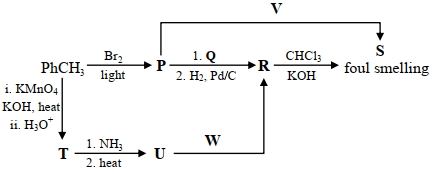
The correct option$(s)$ for the following sequence of reactions is(are):
$(A)$ $Q = KNO_2, W = LiAlH_4$
$(B)$ $R =$ benzenamine,$V = KCN$
$(C)$ $Q = AgNO_2, R =$ phenylmethanamine
$(D)$ $W = LiAlH_4, V = AgCN$
$(A)$ $Q = KNO_2, W = LiAlH_4$
$(B)$ $R =$ benzenamine,$V = KCN$
$(C)$ $Q = AgNO_2, R =$ phenylmethanamine
$(D)$ $W = LiAlH_4, V = AgCN$
A
$A, B$
B
$C, D$
C
$A, C$
D
$A, D$
Solution
(B) $1$. The reaction sequence starts with $PhCH_3$ (toluene) reacting with $Br_2/light$ to form $P$ $(PhCH_2Br)$.
$2$. $P$ $(PhCH_2Br)$ reacts with $AgNO_2$ followed by $H_2, Pd/C$ to give $R$ ($PhCH_2NH_2$,phenylmethanamine). Thus,$Q = AgNO_2$.
$3$. $R$ $(PhCH_2NH_2)$ undergoes carbylamine reaction with $CHCl_3/KOH$ to form a foul-smelling isocyanide $(PhCH_2NC)$.
$4$. $PhCH_3$ is oxidized to $T$ $(PhCOOH)$,which reacts with $NH_3$ and heat to form $U$ $(PhCONH_2)$.
$5$. $U$ $(PhCONH_2)$ is reduced by $W$ $(LiAlH_4)$ to form $R$ $(PhCH_2NH_2)$.
$6$. $P$ $(PhCH_2Br)$ reacts with $V$ $(AgCN)$ to form $PhCH_2NC$.
$7$. Comparing with the options: $Q = AgNO_2$,$R =$ phenylmethanamine,$W = LiAlH_4$,$V = AgCN$. Therefore,options $(C)$ and $(D)$ are correct.
$2$. $P$ $(PhCH_2Br)$ reacts with $AgNO_2$ followed by $H_2, Pd/C$ to give $R$ ($PhCH_2NH_2$,phenylmethanamine). Thus,$Q = AgNO_2$.
$3$. $R$ $(PhCH_2NH_2)$ undergoes carbylamine reaction with $CHCl_3/KOH$ to form a foul-smelling isocyanide $(PhCH_2NC)$.
$4$. $PhCH_3$ is oxidized to $T$ $(PhCOOH)$,which reacts with $NH_3$ and heat to form $U$ $(PhCONH_2)$.
$5$. $U$ $(PhCONH_2)$ is reduced by $W$ $(LiAlH_4)$ to form $R$ $(PhCH_2NH_2)$.
$6$. $P$ $(PhCH_2Br)$ reacts with $V$ $(AgCN)$ to form $PhCH_2NC$.
$7$. Comparing with the options: $Q = AgNO_2$,$R =$ phenylmethanamine,$W = LiAlH_4$,$V = AgCN$. Therefore,options $(C)$ and $(D)$ are correct.
0 likes
View Solution117
AdvancedMCQ
Consider the following reaction sequence:
$p$-Nitrotoluene $\xrightarrow{P} Q$ $\xrightarrow{R} S$ $\xrightarrow{H_2O} T$
$S \xrightarrow{U} \text{Benzoic acid}$
Identify the correct statements from the following:
$(A) P = H_2/Pd, \text{ethanol}; R = NaNO_2/HCl; U = 1. H_3PO_2, 2. KMnO_4-KOH, \text{heat}$
$(B) P = Sn/HCl; R = HNO_2; S = p-\text{toluenediazonium chloride}$
$(C) S = p-\text{toluenediazonium chloride}; T = p-\text{cresol}; U = 1. CH_3CH_2OH, 2. KMnO_4-KOH, \text{heat}$
$(D) Q = p-\text{nitrobenzoic acid}; R = H_2/Pd, \text{ethanol}; T = p-\text{cresol}$
Which of the following combinations is correct?
$p$-Nitrotoluene $\xrightarrow{P} Q$ $\xrightarrow{R} S$ $\xrightarrow{H_2O} T$
$S \xrightarrow{U} \text{Benzoic acid}$
Identify the correct statements from the following:
$(A) P = H_2/Pd, \text{ethanol}; R = NaNO_2/HCl; U = 1. H_3PO_2, 2. KMnO_4-KOH, \text{heat}$
$(B) P = Sn/HCl; R = HNO_2; S = p-\text{toluenediazonium chloride}$
$(C) S = p-\text{toluenediazonium chloride}; T = p-\text{cresol}; U = 1. CH_3CH_2OH, 2. KMnO_4-KOH, \text{heat}$
$(D) Q = p-\text{nitrobenzoic acid}; R = H_2/Pd, \text{ethanol}; T = p-\text{cresol}$
Which of the following combinations is correct?
A
$A, B, D$
B
$A, B, C$
C
$A, B$
D
$A, D$
Solution
(B) $1$. The reduction of $p$-nitrotoluene with $H_2/Pd$ or $Sn/HCl$ gives $p$-toluidine $(Q)$. Thus,$P$ can be $H_2/Pd$ or $Sn/HCl$.
$2$. The reaction of $p$-toluidine $(Q)$ with $NaNO_2/HCl$ or $HNO_2$ at $0-5^{\circ}C$ gives $p$-toluenediazonium chloride $(S)$. Thus,$R$ is correct in both $(A)$ and $(B)$.
$3$. Hydrolysis of $S$ with $H_2O$ gives $p$-cresol $(T)$.
$4$. Reaction of $S$ with $H_3PO_2$ or $CH_3CH_2OH$ removes the diazonium group to give toluene. Subsequent oxidation of the methyl group with $KMnO_4/KOH, \Delta$ gives benzoic acid. Thus,$U$ is correct in both $(A)$ and $(C)$.
$5$. Evaluating the options:
- $(A)$ is correct: $P, R, U$ are correct.
- $(B)$ is correct: $P, R, S$ are correct.
- $(C)$ is correct: $S, T, U$ are correct.
- $(D)$ is incorrect: $Q$ is $p$-toluidine,not $p$-nitrobenzoic acid.
Therefore,the correct combination is $(A, B, C)$.
$2$. The reaction of $p$-toluidine $(Q)$ with $NaNO_2/HCl$ or $HNO_2$ at $0-5^{\circ}C$ gives $p$-toluenediazonium chloride $(S)$. Thus,$R$ is correct in both $(A)$ and $(B)$.
$3$. Hydrolysis of $S$ with $H_2O$ gives $p$-cresol $(T)$.
$4$. Reaction of $S$ with $H_3PO_2$ or $CH_3CH_2OH$ removes the diazonium group to give toluene. Subsequent oxidation of the methyl group with $KMnO_4/KOH, \Delta$ gives benzoic acid. Thus,$U$ is correct in both $(A)$ and $(C)$.
$5$. Evaluating the options:
- $(A)$ is correct: $P, R, U$ are correct.
- $(B)$ is correct: $P, R, S$ are correct.
- $(C)$ is correct: $S, T, U$ are correct.
- $(D)$ is incorrect: $Q$ is $p$-toluidine,not $p$-nitrobenzoic acid.
Therefore,the correct combination is $(A, B, C)$.
0 likes
View Solution118
DifficultMCQ
Match the Compounds (List-$I$) with the appropriate Catalyst/Reagents (List-$II$) for their reduction or conversion into corresponding amines.
Choose the correct answer from the options given below:
| List-$I$ (Compounds) | List-$II$ (Catalyst/Reagents) |
| $A$. $R-CONH_2$ | $I$. $NaOH$ (aqueous) |
| $B$. $C_6H_5NO_2$ | $II$. $H_2 / Ni$ |
| $C$. $R-C \equiv N$ | $III$. $LiAlH_4, H_2O$ |
| $D$. $N$-alkylphthalimide | $IV$. $Sn,HCl$ |
Choose the correct answer from the options given below:
A
$A-III, B-IV, C-II, D-I$
B
$A-II, B-IV, C-III, D-I$
C
$A-II, B-I, C-III, D-IV$
D
$A-III, B-II, C-IV, D-I$
Solution
(A) The correct matches are:
$A$. $R-CONH_2$ (Amide) is reduced to amine $(R-CH_2NH_2)$ using $LiAlH_4, H_2O$ $(III)$.
$B$. $C_6H_5NO_2$ (Nitrobenzene) is reduced to aniline $(C_6H_5NH_2)$ using $Sn, HCl$ $(IV)$.
$C$. $R-C \equiv N$ (Nitrile) is reduced to amine $(R-CH_2NH_2)$ using $H_2 / Ni$ $(II)$.
$D$. $N$-alkylphthalimide is converted to primary amine $(R-NH_2)$ using $NaOH$ (aqueous) $(I)$ in the Gabriel phthalimide synthesis.
Thus,the correct matching is $A-III, B-IV, C-II, D-I$.
$A$. $R-CONH_2$ (Amide) is reduced to amine $(R-CH_2NH_2)$ using $LiAlH_4, H_2O$ $(III)$.
$B$. $C_6H_5NO_2$ (Nitrobenzene) is reduced to aniline $(C_6H_5NH_2)$ using $Sn, HCl$ $(IV)$.
$C$. $R-C \equiv N$ (Nitrile) is reduced to amine $(R-CH_2NH_2)$ using $H_2 / Ni$ $(II)$.
$D$. $N$-alkylphthalimide is converted to primary amine $(R-NH_2)$ using $NaOH$ (aqueous) $(I)$ in the Gabriel phthalimide synthesis.
Thus,the correct matching is $A-III, B-IV, C-II, D-I$.
0 likes
View Solution119
DifficultMCQ
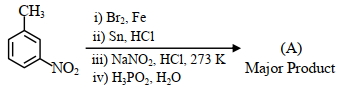
Consider the following sequence of reactions to produce major product $(A)$. Molar mass of product $(A)$ is $........... \ g \ mol^{-1}$. (Given molar mass in $g \ mol^{-1}$ of $C : 12, H : 1, O : 16, Br : 80, N : 14, P : 31$)
A
$173$
B
$172$
C
$171$
D
$174$
Solution
(C) The starting material is $3$-nitrotoluene.
$1$. Bromination with $Br_2/Fe$ gives $2$-bromo-$5$-nitrotoluene.
$2$. Reduction with $Sn/HCl$ converts the $-NO_2$ group to $-NH_2$,yielding $5$-amino-$2$-bromotoluene.
$3$. Diazotization with $NaNO_2/HCl$ at $273 \ K$ converts the $-NH_2$ group to a diazonium salt,$-N_2^+Cl^-$.
$4$. Reduction with $H_3PO_2/H_2O$ removes the diazonium group,resulting in $2$-bromotoluene as the major product $(A)$.
The chemical formula of $2$-bromotoluene is $C_7H_7Br$.
Molar mass $= (7 \times 12) + (7 \times 1) + 80 = 84 + 7 + 80 = 171 \ g \ mol^{-1}$.
$1$. Bromination with $Br_2/Fe$ gives $2$-bromo-$5$-nitrotoluene.
$2$. Reduction with $Sn/HCl$ converts the $-NO_2$ group to $-NH_2$,yielding $5$-amino-$2$-bromotoluene.
$3$. Diazotization with $NaNO_2/HCl$ at $273 \ K$ converts the $-NH_2$ group to a diazonium salt,$-N_2^+Cl^-$.
$4$. Reduction with $H_3PO_2/H_2O$ removes the diazonium group,resulting in $2$-bromotoluene as the major product $(A)$.
The chemical formula of $2$-bromotoluene is $C_7H_7Br$.
Molar mass $= (7 \times 12) + (7 \times 1) + 80 = 84 + 7 + 80 = 171 \ g \ mol^{-1}$.
0 likes
View Solution120
MediumMCQ
Consider the following sequence of reactions:
Chlorobenzene $\xrightarrow[ii) CO_2, H_3O^{+}]{i) Mg, \text{dry ether}} \text{Benzoic acid}$ $\xrightarrow{NH_3, \Delta} \text{Benzamide (A)}$ $\xrightarrow{Br_2, NaOH} \text{Aniline (B)}$
$11.25 \ mg$ of chlorobenzene will produce $.......... \times 10^{-1} \ mg$ of product $B$.
(Consider the reactions result in complete conversion.)
[Given molar mass of $C, H, O, N$ and $Cl$ as $12, 1, 16, 14$ and $35.5 \ g \ mol^{-1}$ respectively]
Chlorobenzene $\xrightarrow[ii) CO_2, H_3O^{+}]{i) Mg, \text{dry ether}} \text{Benzoic acid}$ $\xrightarrow{NH_3, \Delta} \text{Benzamide (A)}$ $\xrightarrow{Br_2, NaOH} \text{Aniline (B)}$
$11.25 \ mg$ of chlorobenzene will produce $.......... \times 10^{-1} \ mg$ of product $B$.
(Consider the reactions result in complete conversion.)
[Given molar mass of $C, H, O, N$ and $Cl$ as $12, 1, 16, 14$ and $35.5 \ g \ mol^{-1}$ respectively]
A
$90$
B
$91$
C
$92$
D
$93$
Solution
(D) $1$. Molar mass of chlorobenzene $(C_6H_5Cl) = (6 \times 12) + (5 \times 1) + 35.5 = 112.5 \ g \ mol^{-1}$.
$2$. Molar mass of aniline $(C_6H_5NH_2) = (6 \times 12) + (7 \times 1) + 14 = 93 \ g \ mol^{-1}$.
$3$. Since the conversion is complete,the number of moles of chlorobenzene equals the number of moles of aniline (product $B$).
$4$. Moles of chlorobenzene $= \frac{11.25 \times 10^{-3} \ g}{112.5 \ g \ mol^{-1}} = 10^{-4} \ mol$.
$5$. Moles of aniline $= 10^{-4} \ mol$.
$6$. Mass of aniline $= 10^{-4} \ mol \times 93 \ g \ mol^{-1} = 93 \times 10^{-4} \ g = 93 \times 10^{-1} \ mg$.
$7$. Therefore,the value is $93$.
$2$. Molar mass of aniline $(C_6H_5NH_2) = (6 \times 12) + (7 \times 1) + 14 = 93 \ g \ mol^{-1}$.
$3$. Since the conversion is complete,the number of moles of chlorobenzene equals the number of moles of aniline (product $B$).
$4$. Moles of chlorobenzene $= \frac{11.25 \times 10^{-3} \ g}{112.5 \ g \ mol^{-1}} = 10^{-4} \ mol$.
$5$. Moles of aniline $= 10^{-4} \ mol$.
$6$. Mass of aniline $= 10^{-4} \ mol \times 93 \ g \ mol^{-1} = 93 \times 10^{-4} \ g = 93 \times 10^{-1} \ mg$.
$7$. Therefore,the value is $93$.
0 likes
View Solution121
DifficultMCQ
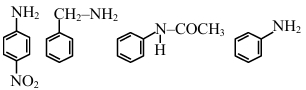
Given below are some nitrogen-containing compounds. Each of them is treated with $HCl$ separately. $1.0 \ g$ of the most basic compound will consume $........$ $mg$ of $HCl$. ($Given$ molar mass in $g \ mol^{-1}$: $C:12, H:1, O:16, Cl:35.5$)
A
$341$
B
$241$
C
$141$
D
$541$
Solution
(A) The given compounds are $p$-nitroaniline,benzylamine,acetanilide,and aniline. Benzylamine is an aliphatic amine,while the others are aromatic amines or amides where the lone pair on nitrogen is involved in resonance or electron-withdrawing effects,making them less basic. Benzylamine is the most basic compound.
The molar mass of benzylamine $(C_6H_5CH_2NH_2)$ is $(7 \times 12) + (9 \times 1) + 14 = 107 \ g \ mol^{-1}$.
Moles of benzylamine in $1.0 \ g = \frac{1.0 \ g}{107 \ g \ mol^{-1}} \approx 0.009346 \ mol$.
Benzylamine reacts with $HCl$ in a $1:1$ molar ratio: $C_6H_5CH_2NH_2 + HCl \rightarrow C_6H_5CH_2NH_3^+Cl^-$.
Moles of $HCl$ consumed $= 0.009346 \ mol$.
Mass of $HCl$ consumed $= 0.009346 \ mol \times 36.5 \ g \ mol^{-1} \approx 0.3411 \ g$.
Converting to $mg$: $0.3411 \ g \times 1000 \ mg \ g^{-1} \approx 341 \ mg$.
The molar mass of benzylamine $(C_6H_5CH_2NH_2)$ is $(7 \times 12) + (9 \times 1) + 14 = 107 \ g \ mol^{-1}$.
Moles of benzylamine in $1.0 \ g = \frac{1.0 \ g}{107 \ g \ mol^{-1}} \approx 0.009346 \ mol$.
Benzylamine reacts with $HCl$ in a $1:1$ molar ratio: $C_6H_5CH_2NH_2 + HCl \rightarrow C_6H_5CH_2NH_3^+Cl^-$.
Moles of $HCl$ consumed $= 0.009346 \ mol$.
Mass of $HCl$ consumed $= 0.009346 \ mol \times 36.5 \ g \ mol^{-1} \approx 0.3411 \ g$.
Converting to $mg$: $0.3411 \ g \times 1000 \ mg \ g^{-1} \approx 341 \ mg$.
0 likes
View Solution122
MediumMCQ
Which one of the following reaction sequences will give an azo dye?
A
Nitrobenzene $\xrightarrow[(ii) NaNO_2/HCl]{(i) Sn/HCl}$ $\xrightarrow[(iii) \beta-\text{naphthol}, NaOH]{}$
B
Benzenesulfonic acid $\xrightarrow[(ii) NH_3]{(i) SOCl_2}$ $\xrightarrow[(iii) \text{Benzyl chloride}]{}$
C
Benzonitrile $\xrightarrow[(ii) PCl_5]{(i) 70\% H_2SO_4}$ $\xrightarrow[(iii) \text{Aniline}]{}$
D
Aniline $\xrightarrow[(i) HCl/NaNO_2]{(ii) \text{Toluene}}$
Solution
(A) The formation of an azo dye involves the coupling reaction of a diazonium salt with an electron-rich aromatic compound like $\beta$-naphthol in an alkaline medium.
$1$. Nitrobenzene $(C_6H_5NO_2)$ is reduced to aniline $(C_6H_5NH_2)$ using $Sn/HCl$.
$2$. Aniline reacts with $NaNO_2/HCl$ at $0-5^{\circ}C$ to form benzenediazonium chloride $(C_6H_5N_2^+Cl^-)$.
$3$. Benzenediazonium chloride undergoes a coupling reaction with $\beta$-naphthol in the presence of $NaOH$ to form an orange-red azo dye.
Therefore,the correct sequence is given in option $A$.
$1$. Nitrobenzene $(C_6H_5NO_2)$ is reduced to aniline $(C_6H_5NH_2)$ using $Sn/HCl$.
$2$. Aniline reacts with $NaNO_2/HCl$ at $0-5^{\circ}C$ to form benzenediazonium chloride $(C_6H_5N_2^+Cl^-)$.
$3$. Benzenediazonium chloride undergoes a coupling reaction with $\beta$-naphthol in the presence of $NaOH$ to form an orange-red azo dye.
Therefore,the correct sequence is given in option $A$.
0 likes
View Solution123
DifficultMCQ
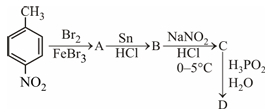
Product $D$ is:-
A
$2-$bromotoluene
B
$3-$bromotoluene
C
$4-$amino$-3-$bromotoluene
D
$4-$amino-benzyl bromide
Solution
(A) $1$. The starting material is $p$-nitrotoluene. Bromination in the presence of $FeBr_3$ occurs at the ortho position relative to the methyl group (since $-CH_3$ is ortho/para directing and $-NO_2$ is meta directing),yielding $2$-bromo-$4$-nitrotoluene $(A)$.
$2$. Reduction of the nitro group using $Sn/HCl$ converts the $-NO_2$ group to an $-NH_2$ group,yielding $2$-bromo-$4$-aminotoluene $(B)$.
$3$. Treatment with $NaNO_2/HCl$ at $0-5^{\circ}C$ performs diazotization of the $-NH_2$ group,forming the diazonium salt,$2$-bromo-$4$-methylbenzenediazonium chloride $(C)$.
$4$. Finally,treatment with $H_3PO_2$ and $H_2O$ reduces the diazonium group to a hydrogen atom,resulting in $2$-bromotoluene $(D)$.
$2$. Reduction of the nitro group using $Sn/HCl$ converts the $-NO_2$ group to an $-NH_2$ group,yielding $2$-bromo-$4$-aminotoluene $(B)$.
$3$. Treatment with $NaNO_2/HCl$ at $0-5^{\circ}C$ performs diazotization of the $-NH_2$ group,forming the diazonium salt,$2$-bromo-$4$-methylbenzenediazonium chloride $(C)$.
$4$. Finally,treatment with $H_3PO_2$ and $H_2O$ reduces the diazonium group to a hydrogen atom,resulting in $2$-bromotoluene $(D)$.
0 likes
View Solution124
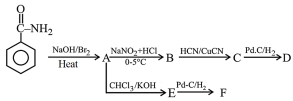
MediumMCQ
Suppose the following reaction:
The product $D$ and $F$ are related as:
The product $D$ and $F$ are related as:
A
Identical
B
Homolog
C
Functional isomer
D
Both form identical product with $HNO_2$
Solution
(C) $1$. The starting material is benzamide. Reaction with $NaOH/Br_2$ (Hofmann bromamide degradation) gives aniline $(A)$.
$2$. Aniline $(A)$ reacts with $NaNO_2/HCl$ at $0-5^{\circ}C$ to form benzene diazonium chloride $(B)$.
$3$. $B$ reacts with $HCN/CuCN$ to form benzonitrile $(C)$,which on reduction with $Pd-C/H_2$ gives benzylamine ($D$,$C_6H_5CH_2NH_2$).
$4$. Aniline $(A)$ reacts with $CHCl_3/KOH$ (carbylamine reaction) to form phenyl isocyanide ($E$,$C_6H_5NC$).
$5$. Reduction of phenyl isocyanide $(E)$ with $Pd-C/H_2$ gives $N$-methylaniline ($F$,$C_6H_5NHCH_3$).
$6$. Comparing $D$ ($C_6H_5CH_2NH_2$,a primary amine) and $F$ ($C_6H_5NHCH_3$,a secondary amine),they have the same molecular formula $(C_7H_9N)$ but different functional groups (primary vs secondary amine). Thus,they are functional isomers.
$2$. Aniline $(A)$ reacts with $NaNO_2/HCl$ at $0-5^{\circ}C$ to form benzene diazonium chloride $(B)$.
$3$. $B$ reacts with $HCN/CuCN$ to form benzonitrile $(C)$,which on reduction with $Pd-C/H_2$ gives benzylamine ($D$,$C_6H_5CH_2NH_2$).
$4$. Aniline $(A)$ reacts with $CHCl_3/KOH$ (carbylamine reaction) to form phenyl isocyanide ($E$,$C_6H_5NC$).
$5$. Reduction of phenyl isocyanide $(E)$ with $Pd-C/H_2$ gives $N$-methylaniline ($F$,$C_6H_5NHCH_3$).
$6$. Comparing $D$ ($C_6H_5CH_2NH_2$,a primary amine) and $F$ ($C_6H_5NHCH_3$,a secondary amine),they have the same molecular formula $(C_7H_9N)$ but different functional groups (primary vs secondary amine). Thus,they are functional isomers.
0 likes
View Solution125
MediumMCQ
Primary and secondary amines can be distinguished by $:-$
A
Carbylamine reaction
B
Hinsberg reagent
C
Both $(A)$ and $(B)$
D
None of these
Solution
(C) Primary amines react with chloroform and alcoholic $KOH$ to give isocyanides (carbylamine test),whereas secondary amines do not. This is the Carbylamine reaction.
Primary amines react with Hinsberg reagent $(C_6H_5SO_2Cl)$ to form a sulfonamide which is soluble in alkali,whereas secondary amines form a sulfonamide which is insoluble in alkali.
Since both tests can distinguish between primary and secondary amines,the correct option is $(C)$.
Primary amines react with Hinsberg reagent $(C_6H_5SO_2Cl)$ to form a sulfonamide which is soluble in alkali,whereas secondary amines form a sulfonamide which is insoluble in alkali.
Since both tests can distinguish between primary and secondary amines,the correct option is $(C)$.
0 likes
View Solution126
MediumMCQ
Which of the following reactions does $NOT$ yield an amine?
A
$R-X + NH_{3(alc)} \longrightarrow R-NH_2$
B
$R-NO_2 \xrightarrow{Sn/conc.HCl} R-NH_2$
C
$R-CH=NOH \xrightarrow{Na/C_2H_5OH} R-CH_2NH_2$
D
$R-CN + H_2O \xrightarrow{H^+} R-COOH$
Solution
(D) The reaction $R-CN + H_2O \xrightarrow{H^+} R-COOH$ is the hydrolysis of a nitrile,which yields a carboxylic acid,not an amine.
- Option $A$: Ammonolysis of alkyl halides yields amines.
- Option $B$: Reduction of nitro compounds yields amines.
- Option $C$: Reduction of oximes yields amines.
- Option $D$: Hydrolysis of nitriles yields carboxylic acids.
- Option $A$: Ammonolysis of alkyl halides yields amines.
- Option $B$: Reduction of nitro compounds yields amines.
- Option $C$: Reduction of oximes yields amines.
- Option $D$: Hydrolysis of nitriles yields carboxylic acids.
0 likes
View Solution127
EasyMCQ
The end product $C$ of the following reaction is $C_2H_5NH_2$ $\xrightarrow{HNO_2} A$ $\xrightarrow{PCl_5} B$ $\xrightarrow{NH_3 (alc.)} C$
A
Ethanol
B
Ethanamine
C
Chloroethane
D
Nitroethane
Solution
(B) The reaction sequence is as follows:
$1$. $C_2H_5NH_2 \xrightarrow{HNO_2} C_2H_5OH$ (Product $A$ is Ethanol).
$2$. $C_2H_5OH \xrightarrow{PCl_5} C_2H_5Cl$ (Product $B$ is Chloroethane).
$3$. $C_2H_5Cl \xrightarrow{NH_3 (alc.)} C_2H_5NH_2$ (Product $C$ is Ethanamine).
Therefore,the end product $C$ is Ethanamine.
$1$. $C_2H_5NH_2 \xrightarrow{HNO_2} C_2H_5OH$ (Product $A$ is Ethanol).
$2$. $C_2H_5OH \xrightarrow{PCl_5} C_2H_5Cl$ (Product $B$ is Chloroethane).
$3$. $C_2H_5Cl \xrightarrow{NH_3 (alc.)} C_2H_5NH_2$ (Product $C$ is Ethanamine).
Therefore,the end product $C$ is Ethanamine.
0 likes
View Solution128
MediumMCQ
Match the compounds given in List-$I$ with the items given in List-$II$.
| List-$I$ | List-$II$ |
| $I.$ Benzenesulphonyl Chloride | $A.$ Zwitterion |
| $II.$ Sulphanilic acid | $B.$ Hinsberg reagent |
| $III.$ Alkyl Diazonium salts | $C.$ Dyes |
| $IV.$ Aryl Diazonium salts | $D.$ Conversion to alcohols |
A
$I-C, II-B, III-A, IV-D$
B
$I-A, II-C, III-B, IV-D$
C
$I-C, II-A, III-D, IV-B$
D
$I-B, II-A, III-D, IV-C$
Solution
(D) $I.$ Benzenesulphonyl Chloride is known as the Hinsberg reagent $(I-B)$.
$II.$ Sulphanilic acid exists as a zwitterion due to the presence of both acidic $(-SO_3H)$ and basic $(-NH_2)$ groups in the same molecule $(II-A)$.
$III.$ Alkyl diazonium salts are highly unstable and decompose to form alcohols $(III-D)$.
$IV.$ Aryl diazonium salts are stable at low temperatures and are used in coupling reactions to form azo dyes $(IV-C)$.
Therefore,the correct matching is $I-B, II-A, III-D, IV-C$.
$II.$ Sulphanilic acid exists as a zwitterion due to the presence of both acidic $(-SO_3H)$ and basic $(-NH_2)$ groups in the same molecule $(II-A)$.
$III.$ Alkyl diazonium salts are highly unstable and decompose to form alcohols $(III-D)$.
$IV.$ Aryl diazonium salts are stable at low temperatures and are used in coupling reactions to form azo dyes $(IV-C)$.
Therefore,the correct matching is $I-B, II-A, III-D, IV-C$.
0 likes
View Solution129
DifficultMCQ
An alkyl halide reacts with alcoholic ammonia in a sealed tube,the product formed will be
A
a primary amine
B
a secondary amine
C
a tertiary amine
D
a mixture of all the three
Solution
(D) When an alkyl halide reacts with alcoholic ammonia in a sealed tube,a mixture of primary,secondary,and tertiary amines is formed due to successive alkylation reactions.
$R-X + NH_{3} \rightarrow R-NH_{2} + HX$ (Primary amine)
$R-NH_{2} + R-X \rightarrow R_{2}NH + HX$ (Secondary amine)
$R_{2}NH + R-X \rightarrow R_{3}N + HX$ (Tertiary amine)
$R_{3}N + R-X \rightarrow R_{4}N^{+}X^{-}$ (Quaternary ammonium salt)
$R-X + NH_{3} \rightarrow R-NH_{2} + HX$ (Primary amine)
$R-NH_{2} + R-X \rightarrow R_{2}NH + HX$ (Secondary amine)
$R_{2}NH + R-X \rightarrow R_{3}N + HX$ (Tertiary amine)
$R_{3}N + R-X \rightarrow R_{4}N^{+}X^{-}$ (Quaternary ammonium salt)
0 likes
View Solution130
DifficultMCQ
An organic compound $A$ on reduction gives compound $B$,which on reaction with trichloromethane and caustic potash forms $C$. The compound $C$ on catalytic reduction gives $N$-methylbenzenamine. The compound $A$ is,
A
Nitrobenzene
B
Nitromethane
C
Methanamine
D
Benzenamine
Solution
(A) The reaction sequence is as follows:
$1$. $A$ is Nitrobenzene $(C_6H_5NO_2)$.
$2$. Reduction of $A$ gives $B$,which is Aniline $(C_6H_5NH_2)$.
$3$. Aniline reacts with trichloromethane $(CHCl_3)$ and caustic potash $(KOH)$ to form Phenyl isocyanide $(C_6H_5NC)$ as compound $C$ (Carbylamine reaction).
$4$. Catalytic reduction of $C$ $(C_6H_5NC)$ gives $N$-methylbenzenamine $(C_6H_5NHCH_3)$.
Thus,compound $A$ is Nitrobenzene.
$1$. $A$ is Nitrobenzene $(C_6H_5NO_2)$.
$2$. Reduction of $A$ gives $B$,which is Aniline $(C_6H_5NH_2)$.
$3$. Aniline reacts with trichloromethane $(CHCl_3)$ and caustic potash $(KOH)$ to form Phenyl isocyanide $(C_6H_5NC)$ as compound $C$ (Carbylamine reaction).
$4$. Catalytic reduction of $C$ $(C_6H_5NC)$ gives $N$-methylbenzenamine $(C_6H_5NHCH_3)$.
Thus,compound $A$ is Nitrobenzene.
0 likes
View Solution131
EasyMCQ
An aromatic compound '$A$' $(C_{7}H_{9}N)$ on reacting with $NaNO_{2} / HCl$ at $0^{\circ}C$ forms benzyl alcohol and nitrogen gas. The number of isomers possible for the compound '$A$' is
A
$5$
B
$4$
C
$3$
D
$6$
Solution
(A) The molecular formula $C_{7}H_{9}N$ corresponds to an aromatic amine. The reaction with $NaNO_{2} / HCl$ at $0^{\circ}C$ to form benzyl alcohol indicates that the compound is a primary aliphatic amine attached to a benzene ring,specifically benzylamine $(C_{6}H_{5}CH_{2}NH_{2})$.
The isomers of $C_{7}H_{9}N$ are:
$1$. $o$-Toluidine ($2$-methylaniline)
$2$. $m$-Toluidine ($3$-methylaniline)
$3$. $p$-Toluidine ($4$-methylaniline)
$4$. $N$-Methylaniline $(C_{6}H_{5}NHCH_{3})$
$5$. Benzylamine $(C_{6}H_{5}CH_{2}NH_{2})$
Thus,there are $5$ possible isomers for the compound $C_{7}H_{9}N$.
The isomers of $C_{7}H_{9}N$ are:
$1$. $o$-Toluidine ($2$-methylaniline)
$2$. $m$-Toluidine ($3$-methylaniline)
$3$. $p$-Toluidine ($4$-methylaniline)
$4$. $N$-Methylaniline $(C_{6}H_{5}NHCH_{3})$
$5$. Benzylamine $(C_{6}H_{5}CH_{2}NH_{2})$
Thus,there are $5$ possible isomers for the compound $C_{7}H_{9}N$.
0 likes
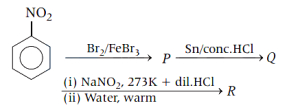
View Solution132
EasyMCQ
The final product $R$ for the reaction is:
A
$3-$Bromonitrobenzene
B
$3-$Bromophenol
C
$3-$Bromobenzenediazonium chloride
D
$3-$Bromoaniline
Solution
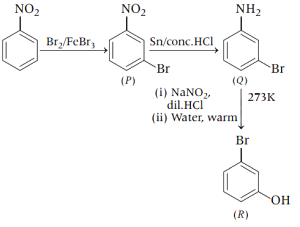
(B) $1$. Nitrobenzene reacts with $Br_2/FeBr_3$ to form $m$-bromonitrobenzene $(P)$ because the $-NO_2$ group is meta-directing.
$2$. $m$-Bromonitrobenzene $(P)$ is reduced by $Sn/conc. HCl$ to form $m$-bromoaniline $(Q)$.
$3$. $m$-Bromoaniline $(Q)$ reacts with $NaNO_2/dil. HCl$ at $273 \ K$ to form $m$-bromobenzenediazonium chloride.
$4$. Finally,warming with water replaces the diazonium group with an $-OH$ group to form $m$-bromophenol $(R)$.
$2$. $m$-Bromonitrobenzene $(P)$ is reduced by $Sn/conc. HCl$ to form $m$-bromoaniline $(Q)$.
$3$. $m$-Bromoaniline $(Q)$ reacts with $NaNO_2/dil. HCl$ at $273 \ K$ to form $m$-bromobenzenediazonium chloride.
$4$. Finally,warming with water replaces the diazonium group with an $-OH$ group to form $m$-bromophenol $(R)$.
0 likes
View Solution133
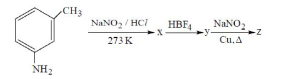
MediumMCQ
The percentage of carbon in '$z$' is (Atomic weights: $C=12 \text{ u}, H=1 \text{ u}, N=14 \text{ u}, O=16 \text{ u}, F=19 \text{ u}, B=10.8 \text{ u}$). (in $.3$)
A
$71$
B
$51$
C
$61$
D
$48$
Solution
(C) $1$. The starting material is $m$-toluidine ($3$-methylaniline).
$2$. Reaction with $NaNO_2/HCl$ at $273 \text{ K}$ gives $m$-toluenediazonium chloride $(x)$.
$3$. Reaction with $HBF_4$ gives $m$-toluenediazonium tetrafluoroborate $(y)$.
$4$. Thermal decomposition of $y$ in the presence of $NaNO_2$ and $Cu$ (Schiemann reaction/Balz-Schiemann variant) leads to the formation of $m$-nitrotoluene $(z)$,which is $C_7H_7NO_2$.
$5$. Molar mass of $C_7H_7NO_2 = (7 \times 12) + (7 \times 1) + 14 + (2 \times 16) = 84 + 7 + 14 + 32 = 137 \text{ g/mol}$.
$6$. Percentage of carbon = $(84 / 137) \times 100 \approx 61.31 \%$.
$2$. Reaction with $NaNO_2/HCl$ at $273 \text{ K}$ gives $m$-toluenediazonium chloride $(x)$.
$3$. Reaction with $HBF_4$ gives $m$-toluenediazonium tetrafluoroborate $(y)$.
$4$. Thermal decomposition of $y$ in the presence of $NaNO_2$ and $Cu$ (Schiemann reaction/Balz-Schiemann variant) leads to the formation of $m$-nitrotoluene $(z)$,which is $C_7H_7NO_2$.
$5$. Molar mass of $C_7H_7NO_2 = (7 \times 12) + (7 \times 1) + 14 + (2 \times 16) = 84 + 7 + 14 + 32 = 137 \text{ g/mol}$.
$6$. Percentage of carbon = $(84 / 137) \times 100 \approx 61.31 \%$.
0 likes
View Solution134
MediumMCQ
What are $X$ and $Y$ respectively in the following set of reactions?

A
Phenyl cyanide,Phenyl cyanide
B
Phenyl cyanide,Phenyl isocyanide
C
Phenyl isocyanide,Phenyl cyanide
D
Phenyl isocyanide,Phenyl isocyanide
Solution
(C) The reaction of aniline with $CHCl_3$ and $KOH$ (carbylamine reaction) produces phenyl isocyanide $(C_6H_5NC)$ as $X$.
The reaction of aniline with $NaNO_2/HCl$ followed by $CuCN/KCN$ (Sandmeyer reaction) produces phenyl cyanide $(C_6H_5CN)$ as $Y$.
Therefore,$X$ is phenyl isocyanide and $Y$ is phenyl cyanide.
The reaction of aniline with $NaNO_2/HCl$ followed by $CuCN/KCN$ (Sandmeyer reaction) produces phenyl cyanide $(C_6H_5CN)$ as $Y$.
Therefore,$X$ is phenyl isocyanide and $Y$ is phenyl cyanide.
0 likes
View Solution135
EasyMCQ
The correct sequence of reactions involved in the following conversion is:
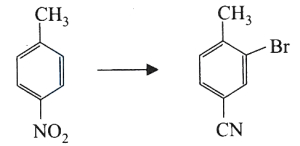
A
Bromination,reduction,carbylamine reaction
B
Reduction,Bromination,carbylamine reaction
C
Bromination,reduction,oxidation
D
Reduction,Bromination,oxidation
Solution
(A) The conversion of $p$-nitrotoluene to $2$-bromo-$4$-methylbenzonitrile involves the following steps:
$1$. Bromination: $p$-Nitrotoluene reacts with $Br_2$ to form $2$-bromo-$4$-nitrotoluene.
$2$. Reduction: The nitro group $(-NO_2)$ is reduced to an amino group $(-NH_2)$ using $Sn + HCl$ to form $2$-bromo-$4$-methylaniline.
$3$. Carbylamine reaction: The primary amine $(-NH_2)$ is converted to an isocyanide $(-NC)$ using $CHCl_3 + KOH$ (Note: The final product in the provided image is an isocyanide,not a nitrile,which is characteristic of the carbylamine reaction).
Thus,the correct sequence is Bromination,reduction,carbylamine reaction.
$1$. Bromination: $p$-Nitrotoluene reacts with $Br_2$ to form $2$-bromo-$4$-nitrotoluene.
$2$. Reduction: The nitro group $(-NO_2)$ is reduced to an amino group $(-NH_2)$ using $Sn + HCl$ to form $2$-bromo-$4$-methylaniline.
$3$. Carbylamine reaction: The primary amine $(-NH_2)$ is converted to an isocyanide $(-NC)$ using $CHCl_3 + KOH$ (Note: The final product in the provided image is an isocyanide,not a nitrile,which is characteristic of the carbylamine reaction).
Thus,the correct sequence is Bromination,reduction,carbylamine reaction.
0 likes
View Solution136
MediumMCQ
In the given reactions,'$X$' and '$Y$' respectively are $C_6H_5CH_2NH_2$ $\xrightarrow{X} C_6H_5CONH_2$ $\xrightarrow{Y} C_6H_5NH_2$
A
$KMnO_4 / H^{+} / \Delta$ and $Br_2 / KOH$
B
$Br_2 / KOH$ and $KMnO_4 / H^{+} / \Delta$
C
$Br_2 / H^{+}$ and $NaBH_4$
D
$NaBH_4$ and $Br_2 / H^{+}$
Solution
(A) Step $1$: Oxidation of benzylamine $(C_6H_5CH_2NH_2)$ to benzamide $(C_6H_5CONH_2)$ is not a standard single-step reaction. However,considering the options provided,the conversion of the side chain to an amide group typically involves oxidation. $KMnO_4 / H^{+} / \Delta$ is a strong oxidizing agent capable of oxidizing the benzylic carbon to a carboxylic acid,which can then be converted to an amide.
Step $2$: The conversion of benzamide $(C_6H_5CONH_2)$ to aniline $(C_6H_5NH_2)$ is the classic $Hoffmann$ bromamide degradation reaction,which uses $Br_2 / KOH$ (or $Br_2 / NaOH$).
Therefore,$X$ is $KMnO_4 / H^{+} / \Delta$ and $Y$ is $Br_2 / KOH$.
Step $2$: The conversion of benzamide $(C_6H_5CONH_2)$ to aniline $(C_6H_5NH_2)$ is the classic $Hoffmann$ bromamide degradation reaction,which uses $Br_2 / KOH$ (or $Br_2 / NaOH$).
Therefore,$X$ is $KMnO_4 / H^{+} / \Delta$ and $Y$ is $Br_2 / KOH$.
0 likes
View Solution137
EasyMCQ
Match the following:
The correct answer is
| List-$I$ (Amine) | List-$II$ ($pK_b$ value) |
| $A$. $N,N$-Dimethylaniline | $I$. $9.30$ |
| $B$. Aniline | $II$. $8.92$ |
| $C$. $N$-Ethylethanamine | $III$. $9.38$ |
| $D$. $N$-Methylaniline | $IV$. $3.00$ |
The correct answer is
A
$A-II, B-III, C-IV, D-I$
B
$A-II, B-IV, C-III, D-I$
C
$A-III, B-IV, C-I, D-II$
D
$A-IV, B-III, C-II, D-I$
Solution
(A) The basicity of amines is inversely proportional to their $pK_b$ values. $A$ lower $pK_b$ value indicates a stronger base.
$1$. $N$-Ethylethanamine (diethylamine) is an aliphatic secondary amine,which is much more basic than aromatic amines due to the absence of resonance stabilization of the lone pair on nitrogen. Thus,it has the lowest $pK_b$ value: $C-IV$ $(3.00)$.
$2$. Among the aromatic amines,$N,N$-Dimethylaniline $(A)$ is more basic than $N$-Methylaniline $(D)$ and Aniline $(B)$ due to the electron-donating $+I$ effect of the two methyl groups,which increases electron density on the nitrogen atom. Thus,$A$ has the lowest $pK_b$ among the aromatics: $A-II$ $(8.92)$.
$3$. $N$-Methylaniline $(D)$ is more basic than Aniline $(B)$ due to the $+I$ effect of one methyl group. Thus,$D-I$ $(9.30)$.
$4$. Aniline $(B)$ is the least basic among these due to the resonance of the lone pair with the benzene ring. Thus,$B-III$ $(9.38)$.
Therefore,the correct matching is $A-II, B-III, C-IV, D-I$.
$1$. $N$-Ethylethanamine (diethylamine) is an aliphatic secondary amine,which is much more basic than aromatic amines due to the absence of resonance stabilization of the lone pair on nitrogen. Thus,it has the lowest $pK_b$ value: $C-IV$ $(3.00)$.
$2$. Among the aromatic amines,$N,N$-Dimethylaniline $(A)$ is more basic than $N$-Methylaniline $(D)$ and Aniline $(B)$ due to the electron-donating $+I$ effect of the two methyl groups,which increases electron density on the nitrogen atom. Thus,$A$ has the lowest $pK_b$ among the aromatics: $A-II$ $(8.92)$.
$3$. $N$-Methylaniline $(D)$ is more basic than Aniline $(B)$ due to the $+I$ effect of one methyl group. Thus,$D-I$ $(9.30)$.
$4$. Aniline $(B)$ is the least basic among these due to the resonance of the lone pair with the benzene ring. Thus,$B-III$ $(9.38)$.
Therefore,the correct matching is $A-II, B-III, C-IV, D-I$.
0 likes
View Solution138
DifficultMCQ
Match the following:
| List-$I$ | List-$II$ |
|---|---|
| $A$. Amide | $I$. Carbylamine reaction |
| $B$. Nitrile | $II$. Hinsberg's reagent |
| $C$. $C_6H_5SO_2Cl$ | $III$. Hofmann's bromamide reaction |
| $D$. $1^{\circ}$-Amine | $IV$. $LiAlH_4$ |
A
$A-III, B-IV, C-II, D-I$
B
$A-I, B-II, C-III, D-IV$
C
$A-III, B-II, C-IV, D-I$
D
$A-IV, B-III, C-II, D-I$
Solution
(A) . Amide reacts via Hofmann's bromamide reaction $(III)$.
$B$. Nitrile is reduced using $LiAlH_4$ $(IV)$.
$C$. $C_6H_5SO_2Cl$ is known as Hinsberg's reagent $(II)$.
$D$. $1^{\circ}$-Amine undergoes the carbylamine reaction $(I)$.
Therefore,the correct matching is $A-III, B-IV, C-II, D-I$.
$B$. Nitrile is reduced using $LiAlH_4$ $(IV)$.
$C$. $C_6H_5SO_2Cl$ is known as Hinsberg's reagent $(II)$.
$D$. $1^{\circ}$-Amine undergoes the carbylamine reaction $(I)$.
Therefore,the correct matching is $A-III, B-IV, C-II, D-I$.
0 likes
View Solution139
MediumMCQ
The following transformation can be accomplished by:
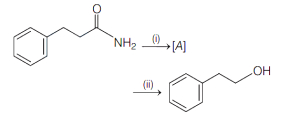
A
$LiAlH_4$,Pyridinium dichromate
B
$Br_2 / 4 KOH$,$NaNO_2 / HCl$
C
$Br_2 / 3 KOH$,Alc. $KMnO_4$
D
$NaNO_2 / HCl$,$LiAlH_4$
Solution
(B) Step $(i)$: The amide reacts with bromine and aqueous $KOH$ to undergo Hofmann bromamide degradation to form a primary amine.
Step $(ii)$: The primary amine reacts with $NaNO_2 / HCl$ (nitrous acid) at low temperature to form a diazonium salt,which upon hydrolysis yields an alcohol.
Step $(ii)$: The primary amine reacts with $NaNO_2 / HCl$ (nitrous acid) at low temperature to form a diazonium salt,which upon hydrolysis yields an alcohol.
0 likes
View Solution140
DifficultMCQ
The major products $P$ and $Q$ formed in the following reactions of benzonitrile are
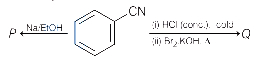
A
Benzamide and Benzylamine
B
Benzaldimine and Aniline
C
Benzylamine and Aniline
D
Aniline and Benzamide
Solution
(C) When $C_6H_5CN$ reacts with $Na / C_2H_5OH$,$C_6H_5CN$ undergoes reduction and the $-C \equiv N$ group changes to $-CH_2-NH_2$. Thus,the product $(P)$ is $C_6H_5CH_2NH_2$ (Benzylamine).
The reaction occurs as follows:
$C_6H_5CN + 4[H] \rightarrow C_6H_5CH_2NH_2$
When $C_6H_5CN$ reacts with $(i)$ $HCl$ (conc. cold) and (ii) $Br_2 / KOH$,it follows the partial hydrolysis of nitrile to amide,followed by the Hoffmann-Bromamide degradation reaction. The final product $(Q)$ is aniline $(C_6H_5NH_2)$.
The whole reaction is as follows:
$C_6H_5CN$ $\xrightarrow{H_2O, OH^{-}} C_6H_5CONH_2$ $\xrightarrow{Br_2 / KOH} C_6H_5NH_2$
Hence,option $(C)$ is the correct answer.
The reaction occurs as follows:
$C_6H_5CN + 4[H] \rightarrow C_6H_5CH_2NH_2$
When $C_6H_5CN$ reacts with $(i)$ $HCl$ (conc. cold) and (ii) $Br_2 / KOH$,it follows the partial hydrolysis of nitrile to amide,followed by the Hoffmann-Bromamide degradation reaction. The final product $(Q)$ is aniline $(C_6H_5NH_2)$.
The whole reaction is as follows:
$C_6H_5CN$ $\xrightarrow{H_2O, OH^{-}} C_6H_5CONH_2$ $\xrightarrow{Br_2 / KOH} C_6H_5NH_2$
Hence,option $(C)$ is the correct answer.
0 likes
View Solution141
DifficultMCQ
What are the structures of $X$,$Y$,and $Z$ in the above given reaction sequence?
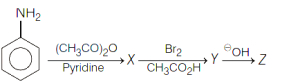
A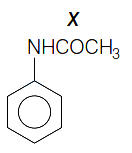
B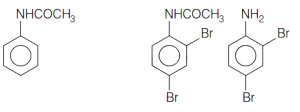
C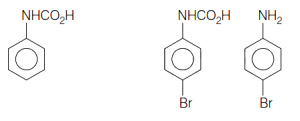
D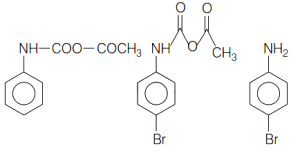
Solution
(C) The reaction sequence is as follows:
$1$. Aniline reacts with acetic anhydride $(CH_3CO)_2O$ in the presence of pyridine to form acetanilide,which is $X$ $(C_6H_5NHCOCH_3)$.
$2$. Acetanilide $(X)$ undergoes electrophilic aromatic substitution with $Br_2$ in acetic acid $(CH_3CO_2H)$ to form $p$-bromoacetanilide,which is $Y$ $(Br-C_6H_4-NHCOCH_3)$.
$3$. $p$-Bromoacetanilide $(Y)$ undergoes alkaline hydrolysis with $OH^-$ to form $p$-bromoaniline,which is $Z$ $(Br-C_6H_4-NH_2)$.
$1$. Aniline reacts with acetic anhydride $(CH_3CO)_2O$ in the presence of pyridine to form acetanilide,which is $X$ $(C_6H_5NHCOCH_3)$.
$2$. Acetanilide $(X)$ undergoes electrophilic aromatic substitution with $Br_2$ in acetic acid $(CH_3CO_2H)$ to form $p$-bromoacetanilide,which is $Y$ $(Br-C_6H_4-NHCOCH_3)$.
$3$. $p$-Bromoacetanilide $(Y)$ undergoes alkaline hydrolysis with $OH^-$ to form $p$-bromoaniline,which is $Z$ $(Br-C_6H_4-NH_2)$.
0 likes
View Solution142
DifficultMCQ
$90 \ g$ of ethylamine on reaction with methyl chloride produces a tertiary amine as the exclusive product. The amount of methyl chloride required is:
$[\text{Given atomic masses in amu}: H=1, C=12, N=14, Cl=35.5]$ (in $g$)
$[\text{Given atomic masses in amu}: H=1, C=12, N=14, Cl=35.5]$ (in $g$)
A
$50.5$
B
$101$
C
$202$
D
$303$
Solution
(C) The reaction for the formation of a tertiary amine from ethylamine $(CH_3CH_2NH_2)$ and methyl chloride $(CH_3Cl)$ is:
$CH_3CH_2NH_2 + 2CH_3Cl \rightarrow CH_3CH_2N(CH_3)_2 + 2HCl$
Molar mass of ethylamine $(C_2H_7N)$ $= (2 \times 12) + (7 \times 1) + 14 = 45 \ g/mol$.
Molar mass of methyl chloride $(CH_3Cl)$ $= 12 + (3 \times 1) + 35.5 = 50.5 \ g/mol$.
Moles of ethylamine $= \frac{90 \ g}{45 \ g/mol} = 2 \ mol$.
According to the stoichiometry of the reaction,$1 \ mol$ of ethylamine reacts with $2 \ mol$ of methyl chloride.
Therefore,$2 \ mol$ of ethylamine will react with $2 \times 2 = 4 \ mol$ of methyl chloride.
Mass of methyl chloride required $= 4 \ mol \times 50.5 \ g/mol = 202 \ g$.
$CH_3CH_2NH_2 + 2CH_3Cl \rightarrow CH_3CH_2N(CH_3)_2 + 2HCl$
Molar mass of ethylamine $(C_2H_7N)$ $= (2 \times 12) + (7 \times 1) + 14 = 45 \ g/mol$.
Molar mass of methyl chloride $(CH_3Cl)$ $= 12 + (3 \times 1) + 35.5 = 50.5 \ g/mol$.
Moles of ethylamine $= \frac{90 \ g}{45 \ g/mol} = 2 \ mol$.
According to the stoichiometry of the reaction,$1 \ mol$ of ethylamine reacts with $2 \ mol$ of methyl chloride.
Therefore,$2 \ mol$ of ethylamine will react with $2 \times 2 = 4 \ mol$ of methyl chloride.
Mass of methyl chloride required $= 4 \ mol \times 50.5 \ g/mol = 202 \ g$.
0 likes
View Solution143
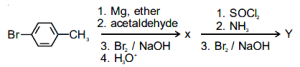
DifficultMCQ
The compounds $X$ and $Y$ are respectively:
A
$p$-methyl$-1-$phenylethanol and $p$-toluidine
B
$p$-methylacetophenone and $p$-toluidine
C
$1-(p-tolyl)ethanol$ and $p$-toluamide
D
$p$-toluic acid and $p$-toluidine
Solution
(D) $1$. Formation of $X$: The reaction of $p$-bromotoluene with $Mg$ in ether forms a Grignard reagent,$p-CH_3-C_6H_4-MgBr$. This reacts with acetaldehyde $(CH_3CHO)$ followed by hydrolysis to give $1-(p-tolyl)ethanol$. The haloform reaction $(Br_2/NaOH)$ on this secondary alcohol oxidizes it to $p$-methylacetophenone,which then undergoes haloform reaction again to produce $p$-toluic acid $(X)$.
$2$. Formation of $Y$: $p$-toluic acid $(X)$ reacts with $SOCl_2$ to form $p$-toluoyl chloride,which on reaction with $NH_3$ gives $p$-toluamide. Finally,the Hoffman bromamide reaction $(Br_2/NaOH)$ converts the amide into $p$-toluidine $(Y)$.
$2$. Formation of $Y$: $p$-toluic acid $(X)$ reacts with $SOCl_2$ to form $p$-toluoyl chloride,which on reaction with $NH_3$ gives $p$-toluamide. Finally,the Hoffman bromamide reaction $(Br_2/NaOH)$ converts the amide into $p$-toluidine $(Y)$.
0 likes
View Solution144
DifficultMCQ
Given below are two statements:
Statement $I$: $o$-Phenylenediamine can be synthesized from $o$-xylene using simpler reagents in the order: $i)$ Acidic $KMnO_4$,$ii)$ Ammonia,$iii)$ Bromine and alkali.
Statement $II$: Aniline can be converted into benzene using reagents in the order: $(i)$ Bromine-$H_2O$,$(ii)$ $NaNO_2 / HCl$ $(0-5^{\circ} C)$,$(iii)$ aq. $H_3PO_2$.
In the light of the above statements,choose the correct answer from the options given below.
Statement $I$: $o$-Phenylenediamine can be synthesized from $o$-xylene using simpler reagents in the order: $i)$ Acidic $KMnO_4$,$ii)$ Ammonia,$iii)$ Bromine and alkali.
Statement $II$: Aniline can be converted into benzene using reagents in the order: $(i)$ Bromine-$H_2O$,$(ii)$ $NaNO_2 / HCl$ $(0-5^{\circ} C)$,$(iii)$ aq. $H_3PO_2$.
In the light of the above statements,choose the correct answer from the options given below.
A
Both Statement $I$ and Statement $II$ are false
B
Statement $I$ is true but Statement $II$ is false
C
Both Statement $I$ and Statement $II$ are true
D
Statement $I$ is false but Statement $II$ is true
Solution
(B) Statement $I$: $o$-Xylene on oxidation with acidic $KMnO_4$ gives phthalic acid. Phthalic acid reacts with ammonia to form phthalimide. Phthalimide on reaction with $Br_2/KOH$ (Hofmann bromamide degradation) gives $o$-phenylenediamine. Thus,Statement $I$ is true.
Statement $II$: Aniline reacts with $Br_2-H_2O$ to form $2,4,6$-tribromoaniline. This cannot be converted to benzene using the subsequent steps mentioned. The correct sequence to convert aniline to benzene is $(i)$ $NaNO_2/HCl$ $(0-5^{\circ} C)$ to form benzene diazonium chloride,$(ii)$ $H_3PO_2/H_2O$ to form benzene. Thus,Statement $II$ is false.
Statement $II$: Aniline reacts with $Br_2-H_2O$ to form $2,4,6$-tribromoaniline. This cannot be converted to benzene using the subsequent steps mentioned. The correct sequence to convert aniline to benzene is $(i)$ $NaNO_2/HCl$ $(0-5^{\circ} C)$ to form benzene diazonium chloride,$(ii)$ $H_3PO_2/H_2O$ to form benzene. Thus,Statement $II$ is false.
0 likes
View Solution145
DifficultMCQ
Given below are two statements:
Statement $I$: The dipole moment of $R-CN$ is greater than $R-NC$ and $R-NC$ can undergo hydrolysis under acidic medium to produce $R-NH_2$ and $HCOOH$.
Statement $II$: $R-CN$ hydrolyses under acidic medium to produce a compound which on treatment with $SOCl_2$ followed by the addition of $NH_3$ gives another compound $(x)$. This compound $(x)$ on treatment with $NaOCl/NaOH$ gives a product,that on treatment with $CHCl_3/KOH/\Delta$ produces $R-NC$.
In the light of the above statements,choose the correct answer from the options given below:
Statement $I$: The dipole moment of $R-CN$ is greater than $R-NC$ and $R-NC$ can undergo hydrolysis under acidic medium to produce $R-NH_2$ and $HCOOH$.
Statement $II$: $R-CN$ hydrolyses under acidic medium to produce a compound which on treatment with $SOCl_2$ followed by the addition of $NH_3$ gives another compound $(x)$. This compound $(x)$ on treatment with $NaOCl/NaOH$ gives a product,that on treatment with $CHCl_3/KOH/\Delta$ produces $R-NC$.
In the light of the above statements,choose the correct answer from the options given below:
A
Both Statement $I$ and Statement $II$ are false
B
Both Statement $I$ and Statement $II$ are true
C
Statement $I$ is true but Statement $II$ is false
D
Statement $I$ is false but Statement $II$ is true
Solution
(D) Statement $I$: False. The dipole moment of $R-NC$ is significantly higher than that of $R-CN$ due to the electronic structure of the isocyanide group.
Statement $II$: True. The reaction sequence is as follows:
$R-CN$ $\xrightarrow{H_3O^{+}} RCOOH$ $\xrightarrow{SOCl_2} RCOCl$ $\xrightarrow{NH_3} RCONH_2 (x)$ $\xrightarrow{NaOCl/OH^{-}} RNH_2$ $\xrightarrow{CHCl_3 + KOH/\Delta} R-NC$ (Carbylamine reaction).
Statement $II$: True. The reaction sequence is as follows:
$R-CN$ $\xrightarrow{H_3O^{+}} RCOOH$ $\xrightarrow{SOCl_2} RCOCl$ $\xrightarrow{NH_3} RCONH_2 (x)$ $\xrightarrow{NaOCl/OH^{-}} RNH_2$ $\xrightarrow{CHCl_3 + KOH/\Delta} R-NC$ (Carbylamine reaction).
0 likes
View SolutionAmines — Mix Examples of Amines · Frequently Asked Questions
1Are these Amines questions useful for JEE and NEET?
Yes. All questions in this section are mapped to JEE Main and NEET exam patterns. Previous year questions from JEE Main, NEET, GUJCET and state-level exams are included with full solutions.
2Can I switch to Hindi or Gujarati for these questions?
Yes. Use the language tabs in the hero section or the sidebar to view the same questions and solutions in English, Hindi or Gujarati.
3How do I generate a question paper from this subtopic?
Use the Vedclass Exam Paper Generator — select the chapter and subtopic, set difficulty, and generate Sets A, B, C, D automatically. First 3 chapters of every subject are free.
Vedclass Products
For Students
Vedclass Test Series
Mock tests in real JEE/NEET style with performance analysis. 5-day free trial.
Start Free TrialFor Teachers
Exam Paper Generator
Generate Set A/B/C/D papers from this chapter in 2 minutes. 3 chapters free.
Try FreeFor Institutes
Online Exam Module
Live online exams with unlimited students, 360° analytics & white-label branding.
See DemoFor Teachers & Institutes
Generate a Amines Exam Paper in 2 Minutes
Select subtopic & difficulty — Sets A, B, C, D auto-generated with No Repeat logic.
First 3 chapters of every subject are free — no payment required.