
A English
Preparation of Amines Questions in English
Class 12 Chemistry · Amines · Preparation of Amines
223+
Questions
English
Language
100%
With Solutions
Showing 49 of 223 questions in English
1
MediumMCQ
The compound $A$ when treated with $HNO_3$ (in presence of $H_2SO_4$) gives compound $B$,which is then reduced with $Sn$ and $HCl$ to aniline. The compound $A$ is
A
Toluene
B
Benzene
C
Ethane
D
Acetamide
Solution
(B) The reaction sequence is as follows:
$1$. The nitration of benzene $(C_6H_6)$ with concentrated $HNO_3$ in the presence of concentrated $H_2SO_4$ yields nitrobenzene $(C_6H_5NO_2)$,which is compound $B$.
$2$. Nitrobenzene $(C_6H_5NO_2)$ is then reduced using $Sn$ and $HCl$ to form aniline $(C_6H_5NH_2)$.
$3$. Therefore,the starting compound $A$ is benzene.
$1$. The nitration of benzene $(C_6H_6)$ with concentrated $HNO_3$ in the presence of concentrated $H_2SO_4$ yields nitrobenzene $(C_6H_5NO_2)$,which is compound $B$.
$2$. Nitrobenzene $(C_6H_5NO_2)$ is then reduced using $Sn$ and $HCl$ to form aniline $(C_6H_5NH_2)$.
$3$. Therefore,the starting compound $A$ is benzene.
0 likes
View Solution2
MediumMCQ
Identify $X$ and $Y$ in the following sequence:
$C_2H_5Br$ $\xrightarrow{X} \text{product}$ $\xrightarrow{Y} C_3H_7NH_2$
$C_2H_5Br$ $\xrightarrow{X} \text{product}$ $\xrightarrow{Y} C_3H_7NH_2$
A
$X = KCN, \, Y = LiAlH_4$
B
$X = KCN, \, Y = H_3O^{+}$
C
$X = CH_3Cl, \, Y = AlCl_3/HCl$
D
$X = CH_3NH_2, \, Y = HNO_2$
Solution
(A) The reaction sequence is as follows:
$1. \, C_2H_5Br \xrightarrow{KCN (X)} C_2H_5CN$ (Ethyl cyanide)
$2. \, C_2H_5CN \xrightarrow{LiAlH_4 (Y)} C_2H_5CH_2NH_2$ (Propylamine,$C_3H_7NH_2$)
Thus,$X = KCN$ and $Y = LiAlH_4$.
$1. \, C_2H_5Br \xrightarrow{KCN (X)} C_2H_5CN$ (Ethyl cyanide)
$2. \, C_2H_5CN \xrightarrow{LiAlH_4 (Y)} C_2H_5CH_2NH_2$ (Propylamine,$C_3H_7NH_2$)
Thus,$X = KCN$ and $Y = LiAlH_4$.
0 likes
View Solution3
MediumMCQ
When ethyl alcohol $C_2H_5OH$ is mixed with ammonia and passed over heated alumina,the compound formed is
A
$C_2H_5NH_2$
B
$C_2H_4$
C
$C_2H_5OC_2H_5$
D
$CH_3OCH_3$
Solution
(A) When ethyl alcohol is passed over heated alumina $(Al_2O_3)$ in the presence of ammonia,it undergoes an ammonolysis reaction to form ethylamine.
The chemical reaction is:
$C_2H_5OH + NH_3 \xrightarrow{Al_2O_3, \Delta} C_2H_5NH_2 + H_2O$
Thus,the correct product is ethylamine $(C_2H_5NH_2)$.
The chemical reaction is:
$C_2H_5OH + NH_3 \xrightarrow{Al_2O_3, \Delta} C_2H_5NH_2 + H_2O$
Thus,the correct product is ethylamine $(C_2H_5NH_2)$.
0 likes
View Solution4
MediumMCQ
Identify the major organic product formed from the following reaction sequence:
$CH_3-CH(CH_3)-CO-CH_3 \xrightarrow[(ii) LiAlH_4, (iii) H_2O]{(i) CH_3NH_2} \text{?}$
$CH_3-CH(CH_3)-CO-CH_3 \xrightarrow[(ii) LiAlH_4, (iii) H_2O]{(i) CH_3NH_2} \text{?}$
A
$3-$methylbutan$-2-$ol
B
$N$,$2$,$3$-trimethylbutan$-2-$amine
C
$N$,$3$-dimethylbutan$-2-$amine
D
$N$-methyl$-3-$methylbutan$-2-$amine
Solution
(B) The reaction proceeds in two main steps:
$1$. The ketone,$3$-methylbutan-$2$-one,reacts with methylamine $(CH_3NH_2)$ to form an imine intermediate $(CH_3-CH(CH_3)-C(CH_3)=NCH_3)$ via nucleophilic addition followed by the elimination of water.
$2$. The imine is then reduced by lithium aluminium hydride $(LiAlH_4)$ to the corresponding secondary amine.
$3$. The final product is $N,2,3$-trimethylbutan-$2$-amine.
$1$. The ketone,$3$-methylbutan-$2$-one,reacts with methylamine $(CH_3NH_2)$ to form an imine intermediate $(CH_3-CH(CH_3)-C(CH_3)=NCH_3)$ via nucleophilic addition followed by the elimination of water.
$2$. The imine is then reduced by lithium aluminium hydride $(LiAlH_4)$ to the corresponding secondary amine.
$3$. The final product is $N,2,3$-trimethylbutan-$2$-amine.
0 likes
View Solution5
MediumMCQ
When propanamide reacts with $Br_2$ and $NaOH$,which of the following compounds is formed?
A
Ethyl alcohol
B
Propyl alcohol
C
Propyl amine
D
Ethylamine
Solution
(D) $CH_3CH_2CONH_2 \xrightarrow{Br_2/NaOH} CH_3CH_2NH_2$
This is a $Hofmann$ bromamide degradation reaction,which converts an amide into a primary amine containing one carbon atom less than the original amide.
This is a $Hofmann$ bromamide degradation reaction,which converts an amide into a primary amine containing one carbon atom less than the original amide.
0 likes
View Solution6
DifficultMCQ
In the Gabriel phthalimide synthesis,phthalimide is treated first with
A
$C_2H_5I / KOH$
B
Ethanolic $Na$
C
Ethanol and $H_2SO_4$
D
Ether and $LiAlH_4$
Solution
(A) In the Gabriel phthalimide synthesis,phthalimide is first treated with alcoholic $KOH$ to form potassium phthalimide.
This potassium phthalimide then reacts with an alkyl halide (such as $C_2H_5I$) to form an $N$-alkyl phthalimide.
Finally,the $N$-alkyl phthalimide is hydrolyzed with dilute $HCl$ or $NaOH$ to yield a primary amine.
Therefore,the initial step involves the reaction with $KOH$.
This potassium phthalimide then reacts with an alkyl halide (such as $C_2H_5I$) to form an $N$-alkyl phthalimide.
Finally,the $N$-alkyl phthalimide is hydrolyzed with dilute $HCl$ or $NaOH$ to yield a primary amine.
Therefore,the initial step involves the reaction with $KOH$.
0 likes
View Solution7
MediumMCQ
When acetamide is treated with $NaOBr$,the product formed is
A
$CH_3CN$
B
$CH_3CH_2NH_2$
C
$CH_3NH_2$
D
None of the above
Solution
(C) The reaction of acetamide $(CH_3CONH_2)$ with $NaOBr$ is known as the Hofmann bromamide degradation reaction.
In this reaction,an amide is converted into a primary amine with one carbon atom less than the original amide.
$CH_3CONH_2 + NaOBr + 4NaOH \rightarrow CH_3NH_2 + Na_2CO_3 + 2NaBr + 2H_2O$.
Thus,the product formed is methylamine $(CH_3NH_2)$.
In this reaction,an amide is converted into a primary amine with one carbon atom less than the original amide.
$CH_3CONH_2 + NaOBr + 4NaOH \rightarrow CH_3NH_2 + Na_2CO_3 + 2NaBr + 2H_2O$.
Thus,the product formed is methylamine $(CH_3NH_2)$.
0 likes
View Solution8
MediumMCQ
Amides may be converted into amines by a reaction named after:
A
Perkin
B
Claisen
C
Hoffmann
D
Kolbe
Solution
(C) The reaction is known as the $Hofmann$ bromamide degradation reaction.
In this reaction,an amide is treated with bromine in an aqueous or ethanolic solution of sodium hydroxide to form a primary amine.
The chemical equation is:
$CH_3CONH_2 + Br_2 + 4KOH \xrightarrow{\Delta} CH_3NH_2 + K_2CO_3 + 2KBr + 2H_2O$
In this reaction,an amide is treated with bromine in an aqueous or ethanolic solution of sodium hydroxide to form a primary amine.
The chemical equation is:
$CH_3CONH_2 + Br_2 + 4KOH \xrightarrow{\Delta} CH_3NH_2 + K_2CO_3 + 2KBr + 2H_2O$
0 likes
View Solution9
MediumMCQ
The reaction $CH_3CONH_2 \xrightarrow{NaOBr}$ gives:
A
$CH_3Br$
B
$CH_4$
C
$CH_3COBr$
D
$CH_3NH_2$
Solution
(D) The reaction $CH_3CONH_2 \xrightarrow{NaOBr} CH_3NH_2$ is known as the $Hofmann$ bromamide degradation reaction.
In this reaction,an amide is treated with an aqueous or ethanolic solution of $NaOH$ and $Br_2$ to produce a primary amine with one carbon atom less than the original amide.
Therefore,$CH_3CONH_2$ (acetamide) yields $CH_3NH_2$ (methanamine).
In this reaction,an amide is treated with an aqueous or ethanolic solution of $NaOH$ and $Br_2$ to produce a primary amine with one carbon atom less than the original amide.
Therefore,$CH_3CONH_2$ (acetamide) yields $CH_3NH_2$ (methanamine).
0 likes
View Solution10
DifficultMCQ
Acetamide is treated separately with the following reagents. Which would give methyl amine?
A
$PCl_5$
B
$NaOH + Br_2$
C
Sodalime
D
Hot conc. $H_2SO_4$
Solution
(B) The reaction of acetamide with $NaOH + Br_2$ is known as the Hofmann bromamide degradation reaction.
In this reaction,an amide is converted into a primary amine with one carbon atom less than the original amide.
$CH_3CONH_2 + Br_2 + 4NaOH \to CH_3NH_2 + Na_2CO_3 + 2NaBr + 2H_2O$
Thus,acetamide gives methyl amine.
In this reaction,an amide is converted into a primary amine with one carbon atom less than the original amide.
$CH_3CONH_2 + Br_2 + 4NaOH \to CH_3NH_2 + Na_2CO_3 + 2NaBr + 2H_2O$
Thus,acetamide gives methyl amine.
0 likes
View Solution11
MediumMCQ
Ethylamine can be prepared by the action of bromine and caustic potash on
A
Acetamide
B
Propionamide
C
Formamide
D
Methyl cyanide
Solution
(B) The reaction of an amide with bromine and caustic potash $(KOH)$ is known as the $Hofmann$ bromamide degradation reaction.
This reaction results in the formation of a primary amine with one carbon atom less than the parent amide.
To prepare ethylamine $(CH_3CH_2NH_2)$,which has $2$ carbon atoms,the starting amide must be propionamide $(CH_3CH_2CONH_2)$,which has $3$ carbon atoms.
The chemical equation is:
$CH_3CH_2CONH_2 + Br_2 + 4KOH \to CH_3CH_2NH_2 + K_2CO_3 + 2KBr + 2H_2O$
This reaction results in the formation of a primary amine with one carbon atom less than the parent amide.
To prepare ethylamine $(CH_3CH_2NH_2)$,which has $2$ carbon atoms,the starting amide must be propionamide $(CH_3CH_2CONH_2)$,which has $3$ carbon atoms.
The chemical equation is:
$CH_3CH_2CONH_2 + Br_2 + 4KOH \to CH_3CH_2NH_2 + K_2CO_3 + 2KBr + 2H_2O$
0 likes
View Solution12
MediumMCQ
Reduction of nitroalkanes yields
A
Acid
B
Alcohol
C
Amine
D
Diazo compounds
Solution
(C) The reduction of nitroalkanes using reducing agents like $Sn/HCl$ or $Fe/HCl$ results in the formation of primary amines.
$CH_3CH_2NO_2 + 6[H] \xrightarrow{Sn/HCl} CH_3CH_2NH_2 + 2H_2O$
Thus,the reduction of nitroalkanes yields amines.
$CH_3CH_2NO_2 + 6[H] \xrightarrow{Sn/HCl} CH_3CH_2NH_2 + 2H_2O$
Thus,the reduction of nitroalkanes yields amines.
0 likes
View Solution13
MediumMCQ
$Acetamide$ changes into $methylamine$ by:
A
$Hofmann$ bromamide reaction
B
$Hofmann$ reaction
C
$Friedel-Craft's$ reaction
D
$Hinsberg$ reaction
Solution
(A) $Acetamide$ $(CH_3CONH_2)$ changes into $methylamine$ $(CH_3NH_2)$ by the $Hofmann$ bromamide degradation reaction.
In this reaction,an amide is treated with bromine $(Br_2)$ in an aqueous or ethanolic solution of sodium hydroxide $(NaOH)$,which leads to the degradation of the amide and the formation of a primary amine with one carbon atom less than the original amide.
In this reaction,an amide is treated with bromine $(Br_2)$ in an aqueous or ethanolic solution of sodium hydroxide $(NaOH)$,which leads to the degradation of the amide and the formation of a primary amine with one carbon atom less than the original amide.
0 likes
View Solution14
DifficultMCQ
Which one of the following compounds gives a secondary amine on reduction?
A
Nitromethane
B
Nitrobenzene
C
Methyl isocyanide
D
Methyl cyanide
Solution
(C) The correct answer is $(C)$.
Methyl isocyanide $(CH_3NC)$ on reduction with hydrogen in the presence of a catalyst gives $N$-methylmethanamine,which is a secondary amine ($2^\circ$ amine).
The reaction is:
$CH_3-NC + 4[H] \xrightarrow{\text{Reduction}} CH_3-NH-CH_3$ ($N$-methylmethanamine).
Methyl isocyanide $(CH_3NC)$ on reduction with hydrogen in the presence of a catalyst gives $N$-methylmethanamine,which is a secondary amine ($2^\circ$ amine).
The reaction is:
$CH_3-NC + 4[H] \xrightarrow{\text{Reduction}} CH_3-NH-CH_3$ ($N$-methylmethanamine).
0 likes
View Solution15
MediumMCQ
When ethanol is mixed with ammonia and passed over alumina,the compound formed is:
A
$C_2H_5NH_2$
B
$C_2H_4$
C
$C_2H_5OC_2H_5$
D
$CH_3OCH_3$
Solution
(A) When ethanol $(C_2H_5OH)$ is reacted with ammonia $(NH_3)$ in the presence of alumina $(Al_2O_3)$ at high temperature,it undergoes an ammonolysis reaction to form ethylamine $(C_2H_5NH_2)$.
The chemical equation is: $C_2H_5OH + NH_3 \xrightarrow{Al_2O_3} C_2H_5NH_2 + H_2O$.
The chemical equation is: $C_2H_5OH + NH_3 \xrightarrow{Al_2O_3} C_2H_5NH_2 + H_2O$.
0 likes
View Solution16
MediumMCQ
Identify '$B$' in the reaction: $\text{Acetamide}$ $\xrightarrow{\Delta, P_2O_5} A$ $\xrightarrow{4H} B$
A
$CH_3NH_2$
B
$CH_3CH_2NH_2$
C
$CH_3CN$
D
$CH_3COONH_4$
Solution
(B) The reaction proceeds as follows:
$1$. Acetamide $(CH_3CONH_2)$ on heating with $P_2O_5$ (a dehydrating agent) undergoes dehydration to form methyl cyanide $(CH_3CN)$ as product $A$.
$2$. Methyl cyanide $(CH_3CN)$ on reduction with $4H$ (using reagents like $LiAlH_4$ or $Na/C_2H_5OH$) forms ethylamine $(CH_3CH_2NH_2)$ as product $B$.
Reaction sequence: $CH_3CONH_2$ $\xrightarrow{P_2O_5, \Delta} CH_3CN$ $\xrightarrow{4H} CH_3CH_2NH_2$.
$1$. Acetamide $(CH_3CONH_2)$ on heating with $P_2O_5$ (a dehydrating agent) undergoes dehydration to form methyl cyanide $(CH_3CN)$ as product $A$.
$2$. Methyl cyanide $(CH_3CN)$ on reduction with $4H$ (using reagents like $LiAlH_4$ or $Na/C_2H_5OH$) forms ethylamine $(CH_3CH_2NH_2)$ as product $B$.
Reaction sequence: $CH_3CONH_2$ $\xrightarrow{P_2O_5, \Delta} CH_3CN$ $\xrightarrow{4H} CH_3CH_2NH_2$.
0 likes
View Solution17
MediumMCQ
Which of the following gives a primary amine on reduction?
A
$CH_3-CH_2-NO_2$
B
$CH_3-CH_2-O-N=O$
C
$CH_3-CH_2-NO_3$
D
None of these
Solution
(A) Nitroalkanes,such as $CH_3-CH_2-NO_2$,undergo reduction in the presence of a catalyst like $Sn/HCl$ or $H_2/Ni$ to form primary amines.
The reaction is: $CH_3-CH_2-NO_2 + 6[H] \to CH_3-CH_2-NH_2 + 2H_2O$.
The reaction is: $CH_3-CH_2-NO_2 + 6[H] \to CH_3-CH_2-NH_2 + 2H_2O$.
0 likes
View Solution18
MediumMCQ
In the reaction $CH_3COOH$ $\xrightarrow{PCl_5} (A)$ $\xrightarrow{NH_3} (B)$ $\xrightarrow{NaBrO} (C)$,the final product $(C)$ is
A
Ammonium acetate
B
Acetamide
C
Methylamine
D
Ethanal
Solution
(C) The reaction sequence is as follows:
$1$. $CH_3COOH + PCl_5 \rightarrow CH_3COCl + POCl_3 + HCl$. Product $(A)$ is Acetyl chloride $(CH_3COCl)$.
$2$. $CH_3COCl + NH_3 \rightarrow CH_3CONH_2 + HCl$. Product $(B)$ is Acetamide $(CH_3CONH_2)$.
$3$. $CH_3CONH_2 + NaBrO \rightarrow CH_3NH_2 + Na_2CO_3 + NaBr$. This is the Hofmann bromamide degradation reaction.
Product $(C)$ is Methylamine $(CH_3NH_2)$.
$1$. $CH_3COOH + PCl_5 \rightarrow CH_3COCl + POCl_3 + HCl$. Product $(A)$ is Acetyl chloride $(CH_3COCl)$.
$2$. $CH_3COCl + NH_3 \rightarrow CH_3CONH_2 + HCl$. Product $(B)$ is Acetamide $(CH_3CONH_2)$.
$3$. $CH_3CONH_2 + NaBrO \rightarrow CH_3NH_2 + Na_2CO_3 + NaBr$. This is the Hofmann bromamide degradation reaction.
Product $(C)$ is Methylamine $(CH_3NH_2)$.
0 likes
View Solution19
MediumMCQ
$CH_3CONH_2 \xrightarrow{Na + ROH} Z + H_2O$. What is $Z$?
A
$CH_3CH_2NH_2$
B
$CH_3CH_2NC$
C
$CH_3CH_2CH_3$
D
$NH_2CONH_2$
Solution
(A) The reaction of an amide $(CH_3CONH_2)$ with sodium $(Na)$ and alcohol $(ROH)$ is a reduction reaction.
This is a specific method for the reduction of amides to primary amines.
The reaction proceeds as follows: $CH_3CONH_2 + 4[H] \xrightarrow{Na + ROH} CH_3CH_2NH_2 + H_2O$.
Therefore,$Z$ is $CH_3CH_2NH_2$.
This is a specific method for the reduction of amides to primary amines.
The reaction proceeds as follows: $CH_3CONH_2 + 4[H] \xrightarrow{Na + ROH} CH_3CH_2NH_2 + H_2O$.
Therefore,$Z$ is $CH_3CH_2NH_2$.
0 likes
View Solution20
MediumMCQ
Nitrobenzene combines with hydrogen in the presence of platinum to produce
A
Toluene
B
Benzene
C
Aniline
D
Azobenzene
Solution
(C) The catalytic hydrogenation of nitrobenzene in the presence of platinum $(Pt)$ acts as a reducing agent to convert the nitro group $(-NO_2)$ into an amino group $(-NH_2)$.
The chemical equation is: $C_6H_5NO_2 + 6H \xrightarrow{Pt} C_6H_5NH_2 + 2H_2O$.
Thus,the product formed is aniline.
The chemical equation is: $C_6H_5NO_2 + 6H \xrightarrow{Pt} C_6H_5NH_2 + 2H_2O$.
Thus,the product formed is aniline.
0 likes
View Solution21
MediumMCQ
When chlorobenzene is treated with $NH_3$ in the presence of $Cu_2O$ in xylene at $570 \ K$,the product obtained is:
A
Benzylamine
B
Diazonium salt
C
Schiff’s base
D
Aniline
Solution
(D) The reaction of chlorobenzene with ammonia in the presence of $Cu_2O$ at $570 \ K$ is a nucleophilic substitution reaction used for the preparation of aniline.
The chemical equation is:
$2C_6H_5Cl + 2NH_3 \xrightarrow{Cu_2O, \ 570 \ K} 2C_6H_5NH_2 + Cu_2Cl_2 + H_2O$
Thus,the product obtained is aniline.
The chemical equation is:
$2C_6H_5Cl + 2NH_3 \xrightarrow{Cu_2O, \ 570 \ K} 2C_6H_5NH_2 + Cu_2Cl_2 + H_2O$
Thus,the product obtained is aniline.
0 likes
View Solution22
MediumMCQ
The diazonium salts are the reaction products in the presence of excess of mineral acid with nitrous acid and:
A
Primary aliphatic amine
B
Secondary aromatic amine
C
Primary aromatic amine
D
Tertiary aliphatic amine
Solution
(C) The formation of diazonium salts,known as the diazotization reaction,occurs when a $1^{\circ}$ aromatic amine reacts with nitrous acid $(HNO_2)$ in the presence of an excess of mineral acid (like $HCl$) at a low temperature of $273-278 \ K$.
$Ar-NH_2 + HNO_2 + 2HX \xrightarrow{273-278 \ K} Ar-N_2^+X^- + 2H_2O$
Therefore,the correct reactant is a primary aromatic amine.
$Ar-NH_2 + HNO_2 + 2HX \xrightarrow{273-278 \ K} Ar-N_2^+X^- + 2H_2O$
Therefore,the correct reactant is a primary aromatic amine.
0 likes
View Solution23
MediumMCQ
In acid medium,nitrobenzene is reduced to aniline as shown in the reaction:
$C_6H_5-NO_2 + 6[H] \to C_6H_5-NH_2 + 2H_2O$
The reducing agent used in this reaction is $......$.
$C_6H_5-NO_2 + 6[H] \to C_6H_5-NH_2 + 2H_2O$
The reducing agent used in this reaction is $......$.
A
$LiAlH_4$
B
$Sn/HCl$
C
$Na/\text{alcohol}$
D
$H_2/Ni$
Solution
(B) The reduction of nitrobenzene to aniline in an acidic medium is typically carried out using a metal and a mineral acid,such as $Sn/HCl$ or $Fe/HCl$.
The reaction is:
$C_6H_5NO_2 + 6[H] \xrightarrow{Sn/HCl} C_6H_5-NH_2 + 2H_2O$
Therefore,the correct reducing agent is $Sn/HCl$.
The reaction is:
$C_6H_5NO_2 + 6[H] \xrightarrow{Sn/HCl} C_6H_5-NH_2 + 2H_2O$
Therefore,the correct reducing agent is $Sn/HCl$.
0 likes
View Solution24
MediumMCQ
Aromatic nitriles $(ArCN)$ are not prepared by which reaction?
A
$ArX + KCN$
B
$ArN_2^+ + CuCN$
C
$ArCONH_2 + P_2O_5$
D
$ArCONH_2 + SOCl_2$
Solution
(A) In aryl halides $(ArX)$,the carbon-halogen bond acquires partial double bond character due to resonance,making it resistant to nucleophilic substitution by $CN^-$. Thus,$ArX$ does not react with $KCN$ under normal conditions to form $ArCN$.
$(B)$ $ArN_2^+ + CuCN \to ArCN + N_2 + Cu^+$ (Sandmeyer reaction).
$(C)$ $ArCONH_2 \xrightarrow{P_2O_5} ArCN + H_2O$ (Dehydration of amide).
$(D)$ $ArCONH_2 + SOCl_2 \to ArCN + SO_2 + 2HCl$ (Dehydration of amide).
$(B)$ $ArN_2^+ + CuCN \to ArCN + N_2 + Cu^+$ (Sandmeyer reaction).
$(C)$ $ArCONH_2 \xrightarrow{P_2O_5} ArCN + H_2O$ (Dehydration of amide).
$(D)$ $ArCONH_2 + SOCl_2 \to ArCN + SO_2 + 2HCl$ (Dehydration of amide).
0 likes
View Solution25
MediumMCQ
Gabriel's phthalimide synthesis is used for the preparation of
A
Primary aromatic amine
B
Secondary amine
C
Primary aliphatic amine
D
Tertiary amine
Solution
(C) Gabriel's phthalimide synthesis involves the reaction of potassium phthalimide with an alkyl halide followed by alkaline hydrolysis.
This reaction specifically yields $1^{\circ}$ (primary) aliphatic amines.
It cannot be used for the preparation of aromatic amines because aryl halides do not undergo nucleophilic substitution with the phthalimide anion under these conditions.
This reaction specifically yields $1^{\circ}$ (primary) aliphatic amines.
It cannot be used for the preparation of aromatic amines because aryl halides do not undergo nucleophilic substitution with the phthalimide anion under these conditions.
0 likes
View Solution26
MediumMCQ
For the preparation of $p-$nitroiodobenzene from $p-$nitroaniline,the best method is
A
$NaNO_2/HCl$ followed by $KI$
B
$NaNO_2/HCl$ followed by $CuCN$
C
$LiAlH_4$ followed by $I_2$
D
$NaBH_4$ followed by $I_2$
Solution
(A) The preparation of $p-$nitroiodobenzene from $p-$nitroaniline involves two main steps:
$1$. Diazotization: $p-$nitroaniline reacts with $NaNO_2$ and $HCl$ at $0-5^{\circ}C$ to form $p-$nitrobenzenediazonium chloride.
$2$. Iodination: The diazonium salt is then treated with $KI$ (potassium iodide) to replace the diazonium group with an iodine atom,yielding $p-$nitroiodobenzene.
This is a standard method for introducing iodine into an aromatic ring via a diazonium intermediate.
$1$. Diazotization: $p-$nitroaniline reacts with $NaNO_2$ and $HCl$ at $0-5^{\circ}C$ to form $p-$nitrobenzenediazonium chloride.
$2$. Iodination: The diazonium salt is then treated with $KI$ (potassium iodide) to replace the diazonium group with an iodine atom,yielding $p-$nitroiodobenzene.
This is a standard method for introducing iodine into an aromatic ring via a diazonium intermediate.
0 likes
View Solution27
MediumMCQ
Which of the following is not a usual method for the preparation of a primary amine?
A
Hofmann's method
B
Curtius reaction
C
Schmidt reaction
D
Friedel-Crafts reaction
Solution
(D) The Friedel-Crafts reaction is used for the alkylation or acylation of aromatic rings,such as the preparation of alkylbenzene or acetophenone.
It is not a method used for the preparation of primary amines.
It is not a method used for the preparation of primary amines.
0 likes
View Solution28
MediumMCQ
Hofmann's hypobromite reaction affords a method of
A
Preparing a tertiary amine
B
Preparing a mixture of amines
C
Stepping down a series
D
Stepping up a series
Solution
(C) . The Hofmann bromamide degradation reaction is used to convert an amide into a primary amine containing one carbon atom less than the original amide.
$CH_3CONH_2 + Br_2 + 4KOH \to CH_3NH_2 + K_2CO_3 + 3KBr + 2H_2O$.
Since the number of carbon atoms in the product is less than in the reactant,it is known as a method for stepping down a series.
$CH_3CONH_2 + Br_2 + 4KOH \to CH_3NH_2 + K_2CO_3 + 3KBr + 2H_2O$.
Since the number of carbon atoms in the product is less than in the reactant,it is known as a method for stepping down a series.
0 likes
View Solution29
MediumMCQ
Which one of the following reducing agents is likely to be the most effective in bringing about the following change? $RCONH_2 \to RCH_2NH_2$
A
$LiAlH_4$
B
$NaBH_4$
C
$H_2-Ni$
D
$Na-\text{alcohol}$
Solution
(A) $LiAlH_4$ is a strong reducing agent capable of reducing amides to primary amines.
The reaction is: $RCONH_2 \xrightarrow{LiAlH_4} RCH_2NH_2$.
$NaBH_4$ is generally too weak to reduce amides to amines.
The reaction is: $RCONH_2 \xrightarrow{LiAlH_4} RCH_2NH_2$.
$NaBH_4$ is generally too weak to reduce amides to amines.
0 likes
View Solution30
MediumMCQ
The reduction of which of the following compounds would yield a secondary amine?
A
Alkyl nitrite
B
Carbylamine
C
Primary amine
D
Secondary nitro compound
Solution
(B) The reduction of carbylamines (isocyanides) yields secondary amines.
The reaction is: $R-NC + 4[H] \xrightarrow{Ni/H_2} R-NH-CH_3$.
Thus,the correct option is $B$.
The reaction is: $R-NC + 4[H] \xrightarrow{Ni/H_2} R-NH-CH_3$.
Thus,the correct option is $B$.
0 likes
View Solution31
MediumMCQ
When acetamide reacts with $Br_2$ and caustic soda,then we get
A
Acetic acid
B
Bromoacetic acid
C
Methyl amine
D
Ethane
Solution
(C) The reaction of acetamide with $Br_2$ and caustic soda $(NaOH)$ is known as the Hofmann bromamide degradation reaction.
In this reaction,an amide is converted into a primary amine with one carbon atom less than the original amide.
$CH_3CONH_2 + Br_2 + 4NaOH \to CH_3NH_2 + Na_2CO_3 + 2NaBr + 2H_2O$
Thus,acetamide $(CH_3CONH_2)$ yields methyl amine $(CH_3NH_2)$.
In this reaction,an amide is converted into a primary amine with one carbon atom less than the original amide.
$CH_3CONH_2 + Br_2 + 4NaOH \to CH_3NH_2 + Na_2CO_3 + 2NaBr + 2H_2O$
Thus,acetamide $(CH_3CONH_2)$ yields methyl amine $(CH_3NH_2)$.
0 likes
View Solution32
MediumMCQ
Indicate which nitrogen compound amongst the following would undergo Hofmann's reaction (i.e.,reaction with $Br_2$ and strong $KOH$) to furnish the primary amine $(R-NH_2)$.
A
$R-CO-NH-CH_3$
B
$R-CO-O-NH_4$
C
$R-CO-NH_2$
D
$R-CO-NHOH$
Solution
(C) The Hofmann bromamide degradation reaction is a characteristic reaction of primary amides.
In this reaction,a primary amide $(R-CONH_2)$ reacts with bromine $(Br_2)$ in the presence of a strong base like potassium hydroxide $(KOH)$ to form a primary amine $(R-NH_2)$ with one carbon atom less than the original amide.
The balanced chemical equation is:
$R-CONH_2 + Br_2 + 4KOH \xrightarrow{} R-NH_2 + 2KBr + K_2CO_3 + 2H_2O$
Therefore,the compound that undergoes this reaction is $R-CONH_2$.
In this reaction,a primary amide $(R-CONH_2)$ reacts with bromine $(Br_2)$ in the presence of a strong base like potassium hydroxide $(KOH)$ to form a primary amine $(R-NH_2)$ with one carbon atom less than the original amide.
The balanced chemical equation is:
$R-CONH_2 + Br_2 + 4KOH \xrightarrow{} R-NH_2 + 2KBr + K_2CO_3 + 2H_2O$
Therefore,the compound that undergoes this reaction is $R-CONH_2$.
0 likes
View Solution33
MediumMCQ
Benzene $\xrightarrow{HNO_3/H_2SO_4}$ Intermediate $\xrightarrow[Heat]{Sn/HCl}$ Product. Identify the final product.
A
o-Phenylenediamine
B
Aniline
C
Benzene
D
p-Phenylenediamine
Solution
(B) $1$. The reaction of benzene with a mixture of concentrated $HNO_3$ and concentrated $H_2SO_4$ (nitrating mixture) undergoes electrophilic aromatic substitution to form nitrobenzene as the intermediate.
$2$. Nitrobenzene is then reduced using $Sn/HCl$ (a reducing agent) under heating conditions to form aniline $(C_6H_5NH_2)$.
$3$. The overall reaction is: $C_6H_6$ $\xrightarrow{HNO_3/H_2SO_4} C_6H_5NO_2$ $\xrightarrow{Sn/HCl, \Delta} C_6H_5NH_2$.
$2$. Nitrobenzene is then reduced using $Sn/HCl$ (a reducing agent) under heating conditions to form aniline $(C_6H_5NH_2)$.
$3$. The overall reaction is: $C_6H_6$ $\xrightarrow{HNO_3/H_2SO_4} C_6H_5NO_2$ $\xrightarrow{Sn/HCl, \Delta} C_6H_5NH_2$.
0 likes
View Solution34
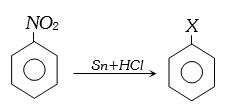
MediumMCQ
In the above reaction,'$X$' stands for:
A
$NH_2$
B
$SnCl_2$
C
$Cl$
D
$NH_4^+Cl^-$
Solution
(A) The given reaction is the reduction of nitrobenzene to aniline using a metal-acid reducing agent $(Sn + HCl)$.
Nitrobenzene $(C_6H_5NO_2)$ reacts with $6[H]$ provided by the $Sn + HCl$ mixture to form aniline $(C_6H_5NH_2)$ and water $(2H_2O)$.
The reaction is: $C_6H_5NO_2 + 6[H] \xrightarrow{Sn/HCl} C_6H_5NH_2 + 2H_2O$.
Comparing this with the given reaction,'$X$' corresponds to the $-NH_2$ group.
Therefore,the correct option is $(A)$.
Nitrobenzene $(C_6H_5NO_2)$ reacts with $6[H]$ provided by the $Sn + HCl$ mixture to form aniline $(C_6H_5NH_2)$ and water $(2H_2O)$.
The reaction is: $C_6H_5NO_2 + 6[H] \xrightarrow{Sn/HCl} C_6H_5NH_2 + 2H_2O$.
Comparing this with the given reaction,'$X$' corresponds to the $-NH_2$ group.
Therefore,the correct option is $(A)$.
0 likes
View Solution35
MediumMCQ
Which of the following amines cannot be prepared by the Gabriel phthalimide synthesis method?
A
Aniline
B
Benzylamine
C
Methylamine
D
Isobutylamine
Solution
(A) The Gabriel phthalimide synthesis is used for the preparation of primary aliphatic amines.
$Aryl$ halides do not undergo nucleophilic substitution reactions with the anion formed by phthalimide easily due to the partial double bond character of the $C-X$ bond and the instability of the phenyl cation.
Therefore,aromatic primary amines like $Aniline$ $(C_6H_5NH_2)$ cannot be prepared by this method.
$Aryl$ halides do not undergo nucleophilic substitution reactions with the anion formed by phthalimide easily due to the partial double bond character of the $C-X$ bond and the instability of the phenyl cation.
Therefore,aromatic primary amines like $Aniline$ $(C_6H_5NH_2)$ cannot be prepared by this method.
0 likes
View Solution36
MediumMCQ
What product is obtained by the reduction of $(CH_3)_2C=NOH$ using $Na$ and $EtOH$?
A
$s$-amine
B
$p$-amine
C
$t$-amine
D
None of these
Solution
(B) The reduction of an oxime $(R_2C=NOH)$ using sodium $(Na)$ and ethanol $(EtOH)$ is a standard method for the preparation of primary amines.
In this reaction,the oxime $(CH_3)_2C=NOH$ (acetone oxime) is reduced to isopropylamine $(CH_3)_2CHNH_2$.
Isopropylamine is a primary ($p$-) amine because the nitrogen atom is attached to only one carbon atom.
Therefore,the correct option is $B$.
In this reaction,the oxime $(CH_3)_2C=NOH$ (acetone oxime) is reduced to isopropylamine $(CH_3)_2CHNH_2$.
Isopropylamine is a primary ($p$-) amine because the nitrogen atom is attached to only one carbon atom.
Therefore,the correct option is $B$.
0 likes
View Solution37
MediumMCQ
Which of the following reactions is used for the preparation of $1^o$ amines?
A
Hofmann carbylamine reaction
B
Hofmann mustard oil reaction
C
Hofmann bromamide degradation reaction
D
Liebermann nitroso reaction
Solution
(C) The $Hofmann$ $bromamide$ $degradation$ $reaction$ is specifically used for the preparation of primary $(1^o)$ amines from amides. In this reaction,an amide is treated with bromine in an aqueous or ethanolic solution of sodium hydroxide,resulting in the formation of a primary amine with one carbon atom less than the original amide. The reaction is represented as: $R-CONH_2 + Br_2 + 4NaOH \rightarrow R-NH_2 + Na_2CO_3 + 2NaBr + 2H_2O$.
0 likes
View Solution38
MediumMCQ
Which of the following reactions does not produce an amine?
A
$R - X + NH_3 \rightarrow$
B
$R - CH = NOH + 4[H] \xrightarrow{Na/C_2H_5OH}$
C
$R - CN + 2H_2O \xrightarrow{H^+}$
D
$R - CONH_2 + 4[H] \xrightarrow{LiAlH_4}$
Solution
(C) The reaction $R - CN + 2H_2O \xrightarrow{H^+} R - COOH + NH_3$ represents the acid-catalyzed hydrolysis of a nitrile (cyanide) to a carboxylic acid and ammonia,not an amine.
In contrast,the other reactions are standard methods for preparing amines:
$1$. $R - X + NH_3 \rightarrow R - NH_2$ (Ammonolysis of alkyl halides).
$2$. $R - CH = NOH + 4[H] \rightarrow R - CH_2 - NH_2 + H_2O$ (Reduction of oximes).
$3$. $R - CONH_2 + 4[H] \rightarrow R - CH_2 - NH_2 + H_2O$ (Reduction of amides).
In contrast,the other reactions are standard methods for preparing amines:
$1$. $R - X + NH_3 \rightarrow R - NH_2$ (Ammonolysis of alkyl halides).
$2$. $R - CH = NOH + 4[H] \rightarrow R - CH_2 - NH_2 + H_2O$ (Reduction of oximes).
$3$. $R - CONH_2 + 4[H] \rightarrow R - CH_2 - NH_2 + H_2O$ (Reduction of amides).
0 likes
View Solution39
MediumMCQ
Which reaction is possible using $Fe/HCl$? [Here $\phi = C_6H_5$]
A
$\phi - NO_2 \rightarrow \phi - NH - NH - \phi$
B
$\phi - NO_2 \rightarrow \phi - NH_2$
C
$\phi - NO_2 \rightarrow \phi - NHOH$
D
$\phi - NO_2 \rightarrow \phi - N = N - \phi$
Solution
(B) The reagent $Fe/HCl$ is a standard reducing agent used to reduce nitro compounds to primary amines.
In this reaction,the nitro group $(-NO_2)$ attached to the benzene ring $(\phi)$ is reduced to an amino group $(-NH_2)$.
The reaction is: $\phi - NO_2 + 6[H] \xrightarrow{Fe/HCl} \phi - NH_2 + 2H_2O$.
Therefore,the correct conversion is $\phi - NO_2 \rightarrow \phi - NH_2$.
In this reaction,the nitro group $(-NO_2)$ attached to the benzene ring $(\phi)$ is reduced to an amino group $(-NH_2)$.
The reaction is: $\phi - NO_2 + 6[H] \xrightarrow{Fe/HCl} \phi - NH_2 + 2H_2O$.
Therefore,the correct conversion is $\phi - NO_2 \rightarrow \phi - NH_2$.
0 likes
View Solution40
MediumMCQ
In the reaction $CH_3CONH_2 \xrightarrow{Na/ROH} Z + H_2O$,what is $Z$?
A
$CH_3CH_2NH_2$
B
$CH_3CH_2NC$
C
$CH_3CH_2CH_3$
D
$NH_2CONH_2$
Solution
(A) The reaction of an amide $(CH_3CONH_2)$ with sodium and alcohol $(Na/ROH)$ is a reduction reaction.
$CH_3CONH_2 + 4[H] \xrightarrow{Na/ROH} CH_3CH_2NH_2 + H_2O$.
Here,the amide is reduced to the corresponding primary amine,which is $CH_3CH_2NH_2$ (ethanamine).
$CH_3CONH_2 + 4[H] \xrightarrow{Na/ROH} CH_3CH_2NH_2 + H_2O$.
Here,the amide is reduced to the corresponding primary amine,which is $CH_3CH_2NH_2$ (ethanamine).
0 likes
View Solution41
MediumMCQ
Which of the following nitrogen compounds gives a primary amine upon reaction with $Br_2$ and strong $KOH$ (Hofmann bromamide degradation reaction)?
A
$R-CONH_2$
B
$R-COONH_4$
C
$R-CONHCH_3$
D
$R-CONHOH$
Solution
(A) The Hofmann bromamide degradation reaction is specific to primary amides $(R-CONH_2)$.
When a primary amide reacts with $Br_2$ and $KOH$,it undergoes rearrangement to form a primary amine $(R-NH_2)$ with one carbon atom less than the original amide.
The reaction is: $R-CONH_2 + Br_2 + 4KOH \rightarrow R-NH_2 + K_2CO_3 + 2KBr + 2H_2O$.
Thus,the correct compound is $R-CONH_2$.
When a primary amide reacts with $Br_2$ and $KOH$,it undergoes rearrangement to form a primary amine $(R-NH_2)$ with one carbon atom less than the original amide.
The reaction is: $R-CONH_2 + Br_2 + 4KOH \rightarrow R-NH_2 + K_2CO_3 + 2KBr + 2H_2O$.
Thus,the correct compound is $R-CONH_2$.
0 likes
View Solution42
MediumMCQ
Which of the following does not give $RNH_2$ via the Hofmann hypobromide reaction?
A
Isobutanamide
B
Carbamide
C
Ethanamide
D
Benzamide
Solution
(B) The Hofmann hypobromide degradation reaction is specific to primary amides $(RCONH_2)$.
$RCONH_2 + Br_2 + 4NaOH \rightarrow RNH_2 + Na_2CO_3 + 2NaBr + 2H_2O$.
Carbamide,also known as urea $(NH_2CONH_2)$,is a diamide. When subjected to the Hofmann hypobromide reaction,it does not yield a simple primary amine $(RNH_2)$ as the final product because the reaction conditions lead to further degradation or decomposition of the intermediate species.
Isobutanamide ($CH_3)_2CHCONH_2$,Ethanamide $(CH_3CONH_2)$,and Benzamide $(C_6H_5CONH_2)$ are all primary amides and will successfully undergo the Hofmann hypobromide reaction to form their respective primary amines.
$RCONH_2 + Br_2 + 4NaOH \rightarrow RNH_2 + Na_2CO_3 + 2NaBr + 2H_2O$.
Carbamide,also known as urea $(NH_2CONH_2)$,is a diamide. When subjected to the Hofmann hypobromide reaction,it does not yield a simple primary amine $(RNH_2)$ as the final product because the reaction conditions lead to further degradation or decomposition of the intermediate species.
Isobutanamide ($CH_3)_2CHCONH_2$,Ethanamide $(CH_3CONH_2)$,and Benzamide $(C_6H_5CONH_2)$ are all primary amides and will successfully undergo the Hofmann hypobromide reaction to form their respective primary amines.
0 likes
View Solution43
MediumMCQ
The catalytic hydrogenation of acetone oxime gives .....
A
Propane$-1-$amine
B
Propan$-2-$amine (Isopropylamine)
C
Ethylmethylamine
D
$CH_4$ and ethanamine
Solution
(B) Acetone oxime is $(CH_3)_2C=NOH$.
Upon catalytic hydrogenation,the $C=N$ bond is reduced to a $C-NH_2$ bond.
The reaction is: $(CH_3)_2C=NOH + 2H_2 \xrightarrow{Ni/Pt} (CH_3)_2CHNH_2 + H_2O$.
The product $(CH_3)_2CHNH_2$ is propan$-2-$amine,also known as isopropylamine.
Upon catalytic hydrogenation,the $C=N$ bond is reduced to a $C-NH_2$ bond.
The reaction is: $(CH_3)_2C=NOH + 2H_2 \xrightarrow{Ni/Pt} (CH_3)_2CHNH_2 + H_2O$.
The product $(CH_3)_2CHNH_2$ is propan$-2-$amine,also known as isopropylamine.
0 likes
View Solution44
MediumMCQ
Which reagent reacts with acetamide to produce methylamine?
A
$PCl_3$
B
$CaO + NaOH$
C
$Br_2 + NaOH$
D
$NaNO_2 + \text{dil. } HCl$
Solution
(C) The conversion of an amide to a primary amine with one carbon atom less is known as the Hofmann bromamide degradation reaction.
Acetamide $(CH_3CONH_2)$ reacts with bromine $(Br_2)$ in the presence of a strong base like sodium hydroxide $(NaOH)$ to form methylamine $(CH_3NH_2)$.
The chemical equation is: $CH_3CONH_2 + Br_2 + 4NaOH \rightarrow CH_3NH_2 + Na_2CO_3 + 2NaBr + 2H_2O$.
Therefore,the correct reagent is $Br_2 + NaOH$.
Acetamide $(CH_3CONH_2)$ reacts with bromine $(Br_2)$ in the presence of a strong base like sodium hydroxide $(NaOH)$ to form methylamine $(CH_3NH_2)$.
The chemical equation is: $CH_3CONH_2 + Br_2 + 4NaOH \rightarrow CH_3NH_2 + Na_2CO_3 + 2NaBr + 2H_2O$.
Therefore,the correct reagent is $Br_2 + NaOH$.
0 likes
View Solution45
MediumMCQ
In the reaction sequence $CH_3CONH_2$ $\xrightarrow{?} CH_3CN$ $\xrightarrow{\text{reduction}} CH_3CH_2NH_2$,which dehydrating agent is used in the first step?
A
$P_2O_5$
B
$NH_3$
C
$SOCl_2$
D
$Cl_2$
Solution
(A) The conversion of an amide $(CH_3CONH_2)$ to a nitrile $(CH_3CN)$ is a dehydration reaction.
This is typically achieved using a strong dehydrating agent like phosphorus pentoxide $(P_2O_5)$ or phosphorus oxychloride $(POCl_3)$.
Among the given options,$P_2O_5$ is the standard dehydrating agent used for this transformation.
This is typically achieved using a strong dehydrating agent like phosphorus pentoxide $(P_2O_5)$ or phosphorus oxychloride $(POCl_3)$.
Among the given options,$P_2O_5$ is the standard dehydrating agent used for this transformation.
0 likes
View Solution46
MediumMCQ
Which of the following reactions can be used to prepare an amine from an amide?
A
Perkin
B
Claisen
C
Hofmann
D
Kolbe
Solution
(C) The reaction used to prepare an amine from an amide is the Hofmann bromamide degradation reaction.
In this reaction,an amide $(R-CONH_2)$ reacts with bromine $(Br_2)$ and an alkali $(KOH)$ to form a primary amine $(R-NH_2)$ with one carbon atom less than the parent amide.
The chemical equation is:
$R-CONH_2 + Br_2 + 4KOH \to R-NH_2 + K_2CO_3 + 2KBr + 2H_2O$
In this reaction,an amide $(R-CONH_2)$ reacts with bromine $(Br_2)$ and an alkali $(KOH)$ to form a primary amine $(R-NH_2)$ with one carbon atom less than the parent amide.
The chemical equation is:
$R-CONH_2 + Br_2 + 4KOH \to R-NH_2 + K_2CO_3 + 2KBr + 2H_2O$
0 likes
View Solution47
DifficultMCQ
$CH_3CONH_2$ $\xrightarrow{PCl_5} A$ $\xrightarrow{Na/EtOH} B$. What is reaction $II$ called?
A
Clemmensen reduction
B
Stephen reduction
C
Mendius reduction
D
Bouveault-Blanc reduction
Solution
(C) The reaction sequence is as follows:
$1$. $CH_3CONH_2 \xrightarrow{PCl_5} CH_3CN$ (Compound $A$ is acetonitrile).
$2$. $CH_3CN \xrightarrow{Na/EtOH} CH_3CH_2NH_2$ (Compound $B$ is ethylamine).
Reaction $II$ involves the reduction of a nitrile $(R-CN)$ to a primary amine $(R-CH_2NH_2)$ using sodium and ethanol. This specific reduction is known as the Mendius reduction.
$1$. $CH_3CONH_2 \xrightarrow{PCl_5} CH_3CN$ (Compound $A$ is acetonitrile).
$2$. $CH_3CN \xrightarrow{Na/EtOH} CH_3CH_2NH_2$ (Compound $B$ is ethylamine).
Reaction $II$ involves the reduction of a nitrile $(R-CN)$ to a primary amine $(R-CH_2NH_2)$ using sodium and ethanol. This specific reduction is known as the Mendius reduction.
0 likes
View Solution48
DifficultMCQ
The Mendius reaction is involved in the reduction of which of the following?
A
Cyanoalkanes
B
Alkyl isocyanides
C
Oximes
D
Nitroalkanes
Solution
(A) The Mendius reaction involves the reduction of nitriles (cyanoalkanes) to primary amines using sodium and ethanol.
The reaction is represented as:
$R-CN + 4[H] \xrightarrow{Na/C_2H_5OH} R-CH_2NH_2$
The reaction is represented as:
$R-CN + 4[H] \xrightarrow{Na/C_2H_5OH} R-CH_2NH_2$
0 likes
View Solution49
MediumMCQ
Which of the following compounds reacts with $KOH$ and $Br_2$ to form ethylamine?
A
Acetamide
B
Propionamide
C
Formamide
D
Methyl cyanide
Solution
(B) The reaction of an amide with $Br_2$ and $KOH$ is known as the Hofmann bromamide degradation reaction,which produces a primary amine with one carbon atom less than the parent amide.
To obtain ethylamine $(CH_3CH_2NH_2)$,which has $2$ carbon atoms,the starting amide must be propionamide $(CH_3CH_2CONH_2)$,which has $3$ carbon atoms.
The reaction is: $CH_3CH_2CONH_2 + Br_2 + 4KOH \to CH_3CH_2NH_2 + K_2CO_3 + 2KBr + 2H_2O$.
To obtain ethylamine $(CH_3CH_2NH_2)$,which has $2$ carbon atoms,the starting amide must be propionamide $(CH_3CH_2CONH_2)$,which has $3$ carbon atoms.
The reaction is: $CH_3CH_2CONH_2 + Br_2 + 4KOH \to CH_3CH_2NH_2 + K_2CO_3 + 2KBr + 2H_2O$.
0 likes
View SolutionAmines — Preparation of Amines · Frequently Asked Questions
1Are these Amines questions useful for JEE and NEET?
Yes. All questions in this section are mapped to JEE Main and NEET exam patterns. Previous year questions from JEE Main, NEET, GUJCET and state-level exams are included with full solutions.
2Can I switch to Hindi or Gujarati for these questions?
Yes. Use the language tabs in the hero section or the sidebar to view the same questions and solutions in English, Hindi or Gujarati.
3How do I generate a question paper from this subtopic?
Use the Vedclass Exam Paper Generator — select the chapter and subtopic, set difficulty, and generate Sets A, B, C, D automatically. First 3 chapters of every subject are free.
Vedclass Products
For Students
Vedclass Test Series
Mock tests in real JEE/NEET style with performance analysis. 5-day free trial.
Start Free TrialFor Teachers
Exam Paper Generator
Generate Set A/B/C/D papers from this chapter in 2 minutes. 3 chapters free.
Try FreeFor Institutes
Online Exam Module
Live online exams with unlimited students, 360° analytics & white-label branding.
See DemoFor Teachers & Institutes
Generate a Amines Exam Paper in 2 Minutes
Select subtopic & difficulty — Sets A, B, C, D auto-generated with No Repeat logic.
First 3 chapters of every subject are free — no payment required.