
A English
Properties of Phenols Questions in English
Class 12 Chemistry · Alcohols, Phenols and Ethers · Properties of Phenols
751+
Questions
English
Language
100%
With Solutions
Showing 24 of 751 questions in English
651
MediumMCQ
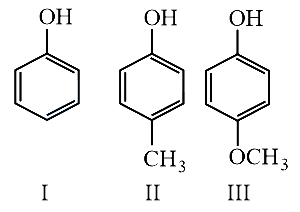
The correct order of acidity of the following is:
A
$I > II > III$
B
$II > III > I$
C
$III > II > I$
D
$III > I > II$
Solution
(A) The acidic strength of phenols is influenced by the nature of substituents attached to the benzene ring. Electron-withdrawing groups $(EWG)$ increase acidity,while electron-releasing groups $(ERG)$ decrease acidity.
$I$ is phenol.
$II$ is $p$-cresol,which has a methyl group $(-CH_3)$ at the para position. The methyl group is an electron-releasing group due to the $+I$ effect and hyperconjugation,which decreases the acidity compared to phenol.
$III$ is $p$-methoxyphenol,which has a methoxy group $(-OCH_3)$ at the para position. The methoxy group is a strong electron-releasing group due to the $+M$ (mesomeric) effect,which significantly decreases the acidity compared to phenol and $p$-cresol.
Therefore,the order of acidity is $I > II > III$.
$I$ is phenol.
$II$ is $p$-cresol,which has a methyl group $(-CH_3)$ at the para position. The methyl group is an electron-releasing group due to the $+I$ effect and hyperconjugation,which decreases the acidity compared to phenol.
$III$ is $p$-methoxyphenol,which has a methoxy group $(-OCH_3)$ at the para position. The methoxy group is a strong electron-releasing group due to the $+M$ (mesomeric) effect,which significantly decreases the acidity compared to phenol and $p$-cresol.
Therefore,the order of acidity is $I > II > III$.
0 likes
View Solution652
EasyMCQ
Identify the correct set from the following:
| Compound | $p K_a$ |
A
$m$-nitrophenol $8.39$
B
$o$-nitrophenol $7.23$
C
$m$-nitrophenol $7.23$
D
$o$-nitrophenol $8.39$
Solution
(B) The acidity of nitrophenols is influenced by the inductive and resonance effects of the $-NO_2$ group.
$o$-Nitrophenol exhibits intramolecular hydrogen bonding,which stabilizes the molecule but makes the release of the proton slightly more difficult compared to $p$-nitrophenol,yet it is more acidic than phenol.
The experimental $p K_a$ values are:
$o$-Nitrophenol: $7.23$
$m$-Nitrophenol: $8.39$
$p$-Nitrophenol: $7.15$
Therefore,the correct set is $o$-nitrophenol $7.23$.
$o$-Nitrophenol exhibits intramolecular hydrogen bonding,which stabilizes the molecule but makes the release of the proton slightly more difficult compared to $p$-nitrophenol,yet it is more acidic than phenol.
The experimental $p K_a$ values are:
$o$-Nitrophenol: $7.23$
$m$-Nitrophenol: $8.39$
$p$-Nitrophenol: $7.15$
Therefore,the correct set is $o$-nitrophenol $7.23$.
0 likes
View Solution653
MediumMCQ
What is $Z$ in the above sequence of reactions?

A
Salicylaldehyde
B
Phenyl acetate
C
p-Hydroxybenzoic acid
D
Aspirin
Solution
(D) The reaction sequence is as follows:
$1$. Cumene is oxidized and then hydrolyzed to form phenol $(X)$.
$2$. Phenol reacts with $NaOH$ followed by $CO_2$ and acidification (Kolbe-Schmitt reaction) to form salicylic acid $(Y)$,which is $2$-hydroxybenzoic acid.
$3$. Salicylic acid reacts with acetic anhydride $(CH_3CO)_2O$ to form acetylsalicylic acid,commonly known as aspirin $(Z)$.
$1$. Cumene is oxidized and then hydrolyzed to form phenol $(X)$.
$2$. Phenol reacts with $NaOH$ followed by $CO_2$ and acidification (Kolbe-Schmitt reaction) to form salicylic acid $(Y)$,which is $2$-hydroxybenzoic acid.
$3$. Salicylic acid reacts with acetic anhydride $(CH_3CO)_2O$ to form acetylsalicylic acid,commonly known as aspirin $(Z)$.
0 likes
View Solution654
MediumMCQ
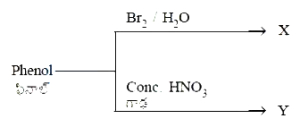
Identify $X$ and $Y$ in the following reactions:
A
$X$ = $2-$bromophenol,$Y$ = $2-$nitrophenol
B
$X$ = $2,4-$dibromophenol,$Y$ = $2,6-$dinitrophenol
C
$X$ = $2,6-$dibromophenol,$Y$ = $2,6-$dinitrophenol
D
$X$ = $2,4,6-$tribromophenol,$Y$ = $2,4,6-$trinitrophenol
Solution
(D) When phenol reacts with bromine water $(Br_2/H_2O)$,it undergoes electrophilic substitution at all ortho and para positions due to the strong activating effect of the $-OH$ group,resulting in the formation of $2,4,6$-tribromophenol $(X)$.
When phenol reacts with concentrated nitric acid $(Conc. HNO_3)$,it undergoes nitration to form $2,4,6$-trinitrophenol,commonly known as picric acid $(Y)$.
When phenol reacts with concentrated nitric acid $(Conc. HNO_3)$,it undergoes nitration to form $2,4,6$-trinitrophenol,commonly known as picric acid $(Y)$.
0 likes
View Solution655
EasyMCQ
Which of the following has the highest $pK_{a}$ value?
A
$2-$Nitrophenol
B
$3-$Nitrophenol
C
$4-$Nitrophenol
D
$2, 4-$Dinitrophenol
Solution
(B) The $pK_{a}$ value is inversely proportional to the acidity of the compound. $A$ higher $pK_{a}$ value indicates a weaker acid.
Among the given options,the $-NO_2$ group is a strong electron-withdrawing group $(EWG)$ that increases acidity via $-I$ and $-M$ effects.
In $2-$nitrophenol,intramolecular hydrogen bonding stabilizes the conjugate base,increasing acidity.
In $4-$nitrophenol,the $-NO_2$ group exerts a strong $-M$ effect,significantly increasing acidity.
In $2, 4-$dinitrophenol,two $-NO_2$ groups significantly increase acidity.
In $3-$nitrophenol,the $-NO_2$ group is at the meta position,where it only exerts an $-I$ effect (no resonance effect). Therefore,it is the least acidic among the choices,resulting in the highest $pK_{a}$ value.
Among the given options,the $-NO_2$ group is a strong electron-withdrawing group $(EWG)$ that increases acidity via $-I$ and $-M$ effects.
In $2-$nitrophenol,intramolecular hydrogen bonding stabilizes the conjugate base,increasing acidity.
In $4-$nitrophenol,the $-NO_2$ group exerts a strong $-M$ effect,significantly increasing acidity.
In $2, 4-$dinitrophenol,two $-NO_2$ groups significantly increase acidity.
In $3-$nitrophenol,the $-NO_2$ group is at the meta position,where it only exerts an $-I$ effect (no resonance effect). Therefore,it is the least acidic among the choices,resulting in the highest $pK_{a}$ value.
0 likes
View Solution656
DifficultMCQ
$X + Y \xrightarrow{H^{+}} \text{Aspirin} + CH_3COOH$. Identify $X$ and $Y$ from the following:
A
$X = \text{Benzoic acid}, Y = CH_3COCl$
B
$X = \text{Salicylic acid}, Y = (CH_3CO)_2O$
C
$X = \text{m-Hydroxybenzoic acid}, Y = CH_3COOH$
D
$X = \text{p-Hydroxybenzoic acid}, Y = CH_3COCH_3$
Solution
(B) The synthesis of Aspirin (acetylsalicylic acid) involves the acetylation of salicylic acid.
Salicylic acid $(X)$ reacts with acetic anhydride $(Y)$ in the presence of an acid catalyst $(H^+)$ to form acetylsalicylic acid (Aspirin) and acetic acid $(CH_3COOH)$.
The reaction is:
$\text{Salicylic acid} + (CH_3CO)_2O \xrightarrow{H^+} \text{Aspirin} + CH_3COOH$.
Thus,$X$ is salicylic acid and $Y$ is acetic anhydride $(CH_3CO)_2O$.
Salicylic acid $(X)$ reacts with acetic anhydride $(Y)$ in the presence of an acid catalyst $(H^+)$ to form acetylsalicylic acid (Aspirin) and acetic acid $(CH_3COOH)$.
The reaction is:
$\text{Salicylic acid} + (CH_3CO)_2O \xrightarrow{H^+} \text{Aspirin} + CH_3COOH$.
Thus,$X$ is salicylic acid and $Y$ is acetic anhydride $(CH_3CO)_2O$.
0 likes
View Solution657
MediumMCQ
Cumene on oxidation in air gives a compound,$X$. This on reaction with dilute acid gives $Y$ and $Z$. $Y$ reacts with sodium metal and not $Z$. What is $Z$ ?
A
$CH_3CHO$
B
$CH_3CH_2COCH_3$
C
$CH_3COCH_3$
D
$CH_3COOCH_3$
Solution
(C) The oxidation of cumene (isopropylbenzene) in air gives cumene hydroperoxide,which is compound $X$.
$C_6H_5CH(CH_3)_2 + O_2 \rightarrow C_6H_5C(CH_3)_2OOH$ (Cumene hydroperoxide,$X$)
Upon treatment with dilute acid,cumene hydroperoxide undergoes rearrangement to form phenol $(Y)$ and acetone $(Z)$.
$C_6H_5C(CH_3)_2OOH \xrightarrow{H^+} C_6H_5OH (Y) + CH_3COCH_3 (Z)$
Phenol $(Y)$ contains an acidic hydroxyl group $(-OH)$ attached to the benzene ring,which reacts with sodium metal to evolve hydrogen gas.
$2C_6H_5OH + 2Na \rightarrow 2C_6H_5ONa + H_2 \uparrow$
Acetone $(Z)$ is a ketone and does not contain an acidic hydrogen atom that can react with sodium metal.
Therefore,$Z$ is acetone $(CH_3COCH_3)$.
$C_6H_5CH(CH_3)_2 + O_2 \rightarrow C_6H_5C(CH_3)_2OOH$ (Cumene hydroperoxide,$X$)
Upon treatment with dilute acid,cumene hydroperoxide undergoes rearrangement to form phenol $(Y)$ and acetone $(Z)$.
$C_6H_5C(CH_3)_2OOH \xrightarrow{H^+} C_6H_5OH (Y) + CH_3COCH_3 (Z)$
Phenol $(Y)$ contains an acidic hydroxyl group $(-OH)$ attached to the benzene ring,which reacts with sodium metal to evolve hydrogen gas.
$2C_6H_5OH + 2Na \rightarrow 2C_6H_5ONa + H_2 \uparrow$
Acetone $(Z)$ is a ketone and does not contain an acidic hydrogen atom that can react with sodium metal.
Therefore,$Z$ is acetone $(CH_3COCH_3)$.
0 likes
View Solution658
MediumMCQ
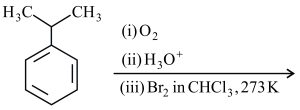
The major aromatic product of the following reaction sequence is:
A
$2,4,6-$Tribromophenol
B
$2,4-$Dibromophenol
C
o-Bromophenol
D
p-Bromophenol
Solution
(D) The reaction sequence is as follows:
$1$. Cumene (isopropylbenzene) reacts with $O_2$ to form cumene hydroperoxide.
$2$. Acid-catalyzed hydrolysis of cumene hydroperoxide yields phenol and acetone $(CH_3COCH_3)$.
$3$. The reaction of phenol with $Br_2$ in a solvent of low polarity like $CHCl_3$ at low temperature $(273 \ K)$ leads to monobromination.
Due to the strong activating effect of the $-OH$ group,the electrophilic substitution occurs primarily at the ortho and para positions. The para-isomer is the major product due to less steric hindrance compared to the ortho-isomer. Thus,the major product is $p$-bromophenol.
$1$. Cumene (isopropylbenzene) reacts with $O_2$ to form cumene hydroperoxide.
$2$. Acid-catalyzed hydrolysis of cumene hydroperoxide yields phenol and acetone $(CH_3COCH_3)$.
$3$. The reaction of phenol with $Br_2$ in a solvent of low polarity like $CHCl_3$ at low temperature $(273 \ K)$ leads to monobromination.
Due to the strong activating effect of the $-OH$ group,the electrophilic substitution occurs primarily at the ortho and para positions. The para-isomer is the major product due to less steric hindrance compared to the ortho-isomer. Thus,the major product is $p$-bromophenol.
0 likes
View Solution659
EasyMCQ
The major product in Reimer-Tiemann reaction is $X$. The reactants are $Y$ and $Z$. $X$,$Y$ and $Z$ are respectively.
A
Salicylaldehyde,$CHCl_3$,$Aq. NaOH$
B
Salicylic acid,$CCl_4$,$Aq. Ba(OH)_2$
C
p-Hydroxybenzaldehyde,$CHCl_3$,$Aq. NaOH$
D
Benzoic acid,$CCl_4$,$Aq. KOH$
Solution
(A) The Reimer-Tiemann reaction involves the treatment of phenol with chloroform $(CHCl_3)$ in the presence of an aqueous base like sodium hydroxide $(NaOH)$.
This reaction results in the introduction of a formyl group $(-CHO)$ at the ortho position of the phenol ring,yielding salicylaldehyde (o-hydroxybenzaldehyde) as the major product.
Therefore,$X$ is salicylaldehyde,$Y$ is $CHCl_3$,and $Z$ is $Aq. NaOH$.
This reaction results in the introduction of a formyl group $(-CHO)$ at the ortho position of the phenol ring,yielding salicylaldehyde (o-hydroxybenzaldehyde) as the major product.
Therefore,$X$ is salicylaldehyde,$Y$ is $CHCl_3$,and $Z$ is $Aq. NaOH$.
0 likes
View Solution660
MediumMCQ
The reaction sequence is as follows: $C_6H_5SO_3H$ $\xrightarrow[(ii) H^+]{(i) NaOH} P$ $\xrightarrow{Na_2Cr_2O_7, H_2SO_4} Q$. The ratio of $\sigma$ bonds to $\pi$ bonds in $Q$ is:
A
$3: 1$
B
$1: 3$
C
$4: 1$
D
$2: 1$
Solution
(A) $1$. The reaction of benzenesulfonic acid with $NaOH$ followed by acidification gives phenol $(P = C_6H_5OH)$.
$2$. The oxidation of phenol with $Na_2Cr_2O_7$ and $H_2SO_4$ (Jones reagent or similar strong oxidizing conditions) yields $p$-benzoquinone as the major product $(Q = C_6H_4O_2)$.
$3$. In $p$-benzoquinone $(C_6H_4O_2)$,the structure consists of a six-membered ring with two carbonyl groups at para positions and two double bonds in the ring.
$4$. Counting the bonds:
- $\sigma$ bonds: $6$ ($C$-$C$ in ring) + $4$ ($C$-$H$) + $2$ ($C$=$O$) + $2$ ($C$-$O$) = $14$ $\sigma$ bonds.
- $\pi$ bonds: $2$ ($C$=$C$) + $2$ ($C$=$O$) = $4$ $\pi$ bonds.
- Wait,let's re-count carefully: The structure of $p$-benzoquinone has $6$ $C$-$C$ $\sigma$ bonds,$4$ $C$-$H$ $\sigma$ bonds,$2$ $C$=$O$ $\sigma$ bonds,and $2$ $C$-$O$ $\sigma$ bonds (total $14$). The $\pi$ bonds are $2$ from $C$=$C$ and $2$ from $C$=$O$ (total $4$).
- The ratio is $14:4 = 7:2$. Let's re-examine the structure. $p$-Benzoquinone has $12$ $\sigma$ bonds and $4$ $\pi$ bonds. Ratio $12:4 = 3:1$.
$2$. The oxidation of phenol with $Na_2Cr_2O_7$ and $H_2SO_4$ (Jones reagent or similar strong oxidizing conditions) yields $p$-benzoquinone as the major product $(Q = C_6H_4O_2)$.
$3$. In $p$-benzoquinone $(C_6H_4O_2)$,the structure consists of a six-membered ring with two carbonyl groups at para positions and two double bonds in the ring.
$4$. Counting the bonds:
- $\sigma$ bonds: $6$ ($C$-$C$ in ring) + $4$ ($C$-$H$) + $2$ ($C$=$O$) + $2$ ($C$-$O$) = $14$ $\sigma$ bonds.
- $\pi$ bonds: $2$ ($C$=$C$) + $2$ ($C$=$O$) = $4$ $\pi$ bonds.
- Wait,let's re-count carefully: The structure of $p$-benzoquinone has $6$ $C$-$C$ $\sigma$ bonds,$4$ $C$-$H$ $\sigma$ bonds,$2$ $C$=$O$ $\sigma$ bonds,and $2$ $C$-$O$ $\sigma$ bonds (total $14$). The $\pi$ bonds are $2$ from $C$=$C$ and $2$ from $C$=$O$ (total $4$).
- The ratio is $14:4 = 7:2$. Let's re-examine the structure. $p$-Benzoquinone has $12$ $\sigma$ bonds and $4$ $\pi$ bonds. Ratio $12:4 = 3:1$.
0 likes
View Solution661
EasyMCQ
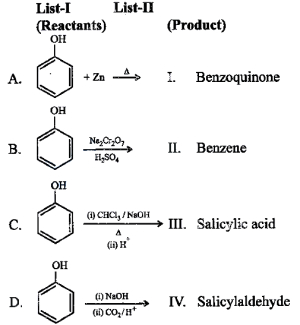
Match the following reactions of phenol with their products:
A
$A-II, B-I, C-IV, D-III$
B
$A-II, B-III, C-I, D-IV$
C
$A-III, B-II, C-IV, D-I$
D
$A-III, B-IV, C-I, D-II$
Solution
(A) The reactions are as follows:
$A$. Phenol reacts with $Zn$ dust to form benzene: $C_6H_5OH + Zn \rightarrow C_6H_6 + ZnO$ $(II)$.
$B$. Phenol is oxidized by $Na_2Cr_2O_7/H_2SO_4$ to form benzoquinone $(I)$.
$C$. Reimer-Tiemann reaction of phenol with $CHCl_3/NaOH$ followed by $H^+$ gives salicylaldehyde $(IV)$.
$D$. Kolbe's reaction of phenol with $NaOH$ followed by $CO_2/H^+$ gives salicylic acid $(III)$.
Therefore,the correct matching is $A-II, B-I, C-IV, D-III$.
$A$. Phenol reacts with $Zn$ dust to form benzene: $C_6H_5OH + Zn \rightarrow C_6H_6 + ZnO$ $(II)$.
$B$. Phenol is oxidized by $Na_2Cr_2O_7/H_2SO_4$ to form benzoquinone $(I)$.
$C$. Reimer-Tiemann reaction of phenol with $CHCl_3/NaOH$ followed by $H^+$ gives salicylaldehyde $(IV)$.
$D$. Kolbe's reaction of phenol with $NaOH$ followed by $CO_2/H^+$ gives salicylic acid $(III)$.
Therefore,the correct matching is $A-II, B-I, C-IV, D-III$.
0 likes
View Solution662
EasyMCQ
The major products of Reimer-Tiemann reaction and Kolbe reaction are respectively:
A
Phenol,Benzaldehyde
B
Salicylaldehyde,Salicylic acid
C
o-Cresol,Salicylic acid
D
p-Nitrophenol,p-Benzoquinone
Solution
(B) In the Reimer-Tiemann reaction,phenol reacts with $CHCl_3$ in the presence of aqueous $NaOH$ to form salicylaldehyde as the major product.
In the Kolbe reaction,phenol reacts with $NaOH$ to form sodium phenoxide,which then reacts with $CO_2$ followed by acidification to form salicylic acid as the major product.
In the Kolbe reaction,phenol reacts with $NaOH$ to form sodium phenoxide,which then reacts with $CO_2$ followed by acidification to form salicylic acid as the major product.
0 likes
View Solution663
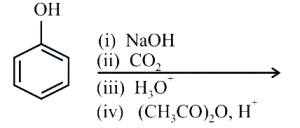
MediumMCQ
The major product in the following reaction is:
A
$4-$acetoxybenzoic acid
B
$2-$acetoxybenzoic acid
C
$4-$hydroxy$-3-$acetylbenzoic acid
D
$2-$hydroxybenzoic acid methyl ester
Solution
(B) The reaction sequence is as follows:
$1$. Phenol reacts with $NaOH$ to form sodium phenoxide.
$2$. Sodium phenoxide undergoes Kolbe's reaction with $CO_2$ followed by acidification $(H_3O^+)$ to produce salicylic acid ($2$-hydroxybenzoic acid).
$3$. Salicylic acid then reacts with acetic anhydride $((CH_3CO)_2O)$ in the presence of an acid catalyst $(H^+)$ to undergo acetylation of the phenolic $-OH$ group.
$4$. The final product is $2-$acetoxybenzoic acid,commonly known as aspirin.
$1$. Phenol reacts with $NaOH$ to form sodium phenoxide.
$2$. Sodium phenoxide undergoes Kolbe's reaction with $CO_2$ followed by acidification $(H_3O^+)$ to produce salicylic acid ($2$-hydroxybenzoic acid).
$3$. Salicylic acid then reacts with acetic anhydride $((CH_3CO)_2O)$ in the presence of an acid catalyst $(H^+)$ to undergo acetylation of the phenolic $-OH$ group.
$4$. The final product is $2-$acetoxybenzoic acid,commonly known as aspirin.
0 likes
View Solution664
DifficultMCQ
In which of the following compounds is deoxygenation possible when heated with $Zn$ dust?

A
$A, B$ and $C$
B
$A, C$ and $D$
C
$B$ and $D$
D
$B$ and $C$
Solution
(C) When phenols are heated with zinc dust,they undergo reduction (deoxygenation) to form the corresponding aromatic hydrocarbon.
Compound $A$ is benzyl alcohol,which does not undergo deoxygenation with $Zn$ dust.
Compound $B$ is $o$-cresol ($2$-methylphenol),which contains a phenolic $-OH$ group and is reduced to toluene.
Compound $C$ is $2$-methylbenzyl alcohol,which does not contain a phenolic $-OH$ group and thus does not undergo deoxygenation with $Zn$ dust.
Compound $D$ is salicylic acid ($2$-hydroxybenzoic acid),which contains a phenolic $-OH$ group and is reduced to benzoic acid.
Therefore,compounds $B$ and $D$ undergo deoxygenation when heated with $Zn$ dust.
Compound $A$ is benzyl alcohol,which does not undergo deoxygenation with $Zn$ dust.
Compound $B$ is $o$-cresol ($2$-methylphenol),which contains a phenolic $-OH$ group and is reduced to toluene.
Compound $C$ is $2$-methylbenzyl alcohol,which does not contain a phenolic $-OH$ group and thus does not undergo deoxygenation with $Zn$ dust.
Compound $D$ is salicylic acid ($2$-hydroxybenzoic acid),which contains a phenolic $-OH$ group and is reduced to benzoic acid.
Therefore,compounds $B$ and $D$ undergo deoxygenation when heated with $Zn$ dust.
0 likes
View Solution665
DifficultMCQ
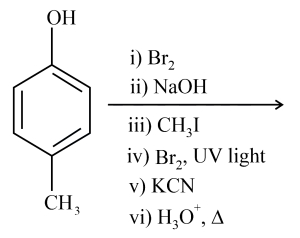
The major product of the following reaction sequence is
A
$2-$bromo$-4-$methoxyphenylacetic acid
B
$2-$bromo$-4-$methoxyphenylacetic acid (isomer)
C
$3-$bromo$-4-$methoxyphenylacetic acid
D
$2-$bromo$-4-$methoxyphenylacetic acid (isomer)
Solution
(C) The reaction sequence is as follows:
$1$. Electrophilic aromatic substitution of $p$-cresol with $Br_2$ gives $2$-bromo-$4$-methylphenol.
$2$. Treatment with $NaOH$ forms the sodium phenoxide salt.
$3$. Williamson's ether synthesis with $CH_3I$ yields $2$-bromo-$1$-methoxy-$4$-methylbenzene.
$4$. Free radical bromination of the methyl group with $Br_2/h\nu$ gives $2$-bromo-$1$-methoxy-$4$-(bromomethyl)benzene.
$5$. Nucleophilic substitution with $KCN$ replaces the benzylic bromine with a cyano group to form $2$-bromo-$1$-methoxy-$4$-(cyanomethyl)benzene.
$6$. Acidic hydrolysis of the cyanide group $(H_3O^+, \Delta)$ yields the final product,$2$-bromo-$4$-methoxyphenylacetic acid.
$1$. Electrophilic aromatic substitution of $p$-cresol with $Br_2$ gives $2$-bromo-$4$-methylphenol.
$2$. Treatment with $NaOH$ forms the sodium phenoxide salt.
$3$. Williamson's ether synthesis with $CH_3I$ yields $2$-bromo-$1$-methoxy-$4$-methylbenzene.
$4$. Free radical bromination of the methyl group with $Br_2/h\nu$ gives $2$-bromo-$1$-methoxy-$4$-(bromomethyl)benzene.
$5$. Nucleophilic substitution with $KCN$ replaces the benzylic bromine with a cyano group to form $2$-bromo-$1$-methoxy-$4$-(cyanomethyl)benzene.
$6$. Acidic hydrolysis of the cyanide group $(H_3O^+, \Delta)$ yields the final product,$2$-bromo-$4$-methoxyphenylacetic acid.
0 likes
View Solution666
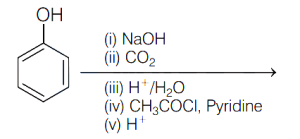
MediumMCQ
The major product formed in the following reaction is:
A
Aspirin (o-acetoxybenzoic acid)
B
Methyl salicylate
C
p-acetoxybenzoic acid
D
Methyl p-hydroxybenzoate
Solution
(A) The reaction sequence is as follows:
$1$. The reaction of phenol with $NaOH$ followed by $CO_2$ and then $H^+/H_2O$ is the Kolbe-Schmitt reaction,which yields salicylic acid ($2$-hydroxybenzoic acid).
$2$. The subsequent reaction with $CH_3COCl$ in the presence of pyridine is an acetylation reaction of the phenolic $-OH$ group.
$3$. This converts the $-OH$ group of salicylic acid into an acetoxy group $(-OCOCH_3)$,resulting in the formation of aspirin ($2$-acetoxybenzoic acid).
$1$. The reaction of phenol with $NaOH$ followed by $CO_2$ and then $H^+/H_2O$ is the Kolbe-Schmitt reaction,which yields salicylic acid ($2$-hydroxybenzoic acid).
$2$. The subsequent reaction with $CH_3COCl$ in the presence of pyridine is an acetylation reaction of the phenolic $-OH$ group.
$3$. This converts the $-OH$ group of salicylic acid into an acetoxy group $(-OCOCH_3)$,resulting in the formation of aspirin ($2$-acetoxybenzoic acid).
0 likes
View Solution667
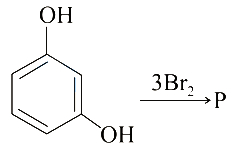
MediumMCQ
The major product $P$ formed in the following reaction is
A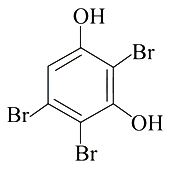
B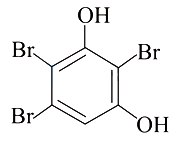
C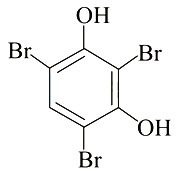
D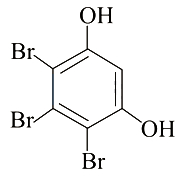
Solution
(A) The reaction of resorcinol ($1,3$-dihydroxybenzene) with $3Br_2$ (bromine water) is an electrophilic aromatic substitution reaction. The $-OH$ groups are strongly activating and ortho/para directing. In resorcinol,the positions $2, 4,$ and $6$ are activated by the two $-OH$ groups. Therefore,bromination occurs at all three positions to form $2,4,6$-tribromoresorcinol.
0 likes
View Solution668
EasyMCQ
Which intermediate is formed in the Reimer-Tiemann reaction?
A
Aldehyde
B
Carbocation
C
Carbanion
D
Substituted benzal chloride
Solution
(D) In the Reimer-Tiemann reaction,phenol is treated with chloroform $(CHCl_3)$ in the presence of aqueous sodium hydroxide $(NaOH)$.
This reaction proceeds via the formation of a dichlorocarbene $(:CCl_2)$ intermediate,which attacks the phenoxide ion to form a substituted benzal chloride intermediate.
This intermediate is subsequently hydrolyzed to form salicylaldehyde.
Therefore,the intermediate formed is a substituted benzal chloride.
This reaction proceeds via the formation of a dichlorocarbene $(:CCl_2)$ intermediate,which attacks the phenoxide ion to form a substituted benzal chloride intermediate.
This intermediate is subsequently hydrolyzed to form salicylaldehyde.
Therefore,the intermediate formed is a substituted benzal chloride.
0 likes
View Solution669
MediumMCQ
The reaction is given as: $X \xrightarrow{Y} \text{Benzoquinone}$. Identify $X$ and $Y$ in the above reaction.
A
$X$ = Cyclohexanol,$Y$ = Zn
B
$X$ = Phenol,$Y$ = $Na_2Cr_2O_7 / H_2SO_4$
C
$X$ = Cyclohex$-2-$en$-1-$ol,$Y$ = $Na_2Cr_2O_7 / H_2SO_4$
D
$X$ = Phenol,$Y$ = Zn
Solution
(B) The oxidation of phenol with chromic acid $(Na_2Cr_2O_7 / H_2SO_4)$ yields $p$-benzoquinone as the product.
Therefore,$X$ is phenol and $Y$ is $Na_2Cr_2O_7 / H_2SO_4$.
Therefore,$X$ is phenol and $Y$ is $Na_2Cr_2O_7 / H_2SO_4$.
0 likes
View Solution670
MediumMCQ
The products formed in the reaction of phenol with $Br_2$ dissolved in $CS_2$ at $0^{\circ} C$ are
A
$o$-bromo,$m$-bromo and $p$-bromophenols
B
$o$-bromo and $p$-bromophenols
C
$2,4,6$-tribromo and $2,3,6$-tribromophenols
D
$2,4$-dibromo and $2,6$-dibromophenols
Solution
(B) When phenol is treated with $Br_2$ in the presence of a non-polar solvent like $CS_2$ at low temperature $(0^{\circ} C)$,the reaction is controlled to yield mono-substituted products.
In a non-polar solvent,the ionization of phenol to the highly reactive phenoxide ion is suppressed.
Consequently,the electrophilic substitution occurs only once,leading to the formation of a mixture of $o$-bromophenol and $p$-bromophenol.
In a non-polar solvent,the ionization of phenol to the highly reactive phenoxide ion is suppressed.
Consequently,the electrophilic substitution occurs only once,leading to the formation of a mixture of $o$-bromophenol and $p$-bromophenol.
0 likes
View Solution671
EasyMCQ
Identify the product in the following reaction:
Phenol + $CHCl_3 + NaOH \rightarrow \text{Product}$
Phenol + $CHCl_3 + NaOH \rightarrow \text{Product}$
A
Benzaldehyde
B
Salicylaldehyde ($o$-hydroxybenzaldehyde)
C
Salicylic acid ($o$-hydroxybenzoic acid)
D
Benzoic acid
Solution
(B) The given reaction is the Reimer-Tiemann reaction. In this reaction,phenol reacts with chloroform $(CHCl_3)$ in the presence of an aqueous base like sodium hydroxide $(NaOH)$ to form an ortho-substituted product,which is salicylaldehyde ($o$-hydroxybenzaldehyde). The mechanism involves the formation of a dichlorocarbene $(:CCl_2)$ intermediate,which acts as an electrophile and attacks the phenol ring.
0 likes
View Solution672
MediumMCQ
The conversion of $O$-acylated phenol in the presence of $AlCl_3$ to $C$-acylated phenol is an example of which type of organic reaction?
A
addition reaction
B
substitution reaction
C
molecular rearrangement
D
elimination reaction
Solution
(C) The conversion of $O$-acylated phenol to $C$-acylated phenol in the presence of a Lewis acid like $AlCl_3$ is known as the Fries rearrangement.
In this reaction,the acyl group $(RCO-)$ migrates from the oxygen atom of the phenolic ester to the ortho or para position of the benzene ring.
Since the atoms or groups within the same molecule rearrange to form a new isomer,this process is classified as a molecular rearrangement reaction.
In this reaction,the acyl group $(RCO-)$ migrates from the oxygen atom of the phenolic ester to the ortho or para position of the benzene ring.
Since the atoms or groups within the same molecule rearrange to form a new isomer,this process is classified as a molecular rearrangement reaction.
0 likes
View Solution673
EasyMCQ
The $pK_{a}$ values of $X, Y, Z$ respectively are $8.3, 7.1, 10.2$. What are $X, Y, Z$?
A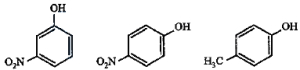
B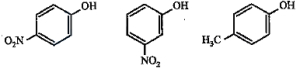
C
D
Solution
(A) The acidity of phenols is determined by the stability of the phenoxide ion formed after the loss of a proton. Electron-withdrawing groups (like $-NO_2$) increase acidity (lower $pK_{a}$),while electron-donating groups (like $-CH_3$) decrease acidity (higher $pK_{a}$).
$1$. $p$-Nitrophenol has a $-NO_2$ group at the para position,which exerts a strong $-R$ (resonance) and $-I$ (inductive) effect,making it the most acidic $(pK_{a} = 7.1)$.
$2$. $m$-Nitrophenol has a $-NO_2$ group at the meta position,which exerts only a $-I$ effect,making it less acidic than $p$-nitrophenol $(pK_{a} = 8.3)$.
$3$. $p$-Cresol has a $-CH_3$ group at the para position,which is an electron-donating group ($+I$ and hyperconjugation),making it the least acidic $(pK_{a} = 10.2)$.
Thus,$X = m$-nitrophenol $(8.3)$,$Y = p$-nitrophenol $(7.1)$,and $Z = p$-cresol $(10.2)$.
$1$. $p$-Nitrophenol has a $-NO_2$ group at the para position,which exerts a strong $-R$ (resonance) and $-I$ (inductive) effect,making it the most acidic $(pK_{a} = 7.1)$.
$2$. $m$-Nitrophenol has a $-NO_2$ group at the meta position,which exerts only a $-I$ effect,making it less acidic than $p$-nitrophenol $(pK_{a} = 8.3)$.
$3$. $p$-Cresol has a $-CH_3$ group at the para position,which is an electron-donating group ($+I$ and hyperconjugation),making it the least acidic $(pK_{a} = 10.2)$.
Thus,$X = m$-nitrophenol $(8.3)$,$Y = p$-nitrophenol $(7.1)$,and $Z = p$-cresol $(10.2)$.
0 likes
View Solution674
MediumMCQ
Assertion $(A)$: Chlorobenzene is not formed in the reaction of phenol with thionyl chloride.
Reason $(R)$: In phenol,the carbon-oxygen bond has partial double bond character.
The correct answer is
Reason $(R)$: In phenol,the carbon-oxygen bond has partial double bond character.
The correct answer is
A
$(A)$ and $(R)$ are correct. $(R)$ is the correct explanation of $(A)$
B
$(A)$ and $(R)$ are correct,but $(R)$ is not the correct explanation of $(A)$
C
$A$ is correct but $R$ is not correct
D
$A$ is not correct but $R$ is correct
Solution
(A) The reaction of alcohols with $SOCl_2$ proceeds via an $S_N2$ mechanism or $S_Ni$ mechanism to replace the $-OH$ group with $-Cl$.
In phenol,the lone pair of electrons on the oxygen atom participates in resonance with the benzene ring,giving the $C-O$ bond a partial double bond character.
This makes the $C-O$ bond stronger and shorter,preventing the cleavage of the $C-O$ bond required to replace the $-OH$ group with $-Cl$.
Therefore,chlorobenzene is not formed when phenol reacts with $SOCl_2$.
Both Assertion $(A)$ and Reason $(R)$ are correct,and $(R)$ is the correct explanation of $(A)$.
In phenol,the lone pair of electrons on the oxygen atom participates in resonance with the benzene ring,giving the $C-O$ bond a partial double bond character.
This makes the $C-O$ bond stronger and shorter,preventing the cleavage of the $C-O$ bond required to replace the $-OH$ group with $-Cl$.
Therefore,chlorobenzene is not formed when phenol reacts with $SOCl_2$.
Both Assertion $(A)$ and Reason $(R)$ are correct,and $(R)$ is the correct explanation of $(A)$.
0 likes
View SolutionAlcohols, Phenols and Ethers — Properties of Phenols · Frequently Asked Questions
1Are these Alcohols, Phenols and Ethers questions useful for JEE and NEET?
Yes. All questions in this section are mapped to JEE Main and NEET exam patterns. Previous year questions from JEE Main, NEET, GUJCET and state-level exams are included with full solutions.
2Can I switch to Hindi or Gujarati for these questions?
Yes. Use the language tabs in the hero section or the sidebar to view the same questions and solutions in English, Hindi or Gujarati.
3How do I generate a question paper from this subtopic?
Use the Vedclass Exam Paper Generator — select the chapter and subtopic, set difficulty, and generate Sets A, B, C, D automatically. First 3 chapters of every subject are free.
Vedclass Products
For Students
Vedclass Test Series
Mock tests in real JEE/NEET style with performance analysis. 5-day free trial.
Start Free TrialFor Teachers
Exam Paper Generator
Generate Set A/B/C/D papers from this chapter in 2 minutes. 3 chapters free.
Try FreeFor Institutes
Online Exam Module
Live online exams with unlimited students, 360° analytics & white-label branding.
See DemoFor Teachers & Institutes
Generate a Alcohols, Phenols and Ethers Exam Paper in 2 Minutes
Select subtopic & difficulty — Sets A, B, C, D auto-generated with No Repeat logic.
First 3 chapters of every subject are free — no payment required.