
A English
Properties of Phenols Questions in English
Class 12 Chemistry · Alcohols, Phenols and Ethers · Properties of Phenols
751+
Questions
English
Language
100%
With Solutions
Showing 32 of 751 questions in English
701
MediumMCQ
The correct order of boiling points of the below compounds is:
$(I)$ Methoxybenzene
$(II)$ $m$-Cresol
$(III)$ $o$-Cresol
$(I)$ Methoxybenzene
$(II)$ $m$-Cresol
$(III)$ $o$-Cresol
A
$I > II > III$
B
$II > I > III$
C
$III > II > I$
D
$II > III > I$
Solution
(D) Methoxybenzene (Structure $I$) is an ether and cannot form intermolecular hydrogen bonds,so it has the lowest boiling point.
Both $m$-cresol (Structure $II$) and $o$-cresol (Structure $III$) are phenols and can form intermolecular hydrogen bonds,leading to higher boiling points than $I$.
Between $m$-cresol and $o$-cresol,$o$-cresol exhibits intramolecular hydrogen bonding,which reduces the extent of intermolecular hydrogen bonding compared to $m$-cresol.
Therefore,$m$-cresol has a higher boiling point than $o$-cresol.
The correct order of boiling points is $II > III > I$.
Both $m$-cresol (Structure $II$) and $o$-cresol (Structure $III$) are phenols and can form intermolecular hydrogen bonds,leading to higher boiling points than $I$.
Between $m$-cresol and $o$-cresol,$o$-cresol exhibits intramolecular hydrogen bonding,which reduces the extent of intermolecular hydrogen bonding compared to $m$-cresol.
Therefore,$m$-cresol has a higher boiling point than $o$-cresol.
The correct order of boiling points is $II > III > I$.
0 likes
View Solution702
DifficultMCQ
The major product of the following reaction sequence is:
Aniline $\xrightarrow[(i) NaNO_2, HCl, 273-278K]{(ii) H_2O, warm} \text{Product}$ $\xrightarrow[(iv) NaOH]{(iii) Br_2, (excess)} \text{Product}$ $\xrightarrow{(v) CH_3I} \text{Final Product}$
Aniline $\xrightarrow[(i) NaNO_2, HCl, 273-278K]{(ii) H_2O, warm} \text{Product}$ $\xrightarrow[(iv) NaOH]{(iii) Br_2, (excess)} \text{Product}$ $\xrightarrow{(v) CH_3I} \text{Final Product}$
A
$2,4-$Dibromoanisole
B
$3,5-$Dibromoanisole
C
$2,4,6-$Tribromoanisole
D
$2,3,4-$Tribromoanisole
Solution
(C) The reaction sequence proceeds as follows:
$1$. Aniline reacts with $NaNO_2/HCl$ at $273-278 \ K$ to form benzene diazonium chloride.
$2$. Hydrolysis with warm $H_2O$ converts the diazonium salt into phenol.
$3$. Phenol reacts with excess $Br_2$ (bromine water) to undergo electrophilic aromatic substitution,yielding $2,4,6$-tribromophenol.
$4$. Treatment with $NaOH$ converts the phenol into sodium phenoxide ($2,4,6$-tribromophenoxide).
$5$. Finally,reaction with $CH_3I$ (Williamson ether synthesis) yields $2,4,6$-tribromoanisole as the final product.
$1$. Aniline reacts with $NaNO_2/HCl$ at $273-278 \ K$ to form benzene diazonium chloride.
$2$. Hydrolysis with warm $H_2O$ converts the diazonium salt into phenol.
$3$. Phenol reacts with excess $Br_2$ (bromine water) to undergo electrophilic aromatic substitution,yielding $2,4,6$-tribromophenol.
$4$. Treatment with $NaOH$ converts the phenol into sodium phenoxide ($2,4,6$-tribromophenoxide).
$5$. Finally,reaction with $CH_3I$ (Williamson ether synthesis) yields $2,4,6$-tribromoanisole as the final product.
0 likes
View Solution703
MediumMCQ
The major product of the following reaction is:
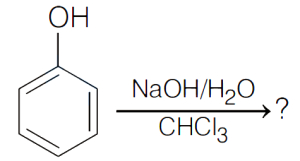
A
Sodium $2-$chlorophenolate
B
Sodium $2-$carboxyphenolate
C
Sodium $2-$formylphenolate
D
Sodium $2-$hydroxyphenolate
Solution
(C) The reaction of phenol with $CHCl_3$ in the presence of aqueous $NaOH$ is known as the $Reimer-Tiemann$ reaction.
In this reaction,$CHCl_3$ reacts with $NaOH$ to generate a dichlorocarbene intermediate $(:CCl_2)$.
This electrophilic carbene attacks the phenoxide ion at the ortho position.
The intermediate formed undergoes hydrolysis to yield salicylaldehyde ($2$-hydroxybenzaldehyde) in its salt form,which is sodium $2-$formylphenolate.
In this reaction,$CHCl_3$ reacts with $NaOH$ to generate a dichlorocarbene intermediate $(:CCl_2)$.
This electrophilic carbene attacks the phenoxide ion at the ortho position.
The intermediate formed undergoes hydrolysis to yield salicylaldehyde ($2$-hydroxybenzaldehyde) in its salt form,which is sodium $2-$formylphenolate.
0 likes
View Solution704
DifficultMCQ
The functional groups present in the product '$X$' of the reaction given below are
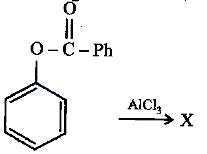
A
$-OH, -C-H$
B
$-OH, -C-$
C
$-O-Ph, -C-$
D
$-C-OH, -OH$
Solution
(B) The reaction shown is a Fries rearrangement.
When phenyl benzoate is treated with $AlCl_3$ (a Lewis acid),it undergoes rearrangement to form a mixture of ortho-hydroxybenzophenone and para-hydroxybenzophenone.
The product '$X$' is ortho-hydroxybenzophenone,which contains a phenolic hydroxyl group $(-OH)$ and a ketone carbonyl group $(-C=O)$.
Therefore,the functional groups present are $-OH$ and $-C=O$ (ketone).
When phenyl benzoate is treated with $AlCl_3$ (a Lewis acid),it undergoes rearrangement to form a mixture of ortho-hydroxybenzophenone and para-hydroxybenzophenone.
The product '$X$' is ortho-hydroxybenzophenone,which contains a phenolic hydroxyl group $(-OH)$ and a ketone carbonyl group $(-C=O)$.
Therefore,the functional groups present are $-OH$ and $-C=O$ (ketone).
0 likes
View Solution705
EasyMCQ
Which one of the following compounds gives aspirin on reacting with acetic anhydride in the presence of conc. $H_2SO_4$?
A
Salicylaldehyde
B
Salicylic acid
C
$2-$Formylbenzoic acid
D
p-Aminophenol
Solution
(B) $2-$Hydroxybenzoic acid (salicylic acid) reacts with acetic anhydride in the presence of conc. $H_2SO_4$ to form $2-$acetoxybenzoic acid,which is commonly known as aspirin. The reaction is an acetylation reaction of the phenolic $-OH$ group.
0 likes
View Solution706
MediumMCQ
Arrange the following phenols in decreasing order of their $pK_{a}$ values:
$(A)$ Phenol
$(B)$ ortho-Nitrophenol
$(C)$ meta-Nitrophenol
$(D)$ para-Nitrophenol
$(A)$ Phenol
$(B)$ ortho-Nitrophenol
$(C)$ meta-Nitrophenol
$(D)$ para-Nitrophenol
A
$A > C > B > D$
B
$A > C > D > B$
C
$B > D > C > A$
D
$D > B > C > A$
Solution
(A) The acidity of phenols is inversely proportional to their $pK_{a}$ values $(Acidity \propto \frac{1}{pK_{a}})$.
Electron-withdrawing groups (like $-NO_{2}$) increase the acidity of phenol by stabilizing the phenoxide ion through $-I$ and $-M$ effects.
$1$. Phenol $(A)$ has no electron-withdrawing group,so it is the least acidic (highest $pK_{a}$).
$2$. meta-Nitrophenol $(C)$ exhibits only the $-I$ effect,making it more acidic than phenol but less acidic than ortho and para isomers.
$3$. ortho-Nitrophenol $(B)$ and para-Nitrophenol $(D)$ exhibit both $-I$ and $-M$ effects. para-Nitrophenol $(D)$ is the most acidic due to the strong $-M$ effect of the $-NO_{2}$ group at the para position.
ortho-Nitrophenol $(B)$ is less acidic than para-Nitrophenol $(D)$ due to intramolecular hydrogen bonding,which stabilizes the undissociated molecule.
Thus,the order of acidity is: $D > B > C > A$.
Since $pK_{a}$ is inversely proportional to acidity,the decreasing order of $pK_{a}$ is: $A > C > B > D$.
Electron-withdrawing groups (like $-NO_{2}$) increase the acidity of phenol by stabilizing the phenoxide ion through $-I$ and $-M$ effects.
$1$. Phenol $(A)$ has no electron-withdrawing group,so it is the least acidic (highest $pK_{a}$).
$2$. meta-Nitrophenol $(C)$ exhibits only the $-I$ effect,making it more acidic than phenol but less acidic than ortho and para isomers.
$3$. ortho-Nitrophenol $(B)$ and para-Nitrophenol $(D)$ exhibit both $-I$ and $-M$ effects. para-Nitrophenol $(D)$ is the most acidic due to the strong $-M$ effect of the $-NO_{2}$ group at the para position.
ortho-Nitrophenol $(B)$ is less acidic than para-Nitrophenol $(D)$ due to intramolecular hydrogen bonding,which stabilizes the undissociated molecule.
Thus,the order of acidity is: $D > B > C > A$.
Since $pK_{a}$ is inversely proportional to acidity,the decreasing order of $pK_{a}$ is: $A > C > B > D$.
0 likes
View Solution707
MediumMCQ
Arrange the following compounds in the correct order of their acid strength.
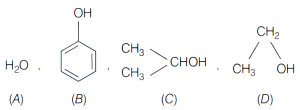
A
$A > D > C > B$
B
$A > B > C > D$
C
$B > C > D > A$
D
$B > A > D > C$
Solution
(D) The acidic strength of compounds is determined by the stability of their conjugate bases. More stable conjugate bases correspond to stronger acids.
$A$: $H_2O$ (Conjugate base: $OH^-$)
$B$: Phenol $(C_6H_5OH)$ (Conjugate base: Phenoxide ion,$C_6H_5O^-$,which is resonance stabilized)
$C$: Isopropyl alcohol $((CH_3)_2CHOH)$ (Conjugate base: Isopropoxide ion,$(CH_3)_2CHO^-$,destabilized by two electron-donating methyl groups)
$D$: Ethanol $(CH_3CH_2OH)$ (Conjugate base: Ethoxide ion,$CH_3CH_2O^-$,destabilized by one electron-donating ethyl group)
Stability order of conjugate bases: $C_6H_5O^- > OH^- > CH_3CH_2O^- > (CH_3)_2CHO^-$.
Therefore,the order of acidic strength is: $B > A > D > C$.
Thus,option $D$ is correct.
$A$: $H_2O$ (Conjugate base: $OH^-$)
$B$: Phenol $(C_6H_5OH)$ (Conjugate base: Phenoxide ion,$C_6H_5O^-$,which is resonance stabilized)
$C$: Isopropyl alcohol $((CH_3)_2CHOH)$ (Conjugate base: Isopropoxide ion,$(CH_3)_2CHO^-$,destabilized by two electron-donating methyl groups)
$D$: Ethanol $(CH_3CH_2OH)$ (Conjugate base: Ethoxide ion,$CH_3CH_2O^-$,destabilized by one electron-donating ethyl group)
Stability order of conjugate bases: $C_6H_5O^- > OH^- > CH_3CH_2O^- > (CH_3)_2CHO^-$.
Therefore,the order of acidic strength is: $B > A > D > C$.
Thus,option $D$ is correct.
0 likes
View Solution708
MediumMCQ
The order of reactivity of phenol $(I)$,nitrobenzene $(II)$,and benzene $(III)$ towards nitration is:
A
$(III) > (I) > (II)$
B
$(II) > (III) > (I)$
C
$(I) > (III) > (II)$
D
$(I) > (II) > (III)$
Solution
(C) Nitration is an electrophilic aromatic substitution reaction. The rate of this reaction depends on the electron density of the aromatic ring.
Groups that increase electron density (electron-donating groups) activate the ring,while groups that decrease electron density (electron-withdrawing groups) deactivate the ring.
In phenol $(I)$,the $-OH$ group exerts a strong $+R$ (resonance) effect,which significantly increases the electron density of the ring,making it highly reactive.
In benzene $(III)$,there is no substituent to alter the electron density.
In nitrobenzene $(II)$,the $-NO_2$ group exerts a strong $-R$ effect,which significantly decreases the electron density of the ring,making it the least reactive.
Therefore,the order of reactivity is $(I) > (III) > (II)$.
Groups that increase electron density (electron-donating groups) activate the ring,while groups that decrease electron density (electron-withdrawing groups) deactivate the ring.
In phenol $(I)$,the $-OH$ group exerts a strong $+R$ (resonance) effect,which significantly increases the electron density of the ring,making it highly reactive.
In benzene $(III)$,there is no substituent to alter the electron density.
In nitrobenzene $(II)$,the $-NO_2$ group exerts a strong $-R$ effect,which significantly decreases the electron density of the ring,making it the least reactive.
Therefore,the order of reactivity is $(I) > (III) > (II)$.
0 likes
View Solution709
MediumMCQ
Assertion $(A)$: $pK_a$ of phenol is $4.19$ and that of benzoic acid is $10$.
Reason $(R)$: Phenoxide ion is stabilised by non-equivalent resonance structures,whereas benzoate ion is stabilised by two equivalent resonance structures.
The correct option among the following is:
Reason $(R)$: Phenoxide ion is stabilised by non-equivalent resonance structures,whereas benzoate ion is stabilised by two equivalent resonance structures.
The correct option among the following is:
A
$A$ and $R$ are true. $R$ is the correct explanation of $A$.
B
$A$ and $R$ are true,but $R$ is not the correct explanation for $A$.
C
$A$ is true,$R$ is false.
D
$A$ is false,but $R$ is true.
Solution
(D) $pK_a = -\log K_a$. As $K_a$ increases,$pK_a$ decreases.
Benzoic acid $(pK_a \approx 4.2)$ is a stronger acid than phenol $(pK_a \approx 10)$,so the $pK_a$ of benzoic acid is smaller than that of phenol.
Therefore,Assertion $(A)$ is false.
The phenoxide ion is stabilized by non-equivalent resonance structures,while the benzoate ion is stabilized by two equivalent resonance structures,which makes the benzoate ion more stable and benzoic acid a stronger acid.
Thus,Reason $(R)$ is true.
Benzoic acid $(pK_a \approx 4.2)$ is a stronger acid than phenol $(pK_a \approx 10)$,so the $pK_a$ of benzoic acid is smaller than that of phenol.
Therefore,Assertion $(A)$ is false.
The phenoxide ion is stabilized by non-equivalent resonance structures,while the benzoate ion is stabilized by two equivalent resonance structures,which makes the benzoate ion more stable and benzoic acid a stronger acid.
Thus,Reason $(R)$ is true.
0 likes
View Solution710
MediumMCQ
In which of the following,ortho/para substitution by an electrophile is very facile?
A
Nitrobenzene
B
Phenol
C
Benzoic acid
D
Acetophenone
Solution
(B) The $-OH$ group is an electron-donating group by resonance effect,which makes the benzene ring highly activated towards electrophilic substitution.
It is ortho/para directing in nature.
Therefore,ortho/para substitution in phenol by an electrophile is very facile compared to the other options,which contain electron-withdrawing groups.
It is ortho/para directing in nature.
Therefore,ortho/para substitution in phenol by an electrophile is very facile compared to the other options,which contain electron-withdrawing groups.
0 likes
View Solution711
MediumMCQ
Find the correct order of acid strengths of the following compounds:
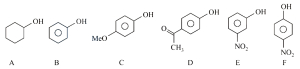
A
$F > E > D > B > C > A$
B
$D > F > E > C > B > A$
C
$D > E > F > B > C > A$
D
$F > D > E > B > C > A$
Solution
(A) The acidity of phenols depends on the stability of the phenoxide ion formed after the loss of a proton. Electron-withdrawing groups $(EWG)$ stabilize the phenoxide ion,increasing acidity,while electron-donating groups $(EDG)$ destabilize it,decreasing acidity.
$1$. $A$ (Cyclohexanol): The conjugate base is an alkoxide ion,which is less stable than the phenoxide ion. Thus,$A$ is the least acidic.
$2$. $B$ (Phenol): The reference compound.
$3$. $C$ (p-Methoxyphenol): $-OCH_3$ is an $EDG$ by resonance (+$M$ effect),which destabilizes the phenoxide ion. Thus,$C < B$.
$4$. $D$ (p-Hydroxyacetophenone): $-COCH_3$ is an $EWG$ (-$M$ effect),which stabilizes the phenoxide ion. Thus,$D > B$.
$5$. $E$ (m-Nitrophenol): $-NO_2$ is a strong $EWG$ (-$I$ and -$M$ effects). At the meta position,only the -$I$ effect operates. Thus,$E > B$.
$6$. $F$ (p-Nitrophenol): $-NO_2$ at the para position exerts both -$I$ and -$M$ effects,providing maximum stabilization to the phenoxide ion. Thus,$F > E$.
Comparing the $EWG$ strengths: $p-NO_2$ $(F)$ > $m-NO_2$ $(E)$ > $p-COCH_3$ $(D)$.
Comparing the $EDG$ strengths: $p-OCH_3$ $(C)$ destabilizes more than $B$. $A$ is the least acidic.
The correct order is $F > E > D > B > C > A$.
$1$. $A$ (Cyclohexanol): The conjugate base is an alkoxide ion,which is less stable than the phenoxide ion. Thus,$A$ is the least acidic.
$2$. $B$ (Phenol): The reference compound.
$3$. $C$ (p-Methoxyphenol): $-OCH_3$ is an $EDG$ by resonance (+$M$ effect),which destabilizes the phenoxide ion. Thus,$C < B$.
$4$. $D$ (p-Hydroxyacetophenone): $-COCH_3$ is an $EWG$ (-$M$ effect),which stabilizes the phenoxide ion. Thus,$D > B$.
$5$. $E$ (m-Nitrophenol): $-NO_2$ is a strong $EWG$ (-$I$ and -$M$ effects). At the meta position,only the -$I$ effect operates. Thus,$E > B$.
$6$. $F$ (p-Nitrophenol): $-NO_2$ at the para position exerts both -$I$ and -$M$ effects,providing maximum stabilization to the phenoxide ion. Thus,$F > E$.
Comparing the $EWG$ strengths: $p-NO_2$ $(F)$ > $m-NO_2$ $(E)$ > $p-COCH_3$ $(D)$.
Comparing the $EDG$ strengths: $p-OCH_3$ $(C)$ destabilizes more than $B$. $A$ is the least acidic.
The correct order is $F > E > D > B > C > A$.
0 likes
View Solution712
MediumMCQ
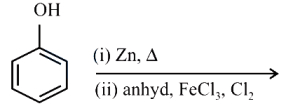
The major product of the following reaction is:
A
$4-$chlorophenol
B
$2-$chlorophenol
C
$2,4-$dichlorophenol
D
chlorobenzene
Solution
(D) Step $1$: Phenol reacts with zinc dust $(Zn)$ under heating $(\Delta)$ to undergo reduction,resulting in the formation of benzene.
$C_6H_5OH Zn \xrightarrow{\Delta} C_6H_6 ZnO$
Step $2$: Benzene then undergoes electrophilic aromatic substitution (chlorination) in the presence of anhydrous ferric chloride $(FeCl_3)$ and chlorine $(Cl_2)$ to form chlorobenzene.
$C_6H_6 Cl_2 \xrightarrow{\text{anhyd. } FeCl_3} C_6H_5Cl HCl$
Therefore,the major product is chlorobenzene.
$C_6H_5OH Zn \xrightarrow{\Delta} C_6H_6 ZnO$
Step $2$: Benzene then undergoes electrophilic aromatic substitution (chlorination) in the presence of anhydrous ferric chloride $(FeCl_3)$ and chlorine $(Cl_2)$ to form chlorobenzene.
$C_6H_6 Cl_2 \xrightarrow{\text{anhyd. } FeCl_3} C_6H_5Cl HCl$
Therefore,the major product is chlorobenzene.
0 likes
View Solution713
MediumMCQ
Which one of the following properties is exhibited by phenol?
A
It is soluble in aq. $NaOH$ and evolves $CO_{2}$ with aq. $NaHCO_{3}$
B
It is soluble in aq. $NaOH$ and does not evolve $CO_{2}$ with aq. $NaHCO_{3}$
C
It is not soluble in aq. $NaOH$ but evolves $CO_{2}$ with aq. $NaHCO_{3}$
D
It is insoluble in aq. $NaOH$ and does not evolve $CO_{2}$ with aq. $NaHCO_{3}$
Solution
(B) Phenol is acidic enough to react with strong bases like $NaOH$ to form sodium phenoxide $(C_{6}H_{5}ONa)$,which is water-soluble.
Phenol is a weaker acid than carbonic acid $(H_{2}CO_{3})$,therefore it cannot displace $CO_{2}$ from $NaHCO_{3}$.
Phenol is a weaker acid than carbonic acid $(H_{2}CO_{3})$,therefore it cannot displace $CO_{2}$ from $NaHCO_{3}$.
0 likes
View Solution714
MediumMCQ
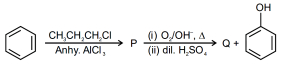
The major product '$P$' and '$Q$' in the above reactions are
A
Isopropylbenzene and propanal
B
Isopropylbenzene and acetone
C
Isopropylbenzene and acetone
D
Isopropylbenzene and propanal
Solution
(C) $1$. The reaction of benzene with $CH_3CH_2CH_2Cl$ in the presence of anhydrous $AlCl_3$ is a Friedel-Crafts alkylation. The primary carbocation formed $(CH_3CH_2CH_2^+)$ undergoes a $1,2-H^-$ shift to form a more stable secondary carbocation $(CH_3CH^+CH_3)$.
$2$. This secondary carbocation attacks the benzene ring to form isopropylbenzene (cumene) as the major product '$P$'.
$3$. Cumene undergoes oxidation with $O_2/OH^-, \Delta$ to form cumene hydroperoxide,which upon treatment with dilute $H_2SO_4$ yields phenol and acetone $(CH_3COCH_3)$ as the major product '$Q$'.
$4$. Thus,'$P$' is isopropylbenzene and '$Q$' is acetone.
$2$. This secondary carbocation attacks the benzene ring to form isopropylbenzene (cumene) as the major product '$P$'.
$3$. Cumene undergoes oxidation with $O_2/OH^-, \Delta$ to form cumene hydroperoxide,which upon treatment with dilute $H_2SO_4$ yields phenol and acetone $(CH_3COCH_3)$ as the major product '$Q$'.
$4$. Thus,'$P$' is isopropylbenzene and '$Q$' is acetone.
0 likes
View Solution715
MediumMCQ
Which of the following compounds will produce effervescence when mixed with an aqueous sodium bicarbonate $(NaHCO_3)$ solution?
A
$2,4,6-$Trinitrophenol
B
$CH_3COCH_3$
C
$CH_3CH_2OH$
D
$CH_3CH_2OCH_2CH_3$
Solution
(A) Compounds that are stronger acids than carbonic acid $(H_2CO_3)$ react with sodium bicarbonate $(NaHCO_3)$ to release carbon dioxide $(CO_2)$ gas,which causes effervescence.
$2,4,6-$Trinitrophenol (also known as picric acid) is a strong acid due to the electron-withdrawing effect of three nitro $(-NO_2)$ groups,which stabilize the phenoxide ion.
Since the $pK_a$ of picric acid is lower than the $pK_a$ of $H_2CO_3$,it reacts with $NaHCO_3$ to produce effervescence.
Other options like acetone,ethanol,and diethyl ether are not acidic enough to react with $NaHCO_3$.
$2,4,6-$Trinitrophenol (also known as picric acid) is a strong acid due to the electron-withdrawing effect of three nitro $(-NO_2)$ groups,which stabilize the phenoxide ion.
Since the $pK_a$ of picric acid is lower than the $pK_a$ of $H_2CO_3$,it reacts with $NaHCO_3$ to produce effervescence.
Other options like acetone,ethanol,and diethyl ether are not acidic enough to react with $NaHCO_3$.
0 likes
View Solution716
MediumMCQ
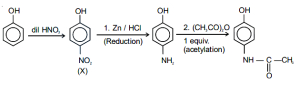
The products $X$ and $Y$ which are formed in the following sequence of reactions are respectively:
$\text{Phenol}$ $\xrightarrow{dil \ HNO_3} X$ $\xrightarrow{1. Zn/HCl, \Delta \atop 2.(CH_3CO)_2O (1 \ equiv)} Y$
$\text{Phenol}$ $\xrightarrow{dil \ HNO_3} X$ $\xrightarrow{1. Zn/HCl, \Delta \atop 2.(CH_3CO)_2O (1 \ equiv)} Y$
A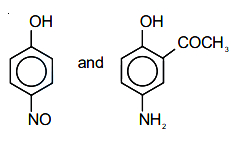
B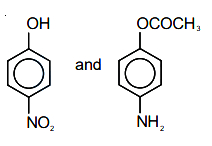
C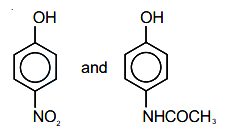
D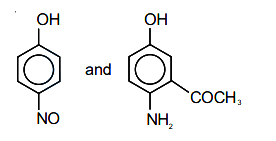
Solution
(C) $1$. $\text{Phenol}$ reacts with dilute $HNO_3$ to form a mixture of $o$-nitrophenol and $p$-nitrophenol. The major product is $p$-nitrophenol $(X)$.
$2$. $p$-nitrophenol $(X)$ is reduced using $Zn/HCl$ to form $p$-aminophenol.
$3$. $p$-aminophenol reacts with $1 \ equiv$ of acetic anhydride $(CH_3CO)_2O$. The amino group $(-NH_2)$ is more nucleophilic than the hydroxyl group $(-OH)$, so acetylation occurs at the nitrogen atom to form $p$-acetamidophenol $(Y)$.
$2$. $p$-nitrophenol $(X)$ is reduced using $Zn/HCl$ to form $p$-aminophenol.
$3$. $p$-aminophenol reacts with $1 \ equiv$ of acetic anhydride $(CH_3CO)_2O$. The amino group $(-NH_2)$ is more nucleophilic than the hydroxyl group $(-OH)$, so acetylation occurs at the nitrogen atom to form $p$-acetamidophenol $(Y)$.
0 likes
View Solution717
DifficultMCQ
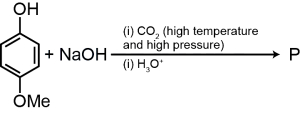
The structure of the product $P$ of the following reaction is
A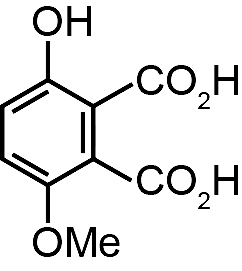
B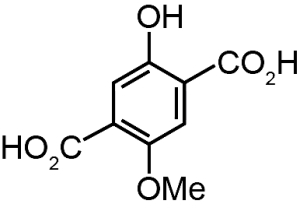
C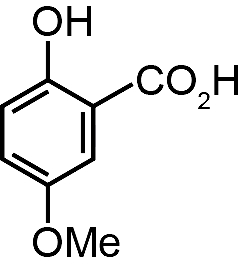
D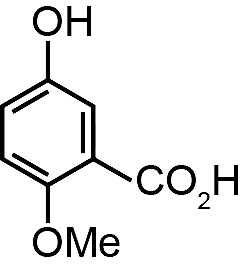
Solution
(D) The reaction is a Kolbe-Schmitt reaction.
$1$. $4$-Methoxyphenol reacts with $NaOH$ to form sodium $4$-methoxyphenoxide.
$2$. The phenoxide ion is highly reactive towards electrophilic aromatic substitution.
$3$. The $-O^-$ group is a strong ortho/para directing group. Since the para position is already occupied by the $-OMe$ group,the electrophile $(CO_2)$ attacks the ortho position relative to the $-O^-$ group.
$4$. Subsequent acidification with $H_3O^+$ yields the final product,$2$-hydroxy-$5$-methoxybenzoic acid.
$1$. $4$-Methoxyphenol reacts with $NaOH$ to form sodium $4$-methoxyphenoxide.
$2$. The phenoxide ion is highly reactive towards electrophilic aromatic substitution.
$3$. The $-O^-$ group is a strong ortho/para directing group. Since the para position is already occupied by the $-OMe$ group,the electrophile $(CO_2)$ attacks the ortho position relative to the $-O^-$ group.
$4$. Subsequent acidification with $H_3O^+$ yields the final product,$2$-hydroxy-$5$-methoxybenzoic acid.
0 likes
View Solution718
MediumMCQ
Which statement is incorrect?
A
Phenol is a weak acid
B
Phenol is an aromatic compound
C
Phenol liberates $CO_2$ from $Na_2CO_3$ solution
D
Phenol is soluble in $NaOH$
Solution
(C) Phenol is a weaker acid than carbonic acid $(H_2CO_3)$.
Therefore,it cannot displace carbonic acid from its salts like $Na_2CO_3$.
Consequently,phenol does not liberate $CO_2$ gas from $Na_2CO_3$ solution.
Thus,the statement in option $C$ is incorrect.
Therefore,it cannot displace carbonic acid from its salts like $Na_2CO_3$.
Consequently,phenol does not liberate $CO_2$ gas from $Na_2CO_3$ solution.
Thus,the statement in option $C$ is incorrect.
0 likes
View Solution719
MediumMCQ
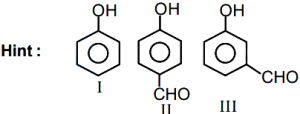
The correct acidity order of phenol $(I)$,$4-$hydroxybenzaldehyde $(II)$ and $3-$hydroxybenzaldehyde $(III)$ is:
A
$I < II < III$
B
$I < III < II$
C
$II < III < I$
D
$III < II < I$
Solution
(B) Electron-withdrawing groups $(EWG)$ like $-CHO$ increase the acidity of phenols by stabilizing the phenoxide ion.
In $4-$hydroxybenzaldehyde $(II)$,the $-CHO$ group is at the para position and exerts both $-M$ (mesomeric) and $-I$ (inductive) effects.
In $3-$hydroxybenzaldehyde $(III)$,the $-CHO$ group is at the meta position and exerts only the $-I$ effect (the mesomeric effect does not operate at the meta position).
Phenol $(I)$ has no such electron-withdrawing group.
Therefore,the acidity order is $I < III < II$.
In $4-$hydroxybenzaldehyde $(II)$,the $-CHO$ group is at the para position and exerts both $-M$ (mesomeric) and $-I$ (inductive) effects.
In $3-$hydroxybenzaldehyde $(III)$,the $-CHO$ group is at the meta position and exerts only the $-I$ effect (the mesomeric effect does not operate at the meta position).
Phenol $(I)$ has no such electron-withdrawing group.
Therefore,the acidity order is $I < III < II$.
0 likes
View Solution720
MediumMCQ
Which of the following compounds has maximum volatility?
A
p-Hydroxybenzoic acid
B
m-Hydroxybenzoic acid
C
o-Hydroxybenzoic acid (Salicylic acid)
D
Benzoic acid
Solution
(C) Volatility is inversely proportional to the strength of intermolecular forces.
$o$-Hydroxybenzoic acid (Salicylic acid) exhibits intramolecular hydrogen bonding,which reduces the extent of intermolecular hydrogen bonding compared to its isomers ($p$- and $m$-hydroxybenzoic acid).
This results in weaker intermolecular forces,making $o$-hydroxybenzoic acid more volatile than the others.
$o$-Hydroxybenzoic acid (Salicylic acid) exhibits intramolecular hydrogen bonding,which reduces the extent of intermolecular hydrogen bonding compared to its isomers ($p$- and $m$-hydroxybenzoic acid).
This results in weaker intermolecular forces,making $o$-hydroxybenzoic acid more volatile than the others.
0 likes
View Solution721
EasyMCQ
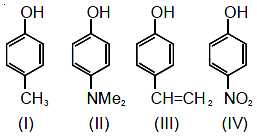
The correct order of acidity of the above compounds is:
A
$II > IV > I > III$
B
$III > IV > II > I$
C
$IV > III > I > II$
D
$IV > I > III > II$
Solution
(C) The acidity of phenols depends on the stability of the phenoxide ion formed after the loss of a proton. Electron-withdrawing groups $(EWG)$ stabilize the phenoxide ion and increase acidity,while electron-donating groups $(EDG)$ destabilize it and decrease acidity.
$1$. Compound $(IV)$ has a $-NO_2$ group,which is a strong electron-withdrawing group ($-R$ and $-I$ effect),making it the most acidic.
$2$. Compound $(III)$ has a $-CH=CH_2$ group,which is an electron-withdrawing group ($-R$ effect),making it more acidic than $(I)$ and $(II)$.
$3$. Compound $(I)$ has a $-CH_3$ group,which is an electron-donating group ($+I$ and hyperconjugation),making it less acidic than $(III)$ but more acidic than $(II)$.
$4$. Compound $(II)$ has a $-NMe_2$ group,which is a very strong electron-donating group ($+R$ effect),making it the least acidic.
Therefore,the correct order of acidity is $(IV) > (III) > (I) > (II)$.
$1$. Compound $(IV)$ has a $-NO_2$ group,which is a strong electron-withdrawing group ($-R$ and $-I$ effect),making it the most acidic.
$2$. Compound $(III)$ has a $-CH=CH_2$ group,which is an electron-withdrawing group ($-R$ effect),making it more acidic than $(I)$ and $(II)$.
$3$. Compound $(I)$ has a $-CH_3$ group,which is an electron-donating group ($+I$ and hyperconjugation),making it less acidic than $(III)$ but more acidic than $(II)$.
$4$. Compound $(II)$ has a $-NMe_2$ group,which is a very strong electron-donating group ($+R$ effect),making it the least acidic.
Therefore,the correct order of acidity is $(IV) > (III) > (I) > (II)$.
0 likes
View Solution722
EasyMCQ
The correct order of decreasing acidity of nitrophenols is:
A
$p$-Nitrophenol $ > $ $o$-Nitrophenol $ > $ $m$-Nitrophenol
B
$o$-Nitrophenol $ > $ $m$-Nitrophenol $ > $ $p$-Nitrophenol
C
$p$-Nitrophenol $ > $ $m$-Nitrophenol $ > $ $o$-Nitrophenol
D
$m$-Nitrophenol $ > $ $p$-Nitrophenol $ > $ $o$-Nitrophenol
Solution
(A) The acidity of nitrophenols is determined by the electron-withdrawing effect ($-I$ and $-R$ effects) of the $-NO_2$ group.
$p$-Nitrophenol is the most acidic because the $-NO_2$ group at the para-position exerts both strong $-I$ and $-R$ effects,stabilizing the phenoxide ion significantly.
In $o$-nitrophenol,the $-NO_2$ group is at the ortho-position,which also exerts strong $-I$ and $-R$ effects,but the formation of intramolecular $H$-bonding between the $-OH$ group and the $-NO_2$ group makes the release of the proton slightly more difficult compared to $p$-nitrophenol.
In $m$-nitrophenol,the $-NO_2$ group only exerts a $-I$ effect (no resonance effect),making it the least acidic among the three.
Thus,the correct order of decreasing acidity is: $p$-Nitrophenol $ > $ $o$-Nitrophenol $ > $ $m$-Nitrophenol.
$p$-Nitrophenol is the most acidic because the $-NO_2$ group at the para-position exerts both strong $-I$ and $-R$ effects,stabilizing the phenoxide ion significantly.
In $o$-nitrophenol,the $-NO_2$ group is at the ortho-position,which also exerts strong $-I$ and $-R$ effects,but the formation of intramolecular $H$-bonding between the $-OH$ group and the $-NO_2$ group makes the release of the proton slightly more difficult compared to $p$-nitrophenol.
In $m$-nitrophenol,the $-NO_2$ group only exerts a $-I$ effect (no resonance effect),making it the least acidic among the three.
Thus,the correct order of decreasing acidity is: $p$-Nitrophenol $ > $ $o$-Nitrophenol $ > $ $m$-Nitrophenol.
0 likes
View Solution723
MediumMCQ
The correct order of acid strength of the following substituted phenols in water at $28^{\circ} C$ is:
A
$p$-nitrophenol $ < $ $p$-fluorophenol $ < $ $p$-chlorophenol
B
$p$-chlorophenol $ < $ $p$-fluorophenol $ < $ $p$-nitrophenol
C
$p$-fluorophenol $ < $ $p$-chlorophenol $ < $ $p$-nitrophenol
D
$p$-fluorophenol $ < $ $p$-nitrophenol $ < $ $p$-chlorophenol
Solution
(C) The acidic strength of substituted phenols depends on the electron-withdrawing effect ($-I$ and $-M$ effects) of the substituent group attached to the benzene ring.
Stronger electron-withdrawing groups stabilize the phenoxide ion more effectively,thereby increasing the acidic strength.
The electron-withdrawing tendency of the given substituents follows the order: $-F < -Cl < -NO_2$.
Therefore,the correct order of acidic strength is $p$-fluorophenol $ < $ $p$-chlorophenol $ < $ $p$-nitrophenol.
Stronger electron-withdrawing groups stabilize the phenoxide ion more effectively,thereby increasing the acidic strength.
The electron-withdrawing tendency of the given substituents follows the order: $-F < -Cl < -NO_2$.
Therefore,the correct order of acidic strength is $p$-fluorophenol $ < $ $p$-chlorophenol $ < $ $p$-nitrophenol.
0 likes
View Solution724
EasyMCQ
When phenol is treated with $D_{2}SO_{4} / D_{2}O$,some of the hydrogens get exchanged. The final product in this exchange reaction is
A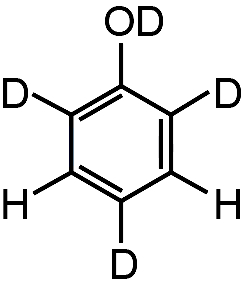
B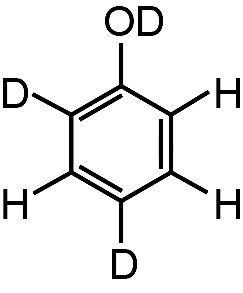
C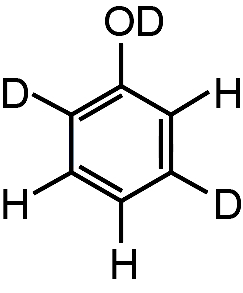
D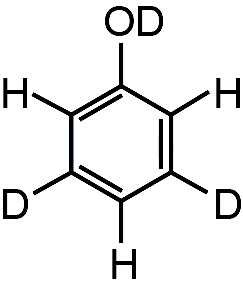
Solution
(A) In an acidic medium,phenol exists in equilibrium with its protonated form,and the $-OH$ group activates the benzene ring towards electrophilic substitution.
The $-OH$ group is an electron-donating group by resonance,which increases the electron density at the $ortho$ and $para$ positions.
When treated with $D_{2}SO_{4} / D_{2}O$,the $D^+$ acts as an electrophile.
The electrophile $(D^+)$ attacks the electron-rich $ortho$ and $para$ positions of the benzene ring.
Additionally,the phenolic hydrogen is acidic and readily exchanges with $D$ in $D_{2}O$ to form $-OD$.
Therefore,the hydrogen atoms at the $ortho$ and $para$ positions are replaced by deuterium atoms,and the $-OH$ group becomes $-OD$.
The final product is $2,4,6-trideuterophenol-d_1$ (where the phenolic hydrogen is also replaced).
The $-OH$ group is an electron-donating group by resonance,which increases the electron density at the $ortho$ and $para$ positions.
When treated with $D_{2}SO_{4} / D_{2}O$,the $D^+$ acts as an electrophile.
The electrophile $(D^+)$ attacks the electron-rich $ortho$ and $para$ positions of the benzene ring.
Additionally,the phenolic hydrogen is acidic and readily exchanges with $D$ in $D_{2}O$ to form $-OD$.
Therefore,the hydrogen atoms at the $ortho$ and $para$ positions are replaced by deuterium atoms,and the $-OH$ group becomes $-OD$.
The final product is $2,4,6-trideuterophenol-d_1$ (where the phenolic hydrogen is also replaced).
0 likes
View Solution725
MediumMCQ
Two aromatic compounds having formula $C_7H_8O$ which are easily identifiable by $FeCl_3$ solution test (violet colouration) are
A
$o-$cresol and benzyl alcohol
B
$m-$cresol and $p-$cresol
C
$o-$cresol and $p-$cresol
D
methyl phenyl ether and benzyl alcohol
Solution
(A) The $FeCl_3$ test is used to detect the presence of a phenolic group ($-OH$ group attached directly to the benzene ring).
Compounds containing a phenolic group react with neutral $FeCl_3$ to form a violet-colored complex.
Among the given options,$o-$cresol ($2-$methylphenol) is a phenol and gives a violet color with $FeCl_3$.
Benzyl alcohol $(C_6H_5CH_2OH)$ does not contain a phenolic group (the $-OH$ is on the side chain),so it does not give a violet color with $FeCl_3$.
Therefore,$o-$cresol and benzyl alcohol can be distinguished using this test.
Compounds containing a phenolic group react with neutral $FeCl_3$ to form a violet-colored complex.
Among the given options,$o-$cresol ($2-$methylphenol) is a phenol and gives a violet color with $FeCl_3$.
Benzyl alcohol $(C_6H_5CH_2OH)$ does not contain a phenolic group (the $-OH$ is on the side chain),so it does not give a violet color with $FeCl_3$.
Therefore,$o-$cresol and benzyl alcohol can be distinguished using this test.
0 likes
View Solution726
DifficultMCQ
Consider the following reaction sequence:
$\text{Compound } (x)$ $\xrightarrow[(ii) H_3O^{+}]{(i) CO_2, NaOH, 120^{\circ}C, \text{high pressure}} \text{Compound } (y) \text{ (Major Product)}$
$[76.6\% C, 6.38\% H, \text{vapour density } 47]$
Compound $(y)$ develops a characteristic color with neutral $FeCl_3$ solution.
Identify the $INCORRECT$ statement from the following for the above sequence.
$\text{Compound } (x)$ $\xrightarrow[(ii) H_3O^{+}]{(i) CO_2, NaOH, 120^{\circ}C, \text{high pressure}} \text{Compound } (y) \text{ (Major Product)}$
$[76.6\% C, 6.38\% H, \text{vapour density } 47]$
Compound $(y)$ develops a characteristic color with neutral $FeCl_3$ solution.
Identify the $INCORRECT$ statement from the following for the above sequence.
A
Both compounds $x$ and $y$ will dissolve in $NaOH$.
B
Compound $y$ will dissolve in $NaHCO_3$ and evolve a gas.
C
Compound $x$ is more acidic than compound $y$.
D
Both compounds $x$ and $y$ will burn with a sooty flame.
Solution
(C) The reaction is the Kolbe-Schmitt reaction. The molecular weight of compound $(y)$ is $2 \times \text{vapour density} = 2 \times 47 = 94$.
Given the percentages: $C = 76.6\%$,$H = 6.38\%$,$O = 100 - (76.6 + 6.38) = 17.02\%$.
Moles of $C = 76.6/12 = 6.38$,$H = 6.38/1 = 6.38$,$O = 17.02/16 = 1.06$.
Ratio $C:H:O = 6:6:1$. The empirical formula is $C_6H_6O$,which corresponds to phenol $(C_6H_5OH)$.
Thus,compound $(x)$ is phenol and compound $(y)$ is salicylic acid ($2$-hydroxybenzoic acid).
Phenol $(x)$ is acidic and dissolves in $NaOH$. Salicylic acid $(y)$ is more acidic than phenol due to the electron-withdrawing $-COOH$ group and intramolecular hydrogen bonding,so it also dissolves in $NaOH$.
Salicylic acid $(y)$ reacts with $NaHCO_3$ to evolve $CO_2$ gas.
Both are aromatic compounds and burn with a sooty flame.
Statement $(c)$ is incorrect because salicylic acid $(y)$ is more acidic than phenol $(x)$.
Given the percentages: $C = 76.6\%$,$H = 6.38\%$,$O = 100 - (76.6 + 6.38) = 17.02\%$.
Moles of $C = 76.6/12 = 6.38$,$H = 6.38/1 = 6.38$,$O = 17.02/16 = 1.06$.
Ratio $C:H:O = 6:6:1$. The empirical formula is $C_6H_6O$,which corresponds to phenol $(C_6H_5OH)$.
Thus,compound $(x)$ is phenol and compound $(y)$ is salicylic acid ($2$-hydroxybenzoic acid).
Phenol $(x)$ is acidic and dissolves in $NaOH$. Salicylic acid $(y)$ is more acidic than phenol due to the electron-withdrawing $-COOH$ group and intramolecular hydrogen bonding,so it also dissolves in $NaOH$.
Salicylic acid $(y)$ reacts with $NaHCO_3$ to evolve $CO_2$ gas.
Both are aromatic compounds and burn with a sooty flame.
Statement $(c)$ is incorrect because salicylic acid $(y)$ is more acidic than phenol $(x)$.
0 likes
View Solution727
DifficultMCQ
Given below are two statements:
Statement $I$: Phenol on treatment with $CHCl_3 / aq. KOH$ under refluxing condition,followed by acidification produces $p$-hydroxybenzaldehyde as the major product and $o$-hydroxybenzaldehyde as the minor product.
Statement $II$: The mixture of $p$-hydroxybenzaldehyde and $o$-hydroxybenzaldehyde can be easily separated through steam distillation.
In the light of the above statements,choose the correct answer from the options given below:
Statement $I$: Phenol on treatment with $CHCl_3 / aq. KOH$ under refluxing condition,followed by acidification produces $p$-hydroxybenzaldehyde as the major product and $o$-hydroxybenzaldehyde as the minor product.
Statement $II$: The mixture of $p$-hydroxybenzaldehyde and $o$-hydroxybenzaldehyde can be easily separated through steam distillation.
In the light of the above statements,choose the correct answer from the options given below:
A
Both Statement $I$ and Statement $II$ are false
B
Statement $I$ is true but Statement $II$ is false
C
Both Statement $I$ and Statement $II$ are true
D
Statement $I$ is false but Statement $II$ is true
Solution
(D) The reaction of phenol with $CHCl_3$ and $aq. KOH$ is the Reimer-Tiemann reaction.
In this reaction,$o$-hydroxybenzaldehyde (salicylaldehyde) is the major product due to intramolecular hydrogen bonding,while $p$-hydroxybenzaldehyde is the minor product.
Therefore,Statement $I$ is false.
$o$-hydroxybenzaldehyde exhibits intramolecular hydrogen bonding,making it volatile with steam,whereas $p$-hydroxybenzaldehyde exhibits intermolecular hydrogen bonding,making it less volatile.
Thus,they can be separated by steam distillation.
Therefore,Statement $II$ is true.
In this reaction,$o$-hydroxybenzaldehyde (salicylaldehyde) is the major product due to intramolecular hydrogen bonding,while $p$-hydroxybenzaldehyde is the minor product.
Therefore,Statement $I$ is false.
$o$-hydroxybenzaldehyde exhibits intramolecular hydrogen bonding,making it volatile with steam,whereas $p$-hydroxybenzaldehyde exhibits intermolecular hydrogen bonding,making it less volatile.
Thus,they can be separated by steam distillation.
Therefore,Statement $II$ is true.
0 likes
View Solution728
MediumMCQ
$C_6H_6 + X \xrightarrow{anhydrous AlCl_3} \text{Isopropylbenzene} \xrightarrow{(i) O_2, (ii) H^+} Y + Z$. In this reaction,$X, Y$ and $Z$ are . . . . . . respectively.
A
$CH_3CH_2Cl, C_6H_5OH, CH_3COCH_3$
B
$CH_3CH_2Cl, C_6H_4(OH)_2, CH_3CHO$
C
$CH_3CH(Cl)CH_3, C_6H_5OH, CH_3COCH_3$
D
$CH_3CH_2CH_2Cl, C_6H_5CHO, CH_3COCH_3$
Solution
(C) The reaction sequence is the industrial cumene process for the preparation of phenol.
Step $1$: Benzene $(C_6H_6)$ reacts with isopropyl chloride $(CH_3CH(Cl)CH_3)$ in the presence of anhydrous $AlCl_3$ (Friedel-Crafts alkylation) to form isopropylbenzene (cumene).
Step $2$: Cumene is oxidized by $O_2$ to form cumene hydroperoxide,which upon acid hydrolysis $(H^+)$ yields phenol $(C_6H_5OH)$ as $Y$ and acetone $(CH_3COCH_3)$ as $Z$.
Therefore,$X = CH_3CH(Cl)CH_3$,$Y = C_6H_5OH$,and $Z = CH_3COCH_3$.
Step $1$: Benzene $(C_6H_6)$ reacts with isopropyl chloride $(CH_3CH(Cl)CH_3)$ in the presence of anhydrous $AlCl_3$ (Friedel-Crafts alkylation) to form isopropylbenzene (cumene).
Step $2$: Cumene is oxidized by $O_2$ to form cumene hydroperoxide,which upon acid hydrolysis $(H^+)$ yields phenol $(C_6H_5OH)$ as $Y$ and acetone $(CH_3COCH_3)$ as $Z$.
Therefore,$X = CH_3CH(Cl)CH_3$,$Y = C_6H_5OH$,and $Z = CH_3COCH_3$.
0 likes
View Solution729
MediumMCQ
Which type of solution of phenol is required to prepare Orange dye by coupling reaction?
A
Alkaline solution of phenol
B
Neutral solution of phenol
C
Acidic solution of phenol
D
$CCl_4$ solution of phenol
Solution
(A) The coupling reaction involves a diazonium salt attacking a phenol.
Phenol is a weak acid,and it forms a phenoxide ion in an alkaline medium.
The phenoxide ion is much more strongly activated towards electrophilic aromatic substitution than neutral phenol,making the reaction with the diazonium electrophile faster and more efficient.
Phenol is a weak acid,and it forms a phenoxide ion in an alkaline medium.
The phenoxide ion is much more strongly activated towards electrophilic aromatic substitution than neutral phenol,making the reaction with the diazonium electrophile faster and more efficient.
0 likes
View Solution730
MediumMCQ
Which reaction is used to prepare $2$-hydroxybenzaldehyde from phenol?
A
Reimer-Tiemann reaction
B
Kolbe's reaction
C
Williamson synthesis
D
Etard's reaction
Solution
(A) The Reimer-Tiemann reaction is specifically used to introduce a formyl group $(-\text{CHO})$ into the ortho position of a phenol by using chloroform $(CHCl_3)$ and aqueous sodium hydroxide $(NaOH)$.
This reaction results in the formation of $2$-hydroxybenzaldehyde,commonly known as salicylaldehyde.
This reaction results in the formation of $2$-hydroxybenzaldehyde,commonly known as salicylaldehyde.
0 likes
View Solution731
DifficultMCQ
One mole of phenol is treated with dilute $HNO_3$ at $298 \ K$ to give a mixture of products. The mixture is separated by steam distillation. The steam volatile compound $(X)$ is separated. The increase in percentage of oxygen in $(X)$ with respect to phenol is . . . . . . $\times 10^{-1}$ %. (Given molar mass in $g \ mol^{-1}$: $H:1, C:12, N:14, O:16$)
A
$15$
B
$25$
C
$35$
D
$45$
Solution
(D) Phenol $(C_6H_5OH)$ reacts with dilute $HNO_3$ to form a mixture of $o$-nitrophenol and $p$-nitrophenol.
$o$-Nitrophenol is steam volatile due to intramolecular hydrogen bonding,while $p$-nitrophenol is not due to intermolecular hydrogen bonding.
Thus,the steam volatile compound $(X)$ is $o$-nitrophenol $(C_6H_5NO_3)$.
Molar mass of phenol $(C_6H_6O)$ = $(6 \times 12) + (6 \times 1) + 16 = 94 \ g \ mol^{-1}$.
Percentage of oxygen in phenol = $(16 / 94) \times 100 \approx 17.021 \ \%$.
Molar mass of $o$-nitrophenol $(C_6H_5NO_3)$ = $(6 \times 12) + (5 \times 1) + 14 + (3 \times 16) = 72 + 5 + 14 + 48 = 139 \ g \ mol^{-1}$.
Percentage of oxygen in $o$-nitrophenol = $(48 / 139) \times 100 \approx 34.532 \ \%$.
Increase in percentage of oxygen = $34.532 - 17.021 = 17.511 \ \%$.
Expressing as $175.11 \times 10^{-1} \% \approx 175 \times 10^{-1} \%$. Given the options provided,the closest integer value is $175$ (Note: The provided options in the prompt seem to be placeholders; based on standard calculation,the result is $175$).
$o$-Nitrophenol is steam volatile due to intramolecular hydrogen bonding,while $p$-nitrophenol is not due to intermolecular hydrogen bonding.
Thus,the steam volatile compound $(X)$ is $o$-nitrophenol $(C_6H_5NO_3)$.
Molar mass of phenol $(C_6H_6O)$ = $(6 \times 12) + (6 \times 1) + 16 = 94 \ g \ mol^{-1}$.
Percentage of oxygen in phenol = $(16 / 94) \times 100 \approx 17.021 \ \%$.
Molar mass of $o$-nitrophenol $(C_6H_5NO_3)$ = $(6 \times 12) + (5 \times 1) + 14 + (3 \times 16) = 72 + 5 + 14 + 48 = 139 \ g \ mol^{-1}$.
Percentage of oxygen in $o$-nitrophenol = $(48 / 139) \times 100 \approx 34.532 \ \%$.
Increase in percentage of oxygen = $34.532 - 17.021 = 17.511 \ \%$.
Expressing as $175.11 \times 10^{-1} \% \approx 175 \times 10^{-1} \%$. Given the options provided,the closest integer value is $175$ (Note: The provided options in the prompt seem to be placeholders; based on standard calculation,the result is $175$).
0 likes
View Solution732
DifficultMCQ
$4.7 \text{ g}$ of phenol is heated with $Zn$ to give product $X$. If this reaction goes to $60\%$ completion,then the number of moles of compound $X$ formed will be . . . . . . $\times 10^{-2}$. (Nearest Integer) (Given molar mass in $\text{g mol}^{-1}$: $H:1, C:12, O:16$)
A
$1$
B
$2$
C
$3$
D
$4$
Solution
(C) The chemical reaction for the reduction of phenol with zinc dust is: $C_6H_5OH + Zn \rightarrow C_6H_6 + ZnO$.
First,calculate the molar mass of phenol $(C_6H_5OH)$: $(6 \times 12) + (6 \times 1) + 16 = 72 + 6 + 16 = 94 \text{ g mol}^{-1}$.
Calculate the initial moles of phenol: $\text{Moles} = \frac{\text{mass}}{\text{molar mass}} = \frac{4.7 \text{ g}}{94 \text{ g mol}^{-1}} = 0.05 \text{ moles}$.
Since the reaction goes to $60\%$ completion,the moles of product $X$ (benzene) formed is: $0.05 \times 0.60 = 0.03 \text{ moles}$.
Expressing this in the required format: $0.03 = 3 \times 10^{-2}$.
Therefore,the value is $3$.
First,calculate the molar mass of phenol $(C_6H_5OH)$: $(6 \times 12) + (6 \times 1) + 16 = 72 + 6 + 16 = 94 \text{ g mol}^{-1}$.
Calculate the initial moles of phenol: $\text{Moles} = \frac{\text{mass}}{\text{molar mass}} = \frac{4.7 \text{ g}}{94 \text{ g mol}^{-1}} = 0.05 \text{ moles}$.
Since the reaction goes to $60\%$ completion,the moles of product $X$ (benzene) formed is: $0.05 \times 0.60 = 0.03 \text{ moles}$.
Expressing this in the required format: $0.03 = 3 \times 10^{-2}$.
Therefore,the value is $3$.
0 likes
View SolutionAlcohols, Phenols and Ethers — Properties of Phenols · Frequently Asked Questions
1Are these Alcohols, Phenols and Ethers questions useful for JEE and NEET?
Yes. All questions in this section are mapped to JEE Main and NEET exam patterns. Previous year questions from JEE Main, NEET, GUJCET and state-level exams are included with full solutions.
2Can I switch to Hindi or Gujarati for these questions?
Yes. Use the language tabs in the hero section or the sidebar to view the same questions and solutions in English, Hindi or Gujarati.
3How do I generate a question paper from this subtopic?
Use the Vedclass Exam Paper Generator — select the chapter and subtopic, set difficulty, and generate Sets A, B, C, D automatically. First 3 chapters of every subject are free.
Vedclass Products
For Students
Vedclass Test Series
Mock tests in real JEE/NEET style with performance analysis. 5-day free trial.
Start Free TrialFor Teachers
Exam Paper Generator
Generate Set A/B/C/D papers from this chapter in 2 minutes. 3 chapters free.
Try FreeFor Institutes
Online Exam Module
Live online exams with unlimited students, 360° analytics & white-label branding.
See DemoFor Teachers & Institutes
Generate a Alcohols, Phenols and Ethers Exam Paper in 2 Minutes
Select subtopic & difficulty — Sets A, B, C, D auto-generated with No Repeat logic.
First 3 chapters of every subject are free — no payment required.