
A English
Properties of Phenols Questions in English
Class 12 Chemistry · Alcohols, Phenols and Ethers · Properties of Phenols
751+
Questions
English
Language
100%
With Solutions
Showing 32 of 751 questions in English
601
MediumMCQ
Match the following $pKa$ values:
| Acid | $pKa$ |
|---|---|
| $(a)$ Phenol | $(i)$ $16$ |
| $(b)$ $p$-Nitrophenol | $(ii)$ $0.78$ |
| $(c)$ Ethanol | $(iii)$ $10$ |
| $(d)$ Picric acid | $(iv)$ $7.1$ |
A
$a-i, b-ii, c-iii, d-iv$
B
$a-iv, b-ii, c-iii, d-i$
C
$a-iii, b-iv, c-i, d-ii$
D
$a-ii, b-i, c-ii, d-iv$
Solution
(C) Acidity is inversely proportional to the $pKa$ value.
$1$. Picric acid ($2,4,6$-trinitrophenol) is the strongest acid among the given options due to the presence of three electron-withdrawing $-NO_2$ groups,so it has the lowest $pKa$ value $(0.78)$.
$2$. $p$-Nitrophenol is more acidic than phenol due to the $-I$ and $-M$ effect of the $-NO_2$ group $(pKa = 7.1)$.
$3$. Phenol is more acidic than ethanol because the phenoxide ion is resonance stabilized $(pKa = 10)$.
$4$. Ethanol is the least acidic $(pKa = 16)$.
Therefore,the correct match is: $a-iii, b-iv, c-i, d-ii$.
$1$. Picric acid ($2,4,6$-trinitrophenol) is the strongest acid among the given options due to the presence of three electron-withdrawing $-NO_2$ groups,so it has the lowest $pKa$ value $(0.78)$.
$2$. $p$-Nitrophenol is more acidic than phenol due to the $-I$ and $-M$ effect of the $-NO_2$ group $(pKa = 7.1)$.
$3$. Phenol is more acidic than ethanol because the phenoxide ion is resonance stabilized $(pKa = 10)$.
$4$. Ethanol is the least acidic $(pKa = 16)$.
Therefore,the correct match is: $a-iii, b-iv, c-i, d-ii$.
0 likes
View Solution602
EasyMCQ
In the following reaction sequence,identify the major product $Y$:
$C_6H_5OH$ $\xrightarrow{C_6H_5COCl, \text{Base}} X$ $\xrightarrow{\text{Nitration}} Y$
$C_6H_5OH$ $\xrightarrow{C_6H_5COCl, \text{Base}} X$ $\xrightarrow{\text{Nitration}} Y$
A
$4-$hydroxyphenyl benzoate
B
$4-$nitrophenyl benzoate
C
phenyl $4-$nitrobenzoate
D
$4-$nitrophenyl $4-$nitrobenzoate
Solution
(B) The reaction sequence is as follows:
$1$. Phenol $(C_6H_5OH)$ reacts with benzoyl chloride $(C_6H_5COCl)$ in the presence of a base to form phenyl benzoate $(X)$ via the Schotten-Baumann reaction.
$2$. Phenyl benzoate $(C_6H_5COOC_6H_5)$ undergoes electrophilic aromatic substitution (nitration). The ester group $(-OCOC_6H_5)$ is ortho/para directing. Due to steric hindrance,the para-substituted product is the major product.
$3$. The nitration occurs on the ring attached to the oxygen atom (the phenoxy ring) because it is more activated than the benzoyl ring. Thus,the major product $Y$ is $4-$nitrophenyl benzoate.
$1$. Phenol $(C_6H_5OH)$ reacts with benzoyl chloride $(C_6H_5COCl)$ in the presence of a base to form phenyl benzoate $(X)$ via the Schotten-Baumann reaction.
$2$. Phenyl benzoate $(C_6H_5COOC_6H_5)$ undergoes electrophilic aromatic substitution (nitration). The ester group $(-OCOC_6H_5)$ is ortho/para directing. Due to steric hindrance,the para-substituted product is the major product.
$3$. The nitration occurs on the ring attached to the oxygen atom (the phenoxy ring) because it is more activated than the benzoyl ring. Thus,the major product $Y$ is $4-$nitrophenyl benzoate.
0 likes
View Solution603
EasyMCQ
Among the following,which is least acidic?
A
phenol
B
$o-$cresol
C
$o-$nitrophenol
D
$o-$chlorophenol
Solution
(B) The acidity of phenols depends on the stability of the phenoxide ion formed after the loss of a proton.
Electron-withdrawing groups $(EWG)$ like $-NO_{2}$ and $-Cl$ stabilize the phenoxide ion through the inductive effect and resonance,thereby increasing acidity.
Electron-donating groups $(EDG)$ like $-CH_{3}$ (as in $o-$cresol) destabilize the phenoxide ion by increasing the electron density on the oxygen atom,thereby decreasing acidity.
Comparing the given compounds:
$1$. $o-$nitrophenol: Contains $-NO_{2}$ (strong $EWG$),most acidic.
$2$. $o-$chlorophenol: Contains $-Cl$ $(EWG)$,acidic.
$3$. Phenol: Standard reference.
$4$. $o-$cresol: Contains $-CH_{3}$ $(EDG)$,least acidic.
Therefore,the correct order of acidic strength is $o-$nitrophenol > $o-$chlorophenol > phenol > $o-$cresol.
Electron-withdrawing groups $(EWG)$ like $-NO_{2}$ and $-Cl$ stabilize the phenoxide ion through the inductive effect and resonance,thereby increasing acidity.
Electron-donating groups $(EDG)$ like $-CH_{3}$ (as in $o-$cresol) destabilize the phenoxide ion by increasing the electron density on the oxygen atom,thereby decreasing acidity.
Comparing the given compounds:
$1$. $o-$nitrophenol: Contains $-NO_{2}$ (strong $EWG$),most acidic.
$2$. $o-$chlorophenol: Contains $-Cl$ $(EWG)$,acidic.
$3$. Phenol: Standard reference.
$4$. $o-$cresol: Contains $-CH_{3}$ $(EDG)$,least acidic.
Therefore,the correct order of acidic strength is $o-$nitrophenol > $o-$chlorophenol > phenol > $o-$cresol.
0 likes
View Solution604
MediumMCQ
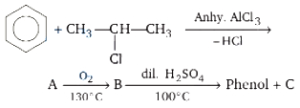
Identify $C$ in the following reaction sequence:
A
ethanol
B
propanone
C
cumene hydroperoxide
D
water
Solution
(B) The reaction sequence is the industrial preparation of phenol from cumene:
$1$. Benzene reacts with isopropyl chloride in the presence of anhydrous $AlCl_3$ to form cumene $(A)$.
$2$. Cumene $(A)$ is oxidized by $O_2$ at $130^{\circ}C$ to form cumene hydroperoxide $(B)$.
$3$. Cumene hydroperoxide $(B)$ is treated with dilute $H_2SO_4$ at $100^{\circ}C$ to yield phenol and propanone $(C)$.
Therefore,$C$ is propanone.
$1$. Benzene reacts with isopropyl chloride in the presence of anhydrous $AlCl_3$ to form cumene $(A)$.
$2$. Cumene $(A)$ is oxidized by $O_2$ at $130^{\circ}C$ to form cumene hydroperoxide $(B)$.
$3$. Cumene hydroperoxide $(B)$ is treated with dilute $H_2SO_4$ at $100^{\circ}C$ to yield phenol and propanone $(C)$.
Therefore,$C$ is propanone.
0 likes
View Solution605
MediumMCQ
An organic compound with molecular formula $C_7H_8O$ dissolves in $NaOH$ and gives a characteristic colour with $FeCl_3$. On treatment with bromine,it gives a tribromo derivative $C_7H_5OBr_3$. The compound is
A
$o$-cresol
B
$m$-cresol
C
$p$-cresol
D
benzyl alcohol
Solution
(B) The molecular formula $C_7H_8O$ corresponds to cresols or benzyl alcohol.
Since the compound dissolves in $NaOH$,it must be acidic in nature,which indicates it is a phenol (cresol).
It gives a characteristic violet color with neutral $FeCl_3$,which is a test for phenolic groups.
Treatment with bromine water leads to a tribromo derivative,indicating the presence of three reactive positions (ortho and para) relative to the $-OH$ group.
All three isomers of cresol ($o$-,$m$-,and $p$-) satisfy these conditions. However,in many textbook contexts,$m$-cresol is often cited for such reactions.
Specifically,the reaction with $Br_2$ water on $m$-cresol yields $2,4,6$-tribromo-$m$-cresol.
Since the compound dissolves in $NaOH$,it must be acidic in nature,which indicates it is a phenol (cresol).
It gives a characteristic violet color with neutral $FeCl_3$,which is a test for phenolic groups.
Treatment with bromine water leads to a tribromo derivative,indicating the presence of three reactive positions (ortho and para) relative to the $-OH$ group.
All three isomers of cresol ($o$-,$m$-,and $p$-) satisfy these conditions. However,in many textbook contexts,$m$-cresol is often cited for such reactions.
Specifically,the reaction with $Br_2$ water on $m$-cresol yields $2,4,6$-tribromo-$m$-cresol.
0 likes
View Solution606
MediumMCQ
Phenol $\stackrel{X}{\longrightarrow}$ forms a tribromo derivative. "$X$" is
A
bromine in benzene
B
bromine in water
C
potassium bromide solution
D
bromine in carbon tetrachloride at $0^{\circ} C$
Solution
(B) When phenol is treated with bromine water $(Br_2/H_2O)$,it undergoes electrophilic substitution at all available ortho and para positions due to the highly activating nature of the $-OH$ group.
This reaction results in the formation of $2,4,6$-tribromophenol as a white precipitate.
Therefore,the reagent "$X$" is bromine in water.
This reaction results in the formation of $2,4,6$-tribromophenol as a white precipitate.
Therefore,the reagent "$X$" is bromine in water.
0 likes
View Solution607
EasyMCQ
The correct sequence of reactions to convert $p$-nitrophenol into quinol involves
A
reduction,diazotization and hydrolysis
B
hydrolysis,diazotization and reduction
C
hydrolysis,reduction and diazotization
D
diazotization,reduction and hydrolysis
Solution
(A) The conversion of $p$-nitrophenol to quinol proceeds through the following steps:
$1$. Reduction: $p$-nitrophenol is reduced using $Sn/HCl$ to form $p$-aminophenol.
$2$. Diazotization: $p$-aminophenol is treated with $NaNO_2/HCl$ at $0-5 \ ^\circ C$ to form the corresponding diazonium salt.
$3$. Hydrolysis: The diazonium salt is hydrolyzed by warming with water to yield quinol ($p$-dihydroxybenzene).
$1$. Reduction: $p$-nitrophenol is reduced using $Sn/HCl$ to form $p$-aminophenol.
$2$. Diazotization: $p$-aminophenol is treated with $NaNO_2/HCl$ at $0-5 \ ^\circ C$ to form the corresponding diazonium salt.
$3$. Hydrolysis: The diazonium salt is hydrolyzed by warming with water to yield quinol ($p$-dihydroxybenzene).
0 likes
View Solution608
MediumMCQ
Which of the following orders is true regarding the acidic nature of phenol and its derivatives?
A
$Phenol > o-cresol > o-nitrophenol$
B
$o-cresol < phenol < o-nitrophenol$
C
$phenol < o-cresol > o-nitrophenol$
D
$phenol < o-cresol < o-nitrophenol$
Solution
(B) The acidity of substituted phenols is significantly affected by the nature of the substituents.
Electron-withdrawing groups $(EWG)$ such as $-NO_2$ increase the acidic strength by stabilizing the phenoxide ion through the $-I$ and $-M$ effects.
Conversely,electron-donating groups $(EDG)$ such as $-CH_3$ (methyl group in cresol) decrease the acidic strength due to the $+I$ effect and hyperconjugation,which destabilizes the phenoxide ion.
Therefore,the acidic strength follows the order: $o-cresol < phenol < o-nitrophenol$.
Electron-withdrawing groups $(EWG)$ such as $-NO_2$ increase the acidic strength by stabilizing the phenoxide ion through the $-I$ and $-M$ effects.
Conversely,electron-donating groups $(EDG)$ such as $-CH_3$ (methyl group in cresol) decrease the acidic strength due to the $+I$ effect and hyperconjugation,which destabilizes the phenoxide ion.
Therefore,the acidic strength follows the order: $o-cresol < phenol < o-nitrophenol$.
0 likes
View Solution609
MediumMCQ
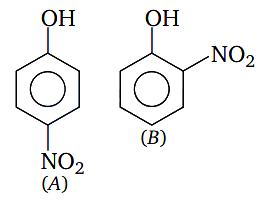
Out of the compounds below,the vapour pressure of $(B)$ at a particular temperature is:
A
higher than that of $(A)$
B
lower than that of $(A)$
C
higher or lower than $(A)$,depending on the size of the vessel
D
same as that of $(A)$
Solution
(A) In $(A)$ (para-nitrophenol),intermolecular $H$-bonding exists,which leads to association of molecules and higher boiling point.
In $(B)$ (ortho-nitrophenol),intramolecular $H$-bonding exists,which restricts association and results in a lower boiling point.
Since $(B)$ has a lower boiling point,it is more volatile than $(A)$.
Therefore,the vapour pressure of $(B)$ is higher than that of $(A)$ at a particular temperature.
In $(B)$ (ortho-nitrophenol),intramolecular $H$-bonding exists,which restricts association and results in a lower boiling point.
Since $(B)$ has a lower boiling point,it is more volatile than $(A)$.
Therefore,the vapour pressure of $(B)$ is higher than that of $(A)$ at a particular temperature.
0 likes
View Solution610
MediumMCQ
Match the following:
The correct answer is
| List-$I$ (Compound) | List-$II$ $(pK_a)$ |
|---|---|
| $A$. $p-$Nitrophenol | $I$. $7.1$ |
| $B$. Phenol | $II$. $10.0$ |
| $C$. Ethanol | $III$. $15.9$ |
| $D$. $p-$Cresol | $IV$. $10.2$ |
A
$A-I, B-II, C-III, D-IV$
B
$A-II, B-III, C-I, D-IV$
C
$A-I, B-II, C-IV, D-III$
D
$A-IV, B-III, C-I, D-II$
Solution
(A) The acidity of compounds depends on the stability of the conjugate base formed after the loss of a proton $(H^+)$.
$1$. $p-$Nitrophenol $(A)$: The nitro group $(-NO_2)$ is a strong electron-withdrawing group ($-I$ and $-M$ effect),which stabilizes the phenoxide ion significantly,making it the most acidic. Its $pK_a$ is $7.1$ $(I)$.
$2$. Phenol $(B)$: Phenol is more acidic than ethanol but less acidic than $p-$nitrophenol. Its $pK_a$ is $10.0$ $(II)$.
$3$. Ethanol $(C)$: Aliphatic alcohols are much less acidic than phenols due to the electron-donating alkyl group ($+I$ effect) which destabilizes the alkoxide ion. Its $pK_a$ is $15.9$ $(III)$.
$4$. $p-$Cresol $(D)$: The methyl group $(-CH_3)$ is an electron-donating group ($+I$ and hyperconjugation),which destabilizes the phenoxide ion compared to phenol,making it less acidic. Its $pK_a$ is $10.2$ $(IV)$.
Therefore,the correct matching is $A-I, B-II, C-III, D-IV$.
$1$. $p-$Nitrophenol $(A)$: The nitro group $(-NO_2)$ is a strong electron-withdrawing group ($-I$ and $-M$ effect),which stabilizes the phenoxide ion significantly,making it the most acidic. Its $pK_a$ is $7.1$ $(I)$.
$2$. Phenol $(B)$: Phenol is more acidic than ethanol but less acidic than $p-$nitrophenol. Its $pK_a$ is $10.0$ $(II)$.
$3$. Ethanol $(C)$: Aliphatic alcohols are much less acidic than phenols due to the electron-donating alkyl group ($+I$ effect) which destabilizes the alkoxide ion. Its $pK_a$ is $15.9$ $(III)$.
$4$. $p-$Cresol $(D)$: The methyl group $(-CH_3)$ is an electron-donating group ($+I$ and hyperconjugation),which destabilizes the phenoxide ion compared to phenol,making it less acidic. Its $pK_a$ is $10.2$ $(IV)$.
Therefore,the correct matching is $A-I, B-II, C-III, D-IV$.
0 likes
View Solution611
MediumMCQ
Consider the following reactions:
$C_6H_5N_2Cl$ $\xrightarrow{H_2O, 283 \ K} X$ $\xrightarrow{Conc. \ HNO_3} Y$
$X \xrightarrow{Br_2/H_2O} Z$
$Y$ and $Z$ respectively are:
$C_6H_5N_2Cl$ $\xrightarrow{H_2O, 283 \ K} X$ $\xrightarrow{Conc. \ HNO_3} Y$
$X \xrightarrow{Br_2/H_2O} Z$
$Y$ and $Z$ respectively are:
A
Picric acid ($2,4,6-$Trinitrophenol),$2,4,6-$Tribromophenol
B
$o-$nitrophenol,$p-$bromophenol
C
$p-$Nitrophenol,$o-$bromophenol
D
$2,4-$dinitrophenol,$2,4-$dibromophenol
Solution
(A) $1$. The reaction of benzenediazonium chloride $(C_6H_5N_2Cl)$ with water at $283 \ K$ yields phenol $(X)$.
$2$. Phenol $(X)$ reacts with concentrated $HNO_3$ to undergo electrophilic aromatic substitution,resulting in the formation of $2,4,6-$trinitrophenol,also known as picric acid $(Y)$.
$3$. Phenol $(X)$ reacts with bromine water $(Br_2/H_2O)$ to undergo rapid electrophilic substitution at all available ortho and para positions,yielding $2,4,6-$tribromophenol $(Z)$.
$2$. Phenol $(X)$ reacts with concentrated $HNO_3$ to undergo electrophilic aromatic substitution,resulting in the formation of $2,4,6-$trinitrophenol,also known as picric acid $(Y)$.
$3$. Phenol $(X)$ reacts with bromine water $(Br_2/H_2O)$ to undergo rapid electrophilic substitution at all available ortho and para positions,yielding $2,4,6-$tribromophenol $(Z)$.
0 likes
View Solution612
DifficultMCQ
An organic compound $C_6H_7N$ on reaction with $NaNO_2 / HCl$ at $273-278 \ K$ followed by warming with water gives $B$. $B$ reacts with concentrated $HNO_3$ to give $C$. What is $C$?
A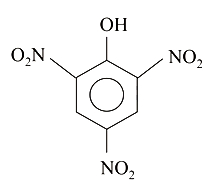
B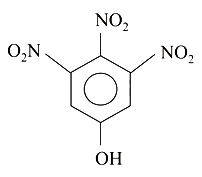
C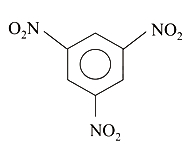
D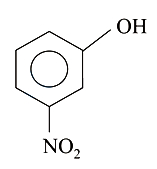
Solution
(A) $C_6H_7N$ corresponds to aniline $(A)$.
Aniline undergoes diazotisation reaction with $NaNO_2 / HCl$ at $273-278 \ K$ to form benzene diazonium chloride,which on warming with water produces phenol $(B)$.
Phenol reacts with concentrated nitric acid $(HNO_3)$ to undergo electrophilic aromatic substitution,yielding $2,4,6-$trinitrophenol $(C)$,which is commonly known as picric acid.
Aniline undergoes diazotisation reaction with $NaNO_2 / HCl$ at $273-278 \ K$ to form benzene diazonium chloride,which on warming with water produces phenol $(B)$.
Phenol reacts with concentrated nitric acid $(HNO_3)$ to undergo electrophilic aromatic substitution,yielding $2,4,6-$trinitrophenol $(C)$,which is commonly known as picric acid.
0 likes
View Solution613
DifficultMCQ
What is $Z$ in the following sequence of reactions?
$p-chloronitrobenzene$ $\xrightarrow{NaOH, 443 \ K} X$ $\xrightarrow{(i) Sn + HCl (ii) NaNO_2 / HCl, 0-5^{\circ}C} Y$ $\xrightarrow{H_3O^{+}, 10^{\circ}C} Z$
$p-chloronitrobenzene$ $\xrightarrow{NaOH, 443 \ K} X$ $\xrightarrow{(i) Sn + HCl (ii) NaNO_2 / HCl, 0-5^{\circ}C} Y$ $\xrightarrow{H_3O^{+}, 10^{\circ}C} Z$
A
p-nitrophenol
B
p-aminophenol
C
hydroquinone
D
phloroglucinol
Solution
(C) The reaction sequence is as follows:
$1$. $p-chloronitrobenzene$ reacts with $NaOH$ at $443 \ K$ to form $p-nitrophenol$ $(X)$.
$2$. $p-nitrophenol$ is reduced using $Sn + HCl$ to form $p-aminophenol$ $(Y)$.
$3$. $p-aminophenol$ reacts with $NaNO_2 / HCl$ at $0-5^{\circ}C$ to form a diazonium salt intermediate.
$4$. Hydrolysis of this diazonium salt with $H_3O^{+}$ at $10^{\circ}C$ replaces the diazonium group with an $-OH$ group,resulting in the formation of $hydroquinone$ $(Z)$.
$1$. $p-chloronitrobenzene$ reacts with $NaOH$ at $443 \ K$ to form $p-nitrophenol$ $(X)$.
$2$. $p-nitrophenol$ is reduced using $Sn + HCl$ to form $p-aminophenol$ $(Y)$.
$3$. $p-aminophenol$ reacts with $NaNO_2 / HCl$ at $0-5^{\circ}C$ to form a diazonium salt intermediate.
$4$. Hydrolysis of this diazonium salt with $H_3O^{+}$ at $10^{\circ}C$ replaces the diazonium group with an $-OH$ group,resulting in the formation of $hydroquinone$ $(Z)$.
0 likes
View Solution614
EasyMCQ
What are $A$,$B$ and $C$ in the following reactions?
$\text{Cumene}$ $\xrightarrow{O_2} A$ $\xrightarrow{H_3O^{+}} B + C$
$\text{Cumene}$ $\xrightarrow{O_2} A$ $\xrightarrow{H_3O^{+}} B + C$
A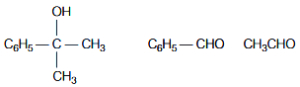
B
C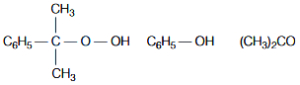
D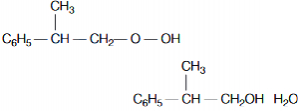
Solution
(C) The given reaction is the industrial preparation of phenol from cumene (isopropylbenzene).
$1$. Cumene reacts with oxygen $(O_2)$ to form cumene hydroperoxide $(A)$:
$C_6H_5-CH(CH_3)_2 + O_2 \rightarrow C_6H_5-C(CH_3)_2-O-OH$
$2$. Cumene hydroperoxide $(A)$ on treatment with dilute acid $(H_3O^+)$ undergoes rearrangement to produce phenol $(B)$ and acetone $(C)$:
$C_6H_5-C(CH_3)_2-O-OH \xrightarrow{H_3O^+} C_6H_5OH + (CH_3)_2CO$
Thus,$A$ is cumene hydroperoxide,$B$ is phenol,and $C$ is acetone. The correct option is $C$.
$1$. Cumene reacts with oxygen $(O_2)$ to form cumene hydroperoxide $(A)$:
$C_6H_5-CH(CH_3)_2 + O_2 \rightarrow C_6H_5-C(CH_3)_2-O-OH$
$2$. Cumene hydroperoxide $(A)$ on treatment with dilute acid $(H_3O^+)$ undergoes rearrangement to produce phenol $(B)$ and acetone $(C)$:
$C_6H_5-C(CH_3)_2-O-OH \xrightarrow{H_3O^+} C_6H_5OH + (CH_3)_2CO$
Thus,$A$ is cumene hydroperoxide,$B$ is phenol,and $C$ is acetone. The correct option is $C$.
0 likes
View Solution615
MediumMCQ
What are $X$ and $Y$ respectively in the following set of reactions?

A
$Toluene$ ; $p-acetoxy-toluene$
B
$Toluene$ ; $p-acetoxy-toluene$
C
$Phenol$ ; $phenyl-acetate$
D
$Phenol$ ; $p-hydroxy-phenyl-acetate$
Solution
(B) $1$. Reaction with $Zn$ dust and heat: $p-Cresol$ $(p-methylphenol)$ reacts with $Zn$ dust to undergo reduction,where the $-OH$ group is removed and replaced by a hydrogen atom,resulting in the formation of $Toluene$ $(X)$.
$2$. Reaction with $(CH_3CO)_2O$ followed by $H^+$: $p-Cresol$ reacts with acetic anhydride $(CH_3CO)_2O$ to undergo acetylation of the phenolic $-OH$ group,forming $p-acetoxy-toluene$ $(Y)$.
$2$. Reaction with $(CH_3CO)_2O$ followed by $H^+$: $p-Cresol$ reacts with acetic anhydride $(CH_3CO)_2O$ to undergo acetylation of the phenolic $-OH$ group,forming $p-acetoxy-toluene$ $(Y)$.
0 likes
View Solution616
MediumMCQ
What is $Y$ in the given reaction sequence?
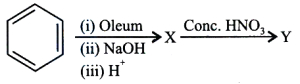
A
$2-$Nitrophenol
B
$2,6-$Dinitrophenol
C
$2,4-$Dinitrophenol
D
$2,4,6-$Trinitrophenol (Picric acid)
Solution
(D) The reaction sequence is as follows:
$1$. Benzene reacts with $Oleum$ $(H_2S_2O_7)$ to form benzene sulphonic acid.
$2$. Benzene sulphonic acid reacts with $NaOH$ followed by $H^+$ to form phenol $(X)$.
$3$. Phenol $(X)$ reacts with concentrated $HNO_3$ (nitration) to form $2,4,6-trinitrophenol$,commonly known as $Picric \ acid$ $(Y)$.
$1$. Benzene reacts with $Oleum$ $(H_2S_2O_7)$ to form benzene sulphonic acid.
$2$. Benzene sulphonic acid reacts with $NaOH$ followed by $H^+$ to form phenol $(X)$.
$3$. Phenol $(X)$ reacts with concentrated $HNO_3$ (nitration) to form $2,4,6-trinitrophenol$,commonly known as $Picric \ acid$ $(Y)$.
0 likes
View Solution617
MediumMCQ
What is the major product '$Z$' in the following reaction sequence?
Benzene $\xrightarrow{\text{Oleum}}$ $X$ $\xrightarrow[(2) H^+]{(1) NaOH}$ $Y$ $\xrightarrow[(2) H^+]{(1) CHCl_3/NaOH}$ $Z$
Benzene $\xrightarrow{\text{Oleum}}$ $X$ $\xrightarrow[(2) H^+]{(1) NaOH}$ $Y$ $\xrightarrow[(2) H^+]{(1) CHCl_3/NaOH}$ $Z$
A
$o-$Hydroxy benzaldehyde
B
$p-$Hydroxy benzaldehyde
C
$o-$Hydroxy benzoic acid
D
$p-$Hydroxy benzoic acid
Solution
(A) $1$. The reaction of benzene with oleum $(H_2S_2O_7)$ gives benzene sulfonic acid $(X)$.
$2$. The fusion of benzene sulfonic acid with $NaOH$ followed by acidification gives phenol $(Y)$.
$3$. The reaction of phenol with $CHCl_3$ and $NaOH$ is the Reimer-Tiemann reaction,which introduces a formyl group $(-CHO)$ at the ortho position to the $-OH$ group.
$4$. Thus,the major product '$Z$' is $o-$hydroxy benzaldehyde (salicylaldehyde).
$2$. The fusion of benzene sulfonic acid with $NaOH$ followed by acidification gives phenol $(Y)$.
$3$. The reaction of phenol with $CHCl_3$ and $NaOH$ is the Reimer-Tiemann reaction,which introduces a formyl group $(-CHO)$ at the ortho position to the $-OH$ group.
$4$. Thus,the major product '$Z$' is $o-$hydroxy benzaldehyde (salicylaldehyde).
0 likes
View Solution618
MediumMCQ
Which of the following is the major product,when $p$-cresol is treated with zinc dust?
A
Toluene
B
Heptane
C
Methyl cyclohexanol
D
Methyl cyclohexane
Solution
(A) When $p$-cresol ($4$-methylphenol) is heated with zinc dust,it undergoes a reduction reaction.
In this reaction,the phenolic $-OH$ group is removed and replaced by a hydrogen atom.
This process converts the phenol derivative into the corresponding hydrocarbon.
Thus,$p$-cresol reacts with zinc dust to form toluene $(C_6H_5CH_3)$ and zinc oxide $(ZnO)$.
The reaction is: $CH_3-C_6H_4-OH + Zn \rightarrow CH_3-C_6H_5 + ZnO$.
In this reaction,the phenolic $-OH$ group is removed and replaced by a hydrogen atom.
This process converts the phenol derivative into the corresponding hydrocarbon.
Thus,$p$-cresol reacts with zinc dust to form toluene $(C_6H_5CH_3)$ and zinc oxide $(ZnO)$.
The reaction is: $CH_3-C_6H_4-OH + Zn \rightarrow CH_3-C_6H_5 + ZnO$.
0 likes
View Solution619
EasyMCQ
Reaction of phenol with which of the following reagents forms picric acid?
A
Conc. $H_2SO_4$
B
dil. $H_2SO_4$
C
Conc. $HNO_3$
D
dil. $HNO_3$
Solution
(C) When phenol is treated with concentrated nitric acid $(Conc. HNO_3)$,it undergoes electrophilic aromatic substitution to form $2,4,6$-trinitrophenol,which is commonly known as picric acid.
0 likes
View Solution620
MediumMCQ
Identify the major product formed from the following reaction sequence:
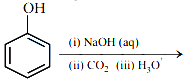
A
Benzene
B
Salicylic acid
C
$3-$Hydroxybenzoic acid
D
$4-$Hydroxybenzoic acid
Solution
(B) The reaction sequence is the $Kolbe-Schmitt$ reaction.
$1$. Phenol reacts with $NaOH$ to form sodium phenoxide.
$2$. Sodium phenoxide reacts with $CO_2$ under pressure to form an intermediate,which upon acidification $(H_3O^+)$ yields salicylic acid as the major product.
$3$. The ortho-substitution is favored due to the formation of a stable chelated intermediate involving the sodium ion and the oxygen atoms of the phenoxide and the carboxylate group.
$1$. Phenol reacts with $NaOH$ to form sodium phenoxide.
$2$. Sodium phenoxide reacts with $CO_2$ under pressure to form an intermediate,which upon acidification $(H_3O^+)$ yields salicylic acid as the major product.
$3$. The ortho-substitution is favored due to the formation of a stable chelated intermediate involving the sodium ion and the oxygen atoms of the phenoxide and the carboxylate group.
0 likes
View Solution621
MediumMCQ
When phenol is treated with bromine water,the white precipitate formed is
A
$3, 5-$dibromophenol
B
$2, 4, 6-$tribromophenol
C
$2, 4-$dibromophenol
D
$2-$bromophenol
Solution
(B) When phenol is treated with bromine water,it undergoes electrophilic aromatic substitution at all ortho and para positions due to the strong activating effect of the $-OH$ group.
This reaction results in the formation of $2, 4, 6-$tribromophenol,which appears as a white precipitate.
The chemical reaction is:
$C_6H_5OH + 3Br_2(aq) \rightarrow C_6H_2Br_3OH + 3HBr$
This reaction results in the formation of $2, 4, 6-$tribromophenol,which appears as a white precipitate.
The chemical reaction is:
$C_6H_5OH + 3Br_2(aq) \rightarrow C_6H_2Br_3OH + 3HBr$
0 likes
View Solution622
MediumMCQ
The major product of the following reaction sequence is:
$C_6H_5OH \xrightarrow[(ii) NaOH, (iii) H^+]{(i) CHCl_3, NaOH(aq)} ?$
$C_6H_5OH \xrightarrow[(ii) NaOH, (iii) H^+]{(i) CHCl_3, NaOH(aq)} ?$
A
$2-$Hydroxybenzaldehyde
B
$3-$Hydroxybenzaldehyde
C
$4-$Hydroxybenzaldehyde
D
Benzaldehyde
Solution
(A) The given reaction is the Reimer-Tiemann reaction.
Phenol reacts with chloroform $(CHCl_3)$ in the presence of aqueous sodium hydroxide $(NaOH)$ to form an intermediate,which upon hydrolysis with acid $(H^+)$ yields $2$-hydroxybenzaldehyde (salicylaldehyde) as the major product.
Phenol reacts with chloroform $(CHCl_3)$ in the presence of aqueous sodium hydroxide $(NaOH)$ to form an intermediate,which upon hydrolysis with acid $(H^+)$ yields $2$-hydroxybenzaldehyde (salicylaldehyde) as the major product.
0 likes
View Solution623
EasyMCQ
The Reimer-Tiemann reaction involves the formation of $X$ from phenol through the intermediate $Y$. What are $X$ and $Y$?
A
$X$: Salicylaldehyde,$Y$: o-dichloromethyl phenoxide ion
B
$X$: m-hydroxybenzaldehyde,$Y$: m-dichloromethyl phenoxide ion
C
$X$: m-hydroxybenzoic acid,$Y$: m-trichloromethyl phenoxide ion
D
$X$: Salicylaldehyde,$Y$: o-trichloromethyl phenoxide ion
Solution
(A) The Reimer-Tiemann reaction is a chemical reaction used for the ortho-formylation of phenols.
In this reaction,phenol reacts with chloroform $(CHCl_3)$ in the presence of an aqueous base like $KOH$ to form salicylaldehyde $(X)$.
The reaction proceeds through the formation of a dichlorocarbene $(:CCl_2)$ intermediate,which attacks the phenoxide ion to form an ortho-dichloromethyl substituted phenoxide intermediate $(Y)$.
This intermediate $Y$ then undergoes hydrolysis to yield the final product,salicylaldehyde $(X)$.
In this reaction,phenol reacts with chloroform $(CHCl_3)$ in the presence of an aqueous base like $KOH$ to form salicylaldehyde $(X)$.
The reaction proceeds through the formation of a dichlorocarbene $(:CCl_2)$ intermediate,which attacks the phenoxide ion to form an ortho-dichloromethyl substituted phenoxide intermediate $(Y)$.
This intermediate $Y$ then undergoes hydrolysis to yield the final product,salicylaldehyde $(X)$.
0 likes
View Solution624
MediumMCQ
What are $X$ and $Y$ in the following reactions?
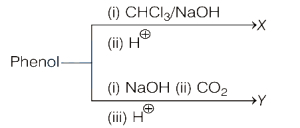
A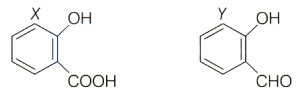
B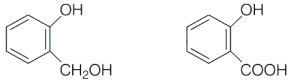
C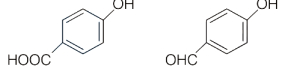
D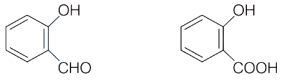
Solution
(D) The reaction of phenol with $CHCl_3$ and aqueous $NaOH$ followed by acidification is the Reimer-Tiemann reaction,which yields $2$-hydroxybenzaldehyde (salicylaldehyde) as product $X$.
The reaction of phenol with $NaOH$ followed by $CO_2$ and then acidification is the Kolbe-Schmitt reaction,which yields $2$-hydroxybenzoic acid (salicylic acid) as product $Y$.
Therefore,$X$ is $2$-hydroxybenzaldehyde and $Y$ is $2$-hydroxybenzoic acid.
The reaction of phenol with $NaOH$ followed by $CO_2$ and then acidification is the Kolbe-Schmitt reaction,which yields $2$-hydroxybenzoic acid (salicylic acid) as product $Y$.
Therefore,$X$ is $2$-hydroxybenzaldehyde and $Y$ is $2$-hydroxybenzoic acid.
0 likes
View Solution625
EasyMCQ
Phenol on oxidation in air gives
A
quinone
B
catechol
C
resorcinol
D
$o-$cresol
Solution
(A) When phenol is exposed to air,it undergoes slow oxidation to form $p$-benzoquinone (commonly referred to as quinone). The reaction is as follows:
$C_6H_5OH + [O] \rightarrow C_6H_4O_2$ (quinone)
This process is responsible for the pinkish color that phenol develops upon standing in air.
$C_6H_5OH + [O] \rightarrow C_6H_4O_2$ (quinone)
This process is responsible for the pinkish color that phenol develops upon standing in air.
0 likes
View Solution626
MediumMCQ
Identify $X$ and $Y$ in the following reaction:
$X \xrightarrow{Y} \text{Benzoquinone}$
$X \xrightarrow{Y} \text{Benzoquinone}$
A
$X$ = Cyclohexanol,$Y$ = Zn
B
$X$ = Phenol,$Y$ = $Na_2Cr_2O_7 / H_2SO_4$
C
$X$ = Cyclohex$-2-$en$-1-$ol,$Y$ = $Na_2Cr_2O_7 / H_2SO_4$
D
$X$ = Phenol,$Y$ = Zn
Solution
(B) The oxidation of phenol with chromic acid ($Na_2Cr_2O_7$ in the presence of $H_2SO_4$) yields $p$-benzoquinone.
Therefore,$X$ is phenol and $Y$ is $Na_2Cr_2O_7 / H_2SO_4$.
Therefore,$X$ is phenol and $Y$ is $Na_2Cr_2O_7 / H_2SO_4$.
0 likes
View Solution627
EasyMCQ
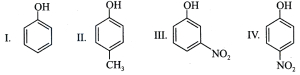
Arrange the following in the correct order of their acidic strength:
A
$III > IV > I > II$
B
$IV > III > I > II$
C
$II > I > III > IV$
D
$I > IV > III > II$
Solution
(B) The acidic strength of phenols is determined by the stability of the corresponding phenoxide ion. Electron-withdrawing groups $(EWG)$ increase acidity by stabilizing the phenoxide ion,while electron-donating groups $(EDG)$ decrease acidity by destabilizing it.
$1.$ $IV$ ($p$-nitrophenol): The $-NO_2$ group at the $p$-position exerts both a strong $-I$ effect and a strong $-M$ (mesomeric) effect,which significantly stabilizes the phenoxide ion.
$2.$ $III$ ($m$-nitrophenol): The $-NO_2$ group at the $m$-position exerts only a $-I$ effect (no $-M$ effect),providing less stabilization than at the $p$-position.
$3.$ $I$ (Phenol): This is the reference compound.
$4.$ $II$ ($p$-methylphenol): The $-CH_3$ group at the $p$-position exerts a $+I$ effect and hyperconjugation $(+H)$,which donates electron density and destabilizes the phenoxide ion,making it the least acidic.
Therefore,the correct order of acidic strength is $IV > III > I > II$.
$1.$ $IV$ ($p$-nitrophenol): The $-NO_2$ group at the $p$-position exerts both a strong $-I$ effect and a strong $-M$ (mesomeric) effect,which significantly stabilizes the phenoxide ion.
$2.$ $III$ ($m$-nitrophenol): The $-NO_2$ group at the $m$-position exerts only a $-I$ effect (no $-M$ effect),providing less stabilization than at the $p$-position.
$3.$ $I$ (Phenol): This is the reference compound.
$4.$ $II$ ($p$-methylphenol): The $-CH_3$ group at the $p$-position exerts a $+I$ effect and hyperconjugation $(+H)$,which donates electron density and destabilizes the phenoxide ion,making it the least acidic.
Therefore,the correct order of acidic strength is $IV > III > I > II$.
0 likes
View Solution628
MediumMCQ
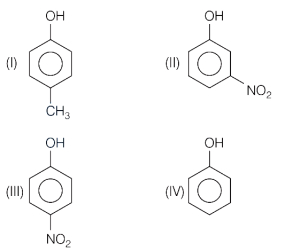
Arrange the following in increasing order of acidic character.
A
$I < IV < II < III$
B
$I < II < III < IV$
C
$IV < III < II < I$
D
$II < III < IV < I$
Solution
(A) Acidic character $\propto$ stability of conjugate base (phenoxide ion).
The stability of the phenoxide ion is increased by electron-withdrawing groups ($-M$ and $-I$ effects) and decreased by electron-donating groups ($+M$,$+H$,and $+I$ effects).
The substituents are:
$(I)$ $p$-methylphenol: $-CH_3$ group shows $+H$ and $+I$ effects,which destabilize the phenoxide ion.
$(II)$ $m$-nitrophenol: $-NO_2$ group shows only $-I$ effect ($-M$ effect does not operate at $m$-position).
$(III)$ $p$-nitrophenol: $-NO_2$ group shows both $-M$ and $-I$ effects,providing strong stabilization.
$(IV)$ Phenol: No substituent.
Comparing these,the order of stability of the conjugate base is: $p$-methylphenoxide < phenoxide < $m$-nitrophenoxide < $p$-nitrophenoxide.
Therefore,the increasing order of acidic character is: $I < IV < II < III$.
The stability of the phenoxide ion is increased by electron-withdrawing groups ($-M$ and $-I$ effects) and decreased by electron-donating groups ($+M$,$+H$,and $+I$ effects).
The substituents are:
$(I)$ $p$-methylphenol: $-CH_3$ group shows $+H$ and $+I$ effects,which destabilize the phenoxide ion.
$(II)$ $m$-nitrophenol: $-NO_2$ group shows only $-I$ effect ($-M$ effect does not operate at $m$-position).
$(III)$ $p$-nitrophenol: $-NO_2$ group shows both $-M$ and $-I$ effects,providing strong stabilization.
$(IV)$ Phenol: No substituent.
Comparing these,the order of stability of the conjugate base is: $p$-methylphenoxide < phenoxide < $m$-nitrophenoxide < $p$-nitrophenoxide.
Therefore,the increasing order of acidic character is: $I < IV < II < III$.
0 likes
View Solution629
MediumMCQ
What are $A, B, C$ and $D$ in the following reactions?
$i)$ Aniline $\xrightarrow[273 \ K]{NaNO_2 \mid HCl} A$ $\xrightarrow{B} \text{Phenol}$
$ii)$ Cumene $\xrightarrow{O_2} C$ $\xrightarrow{D} \text{Phenol} + \text{acetone}$
$i)$ Aniline $\xrightarrow[273 \ K]{NaNO_2 \mid HCl} A$ $\xrightarrow{B} \text{Phenol}$
$ii)$ Cumene $\xrightarrow{O_2} C$ $\xrightarrow{D} \text{Phenol} + \text{acetone}$
A
$A$: $C_6H_5N_2^+Cl^-$,$B$: $\text{Warm } H_2O$,$C$: $C_6H_5C(CH_3)_2OOH$,$D$: $H^+/H_2O$
B
$A$: $C_6H_5Cl$,$B$: $623 \ K/300 \ atm$,$C$: $C_6H_5C(CH_3)_2OH$,$D$: $H_2O_2$
C
$A$: $C_6H_5ONa$,$B$: $H_3O^+$,$C$: $C_6H_5CH(CH_3)CH_2OOH$,$D$: $H_2O_2$
D
$A$: $C_6H_5NHOH$,$B$: $NaOH$,$C$: $C_6H_5OCH(CH_3)_2$,$D$: $H^+/H_2O_2$
Solution
(D) In reaction $(i)$,Aniline reacts with $NaNO_2/HCl$ at $273 \ K$ to form benzene diazonium chloride $(A = C_6H_5N_2^+Cl^-)$. This compound on hydrolysis with warm water $(B = \text{Warm } H_2O)$ yields phenol.
In reaction $(ii)$,Cumene (isopropylbenzene) undergoes oxidation with $O_2$ to form cumene hydroperoxide $(C = C_6H_5C(CH_3)_2OOH)$. This hydroperoxide on treatment with dilute acid $(D = H^+/H_2O)$ undergoes rearrangement to give phenol and acetone.
Thus,the correct set is option $D$.
In reaction $(ii)$,Cumene (isopropylbenzene) undergoes oxidation with $O_2$ to form cumene hydroperoxide $(C = C_6H_5C(CH_3)_2OOH)$. This hydroperoxide on treatment with dilute acid $(D = H^+/H_2O)$ undergoes rearrangement to give phenol and acetone.
Thus,the correct set is option $D$.
0 likes
View Solution630
MediumMCQ
What are $X$ and $Y$ respectively in the following reaction sequence?
$C_6H_5N_2^+X^-$ $\xrightarrow{C_2H_5OH} X$ $\xrightarrow[\text{anhy. } AlCl_3]{CO, HCl} Y$
$C_6H_5N_2^+X^-$ $\xrightarrow{C_2H_5OH} X$ $\xrightarrow[\text{anhy. } AlCl_3]{CO, HCl} Y$
A
Benzene,Benzaldehyde
B
Benzene,Benzoic acid
C
Phenol,Salicylic acid
D
Phenol,Salicylaldehyde
Solution
(D) $1$. The reaction of benzenediazonium salt $(C_6H_5N_2^+X^-)$ with ethanol $(C_2H_5OH)$ reduces the diazonium group to benzene,but in the presence of water or ethanol,it typically forms phenol $(C_6H_5OH)$ as the major product. Given the subsequent reaction,$X$ is phenol $(C_6H_5OH)$.
$2$. The reaction of phenol $(C_6H_5OH)$ with $CO$ and $HCl$ in the presence of anhydrous $AlCl_3$ is the Gattermann-Koch formylation reaction,which introduces a formyl group $(-CHO)$ at the ortho position of the phenol ring,resulting in salicylaldehyde ($2$-hydroxybenzaldehyde).
$3$. Therefore,$X$ is phenol and $Y$ is salicylaldehyde.
$2$. The reaction of phenol $(C_6H_5OH)$ with $CO$ and $HCl$ in the presence of anhydrous $AlCl_3$ is the Gattermann-Koch formylation reaction,which introduces a formyl group $(-CHO)$ at the ortho position of the phenol ring,resulting in salicylaldehyde ($2$-hydroxybenzaldehyde).
$3$. Therefore,$X$ is phenol and $Y$ is salicylaldehyde.
0 likes
View Solution631
MediumMCQ
Which of the following conversions represents the Fries rearrangement?
A
$O$-acylated phenol to $C$-acylated phenol
B
$C$-acylated phenol to $O$-acylated phenol
C
$N$-acylated phenol to $C$-acylated phenol
D
$C$-acylated phenol to $N$-acylated phenol
Solution
(A) Key Idea: The Fries rearrangement is the rearrangement of a phenolic ester to a hydroxy aryl ketone in the presence of a Lewis acid catalyst.
In this reaction,the acyl group $(RCO-)$ migrates from the oxygen atom of the ester to the ortho or para position of the benzene ring.
Thus,it represents the conversion of an $O$-acylated phenol (phenolic ester) to a $C$-acylated phenol (hydroxy aryl ketone).
Therefore,option $(A)$ is correct.
The reaction is as follows:
$C_6H_5OCOR \xrightarrow{AlCl_3} o-HOC_6H_4COR + p-HOC_6H_4COR$
In this reaction,the acyl group $(RCO-)$ migrates from the oxygen atom of the ester to the ortho or para position of the benzene ring.
Thus,it represents the conversion of an $O$-acylated phenol (phenolic ester) to a $C$-acylated phenol (hydroxy aryl ketone).
Therefore,option $(A)$ is correct.
The reaction is as follows:
$C_6H_5OCOR \xrightarrow{AlCl_3} o-HOC_6H_4COR + p-HOC_6H_4COR$
0 likes
View Solution632
EasyMCQ
The following reaction sequence is given:
Phenol $\xrightarrow{NaOH} X$ $\xrightarrow[(ii) H^+]{(i) CO_2} Y$ $\xrightarrow{(CH_3CO)_2O/H^+} Z + CH_3COOH$
The correct statements about $Z$ from the following are:
$I$. It is $o$-hydroxybenzoic acid.
$II$. It is a non-narcotic analgesic.
$III$. It acts as antipyretic.
$IV$. It acts as antihistamine.
Phenol $\xrightarrow{NaOH} X$ $\xrightarrow[(ii) H^+]{(i) CO_2} Y$ $\xrightarrow{(CH_3CO)_2O/H^+} Z + CH_3COOH$
The correct statements about $Z$ from the following are:
$I$. It is $o$-hydroxybenzoic acid.
$II$. It is a non-narcotic analgesic.
$III$. It acts as antipyretic.
$IV$. It acts as antihistamine.
A
$II$ and $III$
B
$I$ and $IV$
C
$II$ and $IV$
D
$I$ and $II$
Solution
(A) The reaction sequence is as follows:
$1$. Phenol reacts with $NaOH$ to form sodium phenoxide $(X)$.
$2$. Sodium phenoxide reacts with $CO_2$ followed by acid hydrolysis to form salicylic acid $(Y)$,which is $o$-hydroxybenzoic acid.
$3$. Salicylic acid reacts with acetic anhydride $((CH_3CO)_2O)$ in the presence of acid to form acetylsalicylic acid $(Z)$,commonly known as Aspirin,and acetic acid $(CH_3COOH)$.
$4$. Aspirin $(Z)$ is a non-narcotic analgesic and an antipyretic.
Therefore,statements $II$ and $III$ are correct.
$1$. Phenol reacts with $NaOH$ to form sodium phenoxide $(X)$.
$2$. Sodium phenoxide reacts with $CO_2$ followed by acid hydrolysis to form salicylic acid $(Y)$,which is $o$-hydroxybenzoic acid.
$3$. Salicylic acid reacts with acetic anhydride $((CH_3CO)_2O)$ in the presence of acid to form acetylsalicylic acid $(Z)$,commonly known as Aspirin,and acetic acid $(CH_3COOH)$.
$4$. Aspirin $(Z)$ is a non-narcotic analgesic and an antipyretic.
Therefore,statements $II$ and $III$ are correct.
0 likes
View SolutionAlcohols, Phenols and Ethers — Properties of Phenols · Frequently Asked Questions
1Are these Alcohols, Phenols and Ethers questions useful for JEE and NEET?
Yes. All questions in this section are mapped to JEE Main and NEET exam patterns. Previous year questions from JEE Main, NEET, GUJCET and state-level exams are included with full solutions.
2Can I switch to Hindi or Gujarati for these questions?
Yes. Use the language tabs in the hero section or the sidebar to view the same questions and solutions in English, Hindi or Gujarati.
3How do I generate a question paper from this subtopic?
Use the Vedclass Exam Paper Generator — select the chapter and subtopic, set difficulty, and generate Sets A, B, C, D automatically. First 3 chapters of every subject are free.
Vedclass Products
For Students
Vedclass Test Series
Mock tests in real JEE/NEET style with performance analysis. 5-day free trial.
Start Free TrialFor Teachers
Exam Paper Generator
Generate Set A/B/C/D papers from this chapter in 2 minutes. 3 chapters free.
Try FreeFor Institutes
Online Exam Module
Live online exams with unlimited students, 360° analytics & white-label branding.
See DemoFor Teachers & Institutes
Generate a Alcohols, Phenols and Ethers Exam Paper in 2 Minutes
Select subtopic & difficulty — Sets A, B, C, D auto-generated with No Repeat logic.
First 3 chapters of every subject are free — no payment required.