
A English
Properties of alcohol Questions in English
Class 12 Chemistry · Alcohols, Phenols and Ethers · Properties of alcohol
889+
Questions
English
Language
100%
With Solutions
Showing 50 of 889 questions in English
451
MediumMCQ
For the following reaction,select the statement that best describes the change.
$RCH_2OH + PCC [ C_5H_5NH^{+} ClCrO_3^- ] \to$
$RCH_2OH + PCC [ C_5H_5NH^{+} ClCrO_3^- ] \to$
A
The alcohol is oxidized to an acid,and the $Cr(VI)$ is reduced
B
The alcohol is oxidized to an aldehyde,and the $Cr(VI)$ is reduced
C
The alcohol is reduced to an aldehyde,and the $Cr(III)$ is oxidized
D
The alcohol is oxidized to a ketone,and the $Cr(VI)$ is reduced
Solution
(B) $PCC$ (Pyridinium chlorochromate) is a mild oxidizing agent that selectively oxidizes primary alcohols $(RCH_2OH)$ to aldehydes $(RCHO)$.
In this process,the chromium in $PCC$,which is in the $+6$ oxidation state $(Cr(VI))$,is reduced to $Cr(III)$.
In this process,the chromium in $PCC$,which is in the $+6$ oxidation state $(Cr(VI))$,is reduced to $Cr(III)$.
0 likes
View Solution452
DifficultMCQ
Which of the following compounds are not oxidized by $HIO_4$?
$(1)$ $CH_3-CH(OH)-CH_2-OH$
$(2)$ $CH_3-C(=O)-CHO$
$(3)$ $CH_3-C(=O)-C(=O)-CH_3$
$(4)$ $CH_3-C(=O)-CH(NH_2)-CH_3$
$(5)$ Cyclohexene oxide
$(6)$ $CH_3-O-CH_2-CH_2-OH$
$(7)$ $HOOC-CH_2-OH$
$(1)$ $CH_3-CH(OH)-CH_2-OH$
$(2)$ $CH_3-C(=O)-CHO$
$(3)$ $CH_3-C(=O)-C(=O)-CH_3$
$(4)$ $CH_3-C(=O)-CH(NH_2)-CH_3$
$(5)$ Cyclohexene oxide
$(6)$ $CH_3-O-CH_2-CH_2-OH$
$(7)$ $HOOC-CH_2-OH$
A
$5, 6, 7$
B
$4, 5, 6, 7$
C
$6, 7$
D
$3, 4, 5, 6, 7$
Solution
(C) $HIO_4$ (Periodic acid) is a selective oxidizing agent that cleaves $C-C$ bonds in compounds containing vicinal functional groups such as:
$1.$ Vicinal diols: $-CH(OH)-CH(OH)-$
$2.$ $\alpha$-hydroxy carbonyls: $-CH(OH)-C(=O)-$
$3.$ $1,2$-dicarbonyls: $-C(=O)-C(=O)-$
$4.$ $\alpha$-amino alcohols: $-CH(NH_2)-CH(OH)-$
Analysis:
$(1)$ $CH_3-CH(OH)-CH_2-OH$ is a vicinal diol. (Oxidized)
$(2)$ $CH_3-C(=O)-CHO$ is an $\alpha$-keto aldehyde. (Oxidized)
$(3)$ $CH_3-C(=O)-C(=O)-CH_3$ is an $\alpha$-diketone. (Oxidized)
$(4)$ $CH_3-C(=O)-CH(NH_2)-CH_3$ is an $\alpha$-amino ketone. (Oxidized)
$(5)$ Cyclohexene oxide is an epoxide,not a vicinal diol or $\alpha$-hydroxy carbonyl. (Not oxidized)
$(6)$ $CH_3-O-CH_2-CH_2-OH$ is an ether-alcohol. (Not oxidized)
$(7)$ $HOOC-CH_2-OH$ is an $\alpha$-hydroxy acid. $HIO_4$ does not typically oxidize $\alpha$-hydroxy acids. (Not oxidized)
Thus,compounds $(5), (6),$ and $(7)$ are not oxidized. However,based on the provided options,$(c)$ is the most appropriate choice as it includes the clearly non-oxidizable species.
$1.$ Vicinal diols: $-CH(OH)-CH(OH)-$
$2.$ $\alpha$-hydroxy carbonyls: $-CH(OH)-C(=O)-$
$3.$ $1,2$-dicarbonyls: $-C(=O)-C(=O)-$
$4.$ $\alpha$-amino alcohols: $-CH(NH_2)-CH(OH)-$
Analysis:
$(1)$ $CH_3-CH(OH)-CH_2-OH$ is a vicinal diol. (Oxidized)
$(2)$ $CH_3-C(=O)-CHO$ is an $\alpha$-keto aldehyde. (Oxidized)
$(3)$ $CH_3-C(=O)-C(=O)-CH_3$ is an $\alpha$-diketone. (Oxidized)
$(4)$ $CH_3-C(=O)-CH(NH_2)-CH_3$ is an $\alpha$-amino ketone. (Oxidized)
$(5)$ Cyclohexene oxide is an epoxide,not a vicinal diol or $\alpha$-hydroxy carbonyl. (Not oxidized)
$(6)$ $CH_3-O-CH_2-CH_2-OH$ is an ether-alcohol. (Not oxidized)
$(7)$ $HOOC-CH_2-OH$ is an $\alpha$-hydroxy acid. $HIO_4$ does not typically oxidize $\alpha$-hydroxy acids. (Not oxidized)
Thus,compounds $(5), (6),$ and $(7)$ are not oxidized. However,based on the provided options,$(c)$ is the most appropriate choice as it includes the clearly non-oxidizable species.
0 likes
View Solution453
AdvancedMCQ
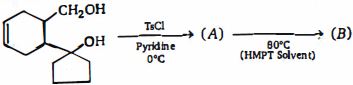
Identify the unknown $(A)$ in the reaction:
A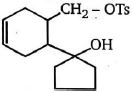
B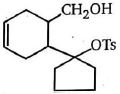
C
D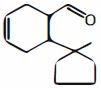
Solution
(A) The reaction involves a diol with a primary $(1^{\circ})$ alcohol group and a tertiary $(3^{\circ})$ alcohol group.
Treatment with $TsCl$ (p-toluenesulfonyl chloride) in pyridine at $0^{\circ}C$ is a selective reaction that converts the less sterically hindered primary alcohol into a tosylate $(OTs)$ group.
The tertiary alcohol is much more sterically hindered and does not react under these mild conditions.
Therefore,the primary alcohol group $-\text{CH}_2\text{OH}$ is converted to $-\text{CH}_2\text{OTs}$,while the tertiary alcohol group remains unchanged.
This corresponds to the structure where the $-\text{CH}_2\text{OTs}$ group is attached to the cyclohexane ring.
Treatment with $TsCl$ (p-toluenesulfonyl chloride) in pyridine at $0^{\circ}C$ is a selective reaction that converts the less sterically hindered primary alcohol into a tosylate $(OTs)$ group.
The tertiary alcohol is much more sterically hindered and does not react under these mild conditions.
Therefore,the primary alcohol group $-\text{CH}_2\text{OH}$ is converted to $-\text{CH}_2\text{OTs}$,while the tertiary alcohol group remains unchanged.
This corresponds to the structure where the $-\text{CH}_2\text{OTs}$ group is attached to the cyclohexane ring.
0 likes
View Solution454
MediumMCQ
In the given table,identify the incorrect option. The digit in the box indicates the moles of that substance.
| Reactant | $HIO_4$ consumed | $HCO_2H$ formed | $HCHO$ formed |
A
| $HO-CH_2-CH(OH)-CH_2-OH$ | $\boxed{2}$ | $\boxed{1}$ | $\boxed{2}$ |
B
| $R-CH(OH)-CH(OH)-CH(OH)-CH_2-OH$ | $\boxed{3}$ | $\boxed{2}$ | $\boxed{1}$ |
C
| $HO-CH_2-CH(OCH_3)-CH_2-OH$ | $\boxed{0}$ | $\boxed{0}$ | $\boxed{0}$ |
D
| $HO-CH_2-CH(OH)-CH_2-OCH_3$ | $\boxed{1}$ | $\boxed{1}$ | $\boxed{1}$ |
Solution
(D) Periodic acid $(HIO_4)$ cleaves the $C-C$ bond of vicinal diols ($1,2$-diols).
- In option $(a)$,$HO-CH_2-CH(OH)-CH_2-OH$ has two vicinal $C-C$ bonds. Cleavage consumes $2$ moles of $HIO_4$ and produces $2$ moles of $HCHO$ and $1$ mole of $HCO_2H$.
- In option $(b)$,$R-CH(OH)-CH(OH)-CH(OH)-CH_2-OH$ has three vicinal $C-C$ bonds. Cleavage consumes $3$ moles of $HIO_4$ and produces $1$ mole of $HCHO$ and $2$ moles of $HCO_2H$.
- In option $(c)$,$HO-CH_2-CH(OCH_3)-CH_2-OH$ has no vicinal diols (the middle group is an ether),so no reaction occurs.
- In option $(d)$,$HO-CH_2-CH(OH)-CH_2-OCH_3$ has only one vicinal $C-C$ bond (between $C_1$ and $C_2$). Cleavage consumes $1$ mole of $HIO_4$ and produces $1$ mole of $HCHO$ and $0$ moles of $HCO_2H$. Therefore,the table values for option $(d)$ are incorrect.
- In option $(a)$,$HO-CH_2-CH(OH)-CH_2-OH$ has two vicinal $C-C$ bonds. Cleavage consumes $2$ moles of $HIO_4$ and produces $2$ moles of $HCHO$ and $1$ mole of $HCO_2H$.
- In option $(b)$,$R-CH(OH)-CH(OH)-CH(OH)-CH_2-OH$ has three vicinal $C-C$ bonds. Cleavage consumes $3$ moles of $HIO_4$ and produces $1$ mole of $HCHO$ and $2$ moles of $HCO_2H$.
- In option $(c)$,$HO-CH_2-CH(OCH_3)-CH_2-OH$ has no vicinal diols (the middle group is an ether),so no reaction occurs.
- In option $(d)$,$HO-CH_2-CH(OH)-CH_2-OCH_3$ has only one vicinal $C-C$ bond (between $C_1$ and $C_2$). Cleavage consumes $1$ mole of $HIO_4$ and produces $1$ mole of $HCHO$ and $0$ moles of $HCO_2H$. Therefore,the table values for option $(d)$ are incorrect.
0 likes
View Solution455
MediumMCQ
Select the best method for the preparation of the following compounds:
(Image shows a mixture of trans$-2-$methylcyclohexanol enantiomers)
($MCPBA$ = meta-chloroperoxybenzoic acid)
(Image shows a mixture of trans$-2-$methylcyclohexanol enantiomers)
($MCPBA$ = meta-chloroperoxybenzoic acid)
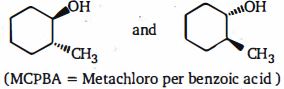
A
reaction of cyclohexanone with $CH_3Li$
B
reaction of $1-$methylcyclohexene with $Hg(OAc)_2$ followed by $NaBH_4$
C
reaction of cyclohexene with $BH_3; NaOH/H_2O_2$,followed by $CH_3Br$
D
reaction of cyclohexene with $MCPBA$,followed by $CH_3MgBr$
Solution
(D) The target compounds are a pair of enantiomers of $trans-2-methylcyclohexanol$.
Step $1$: Reaction of cyclohexene with $MCPBA$ (meta-chloroperoxybenzoic acid) yields cyclohexene oxide (epoxide).
Step $2$: The nucleophilic ring-opening of the epoxide with a Grignard reagent like $CH_3MgBr$ occurs via an $S_N2$ mechanism,leading to the trans-addition of the methyl group and the hydroxyl group.
Therefore,the reaction of cyclohexene with $MCPBA$ followed by $CH_3MgBr$ is the correct method.
Step $1$: Reaction of cyclohexene with $MCPBA$ (meta-chloroperoxybenzoic acid) yields cyclohexene oxide (epoxide).
Step $2$: The nucleophilic ring-opening of the epoxide with a Grignard reagent like $CH_3MgBr$ occurs via an $S_N2$ mechanism,leading to the trans-addition of the methyl group and the hydroxyl group.
Therefore,the reaction of cyclohexene with $MCPBA$ followed by $CH_3MgBr$ is the correct method.
0 likes
View Solution456
MediumMCQ
Product $(B)$ of the above reaction is
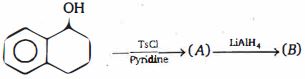
A
$1,2-$dihydronaphthalene
B
$1,4-$dihydronaphthalene
C
tetralin ($1$,$2$,$3$,$4$-tetrahydronaphthalene)
D
$1-$chlorotetralin
Solution
(C) The reaction proceeds in two steps:
$1$. The starting material is $1$-tetralol. Treatment with $TsCl$ (p-toluenesulfonyl chloride) in the presence of pyridine converts the hydroxyl group into a good leaving group,the tosylate group $(-OTs)$,forming intermediate $(A)$,which is $1$-tetralyl tosylate.
$2$. The subsequent treatment with $LiAlH_4$ (a strong reducing agent) performs a nucleophilic substitution (reduction) of the tosylate group,replacing it with a hydride ion $(H^-)$ to yield tetralin ($1,2,3,4$-tetrahydronaphthalene) as the final product $(B)$.
$1$. The starting material is $1$-tetralol. Treatment with $TsCl$ (p-toluenesulfonyl chloride) in the presence of pyridine converts the hydroxyl group into a good leaving group,the tosylate group $(-OTs)$,forming intermediate $(A)$,which is $1$-tetralyl tosylate.
$2$. The subsequent treatment with $LiAlH_4$ (a strong reducing agent) performs a nucleophilic substitution (reduction) of the tosylate group,replacing it with a hydride ion $(H^-)$ to yield tetralin ($1,2,3,4$-tetrahydronaphthalene) as the final product $(B)$.
0 likes
View Solution457
DifficultMCQ
In the given pairs of alcohols,in which pair is the second alcohol more reactive than the first towards hydrogen bromide $(HBr)$?
A
$1-$methylcyclopentanol and cyclohexanol
B
$1-$ethylcyclopentanol and $1-$cyclopentylethanol
C
$CH_3-CH(OH)-CH_2-CH_3$ and $CH_3-CH_2-CH(CH_3)-CH_2-OH$
D
$CH_3-CH(OH)-CH_2-CH_3$ and $CH_3-C(OH)(CH_3)-CH_2-CH_3$
Solution
(D) The reactivity of alcohols towards $HBr$ follows the order $3^\circ > 2^\circ > 1^\circ$ because the reaction proceeds via a carbocation intermediate ($S_N1$ mechanism).
In option $(D)$,the first alcohol is a secondary $(2^\circ)$ alcohol ($CH_3-CH(OH)-CH_2-CH_3$,butan$-2-$ol) and the second alcohol is a tertiary $(3^\circ)$ alcohol ($CH_3-C(OH)(CH_3)-CH_2-CH_3$,$2$-methylbutan$-2-$ol).
Since a $3^\circ$ carbocation is more stable than a $2^\circ$ carbocation,the second alcohol is more reactive than the first.
In option $(D)$,the first alcohol is a secondary $(2^\circ)$ alcohol ($CH_3-CH(OH)-CH_2-CH_3$,butan$-2-$ol) and the second alcohol is a tertiary $(3^\circ)$ alcohol ($CH_3-C(OH)(CH_3)-CH_2-CH_3$,$2$-methylbutan$-2-$ol).
Since a $3^\circ$ carbocation is more stable than a $2^\circ$ carbocation,the second alcohol is more reactive than the first.
0 likes
View Solution458
MediumMCQ
In which of the following reactions will hydrogen gas not be evolved?
A
$CH_3-CH_2-OH \xrightarrow{Na}$
B
$CH_3-CH_2-OH \xrightarrow{K}$
C
$CH_3-CH(CH_3)-OH \xrightarrow{Al}$
D
$CH_3-CH(CH_3)-OH \xrightarrow{CH_3MgBr}$
Solution
(D) Alcohols react with active metals like $Na$,$K$,and $Al$ to liberate hydrogen gas $(H_2)$.
For example: $2CH_3-CH_2-OH + 2Na \rightarrow 2CH_3-CH_2-ONa + H_2 \uparrow$.
However,when an alcohol reacts with a Grignard reagent $(CH_3MgBr)$,an acid-base reaction occurs where the acidic hydrogen of the alcohol is abstracted by the alkyl group of the Grignard reagent to form an alkane.
Reaction: $CH_3-CH(OH)-CH_3 + CH_3MgBr \rightarrow CH_4 \uparrow + CH_3-CH(OMgBr)-CH_3$.
Here,methane $(CH_4)$ gas is evolved instead of hydrogen gas.
For example: $2CH_3-CH_2-OH + 2Na \rightarrow 2CH_3-CH_2-ONa + H_2 \uparrow$.
However,when an alcohol reacts with a Grignard reagent $(CH_3MgBr)$,an acid-base reaction occurs where the acidic hydrogen of the alcohol is abstracted by the alkyl group of the Grignard reagent to form an alkane.
Reaction: $CH_3-CH(OH)-CH_3 + CH_3MgBr \rightarrow CH_4 \uparrow + CH_3-CH(OMgBr)-CH_3$.
Here,methane $(CH_4)$ gas is evolved instead of hydrogen gas.
0 likes
View Solution459
MediumMCQ
When a Grignard reagent reacts with $(B)$,product $(D)$ is obtained. Reactant $(A)$ of the above reaction is:
$(A)$ $\xrightarrow{PBr_3} (C)$ $\xrightarrow{Mg, \text{ether}} \text{Grignard reagent}$
$(A) \xrightarrow{Na_2Cr_2O_7, H_2SO_4} (B)$
$\text{Grignard reagent} + (B) \to (D) \xrightarrow{H_3O^\oplus} (3,4-\text{dimethylhexan-3-ol})$
$(A)$ $\xrightarrow{PBr_3} (C)$ $\xrightarrow{Mg, \text{ether}} \text{Grignard reagent}$
$(A) \xrightarrow{Na_2Cr_2O_7, H_2SO_4} (B)$
$\text{Grignard reagent} + (B) \to (D) \xrightarrow{H_3O^\oplus} (3,4-\text{dimethylhexan-3-ol})$
A
Butan$-2-$ol
B
Butan$-1-$ol
C
Pentan$-3-$ol
D
Pentan$-2-$ol
Solution
(A) The final product is $3,4-\text{dimethylhexan-3-ol}$. This is a tertiary alcohol formed by the reaction of a Grignard reagent with a ketone.
Let the Grignard reagent be $R-MgBr$ and the ketone be $R'-CO-R''$.
From the reaction sequence,$(A)$ is a secondary alcohol that is oxidized to a ketone $(B)$ and also converted to a Grignard reagent via an alkyl bromide $(C)$.
If $(A)$ is $butan-2-ol$ $(CH_3-CH(OH)-CH_2-CH_3)$:
$1$. Oxidation of $butan-2-ol$ gives $butanone$ $(CH_3-CO-CH_2-CH_3)$ as $(B)$.
$2$. Conversion of $butan-2-ol$ to $2-bromobutane$ $(CH_3-CH(Br)-CH_2-CH_3)$ and then to the Grignard reagent $sec-butylmagnesium$ bromide $(CH_3-CH(MgBr)-CH_2-CH_3)$.
$3$. Reaction of $sec-butylmagnesium$ bromide with $butanone$ followed by hydrolysis gives $3,4-dimethylhexan-3-ol$.
Thus,$(A)$ is $butan-2-ol$.
Let the Grignard reagent be $R-MgBr$ and the ketone be $R'-CO-R''$.
From the reaction sequence,$(A)$ is a secondary alcohol that is oxidized to a ketone $(B)$ and also converted to a Grignard reagent via an alkyl bromide $(C)$.
If $(A)$ is $butan-2-ol$ $(CH_3-CH(OH)-CH_2-CH_3)$:
$1$. Oxidation of $butan-2-ol$ gives $butanone$ $(CH_3-CO-CH_2-CH_3)$ as $(B)$.
$2$. Conversion of $butan-2-ol$ to $2-bromobutane$ $(CH_3-CH(Br)-CH_2-CH_3)$ and then to the Grignard reagent $sec-butylmagnesium$ bromide $(CH_3-CH(MgBr)-CH_2-CH_3)$.
$3$. Reaction of $sec-butylmagnesium$ bromide with $butanone$ followed by hydrolysis gives $3,4-dimethylhexan-3-ol$.
Thus,$(A)$ is $butan-2-ol$.
0 likes
View Solution460
MediumMCQ
What is the major product of the following reaction?
$CH_3-CH(OH)-CH_2-CH_2-OH \xrightarrow[Pyridine, \text{cold}]{CrO_3} \text{Product}$
$CH_3-CH(OH)-CH_2-CH_2-OH \xrightarrow[Pyridine, \text{cold}]{CrO_3} \text{Product}$
A
$CH_3-CH(OH)-CH_2-CHO$
B
$CH_3-C(=O)-CH_2-CHO$
C
$CH_3-C(=O)-CH_2-COOH$
D
$CH_3-CH(OH)-CH_2-COOH$
Solution
(B) $CrO_3$ in pyridine (Sarett reagent) is a mild oxidizing agent.
It oxidizes primary alcohols to aldehydes and secondary alcohols to ketones,but it does not further oxidize aldehydes to carboxylic acids.
In the given substrate $CH_3-CH(OH)-CH_2-CH_2-OH$,the primary alcohol group $(-CH_2OH)$ is oxidized to an aldehyde $(-CHO)$ and the secondary alcohol group $(-CH(OH)-)$ is oxidized to a ketone $(-C(=O)-)$.
The reaction is: $CH_3-CH(OH)-CH_2-CH_2-OH \xrightarrow{CrO_3/Py} CH_3-C(=O)-CH_2-CHO$
It oxidizes primary alcohols to aldehydes and secondary alcohols to ketones,but it does not further oxidize aldehydes to carboxylic acids.
In the given substrate $CH_3-CH(OH)-CH_2-CH_2-OH$,the primary alcohol group $(-CH_2OH)$ is oxidized to an aldehyde $(-CHO)$ and the secondary alcohol group $(-CH(OH)-)$ is oxidized to a ketone $(-C(=O)-)$.
The reaction is: $CH_3-CH(OH)-CH_2-CH_2-OH \xrightarrow{CrO_3/Py} CH_3-C(=O)-CH_2-CHO$
0 likes
View Solution461
MediumMCQ
$Ph-CH_2-CH(OH)-CH_3$ $\xrightarrow{K}$ $\xrightarrow{C_2H_5Br} (A)$. Product $(A)$ in the above reaction is:
A
$Ph-CH_2-CH(OEt)-CH_3$ (inversion)
B
$Ph-CH_2-CH(OEt)-CH_3$ (retention)
C
$Ph-CH_2-CH(OEt)-CH_3$ (racemic)
D
$Ph-CH=CH-CH_3$
Solution
(B) The reaction proceeds via the Williamson ether synthesis mechanism.
$1$. The alcohol $Ph-CH_2-CH(OH)-CH_3$ reacts with potassium $(K)$ to form an alkoxide ion,$Ph-CH_2-CH(O^-)-CH_3$.
$2$. This alkoxide ion acts as a nucleophile and attacks the ethyl bromide $(C_2H_5Br)$ via an $S_N2$ mechanism.
$3$. In an $S_N2$ reaction,the nucleophile attacks the electrophilic carbon of the alkyl halide.
$4$. Since the chiral center at the $CH$ group is not involved in the bond-breaking or bond-forming process,the configuration at the chiral center remains unchanged.
$5$. Therefore,the product is $Ph-CH_2-CH(OEt)-CH_3$ with retention of configuration at the chiral center.
$1$. The alcohol $Ph-CH_2-CH(OH)-CH_3$ reacts with potassium $(K)$ to form an alkoxide ion,$Ph-CH_2-CH(O^-)-CH_3$.
$2$. This alkoxide ion acts as a nucleophile and attacks the ethyl bromide $(C_2H_5Br)$ via an $S_N2$ mechanism.
$3$. In an $S_N2$ reaction,the nucleophile attacks the electrophilic carbon of the alkyl halide.
$4$. Since the chiral center at the $CH$ group is not involved in the bond-breaking or bond-forming process,the configuration at the chiral center remains unchanged.
$5$. Therefore,the product is $Ph-CH_2-CH(OEt)-CH_3$ with retention of configuration at the chiral center.
0 likes
View Solution462
MediumMCQ
The fastest rate of reaction will be when $R$ is:

A
$CH_3-$
B
$CH_3CH_2-$
C
$(CH_3)_2CH-$
D
$(CH_3)_3C-$
Solution
(A) The reaction shown is an esterification reaction between an alcohol $(R-OH)$ and $p$-nitrobenzoic acid.
In the mechanism of esterification,the alcohol acts as a nucleophile and attacks the carbonyl carbon of the carboxylic acid.
The rate of this reaction is primarily governed by steric hindrance.
As the bulkiness of the alkyl group $R$ increases,the steric hindrance at the reaction center increases,which decreases the rate of nucleophilic attack.
Therefore,the rate of reaction follows the order: $CH_3- > CH_3CH_2- > (CH_3)_2CH- > (CH_3)_3C-$.
Thus,the fastest rate of reaction occurs when $R$ is $CH_3-$.
In the mechanism of esterification,the alcohol acts as a nucleophile and attacks the carbonyl carbon of the carboxylic acid.
The rate of this reaction is primarily governed by steric hindrance.
As the bulkiness of the alkyl group $R$ increases,the steric hindrance at the reaction center increases,which decreases the rate of nucleophilic attack.
Therefore,the rate of reaction follows the order: $CH_3- > CH_3CH_2- > (CH_3)_2CH- > (CH_3)_3C-$.
Thus,the fastest rate of reaction occurs when $R$ is $CH_3-$.
0 likes
View Solution463
MediumMCQ
Iodoform can be obtained on warming $NaOH$ and iodine with:
A
$CH_3CH_2CH(OH)CH_3$
B
$CH_3COCH_2CH_3$
C
$CH_3COOCH_3$
D
$(CH_3)_2CHCH_2OH$
Solution
(A) The iodoform test is given by compounds containing the $CH_3CO-$ group or the $CH_3CH(OH)-$ group.
$A$. $CH_3CH_2CH(OH)CH_3$ is $2-$butanol,which contains the $CH_3CH(OH)-$ group and thus gives a positive iodoform test.
$B$. $CH_3COCH_2CH_3$ is $2-$butanone,which contains the $CH_3CO-$ group and also gives a positive iodoform test. However,in the context of alcohols,$2-$butanol is the standard answer.
$C$. $CH_3COOCH_3$ is methyl acetate,which does not give the iodoform test.
$D$. $(CH_3)_2CHCH_2OH$ is isobutyl alcohol,which does not contain the required structural unit.
Therefore,the correct option is $A$.
$A$. $CH_3CH_2CH(OH)CH_3$ is $2-$butanol,which contains the $CH_3CH(OH)-$ group and thus gives a positive iodoform test.
$B$. $CH_3COCH_2CH_3$ is $2-$butanone,which contains the $CH_3CO-$ group and also gives a positive iodoform test. However,in the context of alcohols,$2-$butanol is the standard answer.
$C$. $CH_3COOCH_3$ is methyl acetate,which does not give the iodoform test.
$D$. $(CH_3)_2CHCH_2OH$ is isobutyl alcohol,which does not contain the required structural unit.
Therefore,the correct option is $A$.
0 likes
View Solution464
MediumMCQ
$CH_3-C(OH)(CH_3)-CH_3 \xrightarrow[cool]{Na_2Cr_2O_7} (P)$; Product $(P)$ in the reaction is
A
$CH_3-C(CH_3)=CH_2$
B
$CH_3-CH(CH_3)-CH_3$
C
$(CH_3)_3C-O-C(CH_3)_3$
D
No reaction
Solution
(D) The given reactant is $2$-methylpropan-$2$-ol,which is a $3^o$ (tertiary) alcohol.
$3^o$ alcohols are resistant to oxidation under normal conditions because they lack an $\alpha$-hydrogen atom required for the formation of a carbonyl group.
Therefore,no reaction occurs with $Na_2Cr_2O_7$.
$3^o$ alcohols are resistant to oxidation under normal conditions because they lack an $\alpha$-hydrogen atom required for the formation of a carbonyl group.
Therefore,no reaction occurs with $Na_2Cr_2O_7$.
0 likes
View Solution465
MediumMCQ
$1, 2, 3$-butanetriol undergoes oxidative cleavage with $HIO_4$. During this process:
A
$1$ equivalent of $HIO_4$ is consumed and $HCO_2H$ and $CH_3-C(=O)-CO_2H$ are formed.
B
$2$ equivalents of $HIO_4$ are consumed and $HCO_2H, HCH=O$ and $CH_3-CH=O$ are formed.
C
$3$ equivalents of $HIO_4$ are consumed and $2$ eq. of $HCO_2H$ and $1$ eq. of $CH_3CO_2H$ are formed.
D
$2$ equivalents of $HIO_4$ are consumed and $2$ eq. of $HCO_2H$ and $1$ eq. of $CH_3CH=O$ are formed.
Solution
(B) $1, 2, 3$-butanetriol has the structure $CH_2(OH)-CH(OH)-CH(OH)-CH_3$.
Periodic acid $(HIO_4)$ cleaves the $C-C$ bonds between adjacent carbons that both carry hydroxyl groups.
$1.$ The bond between $C1$ and $C2$ is cleaved,and the bond between $C2$ and $C3$ is cleaved.
$2.$ This requires $2$ equivalents of $HIO_4$.
$3.$ The terminal primary alcohol group $(C1)$ is oxidized to formaldehyde $(HCH=O)$.
$4.$ The internal secondary alcohol group $(C2)$,which is between two cleavage sites,is oxidized to formic acid $(HCO_2H)$.
$5.$ The secondary alcohol group $(C3)$ is oxidized to acetaldehyde $(CH_3CH=O)$.
Therefore,$2$ equivalents of $HIO_4$ are consumed to form $HCO_2H, HCHO,$ and $CH_3CHO$.
Periodic acid $(HIO_4)$ cleaves the $C-C$ bonds between adjacent carbons that both carry hydroxyl groups.
$1.$ The bond between $C1$ and $C2$ is cleaved,and the bond between $C2$ and $C3$ is cleaved.
$2.$ This requires $2$ equivalents of $HIO_4$.
$3.$ The terminal primary alcohol group $(C1)$ is oxidized to formaldehyde $(HCH=O)$.
$4.$ The internal secondary alcohol group $(C2)$,which is between two cleavage sites,is oxidized to formic acid $(HCO_2H)$.
$5.$ The secondary alcohol group $(C3)$ is oxidized to acetaldehyde $(CH_3CH=O)$.
Therefore,$2$ equivalents of $HIO_4$ are consumed to form $HCO_2H, HCHO,$ and $CH_3CHO$.
0 likes
View Solution466
DifficultMCQ
$CHO-CH(OH)-CH_2OH \xrightarrow{2HIO_4}$ Products obtained in the above reaction are
A
$HCHO, HCO_2H$
B
$HCHO, 2HCO_2H$
C
$CO_2, 2HCO_2H$
D
$CO_2, HCHO, HCO_2H$
Solution
(B) Periodic acid $(HIO_4)$ cleaves vicinal diols and polyols.
The reaction is: $CHO-CH(OH)-CH_2OH + 2HIO_4 \rightarrow HCHO + 2HCO_2H + 2HIO_3$.
The terminal $CH_2OH$ group is oxidized to $HCHO$ (formaldehyde),and the internal $CH(OH)$ group is oxidized to $HCO_2H$ (formic acid).
The $CHO$ group is also oxidized to $HCO_2H$.
Thus,the products are $HCHO$ and $2HCO_2H$.
The reaction is: $CHO-CH(OH)-CH_2OH + 2HIO_4 \rightarrow HCHO + 2HCO_2H + 2HIO_3$.
The terminal $CH_2OH$ group is oxidized to $HCHO$ (formaldehyde),and the internal $CH(OH)$ group is oxidized to $HCO_2H$ (formic acid).
The $CHO$ group is also oxidized to $HCO_2H$.
Thus,the products are $HCHO$ and $2HCO_2H$.
0 likes
View Solution467
AdvancedMCQ
The product obtained is
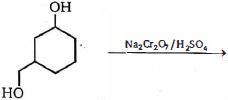
A
$3-$oxocyclohexanecarboxylic acid
B
$3-$oxocyclohexanecarbaldehyde
C
$3-$(hydroxymethyl)cyclohexanone
D
None of these
Solution
(A) The reactant is $3-(hydroxymethyl)cyclohexan-1-ol$. The reagent $Na_2Cr_2O_7 / H_2SO_4$ is a strong oxidizing agent (Jones reagent). It oxidizes primary alcohols to carboxylic acids and secondary alcohols to ketones. Therefore,the $1^\circ$ alcohol group $(-CH_2OH)$ is oxidized to a carboxylic acid $(-COOH)$ and the $2^\circ$ alcohol group $(-OH)$ is oxidized to a ketone $(=O)$. The final product is $3-oxocyclohexanecarboxylic acid$.
0 likes
View Solution468
DifficultMCQ
$PCC$ (Pyridinium chlorochromate) is a good reagent for which of the following transformations?
A
Cyclohexanone $\rightarrow$ Cyclohexanol
B
Cyclohexanol $\rightarrow$ Cyclohexanone
C
Cyclohexanol $\rightarrow$ Chlorocyclohexane
D
Cyclohexanone $\rightarrow$ Adipic acid
Solution
(B) $PCC$ (Pyridinium chlorochromate) is a mild oxidizing agent used for the oxidation of primary alcohols to aldehydes and secondary alcohols to ketones.
In this case,cyclohexanol is a secondary alcohol. When treated with $PCC$,it undergoes oxidation to form cyclohexanone.
The reaction is:
$\text{Cyclohexanol} \xrightarrow{PCC} \text{Cyclohexanone}$
Therefore,the correct transformation is represented by option $B$.
In this case,cyclohexanol is a secondary alcohol. When treated with $PCC$,it undergoes oxidation to form cyclohexanone.
The reaction is:
$\text{Cyclohexanol} \xrightarrow{PCC} \text{Cyclohexanone}$
Therefore,the correct transformation is represented by option $B$.
0 likes
View Solution469
MediumMCQ
How many primary alcohols (including stereoisomers) are possible with formula $C_5H_{12}O$?
A
$2$
B
$3$
C
$4$
D
$5$
Solution
(D) The primary alcohols ($1^\circ$ alcohols) with the molecular formula $C_5H_{12}O$ are derived from the pentyl group attached to an $-OH$ group.
$1$. $CH_3-CH_2-CH_2-CH_2-CH_2OH$ (Pentane$-1-$ol)
$2$. $CH_3-CH_2-CH(CH_3)-CH_2OH$ ($2$-Methylbutan$-1-$ol). This molecule has a chiral center, so it exists as two enantiomers ($R$ and $S$).
$3$. $CH_3-CH(CH_3)-CH_2-CH_2OH$ ($3$-Methylbutan$-1-$ol)
$4$. $(CH_3)_3C-CH_2OH$ ($2$,$2$-Dimethylpropan$-1-$ol)
Counting the stereoisomers for $2$-methylbutan$-1-$ol, we have: $(1)$ Pentane$-1-$ol, $(2)$ $(R)$$-2$-methylbutan$-1-$ol, $(3)$ $(S)$$-2$-methylbutan$-1-$ol, $(4)$ $3$-methylbutan$-1-$ol, and $(5)$ $2,2$-dimethylpropan$-1-$ol.
Thus, there are $5$ primary alcohols possible.
$1$. $CH_3-CH_2-CH_2-CH_2-CH_2OH$ (Pentane$-1-$ol)
$2$. $CH_3-CH_2-CH(CH_3)-CH_2OH$ ($2$-Methylbutan$-1-$ol). This molecule has a chiral center, so it exists as two enantiomers ($R$ and $S$).
$3$. $CH_3-CH(CH_3)-CH_2-CH_2OH$ ($3$-Methylbutan$-1-$ol)
$4$. $(CH_3)_3C-CH_2OH$ ($2$,$2$-Dimethylpropan$-1-$ol)
Counting the stereoisomers for $2$-methylbutan$-1-$ol, we have: $(1)$ Pentane$-1-$ol, $(2)$ $(R)$$-2$-methylbutan$-1-$ol, $(3)$ $(S)$$-2$-methylbutan$-1-$ol, $(4)$ $3$-methylbutan$-1-$ol, and $(5)$ $2,2$-dimethylpropan$-1-$ol.
Thus, there are $5$ primary alcohols possible.
0 likes
View Solution
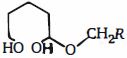

471
MediumMCQ
Optically active $2-$octanol rapidly loses its optical activity when exposed to
A
dilute acid
B
dilute base
C
light
D
humidity
Solution
(A) The optical activity of $2-$octanol is due to the presence of a chiral carbon atom at the $C-2$ position.
When treated with dilute acid,$2-$octanol undergoes an acid-catalyzed dehydration reaction.
This reaction leads to the formation of an alkene (octene),which is an achiral molecule.
Since the chiral center is destroyed during the formation of the double bond,the molecule loses its optical activity.
$CH_3-CH(OH)-(CH_2)_5-CH_3 \xrightarrow{dil. \, acid} CH_3-CH=CH-(CH_2)_4-CH_3 + H_2O$
When treated with dilute acid,$2-$octanol undergoes an acid-catalyzed dehydration reaction.
This reaction leads to the formation of an alkene (octene),which is an achiral molecule.
Since the chiral center is destroyed during the formation of the double bond,the molecule loses its optical activity.
$CH_3-CH(OH)-(CH_2)_5-CH_3 \xrightarrow{dil. \, acid} CH_3-CH=CH-(CH_2)_4-CH_3 + H_2O$
0 likes
View Solution472
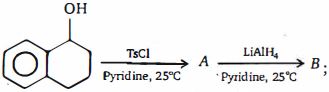
DifficultMCQ
Product $(B)$ is
A
$1,2-$dihydronaphthalene
B
$1,4-$dihydronaphthalene
C
tetralin ($1$,$2$,$3$,$4$-tetrahydronaphthalene)
D
$1-$chlorotetralin
Solution
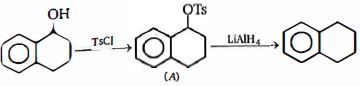
(C) The reaction proceeds in two steps:
$1$. The reaction of $1$-tetralol with $TsCl$ (p-toluenesulfonyl chloride) in the presence of pyridine converts the hydroxyl group into a good leaving group,the tosylate group $(-OTs)$,forming $1$-tetralyl tosylate as product $(A)$.
$2$. The reaction of $(A)$ with $LiAlH_4$ (a strong reducing agent) results in the nucleophilic substitution of the tosylate group by a hydride ion $(H^-)$,which reduces the $C-OTs$ bond to a $C-H$ bond,yielding tetralin ($1,2,3,4$-tetrahydronaphthalene) as product $(B)$.
$1$. The reaction of $1$-tetralol with $TsCl$ (p-toluenesulfonyl chloride) in the presence of pyridine converts the hydroxyl group into a good leaving group,the tosylate group $(-OTs)$,forming $1$-tetralyl tosylate as product $(A)$.
$2$. The reaction of $(A)$ with $LiAlH_4$ (a strong reducing agent) results in the nucleophilic substitution of the tosylate group by a hydride ion $(H^-)$,which reduces the $C-OTs$ bond to a $C-H$ bond,yielding tetralin ($1,2,3,4$-tetrahydronaphthalene) as product $(B)$.
0 likes
View Solution473
MediumMCQ
Which of the following alcohols on treatment with $HCl$ gives $3-$chloro$-3-$methylcyclohexene as a product?
A
$4-$methylcyclohex$-3-$en$-1-$ol
B
$5-$methylcyclohex$-2-$en$-1-$ol
C
$1-$methylcyclohex$-2-$en$-1-$ol
D
All of these
Solution
(D) The reaction of alcohols with $HCl$ proceeds via an $S_N1$ mechanism involving the formation of a carbocation intermediate.
$(a)$ $4-$methylcyclohex$-3-$en$-1-$ol forms a carbocation that undergoes rearrangement to form the more stable allylic carbocation,which then reacts with $Cl^-$ to give $3-$chloro$-3-$methylcyclohexene.
$(b)$ $5-$methylcyclohex$-2-$en$-1-$ol forms an allylic carbocation that can directly react with $Cl^-$ to give $3-$chloro$-3-$methylcyclohexene.
$(c)$ $1-$methylcyclohex$-2-$en$-1-$ol forms an allylic carbocation that reacts with $Cl^-$ to give $3-$chloro$-3-$methylcyclohexene.
Since all the given alcohols can produce the specified product through carbocation intermediates,the correct answer is $D$.
$(a)$ $4-$methylcyclohex$-3-$en$-1-$ol forms a carbocation that undergoes rearrangement to form the more stable allylic carbocation,which then reacts with $Cl^-$ to give $3-$chloro$-3-$methylcyclohexene.
$(b)$ $5-$methylcyclohex$-2-$en$-1-$ol forms an allylic carbocation that can directly react with $Cl^-$ to give $3-$chloro$-3-$methylcyclohexene.
$(c)$ $1-$methylcyclohex$-2-$en$-1-$ol forms an allylic carbocation that reacts with $Cl^-$ to give $3-$chloro$-3-$methylcyclohexene.
Since all the given alcohols can produce the specified product through carbocation intermediates,the correct answer is $D$.
0 likes
View Solution474
DifficultMCQ
Treatment of a $2^{\circ} \text{ alcohol}$ with $CrO_3/H_2SO_4$ yields a/an
A
aldehyde
B
carboxylic acid
C
ester
D
ketone
Solution
(D) The oxidation of a secondary alcohol $(2^{\circ} \text{ alcohol})$ using Jones reagent $(CrO_3/H_2SO_4)$ results in the formation of a ketone.
The reaction is represented as: $R-CH(OH)-R' \xrightarrow{CrO_3/H_2SO_4} R-CO-R' \text{ (ketone)}$.
The reaction is represented as: $R-CH(OH)-R' \xrightarrow{CrO_3/H_2SO_4} R-CO-R' \text{ (ketone)}$.
0 likes
View Solution475
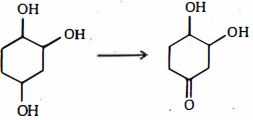
MediumMCQ
This conversion can be achieved by
A
$Me_2CO/H^{+}, H_3O^{\oplus}, KMnO_4/HO^{-}$
B
$Me_2CO/H^{+}, KMnO_4, H_3O^{+}$
C
$KMnO_4/NaIO_4, Me_2CO/H^{+}, H_3O^{+}$
D
$KMnO_4/NaIO_4, H_3O^{+}, Me_2CO/H^{+}$
Solution
(B) The starting material is a triol (cyclohexane$-1,2,4-$triol).
To selectively oxidize the secondary alcohol at the $4$-position to a ketone while protecting the $1,2$-diol,we first use acetone $(Me_2CO)$ in the presence of an acid catalyst $(H^{+})$ to form an acetonide (cyclic ketal) protecting group at the $1,2$-diol positions.
Next,the remaining secondary alcohol at the $4$-position is oxidized to a ketone using $KMnO_4$.
Finally,the acetonide protecting group is removed by acid-catalyzed hydrolysis $(H_3O^{\oplus})$ to regenerate the $1,2$-diol,yielding the final product,$4$-hydroxycyclohexanone.
To selectively oxidize the secondary alcohol at the $4$-position to a ketone while protecting the $1,2$-diol,we first use acetone $(Me_2CO)$ in the presence of an acid catalyst $(H^{+})$ to form an acetonide (cyclic ketal) protecting group at the $1,2$-diol positions.
Next,the remaining secondary alcohol at the $4$-position is oxidized to a ketone using $KMnO_4$.
Finally,the acetonide protecting group is removed by acid-catalyzed hydrolysis $(H_3O^{\oplus})$ to regenerate the $1,2$-diol,yielding the final product,$4$-hydroxycyclohexanone.

0 likes
View Solution476
MediumMCQ
An aromatic compound $A$ of the molecular formula $C_8H_{10}O$ on reaction with iodine and dilute $NaOH$ gives a yellow precipitate. The structure of the compound is expected to be
A
Acetophenone
B
$C_6H_5CH(OH)CH_3$
C
$4-$Methylbenzyl alcohol
D
$2,4-$Dimethylphenol
Solution
(B) The formation of a yellow precipitate with $I_2$ and dilute $NaOH$ is the characteristic iodoform test. This test is given by compounds containing the $CH_3CO-$ group or the $CH_3CH(OH)-$ group attached to a carbon atom or a hydrogen atom.
Given the molecular formula $C_8H_{10}O$,the compound $C_6H_5CH(OH)CH_3$ ($1$-phenylethanol) contains the $CH_3CH(OH)-$ group.
Upon reaction with $I_2$ and $NaOH$,$C_6H_5CH(OH)CH_3$ undergoes oxidation to acetophenone,which then reacts further to form iodoform $(CHI_3)$,a yellow precipitate,and sodium benzoate.
Given the molecular formula $C_8H_{10}O$,the compound $C_6H_5CH(OH)CH_3$ ($1$-phenylethanol) contains the $CH_3CH(OH)-$ group.
Upon reaction with $I_2$ and $NaOH$,$C_6H_5CH(OH)CH_3$ undergoes oxidation to acetophenone,which then reacts further to form iodoform $(CHI_3)$,a yellow precipitate,and sodium benzoate.
0 likes
View Solution477
MediumMCQ
Which of the following gives the iodoform test?
A
$CH_3-CH_2-OH$
B
$CH_3-CH_2-CHO$
C
$HO-CH_2-CH_2-OH$
D
None of these
Solution
(A) The iodoform test is given by compounds containing the $CH_3-CO-$ group or the $CH_3-CH(OH)-$ group.
$A$. Ethanol $(CH_3-CH_2-OH)$ contains the $CH_3-CH(OH)-$ group. During the reaction with $I_2$ and $NaOH$,it is first oxidized to acetaldehyde $(CH_3-CHO)$,which then undergoes the iodoform reaction to form yellow crystals of iodoform $(CHI_3)$.
$B$. Propanal $(CH_3-CH_2-CHO)$ does not contain the required structural group.
$C$. Ethane$-1,2-$diol $(HO-CH_2-CH_2-OH)$ does not contain the required structural group.
Therefore,the correct option is $A$.
$A$. Ethanol $(CH_3-CH_2-OH)$ contains the $CH_3-CH(OH)-$ group. During the reaction with $I_2$ and $NaOH$,it is first oxidized to acetaldehyde $(CH_3-CHO)$,which then undergoes the iodoform reaction to form yellow crystals of iodoform $(CHI_3)$.
$B$. Propanal $(CH_3-CH_2-CHO)$ does not contain the required structural group.
$C$. Ethane$-1,2-$diol $(HO-CH_2-CH_2-OH)$ does not contain the required structural group.
Therefore,the correct option is $A$.
0 likes
View Solution478
AdvancedMCQ
Product $(B)$ of the given reaction is

A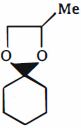
B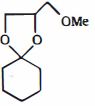
C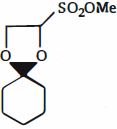
D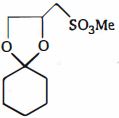
Solution
(B) $1$. The reaction of cyclohexanone with glycerol in the presence of an acid catalyst $(H^+)$ leads to the formation of a cyclic ketal $(A)$. Glycerol has three hydroxyl groups,but the reaction forms a five-membered dioxolane ring,leaving one primary hydroxyl group free.
$2$. In the second step,the free hydroxyl group of the cyclic ketal $(A)$ reacts with dimethyl sulfate $(Me_2SO_4)$ in the presence of a base. This is a Williamson ether synthesis or a methylation reaction where the hydroxyl group is converted into a methoxy group $(-OMe)$.
$3$. The final product $(B)$ is the methylated cyclic ketal,which corresponds to the structure shown in option $(B)$.
$2$. In the second step,the free hydroxyl group of the cyclic ketal $(A)$ reacts with dimethyl sulfate $(Me_2SO_4)$ in the presence of a base. This is a Williamson ether synthesis or a methylation reaction where the hydroxyl group is converted into a methoxy group $(-OMe)$.
$3$. The final product $(B)$ is the methylated cyclic ketal,which corresponds to the structure shown in option $(B)$.
0 likes
View Solution479
MediumMCQ
Which of the following is incapable of showing the iodoform test?
A
$CH_3CH_2OH$
B
$Ph-CH=CH-CH(OH)CH_3$
C
$Ph-C(OH)(CH_3)_2$
D
$CH_3CHO$
Solution
(C) The iodoform test is given by compounds containing the $CH_3CO-$ group or the $CH_3CH(OH)-$ group.
$(A)$ $CH_3CH_2OH$ contains the $CH_3CH(OH)-$ group,so it gives the iodoform test.
$(B)$ $Ph-CH=CH-CH(OH)CH_3$ contains the $CH_3CH(OH)-$ group,so it gives the iodoform test.
$(C)$ $Ph-C(OH)(CH_3)_2$ is a $3^{\circ}$ alcohol. It does not contain the $CH_3CH(OH)-$ group and cannot be oxidized to a methyl ketone. Therefore,it does not give the iodoform test.
$(D)$ $CH_3CHO$ contains the $CH_3CO-$ group,so it gives the iodoform test.
Thus,the correct option is $C$.
$(A)$ $CH_3CH_2OH$ contains the $CH_3CH(OH)-$ group,so it gives the iodoform test.
$(B)$ $Ph-CH=CH-CH(OH)CH_3$ contains the $CH_3CH(OH)-$ group,so it gives the iodoform test.
$(C)$ $Ph-C(OH)(CH_3)_2$ is a $3^{\circ}$ alcohol. It does not contain the $CH_3CH(OH)-$ group and cannot be oxidized to a methyl ketone. Therefore,it does not give the iodoform test.
$(D)$ $CH_3CHO$ contains the $CH_3CO-$ group,so it gives the iodoform test.
Thus,the correct option is $C$.
0 likes
View Solution480
MediumMCQ
$CH_3-CH(OAc)-Et$ ($d=$ dextro rotatory) $\xrightarrow{HO^{-}}$ Product of the reaction is
A
$CH_3-CH(OH)-Et$ $(d)$
B
$CH_3-CH(OH)-Et$ $(l)$
C
$CH_3-CH(OH)-Et$ $(d \& l)$
D
$CH_3-C(CH_3)=CH_2$
Solution
(A) The reaction is the alkaline hydrolysis (saponification) of an ester.
In this reaction,the $HO^{-}$ nucleophile attacks the carbonyl carbon of the acetate group.
The bond between the oxygen atom of the alcohol part and the carbonyl carbon of the ester is broken.
Since the chiral center (the carbon atom attached to the $OAc$ group) is not involved in the bond-breaking or bond-forming process,the configuration at the chiral center remains unchanged.
Therefore,the product $CH_3-CH(OH)-Et$ retains the same optical activity as the reactant,which is $d$ (dextro rotatory).
In this reaction,the $HO^{-}$ nucleophile attacks the carbonyl carbon of the acetate group.
The bond between the oxygen atom of the alcohol part and the carbonyl carbon of the ester is broken.
Since the chiral center (the carbon atom attached to the $OAc$ group) is not involved in the bond-breaking or bond-forming process,the configuration at the chiral center remains unchanged.
Therefore,the product $CH_3-CH(OH)-Et$ retains the same optical activity as the reactant,which is $d$ (dextro rotatory).
0 likes
View Solution481
MediumMCQ
The reaction shown below is an example of:
$CH_2=CH-COOCH_3 + CH_3CH_2CH_2OH \xrightarrow{\text{Conc. } HCl} CH_2=CH-COOCH_2CH_2CH_3 + CH_3OH$
$CH_2=CH-COOCH_3 + CH_3CH_2CH_2OH \xrightarrow{\text{Conc. } HCl} CH_2=CH-COOCH_2CH_2CH_3 + CH_3OH$
A
Esterification
B
Saponification
C
Hydrolysis
D
Transesterification
Solution
(D) The given reaction involves the exchange of an alkoxy group of an ester with an alcohol in the presence of an acid catalyst $(Conc. HCl)$.
This process,where one ester is converted into another ester,is known as transesterification.
Therefore,the correct option is $(D)$.
This process,where one ester is converted into another ester,is known as transesterification.
Therefore,the correct option is $(D)$.
0 likes
View Solution482
MediumMCQ
$CH_3CH_2CH(OH)CH(CH_3)_2 + CH_3COCl \xrightarrow{\text{base}} CH_3CH_2CH(OCOCH_3)CH(CH_3)_2 + HCl$
In the above reaction,if the reactant alcohol is a pure $R$-isomer,the product would:
In the above reaction,if the reactant alcohol is a pure $R$-isomer,the product would:
A
have configuration inverted at the chiral atom
B
be a racemic mixture
C
have the same configuration at the chiral atom
D
be optically inactive
Solution
(C) The reaction is an esterification reaction between an alcohol and an acid chloride in the presence of a base.
In this reaction,the $O-H$ bond of the alcohol is broken,and the $C-O$ bond remains intact.
Since the chiral center is the carbon atom attached to the oxygen atom $(C-OH)$,and the bond between this carbon and the oxygen is not broken during the reaction,the configuration at the chiral center remains unchanged.
Therefore,if the reactant alcohol is a pure $R$-isomer,the product will also have the same $R$-configuration at the chiral center.
In this reaction,the $O-H$ bond of the alcohol is broken,and the $C-O$ bond remains intact.
Since the chiral center is the carbon atom attached to the oxygen atom $(C-OH)$,and the bond between this carbon and the oxygen is not broken during the reaction,the configuration at the chiral center remains unchanged.
Therefore,if the reactant alcohol is a pure $R$-isomer,the product will also have the same $R$-configuration at the chiral center.
0 likes
View Solution483
AdvancedMCQ
The reaction of $4-(\text{aminomethyl})\text{cyclohexylmethanol}$ with acetic anhydride $(Ac_2O)$ proceeds in two steps to form $P$ and $Q$. Identify $P$ and $Q$ respectively.
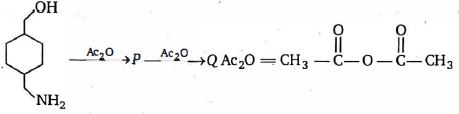
A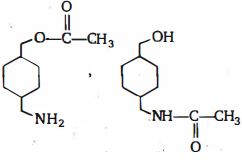
B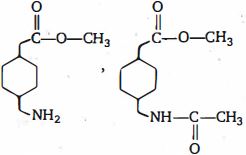
C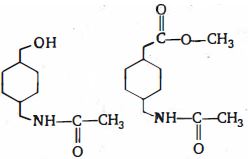
D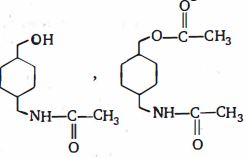
Solution
(D) The starting material is $4-(\text{aminomethyl})\text{cyclohexylmethanol}$,which contains both a primary alcohol $(-CH_2OH)$ and a primary amine $(-CH_2NH_2)$ group.
Acetic anhydride $(Ac_2O)$ is an acetylating agent that reacts with both alcohols and amines.
However,the reaction with the amine group is generally faster than the reaction with the alcohol group under controlled conditions.
In the first step,the more nucleophilic amine group reacts with $Ac_2O$ to form an amide: $R-CH_2NH_2 + Ac_2O \rightarrow R-CH_2NHCOCH_3 + CH_3COOH$.
This product is $P$,which has an amide group and an intact alcohol group.
In the second step,the remaining alcohol group reacts with another equivalent of $Ac_2O$ to form an ester: $R-CH_2OH + Ac_2O \rightarrow R-CH_2OCOCH_3 + CH_3COOH$.
This product is $Q$,which has both an amide and an ester group.
Therefore,$P$ is the amide and $Q$ is the di-acetylated product (amide + ester).
Acetic anhydride $(Ac_2O)$ is an acetylating agent that reacts with both alcohols and amines.
However,the reaction with the amine group is generally faster than the reaction with the alcohol group under controlled conditions.
In the first step,the more nucleophilic amine group reacts with $Ac_2O$ to form an amide: $R-CH_2NH_2 + Ac_2O \rightarrow R-CH_2NHCOCH_3 + CH_3COOH$.
This product is $P$,which has an amide group and an intact alcohol group.
In the second step,the remaining alcohol group reacts with another equivalent of $Ac_2O$ to form an ester: $R-CH_2OH + Ac_2O \rightarrow R-CH_2OCOCH_3 + CH_3COOH$.
This product is $Q$,which has both an amide and an ester group.
Therefore,$P$ is the amide and $Q$ is the di-acetylated product (amide + ester).
0 likes
View Solution484
DifficultMCQ
Product $(C)$ is

A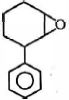
B
C
D
Solution
(B) The reaction sequence is as follows:
$1$. Benzene reacts with cyclohexene in the presence of $H_2SO_4$ (acid-catalyzed alkylation) to form cyclohexylbenzene.
$2$. Treatment with $NBS$ ($N$-bromosuccinimide) followed by $alc. KOH$ introduces a double bond,forming $1$-phenylcyclohex-$1$-ene (compound $(B)$).
$3$. Epoxidation of $1$-phenylcyclohex-$1$-ene using a peroxyacid $(RCO_3H)$ yields $1$-phenyl-$-oxabicyclo[4.1.0]heptane$ (compound $(C)$).
The correct structure for $(C)$ is the epoxide of $1$-phenylcyclohex-$1$-ene.
$1$. Benzene reacts with cyclohexene in the presence of $H_2SO_4$ (acid-catalyzed alkylation) to form cyclohexylbenzene.
$2$. Treatment with $NBS$ ($N$-bromosuccinimide) followed by $alc. KOH$ introduces a double bond,forming $1$-phenylcyclohex-$1$-ene (compound $(B)$).
$3$. Epoxidation of $1$-phenylcyclohex-$1$-ene using a peroxyacid $(RCO_3H)$ yields $1$-phenyl-$-oxabicyclo[4.1.0]heptane$ (compound $(C)$).
The correct structure for $(C)$ is the epoxide of $1$-phenylcyclohex-$1$-ene.
0 likes
View Solution485
DifficultMCQ
Which sequence of steps describes the best synthesis of $2-$phenylpropene?
A
Benzene $+$ $2-$chloropropene,$AlCl_3$
B
$1.$ Benzaldehyde $(C_6H_5CHO) + CH_3CH_2MgBr$,diethyl ether; $2.$ $H_3O^{+}$; $3.$ $H_2SO_4$,heat
C
$1.$ Bromobenzene $+ Mg$,diethyl ether; $2.$ Propanal $(CH_3CH_2CHO)$; $3.$ $H_3O^{+}$; $4.$ $H_2SO_4$,heat
D
$1.$ Bromobenzene $+ Mg$,diethyl ether; $2.$ Acetone $[(CH_3)_2C=O]$; $3.$ $H_3O^{+}$; $4.$ $H_2SO_4$,heat
Solution
(D) The synthesis of $2-$phenylpropene involves the following steps:
$1.$ Formation of Grignard reagent: Bromobenzene reacts with $Mg$ in diethyl ether to form phenylmagnesium bromide $(PhMgBr)$.
$2.$ Nucleophilic addition: $PhMgBr$ reacts with acetone $[(CH_3)_2C=O]$ to form an alkoxide intermediate.
$3.$ Acidic workup: Addition of $H_3O^{+}$ yields $2-$phenylpropan$-2-$ol.
$4.$ Dehydration: Heating $2-$phenylpropan$-2-$ol with $H_2SO_4$ causes dehydration to form $2-$phenylpropene.
$1.$ Formation of Grignard reagent: Bromobenzene reacts with $Mg$ in diethyl ether to form phenylmagnesium bromide $(PhMgBr)$.
$2.$ Nucleophilic addition: $PhMgBr$ reacts with acetone $[(CH_3)_2C=O]$ to form an alkoxide intermediate.
$3.$ Acidic workup: Addition of $H_3O^{+}$ yields $2-$phenylpropan$-2-$ol.
$4.$ Dehydration: Heating $2-$phenylpropan$-2-$ol with $H_2SO_4$ causes dehydration to form $2-$phenylpropene.
0 likes
View Solution486
MediumMCQ
The product $(B)$ of the reaction sequence is:
$Cl-C_6H_4-CH_2Br$ $\xrightarrow{Mg, Et_2O} A$ $\xrightarrow[2. H_3O^+]{1. CH_3CHO} B$
$Cl-C_6H_4-CH_2Br$ $\xrightarrow{Mg, Et_2O} A$ $\xrightarrow[2. H_3O^+]{1. CH_3CHO} B$
A
$Cl-C_6H_4-CH_2CH(OH)CH_3$
B
$Cl-C_6H_4-CH_2CH_2CH_2OH$
C
$Cl-C_6H_4-CH(OH)CH_2CH_3$
D
$Cl-C_6H_4-CH_2CH_2OH$
Solution
(A) Step $1$: The reaction of $4-chlorobenzyl bromide$ with $Mg$ in $dry$ $ether$ $(Et_2O)$ forms the Grignard reagent,$4-chlorobenzylmagnesium$ $bromide$ $(A)$,which is $Cl-C_6H_4-CH_2MgBr$.
Step $2$: The Grignard reagent $(A)$ reacts with acetaldehyde $(CH_3CHO)$ followed by acid hydrolysis $(H_3O^+)$ to form a secondary alcohol.
The nucleophilic $CH_2-C_6H_4-Cl$ group attacks the carbonyl carbon of $CH_3CHO$ to form $Cl-C_6H_4-CH_2-CH(O^-)-CH_3$,which upon protonation gives $Cl-C_6H_4-CH_2-CH(OH)-CH_3$ as product $(B)$.
Step $2$: The Grignard reagent $(A)$ reacts with acetaldehyde $(CH_3CHO)$ followed by acid hydrolysis $(H_3O^+)$ to form a secondary alcohol.
The nucleophilic $CH_2-C_6H_4-Cl$ group attacks the carbonyl carbon of $CH_3CHO$ to form $Cl-C_6H_4-CH_2-CH(O^-)-CH_3$,which upon protonation gives $Cl-C_6H_4-CH_2-CH(OH)-CH_3$ as product $(B)$.
0 likes
View Solution487
AdvancedMCQ
In the following reaction sequence,the compound $I$ is:
$I (C_3H_6Cl_2)$ $\xrightarrow{KOH_{(aq)}} II$ $\xrightarrow{(i) CH_3MgBr, (ii) H_2O/H^{+}} III$ $\xrightarrow{Anhy. ZnCl_2 + Conc. HCl}$ gives turbidity immediately.
$I (C_3H_6Cl_2)$ $\xrightarrow{KOH_{(aq)}} II$ $\xrightarrow{(i) CH_3MgBr, (ii) H_2O/H^{+}} III$ $\xrightarrow{Anhy. ZnCl_2 + Conc. HCl}$ gives turbidity immediately.
A
$Cl-CH_2-CH(Cl)-CH_3$
B
$Cl-CH_2-CH_2-CH_2-Cl$
C
$CH_3-CH_2-CHCl_2$
D
$CH_3-C(Cl)_2-CH_3$
Solution
(D) $III$ gives immediate turbidity with Lucas reagent $(Anhy. ZnCl_2 + Conc. HCl)$,which indicates that $III$ is a tertiary $(3^\circ)$ alcohol.
$A$ $3^\circ$ alcohol is formed when a ketone reacts with a Grignard reagent $(CH_3MgBr)$. Therefore,$II$ must be a ketone.
Since $II$ is formed from $I (C_3H_6Cl_2)$ by reaction with aqueous $KOH$,$I$ must be a geminal dihalide. Thus,$I$ is $2,2$-dichloropropane $(CH_3-C(Cl)_2-CH_3)$.
The reaction sequence is:
$CH_3-C(Cl)_2-CH_3 (I)$ $\xrightarrow{KOH_{(aq)}} [CH_3-C(OH)_2-CH_3]$ $\xrightarrow{-H_2O} CH_3-CO-CH_3 (II)$
$CH_3-CO-CH_3 (II) \xrightarrow{(i) CH_3MgBr, (ii) H_2O/H^{+}} (CH_3)_3C-OH (III)$
$(CH_3)_3C-OH (III) \xrightarrow{Lucas\,Reagent} \text{Immediate turbidity}$.
$A$ $3^\circ$ alcohol is formed when a ketone reacts with a Grignard reagent $(CH_3MgBr)$. Therefore,$II$ must be a ketone.
Since $II$ is formed from $I (C_3H_6Cl_2)$ by reaction with aqueous $KOH$,$I$ must be a geminal dihalide. Thus,$I$ is $2,2$-dichloropropane $(CH_3-C(Cl)_2-CH_3)$.
The reaction sequence is:
$CH_3-C(Cl)_2-CH_3 (I)$ $\xrightarrow{KOH_{(aq)}} [CH_3-C(OH)_2-CH_3]$ $\xrightarrow{-H_2O} CH_3-CO-CH_3 (II)$
$CH_3-CO-CH_3 (II) \xrightarrow{(i) CH_3MgBr, (ii) H_2O/H^{+}} (CH_3)_3C-OH (III)$
$(CH_3)_3C-OH (III) \xrightarrow{Lucas\,Reagent} \text{Immediate turbidity}$.
0 likes
View Solution488
DifficultMCQ
Rate of dehydration of alcohols follows the order
A
$2^o > 1^o > CH_3OH > 3^o$
B
$3^o > 2^o > 1^o > CH_3OH$
C
$2^o > 3^o > 1^o > CH_3OH$
D
$CH_3OH > 1^o > 2^o > 3^o$
Solution
(B) The dehydration of alcohols proceeds via the formation of a carbocation intermediate.
Since the stability of carbocations follows the order $3^o > 2^o > 1^o > CH_3^+$,the rate of dehydration of alcohols follows the same order: $3^o > 2^o > 1^o > CH_3OH$.
Since the stability of carbocations follows the order $3^o > 2^o > 1^o > CH_3^+$,the rate of dehydration of alcohols follows the same order: $3^o > 2^o > 1^o > CH_3OH$.
0 likes
View Solution489
DifficultMCQ
Amongst the following alcohols,which would react fastest with conc. $HCl$ and $ZnCl_2$?
A
pentan-$1$-ol
B
$2$-methylbutan-$1$-ol
C
pentan-$2$-ol
D
$2$-methylbutan-$2$-ol
Solution
(D) The mixture of conc. $HCl$ and anhydrous $ZnCl_2$ is known as Lucas reagent.
This reaction proceeds via the formation of a carbocation intermediate.
The reactivity order of alcohols towards Lucas reagent is $3^o > 2^o > 1^o$.
$2$-methylbutan-$2$-ol is a tertiary $(3^o)$ alcohol,while the others are primary or secondary alcohols.
Therefore,$2$-methylbutan-$2$-ol reacts fastest with Lucas reagent,producing immediate turbidity.
This reaction proceeds via the formation of a carbocation intermediate.
The reactivity order of alcohols towards Lucas reagent is $3^o > 2^o > 1^o$.
$2$-methylbutan-$2$-ol is a tertiary $(3^o)$ alcohol,while the others are primary or secondary alcohols.
Therefore,$2$-methylbutan-$2$-ol reacts fastest with Lucas reagent,producing immediate turbidity.
0 likes
View Solution490
DifficultMCQ
The major product in the following reaction is:
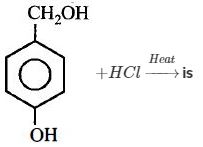
A
$4-$chloromethylphenol
B
$3-$chloro$-4-$hydroxybenzyl alcohol
C
$4-$chlorophenol
D
$4-$chloromethylchlorobenzene
Solution
(A) The reaction involves $p$-hydroxybenzyl alcohol reacting with $HCl$ under heating conditions.
In this molecule,there are two hydroxyl groups: one is a phenolic $-OH$ group and the other is an alcoholic $-CH_2OH$ group.
Phenolic $-OH$ groups are generally less reactive towards nucleophilic substitution with $HCl$ because the $C-O$ bond has partial double bond character due to resonance.
However,the alcoholic $-CH_2OH$ group is a primary benzylic alcohol. Benzylic alcohols are highly reactive towards substitution reactions because the resulting carbocation intermediate is stabilized by resonance with the benzene ring.
Therefore,the $-CH_2OH$ group undergoes substitution with $HCl$ to form $-CH_2Cl$,while the phenolic $-OH$ group remains unaffected.
The major product is $4$-chloromethylphenol.
In this molecule,there are two hydroxyl groups: one is a phenolic $-OH$ group and the other is an alcoholic $-CH_2OH$ group.
Phenolic $-OH$ groups are generally less reactive towards nucleophilic substitution with $HCl$ because the $C-O$ bond has partial double bond character due to resonance.
However,the alcoholic $-CH_2OH$ group is a primary benzylic alcohol. Benzylic alcohols are highly reactive towards substitution reactions because the resulting carbocation intermediate is stabilized by resonance with the benzene ring.
Therefore,the $-CH_2OH$ group undergoes substitution with $HCl$ to form $-CH_2Cl$,while the phenolic $-OH$ group remains unaffected.
The major product is $4$-chloromethylphenol.
0 likes
View Solution491
MediumMCQ
The reagent used to convert allyl alcohol to acrolein is:
A
$MnO_2$
B
$H_2O_2$
C
$OsO_4$
D
$KMnO_4$
Solution
(A) $MnO_2$ is a selective oxidizing agent that specifically oxidizes allylic and benzylic alcohols to their corresponding aldehydes or ketones without affecting the double bond.
Allyl alcohol $(CH_2=CH-CH_2OH)$ is oxidized to acrolein $(CH_2=CH-CHO)$ using $MnO_2$.
Allyl alcohol $(CH_2=CH-CH_2OH)$ is oxidized to acrolein $(CH_2=CH-CHO)$ using $MnO_2$.
0 likes
View Solution492
MediumMCQ
What is the decreasing order of dehydration of the following compounds in the presence of conc. $H_2SO_4$?
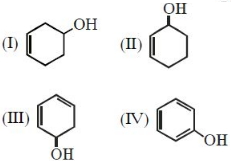
A
$IV > III > II > I$
B
$III > II > I > IV$
C
$I > II > III > IV$
D
$III > IV > II > I$
Solution
(B) The dehydration of alcohols in the presence of conc. $H_2SO_4$ proceeds via the formation of a carbocation intermediate. The rate of dehydration depends on the stability of the carbocation formed.
$(I)$ Cyclohex$-2-$en$-1-$ol forms an allylic carbocation.
$(II)$ Cyclohex$-3-$en$-1-$ol forms an allylic carbocation.
$(III)$ Cyclohexa$-2,5-$dien$-1-$ol forms a highly stable resonance-stabilized allylic carbocation.
$(IV)$ Phenol does not undergo dehydration easily because the $C-OH$ bond has partial double bond character due to resonance,and the resulting phenyl cation is highly unstable.
Comparing the stability of the carbocations: The carbocation from $(III)$ is the most stable due to extended conjugation. Between $(I)$ and $(II)$,$(I)$ is more stable as the double bond is closer to the carbocation center,allowing better resonance. $(IV)$ is the least reactive.
Thus,the order is $III > I > II > IV$. However,based on standard competitive chemistry problems of this type,the correct order is $III > II > I > IV$.
$(I)$ Cyclohex$-2-$en$-1-$ol forms an allylic carbocation.
$(II)$ Cyclohex$-3-$en$-1-$ol forms an allylic carbocation.
$(III)$ Cyclohexa$-2,5-$dien$-1-$ol forms a highly stable resonance-stabilized allylic carbocation.
$(IV)$ Phenol does not undergo dehydration easily because the $C-OH$ bond has partial double bond character due to resonance,and the resulting phenyl cation is highly unstable.
Comparing the stability of the carbocations: The carbocation from $(III)$ is the most stable due to extended conjugation. Between $(I)$ and $(II)$,$(I)$ is more stable as the double bond is closer to the carbocation center,allowing better resonance. $(IV)$ is the least reactive.
Thus,the order is $III > I > II > IV$. However,based on standard competitive chemistry problems of this type,the correct order is $III > II > I > IV$.
0 likes
View Solution493
DifficultMCQ
$(a)$ Secondary alcohol $\xrightarrow[\Delta]{H_3PO_4}$
$(b)$ Tertiary alcohol $\xrightarrow[\Delta]{H_3PO_4}$
For the above dehydration reaction,the rate of reaction will be:
$(b)$ Tertiary alcohol $\xrightarrow[\Delta]{H_3PO_4}$
For the above dehydration reaction,the rate of reaction will be:
A
$a > b$
B
$a < b$
C
$a = b$
D
None of these
Solution
(B) The dehydration of alcohols in the presence of acid $(H_3PO_4)$ follows the $E_1$ mechanism.
The rate-determining step in the $E_1$ mechanism is the formation of a carbocation intermediate.
The rate of reaction is directly proportional to the stability of the carbocation formed.
Secondary alcohols form secondary carbocations,while tertiary alcohols form tertiary carbocations.
Since tertiary carbocations are more stable than secondary carbocations,the rate of dehydration for tertiary alcohols is higher than that for secondary alcohols.
Therefore,the rate of reaction for $(b)$ is greater than $(a)$,which means $a < b$.
The rate-determining step in the $E_1$ mechanism is the formation of a carbocation intermediate.
The rate of reaction is directly proportional to the stability of the carbocation formed.
Secondary alcohols form secondary carbocations,while tertiary alcohols form tertiary carbocations.
Since tertiary carbocations are more stable than secondary carbocations,the rate of dehydration for tertiary alcohols is higher than that for secondary alcohols.
Therefore,the rate of reaction for $(b)$ is greater than $(a)$,which means $a < b$.
0 likes
View Solution494
MediumMCQ
Arrange the following in order of their reactivity when reacting with $HCl/ZnCl_2$ (Lucas reagent):
$I. CH_3-C(CH_3)_2-OH$
$II. CH_3-CH(CH_3)-OH$
$III. CH_3-CH_2-OH$
$IV. Ph-C(CH_3)_2-OH$
$I. CH_3-C(CH_3)_2-OH$
$II. CH_3-CH(CH_3)-OH$
$III. CH_3-CH_2-OH$
$IV. Ph-C(CH_3)_2-OH$
A
$IV > I > II > III$
B
$I > II > III > IV$
C
$IV > III > II > I$
D
$III > II > I > IV$
Solution
(A) The reaction of alcohols with Lucas reagent $(HCl/ZnCl_2)$ proceeds via the $S_N1$ mechanism.
The rate of reaction is determined by the stability of the carbocation intermediate formed.
The stability order of the carbocations is:
$IV$: $Ph-C^+(CH_3)_2$ (Tertiary benzylic carbocation,highly stabilized by resonance and inductive effect) > $I$: $(CH_3)_3C^+$ (Tertiary alkyl carbocation) > $II$: $CH_3-CH^+-CH_3$ (Secondary alkyl carbocation) > $III$: $CH_3-CH_2^+$ (Primary alkyl carbocation).
Therefore,the reactivity order is $IV > I > II > III$.
The rate of reaction is determined by the stability of the carbocation intermediate formed.
The stability order of the carbocations is:
$IV$: $Ph-C^+(CH_3)_2$ (Tertiary benzylic carbocation,highly stabilized by resonance and inductive effect) > $I$: $(CH_3)_3C^+$ (Tertiary alkyl carbocation) > $II$: $CH_3-CH^+-CH_3$ (Secondary alkyl carbocation) > $III$: $CH_3-CH_2^+$ (Primary alkyl carbocation).
Therefore,the reactivity order is $IV > I > II > III$.
0 likes
View Solution495
DifficultMCQ
In which of the following $S_N1$ reactions will a racemic mixture form as the major product?
A
$CH_3-CH(CH_3)-CH_2-OH \xrightarrow{HI} \text{Product}$
B
$CH_3-C(CH_3)_2-CH_2-Br \xrightarrow[\text{Polar solvent}]{NaOH_{(aq)}} \text{Product}$
C
$Ph-C(CH_3)_2-CH_2-OH \xrightarrow{HCl/ZnCl_2} \text{Product}$
D
$Ph-CH(Ph)-CH_2-Cl \xrightarrow{CH_3OH} \text{Product}$
Solution
(C) The correct answer is $(C)$.
In option $(C)$,the reaction proceeds via an $S_N1$ mechanism.
The alcohol $Ph-C(CH_3)_2-CH_2-OH$ reacts with Lucas reagent $(HCl/ZnCl_2)$ to form a primary carbocation $Ph-C(CH_3)_2-CH_2^+$.
This carbocation undergoes a $1,2$-methyl shift to form a more stable tertiary benzylic carbocation $Ph-C^+(CH_3)-CH_2-CH_3$.
Since this carbocation is planar,the nucleophile $Cl^-$ can attack from either side with equal probability,resulting in the formation of a racemic mixture of $2$-chloro-$2$-phenylbutane as the major product.
In option $(C)$,the reaction proceeds via an $S_N1$ mechanism.
The alcohol $Ph-C(CH_3)_2-CH_2-OH$ reacts with Lucas reagent $(HCl/ZnCl_2)$ to form a primary carbocation $Ph-C(CH_3)_2-CH_2^+$.
This carbocation undergoes a $1,2$-methyl shift to form a more stable tertiary benzylic carbocation $Ph-C^+(CH_3)-CH_2-CH_3$.
Since this carbocation is planar,the nucleophile $Cl^-$ can attack from either side with equal probability,resulting in the formation of a racemic mixture of $2$-chloro-$2$-phenylbutane as the major product.
0 likes
View Solution496
MediumMCQ
Which of the following gives immediate turbidity on reaction with Lucas reagent $(HCl/ZnCl_2)$?
A
sec-Butyl alcohol
B
Phenol
C
$CH_2=CH-OH$
D
$2-$Methyl$-2-$butanol
Solution
(D) The reaction of alcohols with Lucas reagent $(conc. HCl + \text{anhydrous } ZnCl_2)$ is used to distinguish between $1^\circ, 2^\circ,$ and $3^\circ$ alcohols.
The reaction follows an $S_N1$ mechanism,and the rate depends on the stability of the carbocation formed.
Tertiary $(3^\circ)$ alcohols form stable $3^\circ$ carbocations and thus react immediately to form insoluble alkyl chlorides,which appear as turbidity.
Among the given options,$2$-methyl$-2-$butanol is a $3^\circ$ alcohol,so it gives immediate turbidity.
The reaction follows an $S_N1$ mechanism,and the rate depends on the stability of the carbocation formed.
Tertiary $(3^\circ)$ alcohols form stable $3^\circ$ carbocations and thus react immediately to form insoluble alkyl chlorides,which appear as turbidity.
Among the given options,$2$-methyl$-2-$butanol is a $3^\circ$ alcohol,so it gives immediate turbidity.
0 likes
View Solution497
MediumMCQ
$ROH + HX \to RX + H_2O$
In the above reaction,the reactivity order of hydrogen halides is
In the above reaction,the reactivity order of hydrogen halides is
A
$HI > HBr > HCl > HF$
B
$HBr > HCl > HI > HF$
C
$HCl > HBr > HI > HF$
D
$HF > HBr > HCl > HI$
Solution
(A) The reaction of alcohols with hydrogen halides $(HX)$ involves the cleavage of the $C-O$ bond.
The reactivity of $HX$ depends on the strength of the $H-X$ bond.
As the size of the halogen atom increases from $F$ to $I$,the bond dissociation energy of the $H-X$ bond decreases.
Therefore,the bond strength order is $HF > HCl > HBr > HI$.
Consequently,the reactivity order for the cleavage of the $H-X$ bond is $HI > HBr > HCl > HF$.
The reactivity of $HX$ depends on the strength of the $H-X$ bond.
As the size of the halogen atom increases from $F$ to $I$,the bond dissociation energy of the $H-X$ bond decreases.
Therefore,the bond strength order is $HF > HCl > HBr > HI$.
Consequently,the reactivity order for the cleavage of the $H-X$ bond is $HI > HBr > HCl > HF$.
0 likes
View Solution498
MediumMCQ
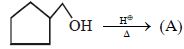
The major product is:
A
Methylenecyclopentane
B
Cyclohexene
C
Ethylidenecyclopentane
D
$1-$Methylcyclopent$-1-$ene
Solution
(B) The reaction involves the acid-catalyzed dehydration of cyclopentylmethanol.
$1$. Protonation of the hydroxyl group occurs to form a good leaving group $(-OH_2^+)$.
$2$. Loss of water generates a primary carbocation.
$3$. This primary carbocation undergoes a ring expansion rearrangement to form a more stable six-membered cyclohexyl carbocation.
$4$. Finally,deprotonation occurs to form the most stable alkene,which is cyclohexene.
$1$. Protonation of the hydroxyl group occurs to form a good leaving group $(-OH_2^+)$.
$2$. Loss of water generates a primary carbocation.
$3$. This primary carbocation undergoes a ring expansion rearrangement to form a more stable six-membered cyclohexyl carbocation.
$4$. Finally,deprotonation occurs to form the most stable alkene,which is cyclohexene.
0 likes
View Solution499
AdvancedMCQ
$HC \equiv CH$ $\xrightarrow[HgSO_4]{H_2SO_4} \,\,$ $\xrightarrow[HOH]{CH_3MgBr} \,\,$ $\xrightarrow{P/Br_2} (X)$; $(X)$ is
A
$CH_3CH(Br)CH_3$
B
$CH_3CH_2CH_2Br$
C
$H_2C=CHBr$
D
$BrCH=CHCH_3$
Solution
(A) Step $1$: Hydration of acetylene $(HC \equiv CH)$ in the presence of $HgSO_4/H_2SO_4$ gives acetaldehyde $(CH_3CHO)$.
Step $2$: Reaction of acetaldehyde with Grignard reagent $(CH_3MgBr)$ followed by hydrolysis $(HOH)$ yields isopropyl alcohol $(CH_3CH(OH)CH_3)$.
Step $3$: Reaction of isopropyl alcohol with $P/Br_2$ (or $PBr_3$) results in the substitution of the hydroxyl group with bromine to form isopropyl bromide $(CH_3CH(Br)CH_3)$.
Step $2$: Reaction of acetaldehyde with Grignard reagent $(CH_3MgBr)$ followed by hydrolysis $(HOH)$ yields isopropyl alcohol $(CH_3CH(OH)CH_3)$.
Step $3$: Reaction of isopropyl alcohol with $P/Br_2$ (or $PBr_3$) results in the substitution of the hydroxyl group with bromine to form isopropyl bromide $(CH_3CH(Br)CH_3)$.
0 likes
View Solution500
DifficultMCQ
The starting material is $butan-2-ol$. The reaction with $H^+/\Delta$ yields $(x)$ possible products,and the subsequent reaction of these products with $Br_2/CCl_4$ yields $(y)$ possible products. Determine the values of $x$ and $y$.
A
$2, 4$
B
$3, 5$
C
$3, 6$
D
$3, 4$
Solution
(B) The dehydration of $butan-2-ol$ $(CH_3CH_2CH(OH)CH_3)$ in the presence of $H^+/\Delta$ proceeds via an $E1$ mechanism involving a carbocation intermediate.
$1$. The carbocation formed is $CH_3CH_2CH^+CH_3$.
$2$. Elimination of a proton from the adjacent carbons leads to the formation of three possible alkene products:
- $but-1-ene$ $(CH_3CH_2CH=CH_2)$
- $cis-but-2-ene$ $(CH_3CH=CHCH_3)$
- $trans-but-2-ene$ $(CH_3CH=CHCH_3)$
Thus,the number of products $(x) = 3$.
$3$. When these three alkenes react with $Br_2/CCl_4$ (electrophilic addition),they form vicinal dibromides:
- $but-1-ene$ gives $1,2-dibromobutane$ (one chiral product,a racemic mixture of $R$ and $S$ enantiomers).
- $cis-but-2-ene$ gives $meso-2,3-dibromobutane$ (one product).
- $trans-but-2-ene$ gives a racemic mixture of $(2R, 3R)$ and $(2S, 3S)-2,3-dibromobutane$ (two enantiomers).
$4$. Counting the distinct stereoisomeric products: $1,2-dibromobutane$ ($2$ enantiomers),$meso-2,3-dibromobutane$ ($1$ isomer),and $(2R, 3R)/(2S, 3S)-2,3-dibromobutane$ ($2$ enantiomers). Total products $(y) = 2 + 1 + 2 = 5$.
Therefore,$x = 3$ and $y = 5$.
$1$. The carbocation formed is $CH_3CH_2CH^+CH_3$.
$2$. Elimination of a proton from the adjacent carbons leads to the formation of three possible alkene products:
- $but-1-ene$ $(CH_3CH_2CH=CH_2)$
- $cis-but-2-ene$ $(CH_3CH=CHCH_3)$
- $trans-but-2-ene$ $(CH_3CH=CHCH_3)$
Thus,the number of products $(x) = 3$.
$3$. When these three alkenes react with $Br_2/CCl_4$ (electrophilic addition),they form vicinal dibromides:
- $but-1-ene$ gives $1,2-dibromobutane$ (one chiral product,a racemic mixture of $R$ and $S$ enantiomers).
- $cis-but-2-ene$ gives $meso-2,3-dibromobutane$ (one product).
- $trans-but-2-ene$ gives a racemic mixture of $(2R, 3R)$ and $(2S, 3S)-2,3-dibromobutane$ (two enantiomers).
$4$. Counting the distinct stereoisomeric products: $1,2-dibromobutane$ ($2$ enantiomers),$meso-2,3-dibromobutane$ ($1$ isomer),and $(2R, 3R)/(2S, 3S)-2,3-dibromobutane$ ($2$ enantiomers). Total products $(y) = 2 + 1 + 2 = 5$.
Therefore,$x = 3$ and $y = 5$.
0 likes
View SolutionAlcohols, Phenols and Ethers — Properties of alcohol · Frequently Asked Questions
1Are these Alcohols, Phenols and Ethers questions useful for JEE and NEET?
Yes. All questions in this section are mapped to JEE Main and NEET exam patterns. Previous year questions from JEE Main, NEET, GUJCET and state-level exams are included with full solutions.
2Can I switch to Hindi or Gujarati for these questions?
Yes. Use the language tabs in the hero section or the sidebar to view the same questions and solutions in English, Hindi or Gujarati.
3How do I generate a question paper from this subtopic?
Use the Vedclass Exam Paper Generator — select the chapter and subtopic, set difficulty, and generate Sets A, B, C, D automatically. First 3 chapters of every subject are free.
Vedclass Products
For Students
Vedclass Test Series
Mock tests in real JEE/NEET style with performance analysis. 5-day free trial.
Start Free TrialFor Teachers
Exam Paper Generator
Generate Set A/B/C/D papers from this chapter in 2 minutes. 3 chapters free.
Try FreeFor Institutes
Online Exam Module
Live online exams with unlimited students, 360° analytics & white-label branding.
See DemoFor Teachers & Institutes
Generate a Alcohols, Phenols and Ethers Exam Paper in 2 Minutes
Select subtopic & difficulty — Sets A, B, C, D auto-generated with No Repeat logic.
First 3 chapters of every subject are free — no payment required.