
A English
Properties of alcohol Questions in English
Class 12 Chemistry · Alcohols, Phenols and Ethers · Properties of alcohol
889+
Questions
English
Language
100%
With Solutions
Showing 50 of 889 questions in English
401
MediumMCQ
$A$ solution of optically active $1$-phenylethanol racemizes in acidified aqueous medium. It is due to
A
enolization
B
carbonium ion formation
C
carbanion formation
D
reversible oxidation-reduction
Solution
(B) In an acidified aqueous medium,the hydroxyl group of $1$-phenylethanol gets protonated to form an oxonium ion.
This oxonium ion loses a water molecule to form a stable benzylic carbocation (carbonium ion).
The planar carbocation can be attacked by water from either side with equal probability,leading to the formation of a racemic mixture.
Therefore,the racemization is due to the formation of a carbonium ion.
This oxonium ion loses a water molecule to form a stable benzylic carbocation (carbonium ion).
The planar carbocation can be attacked by water from either side with equal probability,leading to the formation of a racemic mixture.
Therefore,the racemization is due to the formation of a carbonium ion.
0 likes
View Solution402
MediumMCQ
The isomeric alcohol which has a chiral carbon atom is
A
$n$-butyl alcohol
B
$iso$-butyl alcohol
C
$sec$-butyl alcohol
D
$tert$-butyl alcohol
Solution
(C) chiral carbon atom is a carbon atom bonded to four different groups.
$(a)$ $n$-butyl alcohol $(CH_3CH_2CH_2CH_2OH)$: No chiral carbon.
$(b)$ $iso$-butyl alcohol $((CH_3)_2CHCH_2OH)$: No chiral carbon.
$(c)$ $sec$-butyl alcohol $(CH_3CH_2CH(OH)CH_3)$: The carbon atom attached to the $-OH$ group is bonded to $-H$,$-OH$,$-CH_3$,and $-CH_2CH_3$ groups. Since all four groups are different,it is a chiral carbon.
$(d)$ $tert$-butyl alcohol $((CH_3)_3COH)$: No chiral carbon.
Therefore,$sec$-butyl alcohol is the correct answer.
$(a)$ $n$-butyl alcohol $(CH_3CH_2CH_2CH_2OH)$: No chiral carbon.
$(b)$ $iso$-butyl alcohol $((CH_3)_2CHCH_2OH)$: No chiral carbon.
$(c)$ $sec$-butyl alcohol $(CH_3CH_2CH(OH)CH_3)$: The carbon atom attached to the $-OH$ group is bonded to $-H$,$-OH$,$-CH_3$,and $-CH_2CH_3$ groups. Since all four groups are different,it is a chiral carbon.
$(d)$ $tert$-butyl alcohol $((CH_3)_3COH)$: No chiral carbon.
Therefore,$sec$-butyl alcohol is the correct answer.
0 likes
View Solution403
MediumMCQ
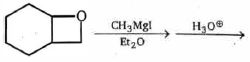
What is the major product of the following reaction?
A
$2-$methylcyclohexylmethanol
B
$2-$ethylcyclohexanol
C
$1-$methoxy$-2-$methylcyclohexane
D
$2-$methylcyclohexanol
Solution
(B) The reaction involves the ring-opening of an epoxide (or a strained cyclic ether) by a Grignard reagent $(CH_3MgI)$.
In the reaction of a Grignard reagent with an unsymmetrical epoxide,the nucleophilic alkyl group $(CH_3^-)$ attacks the less sterically hindered carbon atom of the epoxide ring.
Following the attack,the ring opens,and subsequent acidic workup $(H_3O^+)$ protonates the resulting alkoxide to form an alcohol.
In this specific case,the $CH_3$ group attacks the less hindered carbon,resulting in the formation of $2$-ethylcyclohexanol.
In the reaction of a Grignard reagent with an unsymmetrical epoxide,the nucleophilic alkyl group $(CH_3^-)$ attacks the less sterically hindered carbon atom of the epoxide ring.
Following the attack,the ring opens,and subsequent acidic workup $(H_3O^+)$ protonates the resulting alkoxide to form an alcohol.
In this specific case,the $CH_3$ group attacks the less hindered carbon,resulting in the formation of $2$-ethylcyclohexanol.
0 likes
View Solution404
AdvancedMCQ
In which of the following reactions is a $2^o$ alcohol obtained as a product?
A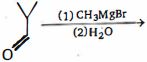
B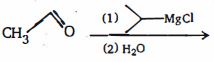
C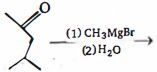
D
Both $(a)$ and $(b)$.
Solution
(D) The reaction of Grignard reagents $(RMgX)$ with aldehydes and ketones follows these rules:
$1$. Formaldehyde $(HCHO)$ + $RMgX$ $\rightarrow$ $1^o$ alcohol.
$2$. Other aldehydes $(R'CHO)$ + $RMgX$ $\rightarrow$ $2^o$ alcohol.
$3$. Ketones $(R'COR'')$ + $RMgX$ $\rightarrow$ $3^o$ alcohol.
In option $(a)$,isobutyraldehyde is an aldehyde,so it forms a $2^o$ alcohol.
In option $(b)$,acetaldehyde is an aldehyde,so it forms a $2^o$ alcohol.
In option $(c)$,methyl isopropyl ketone is a ketone,so it forms a $3^o$ alcohol.
Therefore,both $(a)$ and $(b)$ yield a $2^o$ alcohol.
$1$. Formaldehyde $(HCHO)$ + $RMgX$ $\rightarrow$ $1^o$ alcohol.
$2$. Other aldehydes $(R'CHO)$ + $RMgX$ $\rightarrow$ $2^o$ alcohol.
$3$. Ketones $(R'COR'')$ + $RMgX$ $\rightarrow$ $3^o$ alcohol.
In option $(a)$,isobutyraldehyde is an aldehyde,so it forms a $2^o$ alcohol.
In option $(b)$,acetaldehyde is an aldehyde,so it forms a $2^o$ alcohol.
In option $(c)$,methyl isopropyl ketone is a ketone,so it forms a $3^o$ alcohol.
Therefore,both $(a)$ and $(b)$ yield a $2^o$ alcohol.
0 likes
View Solution405
DifficultMCQ
What product would you expect to obtain from a Grignard reaction when an excess of phenylmagnesium bromide reacts with dimethyl carbonate $CH_3OCOOCH_3$?
A
$CH_3-C(OH)(Ph)-Ph$
B
$CH_3-CH(OH)-Ph$
C
$Ph_3C-OH$
D
$CH_3-C(=O)-Ph$
Solution
(C) Dimethyl carbonate $(CH_3OCOOCH_3)$ reacts with an excess of phenylmagnesium bromide $(PhMgBr)$ to produce triphenylmethanol $(Ph_3COH)$. The reaction occurs in three steps:
$1.$ Nucleophilic acyl substitution of the first methoxy group to form methyl benzoate: $CH_3OCOOCH_3 + PhMgBr \rightarrow PhCOOCH_3 + CH_3OMgBr$
$2.$ Nucleophilic acyl substitution of the second methoxy group to form benzophenone: $PhCOOCH_3 + PhMgBr \rightarrow PhCOPh + CH_3OMgBr$
$3.$ Nucleophilic addition to the ketone followed by hydrolysis to form triphenylmethanol: $PhCOPh + PhMgBr$ $\rightarrow Ph_3COMgBr$ $\xrightarrow{H_3O^{+}} Ph_3COH$.
$1.$ Nucleophilic acyl substitution of the first methoxy group to form methyl benzoate: $CH_3OCOOCH_3 + PhMgBr \rightarrow PhCOOCH_3 + CH_3OMgBr$
$2.$ Nucleophilic acyl substitution of the second methoxy group to form benzophenone: $PhCOOCH_3 + PhMgBr \rightarrow PhCOPh + CH_3OMgBr$
$3.$ Nucleophilic addition to the ketone followed by hydrolysis to form triphenylmethanol: $PhCOPh + PhMgBr$ $\rightarrow Ph_3COMgBr$ $\xrightarrow{H_3O^{+}} Ph_3COH$.
0 likes
View Solution406
MediumMCQ
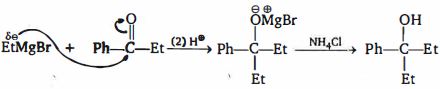
Which of the following combinations cannot be used to prepare the alcohol $Ph-C(OH)(CH_3)-CH_2-CH_3$?
A
$PhMgBr + CH_3-C(=O)-CH_2-CH_3 \xrightarrow{NH_4Cl}$
B
$EtMgBr + Ph-C(=O)-CH_3 \xrightarrow{NH_4Cl}$
C
$CH_3MgBr + Ph-C(=O)-Et \xrightarrow{NH_4Cl}$
D
$EtMgBr + Ph-C(=O)-CH_2-CH_3 \xrightarrow{NH_4Cl}$
Solution
(D) The target alcohol is $2$-phenylbutan-$2$-ol,which has the structure $Ph-C(OH)(CH_3)-CH_2-CH_3$.
Grignard reagents react with ketones to form tertiary alcohols.
In option $(D)$,the reaction is:
$EtMgBr + Ph-C(=O)-CH_2-CH_3 \xrightarrow{NH_4Cl} Ph-C(OH)(CH_2-CH_3)_2$
This combination produces $3$-phenylpentan-$3$-ol,which is not the required alcohol.
Options $(A)$,$(B)$,and $(C)$ correctly produce $2$-phenylbutan-$2$-ol.
Grignard reagents react with ketones to form tertiary alcohols.
In option $(D)$,the reaction is:
$EtMgBr + Ph-C(=O)-CH_2-CH_3 \xrightarrow{NH_4Cl} Ph-C(OH)(CH_2-CH_3)_2$
This combination produces $3$-phenylpentan-$3$-ol,which is not the required alcohol.
Options $(A)$,$(B)$,and $(C)$ correctly produce $2$-phenylbutan-$2$-ol.
0 likes
View Solution407
DifficultMCQ
Point out the incorrect synthesis.
A
Cyclohexylmagnesium bromide + Acetone $\xrightarrow[(2) H^+]{(1) CH_3COCH_3}$ $1-$cyclohexylpropan$-2-$ol
B
$3-$bromopiperidine $\xrightarrow{Mg}$ $3-$magnesiumbromopiperidine $\xrightarrow{PhCHO, H^+}$ $1-$(phenylhydroxymethyl)piperidine
C
$PhMgBr + \text{Ethylene oxide} \xrightarrow[(2) H^+]{(1) \text{Ethylene oxide}} Ph-CH_2-CH_2-OH$
D
$PhMgBr \xrightarrow[(2) H^+]{(1) HCHO} Ph-CH_2-OH$
Solution
(A) In option $A$,the reaction of cyclohexylmagnesium bromide with acetone $(CH_3COCH_3)$ followed by acid hydrolysis $(H^+)$ yields $2-$cyclohexylpropan$-2-$ol,not $1-$cyclohexylpropan$-2-$ol. The Grignard reagent attacks the carbonyl carbon of acetone to form a tertiary alcohol. Therefore,the synthesis shown in option $A$ is incorrect.
0 likes
View Solution408
DifficultMCQ
Which of the following alcohols cannot be prepared by the reaction of an acid chloride with an excess of a Grignard reagent followed by acidification?
A
$Ph_2C(OH)CH_3$
B
$PhC(OH)(CH_3)_2$
C
$Et_2C(OH)CH_3$
D
$PhC(OH)(CH_3)Et$
Solution
(D) The reaction of an acid chloride $(RCOCl)$ with an excess of a Grignard reagent $(R'MgX)$ proceeds via a ketone intermediate to form a tertiary alcohol of the type $RC(OH)(R')_2$.
This means that the resulting tertiary alcohol must have at least two identical alkyl or aryl groups attached to the carbon bearing the hydroxyl group.
Let us analyze the options:
$(A)$ $Ph_2C(OH)CH_3$: Has two identical $Ph$ groups. Can be prepared from $CH_3COCl + 2PhMgBr$.
$(B)$ $PhC(OH)(CH_3)_2$: Has two identical $CH_3$ groups. Can be prepared from $PhCOCl + 2CH_3MgBr$.
$(C)$ $Et_2C(OH)CH_3$: Has two identical $Et$ groups. Can be prepared from $CH_3COCl + 2EtMgBr$.
$(D)$ $PhC(OH)(CH_3)Et$: Has three different groups $(Ph, CH_3, Et)$. This cannot be prepared by the reaction of an acid chloride with an excess of a single Grignard reagent,as that would require two different Grignard reagents to be added sequentially,which is not possible in a single step with excess reagent.
Therefore,the correct option is $(D)$.
This means that the resulting tertiary alcohol must have at least two identical alkyl or aryl groups attached to the carbon bearing the hydroxyl group.
Let us analyze the options:
$(A)$ $Ph_2C(OH)CH_3$: Has two identical $Ph$ groups. Can be prepared from $CH_3COCl + 2PhMgBr$.
$(B)$ $PhC(OH)(CH_3)_2$: Has two identical $CH_3$ groups. Can be prepared from $PhCOCl + 2CH_3MgBr$.
$(C)$ $Et_2C(OH)CH_3$: Has two identical $Et$ groups. Can be prepared from $CH_3COCl + 2EtMgBr$.
$(D)$ $PhC(OH)(CH_3)Et$: Has three different groups $(Ph, CH_3, Et)$. This cannot be prepared by the reaction of an acid chloride with an excess of a single Grignard reagent,as that would require two different Grignard reagents to be added sequentially,which is not possible in a single step with excess reagent.
Therefore,the correct option is $(D)$.
0 likes
View Solution409
MediumMCQ
Identify the product of the following reaction: $\gamma$-butyrolactone + $BrMg-(CH_2)_4-MgBr$ $\xrightarrow[(ii) H_3O^{+}]{(i) THF}$
A
Cyclopentanol derivative with a $-(CH_2)_3-OH$ group
B
$1,5-$pentanediol
C
$1,4-$butanediol
D
Cyclohexanol
Solution
(A) The reaction involves $\gamma$-butyrolactone reacting with a di-Grignard reagent,$BrMg-(CH_2)_4-MgBr$.
$1$. The nucleophilic carbon of the Grignard reagent attacks the carbonyl carbon of the $\gamma$-butyrolactone,leading to the ring opening of the lactone.
$2$. The intermediate formed is a di-alkoxide species.
$3$. Upon acid hydrolysis $(H_3O^{+})$,the alkoxide groups are protonated to form hydroxyl groups.
$4$. The final product is a cyclic structure with a side chain,specifically $1-$($4$-hydroxybutyl)cyclopentan$-1-$ol (or a similar diol derivative depending on the exact cyclization). Based on the provided reaction scheme,the product is a diol where the ring has opened and the Grignard chain has attached.
$1$. The nucleophilic carbon of the Grignard reagent attacks the carbonyl carbon of the $\gamma$-butyrolactone,leading to the ring opening of the lactone.
$2$. The intermediate formed is a di-alkoxide species.
$3$. Upon acid hydrolysis $(H_3O^{+})$,the alkoxide groups are protonated to form hydroxyl groups.
$4$. The final product is a cyclic structure with a side chain,specifically $1-$($4$-hydroxybutyl)cyclopentan$-1-$ol (or a similar diol derivative depending on the exact cyclization). Based on the provided reaction scheme,the product is a diol where the ring has opened and the Grignard chain has attached.
0 likes
View Solution410
MediumMCQ
Which of the following compounds will form a hydrocarbon on reaction with a Grignard reagent?
A
$CH_3CH_2OH$
B
$CH_3CHO$
C
$CH_3COCH_3$
D
$CH_3CO_2CH_3$
Solution
(A) Grignard reagents $(R-MgX)$ are strong bases and nucleophiles. They react rapidly with compounds containing active hydrogen atoms (such as those attached to $O$,$N$,or $S$) to form hydrocarbons $(R-H)$ via an acid-base reaction.
In the given options,$CH_3CH_2OH$ (ethanol) contains an acidic hydroxyl hydrogen atom.
The reaction is: $CH_3CH_2OH + R-MgBr \rightarrow R-H + CH_3CH_2O-MgBr$.
Other options like $CH_3CHO$,$CH_3COCH_3$,and $CH_3CO_2CH_3$ undergo nucleophilic addition or substitution reactions with Grignard reagents,not simple acid-base hydrocarbon formation.
In the given options,$CH_3CH_2OH$ (ethanol) contains an acidic hydroxyl hydrogen atom.
The reaction is: $CH_3CH_2OH + R-MgBr \rightarrow R-H + CH_3CH_2O-MgBr$.
Other options like $CH_3CHO$,$CH_3COCH_3$,and $CH_3CO_2CH_3$ undergo nucleophilic addition or substitution reactions with Grignard reagents,not simple acid-base hydrocarbon formation.
0 likes
View Solution411
AdvancedMCQ
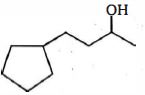
Which combination of alkyl bromide and epoxide can be used to prepare the following product by addition of the Grignard reagent derived from the alkyl bromide to the epoxide?
A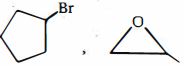
B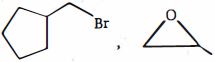
C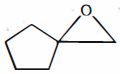
D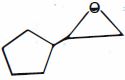
Solution
(B) The target product is $1-\text{cyclopentylbutan}-2-\text{ol}$. To synthesize this,we need to add a nucleophile to an epoxide. The Grignard reagent derived from cyclopentylmethyl bromide is $\text{cyclopentylmethylmagnesium bromide}$ $(\text{cyclopentyl-CH}_2\text{MgBr})$. When this reacts with propylene oxide (methyloxirane),the nucleophilic $\text{CH}_2$ group attacks the less sterically hindered carbon of the epoxide ring. This results in the formation of the desired alcohol. The reaction is: $\text{Cyclopentyl-CH}_2\text{MgBr} + \text{propylene oxide}$ $\rightarrow \text{Cyclopentyl-CH}_2\text{CH}_2\text{CH(OH)CH}_3$. This corresponds to option $(b)$.
0 likes
View Solution412
DifficultMCQ
$4$-chloro-butan-$1$-ol $+ NaOH \to (B)$. The product $(B)$ of the above reaction is:
A
Tetrahydropyran
B
Tetrahydrofuran
C
$3$-methyloxetane
D
$2$-ethyloxirane
Solution
(B) The reaction of $4$-chloro-butan-$1$-ol with $NaOH$ proceeds via an intramolecular nucleophilic substitution reaction.
$NaOH$ deprotonates the hydroxyl group to form an alkoxide ion: $Cl-(CH_2)_4-OH + NaOH \to Cl-(CH_2)_4-O^-Na^+ + H_2O$.
This alkoxide ion then acts as an internal nucleophile,attacking the carbon atom bonded to the chlorine atom (intramolecular $S_N2$ reaction).
This leads to the formation of a five-membered cyclic ether,which is tetrahydrofuran.
$NaOH$ deprotonates the hydroxyl group to form an alkoxide ion: $Cl-(CH_2)_4-OH + NaOH \to Cl-(CH_2)_4-O^-Na^+ + H_2O$.
This alkoxide ion then acts as an internal nucleophile,attacking the carbon atom bonded to the chlorine atom (intramolecular $S_N2$ reaction).
This leads to the formation of a five-membered cyclic ether,which is tetrahydrofuran.
0 likes
View Solution413
MediumMCQ
The reaction shown in the image proceeds by the $.......$ mechanism.
$CH_3CH_2CH(OH)CH_3 + SOCl_2 \rightarrow CH_3CH_2CH(Cl)CH_3 + SO_2 + HCl$
$CH_3CH_2CH(OH)CH_3 + SOCl_2 \rightarrow CH_3CH_2CH(Cl)CH_3 + SO_2 + HCl$
A
$S_{N^1}$
B
$S_{N^2}$
C
$S_{E^2}$
D
$S_{E^1}$
Solution
(B) The reaction of an alcohol with thionyl chloride $(SOCl_2)$ is a well-known method for the preparation of alkyl chlorides.
This reaction proceeds via the $S_{Ni}$ (Substitution Nucleophilic internal) mechanism.
In this mechanism,the configuration of the chiral center is retained because the nucleophile $(Cl^-)$ attacks from the same side as the leaving group departs,often involving an internal delivery of the chloride ion.
However,among the given options,the $S_{N^i}$ mechanism is a specific type of nucleophilic substitution that is often categorized under the broader umbrella of $S_N$ mechanisms.
Given the options provided and the stereochemical outcome (retention of configuration),the reaction is a nucleophilic substitution. In the absence of $S_{Ni}$ as an explicit option,it is often associated with $S_N$ pathways. Specifically,for primary and secondary alcohols,it is a nucleophilic substitution reaction.
This reaction proceeds via the $S_{Ni}$ (Substitution Nucleophilic internal) mechanism.
In this mechanism,the configuration of the chiral center is retained because the nucleophile $(Cl^-)$ attacks from the same side as the leaving group departs,often involving an internal delivery of the chloride ion.
However,among the given options,the $S_{N^i}$ mechanism is a specific type of nucleophilic substitution that is often categorized under the broader umbrella of $S_N$ mechanisms.
Given the options provided and the stereochemical outcome (retention of configuration),the reaction is a nucleophilic substitution. In the absence of $S_{Ni}$ as an explicit option,it is often associated with $S_N$ pathways. Specifically,for primary and secondary alcohols,it is a nucleophilic substitution reaction.
0 likes
View Solution414
MediumMCQ
Which of these dehydrates most easily?
A
$CH_3-CH_2-CH_2-OH$
B
$1-$methylcyclohexanol
C
Phenol
D
$(CH_3)_3C-CH_2-OH$
Solution
(B) The ease of dehydration of alcohols follows the order: $3^\circ > 2^\circ > 1^\circ$.
Dehydration involves the formation of a carbocation intermediate.
Among the given options,$1$-methylcyclohexanol is a tertiary $(3^\circ)$ alcohol.
It forms a tertiary carbocation upon dehydration,which is the most stable among the choices provided.
Therefore,it dehydrates most easily.
Dehydration involves the formation of a carbocation intermediate.
Among the given options,$1$-methylcyclohexanol is a tertiary $(3^\circ)$ alcohol.
It forms a tertiary carbocation upon dehydration,which is the most stable among the choices provided.
Therefore,it dehydrates most easily.
0 likes
View Solution415
DifficultMCQ
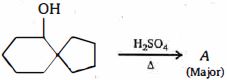
Major product $A$ is
A
B
C
D
Solution
(B) The reaction involves the acid-catalyzed dehydration of a tertiary alcohol.
$1$. Protonation of the $-OH$ group occurs to form a good leaving group $(-OH_2^+)$.
$2$. Loss of water generates a carbocation at the spiro-junction.
$3$. Ring expansion occurs to relieve ring strain,transforming the spiro[$5.4$]decane system into a bicyclo[$4.4$.$0$]decane (decalin) system.
$4$. The resulting carbocation undergoes deprotonation to form the most stable alkene,which is the tetrasubstituted alkene,$1,2,3,4,5,6,7,8$-octahydronaphthalene (or $\Delta^{9,10}$-octalin).
Therefore,the major product $A$ is the bicyclo[$4.4$.$0$]dec$-1-$ene structure.
$1$. Protonation of the $-OH$ group occurs to form a good leaving group $(-OH_2^+)$.
$2$. Loss of water generates a carbocation at the spiro-junction.
$3$. Ring expansion occurs to relieve ring strain,transforming the spiro[$5.4$]decane system into a bicyclo[$4.4$.$0$]decane (decalin) system.
$4$. The resulting carbocation undergoes deprotonation to form the most stable alkene,which is the tetrasubstituted alkene,$1,2,3,4,5,6,7,8$-octahydronaphthalene (or $\Delta^{9,10}$-octalin).
Therefore,the major product $A$ is the bicyclo[$4.4$.$0$]dec$-1-$ene structure.
0 likes
View Solution416
DifficultMCQ
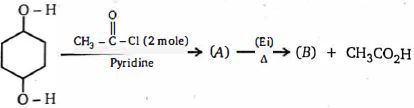
Product $(B)$ of the given reaction is:
A
Cyclohexa$-1,3-$diene
B
Cyclohexa$-1,4-$diene
C
Methylenecyclohexene
D
None of these
Solution
(B) $1$. The starting material is cyclohexane$-1,4-$diol. When treated with $2 \text{ moles}$ of acetyl chloride in the presence of pyridine,it undergoes esterification to form cyclohexane$-1,4-$diyl diacetate,which is product $(A)$.
$2$. Product $(A)$ undergoes thermal decomposition (pyrolysis of ester),which is a $syn$-elimination reaction.
$3$. In this reaction,the acetate groups are eliminated as acetic acid $(CH_3CO_2H)$,leading to the formation of double bonds in the ring.
$4$. Since the acetate groups are at the $1$ and $4$ positions,the elimination results in the formation of cyclohexa$-1,4-$diene as the major product $(B)$.
$2$. Product $(A)$ undergoes thermal decomposition (pyrolysis of ester),which is a $syn$-elimination reaction.
$3$. In this reaction,the acetate groups are eliminated as acetic acid $(CH_3CO_2H)$,leading to the formation of double bonds in the ring.
$4$. Since the acetate groups are at the $1$ and $4$ positions,the elimination results in the formation of cyclohexa$-1,4-$diene as the major product $(B)$.
0 likes
View Solution417
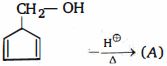
DifficultMCQ
The product $(A)$ is:
A
Cyclopentadiene derivative
B
Benzene
C
Cyclohexadiene
D
Cyclohexene
Solution
(B) The reaction involves the acid-catalyzed dehydration of cyclopenta$-2,4-$dienylmethanol.
$1$. Protonation of the $-OH$ group followed by the loss of $H_2O$ generates a carbocation at the exocyclic carbon.
$2$. This carbocation undergoes a ring expansion rearrangement to form a more stable aromatic benzene ring.
$3$. Finally,the loss of a proton $(H^+)$ yields benzene as the final product $(A)$.
$1$. Protonation of the $-OH$ group followed by the loss of $H_2O$ generates a carbocation at the exocyclic carbon.
$2$. This carbocation undergoes a ring expansion rearrangement to form a more stable aromatic benzene ring.
$3$. Finally,the loss of a proton $(H^+)$ yields benzene as the final product $(A)$.
0 likes
View Solution418
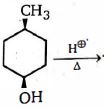
DifficultMCQ
The products obtained in the following reaction are:
A
Racemic
B
Diastereomers
C
$G.I.$
D
Positional isomers
Solution
(A) The reaction involves the acid-catalyzed dehydration of $cis-4-methylcyclohexanol$ using $H^+$ and heat $(\Delta)$.
This process proceeds via an $E1$ mechanism involving the formation of a carbocation intermediate.
The dehydration leads to the formation of $4-methylcyclohexene$.
Since the product $4-methylcyclohexene$ has a chiral center at the $C4$ position,the reaction produces a pair of enantiomers in equal amounts,which is known as a racemic mixture.
This process proceeds via an $E1$ mechanism involving the formation of a carbocation intermediate.
The dehydration leads to the formation of $4-methylcyclohexene$.
Since the product $4-methylcyclohexene$ has a chiral center at the $C4$ position,the reaction produces a pair of enantiomers in equal amounts,which is known as a racemic mixture.
0 likes
View Solution419
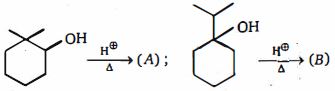
DifficultMCQ
The sum of the number of $\alpha$-hydrogen atoms present in compounds $A$ and $B$ is:
A
$18$
B
$19$
C
$20$
D
$21$
Solution
(C) The reaction involves the acid-catalyzed dehydration of alcohols to form alkenes.
For compound $A$: The dehydration of $1,2$-dimethylcyclohexanol gives $1,2$-dimethylcyclohexene as the major product. This alkene has $10$ $\alpha$-hydrogen atoms ($3$ from each methyl group and $2$ from each adjacent $CH_2$ group).
For compound $B$: The dehydration of $1$-isopropylcyclohexanol gives $1$-isopropylidenecyclohexane. This alkene has $10$ $\alpha$-hydrogen atoms ($6$ from the two methyl groups on the isopropylidene side chain and $4$ from the adjacent $CH_2$ groups of the cyclohexane ring).
The sum of $\alpha$-hydrogen atoms in $A + B = 10 + 10 = 20$.
For compound $A$: The dehydration of $1,2$-dimethylcyclohexanol gives $1,2$-dimethylcyclohexene as the major product. This alkene has $10$ $\alpha$-hydrogen atoms ($3$ from each methyl group and $2$ from each adjacent $CH_2$ group).
For compound $B$: The dehydration of $1$-isopropylcyclohexanol gives $1$-isopropylidenecyclohexane. This alkene has $10$ $\alpha$-hydrogen atoms ($6$ from the two methyl groups on the isopropylidene side chain and $4$ from the adjacent $CH_2$ groups of the cyclohexane ring).
The sum of $\alpha$-hydrogen atoms in $A + B = 10 + 10 = 20$.
0 likes
View Solution420
DifficultMCQ
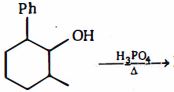
The major product obtained by the dehydration of the given alcohol is:
A
$1-$phenyl$-3-$methylcyclohex$-1-$ene
B
$3-$methyl$-1-$phenylcyclohexene
C
$1-$methyl$-3-$phenylcyclohexene
D
$1-$phenyl$-2-$methylcyclohex$-1-$ene
Solution
(A) The dehydration of the given alcohol ($2$-methyl-$1$-phenylcyclohexan-$1$-ol) proceeds via the formation of a carbocation intermediate.
$1$. Protonation of the hydroxyl group followed by the loss of water molecule generates a secondary carbocation at the $C-1$ position.
$2$. This carbocation undergoes a $1,2$-hydride shift to form a more stable benzylic carbocation at the position adjacent to the phenyl group.
$3$. Elimination of a proton from the adjacent carbon leads to the formation of the most stable alkene,which is $1$-phenyl-$3$-methylcyclohex-$1$-ene,due to conjugation with the phenyl ring and the presence of $3$ $\alpha$-hydrogens.
$1$. Protonation of the hydroxyl group followed by the loss of water molecule generates a secondary carbocation at the $C-1$ position.
$2$. This carbocation undergoes a $1,2$-hydride shift to form a more stable benzylic carbocation at the position adjacent to the phenyl group.
$3$. Elimination of a proton from the adjacent carbon leads to the formation of the most stable alkene,which is $1$-phenyl-$3$-methylcyclohex-$1$-ene,due to conjugation with the phenyl ring and the presence of $3$ $\alpha$-hydrogens.
0 likes
View Solution421
DifficultMCQ
What is the major product of the following reaction?
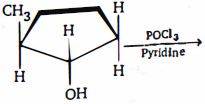
A
$1-$methylcyclopentene
B
$3-$methylcyclopentene
C
Methylenecyclopentane
D
Cyclohexene
Solution
(A) The reaction of $2$-methylcyclopentanol with $POCl_3$ in the presence of pyridine is a dehydration reaction.
$POCl_3$ acts as a dehydrating agent,and the reaction proceeds via an $E_2$ mechanism.
In this mechanism,the hydroxyl group is converted into a good leaving group,and a base (pyridine) abstracts a proton from the adjacent carbon atom to form the double bond.
According to Zaitsev's rule,the more substituted alkene is the major product.
Therefore,the double bond forms between the carbon bearing the methyl group and the adjacent carbon,resulting in $1$-methylcyclopentene as the major product.
$POCl_3$ acts as a dehydrating agent,and the reaction proceeds via an $E_2$ mechanism.
In this mechanism,the hydroxyl group is converted into a good leaving group,and a base (pyridine) abstracts a proton from the adjacent carbon atom to form the double bond.
According to Zaitsev's rule,the more substituted alkene is the major product.
Therefore,the double bond forms between the carbon bearing the methyl group and the adjacent carbon,resulting in $1$-methylcyclopentene as the major product.
0 likes
View Solution422
DifficultMCQ
What is the major product of the following reaction?
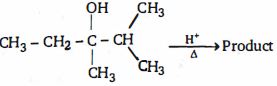
A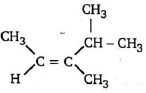
B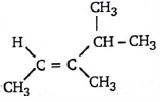
C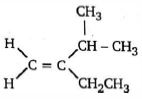
D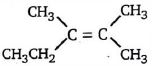
Solution
(B) The reaction involves the acid-catalyzed dehydration of an alcohol.
$1$. Protonation of the $-OH$ group followed by the loss of water forms a secondary carbocation.
$2$. This secondary carbocation undergoes a $1,2-H$ shift to form a more stable tertiary carbocation.
$3$. The tertiary carbocation then loses a proton from the adjacent carbon to form the most stable alkene according to Saytzeff's rule.
$4$. The final product is $2,3-dimethylpent-2-ene$.
$1$. Protonation of the $-OH$ group followed by the loss of water forms a secondary carbocation.
$2$. This secondary carbocation undergoes a $1,2-H$ shift to form a more stable tertiary carbocation.
$3$. The tertiary carbocation then loses a proton from the adjacent carbon to form the most stable alkene according to Saytzeff's rule.
$4$. The final product is $2,3-dimethylpent-2-ene$.
0 likes
View Solution423
MediumMCQ
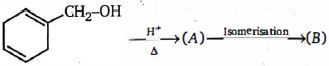
$A$ on heating isomerizes to $B$. What is the structure of $B$?
A
Cyclohexa$-1,3-$dien$-1-$ylmethylene
B
Toluene
C
Phenol
D
Cyclohexa$-1,4-$dien$-1-$ylmethylene
Solution
(B) The starting material is cyclohexa$-1,4-$dien$-1-$ylmethanol. Upon treatment with $H^+$ and heating,it undergoes dehydration to form a carbocation,which rearranges and loses a proton to form an intermediate $(A)$,which is $6-$methylenecyclohexa$-1,3-$diene. This intermediate $(A)$ undergoes isomerization upon heating to form the aromatic compound $B$,which is toluene $(C_6H_5CH_3)$.
0 likes
View Solution424
AdvancedMCQ
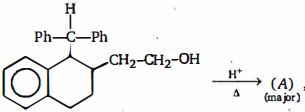
The major product $(A)$ is:
A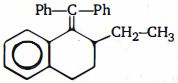
B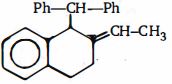
C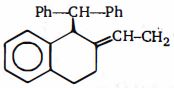
D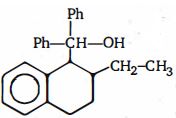
Solution
(A) The reaction involves the dehydration of an alcohol in the presence of an acid catalyst $(H^+)$ and heat $(\Delta)$.
$1$. Protonation of the $-OH$ group occurs to form a good leaving group $(-OH_2^+)$.
$2$. Loss of water generates a primary carbocation at the end of the side chain.
$3$. This primary carbocation undergoes a series of $1,2-H^-$ shifts to migrate the positive charge to the carbon adjacent to the tetralin ring,which is stabilized by the adjacent phenyl groups and the ring system.
$4$. Finally,the elimination of a proton from the adjacent carbon leads to the formation of the most stable alkene,which is the conjugated product where the double bond is formed between the ring and the side chain,resulting in the structure shown in option $A$.
$1$. Protonation of the $-OH$ group occurs to form a good leaving group $(-OH_2^+)$.
$2$. Loss of water generates a primary carbocation at the end of the side chain.
$3$. This primary carbocation undergoes a series of $1,2-H^-$ shifts to migrate the positive charge to the carbon adjacent to the tetralin ring,which is stabilized by the adjacent phenyl groups and the ring system.
$4$. Finally,the elimination of a proton from the adjacent carbon leads to the formation of the most stable alkene,which is the conjugated product where the double bond is formed between the ring and the side chain,resulting in the structure shown in option $A$.
0 likes
View Solution425
MediumMCQ
In which of the following reactions will a resonance-stabilized product be formed?
A
Cyclohex$-1-$en$-1-$ylmethanol reacting with $H^+/\Delta$
B
Cyclohex$-2-$en$-1-$ol reacting with $H^+/\Delta$
C
$1-$Methyl$-1,2,3,4-$tetrahydronaphthalen$-1-$ol reacting with $H^+/\Delta$
D
All of these
Solution
(D) In all the given reactions,the dehydration of alcohol in the presence of $H^+/\Delta$ proceeds via the formation of a carbocation intermediate.
$A$: The carbocation formed after the loss of $H_2O$ is resonance-stabilized by the adjacent double bond.
$B$: The carbocation formed is an allylic carbocation,which is resonance-stabilized.
$C$: The carbocation formed is benzylic,which is highly resonance-stabilized by the benzene ring.
Since all reactions involve the formation of a resonance-stabilized carbocation intermediate,the correct answer is $(d)$.
$A$: The carbocation formed after the loss of $H_2O$ is resonance-stabilized by the adjacent double bond.
$B$: The carbocation formed is an allylic carbocation,which is resonance-stabilized.
$C$: The carbocation formed is benzylic,which is highly resonance-stabilized by the benzene ring.
Since all reactions involve the formation of a resonance-stabilized carbocation intermediate,the correct answer is $(d)$.
0 likes
View Solution426
AdvancedMCQ
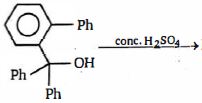
Major product of the reaction is
A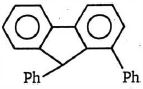
B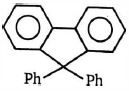
C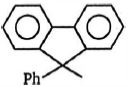
D
None of these
Solution
(C) The reaction involves the dehydration of the given alcohol in the presence of $conc. \ H_2SO_4$.
$1$. The hydroxyl group $(-OH)$ is protonated by $H^+$ to form an oxonium ion,which then leaves as a water molecule to form a stable carbocation.
$2$. This carbocation undergoes an intramolecular Friedel-Crafts alkylation reaction.
$3$. The carbocation attacks the ortho position of the adjacent phenyl ring,leading to the formation of a five-membered ring fused to the two benzene rings.
$4$. The final product is $9,9-diphenylfluorene$.
$1$. The hydroxyl group $(-OH)$ is protonated by $H^+$ to form an oxonium ion,which then leaves as a water molecule to form a stable carbocation.
$2$. This carbocation undergoes an intramolecular Friedel-Crafts alkylation reaction.
$3$. The carbocation attacks the ortho position of the adjacent phenyl ring,leading to the formation of a five-membered ring fused to the two benzene rings.
$4$. The final product is $9,9-diphenylfluorene$.
0 likes
View Solution427
DifficultMCQ
$Ph-C(OH)(Ph)-C(OH)(CH_3)_2$ $(A)$ $+$ $Ph-C(OH)(Ph)-C(OH)(Et)_2$ $(B)$ $\xrightarrow{H_2SO_4}$
$(p)$ $Ph-C(Ph)(CH_3)-CO-CH_3$
$(q)$ $Ph-C(Ph)(Et)-CO-Et$
$(r)$ $Ph-C(Ph)(Et)-CO-CH_3$
$(s)$ $Ph-C(Ph)(CH_3)-CO-Et$
When $(A)$ and $(B)$ react with $H_2SO_4$,the products obtained are:
$(p)$ $Ph-C(Ph)(CH_3)-CO-CH_3$
$(q)$ $Ph-C(Ph)(Et)-CO-Et$
$(r)$ $Ph-C(Ph)(Et)-CO-CH_3$
$(s)$ $Ph-C(Ph)(CH_3)-CO-Et$
When $(A)$ and $(B)$ react with $H_2SO_4$,the products obtained are:
A
$p, q, r, s$
B
$p, q$
C
$p, q, r$
D
$p, q, s$
Solution
(B) The reaction is a $Pinacol-Pinacolone$ rearrangement,which is an intramolecular process.
In this reaction,the carbocation formed from the diol rearranges to the corresponding ketone without exchanging alkyl or aryl groups between different molecules.
For $(A)$,the product is $Ph-C(Ph)(CH_3)-CO-CH_3$ $(p)$.
For $(B)$,the product is $Ph-C(Ph)(Et)-CO-Et$ $(q)$.
Since the process is intramolecular,no crossover products like $(r)$ or $(s)$ are formed.
Therefore,the correct products are $(p)$ and $(q)$.
In this reaction,the carbocation formed from the diol rearranges to the corresponding ketone without exchanging alkyl or aryl groups between different molecules.
For $(A)$,the product is $Ph-C(Ph)(CH_3)-CO-CH_3$ $(p)$.
For $(B)$,the product is $Ph-C(Ph)(Et)-CO-Et$ $(q)$.
Since the process is intramolecular,no crossover products like $(r)$ or $(s)$ are formed.
Therefore,the correct products are $(p)$ and $(q)$.
0 likes
View Solution428
MediumMCQ
In the given pairs of alcohols,in which pair is the second alcohol more reactive than the first towards hydrogen bromide $(HBr)$?
A
$1-$methylcyclopentanol and cyclohexanol
B
$1-$ethylcyclopentanol and $1-$cyclopentylethanol
C
$CH_3-CH(OH)-CH_2-CH_3$ and $CH_3-CH_2-CH(CH_3)-CH_2OH$
D
$CH_3-CH(OH)-CH_2-CH_3$ and $(CH_3)_2C(OH)-CH_2-CH_3$
Solution
(D) The reaction of alcohols with $HBr$ proceeds via an $S_N1$ mechanism,where the rate-determining step is the formation of a carbocation intermediate. The stability of the carbocation determines the reactivity of the alcohol; more stable carbocations are formed more easily,making the parent alcohol more reactive.
$(a)$ $1-$methylcyclopentanol forms a tertiary $(3^{\circ})$ carbocation,while cyclohexanol forms a secondary $(2^{\circ})$ carbocation. Thus,the first is more reactive.
$(b)$ $1-$ethylcyclopentanol forms a tertiary $(3^{\circ})$ carbocation,while $1-$cyclopentylethanol forms a secondary $(2^{\circ})$ carbocation. Thus,the first is more reactive.
$(c)$ $CH_3-CH(OH)-CH_2-CH_3$ (butan$-2-$ol) forms a secondary $(2^{\circ})$ carbocation,while $CH_3-CH_2-CH(CH_3)-CH_2OH$ ($2$-methylbutan$-1-$ol) forms a primary $(1^{\circ})$ carbocation. Thus,the first is more reactive.
$(d)$ $CH_3-CH(OH)-CH_2-CH_3$ (butan$-2-$ol) forms a secondary $(2^{\circ})$ carbocation,while $(CH_3)_2C(OH)-CH_2-CH_3$ ($3$-methylpentan$-3-$ol) forms a tertiary $(3^{\circ})$ carbocation. Since the tertiary carbocation is more stable than the secondary one,the second alcohol is more reactive than the first.
$(a)$ $1-$methylcyclopentanol forms a tertiary $(3^{\circ})$ carbocation,while cyclohexanol forms a secondary $(2^{\circ})$ carbocation. Thus,the first is more reactive.
$(b)$ $1-$ethylcyclopentanol forms a tertiary $(3^{\circ})$ carbocation,while $1-$cyclopentylethanol forms a secondary $(2^{\circ})$ carbocation. Thus,the first is more reactive.
$(c)$ $CH_3-CH(OH)-CH_2-CH_3$ (butan$-2-$ol) forms a secondary $(2^{\circ})$ carbocation,while $CH_3-CH_2-CH(CH_3)-CH_2OH$ ($2$-methylbutan$-1-$ol) forms a primary $(1^{\circ})$ carbocation. Thus,the first is more reactive.
$(d)$ $CH_3-CH(OH)-CH_2-CH_3$ (butan$-2-$ol) forms a secondary $(2^{\circ})$ carbocation,while $(CH_3)_2C(OH)-CH_2-CH_3$ ($3$-methylpentan$-3-$ol) forms a tertiary $(3^{\circ})$ carbocation. Since the tertiary carbocation is more stable than the secondary one,the second alcohol is more reactive than the first.
0 likes
View Solution429
MediumMCQ
Consider the following alcohols. The order of decreasing reactivities of these alcohols towards substitution with $HBr$ is:
$(I)$ $C_6H_5CH_2OH$
$(II)$ $p-NO_2-C_6H_4CH_2OH$
$(III)$ $p-CH_3O-C_6H_4CH_2OH$
$(IV)$ $p-Br-C_6H_4CH_2OH$
$(I)$ $C_6H_5CH_2OH$
$(II)$ $p-NO_2-C_6H_4CH_2OH$
$(III)$ $p-CH_3O-C_6H_4CH_2OH$
$(IV)$ $p-Br-C_6H_4CH_2OH$
A
$III > I > IV > II$
B
$III > I > II > IV$
C
$I > III > IV > II$
D
$I > III > II > IV$
Solution
(A) The reaction of alcohols with $HBr$ proceeds via the formation of a carbocation intermediate (usually $S_N1$ mechanism for benzylic alcohols).
The rate of reaction is directly proportional to the stability of the carbocation formed in the rate-determining step.
The carbocations formed are substituted benzyl carbocations: $X-C_6H_4-CH_2^+$.
Electron-donating groups $(EDG)$ stabilize the carbocation,while electron-withdrawing groups $(EWG)$ destabilize it.
- In $(III)$,the $-OCH_3$ group is a strong $EDG$ ($+M$ effect),making it the most reactive.
- In $(I)$,there is no substituent.
- In $(IV)$,the $-Br$ group is an $EWG$ ($-I$ effect),making it less reactive than $(I)$.
- In $(II)$,the $-NO_2$ group is a very strong $EWG$ ($-M$ and $-I$ effects),making it the least reactive.
Therefore,the order of decreasing reactivity is $III > I > IV > II$.
The rate of reaction is directly proportional to the stability of the carbocation formed in the rate-determining step.
The carbocations formed are substituted benzyl carbocations: $X-C_6H_4-CH_2^+$.
Electron-donating groups $(EDG)$ stabilize the carbocation,while electron-withdrawing groups $(EWG)$ destabilize it.
- In $(III)$,the $-OCH_3$ group is a strong $EDG$ ($+M$ effect),making it the most reactive.
- In $(I)$,there is no substituent.
- In $(IV)$,the $-Br$ group is an $EWG$ ($-I$ effect),making it less reactive than $(I)$.
- In $(II)$,the $-NO_2$ group is a very strong $EWG$ ($-M$ and $-I$ effects),making it the least reactive.
Therefore,the order of decreasing reactivity is $III > I > IV > II$.
0 likes
View Solution430
MediumMCQ
Product $W$ is

A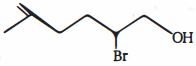
$A$ cyclic ether with a bromomethyl group.
B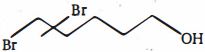
$A$ vicinal dibromide.
C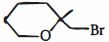
$A$ bromo-alcohol.
D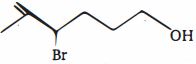
An alkene with a bromine substituent.
Solution
(A) The reaction involves the electrophilic addition of $Br_2$ to the alkene double bond.
$1$. The alkene reacts with $Br_2$ to form a cyclic bromonium ion intermediate.
$2$. The internal nucleophilic hydroxyl group $(-OH)$ attacks the more substituted carbon of the bromonium ion,leading to the formation of a cyclic ether (a six-membered ring).
$3$. The oxygen atom becomes positively charged,and subsequently,a proton is removed by the bromide ion $(Br^-)$ to form the final product $W$,which is a cyclic ether with a bromomethyl group attached.
$1$. The alkene reacts with $Br_2$ to form a cyclic bromonium ion intermediate.
$2$. The internal nucleophilic hydroxyl group $(-OH)$ attacks the more substituted carbon of the bromonium ion,leading to the formation of a cyclic ether (a six-membered ring).
$3$. The oxygen atom becomes positively charged,and subsequently,a proton is removed by the bromide ion $(Br^-)$ to form the final product $W$,which is a cyclic ether with a bromomethyl group attached.

0 likes
View Solution431
MediumMCQ
Compare the rate of dehydration of $(i)$,$(ii)$ and $(iii)$ by conc. $H_2SO_4$.

A
$(i) > (iii) > (ii)$
B
$(i) > (ii) > (iii)$
C
$(ii) > (i) > (iii)$
D
$(ii) > (iii) > (i)$
Solution
(B) The rate of dehydration of alcohols depends on the stability of the carbocation formed in the rate-determining step (r.d.s.).
$1$. For $(i)$,the carbocation formed is allylic and benzylic,which is highly stabilized by resonance ($7$ resonating structures).
$2$. For $(ii)$,the carbocation formed is benzylic,which is stabilized by resonance ($6$ resonating structures).
$3$. For $(iii)$,the carbocation formed is vinylic,which is highly unstable.
Therefore,the stability order of the carbocations is $(i) > (ii) > (iii)$.
Consequently,the rate of dehydration follows the same order: $(i) > (ii) > (iii)$.
$1$. For $(i)$,the carbocation formed is allylic and benzylic,which is highly stabilized by resonance ($7$ resonating structures).
$2$. For $(ii)$,the carbocation formed is benzylic,which is stabilized by resonance ($6$ resonating structures).
$3$. For $(iii)$,the carbocation formed is vinylic,which is highly unstable.
Therefore,the stability order of the carbocations is $(i) > (ii) > (iii)$.
Consequently,the rate of dehydration follows the same order: $(i) > (ii) > (iii)$.
0 likes
View Solution432
MediumMCQ
The reaction sequence is as follows:
$2\text{-methylcyclohexanol}$ $\xrightarrow{H^+, \Delta} (A)$ $\xrightarrow{\text{cold dil. } KMnO_4} (B)$ $\xrightarrow{CrO_3} (C)$
Identify the product $(C)$.
$2\text{-methylcyclohexanol}$ $\xrightarrow{H^+, \Delta} (A)$ $\xrightarrow{\text{cold dil. } KMnO_4} (B)$ $\xrightarrow{CrO_3} (C)$
Identify the product $(C)$.
A
$1-$methylcyclohexane$-1,2-$dione
B
$1-$methylcyclohex$-1-$ene
C
$2-$hydroxy$-2-$methylcyclohexanone
D
$2-$formylcyclohexanone
Solution
(C) Step $1$: Dehydration of $2\text{-methylcyclohexanol}$ with $H^+/\Delta$ gives $1\text{-methylcyclohexene}$ as the major product $(A)$ due to Saytzeff's rule.
Step $2$: Syn-hydroxylation of $1\text{-methylcyclohexene}$ with cold dilute $KMnO_4$ (Baeyer's reagent) yields $1\text{-methylcyclohexane-1,2-diol}$ as product $(B)$.
Step $3$: Oxidation of the secondary alcohol group in $1\text{-methylcyclohexane-1,2-diol}$ using $CrO_3$ (Jones reagent or similar) selectively oxidizes the secondary alcohol to a ketone,while the tertiary alcohol remains unaffected. Thus,the product $(C)$ is $2\text{-hydroxy-2-methylcyclohexanone}$.
Step $2$: Syn-hydroxylation of $1\text{-methylcyclohexene}$ with cold dilute $KMnO_4$ (Baeyer's reagent) yields $1\text{-methylcyclohexane-1,2-diol}$ as product $(B)$.
Step $3$: Oxidation of the secondary alcohol group in $1\text{-methylcyclohexane-1,2-diol}$ using $CrO_3$ (Jones reagent or similar) selectively oxidizes the secondary alcohol to a ketone,while the tertiary alcohol remains unaffected. Thus,the product $(C)$ is $2\text{-hydroxy-2-methylcyclohexanone}$.
0 likes
View Solution433
MediumMCQ
$CH_3-CH(CH_3)-CH(OH)-CH_3$ $\xrightarrow[350^\circ C]{Al_2O_3} (A)$ $\xrightarrow[(ii) AgOH]{(i) HI} (B)$
Product $(B)$ of the above reaction is:
Product $(B)$ of the above reaction is:
A
$CH_3-C(OH)(CH_3)-CH_2-CH_3$
B
$CH_3-CH(CH_3)-CH(OH)-CH_3$
C
$CH_3-CH(OH)-C(CH_3)_3$
D
$HO-CH_2-CH_2-CH_2-CH_3$
Solution
(A) $1.$ Dehydration of $3$-methylbutan-$2$-ol $(CH_3-CH(CH_3)-CH(OH)-CH_3)$ using $Al_2O_3$ at $350^\circ C$ yields $2$-methylbut-$2$-ene $(CH_3-C(CH_3)=CH-CH_3)$ as the major product according to Saytzeff's rule.
$2.$ Addition of $HI$ to $2$-methylbut-$2$-ene follows Markovnikov's rule,where the $I^-$ attaches to the more substituted carbon,forming $2$-iodo-$2$-methylbutane $(CH_3-CI(CH_3)-CH_2-CH_3)$.
$3.$ Reaction with $AgOH$ (moist $Ag_2O$) results in nucleophilic substitution of the iodide group with a hydroxyl group,forming $2$-methylbutan-$2$-ol $(CH_3-C(OH)(CH_3)-CH_2-CH_3)$.
$2.$ Addition of $HI$ to $2$-methylbut-$2$-ene follows Markovnikov's rule,where the $I^-$ attaches to the more substituted carbon,forming $2$-iodo-$2$-methylbutane $(CH_3-CI(CH_3)-CH_2-CH_3)$.
$3.$ Reaction with $AgOH$ (moist $Ag_2O$) results in nucleophilic substitution of the iodide group with a hydroxyl group,forming $2$-methylbutan-$2$-ol $(CH_3-C(OH)(CH_3)-CH_2-CH_3)$.
0 likes
View Solution434
MediumMCQ
Product $(B)$ of the above reaction is

A
Tetrahydropyran$-2-$yl ether derivative
B
Tetrahydropyran$-3-$yl ether derivative
C
$3,4-$dihydro-2H-pyran derivative
D
Tetrahydropyran$-2-$yl peroxide derivative
Solution
(A) The reaction starts with the protonation of the hydroxyl group of tetrahydrofurfuryl alcohol,followed by the loss of water to form a primary carbocation. This carbocation undergoes ring expansion to form a more stable six-membered oxocarbenium ion. Loss of a proton from this ion yields $3,4-$dihydro-2H-pyran as intermediate $(A)$. Subsequent acid-catalyzed addition of the alcohol $ROH$ to the double bond of $3,4-$dihydro-2H-pyran follows Markovnikov's rule,where the alkoxy group attaches to the carbon adjacent to the oxygen atom,resulting in the formation of a tetrahydropyran$-2-$yl ether derivative as the major product $(B)$.
0 likes
View Solution435
MediumMCQ
The reaction of allyl alcohol with $MCPBA$ ($meta$-chloroperbenzoic acid) is shown below:
Allyl alcohol $\xrightarrow{MCPBA}$ Product
What is the stereochemistry of the product of the above reaction?
Allyl alcohol $\xrightarrow{MCPBA}$ Product
What is the stereochemistry of the product of the above reaction?
A
Meso
B
Racemic
C
Diastereomers
D
Optically inactive due to absence of chiral center
Solution
(B) The reaction of allyl alcohol $(CH_2=CH-CH_2OH)$ with $MCPBA$ is an epoxidation reaction. The product formed is glycidol $(oxiran-2-ylmethanol)$.
The product contains a chiral center at the $C-2$ position of the oxirane ring. Since the reaction produces both enantiomers in equal amounts,the resulting mixture is a racemic mixture.
The product contains a chiral center at the $C-2$ position of the oxirane ring. Since the reaction produces both enantiomers in equal amounts,the resulting mixture is a racemic mixture.
0 likes
View Solution436
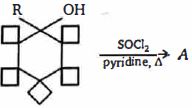
MediumMCQ
The product $(A)$ of the reaction is:
A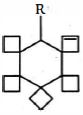
B
C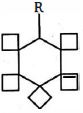
D
None of these
Solution
(B) The reaction of the given tertiary alcohol with $SOCl_2$ in the presence of pyridine typically proceeds via a carbocation intermediate due to the steric hindrance and the potential for rearrangement.
$1$. The hydroxyl group is converted into a good leaving group (chlorosulfite ester),which then departs to form a carbocation.
$2$. The carbocation undergoes a ring expansion (Wagner-Meerwein rearrangement) to relieve ring strain and form a more stable carbocation.
$3$. Pyridine,acting as a base,then abstracts a proton from the adjacent carbon to form an alkene as the major product.
$4$. Based on the provided reaction mechanism image,the final product $(A)$ is the alkene shown in option $(B)$.
$1$. The hydroxyl group is converted into a good leaving group (chlorosulfite ester),which then departs to form a carbocation.
$2$. The carbocation undergoes a ring expansion (Wagner-Meerwein rearrangement) to relieve ring strain and form a more stable carbocation.
$3$. Pyridine,acting as a base,then abstracts a proton from the adjacent carbon to form an alkene as the major product.
$4$. Based on the provided reaction mechanism image,the final product $(A)$ is the alkene shown in option $(B)$.
0 likes
View Solution437
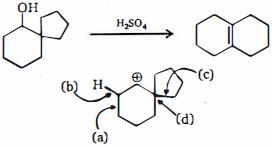
DifficultMCQ
The following transformation involves a carbocation rearrangement. The carbocation is generated by protonation of the hydroxyl group,followed by the loss of water. Which bond has to migrate in the carbocation to yield the product indicated (after the deprotonation)?
A
$a$
B
$b$
C
$c$
D
$d$
Solution
(C) The reaction involves the acid-catalyzed dehydration of a spiro-alcohol.
First,the hydroxyl group is protonated to form an oxonium ion,which then loses a molecule of water to generate a secondary carbocation at the carbon atom adjacent to the spiro-center.
To expand the five-membered ring into a six-membered ring (forming a decalin-like structure),a ring expansion rearrangement occurs.
Specifically,the bond labeled $c$ (a $C$-$C$ bond of the five-membered ring) migrates to the positively charged carbon.
This migration converts the five-membered ring into a six-membered ring,resulting in a more stable carbocation,which then undergoes deprotonation to form the final alkene product.
First,the hydroxyl group is protonated to form an oxonium ion,which then loses a molecule of water to generate a secondary carbocation at the carbon atom adjacent to the spiro-center.
To expand the five-membered ring into a six-membered ring (forming a decalin-like structure),a ring expansion rearrangement occurs.
Specifically,the bond labeled $c$ (a $C$-$C$ bond of the five-membered ring) migrates to the positively charged carbon.
This migration converts the five-membered ring into a six-membered ring,resulting in a more stable carbocation,which then undergoes deprotonation to form the final alkene product.
0 likes
View Solution438
MediumMCQ
Which of the following is oxidized most easily?
A
$CH_3-CH(OH)-CH_3$
B
Phenol
C
$CH_3-CH_2-O-CH_2-CH_3$
D
$1-$Methylcyclohexanol
Solution
(A) The ease of oxidation follows the order: $1^\circ$ alcohol > $2^\circ$ alcohol > $3^\circ$ alcohol.
$CH_3-CH(OH)-CH_3$ is a secondary $(2^\circ)$ alcohol,which is easily oxidized to a ketone.
Phenol is resistant to simple oxidation compared to aliphatic alcohols.
Diethyl ether $(CH_3-CH_2-O-CH_2-CH_3)$ is generally resistant to oxidation.
$1$-Methylcyclohexanol is a tertiary $(3^\circ)$ alcohol,which is difficult to oxidize.
Therefore,$CH_3-CH(OH)-CH_3$ is oxidized most easily among the given options.
$CH_3-CH(OH)-CH_3$ is a secondary $(2^\circ)$ alcohol,which is easily oxidized to a ketone.
Phenol is resistant to simple oxidation compared to aliphatic alcohols.
Diethyl ether $(CH_3-CH_2-O-CH_2-CH_3)$ is generally resistant to oxidation.
$1$-Methylcyclohexanol is a tertiary $(3^\circ)$ alcohol,which is difficult to oxidize.
Therefore,$CH_3-CH(OH)-CH_3$ is oxidized most easily among the given options.
0 likes
View Solution439
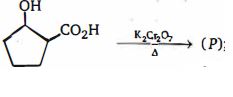
MediumMCQ
Product $(P)$ is
A
B
C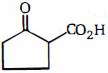
D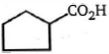
Solution
(B) The reaction involves the oxidation of a secondary alcohol to a ketone using $K_2Cr_2O_7$. The starting material is $2$-hydroxycyclopentanecarboxylic acid. Oxidation of the hydroxyl group yields a $\beta$-keto acid. $\beta$-keto acids are thermally unstable and undergo decarboxylation upon heating to form a ketone. Thus,the final product $(P)$ is cyclopentanone.
0 likes
View Solution440
MediumMCQ
Which of the following reacts with $HBr$ at a faster rate?
A
Cyclohexanol
B
$1-$Methylcyclohexanol
C
trans$-2-$Methylcyclohexanol
D
cis$-2-$Methylcyclohexanol
Solution
(B) The reaction of alcohols with $HBr$ proceeds via an $S_{N}1$ mechanism,which involves the formation of a carbocation intermediate. The rate of the reaction depends on the stability of the carbocation formed.
$(A)$ Cyclohexanol forms a $2^{\circ}$ carbocation.
$(B)$ $1-$Methylcyclohexanol forms a $3^{\circ}$ carbocation.
$(C)$ trans$-2-$Methylcyclohexanol forms a $2^{\circ}$ carbocation.
$(D)$ cis$-2-$Methylcyclohexanol forms a $2^{\circ}$ carbocation.
Since a $3^{\circ}$ carbocation is more stable than a $2^{\circ}$ carbocation,$1$-methylcyclohexanol reacts at a faster rate.
$(A)$ Cyclohexanol forms a $2^{\circ}$ carbocation.
$(B)$ $1-$Methylcyclohexanol forms a $3^{\circ}$ carbocation.
$(C)$ trans$-2-$Methylcyclohexanol forms a $2^{\circ}$ carbocation.
$(D)$ cis$-2-$Methylcyclohexanol forms a $2^{\circ}$ carbocation.
Since a $3^{\circ}$ carbocation is more stable than a $2^{\circ}$ carbocation,$1$-methylcyclohexanol reacts at a faster rate.
0 likes
View Solution441
DifficultMCQ
Consider the following alcohols:
$(I)$ $C_6H_5CH_2OH$
$(II)$ $O_2N-C_6H_4-CH_2OH$ (para-nitro)
$(III)$ $CH_3O-C_6H_4-CH_2OH$ (para-methoxy)
$(IV)$ $Br-C_6H_4-CH_2OH$ (para-bromo)
The order of decreasing reactivities of these alcohols towards nucleophilic substitution with $HBr$ is:
$(I)$ $C_6H_5CH_2OH$
$(II)$ $O_2N-C_6H_4-CH_2OH$ (para-nitro)
$(III)$ $CH_3O-C_6H_4-CH_2OH$ (para-methoxy)
$(IV)$ $Br-C_6H_4-CH_2OH$ (para-bromo)
The order of decreasing reactivities of these alcohols towards nucleophilic substitution with $HBr$ is:
A
$III > I > IV > II$
B
$III > I > II > IV$
C
$I > III > IV > II$
D
$I > III > II > IV$
Solution
(A) The reaction of alcohols with $HBr$ proceeds via the formation of a carbocation intermediate. The rate of reaction is directly proportional to the stability of the carbocation formed.
$1$. The carbocations formed are substituted benzyl carbocations: $X-C_6H_4-CH_2^+$.
$2$. Electron-donating groups $(EDG)$ increase the stability of the carbocation,while electron-withdrawing groups $(EWG)$ decrease it.
$3$. The substituents are:
- $CH_3O-$ (methoxy): Strong $+M$ effect (strongly stabilizing).
- $H$ (hydrogen): Reference.
- $Br$ (bromo): $-I$ effect (destabilizing).
- $O_2N-$ (nitro): Strong $-M$ and $-I$ effects (strongly destabilizing).
Thus,the stability order of the carbocations is: $III (methoxy) > I (H) > IV (bromo) > II (nitro)$.
Therefore,the order of reactivity is $III > I > IV > II$.
$1$. The carbocations formed are substituted benzyl carbocations: $X-C_6H_4-CH_2^+$.
$2$. Electron-donating groups $(EDG)$ increase the stability of the carbocation,while electron-withdrawing groups $(EWG)$ decrease it.
$3$. The substituents are:
- $CH_3O-$ (methoxy): Strong $+M$ effect (strongly stabilizing).
- $H$ (hydrogen): Reference.
- $Br$ (bromo): $-I$ effect (destabilizing).
- $O_2N-$ (nitro): Strong $-M$ and $-I$ effects (strongly destabilizing).
Thus,the stability order of the carbocations is: $III (methoxy) > I (H) > IV (bromo) > II (nitro)$.
Therefore,the order of reactivity is $III > I > IV > II$.
0 likes
View Solution442
MediumMCQ
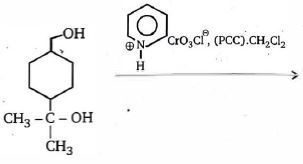
The product of the reaction is:
A
$4-$($2$-hydroxypropan$-2-$yl)cyclohex$-1-$ene
B
$4-$($2$-hydroxypropan$-2-$yl)cyclohexanecarbaldehyde
C
$4-$($2$-hydroxypropan$-2-$yl)cyclohexanecarboxylic acid
D
$4-$($2$-hydroxypropan$-2-$yl)cyclohexanone
Solution
(B) The given reactant is a diol containing a primary alcohol $(-CH_2OH)$ and a tertiary alcohol $(-C(OH)(CH_3)_2)$.
Pyridinium chlorochromate $(PCC)$ is a selective oxidizing agent that oxidizes primary alcohols to aldehydes and secondary alcohols to ketones.
It does not oxidize tertiary alcohols.
Therefore,the primary alcohol group is oxidized to an aldehyde group $(-CHO)$,while the tertiary alcohol group remains unchanged.
The product is $4-(2-hydroxypropan-2-yl)cyclohexanecarbaldehyde$.
Pyridinium chlorochromate $(PCC)$ is a selective oxidizing agent that oxidizes primary alcohols to aldehydes and secondary alcohols to ketones.
It does not oxidize tertiary alcohols.
Therefore,the primary alcohol group is oxidized to an aldehyde group $(-CHO)$,while the tertiary alcohol group remains unchanged.
The product is $4-(2-hydroxypropan-2-yl)cyclohexanecarbaldehyde$.
0 likes
View Solution443
MediumMCQ
Which is the best reagent to convert isopropyl alcohol to isopropyl bromide?
$CH_3-CH(OH)-CH_3 \xrightarrow{?} CH_3-CH(Br)-CH_3$
$CH_3-CH(OH)-CH_3 \xrightarrow{?} CH_3-CH(Br)-CH_3$
A
$HBr$
B
$SOBr_2$
C
$Br_2$
D
$CH_3MgBr$
Solution
(B) The conversion of isopropyl alcohol to isopropyl bromide is best achieved using $SOBr_2$ (thionyl bromide).
The reaction is: $CH_3-CH(OH)-CH_3 + SOBr_2 \rightarrow CH_3-CH(Br)-CH_3 + SO_2(g) + HBr(g)$.
$SOBr_2$ is preferred because the side products,$SO_2$ and $HBr$,are gases that escape the reaction mixture,driving the reaction to completion and yielding a pure product.
Using $HBr$ can lead to side reactions such as the elimination of water to form an alkene (propene) due to the acidic conditions and heat.
The reaction is: $CH_3-CH(OH)-CH_3 + SOBr_2 \rightarrow CH_3-CH(Br)-CH_3 + SO_2(g) + HBr(g)$.
$SOBr_2$ is preferred because the side products,$SO_2$ and $HBr$,are gases that escape the reaction mixture,driving the reaction to completion and yielding a pure product.
Using $HBr$ can lead to side reactions such as the elimination of water to form an alkene (propene) due to the acidic conditions and heat.
0 likes
View Solution444
MediumMCQ
Find the missing reagents $(x)$ and $(y)$ for the following reaction sequence:

A
$x = LiAlH_4, y = NaBH_4$
B
$x = LiAlH_4 / AlCl_3, y = LiAlH_4$
C
$x = LiAlH_4, y = LiAlH_4 / AlCl_3$
D
$x = H_2 / Ni, y = H_2 / Pt$
Solution
(C) The reaction involves the regioselective ring opening of an epoxide.
$1$. For the formation of the $3^\circ$ alcohol,the nucleophilic hydride $(H^-)$ from $LiAlH_4$ attacks the less sterically hindered carbon atom of the epoxide ring,followed by protonation to yield the $3^\circ$ alcohol. Thus,$x = LiAlH_4$.
$2$. For the formation of the $2^\circ$ alcohol,the epoxide is treated with $LiAlH_4 / AlCl_3$. The $AlCl_3$ acts as a Lewis acid and coordinates with the oxygen atom of the epoxide,which increases the electrophilicity of the more substituted carbon. Consequently,the hydride attacks the more substituted carbon,leading to the formation of the $2^\circ$ alcohol. Thus,$y = LiAlH_4 / AlCl_3$.
Therefore,the correct reagents are $x = LiAlH_4$ and $y = LiAlH_4 / AlCl_3$.
$1$. For the formation of the $3^\circ$ alcohol,the nucleophilic hydride $(H^-)$ from $LiAlH_4$ attacks the less sterically hindered carbon atom of the epoxide ring,followed by protonation to yield the $3^\circ$ alcohol. Thus,$x = LiAlH_4$.
$2$. For the formation of the $2^\circ$ alcohol,the epoxide is treated with $LiAlH_4 / AlCl_3$. The $AlCl_3$ acts as a Lewis acid and coordinates with the oxygen atom of the epoxide,which increases the electrophilicity of the more substituted carbon. Consequently,the hydride attacks the more substituted carbon,leading to the formation of the $2^\circ$ alcohol. Thus,$y = LiAlH_4 / AlCl_3$.
Therefore,the correct reagents are $x = LiAlH_4$ and $y = LiAlH_4 / AlCl_3$.
0 likes
View Solution445
MediumMCQ
In the given reaction,find the value of $x$,where $x$ is the number of moles of acetic anhydride $(Ac_2O)$ consumed.
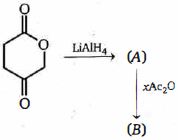
A
$1$
B
$2$
C
$3$
D
$4$
Solution
(C) The starting material is a cyclic anhydride. Reduction with $LiAlH_4$ reduces the anhydride to a triol,specifically butane$-1,2,4-$triol $(A)$.
Each hydroxyl $(-OH)$ group reacts with one mole of acetic anhydride $(Ac_2O)$ to form an ester (acetate) group.
Since there are $3$ hydroxyl groups in the triol $(A)$,$3$ moles of $Ac_2O$ are required for complete acetylation.
Therefore,$x = 3$.
Each hydroxyl $(-OH)$ group reacts with one mole of acetic anhydride $(Ac_2O)$ to form an ester (acetate) group.
Since there are $3$ hydroxyl groups in the triol $(A)$,$3$ moles of $Ac_2O$ are required for complete acetylation.
Therefore,$x = 3$.
0 likes
View Solution446
MediumMCQ
Identify the product formed when $(R)-2-$butanol and $(S)-2-$butanol react with $(R,R)-$tartaric acid in an acidic medium.
A
Racemic
B
Diastereomer
C
Meso
D
Pure enantiomer
Solution
(B) The reaction of $(R)-2-$butanol and $(S)-2-$butanol with $(R,R)-$tartaric acid results in the formation of esters.
Since $(R,R)-$tartaric acid is a chiral resolving agent,it reacts with the enantiomers of $2-$butanol to form two different products: $(R,R,R)-$tartrate ester and $(S,R,R)-$tartrate ester.
These two products are non-mirror images of each other,which classifies them as diastereomers.
Since $(R,R)-$tartaric acid is a chiral resolving agent,it reacts with the enantiomers of $2-$butanol to form two different products: $(R,R,R)-$tartrate ester and $(S,R,R)-$tartrate ester.
These two products are non-mirror images of each other,which classifies them as diastereomers.
0 likes
View Solution447
MediumMCQ
An alcohol of formula $C_9H_{12}O$ reacts with $Na_2Cr_2O_7$ to form a compound having formula $C_9H_{10}O$. The original alcohol might be
A
$Ph-CH_2-CH_2-CH_2-OH$
B
$Ph-CH(OH)-CH_2-CH_3$
C
$Ph-C(CH_3)_2-OH$
D
$Ph-CH(CH_3)-CH_2OH$
Solution
(B) The reaction involves the oxidation of an alcohol to a carbonyl compound (aldehyde or ketone) using $Na_2Cr_2O_7$,which is a strong oxidizing agent.
The change in molecular formula is from $C_9H_{12}O$ to $C_9H_{10}O$,which corresponds to the loss of two hydrogen atoms $(2H)$.
This indicates that the alcohol is a secondary alcohol,which oxidizes to a ketone.
Option $B$ $(Ph-CH(OH)-CH_2-CH_3)$ is a secondary alcohol. Upon oxidation,it forms $Ph-C(=O)-CH_2-CH_3$ (propiophenone),which has the formula $C_9H_{10}O$.
The change in molecular formula is from $C_9H_{12}O$ to $C_9H_{10}O$,which corresponds to the loss of two hydrogen atoms $(2H)$.
This indicates that the alcohol is a secondary alcohol,which oxidizes to a ketone.
Option $B$ $(Ph-CH(OH)-CH_2-CH_3)$ is a secondary alcohol. Upon oxidation,it forms $Ph-C(=O)-CH_2-CH_3$ (propiophenone),which has the formula $C_9H_{10}O$.
0 likes
View Solution448
MediumMCQ
An optically active alcohol of formula $C_9H_{12}O_2$ produced the following compound when refluxed with $KMnO_4$. What is the structure of $(A)$? The original compound showed these properties also:
$\mathop {C_9H_{12}O_2}\limits_{(A)} \xrightarrow{Na} H_2 \text{ liberated}$
$\mathop {C_9H_{12}O_2}\limits_{(A)} \xrightarrow{Br_2} \text{ no rapid reaction}$
$\mathop {C_9H_{12}O_2}\limits_{(A)} \xrightarrow[{cool}]{CrO_3 / H^{+}} C_9H_8O_3$
$\mathop {C_9H_{12}O_2}\limits_{(A)} \xrightarrow{Na} H_2 \text{ liberated}$
$\mathop {C_9H_{12}O_2}\limits_{(A)} \xrightarrow{Br_2} \text{ no rapid reaction}$
$\mathop {C_9H_{12}O_2}\limits_{(A)} \xrightarrow[{cool}]{CrO_3 / H^{+}} C_9H_8O_3$
A
$1-$($4$-(hydroxymethyl)phenyl)ethanol
B
$1-$(p-tolyl)ethane$-1,2-$diol
C
$2-$(p-tolyl)propan$-2-$ol
D
both $(a)$ and $(b)$
Solution
(A) $1$. The formula $C_9H_{12}O_2$ and the reaction with $Na$ indicate the presence of hydroxyl groups.
$2$. The reaction with $KMnO_4$ (reflux) oxidizes alkyl side chains on a benzene ring to carboxylic acids.
$3$. The reaction with $CrO_3/H^+$ (Jones reagent) under cool conditions selectively oxidizes primary and secondary alcohols to carboxylic acids and ketones,respectively.
$4$. Structure $(A)$ is $1-(4-(\text{hydroxymethyl})\text{phenyl})\text{ethanol}$.
$5$. It is optically active due to the chiral center at the carbon bearing the secondary hydroxyl group.
$6$. Oxidation of $(A)$ with $KMnO_4$ yields terephthalic acid $(C_8H_6O_4)$.
$7$. Oxidation of $(A)$ with $CrO_3/H^+$ yields $4-(\text{acetyl})\text{benzoic acid}$ $(C_9H_8O_3)$.
$8$. Structure $(B)$ is not optically active as it lacks a chiral center.
$2$. The reaction with $KMnO_4$ (reflux) oxidizes alkyl side chains on a benzene ring to carboxylic acids.
$3$. The reaction with $CrO_3/H^+$ (Jones reagent) under cool conditions selectively oxidizes primary and secondary alcohols to carboxylic acids and ketones,respectively.
$4$. Structure $(A)$ is $1-(4-(\text{hydroxymethyl})\text{phenyl})\text{ethanol}$.
$5$. It is optically active due to the chiral center at the carbon bearing the secondary hydroxyl group.
$6$. Oxidation of $(A)$ with $KMnO_4$ yields terephthalic acid $(C_8H_6O_4)$.
$7$. Oxidation of $(A)$ with $CrO_3/H^+$ yields $4-(\text{acetyl})\text{benzoic acid}$ $(C_9H_8O_3)$.
$8$. Structure $(B)$ is not optically active as it lacks a chiral center.
0 likes
View Solution449
MediumMCQ
Which of the following are not cleaved by $HIO_4$?
$I :$ glycerol
$II :$ glycol
$III :$ $1,3-$propanediol
$IV :$ methoxy$-2-$propanol
$I :$ glycerol
$II :$ glycol
$III :$ $1,3-$propanediol
$IV :$ methoxy$-2-$propanol
A
$I, II, III, IV$
B
$I, II$
C
$II, III$
D
$III, IV$
Solution
(D) $HIO_4$ (periodic acid) cleaves compounds containing vicinal diols ($-OH$ groups on adjacent carbons).
$I :$ Glycerol $(CH_2OH-CHOH-CH_2OH)$ contains vicinal diols and is cleaved.
$II :$ Glycol $(CH_2OH-CH_2OH)$ contains vicinal diols and is cleaved.
$III :$ $1,3-$propanediol $(CH_2OH-CH_2-CH_2OH)$ does not have vicinal diols ($-OH$ groups are on $C_1$ and $C_3$),so it is not cleaved.
$IV :$ Methoxy$-2-$propanol $(CH_3OCH_2-CHOH-CH_3)$ is an ether and does not contain vicinal diols,so it is not cleaved.
Therefore,$III$ and $IV$ are not cleaved by $HIO_4$.
$I :$ Glycerol $(CH_2OH-CHOH-CH_2OH)$ contains vicinal diols and is cleaved.
$II :$ Glycol $(CH_2OH-CH_2OH)$ contains vicinal diols and is cleaved.
$III :$ $1,3-$propanediol $(CH_2OH-CH_2-CH_2OH)$ does not have vicinal diols ($-OH$ groups are on $C_1$ and $C_3$),so it is not cleaved.
$IV :$ Methoxy$-2-$propanol $(CH_3OCH_2-CHOH-CH_3)$ is an ether and does not contain vicinal diols,so it is not cleaved.
Therefore,$III$ and $IV$ are not cleaved by $HIO_4$.
0 likes
View Solution450
MediumMCQ
Which of the following reactions requires an oxidising agent?
A
$CH_3-CH=CH_2 \to CH_3-CH_2-CH_3$
B
$CH_3-CH_2OH \to CH_3CHO$
C
$CH_3-CH_2Cl \to CH_3-CH_3$
D
$CH_3-CH_2OH \to CH_3-CH_2Cl$
Solution
(B) The oxidation of a primary alcohol to an aldehyde requires an oxidising agent such as $PCC$ or $KMnO_4$.
In the reaction $CH_3CH_2OH \to CH_3CHO$,the oxidation state of carbon increases,which is characteristic of an oxidation process.
Therefore,the correct reaction is $CH_3-CH_2OH \to CH_3CHO$.
In the reaction $CH_3CH_2OH \to CH_3CHO$,the oxidation state of carbon increases,which is characteristic of an oxidation process.
Therefore,the correct reaction is $CH_3-CH_2OH \to CH_3CHO$.
0 likes
View SolutionAlcohols, Phenols and Ethers — Properties of alcohol · Frequently Asked Questions
1Are these Alcohols, Phenols and Ethers questions useful for JEE and NEET?
Yes. All questions in this section are mapped to JEE Main and NEET exam patterns. Previous year questions from JEE Main, NEET, GUJCET and state-level exams are included with full solutions.
2Can I switch to Hindi or Gujarati for these questions?
Yes. Use the language tabs in the hero section or the sidebar to view the same questions and solutions in English, Hindi or Gujarati.
3How do I generate a question paper from this subtopic?
Use the Vedclass Exam Paper Generator — select the chapter and subtopic, set difficulty, and generate Sets A, B, C, D automatically. First 3 chapters of every subject are free.
Vedclass Products
For Students
Vedclass Test Series
Mock tests in real JEE/NEET style with performance analysis. 5-day free trial.
Start Free TrialFor Teachers
Exam Paper Generator
Generate Set A/B/C/D papers from this chapter in 2 minutes. 3 chapters free.
Try FreeFor Institutes
Online Exam Module
Live online exams with unlimited students, 360° analytics & white-label branding.
See DemoFor Teachers & Institutes
Generate a Alcohols, Phenols and Ethers Exam Paper in 2 Minutes
Select subtopic & difficulty — Sets A, B, C, D auto-generated with No Repeat logic.
First 3 chapters of every subject are free — no payment required.