
A English
Properties of alcohol Questions in English
Class 12 Chemistry · Alcohols, Phenols and Ethers · Properties of alcohol
889+
Questions
English
Language
100%
With Solutions
Showing 49 of 889 questions in English
551
MediumMCQ
$n$-Propyl alcohol and isopropyl alcohol can be chemically distinguished by which of the following reagents?
A
$PCl_5$
B
Reduction
C
Oxidation with potassium dichromate
D
Ammonolysis
Solution
(C) $n$-Propyl alcohol $(CH_3CH_2CH_2OH)$ is a primary $(1^{\circ})$ alcohol,while isopropyl alcohol $(CH_3CH(OH)CH_3)$ is a secondary $(2^{\circ})$ alcohol.
When oxidized with potassium dichromate $(K_2Cr_2O_7)$ in acidic medium,primary alcohols are oxidized to aldehydes and then to carboxylic acids with the same number of carbon atoms.
Secondary alcohols are oxidized to ketones with the same number of carbon atoms,which are further oxidized to carboxylic acids with fewer carbon atoms.
Since the products formed are different,they can be distinguished by this method.
When oxidized with potassium dichromate $(K_2Cr_2O_7)$ in acidic medium,primary alcohols are oxidized to aldehydes and then to carboxylic acids with the same number of carbon atoms.
Secondary alcohols are oxidized to ketones with the same number of carbon atoms,which are further oxidized to carboxylic acids with fewer carbon atoms.
Since the products formed are different,they can be distinguished by this method.
0 likes
View Solution552
DifficultMCQ
$(CH_3)_2CHOH$ $\xrightarrow{dil. \, [O]} X$ $\xrightarrow[(ii) \, H_2O]{(i) \, CH_3MgBr} Y$. What is $Y$ here?
A
Isobutyl alcohol
B
Tertiary butyl alcohol
C
Isobutylene
D
Secondary butyl alcohol
Solution
(B) $1$. The starting material is isopropyl alcohol $(CH_3)_2CHOH$.
$2$. Oxidation of a secondary alcohol with dilute oxidizing agents (like $KMnO_4$ or $CrO_3$) yields a ketone,which is acetone $(CH_3COCH_3)$. Thus,$X = CH_3COCH_3$.
$3$. The reaction of acetone with methylmagnesium bromide $(CH_3MgBr)$ followed by hydrolysis is a Grignard reaction.
$4$. $CH_3COCH_3 + CH_3MgBr \rightarrow (CH_3)_3COMgBr$.
$5$. Subsequent hydrolysis of $(CH_3)_3COMgBr$ yields tertiary butyl alcohol $(CH_3)_3COH$. Thus,$Y = (CH_3)_3COH$.
$2$. Oxidation of a secondary alcohol with dilute oxidizing agents (like $KMnO_4$ or $CrO_3$) yields a ketone,which is acetone $(CH_3COCH_3)$. Thus,$X = CH_3COCH_3$.
$3$. The reaction of acetone with methylmagnesium bromide $(CH_3MgBr)$ followed by hydrolysis is a Grignard reaction.
$4$. $CH_3COCH_3 + CH_3MgBr \rightarrow (CH_3)_3COMgBr$.
$5$. Subsequent hydrolysis of $(CH_3)_3COMgBr$ yields tertiary butyl alcohol $(CH_3)_3COH$. Thus,$Y = (CH_3)_3COH$.
0 likes
View Solution553
DifficultMCQ
Identify $Z$ in the following reaction sequence:
$(CH_3)_2CH-OH$ $\xrightarrow{PBr_3} X$ $\xrightarrow{alc. KOH} Y$ $\xrightarrow[(ii) H_3O^+]{(i) H_2SO_4} Z$
$(CH_3)_2CH-OH$ $\xrightarrow{PBr_3} X$ $\xrightarrow{alc. KOH} Y$ $\xrightarrow[(ii) H_3O^+]{(i) H_2SO_4} Z$
A
$CH_2 = CH_2$
B
$CH_3CH_2OH$
C
$CH_3CH_2OCH_2CH_3$
D
None of the above
Solution
(D) Step $1$: $(CH_3)_2CH-OH + PBr_3 \rightarrow (CH_3)_2CH-Br$ ($X$ is isopropyl bromide).
Step $2$: $(CH_3)_2CH-Br + alc. KOH \rightarrow CH_3-CH=CH_2$ ($Y$ is propene).
Step $3$: $CH_3-CH=CH_2 + (i) H_2SO_4 / (ii) H_3O^+ \rightarrow CH_3-CH(OH)-CH_3$ (Isopropyl alcohol or propan-$2$-ol).
Since $CH_3-CH(OH)-CH_3$ is not among the given options,the correct answer is $D$.
Step $2$: $(CH_3)_2CH-Br + alc. KOH \rightarrow CH_3-CH=CH_2$ ($Y$ is propene).
Step $3$: $CH_3-CH=CH_2 + (i) H_2SO_4 / (ii) H_3O^+ \rightarrow CH_3-CH(OH)-CH_3$ (Isopropyl alcohol or propan-$2$-ol).
Since $CH_3-CH(OH)-CH_3$ is not among the given options,the correct answer is $D$.
0 likes
View Solution554
DifficultMCQ
The product $\begin{array}{*{20}{c}} {CH_2 - O - COCH_3} \\ {|} \\ {CH_2 - O - COCH_3} \end{array}$ is obtained by the reaction of which of the following?
A
Acetone and glycerol
B
Ethanal and ethanol
C
Glycol and $CH_3COCl$
D
Glycerol and $(CH_3CO)_2O$
Solution
(C) The given product is ethylene glycol diacetate,which has the structure $CH_2(OCOCH_3)-CH_2(OCOCH_3)$.
This compound is formed by the acetylation of ethylene glycol $(HO-CH_2-CH_2-OH)$ with an acetylating agent like acetic anhydride $((CH_3CO)_2O)$ or acetyl chloride $(CH_3COCl)$.
Looking at the options,option $C$ mentions glycol and $CH_3COCl$,which is a valid pathway for the synthesis of this ester.
Note: The structure provided in the question represents ethylene glycol diacetate,not a glycerol derivative.
This compound is formed by the acetylation of ethylene glycol $(HO-CH_2-CH_2-OH)$ with an acetylating agent like acetic anhydride $((CH_3CO)_2O)$ or acetyl chloride $(CH_3COCl)$.
Looking at the options,option $C$ mentions glycol and $CH_3COCl$,which is a valid pathway for the synthesis of this ester.
Note: The structure provided in the question represents ethylene glycol diacetate,not a glycerol derivative.
0 likes
View Solution555
DifficultMCQ
What is the product obtained from the oxidation of isopropyl alcohol?
A
Acetone
B
Ether
C
Ethylene
D
Acetaldehyde
Solution
(A) Isopropyl alcohol is a secondary alcohol with the structure $(CH_3)_2CHOH$.
Upon oxidation,secondary alcohols are converted into ketones.
The oxidation of isopropyl alcohol $(CH_3)_2CHOH$ using an oxidizing agent like $K_2Cr_2O_7/H^+$ yields acetone $(CH_3)_2C=O$.
Upon oxidation,secondary alcohols are converted into ketones.
The oxidation of isopropyl alcohol $(CH_3)_2CHOH$ using an oxidizing agent like $K_2Cr_2O_7/H^+$ yields acetone $(CH_3)_2C=O$.
0 likes
View Solution556
DifficultMCQ
Identify the organic product formed when ethylene glycol is heated with acidic potassium permanganate $(KMnO_4)$.
A
Oxalic acid
B
Glyoxal
C
Formic acid
D
Acetaldehyde
Solution
(A) Ethylene glycol $(HOCH_2-CH_2OH)$ is a vicinal diol. When it is treated with a strong oxidizing agent like acidic $KMnO_4$,the primary alcohol groups are oxidized to carboxylic acid groups. The reaction proceeds as follows:
$HOCH_2-CH_2OH + 2[O] \xrightarrow{H^+, KMnO_4} HOOC-COOH + 2H_2O$.
The product formed is oxalic acid.
$HOCH_2-CH_2OH + 2[O] \xrightarrow{H^+, KMnO_4} HOOC-COOH + 2H_2O$.
The product formed is oxalic acid.
0 likes
View Solution557
DifficultMCQ
How can $CH_3OH$ be distinguished from $C_2H_5OH$?
A
Reaction with $HCl$
B
Reaction with $NH_3$
C
Iodoform test
D
Solubility in water
Solution
(C) The iodoform test is used to distinguish between alcohols containing the $CH_3CH(OH)-$ group and those that do not.
$C_2H_5OH$ (ethanol) contains the $CH_3CH(OH)-$ group,so it reacts with $I_2$ and $NaOH$ to form a yellow precipitate of iodoform $(CHI_3)$.
$CH_3OH$ (methanol) does not contain this group and does not give the iodoform test.
Therefore,the iodoform test is the correct method to distinguish between them.
$C_2H_5OH$ (ethanol) contains the $CH_3CH(OH)-$ group,so it reacts with $I_2$ and $NaOH$ to form a yellow precipitate of iodoform $(CHI_3)$.
$CH_3OH$ (methanol) does not contain this group and does not give the iodoform test.
Therefore,the iodoform test is the correct method to distinguish between them.
0 likes
View Solution558
DifficultMCQ
What is the order of reactivity of halogen acids $(HX)$ with $C_2H_5OH$?
A
$HCl > HBr > HI$
B
$HI > HBr > HCl$
C
$HBr > HI > HCl$
D
$HBr > HCl > HI$
Solution
(B) The reaction of alcohols with halogen acids $(HX)$ involves the cleavage of the $C-O$ bond.
The reactivity of halogen acids depends on the strength of the $H-X$ bond.
As the size of the halogen atom increases from $Cl$ to $I$,the bond dissociation energy of the $H-X$ bond decreases,making it easier to break.
Therefore,the order of reactivity is $HI > HBr > HCl$.
The reactivity of halogen acids depends on the strength of the $H-X$ bond.
As the size of the halogen atom increases from $Cl$ to $I$,the bond dissociation energy of the $H-X$ bond decreases,making it easier to break.
Therefore,the order of reactivity is $HI > HBr > HCl$.
0 likes
View Solution559
DifficultMCQ
What is produced when glycerol is heated with oxalic acid at $110\,^{\circ}C$?
A
Ethanol
B
Methanoic acid
C
Ether
D
Acetone
0 likes
View Solution560
DifficultMCQ
Which of the following compounds will yield $Propanone$ upon dehydrogenation?
A
$Propan-2-ol$
B
$Propan-1-ol$
C
$Isobutyl$ alcohol
D
$Propane-1-thiol$
Solution
(A) Dehydrogenation of alcohols involves the removal of hydrogen atoms from the carbon atom bearing the hydroxyl group and the oxygen atom of the hydroxyl group.
Primary alcohols $(R-CH_2OH)$ undergo dehydrogenation to form aldehydes $(R-CHO)$.
Secondary alcohols $(R_2CHOH)$ undergo dehydrogenation to form ketones $(R_2C=O)$.
$Propan-2-ol$ $(CH_3-CH(OH)-CH_3)$ is a secondary alcohol.
Upon dehydrogenation,it loses $H_2$ to form $Propanone$ $(CH_3-CO-CH_3)$.
Primary alcohols $(R-CH_2OH)$ undergo dehydrogenation to form aldehydes $(R-CHO)$.
Secondary alcohols $(R_2CHOH)$ undergo dehydrogenation to form ketones $(R_2C=O)$.
$Propan-2-ol$ $(CH_3-CH(OH)-CH_3)$ is a secondary alcohol.
Upon dehydrogenation,it loses $H_2$ to form $Propanone$ $(CH_3-CO-CH_3)$.
0 likes
View Solution561
DifficultMCQ
When glycerol reacts with excess $HI$,which of the following is $NOT$ formed?
A
$CH_2 = CH - CH_2I$
B
$CH_2I - CHI - CH_2I$
C
$CH_3 - CH = CH_2$
D
$CH_3 - CHI - CH_3$
Solution
(B) Glycerol $(CH_2OH-CHOH-CH_2OH)$ reacts with excess $HI$ to undergo substitution and reduction reactions.
First,the hydroxyl groups are replaced by iodine to form $1,2,3-triiodopropane$ $(CH_2I-CHI-CH_2I)$.
This compound is unstable and loses $I_2$ to form allyl iodide $(CH_2=CH-CH_2I)$.
Allyl iodide can further react with $HI$ to form $1-iodopropane$ or $2-iodopropane$ $(CH_3-CHI-CH_3)$ via addition reactions.
However,the compound $CH_2OH-CHI-CH_2OH$ is not formed because the reaction proceeds through the complete substitution of all $-OH$ groups.
First,the hydroxyl groups are replaced by iodine to form $1,2,3-triiodopropane$ $(CH_2I-CHI-CH_2I)$.
This compound is unstable and loses $I_2$ to form allyl iodide $(CH_2=CH-CH_2I)$.
Allyl iodide can further react with $HI$ to form $1-iodopropane$ or $2-iodopropane$ $(CH_3-CHI-CH_3)$ via addition reactions.
However,the compound $CH_2OH-CHI-CH_2OH$ is not formed because the reaction proceeds through the complete substitution of all $-OH$ groups.
0 likes
View Solution562
MediumMCQ
What is the first step in the dehydration of alcohol to form an alkene by heating with concentrated $H_2SO_4$?
A
Formation of ester
B
Protonation of alcohol molecule
C
Formation of carbocation
D
Dehydration
Solution
(B) The mechanism for the acid-catalyzed dehydration of alcohols to alkenes involves three steps:
$1$. Protonation of the alcohol molecule: The oxygen atom of the alcohol group gets protonated by the acid $(H_2SO_4)$ to form an alkyloxonium ion $(R-OH_2^+)$.
$2$. Formation of carbocation: The alkyloxonium ion loses a water molecule to form a carbocation.
$3$. Formation of alkene: The carbocation loses a proton to form an alkene.
$1$. Protonation of the alcohol molecule: The oxygen atom of the alcohol group gets protonated by the acid $(H_2SO_4)$ to form an alkyloxonium ion $(R-OH_2^+)$.
$2$. Formation of carbocation: The alkyloxonium ion loses a water molecule to form a carbocation.
$3$. Formation of alkene: The carbocation loses a proton to form an alkene.
0 likes
View Solution563
DifficultMCQ
Which of the following is the correct decreasing order of reactivity for acid-catalyzed esterification of alcohols?
A
$CH_3(CH_2)_2OH > CH_3CH_2CH(OH)CH_3 > (CH_3)_3C-OH$
B
$CH_3CH(OH)C_2H_5 > CH_3(CH_2)_3OH > (CH_3)_3C-OH$
C
$(CH_3)_3COH > CH_3CH_2CH(OH)CH_3 > CH_3(CH_2)_2OH$
D
None of these
Solution
(A) The rate of acid-catalyzed esterification of alcohols depends on the steric hindrance around the hydroxyl group.
As the degree of branching at the carbon atom attached to the $-OH$ group increases,the steric hindrance increases,which makes the attack of the carboxylic acid on the alcohol more difficult.
Therefore,the reactivity order is: Primary $(1^{\circ})$ > Secondary $(2^{\circ})$ > Tertiary $(3^{\circ})$.
In the given options:
$CH_3(CH_2)_2OH$ is a primary alcohol $(1^{\circ})$,
$CH_3CH_2CH(OH)CH_3$ is a secondary alcohol $(2^{\circ})$,
$(CH_3)_3C-OH$ is a tertiary alcohol $(3^{\circ})$.
Thus,the correct decreasing order is $CH_3(CH_2)_2OH > CH_3CH_2CH(OH)CH_3 > (CH_3)_3C-OH$.
As the degree of branching at the carbon atom attached to the $-OH$ group increases,the steric hindrance increases,which makes the attack of the carboxylic acid on the alcohol more difficult.
Therefore,the reactivity order is: Primary $(1^{\circ})$ > Secondary $(2^{\circ})$ > Tertiary $(3^{\circ})$.
In the given options:
$CH_3(CH_2)_2OH$ is a primary alcohol $(1^{\circ})$,
$CH_3CH_2CH(OH)CH_3$ is a secondary alcohol $(2^{\circ})$,
$(CH_3)_3C-OH$ is a tertiary alcohol $(3^{\circ})$.
Thus,the correct decreasing order is $CH_3(CH_2)_2OH > CH_3CH_2CH(OH)CH_3 > (CH_3)_3C-OH$.
0 likes
View Solution564
DifficultMCQ
Which of the following processes can be used to distinguish between $1-$propanol and $2-$propanol?
A
Oxidation with $KMnO_4$ followed by reduction with Fehling's solution
B
Oxidation with acidic dichromate followed by reduction with Fehling's solution
C
Oxidation by heating with copper followed by reaction with Fehling's solution
D
Oxidation with concentrated $H_2SO_4$ followed by reaction with Fehling's solution
Solution
(C) $1-$propanol is a primary alcohol $(CH_3CH_2CH_2OH)$,which on oxidation with hot $Cu$ gives an aldehyde (propanal,$CH_3CH_2CHO$).
$2-$propanol is a secondary alcohol $(CH_3CH(OH)CH_3)$,which on oxidation with hot $Cu$ gives a ketone (acetone,$CH_3COCH_3$).
Aldehydes give a positive test with Fehling's solution (red precipitate),whereas ketones do not.
Therefore,heating with $Cu$ followed by treatment with Fehling's solution distinguishes the two.
$2-$propanol is a secondary alcohol $(CH_3CH(OH)CH_3)$,which on oxidation with hot $Cu$ gives a ketone (acetone,$CH_3COCH_3$).
Aldehydes give a positive test with Fehling's solution (red precipitate),whereas ketones do not.
Therefore,heating with $Cu$ followed by treatment with Fehling's solution distinguishes the two.
0 likes
View Solution565
DifficultMCQ
Which of the following alcohols is most easily dehydrated with concentrated ${H_2SO_4}$?
A
$p-O_2N.C_6H_4.CH(OH)CH_3$
B
$p-Cl.C_6H_4.CH(OH)CH_3$
C
$p-CH_3O.C_6H_4.CH(OH)CH_3$
D
$C_6H_5CH(OH)CH_3$
Solution
(C) The dehydration of alcohols with concentrated ${H_2SO_4}$ proceeds via an $E1$ mechanism,which involves the formation of a carbocation intermediate.
The rate of dehydration depends on the stability of the carbocation formed.
In the given options,all are secondary benzylic alcohols. The stability of the resulting benzylic carbocation is influenced by the substituent present on the benzene ring.
Electron-donating groups $(EDG)$ stabilize the carbocation,while electron-withdrawing groups $(EWG)$ destabilize it.
The methoxy group $(-OCH_3)$ is a strong electron-donating group due to its $+M$ effect,which significantly stabilizes the carbocation.
The nitro group $(-NO_2)$ and chlorine $(-Cl)$ are electron-withdrawing groups,which destabilize the carbocation.
Therefore,$p-CH_3O.C_6H_4.CH(OH)CH_3$ forms the most stable carbocation and undergoes dehydration most easily.
The rate of dehydration depends on the stability of the carbocation formed.
In the given options,all are secondary benzylic alcohols. The stability of the resulting benzylic carbocation is influenced by the substituent present on the benzene ring.
Electron-donating groups $(EDG)$ stabilize the carbocation,while electron-withdrawing groups $(EWG)$ destabilize it.
The methoxy group $(-OCH_3)$ is a strong electron-donating group due to its $+M$ effect,which significantly stabilizes the carbocation.
The nitro group $(-NO_2)$ and chlorine $(-Cl)$ are electron-withdrawing groups,which destabilize the carbocation.
Therefore,$p-CH_3O.C_6H_4.CH(OH)CH_3$ forms the most stable carbocation and undergoes dehydration most easily.
0 likes
View Solution566
DifficultMCQ
With which of the following will $HBr$ react the fastest?
A
$2$-Methylpropan-$2$-ol
B
Propan-$2$-ol
C
$2$-Methylpropan-$1$-ol
D
Propan-$1$-ol
Solution
(A) The reaction of alcohols with $HBr$ proceeds via an $S_N1$ mechanism,which involves the formation of a carbocation intermediate.
The rate of reaction depends on the stability of the carbocation formed.
$2$-Methylpropan-$2$-ol is a tertiary $(3^{\circ})$ alcohol,which forms a stable tertiary carbocation.
Propan-$2$-ol is a secondary $(2^{\circ})$ alcohol,while $2$-Methylpropan-$1$-ol and Propan-$1$-ol are primary $(1^{\circ})$ alcohols.
Since the stability order of carbocations is $3^{\circ} > 2^{\circ} > 1^{\circ}$,the tertiary alcohol ($2$-Methylpropan-$2$-ol) will react the fastest.
The rate of reaction depends on the stability of the carbocation formed.
$2$-Methylpropan-$2$-ol is a tertiary $(3^{\circ})$ alcohol,which forms a stable tertiary carbocation.
Propan-$2$-ol is a secondary $(2^{\circ})$ alcohol,while $2$-Methylpropan-$1$-ol and Propan-$1$-ol are primary $(1^{\circ})$ alcohols.
Since the stability order of carbocations is $3^{\circ} > 2^{\circ} > 1^{\circ}$,the tertiary alcohol ($2$-Methylpropan-$2$-ol) will react the fastest.
0 likes
View Solution567
MediumMCQ
Which is the best method to prepare cyclohexene from cyclohexanol?
A
Conc. $HCl + ZnCl_2$
B
Conc. $H_3PO_4$
C
$HBr$
D
Conc. $HCl$
Solution
(B) The dehydration of cyclohexanol to cyclohexene is an elimination reaction ($E1$ mechanism).
Concentrated phosphoric acid $(H_3PO_4)$ is the preferred reagent for this dehydration because it is a non-oxidizing acid and minimizes side reactions like oxidation or substitution compared to concentrated sulfuric acid or hydrohalic acids.
Thus,heating cyclohexanol with concentrated $H_3PO_4$ yields cyclohexene efficiently.
Concentrated phosphoric acid $(H_3PO_4)$ is the preferred reagent for this dehydration because it is a non-oxidizing acid and minimizes side reactions like oxidation or substitution compared to concentrated sulfuric acid or hydrohalic acids.
Thus,heating cyclohexanol with concentrated $H_3PO_4$ yields cyclohexene efficiently.
0 likes
View Solution568
DifficultMCQ
What is the product of the reaction between phenylmagnesium bromide and methanol?
A
$A$ mixture of anisole and $Mg(OH)Br$
B
$A$ mixture of benzene and $Mg(OMe)Br$
C
$A$ mixture of toluene and $Mg(OH)Br$
D
$A$ mixture of phenol and $Mg(Me)Br$
Solution
(B) Phenylmagnesium bromide $(C_6H_5MgBr)$ is a Grignard reagent,which acts as a strong base.
Methanol $(CH_3OH)$ contains an acidic proton attached to the oxygen atom.
The reaction proceeds as an acid-base reaction where the Grignard reagent abstracts the acidic proton from methanol:
$C_6H_5MgBr + CH_3OH \rightarrow C_6H_6 + Mg(OCH_3)Br$
Here,$C_6H_6$ is benzene and $Mg(OCH_3)Br$ is bromomagnesium methoxide.
Methanol $(CH_3OH)$ contains an acidic proton attached to the oxygen atom.
The reaction proceeds as an acid-base reaction where the Grignard reagent abstracts the acidic proton from methanol:
$C_6H_5MgBr + CH_3OH \rightarrow C_6H_6 + Mg(OCH_3)Br$
Here,$C_6H_6$ is benzene and $Mg(OCH_3)Br$ is bromomagnesium methoxide.
0 likes
View Solution569
DifficultMCQ
Assertion : In fused state,calcium chloride cannot be used to dry alcohol or $NH_3$.
Reason : $CaCl_2$ is not a good dessicant.
Reason : $CaCl_2$ is not a good dessicant.
A
If both Assertion and Reason are correct and the Reason is a correct explanation of the Assertion.
B
If both Assertion and Reason are correct but Reason is not a correct explanation of the Assertion.
C
If the Assertion is correct but Reason is incorrect.
D
If both the Assertion and Reason are incorrect.
Solution
(C) The Assertion is true because $CaCl_2$ reacts with alcohols and $NH_3$ to form addition compounds (e.g.,$CaCl_2 \cdot 4C_2H_5OH$ and $CaCl_2 \cdot 8NH_3$),making it unsuitable as a drying agent for these substances.
The Reason is false because $CaCl_2$ is actually a very effective and commonly used desiccant for many other gases and solvents.
The Reason is false because $CaCl_2$ is actually a very effective and commonly used desiccant for many other gases and solvents.
0 likes
View Solution570
MediumMCQ
Assertion : Alcohols are dehydrated to hydrocarbons in the presence of acidic zeolites.
Reason : Zeolites are porous catalysts.
Reason : Zeolites are porous catalysts.
A
If both Assertion and Reason are correct and the Reason is a correct explanation of the Assertion.
B
If both Assertion and Reason are correct but Reason is not a correct explanation of the Assertion.
C
If the Assertion is correct but Reason is incorrect.
D
If both the Assertion and Reason are incorrect.
Solution
(B) In the petroleum industry,zeolites are used to convert alcohols directly into hydrocarbons by dehydration.
Zeolites are indeed porous catalysts,which allows them to act as shape-selective catalysts.
However,the dehydration of alcohols to hydrocarbons is specifically due to the acidic nature of the zeolites,not just their porosity.
Therefore,both statements are correct,but the Reason is not the correct explanation for the Assertion.
Zeolites are indeed porous catalysts,which allows them to act as shape-selective catalysts.
However,the dehydration of alcohols to hydrocarbons is specifically due to the acidic nature of the zeolites,not just their porosity.
Therefore,both statements are correct,but the Reason is not the correct explanation for the Assertion.
0 likes
View Solution571
MediumMCQ
The major product formed in the following reaction: $CH_3CH(Cl)CH_2CH_2OH \xrightarrow{Aq. KOH}$ is
A
$CH_3CH = CHCH_2OH$
B
$CH_2 = CHCH_2CH_2OH$
C
$CH_3CH(O)CH_2CH_2$ (cyclic ether)
D
$CH_3CH(OH)CH_2CH_2OH$
Solution
(D) The reaction involves an aqueous solution of $KOH$,which acts as a source of $OH^-$ ions.
In the presence of $aq. KOH$,the nucleophilic substitution reaction takes place where the chloride ion $(-Cl)$ is replaced by the hydroxyl group $(-OH)$.
Therefore,the reaction is: $CH_3CH(Cl)CH_2CH_2OH + KOH(aq) \rightarrow CH_3CH(OH)CH_2CH_2OH + KCl$.
The major product is $CH_3CH(OH)CH_2CH_2OH$.
In the presence of $aq. KOH$,the nucleophilic substitution reaction takes place where the chloride ion $(-Cl)$ is replaced by the hydroxyl group $(-OH)$.
Therefore,the reaction is: $CH_3CH(Cl)CH_2CH_2OH + KOH(aq) \rightarrow CH_3CH(OH)CH_2CH_2OH + KCl$.
The major product is $CH_3CH(OH)CH_2CH_2OH$.
0 likes
View Solution572
AdvancedMCQ
Identify $Z$ in the reaction sequence: $CH_3CH_2CH_2Br$ $\xrightarrow{Aq. NaOH} X$ $\xrightarrow{Al_2O_3, \Delta} Y$ $\xrightarrow{Cl_2/H_2O} Z$
A
Mixture of $CH_3CHClCH_2Cl$ and $CH_3CHOHCH_2Cl$
B
$CH_3CHOHCH_2Cl$
C
$CH_3CHClCH_2OH$
D
$CH_3CHClCH_2Cl$
Solution
(B) $1$. $CH_3CH_2CH_2Br$ reacts with aqueous $NaOH$ (nucleophilic substitution) to form propan-$1$-ol $(X)$: $CH_3CH_2CH_2Br + NaOH(aq) \rightarrow CH_3CH_2CH_2OH + NaBr$.
$2$. Propan-$1$-ol $(X)$ undergoes dehydration with $Al_2O_3$ at high temperature to form propene $(Y)$: $CH_3CH_2CH_2OH \xrightarrow{Al_2O_3, \Delta} CH_3CH=CH_2 + H_2O$.
$3$. Propene $(Y)$ reacts with $Cl_2/H_2O$ (hypochlorous acid,$HOCl$) to form chlorohydrin $(Z)$: $CH_3CH=CH_2 + Cl_2 + H_2O \rightarrow CH_3CH(OH)CH_2Cl + HCl$. The hydroxyl group attaches to the more substituted carbon (Markovnikov addition).
$2$. Propan-$1$-ol $(X)$ undergoes dehydration with $Al_2O_3$ at high temperature to form propene $(Y)$: $CH_3CH_2CH_2OH \xrightarrow{Al_2O_3, \Delta} CH_3CH=CH_2 + H_2O$.
$3$. Propene $(Y)$ reacts with $Cl_2/H_2O$ (hypochlorous acid,$HOCl$) to form chlorohydrin $(Z)$: $CH_3CH=CH_2 + Cl_2 + H_2O \rightarrow CH_3CH(OH)CH_2Cl + HCl$. The hydroxyl group attaches to the more substituted carbon (Markovnikov addition).
0 likes
View Solution573
MediumMCQ
The formation of diethyl ether from ethanol is based on:
A
Dehydrogenation reaction
B
Hydrogenation reaction
C
Dehydration reaction
D
Heterolytic fission reaction
Solution
(C) The formation of diethyl ether from ethanol $(C_2H_5OH)$ in the presence of concentrated $H_2SO_4$ at $413 \ K$ $(140^\circ C)$ is an example of an intermolecular dehydration reaction.
$2 \ C_2H_5OH \xrightarrow{H_2SO_4, 413 \ K} C_2H_5-O-C_2H_5 + H_2O$
$2 \ C_2H_5OH \xrightarrow{H_2SO_4, 413 \ K} C_2H_5-O-C_2H_5 + H_2O$
0 likes
View Solution574
DifficultMCQ
Compound $A$ of molecular formula $C_4H_{10}O$ on treatment with Lucas reagent at room temperature gives compound $B$. When compound $B$ is heated with alcoholic $KOH$,it gives isobutene. Compound $A$ and $B$ are respectively:
A
$2-$methylpropan$-2-$ol and $2-$chloro$-2-$methylpropane
B
$2-$methylpropan$-1-$ol and $1-$chloro$-2-$methylpropane
C
$2-$methylpropan$-1-$ol and $2-$chloro$-2-$methylpropane
D
butan$-2-$ol and $2-$chlorobutane
Solution
(A) $1$. The molecular formula $C_4H_{10}O$ corresponds to an alcohol.
$2$. Lucas reagent $(conc. HCl + ZnCl_2)$ reacts with tertiary alcohols instantaneously at room temperature to form alkyl chlorides.
$3$. Compound $B$ on heating with alcoholic $KOH$ (dehydrohalogenation) gives isobutene $(CH_3-C(CH_3)=CH_2)$.
$4$. The structure of isobutene indicates that the precursor alkyl chloride $(B)$ must be $2-$chloro$-2-$methylpropane.
$5$. Therefore,compound $A$ must be $2-$methylpropan$-2-$ol ($tert-$butyl alcohol).
$6$. The reaction is: $(CH_3)_3COH + HCl \rightarrow (CH_3)_3CCl + H_2O$.
$7$. Thus,$A$ is $2-$methylpropan$-2-$ol and $B$ is $2-$chloro$-2-$methylpropane.
$2$. Lucas reagent $(conc. HCl + ZnCl_2)$ reacts with tertiary alcohols instantaneously at room temperature to form alkyl chlorides.
$3$. Compound $B$ on heating with alcoholic $KOH$ (dehydrohalogenation) gives isobutene $(CH_3-C(CH_3)=CH_2)$.
$4$. The structure of isobutene indicates that the precursor alkyl chloride $(B)$ must be $2-$chloro$-2-$methylpropane.
$5$. Therefore,compound $A$ must be $2-$methylpropan$-2-$ol ($tert-$butyl alcohol).
$6$. The reaction is: $(CH_3)_3COH + HCl \rightarrow (CH_3)_3CCl + H_2O$.
$7$. Thus,$A$ is $2-$methylpropan$-2-$ol and $B$ is $2-$chloro$-2-$methylpropane.
0 likes
View Solution575
DifficultMCQ
Which of the following alcohols gives the best yield of dialkyl ether on being heated with a trace of sulphuric acid?
A
$2-$Pentanol
B
Cyclopentanol
C
$2-$Methyl$-2-$butanol
D
$1-$Pentanol
Solution
(D) The dehydration of alcohols to form ethers using a trace of sulphuric acid follows an $S_N2$ mechanism.
Primary alcohols are the least sterically hindered and therefore undergo $S_N2$ substitution most readily to form ethers.
Secondary and tertiary alcohols are more prone to elimination reactions (forming alkenes) due to steric hindrance and the stability of the carbocation intermediate.
Among the given options,$1-$Pentanol is a primary alcohol,while the others are secondary or tertiary alcohols.
Therefore,$1-$Pentanol gives the best yield of dialkyl ether.
Primary alcohols are the least sterically hindered and therefore undergo $S_N2$ substitution most readily to form ethers.
Secondary and tertiary alcohols are more prone to elimination reactions (forming alkenes) due to steric hindrance and the stability of the carbocation intermediate.
Among the given options,$1-$Pentanol is a primary alcohol,while the others are secondary or tertiary alcohols.
Therefore,$1-$Pentanol gives the best yield of dialkyl ether.
0 likes
View Solution576
DifficultMCQ
$ClCH_2CH_2OH$ is a stronger acid than $CH_3CH_2OH$ because of:
A
$-I$ effect of $Cl$ increases the negative charge on the $O$ atom of the alcohol
B
$-I$ effect of $Cl$ disperses the negative charge on the $O$ atom to produce a more stable cation
C
None of these
D
$-I$ effect of $Cl$ disperses the negative charge on the $O$ atom to produce a more stable anion
Solution
(D) The acidity of an alcohol depends on the stability of the conjugate base (alkoxide ion) formed after the loss of a proton $(H^+)$.
In $ClCH_2CH_2OH$,the chlorine atom exerts a $-I$ (negative inductive) effect,which is electron-withdrawing.
This $-I$ effect helps in dispersing the negative charge on the oxygen atom of the alkoxide ion $(ClCH_2CH_2O^-)$,thereby increasing its stability compared to the ethoxide ion $(CH_3CH_2O^-)$.
Since the conjugate base of $ClCH_2CH_2OH$ is more stable,it is a stronger acid than $CH_3CH_2OH$.
In $ClCH_2CH_2OH$,the chlorine atom exerts a $-I$ (negative inductive) effect,which is electron-withdrawing.
This $-I$ effect helps in dispersing the negative charge on the oxygen atom of the alkoxide ion $(ClCH_2CH_2O^-)$,thereby increasing its stability compared to the ethoxide ion $(CH_3CH_2O^-)$.
Since the conjugate base of $ClCH_2CH_2OH$ is more stable,it is a stronger acid than $CH_3CH_2OH$.
0 likes
View Solution577
MediumMCQ
In the Victor-Meyer's test,the colours given by $1^o$,$2^o$,and $3^o$ alcohols are respectively:
A
red,blue,colourless
B
red,colourless,blue
C
blue,red,violet
D
red,blue,violet
Solution
(A) In the Victor-Meyer's test,the alcohols are converted into nitroalkanes,which are then treated with nitrous acid $(HNO_2)$ and finally made alkaline with $NaOH$.
For $1^o$ alcohols,the product is a nitrolic acid,which gives a blood-red colour in alkaline solution.
For $2^o$ alcohols,the product is a pseudonitrol,which gives a blue colour in alkaline solution.
For $3^o$ alcohols,the product does not react with nitrous acid and remains colourless in alkaline solution.
Therefore,the colours are red,blue,and colourless respectively.
For $1^o$ alcohols,the product is a nitrolic acid,which gives a blood-red colour in alkaline solution.
For $2^o$ alcohols,the product is a pseudonitrol,which gives a blue colour in alkaline solution.
For $3^o$ alcohols,the product does not react with nitrous acid and remains colourless in alkaline solution.
Therefore,the colours are red,blue,and colourless respectively.
0 likes
View Solution578
DifficultMCQ
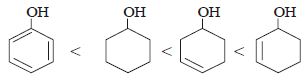
Assertion : The ease of dehydration of the following alcohols is as shown in the image.
Reason : Alcohols leading to conjugated alkenes are dehydrated to a greater extent.
Reason : Alcohols leading to conjugated alkenes are dehydrated to a greater extent.
A
If both Assertion and Reason are correct and the Reason is a correct explanation of the Assertion.
B
If both Assertion and Reason are correct but Reason is not a correct explanation of the Assertion.
C
If the Assertion is correct but Reason is incorrect.
D
If both the Assertion and Reason are incorrect.
Solution
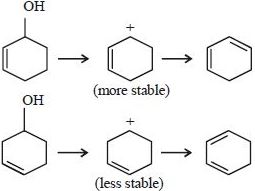
(A) The given order of dehydration is correct due to the following reasons:
$(i)$ Alcohols that lead to the formation of conjugated alkenes are dehydrated more readily because the resulting product is more stable.
$(ii)$ $2-Cyclohexenol$ is dehydrated more easily than $3-cyclohexenol$ because the carbocation formed from the former is stabilized by resonance with the double bond (allylic carbocation),making it more stable than the carbocation from the latter.
$(iii)$ Phenol is not dehydrated under standard conditions due to the high stability of the $C-O$ bond resulting from resonance,which gives it partial double-bond character.
$(i)$ Alcohols that lead to the formation of conjugated alkenes are dehydrated more readily because the resulting product is more stable.
$(ii)$ $2-Cyclohexenol$ is dehydrated more easily than $3-cyclohexenol$ because the carbocation formed from the former is stabilized by resonance with the double bond (allylic carbocation),making it more stable than the carbocation from the latter.
$(iii)$ Phenol is not dehydrated under standard conditions due to the high stability of the $C-O$ bond resulting from resonance,which gives it partial double-bond character.
0 likes
View Solution579
MediumMCQ
$CH_3-C(CH_3)_2-Cl$ $\xrightarrow{NaCN} A$ $\xrightarrow{dil. H_2SO_4} B$. Compound $B$ is:
A
$CH_3-C(CH_3)_2-COOH$
B
$CH_3-C(CH_3)_2-OH$
C
$CH_3-C(CH_3)_2-O-C(CH_3)_3$
D
All the three
Solution
(B) Tertiary alkyl halides like $CH_3-C(CH_3)_2-Cl$ undergo elimination $(E2)$ when treated with $NaCN$ (which acts as a base) to form isobutylene $(CH_2=C(CH_3)_2)$.
Subsequent hydration with $dil. H_2SO_4$ follows Markovnikov's rule to yield tert-butyl alcohol $(CH_3-C(CH_3)_2-OH)$.
Reaction:
$CH_3-C(CH_3)_2-Cl$ $\xrightarrow{NaCN} CH_2=C(CH_3)_2 (A)$ $\xrightarrow{dil. H_2SO_4} CH_3-C(CH_3)_2-OH (B)$
Subsequent hydration with $dil. H_2SO_4$ follows Markovnikov's rule to yield tert-butyl alcohol $(CH_3-C(CH_3)_2-OH)$.
Reaction:
$CH_3-C(CH_3)_2-Cl$ $\xrightarrow{NaCN} CH_2=C(CH_3)_2 (A)$ $\xrightarrow{dil. H_2SO_4} CH_3-C(CH_3)_2-OH (B)$
0 likes
View Solution580
MediumMCQ
When vapours of a secondary alcohol are passed over heated copper at $573 \; K$,the product formed is:
A
a carboxylic acid
B
an aldehyde
C
a ketone
D
an alkene
Solution
(C) When vapours of a secondary alcohol are passed over heated copper at $573 \; K$,dehydrogenation occurs to form a ketone.
Reaction: $CH_3-CH(OH)-CH_3 \xrightarrow{Cu / 573 \; K} CH_3-CO-CH_3 + H_2$
Thus,a $2^o$ alcohol yields a ketone.
Reaction: $CH_3-CH(OH)-CH_3 \xrightarrow{Cu / 573 \; K} CH_3-CO-CH_3 + H_2$
Thus,a $2^o$ alcohol yields a ketone.
0 likes
View Solution581
AdvancedMCQ
Compound $A, C_{8}H_{10}O,$ is found to react with $NaOI$ (produced by reacting $Y$ with $NaOH$) and yields a yellow precipitate with a characteristic smell. $A$ and $Y$ are respectively:
A
$p-Methylbenzyl alcohol$ and $I_2$
B
$Phenylethanol$ and $I_2$
C
$1-Phenylethanol$ and $I_2$
D
$2,4-Dimethylphenol$ and $I_2$
Solution
(C) The haloform reaction is given by compounds containing the $CH_3-CO-$ group or the $CH_3-CH(OH)-$ group.
Compound $A$ with molecular formula $C_8H_{10}O$ that contains the $CH_3-CH(OH)-$ group is $1-phenylethanol$ $(C_6H_5-CH(OH)-CH_3)$.
$NaOI$ is prepared by the reaction of $I_2$ with $NaOH$.
Therefore,$A$ is $1-phenylethanol$ and $Y$ is $I_2$.
Compound $A$ with molecular formula $C_8H_{10}O$ that contains the $CH_3-CH(OH)-$ group is $1-phenylethanol$ $(C_6H_5-CH(OH)-CH_3)$.
$NaOI$ is prepared by the reaction of $I_2$ with $NaOH$.
Therefore,$A$ is $1-phenylethanol$ and $Y$ is $I_2$.
0 likes
View Solution582
MediumMCQ
The compound $A$ on treatment with $Na$ gives $B$,and with $PCl_{5}$ gives $C$. $B$ and $C$ react together to give diethyl ether. $A, B$ and $C$ are in the order
A
$C_{2}H_{5}OH, C_{2}H_{6}, C_{2}H_{5}Cl$
B
$C_{2}H_{5}OH, C_{2}H_{5}Cl, C_{2}H_{5}ONa$
C
$C_{2}H_{5}Cl, C_{2}H_{6}, C_{2}H_{5}OH$
D
$C_{2}H_{5}OH, C_{2}H_{5}ONa, C_{2}H_{5}Cl$
Solution
(D) The reaction sequence is as follows:
$1$. Compound $A$ is ethanol $(C_{2}H_{5}OH)$.
$2$. When $A$ $(C_{2}H_{5}OH)$ reacts with $Na$,it forms sodium ethoxide $(B = C_{2}H_{5}ONa)$.
$3$. When $A$ $(C_{2}H_{5}OH)$ reacts with $PCl_{5}$,it forms ethyl chloride $(C = C_{2}H_{5}Cl)$.
$4$. $B$ $(C_{2}H_{5}ONa)$ and $C$ $(C_{2}H_{5}Cl)$ react via Williamson's synthesis to produce diethyl ether $(C_{2}H_{5}-O-C_{2}H_{5})$.
Therefore,the correct order is $A = C_{2}H_{5}OH, B = C_{2}H_{5}ONa, C = C_{2}H_{5}Cl$.
$1$. Compound $A$ is ethanol $(C_{2}H_{5}OH)$.
$2$. When $A$ $(C_{2}H_{5}OH)$ reacts with $Na$,it forms sodium ethoxide $(B = C_{2}H_{5}ONa)$.
$3$. When $A$ $(C_{2}H_{5}OH)$ reacts with $PCl_{5}$,it forms ethyl chloride $(C = C_{2}H_{5}Cl)$.
$4$. $B$ $(C_{2}H_{5}ONa)$ and $C$ $(C_{2}H_{5}Cl)$ react via Williamson's synthesis to produce diethyl ether $(C_{2}H_{5}-O-C_{2}H_{5})$.
Therefore,the correct order is $A = C_{2}H_{5}OH, B = C_{2}H_{5}ONa, C = C_{2}H_{5}Cl$.
0 likes
View Solution583
AdvancedMCQ
Among the compounds $A$ and $B$ with molecular formula $C_9H_{18}O_3$,$A$ has a higher boiling point than $B$. The possible structures of $A$ and $B$ are
A
$A$ = $1,3,5-$tris(hydroxymethyl)cyclohexane,$B$ = $1,3,5-$trimethoxycyclohexane
B
$A$ = $1,3,5-$trimethoxycyclohexane,$B$ = $3-$($3$,$5$-dihydroxycyclohexyl)propan$-1-$ol
C
$A$ = $1,3,5-$trimethoxycyclohexane,$B$ = $1,3,5-$tris(hydroxymethyl)cyclohexane
D
$A$ = $1,3,5-$tris(hydroxymethyl)cyclohexane,$B$ = $3-$($3$,$5$-dihydroxycyclohexyl)propan$-1-$ol
Solution
(A) The boiling point of a compound depends on the intermolecular forces present.
Alcohols possess $-OH$ groups,which allow for extensive intermolecular hydrogen bonding,leading to significantly higher boiling points compared to ethers,which lack such hydrogen bonding.
Compound $A$ is $1,3,5-\text{tris(hydroxymethyl)cyclohexane}$,which contains three $-OH$ groups,facilitating strong intermolecular hydrogen bonding.
Compound $B$ is $1,3,5-\text{trimethoxycyclohexane}$,which is an ether and lacks hydrogen bonding.
Therefore,$A$ has a higher boiling point than $B$.
Alcohols possess $-OH$ groups,which allow for extensive intermolecular hydrogen bonding,leading to significantly higher boiling points compared to ethers,which lack such hydrogen bonding.
Compound $A$ is $1,3,5-\text{tris(hydroxymethyl)cyclohexane}$,which contains three $-OH$ groups,facilitating strong intermolecular hydrogen bonding.
Compound $B$ is $1,3,5-\text{trimethoxycyclohexane}$,which is an ether and lacks hydrogen bonding.
Therefore,$A$ has a higher boiling point than $B$.
0 likes
View Solution584
Medium
Write the structures of different isomeric alkyl groups corresponding to the molecular formula $C_{5}H_{11}$. Write the $IUPAC$ names of the alcohols obtained by the attachment of $-OH$ groups at different carbons of the chain.
Solution
(N/A)
| Structures of Alcohols | $IUPAC$ Name |
| $(i) \ CH_{3}CH_{2}CH_{2}CH_{2}CH_{2}OH$ | Pentan$-1-$ol |
| $(ii) \ CH_{3}CH(OH)CH_{2}CH_{2}CH_{3}$ | Pentan$-2-$ol |
| $(iii) \ CH_{3}CH_{2}CH(OH)CH_{2}CH_{3}$ | Pentan$-3-$ol |
| $(iv) \ CH_{3}CH(CH_{3})CH_{2}CH_{2}OH$ | $3-$Methylbutan$-1-$ol |
| $(v) \ CH_{3}CH_{2}CH(CH_{3})CH_{2}OH$ | $2-$Methylbutan$-1-$ol |
| $(vi) \ CH_{3}C(OH)(CH_{3})CH_{2}CH_{3}$ | $2-$Methylbutan$-2-$ol |
| $(vii) \ (CH_{3})_{3}CCH_{2}OH$ | $2,2-$Dimethylpropan$-1-$ol |
| $(viii) \ CH_{3}CH(CH_{3})CH(OH)CH_{3}$ | $3-$Methylbutan$-2-$ol |
0 likes
View Solution585
Easy
Amongst the following compounds,identify which are insoluble,partially soluble,and highly soluble in water:
$(i)$ phenol,$(ii)$ toluene,$(iii)$ formic acid,$(iv)$ ethylene glycol,$(v)$ chloroform,$(vi)$ pentanol.
$(i)$ phenol,$(ii)$ toluene,$(iii)$ formic acid,$(iv)$ ethylene glycol,$(v)$ chloroform,$(vi)$ pentanol.
Solution
(N/A) $(i)$ Phenol $(C_{6}H_{5}OH)$ contains a polar $-OH$ group and a non-polar phenyl ring. It is partially soluble in water.
$(ii)$ Toluene $(C_{6}H_{5}CH_{3})$ is a non-polar hydrocarbon. It is insoluble in water.
$(iii)$ Formic acid $(HCOOH)$ can form strong hydrogen bonds with water. It is highly soluble in water.
$(iv)$ Ethylene glycol $(HOCH_{2}CH_{2}OH)$ has two polar $-OH$ groups and forms extensive hydrogen bonds. It is highly soluble in water.
$(v)$ Chloroform $(CHCl_{3})$ is a non-polar organic solvent. It is insoluble in water.
$(vi)$ Pentanol $(C_{5}H_{11}OH)$ has a polar $-OH$ group but a long hydrophobic alkyl chain. It is partially soluble in water.
$(ii)$ Toluene $(C_{6}H_{5}CH_{3})$ is a non-polar hydrocarbon. It is insoluble in water.
$(iii)$ Formic acid $(HCOOH)$ can form strong hydrogen bonds with water. It is highly soluble in water.
$(iv)$ Ethylene glycol $(HOCH_{2}CH_{2}OH)$ has two polar $-OH$ groups and forms extensive hydrogen bonds. It is highly soluble in water.
$(v)$ Chloroform $(CHCl_{3})$ is a non-polar organic solvent. It is insoluble in water.
$(vi)$ Pentanol $(C_{5}H_{11}OH)$ has a polar $-OH$ group but a long hydrophobic alkyl chain. It is partially soluble in water.
0 likes
View Solution586
Easy
Why is sulphuric acid not used during the reaction of alcohols with $KI$?
Solution
(N/A) In the presence of sulphuric acid $(H_2SO_4)$,$KI$ produces $HI$.
$2 KI + H_2SO_4 \longrightarrow 2 KHSO_4 + 2 HI$
Since $H_2SO_4$ is a strong oxidizing agent,it oxidizes the $HI$ produced in the reaction to $I_2$.
$2 HI + H_2SO_4 \longrightarrow I_2 + SO_2 + 2 H_2O$
As a result,the $HI$ required for the conversion of alcohol to alkyl iodide is consumed,and the reaction cannot proceed.
Therefore,sulphuric acid is not used; instead,a non-oxidizing acid such as phosphoric acid $(H_3PO_4)$ is used.
$2 KI + H_2SO_4 \longrightarrow 2 KHSO_4 + 2 HI$
Since $H_2SO_4$ is a strong oxidizing agent,it oxidizes the $HI$ produced in the reaction to $I_2$.
$2 HI + H_2SO_4 \longrightarrow I_2 + SO_2 + 2 H_2O$
As a result,the $HI$ required for the conversion of alcohol to alkyl iodide is consumed,and the reaction cannot proceed.
Therefore,sulphuric acid is not used; instead,a non-oxidizing acid such as phosphoric acid $(H_3PO_4)$ is used.
0 likes
View Solution587
Difficult
Give the structures of the products you would expect when each of the following alcohols reacts with $(a)$ $HCl - ZnCl_{2}$,$(b)$ $HBr$,and $(c)$ $SOCl_{2}$: $(i)$ $Butan-1-ol$,$(ii)$ $2-Methylbutan-2-ol$.
Solution
(N/A) $(i)$ $CH_{3}CH_{2}CH_{2}CH_{2}OH$ (Butan$-1-$ol) $\xrightarrow{HCl + ZnCl_{2}}$ No reaction at room temperature. Primary alcohols do not react with Lucas' reagent at room temperature.
$(ii)$ $CH_{3}CH_{2}C(OH)(CH_{3})_{2}$ ($2$-Methylbutan$-2-$ol,$3^{\circ}$) $\xrightarrow{HCl + ZnCl_{2}}$ $CH_{3}CH_{2}C(Cl)(CH_{3})_{2}$ ($2$-Chloro$-2-$methylbutane) + $H_{2}O$. Tertiary alcohols react immediately with Lucas' reagent to form white turbidity.
$(b)$
$(i)$ $CH_{3}CH_{2}CH_{2}CH_{2}OH + HBr \to CH_{3}CH_{2}CH_{2}CH_{2}Br$ ($1$-Bromobutane) + $H_{2}O$.
$(ii)$ $CH_{3}CH_{2}C(OH)(CH_{3})_{2} + HBr \to CH_{3}CH_{2}C(Br)(CH_{3})_{2}$ ($2$-Bromo$-2-$methylbutane) + $H_{2}O$.
$(c)$
$(i)$ $CH_{3}CH_{2}CH_{2}CH_{2}OH + SOCl_{2} \to CH_{3}CH_{2}CH_{2}CH_{2}Cl$ ($1$-Chlorobutane) + $SO_{2} + HCl$.
$(ii)$ $CH_{3}CH_{2}C(OH)(CH_{3})_{2} + SOCl_{2} \to CH_{3}CH_{2}C(Cl)(CH_{3})_{2}$ ($2$-Chloro$-2-$methylbutane) + $SO_{2} + HCl$.
$(ii)$ $CH_{3}CH_{2}C(OH)(CH_{3})_{2}$ ($2$-Methylbutan$-2-$ol,$3^{\circ}$) $\xrightarrow{HCl + ZnCl_{2}}$ $CH_{3}CH_{2}C(Cl)(CH_{3})_{2}$ ($2$-Chloro$-2-$methylbutane) + $H_{2}O$. Tertiary alcohols react immediately with Lucas' reagent to form white turbidity.
$(b)$
$(i)$ $CH_{3}CH_{2}CH_{2}CH_{2}OH + HBr \to CH_{3}CH_{2}CH_{2}CH_{2}Br$ ($1$-Bromobutane) + $H_{2}O$.
$(ii)$ $CH_{3}CH_{2}C(OH)(CH_{3})_{2} + HBr \to CH_{3}CH_{2}C(Br)(CH_{3})_{2}$ ($2$-Bromo$-2-$methylbutane) + $H_{2}O$.
$(c)$
$(i)$ $CH_{3}CH_{2}CH_{2}CH_{2}OH + SOCl_{2} \to CH_{3}CH_{2}CH_{2}CH_{2}Cl$ ($1$-Chlorobutane) + $SO_{2} + HCl$.
$(ii)$ $CH_{3}CH_{2}C(OH)(CH_{3})_{2} + SOCl_{2} \to CH_{3}CH_{2}C(Cl)(CH_{3})_{2}$ ($2$-Chloro$-2-$methylbutane) + $SO_{2} + HCl$.
0 likes
View Solution588
Medium
Predict the major product of acid-catalyzed dehydration of:
$(i)$ $1$-methylcyclohexanol
$(ii)$ butan-$1$-ol
$(i)$ $1$-methylcyclohexanol
$(ii)$ butan-$1$-ol
Solution
(N/A) $(i)$ Acid-catalyzed dehydration of $1$-methylcyclohexanol proceeds via the formation of a tertiary carbocation. The loss of a proton from the adjacent carbon leads to the formation of $1$-methylcyclohexene as the major product.
$(ii)$ Acid-catalyzed dehydration of butan-$1$-ol proceeds via the formation of a primary carbocation,which undergoes rearrangement to a more stable secondary carbocation. Subsequent loss of a proton yields but-$2$-ene as the major product.
Reaction for $(i)$:
$1$-methylcyclohexanol $\xrightarrow{H^+}$ $1$-methylcyclohexene $+ H_2O$
Reaction for $(ii)$:
$CH_3CH_2CH_2CH_2OH \xrightarrow{H^+} CH_3CH=CHCH_3$ (but-$2$-ene,major product) $+ H_2O$
$(ii)$ Acid-catalyzed dehydration of butan-$1$-ol proceeds via the formation of a primary carbocation,which undergoes rearrangement to a more stable secondary carbocation. Subsequent loss of a proton yields but-$2$-ene as the major product.
Reaction for $(i)$:
$1$-methylcyclohexanol $\xrightarrow{H^+}$ $1$-methylcyclohexene $+ H_2O$
Reaction for $(ii)$:
$CH_3CH_2CH_2CH_2OH \xrightarrow{H^+} CH_3CH=CHCH_3$ (but-$2$-ene,major product) $+ H_2O$
0 likes
View Solution589
Medium
Explain why propanol has a higher boiling point than that of the hydrocarbon,butane?
Solution
(N/A) Propanol $(CH_3CH_2CH_2OH)$ undergoes intermolecular hydrogen bonding due to the presence of the polar $-OH$ group.
On the other hand,butane $(C_4H_{10})$ is a non-polar hydrocarbon and only exhibits weak van der Waals forces.
Because of the strong intermolecular hydrogen bonds in propanol,extra energy is required to overcome these forces during the phase transition.
Therefore,propanol has a significantly higher boiling point than butane.
On the other hand,butane $(C_4H_{10})$ is a non-polar hydrocarbon and only exhibits weak van der Waals forces.
Because of the strong intermolecular hydrogen bonds in propanol,extra energy is required to overcome these forces during the phase transition.
Therefore,propanol has a significantly higher boiling point than butane.
0 likes
View Solution590
Medium
Alcohols are comparatively more soluble in water than hydrocarbons of comparable molecular masses. Explain this fact.
Solution
(N/A) Alcohols are capable of forming intermolecular hydrogen bonds with water molecules due to the presence of the polar $-OH$ group.
In contrast,hydrocarbons are non-polar and cannot form hydrogen bonds with water.
As a result,alcohols are significantly more soluble in water than hydrocarbons of comparable molecular masses.
In contrast,hydrocarbons are non-polar and cannot form hydrogen bonds with water.
As a result,alcohols are significantly more soluble in water than hydrocarbons of comparable molecular masses.

0 likes
View Solution591
Difficult
Write the mechanism of acid dehydration of ethanol to yield ethene.
Solution
(N/A) The mechanism of acid dehydration of ethanol to yield ethene involves the following three steps:
Step $1$: Protonation of ethanol to form ethyl oxonium ion:
$CH_3-CH_2-OH + H^{+} \rightleftharpoons CH_3-CH_2-OH_2^{+}$
Step $2$: Formation of carbocation (rate-determining step):
$CH_3-CH_2-OH_2^{+} \rightarrow CH_3-CH_2^{+} + H_2O$
Step $3$: Elimination of a proton to form ethene:
$CH_3-CH_2^{+} \rightarrow CH_2=CH_2 + H^{+}$
The acid consumed in step $1$ is released in step $3$. After the formation of ethene,it is removed to shift the equilibrium in a forward direction.
Step $1$: Protonation of ethanol to form ethyl oxonium ion:
$CH_3-CH_2-OH + H^{+} \rightleftharpoons CH_3-CH_2-OH_2^{+}$
Step $2$: Formation of carbocation (rate-determining step):
$CH_3-CH_2-OH_2^{+} \rightarrow CH_3-CH_2^{+} + H_2O$
Step $3$: Elimination of a proton to form ethene:
$CH_3-CH_2^{+} \rightarrow CH_2=CH_2 + H^{+}$
The acid consumed in step $1$ is released in step $3$. After the formation of ethene,it is removed to shift the equilibrium in a forward direction.
0 likes
View Solution592
Medium
Name the reagents used in the following reactions:
$(i)$ Oxidation of a primary alcohol to carboxylic acid.
$(ii)$ Oxidation of a primary alcohol to aldehyde.
$(iii)$ Bromination of phenol to $2,4,6-$tribromophenol.
$(iv)$ Benzyl alcohol to benzoic acid.
$(v)$ Dehydration of propan$-2-$ol to propene.
$(vi)$ Butan$-2-$one to butan$-2-$ol.
$(i)$ Oxidation of a primary alcohol to carboxylic acid.
$(ii)$ Oxidation of a primary alcohol to aldehyde.
$(iii)$ Bromination of phenol to $2,4,6-$tribromophenol.
$(iv)$ Benzyl alcohol to benzoic acid.
$(v)$ Dehydration of propan$-2-$ol to propene.
$(vi)$ Butan$-2-$one to butan$-2-$ol.
Solution
(N/A) $(i)$ Acidified potassium permanganate $(KMnO_4/H^+)$ or acidified potassium dichromate $(K_2Cr_2O_7/H^+)$.
$(ii)$ Pyridinium chlorochromate $(PCC)$ in dichloromethane $(CH_2Cl_2)$.
$(iii)$ Bromine water $(Br_2/H_2O)$.
$(iv)$ Acidified potassium permanganate $(KMnO_4/H^+)$.
$(v)$ Concentrated phosphoric acid $(H_3PO_4)$ or concentrated sulfuric acid $(H_2SO_4)$ at $440 \ K$.
$(vi)$ Sodium borohydride $(NaBH_4)$ or Lithium aluminium hydride $(LiAlH_4)$.
$(ii)$ Pyridinium chlorochromate $(PCC)$ in dichloromethane $(CH_2Cl_2)$.
$(iii)$ Bromine water $(Br_2/H_2O)$.
$(iv)$ Acidified potassium permanganate $(KMnO_4/H^+)$.
$(v)$ Concentrated phosphoric acid $(H_3PO_4)$ or concentrated sulfuric acid $(H_2SO_4)$ at $440 \ K$.
$(vi)$ Sodium borohydride $(NaBH_4)$ or Lithium aluminium hydride $(LiAlH_4)$.
0 likes
View Solution593
Medium
Give reason for the higher boiling point of ethanol in comparison to methoxymethane.
Solution
(N/A) Ethanol $(C_2H_5OH)$ undergoes intermolecular hydrogen bonding due to the presence of the polar $-OH$ group,which leads to the association of molecules.
Extra energy is required to break these hydrogen bonds during the phase transition from liquid to gas.
On the other hand,methoxymethane $(CH_3OCH_3)$ is an ether and does not possess an $-OH$ group,so it does not undergo intermolecular hydrogen bonding.
Hence,the boiling point of ethanol is significantly higher than that of methoxymethane.
Extra energy is required to break these hydrogen bonds during the phase transition from liquid to gas.
On the other hand,methoxymethane $(CH_3OCH_3)$ is an ether and does not possess an $-OH$ group,so it does not undergo intermolecular hydrogen bonding.
Hence,the boiling point of ethanol is significantly higher than that of methoxymethane.
0 likes
View Solution594
MediumMCQ
Arrange the following compounds in increasing order of their boiling points:
$CH_3CHO, CH_3CH_2OH, CH_3OCH_3, CH_3CH_2CH_3$
$CH_3CHO, CH_3CH_2OH, CH_3OCH_3, CH_3CH_2CH_3$
A
$CH_3CH_2CH_3 < CH_3OCH_3 < CH_3CHO < CH_3CH_2OH$
B
$CH_3CH_2CH_3 < CH_3CHO < CH_3OCH_3 < CH_3CH_2OH$
C
$CH_3OCH_3 < CH_3CH_2CH_3 < CH_3CHO < CH_3CH_2OH$
D
$CH_3CH_2OH < CH_3CHO < CH_3OCH_3 < CH_3CH_2CH_3$
Solution
(A) The molecular masses of the given compounds are in the range $44$ to $46 \ g/mol$.
$CH_3CH_2OH$ (ethanol) exhibits extensive intermolecular $H$-bonding,leading to molecular association,which results in the highest boiling point.
$CH_3CHO$ (acetaldehyde) is more polar than $CH_3OCH_3$ (methoxy methane),resulting in stronger dipole-dipole interactions.
$CH_3CH_2CH_3$ (propane) is a non-polar alkane with only weak van der Waals forces.
Therefore,the increasing order of boiling points is: $CH_3CH_2CH_3 < CH_3OCH_3 < CH_3CHO < CH_3CH_2OH$.
$CH_3CH_2OH$ (ethanol) exhibits extensive intermolecular $H$-bonding,leading to molecular association,which results in the highest boiling point.
$CH_3CHO$ (acetaldehyde) is more polar than $CH_3OCH_3$ (methoxy methane),resulting in stronger dipole-dipole interactions.
$CH_3CH_2CH_3$ (propane) is a non-polar alkane with only weak van der Waals forces.
Therefore,the increasing order of boiling points is: $CH_3CH_2CH_3 < CH_3OCH_3 < CH_3CHO < CH_3CH_2OH$.
0 likes
View Solution595
Difficult
Explain the intermolecular hydrogen bonding in alcohols and phenols and its effect on their physical properties.
Solution
(N/A) $1$. In alcohols and phenols,the oxygen atom of the $-OH$ group is highly electronegative,which creates a partial negative charge $(\delta^-)$ on the oxygen and a partial positive charge $(\delta^+)$ on the hydrogen atom.
$2$. This polarity leads to the formation of intermolecular hydrogen bonds between the hydrogen atom of one molecule and the oxygen atom of another molecule.
$3$. Effect on Physical Properties: Due to the presence of these intermolecular hydrogen bonds,alcohols and phenols exhibit higher boiling points compared to alkanes,ethers,or haloalkanes of comparable molecular masses.
$4$. Additionally,these hydrogen bonds allow alcohols and phenols to form hydrogen bonds with water molecules,which explains their solubility in water.
$2$. This polarity leads to the formation of intermolecular hydrogen bonds between the hydrogen atom of one molecule and the oxygen atom of another molecule.
$3$. Effect on Physical Properties: Due to the presence of these intermolecular hydrogen bonds,alcohols and phenols exhibit higher boiling points compared to alkanes,ethers,or haloalkanes of comparable molecular masses.
$4$. Additionally,these hydrogen bonds allow alcohols and phenols to form hydrogen bonds with water molecules,which explains their solubility in water.
0 likes
View Solution596
Medium
Explain the effect of an increase in the number of carbon atoms and branching on the boiling points of alcohols and phenols.
Solution
(N/A) The boiling points of alcohols and phenols increase with an increase in the number of carbon atoms due to an increase in the strength of van der Waals forces.
For example,the boiling points follow the order: $CH_3OH < C_2H_5OH < C_3H_7OH < C_4H_9OH$.
In alcohols,as the branching in the carbon chain increases,the boiling point decreases because the surface area decreases,which leads to a decrease in the strength of van der Waals forces.
For example,the boiling points follow the order: $CH_3CH_2CH_2CH_2OH > (CH_3)_2CHCH_2OH > (CH_3)_3COH$.
For example,the boiling points follow the order: $CH_3OH < C_2H_5OH < C_3H_7OH < C_4H_9OH$.
In alcohols,as the branching in the carbon chain increases,the boiling point decreases because the surface area decreases,which leads to a decrease in the strength of van der Waals forces.
For example,the boiling points follow the order: $CH_3CH_2CH_2CH_2OH > (CH_3)_2CHCH_2OH > (CH_3)_3COH$.
0 likes
View Solution597
Medium
Write about the solubility of alcohols and phenols in water.
Solution
(N/A) The solubility of alcohols and phenols in water is due to their ability to form hydrogen bonds with water molecules.
The solubility of alcohols and phenols decreases as the size of the alkyl or aryl group increases.
Lower molecular weight alcohols are miscible with water in all proportions. The solubility increases with an increase in the number of $-OH$ groups.
The solubility of alcohols and phenols decreases as the size of the alkyl or aryl group increases.
Lower molecular weight alcohols are miscible with water in all proportions. The solubility increases with an increase in the number of $-OH$ groups.
0 likes
View Solution598
Difficult
Explain the types of reactions given by alcohol compounds with examples.
Solution
(N/A) Alcohol compounds exhibit three main types of reactions:
$1$. Reactions involving the cleavage of $O-H$ bond: In these reactions,alcohols act as nucleophiles. For example,the reaction of alcohols with carboxylic acids,acid chlorides,or acid anhydrides to form esters.
$R-OH + R'COOH \xrightarrow{H^+} R-COOR' + H_2O$
$2$. Reactions involving the cleavage of $C-O$ bond: In these reactions,the $C-O$ bond breaks,and the alcohol acts as an electrophile. For example,the reaction with hydrogen halides $(HX)$ to form alkyl halides.
$R-OH + HX \rightarrow R-X + H_2O$
$3$. Reactions involving both alkyl and hydroxyl groups (Oxidation and Dehydrogenation): These reactions involve the cleavage of both $O-H$ and $C-H$ bonds. For example,the oxidation of primary alcohols to aldehydes and then to carboxylic acids.
$R-CH_2OH$ $\xrightarrow{[O]} R-CHO$ $\xrightarrow{[O]} R-COOH$
$1$. Reactions involving the cleavage of $O-H$ bond: In these reactions,alcohols act as nucleophiles. For example,the reaction of alcohols with carboxylic acids,acid chlorides,or acid anhydrides to form esters.
$R-OH + R'COOH \xrightarrow{H^+} R-COOR' + H_2O$
$2$. Reactions involving the cleavage of $C-O$ bond: In these reactions,the $C-O$ bond breaks,and the alcohol acts as an electrophile. For example,the reaction with hydrogen halides $(HX)$ to form alkyl halides.
$R-OH + HX \rightarrow R-X + H_2O$
$3$. Reactions involving both alkyl and hydroxyl groups (Oxidation and Dehydrogenation): These reactions involve the cleavage of both $O-H$ and $C-H$ bonds. For example,the oxidation of primary alcohols to aldehydes and then to carboxylic acids.
$R-CH_2OH$ $\xrightarrow{[O]} R-CHO$ $\xrightarrow{[O]} R-COOH$
0 likes
View Solution599
Medium
Explain the acidic nature and acidity of alcohols by describing their reactions with active metals.
Solution
(N/A) Reaction of alcohols with active metals: Like water,alcohols react with active metals such as $Li, Na, K, Al$ to form corresponding alkoxides with the evolution of hydrogen gas. Examples are as follows:
$2 ROH + 2 Na \longrightarrow 2 R-O-Na + H_2(g)$
$2 CH_3OH + 2 Na \longrightarrow 2 CH_3ONa + H_2(g)$
$2 CH_3CH_2OH + Mg \longrightarrow (CH_3CH_2O)_2Mg + H_2(g)$
$6 (CH_3)_3C-OH + 2 Al \longrightarrow 2 [(CH_3)_3C-O]_3Al + 3 H_2(g)$
These reactions involve the cleavage of the $O-H$ bond.
$(b)$ Acidic nature of alcohols: The above reactions show that alcohols are acidic in nature. In fact,alcohols are $Br\ddot{o}nsted$ acids and can donate a proton to a strong base $(B:)$.
$B: + H-\ddot{O}-R \longrightarrow B-H + :\ddot{O}-R^-$
$2 ROH + 2 Na \longrightarrow 2 R-O-Na + H_2(g)$
$2 CH_3OH + 2 Na \longrightarrow 2 CH_3ONa + H_2(g)$
$2 CH_3CH_2OH + Mg \longrightarrow (CH_3CH_2O)_2Mg + H_2(g)$
$6 (CH_3)_3C-OH + 2 Al \longrightarrow 2 [(CH_3)_3C-O]_3Al + 3 H_2(g)$
These reactions involve the cleavage of the $O-H$ bond.
$(b)$ Acidic nature of alcohols: The above reactions show that alcohols are acidic in nature. In fact,alcohols are $Br\ddot{o}nsted$ acids and can donate a proton to a strong base $(B:)$.
$B: + H-\ddot{O}-R \longrightarrow B-H + :\ddot{O}-R^-$
0 likes
View SolutionAlcohols, Phenols and Ethers — Properties of alcohol · Frequently Asked Questions
1Are these Alcohols, Phenols and Ethers questions useful for JEE and NEET?
Yes. All questions in this section are mapped to JEE Main and NEET exam patterns. Previous year questions from JEE Main, NEET, GUJCET and state-level exams are included with full solutions.
2Can I switch to Hindi or Gujarati for these questions?
Yes. Use the language tabs in the hero section or the sidebar to view the same questions and solutions in English, Hindi or Gujarati.
3How do I generate a question paper from this subtopic?
Use the Vedclass Exam Paper Generator — select the chapter and subtopic, set difficulty, and generate Sets A, B, C, D automatically. First 3 chapters of every subject are free.
Vedclass Products
For Students
Vedclass Test Series
Mock tests in real JEE/NEET style with performance analysis. 5-day free trial.
Start Free TrialFor Teachers
Exam Paper Generator
Generate Set A/B/C/D papers from this chapter in 2 minutes. 3 chapters free.
Try FreeFor Institutes
Online Exam Module
Live online exams with unlimited students, 360° analytics & white-label branding.
See DemoFor Teachers & Institutes
Generate a Alcohols, Phenols and Ethers Exam Paper in 2 Minutes
Select subtopic & difficulty — Sets A, B, C, D auto-generated with No Repeat logic.
First 3 chapters of every subject are free — no payment required.