
A English
Properties of alcohol Questions in English
Class 12 Chemistry · Alcohols, Phenols and Ethers · Properties of alcohol
889+
Questions
English
Language
100%
With Solutions
Showing 50 of 889 questions in English
351
DifficultMCQ
$CH_3MgBr + \text{Cyclopentanone}$ $\xrightarrow{H_3O^{+}} A$ $\xrightarrow{HBr} B$ $\xrightarrow{Mg/\text{ether}} C$ $\xrightarrow{HCHO}_{H_3O^{+}} D$ $\xrightarrow{HI} E$
$E$ is
$E$ is
A
$1-$iodo$-1-$methylcyclopentane
B
$1-$iodo$-1-$ethylcyclopentane
C
$1-$iodo$-2-$methylcyclohexane
D
$1-$iodo$-1-$methylcyclohexane
Solution
(A) $1$. $CH_3MgBr$ reacts with cyclopentanone followed by $H_3O^{+}$ to form $1-$methylcyclopentanol $(A)$.
$2$. $1-$methylcyclopentanol $(A)$ reacts with $HBr$ to form $1-$bromo$-1-$methylcyclopentane $(B)$.
$3$. $1-$bromo$-1-$methylcyclopentane $(B)$ reacts with $Mg/\text{ether}$ to form the Grignard reagent,$1$-methylcyclopentylmagnesium bromide $(C)$.
$4$. The Grignard reagent $(C)$ reacts with formaldehyde $(HCHO)$ followed by $H_3O^{+}$ to form ($1$-methylcyclopentyl)methanol $(D)$.
$5$. ($1$-methylcyclopentyl)methanol $(D)$ reacts with $HI$ to form $1-$(iodomethyl)$-1-$methylcyclopentane $(E)$.
Note: Based on the provided options,the reaction sequence leads to a structure where the methyl group and the iodomethyl group are on the same carbon of the cyclopentane ring. Option $A$ represents $1-$iodo$-1-$methylcyclopentane,which is the product of the first substitution step $(B)$. Re-evaluating the options provided,the structure in option $A$ is the most chemically consistent with the intermediate $B$.
$2$. $1-$methylcyclopentanol $(A)$ reacts with $HBr$ to form $1-$bromo$-1-$methylcyclopentane $(B)$.
$3$. $1-$bromo$-1-$methylcyclopentane $(B)$ reacts with $Mg/\text{ether}$ to form the Grignard reagent,$1$-methylcyclopentylmagnesium bromide $(C)$.
$4$. The Grignard reagent $(C)$ reacts with formaldehyde $(HCHO)$ followed by $H_3O^{+}$ to form ($1$-methylcyclopentyl)methanol $(D)$.
$5$. ($1$-methylcyclopentyl)methanol $(D)$ reacts with $HI$ to form $1-$(iodomethyl)$-1-$methylcyclopentane $(E)$.
Note: Based on the provided options,the reaction sequence leads to a structure where the methyl group and the iodomethyl group are on the same carbon of the cyclopentane ring. Option $A$ represents $1-$iodo$-1-$methylcyclopentane,which is the product of the first substitution step $(B)$. Re-evaluating the options provided,the structure in option $A$ is the most chemically consistent with the intermediate $B$.
0 likes
View Solution352
DifficultMCQ
What is the major product of the following reaction?
$HO-CH_2-CH_2-CH_2-CH_2-Cl \xrightarrow{Alc. KOH} ?$
$HO-CH_2-CH_2-CH_2-CH_2-Cl \xrightarrow{Alc. KOH} ?$
A
$HO-CH_2-CH_2-CH_2-CH_2-OH$
B
$HO-CH_2-CH_2-CH=CH_2$
C
$HO-CH_2-CH=CH-CH_3$
D
Tetrahydrofuran
Solution
(D) The reactant is $4$-chlorobutan-$1$-ol $(HO-CH_2-CH_2-CH_2-CH_2-Cl)$.
When treated with alcoholic $KOH$,which is a strong base,an intramolecular nucleophilic substitution reaction occurs.
The hydroxyl group $(-OH)$ is deprotonated by the base to form an alkoxide ion $(-O^-)$.
This alkoxide ion then attacks the carbon atom bonded to the chlorine atom,leading to the displacement of the chloride ion $(Cl^-)$ via an intramolecular $S_N2$ mechanism.
This results in the formation of a five-membered cyclic ether,which is tetrahydrofuran.
When treated with alcoholic $KOH$,which is a strong base,an intramolecular nucleophilic substitution reaction occurs.
The hydroxyl group $(-OH)$ is deprotonated by the base to form an alkoxide ion $(-O^-)$.
This alkoxide ion then attacks the carbon atom bonded to the chlorine atom,leading to the displacement of the chloride ion $(Cl^-)$ via an intramolecular $S_N2$ mechanism.
This results in the formation of a five-membered cyclic ether,which is tetrahydrofuran.
0 likes
View Solution353
DifficultMCQ
The product obtained in the reaction is:
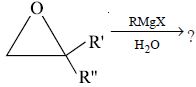
A
$R-CH_2-C(R')(R'')-OH$
B
$R-CH_2-CH_2-OH$
C
$R-C(R')(R'')-CH_2OH$
D
$R-CH(OH)-CH_2-R'$
Solution
(A) The reaction involves the nucleophilic attack of the Grignard reagent $RMgX$ on the less hindered carbon atom of the epoxide ring.
In the given epoxide,the carbon atom with $R'$ and $R''$ substituents is more sterically hindered.
Therefore,the nucleophile $R^-$ attacks the less substituted carbon atom (the $CH_2$ group).
This leads to the ring opening,followed by protonation with $H_2O$ to form the primary alcohol: $R-CH_2-C(R')(R'')-OH$.
In the given epoxide,the carbon atom with $R'$ and $R''$ substituents is more sterically hindered.
Therefore,the nucleophile $R^-$ attacks the less substituted carbon atom (the $CH_2$ group).
This leads to the ring opening,followed by protonation with $H_2O$ to form the primary alcohol: $R-CH_2-C(R')(R'')-OH$.
0 likes
View Solution354
MediumMCQ
$CH_2=CH-CH(OH)-CH_2-CH_2OH \xrightarrow{MnO_2} A$. $A$ is:
A
$CH_2=CH-C(=O)-CH_2-CH_2OH$
B
$CH_2=CH-CH(OH)-CH_2-CHO$
C
$CH_2=CH-C(=O)-CH_2-CHO$
D
$CH_2=CH-C(=O)-CH_2-COOH$
Solution
(A) $MnO_2$ is a selective oxidizing agent that specifically oxidizes allylic and benzylic alcohols to their corresponding aldehydes or ketones,while leaving saturated alcohols unaffected.
In the given molecule,the secondary alcohol group at the third carbon is allylic $(CH_2=CH-CH(OH)-)$,whereas the primary alcohol group at the end is saturated.
Therefore,only the allylic alcohol is oxidized to a ketone group $(C=O)$.
$CH_2=CH-CH(OH)-CH_2-CH_2OH \xrightarrow{MnO_2} CH_2=CH-C(=O)-CH_2-CH_2OH$
In the given molecule,the secondary alcohol group at the third carbon is allylic $(CH_2=CH-CH(OH)-)$,whereas the primary alcohol group at the end is saturated.
Therefore,only the allylic alcohol is oxidized to a ketone group $(C=O)$.
$CH_2=CH-CH(OH)-CH_2-CH_2OH \xrightarrow{MnO_2} CH_2=CH-C(=O)-CH_2-CH_2OH$
0 likes
View Solution355
AdvancedMCQ
The product$(s)$ not obtained in the following reaction is:
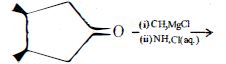
A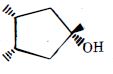
B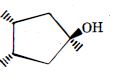
C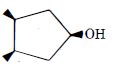
D
None of these.
Solution
(D) The reaction involves the nucleophilic attack of the Grignard reagent $(CH_3MgCl)$ on the carbonyl carbon of the cyclopentanone derivative. The methyl group can attack the carbonyl carbon from either the top or the bottom face of the planar carbonyl group. Since the two methyl groups on the ring are on the same side (cis-configuration),the approach of the $CH_3^-$ nucleophile is not equally hindered from both sides due to the steric effect of the existing methyl groups. However,in such reactions,both stereoisomers (where $-OH$ is cis or trans to the methyl groups) are typically formed as a mixture. The question asks for the product $NOT$ obtained. Since both stereoisomers are formed,all options provided as potential products are actually obtained. Therefore,the correct answer is that none of the listed products are 'not obtained'.
0 likes
View Solution356
DifficultMCQ
Which of the following gives a blue color on reaction with $P + I_2$,followed by $AgNO_2$,$HNO_2$,and finally $NaOH$?
A
$CH_3-CH_2-OH$
B
$CH_3-CH(OH)-CH_2-CH_3$
C
$CH_3-C(CH_3)(OH)-CH_3$
D
$CH_3-OH$
Solution
(B) The sequence of reactions described is the $Victor \ Meyer's \ test$,used to distinguish between primary,secondary,and tertiary alcohols.
$1.$ Primary alcohols $(1^\circ)$ give a blood-red color.
$2.$ Secondary alcohols $(2^\circ)$ give a blue color.
$3.$ Tertiary alcohols $(3^\circ)$ give no color (remain colorless).
Among the given options,$CH_3-CH(OH)-CH_2-CH_3$ (Butan-$2$-ol) is a secondary alcohol,therefore it produces a blue color.
$1.$ Primary alcohols $(1^\circ)$ give a blood-red color.
$2.$ Secondary alcohols $(2^\circ)$ give a blue color.
$3.$ Tertiary alcohols $(3^\circ)$ give no color (remain colorless).
Among the given options,$CH_3-CH(OH)-CH_2-CH_3$ (Butan-$2$-ol) is a secondary alcohol,therefore it produces a blue color.
0 likes
View Solution357
MediumMCQ
Which of the following will give a blue color during Victor Mayer's test?
A
$tert$-butyl alcohol
B
Phenol
C
Propan-$1$-ol
D
None of these
Solution
(D) Victor Mayer's test is used to distinguish between primary,secondary,and tertiary alcohols.
$1$. Primary $(1^{\circ})$ alcohols give a red color.
$2$. Secondary $(2^{\circ})$ alcohols give a blue color.
$3$. Tertiary $(3^{\circ})$ alcohols give no color (colorless).
Let's analyze the options:
- Option $A$: $tert$-butyl alcohol is a tertiary alcohol,so it gives no color.
- Option $B$: Phenol is not an aliphatic alcohol and does not undergo the Victor Mayer's test.
- Option $C$: Propan-$1$-ol is a primary alcohol,so it gives a red color.
Since none of the given options are secondary alcohols,the correct answer is 'None of these'.
$1$. Primary $(1^{\circ})$ alcohols give a red color.
$2$. Secondary $(2^{\circ})$ alcohols give a blue color.
$3$. Tertiary $(3^{\circ})$ alcohols give no color (colorless).
Let's analyze the options:
- Option $A$: $tert$-butyl alcohol is a tertiary alcohol,so it gives no color.
- Option $B$: Phenol is not an aliphatic alcohol and does not undergo the Victor Mayer's test.
- Option $C$: Propan-$1$-ol is a primary alcohol,so it gives a red color.
Since none of the given options are secondary alcohols,the correct answer is 'None of these'.
0 likes
View Solution358
DifficultMCQ
In the esterification reaction of $p$-toluic acid with methanol $(CH_3^{18}OH)$,the product $A$ is:
A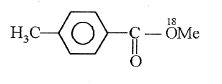
B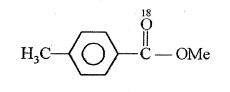
C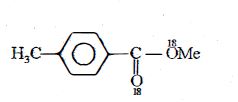
D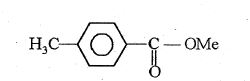
Solution
(A) The esterification of a carboxylic acid with an alcohol proceeds via an $A_{AC}2$ mechanism.
In this mechanism,the alcohol acts as a nucleophile and attacks the carbonyl carbon of the protonated carboxylic acid.
The bond between the acyl carbon and the hydroxyl group of the acid is cleaved,and the oxygen atom from the alcohol is incorporated into the ester.
Therefore,when $p$-toluic acid reacts with methanol labeled with $^{18}O$ $(CH_3^{18}OH)$,the $^{18}O$ atom ends up in the alkoxy part of the ester,forming $p-CH_3-C_6H_4-CO-^{18}OCH_3$.
In this mechanism,the alcohol acts as a nucleophile and attacks the carbonyl carbon of the protonated carboxylic acid.
The bond between the acyl carbon and the hydroxyl group of the acid is cleaved,and the oxygen atom from the alcohol is incorporated into the ester.
Therefore,when $p$-toluic acid reacts with methanol labeled with $^{18}O$ $(CH_3^{18}OH)$,the $^{18}O$ atom ends up in the alkoxy part of the ester,forming $p-CH_3-C_6H_4-CO-^{18}OCH_3$.
0 likes
View Solution359
DifficultMCQ
The final product $(III)$ is

A
Epoxycyclohexane
B
$2-$Chlorocyclohexanol
C
$(\pm)-$Cis$-1,2-$cyclohexanediol
D
Trans$-1,2-$cyclohexanediol
Solution
(D) The reaction sequence is as follows:
$1$. Cyclohexene reacts with $HOCl$ (hypochlorous acid) to form $2-$chlorocyclohexanol $(I)$ via electrophilic addition.
$2$. Treatment of $2-$chlorocyclohexanol $(I)$ with dilute $NaOH$ causes an intramolecular $S_N2$ reaction,leading to the formation of an epoxide,specifically epoxycyclohexane $(II)$.
$3$. Acid-catalyzed ring opening of the epoxide $(II)$ with dilute $H_2SO_4$ proceeds via an $S_N2$-like mechanism,resulting in the formation of trans$-1,2-$cyclohexanediol $(III)$.
$1$. Cyclohexene reacts with $HOCl$ (hypochlorous acid) to form $2-$chlorocyclohexanol $(I)$ via electrophilic addition.
$2$. Treatment of $2-$chlorocyclohexanol $(I)$ with dilute $NaOH$ causes an intramolecular $S_N2$ reaction,leading to the formation of an epoxide,specifically epoxycyclohexane $(II)$.
$3$. Acid-catalyzed ring opening of the epoxide $(II)$ with dilute $H_2SO_4$ proceeds via an $S_N2$-like mechanism,resulting in the formation of trans$-1,2-$cyclohexanediol $(III)$.
0 likes
View Solution360
MediumMCQ
Which of the following orders is correct regarding the boiling point?
A
$n-C_4H_9OH > n-C_4H_9NH_2 > (C_2H_5)_2NH > C_2H_5N(CH_3)_2 > C_2H_5CH(CH_3)_2$
B
Propan$-1-$ol > Propanal > Acetone > Methoxy ethane > $n-$butane
C
Pentan$-1-$ol > Butan$-2-$ol > Butan$-1-$ol > Ethanol > Methanol
D
$CHCl_3 > CH_2Cl_2 > CCl_4$
Solution
(A) The boiling point depends on intermolecular forces such as hydrogen bonding,dipole-dipole interactions,and London dispersion forces.
$1$. $n-C_4H_9OH$ (primary alcohol) has strong intermolecular hydrogen bonding.
$2$. $n-C_4H_9NH_2$ (primary amine) has hydrogen bonding,but it is weaker than in alcohols due to the lower electronegativity of $N$ compared to $O$.
$3$. $(C_2H_5)_2NH$ (secondary amine) has fewer hydrogen bonds than primary amines due to steric hindrance.
$4$. $C_2H_5N(CH_3)_2$ (tertiary amine) lacks hydrogen bonding.
$5$. $C_2H_5CH(CH_3)_2$ (alkane) has only weak London dispersion forces.
Therefore,the order $n-C_4H_9OH > n-C_4H_9NH_2 > (C_2H_5)_2NH > C_2H_5N(CH_3)_2 > C_2H_5CH(CH_3)_2$ is correct.
$1$. $n-C_4H_9OH$ (primary alcohol) has strong intermolecular hydrogen bonding.
$2$. $n-C_4H_9NH_2$ (primary amine) has hydrogen bonding,but it is weaker than in alcohols due to the lower electronegativity of $N$ compared to $O$.
$3$. $(C_2H_5)_2NH$ (secondary amine) has fewer hydrogen bonds than primary amines due to steric hindrance.
$4$. $C_2H_5N(CH_3)_2$ (tertiary amine) lacks hydrogen bonding.
$5$. $C_2H_5CH(CH_3)_2$ (alkane) has only weak London dispersion forces.
Therefore,the order $n-C_4H_9OH > n-C_4H_9NH_2 > (C_2H_5)_2NH > C_2H_5N(CH_3)_2 > C_2H_5CH(CH_3)_2$ is correct.
0 likes
View Solution361
DifficultMCQ
Which of the following hydroxy ethers gives a $+ve$ test with Tollen's reagent?
A
$3-$hydroxytetrahydropyran
B
$2-$methyl$-2-$hydroxytetrahydropyran
C
$2-$hydroxymethyltetrahydropyran
D
$CH_3-CH(OH)-OCH_3$
Solution
(B) The correct answer is $(b)$.
$2$-methyl-$2$-hydroxytetrahydropyran is a cyclic hemiacetal.
Hemiacetals are in equilibrium with their corresponding aldehydes (or ketones) in aqueous solution.
Since aldehydes reduce Tollen's reagent to metallic silver,cyclic hemiacetals that can open to form an aldehyde group will give a positive Tollen's test.
In the case of $2$-methyl-$2$-hydroxytetrahydropyran,the ring opens to form a hydroxy-ketone,but hemiacetals derived from aldehydes (like $CH_3-CH(OH)-OCH_3$) are more commonly cited for this test. However,among the given options,the structure in $(b)$ represents a hemiacetal functional group which is in equilibrium with the open-chain form containing a carbonyl group,allowing it to react with Tollen's reagent.
$2$-methyl-$2$-hydroxytetrahydropyran is a cyclic hemiacetal.
Hemiacetals are in equilibrium with their corresponding aldehydes (or ketones) in aqueous solution.
Since aldehydes reduce Tollen's reagent to metallic silver,cyclic hemiacetals that can open to form an aldehyde group will give a positive Tollen's test.
In the case of $2$-methyl-$2$-hydroxytetrahydropyran,the ring opens to form a hydroxy-ketone,but hemiacetals derived from aldehydes (like $CH_3-CH(OH)-OCH_3$) are more commonly cited for this test. However,among the given options,the structure in $(b)$ represents a hemiacetal functional group which is in equilibrium with the open-chain form containing a carbonyl group,allowing it to react with Tollen's reagent.
0 likes
View Solution362
DifficultMCQ
Arrange the following alcohols in the decreasing order of their rate of dehydration via the $S_{N}1$ mechanism:
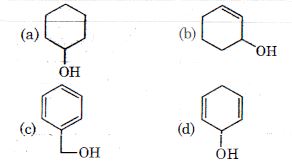
A
$a > b > c > d$
B
$c > d > b > a$
C
$d > c > b > a$
D
$a > c > d > b$
Solution
(C) The rate of dehydration of alcohols via the $S_{N}1$ mechanism depends on the stability of the carbocation intermediate formed after the loss of water.
$(a)$ Cyclohexanol forms a secondary $(2^{\circ})$ carbocation.
$(b)$ Cyclohex$-2-$en$-1-$ol forms a resonance-stabilized allylic carbocation.
$(c)$ Benzyl alcohol forms a highly stable resonance-stabilized benzylic carbocation.
$(d)$ Cyclohexa$-2,5-$dien$-1-$ol forms a highly stable resonance-stabilized carbocation due to conjugation with two double bonds.
Comparing the stability: The carbocation from $(d)$ is most stable due to extended conjugation,followed by $(c)$ (benzylic),then $(b)$ (allylic),and $(a)$ (secondary alkyl) is the least stable.
Therefore,the order of dehydration rate is $d > c > b > a$.
$(a)$ Cyclohexanol forms a secondary $(2^{\circ})$ carbocation.
$(b)$ Cyclohex$-2-$en$-1-$ol forms a resonance-stabilized allylic carbocation.
$(c)$ Benzyl alcohol forms a highly stable resonance-stabilized benzylic carbocation.
$(d)$ Cyclohexa$-2,5-$dien$-1-$ol forms a highly stable resonance-stabilized carbocation due to conjugation with two double bonds.
Comparing the stability: The carbocation from $(d)$ is most stable due to extended conjugation,followed by $(c)$ (benzylic),then $(b)$ (allylic),and $(a)$ (secondary alkyl) is the least stable.
Therefore,the order of dehydration rate is $d > c > b > a$.
0 likes
View Solution363
DifficultMCQ
Which of the following will not produce $CH_4$ gas when reacted with $CH_3MgBr$?
A
Benzenesulfonic acid $(C_6H_5SO_3H)$
B
$CH_3NH_2$
C
$CH_3CH_2OH$
D
$1,4-$Pentadiene $(CH_2=CH-CH_2-CH=CH_2)$
Solution
(D) $CH_3MgBr$ is a Grignard reagent which acts as a strong base. It reacts with compounds containing acidic hydrogen atoms (like $-OH$,$-NH_2$,$-SH$,$-COOH$,$-SO_3H$) to produce methane $(CH_4)$ gas.
$1.$ $C_6H_5SO_3H + CH_3MgBr \rightarrow C_6H_5SO_3MgBr + CH_4 \uparrow$
$2.$ $CH_3NH_2 + CH_3MgBr \rightarrow CH_3NHMgBr + CH_4 \uparrow$
$3.$ $CH_3CH_2OH + CH_3MgBr \rightarrow CH_3CH_2OMgBr + CH_4 \uparrow$
In $CH_2=CH-CH_2-CH=CH_2$ ($1$,$4$-pentadiene),the hydrogen atoms attached to $sp^2$ hybridized carbons are not acidic enough to react with $CH_3MgBr$ to produce $CH_4$. Therefore,it will not produce $CH_4$ gas.
$1.$ $C_6H_5SO_3H + CH_3MgBr \rightarrow C_6H_5SO_3MgBr + CH_4 \uparrow$
$2.$ $CH_3NH_2 + CH_3MgBr \rightarrow CH_3NHMgBr + CH_4 \uparrow$
$3.$ $CH_3CH_2OH + CH_3MgBr \rightarrow CH_3CH_2OMgBr + CH_4 \uparrow$
In $CH_2=CH-CH_2-CH=CH_2$ ($1$,$4$-pentadiene),the hydrogen atoms attached to $sp^2$ hybridized carbons are not acidic enough to react with $CH_3MgBr$ to produce $CH_4$. Therefore,it will not produce $CH_4$ gas.
0 likes
View Solution364
DifficultMCQ
Consider the following reaction sequence:
$C_6H_5-CH=CH-CHO$ $\xrightarrow[35^{\circ}C]{LiAlH_4} A$ $\xrightarrow[Excess]{CH_3MgBr} B$
Identify $B$ in the reaction.
$C_6H_5-CH=CH-CHO$ $\xrightarrow[35^{\circ}C]{LiAlH_4} A$ $\xrightarrow[Excess]{CH_3MgBr} B$
Identify $B$ in the reaction.
A
$C_6H_5-CH_2-CH_2-CHO$
B
$C_6H_5-CH_2-CH_2-CH_2OH$
C
$C_6H_5-CH=CH-CH_2OH$
D
$CH_4$
Solution
(D) $1$. The starting material is cinnamaldehyde $(C_6H_5-CH=CH-CHO)$.
$2$. Treatment with $LiAlH_4$ at $35^{\circ}C$ reduces both the aldehyde group and the carbon-carbon double bond to give $3-$phenylpropan$-1-$ol $(A = C_6H_5-CH_2-CH_2-CH_2OH)$.
$3$. When $A$ is treated with excess $CH_3MgBr$,the Grignard reagent acts as a base and reacts with the acidic hydroxyl group $(-OH)$ of the alcohol to form an alkoxide and methane gas $(CH_4)$.
$4$. The reaction is: $C_6H_5-CH_2-CH_2-CH_2OH + CH_3MgBr \rightarrow C_6H_5-CH_2-CH_2-CH_2OMgBr + CH_4$.
$5$. Thus,$B$ is $CH_4$.
$2$. Treatment with $LiAlH_4$ at $35^{\circ}C$ reduces both the aldehyde group and the carbon-carbon double bond to give $3-$phenylpropan$-1-$ol $(A = C_6H_5-CH_2-CH_2-CH_2OH)$.
$3$. When $A$ is treated with excess $CH_3MgBr$,the Grignard reagent acts as a base and reacts with the acidic hydroxyl group $(-OH)$ of the alcohol to form an alkoxide and methane gas $(CH_4)$.
$4$. The reaction is: $C_6H_5-CH_2-CH_2-CH_2OH + CH_3MgBr \rightarrow C_6H_5-CH_2-CH_2-CH_2OMgBr + CH_4$.
$5$. Thus,$B$ is $CH_4$.
0 likes
View Solution365
MediumMCQ
Select the correct statement regarding acid-catalysed dehydration of $tert$-butyl alcohol.
A
The first step involves slow and irreversible protonation of the hydroxyl group.
B
Two different alkenes are obtained.
C
Overall it is a $3$-step reaction where the $2^{nd}$ step is the rate-determining step.
D
$HI$ can be used for dehydration of $tert$-butyl alcohol.
Solution
(C) The acid-catalysed dehydration of $tert$-butyl alcohol follows an $E1$ mechanism.
Step $1$: Protonation of the hydroxyl group to form an alkyloxonium ion. This is a fast and reversible step.
Step $2$: Loss of a water molecule to form a $tert$-butyl carbocation. This is the slow and rate-determining step.
Step $3$: Loss of a proton from the carbocation to form $2$-methylpropene (isobutylene). This is a fast step.
Since the carbocation formed is symmetric,only one alkene ($2$-methylpropene) is obtained.
Therefore,the correct statement is that it is a $3$-step reaction where the $2^{nd}$ step is the rate-determining step.
Step $1$: Protonation of the hydroxyl group to form an alkyloxonium ion. This is a fast and reversible step.
Step $2$: Loss of a water molecule to form a $tert$-butyl carbocation. This is the slow and rate-determining step.
Step $3$: Loss of a proton from the carbocation to form $2$-methylpropene (isobutylene). This is a fast step.
Since the carbocation formed is symmetric,only one alkene ($2$-methylpropene) is obtained.
Therefore,the correct statement is that it is a $3$-step reaction where the $2^{nd}$ step is the rate-determining step.
0 likes
View Solution366
DifficultMCQ
An alcohol having molecular weight $74$ gives white turbidity with Lucas reagent within $5-10$ minutes. It reacts with sodium metal to give $Y$. $Y$ reacts with $CH_3-Br$ to give $Z$. $Z$ is:
A
$CH_3-C(CH_3)_2-OCH_3$
B
$CH_3-CH_2-CH_2-CH_2-OCH_3$
C
$CH_3-CH(OCH_3)-CH_2-CH_3$
D
$CH_3-C(OCH_3)=CH-CH_3$
Solution
(C) The molecular weight $74$ corresponds to the formula $C_4H_{10}O$ $(12 \times 4 + 10 \times 1 + 16 = 74)$.
Lucas reagent giving white turbidity in $5-10$ minutes indicates that the alcohol is a secondary $(2^\circ)$ alcohol.
The only secondary alcohol with this formula is butan-$2$-ol $(CH_3-CH(OH)-CH_2-CH_3)$.
Reaction with $Na$:
$CH_3-CH(OH)-CH_2-CH_3 + Na \rightarrow CH_3-CH(ONa)-CH_2-CH_3$ $(Y)$ $+ 1/2 H_2$.
Reaction with $CH_3-Br$ (Williamson synthesis):
$CH_3-CH(ONa)-CH_2-CH_3 + CH_3-Br \rightarrow CH_3-CH(OCH_3)-CH_2-CH_3$ $(Z)$ $+ NaBr$.
Thus,$Z$ is $2$-methoxybutane.
Lucas reagent giving white turbidity in $5-10$ minutes indicates that the alcohol is a secondary $(2^\circ)$ alcohol.
The only secondary alcohol with this formula is butan-$2$-ol $(CH_3-CH(OH)-CH_2-CH_3)$.
Reaction with $Na$:
$CH_3-CH(OH)-CH_2-CH_3 + Na \rightarrow CH_3-CH(ONa)-CH_2-CH_3$ $(Y)$ $+ 1/2 H_2$.
Reaction with $CH_3-Br$ (Williamson synthesis):
$CH_3-CH(ONa)-CH_2-CH_3 + CH_3-Br \rightarrow CH_3-CH(OCH_3)-CH_2-CH_3$ $(Z)$ $+ NaBr$.
Thus,$Z$ is $2$-methoxybutane.
0 likes
View Solution367
MediumMCQ
The number of primary alcohols possible with the formula $C_4H_{10}O$ is :-
A
$2$
B
$3$
C
$4$
D
$5$
Solution
(A) primary alcohol is characterized by the functional group $-CH_2OH$ attached to a carbon chain.
For the molecular formula $C_4H_{10}O$,we need to attach the $-CH_2OH$ group to a propyl radical $(C_3H_7)$.
There are two possible isomers for the propyl radical:
$1$. $n$-propyl group: $CH_3-CH_2-CH_2-$
$2$. Isopropyl group: $(CH_3)_2CH-$
Attaching the $-CH_2OH$ group to these radicals gives:
$1$. $CH_3-CH_2-CH_2-CH_2OH$ ($n$-butanol)
$2$. $(CH_3)_2CH-CH_2OH$ ($2$-methylpropan-$1$-ol)
Thus,there are $2$ primary alcohols possible.
For the molecular formula $C_4H_{10}O$,we need to attach the $-CH_2OH$ group to a propyl radical $(C_3H_7)$.
There are two possible isomers for the propyl radical:
$1$. $n$-propyl group: $CH_3-CH_2-CH_2-$
$2$. Isopropyl group: $(CH_3)_2CH-$
Attaching the $-CH_2OH$ group to these radicals gives:
$1$. $CH_3-CH_2-CH_2-CH_2OH$ ($n$-butanol)
$2$. $(CH_3)_2CH-CH_2OH$ ($2$-methylpropan-$1$-ol)
Thus,there are $2$ primary alcohols possible.
0 likes
View Solution368
EasyMCQ
In chromic acid oxidation of alcohol,the chromium is
A
Reduced from $Cr^{+3}$ to $Cr^{+6}$
B
Oxidised from $Cr^{+6}$ to $Cr^{+3}$
C
Reduced from $Cr^{+6}$ to $Cr^{+3}$
D
Oxidised from $Cr^{+3}$ to $Cr^{+6}$
Solution
(C) In the oxidation of alcohols using chromic acid ($H_2CrO_4$ or $CrO_3$ in $H_2SO_4$),the chromium atom in the reagent is in the $+6$ oxidation state.
During the reaction,the alcohol is oxidized to an aldehyde or carboxylic acid,and the chromium is reduced from the $+6$ oxidation state to the $+3$ oxidation state $(Cr^{+3})$.
Therefore,the correct process is the reduction of $Cr$ from $Cr^{+6}$ to $Cr^{+3}$.
During the reaction,the alcohol is oxidized to an aldehyde or carboxylic acid,and the chromium is reduced from the $+6$ oxidation state to the $+3$ oxidation state $(Cr^{+3})$.
Therefore,the correct process is the reduction of $Cr$ from $Cr^{+6}$ to $Cr^{+3}$.
0 likes
View Solution369
MediumMCQ
Which of the following gives a $2^{\circ}$ alcohol as a major product upon reaction with $CH_{3}MgBr$ followed by $H_{2}O$?
A
$CH_{3}CH_{2}OH$
B
Ethylene oxide
C
$CH_{3}COCH_{3}$
D
Propylene oxide
Solution
(D) The reaction of a Grignard reagent $(CH_{3}MgBr)$ with epoxides followed by hydrolysis $(H_{2}O)$ yields alcohols.
$1$. Reaction with ethylene oxide $(C_{2}H_{4}O)$ gives a $1^{\circ}$ alcohol: $CH_{3}MgBr + C_{2}H_{4}O \rightarrow CH_{3}CH_{2}CH_{2}OH$ (Propan$-1-$ol).
$2$. Reaction with propylene oxide $(CH_{3}-CH-CH_{2}-O)$ involves the nucleophilic attack of $CH_{3}^{-}$ at the less hindered carbon atom,resulting in a $2^{\circ}$ alcohol: $CH_{3}MgBr + CH_{3}-CH-CH_{2}-O \rightarrow CH_{3}-CH(OH)-CH_{2}-CH_{3}$ (Butan$-2-$ol).
$3$. Reaction with acetone $(CH_{3}COCH_{3})$ gives a $3^{\circ}$ alcohol: $CH_{3}MgBr + CH_{3}COCH_{3} \rightarrow (CH_{3})_{3}COH$ ($2$-Methylpropan$-2-$ol).
Therefore,propylene oxide gives a $2^{\circ}$ alcohol.
$1$. Reaction with ethylene oxide $(C_{2}H_{4}O)$ gives a $1^{\circ}$ alcohol: $CH_{3}MgBr + C_{2}H_{4}O \rightarrow CH_{3}CH_{2}CH_{2}OH$ (Propan$-1-$ol).
$2$. Reaction with propylene oxide $(CH_{3}-CH-CH_{2}-O)$ involves the nucleophilic attack of $CH_{3}^{-}$ at the less hindered carbon atom,resulting in a $2^{\circ}$ alcohol: $CH_{3}MgBr + CH_{3}-CH-CH_{2}-O \rightarrow CH_{3}-CH(OH)-CH_{2}-CH_{3}$ (Butan$-2-$ol).
$3$. Reaction with acetone $(CH_{3}COCH_{3})$ gives a $3^{\circ}$ alcohol: $CH_{3}MgBr + CH_{3}COCH_{3} \rightarrow (CH_{3})_{3}COH$ ($2$-Methylpropan$-2-$ol).
Therefore,propylene oxide gives a $2^{\circ}$ alcohol.
0 likes
View Solution370
DifficultMCQ
$1-Methylcyclohexene$ $\xrightarrow[\text{cold}]{alkaline\,KMnO_4} A$ $\xrightarrow[CH_3COOH]{CrO_3} B$
$A$ and $B$ are
$A$ and $B$ are
A
$1-$Methylcyclohexane$-1,2-$diol and $2-$hydroxy$-2-$methylcyclohexanone
B
$1-$Methylcyclohexane$-1,2-$diol and cyclohexane$-1,2-$dione
C
$1-$Methylcyclohexane$-1,2-$diol and $2-$methylcyclohexanol
D
$1-$Methylcyclohexane$-1,2-$diol and $6-$hydroxy$-6-$methylhexanoic acid
Solution
(A) $1$. The reaction of $1-methylcyclohexene$ with cold alkaline $KMnO_4$ (Baeyer's reagent) is a syn-hydroxylation reaction,which converts the alkene into a vicinal diol.
$2$. Thus,$A$ is $1-methylcyclohexane-1,2-diol$.
$3$. The reaction of a vicinal diol with $CrO_3$ in $CH_3COOH$ is a selective oxidation. In this case,the secondary alcohol group is oxidized to a ketone,while the tertiary alcohol group remains unaffected.
$4$. Therefore,$B$ is $2-hydroxy-2-methylcyclohexanone$.
$2$. Thus,$A$ is $1-methylcyclohexane-1,2-diol$.
$3$. The reaction of a vicinal diol with $CrO_3$ in $CH_3COOH$ is a selective oxidation. In this case,the secondary alcohol group is oxidized to a ketone,while the tertiary alcohol group remains unaffected.
$4$. Therefore,$B$ is $2-hydroxy-2-methylcyclohexanone$.
0 likes
View Solution371
DifficultMCQ
Iodoform can be obtained on warming $NaOH$ and iodine with
A
$CH_3-CH_2-CH(OH)-CH_3$
B
$(CH_3)_2CH-CO-C_2H_5$
C
$CH_3-CO-OCH_3$
D
$(CH_3)_2CH-CH_2OH$
Solution
(A) The iodoform test is given by compounds containing the $CH_3-CO-$ group or the $CH_3-CH(OH)-$ group.
Among the given options,$CH_3-CH_2-CH(OH)-CH_3$ (butan-$2$-ol) contains the $CH_3-CH(OH)-$ group,so it gives a positive iodoform test.
Reaction: $CH_3-CH_2-CH(OH)-CH_3 + 4I_2 + 6NaOH \rightarrow CHI_3 + CH_3-CH_2-COONa + 5NaI + 5H_2O$.
Among the given options,$CH_3-CH_2-CH(OH)-CH_3$ (butan-$2$-ol) contains the $CH_3-CH(OH)-$ group,so it gives a positive iodoform test.
Reaction: $CH_3-CH_2-CH(OH)-CH_3 + 4I_2 + 6NaOH \rightarrow CHI_3 + CH_3-CH_2-COONa + 5NaI + 5H_2O$.
0 likes
View Solution372
MediumMCQ
Prof. Sandy Gilbert asked his students to prepare $2$-chloropropane by different methods:
Kaushal's method: $CH_3-CH(OH)-CH_3 \xrightarrow{KCl}$
Preeti's method: $CH_3-CH=CH_2 \xrightarrow{Cl_2 + H_2O}$
Raghav's method: $CH_3-CH(OH)-CH_3 \xrightarrow[Pyridine]{SOCl_2}$
Kaushal's method: $CH_3-CH(OH)-CH_3 \xrightarrow{KCl}$
Preeti's method: $CH_3-CH=CH_2 \xrightarrow{Cl_2 + H_2O}$
Raghav's method: $CH_3-CH(OH)-CH_3 \xrightarrow[Pyridine]{SOCl_2}$
A
All three methods are correct
B
Only Raghav's method is correct
C
Only Preeti's method is correct
D
Kaushal's and Raghav's method both are correct
Solution
(B) Raghav's method is correct because thionyl chloride $(SOCl_2)$ in the presence of pyridine (Darzen's process) effectively converts alcohols into alkyl chlorides.
Kaushal's method is incorrect because $KCl$ is not a halogenating agent for alcohols.
Preeti's method is incorrect because the reaction of an alkene with chlorine water $(Cl_2 + H_2O)$ produces a chlorohydrin $(CH_3-CH(OH)-CH_2Cl)$ rather than an alkyl halide.
Kaushal's method is incorrect because $KCl$ is not a halogenating agent for alcohols.
Preeti's method is incorrect because the reaction of an alkene with chlorine water $(Cl_2 + H_2O)$ produces a chlorohydrin $(CH_3-CH(OH)-CH_2Cl)$ rather than an alkyl halide.
0 likes
View Solution373
DifficultMCQ
When the product formed by the reaction of $1-$methylcyclohexene with $H_3O^+$ is treated with Lucas reagent,when does turbidity appear?
A
$5-10$ minutes later
B
Immediately
C
$50-60$ minutes after
D
After $5-10$ hours
Solution
(B) The reaction of $1-$methylcyclohexene with $H_3O^+$ (acid-catalyzed hydration) yields $1-$methylcyclohexanol,which is a tertiary $(3^{\circ})$ alcohol.
Lucas reagent (a mixture of concentrated $HCl$ and anhydrous $ZnCl_2$) is used to distinguish between primary,secondary,and tertiary alcohols.
Tertiary alcohols react with Lucas reagent to form alkyl chlorides,which are insoluble in the aqueous medium,resulting in the immediate appearance of turbidity.
Therefore,for a $3^{\circ}$ alcohol,turbidity appears immediately.
Lucas reagent (a mixture of concentrated $HCl$ and anhydrous $ZnCl_2$) is used to distinguish between primary,secondary,and tertiary alcohols.
Tertiary alcohols react with Lucas reagent to form alkyl chlorides,which are insoluble in the aqueous medium,resulting in the immediate appearance of turbidity.
Therefore,for a $3^{\circ}$ alcohol,turbidity appears immediately.
0 likes
View Solution374
MediumMCQ
$HO-CH_2CH_2CH_2CH_2-Br \xrightarrow{KOH} \text{Product}$. The product is:
A
$HO-CH_2CH_2CH_2CH_2-OH$
B
Tetrahydrofuran
C
$CH_3CH_2CH_2CH_2CH_2OH$
D
$CH_2=CHCH_2CH_2OH$
Solution
(B) The reaction involves an intramolecular nucleophilic substitution $(S_N2)$ reaction.
$1$. The base $KOH$ deprotonates the hydroxyl group $(-OH)$ to form an alkoxide ion: $HO-CH_2CH_2CH_2CH_2-Br + OH^- \rightarrow ^-O-CH_2CH_2CH_2CH_2-Br + H_2O$.
$2$. The negatively charged oxygen atom acts as an internal nucleophile and attacks the carbon atom attached to the bromine atom,displacing the bromide ion.
$3$. This cyclization leads to the formation of a five-membered cyclic ether,which is Tetrahydrofuran.
$1$. The base $KOH$ deprotonates the hydroxyl group $(-OH)$ to form an alkoxide ion: $HO-CH_2CH_2CH_2CH_2-Br + OH^- \rightarrow ^-O-CH_2CH_2CH_2CH_2-Br + H_2O$.
$2$. The negatively charged oxygen atom acts as an internal nucleophile and attacks the carbon atom attached to the bromine atom,displacing the bromide ion.
$3$. This cyclization leads to the formation of a five-membered cyclic ether,which is Tetrahydrofuran.
0 likes
View Solution375
DifficultMCQ
The rate of the esterification reaction between $R-OH$ and $p-nitrobenzoic$ acid will be fastest when $R$ is:
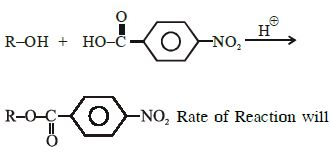
A
$-CH_3$
B
$-CH_2-CH_3$
C
$-CH(CH_3)_2$
D
$-C(CH_3)_3$
Solution
(A) The esterification reaction follows an $S_N2$-like mechanism regarding the attack of the alcohol on the carbonyl carbon of the carboxylic acid.
In this reaction,the rate is inversely proportional to the steric hindrance around the oxygen atom of the alcohol $(R-OH)$.
As the size of the alkyl group $(R)$ increases,the steric hindrance increases,which makes it more difficult for the nucleophile (alcohol) to attack the carbonyl carbon.
The order of reactivity for alcohols in esterification is: $\text{Methyl} > \text{Primary} (1^\circ) > \text{Secondary} (2^\circ) > \text{Tertiary} (3^\circ)$.
Among the given options,$-CH_3$ (methyl group) has the least steric hindrance.
Therefore,the reaction is fastest when $R$ is $-CH_3$.
In this reaction,the rate is inversely proportional to the steric hindrance around the oxygen atom of the alcohol $(R-OH)$.
As the size of the alkyl group $(R)$ increases,the steric hindrance increases,which makes it more difficult for the nucleophile (alcohol) to attack the carbonyl carbon.
The order of reactivity for alcohols in esterification is: $\text{Methyl} > \text{Primary} (1^\circ) > \text{Secondary} (2^\circ) > \text{Tertiary} (3^\circ)$.
Among the given options,$-CH_3$ (methyl group) has the least steric hindrance.
Therefore,the reaction is fastest when $R$ is $-CH_3$.
0 likes
View Solution376
DifficultMCQ
In the following sequence of reaction,$Z$ $\xrightarrow{PCl_5} X$ $\xrightarrow[\Delta]{\text{Alc. KOH}} Y$ $\xrightarrow{H_2O/H^{+}} Z$ (Major),$Z$ is:
A
$CH_3-CH_2-CH_2-OH$
B
$CH_3-CH(OH)-CH_3$
C
$CH_3-CH_2-CH_2-CH_2-OH$
D
$CH_3-C(CH_3)(CH_3)-CH_2-OH$
Solution
(B) The correct answer is $(b)$.
$1.$ $CH_3-CH(OH)-CH_3 (Z) \xrightarrow{PCl_5} CH_3-CHCl-CH_3 (X)$
$2.$ $CH_3-CHCl-CH_3 (X) \xrightarrow{\text{Alc. KOH}, \Delta} CH_3-CH=CH_2 (Y)$
$3.$ $CH_3-CH=CH_2 (Y) \xrightarrow{H_2O/H^{+}} CH_3-CH(OH)-CH_3 (Z)$
The hydration of propene follows Markovnikov's rule,where the $-OH$ group adds to the more substituted carbon,regenerating Propan-$2$-ol. Thus,$Z$ is Propan-$2$-ol.
$1.$ $CH_3-CH(OH)-CH_3 (Z) \xrightarrow{PCl_5} CH_3-CHCl-CH_3 (X)$
$2.$ $CH_3-CHCl-CH_3 (X) \xrightarrow{\text{Alc. KOH}, \Delta} CH_3-CH=CH_2 (Y)$
$3.$ $CH_3-CH=CH_2 (Y) \xrightarrow{H_2O/H^{+}} CH_3-CH(OH)-CH_3 (Z)$
The hydration of propene follows Markovnikov's rule,where the $-OH$ group adds to the more substituted carbon,regenerating Propan-$2$-ol. Thus,$Z$ is Propan-$2$-ol.
0 likes
View Solution377
EasyMCQ
Which among the following reactions is not possible?
A
$CH_3CH_2OH + HBr \rightarrow CH_3CH_2Br + H_2O$
B
$CH_3CH_2OH + PCl_5 \rightarrow CH_3CH_2Cl + POCl_3 + HCl$
C
$CH_3CH_2OH + SOCl_2 \rightarrow CH_3CH_2Cl + SO_2 + HCl$
D
$CH_3CH_2OH + NaCl \rightarrow CH_3CH_2Cl + NaOH$
Solution
(D) The reaction of an alcohol with $NaCl$ to produce a haloalkane is not possible because the hydroxyl group $(-OH)$ is a poor leaving group.
In the other reactions,$HBr$,$PCl_5$,and $SOCl_2$ are effective reagents that convert the $-OH$ group into a better leaving group or directly substitute it,facilitating the formation of the haloalkane.
Specifically,$NaCl$ is a salt of a strong acid and a strong base,and the chloride ion $(Cl^-)$ is a weak nucleophile that cannot displace the hydroxide ion $(OH^-)$ from an alcohol under standard conditions.
Therefore,the reaction $CH_3CH_2OH + NaCl \rightarrow CH_3CH_2Cl + NaOH$ does not occur.
In the other reactions,$HBr$,$PCl_5$,and $SOCl_2$ are effective reagents that convert the $-OH$ group into a better leaving group or directly substitute it,facilitating the formation of the haloalkane.
Specifically,$NaCl$ is a salt of a strong acid and a strong base,and the chloride ion $(Cl^-)$ is a weak nucleophile that cannot displace the hydroxide ion $(OH^-)$ from an alcohol under standard conditions.
Therefore,the reaction $CH_3CH_2OH + NaCl \rightarrow CH_3CH_2Cl + NaOH$ does not occur.
0 likes
View Solution378
DifficultMCQ
Which of the following reactions is incorrect?
A
$CH_3-CH_2-CH_2-OH \xrightarrow{PCC} CH_3-CH_2-COOH$
B
$(CH_3)_2CH-OH \xrightarrow{KMnO_4/H^\oplus} (CH_3)_2C=O$
C
$CH_3-CH_2-OH \xrightarrow{K_2Cr_2O_7/H^\oplus} CH_3-COOH$
D
$CH_2(OH)-CH_2(OH) \xrightarrow{HIO_4.2H_2O} 2HCHO$
Solution
(A) Option $A$ is incorrect because $PCC$ (Pyridinium chlorochromate) is a mild oxidizing agent that oxidizes primary alcohols to aldehydes,not to carboxylic acids. It stops the oxidation at the aldehyde stage.
Option $B$ is correct: Secondary alcohols are oxidized to ketones by strong oxidizing agents like $KMnO_4/H^\oplus$.
Option $C$ is correct: Primary alcohols are oxidized to carboxylic acids by strong oxidizing agents like $K_2Cr_2O_7/H^\oplus$.
Option $D$ is correct: $HIO_4$ (Periodic acid) causes the oxidative cleavage of vicinal diols to form aldehydes or ketones.
Option $B$ is correct: Secondary alcohols are oxidized to ketones by strong oxidizing agents like $KMnO_4/H^\oplus$.
Option $C$ is correct: Primary alcohols are oxidized to carboxylic acids by strong oxidizing agents like $K_2Cr_2O_7/H^\oplus$.
Option $D$ is correct: $HIO_4$ (Periodic acid) causes the oxidative cleavage of vicinal diols to form aldehydes or ketones.
0 likes
View Solution379
DifficultMCQ
When glycerol is treated with an excess of $HI$,it produces:
A
allyl iodide
B
propene
C
glycerol triiodide
D
$2$-iodopropane
Solution
(D) When glycerol $(CH_2OH-CHOH-CH_2OH)$ is treated with an excess of $HI$,it first undergoes substitution to form $1,2,3$-triiodopropane.
This unstable intermediate loses a molecule of $I_2$ to form allyl iodide $(CH_2=CH-CH_2I)$.
Allyl iodide then reacts with $HI$ to form $1,2$-diiodopropane,which further loses $I_2$ to form propene $(CH_3-CH=CH_2)$.
Finally,propene reacts with $HI$ according to Markovnikov's rule to yield $2$-iodopropane $(CH_3-CH(I)-CH_3)$ as the final product.
This unstable intermediate loses a molecule of $I_2$ to form allyl iodide $(CH_2=CH-CH_2I)$.
Allyl iodide then reacts with $HI$ to form $1,2$-diiodopropane,which further loses $I_2$ to form propene $(CH_3-CH=CH_2)$.
Finally,propene reacts with $HI$ according to Markovnikov's rule to yield $2$-iodopropane $(CH_3-CH(I)-CH_3)$ as the final product.
0 likes
View Solution380
MediumMCQ
Which of the following compounds is most reactive toward acid-catalyzed dehydration?
A
$1$-naphthol derivative
B
$1,2,3,4$-tetrahydronaphthalen$-1$-ol
C
$5,6,7,8$-tetrahydronaphthalen$-1$-ol
D
$5,6,7,8$-tetrahydronaphthalen$-2$-ol
Solution
(A) Acid-catalyzed dehydration of alcohols proceeds via the formation of a carbocation intermediate. The rate of dehydration depends on the stability of the carbocation formed.
In the case of the compound shown in the image (a derivative of $1$-naphthol),the loss of the hydroxyl group leads to the formation of a carbocation that is stabilized by resonance with the adjacent aromatic ring.
Furthermore,the subsequent elimination of a proton leads to the formation of a fully aromatic naphthalene system,which is highly stable.
Therefore,this compound is the most reactive toward acid-catalyzed dehydration due to the formation of a highly stable aromatic product.
In the case of the compound shown in the image (a derivative of $1$-naphthol),the loss of the hydroxyl group leads to the formation of a carbocation that is stabilized by resonance with the adjacent aromatic ring.
Furthermore,the subsequent elimination of a proton leads to the formation of a fully aromatic naphthalene system,which is highly stable.
Therefore,this compound is the most reactive toward acid-catalyzed dehydration due to the formation of a highly stable aromatic product.
0 likes
View Solution381
DifficultMCQ
Identify the major product of the following reaction:
($1$-hydroxycyclopentyl)methyl bromide + $aq. AgNO_3$ $\rightarrow$ ?
($1$-hydroxycyclopentyl)methyl bromide + $aq. AgNO_3$ $\rightarrow$ ?
A
Cyclohexanol
B
Cyclohexanone
C
Nitrocyclohexane
D
$1-$methylcyclopentanol
Solution
(B) The reaction involves the treatment of ($1$-hydroxycyclopentyl)methyl bromide with aqueous $AgNO_3$.
$1$. The $Ag^+$ ion acts as a Lewis acid and coordinates with the bromine atom,facilitating the departure of the bromide ion $(Br^-)$ to form a carbocation at the $CH_2$ group.
$2$. The hydroxyl group $(-OH)$ at the adjacent carbon atom can then participate in a ring expansion rearrangement. The bond between the ring carbon and the adjacent $CH_2$ group migrates to the carbocation center.
$3$. This process expands the five-membered ring into a six-membered ring,resulting in a cyclohexyl cation with a hydroxyl group attached to the same carbon.
$4$. Subsequent loss of a proton $(H^+)$ from the oxygen atom leads to the formation of cyclohexanone as the stable product.
Therefore,the major product is cyclohexanone.
$1$. The $Ag^+$ ion acts as a Lewis acid and coordinates with the bromine atom,facilitating the departure of the bromide ion $(Br^-)$ to form a carbocation at the $CH_2$ group.
$2$. The hydroxyl group $(-OH)$ at the adjacent carbon atom can then participate in a ring expansion rearrangement. The bond between the ring carbon and the adjacent $CH_2$ group migrates to the carbocation center.
$3$. This process expands the five-membered ring into a six-membered ring,resulting in a cyclohexyl cation with a hydroxyl group attached to the same carbon.
$4$. Subsequent loss of a proton $(H^+)$ from the oxygen atom leads to the formation of cyclohexanone as the stable product.
Therefore,the major product is cyclohexanone.
0 likes
View Solution382
DifficultMCQ
Correct order of reactivity of the given alcohols towards the substitution with $(NaBr + H_2SO_4)$ is:
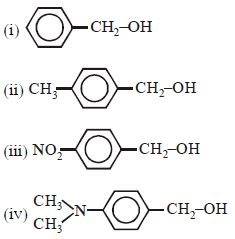
A
$i > ii > iii > iv$
B
$iv > ii > i > iii$
C
$iii > i > ii > iv$
D
$iv > iii > i > ii$
Solution
(B) The reaction of alcohols with $(NaBr + H_2SO_4)$ proceeds via the formation of a carbocation intermediate ($S_N1$ mechanism).
Greater the stability of the carbocation formed,higher is the reactivity of the alcohol.
The carbocation formed is a substituted benzyl carbocation $(Ar-CH_2^+)$.
Electron-donating groups $(EDG)$ increase the stability of the carbocation,while electron-withdrawing groups $(EWG)$ decrease it.
The substituents at the para-position are:
$(iv)$ $-N(CH_3)_2$ (Strong $EDG$,$+M$ effect)
$(ii)$ $-CH_3$ (Weak $EDG$,$+I$ and hyperconjugation)
$(i)$ $-H$ (Reference)
$(iii)$ $-NO_2$ (Strong $EWG$,$-M$ and $-I$ effect)
Thus,the stability order of the carbocations is $(iv) > (ii) > (i) > (iii)$.
Therefore,the reactivity order is $(iv) > (ii) > (i) > (iii)$.
Greater the stability of the carbocation formed,higher is the reactivity of the alcohol.
The carbocation formed is a substituted benzyl carbocation $(Ar-CH_2^+)$.
Electron-donating groups $(EDG)$ increase the stability of the carbocation,while electron-withdrawing groups $(EWG)$ decrease it.
The substituents at the para-position are:
$(iv)$ $-N(CH_3)_2$ (Strong $EDG$,$+M$ effect)
$(ii)$ $-CH_3$ (Weak $EDG$,$+I$ and hyperconjugation)
$(i)$ $-H$ (Reference)
$(iii)$ $-NO_2$ (Strong $EWG$,$-M$ and $-I$ effect)
Thus,the stability order of the carbocations is $(iv) > (ii) > (i) > (iii)$.
Therefore,the reactivity order is $(iv) > (ii) > (i) > (iii)$.
0 likes
View Solution383
DifficultMCQ
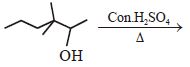
Predict the major product of the following reaction:
A
$3,3-$dimethylpent$-1-$ene
B
$2,3-$dimethylpent$-1-$ene
C
$3,4-$dimethylpent$-2-$ene
D
$3,4-$dimethylpent$-2-$ene (isomer)
Solution
(C) The reaction involves the acid-catalyzed dehydration of $3,3$-dimethylpentan-$2$-ol using concentrated $H_2SO_4$ at high temperature.
$1$. Protonation of the $-OH$ group occurs to form a good leaving group $(-OH_2^+)$.
$2$. Loss of water generates a secondary carbocation at the $C-2$ position.
$3$. This secondary carbocation undergoes a $1,2$-methyl shift to form a more stable tertiary carbocation at the $C-3$ position.
$4$. Elimination of a proton from the adjacent $C-4$ position (following Zaitsev's rule) yields the most stable,highly substituted alkene,which is $3,4$-dimethylpent-$2$-ene.
$1$. Protonation of the $-OH$ group occurs to form a good leaving group $(-OH_2^+)$.
$2$. Loss of water generates a secondary carbocation at the $C-2$ position.
$3$. This secondary carbocation undergoes a $1,2$-methyl shift to form a more stable tertiary carbocation at the $C-3$ position.
$4$. Elimination of a proton from the adjacent $C-4$ position (following Zaitsev's rule) yields the most stable,highly substituted alkene,which is $3,4$-dimethylpent-$2$-ene.
0 likes
View Solution384
EasyMCQ
$CH_3CH_2OH + HX \xrightarrow{ZnX_2} CH_3CH_2 - X + H_2O$. What is the reactivity order of $HX$?
A
$HBr > HI > HCl$
B
$HI > HBr > HCl$
C
$HCl > HBr > HI$
D
$HI > HCl > HBr$
Solution
(B) The reaction of alcohols with hydrogen halides $(HX)$ in the presence of $ZnX_2$ (Lucas reagent) follows the reactivity order of $HX$ based on the ease of bond cleavage.
The bond dissociation energy of $HX$ decreases in the order $HCl > HBr > HI$.
Since $HI$ has the lowest bond dissociation energy,the $H-I$ bond is the easiest to break,making $HI$ the most reactive.
Therefore,the correct order of reactivity is $HI > HBr > HCl$.
The bond dissociation energy of $HX$ decreases in the order $HCl > HBr > HI$.
Since $HI$ has the lowest bond dissociation energy,the $H-I$ bond is the easiest to break,making $HI$ the most reactive.
Therefore,the correct order of reactivity is $HI > HBr > HCl$.
0 likes
View Solution385
MediumMCQ
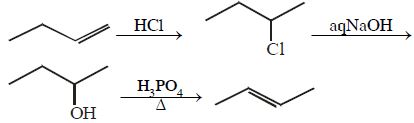
$CH_3-CH_2-CH=CH_2$ $\xrightarrow[CCl_4]{HCl} X$ $\xrightarrow{Aq. NaOH} Y$ $\xrightarrow[\Delta]{Conc. H_3PO_4} Z$
The major product $Z$ is:
The major product $Z$ is:
A
$CH_3-CH_2-CH=CH_2$
B
$CH_3-CH=CH-CH_3$
C
$CH_3-CH(OH)-CH=CH_2$
D
$CH_2=CH-CH=CH_2$
Solution
(B) The reaction sequence is as follows:
$1.$ Addition of $HCl$ to $CH_3-CH_2-CH=CH_2$ (but-$1$-ene) follows Markovnikov's rule to give $X = CH_3-CH_2-CHCl-CH_3$ ($2$-chlorobutane).
$2.$ Reaction of $X$ with $Aq. NaOH$ (nucleophilic substitution) gives $Y = CH_3-CH_2-CH(OH)-CH_3$ (butan-$2$-ol).
$3.$ Dehydration of $Y$ with $Conc. H_3PO_4$ and heat follows Zaitsev's rule to give the more stable,more substituted alkene as the major product,which is $Z = CH_3-CH=CH-CH_3$ (but-$2$-ene).
$1.$ Addition of $HCl$ to $CH_3-CH_2-CH=CH_2$ (but-$1$-ene) follows Markovnikov's rule to give $X = CH_3-CH_2-CHCl-CH_3$ ($2$-chlorobutane).
$2.$ Reaction of $X$ with $Aq. NaOH$ (nucleophilic substitution) gives $Y = CH_3-CH_2-CH(OH)-CH_3$ (butan-$2$-ol).
$3.$ Dehydration of $Y$ with $Conc. H_3PO_4$ and heat follows Zaitsev's rule to give the more stable,more substituted alkene as the major product,which is $Z = CH_3-CH=CH-CH_3$ (but-$2$-ene).
0 likes
View Solution386
MediumMCQ
Which of the following is soluble in water?
A
$CS_2$
B
$CCl_4$
C
$C_2H_5OH$
D
$CHCl_3$
Solution
(C) Water is a polar solvent.
According to the principle of "like dissolves like",polar substances are soluble in polar solvents.
$C_2H_5OH$ (ethanol) is a polar molecule due to the presence of the $-OH$ group,which allows it to form hydrogen bonds with water molecules.
Therefore,$C_2H_5OH$ is soluble in water,whereas $CS_2$,$CCl_4$,and $CHCl_3$ are non-polar or weakly polar organic solvents that are immiscible with water.
According to the principle of "like dissolves like",polar substances are soluble in polar solvents.
$C_2H_5OH$ (ethanol) is a polar molecule due to the presence of the $-OH$ group,which allows it to form hydrogen bonds with water molecules.
Therefore,$C_2H_5OH$ is soluble in water,whereas $CS_2$,$CCl_4$,and $CHCl_3$ are non-polar or weakly polar organic solvents that are immiscible with water.
0 likes
View Solution387
DifficultMCQ
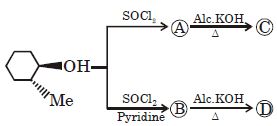
Major products $(C)$ and $(D)$ will be respectively:
A
$3-$methylcyclohexene and $1-$methylcyclohexene
B
$1-$methylcyclohexene and $1-$methylcyclohexene
C
$1-$methylcyclohexene and $3-$methylcyclohexene
D
$3-$methylcyclohexene and $3-$methylcyclohexene
Solution
(A) The starting material is $trans-2-methylcyclohexanol$.
$1$. Reaction with $SOCl_2$ (without pyridine) proceeds via an $S_Ni$ mechanism,which involves retention of configuration. Thus,$(A)$ is $trans-1-chloro-2-methylcyclohexane$. Subsequent elimination with $alc. KOH$ follows an $E2$ mechanism. For $E2$ elimination,the leaving group $(Cl)$ and the $\beta-H$ must be anti-periplanar. In $trans-1-chloro-2-methylcyclohexane$,the $\beta-H$ at $C-1$ is anti to the $Cl$ atom,leading to the formation of $3-methylcyclohexene$ as the major product $(C)$.
$2$. Reaction with $SOCl_2$ in the presence of pyridine proceeds via an $S_N2$ mechanism,which involves inversion of configuration. Thus,$(B)$ is $cis-1-chloro-2-methylcyclohexane$. Subsequent elimination with $alc. KOH$ follows an $E2$ mechanism. In $cis-1-chloro-2-methylcyclohexane$,the $\beta-H$ at $C-2$ is anti to the $Cl$ atom,leading to the formation of the more stable,more substituted alkene,$1-methylcyclohexene$,as the major product $(D)$.
$1$. Reaction with $SOCl_2$ (without pyridine) proceeds via an $S_Ni$ mechanism,which involves retention of configuration. Thus,$(A)$ is $trans-1-chloro-2-methylcyclohexane$. Subsequent elimination with $alc. KOH$ follows an $E2$ mechanism. For $E2$ elimination,the leaving group $(Cl)$ and the $\beta-H$ must be anti-periplanar. In $trans-1-chloro-2-methylcyclohexane$,the $\beta-H$ at $C-1$ is anti to the $Cl$ atom,leading to the formation of $3-methylcyclohexene$ as the major product $(C)$.
$2$. Reaction with $SOCl_2$ in the presence of pyridine proceeds via an $S_N2$ mechanism,which involves inversion of configuration. Thus,$(B)$ is $cis-1-chloro-2-methylcyclohexane$. Subsequent elimination with $alc. KOH$ follows an $E2$ mechanism. In $cis-1-chloro-2-methylcyclohexane$,the $\beta-H$ at $C-2$ is anti to the $Cl$ atom,leading to the formation of the more stable,more substituted alkene,$1-methylcyclohexene$,as the major product $(D)$.
0 likes
View Solution388
DifficultMCQ
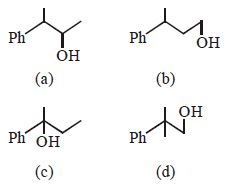
The relative rate of acid-catalyzed dehydration of the following alcohols would be:
A
$ (c) > (a) > (d) > (b) $
B
$ (c) > (d) > (a) > (b) $
C
$ (a) > (c) > (d) > (b) $
D
$ (c) > (d) > (b) > (a) $
Solution
(B) The rate of acid-catalyzed dehydration of alcohols depends on the stability of the carbocation intermediate formed after the loss of water. The more stable the carbocation,the faster the rate of dehydration.
$(a)$ Forms a secondary benzylic carbocation: $Ph-CH(CH_3)-CH^+(CH_3)$.
$(b)$ Forms a primary carbocation: $Ph-CH(CH_3)-CH_2-CH_2^+$.
$(c)$ Forms a tertiary benzylic carbocation: $Ph-C^+(CH_3)-CH_2-CH_3$.
$(d)$ Forms a tertiary carbocation: $Ph-C(CH_3)_2-CH_2^+$. (Note: This is a tertiary carbocation but not benzylic).
Comparing stability: Tertiary benzylic $(c)$ > Tertiary $(d)$ > Secondary benzylic $(a)$ > Primary $(b)$.
Therefore,the order of relative rates is $(c) > (d) > (a) > (b)$.
$(a)$ Forms a secondary benzylic carbocation: $Ph-CH(CH_3)-CH^+(CH_3)$.
$(b)$ Forms a primary carbocation: $Ph-CH(CH_3)-CH_2-CH_2^+$.
$(c)$ Forms a tertiary benzylic carbocation: $Ph-C^+(CH_3)-CH_2-CH_3$.
$(d)$ Forms a tertiary carbocation: $Ph-C(CH_3)_2-CH_2^+$. (Note: This is a tertiary carbocation but not benzylic).
Comparing stability: Tertiary benzylic $(c)$ > Tertiary $(d)$ > Secondary benzylic $(a)$ > Primary $(b)$.
Therefore,the order of relative rates is $(c) > (d) > (a) > (b)$.
0 likes
View Solution389
MediumMCQ
Identify $Z$ in the series:
$CH_2 = CH_2$ $\xrightarrow{HBr} X$ $\xrightarrow[Hydrolysis, Na_2CO_3]{I_2 (excess)} Z$
$CH_2 = CH_2$ $\xrightarrow{HBr} X$ $\xrightarrow[Hydrolysis, Na_2CO_3]{I_2 (excess)} Z$
A
$Et^{-}I$
B
$EtOH$
C
$CHI_3$
D
$MeCHO$
Solution
(C) Step $1$: $CH_2 = CH_2$ reacts with $HBr$ to form ethyl bromide $(X = CH_3CH_2Br)$.
Step $2$: Hydrolysis of $CH_3CH_2Br$ yields ethanol $(CH_3CH_2OH)$.
Step $3$: Ethanol reacts with $I_2$ in the presence of $Na_2CO_3$ (Iodoform test conditions) to produce iodoform $(CHI_3)$,which is a yellow precipitate.
Therefore,$Z$ is $CHI_3$.
Step $2$: Hydrolysis of $CH_3CH_2Br$ yields ethanol $(CH_3CH_2OH)$.
Step $3$: Ethanol reacts with $I_2$ in the presence of $Na_2CO_3$ (Iodoform test conditions) to produce iodoform $(CHI_3)$,which is a yellow precipitate.
Therefore,$Z$ is $CHI_3$.
0 likes
View Solution390
DifficultMCQ
Which of the following shows the Lucas test instantaneously?
A
Chlorocycloheptatriene
B
$2-$phenylpropan$-2-$ol
C
Cyclopentadienol
D
$Ph-C(Ph)_2-OH$
Solution
(D) The Lucas test involves the reaction of an alcohol with Lucas reagent $(conc. \ HCl + ZnCl_2)$.
It proceeds via an $S_N1$ mechanism,where the rate-determining step is the formation of a carbocation.
Alcohols that form highly stable carbocations react instantaneously with the Lucas reagent.
Option $D$ is $Ph-C(Ph)_2-OH$,which is a tertiary alcohol. Upon protonation and loss of water,it forms a triphenylmethyl carbocation $(Ph_3C^+)$.
This carbocation is exceptionally stable due to extensive resonance stabilization by three phenyl rings.
Therefore,it reacts instantaneously with the Lucas reagent.
It proceeds via an $S_N1$ mechanism,where the rate-determining step is the formation of a carbocation.
Alcohols that form highly stable carbocations react instantaneously with the Lucas reagent.
Option $D$ is $Ph-C(Ph)_2-OH$,which is a tertiary alcohol. Upon protonation and loss of water,it forms a triphenylmethyl carbocation $(Ph_3C^+)$.
This carbocation is exceptionally stable due to extensive resonance stabilization by three phenyl rings.
Therefore,it reacts instantaneously with the Lucas reagent.
0 likes
View Solution391
MediumMCQ
Which one of the following on reaction with Lucas reagent gives white precipitate fastest?
A
B
C
D
Solution
(C) The Lucas reagent consists of a mixture of anhydrous $ZnCl_2$ and concentrated $HCl$.
The rate of reaction with Lucas reagent depends on the stability of the carbocation intermediate formed.
The reactivity order for alcohols is: $Tertiary > Secondary > Primary$.
Among the given options,$2-$Methylpropan$-2-$ol is a tertiary alcohol,hence it reacts fastest to form a white precipitate.
The rate of reaction with Lucas reagent depends on the stability of the carbocation intermediate formed.
The reactivity order for alcohols is: $Tertiary > Secondary > Primary$.
Among the given options,$2-$Methylpropan$-2-$ol is a tertiary alcohol,hence it reacts fastest to form a white precipitate.
0 likes
View Solution392
DifficultMCQ
$CH \equiv CH$ $\xrightarrow{\text{Red hot Fe tube}} A$ $\xrightarrow{CH_3COCl / AlCl_3} B$ $\xrightarrow{(1) LiAlH_4 / (2) H_3O^\oplus} C$
$C$ will be
$C$ will be
A
Phenylmethanol
B
$1-$Phenylethanol
C
Benzoic acid
D
Benzaldehyde
Solution
(B) $1$. The reaction of acetylene $(CH \equiv CH)$ with a red hot iron tube leads to the formation of benzene $(A)$.
$2$. Benzene undergoes Friedel-Crafts acylation with acetyl chloride $(CH_3COCl)$ in the presence of $AlCl_3$ to form acetophenone ($B$,$C_6H_5COCH_3$).
$3$. Reduction of acetophenone with $LiAlH_4$ followed by acid hydrolysis $(H_3O^\oplus)$ reduces the ketone group to a secondary alcohol,yielding $1-$phenylethanol ($C$,$C_6H_5CH(OH)CH_3$).
$2$. Benzene undergoes Friedel-Crafts acylation with acetyl chloride $(CH_3COCl)$ in the presence of $AlCl_3$ to form acetophenone ($B$,$C_6H_5COCH_3$).
$3$. Reduction of acetophenone with $LiAlH_4$ followed by acid hydrolysis $(H_3O^\oplus)$ reduces the ketone group to a secondary alcohol,yielding $1-$phenylethanol ($C$,$C_6H_5CH(OH)CH_3$).
0 likes
View Solution393
DifficultMCQ
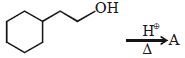
The reaction of $2$-cyclohexylethanol with $H^{\oplus}$ and $\Delta$ yields a major product $A$. Identify $A$.
A
Vinylcyclohexane
B
Ethylidenecyclohexane
C
$1-$Ethylcyclohexene
D
$1-$Methylcyclohexene
Solution
(C) The reaction involves the acid-catalyzed dehydration of a primary alcohol,$2$-cyclohexylethanol.
Step $1$: Protonation of the hydroxyl group to form a good leaving group,$-OH_2^+$.
Step $2$: Loss of water molecule to form a primary carbocation,$C_6H_{11}-CH_2-CH_2^+$.
Step $3$: The primary carbocation undergoes a $1,2$-hydride shift to form a more stable secondary carbocation,$C_6H_{11}^+-CH_2-CH_3$.
Step $4$: Elimination of a proton from the adjacent carbon leads to the formation of the most stable alkene,which is the more substituted alkene,$1$-ethylcyclohexene.
Step $1$: Protonation of the hydroxyl group to form a good leaving group,$-OH_2^+$.
Step $2$: Loss of water molecule to form a primary carbocation,$C_6H_{11}-CH_2-CH_2^+$.
Step $3$: The primary carbocation undergoes a $1,2$-hydride shift to form a more stable secondary carbocation,$C_6H_{11}^+-CH_2-CH_3$.
Step $4$: Elimination of a proton from the adjacent carbon leads to the formation of the most stable alkene,which is the more substituted alkene,$1$-ethylcyclohexene.
0 likes
View Solution394
DifficultMCQ
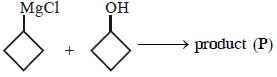
The reaction between cyclobutylmagnesium chloride and cyclobutanol is shown below. Identify the product $P$.
A
Cyclobutane
B
Bicyclobutyl
C
Cyclobutene
D
Cyclobutane-$1$,$1$'-bicyclobutane
Solution
(A) The reaction involves a Grignard reagent (cyclobutylmagnesium chloride) and an alcohol (cyclobutanol).
Grignard reagents are strong bases and react with compounds containing acidic protons,such as alcohols,to form an alkane and a magnesium salt.
The reaction is:
$C_4H_7MgCl + C_4H_7OH \rightarrow C_4H_8 + C_4H_7OMgCl$
Here,the cyclobutyl group $(C_4H_7^-)$ abstracts the acidic proton from the hydroxyl group of cyclobutanol to form cyclobutane $(C_4H_8)$.
Therefore,the product $P$ is cyclobutane.
Grignard reagents are strong bases and react with compounds containing acidic protons,such as alcohols,to form an alkane and a magnesium salt.
The reaction is:
$C_4H_7MgCl + C_4H_7OH \rightarrow C_4H_8 + C_4H_7OMgCl$
Here,the cyclobutyl group $(C_4H_7^-)$ abstracts the acidic proton from the hydroxyl group of cyclobutanol to form cyclobutane $(C_4H_8)$.
Therefore,the product $P$ is cyclobutane.
0 likes
View Solution395
DifficultMCQ
$CH_3CH_2OH$ $\xrightarrow{Red \ P + I_2} (A)$ $\xrightarrow[Ether]{Mg} (B)$ $\xrightarrow{HCHO} (C)$ $\xrightarrow{H_2O} (D)$
The compound $(D)$ is
The compound $(D)$ is
A
Propanal
B
Butanol
C
$n-$ Butyl alcohol
D
$n-$ Propyl alcohol
Solution
(D) Step $1$: $CH_3CH_2OH + Red \ P + I_2 \rightarrow CH_3CH_2I$ (Compound $A$ is ethyl iodide).
Step $2$: $CH_3CH_2I + Mg \xrightarrow{Ether} CH_3CH_2MgI$ (Compound $B$ is ethyl magnesium iodide).
Step $3$: $CH_3CH_2MgI + HCHO \rightarrow CH_3CH_2CH_2OMgI$ (Compound $C$ is an adduct).
Step $4$: $CH_3CH_2CH_2OMgI + H_2O \rightarrow CH_3CH_2CH_2OH + Mg(OH)I$ (Compound $D$ is $n-$ propyl alcohol).
Step $2$: $CH_3CH_2I + Mg \xrightarrow{Ether} CH_3CH_2MgI$ (Compound $B$ is ethyl magnesium iodide).
Step $3$: $CH_3CH_2MgI + HCHO \rightarrow CH_3CH_2CH_2OMgI$ (Compound $C$ is an adduct).
Step $4$: $CH_3CH_2CH_2OMgI + H_2O \rightarrow CH_3CH_2CH_2OH + Mg(OH)I$ (Compound $D$ is $n-$ propyl alcohol).
0 likes
View Solution396
DifficultMCQ
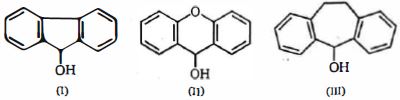
Arrange the following alcohols in decreasing order of the ease of ionization under acidic conditions.
A
$I > III > II$
B
$I > II > III$
C
$II > III > I$
D
$II > I > III$
Solution
(C) The ease of ionization of alcohols under acidic conditions depends on the stability of the carbocation formed after the loss of a water molecule.
$1$. In compound $(II)$,the carbocation formed is stabilized by the resonance effect of the oxygen atom,making it aromatic and highly stable.
$2$. In compound $(III)$,the carbocation is non-aromatic but is relatively stable due to resonance with the two benzene rings.
$3$. In compound $(I)$,the carbocation formed is anti-aromatic,which makes it highly unstable.
Therefore,the stability order of the carbocations is $(II > III > I)$.
Thus,the decreasing order of the ease of ionization is $(II > III > I)$.
$1$. In compound $(II)$,the carbocation formed is stabilized by the resonance effect of the oxygen atom,making it aromatic and highly stable.
$2$. In compound $(III)$,the carbocation is non-aromatic but is relatively stable due to resonance with the two benzene rings.
$3$. In compound $(I)$,the carbocation formed is anti-aromatic,which makes it highly unstable.
Therefore,the stability order of the carbocations is $(II > III > I)$.
Thus,the decreasing order of the ease of ionization is $(II > III > I)$.
0 likes
View Solution397
DifficultMCQ
Which of the following alcohols is the least soluble in water?
A
Ethanol
B
$1-$Propanol
C
$1-$Butanol
D
$1-$Pentanol
Solution
(D) The solubility of alcohols in water is determined by the balance between the hydrophilic hydroxyl group $(-OH)$ and the hydrophobic alkyl chain.
As the length of the hydrocarbon chain increases,the hydrophobic character of the alcohol increases,which decreases its solubility in water.
Among the given options,$1-$pentanol $(C_5H_{11}OH)$ has the longest alkyl chain,making it the most hydrophobic and thus the least soluble in water compared to ethanol,$1-$propanol,and $1-$butanol.
As the length of the hydrocarbon chain increases,the hydrophobic character of the alcohol increases,which decreases its solubility in water.
Among the given options,$1-$pentanol $(C_5H_{11}OH)$ has the longest alkyl chain,making it the most hydrophobic and thus the least soluble in water compared to ethanol,$1-$propanol,and $1-$butanol.
0 likes
View Solution398
MediumMCQ
Which of the following alcohols is expected to have the lowest $pK_a$ value?
A
Ethanol
B
$1$-propanol
C
$2, 2, 2$-trifluoroethanol
D
$2$-chloroethanol
Solution
(C) The acidic strength of an alcohol is inversely proportional to its $pK_a$ value.
Stronger electron-withdrawing groups ($-I$ effect) increase the acidity by stabilizing the conjugate base (alkoxide ion).
Comparing the groups:
$1$. Ethanol: $-CH_2CH_3$ (electron-donating group).
$2$. $1$-propanol: $-CH_2CH_2CH_3$ (electron-donating group).
$3$. $2$-chloroethanol: $-CH_2CH_2Cl$ ($-I$ effect of $Cl$).
$4$. $2, 2, 2$-trifluoroethanol: $-CH_2CF_3$ (strong $-I$ effect of three $F$ atoms).
Since the $-I$ effect of three fluorine atoms is much stronger than that of one chlorine atom,$2, 2, 2$-trifluoroethanol is the most acidic and thus has the lowest $pK_a$ value.
Stronger electron-withdrawing groups ($-I$ effect) increase the acidity by stabilizing the conjugate base (alkoxide ion).
Comparing the groups:
$1$. Ethanol: $-CH_2CH_3$ (electron-donating group).
$2$. $1$-propanol: $-CH_2CH_2CH_3$ (electron-donating group).
$3$. $2$-chloroethanol: $-CH_2CH_2Cl$ ($-I$ effect of $Cl$).
$4$. $2, 2, 2$-trifluoroethanol: $-CH_2CF_3$ (strong $-I$ effect of three $F$ atoms).
Since the $-I$ effect of three fluorine atoms is much stronger than that of one chlorine atom,$2, 2, 2$-trifluoroethanol is the most acidic and thus has the lowest $pK_a$ value.
0 likes
View Solution399
DifficultMCQ
Which of the following compounds contain at least one secondary $(2^o)$ alcohol?

A
$I, II, IV, VI$
B
$I, III$
C
$I, II, III, V$
D
$I, III, V$
Solution
(D) secondary $(2^o)$ alcohol is one in which the hydroxyl $(-OH)$ group is attached to a carbon atom that is bonded to two other carbon atoms.
Analyzing the structures:
$(I)$ The $-OH$ group is on a primary carbon. (Not $2^o$)
$(II)$ The $-OH$ group is on a tertiary carbon. (Not $2^o$)
$(III)$ The $-OH$ group is on a secondary carbon. ($2^o$ alcohol)
$(IV)$ The $-OH$ group is on a primary carbon. (Not $2^o$)
$(V)$ The $-OH$ group is on a tertiary carbon. (Not $2^o$)
$(VI)$ The $-OH$ group is on a primary carbon. (Not $2^o$)
Wait,re-evaluating the structures:
$(I)$ $CH_3CH_2CH(OH)CH_2OH$: The $-OH$ at the $3^{rd}$ position is secondary.
$(III)$ $CH_3CH_2CH(OH)CHO$: The $-OH$ is on a secondary carbon.
$(V)$ $CH_3CH_2C(OH)(CH_3)CH(OH)CH_3$: The $-OH$ at the $4^{th}$ position is secondary.
Thus,compounds $(I, III, V)$ contain at least one secondary alcohol group. The correct option is $(D)$.
Analyzing the structures:
$(I)$ The $-OH$ group is on a primary carbon. (Not $2^o$)
$(II)$ The $-OH$ group is on a tertiary carbon. (Not $2^o$)
$(III)$ The $-OH$ group is on a secondary carbon. ($2^o$ alcohol)
$(IV)$ The $-OH$ group is on a primary carbon. (Not $2^o$)
$(V)$ The $-OH$ group is on a tertiary carbon. (Not $2^o$)
$(VI)$ The $-OH$ group is on a primary carbon. (Not $2^o$)
Wait,re-evaluating the structures:
$(I)$ $CH_3CH_2CH(OH)CH_2OH$: The $-OH$ at the $3^{rd}$ position is secondary.
$(III)$ $CH_3CH_2CH(OH)CHO$: The $-OH$ is on a secondary carbon.
$(V)$ $CH_3CH_2C(OH)(CH_3)CH(OH)CH_3$: The $-OH$ at the $4^{th}$ position is secondary.
Thus,compounds $(I, III, V)$ contain at least one secondary alcohol group. The correct option is $(D)$.
0 likes
View Solution400
MediumMCQ
Which base is strong enough to convert $(CH_3)_3COH$ into $(CH_3)_3CONa$ in a reaction that goes to completion?
A
$NaNH_2$
B
$CH_3CH_2Na$
C
$NaOH$
D
More than one of the above
Solution
(D) To convert $(CH_3)_3COH$ (tert-butyl alcohol) into $(CH_3)_3CONa$ (sodium tert-butoxide),we need a base stronger than the tert-butoxide ion itself.
The $pK_a$ of $(CH_3)_3COH$ is approximately $18$.
$1$. $NaNH_2$ (sodium amide) contains the amide ion $(NH_2^-)$,which is the conjugate base of ammonia ($NH_3$,$pK_a \approx 38$). Since $38 > 18$,$NaNH_2$ is a much stronger base than the tert-butoxide ion and will drive the reaction to completion.
$2$. $CH_3CH_2Na$ (ethylsodium) contains the ethyl carbanion $(CH_3CH_2^-)$,which is the conjugate base of ethane ($C_2H_6$,$pK_a \approx 50$). Since $50 > 18$,it is also a much stronger base than the tert-butoxide ion and will drive the reaction to completion.
$3$. $NaOH$ is a weaker base than the tert-butoxide ion,so it cannot convert the alcohol to the alkoxide effectively.
Since both $NaNH_2$ and $CH_3CH_2Na$ are strong enough,the correct answer is 'More than one of the above'.
The $pK_a$ of $(CH_3)_3COH$ is approximately $18$.
$1$. $NaNH_2$ (sodium amide) contains the amide ion $(NH_2^-)$,which is the conjugate base of ammonia ($NH_3$,$pK_a \approx 38$). Since $38 > 18$,$NaNH_2$ is a much stronger base than the tert-butoxide ion and will drive the reaction to completion.
$2$. $CH_3CH_2Na$ (ethylsodium) contains the ethyl carbanion $(CH_3CH_2^-)$,which is the conjugate base of ethane ($C_2H_6$,$pK_a \approx 50$). Since $50 > 18$,it is also a much stronger base than the tert-butoxide ion and will drive the reaction to completion.
$3$. $NaOH$ is a weaker base than the tert-butoxide ion,so it cannot convert the alcohol to the alkoxide effectively.
Since both $NaNH_2$ and $CH_3CH_2Na$ are strong enough,the correct answer is 'More than one of the above'.
0 likes
View SolutionAlcohols, Phenols and Ethers — Properties of alcohol · Frequently Asked Questions
1Are these Alcohols, Phenols and Ethers questions useful for JEE and NEET?
Yes. All questions in this section are mapped to JEE Main and NEET exam patterns. Previous year questions from JEE Main, NEET, GUJCET and state-level exams are included with full solutions.
2Can I switch to Hindi or Gujarati for these questions?
Yes. Use the language tabs in the hero section or the sidebar to view the same questions and solutions in English, Hindi or Gujarati.
3How do I generate a question paper from this subtopic?
Use the Vedclass Exam Paper Generator — select the chapter and subtopic, set difficulty, and generate Sets A, B, C, D automatically. First 3 chapters of every subject are free.
Vedclass Products
For Students
Vedclass Test Series
Mock tests in real JEE/NEET style with performance analysis. 5-day free trial.
Start Free TrialFor Teachers
Exam Paper Generator
Generate Set A/B/C/D papers from this chapter in 2 minutes. 3 chapters free.
Try FreeFor Institutes
Online Exam Module
Live online exams with unlimited students, 360° analytics & white-label branding.
See DemoFor Teachers & Institutes
Generate a Alcohols, Phenols and Ethers Exam Paper in 2 Minutes
Select subtopic & difficulty — Sets A, B, C, D auto-generated with No Repeat logic.
First 3 chapters of every subject are free — no payment required.