
A English
Properties of alcohol Questions in English
Class 12 Chemistry · Alcohols, Phenols and Ethers · Properties of alcohol
889+
Questions
English
Language
100%
With Solutions
Showing 50 of 889 questions in English
501
MediumMCQ
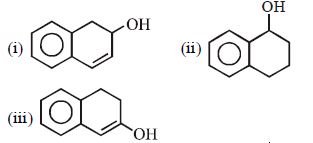
Compare the rate of dehydration of $(i)$,$(ii)$ and $(iii)$ by conc. $H_2SO_4$.
A
$(i) > (iii) > (ii)$
B
$(i) > (ii) > (iii)$
C
$(ii) > (i) > (iii)$
D
$(ii) > (iii) > (i)$
Solution
(B) The rate of dehydration of alcohols depends on the stability of the carbocation intermediate formed after the loss of water.
$(i)$ forms a carbocation that is resonance-stabilized by the adjacent double bond and the benzene ring.
$(ii)$ forms a secondary benzylic carbocation,which is stabilized by the benzene ring.
$(iii)$ forms a vinylic carbocation,which is highly unstable.
Comparing the stability: $(i)$ (allylic and benzylic resonance) > $(ii)$ (benzylic) > $(iii)$ (vinylic).
Therefore,the rate of dehydration follows the order $(i) > (ii) > (iii)$.
$(i)$ forms a carbocation that is resonance-stabilized by the adjacent double bond and the benzene ring.
$(ii)$ forms a secondary benzylic carbocation,which is stabilized by the benzene ring.
$(iii)$ forms a vinylic carbocation,which is highly unstable.
Comparing the stability: $(i)$ (allylic and benzylic resonance) > $(ii)$ (benzylic) > $(iii)$ (vinylic).
Therefore,the rate of dehydration follows the order $(i) > (ii) > (iii)$.
0 likes
View Solution502
MediumMCQ
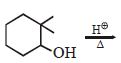
What is the major product of the following reaction?
A
$1,1-$dimethylcyclohexene
B
$2,3-$dimethylcyclohexene
C
$2,3-$dimethyl$-2-$cyclohexene
D
$1,2-$dimethylcyclohexene
Solution
(B) The reaction involves the acid-catalyzed dehydration of $2,2$-dimethylcyclohexanol.
$1$. Protonation of the $-OH$ group occurs to form a good leaving group $(-OH_2^+)$.
$2$. Loss of water generates a secondary carbocation.
$3$. $A$ $1,2$-methyl shift occurs to form a more stable tertiary carbocation.
$4$. Elimination of a proton from the adjacent carbon leads to the formation of the most stable alkene,which is $2,3$-dimethylcyclohexene (or $1,2$-dimethylcyclohexene depending on the numbering convention,but the structure corresponds to the tetrasubstituted alkene).
$1$. Protonation of the $-OH$ group occurs to form a good leaving group $(-OH_2^+)$.
$2$. Loss of water generates a secondary carbocation.
$3$. $A$ $1,2$-methyl shift occurs to form a more stable tertiary carbocation.
$4$. Elimination of a proton from the adjacent carbon leads to the formation of the most stable alkene,which is $2,3$-dimethylcyclohexene (or $1,2$-dimethylcyclohexene depending on the numbering convention,but the structure corresponds to the tetrasubstituted alkene).
0 likes
View Solution503
DifficultMCQ
$CH_3-CH(OH)-CH_3$ $\xrightarrow{PBr_3} X$ $\xrightarrow{Mg/\text{ether}} Y$ $\xrightarrow{H_2O/H^+} \text{The final product is}$
A
$CH_3-CH(OH)-CH_3$
B
$CH_3-CH_2-CH_2-OH$
C
$CH_3-CH(CH_3)-O-CH(CH_3)-CH_3$
D
$CH_3-CH_2-CH_3$
Solution
(D) $1.$ $CH_3-CH(OH)-CH_3 + PBr_3 \rightarrow CH_3-CH(Br)-CH_3$ (Isopropyl bromide,$X$).
$2.$ $CH_3-CH(Br)-CH_3 + Mg \xrightarrow{\text{ether}} CH_3-CH(MgBr)-CH_3$ (Isopropyl magnesium bromide,$Y$).
$3.$ $CH_3-CH(MgBr)-CH_3 + H_2O \rightarrow CH_3-CH_2-CH_3$ (Propane).
Thus,the final product is propane.
$2.$ $CH_3-CH(Br)-CH_3 + Mg \xrightarrow{\text{ether}} CH_3-CH(MgBr)-CH_3$ (Isopropyl magnesium bromide,$Y$).
$3.$ $CH_3-CH(MgBr)-CH_3 + H_2O \rightarrow CH_3-CH_2-CH_3$ (Propane).
Thus,the final product is propane.
0 likes
View Solution504
MediumMCQ
Acidic dehydration of alcohol involves
A
$E_1$ elimination
B
Carbocation rearrangement if possible
C
Saytzeff's product is formed as major product
D
All
Solution
(D) Acidic dehydration of alcohols typically proceeds via the $E_1$ mechanism.
$1$. The hydroxyl group is protonated to form a good leaving group $(-OH_2^+)$.
$2$. The leaving group departs to form a carbocation intermediate.
$3$. If the carbocation can rearrange to a more stable form (e.g.,from secondary to tertiary),it will do so.
$4$. Finally,a proton is removed to form an alkene,where the most substituted alkene (Saytzeff's product) is generally the major product due to its higher stability.
Therefore,all the given statements are correct.
$1$. The hydroxyl group is protonated to form a good leaving group $(-OH_2^+)$.
$2$. The leaving group departs to form a carbocation intermediate.
$3$. If the carbocation can rearrange to a more stable form (e.g.,from secondary to tertiary),it will do so.
$4$. Finally,a proton is removed to form an alkene,where the most substituted alkene (Saytzeff's product) is generally the major product due to its higher stability.
Therefore,all the given statements are correct.
0 likes
View Solution505
EasyMCQ
Reactivity of given alcohols for acidic dehydration can be explained by $Ph-CH_2-CH(OH)-CH_3 > CH_3-CH_2-CH(OH)-CH_3$:
A
Carbocation stability
B
Product stability
C
Carbanion rearrangement
D
Acidic strength of alcohols
Solution
(B) The reactivity of alcohols towards acidic dehydration depends on the stability of the alkene formed (Product stability).
In the first case,the product $Ph-CH=CH-CH_3$ is resonance-stabilized due to conjugation with the phenyl ring,making it much more stable than the product $CH_3-CH=CH-CH_3$ formed from the second alcohol.
Higher product stability leads to higher reactivity of the starting alcohol.
In the first case,the product $Ph-CH=CH-CH_3$ is resonance-stabilized due to conjugation with the phenyl ring,making it much more stable than the product $CH_3-CH=CH-CH_3$ formed from the second alcohol.
Higher product stability leads to higher reactivity of the starting alcohol.
0 likes
View Solution506
EasyMCQ
Which of the following is a secondary alcohol?
A
$C_6H_5OH$ (Phenol)
B
$C_6H_5CH(OH)CH_3$ ($1$-Phenylethanol)
C
$(CH_3)_2CHCH_2OH$ (Isobutyl alcohol)
D
$(CH_3)_3COH$ (tert-Butyl alcohol)
Solution
(B) secondary $(2^\circ)$ alcohol is one in which the hydroxyl group $(-OH)$ is attached to a carbon atom that is bonded to two other carbon atoms.
$A$. $C_6H_5OH$ is a phenol,where the $-OH$ group is directly attached to an aromatic ring.
$B$. $C_6H_5CH(OH)CH_3$ is a secondary alcohol because the carbon atom bearing the $-OH$ group is attached to one phenyl group and one methyl group (two carbon-containing groups).
$C$. $(CH_3)_2CHCH_2OH$ is a primary $(1^\circ)$ alcohol because the carbon atom bearing the $-OH$ group is attached to only one other carbon atom.
$D$. $(CH_3)_3COH$ is a tertiary $(3^\circ)$ alcohol because the carbon atom bearing the $-OH$ group is attached to three other carbon atoms.
Therefore,the correct option is $B$.
$A$. $C_6H_5OH$ is a phenol,where the $-OH$ group is directly attached to an aromatic ring.
$B$. $C_6H_5CH(OH)CH_3$ is a secondary alcohol because the carbon atom bearing the $-OH$ group is attached to one phenyl group and one methyl group (two carbon-containing groups).
$C$. $(CH_3)_2CHCH_2OH$ is a primary $(1^\circ)$ alcohol because the carbon atom bearing the $-OH$ group is attached to only one other carbon atom.
$D$. $(CH_3)_3COH$ is a tertiary $(3^\circ)$ alcohol because the carbon atom bearing the $-OH$ group is attached to three other carbon atoms.
Therefore,the correct option is $B$.
0 likes
View Solution507
DifficultMCQ
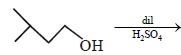
What is the correct major product of the following reaction?
A
$3-$methylbutan$-1-$ol
B
$3-$methylbutan$-2-$ol
C
$2-$methylbutan$-2-$ol
D
butan$-2-$ol
Solution
(C) The reaction of $3\text{-methylbutan-1-ol}$ with dilute $H_2SO_4$ involves the acid-catalyzed dehydration of the alcohol to form an alkene,followed by the acid-catalyzed hydration of the alkene to form a more stable alcohol.
$1$. Dehydration: $3\text{-methylbutan-1-ol}$ undergoes dehydration to form $2\text{-methylbut-2-ene}$ (the most stable alkene via Saytzeff's rule).
$2$. Hydration: The addition of water to $2\text{-methylbut-2-ene}$ follows Markovnikov's rule,where the $OH^-$ group attaches to the more substituted carbon atom.
$3$. The resulting product is $2\text{-methylbutan-2-ol}$,which is a tertiary alcohol and more stable than the starting primary alcohol.
$1$. Dehydration: $3\text{-methylbutan-1-ol}$ undergoes dehydration to form $2\text{-methylbut-2-ene}$ (the most stable alkene via Saytzeff's rule).
$2$. Hydration: The addition of water to $2\text{-methylbut-2-ene}$ follows Markovnikov's rule,where the $OH^-$ group attaches to the more substituted carbon atom.
$3$. The resulting product is $2\text{-methylbutan-2-ol}$,which is a tertiary alcohol and more stable than the starting primary alcohol.
0 likes
View Solution508
DifficultMCQ
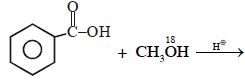
What is the product obtained from the following reaction?
A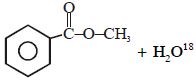
B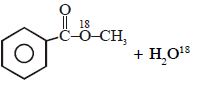
C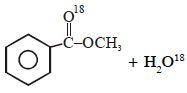
D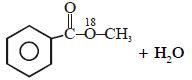
Solution
(D) The reaction between a carboxylic acid and an alcohol in the presence of an acid catalyst $(H^+)$ is known as Fischer esterification.
In this mechanism,the bond cleavage occurs between the $C-OH$ bond of the carboxylic acid and the $O-H$ bond of the alcohol.
Specifically,the $-OH$ group of the carboxylic acid is removed,and the $-OCH_3$ group from the alcohol replaces it.
Therefore,the oxygen atom labeled with $^{18}O$ from the methanol $(CH_3^{18}OH)$ will be incorporated into the ester product,while the water molecule formed will contain the oxygen from the carboxylic acid.
The reaction is: $C_6H_5COOH + CH_3^{18}OH \xrightarrow{H^+} C_6H_5CO^{18}OCH_3 + H_2O$.
In this mechanism,the bond cleavage occurs between the $C-OH$ bond of the carboxylic acid and the $O-H$ bond of the alcohol.
Specifically,the $-OH$ group of the carboxylic acid is removed,and the $-OCH_3$ group from the alcohol replaces it.
Therefore,the oxygen atom labeled with $^{18}O$ from the methanol $(CH_3^{18}OH)$ will be incorporated into the ester product,while the water molecule formed will contain the oxygen from the carboxylic acid.
The reaction is: $C_6H_5COOH + CH_3^{18}OH \xrightarrow{H^+} C_6H_5CO^{18}OCH_3 + H_2O$.
0 likes
View Solution509
MediumMCQ
$CH_3OH$ and $C_2H_5OH$ may be distinguished chemically by:
A
By the action of $HCl$
B
By the action of $I_2 + Na_2CO_3$
C
By the action of $NH_3$
D
Solubility in water
Solution
(B) The Iodoform test is used to distinguish compounds containing a $CH_3CH(OH)-$ group or a $CH_3CO-$ group.
Ethanol $(C_2H_5OH)$ contains a methyl group attached to the carbon bearing the hydroxyl group $(CH_3CH_2OH)$,which gives a positive Iodoform test.
Methanol $(CH_3OH)$ does not contain this structural unit and does not give the Iodoform test.
$CH_3OH + I_2 + Na_2CO_3 \xrightarrow{\Delta} \text{No reaction}$
$C_2H_5OH + 4I_2 + 6Na_2CO_3 \xrightarrow{\Delta} CHI_3 (\text{yellow ppt}) + HCOONa + 5NaI + 5NaHCO_3 + 2H_2O$
Therefore,$I_2 + Na_2CO_3$ is the correct reagent.
Ethanol $(C_2H_5OH)$ contains a methyl group attached to the carbon bearing the hydroxyl group $(CH_3CH_2OH)$,which gives a positive Iodoform test.
Methanol $(CH_3OH)$ does not contain this structural unit and does not give the Iodoform test.
$CH_3OH + I_2 + Na_2CO_3 \xrightarrow{\Delta} \text{No reaction}$
$C_2H_5OH + 4I_2 + 6Na_2CO_3 \xrightarrow{\Delta} CHI_3 (\text{yellow ppt}) + HCOONa + 5NaI + 5NaHCO_3 + 2H_2O$
Therefore,$I_2 + Na_2CO_3$ is the correct reagent.
0 likes
View Solution510
MediumMCQ
Which of the following compounds has the highest boiling point?
A
$CH_3OH$
B
$CH_3Br$
C
$CH_3Cl$
D
$CH_4$
Solution
(A) The boiling point depends on the intermolecular forces present in the molecule.
$CH_3OH$ (methanol) exhibits intermolecular $H$-bonding,which is a strong attractive force.
$CH_3Br$,$CH_3Cl$,and $CH_4$ exhibit weaker dipole-dipole or London dispersion forces.
Therefore,$CH_3OH$ has the highest boiling point.
$CH_3OH$ (methanol) exhibits intermolecular $H$-bonding,which is a strong attractive force.
$CH_3Br$,$CH_3Cl$,and $CH_4$ exhibit weaker dipole-dipole or London dispersion forces.
Therefore,$CH_3OH$ has the highest boiling point.
0 likes
View Solution511
DifficultMCQ
Compound $(x)$ with molecular formula $C_4H_8O$ gives a positive haloform test but does not give a $2,4-DNP$ test. The compound is:
A
But$-3-$en$-2-$ol
B
Butanal
C
Butan$-2-$one
D
Cyclobutanol
Solution
(A) The $2,4-DNP$ test is given by aldehydes and ketones (carbonyl compounds). Since the compound does not give a $2,4-DNP$ test,it cannot be an aldehyde or a ketone.
The haloform test is given by compounds containing the $CH_3CO-$ group or the $CH_3CH(OH)-$ group.
Among the given options:
$A$. But$-3-$en$-2-$ol $(CH_2=CH-CH(OH)-CH_3)$ contains the $CH_3CH(OH)-$ group,so it gives a positive haloform test. It is an alcohol,not a carbonyl compound,so it does not give the $2,4-DNP$ test.
$B$. Butanal is an aldehyde,so it gives the $2,4-DNP$ test.
$C$. Butan$-2-$one is a ketone,so it gives the $2,4-DNP$ test.
$D$. Cyclobutanol does not contain the required structural group for the haloform test.
Therefore,the correct compound is But$-3-$en$-2-$ol.
The haloform test is given by compounds containing the $CH_3CO-$ group or the $CH_3CH(OH)-$ group.
Among the given options:
$A$. But$-3-$en$-2-$ol $(CH_2=CH-CH(OH)-CH_3)$ contains the $CH_3CH(OH)-$ group,so it gives a positive haloform test. It is an alcohol,not a carbonyl compound,so it does not give the $2,4-DNP$ test.
$B$. Butanal is an aldehyde,so it gives the $2,4-DNP$ test.
$C$. Butan$-2-$one is a ketone,so it gives the $2,4-DNP$ test.
$D$. Cyclobutanol does not contain the required structural group for the haloform test.
Therefore,the correct compound is But$-3-$en$-2-$ol.
0 likes
View Solution512
MediumMCQ
The order of reactivity of the following alcohols toward $HCl$ is:
$(1)$ $F-CH_2-CH_2-CH(OH)-CH_3$
$(2)$ $F-CH_2-CH_2-CH_2-CH(OH)-CH_3$
$(3)$ $CH_3-CH(OH)-CH_3$
$(4)$ $Ph-CH_2-CH_2-OH$
$(1)$ $F-CH_2-CH_2-CH(OH)-CH_3$
$(2)$ $F-CH_2-CH_2-CH_2-CH(OH)-CH_3$
$(3)$ $CH_3-CH(OH)-CH_3$
$(4)$ $Ph-CH_2-CH_2-OH$
A
$1 > 2 > 3 > 4$
B
$1 > 3 > 2 > 4$
C
$4 > 3 > 2 > 1$
D
$4 > 3 > 1 > 2$
Solution
(C) The reaction of alcohols with $HCl$ proceeds via an $S_N1$ mechanism,which involves the formation of a carbocation intermediate.
Reactivity depends on the stability of the carbocation formed.
$(1)$ $F-CH_2-CH_2-CH^+-CH_3$: The carbocation is secondary and destabilized by the inductive effect $(-I)$ of the $F$ atom at the $\gamma$-position.
$(2)$ $F-CH_2-CH_2-CH_2-CH^+-CH_3$: The carbocation is secondary and destabilized by the $-I$ effect of the $F$ atom,but the effect is weaker than in $(1)$ because the $F$ atom is further away.
$(3)$ $CH_3-CH^+-CH_3$: This is a secondary carbocation with no electron-withdrawing groups,making it more stable than $(1)$ and $(2)$.
$(4)$ $Ph-CH_2-CH_2^+$: This is a primary carbocation,but it is stabilized by the resonance effect of the phenyl group,making it the most reactive among these.
Thus,the order of reactivity is $4 > 3 > 2 > 1$.
Reactivity depends on the stability of the carbocation formed.
$(1)$ $F-CH_2-CH_2-CH^+-CH_3$: The carbocation is secondary and destabilized by the inductive effect $(-I)$ of the $F$ atom at the $\gamma$-position.
$(2)$ $F-CH_2-CH_2-CH_2-CH^+-CH_3$: The carbocation is secondary and destabilized by the $-I$ effect of the $F$ atom,but the effect is weaker than in $(1)$ because the $F$ atom is further away.
$(3)$ $CH_3-CH^+-CH_3$: This is a secondary carbocation with no electron-withdrawing groups,making it more stable than $(1)$ and $(2)$.
$(4)$ $Ph-CH_2-CH_2^+$: This is a primary carbocation,but it is stabilized by the resonance effect of the phenyl group,making it the most reactive among these.
Thus,the order of reactivity is $4 > 3 > 2 > 1$.
0 likes
View Solution513
DifficultMCQ
Identify the major product of the following reaction:
$(CH_3)_3C-CH(OH)-CH_3 \xrightarrow[\Delta]{\text{conc. } H_2SO_4} \text{Major product}$
$(CH_3)_3C-CH(OH)-CH_3 \xrightarrow[\Delta]{\text{conc. } H_2SO_4} \text{Major product}$
A
$2,3-$dimethylbut$-1-$ene
B
$2,3-$dimethylbut$-2-$ene
C
$3,3-$dimethylbut$-1-$ene
D
None of these
Solution
(B) The starting material is $3,3$-dimethylbutan-$2$-ol.
When treated with concentrated $H_2SO_4$ and heated,it undergoes acid-catalyzed dehydration.
Step $1$: Protonation of the $-OH$ group to form a good leaving group $(-OH_2^+)$.
Step $2$: Loss of water to form a secondary carbocation: $(CH_3)_3C-CH^+-CH_3$.
Step $3$: The secondary carbocation undergoes a $1,2$-methyl shift to form a more stable tertiary carbocation: $(CH_3)_2C^+-CH(CH_3)_2$.
Step $4$: Elimination of a proton from the adjacent carbon atom to form the most stable alkene (Saytzeff product).
The most stable alkene is $2,3$-dimethylbut-$2$-ene,which is a tetrasubstituted alkene.
Therefore,the major product is $2,3$-dimethylbut-$2$-ene.
When treated with concentrated $H_2SO_4$ and heated,it undergoes acid-catalyzed dehydration.
Step $1$: Protonation of the $-OH$ group to form a good leaving group $(-OH_2^+)$.
Step $2$: Loss of water to form a secondary carbocation: $(CH_3)_3C-CH^+-CH_3$.
Step $3$: The secondary carbocation undergoes a $1,2$-methyl shift to form a more stable tertiary carbocation: $(CH_3)_2C^+-CH(CH_3)_2$.
Step $4$: Elimination of a proton from the adjacent carbon atom to form the most stable alkene (Saytzeff product).
The most stable alkene is $2,3$-dimethylbut-$2$-ene,which is a tetrasubstituted alkene.
Therefore,the major product is $2,3$-dimethylbut-$2$-ene.
0 likes
View Solution514
AdvancedMCQ
In the following reaction sequence,$CH_3CH_2OH$ $\xrightarrow{P + I_2} A$ $\xrightarrow[\text{dry ether}]{Mg} B$ $\xrightarrow{HCHO} C$ $\xrightarrow{H_2O} D$,the compound $D$ is:
A
Butanal
B
$n$-Butyl alcohol
C
$n$-Propyl alcohol
D
Propanal
Solution
(C) $1$. $CH_3CH_2OH + P + I_2 \rightarrow CH_3CH_2I (A)$ (Ethyl iodide).
$2$. $CH_3CH_2I + Mg \xrightarrow{\text{dry ether}} CH_3CH_2MgI (B)$ (Ethyl magnesium iodide,a Grignard reagent).
$3$. $CH_3CH_2MgI + HCHO \rightarrow CH_3CH_2CH_2OMgI (C)$ (Addition product).
$4$. $CH_3CH_2CH_2OMgI + H_2O \rightarrow CH_3CH_2CH_2OH (D) + Mg(OH)I$ ($n$-Propyl alcohol).
$2$. $CH_3CH_2I + Mg \xrightarrow{\text{dry ether}} CH_3CH_2MgI (B)$ (Ethyl magnesium iodide,a Grignard reagent).
$3$. $CH_3CH_2MgI + HCHO \rightarrow CH_3CH_2CH_2OMgI (C)$ (Addition product).
$4$. $CH_3CH_2CH_2OMgI + H_2O \rightarrow CH_3CH_2CH_2OH (D) + Mg(OH)I$ ($n$-Propyl alcohol).
0 likes
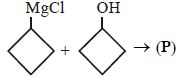
View Solution515
MediumMCQ
Compound $(P)$ is
A
Cyclobutene
B
Bicyclobutane
C
Cyclobutane
D
Cyclobutanol
Solution
(C) The reaction involves a Grignard reagent,cyclobutylmagnesium chloride,reacting with cyclobutanol.
Grignard reagents are strong bases and react readily with compounds containing active hydrogen atoms (like the hydroxyl group in alcohols).
The reaction is an acid-base reaction:
$C_4H_7MgCl + C_4H_7OH \rightarrow C_4H_8 + C_4H_7OMgCl$
Here,the cyclobutyl group acts as a base and abstracts the proton from the hydroxyl group of cyclobutanol to form cyclobutane $(C_4H_8)$ as the hydrocarbon product $(P)$.
Grignard reagents are strong bases and react readily with compounds containing active hydrogen atoms (like the hydroxyl group in alcohols).
The reaction is an acid-base reaction:
$C_4H_7MgCl + C_4H_7OH \rightarrow C_4H_8 + C_4H_7OMgCl$
Here,the cyclobutyl group acts as a base and abstracts the proton from the hydroxyl group of cyclobutanol to form cyclobutane $(C_4H_8)$ as the hydrocarbon product $(P)$.
0 likes
View Solution516
MediumMCQ
$C_2H_5Br$ $\xrightarrow{aq.\,NaOH} X$ $\xrightarrow[H_2SO_4]{Na_2Cr_2O_7} Y$
$[Y]$ is
$[Y]$ is
A
Ethyl acetate
B
Acetic acid
C
Propionic acid
D
Acetone
Solution
(B) Step $1$: $C_2H_5Br$ reacts with aqueous $NaOH$ via nucleophilic substitution $(S_N2)$ to form ethanol $(C_2H_5OH)$.
$C_2H_5Br + NaOH(aq) \rightarrow C_2H_5OH + NaBr$
Step $2$: Ethanol $(C_2H_5OH)$ is a primary alcohol,which upon oxidation with acidic potassium dichromate $(Na_2Cr_2O_7 / H_2SO_4)$ gets oxidized to acetic acid $(CH_3COOH)$.
$C_2H_5OH + [O] \xrightarrow{Na_2Cr_2O_7 / H_2SO_4} CH_3COOH$
Therefore,$[Y]$ is acetic acid.
$C_2H_5Br + NaOH(aq) \rightarrow C_2H_5OH + NaBr$
Step $2$: Ethanol $(C_2H_5OH)$ is a primary alcohol,which upon oxidation with acidic potassium dichromate $(Na_2Cr_2O_7 / H_2SO_4)$ gets oxidized to acetic acid $(CH_3COOH)$.
$C_2H_5OH + [O] \xrightarrow{Na_2Cr_2O_7 / H_2SO_4} CH_3COOH$
Therefore,$[Y]$ is acetic acid.
0 likes
View Solution517
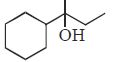
DifficultMCQ
Which of the following is not the product of dehydration of $1-$cyclohexylpropan$-1-$ol?
A
$1-$cyclohexylprop$-1-$ene
B
$2-$cyclohexylprop$-1-$ene
C
$1-$cyclohexylidenepropane
D
$3-$cyclohexylprop$-1-$ene
Solution
(D) The dehydration of $1-$cyclohexylpropan$-1-$ol proceeds via an $E1$ mechanism involving a carbocation intermediate.
$1$. Protonation of the $-OH$ group followed by the loss of water generates a secondary carbocation at the $C1$ position of the propyl chain.
$2$. Elimination of a proton from adjacent carbons ($C2$ of the propyl chain or the $C1$ of the cyclohexyl ring) leads to the formation of alkenes.
$3$. Elimination from $C2$ of the propyl chain yields $1-$cyclohexylprop$-1-$ene (major product) and $2-$cyclohexylprop$-1-$ene (minor product).
$4$. Elimination from the cyclohexyl ring leads to $1-$cyclohexylidenepropane.
$5$. The structure $3-$cyclohexylprop$-1-$ene is not a product of this dehydration because it would require the migration of the double bond to a position that is not accessible through the standard $E1$ elimination pathway of the formed carbocation.
$1$. Protonation of the $-OH$ group followed by the loss of water generates a secondary carbocation at the $C1$ position of the propyl chain.
$2$. Elimination of a proton from adjacent carbons ($C2$ of the propyl chain or the $C1$ of the cyclohexyl ring) leads to the formation of alkenes.
$3$. Elimination from $C2$ of the propyl chain yields $1-$cyclohexylprop$-1-$ene (major product) and $2-$cyclohexylprop$-1-$ene (minor product).
$4$. Elimination from the cyclohexyl ring leads to $1-$cyclohexylidenepropane.
$5$. The structure $3-$cyclohexylprop$-1-$ene is not a product of this dehydration because it would require the migration of the double bond to a position that is not accessible through the standard $E1$ elimination pathway of the formed carbocation.
0 likes
View Solution518
MediumMCQ
Which alcohol gives instant turbidity with Lucas reagent?
A
$CH_3CH_2OH$
B
$(CH_3)_2CHOH$
C
$(CH_3)_3COH$
D
$CH_3OH$
Solution
(C) Lucas reagent is a mixture of concentrated $HCl$ and anhydrous $ZnCl_2$.
It is used to distinguish between primary,secondary,and tertiary alcohols.
Tertiary alcohols react fastest with Lucas reagent due to the formation of a stable carbocation,resulting in the immediate appearance of turbidity.
Among the given options,$(CH_3)_3COH$ is a tertiary alcohol,therefore it gives instant turbidity.
It is used to distinguish between primary,secondary,and tertiary alcohols.
Tertiary alcohols react fastest with Lucas reagent due to the formation of a stable carbocation,resulting in the immediate appearance of turbidity.
Among the given options,$(CH_3)_3COH$ is a tertiary alcohol,therefore it gives instant turbidity.
0 likes
View Solution519
MediumMCQ
In the following sequence of reactions,
$CH_3CH_2CH_2Br$ $\xrightarrow{KOH(alc.)}$ $(A)$ $\xrightarrow{HBr}$ $(B)$ $\xrightarrow{KOH(aq.)}$ $(C)$
The product $(C)$ is
$CH_3CH_2CH_2Br$ $\xrightarrow{KOH(alc.)}$ $(A)$ $\xrightarrow{HBr}$ $(B)$ $\xrightarrow{KOH(aq.)}$ $(C)$
The product $(C)$ is
A
Propene
B
Propyne
C
Propan$-1-$ol
D
Propan$-2-$ol
Solution
(D) Step $1$: $CH_3CH_2CH_2Br$ reacts with alcoholic $KOH$ (dehydrohalogenation) to form propene $(A)$ $(CH_3CH=CH_2)$.
Step $2$: Propene $(A)$ reacts with $HBr$ following Markovnikov's rule to form $2$-bromopropane $(B)$ $(CH_3CH(Br)CH_3)$.
Step $3$: $2$-bromopropane $(B)$ reacts with aqueous $KOH$ (nucleophilic substitution) to form propan$-2-$ol $(C)$ $(CH_3CH(OH)CH_3)$.
Step $2$: Propene $(A)$ reacts with $HBr$ following Markovnikov's rule to form $2$-bromopropane $(B)$ $(CH_3CH(Br)CH_3)$.
Step $3$: $2$-bromopropane $(B)$ reacts with aqueous $KOH$ (nucleophilic substitution) to form propan$-2-$ol $(C)$ $(CH_3CH(OH)CH_3)$.
0 likes
View Solution520
MediumMCQ
Which alcohol reacts most readily with Lucas reagent?
A
Benzyl alcohol
B
$p-$methoxy benzyl alcohol
C
Allyl alcohol
D
Vinyl alcohol
Solution
(B) Lucas reagent is a mixture of concentrated $HCl$ and anhydrous $ZnCl_2$. The reaction proceeds via an $S_N1$ mechanism,where the rate-determining step is the formation of a carbocation.
Therefore,the alcohol that forms the most stable carbocation will react most readily.
In $p-$methoxy benzyl alcohol,the methoxy group $(-OCH_3)$ is an electron-donating group by resonance ($+M$ effect),which significantly stabilizes the resulting benzyl carbocation.
Benzyl alcohol and Allyl alcohol also form stable carbocations,but the presence of the $+M$ group in $p-$methoxy benzyl alcohol makes its carbocation the most stable among the given options.
Vinyl alcohol is unstable and exists as acetaldehyde,so it does not undergo this reaction.
Therefore,the alcohol that forms the most stable carbocation will react most readily.
In $p-$methoxy benzyl alcohol,the methoxy group $(-OCH_3)$ is an electron-donating group by resonance ($+M$ effect),which significantly stabilizes the resulting benzyl carbocation.
Benzyl alcohol and Allyl alcohol also form stable carbocations,but the presence of the $+M$ group in $p-$methoxy benzyl alcohol makes its carbocation the most stable among the given options.
Vinyl alcohol is unstable and exists as acetaldehyde,so it does not undergo this reaction.
0 likes
View Solution521
MediumMCQ
Identify the product of the following reaction: $CH_3-CH(O)CH_2 \xrightarrow[(ii) H_2O]{(i) CH_3MgBr} ?$
A
$CH_3-CH(CH_3)-CH_2OH$
B
$CH_3-CH(OH)-CH_2-CH_3$
C
$CH_3-CH(CH_3)-CH_3$
D
$HO-CH_2-CH_2-CH_2-CH_2-OH$
Solution
(B) The reaction involves the nucleophilic ring opening of an epoxide (propylene oxide) by a Grignard reagent $(CH_3MgBr)$.
In the presence of a Grignard reagent,the nucleophilic $CH_3^-$ group attacks the less sterically hindered carbon atom of the epoxide ring via an $S_N2$ mechanism.
The reaction proceeds as follows:
$CH_3-CH(O)CH_2 + CH_3MgBr \rightarrow CH_3-CH(OMgBr)-CH_2-CH_3$
Upon subsequent hydrolysis with $H_2O$,the magnesium alkoxide is converted into the corresponding alcohol:
$CH_3-CH(OMgBr)-CH_2-CH_3 + H_2O \rightarrow CH_3-CH(OH)-CH_2-CH_3 + Mg(OH)Br$
The final product is $Butan-2-ol$.
In the presence of a Grignard reagent,the nucleophilic $CH_3^-$ group attacks the less sterically hindered carbon atom of the epoxide ring via an $S_N2$ mechanism.
The reaction proceeds as follows:
$CH_3-CH(O)CH_2 + CH_3MgBr \rightarrow CH_3-CH(OMgBr)-CH_2-CH_3$
Upon subsequent hydrolysis with $H_2O$,the magnesium alkoxide is converted into the corresponding alcohol:
$CH_3-CH(OMgBr)-CH_2-CH_3 + H_2O \rightarrow CH_3-CH(OH)-CH_2-CH_3 + Mg(OH)Br$
The final product is $Butan-2-ol$.
0 likes
View Solution522
MediumMCQ
Which of the following alcohols undergoes dehydration most easily?
A
$1-$ Phenyl $-2-$ butanol
B
$1-$ Phenyl $-1-$ butanol
C
$2-$ Phenyl $-1-$ butanol
D
$2-$ Phenyl $-2-$ butanol
Solution
(D) The dehydration of alcohols follows the order of stability of the carbocation intermediate formed: $3^\circ > 2^\circ > 1^\circ$.
In the case of $2-$ Phenyl $-2-$ butanol,the carbocation formed after the loss of the hydroxyl group is a tertiary $(3^\circ)$ carbocation.
Furthermore,this carbocation is benzylic,meaning it is stabilized by resonance with the phenyl ring.
This combination of being a tertiary carbocation and being resonance-stabilized makes the carbocation intermediate from $2-$ Phenyl $-2-$ butanol the most stable among the given options.
Therefore,$2-$ Phenyl $-2-$ butanol undergoes dehydration most easily.
In the case of $2-$ Phenyl $-2-$ butanol,the carbocation formed after the loss of the hydroxyl group is a tertiary $(3^\circ)$ carbocation.
Furthermore,this carbocation is benzylic,meaning it is stabilized by resonance with the phenyl ring.
This combination of being a tertiary carbocation and being resonance-stabilized makes the carbocation intermediate from $2-$ Phenyl $-2-$ butanol the most stable among the given options.
Therefore,$2-$ Phenyl $-2-$ butanol undergoes dehydration most easily.
0 likes
View Solution523
AdvancedMCQ
Consider the following reaction sequence:
$\text{Cyclohexanol}$ $\xrightarrow{CrO_3} A$ $\xrightarrow{CH_3MgBr / H^+, H_2O} B$ $\xrightarrow{H_2SO_4, \Delta} C$ $\xrightarrow{B_2H_6, H_2O_2, OH^-} D$
Identify the final product $D$.
$\text{Cyclohexanol}$ $\xrightarrow{CrO_3} A$ $\xrightarrow{CH_3MgBr / H^+, H_2O} B$ $\xrightarrow{H_2SO_4, \Delta} C$ $\xrightarrow{B_2H_6, H_2O_2, OH^-} D$
Identify the final product $D$.
A
Cyclobutanone
B
$1-$Methylcyclobutanol
C
$1-$Methylcyclohexanol
D
$2-$Methylcyclohexanol
Solution
(D) $1$. Cyclohexanol is oxidized by $CrO_3$ to form cyclohexanone $(A)$.
$2$. Cyclohexanone reacts with $CH_3MgBr$ followed by acidic workup to form $1-$methylcyclohexanol $(B)$.
$3$. $1-$Methylcyclohexanol undergoes acid-catalyzed dehydration with $H_2SO_4$ and heat to form $1-$methylcyclohexene $(C)$.
$4$. $1-$Methylcyclohexene undergoes hydroboration-oxidation $(B_2H_6, H_2O_2, OH^-)$,which is an anti-Markovnikov addition of water,to form $2-$methylcyclohexanol $(D)$.
$2$. Cyclohexanone reacts with $CH_3MgBr$ followed by acidic workup to form $1-$methylcyclohexanol $(B)$.
$3$. $1-$Methylcyclohexanol undergoes acid-catalyzed dehydration with $H_2SO_4$ and heat to form $1-$methylcyclohexene $(C)$.
$4$. $1-$Methylcyclohexene undergoes hydroboration-oxidation $(B_2H_6, H_2O_2, OH^-)$,which is an anti-Markovnikov addition of water,to form $2-$methylcyclohexanol $(D)$.
0 likes
View Solution524
MediumMCQ
How many structural isomers of alcohols with the formula $C_4H_9OH$ are possible if all the carbons are in a straight chain?
A
$4$
B
$5$
C
$2$
D
$3$
Solution
(C) For a straight chain of $4$ carbon atoms (butane derivative),the hydroxyl group $(-OH)$ can be attached to different positions.
$1$. $CH_3-CH_2-CH_2-CH_2-OH$ (butan$-1-$ol)
$2$. $CH_3-CH_2-CH(OH)-CH_3$ (butan$-2-$ol)
These are the only two structural isomers possible with a straight carbon chain.
$1$. $CH_3-CH_2-CH_2-CH_2-OH$ (butan$-1-$ol)
$2$. $CH_3-CH_2-CH(OH)-CH_3$ (butan$-2-$ol)
These are the only two structural isomers possible with a straight carbon chain.
0 likes
View Solution525
DifficultMCQ
Find the correct order of boiling point among the following:
A
$CH_3CH_2CH_2CH_3 < CH_3CH_2CH_2CHO < CH_3CH_2OCH_2CH_3 < CH_3CH_2CH_2CH_2OH$
B
$CH_3CH_2CH_2CH_3 < CH_3CH_2OCH_2CH_3 < CH_3CH_2CH_2CHO < CH_3CH_2CH_2CH_2OH$
C
$CH_3CH_2CH_2CH_2OH < CH_3CH_2OCH_2CH_3 < CH_3CH_2CH_2CHO < CH_3CH_2CH_2CH_3$
D
$CH_3CH_2CH_2CH_3 < CH_3CH_2CH_2CH_2OH < CH_3CH_2OCH_2CH_3 < CH_3CH_2CH_2CHO$
Solution
(B) To determine the boiling point order,we compare the intermolecular forces present in each molecule:
$1$. $CH_3CH_2CH_2CH_3$ (Butane): Only weak London dispersion forces exist. It has the lowest boiling point.
$2$. $CH_3CH_2OCH_2CH_3$ (Ethoxyethane): Has dipole-dipole interactions,making its boiling point higher than that of the alkane.
$3$. $CH_3CH_2CH_2CHO$ (Butanal): Has stronger dipole-dipole interactions due to the polar carbonyl group,resulting in a higher boiling point than the ether.
$4$. $CH_3CH_2CH_2CH_2OH$ (Butan$-1-$ol): Capable of intermolecular hydrogen bonding,which is the strongest intermolecular force among these,giving it the highest boiling point.
Therefore,the correct order is: $CH_3CH_2CH_2CH_3 < CH_3CH_2OCH_2CH_3 < CH_3CH_2CH_2CHO < CH_3CH_2CH_2CH_2OH$.
$1$. $CH_3CH_2CH_2CH_3$ (Butane): Only weak London dispersion forces exist. It has the lowest boiling point.
$2$. $CH_3CH_2OCH_2CH_3$ (Ethoxyethane): Has dipole-dipole interactions,making its boiling point higher than that of the alkane.
$3$. $CH_3CH_2CH_2CHO$ (Butanal): Has stronger dipole-dipole interactions due to the polar carbonyl group,resulting in a higher boiling point than the ether.
$4$. $CH_3CH_2CH_2CH_2OH$ (Butan$-1-$ol): Capable of intermolecular hydrogen bonding,which is the strongest intermolecular force among these,giving it the highest boiling point.
Therefore,the correct order is: $CH_3CH_2CH_2CH_3 < CH_3CH_2OCH_2CH_3 < CH_3CH_2CH_2CHO < CH_3CH_2CH_2CH_2OH$.
0 likes
View Solution526
MediumMCQ
Which of the following alcohols is not oxidized by $PCC$?
A
$n$-butyl alcohol
B
sec-butyl alcohol
C
iso-butyl alcohol
D
tert-butyl alcohol
Solution
(D) $PCC$ (Pyridinium chlorochromate) is a mild oxidizing agent that oxidizes primary alcohols to aldehydes and secondary alcohols to ketones.
It cannot oxidize tertiary alcohols because they lack an $\alpha$-hydrogen atom required for the oxidation mechanism.
$n$-butyl alcohol is a primary alcohol $(CH_3CH_2CH_2CH_2OH)$.
sec-butyl alcohol is a secondary alcohol $(CH_3CH_2CH(OH)CH_3)$.
iso-butyl alcohol is a primary alcohol $((CH_3)_2CHCH_2OH)$.
tert-butyl alcohol is a tertiary alcohol $((CH_3)_3COH)$.
Since tert-butyl alcohol has no $\alpha$-hydrogen,it is not oxidized by $PCC$.
It cannot oxidize tertiary alcohols because they lack an $\alpha$-hydrogen atom required for the oxidation mechanism.
$n$-butyl alcohol is a primary alcohol $(CH_3CH_2CH_2CH_2OH)$.
sec-butyl alcohol is a secondary alcohol $(CH_3CH_2CH(OH)CH_3)$.
iso-butyl alcohol is a primary alcohol $((CH_3)_2CHCH_2OH)$.
tert-butyl alcohol is a tertiary alcohol $((CH_3)_3COH)$.
Since tert-butyl alcohol has no $\alpha$-hydrogen,it is not oxidized by $PCC$.
0 likes
View Solution527
EasyMCQ
Which of the following has the maximum boiling point?
A
Acetone
B
Diethyl ether
C
Methanol
D
Ethanol
Solution
(D) The boiling point of organic compounds depends on the strength of intermolecular forces.
$Ethanol$ $(C_2H_5OH)$ has the highest boiling point among the given options because it possesses strong intermolecular hydrogen bonding.
$Methanol$ $(CH_3OH)$ also has hydrogen bonding but a lower molecular mass than $Ethanol$.
$Acetone$ and $Diethyl$ $ether$ exhibit dipole-dipole interactions,which are weaker than hydrogen bonding.
$Ethanol$ $(C_2H_5OH)$ has the highest boiling point among the given options because it possesses strong intermolecular hydrogen bonding.
$Methanol$ $(CH_3OH)$ also has hydrogen bonding but a lower molecular mass than $Ethanol$.
$Acetone$ and $Diethyl$ $ether$ exhibit dipole-dipole interactions,which are weaker than hydrogen bonding.
0 likes
View Solution528
DifficultMCQ
$HO-CH_2-C(=O)-CH(OH)-CH_2-OH \xrightarrow{HIO_4} \text{Product obtained is}$
A
$H_2C=O$
B
$HCOOH$
C
$CO_2$
D
All
Solution
(D) $HIO_4$ (Periodic acid) cleaves the $C-C$ bond between adjacent carbons having $-OH$ or $>C=O$ groups.
$HO-CH_2-C(=O)-CH(OH)-CH_2-OH \xrightarrow{3HIO_4} 2H_2C=O + CO_2 + HCOOH$.
$1.$ Terminal $-CH_2OH$ groups are oxidized to formaldehyde $(H_2C=O)$.
$2.$ The internal $-C(=O)-$ group is oxidized to $CO_2$.
$3.$ The internal $-CH(OH)-$ group is oxidized to formic acid $(HCOOH)$.
Therefore,all the given products are formed.
$HO-CH_2-C(=O)-CH(OH)-CH_2-OH \xrightarrow{3HIO_4} 2H_2C=O + CO_2 + HCOOH$.
$1.$ Terminal $-CH_2OH$ groups are oxidized to formaldehyde $(H_2C=O)$.
$2.$ The internal $-C(=O)-$ group is oxidized to $CO_2$.
$3.$ The internal $-CH(OH)-$ group is oxidized to formic acid $(HCOOH)$.
Therefore,all the given products are formed.
0 likes
View Solution529
DifficultMCQ
Dehydration of an alcohol $(A)$ gives an alkene. Ozonolysis of one molecule of this alkene yields two molecules of acetaldehyde. Identify the alcohol $(A)$.
A
$CH_3CH_2CH_2OH$
B
$CH_3CH_2OH$
C
$CH_3CH=CHCH_3$
D
$CH_3CH_2CH(OH)CH_3$
Solution
(D) $1$. Ozonolysis of an alkene yielding two molecules of acetaldehyde $(CH_3CHO)$ indicates that the alkene is $CH_3CH=CHCH_3$ (but$-2-$ene).
$2$. The dehydration of an alcohol $(A)$ produces but$-2-$ene.
$3$. $CH_3CH_2CH(OH)CH_3$ (butan$-2-$ol) undergoes dehydration to form but$-2-$ene as the major product according to Saytzeff's rule.
$4$. Therefore,the alcohol $(A)$ is butan$-2-$ol,which is $CH_3CH_2CH(OH)CH_3$.
$2$. The dehydration of an alcohol $(A)$ produces but$-2-$ene.
$3$. $CH_3CH_2CH(OH)CH_3$ (butan$-2-$ol) undergoes dehydration to form but$-2-$ene as the major product according to Saytzeff's rule.
$4$. Therefore,the alcohol $(A)$ is butan$-2-$ol,which is $CH_3CH_2CH(OH)CH_3$.
0 likes
View Solution530
MediumMCQ
The effective factor in the preparation of alkene from alcohol using $Al_2O_3$ is ................ .
A
Porosity of $Al_2O_3$
B
Temperature
C
Concentration
D
Surface area of $Al_2O_3$
0 likes
View Solution531
MediumMCQ
Dehydration of which of the following compounds gives only $hept-3-ene$?
A
$Heptan-3-ol$
B
$Heptan-4-ol$
C
$Heptan-2-ol$
D
$Heptan-1-ol$
Solution
(B) Dehydration of alcohols follows $Saytzeff$ rule,but the formation of a specific alkene depends on the position of the hydroxyl group.
For $heptan-3-ol$ $(CH_3CH_2CH(OH)CH_2CH_2CH_2CH_3)$,dehydration can occur by removing a hydrogen from $C-2$ or $C-4$.
Removing $H$ from $C-4$ gives $hept-3-ene$ $(CH_3CH_2CH=CHCH_2CH_2CH_3)$.
Removing $H$ from $C-2$ gives $hept-2-ene$ $(CH_3CH=CHCH_2CH_2CH_2CH_3)$.
For $heptan-4-ol$ $(CH_3CH_2CH_2CH(OH)CH_2CH_2CH_3)$,the molecule is symmetrical.
Removing $H$ from either $C-3$ or $C-5$ results in the same product,$hept-3-ene$ $(CH_3CH_2CH=CHCH_2CH_2CH_3)$.
Thus,$heptan-4-ol$ yields only $hept-3-ene$ as the major product.
For $heptan-3-ol$ $(CH_3CH_2CH(OH)CH_2CH_2CH_2CH_3)$,dehydration can occur by removing a hydrogen from $C-2$ or $C-4$.
Removing $H$ from $C-4$ gives $hept-3-ene$ $(CH_3CH_2CH=CHCH_2CH_2CH_3)$.
Removing $H$ from $C-2$ gives $hept-2-ene$ $(CH_3CH=CHCH_2CH_2CH_2CH_3)$.
For $heptan-4-ol$ $(CH_3CH_2CH_2CH(OH)CH_2CH_2CH_3)$,the molecule is symmetrical.
Removing $H$ from either $C-3$ or $C-5$ results in the same product,$hept-3-ene$ $(CH_3CH_2CH=CHCH_2CH_2CH_3)$.
Thus,$heptan-4-ol$ yields only $hept-3-ene$ as the major product.
0 likes
View Solution532
DifficultMCQ
How many primary alcohol isomers are possible for the molecular formula ${C_5}{H_{11}}OH$?
A
$2$
B
$3$
C
$4$
D
$5$
Solution
(C) primary alcohol has the general structure $R-CH_2-OH$. For the molecular formula ${C_5}{H_{11}}OH$,we need to find the number of possible pentyl groups attached to the $-CH_2OH$ group.
$1$. $CH_3-CH_2-CH_2-CH_2-CH_2-OH$ (Pentan$-1-$ol)
$2$. $CH_3-CH_2-CH(CH_3)-CH_2-OH$ ($2$-Methylbutan$-1-$ol)
$3$. $CH_3-CH(CH_3)-CH_2-CH_2-OH$ ($3$-Methylbutan$-1-$ol)
$4$. $(CH_3)_3C-CH_2-OH$ ($2$,$2$-Dimethylpropan$-1-$ol)
There are $4$ possible primary alcohol isomers.
$1$. $CH_3-CH_2-CH_2-CH_2-CH_2-OH$ (Pentan$-1-$ol)
$2$. $CH_3-CH_2-CH(CH_3)-CH_2-OH$ ($2$-Methylbutan$-1-$ol)
$3$. $CH_3-CH(CH_3)-CH_2-CH_2-OH$ ($3$-Methylbutan$-1-$ol)
$4$. $(CH_3)_3C-CH_2-OH$ ($2$,$2$-Dimethylpropan$-1-$ol)
There are $4$ possible primary alcohol isomers.
0 likes
View Solution533
DifficultMCQ
Which reagent is useful for the conversion of cyclohexanol to chlorocyclohexane?
A
$Cl_2$,light
B
$SOCl_2$
C
$PBr_3$
D
None of these
Solution
(B) The conversion of an alcohol to an alkyl chloride is best achieved using thionyl chloride $(SOCl_2)$.
This reaction is preferred because the by-products ($SO_2$ and $HCl$) are gases,which escape the reaction mixture,leaving behind pure chlorocyclohexane.
The reaction is: $C_6H_{11}OH + SOCl_2 \rightarrow C_6H_{11}Cl + SO_2(g) + HCl(g)$.
This reaction is preferred because the by-products ($SO_2$ and $HCl$) are gases,which escape the reaction mixture,leaving behind pure chlorocyclohexane.
The reaction is: $C_6H_{11}OH + SOCl_2 \rightarrow C_6H_{11}Cl + SO_2(g) + HCl(g)$.
0 likes
View Solution534
DifficultMCQ
Ethyl alcohol gives ethyl chloride with the help of ..........
A
$SOCl_2$
B
$NaCl$
C
$Cl_2$
D
$KCl$
Solution
(A) The reaction of ethyl alcohol $(C_2H_5OH)$ with thionyl chloride $(SOCl_2)$ is known as the Darzens process.
The reaction is: $C_2H_5OH + SOCl_2 \rightarrow C_2H_5Cl + SO_2 + HCl$.
This method is preferred because the by-products ($SO_2$ and $HCl$) are gases,which escape,leaving behind pure ethyl chloride.
The reaction is: $C_2H_5OH + SOCl_2 \rightarrow C_2H_5Cl + SO_2 + HCl$.
This method is preferred because the by-products ($SO_2$ and $HCl$) are gases,which escape,leaving behind pure ethyl chloride.
0 likes
View Solution535
DifficultMCQ
$X + HCl$ $\xrightarrow[\text{Addition}]{\text{Anhy. } AlCl_3} C_2H_5Cl \xleftarrow[\text{Substitution}]{\text{Anhy. } ZnCl_2/HCl} Y$. The conversion of $Y$ to $X$ can be achieved by heating with .......... at .......... temperature.
A
$Cu, 300 ^oC$
B
$Al, 350 ^oC$
C
$NaOH / I_2, 60 ^oC$
D
$Ca(OH)_2 + CaOCl_2, 60 ^oC$
Solution
(D) The reaction $X + HCl \xrightarrow{AlCl_3} C_2H_5Cl$ represents the addition of $HCl$ to ethene $(X = C_2H_4)$.
The reaction $Y \xrightarrow{ZnCl_2/HCl} C_2H_5Cl$ represents the substitution of an alcohol $(Y = C_2H_5OH)$ with $HCl$ (Lucas reagent).
To convert ethanol $(Y)$ to ethene $(X)$,dehydration is required,but the question asks for the conversion of $Y$ to $X$ via heating with specific reagents.
Looking at the options,$Ca(OH)_2 + CaOCl_2$ (bleaching powder) is used for the haloform reaction or oxidation,but specifically,ethanol $(C_2H_5OH)$ reacts with bleaching powder to form chloroform $(CHCl_3)$.
However,based on standard textbook reactions,the conversion of $Y$ $(C_2H_5OH)$ to $X$ $(C_2H_4)$ is typically done by heating with conc. $H_2SO_4$. Given the options,this question appears to be testing the haloform reaction or specific industrial conversions. Option $D$ is the standard reagent for the haloform reaction.
The reaction $Y \xrightarrow{ZnCl_2/HCl} C_2H_5Cl$ represents the substitution of an alcohol $(Y = C_2H_5OH)$ with $HCl$ (Lucas reagent).
To convert ethanol $(Y)$ to ethene $(X)$,dehydration is required,but the question asks for the conversion of $Y$ to $X$ via heating with specific reagents.
Looking at the options,$Ca(OH)_2 + CaOCl_2$ (bleaching powder) is used for the haloform reaction or oxidation,but specifically,ethanol $(C_2H_5OH)$ reacts with bleaching powder to form chloroform $(CHCl_3)$.
However,based on standard textbook reactions,the conversion of $Y$ $(C_2H_5OH)$ to $X$ $(C_2H_4)$ is typically done by heating with conc. $H_2SO_4$. Given the options,this question appears to be testing the haloform reaction or specific industrial conversions. Option $D$ is the standard reagent for the haloform reaction.
0 likes
View Solution536
DifficultMCQ
Identify the structure of the product formed in the following reaction of $4-$chloro$-4-$methylpentan$-1-$ol in a neutral polar medium:
$(CH_3)_2C(Cl)CH_2CH_2CH_2OH \to HCl + C_6H_{12}O$
$(CH_3)_2C(Cl)CH_2CH_2CH_2OH \to HCl + C_6H_{12}O$
A
Tetrahydropyran
B
$2,2-$dimethyltetrahydrofuran
C
Methoxycyclopentane
D
$1-$methoxypentane
Solution
(B) The reaction involves the intramolecular nucleophilic substitution of $4-$chloro$-4-$methylpentan$-1-$ol.
In a neutral polar medium,the $Cl^-$ ion leaves,forming a tertiary carbocation at the $C-4$ position: $(CH_3)_2C^+(CH_2)_3OH$.
The lone pair on the oxygen atom of the hydroxyl group $(-OH)$ acts as an internal nucleophile and attacks the electrophilic tertiary carbocation.
This leads to the formation of a five-membered ring containing an oxygen atom (tetrahydrofuran derivative).
Specifically,the oxygen attacks the $C-4$ carbon,and after the loss of a proton $(H^+)$,the product formed is $2,2-$dimethyltetrahydrofuran.
In a neutral polar medium,the $Cl^-$ ion leaves,forming a tertiary carbocation at the $C-4$ position: $(CH_3)_2C^+(CH_2)_3OH$.
The lone pair on the oxygen atom of the hydroxyl group $(-OH)$ acts as an internal nucleophile and attacks the electrophilic tertiary carbocation.
This leads to the formation of a five-membered ring containing an oxygen atom (tetrahydrofuran derivative).
Specifically,the oxygen attacks the $C-4$ carbon,and after the loss of a proton $(H^+)$,the product formed is $2,2-$dimethyltetrahydrofuran.
0 likes
View Solution537
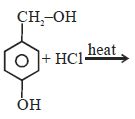
DifficultMCQ
The major product in the following reaction is
A
$4-$hydroxybenzyl chloride
B
$4-$chloromethylchlorobenzene
C
$3-$chloro$-4-$hydroxybenzyl alcohol
D
$4-$chlorobenzyl alcohol
Solution
(A) The reaction involves the substitution of the hydroxyl group $(-OH)$ of the benzylic alcohol with a chlorine atom $(-Cl)$ using $HCl$ under heating conditions.
In $4$-hydroxybenzyl alcohol,there are two types of hydroxyl groups: one is a phenolic $-OH$ group and the other is a benzylic $-OH$ group.
The benzylic $-OH$ group is more reactive towards nucleophilic substitution with $HCl$ because the resulting carbocation intermediate is resonance-stabilized by the benzene ring.
The phenolic $-OH$ group does not undergo substitution with $HCl$ easily because the $C-O$ bond has partial double bond character due to resonance.
Therefore,the $-OH$ group of the $-CH_2OH$ side chain is replaced by $-Cl$,yielding $4$-hydroxybenzyl chloride as the major product.
In $4$-hydroxybenzyl alcohol,there are two types of hydroxyl groups: one is a phenolic $-OH$ group and the other is a benzylic $-OH$ group.
The benzylic $-OH$ group is more reactive towards nucleophilic substitution with $HCl$ because the resulting carbocation intermediate is resonance-stabilized by the benzene ring.
The phenolic $-OH$ group does not undergo substitution with $HCl$ easily because the $C-O$ bond has partial double bond character due to resonance.
Therefore,the $-OH$ group of the $-CH_2OH$ side chain is replaced by $-Cl$,yielding $4$-hydroxybenzyl chloride as the major product.
0 likes
View Solution538
AdvancedMCQ
Compound $A$ and $C$ in the following reaction are
$CH_3CHO$ $\xrightarrow[(i) \, CH_3MgBr]{(ii) \, H_2O} A$ $\xrightarrow{H_2SO_4, \Delta} B$ $\xrightarrow{\text{Hydroboration-Oxidation}} C$
$CH_3CHO$ $\xrightarrow[(i) \, CH_3MgBr]{(ii) \, H_2O} A$ $\xrightarrow{H_2SO_4, \Delta} B$ $\xrightarrow{\text{Hydroboration-Oxidation}} C$
A
Identical
B
Positional Isomer
C
Functional Isomer
D
Optical Isomer
Solution
(B) $CH_3CHO$ reacts with $CH_3MgBr$ followed by $H_2O$ to form $CH_3-CH(OH)-CH_3$ ($A$,Propan$-2-$ol).
$A$ undergoes acid-catalyzed dehydration with $H_2SO_4$ at $\Delta$ to form $CH_3-CH=CH_2$ ($B$,Propene).
$B$ undergoes Hydroboration-Oxidation to form $CH_3-CH_2-CH_2OH$ ($C$,Propan$-1-$ol).
Since $A$ is Propan$-2-$ol and $C$ is Propan$-1-$ol,they differ in the position of the hydroxyl group.
Therefore,$A$ and $C$ are positional isomers.
$A$ undergoes acid-catalyzed dehydration with $H_2SO_4$ at $\Delta$ to form $CH_3-CH=CH_2$ ($B$,Propene).
$B$ undergoes Hydroboration-Oxidation to form $CH_3-CH_2-CH_2OH$ ($C$,Propan$-1-$ol).
Since $A$ is Propan$-2-$ol and $C$ is Propan$-1-$ol,they differ in the position of the hydroxyl group.
Therefore,$A$ and $C$ are positional isomers.
0 likes
View Solution539
MediumMCQ
Identify the incorrect statement regarding the following reaction:
$CH_3CH_2OH + H_3O^+ \to CH_3CH_2-OH_2^+ + H_2O$
$CH_3CH_2OH + H_3O^+ \to CH_3CH_2-OH_2^+ + H_2O$
A
Ethanol acts as a Lewis base.
B
Ethanol acts as a Brønsted base.
C
$H_3O^+$ acts as a Lewis base.
D
$H_3O^+$ and $H_2O$ form a conjugate acid-base pair.
Solution
(C) In the reaction $CH_3CH_2OH + H_3O^+ \to CH_3CH_2OH_2^+ + H_2O$:
$1$. Ethanol $(CH_3CH_2OH)$ donates a lone pair of electrons from oxygen to the $H^+$ ion,acting as a Lewis base.
$2$. Ethanol accepts a proton $(H^+)$ from $H_3O^+$,acting as a Brønsted-Lowry base.
$3$. $H_3O^+$ donates a proton to ethanol,acting as a Brønsted-Lowry acid.
$4$. $H_3O^+$ and $H_2O$ differ by a proton,thus forming a conjugate acid-base pair.
$5$. Statement $C$ is incorrect because $H_3O^+$ acts as a Brønsted-Lowry acid,not a Lewis base.
$1$. Ethanol $(CH_3CH_2OH)$ donates a lone pair of electrons from oxygen to the $H^+$ ion,acting as a Lewis base.
$2$. Ethanol accepts a proton $(H^+)$ from $H_3O^+$,acting as a Brønsted-Lowry base.
$3$. $H_3O^+$ donates a proton to ethanol,acting as a Brønsted-Lowry acid.
$4$. $H_3O^+$ and $H_2O$ differ by a proton,thus forming a conjugate acid-base pair.
$5$. Statement $C$ is incorrect because $H_3O^+$ acts as a Brønsted-Lowry acid,not a Lewis base.
0 likes
View Solution540
MediumMCQ
How many isomers of ${C_5}{H_{11}}OH$ are primary alcohols?
A
$5$
B
$2$
C
$4$
D
$3$
Solution
(C) To determine the number of primary alcohols with the molecular formula ${C_5}{H_{11}}OH$,we look for structures where the $-OH$ group is attached to a primary carbon atom (a carbon attached to only one other carbon).
$1$. $CH_3-CH_2-CH_2-CH_2-CH_2-OH$ (Pentan$-1-$ol)
$2$. $CH_3-CH_2-CH_2-CH(CH_3)-OH$ (This is secondary,so exclude)
$3$. $CH_3-CH_2-CH(CH_3)-CH_2-OH$ ($2$-Methylbutan$-1-$ol)
$4$. $CH_3-CH(CH_3)-CH_2-CH_2-OH$ ($3$-Methylbutan$-1-$ol)
$5$. $(CH_3)_3C-CH_2-OH$ ($2$,$2$-Dimethylpropan$-1-$ol)
There are a total of $4$ primary alcohol isomers.
$1$. $CH_3-CH_2-CH_2-CH_2-CH_2-OH$ (Pentan$-1-$ol)
$2$. $CH_3-CH_2-CH_2-CH(CH_3)-OH$ (This is secondary,so exclude)
$3$. $CH_3-CH_2-CH(CH_3)-CH_2-OH$ ($2$-Methylbutan$-1-$ol)
$4$. $CH_3-CH(CH_3)-CH_2-CH_2-OH$ ($3$-Methylbutan$-1-$ol)
$5$. $(CH_3)_3C-CH_2-OH$ ($2$,$2$-Dimethylpropan$-1-$ol)
There are a total of $4$ primary alcohol isomers.
0 likes
View Solution541
MediumMCQ
Which of the following alcohols reacts most rapidly with alkali metals?
A
Secondary
B
Tertiary
C
Primary
D
All react at the same rate
Solution
(C) The reaction of alcohols with alkali metals ($Na, K$,etc.) involves the cleavage of the $O-H$ bond to form alkoxides and hydrogen gas: $R-OH + M \rightarrow R-O^-M^+ + \frac{1}{2}H_2$. The rate of this reaction depends on the acidity of the alcohol,which is influenced by the electron-donating inductive effect ($+I$ effect) of the alkyl groups. Alkyl groups increase the electron density on the oxygen atom,making the $O-H$ bond less polar and the proton less acidic. Therefore,the order of reactivity is: $\text{Primary} > \text{Secondary} > \text{Tertiary}$. Thus,primary alcohols react most rapidly.
0 likes
View Solution542
MediumMCQ
Which of the following statements is correct regarding the ease of dehydration of alcohols?
A
Primary > Secondary
B
Secondary > Tertiary
C
Tertiary > Secondary > Primary
D
None of these
Solution
(C) The dehydration of alcohols proceeds via the formation of a carbocation intermediate.
The stability order of carbocations is $3^{\circ} > 2^{\circ} > 1^{\circ}$.
Since the rate-determining step involves the formation of a carbocation,the ease of dehydration follows the same order: $3^{\circ} > 2^{\circ} > 1^{\circ}$.
The stability order of carbocations is $3^{\circ} > 2^{\circ} > 1^{\circ}$.
Since the rate-determining step involves the formation of a carbocation,the ease of dehydration follows the same order: $3^{\circ} > 2^{\circ} > 1^{\circ}$.
0 likes
View Solution543
DifficultMCQ
What product is formed when ethyl alcohol is oxidized with $K_2Cr_2O_7$?
A
Acetic acid
B
Acetaldehyde
C
Formaldehyde
D
Formic acid
Solution
(A) The oxidation of primary alcohols like ethyl alcohol $(CH_3CH_2OH)$ with strong oxidizing agents such as acidic $K_2Cr_2O_7$ proceeds in two steps.
First,the alcohol is oxidized to an aldehyde,$CH_3CHO$ (acetaldehyde).
Second,the aldehyde is further oxidized to a carboxylic acid,$CH_3COOH$ (acetic acid).
Under standard laboratory conditions with excess oxidizing agent,the final stable product is acetic acid.
First,the alcohol is oxidized to an aldehyde,$CH_3CHO$ (acetaldehyde).
Second,the aldehyde is further oxidized to a carboxylic acid,$CH_3COOH$ (acetic acid).
Under standard laboratory conditions with excess oxidizing agent,the final stable product is acetic acid.
0 likes
View Solution544
MediumMCQ
Which of the following reagents is used to convert ethyl alcohol into ethyl chloride?
A
$SOCl_2$
B
$NaCl$
C
$Cl_2$
D
$KCl$
Solution
(A) The conversion of ethyl alcohol $(CH_3CH_2OH)$ to ethyl chloride $(CH_3CH_2Cl)$ is best achieved using thionyl chloride $(SOCl_2)$.
This reaction is known as the Darzens process.
The chemical equation is: $CH_3CH_2OH + SOCl_2 \rightarrow CH_3CH_2Cl + SO_2(g) + HCl(g)$.
This method is preferred because the by-products ($SO_2$ and $HCl$) are gases,which escape,leaving behind pure ethyl chloride.
This reaction is known as the Darzens process.
The chemical equation is: $CH_3CH_2OH + SOCl_2 \rightarrow CH_3CH_2Cl + SO_2(g) + HCl(g)$.
This method is preferred because the by-products ($SO_2$ and $HCl$) are gases,which escape,leaving behind pure ethyl chloride.
0 likes
View Solution545
MediumMCQ
In the reaction $R-OH + HX \to RX + H_2O$,what is the order of reactivity of alcohols?
A
Tertiary > Secondary > Primary
B
Tertiary < Secondary < Primary
C
Tertiary > Primary > Secondary
D
Secondary > Primary > Tertiary
Solution
(A) The reaction $R-OH + HX \to RX + H_2O$ proceeds via the formation of a carbocation intermediate.
Since the stability of carbocations follows the order $3^\circ > 2^\circ > 1^\circ$,the reactivity of alcohols towards $HX$ follows the same order.
Therefore,the order of reactivity is $3^\circ > 2^\circ > 1^\circ$ (Tertiary > Secondary > Primary).
Since the stability of carbocations follows the order $3^\circ > 2^\circ > 1^\circ$,the reactivity of alcohols towards $HX$ follows the same order.
Therefore,the order of reactivity is $3^\circ > 2^\circ > 1^\circ$ (Tertiary > Secondary > Primary).
0 likes
View Solution546
DifficultMCQ
An organic compound $(A)$ reacts with sodium metal to form $(B)$. When $(A)$ is heated with concentrated $H_2SO_4$,it produces diethyl ether. What are $(A)$ and $(B)$ respectively?
A
$C_2H_5OH$ and $C_2H_5ONa$
B
$C_3H_7OH$ and $CH_3ONa$
C
$CH_3OH$ and $CH_3ONa$
D
$C_4H_9OH$ and $C_4H_9ONa$
Solution
(A) $1$. The reaction of an alcohol with sodium metal produces sodium alkoxide and hydrogen gas: $2R-OH + 2Na \rightarrow 2R-ONa + H_2$.
$2$. The dehydration of ethanol with concentrated $H_2SO_4$ at $413 \ K$ yields diethyl ether: $2C_2H_5OH \xrightarrow{conc. H_2SO_4, 413 \ K} C_2H_5-O-C_2H_5 + H_2O$.
$3$. Comparing this with the given information,$(A)$ is ethanol $(C_2H_5OH)$ and $(B)$ is sodium ethoxide $(C_2H_5ONa)$.
$2$. The dehydration of ethanol with concentrated $H_2SO_4$ at $413 \ K$ yields diethyl ether: $2C_2H_5OH \xrightarrow{conc. H_2SO_4, 413 \ K} C_2H_5-O-C_2H_5 + H_2O$.
$3$. Comparing this with the given information,$(A)$ is ethanol $(C_2H_5OH)$ and $(B)$ is sodium ethoxide $(C_2H_5ONa)$.
0 likes
View Solution547
DifficultMCQ
$A$ compound with the molecular formula ${C_4}{H_{10}}O$ reacts with sodium and gives a carbonyl compound upon oxidation,which does not reduce Tollen's reagent. What is the original compound?
A
Diethyl ether
B
$n$-Butyl alcohol
C
Isobutyl alcohol
D
sec-Butyl alcohol
Solution
(D) $1$. The molecular formula ${C_4}{H_{10}}O$ corresponds to either an alcohol or an ether.
$2$. The compound reacts with sodium,which indicates it is an alcohol $(R-OH + Na \rightarrow R-ONa + \frac{1}{2}H_2)$.
$3$. Upon oxidation,it yields a carbonyl compound that does not reduce Tollen's reagent. This means the carbonyl compound is a ketone,not an aldehyde.
$4$. For an alcohol to yield a ketone upon oxidation,it must be a secondary alcohol.
$5$. The secondary alcohol with the formula ${C_4}{H_{10}}O$ is $sec$-butyl alcohol $(CH_3-CH(OH)-CH_2-CH_3)$,which oxidizes to butanone $(CH_3-CO-CH_2-CH_3)$.
$6$. Butanone is a ketone and does not give a positive Tollen's test.
$2$. The compound reacts with sodium,which indicates it is an alcohol $(R-OH + Na \rightarrow R-ONa + \frac{1}{2}H_2)$.
$3$. Upon oxidation,it yields a carbonyl compound that does not reduce Tollen's reagent. This means the carbonyl compound is a ketone,not an aldehyde.
$4$. For an alcohol to yield a ketone upon oxidation,it must be a secondary alcohol.
$5$. The secondary alcohol with the formula ${C_4}{H_{10}}O$ is $sec$-butyl alcohol $(CH_3-CH(OH)-CH_2-CH_3)$,which oxidizes to butanone $(CH_3-CO-CH_2-CH_3)$.
$6$. Butanone is a ketone and does not give a positive Tollen's test.
0 likes
View Solution548
MediumMCQ
What is obtained by the reaction of primary and secondary alcohols with red-hot copper at $573 \ K$?
A
Aldehyde and ketone respectively
B
Ketone and aldehyde respectively
C
Only aldehyde
D
Only ketone
Solution
(A) When primary alcohols $(R-CH_2OH)$ are passed over red-hot copper at $573 \ K$,they undergo dehydrogenation to form aldehydes $(R-CHO)$.
When secondary alcohols $(R_2CHOH)$ are passed over red-hot copper at $573 \ K$,they undergo dehydrogenation to form ketones $(R_2C=O)$.
Therefore,primary and secondary alcohols yield aldehydes and ketones respectively.
When secondary alcohols $(R_2CHOH)$ are passed over red-hot copper at $573 \ K$,they undergo dehydrogenation to form ketones $(R_2C=O)$.
Therefore,primary and secondary alcohols yield aldehydes and ketones respectively.
0 likes
View Solution549
DifficultMCQ
Which of the following is the most suitable method to remove small amounts of water from ethanol?
A
Reacting with $Na$ metal
B
Passing dry $HCl$ gas through it
C
Distillation
D
Reacting with $Mg$
Solution
(D) Ethanol containing small amounts of water is known as rectified spirit. To obtain absolute alcohol (pure ethanol),the water must be removed.
Reacting ethanol with $Mg$ metal is the most effective method because $Mg$ reacts with water to form $Mg(OH)_2$ and $H_2$ gas,effectively removing the water content without reacting significantly with the ethanol under controlled conditions.
This process is commonly used in the laboratory to prepare absolute alcohol.
Reacting ethanol with $Mg$ metal is the most effective method because $Mg$ reacts with water to form $Mg(OH)_2$ and $H_2$ gas,effectively removing the water content without reacting significantly with the ethanol under controlled conditions.
This process is commonly used in the laboratory to prepare absolute alcohol.
0 likes
View Solution550
AdvancedMCQ
$A$ compound is soluble in concentrated ${H_2SO_4}$. It does not decolorize a solution of bromine in ${CCl_4}$. However,it is oxidized by chromic anhydride in aqueous sulfuric acid within two seconds,changing the color of the solution from orange to blue,green,and finally opaque. What does the original compound contain?
A
Secondary alcohol
B
Alkene
C
Ether
D
Primary alcohol
Solution
(D) $1$. The compound is soluble in concentrated ${H_2SO_4}$,which indicates it is an alcohol or an ether.
$2$. It does not decolorize bromine in ${CCl_4}$,meaning it is a saturated compound (no $C=C$ double bonds).
$3$. The reaction with chromic anhydride (${CrO_3}$ in ${H_2SO_4}$,known as the Jones reagent) causes a rapid color change from orange to blue/green. This is a characteristic test for primary and secondary alcohols.
$4$. Primary and secondary alcohols are oxidized rapidly by the Jones reagent. However,the specific observation of the solution turning blue,green,and then opaque is a classic qualitative test result for a primary alcohol,which is oxidized to an aldehyde and then to a carboxylic acid,often forming complex chromium species.
$2$. It does not decolorize bromine in ${CCl_4}$,meaning it is a saturated compound (no $C=C$ double bonds).
$3$. The reaction with chromic anhydride (${CrO_3}$ in ${H_2SO_4}$,known as the Jones reagent) causes a rapid color change from orange to blue/green. This is a characteristic test for primary and secondary alcohols.
$4$. Primary and secondary alcohols are oxidized rapidly by the Jones reagent. However,the specific observation of the solution turning blue,green,and then opaque is a classic qualitative test result for a primary alcohol,which is oxidized to an aldehyde and then to a carboxylic acid,often forming complex chromium species.
0 likes
View SolutionAlcohols, Phenols and Ethers — Properties of alcohol · Frequently Asked Questions
1Are these Alcohols, Phenols and Ethers questions useful for JEE and NEET?
Yes. All questions in this section are mapped to JEE Main and NEET exam patterns. Previous year questions from JEE Main, NEET, GUJCET and state-level exams are included with full solutions.
2Can I switch to Hindi or Gujarati for these questions?
Yes. Use the language tabs in the hero section or the sidebar to view the same questions and solutions in English, Hindi or Gujarati.
3How do I generate a question paper from this subtopic?
Use the Vedclass Exam Paper Generator — select the chapter and subtopic, set difficulty, and generate Sets A, B, C, D automatically. First 3 chapters of every subject are free.
Vedclass Products
For Students
Vedclass Test Series
Mock tests in real JEE/NEET style with performance analysis. 5-day free trial.
Start Free TrialFor Teachers
Exam Paper Generator
Generate Set A/B/C/D papers from this chapter in 2 minutes. 3 chapters free.
Try FreeFor Institutes
Online Exam Module
Live online exams with unlimited students, 360° analytics & white-label branding.
See DemoFor Teachers & Institutes
Generate a Alcohols, Phenols and Ethers Exam Paper in 2 Minutes
Select subtopic & difficulty — Sets A, B, C, D auto-generated with No Repeat logic.
First 3 chapters of every subject are free — no payment required.