
A English
Linkage and recombination Questions in English
Class 12 Biology · Principles of Inheritance and Variation · Linkage and recombination
223+
Questions
English
Language
100%
With Solutions
Showing 50 of 223 questions in English
101
MediumMCQ
In a test cross involving $F_1$ dihybrid flies,more parental-type offspring were produced than the recombinant-type offspring. This indicates
A
the two genes are linked and present on the same chromosome
B
both of the characters are controlled by more than one gene
C
the two genes are located on two different chromosomes
D
chromosomes failed to separate during meiosis.
Solution
(A) : If in a dihybrid test cross,more parental combinations appear compared to the recombinants in the $F_2$ generation,it is indicative of the involvement of linkage.
Linkage is the tendency of two different genes on the same chromosome to remain together during the separation of homologous chromosomes at meiosis.
During complete linkage,no recombinants are formed,whereas in incomplete linkage,a few recombinants are produced along with parental combinations.
Linkage is the tendency of two different genes on the same chromosome to remain together during the separation of homologous chromosomes at meiosis.
During complete linkage,no recombinants are formed,whereas in incomplete linkage,a few recombinants are produced along with parental combinations.
0 likes
View Solution102
MediumMCQ
The term "linkage" was coined by
A
$G$. Mendel
B
$W$. Sutton
C
$T$.$H$. Morgan
D
$T$. Boveri
Solution
(C) The correct answer is $C$.
Linkage is the phenomenon where genes located on the same chromosome tend to be inherited together through generations without separation.
While Sutton and Boveri $(1902-1903)$ proposed the chromosomal theory of inheritance and Bateson and Punnett $(1906)$ observed the phenomenon in sweet peas, it was $T.H. Morgan$ who coined the term "linkage" and provided experimental proof using the fruit fly, $Drosophila$ $\text{melanogaster}$.
Linkage is the phenomenon where genes located on the same chromosome tend to be inherited together through generations without separation.
While Sutton and Boveri $(1902-1903)$ proposed the chromosomal theory of inheritance and Bateson and Punnett $(1906)$ observed the phenomenon in sweet peas, it was $T.H. Morgan$ who coined the term "linkage" and provided experimental proof using the fruit fly, $Drosophila$ $\text{melanogaster}$.
0 likes
View Solution103
MediumMCQ
Select the correct statement from the ones given below with respect to dihybrid cross.
A
Tightly linked genes on the same chromosomes show higher recombinations.
B
Genes far apart on the same chromosome show very few recombinations.
C
Genes loosely linked on the same chromosome show similar recombinations.
D
Tightly linked genes on the same chromosome show very few recombinations.
Solution
(D) : Linkage is the phenomenon of certain genes staying together during inheritance through generations without any change or separation due to their being present on the same chromosome.
Linked genes occur in the same chromosome.
The strength of the linkage between two genes is inversely proportional to the distance between the two.
$i.e.$,two linked genes show a higher frequency of crossing over (recombination) if the distance between them is higher and a lower frequency if the distance is small.
Linked genes occur in the same chromosome.
The strength of the linkage between two genes is inversely proportional to the distance between the two.
$i.e.$,two linked genes show a higher frequency of crossing over (recombination) if the distance between them is higher and a lower frequency if the distance is small.
0 likes
View Solution104
MediumMCQ
Which of the following statements is not true of two genes that show $50\%$ recombination frequency?
A
The genes show independent assortment.
B
If the genes are present on the same chromosome,they undergo more than one crossover in every meiosis.
C
The genes may be on different chromosomes.
D
The genes are tightly linked.
Solution
(D) Recombination frequency of $50\%$ indicates that the genes are either located on different chromosomes or are so far apart on the same chromosome that they assort independently.
$A$ $50\%$ recombination frequency is the maximum possible value,which is equivalent to the frequency observed for genes undergoing independent assortment.
If genes were tightly linked,the recombination frequency would be very low (close to $0\%$).
Therefore,the statement that the genes are tightly linked is incorrect.
$A$ $50\%$ recombination frequency is the maximum possible value,which is equivalent to the frequency observed for genes undergoing independent assortment.
If genes were tightly linked,the recombination frequency would be very low (close to $0\%$).
Therefore,the statement that the genes are tightly linked is incorrect.
0 likes
View Solution105
MediumMCQ
Which is the most common mechanism of genetic variation in the population of a sexually reproducing organism?
A
Genetic drift
B
Recombination
C
Transduction
D
Chromosomal aberrations
Solution
(B) The correct answer is $B$.
Genetic variation in sexually reproducing organisms primarily arises from the reshuffling of genes.
This occurs through three main processes:
$1$. Independent assortment of chromosomes during meiosis.
$2$. Crossing over,which leads to the exchange of genetic material between homologous chromosomes.
$3$. Random fertilization of gametes.
Collectively,these processes are referred to as recombination. While mutations and genetic drift also contribute to variation,recombination is the most frequent and consistent mechanism driving variation in a sexually reproducing population.
Genetic variation in sexually reproducing organisms primarily arises from the reshuffling of genes.
This occurs through three main processes:
$1$. Independent assortment of chromosomes during meiosis.
$2$. Crossing over,which leads to the exchange of genetic material between homologous chromosomes.
$3$. Random fertilization of gametes.
Collectively,these processes are referred to as recombination. While mutations and genetic drift also contribute to variation,recombination is the most frequent and consistent mechanism driving variation in a sexually reproducing population.
0 likes
View Solution106
MediumMCQ
Who used the frequency of recombination as a measure of the distance between genes on a chromosome and mapped their position?
A
Alfred Sturtevant
B
Mendel
C
De Vries
D
Henking
Solution
(A) Alfred Sturtevant,a student of Thomas Hunt Morgan,used the frequency of recombination between gene pairs on the same chromosome as a measure of the distance between genes and mapped their position on the chromosome. This technique is known as genetic mapping or linkage mapping.
0 likes
View Solution107
MediumMCQ
Why did Morgan work with the fruit flies $(Drosophila \text{ } melanogaster)$?
A
Suitable for study
B
Grown on simple synthetic medium
C
Complete their life cycle in about two weeks
D
All of the above
Solution
(D) Thomas Hunt Morgan selected $Drosophila \text{ } melanogaster$ (fruit flies) for his genetic experiments due to several key advantages:
$1$. They are suitable for study as they have many types of hereditary variations that can be seen with low-power microscopes.
$2$. They can be grown on simple synthetic media in the laboratory.
$3$. They complete their life cycle in a short period, about two weeks, allowing for the study of many generations in a short time.
$4$. A single mating could produce a large number of progeny flies.
$5$. There is a clear differentiation between the sexes (male and female flies are easily distinguishable).
Therefore, all the given options are correct.
$1$. They are suitable for study as they have many types of hereditary variations that can be seen with low-power microscopes.
$2$. They can be grown on simple synthetic media in the laboratory.
$3$. They complete their life cycle in a short period, about two weeks, allowing for the study of many generations in a short time.
$4$. A single mating could produce a large number of progeny flies.
$5$. There is a clear differentiation between the sexes (male and female flies are easily distinguishable).
Therefore, all the given options are correct.
0 likes
View Solution108
MediumMCQ
Which organism did $T.H. Morgan$ use in his experiments on linkage and recombination?
A
Grasshopper
B
Pea
C
Dog flower
D
Drosophila
Solution
(D) $T.H. Morgan$ worked with the fruit fly, $Drosophila$ $\text{melanogaster}$, for his experiments on linkage and recombination.
He chose this organism because it could be grown on simple synthetic medium in the laboratory, had a short life cycle (about two weeks), and produced a large number of progeny in a single mating.
Also, there was a clear differentiation of the sexes, and it had many types of hereditary variations that could be seen with low-power microscopes.
He chose this organism because it could be grown on simple synthetic medium in the laboratory, had a short life cycle (about two weeks), and produced a large number of progeny in a single mating.
Also, there was a clear differentiation of the sexes, and it had many types of hereditary variations that could be seen with low-power microscopes.
0 likes
View Solution109
MediumMCQ
What happens in the process of variation?
A
Chromosomal material is duplicated
B
Breakdown of chromosomes
C
Decrease of genetic material
D
Exchange of genetic material
Solution
(D) Variation in biological organisms,particularly during sexual reproduction,is primarily caused by the process of crossing over during meiosis.
Crossing over involves the exchange of genetic material between non-sister chromatids of homologous chromosomes.
This process leads to new combinations of genes,which results in genetic variation among offspring.
Therefore,the correct answer is the exchange of genetic material.
Crossing over involves the exchange of genetic material between non-sister chromatids of homologous chromosomes.
This process leads to new combinations of genes,which results in genetic variation among offspring.
Therefore,the correct answer is the exchange of genetic material.
0 likes
View Solution110
DifficultMCQ
Two genes '$a$' and '$b$' show $20\%$ recombination. What will be the proportion of gametes produced by a dihybrid $F_1$ individual with the genotype $++/ab$,derived from a cross between $++/++$ and $ab/ab$?
A
$++ \, 40\% : ab \, 40\% : a+ \, 10\% : +b \, 10\%$
B
$++ \, 50\% : ab \, 50\%$
C
$++ \, 40\% : ab \, 40\% : a+ \, 10\% : +b \, 10\%$
D
$++ \, 30\% : ab \, 30\% : a+ \, 20\% : +b \, 20\%$
Solution
(C) The recombination frequency is given as $20\%$.
This means the frequency of recombinant gametes ($a+$ and $+b$) is $20\%$ in total.
Since there are two types of recombinant gametes,each will be $20\% / 2 = 10\%$.
The parental gametes ($++$ and $ab$) will make up the remaining $100\% - 20\% = 80\%$.
Since there are two types of parental gametes,each will be $80\% / 2 = 40\%$.
Therefore,the proportions are: $++ = 40\%$,$ab = 40\%$,$a+ = 10\%$,and $+b = 10\%$.
Thus,the correct option is $C$.
This means the frequency of recombinant gametes ($a+$ and $+b$) is $20\%$ in total.
Since there are two types of recombinant gametes,each will be $20\% / 2 = 10\%$.
The parental gametes ($++$ and $ab$) will make up the remaining $100\% - 20\% = 80\%$.
Since there are two types of parental gametes,each will be $80\% / 2 = 40\%$.
Therefore,the proportions are: $++ = 40\%$,$ab = 40\%$,$a+ = 10\%$,and $+b = 10\%$.
Thus,the correct option is $C$.
0 likes
View Solution111
DifficultMCQ
In $Neurospora$,the arrangement of $8$ ascospores produced is $2a : 4a : 2a$. This indicates:
A
No crossing over
B
Some crossing over
C
Second division segregation
D
First division segregation
Solution
(C) $Neurospora$ में,जब अर्धसूत्रीविभाजन (Meiosis) के दौरान जीन लोकस और सेंट्रोमियर के बीच क्रॉसिंग ओवर होता है,तो इसे द्वितीय विभाजन पृथक्करण (Second division segregation) कहा जाता है। सामान्यतः,यदि क्रॉसिंग ओवर नहीं होता है,तो एस्कोस्पोर्स की व्यवस्था $4a : 4a$ (प्रथम विभाजन पृथक्करण) होती है। लेकिन जब $2a : 4a : 2a$ जैसी व्यवस्था दिखाई देती है,तो यह स्पष्ट करता है कि जीन का पृथक्करण अर्धसूत्रीविभाजन के दूसरे चरण में हुआ है,जो क्रॉसिंग ओवर के कारण संभव होता है।
0 likes
View Solution112
MediumMCQ
Mendel studied seven pairs of traits in pea plants,which allow for $21$ possible combinations. If you are told that one of these combinations does not show independent assortment in a subsequent study,what would be your reaction?
A
The Law of Independent Assortment is incorrect.
B
Mendel did not study all the combinations.
C
It is possible.
D
The subsequent study might be incorrect.
Solution
(C) मेंडल के स्वतंत्र अपव्यूहन के नियम के अनुसार,जीन एक-दूसरे से स्वतंत्र रूप से वंशागत होते हैं। हालाँकि,यह नियम केवल तभी लागू होता है जब जीन अलग-अलग गुणसूत्रों पर स्थित हों या एक ही गुणसूत्र पर बहुत दूर स्थित हों। यदि दो जीन एक ही गुणसूत्र पर बहुत पास स्थित होते हैं,तो वे 'सहलग्नता' (Linkage) प्रदर्शित करते हैं और स्वतंत्र अपव्यूहन नहीं दिखाते हैं। मेंडल द्वारा चुने गए सात लक्षण संयोग से अलग-अलग गुणसूत्रों पर थे या बहुत दूर थे,इसलिए उन्होंने स्वतंत्र अपव्यूहन देखा। यदि किसी अन्य अध्ययन में स्वतंत्र अपव्यूहन नहीं देखा जाता है,तो इसका अर्थ है कि उन जीनों के बीच 'सहलग्नता' (Linkage) है,जो जैविक रूप से संभव है।
0 likes
View Solution113
MediumMCQ
Two dominant non-allelic genes are $50$ map units apart. The linkage present is:
A
$cis$ type
B
$trans$ type
C
Complete
D
Absent/Incomplete
Solution
(D) The distance between two genes is measured in map units or centimorgans $(cM)$.
$1$ map unit corresponds to $1\%$ recombination frequency.
If two genes are $50$ map units apart,the recombination frequency between them is $50\%$.
According to the principle of linkage,if the recombination frequency is $50\%$,the genes behave as if they are assorting independently.
Therefore,linkage is considered to be absent or effectively incomplete to the point of independent assortment.
$1$ map unit corresponds to $1\%$ recombination frequency.
If two genes are $50$ map units apart,the recombination frequency between them is $50\%$.
According to the principle of linkage,if the recombination frequency is $50\%$,the genes behave as if they are assorting independently.
Therefore,linkage is considered to be absent or effectively incomplete to the point of independent assortment.
0 likes
View Solution114
MediumMCQ
Which of the following is suitable for the study of linkage?
A
$aaBB \times aaBB$
B
$AABB \times aabb$
C
$AaBb \times AaBb$
D
$AAbb \times AaBB$
Solution
(B) To study linkage,a test cross is performed between a dihybrid individual $(AaBb)$ and a homozygous recessive individual $(aabb)$.
However,in the given options,we look for a cross that produces a dihybrid $(AaBb)$ in the $F_1$ generation,which is then used for linkage analysis.
The cross $AABB \times aabb$ produces $AaBb$ in the $F_1$ generation.
This $F_1$ dihybrid is then test-crossed with a double recessive parent $(aabb)$ to observe the linkage between genes.
Therefore,the cross $AABB \times aabb$ is the standard starting point for creating the dihybrid required to study linkage.
However,in the given options,we look for a cross that produces a dihybrid $(AaBb)$ in the $F_1$ generation,which is then used for linkage analysis.
The cross $AABB \times aabb$ produces $AaBb$ in the $F_1$ generation.
This $F_1$ dihybrid is then test-crossed with a double recessive parent $(aabb)$ to observe the linkage between genes.
Therefore,the cross $AABB \times aabb$ is the standard starting point for creating the dihybrid required to study linkage.
0 likes
View Solution115
MediumMCQ
In a diploid organism,crossing over is responsible for what?
A
Dominance of genes
B
Linkage between genes
C
Segregation of alleles
D
Recombination of linked genes
Solution
(D) Crossing over is a biological process that occurs during the $pachytene$ stage of $prophase-I$ of $meiosis$.
It involves the exchange of genetic material between non-sister chromatids of homologous chromosomes.
This process leads to the formation of new combinations of alleles on a chromosome,which is known as genetic recombination.
Therefore,crossing over is responsible for the recombination of linked genes,which increases genetic variation in sexually reproducing organisms.
It involves the exchange of genetic material between non-sister chromatids of homologous chromosomes.
This process leads to the formation of new combinations of alleles on a chromosome,which is known as genetic recombination.
Therefore,crossing over is responsible for the recombination of linked genes,which increases genetic variation in sexually reproducing organisms.
0 likes
View Solution116
MediumMCQ
Genes $A$ and $B$ are linked. What will be the genotype of the offspring produced by a cross between $AB/ab$ and $ab/ab$?
A
$AB/ab$ and $ab/ab$
B
$AaBb$ and $aabb$
C
$AA BB$ and $aa bb$
D
None of the above
Solution
(A) The cross is between a dihybrid individual with linked genes $(AB/ab)$ and a homozygous recessive individual $(ab/ab)$.
This is a test cross.
The gametes produced by the $AB/ab$ parent are $AB$ and $ab$ (assuming no crossing over).
The gametes produced by the $ab/ab$ parent are only $ab$.
Therefore,the offspring genotypes will be $AB/ab$ and $ab/ab$.
This is a test cross.
The gametes produced by the $AB/ab$ parent are $AB$ and $ab$ (assuming no crossing over).
The gametes produced by the $ab/ab$ parent are only $ab$.
Therefore,the offspring genotypes will be $AB/ab$ and $ab/ab$.
0 likes
View Solution117
MediumMCQ
Which of the following does not follow the law of independent assortment?
A
Non-homologous chromosomes and lack of linkage
B
Genes on homologous chromosomes
C
Linked genes on the same chromosome
D
Unlinked genes on the same chromosome
Solution
(C) The law of independent assortment states that the alleles of two (or more) different genes get sorted into gametes independently of one another.
This law holds true only when the genes are located on different chromosomes or are very far apart on the same chromosome.
When genes are located close together on the same chromosome,they are said to be 'linked'.
Linked genes do not assort independently because they tend to be inherited together as a single unit during meiosis.
Therefore,linked genes on the same chromosome violate the law of independent assortment.
This law holds true only when the genes are located on different chromosomes or are very far apart on the same chromosome.
When genes are located close together on the same chromosome,they are said to be 'linked'.
Linked genes do not assort independently because they tend to be inherited together as a single unit during meiosis.
Therefore,linked genes on the same chromosome violate the law of independent assortment.
0 likes
View Solution118
MediumMCQ
There are three genes $a, b,$ and $c$. The percentage of crossing over between $a$ and $b$ is $20\%$,between $b$ and $c$ is $28\%$,and between $a$ and $c$ is $8\%$. What is the sequence of these genes on the chromosome?
A
$b- a- c$
B
$a- b- c$
C
$a- c- b$
D
None of these
Solution
(A) The percentage of crossing over is directly proportional to the distance between genes on a chromosome. Therefore,$1\% \text{ crossing over} = 1 \text{ map unit (cM)}$.
Given distances:
$a-b = 20 \text{ units}$
$b-c = 28 \text{ units}$
$a-c = 8 \text{ units}$
To find the sequence,we look for the two smallest distances that add up to the largest distance:
$a-c (8) + a-b (20) = 28 \text{ units} = b-c$.
This indicates that gene $a$ lies between $b$ and $c$.
Thus,the sequence is $b- a- c$ or $c- a- b$.
Given distances:
$a-b = 20 \text{ units}$
$b-c = 28 \text{ units}$
$a-c = 8 \text{ units}$
To find the sequence,we look for the two smallest distances that add up to the largest distance:
$a-c (8) + a-b (20) = 28 \text{ units} = b-c$.
This indicates that gene $a$ lies between $b$ and $c$.
Thus,the sequence is $b- a- c$ or $c- a- b$.
0 likes
View Solution119
EasyMCQ
What is a genetic map?
A
Shows the stages during cell division.
B
Shows the distribution of various species in an area.
C
Establishes the position of genes on a chromosome.
D
Establishes the various stages of gene evolution.
Solution
(C) genetic map (also known as a linkage map) is a representation of the relative positions of genes or genetic markers on a chromosome. It is based on the frequency of recombination between markers during crossover in meiosis. The distance between genes on a genetic map is measured in map units or centimorgans $(cM)$. Therefore,it establishes the physical or relative location of genes on a chromosome.
0 likes
View Solution120
MediumMCQ
When a group of genes exhibits linkage,they:
A
Do not show independent assortment.
B
Induce cell division.
C
Do not show chromosomal mapping.
D
Show recombination during meiosis.
Solution
(A) Linkage is the phenomenon where genes located on the same chromosome are inherited together because they are physically close to each other.
According to Mendel's Law of Independent Assortment,genes on different chromosomes assort independently.
However,linked genes do not follow this law because they tend to stay together during gamete formation,thus failing to show independent assortment.
According to Mendel's Law of Independent Assortment,genes on different chromosomes assort independently.
However,linked genes do not follow this law because they tend to stay together during gamete formation,thus failing to show independent assortment.
0 likes
View Solution121
AdvancedMCQ
In a fruit fly,the $X$-chromosome linkage map has a total length of $66$ units,with the yellow body gene $(y)$ at one end and the bobbed hair gene $(b)$ at the other end. What will be the recombination frequency between these two genes $(y$ and $b)$?
A
$\leq 50\%$
B
$66\%$
C
$100\%$
D
$> 50\%$
Solution
(A) The distance between two genes on a chromosome is measured in map units or centimorgans $(cM)$.
One map unit corresponds to $1\%$ recombination frequency.
However,the maximum observable recombination frequency between any two linked genes is capped at $50\%$,even if the map distance is greater than $50$ map units.
This is because multiple crossovers (double or higher-order crossovers) between distant genes can result in the parental combination of alleles,effectively masking the recombination events.
Since the map distance is $66$ units (which is $> 50$ units),the observed recombination frequency will be $50\%$ or less (approaching $50\%$ as the distance increases).
Therefore,the correct answer is $\leq 50\%$.
One map unit corresponds to $1\%$ recombination frequency.
However,the maximum observable recombination frequency between any two linked genes is capped at $50\%$,even if the map distance is greater than $50$ map units.
This is because multiple crossovers (double or higher-order crossovers) between distant genes can result in the parental combination of alleles,effectively masking the recombination events.
Since the map distance is $66$ units (which is $> 50$ units),the observed recombination frequency will be $50\%$ or less (approaching $50\%$ as the distance increases).
Therefore,the correct answer is $\leq 50\%$.
0 likes
View Solution122
MediumMCQ
The lack of independent assortment of two genes $A$ and $B$ in the fruit fly $Drosophila$ is due to:
A
Segregation
B
Recombination
C
Linkage
D
Crossing over
Solution
(C) Independent assortment is a principle described by Mendel,which states that genes for different traits segregate independently during gamete formation.
However,when two genes are located close together on the same chromosome,they tend to be inherited together,a phenomenon known as linkage.
In $Drosophila$,$T.H. Morgan$ observed that genes $A$ and $B$ did not show independent assortment because they were physically linked on the same chromosome.
Therefore,the lack of independent assortment is due to linkage.
However,when two genes are located close together on the same chromosome,they tend to be inherited together,a phenomenon known as linkage.
In $Drosophila$,$T.H. Morgan$ observed that genes $A$ and $B$ did not show independent assortment because they were physically linked on the same chromosome.
Therefore,the lack of independent assortment is due to linkage.
0 likes
View Solution123
MediumMCQ
In maize plants,genes $R$ and $y$ are located very close to each other on the chromosome map. When a cross is made between $RRYY$ and $rryy$ genotypes,what will the $F_2$ analysis show?
A
Higher number of recombinant types
B
Segregation in the expected $9:3:3:1$ ratio
C
Segregation in a $3:1$ ratio
D
Higher number of parental types
Solution
(D) When two genes are located very close to each other on the same chromosome,they exhibit the phenomenon of linkage.
Linkage refers to the physical association of genes on a chromosome,which results in the tendency of these genes to be inherited together.
Because the genes $R$ and $y$ are closely linked,the frequency of crossing over between them is very low.
Consequently,the gametes produced will predominantly be of the parental type ($RY$ and $ry$).
In the $F_2$ generation,this results in a significantly higher proportion of offspring showing parental phenotypes compared to recombinant phenotypes,deviating from the independent assortment ratio of $9:3:3:1$.
Linkage refers to the physical association of genes on a chromosome,which results in the tendency of these genes to be inherited together.
Because the genes $R$ and $y$ are closely linked,the frequency of crossing over between them is very low.
Consequently,the gametes produced will predominantly be of the parental type ($RY$ and $ry$).
In the $F_2$ generation,this results in a significantly higher proportion of offspring showing parental phenotypes compared to recombinant phenotypes,deviating from the independent assortment ratio of $9:3:3:1$.
0 likes
View Solution124
MediumMCQ
Select the correct statement regarding the dihybrid cross experiment.
A
Genes very closely linked on a chromosome show more recombinations.
B
Genes located far apart on the same chromosome show very few recombinations.
C
Loosely linked genes on the same chromosome show the same number of recombinations as very closely linked genes.
D
Genes very closely linked on a chromosome show very few recombinations.
Solution
(D) In a dihybrid cross,the frequency of recombination between two genes is inversely proportional to the distance between them on the chromosome.
Genes that are located very close to each other on the same chromosome are tightly linked,meaning they are inherited together more frequently,resulting in a lower frequency of recombination.
Conversely,genes that are located far apart on the same chromosome are loosely linked and have a higher probability of crossing over,leading to a higher frequency of recombination.
Therefore,the statement that genes very closely linked on a chromosome show very few recombinations is correct.
Genes that are located very close to each other on the same chromosome are tightly linked,meaning they are inherited together more frequently,resulting in a lower frequency of recombination.
Conversely,genes that are located far apart on the same chromosome are loosely linked and have a higher probability of crossing over,leading to a higher frequency of recombination.
Therefore,the statement that genes very closely linked on a chromosome show very few recombinations is correct.
0 likes
View Solution125
MediumMCQ
Which of the following statements is $NOT$ true for two genes showing $50\%$ recombination frequency?
A
The genes are present on different chromosomes.
B
The genes are tightly linked.
C
The genes show independent assortment.
D
If the genes are on the same chromosome,they show more than one crossover in every meiosis.
Solution
(B) Recombination frequency of $50\%$ indicates that the genes are either located on different chromosomes or are so far apart on the same chromosome that they assort independently.
$1$. If genes are on different chromosomes,they show independent assortment.
$2$. If genes are on the same chromosome but very far apart,multiple crossovers occur,resulting in $50\%$ recombination.
$3$. Tightly linked genes show very low recombination frequency (much less than $50\%$).
Therefore,the statement that genes are tightly linked is incorrect.
$1$. If genes are on different chromosomes,they show independent assortment.
$2$. If genes are on the same chromosome but very far apart,multiple crossovers occur,resulting in $50\%$ recombination.
$3$. Tightly linked genes show very low recombination frequency (much less than $50\%$).
Therefore,the statement that genes are tightly linked is incorrect.
0 likes
View Solution126
EasyMCQ
Who coined the term 'linkage'?
A
$T. H. Morgan$
B
$T. Boveri$
C
$G. Mendel$
D
$W. Sutton$
Solution
(A) The term 'linkage' was coined by $T. H. Morgan$.
$T. H. Morgan$ performed experiments on the fruit fly, $Drosophila \, melanogaster$, and observed that genes located on the same chromosome do not always assort independently, a phenomenon he termed 'linkage'.
$T. H. Morgan$ performed experiments on the fruit fly, $Drosophila \, melanogaster$, and observed that genes located on the same chromosome do not always assort independently, a phenomenon he termed 'linkage'.
0 likes
View Solution127
MediumMCQ
When a test cross is performed between $F_1$ hybrid flies,the parental type offspring are produced in much higher frequency than the recombinant type offspring. What does this indicate?
A
Chromosomes fail to separate during meiosis.
B
The two genes are linked and present on the same chromosome.
C
Both traits are controlled by more than one gene.
D
The two genes are located on two different chromosomes.
Solution
(B) In genetics,when two genes are located on the same chromosome,they are said to be linked.
Linkage refers to the physical association of genes on a chromosome.
According to Morgan's experiments on Drosophila,genes that are closely linked show very low recombination frequency,meaning the parental combinations are inherited together much more frequently than the recombinant types.
If genes were on different chromosomes,they would show independent assortment,resulting in a $1:1:1:1$ ratio in a test cross,where parental and recombinant types are equal.
Since parental types are significantly higher,it indicates that the genes are linked and located on the same chromosome.
Linkage refers to the physical association of genes on a chromosome.
According to Morgan's experiments on Drosophila,genes that are closely linked show very low recombination frequency,meaning the parental combinations are inherited together much more frequently than the recombinant types.
If genes were on different chromosomes,they would show independent assortment,resulting in a $1:1:1:1$ ratio in a test cross,where parental and recombinant types are equal.
Since parental types are significantly higher,it indicates that the genes are linked and located on the same chromosome.
0 likes
View Solution128
MediumMCQ
In a diploid organism,crossing over is responsible for ..........
A
Dominance of genes
B
Linkage between genes
C
Segregation of alleles
D
Recombination of linked alleles
Solution
(D) Crossing over is a biological process that occurs during the pachytene stage of prophase-$I$ of meiosis.
It involves the exchange of genetic material between non-sister chromatids of homologous chromosomes.
This process results in the formation of new combinations of alleles on the chromosomes,which is known as genetic recombination.
Therefore,crossing over is responsible for the recombination of linked alleles,leading to genetic variation in the offspring.
It involves the exchange of genetic material between non-sister chromatids of homologous chromosomes.
This process results in the formation of new combinations of alleles on the chromosomes,which is known as genetic recombination.
Therefore,crossing over is responsible for the recombination of linked alleles,leading to genetic variation in the offspring.
0 likes
View Solution129
MediumMCQ
What map unit (Centimorgan) is adopted in the construction of genetic maps?
A
$A$ unit of distance between two expressed genes,representing $10 \%$ cross over
B
$A$ unit of distance between two expressed genes,representing $100 \%$ cross over
C
$A$ unit of distance between genes on chromosomes,representing $1 \%$ cross over
D
$A$ unit of distance between genes on chromosomes,representing $50 \%$ cross over
Solution
(C) The genetic map unit is known as the Centimorgan $(cM)$,named in honor of Thomas Hunt Morgan.
One Centimorgan $(1 \ cM)$ is defined as the distance between two gene loci on a chromosome such that there is a $1 \%$ frequency of recombination (crossing over) between them.
Therefore,a map distance of $1 \ cM$ corresponds to $1 \%$ recombination frequency.
This unit is essential for mapping the relative positions of genes on chromosomes.
One Centimorgan $(1 \ cM)$ is defined as the distance between two gene loci on a chromosome such that there is a $1 \%$ frequency of recombination (crossing over) between them.
Therefore,a map distance of $1 \ cM$ corresponds to $1 \%$ recombination frequency.
This unit is essential for mapping the relative positions of genes on chromosomes.
0 likes
View Solution130
MediumMCQ
The frequency of recombination between gene pairs on the same chromosome as a measure of the distance between genes was explained by
A
$T$.$H$. Morgan
B
Gregor $J$. Mendel
C
Alfred Sturtevant
D
Sutton Boveri
Solution
(C) Alfred Sturtevant,a student of $T$.$H$. Morgan,used the frequency of recombination between gene pairs on the same chromosome as a measure of the distance between genes and mapped their position on the chromosome.
This technique is known as genetic mapping or linkage mapping.
$1$ map unit corresponds to $1\%$ recombination frequency.
This technique is known as genetic mapping or linkage mapping.
$1$ map unit corresponds to $1\%$ recombination frequency.
0 likes
View Solution131
MediumMCQ
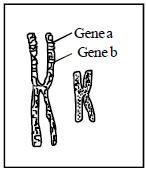
Given below is a highly simplified representation of the human sex chromosomes from a karyotype. The genes $a$ and $b$ could be of
A
colour blindness and body height
B
attached ear lobe and Rhesus blood group
C
haemophilia and red-green colour blindness
D
phenylketonuria and haemophilia
Solution
(C) The image shows the $X$ and $Y$ chromosomes. Genes $a$ and $b$ are located on the same chromosome (the $X$ chromosome) and are very close to each other,indicating that they are linked genes.
Linked genes are genes that are physically located on the same chromosome and tend to be inherited together.
Haemophilia and red-green colour blindness are both well-known $X$-linked recessive disorders in humans.
Because the genes responsible for these two conditions are located on the $X$ chromosome,they exhibit linkage and are often inherited together,which is a classic example of sex-linked inheritance.
Linked genes are genes that are physically located on the same chromosome and tend to be inherited together.
Haemophilia and red-green colour blindness are both well-known $X$-linked recessive disorders in humans.
Because the genes responsible for these two conditions are located on the $X$ chromosome,they exhibit linkage and are often inherited together,which is a classic example of sex-linked inheritance.
0 likes
View Solution132
EasyMCQ
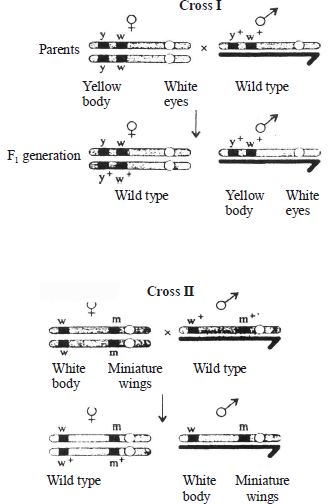
The experiment shown in the given figure has been carried out by Morgan to show the phenomenon of linkage and recombination. If in cross $I$,genes are tightly linked and in cross $II$,genes are loosely linked,then what will be the percentage of recombinants produced in cross $I$ and cross $II$ respectively?
A
$98.7\%$ and $62.8\%$
B
$1.3\%$ and $37.2\%$
C
$37.2\%$ and $1.3\%$
D
$62.8\%$ and $98.7\%$
Solution
(B) Thomas Hunt Morgan conducted experiments on Drosophila melanogaster to study linkage and recombination.
In cross $I$,the genes for yellow body $(y)$ and white eyes $(w)$ are tightly linked,resulting in a low frequency of recombination,which is $1.3\%$.
In cross $II$,the genes for white eyes $(w)$ and miniature wings $(m)$ are loosely linked,resulting in a higher frequency of recombination,which is $37.2\%$.
Therefore,the percentage of recombinants produced in cross $I$ and cross $II$ are $1.3\%$ and $37.2\%$ respectively.
In cross $I$,the genes for yellow body $(y)$ and white eyes $(w)$ are tightly linked,resulting in a low frequency of recombination,which is $1.3\%$.
In cross $II$,the genes for white eyes $(w)$ and miniature wings $(m)$ are loosely linked,resulting in a higher frequency of recombination,which is $37.2\%$.
Therefore,the percentage of recombinants produced in cross $I$ and cross $II$ are $1.3\%$ and $37.2\%$ respectively.
0 likes
View Solution133
DifficultMCQ
Assertion: In case of incomplete linkage,linked genes show new combinations along with parental combinations.
Reason: In case of incomplete linkage,linked genes are separated by crossing over.
Reason: In case of incomplete linkage,linked genes are separated by crossing over.
A
If both Assertion and Reason are correct and the Reason is a correct explanation of the Assertion.
B
If both Assertion and Reason are correct but Reason is not a correct explanation of the Assertion.
C
If the Assertion is correct but Reason is incorrect.
D
If both the Assertion and Reason are incorrect.
Solution
(A) In incomplete linkage,genes located on the same chromosome do not always stay together during inheritance.
Crossing over occurs between non-sister chromatids of homologous chromosomes during meiosis,which leads to the exchange of genetic material.
This process separates the linked genes,resulting in the formation of new gene combinations (recombinants) in addition to the parental combinations.
Therefore,the Reason correctly explains why incomplete linkage results in new combinations.
Crossing over occurs between non-sister chromatids of homologous chromosomes during meiosis,which leads to the exchange of genetic material.
This process separates the linked genes,resulting in the formation of new gene combinations (recombinants) in addition to the parental combinations.
Therefore,the Reason correctly explains why incomplete linkage results in new combinations.
0 likes
View Solution134
MediumMCQ
There are three genes $a, b, c$. The percentage of crossing over between $a$ and $b$ is $20\%$,between $b$ and $c$ is $28\%$,and between $a$ and $c$ is $8\%$. What is the sequence of genes on the chromosome?
A
$b, a, c$
B
$a, b, c$
C
$a, c, b$
D
None of these
Solution
(A) The distance between genes is proportional to the percentage of crossing over. Given:
$1$. Crossing over between $a$ and $b = 20\%$
$2$. Crossing over between $b$ and $c = 28\%$
$3$. Crossing over between $a$ and $c = 8\%$
Since the distance between $b$ and $c$ $(28\%)$ is the sum of the distances between $b$ and $a$ $(20\%)$ and $a$ and $c$ $(8\%)$,gene $a$ must be located between $b$ and $c$.
Therefore,the sequence of genes on the chromosome is $b-a-c$.
$1$. Crossing over between $a$ and $b = 20\%$
$2$. Crossing over between $b$ and $c = 28\%$
$3$. Crossing over between $a$ and $c = 8\%$
Since the distance between $b$ and $c$ $(28\%)$ is the sum of the distances between $b$ and $a$ $(20\%)$ and $a$ and $c$ $(8\%)$,gene $a$ must be located between $b$ and $c$.
Therefore,the sequence of genes on the chromosome is $b-a-c$.
0 likes
View Solution135
Difficult
Two heterozygous parents are crossed. If the two loci are linked,what would be the distribution of phenotypic features in the $F_{2}$ generation for a dihybrid cross?
Solution
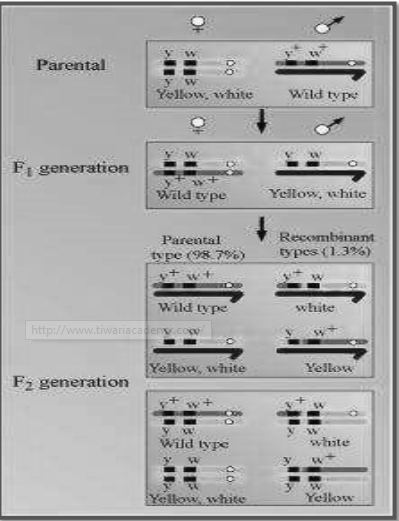
(D) Linkage is defined as the coexistence of two or more genes on the same chromosome. When genes are situated on the same chromosome and lie close to each other,they tend to be inherited together,a phenomenon known as linkage. In a dihybrid cross involving linked genes,the parental combinations are significantly more frequent than the recombinant combinations in the $F_{2}$ generation. This deviates from the Mendelian dihybrid ratio of $9:3:3:1$,as the linked genes do not assort independently. The degree of linkage depends on the physical distance between the genes; closer genes show stronger linkage and fewer recombinants. For example,in Drosophila,genes for yellow body and white eyes are tightly linked,resulting in a high percentage of parental types and a very low percentage of recombinants in the $F_{2}$ generation.
0 likes
View Solution136
Medium
Briefly mention the contribution of $T.H.$ Morgan in genetics.
Solution
(N/A) $T.H.$ Morgan's work was primarily based on the fruit fly, $Drosophila$ $melanogaster$.
He formulated the chromosomal theory of linkage.
He defined linkage as the physical co-existence of two or more genes on the same chromosome.
He performed dihybrid crosses in $Drosophila$ to demonstrate that linked genes are inherited together and are located on the $X$-chromosome.
His experiments also proved that tightly linked genes show very low recombination frequencies, whereas loosely linked genes show higher recombination frequencies.
He formulated the chromosomal theory of linkage.
He defined linkage as the physical co-existence of two or more genes on the same chromosome.
He performed dihybrid crosses in $Drosophila$ to demonstrate that linked genes are inherited together and are located on the $X$-chromosome.
His experiments also proved that tightly linked genes show very low recombination frequencies, whereas loosely linked genes show higher recombination frequencies.
0 likes
View Solution137
Medium
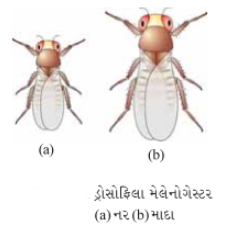
Why did Morgan choose the fruit fly for his experiments to prove the chromosomal theory of inheritance?
Solution
(N/A) Thomas Hunt Morgan and his colleagues performed experimental verification of the chromosomal theory of inheritance.
He conducted his research on the fruit fly,Drosophila melanogaster,for several key reasons:
$1$. They could be grown on simple synthetic media in the laboratory.
$2$. They complete their life cycle in about $15$ days (two weeks).
$3$. $A$ single mating could produce a large number of progeny flies.
$4$. There was a clear differentiation of the sexes; the male and female flies are easily distinguishable.
$5$. They have many types of hereditary variations that can be seen even with low-power microscopes.
He conducted his research on the fruit fly,Drosophila melanogaster,for several key reasons:
$1$. They could be grown on simple synthetic media in the laboratory.
$2$. They complete their life cycle in about $15$ days (two weeks).
$3$. $A$ single mating could produce a large number of progeny flies.
$4$. There was a clear differentiation of the sexes; the male and female flies are easily distinguishable.
$5$. They have many types of hereditary variations that can be seen even with low-power microscopes.
0 likes
View Solution138
Medium
State the conclusions drawn from Morgan's experiments on linkage and recombination.
Solution
(A) Morgan conducted several dihybrid crosses in Drosophila to study genes that were sex-linked. These crosses were similar to the dihybrid crosses carried out by Mendel in peas.
Morgan hybridized yellow-bodied,white-eyed females to brown-bodied,red-eyed males and intercrossed their $F_1$ progeny.
He observed that the two genes did not segregate independently of each other and the $F_2$ ratio deviated very significantly from the $9:3:3:1$ ratio (expected when the two genes are independent).
Morgan and his group knew that the genes were located on the $X$ chromosome. They observed that when two genes in a dihybrid cross were situated on the same chromosome,the proportion of parental gene combinations was much higher than the non-parental type.
Morgan attributed this to the physical association or linkage of the two genes. He coined the term 'Linkage' to describe this physical association of genes on a chromosome and the term 'Recombination' to describe the generation of non-parental gene combinations.
Morgan and his colleagues also found that even when genes were grouped on the same chromosome,some genes were very tightly linked (showed very low recombination) while others were loosely linked (showed higher recombination).
For example,he found that the genes white and yellow were very tightly linked and showed only $1.3\%$ recombination,while white and miniature wing showed $37.2\%$ recombination,indicating loose linkage.
Morgan's student,Alfred Sturtevant,used the frequency of recombination between gene pairs on the same chromosome as a measure of the distance between genes and 'mapped' their position on the chromosome.
Genetic maps are now used as a starting point in the sequencing of whole genomes,as was done in the case of the Human Genome Project $(HGP)$.
Morgan hybridized yellow-bodied,white-eyed females to brown-bodied,red-eyed males and intercrossed their $F_1$ progeny.
He observed that the two genes did not segregate independently of each other and the $F_2$ ratio deviated very significantly from the $9:3:3:1$ ratio (expected when the two genes are independent).
Morgan and his group knew that the genes were located on the $X$ chromosome. They observed that when two genes in a dihybrid cross were situated on the same chromosome,the proportion of parental gene combinations was much higher than the non-parental type.
Morgan attributed this to the physical association or linkage of the two genes. He coined the term 'Linkage' to describe this physical association of genes on a chromosome and the term 'Recombination' to describe the generation of non-parental gene combinations.
Morgan and his colleagues also found that even when genes were grouped on the same chromosome,some genes were very tightly linked (showed very low recombination) while others were loosely linked (showed higher recombination).
For example,he found that the genes white and yellow were very tightly linked and showed only $1.3\%$ recombination,while white and miniature wing showed $37.2\%$ recombination,indicating loose linkage.
Morgan's student,Alfred Sturtevant,used the frequency of recombination between gene pairs on the same chromosome as a measure of the distance between genes and 'mapped' their position on the chromosome.
Genetic maps are now used as a starting point in the sequencing of whole genomes,as was done in the case of the Human Genome Project $(HGP)$.
0 likes
View Solution139
Easy
Distinguish between: Linkage and Recombination.
Solution
(N/A)
| Linkage | Recombination |
|---|---|
| $1$. Linked genes are located on the same chromosome. | $1$. Genes involved are located on different chromosomes or are far apart on the same chromosome. |
| $2$. Genes are inherited together. | $2$. Genes are not inherited together. |
| $3$. There is no exchange of genetic material between homologous chromosomes. | $3$. There is an exchange of genetic material between non-sister chromatids of homologous chromosomes. |
| $4$. It reduces the frequency of new combinations of traits. | $4$. It increases the frequency of new combinations of traits (variations). |
0 likes
View Solution140
Medium
Distinguish between: Linkage in Sweet Pea and Linkage in Drosophila.
Solution
(N/A)
| Linkage in Sweet Pea | Linkage in Drosophila |
| $(a)$ Demonstrated by Bateson and Punnett using flower color (purple/red) and pollen shape (long/round). | $(a)$ Demonstrated by Morgan using body color (yellow/brown) and eye color (white/red). |
| $(b)$ $F_1$ generation shows parental combinations of purple flower and long pollen. | $(b)$ $F_1$ generation shows parental combinations of yellow body and white eyes. |
| $(c)$ $F_2$ generation shows a phenotypic ratio of $7:1:1:7$ (for coupling phase). | $(c)$ $F_2$ generation shows a test cross ratio of $1:1$ (due to complete linkage). |
| $(d)$ Parental types are more frequent than recombinant types. | $(d)$ Parental types are significantly higher due to tight linkage. |
0 likes
View Solution141
Medium
Genetic variation is observed in sexually reproducing species.
Solution
(N/A) It is not always the case that offspring are identical to their parents; they often exhibit differences.
Primarily,genetic variation develops in sexually reproducing species because parental genes undergo recombination during the formation of gametes and fertilization,resulting in offspring with unique genotypes.
Primarily,genetic variation develops in sexually reproducing species because parental genes undergo recombination during the formation of gametes and fertilization,resulting in offspring with unique genotypes.
0 likes
View Solution142
Easy
Define/Explain the following terms:
$1.$ Linked genes
$2.$ Locus
$1.$ Linked genes
$2.$ Locus
Solution
(N/A) $1.$ Linked genes: Genes that are physically located on the same chromosome and tend to be inherited together during meiosis.
$2.$ Locus: The specific physical position or location of a gene or a $DNA$ sequence on a chromosome.
$2.$ Locus: The specific physical position or location of a gene or a $DNA$ sequence on a chromosome.
0 likes
View Solution143
EasyMCQ
State the contribution of the following scientists: Thomas Hunt Morgan and Alfred Sturtevant.
A
Morgan: Linkage; Sturtevant: Sex determination
B
Morgan: Experimental verification of chromosomal theory of inheritance; Sturtevant: Genetic mapping
C
Morgan: $DNA$ structure; Sturtevant: Mutation theory
D
Morgan: Law of segregation; Sturtevant: Law of independent assortment
Solution
(B) Thomas Hunt Morgan: He provided the experimental verification of the chromosomal theory of inheritance using $Drosophila melanogaster$. He also discovered the phenomenon of linkage and recombination.
Alfred Sturtevant: He was a student of Morgan who used the frequency of recombination between gene pairs on the same chromosome as a measure of the distance between genes to map their position on the chromosome, known as genetic mapping.
Alfred Sturtevant: He was a student of Morgan who used the frequency of recombination between gene pairs on the same chromosome as a measure of the distance between genes to map their position on the chromosome, known as genetic mapping.
0 likes
View Solution144
MediumMCQ
Do you think Mendel's laws of inheritance would have been different if the characters that he chose were located on the same chromosome?
A
Yes,they would be different.
B
No,they would remain the same.
C
They would only apply to plants.
D
They would only apply to animals.
Solution
(A) Mendel's Law of Independent Assortment states that genes for different traits segregate independently of one another during the formation of gametes.
If the characters Mendel chose were located on the same chromosome,they would be physically linked.
Linked genes do not assort independently; instead,they tend to be inherited together as a unit.
Therefore,if the genes were linked,Mendel would not have observed the $9:3:3:1$ phenotypic ratio in his dihybrid crosses,and he would not have been able to formulate the Law of Independent Assortment.
If the characters Mendel chose were located on the same chromosome,they would be physically linked.
Linked genes do not assort independently; instead,they tend to be inherited together as a unit.
Therefore,if the genes were linked,Mendel would not have observed the $9:3:3:1$ phenotypic ratio in his dihybrid crosses,and he would not have been able to formulate the Law of Independent Assortment.
0 likes
View Solution145
Medium
Discuss why Drosophila has been used extensively for genetical studies.
Solution
(N/A) Thomas Hunt Morgan selected the fruit fly, $Drosophila \text{ } melanogaster$, for his genetic studies due to the following reasons:
$(i)$ They can be easily grown on simple synthetic media like ripe bananas in the laboratory.
$(ii)$ They have a short life cycle, completing it in about two weeks.
$(iii)$ A single mating can produce a large number of progeny, which is useful for statistical analysis.
$(iv)$ They exhibit clear sexual dimorphism, making it easy to distinguish between male and female flies.
$(v)$ They possess many types of hereditary variations that can be observed easily using low-power microscopes.
$(i)$ They can be easily grown on simple synthetic media like ripe bananas in the laboratory.
$(ii)$ They have a short life cycle, completing it in about two weeks.
$(iii)$ A single mating can produce a large number of progeny, which is useful for statistical analysis.
$(iv)$ They exhibit clear sexual dimorphism, making it easy to distinguish between male and female flies.
$(v)$ They possess many types of hereditary variations that can be observed easily using low-power microscopes.
0 likes
View Solution146
Medium
What is recombination? Discuss the applications of recombination from the point of view of genetic engineering.
Solution
(N/A) Recombination is the process of generating new combinations of alleles or genes,which occurs primarily through crossing over during meiosis or independent assortment.
In the context of genetic engineering and genetics,Alfred Sturtevant utilized the frequency of recombination between gene pairs located on the same chromosome to estimate the physical distance between them,effectively 'mapping' their positions on the chromosome.
These genetic maps serve as a foundational tool in modern biotechnology and genomics. They are extensively used as a starting point for the sequencing of whole genomes,a methodology that was critical in the success of the Human Genome Sequencing Project.
In the context of genetic engineering and genetics,Alfred Sturtevant utilized the frequency of recombination between gene pairs located on the same chromosome to estimate the physical distance between them,effectively 'mapping' their positions on the chromosome.
These genetic maps serve as a foundational tool in modern biotechnology and genomics. They are extensively used as a starting point for the sequencing of whole genomes,a methodology that was critical in the success of the Human Genome Sequencing Project.
0 likes
View Solution147
Medium
Discuss in detail the contributions of Morgan and Sturtevant in the area of genetics.
Solution
(N/A) Experimental verification of the chromosomal theory of inheritance was done by Thomas Hunt Morgan (Father of experimental genetics) and his colleagues. It led to the discovery that the basis of variation is sexual reproduction.
Morgan worked with the tiny fruit flies,$Drosophila$ $melanogaster$,which were suitable for such studies. Morgan performed dihybrid crosses in $Drosophila$ to study sex-linked genes. The crosses were similar to the dihybrid crosses carried out by Mendel in peas. For example,Morgan hybridized yellow-bodied,white-eyed females with brown-bodied,red-eyed males and intercrossed their $F_1$ progeny.
He observed that the two genes did not segregate independently of each other,and the $F_2$ ratio deviated significantly from the $9:3:3:1$ ratio (expected when the two genes are independent).
Morgan and his group knew that the genes were located on the $X$ chromosome and observed that when two genes in a dihybrid cross were situated on the same chromosome,the proportion of parental gene combinations was much higher than the non-parental type.
Morgan attributed this to the physical association or linkage of the two genes. He coined the term 'linkage' to describe this physical association of genes on a chromosome and the term 'recombination' to describe the generation of non-parental gene combinations.
His student,Alfred Sturtevant,used the frequency of recombination between gene pairs on the same chromosome as a measure of the distance between genes and 'mapped' their position on the chromosome.
Today,genetic maps are extensively used as a starting point in the sequencing of whole genomes,as was done in the case of the Human Genome Sequencing Project.
Morgan worked with the tiny fruit flies,$Drosophila$ $melanogaster$,which were suitable for such studies. Morgan performed dihybrid crosses in $Drosophila$ to study sex-linked genes. The crosses were similar to the dihybrid crosses carried out by Mendel in peas. For example,Morgan hybridized yellow-bodied,white-eyed females with brown-bodied,red-eyed males and intercrossed their $F_1$ progeny.
He observed that the two genes did not segregate independently of each other,and the $F_2$ ratio deviated significantly from the $9:3:3:1$ ratio (expected when the two genes are independent).
Morgan and his group knew that the genes were located on the $X$ chromosome and observed that when two genes in a dihybrid cross were situated on the same chromosome,the proportion of parental gene combinations was much higher than the non-parental type.
Morgan attributed this to the physical association or linkage of the two genes. He coined the term 'linkage' to describe this physical association of genes on a chromosome and the term 'recombination' to describe the generation of non-parental gene combinations.
His student,Alfred Sturtevant,used the frequency of recombination between gene pairs on the same chromosome as a measure of the distance between genes and 'mapped' their position on the chromosome.
Today,genetic maps are extensively used as a starting point in the sequencing of whole genomes,as was done in the case of the Human Genome Sequencing Project.
0 likes
View Solution148
Medium
Provide the experimental verification of the chromosomal theory of inheritance.
Solution
(N/A) Sutton and Boveri proposed that the pairing and separation of a pair of chromosomes would lead to the segregation of a pair of factors they carried. Sutton combined the knowledge of chromosomal segregation with Mendelian principles and called it the chromosomal theory of inheritance.
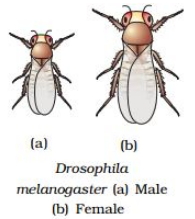
The experimental verification of the chromosomal theory of inheritance was provided by Thomas Hunt Morgan and his colleagues. This work led to the discovery of the basis for variations produced by sexual reproduction. Morgan worked with the tiny fruit flies, $Drosophila \text{ } melanogaster$, which were found to be very suitable for such studies due to the following reasons:
$1$. They could be grown on a simple synthetic medium in the laboratory.
$2$. They complete their life cycle in about two weeks.
$3$. $A$ single mating could produce a large number of progeny flies.
$4$. There is a clear sexual dimorphism, i.e., males are smaller and females are larger.
$5$. They have four pairs of chromosomes which differ in size.
$6$. They exhibit many types of hereditary variations that can be observed under a low-power microscope.
The experimental verification of the chromosomal theory of inheritance was provided by Thomas Hunt Morgan and his colleagues. This work led to the discovery of the basis for variations produced by sexual reproduction. Morgan worked with the tiny fruit flies, $Drosophila \text{ } melanogaster$, which were found to be very suitable for such studies due to the following reasons:
$1$. They could be grown on a simple synthetic medium in the laboratory.
$2$. They complete their life cycle in about two weeks.
$3$. $A$ single mating could produce a large number of progeny flies.
$4$. There is a clear sexual dimorphism, i.e., males are smaller and females are larger.
$5$. They have four pairs of chromosomes which differ in size.
$6$. They exhibit many types of hereditary variations that can be observed under a low-power microscope.
0 likes
View Solution149
Medium
Describe linkage and recombination in detail.
Solution
(N/A) Morgan and his group observed in $Drosophila$ that when two genes in a dihybrid cross were situated on the same chromosome,the proportion of parental gene combinations was much higher than the non-parental type.
They attributed this to the physical association of the two genes and coined the term 'linkage' to describe this physical association of genes on a chromosome,and the term 'recombination' to describe the generation of non-parental gene combinations.
Thus,linkage is a phenomenon of genetic inheritance in which genes on a particular chromosome show a tendency to be inherited together.
Morgan and his group also found that even when genes were grouped on the same chromosome,some genes were tightly linked; i.e.,linkage is stronger between two genes if the frequency of recombination is low.
Conversely,the frequency of recombination is higher if genes are loosely linked; i.e.,linkage is weak between two genes.
Recombination of linked genes occurs by crossing over (the exchange of corresponding parts between the chromatids of homologous chromosomes).
All the genes linked together on a single chromosome constitute a linkage group.
The number of linkage groups in an organism is equal to its haploid number of chromosomes.
This hypothesis was proved by $T.H.$ Morgan through his experiments on $Drosophila$.
Morgan and his group hybridized yellow-bodied,white-eyed females with brown-bodied,red-eyed males (wild type) and intercrossed their $F_1$ progeny (cross-$A$).
It was observed that the two genes did not segregate independently of each other,and the $F_2$ ratios deviated significantly from the $9:3:3:1$ ratio.
In the $F_2$ generation,parental combinations were $98.7\%$ and recombinants were $1.3\%$.
In another cross (cross-$B$),between a white-bodied fly with miniature wings and a male fly with a yellow body and normal wings,parental combinations were $62.8\%$ and recombinants were $37.2\%$ in the $F_2$ generation.
Thus,it was proved from the crosses that the linkage between genes for yellow body and white eyes is stronger than the linkage between the white body and miniature wings.
His student,Alfred Sturtevant,used the frequency of recombination between gene pairs on the same chromosome as a measure of the distance between genes and 'mapped' their position on the chromosome.
They attributed this to the physical association of the two genes and coined the term 'linkage' to describe this physical association of genes on a chromosome,and the term 'recombination' to describe the generation of non-parental gene combinations.
Thus,linkage is a phenomenon of genetic inheritance in which genes on a particular chromosome show a tendency to be inherited together.
Morgan and his group also found that even when genes were grouped on the same chromosome,some genes were tightly linked; i.e.,linkage is stronger between two genes if the frequency of recombination is low.
Conversely,the frequency of recombination is higher if genes are loosely linked; i.e.,linkage is weak between two genes.
Recombination of linked genes occurs by crossing over (the exchange of corresponding parts between the chromatids of homologous chromosomes).
All the genes linked together on a single chromosome constitute a linkage group.
The number of linkage groups in an organism is equal to its haploid number of chromosomes.
This hypothesis was proved by $T.H.$ Morgan through his experiments on $Drosophila$.
Morgan and his group hybridized yellow-bodied,white-eyed females with brown-bodied,red-eyed males (wild type) and intercrossed their $F_1$ progeny (cross-$A$).
It was observed that the two genes did not segregate independently of each other,and the $F_2$ ratios deviated significantly from the $9:3:3:1$ ratio.
In the $F_2$ generation,parental combinations were $98.7\%$ and recombinants were $1.3\%$.
In another cross (cross-$B$),between a white-bodied fly with miniature wings and a male fly with a yellow body and normal wings,parental combinations were $62.8\%$ and recombinants were $37.2\%$ in the $F_2$ generation.
Thus,it was proved from the crosses that the linkage between genes for yellow body and white eyes is stronger than the linkage between the white body and miniature wings.
His student,Alfred Sturtevant,used the frequency of recombination between gene pairs on the same chromosome as a measure of the distance between genes and 'mapped' their position on the chromosome.
0 likes
View Solution150
Easy
Give differences: Crossing over and Linkage.
Solution
(N/A)
| Crossing over | Linkage |
|---|---|
| $(1)$ It leads to the separation of linked genes. | $(1)$ It keeps the genes together. |
| $(2)$ It involves the exchange of segments between non-sister chromatids of homologous chromosomes. | $(2)$ It involves genes located on the same chromosome. |
| $(3)$ The frequency of crossing over can never exceed $50\%$. | $(3)$ The number of linkage groups can never be more than the haploid chromosome number. |
| $(4)$ It increases variability by forming new gene combinations. | $(4)$ It reduces variability. |
0 likes
View SolutionPrinciples of Inheritance and Variation — Linkage and recombination · Frequently Asked Questions
1Are these Principles of Inheritance and Variation questions useful for JEE and NEET?
Yes. All questions in this section are mapped to JEE Main and NEET exam patterns. Previous year questions from JEE Main, NEET, GUJCET and state-level exams are included with full solutions.
2Can I switch to Hindi or Gujarati for these questions?
Yes. Use the language tabs in the hero section or the sidebar to view the same questions and solutions in English, Hindi or Gujarati.
3How do I generate a question paper from this subtopic?
Use the Vedclass Exam Paper Generator — select the chapter and subtopic, set difficulty, and generate Sets A, B, C, D automatically. First 3 chapters of every subject are free.
Vedclass Products
For Students
Vedclass Test Series
Mock tests in real JEE/NEET style with performance analysis. 5-day free trial.
Start Free TrialFor Teachers
Exam Paper Generator
Generate Set A/B/C/D papers from this chapter in 2 minutes. 3 chapters free.
Try FreeFor Institutes
Online Exam Module
Live online exams with unlimited students, 360° analytics & white-label branding.
See DemoFor Teachers & Institutes
Generate a Principles of Inheritance and Variation Exam Paper in 2 Minutes
Select subtopic & difficulty — Sets A, B, C, D auto-generated with No Repeat logic.
First 3 chapters of every subject are free — no payment required.