
A English
Linkage and recombination Questions in English
Class 12 Biology · Principles of Inheritance and Variation · Linkage and recombination
223+
Questions
English
Language
100%
With Solutions
Showing 50 of 223 questions in English
151
MediumMCQ
Give scientific reasons: Linkage and crossing over of genes are alternatives of each other.
A
Linkage keeps genes together,while crossing over separates them.
B
Linkage increases recombination,while crossing over decreases it.
C
Linkage occurs in autosomes,while crossing over occurs in sex chromosomes.
D
Linkage is a physical process,while crossing over is a chemical process.
Solution
(A) Linkage and crossing over are considered alternatives because they have opposing effects on the inheritance of genes located on the same chromosome.
Linkage is the phenomenon where genes located close together on the same chromosome tend to be inherited together,thereby reducing the frequency of recombination.
Crossing over is the process of exchange of genetic material between non-sister chromatids of homologous chromosomes during meiosis,which leads to the separation of linked genes and increases genetic recombination.
Therefore,while linkage promotes the parental combination of alleles,crossing over promotes the formation of new combinations (recombinants),making them functional alternatives in determining the inheritance pattern of linked genes.
Linkage is the phenomenon where genes located close together on the same chromosome tend to be inherited together,thereby reducing the frequency of recombination.
Crossing over is the process of exchange of genetic material between non-sister chromatids of homologous chromosomes during meiosis,which leads to the separation of linked genes and increases genetic recombination.
Therefore,while linkage promotes the parental combination of alleles,crossing over promotes the formation of new combinations (recombinants),making them functional alternatives in determining the inheritance pattern of linked genes.
0 likes
View Solution152
Easy
Define/Explain: Linkage.
Solution
(N/A) The genes present on the same chromosome tend to be inherited together; these are called linked genes,and this phenomenon is known as linkage.
0 likes
View Solution153
MediumMCQ
$T.H.$ Morgan worked with $Drosophila$ to prove the chromosomal theory of inheritance. Which of the following characteristics was $NOT$ present in $Drosophila$?
A
Completion of the life cycle in two weeks.
B
Production of large numbers of progeny in a simple synthetic medium in the laboratory.
C
$Drosophila$ were hermaphrodites.
D
None of the above.
0 likes
View Solution154
MediumMCQ
Which traits did Morgan choose for the male and female $Drosophila$ respectively to explain linkage and recombination?
A
Yellow-bodied,white-eyed male and brown-bodied,red-eyed female.
B
Brown-bodied,red-eyed male and yellow-bodied,white-eyed female.
C
Yellow-bodied,red-eyed male and brown-bodied,white-eyed female.
D
Brown-bodied,white-eyed male and yellow-bodied,red-eyed female.
Solution
(A) Thomas Hunt Morgan conducted his experiments on $Drosophila$ $melanogaster$ to study the principles of linkage and recombination.
He crossed a yellow-bodied,white-eyed male with a brown-bodied,red-eyed female.
In this cross,the brown body color and red eye color are the wild-type traits (dominant),while the yellow body color and white eye color are the mutant traits (recessive).
Therefore,the correct choice is $A$.
He crossed a yellow-bodied,white-eyed male with a brown-bodied,red-eyed female.
In this cross,the brown body color and red eye color are the wild-type traits (dominant),while the yellow body color and white eye color are the mutant traits (recessive).
Therefore,the correct choice is $A$.
0 likes
View Solution155
MediumMCQ
Which method can be used to determine the location of specific genes on a chromosome?
A
Linkage
B
Recombination
C
Genetic mapping
D
All of the above
Solution
(C) Genetic mapping is the process used to determine the location of specific genes on a chromosome.
It relies on the frequency of recombination between gene pairs to estimate the distance between them.
Linkage and recombination frequencies are the fundamental principles used to construct these genetic maps.
Therefore,all the mentioned concepts are integral to the process of mapping genes on a chromosome.
It relies on the frequency of recombination between gene pairs to estimate the distance between them.
Linkage and recombination frequencies are the fundamental principles used to construct these genetic maps.
Therefore,all the mentioned concepts are integral to the process of mapping genes on a chromosome.
0 likes
View Solution156
MediumMCQ
Which characteristic does not support Mendel's Law of Independent Assortment?
A
Genes are located on homologous chromosomes.
B
Genes are located on non-homologous chromosomes.
C
Genes are linked on homologous chromosomes.
D
All of the above.
Solution
(C) Mendel's Law of Independent Assortment states that the alleles of two (or more) different genes get sorted into gametes independently of one another.
This law holds true only when the genes are located on different (non-homologous) chromosomes or are very far apart on the same chromosome.
If genes are linked (located close together on the same chromosome),they tend to be inherited together,which violates the Law of Independent Assortment.
Therefore,the presence of linked genes on homologous chromosomes does not support this law.
This law holds true only when the genes are located on different (non-homologous) chromosomes or are very far apart on the same chromosome.
If genes are linked (located close together on the same chromosome),they tend to be inherited together,which violates the Law of Independent Assortment.
Therefore,the presence of linked genes on homologous chromosomes does not support this law.
0 likes
View Solution157
EasyMCQ
What do genetic maps represent?
A
Evolutionary relationships.
B
The position of genes on a chromosome.
C
The structure of $DNA$ based on chromosomes.
D
The phenomenon of linkage during meiosis.
Solution
(B) Genetic maps,also known as linkage maps,represent the linear arrangement of genes on a chromosome.
They are constructed based on the frequency of recombination between gene pairs during meiosis.
The distance between genes on a genetic map is measured in map units or centimorgans $(cM)$,which corresponds to the percentage of crossing over between them.
They are constructed based on the frequency of recombination between gene pairs during meiosis.
The distance between genes on a genetic map is measured in map units or centimorgans $(cM)$,which corresponds to the percentage of crossing over between them.
0 likes
View Solution158
MediumMCQ
Genes $p, q,$ and $r$ are arranged on a chromosome. If the recombination frequency between $p$ and $q$ is $10 \%$,the recombination frequency between $q$ and $r$ is $20 \%$,and the recombination frequency between $p$ and $r$ is $10 \%$,what is the order of the genes on the chromosome?
A
$p-q-r$
B
$r-q-p$
C
$p-r-q$
D
$q-p-r$
Solution
(D) The recombination frequency between two genes is directly proportional to the distance between them on the chromosome.
Given:
Recombination frequency between $p$ and $q = 10 \% \implies$ distance $= 10 \text{ map units}$.
Recombination frequency between $q$ and $r = 20 \% \implies$ distance $= 20 \text{ map units}$.
Recombination frequency between $p$ and $r = 10 \% \implies$ distance $= 10 \text{ map units}$.
Since the distance between $q$ and $r$ $(20 \text{ units})$ is the sum of the distances between $p$ and $q$ $(10 \text{ units})$ and $p$ and $r$ $(10 \text{ units})$,it implies that gene $p$ lies between $q$ and $r$.
Therefore,the order of the genes on the chromosome is $q-p-r$ or $r-p-q$.
Given:
Recombination frequency between $p$ and $q = 10 \% \implies$ distance $= 10 \text{ map units}$.
Recombination frequency between $q$ and $r = 20 \% \implies$ distance $= 20 \text{ map units}$.
Recombination frequency between $p$ and $r = 10 \% \implies$ distance $= 10 \text{ map units}$.
Since the distance between $q$ and $r$ $(20 \text{ units})$ is the sum of the distances between $p$ and $q$ $(10 \text{ units})$ and $p$ and $r$ $(10 \text{ units})$,it implies that gene $p$ lies between $q$ and $r$.
Therefore,the order of the genes on the chromosome is $q-p-r$ or $r-p-q$.
0 likes
View Solution159
MediumMCQ
Based on which of the following did Morgan observe characteristics similar to Mendel's analysis experiments in the fruit fly Drosophila?
A
Linkage
B
Segregation
C
Recombination
D
Both $A$ and $C$
Solution
(D) Thomas Hunt Morgan conducted experiments on Drosophila melanogaster.
He observed that genes for white eyes and yellow bodies were linked and did not segregate independently,which is known as linkage.
He also observed that these genes could be separated during meiosis due to crossing over,a process known as recombination.
These observations provided a basis for understanding how genes are inherited together or separated,which paralleled Mendel's observations on independent assortment and segregation,ultimately leading to the chromosomal theory of inheritance.
He observed that genes for white eyes and yellow bodies were linked and did not segregate independently,which is known as linkage.
He also observed that these genes could be separated during meiosis due to crossing over,a process known as recombination.
These observations provided a basis for understanding how genes are inherited together or separated,which paralleled Mendel's observations on independent assortment and segregation,ultimately leading to the chromosomal theory of inheritance.
0 likes
View Solution160
EasyMCQ
What is the name of the pea species used by Bateson and Punnett in their experiments?
A
Pisum sativum
B
Ocimum sanctum
C
Lathyrus odoratus
D
Mirabilis jalapa
Solution
(C) Bateson and Punnett are famous for their work on genetic linkage in the sweet pea plant. The scientific name of the sweet pea plant is $Lathyrus$ $odoratus$. While Gregor Mendel used $Pisum$ $sativum$ (garden pea) for his experiments on inheritance,Bateson and Punnett used $Lathyrus$ $odoratus$ to demonstrate the phenomenon of coupling and repulsion (linkage).
0 likes
View Solution161
DifficultMCQ
In which of the following can recombination be observed?
A
Option $A$
B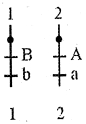
Option $B$
C
Option $C$
D
Option $D$
Solution
(C) Recombination is the process by which genetic material is broken and joined to other genetic material,leading to new combinations of alleles.
In the context of linked genes,recombination occurs due to crossing over between non-sister chromatids of homologous chromosomes during meiosis.
Looking at the options,we are looking for a configuration that represents a recombinant genotype compared to the parental linkage.
Option $C$ shows a configuration where the alleles $A$ and $b$ are on one chromosome and $a$ and $B$ are on the other,which is a classic representation of a recombinant product resulting from a crossover event between genes $A$ and $B$ that were originally in a cis-linkage (like $AB$ and $ab$).
Therefore,the configuration in option $C$ represents the result of recombination.
In the context of linked genes,recombination occurs due to crossing over between non-sister chromatids of homologous chromosomes during meiosis.
Looking at the options,we are looking for a configuration that represents a recombinant genotype compared to the parental linkage.
Option $C$ shows a configuration where the alleles $A$ and $b$ are on one chromosome and $a$ and $B$ are on the other,which is a classic representation of a recombinant product resulting from a crossover event between genes $A$ and $B$ that were originally in a cis-linkage (like $AB$ and $ab$).
Therefore,the configuration in option $C$ represents the result of recombination.
0 likes
View Solution162
MediumMCQ
Which event during cell division is responsible for the emergence of new characteristics in the next generation of organisms?
A
Linkage
B
Recombination
C
Segregation
D
All of the above
Solution
(B) During meiosis,specifically in the pachytene stage of prophase-$I$,the process of crossing over occurs between non-sister chromatids of homologous chromosomes.
This process leads to the exchange of genetic material,resulting in new combinations of genes,which is known as recombination.
Recombination is the primary mechanism responsible for genetic variation and the emergence of new characteristics in the offspring compared to their parents.
Linkage refers to the tendency of genes to be inherited together,which reduces variation,and segregation ensures the separation of alleles,but recombination is the specific event that creates new genetic combinations.
This process leads to the exchange of genetic material,resulting in new combinations of genes,which is known as recombination.
Recombination is the primary mechanism responsible for genetic variation and the emergence of new characteristics in the offspring compared to their parents.
Linkage refers to the tendency of genes to be inherited together,which reduces variation,and segregation ensures the separation of alleles,but recombination is the specific event that creates new genetic combinations.
0 likes
View Solution163
MediumMCQ
As the length of the chromosome increases in an organism,which of the following increases?
A
Genetic diversity
B
Crossing over
C
Recombination
D
All of the above
Solution
(D) The frequency of crossing over is directly proportional to the physical distance between genes on a chromosome.
As the length of the chromosome increases,the physical distance between genes located on that chromosome generally increases.
Consequently,the probability of crossing over occurring between these genes increases.
Since crossing over is the mechanism that leads to recombination,an increase in crossing over frequency directly leads to an increase in the frequency of recombination.
Therefore,both crossing over and recombination increase with the length of the chromosome.
As the length of the chromosome increases,the physical distance between genes located on that chromosome generally increases.
Consequently,the probability of crossing over occurring between these genes increases.
Since crossing over is the mechanism that leads to recombination,an increase in crossing over frequency directly leads to an increase in the frequency of recombination.
Therefore,both crossing over and recombination increase with the length of the chromosome.
0 likes
View Solution164
MediumMCQ
Who performed the first experiment on linkage and recombination?
A
Morgan
B
Bridges
C
Bateson and Punnett
D
Correns,Tschermak,de Vries
Solution
(C) The first experiment on linkage and recombination was performed by William Bateson and Reginald $C$. Punnett in $1906$ while working on the sweet pea $(Lathyrus \text{ odoratus})$. They observed that the parental combinations of traits appeared together more frequently than expected by independent assortment, which they termed 'coupling' and 'repulsion'. Although Thomas Hunt Morgan later provided the chromosomal basis for linkage and recombination using $Drosophila$, the initial discovery and experimental evidence were established by Bateson and Punnett.
0 likes
View Solution165
MediumMCQ
What was the phenotypic ratio obtained in the experiment on linkage and recombination performed in Lathyrus odoratus (Sweet Pea)?
A
$9:3:3:1$
B
$11:7:7:1$
C
$1:1:1:1$
D
$1:2:1$
Solution
(B) The experiment on linkage and recombination in $Lathyrus$ $odoratus$ (Sweet Pea) was conducted by William Bateson and $R$.$C$. Punnett.
They observed that the phenotypic ratio deviated significantly from the expected Mendelian dihybrid ratio of $9:3:3:1$.
Instead,they obtained a ratio of $11:7:7:1$ in the $F_2$ generation.
This deviation occurred because the genes for flower color and pollen shape were linked,meaning they did not assort independently as predicted by Mendel's Law of Independent Assortment.
They observed that the phenotypic ratio deviated significantly from the expected Mendelian dihybrid ratio of $9:3:3:1$.
Instead,they obtained a ratio of $11:7:7:1$ in the $F_2$ generation.
This deviation occurred because the genes for flower color and pollen shape were linked,meaning they did not assort independently as predicted by Mendel's Law of Independent Assortment.
0 likes
View Solution166
EasyMCQ
Which scientists proposed the coupling and repulsion theory?
A
Bateson and Punnett
B
$T.H.$ Morgan
C
Bridges
D
Johannsen
Solution
(A) The coupling and repulsion theory of linkage was proposed by $William$ $Bateson$ and $Reginald$ $Punnett$.
They observed that when two dominant alleles are present on the same chromosome,they tend to be inherited together (coupling),and when they are on different homologous chromosomes,they tend to remain separate (repulsion).
They observed that when two dominant alleles are present on the same chromosome,they tend to be inherited together (coupling),and when they are on different homologous chromosomes,they tend to remain separate (repulsion).
0 likes
View Solution167
MediumMCQ
Which scientist explained linkage and recombination in Drosophila?
A
$T.H.$ Morgan
B
Bridges
C
Bateson
D
Johannsen
Solution
(A) Thomas Hunt Morgan ($T.H.$ Morgan) conducted extensive experiments on the fruit fly,Drosophila melanogaster.
He discovered the principle of linkage and recombination by observing that genes located on the same chromosome do not always assort independently.
He observed that genes that are physically close to each other on a chromosome tend to be inherited together,a phenomenon he termed linkage.
He also explained that the frequency of recombination between gene pairs on the same chromosome is a measure of the distance between them.
He discovered the principle of linkage and recombination by observing that genes located on the same chromosome do not always assort independently.
He observed that genes that are physically close to each other on a chromosome tend to be inherited together,a phenomenon he termed linkage.
He also explained that the frequency of recombination between gene pairs on the same chromosome is a measure of the distance between them.
0 likes
View Solution168
MediumMCQ
Which of the following characteristics cannot be observed in the progeny if linkage is present?
A
Crossing over
B
Recombination
C
Linkage
D
Dominance
Solution
(B) Linkage is the physical association of genes on the same chromosome. When genes are tightly linked,they tend to be inherited together,which significantly reduces the frequency of recombination. Crossing over is the process that leads to recombination. Therefore,if linkage is present,the frequency of recombination is drastically reduced or absent,making it the characteristic that is not typically observed in the progeny compared to independent assortment.
0 likes
View Solution169
MediumMCQ
What is the number of linkage groups in humans with respect to $22$ pairs of autosomes?
A
$11$
B
$22$
C
$23$
D
$24$
Solution
(C) linkage group is defined as the number of pairs of homologous chromosomes in an organism.
In humans,there are $22$ pairs of autosomes and $1$ pair of sex chromosomes ($XX$ or $XY$).
Therefore,the total number of linkage groups is equal to the haploid number of chromosomes $(n)$.
For humans,$n = 23$ ($22$ autosomes + $1$ sex chromosome).
Thus,the number of linkage groups is $23$.
In humans,there are $22$ pairs of autosomes and $1$ pair of sex chromosomes ($XX$ or $XY$).
Therefore,the total number of linkage groups is equal to the haploid number of chromosomes $(n)$.
For humans,$n = 23$ ($22$ autosomes + $1$ sex chromosome).
Thus,the number of linkage groups is $23$.
0 likes
View Solution170
EasyMCQ
In which of the following is the phenomenon of crossing over $NOT$ observed?
A
Drosophila female fly
B
Queen honey bee
C
Male Drosophila fly
D
Birds
Solution
(C) Crossing over is a biological process that occurs during meiosis $I$ (prophase $I$) where homologous chromosomes exchange genetic material.
In $Drosophila$ (fruit fly),crossing over is completely absent in males.
This is a well-documented genetic phenomenon where the male $Drosophila$ does not exhibit recombination between homologous chromosomes during spermatogenesis.
Therefore,the correct answer is the male $Drosophila$ fly.
In $Drosophila$ (fruit fly),crossing over is completely absent in males.
This is a well-documented genetic phenomenon where the male $Drosophila$ does not exhibit recombination between homologous chromosomes during spermatogenesis.
Therefore,the correct answer is the male $Drosophila$ fly.
0 likes
View Solution171
MediumMCQ
What is the arrangement of genes on chromosomes resulting from crossing over called?
A
Cis
B
Trans
C
Random
D
No specific name
Solution
(B) When two linked genes are present on the same chromosome,the arrangement is called $Cis$ arrangement. When crossing over occurs between homologous chromosomes,it can lead to a new arrangement where the dominant allele of one gene and the recessive allele of the other gene are on the same chromosome. This specific arrangement,resulting from the exchange of segments during crossing over,is known as the $Trans$ arrangement (or repulsion phase).
0 likes
View Solution172
MediumMCQ
In a somatic cell,if the arrangement of genes is such that dominant alleles are present on one chromosome and recessive alleles are present on the other chromosome of a homologous pair,what is this arrangement called?
A
Cis
B
Trans
C
Cis and Trans
D
None of these
Solution
(B) In genetics,the arrangement of linked genes on homologous chromosomes is described as follows:
$1$. $Cis$-arrangement: When two dominant alleles are located on the same chromosome and their corresponding recessive alleles are on the other homologous chromosome (e.g.,$AB/ab$).
$2$. $Trans$-arrangement: When a dominant allele of one gene and a recessive allele of another gene are located on the same chromosome (e.g.,$Ab/aB$).
Since the question specifies that dominant alleles are on one chromosome and recessive alleles are on the other,this corresponds to the $Trans$-arrangement.
$1$. $Cis$-arrangement: When two dominant alleles are located on the same chromosome and their corresponding recessive alleles are on the other homologous chromosome (e.g.,$AB/ab$).
$2$. $Trans$-arrangement: When a dominant allele of one gene and a recessive allele of another gene are located on the same chromosome (e.g.,$Ab/aB$).
Since the question specifies that dominant alleles are on one chromosome and recessive alleles are on the other,this corresponds to the $Trans$-arrangement.
0 likes
View Solution173
MediumMCQ
Select the incorrect statement$(s)$ from the options given below with respect to dihybrid cross.
$I.$ Tightly linked genes on the same chromosome show higher recombinations.
$II.$ Genes far apart on the same chromosome show very few recombinations.
$III.$ Genes loosely linked on the same chromosome show similar recombinations.
$I.$ Tightly linked genes on the same chromosome show higher recombinations.
$II.$ Genes far apart on the same chromosome show very few recombinations.
$III.$ Genes loosely linked on the same chromosome show similar recombinations.
A
$I$ and $II$
B
$III$ and $II$
C
$I$ and $III$
D
All of these
Solution
(D) The frequency of recombination between two genes is inversely proportional to the distance between them on the chromosome.
Statement $I$ is incorrect because tightly linked genes show very few recombinations,not higher.
Statement $II$ is incorrect because genes that are far apart on the same chromosome show a higher frequency of recombinations due to more crossing-over events.
Statement $III$ is incorrect because loosely linked genes show higher recombination frequencies compared to tightly linked genes,and the term 'similar recombinations' is vague and scientifically inaccurate in this context.
Therefore,all three statements are incorrect.
Statement $I$ is incorrect because tightly linked genes show very few recombinations,not higher.
Statement $II$ is incorrect because genes that are far apart on the same chromosome show a higher frequency of recombinations due to more crossing-over events.
Statement $III$ is incorrect because loosely linked genes show higher recombination frequencies compared to tightly linked genes,and the term 'similar recombinations' is vague and scientifically inaccurate in this context.
Therefore,all three statements are incorrect.
0 likes
View Solution174
EasyMCQ
Genes on the same chromosome can be:
A
Linked
B
Homologous
C
Autosomes
D
Identical alleles
Solution
(A) Genes are the carriers of genetic information and serve as the functional units of heredity,located on chromosomes.
When two or more genes are present on the same chromosome,they are physically associated with each other.
This phenomenon,where genes located on the same chromosome tend to be inherited together,is known as linkage.
Therefore,genes on the same chromosome are referred to as linked genes.
When two or more genes are present on the same chromosome,they are physically associated with each other.
This phenomenon,where genes located on the same chromosome tend to be inherited together,is known as linkage.
Therefore,genes on the same chromosome are referred to as linked genes.
0 likes
View Solution175
MediumMCQ
The phenomenon of crossing over in diploid organisms is responsible for
A
Linkages between genes
B
Recombination between linked genes
C
Segregation between genes
D
Dominance of genes
Solution
(B) Recombination of genes on the same chromosome is accomplished by crossing over,a process by which segments of non-sister chromatids of homologous chromosomes are interchanged.
Crossing over occurs during the pachytene stage of prophase-$I$ of meiosis-$I$.
Crossing over occurs during the pachytene stage of prophase-$I$ of meiosis-$I$.
0 likes
View Solution176
MediumMCQ
There are three genes $a, b, c$ with percentage of crossing over between $a$ and $b$ is $20\%$,$b$ and $c$ is $28\%$,and $a$ and $c$ is $8\%$. What is the sequence of genes on the chromosome?
A
$b, a, c$
B
$c, b, a$
C
$a, b, c$
D
None of these
Solution
(A) The frequency of recombination is directly proportional to the distance between two genes on a chromosome. $A$ recombination frequency of $1\%$ corresponds to $1$ map unit or $1\; cM$ (centiMorgan).
Given distances:
Distance between $a$ and $b = 20\; cM$
Distance between $b$ and $c = 28\; cM$
Distance between $a$ and $c = 8\; cM$
Since the distance between $b$ and $c$ $(28\; cM)$ is the sum of the distances between $b$ and $a$ $(20\; cM)$ and $a$ and $c$ $(8\; cM)$,it implies that gene $a$ is located between genes $b$ and $c$.
Therefore,the linear sequence of genes on the chromosome is $b - a - c$.
Given distances:
Distance between $a$ and $b = 20\; cM$
Distance between $b$ and $c = 28\; cM$
Distance between $a$ and $c = 8\; cM$
Since the distance between $b$ and $c$ $(28\; cM)$ is the sum of the distances between $b$ and $a$ $(20\; cM)$ and $a$ and $c$ $(8\; cM)$,it implies that gene $a$ is located between genes $b$ and $c$.
Therefore,the linear sequence of genes on the chromosome is $b - a - c$.
0 likes
View Solution177
EasyMCQ
What is a linkage group?
A
Linearly arranged group of linked genes
B
Non-linearly arranged group of linked genes
C
Non-linearly arranged group of unlinked genes
D
Non-linearly arranged group of single genes
Solution
(A) linkage group is defined as a set of genes that are physically located on the same chromosome and are inherited together.
These genes are arranged in a linear fashion along the length of the chromosome.
Therefore,the correct definition is a linearly arranged group of linked genes.
These genes are arranged in a linear fashion along the length of the chromosome.
Therefore,the correct definition is a linearly arranged group of linked genes.
0 likes
View Solution178
MediumMCQ
Incomplete linkage is $A$. Complete linkage is $B$. Choose the correct option for $A$ and $B$.
A
$A-$common,$B-$rare
B
$A-$rare,$B-$common
C
$A-$impractical,$B-$practical
D
Both $(b)$ and $(c)$
Solution
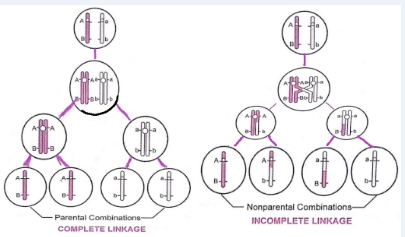
(A) Incomplete linkage occurs when genes located on the same chromosome are separated by crossing over,resulting in non-parental gene combinations. This is a common phenomenon in most organisms.
Complete linkage occurs when genes are so closely located on the same chromosome that they do not undergo crossing over and are always inherited together. This is a rare phenomenon in nature.
Therefore,incomplete linkage is common $(A)$ and complete linkage is rare $(B)$.
Complete linkage occurs when genes are so closely located on the same chromosome that they do not undergo crossing over and are always inherited together. This is a rare phenomenon in nature.
Therefore,incomplete linkage is common $(A)$ and complete linkage is rare $(B)$.
0 likes
View Solution179
MediumMCQ
Crossing over is advantageous because it brings about
A
Variation
B
Linkage
C
Inbreeding
D
Stability
Solution
(A) Crossing over is a biological process that occurs during meiosis,specifically in the pachytene stage of prophase-$I$.
It involves the exchange of genetic material between non-sister chromatids of homologous chromosomes.
This process leads to the formation of new combinations of alleles,which are known as recombinations.
These recombinations,along with mutations,are the primary sources of genetic variation in sexually reproducing organisms,allowing for evolution and adaptation.
It involves the exchange of genetic material between non-sister chromatids of homologous chromosomes.
This process leads to the formation of new combinations of alleles,which are known as recombinations.
These recombinations,along with mutations,are the primary sources of genetic variation in sexually reproducing organisms,allowing for evolution and adaptation.
0 likes
View Solution180
MediumMCQ
Mendel was successful in discovering the principles of inheritance because:
A
He took pea plants for his experiments.
B
He did not encounter linkage between the genes for the characters he considered.
C
He had an in-depth knowledge of hybridization.
D
He was a famous mathematician.
Solution
(B) Mendel was successful in discovering the principles of inheritance because he did not encounter linkage between the genes for the characters he considered.
One of his key principles,the Law of Independent Assortment,is applicable only if the genes are located on different non-homologous chromosome pairs or are sufficiently far apart on the same chromosome to undergo recombination.
Since the seven traits Mendel studied in pea plants were either on different chromosomes or showed no linkage,his results consistently supported his proposed laws.
One of his key principles,the Law of Independent Assortment,is applicable only if the genes are located on different non-homologous chromosome pairs or are sufficiently far apart on the same chromosome to undergo recombination.
Since the seven traits Mendel studied in pea plants were either on different chromosomes or showed no linkage,his results consistently supported his proposed laws.
0 likes
View Solution181
EasyMCQ
The number of linkage groups in $Pisum \text{ } sativum$ is
A
$2$
B
$5$
C
$7$
D
$9$
Solution
(C) The number of linkage groups is equal to the haploid number of chromosomes $(n)$ in an organism.
$Pisum \text{ } sativum$ (garden pea) has a diploid chromosome number of $2n = 14$.
Therefore, the haploid number of chromosomes is $n = 7$.
Since the number of linkage groups corresponds to the haploid number of chromosomes, there are $7$ linkage groups in $Pisum \text{ } sativum$.
$Pisum \text{ } sativum$ (garden pea) has a diploid chromosome number of $2n = 14$.
Therefore, the haploid number of chromosomes is $n = 7$.
Since the number of linkage groups corresponds to the haploid number of chromosomes, there are $7$ linkage groups in $Pisum \text{ } sativum$.
0 likes
View Solution182
MediumMCQ
Who clearly proved and defined linkage?
A
Morgan
B
Castle
C
Bateson
D
Punnett
Solution
(A) It was $TH$ Morgan who clearly proved and defined linkage on the basis of breeding experiments in fruit flies ($Drosophila$ $melanogaster$).
In $1911$,Morgan and Castle proposed the 'chromosomal' theory of linkage,which established that genes are located on chromosomes and that linkage is a physical association of genes on the same chromosome.
In $1911$,Morgan and Castle proposed the 'chromosomal' theory of linkage,which established that genes are located on chromosomes and that linkage is a physical association of genes on the same chromosome.
0 likes
View Solution183
EasyMCQ
Linked genes are present on
A
Same chromosome
B
Different chromosome
C
Heterologous chromosome
D
Paired chromosome
Solution
(A) The chromosomal theory of linkage states that:
$(i)$ Linked genes are present on the same chromosome.
$(ii)$ They lie in a linear sequence on the chromosome.
$(iii)$ There is a tendency to maintain the parental combination of alleles.
$(iv)$ The strength of linkage between two genes is inversely proportional to the distance between them.
$(i)$ Linked genes are present on the same chromosome.
$(ii)$ They lie in a linear sequence on the chromosome.
$(iii)$ There is a tendency to maintain the parental combination of alleles.
$(iv)$ The strength of linkage between two genes is inversely proportional to the distance between them.
0 likes
View Solution184
MediumMCQ
Two genes $R$ and $Y$ are located very close on the chromosomal linkage map of maize plant. When $RRYY$ and $rryy$ genotypes are hybridized,then $F_{2}$-segregation will show
A
Higher number of the recombinant types
B
Segregation in the expected $9: 3: 3: 1$ ratio
C
Segregation in $3: 1$ ratio
D
Higher number of the parental types
Solution
(D) The law of independent assortment is not applicable when genes for different characters are located on the same homologous chromosome,i.e.,linked genes.
Since genes $R$ and $Y$ are located very close to each other,they exhibit strong linkage.
Strong linkage results in a very low frequency of crossing over between the genes.
Consequently,the offspring will show a significantly higher number of parental types compared to recombinant types in the $F_{2}$ generation.
Since genes $R$ and $Y$ are located very close to each other,they exhibit strong linkage.
Strong linkage results in a very low frequency of crossing over between the genes.
Consequently,the offspring will show a significantly higher number of parental types compared to recombinant types in the $F_{2}$ generation.
0 likes
View Solution185
MediumMCQ
$A$ genetic map is one that
A
Shows the stages during cell division
B
Shows the distribution of various species in a region
C
Establishes sites of the genes on a chromosome
D
Establishes the various stages in gene evolution
Solution
(C) genetic map is a diagram that represents the relative positions of genes on a chromosome based on the frequency of recombination between them.
Alfred Sturtevant,in $1911$,constructed the first genetic map of the fruit fly ($Drosophila$ $melanogaster$) by mapping the positions of genes on its chromosomes.
Alfred Sturtevant,in $1911$,constructed the first genetic map of the fruit fly ($Drosophila$ $melanogaster$) by mapping the positions of genes on its chromosomes.
0 likes
View Solution186
MediumMCQ
Which of the following is true about linkage?
$I.$ It is a phenomenon in which more recombinants are produced in $F_{2}$-generation.
$II.$ More parental combinations are produced in $F_{2}$-generation.
$III.$ Genotypes which are present in $F_{1}$ hybrid reappear in high frequency in $F_{2}$-generation.
$IV.$ It is a phenomenon in which two chromosomes are linked.
$I.$ It is a phenomenon in which more recombinants are produced in $F_{2}$-generation.
$II.$ More parental combinations are produced in $F_{2}$-generation.
$III.$ Genotypes which are present in $F_{1}$ hybrid reappear in high frequency in $F_{2}$-generation.
$IV.$ It is a phenomenon in which two chromosomes are linked.
A
Only $I$
B
Only $II$
C
$I$ and $III$
D
$II$ and $III$
Solution
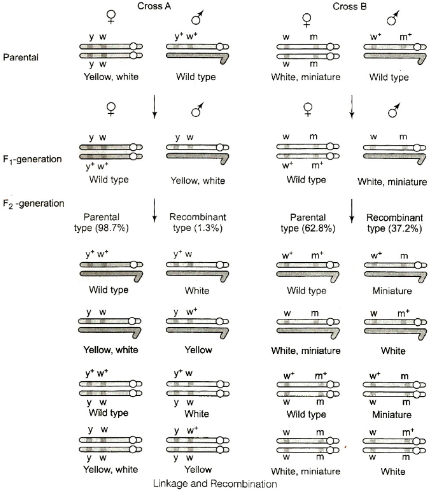
(D) Linkage is the physical association of genes on the same chromosome.
When genes are linked,they tend to be inherited together,which results in a higher frequency of parental combinations in the $F_{2}$-generation compared to non-parental (recombinant) combinations.
Statement $I$ is incorrect because linkage reduces the frequency of recombinants.
Statement $II$ is correct because linked genes show a higher frequency of parental types.
Statement $III$ is correct because the parental gene combinations present in the $F_{1}$ hybrid are maintained due to linkage and thus reappear in high frequency in the $F_{2}$ progeny.
Statement $IV$ is incorrect because linkage refers to the association of genes on a chromosome,not the linkage of two entire chromosomes.
Therefore,statements $II$ and $III$ are true.
When genes are linked,they tend to be inherited together,which results in a higher frequency of parental combinations in the $F_{2}$-generation compared to non-parental (recombinant) combinations.
Statement $I$ is incorrect because linkage reduces the frequency of recombinants.
Statement $II$ is correct because linked genes show a higher frequency of parental types.
Statement $III$ is correct because the parental gene combinations present in the $F_{1}$ hybrid are maintained due to linkage and thus reappear in high frequency in the $F_{2}$ progeny.
Statement $IV$ is incorrect because linkage refers to the association of genes on a chromosome,not the linkage of two entire chromosomes.
Therefore,statements $II$ and $III$ are true.
0 likes
View Solution187
MediumMCQ
When the number of recombinant progeny is usually less than the number expected in independent assortment, it is called:
A
Complete linkage
B
Incomplete linkage
C
Complete recombination
D
Complete independent assortment
Solution
(B) In $Mendelian$ genetics, independent assortment predicts a specific ratio of recombinant types. When genes are located on the same chromosome, they tend to be inherited together, a phenomenon known as linkage.
In $Incomplete$ $linkage$, crossing over occurs, resulting in some recombinant progeny, but the frequency of these recombinants is significantly lower than what would be expected if the genes were assorting independently.
Therefore, when the number of recombinant progeny is less than the expected value, it indicates the presence of linkage, specifically $Incomplete$ $linkage$.
In $Incomplete$ $linkage$, crossing over occurs, resulting in some recombinant progeny, but the frequency of these recombinants is significantly lower than what would be expected if the genes were assorting independently.
Therefore, when the number of recombinant progeny is less than the expected value, it indicates the presence of linkage, specifically $Incomplete$ $linkage$.
0 likes
View Solution188
EasyMCQ
Linkage was first suggested by
A
Sutton and Boveri
B
Morgan
C
De Vries
D
Pasteur
Solution
(A) Linkage was first suggested by Sutton and Boveri in $1903$ when they proposed the chromosomal theory of inheritance.
They observed that genes located on the same chromosome tend to be inherited together, which is the basis of linkage.
Later, Bateson and Punnett $(1906)$ provided experimental evidence for this phenomenon while working on sweet pea $(Lathyrus \text{ odoratus})$, where they observed that certain traits did not follow Mendel's law of independent assortment.
They observed that genes located on the same chromosome tend to be inherited together, which is the basis of linkage.
Later, Bateson and Punnett $(1906)$ provided experimental evidence for this phenomenon while working on sweet pea $(Lathyrus \text{ odoratus})$, where they observed that certain traits did not follow Mendel's law of independent assortment.
0 likes
View Solution189
MediumMCQ
Two genes $R$ and $Y$ are located very close on the chromosomal linkage map of maize plant. When $RRYY$ and $rryy$ genotypes are hybridized,then $F_{2}$-segregation will show:
A
$1: 2: 1$
B
$3: 1$
C
$9: 3: 3: 1$
D
$1: 1: 1$
Solution
(B) When two genes are located very close to each other on the same chromosome,they exhibit linkage. Linkage prevents independent assortment,which is required for the standard Mendelian dihybrid ratio of $9: 3: 3: 1$.
Because the genes $R$ and $Y$ are tightly linked,they tend to be inherited together as a single unit.
In this cross,the $F_{1}$ generation $(RrYy)$ produces gametes primarily of the parental types ($RY$ and $ry$) due to the lack of crossing over.
Consequently,the $F_{2}$ generation will show a phenotypic ratio similar to a monohybrid cross,which is $3: 1$.
Because the genes $R$ and $Y$ are tightly linked,they tend to be inherited together as a single unit.
In this cross,the $F_{1}$ generation $(RrYy)$ produces gametes primarily of the parental types ($RY$ and $ry$) due to the lack of crossing over.
Consequently,the $F_{2}$ generation will show a phenotypic ratio similar to a monohybrid cross,which is $3: 1$.
0 likes
View Solution190
MediumMCQ
Genes $A, B$,and $C$ are linked. Genes $A$ and $B$ are closer than $A$ and $C$. Find out the correct option for the given statements:
$I.$ $A$ might be before $B$ and $C$
$II.$ $B$ might be between $A$ and $C$
$III.$ $C$ might be between $A$ and $B$
$IV.$ More crossovers have occurred between $A$ and $C$ than $A$ and $B$.
$I.$ $A$ might be before $B$ and $C$
$II.$ $B$ might be between $A$ and $C$
$III.$ $C$ might be between $A$ and $B$
$IV.$ More crossovers have occurred between $A$ and $C$ than $A$ and $B$.
A
$I$ and $II$
B
$II$ and $III$
C
$III$ and $IV$
D
$I, II$ and $IV$
Solution
(D) The distance between genes is directly proportional to the frequency of recombination (crossovers).
Since genes $A$ and $B$ are closer than $A$ and $C$,the recombination frequency between $A$ and $C$ is higher than between $A$ and $B$.
This implies that $B$ must be located between $A$ and $C$ (sequence: $A-B-C$).
Statement $I$ is correct because $A$ is at one end.
Statement $II$ is correct because $B$ is between $A$ and $C$.
Statement $III$ is incorrect because $C$ is at the other end.
Statement $IV$ is correct because a greater distance between $A$ and $C$ results in more crossovers.
Therefore,statements $I, II$,and $IV$ are correct.
Since genes $A$ and $B$ are closer than $A$ and $C$,the recombination frequency between $A$ and $C$ is higher than between $A$ and $B$.
This implies that $B$ must be located between $A$ and $C$ (sequence: $A-B-C$).
Statement $I$ is correct because $A$ is at one end.
Statement $II$ is correct because $B$ is between $A$ and $C$.
Statement $III$ is incorrect because $C$ is at the other end.
Statement $IV$ is correct because a greater distance between $A$ and $C$ results in more crossovers.
Therefore,statements $I, II$,and $IV$ are correct.
0 likes
View Solution191
MediumMCQ
When normal and mutant alleles are present on opposite chromosomes of a homologous pair,the heterozygotes are called as:
A
$cis$ heterozygotes
B
$Homologous$ heterozygotes
C
$trans$ heterozygotes
D
None of the above
Solution
(C) In genetics,when two mutant alleles are located on different chromosomes of a homologous pair,the arrangement is referred to as the $trans$ configuration.
Conversely,if both mutant alleles are present on the same chromosome,it is known as the $cis$ configuration.
Therefore,when normal and mutant alleles are present on opposite chromosomes of a homologous pair,the heterozygotes are called $trans$ heterozygotes.
Conversely,if both mutant alleles are present on the same chromosome,it is known as the $cis$ configuration.
Therefore,when normal and mutant alleles are present on opposite chromosomes of a homologous pair,the heterozygotes are called $trans$ heterozygotes.
0 likes
View Solution192
EasyMCQ
Generation of non-parental gene combinations is termed as
A
Linkage
B
Polyploidy
C
Recombination
D
Aneuploidy
Solution
(C) The generation of non-parental gene combinations is known as $Recombination$.
It occurs due to the process of $crossing-over$ during $meiosis$, where homologous chromosomes exchange genetic material, leading to new combinations of alleles that differ from those present in the parents.
It occurs due to the process of $crossing-over$ during $meiosis$, where homologous chromosomes exchange genetic material, leading to new combinations of alleles that differ from those present in the parents.
0 likes
View Solution193
MediumMCQ
Morgan hybridized yellow-bodied,white-eyed females to brown-bodied,red-eyed males and intercrossed their $F_{1}$ progeny. He observed that:
$(a)$ $F_{2}$ ratio deviated significantly from the $9 : 3 : 3 : 1$ ratio.
$(b)$ Both genes did not segregate independently of each other.
$(c)$ Recombinant types are not obtained in $F_{2}$ generation.
$(d)$ Both genes segregate independently of each other.
Select the correct set of statements:
$(a)$ $F_{2}$ ratio deviated significantly from the $9 : 3 : 3 : 1$ ratio.
$(b)$ Both genes did not segregate independently of each other.
$(c)$ Recombinant types are not obtained in $F_{2}$ generation.
$(d)$ Both genes segregate independently of each other.
Select the correct set of statements:
A
$(a) \; \& \; (b) \text{ only}$
B
$(b) \; \& \; (c) \text{ only}$
C
$(b) \; \& \; (d) \text{ only}$
D
$(c) \; \& \; (d) \text{ only}$
Solution
(A) Thomas Hunt Morgan conducted experiments on Drosophila melanogaster to study genes that are sex-linked. He hybridized yellow-bodied,white-eyed females with brown-bodied,red-eyed males and intercrossed their $F_{1}$ progeny.
$1$. Since the genes for body color and eye color are located on the same $X$ chromosome,they are physically linked.
$2$. Because of this linkage,the genes do not segregate independently,which leads to a significant deviation from the expected Mendelian dihybrid ratio of $9 : 3 : 3 : 1$ in the $F_{2}$ generation.
$3$. Recombination does occur due to crossing over,so recombinant types are indeed obtained,though in lower frequencies than parental types.
Therefore,statements $(a)$ and $(b)$ are correct.
$1$. Since the genes for body color and eye color are located on the same $X$ chromosome,they are physically linked.
$2$. Because of this linkage,the genes do not segregate independently,which leads to a significant deviation from the expected Mendelian dihybrid ratio of $9 : 3 : 3 : 1$ in the $F_{2}$ generation.
$3$. Recombination does occur due to crossing over,so recombinant types are indeed obtained,though in lower frequencies than parental types.
Therefore,statements $(a)$ and $(b)$ are correct.

0 likes
View Solution194
EasyMCQ
. . . . . . $(B)$ . . . . . . used the frequency of recombination between gene pairs on the . . . . . . $(A)$ . . . . . . as a measure of the distance between genes and mapped their position on the chromosome.
$(A) \quad\quad (B)$
$(A) \quad\quad (B)$
A
Morgan $\quad$ Same chromosome
B
Sturtevant $\quad$ Different chromosomes
C
Morgan $\quad$ Different chromosomes
D
Sturtevant $\quad$ Same chromosome
Solution
(D) Alfred Sturtevant,a student of Thomas Hunt Morgan,used the frequency of recombination between gene pairs on the same chromosome as a measure of the distance between genes and mapped their position on the chromosome.
This technique is known as genetic mapping or linkage mapping.
Therefore,$(B)$ is Sturtevant and $(A)$ is the same chromosome.
This technique is known as genetic mapping or linkage mapping.
Therefore,$(B)$ is Sturtevant and $(A)$ is the same chromosome.
0 likes
View Solution195
MediumMCQ
The chromosome maps are not accurate maps because
A
Crossing over frequency is higher than recombination frequency
B
One crossing over interferes and increases the frequency of nearby crossing over
C
Crossing over frequency decreases towards the ends of chromosome
D
Heterochromatin increases crossing over
Solution
(B) Chromosome maps are based on the frequency of recombination between genes. However,they are not perfectly accurate because of the phenomenon of interference. Interference occurs when one crossover event in a specific region of a chromosome reduces the probability of another crossover occurring in the adjacent region. Furthermore,multiple crossovers can occur between two genes,which may not be detected as recombination,leading to an underestimation of the actual physical distance between genes on the chromosome.
0 likes
View Solution196
DifficultMCQ
In $Lathyrus$ $odoratus$,a hybrid blue-flowered and long-pollen plant is test-crossed with a homozygous recessive red-flowered and round-pollen plant. How many parental types are obtained when genes are present in the $cis$ stage in parents (in $\%$)?
A
$50$
B
$43.7$
C
$87.4$
D
$12.6$
Solution
(C) In $Lathyrus$ $odoratus$ (Sweet pea),the genes for flower color ($B$ for blue,$b$ for red) and pollen shape ($L$ for long,$l$ for round) show linkage.
In the $cis$ arrangement,the dominant alleles are on one chromosome $(BL)$ and recessive alleles are on the other $(bl)$.
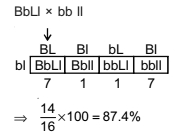
The test cross is $BbLl \times bbll$.
The parental combinations (non-recombinants) are $BL$ and $bl$,while the recombinant types are $Bl$ and $bL$.
Based on the linkage data for this cross,the ratio of offspring is $7$ (Blue-Long) : $1$ (Blue-Round) : $1$ (Red-Long) : $7$ (Red-Round).
The parental types are Blue-Long $(BbLl)$ and Red-Round $(bbll)$,which account for $7 + 7 = 14$ out of $16$ total offspring.
Percentage of parental types = $(14 / 16) \times 100 = 87.4\%$.
In the $cis$ arrangement,the dominant alleles are on one chromosome $(BL)$ and recessive alleles are on the other $(bl)$.
The test cross is $BbLl \times bbll$.
The parental combinations (non-recombinants) are $BL$ and $bl$,while the recombinant types are $Bl$ and $bL$.
Based on the linkage data for this cross,the ratio of offspring is $7$ (Blue-Long) : $1$ (Blue-Round) : $1$ (Red-Long) : $7$ (Red-Round).
The parental types are Blue-Long $(BbLl)$ and Red-Round $(bbll)$,which account for $7 + 7 = 14$ out of $16$ total offspring.
Percentage of parental types = $(14 / 16) \times 100 = 87.4\%$.
0 likes
View Solution197
MediumMCQ
Which of the following combinations of characters selected by Mendel shows linkage?
A
Stem height and pod colour
B
Flower colour and flower position
C
Seed shape and seed colour
D
Plant height and pod shape
Solution
(D) Mendel studied $7$ pairs of contrasting traits in pea plants. Linkage refers to the physical association of genes on the same chromosome. In the case of pea plants,it was later discovered that some of the genes for the traits Mendel studied were located on the same chromosome. Specifically,the genes for plant height and pod shape are located on chromosome $4$,and the genes for flower colour and flower position are located on chromosome $1$. However,among the given options,the combination of $Plant \ height$ and $Pod \ shape$ is a classic example often cited in genetic studies regarding linkage in $Pisum \ sativum$.
0 likes
View Solution198
MediumMCQ
Primary source of allelic variation is
A
Independent assortment
B
Recombination
C
Mutation
D
Polyploidy
Solution
(B) Recombination is considered the primary source of allelic variation in sexually reproducing populations.
During meiosis,the process of crossing over leads to the exchange of genetic material between homologous chromosomes.
This results in new combinations of alleles in the gametes,which increases genetic diversity within a population.
During meiosis,the process of crossing over leads to the exchange of genetic material between homologous chromosomes.
This results in new combinations of alleles in the gametes,which increases genetic diversity within a population.
0 likes
View Solution199
MediumMCQ
How many types of gametes will be produced by a male Drosophila having the following arrangement of two genes ($y$ and $w$) on the $X$-chromosome?

A
$2$
B
$4$
C
$1$
D
$8$
Solution
(A) In male Drosophila,the sex chromosomes are $XY$. The genes $y$ and $w$ are located on the $X$-chromosome,while the $Y$-chromosome does not carry these alleles.
Since the male is hemizygous for these genes,it will produce two types of gametes during meiosis:
$1$. Gametes containing the $X$-chromosome with the $y$ and $w$ alleles.
$2$. Gametes containing the $Y$-chromosome (which lacks these alleles).
Therefore,the total number of types of gametes produced is $2$.
Since the male is hemizygous for these genes,it will produce two types of gametes during meiosis:
$1$. Gametes containing the $X$-chromosome with the $y$ and $w$ alleles.
$2$. Gametes containing the $Y$-chromosome (which lacks these alleles).
Therefore,the total number of types of gametes produced is $2$.

0 likes
View Solution200
MediumMCQ
If interference is complete or $100\%$ then the frequency of observed double crossover will be:
A
Equal to expected frequency
B
Greater than expected frequency
C
Lesser than expected frequency
D
Zero
Solution
(D) Interference is defined as the phenomenon where one crossover event reduces the probability of another crossover occurring in the adjacent region.
Mathematically, the coefficient of coincidence $(C)$ is defined as the ratio of observed double crossovers to expected double crossovers.
Interference $(I)$ is calculated as $I = 1 - C$.
If interference is complete $(I = 1)$, then $1 = 1 - C$, which implies $C = 0$.
Since $C = (\text{Observed double crossovers} / \text{Expected double crossovers})$, if $C = 0$, then the observed double crossovers must be $0$.
Mathematically, the coefficient of coincidence $(C)$ is defined as the ratio of observed double crossovers to expected double crossovers.
Interference $(I)$ is calculated as $I = 1 - C$.
If interference is complete $(I = 1)$, then $1 = 1 - C$, which implies $C = 0$.
Since $C = (\text{Observed double crossovers} / \text{Expected double crossovers})$, if $C = 0$, then the observed double crossovers must be $0$.
0 likes
View SolutionPrinciples of Inheritance and Variation — Linkage and recombination · Frequently Asked Questions
1Are these Principles of Inheritance and Variation questions useful for JEE and NEET?
Yes. All questions in this section are mapped to JEE Main and NEET exam patterns. Previous year questions from JEE Main, NEET, GUJCET and state-level exams are included with full solutions.
2Can I switch to Hindi or Gujarati for these questions?
Yes. Use the language tabs in the hero section or the sidebar to view the same questions and solutions in English, Hindi or Gujarati.
3How do I generate a question paper from this subtopic?
Use the Vedclass Exam Paper Generator — select the chapter and subtopic, set difficulty, and generate Sets A, B, C, D automatically. First 3 chapters of every subject are free.
Vedclass Products
For Students
Vedclass Test Series
Mock tests in real JEE/NEET style with performance analysis. 5-day free trial.
Start Free TrialFor Teachers
Exam Paper Generator
Generate Set A/B/C/D papers from this chapter in 2 minutes. 3 chapters free.
Try FreeFor Institutes
Online Exam Module
Live online exams with unlimited students, 360° analytics & white-label branding.
See DemoFor Teachers & Institutes
Generate a Principles of Inheritance and Variation Exam Paper in 2 Minutes
Select subtopic & difficulty — Sets A, B, C, D auto-generated with No Repeat logic.
First 3 chapters of every subject are free — no payment required.