
A English
Linkage and recombination Questions in English
Class 12 Biology · Principles of Inheritance and Variation · Linkage and recombination
223+
Questions
English
Language
100%
With Solutions
Showing 50 of 223 questions in English
1
EasyMCQ
The arrangement of genes on chromosomes is
A
Linear
B
Ovoid
C
Diffused
D
Spiral
Solution
(A) Genes are segments of $DNA$ that are located at specific positions called loci on chromosomes. These genes are arranged in a specific,sequential,and linear order along the length of the chromosome. This linear arrangement is a fundamental concept in genetics,as it allows for the mapping of genes and understanding of linkage groups.
0 likes
View Solution2
MediumMCQ
Crossing over is advantageous because it brings about
A
Variation
B
Linkage
C
Inbreeding
D
Stability
Solution
(A) Crossing over is a process that occurs during the $pachytene$ stage of $prophase-I$ of $meiosis$.
It involves the exchange of genetic material between non-sister chromatids of homologous chromosomes.
This recombination of genetic material leads to new combinations of genes in the gametes,which is the primary source of genetic variation in sexually reproducing organisms.
Therefore,crossing over is advantageous as it promotes genetic diversity,which is essential for evolution and adaptation.
It involves the exchange of genetic material between non-sister chromatids of homologous chromosomes.
This recombination of genetic material leads to new combinations of genes in the gametes,which is the primary source of genetic variation in sexually reproducing organisms.
Therefore,crossing over is advantageous as it promotes genetic diversity,which is essential for evolution and adaptation.
0 likes
View Solution3
MediumMCQ
Which of the following is an exception to Mendel's laws?
A
Law of independent assortment
B
Law of segregation
C
Law of dominance
D
Law of linkage
Solution
(D) . Linkage is the phenomenon where genes located close together on the same chromosome tend to be inherited together, which violates Mendel's $Law$ of $Independent$ $Assortment$. Mendel's laws are applicable only when genes are located on different chromosomes or are far apart on the same chromosome.
0 likes
View Solution4
DifficultMCQ
The evidence that crossing over occurs at the four-stranded stage and not at the two-stranded stage of the chromosomes comes from:
A
$2 : 2 : 2 : 2$ arrangement of ascospores in Neurospora
B
$4 : 4$ arrangement of ascospores in Neurospora
C
Studies of meiosis in maize
D
Studies on linkage maps of chromosomes in Drosophila
Solution
(A) The evidence that crossing over occurs at the four-stranded stage (pachytene of meiosis-$I$) is provided by the analysis of ascospores in the fungus $Neurospora$ $crassa$.
In $Neurospora$,the linear arrangement of ascospores in the ascus reflects the segregation pattern of alleles.
If crossing over occurred at the two-stranded stage,the resulting arrangement would be $4 : 4$.
However,the observed $2 : 2 : 2 : 2$ arrangement of ascospores confirms that crossing over takes place after the chromosomes have replicated into four chromatids (four-stranded stage).
In $Neurospora$,the linear arrangement of ascospores in the ascus reflects the segregation pattern of alleles.
If crossing over occurred at the two-stranded stage,the resulting arrangement would be $4 : 4$.
However,the observed $2 : 2 : 2 : 2$ arrangement of ascospores confirms that crossing over takes place after the chromosomes have replicated into four chromatids (four-stranded stage).
0 likes
View Solution5
MediumMCQ
Mendel did not recognize the linkage phenomenon in his experiments because
A
There were many chromosomes to handle
B
Characters he studied were located on different chromosomes
C
He did not have a powerful microscope
D
He studied only pure plants
Solution
(B) The phenomenon of linkage refers to the tendency of genes located on the same chromosome to be inherited together. Mendel did not observe linkage because the seven pairs of contrasting traits he studied in pea plants were located on different chromosomes,or were so far apart on the same chromosome that they behaved as if they were independently assorting. Therefore,he observed independent assortment rather than linkage.
0 likes
View Solution6
MediumMCQ
Coupling and repulsion are the two faces of
A
Crossing over
B
Linkage
C
Chiasmata
D
Mutation
Solution
(B) Coupling (cis-arrangement) and repulsion (trans-arrangement) are two aspects of linkage.
Linkage is the physical association of genes on the same chromosome.
When dominant alleles of two genes are present on the same chromosome,it is called coupling.
When a dominant allele of one gene and a recessive allele of another gene are present on the same chromosome,it is called repulsion.
Linkage is the physical association of genes on the same chromosome.
When dominant alleles of two genes are present on the same chromosome,it is called coupling.
When a dominant allele of one gene and a recessive allele of another gene are present on the same chromosome,it is called repulsion.
0 likes
View Solution7
MediumMCQ
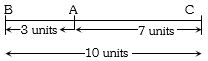
The map distance between genes $A$ and $B$ is $3$ units,between $B$ and $C$ $10$ units,and between $C$ and $A$ $7$ units. The order of the genes in a linkage map constructed on the above data would be:
A
$A, B, C$
B
$A, C, B$
C
$B, C, A$
D
$B, A, C$
Solution
(D) Given distances are:
Distance between $A$ and $B = 3$ units.
Distance between $B$ and $C = 10$ units.
Distance between $C$ and $A = 7$ units.
Since the distance between $B$ and $C$ is the sum of the distances between $B$ and $A$ ($3$ units) and $A$ and $C$ ($7$ units),i.e.,$3 + 7 = 10$ units,it implies that gene $A$ lies between genes $B$ and $C$.
Therefore,the linear order of the genes on the chromosome is $B-A-C$.
Distance between $A$ and $B = 3$ units.
Distance between $B$ and $C = 10$ units.
Distance between $C$ and $A = 7$ units.
Since the distance between $B$ and $C$ is the sum of the distances between $B$ and $A$ ($3$ units) and $A$ and $C$ ($7$ units),i.e.,$3 + 7 = 10$ units,it implies that gene $A$ lies between genes $B$ and $C$.
Therefore,the linear order of the genes on the chromosome is $B-A-C$.
0 likes
View Solution8
MediumMCQ
Alleles of different genes that are on the same chromosome may occasionally be separated by a phenomenon known as
A
Pleiotropy
B
Epistasis
C
Continuous variation
D
Crossing over
Solution
(D) . Crossing over is the process of exchange of genetic material between non-sister chromatids of homologous chromosomes during meiosis,which leads to the separation of linked genes. This phenomenon was extensively studied by $T. H. Morgan$ in $Drosophila$.
0 likes
View Solution9
MediumMCQ
Which one of the following pairs is correctly matched?
A
Morgan $\Rightarrow$ Discovered the process of linkage
B
Linus Pauling $\Rightarrow$ Isolated $DNA$ for the first time
C
Francis Crick $\Rightarrow$ Discovered the phenomenon of transformation
D
$H$. Khorana $\Rightarrow$ Discovered that a sequence of $3$ nucleotides codes for a single amino acid
Solution
(A) is the correct answer. Thomas Hunt Morgan $(1910)$ clearly proved and defined the phenomenon of linkage based on his breeding experiments in the fruit fly,$Drosophila \ melanogaster$.
$B$ is incorrect because Friedrich Miescher isolated $DNA$ for the first time.
$C$ is incorrect because Frederick Griffith discovered the phenomenon of transformation.
$D$ is incorrect because Marshall Nirenberg and Har Gobind Khorana helped decipher the genetic code,but the triplet nature was proposed by George Gamow.
$B$ is incorrect because Friedrich Miescher isolated $DNA$ for the first time.
$C$ is incorrect because Frederick Griffith discovered the phenomenon of transformation.
$D$ is incorrect because Marshall Nirenberg and Har Gobind Khorana helped decipher the genetic code,but the triplet nature was proposed by George Gamow.
0 likes
View Solution10
MediumMCQ
The percentage of crossing over will be more if:
A
Linked genes are located far apart from each other
B
Linked genes are located close to each other
C
Genes are not linked
D
Genes are located in a different cell
Solution
(A) Crossing over is directly proportional to the distance between the linked genes.
This means that the greater the physical distance between two genes on a chromosome,the higher the probability that a crossover event will occur between them during meiosis.
Therefore,linked genes located far apart from each other show a higher percentage of crossing over compared to those located close together.
This means that the greater the physical distance between two genes on a chromosome,the higher the probability that a crossover event will occur between them during meiosis.
Therefore,linked genes located far apart from each other show a higher percentage of crossing over compared to those located close together.
0 likes
View Solution11
MediumMCQ
Drosophila has four pairs of chromosomes. How many linkage groups does it have?
A
Eight
B
Four
C
One less than the pairs of chromosomes
D
One more than the pairs of chromosomes
Solution
(B) The number of linkage groups in an organism is equal to the haploid number of chromosomes $(n)$.
Since $Drosophila$ has $4$ pairs of chromosomes,its diploid number $(2n)$ is $8$.
Therefore,the haploid number $(n)$ is $4/2 = 4$.
Thus,$Drosophila$ has $4$ linkage groups.
Since $Drosophila$ has $4$ pairs of chromosomes,its diploid number $(2n)$ is $8$.
Therefore,the haploid number $(n)$ is $4/2 = 4$.
Thus,$Drosophila$ has $4$ linkage groups.
0 likes
View Solution12
MediumMCQ
Linkage in Drosophila was first discovered by
A
Morgan
B
Bateson and Punnett
C
Sturtevant
D
Bridges
Solution
(A) Linkage was first discovered by Thomas Hunt Morgan in Drosophila melanogaster. While working with Drosophila,he observed that genes located on the same chromosome do not always assort independently,a phenomenon he termed linkage. This discovery was fundamental to understanding genetic mapping and chromosomal inheritance.
0 likes
View Solution13
MediumMCQ
Mendel observed that some characters did not assort independently. Later researchers found it to be due to
A
Crossing-over
B
Linkage
C
Dominance of one trait over the other
D
Amitosis
Solution
(B) The correct answer is $B$.
$Mendel's$ Law of Independent Assortment states that the alleles of two (or more) different genes get sorted into gametes independently of one another.
However,this law is not universally applicable.
It applies only to genes that are located on different chromosomes or are very far apart on the same chromosome.
When genes are located close together on the same chromosome,they tend to be inherited together,a phenomenon known as $Linkage$.
Therefore,characters governed by linked genes do not assort independently.
$Mendel's$ Law of Independent Assortment states that the alleles of two (or more) different genes get sorted into gametes independently of one another.
However,this law is not universally applicable.
It applies only to genes that are located on different chromosomes or are very far apart on the same chromosome.
When genes are located close together on the same chromosome,they tend to be inherited together,a phenomenon known as $Linkage$.
Therefore,characters governed by linked genes do not assort independently.
0 likes
View Solution14
EasyMCQ
The scientists who proposed the theory of linkage are
A
Morgan and Castle
B
Beadle and Tatum
C
Watson and Crick
D
Bateson and Punnett
Solution
(A) $T.H. Morgan$ $(1911)$ proposed the 'chromosome theory of linkage' along with $W.E. Castle$ based on his experiments in $Drosophila$.
0 likes
View Solution15
MediumMCQ
In maize,the chromosome number is $2n = 20$. The number of linkage groups in it shall be:
A
$20$
B
$40$
C
$10$
D
$5$
Solution
(C) The number of linkage groups in an organism is equal to its haploid chromosome number $(n)$.
Given that the diploid chromosome number is $2n = 20$,the haploid number is $n = 20 / 2 = 10$.
Therefore,the number of linkage groups in maize is $10$.
Given that the diploid chromosome number is $2n = 20$,the haploid number is $n = 20 / 2 = 10$.
Therefore,the number of linkage groups in maize is $10$.
0 likes
View Solution16
MediumMCQ
The term 'crossing over' was coined by
A
Bateson
B
Darlington
C
Morgan
D
Muller
Solution
(C) The term 'crossing over' was coined by Thomas Hunt Morgan in $1912$.
Crossing over is the process of exchange of genetic material between non-sister chromatids of homologous chromosomes during the pachytene stage of prophase $I$ of meiosis.
It leads to genetic recombination,which is essential for variation in sexually reproducing organisms.
Crossing over is the process of exchange of genetic material between non-sister chromatids of homologous chromosomes during the pachytene stage of prophase $I$ of meiosis.
It leads to genetic recombination,which is essential for variation in sexually reproducing organisms.
0 likes
View Solution17
MediumMCQ
Linkage decreases the frequency of
A
Hybrid
B
Dominant allele
C
Recessive allele
D
Both $(a)$ and $(b)$
Solution
(A) Linkage refers to the physical association of genes on the same chromosome.
Genes that are closely linked show a lower frequency of recombination (crossing over) during meiosis.
Since recombination is responsible for producing new genetic combinations (hybrids) in the offspring,linkage reduces the frequency of these new combinations or hybrids.
Therefore,the correct option is $(A)$.
Genes that are closely linked show a lower frequency of recombination (crossing over) during meiosis.
Since recombination is responsible for producing new genetic combinations (hybrids) in the offspring,linkage reduces the frequency of these new combinations or hybrids.
Therefore,the correct option is $(A)$.
0 likes
View Solution18
MediumMCQ
Crossing over in a diploid organism is responsible for
A
Dominance of genes
B
Linkage between genes
C
Segregation of alleles
D
Recombination of linked alleles
Solution
(D) Crossing over is a biological process that occurs during the pachytene stage of prophase-$I$ of meiosis.
It involves the exchange of genetic material between non-sister chromatids of homologous chromosomes.
This process leads to the formation of new combinations of alleles on the chromosomes,which is known as genetic recombination.
Therefore,crossing over is responsible for the recombination of linked alleles,increasing genetic diversity in the offspring.
It involves the exchange of genetic material between non-sister chromatids of homologous chromosomes.
This process leads to the formation of new combinations of alleles on the chromosomes,which is known as genetic recombination.
Therefore,crossing over is responsible for the recombination of linked alleles,increasing genetic diversity in the offspring.
0 likes
View Solution19
MediumMCQ
The distance between two linked genes on a chromosome is measured in cross-over units,which is:
A
Ratio of crossing over between them
B
Cross-over value
C
Number of other genes between them
D
None of these
Solution
(B) The distance between two linked genes on a chromosome is measured in map units or centimorgans $(cM)$.
This distance is directly proportional to the frequency of crossing over between them.
The cross-over value (or recombination frequency) represents the percentage of offspring that show recombinant phenotypes.
Therefore,the distance is measured as the cross-over value.
This distance is directly proportional to the frequency of crossing over between them.
The cross-over value (or recombination frequency) represents the percentage of offspring that show recombinant phenotypes.
Therefore,the distance is measured as the cross-over value.
0 likes
View Solution20
EasyMCQ
Linkage was first observed in
A
Field pea
B
Sweet pea
C
Pea
D
Grass pea
Solution
(B) Linkage was first discovered by $Bateson$ and $Punnett$ in $1906$ while working on the sweet pea plant $(Lathyrus \text{ odoratus})$. They observed that the genes for flower color and pollen shape did not show independent assortment, leading to the discovery of the phenomenon of linkage.
0 likes
View Solution21
EasyMCQ
When closely placed genes on the same chromosome are inherited together,the phenomenon is known as:
A
Qualitative inheritance
B
Crossing over
C
Gene interaction
D
Linkage
Solution
(D) Linkage is the physical association of genes on the same chromosome. When genes are located very close to each other on the same chromosome,they tend to be inherited together as a single unit during meiosis,as the probability of crossing over between them is very low. This phenomenon is known as linkage.
0 likes
View Solution22
MediumMCQ
For the preparation of genetic maps,the recombination frequencies between genes are additive over short distances but not over long distances due to
A
Multiple cross overs
B
Lethal mutation
C
Epistasis
D
Synaptonemal complex
Solution
(A) Genetic mapping is based on the frequency of recombination between genes.
For short distances,the recombination frequency is directly proportional to the physical distance between genes,making it additive.
However,over long distances,the probability of multiple crossover events (double or triple crossovers) increases.
These multiple crossovers can result in the exchange of segments such that the original parental combination is restored,leading to an underestimation of the actual recombination frequency.
Therefore,recombination frequencies are not additive over long distances due to multiple crossover events.
For short distances,the recombination frequency is directly proportional to the physical distance between genes,making it additive.
However,over long distances,the probability of multiple crossover events (double or triple crossovers) increases.
These multiple crossovers can result in the exchange of segments such that the original parental combination is restored,leading to an underestimation of the actual recombination frequency.
Therefore,recombination frequencies are not additive over long distances due to multiple crossover events.
0 likes
View Solution23
MediumMCQ
Genetic recombination occurs through
A
Mitosis and fertilization
B
Mitosis and meiosis
C
Meiosis and fertilization
D
None of the above
Solution
(C) Genetic recombination is the process by which genetic material is exchanged between different organisms or chromosomes, leading to the production of offspring with combinations of traits that differ from those found in either parent.
$1$. During $Meiosis$ (specifically $Prophase-I$), the process of $Crossing-over$ occurs between non-sister chromatids of homologous chromosomes, which is a primary source of genetic recombination.
$2$. During $Fertilization$, the fusion of two genetically distinct gametes (sperm and egg) brings together different sets of alleles, further contributing to the genetic variation in the offspring.
Therefore, both $Meiosis$ and $Fertilization$ are essential for genetic recombination.
$1$. During $Meiosis$ (specifically $Prophase-I$), the process of $Crossing-over$ occurs between non-sister chromatids of homologous chromosomes, which is a primary source of genetic recombination.
$2$. During $Fertilization$, the fusion of two genetically distinct gametes (sperm and egg) brings together different sets of alleles, further contributing to the genetic variation in the offspring.
Therefore, both $Meiosis$ and $Fertilization$ are essential for genetic recombination.
0 likes
View Solution24
MediumMCQ
What will be the number of linkage groups in maize if it has $10$ pairs of chromosomes?
A
$5$
B
$10$
C
$0$
D
$20$
Solution
(B) The number of linkage groups in an organism is equal to its haploid chromosome number $(n)$.
In maize,the diploid number of chromosomes is $2n = 20$,which means there are $10$ pairs of chromosomes.
Therefore,the haploid number $n = 10$.
Thus,the number of linkage groups in maize is $10$.
In maize,the diploid number of chromosomes is $2n = 20$,which means there are $10$ pairs of chromosomes.
Therefore,the haploid number $n = 10$.
Thus,the number of linkage groups in maize is $10$.
0 likes
View Solution25
MediumMCQ
Linked genes are separated by:
A
Crossing over
B
Mutation
C
$(a)$ and $(b)$ both
D
None of these
Solution
(A) Linked genes are genes located on the same chromosome that tend to be inherited together.
Crossing over is the process during meiosis where homologous chromosomes exchange genetic material,which can result in the separation of linked genes.
This phenomenon was extensively studied by $T.H. Morgan$.
Crossing over is the process during meiosis where homologous chromosomes exchange genetic material,which can result in the separation of linked genes.
This phenomenon was extensively studied by $T.H. Morgan$.
0 likes
View Solution26
MediumMCQ
Crossing over causes
A
Expression of recessive genes
B
Synapsis between homologous chromosomes
C
Recombination between linked genes
D
Linkage between dominant genes
Solution
(C) Crossing over is a biological process that occurs during the pachytene stage of prophase-$I$ of meiosis.
During this process,there is an exchange of genetic material between non-sister chromatids of homologous chromosomes.
This exchange leads to the formation of new combinations of alleles,which is known as genetic recombination.
Therefore,crossing over results in recombination between linked genes,increasing genetic diversity.
During this process,there is an exchange of genetic material between non-sister chromatids of homologous chromosomes.
This exchange leads to the formation of new combinations of alleles,which is known as genetic recombination.
Therefore,crossing over results in recombination between linked genes,increasing genetic diversity.
0 likes
View Solution27
MediumMCQ
Continuous variations are attributed to
A
Chromosomal aberrations
B
Polyploidy
C
Mutations
D
Crossing over
Solution
(D) Continuous variations are small,gradual,and cumulative changes in the phenotype of an organism.
These variations are primarily caused by the recombination of genes during meiosis,specifically through the process of crossing over between homologous chromosomes.
Unlike mutations,which cause sudden and discontinuous changes,crossing over leads to new combinations of alleles,resulting in a continuous spectrum of traits within a population.
These variations are primarily caused by the recombination of genes during meiosis,specifically through the process of crossing over between homologous chromosomes.
Unlike mutations,which cause sudden and discontinuous changes,crossing over leads to new combinations of alleles,resulting in a continuous spectrum of traits within a population.
0 likes
View Solution28
EasyMCQ
How many linkage groups are present in Drosophila?
A
$6$
B
$4$
C
$2$
D
$8$
Solution
(B) The total number of linkage groups in an organism is equal to the number of chromosome pairs.
In Drosophila melanogaster,there are $4$ pairs of chromosomes.
Therefore,the number of linkage groups in Drosophila is $4$.
In Drosophila melanogaster,there are $4$ pairs of chromosomes.
Therefore,the number of linkage groups in Drosophila is $4$.
0 likes
View Solution29
MediumMCQ
Who put forward the "Theory of linkage"?
A
Sutton
B
Morgan
C
De Vries
D
Bateson and Punnett
Solution
(B) The "Theory of Linkage" was proposed by Thomas Hunt Morgan. He conducted extensive experiments on the fruit fly, $Drosophila \text{ } melanogaster$, and observed that genes located on the same chromosome do not always assort independently, a phenomenon he termed linkage. While Sutton and Boveri proposed the Chromosomal Theory of Inheritance, and Bateson and Punnett observed linkage in sweet peas, it was Morgan who formulated the formal theory of linkage.
0 likes
View Solution30
MediumMCQ
The tendency of genes to remain together during the process of inheritance is known as
A
Sex linkage
B
Linkage
C
Differential inheritance
D
Optional linkage
Solution
(B) $Linkage$ is the physical association of genes on the same chromosome.
It refers to the tendency of genes to remain together during the process of inheritance,as they do not show independent assortment.
Therefore,the correct option is $B$.
It refers to the tendency of genes to remain together during the process of inheritance,as they do not show independent assortment.
Therefore,the correct option is $B$.
0 likes
View Solution31
EasyMCQ
When linked characters or genes are inherited together through two or more generations,it is called
A
Complete linkage
B
Continuous linkage
C
Incomplete linkage
D
Consistent linkage
Solution
(A) When two or more genes or characters are located on the same chromosome and are inherited together through two or more generations without any recombination,it is known as complete linkage.
This phenomenon is observed in organisms like male $Drosophila$ and certain other insects where crossing over does not occur.
This phenomenon is observed in organisms like male $Drosophila$ and certain other insects where crossing over does not occur.
0 likes
View Solution32
EasyMCQ
Sex-linked inheritance was discovered by
A
McClung
B
Mendel
C
Landsteiner
D
Morgan
Solution
(D) The concept of sex-linked inheritance was discovered by $Thomas \ H. \ Morgan$ in $1910$,while working on the fruit fly,$Drosophila \ melanogaster$.
0 likes
View Solution33
MediumMCQ
In a certain plant, red flowers $(R)$ are dominant to white flowers $(r)$ and tallness $(T)$ is dominant to dwarfness $(t)$. $A$ heterozygous plant $(RrTt)$ is backcrossed with a double recessive plant $(rrtt)$. If the gene loci for colour and size are situated very close together on the same chromosome, the expected percentage of offspring could be approximately:
respectively.
| Tall Red | Tall White | Dwarf Red | Dwarf White |
respectively.
A
| $25$% | $25$% | $25$% | $25$% |
B
| $49$% | $49$% | $1$% | $1$% |
C
| $49$% | $1$% | $1$% | $49$% |
D
| $1$% | $1$% | $49$% | $49$% |
Solution
(C) The cross described is a test cross between a dihybrid $(RrTt)$ and a double recessive individual $(rrtt)$.
Normally, independent assortment would yield a $1:1:1:1$ ratio ($25\%$ each).
However, the problem states that the gene loci for flower color and plant height are situated very close together on the same chromosome, which indicates strong genetic linkage.
In linkage, parental combinations are inherited together more frequently than recombinant types.
Assuming the parent $(RrTt)$ is in coupling phase $(RT/rt)$, the parental gametes ($RT$ and $rt$) will be produced in high frequency, while recombinant gametes ($Rt$ and $rT$) will be produced in very low frequency due to rare crossing over.
Therefore, the offspring will mostly be Tall-Red $(RT/rt)$ and Dwarf-White $(rt/rt)$, with a small percentage of recombinants (Tall-White and Dwarf-Red).
Option $(C)$ represents this scenario where parental types are high ($49\%$ each) and recombinants are low ($1\%$ each).
Normally, independent assortment would yield a $1:1:1:1$ ratio ($25\%$ each).
However, the problem states that the gene loci for flower color and plant height are situated very close together on the same chromosome, which indicates strong genetic linkage.
In linkage, parental combinations are inherited together more frequently than recombinant types.
Assuming the parent $(RrTt)$ is in coupling phase $(RT/rt)$, the parental gametes ($RT$ and $rt$) will be produced in high frequency, while recombinant gametes ($Rt$ and $rT$) will be produced in very low frequency due to rare crossing over.
Therefore, the offspring will mostly be Tall-Red $(RT/rt)$ and Dwarf-White $(rt/rt)$, with a small percentage of recombinants (Tall-White and Dwarf-Red).
Option $(C)$ represents this scenario where parental types are high ($49\%$ each) and recombinants are low ($1\%$ each).
0 likes
View Solution34
MediumMCQ
Which one of the following pairs is correctly matched?
A
Van Helmont $\Rightarrow$ Discovered mutations
B
Louis Pasteur $\Rightarrow$ Wrote "The Origin of Species"
C
$T.H. Morgan$ $\Rightarrow$ Studied sex-linked inheritance
D
$H. Khorana$ $\Rightarrow$ Studied $DNA$ replication
Solution
(C) The correct pair is $T.H. Morgan \Rightarrow$ Studied sex-linked inheritance.
Thomas $H. Morgan$ introduced the concept of sex-linked inheritance in $1910$ while working on the fruit fly, $Drosophila \ melanogaster$.
Van Helmont is known for his experiments on plant growth, not mutations.
Louis Pasteur is known for his work on germ theory and pasteurization, while Charles Darwin wrote "The Origin of Species".
$H. Khorana$ is known for his work on the genetic code and protein synthesis, not specifically $DNA$ replication.
Thomas $H. Morgan$ introduced the concept of sex-linked inheritance in $1910$ while working on the fruit fly, $Drosophila \ melanogaster$.
Van Helmont is known for his experiments on plant growth, not mutations.
Louis Pasteur is known for his work on germ theory and pasteurization, while Charles Darwin wrote "The Origin of Species".
$H. Khorana$ is known for his work on the genetic code and protein synthesis, not specifically $DNA$ replication.
0 likes
View Solution35
MediumMCQ
In $Drosophila$,long wing and broad abdomen characters are dominant over vestigial wing and narrow abdomen characters. $A$ pure-breeding $Drosophila$ with long wings and broad abdomen is crossed with a pure-breeding vestigial-winged and narrow-abdomened $Drosophila$. Two of the $F_1$ individuals were crossed,and the following results were produced in the $F_2$ generation: $482$ $Drosophila$ with long wings and broad abdomen,and $154$ $Drosophila$ with vestigial wings and narrow abdomen. Which one of the following is illustrated by these results?
A
Autosomal linkage
B
Incomplete dominance
C
Mendelian monohybrid inheritance
D
Mendelian dihybrid inheritance
Solution
(A) $1$. The parental cross involves two traits: wing length and abdomen width. Since the $F_1$ generation is heterozygous for both traits,a standard Mendelian dihybrid cross would be expected to yield an $F_2$ phenotypic ratio of $9:3:3:1$.
$2$. In this experiment,the observed $F_2$ ratio is approximately $3:1$ $(482:154)$,which indicates that only two phenotypes are appearing instead of four.
$3$. This deviation from the expected $9:3:3:1$ ratio occurs because the genes for wing length and abdomen width are located on the same chromosome and are inherited together,a phenomenon known as linkage.
$4$. Because the genes are linked,they do not show independent assortment,resulting in the inheritance of parental combinations only.
$2$. In this experiment,the observed $F_2$ ratio is approximately $3:1$ $(482:154)$,which indicates that only two phenotypes are appearing instead of four.
$3$. This deviation from the expected $9:3:3:1$ ratio occurs because the genes for wing length and abdomen width are located on the same chromosome and are inherited together,a phenomenon known as linkage.
$4$. Because the genes are linked,they do not show independent assortment,resulting in the inheritance of parental combinations only.
0 likes
View Solution36
MediumMCQ
When two genes are situated very close to each other in a chromosome,
A
The percentage of crossing over between them is very high
B
Hardly any cross over are detected
C
No crossing over can take place between them
D
Only double cross overs can take place between them
Solution
(B) The frequency of crossing over is directly proportional to the physical distance between two genes on a chromosome.
When two genes are situated very close to each other,the probability of a crossover event occurring between them is extremely low.
Therefore,hardly any crossovers are detected between such closely linked genes.
This phenomenon is known as tight linkage.
When two genes are situated very close to each other,the probability of a crossover event occurring between them is extremely low.
Therefore,hardly any crossovers are detected between such closely linked genes.
This phenomenon is known as tight linkage.
0 likes
View Solution37
MediumMCQ
Crossing over is
A
Inversely related to linkage
B
Directly related to linkage
C
Similar in meaning to linkage
D
None
Solution
(A) Crossing over and linkage are inversely related phenomena.
In linkage,genes located on the same chromosome tend to be inherited together as a single unit.
In contrast,crossing over involves the exchange of genetic material between non-sister chromatids of homologous chromosomes,which leads to the separation of linked genes and the formation of new gene combinations (recombination).
Therefore,a higher frequency of crossing over reduces the strength of linkage between genes.
In linkage,genes located on the same chromosome tend to be inherited together as a single unit.
In contrast,crossing over involves the exchange of genetic material between non-sister chromatids of homologous chromosomes,which leads to the separation of linked genes and the formation of new gene combinations (recombination).
Therefore,a higher frequency of crossing over reduces the strength of linkage between genes.
0 likes
View Solution38
MediumMCQ
Frequency of crossing over in a chromosome is an index of
A
Relative distance between its genes only
B
Structural affinity between its genes only
C
Strength of linkage between its genes only
D
Both $(a)$ and $(b)$ are correct
Solution
(A) The frequency of crossing over is directly proportional to the physical distance between the two genes on a chromosome.
As the distance between genes increases,the probability of a crossover event occurring between them also increases.
Therefore,the frequency of crossing over serves as an index for mapping the relative distance between genes on a chromosome.
Since the strength of linkage is inversely proportional to the distance between genes,crossing over frequency also indirectly indicates the strength of linkage,but it is primarily used as an index for relative distance.
As the distance between genes increases,the probability of a crossover event occurring between them also increases.
Therefore,the frequency of crossing over serves as an index for mapping the relative distance between genes on a chromosome.
Since the strength of linkage is inversely proportional to the distance between genes,crossing over frequency also indirectly indicates the strength of linkage,but it is primarily used as an index for relative distance.
0 likes
View Solution39
MediumMCQ
If the gene exchange rate (recombination frequency) of two linked genes is $30\%$,then the distance between these two genes is:
A
$30$ map units
B
$15$ map units
C
$60$ map units
D
$45$ map units
Solution
(A) The distance between two linked genes is measured in map units (centimorgans),which is directly proportional to the recombination frequency (gene exchange rate).
According to the principle established by Alfred Sturtevant,$1\%$ recombination frequency is equal to $1$ map unit (or $1$ centimorgan).
Given that the gene exchange rate is $30\%$,the distance between the two genes is $30$ map units.
Therefore,the correct option is $A$.
According to the principle established by Alfred Sturtevant,$1\%$ recombination frequency is equal to $1$ map unit (or $1$ centimorgan).
Given that the gene exchange rate is $30\%$,the distance between the two genes is $30$ map units.
Therefore,the correct option is $A$.
0 likes
View Solution40
MediumMCQ
When a cluster of genes shows linkage behaviour,they:
A
Induce cell division
B
Do not show a chromosome map
C
Show recombination during meiosis
D
Do not show independent assortment
Solution
(D) When a cluster of genes shows linkage behavior,they do not show independent assortment.
This is because linked genes are located very close to each other on the same chromosome and tend to be inherited together as a single unit,thereby violating Mendel's Law of Independent Assortment.
This is because linked genes are located very close to each other on the same chromosome and tend to be inherited together as a single unit,thereby violating Mendel's Law of Independent Assortment.
0 likes
View Solution41
MediumMCQ
The theory of recombination of linked genes due to crossing over of chromosomes during the pachytene stage of meiosis was put forward by:
A
$T$.$H$. Morgan
B
Punnett
C
Mendel
D
Connes
Solution
(A) $T.H. Morgan$ proposed the chromosomal theory of linkage and recombination. He observed that genes located on the same chromosome are linked and that the frequency of recombination between linked genes is directly proportional to the distance between them. Crossing over,which leads to recombination,occurs during the $pachytene$ stage of prophase-$I$ of meiosis,where non-sister chromatids of homologous chromosomes exchange genetic material. Therefore,$T.H. Morgan$ is credited with the development of these concepts.
0 likes
View Solution42
MediumMCQ
The distance between two genes in a chromosome is measured in cross-over units,which represent:
A
Ratio of crossing over between them
B
Percentage of crossing over between them
C
Number of crossing over between them
D
None of these
Solution
(B) The distance between two genes in a chromosome is measured in map units or centimorgans $(cM)$.
One map unit corresponds to $1\%$ of crossing over (recombination frequency) between the two genes.
Therefore,the cross-over units represent the percentage of crossing over between the genes.
This is because the frequency of crossing over is directly proportional to the physical distance between the genes on the chromosome.
One map unit corresponds to $1\%$ of crossing over (recombination frequency) between the two genes.
Therefore,the cross-over units represent the percentage of crossing over between the genes.
This is because the frequency of crossing over is directly proportional to the physical distance between the genes on the chromosome.
0 likes
View Solution43
MediumMCQ
When two genes are situated very close to each other on a chromosome:
A
The percentage of crossing over between them is very high.
B
Hardly any crossing over is detected.
C
No crossing over can take place between them.
D
Only double cross overs can take place between them.
Solution
(B) The frequency of crossing over between two genes is directly proportional to the physical distance between them on the chromosome. When two genes are situated very close to each other,the probability of a crossover event occurring in the small segment between them is extremely low. Therefore,they exhibit strong linkage,and hardly any crossing over is detected between them.
0 likes
View Solution44
MediumMCQ
Geneticists plot the relative locations of genes on chromosomes by which of these methods?
A
Using powerful microscopes
B
Calculating the number of genes
C
Determining the frequency of crossing over
D
Exposing animals to radiations
Solution
(C) Geneticists determine the relative positions of genes on a chromosome by calculating the frequency of recombination (crossing over) between them. This is known as genetic mapping or linkage mapping. The frequency of crossing over between two genes is directly proportional to the physical distance between them on the chromosome. Therefore,by measuring how often two genes are inherited together versus separated by recombination,scientists can construct a genetic map.
0 likes
View Solution45
MediumMCQ
Drosophila melanogaster has $8$ chromosomes in its somatic cell. How many linkage groups will it have?
A
$4$
B
$8$
C
$2$
D
$5$
Solution
(A) The number of linkage groups in an organism is equal to the haploid number of chromosomes $(n)$.
In Drosophila melanogaster,the diploid number of chromosomes is $2n = 8$.
Therefore,the haploid number of chromosomes is $n = 8 / 2 = 4$.
Thus,there are $4$ linkage groups.
In Drosophila melanogaster,the diploid number of chromosomes is $2n = 8$.
Therefore,the haploid number of chromosomes is $n = 8 / 2 = 4$.
Thus,there are $4$ linkage groups.
0 likes
View Solution46
MediumMCQ
The linkage map of $X$-chromosome of fruit fly has $66$ units with yellow body gene $(y)$ at one end and bobbed hair $(b)$ gene at the other end. The recombination frequency between these two genes ($y$ and $b$) should be
A
$100\%$
B
$66\%$
C
$> 50\%$
D
$5.50\%$
Solution
(B) The distance between two genes on a chromosome is measured in map units (centimorgans),where $1$ map unit corresponds to $1\%$ recombination frequency.
Since the linkage map distance between the yellow body gene $(y)$ and the bobbed hair gene $(b)$ is $66$ units,the theoretical recombination frequency is $66\%$.
However,in practice,recombination frequency cannot exceed $50\%$ because multiple crossovers between distant genes lead to an observed frequency that approaches $50\%$.
Given the options provided and the definition of map units,the correct representation of the map distance is $66\%$.
Since the linkage map distance between the yellow body gene $(y)$ and the bobbed hair gene $(b)$ is $66$ units,the theoretical recombination frequency is $66\%$.
However,in practice,recombination frequency cannot exceed $50\%$ because multiple crossovers between distant genes lead to an observed frequency that approaches $50\%$.
Given the options provided and the definition of map units,the correct representation of the map distance is $66\%$.
0 likes
View Solution47
MediumMCQ
In order to calculate the map distance of genes on a chromosome,one must know the:
A
Number of mutant genes
B
Cross over percentage
C
Recombination frequency of each gene locus
D
Non-cross over percentage
Solution
(C) The map distance between two genes on a chromosome is measured in centimorgans $(cM)$ or map units.
This distance is directly proportional to the frequency of recombination between the genes.
By definition,$1$ map unit corresponds to $1\%$ recombination frequency.
Therefore,to calculate the map distance,one must know the recombination frequency of the gene loci.
This distance is directly proportional to the frequency of recombination between the genes.
By definition,$1$ map unit corresponds to $1\%$ recombination frequency.
Therefore,to calculate the map distance,one must know the recombination frequency of the gene loci.
0 likes
View Solution48
MediumMCQ
The percentage of recombination between genes $A$ and $B$ is $9\%$,between $A$ and $C$ is $17\%$,and between $B$ and $C$ is $26\%$. What is the correct arrangement of these genes on the chromosome?
A
$ABC$
B
$ACB$
C
$BCA$
D
$BAC$
Solution
(C) The percentage of recombination is directly proportional to the distance between genes on a chromosome (where $1\%$ recombination = $1$ map unit or centimorgan).
Given:
Recombination frequency between $A$ and $B = 9\%$
Recombination frequency between $A$ and $C = 17\%$
Recombination frequency between $B$ and $C = 26\%$
Since the distance between $B$ and $C$ $(26\%)$ is the sum of the distances between $A$ and $B$ $(9\%)$ and $A$ and $C$ $(17\%)$,i.e.,$9 + 17 = 26$,it implies that gene $A$ lies between genes $B$ and $C$.
Therefore,the linear arrangement of the genes is $B-A-C$ or $C-A-B$.
Given:
Recombination frequency between $A$ and $B = 9\%$
Recombination frequency between $A$ and $C = 17\%$
Recombination frequency between $B$ and $C = 26\%$
Since the distance between $B$ and $C$ $(26\%)$ is the sum of the distances between $A$ and $B$ $(9\%)$ and $A$ and $C$ $(17\%)$,i.e.,$9 + 17 = 26$,it implies that gene $A$ lies between genes $B$ and $C$.
Therefore,the linear arrangement of the genes is $B-A-C$ or $C-A-B$.
0 likes
View Solution49
EasyMCQ
Thomas Hunt Morgan was awarded the Nobel Prize for his work on:
A
Gene theory
B
Nuclear theory
C
$DNA$ theory
D
Cytoplasmic inheritance
Solution
(A) Thomas Hunt Morgan was awarded the Nobel Prize in Physiology or Medicine in $1933$ for his discoveries concerning the role played by the chromosome in heredity. His work established the chromosomal basis of inheritance and the concept of linkage,which are fundamental components of the gene theory.
0 likes
View Solution50
DifficultMCQ
$A$ pure breeding pea plant with the dominant phenotype of character $A$ and recessive phenotype of character $B$ was crossed with another pure breeding plant with the recessive phenotype of $A$ and dominant phenotype of character $B$. An offspring of this cross was crossed with a homozygous recessive for both the characters $A$ and $B$. The following results were obtained:
$22$ were phenotypically dominant for $A$ and recessive for $B$.
$4$ were phenotypically dominant for both $A$ and $B$.
$4$ were phenotypically recessive for both $A$ and $B$.
$24$ were phenotypically recessive for $A$ and dominant for $B$.
These results show that:
$22$ were phenotypically dominant for $A$ and recessive for $B$.
$4$ were phenotypically dominant for both $A$ and $B$.
$4$ were phenotypically recessive for both $A$ and $B$.
$24$ were phenotypically recessive for $A$ and dominant for $B$.
These results show that:
A
Genes $A$ and $B$ are linked
B
Independent segregation of genes $A$ and $B$
C
Mendelian dihybrid inheritance
D
Polygenic inheritance
Solution
(A) $1$. The parental genotypes are $AAbb$ and $aaBB$. The $F_1$ offspring genotype is $AaBb$.
$2$. This $F_1$ individual is test-crossed with a homozygous recessive individual $(aabb)$.
$3$. If genes $A$ and $B$ were assorting independently,the expected phenotypic ratio would be $1:1:1:1$ (i.e.,$13.5$ of each type for a total of $54$ offspring).
$4$. The observed results are $22 (A, b)$,$4 (A, B)$,$4 (a, b)$,and $24 (a, B)$.
$5$. Since the parental combinations ($A, b$ and $a, B$) are significantly more frequent than the recombinant combinations ($A, B$ and $a, b$),it indicates that the genes $A$ and $B$ are linked on the same chromosome.
$2$. This $F_1$ individual is test-crossed with a homozygous recessive individual $(aabb)$.
$3$. If genes $A$ and $B$ were assorting independently,the expected phenotypic ratio would be $1:1:1:1$ (i.e.,$13.5$ of each type for a total of $54$ offspring).
$4$. The observed results are $22 (A, b)$,$4 (A, B)$,$4 (a, b)$,and $24 (a, B)$.
$5$. Since the parental combinations ($A, b$ and $a, B$) are significantly more frequent than the recombinant combinations ($A, B$ and $a, b$),it indicates that the genes $A$ and $B$ are linked on the same chromosome.
0 likes
View SolutionPrinciples of Inheritance and Variation — Linkage and recombination · Frequently Asked Questions
1Are these Principles of Inheritance and Variation questions useful for JEE and NEET?
Yes. All questions in this section are mapped to JEE Main and NEET exam patterns. Previous year questions from JEE Main, NEET, GUJCET and state-level exams are included with full solutions.
2Can I switch to Hindi or Gujarati for these questions?
Yes. Use the language tabs in the hero section or the sidebar to view the same questions and solutions in English, Hindi or Gujarati.
3How do I generate a question paper from this subtopic?
Use the Vedclass Exam Paper Generator — select the chapter and subtopic, set difficulty, and generate Sets A, B, C, D automatically. First 3 chapters of every subject are free.
Vedclass Products
For Students
Vedclass Test Series
Mock tests in real JEE/NEET style with performance analysis. 5-day free trial.
Start Free TrialFor Teachers
Exam Paper Generator
Generate Set A/B/C/D papers from this chapter in 2 minutes. 3 chapters free.
Try FreeFor Institutes
Online Exam Module
Live online exams with unlimited students, 360° analytics & white-label branding.
See DemoFor Teachers & Institutes
Generate a Principles of Inheritance and Variation Exam Paper in 2 Minutes
Select subtopic & difficulty — Sets A, B, C, D auto-generated with No Repeat logic.
First 3 chapters of every subject are free — no payment required.