
A English
Linkage and recombination Questions in English
Class 12 Biology · Principles of Inheritance and Variation · Linkage and recombination
223+
Questions
English
Language
100%
With Solutions
Showing 23 of 223 questions in English
201
MediumMCQ
$A$: Crossing over is the exchange of genetic material between non-homologous chromosomes.
$R$: It produces new linkages.
$R$: It produces new linkages.
A
Assertion and Reason both are correct and Reason is the correct explanation of Assertion.
B
Assertion and Reason both are correct but Reason is not the correct explanation of Assertion.
C
Assertion is correct,but Reason is incorrect.
D
Both Assertion and Reason are incorrect.
Solution
(D) The Assertion is incorrect because crossing over occurs between non-sister chromatids of homologous chromosomes,not non-homologous chromosomes.
The Reason is also incorrect because crossing over breaks existing linkages and creates new combinations of alleles (recombination),rather than producing new linkages.
Therefore,both Assertion and Reason are incorrect.
The Reason is also incorrect because crossing over breaks existing linkages and creates new combinations of alleles (recombination),rather than producing new linkages.
Therefore,both Assertion and Reason are incorrect.
0 likes
View Solution202
MediumMCQ
$A$ : In block inheritance of all genes located on the same chromosome may occur in some organisms.
$R$ : Dihybrid test cross will have only two phenotypes.
$R$ : Dihybrid test cross will have only two phenotypes.
A
Assertion and Reason both are correct and Reason is the correct explanation of Assertion.
B
Assertion and Reason both are correct but Reason is not the correct explanation of Assertion.
C
Assertion is correct,but Reason is incorrect.
D
Both Assertion and Reason are incorrect.
Solution
(C) Assertion $(A)$ is correct. In some organisms,complete linkage occurs where all genes on the same chromosome are inherited together as a single block,resulting in no recombination.
Reason $(R)$ is incorrect. $A$ dihybrid test cross $(AaBb \times aabb)$ typically results in four phenotypes in a $1:1:1:1$ ratio if the genes are assorting independently. If the genes are linked,the ratio changes,but it does not necessarily result in only two phenotypes unless the linkage is complete.
Reason $(R)$ is incorrect. $A$ dihybrid test cross $(AaBb \times aabb)$ typically results in four phenotypes in a $1:1:1:1$ ratio if the genes are assorting independently. If the genes are linked,the ratio changes,but it does not necessarily result in only two phenotypes unless the linkage is complete.
0 likes
View Solution203
MediumMCQ
$A$: Morgan's cross $III$ was conducted in $Drosophila$ to locate genes on the chromosome for white eye color.
$R$: The cross was done between red-eyed hybrid female and white-eyed male.
$R$: The cross was done between red-eyed hybrid female and white-eyed male.
A
Assertion and Reason both are correct and Reason is the correct explanation of Assertion.
B
Assertion and Reason both are correct but Reason is not the correct explanation of Assertion.
C
Assertion is correct, but Reason is incorrect.
D
Both Assertion and Reason are incorrect.
Solution
(C) Thomas Hunt Morgan conducted various crosses in $Drosophila$ to study sex-linked inheritance.
The assertion is correct as Morgan performed specific crosses to map the gene for white eye color on the $X$-chromosome.
The reason provided is incorrect because the cross described (red-eyed hybrid female $\times$ white-eyed male) is a test cross or a specific mating pattern, but it does not accurately describe the fundamental cross used to establish the linkage of the white-eye gene to the $X$-chromosome in the context of his classic experiments.
Therefore, the Assertion is correct, but the Reason is incorrect.
The assertion is correct as Morgan performed specific crosses to map the gene for white eye color on the $X$-chromosome.
The reason provided is incorrect because the cross described (red-eyed hybrid female $\times$ white-eyed male) is a test cross or a specific mating pattern, but it does not accurately describe the fundamental cross used to establish the linkage of the white-eye gene to the $X$-chromosome in the context of his classic experiments.
Therefore, the Assertion is correct, but the Reason is incorrect.
0 likes
View Solution204
MediumMCQ
Given below are two statements: one is labelled as Assertion $(A)$ and the other is labelled as Reason $(R)$.
Assertion $(A)$:
Mendel's law of independent assortment does not hold good for the genes that are located closely on the same chromosome.
Reason $(R)$:
Closely located genes assort independently.
In the light of the above statements,choose the correct answer from the options given below:
Assertion $(A)$:
Mendel's law of independent assortment does not hold good for the genes that are located closely on the same chromosome.
Reason $(R)$:
Closely located genes assort independently.
In the light of the above statements,choose the correct answer from the options given below:
A
Both $(A)$ and $(R)$ are correct but $(R)$ is not the correct explanation of $(A)$
B
$(A)$ is correct but $(R)$ is not correct
C
$(A)$ is not correct but $(R)$ is correct
D
Both $(A)$ and $(R)$ are correct and $(R)$ is the correct explanation of $(A)$
Solution
(B) Mendel's law of independent assortment states that the alleles of two (or more) different genes get sorted into gametes independently of one another.
However,this law is only applicable to genes that are located on different chromosomes or are very far apart on the same chromosome.
When genes are located closely on the same chromosome,they exhibit the phenomenon of linkage.
Linked genes tend to be inherited together and do not assort independently,thus violating Mendel's law of independent assortment.
Therefore,Assertion $(A)$ is correct.
Reason $(R)$ states that closely located genes assort independently,which is incorrect because closely located genes show linkage and do not assort independently.
Thus,$(A)$ is correct but $(R)$ is incorrect.
However,this law is only applicable to genes that are located on different chromosomes or are very far apart on the same chromosome.
When genes are located closely on the same chromosome,they exhibit the phenomenon of linkage.
Linked genes tend to be inherited together and do not assort independently,thus violating Mendel's law of independent assortment.
Therefore,Assertion $(A)$ is correct.
Reason $(R)$ states that closely located genes assort independently,which is incorrect because closely located genes show linkage and do not assort independently.
Thus,$(A)$ is correct but $(R)$ is incorrect.
0 likes
View Solution205
MediumMCQ
The recombination frequency between the genes $a$ and $c$ is $5\%$,$b$ and $c$ is $15\%$,$b$ and $d$ is $9\%$,$a$ and $b$ is $20\%$,$c$ and $d$ is $24\%$,and $a$ and $d$ is $29\%$. What will be the sequence of these genes on a linear chromosome?
A
$d, b, a, c$
B
$a, b, c, d$
C
$a, c, b, d$
D
$a, d, b, c$
Solution
(C) Recombination frequency is directly proportional to the distance between genes on a chromosome. Therefore,$1\% \text{ recombination frequency} = 1 \text{ map unit (cM)}$.
Given distances:
$a-c = 5 \text{ cM}$
$b-c = 15 \text{ cM}$
$b-d = 9 \text{ cM}$
$a-b = 20 \text{ cM}$
$c-d = 24 \text{ cM}$
$a-d = 29 \text{ cM}$
Step $1$: Place $a$ and $c$ at a distance of $5 \text{ cM}$.
Step $2$: Since $a-b = 20 \text{ cM}$ and $c-b = 15 \text{ cM}$,$b$ must be placed such that $c$ is between $a$ and $b$ $(a-c-b = 5 + 15 = 20 \text{ cM})$.
Step $3$: Check $d$. We have $b-d = 9 \text{ cM}$ and $c-d = 24 \text{ cM}$. Since $c-b = 15 \text{ cM}$ and $b-d = 9 \text{ cM}$,$d$ must be placed on the other side of $b$ such that $c-b-d = 15 + 9 = 24 \text{ cM}$.
Step $4$: Verify with $a-d = 29 \text{ cM}$. The sequence is $a-c-b-d$. The distance $a-d = a-c + c-b + b-d = 5 + 15 + 9 = 29 \text{ cM}$.
This matches the given data. Thus,the sequence is $a, c, b, d$.
Given distances:
$a-c = 5 \text{ cM}$
$b-c = 15 \text{ cM}$
$b-d = 9 \text{ cM}$
$a-b = 20 \text{ cM}$
$c-d = 24 \text{ cM}$
$a-d = 29 \text{ cM}$
Step $1$: Place $a$ and $c$ at a distance of $5 \text{ cM}$.
Step $2$: Since $a-b = 20 \text{ cM}$ and $c-b = 15 \text{ cM}$,$b$ must be placed such that $c$ is between $a$ and $b$ $(a-c-b = 5 + 15 = 20 \text{ cM})$.
Step $3$: Check $d$. We have $b-d = 9 \text{ cM}$ and $c-d = 24 \text{ cM}$. Since $c-b = 15 \text{ cM}$ and $b-d = 9 \text{ cM}$,$d$ must be placed on the other side of $b$ such that $c-b-d = 15 + 9 = 24 \text{ cM}$.
Step $4$: Verify with $a-d = 29 \text{ cM}$. The sequence is $a-c-b-d$. The distance $a-d = a-c + c-b + b-d = 5 + 15 + 9 = 29 \text{ cM}$.
This matches the given data. Thus,the sequence is $a, c, b, d$.
0 likes
View Solution206
MediumMCQ
Thomas Hunt Morgan worked on which of the following organisms?
A
$Lathyrus$ $odoratus$
B
$Pisum$ $sativum$
C
$Drosophila$ $melanogaster$
D
$Cajanus$ $cajan$
Solution
(C) Thomas Hunt Morgan is known as the 'Father of Experimental Genetics'.
He conducted his experiments on the fruit fly,$Drosophila$ $melanogaster$.
He chose this organism because it could be grown on simple synthetic medium in the laboratory,had a short life cycle (about two weeks),and produced a large number of progeny.
Additionally,there was a clear differentiation of sexes,and it had many types of hereditary variations that could be seen with low-power microscopes.
He conducted his experiments on the fruit fly,$Drosophila$ $melanogaster$.
He chose this organism because it could be grown on simple synthetic medium in the laboratory,had a short life cycle (about two weeks),and produced a large number of progeny.
Additionally,there was a clear differentiation of sexes,and it had many types of hereditary variations that could be seen with low-power microscopes.
0 likes
View Solution207
MediumMCQ
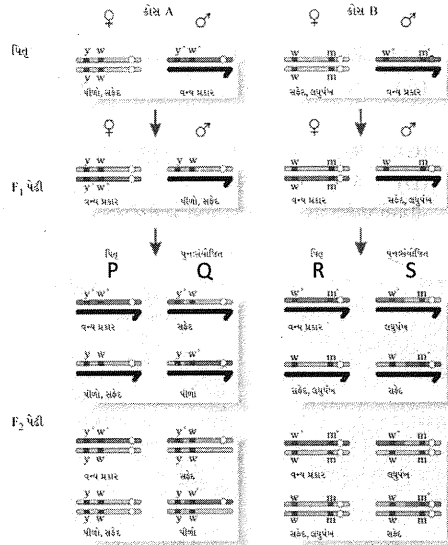
The following experiment is the result of a dihybrid cross performed by Morgan. Identify the proportions of $P, Q, R,$ and $S$.
A
$37.2\% \quad 62.8\% \quad 1.3\% \quad 98.7\%$
B
$1.3\% \quad 98.7\% \quad 37.2\% \quad 62.8\%$
C
$98.7\% \quad 1.3\% \quad 62.8\% \quad 37.2\%$
D
$62.8\% \quad 37.2\% \quad 98.7\% \quad 1.3\%$
Solution
(C) Thomas Hunt Morgan performed dihybrid crosses in Drosophila to study linkage and recombination.
In Cross $A$ (yellow-bodied,white-eyed with wild type),the genes for body color $(y)$ and eye color $(w)$ are tightly linked. The parental types $(P)$ are $98.7\%$ and the recombinant types $(Q)$ are $1.3\%$.
In Cross $B$ (white-eyed,miniature-winged with wild type),the genes for eye color $(w)$ and wing size $(m)$ are loosely linked. The parental types $(R)$ are $62.8\%$ and the recombinant types $(S)$ are $37.2\%$.
Therefore,the proportions are $P = 98.7\%, Q = 1.3\%, R = 62.8\%, S = 37.2\%$.
This matches option $C$.
In Cross $A$ (yellow-bodied,white-eyed with wild type),the genes for body color $(y)$ and eye color $(w)$ are tightly linked. The parental types $(P)$ are $98.7\%$ and the recombinant types $(Q)$ are $1.3\%$.
In Cross $B$ (white-eyed,miniature-winged with wild type),the genes for eye color $(w)$ and wing size $(m)$ are loosely linked. The parental types $(R)$ are $62.8\%$ and the recombinant types $(S)$ are $37.2\%$.
Therefore,the proportions are $P = 98.7\%, Q = 1.3\%, R = 62.8\%, S = 37.2\%$.
This matches option $C$.
0 likes
View Solution208
EasyMCQ
Who mapped the position of genes on chromosomes by using the frequency of recombination between gene pairs on the same chromosome as a measure of the distance between genes?
A
Gregor Mendel
B
Alfred Sturtevant
C
Thomas Hunt Morgan
D
Walter Sutton and Theodor Boveri
Solution
(B) Alfred Sturtevant,a student of Thomas Hunt Morgan,used the frequency of recombination between gene pairs on the same chromosome as a measure of the distance between genes and mapped their position on the chromosome. This method is the basis for genetic mapping.
0 likes
View Solution209
MediumMCQ
Frequency of recombination between gene pairs on the same chromosome as a measure of the distance between genes to map their position on the chromosome was used for the first time by
A
Henking
B
Thomas Hunt Morgan
C
Sutton and Boveri
D
Alfred Sturtevant
Solution
(D) Alfred Sturtevant used the frequency of recombination between gene pairs on the same chromosome as a measure of the distance between genes and 'mapped' their position on the chromosome.
Sutton and Boveri proposed the chromosomal theory of inheritance.
Henking discovered the $X$-chromosome.
Thomas Hunt Morgan proved the chromosomal theory of inheritance and proposed the concept of linkage.
Sutton and Boveri proposed the chromosomal theory of inheritance.
Henking discovered the $X$-chromosome.
Thomas Hunt Morgan proved the chromosomal theory of inheritance and proposed the concept of linkage.
0 likes
View Solution210
MediumMCQ
Which of the following statements are correct?
A
Morgan united knowledge of chromosomal segregation with Mendelian principles
B
Thomas Hunt Morgan worked with Drosophila melanogaster to experimentally verify the chromosomal theory of inheritance
C
$A$ single mating of Drosophila melanogaster could produce a small number of progeny flies
D
There was no clear differentiation of sexes in Drosophila melanogaster
Solution
(A, B) Statement $A$ is correct: Thomas Hunt Morgan integrated the knowledge of chromosomal segregation with Mendelian principles to explain the mechanism of inheritance.
Statement $B$ is correct: Thomas Hunt Morgan worked with $Drosophila$ $\text{melanogaster}$ (fruit flies) to provide experimental evidence for the chromosomal theory of inheritance.
Statement $C$ is incorrect: $A$ single mating of $Drosophila$ $\text{melanogaster}$ can produce a large number of progeny flies, which is one of the reasons they were chosen for genetic studies.
Statement $D$ is incorrect: $Drosophila$ $\text{melanogaster}$ exhibits clear sexual dimorphism, allowing for easy differentiation between male and female flies.
Statement $B$ is correct: Thomas Hunt Morgan worked with $Drosophila$ $\text{melanogaster}$ (fruit flies) to provide experimental evidence for the chromosomal theory of inheritance.
Statement $C$ is incorrect: $A$ single mating of $Drosophila$ $\text{melanogaster}$ can produce a large number of progeny flies, which is one of the reasons they were chosen for genetic studies.
Statement $D$ is incorrect: $Drosophila$ $\text{melanogaster}$ exhibits clear sexual dimorphism, allowing for easy differentiation between male and female flies.
0 likes
View Solution211
MediumMCQ
Choose the incorrect statement.
A
Experimental verification of the chromosomal theory of inheritance was done by $T.H.$ Morgan and his colleagues.
B
Morgan worked with the tiny fruit flies,$Drosophila$ $melanogaster$.
C
$A$ single mating could produce a large number of progeny in fruit flies.
D
$Drosophila$ $melanogaster$ has few types of hereditary variations that can be seen with a low-power microscope.
Solution
(D) The correct answer is $D$.
$T.H.$ Morgan and his colleagues performed experimental verification of the chromosomal theory of inheritance using $Drosophila$ $melanogaster$ (fruit flies).
These flies were chosen because they could be grown on simple synthetic media in the laboratory,their life cycle is short (about two weeks),and a single mating could produce a large number of progeny.
Furthermore,they exhibit many types of hereditary variations that can be seen with low-power microscopes,not 'few' types. Therefore,statement $D$ is incorrect.
$T.H.$ Morgan and his colleagues performed experimental verification of the chromosomal theory of inheritance using $Drosophila$ $melanogaster$ (fruit flies).
These flies were chosen because they could be grown on simple synthetic media in the laboratory,their life cycle is short (about two weeks),and a single mating could produce a large number of progeny.
Furthermore,they exhibit many types of hereditary variations that can be seen with low-power microscopes,not 'few' types. Therefore,statement $D$ is incorrect.
0 likes
View Solution212
MediumMCQ
What will be the number of linkage groups in maize if it has $10$ pairs of chromosomes?
A
$15$
B
$5$
C
$20$
D
$10$
Solution
(D) Linkage groups are defined as the number of pairs of homologous chromosomes in an organism.
In any diploid organism,the number of linkage groups is equal to the haploid number of chromosomes $(n)$.
Given that maize has $10$ pairs of chromosomes,the diploid number $(2n)$ is $20$.
Therefore,the haploid number $(n)$ is $10$.
Thus,the number of linkage groups in maize is $10$.
In any diploid organism,the number of linkage groups is equal to the haploid number of chromosomes $(n)$.
Given that maize has $10$ pairs of chromosomes,the diploid number $(2n)$ is $20$.
Therefore,the haploid number $(n)$ is $10$.
Thus,the number of linkage groups in maize is $10$.
0 likes
View Solution213
MediumMCQ
According to Morgan's experiment,which of the following is true?
A
Genes of eye colour and wing size are tightly linked
B
Genes of body colour and eye colour are loosely linked
C
Tightly linked genes show high recombination
D
Loosely linked genes show high recombination
Solution
(D) Thomas Hunt Morgan's experiments on Drosophila melanogaster demonstrated the concept of linkage and recombination.
$1$. Linkage refers to the physical association of genes on the same chromosome.
$2$. Tightly linked genes are located very close to each other on a chromosome,resulting in a very low frequency of recombination.
$3$. Loosely linked genes are located further apart on the same chromosome,which allows for a higher frequency of crossing over between them,resulting in high recombination.
$4$. Therefore,the statement that 'Loosely linked genes show high recombination' is scientifically correct.
$1$. Linkage refers to the physical association of genes on the same chromosome.
$2$. Tightly linked genes are located very close to each other on a chromosome,resulting in a very low frequency of recombination.
$3$. Loosely linked genes are located further apart on the same chromosome,which allows for a higher frequency of crossing over between them,resulting in high recombination.
$4$. Therefore,the statement that 'Loosely linked genes show high recombination' is scientifically correct.
0 likes
View Solution214
EasyMCQ
Genetic maps of chromosomes are based on the frequency of $:-$
A
Non-disjunction
B
Translocation
C
Linkage
D
Genetic recombination
Solution
(D) Genetic maps,also known as linkage maps,represent the relative positions of genes on a chromosome.
These maps are constructed based on the frequency of genetic recombination (crossing over) between gene loci.
The distance between two genes is measured in centimorgans $(cM)$,where $1 \ cM$ corresponds to a $1\%$ frequency of recombination.
Therefore,the higher the recombination frequency between two genes,the further apart they are located on the chromosome.
These maps are constructed based on the frequency of genetic recombination (crossing over) between gene loci.
The distance between two genes is measured in centimorgans $(cM)$,where $1 \ cM$ corresponds to a $1\%$ frequency of recombination.
Therefore,the higher the recombination frequency between two genes,the further apart they are located on the chromosome.
0 likes
View Solution215
EasyMCQ
Identify the set of correct statements regarding Morgan's experiment on Drosophila.
i. The $X$ chromosome of a Drosophila male shows complete linkage.
ii. The number of linkage groups corresponds to the diploid number of chromosomes.
iii. Drosophila melanogaster has $4$ linkage groups.
iv. The term 'crossing over' was coined by Morgan.
v. The phenomenon of crossing over is by and large universal (except in Drosophila males).
i. The $X$ chromosome of a Drosophila male shows complete linkage.
ii. The number of linkage groups corresponds to the diploid number of chromosomes.
iii. Drosophila melanogaster has $4$ linkage groups.
iv. The term 'crossing over' was coined by Morgan.
v. The phenomenon of crossing over is by and large universal (except in Drosophila males).

A
ii,iii and iv
B
i,iii,iv and v
C
i,iii and ii
D
ii,iii,iv and v
Solution
(B) Let's analyze each statement:
i. In Drosophila males,crossing over does not occur,leading to complete linkage of genes on the $X$ chromosome. This is correct.
ii. The number of linkage groups corresponds to the haploid number of chromosomes $(n)$,not the diploid number $(2n)$. This is incorrect.
iii. Drosophila melanogaster has $2n = 8$ chromosomes,so its haploid number is $n = 4$. Thus,it has $4$ linkage groups. This is correct.
iv. The term 'crossing over' was coined by Morgan and Cattell. This is correct.
v. Crossing over is a universal phenomenon in sexually reproducing organisms,except in Drosophila males (where it is absent). This is correct.
Therefore,the correct statements are i,iii,iv,and v.
i. In Drosophila males,crossing over does not occur,leading to complete linkage of genes on the $X$ chromosome. This is correct.
ii. The number of linkage groups corresponds to the haploid number of chromosomes $(n)$,not the diploid number $(2n)$. This is incorrect.
iii. Drosophila melanogaster has $2n = 8$ chromosomes,so its haploid number is $n = 4$. Thus,it has $4$ linkage groups. This is correct.
iv. The term 'crossing over' was coined by Morgan and Cattell. This is correct.
v. Crossing over is a universal phenomenon in sexually reproducing organisms,except in Drosophila males (where it is absent). This is correct.
Therefore,the correct statements are i,iii,iv,and v.
0 likes
View Solution216
EasyMCQ
Which one of the following statements is $NOT$ true regarding crossing over during meiosis?
A
Crossing over increases the chances of variations.
B
It is necessary for natural selection.
C
It is an universal phenomenon.
D
Closely located linked genes are always separated during crossing over.
Solution
(D) Crossing over is the exchange of genetic material between non-sister chromatids of homologous chromosomes during prophase-$I$ of meiosis.
It leads to genetic recombination,which increases the chances of variations in the population.
These variations are essential for natural selection and evolution.
However,the statement that 'closely located linked genes are always separated during crossing over' is incorrect.
Genes that are located very close to each other on the same chromosome exhibit strong linkage and are rarely separated by crossing over; they tend to be inherited together.
It leads to genetic recombination,which increases the chances of variations in the population.
These variations are essential for natural selection and evolution.
However,the statement that 'closely located linked genes are always separated during crossing over' is incorrect.
Genes that are located very close to each other on the same chromosome exhibit strong linkage and are rarely separated by crossing over; they tend to be inherited together.
0 likes
View Solution217
EasyMCQ
Total number of linkage groups in honeybee is . . . . . . .
A
$16$
B
$23$
C
$32$
D
$46$
Solution
(A) The number of linkage groups corresponds to the haploid number of chromosomes $(n)$ of a particular species.
In honeybees $(Apis \text{ } mellifera)$, the diploid number of chromosomes in females (workers and queens) is $2n = 32$.
Therefore, the haploid number of chromosomes is $n = 16$.
Since the number of linkage groups is equal to the haploid chromosome number, the total number of linkage groups in honeybees is $16$.
In honeybees $(Apis \text{ } mellifera)$, the diploid number of chromosomes in females (workers and queens) is $2n = 32$.
Therefore, the haploid number of chromosomes is $n = 16$.
Since the number of linkage groups is equal to the haploid chromosome number, the total number of linkage groups in honeybees is $16$.
0 likes
View Solution218
EasyMCQ
Linkage groups can be separated during . . . . . . in meiosis.
A
Crossing over
B
Synapsis
C
Tetrad formation
D
Terminalization
Solution
(A) Linkage refers to the physical association of genes on the same chromosome. These genes tend to be inherited together. However,linkage groups can be separated during the process of crossing over. Crossing over occurs during the pachytene stage of prophase-$I$ of meiosis,where non-sister chromatids of homologous chromosomes exchange genetic material. This recombination breaks the linkage between genes located on the same chromosome,leading to new combinations of alleles.
0 likes
View Solution219
EasyMCQ
When white-eyed and miniature-winged $Drosophila$ $melanogaster$ is crossed with its wild type,it produces which of the following percentages of recombinants (in $\%$)?
A
$1.3$
B
$37.2$
C
$62.8$
D
$98.7$
Solution
(B) The genes for white eyes and miniature wings in $Drosophila$ $melanogaster$ are loosely linked.
Because they are located further apart on the same chromosome,they exhibit a higher frequency of crossing over.
According to the experimental data provided by Morgan,the percentage of recombinants observed for these traits is $37.2\%$.
Because they are located further apart on the same chromosome,they exhibit a higher frequency of crossing over.
According to the experimental data provided by Morgan,the percentage of recombinants observed for these traits is $37.2\%$.
0 likes
View Solution220
EasyMCQ
Which of the following animals was selected by $T.H. Morgan$ for studying linkage?
A
$Apis \text{ } indica$
B
$Agrobacterium \text{ } tumefaciens$
C
$Drosophila \text{ } melanogaster$
D
$E. \text{ } coli$
Solution
(C) $T.H. Morgan$ conducted his experiments on $Drosophila \text{ } melanogaster$ (fruit fly) to study the principles of linkage and recombination.
$Drosophila$ was chosen because it could be grown on simple synthetic media in the laboratory,had a short life cycle (about two weeks),and produced a large number of progeny in a single mating.
Additionally,there was a clear differentiation of sexes,and it had many types of hereditary variations that could be seen with low-power microscopes.
$Drosophila$ was chosen because it could be grown on simple synthetic media in the laboratory,had a short life cycle (about two weeks),and produced a large number of progeny in a single mating.
Additionally,there was a clear differentiation of sexes,and it had many types of hereditary variations that could be seen with low-power microscopes.
0 likes
View Solution221
EasyMCQ
In Morgan's experiment with $Drosophila$,when a yellow-bodied,white-eyed female was crossed with a brown-bodied,red-eyed male and their $F_1$ progeny were intercrossed,what was the percentage of recombinants in the $F_2$ generation (in $\%$)?
A
$6.28$
B
$98.7$
C
$1.3$
D
$37.2$
Solution
(C) In $Morgan's$ experiment on $Drosophila$,the genes for body color and eye color are linked and located on the $X$ chromosome.
When a yellow-bodied,white-eyed female is crossed with a brown-bodied,red-eyed male,the $F_1$ generation consists of brown-bodied,red-eyed females and yellow-bodied,white-eyed males.
Upon intercrossing the $F_1$ progeny,the $F_2$ generation shows a significant deviation from the expected $9:3:3:1$ ratio due to genetic linkage.
The parental types are much more frequent than the recombinant types.
The percentage of recombinants observed in this specific cross was $1.3\%$,which indicates a very tight linkage between the genes for body color and eye color.
When a yellow-bodied,white-eyed female is crossed with a brown-bodied,red-eyed male,the $F_1$ generation consists of brown-bodied,red-eyed females and yellow-bodied,white-eyed males.
Upon intercrossing the $F_1$ progeny,the $F_2$ generation shows a significant deviation from the expected $9:3:3:1$ ratio due to genetic linkage.
The parental types are much more frequent than the recombinant types.
The percentage of recombinants observed in this specific cross was $1.3\%$,which indicates a very tight linkage between the genes for body color and eye color.
0 likes
View Solution222
EasyMCQ
Gene-mapping technology was developed by
A
Mendel
B
Tschermak
C
Correns
D
Sturtevant
Solution
(D) Sturtevant.
Alfred Sturtevant,a student of Thomas Hunt Morgan,developed the first genetic map in $1913$ based on the frequency of recombination between gene pairs on the same chromosome.
Alfred Sturtevant,a student of Thomas Hunt Morgan,developed the first genetic map in $1913$ based on the frequency of recombination between gene pairs on the same chromosome.
0 likes
View Solution223
EasyMCQ
Which term is coined for the physical association of $2$ genes on the same chromosome?
A
Recombination
B
Linkage
C
Pleiotropy
D
Gene flow
Solution
(B) Linkage is the phenomenon where genes located close together on the same chromosome tend to be inherited together because they are physically associated. This physical proximity prevents them from segregating independently during meiosis,thus maintaining their association in the offspring.
0 likes
View SolutionPrinciples of Inheritance and Variation — Linkage and recombination · Frequently Asked Questions
1Are these Principles of Inheritance and Variation questions useful for JEE and NEET?
Yes. All questions in this section are mapped to JEE Main and NEET exam patterns. Previous year questions from JEE Main, NEET, GUJCET and state-level exams are included with full solutions.
2Can I switch to Hindi or Gujarati for these questions?
Yes. Use the language tabs in the hero section or the sidebar to view the same questions and solutions in English, Hindi or Gujarati.
3How do I generate a question paper from this subtopic?
Use the Vedclass Exam Paper Generator — select the chapter and subtopic, set difficulty, and generate Sets A, B, C, D automatically. First 3 chapters of every subject are free.
Vedclass Products
For Students
Vedclass Test Series
Mock tests in real JEE/NEET style with performance analysis. 5-day free trial.
Start Free TrialFor Teachers
Exam Paper Generator
Generate Set A/B/C/D papers from this chapter in 2 minutes. 3 chapters free.
Try FreeFor Institutes
Online Exam Module
Live online exams with unlimited students, 360° analytics & white-label branding.
See DemoFor Teachers & Institutes
Generate a Principles of Inheritance and Variation Exam Paper in 2 Minutes
Select subtopic & difficulty — Sets A, B, C, D auto-generated with No Repeat logic.
First 3 chapters of every subject are free — no payment required.