
A English
Wave Equation and Characteristics of Waves Questions in English
Class 11 Physics · Waves and Sound · Wave Equation and Characteristics of Waves
317+
Questions
English
Language
100%
With Solutions
Showing 49 of 317 questions in English
251
MediumMCQ
Velocity of sound waves in air is $330 \,m/s$. For a particular sound wave in air, a path difference of $40 \,cm$ is equivalent to a phase difference of $1.6 \pi$. The frequency of this wave is: (in $\,Hz$)
A
$165$
B
$150$
C
$660$
D
$330$
Solution
(C) Given: Velocity $v = 330 \,m/s$, path difference $\Delta x = 40 \,cm = 0.4 \,m$, and phase difference $\Delta \phi = 1.6 \pi$.
We know the relationship between phase difference and path difference is given by $\Delta \phi = \frac{2 \pi}{\lambda} \Delta x$.
Substituting the values: $1.6 \pi = \frac{2 \pi}{0.4} \Delta x$ is not needed directly, instead use $\lambda = \frac{v}{f}$.
Thus, $\Delta \phi = \frac{2 \pi f}{v} \Delta x$.
Rearranging for frequency $f$: $f = \frac{\Delta \phi \cdot v}{2 \pi \cdot \Delta x}$.
Substituting the values: $f = \frac{1.6 \pi \cdot 330}{2 \pi \cdot 0.4}$.
$f = \frac{1.6 \cdot 330}{0.8} = 2 \cdot 330 = 660 \,Hz$.
We know the relationship between phase difference and path difference is given by $\Delta \phi = \frac{2 \pi}{\lambda} \Delta x$.
Substituting the values: $1.6 \pi = \frac{2 \pi}{0.4} \Delta x$ is not needed directly, instead use $\lambda = \frac{v}{f}$.
Thus, $\Delta \phi = \frac{2 \pi f}{v} \Delta x$.
Rearranging for frequency $f$: $f = \frac{\Delta \phi \cdot v}{2 \pi \cdot \Delta x}$.
Substituting the values: $f = \frac{1.6 \pi \cdot 330}{2 \pi \cdot 0.4}$.
$f = \frac{1.6 \cdot 330}{0.8} = 2 \cdot 330 = 660 \,Hz$.
0 likes
View Solution252
MediumMCQ
The distance between two consecutive points with a phase difference of $60^{\circ}$ in a wave of frequency $500 \text{ Hz}$ is $0.6 \text{ m}$. The velocity with which the wave is travelling is: (in $\text{ km/s}$)
A
$1.8$
B
$9$
C
$3.6$
D
$2.7$
Solution
(A) Given: Phase difference $\phi = 60^{\circ} = \frac{\pi}{3} \text{ radians}$.
Path difference $x = 0.6 \text{ m}$.
Frequency $n = 500 \text{ Hz}$.
The relationship between path difference $(x)$ and phase difference $(\phi)$ is given by $x = \frac{\lambda}{2\pi} \times \phi$.
Substituting the values: $0.6 = \frac{\lambda}{2\pi} \times \frac{\pi}{3}$.
$0.6 = \frac{\lambda}{6} \implies \lambda = 3.6 \text{ m}$.
The velocity of the wave is $v = n \lambda$.
$v = 500 \times 3.6 = 1800 \text{ m/s}$.
Converting to $\text{km/s}$: $v = 1.8 \text{ km/s}$.
Path difference $x = 0.6 \text{ m}$.
Frequency $n = 500 \text{ Hz}$.
The relationship between path difference $(x)$ and phase difference $(\phi)$ is given by $x = \frac{\lambda}{2\pi} \times \phi$.
Substituting the values: $0.6 = \frac{\lambda}{2\pi} \times \frac{\pi}{3}$.
$0.6 = \frac{\lambda}{6} \implies \lambda = 3.6 \text{ m}$.
The velocity of the wave is $v = n \lambda$.
$v = 500 \times 3.6 = 1800 \text{ m/s}$.
Converting to $\text{km/s}$: $v = 1.8 \text{ km/s}$.
0 likes
View Solution253
MediumMCQ
The equation of a simple harmonic progressive wave is given by $y=a \sin 2 \pi(b t-c x)$. The maximum particle velocity will be half the wave velocity,if $c=$
A
$2 \pi a$
B
$\frac{1}{4 \pi a}$
C
$\frac{1}{2 \pi a}$
D
$4 \pi a$
Solution
(B) The general equation of a simple harmonic progressive wave is $y=A \sin 2 \pi \left( \frac{t}{T} - \frac{x}{\lambda} \right)$.
Given equation: $y=a \sin 2 \pi(b t-c x)$.
Comparing the two,we get amplitude $A=a$,frequency $n = \frac{1}{T} = b$,and wave number $\frac{1}{\lambda} = c$.
The maximum particle velocity is given by $(v_p)_{\max} = A \omega = A(2 \pi n) = a(2 \pi b) = 2 \pi ab$.
The wave velocity is given by $v = n \lambda = \frac{n}{1/\lambda} = \frac{b}{c}$.
According to the problem,$(v_p)_{\max} = \frac{1}{2} v$.
Substituting the values: $2 \pi ab = \frac{1}{2} \left( \frac{b}{c} \right)$.
Canceling $b$ from both sides: $2 \pi a = \frac{1}{2c}$.
Solving for $c$: $c = \frac{1}{4 \pi a}$.
Given equation: $y=a \sin 2 \pi(b t-c x)$.
Comparing the two,we get amplitude $A=a$,frequency $n = \frac{1}{T} = b$,and wave number $\frac{1}{\lambda} = c$.
The maximum particle velocity is given by $(v_p)_{\max} = A \omega = A(2 \pi n) = a(2 \pi b) = 2 \pi ab$.
The wave velocity is given by $v = n \lambda = \frac{n}{1/\lambda} = \frac{b}{c}$.
According to the problem,$(v_p)_{\max} = \frac{1}{2} v$.
Substituting the values: $2 \pi ab = \frac{1}{2} \left( \frac{b}{c} \right)$.
Canceling $b$ from both sides: $2 \pi a = \frac{1}{2c}$.
Solving for $c$: $c = \frac{1}{4 \pi a}$.
0 likes
View Solution254
DifficultMCQ
The equation of a wave is $Y = 6 \sin(12 \pi t - 0.02 \pi x + \frac{\pi}{3})$,where $x$ is in $m$ and $t$ is in $s$. The velocity of the wave is: (in $m/s$)
A
$200$
B
$300$
C
$400$
D
$600$
Solution
(D) The standard equation of a traveling wave is given by $Y = A \sin(\omega t - kx + \phi)$.
Comparing this with the given equation $Y = 6 \sin(12 \pi t - 0.02 \pi x + \frac{\pi}{3})$:
We have angular frequency $\omega = 12 \pi \ rad/s$ and wave number $k = 0.02 \pi \ rad/m$.
The velocity of the wave $v$ is given by the ratio of angular frequency to wave number:
$v = \frac{\omega}{k}$
$v = \frac{12 \pi}{0.02 \pi}$
$v = \frac{12}{0.02} = \frac{1200}{2} = 600 \ m/s$.
Comparing this with the given equation $Y = 6 \sin(12 \pi t - 0.02 \pi x + \frac{\pi}{3})$:
We have angular frequency $\omega = 12 \pi \ rad/s$ and wave number $k = 0.02 \pi \ rad/m$.
The velocity of the wave $v$ is given by the ratio of angular frequency to wave number:
$v = \frac{\omega}{k}$
$v = \frac{12 \pi}{0.02 \pi}$
$v = \frac{12}{0.02} = \frac{1200}{2} = 600 \ m/s$.
0 likes
View Solution255
DifficultMCQ
The path difference between two waves,represented by $y_1 = a_1 \sin \left(\omega t - \frac{2 \pi x}{\lambda}\right)$ and $y_2 = a_2 \cos \left(\omega t - \frac{2 \pi x}{\lambda} + \phi\right)$ is
A
$\frac{\lambda}{2 \pi}(\phi)$
B
$\frac{\lambda}{2 \pi}\left(\phi + \frac{\pi}{2}\right)$
C
$\frac{2 \pi}{\lambda}\left(\phi - \frac{\pi}{2}\right)$
D
$\frac{2 \pi}{\lambda}(\phi)$
Solution
(B) Given equations are:
$y_1 = a_1 \sin \left(\omega t - \frac{2 \pi x}{\lambda}\right)$
$y_2 = a_2 \cos \left(\omega t - \frac{2 \pi x}{\lambda} + \phi\right)$
We know that $\cos \theta = \sin \left(\theta + \frac{\pi}{2}\right)$.
Therefore,$y_2$ can be rewritten as:
$y_2 = a_2 \sin \left(\omega t - \frac{2 \pi x}{\lambda} + \phi + \frac{\pi}{2}\right)$
The phase difference $\Delta \Phi$ between the two waves is the difference in their arguments:
$\Delta \Phi = \left(\omega t - \frac{2 \pi x}{\lambda} + \phi + \frac{\pi}{2}\right) - \left(\omega t - \frac{2 \pi x}{\lambda}\right) = \phi + \frac{\pi}{2}$
The relationship between path difference $\Delta x$ and phase difference $\Delta \Phi$ is given by:
$\Delta x = \frac{\lambda}{2 \pi} \times \Delta \Phi$
Substituting the value of $\Delta \Phi$:
$\Delta x = \frac{\lambda}{2 \pi} \left(\phi + \frac{\pi}{2}\right)$
$y_1 = a_1 \sin \left(\omega t - \frac{2 \pi x}{\lambda}\right)$
$y_2 = a_2 \cos \left(\omega t - \frac{2 \pi x}{\lambda} + \phi\right)$
We know that $\cos \theta = \sin \left(\theta + \frac{\pi}{2}\right)$.
Therefore,$y_2$ can be rewritten as:
$y_2 = a_2 \sin \left(\omega t - \frac{2 \pi x}{\lambda} + \phi + \frac{\pi}{2}\right)$
The phase difference $\Delta \Phi$ between the two waves is the difference in their arguments:
$\Delta \Phi = \left(\omega t - \frac{2 \pi x}{\lambda} + \phi + \frac{\pi}{2}\right) - \left(\omega t - \frac{2 \pi x}{\lambda}\right) = \phi + \frac{\pi}{2}$
The relationship between path difference $\Delta x$ and phase difference $\Delta \Phi$ is given by:
$\Delta x = \frac{\lambda}{2 \pi} \times \Delta \Phi$
Substituting the value of $\Delta \Phi$:
$\Delta x = \frac{\lambda}{2 \pi} \left(\phi + \frac{\pi}{2}\right)$
0 likes
View Solution256
MediumMCQ
$A$ transverse wave in a medium is given by $y = A \sin 2(\omega t - kx)$. It is found that the magnitude of the maximum velocity of particles in the medium is equal to the magnitude of the wave velocity. What is the value of $A$?
A
$\frac{2 \lambda}{\pi}$
B
$\frac{\lambda}{\pi}$
C
$\frac{\lambda}{2 \pi}$
D
$\frac{\lambda}{4 \pi}$
Solution
(D) The given wave equation is $y = A \sin(2\omega t - 2kx)$.
Comparing this with the standard wave equation $y = A \sin(\omega' t - k' x)$,we have angular frequency $\omega' = 2\omega$ and wave number $k' = 2k$.
The velocity of the particle is $v_p = \frac{dy}{dt} = A \cdot (2\omega) \cos(2\omega t - 2kx)$.
The maximum particle velocity is $v_{p,max} = 2A\omega$.
The wave velocity is $v_w = \frac{\omega'}{k'} = \frac{2\omega}{2k} = \frac{\omega}{k}$.
Given that $v_{p,max} = v_w$,we have $2A\omega = \frac{\omega}{k}$.
Thus,$A = \frac{1}{2k}$.
Since the wave number $k = \frac{2\pi}{\lambda}$,we substitute this into the expression for $A$:
$A = \frac{1}{2(2\pi / \lambda)} = \frac{\lambda}{4\pi}$.
Comparing this with the standard wave equation $y = A \sin(\omega' t - k' x)$,we have angular frequency $\omega' = 2\omega$ and wave number $k' = 2k$.
The velocity of the particle is $v_p = \frac{dy}{dt} = A \cdot (2\omega) \cos(2\omega t - 2kx)$.
The maximum particle velocity is $v_{p,max} = 2A\omega$.
The wave velocity is $v_w = \frac{\omega'}{k'} = \frac{2\omega}{2k} = \frac{\omega}{k}$.
Given that $v_{p,max} = v_w$,we have $2A\omega = \frac{\omega}{k}$.
Thus,$A = \frac{1}{2k}$.
Since the wave number $k = \frac{2\pi}{\lambda}$,we substitute this into the expression for $A$:
$A = \frac{1}{2(2\pi / \lambda)} = \frac{\lambda}{4\pi}$.
0 likes
View Solution257
MediumMCQ
The equation of wave motion is $Y = 5 \sin (10 \pi t - 0.02 \pi x + \pi / 3)$ where $x$ is in $m$ and $t$ is in $s$. The velocity of the wave is (in $m/s$)
A
$300$
B
$400$
C
$500$
D
$600$
Solution
(C) The standard equation of a traveling wave is given by $y = A \sin (\omega t - kx + \phi)$ or $y = A \sin (kx - \omega t + \phi)$.
Comparing the given equation $Y = 5 \sin (10 \pi t - 0.02 \pi x + \pi / 3)$ with the standard form,we identify the angular frequency $\omega$ and the wave number $k$:
$\omega = 10 \pi \ rad/s$
$k = 0.02 \pi \ rad/m$
The velocity of the wave $v$ is given by the ratio of angular frequency to wave number:
$v = \frac{\omega}{k}$
Substituting the values:
$v = \frac{10 \pi}{0.02 \pi}$
$v = \frac{10}{0.02} = \frac{1000}{2} = 500 \ m/s$
Therefore,the velocity of the wave is $500 \ m/s$.
Comparing the given equation $Y = 5 \sin (10 \pi t - 0.02 \pi x + \pi / 3)$ with the standard form,we identify the angular frequency $\omega$ and the wave number $k$:
$\omega = 10 \pi \ rad/s$
$k = 0.02 \pi \ rad/m$
The velocity of the wave $v$ is given by the ratio of angular frequency to wave number:
$v = \frac{\omega}{k}$
Substituting the values:
$v = \frac{10 \pi}{0.02 \pi}$
$v = \frac{10}{0.02} = \frac{1000}{2} = 500 \ m/s$
Therefore,the velocity of the wave is $500 \ m/s$.
0 likes
View Solution258
MediumMCQ
The equation of a wave is given by $y = 10 \sin \left(\frac{2 \pi t}{30} + \alpha\right)$. If the displacement is $5 \ cm$ at $t = 0 \ s$,then the total phase angle at $t = 7.5 \ s$ will be:
A
$\frac{\pi}{3} \ rad$
B
$\frac{\pi}{2} \ rad$
C
$\frac{2 \pi}{5} \ rad$
D
$\frac{2 \pi}{3} \ rad$
Solution
(D) The given wave equation is $y = 10 \sin \left(\frac{2 \pi t}{30} + \alpha\right)$.
At $t = 0 \ s$,the displacement $y = 5 \ cm$.
Substituting these values into the equation: $5 = 10 \sin \left(\frac{2 \pi (0)}{30} + \alpha\right) \implies 5 = 10 \sin \alpha \implies \sin \alpha = \frac{1}{2}$.
Thus,the initial phase constant $\alpha = \frac{\pi}{6} \ rad$.
The total phase angle $\phi$ at any time $t$ is given by $\phi = \frac{2 \pi t}{30} + \alpha$.
At $t = 7.5 \ s$,the total phase angle is $\phi = \frac{2 \pi (7.5)}{30} + \frac{\pi}{6}$.
$\phi = \frac{15 \pi}{30} + \frac{\pi}{6} = \frac{\pi}{2} + \frac{\pi}{6}$.
$\phi = \frac{3 \pi + \pi}{6} = \frac{4 \pi}{6} = \frac{2 \pi}{3} \ rad$.
At $t = 0 \ s$,the displacement $y = 5 \ cm$.
Substituting these values into the equation: $5 = 10 \sin \left(\frac{2 \pi (0)}{30} + \alpha\right) \implies 5 = 10 \sin \alpha \implies \sin \alpha = \frac{1}{2}$.
Thus,the initial phase constant $\alpha = \frac{\pi}{6} \ rad$.
The total phase angle $\phi$ at any time $t$ is given by $\phi = \frac{2 \pi t}{30} + \alpha$.
At $t = 7.5 \ s$,the total phase angle is $\phi = \frac{2 \pi (7.5)}{30} + \frac{\pi}{6}$.
$\phi = \frac{15 \pi}{30} + \frac{\pi}{6} = \frac{\pi}{2} + \frac{\pi}{6}$.
$\phi = \frac{3 \pi + \pi}{6} = \frac{4 \pi}{6} = \frac{2 \pi}{3} \ rad$.
0 likes
View Solution259
EasyMCQ
$A$ simple harmonic progressive wave is given by $Y = Y_0 \sin 2 \pi (nt - \frac{x}{\lambda})$. If the wave velocity is $(1/8)^{\text{th}}$ of the maximum particle velocity,then the wavelength is
A
$\frac{\pi Y_0}{2}$
B
$\frac{\pi Y_0}{4}$
C
$\frac{\pi Y_0}{8}$
D
$\frac{\pi Y_0}{16}$
Solution
(B) The given wave equation is $Y = Y_0 \sin(2 \pi n t - \frac{2 \pi x}{\lambda})$.
Comparing this with the standard form $Y = Y_0 \sin(\omega t - kx)$,we get angular frequency $\omega = 2 \pi n$.
The maximum particle velocity $v_{p, \text{max}} = Y_0 \omega = Y_0 (2 \pi n) = 2 \pi n Y_0$.
The wave velocity $v = n \lambda$.
According to the problem,the wave velocity is $(1/8)^{\text{th}}$ of the maximum particle velocity:
$v = \frac{1}{8} v_{p, \text{max}}$
$n \lambda = \frac{1}{8} (2 \pi n Y_0)$
$n \lambda = \frac{\pi n Y_0}{4}$
$\lambda = \frac{\pi Y_0}{4}$.
Comparing this with the standard form $Y = Y_0 \sin(\omega t - kx)$,we get angular frequency $\omega = 2 \pi n$.
The maximum particle velocity $v_{p, \text{max}} = Y_0 \omega = Y_0 (2 \pi n) = 2 \pi n Y_0$.
The wave velocity $v = n \lambda$.
According to the problem,the wave velocity is $(1/8)^{\text{th}}$ of the maximum particle velocity:
$v = \frac{1}{8} v_{p, \text{max}}$
$n \lambda = \frac{1}{8} (2 \pi n Y_0)$
$n \lambda = \frac{\pi n Y_0}{4}$
$\lambda = \frac{\pi Y_0}{4}$.
0 likes
View Solution260
DifficultMCQ
The equations of two simple harmonic waves are given by $Y_1 = 2 \sin 8 \pi \left(\frac{t}{0.2} - \frac{x}{2}\right) \text{ m}$ and $Y_2 = 4 \sin 8 \pi \left(\frac{t}{0.16} - \frac{x}{1.6}\right) \text{ m}$. Then both waves have:
A
same period
B
same frequency
C
same wavelength
D
same velocity
Solution
(D) The standard equation for a wave is $Y = A \sin 2 \pi \left(\frac{t}{T} - \frac{x}{\lambda}\right)$.
For the first wave: $Y_1 = 2 \sin 2 \pi \left(\frac{4t}{0.2} - \frac{4x}{2}\right) = 2 \sin 2 \pi \left(\frac{t}{0.05} - \frac{x}{0.5}\right)$.
Here,$T_1 = 0.05 \text{ s}$ and $\lambda_1 = 0.5 \text{ m}$.
Velocity $v_1 = \frac{\lambda_1}{T_1} = \frac{0.5}{0.05} = 10 \text{ m/s}$.
For the second wave: $Y_2 = 4 \sin 2 \pi \left(\frac{4t}{0.16} - \frac{4x}{1.6}\right) = 4 \sin 2 \pi \left(\frac{t}{0.04} - \frac{x}{0.4}\right)$.
Here,$T_2 = 0.04 \text{ s}$ and $\lambda_2 = 0.4 \text{ m}$.
Velocity $v_2 = \frac{\lambda_2}{T_2} = \frac{0.4}{0.04} = 10 \text{ m/s}$.
Since $v_1 = v_2 = 10 \text{ m/s}$,both waves have the same velocity.
For the first wave: $Y_1 = 2 \sin 2 \pi \left(\frac{4t}{0.2} - \frac{4x}{2}\right) = 2 \sin 2 \pi \left(\frac{t}{0.05} - \frac{x}{0.5}\right)$.
Here,$T_1 = 0.05 \text{ s}$ and $\lambda_1 = 0.5 \text{ m}$.
Velocity $v_1 = \frac{\lambda_1}{T_1} = \frac{0.5}{0.05} = 10 \text{ m/s}$.
For the second wave: $Y_2 = 4 \sin 2 \pi \left(\frac{4t}{0.16} - \frac{4x}{1.6}\right) = 4 \sin 2 \pi \left(\frac{t}{0.04} - \frac{x}{0.4}\right)$.
Here,$T_2 = 0.04 \text{ s}$ and $\lambda_2 = 0.4 \text{ m}$.
Velocity $v_2 = \frac{\lambda_2}{T_2} = \frac{0.4}{0.04} = 10 \text{ m/s}$.
Since $v_1 = v_2 = 10 \text{ m/s}$,both waves have the same velocity.
0 likes
View Solution261
EasyMCQ
$A$ transverse wave given by $y=2 \sin (0.01 x+30 t)$ moves on a stretched string from one end to another end in $0.5 \ s$. If $x$ and $y$ are in $cm$ and $t$ is in $s$,then the length of the string is: (in $m$)
A
$6$
B
$9$
C
$12$
D
$15$
Solution
(D) The given equation of the transverse wave is $y=2 \sin (0.01 x+30 t)$.
Comparing this with the standard wave equation $y=A \sin (kx+\omega t)$,we identify the wave number $k=0.01 \ rad/cm$ and the angular frequency $\omega=30 \ rad/s$.
The wave speed $v$ is calculated as $v = \frac{\omega}{k} = \frac{30}{0.01} = 3000 \ cm/s$.
Converting the speed to $SI$ units,$v = 30 \ m/s$.
The time taken to travel the length of the string is $t = 0.5 \ s$.
Therefore,the length of the string $L = v \times t = 30 \ m/s \times 0.5 \ s = 15 \ m$.
Comparing this with the standard wave equation $y=A \sin (kx+\omega t)$,we identify the wave number $k=0.01 \ rad/cm$ and the angular frequency $\omega=30 \ rad/s$.
The wave speed $v$ is calculated as $v = \frac{\omega}{k} = \frac{30}{0.01} = 3000 \ cm/s$.
Converting the speed to $SI$ units,$v = 30 \ m/s$.
The time taken to travel the length of the string is $t = 0.5 \ s$.
Therefore,the length of the string $L = v \times t = 30 \ m/s \times 0.5 \ s = 15 \ m$.
0 likes
View Solution262
EasyMCQ
The speed of a wave in a certain medium is $960 \,m/s$. If $900$ waves pass over a certain point of the medium in half a minute, the wavelength of the wave is (in $\,m$)
A
$16$
B
$32$
C
$9$
D
$18$
Solution
(B) Given: Wave speed $v = 960 \,m/s$.
Number of waves $n = 900$.
Time $t = 0.5 \,min = 30 \,s$.
The frequency $f$ is defined as the number of waves passing a point per unit time:
$f = \frac{n}{t} = \frac{900}{30} = 30 \,Hz$.
The relationship between wave speed, frequency, and wavelength is given by $v = f \lambda$.
Therefore, the wavelength $\lambda = \frac{v}{f} = \frac{960}{30} = 32 \,m$.
Number of waves $n = 900$.
Time $t = 0.5 \,min = 30 \,s$.
The frequency $f$ is defined as the number of waves passing a point per unit time:
$f = \frac{n}{t} = \frac{900}{30} = 30 \,Hz$.
The relationship between wave speed, frequency, and wavelength is given by $v = f \lambda$.
Therefore, the wavelength $\lambda = \frac{v}{f} = \frac{960}{30} = 32 \,m$.
0 likes
View Solution263
MediumMCQ
$A$ simple harmonic progressive wave is represented as $y = 0.03 \sin \pi (2 t - 0.01 x) \ m$. At a given instant of time,the phase difference between two particles $25 \ m$ apart is
A
$\frac{\pi}{2} \ rad$
B
$\frac{\pi}{4} \ rad$
C
$\frac{\pi}{8} \ rad$
D
$\frac{\pi}{10} \ rad$
Solution
(B) The given equation of the $SHM$ wave is $y = 0.03 \sin \pi (2 t - 0.01 x) \ m$.
Expanding this,we get $y = 0.03 \sin (2 \pi t - 0.01 \pi x) \ m$.
Comparing this with the general wave equation $y = a \sin (\omega t - k x)$,we identify the wave number $k$ as $k = 0.01 \pi \ rad/m$.
The phase difference $\Delta \phi$ between two particles separated by a distance $\Delta x$ is given by the formula $\Delta \phi = k \Delta x$.
Given $\Delta x = 25 \ m$ and $k = 0.01 \pi \ rad/m$,we substitute these values into the formula:
$\Delta \phi = (0.01 \pi) \times 25 = 0.25 \pi = \frac{\pi}{4} \ rad$.
Thus,the phase difference is $\frac{\pi}{4} \ rad$.
Expanding this,we get $y = 0.03 \sin (2 \pi t - 0.01 \pi x) \ m$.
Comparing this with the general wave equation $y = a \sin (\omega t - k x)$,we identify the wave number $k$ as $k = 0.01 \pi \ rad/m$.
The phase difference $\Delta \phi$ between two particles separated by a distance $\Delta x$ is given by the formula $\Delta \phi = k \Delta x$.
Given $\Delta x = 25 \ m$ and $k = 0.01 \pi \ rad/m$,we substitute these values into the formula:
$\Delta \phi = (0.01 \pi) \times 25 = 0.25 \pi = \frac{\pi}{4} \ rad$.
Thus,the phase difference is $\frac{\pi}{4} \ rad$.
0 likes
View Solution264
MediumMCQ
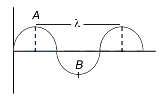
In a sine wave,what is the minimum distance between two particles that always have the same speed?
A
$\frac{\lambda}{2}$
B
$\frac{\lambda}{4}$
C
$\frac{\lambda}{3}$
D
$\lambda$
Solution
(A) In a sine wave,the displacement of a particle is given by $y = A \sin(kx - \omega t)$.
The particle velocity is $v_p = \frac{\partial y}{\partial t} = -A\omega \cos(kx - \omega t)$.
The speed of the particle is $|v_p| = |A\omega \cos(kx - \omega t)|$.
Two particles have the same speed if their displacement magnitudes are equal,i.e.,$|y_1| = |y_2|$.
For a sine wave,points with the same speed are those that have the same magnitude of displacement from the mean position.
Specifically,the points at the crest $(A)$ and the trough $(B)$ both have zero velocity (speed = $0$). The distance between a crest and the adjacent trough is $\frac{\lambda}{2}$.
Alternatively,any two points symmetric about the mean position or the extremes will have the same speed. The minimum distance between two such points is $\frac{\lambda}{2}$.
The particle velocity is $v_p = \frac{\partial y}{\partial t} = -A\omega \cos(kx - \omega t)$.
The speed of the particle is $|v_p| = |A\omega \cos(kx - \omega t)|$.
Two particles have the same speed if their displacement magnitudes are equal,i.e.,$|y_1| = |y_2|$.
For a sine wave,points with the same speed are those that have the same magnitude of displacement from the mean position.
Specifically,the points at the crest $(A)$ and the trough $(B)$ both have zero velocity (speed = $0$). The distance between a crest and the adjacent trough is $\frac{\lambda}{2}$.
Alternatively,any two points symmetric about the mean position or the extremes will have the same speed. The minimum distance between two such points is $\frac{\lambda}{2}$.
0 likes
View Solution265
MediumMCQ
The equation of a simple harmonic progressive wave is given by $y=A \sin (100 \pi t-3 x)$. Find the distance between $2$ particles having a phase difference of $\frac{\pi}{3}$.
A
$\frac{\pi}{9} \ m$
B
$\frac{\pi}{18} \ m$
C
$\frac{\pi}{6} \ m$
D
$\frac{\pi}{3} \ m$
Solution
(A) The given equation of the wave is $y=A \sin (100 \pi t-3 x)$.
Comparing this with the standard wave equation $y=A \sin (\omega t-kx)$,we get the wave number $k=3 \ m^{-1}$.
The relationship between phase difference $(\Delta \phi)$ and path difference $(\Delta x)$ is given by $\Delta \phi = k \cdot \Delta x$.
Given the phase difference $\Delta \phi = \frac{\pi}{3}$.
Substituting the values,we have $\frac{\pi}{3} = 3 \cdot \Delta x$.
Solving for the distance $\Delta x$,we get $\Delta x = \frac{\pi}{3 \times 3} = \frac{\pi}{9} \ m$.
Comparing this with the standard wave equation $y=A \sin (\omega t-kx)$,we get the wave number $k=3 \ m^{-1}$.
The relationship between phase difference $(\Delta \phi)$ and path difference $(\Delta x)$ is given by $\Delta \phi = k \cdot \Delta x$.
Given the phase difference $\Delta \phi = \frac{\pi}{3}$.
Substituting the values,we have $\frac{\pi}{3} = 3 \cdot \Delta x$.
Solving for the distance $\Delta x$,we get $\Delta x = \frac{\pi}{3 \times 3} = \frac{\pi}{9} \ m$.
0 likes
View Solution266
EasyMCQ
$A$ wave travelling along a string is described by the equation $y = A \sin (\omega t - k x)$. The maximum particle velocity is:
A
$A \omega$
B
$\omega / k$
C
$d \omega / d k$
D
$x / t$
Solution
(A) Given the displacement of a particle in the wave is $y = A \sin (\omega t - k x)$.
The particle velocity $v_p$ is defined as the rate of change of displacement with respect to time:
$v_p = \frac{dy}{dt}$
Differentiating the displacement equation with respect to $t$:
$v_p = \frac{d}{dt} [A \sin (\omega t - k x)] = A \omega \cos (\omega t - k x)$
For the maximum particle velocity,the cosine term must be at its maximum value,which is $1$:
$v_{p, \text{max}} = A \omega (1) = A \omega$
Thus,the maximum particle velocity is $A \omega$.
The particle velocity $v_p$ is defined as the rate of change of displacement with respect to time:
$v_p = \frac{dy}{dt}$
Differentiating the displacement equation with respect to $t$:
$v_p = \frac{d}{dt} [A \sin (\omega t - k x)] = A \omega \cos (\omega t - k x)$
For the maximum particle velocity,the cosine term must be at its maximum value,which is $1$:
$v_{p, \text{max}} = A \omega (1) = A \omega$
Thus,the maximum particle velocity is $A \omega$.
0 likes
View Solution267
MediumMCQ
$A$ sound of frequency $480 \,Hz$ is emitted from a stringed instrument. The velocity of sound in air is $320 \,m/s$. After completing $180$ vibrations, the distance covered by the wave is: (in $\,m$)
A
$60$
B
$90$
C
$120$
D
$180$
Solution
(C) Given: Velocity of sound $v = 320 \,m/s$, Frequency $f = 480 \,Hz$, Number of vibrations $N = 180$.
The relationship between velocity, frequency, and wavelength is $v = f \lambda$.
Therefore, the wavelength $\lambda = \frac{v}{f} = \frac{320}{480} = \frac{2}{3} \,m$.
The total distance $D$ covered by the wave after $N$ vibrations is given by $D = N \times \lambda$.
Substituting the values: $D = 180 \times \frac{2}{3} = 120 \,m$.
The relationship between velocity, frequency, and wavelength is $v = f \lambda$.
Therefore, the wavelength $\lambda = \frac{v}{f} = \frac{320}{480} = \frac{2}{3} \,m$.
The total distance $D$ covered by the wave after $N$ vibrations is given by $D = N \times \lambda$.
Substituting the values: $D = 180 \times \frac{2}{3} = 120 \,m$.
0 likes
View Solution268
MediumMCQ
Velocity of sound waves in air is $V \ m/s$. For a particular sound wave in air,a path difference of $x \ cm$ is equivalent to a phase difference of $n\pi$. The frequency of this wave is:
A
$\frac{Vn}{x}$
B
$\frac{V}{nx}$
C
$\frac{Vn}{2x}$
D
$\frac{2x}{V}$
Solution
(C) The relationship between phase difference $\phi$ and path difference $\Delta x$ is given by $\phi = \frac{2\pi}{\lambda} \Delta x$.
Given that the path difference $\Delta x = x \ cm = \frac{x}{100} \ m$ and phase difference $\phi = n\pi$.
Also,the relationship between velocity $V$,frequency $f$,and wavelength $\lambda$ is $V = f\lambda$,which implies $\lambda = \frac{V}{f}$.
Substituting these into the phase difference formula:
$n\pi = \frac{2\pi}{(V/f)} \cdot \frac{x}{100}$.
Note: In standard physics problems of this type,the unit conversion factor is often omitted if $x$ is treated as a variable in the same units as the wavelength. Assuming $x$ is in meters for the formula to hold:
$n\pi = \frac{2\pi f x}{V}$.
Solving for frequency $f$:
$f = \frac{nV}{2x}$.
Given that the path difference $\Delta x = x \ cm = \frac{x}{100} \ m$ and phase difference $\phi = n\pi$.
Also,the relationship between velocity $V$,frequency $f$,and wavelength $\lambda$ is $V = f\lambda$,which implies $\lambda = \frac{V}{f}$.
Substituting these into the phase difference formula:
$n\pi = \frac{2\pi}{(V/f)} \cdot \frac{x}{100}$.
Note: In standard physics problems of this type,the unit conversion factor is often omitted if $x$ is treated as a variable in the same units as the wavelength. Assuming $x$ is in meters for the formula to hold:
$n\pi = \frac{2\pi f x}{V}$.
Solving for frequency $f$:
$f = \frac{nV}{2x}$.
0 likes
View Solution269
MediumMCQ
$A$ simple harmonic progressive wave is represented by $y=A \sin (100 \pi t+3 x)$. The distance between two points on the wave at a phase difference of $\frac{\pi}{3}$ radian is
A
$\frac{\pi}{8} \ m$
B
$\frac{\pi}{9} \ m$
C
$\frac{\pi}{6} \ m$
D
$\frac{\pi}{3} \ m$
Solution
(B) The given equation of the harmonic progressive wave is $y=A \sin (100 \pi t+3 x)$.
Comparing this with the standard wave equation $y=A \sin (\omega t+kx)$,we get the wave number $k=3 \ m^{-1}$.
The relationship between wave number $k$ and wavelength $\lambda$ is $k = \frac{2 \pi}{\lambda}$.
Substituting the value of $k$,we have $3 = \frac{2 \pi}{\lambda}$,which gives $\lambda = \frac{2 \pi}{3} \ m$.
The path difference $\Delta x$ and phase difference $\Delta \phi$ are related by the formula $\Delta x = \frac{\lambda}{2 \pi} \times \Delta \phi$.
Given the phase difference $\Delta \phi = \frac{\pi}{3}$ radian.
Substituting the values,we get $\Delta x = \frac{2 \pi / 3}{2 \pi} \times \frac{\pi}{3} = \frac{1}{3} \times \frac{\pi}{3} = \frac{\pi}{9} \ m$.
Comparing this with the standard wave equation $y=A \sin (\omega t+kx)$,we get the wave number $k=3 \ m^{-1}$.
The relationship between wave number $k$ and wavelength $\lambda$ is $k = \frac{2 \pi}{\lambda}$.
Substituting the value of $k$,we have $3 = \frac{2 \pi}{\lambda}$,which gives $\lambda = \frac{2 \pi}{3} \ m$.
The path difference $\Delta x$ and phase difference $\Delta \phi$ are related by the formula $\Delta x = \frac{\lambda}{2 \pi} \times \Delta \phi$.
Given the phase difference $\Delta \phi = \frac{\pi}{3}$ radian.
Substituting the values,we get $\Delta x = \frac{2 \pi / 3}{2 \pi} \times \frac{\pi}{3} = \frac{1}{3} \times \frac{\pi}{3} = \frac{\pi}{9} \ m$.
0 likes
View Solution270
MediumMCQ
The equation of a sound wave is $y = 0.0015 \sin (62.4 x + 316 t)$. Find the wavelength of this wave.
A
$0.2 \text{ unit}$
B
$0.1 \text{ unit}$
C
$0.3 \text{ unit}$
D
None of these
Solution
(B) The general equation of a plane progressive wave is given by $y = a \sin (kx + \omega t)$.
Given the equation $y = 0.0015 \sin (62.4 x + 316 t)$.
Comparing this with the general equation,we identify the wave number $k$ as $k = 62.4 \text{ rad/unit}$.
Since $k = \frac{2\pi}{\lambda}$,we have $\lambda = \frac{2\pi}{k}$.
Substituting the value of $k$ and taking $\pi \approx 3.14$,we get $\lambda = \frac{2 \times 3.14}{62.4} = \frac{6.28}{62.4} \approx 0.1 \text{ unit}$.
Given the equation $y = 0.0015 \sin (62.4 x + 316 t)$.
Comparing this with the general equation,we identify the wave number $k$ as $k = 62.4 \text{ rad/unit}$.
Since $k = \frac{2\pi}{\lambda}$,we have $\lambda = \frac{2\pi}{k}$.
Substituting the value of $k$ and taking $\pi \approx 3.14$,we get $\lambda = \frac{2 \times 3.14}{62.4} = \frac{6.28}{62.4} \approx 0.1 \text{ unit}$.
0 likes
View Solution271
EasyMCQ
An observer on a sea-coast counts $45$ waves in one minute. If the wavelength of the waves is $7 \ m$,then the velocity of the waves will be (in $m/s$)
A
$4.75$
B
$5.25$
C
$7.5$
D
$8.65$
Solution
(B) The frequency $f$ of the waves is the number of waves per unit time.
Given that the observer counts $45$ waves in $1$ minute ($60$ seconds),the frequency is:
$f = \frac{45 \text{ waves}}{60 \text{ s}} = 0.75 \text{ Hz}$.
The velocity $v$ of a wave is given by the product of its frequency $f$ and wavelength $\lambda$:
$v = f \times \lambda$.
Given $\lambda = 7 \ m$,we have:
$v = 0.75 \text{ Hz} \times 7 \ m = 5.25 \ m/s$.
Therefore,the velocity of the waves is $5.25 \ m/s$.
Given that the observer counts $45$ waves in $1$ minute ($60$ seconds),the frequency is:
$f = \frac{45 \text{ waves}}{60 \text{ s}} = 0.75 \text{ Hz}$.
The velocity $v$ of a wave is given by the product of its frequency $f$ and wavelength $\lambda$:
$v = f \times \lambda$.
Given $\lambda = 7 \ m$,we have:
$v = 0.75 \text{ Hz} \times 7 \ m = 5.25 \ m/s$.
Therefore,the velocity of the waves is $5.25 \ m/s$.
0 likes
View Solution272
MediumMCQ
The equation of a wave is $y = 60 \sin (1200 t - 6 x)$,where '$y$' is in micron,'$t$' is in second,and '$x$' is in metre. The ratio of the maximum particle velocity to the wave velocity of wave propagation is:
A
$3.6 \times 10^{-4}$
B
$3.6 \times 10^{-5}$
C
$3.6 \times 10^{-6}$
D
$36$
Solution
(A) The given wave equation is $y = A \sin (\omega t - k x)$,where $A = 60 \ \mu m = 60 \times 10^{-6} \ m$,$\omega = 1200 \ rad/s$,and $k = 6 \ m^{-1}$.
The maximum particle velocity $(v_p)$ is given by $v_p = A \omega$.
$v_p = (60 \times 10^{-6} \ m) \times (1200 \ rad/s) = 72000 \times 10^{-6} \ m/s = 7.2 \times 10^{-2} \ m/s$.
The wave velocity $(v_w)$ is given by $v_w = \frac{\omega}{k}$.
$v_w = \frac{1200}{6} = 200 \ m/s$.
The ratio of maximum particle velocity to wave velocity is $\frac{v_p}{v_w} = \frac{A \omega}{\omega/k} = A k$.
$\frac{v_p}{v_w} = (60 \times 10^{-6} \ m) \times (6 \ m^{-1}) = 360 \times 10^{-6} = 3.6 \times 10^{-4}$.
The maximum particle velocity $(v_p)$ is given by $v_p = A \omega$.
$v_p = (60 \times 10^{-6} \ m) \times (1200 \ rad/s) = 72000 \times 10^{-6} \ m/s = 7.2 \times 10^{-2} \ m/s$.
The wave velocity $(v_w)$ is given by $v_w = \frac{\omega}{k}$.
$v_w = \frac{1200}{6} = 200 \ m/s$.
The ratio of maximum particle velocity to wave velocity is $\frac{v_p}{v_w} = \frac{A \omega}{\omega/k} = A k$.
$\frac{v_p}{v_w} = (60 \times 10^{-6} \ m) \times (6 \ m^{-1}) = 360 \times 10^{-6} = 3.6 \times 10^{-4}$.
0 likes
View Solution273
MediumMCQ
The distance between two consecutive points with phase difference of $45^{\circ}$ in a wave of frequency $300 \text{ Hz}$ is $4.0 \text{ m}$. The velocity of the travelling wave is (in $\text{km/s}$):
A
$1.6$
B
$3.6$
C
$4.8$
D
$9.6$
Solution
(D) The phase difference $\Delta \phi$ is related to the path difference $\Delta x$ by the formula: $\Delta \phi = \frac{2\pi}{\lambda} \Delta x$.
Given $\Delta \phi = 45^{\circ} = \frac{\pi}{4} \text{ radians}$ and $\Delta x = 4.0 \text{ m}$.
Substituting these values: $\frac{\pi}{4} = \frac{2\pi}{\lambda} \times 4.0$.
Solving for wavelength $\lambda$: $\lambda = 8 \times 4.0 = 32 \text{ m}$.
The wave velocity $v$ is given by $v = f \lambda$,where $f = 300 \text{ Hz}$.
$v = 300 \text{ Hz} \times 32 \text{ m} = 9600 \text{ m/s}$.
Converting to $\text{km/s}$: $v = \frac{9600}{1000} \text{ km/s} = 9.6 \text{ km/s}$.
Given $\Delta \phi = 45^{\circ} = \frac{\pi}{4} \text{ radians}$ and $\Delta x = 4.0 \text{ m}$.
Substituting these values: $\frac{\pi}{4} = \frac{2\pi}{\lambda} \times 4.0$.
Solving for wavelength $\lambda$: $\lambda = 8 \times 4.0 = 32 \text{ m}$.
The wave velocity $v$ is given by $v = f \lambda$,where $f = 300 \text{ Hz}$.
$v = 300 \text{ Hz} \times 32 \text{ m} = 9600 \text{ m/s}$.
Converting to $\text{km/s}$: $v = \frac{9600}{1000} \text{ km/s} = 9.6 \text{ km/s}$.
0 likes
View Solution274
EasyMCQ
The displacement of a wave is given by $y=0.002 \sin (100t + x)$,where $x$ and $y$ are in meters and $t$ is in seconds. This represents a wave:
A
of wavelength $1 \ m$
B
travelling with a velocity of $100 \ m/s$ in the negative $x$-direction
C
of frequency $(\frac{100}{\pi}) \ Hz$
D
travelling with a velocity of $(\frac{50}{\pi}) \ m/s$ in the positive $x$-direction
Solution
(B) The standard equation for a progressive wave is $y = a \sin(\omega t + kx)$.
Comparing the given equation $y = 0.002 \sin(100t + x)$ with the standard form,we get:
Angular frequency $\omega = 100 \ rad/s$
Wave number $k = 1 \ rad/m$
Amplitude $a = 0.002 \ m$
Frequency $f = \frac{\omega}{2\pi} = \frac{100}{2\pi} = \frac{50}{\pi} \ Hz$.
Wave velocity $v = \frac{\omega}{k} = \frac{100}{1} = 100 \ m/s$.
Since the sign between $\omega t$ and $kx$ is positive,the wave is travelling in the negative $x$-direction.
Therefore,the wave is travelling with a velocity of $100 \ m/s$ in the negative $x$-direction.
Comparing the given equation $y = 0.002 \sin(100t + x)$ with the standard form,we get:
Angular frequency $\omega = 100 \ rad/s$
Wave number $k = 1 \ rad/m$
Amplitude $a = 0.002 \ m$
Frequency $f = \frac{\omega}{2\pi} = \frac{100}{2\pi} = \frac{50}{\pi} \ Hz$.
Wave velocity $v = \frac{\omega}{k} = \frac{100}{1} = 100 \ m/s$.
Since the sign between $\omega t$ and $kx$ is positive,the wave is travelling in the negative $x$-direction.
Therefore,the wave is travelling with a velocity of $100 \ m/s$ in the negative $x$-direction.
0 likes
View Solution275
MediumMCQ
$A$ progressive wave of frequency $400 \ Hz$ is travelling with a velocity $336 \ m/s$. How far apart are the two points which are $60^{\circ}$ out of phase (in $m$)?
A
$0.14$
B
$0.21$
C
$0.24$
D
$0.28$
Solution
(A) Given: Frequency $(n) = 400 \ Hz$,Velocity $(v) = 336 \ m/s$,Phase difference $(\phi) = 60^{\circ} = \frac{\pi}{3} \ rad$.
First,calculate the wavelength $(\lambda)$ using the formula $v = n \lambda$:
$\lambda = \frac{v}{n} = \frac{336}{400} = 0.84 \ m$.
The relationship between path difference $(\Delta x)$ and phase difference $(\phi)$ is given by $\Delta x = \frac{\lambda}{2\pi} \times \phi$.
Substituting the values:
$\Delta x = \frac{0.84}{2\pi} \times \frac{\pi}{3} = \frac{0.84}{6} = 0.14 \ m$.
Therefore,the two points are $0.14 \ m$ apart.
First,calculate the wavelength $(\lambda)$ using the formula $v = n \lambda$:
$\lambda = \frac{v}{n} = \frac{336}{400} = 0.84 \ m$.
The relationship between path difference $(\Delta x)$ and phase difference $(\phi)$ is given by $\Delta x = \frac{\lambda}{2\pi} \times \phi$.
Substituting the values:
$\Delta x = \frac{0.84}{2\pi} \times \frac{\pi}{3} = \frac{0.84}{6} = 0.14 \ m$.
Therefore,the two points are $0.14 \ m$ apart.
0 likes
View Solution276
MediumMCQ
$A$ transverse wave travelling along a stretched string has a speed of $30 \ m/s$ and a frequency of $250 \ Hz$. The phase difference between two points on the string $10 \ cm$ apart at the same instant is
A
$0 \ radian$
B
$\frac{\pi}{2} \ radian$
C
$\frac{5\pi}{3} \ radian$
D
$\frac{8\pi}{3} \ radian$
Solution
(C) The wavelength $\lambda$ of the wave is given by the formula $\lambda = \frac{v}{f}$,where $v$ is the speed and $f$ is the frequency.
Substituting the given values,$\lambda = \frac{30}{250} = 0.12 \ m$.
The phase difference $\Delta\phi$ between two points separated by a path difference $\Delta x$ is given by $\Delta\phi = \frac{2\pi}{\lambda} \times \Delta x$.
Given the path difference $\Delta x = 10 \ cm = 0.1 \ m$.
Substituting the values,$\Delta\phi = \frac{2\pi}{0.12} \times 0.1$.
$\Delta\phi = \frac{0.2\pi}{0.12} = \frac{20\pi}{12} = \frac{5\pi}{3} \ radian$.
Substituting the given values,$\lambda = \frac{30}{250} = 0.12 \ m$.
The phase difference $\Delta\phi$ between two points separated by a path difference $\Delta x$ is given by $\Delta\phi = \frac{2\pi}{\lambda} \times \Delta x$.
Given the path difference $\Delta x = 10 \ cm = 0.1 \ m$.
Substituting the values,$\Delta\phi = \frac{2\pi}{0.12} \times 0.1$.
$\Delta\phi = \frac{0.2\pi}{0.12} = \frac{20\pi}{12} = \frac{5\pi}{3} \ radian$.
0 likes
View Solution277
EasyMCQ
The displacement of two sinusoidal waves is given by the equations:
$y_1 = 8 \sin(20x - 30t)$
$y_2 = 8 \sin(25x - 40t)$
Then the phase difference between the waves at time $t = 2 \ s$ and distance $x = 5 \ cm$ will be:
$y_1 = 8 \sin(20x - 30t)$
$y_2 = 8 \sin(25x - 40t)$
Then the phase difference between the waves at time $t = 2 \ s$ and distance $x = 5 \ cm$ will be:
A
$2 \ \text{radian}$
B
$3 \ \text{radian}$
C
$4 \ \text{radian}$
D
$5 \ \text{radian}$
Solution
(D) The phase of a wave is given by the argument of the sine function,$\phi = kx - \omega t$.
For the first wave,$\phi_1 = 20x - 30t$.
For the second wave,$\phi_2 = 25x - 40t$.
Given $x = 5 \ cm$ and $t = 2 \ s$:
$\phi_1 = 20(5) - 30(2) = 100 - 60 = 40 \ \text{radians}$.
$\phi_2 = 25(5) - 40(2) = 125 - 80 = 45 \ \text{radians}$.
The phase difference $\Delta \phi = |\phi_2 - \phi_1| = |45 - 40| = 5 \ \text{radians}$.
For the first wave,$\phi_1 = 20x - 30t$.
For the second wave,$\phi_2 = 25x - 40t$.
Given $x = 5 \ cm$ and $t = 2 \ s$:
$\phi_1 = 20(5) - 30(2) = 100 - 60 = 40 \ \text{radians}$.
$\phi_2 = 25(5) - 40(2) = 125 - 80 = 45 \ \text{radians}$.
The phase difference $\Delta \phi = |\phi_2 - \phi_1| = |45 - 40| = 5 \ \text{radians}$.
0 likes
View Solution278
MediumMCQ
The displacement of a wave travelling in the $x$ direction is $y = 10^{-4} \sin(600t - 2x + \pi/3) \text{ m}$,where $x$ is in metres and $t$ is in seconds. The speed of the wave is: (in $\text{ m/s}$)
A
$200$
B
$300$
C
$600$
D
$150$
Solution
(B) The standard equation of a travelling wave is $y = A \sin(\omega t - kx + \phi)$.
Comparing this with the given equation $y = 10^{-4} \sin(600t - 2x + \pi/3)$,we get:
Angular frequency $\omega = 600 \text{ rad/s}$
Wave number $k = 2 \text{ rad/m}$
The speed of the wave $v$ is given by the formula $v = \frac{\omega}{k}$.
Substituting the values,$v = \frac{600}{2} = 300 \text{ m/s}$.
Comparing this with the given equation $y = 10^{-4} \sin(600t - 2x + \pi/3)$,we get:
Angular frequency $\omega = 600 \text{ rad/s}$
Wave number $k = 2 \text{ rad/m}$
The speed of the wave $v$ is given by the formula $v = \frac{\omega}{k}$.
Substituting the values,$v = \frac{600}{2} = 300 \text{ m/s}$.
0 likes
View Solution279
EasyMCQ
The displacement of a particle in a medium is $y = 10^{-4} \sin(100t + 20x + \frac{\pi}{3}) \ m$,where $t$ is in seconds and $x$ is in metres. The speed of the wave is (in $m/s$)
A
$5$
B
$10$
C
$15$
D
$20$
Solution
(A) The standard equation of a travelling wave is given by $y = y_0 \sin(\omega t + kx + \phi)$.
Comparing the given equation $y = 10^{-4} \sin(100t + 20x + \frac{\pi}{3})$ with the standard form,we get the angular frequency $\omega = 100 \ rad/s$ and the wave number $k = 20 \ rad/m$.
The speed of the wave $v$ is related to the angular frequency and wave number by the formula $v = \frac{\omega}{k}$.
Substituting the values,we get $v = \frac{100}{20} = 5 \ m/s$.
Comparing the given equation $y = 10^{-4} \sin(100t + 20x + \frac{\pi}{3})$ with the standard form,we get the angular frequency $\omega = 100 \ rad/s$ and the wave number $k = 20 \ rad/m$.
The speed of the wave $v$ is related to the angular frequency and wave number by the formula $v = \frac{\omega}{k}$.
Substituting the values,we get $v = \frac{100}{20} = 5 \ m/s$.
0 likes
View Solution280
MediumMCQ
In a medium, the phase difference between two particles separated by a distance $x$ is $\frac{\pi}{5} \text{ rad}$. If the frequency of the oscillation of particles is $25 \text{ Hz}$ and the velocity of propagation of the wave is $75 \text{ m/s}$, then the value of $x$ is (in $\text{ m}$)
A
$0.1$
B
$0.2$
C
$0.3$
D
$0.4$
Solution
(C) Given: Phase difference $\phi = \frac{\pi}{5} \text{ rad}$, Frequency $f = 25 \text{ Hz}$, Velocity $v = 75 \text{ m/s}$.
First, calculate the wavelength $\lambda$ using the formula $\lambda = \frac{v}{f}$:
$\lambda = \frac{75 \text{ m/s}}{25 \text{ Hz}} = 3 \text{ m}$.
The relationship between phase difference $\phi$ and path difference $x$ is given by:
$\phi = \frac{2\pi}{\lambda} x$.
Substituting the known values:
$\frac{\pi}{5} = \frac{2\pi}{3} x$.
Solving for $x$:
$x = \frac{\pi}{5} \times \frac{3}{2\pi} = \frac{3}{10} \text{ m} = 0.3 \text{ m}$.
First, calculate the wavelength $\lambda$ using the formula $\lambda = \frac{v}{f}$:
$\lambda = \frac{75 \text{ m/s}}{25 \text{ Hz}} = 3 \text{ m}$.
The relationship between phase difference $\phi$ and path difference $x$ is given by:
$\phi = \frac{2\pi}{\lambda} x$.
Substituting the known values:
$\frac{\pi}{5} = \frac{2\pi}{3} x$.
Solving for $x$:
$x = \frac{\pi}{5} \times \frac{3}{2\pi} = \frac{3}{10} \text{ m} = 0.3 \text{ m}$.

0 likes
View Solution281
MediumMCQ
Two waves are represented by the equations $y_1 = A \sin (\omega t + kx + 0.57) \ m$ and $y_2 = A \cos (\omega t + kx) \ m$,where $x$ is in metre and $t$ is in second. What is the phase difference between them?
A
$0.57 \ \text{radian}$
B
$1.0 \ \text{radian}$
C
$1.57 \ \text{radian}$
D
$1.25 \ \text{radian}$
Solution
(B) The first wave is given by $y_1 = A \sin (\omega t + kx + 0.57)$.
The second wave is $y_2 = A \cos (\omega t + kx)$.
Using the trigonometric identity $\cos \theta = \sin (\theta + \frac{\pi}{2})$,we can rewrite $y_2$ as:
$y_2 = A \sin (\omega t + kx + \frac{\pi}{2})$.
The phase of the first wave is $\phi_1 = \omega t + kx + 0.57$.
The phase of the second wave is $\phi_2 = \omega t + kx + \frac{\pi}{2}$.
The phase difference $\Delta \phi$ is given by $|\phi_2 - \phi_1| = |(\omega t + kx + \frac{\pi}{2}) - (\omega t + kx + 0.57)|$.
$\Delta \phi = \frac{\pi}{2} - 0.57$.
Since $\frac{\pi}{2} \approx 1.57$,we have:
$\Delta \phi = 1.57 - 0.57 = 1.0 \ \text{rad}$.
The second wave is $y_2 = A \cos (\omega t + kx)$.
Using the trigonometric identity $\cos \theta = \sin (\theta + \frac{\pi}{2})$,we can rewrite $y_2$ as:
$y_2 = A \sin (\omega t + kx + \frac{\pi}{2})$.
The phase of the first wave is $\phi_1 = \omega t + kx + 0.57$.
The phase of the second wave is $\phi_2 = \omega t + kx + \frac{\pi}{2}$.
The phase difference $\Delta \phi$ is given by $|\phi_2 - \phi_1| = |(\omega t + kx + \frac{\pi}{2}) - (\omega t + kx + 0.57)|$.
$\Delta \phi = \frac{\pi}{2} - 0.57$.
Since $\frac{\pi}{2} \approx 1.57$,we have:
$\Delta \phi = 1.57 - 0.57 = 1.0 \ \text{rad}$.
0 likes
View Solution282
MediumMCQ
$A$ transverse wave $Y=2 \sin (0.01 x+30 t)$ moves on a stretched string from one end to another end in $0.5 \ s$. If $x$ and $y$ are in $cm$ and $t$ in $s$,then the length of the string is: (in $m$)
A
$5$
B
$10$
C
$15$
D
$20$
Solution
(C) The given wave equation is $Y=2 \sin (0.01 x+30 t)$.
Comparing this with the standard wave equation $Y=A \sin (kx+\omega t)$:
We get the wave number $k = 0.01 \ cm^{-1}$ and angular frequency $\omega = 30 \ rad/s$.
The wave velocity $v$ is given by $v = \frac{\omega}{k} = \frac{30}{0.01} = 3000 \ cm/s$.
Converting the velocity to meters per second: $v = 30 \ m/s$.
The length of the string $L$ is the distance traveled by the wave in time $t = 0.5 \ s$.
$L = v \times t = 30 \ m/s \times 0.5 \ s = 15 \ m$.
Comparing this with the standard wave equation $Y=A \sin (kx+\omega t)$:
We get the wave number $k = 0.01 \ cm^{-1}$ and angular frequency $\omega = 30 \ rad/s$.
The wave velocity $v$ is given by $v = \frac{\omega}{k} = \frac{30}{0.01} = 3000 \ cm/s$.
Converting the velocity to meters per second: $v = 30 \ m/s$.
The length of the string $L$ is the distance traveled by the wave in time $t = 0.5 \ s$.
$L = v \times t = 30 \ m/s \times 0.5 \ s = 15 \ m$.
0 likes
View Solution283
MediumMCQ
The equation of the wave is $Y = 10 \sin \left(\frac{2 \pi t}{30} + \alpha\right)$. If the displacement is $5 \text{ cm}$ at $t = 0$,then the total phase at $t = 7.5 \text{ s}$ will be (Given: $\sin 30^{\circ} = 0.5$)
A
$\frac{\pi}{3} \text{ rad}$
B
$\frac{\pi}{2} \text{ rad}$
C
$\frac{2 \pi}{5} \text{ rad}$
D
$\frac{2 \pi}{3} \text{ rad}$
Solution
(D) The given wave equation is $Y = 10 \sin \left(\frac{2 \pi t}{30} + \alpha\right)$.
At $t = 0$,the displacement $Y = 5 \text{ cm}$.
Substituting these values: $5 = 10 \sin \left(\frac{2 \pi \times 0}{30} + \alpha\right)$.
$5 = 10 \sin \alpha \implies \sin \alpha = 0.5$.
Since $\sin 30^{\circ} = 0.5$,we have $\alpha = 30^{\circ} = \frac{\pi}{6} \text{ rad}$.
The total phase $\phi$ at any time $t$ is given by $\phi = \frac{2 \pi t}{30} + \alpha$.
At $t = 7.5 \text{ s}$:
$\phi = \frac{2 \pi \times 7.5}{30} + \frac{\pi}{6}$.
$\phi = \frac{15 \pi}{30} + \frac{\pi}{6} = \frac{\pi}{2} + \frac{\pi}{6}$.
$\phi = \frac{3 \pi + \pi}{6} = \frac{4 \pi}{6} = \frac{2 \pi}{3} \text{ rad}$.
At $t = 0$,the displacement $Y = 5 \text{ cm}$.
Substituting these values: $5 = 10 \sin \left(\frac{2 \pi \times 0}{30} + \alpha\right)$.
$5 = 10 \sin \alpha \implies \sin \alpha = 0.5$.
Since $\sin 30^{\circ} = 0.5$,we have $\alpha = 30^{\circ} = \frac{\pi}{6} \text{ rad}$.
The total phase $\phi$ at any time $t$ is given by $\phi = \frac{2 \pi t}{30} + \alpha$.
At $t = 7.5 \text{ s}$:
$\phi = \frac{2 \pi \times 7.5}{30} + \frac{\pi}{6}$.
$\phi = \frac{15 \pi}{30} + \frac{\pi}{6} = \frac{\pi}{2} + \frac{\pi}{6}$.
$\phi = \frac{3 \pi + \pi}{6} = \frac{4 \pi}{6} = \frac{2 \pi}{3} \text{ rad}$.
0 likes
View Solution284
MediumMCQ
The equation of a transverse wave is given by $y=0.05 \sin \pi(2 t-0.02 x)$,where $x, y$ are in metre and $t$ is in second. The minimum distance of separation between two particles which are in phase and the wave velocity are respectively
A
$50 \ m, 50 \ ms^{-1}$
B
$100 \ m, 100 \ ms^{-1}$
C
$50 \ m, 100 \ ms^{-1}$
D
$100 \ m, 50 \ ms^{-1}$
Solution
(B) Given equation: $y=0.05 \sin \pi(2 t-0.02 x)$
Expanding the equation: $y=0.05 \sin (2 \pi t - 0.02 \pi x)$
Comparing this with the standard wave equation $y=a \sin (\omega t - k x)$:
Angular frequency $\omega = 2 \pi \ rad/s$
Wave number $k = 0.02 \pi \ m^{-1}$
The minimum distance between two particles in phase is the wavelength $\lambda$.
Since $k = \frac{2 \pi}{\lambda}$,we have $\lambda = \frac{2 \pi}{k} = \frac{2 \pi}{0.02 \pi} = \frac{2}{0.02} = 100 \ m$.
The wave velocity $v$ is given by $v = \frac{\omega}{k}$.
$v = \frac{2 \pi}{0.02 \pi} = \frac{2}{0.02} = 100 \ m/s$.
Expanding the equation: $y=0.05 \sin (2 \pi t - 0.02 \pi x)$
Comparing this with the standard wave equation $y=a \sin (\omega t - k x)$:
Angular frequency $\omega = 2 \pi \ rad/s$
Wave number $k = 0.02 \pi \ m^{-1}$
The minimum distance between two particles in phase is the wavelength $\lambda$.
Since $k = \frac{2 \pi}{\lambda}$,we have $\lambda = \frac{2 \pi}{k} = \frac{2 \pi}{0.02 \pi} = \frac{2}{0.02} = 100 \ m$.
The wave velocity $v$ is given by $v = \frac{\omega}{k}$.
$v = \frac{2 \pi}{0.02 \pi} = \frac{2}{0.02} = 100 \ m/s$.
0 likes
View Solution285
EasyMCQ
The equation of a wave is given by $y = 10 \sin \left( \frac{2 \pi}{45} t + \alpha \right)$. If the displacement is $5 \text{ cm}$ at $t = 0$,then the total phase at $t = 7.5 \text{ s}$ is
A
$\frac{\pi}{3}$
B
$\frac{\pi}{2}$
C
$\frac{\pi}{6}$
D
$\pi$
Solution
(B) The given wave equation is $y = 10 \sin \left( \frac{2 \pi}{45} t + \alpha \right)$.
At $t = 0$,the displacement $y = 5 \text{ cm}$.
Substituting these values: $5 = 10 \sin \left( \frac{2 \pi}{45} \times 0 + \alpha \right) = 10 \sin \alpha$.
Thus,$\sin \alpha = \frac{5}{10} = \frac{1}{2}$,which gives $\alpha = \frac{\pi}{6}$.
The total phase of the wave is given by $\phi = \frac{2 \pi}{45} t + \alpha$.
At $t = 7.5 \text{ s} = \frac{15}{2} \text{ s}$,the total phase is:
$\phi = \frac{2 \pi}{45} \times \frac{15}{2} + \frac{\pi}{6} = \frac{\pi}{3} + \frac{\pi}{6}$.
$\phi = \frac{2 \pi + \pi}{6} = \frac{3 \pi}{6} = \frac{\pi}{2}$.
At $t = 0$,the displacement $y = 5 \text{ cm}$.
Substituting these values: $5 = 10 \sin \left( \frac{2 \pi}{45} \times 0 + \alpha \right) = 10 \sin \alpha$.
Thus,$\sin \alpha = \frac{5}{10} = \frac{1}{2}$,which gives $\alpha = \frac{\pi}{6}$.
The total phase of the wave is given by $\phi = \frac{2 \pi}{45} t + \alpha$.
At $t = 7.5 \text{ s} = \frac{15}{2} \text{ s}$,the total phase is:
$\phi = \frac{2 \pi}{45} \times \frac{15}{2} + \frac{\pi}{6} = \frac{\pi}{3} + \frac{\pi}{6}$.
$\phi = \frac{2 \pi + \pi}{6} = \frac{3 \pi}{6} = \frac{\pi}{2}$.
0 likes
View Solution286
EasyMCQ
The maximum particle velocity in a wave motion is half the wave velocity. Then the amplitude of the wave is equal to
A
$\frac{\lambda}{4 \pi}$
B
$\frac{2 \lambda}{\pi}$
C
$\frac{\lambda}{2 \pi}$
D
$\lambda$
Solution
(A) The equation of a simple harmonic wave is given by $y = a \sin \frac{2 \pi}{\lambda} (vt - x)$.
By differentiating the displacement $y$ with respect to time $t$,we obtain the particle velocity:
$v_p = \frac{dy}{dt} = a \cdot \frac{2 \pi v}{\lambda} \cos \frac{2 \pi}{\lambda} (vt - x)$.
The maximum particle velocity $(v_{p, \max})$ occurs when the cosine term is $1$:
$v_{p, \max} = \frac{2 \pi v a}{\lambda}$.
According to the problem,the maximum particle velocity is half the wave velocity $(v)$:
$v_{p, \max} = \frac{v}{2}$.
Equating the two expressions for $v_{p, \max}$:
$\frac{v}{2} = \frac{2 \pi v a}{\lambda}$.
Solving for the amplitude $a$:
$a = \frac{\lambda}{4 \pi}$.
By differentiating the displacement $y$ with respect to time $t$,we obtain the particle velocity:
$v_p = \frac{dy}{dt} = a \cdot \frac{2 \pi v}{\lambda} \cos \frac{2 \pi}{\lambda} (vt - x)$.
The maximum particle velocity $(v_{p, \max})$ occurs when the cosine term is $1$:
$v_{p, \max} = \frac{2 \pi v a}{\lambda}$.
According to the problem,the maximum particle velocity is half the wave velocity $(v)$:
$v_{p, \max} = \frac{v}{2}$.
Equating the two expressions for $v_{p, \max}$:
$\frac{v}{2} = \frac{2 \pi v a}{\lambda}$.
Solving for the amplitude $a$:
$a = \frac{\lambda}{4 \pi}$.
0 likes
View Solution287
MediumMCQ
The equation of a simple harmonic wave is given by $y = 6 \sin 2 \pi (2t - 0.1x)$,where $y$ and $x$ are in $mm$ and $t$ is in seconds. The phase difference between two particles $2 \ mm$ apart at any instant is (in $^{\circ}$)
A
$18$
B
$36$
C
$54$
D
$72$
Solution
(D) The standard equation of a progressive wave is $y = A \sin(2\pi ft - kx)$.
Comparing the given equation $y = 6 \sin 2\pi(2t - 0.1x)$ with the standard form,we get the wave number $k = 2\pi \times 0.1 = 0.2\pi \ rad/mm$.
The relationship between phase difference $\Delta \phi$ and path difference $\Delta x$ is given by $\Delta \phi = k \Delta x$.
Given the separation between particles $\Delta x = 2 \ mm$.
Substituting the values,$\Delta \phi = (0.2\pi) \times 2 = 0.4\pi \ rad$.
To convert radians to degrees,multiply by $\frac{180^{\circ}}{\pi}$:
$\Delta \phi = 0.4\pi \times \frac{180^{\circ}}{\pi} = 0.4 \times 180^{\circ} = 72^{\circ}$.
Comparing the given equation $y = 6 \sin 2\pi(2t - 0.1x)$ with the standard form,we get the wave number $k = 2\pi \times 0.1 = 0.2\pi \ rad/mm$.
The relationship between phase difference $\Delta \phi$ and path difference $\Delta x$ is given by $\Delta \phi = k \Delta x$.
Given the separation between particles $\Delta x = 2 \ mm$.
Substituting the values,$\Delta \phi = (0.2\pi) \times 2 = 0.4\pi \ rad$.
To convert radians to degrees,multiply by $\frac{180^{\circ}}{\pi}$:
$\Delta \phi = 0.4\pi \times \frac{180^{\circ}}{\pi} = 0.4 \times 180^{\circ} = 72^{\circ}$.
0 likes
View Solution288
EasyMCQ
When a wave enters into a rarer medium from a denser medium,the property of the wave which remains constant is
A
Wavelength
B
Frequency
C
Velocity
D
Amplitude
Solution
(B) When a wave travels from one medium to another,its frequency depends only on the source of the wave and does not change.
However,the velocity and wavelength of the wave change depending on the refractive index of the medium.
Therefore,the frequency of the wave remains constant.
However,the velocity and wavelength of the wave change depending on the refractive index of the medium.
Therefore,the frequency of the wave remains constant.
0 likes
View Solution289
EasyMCQ
The displacement $y$ (in $cm$) in case of a simple harmonic wave is given by $y=\frac{10}{\pi} \sin \left(2000 \pi t-\frac{\pi x}{17}\right)$. The period and maximum velocity of the particles in the medium will respectively be
A
$10^{-3} \,s, 330 \,ms^{-1}$
B
$10^{-4} \,s, 20 \,ms^{-1}$
C
$10^{-3} \,s, 200 \,ms^{-1}$
D
$10^{-2} \,s, 2000 \,ms^{-1}$
Solution
(C) The displacement equation for a simple harmonic wave is given by:
$y = \frac{10}{\pi} \sin \left(2000 \pi t - \frac{\pi x}{17}\right) \text{ cm}$
Comparing this with the standard wave equation $y = a \sin(\omega t - kx)$:
Here,amplitude $a = \frac{10}{\pi} \text{ cm} = \frac{10}{\pi} \times 10^{-2} \text{ m}$.
Angular frequency $\omega = 2000 \pi \text{ rad/s}$.
$1$. Period $(T)$:
$\omega = \frac{2\pi}{T} = 2000 \pi$
$T = \frac{2\pi}{2000 \pi} = \frac{1}{1000} \text{ s} = 10^{-3} \text{ s}$.
$2$. Maximum velocity $(v_{\max})$:
$v_{\max} = \omega a$
$v_{\max} = (2000 \pi) \times \left(\frac{10}{\pi} \times 10^{-2}\right) \text{ m/s}$
$v_{\max} = 2000 \times 10 \times 10^{-2} = 200 \text{ m/s}$.
Thus,the period is $10^{-3} \text{ s}$ and the maximum velocity is $200 \text{ m/s}$.
$y = \frac{10}{\pi} \sin \left(2000 \pi t - \frac{\pi x}{17}\right) \text{ cm}$
Comparing this with the standard wave equation $y = a \sin(\omega t - kx)$:
Here,amplitude $a = \frac{10}{\pi} \text{ cm} = \frac{10}{\pi} \times 10^{-2} \text{ m}$.
Angular frequency $\omega = 2000 \pi \text{ rad/s}$.
$1$. Period $(T)$:
$\omega = \frac{2\pi}{T} = 2000 \pi$
$T = \frac{2\pi}{2000 \pi} = \frac{1}{1000} \text{ s} = 10^{-3} \text{ s}$.
$2$. Maximum velocity $(v_{\max})$:
$v_{\max} = \omega a$
$v_{\max} = (2000 \pi) \times \left(\frac{10}{\pi} \times 10^{-2}\right) \text{ m/s}$
$v_{\max} = 2000 \times 10 \times 10^{-2} = 200 \text{ m/s}$.
Thus,the period is $10^{-3} \text{ s}$ and the maximum velocity is $200 \text{ m/s}$.
0 likes
View Solution290
EasyMCQ
The path difference between two waves given by the equations $y_1 = a_1 \sin \left(\omega t - \frac{2 \pi x}{\lambda}\right)$ and $y_2 = a_2 \sin \left(\omega t - \frac{2 \pi x}{\lambda} + \phi\right)$ is
A
$\left(\frac{\lambda}{\pi} \phi\right)$
B
$\frac{\lambda}{\pi} \left(\phi - \frac{\pi}{2}\right)$
C
$\frac{\lambda}{2 \pi} \phi$
D
$\frac{\lambda}{2 \pi} \left(\phi - \frac{\pi}{2}\right)$
Solution
(C) The phase difference between the two waves is given by the difference in their arguments.
Let $\phi_1 = \omega t - \frac{2 \pi x}{\lambda}$ and $\phi_2 = \omega t - \frac{2 \pi x}{\lambda} + \phi$.
The phase difference $\Delta \phi = \phi_2 - \phi_1 = \phi$.
The relationship between path difference $(\Delta x)$ and phase difference $(\Delta \phi)$ is given by the formula:
$\Delta \phi = \frac{2 \pi}{\lambda} \Delta x$.
Rearranging this formula to solve for the path difference $\Delta x$:
$\Delta x = \frac{\lambda}{2 \pi} \Delta \phi$.
Substituting $\Delta \phi = \phi$ into the equation:
$\Delta x = \frac{\lambda}{2 \pi} \phi$.
Let $\phi_1 = \omega t - \frac{2 \pi x}{\lambda}$ and $\phi_2 = \omega t - \frac{2 \pi x}{\lambda} + \phi$.
The phase difference $\Delta \phi = \phi_2 - \phi_1 = \phi$.
The relationship between path difference $(\Delta x)$ and phase difference $(\Delta \phi)$ is given by the formula:
$\Delta \phi = \frac{2 \pi}{\lambda} \Delta x$.
Rearranging this formula to solve for the path difference $\Delta x$:
$\Delta x = \frac{\lambda}{2 \pi} \Delta \phi$.
Substituting $\Delta \phi = \phi$ into the equation:
$\Delta x = \frac{\lambda}{2 \pi} \phi$.
0 likes
View Solution291
EasyMCQ
Two waves are represented by: $x_1 = A \sin \left(\omega t + \frac{\pi}{6}\right)$ and $x_2 = A \cos \omega t$. Then the phase difference between them is
A
$\frac{\pi}{6}$
B
$\frac{\pi}{3}$
C
$\frac{\pi}{2}$
D
$\pi$
Solution
(B) Given the equations for the two waves are $x_1 = A \sin \left(\omega t + \frac{\pi}{6}\right)$ and $x_2 = A \cos \omega t$.
To find the phase difference,we express both waves in terms of the same trigonometric function (sine or cosine).
We know that $\cos \theta = \sin \left(\theta + \frac{\pi}{2}\right)$.
Therefore,$x_2 = A \sin \left(\omega t + \frac{\pi}{2}\right)$.
Now,the phase of $x_1$ is $\phi_1 = \omega t + \frac{\pi}{6}$ and the phase of $x_2$ is $\phi_2 = \omega t + \frac{\pi}{2}$.
The phase difference $\Delta \phi = \phi_2 - \phi_1 = \left(\omega t + \frac{\pi}{2}\right) - \left(\omega t + \frac{\pi}{6}\right)$.
$\Delta \phi = \frac{\pi}{2} - \frac{\pi}{6} = \frac{3\pi - \pi}{6} = \frac{2\pi}{6} = \frac{\pi}{3}$.
To find the phase difference,we express both waves in terms of the same trigonometric function (sine or cosine).
We know that $\cos \theta = \sin \left(\theta + \frac{\pi}{2}\right)$.
Therefore,$x_2 = A \sin \left(\omega t + \frac{\pi}{2}\right)$.
Now,the phase of $x_1$ is $\phi_1 = \omega t + \frac{\pi}{6}$ and the phase of $x_2$ is $\phi_2 = \omega t + \frac{\pi}{2}$.
The phase difference $\Delta \phi = \phi_2 - \phi_1 = \left(\omega t + \frac{\pi}{2}\right) - \left(\omega t + \frac{\pi}{6}\right)$.
$\Delta \phi = \frac{\pi}{2} - \frac{\pi}{6} = \frac{3\pi - \pi}{6} = \frac{2\pi}{6} = \frac{\pi}{3}$.
0 likes
View Solution292
EasyMCQ
$A$ plane wave $y=a \sin (\omega t-k x)$ propagates through a stretched string. The particle velocity versus $x$ graph at $t=0$ is
A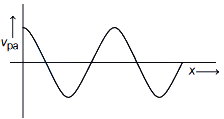
B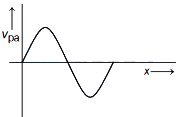
C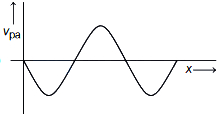
D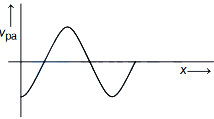
Solution
(A) The plane wave is given by $y=a \sin (\omega t-k x)$.
At $t=0$,the displacement is $y=a \sin (-k x) = -a \sin (k x)$.
The particle velocity $v_{pa}$ is the time derivative of displacement:
$v_{pa} = \frac{d y}{d t} = \frac{d}{d t} (-a \sin (k x)) = -a \cos (k x) \cdot \frac{d}{d t} (k x)$.
Since $k = \frac{\omega}{v_{wave}}$,this is not quite right. Let's differentiate correctly:
$v_{pa} = \frac{\partial y}{\partial t} = a \omega \cos (\omega t - k x)$.
At $t=0$,$v_{pa} = a \omega \cos (-k x) = a \omega \cos (k x)$.
Using $k = \frac{2 \pi}{\lambda}$,we get $v_{pa} = a \omega \cos \left( \frac{2 \pi x}{\lambda} \right)$.
At $x=0$,$v_{pa} = a \omega$.
At $x=\frac{\lambda}{4}$,$v_{pa} = a \omega \cos \left( \frac{\pi}{2} \right) = 0$.
At $x=\frac{\lambda}{2}$,$v_{pa} = a \omega \cos (\pi) = -a \omega$.
This corresponds to a cosine graph starting at a positive maximum. Looking at the provided options,the graph that matches $v_{pa} = a \omega \cos (kx)$ is option $A$.
At $t=0$,the displacement is $y=a \sin (-k x) = -a \sin (k x)$.
The particle velocity $v_{pa}$ is the time derivative of displacement:
$v_{pa} = \frac{d y}{d t} = \frac{d}{d t} (-a \sin (k x)) = -a \cos (k x) \cdot \frac{d}{d t} (k x)$.
Since $k = \frac{\omega}{v_{wave}}$,this is not quite right. Let's differentiate correctly:
$v_{pa} = \frac{\partial y}{\partial t} = a \omega \cos (\omega t - k x)$.
At $t=0$,$v_{pa} = a \omega \cos (-k x) = a \omega \cos (k x)$.
Using $k = \frac{2 \pi}{\lambda}$,we get $v_{pa} = a \omega \cos \left( \frac{2 \pi x}{\lambda} \right)$.
At $x=0$,$v_{pa} = a \omega$.
At $x=\frac{\lambda}{4}$,$v_{pa} = a \omega \cos \left( \frac{\pi}{2} \right) = 0$.
At $x=\frac{\lambda}{2}$,$v_{pa} = a \omega \cos (\pi) = -a \omega$.
This corresponds to a cosine graph starting at a positive maximum. Looking at the provided options,the graph that matches $v_{pa} = a \omega \cos (kx)$ is option $A$.
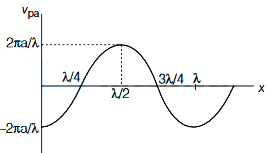
0 likes
View Solution293
EasyMCQ
$A$ transverse wave is described by the equation $y = y_0 \sin 2 \pi \left( \nu t - \frac{x}{\lambda} \right)$. The maximum particle velocity is equal to four times the wave velocity if $\lambda =$
A
$\lambda = \frac{\pi y_0}{4}$
B
$\lambda = \frac{\pi y_0}{2}$
C
$\lambda = 2 \pi y_0$
D
$\lambda = \frac{\pi}{y_0}$
Solution
(B) The given wave equation is $y = y_0 \sin 2 \pi \left( \nu t - \frac{x}{\lambda} \right)$.
Comparing this with the standard wave equation $y = y_0 \sin (\omega t - kx)$,we have $\omega = 2 \pi \nu$ and $k = \frac{2 \pi}{\lambda}$.
The wave velocity $v_w$ is given by $v_w = \frac{\omega}{k} = \frac{2 \pi \nu}{2 \pi / \lambda} = \nu \lambda$.
The particle velocity $v_p$ is the derivative of displacement with respect to time: $v_p = \frac{\partial y}{\partial t} = y_0 (2 \pi \nu) \cos 2 \pi \left( \nu t - \frac{x}{\lambda} \right)$.
The maximum particle velocity is $v_{p, \text{max}} = 2 \pi \nu y_0$.
According to the problem,$v_{p, \text{max}} = 4 v_w$.
Substituting the expressions: $2 \pi \nu y_0 = 4 (\nu \lambda)$.
Solving for $\lambda$: $2 \pi y_0 = 4 \lambda$,which gives $\lambda = \frac{2 \pi y_0}{4} = \frac{\pi y_0}{2}$.
Comparing this with the standard wave equation $y = y_0 \sin (\omega t - kx)$,we have $\omega = 2 \pi \nu$ and $k = \frac{2 \pi}{\lambda}$.
The wave velocity $v_w$ is given by $v_w = \frac{\omega}{k} = \frac{2 \pi \nu}{2 \pi / \lambda} = \nu \lambda$.
The particle velocity $v_p$ is the derivative of displacement with respect to time: $v_p = \frac{\partial y}{\partial t} = y_0 (2 \pi \nu) \cos 2 \pi \left( \nu t - \frac{x}{\lambda} \right)$.
The maximum particle velocity is $v_{p, \text{max}} = 2 \pi \nu y_0$.
According to the problem,$v_{p, \text{max}} = 4 v_w$.
Substituting the expressions: $2 \pi \nu y_0 = 4 (\nu \lambda)$.
Solving for $\lambda$: $2 \pi y_0 = 4 \lambda$,which gives $\lambda = \frac{2 \pi y_0}{4} = \frac{\pi y_0}{2}$.
0 likes
View Solution294
EasyMCQ
$A$ transverse wave is represented by the equation $y=2 \sin (30 t-40 x)$ where the measurements of distances are in meters,then the velocity of propagation is (in $ms^{-1}$)
A
$15$
B
$0.75$
C
$3.75$
D
$300$
Solution
(B) The given equation of the transverse wave is $y=2 \sin (30 t-40 x)$.
Comparing this with the standard wave equation $y=A \sin (\omega t-k x)$,we get the angular frequency $\omega = 30 \ rad/s$ and the wave number $k = 40 \ m^{-1}$.
The velocity of propagation $v$ is given by the formula $v = \frac{\omega}{k}$.
Substituting the values,we get $v = \frac{30}{40} = 0.75 \ ms^{-1}$.
Comparing this with the standard wave equation $y=A \sin (\omega t-k x)$,we get the angular frequency $\omega = 30 \ rad/s$ and the wave number $k = 40 \ m^{-1}$.
The velocity of propagation $v$ is given by the formula $v = \frac{\omega}{k}$.
Substituting the values,we get $v = \frac{30}{40} = 0.75 \ ms^{-1}$.
0 likes
View Solution295
EasyMCQ
If a travelling wave is given by $y(x, t) = 0.5 \sin (70.1 x - 10 \pi t)$,where $x$ and $y$ are in metre,the time $t$ is in second,then the frequency of the wave is (in $Hz$)
A
$6$
B
$7$
C
$4$
D
$5$
Solution
(D) The standard equation of a travelling wave is given by $y(x, t) = A \sin (kx - \omega t)$.
Comparing this with the given equation $y(x, t) = 0.5 \sin (70.1 x - 10 \pi t)$,we get the angular frequency $\omega = 10 \pi \text{ rad/s}$.
The relationship between angular frequency $\omega$ and frequency $f$ is given by $\omega = 2 \pi f$.
Substituting the value of $\omega$,we have $10 \pi = 2 \pi f$.
Solving for $f$,we get $f = \frac{10 \pi}{2 \pi} = 5 \text{ Hz}$.
Therefore,the frequency of the wave is $5 \text{ Hz}$.
Comparing this with the given equation $y(x, t) = 0.5 \sin (70.1 x - 10 \pi t)$,we get the angular frequency $\omega = 10 \pi \text{ rad/s}$.
The relationship between angular frequency $\omega$ and frequency $f$ is given by $\omega = 2 \pi f$.
Substituting the value of $\omega$,we have $10 \pi = 2 \pi f$.
Solving for $f$,we get $f = \frac{10 \pi}{2 \pi} = 5 \text{ Hz}$.
Therefore,the frequency of the wave is $5 \text{ Hz}$.
0 likes
View Solution296
MediumMCQ
$A$ sound wave of frequency $500 \text{ Hz}$ travels between two points $X$ and $Y$ separated by a distance of $600 \text{ m}$ in a time of $2 \text{ s}$. The number of waves between the points $X$ and $Y$ are
A
$1000$
B
$1500$
C
$300$
D
$600$
Solution
(A) The frequency of the sound wave is $f = 500 \text{ Hz}$.
The time taken for the wave to travel from $X$ to $Y$ is $t = 2 \text{ s}$.
The number of waves $N$ produced by a source in time $t$ is given by the formula $N = f \times t$.
Substituting the given values: $N = 500 \text{ Hz} \times 2 \text{ s} = 1000$.
Thus,there are $1000$ waves between points $X$ and $Y$.
The time taken for the wave to travel from $X$ to $Y$ is $t = 2 \text{ s}$.
The number of waves $N$ produced by a source in time $t$ is given by the formula $N = f \times t$.
Substituting the given values: $N = 500 \text{ Hz} \times 2 \text{ s} = 1000$.
Thus,there are $1000$ waves between points $X$ and $Y$.
0 likes
View Solution297
EasyMCQ
If the frequency of a wave is increased by $25 \%$,then the change in its wavelength is (medium not changed).
A
$20 \%$ increase
B
$20 \%$ decrease
C
$25 \%$ increase
D
$25 \%$ decrease
Solution
(B) The speed of a wave $v$ is given by $v = f \lambda$. Since the medium is not changed,the speed $v$ remains constant.
Therefore,$f_1 \lambda_1 = f_2 \lambda_2$,which implies $f \propto \frac{1}{\lambda}$.
Given that the frequency is increased by $25 \%$,the new frequency $f_2 = f_1 + 0.25 f_1 = 1.25 f_1 = \frac{5}{4} f_1$.
Using the inverse relationship,$\frac{\lambda_2}{\lambda_1} = \frac{f_1}{f_2} = \frac{f_1}{1.25 f_1} = \frac{1}{1.25} = \frac{4}{5} = 0.8$.
This means $\lambda_2 = 0.8 \lambda_1$.
The percentage change in wavelength is $\frac{\lambda_2 - \lambda_1}{\lambda_1} \times 100 = \frac{0.8 \lambda_1 - \lambda_1}{\lambda_1} \times 100 = -0.2 \times 100 = -20 \%$.
The negative sign indicates a $20 \%$ decrease in wavelength.
Therefore,$f_1 \lambda_1 = f_2 \lambda_2$,which implies $f \propto \frac{1}{\lambda}$.
Given that the frequency is increased by $25 \%$,the new frequency $f_2 = f_1 + 0.25 f_1 = 1.25 f_1 = \frac{5}{4} f_1$.
Using the inverse relationship,$\frac{\lambda_2}{\lambda_1} = \frac{f_1}{f_2} = \frac{f_1}{1.25 f_1} = \frac{1}{1.25} = \frac{4}{5} = 0.8$.
This means $\lambda_2 = 0.8 \lambda_1$.
The percentage change in wavelength is $\frac{\lambda_2 - \lambda_1}{\lambda_1} \times 100 = \frac{0.8 \lambda_1 - \lambda_1}{\lambda_1} \times 100 = -0.2 \times 100 = -20 \%$.
The negative sign indicates a $20 \%$ decrease in wavelength.
0 likes
View Solution298
EasyMCQ
$A$ small amplitude progressive wave in a stretched string has a speed of $100 \ cm/s$ and a frequency of $100 \ Hz$. The phase difference between two points $2.75 \ cm$ apart on the string,in radians,is
A
$0$
B
$11 \frac{\pi}{2}$
C
$\frac{\pi}{4}$
D
$\frac{3 \pi}{8}$
Solution
(B) Given: Frequency $f = 100 \ Hz$,speed $v = 100 \ cm/s$,and path difference $\Delta x = 2.75 \ cm$.
First,we calculate the wavelength $\lambda$ using the relation $v = f \lambda$:
$\lambda = \frac{v}{f} = \frac{100 \ cm/s}{100 \ Hz} = 1 \ cm$.
The phase difference $\Delta \phi$ is related to the path difference $\Delta x$ by the formula:
$\Delta \phi = \frac{2 \pi}{\lambda} \Delta x$.
Substituting the values:
$\Delta \phi = \frac{2 \pi}{1 \ cm} \times 2.75 \ cm = 5.5 \pi$.
Converting $5.5 \pi$ to a fraction:
$5.5 \pi = \frac{11}{2} \pi$ radians.
First,we calculate the wavelength $\lambda$ using the relation $v = f \lambda$:
$\lambda = \frac{v}{f} = \frac{100 \ cm/s}{100 \ Hz} = 1 \ cm$.
The phase difference $\Delta \phi$ is related to the path difference $\Delta x$ by the formula:
$\Delta \phi = \frac{2 \pi}{\lambda} \Delta x$.
Substituting the values:
$\Delta \phi = \frac{2 \pi}{1 \ cm} \times 2.75 \ cm = 5.5 \pi$.
Converting $5.5 \pi$ to a fraction:
$5.5 \pi = \frac{11}{2} \pi$ radians.
0 likes
View Solution299
EasyMCQ
What is the phase difference between two particles $25 \ m$ apart in a wave represented by the equation $y=0.03 \sin (\pi[2 t-0.01 x])$ traveling in a medium?
A
$\frac{\pi}{8}$
B
$\frac{\pi}{4}$
C
$\frac{\pi}{2}$
D
$\pi$
Solution
(B) The given wave equation is $y=0.03 \sin (\pi[2 t-0.01 x])$.
Expanding the equation,we get $y=0.03 \sin (2\pi t - 0.01\pi x)$.
Comparing this with the standard wave equation $y=A \sin (\omega t - kx)$,we identify the wave number $k = 0.01\pi \ rad/m$.
The path difference between the two particles is given as $\Delta x = 25 \ m$.
The relationship between phase difference $\Delta \phi$ and path difference $\Delta x$ is $\Delta \phi = k \cdot \Delta x$.
Substituting the values,$\Delta \phi = (0.01\pi) \times 25 = 0.25\pi$.
Converting $0.25\pi$ to a fraction,we get $\Delta \phi = \frac{1}{4}\pi = \frac{\pi}{4} \ rad$.
Expanding the equation,we get $y=0.03 \sin (2\pi t - 0.01\pi x)$.
Comparing this with the standard wave equation $y=A \sin (\omega t - kx)$,we identify the wave number $k = 0.01\pi \ rad/m$.
The path difference between the two particles is given as $\Delta x = 25 \ m$.
The relationship between phase difference $\Delta \phi$ and path difference $\Delta x$ is $\Delta \phi = k \cdot \Delta x$.
Substituting the values,$\Delta \phi = (0.01\pi) \times 25 = 0.25\pi$.
Converting $0.25\pi$ to a fraction,we get $\Delta \phi = \frac{1}{4}\pi = \frac{\pi}{4} \ rad$.
0 likes
View SolutionWaves and Sound — Wave Equation and Characteristics of Waves · Frequently Asked Questions
1Are these Waves and Sound questions useful for JEE and NEET?
Yes. All questions in this section are mapped to JEE Main and NEET exam patterns. Previous year questions from JEE Main, NEET, GUJCET and state-level exams are included with full solutions.
2Can I switch to Hindi or Gujarati for these questions?
Yes. Use the language tabs in the hero section or the sidebar to view the same questions and solutions in English, Hindi or Gujarati.
3How do I generate a question paper from this subtopic?
Use the Vedclass Exam Paper Generator — select the chapter and subtopic, set difficulty, and generate Sets A, B, C, D automatically. First 3 chapters of every subject are free.
Vedclass Products
For Students
Vedclass Test Series
Mock tests in real JEE/NEET style with performance analysis. 5-day free trial.
Start Free TrialFor Teachers
Exam Paper Generator
Generate Set A/B/C/D papers from this chapter in 2 minutes. 3 chapters free.
Try FreeFor Institutes
Online Exam Module
Live online exams with unlimited students, 360° analytics & white-label branding.
See DemoFor Teachers & Institutes
Generate a Waves and Sound Exam Paper in 2 Minutes
Select subtopic & difficulty — Sets A, B, C, D auto-generated with No Repeat logic.
First 3 chapters of every subject are free — no payment required.