
A English
Sound Waves (Longitudinal wave) and it’s Characteristics (Speed etc.) Questions in English
Class 11 Physics · Waves and Sound · Sound Waves (Longitudinal wave) and it’s Characteristics (Speed etc.)
210+
Questions
English
Language
100%
With Solutions
Showing 49 of 210 questions in English
151
MediumMCQ
Out of hot moist air and dry cold air,in which does sound travel faster?
A
Hot moist air
B
Dry cold air
C
Same in both
D
Cannot be determined
Solution
(A) The speed of sound in a gas is given by the formula $v = \sqrt{\frac{\gamma P}{\rho}}$,where $\gamma$ is the adiabatic index,$P$ is the pressure,and $\rho$ is the density of the medium.
For hot moist air,the temperature is higher,which decreases the density $\rho$ of the air compared to cold dry air.
Additionally,the presence of water vapor (moisture) further decreases the effective density of the air because the molar mass of water vapor $(18 \ g/mol)$ is less than that of dry air (approximately $29 \ g/mol$).
Since the speed of sound $v$ is inversely proportional to the square root of density $(v \propto \frac{1}{\sqrt{\rho}})$,a lower density leads to a higher speed of sound.
Therefore,sound travels faster in hot moist air than in dry cold air.
For hot moist air,the temperature is higher,which decreases the density $\rho$ of the air compared to cold dry air.
Additionally,the presence of water vapor (moisture) further decreases the effective density of the air because the molar mass of water vapor $(18 \ g/mol)$ is less than that of dry air (approximately $29 \ g/mol$).
Since the speed of sound $v$ is inversely proportional to the square root of density $(v \propto \frac{1}{\sqrt{\rho}})$,a lower density leads to a higher speed of sound.
Therefore,sound travels faster in hot moist air than in dry cold air.
0 likes
View Solution152
EasyMCQ
Find the wavelength of a sound wave of frequency $4.2 \text{ MHz}$ travelling with a speed of $1.7 \text{ km/s}$.
A
$4.05 \times 10^{-4} \text{ m}$
B
$4.05 \times 10^{-3} \text{ m}$
C
$2.47 \times 10^{-4} \text{ m}$
D
$2.47 \times 10^{-3} \text{ m}$
Solution
(A) The relationship between wave speed $(v)$,frequency $(f)$,and wavelength $(\lambda)$ is given by the formula: $v = f \lambda$.
Given:
Frequency $f = 4.2 \text{ MHz} = 4.2 \times 10^6 \text{ Hz}$.
Speed $v = 1.7 \text{ km/s} = 1.7 \times 10^3 \text{ m/s}$.
Rearranging the formula to solve for wavelength:
$\lambda = \frac{v}{f} = \frac{1.7 \times 10^3}{4.2 \times 10^6} \text{ m}$.
Calculating the value:
$\lambda \approx 0.40476 \times 10^{-3} \text{ m} = 4.0476 \times 10^{-4} \text{ m}$.
Rounding to significant figures,we get $\lambda \approx 4.05 \times 10^{-4} \text{ m}$.
Given:
Frequency $f = 4.2 \text{ MHz} = 4.2 \times 10^6 \text{ Hz}$.
Speed $v = 1.7 \text{ km/s} = 1.7 \times 10^3 \text{ m/s}$.
Rearranging the formula to solve for wavelength:
$\lambda = \frac{v}{f} = \frac{1.7 \times 10^3}{4.2 \times 10^6} \text{ m}$.
Calculating the value:
$\lambda \approx 0.40476 \times 10^{-3} \text{ m} = 4.0476 \times 10^{-4} \text{ m}$.
Rounding to significant figures,we get $\lambda \approx 4.05 \times 10^{-4} \text{ m}$.
0 likes
View Solution153
DifficultMCQ
Does an oscillating source always produce sound waves?
A
Yes, always.
B
No, only if the frequency is within the audible range.
C
No, only if the amplitude is high.
D
Yes, but only in a vacuum.
Solution
(B) Sound waves are produced by an oscillating source, but they are classified as audible sound only if the frequency lies between $20 \,Hz$ and $20,000 \,Hz$.
If the frequency is below $20 \,Hz$, it is called infrasonic, and if it is above $20,000 \,Hz$, it is called ultrasonic.
Therefore, an oscillating source does not always produce sound waves that are audible to human ears.
If the frequency is below $20 \,Hz$, it is called infrasonic, and if it is above $20,000 \,Hz$, it is called ultrasonic.
Therefore, an oscillating source does not always produce sound waves that are audible to human ears.
0 likes
View Solution154
Easy
Match Column - $A$ with Column - $B$.
| Column - $A$ | Column - $B$ |
|---|---|
| $(a)$ Speed of longitudinal waves in gas and liquid. | $(i)$ $v = \sqrt{\frac{B}{\rho}}$ |
| $(b)$ Speed of longitudinal waves in solid rod. | $(ii)$ $v = \sqrt{\frac{Y}{\rho}}$ |
| $(c)$ Speed of sound in air according to Newton. | $(iii)$ $v = \sqrt{\frac{P}{\rho}}$ |
| $(d)$ Speed of sound in air according to Laplace. | $(iv)$ $v = \sqrt{\frac{\gamma P}{\rho}}$ |
Solution
(A) The speed of longitudinal waves in a medium is given by $v = \sqrt{\frac{B}{\rho}}$,where $B$ is the bulk modulus and $\rho$ is the density. Thus,$(a) - (i)$.
For a solid rod,the speed of longitudinal waves is $v = \sqrt{\frac{Y}{\rho}}$,where $Y$ is Young's modulus. Thus,$(b) - (ii)$.
According to Newton,sound propagation in air is an isothermal process,giving $v = \sqrt{\frac{P}{\rho}}$. Thus,$(c) - (iii)$.
According to Laplace,sound propagation in air is an adiabatic process,giving $v = \sqrt{\frac{\gamma P}{\rho}}$. Thus,$(d) - (iv)$.
The correct matching is $(a-i, b-ii, c-iii, d-iv)$.
For a solid rod,the speed of longitudinal waves is $v = \sqrt{\frac{Y}{\rho}}$,where $Y$ is Young's modulus. Thus,$(b) - (ii)$.
According to Newton,sound propagation in air is an isothermal process,giving $v = \sqrt{\frac{P}{\rho}}$. Thus,$(c) - (iii)$.
According to Laplace,sound propagation in air is an adiabatic process,giving $v = \sqrt{\frac{\gamma P}{\rho}}$. Thus,$(d) - (iv)$.
The correct matching is $(a-i, b-ii, c-iii, d-iv)$.
0 likes
View Solution155
MediumMCQ
At what temperature (in $^\circ C$) will the speed of sound in air be $3$ times its value at $0^\circ C$ (in $^\circ C$)?
A
$2184$
B
$2457$
C
$1092$
D
$729$
Solution
(A) The speed of sound in a gas is given by $v = \sqrt{\frac{\gamma RT}{M}}$, which implies $v \propto \sqrt{T}$, where $T$ is the absolute temperature in Kelvin.
Let $v_1$ be the speed of sound at $T_1 = 0^\circ C = 273 \ K$.
Let $v_2$ be the speed of sound at temperature $T_2$ such that $v_2 = 3v_1$.
Using the relation $\frac{v_2}{v_1} = \sqrt{\frac{T_2}{T_1}}$, we get:
$\frac{3v_1}{v_1} = \sqrt{\frac{T_2}{273}}$
$3 = \sqrt{\frac{T_2}{273}}$
Squaring both sides:
$9 = \frac{T_2}{273}$
$T_2 = 9 \times 273 = 2457 \ K$.
To convert this to Celsius: $T(^\circ C) = T(K) - 273 = 2457 - 273 = 2184^\circ C$.
Let $v_1$ be the speed of sound at $T_1 = 0^\circ C = 273 \ K$.
Let $v_2$ be the speed of sound at temperature $T_2$ such that $v_2 = 3v_1$.
Using the relation $\frac{v_2}{v_1} = \sqrt{\frac{T_2}{T_1}}$, we get:
$\frac{3v_1}{v_1} = \sqrt{\frac{T_2}{273}}$
$3 = \sqrt{\frac{T_2}{273}}$
Squaring both sides:
$9 = \frac{T_2}{273}$
$T_2 = 9 \times 273 = 2457 \ K$.
To convert this to Celsius: $T(^\circ C) = T(K) - 273 = 2457 - 273 = 2184^\circ C$.
0 likes
View Solution156
Difficult
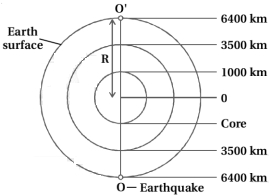
The Earth has a radius of $6400 \ km$. The inner core of $1000 \ km$ radius is solid. Outside it,there is a region from $1000 \ km$ to a radius of $3500 \ km$ which is in a molten state. Then again from $3500 \ km$ to $6400 \ km$,the Earth is solid. Only longitudinal $(P)$ waves can travel inside a liquid. Assume that the $P$ wave has a speed of $8 \ kms^{-1}$ in solid parts and of $5 \ kms^{-1}$ in liquid parts of the Earth. An earthquake occurs at some place close to the surface of the Earth. Calculate the time after which it will be recorded in a seismometer at a diametrically opposite point on the Earth if the wave travels along the diameter.
Solution
(N/A) The total time taken $t$ is the sum of the time taken to travel through each distinct layer along the diameter.
The diameter consists of three regions: the inner solid core,the molten middle region,and the outer solid crust.
The total distance for each region along the diameter is twice its radial thickness.
$1$. Inner solid core ($0$ to $1000 \ km$): Distance $d_1 = 2 \times 1000 \ km = 2000 \ km$,Speed $v_1 = 8 \ kms^{-1}$.
Time $t_1 = \frac{d_1}{v_1} = \frac{2000}{8} = 250 \ s$.
$2$. Molten region ($1000 \ km$ to $3500 \ km$): Distance $d_2 = 2 \times (3500 - 1000) \ km = 5000 \ km$,Speed $v_2 = 5 \ kms^{-1}$.
Time $t_2 = \frac{d_2}{v_2} = \frac{5000}{5} = 1000 \ s$.
$3$. Outer solid crust ($3500 \ km$ to $6400 \ km$): Distance $d_3 = 2 \times (6400 - 3500) \ km = 5800 \ km$,Speed $v_3 = 8 \ kms^{-1}$.
Time $t_3 = \frac{d_3}{v_3} = \frac{5800}{8} = 725 \ s$.
Total time $t = t_1 + t_2 + t_3 = 250 + 1000 + 725 = 1975 \ s$.
The diameter consists of three regions: the inner solid core,the molten middle region,and the outer solid crust.
The total distance for each region along the diameter is twice its radial thickness.
$1$. Inner solid core ($0$ to $1000 \ km$): Distance $d_1 = 2 \times 1000 \ km = 2000 \ km$,Speed $v_1 = 8 \ kms^{-1}$.
Time $t_1 = \frac{d_1}{v_1} = \frac{2000}{8} = 250 \ s$.
$2$. Molten region ($1000 \ km$ to $3500 \ km$): Distance $d_2 = 2 \times (3500 - 1000) \ km = 5000 \ km$,Speed $v_2 = 5 \ kms^{-1}$.
Time $t_2 = \frac{d_2}{v_2} = \frac{5000}{5} = 1000 \ s$.
$3$. Outer solid crust ($3500 \ km$ to $6400 \ km$): Distance $d_3 = 2 \times (6400 - 3500) \ km = 5800 \ km$,Speed $v_3 = 8 \ kms^{-1}$.
Time $t_3 = \frac{d_3}{v_3} = \frac{5800}{8} = 725 \ s$.
Total time $t = t_1 + t_2 + t_3 = 250 + 1000 + 725 = 1975 \ s$.
0 likes
View Solution157
DifficultMCQ
Assume that the displacement $(s)$ of air is proportional to the pressure difference $(\Delta p)$ created by a sound wave. Displacement $(s)$ further depends on the speed of sound $(v)$,density of air $(\rho)$,and the frequency $(f)$. If $\Delta p \approx 10 \, Pa$,$v \approx 300 \, m/s$,$\rho \approx 1 \, kg/m^3$,and $f \approx 1000 \, Hz$,then $s$ will be of the order of (take multiplicative constant to be $1$).
A
$10 \, mm$
B
$\frac{3}{100} \, mm$
C
$1 \, mm$
D
$\frac{1}{10} \, mm$
Solution
(B) The pressure amplitude $\Delta p$ in a sound wave is related to the displacement amplitude $s$ by the formula $\Delta p = B k s$,where $B$ is the bulk modulus and $k$ is the wave number.
Since $B = \rho v^2$ and $k = \frac{\omega}{v} = \frac{2 \pi f}{v}$,we have $\Delta p = (\rho v^2) \times (\frac{2 \pi f}{v}) \times s$.
Taking the multiplicative constant to be $1$ (ignoring $2 \pi$),the relation simplifies to $\Delta p = \rho v \omega s$.
Rearranging for $s$,we get $s = \frac{\Delta p}{\rho v \omega} = \frac{\Delta p}{\rho v (2 \pi f)}$.
Substituting the given values: $s \approx \frac{10}{1 \times 300 \times 2 \pi \times 1000} \, m$.
Ignoring the factor of $2 \pi$ as per the instruction to take the multiplicative constant as $1$: $s \approx \frac{10}{300 \times 1000} \, m = \frac{1}{30000} \, m$.
Converting to millimeters: $s \approx \frac{1}{30000} \times 1000 \, mm = \frac{1}{30} \, mm \approx 0.033 \, mm = \frac{3}{100} \, mm$.
Since $B = \rho v^2$ and $k = \frac{\omega}{v} = \frac{2 \pi f}{v}$,we have $\Delta p = (\rho v^2) \times (\frac{2 \pi f}{v}) \times s$.
Taking the multiplicative constant to be $1$ (ignoring $2 \pi$),the relation simplifies to $\Delta p = \rho v \omega s$.
Rearranging for $s$,we get $s = \frac{\Delta p}{\rho v \omega} = \frac{\Delta p}{\rho v (2 \pi f)}$.
Substituting the given values: $s \approx \frac{10}{1 \times 300 \times 2 \pi \times 1000} \, m$.
Ignoring the factor of $2 \pi$ as per the instruction to take the multiplicative constant as $1$: $s \approx \frac{10}{300 \times 1000} \, m = \frac{1}{30000} \, m$.
Converting to millimeters: $s \approx \frac{1}{30000} \times 1000 \, mm = \frac{1}{30} \, mm \approx 0.033 \, mm = \frac{3}{100} \, mm$.
0 likes
View Solution158
MediumMCQ
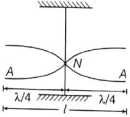
$A$ steel rod $100\, cm$ long is clamped at its middle. The fundamental frequency of longitudinal vibrations of the rod is given to be $2.53\, kHz$. What is the speed of sound in steel? (in $km/s$)
A
$6.2$
B
$5.06$
C
$7.23$
D
$7.45$
Solution
(B) When a rod is clamped at its middle,the ends act as antinodes $(A)$ and the clamped point acts as a node $(N)$.
In the fundamental mode,the length of the rod $l$ corresponds to two segments of $\frac{\lambda}{4}$ each,so $l = \frac{\lambda}{4} + \frac{\lambda}{4} = \frac{\lambda}{2}$.
$\Rightarrow \lambda = 2l$.
Given: $l = 100\, cm = 1\, m$,frequency $f = 2.53\, kHz = 2.53 \times 10^3\, Hz$.
The speed of sound $v$ is given by $v = f \lambda$.
Substituting $\lambda = 2l$:
$v = f \times 2l = 2.53 \times 10^3 \times 2 \times 1 = 5.06 \times 10^3\, m/s$.
Converting to $km/s$:
$v = 5.06\, km/s$.
In the fundamental mode,the length of the rod $l$ corresponds to two segments of $\frac{\lambda}{4}$ each,so $l = \frac{\lambda}{4} + \frac{\lambda}{4} = \frac{\lambda}{2}$.
$\Rightarrow \lambda = 2l$.
Given: $l = 100\, cm = 1\, m$,frequency $f = 2.53\, kHz = 2.53 \times 10^3\, Hz$.
The speed of sound $v$ is given by $v = f \lambda$.
Substituting $\lambda = 2l$:
$v = f \times 2l = 2.53 \times 10^3 \times 2 \times 1 = 5.06 \times 10^3\, m/s$.
Converting to $km/s$:
$v = 5.06\, km/s$.
0 likes
View Solution159
DifficultMCQ
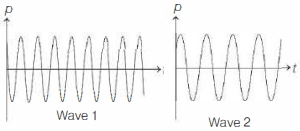
The figure below shows pressure variation in two different sound waves in air with time at a given position. Both the figures are drawn to the same scale. Which of the following statements is true?
A
Wave $1$ has lower frequency and smaller amplitude compared to wave $2$.
B
Wave $1$ has higher frequency and greater amplitude compared to wave $2$.
C
Wave $1$ has shorter wavelength and greater amplitude compared to wave $2$.
D
Wave $1$ has higher frequency and smaller amplitude compared to wave $2$.
Solution
(D) The correct option is $(d)$.
From the given figures, we can observe the following:
$1$. Frequency: Wave $1$ completes more oscillations in the same time interval compared to wave $2$. Since frequency $f = \frac{1}{T}$, where $T$ is the time period, a higher number of oscillations implies a higher frequency. Thus, wave $1$ has a higher frequency than wave $2$.
$2$. Amplitude: The amplitude is represented by the maximum displacement from the mean position (pressure variation). Visually, the peak height of wave $1$ is smaller than the peak height of wave $2$. Therefore, wave $1$ has a smaller amplitude compared to wave $2$.
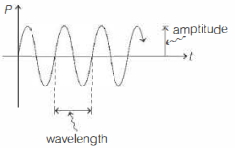
Note: The original option $(d)$ stated "shorter wavelength". In a time-domain graph, the horizontal axis represents time, so the distance between peaks corresponds to the time period $T$. A higher frequency corresponds to a shorter time period. Since wavelength $\lambda = vT$ (where $v$ is the speed of sound), a shorter time period implies a shorter wavelength. Thus, wave $1$ has a shorter wavelength and smaller amplitude compared to wave $2$.
From the given figures, we can observe the following:
$1$. Frequency: Wave $1$ completes more oscillations in the same time interval compared to wave $2$. Since frequency $f = \frac{1}{T}$, where $T$ is the time period, a higher number of oscillations implies a higher frequency. Thus, wave $1$ has a higher frequency than wave $2$.
$2$. Amplitude: The amplitude is represented by the maximum displacement from the mean position (pressure variation). Visually, the peak height of wave $1$ is smaller than the peak height of wave $2$. Therefore, wave $1$ has a smaller amplitude compared to wave $2$.
Note: The original option $(d)$ stated "shorter wavelength". In a time-domain graph, the horizontal axis represents time, so the distance between peaks corresponds to the time period $T$. A higher frequency corresponds to a shorter time period. Since wavelength $\lambda = vT$ (where $v$ is the speed of sound), a shorter time period implies a shorter wavelength. Thus, wave $1$ has a shorter wavelength and smaller amplitude compared to wave $2$.
0 likes
View Solution160
MediumMCQ
The velocity of sound measured at a given temperature in oxygen and hydrogen is in the ratio of:
A
$1:4$
B
$4:1$
C
$1:1$
D
$32:1$
Solution
(A) The velocity of sound in a gaseous medium is given by the formula:
$v = \sqrt{\frac{\gamma RT}{M}}$
Since the temperature $T$ and the adiabatic index $\gamma$ are constant for the given conditions,the velocity is inversely proportional to the square root of the molar mass $M$:
$v \propto \frac{1}{\sqrt{M}}$
Therefore,the ratio of the velocity of sound in oxygen $(v_{O_2})$ to that in hydrogen $(v_{H_2})$ is:
$\frac{v_{O_2}}{v_{H_2}} = \sqrt{\frac{M_{H_2}}{M_{O_2}}}$
The molar mass of hydrogen $(H_2)$ is $2 \text{ g/mol}$ and the molar mass of oxygen $(O_2)$ is $32 \text{ g/mol}$.
$\frac{v_{O_2}}{v_{H_2}} = \sqrt{\frac{2}{32}} = \sqrt{\frac{1}{16}} = \frac{1}{4}$
Thus,the ratio is $1:4$.
$v = \sqrt{\frac{\gamma RT}{M}}$
Since the temperature $T$ and the adiabatic index $\gamma$ are constant for the given conditions,the velocity is inversely proportional to the square root of the molar mass $M$:
$v \propto \frac{1}{\sqrt{M}}$
Therefore,the ratio of the velocity of sound in oxygen $(v_{O_2})$ to that in hydrogen $(v_{H_2})$ is:
$\frac{v_{O_2}}{v_{H_2}} = \sqrt{\frac{M_{H_2}}{M_{O_2}}}$
The molar mass of hydrogen $(H_2)$ is $2 \text{ g/mol}$ and the molar mass of oxygen $(O_2)$ is $32 \text{ g/mol}$.
$\frac{v_{O_2}}{v_{H_2}} = \sqrt{\frac{2}{32}} = \sqrt{\frac{1}{16}} = \frac{1}{4}$
Thus,the ratio is $1:4$.
0 likes
View Solution161
MediumMCQ
$A$ source of frequency $f$ is emitting sound waves. If the temperature of the medium increases,then
A
wavelength of the sound wave increases
B
speed of the sound wave decreases
C
wavelength of the sound wave decreases
D
amplitude of the sound wave increases
Solution
(A) The velocity of sound in a gaseous medium is given by $v = \sqrt{\frac{\gamma RT}{M}}$,which implies $v \propto \sqrt{T}$.
Since the temperature $T$ increases,the speed of sound $v$ also increases.
The relationship between speed,frequency,and wavelength is $v = f \lambda$.
Since the frequency $f$ is a characteristic of the source,it remains constant regardless of the medium's temperature.
Therefore,$\lambda = \frac{v}{f}$. Since $v$ increases and $f$ is constant,the wavelength $\lambda$ must increase.
Thus,the correct option is $(A)$.
Since the temperature $T$ increases,the speed of sound $v$ also increases.
The relationship between speed,frequency,and wavelength is $v = f \lambda$.
Since the frequency $f$ is a characteristic of the source,it remains constant regardless of the medium's temperature.
Therefore,$\lambda = \frac{v}{f}$. Since $v$ increases and $f$ is constant,the wavelength $\lambda$ must increase.
Thus,the correct option is $(A)$.
0 likes
View Solution162
DifficultMCQ
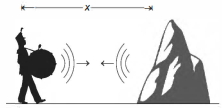
$A$ person in front of a mountain is beating a drum at the rate of $40$ per minute and hears no distinct echo. If the person moves $90 \, m$ closer to the mountain,he has to beat the drum at $60$ per minute to not hear any distinct echo. The speed of sound is .............. $ms^{-1}$.
A
$320$
B
$340$
C
$360$
D
$380$
Solution
(C) Since the drummer does not hear any echo,the time interval between two successive drum beats must be equal to the time taken by the sound to travel to the mountain and back.
Let $x$ be the initial distance from the mountain and $v$ be the speed of sound.
The time interval between two beats in the first case is $T_1 = \frac{60}{40} = 1.5 \, s$.
The time taken for sound to travel to the mountain and back is $\frac{2x}{v}$.
So,$\frac{2x}{v} = 1.5 \implies 2x = 1.5v \quad \dots(i)$
In the second case,the distance becomes $(x - 90) \, m$ and the rate is $60$ beats per minute.
The time interval between two beats is $T_2 = \frac{60}{60} = 1.0 \, s$.
So,$\frac{2(x - 90)}{v} = 1.0 \implies 2x - 180 = v \quad \dots(ii)$
Substituting $2x = 1.5v$ from equation $(i)$ into equation $(ii)$:
$1.5v - 180 = v$
$0.5v = 180$
$v = \frac{180}{0.5} = 360 \, ms^{-1}$.
Let $x$ be the initial distance from the mountain and $v$ be the speed of sound.
The time interval between two beats in the first case is $T_1 = \frac{60}{40} = 1.5 \, s$.
The time taken for sound to travel to the mountain and back is $\frac{2x}{v}$.
So,$\frac{2x}{v} = 1.5 \implies 2x = 1.5v \quad \dots(i)$
In the second case,the distance becomes $(x - 90) \, m$ and the rate is $60$ beats per minute.
The time interval between two beats is $T_2 = \frac{60}{60} = 1.0 \, s$.
So,$\frac{2(x - 90)}{v} = 1.0 \implies 2x - 180 = v \quad \dots(ii)$
Substituting $2x = 1.5v$ from equation $(i)$ into equation $(ii)$:
$1.5v - 180 = v$
$0.5v = 180$
$v = \frac{180}{0.5} = 360 \, ms^{-1}$.
0 likes
View Solution163
MediumMCQ
The wavelength of sound waves in hydrogen gas corresponding to the lower limit of audibility is ........ $m$ (speed of sound in hydrogen gas is about $1350 \, m/s$).
A
$60$
B
$67.5$
C
$100$
D
$500$
Solution
(B) The lower limit of human audibility is $f = 20 \, Hz$.
Given the speed of sound in hydrogen gas is $v = 1350 \, m/s$.
The relationship between speed $(v)$,frequency $(f)$,and wavelength $(\lambda)$ is given by $v = f \lambda$.
Therefore,$\lambda = \frac{v}{f}$.
Substituting the values: $\lambda = \frac{1350}{20} = 67.5 \, m$.
Thus,the correct option is $B$.
Given the speed of sound in hydrogen gas is $v = 1350 \, m/s$.
The relationship between speed $(v)$,frequency $(f)$,and wavelength $(\lambda)$ is given by $v = f \lambda$.
Therefore,$\lambda = \frac{v}{f}$.
Substituting the values: $\lambda = \frac{1350}{20} = 67.5 \, m$.
Thus,the correct option is $B$.
0 likes
View Solution164
EasyMCQ
The speed of sound in air is independent of its:
A
Amplitude
B
Frequency
C
Phase
D
All of these
Solution
(D) The speed of sound in a gas is given by the formula $v = \sqrt{\frac{\gamma P}{\rho}}$,where $\gamma$ is the adiabatic index,$P$ is the pressure,and $\rho$ is the density of the medium.
From this expression,it is clear that the speed of sound depends only on the properties of the medium (temperature,pressure,density,and nature of the gas).
It does not depend on the wave characteristics such as amplitude,frequency,or phase.
Therefore,the speed of sound in air is independent of all these factors.
Thus,the correct option is $D$.
From this expression,it is clear that the speed of sound depends only on the properties of the medium (temperature,pressure,density,and nature of the gas).
It does not depend on the wave characteristics such as amplitude,frequency,or phase.
Therefore,the speed of sound in air is independent of all these factors.
Thus,the correct option is $D$.
0 likes
View Solution165
EasyMCQ
What is the phase difference between the displacement wave and the pressure wave in a sound wave?
A
Zero
B
$\frac{\pi}{2}$
C
$\pi$
D
$\frac{\pi}{4}$
Solution
(B) In a sound wave,the displacement $y(x, t)$ is given by $y = A \sin(kx - \omega t)$.
The pressure variation $\Delta P$ is related to the displacement by the relation $\Delta P = -B \frac{\partial y}{\partial x}$,where $B$ is the bulk modulus.
Calculating the derivative: $\frac{\partial y}{\partial x} = Ak \cos(kx - \omega t)$.
Thus,$\Delta P = -BAk \cos(kx - \omega t) = BAk \sin(kx - \omega t - \frac{\pi}{2})$.
Comparing the phase of the displacement wave $(kx - \omega t)$ and the pressure wave $(kx - \omega t - \frac{\pi}{2})$,the phase difference is $\frac{\pi}{2}$.
The pressure variation $\Delta P$ is related to the displacement by the relation $\Delta P = -B \frac{\partial y}{\partial x}$,where $B$ is the bulk modulus.
Calculating the derivative: $\frac{\partial y}{\partial x} = Ak \cos(kx - \omega t)$.
Thus,$\Delta P = -BAk \cos(kx - \omega t) = BAk \sin(kx - \omega t - \frac{\pi}{2})$.
Comparing the phase of the displacement wave $(kx - \omega t)$ and the pressure wave $(kx - \omega t - \frac{\pi}{2})$,the phase difference is $\frac{\pi}{2}$.
0 likes
View Solution166
MediumMCQ
The ratio of the speed of sound in hydrogen gas to the speed of sound in oxygen gas at the same temperature is
A
$4:1$
B
$1:2$
C
$1:4$
D
$1:1$
Solution
(A) The speed of sound in an ideal gas is given by the formula $C = \sqrt{\frac{\gamma R T}{M}}$,where $\gamma$ is the adiabatic index,$R$ is the universal gas constant,$T$ is the absolute temperature,and $M$ is the molar mass of the gas.
Since the temperature $T$ and the adiabatic index $\gamma$ (for diatomic gases like $H_2$ and $O_2$) are the same,the speed of sound is inversely proportional to the square root of the molar mass: $C \propto \frac{1}{\sqrt{M}}$.
The molar mass of hydrogen $(H_2)$ is $M_{H_2} = 2 \text{ g/mol}$.
The molar mass of oxygen $(O_2)$ is $M_{O_2} = 32 \text{ g/mol}$.
Therefore,the ratio of the speed of sound in hydrogen to oxygen is $\frac{C_{H_2}}{C_{O_2}} = \sqrt{\frac{M_{O_2}}{M_{H_2}}} = \sqrt{\frac{32}{2}} = \sqrt{16} = 4$.
Thus,the ratio is $4:1$.
Since the temperature $T$ and the adiabatic index $\gamma$ (for diatomic gases like $H_2$ and $O_2$) are the same,the speed of sound is inversely proportional to the square root of the molar mass: $C \propto \frac{1}{\sqrt{M}}$.
The molar mass of hydrogen $(H_2)$ is $M_{H_2} = 2 \text{ g/mol}$.
The molar mass of oxygen $(O_2)$ is $M_{O_2} = 32 \text{ g/mol}$.
Therefore,the ratio of the speed of sound in hydrogen to oxygen is $\frac{C_{H_2}}{C_{O_2}} = \sqrt{\frac{M_{O_2}}{M_{H_2}}} = \sqrt{\frac{32}{2}} = \sqrt{16} = 4$.
Thus,the ratio is $4:1$.
0 likes
View Solution167
MediumMCQ
The speed of sound in oxygen at $S.T.P.$ will be approximately: (Given,$R=8.3 \text{ J K}^{-1} \text{mol}^{-1}, \gamma=1.4$) (in $\text{ m/s}$)
A
$310$
B
$333$
C
$341$
D
$315$
Solution
(D) The speed of sound in an ideal gas is given by the formula $v = \sqrt{\frac{\gamma RT}{M}}$.
At $S.T.P.$,the temperature $T = 273 \text{ K}$.
The molar mass of oxygen $(O_2)$ is $M = 32 \times 10^{-3} \text{ kg/mol}$.
Given $\gamma = 1.4$ and $R = 8.3 \text{ J K}^{-1} \text{mol}^{-1}$.
Substituting these values into the formula:
$v = \sqrt{\frac{1.4 \times 8.3 \times 273}{32 \times 10^{-3}}}$
$v = \sqrt{\frac{3171.06}{0.032}}$
$v = \sqrt{99095.625}$
$v \approx 314.79 \text{ m/s}$.
Rounding to the nearest integer,we get $v \approx 315 \text{ m/s}$.
At $S.T.P.$,the temperature $T = 273 \text{ K}$.
The molar mass of oxygen $(O_2)$ is $M = 32 \times 10^{-3} \text{ kg/mol}$.
Given $\gamma = 1.4$ and $R = 8.3 \text{ J K}^{-1} \text{mol}^{-1}$.
Substituting these values into the formula:
$v = \sqrt{\frac{1.4 \times 8.3 \times 273}{32 \times 10^{-3}}}$
$v = \sqrt{\frac{3171.06}{0.032}}$
$v = \sqrt{99095.625}$
$v \approx 314.79 \text{ m/s}$.
Rounding to the nearest integer,we get $v \approx 315 \text{ m/s}$.
0 likes
View Solution168
MediumMCQ
Given below are two statements: one is labelled as Assertion $A$ and the other is labelled as Reason $R$.
Assertion $A$: $A$ sound wave has higher speed in solids than gases.
Reason $R$: Gases have higher value of Bulk modulus than solids.
In the light of the above statements,choose the correct answer from the options given below:
Assertion $A$: $A$ sound wave has higher speed in solids than gases.
Reason $R$: Gases have higher value of Bulk modulus than solids.
In the light of the above statements,choose the correct answer from the options given below:
A
Both $A$ and $R$ are true and $R$ is the correct explanation of $A$.
B
$A$ is false but $R$ is true.
C
Both $A$ and $R$ are true but $R$ is $\text{NOT}$ the correct explanation of $A$.
D
$A$ is true but $R$ is false.
Solution
(D) The speed of sound in a medium is given by the formula $v = \sqrt{\frac{B}{\rho}}$,where $B$ is the Bulk modulus and $\rho$ is the density of the medium.
Solids have a much higher Bulk modulus $(B)$ compared to gases,which significantly outweighs the effect of their higher density $(\rho)$.
Therefore,the speed of sound is higher in solids than in gases. Thus,Assertion $A$ is true.
However,the Reason $R$ states that gases have a higher Bulk modulus than solids,which is incorrect. Solids have a much higher Bulk modulus than gases.
Therefore,$A$ is true but $R$ is false.
Solids have a much higher Bulk modulus $(B)$ compared to gases,which significantly outweighs the effect of their higher density $(\rho)$.
Therefore,the speed of sound is higher in solids than in gases. Thus,Assertion $A$ is true.
However,the Reason $R$ states that gases have a higher Bulk modulus than solids,which is incorrect. Solids have a much higher Bulk modulus than gases.
Therefore,$A$ is true but $R$ is false.
0 likes
View Solution169
MediumMCQ
Consider the sound wave travelling in ideal gases of $He$,$CH_4$,and $CO_2$. All the gases have the same ratio $\frac{P}{\rho}$,where $P$ is the pressure and $\rho$ is the density. The ratio of the speed of sound through the gases $V_{He}: V_{CH_4}: V_{CO_2}$ is given by
A
$\sqrt{\frac{7}{5}}: \sqrt{\frac{5}{3}}: \sqrt{\frac{4}{3}}$
B
$\sqrt{\frac{5}{3}}: \sqrt{\frac{4}{3}}: \sqrt{\frac{4}{3}}$
C
$\sqrt{\frac{5}{3}}: \sqrt{\frac{4}{3}}: \sqrt{\frac{7}{5}}$
D
$\sqrt{\frac{4}{3}}: \sqrt{\frac{5}{3}}: \sqrt{\frac{7}{5}}$
Solution
(B) The speed of sound in an ideal gas is given by the formula $V = \sqrt{\frac{\gamma P}{\rho}}$,where $\gamma$ is the adiabatic index,$P$ is the pressure,and $\rho$ is the density.
Given that the ratio $\frac{P}{\rho}$ is constant for all gases,the speed of sound is proportional to the square root of the adiabatic index: $V \propto \sqrt{\gamma}$.
For $He$ (monatomic gas),the degrees of freedom $f = 3$,so $\gamma_{He} = 1 + \frac{2}{3} = \frac{5}{3}$.
For $CH_4$ (polyatomic gas),the degrees of freedom $f = 6$,so $\gamma_{CH_4} = 1 + \frac{2}{6} = 1 + \frac{1}{3} = \frac{4}{3}$.
For $CO_2$ (polyatomic gas),the degrees of freedom $f = 6$,so $\gamma_{CO_2} = 1 + \frac{2}{6} = \frac{4}{3}$.
Therefore,the ratio of the speeds is $V_{He} : V_{CH_4} : V_{CO_2} = \sqrt{\gamma_{He}} : \sqrt{\gamma_{CH_4}} : \sqrt{\gamma_{CO_2}} = \sqrt{\frac{5}{3}} : \sqrt{\frac{4}{3}} : \sqrt{\frac{4}{3}}$.
Given that the ratio $\frac{P}{\rho}$ is constant for all gases,the speed of sound is proportional to the square root of the adiabatic index: $V \propto \sqrt{\gamma}$.
For $He$ (monatomic gas),the degrees of freedom $f = 3$,so $\gamma_{He} = 1 + \frac{2}{3} = \frac{5}{3}$.
For $CH_4$ (polyatomic gas),the degrees of freedom $f = 6$,so $\gamma_{CH_4} = 1 + \frac{2}{6} = 1 + \frac{1}{3} = \frac{4}{3}$.
For $CO_2$ (polyatomic gas),the degrees of freedom $f = 6$,so $\gamma_{CO_2} = 1 + \frac{2}{6} = \frac{4}{3}$.
Therefore,the ratio of the speeds is $V_{He} : V_{CH_4} : V_{CO_2} = \sqrt{\gamma_{He}} : \sqrt{\gamma_{CH_4}} : \sqrt{\gamma_{CO_2}} = \sqrt{\frac{5}{3}} : \sqrt{\frac{4}{3}} : \sqrt{\frac{4}{3}}$.
0 likes
View Solution170
MediumMCQ
Sound waves are not transmitted over long distances because:
A
they are absorbed by the atmosphere
B
they have a constant frequency
C
the height of the antenna required would be very high
D
the velocity of sound waves is very low
Solution
(A) Sound waves are mechanical waves that require a material medium for propagation. As they travel through the atmosphere,their energy is dissipated due to several factors:
$1$. Geometric spreading: The intensity of the wave decreases as it spreads out over a larger area.
$2$. Atmospheric absorption: Acoustic energy is absorbed by the atmosphere through molecular relaxation and viscosity effects.
$3$. Surface effects: Interaction with the ground and obstacles causes scattering and absorption.
Because of these energy losses,the intensity of sound waves decreases rapidly with distance,making long-distance transmission ineffective compared to electromagnetic waves. While atmospheric absorption is often negligible for short distances,it becomes significant over long distances.
$1$. Geometric spreading: The intensity of the wave decreases as it spreads out over a larger area.
$2$. Atmospheric absorption: Acoustic energy is absorbed by the atmosphere through molecular relaxation and viscosity effects.
$3$. Surface effects: Interaction with the ground and obstacles causes scattering and absorption.
Because of these energy losses,the intensity of sound waves decreases rapidly with distance,making long-distance transmission ineffective compared to electromagnetic waves. While atmospheric absorption is often negligible for short distances,it becomes significant over long distances.
0 likes
View Solution171
EasyMCQ
Which of the following statements is $NOT$ true?
A
Sound wave travels in a straight line.
B
Sound is propagated as waves.
C
Sound can travel through vacuum.
D
Sound is a form of energy.
Solution
(C) Sound waves are mechanical waves that require a material medium (solid,liquid,or gas) for their propagation. They travel by vibrating the particles of the medium. Since a vacuum is devoid of any particles,sound waves cannot travel through it. Therefore,the statement that sound can travel through a vacuum is false.
0 likes
View Solution172
EasyMCQ
Which one of the following statements is true?
A
The sound waves in air are longitudinal while the light waves in air are transverse
B
Both light and sound waves in air are transverse
C
Both light and sound waves in air are longitudinal
D
The sound waves are transverse and light waves are longitudinal
Solution
(A) Sound waves are mechanical waves that require a medium to travel. In air,particles oscillate parallel to the direction of wave propagation,making them longitudinal waves.
Light waves are electromagnetic waves that do not require a medium. They consist of oscillating electric and magnetic fields perpendicular to the direction of propagation,making them transverse waves.
Therefore,the correct statement is that sound waves in air are longitudinal while light waves in air are transverse.
Light waves are electromagnetic waves that do not require a medium. They consist of oscillating electric and magnetic fields perpendicular to the direction of propagation,making them transverse waves.
Therefore,the correct statement is that sound waves in air are longitudinal while light waves in air are transverse.
0 likes
View Solution173
MediumMCQ
$A$ sound wave is travelling with a frequency of $50 \,Hz$. The phase difference between two points in the path of the wave is $\frac{\pi}{3} \,rad$. The distance between those two points is (Velocity of sound in air $=330 \,m/s$) (in $m$)
A
$1.1$
B
$0.6$
C
$2.2$
D
$1.7$
Solution
(A) The relationship between phase difference $\phi$ and path difference $x$ is given by $\phi = \frac{2 \pi}{\lambda} x$.
First,calculate the wavelength $\lambda$ using the formula $\lambda = \frac{v}{f}$,where $v = 330 \,m/s$ and $f = 50 \,Hz$.
$\lambda = \frac{330}{50} = 6.6 \,m$.
Now,rearrange the phase difference formula to solve for $x$: $x = \frac{\phi \lambda}{2 \pi}$.
Substituting the values: $x = \frac{(\pi/3) \times 6.6}{2 \pi} = \frac{6.6}{6} = 1.1 \,m$.
Thus,the distance between the two points is $1.1 \,m$.
First,calculate the wavelength $\lambda$ using the formula $\lambda = \frac{v}{f}$,where $v = 330 \,m/s$ and $f = 50 \,Hz$.
$\lambda = \frac{330}{50} = 6.6 \,m$.
Now,rearrange the phase difference formula to solve for $x$: $x = \frac{\phi \lambda}{2 \pi}$.
Substituting the values: $x = \frac{(\pi/3) \times 6.6}{2 \pi} = \frac{6.6}{6} = 1.1 \,m$.
Thus,the distance between the two points is $1.1 \,m$.
0 likes
View Solution174
DifficultMCQ
$A$ sound wave of frequency $160 \,Hz$ has a velocity of $320 \,m/s$. When it travels through air, the particles having a phase difference of $90^{\circ}$ are separated by a distance of: (in $cm$)
A
$50$
B
$1$
C
$25$
D
$75$
Solution
(A) Given: Frequency $f = 160 \,Hz$, Velocity $v = 320 \,m/s$.
First, calculate the wavelength $\lambda$ using the formula $\lambda = v/f$:
$\lambda = 320 / 160 = 2 \,m = 200 \,cm$.
The relationship between phase difference $\phi$ and path difference $x$ is given by $\phi = \frac{2\pi x}{\lambda}$.
Given phase difference $\phi = 90^{\circ} = \pi/2$ radians.
Substituting the values: $\frac{\pi}{2} = \frac{2\pi x}{200}$.
Solving for $x$: $x = \frac{\pi}{2} \cdot \frac{200}{2\pi} = \frac{200}{4} = 50 \,cm$.
First, calculate the wavelength $\lambda$ using the formula $\lambda = v/f$:
$\lambda = 320 / 160 = 2 \,m = 200 \,cm$.
The relationship between phase difference $\phi$ and path difference $x$ is given by $\phi = \frac{2\pi x}{\lambda}$.
Given phase difference $\phi = 90^{\circ} = \pi/2$ radians.
Substituting the values: $\frac{\pi}{2} = \frac{2\pi x}{200}$.
Solving for $x$: $x = \frac{\pi}{2} \cdot \frac{200}{2\pi} = \frac{200}{4} = 50 \,cm$.
0 likes
View Solution175
MediumMCQ
$A$ person standing between two parallel cliffs fires a gun and hears two echoes,the first echo after $1 \ s$ and the second echo after $3 \ s$. If the velocity of sound is $340 \ m/s$,the distance between the two cliffs is: (in $m$)
A
$340$
B
$680$
C
$1020$
D
$1360$
Solution
(B) Let the person be at a distance $d_1$ from the first cliff and $d_2$ from the second cliff.
The time taken for the first echo is $t_1 = 1 \ s$. The sound travels to the cliff and back,so $2d_1 = v \times t_1$.
$2d_1 = 340 \times 1 = 340 \ m$,which gives $d_1 = 170 \ m$.
The time taken for the second echo is $t_2 = 3 \ s$. Similarly,$2d_2 = v \times t_2$.
$2d_2 = 340 \times 3 = 1020 \ m$,which gives $d_2 = 510 \ m$.
The total distance between the two cliffs is $D = d_1 + d_2$.
$D = 170 \ m + 510 \ m = 680 \ m$.
The time taken for the first echo is $t_1 = 1 \ s$. The sound travels to the cliff and back,so $2d_1 = v \times t_1$.
$2d_1 = 340 \times 1 = 340 \ m$,which gives $d_1 = 170 \ m$.
The time taken for the second echo is $t_2 = 3 \ s$. Similarly,$2d_2 = v \times t_2$.
$2d_2 = 340 \times 3 = 1020 \ m$,which gives $d_2 = 510 \ m$.
The total distance between the two cliffs is $D = d_1 + d_2$.
$D = 170 \ m + 510 \ m = 680 \ m$.
0 likes
View Solution176
MediumMCQ
Two sounding sources send waves at a certain temperature in air of wavelength $50 \ cm$ and $50.5 \ cm$ respectively. The frequency of the sources differs by $6 \ Hz$. The velocity of sound in air at the same temperature is (in $m/s$)
A
$300$
B
$303$
C
$313$
D
$330$
Solution
(B) The relationship between velocity $(v)$,frequency $(n)$,and wavelength $(\lambda)$ is given by $v = n \lambda$.
Since both sound sources are at the same temperature,the velocity of sound $(v)$ is the same for both waves.
Let the frequencies be $n_1$ and $n_2$ corresponding to wavelengths $\lambda_1 = 50 \ cm = 0.5 \ m$ and $\lambda_2 = 50.5 \ cm = 0.505 \ m$.
We have $v = n_1 \lambda_1 = n_2 \lambda_2$.
Thus,$n_1 (0.5) = n_2 (0.505)$,which implies $\frac{n_1}{n_2} = \frac{0.505}{0.5} = 1.01$.
Given $|n_1 - n_2| = 6 \ Hz$,we can write $n_1 = n_2 + 6$.
Substituting this into the ratio: $\frac{n_2 + 6}{n_2} = 1.01$.
$1 + \frac{6}{n_2} = 1.01 \implies \frac{6}{n_2} = 0.01$.
$n_2 = \frac{6}{0.01} = 600 \ Hz$.
Now,calculate the velocity: $v = n_2 \lambda_2 = 600 \times 0.505 \ m = 303 \ m/s$.
Since both sound sources are at the same temperature,the velocity of sound $(v)$ is the same for both waves.
Let the frequencies be $n_1$ and $n_2$ corresponding to wavelengths $\lambda_1 = 50 \ cm = 0.5 \ m$ and $\lambda_2 = 50.5 \ cm = 0.505 \ m$.
We have $v = n_1 \lambda_1 = n_2 \lambda_2$.
Thus,$n_1 (0.5) = n_2 (0.505)$,which implies $\frac{n_1}{n_2} = \frac{0.505}{0.5} = 1.01$.
Given $|n_1 - n_2| = 6 \ Hz$,we can write $n_1 = n_2 + 6$.
Substituting this into the ratio: $\frac{n_2 + 6}{n_2} = 1.01$.
$1 + \frac{6}{n_2} = 1.01 \implies \frac{6}{n_2} = 0.01$.
$n_2 = \frac{6}{0.01} = 600 \ Hz$.
Now,calculate the velocity: $v = n_2 \lambda_2 = 600 \times 0.505 \ m = 303 \ m/s$.
0 likes
View Solution177
EasyMCQ
The ratio of the velocity of sound in hydrogen gas $(\gamma = 7/5)$ to that in helium gas $(\gamma = 5/3)$ at the same temperature is
A
$1: 1$
B
$7: 3$
C
$21: 25$
D
$\sqrt{42}: 5$
Solution
(D) The velocity of sound in an ideal gas is given by $v = \sqrt{\frac{\gamma RT}{M}}$.
For the same temperature $T$,the ratio of the velocity of sound in hydrogen $(v_H)$ to helium $(v_{He})$ is:
$\frac{v_H}{v_{He}} = \sqrt{\frac{\gamma_H R T / M_H}{\gamma_{He} R T / M_{He}}} = \sqrt{\frac{\gamma_H M_{He}}{\gamma_{He} M_H}}$.
Given:
$\gamma_H = 7/5$,$\gamma_{He} = 5/3$,
$M_H = 2 \text{ g/mol}$,$M_{He} = 4 \text{ g/mol}$.
Substituting these values:
$\frac{v_H}{v_{He}} = \sqrt{\frac{(7/5) \times 4}{(5/3) \times 2}} = \sqrt{\frac{28/5}{10/3}} = \sqrt{\frac{28}{5} \times \frac{3}{10}} = \sqrt{\frac{84}{50}} = \sqrt{\frac{42}{25}} = \frac{\sqrt{42}}{5}$.
Thus,the ratio is $\sqrt{42}: 5$.
For the same temperature $T$,the ratio of the velocity of sound in hydrogen $(v_H)$ to helium $(v_{He})$ is:
$\frac{v_H}{v_{He}} = \sqrt{\frac{\gamma_H R T / M_H}{\gamma_{He} R T / M_{He}}} = \sqrt{\frac{\gamma_H M_{He}}{\gamma_{He} M_H}}$.
Given:
$\gamma_H = 7/5$,$\gamma_{He} = 5/3$,
$M_H = 2 \text{ g/mol}$,$M_{He} = 4 \text{ g/mol}$.
Substituting these values:
$\frac{v_H}{v_{He}} = \sqrt{\frac{(7/5) \times 4}{(5/3) \times 2}} = \sqrt{\frac{28/5}{10/3}} = \sqrt{\frac{28}{5} \times \frac{3}{10}} = \sqrt{\frac{84}{50}} = \sqrt{\frac{42}{25}} = \frac{\sqrt{42}}{5}$.
Thus,the ratio is $\sqrt{42}: 5$.
0 likes
View Solution178
EasyMCQ
The ratio of the speed of sound in helium gas to that in nitrogen gas at the same temperature is $\left(\gamma_{He}=\frac{5}{3}, \gamma_{N_2}=\frac{7}{5}, M_{He}=4, M_{N_2}=28\right)$
A
$\sqrt{5/3}$
B
$\sqrt{7/5}$
C
$\sqrt{2/7}$
D
$\sqrt{5/21}$
Solution
(A) The speed of sound in an ideal gas is given by the formula $v = \sqrt{\frac{\gamma RT}{M}}$.
Since the temperature $T$ is the same for both gases,the ratio of the speed of sound in helium $(v_{He})$ to that in nitrogen $(v_{N_2})$ is given by:
$\frac{v_{He}}{v_{N_2}} = \sqrt{\frac{\gamma_{He}}{M_{He}} \cdot \frac{M_{N_2}}{\gamma_{N_2}}}$
Substituting the given values $\gamma_{He} = 5/3$,$M_{He} = 4$,$\gamma_{N_2} = 7/5$,and $M_{N_2} = 28$:
$\frac{v_{He}}{v_{N_2}} = \sqrt{\left(\frac{5/3}{4}\right) \cdot \left(\frac{28}{7/5}\right)}$
$\frac{v_{He}}{v_{N_2}} = \sqrt{\left(\frac{5}{12}\right) \cdot \left(\frac{28 \cdot 5}{7}\right)}$
$\frac{v_{He}}{v_{N_2}} = \sqrt{\left(\frac{5}{12}\right) \cdot (4 \cdot 5)} = \sqrt{\frac{5 \cdot 20}{12}} = \sqrt{\frac{100}{12}} = \sqrt{\frac{25}{3}} = \frac{5}{\sqrt{3}}$
Wait,re-evaluating the calculation: $\frac{v_{He}}{v_{N_2}} = \sqrt{\frac{5/3}{4} \times \frac{28}{7/5}} = \sqrt{\frac{5}{12} \times \frac{140}{7}} = \sqrt{\frac{5}{12} \times 20} = \sqrt{\frac{100}{12}} = \sqrt{\frac{25}{3}} = \frac{5}{\sqrt{3}}$.
Given the options provided in the prompt,there appears to be a discrepancy. Based on the standard calculation,the result is $5/\sqrt{3}$. If we assume the question intended to test the ratio $\sqrt{\frac{\gamma_{He} M_{N_2}}{\gamma_{N_2} M_{He}}}$,the result is $\sqrt{\frac{5/3 \times 28}{7/5 \times 4}} = \sqrt{\frac{140/3}{28/5}} = \sqrt{\frac{140}{3} \times \frac{5}{28}} = \sqrt{5 \times \frac{5}{3}} = \sqrt{25/3} = 5/\sqrt{3}$.
Since the temperature $T$ is the same for both gases,the ratio of the speed of sound in helium $(v_{He})$ to that in nitrogen $(v_{N_2})$ is given by:
$\frac{v_{He}}{v_{N_2}} = \sqrt{\frac{\gamma_{He}}{M_{He}} \cdot \frac{M_{N_2}}{\gamma_{N_2}}}$
Substituting the given values $\gamma_{He} = 5/3$,$M_{He} = 4$,$\gamma_{N_2} = 7/5$,and $M_{N_2} = 28$:
$\frac{v_{He}}{v_{N_2}} = \sqrt{\left(\frac{5/3}{4}\right) \cdot \left(\frac{28}{7/5}\right)}$
$\frac{v_{He}}{v_{N_2}} = \sqrt{\left(\frac{5}{12}\right) \cdot \left(\frac{28 \cdot 5}{7}\right)}$
$\frac{v_{He}}{v_{N_2}} = \sqrt{\left(\frac{5}{12}\right) \cdot (4 \cdot 5)} = \sqrt{\frac{5 \cdot 20}{12}} = \sqrt{\frac{100}{12}} = \sqrt{\frac{25}{3}} = \frac{5}{\sqrt{3}}$
Wait,re-evaluating the calculation: $\frac{v_{He}}{v_{N_2}} = \sqrt{\frac{5/3}{4} \times \frac{28}{7/5}} = \sqrt{\frac{5}{12} \times \frac{140}{7}} = \sqrt{\frac{5}{12} \times 20} = \sqrt{\frac{100}{12}} = \sqrt{\frac{25}{3}} = \frac{5}{\sqrt{3}}$.
Given the options provided in the prompt,there appears to be a discrepancy. Based on the standard calculation,the result is $5/\sqrt{3}$. If we assume the question intended to test the ratio $\sqrt{\frac{\gamma_{He} M_{N_2}}{\gamma_{N_2} M_{He}}}$,the result is $\sqrt{\frac{5/3 \times 28}{7/5 \times 4}} = \sqrt{\frac{140/3}{28/5}} = \sqrt{\frac{140}{3} \times \frac{5}{28}} = \sqrt{5 \times \frac{5}{3}} = \sqrt{25/3} = 5/\sqrt{3}$.
0 likes
View Solution179
MediumMCQ
For a particular sound wave propagating in air, a path difference between two points is $0.54 \, m$ which is equivalent to a phase difference of $(1.8 \pi)$. If the velocity of the sound wave in air is $330 \, m/s$, the frequency of this wave is: (in $Hz$.)
A
$660$
B
$550$
C
$110$
D
$367$
Solution
(B) The correct option is $B$.
Concept: The relationship between path difference $(x)$ and phase difference $(\phi)$ is given by:
$\phi = \frac{2 \pi x}{\lambda}$
where $\lambda$ is the wavelength.
From this, we can express the wavelength as: $\lambda = \frac{2 \pi x}{\phi}$.
The velocity of a wave is given by $v = \lambda f$, where $f$ is the frequency.
Substituting $\lambda$ into the velocity equation:
$v = (\frac{2 \pi x}{\phi}) f$
Rearranging to solve for frequency $f$:
$f = \frac{v \phi}{2 \pi x}$
Given values: $x = 0.54 \, m$, $\phi = 1.8 \pi$, and $v = 330 \, m/s$.
Substituting these values:
$f = \frac{330 \times 1.8 \pi}{2 \pi \times 0.54}$
$f = \frac{330 \times 1.8}{2 \times 0.54}$
$f = \frac{594}{1.08} = 550 \, Hz$.
Concept: The relationship between path difference $(x)$ and phase difference $(\phi)$ is given by:
$\phi = \frac{2 \pi x}{\lambda}$
where $\lambda$ is the wavelength.
From this, we can express the wavelength as: $\lambda = \frac{2 \pi x}{\phi}$.
The velocity of a wave is given by $v = \lambda f$, where $f$ is the frequency.
Substituting $\lambda$ into the velocity equation:
$v = (\frac{2 \pi x}{\phi}) f$
Rearranging to solve for frequency $f$:
$f = \frac{v \phi}{2 \pi x}$
Given values: $x = 0.54 \, m$, $\phi = 1.8 \pi$, and $v = 330 \, m/s$.
Substituting these values:
$f = \frac{330 \times 1.8 \pi}{2 \pi \times 0.54}$
$f = \frac{330 \times 1.8}{2 \times 0.54}$
$f = \frac{594}{1.08} = 550 \, Hz$.
0 likes
View Solution180
EasyMCQ
Two monoatomic ideal gases $A$ and $B$ of molecular masses $m_1$ and $m_2$ respectively,are enclosed in separate containers kept at the same temperature. The ratio of the speed of sound in gas $A$ to that in gas $B$ is given by
A
$\sqrt{\frac{m_2}{m_1}}$
B
$\sqrt{\frac{m_1}{m_2}}$
C
$\frac{m_2}{m_1}$
D
$\frac{m_1}{m_2}$
Solution
(A) The speed of sound in a gaseous medium is given by the formula $v = \sqrt{\frac{\gamma R T}{M}}$,where $\gamma$ is the adiabatic index (ratio of specific heats $C_P/C_V$),$R$ is the universal gas constant,$T$ is the absolute temperature,and $M$ is the molecular mass of the gas.
Since both gases are monoatomic,the value of $\gamma$ is the same for both $(\gamma = 5/3)$.
Given that both gases are at the same temperature $T$,the variables $\gamma, R,$ and $T$ are constant for both gases.
Therefore,the speed of sound is inversely proportional to the square root of the molecular mass: $v \propto \frac{1}{\sqrt{M}}$.
The ratio of the speed of sound in gas $A$ $(v_1)$ to that in gas $B$ $(v_2)$ is given by: $\frac{v_1}{v_2} = \sqrt{\frac{m_2}{m_1}}$.
Since both gases are monoatomic,the value of $\gamma$ is the same for both $(\gamma = 5/3)$.
Given that both gases are at the same temperature $T$,the variables $\gamma, R,$ and $T$ are constant for both gases.
Therefore,the speed of sound is inversely proportional to the square root of the molecular mass: $v \propto \frac{1}{\sqrt{M}}$.
The ratio of the speed of sound in gas $A$ $(v_1)$ to that in gas $B$ $(v_2)$ is given by: $\frac{v_1}{v_2} = \sqrt{\frac{m_2}{m_1}}$.
0 likes
View Solution181
EasyMCQ
At what temperature will the speed of sound be nearly $1.5$ times its value at $N.T.P.$ (in $^{\circ} C$)?
A
$136$
B
$614$
C
$341$
D
$409$
Solution
(C) The speed of sound $v$ in a gas is given by the formula $v = \sqrt{\frac{\gamma R T}{M}}$.
Since $\gamma$,$R$,and $M$ are constants for a given gas,the speed of sound is directly proportional to the square root of the absolute temperature: $v \propto \sqrt{T}$.
Let $v$ be the speed at $N.T.P.$ $(T = 273 \ K)$ and $v'$ be the speed at temperature $T'$.
Given that $v' = 1.5 v$,we have:
$\frac{v'}{v} = \sqrt{\frac{T'}{T}} = 1.5$.
Squaring both sides:
$\frac{T'}{T} = (1.5)^2 = 2.25$.
$T' = 2.25 \times 273 \ K = 614.25 \ K$.
To convert this temperature to degree Celsius:
$T(^{\circ} C) = T(K) - 273 = 614.25 - 273 = 341.25^{\circ} C$.
Thus,the temperature is approximately $341^{\circ} C$.
Since $\gamma$,$R$,and $M$ are constants for a given gas,the speed of sound is directly proportional to the square root of the absolute temperature: $v \propto \sqrt{T}$.
Let $v$ be the speed at $N.T.P.$ $(T = 273 \ K)$ and $v'$ be the speed at temperature $T'$.
Given that $v' = 1.5 v$,we have:
$\frac{v'}{v} = \sqrt{\frac{T'}{T}} = 1.5$.
Squaring both sides:
$\frac{T'}{T} = (1.5)^2 = 2.25$.
$T' = 2.25 \times 273 \ K = 614.25 \ K$.
To convert this temperature to degree Celsius:
$T(^{\circ} C) = T(K) - 273 = 614.25 - 273 = 341.25^{\circ} C$.
Thus,the temperature is approximately $341^{\circ} C$.
0 likes
View Solution182
MediumMCQ
What is the ratio of the velocity of sound in hydrogen $\left(\gamma=\frac{7}{5}\right)$ to that in helium $\left(\gamma=\frac{5}{3}\right)$ at the same temperature? (Molecular weight of hydrogen and helium is $2$ and $4$ respectively)
A
$\frac{\sqrt{42}}{5}$
B
$\frac{5}{\sqrt{42}}$
C
$\frac{\sqrt{21}}{5}$
D
$\frac{5}{\sqrt{21}}$
Solution
(A) The velocity of sound in an ideal gas is given by the formula $V = \sqrt{\frac{\gamma RT}{M}}$.
Since the temperature $T$ is the same for both gases,the ratio of the velocity of sound in hydrogen $(V_H)$ to that in helium $(V_{He})$ is given by:
$\frac{V_H}{V_{He}} = \sqrt{\frac{\gamma_H}{\gamma_{He}} \cdot \frac{M_{He}}{M_H}}$
Substituting the given values $\gamma_H = \frac{7}{5}$,$\gamma_{He} = \frac{5}{3}$,$M_H = 2$,and $M_{He} = 4$:
$\frac{V_H}{V_{He}} = \sqrt{\left(\frac{7/5}{5/3}\right) \cdot \left(\frac{4}{2}\right)}$
$\frac{V_H}{V_{He}} = \sqrt{\left(\frac{7}{5} \cdot \frac{3}{5}\right) \cdot 2} = \sqrt{\frac{21}{25} \cdot 2} = \sqrt{\frac{42}{25}} = \frac{\sqrt{42}}{5}$.
Since the temperature $T$ is the same for both gases,the ratio of the velocity of sound in hydrogen $(V_H)$ to that in helium $(V_{He})$ is given by:
$\frac{V_H}{V_{He}} = \sqrt{\frac{\gamma_H}{\gamma_{He}} \cdot \frac{M_{He}}{M_H}}$
Substituting the given values $\gamma_H = \frac{7}{5}$,$\gamma_{He} = \frac{5}{3}$,$M_H = 2$,and $M_{He} = 4$:
$\frac{V_H}{V_{He}} = \sqrt{\left(\frac{7/5}{5/3}\right) \cdot \left(\frac{4}{2}\right)}$
$\frac{V_H}{V_{He}} = \sqrt{\left(\frac{7}{5} \cdot \frac{3}{5}\right) \cdot 2} = \sqrt{\frac{21}{25} \cdot 2} = \sqrt{\frac{42}{25}} = \frac{\sqrt{42}}{5}$.
0 likes
View Solution183
EasyMCQ
The wavelength of sound in any gas depends upon
A
intensity of sound waves only
B
density and elasticity of the gas
C
wavelength of sound only
D
amplitude and frequency of sound
Solution
(B) The speed of sound $v$ in a gas is given by the formula $v = \sqrt{\frac{B}{\rho}}$,where $B$ is the bulk modulus of elasticity and $\rho$ is the density of the gas.
Since the speed of sound $v = f \lambda$,where $f$ is the frequency and $\lambda$ is the wavelength,we have $\lambda = \frac{v}{f} = \frac{1}{f} \sqrt{\frac{B}{\rho}}$.
Thus,the wavelength $\lambda$ depends on the frequency of the sound source and the physical properties of the medium (density and elasticity).
Among the given options,the density and elasticity of the gas are the fundamental properties of the medium that determine the speed of sound,which directly influences the wavelength.
Since the speed of sound $v = f \lambda$,where $f$ is the frequency and $\lambda$ is the wavelength,we have $\lambda = \frac{v}{f} = \frac{1}{f} \sqrt{\frac{B}{\rho}}$.
Thus,the wavelength $\lambda$ depends on the frequency of the sound source and the physical properties of the medium (density and elasticity).
Among the given options,the density and elasticity of the gas are the fundamental properties of the medium that determine the speed of sound,which directly influences the wavelength.
0 likes
View Solution184
EasyMCQ
What is the effect of pressure on the speed of sound in a medium,if pressure is doubled at constant temperature?
A
Remains same
B
Reduced to half
C
Gets doubled
D
Becomes $4$ times
Solution
(A) The speed of sound $v$ in an ideal gas is given by the formula $v = \sqrt{\frac{\gamma P}{\rho}}$,where $P$ is the pressure and $\rho$ is the density of the gas.
Since density $\rho = \frac{m}{V}$ and for an ideal gas $PV = nRT$,we have $\rho = \frac{PM}{RT}$,where $M$ is the molar mass.
Substituting this into the speed formula: $v = \sqrt{\frac{\gamma P}{PM/RT}} = \sqrt{\frac{\gamma RT}{M}}$.
As seen from the final expression,the speed of sound depends only on temperature $T$ and the nature of the gas (molar mass $M$ and adiabatic index $\gamma$).
Therefore,at a constant temperature,the speed of sound is independent of the pressure. If the pressure is doubled,the speed of sound remains the same.
Since density $\rho = \frac{m}{V}$ and for an ideal gas $PV = nRT$,we have $\rho = \frac{PM}{RT}$,where $M$ is the molar mass.
Substituting this into the speed formula: $v = \sqrt{\frac{\gamma P}{PM/RT}} = \sqrt{\frac{\gamma RT}{M}}$.
As seen from the final expression,the speed of sound depends only on temperature $T$ and the nature of the gas (molar mass $M$ and adiabatic index $\gamma$).
Therefore,at a constant temperature,the speed of sound is independent of the pressure. If the pressure is doubled,the speed of sound remains the same.
0 likes
View Solution185
MediumMCQ
$A$ tuning fork of frequency $220 \,Hz$ produces sound waves of wavelength $1.5 \,m$ in air at $N.T.P$. The increase in wavelength when the temperature of air is $27^{\circ} C$ is nearly $\left(\sqrt{\frac{300}{273}}=1.05\right)$ (in $\,m$)
A
$0.06$
B
$0.10$
C
$0.09$
D
$0.07$
Solution
(D) At $N.T.P$, the temperature $T_0 = 273 \,K$. The velocity of sound $v_0$ is given by $v_0 = f \lambda_0 = 220 \,Hz \times 1.5 \,m = 330 \,m/s$.
When the temperature increases to $27^{\circ} C$, the new temperature $T = 273 + 27 = 300 \,K$.
The velocity of sound in air is proportional to the square root of the absolute temperature: $\frac{v}{v_0} = \sqrt{\frac{T}{T_0}}$.
Substituting the values: $v = 330 \times \sqrt{\frac{300}{273}} = 330 \times 1.05 = 346.5 \,m/s$.
The new wavelength $\lambda$ is given by $\lambda = \frac{v}{f} = \frac{346.5}{220} = 1.575 \,m$.
The increase in wavelength $\Delta \lambda = \lambda - \lambda_0 = 1.575 \,m - 1.5 \,m = 0.075 \,m$.
Rounding to the nearest value provided, we get $0.07 \,m$.
When the temperature increases to $27^{\circ} C$, the new temperature $T = 273 + 27 = 300 \,K$.
The velocity of sound in air is proportional to the square root of the absolute temperature: $\frac{v}{v_0} = \sqrt{\frac{T}{T_0}}$.
Substituting the values: $v = 330 \times \sqrt{\frac{300}{273}} = 330 \times 1.05 = 346.5 \,m/s$.
The new wavelength $\lambda$ is given by $\lambda = \frac{v}{f} = \frac{346.5}{220} = 1.575 \,m$.
The increase in wavelength $\Delta \lambda = \lambda - \lambda_0 = 1.575 \,m - 1.5 \,m = 0.075 \,m$.
Rounding to the nearest value provided, we get $0.07 \,m$.
0 likes
View Solution186
EasyMCQ
Sound waves transfer
A
only energy not momentum
B
energy
C
momentum
D
Both energy and momentum
Solution
(D) Sound waves are mechanical waves that propagate through a medium. As they travel,they cause the particles of the medium to oscillate,thereby transporting energy from one point to another. Because these waves involve the motion of particles with mass,they also carry momentum. Therefore,sound waves transfer both energy and momentum.
0 likes
View Solution187
EasyMCQ
The ratio of the velocity of sound in hydrogen $\left(\gamma=\frac{7}{5}\right)$ to that in helium $\left(\gamma=\frac{5}{3}\right)$ at the same temperature is
A
$\sqrt{\frac{5}{42}}$
B
$\sqrt{\frac{5}{21}}$
C
$\frac{\sqrt{42}}{5}$
D
$\frac{\sqrt{21}}{5}$
Solution
(C) The velocity of sound in an ideal gas is given by $v = \sqrt{\frac{\gamma RT}{M}}$,where $\gamma$ is the adiabatic index,$R$ is the gas constant,$T$ is the temperature,and $M$ is the molar mass.
Since the temperature $T$ is the same for both gases,the ratio of the velocities is $\frac{v_{H_2}}{v_{He}} = \sqrt{\frac{\gamma_{H_2} M_{He}}{\gamma_{He} M_{H_2}}}$.
For hydrogen $(H_2)$,$M_{H_2} = 2 \times 10^{-3} \ kg/mol$ and $\gamma_{H_2} = \frac{7}{5}$.
For helium $(He)$,$M_{He} = 4 \times 10^{-3} \ kg/mol$ and $\gamma_{He} = \frac{5}{3}$.
Substituting these values: $\frac{v_{H_2}}{v_{He}} = \sqrt{\frac{(7/5) \times 4}{(5/3) \times 2}} = \sqrt{\frac{7}{5} \times \frac{3}{5} \times \frac{4}{2}} = \sqrt{\frac{7 \times 3 \times 2}{5 \times 5}} = \sqrt{\frac{42}{25}} = \frac{\sqrt{42}}{5}$.
Since the temperature $T$ is the same for both gases,the ratio of the velocities is $\frac{v_{H_2}}{v_{He}} = \sqrt{\frac{\gamma_{H_2} M_{He}}{\gamma_{He} M_{H_2}}}$.
For hydrogen $(H_2)$,$M_{H_2} = 2 \times 10^{-3} \ kg/mol$ and $\gamma_{H_2} = \frac{7}{5}$.
For helium $(He)$,$M_{He} = 4 \times 10^{-3} \ kg/mol$ and $\gamma_{He} = \frac{5}{3}$.
Substituting these values: $\frac{v_{H_2}}{v_{He}} = \sqrt{\frac{(7/5) \times 4}{(5/3) \times 2}} = \sqrt{\frac{7}{5} \times \frac{3}{5} \times \frac{4}{2}} = \sqrt{\frac{7 \times 3 \times 2}{5 \times 5}} = \sqrt{\frac{42}{25}} = \frac{\sqrt{42}}{5}$.
0 likes
View Solution188
EasyMCQ
During the propagation of a longitudinal wave,in the region of compressions and rarefactions,
A
density varies
B
density remains constant
C
there is heat transfer
D
Boyle's law is obeyed
Solution
(A) When a longitudinal wave propagates through a medium (solid,liquid,or gas),the particles of the medium oscillate about their mean positions in the same direction as the wave propagation.
At any given instant,there are regions where the particles are crowded together,resulting in high density,known as compressions.
Conversely,there are regions where the particles are spread apart,resulting in low density,known as rarefactions.
Therefore,the density of the medium varies periodically during the propagation of a longitudinal wave.
At any given instant,there are regions where the particles are crowded together,resulting in high density,known as compressions.
Conversely,there are regions where the particles are spread apart,resulting in low density,known as rarefactions.
Therefore,the density of the medium varies periodically during the propagation of a longitudinal wave.
0 likes
View Solution189
DifficultMCQ
Match the following:
| Column-$I$ | Column-$II$ |
|---|---|
| $(a)$ Transverse wave through a steel rod | $(i)$ $\sqrt{B + \frac{4}{3} \frac{\eta}{\rho}}$ |
| $(b)$ Longitudinal waves in earth's crust | $(ii)$ $\sqrt{\frac{\eta}{\rho}}$ |
| $(c)$ Longitudinal waves through a steel rod | $(iii)$ $\sqrt{\frac{2 \pi T}{g \lambda}}$ |
| $(d)$ Ripples | $(iv)$ $\sqrt{\frac{Y}{\rho}}$ |
A
$(a) - (ii), (b) - (i), (c) - (iv), (d) - (iii)$
B
$(a) - (i), (b) - (iii), (c) - (iv), (d) - (ii)$
C
$(a) - (iii), (b) - (iv), (c) - (i), (d) - (ii)$
D
$(a) - (ii), (b) - (iv), (c) - (i), (d) - (iii)$
Solution
(A) The speed of waves in different media is determined by the elastic properties and density of the medium.
$(a)$ For a transverse wave in a solid (like a steel rod), the speed is given by $v = \sqrt{\frac{\eta}{\rho}}$, where $\eta$ is the shear modulus and $\rho$ is the density. Thus, $(a) - (ii)$.
$(b)$ For longitudinal waves in a bulk solid (like the earth's crust), the speed depends on both bulk modulus $B$ and shear modulus $\eta$: $v = \sqrt{\frac{B + \frac{4}{3}\eta}{\rho}}$. Thus, $(b) - (i)$.
$(c)$ For longitudinal waves in a thin rod, the speed is given by $v = \sqrt{\frac{Y}{\rho}}$, where $Y$ is Young's modulus. Thus, $(c) - (iv)$.
$(d)$ Ripples are surface waves on liquids where surface tension $T$ is the restoring force. The speed is given by $v = \sqrt{\frac{2 \pi T}{g \lambda}}$. Thus, $(d) - (iii)$.
Therefore, the correct matching is $(a) - (ii), (b) - (i), (c) - (iv), (d) - (iii)$.
$(a)$ For a transverse wave in a solid (like a steel rod), the speed is given by $v = \sqrt{\frac{\eta}{\rho}}$, where $\eta$ is the shear modulus and $\rho$ is the density. Thus, $(a) - (ii)$.
$(b)$ For longitudinal waves in a bulk solid (like the earth's crust), the speed depends on both bulk modulus $B$ and shear modulus $\eta$: $v = \sqrt{\frac{B + \frac{4}{3}\eta}{\rho}}$. Thus, $(b) - (i)$.
$(c)$ For longitudinal waves in a thin rod, the speed is given by $v = \sqrt{\frac{Y}{\rho}}$, where $Y$ is Young's modulus. Thus, $(c) - (iv)$.
$(d)$ Ripples are surface waves on liquids where surface tension $T$ is the restoring force. The speed is given by $v = \sqrt{\frac{2 \pi T}{g \lambda}}$. Thus, $(d) - (iii)$.
Therefore, the correct matching is $(a) - (ii), (b) - (i), (c) - (iv), (d) - (iii)$.
0 likes
View Solution190
DifficultMCQ
An earthquake generates both transverse $S$ and longitudinal $P$ waves in the earth with speeds $4.5 \,km/s$ and $8.0 \,km/s$, respectively. $A$ seismograph records that the first $P$-wave arrives $3.5 \,min$ earlier than the first $S$-wave. From the seismograph, the epicentre of the earthquake is located at a distance of: (in $\,km$)
A
$1080$
B
$2468$
C
$2160$
D
$4320$
Solution
(C) Let the distance of the epicenter of the earthquake from the point of observation be $d$.
Speed of $S$-wave, $v_S = 4.5 \,km/s$.
Speed of $P$-wave, $v_P = 8.0 \,km/s$.
Since the distance $d$ is the same for both waves, we have $d = v_P t_P = v_S t_S$.
Thus, $8.0 t_P = 4.5 t_S$, which gives $t_P = \frac{4.5}{8.0} t_S \quad \dots (i)$.
The first $P$-wave arrives $3.5 \,min$ earlier than the first $S$-wave, so $t_S - t_P = 3.5 \,min = 3.5 \times 60 \,s = 210 \,s \quad \dots (ii)$.
Substituting $(i)$ into $(ii)$:
$t_S - \frac{4.5}{8.0} t_S = 210$
$\frac{8.0 t_S - 4.5 t_S}{8.0} = 210$
$\frac{3.5 t_S}{8.0} = 210$
$t_S = \frac{210 \times 8.0}{3.5} = 480 \,s$.
Now, calculating the distance $d = v_S t_S = 4.5 \,km/s \times 480 \,s = 2160 \,km$.
Speed of $S$-wave, $v_S = 4.5 \,km/s$.
Speed of $P$-wave, $v_P = 8.0 \,km/s$.
Since the distance $d$ is the same for both waves, we have $d = v_P t_P = v_S t_S$.
Thus, $8.0 t_P = 4.5 t_S$, which gives $t_P = \frac{4.5}{8.0} t_S \quad \dots (i)$.
The first $P$-wave arrives $3.5 \,min$ earlier than the first $S$-wave, so $t_S - t_P = 3.5 \,min = 3.5 \times 60 \,s = 210 \,s \quad \dots (ii)$.
Substituting $(i)$ into $(ii)$:
$t_S - \frac{4.5}{8.0} t_S = 210$
$\frac{8.0 t_S - 4.5 t_S}{8.0} = 210$
$\frac{3.5 t_S}{8.0} = 210$
$t_S = \frac{210 \times 8.0}{3.5} = 480 \,s$.
Now, calculating the distance $d = v_S t_S = 4.5 \,km/s \times 480 \,s = 2160 \,km$.
0 likes
View Solution191
EasyMCQ
The mass of one mole of a gas is $22.4 \times 10^{-3} \ kg$ and its specific heat ratio is $1.6$. The speed of sound in the gas at $STP$ is nearly: (in $m/s$)
A
$402$
B
$292$
C
$302$
D
$312$
Solution
(A) The molar mass of the gas is $M = 22.4 \times 10^{-3} \ kg/mol$.
The specific heat ratio is $\gamma = 1.6$.
At $STP$,the pressure is $P = 1.013 \times 10^5 \ Pa$ and the molar volume is $V_m = 22.4 \times 10^{-3} \ m^3/mol$.
The speed of sound in an ideal gas is given by the formula $v = \sqrt{\frac{\gamma P}{\rho}}$.
Since density $\rho = \frac{M}{V_m}$,we can write $v = \sqrt{\frac{\gamma P V_m}{M}}$.
Substituting the values: $v = \sqrt{\frac{1.6 \times 1.013 \times 10^5 \times 22.4 \times 10^{-3}}{22.4 \times 10^{-3}}}$.
$v = \sqrt{1.6 \times 1.013 \times 10^5} = \sqrt{1.6208 \times 10^5} \approx \sqrt{162080} \approx 402.59 \ m/s$.
Thus,the speed of sound is nearly $402 \ m/s$.
The specific heat ratio is $\gamma = 1.6$.
At $STP$,the pressure is $P = 1.013 \times 10^5 \ Pa$ and the molar volume is $V_m = 22.4 \times 10^{-3} \ m^3/mol$.
The speed of sound in an ideal gas is given by the formula $v = \sqrt{\frac{\gamma P}{\rho}}$.
Since density $\rho = \frac{M}{V_m}$,we can write $v = \sqrt{\frac{\gamma P V_m}{M}}$.
Substituting the values: $v = \sqrt{\frac{1.6 \times 1.013 \times 10^5 \times 22.4 \times 10^{-3}}{22.4 \times 10^{-3}}}$.
$v = \sqrt{1.6 \times 1.013 \times 10^5} = \sqrt{1.6208 \times 10^5} \approx \sqrt{162080} \approx 402.59 \ m/s$.
Thus,the speed of sound is nearly $402 \ m/s$.
0 likes
View Solution192
MediumMCQ
Speed of sound in air near room temperature is approximately
A
$3.4 \times 10^2 \text{ m s}^{-1}$
B
$34 \text{ m s}^{-1}$
C
$34 \text{ km s}^{-1}$
D
$3.4 \text{ km s}^{-1}$
Solution
(A) The speed of sound in air depends on the temperature of the medium. For dry air at a room temperature of approximately $20^{\circ} \text{C}$,the speed of sound is calculated to be about $343 \text{ m s}^{-1}$.
This value is approximately equal to $3.4 \times 10^2 \text{ m s}^{-1}$.
This value is approximately equal to $3.4 \times 10^2 \text{ m s}^{-1}$.
0 likes
View Solution193
MediumMCQ
The speed of sound in oxygen $(O_2)$ at a certain temperature is $460 \,ms^{-1}$. The speed of sound in helium $(He)$ at the same temperature will be (assume both gases to be ideal): (in $\,ms^{-1}$)
A
$330$
B
$1420$
C
$500$
D
$650$
Solution
(B) For oxygen $(O_2)$:
Molar mass,$M_1 = 32 \,g/mol$.
Heat capacity ratio,$\gamma_1 = C_p / C_V = 7/5$ (for diatomic gas).
Speed of sound,$v_1 = 460 \,ms^{-1}$.
For helium $(He)$:
Molar mass,$M_2 = 4 \,g/mol$.
Heat capacity ratio,$\gamma_2 = C_p / C_V = 5/3$ (for monoatomic gas).
The speed of sound in an ideal gas is given by $v = \sqrt{\frac{\gamma RT}{M}}$.
Taking the ratio of speeds: $\frac{v_1}{v_2} = \sqrt{\frac{\gamma_1 / M_1}{\gamma_2 / M_2}} = \sqrt{\frac{\gamma_1}{\gamma_2} \cdot \frac{M_2}{M_1}}$.
Substituting the values: $\frac{460}{v_2} = \sqrt{\frac{7/5}{5/3} \cdot \frac{4}{32}} = \sqrt{\frac{21}{25} \cdot \frac{1}{8}} = \sqrt{\frac{21}{200}} \approx 0.324$.
Wait,re-calculating: $\frac{460}{v_2} = \sqrt{\frac{7}{5} \cdot \frac{3}{5} \cdot \frac{4}{32}} = \sqrt{\frac{21}{25} \cdot \frac{1}{8}} = \sqrt{\frac{21}{200}} \approx 0.324$.
Actually,$\frac{v_2}{v_1} = \sqrt{\frac{\gamma_2}{\gamma_1} \cdot \frac{M_1}{M_2}} = \sqrt{\frac{5/3}{7/5} \cdot \frac{32}{4}} = \sqrt{\frac{25}{21} \cdot 8} = \sqrt{\frac{200}{21}} \approx \sqrt{9.52} \approx 3.085$.
$v_2 = 460 \times 3.085 \approx 1419.1 \,ms^{-1} \approx 1420 \,ms^{-1}$.
Molar mass,$M_1 = 32 \,g/mol$.
Heat capacity ratio,$\gamma_1 = C_p / C_V = 7/5$ (for diatomic gas).
Speed of sound,$v_1 = 460 \,ms^{-1}$.
For helium $(He)$:
Molar mass,$M_2 = 4 \,g/mol$.
Heat capacity ratio,$\gamma_2 = C_p / C_V = 5/3$ (for monoatomic gas).
The speed of sound in an ideal gas is given by $v = \sqrt{\frac{\gamma RT}{M}}$.
Taking the ratio of speeds: $\frac{v_1}{v_2} = \sqrt{\frac{\gamma_1 / M_1}{\gamma_2 / M_2}} = \sqrt{\frac{\gamma_1}{\gamma_2} \cdot \frac{M_2}{M_1}}$.
Substituting the values: $\frac{460}{v_2} = \sqrt{\frac{7/5}{5/3} \cdot \frac{4}{32}} = \sqrt{\frac{21}{25} \cdot \frac{1}{8}} = \sqrt{\frac{21}{200}} \approx 0.324$.
Wait,re-calculating: $\frac{460}{v_2} = \sqrt{\frac{7}{5} \cdot \frac{3}{5} \cdot \frac{4}{32}} = \sqrt{\frac{21}{25} \cdot \frac{1}{8}} = \sqrt{\frac{21}{200}} \approx 0.324$.
Actually,$\frac{v_2}{v_1} = \sqrt{\frac{\gamma_2}{\gamma_1} \cdot \frac{M_1}{M_2}} = \sqrt{\frac{5/3}{7/5} \cdot \frac{32}{4}} = \sqrt{\frac{25}{21} \cdot 8} = \sqrt{\frac{200}{21}} \approx \sqrt{9.52} \approx 3.085$.
$v_2 = 460 \times 3.085 \approx 1419.1 \,ms^{-1} \approx 1420 \,ms^{-1}$.
0 likes
View Solution194
EasyMCQ
The speed of sound in air:
A
is independent of temperature
B
increases with pressure
C
increases with increase in humidity
D
decreases with increase in humidity
Solution
(C) The speed of sound in air is given by the formula $v = \sqrt{\frac{\gamma P}{\rho}}$,where $\gamma$ is the adiabatic index,$P$ is the pressure,and $\rho$ is the density of the air.
Since the density of water vapour is less than the density of dry air at the same temperature and pressure,the presence of moisture (humidity) decreases the effective density $\rho$ of the air.
As the speed of sound $v$ is inversely proportional to the square root of the density $(v \propto \frac{1}{\sqrt{\rho}})$,a decrease in density leads to an increase in the speed of sound.
Therefore,the speed of sound in air increases with an increase in humidity.
Since the density of water vapour is less than the density of dry air at the same temperature and pressure,the presence of moisture (humidity) decreases the effective density $\rho$ of the air.
As the speed of sound $v$ is inversely proportional to the square root of the density $(v \propto \frac{1}{\sqrt{\rho}})$,a decrease in density leads to an increase in the speed of sound.
Therefore,the speed of sound in air increases with an increase in humidity.
0 likes
View Solution195
MediumMCQ
At what temperature does the velocity of sound in air increase by $10\%$ compared to its velocity at $0^{\circ}C$ (in $^{\circ}C$)?
A
$45$
B
$57$
C
$27$
D
$18$
Solution
(B) The speed of sound in air is directly proportional to the square root of the absolute temperature ($T$ in Kelvin).
Mathematically,$v \propto \sqrt{T}$.
Let $v_1$ be the velocity at $T_1 = 0^{\circ}C = 273 \ K$.
Let $v_2$ be the velocity at temperature $T_2$.
Given that the velocity increases by $10\%$,we have $v_2 = v_1 + 0.10v_1 = 1.1v_1 = \frac{11}{10}v_1$.
Using the ratio formula: $\frac{v_1}{v_2} = \sqrt{\frac{T_1}{T_2}}$.
Substituting the values: $\frac{v_1}{1.1v_1} = \sqrt{\frac{273}{T_2}}$.
$\frac{1}{1.1} = \sqrt{\frac{273}{T_2}} \Rightarrow \frac{1}{1.21} = \frac{273}{T_2}$.
$T_2 = 273 \times 1.21 = 330.33 \ K$.
Converting back to Celsius: $T_2(^{\circ}C) = 330.33 - 273 = 57.33^{\circ}C \approx 57^{\circ}C$.
Mathematically,$v \propto \sqrt{T}$.
Let $v_1$ be the velocity at $T_1 = 0^{\circ}C = 273 \ K$.
Let $v_2$ be the velocity at temperature $T_2$.
Given that the velocity increases by $10\%$,we have $v_2 = v_1 + 0.10v_1 = 1.1v_1 = \frac{11}{10}v_1$.
Using the ratio formula: $\frac{v_1}{v_2} = \sqrt{\frac{T_1}{T_2}}$.
Substituting the values: $\frac{v_1}{1.1v_1} = \sqrt{\frac{273}{T_2}}$.
$\frac{1}{1.1} = \sqrt{\frac{273}{T_2}} \Rightarrow \frac{1}{1.21} = \frac{273}{T_2}$.
$T_2 = 273 \times 1.21 = 330.33 \ K$.
Converting back to Celsius: $T_2(^{\circ}C) = 330.33 - 273 = 57.33^{\circ}C \approx 57^{\circ}C$.
0 likes
View Solution196
EasyMCQ
The depth of the sea is measured by means of an echo. If the time between the moment the sound is produced and received is $3.52 \,s$, then the depth of the sea is (The compressibility of sea water is $4.84 \times 10^{-10} \,m^2 \,N^{-1}$ and its density is $1024 \,kg \,m^{-3}$): (in $km$)
A
$1.5$
B
$1.9$
C
$2.5$
D
$2.9$
Solution
(C) The speed of sound in a liquid is given by the formula $v = \sqrt{\frac{1}{K \rho}}$, where $K$ is the compressibility and $\rho$ is the density of the medium.
Given: $K = 4.84 \times 10^{-10} \,m^2 \,N^{-1}$, $\rho = 1024 \,kg \,m^{-3}$.
Substituting the values: $v = \sqrt{\frac{1}{4.84 \times 10^{-10} \times 1024}} = \sqrt{\frac{1}{4956.16 \times 10^{-10}}} = \sqrt{\frac{10^{10}}{4956.16}} \approx \sqrt{2017700} \approx 1420.46 \,m/s$.
The total time taken for the echo is $t = 3.52 \,s$. The time taken for the sound to reach the bottom is $t' = \frac{t}{2} = \frac{3.52}{2} = 1.76 \,s$.
The depth $d$ is given by $d = v \times t' = 1420.46 \times 1.76 \approx 2500 \,m = 2.5 \,km$.
Given: $K = 4.84 \times 10^{-10} \,m^2 \,N^{-1}$, $\rho = 1024 \,kg \,m^{-3}$.
Substituting the values: $v = \sqrt{\frac{1}{4.84 \times 10^{-10} \times 1024}} = \sqrt{\frac{1}{4956.16 \times 10^{-10}}} = \sqrt{\frac{10^{10}}{4956.16}} \approx \sqrt{2017700} \approx 1420.46 \,m/s$.
The total time taken for the echo is $t = 3.52 \,s$. The time taken for the sound to reach the bottom is $t' = \frac{t}{2} = \frac{3.52}{2} = 1.76 \,s$.
The depth $d$ is given by $d = v \times t' = 1420.46 \times 1.76 \approx 2500 \,m = 2.5 \,km$.
0 likes
View Solution197
EasyMCQ
Which of the following principles is being used in $SONAR$ technology?
A
Newton's laws of motion
B
Reflection of electromagnetic waves
C
Laws of thermodynamics
D
Reflection of ultrasonic waves
Solution
(D) $SONAR$ stands for Sound Navigation and Ranging. It operates by emitting ultrasonic pulses that travel through water,hit an object,and reflect back to the receiver. By measuring the time taken for the echo to return,the distance to the object can be calculated. Therefore,the principle used is the reflection of ultrasonic waves.
0 likes
View Solution198
MediumMCQ
Which of the following is not a transverse wave?
A
Light waves
B
Sound waves
C
Waves on a violin string
D
Water waves
Solution
(B) transverse wave is a wave in which particles of the medium vibrate in a direction perpendicular to the direction of wave propagation.
Light waves,waves on a violin string,and water waves are examples of transverse waves because their particle vibrations are perpendicular to the direction of wave motion.
Sound waves are longitudinal waves because the particles of the medium vibrate parallel to the direction of wave propagation.
Therefore,sound waves are not transverse waves.
Light waves,waves on a violin string,and water waves are examples of transverse waves because their particle vibrations are perpendicular to the direction of wave motion.
Sound waves are longitudinal waves because the particles of the medium vibrate parallel to the direction of wave propagation.
Therefore,sound waves are not transverse waves.
0 likes
View Solution199
DifficultMCQ
$A$ sound wave passing through an ideal gas at $NTP$ produces a pressure change of $0.001 \ dyne/cm^2$ during adiabatic compression. The corresponding change in temperature $(\gamma = 1.5$ for the gas and atmospheric pressure is $1.013 \times 10^6 \ dyne/cm^2)$ is:
A
$8.97 \times 10^{-4} \ K$
B
$8.97 \times 10^{-6} \ K$
C
$8.97 \times 10^{-8} \ K$
D
$8.97 \times 10^{-9} \ K$
Solution
(C) For an adiabatic process,the relation between temperature $T$ and pressure $p$ is given by $T^\gamma p^{1-\gamma} = \text{constant}$.
Taking the natural logarithm on both sides: $\gamma \ln T + (1-\gamma) \ln p = \text{constant}$.
Differentiating both sides: $\gamma \frac{\Delta T}{T} + (1-\gamma) \frac{\Delta p}{p} = 0$.
Rearranging for $\Delta T$: $\frac{\Delta T}{T} = \frac{\gamma - 1}{\gamma} \frac{\Delta p}{p}$.
Given: $T = 273 \ K$ (at $NTP$),$\gamma = 1.5$,$\Delta p = 0.001 \ dyne/cm^2$,$p = 1.013 \times 10^6 \ dyne/cm^2$.
Substituting the values: $\Delta T = 273 \times \left( \frac{1.5 - 1}{1.5} \right) \times \frac{0.001}{1.013 \times 10^6}$.
$\Delta T = 273 \times \frac{0.5}{1.5} \times \frac{10^{-3}}{1.013 \times 10^6} = 273 \times \frac{1}{3} \times 0.987 \times 10^{-9} \approx 8.97 \times 10^{-8} \ K$.
Taking the natural logarithm on both sides: $\gamma \ln T + (1-\gamma) \ln p = \text{constant}$.
Differentiating both sides: $\gamma \frac{\Delta T}{T} + (1-\gamma) \frac{\Delta p}{p} = 0$.
Rearranging for $\Delta T$: $\frac{\Delta T}{T} = \frac{\gamma - 1}{\gamma} \frac{\Delta p}{p}$.
Given: $T = 273 \ K$ (at $NTP$),$\gamma = 1.5$,$\Delta p = 0.001 \ dyne/cm^2$,$p = 1.013 \times 10^6 \ dyne/cm^2$.
Substituting the values: $\Delta T = 273 \times \left( \frac{1.5 - 1}{1.5} \right) \times \frac{0.001}{1.013 \times 10^6}$.
$\Delta T = 273 \times \frac{0.5}{1.5} \times \frac{10^{-3}}{1.013 \times 10^6} = 273 \times \frac{1}{3} \times 0.987 \times 10^{-9} \approx 8.97 \times 10^{-8} \ K$.
0 likes
View SolutionWaves and Sound — Sound Waves (Longitudinal wave) and it’s Characteristics (Speed etc.) · Frequently Asked Questions
1Are these Waves and Sound questions useful for JEE and NEET?
Yes. All questions in this section are mapped to JEE Main and NEET exam patterns. Previous year questions from JEE Main, NEET, GUJCET and state-level exams are included with full solutions.
2Can I switch to Hindi or Gujarati for these questions?
Yes. Use the language tabs in the hero section or the sidebar to view the same questions and solutions in English, Hindi or Gujarati.
3How do I generate a question paper from this subtopic?
Use the Vedclass Exam Paper Generator — select the chapter and subtopic, set difficulty, and generate Sets A, B, C, D automatically. First 3 chapters of every subject are free.
Vedclass Products
For Students
Vedclass Test Series
Mock tests in real JEE/NEET style with performance analysis. 5-day free trial.
Start Free TrialFor Teachers
Exam Paper Generator
Generate Set A/B/C/D papers from this chapter in 2 minutes. 3 chapters free.
Try FreeFor Institutes
Online Exam Module
Live online exams with unlimited students, 360° analytics & white-label branding.
See DemoFor Teachers & Institutes
Generate a Waves and Sound Exam Paper in 2 Minutes
Select subtopic & difficulty — Sets A, B, C, D auto-generated with No Repeat logic.
First 3 chapters of every subject are free — no payment required.