
A English
Sound Waves (Longitudinal wave) and it’s Characteristics (Speed etc.) Questions in English
Class 11 Physics · Waves and Sound · Sound Waves (Longitudinal wave) and it’s Characteristics (Speed etc.)
210+
Questions
English
Language
100%
With Solutions
Showing 50 of 210 questions in English
101
EasyMCQ
The speed of sound in any gas depends upon
A
Intensity of sound waves only
B
Wavelength of sound only
C
Density and elasticity of gas
D
Amplitude and frequency of sound
Solution
(C) The speed of sound $(v)$ in a gas is given by the formula $v = \sqrt{\frac{E}{\rho}}$,where $E$ is the modulus of elasticity (bulk modulus) and $\rho$ is the density of the gas. Therefore,the speed of sound in any gas depends upon the density and elasticity of the gas.
0 likes
View Solution102
EasyMCQ
$A$ mechanical wave (sound wave) in a gas is:
A
Transverse
B
Longitudinal
C
Neither transverse nor longitudinal
D
Either transverse or longitudinal
Solution
(B) mechanical wave requires a medium to propagate. In a gas,sound waves propagate through the compression and rarefaction of gas molecules.
Since the displacement of the gas particles is parallel to the direction of wave propagation,sound waves in a gas are classified as longitudinal waves.
Transverse waves require a medium with shear modulus (like solids) to propagate,which gases do not possess.
Since the displacement of the gas particles is parallel to the direction of wave propagation,sound waves in a gas are classified as longitudinal waves.
Transverse waves require a medium with shear modulus (like solids) to propagate,which gases do not possess.
0 likes
View Solution103
EasyMCQ
Which of the following waves is used in sonography?
A
Radio waves
B
$X-$ rays
C
Ultrasonic waves
D
Gamma rays
Solution
(C) Sonography,also known as ultrasound imaging,uses high-frequency sound waves to create images of the inside of the body.
These sound waves are known as ultrasonic waves,which have frequencies higher than the upper audible limit of human hearing $(> 20,000 \ Hz)$.
Therefore,ultrasonic waves are the correct choice.
These sound waves are known as ultrasonic waves,which have frequencies higher than the upper audible limit of human hearing $(> 20,000 \ Hz)$.
Therefore,ultrasonic waves are the correct choice.
0 likes
View Solution104
EasyMCQ
Sound waves travel fastest in
A
Solids
B
Liquids
C
Gases
D
Vacuum
Solution
(A) The speed of sound depends on the elasticity and density of the medium.
Sound waves are mechanical waves that require a material medium to propagate.
Since solids are more elastic than liquids and gases,the particles in solids are more tightly packed,allowing the mechanical disturbance to transfer more rapidly.
Therefore,sound waves travel fastest in solids.
Sound waves are mechanical waves that require a material medium to propagate.
Since solids are more elastic than liquids and gases,the particles in solids are more tightly packed,allowing the mechanical disturbance to transfer more rapidly.
Therefore,sound waves travel fastest in solids.
0 likes
View Solution105
EasyMCQ
$A$ student plotted the following four graphs representing the variation of velocity of sound in a gas with the pressure $P$. Which one is correct?
A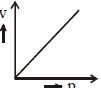
B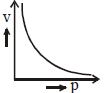
C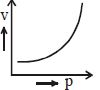
D
Solution
(D) The speed of sound $v$ in an ideal gas is given by the formula $v = \sqrt{\frac{\gamma P}{\rho}}$,where $\gamma$ is the adiabatic index,$P$ is the pressure,and $\rho$ is the density of the gas.
Since the density $\rho = \frac{m}{V}$ and for an ideal gas $PV = nRT$,we have $\rho = \frac{PM}{RT}$,where $M$ is the molar mass and $T$ is the temperature.
Substituting this into the velocity formula: $v = \sqrt{\frac{\gamma P}{PM/RT}} = \sqrt{\frac{\gamma RT}{M}}$.
This shows that the speed of sound $v$ depends only on the temperature $T$ and the nature of the gas (molar mass $M$ and $\gamma$),and is independent of the pressure $P$ as long as the temperature remains constant.
Therefore,the graph showing a constant velocity $v$ with respect to pressure $P$ is correct,which corresponds to the fourth graph.
Since the density $\rho = \frac{m}{V}$ and for an ideal gas $PV = nRT$,we have $\rho = \frac{PM}{RT}$,where $M$ is the molar mass and $T$ is the temperature.
Substituting this into the velocity formula: $v = \sqrt{\frac{\gamma P}{PM/RT}} = \sqrt{\frac{\gamma RT}{M}}$.
This shows that the speed of sound $v$ depends only on the temperature $T$ and the nature of the gas (molar mass $M$ and $\gamma$),and is independent of the pressure $P$ as long as the temperature remains constant.
Therefore,the graph showing a constant velocity $v$ with respect to pressure $P$ is correct,which corresponds to the fourth graph.
0 likes
View Solution106
EasyMCQ
Velocity of sound in vacuum is .... $ms^{-1}$
A
$0$
B
$330$
C
$360$
D
$660$
Solution
(A) Sound waves are mechanical waves.
These waves require a material medium for their propagation.
Since vacuum is the absence of any material medium,sound waves cannot propagate through it.
Therefore,the velocity of sound in a vacuum is $0 \ ms^{-1}$.
These waves require a material medium for their propagation.
Since vacuum is the absence of any material medium,sound waves cannot propagate through it.
Therefore,the velocity of sound in a vacuum is $0 \ ms^{-1}$.
0 likes
View Solution107
EasyMCQ
Newton assumed that sound propagation in a gas takes place under which condition?
A
Isothermal condition
B
Adiabatic condition
C
Isobaric condition
D
Isentropic condition
Solution
(A) Newton assumed that the process of sound propagation in a gas is an isothermal process. According to him,the temperature of the gas remains constant during the compression and rarefaction cycles of the sound wave. However,this assumption was later corrected by Laplace,who showed that the process is actually adiabatic.
0 likes
View Solution108
EasyMCQ
$A$ sound is produced by plucking a string in a musical instrument,then
A
The velocity of the wave in the string is equal to the velocity of sound in the string
B
The frequency of the wave in the string is equal to the frequency of the sound produced
C
The wave in the string is progressive
D
The tension in the string varies from point to point
Solution
(B) When a string is plucked,it vibrates at a specific frequency determined by its length,tension,and mass per unit length.
This vibration creates pressure waves in the surrounding air.
The frequency of the vibration of the string is the source of the sound.
According to the principles of wave physics,the frequency of the source (the vibrating string) is equal to the frequency of the sound wave produced in the medium (air).
This vibration creates pressure waves in the surrounding air.
The frequency of the vibration of the string is the source of the sound.
According to the principles of wave physics,the frequency of the source (the vibrating string) is equal to the frequency of the sound wave produced in the medium (air).
0 likes
View Solution109
MediumMCQ
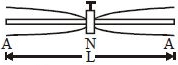
$A$ steel rod of length $100 \, cm$ is clamped at the middle. The frequency of the fundamental mode for the longitudinal vibrations of the rod is ..... $kHz$ (Speed of sound in steel $= 5 \, km \, s^{-1}$)
A
$1.5$
B
$2$
C
$2.5$
D
$3$
Solution
(C) Given: Length of the rod $L = 100 \, cm = 1 \, m$. Speed of sound in steel $v = 5 \, km \, s^{-1} = 5 \times 10^3 \, m \, s^{-1}$.
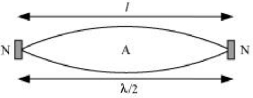
Since the rod is clamped at the middle,the middle point acts as a node $(N)$. In the fundamental mode of longitudinal vibration,antinodes $(A)$ are formed at both free ends of the rod.
As shown in the figure,the total length of the rod $L$ corresponds to the distance between two consecutive antinodes.
The distance between two consecutive antinodes is $\frac{\lambda}{2}$.
Therefore,$\frac{\lambda}{2} = L = 1 \, m$,which gives the wavelength $\lambda = 2 \, m$.
The frequency of the fundamental mode is given by $f = \frac{v}{\lambda}$.
Substituting the values: $f = \frac{5 \times 10^3 \, m \, s^{-1}}{2 \, m} = 2.5 \times 10^3 \, Hz = 2.5 \, kHz$.
Since the rod is clamped at the middle,the middle point acts as a node $(N)$. In the fundamental mode of longitudinal vibration,antinodes $(A)$ are formed at both free ends of the rod.
As shown in the figure,the total length of the rod $L$ corresponds to the distance between two consecutive antinodes.
The distance between two consecutive antinodes is $\frac{\lambda}{2}$.
Therefore,$\frac{\lambda}{2} = L = 1 \, m$,which gives the wavelength $\lambda = 2 \, m$.
The frequency of the fundamental mode is given by $f = \frac{v}{\lambda}$.
Substituting the values: $f = \frac{5 \times 10^3 \, m \, s^{-1}}{2 \, m} = 2.5 \times 10^3 \, Hz = 2.5 \, kHz$.
0 likes
View Solution110
MediumMCQ
The velocities of sound at the same pressure in two monatomic gases of densities ${\rho _1}$ and ${\rho _2}$ are $v_1$ and $v_2$ respectively. If ${\rho _1}/{\rho _2} = 2$,then the value of $\frac{{{v_1}}}{{{v_2}}}$ is:
A
$\frac{1}{{\sqrt 2 }}$
B
$2$
C
$\frac{1}{2}$
D
None of these
Solution
(A) The velocity of sound in a gas is given by the formula $v = \sqrt{\frac{\gamma P}{\rho}}$,where $\gamma$ is the adiabatic index,$P$ is the pressure,and $\rho$ is the density of the gas.
Since both gases are monatomic,they have the same adiabatic index $\gamma = 5/3$.
Given that the pressure $P$ is the same for both gases,the velocity $v$ is inversely proportional to the square root of the density: $v \propto \frac{1}{\sqrt{\rho}}$.
Therefore,the ratio of the velocities is $\frac{v_1}{v_2} = \sqrt{\frac{\rho_2}{\rho_1}}$.
Given $\frac{\rho_1}{\rho_2} = 2$,we have $\frac{\rho_2}{\rho_1} = \frac{1}{2}$.
Substituting this into the ratio formula: $\frac{v_1}{v_2} = \sqrt{\frac{1}{2}} = \frac{1}{\sqrt{2}}$.
Since both gases are monatomic,they have the same adiabatic index $\gamma = 5/3$.
Given that the pressure $P$ is the same for both gases,the velocity $v$ is inversely proportional to the square root of the density: $v \propto \frac{1}{\sqrt{\rho}}$.
Therefore,the ratio of the velocities is $\frac{v_1}{v_2} = \sqrt{\frac{\rho_2}{\rho_1}}$.
Given $\frac{\rho_1}{\rho_2} = 2$,we have $\frac{\rho_2}{\rho_1} = \frac{1}{2}$.
Substituting this into the ratio formula: $\frac{v_1}{v_2} = \sqrt{\frac{1}{2}} = \frac{1}{\sqrt{2}}$.
0 likes
View Solution111
MediumMCQ
$A$ train, standing in a station-yard, blows a whistle of frequency $400\,Hz$ in still air. The wind starts blowing in the direction from the yard to the station with a speed of $10\,ms^{-1}$. What will be the frequency and speed of sound for an observer? (The speed of sound in still air is $340\,ms^{-1}$)
A
$400\,Hz, 340\,ms^{-1}$
B
$ > 400\,Hz, 340\,ms^{-1}$
C
$400\,Hz, 350\,ms^{-1}$
D
$ < 400\,Hz, 330\,ms^{-1}$
Solution
(C) Given: Frequency of source $f = 400\,Hz$, speed of sound in still air $v = 340\,ms^{-1}$, wind speed $v_{w} = 10\,ms^{-1}$.
Since there is no relative motion between the source (train) and the observer, the frequency of the sound heard by the observer remains unchanged. Therefore, the observed frequency is $f' = f = 400\,Hz$.
When the wind blows in the direction of the sound propagation, the effective speed of sound increases. The new speed of sound $v'$ for the observer is given by $v' = v + v_{w}$.
Substituting the values, $v' = 340 + 10 = 350\,ms^{-1}$.
Thus, the frequency is $400\,Hz$ and the speed of sound is $350\,ms^{-1}$.
Since there is no relative motion between the source (train) and the observer, the frequency of the sound heard by the observer remains unchanged. Therefore, the observed frequency is $f' = f = 400\,Hz$.
When the wind blows in the direction of the sound propagation, the effective speed of sound increases. The new speed of sound $v'$ for the observer is given by $v' = v + v_{w}$.
Substituting the values, $v' = 340 + 10 = 350\,ms^{-1}$.
Thus, the frequency is $400\,Hz$ and the speed of sound is $350\,ms^{-1}$.
0 likes
View Solution112
DifficultMCQ
The speed of sound in oxygen $(O_2)$ at a certain temperature is $460 \, m/s$. The speed of sound in helium $(He)$ at the same temperature will be ............. $m/s$ (assume both gases to be ideal).
A
$1420$
B
$500$
C
$650$
D
$330$
Solution
(A) The speed of sound in an ideal gas is given by the formula: $v = \sqrt{\frac{\gamma RT}{M}}$.
For oxygen $(O_2)$,which is a diatomic gas,the adiabatic index $\gamma_{O_2} = 1.4 = \frac{7}{5}$ and the molar mass $M_{O_2} = 32 \, g/mol$.
So,$v_{O_2} = \sqrt{\frac{7RT}{5 \times 32}}$.
For helium $(He)$,which is a monatomic gas,the adiabatic index $\gamma_{He} = 1.67 = \frac{5}{3}$ and the molar mass $M_{He} = 4 \, g/mol$.
So,$v_{He} = \sqrt{\frac{5RT}{3 \times 4}}$.
Taking the ratio of the speeds:
$\frac{v_{He}}{v_{O_2}} = \sqrt{\frac{\gamma_{He} / M_{He}}{\gamma_{O_2} / M_{O_2}}} = \sqrt{\frac{5/3}{4} \times \frac{32}{7/5}} = \sqrt{\frac{5}{12} \times \frac{160}{7}} = \sqrt{\frac{800}{84}} = \sqrt{\frac{200}{21}} \approx 3.086$.
Therefore,$v_{He} = 460 \times 3.086 \approx 1420 \, m/s$.
For oxygen $(O_2)$,which is a diatomic gas,the adiabatic index $\gamma_{O_2} = 1.4 = \frac{7}{5}$ and the molar mass $M_{O_2} = 32 \, g/mol$.
So,$v_{O_2} = \sqrt{\frac{7RT}{5 \times 32}}$.
For helium $(He)$,which is a monatomic gas,the adiabatic index $\gamma_{He} = 1.67 = \frac{5}{3}$ and the molar mass $M_{He} = 4 \, g/mol$.
So,$v_{He} = \sqrt{\frac{5RT}{3 \times 4}}$.
Taking the ratio of the speeds:
$\frac{v_{He}}{v_{O_2}} = \sqrt{\frac{\gamma_{He} / M_{He}}{\gamma_{O_2} / M_{O_2}}} = \sqrt{\frac{5/3}{4} \times \frac{32}{7/5}} = \sqrt{\frac{5}{12} \times \frac{160}{7}} = \sqrt{\frac{800}{84}} = \sqrt{\frac{200}{21}} \approx 3.086$.
Therefore,$v_{He} = 460 \times 3.086 \approx 1420 \, m/s$.
0 likes
View Solution113
EasyMCQ
If $V_m$ is the velocity of sound in moist air and $V_d$ is the velocity of sound in dry air,under identical conditions of pressure and temperature,which of the following is true?
A
$V_m > V_d$
B
$V_m < V_d$
C
$V_m = V_d$
D
$V_m V_d = 1$
Solution
(A) The velocity of sound in a gas is given by the formula $V = \sqrt{\frac{\gamma P}{\rho}}$,where $\gamma$ is the adiabatic index,$P$ is the pressure,and $\rho$ is the density of the gas.
Under identical conditions of pressure and temperature,the velocity of sound is inversely proportional to the square root of the density of the medium: $V \propto \frac{1}{\sqrt{\rho}}$.
Moist air contains water vapor,which has a lower molecular mass compared to the nitrogen and oxygen molecules that make up dry air. Therefore,the density of moist air is less than the density of dry air $(\rho_m < \rho_d)$.
Since the density of moist air is lower,the velocity of sound in moist air must be greater than the velocity of sound in dry air $(V_m > V_d)$.
Under identical conditions of pressure and temperature,the velocity of sound is inversely proportional to the square root of the density of the medium: $V \propto \frac{1}{\sqrt{\rho}}$.
Moist air contains water vapor,which has a lower molecular mass compared to the nitrogen and oxygen molecules that make up dry air. Therefore,the density of moist air is less than the density of dry air $(\rho_m < \rho_d)$.
Since the density of moist air is lower,the velocity of sound in moist air must be greater than the velocity of sound in dry air $(V_m > V_d)$.
0 likes
View Solution114
EasyMCQ
The velocity of sound in a gas at pressure $P$ and density $d$ is
A
$v = \sqrt {\frac{\gamma P}{d}}$
B
$v = \sqrt {\frac{P}{\gamma d}}$
C
$v = \gamma \sqrt {\frac{P}{d}}$
D
$v = \sqrt {\frac{2P}{d}}$
Solution
(A) According to the Laplace correction for the speed of sound in an ideal gas,the velocity $v$ is given by $v = \sqrt{\frac{\gamma P}{\rho}}$,where $\gamma$ is the adiabatic index,$P$ is the pressure,and $\rho$ is the density.
Given that the density is denoted by $d$,the formula becomes $v = \sqrt{\frac{\gamma P}{d}}$.
This can be derived from the ideal gas equation $PV = nRT$,where $n = \frac{m}{M}$.
Thus,$PV = \frac{m}{M}RT$,which implies $P = \frac{m}{V} \cdot \frac{RT}{M} = d \cdot \frac{RT}{M}$.
Therefore,$\frac{P}{d} = \frac{RT}{M}$.
Substituting this into the expression $v = \sqrt{\frac{\gamma RT}{M}}$,we get $v = \sqrt{\frac{\gamma P}{d}}$.
Given that the density is denoted by $d$,the formula becomes $v = \sqrt{\frac{\gamma P}{d}}$.
This can be derived from the ideal gas equation $PV = nRT$,where $n = \frac{m}{M}$.
Thus,$PV = \frac{m}{M}RT$,which implies $P = \frac{m}{V} \cdot \frac{RT}{M} = d \cdot \frac{RT}{M}$.
Therefore,$\frac{P}{d} = \frac{RT}{M}$.
Substituting this into the expression $v = \sqrt{\frac{\gamma RT}{M}}$,we get $v = \sqrt{\frac{\gamma P}{d}}$.
0 likes
View Solution115
MediumMCQ
$Assertion :$ Sound travels faster in solids than gases.
$Reason :$ Solids possess greater density than gases.
$Reason :$ Solids possess greater density than gases.
A
If both Assertion and Reason are correct and the Reason is a correct explanation of the Assertion.
B
If both Assertion and Reason are correct but Reason is not a correct explanation of the Assertion.
C
If the Assertion is correct but Reason is incorrect.
D
If both the Assertion and Reason are incorrect.
Solution
(B) The speed of sound in a medium is given by the formula $v = \sqrt{\frac{E}{\rho}}$,where $E$ is the modulus of elasticity and $\rho$ is the density of the medium.
Sound travels faster in solids than in gases because the elasticity $(E)$ of solids is significantly higher than that of gases.
While it is true that solids generally possess greater density than gases,density is in the denominator of the velocity formula $(v \propto \frac{1}{\sqrt{\rho}})$. Therefore,higher density actually tends to decrease the speed of sound.
The reason sound travels faster in solids is primarily due to the much higher elasticity of solids,which outweighs the effect of their higher density. Thus,the Reason is a true statement,but it is not the correct explanation for the Assertion.
Sound travels faster in solids than in gases because the elasticity $(E)$ of solids is significantly higher than that of gases.
While it is true that solids generally possess greater density than gases,density is in the denominator of the velocity formula $(v \propto \frac{1}{\sqrt{\rho}})$. Therefore,higher density actually tends to decrease the speed of sound.
The reason sound travels faster in solids is primarily due to the much higher elasticity of solids,which outweighs the effect of their higher density. Thus,the Reason is a true statement,but it is not the correct explanation for the Assertion.
0 likes
View Solution116
EasyMCQ
$Assertion :$ The change in air pressure affects the speed of sound.
$Reason :$ The speed of sound in gases is proportional to the square of pressure.
$Reason :$ The speed of sound in gases is proportional to the square of pressure.
A
If both Assertion and Reason are correct and the Reason is a correct explanation of the Assertion.
B
If both Assertion and Reason are correct but Reason is not a correct explanation of the Assertion.
C
If the Assertion is correct but Reason is incorrect.
D
If both the Assertion and Reason are incorrect.
Solution
(D) The speed of sound in a gas is given by the formula $v = \sqrt{\frac{\gamma P}{\rho}}$,where $P$ is the pressure and $\rho$ is the density of the gas.
According to the ideal gas law,$PV = nRT$,which can be written as $P = \frac{\rho RT}{M}$,where $M$ is the molar mass.
Thus,the ratio $\frac{P}{\rho} = \frac{RT}{M}$.
Substituting this into the speed formula,we get $v = \sqrt{\frac{\gamma RT}{M}}$.
Since $R$,$T$,and $M$ are constant at a given temperature,the speed of sound $v$ is independent of pressure $P$.
Therefore,the Assertion is incorrect because pressure change does not affect the speed of sound at a constant temperature.
The Reason is also incorrect because the speed of sound is independent of pressure,not proportional to its square.
Thus,both the Assertion and Reason are incorrect.
According to the ideal gas law,$PV = nRT$,which can be written as $P = \frac{\rho RT}{M}$,where $M$ is the molar mass.
Thus,the ratio $\frac{P}{\rho} = \frac{RT}{M}$.
Substituting this into the speed formula,we get $v = \sqrt{\frac{\gamma RT}{M}}$.
Since $R$,$T$,and $M$ are constant at a given temperature,the speed of sound $v$ is independent of pressure $P$.
Therefore,the Assertion is incorrect because pressure change does not affect the speed of sound at a constant temperature.
The Reason is also incorrect because the speed of sound is independent of pressure,not proportional to its square.
Thus,both the Assertion and Reason are incorrect.
0 likes
View Solution117
EasyMCQ
$Assertion :$ The base of Laplace correction was that exchange of heat between the region of compression and rarefaction in air is negligible.
$Reason :$ Air is a bad conductor of heat and the velocity of sound in air is quite large.
$Reason :$ Air is a bad conductor of heat and the velocity of sound in air is quite large.
A
If both Assertion and Reason are correct and the Reason is a correct explanation of the Assertion.
B
If both Assertion and Reason are correct but Reason is not a correct explanation of the Assertion.
C
If the Assertion is correct but Reason is incorrect.
D
If both the Assertion and Reason are incorrect.
Solution
(A) Laplace corrected Newton's formula for the speed of sound by assuming that the propagation of sound in air is an adiabatic process.
In an adiabatic process,there is no exchange of heat between the system and the surroundings.
This assumption is justified because air is a poor conductor of heat and the compressions and rarefactions occur so rapidly (due to the high velocity of sound) that there is insufficient time for any significant heat exchange to take place between the regions.
Therefore,both the Assertion and the Reason are correct,and the Reason provides the correct explanation for the Assertion.
In an adiabatic process,there is no exchange of heat between the system and the surroundings.
This assumption is justified because air is a poor conductor of heat and the compressions and rarefactions occur so rapidly (due to the high velocity of sound) that there is insufficient time for any significant heat exchange to take place between the regions.
Therefore,both the Assertion and the Reason are correct,and the Reason provides the correct explanation for the Assertion.
0 likes
View Solution118
MediumMCQ
$A$ $SONAR$ (sound navigation and ranging) uses ultrasonic waves to detect and locate objects under water. In a submarine equipped with a $SONAR$,the time delay between generation of a probe wave and the reception of its echo after reflection from an enemy submarine is found to be $77.0\; s$. What is the distance of the enemy submarine (in $; km$)? (Speed of sound in water $= 1450\; m/s$)
A
$68.5$
B
$75.4$
C
$55.8$
D
$26.4$
Solution
(C) Let the distance between the submarine and the enemy submarine be $S$.
The speed of sound in water is $v = 1450\; m/s$.
The total time delay between the transmission and reception of the echo is $t = 77.0\; s$.
Since the sound travels to the enemy submarine and back to the source,the total distance covered by the sound wave is $2S$.
Using the formula $\text{Distance} = \text{Speed} \times \text{Time}$,we have $2S = v \times t$.
Substituting the values: $2S = 1450\; m/s \times 77.0\; s = 111650\; m$.
Therefore,the distance $S = \frac{111650}{2} = 55825\; m$.
Converting to kilometers: $S = 55.825\; km \approx 55.8\; km$.
The speed of sound in water is $v = 1450\; m/s$.
The total time delay between the transmission and reception of the echo is $t = 77.0\; s$.
Since the sound travels to the enemy submarine and back to the source,the total distance covered by the sound wave is $2S$.
Using the formula $\text{Distance} = \text{Speed} \times \text{Time}$,we have $2S = v \times t$.
Substituting the values: $2S = 1450\; m/s \times 77.0\; s = 111650\; m$.
Therefore,the distance $S = \frac{111650}{2} = 55825\; m$.
Converting to kilometers: $S = 55.825\; km \approx 55.8\; km$.
0 likes
View Solution119
MediumMCQ
Estimate the speed of sound (in $m/s$) in air at standard temperature and pressure $(STP)$. The mass of $1$ mole of air is $29.0 \times 10^{-3} \; kg$.
A
$376$
B
$230$
C
$343$
D
$280$
Solution
(D) We know that $1$ mole of any gas occupies $22.4$ litres at $STP$. Therefore,the density of air at $STP$ is:
$\rho = \frac{\text{mass of one mole of air}}{\text{volume of one mole of air at } STP}$
$\rho = \frac{29.0 \times 10^{-3} \; kg}{22.4 \times 10^{-3} \; m^3} = 1.29 \; kg/m^3$
According to Newton's formula for the speed of sound in a medium,the speed of sound $v$ is given by $v = \sqrt{\frac{P}{\rho}}$,where $P$ is the atmospheric pressure at $STP$ $(1.01 \times 10^5 \; N/m^2)$.
$v = \sqrt{\frac{1.01 \times 10^5}{1.29}} \approx \sqrt{78294.57} \approx 280 \; m/s$.
Thus,the estimated speed of sound is $280 \; m/s$.
$\rho = \frac{\text{mass of one mole of air}}{\text{volume of one mole of air at } STP}$
$\rho = \frac{29.0 \times 10^{-3} \; kg}{22.4 \times 10^{-3} \; m^3} = 1.29 \; kg/m^3$
According to Newton's formula for the speed of sound in a medium,the speed of sound $v$ is given by $v = \sqrt{\frac{P}{\rho}}$,where $P$ is the atmospheric pressure at $STP$ $(1.01 \times 10^5 \; N/m^2)$.
$v = \sqrt{\frac{1.01 \times 10^5}{1.29}} \approx \sqrt{78294.57} \approx 280 \; m/s$.
Thus,the estimated speed of sound is $280 \; m/s$.
0 likes
View Solution120
Medium
Use the formula $v=\sqrt{\frac{\gamma P}{\rho}}$ to explain why the speed of sound in air:
$(a)$ is independent of pressure,
$(b)$ increases with temperature,
$(c)$ increases with humidity.
$(a)$ is independent of pressure,
$(b)$ increases with temperature,
$(c)$ increases with humidity.
Solution
(N/A) $v=\sqrt{\frac{\gamma P}{\rho}} \dots (i)$
$(a)$ Density $\rho = \frac{M}{V}$,where $M$ is the mass and $V$ is the volume. Substituting this into $(i)$,we get $v = \sqrt{\frac{\gamma PV}{M}}$. For an ideal gas,$PV = RT$. Thus,$v = \sqrt{\frac{\gamma RT}{M}}$. Since $R, T, M,$ and $\gamma$ are constant at a given temperature,$v$ is independent of pressure.
$(b)$ From the relation $v = \sqrt{\frac{\gamma RT}{M}}$,we see that $v \propto \sqrt{T}$. As the temperature $T$ increases,the speed of sound $v$ increases.
$(c)$ Let $\rho_m$ and $\rho_d$ be the densities of moist and dry air. Since water vapor has a lower molecular mass than dry air (mostly $N_2$ and $O_2$),the density of moist air is less than that of dry air $(\rho_m < \rho_d)$. From $v = \sqrt{\frac{\gamma P}{\rho}}$,since $v \propto \frac{1}{\sqrt{\rho}}$,a lower density results in a higher speed of sound. Thus,the speed of sound increases with humidity.
$(a)$ Density $\rho = \frac{M}{V}$,where $M$ is the mass and $V$ is the volume. Substituting this into $(i)$,we get $v = \sqrt{\frac{\gamma PV}{M}}$. For an ideal gas,$PV = RT$. Thus,$v = \sqrt{\frac{\gamma RT}{M}}$. Since $R, T, M,$ and $\gamma$ are constant at a given temperature,$v$ is independent of pressure.
$(b)$ From the relation $v = \sqrt{\frac{\gamma RT}{M}}$,we see that $v \propto \sqrt{T}$. As the temperature $T$ increases,the speed of sound $v$ increases.
$(c)$ Let $\rho_m$ and $\rho_d$ be the densities of moist and dry air. Since water vapor has a lower molecular mass than dry air (mostly $N_2$ and $O_2$),the density of moist air is less than that of dry air $(\rho_m < \rho_d)$. From $v = \sqrt{\frac{\gamma P}{\rho}}$,since $v \propto \frac{1}{\sqrt{\rho}}$,a lower density results in a higher speed of sound. Thus,the speed of sound increases with humidity.
0 likes
View Solution121
Medium
$A$ bat emits ultrasonic sound of frequency $1000 \; kHz$ in air. If the sound meets a water surface,what is the wavelength of
$(a)$ the reflected sound,
$(b)$ the transmitted sound?
Speed of sound in air is $340 \; m/s$ and in water is $1486 \; m/s$.
$(a)$ the reflected sound,
$(b)$ the transmitted sound?
Speed of sound in air is $340 \; m/s$ and in water is $1486 \; m/s$.
Solution
The frequency of the sound wave remains constant when it travels from one medium to another.
Given frequency,$\nu = 1000 \; kHz = 10^6 \; Hz$.
$(a)$ For the reflected sound in air:
Speed of sound in air,$v_a = 340 \; m/s$.
The wavelength $\lambda_r$ is given by $\lambda_r = \frac{v_a}{\nu} = \frac{340}{10^6} = 3.4 \times 10^{-4} \; m$.
$(b)$ For the transmitted sound in water:
Speed of sound in water,$v_w = 1486 \; m/s$.
The wavelength $\lambda_t$ is given by $\lambda_t = \frac{v_w}{\nu} = \frac{1486}{10^6} = 1.486 \times 10^{-3} \; m \approx 1.49 \times 10^{-3} \; m$.
Given frequency,$\nu = 1000 \; kHz = 10^6 \; Hz$.
$(a)$ For the reflected sound in air:
Speed of sound in air,$v_a = 340 \; m/s$.
The wavelength $\lambda_r$ is given by $\lambda_r = \frac{v_a}{\nu} = \frac{340}{10^6} = 3.4 \times 10^{-4} \; m$.
$(b)$ For the transmitted sound in water:
Speed of sound in water,$v_w = 1486 \; m/s$.
The wavelength $\lambda_t$ is given by $\lambda_t = \frac{v_w}{\nu} = \frac{1486}{10^6} = 1.486 \times 10^{-3} \; m \approx 1.49 \times 10^{-3} \; m$.
0 likes
View Solution122
EasyMCQ
$A$ hospital uses an ultrasonic scanner to locate tumours in a tissue. What is the wavelength of sound in the tissue in which the speed of sound is $1.7 \; km/s$? The operating frequency of the scanner is $4.2 \; MHz$.
A
$1.6 \times 10^{-3} \; m$
B
$4.1 \times 10^{-4} \; m$
C
$8.2 \times 10^{-3} \; m$
D
$6.3 \times 10^{-5} \; m$
Solution
(B) The speed of sound in the tissue is $v = 1.7 \; km/s = 1.7 \times 10^3 \; m/s$.
The operating frequency of the scanner is $f = 4.2 \; MHz = 4.2 \times 10^6 \; Hz$.
The wavelength $\lambda$ of sound in the tissue is given by the relation $\lambda = \frac{v}{f}$.
Substituting the values,we get $\lambda = \frac{1.7 \times 10^3}{4.2 \times 10^6} \approx 0.4047 \times 10^{-3} \; m = 4.1 \times 10^{-4} \; m$.
The operating frequency of the scanner is $f = 4.2 \; MHz = 4.2 \times 10^6 \; Hz$.
The wavelength $\lambda$ of sound in the tissue is given by the relation $\lambda = \frac{v}{f}$.
Substituting the values,we get $\lambda = \frac{1.7 \times 10^3}{4.2 \times 10^6} \approx 0.4047 \times 10^{-3} \; m = 4.1 \times 10^{-4} \; m$.
0 likes
View Solution123
MediumMCQ
$A$ steel rod $100 \; cm$ long is clamped at its middle. The fundamental frequency of longitudinal vibrations of the rod is given to be $2.53 \; kHz$. What is the speed (in $km/s$) of sound in steel?
A
$3.42$
B
$7.62$
C
$5.06$
D
$9.56$
Solution
(C) Length of the steel rod,$l = 100 \; cm = 1 \; m$.
Fundamental frequency of vibration,$\nu = 2.53 \; kHz = 2.53 \times 10^3 \; Hz$.
When the rod is clamped at its middle,a node $(N)$ is formed at the centre,and antinodes $(A)$ are formed at its two free ends. The length of the rod corresponds to the distance between two antinodes,which is $\lambda/2$.
Thus,$l = \lambda/2$,which implies $\lambda = 2l = 2 \times 1 = 2 \; m$.
The speed of sound in steel is given by the relation $v = \nu \lambda$.
$v = 2.53 \times 10^3 \; Hz \times 2 \; m = 5.06 \times 10^3 \; m/s$.
$v = 5.06 \; km/s$.
Fundamental frequency of vibration,$\nu = 2.53 \; kHz = 2.53 \times 10^3 \; Hz$.
When the rod is clamped at its middle,a node $(N)$ is formed at the centre,and antinodes $(A)$ are formed at its two free ends. The length of the rod corresponds to the distance between two antinodes,which is $\lambda/2$.
Thus,$l = \lambda/2$,which implies $\lambda = 2l = 2 \times 1 = 2 \; m$.
The speed of sound in steel is given by the relation $v = \nu \lambda$.
$v = 2.53 \times 10^3 \; Hz \times 2 \; m = 5.06 \times 10^3 \; m/s$.
$v = 5.06 \; km/s$.
0 likes
View Solution124
Medium
$A$ narrow sound pulse (for example,a short pip by a whistle) is sent across a medium.
$(a)$ Does the pulse have a definite $(i)$ frequency,$(ii)$ wavelength,$(iii)$ speed of propagation?
$(b)$ If the pulse rate is $1$ after every $20 \; s$,(that is,the whistle is blown for a split of a second after every $20 \; s$),is the frequency of the note produced by the whistle equal to $1/20$ or $0.05 \; Hz$?
$(a)$ Does the pulse have a definite $(i)$ frequency,$(ii)$ wavelength,$(iii)$ speed of propagation?
$(b)$ If the pulse rate is $1$ after every $20 \; s$,(that is,the whistle is blown for a split of a second after every $20 \; s$),is the frequency of the note produced by the whistle equal to $1/20$ or $0.05 \; Hz$?
Solution
(N/A) $(i)$ No,a narrow pulse is not a periodic wave and does not have a single definite frequency.
$(ii)$ No,because it lacks a definite frequency,it does not have a definite wavelength.
$(iii)$ Yes,the pulse travels through the medium at the speed of sound characteristic of that medium.
$(b)$ No,the frequency of the note produced by the whistle is not $0.05 \; Hz$. The value $0.05 \; Hz$ represents the frequency of repetition of the pulse (the rate at which the whistle is blown),not the frequency of the sound wave itself.
$(ii)$ No,because it lacks a definite frequency,it does not have a definite wavelength.
$(iii)$ Yes,the pulse travels through the medium at the speed of sound characteristic of that medium.
$(b)$ No,the frequency of the note produced by the whistle is not $0.05 \; Hz$. The value $0.05 \; Hz$ represents the frequency of repetition of the pulse (the rate at which the whistle is blown),not the frequency of the sound wave itself.
0 likes
View Solution125
MediumMCQ
Earthquakes generate sound waves inside the earth. Unlike a gas,the earth can experience both transverse $(S)$ and longitudinal $(P)$ sound waves. Typically,the speed of $S$ wave is about $4.0 \; km/s$,and that of $P$ wave is $8.0 \; km/s$. $A$ seismograph records $P$ and $S$ waves from an earthquake. The first $P$ wave arrives $4 \; min$ before the first $S$ wave. Assuming the waves travel in a straight line,at what distance (in $km$) does the earthquake occur?
A
$1920$
B
$1580$
C
$2250$
D
$2560$
Solution
(A) Let $v_S$ and $v_P$ be the velocities of $S$ and $P$ waves respectively.
Let $L$ be the distance between the epicenter and the seismograph.
We have:
$L = v_S t_S \dots (i)$
$L = v_P t_P \dots (ii)$
Where $t_S$ and $t_P$ are the respective times taken by the $S$ and $P$ waves to reach the seismograph from the epicenter.
Given:
$v_P = 8 \; km/s$,$v_S = 4 \; km/s$
From equations $(i)$ and $(ii)$:
$v_S t_S = v_P t_P \implies 4 t_S = 8 t_P \implies t_S = 2 t_P \dots (iii)$
It is given that the $P$ wave arrives $4 \; min$ before the $S$ wave:
$t_S - t_P = 4 \; min = 240 \; s$
Substituting $t_S = 2 t_P$ into the equation:
$2 t_P - t_P = 240 \implies t_P = 240 \; s$
Now,calculate the distance $L$ using equation $(ii)$:
$L = v_P \times t_P = 8 \; km/s \times 240 \; s = 1920 \; km$
Thus,the earthquake occurs at a distance of $1920 \; km$.
Let $L$ be the distance between the epicenter and the seismograph.
We have:
$L = v_S t_S \dots (i)$
$L = v_P t_P \dots (ii)$
Where $t_S$ and $t_P$ are the respective times taken by the $S$ and $P$ waves to reach the seismograph from the epicenter.
Given:
$v_P = 8 \; km/s$,$v_S = 4 \; km/s$
From equations $(i)$ and $(ii)$:
$v_S t_S = v_P t_P \implies 4 t_S = 8 t_P \implies t_S = 2 t_P \dots (iii)$
It is given that the $P$ wave arrives $4 \; min$ before the $S$ wave:
$t_S - t_P = 4 \; min = 240 \; s$
Substituting $t_S = 2 t_P$ into the equation:
$2 t_P - t_P = 240 \implies t_P = 240 \; s$
Now,calculate the distance $L$ using equation $(ii)$:
$L = v_P \times t_P = 8 \; km/s \times 240 \; s = 1920 \; km$
Thus,the earthquake occurs at a distance of $1920 \; km$.
0 likes
View Solution126
Easy
Explain the propagation of sound waves in:
$(i)$ air
$(ii)$ solids
$(i)$ air
$(ii)$ solids
Solution
(N/A) $(i)$ As the sound wave passes through air, compression and expansion of small regions of the air medium take place periodically, turn by turn, along the direction of propagation of the wave. A small region of the air medium in which air particles tend to move towards each other causes an increase in density $(\Delta \rho)$ and hence an increase in pressure $(\Delta P)$, because according to the ideal gas equation, we have $PV = nRT \Rightarrow P(\frac{M}{\rho}) = nRT \Rightarrow P = (\frac{nRT}{M}) \rho$. At constant temperature, $\Delta P \propto \Delta \rho$.
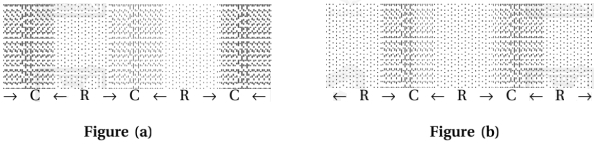
In such a high-pressure region, where density is increased temporarily, a "Condensation" or "Compression" is said to be formed. It is shown by the symbol $C$ in the figure.
Since pressure is the force exerted normally on a unit area, a restoring force is developed in this region, which is directly proportional to the displacement of a particle from its mean position. Consequently, air particles in this region tend to move outward (parallel to the direction of propagation of the wave) towards the adjoining regions on the left and right, causing compressions in them. When this happens, the density of air in the middle region (from where air particles have moved out) decreases temporarily.
In such a low-pressure region, a "rarefaction" or "expansion" is said to have been formed. It is shown by the symbol $R$ in the figure.
As explained above, each small region of the air medium coming successively in a direction away from the origin of the sound undergoes compression and rarefaction periodically. This is how the disturbance moves away from the source of sound, which indicates the propagation of sound waves, which are mechanical and longitudinal.
$(ii)$ Crystalline solids possess a lattice structure in which atoms or molecules are arranged with a definite geometric periodic pattern. In the normal condition, without any disturbance, all these atoms or molecules are under equilibrium because the forces exerted from the surroundings balance each other.
Now, under this equilibrium condition, if a disturbance is produced in any atom or molecule, it gets displaced from its equilibrium position. Here, this atom or molecule behaves as if it is elastically connected to neighboring atoms or molecules. Hence, a restoring force is developed in such imaginary elastic springs. Such a force becomes responsible for producing very small oscillations in the atoms or molecules, turn by turn, along the direction of motion of the disturbance, which ultimately results in the propagation of the wave in the solid medium from one end to the other.
In such a high-pressure region, where density is increased temporarily, a "Condensation" or "Compression" is said to be formed. It is shown by the symbol $C$ in the figure.
Since pressure is the force exerted normally on a unit area, a restoring force is developed in this region, which is directly proportional to the displacement of a particle from its mean position. Consequently, air particles in this region tend to move outward (parallel to the direction of propagation of the wave) towards the adjoining regions on the left and right, causing compressions in them. When this happens, the density of air in the middle region (from where air particles have moved out) decreases temporarily.
In such a low-pressure region, a "rarefaction" or "expansion" is said to have been formed. It is shown by the symbol $R$ in the figure.
As explained above, each small region of the air medium coming successively in a direction away from the origin of the sound undergoes compression and rarefaction periodically. This is how the disturbance moves away from the source of sound, which indicates the propagation of sound waves, which are mechanical and longitudinal.
$(ii)$ Crystalline solids possess a lattice structure in which atoms or molecules are arranged with a definite geometric periodic pattern. In the normal condition, without any disturbance, all these atoms or molecules are under equilibrium because the forces exerted from the surroundings balance each other.
Now, under this equilibrium condition, if a disturbance is produced in any atom or molecule, it gets displaced from its equilibrium position. Here, this atom or molecule behaves as if it is elastically connected to neighboring atoms or molecules. Hence, a restoring force is developed in such imaginary elastic springs. Such a force becomes responsible for producing very small oscillations in the atoms or molecules, turn by turn, along the direction of motion of the disturbance, which ultimately results in the propagation of the wave in the solid medium from one end to the other.
0 likes
View Solution127
Easy
What is called compression or condensation? Which type of changes in density and pressure take place in it?
Solution
(N/A) Compression or condensation is a region in a longitudinal wave where the particles of the medium are crowded together,resulting in a local increase in density and pressure.
In a compression,the density of the medium is higher than the average density,and the pressure is higher than the equilibrium pressure of the medium.
These regions propagate through the medium as the wave travels.
In a compression,the density of the medium is higher than the average density,and the pressure is higher than the equilibrium pressure of the medium.
These regions propagate through the medium as the wave travels.
0 likes
View Solution128
Easy
What is called rarefaction? Which type of changes in density and pressure take place in it?
Solution
(N/A) Rarefaction is a region in a longitudinal wave where the particles of the medium are spread further apart than their normal equilibrium position.
In a region of rarefaction,the density of the medium is lower than the average density,and the pressure of the medium is lower than the average pressure.
Essentially,rarefaction represents a region of low pressure and low density in a longitudinal wave.
In a region of rarefaction,the density of the medium is lower than the average density,and the pressure of the medium is lower than the average pressure.
Essentially,rarefaction represents a region of low pressure and low density in a longitudinal wave.
0 likes
View Solution129
Medium
Write the displacement variable in the propagation of sound in air.
Solution
(N/A) In the propagation of sound in air,the displacement variable is the displacement of air molecules from their mean equilibrium position.
Let the displacement of a particle at position $x$ and time $t$ be represented by $y(x, t)$.
The equation for a plane progressive harmonic sound wave is given by:
$y(x, t) = A \sin(kx - \omega t + \phi)$
Where:
$A$ is the amplitude of the displacement of air molecules.
$k$ is the angular wave number $(k = 2\pi / \lambda)$.
$\omega$ is the angular frequency $(\omega = 2\pi f)$.
$\phi$ is the initial phase constant.
Thus,the displacement variable represents the longitudinal oscillation of air molecules along the direction of wave propagation.
Let the displacement of a particle at position $x$ and time $t$ be represented by $y(x, t)$.
The equation for a plane progressive harmonic sound wave is given by:
$y(x, t) = A \sin(kx - \omega t + \phi)$
Where:
$A$ is the amplitude of the displacement of air molecules.
$k$ is the angular wave number $(k = 2\pi / \lambda)$.
$\omega$ is the angular frequency $(\omega = 2\pi f)$.
$\phi$ is the initial phase constant.
Thus,the displacement variable represents the longitudinal oscillation of air molecules along the direction of wave propagation.
0 likes
View Solution130
MediumMCQ
Why are the speeds of longitudinal and transverse waves in a solid different? Explain.
A
Due to different elastic moduli involved.
B
Due to different densities of the medium.
C
Due to the same elastic moduli.
D
Due to the absence of restoring forces.
Solution
(A) In a solid medium,both longitudinal and transverse waves can propagate.
$1$. Longitudinal waves involve compression and rarefaction,which depend on the bulk modulus $(B)$ and the shear modulus $(G)$ of the material. The speed is given by $v_L = \sqrt{\frac{B + \frac{4}{3}G}{\rho}}$,where $\rho$ is the density.
$2$. Transverse waves involve shearing of the material,which depends only on the shear modulus $(G)$. The speed is given by $v_T = \sqrt{\frac{G}{\rho}}$.
$3$. Since the elastic properties (bulk modulus and shear modulus) of a solid are different,the speeds of these two types of waves are inherently different.
$1$. Longitudinal waves involve compression and rarefaction,which depend on the bulk modulus $(B)$ and the shear modulus $(G)$ of the material. The speed is given by $v_L = \sqrt{\frac{B + \frac{4}{3}G}{\rho}}$,where $\rho$ is the density.
$2$. Transverse waves involve shearing of the material,which depends only on the shear modulus $(G)$. The speed is given by $v_T = \sqrt{\frac{G}{\rho}}$.
$3$. Since the elastic properties (bulk modulus and shear modulus) of a solid are different,the speeds of these two types of waves are inherently different.
0 likes
View Solution131
Medium
Explain which properties are necessary to understand the speed of mechanical waves.
Solution
(N/A) For the propagation of mechanical waves,the medium must possess two essential properties:
$1$. Elasticity: This property allows the particles of the medium to exert a restoring force when displaced from their mean position,enabling them to return to their original state.
$2$. Inertia: This property allows the particles of the medium to store kinetic energy and overshoot their mean position,which is necessary for the oscillation to continue.
By considering these two properties,the speed of a mechanical wave can be derived using dimensional analysis,where the wave speed $v$ depends on the elastic property (e.g.,tension $T$ or bulk modulus $B$) and the inertial property (e.g.,mass per unit length $\mu$ or density $\rho$).
$1$. Elasticity: This property allows the particles of the medium to exert a restoring force when displaced from their mean position,enabling them to return to their original state.
$2$. Inertia: This property allows the particles of the medium to store kinetic energy and overshoot their mean position,which is necessary for the oscillation to continue.
By considering these two properties,the speed of a mechanical wave can be derived using dimensional analysis,where the wave speed $v$ depends on the elastic property (e.g.,tension $T$ or bulk modulus $B$) and the inertial property (e.g.,mass per unit length $\mu$ or density $\rho$).
0 likes
View Solution132
Medium
Derive the expression for the speed of a sound wave and obtain the equations for the speed of sound in different media.
Solution
(N/A) In a longitudinal wave,the constituents of the medium oscillate forward and backward in the direction of propagation of the wave.
The property that determines the extent to which the volume of an element of a medium changes when the pressure on it changes is the bulk modulus $B$. Its dimensional formula is $[M^{1} L^{-1} T^{-2}]$.
The longitudinal waves in a medium travel in the form of compressions and rarefactions,which are changes in the density $\rho$. The dimension of density is $[M^{1} L^{-3} T^{0}]$.
Thus,the dimension of the ratio $\frac{B}{\rho}$ is:
$\frac{[B]}{[\rho]} = \frac{[M^{1} L^{-1} T^{-2}]}{[M^{1} L^{-3} T^{0}]} = [L^{2} T^{-2}]$
Since the dimension of velocity $v$ is $[L^{1} T^{-1}]$,we have $[v^{2}] = [L^{2} T^{-2}]$.
Therefore,$\frac{B}{\rho} \propto v^{2}$.
On the basis of dimensional analysis,the expression for the speed of longitudinal waves in a medium is $v = C \sqrt{\frac{B}{\rho}}$,where $C$ is a dimensionless constant,which is found to be $1$.
Thus,the speed of longitudinal waves in a fluid is $v = \sqrt{\frac{B}{\rho}}$.
For a solid bar or rod,the relevant modulus of elasticity is Young's modulus $Y$,and the speed is given by $v = \sqrt{\frac{Y}{\rho}}$.
The property that determines the extent to which the volume of an element of a medium changes when the pressure on it changes is the bulk modulus $B$. Its dimensional formula is $[M^{1} L^{-1} T^{-2}]$.
The longitudinal waves in a medium travel in the form of compressions and rarefactions,which are changes in the density $\rho$. The dimension of density is $[M^{1} L^{-3} T^{0}]$.
Thus,the dimension of the ratio $\frac{B}{\rho}$ is:
$\frac{[B]}{[\rho]} = \frac{[M^{1} L^{-1} T^{-2}]}{[M^{1} L^{-3} T^{0}]} = [L^{2} T^{-2}]$
Since the dimension of velocity $v$ is $[L^{1} T^{-1}]$,we have $[v^{2}] = [L^{2} T^{-2}]$.
Therefore,$\frac{B}{\rho} \propto v^{2}$.
On the basis of dimensional analysis,the expression for the speed of longitudinal waves in a medium is $v = C \sqrt{\frac{B}{\rho}}$,where $C$ is a dimensionless constant,which is found to be $1$.
Thus,the speed of longitudinal waves in a fluid is $v = \sqrt{\frac{B}{\rho}}$.
For a solid bar or rod,the relevant modulus of elasticity is Young's modulus $Y$,and the speed is given by $v = \sqrt{\frac{Y}{\rho}}$.
0 likes
View Solution133
Medium
Why is the speed of sound higher in solids and liquids as compared to gases?
Solution
(N/A) The speed of sound in a medium is given by the formula $v = \sqrt{\frac{B}{\rho}}$,where $B$ is the bulk modulus and $\rho$ is the density of the medium.
Although the densities $(\rho)$ of solids and liquids are much higher than those of gases,the speed of sound is higher in them because they are much less compressible than gases.
This means that solids and liquids have a significantly greater bulk modulus $(B)$ compared to gases,and the increase in the bulk modulus far outweighs the increase in density,resulting in a higher speed of sound.
Although the densities $(\rho)$ of solids and liquids are much higher than those of gases,the speed of sound is higher in them because they are much less compressible than gases.
This means that solids and liquids have a significantly greater bulk modulus $(B)$ compared to gases,and the increase in the bulk modulus far outweighs the increase in density,resulting in a higher speed of sound.
0 likes
View Solution134
Medium
Obtain the equation for the speed of a sound wave in air and identify the error in this equation.
Solution
(N/A) The general equation for the speed of a sound wave in a gas is given by $v = \sqrt{\frac{B}{\rho}}$,where $B$ is the bulk modulus and $\rho$ is the density of the gas.
Newton assumed that the propagation of sound in air is an isothermal process.
For an isothermal process,$PV = \text{constant}$.
Differentiating both sides,we get $V \Delta P + P \Delta V = 0$,which implies $P = -\frac{\Delta P}{\Delta V / V}$.
Since the bulk modulus $B = -\frac{\Delta P}{\Delta V / V}$,we get $B = P$.
Substituting this into the general equation,we get Newton's formula for the speed of sound: $v = \sqrt{\frac{P}{\rho}}$.
For air at $STP$,$P = 1.01 \times 10^5 \text{ Pa}$ and $\rho = 1.29 \text{ kg/m}^3$.
Calculating the value: $v = \sqrt{\frac{1.01 \times 10^5}{1.29}} \approx 280 \text{ m/s}$.
The experimental value of the speed of sound in air is approximately $331 \text{ m/s}$.
The error in Newton's formula is that it underestimates the speed by about $15\%$. This is because sound propagation is actually an adiabatic process,not an isothermal one.
Newton assumed that the propagation of sound in air is an isothermal process.
For an isothermal process,$PV = \text{constant}$.
Differentiating both sides,we get $V \Delta P + P \Delta V = 0$,which implies $P = -\frac{\Delta P}{\Delta V / V}$.
Since the bulk modulus $B = -\frac{\Delta P}{\Delta V / V}$,we get $B = P$.
Substituting this into the general equation,we get Newton's formula for the speed of sound: $v = \sqrt{\frac{P}{\rho}}$.
For air at $STP$,$P = 1.01 \times 10^5 \text{ Pa}$ and $\rho = 1.29 \text{ kg/m}^3$.
Calculating the value: $v = \sqrt{\frac{1.01 \times 10^5}{1.29}} \approx 280 \text{ m/s}$.
The experimental value of the speed of sound in air is approximately $331 \text{ m/s}$.
The error in Newton's formula is that it underestimates the speed by about $15\%$. This is because sound propagation is actually an adiabatic process,not an isothermal one.
0 likes
View Solution135
Difficult
Write the equation for the speed of a sound wave according to Newton and explain the correction made by Laplace.
Solution
(N/A) According to Newton,the speed of sound in an ideal gas is given by:
$v = \sqrt{\frac{P}{\rho}}$ ... $(1)$
Laplace pointed out that the pressure variations during the propagation of sound waves occur so rapidly that there is insufficient time for heat exchange to maintain a constant temperature. Therefore,these processes are adiabatic rather than isothermal.
For an adiabatic process,an ideal gas satisfies the relation:
$P V^{\gamma} = \text{constant}$
Differentiating both sides:
$\Delta(P V^{\gamma}) = 0$
$P(\gamma V^{\gamma-1} \Delta V) + V^{\gamma} \Delta P = 0$
$\gamma P \Delta V + V \Delta P = 0$
$\gamma P = -\frac{\Delta P}{\Delta V / V} = B$
where $B$ is the adiabatic bulk modulus.
Substituting $B = \gamma P$ into the general formula for the speed of sound $v = \sqrt{\frac{B}{\rho}}$,we get the Laplace correction:
$v = \sqrt{\frac{\gamma P}{\rho}}$ ... $(2)$
Here,$\gamma = \frac{C_P}{C_V}$ is the ratio of specific heats. For air,$\gamma = 1.4$. Using this formula at $STP$,the calculated speed of sound is approximately $331.3 \ m/s$,which matches experimental results.
$v = \sqrt{\frac{P}{\rho}}$ ... $(1)$
Laplace pointed out that the pressure variations during the propagation of sound waves occur so rapidly that there is insufficient time for heat exchange to maintain a constant temperature. Therefore,these processes are adiabatic rather than isothermal.
For an adiabatic process,an ideal gas satisfies the relation:
$P V^{\gamma} = \text{constant}$
Differentiating both sides:
$\Delta(P V^{\gamma}) = 0$
$P(\gamma V^{\gamma-1} \Delta V) + V^{\gamma} \Delta P = 0$
$\gamma P \Delta V + V \Delta P = 0$
$\gamma P = -\frac{\Delta P}{\Delta V / V} = B$
where $B$ is the adiabatic bulk modulus.
Substituting $B = \gamma P$ into the general formula for the speed of sound $v = \sqrt{\frac{B}{\rho}}$,we get the Laplace correction:
$v = \sqrt{\frac{\gamma P}{\rho}}$ ... $(2)$
Here,$\gamma = \frac{C_P}{C_V}$ is the ratio of specific heats. For air,$\gamma = 1.4$. Using this formula at $STP$,the calculated speed of sound is approximately $331.3 \ m/s$,which matches experimental results.
0 likes
View Solution136
Easy
Write the equation for the speed of a sound wave in air.
Solution
(N/A) The speed of a sound wave in air is given by the Laplace correction to Newton's formula: $v = \sqrt{\frac{\gamma P}{\rho}}$,where:
$v$ is the speed of sound,
$\gamma$ is the adiabatic index (ratio of specific heats $C_p/C_v$),
$P$ is the pressure of the gas,
$\rho$ is the density of the gas.
$v$ is the speed of sound,
$\gamma$ is the adiabatic index (ratio of specific heats $C_p/C_v$),
$P$ is the pressure of the gas,
$\rho$ is the density of the gas.
0 likes
View Solution137
Easy
Write the equation for the speed of a sound wave in metals.
Solution
(N/A) The speed of a sound wave in a solid medium like a metal is given by the formula:
$v = \sqrt{\frac{Y}{\rho}}$
Where:
$v$ is the speed of the sound wave in the metal,
$Y$ is the Young's modulus of the material of the metal,
$\rho$ is the density of the metal.
$v = \sqrt{\frac{Y}{\rho}}$
Where:
$v$ is the speed of the sound wave in the metal,
$Y$ is the Young's modulus of the material of the metal,
$\rho$ is the density of the metal.
0 likes
View Solution138
Easy
Write the equation for the speed of a sound wave in an ideal gas.
Solution
(N/A) According to the Laplace correction for the speed of sound in an ideal gas,the process is considered adiabatic. The speed of sound $v$ is given by the formula:
$v = \sqrt{\frac{\gamma P}{\rho}}$
Where:
$v$ is the speed of sound,
$\gamma$ is the adiabatic index (ratio of specific heats $C_p/C_v$),
$P$ is the pressure of the gas,
$\rho$ is the density of the gas.
Alternatively,using the ideal gas law $PV = nRT$ and $\rho = M/V$,the equation can be expressed in terms of temperature $T$ as:
$v = \sqrt{\frac{\gamma RT}{M}}$
Where $R$ is the universal gas constant,$T$ is the absolute temperature,and $M$ is the molar mass of the gas.
$v = \sqrt{\frac{\gamma P}{\rho}}$
Where:
$v$ is the speed of sound,
$\gamma$ is the adiabatic index (ratio of specific heats $C_p/C_v$),
$P$ is the pressure of the gas,
$\rho$ is the density of the gas.
Alternatively,using the ideal gas law $PV = nRT$ and $\rho = M/V$,the equation can be expressed in terms of temperature $T$ as:
$v = \sqrt{\frac{\gamma RT}{M}}$
Where $R$ is the universal gas constant,$T$ is the absolute temperature,and $M$ is the molar mass of the gas.
0 likes
View Solution139
Medium
Write Newton's equation for the speed of a sound wave in air.
Solution
(N/A) Newton assumed that the propagation of sound through air is an isothermal process,meaning the temperature of the medium remains constant during the compression and rarefaction cycles.
According to Newton,the speed of sound $v$ in a gas is given by the formula:
$v = \sqrt{\frac{P}{\rho}}$
Where:
$P$ is the pressure of the gas.
$\rho$ is the density of the gas.
According to Newton,the speed of sound $v$ in a gas is given by the formula:
$v = \sqrt{\frac{P}{\rho}}$
Where:
$P$ is the pressure of the gas.
$\rho$ is the density of the gas.
0 likes
View Solution140
Medium
Write Newton's equation for the speed of a sound wave in air.
Solution
(N/A) Newton assumed that the propagation of sound waves in air is an isothermal process,meaning the temperature of the air remains constant during the compression and rarefaction cycles.
According to Newton,the speed of sound $v$ in a gas is given by the formula:
$v = \sqrt{\frac{P}{\rho}}$
Where:
$P$ is the pressure of the gas.
$\rho$ is the density of the gas.
This formula is known as Newton's formula for the speed of sound.
According to Newton,the speed of sound $v$ in a gas is given by the formula:
$v = \sqrt{\frac{P}{\rho}}$
Where:
$P$ is the pressure of the gas.
$\rho$ is the density of the gas.
This formula is known as Newton's formula for the speed of sound.
0 likes
View Solution141
Medium
How does the speed of a sound wave depend on the absolute temperature of air?
Solution
(N/A) The speed of sound $v$ in an ideal gas is given by the formula $v = \sqrt{\frac{\gamma RT}{M}}$,where $\gamma$ is the adiabatic index,$R$ is the universal gas constant,$T$ is the absolute temperature,and $M$ is the molar mass of the gas.
Since $\gamma$,$R$,and $M$ are constants for a given gas,the speed of sound is directly proportional to the square root of the absolute temperature of the air.
Therefore,$v \propto \sqrt{T}$.
Since $\gamma$,$R$,and $M$ are constants for a given gas,the speed of sound is directly proportional to the square root of the absolute temperature of the air.
Therefore,$v \propto \sqrt{T}$.
0 likes
View Solution142
MediumMCQ
When pressure on a gaseous medium is changed at constant temperature,what will be the effect on the speed of sound wave in it?
A
It increases
B
It decreases
C
It remains unchanged
D
It becomes zero
Solution
(C) The speed of a sound wave in a gaseous medium is given by the formula:
$v = \sqrt{\frac{\gamma P}{\rho}}$
Using the ideal gas equation $PV = \mu RT$ and density $\rho = \frac{M}{V}$,we can substitute $P = \frac{\rho RT}{M_0}$ (where $M_0$ is the molar mass):
$v = \sqrt{\frac{\gamma RT}{M_0}}$
Since $\gamma$,$R$,and $M_0$ are constants for a given gas,the speed $v$ depends only on the absolute temperature $T$.
Therefore,at a constant temperature,the speed of sound is independent of the pressure of the gas.
Hence,there will be no effect on the speed of the sound wave when the pressure is changed at a constant temperature.
$v = \sqrt{\frac{\gamma P}{\rho}}$
Using the ideal gas equation $PV = \mu RT$ and density $\rho = \frac{M}{V}$,we can substitute $P = \frac{\rho RT}{M_0}$ (where $M_0$ is the molar mass):
$v = \sqrt{\frac{\gamma RT}{M_0}}$
Since $\gamma$,$R$,and $M_0$ are constants for a given gas,the speed $v$ depends only on the absolute temperature $T$.
Therefore,at a constant temperature,the speed of sound is independent of the pressure of the gas.
Hence,there will be no effect on the speed of the sound wave when the pressure is changed at a constant temperature.
0 likes
View Solution143
MediumMCQ
What will be the shape of the graph of the speed of sound in air versus pressure at a constant temperature?
A
$A$ straight line passing through the origin
B
$A$ parabola
C
$A$ straight line parallel to the pressure axis
D
$A$ hyperbola
Solution
(C) The speed of sound in a gas is given by the formula $v = \sqrt{\frac{\gamma P}{\rho}}$.
Since density $\rho = \frac{M}{V}$ and for an ideal gas $PV = nRT$,we have $\frac{P}{\rho} = \frac{RT}{M}$.
Substituting this into the speed formula,we get $v = \sqrt{\frac{\gamma RT}{M}}$.
At a constant temperature $T$,the speed of sound $v$ depends only on the gas properties $(\gamma, M)$ and temperature $T$.
Therefore,the speed of sound is independent of pressure $P$.
Thus,the graph of speed versus pressure is a straight line parallel to the pressure axis.
Since density $\rho = \frac{M}{V}$ and for an ideal gas $PV = nRT$,we have $\frac{P}{\rho} = \frac{RT}{M}$.
Substituting this into the speed formula,we get $v = \sqrt{\frac{\gamma RT}{M}}$.
At a constant temperature $T$,the speed of sound $v$ depends only on the gas properties $(\gamma, M)$ and temperature $T$.
Therefore,the speed of sound is independent of pressure $P$.
Thus,the graph of speed versus pressure is a straight line parallel to the pressure axis.
0 likes
View Solution144
MediumMCQ
At constant pressure,out of $H_2$ and $O_2$ gas,in which gas is the speed of sound greater?
A
$H_2$
B
$O_2$
C
Both are equal
D
None of these
Solution
(A) The speed of sound in a gas is given by the formula $v = \sqrt{\frac{\gamma P}{\rho}}$,where $\gamma$ is the adiabatic index,$P$ is the pressure,and $\rho$ is the density of the gas.
At constant pressure $P$,the speed of sound is inversely proportional to the square root of the density: $v \propto \frac{1}{\sqrt{\rho}}$.
Since the molar mass of $H_2$ $(2 \ g/mol)$ is much smaller than that of $O_2$ $(32 \ g/mol)$,the density of $H_2$ is lower than the density of $O_2$ at the same temperature and pressure.
Because $\rho_{H_2} < \rho_{O_2}$,it follows that $v_{H_2} > v_{O_2}$.
Therefore,the speed of sound is greater in $H_2$ gas.
At constant pressure $P$,the speed of sound is inversely proportional to the square root of the density: $v \propto \frac{1}{\sqrt{\rho}}$.
Since the molar mass of $H_2$ $(2 \ g/mol)$ is much smaller than that of $O_2$ $(32 \ g/mol)$,the density of $H_2$ is lower than the density of $O_2$ at the same temperature and pressure.
Because $\rho_{H_2} < \rho_{O_2}$,it follows that $v_{H_2} > v_{O_2}$.
Therefore,the speed of sound is greater in $H_2$ gas.
0 likes
View Solution145
Easy
Mention the type of ultrasonic waves and their frequency.
Solution
(N/A) Ultrasonic waves are mechanical and longitudinal waves.
Their frequency is greater than $20 \ kHz$ (or $20,000 \ Hz$).
Their frequency is greater than $20 \ kHz$ (or $20,000 \ Hz$).
0 likes
View Solution146
MediumMCQ
Mention the audible frequency range for humans.
A
$20$ Hz to $2000$ Hz
B
$20$ Hz to $20000$ Hz
C
$200$ Hz to $20000$ Hz
D
$2$ Hz to $200$ Hz
Solution
(B) The audible frequency range for humans is the range of sound frequencies that a healthy human ear can perceive. This range is generally considered to be from $20$ Hz to $20000$ Hz (or $20$ kHz).
0 likes
View Solution147
EasyMCQ
What is the distance between consecutive condensation and rarefaction in longitudinal waves?
A
$\lambda$
B
$\frac{\lambda}{2}$
C
$\frac{\lambda}{4}$
D
$2\lambda$
Solution
(B) In a longitudinal wave,a condensation (or compression) is a region of high pressure and density,while a rarefaction is a region of low pressure and density.
One full wavelength $(\lambda)$ is defined as the distance between two consecutive condensations or two consecutive rarefactions.
The distance between a condensation and the next consecutive rarefaction is exactly half of the wavelength.
Therefore,the distance is $\frac{\lambda}{2}$.
One full wavelength $(\lambda)$ is defined as the distance between two consecutive condensations or two consecutive rarefactions.
The distance between a condensation and the next consecutive rarefaction is exactly half of the wavelength.
Therefore,the distance is $\frac{\lambda}{2}$.
0 likes
View Solution148
Medium
When a steel pipe is hammered at one end,we hear two sounds at another end. Why?
Solution
(N/A) The sound produced by hammering travels through two different media to reach the other end of the pipe.
$1$. The first sound travels through the solid steel material of the pipe. Since the speed of sound in solids is significantly higher than in air,this sound reaches the listener first.
$2$. The second sound travels through the air present inside the hollow part of the pipe. Since the speed of sound in air is much lower,this sound reaches the listener later.
Because of the difference in the speed of sound in steel and air,we hear two distinct sounds.
$1$. The first sound travels through the solid steel material of the pipe. Since the speed of sound in solids is significantly higher than in air,this sound reaches the listener first.
$2$. The second sound travels through the air present inside the hollow part of the pipe. Since the speed of sound in air is much lower,this sound reaches the listener later.
Because of the difference in the speed of sound in steel and air,we hear two distinct sounds.
0 likes
View Solution149
Medium
Why are the bells in temples and schools made of metal and not of wood?
Solution
(N/A) Bells are made of metal due to two primary reasons:
$(i)$ Metals have high elasticity and low internal damping,which allows the bell to vibrate for a longer duration after being struck.
$(ii)$ The speed of sound in metals is much higher than in wood,and metals are capable of producing high-frequency,resonant vibrations. This results in a sharp,clear,and loud sound that can travel over long distances and is easily audible.
$(i)$ Metals have high elasticity and low internal damping,which allows the bell to vibrate for a longer duration after being struck.
$(ii)$ The speed of sound in metals is much higher than in wood,and metals are capable of producing high-frequency,resonant vibrations. This results in a sharp,clear,and loud sound that can travel over long distances and is easily audible.
0 likes
View Solution150
Easy
Why can we not have a conversation on the surface of the Moon?
Solution
(N/A) Sound waves are mechanical waves that require a material medium for their propagation. Since the Moon has no atmosphere (it is a vacuum),there is no medium for sound waves to travel through. Therefore,we cannot hear each other or have a conversation on the surface of the Moon.
0 likes
View SolutionWaves and Sound — Sound Waves (Longitudinal wave) and it’s Characteristics (Speed etc.) · Frequently Asked Questions
1Are these Waves and Sound questions useful for JEE and NEET?
Yes. All questions in this section are mapped to JEE Main and NEET exam patterns. Previous year questions from JEE Main, NEET, GUJCET and state-level exams are included with full solutions.
2Can I switch to Hindi or Gujarati for these questions?
Yes. Use the language tabs in the hero section or the sidebar to view the same questions and solutions in English, Hindi or Gujarati.
3How do I generate a question paper from this subtopic?
Use the Vedclass Exam Paper Generator — select the chapter and subtopic, set difficulty, and generate Sets A, B, C, D automatically. First 3 chapters of every subject are free.
Vedclass Products
For Students
Vedclass Test Series
Mock tests in real JEE/NEET style with performance analysis. 5-day free trial.
Start Free TrialFor Teachers
Exam Paper Generator
Generate Set A/B/C/D papers from this chapter in 2 minutes. 3 chapters free.
Try FreeFor Institutes
Online Exam Module
Live online exams with unlimited students, 360° analytics & white-label branding.
See DemoFor Teachers & Institutes
Generate a Waves and Sound Exam Paper in 2 Minutes
Select subtopic & difficulty — Sets A, B, C, D auto-generated with No Repeat logic.
First 3 chapters of every subject are free — no payment required.