
A English
Longitudinal Stationary Waves (Organ Pipes) and Resonance Tube Questions in English
Class 11 Physics · Waves and Sound · Longitudinal Stationary Waves (Organ Pipes) and Resonance Tube
352+
Questions
English
Language
100%
With Solutions
Showing 48 of 352 questions in English
251
MediumMCQ
An organ pipe $P_1$ closed at one end has a vibrating air column in its first overtone,and another pipe $P_2$ open at both ends has a vibrating air column in the third overtone. Both are in resonance with a given tuning fork. The ratio of the length of pipe $P_1$ to that of $P_2$ is
A
$3$:$8$
B
$1$:$2$
C
$1$:$8$
D
$5$:$8$
Solution
(A) Since both pipes are in resonance with the same tuning fork,they must have the same frequency of vibration,$f$.
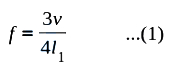
For an organ pipe closed at one end,the frequency of the $n$-th overtone is given by $f = \frac{(2n+1)v}{4l_1}$,where $n$ is the overtone number. For the first overtone $(n=1)$,the frequency is $f = \frac{3v}{4l_1}$.
For an organ pipe open at both ends,the frequency of the $n$-th overtone is given by $f = \frac{(n+1)v}{2l_2}$. For the third overtone $(n=3)$,the frequency is $f = \frac{(3+1)v}{2l_2} = \frac{4v}{2l_2} = \frac{2v}{l_2}$.
Equating the frequencies: $\frac{3v}{4l_1} = \frac{2v}{l_2}$.
Rearranging to find the ratio $\frac{l_1}{l_2}$: $\frac{l_1}{l_2} = \frac{3v}{4l_1} \cdot \frac{l_2}{2v} = \frac{3}{8}$.
For an organ pipe closed at one end,the frequency of the $n$-th overtone is given by $f = \frac{(2n+1)v}{4l_1}$,where $n$ is the overtone number. For the first overtone $(n=1)$,the frequency is $f = \frac{3v}{4l_1}$.
For an organ pipe open at both ends,the frequency of the $n$-th overtone is given by $f = \frac{(n+1)v}{2l_2}$. For the third overtone $(n=3)$,the frequency is $f = \frac{(3+1)v}{2l_2} = \frac{4v}{2l_2} = \frac{2v}{l_2}$.
Equating the frequencies: $\frac{3v}{4l_1} = \frac{2v}{l_2}$.
Rearranging to find the ratio $\frac{l_1}{l_2}$: $\frac{l_1}{l_2} = \frac{3v}{4l_1} \cdot \frac{l_2}{2v} = \frac{3}{8}$.
0 likes
View Solution252
MediumMCQ
On closing an open organ pipe from one end, it is noticed that the frequency of the third harmonic is $50 \,Hz$ more than the fundamental frequency of vibration in the open organ pipe. The fundamental frequency of the open organ pipe is (in $\,Hz$)
A
$100$
B
$50$
C
$250$
D
$200$
Solution
(A) The frequency of the $m^{\text{th}}$ harmonic in an open organ pipe is given by $f_m = \frac{m v}{2 L}$.
For the fundamental frequency $(m=1)$, $f_1 = \frac{v}{2 L}$.
The frequency of the $n^{\text{th}}$ harmonic in a closed organ pipe is given by $f_n^{\prime} = \frac{n v}{4 L}$, where $n$ must be an odd integer.
The frequency of the $3^{\text{rd}}$ harmonic in a closed organ pipe is $f_3^{\prime} = \frac{3 v}{4 L}$.
According to the problem, $f_3^{\prime} - f_1 = 50 \,Hz$.
Substituting the expressions: $\frac{3 v}{4 L} - \frac{v}{2 L} = 50$.
$\frac{3 v - 2 v}{4 L} = 50 \Rightarrow \frac{v}{4 L} = 50 \Rightarrow \frac{v}{L} = 200$.
The fundamental frequency of the open organ pipe is $f_1 = \frac{v}{2 L} = \frac{200}{2} = 100 \,Hz$.
For the fundamental frequency $(m=1)$, $f_1 = \frac{v}{2 L}$.
The frequency of the $n^{\text{th}}$ harmonic in a closed organ pipe is given by $f_n^{\prime} = \frac{n v}{4 L}$, where $n$ must be an odd integer.
The frequency of the $3^{\text{rd}}$ harmonic in a closed organ pipe is $f_3^{\prime} = \frac{3 v}{4 L}$.
According to the problem, $f_3^{\prime} - f_1 = 50 \,Hz$.
Substituting the expressions: $\frac{3 v}{4 L} - \frac{v}{2 L} = 50$.
$\frac{3 v - 2 v}{4 L} = 50 \Rightarrow \frac{v}{4 L} = 50 \Rightarrow \frac{v}{L} = 200$.
The fundamental frequency of the open organ pipe is $f_1 = \frac{v}{2 L} = \frac{200}{2} = 100 \,Hz$.
0 likes
View Solution253
DifficultMCQ
In a resonance tube experiment,the first and second resonance are heard when the water level is $24.1 \ cm$ and $74.1 \ cm$ respectively,below the open end of the tube. The inner diameter of the tube is (in $cm$)
A
$3$
B
$2$
C
$5$
D
$4$
Solution
(A) Let the end correction be $e$. The resonance condition for a tube closed at one end is given by $l_n + e = (2n-1) \frac{\lambda}{4}$.
For the first resonance $(n=1)$: $24.1 + e = \frac{\lambda}{4} \quad ---(1)$
For the second resonance $(n=2)$: $74.1 + e = \frac{3\lambda}{4} \quad ---(2)$
Subtracting equation $(1)$ from equation $(2)$:
$(74.1 + e) - (24.1 + e) = \frac{3\lambda}{4} - \frac{\lambda}{4}$
$50 = \frac{2\lambda}{4} = \frac{\lambda}{2}$
$\lambda = 100 \ cm$
Substituting $\lambda$ in equation $(1)$:
$24.1 + e = \frac{100}{4} = 25$
$e = 25 - 24.1 = 0.9 \ cm$
The end correction $e$ is related to the diameter $D$ by the formula $e = 0.3D$.
$0.9 = 0.3D$
$D = \frac{0.9}{0.3} = 3 \ cm$.
For the first resonance $(n=1)$: $24.1 + e = \frac{\lambda}{4} \quad ---(1)$
For the second resonance $(n=2)$: $74.1 + e = \frac{3\lambda}{4} \quad ---(2)$
Subtracting equation $(1)$ from equation $(2)$:
$(74.1 + e) - (24.1 + e) = \frac{3\lambda}{4} - \frac{\lambda}{4}$
$50 = \frac{2\lambda}{4} = \frac{\lambda}{2}$
$\lambda = 100 \ cm$
Substituting $\lambda$ in equation $(1)$:
$24.1 + e = \frac{100}{4} = 25$
$e = 25 - 24.1 = 0.9 \ cm$
The end correction $e$ is related to the diameter $D$ by the formula $e = 0.3D$.
$0.9 = 0.3D$
$D = \frac{0.9}{0.3} = 3 \ cm$.
0 likes
View Solution254
MediumMCQ
An air column in a pipe,which is closed at one end,will be in resonance with a vibrating tuning fork of frequency $264 \,Hz$ for various lengths. Which one of the following lengths is not possible (in $\,cm$)? $(V=330 \,m/s)$
A
$62.50$
B
$93.75$
C
$156.25$
D
$31.25$
Solution
(A) The frequency of the tuning fork is $n = 264 \,Hz$ and the speed of sound is $V = 330 \,m/s$.
For a pipe closed at one end,the resonance occurs at lengths given by $\ell = (2k-1) \frac{\lambda}{4}$,where $k = 1, 2, 3, \dots$.
The wavelength is $\lambda = \frac{V}{n} = \frac{330}{264} = 1.25 \,m = 125 \,cm$.
Thus,the possible lengths are $\ell = (2k-1) \frac{125}{4} = (2k-1) \times 31.25 \,cm$.
For $k=1$,$\ell = 31.25 \,cm$.
For $k=2$,$\ell = 3 \times 31.25 = 93.75 \,cm$.
For $k=3$,$\ell = 5 \times 31.25 = 156.25 \,cm$.
Comparing these with the given options,$62.50 \,cm$ is not an odd multiple of $31.25 \,cm$,hence it is not possible.
For a pipe closed at one end,the resonance occurs at lengths given by $\ell = (2k-1) \frac{\lambda}{4}$,where $k = 1, 2, 3, \dots$.
The wavelength is $\lambda = \frac{V}{n} = \frac{330}{264} = 1.25 \,m = 125 \,cm$.
Thus,the possible lengths are $\ell = (2k-1) \frac{125}{4} = (2k-1) \times 31.25 \,cm$.
For $k=1$,$\ell = 31.25 \,cm$.
For $k=2$,$\ell = 3 \times 31.25 = 93.75 \,cm$.
For $k=3$,$\ell = 5 \times 31.25 = 156.25 \,cm$.
Comparing these with the given options,$62.50 \,cm$ is not an odd multiple of $31.25 \,cm$,hence it is not possible.
0 likes
View Solution255
MediumMCQ
Two consecutive harmonics of an air column in a pipe closed at one end are of frequencies $150 \,Hz$ and $250 \,Hz$. The fundamental frequency of the air column is: (in $\,Hz$)
A
$25$
B
$75$
C
$100$
D
$50$
Solution
(D) In a pipe closed at one end, the allowed frequencies are odd multiples of the fundamental frequency $(f_0)$: $f_n = (2n-1)f_0$, where $n = 1, 2, 3, ...$.
These frequencies are $f_1 = f_0$, $f_2 = 3f_0$, $f_3 = 5f_0$, $f_4 = 7f_0$, and so on.
The difference between two consecutive harmonics in a closed pipe is $2f_0$.
Given the consecutive frequencies are $150 \,Hz$ and $250 \,Hz$, their difference is $250 \,Hz - 150 \,Hz = 100 \,Hz$.
Therefore, $2f_0 = 100 \,Hz$, which gives $f_0 = 50 \,Hz$.
These frequencies are $f_1 = f_0$, $f_2 = 3f_0$, $f_3 = 5f_0$, $f_4 = 7f_0$, and so on.
The difference between two consecutive harmonics in a closed pipe is $2f_0$.
Given the consecutive frequencies are $150 \,Hz$ and $250 \,Hz$, their difference is $250 \,Hz - 150 \,Hz = 100 \,Hz$.
Therefore, $2f_0 = 100 \,Hz$, which gives $f_0 = 50 \,Hz$.
0 likes
View Solution256
MediumMCQ
In fundamental mode,the time required for the sound wave to reach up to the closed end of a pipe filled with air is $t$ seconds. The frequency of vibration of the air column is
A
$\frac{1}{t}$
B
$\frac{2}{t}$
C
$\frac{3}{t}$
D
$\frac{0.25}{t}$
Solution
(D) In the fundamental mode of a closed pipe,the length of the air column $L$ is equal to $\frac{\lambda}{4}$.
Given that the time taken for the sound wave to travel the length $L$ is $t$.
Since the wave travels a distance $L = \frac{\lambda}{4}$ in time $t$,the time taken to travel a full wavelength $\lambda$ is $T = 4t$.
Here,$T$ represents the time period of the vibration.
The frequency of vibration $n$ is the reciprocal of the time period,given by $n = \frac{1}{T}$.
Substituting $T = 4t$,we get $n = \frac{1}{4t} = \frac{0.25}{t}$.
Given that the time taken for the sound wave to travel the length $L$ is $t$.
Since the wave travels a distance $L = \frac{\lambda}{4}$ in time $t$,the time taken to travel a full wavelength $\lambda$ is $T = 4t$.
Here,$T$ represents the time period of the vibration.
The frequency of vibration $n$ is the reciprocal of the time period,given by $n = \frac{1}{T}$.
Substituting $T = 4t$,we get $n = \frac{1}{4t} = \frac{0.25}{t}$.
0 likes
View Solution257
DifficultMCQ
$A$ closed organ pipe of length $L_c$ and an open organ pipe of length $L_o$ contain different gases of densities $\rho_1$ and $\rho_2$ respectively. The compressibility of the gases is the same in both the pipes. The gases are vibrating in their first overtone with the same frequency. What is the length of the open organ pipe?
A
$\frac{4 L_c}{3} \sqrt{\frac{\rho_1}{\rho_2}}$
B
$\frac{3 L_c}{4} \sqrt{\frac{\rho_2}{\rho_1}}$
C
$\frac{4 L_c}{3} \sqrt{\frac{\rho_2}{\rho_1}}$
D
$\frac{2 L_c}{3} \sqrt{\frac{\rho_2}{\rho_1}}$
Solution
(A) For an open organ pipe,the fundamental frequency is $f_o = \frac{v_2}{2 L_o}$. The first overtone is $f_{o1} = 2 f_o = \frac{v_2}{L_o}$.
For a closed organ pipe,the fundamental frequency is $f_c = \frac{v_1}{4 L_c}$. The first overtone is $f_{c1} = 3 f_c = \frac{3 v_1}{4 L_c}$.
Given that the frequencies are equal,$f_{o1} = f_{c1}$,so $\frac{v_2}{L_o} = \frac{3 v_1}{4 L_c}$.
Rearranging for $L_o$,we get $L_o = \frac{4 L_c}{3} \frac{v_2}{v_1}$.
The speed of sound in a gas is given by $v = \sqrt{\frac{1}{\rho \beta}}$,where $\beta$ is the compressibility. Since $\beta$ is the same for both gases,$\frac{v_2}{v_1} = \sqrt{\frac{\rho_1}{\rho_2}}$.
Substituting this into the expression for $L_o$,we get $L_o = \frac{4 L_c}{3} \sqrt{\frac{\rho_1}{\rho_2}}$.
For a closed organ pipe,the fundamental frequency is $f_c = \frac{v_1}{4 L_c}$. The first overtone is $f_{c1} = 3 f_c = \frac{3 v_1}{4 L_c}$.
Given that the frequencies are equal,$f_{o1} = f_{c1}$,so $\frac{v_2}{L_o} = \frac{3 v_1}{4 L_c}$.
Rearranging for $L_o$,we get $L_o = \frac{4 L_c}{3} \frac{v_2}{v_1}$.
The speed of sound in a gas is given by $v = \sqrt{\frac{1}{\rho \beta}}$,where $\beta$ is the compressibility. Since $\beta$ is the same for both gases,$\frac{v_2}{v_1} = \sqrt{\frac{\rho_1}{\rho_2}}$.
Substituting this into the expression for $L_o$,we get $L_o = \frac{4 L_c}{3} \sqrt{\frac{\rho_1}{\rho_2}}$.
0 likes
View Solution258
EasyMCQ
$A$ pipe open at both ends of length $1.5 \,m$ is dipped in water such that the second overtone of the vibrating air column resonates with a tuning fork of frequency $330 \,Hz$. If the speed of sound in air is $330 \,m/s$, then the length of the pipe immersed in water is (Neglect end correction). (in $\,m$)
A
$0.35$
B
$0.25$
C
$0.55$
D
$0.45$
Solution
(B) Let $L = 1.5 \,m$ be the total length of the pipe and $\ell$ be the length immersed in water. The length of the air column above the water is $L' = L - \ell = 1.5 - \ell$.
Since the pipe is now closed at one end (by water), it acts as a closed organ pipe.
The frequency of the $n^{th}$ overtone for a closed pipe is given by $f_n = \frac{(2n+1)v}{4L'}$, where $n$ is the overtone number.
For the second overtone, $n = 2$, so the frequency is $f_2 = \frac{(2(2)+1)v}{4L'} = \frac{5v}{4L'}$.
Given $f_2 = 330 \,Hz$ and $v = 330 \,m/s$, we have:
$330 = \frac{5 \times 330}{4(1.5 - \ell)}$
$1 = \frac{5}{4(1.5 - \ell)}$
$4(1.5 - \ell) = 5$
$6 - 4\ell = 5$
$4\ell = 1$
$\ell = 0.25 \,m$.
Since the pipe is now closed at one end (by water), it acts as a closed organ pipe.
The frequency of the $n^{th}$ overtone for a closed pipe is given by $f_n = \frac{(2n+1)v}{4L'}$, where $n$ is the overtone number.
For the second overtone, $n = 2$, so the frequency is $f_2 = \frac{(2(2)+1)v}{4L'} = \frac{5v}{4L'}$.
Given $f_2 = 330 \,Hz$ and $v = 330 \,m/s$, we have:
$330 = \frac{5 \times 330}{4(1.5 - \ell)}$
$1 = \frac{5}{4(1.5 - \ell)}$
$4(1.5 - \ell) = 5$
$6 - 4\ell = 5$
$4\ell = 1$
$\ell = 0.25 \,m$.
0 likes
View Solution259
DifficultMCQ
$A$ glass tube of $1 \,m$ length is filled with water. The water can be drained out slowly from the bottom of the tube. If a vibrating tuning fork of frequency $500 \,Hz$ is brought at the upper end of the tube, then the total number of resonances obtained are [Velocity of sound in air is $320 \,m/s$].
A
$3$
B
$4$
C
$1$
D
$2$
Solution
(A) The frequency of the tuning fork is $f = 500 \,Hz$ and the velocity of sound is $v = 320 \,m/s$.
The wavelength of the sound wave is $\lambda = \frac{v}{f} = \frac{320}{500} = 0.64 \,m = 64 \,cm$.
For a tube closed at one end, resonance occurs when the length of the air column $L$ satisfies $L = \frac{(2n-1)\lambda}{4}$, where $n = 1, 2, 3, \dots$.
The possible lengths for resonance are:
For $n=1: L_1 = \frac{\lambda}{4} = \frac{64}{4} = 16 \,cm$.
For $n=2: L_2 = \frac{3\lambda}{4} = 3 \times 16 = 48 \,cm$.
For $n=3: L_3 = \frac{5\lambda}{4} = 5 \times 16 = 80 \,cm$.
For $n=4: L_4 = \frac{7\lambda}{4} = 7 \times 16 = 112 \,cm$.
Since the total length of the tube is $1 \,m = 100 \,cm$, only lengths $16 \,cm, 48 \,cm,$ and $80 \,cm$ are possible.
Therefore, the total number of resonances obtained is $3$.
The wavelength of the sound wave is $\lambda = \frac{v}{f} = \frac{320}{500} = 0.64 \,m = 64 \,cm$.
For a tube closed at one end, resonance occurs when the length of the air column $L$ satisfies $L = \frac{(2n-1)\lambda}{4}$, where $n = 1, 2, 3, \dots$.
The possible lengths for resonance are:
For $n=1: L_1 = \frac{\lambda}{4} = \frac{64}{4} = 16 \,cm$.
For $n=2: L_2 = \frac{3\lambda}{4} = 3 \times 16 = 48 \,cm$.
For $n=3: L_3 = \frac{5\lambda}{4} = 5 \times 16 = 80 \,cm$.
For $n=4: L_4 = \frac{7\lambda}{4} = 7 \times 16 = 112 \,cm$.
Since the total length of the tube is $1 \,m = 100 \,cm$, only lengths $16 \,cm, 48 \,cm,$ and $80 \,cm$ are possible.
Therefore, the total number of resonances obtained is $3$.
0 likes
View Solution260
MediumMCQ
$A$ tuning fork of frequency $n$ is held near the open end of a tube which is closed at the other end,and the length is adjusted until resonance occurs. The first resonance occurs at length $L_1$ and the immediate next resonance occurs at length $L_2$. The speed of sound in air is
A
$n(L_2 - L_1)$
B
$\frac{n(L_2 - L_1)}{2}$
C
$2n(L_2 - L_1)$
D
$\frac{n(L_2 + L_1)}{2}$
Solution
(C) For a tube closed at one end,the resonance lengths are given by $L = \frac{(2k-1)\lambda}{4}$,where $k = 1, 2, 3, \dots$
The first resonance occurs at $L_1 = \frac{\lambda}{4}$.
The second resonance occurs at $L_2 = \frac{3\lambda}{4}$.
Subtracting the two lengths: $L_2 - L_1 = \frac{3\lambda}{4} - \frac{\lambda}{4} = \frac{2\lambda}{4} = \frac{\lambda}{2}$.
Therefore,the wavelength is $\lambda = 2(L_2 - L_1)$.
The speed of sound $V$ is given by the formula $V = n\lambda$.
Substituting the value of $\lambda$: $V = n \times 2(L_2 - L_1) = 2n(L_2 - L_1)$.
The first resonance occurs at $L_1 = \frac{\lambda}{4}$.
The second resonance occurs at $L_2 = \frac{3\lambda}{4}$.
Subtracting the two lengths: $L_2 - L_1 = \frac{3\lambda}{4} - \frac{\lambda}{4} = \frac{2\lambda}{4} = \frac{\lambda}{2}$.
Therefore,the wavelength is $\lambda = 2(L_2 - L_1)$.
The speed of sound $V$ is given by the formula $V = n\lambda$.
Substituting the value of $\lambda$: $V = n \times 2(L_2 - L_1) = 2n(L_2 - L_1)$.
0 likes
View Solution261
MediumMCQ
When an air column in a pipe open at both ends vibrates such that four antinodes and three nodes are formed,then the corresponding mode of vibration is
A
first overtone
B
second overtone
C
fourth overtone
D
third overtone
Solution
(B) In an open pipe of length $L$,the condition for standing waves is $L = n \frac{\lambda}{2}$,where $n$ is the number of loops (or harmonics).
For a pipe open at both ends,antinodes are always formed at the open ends.
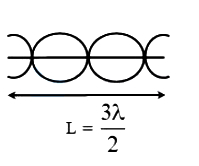
If there are $4$ antinodes and $3$ nodes,the number of loops formed is $n = 3$.
The length of the pipe is $L = 3 \frac{\lambda}{2}$.
This corresponds to the $3^{rd}$ harmonic.
The sequence of harmonics for an open pipe is $f_1, 2f_1, 3f_1, \dots$ (fundamental,$1^{st}$ overtone,$2^{nd}$ overtone,$\dots$).
Since $3f_1$ is the $3^{rd}$ harmonic,it is the $2^{nd}$ overtone.
For a pipe open at both ends,antinodes are always formed at the open ends.
If there are $4$ antinodes and $3$ nodes,the number of loops formed is $n = 3$.
The length of the pipe is $L = 3 \frac{\lambda}{2}$.
This corresponds to the $3^{rd}$ harmonic.
The sequence of harmonics for an open pipe is $f_1, 2f_1, 3f_1, \dots$ (fundamental,$1^{st}$ overtone,$2^{nd}$ overtone,$\dots$).
Since $3f_1$ is the $3^{rd}$ harmonic,it is the $2^{nd}$ overtone.
0 likes
View Solution262
EasyMCQ
The fundamental frequency of an air column in pipe '$A$' closed at one end coincides with the second overtone of pipe '$B$' open at both ends. The ratio of the length of pipe '$A$' to that of pipe '$B$' is
A
$3: 8$
B
$3: 4$
C
$1: 6$
D
$2: 3$
Solution
(C) The fundamental frequency of a pipe closed at one end is given by $n = \frac{v}{4 \ell_A}$,where $v$ is the speed of sound and $\ell_A$ is the length of pipe '$A$'.
The frequencies of an open pipe are given by $n_k = \frac{k v}{2 \ell_B}$,where $k = 1, 2, 3, \dots$ and $\ell_B$ is the length of pipe '$B$'.
The first overtone corresponds to $k=2$,and the second overtone corresponds to $k=3$.
Thus,the second overtone of the open pipe is $n' = \frac{3 v}{2 \ell_B}$.
According to the problem,$n = n'$,so $\frac{v}{4 \ell_A} = \frac{3 v}{2 \ell_B}$.
Simplifying this,we get $\frac{1}{4 \ell_A} = \frac{3}{2 \ell_B}$,which implies $\frac{\ell_A}{\ell_B} = \frac{2}{4 \times 3} = \frac{2}{12} = \frac{1}{6}$.
Therefore,the ratio of the length of pipe '$A$' to that of pipe '$B$' is $1: 6$.
The frequencies of an open pipe are given by $n_k = \frac{k v}{2 \ell_B}$,where $k = 1, 2, 3, \dots$ and $\ell_B$ is the length of pipe '$B$'.
The first overtone corresponds to $k=2$,and the second overtone corresponds to $k=3$.
Thus,the second overtone of the open pipe is $n' = \frac{3 v}{2 \ell_B}$.
According to the problem,$n = n'$,so $\frac{v}{4 \ell_A} = \frac{3 v}{2 \ell_B}$.
Simplifying this,we get $\frac{1}{4 \ell_A} = \frac{3}{2 \ell_B}$,which implies $\frac{\ell_A}{\ell_B} = \frac{2}{4 \times 3} = \frac{2}{12} = \frac{1}{6}$.
Therefore,the ratio of the length of pipe '$A$' to that of pipe '$B$' is $1: 6$.
0 likes
View Solution263
DifficultMCQ
$A$ cylindrical tube open at both ends has a fundamental frequency '$n$' in air. The tube is dipped vertically in water so that one-fourth of it is in water. The fundamental frequency of the air column becomes
A
$\frac{3n}{4}$
B
$\frac{n}{2}$
C
$n$
D
$\frac{2n}{3}$
Solution
(D) The fundamental frequency of an open tube of length $\ell_1$ is given by $n_1 = \frac{v}{2\ell_1} = n$.
When the tube is dipped vertically in water such that one-fourth of its length is submerged, the length of the air column becomes $\ell_2 = \ell_1 - \frac{1}{4}\ell_1 = \frac{3}{4}\ell_1$.
Since the tube is now closed at one end by the water surface, it acts as a closed organ pipe.
The fundamental frequency of a closed organ pipe is $n_2 = \frac{v}{4\ell_2}$.
Substituting $\ell_2 = \frac{3}{4}\ell_1$ into the equation:
$n_2 = \frac{v}{4(\frac{3}{4}\ell_1)} = \frac{v}{3\ell_1}$.
Comparing $n_2$ with $n_1$:
$n_2 = \frac{2}{3} \times (\frac{v}{2\ell_1}) = \frac{2}{3}n$.
When the tube is dipped vertically in water such that one-fourth of its length is submerged, the length of the air column becomes $\ell_2 = \ell_1 - \frac{1}{4}\ell_1 = \frac{3}{4}\ell_1$.
Since the tube is now closed at one end by the water surface, it acts as a closed organ pipe.
The fundamental frequency of a closed organ pipe is $n_2 = \frac{v}{4\ell_2}$.
Substituting $\ell_2 = \frac{3}{4}\ell_1$ into the equation:
$n_2 = \frac{v}{4(\frac{3}{4}\ell_1)} = \frac{v}{3\ell_1}$.
Comparing $n_2$ with $n_1$:
$n_2 = \frac{2}{3} \times (\frac{v}{2\ell_1}) = \frac{2}{3}n$.
0 likes
View Solution264
DifficultMCQ
$A$ closed organ pipe and an open organ pipe of the same length produce $2$ beats per second when they are set into vibrations together in their fundamental mode. The length of the open pipe is now halved and that of the closed pipe is doubled. The number of beats produced per second will be:
A
$4$
B
$3$
C
$8$
D
$7$
Solution
(D) Fundamental frequency of a closed pipe is $n_{c} = \frac{v}{4L}$.
Fundamental frequency of an open pipe is $n_{o} = \frac{v}{2L}$.
Given that they produce $2$ beats per second:
$n_{o} - n_{c} = 2$
$\frac{v}{2L} - \frac{v}{4L} = 2$
$\frac{v}{4L} = 2 \implies \frac{v}{L} = 8$.
When the length of the open pipe is halved,the new frequency is:
$n_{o}' = \frac{v}{2(L/2)} = \frac{v}{L} = 8 \text{ Hz}$.
When the length of the closed pipe is doubled,the new frequency is:
$n_{c}' = \frac{v}{4(2L)} = \frac{v}{8L} = \frac{1}{8} \times \left(\frac{v}{L}\right) = \frac{1}{8} \times 8 = 1 \text{ Hz}$.
New beat frequency $= n_{o}' - n_{c}' = 8 - 1 = 7 \text{ beats per second}$.
Fundamental frequency of an open pipe is $n_{o} = \frac{v}{2L}$.
Given that they produce $2$ beats per second:
$n_{o} - n_{c} = 2$
$\frac{v}{2L} - \frac{v}{4L} = 2$
$\frac{v}{4L} = 2 \implies \frac{v}{L} = 8$.
When the length of the open pipe is halved,the new frequency is:
$n_{o}' = \frac{v}{2(L/2)} = \frac{v}{L} = 8 \text{ Hz}$.
When the length of the closed pipe is doubled,the new frequency is:
$n_{c}' = \frac{v}{4(2L)} = \frac{v}{8L} = \frac{1}{8} \times \left(\frac{v}{L}\right) = \frac{1}{8} \times 8 = 1 \text{ Hz}$.
New beat frequency $= n_{o}' - n_{c}' = 8 - 1 = 7 \text{ beats per second}$.
0 likes
View Solution265
MediumMCQ
$A$ pipe open at both ends has a length of $1 \,m$. The air column in the pipe cannot resonate for which of the following frequencies (in $\,Hz$)? (Neglect end correction, speed of sound in air $= 340 \,m/s$)
A
$510$
B
$85$
C
$170$
D
$340$
Solution
(B) For a pipe open at both ends, the resonant frequencies are given by the formula: $f_n = \frac{n v}{2L}$, where $n = 1, 2, 3, \dots$ is the harmonic number, $v$ is the speed of sound, and $L$ is the length of the pipe.
Given: $v = 340 \,m/s$ and $L = 1 \,m$.
Substituting these values, we get: $f_n = \frac{n \times 340}{2 \times 1} = n \times 170 \,Hz$.
This means the pipe can resonate at frequencies that are integer multiples of $170 \,Hz$ (i.e., $170 \,Hz, 340 \,Hz, 510 \,Hz, \dots$).
Comparing this with the given options, $85 \,Hz$ is not a multiple of $170 \,Hz$ and therefore the air column cannot resonate at this frequency.
Given: $v = 340 \,m/s$ and $L = 1 \,m$.
Substituting these values, we get: $f_n = \frac{n \times 340}{2 \times 1} = n \times 170 \,Hz$.
This means the pipe can resonate at frequencies that are integer multiples of $170 \,Hz$ (i.e., $170 \,Hz, 340 \,Hz, 510 \,Hz, \dots$).
Comparing this with the given options, $85 \,Hz$ is not a multiple of $170 \,Hz$ and therefore the air column cannot resonate at this frequency.
0 likes
View Solution266
EasyMCQ
$A$ closed organ pipe and an open organ pipe have their first overtones identical in frequency. Their lengths are in the ratio
A
$3: 4$
B
$2: 3$
C
$4: 5$
D
$1: 2$
Solution
(A) The frequency of the first overtone of a closed organ pipe of length $\ell$ is given by $f = \frac{3V}{4\ell}$.
The frequency of the first overtone of an open organ pipe of length $\ell^{\prime}$ is given by $f^{\prime} = \frac{2V}{2\ell^{\prime}} = \frac{V}{\ell^{\prime}}$.
Given that the frequencies are identical,we set $f = f^{\prime}$:
$\frac{3V}{4\ell} = \frac{V}{\ell^{\prime}}$.
Rearranging the terms to find the ratio of lengths $\frac{\ell}{\ell^{\prime}}$:
$\frac{\ell}{\ell^{\prime}} = \frac{3}{4}$.
Thus,the ratio of their lengths is $3: 4$.
The frequency of the first overtone of an open organ pipe of length $\ell^{\prime}$ is given by $f^{\prime} = \frac{2V}{2\ell^{\prime}} = \frac{V}{\ell^{\prime}}$.
Given that the frequencies are identical,we set $f = f^{\prime}$:
$\frac{3V}{4\ell} = \frac{V}{\ell^{\prime}}$.
Rearranging the terms to find the ratio of lengths $\frac{\ell}{\ell^{\prime}}$:
$\frac{\ell}{\ell^{\prime}} = \frac{3}{4}$.
Thus,the ratio of their lengths is $3: 4$.
0 likes
View Solution267
MediumMCQ
Two open organ pipes of fundamental frequencies $n_{1}$ and $n_{2}$ are joined in series. The fundamental frequency of the new pipe is
A
$n_{1}-n_{2}$
B
$\frac{n_{1} n_{2}}{n_{1}+n_{2}}$
C
$\frac{1}{n_{1} n_{2}}$
D
$\frac{n_{1}+n_{2}}{n_{1} n_{2}}$
Solution
(B) For an open organ pipe,the fundamental frequency is given by $n = \frac{V}{2\ell}$,where $V$ is the speed of sound and $\ell$ is the length of the pipe.
For the first pipe: $\ell_{1} = \frac{V}{2n_{1}}$.
For the second pipe: $\ell_{2} = \frac{V}{2n_{2}}$.
When joined in series,the total length of the new pipe is $\ell = \ell_{1} + \ell_{2}$.
The fundamental frequency of the new pipe is $n = \frac{V}{2\ell}$.
Substituting the values of $\ell_{1}$ and $\ell_{2}$ into the equation for $\ell$:
$\frac{V}{2n} = \frac{V}{2n_{1}} + \frac{V}{2n_{2}}$.
Dividing both sides by $\frac{V}{2}$,we get: $\frac{1}{n} = \frac{1}{n_{1}} + \frac{1}{n_{2}}$.
Solving for $n$: $\frac{1}{n} = \frac{n_{1} + n_{2}}{n_{1}n_{2}}$,which gives $n = \frac{n_{1}n_{2}}{n_{1} + n_{2}}$.
For the first pipe: $\ell_{1} = \frac{V}{2n_{1}}$.
For the second pipe: $\ell_{2} = \frac{V}{2n_{2}}$.
When joined in series,the total length of the new pipe is $\ell = \ell_{1} + \ell_{2}$.
The fundamental frequency of the new pipe is $n = \frac{V}{2\ell}$.
Substituting the values of $\ell_{1}$ and $\ell_{2}$ into the equation for $\ell$:
$\frac{V}{2n} = \frac{V}{2n_{1}} + \frac{V}{2n_{2}}$.
Dividing both sides by $\frac{V}{2}$,we get: $\frac{1}{n} = \frac{1}{n_{1}} + \frac{1}{n_{2}}$.
Solving for $n$: $\frac{1}{n} = \frac{n_{1} + n_{2}}{n_{1}n_{2}}$,which gives $n = \frac{n_{1}n_{2}}{n_{1} + n_{2}}$.
0 likes
View Solution268
EasyMCQ
The air column in an organ pipe closed at one end is made to vibrate so that there are $2$ nodes and $2$ antinodes each. The mode of vibration is called:
A
$3^{rd}$ overtone
B
$1^{st}$ overtone
C
fundamental
D
$2^{nd}$ overtone
Solution
(B) In an organ pipe closed at one end,the standing wave pattern always has a node at the closed end and an antinode at the open end.
For the fundamental mode,there is $1$ node and $1$ antinode.
For the first overtone,there are $2$ nodes and $2$ antinodes.
Since the question specifies $2$ nodes and $2$ antinodes,this corresponds to the first overtone.
For the fundamental mode,there is $1$ node and $1$ antinode.
For the first overtone,there are $2$ nodes and $2$ antinodes.
Since the question specifies $2$ nodes and $2$ antinodes,this corresponds to the first overtone.
0 likes
View Solution269
MediumMCQ
In the fundamental mode,the time required for a sound wave to reach the closed end of an air-filled pipe is $t$ seconds. What is the frequency of vibration of the air column?
A
$\frac{1}{3 t}$
B
$\frac{1}{t}$
C
$\frac{1}{4 t}$
D
$\frac{1}{2 t}$
Solution
(C) In the fundamental mode of a closed pipe,the length of the pipe $L$ corresponds to one-fourth of the wavelength,i.e.,$L = \frac{\lambda}{4}$.
Given that the time taken for the sound wave to travel the length $L$ is $t$,we have $t = \frac{L}{v}$,where $v$ is the speed of sound.
Since $L = \frac{\lambda}{4}$,we can write $t = \frac{\lambda}{4v}$.
The time period $T$ of the wave is given by $T = \frac{\lambda}{v}$.
Substituting $\lambda = vT$ into the expression for $t$,we get $t = \frac{vT}{4v} = \frac{T}{4}$.
Therefore,the time period $T = 4t$.
The frequency $f$ is the reciprocal of the time period,so $f = \frac{1}{T} = \frac{1}{4t}$.
Given that the time taken for the sound wave to travel the length $L$ is $t$,we have $t = \frac{L}{v}$,where $v$ is the speed of sound.
Since $L = \frac{\lambda}{4}$,we can write $t = \frac{\lambda}{4v}$.
The time period $T$ of the wave is given by $T = \frac{\lambda}{v}$.
Substituting $\lambda = vT$ into the expression for $t$,we get $t = \frac{vT}{4v} = \frac{T}{4}$.
Therefore,the time period $T = 4t$.
The frequency $f$ is the reciprocal of the time period,so $f = \frac{1}{T} = \frac{1}{4t}$.
0 likes
View Solution270
MediumMCQ
$A$ resonance tube completely filled with water has a small hole at the bottom. Length of the tube is $0.8 \ m$. $A$ vibrating tuning fork of frequency $500 \ Hz$ is held near the open end of the tube. Water is slowly removed from the bottom. The maximum number of resonances heard will be (Neglect end correction. Speed of sound in air $= 340 \ m/s$).
A
$5$
B
$4$
C
$2$
D
$3$
Solution
(C) Given: Length of the tube $L = 0.8 \ m$,Frequency $f = 500 \ Hz$,Speed of sound $v = 340 \ m/s$.
First,calculate the wavelength $\lambda$ of the sound wave:
$\lambda = \frac{v}{f} = \frac{340}{500} = 0.68 \ m$.
The resonance condition for a tube closed at one end is $L_n = \frac{(2n-1)\lambda}{4}$,where $n = 1, 2, 3, \dots$.
We need to find the number of values of $n$ such that $L_n \le 0.8 \ m$.
For $n=1$: $L_1 = \frac{\lambda}{4} = \frac{0.68}{4} = 0.17 \ m$.
For $n=2$: $L_2 = \frac{3\lambda}{4} = 3 \times 0.17 = 0.51 \ m$.
For $n=3$: $L_3 = \frac{5\lambda}{4} = 5 \times 0.17 = 0.85 \ m$.
Since $L_3 = 0.85 \ m > 0.8 \ m$,the third resonance cannot be formed within the tube length.
Therefore,only $2$ resonances will be heard.
First,calculate the wavelength $\lambda$ of the sound wave:
$\lambda = \frac{v}{f} = \frac{340}{500} = 0.68 \ m$.
The resonance condition for a tube closed at one end is $L_n = \frac{(2n-1)\lambda}{4}$,where $n = 1, 2, 3, \dots$.
We need to find the number of values of $n$ such that $L_n \le 0.8 \ m$.
For $n=1$: $L_1 = \frac{\lambda}{4} = \frac{0.68}{4} = 0.17 \ m$.
For $n=2$: $L_2 = \frac{3\lambda}{4} = 3 \times 0.17 = 0.51 \ m$.
For $n=3$: $L_3 = \frac{5\lambda}{4} = 5 \times 0.17 = 0.85 \ m$.
Since $L_3 = 0.85 \ m > 0.8 \ m$,the third resonance cannot be formed within the tube length.
Therefore,only $2$ resonances will be heard.
0 likes
View Solution271
MediumMCQ
The $3^{\text{rd}}$ overtone of a closed organ pipe is in unison with the $3^{\text{rd}}$ overtone of an open pipe. The ratio of the length of the closed pipe to the length of the open pipe is:
A
$\frac{7}{8}$
B
$\frac{4}{3}$
C
$\frac{6}{5}$
D
$\frac{7}{9}$
Solution
(A) For a closed organ pipe of length $L_c$,the frequency of the $n^{\text{th}}$ overtone is given by $f_c = \frac{(2n+1)v}{4L_c}$,where $n$ is the overtone number.
For the $3^{\text{rd}}$ overtone $(n=3)$,$f_c = \frac{(2(3)+1)v}{4L_c} = \frac{7v}{4L_c}$.
For an open organ pipe of length $L_o$,the frequency of the $n^{\text{th}}$ overtone is given by $f_o = \frac{(n+1)v}{2L_o}$.
For the $3^{\text{rd}}$ overtone $(n=3)$,$f_o = \frac{(3+1)v}{2L_o} = \frac{4v}{2L_o} = \frac{2v}{L_o}$.
Since the frequencies are in unison,$f_c = f_o$:
$\frac{7v}{4L_c} = \frac{2v}{L_o}$.
Rearranging for the ratio $\frac{L_c}{L_o}$:
$\frac{L_c}{L_o} = \frac{7}{4 \times 2} = \frac{7}{8}$.
Thus,the correct option is $A$.
For the $3^{\text{rd}}$ overtone $(n=3)$,$f_c = \frac{(2(3)+1)v}{4L_c} = \frac{7v}{4L_c}$.
For an open organ pipe of length $L_o$,the frequency of the $n^{\text{th}}$ overtone is given by $f_o = \frac{(n+1)v}{2L_o}$.
For the $3^{\text{rd}}$ overtone $(n=3)$,$f_o = \frac{(3+1)v}{2L_o} = \frac{4v}{2L_o} = \frac{2v}{L_o}$.
Since the frequencies are in unison,$f_c = f_o$:
$\frac{7v}{4L_c} = \frac{2v}{L_o}$.
Rearranging for the ratio $\frac{L_c}{L_o}$:
$\frac{L_c}{L_o} = \frac{7}{4 \times 2} = \frac{7}{8}$.
Thus,the correct option is $A$.
0 likes
View Solution272
MediumMCQ
When an open pipe is closed from one end, the third overtone of the closed pipe is higher in frequency by $150 \,Hz$ than the second overtone of the open pipe. The fundamental frequency of the open pipe will be: (in $\,Hz$)
A
$300$
B
$500$
C
$200$
D
$400$
Solution
(A) Let the length of the pipe be $\ell$ and the speed of sound be $v$.
For an open pipe, the fundamental frequency is $f_0 = \frac{v}{2\ell}$. The $2^{nd}$ overtone of an open pipe is $3f_0 = \frac{3v}{2\ell}$.
For a closed pipe, the fundamental frequency is $f_c = \frac{v}{4\ell}$. The $3^{rd}$ overtone of a closed pipe is $7f_c = \frac{7v}{4\ell}$.
According to the problem, the $3^{rd}$ overtone of the closed pipe is $150 \,Hz$ higher than the $2^{nd}$ overtone of the open pipe:
$\frac{7v}{4\ell} = \frac{3v}{2\ell} + 150$
$\frac{7v}{4\ell} - \frac{6v}{4\ell} = 150$
$\frac{v}{4\ell} = 150$
Since the fundamental frequency of the open pipe is $f_0 = \frac{v}{2\ell}$, we can write:
$f_0 = 2 \times \left(\frac{v}{4\ell}\right) = 2 \times 150 = 300 \,Hz$.
For an open pipe, the fundamental frequency is $f_0 = \frac{v}{2\ell}$. The $2^{nd}$ overtone of an open pipe is $3f_0 = \frac{3v}{2\ell}$.
For a closed pipe, the fundamental frequency is $f_c = \frac{v}{4\ell}$. The $3^{rd}$ overtone of a closed pipe is $7f_c = \frac{7v}{4\ell}$.
According to the problem, the $3^{rd}$ overtone of the closed pipe is $150 \,Hz$ higher than the $2^{nd}$ overtone of the open pipe:
$\frac{7v}{4\ell} = \frac{3v}{2\ell} + 150$
$\frac{7v}{4\ell} - \frac{6v}{4\ell} = 150$
$\frac{v}{4\ell} = 150$
Since the fundamental frequency of the open pipe is $f_0 = \frac{v}{2\ell}$, we can write:
$f_0 = 2 \times \left(\frac{v}{4\ell}\right) = 2 \times 150 = 300 \,Hz$.
0 likes
View Solution273
EasyMCQ
An open organ pipe and a closed organ pipe have the frequency of their first overtone identical. The ratio of the length of the open pipe to that of the closed pipe is
A
$3$:$4$
B
$1$:$2$
C
$2$:$1$
D
$4$:$3$
Solution
(D) For a closed organ pipe of length $\ell_c$,the fundamental frequency is $f_c = \frac{V}{4\ell_c}$. The first overtone is the third harmonic,so $f_{c,1} = 3f_c = \frac{3V}{4\ell_c}$.
For an open organ pipe of length $\ell_o$,the fundamental frequency is $f_o = \frac{V}{2\ell_o}$. The first overtone is the second harmonic,so $f_{o,1} = 2f_o = \frac{2V}{2\ell_o} = \frac{V}{\ell_o}$.
Given that the frequencies of the first overtones are identical,we have $\frac{3V}{4\ell_c} = \frac{V}{\ell_o}$.
Rearranging the terms to find the ratio $\frac{\ell_o}{\ell_c}$,we get $\frac{\ell_o}{\ell_c} = \frac{4}{3}$.
For an open organ pipe of length $\ell_o$,the fundamental frequency is $f_o = \frac{V}{2\ell_o}$. The first overtone is the second harmonic,so $f_{o,1} = 2f_o = \frac{2V}{2\ell_o} = \frac{V}{\ell_o}$.
Given that the frequencies of the first overtones are identical,we have $\frac{3V}{4\ell_c} = \frac{V}{\ell_o}$.
Rearranging the terms to find the ratio $\frac{\ell_o}{\ell_c}$,we get $\frac{\ell_o}{\ell_c} = \frac{4}{3}$.
0 likes
View Solution274
EasyMCQ
What should be the length of a closed pipe to produce resonance with a sound wave of wavelength $62 \,cm$,in fundamental mode (in $\,cm$)? [Neglect end correction]
A
$31$
B
$15.5$
C
$20.6$
D
$46.5$
Solution
(B) In a closed pipe,the fundamental mode of vibration occurs when the length of the pipe $\ell$ is equal to one-fourth of the wavelength $\lambda$ of the sound wave.
Formula: $\ell = \frac{\lambda}{4}$
Given: $\lambda = 62 \,cm$
Calculation: $\ell = \frac{62}{4} = 15.5 \,cm$
Therefore,the correct option is $B$.
Formula: $\ell = \frac{\lambda}{4}$
Given: $\lambda = 62 \,cm$
Calculation: $\ell = \frac{62}{4} = 15.5 \,cm$
Therefore,the correct option is $B$.
0 likes
View Solution275
EasyMCQ
The fundamental frequency of a closed pipe is $400 \,Hz$. If $1/3$ of the pipe is filled with water,the frequency of the $2^{\text{nd}}$ harmonic of the pipe will be (Neglect end correction). (in $\,Hz$)
A
$600$
B
$1800$
C
$1200$
D
$300$
Solution
(B) The fundamental frequency of a closed pipe of length $L$ is given by $f_1 = \frac{v}{4L} = 400 \,Hz$.
From this,we get $v = 1600L$.
When $1/3$ of the pipe is filled with water,the length of the air column becomes $L' = L - \frac{L}{3} = \frac{2L}{3}$.
The new fundamental frequency of the air column is $f'_1 = \frac{v}{4L'} = \frac{v}{4(2L/3)} = \frac{3v}{8L}$.
Substituting $v = 1600L$,we get $f'_1 = \frac{3(1600L)}{8L} = 3 \times 200 = 600 \,Hz$.
In a closed pipe,the harmonics are odd multiples of the fundamental frequency $(f_1, 3f_1, 5f_1, \dots)$. However,the question asks for the $2^{\text{nd}}$ harmonic of the pipe in its new state. The $2^{\text{nd}}$ harmonic (first overtone) of a closed pipe is $3f'_1$.
Therefore,the frequency of the $2^{\text{nd}}$ harmonic is $3 \times 600 \,Hz = 1800 \,Hz$.
From this,we get $v = 1600L$.
When $1/3$ of the pipe is filled with water,the length of the air column becomes $L' = L - \frac{L}{3} = \frac{2L}{3}$.
The new fundamental frequency of the air column is $f'_1 = \frac{v}{4L'} = \frac{v}{4(2L/3)} = \frac{3v}{8L}$.
Substituting $v = 1600L$,we get $f'_1 = \frac{3(1600L)}{8L} = 3 \times 200 = 600 \,Hz$.
In a closed pipe,the harmonics are odd multiples of the fundamental frequency $(f_1, 3f_1, 5f_1, \dots)$. However,the question asks for the $2^{\text{nd}}$ harmonic of the pipe in its new state. The $2^{\text{nd}}$ harmonic (first overtone) of a closed pipe is $3f'_1$.
Therefore,the frequency of the $2^{\text{nd}}$ harmonic is $3 \times 600 \,Hz = 1800 \,Hz$.
0 likes
View Solution276
EasyMCQ
In a resonance tube of length $0.8 \,m$, an air column vibrates with a source of frequency $375 \,Hz$ for a certain height of water from the bottom of the tube. What is the water level corresponding to the fundamental frequency (in $\,m$)? (Neglect end correction, speed of sound in air = $330 \,m/s$)
A
$0.45$
B
$0.58$
C
$0.8$
D
$0.65$
Solution
(B) Given: Length of tube $L = 0.8 \,m$, Frequency $f = 375 \,Hz$, Speed of sound $v = 330 \,m/s$.
For the fundamental frequency in a resonance tube (closed at one end), the length of the air column $\ell$ is given by $\ell = \frac{v}{4f}$.
Substituting the values: $\ell = \frac{330}{4 \times 375} = \frac{330}{1500} = 0.22 \,m$.
This $\ell$ represents the length of the air column from the top.
The water level from the bottom is the total length of the tube minus the length of the air column: $h = L - \ell$.
$h = 0.8 \,m - 0.22 \,m = 0.58 \,m$.
For the fundamental frequency in a resonance tube (closed at one end), the length of the air column $\ell$ is given by $\ell = \frac{v}{4f}$.
Substituting the values: $\ell = \frac{330}{4 \times 375} = \frac{330}{1500} = 0.22 \,m$.
This $\ell$ represents the length of the air column from the top.
The water level from the bottom is the total length of the tube minus the length of the air column: $h = L - \ell$.
$h = 0.8 \,m - 0.22 \,m = 0.58 \,m$.
0 likes
View Solution277
EasyMCQ
The fundamental frequency of an open pipe is $n$. If it is closed from one end, then the frequency of the $2^{nd}$ harmonic of the closed pipe is higher by $200 \,Hz$ than $n$. The value of $n$ is: (in $\,Hz$)
A
$800$
B
$200$
C
$100$
D
$400$
Solution
(D) The fundamental frequency of an open pipe is given by $n = \frac{v}{2 \ell}$.
For a closed pipe, the harmonics are odd multiples of the fundamental frequency $n_0 = \frac{v}{4 \ell}$.
The $2^{nd}$ harmonic of a closed pipe is actually the $1^{st}$ overtone, which is the $3^{rd}$ harmonic, given by $3 n_0 = \frac{3v}{4 \ell}$.
According to the problem, the frequency of the $2^{nd}$ harmonic of the closed pipe is $200 \,Hz$ higher than $n$:
$\frac{3v}{4 \ell} - n = 200$
Since $n = \frac{v}{2 \ell}$, we have $\frac{v}{4 \ell} = \frac{n}{2}$.
Substituting this into the equation: $3(\frac{n}{2}) - n = 200$.
$1.5n - n = 200 \implies 0.5n = 200$.
$n = 400 \,Hz$.
For a closed pipe, the harmonics are odd multiples of the fundamental frequency $n_0 = \frac{v}{4 \ell}$.
The $2^{nd}$ harmonic of a closed pipe is actually the $1^{st}$ overtone, which is the $3^{rd}$ harmonic, given by $3 n_0 = \frac{3v}{4 \ell}$.
According to the problem, the frequency of the $2^{nd}$ harmonic of the closed pipe is $200 \,Hz$ higher than $n$:
$\frac{3v}{4 \ell} - n = 200$
Since $n = \frac{v}{2 \ell}$, we have $\frac{v}{4 \ell} = \frac{n}{2}$.
Substituting this into the equation: $3(\frac{n}{2}) - n = 200$.
$1.5n - n = 200 \implies 0.5n = 200$.
$n = 400 \,Hz$.
0 likes
View Solution278
MediumMCQ
$A$ pipe open at both ends and a pipe closed at one end have the same length. The ratio of the frequencies of their $P^{\text{th}}$ overtone is:
A
$\frac{P+1}{2P}$
B
$\frac{P+1}{2P+1}$
C
$\frac{2(P+1)}{2P+1}$
D
$\frac{P}{2P+1}$
Solution
(C) For an open organ pipe of length $L$,the frequency of the $P^{\text{th}}$ overtone is given by $f_{\text{open}} = (P+1) \frac{v}{2L}$.
For a closed organ pipe of the same length $L$,the frequency of the $P^{\text{th}}$ overtone is given by $f_{\text{closed}} = (2P+1) \frac{v}{4L}$.
Taking the ratio of the frequency of the $P^{\text{th}}$ overtone of the open pipe to that of the closed pipe:
Ratio $= \frac{(P+1) \frac{v}{2L}}{(2P+1) \frac{v}{4L}}$.
Ratio $= \frac{P+1}{2L} \times \frac{4L}{2P+1} = \frac{2(P+1)}{2P+1}$.
For a closed organ pipe of the same length $L$,the frequency of the $P^{\text{th}}$ overtone is given by $f_{\text{closed}} = (2P+1) \frac{v}{4L}$.
Taking the ratio of the frequency of the $P^{\text{th}}$ overtone of the open pipe to that of the closed pipe:
Ratio $= \frac{(P+1) \frac{v}{2L}}{(2P+1) \frac{v}{4L}}$.
Ratio $= \frac{P+1}{2L} \times \frac{4L}{2P+1} = \frac{2(P+1)}{2P+1}$.
0 likes
View Solution279
MediumMCQ
In the fundamental mode,the time required for a sound wave to reach the closed end of a pipe filled with air is $t$ seconds. The frequency of vibration of the air column is:
A
$(2t)^{-1}$
B
$4t^{-1}$
C
$2t^{-1}$
D
$(4t)^{-1}$
Solution
(D) For a closed pipe of length $l$,the fundamental frequency is given by $f_0 = \frac{v}{4l}$,where $v$ is the speed of sound.
The time $t$ taken by the sound wave to travel the length of the pipe $l$ is $t = \frac{l}{v}$,which implies $v = \frac{l}{t}$.
Substituting the value of $v$ into the frequency formula:
$f_0 = \frac{l/t}{4l} = \frac{1}{4t}$.
Thus,the frequency of vibration is $(4t)^{-1}$.
The time $t$ taken by the sound wave to travel the length of the pipe $l$ is $t = \frac{l}{v}$,which implies $v = \frac{l}{t}$.
Substituting the value of $v$ into the frequency formula:
$f_0 = \frac{l/t}{4l} = \frac{1}{4t}$.
Thus,the frequency of vibration is $(4t)^{-1}$.
0 likes
View Solution280
DifficultMCQ
Two open pipes of different lengths and of same diameter,in which the air column vibrates with fundamental frequencies '$n_1$' and '$n_2$' respectively. When both pipes are joined to form a single pipe,its fundamental frequency will be:
A
$\frac{n_1+n_2}{n_1 n_2}$
B
$\frac{n_1 n_2}{2 n_2+n_1}$
C
$\frac{2 n_2+n_1}{n_1 n_2}$
D
$\frac{n_1 n_2}{n_1+n_2}$
Solution
(D) For an open pipe,the fundamental frequency is given by $n = \frac{v}{2l}$,where $v$ is the speed of sound and $l$ is the length of the pipe.
For the two pipes,we have $l_1 = \frac{v}{2n_1}$ and $l_2 = \frac{v}{2n_2}$.
When the two pipes are joined,the new length becomes $L = l_1 + l_2$.
The new fundamental frequency $n'$ is given by $n' = \frac{v}{2L} = \frac{v}{2(l_1 + l_2)}$.
Substituting the values of $l_1$ and $l_2$:
$n' = \frac{v}{2(\frac{v}{2n_1} + \frac{v}{2n_2})} = \frac{v}{\frac{v}{n_1} + \frac{v}{n_2}} = \frac{1}{\frac{1}{n_1} + \frac{1}{n_2}} = \frac{n_1 n_2}{n_1 + n_2}$.
For the two pipes,we have $l_1 = \frac{v}{2n_1}$ and $l_2 = \frac{v}{2n_2}$.
When the two pipes are joined,the new length becomes $L = l_1 + l_2$.
The new fundamental frequency $n'$ is given by $n' = \frac{v}{2L} = \frac{v}{2(l_1 + l_2)}$.
Substituting the values of $l_1$ and $l_2$:
$n' = \frac{v}{2(\frac{v}{2n_1} + \frac{v}{2n_2})} = \frac{v}{\frac{v}{n_1} + \frac{v}{n_2}} = \frac{1}{\frac{1}{n_1} + \frac{1}{n_2}} = \frac{n_1 n_2}{n_1 + n_2}$.
0 likes
View Solution281
EasyMCQ
$A$ pipe closed at one end has a length of $83 \ cm$. The number of possible natural oscillations of the air column whose frequencies lie below $1000 \ Hz$ are (velocity of sound in air $= 332 \ m/s$).
A
$3$
B
$4$
C
$5$
D
$6$
Solution
(C) For a pipe closed at one end,the natural frequencies are given by $f_k = (2k - 1) \frac{V}{4L}$,where $k = 1, 2, 3, \dots$ is the mode number.
Given $V = 332 \ m/s$ and $L = 83 \ cm = 0.83 \ m$.
The fundamental frequency $(k=1)$ is $f_1 = \frac{V}{4L} = \frac{332}{4 \times 0.83} = \frac{332}{3.32} = 100 \ Hz$.
The possible frequencies are odd multiples of the fundamental frequency: $f_k = (2k - 1) \times 100 \ Hz$.
We need to find the number of frequencies such that $f_k < 1000 \ Hz$.
$(2k - 1) \times 100 < 1000 \implies 2k - 1 < 10 \implies 2k < 11 \implies k < 5.5$.
Since $k$ must be a positive integer,$k$ can be $1, 2, 3, 4, 5$.
The frequencies are $100 \ Hz, 300 \ Hz, 500 \ Hz, 700 \ Hz, 900 \ Hz$.
There are $5$ such frequencies.
Given $V = 332 \ m/s$ and $L = 83 \ cm = 0.83 \ m$.
The fundamental frequency $(k=1)$ is $f_1 = \frac{V}{4L} = \frac{332}{4 \times 0.83} = \frac{332}{3.32} = 100 \ Hz$.
The possible frequencies are odd multiples of the fundamental frequency: $f_k = (2k - 1) \times 100 \ Hz$.
We need to find the number of frequencies such that $f_k < 1000 \ Hz$.
$(2k - 1) \times 100 < 1000 \implies 2k - 1 < 10 \implies 2k < 11 \implies k < 5.5$.
Since $k$ must be a positive integer,$k$ can be $1, 2, 3, 4, 5$.
The frequencies are $100 \ Hz, 300 \ Hz, 500 \ Hz, 700 \ Hz, 900 \ Hz$.
There are $5$ such frequencies.
0 likes
View Solution282
MediumMCQ
The fundamental frequency of an air column in a pipe closed at one end is $100 \ Hz$. If the same pipe is open at both the ends,the frequencies produced in $Hz$ are
A
$100, 200, 300, 400, .....$
B
$100, 300, 500, 700, .....$
C
$200, 300, 400, 500, .....$
D
$200, 400, 600, 800, .....$
Solution
(D) For a pipe closed at one end,the fundamental frequency is given by $n_1 = \frac{V}{4L} = 100 \ Hz$.
When the same pipe is open at both ends,the new fundamental frequency $n'_1$ is given by $n'_1 = \frac{V}{2L}$.
Comparing the two expressions,we get $n'_1 = 2 \times \frac{V}{4L} = 2 \times 100 \ Hz = 200 \ Hz$.
In an open pipe,all harmonics (integer multiples of the fundamental frequency) are produced.
Therefore,the frequencies produced are $200 \ Hz, 400 \ Hz, 600 \ Hz, 800 \ Hz, .....$.
When the same pipe is open at both ends,the new fundamental frequency $n'_1$ is given by $n'_1 = \frac{V}{2L}$.
Comparing the two expressions,we get $n'_1 = 2 \times \frac{V}{4L} = 2 \times 100 \ Hz = 200 \ Hz$.
In an open pipe,all harmonics (integer multiples of the fundamental frequency) are produced.
Therefore,the frequencies produced are $200 \ Hz, 400 \ Hz, 600 \ Hz, 800 \ Hz, .....$.
0 likes
View Solution283
MediumMCQ
If the end correction of an open pipe is $0.8 \ cm$,then the inner radius of that pipe will be
A
$\frac{1}{3} \ cm$
B
$\frac{2}{3} \ cm$
C
$\frac{3}{2} \ cm$
D
$0.2 \ cm$
Solution
(B) For an open organ pipe,the end correction $\Delta L$ is related to the inner radius $r$ by the formula $\Delta L = 0.6 \times r$ at each end. Since an open pipe has two ends,the total end correction is $\Delta L_{total} = 2 \times (0.6 \times r) = 1.2 \times r$.
Given that the total end correction $\Delta L = 0.8 \ cm$,we have:
$0.8 = 1.2 \times r$
$r = \frac{0.8}{1.2} \ cm$
$r = \frac{8}{12} \ cm = \frac{2}{3} \ cm$.
Given that the total end correction $\Delta L = 0.8 \ cm$,we have:
$0.8 = 1.2 \times r$
$r = \frac{0.8}{1.2} \ cm$
$r = \frac{8}{12} \ cm = \frac{2}{3} \ cm$.
0 likes
View Solution284
MediumMCQ
When an open pipe is closed from one end,the third overtone of the closed pipe is higher in frequency by $150 \ Hz$ than the second overtone of an open pipe. The fundamental frequency of the open-ended pipe will be (in $Hz$)
A
$75$
B
$150$
C
$225$
D
$300$
Solution
(D) Let $f_0 = \frac{v}{2L}$ be the fundamental frequency of the open pipe.
Its second overtone is $3f_0 = \frac{3v}{2L}$.
Let $f_c = \frac{v}{4L}$ be the fundamental frequency of the closed pipe.
The frequencies of a closed pipe are given by $(2n-1)f_c$,where $n=1, 2, 3, \dots$.
The third overtone corresponds to $n=4$,so $(f_3)_{\text{closed}} = (2(4)-1)f_c = 7f_c = \frac{7v}{4L}$.
According to the problem,$(f_3)_{\text{closed}} - (3f_0) = 150 \ Hz$.
Substituting the expressions: $\frac{7v}{4L} - \frac{3v}{2L} = 150$.
$\frac{7v}{4L} - \frac{6v}{4L} = 150$.
$\frac{v}{4L} = 150$.
Since the fundamental frequency of the open pipe is $f_0 = \frac{v}{2L}$,we have $f_0 = 2 \times \frac{v}{4L} = 2 \times 150 = 300 \ Hz$.
Its second overtone is $3f_0 = \frac{3v}{2L}$.
Let $f_c = \frac{v}{4L}$ be the fundamental frequency of the closed pipe.
The frequencies of a closed pipe are given by $(2n-1)f_c$,where $n=1, 2, 3, \dots$.
The third overtone corresponds to $n=4$,so $(f_3)_{\text{closed}} = (2(4)-1)f_c = 7f_c = \frac{7v}{4L}$.
According to the problem,$(f_3)_{\text{closed}} - (3f_0) = 150 \ Hz$.
Substituting the expressions: $\frac{7v}{4L} - \frac{3v}{2L} = 150$.
$\frac{7v}{4L} - \frac{6v}{4L} = 150$.
$\frac{v}{4L} = 150$.
Since the fundamental frequency of the open pipe is $f_0 = \frac{v}{2L}$,we have $f_0 = 2 \times \frac{v}{4L} = 2 \times 150 = 300 \ Hz$.
0 likes
View Solution285
DifficultMCQ
In a resonance tube,the first resonance with a tuning fork occurs at $16 \ cm$ and the second at $49 \ cm$. If the velocity of sound is $330 \ m/s$,the frequency of the tuning fork is: (in $Hz$)
A
$500$
B
$300$
C
$330$
D
$165$
Solution
(A) In a resonance tube (which acts as a closed pipe),the resonance lengths are given by $l_1 = \frac{\lambda}{4}$ and $l_2 = \frac{3\lambda}{4}$.
The difference between the two resonance lengths is $l_2 - l_1 = \frac{\lambda}{2}$.
Given $l_1 = 16 \ cm = 0.16 \ m$ and $l_2 = 49 \ cm = 0.49 \ m$.
Therefore,$\frac{\lambda}{2} = 0.49 \ m - 0.16 \ m = 0.33 \ m$.
This implies $\lambda = 0.66 \ m$.
Using the wave equation $v = n\lambda$,where $v = 330 \ m/s$ is the velocity of sound and $n$ is the frequency:
$n = \frac{v}{\lambda} = \frac{330}{0.66} = 500 \ Hz$.
The difference between the two resonance lengths is $l_2 - l_1 = \frac{\lambda}{2}$.
Given $l_1 = 16 \ cm = 0.16 \ m$ and $l_2 = 49 \ cm = 0.49 \ m$.
Therefore,$\frac{\lambda}{2} = 0.49 \ m - 0.16 \ m = 0.33 \ m$.
This implies $\lambda = 0.66 \ m$.
Using the wave equation $v = n\lambda$,where $v = 330 \ m/s$ is the velocity of sound and $n$ is the frequency:
$n = \frac{v}{\lambda} = \frac{330}{0.66} = 500 \ Hz$.
0 likes
View Solution286
MediumMCQ
$n_{1}$ is the frequency of a pipe closed at one end and $n_{2}$ is the frequency of a pipe open at both ends. If both are joined end to end,find the fundamental frequency of the closed pipe so formed.
A
$\frac{n_{1} n_{2}}{n_{2}+2 n_{1}}$
B
$\frac{n_{1} n_{2}}{2 n_{2}+n_{1}}$
C
$\frac{n_{1}+2 n_{2}}{n_{2} n_{1}}$
D
$\frac{2 n_{1}+n_{2}}{n_{2} n_{1}}$
Solution
(A) The fundamental frequency of a pipe closed at one end is $n_{1} = \frac{v}{4 l_{1}}$,which gives $l_{1} = \frac{v}{4 n_{1}}$.
The fundamental frequency of a pipe open at both ends is $n_{2} = \frac{v}{2 l_{2}}$,which gives $l_{2} = \frac{v}{2 n_{2}}$.
When both pipes are joined end to end,the new pipe is closed at one end and open at the other,with a total length $L = l_{1} + l_{2}$.
The fundamental frequency $n$ of this new closed pipe is given by $n = \frac{v}{4 L} = \frac{v}{4 (l_{1} + l_{2})}$.
Substituting the values of $l_{1}$ and $l_{2}$: $\frac{1}{4 n} = \frac{1}{4 n_{1}} + \frac{1}{2 n_{2}}$.
Multiplying by $4$: $\frac{1}{n} = \frac{1}{n_{1}} + \frac{2}{n_{2}} = \frac{n_{2} + 2 n_{1}}{n_{1} n_{2}}$.
Therefore,$n = \frac{n_{1} n_{2}}{n_{2} + 2 n_{1}}$.
The fundamental frequency of a pipe open at both ends is $n_{2} = \frac{v}{2 l_{2}}$,which gives $l_{2} = \frac{v}{2 n_{2}}$.
When both pipes are joined end to end,the new pipe is closed at one end and open at the other,with a total length $L = l_{1} + l_{2}$.
The fundamental frequency $n$ of this new closed pipe is given by $n = \frac{v}{4 L} = \frac{v}{4 (l_{1} + l_{2})}$.
Substituting the values of $l_{1}$ and $l_{2}$: $\frac{1}{4 n} = \frac{1}{4 n_{1}} + \frac{1}{2 n_{2}}$.
Multiplying by $4$: $\frac{1}{n} = \frac{1}{n_{1}} + \frac{2}{n_{2}} = \frac{n_{2} + 2 n_{1}}{n_{1} n_{2}}$.
Therefore,$n = \frac{n_{1} n_{2}}{n_{2} + 2 n_{1}}$.
0 likes
View Solution287
MediumMCQ
In the fundamental mode,the time taken by the wave to reach the closed end of an air-filled pipe is $0.01 \ s$. The fundamental frequency is (in $Hz$)
A
$25$
B
$12.5$
C
$20$
D
$15$
Solution
(A) In the fundamental mode of a pipe closed at one end,the length of the pipe $l$ corresponds to one-fourth of the wavelength,i.e.,$l = \frac{\lambda}{4}$,which implies $\lambda = 4l$.
Given that the time taken by the wave to travel the length of the pipe $l$ is $t = 0.01 \ s$,the speed of sound $v$ is given by $v = \frac{l}{t}$.
The fundamental frequency $n$ is given by $n = \frac{v}{\lambda}$.
Substituting the values,we get $n = \frac{l/t}{4l} = \frac{1}{4t}$.
Substituting $t = 0.01 \ s$,we get $n = \frac{1}{4 \times 0.01} = \frac{1}{0.04} = 25 \ Hz$.
Given that the time taken by the wave to travel the length of the pipe $l$ is $t = 0.01 \ s$,the speed of sound $v$ is given by $v = \frac{l}{t}$.
The fundamental frequency $n$ is given by $n = \frac{v}{\lambda}$.
Substituting the values,we get $n = \frac{l/t}{4l} = \frac{1}{4t}$.
Substituting $t = 0.01 \ s$,we get $n = \frac{1}{4 \times 0.01} = \frac{1}{0.04} = 25 \ Hz$.
0 likes
View Solution288
EasyMCQ
The fundamental frequency of a pipe is $100 \ Hz$ and the next two frequencies are $300 \ Hz$ and $500 \ Hz$. Then,the pipe is:
A
open at both ends
B
closed at both ends
C
open at one end and closed at the other
D
None of the above
Solution
(C) For a pipe closed at one end,the allowed frequencies are given by $f_n = n \cdot f_1$,where $n$ is an odd integer $(n = 1, 3, 5, \dots)$.
Given the fundamental frequency $f_1 = 100 \ Hz$,the subsequent frequencies are $f_2 = 3 \times 100 \ Hz = 300 \ Hz$ and $f_3 = 5 \times 100 \ Hz = 500 \ Hz$.
Since the frequencies follow the ratio $1:3:5$,the pipe must be closed at one end and open at the other.
Given the fundamental frequency $f_1 = 100 \ Hz$,the subsequent frequencies are $f_2 = 3 \times 100 \ Hz = 300 \ Hz$ and $f_3 = 5 \times 100 \ Hz = 500 \ Hz$.
Since the frequencies follow the ratio $1:3:5$,the pipe must be closed at one end and open at the other.
0 likes
View Solution289
MediumMCQ
In a resonance pipe, the first and second resonances are obtained at depths $22.7 \,cm$ and $70.2 \,cm$ respectively. What will be the end correction (in $\,cm$)?
A
$1.05$
B
$115.5$
C
$92.5$
D
$113.5$
Solution
(A) Let the end correction be $x$. The resonance condition for a pipe closed at one end is given by $l_n + x = (2n-1) \frac{\lambda}{4}$.
For the first resonance $(n=1)$: $l_1 + x = \frac{\lambda}{4}$.
For the second resonance $(n=2)$: $l_2 + x = \frac{3\lambda}{4}$.
Dividing the two equations: $\frac{l_2 + x}{l_1 + x} = 3$.
$l_2 + x = 3l_1 + 3x$.
$2x = l_2 - 3l_1$.
$x = \frac{l_2 - 3l_1}{2}$.
Substituting the given values: $x = \frac{70.2 - 3(22.7)}{2} = \frac{70.2 - 68.1}{2} = \frac{2.1}{2} = 1.05 \,cm$.
For the first resonance $(n=1)$: $l_1 + x = \frac{\lambda}{4}$.
For the second resonance $(n=2)$: $l_2 + x = \frac{3\lambda}{4}$.
Dividing the two equations: $\frac{l_2 + x}{l_1 + x} = 3$.
$l_2 + x = 3l_1 + 3x$.
$2x = l_2 - 3l_1$.
$x = \frac{l_2 - 3l_1}{2}$.
Substituting the given values: $x = \frac{70.2 - 3(22.7)}{2} = \frac{70.2 - 68.1}{2} = \frac{2.1}{2} = 1.05 \,cm$.
0 likes
View Solution290
MediumMCQ
Sound waves of frequency $600 \,Hz$ fall normally on a perfectly reflecting wall. The shortest distance from the wall at which all particles will have maximum amplitude of vibration is (speed of sound $= 300 \,ms^{-1}$)
A
$1/4 \,m$
B
$1/8 \,m$
C
$3/8 \,m$
D
$7/8 \,m$
Solution
(B) When sound waves fall normally on a perfectly reflecting wall, a stationary wave is formed due to the superposition of incident and reflected waves.
At a perfectly reflecting wall, a node is formed because the wall is a rigid boundary.
The nodes are points of zero displacement, while antinodes are points of maximum displacement (maximum amplitude).
The distance of the first antinode from the wall (node) is given by $d = \lambda/4$.
First, calculate the wavelength $\lambda$ using the formula $\lambda = v/f$, where $v = 300 \,ms^{-1}$ and $f = 600 \,Hz$.
$\lambda = 300/600 = 0.5 \,m$.
Now, calculate the distance $d = \lambda/4 = 0.5/4 = 0.125 \,m = 1/8 \,m$.
Thus, the shortest distance from the wall where particles have maximum amplitude is $1/8 \,m$.
At a perfectly reflecting wall, a node is formed because the wall is a rigid boundary.
The nodes are points of zero displacement, while antinodes are points of maximum displacement (maximum amplitude).
The distance of the first antinode from the wall (node) is given by $d = \lambda/4$.
First, calculate the wavelength $\lambda$ using the formula $\lambda = v/f$, where $v = 300 \,ms^{-1}$ and $f = 600 \,Hz$.
$\lambda = 300/600 = 0.5 \,m$.
Now, calculate the distance $d = \lambda/4 = 0.5/4 = 0.125 \,m = 1/8 \,m$.
Thus, the shortest distance from the wall where particles have maximum amplitude is $1/8 \,m$.
0 likes
View Solution291
EasyMCQ
If the temperature increases,then what happens to the frequency of the sound produced by the organ pipe?
A
increases
B
decreases
C
unchanged
D
not definite
Solution
(A) The speed of sound in a gas is given by $v = \sqrt{\frac{\gamma RT}{M}}$,which shows that the speed of sound $v$ is directly proportional to the square root of the absolute temperature $T$ $(v \propto \sqrt{T})$.
As the temperature increases,the speed of sound $v$ increases.
The frequency $n$ of an organ pipe is given by $n = \frac{v}{\lambda}$,where $\lambda$ is the wavelength determined by the length of the pipe,which remains constant.
Since $v$ increases and $\lambda$ remains constant,the frequency $n$ increases.
As the temperature increases,the speed of sound $v$ increases.
The frequency $n$ of an organ pipe is given by $n = \frac{v}{\lambda}$,where $\lambda$ is the wavelength determined by the length of the pipe,which remains constant.
Since $v$ increases and $\lambda$ remains constant,the frequency $n$ increases.
0 likes
View Solution292
MediumMCQ
Consider the following statements about stationary waves:
$A$. The distance between two adjacent nodes or antinodes is equal to $\frac{\lambda}{2}$ $(\lambda = \text{wavelength of the wave})$.
$B$. $A$ pressure node is always formed at the open end of the open organ pipe.
Choose the correct option from the following:
$A$. The distance between two adjacent nodes or antinodes is equal to $\frac{\lambda}{2}$ $(\lambda = \text{wavelength of the wave})$.
$B$. $A$ pressure node is always formed at the open end of the open organ pipe.
Choose the correct option from the following:
A
Only the statement $A$ is true
B
Only the statement $B$ is true
C
Both statements $A$ and $B$ are true
D
Both statements $A$ and $B$ are wrong
Solution
(C) Statement $A$: In a stationary wave,the distance between two consecutive nodes is $\frac{\lambda}{2}$ and the distance between two consecutive antinodes is also $\frac{\lambda}{2}$. Thus,statement $A$ is true.
Statement $B$: At the open end of an organ pipe,the air is free to vibrate,which means the displacement is maximum (antinode). Since pressure variation is minimum at the displacement antinode,a pressure node is formed at the open end. Thus,statement $B$ is true.
Therefore,both statements $A$ and $B$ are true.
Statement $B$: At the open end of an organ pipe,the air is free to vibrate,which means the displacement is maximum (antinode). Since pressure variation is minimum at the displacement antinode,a pressure node is formed at the open end. Thus,statement $B$ is true.
Therefore,both statements $A$ and $B$ are true.
0 likes
View Solution293
MediumMCQ
The fundamental frequency of a closed pipe of length $L$ is equal to the second overtone of a pipe open at both the ends of length $(XL)$. The value of $X$ is (Neglect end correction).
A
$1/6$
B
$1/3$
C
$3$
D
$6$
Solution
(D) For a closed pipe of length $L$,the fundamental frequency is given by $f_c = \frac{v}{4L}$.
For an open pipe of length $L' = XL$,the frequencies are given by $f_n = \frac{n v}{2L'}$,where $n = 1, 2, 3, \dots$.
The first overtone is $n=2$ and the second overtone is $n=3$.
Therefore,the second overtone frequency of the open pipe is $f_o = \frac{3v}{2(XL)}$.
According to the problem,$f_c = f_o$,so $\frac{v}{4L} = \frac{3v}{2XL}$.
Canceling $v$ and $L$ from both sides,we get $\frac{1}{4} = \frac{3}{2X}$.
Solving for $X$,we get $2X = 12$,which implies $X = 6$.
For an open pipe of length $L' = XL$,the frequencies are given by $f_n = \frac{n v}{2L'}$,where $n = 1, 2, 3, \dots$.
The first overtone is $n=2$ and the second overtone is $n=3$.
Therefore,the second overtone frequency of the open pipe is $f_o = \frac{3v}{2(XL)}$.
According to the problem,$f_c = f_o$,so $\frac{v}{4L} = \frac{3v}{2XL}$.
Canceling $v$ and $L$ from both sides,we get $\frac{1}{4} = \frac{3}{2X}$.
Solving for $X$,we get $2X = 12$,which implies $X = 6$.
0 likes
View Solution294
MediumMCQ
The frequency of the fourth overtone of a closed pipe is in unison with the fifth overtone of an open pipe. The ratio of the length of the closed pipe to that of the open pipe is
A
$2: 3$
B
$3: 4$
C
$4: 5$
D
$5: 6$
Solution
(B) For a closed pipe of length $L_c$,the frequency of the $n^{th}$ overtone is given by $f_c = \frac{(2n+1)v}{4L_c}$,where $n$ is the overtone number. For the fourth overtone $(n=4)$,$f_c = \frac{(2(4)+1)v}{4L_c} = \frac{9v}{4L_c}$.
For an open pipe of length $L_o$,the frequency of the $m^{th}$ overtone is given by $f_o = \frac{(m+1)v}{2L_o}$,where $m$ is the overtone number. For the fifth overtone $(m=5)$,$f_o = \frac{(5+1)v}{2L_o} = \frac{6v}{2L_o} = \frac{3v}{L_o}$.
Given that the frequencies are in unison,$f_c = f_o$,so $\frac{9v}{4L_c} = \frac{3v}{L_o}$.
Simplifying the equation: $\frac{9}{4L_c} = \frac{3}{L_o} \implies \frac{L_c}{L_o} = \frac{9}{4 \times 3} = \frac{9}{12} = \frac{3}{4}$.
Thus,the ratio of the length of the closed pipe to the open pipe is $3: 4$.
For an open pipe of length $L_o$,the frequency of the $m^{th}$ overtone is given by $f_o = \frac{(m+1)v}{2L_o}$,where $m$ is the overtone number. For the fifth overtone $(m=5)$,$f_o = \frac{(5+1)v}{2L_o} = \frac{6v}{2L_o} = \frac{3v}{L_o}$.
Given that the frequencies are in unison,$f_c = f_o$,so $\frac{9v}{4L_c} = \frac{3v}{L_o}$.
Simplifying the equation: $\frac{9}{4L_c} = \frac{3}{L_o} \implies \frac{L_c}{L_o} = \frac{9}{4 \times 3} = \frac{9}{12} = \frac{3}{4}$.
Thus,the ratio of the length of the closed pipe to the open pipe is $3: 4$.
0 likes
View Solution295
MediumMCQ
$A$ pipe open at both ends of length $1.5 \ m$ is dipped in water at one end such that the $2^{\text{nd}}$ overtone of the vibrating air column is resonating with a tuning fork of frequency $330 \ Hz$. The length of the pipe immersed in water is (Speed of sound in air $= 330 \ m/s$) (Neglect end correction). (in $m$)
A
$1$
B
$0.75$
C
$0.5$
D
$0.25$
Solution
(D) The speed of sound $v = 330 \ m/s$ and frequency $f = 330 \ Hz$. The wavelength $\lambda = v/f = 330/330 = 1 \ m$.
When one end of an open pipe is dipped in water,it acts as a pipe closed at one end.
The length of the air column is $L' = L - x$,where $L = 1.5 \ m$ is the total length and $x$ is the length immersed.
For a pipe closed at one end,the frequencies of harmonics are given by $f_n = (2n-1) \frac{v}{4L'}$,where $n=1$ is the fundamental,$n=2$ is the $1^{\text{st}}$ overtone,and $n=3$ is the $2^{\text{nd}}$ overtone.
For the $2^{\text{nd}}$ overtone,$n=3$,so $f_3 = 5 \frac{v}{4L'}$.
Given $f_3 = 330 \ Hz$,we have $330 = 5 \times \frac{330}{4L'}$.
This simplifies to $1 = \frac{5}{4L'}$,which gives $4L' = 5$,or $L' = 1.25 \ m$.
Since $L' = L - x$,we have $1.25 = 1.5 - x$.
Therefore,$x = 1.5 - 1.25 = 0.25 \ m$.
When one end of an open pipe is dipped in water,it acts as a pipe closed at one end.
The length of the air column is $L' = L - x$,where $L = 1.5 \ m$ is the total length and $x$ is the length immersed.
For a pipe closed at one end,the frequencies of harmonics are given by $f_n = (2n-1) \frac{v}{4L'}$,where $n=1$ is the fundamental,$n=2$ is the $1^{\text{st}}$ overtone,and $n=3$ is the $2^{\text{nd}}$ overtone.
For the $2^{\text{nd}}$ overtone,$n=3$,so $f_3 = 5 \frac{v}{4L'}$.
Given $f_3 = 330 \ Hz$,we have $330 = 5 \times \frac{330}{4L'}$.
This simplifies to $1 = \frac{5}{4L'}$,which gives $4L' = 5$,or $L' = 1.25 \ m$.
Since $L' = L - x$,we have $1.25 = 1.5 - x$.
Therefore,$x = 1.5 - 1.25 = 0.25 \ m$.
0 likes
View Solution296
MediumMCQ
An air column is of length $17 \ cm$. The ratio of frequencies of the $5^{\text{th}}$ overtone for an air column closed at one end to that open at both ends is (velocity of sound in air $= 340 \ ms^{-1}$).
A
$\frac{9}{11}$
B
$\frac{5}{7}$
C
$\frac{11}{12}$
D
$\frac{13}{9}$
Solution
(C) For an air column of length $L$ closed at one end,the frequency of the $n^{\text{th}}$ overtone is given by $f_{c} = (2n + 1) \frac{v}{4L}$. For the $5^{\text{th}}$ overtone,$n = 5$,so $f_{c} = (2(5) + 1) \frac{v}{4L} = 11 \frac{v}{4L}$.
For an air column of length $L$ open at both ends,the frequency of the $n^{\text{th}}$ overtone is given by $f_{o} = (n + 1) \frac{v}{2L}$. For the $5^{\text{th}}$ overtone,$n = 5$,so $f_{o} = (5 + 1) \frac{v}{2L} = 6 \frac{v}{2L} = 12 \frac{v}{4L}$.
The ratio of the frequencies is $\frac{f_{c}}{f_{o}} = \frac{11v/4L}{12v/4L} = \frac{11}{12}$.
For an air column of length $L$ open at both ends,the frequency of the $n^{\text{th}}$ overtone is given by $f_{o} = (n + 1) \frac{v}{2L}$. For the $5^{\text{th}}$ overtone,$n = 5$,so $f_{o} = (5 + 1) \frac{v}{2L} = 6 \frac{v}{2L} = 12 \frac{v}{4L}$.
The ratio of the frequencies is $\frac{f_{c}}{f_{o}} = \frac{11v/4L}{12v/4L} = \frac{11}{12}$.
0 likes
View Solution297
DifficultMCQ
The closed and open organ pipes have the same length $L$. When they are vibrating simultaneously in their first overtone,they produce $4$ beats per second. The length of the open pipe is made half $(L/2)$ and that of the closed pipe is made two times $(2L)$ the original. Now,the number of beats produced if the two pipes are vibrating in their fundamental modes simultaneously is:
A
$8$
B
$10$
C
$14$
D
$16$
Solution
(C) Let the length of both pipes be $L$. The speed of sound is $v$.
For an open pipe,the frequencies are $f_{open, n} = n(v/2L)$. The first overtone $(n=2)$ is $f_{open, 1st} = 2(v/2L) = v/L$.
For a closed pipe,the frequencies are $f_{closed, n} = (2n-1)(v/4L)$. The first overtone $(n=2)$ is $f_{closed, 1st} = 3(v/4L)$.
Given that the beat frequency is $4$ Hz: $|v/L - 3v/4L| = 4 \implies v/4L = 4 \implies v/L = 16$.
Now,the new length of the open pipe is $L' = L/2$ and the new length of the closed pipe is $L'' = 2L$.
The fundamental frequency of the new open pipe is $f'_{open} = v/(2L') = v/(2(L/2)) = v/L = 16$ Hz.
The fundamental frequency of the new closed pipe is $f''_{closed} = v/(4L'') = v/(4(2L)) = v/8L = 16/8 = 2$ Hz.
The number of beats produced is $|f'_{open} - f''_{closed}| = |16 - 2| = 14$ Hz.
For an open pipe,the frequencies are $f_{open, n} = n(v/2L)$. The first overtone $(n=2)$ is $f_{open, 1st} = 2(v/2L) = v/L$.
For a closed pipe,the frequencies are $f_{closed, n} = (2n-1)(v/4L)$. The first overtone $(n=2)$ is $f_{closed, 1st} = 3(v/4L)$.
Given that the beat frequency is $4$ Hz: $|v/L - 3v/4L| = 4 \implies v/4L = 4 \implies v/L = 16$.
Now,the new length of the open pipe is $L' = L/2$ and the new length of the closed pipe is $L'' = 2L$.
The fundamental frequency of the new open pipe is $f'_{open} = v/(2L') = v/(2(L/2)) = v/L = 16$ Hz.
The fundamental frequency of the new closed pipe is $f''_{closed} = v/(4L'') = v/(4(2L)) = v/8L = 16/8 = 2$ Hz.
The number of beats produced is $|f'_{open} - f''_{closed}| = |16 - 2| = 14$ Hz.
0 likes
View Solution298
EasyMCQ
The ratio of the frequencies of the first overtone produced by an open pipe to that of a closed pipe having the same length is
A
$1: 2$
B
$2: 1$
C
$3: 4$
D
$4: 3$
Solution
(D) For an open pipe of length $L$,the fundamental frequency is $f_{open, 1} = \frac{v}{2L}$. The first overtone is the second harmonic,given by $f_{open, 2} = 2 \times f_{open, 1} = 2 \times \frac{v}{2L} = \frac{v}{L}$.
For a closed pipe of length $L$,the fundamental frequency is $f_{closed, 1} = \frac{v}{4L}$. The first overtone is the third harmonic,given by $f_{closed, 2} = 3 \times f_{closed, 1} = 3 \times \frac{v}{4L} = \frac{3v}{4L}$.
The ratio of the frequency of the first overtone of the open pipe to that of the closed pipe is $\frac{f_{open, 2}}{f_{closed, 2}} = \frac{v/L}{3v/4L} = \frac{1}{1} \times \frac{4}{3} = \frac{4}{3}$.
For a closed pipe of length $L$,the fundamental frequency is $f_{closed, 1} = \frac{v}{4L}$. The first overtone is the third harmonic,given by $f_{closed, 2} = 3 \times f_{closed, 1} = 3 \times \frac{v}{4L} = \frac{3v}{4L}$.
The ratio of the frequency of the first overtone of the open pipe to that of the closed pipe is $\frac{f_{open, 2}}{f_{closed, 2}} = \frac{v/L}{3v/4L} = \frac{1}{1} \times \frac{4}{3} = \frac{4}{3}$.
0 likes
View SolutionWaves and Sound — Longitudinal Stationary Waves (Organ Pipes) and Resonance Tube · Frequently Asked Questions
1Are these Waves and Sound questions useful for JEE and NEET?
Yes. All questions in this section are mapped to JEE Main and NEET exam patterns. Previous year questions from JEE Main, NEET, GUJCET and state-level exams are included with full solutions.
2Can I switch to Hindi or Gujarati for these questions?
Yes. Use the language tabs in the hero section or the sidebar to view the same questions and solutions in English, Hindi or Gujarati.
3How do I generate a question paper from this subtopic?
Use the Vedclass Exam Paper Generator — select the chapter and subtopic, set difficulty, and generate Sets A, B, C, D automatically. First 3 chapters of every subject are free.
Vedclass Products
For Students
Vedclass Test Series
Mock tests in real JEE/NEET style with performance analysis. 5-day free trial.
Start Free TrialFor Teachers
Exam Paper Generator
Generate Set A/B/C/D papers from this chapter in 2 minutes. 3 chapters free.
Try FreeFor Institutes
Online Exam Module
Live online exams with unlimited students, 360° analytics & white-label branding.
See DemoFor Teachers & Institutes
Generate a Waves and Sound Exam Paper in 2 Minutes
Select subtopic & difficulty — Sets A, B, C, D auto-generated with No Repeat logic.
First 3 chapters of every subject are free — no payment required.