
A English
Longitudinal Stationary Waves (Organ Pipes) and Resonance Tube Questions in English
Class 11 Physics · Waves and Sound · Longitudinal Stationary Waves (Organ Pipes) and Resonance Tube
352+
Questions
English
Language
100%
With Solutions
Showing 48 of 352 questions in English
301
MediumMCQ
An organ pipe closed at one end has a fundamental frequency of $1500 \ Hz$. The maximum number of overtones generated by this pipe which a normal person can hear is ($A$ normal person can hear frequencies up to $19.5 \ kHz$,neglect end correction).
A
$6$
B
$3$
C
$13$
D
$11$
Solution
(A) For an organ pipe closed at one end,the frequencies of the harmonics are given by $f_n = (2n - 1)f_0$,where $n = 1, 2, 3, \dots$ and $f_0 = 1500 \ Hz$.
The fundamental frequency is $f_1 = 1500 \ Hz$.
The overtones are the frequencies higher than the fundamental frequency,given by $f_n = (2n - 1)f_0$ for $n > 1$.
We need $f_n \leq 19500 \ Hz$.
$(2n - 1) \times 1500 \leq 19500$.
$2n - 1 \leq \frac{19500}{1500} = 13$.
$2n \leq 14$,so $n \leq 7$.
The possible values for $n$ are $1, 2, 3, 4, 5, 6, 7$.
Since $n=1$ is the fundamental frequency,the overtones correspond to $n = 2, 3, 4, 5, 6, 7$.
There are $7 - 1 = 6$ overtones.
The fundamental frequency is $f_1 = 1500 \ Hz$.
The overtones are the frequencies higher than the fundamental frequency,given by $f_n = (2n - 1)f_0$ for $n > 1$.
We need $f_n \leq 19500 \ Hz$.
$(2n - 1) \times 1500 \leq 19500$.
$2n - 1 \leq \frac{19500}{1500} = 13$.
$2n \leq 14$,so $n \leq 7$.
The possible values for $n$ are $1, 2, 3, 4, 5, 6, 7$.
Since $n=1$ is the fundamental frequency,the overtones correspond to $n = 2, 3, 4, 5, 6, 7$.
There are $7 - 1 = 6$ overtones.
0 likes
View Solution302
EasyMCQ
$A$ pipe open at both ends and a pipe closed at one end have the same length and both are vibrating in their fundamental mode. If the air column vibrating in the open pipe has a resonance frequency $n_1$ and the air column vibrating in the closed pipe has a resonance frequency $n_2$,then:
A
$n_1 = 2 n_2$
B
$n_1 = n_2$
C
$2 n_1 = n_2$
D
$3 n_1 = 4 n_2$
Solution
(A) The fundamental resonant frequency for a pipe open at both ends of length $L$ is given by $n_1 = \frac{V}{2L}$,where $V$ is the speed of sound in air.
The fundamental resonant frequency for a pipe closed at one end of length $L$ is given by $n_2 = \frac{V}{4L}$.
Comparing the two equations:
$n_2 = \frac{V}{4L} = \frac{1}{2} \left( \frac{V}{2L} \right)$
$n_2 = \frac{n_1}{2}$
Therefore,$n_1 = 2 n_2$.
The fundamental resonant frequency for a pipe closed at one end of length $L$ is given by $n_2 = \frac{V}{4L}$.
Comparing the two equations:
$n_2 = \frac{V}{4L} = \frac{1}{2} \left( \frac{V}{2L} \right)$
$n_2 = \frac{n_1}{2}$
Therefore,$n_1 = 2 n_2$.
0 likes
View Solution303
EasyMCQ
The end correction for the vibrations of air column in a tube of circular cross-section will be more if the tube is
A
reduced in length.
B
increased in length.
C
made thinner.
D
widened.
Solution
(D) The end correction $e$ for a tube of circular cross-section is given by the formula $e = 0.6r$ or $e = 0.3d$,where $r$ is the radius and $d$ is the diameter of the tube.
Since the end correction $e$ is directly proportional to the diameter $d$ of the tube $(e \propto d)$,increasing the diameter of the tube will result in a larger end correction.
Therefore,the end correction will be more if the tube is widened.
Since the end correction $e$ is directly proportional to the diameter $d$ of the tube $(e \propto d)$,increasing the diameter of the tube will result in a larger end correction.
Therefore,the end correction will be more if the tube is widened.
0 likes
View Solution304
EasyMCQ
Air columns in two identical tubes are vibrating. Tube $A$ has one end closed and tube $B$ has both ends open. Neglecting end correction,the ratio of the fundamental frequency of the air column in tube $A$ to that in tube $B$ is
A
$1: 4$
B
$4: 1$
C
$1: 2$
D
$2: 1$
Solution
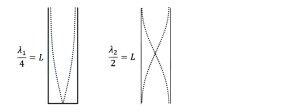
(C) For a tube of length $L$ closed at one end,the fundamental wavelength is $\lambda_1 = 4L$. The fundamental frequency is $f_A = \frac{v}{\lambda_1} = \frac{v}{4L}$.
For a tube of length $L$ open at both ends,the fundamental wavelength is $\lambda_2 = 2L$. The fundamental frequency is $f_B = \frac{v}{\lambda_2} = \frac{v}{2L}$.
The ratio of the fundamental frequency of tube $A$ to tube $B$ is $\frac{f_A}{f_B} = \frac{v/4L}{v/2L} = \frac{2L}{4L} = \frac{1}{2}$.
Thus,the ratio is $1: 2$.
For a tube of length $L$ open at both ends,the fundamental wavelength is $\lambda_2 = 2L$. The fundamental frequency is $f_B = \frac{v}{\lambda_2} = \frac{v}{2L}$.
The ratio of the fundamental frequency of tube $A$ to tube $B$ is $\frac{f_A}{f_B} = \frac{v/4L}{v/2L} = \frac{2L}{4L} = \frac{1}{2}$.
Thus,the ratio is $1: 2$.
0 likes
View Solution305
MediumMCQ
In a pipe closed at one end,an air column is vibrating in the fourth overtone. How many nodes and antinodes does the vibrating air column have?
A
$4$ nodes and $5$ antinodes.
B
$5$ nodes and $4$ antinodes.
C
$5$ nodes and $5$ antinodes.
D
$4$ nodes and $4$ antinodes.
Solution
(C) For a pipe closed at one end,the possible frequencies are given by $f_n = (2n + 1)f_0$,where $n = 0, 1, 2, ...$ represents the overtone number.
For the $n$-th overtone,the number of nodes is $(n + 1)$ and the number of antinodes is $(n + 1)$.
Given that the air column is vibrating in the fourth overtone,we have $n = 4$.
Therefore,the number of nodes = $4 + 1 = 5$.
The number of antinodes = $4 + 1 = 5$.
Thus,the vibrating air column has $5$ nodes and $5$ antinodes.
For the $n$-th overtone,the number of nodes is $(n + 1)$ and the number of antinodes is $(n + 1)$.
Given that the air column is vibrating in the fourth overtone,we have $n = 4$.
Therefore,the number of nodes = $4 + 1 = 5$.
The number of antinodes = $4 + 1 = 5$.
Thus,the vibrating air column has $5$ nodes and $5$ antinodes.
0 likes
View Solution306
MediumMCQ
The first overtone of the vibrating air column of a closed pipe has the same frequency as the second overtone of an open pipe $1.5 \ m$ long. The length of the closed pipe is (in $m$)
A
$1.0$
B
$0.75$
C
$0.5$
D
$1.25$
Solution
(B) The frequency of an open pipe of length $L_O$ is given by $f_n = \frac{n v}{2 L_O}$,where $n = 1, 2, 3, \dots$ is the harmonic number. The second overtone corresponds to the $3^{rd}$ harmonic $(n=3)$. Thus,$f_{O,2} = \frac{3 v}{2 L_O}$.
For a closed pipe of length $L_C$,the frequency is given by $f_m = \frac{(2m-1) v}{4 L_C}$,where $m = 1, 2, 3, \dots$ is the overtone number. The first overtone corresponds to $m=2$ (the $3^{rd}$ harmonic). Thus,$f_{C,1} = \frac{3 v}{4 L_C}$.
Given that $f_{O,2} = f_{C,1}$,we have:
$\frac{3 v}{2 L_O} = \frac{3 v}{4 L_C}$
$\frac{1}{2 L_O} = \frac{1}{4 L_C}$
$L_C = \frac{L_O}{2} = \frac{1.5 \ m}{2} = 0.75 \ m$.
For a closed pipe of length $L_C$,the frequency is given by $f_m = \frac{(2m-1) v}{4 L_C}$,where $m = 1, 2, 3, \dots$ is the overtone number. The first overtone corresponds to $m=2$ (the $3^{rd}$ harmonic). Thus,$f_{C,1} = \frac{3 v}{4 L_C}$.
Given that $f_{O,2} = f_{C,1}$,we have:
$\frac{3 v}{2 L_O} = \frac{3 v}{4 L_C}$
$\frac{1}{2 L_O} = \frac{1}{4 L_C}$
$L_C = \frac{L_O}{2} = \frac{1.5 \ m}{2} = 0.75 \ m$.
0 likes
View Solution307
EasyMCQ
$A$ cylindrical tube,open at both ends,has a vibrating air column of fundamental frequency '$f$' in air. The tube is dipped vertically in water so that half of its length is in water. The fundamental frequency of the vibrating air column is now:
A
$f$
B
$\frac{f}{2}$
C
$\frac{3f}{2}$
D
$2f$
Solution
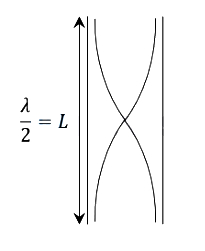
(A) For an open organ pipe of length $L$,the fundamental frequency is given by $f = \frac{v}{2L}$,where $v$ is the speed of sound in air.
When the tube is dipped vertically into water such that half of its length is submerged,the effective length of the air column becomes $L' = \frac{L}{2}$.
The lower end of the tube is now closed by the water surface,making it a closed organ pipe of length $L' = \frac{L}{2}$.
The fundamental frequency of a closed organ pipe is given by $f' = \frac{v}{4L'}$.
Substituting $L' = \frac{L}{2}$ into the formula,we get $f' = \frac{v}{4(L/2)} = \frac{v}{2L}$.
Since $f = \frac{v}{2L}$,it follows that $f' = f$.
Therefore,the fundamental frequency remains the same.
When the tube is dipped vertically into water such that half of its length is submerged,the effective length of the air column becomes $L' = \frac{L}{2}$.
The lower end of the tube is now closed by the water surface,making it a closed organ pipe of length $L' = \frac{L}{2}$.
The fundamental frequency of a closed organ pipe is given by $f' = \frac{v}{4L'}$.
Substituting $L' = \frac{L}{2}$ into the formula,we get $f' = \frac{v}{4(L/2)} = \frac{v}{2L}$.
Since $f = \frac{v}{2L}$,it follows that $f' = f$.
Therefore,the fundamental frequency remains the same.
0 likes
View Solution308
EasyMCQ
In the fundamental mode,the time required for a sound wave to reach the closed end of a pipe filled with air is $t$ seconds. The frequency of vibration of the air column is:
A
$\frac{2}{t}$
B
$\frac{0.5}{t}$
C
$\frac{1}{t}$
D
$\frac{0.25}{t}$
Solution
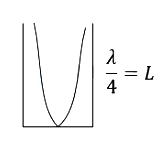
(D) For a pipe closed at one end,the fundamental mode corresponds to a length $L = \frac{\lambda}{4}$,where $\lambda$ is the wavelength.
Thus,the wavelength is $\lambda = 4L$.
The time taken for the sound wave to travel the length of the pipe $L$ is given as $t$. Since the speed of sound $v$ is constant,we have $v = \frac{L}{t}$.
The frequency $f$ is given by $f = \frac{v}{\lambda}$.
Substituting the values,we get $f = \frac{L/t}{4L} = \frac{1}{4t} = \frac{0.25}{t}$.
Therefore,the frequency of vibration of the air column is $\frac{0.25}{t}$ Hz.
Option $(D)$ is correct.
Thus,the wavelength is $\lambda = 4L$.
The time taken for the sound wave to travel the length of the pipe $L$ is given as $t$. Since the speed of sound $v$ is constant,we have $v = \frac{L}{t}$.
The frequency $f$ is given by $f = \frac{v}{\lambda}$.
Substituting the values,we get $f = \frac{L/t}{4L} = \frac{1}{4t} = \frac{0.25}{t}$.
Therefore,the frequency of vibration of the air column is $\frac{0.25}{t}$ Hz.
Option $(D)$ is correct.
0 likes
View Solution309
MediumMCQ
$A$ cylindrical tube open at both ends has a fundamental frequency $f$ in air. When the tube is dipped vertically in water so that one-third part of the tube is in water,the fundamental frequency of the air column becomes (neglect end correction).
A
$\frac{f}{2}$
B
$\frac{3f}{2}$
C
$\frac{f}{4}$
D
$\frac{3f}{4}$
Solution
(D) For a cylindrical tube open at both ends with length $L$,the fundamental frequency is given by $f = \frac{v}{2L}$,where $v$ is the speed of sound in air.
When the tube is dipped vertically into water such that one-third of its length is submerged,the length of the air column becomes $L' = L - \frac{L}{3} = \frac{2L}{3}$.
The tube now acts as a pipe closed at one end (the water surface) and open at the other.
For a pipe closed at one end,the fundamental frequency is $f' = \frac{v}{4L'}$.
Substituting $L' = \frac{2L}{3}$,we get $f' = \frac{v}{4(2L/3)} = \frac{3v}{8L}$.
Since $f = \frac{v}{2L}$,we can write $f' = \frac{3}{4} \times \frac{v}{2L} = \frac{3}{4}f$.
When the tube is dipped vertically into water such that one-third of its length is submerged,the length of the air column becomes $L' = L - \frac{L}{3} = \frac{2L}{3}$.
The tube now acts as a pipe closed at one end (the water surface) and open at the other.
For a pipe closed at one end,the fundamental frequency is $f' = \frac{v}{4L'}$.
Substituting $L' = \frac{2L}{3}$,we get $f' = \frac{v}{4(2L/3)} = \frac{3v}{8L}$.
Since $f = \frac{v}{2L}$,we can write $f' = \frac{3}{4} \times \frac{v}{2L} = \frac{3}{4}f$.
0 likes
View Solution310
EasyMCQ
The waves set up in a closed pipe are
A
Transverse and Progressive
B
Longitudinal and Stationary
C
Transverse and Stationary
D
Longitudinal and Progressive
Solution
(B) In a closed pipe,sound waves travel through the air column and reflect off the closed end.
These reflected waves interfere with the incident waves to form stationary (standing) waves.
Since sound waves are pressure waves,they are longitudinal in nature.
Therefore,the waves set up in a closed pipe are longitudinal and stationary.
These reflected waves interfere with the incident waves to form stationary (standing) waves.
Since sound waves are pressure waves,they are longitudinal in nature.
Therefore,the waves set up in a closed pipe are longitudinal and stationary.
0 likes
View Solution311
EasyMCQ
$A$ pipe of $30 \text{ cm}$ long and open at both ends produces harmonics. Which harmonic mode of the pipe resonates with a $1.1 \text{ kHz}$ source? (Given: speed of sound in air $v = 330 \text{ ms}^{-1}$)
A
Fifth harmonic
B
Fourth harmonic
C
Third harmonic
D
Second harmonic
Solution
(D) Given: Length of pipe $L = 30 \text{ cm} = 0.3 \text{ m}$.
Frequency $f = 1.1 \text{ kHz} = 1100 \text{ Hz}$.
Speed of sound $v = 330 \text{ ms}^{-1}$.
For an open pipe,the frequency of the $n^{th}$ harmonic is given by $f_n = n \times \frac{v}{2L}$.
Substituting the values: $1100 = n \times \frac{330}{2 \times 0.3}$.
$1100 = n \times \frac{330}{0.6}$.
$1100 = n \times 550$.
$n = \frac{1100}{550} = 2$.
Therefore,the pipe resonates in the second harmonic mode.
Frequency $f = 1.1 \text{ kHz} = 1100 \text{ Hz}$.
Speed of sound $v = 330 \text{ ms}^{-1}$.
For an open pipe,the frequency of the $n^{th}$ harmonic is given by $f_n = n \times \frac{v}{2L}$.
Substituting the values: $1100 = n \times \frac{330}{2 \times 0.3}$.
$1100 = n \times \frac{330}{0.6}$.
$1100 = n \times 550$.
$n = \frac{1100}{550} = 2$.
Therefore,the pipe resonates in the second harmonic mode.
0 likes
View Solution312
MediumMCQ
The first overtone frequency of a closed pipe of length $l_{1}$ is equal to the $2^{\text{nd}}$ harmonic frequency of an open pipe of length $l_{2}$. The ratio $\frac{l_{1}}{l_{2}}$ is:
A
$\frac{3}{4}$
B
$\frac{4}{3}$
C
$\frac{3}{2}$
D
$\frac{2}{3}$
Solution
(A) The frequency of the $n^{\text{th}}$ overtone of a closed pipe is given by $f_{c} = \frac{(2n+1)v}{4l_{1}}$. For the first overtone,$n=1$,so $f_{c} = \frac{3v}{4l_{1}}$.
The frequency of the $m^{\text{th}}$ harmonic of an open pipe is given by $f_{o} = \frac{mv}{2l_{2}}$. For the $2^{\text{nd}}$ harmonic,$m=2$,so $f_{o} = \frac{2v}{2l_{2}} = \frac{v}{l_{2}}$.
Given that $f_{c} = f_{o}$,we have $\frac{3v}{4l_{1}} = \frac{v}{l_{2}}$.
Rearranging the terms to find the ratio $\frac{l_{1}}{l_{2}}$,we get $\frac{l_{1}}{l_{2}} = \frac{3}{4}$.
The frequency of the $m^{\text{th}}$ harmonic of an open pipe is given by $f_{o} = \frac{mv}{2l_{2}}$. For the $2^{\text{nd}}$ harmonic,$m=2$,so $f_{o} = \frac{2v}{2l_{2}} = \frac{v}{l_{2}}$.
Given that $f_{c} = f_{o}$,we have $\frac{3v}{4l_{1}} = \frac{v}{l_{2}}$.
Rearranging the terms to find the ratio $\frac{l_{1}}{l_{2}}$,we get $\frac{l_{1}}{l_{2}} = \frac{3}{4}$.
0 likes
View Solution313
EasyMCQ
The frequency of the second overtone of an open pipe is equal to the frequency of the first overtone of a closed pipe. The ratio of the lengths of the open pipe to the closed pipe is
A
$2: 1$
B
$1: 2$
C
$1: 3$
D
$3: 1$
Solution
(A) For an open pipe of length $L_o$,the frequency of the $n^{th}$ harmonic is $f_n = \frac{n v}{2 L_o}$. The second overtone corresponds to the $3^{rd}$ harmonic $(n=3)$,so $f_{o} = \frac{3 v}{2 L_o}$.
For a closed pipe of length $L_c$,the frequency of the $n^{th}$ harmonic is $f_n = \frac{(2n-1) v}{4 L_c}$. The first overtone corresponds to the $3^{rd}$ harmonic $(n=2)$,so $f_{c} = \frac{3 v}{4 L_c}$.
Given that $f_o = f_c$,we have $\frac{3 v}{2 L_o} = \frac{3 v}{4 L_c}$.
Simplifying this,we get $\frac{1}{2 L_o} = \frac{1}{4 L_c}$,which implies $\frac{L_o}{L_c} = \frac{4}{2} = \frac{2}{1}$.
For a closed pipe of length $L_c$,the frequency of the $n^{th}$ harmonic is $f_n = \frac{(2n-1) v}{4 L_c}$. The first overtone corresponds to the $3^{rd}$ harmonic $(n=2)$,so $f_{c} = \frac{3 v}{4 L_c}$.
Given that $f_o = f_c$,we have $\frac{3 v}{2 L_o} = \frac{3 v}{4 L_c}$.
Simplifying this,we get $\frac{1}{2 L_o} = \frac{1}{4 L_c}$,which implies $\frac{L_o}{L_c} = \frac{4}{2} = \frac{2}{1}$.
0 likes
View Solution314
DifficultMCQ
$A$ closed organ pipe and an open organ pipe of the same length produce $2 \text{ beats/second}$ while vibrating in their fundamental modes. The length of the open organ pipe is halved and that of the closed pipe is doubled. Then the number of beats produced per second while vibrating in the fundamental mode is
A
$2$
B
$6$
C
$8$
D
$7$
Solution
(D) Let the length of both pipes be $L$. The fundamental frequency of an open organ pipe is $f_{o} = \frac{v}{2L}$ and that of a closed organ pipe is $f_{c} = \frac{v}{4L}$.
Given that $f_{o} - f_{c} = 2 \text{ Hz}$.
Substituting the expressions,$\frac{v}{2L} - \frac{v}{4L} = 2 \Rightarrow \frac{v}{4L} = 2 \text{ Hz}$.
Thus,$f_{c} = 2 \text{ Hz}$ and $f_{o} = 2f_{c} = 4 \text{ Hz}$.
Now,the length of the open pipe is halved $(L_{o}' = L/2)$,so its new frequency is $f_{o}' = \frac{v}{2(L/2)} = \frac{v}{L} = 2f_{o} = 2 \times 4 = 8 \text{ Hz}$.
The length of the closed pipe is doubled $(L_{c}' = 2L)$,so its new frequency is $f_{c}' = \frac{v}{4(2L)} = \frac{1}{2} \left(\frac{v}{4L}\right) = \frac{1}{2} f_{c} = \frac{1}{2} \times 2 = 1 \text{ Hz}$.
The number of beats produced per second is $|f_{o}' - f_{c}'| = |8 - 1| = 7 \text{ Hz}$.
Given that $f_{o} - f_{c} = 2 \text{ Hz}$.
Substituting the expressions,$\frac{v}{2L} - \frac{v}{4L} = 2 \Rightarrow \frac{v}{4L} = 2 \text{ Hz}$.
Thus,$f_{c} = 2 \text{ Hz}$ and $f_{o} = 2f_{c} = 4 \text{ Hz}$.
Now,the length of the open pipe is halved $(L_{o}' = L/2)$,so its new frequency is $f_{o}' = \frac{v}{2(L/2)} = \frac{v}{L} = 2f_{o} = 2 \times 4 = 8 \text{ Hz}$.
The length of the closed pipe is doubled $(L_{c}' = 2L)$,so its new frequency is $f_{c}' = \frac{v}{4(2L)} = \frac{1}{2} \left(\frac{v}{4L}\right) = \frac{1}{2} f_{c} = \frac{1}{2} \times 2 = 1 \text{ Hz}$.
The number of beats produced per second is $|f_{o}' - f_{c}'| = |8 - 1| = 7 \text{ Hz}$.
0 likes
View Solution315
DifficultMCQ
$A$ cylindrical tube open at both ends has a fundamental frequency of $390 \,Hz$ in air. If $\frac{1}{4}$th of the tube is immersed vertically in water, what is the fundamental frequency of the air column (in $\,Hz$)?
A
$260$
B
$130$
C
$390$
D
$520$
Solution
(A) The fundamental frequency of an open cylindrical tube of length $L$ is given by $n = \frac{v}{2L} = 390 \,Hz$.
When $\frac{1}{4}$th of the tube is immersed in water, the tube acts as a closed organ pipe (closed at one end) with a new length $L' = L - \frac{1}{4}L = \frac{3}{4}L$.
The fundamental frequency of a closed organ pipe is given by $n' = \frac{v}{4L'}$.
Substituting $L' = \frac{3}{4}L$, we get $n' = \frac{v}{4(\frac{3}{4}L)} = \frac{v}{3L}$.
We can rewrite this as $n' = \frac{2}{3} \times (\frac{v}{2L})$.
Since $\frac{v}{2L} = 390 \,Hz$, we have $n' = \frac{2}{3} \times 390 \,Hz = 260 \,Hz$.
When $\frac{1}{4}$th of the tube is immersed in water, the tube acts as a closed organ pipe (closed at one end) with a new length $L' = L - \frac{1}{4}L = \frac{3}{4}L$.
The fundamental frequency of a closed organ pipe is given by $n' = \frac{v}{4L'}$.
Substituting $L' = \frac{3}{4}L$, we get $n' = \frac{v}{4(\frac{3}{4}L)} = \frac{v}{3L}$.
We can rewrite this as $n' = \frac{2}{3} \times (\frac{v}{2L})$.
Since $\frac{v}{2L} = 390 \,Hz$, we have $n' = \frac{2}{3} \times 390 \,Hz = 260 \,Hz$.
0 likes
View Solution316
DifficultMCQ
$A$ glass tube is open at both ends. $A$ tuning fork of frequency $f$ resonates with the air column inside the tube. Now,the tube is placed vertically inside water so that half the length of the tube is filled with water. Now,the air column inside the tube is in unison with another fork of frequency $f^{\prime}$. Then,
A
$f^{\prime} = f$
B
$f^{\prime} = 4f$
C
$f^{\prime} = 2f$
D
$f^{\prime} = \frac{f}{2}$
Solution
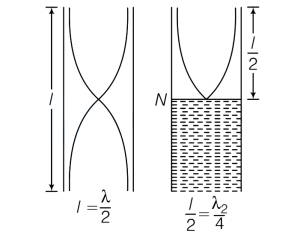
(A) For an open organ pipe of length $l$,the fundamental frequency is given by $f = \frac{v}{2l}$,where $v$ is the speed of sound in air.
When the tube is placed vertically in water such that half its length is submerged,it acts as a closed organ pipe of length $l' = \frac{l}{2}$.
The fundamental frequency of a closed organ pipe is given by $f' = \frac{v}{4l'}$.
Substituting $l' = \frac{l}{2}$ into the expression for $f'$,we get:
$f' = \frac{v}{4(l/2)} = \frac{v}{2l}$.
Comparing this with the initial frequency $f = \frac{v}{2l}$,we find that $f' = f$.
When the tube is placed vertically in water such that half its length is submerged,it acts as a closed organ pipe of length $l' = \frac{l}{2}$.
The fundamental frequency of a closed organ pipe is given by $f' = \frac{v}{4l'}$.
Substituting $l' = \frac{l}{2}$ into the expression for $f'$,we get:
$f' = \frac{v}{4(l/2)} = \frac{v}{2l}$.
Comparing this with the initial frequency $f = \frac{v}{2l}$,we find that $f' = f$.
0 likes
View Solution317
EasyMCQ
At a temperature of $27^{\circ} C$, two identical organ pipes produce notes of frequency $140 \,Hz$. If the temperature of one pipe is raised to $57.75^{\circ} C$, then the number of beats produced per second is
A
$7$
B
$5$
C
$3$
D
$9$
Solution
$(A)$ Given: $n_0 = 140 \,Hz$, $T_0 = 27^{\circ} C = 300 \,K$, and $T_1 = 57.75^{\circ} C = 330.75 \,K$.
Since the frequency of an organ pipe is proportional to the speed of sound $(n \propto v)$, and the speed of sound is proportional to the square root of the absolute temperature $(v \propto \sqrt{T})$, we have $n \propto \sqrt{T}$.
Therefore, $\frac{n_1}{n_0} = \sqrt{\frac{T_1}{T_0}}$.
Substituting the values: $\frac{n_1}{140} = \sqrt{\frac{330.75}{300}} = \sqrt{1.1025} = 1.05$.
So, $n_1 = 140 \times 1.05 = 147 \,Hz$.
The number of beats produced per second is the difference in frequencies: $n_1 - n_0 = 147 \,Hz - 140 \,Hz = 7 \,Hz$.
Thus, the correct option is $A$.
Since the frequency of an organ pipe is proportional to the speed of sound $(n \propto v)$, and the speed of sound is proportional to the square root of the absolute temperature $(v \propto \sqrt{T})$, we have $n \propto \sqrt{T}$.
Therefore, $\frac{n_1}{n_0} = \sqrt{\frac{T_1}{T_0}}$.
Substituting the values: $\frac{n_1}{140} = \sqrt{\frac{330.75}{300}} = \sqrt{1.1025} = 1.05$.
So, $n_1 = 140 \times 1.05 = 147 \,Hz$.
The number of beats produced per second is the difference in frequencies: $n_1 - n_0 = 147 \,Hz - 140 \,Hz = 7 \,Hz$.
Thus, the correct option is $A$.
0 likes
View Solution318
EasyMCQ
In a closed organ pipe, the number of nodes formed in the fifth and ninth harmonics are respectively:
A
$5$, $9$
B
$3$, $5$
C
$5$, $7$
D
$2$, $4$
Solution
(B) For a closed organ pipe, the frequency of the $n^{th}$ harmonic is given by $f_n = n \cdot f_1$, where $n$ must be an odd integer $(n = 1, 3, 5, 7, 9, ...)$.
In a closed organ pipe of length $L$, the number of nodes $N$ formed for the $n^{th}$ harmonic is given by the formula $N = \frac{n+1}{2}$.
For the fifth harmonic $(n = 5)$:
$N_5 = \frac{5+1}{2} = \frac{6}{2} = 3$.
For the ninth harmonic $(n = 9)$:
$N_9 = \frac{9+1}{2} = \frac{10}{2} = 5$.
Therefore, the number of nodes formed are $3$ and $5$ respectively.
In a closed organ pipe of length $L$, the number of nodes $N$ formed for the $n^{th}$ harmonic is given by the formula $N = \frac{n+1}{2}$.
For the fifth harmonic $(n = 5)$:
$N_5 = \frac{5+1}{2} = \frac{6}{2} = 3$.
For the ninth harmonic $(n = 9)$:
$N_9 = \frac{9+1}{2} = \frac{10}{2} = 5$.
Therefore, the number of nodes formed are $3$ and $5$ respectively.
0 likes
View Solution319
EasyMCQ
$A$ pipe with $30 \ cm$ length is open at both ends. Which harmonic mode of the pipe resonates with a $1.65 \ kHz$ source? (Velocity of sound in air $= 330 \ m/s$)
A
$2$
B
$3$
C
$3.5$
D
$2.5$
Solution
(B) For an open organ pipe,the frequency of the $n^{th}$ harmonic is given by $f_n = \frac{n v}{2L}$,where $n = 1, 2, 3, ...$ is the harmonic mode.
Given:
Length $L = 30 \ cm = 0.3 \ m$
Frequency $f = 1.65 \ kHz = 1650 \ Hz$
Velocity of sound $v = 330 \ m/s$
Substituting the values into the formula:
$1650 = \frac{n \times 330}{2 \times 0.3}$
$1650 = \frac{n \times 330}{0.6}$
$1650 = n \times 550$
$n = \frac{1650}{550} = 3$
Therefore,the pipe resonates in the $3^{rd}$ harmonic mode.
Given:
Length $L = 30 \ cm = 0.3 \ m$
Frequency $f = 1.65 \ kHz = 1650 \ Hz$
Velocity of sound $v = 330 \ m/s$
Substituting the values into the formula:
$1650 = \frac{n \times 330}{2 \times 0.3}$
$1650 = \frac{n \times 330}{0.6}$
$1650 = n \times 550$
$n = \frac{1650}{550} = 3$
Therefore,the pipe resonates in the $3^{rd}$ harmonic mode.
0 likes
View Solution320
MediumMCQ
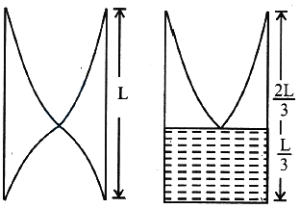
The vibrations of four air columns are shown below. The ratio of frequencies is

A
$1$:$2$:$3$:$4$
B
$1$:$3$:$2$:$4$
C
$1$:$4$:$3$:$2$
D
$1$:$4$:$2$:$3$
Solution
(D) For figure $(a)$,$L = \frac{\lambda_1}{4} \Rightarrow \lambda_1 = 4L$.
For figure $(b)$,$L = \frac{\lambda_2}{4} + \frac{\lambda_2}{2} + \frac{\lambda_2}{4} = \lambda_2 \Rightarrow \lambda_2 = L$.
For figure $(c)$,$L = \frac{\lambda_3}{4} + \frac{\lambda_3}{4} + \frac{\lambda_3}{2} = \lambda_3 \Rightarrow \lambda_3 = L$ (Note: Based on the diagram,it represents a pipe open at both ends with one node in the middle,so $L = \lambda_3/2 \Rightarrow \lambda_3 = 2L$).
For figure $(d)$,$L = \frac{\lambda_4}{2} + \frac{\lambda_4}{4} = \frac{3\lambda_4}{4} \Rightarrow \lambda_4 = \frac{4L}{3}$.
Since frequency $f \propto \frac{1}{\lambda}$,we have $f_1 : f_2 : f_3 : f_4 = \frac{1}{\lambda_1} : \frac{1}{\lambda_2} : \frac{1}{\lambda_3} : \frac{1}{\lambda_4}$.
Substituting the values: $f_1 : f_2 : f_3 : f_4 = \frac{1}{4L} : \frac{1}{L} : \frac{1}{2L} : \frac{3}{4L}$.
Multiplying by $4L$,we get $1 : 4 : 2 : 3$.
For figure $(b)$,$L = \frac{\lambda_2}{4} + \frac{\lambda_2}{2} + \frac{\lambda_2}{4} = \lambda_2 \Rightarrow \lambda_2 = L$.
For figure $(c)$,$L = \frac{\lambda_3}{4} + \frac{\lambda_3}{4} + \frac{\lambda_3}{2} = \lambda_3 \Rightarrow \lambda_3 = L$ (Note: Based on the diagram,it represents a pipe open at both ends with one node in the middle,so $L = \lambda_3/2 \Rightarrow \lambda_3 = 2L$).
For figure $(d)$,$L = \frac{\lambda_4}{2} + \frac{\lambda_4}{4} = \frac{3\lambda_4}{4} \Rightarrow \lambda_4 = \frac{4L}{3}$.
Since frequency $f \propto \frac{1}{\lambda}$,we have $f_1 : f_2 : f_3 : f_4 = \frac{1}{\lambda_1} : \frac{1}{\lambda_2} : \frac{1}{\lambda_3} : \frac{1}{\lambda_4}$.
Substituting the values: $f_1 : f_2 : f_3 : f_4 = \frac{1}{4L} : \frac{1}{L} : \frac{1}{2L} : \frac{3}{4L}$.
Multiplying by $4L$,we get $1 : 4 : 2 : 3$.
0 likes
View Solution321
MediumMCQ
The fundamental frequency of an open pipe is $100 \ Hz$. If the bottom end of the pipe is closed and $1/3$ rd of the pipe is filled with water,then the fundamental frequency of the pipe is: (in $Hz$)
A
$200$
B
$100$
C
$75$
D
$150$
Solution
(C) For an open organ pipe of length $L$,the fundamental frequency is given by:
$f_0 = \frac{v}{2L} = 100 \ Hz$
When the bottom end is closed and $1/3$ of the pipe is filled with water,the effective length of the air column becomes $L' = L - \frac{L}{3} = \frac{2L}{3}$.
For a closed organ pipe of length $L'$,the fundamental frequency is:
$f' = \frac{v}{4L'}$
Substituting $L' = \frac{2L}{3}$:
$f' = \frac{v}{4(2L/3)} = \frac{3v}{8L}$
We can rewrite this as:
$f' = \frac{3}{4} \left( \frac{v}{2L} \right)$
Since $\frac{v}{2L} = 100 \ Hz$,we have:
$f' = \frac{3}{4} \times 100 = 75 \ Hz$
$f_0 = \frac{v}{2L} = 100 \ Hz$
When the bottom end is closed and $1/3$ of the pipe is filled with water,the effective length of the air column becomes $L' = L - \frac{L}{3} = \frac{2L}{3}$.
For a closed organ pipe of length $L'$,the fundamental frequency is:
$f' = \frac{v}{4L'}$
Substituting $L' = \frac{2L}{3}$:
$f' = \frac{v}{4(2L/3)} = \frac{3v}{8L}$
We can rewrite this as:
$f' = \frac{3}{4} \left( \frac{v}{2L} \right)$
Since $\frac{v}{2L} = 100 \ Hz$,we have:
$f' = \frac{3}{4} \times 100 = 75 \ Hz$
0 likes
View Solution322
EasyMCQ
The frequency of the fifth harmonic of a closed pipe is equal to the frequency of the third harmonic of an open pipe. If the length of the open pipe is $72 \ cm$,then the length of the closed pipe is: (in $cm$)
A
$60$
B
$45$
C
$30$
D
$75$
Solution
(A) For an open organ pipe,the frequency of the $n^{th}$ harmonic is given by $f_n = \frac{n v}{2 l_o}$.
For the third harmonic $(n=3)$,$f_{open} = \frac{3 v}{2 l_o}$.
Given $l_o = 72 \ cm$,so $f_{open} = \frac{3 v}{2 \times 72} = \frac{v}{48}$.
For a closed organ pipe,the frequency of the $n^{th}$ harmonic (where $n$ is odd) is given by $f_n = \frac{n v}{4 l_c}$.
For the fifth harmonic $(n=5)$,$f_{closed} = \frac{5 v}{4 l_c}$.
According to the problem,$f_{closed} = f_{open}$.
$\frac{5 v}{4 l_c} = \frac{3 v}{2 l_o}$.
Substituting $l_o = 72 \ cm$:
$\frac{5}{4 l_c} = \frac{3}{2 \times 72} = \frac{3}{144} = \frac{1}{48}$.
$4 l_c = 5 \times 48 = 240$.
$l_c = \frac{240}{4} = 60 \ cm$.
For the third harmonic $(n=3)$,$f_{open} = \frac{3 v}{2 l_o}$.
Given $l_o = 72 \ cm$,so $f_{open} = \frac{3 v}{2 \times 72} = \frac{v}{48}$.
For a closed organ pipe,the frequency of the $n^{th}$ harmonic (where $n$ is odd) is given by $f_n = \frac{n v}{4 l_c}$.
For the fifth harmonic $(n=5)$,$f_{closed} = \frac{5 v}{4 l_c}$.
According to the problem,$f_{closed} = f_{open}$.
$\frac{5 v}{4 l_c} = \frac{3 v}{2 l_o}$.
Substituting $l_o = 72 \ cm$:
$\frac{5}{4 l_c} = \frac{3}{2 \times 72} = \frac{3}{144} = \frac{1}{48}$.
$4 l_c = 5 \times 48 = 240$.
$l_c = \frac{240}{4} = 60 \ cm$.
0 likes
View Solution323
MediumMCQ
Two open organ pipes of lengths $50 \,cm$ and $51 \,cm$ are totally immersed in a medium. They are found to give $40$ beats in $10 \,s$ when each is sounding at its fundamental note. The speed of sound in this medium is (in $\,ms^{-1}$)
A
$275$
B
$310$
C
$258$
D
$204$
Solution
(D) The fundamental frequency of an open organ pipe is given by $f = \frac{v}{2l}$.
Given, beat frequency $f_b = \frac{40}{10} = 4 \,Hz$.
Let $l_1 = 50 \,cm = 0.5 \,m$ and $l_2 = 51 \,cm = 0.51 \,m$.
The difference in frequencies is $f_1 - f_2 = 4 \,Hz$.
$\frac{v}{2l_1} - \frac{v}{2l_2} = 4$
$\frac{v}{2} \left( \frac{1}{0.5} - \frac{1}{0.51} \right) = 4$
$\frac{v}{2} \left( \frac{0.51 - 0.5}{0.5 \times 0.51} \right) = 4$
$\frac{v}{2} \left( \frac{0.01}{0.255} \right) = 4$
$v \left( \frac{0.01}{0.51} \right) = 4$
$v = \frac{4 \times 0.51}{0.01} = 4 \times 51 = 204 \,ms^{-1}$.
Given, beat frequency $f_b = \frac{40}{10} = 4 \,Hz$.
Let $l_1 = 50 \,cm = 0.5 \,m$ and $l_2 = 51 \,cm = 0.51 \,m$.
The difference in frequencies is $f_1 - f_2 = 4 \,Hz$.
$\frac{v}{2l_1} - \frac{v}{2l_2} = 4$
$\frac{v}{2} \left( \frac{1}{0.5} - \frac{1}{0.51} \right) = 4$
$\frac{v}{2} \left( \frac{0.51 - 0.5}{0.5 \times 0.51} \right) = 4$
$\frac{v}{2} \left( \frac{0.01}{0.255} \right) = 4$
$v \left( \frac{0.01}{0.51} \right) = 4$
$v = \frac{4 \times 0.51}{0.01} = 4 \times 51 = 204 \,ms^{-1}$.
0 likes
View Solution324
MediumMCQ
An open air pipe of length $80 \,cm$ has the second harmonic frequency equal to the fundamental frequency of a closed organ air pipe. The length of the closed pipe is (in $\,cm$)
A
$20$
B
$40$
C
$60$
D
$10$
Solution
(A) For an open pipe of length $l_O$, the frequency of the $n^{th}$ harmonic is given by $f_n = n \cdot \frac{V}{2 l_O}$.
For an open pipe, the second harmonic $(n=2)$ is $f_2 = 2 \cdot \frac{V}{2 l_O} = \frac{V}{l_O}$.
For a closed pipe of length $l_C$, the fundamental frequency is $f_1 = \frac{V}{4 l_C}$.
Given that the second harmonic of the open pipe equals the fundamental frequency of the closed pipe:
$\frac{V}{l_O} = \frac{V}{4 l_C}$.
Substituting $l_O = 80 \,cm$:
$\frac{1}{80} = \frac{1}{4 l_C}$.
$4 l_C = 80$.
$l_C = 20 \,cm$.
For an open pipe, the second harmonic $(n=2)$ is $f_2 = 2 \cdot \frac{V}{2 l_O} = \frac{V}{l_O}$.
For a closed pipe of length $l_C$, the fundamental frequency is $f_1 = \frac{V}{4 l_C}$.
Given that the second harmonic of the open pipe equals the fundamental frequency of the closed pipe:
$\frac{V}{l_O} = \frac{V}{4 l_C}$.
Substituting $l_O = 80 \,cm$:
$\frac{1}{80} = \frac{1}{4 l_C}$.
$4 l_C = 80$.
$l_C = 20 \,cm$.
0 likes
View Solution325
MediumMCQ
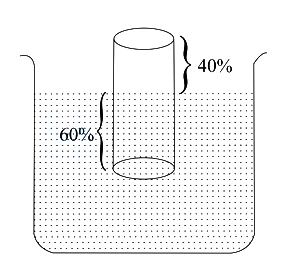
$A$ cylindrical tube open at both ends has a fundamental frequency $f$ in air. The tube is dipped vertically in water so that $60 \%$ of the tube is in water. Then the fundamental frequency of the air column is
A
$\frac{f}{2}$
B
$\frac{5 f}{4}$
C
$\frac{3 f}{4}$
D
$2 f$
Solution
(B) Let the length of the tube be $L$.
The fundamental frequency for an open organ pipe is given by:
$f = \frac{V}{2L}$
When the tube is dipped vertically in water such that $60 \%$ of its length is submerged,the remaining length of the air column above the water surface acts as a closed organ pipe (closed at one end by the water surface).
The length of this air column is:
$l' = (100 \% - 60 \%) L = 40 \% L = 0.4L = \frac{2L}{5}$
The fundamental frequency of a closed organ pipe is given by:
$f' = \frac{V}{4l'}$
Substituting the value of $l'$:
$f' = \frac{V}{4(\frac{2L}{5})} = \frac{5V}{8L}$
We can rewrite this in terms of $f$:
$f' = \frac{5}{4} \left( \frac{V}{2L} \right) = \frac{5}{4} f$
The fundamental frequency for an open organ pipe is given by:
$f = \frac{V}{2L}$
When the tube is dipped vertically in water such that $60 \%$ of its length is submerged,the remaining length of the air column above the water surface acts as a closed organ pipe (closed at one end by the water surface).
The length of this air column is:
$l' = (100 \% - 60 \%) L = 40 \% L = 0.4L = \frac{2L}{5}$
The fundamental frequency of a closed organ pipe is given by:
$f' = \frac{V}{4l'}$
Substituting the value of $l'$:
$f' = \frac{V}{4(\frac{2L}{5})} = \frac{5V}{8L}$
We can rewrite this in terms of $f$:
$f' = \frac{5}{4} \left( \frac{V}{2L} \right) = \frac{5}{4} f$
0 likes
View Solution326
MediumMCQ
When the air column of a resonance tube is vibrated together with a tuning fork,$3$ beats are heard per second,either the temperature of the air column is $51^{\circ} C$ or $16^{\circ} C$. The frequency of the tuning fork is (in $Hz$)
A
$128$
B
$98$
C
$105$
D
$256$
Solution
(C) The frequency of an air column in a resonance tube is proportional to the speed of sound,which is proportional to the square root of the absolute temperature $(v \propto \sqrt{T})$.
Let $n$ be the frequency of the tuning fork.
At $T_1 = 273 + 51 = 324 \ K$,the frequency of the air column is $n_1 = n + 3$.
At $T_2 = 273 + 16 = 289 \ K$,the frequency of the air column is $n_2 = n - 3$.
Using the relation $\frac{n_1}{n_2} = \sqrt{\frac{T_1}{T_2}}$,we get:
$\frac{n+3}{n-3} = \sqrt{\frac{324}{289}} = \frac{18}{17}$.
Cross-multiplying gives: $17(n + 3) = 18(n - 3)$.
$17n + 51 = 18n - 54$.
$n = 51 + 54 = 105 \ Hz$.
Let $n$ be the frequency of the tuning fork.
At $T_1 = 273 + 51 = 324 \ K$,the frequency of the air column is $n_1 = n + 3$.
At $T_2 = 273 + 16 = 289 \ K$,the frequency of the air column is $n_2 = n - 3$.
Using the relation $\frac{n_1}{n_2} = \sqrt{\frac{T_1}{T_2}}$,we get:
$\frac{n+3}{n-3} = \sqrt{\frac{324}{289}} = \frac{18}{17}$.
Cross-multiplying gives: $17(n + 3) = 18(n - 3)$.
$17n + 51 = 18n - 54$.
$n = 51 + 54 = 105 \ Hz$.
0 likes
View Solution327
EasyMCQ
An open pipe of length $l$ is vibrating in the $3^{rd}$ overtone with a maximum amplitude $A$. The amplitude at a distance of $\frac{l}{16}$ from any open end is
A
$A$
B
$0$
C
$\frac{A}{\sqrt{2}}$
D
$\frac{\sqrt{3} A}{2}$
Solution
(C) For an open organ pipe,the wavelength of the $n^{th}$ overtone is given by $\lambda_n = \frac{2l}{n+1}$.
For the $3^{rd}$ overtone,$n=3$,so $\lambda = \frac{2l}{3+1} = \frac{2l}{4} = \frac{l}{2}$.
Since the pipe is open at both ends,antinodes (maximum amplitude $A$) are formed at the open ends.
The displacement amplitude $R$ at a distance $x$ from an antinode is given by $R = A \cos(kx)$,where $k = \frac{2\pi}{\lambda}$.
Given $x = \frac{l}{16}$,we calculate the phase angle $\phi = kx = \frac{2\pi}{\lambda} \cdot \frac{l}{16}$.
Substituting $\lambda = \frac{l}{2}$,we get $\phi = \frac{2\pi}{(l/2)} \cdot \frac{l}{16} = \frac{4\pi}{l} \cdot \frac{l}{16} = \frac{\pi}{4}$.
Therefore,the amplitude $R = A \cos(\frac{\pi}{4}) = A \cdot \frac{1}{\sqrt{2}} = \frac{A}{\sqrt{2}}$.
For the $3^{rd}$ overtone,$n=3$,so $\lambda = \frac{2l}{3+1} = \frac{2l}{4} = \frac{l}{2}$.
Since the pipe is open at both ends,antinodes (maximum amplitude $A$) are formed at the open ends.
The displacement amplitude $R$ at a distance $x$ from an antinode is given by $R = A \cos(kx)$,where $k = \frac{2\pi}{\lambda}$.
Given $x = \frac{l}{16}$,we calculate the phase angle $\phi = kx = \frac{2\pi}{\lambda} \cdot \frac{l}{16}$.
Substituting $\lambda = \frac{l}{2}$,we get $\phi = \frac{2\pi}{(l/2)} \cdot \frac{l}{16} = \frac{4\pi}{l} \cdot \frac{l}{16} = \frac{\pi}{4}$.
Therefore,the amplitude $R = A \cos(\frac{\pi}{4}) = A \cdot \frac{1}{\sqrt{2}} = \frac{A}{\sqrt{2}}$.
0 likes
View Solution328
EasyMCQ
$A$ closed pipe is in resonance with a tuning fork at $27^{\circ} C$ when its length is $20 \,cm$. If the pipe is to be in resonance with the same tuning fork at $7^{\circ} C$, then the change in the length of the pipe required is nearly: (in $\,mm$)
A
$1$
B
$7$
C
$5$
D
$13$
Solution
(B) The frequency of the tuning fork $f$ remains constant. For a closed pipe, the fundamental frequency is given by $f = \frac{v}{4L}$, where $v$ is the speed of sound and $L$ is the length of the pipe.
Since $f$ is constant, $\frac{v_1}{L_1} = \frac{v_2}{L_2}$, which implies $\frac{L_2}{L_1} = \frac{v_2}{v_1}$.
The speed of sound $v$ is proportional to the square root of the absolute temperature $T$ $(v \propto \sqrt{T})$.
Thus, $\frac{L_2}{L_1} = \sqrt{\frac{T_2}{T_1}}$.
Given $T_1 = 27 + 273 = 300 \,K$ and $T_2 = 7 + 273 = 280 \,K$.
$L_1 = 20 \,cm = 200 \,mm$.
$L_2 = L_1 \sqrt{\frac{280}{300}} = 200 \times \sqrt{\frac{28}{30}} = 200 \times \sqrt{0.9333} \approx 200 \times 0.966 = 193.2 \,mm$.
The change in length $\Delta L = L_1 - L_2 = 200 \,mm - 193.2 \,mm = 6.8 \,mm \approx 7 \,mm$.
Since $f$ is constant, $\frac{v_1}{L_1} = \frac{v_2}{L_2}$, which implies $\frac{L_2}{L_1} = \frac{v_2}{v_1}$.
The speed of sound $v$ is proportional to the square root of the absolute temperature $T$ $(v \propto \sqrt{T})$.
Thus, $\frac{L_2}{L_1} = \sqrt{\frac{T_2}{T_1}}$.
Given $T_1 = 27 + 273 = 300 \,K$ and $T_2 = 7 + 273 = 280 \,K$.
$L_1 = 20 \,cm = 200 \,mm$.
$L_2 = L_1 \sqrt{\frac{280}{300}} = 200 \times \sqrt{\frac{28}{30}} = 200 \times \sqrt{0.9333} \approx 200 \times 0.966 = 193.2 \,mm$.
The change in length $\Delta L = L_1 - L_2 = 200 \,mm - 193.2 \,mm = 6.8 \,mm \approx 7 \,mm$.
0 likes
View Solution329
MediumMCQ
$A$ closed organ pipe of length $L$ and an open organ pipe contain gases of densities $\rho_1$ and $\rho_2$ respectively. The compressibility of the gases is equal in both the pipes. If the frequencies of their first overtones are the same,then the length of the open organ pipe is:
A
$\frac{4 L}{3} \sqrt{\frac{\rho_2}{\rho_1}}$
B
$\frac{4 L}{3} \sqrt{\frac{\rho_1}{\rho_2}}$
C
$\frac{4 L}{3}$
D
$\frac{L}{3}$
Solution
(B) For a closed organ pipe,the first overtone is the $3^{rd}$ harmonic. The frequency is given by $f = \frac{3v_1}{4L} = \frac{3}{4L} \sqrt{\frac{1}{\beta \rho_1}}$,where $\beta$ is the compressibility.
For an open organ pipe,the first overtone is the $2^{nd}$ harmonic. The frequency is given by $f = \frac{2v_2}{2L'} = \frac{v_2}{L'} = \frac{1}{L'} \sqrt{\frac{1}{\beta \rho_2}}$.
Since the compressibility $\beta$ is the same for both gases,and assuming the bulk modulus $K = 1/\beta$ is the same,we equate the frequencies:
$\frac{3}{4L} \sqrt{\frac{1}{\beta \rho_1}} = \frac{1}{L'} \sqrt{\frac{1}{\beta \rho_2}}$
$\frac{3}{4L \sqrt{\rho_1}} = \frac{1}{L' \sqrt{\rho_2}}$
$L' = \frac{4L}{3} \sqrt{\frac{\rho_1}{\rho_2}}$.
For an open organ pipe,the first overtone is the $2^{nd}$ harmonic. The frequency is given by $f = \frac{2v_2}{2L'} = \frac{v_2}{L'} = \frac{1}{L'} \sqrt{\frac{1}{\beta \rho_2}}$.
Since the compressibility $\beta$ is the same for both gases,and assuming the bulk modulus $K = 1/\beta$ is the same,we equate the frequencies:
$\frac{3}{4L} \sqrt{\frac{1}{\beta \rho_1}} = \frac{1}{L'} \sqrt{\frac{1}{\beta \rho_2}}$
$\frac{3}{4L \sqrt{\rho_1}} = \frac{1}{L' \sqrt{\rho_2}}$
$L' = \frac{4L}{3} \sqrt{\frac{\rho_1}{\rho_2}}$.
0 likes
View Solution330
EasyMCQ
For a certain organ pipe, three successive resonance frequencies are observed at $425 \,Hz$, $595 \,Hz$, and $765 \,Hz$, respectively. The length of the pipe is (speed of sound in air $= 340 \,m/s$). (in $\,m$)
A
$0.5$
B
$1$
C
$1.5$
D
$2$
Solution
(B) The difference between successive resonance frequencies is $\Delta f = 595 - 425 = 170 \,Hz$ and $765 - 595 = 170 \,Hz$.
Since the difference between successive frequencies is $2f_0$ (where $f_0$ is the fundamental frequency), the pipe must be a closed organ pipe.
Thus, $2f_0 = 170 \,Hz$, which gives $f_0 = 85 \,Hz$.
The fundamental frequency of a closed organ pipe is given by $f_0 = \frac{v}{4l}$.
Substituting the given values: $85 = \frac{340}{4l}$.
Solving for $l$: $l = \frac{340}{4 \times 85} = \frac{340}{340} = 1 \,m$.
Since the difference between successive frequencies is $2f_0$ (where $f_0$ is the fundamental frequency), the pipe must be a closed organ pipe.
Thus, $2f_0 = 170 \,Hz$, which gives $f_0 = 85 \,Hz$.
The fundamental frequency of a closed organ pipe is given by $f_0 = \frac{v}{4l}$.
Substituting the given values: $85 = \frac{340}{4l}$.
Solving for $l$: $l = \frac{340}{4 \times 85} = \frac{340}{340} = 1 \,m$.
0 likes
View Solution331
EasyMCQ
Two closed pipes have the same fundamental frequency. One is filled with oxygen and the other with hydrogen at the same temperature. The ratio of their lengths respectively is
A
$1:4$
B
$4:1$
C
$1:2$
D
$2:1$
Solution
(A) The fundamental frequency of a closed pipe is given by $f = \frac{v}{4l}$,where $v$ is the speed of sound in the gas and $l$ is the length of the pipe.
Since $v = \sqrt{\frac{\gamma RT}{M}}$,we have $f = \frac{1}{4l} \sqrt{\frac{\gamma RT}{M}}$.
Given that the fundamental frequency $f$ and temperature $T$ are the same for both pipes,we have $l \propto \frac{1}{\sqrt{M}}$,where $M$ is the molar mass of the gas.
For oxygen $(O_2)$,$M_1 = 32 \ g/mol$. For hydrogen $(H_2)$,$M_2 = 2 \ g/mol$.
The ratio of their lengths is $\frac{l_1}{l_2} = \sqrt{\frac{M_2}{M_1}} = \sqrt{\frac{2}{32}} = \sqrt{\frac{1}{16}} = \frac{1}{4}$.
Thus,the ratio of their lengths is $1:4$.
Since $v = \sqrt{\frac{\gamma RT}{M}}$,we have $f = \frac{1}{4l} \sqrt{\frac{\gamma RT}{M}}$.
Given that the fundamental frequency $f$ and temperature $T$ are the same for both pipes,we have $l \propto \frac{1}{\sqrt{M}}$,where $M$ is the molar mass of the gas.
For oxygen $(O_2)$,$M_1 = 32 \ g/mol$. For hydrogen $(H_2)$,$M_2 = 2 \ g/mol$.
The ratio of their lengths is $\frac{l_1}{l_2} = \sqrt{\frac{M_2}{M_1}} = \sqrt{\frac{2}{32}} = \sqrt{\frac{1}{16}} = \frac{1}{4}$.
Thus,the ratio of their lengths is $1:4$.
0 likes
View Solution332
EasyMCQ
An open pipe of length $L_1$ has a fundamental frequency $n_1$,and a closed pipe of length $L_2$ has a fundamental frequency $n_2$. If they are joined to form a single closed pipe of length $L = L_1 + L_2$,what is the fundamental frequency of the combined pipe?
A
$n_1+n_2$
B
$n_1-n_2$
C
$\frac{n_1 n_2}{n_1+2 n_2}$
D
$\frac{2 n_1 n_2}{n_1+2 n_2}$
Solution
(C) For an open pipe of length $L_1$,the fundamental frequency is $n_1 = \frac{v}{2 L_1}$,which implies $L_1 = \frac{v}{2 n_1}$.
For a closed pipe of length $L_2$,the fundamental frequency is $n_2 = \frac{v}{4 L_2}$,which implies $L_2 = \frac{v}{4 n_2}$.
The combined pipe is closed at one end and open at the other,with total length $L = L_1 + L_2$.
The fundamental frequency of the combined pipe is $n = \frac{v}{4 L} = \frac{v}{4(L_1 + L_2)}$.
Substituting the values of $L_1$ and $L_2$: $n = \frac{v}{4(\frac{v}{2 n_1} + \frac{v}{4 n_2})} = \frac{v}{4v(\frac{1}{2 n_1} + \frac{1}{4 n_2})} = \frac{1}{\frac{2}{4 n_1} + \frac{1}{4 n_2}} = \frac{1}{\frac{1}{2 n_1} + \frac{1}{4 n_2}} = \frac{1}{\frac{2 n_2 + n_1}{4 n_1 n_2}} = \frac{4 n_1 n_2}{n_1 + 2 n_2}$.
Wait,re-evaluating the denominator: $n = \frac{1}{\frac{2}{4 n_1} + \frac{1}{4 n_2}} = \frac{1}{\frac{1}{2 n_1} + \frac{1}{4 n_2}} = \frac{4 n_1 n_2}{2 n_2 + n_1}$.
Given the options,the correct expression is $\frac{2 n_1 n_2}{n_1 + 2 n_2}$ if the length relations were different,but based on standard derivation,the result is $\frac{2 n_1 n_2}{n_1 + 2 n_2}$ is not matching. Let's re-check: $L = \frac{v}{2 n_1} + \frac{v}{4 n_2} = v \frac{2 n_2 + n_1}{4 n_1 n_2}$. Then $n = \frac{v}{4 L} = \frac{v}{4 v \frac{2 n_2 + n_1}{4 n_1 n_2}} = \frac{n_1 n_2}{n_1 + 2 n_2}$.
For a closed pipe of length $L_2$,the fundamental frequency is $n_2 = \frac{v}{4 L_2}$,which implies $L_2 = \frac{v}{4 n_2}$.
The combined pipe is closed at one end and open at the other,with total length $L = L_1 + L_2$.
The fundamental frequency of the combined pipe is $n = \frac{v}{4 L} = \frac{v}{4(L_1 + L_2)}$.
Substituting the values of $L_1$ and $L_2$: $n = \frac{v}{4(\frac{v}{2 n_1} + \frac{v}{4 n_2})} = \frac{v}{4v(\frac{1}{2 n_1} + \frac{1}{4 n_2})} = \frac{1}{\frac{2}{4 n_1} + \frac{1}{4 n_2}} = \frac{1}{\frac{1}{2 n_1} + \frac{1}{4 n_2}} = \frac{1}{\frac{2 n_2 + n_1}{4 n_1 n_2}} = \frac{4 n_1 n_2}{n_1 + 2 n_2}$.
Wait,re-evaluating the denominator: $n = \frac{1}{\frac{2}{4 n_1} + \frac{1}{4 n_2}} = \frac{1}{\frac{1}{2 n_1} + \frac{1}{4 n_2}} = \frac{4 n_1 n_2}{2 n_2 + n_1}$.
Given the options,the correct expression is $\frac{2 n_1 n_2}{n_1 + 2 n_2}$ if the length relations were different,but based on standard derivation,the result is $\frac{2 n_1 n_2}{n_1 + 2 n_2}$ is not matching. Let's re-check: $L = \frac{v}{2 n_1} + \frac{v}{4 n_2} = v \frac{2 n_2 + n_1}{4 n_1 n_2}$. Then $n = \frac{v}{4 L} = \frac{v}{4 v \frac{2 n_2 + n_1}{4 n_1 n_2}} = \frac{n_1 n_2}{n_1 + 2 n_2}$.
0 likes
View Solution333
EasyMCQ
Consider a gas with molar mass $M$. If sound at frequency $f$ is introduced to a tube of this gas at temperature $T$,an internal acoustic standing wave is set up with nodes separated by $L$. The adiabatic constant $\gamma = \frac{C_p}{C_v}$ is
A
$\frac{M f^2 L^2}{R T}$
B
$\frac{M f^2 L^2}{4 R T}$
C
$\frac{4 M f^2 L^2}{R T}$
D
$\frac{3 M f^2 L^2}{2 R T}$
Solution
(C) The distance between two consecutive nodes in a standing wave is equal to half the wavelength,$\lambda/2 = L$,so $\lambda = 2L$.
The speed of sound $v$ in a gas is given by $v = f \lambda = f(2L) = 2fL$.
The speed of sound in an ideal gas is also given by $v = \sqrt{\frac{\gamma R T}{M}}$.
Equating the two expressions for $v$: $2fL = \sqrt{\frac{\gamma R T}{M}}$.
Squaring both sides: $4f^2 L^2 = \frac{\gamma R T}{M}$.
Solving for $\gamma$: $\gamma = \frac{4 M f^2 L^2}{R T}$.
The speed of sound $v$ in a gas is given by $v = f \lambda = f(2L) = 2fL$.
The speed of sound in an ideal gas is also given by $v = \sqrt{\frac{\gamma R T}{M}}$.
Equating the two expressions for $v$: $2fL = \sqrt{\frac{\gamma R T}{M}}$.
Squaring both sides: $4f^2 L^2 = \frac{\gamma R T}{M}$.
Solving for $\gamma$: $\gamma = \frac{4 M f^2 L^2}{R T}$.
0 likes
View Solution334
MediumMCQ
If the lengths of the open and closed pipes are in the ratio of $2 : 3$, then the ratio of the frequencies of the third harmonic of the open pipe and the fifth harmonic of the closed pipe is
A
$3 : 5$
B
$9 : 5$
C
$2 : 3$
D
$4 : 9$
Solution
(B) Let $L_o$ and $L_c$ be the lengths of the open and closed pipes respectively. Given $L_o / L_c = 2 / 3$.
For an open pipe, the frequency of the $n^{th}$ harmonic is given by $f_{o,n} = n(v / 2L_o)$. The third harmonic $(n=3)$ is $f_{o,3} = 3(v / 2L_o)$.
For a closed pipe, the frequency of the $m^{th}$ harmonic is given by $f_{c,m} = m(v / 4L_c)$, where $m$ must be an odd integer. The fifth harmonic $(m=5)$ is $f_{c,5} = 5(v / 4L_c)$.
The ratio of the frequencies is $R = f_{o,3} / f_{c,5} = [3(v / 2L_o)] / [5(v / 4L_c)]$.
$R = (3v / 2L_o) \times (4L_c / 5v) = (3 \times 4 \times L_c) / (2 \times 5 \times L_o) = (12 / 10) \times (L_c / L_o)$.
Since $L_o / L_c = 2 / 3$, then $L_c / L_o = 3 / 2$.
Substituting this value: $R = (1.2) \times (1.5) = 1.8 = 18 / 10 = 9 / 5$.
Thus, the ratio is $9 : 5$.
For an open pipe, the frequency of the $n^{th}$ harmonic is given by $f_{o,n} = n(v / 2L_o)$. The third harmonic $(n=3)$ is $f_{o,3} = 3(v / 2L_o)$.
For a closed pipe, the frequency of the $m^{th}$ harmonic is given by $f_{c,m} = m(v / 4L_c)$, where $m$ must be an odd integer. The fifth harmonic $(m=5)$ is $f_{c,5} = 5(v / 4L_c)$.
The ratio of the frequencies is $R = f_{o,3} / f_{c,5} = [3(v / 2L_o)] / [5(v / 4L_c)]$.
$R = (3v / 2L_o) \times (4L_c / 5v) = (3 \times 4 \times L_c) / (2 \times 5 \times L_o) = (12 / 10) \times (L_c / L_o)$.
Since $L_o / L_c = 2 / 3$, then $L_c / L_o = 3 / 2$.
Substituting this value: $R = (1.2) \times (1.5) = 1.8 = 18 / 10 = 9 / 5$.
Thus, the ratio is $9 : 5$.
0 likes
View Solution335
EasyMCQ
The difference between the fundamental frequencies of an open pipe and a closed pipe of the same length is $100 \ Hz$. The difference between the frequencies of the second harmonic of the open pipe and the third harmonic of the closed pipe is: (in $Hz$)
A
$100$
B
$150$
C
$200$
D
$250$
Solution
(A) Let $v$ be the speed of sound and $l$ be the length of the pipes.
For an open organ pipe,the fundamental frequency is $f_{o} = \frac{v}{2l}$.
For a closed organ pipe,the fundamental frequency is $f_{c} = \frac{v}{4l}$.
Given that the difference between these fundamental frequencies is $100 \ Hz$:
$f_{o} - f_{c} = 100 \ Hz \implies \frac{v}{2l} - \frac{v}{4l} = 100 \ Hz \implies \frac{v}{4l} = 100 \ Hz$.
The second harmonic of the open pipe is $f_{2,o} = 2 \times f_{o} = 2 \times \frac{v}{2l} = \frac{v}{l}$.
The third harmonic of the closed pipe is $f_{3,c} = 3 \times f_{c} = 3 \times \frac{v}{4l} = \frac{3v}{4l}$.
The difference between these frequencies is:
$f_{2,o} - f_{3,c} = \frac{v}{l} - \frac{3v}{4l} = \frac{4v - 3v}{4l} = \frac{v}{4l}$.
Since $\frac{v}{4l} = 100 \ Hz$,the required difference is $100 \ Hz$.
For an open organ pipe,the fundamental frequency is $f_{o} = \frac{v}{2l}$.
For a closed organ pipe,the fundamental frequency is $f_{c} = \frac{v}{4l}$.
Given that the difference between these fundamental frequencies is $100 \ Hz$:
$f_{o} - f_{c} = 100 \ Hz \implies \frac{v}{2l} - \frac{v}{4l} = 100 \ Hz \implies \frac{v}{4l} = 100 \ Hz$.
The second harmonic of the open pipe is $f_{2,o} = 2 \times f_{o} = 2 \times \frac{v}{2l} = \frac{v}{l}$.
The third harmonic of the closed pipe is $f_{3,c} = 3 \times f_{c} = 3 \times \frac{v}{4l} = \frac{3v}{4l}$.
The difference between these frequencies is:
$f_{2,o} - f_{3,c} = \frac{v}{l} - \frac{3v}{4l} = \frac{4v - 3v}{4l} = \frac{v}{4l}$.
Since $\frac{v}{4l} = 100 \ Hz$,the required difference is $100 \ Hz$.
0 likes
View Solution336
MediumMCQ
If the seventh harmonic of a closed organ pipe is in unison with the fourth harmonic of an open organ pipe,then the ratio of the length of the closed pipe to that of the open pipe is:
A
$4: 7$
B
$7: 4$
C
$8: 7$
D
$7: 8$
Solution
(D) For a closed organ pipe,the frequency of the $n^{th}$ harmonic is given by $f_c = \frac{nv}{4L_c}$. For the $7^{th}$ harmonic,$n = 7$,so $f_c = \frac{7v}{4L_c}$.
For an open organ pipe,the frequency of the $n^{th}$ harmonic is given by $f_o = \frac{nv}{2L_o}$. For the $4^{th}$ harmonic,$n = 4$,so $f_o = \frac{4v}{2L_o}$.
Given that the two frequencies are in unison,$f_c = f_o$.
Therefore,$\frac{7v}{4L_c} = \frac{4v}{2L_o}$.
Simplifying the equation: $\frac{7}{4L_c} = \frac{2}{L_o}$.
Rearranging for the ratio of lengths: $\frac{L_c}{L_o} = \frac{7}{4 \times 2} = \frac{7}{8}$.
For an open organ pipe,the frequency of the $n^{th}$ harmonic is given by $f_o = \frac{nv}{2L_o}$. For the $4^{th}$ harmonic,$n = 4$,so $f_o = \frac{4v}{2L_o}$.
Given that the two frequencies are in unison,$f_c = f_o$.
Therefore,$\frac{7v}{4L_c} = \frac{4v}{2L_o}$.
Simplifying the equation: $\frac{7}{4L_c} = \frac{2}{L_o}$.
Rearranging for the ratio of lengths: $\frac{L_c}{L_o} = \frac{7}{4 \times 2} = \frac{7}{8}$.
0 likes
View Solution337
MediumMCQ
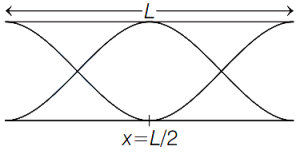
An organ pipe with both ends open has a length $L=25 \,cm$. An extra hole is created at position $\frac{L}{2}$. The lowest frequency of sound produced is (assume,speed of sound $=340 \,m/s$) (in $\,Hz$)
A
$680$
B
$340$
C
$1360$
D
$4352$
Solution
(C) An organ pipe open at both ends must have an antinode at each open end. When an extra hole is created at the center $(x = \frac{L}{2})$,the air at this point is in contact with the atmosphere,which forces an antinode to form at this position as well.
For the lowest frequency (fundamental mode),the standing wave must have antinodes at both ends and at the center hole.
The distance between two consecutive antinodes is $\frac{\lambda}{2}$.
Here,the distance between the end antinode and the center antinode is $\frac{L}{2}$.
Therefore,$\frac{\lambda}{2} = \frac{L}{2} \implies \lambda = L = 25 \,cm = 0.25 \,m$.
The frequency $f$ is given by $f = \frac{v}{\lambda}$.
Substituting the values,$f = \frac{340}{0.25} = 1360 \,Hz$.
For the lowest frequency (fundamental mode),the standing wave must have antinodes at both ends and at the center hole.
The distance between two consecutive antinodes is $\frac{\lambda}{2}$.
Here,the distance between the end antinode and the center antinode is $\frac{L}{2}$.
Therefore,$\frac{\lambda}{2} = \frac{L}{2} \implies \lambda = L = 25 \,cm = 0.25 \,m$.
The frequency $f$ is given by $f = \frac{v}{\lambda}$.
Substituting the values,$f = \frac{340}{0.25} = 1360 \,Hz$.
0 likes
View Solution338
MediumMCQ
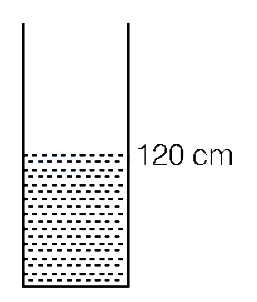
$A$ source of frequency $340 \,Hz$ is kept above a vertical cylindrical tube closed at the lower end. The length of the tube is $120 \,cm$. Water is slowly poured in just enough to produce resonance. Then, the minimum height (velocity of sound $= 340 \,m/s$) of the water level in the tube for that resonance is (in $\,m$)
A
$0.75$
B
$0.25$
C
$0.95$
D
$0.45$
Solution
(D) The frequency of the source is $f = 340 \,Hz$ and the velocity of sound is $v = 340 \,m/s$.
The wavelength of the sound wave is $\lambda = \frac{v}{f} = \frac{340}{340} = 1 \,m = 100 \,cm$.
For a tube closed at one end, resonance occurs when the length of the air column $l$ satisfies $l = (2n-1) \frac{\lambda}{4}$, where $n = 1, 2, 3, \dots$.
For $n=1$, $l_1 = \frac{\lambda}{4} = \frac{100}{4} = 25 \,cm$.
For $n=2$, $l_2 = \frac{3\lambda}{4} = \frac{3 \times 100}{4} = 75 \,cm$.
For $n=3$, $l_3 = \frac{5\lambda}{4} = \frac{5 \times 100}{4} = 125 \,cm$.
Since the total length of the tube is $120 \,cm$, the possible air column lengths are $25 \,cm$ and $75 \,cm$.
The height of the water level $h$ from the bottom is given by $h = L - l$, where $L = 120 \,cm$ is the total length of the tube.
For $l_1 = 25 \,cm$, $h_1 = 120 - 25 = 95 \,cm = 0.95 \,m$.
For $l_2 = 75 \,cm$, $h_2 = 120 - 75 = 45 \,cm = 0.45 \,m$.
The minimum height of the water level is $0.45 \,m$.
The wavelength of the sound wave is $\lambda = \frac{v}{f} = \frac{340}{340} = 1 \,m = 100 \,cm$.
For a tube closed at one end, resonance occurs when the length of the air column $l$ satisfies $l = (2n-1) \frac{\lambda}{4}$, where $n = 1, 2, 3, \dots$.
For $n=1$, $l_1 = \frac{\lambda}{4} = \frac{100}{4} = 25 \,cm$.
For $n=2$, $l_2 = \frac{3\lambda}{4} = \frac{3 \times 100}{4} = 75 \,cm$.
For $n=3$, $l_3 = \frac{5\lambda}{4} = \frac{5 \times 100}{4} = 125 \,cm$.
Since the total length of the tube is $120 \,cm$, the possible air column lengths are $25 \,cm$ and $75 \,cm$.
The height of the water level $h$ from the bottom is given by $h = L - l$, where $L = 120 \,cm$ is the total length of the tube.
For $l_1 = 25 \,cm$, $h_1 = 120 - 25 = 95 \,cm = 0.95 \,m$.
For $l_2 = 75 \,cm$, $h_2 = 120 - 75 = 45 \,cm = 0.45 \,m$.
The minimum height of the water level is $0.45 \,m$.
0 likes
View Solution339
DifficultMCQ
$A$ closed pipe is suddenly opened and changed to an open pipe of the same length. The fundamental frequency of the resulting open pipe is less than that of the $3^{rd}$ harmonic of the earlier closed pipe by $55 \,Hz$. Then, the value of the fundamental frequency of the closed pipe is: (in $\,Hz$)
A
$165$
B
$110$
C
$55$
D
$220$
Solution
(C) Let the length of the pipe be $l$ and the speed of sound be $v$.
The fundamental frequency of a closed pipe is $f_c = \frac{v}{4l}$.
The $3^{rd}$ harmonic of the closed pipe is $f_{3,c} = 3 \times f_c = \frac{3v}{4l}$.
The fundamental frequency of the open pipe is $f_o = \frac{v}{2l}$.
According to the problem, the fundamental frequency of the open pipe is less than the $3^{rd}$ harmonic of the closed pipe by $55 \,Hz$:
$f_{3,c} - f_o = 55 \,Hz$
$\frac{3v}{4l} - \frac{v}{2l} = 55$
$\frac{3v - 2v}{4l} = 55$
$\frac{v}{4l} = 55 \,Hz$
Since the fundamental frequency of the closed pipe is $f_c = \frac{v}{4l}$, the value is $55 \,Hz$.
The fundamental frequency of a closed pipe is $f_c = \frac{v}{4l}$.
The $3^{rd}$ harmonic of the closed pipe is $f_{3,c} = 3 \times f_c = \frac{3v}{4l}$.
The fundamental frequency of the open pipe is $f_o = \frac{v}{2l}$.
According to the problem, the fundamental frequency of the open pipe is less than the $3^{rd}$ harmonic of the closed pipe by $55 \,Hz$:
$f_{3,c} - f_o = 55 \,Hz$
$\frac{3v}{4l} - \frac{v}{2l} = 55$
$\frac{3v - 2v}{4l} = 55$
$\frac{v}{4l} = 55 \,Hz$
Since the fundamental frequency of the closed pipe is $f_c = \frac{v}{4l}$, the value is $55 \,Hz$.
0 likes
View Solution340
DifficultMCQ
An organ pipe $P_1$,closed at one end and containing a gas of density $\rho_1$ is vibrating in its first harmonic. Another organ pipe $P_2$,open at both ends and containing a gas of density $\rho_2$ is vibrating in its third harmonic. Both the pipes are in resonance with a given tuning fork. If the compressibility of gases is equal in both pipes,the ratio of the lengths of $P_1$ and $P_2$ is (assume the given gases to be monoatomic)
A
$\frac{1}{3}$
B
$3$
C
$\frac{1}{6} \sqrt{\frac{\rho_1}{\rho_2}}$
D
$\frac{1}{6} \sqrt{\frac{\rho_2}{\rho_1}}$
Solution
(D) The frequency of a closed organ pipe vibrating in its first harmonic is $n_1 = \frac{v_1}{4 l_1}$.
The frequency of an open organ pipe vibrating in its third harmonic is $n_3 = \frac{3 v_2}{2 l_2}$.
Since both pipes are in resonance with the same tuning fork,$n_1 = n_3$.
Therefore,$\frac{v_1}{4 l_1} = \frac{3 v_2}{2 l_2}$,which implies $\frac{l_1}{l_2} = \frac{1}{6} \left( \frac{v_1}{v_2} \right)$.
The speed of sound in a gas is given by $v = \sqrt{\frac{B}{\rho}}$,where $B$ is the bulk modulus (reciprocal of compressibility) and $\rho$ is the density.
Since the compressibility is equal,$B_1 = B_2 = B$.
Thus,$\frac{v_1}{v_2} = \sqrt{\frac{B/\rho_1}{B/\rho_2}} = \sqrt{\frac{\rho_2}{\rho_1}}$.
Substituting this into the ratio of lengths,we get $\frac{l_1}{l_2} = \frac{1}{6} \sqrt{\frac{\rho_2}{\rho_1}}$.
The frequency of an open organ pipe vibrating in its third harmonic is $n_3 = \frac{3 v_2}{2 l_2}$.
Since both pipes are in resonance with the same tuning fork,$n_1 = n_3$.
Therefore,$\frac{v_1}{4 l_1} = \frac{3 v_2}{2 l_2}$,which implies $\frac{l_1}{l_2} = \frac{1}{6} \left( \frac{v_1}{v_2} \right)$.
The speed of sound in a gas is given by $v = \sqrt{\frac{B}{\rho}}$,where $B$ is the bulk modulus (reciprocal of compressibility) and $\rho$ is the density.
Since the compressibility is equal,$B_1 = B_2 = B$.
Thus,$\frac{v_1}{v_2} = \sqrt{\frac{B/\rho_1}{B/\rho_2}} = \sqrt{\frac{\rho_2}{\rho_1}}$.
Substituting this into the ratio of lengths,we get $\frac{l_1}{l_2} = \frac{1}{6} \sqrt{\frac{\rho_2}{\rho_1}}$.
0 likes
View Solution341
EasyMCQ
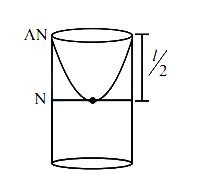
$A$ cylindrical tube open at both ends has a fundamental frequency '$f$' in air. The tube is dipped vertically in water so that half of its length is in water. The new fundamental frequency is
A
$f$
B
$\frac{f}{2}$
C
$2f$
D
$4f$
Solution
(A) Initially,for an open pipe of length '$L$',the fundamental frequency is given by:
$f = \frac{V}{2L}$
When the tube is dipped vertically in water such that half of its length is submerged,the remaining length of the air column above the water surface is '$L/2$'.
The water surface acts as a closed end. Thus,the tube now behaves as a pipe closed at one end with an effective length '$L' = L/2$'.
The fundamental frequency of a pipe closed at one end is given by:
$f' = \frac{V}{4L'}$
Substituting '$L' = L/2$':
$f' = \frac{V}{4(L/2)} = \frac{V}{2L} = f$
Therefore,the new fundamental frequency remains '$f$'.
$f = \frac{V}{2L}$
When the tube is dipped vertically in water such that half of its length is submerged,the remaining length of the air column above the water surface is '$L/2$'.
The water surface acts as a closed end. Thus,the tube now behaves as a pipe closed at one end with an effective length '$L' = L/2$'.
The fundamental frequency of a pipe closed at one end is given by:
$f' = \frac{V}{4L'}$
Substituting '$L' = L/2$':
$f' = \frac{V}{4(L/2)} = \frac{V}{2L} = f$
Therefore,the new fundamental frequency remains '$f$'.
0 likes
View Solution342
MediumMCQ
An air column in a tube of length $L = 50 \ cm$,closed at one end,is vibrating in its fifth harmonic. The phase difference between a particle at the open end and a particle at $42 \ cm$ from the open end is: (in $^{\circ}$)
A
$90$
B
$180$
C
$0$
D
$270$
Solution
(C) For a tube closed at one end,the frequencies of harmonics are given by $f_n = n \frac{v}{4L}$,where $n = 1, 3, 5, ...$ are odd integers. The fifth harmonic corresponds to $n = 5$.
The wavelength $\lambda$ is given by $\lambda = \frac{4L}{n} = \frac{4 \times 50 \ cm}{5} = 40 \ cm$.
The standing wave equation for a closed pipe (taking the open end at $x = 0$) is $y = A \sin(kx) \cos(\omega t)$,where $k = \frac{2\pi}{\lambda} = \frac{2\pi}{40} = \frac{\pi}{20} \ rad/cm$.
The particle at the open end $(x = 0)$ is at a node of the displacement wave (or antinode of pressure),but in terms of displacement amplitude,the open end is an antinode. However,the standard equation $y = A \sin(kx) \cos(\omega t)$ assumes $x=0$ is a node. For an open end at $x=0$,the displacement is $y = A \cos(kx) \cos(\omega t)$.
At $x = 0$,$y_1 = A \cos(0) \cos(\omega t) = A \cos(\omega t)$.
At $x = 42 \ cm$,$y_2 = A \cos(k \times 42) \cos(\omega t) = A \cos(\frac{\pi}{20} \times 42) \cos(\omega t) = A \cos(2.1\pi) \cos(\omega t) = A \cos(2\pi + 0.1\pi) \cos(\omega t) = A \cos(0.1\pi) \cos(\omega t)$.
Since both particles oscillate in phase (the cosine terms have the same sign),the phase difference is $0^{\circ}$.
The wavelength $\lambda$ is given by $\lambda = \frac{4L}{n} = \frac{4 \times 50 \ cm}{5} = 40 \ cm$.
The standing wave equation for a closed pipe (taking the open end at $x = 0$) is $y = A \sin(kx) \cos(\omega t)$,where $k = \frac{2\pi}{\lambda} = \frac{2\pi}{40} = \frac{\pi}{20} \ rad/cm$.
The particle at the open end $(x = 0)$ is at a node of the displacement wave (or antinode of pressure),but in terms of displacement amplitude,the open end is an antinode. However,the standard equation $y = A \sin(kx) \cos(\omega t)$ assumes $x=0$ is a node. For an open end at $x=0$,the displacement is $y = A \cos(kx) \cos(\omega t)$.
At $x = 0$,$y_1 = A \cos(0) \cos(\omega t) = A \cos(\omega t)$.
At $x = 42 \ cm$,$y_2 = A \cos(k \times 42) \cos(\omega t) = A \cos(\frac{\pi}{20} \times 42) \cos(\omega t) = A \cos(2.1\pi) \cos(\omega t) = A \cos(2\pi + 0.1\pi) \cos(\omega t) = A \cos(0.1\pi) \cos(\omega t)$.
Since both particles oscillate in phase (the cosine terms have the same sign),the phase difference is $0^{\circ}$.
0 likes
View Solution343
MediumMCQ
$A$ metal rod of length $125 \ cm$ is clamped at its midpoint. If the speed of sound in the metal is $5000 \ ms^{-1}$,then the fundamental frequency of the longitudinal vibrations of the rod is (in $kHz$)
A
$2$
B
$20$
C
$0.2$
D
$200$
Solution
(A) For a rod clamped at its midpoint,the midpoint acts as a node and the two ends act as antinodes for the fundamental longitudinal vibration.
Let $L$ be the length of the rod. The distance between two consecutive antinodes is $\lambda/2$. Here,the rod is clamped at the center,so the length $L$ corresponds to the distance between the two ends (antinodes),which is $\lambda/2$.
Thus,$L = \lambda/2$,which implies $\lambda = 2L$.
The fundamental frequency $f$ is given by $f = v/\lambda$,where $v$ is the speed of sound.
Substituting $\lambda = 2L$,we get $f = v/(2L)$.
Given: $L = 125 \ cm = 1.25 \ m$ and $v = 5000 \ ms^{-1}$.
$f = 5000 / (2 \times 1.25) = 5000 / 2.5 = 2000 \ Hz$.
$2000 \ Hz = 2 \ kHz$.
Let $L$ be the length of the rod. The distance between two consecutive antinodes is $\lambda/2$. Here,the rod is clamped at the center,so the length $L$ corresponds to the distance between the two ends (antinodes),which is $\lambda/2$.
Thus,$L = \lambda/2$,which implies $\lambda = 2L$.
The fundamental frequency $f$ is given by $f = v/\lambda$,where $v$ is the speed of sound.
Substituting $\lambda = 2L$,we get $f = v/(2L)$.
Given: $L = 125 \ cm = 1.25 \ m$ and $v = 5000 \ ms^{-1}$.
$f = 5000 / (2 \times 1.25) = 5000 / 2.5 = 2000 \ Hz$.
$2000 \ Hz = 2 \ kHz$.
0 likes
View Solution344
DifficultMCQ
For air at room temperature,the atmospheric pressure is $1.0 \times 10^{5} \text{ Nm}^{-2}$ and the density of air is $1.2 \text{ kgm}^{-3}$. For a tube of length $1.0 \text{ m}$,closed at one end,the lowest frequency generated is $84 \text{ Hz}$. The value of $\gamma$ (ratio of two specific heats) for air is:
A
$2.1$
B
$1.5$
C
$1.8$
D
$1.4$
Solution
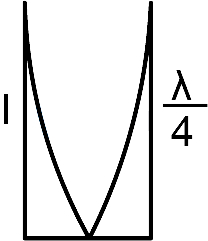
(D) The tube is closed at one end,so it acts as a closed organ pipe. The lowest frequency (fundamental frequency) produced in the tube corresponds to the condition where the length of the tube $l = \frac{\lambda}{4}$.
Given: $l = 1.0 \text{ m}$,$f = 84 \text{ Hz}$.
Therefore,the wavelength $\lambda = 4l = 4 \times 1.0 = 4 \text{ m}$.
The velocity of sound in air is given by $v = f \lambda = 84 \times 4 = 336 \text{ m/s}$.
The velocity of sound is also given by the formula $v = \sqrt{\frac{\gamma P}{\rho}}$,where $P$ is the atmospheric pressure and $\rho$ is the density of air.
Squaring both sides,we get $v^{2} = \frac{\gamma P}{\rho}$.
Rearranging for $\gamma$,we get $\gamma = \frac{v^{2} \rho}{P}$.
Substituting the values: $\gamma = \frac{(336)^{2} \times 1.2}{1.0 \times 10^{5}} = \frac{112896 \times 1.2}{100000} = \frac{135475.2}{100000} \approx 1.355$.
Rounding to the nearest option,we get $\gamma = 1.4$.
Given: $l = 1.0 \text{ m}$,$f = 84 \text{ Hz}$.
Therefore,the wavelength $\lambda = 4l = 4 \times 1.0 = 4 \text{ m}$.
The velocity of sound in air is given by $v = f \lambda = 84 \times 4 = 336 \text{ m/s}$.
The velocity of sound is also given by the formula $v = \sqrt{\frac{\gamma P}{\rho}}$,where $P$ is the atmospheric pressure and $\rho$ is the density of air.
Squaring both sides,we get $v^{2} = \frac{\gamma P}{\rho}$.
Rearranging for $\gamma$,we get $\gamma = \frac{v^{2} \rho}{P}$.
Substituting the values: $\gamma = \frac{(336)^{2} \times 1.2}{1.0 \times 10^{5}} = \frac{112896 \times 1.2}{100000} = \frac{135475.2}{100000} \approx 1.355$.
Rounding to the nearest option,we get $\gamma = 1.4$.
0 likes
View Solution345
MediumMCQ
The length of an open organ pipe is twice the length of a closed organ pipe. The fundamental frequency of the open pipe is $100 \ Hz$. The frequency of the third harmonic of the closed pipe is: (in $Hz$)
A
$100$
B
$200$
C
$300$
D
$150$
Solution
(C) Let the length of the closed organ pipe be $l$. The fundamental frequency of an open organ pipe of length $L = 2l$ is given by $f_{open} = \frac{v}{2L} = \frac{v}{2(2l)} = \frac{v}{4l} = 100 \ Hz$.
The frequencies of a closed organ pipe of length $l$ are given by $f_n = (2n - 1) \frac{v}{4l}$,where $n = 1, 2, 3, ...$.
The first harmonic (fundamental) is $f_1 = \frac{v}{4l} = 100 \ Hz$.
The third harmonic corresponds to $n = 2$ (since the harmonics of a closed pipe are odd multiples of the fundamental: $f_1, 3f_1, 5f_1, ...$).
Therefore,the frequency of the third harmonic is $f_3 = 3 \times f_1 = 3 \times 100 \ Hz = 300 \ Hz$.
The frequencies of a closed organ pipe of length $l$ are given by $f_n = (2n - 1) \frac{v}{4l}$,where $n = 1, 2, 3, ...$.
The first harmonic (fundamental) is $f_1 = \frac{v}{4l} = 100 \ Hz$.
The third harmonic corresponds to $n = 2$ (since the harmonics of a closed pipe are odd multiples of the fundamental: $f_1, 3f_1, 5f_1, ...$).
Therefore,the frequency of the third harmonic is $f_3 = 3 \times f_1 = 3 \times 100 \ Hz = 300 \ Hz$.
0 likes
View Solution346
MediumMCQ
$A$ whistle whose air column is open at both ends has a fundamental frequency of $5100 \ Hz$. If the speed of sound in air is $340 \ ms^{-1}$,the length of the whistle,in $cm$,is
A
$5 / 3$
B
$10 / 3$
C
$5$
D
$20 / 3$
Solution
(B) For an open pipe,the fundamental frequency $f$ is given by the formula $f = \frac{v}{2l}$,where $v$ is the speed of sound and $l$ is the length of the pipe.
Given: $f = 5100 \ Hz$,$v = 340 \ ms^{-1}$.
Substituting the values into the formula:
$5100 = \frac{340}{2l}$
$l = \frac{340}{5100 \times 2}$
$l = \frac{340}{10200} = \frac{34}{1020} = \frac{1}{30} \ m$.
To convert the length into $cm$,multiply by $100$:
$l = \frac{1}{30} \times 100 = \frac{10}{3} \ cm$.
Given: $f = 5100 \ Hz$,$v = 340 \ ms^{-1}$.
Substituting the values into the formula:
$5100 = \frac{340}{2l}$
$l = \frac{340}{5100 \times 2}$
$l = \frac{340}{10200} = \frac{34}{1020} = \frac{1}{30} \ m$.
To convert the length into $cm$,multiply by $100$:
$l = \frac{1}{30} \times 100 = \frac{10}{3} \ cm$.
0 likes
View Solution347
EasyMCQ
The fundamental frequency of a closed pipe is equal to the frequency of the second harmonic of an open pipe. The ratio of their lengths is
A
$1: 2$
B
$1: 4$
C
$1: 8$
D
$1: 16$
Solution
(B) Let the length of the closed pipe be $L_{1}$ and the length of the open pipe be $L_{2}$.
The fundamental frequency of a closed pipe is given by $v_{1} = \frac{v}{4 L_{1}}$.
The frequency of the second harmonic of an open pipe is given by $v_{2} = 2 \times \frac{v}{2 L_{2}} = \frac{v}{L_{2}}$.
According to the problem,the fundamental frequency of the closed pipe is equal to the frequency of the second harmonic of the open pipe,so $v_{1} = v_{2}$.
Substituting the expressions,we get $\frac{v}{4 L_{1}} = \frac{v}{L_{2}}$.
Rearranging the terms,we find $\frac{L_{1}}{L_{2}} = \frac{1}{4}$.
Thus,the ratio of their lengths is $1: 4$.
The fundamental frequency of a closed pipe is given by $v_{1} = \frac{v}{4 L_{1}}$.
The frequency of the second harmonic of an open pipe is given by $v_{2} = 2 \times \frac{v}{2 L_{2}} = \frac{v}{L_{2}}$.
According to the problem,the fundamental frequency of the closed pipe is equal to the frequency of the second harmonic of the open pipe,so $v_{1} = v_{2}$.
Substituting the expressions,we get $\frac{v}{4 L_{1}} = \frac{v}{L_{2}}$.
Rearranging the terms,we find $\frac{L_{1}}{L_{2}} = \frac{1}{4}$.
Thus,the ratio of their lengths is $1: 4$.
0 likes
View Solution348
EasyMCQ
The frequency of the first overtone of a closed pipe of length $l_{1}$ is equal to that of the first overtone of an open pipe of length $l_{2}$. The ratio of their lengths $(l_{1}: l_{2})$ is
A
$2: 3$
B
$4: 5$
C
$3: 5$
D
$3: 4$
Solution
(D) For a closed pipe,the frequency of the $n$-th overtone is given by $f_{c} = \frac{(2n+1)v}{4l_{1}}$,where $n$ is the overtone number. For the first overtone $(n=1)$,$f_{c} = \frac{3v}{4l_{1}}$.
For an open pipe,the frequency of the $n$-th overtone is given by $f_{o} = \frac{(n+1)v}{2l_{2}}$,where $n$ is the overtone number. For the first overtone $(n=1)$,$f_{o} = \frac{2v}{2l_{2}} = \frac{v}{l_{2}}$.
Given that the frequencies are equal: $\frac{3v}{4l_{1}} = \frac{v}{l_{2}}$.
Rearranging for the ratio: $\frac{l_{1}}{l_{2}} = \frac{3}{4}$.
For an open pipe,the frequency of the $n$-th overtone is given by $f_{o} = \frac{(n+1)v}{2l_{2}}$,where $n$ is the overtone number. For the first overtone $(n=1)$,$f_{o} = \frac{2v}{2l_{2}} = \frac{v}{l_{2}}$.
Given that the frequencies are equal: $\frac{3v}{4l_{1}} = \frac{v}{l_{2}}$.
Rearranging for the ratio: $\frac{l_{1}}{l_{2}} = \frac{3}{4}$.
0 likes
View SolutionWaves and Sound — Longitudinal Stationary Waves (Organ Pipes) and Resonance Tube · Frequently Asked Questions
1Are these Waves and Sound questions useful for JEE and NEET?
Yes. All questions in this section are mapped to JEE Main and NEET exam patterns. Previous year questions from JEE Main, NEET, GUJCET and state-level exams are included with full solutions.
2Can I switch to Hindi or Gujarati for these questions?
Yes. Use the language tabs in the hero section or the sidebar to view the same questions and solutions in English, Hindi or Gujarati.
3How do I generate a question paper from this subtopic?
Use the Vedclass Exam Paper Generator — select the chapter and subtopic, set difficulty, and generate Sets A, B, C, D automatically. First 3 chapters of every subject are free.
Vedclass Products
For Students
Vedclass Test Series
Mock tests in real JEE/NEET style with performance analysis. 5-day free trial.
Start Free TrialFor Teachers
Exam Paper Generator
Generate Set A/B/C/D papers from this chapter in 2 minutes. 3 chapters free.
Try FreeFor Institutes
Online Exam Module
Live online exams with unlimited students, 360° analytics & white-label branding.
See DemoFor Teachers & Institutes
Generate a Waves and Sound Exam Paper in 2 Minutes
Select subtopic & difficulty — Sets A, B, C, D auto-generated with No Repeat logic.
First 3 chapters of every subject are free — no payment required.