
A English
Beats and Tuning fork Questions in English
Class 11 Physics · Waves and Sound · Beats and Tuning fork
211+
Questions
English
Language
100%
With Solutions
Showing 48 of 211 questions in English
151
MediumMCQ
The frequency of a tuning fork is $220 \,Hz$ and the velocity of sound in air is $330 \,m/s$. When the tuning fork completes $80$ vibrations, the distance travelled by the sound wave is: (in $\,m$)
A
$120$
B
$60$
C
$53$
D
$100$
Solution
(A) Given: Frequency $f = 220 \,Hz$, Velocity $v = 330 \,m/s$.
First, calculate the wavelength $\lambda$ using the formula $v = f \lambda$:
$\lambda = \frac{v}{f} = \frac{330}{220} = 1.5 \,m$.
In one vibration, the sound wave travels a distance equal to one wavelength $\lambda$.
Therefore, for $80$ vibrations, the total distance $d$ is:
$d = 80 \times \lambda = 80 \times 1.5 = 120 \,m$.
First, calculate the wavelength $\lambda$ using the formula $v = f \lambda$:
$\lambda = \frac{v}{f} = \frac{330}{220} = 1.5 \,m$.
In one vibration, the sound wave travels a distance equal to one wavelength $\lambda$.
Therefore, for $80$ vibrations, the total distance $d$ is:
$d = 80 \times \lambda = 80 \times 1.5 = 120 \,m$.
0 likes
View Solution152
MediumMCQ
When two tuning forks are sounded together,$6$ beats per second are heard. One of the forks is in unison with $0.70 \ m$ length of a sonometer wire and another fork is in unison with $0.69 \ m$ length of the same sonometer wire. The frequencies of the two tuning forks are:
A
$320 \ Hz, 326 \ Hz$
B
$414 \ Hz, 420 \ Hz$
C
$420 \ Hz, 426 \ Hz$
D
$480 \ Hz, 486 \ Hz$
Solution
(B) For a sonometer wire,the frequency $f$ is inversely proportional to the vibrating length $l$,i.e.,$f \propto 1/l$.
Let the frequencies of the two tuning forks be $f_1$ and $f_2$.
Given that $f_1 \propto 1/0.70$ and $f_2 \propto 1/0.69$.
Since $f_2 > f_1$,we have $f_2 - f_1 = 6 \ Hz$.
Let $f_1 = k/0.70$ and $f_2 = k/0.69$,where $k$ is a constant.
Substituting these into the beat frequency equation: $k/0.69 - k/0.70 = 6$.
$k(0.70 - 0.69) / (0.69 \times 0.70) = 6$.
$k(0.01) / 0.483 = 6$.
$k = 6 \times 0.483 / 0.01 = 6 \times 48.3 = 289.8$.
Now,$f_1 = 289.8 / 0.70 = 414 \ Hz$.
And $f_2 = 289.8 / 0.69 = 420 \ Hz$.
Thus,the frequencies are $414 \ Hz$ and $420 \ Hz$.
Let the frequencies of the two tuning forks be $f_1$ and $f_2$.
Given that $f_1 \propto 1/0.70$ and $f_2 \propto 1/0.69$.
Since $f_2 > f_1$,we have $f_2 - f_1 = 6 \ Hz$.
Let $f_1 = k/0.70$ and $f_2 = k/0.69$,where $k$ is a constant.
Substituting these into the beat frequency equation: $k/0.69 - k/0.70 = 6$.
$k(0.70 - 0.69) / (0.69 \times 0.70) = 6$.
$k(0.01) / 0.483 = 6$.
$k = 6 \times 0.483 / 0.01 = 6 \times 48.3 = 289.8$.
Now,$f_1 = 289.8 / 0.70 = 414 \ Hz$.
And $f_2 = 289.8 / 0.69 = 420 \ Hz$.
Thus,the frequencies are $414 \ Hz$ and $420 \ Hz$.
0 likes
View Solution153
EasyMCQ
The frequency of a tuning fork is $256 \ Hz$. It will < u>not resonate with the tuning fork of frequency (in $Hz$)
A
$256$
B
$512$
C
$754$
D
$768$
Solution
(C) Resonance occurs when the frequency of the driving force matches the natural frequency of the system or one of its harmonics (integer multiples).
Given frequency $f = 256 \ Hz$.
Harmonics are $n \times f$,where $n = 1, 2, 3, \dots$
$1st \ harmonic = 1 \times 256 = 256 \ Hz$.
$2nd \ harmonic = 2 \times 256 = 512 \ Hz$.
$3rd \ harmonic = 3 \times 256 = 768 \ Hz$.
Comparing the options:
$A) 256 \ Hz$ (Resonates)
$B) 512 \ Hz$ (Resonates)
$C) 754 \ Hz$ (Does not resonate)
$D) 768 \ Hz$ (Resonates)
Therefore,the tuning fork will not resonate with $754 \ Hz$.
Given frequency $f = 256 \ Hz$.
Harmonics are $n \times f$,where $n = 1, 2, 3, \dots$
$1st \ harmonic = 1 \times 256 = 256 \ Hz$.
$2nd \ harmonic = 2 \times 256 = 512 \ Hz$.
$3rd \ harmonic = 3 \times 256 = 768 \ Hz$.
Comparing the options:
$A) 256 \ Hz$ (Resonates)
$B) 512 \ Hz$ (Resonates)
$C) 754 \ Hz$ (Does not resonate)
$D) 768 \ Hz$ (Resonates)
Therefore,the tuning fork will not resonate with $754 \ Hz$.
0 likes
View Solution154
MediumMCQ
Two sources of sound are emitting progressive waves $y_1 = 4 \sin(710 \pi t)$ and $y_2 = 3 \sin(702 \pi t)$. The sources are placed close to each other. The number of beats heard per second and the intensity ratio between waxing and waning are respectively:
A
$4, 16:9$
B
$8, 16:9$
C
$4, 49:1$
D
$8, 49:1$
Solution
(C) The given equations are $y_1 = 4 \sin(710 \pi t)$ and $y_2 = 3 \sin(702 \pi t)$.
Comparing these with $y = A \sin(2 \pi f t)$,we get:
$2 \pi f_1 = 710 \pi \implies f_1 = 355 \text{ Hz}$
$2 \pi f_2 = 702 \pi \implies f_2 = 351 \text{ Hz}$
The number of beats per second is $n = |f_1 - f_2| = |355 - 351| = 4 \text{ beats/s}$.
The amplitudes are $A_1 = 4$ and $A_2 = 3$.
The maximum intensity (waxing) is proportional to $(A_1 + A_2)^2 = (4 + 3)^2 = 7^2 = 49$.
The minimum intensity (waning) is proportional to $(A_1 - A_2)^2 = (4 - 3)^2 = 1^2 = 1$.
Therefore,the intensity ratio is $49:1$.
The correct answer is $4, 49:1$.
Comparing these with $y = A \sin(2 \pi f t)$,we get:
$2 \pi f_1 = 710 \pi \implies f_1 = 355 \text{ Hz}$
$2 \pi f_2 = 702 \pi \implies f_2 = 351 \text{ Hz}$
The number of beats per second is $n = |f_1 - f_2| = |355 - 351| = 4 \text{ beats/s}$.
The amplitudes are $A_1 = 4$ and $A_2 = 3$.
The maximum intensity (waxing) is proportional to $(A_1 + A_2)^2 = (4 + 3)^2 = 7^2 = 49$.
The minimum intensity (waning) is proportional to $(A_1 - A_2)^2 = (4 - 3)^2 = 1^2 = 1$.
Therefore,the intensity ratio is $49:1$.
The correct answer is $4, 49:1$.
0 likes
View Solution155
MediumMCQ
Two strings ' $X$ ' and ' $Y$ ' of a guitar produce a beat frequency of $6 \ Hz$. When the tension of the string ' $Y$ ' is increased,the beat frequency is found to be $4 \ Hz$. If the frequency of string ' $X$ ' is $300 \ Hz$,then the original frequency of string ' $Y$ ' is: (in $Hz$)
A
$296$
B
$294$
C
$306$
D
$304$
Solution
(B) The beat frequency is given by $|f_X - f_Y| = 6 \ Hz$.
Given $f_X = 300 \ Hz$,the possible frequencies for $f_Y$ are $300 - 6 = 294 \ Hz$ or $300 + 6 = 306 \ Hz$.
When the tension of a string is increased,its frequency $f$ increases because $f \propto \sqrt{T}$.
Case $1$: If $f_Y = 294 \ Hz$,increasing the tension increases $f_Y$. The new beat frequency would be $|300 - (294 + \Delta f)|$. Since the beat frequency decreases to $4 \ Hz$,the value must be approaching $300 \ Hz$. Thus,$300 - (294 + \Delta f) = 4$,which gives $\Delta f = 2 \ Hz$. This is possible.
Case $2$: If $f_Y = 306 \ Hz$,increasing the tension increases $f_Y$ further away from $300 \ Hz$. The new beat frequency would be $|300 - (306 + \Delta f)| = 6 + \Delta f$,which would be greater than $6 \ Hz$.
Since the beat frequency decreased,the original frequency must be $294 \ Hz$.
Given $f_X = 300 \ Hz$,the possible frequencies for $f_Y$ are $300 - 6 = 294 \ Hz$ or $300 + 6 = 306 \ Hz$.
When the tension of a string is increased,its frequency $f$ increases because $f \propto \sqrt{T}$.
Case $1$: If $f_Y = 294 \ Hz$,increasing the tension increases $f_Y$. The new beat frequency would be $|300 - (294 + \Delta f)|$. Since the beat frequency decreases to $4 \ Hz$,the value must be approaching $300 \ Hz$. Thus,$300 - (294 + \Delta f) = 4$,which gives $\Delta f = 2 \ Hz$. This is possible.
Case $2$: If $f_Y = 306 \ Hz$,increasing the tension increases $f_Y$ further away from $300 \ Hz$. The new beat frequency would be $|300 - (306 + \Delta f)| = 6 + \Delta f$,which would be greater than $6 \ Hz$.
Since the beat frequency decreased,the original frequency must be $294 \ Hz$.
0 likes
View Solution156
MediumMCQ
Two identical straight wires are stretched so as to produce $6$ beats per second when vibrating simultaneously with tensions $T_1$ and $T_2$ respectively. On changing the tension slightly in one of them,the beat frequency remains unchanged. This will happen when (Given $\rightarrow T_1 > T_2$)
A
$T_1$ is increased or $T_2$ is decreased
B
$T_1$ is increased by $144$
C
$T_2$ is decreased by $144$
D
$T_1$ is decreased or $T_2$ is increased
Solution
(D) The frequency of a vibrating wire is given by $f = \frac{1}{2L} \sqrt{\frac{T}{\mu}}$. Since the wires are identical,$L$ and $\mu$ are constant,so $f \propto \sqrt{T}$.
Given $T_1 > T_2$,the frequencies are $f_1$ and $f_2$ such that $f_1 > f_2$. The beat frequency is $f_1 - f_2 = 6$.
If we change the tension slightly,the beat frequency remains $6$ if the difference between the frequencies remains the same.
Let $f_1 = k\sqrt{T_1}$ and $f_2 = k\sqrt{T_2}$.
If $T_1$ is decreased,$f_1$ decreases,moving closer to $f_2$. If $T_2$ is increased,$f_2$ increases,moving closer to $f_1$. In both cases,the difference $f_1 - f_2$ decreases.
However,if we decrease $T_1$ such that $f_1$ becomes less than $f_2$,the beat frequency $|f_2 - f_1|$ can remain $6$ if the new difference is equal to the original difference.
Specifically,if $T_1$ is decreased or $T_2$ is increased,the frequencies approach each other and then cross. The condition for the beat frequency to remain unchanged after a slight change is that the new difference $|f_1' - f_2'|$ equals the original difference $6$.
Given $T_1 > T_2$,the frequencies are $f_1$ and $f_2$ such that $f_1 > f_2$. The beat frequency is $f_1 - f_2 = 6$.
If we change the tension slightly,the beat frequency remains $6$ if the difference between the frequencies remains the same.
Let $f_1 = k\sqrt{T_1}$ and $f_2 = k\sqrt{T_2}$.
If $T_1$ is decreased,$f_1$ decreases,moving closer to $f_2$. If $T_2$ is increased,$f_2$ increases,moving closer to $f_1$. In both cases,the difference $f_1 - f_2$ decreases.
However,if we decrease $T_1$ such that $f_1$ becomes less than $f_2$,the beat frequency $|f_2 - f_1|$ can remain $6$ if the new difference is equal to the original difference.
Specifically,if $T_1$ is decreased or $T_2$ is increased,the frequencies approach each other and then cross. The condition for the beat frequency to remain unchanged after a slight change is that the new difference $|f_1' - f_2'|$ equals the original difference $6$.
0 likes
View Solution157
MediumMCQ
Two sound waves travelling in the same direction have displacements $y_1 = a \sin(0.2 \pi x - 50 \pi t)$ and $y_2 = a \sin(0.15 \pi x - 46 \pi t)$. How many times can a listener hear sound of maximum intensity in one second?
A
$1$
B
$2$
C
$3$
D
$4$
Solution
(B) The frequency of a wave is given by $\omega = 2 \pi f$,where $\omega$ is the angular frequency.
For the first wave,$\omega_1 = 50 \pi$,so $f_1 = \frac{50 \pi}{2 \pi} = 25 \text{ Hz}$.
For the second wave,$\omega_2 = 46 \pi$,so $f_2 = \frac{46 \pi}{2 \pi} = 23 \text{ Hz}$.
The beat frequency is the difference between the two frequencies: $f_b = |f_1 - f_2| = |25 - 23| = 2 \text{ Hz}$.
The beat frequency represents the number of times the intensity reaches a maximum per second.
Therefore,the listener hears the sound of maximum intensity $2$ times in one second.
For the first wave,$\omega_1 = 50 \pi$,so $f_1 = \frac{50 \pi}{2 \pi} = 25 \text{ Hz}$.
For the second wave,$\omega_2 = 46 \pi$,so $f_2 = \frac{46 \pi}{2 \pi} = 23 \text{ Hz}$.
The beat frequency is the difference between the two frequencies: $f_b = |f_1 - f_2| = |25 - 23| = 2 \text{ Hz}$.
The beat frequency represents the number of times the intensity reaches a maximum per second.
Therefore,the listener hears the sound of maximum intensity $2$ times in one second.
0 likes
View Solution158
EasyMCQ
Two tuning forks of frequencies $256 \ Hz$ and $258 \ Hz$ are sounded together. The time interval between two consecutive maxima is (in $s$)
A
$250$
B
$252$
C
$2$
D
$0.5$
Solution
(D) The beat frequency $f_b$ is the difference between the frequencies of the two tuning forks.
$f_b = |f_1 - f_2| = |258 \ Hz - 256 \ Hz| = 2 \ Hz$.
The beat frequency represents the number of maxima (beats) produced per second.
The time interval between two consecutive maxima is the time period of the beats,denoted by $T_b$.
$T_b = \frac{1}{f_b} = \frac{1}{2 \ Hz} = 0.5 \ s$.
Therefore,the time interval between two consecutive maxima is $0.5 \ s$.
$f_b = |f_1 - f_2| = |258 \ Hz - 256 \ Hz| = 2 \ Hz$.
The beat frequency represents the number of maxima (beats) produced per second.
The time interval between two consecutive maxima is the time period of the beats,denoted by $T_b$.
$T_b = \frac{1}{f_b} = \frac{1}{2 \ Hz} = 0.5 \ s$.
Therefore,the time interval between two consecutive maxima is $0.5 \ s$.
0 likes
View Solution159
MediumMCQ
$A$ wire under tension $225 \ N$ produces $6$ beats per second when it is tuned with a tuning fork. When the tension changes to $256 \ N$,it is again tuned with the same tuning fork,and the number of beats remains unchanged. The frequency of the tuning fork will be: (in $Hz$)
A
$256$
B
$186$
C
$225$
D
$280$
Solution
(B) Let $n$ be the frequency of the tuning fork.
Let $n_1$ and $n_2$ be the frequencies of the wire at tensions $T_1 = 225 \ N$ and $T_2 = 256 \ N$ respectively.
Since the frequency of a stretched wire is proportional to the square root of tension $(n \propto \sqrt{T})$,we have:
$n_1 = n - 6$ (or $n + 6$)
$n_2 = n + 6$ (or $n - 6$)
Since $T_2 > T_1$,it follows that $n_2 > n_1$. Thus,$n_1 = n - 6$ and $n_2 = n + 6$.
Taking the ratio:
$\frac{n_1}{n_2} = \sqrt{\frac{T_1}{T_2}} = \sqrt{\frac{225}{256}} = \frac{15}{16}$
$\frac{n - 6}{n + 6} = \frac{15}{16}$
$16(n - 6) = 15(n + 6)$
$16n - 96 = 15n + 90$
$n = 186 \ Hz$
Let $n_1$ and $n_2$ be the frequencies of the wire at tensions $T_1 = 225 \ N$ and $T_2 = 256 \ N$ respectively.
Since the frequency of a stretched wire is proportional to the square root of tension $(n \propto \sqrt{T})$,we have:
$n_1 = n - 6$ (or $n + 6$)
$n_2 = n + 6$ (or $n - 6$)
Since $T_2 > T_1$,it follows that $n_2 > n_1$. Thus,$n_1 = n - 6$ and $n_2 = n + 6$.
Taking the ratio:
$\frac{n_1}{n_2} = \sqrt{\frac{T_1}{T_2}} = \sqrt{\frac{225}{256}} = \frac{15}{16}$
$\frac{n - 6}{n + 6} = \frac{15}{16}$
$16(n - 6) = 15(n + 6)$
$16n - 96 = 15n + 90$
$n = 186 \ Hz$
0 likes
View Solution160
DifficultMCQ
Two waves $Y_1 = 0.25 \sin(316t)$ and $Y_2 = 0.25 \sin(310t)$ are propagating along the same direction. The number of beats produced per second is:
A
$\frac{\pi}{3}$
B
$\frac{3}{\pi}$
C
$\frac{2}{\pi}$
D
$\frac{\pi}{2}$
Solution
(B) The general equation for a wave is given by $Y = A \sin(\omega t)$.
For the first wave,$Y_1 = 0.25 \sin(316t)$,comparing with the general equation,we get angular frequency $\omega_1 = 316 \text{ rad/s}$.
Since $\omega = 2\pi f$,the frequency $f_1 = \frac{\omega_1}{2\pi} = \frac{316}{2\pi} \text{ Hz}$.
For the second wave,$Y_2 = 0.25 \sin(310t)$,comparing with the general equation,we get angular frequency $\omega_2 = 310 \text{ rad/s}$.
The frequency $f_2 = \frac{\omega_2}{2\pi} = \frac{310}{2\pi} \text{ Hz}$.
The number of beats produced per second is the difference in frequencies: $f_{beat} = |f_1 - f_2|$.
$f_{beat} = \frac{316}{2\pi} - \frac{310}{2\pi} = \frac{6}{2\pi} = \frac{3}{\pi} \text{ Hz}$.
For the first wave,$Y_1 = 0.25 \sin(316t)$,comparing with the general equation,we get angular frequency $\omega_1 = 316 \text{ rad/s}$.
Since $\omega = 2\pi f$,the frequency $f_1 = \frac{\omega_1}{2\pi} = \frac{316}{2\pi} \text{ Hz}$.
For the second wave,$Y_2 = 0.25 \sin(310t)$,comparing with the general equation,we get angular frequency $\omega_2 = 310 \text{ rad/s}$.
The frequency $f_2 = \frac{\omega_2}{2\pi} = \frac{310}{2\pi} \text{ Hz}$.
The number of beats produced per second is the difference in frequencies: $f_{beat} = |f_1 - f_2|$.
$f_{beat} = \frac{316}{2\pi} - \frac{310}{2\pi} = \frac{6}{2\pi} = \frac{3}{\pi} \text{ Hz}$.
0 likes
View Solution161
MediumMCQ
$A$ set of $28$ tuning forks is arranged in an increasing order of frequencies. Each fork produces '$x$' beats per second with the preceding fork and the last fork is an octave of the first. If the frequency of the $12^{\text{th}}$ fork is $152 \text{ Hz}$,the value of '$x$' (number of beats per second) is:
A
$2$
B
$4$
C
$6$
D
$8$
Solution
(B) Let the frequencies of the $28$ tuning forks be $n_1, n_2, \dots, n_{28}$ in increasing order.
Since each fork produces '$x$' beats per second with the preceding one,the frequencies form an Arithmetic Progression $(AP)$ with common difference $d = x$.
Thus,the frequency of the $k^{\text{th}}$ fork is $n_k = n_1 + (k-1)x$.
For the $12^{\text{th}}$ fork: $n_{12} = n_1 + 11x = 152 \text{ Hz} \quad \dots(1)$.
For the $28^{\text{th}}$ fork: $n_{28} = n_1 + 27x$.
Given that the last fork is an octave of the first,$n_{28} = 2n_1$.
Substituting the expression for $n_{28}$: $2n_1 = n_1 + 27x \Rightarrow n_1 = 27x$.
Substitute $n_1 = 27x$ into equation $(1)$:
$27x + 11x = 152$
$38x = 152$
$x = \frac{152}{38} = 4 \text{ Hz}$.
Since each fork produces '$x$' beats per second with the preceding one,the frequencies form an Arithmetic Progression $(AP)$ with common difference $d = x$.
Thus,the frequency of the $k^{\text{th}}$ fork is $n_k = n_1 + (k-1)x$.
For the $12^{\text{th}}$ fork: $n_{12} = n_1 + 11x = 152 \text{ Hz} \quad \dots(1)$.
For the $28^{\text{th}}$ fork: $n_{28} = n_1 + 27x$.
Given that the last fork is an octave of the first,$n_{28} = 2n_1$.
Substituting the expression for $n_{28}$: $2n_1 = n_1 + 27x \Rightarrow n_1 = 27x$.
Substitute $n_1 = 27x$ into equation $(1)$:
$27x + 11x = 152$
$38x = 152$
$x = \frac{152}{38} = 4 \text{ Hz}$.
0 likes
View Solution162
DifficultMCQ
Two sound waves having displacements $x_1 = 2 \sin(1000 \pi t)$ and $x_2 = 3 \sin(1006 \pi t)$,when interfere,produce
A
$5$ beats/s with maximum intensity $25$ units
B
$6$ beats/s with maximum intensity $16$ units
C
$3$ beats/s with maximum intensity $25$ units
D
$1$ beats/s with maximum intensity $5$ units
Solution
(C) Given equations of displacement are:
$x_1 = 2 \sin(1000 \pi t)$
$x_2 = 3 \sin(1006 \pi t)$
Comparing these with the standard equation $x = A \sin(\omega t)$,we get:
Angular frequencies: $\omega_1 = 1000 \pi$ and $\omega_2 = 1006 \pi$.
Amplitudes: $A_1 = 2$ and $A_2 = 3$.
The frequencies are $f_1 = \frac{\omega_1}{2 \pi} = \frac{1000 \pi}{2 \pi} = 500 \text{ Hz}$ and $f_2 = \frac{\omega_2}{2 \pi} = \frac{1006 \pi}{2 \pi} = 503 \text{ Hz}$.
Beat frequency is given by $|f_2 - f_1| = |503 - 500| = 3 \text{ beats/s}$.
Maximum intensity is proportional to the square of the maximum amplitude $(A_{\text{max}} = A_1 + A_2)$.
$A_{\text{max}} = 2 + 3 = 5$ units.
Maximum intensity $\propto (A_{\text{max}})^2 = (5)^2 = 25$ units.
Therefore,the waves produce $3$ beats/s with a maximum intensity of $25$ units.
$x_1 = 2 \sin(1000 \pi t)$
$x_2 = 3 \sin(1006 \pi t)$
Comparing these with the standard equation $x = A \sin(\omega t)$,we get:
Angular frequencies: $\omega_1 = 1000 \pi$ and $\omega_2 = 1006 \pi$.
Amplitudes: $A_1 = 2$ and $A_2 = 3$.
The frequencies are $f_1 = \frac{\omega_1}{2 \pi} = \frac{1000 \pi}{2 \pi} = 500 \text{ Hz}$ and $f_2 = \frac{\omega_2}{2 \pi} = \frac{1006 \pi}{2 \pi} = 503 \text{ Hz}$.
Beat frequency is given by $|f_2 - f_1| = |503 - 500| = 3 \text{ beats/s}$.
Maximum intensity is proportional to the square of the maximum amplitude $(A_{\text{max}} = A_1 + A_2)$.
$A_{\text{max}} = 2 + 3 = 5$ units.
Maximum intensity $\propto (A_{\text{max}})^2 = (5)^2 = 25$ units.
Therefore,the waves produce $3$ beats/s with a maximum intensity of $25$ units.
0 likes
View Solution163
DifficultMCQ
The frequencies of two tuning forks $A$ and $B$ are respectively $1.4 \%$ more and $2.6 \%$ less than that of the tuning fork $C$. When $A$ and $B$ are sounded together, $10$ beats are produced in $1 \text{ s}$. The frequency of tuning fork $C$ is: (in $\text{ Hz}$)
A
$250$
B
$300$
C
$340$
D
$400$
Solution
(A) Let $n$ be the frequency of tuning fork $C$.
Given that the frequency of $A$ is $1.4 \%$ more than $C$, so $n_A = n + 0.014n = 1.014n$.
Given that the frequency of $B$ is $2.6 \%$ less than $C$, so $n_B = n - 0.026n = 0.974n$.
When $A$ and $B$ are sounded together, the number of beats produced per second is the difference in their frequencies: $|n_A - n_B| = 10$.
Substituting the values: $1.014n - 0.974n = 10$.
$0.04n = 10$.
$n = \frac{10}{0.04} = \frac{1000}{4} = 250 \text{ Hz}$.
Given that the frequency of $A$ is $1.4 \%$ more than $C$, so $n_A = n + 0.014n = 1.014n$.
Given that the frequency of $B$ is $2.6 \%$ less than $C$, so $n_B = n - 0.026n = 0.974n$.
When $A$ and $B$ are sounded together, the number of beats produced per second is the difference in their frequencies: $|n_A - n_B| = 10$.
Substituting the values: $1.014n - 0.974n = 10$.
$0.04n = 10$.
$n = \frac{10}{0.04} = \frac{1000}{4} = 250 \text{ Hz}$.
0 likes
View Solution164
EasyMCQ
If two waves of the same amplitude,having frequencies $340 \ Hz$ and $335 \ Hz$,are moving in the same direction,then the time interval between two successive maxima formed (in seconds) is:
A
$0.1$
B
$0.2$
C
$0.3$
D
$0.5$
Solution
(B) The beat frequency is defined as the difference between the frequencies of the two waves: $f_{beat} = |f_2 - f_1|$.
Given $f_1 = 340 \ Hz$ and $f_2 = 335 \ Hz$.
$f_{beat} = 340 \ Hz - 335 \ Hz = 5 \ Hz$.
The time interval between two successive maxima is the reciprocal of the beat frequency:
$T = \frac{1}{f_{beat}} = \frac{1}{5} \ s = 0.2 \ s$.
Given $f_1 = 340 \ Hz$ and $f_2 = 335 \ Hz$.
$f_{beat} = 340 \ Hz - 335 \ Hz = 5 \ Hz$.
The time interval between two successive maxima is the reciprocal of the beat frequency:
$T = \frac{1}{f_{beat}} = \frac{1}{5} \ s = 0.2 \ s$.
0 likes
View Solution165
EasyMCQ
Two sound waves having frequencies $250 \,Hz$ and $256 \,Hz$ superimpose to produce a beat wave. The resultant beat wave has intensity maximum at $t=0$. After how much time will an intensity minimum be produced at the same point?
A
$\frac{1}{6} \,s$
B
$\frac{1}{24} \,s$
C
$\frac{1}{18} \,s$
D
$\frac{1}{12} \,s$
Solution
(D) The beat frequency is given by $f_b = |f_2 - f_1| = |256 \,Hz - 250 \,Hz| = 6 \,Hz$.
The time period of the beat wave is $T_b = \frac{1}{f_b} = \frac{1}{6} \,s$.
The intensity is maximum at $t=0$. The intensity becomes minimum at half the time period of the beat, which corresponds to the interval between a maximum and the subsequent minimum.
Therefore, the time required is $t = \frac{T_b}{2} = \frac{1}{6 \times 2} = \frac{1}{12} \,s$.
The time period of the beat wave is $T_b = \frac{1}{f_b} = \frac{1}{6} \,s$.
The intensity is maximum at $t=0$. The intensity becomes minimum at half the time period of the beat, which corresponds to the interval between a maximum and the subsequent minimum.
Therefore, the time required is $t = \frac{T_b}{2} = \frac{1}{6 \times 2} = \frac{1}{12} \,s$.
0 likes
View Solution166
MediumMCQ
$A$ tuning fork gives $3$ beats with $50 \ cm$ length of sonometer wire. If the length of the wire is shortened by $1 \ cm$,the number of beats is still the same. The frequency of the fork is (in $Hz$)
A
$256$
B
$288$
C
$297$
D
$320$
Solution
(C) The frequency of a vibrating wire is given by $f = \frac{1}{2l} \sqrt{\frac{T}{m}}$.
Since $T$ and $m$ are constant,$f \propto \frac{1}{l}$,which implies $fl = \text{constant}$.
Let $f$ be the frequency of the tuning fork.
Initially,the length $l_1 = 50 \ cm$ and the beat frequency is $3$,so the wire frequency $f_1 = f - 3$ (or $f + 3$).
After shortening the length by $1 \ cm$,$l_2 = 49 \ cm$. The beat frequency remains $3$,so the wire frequency $f_2 = f + 3$ (or $f - 3$).
Since $f_1 l_1 = f_2 l_2$,we have $(f - 3) \times 50 = (f + 3) \times 49$.
$50f - 150 = 49f + 147$.
$50f - 49f = 147 + 150$.
$f = 297 \ Hz$.
Since $T$ and $m$ are constant,$f \propto \frac{1}{l}$,which implies $fl = \text{constant}$.
Let $f$ be the frequency of the tuning fork.
Initially,the length $l_1 = 50 \ cm$ and the beat frequency is $3$,so the wire frequency $f_1 = f - 3$ (or $f + 3$).
After shortening the length by $1 \ cm$,$l_2 = 49 \ cm$. The beat frequency remains $3$,so the wire frequency $f_2 = f + 3$ (or $f - 3$).
Since $f_1 l_1 = f_2 l_2$,we have $(f - 3) \times 50 = (f + 3) \times 49$.
$50f - 150 = 49f + 147$.
$50f - 49f = 147 + 150$.
$f = 297 \ Hz$.
0 likes
View Solution167
EasyMCQ
Two waves $y_1 = 0.35 \sin(316 t)$ and $y_2 = 0.35 \sin(310 t)$ are propagating along the same direction. The number of beats produced per second is:
A
$\frac{3}{\pi}$
B
$\frac{2}{\pi}$
C
$\frac{\pi}{2}$
D
$\frac{\pi}{3}$
Solution
(A) The general equation for a wave is $y = A \sin(\omega t)$,where $\omega = 2 \pi f$.
Given $y_1 = 0.35 \sin(316 t)$,the angular frequency is $\omega_1 = 316 \text{ rad/s}$. Thus,the frequency $f_1 = \frac{\omega_1}{2 \pi} = \frac{316}{2 \pi} \text{ Hz}$.
Given $y_2 = 0.35 \sin(310 t)$,the angular frequency is $\omega_2 = 310 \text{ rad/s}$. Thus,the frequency $f_2 = \frac{\omega_2}{2 \pi} = \frac{310}{2 \pi} \text{ Hz}$.
The number of beats produced per second is the beat frequency $f_b = |f_1 - f_2|$.
$f_b = \frac{316}{2 \pi} - \frac{310}{2 \pi} = \frac{6}{2 \pi} = \frac{3}{\pi} \text{ beats per second}$.
Given $y_1 = 0.35 \sin(316 t)$,the angular frequency is $\omega_1 = 316 \text{ rad/s}$. Thus,the frequency $f_1 = \frac{\omega_1}{2 \pi} = \frac{316}{2 \pi} \text{ Hz}$.
Given $y_2 = 0.35 \sin(310 t)$,the angular frequency is $\omega_2 = 310 \text{ rad/s}$. Thus,the frequency $f_2 = \frac{\omega_2}{2 \pi} = \frac{310}{2 \pi} \text{ Hz}$.
The number of beats produced per second is the beat frequency $f_b = |f_1 - f_2|$.
$f_b = \frac{316}{2 \pi} - \frac{310}{2 \pi} = \frac{6}{2 \pi} = \frac{3}{\pi} \text{ beats per second}$.
0 likes
View Solution168
EasyMCQ
Beats are produced by waves $y_1 = a \sin(2000 \pi t)$ and $y_2 = a \sin(2008 \pi t)$. The number of beats heard per second is
A
$4$
B
$1$
C
zero
D
$8$
Solution
(A) The general equation for a wave is given by $y = a \sin(2 \pi n t)$,where $n$ is the frequency.
For the first wave,$2 \pi n_1 = 2000 \pi$,which gives $n_1 = 1000 \text{ Hz}$.
For the second wave,$2 \pi n_2 = 2008 \pi$,which gives $n_2 = 1004 \text{ Hz}$.
The beat frequency is the difference between the two frequencies: $f_{\text{beat}} = |n_2 - n_1| = |1004 - 1000| = 4 \text{ Hz}$.
Therefore,the number of beats heard per second is $4$.
For the first wave,$2 \pi n_1 = 2000 \pi$,which gives $n_1 = 1000 \text{ Hz}$.
For the second wave,$2 \pi n_2 = 2008 \pi$,which gives $n_2 = 1004 \text{ Hz}$.
The beat frequency is the difference between the two frequencies: $f_{\text{beat}} = |n_2 - n_1| = |1004 - 1000| = 4 \text{ Hz}$.
Therefore,the number of beats heard per second is $4$.
0 likes
View Solution169
EasyMCQ
The frequencies of three tuning forks $A$,$B$,and $C$ are related as $n_{A} > n_{B} > n_{C}$. When the forks $A$ and $B$ are sounded together,the number of beats produced per second is $n_1$. When forks $A$ and $C$ are sounded together,the number of beats produced per second is $n_2$. How many beats are produced per second when forks $B$ and $C$ are sounded together?
A
$n_1 - n_2$
B
$\frac{n_1 + n_2}{2}$
C
$n_2 - n_1$
D
$n_1 + n_2$
Solution
(C) Given the frequencies of the tuning forks are $n_A, n_B, n_C$ such that $n_A > n_B > n_C$.
When forks $A$ and $B$ are sounded together,the beat frequency is $n_1 = n_A - n_B$ (Equation $i$).
When forks $A$ and $C$ are sounded together,the beat frequency is $n_2 = n_A - n_C$ (Equation $ii$).
We want to find the beat frequency when $B$ and $C$ are sounded together,which is $n_B - n_C$.
Subtracting Equation $i$ from Equation $ii$:
$(n_A - n_C) - (n_A - n_B) = n_2 - n_1$
$n_A - n_C - n_A + n_B = n_2 - n_1$
$n_B - n_C = n_2 - n_1$.
Thus,the number of beats produced per second is $n_2 - n_1$.
When forks $A$ and $B$ are sounded together,the beat frequency is $n_1 = n_A - n_B$ (Equation $i$).
When forks $A$ and $C$ are sounded together,the beat frequency is $n_2 = n_A - n_C$ (Equation $ii$).
We want to find the beat frequency when $B$ and $C$ are sounded together,which is $n_B - n_C$.
Subtracting Equation $i$ from Equation $ii$:
$(n_A - n_C) - (n_A - n_B) = n_2 - n_1$
$n_A - n_C - n_A + n_B = n_2 - n_1$
$n_B - n_C = n_2 - n_1$.
Thus,the number of beats produced per second is $n_2 - n_1$.
0 likes
View Solution170
MediumMCQ
Two sound waves having wavelengths $5.0 \ m$ and $5.5 \ m$ propagate in a gas with velocity $300 \ m/s$. The number of beats produced per second is
A
six
B
two
C
three
D
one
Solution
(A) Given: Wavelengths $\lambda_1 = 5.0 \ m$ and $\lambda_2 = 5.5 \ m$. Velocity of sound $v = 300 \ m/s$.
The frequency $n$ of a wave is given by $n = \frac{v}{\lambda}$.
Frequency of the first wave: $n_1 = \frac{300}{5.0} = 60 \ Hz$.
Frequency of the second wave: $n_2 = \frac{300}{5.5} = \frac{3000}{55} \approx 54.55 \ Hz$.
The number of beats produced per second is the difference in frequencies: $n_{beats} = |n_1 - n_2| = |60 - 54.55| = 5.45 \ Hz$.
Rounding to the nearest integer,the number of beats is approximately $5 \ Hz$ or $6 \ Hz$ depending on the precision. Given the options,$6 \ Hz$ is the closest match.
The frequency $n$ of a wave is given by $n = \frac{v}{\lambda}$.
Frequency of the first wave: $n_1 = \frac{300}{5.0} = 60 \ Hz$.
Frequency of the second wave: $n_2 = \frac{300}{5.5} = \frac{3000}{55} \approx 54.55 \ Hz$.
The number of beats produced per second is the difference in frequencies: $n_{beats} = |n_1 - n_2| = |60 - 54.55| = 5.45 \ Hz$.
Rounding to the nearest integer,the number of beats is approximately $5 \ Hz$ or $6 \ Hz$ depending on the precision. Given the options,$6 \ Hz$ is the closest match.
0 likes
View Solution171
EasyMCQ
Two identical wires are vibrating in unison. If the tension in one of the wires is increased by $2 \%$,five beats are produced per second by the two vibrating wires. The initial frequency of each wire is $(\sqrt{1.02} \approx 1.01)$. (in $Hz$)
A
$1000$
B
$500$
C
$400$
D
$200$
Solution
(B) The frequency $n$ of a vibrating wire is given by $n = \frac{1}{2 \ell} \sqrt{\frac{T}{m}}$.
Since the wires are identical,$\ell$ and $m$ are constant,so $n \propto \sqrt{T}$.
Let the initial frequency be $n_1$ and the initial tension be $T_1$. After increasing the tension by $2 \%$,the new tension $T_2 = T_1 + 0.02 T_1 = 1.02 T_1$.
The new frequency $n_2$ is given by $\frac{n_2}{n_1} = \sqrt{\frac{T_2}{T_1}} = \sqrt{1.02} = 1.01$.
Thus,$n_2 = 1.01 n_1$.
The beat frequency is given as $n_2 - n_1 = 5 \ Hz$.
Substituting $n_2$,we get $1.01 n_1 - n_1 = 5$.
$0.01 n_1 = 5$.
$n_1 = \frac{5}{0.01} = 500 \ Hz$.
Since the wires are identical,$\ell$ and $m$ are constant,so $n \propto \sqrt{T}$.
Let the initial frequency be $n_1$ and the initial tension be $T_1$. After increasing the tension by $2 \%$,the new tension $T_2 = T_1 + 0.02 T_1 = 1.02 T_1$.
The new frequency $n_2$ is given by $\frac{n_2}{n_1} = \sqrt{\frac{T_2}{T_1}} = \sqrt{1.02} = 1.01$.
Thus,$n_2 = 1.01 n_1$.
The beat frequency is given as $n_2 - n_1 = 5 \ Hz$.
Substituting $n_2$,we get $1.01 n_1 - n_1 = 5$.
$0.01 n_1 = 5$.
$n_1 = \frac{5}{0.01} = 500 \ Hz$.
0 likes
View Solution172
EasyMCQ
The frequencies of two tuning forks $A$ and $B$ are $1.5 \%$ more and $2.5 \%$ less than that of the tuning fork $C$. When $A$ and $B$ are sounded together, $12$ beats are produced in $1$ second. The frequency of tuning fork $C$ is: (in $\text{ Hz}$)
A
$200$
B
$300$
C
$240$
D
$360$
Solution
(B) Let the frequency of tuning fork $C$ be $f_C$.
Given that the frequency of $A$ is $1.5 \%$ more than $f_C$:
$f_A = f_C + 0.015 f_C = 1.015 f_C$.
Given that the frequency of $B$ is $2.5 \%$ less than $f_C$:
$f_B = f_C - 0.025 f_C = 0.975 f_C$.
When $A$ and $B$ are sounded together, the beat frequency is $12 \text{ Hz}$:
$|f_A - f_B| = 12$.
Substituting the expressions:
$1.015 f_C - 0.975 f_C = 12$.
$0.040 f_C = 12$.
$f_C = \frac{12}{0.040} = 300 \text{ Hz}$.
Given that the frequency of $A$ is $1.5 \%$ more than $f_C$:
$f_A = f_C + 0.015 f_C = 1.015 f_C$.
Given that the frequency of $B$ is $2.5 \%$ less than $f_C$:
$f_B = f_C - 0.025 f_C = 0.975 f_C$.
When $A$ and $B$ are sounded together, the beat frequency is $12 \text{ Hz}$:
$|f_A - f_B| = 12$.
Substituting the expressions:
$1.015 f_C - 0.975 f_C = 12$.
$0.040 f_C = 12$.
$f_C = \frac{12}{0.040} = 300 \text{ Hz}$.
0 likes
View Solution173
MediumMCQ
$A$ tuning fork $A$ produces $5$ beats per second with a tuning fork of frequency $480 \ Hz$. When a little wax is stuck to a prong of fork $A$,the number of beats heard per second becomes $2$. What is the frequency of tuning fork $A$ before the wax is stuck to it (in $Hz$)?
A
$485$
B
$478$
C
$475$
D
$482$
Solution
(A) Let the frequency of tuning fork $A$ be $f_A$ and the frequency of tuning fork $B$ be $f_B = 480 \ Hz$.
The beat frequency is given by $|f_A - f_B| = 5 \ Hz$.
This implies $f_A = 480 \pm 5$,so $f_A$ is either $485 \ Hz$ or $475 \ Hz$.
When wax is added to tuning fork $A$,its frequency $f_A$ decreases.
After adding wax,the new beat frequency is $|f_A' - 480| = 2 \ Hz$,where $f_A' < f_A$.
If $f_A = 475 \ Hz$,adding wax would decrease the frequency further (e.g.,to $473 \ Hz$),making the beat frequency $|473 - 480| = 7 \ Hz$,which is not $2 \ Hz$.
If $f_A = 485 \ Hz$,adding wax decreases the frequency towards $480 \ Hz$,making the beat frequency $|482 - 480| = 2 \ Hz$.
Thus,the initial frequency of tuning fork $A$ was $485 \ Hz$.
The beat frequency is given by $|f_A - f_B| = 5 \ Hz$.
This implies $f_A = 480 \pm 5$,so $f_A$ is either $485 \ Hz$ or $475 \ Hz$.
When wax is added to tuning fork $A$,its frequency $f_A$ decreases.
After adding wax,the new beat frequency is $|f_A' - 480| = 2 \ Hz$,where $f_A' < f_A$.
If $f_A = 475 \ Hz$,adding wax would decrease the frequency further (e.g.,to $473 \ Hz$),making the beat frequency $|473 - 480| = 7 \ Hz$,which is not $2 \ Hz$.
If $f_A = 485 \ Hz$,adding wax decreases the frequency towards $480 \ Hz$,making the beat frequency $|482 - 480| = 2 \ Hz$.
Thus,the initial frequency of tuning fork $A$ was $485 \ Hz$.
0 likes
View Solution174
EasyMCQ
For the formation of beats,two sound notes must have:
A
Different amplitudes and different frequencies
B
Exactly equal frequencies only
C
Exactly equal amplitudes only
D
Nearly equal frequencies and equal amplitudes
Solution
(D) Beats are the periodic variations in the intensity of sound heard when two sound waves of slightly different frequencies and comparable amplitudes interfere with each other.
For the formation of distinct beats,the two sound sources must have nearly equal frequencies so that the beat frequency $(f_{beat} = |f_1 - f_2|)$ is low enough to be perceived by the human ear.
Additionally,they should have nearly equal amplitudes to ensure that the interference results in clearly audible maximums and minimums of intensity.
For the formation of distinct beats,the two sound sources must have nearly equal frequencies so that the beat frequency $(f_{beat} = |f_1 - f_2|)$ is low enough to be perceived by the human ear.
Additionally,they should have nearly equal amplitudes to ensure that the interference results in clearly audible maximums and minimums of intensity.
0 likes
View Solution175
EasyMCQ
$A$ wire having tension $225 \ N$ produces six beats per second when it vibrates with a tuning fork. When the tension changes to $256 \ N$,it vibrates with the same fork,and the number of beats per second remains unchanged. The frequency of the fork is: (in $Hz$)
A
$186$
B
$225$
C
$256$
D
$280$
Solution
(A) The frequency of a vibrating wire is given by $f = \frac{1}{2L} \sqrt{\frac{T}{\mu}}$,which implies $f \propto \sqrt{T}$.
Let $f_1$ be the frequency at tension $T_1 = 225 \ N$ and $f_2$ be the frequency at tension $T_2 = 256 \ N$.
Since $f \propto \sqrt{T}$,we have $\frac{f_1}{f_2} = \sqrt{\frac{225}{256}} = \frac{15}{16}$,so $f_2 = \frac{16}{15} f_1$.
Given that the beat frequency is $6 \ Hz$ in both cases,let $x$ be the frequency of the tuning fork.
For the first case: $f_1 = x - 6$ (assuming $x > f_1$).
For the second case: $f_2 = x + 6$ (since $f_2 > f_1$,the frequency must increase past the fork frequency).
Substituting $f_1$ and $f_2$: $x + 6 = \frac{16}{15} (x - 6)$.
$15(x + 6) = 16(x - 6) \implies 15x + 90 = 16x - 96$.
$x = 90 + 96 = 186 \ Hz$.
Let $f_1$ be the frequency at tension $T_1 = 225 \ N$ and $f_2$ be the frequency at tension $T_2 = 256 \ N$.
Since $f \propto \sqrt{T}$,we have $\frac{f_1}{f_2} = \sqrt{\frac{225}{256}} = \frac{15}{16}$,so $f_2 = \frac{16}{15} f_1$.
Given that the beat frequency is $6 \ Hz$ in both cases,let $x$ be the frequency of the tuning fork.
For the first case: $f_1 = x - 6$ (assuming $x > f_1$).
For the second case: $f_2 = x + 6$ (since $f_2 > f_1$,the frequency must increase past the fork frequency).
Substituting $f_1$ and $f_2$: $x + 6 = \frac{16}{15} (x - 6)$.
$15(x + 6) = 16(x - 6) \implies 15x + 90 = 16x - 96$.
$x = 90 + 96 = 186 \ Hz$.
0 likes
View Solution176
EasyMCQ
In the production of beats by two waves of same amplitude and nearly same frequency,the maximum intensity is how many times the intensity of each of the constituent waves?
A
same
B
$2$ times
C
$4$ times
D
$8$ times
Solution
(C) Let the two waves have the same amplitude $A$ and intensities $I_0$. The intensity of a wave is proportional to the square of its amplitude,so $I_0 \propto A^2$.
When these two waves superpose,the maximum amplitude $A_{max}$ occurs during constructive interference,where $A_{max} = A + A = 2A$.
The maximum intensity $I_{max}$ is proportional to the square of the maximum amplitude: $I_{max} \propto (A_{max})^2 = (2A)^2 = 4A^2$.
Since $I_0 \propto A^2$,we have $I_{max} = 4I_0$.
Therefore,the maximum intensity is $4$ times the intensity of each constituent wave.
When these two waves superpose,the maximum amplitude $A_{max}$ occurs during constructive interference,where $A_{max} = A + A = 2A$.
The maximum intensity $I_{max}$ is proportional to the square of the maximum amplitude: $I_{max} \propto (A_{max})^2 = (2A)^2 = 4A^2$.
Since $I_0 \propto A^2$,we have $I_{max} = 4I_0$.
Therefore,the maximum intensity is $4$ times the intensity of each constituent wave.
0 likes
View Solution177
MediumMCQ
Beats are produced by two waves given by $y_{1} = a \sin(2000 \pi t)$ and $y_{2} = a \sin(2008 \pi t)$. The number of beats heard per second is
A
zero
B
one
C
four
D
eight
Solution
(C) The number of beats per second is given by the difference in frequencies,$|n_{1} - n_{2}|$.
Given the wave equations $y_{1} = a \sin(2000 \pi t)$ and $y_{2} = a \sin(2008 \pi t)$,we compare them with the standard form $y = a \sin(2 \pi n t)$.
For the first wave: $2 \pi n_{1} = 2000 \pi \implies n_{1} = 1000 \text{ Hz}$.
For the second wave: $2 \pi n_{2} = 2008 \pi \implies n_{2} = 1004 \text{ Hz}$.
The number of beats per second is $|n_{2} - n_{1}| = |1004 - 1000| = 4 \text{ beats per second}$.
Given the wave equations $y_{1} = a \sin(2000 \pi t)$ and $y_{2} = a \sin(2008 \pi t)$,we compare them with the standard form $y = a \sin(2 \pi n t)$.
For the first wave: $2 \pi n_{1} = 2000 \pi \implies n_{1} = 1000 \text{ Hz}$.
For the second wave: $2 \pi n_{2} = 2008 \pi \implies n_{2} = 1004 \text{ Hz}$.
The number of beats per second is $|n_{2} - n_{1}| = |1004 - 1000| = 4 \text{ beats per second}$.
0 likes
View Solution178
EasyMCQ
Two sound waves of slightly different frequencies propagating in the same direction produce beats due to
A
interference.
B
diffraction.
C
reflection.
D
refraction.
Solution
(A) Beats are a phenomenon that occurs when two sound waves of slightly different frequencies,traveling in the same direction,superimpose on each other.
This superposition leads to the periodic variation in the intensity of the resultant sound,which is known as interference.
Therefore,the production of beats is a direct consequence of the interference of sound waves.
This superposition leads to the periodic variation in the intensity of the resultant sound,which is known as interference.
Therefore,the production of beats is a direct consequence of the interference of sound waves.
0 likes
View Solution179
MediumMCQ
The frequency of a tuning fork is $n \ Hz$ and the velocity of sound in air is $V \ m/s$. When the tuning fork completes $x$ vibrations,the distance traveled by the wave is:
A
$\frac{V}{xn}$
B
$\frac{Vn}{x}$
C
$\frac{xV}{n}$
D
$\frac{x}{Vn}$
Solution
(C) The time period of one vibration is $T = \frac{1}{n} \ s$.
For $x$ vibrations,the total time taken is $t = x \times T = \frac{x}{n} \ s$.
The distance traveled by the wave in time $t$ is given by $d = V \times t$.
Substituting the value of $t$,we get $d = V \times \frac{x}{n} = \frac{xV}{n} \ m$.
For $x$ vibrations,the total time taken is $t = x \times T = \frac{x}{n} \ s$.
The distance traveled by the wave in time $t$ is given by $d = V \times t$.
Substituting the value of $t$,we get $d = V \times \frac{x}{n} = \frac{xV}{n} \ m$.
0 likes
View Solution180
MediumMCQ
$A$ prong of a vibrating tuning fork is in contact with the water surface. It produces concentric circular waves on the surface of the water. The distance between five consecutive crests is $0.8 \ m$ and the velocity of the wave on the water surface is $56 \ m/s$. The frequency of the tuning fork is: (in $Hz$)
A
$256$
B
$280$
C
$341$
D
$512$
Solution
(B) The distance between $N$ consecutive crests is given by $(N-1) \lambda$,where $\lambda$ is the wavelength.
Given that the distance between $5$ consecutive crests is $0.8 \ m$,we have:
$4 \lambda = 0.8 \ m$
$\lambda = \frac{0.8}{4} = 0.2 \ m$
Using the wave equation $v = n \lambda$,where $v$ is the velocity and $n$ is the frequency:
$n = \frac{v}{\lambda}$
Substituting the given values $v = 56 \ m/s$ and $\lambda = 0.2 \ m$:
$n = \frac{56}{0.2} = 280 \ Hz$
Therefore,the frequency of the tuning fork is $280 \ Hz$.
Given that the distance between $5$ consecutive crests is $0.8 \ m$,we have:
$4 \lambda = 0.8 \ m$
$\lambda = \frac{0.8}{4} = 0.2 \ m$
Using the wave equation $v = n \lambda$,where $v$ is the velocity and $n$ is the frequency:
$n = \frac{v}{\lambda}$
Substituting the given values $v = 56 \ m/s$ and $\lambda = 0.2 \ m$:
$n = \frac{56}{0.2} = 280 \ Hz$
Therefore,the frequency of the tuning fork is $280 \ Hz$.
0 likes
View Solution181
DifficultMCQ
$41$ tuning forks are arranged in increasing order of frequency such that each produces $5 \text{ beats/second}$ with the next tuning fork. If the frequency of the last tuning fork is double that of the frequency of the first fork,then the frequency of the first and last fork is:
A
$400, 200 \text{ Hz}$
B
$200, 400 \text{ Hz}$
C
$100, 200 \text{ Hz}$
D
$205, 410 \text{ Hz}$
Solution
(B) Let the frequency of the $1^{\text{st}}$ tuning fork be $n_1$.
The frequencies are in an arithmetic progression with common difference $d = 5 \text{ Hz}$.
The frequency of the $41^{\text{st}}$ tuning fork is given by $n_{41} = n_1 + (41 - 1) \times d$.
$n_{41} = n_1 + 40 \times 5 = n_1 + 200$.
Given that the frequency of the last fork is double the first,$n_{41} = 2n_1$.
Substituting this into the equation: $2n_1 = n_1 + 200$.
Solving for $n_1$: $n_1 = 200 \text{ Hz}$.
Therefore,$n_{41} = 2 \times 200 = 400 \text{ Hz}$.
The frequencies are in an arithmetic progression with common difference $d = 5 \text{ Hz}$.
The frequency of the $41^{\text{st}}$ tuning fork is given by $n_{41} = n_1 + (41 - 1) \times d$.
$n_{41} = n_1 + 40 \times 5 = n_1 + 200$.
Given that the frequency of the last fork is double the first,$n_{41} = 2n_1$.
Substituting this into the equation: $2n_1 = n_1 + 200$.
Solving for $n_1$: $n_1 = 200 \text{ Hz}$.
Therefore,$n_{41} = 2 \times 200 = 400 \text{ Hz}$.
0 likes
View Solution182
MediumMCQ
When two tuning forks are sounded together,$5$ beats per second are heard. One of the forks is in unison with $0.97 \ m$ length of sonometer wire and the other is in unison with $0.96 \ m$ length of the same wire. The frequencies of the two tuning forks are
A
$383 \ Hz, 388 \ Hz$
B
$388 \ Hz, 392 \ Hz$
C
$475 \ Hz, 480 \ Hz$
D
$480 \ Hz, 485 \ Hz$
Solution
(D) The frequency of a sonometer wire is given by $f = \frac{1}{2l} \sqrt{\frac{T}{\mu}}$.
Since the tension $T$ and mass per unit length $\mu$ are constant,$f \propto \frac{1}{l}$.
Let $f_1$ and $f_2$ be the frequencies of the two tuning forks corresponding to lengths $l_1 = 0.97 \ m$ and $l_2 = 0.96 \ m$ respectively.
Thus,$f_1 = \frac{k}{0.97}$ and $f_2 = \frac{k}{0.96}$,where $k = \frac{1}{2} \sqrt{\frac{T}{\mu}}$.
Given the beat frequency is $f_2 - f_1 = 5 \ Hz$.
Substituting the values: $\frac{k}{0.96} - \frac{k}{0.97} = 5$.
$k \left( \frac{0.97 - 0.96}{0.96 \times 0.97} \right) = 5$.
$k \left( \frac{0.01}{0.9312} \right) = 5 \implies k = 5 \times 93.12 = 465.6$.
Now,$f_1 = \frac{465.6}{0.97} = 480 \ Hz$.
And $f_2 = \frac{465.6}{0.96} = 485 \ Hz$.
Since the tension $T$ and mass per unit length $\mu$ are constant,$f \propto \frac{1}{l}$.
Let $f_1$ and $f_2$ be the frequencies of the two tuning forks corresponding to lengths $l_1 = 0.97 \ m$ and $l_2 = 0.96 \ m$ respectively.
Thus,$f_1 = \frac{k}{0.97}$ and $f_2 = \frac{k}{0.96}$,where $k = \frac{1}{2} \sqrt{\frac{T}{\mu}}$.
Given the beat frequency is $f_2 - f_1 = 5 \ Hz$.
Substituting the values: $\frac{k}{0.96} - \frac{k}{0.97} = 5$.
$k \left( \frac{0.97 - 0.96}{0.96 \times 0.97} \right) = 5$.
$k \left( \frac{0.01}{0.9312} \right) = 5 \implies k = 5 \times 93.12 = 465.6$.
Now,$f_1 = \frac{465.6}{0.97} = 480 \ Hz$.
And $f_2 = \frac{465.6}{0.96} = 485 \ Hz$.
0 likes
View Solution183
EasyMCQ
When two tuning forks $A$ and $B$ are sounded together, $4$ beats per second are heard. The frequency of the fork $B$ is $384 \,Hz$. When one of the prongs of the fork $A$ is filed and sounded with $B$, the beat frequency increases. Then the frequency of the fork $A$ is: (in $\,Hz$)
A
$380$
B
$388$
C
$379$
D
$389$
Solution
(B) Given: Beat frequency $= 4 \,Hz$, frequency of fork $B$ $(f_B)$ $= 384 \,Hz$.
The possible frequencies of fork $A$ $(f_A)$ are $f_B \pm 4$, which are $388 \,Hz$ or $380 \,Hz$.
When a prong of a tuning fork is filed, its mass decreases, which increases its frequency ($f_A$ increases).
Case $1$: If $f_A = 380 \,Hz$, filing increases $f_A$ towards $384 \,Hz$, so the beat frequency $(|f_A - f_B|)$ would decrease.
Case $2$: If $f_A = 388 \,Hz$, filing increases $f_A$ away from $384 \,Hz$ (e.g., to $389 \,Hz$), so the beat frequency $(|f_A - f_B|)$ increases.
Since the problem states that the beat frequency increases, the initial frequency of fork $A$ must be $388 \,Hz$.
The possible frequencies of fork $A$ $(f_A)$ are $f_B \pm 4$, which are $388 \,Hz$ or $380 \,Hz$.
When a prong of a tuning fork is filed, its mass decreases, which increases its frequency ($f_A$ increases).
Case $1$: If $f_A = 380 \,Hz$, filing increases $f_A$ towards $384 \,Hz$, so the beat frequency $(|f_A - f_B|)$ would decrease.
Case $2$: If $f_A = 388 \,Hz$, filing increases $f_A$ away from $384 \,Hz$ (e.g., to $389 \,Hz$), so the beat frequency $(|f_A - f_B|)$ increases.
Since the problem states that the beat frequency increases, the initial frequency of fork $A$ must be $388 \,Hz$.
0 likes
View Solution184
DifficultMCQ
Two tuning forks $A$ and $B$ produce notes of frequencies $258 \,Hz$ and $262 \,Hz$. An unknown note sounded with $A$ produces certain beats. When the same note is sounded with $B$, the beat frequency gets doubled. The unknown frequency is (in $\,Hz$)
A
$250$
B
$252$
C
$254$
D
$256$
Solution
(C) Let the unknown frequency be $n \,Hz$.
The beat frequency with $A$ $(n_A = 258 \,Hz)$ is $x = |n - 258|$.
The beat frequency with $B$ $(n_B = 262 \,Hz)$ is $2x = |n - 262|$.
If $n < 258$, then $x = 258 - n$.
Then $2x = |n - 262| = 262 - n$.
Substituting $x$: $2(258 - n) = 262 - n$.
$516 - 2n = 262 - n$.
$n = 516 - 262 = 254 \,Hz$.
Checking the condition: If $n = 254 \,Hz$, beats with $A$ is $|254 - 258| = 4 \,Hz$.
Beats with $B$ is $|254 - 262| = 8 \,Hz$.
Since $8 = 2 \times 4$, the condition is satisfied.
The beat frequency with $A$ $(n_A = 258 \,Hz)$ is $x = |n - 258|$.
The beat frequency with $B$ $(n_B = 262 \,Hz)$ is $2x = |n - 262|$.
If $n < 258$, then $x = 258 - n$.
Then $2x = |n - 262| = 262 - n$.
Substituting $x$: $2(258 - n) = 262 - n$.
$516 - 2n = 262 - n$.
$n = 516 - 262 = 254 \,Hz$.
Checking the condition: If $n = 254 \,Hz$, beats with $A$ is $|254 - 258| = 4 \,Hz$.
Beats with $B$ is $|254 - 262| = 8 \,Hz$.
Since $8 = 2 \times 4$, the condition is satisfied.
0 likes
View Solution185
MediumMCQ
Two sound waves of wavelengths $99 \ cm$ and $100 \ cm$ produce $10$ beats in a time of $t$ seconds. If the speed of sound in air is $330 \ m \ s^{-1}$,then the value of $t$ in seconds is
A
$12$
B
$9$
C
$6$
D
$3$
Solution
(D) The speed of sound $v = 330 \ m \ s^{-1}$.
The wavelengths are $\lambda_1 = 0.99 \ m$ and $\lambda_2 = 1.00 \ m$.
The frequencies are $f_1 = \frac{v}{\lambda_1} = \frac{330}{0.99} = \frac{33000}{99} = \frac{1000}{3} \ Hz$ and $f_2 = \frac{v}{\lambda_2} = \frac{330}{1.00} = 330 \ Hz$.
The beat frequency $f_b = |f_1 - f_2| = |\frac{1000}{3} - 330| = |\frac{1000 - 990}{3}| = \frac{10}{3} \ Hz$.
Beat frequency is defined as the number of beats per second. Thus,$f_b = \frac{\text{Number of beats}}{t}$.
Given that $10$ beats are produced in $t$ seconds,we have $\frac{10}{3} = \frac{10}{t}$.
Therefore,$t = 3 \ s$.
The wavelengths are $\lambda_1 = 0.99 \ m$ and $\lambda_2 = 1.00 \ m$.
The frequencies are $f_1 = \frac{v}{\lambda_1} = \frac{330}{0.99} = \frac{33000}{99} = \frac{1000}{3} \ Hz$ and $f_2 = \frac{v}{\lambda_2} = \frac{330}{1.00} = 330 \ Hz$.
The beat frequency $f_b = |f_1 - f_2| = |\frac{1000}{3} - 330| = |\frac{1000 - 990}{3}| = \frac{10}{3} \ Hz$.
Beat frequency is defined as the number of beats per second. Thus,$f_b = \frac{\text{Number of beats}}{t}$.
Given that $10$ beats are produced in $t$ seconds,we have $\frac{10}{3} = \frac{10}{t}$.
Therefore,$t = 3 \ s$.
0 likes
View Solution186
MediumMCQ
If two progressive sound waves represented by $y_1 = 3 \sin(250 \pi t)$ and $y_2 = 2 \sin(260 \pi t)$ (where displacement is in metre and time is in second) superimpose,then the time interval between two successive maximum intensities is (in $s$)
A
$0.1$
B
$0.4$
C
$0.5$
D
$0.2$
Solution
(D) The given equations of the two sound waves are $y_1 = 3 \sin(250 \pi t)$ and $y_2 = 2 \sin(260 \pi t)$.
Comparing these with the standard equation $y = A \sin(\omega t)$,we get the angular frequencies as $\omega_1 = 250 \pi \text{ rad/s}$ and $\omega_2 = 260 \pi \text{ rad/s}$.
The frequencies $f_1$ and $f_2$ are given by $f = \frac{\omega}{2 \pi}$.
Thus,$f_1 = \frac{250 \pi}{2 \pi} = 125 \text{ Hz}$ and $f_2 = \frac{260 \pi}{2 \pi} = 130 \text{ Hz}$.
The beat frequency $f_b$ is the difference between the two frequencies: $f_b = |f_2 - f_1| = |130 - 125| = 5 \text{ Hz}$.
The time interval between two successive maximum intensities is the time period of the beats,given by $T_b = \frac{1}{f_b}$.
Therefore,$T_b = \frac{1}{5} = 0.2 \text{ s}$.
Thus,the correct option is $D$.
Comparing these with the standard equation $y = A \sin(\omega t)$,we get the angular frequencies as $\omega_1 = 250 \pi \text{ rad/s}$ and $\omega_2 = 260 \pi \text{ rad/s}$.
The frequencies $f_1$ and $f_2$ are given by $f = \frac{\omega}{2 \pi}$.
Thus,$f_1 = \frac{250 \pi}{2 \pi} = 125 \text{ Hz}$ and $f_2 = \frac{260 \pi}{2 \pi} = 130 \text{ Hz}$.
The beat frequency $f_b$ is the difference between the two frequencies: $f_b = |f_2 - f_1| = |130 - 125| = 5 \text{ Hz}$.
The time interval between two successive maximum intensities is the time period of the beats,given by $T_b = \frac{1}{f_b}$.
Therefore,$T_b = \frac{1}{5} = 0.2 \text{ s}$.
Thus,the correct option is $D$.
0 likes
View Solution187
EasyMCQ
Two stretched strings $A$ and $B$ when vibrated together produce $4$ beats per second. If the tension applied to the string $A$ is increased,the number of beats produced per second increases to $7$. If the frequency of string $B$ is $480 \ Hz$ initially,what is the frequency of string $A$ (in $Hz$)?
A
$473$
B
$476$
C
$484$
D
$487$
Solution
(C) The beat frequency is given by $|n_A - n_B| = 4 \ Hz$.
When the tension in string $A$ is increased,its frequency $n_A$ increases because $n \propto \sqrt{T}$.
Since the number of beats increases from $4$ to $7$ upon increasing $n_A$,it implies that $n_A$ must be greater than $n_B$ (i.e.,$n_A - n_B = 4$).
If $n_A$ were less than $n_B$,increasing $n_A$ would decrease the beat frequency towards zero before increasing it again,but the problem implies a direct increase.
Therefore,$n_A = n_B + 4$.
Given $n_B = 480 \ Hz$,we have $n_A = 480 + 4 = 484 \ Hz$.
When the tension in string $A$ is increased,its frequency $n_A$ increases because $n \propto \sqrt{T}$.
Since the number of beats increases from $4$ to $7$ upon increasing $n_A$,it implies that $n_A$ must be greater than $n_B$ (i.e.,$n_A - n_B = 4$).
If $n_A$ were less than $n_B$,increasing $n_A$ would decrease the beat frequency towards zero before increasing it again,but the problem implies a direct increase.
Therefore,$n_A = n_B + 4$.
Given $n_B = 480 \ Hz$,we have $n_A = 480 + 4 = 484 \ Hz$.
0 likes
View Solution188
EasyMCQ
Beats are produced by frequencies $v_1$ and $v_2$ $(v_1 > v_2)$. The duration of time between two successive minima is
A
$\frac{1}{v_1+v_2}$
B
$\frac{2}{v_1-v_2}$
C
$\frac{2}{v_1+v_2}$
D
$\frac{1}{v_1-v_2}$
Solution
(D) The beat frequency is defined as the difference between the two frequencies,given by $f_{beat} = v_1 - v_2$.
The time interval between two successive maxima or two successive minima is known as the time period of the beats $(T_{beat})$.
The time period is the reciprocal of the beat frequency:
$T_{beat} = \frac{1}{f_{beat}} = \frac{1}{v_1 - v_2}$.
Therefore,the duration of time between two successive minima is $\frac{1}{v_1 - v_2}$.
The time interval between two successive maxima or two successive minima is known as the time period of the beats $(T_{beat})$.
The time period is the reciprocal of the beat frequency:
$T_{beat} = \frac{1}{f_{beat}} = \frac{1}{v_1 - v_2}$.
Therefore,the duration of time between two successive minima is $\frac{1}{v_1 - v_2}$.
0 likes
View Solution189
EasyMCQ
What causes the formation of beats in sounds?
A
Dispersion
B
Reflection
C
Refraction
D
Interference
Solution
(D) Beats are a phenomenon that occurs due to the superposition of two sound waves.
When two sound waves of equal amplitude and slightly different frequencies travel in the same direction,they interfere with each other.
This interference results in a periodic variation in the intensity of the resultant sound,which is perceived as beats.
Therefore,the formation of beats is a direct consequence of the interference of sound waves.
When two sound waves of equal amplitude and slightly different frequencies travel in the same direction,they interfere with each other.
This interference results in a periodic variation in the intensity of the resultant sound,which is perceived as beats.
Therefore,the formation of beats is a direct consequence of the interference of sound waves.
0 likes
View Solution190
DifficultMCQ
Two tuning forks $X$ and $Y$ have frequencies $280 \,Hz$ and $284 \,Hz$. $A$ third tuning fork $Z$ has an unknown frequency. When $X$ and $Z$ are sounded together, a certain number of beats per second are heard. When $Y$ and $Z$ are sounded together, the beat frequency is found to be three times as great. The frequency of $Z$ is: (in $\,Hz$)
A
$282$
B
$286$
C
$280$
D
$278$
Solution
(D) Given, frequencies of tuning forks $X$ and $Y$ are:
$n_X = 280 \,Hz$
$n_Y = 284 \,Hz$
Let the frequency of tuning fork $Z$ be $n_Z$ and the beat frequency produced by $X$ and $Z$ be $b$.
From the first condition, $b = |n_Z - 280|$.
From the second condition, the beat frequency produced by $Y$ and $Z$ is $3b$, so $3b = |n_Z - 284|$.
Case $1$: If $n_Z > 284$, then $n_Z - 280 = b$ and $n_Z - 284 = 3b$. Substituting $b$, we get $n_Z - 284 = 3(n_Z - 280) \Rightarrow n_Z - 284 = 3n_Z - 840 \Rightarrow 2n_Z = 556 \Rightarrow n_Z = 278 \,Hz$. This contradicts $n_Z > 284$.
Case $2$: If $n_Z < 280$, then $280 - n_Z = b$ and $284 - n_Z = 3b$. Substituting $b$, we get $284 - n_Z = 3(280 - n_Z) \Rightarrow 284 - n_Z = 840 - 3n_Z \Rightarrow 2n_Z = 556 \Rightarrow n_Z = 278 \,Hz$. This is consistent with $n_Z < 280$.
Thus, the frequency of $Z$ is $278 \,Hz$.
$n_X = 280 \,Hz$
$n_Y = 284 \,Hz$
Let the frequency of tuning fork $Z$ be $n_Z$ and the beat frequency produced by $X$ and $Z$ be $b$.
From the first condition, $b = |n_Z - 280|$.
From the second condition, the beat frequency produced by $Y$ and $Z$ is $3b$, so $3b = |n_Z - 284|$.
Case $1$: If $n_Z > 284$, then $n_Z - 280 = b$ and $n_Z - 284 = 3b$. Substituting $b$, we get $n_Z - 284 = 3(n_Z - 280) \Rightarrow n_Z - 284 = 3n_Z - 840 \Rightarrow 2n_Z = 556 \Rightarrow n_Z = 278 \,Hz$. This contradicts $n_Z > 284$.
Case $2$: If $n_Z < 280$, then $280 - n_Z = b$ and $284 - n_Z = 3b$. Substituting $b$, we get $284 - n_Z = 3(280 - n_Z) \Rightarrow 284 - n_Z = 840 - 3n_Z \Rightarrow 2n_Z = 556 \Rightarrow n_Z = 278 \,Hz$. This is consistent with $n_Z < 280$.
Thus, the frequency of $Z$ is $278 \,Hz$.
0 likes
View Solution191
MediumMCQ
$56$ tuning forks are arranged such that each fork produces $4$ beats per second with its previous one. If the frequency of the last fork is twice that of the first, the frequency of the $19^{\text{th}}$ fork is . . . . . . (in $\text{Hz}$)
A
$292$
B
$302$
C
$272$
D
$312$
Solution
(A) Let the frequency of the first tuning fork be $f_1 = f$.
The number of tuning forks is $n = 56$.
The beat frequency is $d = 4 \text{ Hz}$.
The frequency of the $n^{\text{th}}$ fork is given by $f_n = f_1 + (n - 1)d$.
So, $f_{56} = f + (56 - 1) \times 4 = f + 55 \times 4 = f + 220$.
Given that the frequency of the last fork is twice that of the first, we have $f_{56} = 2f$.
Equating the two expressions: $2f = f + 220$, which gives $f = 220 \text{ Hz}$.
The frequency of the $19^{\text{th}}$ fork is $f_{19} = f_1 + (19 - 1)d$.
$f_{19} = 220 + 18 \times 4 = 220 + 72 = 292 \text{ Hz}$.
The number of tuning forks is $n = 56$.
The beat frequency is $d = 4 \text{ Hz}$.
The frequency of the $n^{\text{th}}$ fork is given by $f_n = f_1 + (n - 1)d$.
So, $f_{56} = f + (56 - 1) \times 4 = f + 55 \times 4 = f + 220$.
Given that the frequency of the last fork is twice that of the first, we have $f_{56} = 2f$.
Equating the two expressions: $2f = f + 220$, which gives $f = 220 \text{ Hz}$.
The frequency of the $19^{\text{th}}$ fork is $f_{19} = f_1 + (19 - 1)d$.
$f_{19} = 220 + 18 \times 4 = 220 + 72 = 292 \text{ Hz}$.
0 likes
View Solution192
MediumMCQ
Two tuning forks of frequencies $320 \ Hz$ and $323 \ Hz$ are vibrated together. The time interval between a maximum sound and its adjacent minimum sound heard by an observer is
A
$\frac{1}{6} \ s$
B
$\frac{1}{3} \ s$
C
$\frac{1}{12} \ s$
D
$\frac{1}{9} \ s$
Solution
(A) The beat frequency is given by the difference between the two frequencies: $f_{beat} = |f_2 - f_1| = |323 \ Hz - 320 \ Hz| = 3 \ Hz$.
This means there are $3$ beats per second.
The time interval between two successive beats (one maximum and one adjacent minimum) is half of the time period of one beat cycle.
The time period of the beat is $T = \frac{1}{f_{beat}} = \frac{1}{3} \ s$.
The time interval between a maximum sound and its adjacent minimum sound is $\Delta t = \frac{T}{2} = \frac{1}{2} \times \frac{1}{3} \ s = \frac{1}{6} \ s$.
This means there are $3$ beats per second.
The time interval between two successive beats (one maximum and one adjacent minimum) is half of the time period of one beat cycle.
The time period of the beat is $T = \frac{1}{f_{beat}} = \frac{1}{3} \ s$.
The time interval between a maximum sound and its adjacent minimum sound is $\Delta t = \frac{T}{2} = \frac{1}{2} \times \frac{1}{3} \ s = \frac{1}{6} \ s$.
0 likes
View Solution193
EasyMCQ
If three sources of sound of frequencies $(n-1)$,$n$,and $(n+1)$ are vibrated together,the number of beats produced and heard per second respectively are
A
$4$ and $2$
B
$4$ and $4$
C
$2$ and $2$
D
$2$ and $4$
Solution
(C) Given frequencies are $f_1 = n-1$,$f_2 = n$,and $f_3 = n+1$.
Beats are produced due to the difference in frequencies of the sound sources.
The number of beats produced per second is determined by the difference between the maximum and minimum frequencies present in the system.
$\text{Beats produced} = f_{\text{max}} - f_{\text{min}} = (n+1) - (n-1) = 2 \text{ beats/sec}$.
Since all three sources are vibrating together,the interference pattern results in a beat frequency of $2 \text{ Hz}$.
Therefore,the number of beats produced is $2$ and the number of beats heard is also $2$.
Thus,the correct option is $C$.
Beats are produced due to the difference in frequencies of the sound sources.
The number of beats produced per second is determined by the difference between the maximum and minimum frequencies present in the system.
$\text{Beats produced} = f_{\text{max}} - f_{\text{min}} = (n+1) - (n-1) = 2 \text{ beats/sec}$.
Since all three sources are vibrating together,the interference pattern results in a beat frequency of $2 \text{ Hz}$.
Therefore,the number of beats produced is $2$ and the number of beats heard is also $2$.
Thus,the correct option is $C$.
0 likes
View Solution194
MediumMCQ
The displacement equations of sound waves produced by two sources are given by $y_1 = 5 \sin(400 \pi t)$ and $y_2 = 8 \sin(408 \pi t)$,where $t$ is time in seconds. If the waves are produced simultaneously,the number of beats produced per minute is
A
$4$
B
$8$
C
$120$
D
$240$
Solution
(D) Given equations are $y_1 = 5 \sin(400 \pi t)$ and $y_2 = 8 \sin(408 \pi t)$.
Comparing these with the standard equation $y = A \sin(\omega t)$,we get angular frequencies $\omega_1 = 400 \pi \text{ rad/s}$ and $\omega_2 = 408 \pi \text{ rad/s}$.
The frequencies $f_1$ and $f_2$ are given by $f = \frac{\omega}{2 \pi}$.
$f_1 = \frac{400 \pi}{2 \pi} = 200 \text{ Hz}$ and $f_2 = \frac{408 \pi}{2 \pi} = 204 \text{ Hz}$.
The beat frequency is $|f_2 - f_1| = |204 - 200| = 4 \text{ beats per second}$.
To find the number of beats per minute,we multiply by $60$:
$\text{Beats per minute} = 4 \times 60 = 240 \text{ beats/min}$.
Comparing these with the standard equation $y = A \sin(\omega t)$,we get angular frequencies $\omega_1 = 400 \pi \text{ rad/s}$ and $\omega_2 = 408 \pi \text{ rad/s}$.
The frequencies $f_1$ and $f_2$ are given by $f = \frac{\omega}{2 \pi}$.
$f_1 = \frac{400 \pi}{2 \pi} = 200 \text{ Hz}$ and $f_2 = \frac{408 \pi}{2 \pi} = 204 \text{ Hz}$.
The beat frequency is $|f_2 - f_1| = |204 - 200| = 4 \text{ beats per second}$.
To find the number of beats per minute,we multiply by $60$:
$\text{Beats per minute} = 4 \times 60 = 240 \text{ beats/min}$.
0 likes
View Solution195
DifficultMCQ
$A$ tuning fork $A$ of frequency $250 \,Hz$ and another tuning fork $B$ of frequency $x$ produce $5$ beats per second when vibrated together. If the fork $B$ is waxed and vibrated together with $A$, then $3$ beats per second are produced. Then $x=$ (in $\,Hz$)
A
$255$
B
$245$
C
$247$
D
$253$
Solution
(A) Given: Frequency of tuning fork $A$ $(f_A)$ = $250 \,Hz$. Frequency of tuning fork $B$ $(f_B)$ = $x \,Hz$.
Initially, the beat frequency is $5 \,Hz$, so $|f_A - f_B| = 5$.
This implies $250 - x = 5$ or $x - 250 = 5$, giving $x = 245 \,Hz$ or $x = 255 \,Hz$.
When tuning fork $B$ is waxed, its frequency decreases $(f_B' < f_B)$.
After waxing, the new beat frequency is $3 \,Hz$.
If $x = 255 \,Hz$, then $f_B$ decreases towards $250 \,Hz$, so the beat frequency would increase from $5$ to a higher value or pass through $0$ and then increase. This does not match the observation of $3 \,Hz$.
If $x = 245 \,Hz$, then $f_B$ decreases further away from $250 \,Hz$ (e.g., to $244 \,Hz$), which would increase the beat frequency to $6 \,Hz$. However, if we consider the frequency of $B$ was $245 \,Hz$ and it was slightly loaded, the beat frequency decreases from $5$ to $3$ only if the frequency of $B$ was originally $255 \,Hz$ and it decreased to $253 \,Hz$ ($255 - 253 = 2$ - incorrect) or if $x = 245 \,Hz$ and the beat frequency changed. Let's re-evaluate: If $x = 255 \,Hz$, loading $B$ makes $f_B$ approach $250 \,Hz$, decreasing the beat frequency. Thus, $x = 255 \,Hz$ is the correct value.
Initially, the beat frequency is $5 \,Hz$, so $|f_A - f_B| = 5$.
This implies $250 - x = 5$ or $x - 250 = 5$, giving $x = 245 \,Hz$ or $x = 255 \,Hz$.
When tuning fork $B$ is waxed, its frequency decreases $(f_B' < f_B)$.
After waxing, the new beat frequency is $3 \,Hz$.
If $x = 255 \,Hz$, then $f_B$ decreases towards $250 \,Hz$, so the beat frequency would increase from $5$ to a higher value or pass through $0$ and then increase. This does not match the observation of $3 \,Hz$.
If $x = 245 \,Hz$, then $f_B$ decreases further away from $250 \,Hz$ (e.g., to $244 \,Hz$), which would increase the beat frequency to $6 \,Hz$. However, if we consider the frequency of $B$ was $245 \,Hz$ and it was slightly loaded, the beat frequency decreases from $5$ to $3$ only if the frequency of $B$ was originally $255 \,Hz$ and it decreased to $253 \,Hz$ ($255 - 253 = 2$ - incorrect) or if $x = 245 \,Hz$ and the beat frequency changed. Let's re-evaluate: If $x = 255 \,Hz$, loading $B$ makes $f_B$ approach $250 \,Hz$, decreasing the beat frequency. Thus, $x = 255 \,Hz$ is the correct value.
0 likes
View Solution196
EasyMCQ
Two strings $A$ and $B$ produce beats of frequency $\Delta f_1 > 0$. The tension in string $A$ is slightly increased and the beat frequency is found to be $\Delta f_2 > 0$. If the original frequency of $A$ is $f_0$ and $\Delta f_2 < \Delta f_1$,then the frequency of $B$ is
A
$f_0 + \Delta f_1$
B
$f_0 + \Delta f_1 - \Delta f_2$
C
$f_0 - \Delta f_1$
D
$f_0 + \frac{(\Delta f_1 + \Delta f_2)}{2}$
Solution
(A) Let the frequency of string $A$ be $f_A = f_0$ and the frequency of string $B$ be $f_B$.
Initially,the beat frequency is $\Delta f_1 = |f_0 - f_B| > 0$.
When the tension in string $A$ is increased,its frequency $f_A$ increases to $f_A'$.
The new beat frequency is $\Delta f_2 = |f_A' - f_B| < \Delta f_1$.
Since the beat frequency decreased after increasing the frequency of $A$,it implies that $f_A$ was approaching $f_B$.
Therefore,$f_B$ must be greater than $f_A$.
Thus,$\Delta f_1 = f_B - f_0$,which gives $f_B = f_0 + \Delta f_1$.
Initially,the beat frequency is $\Delta f_1 = |f_0 - f_B| > 0$.
When the tension in string $A$ is increased,its frequency $f_A$ increases to $f_A'$.
The new beat frequency is $\Delta f_2 = |f_A' - f_B| < \Delta f_1$.
Since the beat frequency decreased after increasing the frequency of $A$,it implies that $f_A$ was approaching $f_B$.
Therefore,$f_B$ must be greater than $f_A$.
Thus,$\Delta f_1 = f_B - f_0$,which gives $f_B = f_0 + \Delta f_1$.
0 likes
View Solution197
MediumMCQ
Two identical wires have a fundamental frequency $f_0$ when kept under the same tension $T$. If the tension of one wire is increased by $\Delta T$,then $N$ beats occur when both wires oscillate simultaneously. Find the expression for $\frac{\Delta T}{T}$.
A
$\frac{\Delta T}{T}=\left(\frac{f_0+N}{f_0}\right)^2-1$
B
$\frac{\Delta T}{T}=\left(\frac{f_0}{f_0-N}\right)^2-1$
C
$\frac{\Delta T}{T}=\left(\frac{f_0-N}{f_0}\right)^2+1$
D
$\frac{\Delta T}{T}=\left(\frac{f_0+N}{f_0}\right)^2$
Solution
(A) The fundamental frequency of a stretched wire is given by $f = \frac{1}{2L} \sqrt{\frac{T}{\mu}}$,where $T$ is the tension and $\mu$ is the linear mass density.
Since the wires are identical,$L$ and $\mu$ are constant,so $f \propto \sqrt{T}$.
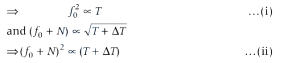
Initially,for both wires,the frequency is $f_0 \propto \sqrt{T}$. Thus,$f_0^2 \propto T$ ... $(i)$
When the tension of one wire is increased by $\Delta T$,its new frequency becomes $f' = f_0 + N$.
Therefore,$(f_0 + N)^2 \propto (T + \Delta T)$ ... (ii)
Dividing equation (ii) by equation $(i)$,we get:
$\frac{(f_0 + N)^2}{f_0^2} = \frac{T + \Delta T}{T}$
$\frac{(f_0 + N)^2}{f_0^2} = 1 + \frac{\Delta T}{T}$
Rearranging for $\frac{\Delta T}{T}$:
$\frac{\Delta T}{T} = \frac{(f_0 + N)^2}{f_0^2} - 1 = \left(\frac{f_0 + N}{f_0}\right)^2 - 1$.
Since the wires are identical,$L$ and $\mu$ are constant,so $f \propto \sqrt{T}$.
Initially,for both wires,the frequency is $f_0 \propto \sqrt{T}$. Thus,$f_0^2 \propto T$ ... $(i)$
When the tension of one wire is increased by $\Delta T$,its new frequency becomes $f' = f_0 + N$.
Therefore,$(f_0 + N)^2 \propto (T + \Delta T)$ ... (ii)
Dividing equation (ii) by equation $(i)$,we get:
$\frac{(f_0 + N)^2}{f_0^2} = \frac{T + \Delta T}{T}$
$\frac{(f_0 + N)^2}{f_0^2} = 1 + \frac{\Delta T}{T}$
Rearranging for $\frac{\Delta T}{T}$:
$\frac{\Delta T}{T} = \frac{(f_0 + N)^2}{f_0^2} - 1 = \left(\frac{f_0 + N}{f_0}\right)^2 - 1$.
0 likes
View Solution198
DifficultMCQ
The wavelengths of two sound notes in air are $\frac{40}{195} \,m$ and $\frac{40}{193} \,m$. Each note produces $9$ beats per second separately with a third note of fixed frequency. The velocity of sound in air in $m/s$ is
A
$360$
B
$320$
C
$300$
D
$340$
Solution
(A) Let the velocity of sound be $v$ and the frequency of the third note be $f_0$. The frequencies of the two given notes are $f_1 = \frac{v}{\lambda_1} = \frac{v}{40/195} = \frac{195v}{40}$ and $f_2 = \frac{v}{\lambda_2} = \frac{v}{40/193} = \frac{193v}{40}$.
Since each note produces $9$ beats per second with the third note,we have:
$|f_1 - f_0| = 9$ and $|f_2 - f_0| = 9$.
This implies $f_1 - f_0 = 9$ and $f_0 - f_2 = 9$ (assuming $f_1 > f_0 > f_2$).
Adding these two equations:
$(f_1 - f_0) + (f_0 - f_2) = 9 + 9$
$f_1 - f_2 = 18$
$\frac{195v}{40} - \frac{193v}{40} = 18$
$\frac{2v}{40} = 18$
$\frac{v}{20} = 18$
$v = 360 \,m/s$.
Since each note produces $9$ beats per second with the third note,we have:
$|f_1 - f_0| = 9$ and $|f_2 - f_0| = 9$.
This implies $f_1 - f_0 = 9$ and $f_0 - f_2 = 9$ (assuming $f_1 > f_0 > f_2$).
Adding these two equations:
$(f_1 - f_0) + (f_0 - f_2) = 9 + 9$
$f_1 - f_2 = 18$
$\frac{195v}{40} - \frac{193v}{40} = 18$
$\frac{2v}{40} = 18$
$\frac{v}{20} = 18$
$v = 360 \,m/s$.
0 likes
View SolutionWaves and Sound — Beats and Tuning fork · Frequently Asked Questions
1Are these Waves and Sound questions useful for JEE and NEET?
Yes. All questions in this section are mapped to JEE Main and NEET exam patterns. Previous year questions from JEE Main, NEET, GUJCET and state-level exams are included with full solutions.
2Can I switch to Hindi or Gujarati for these questions?
Yes. Use the language tabs in the hero section or the sidebar to view the same questions and solutions in English, Hindi or Gujarati.
3How do I generate a question paper from this subtopic?
Use the Vedclass Exam Paper Generator — select the chapter and subtopic, set difficulty, and generate Sets A, B, C, D automatically. First 3 chapters of every subject are free.
Vedclass Products
For Students
Vedclass Test Series
Mock tests in real JEE/NEET style with performance analysis. 5-day free trial.
Start Free TrialFor Teachers
Exam Paper Generator
Generate Set A/B/C/D papers from this chapter in 2 minutes. 3 chapters free.
Try FreeFor Institutes
Online Exam Module
Live online exams with unlimited students, 360° analytics & white-label branding.
See DemoFor Teachers & Institutes
Generate a Waves and Sound Exam Paper in 2 Minutes
Select subtopic & difficulty — Sets A, B, C, D auto-generated with No Repeat logic.
First 3 chapters of every subject are free — no payment required.