
A English
Angular Momentum and Angular Impulse Questions in English
Class 11 Physics · System of Particles and Rotational Motion · Angular Momentum and Angular Impulse
120+
Questions
English
Language
100%
With Solutions
Showing 49 of 120 questions in English
1
EasyMCQ
Angular momentum is
A
$A$ scalar
B
$A$ polar vector
C
An axial vector
D
None of these
Solution
(C) Angular momentum is defined as the cross product of position vector $\vec{r}$ and linear momentum $\vec{p}$,given by $\vec{L} = \vec{r} \times \vec{p}$.
Axial vectors are vectors that represent rotational effects and their direction is determined by the right-hand rule,which is perpendicular to the plane of rotation.
Since angular momentum describes rotational motion,it is classified as an axial vector (or pseudovector).
Therefore,the correct option is $C$.
Axial vectors are vectors that represent rotational effects and their direction is determined by the right-hand rule,which is perpendicular to the plane of rotation.
Since angular momentum describes rotational motion,it is classified as an axial vector (or pseudovector).
Therefore,the correct option is $C$.
0 likes
View Solution2
MediumMCQ
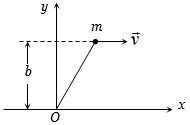
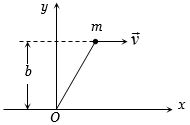
If a particle of mass $m$ is moving with constant velocity $v$ parallel to the $X$-axis in the $x-y$ plane as shown in the figure,its angular momentum with respect to the origin at any time $t$ will be:
A
$mvb\,\hat{k}$
B
$-mvb\,\hat{k}$
C
$mvb\,\hat{i}$
D
$mv\,\hat{i}$
Solution
(B) We know that the angular momentum is given by $\vec{L} = \vec{r} \times \vec{p}$.
In terms of components,this is:
$\vec{L} = \begin{vmatrix} \hat{i} & \hat{j} & \hat{k} \\ x & y & z \\ p_x & p_y & p_z \end{vmatrix}$
Since the motion is in the $x-y$ plane,$z = 0$ and $p_z = 0$. Thus,$\vec{L} = \hat{k}(x p_y - y p_x)$.
Given that the particle moves parallel to the $X$-axis at a distance $b$,its position is $(x, y) = (vt, b)$ and its momentum is $\vec{p} = (mv, 0)$.
Substituting these values:
$\vec{L} = \hat{k}(vt \cdot 0 - b \cdot mv) = -mvb\,\hat{k}$.
In terms of components,this is:
$\vec{L} = \begin{vmatrix} \hat{i} & \hat{j} & \hat{k} \\ x & y & z \\ p_x & p_y & p_z \end{vmatrix}$
Since the motion is in the $x-y$ plane,$z = 0$ and $p_z = 0$. Thus,$\vec{L} = \hat{k}(x p_y - y p_x)$.
Given that the particle moves parallel to the $X$-axis at a distance $b$,its position is $(x, y) = (vt, b)$ and its momentum is $\vec{p} = (mv, 0)$.
Substituting these values:
$\vec{L} = \hat{k}(vt \cdot 0 - b \cdot mv) = -mvb\,\hat{k}$.
0 likes
View Solution3
MediumMCQ
The position of a particle is given by $\vec r = (\hat i + 2\hat j - \hat k)$ and its momentum is $\vec p = (3\hat i + 4\hat j - 2\hat k)$. The angular momentum is perpendicular to:
A
$x-axis$
B
$y-axis$
C
$z-axis$
D
Line at equal angles to all the three axes
Solution
(A) The angular momentum $\vec L$ is given by the cross product of position vector $\vec r$ and momentum vector $\vec p$:
$\vec L = \vec r \times \vec p = \begin{vmatrix} \hat i & \hat j & \hat k \\ 1 & 2 & -1 \\ 3 & 4 & -2 \end{vmatrix}$
$= \hat i(2(-2) - (-1)(4)) - \hat j(1(-2) - (-1)(3)) + \hat k(1(4) - 2(3))$
$= \hat i(-4 + 4) - \hat j(-2 + 3) + \hat k(4 - 6)$
$= 0\hat i - 1\hat j - 2\hat k$
$= -\hat j - 2\hat k$
Since the angular momentum vector $\vec L = 0\hat i - 1\hat j - 2\hat k$ has no component along the $x$-axis (the coefficient of $\hat i$ is $0$),the vector $\vec L$ lies in the $yz$-plane.
Therefore,the angular momentum is perpendicular to the $x$-axis.
$\vec L = \vec r \times \vec p = \begin{vmatrix} \hat i & \hat j & \hat k \\ 1 & 2 & -1 \\ 3 & 4 & -2 \end{vmatrix}$
$= \hat i(2(-2) - (-1)(4)) - \hat j(1(-2) - (-1)(3)) + \hat k(1(4) - 2(3))$
$= \hat i(-4 + 4) - \hat j(-2 + 3) + \hat k(4 - 6)$
$= 0\hat i - 1\hat j - 2\hat k$
$= -\hat j - 2\hat k$
Since the angular momentum vector $\vec L = 0\hat i - 1\hat j - 2\hat k$ has no component along the $x$-axis (the coefficient of $\hat i$ is $0$),the vector $\vec L$ lies in the $yz$-plane.
Therefore,the angular momentum is perpendicular to the $x$-axis.
0 likes
View Solution4
MediumMCQ
The position vectors of two points are $2\hat i + \hat j + \hat k$ and $2\hat i - 3\hat j + \hat k$,and the linear momentum is $2\hat i + 3\hat j - \hat k$. The angular momentum is:
A
$2\hat i - 4\hat k$
B
$4\hat i - 8\hat k$
C
$2\hat i - 4\hat j + 2\hat k$
D
$4\hat i - 8\hat j$
Solution
(B) The radius vector $\vec{r}$ is the displacement between the two points: $\vec{r} = \vec{r_2} - \vec{r_1} = (2\hat{i} - 3\hat{j} + \hat{k}) - (2\hat{i} + \hat{j} + \hat{k}) = -4\hat{j}$.
Linear momentum $\vec{p} = 2\hat{i} + 3\hat{j} - \hat{k}$.
Angular momentum $\vec{L} = \vec{r} \times \vec{p}$.
$\vec{L} = (-4\hat{j}) \times (2\hat{i} + 3\hat{j} - \hat{k}) = \begin{vmatrix} \hat{i} & \hat{j} & \hat{k} \\ 0 & -4 & 0 \\ 2 & 3 & -1 \end{vmatrix}$.
Calculating the determinant: $\vec{L} = \hat{i}((-4)(-1) - (0)(3)) - \hat{j}((0)(-1) - (0)(2)) + \hat{k}((0)(3) - (-4)(2))$.
$\vec{L} = \hat{i}(4) - \hat{j}(0) + \hat{k}(8) = 4\hat{i} + 8\hat{k}$.
Wait,re-evaluating the cross product: $\vec{L} = (-4\hat{j}) \times (2\hat{i}) + (-4\hat{j}) \times (3\hat{j}) + (-4\hat{j}) \times (-\hat{k}) = -8(\hat{j} \times \hat{i}) - 12(\hat{j} \times \hat{j}) + 4(\hat{j} \times \hat{k}) = -8(-\hat{k}) - 0 + 4(\hat{i}) = 4\hat{i} + 8\hat{k}$.
Given the options,there appears to be a sign convention difference in the problem statement or options. Based on standard vector cross product rules,the result is $4\hat{i} + 8\hat{k}$. If we assume $\vec{r} = \vec{r_1} - \vec{r_2} = 4\hat{j}$,then $\vec{L} = (4\hat{j}) \times (2\hat{i} + 3\hat{j} - \hat{k}) = 8(\hat{j} \times \hat{i}) + 4(\hat{j} \times \hat{k}) = -8\hat{k} + 4\hat{i} = 4\hat{i} - 8\hat{k}$.
Linear momentum $\vec{p} = 2\hat{i} + 3\hat{j} - \hat{k}$.
Angular momentum $\vec{L} = \vec{r} \times \vec{p}$.
$\vec{L} = (-4\hat{j}) \times (2\hat{i} + 3\hat{j} - \hat{k}) = \begin{vmatrix} \hat{i} & \hat{j} & \hat{k} \\ 0 & -4 & 0 \\ 2 & 3 & -1 \end{vmatrix}$.
Calculating the determinant: $\vec{L} = \hat{i}((-4)(-1) - (0)(3)) - \hat{j}((0)(-1) - (0)(2)) + \hat{k}((0)(3) - (-4)(2))$.
$\vec{L} = \hat{i}(4) - \hat{j}(0) + \hat{k}(8) = 4\hat{i} + 8\hat{k}$.
Wait,re-evaluating the cross product: $\vec{L} = (-4\hat{j}) \times (2\hat{i}) + (-4\hat{j}) \times (3\hat{j}) + (-4\hat{j}) \times (-\hat{k}) = -8(\hat{j} \times \hat{i}) - 12(\hat{j} \times \hat{j}) + 4(\hat{j} \times \hat{k}) = -8(-\hat{k}) - 0 + 4(\hat{i}) = 4\hat{i} + 8\hat{k}$.
Given the options,there appears to be a sign convention difference in the problem statement or options. Based on standard vector cross product rules,the result is $4\hat{i} + 8\hat{k}$. If we assume $\vec{r} = \vec{r_1} - \vec{r_2} = 4\hat{j}$,then $\vec{L} = (4\hat{j}) \times (2\hat{i} + 3\hat{j} - \hat{k}) = 8(\hat{j} \times \hat{i}) + 4(\hat{j} \times \hat{k}) = -8\hat{k} + 4\hat{i} = 4\hat{i} - 8\hat{k}$.
0 likes
View Solution5
EasyMCQ
The units of angular momentum are
A
$kg \cdot m^2/s^2$
B
$Joule \cdot s$
C
$Joule/s$
D
$kg \cdot m \cdot s^2$
Solution
(B) The formula for angular momentum $L$ is given by $L = r \times p$,where $r$ is the position vector and $p$ is the linear momentum.
Dimensional analysis: $L = [L] \times [M L T^{-1}] = [M L^2 T^{-1}]$.
In $SI$ units,this corresponds to $kg \cdot m^2/s$.
Since $1 \text{ Joule} = 1 \text{ kg} \cdot m^2/s^2$,we can write $1 \text{ Joule} \cdot s = (1 \text{ kg} \cdot m^2/s^2) \times s = 1 \text{ kg} \cdot m^2/s$.
Therefore,the unit of angular momentum is $Joule \cdot s$.
Dimensional analysis: $L = [L] \times [M L T^{-1}] = [M L^2 T^{-1}]$.
In $SI$ units,this corresponds to $kg \cdot m^2/s$.
Since $1 \text{ Joule} = 1 \text{ kg} \cdot m^2/s^2$,we can write $1 \text{ Joule} \cdot s = (1 \text{ kg} \cdot m^2/s^2) \times s = 1 \text{ kg} \cdot m^2/s$.
Therefore,the unit of angular momentum is $Joule \cdot s$.
0 likes
View Solution6
MediumMCQ
$A$ particle moves in a circular path with decreasing speed. Choose the correct statement.
A
Angular momentum remains constant
B
Acceleration $(\vec a)$ is towards the center
C
Particle moves in a spiral path with decreasing radius
D
The direction of angular momentum remains constant
Solution
(D) The angular momentum $\vec L$ is defined as $\vec L = \vec r \times \vec p$.
For a particle moving in a circular path,the position vector $\vec r$ and linear momentum $\vec p$ lie in the plane of the circle.
According to the right-hand rule,the direction of $\vec L$ is perpendicular to the plane of rotation.
Since the particle continues to move in the same circular path,the plane of rotation does not change.
Therefore,the direction of the angular momentum vector remains constant,even if its magnitude changes due to the decreasing speed of the particle.
Thus,option $(D)$ is correct.
For a particle moving in a circular path,the position vector $\vec r$ and linear momentum $\vec p$ lie in the plane of the circle.
According to the right-hand rule,the direction of $\vec L$ is perpendicular to the plane of rotation.
Since the particle continues to move in the same circular path,the plane of rotation does not change.
Therefore,the direction of the angular momentum vector remains constant,even if its magnitude changes due to the decreasing speed of the particle.
Thus,option $(D)$ is correct.
0 likes
View Solution7
MediumMCQ
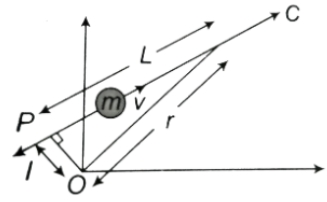
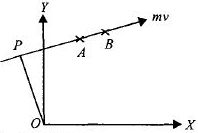
$A$ particle of mass $m$ moves along line $PC$ with velocity $v$ as shown in the figure. What is the angular momentum of the particle about point $O$?
A
$mvL$
B
$mvl$
C
$mvr$
D
Zero
Solution
(B) The angular momentum $L_{ang}$ of a particle about a point $O$ is defined as the cross product of its position vector $\vec{r}$ and its linear momentum $\vec{p} = m\vec{v}$.
Mathematically,$L_{ang} = |\vec{r} \times \vec{p}| = |\vec{r} \times m\vec{v}| = m v r \sin(\theta)$.
Here,$r \sin(\theta)$ represents the perpendicular distance from the point $O$ to the line of motion of the particle,which is given as $l$ in the figure.
Therefore,the angular momentum is $L_{ang} = m v l$.
Mathematically,$L_{ang} = |\vec{r} \times \vec{p}| = |\vec{r} \times m\vec{v}| = m v r \sin(\theta)$.
Here,$r \sin(\theta)$ represents the perpendicular distance from the point $O$ to the line of motion of the particle,which is given as $l$ in the figure.
Therefore,the angular momentum is $L_{ang} = m v l$.
0 likes
View Solution8
MediumMCQ
Two rigid bodies $A$ and $B$ rotate with rotational kinetic energies $E_A$ and $E_B$ respectively. The moments of inertia of $A$ and $B$ about the axis of rotation are $I_A$ and $I_B$ respectively. If $I_A = I_B/4$ and $E_A = 100 E_B$,the ratio of angular momentum $(L_A)$ of $A$ to the angular momentum $(L_B)$ of $B$ is
A
$25$
B
$5/4$
C
$5$
D
$1/4$
Solution
(C) The rotational kinetic energy $E$ is given by the formula $E = \frac{1}{2} I \omega^2 = \frac{L^2}{2I}$,where $L = I \omega$ is the angular momentum.
From this,we can express the angular momentum as $L^2 = 2EI$,or $L = \sqrt{2EI}$.
For body $A$,$L_A = \sqrt{2 E_A I_A}$.
For body $B$,$L_B = \sqrt{2 E_B I_B}$.
The ratio of angular momenta is $\frac{L_A}{L_B} = \sqrt{\frac{2 E_A I_A}{2 E_B I_B}} = \sqrt{\frac{E_A}{E_B} \cdot \frac{I_A}{I_B}}$.
Given $I_A = I_B/4$,we have $\frac{I_A}{I_B} = \frac{1}{4}$.
Given $E_A = 100 E_B$,we have $\frac{E_A}{E_B} = 100$.
Substituting these values: $\frac{L_A}{L_B} = \sqrt{100 \cdot \frac{1}{4}} = \sqrt{25} = 5$.
From this,we can express the angular momentum as $L^2 = 2EI$,or $L = \sqrt{2EI}$.
For body $A$,$L_A = \sqrt{2 E_A I_A}$.
For body $B$,$L_B = \sqrt{2 E_B I_B}$.
The ratio of angular momenta is $\frac{L_A}{L_B} = \sqrt{\frac{2 E_A I_A}{2 E_B I_B}} = \sqrt{\frac{E_A}{E_B} \cdot \frac{I_A}{I_B}}$.
Given $I_A = I_B/4$,we have $\frac{I_A}{I_B} = \frac{1}{4}$.
Given $E_A = 100 E_B$,we have $\frac{E_A}{E_B} = 100$.
Substituting these values: $\frac{L_A}{L_B} = \sqrt{100 \cdot \frac{1}{4}} = \sqrt{25} = 5$.
0 likes
View Solution9
MediumMCQ
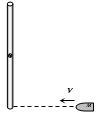
The moment of inertia of a uniform rod of mass $M$ and length $L$ about an axis through its centre and perpendicular to its length is given by $\frac{ML^2}{12}$. Now,consider one such rod pivoted at its centre,free to rotate in a vertical plane. The rod is at rest in the vertical position. $A$ bullet of mass $M$ moving horizontally at a speed $v$ strikes and embeds itself in one end of the rod. The angular velocity of the rod just after the collision will be
A
$v/L$
B
$2v/L$
C
$3v/2L$
D
$6v/L$
Solution
(C) Initial angular momentum of the system about the pivot point is due to the bullet: $L_i = Mv(L/2)$.
After the collision,the bullet is embedded in the rod,so the system rotates with angular velocity $\omega$. The final moment of inertia of the system is $I_f = I_{\text{rod}} + I_{\text{bullet}} = \frac{ML^2}{12} + M(L/2)^2 = \frac{ML^2}{12} + \frac{ML^2}{4} = \frac{ML^2 + 3ML^2}{12} = \frac{4ML^2}{12} = \frac{ML^2}{3}$.
By the principle of conservation of angular momentum,$L_i = L_f$,so $Mv(L/2) = I_f \omega$.
Substituting the values: $\frac{MvL}{2} = \left(\frac{ML^2}{3}\right) \omega$.
Solving for $\omega$: $\omega = \frac{MvL}{2} \cdot \frac{3}{ML^2} = \frac{3v}{2L}$.
After the collision,the bullet is embedded in the rod,so the system rotates with angular velocity $\omega$. The final moment of inertia of the system is $I_f = I_{\text{rod}} + I_{\text{bullet}} = \frac{ML^2}{12} + M(L/2)^2 = \frac{ML^2}{12} + \frac{ML^2}{4} = \frac{ML^2 + 3ML^2}{12} = \frac{4ML^2}{12} = \frac{ML^2}{3}$.
By the principle of conservation of angular momentum,$L_i = L_f$,so $Mv(L/2) = I_f \omega$.
Substituting the values: $\frac{MvL}{2} = \left(\frac{ML^2}{3}\right) \omega$.
Solving for $\omega$: $\omega = \frac{MvL}{2} \cdot \frac{3}{ML^2} = \frac{3v}{2L}$.
0 likes
View Solution10
MediumMCQ
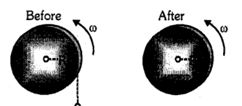
$A$ solid cylinder of mass $2\ kg$ and radius $0.2\ m$ is rotating about its own axis without friction with angular velocity $3\ rad/s$. $A$ particle of mass $0.5\ kg$ and moving with a velocity $5\ m/s$ strikes the cylinder and sticks to it as shown in figure. The angular momentum of the cylinder before collision will be ........ $J-s$.
A
$0.12$
B
$12$
C
$1.2$
D
$1.12$
Solution
(A) The angular momentum $L$ of a rotating body is given by the formula $L = I\omega$,where $I$ is the moment of inertia and $\omega$ is the angular velocity.
For a solid cylinder rotating about its own axis,the moment of inertia is $I = \frac{1}{2}MR^2$.
Given: Mass $M = 2\ kg$,Radius $R = 0.2\ m$,Angular velocity $\omega = 3\ rad/s$.
Substituting the values:
$I = \frac{1}{2} \times 2\ kg \times (0.2\ m)^2 = 1 \times 0.04 = 0.04\ kg\cdot m^2$.
Now,calculate the angular momentum:
$L = I\omega = 0.04\ kg\cdot m^2 \times 3\ rad/s = 0.12\ J-s$.
Therefore,the angular momentum of the cylinder before collision is $0.12\ J-s$.
For a solid cylinder rotating about its own axis,the moment of inertia is $I = \frac{1}{2}MR^2$.
Given: Mass $M = 2\ kg$,Radius $R = 0.2\ m$,Angular velocity $\omega = 3\ rad/s$.
Substituting the values:
$I = \frac{1}{2} \times 2\ kg \times (0.2\ m)^2 = 1 \times 0.04 = 0.04\ kg\cdot m^2$.
Now,calculate the angular momentum:
$L = I\omega = 0.04\ kg\cdot m^2 \times 3\ rad/s = 0.12\ J-s$.
Therefore,the angular momentum of the cylinder before collision is $0.12\ J-s$.
0 likes
View Solution11
EasyMCQ
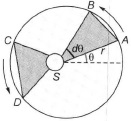
Two rotating bodies have the same angular momentum,but their moments of inertia are $I_1$ and $I_2$ respectively. If $I_1 > I_2$,which body will have a higher kinetic energy?
A
The first
B
The second
C
Both will have the same kinetic energy
D
Cannot be determined
Solution
(B) The rotational kinetic energy $K$ of a body is related to its angular momentum $L$ and moment of inertia $I$ by the formula $K = \frac{L^2}{2I}$.
Given that the angular momentum $L$ is the same for both bodies,the kinetic energy is inversely proportional to the moment of inertia,i.e.,$K \propto \frac{1}{I}$.
Since $I_1 > I_2$,it follows that $K_1 < K_2$.
Therefore,the second body (with the smaller moment of inertia) will have a higher kinetic energy.
Given that the angular momentum $L$ is the same for both bodies,the kinetic energy is inversely proportional to the moment of inertia,i.e.,$K \propto \frac{1}{I}$.
Since $I_1 > I_2$,it follows that $K_1 < K_2$.
Therefore,the second body (with the smaller moment of inertia) will have a higher kinetic energy.
0 likes
View Solution12
MediumMCQ
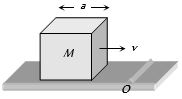
Which graph represents the relationship between angular momentum $L$ and angular velocity $\omega$ for a rigid body rotating about a fixed axis?
A
$A$ straight line passing through the origin.
B
$A$ parabola.
C
$A$ hyperbola.
D
An exponential curve.
Solution
(A) The angular momentum $L$ of a rigid body rotating about a fixed axis is given by the relation $L = I\omega$,where $I$ is the moment of inertia of the body about the axis of rotation.
For a rigid body,the moment of inertia $I$ remains constant.
Therefore,$L \propto \omega$.
This linear relationship implies that the graph of $L$ versus $\omega$ is a straight line passing through the origin with a slope equal to the moment of inertia $I$.
For a rigid body,the moment of inertia $I$ remains constant.
Therefore,$L \propto \omega$.
This linear relationship implies that the graph of $L$ versus $\omega$ is a straight line passing through the origin with a slope equal to the moment of inertia $I$.
0 likes
View Solution13
MediumMCQ
$A$ particle of mass $m$ moves with a constant velocity. Which of the following statements is incorrect regarding its angular momentum?
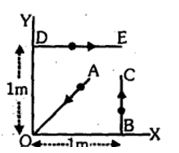
A
It is zero when it is at $A$ and moving along $OA$.
B
It is the same at all points on the line $DE$.
C
It has the same magnitude but opposite direction at $B$ and $D$.
D
It increases as it moves towards the line $BC$.
Solution
(D) The angular momentum of a particle about an origin $O$ is given by $\vec{L} = \vec{r} \times \vec{p} = m(\vec{r} \times \vec{v})$. The magnitude is $L = mvr \sin \theta = mv d$,where $d$ is the perpendicular distance from the origin to the line of motion.
$1$. For motion along $OA$,the line of motion passes through the origin $O$,so $d = 0$ and $L = 0$. Statement $A$ is correct.
$2$. For the line $DE$,the perpendicular distance from $O$ to the line $DE$ is constant $(1 \ m)$. Thus,$L$ is constant at all points on $DE$. Statement $B$ is correct.
$3$. At $B$,the perpendicular distance is $1 \ m$ and the velocity is in the $+y$ direction. At $D$,the perpendicular distance is $1 \ m$ and the velocity is in the $+x$ direction. The angular momentum is a vector quantity. The direction of $\vec{L}$ at $B$ is $\vec{r} \times \vec{v} = (1\hat{i}) \times (v\hat{j}) = mv\hat{k}$. The direction of $\vec{L}$ at $D$ is $\vec{r} \times \vec{v} = (1\hat{j}) \times (v\hat{i}) = -mv\hat{k}$. Thus,they have the same magnitude but opposite directions. Statement $C$ is correct.
$4$. As the particle moves towards the line $BC$,the perpendicular distance $d$ from the origin $O$ to the line of motion remains constant. Therefore,the angular momentum does not change. Statement $D$ is incorrect.
$1$. For motion along $OA$,the line of motion passes through the origin $O$,so $d = 0$ and $L = 0$. Statement $A$ is correct.
$2$. For the line $DE$,the perpendicular distance from $O$ to the line $DE$ is constant $(1 \ m)$. Thus,$L$ is constant at all points on $DE$. Statement $B$ is correct.
$3$. At $B$,the perpendicular distance is $1 \ m$ and the velocity is in the $+y$ direction. At $D$,the perpendicular distance is $1 \ m$ and the velocity is in the $+x$ direction. The angular momentum is a vector quantity. The direction of $\vec{L}$ at $B$ is $\vec{r} \times \vec{v} = (1\hat{i}) \times (v\hat{j}) = mv\hat{k}$. The direction of $\vec{L}$ at $D$ is $\vec{r} \times \vec{v} = (1\hat{j}) \times (v\hat{i}) = -mv\hat{k}$. Thus,they have the same magnitude but opposite directions. Statement $C$ is correct.
$4$. As the particle moves towards the line $BC$,the perpendicular distance $d$ from the origin $O$ to the line of motion remains constant. Therefore,the angular momentum does not change. Statement $D$ is incorrect.
0 likes
View Solution14
MediumMCQ
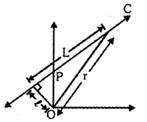
$A$ particle of mass $m$ moves with a velocity $v$ along the line $PC$ as shown in the figure. What is the angular momentum of the particle about $O$?
A
$mvL$
B
$zero$
C
$mvr$
D
$mv\ell$
Solution
(D) The angular momentum $\vec{L}$ of a particle about a point $O$ is given by the cross product of its position vector $\vec{r}$ and its linear momentum $\vec{p} = m\vec{v}$.
Mathematically,$\vec{L} = \vec{r} \times \vec{p} = \vec{r} \times (m\vec{v}) = m(\vec{r} \times \vec{v})$.
The magnitude of the angular momentum is given by $L = mrv \sin(\theta)$,where $\theta$ is the angle between the position vector $\vec{r}$ and the velocity vector $\vec{v}$.
From the geometry of the figure,the perpendicular distance from the origin $O$ to the line of motion $PC$ is $\ell$.
Therefore,the magnitude of the angular momentum about $O$ is $L = m v \ell$.
Mathematically,$\vec{L} = \vec{r} \times \vec{p} = \vec{r} \times (m\vec{v}) = m(\vec{r} \times \vec{v})$.
The magnitude of the angular momentum is given by $L = mrv \sin(\theta)$,where $\theta$ is the angle between the position vector $\vec{r}$ and the velocity vector $\vec{v}$.
From the geometry of the figure,the perpendicular distance from the origin $O$ to the line of motion $PC$ is $\ell$.
Therefore,the magnitude of the angular momentum about $O$ is $L = m v \ell$.
0 likes
View Solution15
EasyMCQ
$A$ particle of mass $M$ moves with a constant velocity parallel to the $X$-axis. What happens to its angular momentum with respect to the origin?
A
Increases with time
B
Decreases with time
C
Remains constant
D
None of these
Solution
(C) The angular momentum $\vec{L}$ of a particle with respect to the origin is given by $\vec{L} = \vec{r} \times \vec{p}$,where $\vec{p} = M\vec{v}$.
Since the particle moves parallel to the $X$-axis with constant velocity $\vec{v} = v\hat{i}$,its position vector is $\vec{r} = x\hat{i} + y\hat{j}$.
Thus,$\vec{L} = (x\hat{i} + y\hat{j}) \times (Mv\hat{i}) = Mv(x(\hat{i} \times \hat{i}) + y(\hat{j} \times \hat{i}))$.
Since $\hat{i} \times \hat{i} = 0$ and $\hat{j} \times \hat{i} = -\hat{k}$,we get $\vec{L} = -Mvy\hat{k}$.
Here,$M$,$v$,and $y$ (the perpendicular distance from the $X$-axis) are all constant.
Therefore,the angular momentum $\vec{L}$ remains constant.
Since the particle moves parallel to the $X$-axis with constant velocity $\vec{v} = v\hat{i}$,its position vector is $\vec{r} = x\hat{i} + y\hat{j}$.
Thus,$\vec{L} = (x\hat{i} + y\hat{j}) \times (Mv\hat{i}) = Mv(x(\hat{i} \times \hat{i}) + y(\hat{j} \times \hat{i}))$.
Since $\hat{i} \times \hat{i} = 0$ and $\hat{j} \times \hat{i} = -\hat{k}$,we get $\vec{L} = -Mvy\hat{k}$.
Here,$M$,$v$,and $y$ (the perpendicular distance from the $X$-axis) are all constant.
Therefore,the angular momentum $\vec{L}$ remains constant.
0 likes
View Solution16
EasyMCQ
When a particle is moving in a circular path around a fixed point in a plane,the direction of its angular momentum is ........
A
Along the radius
B
Tangential to the path
C
At an angle of $45^{\circ}$ to the plane of rotation
D
Along the axis of rotation
Solution
(D) The angular momentum $\vec{L}$ of a particle is defined by the cross product $\vec{L} = \vec{r} \times \vec{p} = \vec{r} \times (m\vec{v})$.
Since the position vector $\vec{r}$ lies in the plane of rotation and the linear velocity vector $\vec{v}$ is tangent to the circular path (also in the plane of rotation),the cross product $\vec{r} \times \vec{v}$ results in a vector perpendicular to both $\vec{r}$ and $\vec{v}$.
By the right-hand rule,this direction is perpendicular to the plane of rotation,which corresponds to the axis of rotation.
Since the position vector $\vec{r}$ lies in the plane of rotation and the linear velocity vector $\vec{v}$ is tangent to the circular path (also in the plane of rotation),the cross product $\vec{r} \times \vec{v}$ results in a vector perpendicular to both $\vec{r}$ and $\vec{v}$.
By the right-hand rule,this direction is perpendicular to the plane of rotation,which corresponds to the axis of rotation.
0 likes
View Solution17
MediumMCQ
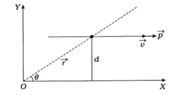
$A$ particle of mass $1 \ kg$ is moving with a linear velocity of $2 \ ms^{-1}$ parallel to the positive $X$-axis. During this motion,its minimum distance from the origin is $12 \ cm$. The angular momentum of this particle about the origin is ....... $Js$.
A
$0.06$
B
$0.12$
C
$0.24$
D
$0.48$
Solution
(C) The angular momentum $L$ of a particle about the origin is given by the formula $L = |\vec{r} \times \vec{p}| = r p \sin \theta$.
From the geometry of the motion,the perpendicular distance $d$ from the origin to the line of motion is $d = r \sin \theta$.
Therefore,the angular momentum can be expressed as $L = p \cdot d = (mv) \cdot d$.
Given: mass $m = 1 \ kg$,velocity $v = 2 \ ms^{-1}$,and perpendicular distance $d = 12 \ cm = 0.12 \ m$.
Substituting these values into the formula:
$L = (1 \ kg) \times (2 \ ms^{-1}) \times (0.12 \ m) = 0.24 \ kg \cdot m^2s^{-1}$ (or $Js$).
Thus,the angular momentum is $0.24 \ Js$.
From the geometry of the motion,the perpendicular distance $d$ from the origin to the line of motion is $d = r \sin \theta$.
Therefore,the angular momentum can be expressed as $L = p \cdot d = (mv) \cdot d$.
Given: mass $m = 1 \ kg$,velocity $v = 2 \ ms^{-1}$,and perpendicular distance $d = 12 \ cm = 0.12 \ m$.
Substituting these values into the formula:
$L = (1 \ kg) \times (2 \ ms^{-1}) \times (0.12 \ m) = 0.24 \ kg \cdot m^2s^{-1}$ (or $Js$).
Thus,the angular momentum is $0.24 \ Js$.
0 likes
View Solution18
EasyMCQ
$A$ particle of mass $0.01 \ kg$ has a position vector $\vec{r} = (10\hat{i} + 6\hat{j}) \ m$ and moves with a velocity $\vec{v} = 5\hat{i} \ m/s$. Calculate its angular momentum about the origin in $\hat{k} \ J \cdot s$.
A
$-1.1$
B
$-3$
C
$0.7$
D
$-0.3$
Solution
(D) The linear momentum $\vec{p}$ is given by $\vec{p} = m\vec{v} = 0.01 \ kg \times 5\hat{i} \ m/s = 0.05\hat{i} \ kg \cdot m/s$.
The angular momentum $\vec{L}$ about the origin is given by the cross product $\vec{L} = \vec{r} \times \vec{p}$.
Substituting the values: $\vec{L} = (10\hat{i} + 6\hat{j}) \times (0.05\hat{i})$.
Using the distributive property of the cross product: $\vec{L} = (10\hat{i} \times 0.05\hat{i}) + (6\hat{j} \times 0.05\hat{i})$.
Since $\hat{i} \times \hat{i} = 0$ and $\hat{j} \times \hat{i} = -\hat{k}$,we get:
$\vec{L} = 0 + 6 \times 0.05 \times (-\hat{k}) = 0.3 \times (-\hat{k}) = -0.3\hat{k} \ J \cdot s$.
The angular momentum $\vec{L}$ about the origin is given by the cross product $\vec{L} = \vec{r} \times \vec{p}$.
Substituting the values: $\vec{L} = (10\hat{i} + 6\hat{j}) \times (0.05\hat{i})$.
Using the distributive property of the cross product: $\vec{L} = (10\hat{i} \times 0.05\hat{i}) + (6\hat{j} \times 0.05\hat{i})$.
Since $\hat{i} \times \hat{i} = 0$ and $\hat{j} \times \hat{i} = -\hat{k}$,we get:
$\vec{L} = 0 + 6 \times 0.05 \times (-\hat{k}) = 0.3 \times (-\hat{k}) = -0.3\hat{k} \ J \cdot s$.
0 likes
View Solution19
MediumMCQ
$A$ body of mass $2 \ kg$ is moving in a circular path of radius $2 \ m$ with uniform speed. If the centripetal force acting on it is $100 \ N$,then its angular momentum is ....... $J \cdot s$.
A
$10$
B
$20$
C
$30$
D
$40$
Solution
(D) The centripetal force $F$ is given by $F = \frac{mv^2}{r}$.
Since angular momentum $L = mvr$,we can write $v = \frac{L}{mr}$.
Substituting this into the force equation:
$F = \frac{m}{r} \left( \frac{L}{mr} \right)^2 = \frac{m}{r} \cdot \frac{L^2}{m^2 r^2} = \frac{L^2}{mr^3}$.
Rearranging for $L^2$:
$L^2 = F \cdot m \cdot r^3$.
Given $m = 2 \ kg$,$r = 2 \ m$,and $F = 100 \ N$:
$L^2 = 100 \times 2 \times (2)^3 = 100 \times 2 \times 8 = 1600$.
Taking the square root:
$L = \sqrt{1600} = 40 \ J \cdot s$.
Since angular momentum $L = mvr$,we can write $v = \frac{L}{mr}$.
Substituting this into the force equation:
$F = \frac{m}{r} \left( \frac{L}{mr} \right)^2 = \frac{m}{r} \cdot \frac{L^2}{m^2 r^2} = \frac{L^2}{mr^3}$.
Rearranging for $L^2$:
$L^2 = F \cdot m \cdot r^3$.
Given $m = 2 \ kg$,$r = 2 \ m$,and $F = 100 \ N$:
$L^2 = 100 \times 2 \times (2)^3 = 100 \times 2 \times 8 = 1600$.
Taking the square root:
$L = \sqrt{1600} = 40 \ J \cdot s$.
0 likes
View Solution20
MediumMCQ
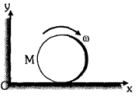
$A$ disc of mass $M$ and radius $R$ is rolling on a horizontal surface as shown in the figure. What is the magnitude of the angular momentum of the disc about the origin $O$?
A
$\frac{1}{2}MR^2\omega$
B
$MR^2\omega$
C
$\frac{3}{2}MR^2\omega$
D
$2MR^2\omega$
Solution
(C) The angular momentum of a rolling body about a point on the surface is the sum of the angular momentum due to translation and the angular momentum due to rotation about its center of mass.
$L = L_{\text{translation}} + L_{\text{rotation}}$
$L = MvR + I_c\omega$
Since the disc is rolling without slipping,the linear velocity of the center of mass is $v = R\omega$.
The moment of inertia of a disc about its center is $I_c = \frac{1}{2}MR^2$.
Substituting these values:
$L = M(R\omega)R + (\frac{1}{2}MR^2)\omega$
$L = MR^2\omega + \frac{1}{2}MR^2\omega$
$L = \frac{3}{2}MR^2\omega$
$L = L_{\text{translation}} + L_{\text{rotation}}$
$L = MvR + I_c\omega$
Since the disc is rolling without slipping,the linear velocity of the center of mass is $v = R\omega$.
The moment of inertia of a disc about its center is $I_c = \frac{1}{2}MR^2$.
Substituting these values:
$L = M(R\omega)R + (\frac{1}{2}MR^2)\omega$
$L = MR^2\omega + \frac{1}{2}MR^2\omega$
$L = \frac{3}{2}MR^2\omega$
0 likes
View Solution21
EasyMCQ
$A$ cylinder of mass $5 \ kg$ and radius $30 \ cm$ is free to rotate about its axis. It receives an initial angular impulse of $3 \ kg \ m^2 s^{-1}$ and subsequently receives the same impulse every $4 \ s$. What will be the angular speed of the cylinder $30 \ s$ after the initial impulse? The cylinder is initially at rest.
A
$106.7$
B
$100$
C
$70$
D
$90.2$
Solution
(A) The moment of inertia of the cylinder about its axis is $I = \frac{1}{2}MR^2 = \frac{1}{2} \times 5 \times (0.3)^2 = 0.225 \ kg \ m^2$.
An angular impulse $J = 3 \ kg \ m^2 s^{-1}$ is applied at $t = 0, 4, 8, 12, 16, 20, 24, 28 \ s$.
Total number of impulses applied up to $30 \ s$ is $8$ (at $t = 0, 4, 8, 12, 16, 20, 24, 28$).
Total angular momentum $L = \sum J = 8 \times 3 = 24 \ kg \ m^2 s^{-1}$.
Since $L = I\omega$,the angular speed is $\omega = \frac{L}{I} = \frac{24}{0.225} = 106.67 \ rad/s \approx 106.7 \ rad/s$.
An angular impulse $J = 3 \ kg \ m^2 s^{-1}$ is applied at $t = 0, 4, 8, 12, 16, 20, 24, 28 \ s$.
Total number of impulses applied up to $30 \ s$ is $8$ (at $t = 0, 4, 8, 12, 16, 20, 24, 28$).
Total angular momentum $L = \sum J = 8 \times 3 = 24 \ kg \ m^2 s^{-1}$.
Since $L = I\omega$,the angular speed is $\omega = \frac{L}{I} = \frac{24}{0.225} = 106.67 \ rad/s \approx 106.7 \ rad/s$.
0 likes
View Solution22
MediumMCQ
$A$ solid cylinder of mass $20 \ kg$ rotates about its axis with an angular speed of $100 \ rad \cdot s^{-1}$. The radius of the cylinder is $0.25 \ m$. The magnitude of its angular momentum about the axis of the cylinder is ........ $J \cdot s$.
A
$55.5$
B
$6.25$
C
$62.5$
D
$20.6$
Solution
(C) The moment of inertia of a solid cylinder about its axis is given by:
$I = \frac{1}{2} M R^2$
Substituting the given values ($M = 20 \ kg$,$R = 0.25 \ m$):
$I = \frac{1}{2} \times 20 \times (0.25)^2 = 10 \times 0.0625 = 0.625 \ kg \cdot m^2$
The angular momentum $L$ is given by the product of the moment of inertia and angular velocity $(\omega)$:
$L = I \omega$
Given $\omega = 100 \ rad \cdot s^{-1}$:
$L = 0.625 \times 100 = 62.5 \ J \cdot s$
$I = \frac{1}{2} M R^2$
Substituting the given values ($M = 20 \ kg$,$R = 0.25 \ m$):
$I = \frac{1}{2} \times 20 \times (0.25)^2 = 10 \times 0.0625 = 0.625 \ kg \cdot m^2$
The angular momentum $L$ is given by the product of the moment of inertia and angular velocity $(\omega)$:
$L = I \omega$
Given $\omega = 100 \ rad \cdot s^{-1}$:
$L = 0.625 \times 100 = 62.5 \ J \cdot s$
0 likes
View Solution23
DifficultMCQ
The position vector of a particle is $\vec{r} = (\hat{i} + 2\hat{j} - \hat{k})$ and its momentum is $\vec{p} = (3\hat{i} + 4\hat{j} - 2\hat{k})$. The angular momentum of this particle is perpendicular to:
A
$X$-axis
B
$Y$-axis
C
$Z$-axis
D
An axis passing through equal angles with all three axes
Solution
(A) The angular momentum $\vec{L}$ is given by the cross product of the position vector $\vec{r}$ and the momentum vector $\vec{p}$.
$\vec{L} = \vec{r} \times \vec{p} = \begin{vmatrix} \hat{i} & \hat{j} & \hat{k} \\ 1 & 2 & -1 \\ 3 & 4 & -2 \end{vmatrix}$
$\vec{L} = \hat{i}(2(-2) - (-1)(4)) - \hat{j}(1(-2) - (-1)(3)) + \hat{k}(1(4) - 2(3))$
$\vec{L} = \hat{i}(-4 + 4) - \hat{j}(-2 + 3) + \hat{k}(4 - 6)$
$\vec{L} = 0\hat{i} - 1\hat{j} - 2\hat{k} = -\hat{j} - 2\hat{k}$.
For a vector to be perpendicular to an axis,their dot product must be zero.
The $X$-axis is represented by the unit vector $\hat{i} = (1\hat{i} + 0\hat{j} + 0\hat{k})$.
Dot product of $\vec{L}$ and $\hat{i}$ is: $(0)(1) + (-1)(0) + (-2)(0) = 0$.
Since the dot product is zero,the angular momentum is perpendicular to the $X$-axis.
$\vec{L} = \vec{r} \times \vec{p} = \begin{vmatrix} \hat{i} & \hat{j} & \hat{k} \\ 1 & 2 & -1 \\ 3 & 4 & -2 \end{vmatrix}$
$\vec{L} = \hat{i}(2(-2) - (-1)(4)) - \hat{j}(1(-2) - (-1)(3)) + \hat{k}(1(4) - 2(3))$
$\vec{L} = \hat{i}(-4 + 4) - \hat{j}(-2 + 3) + \hat{k}(4 - 6)$
$\vec{L} = 0\hat{i} - 1\hat{j} - 2\hat{k} = -\hat{j} - 2\hat{k}$.
For a vector to be perpendicular to an axis,their dot product must be zero.
The $X$-axis is represented by the unit vector $\hat{i} = (1\hat{i} + 0\hat{j} + 0\hat{k})$.
Dot product of $\vec{L}$ and $\hat{i}$ is: $(0)(1) + (-1)(0) + (-2)(0) = 0$.
Since the dot product is zero,the angular momentum is perpendicular to the $X$-axis.
0 likes
View Solution24
DifficultMCQ
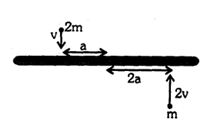
$A$ uniform rod of mass $8m$ and length $6a$ is placed on a horizontal table. Two point masses $m$ and $2m$ are moving with speeds $2v$ and $v$ respectively,as shown in the figure. They strike the rod and stick to it after the collision. Find the angular velocity of the rod about an axis passing through its center of mass.
A
$\frac{v}{a}$
B
$\frac{v}{5a}$
C
$\frac{2v}{5a}$
D
$\frac{5v}{3a}$
Solution
(B) By the principle of conservation of angular momentum about the center of mass of the rod:
Initial angular momentum $L_i = (2m)(v)(a) + (m)(2v)(2a) = 2mav + 4mav = 6mav$.
Final moment of inertia $I_f = I_{rod} + I_{mass1} + I_{mass2} = \frac{(8m)(6a)^2}{12} + (2m)(a)^2 + (m)(2a)^2$.
$I_f = \frac{8m \cdot 36a^2}{12} + 2ma^2 + 4ma^2 = 24ma^2 + 2ma^2 + 4ma^2 = 30ma^2$.
Using $L_i = I_f \omega$:
$6mav = 30ma^2 \omega$.
$\omega = \frac{6mav}{30ma^2} = \frac{v}{5a}$.
Initial angular momentum $L_i = (2m)(v)(a) + (m)(2v)(2a) = 2mav + 4mav = 6mav$.
Final moment of inertia $I_f = I_{rod} + I_{mass1} + I_{mass2} = \frac{(8m)(6a)^2}{12} + (2m)(a)^2 + (m)(2a)^2$.
$I_f = \frac{8m \cdot 36a^2}{12} + 2ma^2 + 4ma^2 = 24ma^2 + 2ma^2 + 4ma^2 = 30ma^2$.
Using $L_i = I_f \omega$:
$6mav = 30ma^2 \omega$.
$\omega = \frac{6mav}{30ma^2} = \frac{v}{5a}$.
0 likes
View Solution25
MediumMCQ
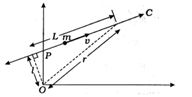
As shown in the figure,a particle of mass $m$ moves with a velocity $v$ along the line $PC$. What is the angular momentum of this particle with respect to point $P$?
A
$mvL$
B
$mvl$
C
$mvr$
D
Zero
Solution
(D) The angular momentum $L$ of a particle about a point $P$ is given by the cross product of the position vector $\vec{r}$ and the linear momentum $\vec{p} = m\vec{v}$.
Mathematically,$\vec{L} = \vec{r} \times \vec{p} = \vec{r} \times (m\vec{v})$.
The magnitude is given by $L = r p \sin \theta$,where $\theta$ is the angle between the position vector $\vec{r}$ and the velocity vector $\vec{v}$.
In this case,the particle is moving along the line $PC$,and point $P$ lies on this same line.
Therefore,the position vector of the particle with respect to point $P$ is collinear with the velocity vector $\vec{v}$.
This means the angle $\theta$ between the position vector and the velocity vector is $0^\circ$ (or $180^\circ$).
Since $\sin(0^\circ) = 0$,the angular momentum $L = mvr \sin(0^\circ) = 0$.
Mathematically,$\vec{L} = \vec{r} \times \vec{p} = \vec{r} \times (m\vec{v})$.
The magnitude is given by $L = r p \sin \theta$,where $\theta$ is the angle between the position vector $\vec{r}$ and the velocity vector $\vec{v}$.
In this case,the particle is moving along the line $PC$,and point $P$ lies on this same line.
Therefore,the position vector of the particle with respect to point $P$ is collinear with the velocity vector $\vec{v}$.
This means the angle $\theta$ between the position vector and the velocity vector is $0^\circ$ (or $180^\circ$).
Since $\sin(0^\circ) = 0$,the angular momentum $L = mvr \sin(0^\circ) = 0$.
0 likes
View Solution26
MediumMCQ
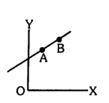
$A$ particle of mass $m$ moves along a straight line $AB$ in the $XY$ plane. Let $L_A$ and $L_B$ be the angular momentum of the particle about the origin $O$ when it is at points $A$ and $B$ respectively. Then:
A
$L_A < L_B$
B
$L_A = L_B$
C
$L_A > L_B$
D
The relation between $L_A$ and $L_B$ depends on the slope of the line $AB$.
Solution
(B) The angular momentum $L$ of a particle about an origin $O$ is given by the cross product of its position vector $\vec{r}$ and its linear momentum $\vec{p}$,i.e.,$\vec{L} = \vec{r} \times \vec{p}$.
The magnitude of angular momentum is given by $L = p \cdot d$,where $p$ is the magnitude of linear momentum and $d$ is the perpendicular distance from the origin $O$ to the line of motion of the particle.
Since the particle is moving along a straight line $AB$,the perpendicular distance $d$ from the origin $O$ to the line $AB$ is the same for all points on the line.
Assuming the particle moves with a constant velocity $v$,its linear momentum $p = mv$ remains constant throughout the motion.
Therefore,at any point on the line $AB$,the angular momentum $L = mv \cdot d$ is constant.
Thus,$L_A = L_B$.
The magnitude of angular momentum is given by $L = p \cdot d$,where $p$ is the magnitude of linear momentum and $d$ is the perpendicular distance from the origin $O$ to the line of motion of the particle.
Since the particle is moving along a straight line $AB$,the perpendicular distance $d$ from the origin $O$ to the line $AB$ is the same for all points on the line.
Assuming the particle moves with a constant velocity $v$,its linear momentum $p = mv$ remains constant throughout the motion.
Therefore,at any point on the line $AB$,the angular momentum $L = mv \cdot d$ is constant.
Thus,$L_A = L_B$.
0 likes
View Solution27
MediumMCQ
$A$ ring of mass $10 \ kg$ and diameter $0.4 \ m$ is rotating about its axis. If it completes $2100$ revolutions per minute,what is its angular momentum in $kg \cdot m^2/s$?
A
$44$
B
$88$
C
$4.4$
D
$0.4$
Solution
(B) The mass of the ring is $m = 10 \ kg$ and the radius is $r = \text{diameter}/2 = 0.4/2 = 0.2 \ m$.
The moment of inertia of a ring about its axis is $I = mr^2 = 10 \times (0.2)^2 = 10 \times 0.04 = 0.4 \ kg \cdot m^2$.
The angular frequency $\omega$ is given by $\omega = 2\pi n$,where $n$ is the frequency in revolutions per second.
Given $n = 2100 \ \text{rpm} = 2100/60 \ \text{rev/s} = 35 \ \text{rev/s}$.
Thus,$\omega = 2 \times \pi \times 35 = 70\pi \ \text{rad/s}$.
The angular momentum $L$ is given by $L = I\omega$.
$L = 0.4 \times 70\pi = 28\pi \ \text{kg} \cdot m^2/s$.
Using $\pi \approx 22/7$,$L = 28 \times (22/7) = 4 \times 22 = 88 \ \text{kg} \cdot m^2/s$.
The moment of inertia of a ring about its axis is $I = mr^2 = 10 \times (0.2)^2 = 10 \times 0.04 = 0.4 \ kg \cdot m^2$.
The angular frequency $\omega$ is given by $\omega = 2\pi n$,where $n$ is the frequency in revolutions per second.
Given $n = 2100 \ \text{rpm} = 2100/60 \ \text{rev/s} = 35 \ \text{rev/s}$.
Thus,$\omega = 2 \times \pi \times 35 = 70\pi \ \text{rad/s}$.
The angular momentum $L$ is given by $L = I\omega$.
$L = 0.4 \times 70\pi = 28\pi \ \text{kg} \cdot m^2/s$.
Using $\pi \approx 22/7$,$L = 28 \times (22/7) = 4 \times 22 = 88 \ \text{kg} \cdot m^2/s$.
0 likes
View Solution28
DifficultMCQ
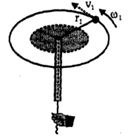
$A$ point mass $m$ is attached to one end of a string passing through a cylindrical tube. The string is held in hand,and the point mass moves in a horizontal circle of radius $r_1 = 2 \ m$ with a speed of $v_1 = 4 \ m/s$. The string is then pulled down so that the radius is reduced to $r_2 = 1 \ m$. Calculate the new linear velocity,angular velocity,and the ratio of the final kinetic energy to the initial kinetic energy.
A
$4:7$
B
$10:9$
C
$1:2$
D
$4:1$
Solution
(D) The force acting on the point mass due to the string is radial,so the angular momentum remains conserved even when the string is pulled.
Let the mass of the particle be $m$,the initial radius be $r_1 = 2 \ m$,the initial linear velocity be $v_1 = 4 \ m/s$,and the initial angular velocity be $\omega_1 = v_1 / r_1 = 4 / 2 = 2 \ rad/s$.
Let the final radius be $r_2 = 1 \ m$,the final linear velocity be $v_2$,and the final angular velocity be $\omega_2$.
By the principle of conservation of angular momentum:
$L_1 = L_2$
$m r_1 v_1 = m r_2 v_2$
$r_1 v_1 = r_2 v_2$
Substituting the values:
$2 \times 4 = 1 \times v_2$
$v_2 = 8 \ m/s$
The new angular velocity is:
$\omega_2 = v_2 / r_2 = 8 / 1 = 8 \ rad/s$
The ratio of the final kinetic energy $(K_2)$ to the initial kinetic energy $(K_1)$ is:
$K_2 / K_1 = (\frac{1}{2} m v_2^2) / (\frac{1}{2} m v_1^2)$
$K_2 / K_1 = v_2^2 / v_1^2$
$K_2 / K_1 = (8)^2 / (4)^2 = 64 / 16 = 4$
Thus,the ratio is $4:1$.
Let the mass of the particle be $m$,the initial radius be $r_1 = 2 \ m$,the initial linear velocity be $v_1 = 4 \ m/s$,and the initial angular velocity be $\omega_1 = v_1 / r_1 = 4 / 2 = 2 \ rad/s$.
Let the final radius be $r_2 = 1 \ m$,the final linear velocity be $v_2$,and the final angular velocity be $\omega_2$.
By the principle of conservation of angular momentum:
$L_1 = L_2$
$m r_1 v_1 = m r_2 v_2$
$r_1 v_1 = r_2 v_2$
Substituting the values:
$2 \times 4 = 1 \times v_2$
$v_2 = 8 \ m/s$
The new angular velocity is:
$\omega_2 = v_2 / r_2 = 8 / 1 = 8 \ rad/s$
The ratio of the final kinetic energy $(K_2)$ to the initial kinetic energy $(K_1)$ is:
$K_2 / K_1 = (\frac{1}{2} m v_2^2) / (\frac{1}{2} m v_1^2)$
$K_2 / K_1 = v_2^2 / v_1^2$
$K_2 / K_1 = (8)^2 / (4)^2 = 64 / 16 = 4$
Thus,the ratio is $4:1$.
0 likes
View Solution29
DifficultMCQ
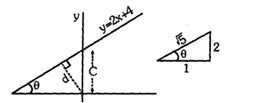
$A$ particle of mass $5 \ kg$ moves along the straight line $y = 2x + 4$ with a velocity of $3\sqrt{5} \ m/s$. Find its angular momentum about the origin in $kg \ m^2 \ s^{-1}$.
A
$45$
B
$60$
C
$50$
D
$75$
Solution
(B) The angular momentum $L$ of a particle about the origin is given by $L = mvd$,where $m$ is the mass,$v$ is the velocity,and $d$ is the perpendicular distance from the origin to the line of motion.
The equation of the line is $2x - y + 4 = 0$.
The perpendicular distance $d$ from the origin $(0, 0)$ to the line $Ax + By + C = 0$ is given by $d = \frac{|C|}{\sqrt{A^2 + B^2}}$.
Here,$A = 2$,$B = -1$,and $C = 4$.
$d = \frac{|4|}{\sqrt{2^2 + (-1)^2}} = \frac{4}{\sqrt{4 + 1}} = \frac{4}{\sqrt{5}} \ m$.
Given mass $m = 5 \ kg$ and velocity $v = 3\sqrt{5} \ m/s$.
$L = mvd = 5 \times (3\sqrt{5}) \times \left(\frac{4}{\sqrt{5}}\right)$.
$L = 5 \times 3 \times 4 = 60 \ kg \ m^2 \ s^{-1}$.
The equation of the line is $2x - y + 4 = 0$.
The perpendicular distance $d$ from the origin $(0, 0)$ to the line $Ax + By + C = 0$ is given by $d = \frac{|C|}{\sqrt{A^2 + B^2}}$.
Here,$A = 2$,$B = -1$,and $C = 4$.
$d = \frac{|4|}{\sqrt{2^2 + (-1)^2}} = \frac{4}{\sqrt{4 + 1}} = \frac{4}{\sqrt{5}} \ m$.
Given mass $m = 5 \ kg$ and velocity $v = 3\sqrt{5} \ m/s$.
$L = mvd = 5 \times (3\sqrt{5}) \times \left(\frac{4}{\sqrt{5}}\right)$.
$L = 5 \times 3 \times 4 = 60 \ kg \ m^2 \ s^{-1}$.
0 likes
View Solution30
DifficultMCQ
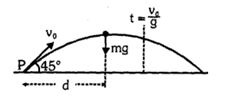
$A$ particle of mass $m$ is projected from a point $P$ on the ground with an initial velocity $v_0$ at an angle of $45^{\circ}$ with the horizontal at $t = 0$. Find the magnitude of the angular momentum of the particle at time $t = \frac{v_0}{g}$.
A
$\frac{1}{2\sqrt{2}} \cdot \frac{mv_0^3}{g}$
B
$\frac{1}{2\sqrt{2}} \cdot \frac{mv_0}{g}$
C
$\frac{1}{2\sqrt{2}} \cdot \frac{mv_0^3}{g}$
D
$\frac{1}{5\sqrt{3}} \cdot \frac{mv_0^3}{g}$
Solution
(C) The only force acting on the projectile is its weight $mg$ acting downwards.
Taking point $P$ as the origin,the torque $\tau$ due to gravity at any time $t$ is given by $\tau = \vec{r} \times \vec{F} = x(t) \cdot mg$,where $x(t) = (v_0 \cos 45^{\circ})t = \frac{v_0}{\sqrt{2}}t$.
Thus,$\tau = mg \cdot \frac{v_0}{\sqrt{2}}t$.
The change in angular momentum $\Delta L$ is equal to the angular impulse:
$\Delta L = \int_{0}^{t} \tau \, dt = \int_{0}^{t} \frac{mgv_0}{\sqrt{2}} t \, dt = \frac{mgv_0}{\sqrt{2}} \left[ \frac{t^2}{2} \right]_{0}^{t} = \frac{mgv_0 t^2}{2\sqrt{2}}$.
Since the initial angular momentum at $P$ is zero (the line of action of the initial velocity passes through $P$),the angular momentum at time $t = \frac{v_0}{g}$ is:
$L = \frac{mgv_0}{2\sqrt{2}} \left( \frac{v_0}{g} \right)^2 = \frac{mgv_0^3}{2\sqrt{2}g^2} = \frac{mv_0^3}{2\sqrt{2}g}$.
Taking point $P$ as the origin,the torque $\tau$ due to gravity at any time $t$ is given by $\tau = \vec{r} \times \vec{F} = x(t) \cdot mg$,where $x(t) = (v_0 \cos 45^{\circ})t = \frac{v_0}{\sqrt{2}}t$.
Thus,$\tau = mg \cdot \frac{v_0}{\sqrt{2}}t$.
The change in angular momentum $\Delta L$ is equal to the angular impulse:
$\Delta L = \int_{0}^{t} \tau \, dt = \int_{0}^{t} \frac{mgv_0}{\sqrt{2}} t \, dt = \frac{mgv_0}{\sqrt{2}} \left[ \frac{t^2}{2} \right]_{0}^{t} = \frac{mgv_0 t^2}{2\sqrt{2}}$.
Since the initial angular momentum at $P$ is zero (the line of action of the initial velocity passes through $P$),the angular momentum at time $t = \frac{v_0}{g}$ is:
$L = \frac{mgv_0}{2\sqrt{2}} \left( \frac{v_0}{g} \right)^2 = \frac{mgv_0^3}{2\sqrt{2}g^2} = \frac{mv_0^3}{2\sqrt{2}g}$.
0 likes
View Solution31
MediumMCQ
$A$ cylinder of mass $M$ and radius $R$ is rotating about its axis with angular velocity $\omega$. $A$ particle of mass $m$ moving with velocity $v$ hits the cylinder and sticks to its rim. Calculate the angular velocity of the cylinder after the impact.
A
$\frac{I\omega + mvR}{I + mR^2}$
B
$\frac{I\omega - mvR}{I + mR^2}$
C
$\frac{I\omega + mvR}{I - mR^2}$
D
$\frac{I\omega + mv}{I + mR}$
Solution
(A) According to the principle of conservation of angular momentum,the total angular momentum before the impact is equal to the total angular momentum after the impact.
Initial angular momentum of the cylinder = $I\omega$
Initial angular momentum of the particle about the axis of the cylinder = $mvR$
Total initial angular momentum $L_1 = I\omega + mvR$
After the particle sticks to the rim,the new moment of inertia of the system becomes $I' = I + mR^2$.
Let the new angular velocity be $\omega'$.
Total final angular momentum $L_2 = (I + mR^2)\omega'$
Equating $L_1 = L_2$:
$I\omega + mvR = (I + mR^2)\omega'$
$\omega' = \frac{I\omega + mvR}{I + mR^2}$
Initial angular momentum of the cylinder = $I\omega$
Initial angular momentum of the particle about the axis of the cylinder = $mvR$
Total initial angular momentum $L_1 = I\omega + mvR$
After the particle sticks to the rim,the new moment of inertia of the system becomes $I' = I + mR^2$.
Let the new angular velocity be $\omega'$.
Total final angular momentum $L_2 = (I + mR^2)\omega'$
Equating $L_1 = L_2$:
$I\omega + mvR = (I + mR^2)\omega'$
$\omega' = \frac{I\omega + mvR}{I + mR^2}$
0 likes
View Solution32
MediumMCQ
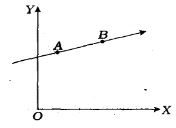
$A$ particle of mass $m$ moves in the $XY$ plane with a velocity $v$ along the straight line $AB.$ If the angular momentum of the particle with respect to origin $O$ is $L_A$ when it is at $A$ and $L_B$ when it is at $B,$ then
A
$L_A = L_B$
B
the relationship between $L_A$ and $L_B$ depends upon the slope of the line $AB$
C
$L_A < L_B$
D
$L_A > L_B$
Solution
(A) The angular momentum $L$ of a particle with respect to an origin $O$ is given by the formula $L = r \times p = r \times (mv),$ where $r$ is the position vector of the particle and $p$ is its linear momentum.
This can also be expressed as $L = m v d,$ where $d$ is the perpendicular distance from the origin $O$ to the line of motion of the particle.
Since the particle is moving along a straight line $AB,$ the perpendicular distance $d$ from the origin $O$ to this line remains constant at all points on the line.
Therefore,the angular momentum $L$ is constant for all points on the line $AB.$
Thus,$L_A = L_B.$
This can also be expressed as $L = m v d,$ where $d$ is the perpendicular distance from the origin $O$ to the line of motion of the particle.
Since the particle is moving along a straight line $AB,$ the perpendicular distance $d$ from the origin $O$ to this line remains constant at all points on the line.
Therefore,the angular momentum $L$ is constant for all points on the line $AB.$
Thus,$L_A = L_B.$
0 likes
View Solution33
EasyMCQ
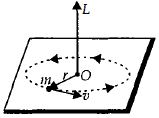
When a mass is rotating in a plane about a fixed point,its angular momentum is directed along
A
a line perpendicular to the plane of rotation
B
the radius
C
the tangent to the orbit
D
the line making an angle of $45^{\circ}$ to the plane of rotation
Solution
(A) The angular momentum $\vec{L}$ of a particle is defined by the cross product of its position vector $\vec{r}$ and its linear momentum $\vec{p} = m\vec{v}$,given by $\vec{L} = \vec{r} \times \vec{p}$.
Since $\vec{r}$ and $\vec{v}$ both lie in the plane of rotation,their cross product $\vec{L}$ must be perpendicular to both $\vec{r}$ and $\vec{v}$ according to the right-hand rule.
Therefore,the angular momentum vector is directed along a line perpendicular to the plane of rotation.
Since $\vec{r}$ and $\vec{v}$ both lie in the plane of rotation,their cross product $\vec{L}$ must be perpendicular to both $\vec{r}$ and $\vec{v}$ according to the right-hand rule.
Therefore,the angular momentum vector is directed along a line perpendicular to the plane of rotation.
0 likes
View Solution34
EasyMCQ
Angular momentum is a:
A
Vector (axial)
B
Vector (polar)
C
Scalar
D
None of the above
Solution
(A) Angular momentum is defined by the cross product of position vector and linear momentum: $\overrightarrow{L} = \overrightarrow{r} \times \overrightarrow{p}$.
Since it is defined by a cross product of two vectors and its direction is determined by the right-hand rule along the axis of rotation,it is classified as an axial vector.
Since it is defined by a cross product of two vectors and its direction is determined by the right-hand rule along the axis of rotation,it is classified as an axial vector.
0 likes
View Solution35
EasyMCQ
The angular momentum of a system of particles changes if:
A
$A$ force acts on the system.
B
$A$ torque acts on the system.
C
The direction of velocity changes.
D
None of the above.
Solution
(B) According to the principle of angular momentum, the rate of change of angular momentum $(\vec{L})$ of a system is equal to the net external torque $(\vec{\tau}_{ext})$ acting on it.
Mathematically, $\vec{\tau}_{ext} = \frac{d\vec{L}}{dt}$.
If $\vec{\tau}_{ext} = 0$, then $\frac{d\vec{L}}{dt} = 0$, which implies $\vec{L}$ is constant.
Therefore, the angular momentum of a system changes if and only if a non-zero net external torque acts on the system.
Mathematically, $\vec{\tau}_{ext} = \frac{d\vec{L}}{dt}$.
If $\vec{\tau}_{ext} = 0$, then $\frac{d\vec{L}}{dt} = 0$, which implies $\vec{L}$ is constant.
Therefore, the angular momentum of a system changes if and only if a non-zero net external torque acts on the system.
0 likes
View Solution36
EasyMCQ
The moment of linear momentum is called:
A
Torque
B
Couple
C
Impulse
D
Angular momentum
Solution
(D) The moment of linear momentum $\vec{p}$ about a point is defined as the cross product of the position vector $\vec{r}$ and the linear momentum $\vec{p}$.
Mathematically,it is expressed as $\vec{L} = \vec{r} \times \vec{p}$.
This quantity is known as angular momentum.
Therefore,the correct option is $D$.
Mathematically,it is expressed as $\vec{L} = \vec{r} \times \vec{p}$.
This quantity is known as angular momentum.
Therefore,the correct option is $D$.
0 likes
View Solution37
EasyMCQ
When a mass moves in a plane about a fixed point,the direction of its angular momentum is along which of the following?
A
The radius
B
The tangent to the orbit
C
$A$ line inclined at $45^o$ to the plane of rotation
D
The axis of rotation
Solution
(D) The angular momentum $\vec{L}$ of a particle is defined by the cross product of its position vector $\vec{r}$ and its linear momentum $\vec{p}$,given by $\vec{L} = \vec{r} \times \vec{p}$.
According to the right-hand rule for the cross product,the vector $\vec{L}$ is perpendicular to both $\vec{r}$ and $\vec{p}$.
Since both $\vec{r}$ and $\vec{p}$ lie in the plane of rotation,their cross product $\vec{L}$ must be perpendicular to the plane of rotation.
The line perpendicular to the plane of rotation passing through the fixed point is the axis of rotation.
Therefore,the direction of the angular momentum is along the axis of rotation.
According to the right-hand rule for the cross product,the vector $\vec{L}$ is perpendicular to both $\vec{r}$ and $\vec{p}$.
Since both $\vec{r}$ and $\vec{p}$ lie in the plane of rotation,their cross product $\vec{L}$ must be perpendicular to the plane of rotation.
The line perpendicular to the plane of rotation passing through the fixed point is the axis of rotation.
Therefore,the direction of the angular momentum is along the axis of rotation.
0 likes
View Solution38
EasyMCQ
The angular momentum of a body is the product of which of the following?
A
Mass and angular velocity
B
Centripetal force and radius
C
Linear velocity and angular velocity
D
Moment of inertia and angular velocity
Solution
(D) The angular momentum $(L)$ of a rotating rigid body is defined as the product of its moment of inertia $(I)$ and its angular velocity $(\omega)$.
Mathematically,this is expressed as:
$L = I \omega$
Therefore,the correct option is $(D)$.
Mathematically,this is expressed as:
$L = I \omega$
Therefore,the correct option is $(D)$.
0 likes
View Solution39
MediumMCQ
$A$ ring of mass $10 \ kg$ and diameter $0.4 \ m$ is rotated about its axis. If it rotates at $2100 \ rpm$,its angular momentum will be ........... $kg \cdot m^2/s$.
A
$44$
B
$88$
C
$4.4$
D
$0.4$
Solution
(B) The moment of inertia $I$ of a ring about its axis is given by $I = mR^2$.
Given mass $m = 10 \ kg$ and diameter $d = 0.4 \ m$,the radius $R = d/2 = 0.2 \ m$.
So,$I = 10 \times (0.2)^2 = 10 \times 0.04 = 0.4 \ kg \cdot m^2$.
The angular velocity $\omega$ in $rad/s$ is given by $\omega = 2\pi n$,where $n$ is the frequency in $rev/s$.
Given $n = 2100 \ rpm = 2100/60 \ rev/s = 35 \ rev/s$.
Thus,$\omega = 2 \times \pi \times 35 = 70\pi \ rad/s$.
The angular momentum $L$ is given by $L = I\omega$.
$L = 0.4 \times 70\pi = 28\pi \ kg \cdot m^2/s$.
Using $\pi \approx 22/7$,$L = 28 \times (22/7) = 4 \times 22 = 88 \ kg \cdot m^2/s$.
Given mass $m = 10 \ kg$ and diameter $d = 0.4 \ m$,the radius $R = d/2 = 0.2 \ m$.
So,$I = 10 \times (0.2)^2 = 10 \times 0.04 = 0.4 \ kg \cdot m^2$.
The angular velocity $\omega$ in $rad/s$ is given by $\omega = 2\pi n$,where $n$ is the frequency in $rev/s$.
Given $n = 2100 \ rpm = 2100/60 \ rev/s = 35 \ rev/s$.
Thus,$\omega = 2 \times \pi \times 35 = 70\pi \ rad/s$.
The angular momentum $L$ is given by $L = I\omega$.
$L = 0.4 \times 70\pi = 28\pi \ kg \cdot m^2/s$.
Using $\pi \approx 22/7$,$L = 28 \times (22/7) = 4 \times 22 = 88 \ kg \cdot m^2/s$.
0 likes
View Solution40
EasyMCQ
In orbital motion,the angular momentum vector is directed:
A
Along the radial vector
B
Parallel to the linear momentum
C
In the orbital plane
D
Perpendicular to the orbital plane
Solution
(D) The angular momentum $L$ is defined as the cross product of the position vector $r$ and the linear momentum vector $p$,given by $L = r \times p$.
By the definition of the cross product,the resulting vector $L$ is always perpendicular to the plane containing both vectors $r$ and $p$.
Since both the position vector $r$ and the linear momentum vector $p$ lie in the orbital plane,the angular momentum vector $L$ must be perpendicular to the orbital plane.
By the definition of the cross product,the resulting vector $L$ is always perpendicular to the plane containing both vectors $r$ and $p$.
Since both the position vector $r$ and the linear momentum vector $p$ lie in the orbital plane,the angular momentum vector $L$ must be perpendicular to the orbital plane.
0 likes
View Solution41
EasyMCQ
If the rotational kinetic energy of a body is $10 \ J$,and its angular momentum vector coincides with the axis of rotation,and its moment of inertia about this axis is $8 \times 10^{-7} \ kg \ m^2$,then the angular momentum of the body will be:
A
$4 \times 10^{-3} \ kg \ m^2/s$
B
$2 \times 10^{-3} \ kg \ m^2/s$
C
$6 \times 10^{-3} \ kg \ m^2/s$
D
None of the above
Solution
(A) The rotational kinetic energy $E$ is given by $E = \frac{L^2}{2I}$,where $L$ is the angular momentum and $I$ is the moment of inertia.
Rearranging for $L$,we get $L = \sqrt{2EI}$.
Given $E = 10 \ J$ and $I = 8 \times 10^{-7} \ kg \ m^2$.
Substituting the values: $L = \sqrt{2 \times 10 \times 8 \times 10^{-7}}$.
$L = \sqrt{160 \times 10^{-7}} = \sqrt{16 \times 10^{-6}}$.
$L = 4 \times 10^{-3} \ kg \ m^2/s$.
Rearranging for $L$,we get $L = \sqrt{2EI}$.
Given $E = 10 \ J$ and $I = 8 \times 10^{-7} \ kg \ m^2$.
Substituting the values: $L = \sqrt{2 \times 10 \times 8 \times 10^{-7}}$.
$L = \sqrt{160 \times 10^{-7}} = \sqrt{16 \times 10^{-6}}$.
$L = 4 \times 10^{-3} \ kg \ m^2/s$.
0 likes
View Solution42
EasyMCQ
If a body has a moment of inertia $I$ and an angular velocity $\omega \, rad/s$,then what is the value of its angular momentum $L$?
A
$I / \omega$
B
$I \omega^2$
C
$I \omega$
D
None of the above
Solution
(C) The angular momentum $L$ of a rotating body is defined as the product of its moment of inertia $I$ and its angular velocity $\omega$.
Mathematically,this is expressed as:
$L = I \omega$
Therefore,the correct option is $C$.
Mathematically,this is expressed as:
$L = I \omega$
Therefore,the correct option is $C$.
0 likes
View Solution43
MediumMCQ
If the Earth is considered a sphere of radius $R$ and mass $M$,then its angular momentum about its axis of rotation in terms of the time period $T$ will be:
A
$ \frac{\pi M R^3}{T} $
B
$ \frac{M R^2 \pi}{T} $
C
$ \frac{2 \pi M R^2}{5 T} $
D
$ \frac{4 \pi M R^2}{5 T} $
Solution
(D) The angular momentum $L$ of a rotating body is given by $L = I \omega$.
For a solid sphere (Earth) rotating about its axis,the moment of inertia is $I = \frac{2}{5} M R^2$.
The angular velocity $\omega$ in terms of the time period $T$ is $\omega = \frac{2 \pi}{T}$.
Substituting these values into the formula for angular momentum:
$L = \left( \frac{2}{5} M R^2 \right) \times \left( \frac{2 \pi}{T} \right) = \frac{4 \pi M R^2}{5 T}$.
For a solid sphere (Earth) rotating about its axis,the moment of inertia is $I = \frac{2}{5} M R^2$.
The angular velocity $\omega$ in terms of the time period $T$ is $\omega = \frac{2 \pi}{T}$.
Substituting these values into the formula for angular momentum:
$L = \left( \frac{2}{5} M R^2 \right) \times \left( \frac{2 \pi}{T} \right) = \frac{4 \pi M R^2}{5 T}$.
0 likes
View Solution44
EasyMCQ
The angular momentum of a particle is:
A
Perpendicular to the plane of rotation.
B
In the plane of rotation.
C
Inclined at an angle to the plane of rotation.
D
Has no fixed direction.
Solution
(A) The angular momentum $\vec{L}$ of a particle is defined as the cross product of its position vector $\vec{r}$ and its linear momentum $\vec{p}$,given by $\vec{L} = \vec{r} \times \vec{p}$.
By the definition of the cross product,the resulting vector $\vec{L}$ is always perpendicular to the plane containing the vectors $\vec{r}$ and $\vec{p}$.
Since the particle moves in a plane of rotation,both $\vec{r}$ and $\vec{p}$ lie within this plane.
Therefore,the angular momentum vector $\vec{L}$ is always perpendicular to the plane of rotation.
By the definition of the cross product,the resulting vector $\vec{L}$ is always perpendicular to the plane containing the vectors $\vec{r}$ and $\vec{p}$.
Since the particle moves in a plane of rotation,both $\vec{r}$ and $\vec{p}$ lie within this plane.
Therefore,the angular momentum vector $\vec{L}$ is always perpendicular to the plane of rotation.
0 likes
View Solution45
MediumMCQ
Consider a body,shown in the figure,consisting of two identical balls,each of mass $M$,connected by a light rigid rod of length $L$. If an impulse $J = Mv$ is imparted to the body at one of its ends,what would be its angular velocity?
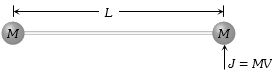
A
$v/L$
B
$2v/L$
C
$v/3L$
D
$v/4L$
Solution
(A) The impulse $J = Mv$ is applied at one end of the rod. This impulse provides an angular momentum about the center of mass $(CM)$ of the system.
The center of mass of the two-ball system is at the midpoint of the rod.
The angular momentum $L_{CM}$ imparted by the impulse $J$ about the center of mass is given by $L_{CM} = J \times r$,where $r = L/2$ is the distance from the center of mass to the point of application of the impulse.
$L_{CM} = (Mv) \times (L/2) = \frac{MvL}{2}$.
The moment of inertia $I$ of the system about an axis passing through the center of mass and perpendicular to the rod is $I = M(L/2)^2 + M(L/2)^2 = 2M(L^2/4) = \frac{ML^2}{2}$.
Using the relation $L_{CM} = I\omega$,we have:
$\frac{MvL}{2} = \left( \frac{ML^2}{2} \right) \omega$.
Solving for $\omega$:
$\omega = \frac{MvL/2}{ML^2/2} = \frac{v}{L}$.
The center of mass of the two-ball system is at the midpoint of the rod.
The angular momentum $L_{CM}$ imparted by the impulse $J$ about the center of mass is given by $L_{CM} = J \times r$,where $r = L/2$ is the distance from the center of mass to the point of application of the impulse.
$L_{CM} = (Mv) \times (L/2) = \frac{MvL}{2}$.
The moment of inertia $I$ of the system about an axis passing through the center of mass and perpendicular to the rod is $I = M(L/2)^2 + M(L/2)^2 = 2M(L^2/4) = \frac{ML^2}{2}$.
Using the relation $L_{CM} = I\omega$,we have:
$\frac{MvL}{2} = \left( \frac{ML^2}{2} \right) \omega$.
Solving for $\omega$:
$\omega = \frac{MvL/2}{ML^2/2} = \frac{v}{L}$.
0 likes
View Solution46
MediumMCQ
$A$ mass $m$ is moving with a constant velocity $v$ along a line parallel to the $X$-axis. Its angular momentum with respect to the origin or the $Z$-axis is:
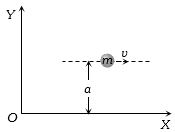
A
will be zero
B
will remain constant
C
will increase
D
will decrease
Solution
(B) The angular momentum $L$ of a particle about the origin is given by $L = r \times p$,where $r$ is the position vector and $p$ is the linear momentum.
Alternatively,the magnitude of angular momentum is $L = p \times d$,where $d$ is the perpendicular distance from the origin to the line of motion.
Here,the mass $m$ moves with constant velocity $v$,so the linear momentum $p = mv$ is constant.
The perpendicular distance $d$ from the origin to the line of motion is constant and equal to $a$.
Therefore,the angular momentum $L = mv \times a = mva$,which is a constant value.
Alternatively,the magnitude of angular momentum is $L = p \times d$,where $d$ is the perpendicular distance from the origin to the line of motion.
Here,the mass $m$ moves with constant velocity $v$,so the linear momentum $p = mv$ is constant.
The perpendicular distance $d$ from the origin to the line of motion is constant and equal to $a$.
Therefore,the angular momentum $L = mv \times a = mva$,which is a constant value.
0 likes
View Solution47
MediumMCQ
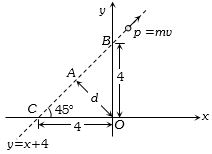
$A$ particle of mass $m = 5$ units is moving in the $XOY$ plane along the line $Y = X + 4$ with a uniform speed $v = 3\sqrt{2}$ units. The magnitude of its angular momentum about the origin is ...... units.
A
$0$
B
$60$
C
$75$
D
$40\sqrt{2}$
Solution
(B) The angular momentum $L$ of a particle about the origin is given by $L = p \times d$,where $p = mv$ is the linear momentum and $d$ is the perpendicular distance from the origin to the line of motion.
Given the line of motion is $Y = X + 4$,which can be written as $X - Y + 4 = 0$.
The perpendicular distance $d$ from the origin $(0, 0)$ to the line $X - Y + 4 = 0$ is calculated as:
$d = \frac{|(1)(0) - (1)(0) + 4|}{\sqrt{1^2 + (-1)^2}} = \frac{4}{\sqrt{2}} = 2\sqrt{2}$ units.
The linear momentum $p = mv = 5 \times 3\sqrt{2} = 15\sqrt{2}$ units.
Therefore,the magnitude of angular momentum is:
$L = p \times d = (15\sqrt{2}) \times (2\sqrt{2}) = 15 \times 2 \times 2 = 60$ units.
Given the line of motion is $Y = X + 4$,which can be written as $X - Y + 4 = 0$.
The perpendicular distance $d$ from the origin $(0, 0)$ to the line $X - Y + 4 = 0$ is calculated as:
$d = \frac{|(1)(0) - (1)(0) + 4|}{\sqrt{1^2 + (-1)^2}} = \frac{4}{\sqrt{2}} = 2\sqrt{2}$ units.
The linear momentum $p = mv = 5 \times 3\sqrt{2} = 15\sqrt{2}$ units.
Therefore,the magnitude of angular momentum is:
$L = p \times d = (15\sqrt{2}) \times (2\sqrt{2}) = 15 \times 2 \times 2 = 60$ units.
0 likes
View Solution48
MediumMCQ
The angular momentum of a flywheel having a moment of inertia of $0.4\, kg\, m^2$ decreases from $30\, kg\, m^2/s$ to $20\, kg\, m^2/s$ in a period of $2\, s$. The average torque acting on the flywheel during this period is ......... $N\, m$.
A
$10$
B
$2.5$
C
$5$
D
$1.5$
Solution
(C) The average torque $\bar{\tau}$ acting on a body is given by the rate of change of angular momentum: $\bar{\tau} = \frac{\Delta L}{\Delta t}$.
Given:
Initial angular momentum $L_i = 30\, kg\, m^2/s$
Final angular momentum $L_f = 20\, kg\, m^2/s$
Time interval $\Delta t = 2\, s$
Change in angular momentum $\Delta L = L_f - L_i = 20 - 30 = -10\, kg\, m^2/s$.
The magnitude of the average torque is $|\bar{\tau}| = |\frac{-10}{2}| = 5\, N\, m$.
Given:
Initial angular momentum $L_i = 30\, kg\, m^2/s$
Final angular momentum $L_f = 20\, kg\, m^2/s$
Time interval $\Delta t = 2\, s$
Change in angular momentum $\Delta L = L_f - L_i = 20 - 30 = -10\, kg\, m^2/s$.
The magnitude of the average torque is $|\bar{\tau}| = |\frac{-10}{2}| = 5\, N\, m$.
0 likes
View Solution49
MediumMCQ
$A$ particle of mass $2 \ kg$ located at the position $(\hat{i} + \hat{j}) \ m$ has a velocity $2(\hat{i} - \hat{j} + \hat{k}) \ m/s$. Its angular momentum about the $z$-axis in $kg \cdot m^2/s$ is:
A
$0$
B
$+8$
C
$12$
D
$-8$
Solution
(D) The angular momentum $\vec{L}$ about the origin is given by $\vec{L} = \vec{r} \times \vec{p} = \vec{r} \times m\vec{v}$.
Given: $\vec{r} = (1\hat{i} + 1\hat{j}) \ m$,$m = 2 \ kg$,and $\vec{v} = 2(\hat{i} - \hat{j} + \hat{k}) \ m/s$.
Therefore,$\vec{p} = m\vec{v} = 2 \times 2(\hat{i} - \hat{j} + \hat{k}) = 4(\hat{i} - \hat{j} + \hat{k}) \ kg \cdot m/s$.
Calculating the cross product $\vec{L} = \vec{r} \times \vec{p}$:
$\vec{L} = (\hat{i} + \hat{j}) \times 4(\hat{i} - \hat{j} + \hat{k})$
$\vec{L} = 4 [(\hat{i} \times \hat{i}) - (\hat{i} \times \hat{j}) + (\hat{i} \times \hat{k}) + (\hat{j} \times \hat{i}) - (\hat{j} \times \hat{j}) + (\hat{j} \times \hat{k})]$
Using cross product rules: $\hat{i} \times \hat{i} = 0$,$\hat{i} \times \hat{j} = \hat{k}$,$\hat{i} \times \hat{k} = -\hat{j}$,$\hat{j} \times \hat{i} = -\hat{k}$,$\hat{j} \times \hat{j} = 0$,$\hat{j} \times \hat{k} = \hat{i}$.
$\vec{L} = 4 [0 - \hat{k} - \hat{j} - \hat{k} - 0 + \hat{i}]$
$\vec{L} = 4(\hat{i} - \hat{j} - 2\hat{k}) = 4\hat{i} - 4\hat{j} - 8\hat{k}$.
The angular momentum about the $z$-axis is the $z$-component of $\vec{L}$,which is $L_z = -8 \ kg \cdot m^2/s$.
Given: $\vec{r} = (1\hat{i} + 1\hat{j}) \ m$,$m = 2 \ kg$,and $\vec{v} = 2(\hat{i} - \hat{j} + \hat{k}) \ m/s$.
Therefore,$\vec{p} = m\vec{v} = 2 \times 2(\hat{i} - \hat{j} + \hat{k}) = 4(\hat{i} - \hat{j} + \hat{k}) \ kg \cdot m/s$.
Calculating the cross product $\vec{L} = \vec{r} \times \vec{p}$:
$\vec{L} = (\hat{i} + \hat{j}) \times 4(\hat{i} - \hat{j} + \hat{k})$
$\vec{L} = 4 [(\hat{i} \times \hat{i}) - (\hat{i} \times \hat{j}) + (\hat{i} \times \hat{k}) + (\hat{j} \times \hat{i}) - (\hat{j} \times \hat{j}) + (\hat{j} \times \hat{k})]$
Using cross product rules: $\hat{i} \times \hat{i} = 0$,$\hat{i} \times \hat{j} = \hat{k}$,$\hat{i} \times \hat{k} = -\hat{j}$,$\hat{j} \times \hat{i} = -\hat{k}$,$\hat{j} \times \hat{j} = 0$,$\hat{j} \times \hat{k} = \hat{i}$.
$\vec{L} = 4 [0 - \hat{k} - \hat{j} - \hat{k} - 0 + \hat{i}]$
$\vec{L} = 4(\hat{i} - \hat{j} - 2\hat{k}) = 4\hat{i} - 4\hat{j} - 8\hat{k}$.
The angular momentum about the $z$-axis is the $z$-component of $\vec{L}$,which is $L_z = -8 \ kg \cdot m^2/s$.
0 likes
View SolutionSystem of Particles and Rotational Motion — Angular Momentum and Angular Impulse · Frequently Asked Questions
1Are these System of Particles and Rotational Motion questions useful for JEE and NEET?
Yes. All questions in this section are mapped to JEE Main and NEET exam patterns. Previous year questions from JEE Main, NEET, GUJCET and state-level exams are included with full solutions.
2Can I switch to Hindi or Gujarati for these questions?
Yes. Use the language tabs in the hero section or the sidebar to view the same questions and solutions in English, Hindi or Gujarati.
3How do I generate a question paper from this subtopic?
Use the Vedclass Exam Paper Generator — select the chapter and subtopic, set difficulty, and generate Sets A, B, C, D automatically. First 3 chapters of every subject are free.
Vedclass Products
For Students
Vedclass Test Series
Mock tests in real JEE/NEET style with performance analysis. 5-day free trial.
Start Free TrialFor Teachers
Exam Paper Generator
Generate Set A/B/C/D papers from this chapter in 2 minutes. 3 chapters free.
Try FreeFor Institutes
Online Exam Module
Live online exams with unlimited students, 360° analytics & white-label branding.
See DemoFor Teachers & Institutes
Generate a System of Particles and Rotational Motion Exam Paper in 2 Minutes
Select subtopic & difficulty — Sets A, B, C, D auto-generated with No Repeat logic.
First 3 chapters of every subject are free — no payment required.