
A English
Angular Momentum and Angular Impulse Questions in English
Class 11 Physics · System of Particles and Rotational Motion · Angular Momentum and Angular Impulse
120+
Questions
English
Language
100%
With Solutions
Showing 50 of 120 questions in English
51
DifficultMCQ
$A$ particle of mass $0.5\, kg$ is rotating in a circular path of radius $2\, m$ and centripetal force on it is $9\, N$. Its angular momentum (in $J\cdot s$) is:
A
$1.5$
B
$3$
C
$6$
D
$18$
Solution
(C) Given: Mass $m = 0.5\, kg$,Radius $r = 2\, m$,Centripetal force $F_c = 9\, N$.
We know that centripetal force $F_c = \frac{mv^2}{r}$.
Substituting the values: $9 = \frac{0.5 \times v^2}{2}$.
$9 = 0.25 \times v^2 \implies v^2 = \frac{9}{0.25} = 36$.
So,velocity $v = 6\, m/s$.
Angular momentum $L = mvr$.
$L = 0.5 \times 6 \times 2 = 6\, J\cdot s$.
We know that centripetal force $F_c = \frac{mv^2}{r}$.
Substituting the values: $9 = \frac{0.5 \times v^2}{2}$.
$9 = 0.25 \times v^2 \implies v^2 = \frac{9}{0.25} = 36$.
So,velocity $v = 6\, m/s$.
Angular momentum $L = mvr$.
$L = 0.5 \times 6 \times 2 = 6\, J\cdot s$.
0 likes
View Solution52
AdvancedMCQ
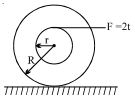
$A$ time-varying force $F = 2t$ is applied on a spool rolling as shown in the figure. The angular momentum of the spool at time $t$ about the bottommost point is:
A
$\frac{r^2 t^2}{R}$
B
$\frac{(R + r)^2}{r} t^2$
C
$(R + r)t^2$
D
data is insufficient
Solution
(C) The rate of change of angular momentum $(L)$ is equal to the net torque $(\tau)$ acting on the system about the point of rotation.
$\frac{dL}{dt} = \tau$
$\Rightarrow dL = \tau dt$
Taking torque about the bottommost point (point of contact with the ground),the perpendicular distance of the line of action of the force $F$ from the bottommost point is $(R + r)$.
$\tau = F \times (R + r) = 2t(R + r)$
Substituting this into the angular momentum equation:
$dL = 2t(R + r) dt$
Integrating from $t = 0$ to $t$ (assuming initial angular momentum is zero):
$L = \int_{0}^{t} 2t(R + r) dt$
$L = 2(R + r) \int_{0}^{t} t dt$
$L = 2(R + r) \left[ \frac{t^2}{2} \right]_{0}^{t}$
$L = (R + r)t^2$
$\frac{dL}{dt} = \tau$
$\Rightarrow dL = \tau dt$
Taking torque about the bottommost point (point of contact with the ground),the perpendicular distance of the line of action of the force $F$ from the bottommost point is $(R + r)$.
$\tau = F \times (R + r) = 2t(R + r)$
Substituting this into the angular momentum equation:
$dL = 2t(R + r) dt$
Integrating from $t = 0$ to $t$ (assuming initial angular momentum is zero):
$L = \int_{0}^{t} 2t(R + r) dt$
$L = 2(R + r) \int_{0}^{t} t dt$
$L = 2(R + r) \left[ \frac{t^2}{2} \right]_{0}^{t}$
$L = (R + r)t^2$
0 likes
View Solution53
MediumMCQ
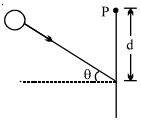
$A$ ball of mass $m$ moving with velocity $v$ collides with a wall elastically as shown in the figure. After the impact,the change in angular momentum about point $P$ is:
A
$2mvd$
B
$2mvd \cos \theta$
C
$2mvd \sin \theta$
D
zero
Solution
(B) The angular momentum $L$ of a particle about a point $P$ is given by $L = r \times p$,where $r$ is the position vector and $p$ is the linear momentum.
For a particle moving with velocity $v$ at an angle $\theta$ with the horizontal,the perpendicular distance from point $P$ to the line of motion is $d \cos \theta$.
Initial angular momentum $L_i = m v (d \cos \theta)$ (in the clockwise direction).
Since the collision is perfectly elastic,the ball rebounds with the same speed $v$ at the same angle $\theta$ with the horizontal.
Final angular momentum $L_f = -m v (d \cos \theta)$ (in the counter-clockwise direction).
The change in angular momentum $\Delta L = L_f - L_i = -m v d \cos \theta - (m v d \cos \theta) = -2m v d \cos \theta$.
The magnitude of the change in angular momentum is $2mvd \cos \theta$.
For a particle moving with velocity $v$ at an angle $\theta$ with the horizontal,the perpendicular distance from point $P$ to the line of motion is $d \cos \theta$.
Initial angular momentum $L_i = m v (d \cos \theta)$ (in the clockwise direction).
Since the collision is perfectly elastic,the ball rebounds with the same speed $v$ at the same angle $\theta$ with the horizontal.
Final angular momentum $L_f = -m v (d \cos \theta)$ (in the counter-clockwise direction).
The change in angular momentum $\Delta L = L_f - L_i = -m v d \cos \theta - (m v d \cos \theta) = -2m v d \cos \theta$.
The magnitude of the change in angular momentum is $2mvd \cos \theta$.
0 likes
View Solution54
MediumMCQ
$A$ uniform rod of mass $M$ and length $L$ has an impulse $J$ applied at right angles to one end. If the other end begins to move with speed $V$,the magnitude of the impulse is:
A
$MV$
B
$\frac{MV}{2}$
C
$2MV$
D
$\frac{2MV}{3}$
Solution
(B) Let the impulse $J$ be applied at one end of the rod. The impulse causes a change in linear momentum and angular momentum.
Linear impulse: $J = M v_{cm}$,where $v_{cm}$ is the velocity of the center of mass.
Angular impulse about the center of mass: $J \times \frac{L}{2} = I_{cm} \omega = \left(\frac{ML^2}{12}\right) \omega$.
From this,$\omega = \frac{6J}{ML}$.
The velocity of the other end is $V = v_{cm} - \omega \frac{L}{2}$ (since the rotation opposes the linear motion at the other end).
Substituting the values: $V = \frac{J}{M} - \left(\frac{6J}{ML}\right) \frac{L}{2} = \frac{J}{M} - \frac{3J}{M} = -\frac{2J}{M}$.
Taking the magnitude: $V = \frac{2J}{M} \Rightarrow J = \frac{MV}{2}$.
Linear impulse: $J = M v_{cm}$,where $v_{cm}$ is the velocity of the center of mass.
Angular impulse about the center of mass: $J \times \frac{L}{2} = I_{cm} \omega = \left(\frac{ML^2}{12}\right) \omega$.
From this,$\omega = \frac{6J}{ML}$.
The velocity of the other end is $V = v_{cm} - \omega \frac{L}{2}$ (since the rotation opposes the linear motion at the other end).
Substituting the values: $V = \frac{J}{M} - \left(\frac{6J}{ML}\right) \frac{L}{2} = \frac{J}{M} - \frac{3J}{M} = -\frac{2J}{M}$.
Taking the magnitude: $V = \frac{2J}{M} \Rightarrow J = \frac{MV}{2}$.
0 likes
View Solution55
AdvancedMCQ
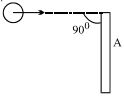
$A$ thin rod of mass $M$ and length $L$ is struck at one end by a ball of clay of mass $m$,moving with speed $v$ as shown in the figure. The ball sticks to the rod. After the collision,the angular momentum of the clay-rod system about $A$,the midpoint of the rod,is:
A
$\left( {m + \frac{M}{3}} \right)\left( {\frac{{vL}}{2}} \right)$
B
$\left( {m + \frac{M}{{12}}} \right)\left( {\frac{{vL}}{2}} \right)$
C
$\frac{{mvL}}{2}$
D
$mvL$
Solution
(C) The angular momentum of the system about the midpoint $A$ is conserved during the collision because there are no external torques acting on the system about point $A$.
Before the collision,the rod is at rest,so its angular momentum is zero.
The angular momentum of the clay ball of mass $m$ moving with speed $v$ at a distance $L/2$ from the midpoint $A$ is given by $L = r \times p = (L/2) \times (mv) = \frac{mvL}{2}$.
Since the external torque about $A$ is zero,the angular momentum of the system remains constant.
Therefore,the angular momentum of the clay-rod system about $A$ after the collision is equal to the angular momentum of the clay ball before the collision,which is $\frac{mvL}{2}$.
Before the collision,the rod is at rest,so its angular momentum is zero.
The angular momentum of the clay ball of mass $m$ moving with speed $v$ at a distance $L/2$ from the midpoint $A$ is given by $L = r \times p = (L/2) \times (mv) = \frac{mvL}{2}$.
Since the external torque about $A$ is zero,the angular momentum of the system remains constant.
Therefore,the angular momentum of the clay-rod system about $A$ after the collision is equal to the angular momentum of the clay ball before the collision,which is $\frac{mvL}{2}$.
0 likes
View Solution56
EasyMCQ
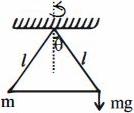
$A$ bob of mass $m$ attached to an inextensible string of length $l$ is suspended from a vertical support. The bob rotates in a horizontal circle with an angular speed $\omega \text{ rad/s}$ about the vertical axis. About the point of suspension:
A
angular momentum changes in magnitude but not in direction
B
angular momentum changes in direction but not in magnitude
C
angular momentum changes both in direction and magnitude
D
angular momentum is conserved
Solution
(B) The forces acting on the bob are the tension $T$ in the string and the gravitational force $mg$ acting downwards.
Taking the point of suspension as the origin,the torque $\vec{\tau}$ due to the gravitational force is $\vec{\tau} = \vec{r} \times \vec{F} = \vec{r} \times m\vec{g}$.
The magnitude of this torque is $\tau = mg \ell \sin \theta$,where $\theta$ is the angle the string makes with the vertical.
This torque is always directed horizontally,perpendicular to the plane containing the string and the vertical axis.
Since the rate of change of angular momentum $\frac{d\vec{L}}{dt} = \vec{\tau}$,the torque causes the direction of the angular momentum vector $\vec{L}$ to change continuously as it precesses around the vertical axis.
However,because the torque is always perpendicular to the angular momentum vector $\vec{L}$,the magnitude of the angular momentum remains constant.
Therefore,the angular momentum changes in direction but not in magnitude.
Taking the point of suspension as the origin,the torque $\vec{\tau}$ due to the gravitational force is $\vec{\tau} = \vec{r} \times \vec{F} = \vec{r} \times m\vec{g}$.
The magnitude of this torque is $\tau = mg \ell \sin \theta$,where $\theta$ is the angle the string makes with the vertical.
This torque is always directed horizontally,perpendicular to the plane containing the string and the vertical axis.
Since the rate of change of angular momentum $\frac{d\vec{L}}{dt} = \vec{\tau}$,the torque causes the direction of the angular momentum vector $\vec{L}$ to change continuously as it precesses around the vertical axis.
However,because the torque is always perpendicular to the angular momentum vector $\vec{L}$,the magnitude of the angular momentum remains constant.
Therefore,the angular momentum changes in direction but not in magnitude.
0 likes
View Solution57
DifficultMCQ
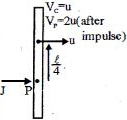
$A$ uniform rod of mass $m$ and length $l$ is moving with velocity $u$ in a direction perpendicular to its length. $A$ blow of impulse $J$ is applied in the direction of $u$,perpendicular to its length at a distance $l/4$ from its center at point $P$,such that the instantaneous velocity of point $P$ is $2u$. Then the velocity of its center of mass will be:
A
$u$
B
$\frac{8}{3}u$
C
$\frac{11}{7}u$
D
$\frac{17}{7}u$
Solution
(C) Let $V$ be the final velocity of the center of mass and $\omega$ be the angular velocity acquired by the rod.
From the impulse-momentum theorem for linear motion: $J = m(V - u) \quad ...(1)$
From the angular impulse-momentum theorem about the center of mass: $J \cdot \frac{l}{4} = I \omega = \left(\frac{ml^2}{12}\right) \omega \quad ...(2)$
From equations $(1)$ and $(2)$,we get: $m(V - u) \cdot \frac{l}{4} = \frac{ml^2}{12} \omega \implies V - u = \frac{l}{3} \omega \implies V = u + \frac{l}{3} \omega \quad ...(3)$
The velocity of point $P$ at distance $l/4$ from the center is given by $V_P = V + \omega \cdot \frac{l}{4}$.
Given $V_P = 2u$,so $2u = V + \frac{l}{4} \omega \quad ...(4)$
Substitute $V$ from $(3)$ into $(4)$: $2u = (u + \frac{l}{3} \omega) + \frac{l}{4} \omega$
$u = \omega l \left(\frac{1}{3} + \frac{1}{4}\right) = \omega l \left(\frac{7}{12}\right) \implies \omega l = \frac{12}{7} u$
Now,substitute $\omega l$ back into the expression for $V$: $V = u + \frac{1}{3} \left(\frac{12}{7} u\right) = u + \frac{4}{7} u = \frac{11}{7} u$.
From the impulse-momentum theorem for linear motion: $J = m(V - u) \quad ...(1)$
From the angular impulse-momentum theorem about the center of mass: $J \cdot \frac{l}{4} = I \omega = \left(\frac{ml^2}{12}\right) \omega \quad ...(2)$
From equations $(1)$ and $(2)$,we get: $m(V - u) \cdot \frac{l}{4} = \frac{ml^2}{12} \omega \implies V - u = \frac{l}{3} \omega \implies V = u + \frac{l}{3} \omega \quad ...(3)$
The velocity of point $P$ at distance $l/4$ from the center is given by $V_P = V + \omega \cdot \frac{l}{4}$.
Given $V_P = 2u$,so $2u = V + \frac{l}{4} \omega \quad ...(4)$
Substitute $V$ from $(3)$ into $(4)$: $2u = (u + \frac{l}{3} \omega) + \frac{l}{4} \omega$
$u = \omega l \left(\frac{1}{3} + \frac{1}{4}\right) = \omega l \left(\frac{7}{12}\right) \implies \omega l = \frac{12}{7} u$
Now,substitute $\omega l$ back into the expression for $V$: $V = u + \frac{1}{3} \left(\frac{12}{7} u\right) = u + \frac{4}{7} u = \frac{11}{7} u$.
0 likes
View Solution58
DifficultMCQ
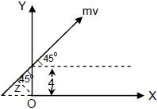
$A$ particle of mass $= 5 \text{ units}$ is moving with a uniform speed $V = 3 \sqrt{2} \text{ units}$ in the $XOY$ plane along the line $Y = X + 4$. The magnitude of the angular momentum of the particle about the origin is ...... $\text{units}$.
A
$60$
B
$40 \sqrt{2}$
C
$0$
D
$7.5$
Solution
(A) The momentum of the particle is given by $p = m \times V = 5 \times 3 \sqrt{2} = 15 \sqrt{2} \text{ units}$.
The particle moves along the line $Y = X + 4$,which can be rewritten as $X - Y + 4 = 0$.
The perpendicular distance $r_{\perp}$ from the origin $(0, 0)$ to the line $AX + BY + C = 0$ is given by $r_{\perp} = \frac{|C|}{\sqrt{A^2 + B^2}}$.
Substituting the values $A = 1, B = -1, C = 4$,we get $r_{\perp} = \frac{|4|}{\sqrt{1^2 + (-1)^2}} = \frac{4}{\sqrt{2}} = 2 \sqrt{2} \text{ units}$.
The magnitude of the angular momentum $L$ about the origin is $L = p \times r_{\perp}$.
$L = (15 \sqrt{2}) \times (2 \sqrt{2}) = 15 \times 2 \times 2 = 60 \text{ units}$.
The particle moves along the line $Y = X + 4$,which can be rewritten as $X - Y + 4 = 0$.
The perpendicular distance $r_{\perp}$ from the origin $(0, 0)$ to the line $AX + BY + C = 0$ is given by $r_{\perp} = \frac{|C|}{\sqrt{A^2 + B^2}}$.
Substituting the values $A = 1, B = -1, C = 4$,we get $r_{\perp} = \frac{|4|}{\sqrt{1^2 + (-1)^2}} = \frac{4}{\sqrt{2}} = 2 \sqrt{2} \text{ units}$.
The magnitude of the angular momentum $L$ about the origin is $L = p \times r_{\perp}$.
$L = (15 \sqrt{2}) \times (2 \sqrt{2}) = 15 \times 2 \times 2 = 60 \text{ units}$.
0 likes
View Solution59
MediumMCQ
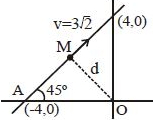
$A$ particle of mass $m = 5$ is moving with a uniform speed $v = 3\sqrt{2}$ in the $XOY$ plane along the line $Y = X + 4$. The magnitude of the angular momentum of the particle about the origin is .......
A
$0$
B
$60$
C
$7.5$
D
$40\sqrt{2}$
Solution
(B) The equation of the line is $Y = X + 4$,which can be written as $X - Y + 4 = 0$.
The perpendicular distance $d$ from the origin $(0, 0)$ to this line is given by the formula $d = \frac{|ax_0 + by_0 + c|}{\sqrt{a^2 + b^2}}$.
Substituting the values,$d = \frac{|1(0) - 1(0) + 4|}{\sqrt{1^2 + (-1)^2}} = \frac{4}{\sqrt{2}}$.
The angular momentum $L$ about the origin is given by $L = mvd$.
Substituting the given values $m = 5$,$v = 3\sqrt{2}$,and $d = \frac{4}{\sqrt{2}}$:
$L = 5 \times 3\sqrt{2} \times \frac{4}{\sqrt{2}} = 5 \times 3 \times 4 = 60$ units.
The perpendicular distance $d$ from the origin $(0, 0)$ to this line is given by the formula $d = \frac{|ax_0 + by_0 + c|}{\sqrt{a^2 + b^2}}$.
Substituting the values,$d = \frac{|1(0) - 1(0) + 4|}{\sqrt{1^2 + (-1)^2}} = \frac{4}{\sqrt{2}}$.
The angular momentum $L$ about the origin is given by $L = mvd$.
Substituting the given values $m = 5$,$v = 3\sqrt{2}$,and $d = \frac{4}{\sqrt{2}}$:
$L = 5 \times 3\sqrt{2} \times \frac{4}{\sqrt{2}} = 5 \times 3 \times 4 = 60$ units.
0 likes
View Solution60
EasyMCQ
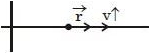
$A$ particle is moving along a straight line with increasing speed. Its angular momentum about a fixed point on this line
A
Goes on increasing
B
Goes on decreasing
C
May be increasing or decreasing depending on direction of motion
D
Remains zero
Solution
(D) The angular momentum $\vec{L}$ of a particle about a point is given by the cross product $\vec{L} = \vec{r} \times \vec{p} = \vec{r} \times (m\vec{v})$.
Since the particle is moving along a straight line and the fixed point lies on the same line,the position vector $\vec{r}$ and the velocity vector $\vec{v}$ are always collinear (parallel or anti-parallel).
The angle $\theta$ between $\vec{r}$ and $\vec{v}$ is either $0^\circ$ or $180^\circ$.
Therefore,the magnitude of angular momentum is $L = |\vec{r}| |m\vec{v}| \sin(\theta) = 0$,because $\sin(0^\circ) = 0$ and $\sin(180^\circ) = 0$.
Thus,the angular momentum remains zero throughout the motion.
Since the particle is moving along a straight line and the fixed point lies on the same line,the position vector $\vec{r}$ and the velocity vector $\vec{v}$ are always collinear (parallel or anti-parallel).
The angle $\theta$ between $\vec{r}$ and $\vec{v}$ is either $0^\circ$ or $180^\circ$.
Therefore,the magnitude of angular momentum is $L = |\vec{r}| |m\vec{v}| \sin(\theta) = 0$,because $\sin(0^\circ) = 0$ and $\sin(180^\circ) = 0$.
Thus,the angular momentum remains zero throughout the motion.
0 likes
View Solution61
EasyMCQ
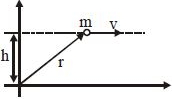
$A$ particle is moving along a straight line parallel to $x-$ axis with constant velocity. Its angular momentum about the origin
A
decreases with time
B
increases with time
C
remains constant
D
is zero
Solution
(C) The angular momentum $\vec{L}$ of a particle about the origin is given by $\vec{L} = \vec{r} \times \vec{p} = \vec{r} \times (m\vec{v})$.
In magnitude,$L = mvr \sin \theta$,where $\theta$ is the angle between the position vector $\vec{r}$ and the velocity vector $\vec{v}$.
From the geometry of the motion,$r \sin \theta = h$,where $h$ is the perpendicular distance of the line of motion from the origin.
Since the particle moves in a straight line parallel to the $x-$ axis with constant velocity $v$,both $v$ and $h$ remain constant throughout the motion.
Therefore,$L = mvh = \text{constant}$.
Thus,the angular momentum of the particle about the origin remains constant.
In magnitude,$L = mvr \sin \theta$,where $\theta$ is the angle between the position vector $\vec{r}$ and the velocity vector $\vec{v}$.
From the geometry of the motion,$r \sin \theta = h$,where $h$ is the perpendicular distance of the line of motion from the origin.
Since the particle moves in a straight line parallel to the $x-$ axis with constant velocity $v$,both $v$ and $h$ remain constant throughout the motion.
Therefore,$L = mvh = \text{constant}$.
Thus,the angular momentum of the particle about the origin remains constant.
0 likes
View Solution62
DifficultMCQ
$A$ fan of moment of inertia $0.6\,kg \cdot m^2$ is turned up to a working speed of $0.5$ revolutions per second. The angular momentum of the fan is:
A
$0.6\pi \,kg \cdot m^2/s$
B
$6\,kg \cdot m^2/s$
C
$3\,kg \cdot m^2/s$
D
$\frac{\pi}{6} \,kg \cdot m^2/s$
Solution
(A) The angular momentum $L$ of a rotating body is given by the formula $L = I\omega$,where $I$ is the moment of inertia and $\omega$ is the angular velocity.
Given:
$I = 0.6 \,kg \cdot m^2$
Frequency $f = 0.5 \,rev/s$
The angular velocity $\omega$ is related to frequency by $\omega = 2\pi f$.
Substituting the values:
$\omega = 2 \times \pi \times 0.5 = \pi \,rad/s$.
Now,calculating the angular momentum:
$L = 0.6 \times \pi = 0.6\pi \,kg \cdot m^2/s$.
Given:
$I = 0.6 \,kg \cdot m^2$
Frequency $f = 0.5 \,rev/s$
The angular velocity $\omega$ is related to frequency by $\omega = 2\pi f$.
Substituting the values:
$\omega = 2 \times \pi \times 0.5 = \pi \,rad/s$.
Now,calculating the angular momentum:
$L = 0.6 \times \pi = 0.6\pi \,kg \cdot m^2/s$.
0 likes
View Solution63
MediumMCQ
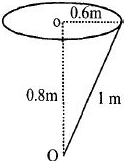
$A$ particle of mass $2\, kg$ is on a smooth horizontal table and moves in a circular path of radius $0.6\, m$. The height of the table from the ground is $0.8\, m$. If the angular speed of the particle is $12\, rad\, s^{-1}$,the magnitude of its angular momentum about a point on the ground right under the centre of the circle is ........ $kg\, m^2\, s^{-1}$.
A
$14.4$
B
$8.64$
C
$20.16$
D
$11.52$
Solution
(B) The angular momentum $\vec{L}$ of a particle about a point $O$ is given by $\vec{L} = \vec{r} \times \vec{p} = \vec{r} \times (m\vec{v})$.
Here,the particle moves in a horizontal circle of radius $r = 0.6\, m$ at a height $h = 0.8\, m$ above the ground.
Let the point on the ground directly below the center of the circle be $O'$. The position vector $\vec{r}$ of the particle relative to $O'$ has a horizontal component $r = 0.6\, m$ and a vertical component $h = 0.8\, m$.
The velocity of the particle is $\vec{v}$,which is tangential to the circular path,so its magnitude is $v = r\omega = 0.6 \times 12 = 7.2\, m/s$.
The angular momentum about $O'$ is $L = |\vec{r} \times m\vec{v}| = mvr_{\perp}$,where $r_{\perp}$ is the perpendicular distance from the axis of rotation passing through $O'$ to the velocity vector. Since the velocity is horizontal and the point $O'$ is on the vertical axis,the perpendicular distance from the line of velocity to the point $O'$ is the radius $r = 0.6\, m$.
Thus,$L = mvr = (2\, kg) \times (7.2\, m/s) \times (0.6\, m) = 8.64\, kg\, m^2\, s^{-1}$.
Here,the particle moves in a horizontal circle of radius $r = 0.6\, m$ at a height $h = 0.8\, m$ above the ground.
Let the point on the ground directly below the center of the circle be $O'$. The position vector $\vec{r}$ of the particle relative to $O'$ has a horizontal component $r = 0.6\, m$ and a vertical component $h = 0.8\, m$.
The velocity of the particle is $\vec{v}$,which is tangential to the circular path,so its magnitude is $v = r\omega = 0.6 \times 12 = 7.2\, m/s$.
The angular momentum about $O'$ is $L = |\vec{r} \times m\vec{v}| = mvr_{\perp}$,where $r_{\perp}$ is the perpendicular distance from the axis of rotation passing through $O'$ to the velocity vector. Since the velocity is horizontal and the point $O'$ is on the vertical axis,the perpendicular distance from the line of velocity to the point $O'$ is the radius $r = 0.6\, m$.
Thus,$L = mvr = (2\, kg) \times (7.2\, m/s) \times (0.6\, m) = 8.64\, kg\, m^2\, s^{-1}$.
0 likes
View Solution64
DifficultMCQ
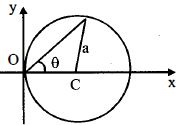
$A$ particle is moving in a circular path of radius $a$ with a constant speed $v$ as shown in the figure. The centre of the circle is marked by $C$. The angular momentum about the origin $O$ can be written as:
A
$va(1 + \cos 2\theta)$
B
$va(1 + \cos \theta)$
C
$va \cos 2\theta$
D
$va$
Solution
(A) The angular momentum $L$ of a particle about a point $O$ is given by $L = m(\vec{r} \times \vec{v})$. For a particle of mass $m$ moving with speed $v$,the magnitude is $L = mvr_{\perp}$,where $r_{\perp}$ is the perpendicular distance from the origin $O$ to the line of velocity.
From the geometry of the circle,the position vector $\vec{r}$ makes an angle $\theta$ with the $x$-axis. The velocity vector $\vec{v}$ is tangent to the circle at the particle's position. The angle between the position vector $\vec{r}$ and the velocity vector $\vec{v}$ is $(90^\circ + \theta)$.
The distance of the particle from the origin $O$ is $r = 2a \cos \theta$.
The angular momentum $L = mvr \sin(90^\circ + \theta) = mvr \cos \theta$.
Substituting $r = 2a \cos \theta$,we get $L = mv(2a \cos \theta) \cos \theta = 2mva \cos^2 \theta$.
Using the identity $2 \cos^2 \theta = 1 + \cos 2\theta$,we get $L = mva(1 + \cos 2\theta)$.
Assuming unit mass $(m=1)$,the angular momentum is $va(1 + \cos 2\theta)$.
From the geometry of the circle,the position vector $\vec{r}$ makes an angle $\theta$ with the $x$-axis. The velocity vector $\vec{v}$ is tangent to the circle at the particle's position. The angle between the position vector $\vec{r}$ and the velocity vector $\vec{v}$ is $(90^\circ + \theta)$.
The distance of the particle from the origin $O$ is $r = 2a \cos \theta$.
The angular momentum $L = mvr \sin(90^\circ + \theta) = mvr \cos \theta$.
Substituting $r = 2a \cos \theta$,we get $L = mv(2a \cos \theta) \cos \theta = 2mva \cos^2 \theta$.
Using the identity $2 \cos^2 \theta = 1 + \cos 2\theta$,we get $L = mva(1 + \cos 2\theta)$.
Assuming unit mass $(m=1)$,the angular momentum is $va(1 + \cos 2\theta)$.
0 likes
View Solution65
MediumMCQ
$A$ particle of mass $2\, kg$ is moving such that at time $t$,its position,in meters,is given by $\vec{r}(t) = 5\hat{i} - 2t^2\hat{j}$. The angular momentum of the particle at $t = 2\, s$ about the origin in $kg\, m^2\, s^{-1}$ is:
A
$-80\hat{k}$
B
$(10\hat{i} - 16\hat{j})$
C
$-40\hat{k}$
D
$40\hat{k}$
Solution
(A) The angular momentum $\vec{L}$ of a particle about the origin is given by $\vec{L} = \vec{r} \times \vec{p} = \vec{r} \times (m\vec{v})$.
Given mass $m = 2\, kg$ and position vector $\vec{r}(t) = 5\hat{i} - 2t^2\hat{j}$.
The velocity vector $\vec{v}(t) = \frac{d\vec{r}}{dt} = \frac{d}{dt}(5\hat{i} - 2t^2\hat{j}) = -4t\hat{j}$.
At $t = 2\, s$:
Position $\vec{r}(2) = 5\hat{i} - 2(2)^2\hat{j} = 5\hat{i} - 8\hat{j}$.
Velocity $\vec{v}(2) = -4(2)\hat{j} = -8\hat{j}$.
Angular momentum $\vec{L} = m(\vec{r} \times \vec{v}) = 2 \times [(5\hat{i} - 8\hat{j}) \times (-8\hat{j})]$.
Since $\hat{i} \times \hat{j} = \hat{k}$ and $\hat{j} \times \hat{j} = 0$:
$\vec{L} = 2 \times [5\hat{i} \times (-8\hat{j}) - 8\hat{j} \times (-8\hat{j})] = 2 \times [-40\hat{k} - 0] = -80\hat{k}\, kg\, m^2\, s^{-1}$.
Given mass $m = 2\, kg$ and position vector $\vec{r}(t) = 5\hat{i} - 2t^2\hat{j}$.
The velocity vector $\vec{v}(t) = \frac{d\vec{r}}{dt} = \frac{d}{dt}(5\hat{i} - 2t^2\hat{j}) = -4t\hat{j}$.
At $t = 2\, s$:
Position $\vec{r}(2) = 5\hat{i} - 2(2)^2\hat{j} = 5\hat{i} - 8\hat{j}$.
Velocity $\vec{v}(2) = -4(2)\hat{j} = -8\hat{j}$.
Angular momentum $\vec{L} = m(\vec{r} \times \vec{v}) = 2 \times [(5\hat{i} - 8\hat{j}) \times (-8\hat{j})]$.
Since $\hat{i} \times \hat{j} = \hat{k}$ and $\hat{j} \times \hat{j} = 0$:
$\vec{L} = 2 \times [5\hat{i} \times (-8\hat{j}) - 8\hat{j} \times (-8\hat{j})] = 2 \times [-40\hat{k} - 0] = -80\hat{k}\, kg\, m^2\, s^{-1}$.
0 likes
View Solution66
DifficultMCQ
The time dependence of the position of a particle of mass $m = 2 \ kg$ is given by $\vec r(t) = 2t \hat i - 3t^2 \hat j$. Its angular momentum with respect to the origin at time $t = 2 \ s$ is:
A
$-48 \hat k$
B
$48(\hat i + \hat j)$
C
$36 \hat k$
D
$-34(\hat k - \hat i)$
Solution
(A) Given: $\vec r(t) = 2t \hat i - 3t^2 \hat j$ and $m = 2 \ kg$.
Velocity $\vec v = \frac{d\vec r}{dt} = 2 \hat i - 6t \hat j$.
At $t = 2 \ s$,position $\vec r = 2(2) \hat i - 3(2)^2 \hat j = 4 \hat i - 12 \hat j$.
At $t = 2 \ s$,velocity $\vec v = 2 \hat i - 6(2) \hat j = 2 \hat i - 12 \hat j$.
Momentum $\vec p = m \vec v = 2(2 \hat i - 12 \hat j) = 4 \hat i - 24 \hat j$.
Angular momentum $\vec L = \vec r \times \vec p = (4 \hat i - 12 \hat j) \times (4 \hat i - 24 \hat j)$.
Using the cross product: $\vec L = [4(-24) - (-12)(4)] \hat k = (-96 + 48) \hat k = -48 \hat k$.
Velocity $\vec v = \frac{d\vec r}{dt} = 2 \hat i - 6t \hat j$.
At $t = 2 \ s$,position $\vec r = 2(2) \hat i - 3(2)^2 \hat j = 4 \hat i - 12 \hat j$.
At $t = 2 \ s$,velocity $\vec v = 2 \hat i - 6(2) \hat j = 2 \hat i - 12 \hat j$.
Momentum $\vec p = m \vec v = 2(2 \hat i - 12 \hat j) = 4 \hat i - 24 \hat j$.
Angular momentum $\vec L = \vec r \times \vec p = (4 \hat i - 12 \hat j) \times (4 \hat i - 24 \hat j)$.
Using the cross product: $\vec L = [4(-24) - (-12)(4)] \hat k = (-96 + 48) \hat k = -48 \hat k$.
0 likes
View Solution67
EasyMCQ
Identify the vector quantity among the following.
A
distance
B
angular momentum
C
heat
D
energy
Solution
(B) vector quantity is a physical quantity that has both magnitude and direction.
Distance,heat,and energy are scalar quantities because they only have magnitude.
Angular momentum is defined as the cross product of position vector $\vec{r}$ and linear momentum $\vec{p}$,given by $\vec{L} = \vec{r} \times \vec{p}$.
Since it is defined by a cross product and has a specific direction (determined by the right-hand rule),angular momentum is a vector quantity.
Distance,heat,and energy are scalar quantities because they only have magnitude.
Angular momentum is defined as the cross product of position vector $\vec{r}$ and linear momentum $\vec{p}$,given by $\vec{L} = \vec{r} \times \vec{p}$.
Since it is defined by a cross product and has a specific direction (determined by the right-hand rule),angular momentum is a vector quantity.
0 likes
View Solution68
MediumMCQ
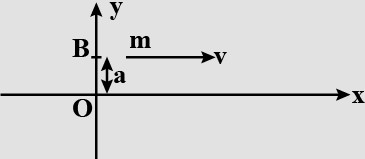
$A$ particle of mass $m$ moves with a constant velocity $\vec{v}$ in the $X-Y$ plane. Its angular momentum with respect to the origin is:
A
Increasing
B
Zero
C
Decreasing
D
Constant
Solution
(D) The angular momentum $\vec{L}$ of a particle with respect to the origin $O$ is given by $\vec{L} = \vec{r} \times \vec{p} = \vec{r} \times (m\vec{v})$.
As shown in the figure,the particle moves parallel to the $X$-axis at a constant perpendicular distance $a$ from the origin $O$.
The magnitude of the angular momentum is $|L| = m v a \sin(\theta)$,where $\theta$ is the angle between the position vector $\vec{r}$ and the velocity vector $\vec{v}$.
Since $a = r \sin(\theta)$,we have $|L| = m v a$.
Since $m$,$v$,and $a$ are all constants,the magnitude of the angular momentum remains constant.
Furthermore,the direction of $\vec{L}$ (given by the right-hand rule) is perpendicular to the $X-Y$ plane (along the $Z$-axis) and does not change as the particle moves.
Therefore,the angular momentum is constant.
As shown in the figure,the particle moves parallel to the $X$-axis at a constant perpendicular distance $a$ from the origin $O$.
The magnitude of the angular momentum is $|L| = m v a \sin(\theta)$,where $\theta$ is the angle between the position vector $\vec{r}$ and the velocity vector $\vec{v}$.
Since $a = r \sin(\theta)$,we have $|L| = m v a$.
Since $m$,$v$,and $a$ are all constants,the magnitude of the angular momentum remains constant.
Furthermore,the direction of $\vec{L}$ (given by the right-hand rule) is perpendicular to the $X-Y$ plane (along the $Z$-axis) and does not change as the particle moves.
Therefore,the angular momentum is constant.
0 likes
View Solution69
DifficultMCQ
Two wheels are connected by a belt. The radius of the larger wheel is three times that of the smaller one. What is the ratio of the rotational inertia of the larger wheel to the smaller wheel,when both wheels have the same angular momentum?
A
$3$
B
$6$
C
$9$
D
$12$
Solution
(A) Since the belt does not slip,the linear speed at the rims of both wheels must be equal:
$v_A = v_C$
Using the relation $v = r\omega$,we have:
$r_A \omega_A = r_C \omega_C$ --- $(i)$
Given that the radius of the larger wheel $(C)$ is three times that of the smaller wheel $(A)$:
$r_C = 3r_A$
Substituting this into equation $(i)$:
$r_A \omega_A = (3r_A) \omega_C$
$\omega_A = 3\omega_C$
If both wheels have the same angular momentum $(L)$:
$L_A = L_C$
$I_A \omega_A = I_C \omega_C$
$\frac{I_C}{I_A} = \frac{\omega_A}{\omega_C}$
Substituting $\omega_A = 3\omega_C$:
$\frac{I_C}{I_A} = \frac{3\omega_C}{\omega_C} = 3$
Thus,the ratio of the rotational inertia of the larger wheel to the smaller wheel is $3$.
$v_A = v_C$
Using the relation $v = r\omega$,we have:
$r_A \omega_A = r_C \omega_C$ --- $(i)$
Given that the radius of the larger wheel $(C)$ is three times that of the smaller wheel $(A)$:
$r_C = 3r_A$
Substituting this into equation $(i)$:
$r_A \omega_A = (3r_A) \omega_C$
$\omega_A = 3\omega_C$
If both wheels have the same angular momentum $(L)$:
$L_A = L_C$
$I_A \omega_A = I_C \omega_C$
$\frac{I_C}{I_A} = \frac{\omega_A}{\omega_C}$
Substituting $\omega_A = 3\omega_C$:
$\frac{I_C}{I_A} = \frac{3\omega_C}{\omega_C} = 3$
Thus,the ratio of the rotational inertia of the larger wheel to the smaller wheel is $3$.
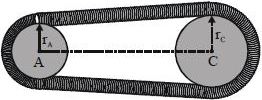
0 likes
View Solution70
EasyMCQ
In an orbital motion,the angular momentum vector is
A
along the radius vector
B
parallel to the linear momentum
C
in the orbital plane
D
perpendicular to the orbital plane
Solution
(D) The angular momentum $\vec{L}$ of a particle in orbital motion is defined by the cross product of its position vector $\vec{r}$ and its linear momentum $\vec{p}$,given by $\vec{L} = \vec{r} \times \vec{p}$.
By the definition of the cross product,the resulting vector $\vec{L}$ is always perpendicular to the plane containing both $\vec{r}$ and $\vec{p}$.
Since both the position vector and the linear momentum vector lie within the orbital plane,the angular momentum vector $\vec{L}$ must be perpendicular to the orbital plane. This is consistent with the right-hand rule,where the direction of $\vec{L}$ points along the axis of rotation.
By the definition of the cross product,the resulting vector $\vec{L}$ is always perpendicular to the plane containing both $\vec{r}$ and $\vec{p}$.
Since both the position vector and the linear momentum vector lie within the orbital plane,the angular momentum vector $\vec{L}$ must be perpendicular to the orbital plane. This is consistent with the right-hand rule,where the direction of $\vec{L}$ points along the axis of rotation.
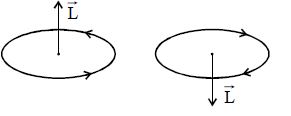
0 likes
View Solution71
DifficultMCQ
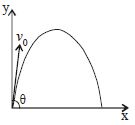
$A$ small particle of mass $m$ is projected at an angle $\theta$ with the $x$-axis with an initial velocity $v_0$ in the $x-y$ plane as shown in the figure. At a time $t < \frac{v_0 \sin \theta}{g}$,the angular momentum of the particle is
A
$-mg v_0 t^2 \cos \theta \hat{j}$
B
$mg v_0 t \cos \theta \hat{k}$
C
$-\frac{1}{2} mg v_0 t^2 \cos \theta \hat{k}$
D
$\frac{1}{2} mg v_0 t^2 \cos \theta \hat{i}$
Solution
(C) The position vector of the particle at time $t$ is given by:
$\vec{r} = (v_0 \cos \theta) t \hat{i} + ((v_0 \sin \theta) t - \frac{1}{2} g t^2) \hat{j}$
The velocity vector of the particle at time $t$ is given by:
$\vec{v} = (v_0 \cos \theta) \hat{i} + (v_0 \sin \theta - gt) \hat{j}$
The angular momentum $\vec{L}$ is defined as $\vec{L} = m(\vec{r} \times \vec{v})$:
$\vec{L} = m [((v_0 \cos \theta) t \hat{i} + ((v_0 \sin \theta) t - \frac{1}{2} g t^2) \hat{j}) \times ((v_0 \cos \theta) \hat{i} + (v_0 \sin \theta - gt) \hat{j})]$
Performing the cross product:
$\vec{L} = m [((v_0 \cos \theta) t) (v_0 \sin \theta - gt) (\hat{i} \times \hat{j}) + ((v_0 \sin \theta) t - \frac{1}{2} g t^2) (v_0 \cos \theta) (\hat{j} \times \hat{i})]$
Since $\hat{i} \times \hat{j} = \hat{k}$ and $\hat{j} \times \hat{i} = -\hat{k}$:
$\vec{L} = m [((v_0^2 \sin \theta \cos \theta) t - v_0 g t^2 \cos \theta) \hat{k} - ((v_0^2 \sin \theta \cos \theta) t - \frac{1}{2} v_0 g t^2 \cos \theta) \hat{k}]$
$\vec{L} = m [v_0^2 \sin \theta \cos \theta t - v_0 g t^2 \cos \theta - v_0^2 \sin \theta \cos \theta t + \frac{1}{2} v_0 g t^2 \cos \theta] \hat{k}$
$\vec{L} = m [-\frac{1}{2} v_0 g t^2 \cos \theta] \hat{k} = -\frac{1}{2} mg v_0 t^2 \cos \theta \hat{k}$
$\vec{r} = (v_0 \cos \theta) t \hat{i} + ((v_0 \sin \theta) t - \frac{1}{2} g t^2) \hat{j}$
The velocity vector of the particle at time $t$ is given by:
$\vec{v} = (v_0 \cos \theta) \hat{i} + (v_0 \sin \theta - gt) \hat{j}$
The angular momentum $\vec{L}$ is defined as $\vec{L} = m(\vec{r} \times \vec{v})$:
$\vec{L} = m [((v_0 \cos \theta) t \hat{i} + ((v_0 \sin \theta) t - \frac{1}{2} g t^2) \hat{j}) \times ((v_0 \cos \theta) \hat{i} + (v_0 \sin \theta - gt) \hat{j})]$
Performing the cross product:
$\vec{L} = m [((v_0 \cos \theta) t) (v_0 \sin \theta - gt) (\hat{i} \times \hat{j}) + ((v_0 \sin \theta) t - \frac{1}{2} g t^2) (v_0 \cos \theta) (\hat{j} \times \hat{i})]$
Since $\hat{i} \times \hat{j} = \hat{k}$ and $\hat{j} \times \hat{i} = -\hat{k}$:
$\vec{L} = m [((v_0^2 \sin \theta \cos \theta) t - v_0 g t^2 \cos \theta) \hat{k} - ((v_0^2 \sin \theta \cos \theta) t - \frac{1}{2} v_0 g t^2 \cos \theta) \hat{k}]$
$\vec{L} = m [v_0^2 \sin \theta \cos \theta t - v_0 g t^2 \cos \theta - v_0^2 \sin \theta \cos \theta t + \frac{1}{2} v_0 g t^2 \cos \theta] \hat{k}$
$\vec{L} = m [-\frac{1}{2} v_0 g t^2 \cos \theta] \hat{k} = -\frac{1}{2} mg v_0 t^2 \cos \theta \hat{k}$
0 likes
View Solution72
Easy
Show that the angular momentum about any point of a single particle moving with constant velocity remains constant throughout the motion.
Solution
(N/A) Let the particle with mass $m$ and velocity $v$ be at point $P$ at some instant $t$. We want to calculate the angular momentum of the particle about an arbitrary point $O$.
The angular momentum is given by $l = r \times mv$. Its magnitude is $mvr \sin \theta$,where $\theta$ is the angle between $r$ and $v$ as shown in the figure.
Although the particle changes position with time,the line of direction of $v$ remains the same. The perpendicular distance from $O$ to the line of motion of the particle is $d = r \sin \theta$,which is a constant.
Further,the direction of $l$ is perpendicular to the plane containing $r$ and $v$. This direction does not change with time. Thus,$l$ remains the same in magnitude and direction and is therefore conserved.
The angular momentum is given by $l = r \times mv$. Its magnitude is $mvr \sin \theta$,where $\theta$ is the angle between $r$ and $v$ as shown in the figure.
Although the particle changes position with time,the line of direction of $v$ remains the same. The perpendicular distance from $O$ to the line of motion of the particle is $d = r \sin \theta$,which is a constant.
Further,the direction of $l$ is perpendicular to the plane containing $r$ and $v$. This direction does not change with time. Thus,$l$ remains the same in magnitude and direction and is therefore conserved.
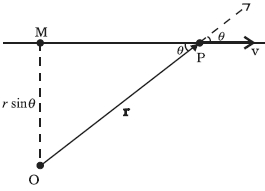
0 likes
View Solution73
Medium
Find the components along the $x, y, z$ axes of the angular momentum $\vec{l}$ of a particle whose position vector is $\vec{r}$ with components $x, y, z$ and momentum is $\vec{p}$ with components $p_x, p_y, p_z$. Show that if the particle moves only in the $x-y$ plane,the angular momentum has only a $z$-component.
Solution
(A) The angular momentum $\vec{l}$ is defined as the cross product of the position vector $\vec{r}$ and the linear momentum vector $\vec{p}$:
$\vec{l} = \vec{r} \times \vec{p} = (x \hat{i} + y \hat{j} + z \hat{k}) \times (p_x \hat{i} + p_y \hat{j} + p_z \hat{k})$
Using the determinant form:
$\vec{l} = \begin{vmatrix} \hat{i} & \hat{j} & \hat{k} \\ x & y & z \\ p_x & p_y & p_z \end{vmatrix} = \hat{i}(y p_z - z p_y) - \hat{j}(x p_z - z p_x) + \hat{k}(x p_y - y p_x)$
Comparing components,we get:
$l_x = y p_z - z p_y$
$l_y = z p_x - x p_z$
$l_z = x p_y - y p_x$
If the particle moves only in the $x-y$ plane,then $z = 0$ and $p_z = 0$. Substituting these into the expressions:
$l_x = y(0) - (0)p_y = 0$
$l_y = (0)p_x - x(0) = 0$
$l_z = x p_y - y p_x$
Since $l_x = 0$ and $l_y = 0$,the angular momentum has only a $z$-component.
$\vec{l} = \vec{r} \times \vec{p} = (x \hat{i} + y \hat{j} + z \hat{k}) \times (p_x \hat{i} + p_y \hat{j} + p_z \hat{k})$
Using the determinant form:
$\vec{l} = \begin{vmatrix} \hat{i} & \hat{j} & \hat{k} \\ x & y & z \\ p_x & p_y & p_z \end{vmatrix} = \hat{i}(y p_z - z p_y) - \hat{j}(x p_z - z p_x) + \hat{k}(x p_y - y p_x)$
Comparing components,we get:
$l_x = y p_z - z p_y$
$l_y = z p_x - x p_z$
$l_z = x p_y - y p_x$
If the particle moves only in the $x-y$ plane,then $z = 0$ and $p_z = 0$. Substituting these into the expressions:
$l_x = y(0) - (0)p_y = 0$
$l_y = (0)p_x - x(0) = 0$
$l_z = x p_y - y p_x$
Since $l_x = 0$ and $l_y = 0$,the angular momentum has only a $z$-component.
0 likes
View Solution74
Medium
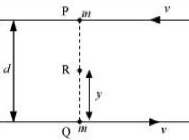
Two particles,each of mass $m$ and speed $v$,travel in opposite directions along parallel lines separated by a distance $d$. Show that the angular momentum vector of the two-particle system is the same whatever be the point about which the angular momentum is taken.
Solution
(N/A) Let at a certain instant two particles be at points $P$ and $Q$,as shown in the figure.
Angular momentum of the system about point $P$:
$\vec{L}_{P} = m v \times 0 + m v \times d = m v d$ ... $(i)$
Angular momentum of the system about point $Q$:
$\vec{L}_{Q} = m v \times d + m v \times 0 = m v d$ ... $(ii)$
Consider a point $R$,which is at a distance $y$ from point $Q$,i.e.,$QR = y$ and $PR = d - y$.
Angular momentum of the system about point $R$:
$\vec{L}_{R} = m v \times (d - y) + m v \times y$
$= m v d - m v y + m v y$
$= m v d$ ... $(iii)$
Comparing equations $(i)$,$(ii)$,and $(iii)$,we get:
$\vec{L}_{P} = \vec{L}_{Q} = \vec{L}_{R}$ ... $(iv)$
We infer from equation $(iv)$ that the angular momentum of a system of two particles moving in opposite directions along parallel lines does not depend on the point about which it is calculated.
Angular momentum of the system about point $P$:
$\vec{L}_{P} = m v \times 0 + m v \times d = m v d$ ... $(i)$
Angular momentum of the system about point $Q$:
$\vec{L}_{Q} = m v \times d + m v \times 0 = m v d$ ... $(ii)$
Consider a point $R$,which is at a distance $y$ from point $Q$,i.e.,$QR = y$ and $PR = d - y$.
Angular momentum of the system about point $R$:
$\vec{L}_{R} = m v \times (d - y) + m v \times y$
$= m v d - m v y + m v y$
$= m v d$ ... $(iii)$
Comparing equations $(i)$,$(ii)$,and $(iii)$,we get:
$\vec{L}_{P} = \vec{L}_{Q} = \vec{L}_{R}$ ... $(iv)$
We infer from equation $(iv)$ that the angular momentum of a system of two particles moving in opposite directions along parallel lines does not depend on the point about which it is calculated.
0 likes
View Solution75
Medium
Explain the angular momentum of a particle and show that it is the moment of linear momentum about the reference point.
Solution
(N/A) Just as the moment of a force is the rotational analogue of force,the quantity angular momentum is the rotational analogue of linear momentum.
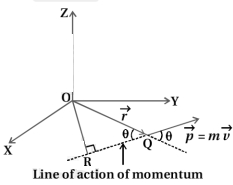
In the figure,$Q$ is a particle of mass $m$,having position vector $\vec{OQ} = \vec{r}$ in a Cartesian coordinate system.
$\vec{v}$ is the linear velocity of the particle. So,its linear momentum is $\vec{p} = m\vec{v}$.
It is not necessary that the particle $Q$ belongs to a rigid body or that it moves along a curved path.
Let the angle between $\vec{r}$ and $\vec{p}$ be $\theta$.
The vector product of $\vec{r}$ and $\vec{p}$ is defined as the angular momentum $\vec{l}$ of the particle with respect to point $O$.
$\therefore \vec{l} = \vec{r} \times \vec{p}$
The unit of angular momentum is $kg \cdot m^2 \cdot s^{-1}$ or $J \cdot s$,and its dimensional formula is $[M^1 L^2 T^{-1}]$.
The magnitude of $\vec{l}$ depends on the selection of the reference point; therefore,while defining the angular momentum of a particle,it is necessary to mention the reference point.
The direction of $\vec{l}$ can be obtained with the help of the right-handed screw rule. Here,$\vec{l}$ is in the $OZ$ direction.
Now,$\vec{l} = \vec{r} \times \vec{p}$.
$\therefore |\vec{l}| = r p \sin \theta = p(r \sin \theta) = p(OR)$.
$\therefore$ Angular momentum of a particle = (magnitude of linear momentum) $\times$ (the perpendicular distance of the line of action of linear momentum from the reference point).
In the figure,$Q$ is a particle of mass $m$,having position vector $\vec{OQ} = \vec{r}$ in a Cartesian coordinate system.
$\vec{v}$ is the linear velocity of the particle. So,its linear momentum is $\vec{p} = m\vec{v}$.
It is not necessary that the particle $Q$ belongs to a rigid body or that it moves along a curved path.
Let the angle between $\vec{r}$ and $\vec{p}$ be $\theta$.
The vector product of $\vec{r}$ and $\vec{p}$ is defined as the angular momentum $\vec{l}$ of the particle with respect to point $O$.
$\therefore \vec{l} = \vec{r} \times \vec{p}$
The unit of angular momentum is $kg \cdot m^2 \cdot s^{-1}$ or $J \cdot s$,and its dimensional formula is $[M^1 L^2 T^{-1}]$.
The magnitude of $\vec{l}$ depends on the selection of the reference point; therefore,while defining the angular momentum of a particle,it is necessary to mention the reference point.
The direction of $\vec{l}$ can be obtained with the help of the right-handed screw rule. Here,$\vec{l}$ is in the $OZ$ direction.
Now,$\vec{l} = \vec{r} \times \vec{p}$.
$\therefore |\vec{l}| = r p \sin \theta = p(r \sin \theta) = p(OR)$.
$\therefore$ Angular momentum of a particle = (magnitude of linear momentum) $\times$ (the perpendicular distance of the line of action of linear momentum from the reference point).
0 likes
View Solution76
Medium
Explain the Cartesian components of the angular momentum of a particle.
Solution
(N/A) The angular momentum $\vec{l}$ of a particle is defined as the cross product of its position vector $\vec{r}$ and linear momentum $\vec{p}$:
$\vec{l} = \vec{r} \times \vec{p}$
In Cartesian coordinates,$\vec{r} = x\hat{i} + y\hat{j} + z\hat{k}$ and $\vec{p} = p_x\hat{i} + p_y\hat{j} + p_z\hat{k}$.
Calculating the cross product using the determinant form:
$\vec{l} = \begin{vmatrix} \hat{i} & \hat{j} & \hat{k} \\ x & y & z \\ p_x & p_y & p_z \end{vmatrix}$
Expanding the determinant:
$\vec{l} = \hat{i}(yp_z - zp_y) + \hat{j}(zp_x - xp_z) + \hat{k}(xp_y - yp_x)$
Comparing this with $\vec{l} = l_x\hat{i} + l_y\hat{j} + l_z\hat{k}$,we identify the Cartesian components:
$l_x = yp_z - zp_y$
$l_y = zp_x - xp_z$
$l_z = xp_y - yp_x$
These represent the components of angular momentum along the $X$,$Y$,and $Z$ axes,respectively.
$\vec{l} = \vec{r} \times \vec{p}$
In Cartesian coordinates,$\vec{r} = x\hat{i} + y\hat{j} + z\hat{k}$ and $\vec{p} = p_x\hat{i} + p_y\hat{j} + p_z\hat{k}$.
Calculating the cross product using the determinant form:
$\vec{l} = \begin{vmatrix} \hat{i} & \hat{j} & \hat{k} \\ x & y & z \\ p_x & p_y & p_z \end{vmatrix}$
Expanding the determinant:
$\vec{l} = \hat{i}(yp_z - zp_y) + \hat{j}(zp_x - xp_z) + \hat{k}(xp_y - yp_x)$
Comparing this with $\vec{l} = l_x\hat{i} + l_y\hat{j} + l_z\hat{k}$,we identify the Cartesian components:
$l_x = yp_z - zp_y$
$l_y = zp_x - xp_z$
$l_z = xp_y - yp_x$
These represent the components of angular momentum along the $X$,$Y$,and $Z$ axes,respectively.
0 likes
View Solution77
Medium
Obtain the relation between torque of a system of particles and angular momentum.
Solution
The total angular momentum of a system of particles is the vector sum of the angular momenta of individual particles. For a system of $n$ particles,
$\overrightarrow{L} = \overrightarrow{l_{1}} + \overrightarrow{l_{2}} + \overrightarrow{l_{3}} + \ldots + \overrightarrow{l_{n}} = \sum_{i=1}^{n} \overrightarrow{l_{i}}$
where $\overrightarrow{l_{i}} = \overrightarrow{r_{i}} \times \overrightarrow{p_{i}}$ is the angular momentum of the $i^{\text{th}}$ particle,$\overrightarrow{r_{i}}$ is its position vector,and $\overrightarrow{p_{i}}$ is its linear momentum.
Differentiating the total angular momentum with respect to time $t$:
$\frac{d\overrightarrow{L}}{dt} = \sum_{i=1}^{n} \frac{d\overrightarrow{l_{i}}}{dt} = \sum_{i=1}^{n} \left( \frac{d\overrightarrow{r_{i}}}{dt} \times \overrightarrow{p_{i}} + \overrightarrow{r_{i}} \times \frac{d\overrightarrow{p_{i}}}{dt} \right)$
Since $\frac{d\overrightarrow{r_{i}}}{dt} = \overrightarrow{v_{i}}$ and $\overrightarrow{v_{i}} \times \overrightarrow{p_{i}} = \overrightarrow{v_{i}} \times (m\overrightarrow{v_{i}}) = 0$,the expression simplifies to:
$\frac{d\overrightarrow{L}}{dt} = \sum_{i=1}^{n} (\overrightarrow{r_{i}} \times \overrightarrow{F_{i}}) = \sum_{i=1}^{n} \overrightarrow{\tau_{i}} = \overrightarrow{\tau}_{ext} + \overrightarrow{\tau}_{int}$
Since internal forces occur in equal and opposite pairs along the same line of action (Newton's third law),their net torque $\overrightarrow{\tau}_{int} = 0$. Thus,the relation is:
$\frac{d\overrightarrow{L}}{dt} = \overrightarrow{\tau}_{ext}$
$\overrightarrow{L} = \overrightarrow{l_{1}} + \overrightarrow{l_{2}} + \overrightarrow{l_{3}} + \ldots + \overrightarrow{l_{n}} = \sum_{i=1}^{n} \overrightarrow{l_{i}}$
where $\overrightarrow{l_{i}} = \overrightarrow{r_{i}} \times \overrightarrow{p_{i}}$ is the angular momentum of the $i^{\text{th}}$ particle,$\overrightarrow{r_{i}}$ is its position vector,and $\overrightarrow{p_{i}}$ is its linear momentum.
Differentiating the total angular momentum with respect to time $t$:
$\frac{d\overrightarrow{L}}{dt} = \sum_{i=1}^{n} \frac{d\overrightarrow{l_{i}}}{dt} = \sum_{i=1}^{n} \left( \frac{d\overrightarrow{r_{i}}}{dt} \times \overrightarrow{p_{i}} + \overrightarrow{r_{i}} \times \frac{d\overrightarrow{p_{i}}}{dt} \right)$
Since $\frac{d\overrightarrow{r_{i}}}{dt} = \overrightarrow{v_{i}}$ and $\overrightarrow{v_{i}} \times \overrightarrow{p_{i}} = \overrightarrow{v_{i}} \times (m\overrightarrow{v_{i}}) = 0$,the expression simplifies to:
$\frac{d\overrightarrow{L}}{dt} = \sum_{i=1}^{n} (\overrightarrow{r_{i}} \times \overrightarrow{F_{i}}) = \sum_{i=1}^{n} \overrightarrow{\tau_{i}} = \overrightarrow{\tau}_{ext} + \overrightarrow{\tau}_{int}$
Since internal forces occur in equal and opposite pairs along the same line of action (Newton's third law),their net torque $\overrightarrow{\tau}_{int} = 0$. Thus,the relation is:
$\frac{d\overrightarrow{L}}{dt} = \overrightarrow{\tau}_{ext}$
0 likes
View Solution78
Easy
Define angular momentum.
Solution
(N/A) Angular momentum $(L)$ of a particle with respect to a point is defined as the cross product of its position vector $(r)$ and its linear momentum $(p)$.
Mathematically,it is expressed as: $L = r \times p$.
Since $p = mv$,where $m$ is the mass and $v$ is the velocity of the particle,the angular momentum can also be written as: $L = r \times (mv) = m(r \times v)$.
The $SI$ unit of angular momentum is $\text{kg} \cdot \text{m}^2/\text{s}$ or $\text{J} \cdot \text{s}$.
Mathematically,it is expressed as: $L = r \times p$.
Since $p = mv$,where $m$ is the mass and $v$ is the velocity of the particle,the angular momentum can also be written as: $L = r \times (mv) = m(r \times v)$.
The $SI$ unit of angular momentum is $\text{kg} \cdot \text{m}^2/\text{s}$ or $\text{J} \cdot \text{s}$.
0 likes
View Solution79
Medium
Write the $SI$ unit of angular momentum and its dimensional formula.
Solution
(N/A) Angular momentum $(L)$ is defined as the product of the position vector $(r)$ and linear momentum $(p)$,given by the formula $L = r \times p$.
Since $p = mv$,the dimensions of angular momentum are $[M^1 L^1 T^{-1}] \times [L^1] = [M^1 L^2 T^{-1}]$.
The $SI$ unit of mass is $kg$,velocity is $m/s$,and distance is $m$.
Therefore,the $SI$ unit of angular momentum is $kg \cdot m^2/s$ or $J \cdot s$.
Since $p = mv$,the dimensions of angular momentum are $[M^1 L^1 T^{-1}] \times [L^1] = [M^1 L^2 T^{-1}]$.
The $SI$ unit of mass is $kg$,velocity is $m/s$,and distance is $m$.
Therefore,the $SI$ unit of angular momentum is $kg \cdot m^2/s$ or $J \cdot s$.
0 likes
View Solution80
Difficult
Derive the equation of angular momentum in the case of rotational motion about a fixed axis.
Solution
(N/A) For a rigid body rotating about a fixed $Z$-axis,the angular momentum of an individual particle $i$ is given by $\vec{l}_i = \vec{r}_i \times \vec{p}_i$.
The total angular momentum $\vec{L}$ of the rigid body is the vector sum of the angular momenta of all its particles:
$\vec{L} = \sum_{i=1}^{n} \vec{l}_i = \sum_{i=1}^{n} (\vec{r}_i \times \vec{p}_i)$.
Since $\vec{p}_i = m_i \vec{v}_i$ and for rotational motion $\vec{v}_i = \vec{\omega} \times \vec{r}_i$,we have:
$\vec{L} = \sum_{i=1}^{n} [\vec{r}_i \times (m_i (\vec{\omega} \times \vec{r}_i))]$.
For rotation about a fixed axis,the angular velocity $\vec{\omega}$ is constant for all particles and directed along the axis of rotation (let it be the $Z$-axis,$\vec{\omega} = \omega \hat{k}$).
The component of angular momentum along the $Z$-axis is:
$L_Z = \sum_{i=1}^{n} m_i r_i^2 \omega = (\sum_{i=1}^{n} m_i r_i^2) \omega$.
Since the moment of inertia $I = \sum_{i=1}^{n} m_i r_i^2$,we get:
$L_Z = I \omega$.
In vector form,$\vec{L} = I \vec{\omega}$,which is analogous to $\vec{p} = m \vec{v}$ in linear motion.
The total angular momentum $\vec{L}$ of the rigid body is the vector sum of the angular momenta of all its particles:
$\vec{L} = \sum_{i=1}^{n} \vec{l}_i = \sum_{i=1}^{n} (\vec{r}_i \times \vec{p}_i)$.
Since $\vec{p}_i = m_i \vec{v}_i$ and for rotational motion $\vec{v}_i = \vec{\omega} \times \vec{r}_i$,we have:
$\vec{L} = \sum_{i=1}^{n} [\vec{r}_i \times (m_i (\vec{\omega} \times \vec{r}_i))]$.
For rotation about a fixed axis,the angular velocity $\vec{\omega}$ is constant for all particles and directed along the axis of rotation (let it be the $Z$-axis,$\vec{\omega} = \omega \hat{k}$).
The component of angular momentum along the $Z$-axis is:
$L_Z = \sum_{i=1}^{n} m_i r_i^2 \omega = (\sum_{i=1}^{n} m_i r_i^2) \omega$.
Since the moment of inertia $I = \sum_{i=1}^{n} m_i r_i^2$,we get:
$L_Z = I \omega$.
In vector form,$\vec{L} = I \vec{\omega}$,which is analogous to $\vec{p} = m \vec{v}$ in linear motion.
0 likes
View Solution81
Easy
Write the general formula of total angular momentum of rotational motion about a fixed axis.
Solution
(N/A) For a rigid body rotating about a fixed axis,the total angular momentum $L$ is given by the product of the moment of inertia $I$ of the body about that axis and its angular velocity $\omega$.
The formula is: $L = I \omega$
Where:
$L$ is the angular momentum,
$I$ is the moment of inertia about the axis of rotation,
$\omega$ is the angular velocity of the body.
The formula is: $L = I \omega$
Where:
$L$ is the angular momentum,
$I$ is the moment of inertia about the axis of rotation,
$\omega$ is the angular velocity of the body.
0 likes
View Solution82
MediumMCQ
Why is the angular momentum perpendicular to the axis,denoted as ${L_ \bot }$,zero in a rotational motion about a fixed axis?
A
Because the particles move in planes perpendicular to the axis.
B
Because the velocity vector is always parallel to the axis.
C
Because the position vector and velocity vector are both perpendicular to the axis.
D
Because the angular momentum is defined only along the axis of rotation.
Solution
(A) In rotational motion about a fixed axis,every particle of the rigid body moves in a circular path in a plane perpendicular to the axis of rotation.
Let the axis of rotation be the $z$-axis. The position vector $\vec{r}$ of a particle can be decomposed into two components: $\vec{r}_{\parallel}$ (along the $z$-axis) and $\vec{r}_{\perp}$ (in the $xy$-plane).
The velocity vector $\vec{v}$ of any particle is given by $\vec{v} = \vec{\omega} \times \vec{r}$. Since $\vec{\omega}$ is along the $z$-axis,$\vec{v}$ lies entirely in the $xy$-plane.
The angular momentum is $\vec{L} = \sum (\vec{r} \times \vec{p}) = \sum m(\vec{r} \times \vec{v})$.
Substituting $\vec{r} = \vec{r}_{\parallel} + \vec{r}_{\perp}$,we get $\vec{L} = \sum m((\vec{r}_{\parallel} + \vec{r}_{\perp}) \times \vec{v})$.
Since $\vec{r}_{\parallel}$ is parallel to the $z$-axis and $\vec{v}$ is in the $xy$-plane,their cross product $\vec{r}_{\parallel} \times \vec{v}$ results in a vector perpendicular to the $z$-axis.
However,for a symmetric body or when summing over the entire rigid body,the components of angular momentum perpendicular to the axis of rotation cancel out due to the circular symmetry of the motion,leaving only the component along the axis of rotation $(L_z)$.
Thus,the net angular momentum perpendicular to the axis,${L_ \bot }$,is zero.
Let the axis of rotation be the $z$-axis. The position vector $\vec{r}$ of a particle can be decomposed into two components: $\vec{r}_{\parallel}$ (along the $z$-axis) and $\vec{r}_{\perp}$ (in the $xy$-plane).
The velocity vector $\vec{v}$ of any particle is given by $\vec{v} = \vec{\omega} \times \vec{r}$. Since $\vec{\omega}$ is along the $z$-axis,$\vec{v}$ lies entirely in the $xy$-plane.
The angular momentum is $\vec{L} = \sum (\vec{r} \times \vec{p}) = \sum m(\vec{r} \times \vec{v})$.
Substituting $\vec{r} = \vec{r}_{\parallel} + \vec{r}_{\perp}$,we get $\vec{L} = \sum m((\vec{r}_{\parallel} + \vec{r}_{\perp}) \times \vec{v})$.
Since $\vec{r}_{\parallel}$ is parallel to the $z$-axis and $\vec{v}$ is in the $xy$-plane,their cross product $\vec{r}_{\parallel} \times \vec{v}$ results in a vector perpendicular to the $z$-axis.
However,for a symmetric body or when summing over the entire rigid body,the components of angular momentum perpendicular to the axis of rotation cancel out due to the circular symmetry of the motion,leaving only the component along the axis of rotation $(L_z)$.
Thus,the net angular momentum perpendicular to the axis,${L_ \bot }$,is zero.
0 likes
View Solution83
EasyMCQ
Can an object moving in a straight line have angular momentum?
A
Yes
B
No
C
Only if it is rotating
D
Only if it is accelerating
Solution
(A) Yes,an object moving in a straight line can have angular momentum relative to a point that is not on the line of motion. The formula for angular momentum is $\vec{L} = \vec{r} \times \vec{p}$,where $\vec{r}$ is the position vector from the reference point to the object and $\vec{p}$ is the linear momentum. As long as the line of motion does not pass through the reference point,the cross product $\vec{r} \times \vec{p}$ will be non-zero.
0 likes
View Solution84
Medium
Does the angular momentum of a body change when its axis of rotation changes? Why?
Solution
(A) Yes,the angular momentum of a body changes when its axis of rotation changes.
This is because angular momentum is defined as $\vec{L} = \vec{r} \times \vec{p}$.
When the axis of rotation changes,the position vector $\vec{r}$ relative to the new axis changes,and the direction of the angular velocity vector $\vec{\omega}$ also changes.
Since $\vec{L} = I\vec{\omega}$,a change in the axis of rotation alters the moment of inertia $I$ and the direction of $\vec{\omega}$,thereby changing the angular momentum $\vec{L}$.
This is because angular momentum is defined as $\vec{L} = \vec{r} \times \vec{p}$.
When the axis of rotation changes,the position vector $\vec{r}$ relative to the new axis changes,and the direction of the angular velocity vector $\vec{\omega}$ also changes.
Since $\vec{L} = I\vec{\omega}$,a change in the axis of rotation alters the moment of inertia $I$ and the direction of $\vec{\omega}$,thereby changing the angular momentum $\vec{L}$.
0 likes
View Solution85
MediumMCQ
When does the magnitude of angular momentum become zero?
A
When the particle is at rest.
B
When the line of action of linear momentum passes through the origin.
C
When the force acting on the particle is zero.
D
When the velocity is constant.
Solution
(B) The angular momentum $\vec{L}$ of a particle is defined as $\vec{L} = \vec{r} \times \vec{p}$,where $\vec{r}$ is the position vector and $\vec{p}$ is the linear momentum.
For the magnitude of angular momentum to be zero,the cross product $\vec{r} \times \vec{p}$ must be zero.
This occurs when the position vector $\vec{r}$ is parallel or anti-parallel to the linear momentum vector $\vec{p}$,or when either $\vec{r}$ or $\vec{p}$ is zero.
Geometrically,this means the line of action of the linear momentum passes through the origin (the reference point for the position vector).
For the magnitude of angular momentum to be zero,the cross product $\vec{r} \times \vec{p}$ must be zero.
This occurs when the position vector $\vec{r}$ is parallel or anti-parallel to the linear momentum vector $\vec{p}$,or when either $\vec{r}$ or $\vec{p}$ is zero.
Geometrically,this means the line of action of the linear momentum passes through the origin (the reference point for the position vector).
0 likes
View Solution86
DifficultMCQ
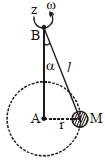
$A$ mass $M$ hangs on a massless rod of length $l$ which rotates at a constant angular frequency $\omega$. The mass $M$ moves with steady speed in a circular path of constant radius $r$. The angular momentum of $M$ about point $A$ is $L_A$,which lies in the positive $z$-direction,and the angular momentum of $M$ about point $B$ is $L_B$. Which of the following statements is correct for this system?
A
$L_A$ and $L_B$ are both constant in magnitude and direction.
B
$L_B$ is constant in direction with varying magnitude.
C
$L_B$ is constant,both in magnitude and direction.
D
$L_A$ is constant,both in magnitude and direction.
Solution
(D) The angular momentum is defined as $\vec{L} = \vec{r} \times \vec{p} = m(\vec{r} \times \vec{v})$.
For point $A$ (the center of the circular path): The position vector $\vec{r}_A$ is in the plane of the circle,and the velocity vector $\vec{v}$ is tangential to the circle. The cross product $\vec{r}_A \times \vec{v}$ always points in the positive $z$-direction (perpendicular to the plane of the circle). Since the speed $v$ and radius $r$ are constant,the magnitude $L_A = mvr$ is constant. Thus,$L_A$ is constant in both magnitude and direction.
For point $B$ (a point on the axis of rotation above $A$): The position vector $\vec{r}_B$ from $B$ to $M$ changes its direction as the mass $M$ rotates. Therefore,the angular momentum $\vec{L}_B = \vec{r}_B \times \vec{p}$ will have a constant magnitude,but its direction will change continuously as it precesses around the $z$-axis.
For point $A$ (the center of the circular path): The position vector $\vec{r}_A$ is in the plane of the circle,and the velocity vector $\vec{v}$ is tangential to the circle. The cross product $\vec{r}_A \times \vec{v}$ always points in the positive $z$-direction (perpendicular to the plane of the circle). Since the speed $v$ and radius $r$ are constant,the magnitude $L_A = mvr$ is constant. Thus,$L_A$ is constant in both magnitude and direction.
For point $B$ (a point on the axis of rotation above $A$): The position vector $\vec{r}_B$ from $B$ to $M$ changes its direction as the mass $M$ rotates. Therefore,the angular momentum $\vec{L}_B = \vec{r}_B \times \vec{p}$ will have a constant magnitude,but its direction will change continuously as it precesses around the $z$-axis.
0 likes
View Solution87
MediumMCQ
The angular momentum of a single particle moving with constant speed along a circular path:
A
changes in magnitude but remains same in the direction
B
remains same in magnitude and direction
C
remains same in magnitude but changes in the direction
D
is zero
Solution
(B) The angular momentum $\vec{L}$ of a particle is given by $\vec{L} = \vec{r} \times \vec{p} = \vec{r} \times (m\vec{v})$.
For a particle moving with constant speed $v$ in a circular path of radius $r$,the magnitude of angular momentum is $L = mvr \sin(90^{\circ}) = mvr$,which is constant.
The direction of angular momentum is given by the right-hand rule,which is perpendicular to the plane of the circular path (along the axis of rotation).
Since the speed and radius are constant and the plane of motion does not change,both the magnitude and the direction of the angular momentum vector remain constant throughout the motion.
For a particle moving with constant speed $v$ in a circular path of radius $r$,the magnitude of angular momentum is $L = mvr \sin(90^{\circ}) = mvr$,which is constant.
The direction of angular momentum is given by the right-hand rule,which is perpendicular to the plane of the circular path (along the axis of rotation).
Since the speed and radius are constant and the plane of motion does not change,both the magnitude and the direction of the angular momentum vector remain constant throughout the motion.

0 likes
View Solution88
DifficultMCQ
$A$ particle of mass $m$ is moving in time $t$ on a trajectory given by $\overrightarrow{r} = 10 \alpha t^2 \hat{i} + 5 \beta (t - 5) \hat{j}$. Where $\alpha$ and $\beta$ are dimensional constants. The angular momentum of the particle becomes the same as it was for $t = 0$ at time $t = \dots$ seconds.
A
$15$
B
$10$
C
$20$
D
$25$
Solution
(B) The position vector is $\overrightarrow{r} = 10 \alpha t^2 \hat{i} + 5 \beta (t - 5) \hat{j}$.
The velocity vector is $\overrightarrow{v} = \frac{d\overrightarrow{r}}{dt} = 20 \alpha t \hat{i} + 5 \beta \hat{j}$.
The angular momentum is given by $\overrightarrow{L} = m (\overrightarrow{r} \times \overrightarrow{v})$.
$\overrightarrow{L} = m [10 \alpha t^2 \hat{i} + 5 \beta (t - 5) \hat{j}] \times [20 \alpha t \hat{i} + 5 \beta \hat{j}]$.
Calculating the cross product: $\overrightarrow{L} = m [ (10 \alpha t^2)(5 \beta) \hat{k} - (5 \beta (t - 5))(20 \alpha t) \hat{k} ]$.
$\overrightarrow{L} = m [ 50 \alpha \beta t^2 - 100 \alpha \beta t (t - 5) ] \hat{k}$.
At $t = 0$,$\overrightarrow{L} = m [ 0 - 0 ] \hat{k} = 0$.
We want $\overrightarrow{L} = 0$ at time $t > 0$:
$50 \alpha \beta t^2 - 100 \alpha \beta t (t - 5) = 0$.
Dividing by $50 \alpha \beta t$ (since $t \neq 0$):
$t - 2(t - 5) = 0$.
$t - 2t + 10 = 0 \implies -t = -10 \implies t = 10 \text{ seconds}$.
The velocity vector is $\overrightarrow{v} = \frac{d\overrightarrow{r}}{dt} = 20 \alpha t \hat{i} + 5 \beta \hat{j}$.
The angular momentum is given by $\overrightarrow{L} = m (\overrightarrow{r} \times \overrightarrow{v})$.
$\overrightarrow{L} = m [10 \alpha t^2 \hat{i} + 5 \beta (t - 5) \hat{j}] \times [20 \alpha t \hat{i} + 5 \beta \hat{j}]$.
Calculating the cross product: $\overrightarrow{L} = m [ (10 \alpha t^2)(5 \beta) \hat{k} - (5 \beta (t - 5))(20 \alpha t) \hat{k} ]$.
$\overrightarrow{L} = m [ 50 \alpha \beta t^2 - 100 \alpha \beta t (t - 5) ] \hat{k}$.
At $t = 0$,$\overrightarrow{L} = m [ 0 - 0 ] \hat{k} = 0$.
We want $\overrightarrow{L} = 0$ at time $t > 0$:
$50 \alpha \beta t^2 - 100 \alpha \beta t (t - 5) = 0$.
Dividing by $50 \alpha \beta t$ (since $t \neq 0$):
$t - 2(t - 5) = 0$.
$t - 2t + 10 = 0 \implies -t = -10 \implies t = 10 \text{ seconds}$.
0 likes
View Solution89
MediumMCQ
The position vector of a $1\,kg$ object is $\overrightarrow{r} = (3\hat{i} - \hat{j})\,m$ and its velocity is $\overrightarrow{v} = (3\hat{j} + \hat{k})\,m/s$. The magnitude of its angular momentum is $\sqrt{x}\,N\cdot m\cdot s$,where $x$ is:
A
$89$
B
$91$
C
$90$
D
$95$
Solution
(B) The angular momentum $\overrightarrow{L}$ is given by the cross product of the position vector $\overrightarrow{r}$ and the linear momentum $\overrightarrow{p} = m\overrightarrow{v}$.
Given $m = 1\,kg$,$\overrightarrow{r} = (3\hat{i} - \hat{j})\,m$,and $\overrightarrow{v} = (3\hat{j} + \hat{k})\,m/s$.
$\overrightarrow{L} = \overrightarrow{r} \times (m\overrightarrow{v}) = 1 \cdot [(3\hat{i} - \hat{j}) \times (3\hat{j} + \hat{k})]$.
Calculating the cross product:
$\overrightarrow{L} = 3\hat{i} \times 3\hat{j} + 3\hat{i} \times \hat{k} - \hat{j} \times 3\hat{j} - \hat{j} \times \hat{k}$.
Using unit vector properties ($\hat{i} \times \hat{j} = \hat{k}$,$\hat{i} \times \hat{k} = -\hat{j}$,$\hat{j} \times \hat{j} = 0$,$\hat{j} \times \hat{k} = \hat{i}$):
$\overrightarrow{L} = 9\hat{k} - 3\hat{j} - 0 - \hat{i} = -\hat{i} - 3\hat{j} + 9\hat{k}$.
The magnitude is $|\overrightarrow{L}| = \sqrt{(-1)^2 + (-3)^2 + (9)^2} = \sqrt{1 + 9 + 81} = \sqrt{91}$.
Thus,$x = 91$.
Given $m = 1\,kg$,$\overrightarrow{r} = (3\hat{i} - \hat{j})\,m$,and $\overrightarrow{v} = (3\hat{j} + \hat{k})\,m/s$.
$\overrightarrow{L} = \overrightarrow{r} \times (m\overrightarrow{v}) = 1 \cdot [(3\hat{i} - \hat{j}) \times (3\hat{j} + \hat{k})]$.
Calculating the cross product:
$\overrightarrow{L} = 3\hat{i} \times 3\hat{j} + 3\hat{i} \times \hat{k} - \hat{j} \times 3\hat{j} - \hat{j} \times \hat{k}$.
Using unit vector properties ($\hat{i} \times \hat{j} = \hat{k}$,$\hat{i} \times \hat{k} = -\hat{j}$,$\hat{j} \times \hat{j} = 0$,$\hat{j} \times \hat{k} = \hat{i}$):
$\overrightarrow{L} = 9\hat{k} - 3\hat{j} - 0 - \hat{i} = -\hat{i} - 3\hat{j} + 9\hat{k}$.
The magnitude is $|\overrightarrow{L}| = \sqrt{(-1)^2 + (-3)^2 + (9)^2} = \sqrt{1 + 9 + 81} = \sqrt{91}$.
Thus,$x = 91$.
0 likes
View Solution90
EasyMCQ
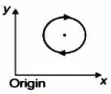
$A$ particle is rotating in a circle with uniform speed as shown. The angular momentum of the particle with respect to the origin is .........
A
Variable in magnitude as well as direction
B
Constant in magnitude only
C
Constant in direction only
D
Constant in magnitude as well as direction
Solution
(A) The angular momentum $\vec{L}$ of a particle with respect to the origin is given by $\vec{L} = \vec{r} \times \vec{p} = \vec{r} \times (m\vec{v})$.
For a particle moving in a circle with uniform speed $v$,the magnitude of angular momentum is $L = mvr_{\perp}$,where $r_{\perp}$ is the perpendicular distance from the origin to the line of velocity. Since the circle is not centered at the origin,the position vector $\vec{r}$ relative to the origin changes continuously as the particle moves along the circle.
Consequently,both the magnitude and the direction of the cross product $\vec{r} \times \vec{v}$ change as the particle rotates. Therefore,the angular momentum is variable in both magnitude and direction.
For a particle moving in a circle with uniform speed $v$,the magnitude of angular momentum is $L = mvr_{\perp}$,where $r_{\perp}$ is the perpendicular distance from the origin to the line of velocity. Since the circle is not centered at the origin,the position vector $\vec{r}$ relative to the origin changes continuously as the particle moves along the circle.
Consequently,both the magnitude and the direction of the cross product $\vec{r} \times \vec{v}$ change as the particle rotates. Therefore,the angular momentum is variable in both magnitude and direction.
0 likes
View Solution91
EasyMCQ
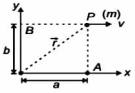
$A$ particle of mass $m$ is moving along a straight line parallel to the $x$-axis with a constant velocity $v$ at a distance $b$ from the origin. Find the angular momentum about the origin in vector form.
A
$+m v^2 b \hat{k}$
B
$-m v b \hat{k}$
C
$-2 m v b \hat{k}$
D
$-m v b \hat{j}$
Solution
(B) The angular momentum $\vec{L}$ of a particle about the origin is given by the cross product of its position vector $\vec{r}$ and its linear momentum $\vec{p} = m\vec{v}$.
$\vec{L} = \vec{r} \times \vec{p} = \vec{r} \times (m\vec{v})$.
Let the position of the particle be $\vec{r} = x \hat{i} + b \hat{j}$,where $x$ is the horizontal distance from the $y$-axis and $b$ is the constant vertical distance from the $x$-axis.
The velocity of the particle is $\vec{v} = v \hat{i}$ (since it moves parallel to the $x$-axis).
Therefore,$\vec{L} = (x \hat{i} + b \hat{j}) \times (m v \hat{i})$.
Using the distributive property of the cross product:
$\vec{L} = (x \hat{i} \times m v \hat{i}) + (b \hat{j} \times m v \hat{i})$.
Since $\hat{i} \times \hat{i} = 0$ and $\hat{j} \times \hat{i} = -\hat{k}$,we get:
$\vec{L} = 0 + m v b (-\hat{k}) = -m v b \hat{k}$.
Thus,the angular momentum is $-m v b \hat{k}$.
$\vec{L} = \vec{r} \times \vec{p} = \vec{r} \times (m\vec{v})$.
Let the position of the particle be $\vec{r} = x \hat{i} + b \hat{j}$,where $x$ is the horizontal distance from the $y$-axis and $b$ is the constant vertical distance from the $x$-axis.
The velocity of the particle is $\vec{v} = v \hat{i}$ (since it moves parallel to the $x$-axis).
Therefore,$\vec{L} = (x \hat{i} + b \hat{j}) \times (m v \hat{i})$.
Using the distributive property of the cross product:
$\vec{L} = (x \hat{i} \times m v \hat{i}) + (b \hat{j} \times m v \hat{i})$.
Since $\hat{i} \times \hat{i} = 0$ and $\hat{j} \times \hat{i} = -\hat{k}$,we get:
$\vec{L} = 0 + m v b (-\hat{k}) = -m v b \hat{k}$.
Thus,the angular momentum is $-m v b \hat{k}$.
0 likes
View Solution92
EasyMCQ
An angular impulse of $20 \,Nms$ is applied to a hollow cylinder of mass $2 \,kg$ and radius $20 \,cm$. The change in its angular speed is ............. $rad/s$.
A
$25$
B
$2.5$
C
$250$
D
$2500$
Solution
(C) The angular impulse applied to a body is equal to the change in its angular momentum,given by $\tau \Delta t = \Delta L = I \Delta \omega$.
For a hollow cylinder,the moment of inertia $I$ is $MR^2$.
Given: Mass $M = 2 \,kg$,Radius $R = 20 \,cm = 0.2 \,m$,Angular impulse $= 20 \,Nms$.
The moment of inertia $I = MR^2 = 2 \times (0.2)^2 = 2 \times 0.04 = 0.08 \,kg \cdot m^2$.
Using the relation: $20 = I \Delta \omega = 0.08 \times \Delta \omega$.
$\Delta \omega = \frac{20}{0.08} = \frac{2000}{8} = 250 \,rad/s$.
For a hollow cylinder,the moment of inertia $I$ is $MR^2$.
Given: Mass $M = 2 \,kg$,Radius $R = 20 \,cm = 0.2 \,m$,Angular impulse $= 20 \,Nms$.
The moment of inertia $I = MR^2 = 2 \times (0.2)^2 = 2 \times 0.04 = 0.08 \,kg \cdot m^2$.
Using the relation: $20 = I \Delta \omega = 0.08 \times \Delta \omega$.
$\Delta \omega = \frac{20}{0.08} = \frac{2000}{8} = 250 \,rad/s$.
0 likes
View Solution93
EasyMCQ
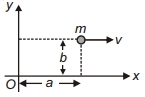
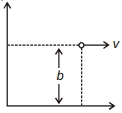
$A$ particle of mass $m$ is moving with constant velocity $v$ parallel to the $x$-axis as shown in the figure. Its angular momentum about origin $O$ is ..........
A
$m v b$
B
$m v a$
C
$m v \sqrt{a^2+b^2}$
D
$m v(a+b)$
Solution
(A) The angular momentum $L$ of a particle about a point is given by the cross product of its position vector $r$ and its linear momentum $p = mv$.
Mathematically,$L = r \times p$.
The magnitude of angular momentum is given by $L = m v r_{\perp}$,where $r_{\perp}$ is the perpendicular distance of the line of motion of the particle from the origin $O$.
From the given figure,the particle is moving parallel to the $x$-axis at a constant perpendicular distance $b$ from the $x$-axis (and thus from the origin $O$ along the $y$-direction).
Therefore,the perpendicular distance $r_{\perp} = b$.
Substituting this into the formula,we get $L = m v b$.
Thus,the correct option is $A$.
Mathematically,$L = r \times p$.
The magnitude of angular momentum is given by $L = m v r_{\perp}$,where $r_{\perp}$ is the perpendicular distance of the line of motion of the particle from the origin $O$.
From the given figure,the particle is moving parallel to the $x$-axis at a constant perpendicular distance $b$ from the $x$-axis (and thus from the origin $O$ along the $y$-direction).
Therefore,the perpendicular distance $r_{\perp} = b$.
Substituting this into the formula,we get $L = m v b$.
Thus,the correct option is $A$.
0 likes
View Solution94
EasyMCQ
$A$ particle starts from the point $(0, 8) \, m$ and moves with a uniform velocity of $\vec{v} = 3 \hat{i} \, m/s$. What is the angular momentum of the particle about the origin after $5 \, s$ (mass of the particle is $1 \, kg$)?
A
$-12 \hat{k} \, kg \cdot m^2/s$
B
$-24 \hat{k} \, kg \cdot m^2/s$
C
$-32 \hat{k} \, kg \cdot m^2/s$
D
$-36 \hat{k} \, kg \cdot m^2/s$
Solution
(B) The angular momentum $\vec{L}$ of a particle about the origin is given by $\vec{L} = \vec{r} \times \vec{p} = \vec{r} \times (m\vec{v})$.
Given the initial position $\vec{r}_0 = 8 \hat{j} \, m$ and velocity $\vec{v} = 3 \hat{i} \, m/s$.
The position of the particle at time $t = 5 \, s$ is $\vec{r} = \vec{r}_0 + \vec{v}t = 8 \hat{j} + (3 \hat{i})(5) = 15 \hat{i} + 8 \hat{j} \, m$.
The momentum of the particle is $\vec{p} = m\vec{v} = (1)(3 \hat{i}) = 3 \hat{i} \, kg \cdot m/s$.
Now,$\vec{L} = (15 \hat{i} + 8 \hat{j}) \times (3 \hat{i}) = 15 \times 3 (\hat{i} \times \hat{i}) + 8 \times 3 (\hat{j} \times \hat{i})$.
Since $\hat{i} \times \hat{i} = 0$ and $\hat{j} \times \hat{i} = -\hat{k}$,we get $\vec{L} = 0 + 24(-\hat{k}) = -24 \hat{k} \, kg \cdot m^2/s$.
Given the initial position $\vec{r}_0 = 8 \hat{j} \, m$ and velocity $\vec{v} = 3 \hat{i} \, m/s$.
The position of the particle at time $t = 5 \, s$ is $\vec{r} = \vec{r}_0 + \vec{v}t = 8 \hat{j} + (3 \hat{i})(5) = 15 \hat{i} + 8 \hat{j} \, m$.
The momentum of the particle is $\vec{p} = m\vec{v} = (1)(3 \hat{i}) = 3 \hat{i} \, kg \cdot m/s$.
Now,$\vec{L} = (15 \hat{i} + 8 \hat{j}) \times (3 \hat{i}) = 15 \times 3 (\hat{i} \times \hat{i}) + 8 \times 3 (\hat{j} \times \hat{i})$.
Since $\hat{i} \times \hat{i} = 0$ and $\hat{j} \times \hat{i} = -\hat{k}$,we get $\vec{L} = 0 + 24(-\hat{k}) = -24 \hat{k} \, kg \cdot m^2/s$.
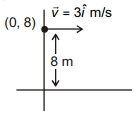
0 likes
View Solution95
MediumMCQ
$A$ ball of mass $1 \,kg$ is projected with a velocity of $20 \sqrt{2} \,m/s$ from the origin of an $xy$ coordinate axis system at an angle of $45^{\circ}$ with the $x$-axis (horizontal). The angular momentum [in $SI$ units] of the ball about the point of projection after $2 \,s$ of projection is [take $g = 10 \,m/s^2$] ($y$-axis is taken as vertical).
A
$-400 \hat{k}$
B
$200 \hat{i}$
C
$300 \hat{j}$
D
$-350 \hat{j}$
Solution
(A) The initial velocity components are $u_x = u \cos 45^{\circ} = 20 \sqrt{2} \times \frac{1}{\sqrt{2}} = 20 \,m/s$ and $u_y = u \sin 45^{\circ} = 20 \sqrt{2} \times \frac{1}{\sqrt{2}} = 20 \,m/s$.
After $t = 2 \,s$,the position coordinates are:
$x = u_x t = 20 \times 2 = 40 \,m$
$y = u_y t - \frac{1}{2} g t^2 = 20 \times 2 - \frac{1}{2} \times 10 \times 2^2 = 40 - 20 = 20 \,m$.
The velocity components at $t = 2 \,s$ are:
$v_x = u_x = 20 \,m/s$
$v_y = u_y - gt = 20 - 10 \times 2 = 0 \,m/s$.
The angular momentum $\vec{L}$ about the origin is given by $\vec{L} = \vec{r} \times \vec{p} = m(\vec{r} \times \vec{v})$.
$\vec{r} = 40 \hat{i} + 20 \hat{j}$ and $\vec{v} = 20 \hat{i} + 0 \hat{j}$.
$\vec{L} = 1 \times [(40 \hat{i} + 20 \hat{j}) \times (20 \hat{i})] = 1 \times [40 \times 20 (\hat{i} \times \hat{i}) + 20 \times 20 (\hat{j} \times \hat{i})]$.
Since $\hat{i} \times \hat{i} = 0$ and $\hat{j} \times \hat{i} = -\hat{k}$,we get:
$\vec{L} = 400(-\hat{k}) = -400 \hat{k} \,kg \cdot m^2/s$.
After $t = 2 \,s$,the position coordinates are:
$x = u_x t = 20 \times 2 = 40 \,m$
$y = u_y t - \frac{1}{2} g t^2 = 20 \times 2 - \frac{1}{2} \times 10 \times 2^2 = 40 - 20 = 20 \,m$.
The velocity components at $t = 2 \,s$ are:
$v_x = u_x = 20 \,m/s$
$v_y = u_y - gt = 20 - 10 \times 2 = 0 \,m/s$.
The angular momentum $\vec{L}$ about the origin is given by $\vec{L} = \vec{r} \times \vec{p} = m(\vec{r} \times \vec{v})$.
$\vec{r} = 40 \hat{i} + 20 \hat{j}$ and $\vec{v} = 20 \hat{i} + 0 \hat{j}$.
$\vec{L} = 1 \times [(40 \hat{i} + 20 \hat{j}) \times (20 \hat{i})] = 1 \times [40 \times 20 (\hat{i} \times \hat{i}) + 20 \times 20 (\hat{j} \times \hat{i})]$.
Since $\hat{i} \times \hat{i} = 0$ and $\hat{j} \times \hat{i} = -\hat{k}$,we get:
$\vec{L} = 400(-\hat{k}) = -400 \hat{k} \,kg \cdot m^2/s$.
0 likes
View Solution96
DifficultMCQ
$A$ particle of mass $100\,g$ is projected at time $t = 0$ with a speed $20\,ms^{-1}$ at an angle $45^{\circ}$ to the horizontal as given in the figure. The magnitude of the angular momentum of the particle about the starting point at time $t = 2\,s$ is found to be $\sqrt{K}\,kg\,m^2/s$. The value of $K$ is $............$ (Take $g = 10\,ms^{-2}$)
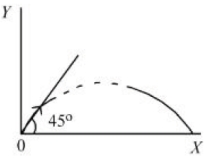
A
$80$
B
$800$
C
$8$
D
$0.8$
Solution
(B) The angular momentum $L$ of a particle about the origin is given by $L = \vec{r} \times \vec{p} = m(\vec{r} \times \vec{v})$.
Alternatively,the torque about the origin is $\vec{\tau} = \vec{r} \times \vec{F} = \vec{r} \times (m\vec{g})$.
Since $\vec{g}$ acts downwards ($-y$ direction),$\vec{\tau} = (x\hat{i} + y\hat{j}) \times (-mg\hat{j}) = -xmg\hat{k}$.
The magnitude of torque is $\tau = xmg = (v_x t)mg$.
Integrating torque to find angular momentum: $L = \int_0^t \tau dt = \int_0^t (v_x t)mg dt = mg v_x \frac{t^2}{2}$.
Given: $m = 100\,g = 0.1\,kg$,$v = 20\,ms^{-1}$,$\theta = 45^{\circ}$,$t = 2\,s$,$g = 10\,ms^{-2}$.
$v_x = v \cos 45^{\circ} = 20 \times \frac{1}{\sqrt{2}} = 10\sqrt{2}\,ms^{-1}$.
$L = (0.1)(10)(10\sqrt{2}) \frac{2^2}{2} = 10 \times 10\sqrt{2} \times 2 = 200\sqrt{2} = \sqrt{40000 \times 2} = \sqrt{80000}$.
Wait,re-evaluating: $L = (0.1)(10)(10\sqrt{2}) \times 2 = 20\sqrt{2} = \sqrt{400 \times 2} = \sqrt{800}$.
Thus,$K = 800$.
Alternatively,the torque about the origin is $\vec{\tau} = \vec{r} \times \vec{F} = \vec{r} \times (m\vec{g})$.
Since $\vec{g}$ acts downwards ($-y$ direction),$\vec{\tau} = (x\hat{i} + y\hat{j}) \times (-mg\hat{j}) = -xmg\hat{k}$.
The magnitude of torque is $\tau = xmg = (v_x t)mg$.
Integrating torque to find angular momentum: $L = \int_0^t \tau dt = \int_0^t (v_x t)mg dt = mg v_x \frac{t^2}{2}$.
Given: $m = 100\,g = 0.1\,kg$,$v = 20\,ms^{-1}$,$\theta = 45^{\circ}$,$t = 2\,s$,$g = 10\,ms^{-2}$.
$v_x = v \cos 45^{\circ} = 20 \times \frac{1}{\sqrt{2}} = 10\sqrt{2}\,ms^{-1}$.
$L = (0.1)(10)(10\sqrt{2}) \frac{2^2}{2} = 10 \times 10\sqrt{2} \times 2 = 200\sqrt{2} = \sqrt{40000 \times 2} = \sqrt{80000}$.
Wait,re-evaluating: $L = (0.1)(10)(10\sqrt{2}) \times 2 = 20\sqrt{2} = \sqrt{400 \times 2} = \sqrt{800}$.
Thus,$K = 800$.
0 likes
View Solution97
DifficultMCQ
$A$ body of mass $5 \,kg$ moving with a uniform speed $3 \sqrt{2} \,m/s$ in the $X-Y$ plane along the line $y=x+4$. The angular momentum of the particle about the origin will be . . . . . . $kg \,m^2/s$.
A
$45$
B
$60$
C
$75$
D
$12$
Solution
(B) The equation of the line is $x - y + 4 = 0$.
The angular momentum $L$ of a particle about the origin is given by $L = mvd$,where $m$ is the mass,$v$ is the speed,and $d$ is the perpendicular distance from the origin to the line of motion.
The perpendicular distance $d$ from the origin $(0,0)$ to the line $Ax + By + C = 0$ is $d = \frac{|C|}{\sqrt{A^2 + B^2}}$.
Here,$A = 1$,$B = -1$,and $C = 4$. So,$d = \frac{|4|}{\sqrt{1^2 + (-1)^2}} = \frac{4}{\sqrt{2}} = 2\sqrt{2} \,m$.
Given mass $m = 5 \,kg$ and speed $v = 3\sqrt{2} \,m/s$.
Therefore,$L = 5 \times (3\sqrt{2}) \times (2\sqrt{2}) = 5 \times 3 \times 2 \times 2 = 60 \,kg \,m^2/s$.
The angular momentum $L$ of a particle about the origin is given by $L = mvd$,where $m$ is the mass,$v$ is the speed,and $d$ is the perpendicular distance from the origin to the line of motion.
The perpendicular distance $d$ from the origin $(0,0)$ to the line $Ax + By + C = 0$ is $d = \frac{|C|}{\sqrt{A^2 + B^2}}$.
Here,$A = 1$,$B = -1$,and $C = 4$. So,$d = \frac{|4|}{\sqrt{1^2 + (-1)^2}} = \frac{4}{\sqrt{2}} = 2\sqrt{2} \,m$.
Given mass $m = 5 \,kg$ and speed $v = 3\sqrt{2} \,m/s$.
Therefore,$L = 5 \times (3\sqrt{2}) \times (2\sqrt{2}) = 5 \times 3 \times 2 \times 2 = 60 \,kg \,m^2/s$.
0 likes
View Solution98
AdvancedMCQ
$A$ small mass $m$ is attached to a massless string whose other end is fixed at $P$ as shown in the figure. The mass is undergoing circular motion in the $x-y$ plane with centre at $O$ and constant angular speed $\omega$. If the angular momentum of the system,calculated about $O$ and $P$ are denoted by $\vec{L}_O$ and $\vec{L}_P$ respectively,then
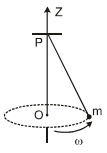
A
$\vec{L}_O$ and $\vec{L}_P$ do not vary with time.
B
$\vec{L}_O$ varies with time while $\vec{L}_P$ remains constant.
C
$\vec{L}_O$ remains constant while $\vec{L}_P$ varies with time.
D
$\vec{L}_O$ and $\vec{L}_P$ both vary with time.
Solution
(C) The angular momentum about a point is given by $\vec{L} = \vec{r} \times \vec{p} = \vec{r} \times (m\vec{v})$.
For point $O$ (the center of the circle),the position vector $\vec{r}$ is in the $x-y$ plane and the velocity $\vec{v}$ is tangential to the circle. The angular momentum $\vec{L}_O = \vec{r} \times m\vec{v}$ is directed along the $z$-axis (perpendicular to the plane of motion). Since the speed and radius are constant,the magnitude and direction of $\vec{L}_O$ remain constant.
For point $P$ (a point on the $z$-axis),the position vector $\vec{r}'$ from $P$ to the mass $m$ changes direction as the mass moves in a circle. Consequently,the cross product $\vec{L}_P = \vec{r}' \times m\vec{v}$ changes its direction continuously as the mass rotates,even though its magnitude remains constant. Therefore,$\vec{L}_P$ varies with time.
Thus,$\vec{L}_O$ remains constant while $\vec{L}_P$ varies with time.
For point $O$ (the center of the circle),the position vector $\vec{r}$ is in the $x-y$ plane and the velocity $\vec{v}$ is tangential to the circle. The angular momentum $\vec{L}_O = \vec{r} \times m\vec{v}$ is directed along the $z$-axis (perpendicular to the plane of motion). Since the speed and radius are constant,the magnitude and direction of $\vec{L}_O$ remain constant.
For point $P$ (a point on the $z$-axis),the position vector $\vec{r}'$ from $P$ to the mass $m$ changes direction as the mass moves in a circle. Consequently,the cross product $\vec{L}_P = \vec{r}' \times m\vec{v}$ changes its direction continuously as the mass rotates,even though its magnitude remains constant. Therefore,$\vec{L}_P$ varies with time.
Thus,$\vec{L}_O$ remains constant while $\vec{L}_P$ varies with time.
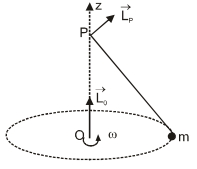
0 likes
View Solution99
AdvancedMCQ
$A$ thin uniform rod of length $L$ and mass $m$ is kept on a frictionless horizontal table with a massless string of length $L$ fixed to one end (top view is shown in the figure). The other end of the string is pivoted to a point $O$. If a horizontal impulse $P$ is imparted to the rod at a distance $x = L/n$ from the mid-point of the rod (see figure), then the rod and string revolve together around the point $O$, with the rod remaining aligned with the string. In such a case, the value of $n$ is:
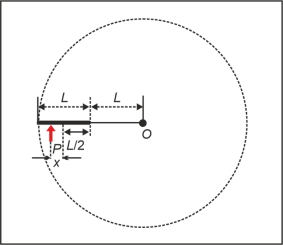
A
$10$
B
$15$
C
$18$
D
$20$
Solution
(C) Let the mass of the rod be $m$. The distance of the center of mass of the rod from the pivot $O$ is $r_{cm} = L + L/2 = 3L/2$.
Linear impulse $P = \Delta p = m v_{cm} = m (\omega r_{cm}) = m \omega (3L/2)$.
Thus, $P = \frac{3}{2} m \omega L$ --- $(i)$
Angular impulse about pivot $O$ is $J_{\theta} = \int \tau dt = \Delta L_{ang}$.
The impulse $P$ is applied at a distance $r = L + L/2 - x = 3L/2 - x$ from the pivot $O$ (based on the figure, the impulse is at $x$ from the midpoint towards the pivot end).
$P (3L/2 - x) = I_O \omega$, where $I_O$ is the moment of inertia about $O$.
$I_O = I_{cm} + m(r_{cm})^2 = \frac{mL^2}{12} + m(3L/2)^2 = mL^2 (\frac{1}{12} + \frac{9}{4}) = mL^2 (\frac{1+27}{12}) = \frac{28}{12} mL^2 = \frac{7}{3} mL^2$.
So, $P (3L/2 - x) = (\frac{7}{3} mL^2) \omega$ --- $(ii)$
Dividing $(ii)$ by $(i)$:
$\frac{P(3L/2 - x)}{P} = \frac{(7/3) mL^2 \omega}{(3/2) m \omega L}$
$3L/2 - x = \frac{7}{3} \cdot \frac{2}{3} L = \frac{14}{9} L$
$x = \frac{3}{2} L - \frac{14}{9} L = \frac{27-28}{18} L$. Since $x$ is a distance, we take the magnitude: $x = L/18$.
Comparing $x = L/n$ with $x = L/18$, we get $n = 18$.
Linear impulse $P = \Delta p = m v_{cm} = m (\omega r_{cm}) = m \omega (3L/2)$.
Thus, $P = \frac{3}{2} m \omega L$ --- $(i)$
Angular impulse about pivot $O$ is $J_{\theta} = \int \tau dt = \Delta L_{ang}$.
The impulse $P$ is applied at a distance $r = L + L/2 - x = 3L/2 - x$ from the pivot $O$ (based on the figure, the impulse is at $x$ from the midpoint towards the pivot end).
$P (3L/2 - x) = I_O \omega$, where $I_O$ is the moment of inertia about $O$.
$I_O = I_{cm} + m(r_{cm})^2 = \frac{mL^2}{12} + m(3L/2)^2 = mL^2 (\frac{1}{12} + \frac{9}{4}) = mL^2 (\frac{1+27}{12}) = \frac{28}{12} mL^2 = \frac{7}{3} mL^2$.
So, $P (3L/2 - x) = (\frac{7}{3} mL^2) \omega$ --- $(ii)$
Dividing $(ii)$ by $(i)$:
$\frac{P(3L/2 - x)}{P} = \frac{(7/3) mL^2 \omega}{(3/2) m \omega L}$
$3L/2 - x = \frac{7}{3} \cdot \frac{2}{3} L = \frac{14}{9} L$
$x = \frac{3}{2} L - \frac{14}{9} L = \frac{27-28}{18} L$. Since $x$ is a distance, we take the magnitude: $x = L/18$.
Comparing $x = L/n$ with $x = L/18$, we get $n = 18$.
0 likes
View Solution100
MediumMCQ
An object of mass $m$ is projected from the origin in a vertical $xy$ plane at an angle $45^{\circ}$ with the $x$-axis with an initial velocity $v_0$. The magnitude and direction of the angular momentum of the object with respect to the origin,when it reaches the maximum height,will be [$g$ is the acceleration due to gravity].
A
$\frac{m v_0^3}{2 \sqrt{2} g}$ along negative $z$-axis
B
$\frac{m v_0^3}{2 \sqrt{2} g}$ along positive $z$-axis
C
$\frac{m v_0^3}{4 \sqrt{2} g}$ along positive $z$-axis
D
$\frac{m v_0^3}{4 \sqrt{2} g}$ along negative $z$-axis
Solution
(D) The initial velocity components are $v_x = v_0 \cos 45^{\circ} = \frac{v_0}{\sqrt{2}}$ and $v_y = v_0 \sin 45^{\circ} = \frac{v_0}{\sqrt{2}}$.
At maximum height $H$,the vertical velocity component is zero,and the horizontal velocity is $v_x = \frac{v_0}{\sqrt{2}}$.
The maximum height $H$ is given by $H = \frac{v_y^2}{2g} = \frac{(v_0/\sqrt{2})^2}{2g} = \frac{v_0^2}{4g}$.
The angular momentum $\vec{L}$ with respect to the origin is $\vec{L} = \vec{r} \times \vec{p} = m(\vec{r} \times \vec{v})$.
At maximum height,the position vector is $\vec{r} = x\hat{i} + H\hat{j}$ and the velocity vector is $\vec{v} = v_x\hat{i}$.
Thus,$\vec{L} = m(x\hat{i} + H\hat{j}) \times (v_x\hat{i}) = mH v_x (\hat{j} \times \hat{i}) = -mH v_x \hat{k}$.
Substituting the values: $L = m \left( \frac{v_0^2}{4g} \right) \left( \frac{v_0}{\sqrt{2}} \right) = \frac{m v_0^3}{4 \sqrt{2} g}$.
The direction is along the negative $z$-axis $(- \hat{k})$.
At maximum height $H$,the vertical velocity component is zero,and the horizontal velocity is $v_x = \frac{v_0}{\sqrt{2}}$.
The maximum height $H$ is given by $H = \frac{v_y^2}{2g} = \frac{(v_0/\sqrt{2})^2}{2g} = \frac{v_0^2}{4g}$.
The angular momentum $\vec{L}$ with respect to the origin is $\vec{L} = \vec{r} \times \vec{p} = m(\vec{r} \times \vec{v})$.
At maximum height,the position vector is $\vec{r} = x\hat{i} + H\hat{j}$ and the velocity vector is $\vec{v} = v_x\hat{i}$.
Thus,$\vec{L} = m(x\hat{i} + H\hat{j}) \times (v_x\hat{i}) = mH v_x (\hat{j} \times \hat{i}) = -mH v_x \hat{k}$.
Substituting the values: $L = m \left( \frac{v_0^2}{4g} \right) \left( \frac{v_0}{\sqrt{2}} \right) = \frac{m v_0^3}{4 \sqrt{2} g}$.
The direction is along the negative $z$-axis $(- \hat{k})$.
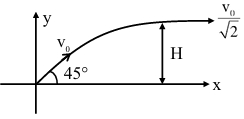
0 likes
View SolutionSystem of Particles and Rotational Motion — Angular Momentum and Angular Impulse · Frequently Asked Questions
1Are these System of Particles and Rotational Motion questions useful for JEE and NEET?
Yes. All questions in this section are mapped to JEE Main and NEET exam patterns. Previous year questions from JEE Main, NEET, GUJCET and state-level exams are included with full solutions.
2Can I switch to Hindi or Gujarati for these questions?
Yes. Use the language tabs in the hero section or the sidebar to view the same questions and solutions in English, Hindi or Gujarati.
3How do I generate a question paper from this subtopic?
Use the Vedclass Exam Paper Generator — select the chapter and subtopic, set difficulty, and generate Sets A, B, C, D automatically. First 3 chapters of every subject are free.
Vedclass Products
For Students
Vedclass Test Series
Mock tests in real JEE/NEET style with performance analysis. 5-day free trial.
Start Free TrialFor Teachers
Exam Paper Generator
Generate Set A/B/C/D papers from this chapter in 2 minutes. 3 chapters free.
Try FreeFor Institutes
Online Exam Module
Live online exams with unlimited students, 360° analytics & white-label branding.
See DemoFor Teachers & Institutes
Generate a System of Particles and Rotational Motion Exam Paper in 2 Minutes
Select subtopic & difficulty — Sets A, B, C, D auto-generated with No Repeat logic.
First 3 chapters of every subject are free — no payment required.