
A English
Angular Momentum and Angular Impulse Questions in English
Class 11 Physics · System of Particles and Rotational Motion · Angular Momentum and Angular Impulse
120+
Questions
English
Language
100%
With Solutions
Showing 19 of 120 questions in English
101
DifficultMCQ
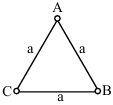
Three equal masses $m$ are kept at vertices $(A, B, C)$ of an equilateral triangle of side $a$ in free space. At $t = 0$,they are given an initial velocity $\vec{V}_A = V_0 \hat{u}_{AC}, \vec{V}_B = V_0 \hat{u}_{BA}$ and $\vec{V}_C = V_0 \hat{u}_{CB}$. Here,$\hat{u}_{AC}, \hat{u}_{CB}$ and $\hat{u}_{BA}$ are unit vectors along the edges of the triangle. If the three masses interact gravitationally,then the magnitude of the net angular momentum of the system about the centroid of the triangle is:
A
$\frac{1}{2} a m V_0$
B
$3 a m V_0$
C
$\frac{\sqrt{3}}{2} a m V_0$
D
$\frac{3}{2} a m V_0$
Solution
(C) The angular momentum of a particle about a point is given by $\vec{L} = \vec{r} \times \vec{p} = m(\vec{r} \times \vec{v})$.
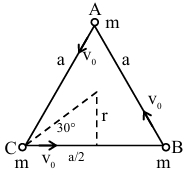
For each mass,the perpendicular distance $r_{\perp}$ from the centroid of the equilateral triangle to the velocity vector (which lies along the side) is the distance from the centroid to the side.
In an equilateral triangle of side $a$,the distance from the centroid to any side is $r_{\perp} = \frac{a}{2\sqrt{3}}$.
The velocity of each mass is $V_0$ directed along the sides of the triangle.
The angular momentum of one mass about the centroid is $L_1 = m V_0 r_{\perp} = m V_0 \left( \frac{a}{2\sqrt{3}} \right)$.
Since the velocities are directed such that all three masses contribute to the angular momentum in the same rotational sense (clockwise or counter-clockwise),the total angular momentum is $L = 3 \times L_1$.
$L = 3 \times m V_0 \left( \frac{a}{2\sqrt{3}} \right) = \frac{3}{2\sqrt{3}} m V_0 a = \frac{\sqrt{3}}{2} m V_0 a$.
For each mass,the perpendicular distance $r_{\perp}$ from the centroid of the equilateral triangle to the velocity vector (which lies along the side) is the distance from the centroid to the side.
In an equilateral triangle of side $a$,the distance from the centroid to any side is $r_{\perp} = \frac{a}{2\sqrt{3}}$.
The velocity of each mass is $V_0$ directed along the sides of the triangle.
The angular momentum of one mass about the centroid is $L_1 = m V_0 r_{\perp} = m V_0 \left( \frac{a}{2\sqrt{3}} \right)$.
Since the velocities are directed such that all three masses contribute to the angular momentum in the same rotational sense (clockwise or counter-clockwise),the total angular momentum is $L = 3 \times L_1$.
$L = 3 \times m V_0 \left( \frac{a}{2\sqrt{3}} \right) = \frac{3}{2\sqrt{3}} m V_0 a = \frac{\sqrt{3}}{2} m V_0 a$.
0 likes
View Solution102
EasyMCQ
$A$ particle having mass $4 \ kg$ is moving with velocity $(4 \hat{i} + 2 \hat{j}) \ m/s$. Find the angular momentum of the particle about the origin when it is at position $(1, 1, 0) \ m$.
A
$-8 \hat{k} \ kg \cdot m^2/s$
B
$-16 \hat{k} \ kg \cdot m^2/s$
C
$-4 \hat{k} \ kg \cdot m^2/s$
D
$-6 \hat{k} \ kg \cdot m^2/s$
Solution
(A) The position vector of the particle is $\vec{r} = (1 \hat{i} + 1 \hat{j} + 0 \hat{k}) \ m$.
The velocity vector is $\vec{v} = (4 \hat{i} + 2 \hat{j}) \ m/s$ and mass $m = 4 \ kg$.
The angular momentum $\vec{L}$ is given by the cross product $\vec{L} = \vec{r} \times \vec{p} = \vec{r} \times (m \vec{v})$.
Substituting the values: $\vec{L} = (\hat{i} + \hat{j}) \times [4 \times (4 \hat{i} + 2 \hat{j})]$.
$\vec{L} = (\hat{i} + \hat{j}) \times (16 \hat{i} + 8 \hat{j})$.
Calculating the cross product: $\vec{L} = 16(\hat{i} \times \hat{i}) + 8(\hat{i} \times \hat{j}) + 16(\hat{j} \times \hat{i}) + 8(\hat{j} \times \hat{j})$.
Since $\hat{i} \times \hat{i} = 0$,$\hat{j} \times \hat{j} = 0$,$\hat{i} \times \hat{j} = \hat{k}$,and $\hat{j} \times \hat{i} = -\hat{k}$.
$\vec{L} = 0 + 8(\hat{k}) + 16(-\hat{k}) + 0 = 8 \hat{k} - 16 \hat{k} = -8 \hat{k} \ kg \cdot m^2/s$.
The velocity vector is $\vec{v} = (4 \hat{i} + 2 \hat{j}) \ m/s$ and mass $m = 4 \ kg$.
The angular momentum $\vec{L}$ is given by the cross product $\vec{L} = \vec{r} \times \vec{p} = \vec{r} \times (m \vec{v})$.
Substituting the values: $\vec{L} = (\hat{i} + \hat{j}) \times [4 \times (4 \hat{i} + 2 \hat{j})]$.
$\vec{L} = (\hat{i} + \hat{j}) \times (16 \hat{i} + 8 \hat{j})$.
Calculating the cross product: $\vec{L} = 16(\hat{i} \times \hat{i}) + 8(\hat{i} \times \hat{j}) + 16(\hat{j} \times \hat{i}) + 8(\hat{j} \times \hat{j})$.
Since $\hat{i} \times \hat{i} = 0$,$\hat{j} \times \hat{j} = 0$,$\hat{i} \times \hat{j} = \hat{k}$,and $\hat{j} \times \hat{i} = -\hat{k}$.
$\vec{L} = 0 + 8(\hat{k}) + 16(-\hat{k}) + 0 = 8 \hat{k} - 16 \hat{k} = -8 \hat{k} \ kg \cdot m^2/s$.
0 likes
View Solution103
MediumMCQ
$A$ particle moves along a circular path with decreasing speed. Hence,
A
its resultant acceleration is towards the centre.
B
it moves in a spiral path with decreasing radius.
C
the direction of angular momentum remains constant.
D
its angular momentum remains constant.
Solution
(C) For a particle moving in a circular path,the angular momentum is defined as $\vec{L} = \vec{r} \times \vec{p}$.
The position vector $\vec{r}$ and the linear momentum vector $\vec{p}$ both lie in the plane of the circular motion.
According to the right-hand rule,the direction of the angular momentum vector $\vec{L}$ is perpendicular to the plane of motion.
Since the particle is constrained to move in a fixed circular path,the plane of motion does not change.
Therefore,the direction of the angular momentum vector remains constant throughout the motion,regardless of the change in speed.
The position vector $\vec{r}$ and the linear momentum vector $\vec{p}$ both lie in the plane of the circular motion.
According to the right-hand rule,the direction of the angular momentum vector $\vec{L}$ is perpendicular to the plane of motion.
Since the particle is constrained to move in a fixed circular path,the plane of motion does not change.
Therefore,the direction of the angular momentum vector remains constant throughout the motion,regardless of the change in speed.
0 likes
View Solution104
EasyMCQ
The Earth is assumed to be a sphere of radius $R$ and mass $M$ having a period of rotation $T$. The angular momentum of the Earth about its axis of rotation is
A
$\frac{2 \pi MR^2}{5 T}$
B
$\frac{4 \pi MR^2}{5 T}$
C
$\frac{MR^2 T}{2 \pi}$
D
$\frac{MR^2 T}{4 \pi}$
Solution
(B) The angular momentum $L$ is given by the formula $L = I \omega$,where $I$ is the moment of inertia and $\omega$ is the angular velocity.
For a solid sphere,the moment of inertia about its axis of rotation is $I = \frac{2}{5} MR^2$.
The angular velocity $\omega$ in terms of the period of rotation $T$ is given by $\omega = \frac{2 \pi}{T}$.
Substituting these values into the angular momentum formula:
$L = I \omega = \left( \frac{2}{5} MR^2 \right) \left( \frac{2 \pi}{T} \right)$.
Therefore,$L = \frac{4 \pi MR^2}{5 T}$.
For a solid sphere,the moment of inertia about its axis of rotation is $I = \frac{2}{5} MR^2$.
The angular velocity $\omega$ in terms of the period of rotation $T$ is given by $\omega = \frac{2 \pi}{T}$.
Substituting these values into the angular momentum formula:
$L = I \omega = \left( \frac{2}{5} MR^2 \right) \left( \frac{2 \pi}{T} \right)$.
Therefore,$L = \frac{4 \pi MR^2}{5 T}$.
0 likes
View Solution105
EasyMCQ
$A$ mass '$M$' is moving with constant velocity parallel to the $X$-axis. Its angular momentum with respect to the origin is
A
constant
B
zero
C
decreasing
D
increasing
Solution
(A) The angular momentum $L$ of a particle with respect to the origin is given by the cross product of its position vector $r$ and its linear momentum $p = Mv$.
$L = r \times (Mv)$
Since the mass $M$ is moving with a constant velocity $v$ parallel to the $X$-axis, we can write its position as $r = xi + yj$, where $y$ is the constant perpendicular distance from the $X$-axis.
The velocity vector is $v = vi$.
The angular momentum is $L = (xi + yj) \times (Mvi) = Mv(xi \times i) + Mv(yj \times i)$.
Since $i \times i = 0$ and $j \times i = -k$, we get $L = -Mvyk$.
As $M$, $v$, and $y$ are all constants, the magnitude and direction of the angular momentum $L$ remain constant over time.
$L = r \times (Mv)$
Since the mass $M$ is moving with a constant velocity $v$ parallel to the $X$-axis, we can write its position as $r = xi + yj$, where $y$ is the constant perpendicular distance from the $X$-axis.
The velocity vector is $v = vi$.
The angular momentum is $L = (xi + yj) \times (Mvi) = Mv(xi \times i) + Mv(yj \times i)$.
Since $i \times i = 0$ and $j \times i = -k$, we get $L = -Mvyk$.
As $M$, $v$, and $y$ are all constants, the magnitude and direction of the angular momentum $L$ remain constant over time.
0 likes
View Solution106
MediumMCQ
$A$ mass tied to a string is whirled in a horizontal circular path with a constant angular velocity and its angular momentum is $L$. If the string is now halved,keeping the angular velocity the same,then the new angular momentum will be:
A
$L$
B
$\frac{L}{4}$
C
$2L$
D
$\frac{L}{2}$
Solution
(B) The correct option is $B$.
Concept: Angular momentum $L$ of a particle of mass $m$ moving in a circle of radius $r$ with angular velocity $\omega$ is given by $L = I\omega = mr^2\omega$.
Given that the mass $m$ and angular velocity $\omega$ remain constant.
Initially,$L = m\omega r^2$.
When the length of the string is halved,the new radius becomes $r' = \frac{r}{2}$.
The new angular momentum $L'$ is given by:
$L' = m\omega(r')^2 = m\omega\left(\frac{r}{2}\right)^2$
$L' = m\omega\left(\frac{r^2}{4}\right) = \frac{1}{4}(mr^2\omega)$
$L' = \frac{L}{4}$.
Concept: Angular momentum $L$ of a particle of mass $m$ moving in a circle of radius $r$ with angular velocity $\omega$ is given by $L = I\omega = mr^2\omega$.
Given that the mass $m$ and angular velocity $\omega$ remain constant.
Initially,$L = m\omega r^2$.
When the length of the string is halved,the new radius becomes $r' = \frac{r}{2}$.
The new angular momentum $L'$ is given by:
$L' = m\omega(r')^2 = m\omega\left(\frac{r}{2}\right)^2$
$L' = m\omega\left(\frac{r^2}{4}\right) = \frac{1}{4}(mr^2\omega)$
$L' = \frac{L}{4}$.
0 likes
View Solution107
MediumMCQ
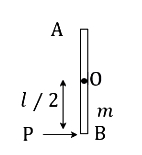
$A$ uniform rod $AB$ of mass $m$ and length $l$ is at rest on a smooth horizontal surface. An impulse $P$ is applied to the end $B$. The time taken by the rod to turn through a right angle is
A
$\frac{\pi}{12} \frac{m l}{P}$
B
$2 \pi \frac{m l}{P}$
C
$2 \frac{\pi P}{m l}$
D
$\frac{\pi P}{m l}$
Solution
(A) Concept: The angular impulse applied to the rod is equal to the change in its angular momentum.
Angular impulse about the center of mass $O$ is given by $J_{\theta} = P \cdot \frac{l}{2}$.
The angular momentum of the rod about its center of mass is $L = I \omega$,where $I = \frac{m l^2}{12}$ is the moment of inertia of the rod about its center.
Equating angular impulse to change in angular momentum:
$P \cdot \frac{l}{2} = I \omega$
$P \cdot \frac{l}{2} = \left( \frac{m l^2}{12} \right) \omega$
Solving for angular velocity $\omega$:
$\omega = \frac{P \cdot l}{2} \cdot \frac{12}{m l^2} = \frac{6 P}{m l}$
The rod rotates with a constant angular velocity $\omega$. The time $\Delta t$ taken to turn through an angle $\Delta \theta = \frac{\pi}{2}$ is:
$\Delta t = \frac{\Delta \theta}{\omega} = \frac{\pi / 2}{6 P / (m l)} = \frac{\pi}{2} \cdot \frac{m l}{6 P} = \frac{\pi m l}{12 P}$
Angular impulse about the center of mass $O$ is given by $J_{\theta} = P \cdot \frac{l}{2}$.
The angular momentum of the rod about its center of mass is $L = I \omega$,where $I = \frac{m l^2}{12}$ is the moment of inertia of the rod about its center.
Equating angular impulse to change in angular momentum:
$P \cdot \frac{l}{2} = I \omega$
$P \cdot \frac{l}{2} = \left( \frac{m l^2}{12} \right) \omega$
Solving for angular velocity $\omega$:
$\omega = \frac{P \cdot l}{2} \cdot \frac{12}{m l^2} = \frac{6 P}{m l}$
The rod rotates with a constant angular velocity $\omega$. The time $\Delta t$ taken to turn through an angle $\Delta \theta = \frac{\pi}{2}$ is:
$\Delta t = \frac{\Delta \theta}{\omega} = \frac{\pi / 2}{6 P / (m l)} = \frac{\pi}{2} \cdot \frac{m l}{6 P} = \frac{\pi m l}{12 P}$
0 likes
View Solution108
MediumMCQ
Two bodies rotate with kinetic energies $E_1$ and $E_2$. Their moments of inertia about their axes of rotation are $I_1$ and $I_2$. If $I_1 = \frac{I_2}{3}$ and $E_1 = 27 E_2$,then the ratio of their angular momenta $L_1$ to $L_2$ is:
A
$1: 3$
B
$3: 1$
C
$1: 1$
D
$2: 1$
Solution
(B) The rotational kinetic energy $E$ is given by $E = \frac{L^2}{2I}$,where $L$ is the angular momentum and $I$ is the moment of inertia.
From this,we can write $L = \sqrt{2IE}$.
Given $I_1 = \frac{I_2}{3} \implies I_2 = 3I_1$ and $E_1 = 27E_2$.
The ratio of angular momenta is $\frac{L_1}{L_2} = \frac{\sqrt{2I_1E_1}}{\sqrt{2I_2E_2}}$.
Substituting the given values:
$\frac{L_1}{L_2} = \sqrt{\frac{I_1}{I_2} \cdot \frac{E_1}{E_2}} = \sqrt{\frac{I_1}{3I_1} \cdot \frac{27E_2}{E_2}}$.
$\frac{L_1}{L_2} = \sqrt{\frac{1}{3} \cdot 27} = \sqrt{9} = 3$.
Thus,the ratio $L_1 : L_2$ is $3: 1$.
From this,we can write $L = \sqrt{2IE}$.
Given $I_1 = \frac{I_2}{3} \implies I_2 = 3I_1$ and $E_1 = 27E_2$.
The ratio of angular momenta is $\frac{L_1}{L_2} = \frac{\sqrt{2I_1E_1}}{\sqrt{2I_2E_2}}$.
Substituting the given values:
$\frac{L_1}{L_2} = \sqrt{\frac{I_1}{I_2} \cdot \frac{E_1}{E_2}} = \sqrt{\frac{I_1}{3I_1} \cdot \frac{27E_2}{E_2}}$.
$\frac{L_1}{L_2} = \sqrt{\frac{1}{3} \cdot 27} = \sqrt{9} = 3$.
Thus,the ratio $L_1 : L_2$ is $3: 1$.
0 likes
View Solution109
EasyMCQ
$A$ particle with position vector $\overrightarrow{r}$ has a linear momentum $\overrightarrow{p}$. Which one of the following statements is true in respect of its angular momentum $\overrightarrow{L}$ about the origin?
A
$\overrightarrow{L}$ acts along $\overrightarrow{p}$
B
$\overrightarrow{L}$ is maximum when $\overrightarrow{p}$ is perpendicular to $\overrightarrow{r}$
C
$\overrightarrow{L}$ acts along $\overrightarrow{r}$
D
$\overrightarrow{L}$ is maximum when $\overrightarrow{p}$ and $\overrightarrow{r}$ are parallel
Solution
(B) The angular momentum of a particle is defined by the cross product of its position vector and linear momentum: $\overrightarrow{L} = \overrightarrow{r} \times \overrightarrow{p}$.
By the properties of the cross product,the vector $\overrightarrow{L}$ is perpendicular to both $\overrightarrow{r}$ and $\overrightarrow{p}$.
The magnitude of the angular momentum is given by $L = rp \sin \theta$,where $\theta$ is the angle between $\overrightarrow{r}$ and $\overrightarrow{p}$.
For the magnitude $L$ to be maximum,$\sin \theta$ must be maximum,which occurs when $\theta = 90^{\circ}$.
Therefore,$\overrightarrow{L}$ is maximum when $\overrightarrow{p}$ is perpendicular to $\overrightarrow{r}$.
By the properties of the cross product,the vector $\overrightarrow{L}$ is perpendicular to both $\overrightarrow{r}$ and $\overrightarrow{p}$.
The magnitude of the angular momentum is given by $L = rp \sin \theta$,where $\theta$ is the angle between $\overrightarrow{r}$ and $\overrightarrow{p}$.
For the magnitude $L$ to be maximum,$\sin \theta$ must be maximum,which occurs when $\theta = 90^{\circ}$.
Therefore,$\overrightarrow{L}$ is maximum when $\overrightarrow{p}$ is perpendicular to $\overrightarrow{r}$.
0 likes
View Solution110
MediumMCQ
$A$ constant torque of $200 \, N-m$ turns a flywheel, which is at rest, about an axis through its centre and perpendicular to its plane. If its moment of inertia is $50 \, kg-m^{2}$, then in $4 \, s$, what will be the change in its angular momentum?
A
$800 \, kg-m^{2}/s$
B
$200 \, kg-m^{2}/s$
C
$40 \, kg-m^{2}/s$
D
$20 \, kg-m^{2}/s$
Solution
(A) The relationship between torque $(\tau)$ and the change in angular momentum $(\Delta L)$ is given by the angular impulse-momentum theorem: $\Delta L = \int \tau dt$.
Since the torque is constant, the change in angular momentum is simply the product of torque and time: $\Delta L = \tau \times \Delta t$.
Given:
Torque $(\tau)$ = $200 \, N-m$
Time $(\Delta t)$ = $4 \, s$
Calculation:
$\Delta L = 200 \, N-m \times 4 \, s = 800 \, kg-m^{2}/s$.
Therefore, the change in angular momentum is $800 \, kg-m^{2}/s$.
Since the torque is constant, the change in angular momentum is simply the product of torque and time: $\Delta L = \tau \times \Delta t$.
Given:
Torque $(\tau)$ = $200 \, N-m$
Time $(\Delta t)$ = $4 \, s$
Calculation:
$\Delta L = 200 \, N-m \times 4 \, s = 800 \, kg-m^{2}/s$.
Therefore, the change in angular momentum is $800 \, kg-m^{2}/s$.
0 likes
View Solution111
EasyMCQ
$A$ torque of $50 \ Nm$ acts on a body for $8 \ s$,which is initially at rest. The change in its angular momentum is:
A
$400 \ kg \cdot m^2/s$
B
$600 \ kg \cdot m^2/s$
C
$1000 \ kg \cdot m^2/s$
D
$800 \ kg \cdot m^2/s$
Solution
(A) The relationship between torque $\tau$ and the change in angular momentum $\Delta L$ is given by the impulse-momentum theorem for rotation: $\Delta L = \int \tau \ dt$.
Since the torque $\tau = 50 \ Nm$ is constant and acts for a time interval $\Delta t = 8 \ s$,the change in angular momentum is:
$\Delta L = \tau \times \Delta t$
$\Delta L = 50 \ Nm \times 8 \ s$
$\Delta L = 400 \ kg \cdot m^2/s$.
Therefore,the change in angular momentum is $400 \ kg \cdot m^2/s$.
Since the torque $\tau = 50 \ Nm$ is constant and acts for a time interval $\Delta t = 8 \ s$,the change in angular momentum is:
$\Delta L = \tau \times \Delta t$
$\Delta L = 50 \ Nm \times 8 \ s$
$\Delta L = 400 \ kg \cdot m^2/s$.
Therefore,the change in angular momentum is $400 \ kg \cdot m^2/s$.
0 likes
View Solution112
MediumMCQ
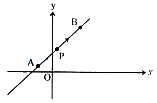
$A$ particle is moving uniformly along a straight line as shown in the figure. During the motion of the particle from $A$ to $B$,the angular momentum of the particle about '$O$' is:
A
remains constant
B
increases
C
first increases then decreases
D
decreases
Solution
(A) The angular momentum $L$ of a particle about a point $O$ is given by the cross product $L = \vec{r} \times \vec{p} = \vec{r} \times (m\vec{v})$.
The magnitude of angular momentum is $L = mvr \sin(\theta)$,where $r$ is the position vector of the particle from the origin $O$,$v$ is the velocity,and $\theta$ is the angle between $\vec{r}$ and $\vec{v}$.
This can also be written as $L = mv d$,where $d = r \sin(\theta)$ is the perpendicular distance from the origin $O$ to the line of motion of the particle.
Since the particle is moving along a straight line,the perpendicular distance $d$ from the origin $O$ to the line of motion remains constant throughout the motion.
Since the mass $m$ and the speed $v$ are also constant (uniform motion),the product $mvd$ remains constant.
Therefore,the angular momentum of the particle about $O$ remains constant during the motion from $A$ to $B$.
The magnitude of angular momentum is $L = mvr \sin(\theta)$,where $r$ is the position vector of the particle from the origin $O$,$v$ is the velocity,and $\theta$ is the angle between $\vec{r}$ and $\vec{v}$.
This can also be written as $L = mv d$,where $d = r \sin(\theta)$ is the perpendicular distance from the origin $O$ to the line of motion of the particle.
Since the particle is moving along a straight line,the perpendicular distance $d$ from the origin $O$ to the line of motion remains constant throughout the motion.
Since the mass $m$ and the speed $v$ are also constant (uniform motion),the product $mvd$ remains constant.
Therefore,the angular momentum of the particle about $O$ remains constant during the motion from $A$ to $B$.
0 likes
View Solution113
EasyMCQ
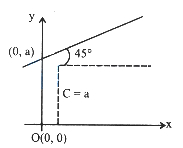
$A$ particle of mass $m$ is moving along a line $y = x + a$ with a constant velocity $v$. The angular momentum of the particle about the origin is
A
$mva$
B
$mva \sqrt{2}$
C
$\frac{mva}{\sqrt{2}}$
D
$\frac{mva}{x \sqrt{2}}$
Solution
(C) The equation of the line is $y = x + a$. Comparing this with the slope-intercept form $y = mx + c$,we get the slope $m_{slope} = 1$. Since $\tan \theta = m_{slope} = 1$,the angle $\theta = 45^{\circ}$.
The velocity vector $\vec{v}$ makes an angle of $45^{\circ}$ with the positive $x$-axis. Thus,$\vec{v} = v \cos 45^{\circ} \hat{i} + v \sin 45^{\circ} \hat{j} = \frac{v}{\sqrt{2}} (\hat{i} + \hat{j})$.
The angular momentum $\vec{L}$ about the origin is given by $\vec{L} = \vec{r} \times \vec{p} = m (\vec{r} \times \vec{v})$.
The perpendicular distance $d$ from the origin $(0, 0)$ to the line $x - y + a = 0$ is given by $d = \frac{|(1)(0) - (1)(0) + a|}{\sqrt{1^2 + (-1)^2}} = \frac{a}{\sqrt{2}}$.
The magnitude of angular momentum is $L = mvd = m v \left( \frac{a}{\sqrt{2}} \right) = \frac{mva}{\sqrt{2}}$.
The velocity vector $\vec{v}$ makes an angle of $45^{\circ}$ with the positive $x$-axis. Thus,$\vec{v} = v \cos 45^{\circ} \hat{i} + v \sin 45^{\circ} \hat{j} = \frac{v}{\sqrt{2}} (\hat{i} + \hat{j})$.
The angular momentum $\vec{L}$ about the origin is given by $\vec{L} = \vec{r} \times \vec{p} = m (\vec{r} \times \vec{v})$.
The perpendicular distance $d$ from the origin $(0, 0)$ to the line $x - y + a = 0$ is given by $d = \frac{|(1)(0) - (1)(0) + a|}{\sqrt{1^2 + (-1)^2}} = \frac{a}{\sqrt{2}}$.
The magnitude of angular momentum is $L = mvd = m v \left( \frac{a}{\sqrt{2}} \right) = \frac{mva}{\sqrt{2}}$.
0 likes
View Solution114
MediumMCQ
The diameter of a flywheel is $1 \,m$. It has a mass of $20 \,kg$. It is rotating about its axis with a speed of $120$ rotations in one minute. Its angular momentum in $kg-m^2/s$ is (in $4$)
A
$13$
B
$31$
C
$41$
D
$43$
Solution
(B) Given: Diameter $D = 1 \,m$,so radius $r = 0.5 \,m$. Mass $m = 20 \,kg$. Frequency $n = 120$ rotations per minute $= 2$ rotations per second.
The moment of inertia $I$ of a flywheel (disk) about its axis is $I = \frac{1}{2}mr^2$.
The angular velocity $\omega = 2\pi n = 2 \times 3.14 \times 2 = 12.56 \,rad/s$.
Angular momentum $L = I\omega = (\frac{1}{2}mr^2) \times (2\pi n)$.
Substituting the values: $L = \frac{20 \times (0.5)^2}{2} \times 2 \times 3.14 \times 2$.
$L = 5 \times 3.14 \times 2 = 31.4 \,kg-m^2/s$.
The moment of inertia $I$ of a flywheel (disk) about its axis is $I = \frac{1}{2}mr^2$.
The angular velocity $\omega = 2\pi n = 2 \times 3.14 \times 2 = 12.56 \,rad/s$.
Angular momentum $L = I\omega = (\frac{1}{2}mr^2) \times (2\pi n)$.
Substituting the values: $L = \frac{20 \times (0.5)^2}{2} \times 2 \times 3.14 \times 2$.
$L = 5 \times 3.14 \times 2 = 31.4 \,kg-m^2/s$.
0 likes
View Solution115
MediumMCQ
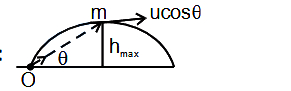
$A$ body of mass $m$ is thrown with velocity $u$ from the origin of a coordinate system at an angle $\theta$ with the horizontal. The magnitude of the angular momentum of the particle about the origin at the time $t$ when it is at the maximum height of the trajectory is proportional to
A
$u$
B
$u^2$
C
$u^3$
D
independent of $u$
Solution
(C) The angular momentum $\vec{L}$ of a particle about the origin is given by $\vec{L} = \vec{r} \times \vec{p}$.
At the maximum height,the velocity of the particle is purely horizontal,given by $v_x = u \cos \theta$.
The position vector of the particle at maximum height is $\vec{r} = x \hat{i} + h_{\max} \hat{j}$,where $h_{\max} = \frac{u^2 \sin^2 \theta}{2g}$.
The momentum is $\vec{p} = m v_x \hat{i} = m u \cos \theta \hat{i}$.
The angular momentum is $\vec{L} = (x \hat{i} + h_{\max} \hat{j}) \times (m u \cos \theta \hat{i}) = -m u \cos \theta h_{\max} \hat{k}$.
The magnitude is $L = m u \cos \theta \left( \frac{u^2 \sin^2 \theta}{2g} \right) = \frac{m u^3 \sin^2 \theta \cos \theta}{2g}$.
Thus,$L \propto u^3$.
At the maximum height,the velocity of the particle is purely horizontal,given by $v_x = u \cos \theta$.
The position vector of the particle at maximum height is $\vec{r} = x \hat{i} + h_{\max} \hat{j}$,where $h_{\max} = \frac{u^2 \sin^2 \theta}{2g}$.
The momentum is $\vec{p} = m v_x \hat{i} = m u \cos \theta \hat{i}$.
The angular momentum is $\vec{L} = (x \hat{i} + h_{\max} \hat{j}) \times (m u \cos \theta \hat{i}) = -m u \cos \theta h_{\max} \hat{k}$.
The magnitude is $L = m u \cos \theta \left( \frac{u^2 \sin^2 \theta}{2g} \right) = \frac{m u^3 \sin^2 \theta \cos \theta}{2g}$.
Thus,$L \propto u^3$.
0 likes
View Solution116
DifficultMCQ
The position vector of a particle of mass $m$ moving with a constant velocity $\vec{v} = v \hat{i}$ is given by $\vec{r} = x(t) \hat{i} + b \hat{j}$,where $b$ is a constant. At an instant,$\vec{r}$ makes an angle $\theta$ with the $x$-axis. The variation of the magnitude of the angular momentum $|\vec{L}|$ of the particle about the origin with $\theta$ will be:
A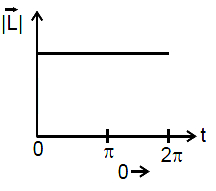
$A$
B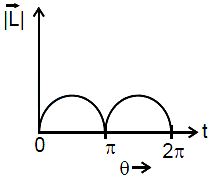
$B$
C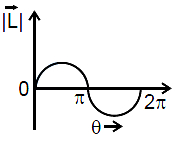
$C$
D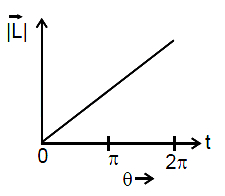
$D$
Solution
(A) The angular momentum $\vec{L}$ of a particle about the origin is given by $\vec{L} = \vec{r} \times \vec{p} = \vec{r} \times (m\vec{v})$.
Given $\vec{r} = x(t) \hat{i} + b \hat{j}$ and $\vec{v} = v \hat{i}$.
$\vec{L} = (x(t) \hat{i} + b \hat{j}) \times (m v \hat{i}) = x(t) m v (\hat{i} \times \hat{i}) + b m v (\hat{j} \times \hat{i})$.
Since $\hat{i} \times \hat{i} = 0$ and $\hat{j} \times \hat{i} = -\hat{k}$,we get $\vec{L} = -b m v \hat{k}$.
The magnitude of the angular momentum is $|\vec{L}| = | -b m v | = b m v$.
Since $b$,$m$,and $v$ are all constants,the magnitude of the angular momentum $|\vec{L}|$ is constant and independent of the angle $\theta$.
Therefore,the graph of $|\vec{L}|$ versus $\theta$ is a horizontal straight line.
Given $\vec{r} = x(t) \hat{i} + b \hat{j}$ and $\vec{v} = v \hat{i}$.
$\vec{L} = (x(t) \hat{i} + b \hat{j}) \times (m v \hat{i}) = x(t) m v (\hat{i} \times \hat{i}) + b m v (\hat{j} \times \hat{i})$.
Since $\hat{i} \times \hat{i} = 0$ and $\hat{j} \times \hat{i} = -\hat{k}$,we get $\vec{L} = -b m v \hat{k}$.
The magnitude of the angular momentum is $|\vec{L}| = | -b m v | = b m v$.
Since $b$,$m$,and $v$ are all constants,the magnitude of the angular momentum $|\vec{L}|$ is constant and independent of the angle $\theta$.
Therefore,the graph of $|\vec{L}|$ versus $\theta$ is a horizontal straight line.
0 likes
View Solution117
MediumMCQ
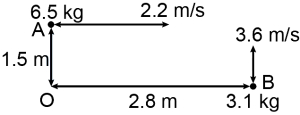
Two particles $A$ and $B$ are moving as shown in the figure. Their total angular momentum about the point $O$ is
A
$9.8 \ kg \ m^2/s$
B
zero
C
$52.7 \ kg \ m^2/s$
D
$37.9 \ kg \ m^2/s$
Solution
(A) The angular momentum $L$ of a particle about a point $O$ is given by $L = \vec{r} \times \vec{p} = m(\vec{r} \times \vec{v})$. The magnitude is $L = mvr \sin \theta$,where $r \sin \theta$ is the perpendicular distance from $O$ to the line of motion.
For particle $A$: $m_A = 6.5 \ kg$,$v_A = 2.2 \ m/s$,and the perpendicular distance $r_A = 1.5 \ m$. The motion is clockwise,so $L_A = -m_A v_A r_A = -(6.5 \times 2.2 \times 1.5) = -21.45 \ kg \ m^2/s$.
For particle $B$: $m_B = 3.1 \ kg$,$v_B = 3.6 \ m/s$,and the perpendicular distance $r_B = 2.8 \ m$. The motion is counter-clockwise,so $L_B = +m_B v_B r_B = +(3.1 \times 3.6 \times 2.8) = +31.248 \ kg \ m^2/s$.
The total angular momentum is $L = L_A + L_B = -21.45 + 31.248 = 9.798 \ kg \ m^2/s \approx 9.8 \ kg \ m^2/s$.
For particle $A$: $m_A = 6.5 \ kg$,$v_A = 2.2 \ m/s$,and the perpendicular distance $r_A = 1.5 \ m$. The motion is clockwise,so $L_A = -m_A v_A r_A = -(6.5 \times 2.2 \times 1.5) = -21.45 \ kg \ m^2/s$.
For particle $B$: $m_B = 3.1 \ kg$,$v_B = 3.6 \ m/s$,and the perpendicular distance $r_B = 2.8 \ m$. The motion is counter-clockwise,so $L_B = +m_B v_B r_B = +(3.1 \times 3.6 \times 2.8) = +31.248 \ kg \ m^2/s$.
The total angular momentum is $L = L_A + L_B = -21.45 + 31.248 = 9.798 \ kg \ m^2/s \approx 9.8 \ kg \ m^2/s$.
0 likes
View Solution118
DifficultMCQ
When the position vector $\vec{r} = x\hat{i} + y\hat{j} + z\hat{k}$ changes sign to $-\vec{r}$,which one of the following vectors will not flip its sign?
A
Linear momentum
B
Velocity
C
Acceleration
D
Angular momentum
Solution
(D) The position vector is given by $\vec{r} = x\hat{i} + y\hat{j} + z\hat{k}$.
When $\vec{r} \rightarrow -\vec{r}$,the velocity vector $\vec{v} = \frac{d\vec{r}}{dt}$ also changes sign to $-\vec{v}$.
Linear momentum $\vec{p} = m\vec{v}$ changes sign to $-m\vec{v} = -\vec{p}$.
Acceleration $\vec{a} = \frac{d\vec{v}}{dt}$ changes sign to $-\vec{a}$.
Angular momentum is defined as $\vec{L} = \vec{r} \times \vec{p} = \vec{r} \times (m\vec{v})$.
When $\vec{r} \rightarrow -\vec{r}$ and $\vec{v} \rightarrow -\vec{v}$,the new angular momentum $\vec{L}' = (-\vec{r}) \times (-m\vec{v}) = (-1)(-1)(\vec{r} \times m\vec{v}) = \vec{L}$.
Thus,the angular momentum does not flip its sign.
When $\vec{r} \rightarrow -\vec{r}$,the velocity vector $\vec{v} = \frac{d\vec{r}}{dt}$ also changes sign to $-\vec{v}$.
Linear momentum $\vec{p} = m\vec{v}$ changes sign to $-m\vec{v} = -\vec{p}$.
Acceleration $\vec{a} = \frac{d\vec{v}}{dt}$ changes sign to $-\vec{a}$.
Angular momentum is defined as $\vec{L} = \vec{r} \times \vec{p} = \vec{r} \times (m\vec{v})$.
When $\vec{r} \rightarrow -\vec{r}$ and $\vec{v} \rightarrow -\vec{v}$,the new angular momentum $\vec{L}' = (-\vec{r}) \times (-m\vec{v}) = (-1)(-1)(\vec{r} \times m\vec{v}) = \vec{L}$.
Thus,the angular momentum does not flip its sign.
0 likes
View Solution119
EasyMCQ
Two cars $A$ and $B$ each of mass $10^3 \text{ kg}$ are moving on parallel tracks separated by a distance of $10 \text{ m}$,in the same direction with speeds $72 \text{ km/h}$ and $36 \text{ km/h}$. The magnitude of angular momentum of car $A$ with respect to car $B$ is . . . . . . $\text{J} \cdot \text{s}$.
A
$3.6 \times 10^5$
B
$10^5$
C
$3 \times 10^5$
D
$2 \times 10^5$
Solution
(B) The angular momentum of a particle relative to another particle is given by $L = m \cdot v_{\text{rel}} \cdot r_{\perp}$.
Here,the mass of car $A$ is $m = 10^3 \text{ kg}$.
The relative velocity of car $A$ with respect to car $B$ is $v_{\text{rel}} = v_A - v_B = 72 \text{ km/h} - 36 \text{ km/h} = 36 \text{ km/h}$.
Converting the relative velocity to $SI$ units: $v_{\text{rel}} = 36 \times \frac{5}{18} \text{ m/s} = 10 \text{ m/s}$.
The perpendicular distance between the tracks is $r_{\perp} = 10 \text{ m}$.
Substituting these values into the formula: $L = 1000 \times 10 \times 10 = 10^5 \text{ kg} \cdot \text{m}^2/\text{s}$ (or $\text{J} \cdot \text{s}$).
Here,the mass of car $A$ is $m = 10^3 \text{ kg}$.
The relative velocity of car $A$ with respect to car $B$ is $v_{\text{rel}} = v_A - v_B = 72 \text{ km/h} - 36 \text{ km/h} = 36 \text{ km/h}$.
Converting the relative velocity to $SI$ units: $v_{\text{rel}} = 36 \times \frac{5}{18} \text{ m/s} = 10 \text{ m/s}$.
The perpendicular distance between the tracks is $r_{\perp} = 10 \text{ m}$.
Substituting these values into the formula: $L = 1000 \times 10 \times 10 = 10^5 \text{ kg} \cdot \text{m}^2/\text{s}$ (or $\text{J} \cdot \text{s}$).
0 likes
View SolutionSystem of Particles and Rotational Motion — Angular Momentum and Angular Impulse · Frequently Asked Questions
1Are these System of Particles and Rotational Motion questions useful for JEE and NEET?
Yes. All questions in this section are mapped to JEE Main and NEET exam patterns. Previous year questions from JEE Main, NEET, GUJCET and state-level exams are included with full solutions.
2Can I switch to Hindi or Gujarati for these questions?
Yes. Use the language tabs in the hero section or the sidebar to view the same questions and solutions in English, Hindi or Gujarati.
3How do I generate a question paper from this subtopic?
Use the Vedclass Exam Paper Generator — select the chapter and subtopic, set difficulty, and generate Sets A, B, C, D automatically. First 3 chapters of every subject are free.
Vedclass Products
For Students
Vedclass Test Series
Mock tests in real JEE/NEET style with performance analysis. 5-day free trial.
Start Free TrialFor Teachers
Exam Paper Generator
Generate Set A/B/C/D papers from this chapter in 2 minutes. 3 chapters free.
Try FreeFor Institutes
Online Exam Module
Live online exams with unlimited students, 360° analytics & white-label branding.
See DemoFor Teachers & Institutes
Generate a System of Particles and Rotational Motion Exam Paper in 2 Minutes
Select subtopic & difficulty — Sets A, B, C, D auto-generated with No Repeat logic.
First 3 chapters of every subject are free — no payment required.