
A English
Variable Mass System and Rocket Problem Questions in English
Class 11 Physics · Newton's Laws of Motion and Friction · Variable Mass System and Rocket Problem
90+
Questions
English
Language
100%
With Solutions
Showing 38 of 90 questions in English
51
EasyMCQ
In the first second of its flight,a rocket ejects $1/60$ of its mass with a velocity of $2400\,m/s$. The acceleration of the rocket is ............ $m/s^2$.
A
$19.6$
B
$30.2$
C
$40$
D
$49.8$
Solution
(C) The thrust force $F$ exerted on the rocket is given by $F = v_r \left( \frac{dm}{dt} \right)$,where $v_r$ is the relative velocity of the ejected gas and $\frac{dm}{dt}$ is the rate of mass ejection.
Given that the rocket ejects $1/60$ of its mass $m$ in $1$ second,we have $\frac{dm}{dt} = \frac{m}{60} \times \frac{1}{1} = \frac{m}{60}$.
The thrust force is $F = 2400 \times \frac{m}{60} = 40m$.
According to Newton's second law,$F = ma$,so $ma = 40m$.
Therefore,the acceleration $a = 40\,m/s^2$.
Given that the rocket ejects $1/60$ of its mass $m$ in $1$ second,we have $\frac{dm}{dt} = \frac{m}{60} \times \frac{1}{1} = \frac{m}{60}$.
The thrust force is $F = 2400 \times \frac{m}{60} = 40m$.
According to Newton's second law,$F = ma$,so $ma = 40m$.
Therefore,the acceleration $a = 40\,m/s^2$.
0 likes
View Solution52
DifficultMCQ
$A$ rocket is fired vertically up from the ground with a resultant acceleration of $10\,m/s^2$. The fuel is finished in $1\,min$ and it continues to move up. Take $g=10\,m/s^2$.
A
The time from initial in which the rocket is again at the ground is $(120+60\sqrt{2})\,s$.
B
The maximum height reached by the rocket from the ground is $36\,km$.
C
Both $(a)$ and $(b)$.
D
The maximum height reached by the rocket from the ground is $18\,km$.
Solution
(C) During the first phase $(t_1 = 60\,s)$:
Acceleration $a = 10\,m/s^2$.
Height $h_1 = \frac{1}{2}at_1^2 = \frac{1}{2} \times 10 \times (60)^2 = 18000\,m = 18\,km$.
Velocity $v_1 = at_1 = 10 \times 60 = 600\,m/s$.
During the second phase (free fall):
Maximum additional height $h_2 = \frac{v_1^2}{2g} = \frac{600^2}{2 \times 10} = \frac{360000}{20} = 18000\,m = 18\,km$.
Total maximum height $H_{\max} = h_1 + h_2 = 18\,km + 18\,km = 36\,km$.
For total time of flight:
Using $s = ut + \frac{1}{2}at^2$ for the whole journey,where $s = 0$ (displacement from ground):
$0 = v_1 t_2 - \frac{1}{2}g t_2^2$ (where $t_2$ is time after fuel finishes).
$-18000 = 600 t_2 - 5 t_2^2 \implies t_2^2 - 120 t_2 - 3600 = 0$.
Solving for $t_2$: $t_2 = \frac{120 + \sqrt{14400 - 4(1)(-3600)}}{2} = \frac{120 + \sqrt{28800}}{2} = 60 + 60\sqrt{2}\,s$.
Total time $T = t_1 + t_2 = 60 + 60 + 60\sqrt{2} = (120 + 60\sqrt{2})\,s$.
Thus,both $(a)$ and $(b)$ are correct.
Acceleration $a = 10\,m/s^2$.
Height $h_1 = \frac{1}{2}at_1^2 = \frac{1}{2} \times 10 \times (60)^2 = 18000\,m = 18\,km$.
Velocity $v_1 = at_1 = 10 \times 60 = 600\,m/s$.
During the second phase (free fall):
Maximum additional height $h_2 = \frac{v_1^2}{2g} = \frac{600^2}{2 \times 10} = \frac{360000}{20} = 18000\,m = 18\,km$.
Total maximum height $H_{\max} = h_1 + h_2 = 18\,km + 18\,km = 36\,km$.
For total time of flight:
Using $s = ut + \frac{1}{2}at^2$ for the whole journey,where $s = 0$ (displacement from ground):
$0 = v_1 t_2 - \frac{1}{2}g t_2^2$ (where $t_2$ is time after fuel finishes).
$-18000 = 600 t_2 - 5 t_2^2 \implies t_2^2 - 120 t_2 - 3600 = 0$.
Solving for $t_2$: $t_2 = \frac{120 + \sqrt{14400 - 4(1)(-3600)}}{2} = \frac{120 + \sqrt{28800}}{2} = 60 + 60\sqrt{2}\,s$.
Total time $T = t_1 + t_2 = 60 + 60 + 60\sqrt{2} = (120 + 60\sqrt{2})\,s$.
Thus,both $(a)$ and $(b)$ are correct.
0 likes
View Solution53
EasyMCQ
$Assertion$ : $A$ rocket moves forward by pushing the surrounding air backwards.
$Reason$ : It derives the necessary thrust to move forward according to Newton's third law of motion.
$Reason$ : It derives the necessary thrust to move forward according to Newton's third law of motion.
A
If both $Assertion$ and $Reason$ are correct and the $Reason$ is a correct explanation of the $Assertion$.
B
If both $Assertion$ and $Reason$ are correct but $Reason$ is not a correct explanation of the $Assertion$.
C
If the $Assertion$ is correct but $Reason$ is incorrect.
D
If both the $Assertion$ and $Reason$ are incorrect.
Solution
(D) The $Assertion$ is incorrect because a rocket does not require surrounding air to move forward. In fact,rockets operate efficiently in the vacuum of space.
The rocket moves forward by ejecting its own fuel combustion products (exhaust gases) at high velocity backwards. According to Newton's third law of motion,the rocket exerts a force on the gases,and the gases exert an equal and opposite reaction force on the rocket,providing the necessary thrust.
Since the $Assertion$ is false and the $Reason$ is a scientifically correct statement regarding the principle of rocket propulsion (Newton's third law),the correct choice is that the $Assertion$ is incorrect but the $Reason$ is correct. However,based on the provided options,if we consider the $Assertion$ false,the most appropriate classification is that the $Assertion$ is incorrect.
The rocket moves forward by ejecting its own fuel combustion products (exhaust gases) at high velocity backwards. According to Newton's third law of motion,the rocket exerts a force on the gases,and the gases exert an equal and opposite reaction force on the rocket,providing the necessary thrust.
Since the $Assertion$ is false and the $Reason$ is a scientifically correct statement regarding the principle of rocket propulsion (Newton's third law),the correct choice is that the $Assertion$ is incorrect but the $Reason$ is correct. However,based on the provided options,if we consider the $Assertion$ false,the most appropriate classification is that the $Assertion$ is incorrect.
0 likes
View Solution54
MediumMCQ
$A$ rocket with a lift-off mass $20,000\; kg$ is blasted upwards with an initial acceleration of $5.0\; m s^{-2}$. Calculate the initial thrust (force) of the blast.
A
$3 \times 10^{5}\; N$
B
$6 \times 10^{4}\; N$
C
$3 \times 10^{3}\; N$
D
$8 \times 10^{5}\; N$
Solution
(A) Mass of the rocket,$m = 20,000\; kg$.
Initial acceleration,$a = 5.0\; m s^{-2}$.
Acceleration due to gravity,$g = 10\; m s^{-2}$.
Using Newton's second law of motion,the net force acting on the rocket is the difference between the thrust $(F)$ and the weight $(mg)$.
The equation of motion is: $F - mg = ma$.
Rearranging for thrust: $F = m(g + a)$.
Substituting the values: $F = 20,000 \times (10 + 5) = 20,000 \times 15 = 3 \times 10^{5}\; N$.
Initial acceleration,$a = 5.0\; m s^{-2}$.
Acceleration due to gravity,$g = 10\; m s^{-2}$.
Using Newton's second law of motion,the net force acting on the rocket is the difference between the thrust $(F)$ and the weight $(mg)$.
The equation of motion is: $F - mg = ma$.
Rearranging for thrust: $F = m(g + a)$.
Substituting the values: $F = 20,000 \times (10 + 5) = 20,000 \times 15 = 3 \times 10^{5}\; N$.
1 likes
View Solution55
Easy
Can the flight of a rocket be considered projectile motion? Give reasons.
Solution
(N/A) No,the flight of a rocket cannot be considered projectile motion.
Projectile motion is defined as the motion of an object under the sole influence of gravity,where the object is given an initial velocity and then allowed to move freely.
$A$ rocket,however,is propelled by the continuous thrust generated by the combustion of its fuel.
Since the rocket is subject to an external force (thrust) throughout its flight,it does not satisfy the condition of moving solely under the influence of gravity.
Projectile motion is defined as the motion of an object under the sole influence of gravity,where the object is given an initial velocity and then allowed to move freely.
$A$ rocket,however,is propelled by the continuous thrust generated by the combustion of its fuel.
Since the rocket is subject to an external force (thrust) throughout its flight,it does not satisfy the condition of moving solely under the influence of gravity.
0 likes
View Solution56
Easy
Is the formula $\vec{F} = m\vec{a}$ valid in all circumstances? Why?
Solution
(N/A) No,the formula $\vec{F} = m\vec{a}$ is not valid in all circumstances.
Newton's Second Law is fundamentally defined as $\vec{F} = \frac{d\vec{p}}{dt}$,where $\vec{p} = m\vec{v}$ is the linear momentum.
Expanding this,we get $\vec{F} = \frac{d(m\vec{v})}{dt} = m\frac{d\vec{v}}{dt} + \vec{v}\frac{dm}{dt}$.
If the mass $m$ is constant,then $\frac{dm}{dt} = 0$,which simplifies the equation to $\vec{F} = m\vec{a}$.
However,in cases where mass changes (e.g.,rocket propulsion) or at relativistic speeds where mass depends on velocity,the formula $\vec{F} = m\vec{a}$ does not hold.
Newton's Second Law is fundamentally defined as $\vec{F} = \frac{d\vec{p}}{dt}$,where $\vec{p} = m\vec{v}$ is the linear momentum.
Expanding this,we get $\vec{F} = \frac{d(m\vec{v})}{dt} = m\frac{d\vec{v}}{dt} + \vec{v}\frac{dm}{dt}$.
If the mass $m$ is constant,then $\frac{dm}{dt} = 0$,which simplifies the equation to $\vec{F} = m\vec{a}$.
However,in cases where mass changes (e.g.,rocket propulsion) or at relativistic speeds where mass depends on velocity,the formula $\vec{F} = m\vec{a}$ does not hold.
0 likes
View Solution57
Medium
$A$ rocket accelerates straight up by ejecting gas downwards. In a small time interval $\Delta t$,it ejects a gas of mass $\Delta m$ at a relative speed $u$. Calculate the kinetic energy $(KE)$ of the entire system at time $t + \Delta t$ and $t$,and show that the device that ejects gas does work equal to $(\frac{1}{2}) \Delta m u^2$ in this time interval (ignoring gravity).
Solution
(A) Let $M$ be the mass of the rocket at time $t$ and $v$ be its velocity.
In time interval $\Delta t$,the rocket ejects gas of mass $\Delta m$ with a relative speed $u$.
The velocity of the ejected gas with respect to the ground is $(v - u)$.
The velocity of the rocket after time $\Delta t$ becomes $(v + \Delta v)$.
The kinetic energy of the system at time $t$ is $(KE)_t = \frac{1}{2} M v^2$.
At time $t + \Delta t$,the kinetic energy of the system is $(KE)_{t+\Delta t} = \frac{1}{2}(M - \Delta m)(v + \Delta v)^2 + \frac{1}{2} \Delta m(v - u)^2$.
Expanding this,we get $(KE)_{t+\Delta t} \approx \frac{1}{2} M v^2 + M v \Delta v - \Delta m v u + \frac{1}{2} \Delta m u^2$.
From the conservation of momentum,the thrust force $F = M \frac{dv}{dt} = u \frac{dm}{dt}$,so $M \Delta v = \Delta m u$.
Substituting $M \Delta v = \Delta m u$ into the expression for the change in kinetic energy $\Delta K = (KE)_{t+\Delta t} - (KE)_t$:
$\Delta K = (M \Delta v - \Delta m u) v + \frac{1}{2} \Delta m u^2$.
Since $M \Delta v = \Delta m u$,the first term becomes zero.
Thus,$\Delta K = \frac{1}{2} \Delta m u^2$.
By the work-energy theorem,the work done by the internal mechanism is equal to the change in kinetic energy,so $\Delta W = \frac{1}{2} \Delta m u^2$.
In time interval $\Delta t$,the rocket ejects gas of mass $\Delta m$ with a relative speed $u$.
The velocity of the ejected gas with respect to the ground is $(v - u)$.
The velocity of the rocket after time $\Delta t$ becomes $(v + \Delta v)$.
The kinetic energy of the system at time $t$ is $(KE)_t = \frac{1}{2} M v^2$.
At time $t + \Delta t$,the kinetic energy of the system is $(KE)_{t+\Delta t} = \frac{1}{2}(M - \Delta m)(v + \Delta v)^2 + \frac{1}{2} \Delta m(v - u)^2$.
Expanding this,we get $(KE)_{t+\Delta t} \approx \frac{1}{2} M v^2 + M v \Delta v - \Delta m v u + \frac{1}{2} \Delta m u^2$.
From the conservation of momentum,the thrust force $F = M \frac{dv}{dt} = u \frac{dm}{dt}$,so $M \Delta v = \Delta m u$.
Substituting $M \Delta v = \Delta m u$ into the expression for the change in kinetic energy $\Delta K = (KE)_{t+\Delta t} - (KE)_t$:
$\Delta K = (M \Delta v - \Delta m u) v + \frac{1}{2} \Delta m u^2$.
Since $M \Delta v = \Delta m u$,the first term becomes zero.
Thus,$\Delta K = \frac{1}{2} \Delta m u^2$.
By the work-energy theorem,the work done by the internal mechanism is equal to the change in kinetic energy,so $\Delta W = \frac{1}{2} \Delta m u^2$.
0 likes
View Solution58
DifficultMCQ
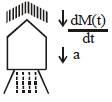
$A$ spaceship in space sweeps stationary interplanetary dust. As a result,its mass increases at a rate $\frac{dM(t)}{dt} = bv^2(t)$,where $v(t)$ is its instantaneous velocity. The instantaneous acceleration of the spaceship is
A
$-\frac{2bv^3}{M(t)}$
B
$-\frac{bv^3}{2M(t)}$
C
$-bv^3(t)$
D
$-\frac{bv^3}{M(t)}$
Solution
(D) The rate of change of mass is given by $\frac{dM(t)}{dt} = bv^2$.
According to Newton's second law for a variable mass system,the thrust force exerted on the spaceship due to the accretion of dust is $F_{\text{thrust}} = -v \frac{dM(t)}{dt}$.
The negative sign indicates that the force acts in the direction opposite to the velocity,causing deceleration.
Using $F = M(t)a$,we have $M(t)a = -v \left( bv^2 \right)$.
Therefore,the instantaneous acceleration is $a = -\frac{bv^3}{M(t)}$.
According to Newton's second law for a variable mass system,the thrust force exerted on the spaceship due to the accretion of dust is $F_{\text{thrust}} = -v \frac{dM(t)}{dt}$.
The negative sign indicates that the force acts in the direction opposite to the velocity,causing deceleration.
Using $F = M(t)a$,we have $M(t)a = -v \left( bv^2 \right)$.
Therefore,the instantaneous acceleration is $a = -\frac{bv^3}{M(t)}$.
0 likes
View Solution59
EasyMCQ
$A$ gun of mass $10 \, kg$ fires $4$ bullets per second. The mass of each bullet is $20 \, g$ and the velocity of the bullet when it leaves the gun is $300 \, m/s$. The force required to hold the gun while firing is (in $N$)
A
$6$
B
$8$
C
$24$
D
$240$
Solution
(C) The force required to hold the gun is equal to the rate of change of momentum of the bullets fired.
The formula for the force is given by $F = n \cdot m \cdot v$,where:
$n$ is the number of bullets fired per second $(4 \, s^{-1})$,
$m$ is the mass of each bullet $(20 \, g = 0.02 \, kg)$,
$v$ is the velocity of the bullet $(300 \, m/s)$.
Substituting the values:
$F = 4 \times 0.02 \, kg \times 300 \, m/s$
$F = 4 \times 6 = 24 \, N$.
Therefore,the force required to hold the gun is $24 \, N$.
The formula for the force is given by $F = n \cdot m \cdot v$,where:
$n$ is the number of bullets fired per second $(4 \, s^{-1})$,
$m$ is the mass of each bullet $(20 \, g = 0.02 \, kg)$,
$v$ is the velocity of the bullet $(300 \, m/s)$.
Substituting the values:
$F = 4 \times 0.02 \, kg \times 300 \, m/s$
$F = 4 \times 6 = 24 \, N$.
Therefore,the force required to hold the gun is $24 \, N$.
0 likes
View Solution60
MediumMCQ
The initial mass of a rocket is $1000 \, \text{kg}$. Calculate at what rate the fuel (in $\text{kg s}^{-1}$) should be burnt so that the rocket is given an acceleration of $20 \, \text{m s}^{-2}$. The gases come out at a relative speed of $500 \, \text{m s}^{-1}$ with respect to the rocket. [Use $g = 10 \, \text{m s}^{-2}$]
A
$600$
B
$500$
C
$10$
D
$60$
Solution
(D) The thrust force exerted on the rocket is given by $F_{\text{thrust}} = \left(\frac{dm}{dt}\right) V_{\text{rel}}$.
The net force acting on the rocket is $F_{\text{net}} = F_{\text{thrust}} - mg = ma$.
Substituting the given values: $m = 1000 \, \text{kg}$,$a = 20 \, \text{m s}^{-2}$,$V_{\text{rel}} = 500 \, \text{m s}^{-1}$,and $g = 10 \, \text{m s}^{-2}$.
$\left(\frac{dm}{dt}\right) \times 500 - (1000 \times 10) = 1000 \times 20$
$\left(\frac{dm}{dt}\right) \times 500 - 10000 = 20000$
$\left(\frac{dm}{dt}\right) \times 500 = 30000$
$\frac{dm}{dt} = \frac{30000}{500} = 60 \, \text{kg s}^{-1}$.
The net force acting on the rocket is $F_{\text{net}} = F_{\text{thrust}} - mg = ma$.
Substituting the given values: $m = 1000 \, \text{kg}$,$a = 20 \, \text{m s}^{-2}$,$V_{\text{rel}} = 500 \, \text{m s}^{-1}$,and $g = 10 \, \text{m s}^{-2}$.
$\left(\frac{dm}{dt}\right) \times 500 - (1000 \times 10) = 1000 \times 20$
$\left(\frac{dm}{dt}\right) \times 500 - 10000 = 20000$
$\left(\frac{dm}{dt}\right) \times 500 = 30000$
$\frac{dm}{dt} = \frac{30000}{500} = 60 \, \text{kg s}^{-1}$.

0 likes
View Solution61
MediumMCQ
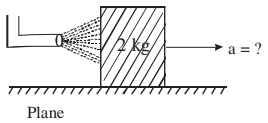
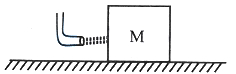
$A$ block of metal weighing $2 \,kg$ is resting on a frictionless plane (as shown in figure). It is struck by a jet releasing water at a rate of $1 \,kg \,s^{-1}$ and at a speed of $10 \,m \,s^{-1}$. Then,the initial acceleration of the block,in $m \,s^{-2}$,will be:
A
$3$
B
$6$
C
$5$
D
$4$
Solution
(C) The force exerted by the water jet on the block is given by the rate of change of momentum of the water striking the block.
$F = \frac{dp}{dt} = v \frac{dm}{dt}$
Given,the speed of water $v = 10 \,m \,s^{-1}$ and the rate of mass flow $\frac{dm}{dt} = 1 \,kg \,s^{-1}$.
Substituting these values,we get:
$F = 10 \times 1 = 10 \,N$
According to Newton's second law,$F = Ma$,where $M$ is the mass of the block and $a$ is its acceleration.
$10 = 2 \times a$
$a = \frac{10}{2} = 5 \,m \,s^{-2}$
Therefore,the initial acceleration of the block is $5 \,m \,s^{-2}$.
$F = \frac{dp}{dt} = v \frac{dm}{dt}$
Given,the speed of water $v = 10 \,m \,s^{-1}$ and the rate of mass flow $\frac{dm}{dt} = 1 \,kg \,s^{-1}$.
Substituting these values,we get:
$F = 10 \times 1 = 10 \,N$
According to Newton's second law,$F = Ma$,where $M$ is the mass of the block and $a$ is its acceleration.
$10 = 2 \times a$
$a = \frac{10}{2} = 5 \,m \,s^{-2}$
Therefore,the initial acceleration of the block is $5 \,m \,s^{-2}$.
0 likes
View Solution62
MediumMCQ
Sand is being dropped from a stationary dropper at a rate of $0.5 \, kg s^{-1}$ on a conveyor belt moving with a velocity of $5 \, m s^{-1}$. The power needed to keep the belt moving with the same velocity will be: (in $, W$)
A
$1.25$
B
$2.5$
C
$6.25$
D
$12.5$
Solution
(D) Given: Rate of mass flow $\frac{dm}{dt} = 0.5 \, kg s^{-1}$,Velocity of belt $v = 5 \, m s^{-1}$.
When sand falls on the belt,the belt must exert a force to accelerate the sand to the velocity of the belt.
The force required to maintain the constant velocity is equal to the thrust force: $F = \frac{dm}{dt} \times v$.
$F = 0.5 \, kg s^{-1} \times 5 \, m s^{-1} = 2.5 \, N$.
The power required to keep the belt moving at a constant velocity is $P = F \times v$.
$P = 2.5 \, N \times 5 \, m s^{-1} = 12.5 \, W$.
When sand falls on the belt,the belt must exert a force to accelerate the sand to the velocity of the belt.
The force required to maintain the constant velocity is equal to the thrust force: $F = \frac{dm}{dt} \times v$.
$F = 0.5 \, kg s^{-1} \times 5 \, m s^{-1} = 2.5 \, N$.
The power required to keep the belt moving at a constant velocity is $P = F \times v$.
$P = 2.5 \, N \times 5 \, m s^{-1} = 12.5 \, W$.
0 likes
View Solution63
EasyMCQ
$A$ balloon has a mass of $10\,g$ in air. The air escapes from the balloon at a uniform rate with a velocity of $4.5\,cm/s$. If the balloon shrinks completely in $5\,s$,then the average force acting on the balloon will be (in $dyne$).
A
$3$
B
$9$
C
$12$
D
$18$
Solution
(B) The average force $F$ exerted on the balloon due to the escaping air is given by the rate of change of momentum,which is $F = v \cdot \frac{dm}{dt}$.
Here,the total mass $m = 10\,g$ escapes in time $t = 5\,s$.
Therefore,the rate of mass loss is $\frac{dm}{dt} = \frac{10\,g}{5\,s} = 2\,g/s$.
The velocity of the escaping air is $v = 4.5\,cm/s$.
Substituting these values into the formula:
$F = 2\,g/s \times 4.5\,cm/s = 9\,g \cdot cm/s^2$.
Since $1\,dyne = 1\,g \cdot cm/s^2$,the average force is $9\,dyne$.
Here,the total mass $m = 10\,g$ escapes in time $t = 5\,s$.
Therefore,the rate of mass loss is $\frac{dm}{dt} = \frac{10\,g}{5\,s} = 2\,g/s$.
The velocity of the escaping air is $v = 4.5\,cm/s$.
Substituting these values into the formula:
$F = 2\,g/s \times 4.5\,cm/s = 9\,g \cdot cm/s^2$.
Since $1\,dyne = 1\,g \cdot cm/s^2$,the average force is $9\,dyne$.
0 likes
View Solution64
DifficultMCQ
$A$ soldier with a machine gun,falling from an airplane,gets detached from his parachute. He is able to resist the downward acceleration if he shoots $40$ bullets per second at a speed of $500 \,m/s$. If the mass of a bullet is $49 \,g$,what is the mass of the man with the gun in $kg$? Ignore air resistance and assume the acceleration due to gravity $g = 9.8 \,m/s^2$.
A
$50$
B
$75$
C
$100$
D
$125$
Solution
(C) To resist the downward acceleration,the upward force exerted by the bullets (thrust force) must balance the weight of the soldier and the gun.
Let $M$ be the total mass of the soldier and the gun,and $m$ be the mass of one bullet.
The force exerted by the bullets is equal to the rate of change of momentum of the bullets: $F = \frac{N}{\Delta t} \times m \times v$,where $\frac{N}{\Delta t}$ is the number of bullets fired per second.
Equating this force to the weight of the soldier: $Mg = \frac{N}{\Delta t} \times m \times v$.
Given: $\frac{N}{\Delta t} = 40 \,s^{-1}$,$m = 49 \,g = 0.049 \,kg$,$v = 500 \,m/s$,and $g = 9.8 \,m/s^2$.
Substituting the values: $M \times 9.8 = 40 \times 0.049 \times 500$.
$M \times 9.8 = 40 \times 24.5 = 980$.
$M = \frac{980}{9.8} = 100 \,kg$.
Let $M$ be the total mass of the soldier and the gun,and $m$ be the mass of one bullet.
The force exerted by the bullets is equal to the rate of change of momentum of the bullets: $F = \frac{N}{\Delta t} \times m \times v$,where $\frac{N}{\Delta t}$ is the number of bullets fired per second.
Equating this force to the weight of the soldier: $Mg = \frac{N}{\Delta t} \times m \times v$.
Given: $\frac{N}{\Delta t} = 40 \,s^{-1}$,$m = 49 \,g = 0.049 \,kg$,$v = 500 \,m/s$,and $g = 9.8 \,m/s^2$.
Substituting the values: $M \times 9.8 = 40 \times 0.049 \times 500$.
$M \times 9.8 = 40 \times 24.5 = 980$.
$M = \frac{980}{9.8} = 100 \,kg$.
0 likes
View Solution65
MediumMCQ
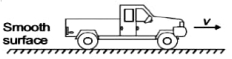
$A$ cart loaded with sand is moving with velocity $v$. Sand is falling through a hole as shown in the diagram. After falling on the ground,the sand is:
A
Moving with the cart
B
Moving in the opposite direction with speed $v$
C
Stationary on the ground
D
Moving with speed $v_1$
Solution
(A) According to the principle of conservation of linear momentum,if no external horizontal force acts on the system (cart + sand),the horizontal velocity of the sand remains unchanged as it falls vertically.
Let the mass of the cart be $M$ and the mass of the sand be $m$. Initially,both are moving with velocity $v$.
When the sand falls vertically,its horizontal component of velocity remains $v$ because there is no horizontal force acting on the sand during its fall.
Therefore,the sand continues to move in the same direction with the same horizontal speed $v$ as the cart.
Thus,the sand is moving with the cart.
Hence,option $A$ is correct.
Let the mass of the cart be $M$ and the mass of the sand be $m$. Initially,both are moving with velocity $v$.
When the sand falls vertically,its horizontal component of velocity remains $v$ because there is no horizontal force acting on the sand during its fall.
Therefore,the sand continues to move in the same direction with the same horizontal speed $v$ as the cart.
Thus,the sand is moving with the cart.
Hence,option $A$ is correct.
0 likes
View Solution66
EasyMCQ
In a rocket,fuel burns at the rate of $2 \, kg/s$. This fuel is ejected from the rocket with a velocity of $80 \, km/s$. The force exerted on the rocket is ............. $N$.
A
$16000$
B
$160000$
C
$1600$
D
$16$
Solution
(B) The force exerted on a rocket due to the ejection of fuel is given by the formula for a variable mass system: $F = v \cdot \frac{dm}{dt}$.
Here,the rate of fuel consumption is $\frac{dm}{dt} = 2 \, kg/s$.
The velocity of the ejected fuel is $v = 80 \, km/s = 80 \times 10^3 \, m/s$.
Substituting these values into the formula:
$F = (80 \times 10^3 \, m/s) \times (2 \, kg/s) = 1,60,000 \, N$.
Therefore,the correct option is $B$.
Here,the rate of fuel consumption is $\frac{dm}{dt} = 2 \, kg/s$.
The velocity of the ejected fuel is $v = 80 \, km/s = 80 \times 10^3 \, m/s$.
Substituting these values into the formula:
$F = (80 \times 10^3 \, m/s) \times (2 \, kg/s) = 1,60,000 \, N$.
Therefore,the correct option is $B$.
0 likes
View Solution67
DifficultMCQ
$A$ cracker rocket is ejecting gases at a rate of $0.05 \,kg/s$ with a velocity of $400 \,m/s$. The accelerating force on the rocket is:
A
$20 \,dyne$
B
$20 \,N$
C
$200 \,N$
D
Zero
Solution
(B) The force exerted on the rocket due to the ejection of gases is given by the thrust formula for a variable mass system:
$F = v \cdot \frac{dm}{dt}$
Given:
Rate of mass ejection $\frac{dm}{dt} = 0.05 \,kg/s$
Velocity of gases $v = 400 \,m/s$
Substituting the values:
$F = 400 \,m/s \times 0.05 \,kg/s = 20 \,N$
Therefore,the accelerating force on the rocket is $20 \,N$.
$F = v \cdot \frac{dm}{dt}$
Given:
Rate of mass ejection $\frac{dm}{dt} = 0.05 \,kg/s$
Velocity of gases $v = 400 \,m/s$
Substituting the values:
$F = 400 \,m/s \times 0.05 \,kg/s = 20 \,N$
Therefore,the accelerating force on the rocket is $20 \,N$.
0 likes
View Solution68
MediumMCQ
$A$ rocket of mass $5700 \,kg$ ejects mass at a constant rate of $15 \,kg/s$ with a constant speed of $12 \,km/s$. The acceleration of the rocket $1 \,minute$ after the blast is ........... $m/s^2$ $(g=10 \,m/s^2)$.
A
$34.9$
B
$27.5$
C
$3.50$
D
$13.5$
Solution
(B) The thrust force on the rocket is given by $F_{thrust} = v_{rel} \left( \frac{dm}{dt} \right)$.
Given: Initial mass $M_0 = 5700 \,kg$,rate of mass ejection $\frac{dm}{dt} = 15 \,kg/s$,relative speed $v = 12 \,km/s = 12000 \,m/s$,and $g = 10 \,m/s^2$.
After $t = 60 \,s$ ($1$ minute),the mass of the rocket is $m = M_0 - \left( \frac{dm}{dt} \right) t = 5700 - (15 \times 60) = 5700 - 900 = 4800 \,kg$.
The net force acting on the rocket is $F_{net} = F_{thrust} - mg = v \left( \frac{dm}{dt} \right) - mg$.
The acceleration $a$ is given by $a = \frac{F_{net}}{m} = \frac{v \left( \frac{dm}{dt} \right)}{m} - g$.
Substituting the values: $a = \frac{12000 \times 15}{4800} - 10$.
$a = \frac{180000}{4800} - 10 = 37.5 - 10 = 27.5 \,m/s^2$.
Given: Initial mass $M_0 = 5700 \,kg$,rate of mass ejection $\frac{dm}{dt} = 15 \,kg/s$,relative speed $v = 12 \,km/s = 12000 \,m/s$,and $g = 10 \,m/s^2$.
After $t = 60 \,s$ ($1$ minute),the mass of the rocket is $m = M_0 - \left( \frac{dm}{dt} \right) t = 5700 - (15 \times 60) = 5700 - 900 = 4800 \,kg$.
The net force acting on the rocket is $F_{net} = F_{thrust} - mg = v \left( \frac{dm}{dt} \right) - mg$.
The acceleration $a$ is given by $a = \frac{F_{net}}{m} = \frac{v \left( \frac{dm}{dt} \right)}{m} - g$.
Substituting the values: $a = \frac{12000 \times 15}{4800} - 10$.
$a = \frac{180000}{4800} - 10 = 37.5 - 10 = 27.5 \,m/s^2$.
0 likes
View Solution69
EasyMCQ
$A$ balloon has $2 \,g$ of air. $A$ small hole is pierced into it. The air comes out with a velocity of $4 \,m/s$. If the balloon shrinks completely in $2.5 \,s$,the average force acting on the balloon is ..........$N$.
A
$0.008$
B
$0.0032$
C
$8$
D
$3.2$
Solution
(B) The average force $F$ exerted on the balloon due to the escaping air is given by the rate of change of momentum,which is $F = v \frac{dm}{dt}$.
Here,the velocity of the air $v = 4 \,m/s$.
The total mass of air $m = 2 \,g = 0.002 \,kg$.
The time taken for the air to escape $dt = 2.5 \,s$.
Substituting these values into the formula:
$F = 4 \times \left( \frac{0.002 \,kg}{2.5 \,s} \right)$
$F = 4 \times 0.0008 \,N$
$F = 0.0032 \,N$.
Therefore,the average force acting on the balloon is $0.0032 \,N$.
Here,the velocity of the air $v = 4 \,m/s$.
The total mass of air $m = 2 \,g = 0.002 \,kg$.
The time taken for the air to escape $dt = 2.5 \,s$.
Substituting these values into the formula:
$F = 4 \times \left( \frac{0.002 \,kg}{2.5 \,s} \right)$
$F = 4 \times 0.0008 \,N$
$F = 0.0032 \,N$.
Therefore,the average force acting on the balloon is $0.0032 \,N$.
0 likes
View Solution70
EasyMCQ
$A$ $6000 \,kg$ rocket is set for firing. If the exhaust speed is $1000 \,m/s$,how much gas must be ejected each second to supply the thrust needed to overcome the weight of the rocket?
A
$30$
B
$40$
C
$50$
D
$60$
Solution
(D) The thrust force $F$ produced by the rocket engine is given by the formula $F = v_{e} \left( \frac{dm}{dt} \right)$,where $v_{e}$ is the exhaust speed and $\frac{dm}{dt}$ is the rate of mass ejection.
To overcome the weight of the rocket,the thrust must be equal to the gravitational force acting on the rocket,so $F = mg$.
Given: Mass of the rocket $m = 6000 \,kg$,acceleration due to gravity $g \approx 10 \,m/s^2$,and exhaust speed $v_{e} = 1000 \,m/s$.
Equating the forces: $v_{e} \left( \frac{dm}{dt} \right) = mg$.
Substituting the values: $1000 \times \left( \frac{dm}{dt} \right) = 6000 \times 10$.
$1000 \times \left( \frac{dm}{dt} \right) = 60000$.
$\frac{dm}{dt} = \frac{60000}{1000} = 60 \,kg/s$.
Therefore,the amount of gas that must be ejected each second is $60 \,kg$.
To overcome the weight of the rocket,the thrust must be equal to the gravitational force acting on the rocket,so $F = mg$.
Given: Mass of the rocket $m = 6000 \,kg$,acceleration due to gravity $g \approx 10 \,m/s^2$,and exhaust speed $v_{e} = 1000 \,m/s$.
Equating the forces: $v_{e} \left( \frac{dm}{dt} \right) = mg$.
Substituting the values: $1000 \times \left( \frac{dm}{dt} \right) = 6000 \times 10$.
$1000 \times \left( \frac{dm}{dt} \right) = 60000$.
$\frac{dm}{dt} = \frac{60000}{1000} = 60 \,kg/s$.
Therefore,the amount of gas that must be ejected each second is $60 \,kg$.
1 likes
View Solution71
EasyMCQ
An open carriage in a goods train is moving with a uniform velocity of $10 \,m/s$. If the rain adds water with zero velocity at the rate of $5 \,kg/s$,then the additional force required by the engine to maintain the same velocity of the train is ....... $N$.
A
$0.5$
B
$20$
C
$50$
D
$0$
Solution
(C) The force required to maintain a constant velocity when mass is being added to a system is given by the thrust force formula: $F = v \frac{dm}{dt}$.
Here,the velocity of the train is $v = 10 \,m/s$.
The rate at which mass is added is $\frac{dm}{dt} = 5 \,kg/s$.
Since the rain falls vertically (zero horizontal velocity),the engine must provide an additional force to accelerate this added mass to the velocity of the train.
Therefore,$F = 10 \,m/s \times 5 \,kg/s = 50 \,N$.
Here,the velocity of the train is $v = 10 \,m/s$.
The rate at which mass is added is $\frac{dm}{dt} = 5 \,kg/s$.
Since the rain falls vertically (zero horizontal velocity),the engine must provide an additional force to accelerate this added mass to the velocity of the train.
Therefore,$F = 10 \,m/s \times 5 \,kg/s = 50 \,N$.
0 likes
View Solution72
DifficultMCQ
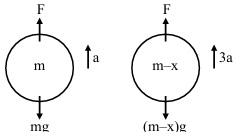
$A$ balloon and its content having mass $M$ is moving up with an acceleration $a$. The mass that must be released from the content so that the balloon starts moving up with an acceleration $3a$ will be: (Take $g$ as acceleration due to gravity)
A
$\frac{3Ma}{2a-g}$
B
$\frac{3Ma}{2a+g}$
C
$\frac{2Ma}{3a+g}$
D
$\frac{2Ma}{3a-g}$
Solution
(C) Let $F$ be the upward buoyant force acting on the balloon.
For the initial case,the equation of motion is:
$F - Mg = Ma$
$F = M(a + g)$
Let $x$ be the mass released from the balloon. The new mass of the balloon is $(M - x)$.
For the second case,the equation of motion is:
$F - (M - x)g = (M - x)(3a)$
Substitute the value of $F$ from the first equation into the second:
$M(a + g) - (M - x)g = (M - x)(3a)$
$Ma + Mg - Mg + xg = 3Ma - 3xa$
$Ma + xg = 3Ma - 3xa$
$xg + 3xa = 3Ma - Ma$
$x(g + 3a) = 2Ma$
$x = \frac{2Ma}{g + 3a}$
For the initial case,the equation of motion is:
$F - Mg = Ma$
$F = M(a + g)$
Let $x$ be the mass released from the balloon. The new mass of the balloon is $(M - x)$.
For the second case,the equation of motion is:
$F - (M - x)g = (M - x)(3a)$
Substitute the value of $F$ from the first equation into the second:
$M(a + g) - (M - x)g = (M - x)(3a)$
$Ma + Mg - Mg + xg = 3Ma - 3xa$
$Ma + xg = 3Ma - 3xa$
$xg + 3xa = 3Ma - Ma$
$x(g + 3a) = 2Ma$
$x = \frac{2Ma}{g + 3a}$
0 likes
View Solution73
DifficultMCQ
$A$ sand dropper drops sand of mass $m(t)$ on a conveyer belt at a rate proportional to the square root of speed $v$ of the belt,i.e.,$\frac{dm}{dt} \propto \sqrt{v}$. If $P$ is the power delivered to run the belt at constant speed,then which of the following relationships is true?
A
$P^2 \propto v^3$
B
$P \propto \sqrt{v}$
C
$P \propto v$
D
$P^2 \propto v^5$
Solution
(D) The power $P$ required to maintain a constant speed $v$ for a conveyor belt onto which mass is being dropped is given by $P = F \cdot v$.
Since the belt moves at a constant speed,the force $F$ required to overcome the momentum change of the added sand is $F = \frac{dp}{dt} = v \frac{dm}{dt}$.
Given that the rate of mass deposition is $\frac{dm}{dt} = k\sqrt{v}$,where $k$ is a constant.
Substituting this into the force equation: $F = v(k\sqrt{v}) = kv^{3/2}$.
Now,calculating the power: $P = F \cdot v = (kv^{3/2}) \cdot v = kv^{5/2}$.
Squaring both sides of the equation,we get $P^2 = k^2 v^5$.
Therefore,$P^2 \propto v^5$.
Since the belt moves at a constant speed,the force $F$ required to overcome the momentum change of the added sand is $F = \frac{dp}{dt} = v \frac{dm}{dt}$.
Given that the rate of mass deposition is $\frac{dm}{dt} = k\sqrt{v}$,where $k$ is a constant.
Substituting this into the force equation: $F = v(k\sqrt{v}) = kv^{3/2}$.
Now,calculating the power: $P = F \cdot v = (kv^{3/2}) \cdot v = kv^{5/2}$.
Squaring both sides of the equation,we get $P^2 = k^2 v^5$.
Therefore,$P^2 \propto v^5$.
0 likes
View Solution74
DifficultMCQ
$A$ rocket of initial mass $1500 \ kg$ ejects gas at a constant rate of $10 \ kg/s$ with a relative speed of $5 \ km/s$. What is the acceleration of the rocket $50 \ s$ after the launch,neglecting gravity (in $m/s^2$)?
A
$10$
B
$25$
C
$50$
D
$100$
Solution
(C) The thrust force $F$ exerted on the rocket is given by $F = v_{rel} \cdot \frac{dm}{dt}$.
Given: $v_{rel} = 5 \ km/s = 5000 \ m/s$ and $\frac{dm}{dt} = 10 \ kg/s$.
So,$F = 5000 \times 10 = 50000 \ N$.
The mass of the rocket at time $t$ is $M(t) = M_0 - (\frac{dm}{dt})t$.
At $t = 50 \ s$,$M(50) = 1500 - (10 \times 50) = 1500 - 500 = 1000 \ kg$.
The acceleration $a$ is given by $a = \frac{F}{M(t)} = \frac{50000}{1000} = 50 \ m/s^2$.
Given: $v_{rel} = 5 \ km/s = 5000 \ m/s$ and $\frac{dm}{dt} = 10 \ kg/s$.
So,$F = 5000 \times 10 = 50000 \ N$.
The mass of the rocket at time $t$ is $M(t) = M_0 - (\frac{dm}{dt})t$.
At $t = 50 \ s$,$M(50) = 1500 - (10 \times 50) = 1500 - 500 = 1000 \ kg$.
The acceleration $a$ is given by $a = \frac{F}{M(t)} = \frac{50000}{1000} = 50 \ m/s^2$.
0 likes
View Solution75
DifficultMCQ
The motion of a rocket in an upward direction with high speed is based on the principle of conservation of:
A
Kinetic energy.
B
mass.
C
angular momentum.
D
linear momentum.
Solution
(D) The motion of a rocket is based on the principle of conservation of linear momentum. As the fuel burns,the rocket ejects hot gases at high speed in the downward direction. According to Newton's third law of motion,the gases exert an equal and opposite force on the rocket,providing the necessary thrust. Since there is no external force acting on the system (rocket + fuel),the total linear momentum of the system remains conserved.
0 likes
View Solution76
EasyMCQ
$A$ conveyor belt is moving with a constant velocity $V$. Sand is being dropped on the belt at the rate of $M \text{ kg/s}$. The force necessary to keep the belt moving with a constant velocity $V \text{ m/s}$ will be
A
$MV/2 \text{ N}$
B
$2MV \text{ N}$
C
$0 \text{ N}$
D
$MV \text{ N}$
Solution
(D) The force required to maintain a constant velocity is given by the rate of change of momentum of the system.
Since the sand is dropped vertically onto the belt,it has no initial horizontal velocity.
As the sand lands on the belt,it must be accelerated from a horizontal velocity of $0$ to $V$ to match the belt's speed.
The rate at which mass is added to the belt is $dm/dt = M$.
The force $F$ required is given by $F = v \cdot (dm/dt)$.
Substituting the given values,$F = V \cdot M = MV \text{ N}$.
Since the sand is dropped vertically onto the belt,it has no initial horizontal velocity.
As the sand lands on the belt,it must be accelerated from a horizontal velocity of $0$ to $V$ to match the belt's speed.
The rate at which mass is added to the belt is $dm/dt = M$.
The force $F$ required is given by $F = v \cdot (dm/dt)$.
Substituting the given values,$F = V \cdot M = MV \text{ N}$.
0 likes
View Solution77
EasyMCQ
$A$ Diwali cracker releases $25 \text{ g}$ of gas per second with a speed of $400 \text{ m/s}$ after an explosion. The force exerted by the gas on the cracker is:
A
$100 \text{ dyne}$
B
$16 \text{ newton}$
C
$10 \text{ newton}$
D
$10,000 \text{ dyne}$
Solution
(C) The force exerted by the gas on the cracker is equal to the rate of change of momentum of the gas.
Given:
Mass rate of gas,$\frac{dm}{dt} = 25 \text{ g/s} = 25 \times 10^{-3} \text{ kg/s}$.
Velocity of gas,$v = 400 \text{ m/s}$.
The force $F$ is given by the formula:
$F = v \times \frac{dm}{dt}$
$F = 400 \text{ m/s} \times 25 \times 10^{-3} \text{ kg/s}$
$F = 400 \times 0.025 \text{ N}$
$F = 10 \text{ N}$.
Given:
Mass rate of gas,$\frac{dm}{dt} = 25 \text{ g/s} = 25 \times 10^{-3} \text{ kg/s}$.
Velocity of gas,$v = 400 \text{ m/s}$.
The force $F$ is given by the formula:
$F = v \times \frac{dm}{dt}$
$F = 400 \text{ m/s} \times 25 \times 10^{-3} \text{ kg/s}$
$F = 400 \times 0.025 \text{ N}$
$F = 10 \text{ N}$.
0 likes
View Solution78
EasyMCQ
$A$ rifle of $20 \,kg$ mass can fire $4$ bullets per second. The mass of each bullet is $35 \times 10^{-3} \,kg$ and its final velocity is $400 \,ms^{-1}$. What force must be applied on the rifle so that it does not move backwards while firing the bullets (in $\,N$)?
A
$80$
B
$28$
C
$-112$
D
$56$
Solution
(D) The force exerted by the bullets on the rifle is equal to the rate of change of momentum of the bullets.
Given:
Mass of rifle $M = 20 \,kg$
Number of bullets per second $n = 4$
Mass of each bullet $m = 35 \times 10^{-3} \,kg$
Velocity of each bullet $v = 400 \,ms^{-1}$
The force $F$ required to keep the rifle stationary is equal to the recoil force exerted by the bullets.
The recoil force is given by the rate of change of momentum of the bullets:
$F = n \times (m \times v)$
$F = 4 \times (35 \times 10^{-3} \,kg) \times (400 \,ms^{-1})$
$F = 4 \times 35 \times 0.4$
$F = 140 \times 0.4 = 56 \,N$
To prevent the rifle from moving backwards,an external force of $56 \,N$ must be applied in the direction of the bullet's motion.
Given:
Mass of rifle $M = 20 \,kg$
Number of bullets per second $n = 4$
Mass of each bullet $m = 35 \times 10^{-3} \,kg$
Velocity of each bullet $v = 400 \,ms^{-1}$
The force $F$ required to keep the rifle stationary is equal to the recoil force exerted by the bullets.
The recoil force is given by the rate of change of momentum of the bullets:
$F = n \times (m \times v)$
$F = 4 \times (35 \times 10^{-3} \,kg) \times (400 \,ms^{-1})$
$F = 4 \times 35 \times 0.4$
$F = 140 \times 0.4 = 56 \,N$
To prevent the rifle from moving backwards,an external force of $56 \,N$ must be applied in the direction of the bullet's motion.
0 likes
View Solution79
MediumMCQ
In a rocket, fuel burns at the rate of $1 \,kg / s$. This fuel is ejected from the rocket with a velocity of $60 \,km / s$. The force exerted on the rocket by this is (in $\,N$)
A
$60$
B
$600$
C
$6000$
D
$60000$
Solution
(D) The force exerted on a rocket due to the ejection of fuel is given by the thrust formula $F = v \frac{dm}{dt}$.
Given, the rate of fuel consumption is $\frac{dm}{dt} = 1 \,kg/s$.
The velocity of the ejected fuel is $v = 60 \,km/s = 60000 \,m/s$.
Substituting these values into the formula:
$F = 60000 \,m/s \times 1 \,kg/s = 60000 \,N$.
Therefore, the force exerted on the rocket is $60000 \,N$.
Given, the rate of fuel consumption is $\frac{dm}{dt} = 1 \,kg/s$.
The velocity of the ejected fuel is $v = 60 \,km/s = 60000 \,m/s$.
Substituting these values into the formula:
$F = 60000 \,m/s \times 1 \,kg/s = 60000 \,N$.
Therefore, the force exerted on the rocket is $60000 \,N$.
0 likes
View Solution80
DifficultMCQ
$A$ rocket with an initial mass $m_0$ is going up with a constant acceleration $a$ by exhausting gases with a velocity $v$ relative to the rocket motion. The mass of the rocket at any instant of time $t$ is (assume that no other forces act on it).
A
$m=m_0 e^{-\frac{a t}{v}}$
B
$m=m_0 e^{-\frac{2 a t}{v}}$
C
$m=m_0 e^{-\frac{a t}{2 v}}$
D
$m=m_0 e^{-\frac{a^2 t^2}{v^2}}$
Solution
(A) The equation of motion for a rocket with variable mass is given by $F_{\text{ext}} + v_{\text{rel}} \frac{dm}{dt} = m \frac{dv}{dt}$.
Given that the rocket moves with constant acceleration $a$,we have $\frac{dv}{dt} = a$.
Assuming no external forces $(F_{\text{ext}} = 0)$,the equation becomes $v_{\text{rel}} \frac{dm}{dt} = m a$.
Here,$v_{\text{rel}} = v$ (the exhaust velocity relative to the rocket).
Rearranging the terms,we get $\frac{dm}{m} = \frac{a}{v} dt$.
Integrating both sides from initial mass $m_0$ at $t=0$ to mass $m$ at time $t$:
$\int_{m_0}^{m} \frac{dm}{m} = \int_{0}^{t} \frac{a}{v} dt$.
$\ln \left( \frac{m}{m_0} \right) = \frac{a t}{v}$.
Taking the exponential of both sides,we get $m = m_0 e^{-\frac{at}{v}}$.
Given that the rocket moves with constant acceleration $a$,we have $\frac{dv}{dt} = a$.
Assuming no external forces $(F_{\text{ext}} = 0)$,the equation becomes $v_{\text{rel}} \frac{dm}{dt} = m a$.
Here,$v_{\text{rel}} = v$ (the exhaust velocity relative to the rocket).
Rearranging the terms,we get $\frac{dm}{m} = \frac{a}{v} dt$.
Integrating both sides from initial mass $m_0$ at $t=0$ to mass $m$ at time $t$:
$\int_{m_0}^{m} \frac{dm}{m} = \int_{0}^{t} \frac{a}{v} dt$.
$\ln \left( \frac{m}{m_0} \right) = \frac{a t}{v}$.
Taking the exponential of both sides,we get $m = m_0 e^{-\frac{at}{v}}$.
0 likes
View Solution81
MediumMCQ
$A$ balloon with mass $m$ is descending vertically with an acceleration $a$ (where $a < g$). The mass to be removed from the balloon so that it starts moving vertically up with an acceleration $a$ is:
A
$\frac{2ma}{g+a}$
B
$\frac{2ma}{g-a}$
C
$\frac{ma}{g+a}$
D
$\frac{ma}{g-a}$
Solution
(A) Let $F_B$ be the upward buoyant force acting on the balloon.
When the balloon of mass $m$ is descending with acceleration $a$,the equation of motion is: $mg - F_B = ma$,which implies $F_B = m(g - a)$.
Let $m'$ be the mass to be removed,so the new mass of the balloon is $(m - m')$.
When the balloon moves vertically up with acceleration $a$,the equation of motion is: $F_B - (m - m')g = (m - m')a$.
Substituting $F_B = m(g - a)$ into the equation: $m(g - a) - (m - m')g = (m - m')a$.
$mg - ma - mg + m'g = ma - m'a$.
$m'g + m'a = 2ma$.
$m'(g + a) = 2ma$.
Therefore,$m' = \frac{2ma}{g+a}$.
When the balloon of mass $m$ is descending with acceleration $a$,the equation of motion is: $mg - F_B = ma$,which implies $F_B = m(g - a)$.
Let $m'$ be the mass to be removed,so the new mass of the balloon is $(m - m')$.
When the balloon moves vertically up with acceleration $a$,the equation of motion is: $F_B - (m - m')g = (m - m')a$.
Substituting $F_B = m(g - a)$ into the equation: $m(g - a) - (m - m')g = (m - m')a$.
$mg - ma - mg + m'g = ma - m'a$.
$m'g + m'a = 2ma$.
$m'(g + a) = 2ma$.
Therefore,$m' = \frac{2ma}{g+a}$.
0 likes
View Solution82
MediumMCQ
$A$ metal block of $2 \,kg$ is at rest on a smooth plane. It is struck by a water jet releasing water at a rate of $1 \,kg \,s^{-1}$ with a speed of $5 \,ms^{-1}$. The acceleration of the block is: (in $\,ms^{-2}$)
A
$2$
B
$2.5$
C
$0.25$
D
$50$
Solution
(B) Given:
Mass of the block,$M = 2 \,kg$
Rate of mass flow of water,$\frac{dm}{dt} = 1 \,kg \,s^{-1}$
Velocity of water jet,$v = 5 \,ms^{-1}$
The force exerted by the water jet on the block is given by the rate of change of momentum:
$F = \frac{dp}{dt} = \frac{d(mv)}{dt} = v \cdot \frac{dm}{dt}$
Substituting the values:
$F = 5 \,ms^{-1} \times 1 \,kg \,s^{-1} = 5 \,N$
According to Newton's second law,the acceleration $a$ of the block is:
$a = \frac{F}{M} = \frac{5 \,N}{2 \,kg} = 2.5 \,ms^{-2}$
Mass of the block,$M = 2 \,kg$
Rate of mass flow of water,$\frac{dm}{dt} = 1 \,kg \,s^{-1}$
Velocity of water jet,$v = 5 \,ms^{-1}$
The force exerted by the water jet on the block is given by the rate of change of momentum:
$F = \frac{dp}{dt} = \frac{d(mv)}{dt} = v \cdot \frac{dm}{dt}$
Substituting the values:
$F = 5 \,ms^{-1} \times 1 \,kg \,s^{-1} = 5 \,N$
According to Newton's second law,the acceleration $a$ of the block is:
$a = \frac{F}{M} = \frac{5 \,N}{2 \,kg} = 2.5 \,ms^{-2}$
0 likes
View Solution83
MediumMCQ
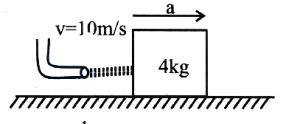
$A$ metal block of mass $4 \ kg$ is at rest on a frictionless surface. It is struck by a jet of water releasing $2 \ kg \ s^{-1}$ at a speed of $10 \ m \ s^{-1}$. The acceleration of the block is (in $m \ s^{-2}$)
A
$10$
B
$15$
C
$20$
D
$5$
Solution
(D) Given: Mass of the block $M = 4 \ kg$,velocity of water $v = 10 \ m \ s^{-1}$,and rate of mass flow $\frac{dm}{dt} = 2 \ kg \ s^{-1}$.
According to Newton's second law,the force exerted by the water jet on the block is given by the rate of change of momentum:
$F = v \cdot \left(\frac{dm}{dt}\right)$
Substituting the given values:
$F = 10 \times 2 = 20 \ N$
Now,using Newton's second law for the block $(F = Ma)$:
$a = \frac{F}{M} = \frac{20 \ N}{4 \ kg} = 5 \ m \ s^{-2}$
Therefore,the acceleration of the block is $5 \ m \ s^{-2}$.
According to Newton's second law,the force exerted by the water jet on the block is given by the rate of change of momentum:
$F = v \cdot \left(\frac{dm}{dt}\right)$
Substituting the given values:
$F = 10 \times 2 = 20 \ N$
Now,using Newton's second law for the block $(F = Ma)$:
$a = \frac{F}{M} = \frac{20 \ N}{4 \ kg} = 5 \ m \ s^{-2}$
Therefore,the acceleration of the block is $5 \ m \ s^{-2}$.
0 likes
View Solution84
DifficultMCQ
$A$ rocket is fired vertically from the ground with a resultant vertical acceleration of $10 \,m/s^2$. The fuel is exhausted in $1 \,min$ and it continues to move up. What is the maximum height reached (in $\,km$)?
A
$36.4$
B
$42.3$
C
$48.4$
D
$25.6$
Solution
(A) Given, resultant vertical acceleration $a = 10 \,m/s^2$, time $t = 1 \,min = 60 \,s$, and initial velocity $u = 0$.
Height reached during the powered phase $(h_1)$:
$h_1 = ut + \frac{1}{2}at^2 = 0 \times 60 + \frac{1}{2} \times 10 \times (60)^2 = 18000 \,m = 18 \,km$.
Velocity at the end of the powered phase $(v)$:
$v = u + at = 0 + 10 \times 60 = 600 \,m/s$.
After the fuel is exhausted, the rocket moves under gravity $(a = -g = -9.8 \,m/s^2)$ until its velocity becomes zero.
Height reached during the unpowered phase $(h_2)$:
Using $v_f^2 - v^2 = 2ah_2$, where $v_f = 0$:
$0 - (600)^2 = 2(-9.8)h_2 \Rightarrow h_2 = \frac{360000}{19.6} \approx 18367.3 \,m \approx 18.4 \,km$.
Total maximum height $H = h_1 + h_2 = 18 \,km + 18.4 \,km = 36.4 \,km$.
Height reached during the powered phase $(h_1)$:
$h_1 = ut + \frac{1}{2}at^2 = 0 \times 60 + \frac{1}{2} \times 10 \times (60)^2 = 18000 \,m = 18 \,km$.
Velocity at the end of the powered phase $(v)$:
$v = u + at = 0 + 10 \times 60 = 600 \,m/s$.
After the fuel is exhausted, the rocket moves under gravity $(a = -g = -9.8 \,m/s^2)$ until its velocity becomes zero.
Height reached during the unpowered phase $(h_2)$:
Using $v_f^2 - v^2 = 2ah_2$, where $v_f = 0$:
$0 - (600)^2 = 2(-9.8)h_2 \Rightarrow h_2 = \frac{360000}{19.6} \approx 18367.3 \,m \approx 18.4 \,km$.
Total maximum height $H = h_1 + h_2 = 18 \,km + 18.4 \,km = 36.4 \,km$.
0 likes
View Solution85
DifficultMCQ
$A$ rocket motor consumes $100 \ kg$ of fuel per second,exhausting it with a speed of $5 \ km/s$. The speed of the rocket when its mass is reduced to $\frac{1}{20}$ of its initial mass is (Assume initial speed to be zero and ignore gravitational and viscous forces.)
A
$20 \ km/s$
B
$40 \ln(2) \ km/s$
C
$5 \ln(20) \ km/s$
D
$10 \ln(10) \ km/s$
Solution
(C) The velocity of a rocket at any time $t$ is given by the Tsiolkovsky rocket equation: $v = u \ln\left(\frac{m_0}{m}\right) - gt$.
Given that gravitational forces are ignored,$g = 0$,so the equation simplifies to $v = u \ln\left(\frac{m_0}{m}\right)$.
Here,$u = 5 \ km/s$ is the exhaust speed of the gases relative to the rocket.
The initial mass is $m_0$ and the final mass is $m = \frac{1}{20}m_0$.
Therefore,the ratio $\frac{m_0}{m} = 20$.
Substituting these values into the equation:
$v = 5 \ln(20) \ km/s$.
Thus,the correct option is $C$.
Given that gravitational forces are ignored,$g = 0$,so the equation simplifies to $v = u \ln\left(\frac{m_0}{m}\right)$.
Here,$u = 5 \ km/s$ is the exhaust speed of the gases relative to the rocket.
The initial mass is $m_0$ and the final mass is $m = \frac{1}{20}m_0$.
Therefore,the ratio $\frac{m_0}{m} = 20$.
Substituting these values into the equation:
$v = 5 \ln(20) \ km/s$.
Thus,the correct option is $C$.
0 likes
View Solution86
MediumMCQ
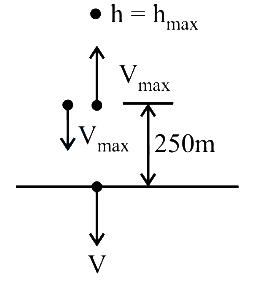
$A$ rocket moves straight upward with zero initial velocity and with an acceleration of $20 \,m/s^2$. It runs out of fuel and stops accelerating at the end of $5^{th} \,sec$. It reaches a maximum height and falls back to the earth. The speed when it hits the ground is (Take $g = 10 \,m/s^2$):
A
$100 \sqrt{2} \,m/s$
B
$150 \sqrt{3} \,m/s$
C
$50 \sqrt{6} \,m/s$
D
$75 \,m/s$
Solution
(C) Step $1$: Calculate the velocity and height at the end of the powered flight $(t = 5 \,s)$.
The initial velocity $u = 0$, acceleration $a = 20 \,m/s^2$, and time $t = 5 \,s$.
The velocity at $t = 5 \,s$ is $V_{max} = u + at = 0 + 20 \times 5 = 100 \,m/s$.
The height reached at $t = 5 \,s$ is $S = ut + \frac{1}{2}at^2 = 0 + \frac{1}{2} \times 20 \times 5^2 = 250 \,m$.
Step $2$: Calculate the final speed when it hits the ground.
After $t = 5 \,s$, the rocket is in free fall under gravity $(g = 10 \,m/s^2)$.
Using the work-energy theorem or kinematic equations, the total energy at the peak height is conserved, or we can use $V^2 = u^2 + 2aS$.
Here, the rocket starts from height $S = 250 \,m$ with an initial upward velocity $V_{max} = 100 \,m/s$.
When it hits the ground, the final velocity $V$ is given by $V^2 = V_{max}^2 + 2gS$.
$V^2 = (100)^2 + 2 \times 10 \times 250$.
$V^2 = 10000 + 5000 = 15000$.
$V = \sqrt{15000} = \sqrt{2500 \times 6} = 50 \sqrt{6} \,m/s$.
The initial velocity $u = 0$, acceleration $a = 20 \,m/s^2$, and time $t = 5 \,s$.
The velocity at $t = 5 \,s$ is $V_{max} = u + at = 0 + 20 \times 5 = 100 \,m/s$.
The height reached at $t = 5 \,s$ is $S = ut + \frac{1}{2}at^2 = 0 + \frac{1}{2} \times 20 \times 5^2 = 250 \,m$.
Step $2$: Calculate the final speed when it hits the ground.
After $t = 5 \,s$, the rocket is in free fall under gravity $(g = 10 \,m/s^2)$.
Using the work-energy theorem or kinematic equations, the total energy at the peak height is conserved, or we can use $V^2 = u^2 + 2aS$.
Here, the rocket starts from height $S = 250 \,m$ with an initial upward velocity $V_{max} = 100 \,m/s$.
When it hits the ground, the final velocity $V$ is given by $V^2 = V_{max}^2 + 2gS$.
$V^2 = (100)^2 + 2 \times 10 \times 250$.
$V^2 = 10000 + 5000 = 15000$.
$V = \sqrt{15000} = \sqrt{2500 \times 6} = 50 \sqrt{6} \,m/s$.
0 likes
View Solution87
MediumMCQ
$A$ rocket lifts off from the ground and accelerates upwards at $1 \ m \ s^{-2}$. $20 \ s$ after liftoff,a piece breaks off from the bottom of the rocket. After breaking off,how much time does it take approximately to reach the ground (in $s$)? (Take $g = 10 \ m \ s^{-2}$)
A
$6.3$
B
$4.5$
C
$10.5$
D
$8.6$
Solution
(D) $1$. Calculate the height of the rocket at $t = 20 \ s$: $h = \frac{1}{2} a t^2 = \frac{1}{2} \times 1 \times (20)^2 = 200 \ m$.
$2$. Calculate the velocity of the rocket at $t = 20 \ s$: $v = a t = 1 \times 20 = 20 \ m \ s^{-1}$.
$3$. The piece breaks off and acts as a projectile with initial velocity $u = 20 \ m \ s^{-1}$ upwards from a height $h = 200 \ m$.
$4$. Using the equation of motion $s = ut + \frac{1}{2} a t^2$ for the piece,where $s = -200 \ m$ (downward displacement),$u = 20 \ m \ s^{-1}$,and $a = -g = -10 \ m \ s^{-2}$:
$-200 = 20 t - \frac{1}{2} \times 10 \times t^2$
$-200 = 20 t - 5 t^2$
$5 t^2 - 20 t - 200 = 0$
$t^2 - 4 t - 40 = 0$.
$5$. Solving for $t$ using the quadratic formula $t = \frac{-b \pm \sqrt{b^2 - 4ac}}{2a}$:
$t = \frac{4 \pm \sqrt{16 - 4(1)(-40)}}{2} = \frac{4 \pm \sqrt{176}}{2} = 2 \pm \sqrt{44} \approx 2 \pm 6.63$.
$6$. Since time must be positive,$t \approx 8.63 \ s$.
$2$. Calculate the velocity of the rocket at $t = 20 \ s$: $v = a t = 1 \times 20 = 20 \ m \ s^{-1}$.
$3$. The piece breaks off and acts as a projectile with initial velocity $u = 20 \ m \ s^{-1}$ upwards from a height $h = 200 \ m$.
$4$. Using the equation of motion $s = ut + \frac{1}{2} a t^2$ for the piece,where $s = -200 \ m$ (downward displacement),$u = 20 \ m \ s^{-1}$,and $a = -g = -10 \ m \ s^{-2}$:
$-200 = 20 t - \frac{1}{2} \times 10 \times t^2$
$-200 = 20 t - 5 t^2$
$5 t^2 - 20 t - 200 = 0$
$t^2 - 4 t - 40 = 0$.
$5$. Solving for $t$ using the quadratic formula $t = \frac{-b \pm \sqrt{b^2 - 4ac}}{2a}$:
$t = \frac{4 \pm \sqrt{16 - 4(1)(-40)}}{2} = \frac{4 \pm \sqrt{176}}{2} = 2 \pm \sqrt{44} \approx 2 \pm 6.63$.
$6$. Since time must be positive,$t \approx 8.63 \ s$.
0 likes
View Solution88
MediumMCQ
Consider a rocket is being fired. The kinetic energy of the rocket is increased by $16$ times,whereas its total mass is reduced by half through the burning of fuel. The factor by which its momentum increases is
A
$8$
B
$2 \sqrt{2}$
C
$4$
D
$4 \sqrt{2}$
Solution
(B) Let the initial mass be $m$ and initial velocity be $v$. The initial kinetic energy is $(K.E.)_i = \frac{1}{2}mv^2$ and initial momentum is $p_i = mv$.
After the fuel is burned,the final mass is $m' = \frac{m}{2}$ and the final kinetic energy is $(K.E.)_f = 16 \times (K.E.)_i = 16 \times \frac{1}{2}mv^2 = 8mv^2$.
Let the final velocity be $v'$. Then $(K.E.)_f = \frac{1}{2}m'v'^2 = \frac{1}{2}(\frac{m}{2})v'^2 = \frac{1}{4}mv'^2$.
Equating the two expressions for $(K.E.)_f$: $\frac{1}{4}mv'^2 = 8mv^2 \Rightarrow v'^2 = 32v^2 \Rightarrow v' = \sqrt{32}v = 4\sqrt{2}v$.
The final momentum is $p_f = m'v' = (\frac{m}{2})(4\sqrt{2}v) = 2\sqrt{2}mv$.
The factor by which momentum increases is $\frac{p_f}{p_i} = \frac{2\sqrt{2}mv}{mv} = 2\sqrt{2}$.
After the fuel is burned,the final mass is $m' = \frac{m}{2}$ and the final kinetic energy is $(K.E.)_f = 16 \times (K.E.)_i = 16 \times \frac{1}{2}mv^2 = 8mv^2$.
Let the final velocity be $v'$. Then $(K.E.)_f = \frac{1}{2}m'v'^2 = \frac{1}{2}(\frac{m}{2})v'^2 = \frac{1}{4}mv'^2$.
Equating the two expressions for $(K.E.)_f$: $\frac{1}{4}mv'^2 = 8mv^2 \Rightarrow v'^2 = 32v^2 \Rightarrow v' = \sqrt{32}v = 4\sqrt{2}v$.
The final momentum is $p_f = m'v' = (\frac{m}{2})(4\sqrt{2}v) = 2\sqrt{2}mv$.
The factor by which momentum increases is $\frac{p_f}{p_i} = \frac{2\sqrt{2}mv}{mv} = 2\sqrt{2}$.
0 likes
View SolutionNewton's Laws of Motion and Friction — Variable Mass System and Rocket Problem · Frequently Asked Questions
1Are these Newton's Laws of Motion and Friction questions useful for JEE and NEET?
Yes. All questions in this section are mapped to JEE Main and NEET exam patterns. Previous year questions from JEE Main, NEET, GUJCET and state-level exams are included with full solutions.
2Can I switch to Hindi or Gujarati for these questions?
Yes. Use the language tabs in the hero section or the sidebar to view the same questions and solutions in English, Hindi or Gujarati.
3How do I generate a question paper from this subtopic?
Use the Vedclass Exam Paper Generator — select the chapter and subtopic, set difficulty, and generate Sets A, B, C, D automatically. First 3 chapters of every subject are free.
Vedclass Products
For Students
Vedclass Test Series
Mock tests in real JEE/NEET style with performance analysis. 5-day free trial.
Start Free TrialFor Teachers
Exam Paper Generator
Generate Set A/B/C/D papers from this chapter in 2 minutes. 3 chapters free.
Try FreeFor Institutes
Online Exam Module
Live online exams with unlimited students, 360° analytics & white-label branding.
See DemoFor Teachers & Institutes
Generate a Newton's Laws of Motion and Friction Exam Paper in 2 Minutes
Select subtopic & difficulty — Sets A, B, C, D auto-generated with No Repeat logic.
First 3 chapters of every subject are free — no payment required.