
A English
Motion (or rest) on Rough Inclined Surface Questions in English
Class 11 Physics · Newton's Laws of Motion and Friction · Motion (or rest) on Rough Inclined Surface
244+
Questions
English
Language
100%
With Solutions
Showing 50 of 244 questions in English
101
MediumMCQ
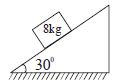
$A$ block of mass $8\, kg$ is at rest on a rough inclined plane as shown in the figure below. The magnitude of the net force exerted by the surface on the block will be ........ $N$ $(g = 10\, m/s^2)$.
A
$40$
B
$40\sqrt{3}$
C
$60$
D
$80$
Solution
(D) Since the block is at rest,the net force acting on it is zero.
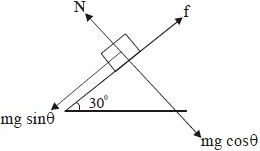
The forces acting on the block are its weight $(mg)$,the normal force $(N)$ exerted by the surface,and the static friction force $(f)$ exerted by the surface.
The net force exerted by the surface on the block is the vector sum of the normal force and the friction force,which is given by $F_{surface} = \sqrt{N^2 + f^2}$.
For a block at rest on an inclined plane:
$N = mg \cos \theta$
$f = mg \sin \theta$
Therefore,the net force exerted by the surface is:
$F_{surface} = \sqrt{(mg \cos \theta)^2 + (mg \sin \theta)^2}$
$F_{surface} = \sqrt{m^2g^2(\cos^2 \theta + \sin^2 \theta)}$
$F_{surface} = mg$
Given $m = 8\, kg$ and $g = 10\, m/s^2$:
$F_{surface} = 8 \times 10 = 80\, N$.
Thus,the magnitude of the net force exerted by the surface on the block is $80\, N$.
The forces acting on the block are its weight $(mg)$,the normal force $(N)$ exerted by the surface,and the static friction force $(f)$ exerted by the surface.
The net force exerted by the surface on the block is the vector sum of the normal force and the friction force,which is given by $F_{surface} = \sqrt{N^2 + f^2}$.
For a block at rest on an inclined plane:
$N = mg \cos \theta$
$f = mg \sin \theta$
Therefore,the net force exerted by the surface is:
$F_{surface} = \sqrt{(mg \cos \theta)^2 + (mg \sin \theta)^2}$
$F_{surface} = \sqrt{m^2g^2(\cos^2 \theta + \sin^2 \theta)}$
$F_{surface} = mg$
Given $m = 8\, kg$ and $g = 10\, m/s^2$:
$F_{surface} = 8 \times 10 = 80\, N$.
Thus,the magnitude of the net force exerted by the surface on the block is $80\, N$.
0 likes
View Solution102
MediumMCQ
$A$ block of wood resting on an inclined plane of angle $30^o$ just starts moving down. If the coefficient of friction is $0.2$,its velocity (in $ms^{-1}$) after $5\, s$ is: $(g = 10\, ms^{-2})$
A
$12.75$
B
$16.34$
C
$18.25$
D
$20$
Solution
(B) The acceleration $a$ of a block sliding down an inclined plane with friction is given by $a = g(\sin \theta - \mu \cos \theta)$.
Given: $g = 10\, ms^{-2}$,$\theta = 30^o$,$\mu = 0.2$,and $t = 5\, s$.
Substituting the values:
$a = 10 \times (\sin 30^o - 0.2 \times \cos 30^o)$
$a = 10 \times (0.5 - 0.2 \times 0.866)$
$a = 10 \times (0.5 - 0.1732) = 10 \times 0.3268 = 3.268\, ms^{-2}$.
Using the equation of motion $v = u + at$,where initial velocity $u = 0$:
$v = 0 + 3.268 \times 5 = 16.34\, ms^{-1}$.
Given: $g = 10\, ms^{-2}$,$\theta = 30^o$,$\mu = 0.2$,and $t = 5\, s$.
Substituting the values:
$a = 10 \times (\sin 30^o - 0.2 \times \cos 30^o)$
$a = 10 \times (0.5 - 0.2 \times 0.866)$
$a = 10 \times (0.5 - 0.1732) = 10 \times 0.3268 = 3.268\, ms^{-2}$.
Using the equation of motion $v = u + at$,where initial velocity $u = 0$:
$v = 0 + 3.268 \times 5 = 16.34\, ms^{-1}$.
0 likes
View Solution103
MediumMCQ
If an inclined plane is made slowly horizontal by reducing its inclination with the horizontal,the component of weight parallel to the plane of a block resting on the inclined plane:
A
Remains same
B
Increases
C
Decreases
D
First increases and then decreases
Solution
(C) The component of the weight of the block acting parallel to the inclined plane is given by $F = mg \sin \theta$,where $m$ is the mass of the block,$g$ is the acceleration due to gravity,and $\theta$ is the angle of inclination.
As the inclined plane is made horizontal,the angle $\theta$ decreases.
Since the sine function is an increasing function for $0^\circ \le \theta \le 90^\circ$,as $\theta$ decreases,$\sin \theta$ also decreases.
Therefore,the component of weight parallel to the plane,$mg \sin \theta$,decreases.
As the inclined plane is made horizontal,the angle $\theta$ decreases.
Since the sine function is an increasing function for $0^\circ \le \theta \le 90^\circ$,as $\theta$ decreases,$\sin \theta$ also decreases.
Therefore,the component of weight parallel to the plane,$mg \sin \theta$,decreases.
0 likes
View Solution104
DifficultMCQ
$A$ block is placed on a rough inclined plane of inclination $\theta = 30^o$. If the force required to drag it up along the plane is to be smaller than the force required to lift it vertically,the coefficient of friction $\mu$ should be less than:
A
$1/2$
B
$\sqrt{3}/2$
C
$2/3$
D
$1/\sqrt{3}$
Solution
(D) Let $m$ be the mass of the block. The force required to lift the block vertically is $F_1 = mg$.
The force required to drag the block up the inclined plane is $F_2 = mg \sin \theta + f_k$,where $f_k = \mu N = \mu mg \cos \theta$.
So,$F_2 = mg \sin \theta + \mu mg \cos \theta$.
According to the problem,$F_2 < F_1$,therefore:
$mg \sin \theta + \mu mg \cos \theta < mg$.
Dividing by $mg$,we get:
$\sin \theta + \mu \cos \theta < 1$.
Substituting $\theta = 30^o$:
$\sin 30^o + \mu \cos 30^o < 1$.
$1/2 + \mu (\sqrt{3}/2) < 1$.
$\mu (\sqrt{3}/2) < 1 - 1/2$.
$\mu (\sqrt{3}/2) < 1/2$.
$\mu < 1/\sqrt{3}$.
The force required to drag the block up the inclined plane is $F_2 = mg \sin \theta + f_k$,where $f_k = \mu N = \mu mg \cos \theta$.
So,$F_2 = mg \sin \theta + \mu mg \cos \theta$.
According to the problem,$F_2 < F_1$,therefore:
$mg \sin \theta + \mu mg \cos \theta < mg$.
Dividing by $mg$,we get:
$\sin \theta + \mu \cos \theta < 1$.
Substituting $\theta = 30^o$:
$\sin 30^o + \mu \cos 30^o < 1$.
$1/2 + \mu (\sqrt{3}/2) < 1$.
$\mu (\sqrt{3}/2) < 1 - 1/2$.
$\mu (\sqrt{3}/2) < 1/2$.
$\mu < 1/\sqrt{3}$.
0 likes
View Solution105
DifficultMCQ
$A$ car is going at a speed of $6\, m/s$ when it encounters a $15\, m$ slope of angle $30^o$. The friction coefficient between the road and tyre is $0.5$. The driver applies the brakes. The minimum speed of the car with which it can reach the bottom is ........ $m/s$. $(g = 10\, m/s^2)$
A
$4$
B
$3$
C
$7.49$
D
$8.45$
Solution
(C) The component of acceleration due to gravity along the slope is $a_g = g \sin \theta = 10 \sin 30^{\circ} = 5\, m/s^2$.
The acceleration due to friction opposing the motion is $a_f = \mu g \cos \theta = 0.5 \times 10 \times \cos 30^{\circ} = 5 \times 0.866 = 4.33\, m/s^2$.
The net acceleration of the car down the slope is $a = a_g - a_f = 5 - 4.33 = 0.67\, m/s^2$.
Using the equation of motion $v^2 = u^2 + 2as$,where $u = 6\, m/s$,$a = 0.67\, m/s^2$,and $s = 15\, m$:
$v^2 = (6)^2 + 2 \times 0.67 \times 15$
$v^2 = 36 + 20.1 = 56.1$
$v = \sqrt{56.1} \approx 7.49\, m/s$.
The acceleration due to friction opposing the motion is $a_f = \mu g \cos \theta = 0.5 \times 10 \times \cos 30^{\circ} = 5 \times 0.866 = 4.33\, m/s^2$.
The net acceleration of the car down the slope is $a = a_g - a_f = 5 - 4.33 = 0.67\, m/s^2$.
Using the equation of motion $v^2 = u^2 + 2as$,where $u = 6\, m/s$,$a = 0.67\, m/s^2$,and $s = 15\, m$:
$v^2 = (6)^2 + 2 \times 0.67 \times 15$
$v^2 = 36 + 20.1 = 56.1$
$v = \sqrt{56.1} \approx 7.49\, m/s$.
0 likes
View Solution106
DifficultMCQ
$A$ block moves down a smooth inclined plane of inclination $\theta$. Its velocity on reaching the bottom is $v$. If it slides down a rough inclined plane of the same inclination,its velocity on reaching the bottom is $v/n$,where $n$ is a number greater than one. The coefficient of friction $\mu$ is given by:
A
$\mu = \tan \theta \left( 1 - \frac{1}{n^2} \right)$
B
$\mu = \cot \theta \left( 1 - \frac{1}{n^2} \right)$
C
$\mu = \tan \theta \sqrt{1 - \frac{1}{n^2}}$
D
$\mu = \cot \theta \sqrt{1 - \frac{1}{n^2}}$
Solution
(A) Let the length of the inclined plane be $s$.
For the smooth inclined plane,the acceleration is $a_1 = g \sin \theta$. Using $v^2 - u^2 = 2as$ with $u=0$,we get $v^2 = 2(g \sin \theta)s$ --- $(1)$.
For the rough inclined plane,the acceleration is $a_2 = g(\sin \theta - \mu \cos \theta)$. The final velocity is $v' = v/n$. Using $v'^2 = 2a_2s$,we get $(v/n)^2 = 2g(\sin \theta - \mu \cos \theta)s$ --- $(2)$.
Dividing equation $(1)$ by equation $(2)$,we get: $n^2 = \frac{\sin \theta}{\sin \theta - \mu \cos \theta}$.
Rearranging the terms: $n^2(\sin \theta - \mu \cos \theta) = \sin \theta$.
$n^2 \sin \theta - n^2 \mu \cos \theta = \sin \theta$.
$n^2 \mu \cos \theta = n^2 \sin \theta - \sin \theta = \sin \theta (n^2 - 1)$.
$\mu = \frac{\sin \theta (n^2 - 1)}{n^2 \cos \theta} = \tan \theta \left( \frac{n^2 - 1}{n^2} \right) = \tan \theta \left( 1 - \frac{1}{n^2} \right)$.
For the smooth inclined plane,the acceleration is $a_1 = g \sin \theta$. Using $v^2 - u^2 = 2as$ with $u=0$,we get $v^2 = 2(g \sin \theta)s$ --- $(1)$.
For the rough inclined plane,the acceleration is $a_2 = g(\sin \theta - \mu \cos \theta)$. The final velocity is $v' = v/n$. Using $v'^2 = 2a_2s$,we get $(v/n)^2 = 2g(\sin \theta - \mu \cos \theta)s$ --- $(2)$.
Dividing equation $(1)$ by equation $(2)$,we get: $n^2 = \frac{\sin \theta}{\sin \theta - \mu \cos \theta}$.
Rearranging the terms: $n^2(\sin \theta - \mu \cos \theta) = \sin \theta$.
$n^2 \sin \theta - n^2 \mu \cos \theta = \sin \theta$.
$n^2 \mu \cos \theta = n^2 \sin \theta - \sin \theta = \sin \theta (n^2 - 1)$.
$\mu = \frac{\sin \theta (n^2 - 1)}{n^2 \cos \theta} = \tan \theta \left( \frac{n^2 - 1}{n^2} \right) = \tan \theta \left( 1 - \frac{1}{n^2} \right)$.
0 likes
View Solution107
DifficultMCQ
$A$ body takes $1\frac{1}{3}$ times as much time to slide down a rough inclined plane as it takes to slide down an identical but smooth inclined plane. If the angle of the inclined plane is $45^{\circ}$,the coefficient of friction is:
A
$\frac{7}{16}$
B
$\frac{9}{16}$
C
$\frac{7}{9}$
D
$\frac{3}{4}$
Solution
(A) For a smooth inclined plane,the acceleration is $a_2 = g \sin \theta$. The time taken is $t_2 = \sqrt{\frac{2s}{g \sin \theta}}$.
For a rough inclined plane,the acceleration is $a_1 = g(\sin \theta - \mu \cos \theta)$. The time taken is $t_1 = \sqrt{\frac{2s}{g(\sin \theta - \mu \cos \theta)}}$.
Given $t_1 = \frac{4}{3} t_2$,so $\frac{t_1}{t_2} = \frac{4}{3}$.
Squaring both sides,$\frac{t_1^2}{t_2^2} = \frac{16}{9} = \frac{a_2}{a_1} = \frac{g \sin \theta}{g(\sin \theta - \mu \cos \theta)} = \frac{\sin \theta}{\sin \theta - \mu \cos \theta}$.
Since $\theta = 45^{\circ}$,$\sin 45^{\circ} = \cos 45^{\circ} = \frac{1}{\sqrt{2}}$.
$\frac{16}{9} = \frac{1/\sqrt{2}}{1/\sqrt{2} - \mu(1/\sqrt{2})} = \frac{1}{1 - \mu}$.
$16(1 - \mu) = 9 \implies 16 - 16\mu = 9 \implies 16\mu = 7 \implies \mu = \frac{7}{16}$.
For a rough inclined plane,the acceleration is $a_1 = g(\sin \theta - \mu \cos \theta)$. The time taken is $t_1 = \sqrt{\frac{2s}{g(\sin \theta - \mu \cos \theta)}}$.
Given $t_1 = \frac{4}{3} t_2$,so $\frac{t_1}{t_2} = \frac{4}{3}$.
Squaring both sides,$\frac{t_1^2}{t_2^2} = \frac{16}{9} = \frac{a_2}{a_1} = \frac{g \sin \theta}{g(\sin \theta - \mu \cos \theta)} = \frac{\sin \theta}{\sin \theta - \mu \cos \theta}$.
Since $\theta = 45^{\circ}$,$\sin 45^{\circ} = \cos 45^{\circ} = \frac{1}{\sqrt{2}}$.
$\frac{16}{9} = \frac{1/\sqrt{2}}{1/\sqrt{2} - \mu(1/\sqrt{2})} = \frac{1}{1 - \mu}$.
$16(1 - \mu) = 9 \implies 16 - 16\mu = 9 \implies 16\mu = 7 \implies \mu = \frac{7}{16}$.
0 likes
View Solution108
DifficultMCQ
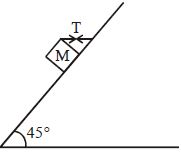
$A$ block of mass $15\,kg$ is resting on a rough inclined plane as shown in the figure. The block is tied up by a horizontal string which has a tension of $50\,N$. The coefficient of friction between the surface of contact is: $(g = 10\,m/s^2)$
A
$1/2$
B
$2/3$
C
$3/4$
D
$1/4$
Solution
(A) The forces acting on the block of mass $m = 15\,kg$ are:
$1$. Weight $mg = 15 \times 10 = 150\,N$ acting vertically downwards.
$2$. Normal force $N_1$ perpendicular to the inclined plane.
$3$. Tension $T = 50\,N$ acting horizontally.
$4$. Friction force $f$ acting up the incline.
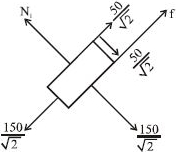
Resolving forces perpendicular to the inclined plane:
$N_1 = mg \cos(45^{\circ}) + T \sin(45^{\circ})$
$N_1 = 150 \times \frac{1}{\sqrt{2}} + 50 \times \frac{1}{\sqrt{2}} = \frac{200}{\sqrt{2}}\,N$
Resolving forces parallel to the inclined plane:
$f + T \cos(45^{\circ}) = mg \sin(45^{\circ})$
$f = 150 \times \frac{1}{\sqrt{2}} - 50 \times \frac{1}{\sqrt{2}} = \frac{100}{\sqrt{2}}\,N$
Using the relation $f = \mu N_1$:
$\frac{100}{\sqrt{2}} = \mu \times \frac{200}{\sqrt{2}}$
$\mu = \frac{100}{200} = \frac{1}{2}$
$1$. Weight $mg = 15 \times 10 = 150\,N$ acting vertically downwards.
$2$. Normal force $N_1$ perpendicular to the inclined plane.
$3$. Tension $T = 50\,N$ acting horizontally.
$4$. Friction force $f$ acting up the incline.
Resolving forces perpendicular to the inclined plane:
$N_1 = mg \cos(45^{\circ}) + T \sin(45^{\circ})$
$N_1 = 150 \times \frac{1}{\sqrt{2}} + 50 \times \frac{1}{\sqrt{2}} = \frac{200}{\sqrt{2}}\,N$
Resolving forces parallel to the inclined plane:
$f + T \cos(45^{\circ}) = mg \sin(45^{\circ})$
$f = 150 \times \frac{1}{\sqrt{2}} - 50 \times \frac{1}{\sqrt{2}} = \frac{100}{\sqrt{2}}\,N$
Using the relation $f = \mu N_1$:
$\frac{100}{\sqrt{2}} = \mu \times \frac{200}{\sqrt{2}}$
$\mu = \frac{100}{200} = \frac{1}{2}$
0 likes
View Solution109
MediumMCQ
$A$ uniform rope lies on a horizontal table such that a part of it hangs over the edge. The rope begins to slide down when the length of the hanging part is $25\%$ of its entire length. The coefficient of friction between the rope and the table is
A
$0.25$
B
$0.75$
C
$0.33$
D
$0.67$
Solution
(C) Let the total length of the rope be $L$ and its total mass be $M$. The mass per unit length is $\lambda = M/L$.
The length of the hanging part is $l = 0.25L = L/4$. The mass of the hanging part is $m = \lambda l = M/4$.
The length of the part on the table is $L - l = 0.75L = 3L/4$. The mass of this part is $M' = \lambda(3L/4) = 3M/4$.
The downward force causing the rope to slide is the weight of the hanging part: $F_g = mg = (M/4)g$.
The limiting friction force opposing the motion is $f_s = \mu_s N = \mu_s M' g = \mu_s (3M/4)g$.
At the point of sliding,the downward force equals the limiting friction force: $(M/4)g = \mu_s (3M/4)g$.
Solving for $\mu_s$: $\mu_s = (M/4) / (3M/4) = 1/3 \approx 0.33$.
The length of the hanging part is $l = 0.25L = L/4$. The mass of the hanging part is $m = \lambda l = M/4$.
The length of the part on the table is $L - l = 0.75L = 3L/4$. The mass of this part is $M' = \lambda(3L/4) = 3M/4$.
The downward force causing the rope to slide is the weight of the hanging part: $F_g = mg = (M/4)g$.
The limiting friction force opposing the motion is $f_s = \mu_s N = \mu_s M' g = \mu_s (3M/4)g$.
At the point of sliding,the downward force equals the limiting friction force: $(M/4)g = \mu_s (3M/4)g$.
Solving for $\mu_s$: $\mu_s = (M/4) / (3M/4) = 1/3 \approx 0.33$.
0 likes
View Solution110
DifficultMCQ
An insect crawls up a hemispherical surface very slowly (see the figure). The coefficient of friction between the insect and the surface is $1/3$. If the line joining the centre of the hemispherical surface to the insect makes an angle $\alpha$ with the vertical,the maximum possible value of $\alpha$ is given by
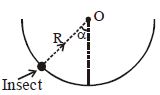
A
$cot\, \alpha = 3$
B
$tan\, \alpha = 3$
C
$sec\, \alpha = 3$
D
$cosec\, \alpha = 3$
Solution
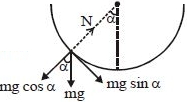
(A) The forces acting on the insect are the gravitational force $mg$ acting vertically downwards,the normal reaction $N$ acting radially outwards,and the frictional force $f$ acting tangentially upwards along the surface.
Resolving the gravitational force $mg$ into two components:
$1$. $mg \cos \alpha$ acting radially inwards (opposite to $N$).
$2$. $mg \sin \alpha$ acting tangentially downwards along the surface.
Since the insect crawls very slowly,it is in equilibrium. Thus:
$N = mg \cos \alpha$
For the insect to not slip,the frictional force $f$ must balance the tangential component of gravity:
$f = mg \sin \alpha$
We know that the maximum static friction is $f_{max} = \mu N$.
At the maximum angle $\alpha$,$f = f_{max} = \mu N$.
Substituting the expressions for $f$ and $N$:
$mg \sin \alpha = \mu (mg \cos \alpha)$
Dividing both sides by $mg \cos \alpha$:
$\tan \alpha = \mu$
Given $\mu = 1/3$,we have:
$\tan \alpha = 1/3$
Therefore,$\cot \alpha = 1/\tan \alpha = 3$.
Resolving the gravitational force $mg$ into two components:
$1$. $mg \cos \alpha$ acting radially inwards (opposite to $N$).
$2$. $mg \sin \alpha$ acting tangentially downwards along the surface.
Since the insect crawls very slowly,it is in equilibrium. Thus:
$N = mg \cos \alpha$
For the insect to not slip,the frictional force $f$ must balance the tangential component of gravity:
$f = mg \sin \alpha$
We know that the maximum static friction is $f_{max} = \mu N$.
At the maximum angle $\alpha$,$f = f_{max} = \mu N$.
Substituting the expressions for $f$ and $N$:
$mg \sin \alpha = \mu (mg \cos \alpha)$
Dividing both sides by $mg \cos \alpha$:
$\tan \alpha = \mu$
Given $\mu = 1/3$,we have:
$\tan \alpha = 1/3$
Therefore,$\cot \alpha = 1/\tan \alpha = 3$.
0 likes
View Solution111
DifficultMCQ
If the coefficient of friction between an insect and a bowl is $\mu$ and the radius of the bowl is $r$,the maximum height to which the insect can crawl in the bowl is:
A
$\frac{r}{\sqrt{1+\mu^2}}$
B
$r\left[1-\frac{1}{\sqrt{1+\mu^2}}\right]$
C
$r \sqrt{1+\mu^2}$
D
$r \sqrt{1+\mu^2}-1$
Solution
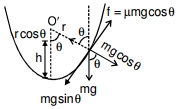
(B) Let $\theta$ be the angle the radius makes with the vertical at the maximum height reached by the insect.
At this point,the component of gravity along the tangent balances the limiting friction.
The forces acting on the insect are: gravity $(mg)$ acting downwards,normal reaction $(N)$ perpendicular to the surface,and friction $(f)$ acting upwards along the tangent.
Resolving gravity into components: $mg \sin \theta$ along the tangent and $mg \cos \theta$ perpendicular to the surface.
Thus,$N = mg \cos \theta$.
The limiting friction is $f = \mu N = \mu mg \cos \theta$.
For the insect to be in equilibrium,$f = mg \sin \theta$.
Therefore,$\mu mg \cos \theta = mg \sin \theta$,which gives $\tan \theta = \mu$.
From the geometry of the bowl,the height $h$ from the bottom is $h = r - r \cos \theta = r(1 - \cos \theta)$.
Since $\tan \theta = \mu$,we have $\cos \theta = \frac{1}{\sqrt{1+\mu^2}}$.
Substituting this into the expression for $h$,we get $h = r\left[1 - \frac{1}{\sqrt{1+\mu^2}}\right]$.
At this point,the component of gravity along the tangent balances the limiting friction.
The forces acting on the insect are: gravity $(mg)$ acting downwards,normal reaction $(N)$ perpendicular to the surface,and friction $(f)$ acting upwards along the tangent.
Resolving gravity into components: $mg \sin \theta$ along the tangent and $mg \cos \theta$ perpendicular to the surface.
Thus,$N = mg \cos \theta$.
The limiting friction is $f = \mu N = \mu mg \cos \theta$.
For the insect to be in equilibrium,$f = mg \sin \theta$.
Therefore,$\mu mg \cos \theta = mg \sin \theta$,which gives $\tan \theta = \mu$.
From the geometry of the bowl,the height $h$ from the bottom is $h = r - r \cos \theta = r(1 - \cos \theta)$.
Since $\tan \theta = \mu$,we have $\cos \theta = \frac{1}{\sqrt{1+\mu^2}}$.
Substituting this into the expression for $h$,we get $h = r\left[1 - \frac{1}{\sqrt{1+\mu^2}}\right]$.
0 likes
View Solution112
MediumMCQ
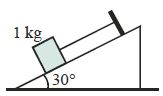
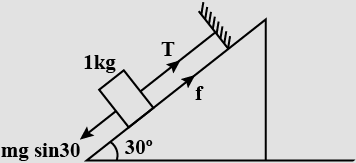
The coefficient of friction between two surfaces is $\mu = 0.8$. The tension in the string shown in the figure is ........ $N$.
A
$0$
B
$6$
C
$4$
D
$8$
Solution
(A) The forces acting on the block along the inclined plane are the component of gravitational force $mg \sin 30^{\circ}$ acting downwards,the tension $T$ in the string acting upwards,and the frictional force $f$ acting upwards.
Maximum static frictional force $f_{max} = \mu N = \mu mg \cos 30^{\circ}$.
Given $\mu = 0.8$,$m = 1 \text{ kg}$,$g = 9.8 \text{ m/s}^2$,and $\theta = 30^{\circ}$.
$f_{max} = 0.8 \times 1 \times 9.8 \times \cos 30^{\circ} = 0.8 \times 9.8 \times 0.866 \approx 6.79 \text{ N}$.
The downward force component is $F_{down} = mg \sin 30^{\circ} = 1 \times 9.8 \times 0.5 = 4.9 \text{ N}$.
Since the downward force $F_{down} = 4.9 \text{ N}$ is less than the maximum static frictional force $f_{max} \approx 6.79 \text{ N}$,the block has no tendency to slide down the incline.
Therefore,the static friction alone is sufficient to balance the downward component of gravity,and the tension in the string is $T = 0 \text{ N}$.
Maximum static frictional force $f_{max} = \mu N = \mu mg \cos 30^{\circ}$.
Given $\mu = 0.8$,$m = 1 \text{ kg}$,$g = 9.8 \text{ m/s}^2$,and $\theta = 30^{\circ}$.
$f_{max} = 0.8 \times 1 \times 9.8 \times \cos 30^{\circ} = 0.8 \times 9.8 \times 0.866 \approx 6.79 \text{ N}$.
The downward force component is $F_{down} = mg \sin 30^{\circ} = 1 \times 9.8 \times 0.5 = 4.9 \text{ N}$.
Since the downward force $F_{down} = 4.9 \text{ N}$ is less than the maximum static frictional force $f_{max} \approx 6.79 \text{ N}$,the block has no tendency to slide down the incline.
Therefore,the static friction alone is sufficient to balance the downward component of gravity,and the tension in the string is $T = 0 \text{ N}$.
0 likes
View Solution113
MediumMCQ
$A$ chain of length $L$ rests on a rough table. If $\mu$ is the coefficient of friction,the maximum fraction of the chain that can hang over the table will be:
A
$\frac{\mu - 1}{\mu}$
B
$\frac{\mu}{\mu + 1}$
C
$(\mu - 1)$
D
$\frac{1}{\mu + 1}$
Solution
(B) Let $\lambda$ be the mass per unit length of the chain.
Let $l$ be the length of the chain hanging over the edge of the table.
The length of the chain remaining on the table is $(L - l)$.
The force pulling the chain down is the weight of the hanging part: $F_g = l \lambda g$.
The maximum static frictional force acting on the part of the chain on the table is: $f_{max} = \mu N = \mu (L - l) \lambda g$.
For the chain to be in limiting equilibrium,the downward force must equal the maximum frictional force:
$l \lambda g = \mu (L - l) \lambda g$
$l = \mu (L - l)$
$l = \mu L - \mu l$
$l(1 + \mu) = \mu L$
$\frac{l}{L} = \frac{\mu}{\mu + 1}$
Thus,the maximum fraction of the chain that can hang is $\frac{\mu}{\mu + 1}$.
Let $l$ be the length of the chain hanging over the edge of the table.
The length of the chain remaining on the table is $(L - l)$.
The force pulling the chain down is the weight of the hanging part: $F_g = l \lambda g$.
The maximum static frictional force acting on the part of the chain on the table is: $f_{max} = \mu N = \mu (L - l) \lambda g$.
For the chain to be in limiting equilibrium,the downward force must equal the maximum frictional force:
$l \lambda g = \mu (L - l) \lambda g$
$l = \mu (L - l)$
$l = \mu L - \mu l$
$l(1 + \mu) = \mu L$
$\frac{l}{L} = \frac{\mu}{\mu + 1}$
Thus,the maximum fraction of the chain that can hang is $\frac{\mu}{\mu + 1}$.
0 likes
View Solution114
DifficultMCQ
$A$ small mass slides down an inclined plane of angle $\theta$ with the horizontal. The coefficient of friction is $\mu = \mu_0 x$,where $x$ is the distance through which the mass slides down and $\mu_0$ is a constant. Then,the distance covered by the mass before it stops is:
A
$\frac{2}{\mu_0} \tan \theta$
B
$\frac{4}{\mu_0} \tan \theta$
C
$\frac{1}{2 \mu_0} \tan \theta$
D
$\frac{1}{\mu_0} \tan \theta$
Solution
(A) The net force acting on the mass along the inclined plane is $F_{net} = mg \sin \theta - f_r = ma$.
Since the frictional force is $f_r = \mu N = \mu mg \cos \theta$,we have $mg \sin \theta - \mu mg \cos \theta = ma$.
Substituting $\mu = \mu_0 x$,the acceleration $a$ is given by $a = g(\sin \theta - \mu_0 x \cos \theta)$.
Using the relation $a = v \frac{dv}{dx}$,we integrate the equation of motion: $\int_0^v v \, dv = \int_0^x g(\sin \theta - \mu_0 x \cos \theta) \, dx$.
At the point where the mass stops,the final velocity $v = 0$.
Thus,$0 = g [x \sin \theta - \frac{\mu_0 x^2}{2} \cos \theta]$.
Setting the term inside the bracket to zero: $x \sin \theta = \frac{\mu_0 x^2}{2} \cos \theta$.
Solving for $x$,we get $x = \frac{2 \sin \theta}{\mu_0 \cos \theta} = \frac{2}{\mu_0} \tan \theta$.
Since the frictional force is $f_r = \mu N = \mu mg \cos \theta$,we have $mg \sin \theta - \mu mg \cos \theta = ma$.
Substituting $\mu = \mu_0 x$,the acceleration $a$ is given by $a = g(\sin \theta - \mu_0 x \cos \theta)$.
Using the relation $a = v \frac{dv}{dx}$,we integrate the equation of motion: $\int_0^v v \, dv = \int_0^x g(\sin \theta - \mu_0 x \cos \theta) \, dx$.
At the point where the mass stops,the final velocity $v = 0$.
Thus,$0 = g [x \sin \theta - \frac{\mu_0 x^2}{2} \cos \theta]$.
Setting the term inside the bracket to zero: $x \sin \theta = \frac{\mu_0 x^2}{2} \cos \theta$.
Solving for $x$,we get $x = \frac{2 \sin \theta}{\mu_0 \cos \theta} = \frac{2}{\mu_0} \tan \theta$.
0 likes
View Solution115
DifficultMCQ
In the above question,the speed of the mass when it has traveled half the maximum distance is:
A
$\sqrt{\frac{g \tan \theta \sin \theta}{\mu_0}}$
B
$\sqrt{\frac{g \tan \theta \sin \theta}{2 \mu_0}}$
C
$\sqrt{\frac{g \tan \theta \sin \theta}{8 \mu_0}}$
D
none of these
Solution
(A) The acceleration of the mass is given by $a = g(\sin \theta - \mu_0 x \cos \theta)$.
Using the work-energy theorem or integrating $v dv = a dx$,we have $\int_0^{v} v dv = \int_0^{x/2} g(\sin \theta - \mu_0 x \cos \theta) dx$.
Integrating both sides: $\frac{v^2}{2} = g[\sin \theta \cdot x' - \frac{\mu_0}{2} (x')^2 \cos \theta]$,where $x' = x/2$.
Substituting $x' = \frac{x}{2} = \frac{1}{\mu_0} \tan \theta$ (since maximum distance $x_{max} = \frac{2 \tan \theta}{\mu_0}$):
$\frac{v^2}{2} = g[\sin \theta (\frac{\tan \theta}{\mu_0}) - \frac{\mu_0}{2} (\frac{\tan \theta}{\mu_0})^2 \cos \theta]$.
$\frac{v^2}{2} = g[\frac{\sin \theta \tan \theta}{\mu_0} - \frac{\tan^2 \theta \cos \theta}{2 \mu_0}] = g[\frac{\sin \theta \tan \theta}{\mu_0} - \frac{\sin \theta \tan \theta}{2 \mu_0}] = \frac{g \sin \theta \tan \theta}{2 \mu_0}$.
Thus,$v^2 = \frac{g \sin \theta \tan \theta}{\mu_0}$,which gives $v = \sqrt{\frac{g \tan \theta \sin \theta}{\mu_0}}$.
Using the work-energy theorem or integrating $v dv = a dx$,we have $\int_0^{v} v dv = \int_0^{x/2} g(\sin \theta - \mu_0 x \cos \theta) dx$.
Integrating both sides: $\frac{v^2}{2} = g[\sin \theta \cdot x' - \frac{\mu_0}{2} (x')^2 \cos \theta]$,where $x' = x/2$.
Substituting $x' = \frac{x}{2} = \frac{1}{\mu_0} \tan \theta$ (since maximum distance $x_{max} = \frac{2 \tan \theta}{\mu_0}$):
$\frac{v^2}{2} = g[\sin \theta (\frac{\tan \theta}{\mu_0}) - \frac{\mu_0}{2} (\frac{\tan \theta}{\mu_0})^2 \cos \theta]$.
$\frac{v^2}{2} = g[\frac{\sin \theta \tan \theta}{\mu_0} - \frac{\tan^2 \theta \cos \theta}{2 \mu_0}] = g[\frac{\sin \theta \tan \theta}{\mu_0} - \frac{\sin \theta \tan \theta}{2 \mu_0}] = \frac{g \sin \theta \tan \theta}{2 \mu_0}$.
Thus,$v^2 = \frac{g \sin \theta \tan \theta}{\mu_0}$,which gives $v = \sqrt{\frac{g \tan \theta \sin \theta}{\mu_0}}$.
0 likes
View Solution116
MediumMCQ
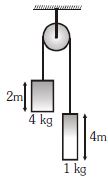
For the equilibrium of a body on an inclined plane of inclination $45^{\circ}$, the coefficient of static friction must be:
A
less than one
B
$Zero$
C
less than zero
D
greater than or equal to one
Solution
(D) For a body to be in equilibrium on an inclined plane, the component of gravitational force acting down the plane must be balanced by the static frictional force.
The force acting down the plane is $F_g = mg \sin \theta$.
The maximum static frictional force is $f_{s,max} = \mu_s N$, where $N = mg \cos \theta$ is the normal force.
For equilibrium, the condition is $mg \sin \theta \leq \mu_s mg \cos \theta$.
This simplifies to $\mu_s \geq \tan \theta$.
Given the inclination $\theta = 45^{\circ}$, we have $\mu_s \geq \tan 45^{\circ}$.
Since $\tan 45^{\circ} = 1$, the condition becomes $\mu_s \geq 1$.
The force acting down the plane is $F_g = mg \sin \theta$.
The maximum static frictional force is $f_{s,max} = \mu_s N$, where $N = mg \cos \theta$ is the normal force.
For equilibrium, the condition is $mg \sin \theta \leq \mu_s mg \cos \theta$.
This simplifies to $\mu_s \geq \tan \theta$.
Given the inclination $\theta = 45^{\circ}$, we have $\mu_s \geq \tan 45^{\circ}$.
Since $\tan 45^{\circ} = 1$, the condition becomes $\mu_s \geq 1$.
0 likes
View Solution117
DifficultMCQ
$A$ body is sliding down an inclined plane (angle of inclination $45^{\circ}$). If the coefficient of friction is $0.5$ and $g = 9.8\, m/s^2$,then the acceleration of the body downwards in $m/s^2$ is
A
$\frac{4.9}{\sqrt{2}}$
B
$4.9\sqrt{2}$
C
$19.6\sqrt{2}$
D
$4.9$
Solution
(A) The acceleration $a$ of a body sliding down an inclined plane with friction is given by the formula: $a = g \sin \theta - \mu g \cos \theta$.
Given: $g = 9.8\, m/s^2$,$\theta = 45^{\circ}$,and $\mu = 0.5$.
Substituting the values:
$a = 9.8 \sin 45^{\circ} - 0.5 \times 9.8 \cos 45^{\circ}$
Since $\sin 45^{\circ} = \cos 45^{\circ} = \frac{1}{\sqrt{2}}$:
$a = 9.8 \left( \frac{1}{\sqrt{2}} \right) - 0.5 \times 9.8 \left( \frac{1}{\sqrt{2}} \right)$
$a = 9.8 \left( \frac{1}{\sqrt{2}} \right) (1 - 0.5)$
$a = 9.8 \times 0.5 \times \frac{1}{\sqrt{2}}$
$a = 4.9 \times \frac{1}{\sqrt{2}} = \frac{4.9}{\sqrt{2}}\, m/s^2$.
Given: $g = 9.8\, m/s^2$,$\theta = 45^{\circ}$,and $\mu = 0.5$.
Substituting the values:
$a = 9.8 \sin 45^{\circ} - 0.5 \times 9.8 \cos 45^{\circ}$
Since $\sin 45^{\circ} = \cos 45^{\circ} = \frac{1}{\sqrt{2}}$:
$a = 9.8 \left( \frac{1}{\sqrt{2}} \right) - 0.5 \times 9.8 \left( \frac{1}{\sqrt{2}} \right)$
$a = 9.8 \left( \frac{1}{\sqrt{2}} \right) (1 - 0.5)$
$a = 9.8 \times 0.5 \times \frac{1}{\sqrt{2}}$
$a = 4.9 \times \frac{1}{\sqrt{2}} = \frac{4.9}{\sqrt{2}}\, m/s^2$.
0 likes
View Solution118
EasyMCQ
Two blocks $A$ and $B$ are released from the top of a rough inclined plane so that $A$ slides along the plane and $B$ falls down freely. Which will have higher velocity on reaching the ground?
A
$A$
B
$B$
C
Both will reach the ground with same velocity
D
It depends on the coefficient of friction
Solution
(B) When block $A$ slides down a rough inclined plane,work is done against the frictional force,which converts some of its potential energy into heat energy.
As a result,the kinetic energy of block $A$ at the bottom is less than its initial potential energy.
In contrast,block $B$ falls freely under gravity,meaning its potential energy is entirely converted into kinetic energy (ignoring air resistance).
Therefore,the final velocity of block $B$ will be greater than that of block $A$ upon reaching the ground.
As a result,the kinetic energy of block $A$ at the bottom is less than its initial potential energy.
In contrast,block $B$ falls freely under gravity,meaning its potential energy is entirely converted into kinetic energy (ignoring air resistance).
Therefore,the final velocity of block $B$ will be greater than that of block $A$ upon reaching the ground.
0 likes
View Solution119
DifficultMCQ
$A$ block slides down an inclined plane of slope angle $\theta$ with a constant velocity. It is then projected up the plane with an initial velocity $u$. The distance up to which it will rise before coming to rest is
A
$\frac{u^2}{4g \sin \theta}$
B
$\frac{u}{4g \sin \theta}$
C
$\frac{u^2 \sin \theta}{4g}$
D
$\frac{u \sin \theta}{4g}$
Solution
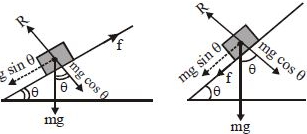
(A) Case $I$: As the block slides down with constant velocity,the acceleration is zero. In this case,the frictional force $f$ balances the component of gravity along the plane:
$f = mg \sin \theta$ and $f = \mu R = \mu mg \cos \theta$
Therefore,$\mu mg \cos \theta = mg \sin \theta$,which gives $\mu = \tan \theta$ ... $(i)$
Case $II$: The block is projected upward with initial velocity $u$. It experiences a downward acceleration $a$ due to both gravity and friction acting down the plane:
$mg \sin \theta + f = ma$
$mg \sin \theta + \mu mg \cos \theta = ma$
Substituting $\mu = \tan \theta$ from $(i)$:
$mg \sin \theta + (\tan \theta) mg \cos \theta = ma$
$mg \sin \theta + mg \sin \theta = ma$
$2mg \sin \theta = ma \implies a = 2g \sin \theta$ ... $(ii)$
Let $x$ be the distance moved up the plane before the block comes to rest. Using the equation of motion $v^2 - u^2 = 2as$:
$0^2 - u^2 = 2(-a)x$
$-u^2 = -2(2g \sin \theta)x$
$x = \frac{u^2}{4g \sin \theta}$
$f = mg \sin \theta$ and $f = \mu R = \mu mg \cos \theta$
Therefore,$\mu mg \cos \theta = mg \sin \theta$,which gives $\mu = \tan \theta$ ... $(i)$
Case $II$: The block is projected upward with initial velocity $u$. It experiences a downward acceleration $a$ due to both gravity and friction acting down the plane:
$mg \sin \theta + f = ma$
$mg \sin \theta + \mu mg \cos \theta = ma$
Substituting $\mu = \tan \theta$ from $(i)$:
$mg \sin \theta + (\tan \theta) mg \cos \theta = ma$
$mg \sin \theta + mg \sin \theta = ma$
$2mg \sin \theta = ma \implies a = 2g \sin \theta$ ... $(ii)$
Let $x$ be the distance moved up the plane before the block comes to rest. Using the equation of motion $v^2 - u^2 = 2as$:
$0^2 - u^2 = 2(-a)x$
$-u^2 = -2(2g \sin \theta)x$
$x = \frac{u^2}{4g \sin \theta}$
0 likes
View Solution120
MediumMCQ
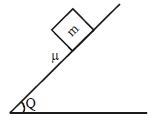
$A$ block of mass $m$ is at rest on an inclined plane with an angle of inclination $\theta$ and coefficient of friction $\mu$,as shown in the figure. The frictional force acting on the block is:
A
$mg \cos \theta$
B
$mg \sin \theta$
C
$\mu mg \sin \theta$
D
$\mu mg \cos \theta$
Solution
(B) The block is at rest on the inclined plane. This means the net force acting on the block along the inclined plane must be zero.
The gravitational force acting on the block is $mg$,which can be resolved into two components:
$1$. $A$ component perpendicular to the inclined plane: $mg \cos \theta$.
$2$. $A$ component parallel to the inclined plane: $mg \sin \theta$.
The component $mg \sin \theta$ acts downwards along the plane,trying to slide the block down. Since the block is at rest,the static frictional force $f$ must balance this component to prevent motion.
Therefore,the frictional force $f = mg \sin \theta$.
The gravitational force acting on the block is $mg$,which can be resolved into two components:
$1$. $A$ component perpendicular to the inclined plane: $mg \cos \theta$.
$2$. $A$ component parallel to the inclined plane: $mg \sin \theta$.
The component $mg \sin \theta$ acts downwards along the plane,trying to slide the block down. Since the block is at rest,the static frictional force $f$ must balance this component to prevent motion.
Therefore,the frictional force $f = mg \sin \theta$.
0 likes
View Solution121
DifficultMCQ
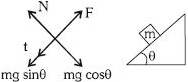
$A$ block of mass $m$ is lying on an inclined plane. The coefficient of friction between the plane and the block is $\mu$. The force $(F_1)$ required to move the block up the inclined plane will be
A
$mg \sin \theta + \mu mg \cos \theta$
B
$mg \cos \theta - \mu mg \sin \theta$
C
$mg \sin \theta - \mu mg \cos \theta$
D
$mg \cos \theta + \mu mg \sin \theta$
Solution
(A) To move the block up the inclined plane,the applied force $F_1$ must overcome both the component of gravitational force acting down the plane and the maximum static frictional force acting down the plane.
$1$. The component of gravitational force acting down the inclined plane is $mg \sin \theta$.
$2$. The normal force acting on the block is $N = mg \cos \theta$.
$3$. The maximum static frictional force acting down the plane is $f = \mu N = \mu mg \cos \theta$.
$4$. Therefore,the total force required to move the block up the plane is $F_1 = mg \sin \theta + f = mg \sin \theta + \mu mg \cos \theta = mg(\sin \theta + \mu \cos \theta)$.
$1$. The component of gravitational force acting down the inclined plane is $mg \sin \theta$.
$2$. The normal force acting on the block is $N = mg \cos \theta$.
$3$. The maximum static frictional force acting down the plane is $f = \mu N = \mu mg \cos \theta$.
$4$. Therefore,the total force required to move the block up the plane is $F_1 = mg \sin \theta + f = mg \sin \theta + \mu mg \cos \theta = mg(\sin \theta + \mu \cos \theta)$.
0 likes
View Solution122
DifficultMCQ
$A$ uniform chain of length $L$ which hangs partially from a table,is kept in equilibrium by friction. The maximum length that can hang without slipping is $l$. Then,the coefficient of friction between the table and the chain is:
A
$\frac{l}{L}$
B
$\frac{l}{L + l}$
C
$\frac{l}{L - l}$
D
$\frac{L}{L + l}$
Solution
(C) Let $M$ be the total mass of the chain of length $L$. The mass per unit length is $\lambda = \frac{M}{L}$.
When a length $l$ hangs from the table,the mass of the hanging part is $m_1 = \lambda l = \frac{M}{L} l$.
The mass of the part remaining on the table is $m_2 = \lambda (L - l) = \frac{M}{L} (L - l)$.
For the chain to be in equilibrium,the downward force due to the hanging part must be balanced by the maximum static frictional force acting on the part on the table.
The downward force is $F_g = m_1 g = \frac{M}{L} l g$.
The maximum frictional force is $f_{max} = \mu N = \mu m_2 g = \mu \frac{M}{L} (L - l) g$.
Equating the two: $\frac{M}{L} l g = \mu \frac{M}{L} (L - l) g$.
Solving for $\mu$: $\mu = \frac{l}{L - l}$.
When a length $l$ hangs from the table,the mass of the hanging part is $m_1 = \lambda l = \frac{M}{L} l$.
The mass of the part remaining on the table is $m_2 = \lambda (L - l) = \frac{M}{L} (L - l)$.
For the chain to be in equilibrium,the downward force due to the hanging part must be balanced by the maximum static frictional force acting on the part on the table.
The downward force is $F_g = m_1 g = \frac{M}{L} l g$.
The maximum frictional force is $f_{max} = \mu N = \mu m_2 g = \mu \frac{M}{L} (L - l) g$.
Equating the two: $\frac{M}{L} l g = \mu \frac{M}{L} (L - l) g$.
Solving for $\mu$: $\mu = \frac{l}{L - l}$.
0 likes
View Solution123
MediumMCQ
$A$ small bar starts sliding down an inclined plane forming an angle $\theta$ with the horizontal. The friction coefficient depends on the distance $x$ covered as $\mu = kx$,where $k$ is a constant. Find the distance covered by the bar until it stops.
A
$\frac{\tan \theta}{k}$
B
$\frac{2 \tan \theta}{k}$
C
$\frac{3 \tan \theta}{k}$
D
None
Solution
(B) According to the Work-Energy Theorem,the total work done on the bar is equal to the change in its kinetic energy.
Since the bar starts from rest and stops at distance $S$,the change in kinetic energy $\Delta K = 0 - 0 = 0$.
Therefore,the total work done $W = \int_{0}^{S} (mg \sin \theta - \mu mg \cos \theta) dx = 0$.
Substituting $\mu = kx$,we get $\int_{0}^{S} (mg \sin \theta - kx mg \cos \theta) dx = 0$.
Integrating with respect to $x$: $[mg \sin \theta \cdot x - \frac{1}{2} k mg \cos \theta \cdot x^2]_0^S = 0$.
This simplifies to $mg \sin \theta \cdot S = \frac{1}{2} k mg \cos \theta \cdot S^2$.
Dividing both sides by $mg \cos \theta \cdot S$ (assuming $S \neq 0$),we get $\tan \theta = \frac{1}{2} k S$.
Solving for $S$,we find $S = \frac{2 \tan \theta}{k}$.
Since the bar starts from rest and stops at distance $S$,the change in kinetic energy $\Delta K = 0 - 0 = 0$.
Therefore,the total work done $W = \int_{0}^{S} (mg \sin \theta - \mu mg \cos \theta) dx = 0$.
Substituting $\mu = kx$,we get $\int_{0}^{S} (mg \sin \theta - kx mg \cos \theta) dx = 0$.
Integrating with respect to $x$: $[mg \sin \theta \cdot x - \frac{1}{2} k mg \cos \theta \cdot x^2]_0^S = 0$.
This simplifies to $mg \sin \theta \cdot S = \frac{1}{2} k mg \cos \theta \cdot S^2$.
Dividing both sides by $mg \cos \theta \cdot S$ (assuming $S \neq 0$),we get $\tan \theta = \frac{1}{2} k S$.
Solving for $S$,we find $S = \frac{2 \tan \theta}{k}$.
0 likes
View Solution124
DifficultMCQ
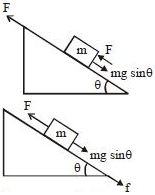
The force required to just move a body up an inclined plane is double the force required to just prevent the body from sliding down the plane. If the coefficient of friction is $\mu$,then the inclination $\theta$ of the plane is:
A
$\tan^{-1}(\mu)$
B
$\tan^{-1}(\mu/2)$
C
$\tan^{-1}(2\mu)$
D
$\tan^{-1}(3\mu)$
Solution
(D) Let $m$ be the mass of the body and $\theta$ be the angle of inclination.
$1$. Force required to just prevent the body from sliding down $(F_1)$:
The component of gravity acting down the plane is $mg \sin \theta$. The friction force acts up the plane to oppose sliding,$f = \mu mg \cos \theta$.
Thus,$F_1 = mg \sin \theta - \mu mg \cos \theta$.
$2$. Force required to just move the body up the plane $(F_2)$:
The component of gravity acts down the plane,and friction also acts down the plane to oppose motion,$f = \mu mg \cos \theta$.
Thus,$F_2 = mg \sin \theta + \mu mg \cos \theta$.
$3$. Given condition: $F_2 = 2 F_1$.
$mg \sin \theta + \mu mg \cos \theta = 2(mg \sin \theta - \mu mg \cos \theta)$
$\sin \theta + \mu \cos \theta = 2 \sin \theta - 2 \mu \cos \theta$
$3 \mu \cos \theta = \sin \theta$
$\tan \theta = 3 \mu$
$\theta = \tan^{-1}(3 \mu)$.
$1$. Force required to just prevent the body from sliding down $(F_1)$:
The component of gravity acting down the plane is $mg \sin \theta$. The friction force acts up the plane to oppose sliding,$f = \mu mg \cos \theta$.
Thus,$F_1 = mg \sin \theta - \mu mg \cos \theta$.
$2$. Force required to just move the body up the plane $(F_2)$:
The component of gravity acts down the plane,and friction also acts down the plane to oppose motion,$f = \mu mg \cos \theta$.
Thus,$F_2 = mg \sin \theta + \mu mg \cos \theta$.
$3$. Given condition: $F_2 = 2 F_1$.
$mg \sin \theta + \mu mg \cos \theta = 2(mg \sin \theta - \mu mg \cos \theta)$
$\sin \theta + \mu \cos \theta = 2 \sin \theta - 2 \mu \cos \theta$
$3 \mu \cos \theta = \sin \theta$
$\tan \theta = 3 \mu$
$\theta = \tan^{-1}(3 \mu)$.
0 likes
View Solution125
DifficultMCQ
$A$ body is moving down a long inclined plane of slope $37^{\circ}$. The coefficient of friction between the body and the plane varies as $\mu = 0.3x$,where $x$ is the distance travelled down the plane. The body will have maximum speed at:
A
at $x = 1.16 \, m$
B
at $x = 2 \, m$
C
at $x = 2.5 \, m$
D
at the bottom of the plane
Solution
(C) The net force acting on the body along the inclined plane is given by $F_{net} = mg \sin \theta - f_k$,where $f_k = \mu N = \mu mg \cos \theta$.
Since $\mu = 0.3x$,the net force is $F_{net} = mg \sin \theta - (0.3x) mg \cos \theta$.
The acceleration of the body is $a = \frac{F_{net}}{m} = g \sin \theta - 0.3x g \cos \theta$.
The speed of the body increases as long as the acceleration is positive. The speed is maximum when the acceleration becomes zero.
Setting $a = 0$:
$g \sin 37^{\circ} - 0.3x g \cos 37^{\circ} = 0$
Given $\sin 37^{\circ} = 0.6$ and $\cos 37^{\circ} = 0.8$:
$10 \times 0.6 - 0.3 \times x \times 10 \times 0.8 = 0$
$6 - 2.4x = 0$
$2.4x = 6$
$x = \frac{6}{2.4} = 2.5 \, m$.
Since $\mu = 0.3x$,the net force is $F_{net} = mg \sin \theta - (0.3x) mg \cos \theta$.
The acceleration of the body is $a = \frac{F_{net}}{m} = g \sin \theta - 0.3x g \cos \theta$.
The speed of the body increases as long as the acceleration is positive. The speed is maximum when the acceleration becomes zero.
Setting $a = 0$:
$g \sin 37^{\circ} - 0.3x g \cos 37^{\circ} = 0$
Given $\sin 37^{\circ} = 0.6$ and $\cos 37^{\circ} = 0.8$:
$10 \times 0.6 - 0.3 \times x \times 10 \times 0.8 = 0$
$6 - 2.4x = 0$
$2.4x = 6$
$x = \frac{6}{2.4} = 2.5 \, m$.
0 likes
View Solution126
EasyMCQ
$A$ block of mass $5\,kg$ and surface area $2\,m^2$ just begins to slide down an inclined plane when the angle of inclination is $30^{\circ}$. Keeping the mass the same,the surface area of the block is doubled. The angle at which this starts sliding down is:
A
$30^{\circ}$
B
$60^{\circ}$
C
$15^{\circ}$
D
None of these
Solution
(A) The condition for a block to just begin sliding down an inclined plane is given by the angle of repose,$\theta$,where $\tan \theta = \mu_s$ (coefficient of static friction).
The coefficient of static friction $\mu_s$ depends only on the nature of the surfaces in contact and is independent of the surface area of the block.
Since the mass and the nature of the surfaces remain unchanged,the coefficient of static friction $\mu_s$ remains the same.
Therefore,the angle of inclination at which the block begins to slide remains $30^{\circ}$.
The coefficient of static friction $\mu_s$ depends only on the nature of the surfaces in contact and is independent of the surface area of the block.
Since the mass and the nature of the surfaces remain unchanged,the coefficient of static friction $\mu_s$ remains the same.
Therefore,the angle of inclination at which the block begins to slide remains $30^{\circ}$.
0 likes
View Solution127
MediumMCQ
$A$ block slides down an incline of angle $30^o$ with an acceleration $\frac{g}{4}$. Find the coefficient of kinetic friction.
A
$\frac{1}{\sqrt{3}}$
B
$\frac{2}{\sqrt{3}}$
C
$\frac{1}{2\sqrt{3}}$
D
None
Solution
(C) The forces acting on the block along the incline are the component of gravity $mg \sin \theta$ acting downwards and the kinetic friction force $f_k = \mu_k N = \mu_k mg \cos \theta$ acting upwards.
According to Newton's second law,the net force is $F_{net} = ma$.
$mg \sin 30^o - \mu_k mg \cos 30^o = m \left( \frac{g}{4} \right)$.
Dividing both sides by $mg$,we get $\sin 30^o - \mu_k \cos 30^o = \frac{1}{4}$.
Substituting the values $\sin 30^o = \frac{1}{2}$ and $\cos 30^o = \frac{\sqrt{3}}{2}$,we have $\frac{1}{2} - \mu_k \frac{\sqrt{3}}{2} = \frac{1}{4}$.
Rearranging the terms: $\mu_k \frac{\sqrt{3}}{2} = \frac{1}{2} - \frac{1}{4} = \frac{1}{4}$.
Solving for $\mu_k$: $\mu_k = \frac{1}{4} \times \frac{2}{\sqrt{3}} = \frac{1}{2\sqrt{3}}$.
According to Newton's second law,the net force is $F_{net} = ma$.
$mg \sin 30^o - \mu_k mg \cos 30^o = m \left( \frac{g}{4} \right)$.
Dividing both sides by $mg$,we get $\sin 30^o - \mu_k \cos 30^o = \frac{1}{4}$.
Substituting the values $\sin 30^o = \frac{1}{2}$ and $\cos 30^o = \frac{\sqrt{3}}{2}$,we have $\frac{1}{2} - \mu_k \frac{\sqrt{3}}{2} = \frac{1}{4}$.
Rearranging the terms: $\mu_k \frac{\sqrt{3}}{2} = \frac{1}{2} - \frac{1}{4} = \frac{1}{4}$.
Solving for $\mu_k$: $\mu_k = \frac{1}{4} \times \frac{2}{\sqrt{3}} = \frac{1}{2\sqrt{3}}$.
0 likes
View Solution128
EasyMCQ
If for an inclined plane the coefficient of static friction is $\mu_s = \frac{3}{4}$,then the angle of repose for the inclined plane will be ........ $^o$.
A
$30$
B
$37$
C
$45$
D
$53$
Solution
(B) The angle of repose $\theta$ is defined as the angle of the inclined plane at which an object placed on it just begins to slide.
At this angle,the component of gravitational force down the plane equals the maximum static frictional force.
Mathematically,$mg \sin \theta = \mu_s mg \cos \theta$.
This simplifies to $\tan \theta = \mu_s$.
Given $\mu_s = \frac{3}{4}$,we have $\tan \theta = 0.75$.
Therefore,$\theta = \tan^{-1}(0.75) = 37^o$.
At this angle,the component of gravitational force down the plane equals the maximum static frictional force.
Mathematically,$mg \sin \theta = \mu_s mg \cos \theta$.
This simplifies to $\tan \theta = \mu_s$.
Given $\mu_s = \frac{3}{4}$,we have $\tan \theta = 0.75$.
Therefore,$\theta = \tan^{-1}(0.75) = 37^o$.
0 likes
View Solution129
DifficultMCQ
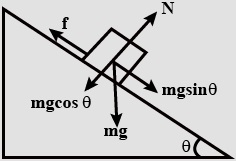
$A$ body is placed on a rough inclined plane of inclination $\theta$. As the angle $\theta$ is increased from $0^o$ to $90^o$,the contact force between the block and the plane
A
remains constant
B
first remains constant then decreases
C
first decreases then increases
D
remains constant then decreases
Solution
(A) The contact force $F_c$ between the block and the plane is the resultant of the normal force $N$ and the frictional force $f$.
$F_c = \sqrt{N^2 + f^2}$.
For a block on an inclined plane,the normal force is $N = mg \cos \theta$.
If the block is in equilibrium,the frictional force $f$ balances the component of gravity along the plane,so $f = mg \sin \theta$.
Thus,$F_c = \sqrt{(mg \cos \theta)^2 + (mg \sin \theta)^2} = \sqrt{m^2g^2(\cos^2 \theta + \sin^2 \theta)} = mg$.
Since the contact force $F_c = mg$ is independent of the angle $\theta$,it remains constant as $\theta$ increases from $0^o$ to $90^o$.
$F_c = \sqrt{N^2 + f^2}$.
For a block on an inclined plane,the normal force is $N = mg \cos \theta$.
If the block is in equilibrium,the frictional force $f$ balances the component of gravity along the plane,so $f = mg \sin \theta$.
Thus,$F_c = \sqrt{(mg \cos \theta)^2 + (mg \sin \theta)^2} = \sqrt{m^2g^2(\cos^2 \theta + \sin^2 \theta)} = mg$.
Since the contact force $F_c = mg$ is independent of the angle $\theta$,it remains constant as $\theta$ increases from $0^o$ to $90^o$.
0 likes
View Solution130
DifficultMCQ
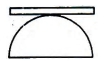
$A$ board is balanced on a rough horizontal semicircular log. Equilibrium is obtained with the help of the addition of a weight to one of the ends of the board when the board makes an angle $\theta$ with the horizontal. The coefficient of friction between the log and the board is:
A
$\cos \theta$
B
$\tan \theta$
C
$\cot \theta$
D
$\sin \theta$
Solution
(B) Let the total mass of the board and the added weight be $M_{total} = (M + m)$.
When the board is tilted at an angle $\theta$ with the horizontal,the force of gravity $(M + m)g$ acting on the center of mass can be resolved into two components:
$1$. $A$ component perpendicular to the board: $(M + m)g \cos \theta$,which is balanced by the normal reaction $N$.
$2$. $A$ component parallel to the board: $(M + m)g \sin \theta$,which tends to make the board slide down.
For the board to be in equilibrium,the frictional force $f$ must balance the component of gravity acting parallel to the board.
Thus,$f = (M + m)g \sin \theta$.
Since the board is on the verge of sliding,the frictional force is the limiting friction,$f = \mu N$.
Substituting $N = (M + m)g \cos \theta$,we get:
$f = \mu (M + m)g \cos \theta$.
Equating the two expressions for $f$:
$(M + m)g \sin \theta = \mu (M + m)g \cos \theta$
$\mu = \frac{\sin \theta}{\cos \theta} = \tan \theta$.
Therefore,the coefficient of friction is $\tan \theta$.
When the board is tilted at an angle $\theta$ with the horizontal,the force of gravity $(M + m)g$ acting on the center of mass can be resolved into two components:
$1$. $A$ component perpendicular to the board: $(M + m)g \cos \theta$,which is balanced by the normal reaction $N$.
$2$. $A$ component parallel to the board: $(M + m)g \sin \theta$,which tends to make the board slide down.
For the board to be in equilibrium,the frictional force $f$ must balance the component of gravity acting parallel to the board.
Thus,$f = (M + m)g \sin \theta$.
Since the board is on the verge of sliding,the frictional force is the limiting friction,$f = \mu N$.
Substituting $N = (M + m)g \cos \theta$,we get:
$f = \mu (M + m)g \cos \theta$.
Equating the two expressions for $f$:
$(M + m)g \sin \theta = \mu (M + m)g \cos \theta$
$\mu = \frac{\sin \theta}{\cos \theta} = \tan \theta$.
Therefore,the coefficient of friction is $\tan \theta$.
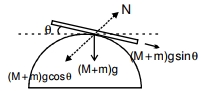
0 likes
View Solution131
DifficultMCQ
$A$ block slides down on an inclined surface of inclination $30^{\circ}$ with the horizontal. Starting from rest,it covers $8 \ m$ in the first two seconds. Find the coefficient of friction. (Take $g = 10 \ m/s^2$)
A
$\frac{1}{5\sqrt{3}}$
B
$\frac{1}{2\sqrt{3}}$
C
$\frac{1}{\sqrt{3}}$
D
$\frac{\sqrt{3}}{5}$
Solution
(A) The acceleration $a$ of a block sliding down a rough inclined plane is given by:
$a = g \sin \theta - \mu g \cos \theta = g(\sin \theta - \mu \cos \theta)$
Given: $u = 0$,$s = 8 \ m$,$t = 2 \ s$,$\theta = 30^{\circ}$,$g = 10 \ m/s^2$.
Using the equation of motion $s = ut + \frac{1}{2}at^2$:
$8 = 0 \times 2 + \frac{1}{2} \times a \times (2)^2$
$8 = 2a \implies a = 4 \ m/s^2$
Now,substitute the expression for $a$:
$4 = 10(\sin 30^{\circ} - \mu \cos 30^{\circ})$
$4 = 10(\frac{1}{2} - \mu \frac{\sqrt{3}}{2})$
$4 = 5 - 5\sqrt{3}\mu$
$5\sqrt{3}\mu = 5 - 4 = 1$
$\mu = \frac{1}{5\sqrt{3}}$
$a = g \sin \theta - \mu g \cos \theta = g(\sin \theta - \mu \cos \theta)$
Given: $u = 0$,$s = 8 \ m$,$t = 2 \ s$,$\theta = 30^{\circ}$,$g = 10 \ m/s^2$.
Using the equation of motion $s = ut + \frac{1}{2}at^2$:
$8 = 0 \times 2 + \frac{1}{2} \times a \times (2)^2$
$8 = 2a \implies a = 4 \ m/s^2$
Now,substitute the expression for $a$:
$4 = 10(\sin 30^{\circ} - \mu \cos 30^{\circ})$
$4 = 10(\frac{1}{2} - \mu \frac{\sqrt{3}}{2})$
$4 = 5 - 5\sqrt{3}\mu$
$5\sqrt{3}\mu = 5 - 4 = 1$
$\mu = \frac{1}{5\sqrt{3}}$
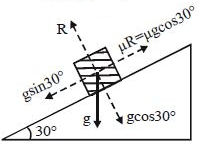
0 likes
View Solution132
DifficultMCQ
$A$ block is released from rest on a $45^\circ$ smooth incline and slides a distance '$d$'. The time taken to slide the same distance '$d$' on a rough incline is '$n$' times the time taken on the smooth incline. The coefficient of kinetic friction is
A
$\mu _k = \sqrt {1 - \frac{1}{{{n^2}}}} $
B
$\mu _k = 1 - \frac{1}{{{n^2}}}$
C
$\mu _s = \sqrt {1 - \frac{1}{{{n^2}}}} $
D
$\mu _s = 1 - \frac{1}{{{n^2}}}$
Solution
(B) For a smooth incline,the acceleration is $a_1 = g \sin \theta$. The time taken to cover distance '$d$' is $t_1 = \sqrt{\frac{2d}{g \sin \theta}}$.
For a rough incline,the acceleration is $a_2 = g \sin \theta - \mu_k g \cos \theta$. The time taken to cover distance '$d$' is $t_2 = \sqrt{\frac{2d}{g \sin \theta - \mu_k g \cos \theta}}$.
Given $t_2 = n t_1$,we have $n = \frac{t_2}{t_1} = \sqrt{\frac{g \sin \theta}{g \sin \theta - \mu_k g \cos \theta}} = \sqrt{\frac{\sin \theta}{\sin \theta - \mu_k \cos \theta}}$.
Squaring both sides: $n^2 = \frac{\sin \theta}{\sin \theta - \mu_k \cos \theta}$.
Since $\theta = 45^\circ$,$\sin 45^\circ = \cos 45^\circ = \frac{1}{\sqrt{2}}$.
$n^2 = \frac{1/\sqrt{2}}{1/\sqrt{2} - \mu_k (1/\sqrt{2})} = \frac{1}{1 - \mu_k}$.
Rearranging gives $1 - \mu_k = \frac{1}{n^2}$,so $\mu_k = 1 - \frac{1}{n^2}$.
For a rough incline,the acceleration is $a_2 = g \sin \theta - \mu_k g \cos \theta$. The time taken to cover distance '$d$' is $t_2 = \sqrt{\frac{2d}{g \sin \theta - \mu_k g \cos \theta}}$.
Given $t_2 = n t_1$,we have $n = \frac{t_2}{t_1} = \sqrt{\frac{g \sin \theta}{g \sin \theta - \mu_k g \cos \theta}} = \sqrt{\frac{\sin \theta}{\sin \theta - \mu_k \cos \theta}}$.
Squaring both sides: $n^2 = \frac{\sin \theta}{\sin \theta - \mu_k \cos \theta}$.
Since $\theta = 45^\circ$,$\sin 45^\circ = \cos 45^\circ = \frac{1}{\sqrt{2}}$.
$n^2 = \frac{1/\sqrt{2}}{1/\sqrt{2} - \mu_k (1/\sqrt{2})} = \frac{1}{1 - \mu_k}$.
Rearranging gives $1 - \mu_k = \frac{1}{n^2}$,so $\mu_k = 1 - \frac{1}{n^2}$.
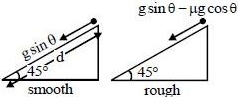
0 likes
View Solution133
MediumMCQ
$Assertion$ : Angle of repose is equal to the angle of limiting friction.
$Reason$ : When the body is just at the point of motion, the force of friction in this stage is called limiting friction.
$Reason$ : When the body is just at the point of motion, the force of friction in this stage is called limiting friction.
A
If both Assertion and Reason are correct and the Reason is a correct explanation of the Assertion.
B
If both Assertion and Reason are correct but Reason is not a correct explanation of the Assertion.
C
If the Assertion is correct but Reason is incorrect.
D
If both the Assertion and Reason are incorrect.
Solution
(A) The maximum value of static friction up to which a body does not move is called limiting friction.
Angle of repose $(\alpha)$ is defined as the angle of the inclined plane with the horizontal such that a body placed on it just begins to slide.
In the limiting condition, the forces are balanced:
$F = mg \sin \alpha$
$R = mg \cos \alpha$
Dividing these equations, we get:
$\frac{F}{R} = \tan \alpha$
Since the coefficient of static friction $\mu_s = \frac{F}{R} = \tan \theta$, where $\theta$ is the angle of friction, we have:
$\tan \theta = \tan \alpha \implies \theta = \alpha$
Thus, the angle of repose is equal to the angle of friction. The reason correctly explains the concept of limiting friction used to derive this equality.
Angle of repose $(\alpha)$ is defined as the angle of the inclined plane with the horizontal such that a body placed on it just begins to slide.
In the limiting condition, the forces are balanced:
$F = mg \sin \alpha$
$R = mg \cos \alpha$
Dividing these equations, we get:
$\frac{F}{R} = \tan \alpha$
Since the coefficient of static friction $\mu_s = \frac{F}{R} = \tan \theta$, where $\theta$ is the angle of friction, we have:
$\tan \theta = \tan \alpha \implies \theta = \alpha$
Thus, the angle of repose is equal to the angle of friction. The reason correctly explains the concept of limiting friction used to derive this equality.
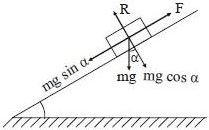
0 likes
View Solution134
EasyMCQ
$Assertion$: Mountain roads rarely go straight up the slope.
$Reason$: The slope of mountains is large,therefore there are more chances for a vehicle to slip from the roads.
$Reason$: The slope of mountains is large,therefore there are more chances for a vehicle to slip from the roads.
A
If both $Assertion$ and $Reason$ are correct and the $Reason$ is a correct explanation of the $Assertion$.
B
If both $Assertion$ and $Reason$ are correct but $Reason$ is not a correct explanation of the $Assertion$.
C
If the $Assertion$ is correct but $Reason$ is incorrect.
D
If both the $Assertion$ and $Reason$ are incorrect.
Solution
(A) Both $Assertion$ and $Reason$ are true and $Reason$ is the correct explanation of $Assertion$. If mountain roads were to go straight up,the angle of inclination $\theta$ would be very large. The frictional force available to prevent slipping is given by $f = \mu mg \cos \theta$. As $\theta$ increases,$\cos \theta$ decreases,making the frictional force smaller. Due to this reduced friction,the vehicle's wheels would be more likely to slip. Furthermore,climbing a steep slope requires significantly higher engine power,which is impractical for most vehicles. Thus,roads are built with a winding path to reduce the effective slope.
0 likes
View Solution135
MediumMCQ
When an object is shot from the bottom of a long smooth inclined plane kept at an angle $60^{\circ}$ with the horizontal,it can travel a distance $x_{1}$ along the plane. But when the inclination is decreased to $30^{\circ}$ and the same object is shot with the same velocity,it can travel $x_{2}$ distance. Then $x_{1}: x_{2}$ will be
A
$1: \sqrt{2}$
B
$\sqrt{2}: 1$
C
$1: \sqrt{3}$
D
$1: 2 \sqrt{3}$
Solution
(C) Using the third equation of motion,$v^{2} = u^{2} - 2as$. At the highest point,the final velocity $v = 0$.
Therefore,$0 = u^{2} - 2as$,which gives $s = \frac{u^{2}}{2a}$.
For an object on a smooth inclined plane,the acceleration $a = g \sin \theta$.
Thus,the distance traveled is $s = \frac{u^{2}}{2g \sin \theta}$.
Since $u$ and $g$ are constant,$s \propto \frac{1}{\sin \theta}$.
Therefore,$\frac{x_{1}}{x_{2}} = \frac{\sin \theta_{2}}{\sin \theta_{1}} = \frac{\sin 30^{\circ}}{\sin 60^{\circ}}$.
Substituting the values,$\frac{x_{1}}{x_{2}} = \frac{1/2}{\sqrt{3}/2} = \frac{1}{\sqrt{3}}$.
Hence,the ratio $x_{1}: x_{2}$ is $1: \sqrt{3}$.
Therefore,$0 = u^{2} - 2as$,which gives $s = \frac{u^{2}}{2a}$.
For an object on a smooth inclined plane,the acceleration $a = g \sin \theta$.
Thus,the distance traveled is $s = \frac{u^{2}}{2g \sin \theta}$.
Since $u$ and $g$ are constant,$s \propto \frac{1}{\sin \theta}$.
Therefore,$\frac{x_{1}}{x_{2}} = \frac{\sin \theta_{2}}{\sin \theta_{1}} = \frac{\sin 30^{\circ}}{\sin 60^{\circ}}$.
Substituting the values,$\frac{x_{1}}{x_{2}} = \frac{1/2}{\sqrt{3}/2} = \frac{1}{\sqrt{3}}$.
Hence,the ratio $x_{1}: x_{2}$ is $1: \sqrt{3}$.
0 likes
View Solution136
DifficultMCQ
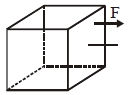
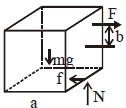
Consider a uniform cubical box of side $a$ on a rough floor that is to be moved by applying a minimum possible force $F$ at a point $b$ above its centre of mass (see figure). If the coefficient of friction is $\mu = 0.4$,the maximum possible value of $100 \times \frac{b}{a}$ for a box not to topple before moving is
A
$80$
B
$75$
C
$85$
D
$82$
Solution
(B) For the box to move,the applied force $F$ must be equal to the limiting friction force:
$F = \mu mg \dots (1)$
For the box not to topple,the torque about the front edge must be zero or balanced. The force $F$ is applied at a height $h = \frac{a}{2} + b$ from the base. The normal force $N$ shifts to the front edge to prevent toppling. Taking torque about the front edge:
$F \left( \frac{a}{2} + b \right) = mg \left( \frac{a}{2} \right) \dots (2)$
Substituting $F = \mu mg$ from equation $(1)$ into equation $(2)$:
$\mu mg \left( \frac{a}{2} + b \right) = mg \left( \frac{a}{2} \right)$
$\mu \left( \frac{a}{2} + b \right) = \frac{a}{2}$
Given $\mu = 0.4 = \frac{2}{5}$,we have:
$\frac{2}{5} \left( \frac{a}{2} + b \right) = \frac{a}{2}$
Multiply by $5$:
$2 \left( \frac{a}{2} + b \right) = 2.5a$
$a + 2b = 2.5a$
$2b = 1.5a$
$\frac{b}{a} = \frac{1.5}{2} = 0.75$
Therefore,$100 \times \frac{b}{a} = 100 \times 0.75 = 75$.
$F = \mu mg \dots (1)$
For the box not to topple,the torque about the front edge must be zero or balanced. The force $F$ is applied at a height $h = \frac{a}{2} + b$ from the base. The normal force $N$ shifts to the front edge to prevent toppling. Taking torque about the front edge:
$F \left( \frac{a}{2} + b \right) = mg \left( \frac{a}{2} \right) \dots (2)$
Substituting $F = \mu mg$ from equation $(1)$ into equation $(2)$:
$\mu mg \left( \frac{a}{2} + b \right) = mg \left( \frac{a}{2} \right)$
$\mu \left( \frac{a}{2} + b \right) = \frac{a}{2}$
Given $\mu = 0.4 = \frac{2}{5}$,we have:
$\frac{2}{5} \left( \frac{a}{2} + b \right) = \frac{a}{2}$
Multiply by $5$:
$2 \left( \frac{a}{2} + b \right) = 2.5a$
$a + 2b = 2.5a$
$2b = 1.5a$
$\frac{b}{a} = \frac{1.5}{2} = 0.75$
Therefore,$100 \times \frac{b}{a} = 100 \times 0.75 = 75$.
1 likes
View Solution137
MediumMCQ
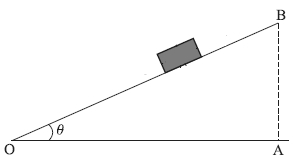
$A$ mass of $4\; kg$ rests on a horizontal plane. The plane is gradually inclined until at an angle $\theta = 15^{\circ}$ with the horizontal,the mass just begins to slide. What is the coefficient of static friction between the block and the surface?
A
$0.52$
B
$0.38$
C
$0.15$
D
$0.27$
Solution
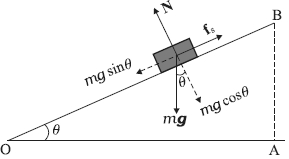
(D) The forces acting on a block of mass $m$ at rest on an inclined plane are:
$(i)$ The weight $mg$ acting vertically downwards.
$(ii)$ The normal force $N$ of the plane on the block.
$(iii)$ The static frictional force $f_{s}$ opposing the impending motion.
In equilibrium,the resultant of these forces must be zero. Resolving the weight $mg$ along the two directions,we have:
$mg \sin \theta = f_{s}$
$mg \cos \theta = N$
As $\theta$ increases,the self-adjusting frictional force $f_{s}$ increases until at $\theta = \theta_{\max}$,$f_{s}$ achieves its maximum value,$(f_{s})_{\max} = \mu_{s} N$.
Therefore,$\tan \theta_{\max} = \mu_{s}$.
When $\theta$ becomes just a little more than $\theta_{\max}$,the block begins to slide.
For $\theta_{\max} = 15^{\circ}$,the coefficient of static friction is:
$\mu_{s} = \tan 15^{\circ} \approx 0.2679 \approx 0.27$.
$(i)$ The weight $mg$ acting vertically downwards.
$(ii)$ The normal force $N$ of the plane on the block.
$(iii)$ The static frictional force $f_{s}$ opposing the impending motion.
In equilibrium,the resultant of these forces must be zero. Resolving the weight $mg$ along the two directions,we have:
$mg \sin \theta = f_{s}$
$mg \cos \theta = N$
As $\theta$ increases,the self-adjusting frictional force $f_{s}$ increases until at $\theta = \theta_{\max}$,$f_{s}$ achieves its maximum value,$(f_{s})_{\max} = \mu_{s} N$.
Therefore,$\tan \theta_{\max} = \mu_{s}$.
When $\theta$ becomes just a little more than $\theta_{\max}$,the block begins to slide.
For $\theta_{\max} = 15^{\circ}$,the coefficient of static friction is:
$\mu_{s} = \tan 15^{\circ} \approx 0.2679 \approx 0.27$.
0 likes
View Solution138
Medium
Define the condition for a vehicle to be parked on a banked slope without slipping.
Solution
(N/A) For a vehicle to be parked on a banked slope without slipping,the gravitational force component acting down the slope must be balanced by the static frictional force acting up the slope.
Let $m$ be the mass of the vehicle,$\theta$ be the angle of banking,$\mu_s$ be the coefficient of static friction,and $g$ be the acceleration due to gravity.
The component of weight acting down the slope is $mg \sin \theta$.
The maximum static frictional force available is $f_{s, \max} = \mu_s N$,where $N$ is the normal force.
On a slope,the normal force is $N = mg \cos \theta$.
For the vehicle to remain stationary (parked),the condition is $mg \sin \theta \leq \mu_s mg \cos \theta$.
Dividing both sides by $mg \cos \theta$,we get $\tan \theta \leq \mu_s$.
Thus,the vehicle can be parked on a slope without slipping if $\mu_s \geq \tan \theta$.
Let $m$ be the mass of the vehicle,$\theta$ be the angle of banking,$\mu_s$ be the coefficient of static friction,and $g$ be the acceleration due to gravity.
The component of weight acting down the slope is $mg \sin \theta$.
The maximum static frictional force available is $f_{s, \max} = \mu_s N$,where $N$ is the normal force.
On a slope,the normal force is $N = mg \cos \theta$.
For the vehicle to remain stationary (parked),the condition is $mg \sin \theta \leq \mu_s mg \cos \theta$.
Dividing both sides by $mg \cos \theta$,we get $\tan \theta \leq \mu_s$.
Thus,the vehicle can be parked on a slope without slipping if $\mu_s \geq \tan \theta$.
0 likes
View Solution139
Difficult
When a body slides down from rest along a smooth inclined plane making an angle of $45^{\circ}$ with the horizontal,it takes time $T$. When the same body slides down from rest along a rough inclined plane making the same angle and through the same distance,it is seen to take time $pT$,where $p$ is some number greater than $1$. Calculate the coefficient of friction between the body and the rough plane.
Solution
(D) For a smooth inclined plane:
The acceleration is $a = g \sin \theta$.
Given $\theta = 45^{\circ}$,so $a = g \sin 45^{\circ} = \frac{g}{\sqrt{2}}$.
The distance $d$ covered in time $T$ starting from rest is $d = \frac{1}{2} a T^2 = \frac{1}{2} \left( \frac{g}{\sqrt{2}} \right) T^2 = \frac{g T^2}{2\sqrt{2}}$.
For a rough inclined plane:
The net force is $F_{net} = mg \sin \theta - f_k = mg \sin \theta - \mu mg \cos \theta = mg(\sin \theta - \mu \cos \theta)$.
The acceleration is $a' = g(\sin \theta - \mu \cos \theta)$.
Since $\theta = 45^{\circ}$,$\sin 45^{\circ} = \cos 45^{\circ} = \frac{1}{\sqrt{2}}$,so $a' = g \left( \frac{1 - \mu}{\sqrt{2}} \right)$.
The distance $d$ covered in time $pT$ is $d = \frac{1}{2} a' (pT)^2 = \frac{1}{2} g \left( \frac{1 - \mu}{\sqrt{2}} \right) p^2 T^2$.
Equating the two expressions for $d$:
$\frac{g T^2}{2\sqrt{2}} = \frac{g p^2 T^2 (1 - \mu)}{2\sqrt{2}}$
$1 = p^2 (1 - \mu)$
$1 - \mu = \frac{1}{p^2}$
$\mu = 1 - \frac{1}{p^2} = \frac{p^2 - 1}{p^2}$.
The acceleration is $a = g \sin \theta$.
Given $\theta = 45^{\circ}$,so $a = g \sin 45^{\circ} = \frac{g}{\sqrt{2}}$.
The distance $d$ covered in time $T$ starting from rest is $d = \frac{1}{2} a T^2 = \frac{1}{2} \left( \frac{g}{\sqrt{2}} \right) T^2 = \frac{g T^2}{2\sqrt{2}}$.
For a rough inclined plane:
The net force is $F_{net} = mg \sin \theta - f_k = mg \sin \theta - \mu mg \cos \theta = mg(\sin \theta - \mu \cos \theta)$.
The acceleration is $a' = g(\sin \theta - \mu \cos \theta)$.
Since $\theta = 45^{\circ}$,$\sin 45^{\circ} = \cos 45^{\circ} = \frac{1}{\sqrt{2}}$,so $a' = g \left( \frac{1 - \mu}{\sqrt{2}} \right)$.
The distance $d$ covered in time $pT$ is $d = \frac{1}{2} a' (pT)^2 = \frac{1}{2} g \left( \frac{1 - \mu}{\sqrt{2}} \right) p^2 T^2$.
Equating the two expressions for $d$:
$\frac{g T^2}{2\sqrt{2}} = \frac{g p^2 T^2 (1 - \mu)}{2\sqrt{2}}$
$1 = p^2 (1 - \mu)$
$1 - \mu = \frac{1}{p^2}$
$\mu = 1 - \frac{1}{p^2} = \frac{p^2 - 1}{p^2}$.
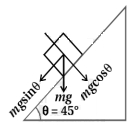
0 likes
View Solution140
Medium
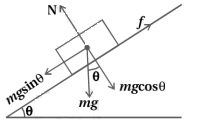
$A$ rectangular box lies on a rough inclined surface. The coefficient of friction between the surface and the box is $\mu$. Let the mass of the box be $m$.
$(a)$ At what angle of inclination $\theta$ of the plane to the horizontal will the box just start to slide down the plane?
$(b)$ What is the force acting on the box down the plane,if the angle of inclination of the plane is increased to $\alpha > \theta$?
$(c)$ What is the force needed to be applied upwards along the plane to make the box either remain stationary or just move up with uniform speed?
$(d)$ What is the force needed to be applied upwards along the plane to make the box move up the plane with acceleration $a$?
$(a)$ At what angle of inclination $\theta$ of the plane to the horizontal will the box just start to slide down the plane?
$(b)$ What is the force acting on the box down the plane,if the angle of inclination of the plane is increased to $\alpha > \theta$?
$(c)$ What is the force needed to be applied upwards along the plane to make the box either remain stationary or just move up with uniform speed?
$(d)$ What is the force needed to be applied upwards along the plane to make the box move up the plane with acceleration $a$?
Solution
(N/A) Consider the diagram shown in the figure.
$(a)$ For the box to just start sliding down the slope:
$f = mg \sin \theta$
$N = mg \cos \theta$
Since $\mu = \frac{f}{N}$,we have $\mu = \frac{mg \sin \theta}{mg \cos \theta} = \tan \theta$.
Therefore,$\theta = \tan^{-1}(\mu)$.
$(b)$ When the angle of inclination is increased to $\alpha > \theta$,the net force $F_1$ acting down the plane is the component of gravity minus the kinetic friction:
$F_1 = mg \sin \alpha - f_k = mg \sin \alpha - \mu N = mg \sin \alpha - \mu mg \cos \alpha = mg(\sin \alpha - \mu \cos \alpha)$.
$(c)$ To keep the box stationary or moving with uniform speed upward,the applied force $F_2$ must overcome both the component of gravity and the friction force (which now acts downwards):
$F_2 = mg \sin \alpha + f_k = mg \sin \alpha + \mu mg \cos \alpha = mg(\sin \alpha + \mu \cos \alpha)$.
$(d)$ When the box is to be moved with acceleration $a$ upward along the plane,the net force $F_3$ must account for the acceleration:
$F_3 = mg(\sin \alpha + \mu \cos \alpha) + ma$.
$(a)$ For the box to just start sliding down the slope:
$f = mg \sin \theta$
$N = mg \cos \theta$
Since $\mu = \frac{f}{N}$,we have $\mu = \frac{mg \sin \theta}{mg \cos \theta} = \tan \theta$.
Therefore,$\theta = \tan^{-1}(\mu)$.
$(b)$ When the angle of inclination is increased to $\alpha > \theta$,the net force $F_1$ acting down the plane is the component of gravity minus the kinetic friction:
$F_1 = mg \sin \alpha - f_k = mg \sin \alpha - \mu N = mg \sin \alpha - \mu mg \cos \alpha = mg(\sin \alpha - \mu \cos \alpha)$.
$(c)$ To keep the box stationary or moving with uniform speed upward,the applied force $F_2$ must overcome both the component of gravity and the friction force (which now acts downwards):
$F_2 = mg \sin \alpha + f_k = mg \sin \alpha + \mu mg \cos \alpha = mg(\sin \alpha + \mu \cos \alpha)$.
$(d)$ When the box is to be moved with acceleration $a$ upward along the plane,the net force $F_3$ must account for the acceleration:
$F_3 = mg(\sin \alpha + \mu \cos \alpha) + ma$.
0 likes
View Solution141
Medium
$A$ rough inclined plane is placed on a car moving with a constant velocity $u$ on horizontal ground. $A$ block of mass $M$ rests on the inclined plane. Is any work done by the force of friction between the block and the inclined plane? Is there any dissipation of energy?
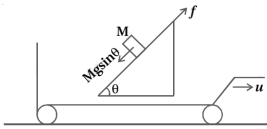
Solution
(N/A) Yes,there is a static friction force $f$ acting on the block.
Since the block is at rest relative to the inclined plane,the force of friction is given by $f = Mg \sin \theta$.
Work done by a force is defined as $W = \vec{F} \cdot \vec{d}$. Since the block is not in motion relative to the inclined plane (displacement $d = 0$),the work done by the friction force is zero.
Because the work done is zero and there is no relative motion between the surfaces,there is no dissipation of energy.
Since the block is at rest relative to the inclined plane,the force of friction is given by $f = Mg \sin \theta$.
Work done by a force is defined as $W = \vec{F} \cdot \vec{d}$. Since the block is not in motion relative to the inclined plane (displacement $d = 0$),the work done by the friction force is zero.
Because the work done is zero and there is no relative motion between the surfaces,there is no dissipation of energy.
0 likes
View Solution142
DifficultMCQ
$A$ small block starts slipping down from a point $B$ on an inclined plane $AB$,which is making an angle $\theta$ with the horizontal. The section $BC$ is smooth and the remaining section $CA$ is rough with a coefficient of friction $\mu$. It is found that the block comes to rest as it reaches the bottom (point $A$) of the inclined plane. If $BC = 2AC$,the coefficient of friction is given by $\mu = k \tan \theta$. The value of $k$ is
A
$1$
B
$2$
C
$3$
D
$4$
Solution
(C) According to the work-energy theorem,the total work done by all forces on the block is equal to the change in its kinetic energy.
Since the block starts from rest at $B$ and comes to rest at $A$,the change in kinetic energy is $\Delta K = 0 - 0 = 0$.
The forces acting on the block are gravity and friction.
Work done by gravity $(W_g)$ = $mg \sin \theta \times (BC + AC)$.
Work done by friction $(W_f)$ = $-\mu mg \cos \theta \times AC$ (since friction only acts on the rough section $CA$).
Setting the total work to zero: $W_g + W_f = 0$.
$mg \sin \theta (BC + AC) - \mu mg \cos \theta (AC) = 0$.
Given $BC = 2AC$,substitute this into the equation:
$mg \sin \theta (2AC + AC) = \mu mg \cos \theta (AC)$.
$3mg \sin \theta (AC) = \mu mg \cos \theta (AC)$.
$3 \sin \theta = \mu \cos \theta$.
$\mu = 3 \tan \theta$.
Comparing this with $\mu = k \tan \theta$,we get $k = 3$.
Since the block starts from rest at $B$ and comes to rest at $A$,the change in kinetic energy is $\Delta K = 0 - 0 = 0$.
The forces acting on the block are gravity and friction.
Work done by gravity $(W_g)$ = $mg \sin \theta \times (BC + AC)$.
Work done by friction $(W_f)$ = $-\mu mg \cos \theta \times AC$ (since friction only acts on the rough section $CA$).
Setting the total work to zero: $W_g + W_f = 0$.
$mg \sin \theta (BC + AC) - \mu mg \cos \theta (AC) = 0$.
Given $BC = 2AC$,substitute this into the equation:
$mg \sin \theta (2AC + AC) = \mu mg \cos \theta (AC)$.
$3mg \sin \theta (AC) = \mu mg \cos \theta (AC)$.
$3 \sin \theta = \mu \cos \theta$.
$\mu = 3 \tan \theta$.
Comparing this with $\mu = k \tan \theta$,we get $k = 3$.
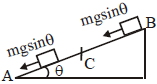
0 likes
View Solution143
DifficultMCQ
$A$ block starts moving up an inclined plane of inclination $30^{\circ}$ with an initial velocity of $v_{0}$. It comes back to its initial position with velocity $\frac{v_{0}}{2}$. The value of the coefficient of kinetic friction between the block and the inclined plane is close to $\frac{I}{1000}$. The nearest integer to $I$ is......
A
$376$
B
$450$
C
$300$
D
$346$
Solution
(D) Let the distance moved up the incline be $s$. The acceleration while moving up is $a_{up} = g(\sin \theta + \mu \cos \theta)$.
Using $v^2 - u^2 = 2as$,for the upward journey: $0 - v_{0}^2 = -2 a_{up} s \implies s = \frac{v_{0}^2}{2g(\sin \theta + \mu \cos \theta)}$.
The acceleration while moving down is $a_{down} = g(\sin \theta - \mu \cos \theta)$.
For the downward journey: $(\frac{v_{0}}{2})^2 - 0 = 2 a_{down} s \implies s = \frac{v_{0}^2}{8g(\sin \theta - \mu \cos \theta)}$.
Equating the two expressions for $s$: $\frac{v_{0}^2}{2g(\sin \theta + \mu \cos \theta)} = \frac{v_{0}^2}{8g(\sin \theta - \mu \cos \theta)}$.
$4(\sin \theta - \mu \cos \theta) = \sin \theta + \mu \cos \theta \implies 3 \sin \theta = 5 \mu \cos \theta$.
$\mu = \frac{3}{5} \tan 30^{\circ} = \frac{3}{5} \times \frac{1}{\sqrt{3}} = \frac{\sqrt{3}}{5} \approx 0.3464$.
Given $\mu = \frac{I}{1000}$,we have $I = 346.4$. The nearest integer is $346$.
Using $v^2 - u^2 = 2as$,for the upward journey: $0 - v_{0}^2 = -2 a_{up} s \implies s = \frac{v_{0}^2}{2g(\sin \theta + \mu \cos \theta)}$.
The acceleration while moving down is $a_{down} = g(\sin \theta - \mu \cos \theta)$.
For the downward journey: $(\frac{v_{0}}{2})^2 - 0 = 2 a_{down} s \implies s = \frac{v_{0}^2}{8g(\sin \theta - \mu \cos \theta)}$.
Equating the two expressions for $s$: $\frac{v_{0}^2}{2g(\sin \theta + \mu \cos \theta)} = \frac{v_{0}^2}{8g(\sin \theta - \mu \cos \theta)}$.
$4(\sin \theta - \mu \cos \theta) = \sin \theta + \mu \cos \theta \implies 3 \sin \theta = 5 \mu \cos \theta$.
$\mu = \frac{3}{5} \tan 30^{\circ} = \frac{3}{5} \times \frac{1}{\sqrt{3}} = \frac{\sqrt{3}}{5} \approx 0.3464$.
Given $\mu = \frac{I}{1000}$,we have $I = 346.4$. The nearest integer is $346$.
0 likes
View Solution144
DifficultMCQ
An insect is at the bottom of a hemispherical ditch of radius $R = 1\, m$. It crawls up the ditch but starts slipping after it is at height $h$ from the bottom. If the coefficient of friction between the ground and the insect is $\mu = 0.75$,then $h$ is $.......\, m$. $(g = 10\, m s^{-2})$
A
$0.80$
B
$0.60$
C
$0.45$
D
$0.20$
Solution
(D) Let $\theta$ be the angle the radius makes with the vertical at the point where the insect starts slipping. At this point,the component of gravity along the tangent balances the maximum static friction.
$mg \sin \theta = f_{max} = \mu N$
Since the normal force $N = mg \cos \theta$,we have:
$mg \sin \theta = \mu mg \cos \theta$
$\tan \theta = \mu = 0.75 = \frac{3}{4}$
From the geometry of the hemisphere,the height $h$ from the bottom is given by:
$h = R - R \cos \theta = R(1 - \cos \theta)$
Given $\tan \theta = \frac{3}{4}$,we have $\sin \theta = \frac{3}{5}$ and $\cos \theta = \frac{4}{5}$.
Substituting the values:
$h = 1 \times (1 - \frac{4}{5}) = 1 \times \frac{1}{5} = 0.2\, m$.
$mg \sin \theta = f_{max} = \mu N$
Since the normal force $N = mg \cos \theta$,we have:
$mg \sin \theta = \mu mg \cos \theta$
$\tan \theta = \mu = 0.75 = \frac{3}{4}$
From the geometry of the hemisphere,the height $h$ from the bottom is given by:
$h = R - R \cos \theta = R(1 - \cos \theta)$
Given $\tan \theta = \frac{3}{4}$,we have $\sin \theta = \frac{3}{5}$ and $\cos \theta = \frac{4}{5}$.
Substituting the values:
$h = 1 \times (1 - \frac{4}{5}) = 1 \times \frac{1}{5} = 0.2\, m$.
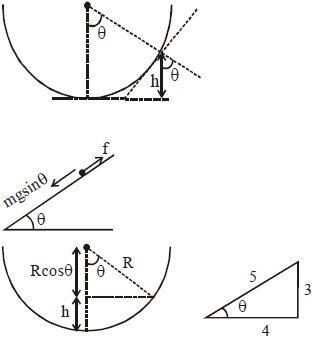
0 likes
View Solution145
DifficultMCQ
$A$ piece of ice slides down a rough inclined plane at $\theta=45^{\circ}$ inclination in twice the time that it takes to slide down an identical but frictionless inclined plane. What is the coefficient of friction between ice and incline?
A
$\frac{3}{4}$
B
$\frac{4}{7}$
C
$\frac{3}{4 \cot \theta}$
D
$\frac{7}{9}$
Solution
(C) Given,$\theta=45^{\circ}, s_{1}=s_{2}, u=0$.
On the rough incline,the acceleration is $a_{1}=g(\sin \theta-\mu \cos \theta)$.
On the frictionless incline,the acceleration is $a_{2}=g \sin \theta$.
Let $t_{1}$ be the time taken on the rough plane and $t_{2}$ be the time taken on the frictionless plane. Given $t_{1}=2 t_{2}$.
Using the equation of motion $s=ut+\frac{1}{2}at^{2}$,for $u=0$:
$s_{1}=\frac{1}{2}g(\sin \theta-\mu \cos \theta)t_{1}^{2}$
$s_{2}=\frac{1}{2}g \sin \theta t_{2}^{2}$
Since $s_{1}=s_{2}$,we have:
$\frac{1}{2}g(\sin \theta-\mu \cos \theta)t_{1}^{2}=\frac{1}{2}g \sin \theta t_{2}^{2}$
$\frac{\sin \theta-\mu \cos \theta}{\sin \theta}=\frac{t_{2}^{2}}{t_{1}^{2}}$
Substituting $t_{1}=2t_{2}$:
$1-\mu \cot \theta=\frac{t_{2}^{2}}{(2t_{2})^{2}}=\frac{1}{4}$
$\mu \cot \theta=1-\frac{1}{4}=\frac{3}{4}$
$\mu=\frac{3}{4 \cot \theta}$. Since $\theta=45^{\circ}$,$\cot 45^{\circ}=1$,so $\mu=\frac{3}{4}=0.75$.
On the rough incline,the acceleration is $a_{1}=g(\sin \theta-\mu \cos \theta)$.
On the frictionless incline,the acceleration is $a_{2}=g \sin \theta$.
Let $t_{1}$ be the time taken on the rough plane and $t_{2}$ be the time taken on the frictionless plane. Given $t_{1}=2 t_{2}$.
Using the equation of motion $s=ut+\frac{1}{2}at^{2}$,for $u=0$:
$s_{1}=\frac{1}{2}g(\sin \theta-\mu \cos \theta)t_{1}^{2}$
$s_{2}=\frac{1}{2}g \sin \theta t_{2}^{2}$
Since $s_{1}=s_{2}$,we have:
$\frac{1}{2}g(\sin \theta-\mu \cos \theta)t_{1}^{2}=\frac{1}{2}g \sin \theta t_{2}^{2}$
$\frac{\sin \theta-\mu \cos \theta}{\sin \theta}=\frac{t_{2}^{2}}{t_{1}^{2}}$
Substituting $t_{1}=2t_{2}$:
$1-\mu \cot \theta=\frac{t_{2}^{2}}{(2t_{2})^{2}}=\frac{1}{4}$
$\mu \cot \theta=1-\frac{1}{4}=\frac{3}{4}$
$\mu=\frac{3}{4 \cot \theta}$. Since $\theta=45^{\circ}$,$\cot 45^{\circ}=1$,so $\mu=\frac{3}{4}=0.75$.
0 likes
View Solution146
EasyMCQ
$A$ body of $5 \,kg$ weight kept on a rough inclined plane of angle $30^{\circ}$ starts sliding with a constant velocity. Then the coefficient of friction is (assume $g=10 \,ms^{-2}$)
A
$1 / \sqrt{3}$
B
$2 / \sqrt{3}$
C
$\sqrt{3}$
D
$2 \sqrt{3}$
Solution
(A) When a body slides down an inclined plane with a constant velocity,the net force acting on it is zero.
This implies that the component of gravitational force acting down the plane is balanced by the frictional force acting up the plane.
Let $m$ be the mass,$\theta$ be the angle of inclination,and $\mu$ be the coefficient of friction.
The force down the plane is $mg \sin \theta$.
The frictional force is $f = \mu N = \mu mg \cos \theta$.
Equating the two,we get $mg \sin \theta = \mu mg \cos \theta$.
Therefore,$\mu = \frac{\sin \theta}{\cos \theta} = \tan \theta$.
Given $\theta = 30^{\circ}$,we have $\mu = \tan 30^{\circ} = \frac{1}{\sqrt{3}}$.
This implies that the component of gravitational force acting down the plane is balanced by the frictional force acting up the plane.
Let $m$ be the mass,$\theta$ be the angle of inclination,and $\mu$ be the coefficient of friction.
The force down the plane is $mg \sin \theta$.
The frictional force is $f = \mu N = \mu mg \cos \theta$.
Equating the two,we get $mg \sin \theta = \mu mg \cos \theta$.
Therefore,$\mu = \frac{\sin \theta}{\cos \theta} = \tan \theta$.
Given $\theta = 30^{\circ}$,we have $\mu = \tan 30^{\circ} = \frac{1}{\sqrt{3}}$.
0 likes
View Solution147
DifficultMCQ
An inclined plane is bent in such a way that the vertical cross-section is given by $y = \frac{x^2}{4}$,where $y$ is in the vertical direction and $x$ is in the horizontal direction. If the upper surface of this curved plane is rough with a coefficient of friction $\mu = 0.5$,the maximum height in $cm$ at which a stationary block will not slip downward is............$cm$.
A
$20$
B
$25$
C
$16$
D
$30$
Solution
(B) The condition for a block to remain stationary on an inclined plane is that the angle of inclination $\theta$ must be less than or equal to the angle of repose $\alpha$,where $\tan \alpha = \mu$.
At the maximum height,the block is at the verge of slipping,so the slope of the tangent to the curve at that point is equal to the coefficient of friction.
$\tan \theta = \frac{dy}{dx} = \mu$
Given $y = \frac{x^2}{4}$,we have $\frac{dy}{dx} = \frac{2x}{4} = \frac{x}{2}$.
Setting $\frac{x}{2} = \mu = 0.5$,we get $x = 1 \ m$.
Now,find the corresponding height $y$ at $x = 1 \ m$:
$y = \frac{x^2}{4} = \frac{(1)^2}{4} = 0.25 \ m$.
Since $1 \ m = 100 \ cm$,the height is $0.25 \times 100 = 25 \ cm$.
At the maximum height,the block is at the verge of slipping,so the slope of the tangent to the curve at that point is equal to the coefficient of friction.
$\tan \theta = \frac{dy}{dx} = \mu$
Given $y = \frac{x^2}{4}$,we have $\frac{dy}{dx} = \frac{2x}{4} = \frac{x}{2}$.
Setting $\frac{x}{2} = \mu = 0.5$,we get $x = 1 \ m$.
Now,find the corresponding height $y$ at $x = 1 \ m$:
$y = \frac{x^2}{4} = \frac{(1)^2}{4} = 0.25 \ m$.
Since $1 \ m = 100 \ cm$,the height is $0.25 \times 100 = 25 \ cm$.
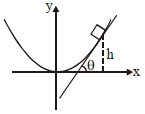
0 likes
View Solution148
DifficultMCQ
When a body slides down from rest along a smooth inclined plane making an angle of $30^{\circ}$ with the horizontal,it takes time $T$. When the same body slides down from rest along a rough inclined plane making the same angle and through the same distance,it takes time $\alpha T$,where $\alpha$ is a constant greater than $1$. The coefficient of friction between the body and the rough plane is $\frac{1}{\sqrt{x}}\left(\frac{\alpha^{2}-1}{\alpha^{2}}\right)$ where $x = .....$.
A
$3$
B
$0.3$
C
$30$
D
$400$
Solution
(A) For a smooth inclined plane:
The acceleration is $a_1 = g \sin 30^{\circ} = \frac{g}{2}$.
Using the equation of motion $S = ut + \frac{1}{2}at^2$,with $u = 0$:
$S = \frac{1}{2} \left(\frac{g}{2}\right) T^2 = \frac{g T^2}{4} \quad \dots (i)$
For a rough inclined plane:
The acceleration is $a_2 = g \sin 30^{\circ} - \mu g \cos 30^{\circ} = g(\sin 30^{\circ} - \mu \cos 30^{\circ}) = g\left(\frac{1}{2} - \mu \frac{\sqrt{3}}{2}\right) = \frac{g}{2}(1 - \sqrt{3}\mu)$.
Using the same distance $S$ and time $\alpha T$:
$S = \frac{1}{2} \left[\frac{g}{2}(1 - \sqrt{3}\mu)\right] (\alpha T)^2 = \frac{g}{4}(1 - \sqrt{3}\mu) \alpha^2 T^2 \quad \dots (ii)$
Equating $(i)$ and $(ii)$:
$\frac{g T^2}{4} = \frac{g}{4}(1 - \sqrt{3}\mu) \alpha^2 T^2$
$1 = (1 - \sqrt{3}\mu) \alpha^2$
$\frac{1}{\alpha^2} = 1 - \sqrt{3}\mu$
$\sqrt{3}\mu = 1 - \frac{1}{\alpha^2} = \frac{\alpha^2 - 1}{\alpha^2}$
$\mu = \frac{1}{\sqrt{3}} \left(\frac{\alpha^2 - 1}{\alpha^2}\right)$
Comparing this with the given expression $\frac{1}{\sqrt{x}}\left(\frac{\alpha^{2}-1}{\alpha^{2}}\right)$,we get $x = 3$.
The acceleration is $a_1 = g \sin 30^{\circ} = \frac{g}{2}$.
Using the equation of motion $S = ut + \frac{1}{2}at^2$,with $u = 0$:
$S = \frac{1}{2} \left(\frac{g}{2}\right) T^2 = \frac{g T^2}{4} \quad \dots (i)$
For a rough inclined plane:
The acceleration is $a_2 = g \sin 30^{\circ} - \mu g \cos 30^{\circ} = g(\sin 30^{\circ} - \mu \cos 30^{\circ}) = g\left(\frac{1}{2} - \mu \frac{\sqrt{3}}{2}\right) = \frac{g}{2}(1 - \sqrt{3}\mu)$.
Using the same distance $S$ and time $\alpha T$:
$S = \frac{1}{2} \left[\frac{g}{2}(1 - \sqrt{3}\mu)\right] (\alpha T)^2 = \frac{g}{4}(1 - \sqrt{3}\mu) \alpha^2 T^2 \quad \dots (ii)$
Equating $(i)$ and $(ii)$:
$\frac{g T^2}{4} = \frac{g}{4}(1 - \sqrt{3}\mu) \alpha^2 T^2$
$1 = (1 - \sqrt{3}\mu) \alpha^2$
$\frac{1}{\alpha^2} = 1 - \sqrt{3}\mu$
$\sqrt{3}\mu = 1 - \frac{1}{\alpha^2} = \frac{\alpha^2 - 1}{\alpha^2}$
$\mu = \frac{1}{\sqrt{3}} \left(\frac{\alpha^2 - 1}{\alpha^2}\right)$
Comparing this with the given expression $\frac{1}{\sqrt{x}}\left(\frac{\alpha^{2}-1}{\alpha^{2}}\right)$,we get $x = 3$.
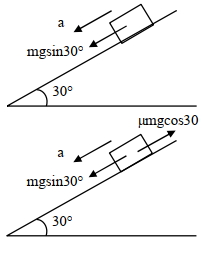
0 likes
View Solution149
DifficultMCQ
$A$ body of mass $m$ is launched up on a rough inclined plane making an angle of $30^{\circ}$ with the horizontal. The coefficient of friction between the body and plane is $\frac{\sqrt{x}}{5}$. If the time of ascent is half of the time of descent,the value of $x$ is ..... .
A
$1$
B
$2$
C
$3$
D
$4$
Solution
(C) Let $t_a$ be the time of ascent and $t_d$ be the time of descent. Given $t_a = \frac{1}{2} t_d$,which implies $t_d = 2 t_a$.
Since the distance $s$ covered is the same,$s = \frac{1}{2} a_a t_a^2 = \frac{1}{2} a_d t_d^2$.
Substituting $t_d = 2 t_a$,we get $a_a t_a^2 = a_d (2 t_a)^2$,so $a_a = 4 a_d$.
The acceleration during ascent is $a_a = g \sin \theta + \mu g \cos \theta = g \sin 30^{\circ} + \mu g \cos 30^{\circ} = \frac{g}{2} + \frac{\sqrt{3}}{2} \mu g$.
The acceleration during descent is $a_d = g \sin \theta - \mu g \cos \theta = g \sin 30^{\circ} - \mu g \cos 30^{\circ} = \frac{g}{2} - \frac{\sqrt{3}}{2} \mu g$.
Substituting these into $a_a = 4 a_d$: $\frac{g}{2} + \frac{\sqrt{3}}{2} \mu g = 4 (\frac{g}{2} - \frac{\sqrt{3}}{2} \mu g)$.
Dividing by $g$: $\frac{1}{2} + \frac{\sqrt{3}}{2} \mu = 2 - 2\sqrt{3} \mu$.
$\frac{5\sqrt{3}}{2} \mu = \frac{3}{2} \implies \mu = \frac{3}{5\sqrt{3}} = \frac{\sqrt{3}}{5}$.
Comparing $\mu = \frac{\sqrt{3}}{5}$ with $\frac{\sqrt{x}}{5}$,we get $x = 3$.
Since the distance $s$ covered is the same,$s = \frac{1}{2} a_a t_a^2 = \frac{1}{2} a_d t_d^2$.
Substituting $t_d = 2 t_a$,we get $a_a t_a^2 = a_d (2 t_a)^2$,so $a_a = 4 a_d$.
The acceleration during ascent is $a_a = g \sin \theta + \mu g \cos \theta = g \sin 30^{\circ} + \mu g \cos 30^{\circ} = \frac{g}{2} + \frac{\sqrt{3}}{2} \mu g$.
The acceleration during descent is $a_d = g \sin \theta - \mu g \cos \theta = g \sin 30^{\circ} - \mu g \cos 30^{\circ} = \frac{g}{2} - \frac{\sqrt{3}}{2} \mu g$.
Substituting these into $a_a = 4 a_d$: $\frac{g}{2} + \frac{\sqrt{3}}{2} \mu g = 4 (\frac{g}{2} - \frac{\sqrt{3}}{2} \mu g)$.
Dividing by $g$: $\frac{1}{2} + \frac{\sqrt{3}}{2} \mu = 2 - 2\sqrt{3} \mu$.
$\frac{5\sqrt{3}}{2} \mu = \frac{3}{2} \implies \mu = \frac{3}{5\sqrt{3}} = \frac{\sqrt{3}}{5}$.
Comparing $\mu = \frac{\sqrt{3}}{5}$ with $\frac{\sqrt{x}}{5}$,we get $x = 3$.
0 likes
View Solution150
MediumMCQ
$A$ block of mass $M$ slides down a rough inclined plane with constant velocity. The angle made by the inclined plane with the horizontal is $\theta$. The magnitude of the contact force will be:
A
$Mg$
B
$Mg \cos \theta$
C
$\sqrt{Mg \sin \theta + Mg \cos \theta}$
D
$Mg \sin \theta \sqrt{1 + \mu}$
Solution
(A) Since the block slides down with constant velocity,the net force acting on it is zero.
The forces acting on the block are the gravitational force $(Mg)$,the normal force $(N)$,and the kinetic friction force $(f)$.
Resolving the gravitational force into components,we have:
$N = Mg \cos \theta$ (perpendicular to the plane)
$f = Mg \sin \theta$ (parallel to the plane)
The contact force $(R)$ is the resultant of the normal force $(N)$ and the friction force $(f)$:
$R = \sqrt{N^2 + f^2}$
Substituting the values of $N$ and $f$:
$R = \sqrt{(Mg \cos \theta)^2 + (Mg \sin \theta)^2}$
$R = \sqrt{M^2g^2(\cos^2 \theta + \sin^2 \theta)}$
Since $\sin^2 \theta + \cos^2 \theta = 1$,we get:
$R = \sqrt{M^2g^2(1)}$
$R = Mg$
The forces acting on the block are the gravitational force $(Mg)$,the normal force $(N)$,and the kinetic friction force $(f)$.
Resolving the gravitational force into components,we have:
$N = Mg \cos \theta$ (perpendicular to the plane)
$f = Mg \sin \theta$ (parallel to the plane)
The contact force $(R)$ is the resultant of the normal force $(N)$ and the friction force $(f)$:
$R = \sqrt{N^2 + f^2}$
Substituting the values of $N$ and $f$:
$R = \sqrt{(Mg \cos \theta)^2 + (Mg \sin \theta)^2}$
$R = \sqrt{M^2g^2(\cos^2 \theta + \sin^2 \theta)}$
Since $\sin^2 \theta + \cos^2 \theta = 1$,we get:
$R = \sqrt{M^2g^2(1)}$
$R = Mg$
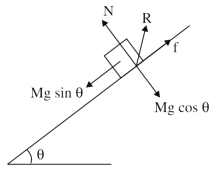
1 likes
View SolutionNewton's Laws of Motion and Friction — Motion (or rest) on Rough Inclined Surface · Frequently Asked Questions
1Are these Newton's Laws of Motion and Friction questions useful for JEE and NEET?
Yes. All questions in this section are mapped to JEE Main and NEET exam patterns. Previous year questions from JEE Main, NEET, GUJCET and state-level exams are included with full solutions.
2Can I switch to Hindi or Gujarati for these questions?
Yes. Use the language tabs in the hero section or the sidebar to view the same questions and solutions in English, Hindi or Gujarati.
3How do I generate a question paper from this subtopic?
Use the Vedclass Exam Paper Generator — select the chapter and subtopic, set difficulty, and generate Sets A, B, C, D automatically. First 3 chapters of every subject are free.
Vedclass Products
For Students
Vedclass Test Series
Mock tests in real JEE/NEET style with performance analysis. 5-day free trial.
Start Free TrialFor Teachers
Exam Paper Generator
Generate Set A/B/C/D papers from this chapter in 2 minutes. 3 chapters free.
Try FreeFor Institutes
Online Exam Module
Live online exams with unlimited students, 360° analytics & white-label branding.
See DemoFor Teachers & Institutes
Generate a Newton's Laws of Motion and Friction Exam Paper in 2 Minutes
Select subtopic & difficulty — Sets A, B, C, D auto-generated with No Repeat logic.
First 3 chapters of every subject are free — no payment required.