
A English
Motion (or rest) on Rough Inclined Surface Questions in English
Class 11 Physics · Newton's Laws of Motion and Friction · Motion (or rest) on Rough Inclined Surface
244+
Questions
English
Language
100%
With Solutions
Showing 34 of 244 questions in English
201
EasyMCQ
The acceleration of a body of mass $m$ sliding down an inclined plane with an angle of inclination $\theta$ and a coefficient of kinetic friction $\mu$ is:
A
$a=g(\sin \theta+\mu \cos \theta)$
B
$a=g(\sin \theta-\mu \cos \theta)$
C
$a=g(\cos \theta-\mu \sin \theta)$
D
$a=g(\cos \theta+\mu \sin \theta)$
Solution
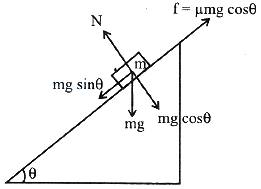
(B) Consider a body of mass $m$ on an inclined plane with angle $\theta$. The forces acting on the body are:
$1$. The component of gravitational force acting down the plane: $mg \sin \theta$.
$2$. The normal force perpendicular to the plane: $N = mg \cos \theta$.
$3$. The kinetic frictional force acting up the plane: $f_k = \mu N = \mu mg \cos \theta$.
The net force $F_{\text{net}}$ acting down the plane is the difference between the gravitational component and the frictional force:
$F_{\text{net}} = mg \sin \theta - f_k = mg \sin \theta - \mu mg \cos \theta$.
Using Newton's second law,$F_{\text{net}} = ma$,we get:
$ma = mg \sin \theta - \mu mg \cos \theta$.
Dividing both sides by $m$,the acceleration $a$ is:
$a = g(\sin \theta - \mu \cos \theta)$.
$1$. The component of gravitational force acting down the plane: $mg \sin \theta$.
$2$. The normal force perpendicular to the plane: $N = mg \cos \theta$.
$3$. The kinetic frictional force acting up the plane: $f_k = \mu N = \mu mg \cos \theta$.
The net force $F_{\text{net}}$ acting down the plane is the difference between the gravitational component and the frictional force:
$F_{\text{net}} = mg \sin \theta - f_k = mg \sin \theta - \mu mg \cos \theta$.
Using Newton's second law,$F_{\text{net}} = ma$,we get:
$ma = mg \sin \theta - \mu mg \cos \theta$.
Dividing both sides by $m$,the acceleration $a$ is:
$a = g(\sin \theta - \mu \cos \theta)$.
0 likes
View Solution202
EasyMCQ
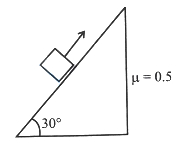
$A$ body is made to move up along an inclined plane of inclination $30^{\circ}$ and the coefficient of friction is $0.5$. Then its retardation is ($g$ = acceleration due to gravity).
A
$\left(\frac{2+\sqrt{3}}{4}\right) g$
B
$\left(\frac{2-\sqrt{3}}{4}\right) g$
C
$\left(\frac{2-\sqrt{3}}{2}\right) g$
D
$\left(\frac{2+\sqrt{3}}{2}\right) g$
Solution
(A) When a body moves up an inclined plane,the forces acting against the motion are the component of gravity along the plane $(mg \sin \theta)$ and the frictional force $(f = \mu N = \mu mg \cos \theta)$.
According to Newton's second law,the net force $F_{net} = ma = -(mg \sin \theta + \mu mg \cos \theta)$.
Thus,the retardation $a$ is given by $a = g(\sin \theta + \mu \cos \theta)$.
Substituting the given values $\theta = 30^{\circ}$ and $\mu = 0.5$:
$a = g(\sin 30^{\circ} + 0.5 \cos 30^{\circ})$
$a = g\left(\frac{1}{2} + 0.5 \times \frac{\sqrt{3}}{2}\right)$
$a = g\left(\frac{1}{2} + \frac{\sqrt{3}}{4}\right)$
$a = g\left(\frac{2 + \sqrt{3}}{4}\right)$.
According to Newton's second law,the net force $F_{net} = ma = -(mg \sin \theta + \mu mg \cos \theta)$.
Thus,the retardation $a$ is given by $a = g(\sin \theta + \mu \cos \theta)$.
Substituting the given values $\theta = 30^{\circ}$ and $\mu = 0.5$:
$a = g(\sin 30^{\circ} + 0.5 \cos 30^{\circ})$
$a = g\left(\frac{1}{2} + 0.5 \times \frac{\sqrt{3}}{2}\right)$
$a = g\left(\frac{1}{2} + \frac{\sqrt{3}}{4}\right)$
$a = g\left(\frac{2 + \sqrt{3}}{4}\right)$.
0 likes
View Solution203
EasyMCQ
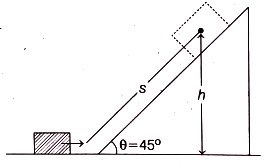
$A$ block of mass $5 \text{ kg}$ starts up a $45^{\circ}$ inclined plane with an initial kinetic energy of $100 \text{ J}$. If the coefficient of friction between the block and the plane is $0.5$,then the distance covered by the block before it stops is (Acceleration due to gravity $= 10 \text{ ms}^{-2}$)
A
$\frac{4 \sqrt{2}}{3} \text{ m}$
B
$\frac{3}{\sqrt{2}} \text{ m}$
C
$2 \sqrt{2} \text{ m}$
D
$\frac{6}{5} \sqrt{2} \text{ m}$
Solution
(A) The block stops on the inclined plane when its initial kinetic energy is used to do work against friction and is partly converted into potential energy.
Given the angle of inclination is $\theta = 45^{\circ}$,the distance covered on the incline $(s)$ is related to the vertical height $(h)$ as:
$\sin 45^{\circ} = \frac{h}{s} \implies s = \frac{h}{\sin 45^{\circ}} = h \sqrt{2}$.
According to the work-energy theorem,the initial kinetic energy $(K.E.)$ is equal to the work done against friction plus the gain in potential energy:
$K.E. = W_{\text{friction}} + \Delta U$
$K.E. = (\mu mg \cos \theta) \cdot s + mgh$
Substituting $s = h \sqrt{2}$ and $\cos 45^{\circ} = \frac{1}{\sqrt{2}}$:
$100 = (0.5 \times 5 \times 10 \times \frac{1}{\sqrt{2}}) \times (h \sqrt{2}) + (5 \times 10 \times h)$
$100 = (0.5 \times 5 \times 10 \times h) + 50h$
$100 = 25h + 50h$
$100 = 75h$
$h = \frac{100}{75} = \frac{4}{3} \text{ m}$.
Now,the distance covered $s$ is:
$s = h \sqrt{2} = \frac{4}{3} \sqrt{2} \text{ m}$.
Given the angle of inclination is $\theta = 45^{\circ}$,the distance covered on the incline $(s)$ is related to the vertical height $(h)$ as:
$\sin 45^{\circ} = \frac{h}{s} \implies s = \frac{h}{\sin 45^{\circ}} = h \sqrt{2}$.
According to the work-energy theorem,the initial kinetic energy $(K.E.)$ is equal to the work done against friction plus the gain in potential energy:
$K.E. = W_{\text{friction}} + \Delta U$
$K.E. = (\mu mg \cos \theta) \cdot s + mgh$
Substituting $s = h \sqrt{2}$ and $\cos 45^{\circ} = \frac{1}{\sqrt{2}}$:
$100 = (0.5 \times 5 \times 10 \times \frac{1}{\sqrt{2}}) \times (h \sqrt{2}) + (5 \times 10 \times h)$
$100 = (0.5 \times 5 \times 10 \times h) + 50h$
$100 = 25h + 50h$
$100 = 75h$
$h = \frac{100}{75} = \frac{4}{3} \text{ m}$.
Now,the distance covered $s$ is:
$s = h \sqrt{2} = \frac{4}{3} \sqrt{2} \text{ m}$.
0 likes
View Solution204
MediumMCQ
When a body is placed on a rough plane (coefficient of friction $= \mu$) inclined at an angle $\theta$ to the horizontal,its acceleration is (acceleration due to gravity $= g$)
A
$g(\sin \theta - \mu \cos \theta)$
B
$g(\sin \theta - \cos \theta)$
C
$g(\mu \sin \theta - \cos \theta)$
D
$g(\mu \cos \theta - \sin \theta)$
Solution
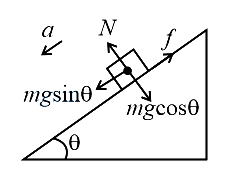
(A) Consider a body of mass $m$ on an inclined plane with angle $\theta$. The forces acting on the body are:
$1$. Gravitational force $mg$ acting vertically downwards.
$2$. Normal reaction $N$ perpendicular to the inclined plane.
$3$. Frictional force $f$ acting up the plane,opposing the motion.
The components of the gravitational force are $mg \sin \theta$ (parallel to the plane) and $mg \cos \theta$ (perpendicular to the plane).
For equilibrium perpendicular to the plane,$N = mg \cos \theta$.
The frictional force is $f = \mu N = \mu mg \cos \theta$.
Applying Newton's second law along the plane:
$mg \sin \theta - f = ma$
$mg \sin \theta - \mu mg \cos \theta = ma$
Dividing by $m$,we get the acceleration:
$a = g(\sin \theta - \mu \cos \theta)$
$1$. Gravitational force $mg$ acting vertically downwards.
$2$. Normal reaction $N$ perpendicular to the inclined plane.
$3$. Frictional force $f$ acting up the plane,opposing the motion.
The components of the gravitational force are $mg \sin \theta$ (parallel to the plane) and $mg \cos \theta$ (perpendicular to the plane).
For equilibrium perpendicular to the plane,$N = mg \cos \theta$.
The frictional force is $f = \mu N = \mu mg \cos \theta$.
Applying Newton's second law along the plane:
$mg \sin \theta - f = ma$
$mg \sin \theta - \mu mg \cos \theta = ma$
Dividing by $m$,we get the acceleration:
$a = g(\sin \theta - \mu \cos \theta)$
0 likes
View Solution205
EasyMCQ
When a body slides down an inclined plane with a coefficient of friction $\mu$,its acceleration will be:
A
$g(\sin \theta - \mu \cos \theta)$
B
$g(\sin \theta + \mu \cos \theta)$
C
$g(\mu \sin \theta - \cos \theta)$
D
$g \mu(\sin \theta - \cos \theta)$
Solution
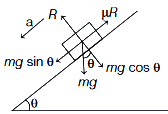
(A) When a body of mass $m$ slides down an inclined plane with acceleration $a$,the forces acting on the body are as follows:
$1$. The component of gravitational force acting down the plane is $mg \sin \theta$.
$2$. The normal reaction force $R$ is equal to $mg \cos \theta$.
$3$. The frictional force acting up the plane is $f = \mu R = \mu mg \cos \theta$.
Applying Newton's second law of motion along the plane:
$ma = mg \sin \theta - f$
$ma = mg \sin \theta - \mu mg \cos \theta$
Dividing both sides by $m$:
$a = g \sin \theta - \mu g \cos \theta$
$a = g(\sin \theta - \mu \cos \theta)$
$1$. The component of gravitational force acting down the plane is $mg \sin \theta$.
$2$. The normal reaction force $R$ is equal to $mg \cos \theta$.
$3$. The frictional force acting up the plane is $f = \mu R = \mu mg \cos \theta$.
Applying Newton's second law of motion along the plane:
$ma = mg \sin \theta - f$
$ma = mg \sin \theta - \mu mg \cos \theta$
Dividing both sides by $m$:
$a = g \sin \theta - \mu g \cos \theta$
$a = g(\sin \theta - \mu \cos \theta)$
0 likes
View Solution206
MediumMCQ
$A$ particle is placed at rest inside a hollow hemisphere of radius $R$. The coefficient of friction between the particle and the hemisphere is $\mu = \frac{1}{\sqrt{3}}$. The maximum height up to which the particle can remain stationary is
A
$\frac{R}{2}$
B
$\left(1-\frac{\sqrt{3}}{2}\right) R$
C
$\frac{\sqrt{3}}{2} R$
D
$\frac{3R}{8}$
Solution
(B) Let the particle be at an angle $\theta$ with the vertical. The forces acting on the particle are its weight $mg$ downwards,the normal force $N$ radially outwards,and the frictional force $f$ tangential to the surface.
For the particle to remain stationary,the component of weight along the tangent must be balanced by the limiting friction: $mg \sin \theta = f = \mu N$.
The component of weight perpendicular to the surface is balanced by the normal force: $N = mg \cos \theta$.
Substituting $N$ into the friction equation: $mg \sin \theta = \mu (mg \cos \theta) \implies \tan \theta = \mu = \frac{1}{\sqrt{3}}$.
Thus,$\theta = 30^\circ$.
The height $h$ of the particle from the bottom of the hemisphere is $h = R - R \cos \theta = R(1 - \cos 30^\circ)$.
$h = R(1 - \frac{\sqrt{3}}{2})$.
For the particle to remain stationary,the component of weight along the tangent must be balanced by the limiting friction: $mg \sin \theta = f = \mu N$.
The component of weight perpendicular to the surface is balanced by the normal force: $N = mg \cos \theta$.
Substituting $N$ into the friction equation: $mg \sin \theta = \mu (mg \cos \theta) \implies \tan \theta = \mu = \frac{1}{\sqrt{3}}$.
Thus,$\theta = 30^\circ$.
The height $h$ of the particle from the bottom of the hemisphere is $h = R - R \cos \theta = R(1 - \cos 30^\circ)$.
$h = R(1 - \frac{\sqrt{3}}{2})$.
0 likes
View Solution207
DifficultMCQ
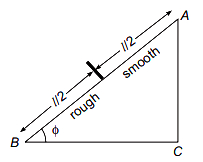
The upper half of an inclined plane with an angle of inclination $\phi$ is smooth,while the lower half is rough. $A$ body starting from rest at the top of the inclined plane comes to rest at the bottom of the inclined plane. Then the coefficient of friction for the lower half is
A
$2 \tan \phi$
B
$\tan \phi$
C
$2 \sin \phi$
D
$2 \cos \phi$
Solution
(A) Let the total length of the inclined plane be $l$. The upper half has length $l/2$ and is smooth,while the lower half has length $l/2$ and is rough with coefficient of friction $\mu$.
For the upper half (smooth):
The acceleration is $a_1 = g \sin \phi$. The initial velocity $u = 0$. Using the equation $v^2 = u^2 + 2as$,the velocity $v$ at the midpoint is:
$v^2 = 0 + 2(g \sin \phi)(l/2) = gl \sin \phi$.
For the lower half (rough):
The initial velocity is $v$ (from the midpoint),and the final velocity is $0$ (at the bottom). The acceleration is $a_2 = g(\sin \phi - \mu \cos \phi)$. Using $v_f^2 = v_i^2 + 2a_2s$:
$0 = v^2 + 2g(\sin \phi - \mu \cos \phi)(l/2)$.
Substituting $v^2 = gl \sin \phi$:
$0 = gl \sin \phi + gl(\sin \phi - \mu \cos \phi)$.
Dividing by $gl$:
$0 = \sin \phi + \sin \phi - \mu \cos \phi$.
$2 \sin \phi = \mu \cos \phi$.
Therefore,$\mu = 2 \tan \phi$.
For the upper half (smooth):
The acceleration is $a_1 = g \sin \phi$. The initial velocity $u = 0$. Using the equation $v^2 = u^2 + 2as$,the velocity $v$ at the midpoint is:
$v^2 = 0 + 2(g \sin \phi)(l/2) = gl \sin \phi$.
For the lower half (rough):
The initial velocity is $v$ (from the midpoint),and the final velocity is $0$ (at the bottom). The acceleration is $a_2 = g(\sin \phi - \mu \cos \phi)$. Using $v_f^2 = v_i^2 + 2a_2s$:
$0 = v^2 + 2g(\sin \phi - \mu \cos \phi)(l/2)$.
Substituting $v^2 = gl \sin \phi$:
$0 = gl \sin \phi + gl(\sin \phi - \mu \cos \phi)$.
Dividing by $gl$:
$0 = \sin \phi + \sin \phi - \mu \cos \phi$.
$2 \sin \phi = \mu \cos \phi$.
Therefore,$\mu = 2 \tan \phi$.
0 likes
View Solution208
DifficultMCQ
Starting from rest,the time taken by a body sliding down on a rough inclined plane at $45^{\circ}$ with the horizontal is twice the time taken to travel on a smooth plane of the same inclination and same distance. Then the coefficient of kinetic friction is
A
$0.25$
B
$0.33$
C
$0.50$
D
$0.75$
Solution
(D) For a smooth inclined plane,the acceleration is $a_s = g \sin \theta$. The time taken to cover distance $s$ is $t_s = \sqrt{\frac{2s}{g \sin \theta}}$.
For a rough inclined plane,the acceleration is $a_r = g(\sin \theta - \mu \cos \theta)$. The time taken is $t_r = \sqrt{\frac{2s}{g(\sin \theta - \mu \cos \theta)}}$.
Given $t_r = n t_s$,where $n = 2$.
Squaring both sides: $\frac{2s}{g(\sin \theta - \mu \cos \theta)} = n^2 \frac{2s}{g \sin \theta}$.
This simplifies to $\sin \theta = n^2(\sin \theta - \mu \cos \theta)$.
Rearranging for $\mu$: $\mu = \tan \theta \left(1 - \frac{1}{n^2}\right)$.
Substituting $\theta = 45^{\circ}$ and $n = 2$: $\mu = \tan 45^{\circ} \left(1 - \frac{1}{2^2}\right) = 1 \times (1 - 0.25) = 0.75$.
For a rough inclined plane,the acceleration is $a_r = g(\sin \theta - \mu \cos \theta)$. The time taken is $t_r = \sqrt{\frac{2s}{g(\sin \theta - \mu \cos \theta)}}$.
Given $t_r = n t_s$,where $n = 2$.
Squaring both sides: $\frac{2s}{g(\sin \theta - \mu \cos \theta)} = n^2 \frac{2s}{g \sin \theta}$.
This simplifies to $\sin \theta = n^2(\sin \theta - \mu \cos \theta)$.
Rearranging for $\mu$: $\mu = \tan \theta \left(1 - \frac{1}{n^2}\right)$.
Substituting $\theta = 45^{\circ}$ and $n = 2$: $\mu = \tan 45^{\circ} \left(1 - \frac{1}{2^2}\right) = 1 \times (1 - 0.25) = 0.75$.
0 likes
View Solution209
MediumMCQ
$A$ particle is projected up along a rough inclined plane of inclination $45^{\circ}$ with the horizontal. If the coefficient of friction is $0.5$,the acceleration is ($g=$ Acceleration due to gravity).
A
$\frac{g}{2}$
B
$\frac{g}{2 \sqrt{2}}$
C
$\frac{3 g}{2 \sqrt{2}}$
D
$\frac{g}{\sqrt{2}}$
Solution
(C) When a particle is projected up an inclined plane,both the component of gravity acting down the plane and the frictional force act in the direction opposite to the motion.
The net force acting on the particle is $F_{net} = -(mg \sin \theta + f_k)$,where $f_k = \mu_k N = \mu_k mg \cos \theta$.
Using Newton's second law,$ma = -(mg \sin \theta + \mu_k mg \cos \theta)$.
The magnitude of the retardation (deceleration) is $a = g(\sin \theta + \mu \cos \theta)$.
Given $\theta = 45^{\circ}$ and $\mu = 0.5$,we have:
$a = g(\sin 45^{\circ} + 0.5 \cos 45^{\circ})$
$a = g(\frac{1}{\sqrt{2}} + 0.5 \cdot \frac{1}{\sqrt{2}})$
$a = g(\frac{1}{\sqrt{2}} + \frac{1}{2 \sqrt{2}}) = g(\frac{2+1}{2 \sqrt{2}})$
$a = \frac{3g}{2 \sqrt{2}}$.
The net force acting on the particle is $F_{net} = -(mg \sin \theta + f_k)$,where $f_k = \mu_k N = \mu_k mg \cos \theta$.
Using Newton's second law,$ma = -(mg \sin \theta + \mu_k mg \cos \theta)$.
The magnitude of the retardation (deceleration) is $a = g(\sin \theta + \mu \cos \theta)$.
Given $\theta = 45^{\circ}$ and $\mu = 0.5$,we have:
$a = g(\sin 45^{\circ} + 0.5 \cos 45^{\circ})$
$a = g(\frac{1}{\sqrt{2}} + 0.5 \cdot \frac{1}{\sqrt{2}})$
$a = g(\frac{1}{\sqrt{2}} + \frac{1}{2 \sqrt{2}}) = g(\frac{2+1}{2 \sqrt{2}})$
$a = \frac{3g}{2 \sqrt{2}}$.
0 likes
View Solution210
DifficultMCQ
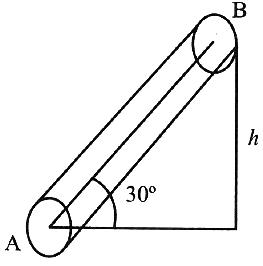
$A$ person climbs up a conveyor belt with a constant acceleration. The speed of the belt is $\sqrt{\frac{g h}{6}}$ and the coefficient of friction is $\frac{5}{3 \sqrt{3}}$. The time taken by the person to reach from $A$ to $B$ with the maximum possible acceleration is
A
$\sqrt{\frac{h g}{6}}$
B
$\sqrt{6 g h}$
C
$\sqrt{\frac{2 h}{g}}$
D
$\sqrt{\frac{6 h}{g}}$
Solution
(D) The maximum possible acceleration of the person on the conveyor belt is given by the net force along the incline divided by mass:
$a_{\max} = \frac{\mu m g \cos \theta - m g \sin \theta}{m} = g(\mu \cos \theta - \sin \theta)$
Given $\theta = 30^{\circ}$,$\mu = \frac{5}{3 \sqrt{3}}$,and $\sin 30^{\circ} = 0.5$,$\cos 30^{\circ} = \frac{\sqrt{3}}{2}$:
$a_{\max} = g \left( \frac{5}{3 \sqrt{3}} \cdot \frac{\sqrt{3}}{2} - \frac{1}{2} \right) = g \left( \frac{5}{6} - \frac{3}{6} \right) = \frac{g}{3}$
The length of the conveyor belt $L$ is related to height $h$ by $L = \frac{h}{\sin 30^{\circ}} = 2h$.
The initial velocity $u$ of the person relative to the ground is the speed of the belt,$u = \sqrt{\frac{g h}{6}}$.
Using the equation of motion $S = ut + \frac{1}{2} a t^2$:
$2h = \left( \sqrt{\frac{g h}{6}} \right) t + \frac{1}{2} \left( \frac{g}{3} \right) t^2$
$2h = \frac{t \sqrt{gh}}{\sqrt{6}} + \frac{gt^2}{6}$
Multiplying by $6$:
$12h = t \sqrt{6gh} + gt^2$
$gt^2 + t \sqrt{6gh} - 12h = 0$
Using the quadratic formula $t = \frac{-b \pm \sqrt{b^2 - 4ac}}{2a}$:
$t = \frac{-\sqrt{6gh} + \sqrt{6gh - 4(g)(-12h)}}{2g} = \frac{-\sqrt{6gh} + \sqrt{6gh + 48gh}}{2g} = \frac{-\sqrt{6gh} + \sqrt{54gh}}{2g} = \frac{-\sqrt{6gh} + 3\sqrt{6gh}}{2g} = \frac{2\sqrt{6gh}}{2g} = \sqrt{\frac{6h}{g}}$
$a_{\max} = \frac{\mu m g \cos \theta - m g \sin \theta}{m} = g(\mu \cos \theta - \sin \theta)$
Given $\theta = 30^{\circ}$,$\mu = \frac{5}{3 \sqrt{3}}$,and $\sin 30^{\circ} = 0.5$,$\cos 30^{\circ} = \frac{\sqrt{3}}{2}$:
$a_{\max} = g \left( \frac{5}{3 \sqrt{3}} \cdot \frac{\sqrt{3}}{2} - \frac{1}{2} \right) = g \left( \frac{5}{6} - \frac{3}{6} \right) = \frac{g}{3}$
The length of the conveyor belt $L$ is related to height $h$ by $L = \frac{h}{\sin 30^{\circ}} = 2h$.
The initial velocity $u$ of the person relative to the ground is the speed of the belt,$u = \sqrt{\frac{g h}{6}}$.
Using the equation of motion $S = ut + \frac{1}{2} a t^2$:
$2h = \left( \sqrt{\frac{g h}{6}} \right) t + \frac{1}{2} \left( \frac{g}{3} \right) t^2$
$2h = \frac{t \sqrt{gh}}{\sqrt{6}} + \frac{gt^2}{6}$
Multiplying by $6$:
$12h = t \sqrt{6gh} + gt^2$
$gt^2 + t \sqrt{6gh} - 12h = 0$
Using the quadratic formula $t = \frac{-b \pm \sqrt{b^2 - 4ac}}{2a}$:
$t = \frac{-\sqrt{6gh} + \sqrt{6gh - 4(g)(-12h)}}{2g} = \frac{-\sqrt{6gh} + \sqrt{6gh + 48gh}}{2g} = \frac{-\sqrt{6gh} + \sqrt{54gh}}{2g} = \frac{-\sqrt{6gh} + 3\sqrt{6gh}}{2g} = \frac{2\sqrt{6gh}}{2g} = \sqrt{\frac{6h}{g}}$
0 likes
View Solution211
MediumMCQ
$A$ body of mass $2 \ kg$ slides down with an acceleration of $4 \ m/s^2$ on an inclined plane having a slope of $30^{\circ}$. The external force required to take the same body up the plane with the same acceleration will be (Acceleration due to gravity $= 10 \ m/s^2$) (in $N$)
A
$8$
B
$16$
C
$22$
D
$20$
Solution
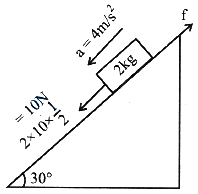
(D) Given: Mass $m = 2 \ kg$,acceleration $a = 4 \ m/s^2$,angle $\theta = 30^{\circ}$,$g = 10 \ m/s^2$.
Case $1$: Body sliding down.
The component of gravitational force along the plane is $mg \sin \theta = 2 \times 10 \times \sin 30^{\circ} = 20 \times 0.5 = 10 \ N$.
Let $f$ be the frictional force acting upwards. The equation of motion is:
$mg \sin \theta - f = ma$
$10 - f = 2 \times 4$
$10 - f = 8$
$f = 2 \ N$.
Case $2$: Body moving up with the same acceleration.
Let $F$ be the external force applied upwards. The frictional force $f$ will now act downwards.
The equation of motion is:
$F - mg \sin \theta - f = ma$
$F - 10 - 2 = 2 \times 4$
$F - 12 = 8$
$F = 20 \ N$.
Case $1$: Body sliding down.
The component of gravitational force along the plane is $mg \sin \theta = 2 \times 10 \times \sin 30^{\circ} = 20 \times 0.5 = 10 \ N$.
Let $f$ be the frictional force acting upwards. The equation of motion is:
$mg \sin \theta - f = ma$
$10 - f = 2 \times 4$
$10 - f = 8$
$f = 2 \ N$.
Case $2$: Body moving up with the same acceleration.
Let $F$ be the external force applied upwards. The frictional force $f$ will now act downwards.
The equation of motion is:
$F - mg \sin \theta - f = ma$
$F - 10 - 2 = 2 \times 4$
$F - 12 = 8$
$F = 20 \ N$.
0 likes
View Solution212
MediumMCQ
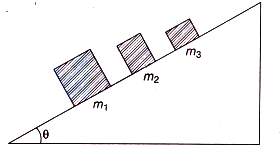
Consider three masses $m_1, m_2$ and $m_3$ $(m_1 > m_2 > m_3)$ that are at rest on an inclined plane as shown in the figure. The angle of inclination $(\theta)$ of the plane is gradually increased until the masses just begin to slide. (Assume the coefficient of static friction between the masses and the surface is constant). Then,which of the following statements is correct?
A
$m_3$ begins to slide at a higher inclination angle than $m_1$ and $m_2$.
B
$m_3$ begins to slide at a lower inclination angle than $m_1$ and $m_2$.
C
$m_1, m_2$ and $m_3$ begin to slide at the same inclination angle.
D
$m_2$ begins to slide at a higher inclination angle than $m_1$ and $m_3$.
Solution
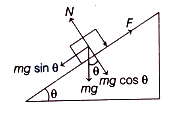
(C) An object begins to slide down an inclined plane when the angle of inclination (also called the angle of repose) is equal to the angle of friction. Let $\theta$ be the angle at which a mass begins to slide down an incline.
At the verge of sliding,the force of static friction $f_s$ is equal to the downward component of gravity.
$f_s = mg \sin \theta$
Since $f_s = \mu N$ and the normal force $N = mg \cos \theta$,we have:
$\mu (mg \cos \theta) = mg \sin \theta$
$\mu = \frac{\sin \theta}{\cos \theta} = \tan \theta$
$\theta = \tan^{-1} \mu$
Since the angle of repose $\theta$ depends only on the coefficient of static friction $\mu$ and is independent of the mass $m$ of the body,all three masses will begin to slide at the same instant at the same inclination angle $\theta$.
At the verge of sliding,the force of static friction $f_s$ is equal to the downward component of gravity.
$f_s = mg \sin \theta$
Since $f_s = \mu N$ and the normal force $N = mg \cos \theta$,we have:
$\mu (mg \cos \theta) = mg \sin \theta$
$\mu = \frac{\sin \theta}{\cos \theta} = \tan \theta$
$\theta = \tan^{-1} \mu$
Since the angle of repose $\theta$ depends only on the coefficient of static friction $\mu$ and is independent of the mass $m$ of the body,all three masses will begin to slide at the same instant at the same inclination angle $\theta$.
0 likes
View Solution213
MediumMCQ
When the angle of inclination of an inclined plane is $\theta$,an object slides down with uniform velocity. If the same object is pushed up with an initial velocity $u$ on the same inclined plane,it goes up the plane and stops at a certain distance on the plane. Thereafter,the body:
A
slides down the inclined plane and reaches the ground with velocity $u$.
B
slides down the inclined plane and reaches the ground with velocity less than $u$.
C
slides down the inclined plane and reaches the ground with velocity greater than $u$.
D
stays at rest on the inclined plane and will not slide down.
Solution
(B) $1$. When the object slides down with uniform velocity,the net force is zero. This implies the component of gravity $mg \sin \theta$ is balanced by the kinetic friction $f_k = \mu_k N = \mu_k mg \cos \theta$. Thus,$\mu_k = \tan \theta$.
$2$. When the object is pushed up with velocity $u$,it experiences a retardation $a_{up} = g \sin \theta + \mu_k g \cos \theta$. Since $\mu_k = \tan \theta$,$a_{up} = g \sin \theta + (\tan \theta) g \cos \theta = 2g \sin \theta$.
$3$. After stopping,the object slides down. The acceleration while sliding down is $a_{down} = g \sin \theta - \mu_k g \cos \theta$. Since $\mu_k = \tan \theta$,$a_{down} = g \sin \theta - g \sin \theta = 0$. Wait,this implies uniform velocity. Let's re-evaluate: the kinetic friction acts opposite to motion. When sliding down,$a_{down} = g \sin \theta - \mu_k g \cos \theta = 0$. The object will slide down with the same velocity it had at the start of the descent. Since it started from rest at the top,it will slide down with uniform velocity. However,the question implies it reaches the ground. The energy lost due to friction during the upward journey is $W_f = f_k \times d = (\mu_k mg \cos \theta) d$. During the downward journey,the same energy is lost. By work-energy theorem,the final kinetic energy $K_f = K_i + W_{gravity} - W_{friction}$. Since $W_{gravity}$ is the same for both paths and $W_{friction}$ is the same,the final velocity will be less than $u$ due to energy dissipation.
$2$. When the object is pushed up with velocity $u$,it experiences a retardation $a_{up} = g \sin \theta + \mu_k g \cos \theta$. Since $\mu_k = \tan \theta$,$a_{up} = g \sin \theta + (\tan \theta) g \cos \theta = 2g \sin \theta$.
$3$. After stopping,the object slides down. The acceleration while sliding down is $a_{down} = g \sin \theta - \mu_k g \cos \theta$. Since $\mu_k = \tan \theta$,$a_{down} = g \sin \theta - g \sin \theta = 0$. Wait,this implies uniform velocity. Let's re-evaluate: the kinetic friction acts opposite to motion. When sliding down,$a_{down} = g \sin \theta - \mu_k g \cos \theta = 0$. The object will slide down with the same velocity it had at the start of the descent. Since it started from rest at the top,it will slide down with uniform velocity. However,the question implies it reaches the ground. The energy lost due to friction during the upward journey is $W_f = f_k \times d = (\mu_k mg \cos \theta) d$. During the downward journey,the same energy is lost. By work-energy theorem,the final kinetic energy $K_f = K_i + W_{gravity} - W_{friction}$. Since $W_{gravity}$ is the same for both paths and $W_{friction}$ is the same,the final velocity will be less than $u$ due to energy dissipation.
0 likes
View Solution214
MediumMCQ
Sand is to be piled up on a horizontal ground in the form of a regular cone of a fixed base of radius $R$. The coefficient of static friction between the sand layers is $\mu$. The maximum volume of the sand that can be piled up in the form of a cone without slipping on the ground is
A
$\frac{\mu R^3}{3 \pi}$
B
$\frac{\mu R^3}{3}$
C
$\frac{\pi R^3}{3 \mu}$
D
$\frac{\mu \pi R^3}{3}$
Solution
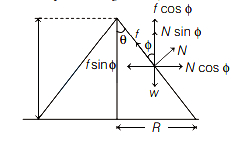
(D) Let $h$ be the height of the sand cone with base radius $R$. The angle of repose $\alpha$ is the maximum angle at which the sand can be piled without slipping. This angle is related to the coefficient of static friction $\mu$ by $\tan \alpha = \mu$.
In the cone,the angle $\alpha$ is formed by the slant height with the horizontal ground. From the geometry of the cone,$\tan \alpha = \frac{h}{R}$.
Equating the two expressions for $\tan \alpha$,we get $\frac{h}{R} = \mu$,which implies $h = \mu R$.
The volume $V$ of a cone is given by $V = \frac{1}{3} \pi R^2 h$.
Substituting $h = \mu R$ into the volume formula,we get $V_{\max} = \frac{1}{3} \pi R^2 (\mu R) = \frac{\mu \pi R^3}{3}$.
In the cone,the angle $\alpha$ is formed by the slant height with the horizontal ground. From the geometry of the cone,$\tan \alpha = \frac{h}{R}$.
Equating the two expressions for $\tan \alpha$,we get $\frac{h}{R} = \mu$,which implies $h = \mu R$.
The volume $V$ of a cone is given by $V = \frac{1}{3} \pi R^2 h$.
Substituting $h = \mu R$ into the volume formula,we get $V_{\max} = \frac{1}{3} \pi R^2 (\mu R) = \frac{\mu \pi R^3}{3}$.
0 likes
View Solution215
DifficultMCQ
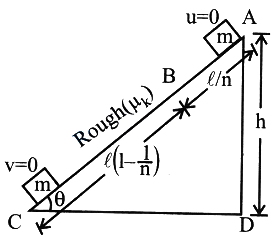
The upper $\left(\frac{1}{n}\right)^{\text{th}}$ of an inclined plane is smooth and the remaining lower part is rough with coefficient of friction $\mu_k$. If a body starting from rest at the top of the inclined plane will again come to rest at the bottom of the plane,then the angle of inclination of the inclined plane is
A
$\sin^{-1}\left[\left(\frac{n}{n-1}\right) \mu_k\right]$
B
$\sin^{-1}\left[\left(\frac{n-1}{n}\right) \mu_k\right]$
C
$\tan^{-1}\left[\left(\frac{n}{n-1}\right) \mu_k\right]$
D
$\tan^{-1}\left[\left(\frac{n-1}{n}\right) \mu_k\right]$
Solution
(D) Let $l$ be the total length of the inclined plane and $\theta$ be the angle of inclination.
According to the work-energy theorem,the total work done on the body is equal to the change in its kinetic energy.
Since the body starts from rest and comes to rest at the bottom,the change in kinetic energy $\Delta K = 0$.
The forces acting on the body are gravity,friction,and the normal force.
$1$. Work done by gravity $(W_g)$: $W_g = mgh = mg(l \sin \theta)$.
$2$. Work done by friction $(W_f)$: Friction acts only on the lower part of length $l(1 - 1/n)$. Thus,$W_f = -f_k \cdot d = -(\mu_k mg \cos \theta) \cdot l(1 - 1/n)$.
$3$. Work done by the normal force $(W_N)$: Since the normal force is always perpendicular to the displacement,$W_N = 0$.
Applying the work-energy theorem: $W_g + W_f + W_N = 0$.
$mg l \sin \theta - \mu_k mg \cos \theta \cdot l \left(\frac{n-1}{n}\right) = 0$.
Dividing by $mg l \cos \theta$ (assuming $\cos \theta \neq 0$):
$\tan \theta = \mu_k \left(\frac{n-1}{n}\right)$.
Therefore,$\theta = \tan^{-1}\left[\left(\frac{n-1}{n}\right) \mu_k\right]$.
According to the work-energy theorem,the total work done on the body is equal to the change in its kinetic energy.
Since the body starts from rest and comes to rest at the bottom,the change in kinetic energy $\Delta K = 0$.
The forces acting on the body are gravity,friction,and the normal force.
$1$. Work done by gravity $(W_g)$: $W_g = mgh = mg(l \sin \theta)$.
$2$. Work done by friction $(W_f)$: Friction acts only on the lower part of length $l(1 - 1/n)$. Thus,$W_f = -f_k \cdot d = -(\mu_k mg \cos \theta) \cdot l(1 - 1/n)$.
$3$. Work done by the normal force $(W_N)$: Since the normal force is always perpendicular to the displacement,$W_N = 0$.
Applying the work-energy theorem: $W_g + W_f + W_N = 0$.
$mg l \sin \theta - \mu_k mg \cos \theta \cdot l \left(\frac{n-1}{n}\right) = 0$.
Dividing by $mg l \cos \theta$ (assuming $\cos \theta \neq 0$):
$\tan \theta = \mu_k \left(\frac{n-1}{n}\right)$.
Therefore,$\theta = \tan^{-1}\left[\left(\frac{n-1}{n}\right) \mu_k\right]$.
0 likes
View Solution216
MediumMCQ
$A$ block of mass $5 \ kg$ is kept against an accelerating wedge with a wedge angle of $45^{\circ}$ to the horizontal. The coefficient of friction between the block and the wedge is $\mu = 0.4$. What is the minimum absolute value of the acceleration of the wedge to keep the block steady? Assume $g = 10 \ m \ s^{-2}$.
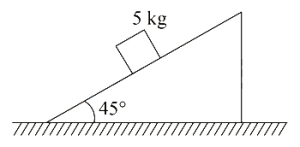
A
$\frac{60}{7} \ m \ s^{-2}$
B
$\frac{30}{7} \ m \ s^{-2}$
C
$\frac{30}{\sqrt{7}} \ m \ s^{-2}$
D
$\frac{60}{\sqrt{7}} \ m \ s^{-2}$
Solution
(B) For a block to remain steady on an accelerating wedge,the forces acting on the block in the frame of the wedge are: gravity ($mg$ downwards),pseudo force ($ma$ horizontally outwards),normal force ($N$ perpendicular to the surface),and friction ($f$ parallel to the surface).
To find the minimum acceleration $(a_{\min})$,friction must act upwards along the incline to prevent the block from sliding down.
Resolving forces parallel and perpendicular to the incline:
$N = mg \cos \theta + ma \sin \theta$
$f + ma \cos \theta = mg \sin \theta$
Since $f = \mu N$,we have $\mu(mg \cos \theta + ma \sin \theta) = mg \sin \theta - ma \cos \theta$.
Rearranging for $a$:
$ma(\mu \sin \theta + \cos \theta) = mg(\sin \theta - \mu \cos \theta)$
$a = g \frac{\sin \theta - \mu \cos \theta}{\cos \theta + \mu \sin \theta}$
Given $\theta = 45^{\circ}$,$\sin 45^{\circ} = \cos 45^{\circ} = \frac{1}{\sqrt{2}}$.
$a_{\min} = g \frac{\frac{1}{\sqrt{2}} - \mu \frac{1}{\sqrt{2}}}{\frac{1}{\sqrt{2}} + \mu \frac{1}{\sqrt{2}}} = g \frac{1 - \mu}{1 + \mu}$
Substituting $g = 10 \ m \ s^{-2}$ and $\mu = 0.4$:
$a_{\min} = 10 \times \frac{1 - 0.4}{1 + 0.4} = 10 \times \frac{0.6}{1.4} = 10 \times \frac{6}{14} = \frac{60}{14} = \frac{30}{7} \ m \ s^{-2}$.
To find the minimum acceleration $(a_{\min})$,friction must act upwards along the incline to prevent the block from sliding down.
Resolving forces parallel and perpendicular to the incline:
$N = mg \cos \theta + ma \sin \theta$
$f + ma \cos \theta = mg \sin \theta$
Since $f = \mu N$,we have $\mu(mg \cos \theta + ma \sin \theta) = mg \sin \theta - ma \cos \theta$.
Rearranging for $a$:
$ma(\mu \sin \theta + \cos \theta) = mg(\sin \theta - \mu \cos \theta)$
$a = g \frac{\sin \theta - \mu \cos \theta}{\cos \theta + \mu \sin \theta}$
Given $\theta = 45^{\circ}$,$\sin 45^{\circ} = \cos 45^{\circ} = \frac{1}{\sqrt{2}}$.
$a_{\min} = g \frac{\frac{1}{\sqrt{2}} - \mu \frac{1}{\sqrt{2}}}{\frac{1}{\sqrt{2}} + \mu \frac{1}{\sqrt{2}}} = g \frac{1 - \mu}{1 + \mu}$
Substituting $g = 10 \ m \ s^{-2}$ and $\mu = 0.4$:
$a_{\min} = 10 \times \frac{1 - 0.4}{1 + 0.4} = 10 \times \frac{0.6}{1.4} = 10 \times \frac{6}{14} = \frac{60}{14} = \frac{30}{7} \ m \ s^{-2}$.
0 likes
View Solution217
EasyMCQ
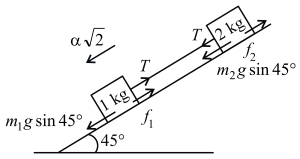
Two blocks of masses $1 \ kg$ and $2 \ kg$ are connected by a light rod and the system is slipping down a rough incline at an angle of $45^{\circ}$ with the horizontal. The coefficient of kinetic friction at both contacts is $0.4$. If the acceleration of the system is $\alpha \sqrt{2} \ m/s^2$,find the value of $\alpha$. (Use $g = 10 \ m/s^2$)
A
$4$
B
$3$
C
$2$
D
$6$
Solution
(B) The frictional force acting on both blocks is kinetic in nature.
For the $1 \ kg$ block:
$f_1 = \mu m_1 g \cos 45^{\circ} = 0.4 \times 1 \times 10 \times \frac{1}{\sqrt{2}} = \frac{4}{\sqrt{2}} = 2\sqrt{2} \ N$
For the $2 \ kg$ block:
$f_2 = \mu m_2 g \cos 45^{\circ} = 0.4 \times 2 \times 10 \times \frac{1}{\sqrt{2}} = \frac{8}{\sqrt{2}} = 4\sqrt{2} \ N$
The net force along the incline in the downward direction provides the acceleration $a = \alpha \sqrt{2}$:
$(m_1 + m_2)g \sin 45^{\circ} - (f_1 + f_2) = (m_1 + m_2)a$
$(1 + 2) \times 10 \times \frac{1}{\sqrt{2}} - (2\sqrt{2} + 4\sqrt{2}) = (1 + 2) \times (\alpha \sqrt{2})$
$30 \times \frac{1}{\sqrt{2}} - 6\sqrt{2} = 3\alpha \sqrt{2}$
Multiply throughout by $\sqrt{2}$:
$30 - 6 \times 2 = 3\alpha \times 2$
$30 - 12 = 6\alpha$
$18 = 6\alpha$
$\alpha = 3$
For the $1 \ kg$ block:
$f_1 = \mu m_1 g \cos 45^{\circ} = 0.4 \times 1 \times 10 \times \frac{1}{\sqrt{2}} = \frac{4}{\sqrt{2}} = 2\sqrt{2} \ N$
For the $2 \ kg$ block:
$f_2 = \mu m_2 g \cos 45^{\circ} = 0.4 \times 2 \times 10 \times \frac{1}{\sqrt{2}} = \frac{8}{\sqrt{2}} = 4\sqrt{2} \ N$
The net force along the incline in the downward direction provides the acceleration $a = \alpha \sqrt{2}$:
$(m_1 + m_2)g \sin 45^{\circ} - (f_1 + f_2) = (m_1 + m_2)a$
$(1 + 2) \times 10 \times \frac{1}{\sqrt{2}} - (2\sqrt{2} + 4\sqrt{2}) = (1 + 2) \times (\alpha \sqrt{2})$
$30 \times \frac{1}{\sqrt{2}} - 6\sqrt{2} = 3\alpha \sqrt{2}$
Multiply throughout by $\sqrt{2}$:
$30 - 6 \times 2 = 3\alpha \times 2$
$30 - 12 = 6\alpha$
$18 = 6\alpha$
$\alpha = 3$
0 likes
View Solution218
MediumMCQ
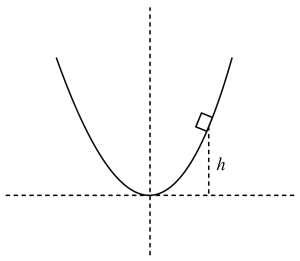
$A$ block is placed on a parabolic shape ramp given by the equation $y = \frac{x^2}{20}$. If the coefficient of static friction $\mu_s$ is $0.5$,then what is the maximum height above the ground at which the block can be placed without slipping (in $m$)?
A
$2.5$
B
$1.25$
C
$0.5$
D
$0.25$
Solution
(B) The block will start slipping when the slope of the curve at that point is equal to the tangent of the angle of repose,$\tan \theta = \mu_s$.
The slope of the curve at any point $x$ is given by the derivative:
$m = \frac{dy}{dx} = \frac{d}{dx} \left( \frac{x^2}{20} \right) = \frac{2x}{20} = \frac{x}{10}$.
For the block to remain in equilibrium without slipping,the slope must satisfy:
$\frac{dy}{dx} \leq \mu_s$
At the point of slipping,$\frac{x}{10} = 0.5$.
Solving for $x$:
$x = 0.5 \times 10 = 5 \ m$.
Now,substitute $x = 5 \ m$ into the equation of the parabola to find the maximum height $h$:
$h = y = \frac{x^2}{20} = \frac{5^2}{20} = \frac{25}{20} = 1.25 \ m$.
The slope of the curve at any point $x$ is given by the derivative:
$m = \frac{dy}{dx} = \frac{d}{dx} \left( \frac{x^2}{20} \right) = \frac{2x}{20} = \frac{x}{10}$.
For the block to remain in equilibrium without slipping,the slope must satisfy:
$\frac{dy}{dx} \leq \mu_s$
At the point of slipping,$\frac{x}{10} = 0.5$.
Solving for $x$:
$x = 0.5 \times 10 = 5 \ m$.
Now,substitute $x = 5 \ m$ into the equation of the parabola to find the maximum height $h$:
$h = y = \frac{x^2}{20} = \frac{5^2}{20} = \frac{25}{20} = 1.25 \ m$.
0 likes
View Solution219
MediumMCQ
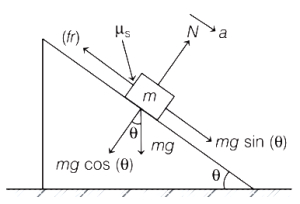
$A$ block of mass $4 \ kg$ is at rest on a rough inclined plane making an angle of $\theta$ with the horizontal. The coefficient of static friction between the block and the plane is $0.5$ and the frictional force on the block is $14.14 \ N$. Find the value of $\theta$. (in $^{\circ}$)
A
$30$
B
$45$
C
$60$
D
$15$
Solution
(B) Given: Mass $m = 4 \ kg$,coefficient of static friction $\mu_s = 0.5$,and frictional force $f = 14.14 \ N = 10\sqrt{2} \ N$.
Since the block is at rest on the inclined plane,the frictional force balances the component of gravitational force acting down the plane.
$f = mg \sin \theta$
$10\sqrt{2} = 4 \times 10 \times \sin \theta$
$10\sqrt{2} = 40 \sin \theta$
$\sin \theta = \frac{10\sqrt{2}}{40} = \frac{\sqrt{2}}{4} = \frac{1}{2\sqrt{2}} \approx 0.3535$.
However,if we assume the frictional force given is the limiting friction $(f_L = \mu_s N)$:
Normal reaction $N = mg \cos \theta = 40 \cos \theta$.
$f_L = \mu_s N = 0.5 \times 40 \cos \theta = 20 \cos \theta$.
Equating $f_L = 10\sqrt{2}$:
$20 \cos \theta = 10\sqrt{2}$
$\cos \theta = \frac{10\sqrt{2}}{20} = \frac{\sqrt{2}}{2} = \frac{1}{\sqrt{2}}$.
Therefore,$\theta = 45^{\circ}$.
Since the block is at rest on the inclined plane,the frictional force balances the component of gravitational force acting down the plane.
$f = mg \sin \theta$
$10\sqrt{2} = 4 \times 10 \times \sin \theta$
$10\sqrt{2} = 40 \sin \theta$
$\sin \theta = \frac{10\sqrt{2}}{40} = \frac{\sqrt{2}}{4} = \frac{1}{2\sqrt{2}} \approx 0.3535$.
However,if we assume the frictional force given is the limiting friction $(f_L = \mu_s N)$:
Normal reaction $N = mg \cos \theta = 40 \cos \theta$.
$f_L = \mu_s N = 0.5 \times 40 \cos \theta = 20 \cos \theta$.
Equating $f_L = 10\sqrt{2}$:
$20 \cos \theta = 10\sqrt{2}$
$\cos \theta = \frac{10\sqrt{2}}{20} = \frac{\sqrt{2}}{2} = \frac{1}{\sqrt{2}}$.
Therefore,$\theta = 45^{\circ}$.
0 likes
View Solution220
MediumMCQ
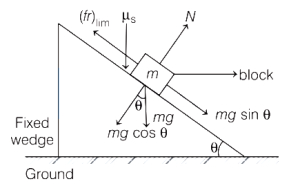
$A$ block rests on a fixed wedge inclined at an angle $\theta$. The coefficient of friction between the block and the plane is $\mu$. The maximum value of $\theta$ for the block to remain motionless on the wedge is
A
$\mu=\tan \theta$
B
$\mu=\sin \theta$
C
$\mu=\cos \theta$
D
$\mu=\cot \theta$
Solution
(A) To find the maximum angle $\theta$ for which the block remains at rest,consider the forces acting on the block of mass $m$:
$1$. The gravitational force $mg$ acts vertically downwards.
$2$. The normal reaction $N$ acts perpendicular to the inclined surface.
$3$. The static friction force $f_s$ acts up the incline to oppose the tendency of motion.
Resolving the weight $mg$ into components:
- Component perpendicular to the incline: $mg \cos \theta$
- Component parallel to the incline: $mg \sin \theta$
For equilibrium perpendicular to the incline:
$N = mg \cos \theta$
For the block to remain motionless,the driving force must be less than or equal to the limiting friction:
$mg \sin \theta \leq f_{s, \text{max}}$
Since $f_{s, \text{max}} = \mu N = \mu mg \cos \theta$,we have:
$mg \sin \theta \leq \mu mg \cos \theta$
Dividing both sides by $mg \cos \theta$ (assuming $\cos \theta \neq 0$):
$\tan \theta \leq \mu$
Thus,the maximum value of $\theta$ is given by $\tan \theta = \mu$.
$1$. The gravitational force $mg$ acts vertically downwards.
$2$. The normal reaction $N$ acts perpendicular to the inclined surface.
$3$. The static friction force $f_s$ acts up the incline to oppose the tendency of motion.
Resolving the weight $mg$ into components:
- Component perpendicular to the incline: $mg \cos \theta$
- Component parallel to the incline: $mg \sin \theta$
For equilibrium perpendicular to the incline:
$N = mg \cos \theta$
For the block to remain motionless,the driving force must be less than or equal to the limiting friction:
$mg \sin \theta \leq f_{s, \text{max}}$
Since $f_{s, \text{max}} = \mu N = \mu mg \cos \theta$,we have:
$mg \sin \theta \leq \mu mg \cos \theta$
Dividing both sides by $mg \cos \theta$ (assuming $\cos \theta \neq 0$):
$\tan \theta \leq \mu$
Thus,the maximum value of $\theta$ is given by $\tan \theta = \mu$.
0 likes
View Solution221
DifficultMCQ
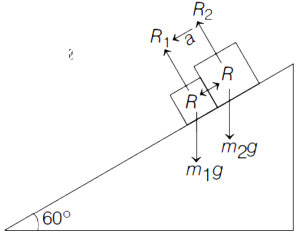
Two touching blocks $1$ and $2$ are placed on an inclined plane forming an angle $60^{\circ}$ with the horizontal. The masses are $m_1$ and $m_2$ and the coefficients of friction between the inclined plane and the two blocks are $1.5 \mu$ and $1.0 \mu$,respectively. The force of reaction between the blocks during the motion is ($g=$ acceleration due to gravity).
A
$\left(m_2-m_1\right) \mu g$
B
$\left(m_2+m_1\right) \mu g$
C
$\frac{1}{2} \frac{m_1 m_2}{m_1+m_2} \mu g$
D
$\frac{1}{4} \frac{m_1 m_2}{m_1+m_2} \mu g$
Solution
(D) Let $a$ be the common acceleration of the two blocks.
For the first block $(m_1)$: The forces acting along the incline are the component of gravity $m_1 g \sin 60^{\circ}$ downwards,friction force $f_1 = \mu_1 N_1 = 1.5 \mu m_1 g \cos 60^{\circ}$ upwards,and the reaction force $R$ from the second block acting upwards.
Equation of motion: $m_1 g \sin 60^{\circ} - 1.5 \mu m_1 g \cos 60^{\circ} + R = m_1 a$ --- $(i)$
For the second block $(m_2)$: The forces acting along the incline are the component of gravity $m_2 g \sin 60^{\circ}$ downwards,friction force $f_2 = \mu_2 N_2 = \mu m_2 g \cos 60^{\circ}$ upwards,and the reaction force $R$ from the first block acting downwards.
Equation of motion: $m_2 g \sin 60^{\circ} - \mu m_2 g \cos 60^{\circ} - R = m_2 a$ --- $(ii)$
From $(i)$,$a = g \sin 60^{\circ} - 1.5 \mu g \cos 60^{\circ} + \frac{R}{m_1}$.
From $(ii)$,$a = g \sin 60^{\circ} - \mu g \cos 60^{\circ} - \frac{R}{m_2}$.
Equating the two expressions for $a$:
$g \sin 60^{\circ} - 1.5 \mu g \cos 60^{\circ} + \frac{R}{m_1} = g \sin 60^{\circ} - \mu g \cos 60^{\circ} - \frac{R}{m_2}$
$R \left( \frac{1}{m_1} + \frac{1}{m_2} \right) = 1.5 \mu g \cos 60^{\circ} - \mu g \cos 60^{\circ} = 0.5 \mu g \cos 60^{\circ}$
$R \left( \frac{m_1 + m_2}{m_1 m_2} \right) = 0.5 \mu g \left( \frac{1}{2} \right) = 0.25 \mu g = \frac{1}{4} \mu g$
$R = \frac{1}{4} \frac{m_1 m_2}{m_1 + m_2} \mu g$.
For the first block $(m_1)$: The forces acting along the incline are the component of gravity $m_1 g \sin 60^{\circ}$ downwards,friction force $f_1 = \mu_1 N_1 = 1.5 \mu m_1 g \cos 60^{\circ}$ upwards,and the reaction force $R$ from the second block acting upwards.
Equation of motion: $m_1 g \sin 60^{\circ} - 1.5 \mu m_1 g \cos 60^{\circ} + R = m_1 a$ --- $(i)$
For the second block $(m_2)$: The forces acting along the incline are the component of gravity $m_2 g \sin 60^{\circ}$ downwards,friction force $f_2 = \mu_2 N_2 = \mu m_2 g \cos 60^{\circ}$ upwards,and the reaction force $R$ from the first block acting downwards.
Equation of motion: $m_2 g \sin 60^{\circ} - \mu m_2 g \cos 60^{\circ} - R = m_2 a$ --- $(ii)$
From $(i)$,$a = g \sin 60^{\circ} - 1.5 \mu g \cos 60^{\circ} + \frac{R}{m_1}$.
From $(ii)$,$a = g \sin 60^{\circ} - \mu g \cos 60^{\circ} - \frac{R}{m_2}$.
Equating the two expressions for $a$:
$g \sin 60^{\circ} - 1.5 \mu g \cos 60^{\circ} + \frac{R}{m_1} = g \sin 60^{\circ} - \mu g \cos 60^{\circ} - \frac{R}{m_2}$
$R \left( \frac{1}{m_1} + \frac{1}{m_2} \right) = 1.5 \mu g \cos 60^{\circ} - \mu g \cos 60^{\circ} = 0.5 \mu g \cos 60^{\circ}$
$R \left( \frac{m_1 + m_2}{m_1 m_2} \right) = 0.5 \mu g \left( \frac{1}{2} \right) = 0.25 \mu g = \frac{1}{4} \mu g$
$R = \frac{1}{4} \frac{m_1 m_2}{m_1 + m_2} \mu g$.
0 likes
View Solution222
DifficultMCQ
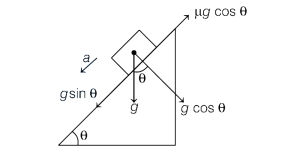
$A$ block of mass $10 \ kg$,initially at rest,makes a downward motion on a $45^{\circ}$ inclined plane. The distance travelled by the block after $2 \ s$ is (Assume the coefficient of kinetic friction to be $0.3$ and $g=10 \ m/s^2$)
A
$7 \sqrt{2} \ m$
B
$\frac{9}{\sqrt{2}} \ m$
C
$10 \sqrt{2} \ m$
D
$5 \sqrt{2} \ m$
Solution
(A) The acceleration $a$ of a block sliding down an inclined plane is given by the formula:
$a = g \sin \theta - \mu g \cos \theta$
Given: mass $m = 10 \ kg$,angle $\theta = 45^{\circ}$,coefficient of kinetic friction $\mu = 0.3$,time $t = 2 \ s$,and acceleration due to gravity $g = 10 \ m/s^2$.
Substituting these values into the acceleration formula:
$a = 10 \sin 45^{\circ} - 0.3 \times 10 \cos 45^{\circ}$
$a = 10 \times \frac{1}{\sqrt{2}} - 3 \times \frac{1}{\sqrt{2}} = \frac{7}{\sqrt{2}} \ m/s^2$
Using the second equation of motion for distance $s$ with initial velocity $u = 0$:
$s = ut + \frac{1}{2}at^2$
$s = 0 \times 2 + \frac{1}{2} \times \left( \frac{7}{\sqrt{2}} \right) \times (2)^2$
$s = \frac{1}{2} \times \frac{7}{\sqrt{2}} \times 4 = \frac{14}{\sqrt{2}} = 7 \sqrt{2} \ m$
Thus,the distance travelled is $7 \sqrt{2} \ m$.
$a = g \sin \theta - \mu g \cos \theta$
Given: mass $m = 10 \ kg$,angle $\theta = 45^{\circ}$,coefficient of kinetic friction $\mu = 0.3$,time $t = 2 \ s$,and acceleration due to gravity $g = 10 \ m/s^2$.
Substituting these values into the acceleration formula:
$a = 10 \sin 45^{\circ} - 0.3 \times 10 \cos 45^{\circ}$
$a = 10 \times \frac{1}{\sqrt{2}} - 3 \times \frac{1}{\sqrt{2}} = \frac{7}{\sqrt{2}} \ m/s^2$
Using the second equation of motion for distance $s$ with initial velocity $u = 0$:
$s = ut + \frac{1}{2}at^2$
$s = 0 \times 2 + \frac{1}{2} \times \left( \frac{7}{\sqrt{2}} \right) \times (2)^2$
$s = \frac{1}{2} \times \frac{7}{\sqrt{2}} \times 4 = \frac{14}{\sqrt{2}} = 7 \sqrt{2} \ m$
Thus,the distance travelled is $7 \sqrt{2} \ m$.
0 likes
View Solution223
DifficultMCQ
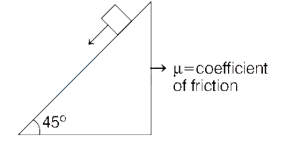
$A$ small block starts sliding down an inclined plane forming an angle $45^{\circ}$ with the horizontal. The coefficient of friction $\mu$ varies with distance $s$ as $\mu = C s^2$,where $C$ is a constant of appropriate dimensions. The distance covered by the block before it stops is:
A
$\sqrt{\frac{3}{C}}$
B
$\sqrt{3 C}$
C
$\sqrt{C}$
D
$\sqrt{\frac{1}{C}}$
Solution
(A) Given that,$\mu = C s^2$.
The net force on the block along the incline is given by:
$M g \sin \theta - f = M a$
$M g \sin \theta - \mu M g \cos \theta = M a$
$a = g \sin \theta - \mu g \cos \theta$
Substituting $\mu = C s^2$ and $\theta = 45^{\circ}$:
$a = g \sin 45^{\circ} - C s^2 g \cos 45^{\circ} = \frac{g}{\sqrt{2}} (1 - C s^2)$
Using the relation $a = v \frac{dv}{ds}$,we have:
$v \frac{dv}{ds} = \frac{g}{\sqrt{2}} (1 - C s^2)$
$v dv = \frac{g}{\sqrt{2}} (1 - C s^2) ds$
Integrating both sides from initial state $(s=0, v=0)$ to final state $(s=s_{max}, v=0)$:
$\int_{0}^{0} v dv = \int_{0}^{s_{max}} \frac{g}{\sqrt{2}} (1 - C s^2) ds$
$0 = \frac{g}{\sqrt{2}} [s - \frac{C s^3}{3}]_{0}^{s_{max}}$
Since $g \neq 0$,we have:
$s_{max} - \frac{C s_{max}^3}{3} = 0$
$s_{max} (1 - \frac{C s_{max}^2}{3}) = 0$
Since $s_{max} \neq 0$,we get:
$1 = \frac{C s_{max}^2}{3}$
$s_{max}^2 = \frac{3}{C}$
$s_{max} = \sqrt{\frac{3}{C}}$
The net force on the block along the incline is given by:
$M g \sin \theta - f = M a$
$M g \sin \theta - \mu M g \cos \theta = M a$
$a = g \sin \theta - \mu g \cos \theta$
Substituting $\mu = C s^2$ and $\theta = 45^{\circ}$:
$a = g \sin 45^{\circ} - C s^2 g \cos 45^{\circ} = \frac{g}{\sqrt{2}} (1 - C s^2)$
Using the relation $a = v \frac{dv}{ds}$,we have:
$v \frac{dv}{ds} = \frac{g}{\sqrt{2}} (1 - C s^2)$
$v dv = \frac{g}{\sqrt{2}} (1 - C s^2) ds$
Integrating both sides from initial state $(s=0, v=0)$ to final state $(s=s_{max}, v=0)$:
$\int_{0}^{0} v dv = \int_{0}^{s_{max}} \frac{g}{\sqrt{2}} (1 - C s^2) ds$
$0 = \frac{g}{\sqrt{2}} [s - \frac{C s^3}{3}]_{0}^{s_{max}}$
Since $g \neq 0$,we have:
$s_{max} - \frac{C s_{max}^3}{3} = 0$
$s_{max} (1 - \frac{C s_{max}^2}{3}) = 0$
Since $s_{max} \neq 0$,we get:
$1 = \frac{C s_{max}^2}{3}$
$s_{max}^2 = \frac{3}{C}$
$s_{max} = \sqrt{\frac{3}{C}}$
0 likes
View Solution224
MediumMCQ
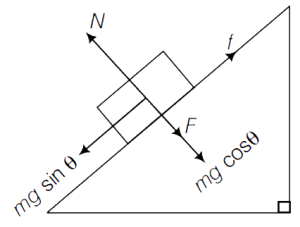
$A$ wooden box lying at rest on an inclined surface of a wet wood is held at static equilibrium by a constant force $F$ applied perpendicular to the incline. If the mass of the box is $1 \ kg$,the angle of inclination is $30^{\circ}$ and the coefficient of static friction between the box and the inclined plane is $0.2$,the minimum magnitude of $F$ is (Use $g=10 \ m/s^2$)
A
$0 \ N$,as $30^{\circ}$ is less than angle of repose
B
$\geq 1 \ N$
C
$\geq 3.3 \ N$
D
$\geq 16.3 \ N$
Solution
(D) To keep the box in static equilibrium,the downward force along the incline $(mg \sin \theta)$ must be balanced by the maximum static friction force $(f_{max})$.
The normal force $N$ acting on the box is the sum of the component of weight perpendicular to the incline and the applied force $F$:
$N = mg \cos \theta + F$
The maximum static friction force is given by:
$f_{max} = \mu N = \mu(mg \cos \theta + F)$
For equilibrium,$mg \sin \theta \leq f_{max}$,so the minimum force $F$ required is when $mg \sin \theta = \mu(mg \cos \theta + F)$.
Rearranging for $F$:
$F = \frac{mg \sin \theta}{\mu} - mg \cos \theta = mg \left( \frac{\sin \theta}{\mu} - \cos \theta \right)$
Given $m = 1 \ kg$,$g = 10 \ m/s^2$,$\theta = 30^{\circ}$,and $\mu = 0.2$:
$F = 1 \times 10 \left( \frac{\sin 30^{\circ}}{0.2} - \cos 30^{\circ} \right)$
$F = 10 \left( \frac{0.5}{0.2} - \frac{\sqrt{3}}{2} \right) = 10 \left( 2.5 - 0.866 \right)$
$F = 10 \times 1.634 = 16.34 \ N$
Thus,the minimum magnitude of $F$ is $\geq 16.3 \ N$.
The normal force $N$ acting on the box is the sum of the component of weight perpendicular to the incline and the applied force $F$:
$N = mg \cos \theta + F$
The maximum static friction force is given by:
$f_{max} = \mu N = \mu(mg \cos \theta + F)$
For equilibrium,$mg \sin \theta \leq f_{max}$,so the minimum force $F$ required is when $mg \sin \theta = \mu(mg \cos \theta + F)$.
Rearranging for $F$:
$F = \frac{mg \sin \theta}{\mu} - mg \cos \theta = mg \left( \frac{\sin \theta}{\mu} - \cos \theta \right)$
Given $m = 1 \ kg$,$g = 10 \ m/s^2$,$\theta = 30^{\circ}$,and $\mu = 0.2$:
$F = 1 \times 10 \left( \frac{\sin 30^{\circ}}{0.2} - \cos 30^{\circ} \right)$
$F = 10 \left( \frac{0.5}{0.2} - \frac{\sqrt{3}}{2} \right) = 10 \left( 2.5 - 0.866 \right)$
$F = 10 \times 1.634 = 16.34 \ N$
Thus,the minimum magnitude of $F$ is $\geq 16.3 \ N$.
0 likes
View Solution225
DifficultMCQ
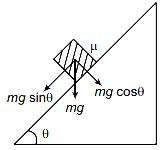
The force required to move a body up a rough inclined plane is double the force required to prevent the body from sliding down the plane. The coefficient of friction,when the angle of inclination of the plane is $60^{\circ}$ is
A
$\frac{1}{3}$
B
$\frac{1}{\sqrt{2}}$
C
$\frac{1}{\sqrt{3}}$
D
$\frac{1}{2}$
Solution
(C) For upward motion,the force required is $F_{\text{up}} = mg(\sin \theta + \mu \cos \theta)$.
For downward motion,the force required to prevent sliding is $F_{\text{down}} = mg(\sin \theta - \mu \cos \theta)$.
According to the problem,$F_{\text{up}} = 2 F_{\text{down}}$.
Substituting the expressions,we get $mg(\sin \theta + \mu \cos \theta) = 2mg(\sin \theta - \mu \cos \theta)$.
Dividing both sides by $mg$,we have $\sin \theta + \mu \cos \theta = 2 \sin \theta - 2 \mu \cos \theta$.
Rearranging the terms,$3 \mu \cos \theta = \sin \theta$,which simplifies to $\mu = \frac{1}{3} \tan \theta$.
Given $\theta = 60^{\circ}$,we have $\mu = \frac{1}{3} \tan 60^{\circ} = \frac{1}{3} \times \sqrt{3} = \frac{1}{\sqrt{3}}$.
For downward motion,the force required to prevent sliding is $F_{\text{down}} = mg(\sin \theta - \mu \cos \theta)$.
According to the problem,$F_{\text{up}} = 2 F_{\text{down}}$.
Substituting the expressions,we get $mg(\sin \theta + \mu \cos \theta) = 2mg(\sin \theta - \mu \cos \theta)$.
Dividing both sides by $mg$,we have $\sin \theta + \mu \cos \theta = 2 \sin \theta - 2 \mu \cos \theta$.
Rearranging the terms,$3 \mu \cos \theta = \sin \theta$,which simplifies to $\mu = \frac{1}{3} \tan \theta$.
Given $\theta = 60^{\circ}$,we have $\mu = \frac{1}{3} \tan 60^{\circ} = \frac{1}{3} \times \sqrt{3} = \frac{1}{\sqrt{3}}$.
0 likes
View Solution226
DifficultMCQ
An object takes $n$ times as much time to slide down a $45^{\circ}$ rough inclined plane as it takes to slide down a perfectly smooth inclined plane of the same inclination. The coefficient of kinetic friction between the object and the rough incline is given by:
A
$\left(1-\frac{1}{n^2}\right)$
B
$\left(\frac{1}{1-n^2}\right)$
C
$\sqrt{1-\frac{1}{n^2}}$
D
$\sqrt{1+\frac{1}{n^2}}$
Solution
(A) For a smooth inclined plane,the acceleration is $a_s = g \sin \theta$. The time taken to cover distance $s$ is $t_s = \sqrt{\frac{2s}{g \sin \theta}}$.
For a rough inclined plane,the acceleration is $a_r = g(\sin \theta - \mu \cos \theta)$. The time taken is $t_r = \sqrt{\frac{2s}{g(\sin \theta - \mu \cos \theta)}} = n t_s$.
Squaring both sides: $\frac{2s}{g(\sin \theta - \mu \cos \theta)} = n^2 \frac{2s}{g \sin \theta}$.
This simplifies to $\sin \theta = n^2(\sin \theta - \mu \cos \theta)$,which gives $\mu \cos \theta = \sin \theta (1 - \frac{1}{n^2})$.
Thus,$\mu = \tan \theta (1 - \frac{1}{n^2})$.
Given $\theta = 45^{\circ}$,$\tan 45^{\circ} = 1$,so $\mu = 1 - \frac{1}{n^2}$.
For a rough inclined plane,the acceleration is $a_r = g(\sin \theta - \mu \cos \theta)$. The time taken is $t_r = \sqrt{\frac{2s}{g(\sin \theta - \mu \cos \theta)}} = n t_s$.
Squaring both sides: $\frac{2s}{g(\sin \theta - \mu \cos \theta)} = n^2 \frac{2s}{g \sin \theta}$.
This simplifies to $\sin \theta = n^2(\sin \theta - \mu \cos \theta)$,which gives $\mu \cos \theta = \sin \theta (1 - \frac{1}{n^2})$.
Thus,$\mu = \tan \theta (1 - \frac{1}{n^2})$.
Given $\theta = 45^{\circ}$,$\tan 45^{\circ} = 1$,so $\mu = 1 - \frac{1}{n^2}$.
0 likes
View Solution227
DifficultMCQ
The minimum force required to move a body up an inclined plane is three times the minimum force required to prevent it from sliding down the plane. If the coefficient of friction between the body and the inclined plane is $\frac{1}{2 \sqrt{3}}$,then the angle of the inclined plane is (in $^{\circ}$)
A
$60$
B
$45$
C
$30$
D
$15$
Solution
(C) The minimum force required to move a body up a rough inclined plane is given by $F_1 = mg(\sin \theta + \mu \cos \theta)$.
The minimum force required to prevent the body from sliding down the rough inclined plane is given by $F_2 = mg(\sin \theta - \mu \cos \theta)$.
According to the problem,$F_1 = 3F_2$.
Substituting the expressions,we get $mg(\sin \theta + \mu \cos \theta) = 3mg(\sin \theta - \mu \cos \theta)$.
Dividing both sides by $mg$,we have $\sin \theta + \mu \cos \theta = 3\sin \theta - 3\mu \cos \theta$.
Rearranging the terms,$4\mu \cos \theta = 2\sin \theta$,which simplifies to $\tan \theta = 2\mu$.
Given $\mu = \frac{1}{2\sqrt{3}}$,we have $\tan \theta = 2 \times \frac{1}{2\sqrt{3}} = \frac{1}{\sqrt{3}}$.
Therefore,$\theta = \tan^{-1}(\frac{1}{\sqrt{3}}) = 30^{\circ}$.
The minimum force required to prevent the body from sliding down the rough inclined plane is given by $F_2 = mg(\sin \theta - \mu \cos \theta)$.
According to the problem,$F_1 = 3F_2$.
Substituting the expressions,we get $mg(\sin \theta + \mu \cos \theta) = 3mg(\sin \theta - \mu \cos \theta)$.
Dividing both sides by $mg$,we have $\sin \theta + \mu \cos \theta = 3\sin \theta - 3\mu \cos \theta$.
Rearranging the terms,$4\mu \cos \theta = 2\sin \theta$,which simplifies to $\tan \theta = 2\mu$.
Given $\mu = \frac{1}{2\sqrt{3}}$,we have $\tan \theta = 2 \times \frac{1}{2\sqrt{3}} = \frac{1}{\sqrt{3}}$.
Therefore,$\theta = \tan^{-1}(\frac{1}{\sqrt{3}}) = 30^{\circ}$.
0 likes
View Solution228
DifficultMCQ
$A$ body is sliding down a rough inclined plane. The coefficient of friction between the body and the plane is $0.5$. The ratio of the net force required for the body to slide down and the normal reaction on the body is $1:2$. Then the angle of the inclined plane is (in $^{\circ}$)
A
$15$
B
$30$
C
$45$
D
$60$
Solution
(C) Given: Coefficient of friction $\mu = 0.5$. The ratio of net force $F$ to normal reaction $R$ is $\frac{F}{R} = \frac{1}{2}$.
The net force $F$ acting on the body sliding down the plane is given by $F = mg \sin \theta - f$,where $f$ is the frictional force.
The frictional force is $f = \mu R$,and the normal reaction is $R = mg \cos \theta$.
Substituting these into the expression for $F$: $F = mg \sin \theta - \mu mg \cos \theta$.
Now,using the given ratio $\frac{F}{R} = \frac{1}{2}$:
$\frac{mg \sin \theta - \mu mg \cos \theta}{mg \cos \theta} = \frac{1}{2}$
Dividing the numerator by the denominator:
$\tan \theta - \mu = \frac{1}{2}$
$\tan \theta = \frac{1}{2} + \mu = 0.5 + 0.5 = 1.0$.
Since $\tan \theta = 1$,we have $\theta = 45^{\circ}$.
The net force $F$ acting on the body sliding down the plane is given by $F = mg \sin \theta - f$,where $f$ is the frictional force.
The frictional force is $f = \mu R$,and the normal reaction is $R = mg \cos \theta$.
Substituting these into the expression for $F$: $F = mg \sin \theta - \mu mg \cos \theta$.
Now,using the given ratio $\frac{F}{R} = \frac{1}{2}$:
$\frac{mg \sin \theta - \mu mg \cos \theta}{mg \cos \theta} = \frac{1}{2}$
Dividing the numerator by the denominator:
$\tan \theta - \mu = \frac{1}{2}$
$\tan \theta = \frac{1}{2} + \mu = 0.5 + 0.5 = 1.0$.
Since $\tan \theta = 1$,we have $\theta = 45^{\circ}$.
0 likes
View Solution229
DifficultMCQ
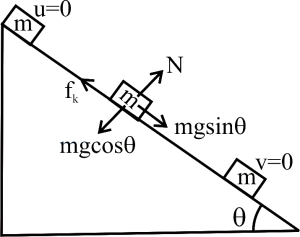
Consider a small block sliding down an inclined plane of inclination $30^{\circ}$ with the horizontal. The coefficient of friction is $\mu = \frac{2}{3} x$,where $x$ is the distance (in meters) through which the mass slides down. The distance covered by the mass before it stops is
A
$\frac{\sqrt{3}}{2} \text{ m}$
B
$\sqrt{3} \text{ m}$
C
$\frac{2}{\sqrt{3}} \text{ m}$
D
$2 \sqrt{3} \text{ m}$
Solution
(B) The normal force on the block is $N = mg \cos \theta$.
Since the coefficient of friction is $\mu = \frac{2}{3} x$,the kinetic friction force is $f_k = \mu N = \left( \frac{2}{3} x \right) mg \cos \theta$.
According to the work-energy theorem,the total work done on the block is equal to the change in its kinetic energy: $W_g + W_f = \Delta K.E. = 0 - 0 = 0$.
The work done by gravity as the block slides down a distance $x$ is $W_g = mgx \sin \theta$.
The work done by the variable friction force is $W_f = - \int_0^x f_k \, dx = - \int_0^x \left( \frac{2}{3} x mg \cos \theta \right) dx = - \frac{2}{3} mg \cos \theta \left[ \frac{x^2}{2} \right]_0^x = - \frac{1}{3} mgx^2 \cos \theta$.
Substituting these into the work-energy equation: $mgx \sin \theta - \frac{1}{3} mgx^2 \cos \theta = 0$.
Dividing by $mgx$ (assuming $x \neq 0$): $\sin \theta - \frac{1}{3} x \cos \theta = 0$.
Solving for $x$: $x = 3 \tan \theta$.
Given $\theta = 30^{\circ}$,$x = 3 \tan 30^{\circ} = 3 \times \frac{1}{\sqrt{3}} = \sqrt{3} \text{ m}$.
Since the coefficient of friction is $\mu = \frac{2}{3} x$,the kinetic friction force is $f_k = \mu N = \left( \frac{2}{3} x \right) mg \cos \theta$.
According to the work-energy theorem,the total work done on the block is equal to the change in its kinetic energy: $W_g + W_f = \Delta K.E. = 0 - 0 = 0$.
The work done by gravity as the block slides down a distance $x$ is $W_g = mgx \sin \theta$.
The work done by the variable friction force is $W_f = - \int_0^x f_k \, dx = - \int_0^x \left( \frac{2}{3} x mg \cos \theta \right) dx = - \frac{2}{3} mg \cos \theta \left[ \frac{x^2}{2} \right]_0^x = - \frac{1}{3} mgx^2 \cos \theta$.
Substituting these into the work-energy equation: $mgx \sin \theta - \frac{1}{3} mgx^2 \cos \theta = 0$.
Dividing by $mgx$ (assuming $x \neq 0$): $\sin \theta - \frac{1}{3} x \cos \theta = 0$.
Solving for $x$: $x = 3 \tan \theta$.
Given $\theta = 30^{\circ}$,$x = 3 \tan 30^{\circ} = 3 \times \frac{1}{\sqrt{3}} = \sqrt{3} \text{ m}$.
0 likes
View Solution230
DifficultMCQ
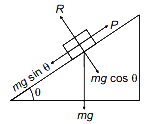
$A$ body is moving up an inclined plane of angle $\theta$ with an initial kinetic energy $E$. The coefficient of friction between the plane and the body is $\mu$. The work done against friction before the body comes to rest is
A
$\frac{\mu \cos \theta}{E \cos \theta+\sin \theta}$
B
$E$
C
$\frac{\mu E \cos \theta}{\mu \cos \theta-\sin \theta}$
D
$\frac{\mu E \cos \theta}{\mu \cos \theta+\sin \theta}$
Solution
(D) The total retarding force acting on the body moving up the inclined plane is $F_{net} = mg \sin \theta + f_k$,where $f_k = \mu R = \mu mg \cos \theta$.
Thus,$F_{net} = mg(\sin \theta + \mu \cos \theta)$.
The retardation $a$ is given by $a = \frac{F_{net}}{m} = g(\sin \theta + \mu \cos \theta)$.
Using the work-energy theorem,the total work done by all forces equals the change in kinetic energy: $W_{total} = \Delta KE = 0 - E = -E$.
The work done by gravity is $W_g = -mg \sin \theta \cdot s$ and the work done against friction is $W_f = f_k \cdot s = \mu mg \cos \theta \cdot s$.
From $v^2 - u^2 = 2as$,we have $0 - u^2 = -2as$,so $s = \frac{u^2}{2a} = \frac{2E/m}{2g(\sin \theta + \mu \cos \theta)} = \frac{E}{mg(\sin \theta + \mu \cos \theta)}$.
The work done against friction is $W_f = (\mu mg \cos \theta) \cdot s = (\mu mg \cos \theta) \cdot \frac{E}{mg(\sin \theta + \mu \cos \theta)} = \frac{\mu E \cos \theta}{\sin \theta + \mu \cos \theta}$.
Thus,$F_{net} = mg(\sin \theta + \mu \cos \theta)$.
The retardation $a$ is given by $a = \frac{F_{net}}{m} = g(\sin \theta + \mu \cos \theta)$.
Using the work-energy theorem,the total work done by all forces equals the change in kinetic energy: $W_{total} = \Delta KE = 0 - E = -E$.
The work done by gravity is $W_g = -mg \sin \theta \cdot s$ and the work done against friction is $W_f = f_k \cdot s = \mu mg \cos \theta \cdot s$.
From $v^2 - u^2 = 2as$,we have $0 - u^2 = -2as$,so $s = \frac{u^2}{2a} = \frac{2E/m}{2g(\sin \theta + \mu \cos \theta)} = \frac{E}{mg(\sin \theta + \mu \cos \theta)}$.
The work done against friction is $W_f = (\mu mg \cos \theta) \cdot s = (\mu mg \cos \theta) \cdot \frac{E}{mg(\sin \theta + \mu \cos \theta)} = \frac{\mu E \cos \theta}{\sin \theta + \mu \cos \theta}$.
0 likes
View Solution231
MediumMCQ
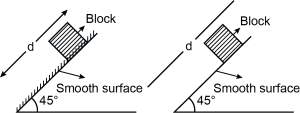
To determine the coefficient of friction between a rough surface and a block,the surface is kept inclined at $45^{\circ}$ and the block is released from rest. The block takes a time $t$ in moving a distance $d$. The rough surface is then replaced by a smooth surface and the same experiment is repeated. The block now takes a time $t/2$ in moving down the same distance $d$. The coefficient of friction is
A
$3/4$
B
$5/4$
C
$1/2$
D
$1/\sqrt{2}$
Solution
(A) For a smooth inclined plane,the acceleration is $a_s = g \sin \theta$. The time taken to cover distance $d$ is $t_s = \sqrt{2d / a_s} = \sqrt{2d / (g \sin \theta)}$.
For a rough inclined plane,the acceleration is $a_r = g(\sin \theta - \mu \cos \theta)$. The time taken to cover distance $d$ is $t_r = \sqrt{2d / a_r} = \sqrt{2d / (g(\sin \theta - \mu \cos \theta))}$.
Given $t_r = t$ and $t_s = t/2$,we have $t_r = 2t_s$.
Therefore,$\sqrt{2d / (g(\sin \theta - \mu \cos \theta))} = 2 \sqrt{2d / (g \sin \theta)}$.
Squaring both sides: $1 / (\sin \theta - \mu \cos \theta) = 4 / \sin \theta$.
$\sin \theta = 4 \sin \theta - 4 \mu \cos \theta$.
$4 \mu \cos \theta = 3 \sin \theta$.
$\mu = (3/4) \tan \theta$.
Substituting $\theta = 45^{\circ}$,$\mu = (3/4) \tan 45^{\circ} = 3/4 \times 1 = 3/4$.
For a rough inclined plane,the acceleration is $a_r = g(\sin \theta - \mu \cos \theta)$. The time taken to cover distance $d$ is $t_r = \sqrt{2d / a_r} = \sqrt{2d / (g(\sin \theta - \mu \cos \theta))}$.
Given $t_r = t$ and $t_s = t/2$,we have $t_r = 2t_s$.
Therefore,$\sqrt{2d / (g(\sin \theta - \mu \cos \theta))} = 2 \sqrt{2d / (g \sin \theta)}$.
Squaring both sides: $1 / (\sin \theta - \mu \cos \theta) = 4 / \sin \theta$.
$\sin \theta = 4 \sin \theta - 4 \mu \cos \theta$.
$4 \mu \cos \theta = 3 \sin \theta$.
$\mu = (3/4) \tan \theta$.
Substituting $\theta = 45^{\circ}$,$\mu = (3/4) \tan 45^{\circ} = 3/4 \times 1 = 3/4$.
0 likes
View Solution232
DifficultMCQ
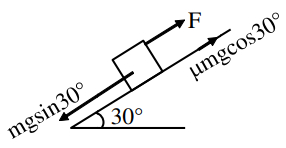
$A$ block of mass $5 \ kg$ is moving on an inclined plane which makes an angle of $30^{\circ}$ with the horizontal. The coefficient of friction between the block and the inclined plane surface is $\frac{\sqrt{3}}{2}$. The force to be applied on the block so that the block will move down without acceleration is . . . . . . $N$.
A
$25$
B
$12.5$
C
$7.5$
D
$15$
Solution
(B) For the block to move down without acceleration,the net force along the inclined plane must be zero.
Let $F$ be the applied force directed up the incline.
The forces acting down the incline are the component of gravity $mg \sin 30^{\circ}$.
The forces acting up the incline are the applied force $F$ and the kinetic friction $f_k = \mu N = \mu mg \cos 30^{\circ}$.
Equating the forces: $mg \sin 30^{\circ} = F + \mu mg \cos 30^{\circ}$.
Substituting the values: $5 \times 10 \times \frac{1}{2} = F + \frac{\sqrt{3}}{2} \times 5 \times 10 \times \frac{\sqrt{3}}{2}$.
$25 = F + \frac{\sqrt{3}}{2} \times 50 \times \frac{\sqrt{3}}{2} = F + \frac{3}{4} \times 50 = F + 37.5$.
$F = 25 - 37.5 = -12.5 \ N$.
The negative sign indicates that the force $F$ must be applied in the opposite direction (i.e.,down the incline) to maintain constant velocity.
Therefore,a force of $12.5 \ N$ must be applied down the incline.
Let $F$ be the applied force directed up the incline.
The forces acting down the incline are the component of gravity $mg \sin 30^{\circ}$.
The forces acting up the incline are the applied force $F$ and the kinetic friction $f_k = \mu N = \mu mg \cos 30^{\circ}$.
Equating the forces: $mg \sin 30^{\circ} = F + \mu mg \cos 30^{\circ}$.
Substituting the values: $5 \times 10 \times \frac{1}{2} = F + \frac{\sqrt{3}}{2} \times 5 \times 10 \times \frac{\sqrt{3}}{2}$.
$25 = F + \frac{\sqrt{3}}{2} \times 50 \times \frac{\sqrt{3}}{2} = F + \frac{3}{4} \times 50 = F + 37.5$.
$F = 25 - 37.5 = -12.5 \ N$.
The negative sign indicates that the force $F$ must be applied in the opposite direction (i.e.,down the incline) to maintain constant velocity.
Therefore,a force of $12.5 \ N$ must be applied down the incline.
0 likes
View Solution233
DifficultMCQ
The time taken by a block of mass $m$ to slide down from the highest point to the lowest point on a rough inclined plane is $50\%$ more compared to the time taken by the same block on an identical inclined smooth plane. Both inclined planes are at $45^\circ$ with the horizontal. The coefficient of kinetic friction between the rough inclined surface and the block is . . . . . . .
A
$3$/$4$
B
$2$/$3$
C
$5$/$9$
D
$4$/$9$
Solution
(C) Let $L$ be the length of the incline.
For a smooth plane,the acceleration is $a_1 = g \sin\theta$. The time taken is $t_1 = \sqrt{2L/a_1}$.
For a rough plane,the acceleration is $a_2 = g(\sin\theta - \mu \cos\theta)$. The time taken is $t_2 = \sqrt{2L/a_2}$.
Given that $t_2 = 1.5 t_1$,we have $t_2^2 = 2.25 t_1^2$.
Substituting the expressions for $t_1$ and $t_2$,we get $\frac{2L}{a_2} = 2.25 \frac{2L}{a_1}$,which simplifies to $a_1 = 2.25 a_2$.
Substituting $a_1$ and $a_2$,we get $g \sin\theta = 2.25 g(\sin\theta - \mu \cos\theta)$.
Since $\theta = 45^\circ$,$\sin\theta = \cos\theta = 1/\sqrt{2}$.
Dividing by $g \sin\theta$,we get $1 = 2.25(1 - \mu)$.
Thus,$1 - \mu = 1/2.25 = 4/9$.
Therefore,$\mu = 1 - 4/9 = 5/9$.
For a smooth plane,the acceleration is $a_1 = g \sin\theta$. The time taken is $t_1 = \sqrt{2L/a_1}$.
For a rough plane,the acceleration is $a_2 = g(\sin\theta - \mu \cos\theta)$. The time taken is $t_2 = \sqrt{2L/a_2}$.
Given that $t_2 = 1.5 t_1$,we have $t_2^2 = 2.25 t_1^2$.
Substituting the expressions for $t_1$ and $t_2$,we get $\frac{2L}{a_2} = 2.25 \frac{2L}{a_1}$,which simplifies to $a_1 = 2.25 a_2$.
Substituting $a_1$ and $a_2$,we get $g \sin\theta = 2.25 g(\sin\theta - \mu \cos\theta)$.
Since $\theta = 45^\circ$,$\sin\theta = \cos\theta = 1/\sqrt{2}$.
Dividing by $g \sin\theta$,we get $1 = 2.25(1 - \mu)$.
Thus,$1 - \mu = 1/2.25 = 4/9$.
Therefore,$\mu = 1 - 4/9 = 5/9$.
0 likes
View Solution234
DifficultMCQ
$A$ block takes time $t$ to slide down a plane inclined at $45^\circ$ to the horizontal. If the surface is made smooth (frictionless),the block takes time $t/2$ to slide down the plane. The coefficient of friction between the block and the inclined plane is $\frac{\alpha}{100}$. The value of $\alpha$ is . . . . . . .
A
$75$
B
$80$
C
$85$
D
$90$
Solution
(A) Let the length of the inclined plane be $L$. The acceleration of the block on a rough surface is $a_1 = g(\sin \theta - \mu \cos \theta)$ and on a smooth surface is $a_2 = g \sin \theta$.
Using the equation of motion $s = ut + \frac{1}{2}at^2$,with initial velocity $u = 0$,we have $L = \frac{1}{2} a_1 t^2$ and $L = \frac{1}{2} a_2 (t/2)^2$.
Equating the two expressions for $L$: $\frac{1}{2} a_1 t^2 = \frac{1}{2} a_2 \frac{t^2}{4}$,which simplifies to $a_1 = \frac{a_2}{4}$ or $4a_1 = a_2$.
Substituting the expressions for $a_1$ and $a_2$ with $\theta = 45^\circ$ (where $\sin 45^\circ = \cos 45^\circ = \frac{1}{\sqrt{2}}$):
$4g(\frac{1}{\sqrt{2}} - \mu \frac{1}{\sqrt{2}}) = g(\frac{1}{\sqrt{2}})$.
Dividing both sides by $\frac{g}{\sqrt{2}}$,we get $4(1 - \mu) = 1$.
$4 - 4\mu = 1 \implies 4\mu = 3 \implies \mu = 0.75$.
Since $\mu = \frac{\alpha}{100}$,we have $\frac{\alpha}{100} = 0.75$,which gives $\alpha = 75$.
Using the equation of motion $s = ut + \frac{1}{2}at^2$,with initial velocity $u = 0$,we have $L = \frac{1}{2} a_1 t^2$ and $L = \frac{1}{2} a_2 (t/2)^2$.
Equating the two expressions for $L$: $\frac{1}{2} a_1 t^2 = \frac{1}{2} a_2 \frac{t^2}{4}$,which simplifies to $a_1 = \frac{a_2}{4}$ or $4a_1 = a_2$.
Substituting the expressions for $a_1$ and $a_2$ with $\theta = 45^\circ$ (where $\sin 45^\circ = \cos 45^\circ = \frac{1}{\sqrt{2}}$):
$4g(\frac{1}{\sqrt{2}} - \mu \frac{1}{\sqrt{2}}) = g(\frac{1}{\sqrt{2}})$.
Dividing both sides by $\frac{g}{\sqrt{2}}$,we get $4(1 - \mu) = 1$.
$4 - 4\mu = 1 \implies 4\mu = 3 \implies \mu = 0.75$.
Since $\mu = \frac{\alpha}{100}$,we have $\frac{\alpha}{100} = 0.75$,which gives $\alpha = 75$.
0 likes
View SolutionNewton's Laws of Motion and Friction — Motion (or rest) on Rough Inclined Surface · Frequently Asked Questions
1Are these Newton's Laws of Motion and Friction questions useful for JEE and NEET?
Yes. All questions in this section are mapped to JEE Main and NEET exam patterns. Previous year questions from JEE Main, NEET, GUJCET and state-level exams are included with full solutions.
2Can I switch to Hindi or Gujarati for these questions?
Yes. Use the language tabs in the hero section or the sidebar to view the same questions and solutions in English, Hindi or Gujarati.
3How do I generate a question paper from this subtopic?
Use the Vedclass Exam Paper Generator — select the chapter and subtopic, set difficulty, and generate Sets A, B, C, D automatically. First 3 chapters of every subject are free.
Vedclass Products
For Students
Vedclass Test Series
Mock tests in real JEE/NEET style with performance analysis. 5-day free trial.
Start Free TrialFor Teachers
Exam Paper Generator
Generate Set A/B/C/D papers from this chapter in 2 minutes. 3 chapters free.
Try FreeFor Institutes
Online Exam Module
Live online exams with unlimited students, 360° analytics & white-label branding.
See DemoFor Teachers & Institutes
Generate a Newton's Laws of Motion and Friction Exam Paper in 2 Minutes
Select subtopic & difficulty — Sets A, B, C, D auto-generated with No Repeat logic.
First 3 chapters of every subject are free — no payment required.