
A English
Acceleration Due to Gravity and its Variation Questions in English
Class 11 Physics · Gravitation · Acceleration Due to Gravity and its Variation
430+
Questions
English
Language
100%
With Solutions
Showing 50 of 430 questions in English
51
MediumMCQ
If the mass of Earth is $80$ times that of a planet and its diameter is double that of the planet,and $g$ on Earth is $9.8 \ m/s^2$,then the value of $g$ on that planet is ........ $m/s^2$.
A
$4.9$
B
$0.98$
C
$0.49$
D
$49$
Solution
(C) The acceleration due to gravity is given by $g = \frac{GM}{R^2}$.
Let $M_e$ and $R_e$ be the mass and radius of Earth,and $M_p$ and $R_p$ be the mass and radius of the planet.
Given: $M_e = 80 M_p$ and $D_e = 2 D_p$,which implies $R_e = 2 R_p$.
The ratio of gravity on the planet $(g_p)$ to Earth $(g_e)$ is:
$\frac{g_p}{g_e} = \frac{M_p}{M_e} \times \left( \frac{R_e}{R_p} \right)^2$
Substituting the given values:
$\frac{g_p}{9.8} = \left( \frac{1}{80} \right) \times (2)^2 = \frac{4}{80} = \frac{1}{20}$
$g_p = \frac{9.8}{20} = 0.49 \ m/s^2$.
Let $M_e$ and $R_e$ be the mass and radius of Earth,and $M_p$ and $R_p$ be the mass and radius of the planet.
Given: $M_e = 80 M_p$ and $D_e = 2 D_p$,which implies $R_e = 2 R_p$.
The ratio of gravity on the planet $(g_p)$ to Earth $(g_e)$ is:
$\frac{g_p}{g_e} = \frac{M_p}{M_e} \times \left( \frac{R_e}{R_p} \right)^2$
Substituting the given values:
$\frac{g_p}{9.8} = \left( \frac{1}{80} \right) \times (2)^2 = \frac{4}{80} = \frac{1}{20}$
$g_p = \frac{9.8}{20} = 0.49 \ m/s^2$.
0 likes
View Solution52
MediumMCQ
The angular speed of the Earth,such that an object on the equator may appear weightless,is ($g = 10\,m/s^2$,radius of the Earth $R = 6400\,km$).
A
$1.25 \times 10^{-3}\,rad/s$
B
$1.56 \times 10^{-3}\,rad/s$
C
$1.25 \times 10^{-1}\,rad/s$
D
$1.56\,rad/s$
Solution
(A) For an object on the equator to appear weightless,the effective acceleration due to gravity must be zero.
The effective gravity $g'$ at the equator is given by $g' = g - R\omega^2$.
For weightlessness,$g' = 0$,which implies $g = R\omega^2$.
Therefore,the angular speed $\omega$ is given by $\omega = \sqrt{\frac{g}{R}}$.
Given $g = 10\,m/s^2$ and $R = 6400\,km = 6.4 \times 10^6\,m$.
$\omega = \sqrt{\frac{10}{6.4 \times 10^6}} = \sqrt{\frac{1}{0.64 \times 10^6}} = \sqrt{\frac{1}{64 \times 10^4}} = \frac{1}{8 \times 10^2} = \frac{1}{800} = 0.00125\,rad/s$.
Thus,$\omega = 1.25 \times 10^{-3}\,rad/s$.
The effective gravity $g'$ at the equator is given by $g' = g - R\omega^2$.
For weightlessness,$g' = 0$,which implies $g = R\omega^2$.
Therefore,the angular speed $\omega$ is given by $\omega = \sqrt{\frac{g}{R}}$.
Given $g = 10\,m/s^2$ and $R = 6400\,km = 6.4 \times 10^6\,m$.
$\omega = \sqrt{\frac{10}{6.4 \times 10^6}} = \sqrt{\frac{1}{0.64 \times 10^6}} = \sqrt{\frac{1}{64 \times 10^4}} = \frac{1}{8 \times 10^2} = \frac{1}{800} = 0.00125\,rad/s$.
Thus,$\omega = 1.25 \times 10^{-3}\,rad/s$.
0 likes
View Solution53
MediumMCQ
At what distance from the centre of the earth,the value of acceleration due to gravity $g$ will be half that on the surface? ($R =$ radius of earth)
A
$2\, R$
B
$R$
C
$0.414\, R$
D
$1.414\, R$
Solution
(D) The acceleration due to gravity at a height $h$ above the surface of the earth is given by $g' = g \left( \frac{R}{R+h} \right)^2$.
We are given that $g' = \frac{g}{2}$.
Substituting this into the formula: $\frac{g}{2} = g \left( \frac{R}{R+h} \right)^2$.
Taking the square root on both sides: $\frac{1}{\sqrt{2}} = \frac{R}{R+h}$.
Rearranging the terms: $R+h = \sqrt{2} R$.
Since $1.414 \approx \sqrt{2}$,we have $R+h = 1.414 R$.
Here,$R+h$ represents the distance from the centre of the earth. Thus,the required distance is $1.414 R$.
We are given that $g' = \frac{g}{2}$.
Substituting this into the formula: $\frac{g}{2} = g \left( \frac{R}{R+h} \right)^2$.
Taking the square root on both sides: $\frac{1}{\sqrt{2}} = \frac{R}{R+h}$.
Rearranging the terms: $R+h = \sqrt{2} R$.
Since $1.414 \approx \sqrt{2}$,we have $R+h = 1.414 R$.
Here,$R+h$ represents the distance from the centre of the earth. Thus,the required distance is $1.414 R$.
0 likes
View Solution54
EasyMCQ
If the density of the Earth increases $4$ times and its radius becomes half of its present value,our weight will
A
Be four times its present value
B
Be doubled
C
Remain same
D
Be halved
Solution
(B) The acceleration due to gravity $g$ on the surface of the Earth is given by $g = \frac{GM}{R^2}$.
Since mass $M = \text{density} (\rho) \times \text{volume} (V) = \rho \times \frac{4}{3} \pi R^3$,we can substitute this into the formula for $g$:
$g = \frac{G (\rho \cdot \frac{4}{3} \pi R^3)}{R^2} = \frac{4}{3} \pi G \rho R$.
This shows that $g \propto \rho R$.
Let the initial density be $\rho_1$ and radius be $R_1$. Then $g_1 \propto \rho_1 R_1$.
Let the new density be $\rho_2 = 4\rho_1$ and the new radius be $R_2 = \frac{R_1}{2}$.
The new acceleration due to gravity $g_2$ is proportional to $\rho_2 R_2 = (4\rho_1) \times (\frac{R_1}{2}) = 2 \rho_1 R_1$.
Therefore,$g_2 = 2 g_1$.
Since weight $W = mg$,if $g$ doubles,the weight also doubles.
Since mass $M = \text{density} (\rho) \times \text{volume} (V) = \rho \times \frac{4}{3} \pi R^3$,we can substitute this into the formula for $g$:
$g = \frac{G (\rho \cdot \frac{4}{3} \pi R^3)}{R^2} = \frac{4}{3} \pi G \rho R$.
This shows that $g \propto \rho R$.
Let the initial density be $\rho_1$ and radius be $R_1$. Then $g_1 \propto \rho_1 R_1$.
Let the new density be $\rho_2 = 4\rho_1$ and the new radius be $R_2 = \frac{R_1}{2}$.
The new acceleration due to gravity $g_2$ is proportional to $\rho_2 R_2 = (4\rho_1) \times (\frac{R_1}{2}) = 2 \rho_1 R_1$.
Therefore,$g_2 = 2 g_1$.
Since weight $W = mg$,if $g$ doubles,the weight also doubles.
0 likes
View Solution55
DifficultMCQ
$A$ man can jump to a height of $1.5 \, m$ on a planet $A$. What is the height he may be able to jump on another planet whose density and radius are,respectively,one-quarter and one-third that of planet $A$?
A
$1.5$
B
$15$
C
$18$
D
$28$
Solution
(C) The height $H$ reached by a man jumping with initial velocity $u$ is given by $H = \frac{u^2}{2g}$.
Since the initial velocity $u$ is constant,$H \propto \frac{1}{g}$,which implies $\frac{H_B}{H_A} = \frac{g_A}{g_B}$.
The acceleration due to gravity is given by $g = \frac{4}{3} \pi G \rho R$,so $g \propto \rho R$.
Given $\rho_B = \frac{1}{4} \rho_A$ and $R_B = \frac{1}{3} R_A$,we have $\frac{g_B}{g_A} = \frac{\rho_B R_B}{\rho_A R_A} = \left(\frac{1}{4}\right) \times \left(\frac{1}{3}\right) = \frac{1}{12}$.
Therefore,$\frac{H_B}{H_A} = \frac{g_A}{g_B} = 12$.
Thus,$H_B = 12 \times H_A = 12 \times 1.5 \, m = 18 \, m$.
Since the initial velocity $u$ is constant,$H \propto \frac{1}{g}$,which implies $\frac{H_B}{H_A} = \frac{g_A}{g_B}$.
The acceleration due to gravity is given by $g = \frac{4}{3} \pi G \rho R$,so $g \propto \rho R$.
Given $\rho_B = \frac{1}{4} \rho_A$ and $R_B = \frac{1}{3} R_A$,we have $\frac{g_B}{g_A} = \frac{\rho_B R_B}{\rho_A R_A} = \left(\frac{1}{4}\right) \times \left(\frac{1}{3}\right) = \frac{1}{12}$.
Therefore,$\frac{H_B}{H_A} = \frac{g_A}{g_B} = 12$.
Thus,$H_B = 12 \times H_A = 12 \times 1.5 \, m = 18 \, m$.
0 likes
View Solution56
EasyMCQ
Weight of a body is maximum at
A
Moon
B
Poles of earth
C
Equator of earth
D
Centre of earth
Solution
(B) The weight of a body is given by the formula $W = m \times g$,where $m$ is the mass of the body and $g$ is the acceleration due to gravity.
Since the mass $m$ is constant,the weight $W$ is directly proportional to the acceleration due to gravity $g$.
The value of $g$ on the surface of the Earth varies with latitude. It is given by $g = g_0 - \omega^2 R \cos^2 \phi$,where $\phi$ is the latitude.
At the equator,$\phi = 0^\circ$,so $\cos^2 \phi$ is maximum,making $g$ minimum.
At the poles,$\phi = 90^\circ$,so $\cos^2 \phi = 0$,making $g$ maximum.
Therefore,the weight of a body is maximum at the poles of the Earth.
Thus,the correct option is $B$.
Since the mass $m$ is constant,the weight $W$ is directly proportional to the acceleration due to gravity $g$.
The value of $g$ on the surface of the Earth varies with latitude. It is given by $g = g_0 - \omega^2 R \cos^2 \phi$,where $\phi$ is the latitude.
At the equator,$\phi = 0^\circ$,so $\cos^2 \phi$ is maximum,making $g$ minimum.
At the poles,$\phi = 90^\circ$,so $\cos^2 \phi = 0$,making $g$ maximum.
Therefore,the weight of a body is maximum at the poles of the Earth.
Thus,the correct option is $B$.
0 likes
View Solution57
EasyMCQ
What will be the acceleration due to gravity at a height $h$ above the Earth's surface,where $R$ is the radius of the Earth and $g$ is the acceleration due to gravity on the surface of the Earth?
A
$\frac{g}{(1 + \frac{h}{R})^2}$
B
$g(1 - \frac{2h}{R})$
C
$\frac{g}{(1 - \frac{h}{R})^2}$
D
$g(1 - \frac{h}{R})$
Solution
(A) The acceleration due to gravity $g'$ at a height $h$ above the surface of the Earth is given by the formula:
$g' = G \frac{M}{(R + h)^2}$
Since the acceleration due to gravity on the surface of the Earth is $g = \frac{GM}{R^2}$,we can write $GM = gR^2$.
Substituting this into the expression for $g'$:
$g' = \frac{gR^2}{(R + h)^2}$
Dividing the numerator and denominator by $R^2$:
$g' = \frac{g}{(\frac{R+h}{R})^2} = \frac{g}{(1 + \frac{h}{R})^2}$
Thus,the correct option is $A$.
$g' = G \frac{M}{(R + h)^2}$
Since the acceleration due to gravity on the surface of the Earth is $g = \frac{GM}{R^2}$,we can write $GM = gR^2$.
Substituting this into the expression for $g'$:
$g' = \frac{gR^2}{(R + h)^2}$
Dividing the numerator and denominator by $R^2$:
$g' = \frac{g}{(\frac{R+h}{R})^2} = \frac{g}{(1 + \frac{h}{R})^2}$
Thus,the correct option is $A$.
0 likes
View Solution58
EasyMCQ
The acceleration due to gravity near the surface of a planet of radius $R$ and density $d$ is proportional to
A
$d/R^2$
B
$dR^2$
C
$dR$
D
$d/R$
Solution
(C) The acceleration due to gravity $g$ on the surface of a planet is given by the formula $g = \frac{GM}{R^2}$.
Since the mass $M$ of the planet can be expressed in terms of its density $d$ and volume $V$ as $M = d \times V = d \times \frac{4}{3}\pi R^3$,we substitute this into the formula for $g$.
$g = \frac{G(d \times \frac{4}{3}\pi R^3)}{R^2}$.
Simplifying the expression,we get $g = \frac{4}{3}\pi G d R$.
Since $\frac{4}{3}$,$\pi$,and $G$ are constants,it follows that $g \propto dR$.
Since the mass $M$ of the planet can be expressed in terms of its density $d$ and volume $V$ as $M = d \times V = d \times \frac{4}{3}\pi R^3$,we substitute this into the formula for $g$.
$g = \frac{G(d \times \frac{4}{3}\pi R^3)}{R^2}$.
Simplifying the expression,we get $g = \frac{4}{3}\pi G d R$.
Since $\frac{4}{3}$,$\pi$,and $G$ are constants,it follows that $g \propto dR$.
0 likes
View Solution59
EasyMCQ
The acceleration due to gravity is $g$ at a point distant $r$ from the centre of the Earth of radius $R$. If $r < R$,then:
A
$g \propto r$
B
$g \propto r^2$
C
$g \propto r^{-1}$
D
$g \propto r^{-2}$
Solution
(A) The acceleration due to gravity at a distance $r$ from the centre of the Earth (where $r < R$) is given by the formula $g' = \frac{4}{3} \pi \rho G r$,where $\rho$ is the density of the Earth and $G$ is the gravitational constant.
Since $\frac{4}{3}$,$\pi$,$\rho$,and $G$ are constants,we can conclude that $g' \propto r$.
Therefore,the acceleration due to gravity inside the Earth is directly proportional to the distance $r$ from the centre.
Since $\frac{4}{3}$,$\pi$,$\rho$,and $G$ are constants,we can conclude that $g' \propto r$.
Therefore,the acceleration due to gravity inside the Earth is directly proportional to the distance $r$ from the centre.
0 likes
View Solution60
MediumMCQ
$A$ body has weight $W$ newton at the surface of the earth. Its weight at a height equal to half the radius of the earth will be:
A
$W/2$
B
$2W/3$
C
$4W/9$
D
$8W/27$
Solution
(C) The weight of a body at the surface of the earth is $W = mg$,where $g$ is the acceleration due to gravity at the surface.
At a height $h$ above the surface,the acceleration due to gravity $g'$ is given by the formula:
$g' = g \left( \frac{R}{R + h} \right)^2$
Given that the height $h = R/2$,we substitute this into the formula:
$g' = g \left( \frac{R}{R + R/2} \right)^2 = g \left( \frac{R}{3R/2} \right)^2 = g \left( \frac{2}{3} \right)^2 = \frac{4}{9}g$
The weight at height $h$ is $W' = mg'$.
Substituting $g'$,we get $W' = m \left( \frac{4}{9}g \right) = \frac{4}{9}W$.
At a height $h$ above the surface,the acceleration due to gravity $g'$ is given by the formula:
$g' = g \left( \frac{R}{R + h} \right)^2$
Given that the height $h = R/2$,we substitute this into the formula:
$g' = g \left( \frac{R}{R + R/2} \right)^2 = g \left( \frac{R}{3R/2} \right)^2 = g \left( \frac{2}{3} \right)^2 = \frac{4}{9}g$
The weight at height $h$ is $W' = mg'$.
Substituting $g'$,we get $W' = m \left( \frac{4}{9}g \right) = \frac{4}{9}W$.
0 likes
View Solution61
EasyMCQ
If the density of the earth is doubled keeping its radius constant,then the acceleration due to gravity will be........ $m/s^2$. $(g = 9.8\,m/s^2)$
A
$19.6$
B
$9.8$
C
$4.9$
D
$2.45$
Solution
(A) The acceleration due to gravity $g$ on the surface of the earth is given by the formula: $g = \frac{GM}{R^2}$.
Since mass $M = \text{Volume} \times \text{Density} = (\frac{4}{3}\pi R^3) \rho$,we can substitute this into the formula:
$g = \frac{G (\frac{4}{3}\pi R^3 \rho)}{R^2} = \frac{4}{3} \pi G R \rho$.
From this expression,we see that $g \propto \rho$ when the radius $R$ is kept constant.
If the density $\rho$ is doubled $(\rho' = 2\rho)$,the new acceleration due to gravity $g'$ will be:
$g' = 2 \times g = 2 \times 9.8\,m/s^2 = 19.6\,m/s^2$.
Since mass $M = \text{Volume} \times \text{Density} = (\frac{4}{3}\pi R^3) \rho$,we can substitute this into the formula:
$g = \frac{G (\frac{4}{3}\pi R^3 \rho)}{R^2} = \frac{4}{3} \pi G R \rho$.
From this expression,we see that $g \propto \rho$ when the radius $R$ is kept constant.
If the density $\rho$ is doubled $(\rho' = 2\rho)$,the new acceleration due to gravity $g'$ will be:
$g' = 2 \times g = 2 \times 9.8\,m/s^2 = 19.6\,m/s^2$.
0 likes
View Solution62
EasyMCQ
The acceleration due to gravity at the pole $(g_p)$ and at the equator $(g_e)$ are related as:
A
$g_p < g_e$
B
$g_p = g_e = g$
C
$g_p = g_e < g$
D
$g_p > g_e$
Solution
(D) The acceleration due to gravity $g$ at a point on the surface of the Earth is given by the formula $g = \frac{GM}{R^2}$,where $G$ is the gravitational constant,$M$ is the mass of the Earth,and $R$ is the distance from the center of the Earth.
Because the Earth is not a perfect sphere but is flattened at the poles and bulges at the equator,the radius at the equator $(R_e)$ is greater than the radius at the poles $(R_p)$.
Since $g \propto \frac{1}{R^2}$,a smaller radius at the poles results in a higher value of acceleration due to gravity $(g_p > g_e)$.
Therefore,the correct option is $D$.
Because the Earth is not a perfect sphere but is flattened at the poles and bulges at the equator,the radius at the equator $(R_e)$ is greater than the radius at the poles $(R_p)$.
Since $g \propto \frac{1}{R^2}$,a smaller radius at the poles results in a higher value of acceleration due to gravity $(g_p > g_e)$.
Therefore,the correct option is $D$.
0 likes
View Solution63
EasyMCQ
If the value of $g$ (acceleration due to gravity) at the Earth's surface is $10 \ m/s^2$,what is its value in $m/s^2$ at the center of the Earth,assuming the Earth is a sphere of radius $R$ meters with uniform mass density?
A
$5$
B
$10/R$
C
$10/2R$
D
Zero
Solution
(D) The acceleration due to gravity $g'$ at a depth $d$ below the Earth's surface is given by the formula: $g' = g \left(1 - \frac{d}{R}\right)$,where $g$ is the acceleration due to gravity at the surface,$d$ is the depth,and $R$ is the radius of the Earth.
At the center of the Earth,the depth $d$ is equal to the radius $R$ (i.e.,$d = R$).
Substituting $d = R$ into the formula: $g' = g \left(1 - \frac{R}{R}\right) = g(1 - 1) = g(0) = 0$.
Therefore,the value of acceleration due to gravity at the center of the Earth is $0 \ m/s^2$.
At the center of the Earth,the depth $d$ is equal to the radius $R$ (i.e.,$d = R$).
Substituting $d = R$ into the formula: $g' = g \left(1 - \frac{R}{R}\right) = g(1 - 1) = g(0) = 0$.
Therefore,the value of acceleration due to gravity at the center of the Earth is $0 \ m/s^2$.
0 likes
View Solution64
MediumMCQ
$A$ research satellite of mass $200 \,kg$ circles the earth in an orbit of average radius $3R/2$,where $R$ is the radius of the earth. Assuming the gravitational pull on a mass of $1 \,kg$ on the earth's surface to be $10 \,N$,the pull on the satellite will be ........ $N$.
A
$889$
B
$880$
C
$890$
D
$892$
Solution
(A) The gravitational force on a mass $m$ at a distance $r$ from the center of the earth is given by $F = G \frac{Mm}{r^2}$.
Given the gravitational pull on $1 \,kg$ at the surface $(r = R)$ is $10 \,N$,we have $g = 10 \,m/s^2$.
The gravitational acceleration $g'$ at an orbital radius $r = 3R/2$ is given by $g' = g \left( \frac{R}{r} \right)^2$.
Substituting $r = 3R/2$,we get $g' = g \left( \frac{R}{3R/2} \right)^2 = g \left( \frac{2}{3} \right)^2 = \frac{4}{9}g$.
The gravitational pull on the satellite of mass $m = 200 \,kg$ is $F' = m \times g' = 200 \times \frac{4}{9} \times 10$.
$F' = \frac{8000}{9} \approx 888.89 \,N$.
Rounding to the nearest integer,we get $889 \,N$.
Given the gravitational pull on $1 \,kg$ at the surface $(r = R)$ is $10 \,N$,we have $g = 10 \,m/s^2$.
The gravitational acceleration $g'$ at an orbital radius $r = 3R/2$ is given by $g' = g \left( \frac{R}{r} \right)^2$.
Substituting $r = 3R/2$,we get $g' = g \left( \frac{R}{3R/2} \right)^2 = g \left( \frac{2}{3} \right)^2 = \frac{4}{9}g$.
The gravitational pull on the satellite of mass $m = 200 \,kg$ is $F' = m \times g' = 200 \times \frac{4}{9} \times 10$.
$F' = \frac{8000}{9} \approx 888.89 \,N$.
Rounding to the nearest integer,we get $889 \,N$.
0 likes
View Solution65
MediumMCQ
Acceleration due to gravity on the moon is $\frac{1}{6}$ of the acceleration due to gravity on the earth. If the ratio of densities of earth $(\rho_e)$ and moon $(\rho_m)$ is $\frac{\rho_e}{\rho_m} = \frac{5}{3}$,then the radius of the moon $R_m$ in terms of $R_e$ will be:
A
$\frac{5}{18}R_e$
B
$\frac{1}{6}R_e$
C
$\frac{3}{18}R_e$
D
$\frac{1}{2\sqrt{3}}R_e$
Solution
(A) The acceleration due to gravity $g$ at the surface of a planet is given by $g = \frac{GM}{R^2}$.
Since mass $M = \text{density} (\rho) \times \text{volume} (V) = \rho \times \frac{4}{3}\pi R^3$,we have $g = \frac{G(\rho \cdot \frac{4}{3}\pi R^3)}{R^2} = \frac{4}{3}\pi G \rho R$.
This implies $g \propto \rho R$,so $\frac{g_e}{g_m} = \frac{\rho_e}{\rho_m} \times \frac{R_e}{R_m}$.
Given $\frac{g_e}{g_m} = 6$ and $\frac{\rho_e}{\rho_m} = \frac{5}{3}$,we substitute these values:
$6 = \frac{5}{3} \times \frac{R_e}{R_m}$.
Rearranging for $R_m$,we get $R_m = \frac{5}{3 \times 6} R_e = \frac{5}{18} R_e$.
Since mass $M = \text{density} (\rho) \times \text{volume} (V) = \rho \times \frac{4}{3}\pi R^3$,we have $g = \frac{G(\rho \cdot \frac{4}{3}\pi R^3)}{R^2} = \frac{4}{3}\pi G \rho R$.
This implies $g \propto \rho R$,so $\frac{g_e}{g_m} = \frac{\rho_e}{\rho_m} \times \frac{R_e}{R_m}$.
Given $\frac{g_e}{g_m} = 6$ and $\frac{\rho_e}{\rho_m} = \frac{5}{3}$,we substitute these values:
$6 = \frac{5}{3} \times \frac{R_e}{R_m}$.
Rearranging for $R_m$,we get $R_m = \frac{5}{3 \times 6} R_e = \frac{5}{18} R_e$.
0 likes
View Solution66
MediumMCQ
The acceleration of a body due to the attraction of the earth (radius $R$) at a distance $2R$ from the surface of the earth is ($g =$ acceleration due to gravity at the surface of the earth).
A
$g/9$
B
$g/3$
C
$g/4$
D
$g$
Solution
(A) The acceleration due to gravity $g'$ at a height $h$ above the surface of the earth is given by the formula: $g' = g \left( \frac{R}{R + h} \right)^2$.
Here,the distance from the surface is $h = 2R$.
Substituting the value of $h$ into the formula:
$g' = g \left( \frac{R}{R + 2R} \right)^2$
$g' = g \left( \frac{R}{3R} \right)^2$
$g' = g \left( \frac{1}{3} \right)^2$
$g' = \frac{g}{9}$.
Here,the distance from the surface is $h = 2R$.
Substituting the value of $h$ into the formula:
$g' = g \left( \frac{R}{R + 2R} \right)^2$
$g' = g \left( \frac{R}{3R} \right)^2$
$g' = g \left( \frac{1}{3} \right)^2$
$g' = \frac{g}{9}$.
0 likes
View Solution67
MediumMCQ
The depth at which the effective value of acceleration due to gravity is $\frac{g}{4}$ is
A
$R$
B
$\frac{3R}{4}$
C
$\frac{R}{2}$
D
$\frac{R}{4}$
Solution
(B) The acceleration due to gravity at a depth $d$ below the Earth's surface is given by the formula: $g' = g \left( 1 - \frac{d}{R} \right)$,where $g$ is the acceleration due to gravity at the surface and $R$ is the radius of the Earth.
Given that the effective value of acceleration due to gravity at depth $d$ is $g' = \frac{g}{4}$.
Substituting this into the formula: $\frac{g}{4} = g \left( 1 - \frac{d}{R} \right)$.
Dividing both sides by $g$: $\frac{1}{4} = 1 - \frac{d}{R}$.
Rearranging the terms: $\frac{d}{R} = 1 - \frac{1}{4} = \frac{3}{4}$.
Therefore,the depth is $d = \frac{3R}{4}$.
Given that the effective value of acceleration due to gravity at depth $d$ is $g' = \frac{g}{4}$.
Substituting this into the formula: $\frac{g}{4} = g \left( 1 - \frac{d}{R} \right)$.
Dividing both sides by $g$: $\frac{1}{4} = 1 - \frac{d}{R}$.
Rearranging the terms: $\frac{d}{R} = 1 - \frac{1}{4} = \frac{3}{4}$.
Therefore,the depth is $d = \frac{3R}{4}$.
0 likes
View Solution68
MediumMCQ
The weight of a body of mass $m$ decreases by $1\%$ when it is raised to a height $h$ above the Earth's surface. If the body is taken to a depth $h$ in a mine,the change in its weight is:
A
$2\%$ decrease
B
$0.5\%$ decrease
C
$1\%$ increase
D
$0.5\%$ increase
Solution
(B) The acceleration due to gravity at a height $h$ above the Earth's surface is given by $g_h = g(1 - \frac{2h}{R})$.
The fractional change in weight (or gravity) is $\frac{\Delta g}{g} = \frac{2h}{R}$.
Given $\frac{\Delta g}{g} \times 100\% = 1\%$,therefore $\frac{2h}{R} = 0.01$,which implies $\frac{h}{R} = 0.005$.
For a depth $d = h$ inside a mine,the acceleration due to gravity is $g_d = g(1 - \frac{d}{R})$.
The fractional change in weight at depth $d$ is $\frac{\Delta g}{g} = \frac{d}{R}$.
Since $d = h$,the fractional change is $\frac{h}{R} = 0.005$.
Converting to percentage: $0.005 \times 100\% = 0.5\%$.
Thus,the weight decreases by $0.5\%$.
The fractional change in weight (or gravity) is $\frac{\Delta g}{g} = \frac{2h}{R}$.
Given $\frac{\Delta g}{g} \times 100\% = 1\%$,therefore $\frac{2h}{R} = 0.01$,which implies $\frac{h}{R} = 0.005$.
For a depth $d = h$ inside a mine,the acceleration due to gravity is $g_d = g(1 - \frac{d}{R})$.
The fractional change in weight at depth $d$ is $\frac{\Delta g}{g} = \frac{d}{R}$.
Since $d = h$,the fractional change is $\frac{h}{R} = 0.005$.
Converting to percentage: $0.005 \times 100\% = 0.5\%$.
Thus,the weight decreases by $0.5\%$.
1 likes
View Solution69
EasyMCQ
If both the mass and the radius of the earth decrease by $1\%$,the value of the acceleration due to gravity will
A
Decrease by $1\%$
B
Increase by $1\%$
C
Increase by $2\%$
D
Remain unchanged
Solution
(B) The acceleration due to gravity $g$ is given by the formula $g = \frac{GM}{R^2}$,where $G$ is the gravitational constant,$M$ is the mass of the Earth,and $R$ is the radius of the Earth.
Taking the natural logarithm on both sides: $\ln(g) = \ln(G) + \ln(M) - 2\ln(R)$.
Differentiating both sides to find the fractional change: $\frac{dg}{g} = \frac{dM}{M} - 2\frac{dR}{R}$.
Given that the mass $M$ decreases by $1\%$,so $\frac{dM}{M} = -0.01$.
Given that the radius $R$ decreases by $1\%$,so $\frac{dR}{R} = -0.01$.
Substituting these values into the equation: $\frac{dg}{g} = (-0.01) - 2(-0.01) = -0.01 + 0.02 = +0.01$.
This represents an increase of $1\%$ in the value of $g$.
Taking the natural logarithm on both sides: $\ln(g) = \ln(G) + \ln(M) - 2\ln(R)$.
Differentiating both sides to find the fractional change: $\frac{dg}{g} = \frac{dM}{M} - 2\frac{dR}{R}$.
Given that the mass $M$ decreases by $1\%$,so $\frac{dM}{M} = -0.01$.
Given that the radius $R$ decreases by $1\%$,so $\frac{dR}{R} = -0.01$.
Substituting these values into the equation: $\frac{dg}{g} = (-0.01) - 2(-0.01) = -0.01 + 0.02 = +0.01$.
This represents an increase of $1\%$ in the value of $g$.
0 likes
View Solution70
MediumMCQ
The density of a newly discovered planet is twice that of Earth. The acceleration due to gravity at the surface of the planet is equal to that at the surface of the Earth. If the radius of the Earth is $R$,the radius of the planet would be
A
$2R$
B
$4R$
C
$\frac{1}{4}R$
D
$\frac{1}{2}R$
Solution
(D) The acceleration due to gravity $g$ at the surface of a planet is given by $g = \frac{4}{3}\pi \rho GR$,where $\rho$ is the density,$G$ is the gravitational constant,and $R$ is the radius of the planet.
Given that $g_p = g_e$ and $\rho_p = 2\rho_e$,we have:
$\frac{g_p}{g_e} = \frac{\rho_p R_p}{\rho_e R_e} = 1$
Substituting the given values:
$1 = \frac{2\rho_e R_p}{\rho_e R_e}$
$1 = 2 \frac{R_p}{R_e}$
$R_p = \frac{R_e}{2} = \frac{R}{2}$
Thus,the radius of the planet is $\frac{R}{2}$.
Given that $g_p = g_e$ and $\rho_p = 2\rho_e$,we have:
$\frac{g_p}{g_e} = \frac{\rho_p R_p}{\rho_e R_e} = 1$
Substituting the given values:
$1 = \frac{2\rho_e R_p}{\rho_e R_e}$
$1 = 2 \frac{R_p}{R_e}$
$R_p = \frac{R_e}{2} = \frac{R}{2}$
Thus,the radius of the planet is $\frac{R}{2}$.
0 likes
View Solution71
DifficultMCQ
Two planets of radii in the ratio $2 : 3$ are made from the material of density in the ratio $3 : 2$. Then the ratio of acceleration due to gravity $g_1/g_2$ at the surface of the two planets will be
A
$1$
B
$2.25$
C
$4/9$
D
$0.12$
Solution
(A) The acceleration due to gravity $g$ at the surface of a planet is given by the formula $g = \frac{GM}{R^2}$.
Since the mass $M$ of a planet can be expressed in terms of its density $\rho$ and radius $R$ as $M = \rho \times V = \rho \times \frac{4}{3}\pi R^3$,we can substitute this into the formula for $g$:
$g = \frac{G(\rho \cdot \frac{4}{3}\pi R^3)}{R^2} = \frac{4}{3}G\pi \rho R$.
Therefore,the ratio of acceleration due to gravity for two planets is $\frac{g_1}{g_2} = \frac{\rho_1}{\rho_2} \times \frac{R_1}{R_2}$.
Given the ratios $\frac{R_1}{R_2} = \frac{2}{3}$ and $\frac{\rho_1}{\rho_2} = \frac{3}{2}$,we substitute these values:
$\frac{g_1}{g_2} = \frac{3}{2} \times \frac{2}{3} = 1$.
Thus,the ratio of acceleration due to gravity at the surface of the two planets is $1$.
Since the mass $M$ of a planet can be expressed in terms of its density $\rho$ and radius $R$ as $M = \rho \times V = \rho \times \frac{4}{3}\pi R^3$,we can substitute this into the formula for $g$:
$g = \frac{G(\rho \cdot \frac{4}{3}\pi R^3)}{R^2} = \frac{4}{3}G\pi \rho R$.
Therefore,the ratio of acceleration due to gravity for two planets is $\frac{g_1}{g_2} = \frac{\rho_1}{\rho_2} \times \frac{R_1}{R_2}$.
Given the ratios $\frac{R_1}{R_2} = \frac{2}{3}$ and $\frac{\rho_1}{\rho_2} = \frac{3}{2}$,we substitute these values:
$\frac{g_1}{g_2} = \frac{3}{2} \times \frac{2}{3} = 1$.
Thus,the ratio of acceleration due to gravity at the surface of the two planets is $1$.
0 likes
View Solution72
EasyMCQ
$A$ person will get more quantity of matter in $kg-wt$ at which of the following locations?
A
Poles
B
At latitude of $60^\circ$
C
Equator
D
Satellite
Solution
(A) The weight of an object is given by $W = mg$,where $m$ is the mass and $g$ is the acceleration due to gravity.
At the poles,the value of $g$ is maximum $(g \approx 9.83 \ m/s^2)$,which results in the maximum weight for a given mass.
At the equator,$g$ is minimum $(g \approx 9.78 \ m/s^2)$,resulting in the minimum weight.
In a satellite,the object is in a state of weightlessness,so $g_{eff} = 0$,and the weight is $0$.
Therefore,a person will measure the highest weight $(kg-wt)$ at the poles.
At the poles,the value of $g$ is maximum $(g \approx 9.83 \ m/s^2)$,which results in the maximum weight for a given mass.
At the equator,$g$ is minimum $(g \approx 9.78 \ m/s^2)$,resulting in the minimum weight.
In a satellite,the object is in a state of weightlessness,so $g_{eff} = 0$,and the weight is $0$.
Therefore,a person will measure the highest weight $(kg-wt)$ at the poles.
0 likes
View Solution73
DifficultMCQ
At what depth below the surface of the earth,will the acceleration due to gravity $g$ be half of its value at $1600 \, km$ above the surface of the earth?
A
$4.2 \times 10^6 \, m$
B
$3.19 \times 10^6 \, m$
C
$1.59 \times 10^6 \, m$
D
None of these
Solution
(D) Let $R = 6400 \, km$ be the radius of the earth.
Acceleration due to gravity at height $h = 1600 \, km$ is given by $g_h = g \left( \frac{R}{R+h} \right)^2$.
Substituting $h = 1600 \, km$ and $R = 6400 \, km$,we get $h = R/4$.
$g_h = g \left( \frac{R}{R + R/4} \right)^2 = g \left( \frac{R}{5R/4} \right)^2 = g \left( \frac{4}{5} \right)^2 = \frac{16}{25} g$.
At depth $d$,the acceleration due to gravity is $g_d = g \left( 1 - \frac{d}{R} \right)$.
According to the problem,$g_d = \frac{1}{2} g_h$.
$g \left( 1 - \frac{d}{R} \right) = \frac{1}{2} \left( \frac{16}{25} g \right) = \frac{8}{25} g$.
$1 - \frac{d}{R} = \frac{8}{25} \Rightarrow \frac{d}{R} = 1 - \frac{8}{25} = \frac{17}{25}$.
$d = \frac{17}{25} \times 6400 \, km = 17 \times 256 \, km = 4352 \, km = 4.352 \times 10^6 \, m$.
Since this value is not among the options,the correct choice is $D$.
Acceleration due to gravity at height $h = 1600 \, km$ is given by $g_h = g \left( \frac{R}{R+h} \right)^2$.
Substituting $h = 1600 \, km$ and $R = 6400 \, km$,we get $h = R/4$.
$g_h = g \left( \frac{R}{R + R/4} \right)^2 = g \left( \frac{R}{5R/4} \right)^2 = g \left( \frac{4}{5} \right)^2 = \frac{16}{25} g$.
At depth $d$,the acceleration due to gravity is $g_d = g \left( 1 - \frac{d}{R} \right)$.
According to the problem,$g_d = \frac{1}{2} g_h$.
$g \left( 1 - \frac{d}{R} \right) = \frac{1}{2} \left( \frac{16}{25} g \right) = \frac{8}{25} g$.
$1 - \frac{d}{R} = \frac{8}{25} \Rightarrow \frac{d}{R} = 1 - \frac{8}{25} = \frac{17}{25}$.
$d = \frac{17}{25} \times 6400 \, km = 17 \times 256 \, km = 4352 \, km = 4.352 \times 10^6 \, m$.
Since this value is not among the options,the correct choice is $D$.
0 likes
View Solution74
DifficultMCQ
What should be the angular speed of the Earth so that a body lying on the equator may appear weightless? $(g = 10\,m/s^2, R = 6400\,km)$
A
$\frac{1}{800}\,rad/s$
B
$\frac{1}{400}\,rad/s$
C
$\frac{1}{600}\,rad/s$
D
$\frac{1}{100}\,rad/s$
Solution
(A) The effective acceleration due to gravity $g'$ at a latitude $\lambda$ is given by $g' = g - \omega^2 R \cos^2 \lambda$.
For a body to appear weightless at the equator,the effective gravity $g'$ must be zero.
At the equator,the latitude $\lambda = 0^\circ$,so $\cos \lambda = 1$.
Substituting these values into the equation: $0 = g - \omega^2 R$.
Rearranging for $\omega$,we get $\omega = \sqrt{\frac{g}{R}}$.
Given $g = 10\,m/s^2$ and $R = 6400\,km = 6.4 \times 10^6\,m$.
$\omega = \sqrt{\frac{10}{6.4 \times 10^6}} = \sqrt{\frac{1}{6.4 \times 10^5}} = \sqrt{\frac{1}{64 \times 10^4}} = \frac{1}{8 \times 10^2} = \frac{1}{800}\,rad/s$.
For a body to appear weightless at the equator,the effective gravity $g'$ must be zero.
At the equator,the latitude $\lambda = 0^\circ$,so $\cos \lambda = 1$.
Substituting these values into the equation: $0 = g - \omega^2 R$.
Rearranging for $\omega$,we get $\omega = \sqrt{\frac{g}{R}}$.
Given $g = 10\,m/s^2$ and $R = 6400\,km = 6.4 \times 10^6\,m$.
$\omega = \sqrt{\frac{10}{6.4 \times 10^6}} = \sqrt{\frac{1}{6.4 \times 10^5}} = \sqrt{\frac{1}{64 \times 10^4}} = \frac{1}{8 \times 10^2} = \frac{1}{800}\,rad/s$.
0 likes
View Solution75
MediumMCQ
$A$ body weighs $500 \, N$ on the surface of the earth. How much would it weigh halfway below the surface of the earth (in $, N$)?
A
$125$
B
$250$
C
$500$
D
$1000$
Solution
(B) The weight of a body on the surface of the earth is given by $W = mg = 500 \, N$.
The acceleration due to gravity at a depth $d$ below the surface of the earth is given by the formula $g' = g(1 - \frac{d}{R})$,where $R$ is the radius of the earth.
Given that the body is halfway below the surface,the depth $d = \frac{R}{2}$.
Substituting this value into the formula:
$g' = g(1 - \frac{R/2}{R}) = g(1 - \frac{1}{2}) = \frac{g}{2}$.
Therefore,the weight at depth $d$ is $W' = mg' = m(\frac{g}{2}) = \frac{mg}{2}$.
Substituting $mg = 500 \, N$:
$W' = \frac{500}{2} = 250 \, N$.
The acceleration due to gravity at a depth $d$ below the surface of the earth is given by the formula $g' = g(1 - \frac{d}{R})$,where $R$ is the radius of the earth.
Given that the body is halfway below the surface,the depth $d = \frac{R}{2}$.
Substituting this value into the formula:
$g' = g(1 - \frac{R/2}{R}) = g(1 - \frac{1}{2}) = \frac{g}{2}$.
Therefore,the weight at depth $d$ is $W' = mg' = m(\frac{g}{2}) = \frac{mg}{2}$.
Substituting $mg = 500 \, N$:
$W' = \frac{500}{2} = 250 \, N$.
0 likes
View Solution76
MediumMCQ
If the density of a small planet is the same as that of the Earth,while the radius of the planet is $0.2$ times that of the Earth,the gravitational acceleration on the surface of that planet is .......... $g$.
A
$0.2$
B
$0.4$
C
$2$
D
$4$
Solution
(A) The acceleration due to gravity $g$ on the surface of a planet is given by the formula $g = \frac{4}{3} \pi G R \rho$,where $G$ is the gravitational constant,$R$ is the radius,and $\rho$ is the density.
Since the density $\rho$ is the same for both the planet and the Earth,we have $g \propto R$.
Let $g$ be the acceleration due to gravity on Earth and $g'$ be the acceleration due to gravity on the planet.
Given that $R' = 0.2 R$,we can write the ratio as:
$\frac{g'}{g} = \frac{R'}{R} = 0.2$.
Therefore,$g' = 0.2 g$.
Since the density $\rho$ is the same for both the planet and the Earth,we have $g \propto R$.
Let $g$ be the acceleration due to gravity on Earth and $g'$ be the acceleration due to gravity on the planet.
Given that $R' = 0.2 R$,we can write the ratio as:
$\frac{g'}{g} = \frac{R'}{R} = 0.2$.
Therefore,$g' = 0.2 g$.
0 likes
View Solution77
EasyMCQ
Acceleration due to gravity $g$ for a body of mass $m$ on the Earth's surface is proportional to (Radius of Earth $= R$,mass of Earth $= M$)
A
$GM/R^2$
B
$m^0$
C
$mM$
D
$1/R^{3/2}$
Solution
(B) The gravitational force $F$ acting on a body of mass $m$ at the surface of the Earth is given by Newton's law of gravitation: $F = \frac{G M m}{R^2}$.
According to Newton's second law,the force is also $F = m g$,where $g$ is the acceleration due to gravity.
Equating the two expressions: $m g = \frac{G M m}{R^2}$.
Canceling $m$ from both sides,we get $g = \frac{G M}{R^2}$.
Since $G$ and $M$ are constants for the Earth,$g$ is independent of the mass of the body $m$ (which can be written as $m^0$).
Thus,$g$ is proportional to $m^0$.
According to Newton's second law,the force is also $F = m g$,where $g$ is the acceleration due to gravity.
Equating the two expressions: $m g = \frac{G M m}{R^2}$.
Canceling $m$ from both sides,we get $g = \frac{G M}{R^2}$.
Since $G$ and $M$ are constants for the Earth,$g$ is independent of the mass of the body $m$ (which can be written as $m^0$).
Thus,$g$ is proportional to $m^0$.
0 likes
View Solution78
MediumMCQ
$A$ body has a weight of $90 \ kgf$ on the earth's surface. The mass of the moon is $1/9$ of the earth's mass and its radius is $1/2$ of the earth's radius. On the moon,the weight of the body is .......... $kgf$.
A
$45$
B
$202.5$
C
$90$
D
$40$
Solution
(D) The acceleration due to gravity on the surface of a planet is given by $g = \frac{GM}{R^2}$.
Comparing the moon $(m)$ and the earth $(e)$:
$\frac{g_m}{g_e} = \frac{M_m}{M_e} \times \left( \frac{R_e}{R_m} \right)^2$.
Given $M_m = \frac{1}{9} M_e$ and $R_m = \frac{1}{2} R_e$,we have:
$\frac{g_m}{g_e} = \left( \frac{1}{9} \right) \times \left( \frac{R_e}{1/2 R_e} \right)^2 = \frac{1}{9} \times (2)^2 = \frac{4}{9}$.
Therefore,$g_m = \frac{4}{9} g_e$.
The weight of a body on the moon is $W_m = m \cdot g_m = m \cdot \left( \frac{4}{9} g_e \right) = \frac{4}{9} W_e$.
Given $W_e = 90 \ kgf$,we get $W_m = \frac{4}{9} \times 90 = 40 \ kgf$.
Comparing the moon $(m)$ and the earth $(e)$:
$\frac{g_m}{g_e} = \frac{M_m}{M_e} \times \left( \frac{R_e}{R_m} \right)^2$.
Given $M_m = \frac{1}{9} M_e$ and $R_m = \frac{1}{2} R_e$,we have:
$\frac{g_m}{g_e} = \left( \frac{1}{9} \right) \times \left( \frac{R_e}{1/2 R_e} \right)^2 = \frac{1}{9} \times (2)^2 = \frac{4}{9}$.
Therefore,$g_m = \frac{4}{9} g_e$.
The weight of a body on the moon is $W_m = m \cdot g_m = m \cdot \left( \frac{4}{9} g_e \right) = \frac{4}{9} W_e$.
Given $W_e = 90 \ kgf$,we get $W_m = \frac{4}{9} \times 90 = 40 \ kgf$.
0 likes
View Solution79
EasyMCQ
If it is assumed that the spinning motion of the Earth increases,then the weight of a body on the equator
A
Decreases
B
Remains constant
C
Increases
D
Becomes more at poles
Solution
(A) The effective acceleration due to gravity $g'$ at a latitude $\lambda$ is given by the formula: $g' = g - \omega^2 R \cos^2 \lambda$.
At the equator,the latitude $\lambda = 0^\circ$,so $\cos 0^\circ = 1$.
Thus,the effective acceleration due to gravity at the equator is $g' = g - \omega^2 R$.
Here,$\omega$ is the angular velocity of the Earth's rotation and $R$ is the radius of the Earth.
If the spinning motion (angular velocity $\omega$) of the Earth increases,the term $\omega^2 R$ increases.
Since $g'$ is calculated by subtracting this term from the constant $g$,an increase in $\omega$ leads to a decrease in $g'$.
Since the weight of a body is $W = mg'$,a decrease in $g'$ results in a decrease in the weight of the body at the equator.
At the equator,the latitude $\lambda = 0^\circ$,so $\cos 0^\circ = 1$.
Thus,the effective acceleration due to gravity at the equator is $g' = g - \omega^2 R$.
Here,$\omega$ is the angular velocity of the Earth's rotation and $R$ is the radius of the Earth.
If the spinning motion (angular velocity $\omega$) of the Earth increases,the term $\omega^2 R$ increases.
Since $g'$ is calculated by subtracting this term from the constant $g$,an increase in $\omega$ leads to a decrease in $g'$.
Since the weight of a body is $W = mg'$,a decrease in $g'$ results in a decrease in the weight of the body at the equator.
0 likes
View Solution80
MediumMCQ
The masses of two planets are in the ratio $1 : 2$. Their radii are in the ratio $1 : 2$. The ratio of the acceleration due to gravity on the planets is:
A
$1 : 2$
B
$2 : 1$
C
$3 : 5$
D
$5 : 3$
Solution
(B) The acceleration due to gravity $g$ on the surface of a planet is given by the formula $g = \frac{GM}{R^2}$,where $M$ is the mass of the planet and $R$ is its radius.
Let the masses of the two planets be $M_1$ and $M_2$,and their radii be $R_1$ and $R_2$.
Given: $\frac{M_1}{M_2} = \frac{1}{2}$ and $\frac{R_1}{R_2} = \frac{1}{2}$.
The ratio of the acceleration due to gravity is $\frac{g_1}{g_2} = \frac{M_1}{M_2} \times (\frac{R_2}{R_1})^2$.
Substituting the given values: $\frac{g_1}{g_2} = \frac{1}{2} \times (\frac{2}{1})^2 = \frac{1}{2} \times 4 = \frac{2}{1}$.
Therefore,the ratio is $2 : 1$.
Let the masses of the two planets be $M_1$ and $M_2$,and their radii be $R_1$ and $R_2$.
Given: $\frac{M_1}{M_2} = \frac{1}{2}$ and $\frac{R_1}{R_2} = \frac{1}{2}$.
The ratio of the acceleration due to gravity is $\frac{g_1}{g_2} = \frac{M_1}{M_2} \times (\frac{R_2}{R_1})^2$.
Substituting the given values: $\frac{g_1}{g_2} = \frac{1}{2} \times (\frac{2}{1})^2 = \frac{1}{2} \times 4 = \frac{2}{1}$.
Therefore,the ratio is $2 : 1$.
0 likes
View Solution81
MediumMCQ
If the Earth is assumed to be a sphere of radius $R$,and $g_{30}$ is the value of acceleration due to gravity at a latitude of $30^\circ$ and $g$ is the value at the equator,the value of $g - g_{30}$ is:
A
$\frac{1}{4}{\omega ^2}R$
B
$\frac{3}{4}{\omega ^2}R$
C
${\omega ^2}R$
D
$\frac{1}{2}{\omega ^2}R$
Solution
(B) The acceleration due to gravity at a latitude $\lambda$ is given by the formula:
$g' = g - R{\omega ^2}{\cos ^2}\lambda$
where $g$ is the acceleration due to gravity at the equator (ignoring the centrifugal effect) or the effective gravity at the equator where $\lambda = 0^\circ$.
At latitude $\lambda = 30^\circ$:
$g_{30} = g - R{\omega ^2}{\cos ^2}30^\circ$
Since $\cos 30^\circ = \frac{\sqrt{3}}{2}$,we have $\cos^2 30^\circ = \frac{3}{4}$.
Substituting this into the equation:
$g_{30} = g - R{\omega ^2} \left( \frac{3}{4} \right)$
Therefore,the difference is:
$g - g_{30} = \frac{3}{4}{\omega ^2}R$.
$g' = g - R{\omega ^2}{\cos ^2}\lambda$
where $g$ is the acceleration due to gravity at the equator (ignoring the centrifugal effect) or the effective gravity at the equator where $\lambda = 0^\circ$.
At latitude $\lambda = 30^\circ$:
$g_{30} = g - R{\omega ^2}{\cos ^2}30^\circ$
Since $\cos 30^\circ = \frac{\sqrt{3}}{2}$,we have $\cos^2 30^\circ = \frac{3}{4}$.
Substituting this into the equation:
$g_{30} = g - R{\omega ^2} \left( \frac{3}{4} \right)$
Therefore,the difference is:
$g - g_{30} = \frac{3}{4}{\omega ^2}R$.
0 likes
View Solution82
EasyMCQ
If $M$ is the mass of the Earth and $R$ is its radius,the ratio of the gravitational acceleration $g$ to the gravitational constant $G$ is:
A
$\frac{R^2}{M}$
B
$\frac{M}{R^2}$
C
$MR^2$
D
$\frac{M}{R}$
Solution
(B) The acceleration due to gravity $g$ at the surface of the Earth is given by the formula:
$g = \frac{GM}{R^2}$
Where $G$ is the universal gravitational constant,$M$ is the mass of the Earth,and $R$ is the radius of the Earth.
To find the ratio of the gravitational acceleration $g$ to the gravitational constant $G$,we divide both sides by $G$:
$\frac{g}{G} = \frac{M}{R^2}$
Therefore,the correct ratio is $\frac{M}{R^2}$.
$g = \frac{GM}{R^2}$
Where $G$ is the universal gravitational constant,$M$ is the mass of the Earth,and $R$ is the radius of the Earth.
To find the ratio of the gravitational acceleration $g$ to the gravitational constant $G$,we divide both sides by $G$:
$\frac{g}{G} = \frac{M}{R^2}$
Therefore,the correct ratio is $\frac{M}{R^2}$.
0 likes
View Solution83
DifficultMCQ
The magnitudes of the gravitational force at distances $r_1$ and $r_2$ from the centre of a uniform sphere of radius $R$ and mass $M$ are $F_1$ and $F_2$ respectively. Then
A
$\frac{F_1}{F_2} = \frac{r_1}{r_2}$ if $r_1 < R$ and $r_2 < R$
B
$\frac{F_1}{F_2} = \frac{r_2^2}{r_1^2}$ if $r_1 > R$ and $r_2 > R$
C
$\frac{F_1}{F_2} = \frac{r_1}{r_2}$ if $r_1 > R$ and $r_2 > R$
D
Both $(a)$ and $(b)$
Solution
(D) For a uniform sphere of mass $M$ and radius $R$,the gravitational field $g$ at a distance $r$ from the centre is given by:
$1$. Inside the sphere $(r < R)$: $g = \frac{GMr}{R^3}$,which implies $g \propto r$.
$2$. Outside the sphere $(r > R)$: $g = \frac{GM}{r^2}$,which implies $g \propto \frac{1}{r^2}$.
Since the gravitational force $F = mg$,the ratio of forces $\frac{F_1}{F_2}$ is equal to the ratio of gravitational fields $\frac{g_1}{g_2}$.
If $r_1 < R$ and $r_2 < R$,then $\frac{F_1}{F_2} = \frac{r_1}{r_2}$. This matches option $(a)$.
If $r_1 > R$ and $r_2 > R$,then $\frac{F_1}{F_2} = \frac{r_2^2}{r_1^2}$. This matches option $(b)$.
Therefore,both $(a)$ and $(b)$ are correct.
$1$. Inside the sphere $(r < R)$: $g = \frac{GMr}{R^3}$,which implies $g \propto r$.
$2$. Outside the sphere $(r > R)$: $g = \frac{GM}{r^2}$,which implies $g \propto \frac{1}{r^2}$.
Since the gravitational force $F = mg$,the ratio of forces $\frac{F_1}{F_2}$ is equal to the ratio of gravitational fields $\frac{g_1}{g_2}$.
If $r_1 < R$ and $r_2 < R$,then $\frac{F_1}{F_2} = \frac{r_1}{r_2}$. This matches option $(a)$.
If $r_1 > R$ and $r_2 > R$,then $\frac{F_1}{F_2} = \frac{r_2^2}{r_1^2}$. This matches option $(b)$.
Therefore,both $(a)$ and $(b)$ are correct.
0 likes
View Solution84
EasyMCQ
If the radius of the earth were to shrink by $1\%$ while its mass remains the same,the acceleration due to gravity on the earth's surface would
A
Decrease by $2\%$
B
Remain unchanged
C
Increase by $2\%$
D
Increase by $1\%$
Solution
(C) The acceleration due to gravity $g$ on the surface of the earth is given by the formula $g = \frac{GM}{R^2}$,where $G$ is the gravitational constant,$M$ is the mass of the earth,and $R$ is its radius.
Since the mass $M$ remains constant,we have $g \propto \frac{1}{R^2}$.
Taking the logarithmic differentiation,we get $\frac{\Delta g}{g} = -2 \frac{\Delta R}{R}$.
Given that the radius shrinks by $1\%$,we have $\frac{\Delta R}{R} = -0.01$.
Substituting this value,$\frac{\Delta g}{g} = -2 \times (-0.01) = 0.02$.
Therefore,the acceleration due to gravity increases by $2\%$.
Since the mass $M$ remains constant,we have $g \propto \frac{1}{R^2}$.
Taking the logarithmic differentiation,we get $\frac{\Delta g}{g} = -2 \frac{\Delta R}{R}$.
Given that the radius shrinks by $1\%$,we have $\frac{\Delta R}{R} = -0.01$.
Substituting this value,$\frac{\Delta g}{g} = -2 \times (-0.01) = 0.02$.
Therefore,the acceleration due to gravity increases by $2\%$.
0 likes
View Solution85
DifficultMCQ
In order to make the effective acceleration due to gravity equal to zero at the equator,the angular velocity of rotation of the earth about its axis should be $(g = 10\,m/s^2$ and radius of earth is $6400\,km)$.
A
$0\,rad/s$
B
$\frac{1}{800}\,rad/s$
C
$\frac{1}{80}\,rad/s$
D
$\frac{1}{8}\,rad/s$
Solution
(B) The effective acceleration due to gravity $g'$ at a latitude $\lambda$ is given by $g' = g - \omega^2 R \cos^2 \lambda$.
At the equator,the latitude $\lambda = 0^\circ$,so $\cos \lambda = 1$.
Thus,the effective acceleration becomes $g' = g - \omega^2 R$.
For the effective acceleration to be zero $(g' = 0)$,we have $0 = g - \omega^2 R$.
This implies $\omega^2 = \frac{g}{R}$.
Given $g = 10\,m/s^2$ and $R = 6400\,km = 6.4 \times 10^6\,m$.
$\omega = \sqrt{\frac{10}{6.4 \times 10^6}} = \sqrt{\frac{1}{6.4 \times 10^5}} = \sqrt{\frac{1}{64 \times 10^4}} = \frac{1}{8 \times 10^2} = \frac{1}{800}\,rad/s$.
At the equator,the latitude $\lambda = 0^\circ$,so $\cos \lambda = 1$.
Thus,the effective acceleration becomes $g' = g - \omega^2 R$.
For the effective acceleration to be zero $(g' = 0)$,we have $0 = g - \omega^2 R$.
This implies $\omega^2 = \frac{g}{R}$.
Given $g = 10\,m/s^2$ and $R = 6400\,km = 6.4 \times 10^6\,m$.
$\omega = \sqrt{\frac{10}{6.4 \times 10^6}} = \sqrt{\frac{1}{6.4 \times 10^5}} = \sqrt{\frac{1}{64 \times 10^4}} = \frac{1}{8 \times 10^2} = \frac{1}{800}\,rad/s$.
0 likes
View Solution86
MediumMCQ
$A$ simple pendulum has a time period $T_1$ when on the earth's surface and $T_2$ when taken to a height $R$ above the earth's surface,where $R$ is the radius of the earth. The value of $T_2/T_1$ is
A
$1$
B
$\sqrt{2}$
C
$4$
D
$2$
Solution
(D) The time period of a simple pendulum is given by $T = 2\pi \sqrt{l/g}$.
On the surface of the earth,the acceleration due to gravity is $g$. Thus,$T_1 = 2\pi \sqrt{l/g}$.
At a height $h = R$ above the earth's surface,the acceleration due to gravity $g'$ is given by $g' = g \left( \frac{R}{R+h} \right)^2$.
Substituting $h = R$,we get $g' = g \left( \frac{R}{R+R} \right)^2 = g \left( \frac{R}{2R} \right)^2 = \frac{g}{4}$.
The time period at height $R$ is $T_2 = 2\pi \sqrt{l/g'} = 2\pi \sqrt{l/(g/4)} = 2 \times 2\pi \sqrt{l/g}$.
Therefore,$T_2/T_1 = 2$.
On the surface of the earth,the acceleration due to gravity is $g$. Thus,$T_1 = 2\pi \sqrt{l/g}$.
At a height $h = R$ above the earth's surface,the acceleration due to gravity $g'$ is given by $g' = g \left( \frac{R}{R+h} \right)^2$.
Substituting $h = R$,we get $g' = g \left( \frac{R}{R+R} \right)^2 = g \left( \frac{R}{2R} \right)^2 = \frac{g}{4}$.
The time period at height $R$ is $T_2 = 2\pi \sqrt{l/g'} = 2\pi \sqrt{l/(g/4)} = 2 \times 2\pi \sqrt{l/g}$.
Therefore,$T_2/T_1 = 2$.
0 likes
View Solution87
MediumMCQ
Assuming the density of the Earth is constant, which graph correctly represents the variation of acceleration due to gravity $(g)$ with the distance $(r)$ from the center of the Earth (radius of the Earth $= R$)?
A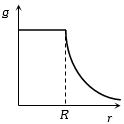
B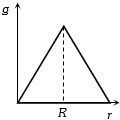
C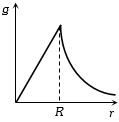
D
None of these.
Solution
(C) For a point inside the Earth $(r < R)$, the acceleration due to gravity is given by $g_{in} = \frac{4}{3} \pi G \rho r$, which means $g \propto r$. This represents a straight line passing through the origin.
For a point outside the Earth $(r \geq R)$, the acceleration due to gravity is given by $g_{out} = \frac{GM}{r^2}$, which means $g \propto \frac{1}{r^2}$. This represents a curve that decreases as $r$ increases.
Therefore, the graph shows a linear increase up to $r = R$ and then a non-linear decrease for $r > R$, which corresponds to the graph provided in option $C$.
For a point outside the Earth $(r \geq R)$, the acceleration due to gravity is given by $g_{out} = \frac{GM}{r^2}$, which means $g \propto \frac{1}{r^2}$. This represents a curve that decreases as $r$ increases.
Therefore, the graph shows a linear increase up to $r = R$ and then a non-linear decrease for $r > R$, which corresponds to the graph provided in option $C$.
0 likes
View Solution88
EasyMCQ
If a hole is bored along the diameter of the earth and a stone is dropped into the hole,what happens to the stone?
A
The stone reaches the centre of the earth and stops there.
B
The stone reaches the other side of the earth and stops there.
C
The stone executes simple harmonic motion about the centre of the earth.
D
The stone reaches the other side of the earth and escapes into space.
Solution
(C) When a stone is dropped into a hole bored along the diameter of the earth,the gravitational force acting on the stone at a distance $r$ from the centre is given by $F = -(\frac{GMm}{R^3})r$.
Since the force is proportional to the displacement $r$ and directed towards the centre,the stone undergoes simple harmonic motion ($S$.$H$.$M$.) about the centre of the earth.
The time period of this oscillation is given by $T = 2\pi \sqrt{\frac{R}{g}}$,where $R$ is the radius of the earth and $g$ is the acceleration due to gravity at the surface.
Since the force is proportional to the displacement $r$ and directed towards the centre,the stone undergoes simple harmonic motion ($S$.$H$.$M$.) about the centre of the earth.
The time period of this oscillation is given by $T = 2\pi \sqrt{\frac{R}{g}}$,where $R$ is the radius of the earth and $g$ is the acceleration due to gravity at the surface.
0 likes
View Solution89
EasyMCQ
The period of oscillation of a simple pendulum of constant length at the Earth's surface is $T$. Its period inside a mine is
A
Greater than $T$
B
Less than $T$
C
Equal to $T$
D
Cannot be compared
Solution
(A) The time period of a simple pendulum is given by the formula $T = 2\pi \sqrt{\frac{l}{g}}$,where $l$ is the length of the pendulum and $g$ is the acceleration due to gravity.
As we go inside a mine (below the Earth's surface),the effective acceleration due to gravity $g$ decreases.
Since $T \propto \frac{1}{\sqrt{g}}$,a decrease in the value of $g$ leads to an increase in the time period $T$.
Therefore,the period of oscillation inside a mine will be greater than $T$.
As we go inside a mine (below the Earth's surface),the effective acceleration due to gravity $g$ decreases.
Since $T \propto \frac{1}{\sqrt{g}}$,a decrease in the value of $g$ leads to an increase in the time period $T$.
Therefore,the period of oscillation inside a mine will be greater than $T$.
0 likes
View Solution90
MediumMCQ
The mass and diameter of a planet are twice those of earth. The period of oscillation of a pendulum on this planet will be (if it is a second's pendulum on earth).
A
$\frac{1}{\sqrt{2}} \, \text{s}$
B
$2\sqrt{2} \, \text{s}$
C
$2 \, \text{s}$
D
$\frac{1}{2} \, \text{s}$
Solution
(B) The acceleration due to gravity is given by $g = \frac{GM}{R^2}$.
Given: $M_p = 2M_e$ and $R_p = 2R_e$.
Therefore,the ratio of gravity on earth to the planet is:
$\frac{g_e}{g_p} = \frac{M_e}{M_p} \times \left(\frac{R_p}{R_e}\right)^2 = \frac{1}{2} \times (2)^2 = \frac{4}{2} = 2$.
So,$g_p = \frac{g_e}{2}$.
The time period of a simple pendulum is $T = 2\pi \sqrt{\frac{L}{g}}$,which implies $T \propto \frac{1}{\sqrt{g}}$.
For a second's pendulum on earth,$T_e = 2 \, \text{s}$.
Thus,$\frac{T_p}{T_e} = \sqrt{\frac{g_e}{g_p}} = \sqrt{2}$.
$T_p = T_e \times \sqrt{2} = 2\sqrt{2} \, \text{s}$.
Given: $M_p = 2M_e$ and $R_p = 2R_e$.
Therefore,the ratio of gravity on earth to the planet is:
$\frac{g_e}{g_p} = \frac{M_e}{M_p} \times \left(\frac{R_p}{R_e}\right)^2 = \frac{1}{2} \times (2)^2 = \frac{4}{2} = 2$.
So,$g_p = \frac{g_e}{2}$.
The time period of a simple pendulum is $T = 2\pi \sqrt{\frac{L}{g}}$,which implies $T \propto \frac{1}{\sqrt{g}}$.
For a second's pendulum on earth,$T_e = 2 \, \text{s}$.
Thus,$\frac{T_p}{T_e} = \sqrt{\frac{g_e}{g_p}} = \sqrt{2}$.
$T_p = T_e \times \sqrt{2} = 2\sqrt{2} \, \text{s}$.
0 likes
View Solution91
EasyMCQ
$A$ simple pendulum is taken from the equator to the pole. Its period
A
Decreases
B
Increases
C
Remains the same
D
Decreases and then increases
Solution
(A) The time period $T$ of a simple pendulum is given by the formula $T = 2\pi \sqrt{\frac{L}{g}}$,where $L$ is the length of the pendulum and $g$ is the acceleration due to gravity.
As we move from the equator to the pole,the value of $g$ increases due to the Earth's shape (it is flattened at the poles).
Since $T \propto \frac{1}{\sqrt{g}}$,an increase in the value of $g$ results in a decrease in the time period $T$.
Therefore,the period of the simple pendulum decreases.
As we move from the equator to the pole,the value of $g$ increases due to the Earth's shape (it is flattened at the poles).
Since $T \propto \frac{1}{\sqrt{g}}$,an increase in the value of $g$ results in a decrease in the time period $T$.
Therefore,the period of the simple pendulum decreases.
0 likes
View Solution92
EasyMCQ
What effect occurs on the frequency of a pendulum if it is taken from the earth's surface to deep into a mine?
A
Increases
B
Decreases
C
First increases then decreases
D
None of these
Solution
(B) The frequency of a simple pendulum is given by the formula $n = \frac{1}{2\pi} \sqrt{\frac{g}{l}}$,which implies $n \propto \sqrt{g}$.
When a pendulum is taken deep into a mine at a depth $d$,the acceleration due to gravity $g'$ is given by $g' = g \left( 1 - \frac{d}{R} \right)$,where $R$ is the radius of the Earth.
Since $g' < g$,the value of acceleration due to gravity decreases as we go deep into the mine.
Because the frequency $n$ is directly proportional to the square root of $g$,a decrease in $g$ leads to a decrease in the frequency of the pendulum.
When a pendulum is taken deep into a mine at a depth $d$,the acceleration due to gravity $g'$ is given by $g' = g \left( 1 - \frac{d}{R} \right)$,where $R$ is the radius of the Earth.
Since $g' < g$,the value of acceleration due to gravity decreases as we go deep into the mine.
Because the frequency $n$ is directly proportional to the square root of $g$,a decrease in $g$ leads to a decrease in the frequency of the pendulum.
0 likes
View Solution93
DifficultMCQ
The acceleration due to gravity on the Moon is $\frac{1}{6}$ times that of the Earth. If the ratio of the density of the Earth $(\rho_e)$ to the Moon $(\rho_m)$ is $\frac{\rho_e}{\rho_m} = \frac{5}{3}$,what is the radius of the Moon $(R_m)$ in terms of the radius of the Earth $(R_e)$?
A
$\frac{5}{18}R_e$
B
$\frac{1}{6}R_e$
C
$\frac{3}{18}R_e$
D
$\frac{1}{2\sqrt{3}}R_e$
Solution
(A) The acceleration due to gravity $g$ at the surface of a planet is given by $g = \frac{GM}{R^2}$.
Since mass $M = \text{density} (\rho) \times \text{volume} (V) = \rho \times \frac{4}{3}\pi R^3$,we have $g = \frac{G}{R^2} \times \rho \times \frac{4}{3}\pi R^3 = \frac{4}{3}\pi \rho GR$.
Therefore,$g \propto \rho R$.
Taking the ratio for the Moon and Earth: $\frac{g_m}{g_e} = \frac{\rho_m}{\rho_e} \times \frac{R_m}{R_e}$.
Given $\frac{g_m}{g_e} = \frac{1}{6}$ and $\frac{\rho_e}{\rho_m} = \frac{5}{3}$,we have $\frac{\rho_m}{\rho_e} = \frac{3}{5}$.
Substituting these values: $\frac{1}{6} = \frac{3}{5} \times \frac{R_m}{R_e}$.
Solving for $R_m$: $\frac{R_m}{R_e} = \frac{1}{6} \times \frac{5}{3} = \frac{5}{18}$.
Thus,$R_m = \frac{5}{18}R_e$.
Since mass $M = \text{density} (\rho) \times \text{volume} (V) = \rho \times \frac{4}{3}\pi R^3$,we have $g = \frac{G}{R^2} \times \rho \times \frac{4}{3}\pi R^3 = \frac{4}{3}\pi \rho GR$.
Therefore,$g \propto \rho R$.
Taking the ratio for the Moon and Earth: $\frac{g_m}{g_e} = \frac{\rho_m}{\rho_e} \times \frac{R_m}{R_e}$.
Given $\frac{g_m}{g_e} = \frac{1}{6}$ and $\frac{\rho_e}{\rho_m} = \frac{5}{3}$,we have $\frac{\rho_m}{\rho_e} = \frac{3}{5}$.
Substituting these values: $\frac{1}{6} = \frac{3}{5} \times \frac{R_m}{R_e}$.
Solving for $R_m$: $\frac{R_m}{R_e} = \frac{1}{6} \times \frac{5}{3} = \frac{5}{18}$.
Thus,$R_m = \frac{5}{18}R_e$.
0 likes
View Solution94
DifficultMCQ
The radius of the Moon is $\frac{1}{4}$ times that of the Earth,and its mass is $\frac{1}{80}$ times that of the Earth. If the acceleration due to gravity on Earth is $g$,what is the acceleration due to gravity on the Moon?
A
$\frac{g}{4}$
B
$\frac{g}{5}$
C
$\frac{g}{6}$
D
$\frac{g}{8}$
Solution
(B) The acceleration due to gravity on the surface of a planet is given by the formula $g = \frac{GM}{R^2}$,where $G$ is the gravitational constant,$M$ is the mass of the planet,and $R$ is its radius.
For Earth: $g_e = \frac{GM_e}{R_e^2}$.
For the Moon: $g_m = \frac{GM_m}{R_m^2}$.
Given that $M_m = \frac{M_e}{80}$ and $R_m = \frac{R_e}{4}$.
Taking the ratio of the two accelerations:
$\frac{g_m}{g_e} = \frac{M_m}{M_e} \times \left( \frac{R_e}{R_m} \right)^2$
Substituting the given values:
$\frac{g_m}{g_e} = \left( \frac{1}{80} \right) \times \left( \frac{4}{1} \right)^2 = \frac{1}{80} \times 16 = \frac{16}{80} = \frac{1}{5}$.
Therefore,$g_m = \frac{g_e}{5} = \frac{g}{5}$.
For Earth: $g_e = \frac{GM_e}{R_e^2}$.
For the Moon: $g_m = \frac{GM_m}{R_m^2}$.
Given that $M_m = \frac{M_e}{80}$ and $R_m = \frac{R_e}{4}$.
Taking the ratio of the two accelerations:
$\frac{g_m}{g_e} = \frac{M_m}{M_e} \times \left( \frac{R_e}{R_m} \right)^2$
Substituting the given values:
$\frac{g_m}{g_e} = \left( \frac{1}{80} \right) \times \left( \frac{4}{1} \right)^2 = \frac{1}{80} \times 16 = \frac{16}{80} = \frac{1}{5}$.
Therefore,$g_m = \frac{g_e}{5} = \frac{g}{5}$.
0 likes
View Solution95
DifficultMCQ
$A$ body thrown on Earth reaches a height of $90\,m$. If the same body is thrown on a planet with $\frac{1}{10}$ of the mass and $\frac{1}{3}$ of the radius of Earth,it will reach a height of ....... $m$.
A
$90$
B
$40$
C
$100$
D
$45$
Solution
(C) The acceleration due to gravity is given by $g = \frac{GM}{R^2}$.
Comparing the gravity on the planet $(g_p)$ and Earth $(g_e)$:
$\frac{g_p}{g_e} = \frac{M_p}{M_e} \times \left( \frac{R_e}{R_p} \right)^2$
Given $M_p = \frac{1}{10} M_e$ and $R_p = \frac{1}{3} R_e$:
$\frac{g_p}{g_e} = \frac{1}{10} \times \left( \frac{3}{1} \right)^2 = \frac{9}{10}$.
The maximum height reached is $H = \frac{u^2}{2g}$,which implies $H \propto \frac{1}{g}$.
Therefore,$\frac{H_p}{H_e} = \frac{g_e}{g_p} = \frac{10}{9}$.
$H_p = \frac{10}{9} \times H_e = \frac{10}{9} \times 90 = 100\,m$.
Comparing the gravity on the planet $(g_p)$ and Earth $(g_e)$:
$\frac{g_p}{g_e} = \frac{M_p}{M_e} \times \left( \frac{R_e}{R_p} \right)^2$
Given $M_p = \frac{1}{10} M_e$ and $R_p = \frac{1}{3} R_e$:
$\frac{g_p}{g_e} = \frac{1}{10} \times \left( \frac{3}{1} \right)^2 = \frac{9}{10}$.
The maximum height reached is $H = \frac{u^2}{2g}$,which implies $H \propto \frac{1}{g}$.
Therefore,$\frac{H_p}{H_e} = \frac{g_e}{g_p} = \frac{10}{9}$.
$H_p = \frac{10}{9} \times H_e = \frac{10}{9} \times 90 = 100\,m$.
0 likes
View Solution96
MediumMCQ
What is the ratio of the acceleration due to gravity on two planets with radii $R_1$ and $R_2$ and densities $\rho_1$ and $\rho_2$?
A
$g_1:g_2 = \frac{\rho_1}{R_1^2} : \frac{\rho_2}{R_2^2}$
B
$g_1:g_2 = R_1 R_2 : \rho_1 \rho_2$
C
$g_1:g_2 = R_1 \rho_2 : R_2 \rho_1$
D
$g_1:g_2 = R_1 \rho_1 : R_2 \rho_2$
Solution
(D) The acceleration due to gravity $g$ on the surface of a planet is given by $g = \frac{GM}{R^2}$.
Since mass $M = \text{Volume} \times \text{Density} = \frac{4}{3} \pi R^3 \rho$,we substitute this into the formula:
$g = \frac{G (\frac{4}{3} \pi R^3 \rho)}{R^2} = \frac{4}{3} \pi G R \rho$.
Thus,$g \propto R \rho$.
Therefore,the ratio of the acceleration due to gravity for two planets is $\frac{g_1}{g_2} = \frac{R_1 \rho_1}{R_2 \rho_2}$,which can be written as $g_1 : g_2 = R_1 \rho_1 : R_2 \rho_2$.
Since mass $M = \text{Volume} \times \text{Density} = \frac{4}{3} \pi R^3 \rho$,we substitute this into the formula:
$g = \frac{G (\frac{4}{3} \pi R^3 \rho)}{R^2} = \frac{4}{3} \pi G R \rho$.
Thus,$g \propto R \rho$.
Therefore,the ratio of the acceleration due to gravity for two planets is $\frac{g_1}{g_2} = \frac{R_1 \rho_1}{R_2 \rho_2}$,which can be written as $g_1 : g_2 = R_1 \rho_1 : R_2 \rho_2$.
0 likes
View Solution97
MediumMCQ
What is the acceleration due to gravity at a distance of $2R$ from the surface of the Earth,where $R$ is the radius of the Earth?
A
$\frac{g}{9}$
B
$\frac{g}{3}$
C
$\frac{g}{4}$
D
$g$
Solution
(A) The acceleration due to gravity $g'$ at a height $h$ above the Earth's surface is given by the formula: $g' = g \left( \frac{R}{R + h} \right)^2$.
Given that the distance from the surface is $h = 2R$.
Substituting the value of $h$ into the formula:
$g' = g \left( \frac{R}{R + 2R} \right)^2$
$g' = g \left( \frac{R}{3R} \right)^2$
$g' = g \left( \frac{1}{3} \right)^2$
$g' = \frac{g}{9}$.
Therefore,the acceleration due to gravity at a distance of $2R$ from the surface is $\frac{g}{9}$.
Given that the distance from the surface is $h = 2R$.
Substituting the value of $h$ into the formula:
$g' = g \left( \frac{R}{R + 2R} \right)^2$
$g' = g \left( \frac{R}{3R} \right)^2$
$g' = g \left( \frac{1}{3} \right)^2$
$g' = \frac{g}{9}$.
Therefore,the acceleration due to gravity at a distance of $2R$ from the surface is $\frac{g}{9}$.
0 likes
View Solution98
DifficultMCQ
At what height above the Earth's surface does the acceleration due to gravity become $1\%$ of its value at the Earth's surface (in $R$)? (Radius of Earth $= R$)
A
$8$
B
$9$
C
$10$
D
$20$
Solution
(B) The acceleration due to gravity at a height $h$ above the surface is given by $g' = g \left( \frac{R}{R+h} \right)^2$.
Given that $g' = 1\% \text{ of } g$,so $g' = \frac{g}{100}$.
Substituting this into the formula: $\frac{g}{100} = g \left( \frac{R}{R+h} \right)^2$.
Taking the square root on both sides: $\frac{1}{10} = \frac{R}{R+h}$.
Cross-multiplying gives: $R + h = 10R$.
Therefore,$h = 9R$.
Given that $g' = 1\% \text{ of } g$,so $g' = \frac{g}{100}$.
Substituting this into the formula: $\frac{g}{100} = g \left( \frac{R}{R+h} \right)^2$.
Taking the square root on both sides: $\frac{1}{10} = \frac{R}{R+h}$.
Cross-multiplying gives: $R + h = 10R$.
Therefore,$h = 9R$.
0 likes
View Solution99
DifficultMCQ
The weight of an object on the surface of the Earth is $72 \, N$. What will be the weight of the object at a height of $R/2$ from the surface of the Earth? ($R$ = radius of the Earth)
A
$28$
B
$16$
C
$32$
D
$72$
Solution
(C) The weight of an object at height $h$ is given by $W' = W \left( \frac{R}{R+h} \right)^2$.
Given $W = 72 \, N$ and $h = R/2$.
Substituting the values:
$W' = 72 \left( \frac{R}{R + R/2} \right)^2$
$W' = 72 \left( \frac{R}{3R/2} \right)^2$
$W' = 72 \left( \frac{2}{3} \right)^2$
$W' = 72 \times \frac{4}{9}$
$W' = 8 \times 4 = 32 \, N$.
Given $W = 72 \, N$ and $h = R/2$.
Substituting the values:
$W' = 72 \left( \frac{R}{R + R/2} \right)^2$
$W' = 72 \left( \frac{R}{3R/2} \right)^2$
$W' = 72 \left( \frac{2}{3} \right)^2$
$W' = 72 \times \frac{4}{9}$
$W' = 8 \times 4 = 32 \, N$.
0 likes
View Solution100
DifficultMCQ
The weight of a body of mass $m$ decreases by $1\%$ when it is taken to a height $h$ above the surface of the Earth. What is the percentage decrease in its weight when it is taken to a depth $h$ below the surface of the Earth?
A
$2\%$ decrease
B
$0.5\%$ decrease
C
$1\%$ increase
D
$0.5\%$ increase
Solution
(B) The change in acceleration due to gravity at height $h$ is given by $\frac{\Delta g_h}{g} \approx \frac{2h}{R}$.
Given that the weight decreases by $1\%$,we have $\frac{2h}{R} \times 100\% = 1\%$,which implies $\frac{h}{R} = 0.005$.
At a depth $d = h$,the change in acceleration due to gravity is given by $\frac{\Delta g_d}{g} = \frac{d}{R} = \frac{h}{R}$.
Substituting the value of $\frac{h}{R}$,we get $\frac{\Delta g_d}{g} = 0.005$.
Therefore,the percentage decrease in weight at depth $h$ is $0.005 \times 100\% = 0.5\%$.
Given that the weight decreases by $1\%$,we have $\frac{2h}{R} \times 100\% = 1\%$,which implies $\frac{h}{R} = 0.005$.
At a depth $d = h$,the change in acceleration due to gravity is given by $\frac{\Delta g_d}{g} = \frac{d}{R} = \frac{h}{R}$.
Substituting the value of $\frac{h}{R}$,we get $\frac{\Delta g_d}{g} = 0.005$.
Therefore,the percentage decrease in weight at depth $h$ is $0.005 \times 100\% = 0.5\%$.
0 likes
View SolutionGravitation — Acceleration Due to Gravity and its Variation · Frequently Asked Questions
1Are these Gravitation questions useful for JEE and NEET?
Yes. All questions in this section are mapped to JEE Main and NEET exam patterns. Previous year questions from JEE Main, NEET, GUJCET and state-level exams are included with full solutions.
2Can I switch to Hindi or Gujarati for these questions?
Yes. Use the language tabs in the hero section or the sidebar to view the same questions and solutions in English, Hindi or Gujarati.
3How do I generate a question paper from this subtopic?
Use the Vedclass Exam Paper Generator — select the chapter and subtopic, set difficulty, and generate Sets A, B, C, D automatically. First 3 chapters of every subject are free.
Vedclass Products
For Students
Vedclass Test Series
Mock tests in real JEE/NEET style with performance analysis. 5-day free trial.
Start Free TrialFor Teachers
Exam Paper Generator
Generate Set A/B/C/D papers from this chapter in 2 minutes. 3 chapters free.
Try FreeFor Institutes
Online Exam Module
Live online exams with unlimited students, 360° analytics & white-label branding.
See DemoFor Teachers & Institutes
Generate a Gravitation Exam Paper in 2 Minutes
Select subtopic & difficulty — Sets A, B, C, D auto-generated with No Repeat logic.
First 3 chapters of every subject are free — no payment required.