
A English
Mix Examples-Fluid Mechanics and Surface Tension Questions in English
Class 11 Physics · Fluid Mechanics and Surface Tension · Mix Examples-Fluid Mechanics and Surface Tension
142+
Questions
English
Language
100%
With Solutions
Showing 49 of 142 questions in English
51
DifficultMCQ
$A$ uniform meter scale is supported at its $20 \ cm$ mark. $A$ body suspended from the $10 \ cm$ mark keeps the scale horizontal. However,the scale becomes unbalanced if the body is completely immersed in water. To regain the balance,the body is shifted to the $8 \ cm$ mark. Therefore,the specific gravity of the material of the body is
A
$5$
B
$6$
C
$7$
D
$4$
Solution
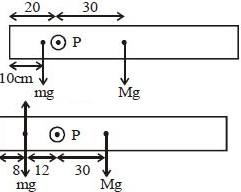
(B) Let $M$ be the mass of the meter scale and $m$ be the mass of the body. The center of mass of the uniform meter scale is at the $50 \ cm$ mark. The pivot $P$ is at the $20 \ cm$ mark.
Case $1$: The body is at the $10 \ cm$ mark. The distance of the body from the pivot is $20 \ cm - 10 \ cm = 10 \ cm$. The distance of the center of mass of the scale from the pivot is $50 \ cm - 20 \ cm = 30 \ cm$. For rotational equilibrium,the net torque about the pivot must be zero:
$Mg \times 30 = mg \times 10$
$30M = 10m \Rightarrow m = 3M$
Case $2$: The body is immersed in water and shifted to the $8 \ cm$ mark. The distance of the body from the pivot is $20 \ cm - 8 \ cm = 12 \ cm$. The buoyant force $F_b$ acts upwards at the $8 \ cm$ mark. The weight of the body $mg$ acts downwards at the $8 \ cm$ mark. The effective downward force at the $8 \ cm$ mark is $(mg - F_b)$.
For equilibrium:
$Mg \times 30 = (mg - F_b) \times 12$
$30Mg = 12mg - 12F_b$
Since $F_b = V \rho_w g = (m / \rho) \rho_w g = m g / \rho_r$,where $\rho_r$ is the specific gravity:
$30Mg = 12mg - 12(mg / \rho_r)$
Substitute $m = 3M$:
$30Mg = 12(3M)g - 12(3M)g / \rho_r$
$30 = 36 - 36 / \rho_r$
$36 / \rho_r = 6$
$\rho_r = 36 / 6 = 6$
Case $1$: The body is at the $10 \ cm$ mark. The distance of the body from the pivot is $20 \ cm - 10 \ cm = 10 \ cm$. The distance of the center of mass of the scale from the pivot is $50 \ cm - 20 \ cm = 30 \ cm$. For rotational equilibrium,the net torque about the pivot must be zero:
$Mg \times 30 = mg \times 10$
$30M = 10m \Rightarrow m = 3M$
Case $2$: The body is immersed in water and shifted to the $8 \ cm$ mark. The distance of the body from the pivot is $20 \ cm - 8 \ cm = 12 \ cm$. The buoyant force $F_b$ acts upwards at the $8 \ cm$ mark. The weight of the body $mg$ acts downwards at the $8 \ cm$ mark. The effective downward force at the $8 \ cm$ mark is $(mg - F_b)$.
For equilibrium:
$Mg \times 30 = (mg - F_b) \times 12$
$30Mg = 12mg - 12F_b$
Since $F_b = V \rho_w g = (m / \rho) \rho_w g = m g / \rho_r$,where $\rho_r$ is the specific gravity:
$30Mg = 12mg - 12(mg / \rho_r)$
Substitute $m = 3M$:
$30Mg = 12(3M)g - 12(3M)g / \rho_r$
$30 = 36 - 36 / \rho_r$
$36 / \rho_r = 6$
$\rho_r = 36 / 6 = 6$
0 likes
View Solution52
DifficultMCQ
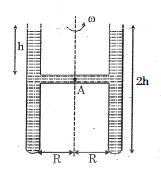
The shown $H$-shaped apparatus contains an ideal incompressible liquid and has dimensions as shown in the figure. The diameters of the tubes are small compared to $h$ and $R$. The apparatus is rotated with a constant angular velocity $\omega$ about a symmetric vertical axis as shown in the figure. The pressure at point $A$ is
A
$P_0 + \rho gh$
B
$P_0 + \rho gh + \frac{\rho R^2 \omega^2}{2}$
C
$P_0 + \rho gh - \frac{\rho R^2 \omega^2}{2}$
D
$P_0 - \rho gh - \frac{\rho R^2 \omega^2}{2}$
Solution
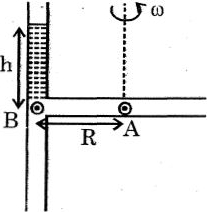
(C) Let $P_B$ be the pressure at point $B$ at the bottom of the vertical column of liquid of height $h$. Since the top of the column is open to the atmosphere,$P_B = P_0 + \rho gh$,where $P_0$ is the atmospheric pressure.
Now,consider the horizontal segment of the tube rotating with angular velocity $\omega$ about the vertical axis passing through $A$. Point $A$ is at a distance $r = 0$ from the axis,and point $B$ is at a distance $r = R$ from the axis.
The pressure variation in a rotating fluid is given by $dP = \rho \omega^2 r dr$. Integrating from $A$ to $B$:
$P_B - P_A = \int_0^R \rho \omega^2 r dr = \frac{\rho \omega^2 R^2}{2}$.
Therefore,$P_A = P_B - \frac{\rho \omega^2 R^2}{2}$.
Substituting the value of $P_B$,we get $P_A = P_0 + \rho gh - \frac{\rho \omega^2 R^2}{2}$.
Now,consider the horizontal segment of the tube rotating with angular velocity $\omega$ about the vertical axis passing through $A$. Point $A$ is at a distance $r = 0$ from the axis,and point $B$ is at a distance $r = R$ from the axis.
The pressure variation in a rotating fluid is given by $dP = \rho \omega^2 r dr$. Integrating from $A$ to $B$:
$P_B - P_A = \int_0^R \rho \omega^2 r dr = \frac{\rho \omega^2 R^2}{2}$.
Therefore,$P_A = P_B - \frac{\rho \omega^2 R^2}{2}$.
Substituting the value of $P_B$,we get $P_A = P_0 + \rho gh - \frac{\rho \omega^2 R^2}{2}$.
0 likes
View Solution53
MediumMCQ
$A$ razor-blade floats on the surface of water contained in a glass. When the glass is gently shaken,the razor-blade sinks. Mark the incorrect statement.
A
Volume of displaced water is lesser than blade's own volume.
B
When the razor-blade sinks,the height of the water decreases.
C
For a floating body of greater density than water,its weight is balanced by the compressive forces of the water below it.
D
Weight of razor-blade is equal to the weight of the displaced water due to volume occupied by the razor-blade and some additional region affected by surface tension.
Solution
(A) When a razor-blade floats on water,it is supported by the buoyant force (Archimedes' principle) and the upward force due to surface tension.
Since the density of the blade is greater than that of water,it would normally sink.
However,surface tension creates a 'dimple' in the water surface,effectively increasing the volume of water displaced beyond the actual volume of the blade.
When the glass is shaken,the surface tension effect is broken,and the blade sinks.
Statement $A$ is incorrect because,while floating,the effective volume of displaced water (including the surface tension effect) is equal to the volume required to balance the weight of the blade.
Statement $B$ is correct because the blade displaces less water when submerged than when it was floating supported by surface tension.
Statement $C$ is correct as it describes the mechanism of support.
Statement $D$ is correct as it explains the equilibrium condition for the floating blade.
Since the density of the blade is greater than that of water,it would normally sink.
However,surface tension creates a 'dimple' in the water surface,effectively increasing the volume of water displaced beyond the actual volume of the blade.
When the glass is shaken,the surface tension effect is broken,and the blade sinks.
Statement $A$ is incorrect because,while floating,the effective volume of displaced water (including the surface tension effect) is equal to the volume required to balance the weight of the blade.
Statement $B$ is correct because the blade displaces less water when submerged than when it was floating supported by surface tension.
Statement $C$ is correct as it describes the mechanism of support.
Statement $D$ is correct as it explains the equilibrium condition for the floating blade.
0 likes
View Solution54
DifficultMCQ
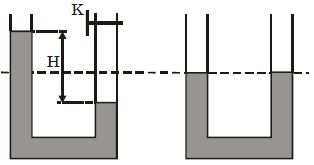
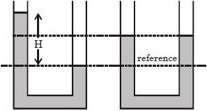
$A$ $U$-tube of small and uniform cross-section contains water of total length $4H$. The height difference between the water columns on the left and on the right is $H$ when the valve $K$ is closed. The valve is suddenly opened,and water flows from left to right. Ignore friction. The speed of the water when the heights of the left and the right water columns are the same is:
A
$\frac{1}{4}\sqrt{gH}$
B
$\sqrt{\frac{gH}{8}}$
C
$\frac{1}{2}\sqrt{gH}$
D
$\sqrt{\frac{gH}{2}}$
Solution
(B) Let the cross-sectional area be $A$ and the density of water be $\rho$. The total length of the water column is $L = 4H$. The mass of the water is $m = \rho A L = 4\rho AH$.
Initially,the left column is at height $H/2$ above the mean level and the right column is at $H/2$ below the mean level. The potential energy of the system relative to the mean level is $U_i = \rho A (H/2) g (H/4) + \rho A (H/2) g (-H/4) = 0$ (considering the center of mass of each column).
More simply,we can consider the potential energy change of the displaced water. $A$ volume $V = A(H/2)$ of water moves from the left side to the right side. The center of mass of this volume drops by a distance $H/2$. The change in potential energy is $\Delta U = -(\rho A (H/2)) g (H/2) = -\rho A g H^2 / 4$.
By the law of conservation of energy,the loss in potential energy equals the gain in kinetic energy:
$|\Delta U| = \frac{1}{2} m v^2$
$\rho A g H^2 / 4 = \frac{1}{2} (4 \rho A H) v^2$
$\rho A g H^2 / 4 = 2 \rho A H v^2$
$v^2 = \frac{gH}{8}$
$v = \sqrt{\frac{gH}{8}}$
Initially,the left column is at height $H/2$ above the mean level and the right column is at $H/2$ below the mean level. The potential energy of the system relative to the mean level is $U_i = \rho A (H/2) g (H/4) + \rho A (H/2) g (-H/4) = 0$ (considering the center of mass of each column).
More simply,we can consider the potential energy change of the displaced water. $A$ volume $V = A(H/2)$ of water moves from the left side to the right side. The center of mass of this volume drops by a distance $H/2$. The change in potential energy is $\Delta U = -(\rho A (H/2)) g (H/2) = -\rho A g H^2 / 4$.
By the law of conservation of energy,the loss in potential energy equals the gain in kinetic energy:
$|\Delta U| = \frac{1}{2} m v^2$
$\rho A g H^2 / 4 = \frac{1}{2} (4 \rho A H) v^2$
$\rho A g H^2 / 4 = 2 \rho A H v^2$
$v^2 = \frac{gH}{8}$
$v = \sqrt{\frac{gH}{8}}$
0 likes
View Solution55
AdvancedMCQ
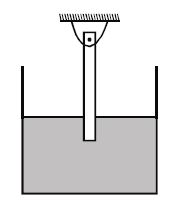
$A$ thin vertical uniform wooden rod is pivoted at the top and immersed in water as shown. The container is slowly raised. At a certain moment,the equilibrium becomes unstable. If the density of water is $9/5$ times the density of wood,then the ratio of the total length of the rod to the submerged length of the rod at that moment is:
A
$2$
B
$3$
C
$4$
D
$6$
Solution
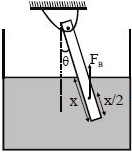
(B) Let $L$ be the total length of the rod,$A$ be its cross-sectional area,and $\rho_w$ and $\rho_r$ be the densities of water and the rod respectively. Given $\rho_w = \frac{9}{5} \rho_r$. Let $x$ be the submerged length of the rod.
The weight of the rod acts at its center of mass,which is at a distance $L/2$ from the pivot. The buoyant force $F_B$ acts at the center of the submerged part,which is at a distance $(L - x/2)$ from the pivot.
For small angular displacement $\theta$,the torque due to gravity is $\tau_g = (\rho_r A L g) \frac{L}{2} \sin \theta$.
The torque due to the buoyant force is $\tau_B = F_B (L - x/2) \sin \theta$,where $F_B = \rho_w (A x) g$.
Equilibrium is unstable when the net restoring torque becomes zero or negative. The condition for stability is that the restoring torque (gravity) must be greater than or equal to the destabilizing torque (buoyancy).
$(\rho_r A L g) \frac{L}{2} \sin \theta = (\rho_w A x g) (L - x/2) \sin \theta$
$\rho_r L^2 / 2 = \rho_w x (L - x/2)$
Substitute $\rho_w = \frac{9}{5} \rho_r$:
$\rho_r L^2 / 2 = \frac{9}{5} \rho_r x (L - x/2)$
$L^2 / 2 = \frac{9}{5} (Lx - x^2/2)$
$5L^2 = 18Lx - 9x^2$
$9x^2 - 18Lx + 5L^2 = 0$
Using the quadratic formula $x = \frac{-b \pm \sqrt{b^2 - 4ac}}{2a}$:
$x = \frac{18L \pm \sqrt{324L^2 - 180L^2}}{18} = \frac{18L \pm \sqrt{144L^2}}{18} = \frac{18L \pm 12L}{18}$
$x = \frac{30L}{18} = \frac{5}{3}L$ (not possible as $x < L$) or $x = \frac{6L}{18} = \frac{L}{3}$.
Thus,$x = L/3$,which means $L/x = 3$.
The weight of the rod acts at its center of mass,which is at a distance $L/2$ from the pivot. The buoyant force $F_B$ acts at the center of the submerged part,which is at a distance $(L - x/2)$ from the pivot.
For small angular displacement $\theta$,the torque due to gravity is $\tau_g = (\rho_r A L g) \frac{L}{2} \sin \theta$.
The torque due to the buoyant force is $\tau_B = F_B (L - x/2) \sin \theta$,where $F_B = \rho_w (A x) g$.
Equilibrium is unstable when the net restoring torque becomes zero or negative. The condition for stability is that the restoring torque (gravity) must be greater than or equal to the destabilizing torque (buoyancy).
$(\rho_r A L g) \frac{L}{2} \sin \theta = (\rho_w A x g) (L - x/2) \sin \theta$
$\rho_r L^2 / 2 = \rho_w x (L - x/2)$
Substitute $\rho_w = \frac{9}{5} \rho_r$:
$\rho_r L^2 / 2 = \frac{9}{5} \rho_r x (L - x/2)$
$L^2 / 2 = \frac{9}{5} (Lx - x^2/2)$
$5L^2 = 18Lx - 9x^2$
$9x^2 - 18Lx + 5L^2 = 0$
Using the quadratic formula $x = \frac{-b \pm \sqrt{b^2 - 4ac}}{2a}$:
$x = \frac{18L \pm \sqrt{324L^2 - 180L^2}}{18} = \frac{18L \pm \sqrt{144L^2}}{18} = \frac{18L \pm 12L}{18}$
$x = \frac{30L}{18} = \frac{5}{3}L$ (not possible as $x < L$) or $x = \frac{6L}{18} = \frac{L}{3}$.
Thus,$x = L/3$,which means $L/x = 3$.
0 likes
View Solution56
MediumMCQ
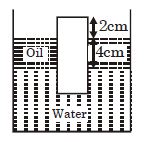
$A$ cylinder of radius $4 \ cm$ and height $10 \ cm$ is immersed in two liquids as shown. Specific gravity of oil is $0.5$. $2 \ cm$ of the cylinder is in the air. Select the $INCORRECT$ statement. Neglect atmospheric pressure.
A
Force exerted by oil on the cylinder is zero.
B
Force exerted by water on the cylinder is $0.96 \pi \ N$.
C
Force exerted by both water and oil is $1.14 \pi \ N$.
D
Frequency of oscillation does not depend on the density of oil,if the cylinder is displaced slightly.
Solution
(A) The cylinder has a radius $r = 4 \ cm = 0.04 \ m$ and height $h = 10 \ cm = 0.1 \ m$. The cross-sectional area $A = \pi r^2 = \pi (0.04)^2 = 0.0016 \pi \ m^2$.
$1$. Force exerted by oil: The oil exerts pressure on the side walls of the cylinder. The net horizontal force is zero due to symmetry. However,the vertical force exerted by the oil is the buoyant force,which is $F_{oil} = \rho_{oil} V_{sub, oil} g$. Here,$\rho_{oil} = 0.5 \times 1000 = 500 \ kg/m^3$ and $V_{sub, oil} = A \times h_{oil} = 0.0016 \pi \times 0.04 = 0.000064 \pi \ m^3$. Thus,$F_{oil} = 500 \times 0.000064 \pi \times 10 = 0.32 \pi \ N$. Therefore,statement $A$ is incorrect.
$2$. Force exerted by water: The water exerts a buoyant force $F_{water} = \rho_{water} V_{sub, water} g$. The submerged height in water is $10 - 2 - 4 = 4 \ cm = 0.04 \ m$. So,$V_{sub, water} = A \times 0.04 = 0.0016 \pi \times 0.04 = 0.000064 \pi \ m^3$. Thus,$F_{water} = 1000 \times 0.000064 \pi \times 10 = 0.64 \pi \ N$. Note: The pressure at the bottom of the cylinder is $P = P_{oil} + P_{water} = (\rho_{oil} g h_{oil} + \rho_{water} g h_{water})$. The total upward force is $F_{total} = P \times A = (500 \times 10 \times 0.04 + 1000 \times 10 \times 0.04) \times 0.0016 \pi = (200 + 400) \times 0.0016 \pi = 0.96 \pi \ N$. This is the net force exerted by the liquids on the bottom surface. Statement $B$ is correct.
$3$. Total force: $F_{total} = F_{oil} + F_{water} = 0.32 \pi + 0.64 \pi = 0.96 \pi \ N$ (buoyant forces). Statement $C$ is incorrect as well,but $A$ is the most fundamentally incorrect statement regarding the net force on the cylinder.
$1$. Force exerted by oil: The oil exerts pressure on the side walls of the cylinder. The net horizontal force is zero due to symmetry. However,the vertical force exerted by the oil is the buoyant force,which is $F_{oil} = \rho_{oil} V_{sub, oil} g$. Here,$\rho_{oil} = 0.5 \times 1000 = 500 \ kg/m^3$ and $V_{sub, oil} = A \times h_{oil} = 0.0016 \pi \times 0.04 = 0.000064 \pi \ m^3$. Thus,$F_{oil} = 500 \times 0.000064 \pi \times 10 = 0.32 \pi \ N$. Therefore,statement $A$ is incorrect.
$2$. Force exerted by water: The water exerts a buoyant force $F_{water} = \rho_{water} V_{sub, water} g$. The submerged height in water is $10 - 2 - 4 = 4 \ cm = 0.04 \ m$. So,$V_{sub, water} = A \times 0.04 = 0.0016 \pi \times 0.04 = 0.000064 \pi \ m^3$. Thus,$F_{water} = 1000 \times 0.000064 \pi \times 10 = 0.64 \pi \ N$. Note: The pressure at the bottom of the cylinder is $P = P_{oil} + P_{water} = (\rho_{oil} g h_{oil} + \rho_{water} g h_{water})$. The total upward force is $F_{total} = P \times A = (500 \times 10 \times 0.04 + 1000 \times 10 \times 0.04) \times 0.0016 \pi = (200 + 400) \times 0.0016 \pi = 0.96 \pi \ N$. This is the net force exerted by the liquids on the bottom surface. Statement $B$ is correct.
$3$. Total force: $F_{total} = F_{oil} + F_{water} = 0.32 \pi + 0.64 \pi = 0.96 \pi \ N$ (buoyant forces). Statement $C$ is incorrect as well,but $A$ is the most fundamentally incorrect statement regarding the net force on the cylinder.
0 likes
View Solution57
DifficultMCQ
At a speed of .......... $m/s$,the velocity head of water is equal to the pressure head of $40\, cm$ of $Hg$.
A
$10.3$
B
$2.8$
C
$5.6$
D
$8.4$
Solution
(A) The velocity head is given by $\frac{v^2}{2g}$.
Given pressure head $h = 40\, cm$ of $Hg$.
Converting $Hg$ head to water head: $h_{water} = h_{Hg} \times \frac{\rho_{Hg}}{\rho_{water}} = 40\, cm \times 13.6 = 544\, cm = 5.44\, m$.
Equating velocity head to pressure head: $\frac{v^2}{2g} = 5.44\, m$.
$v^2 = 2 \times 9.8 \times 5.44 = 106.624$.
$v = \sqrt{106.624} \approx 10.32\, m/s$.
Given pressure head $h = 40\, cm$ of $Hg$.
Converting $Hg$ head to water head: $h_{water} = h_{Hg} \times \frac{\rho_{Hg}}{\rho_{water}} = 40\, cm \times 13.6 = 544\, cm = 5.44\, m$.
Equating velocity head to pressure head: $\frac{v^2}{2g} = 5.44\, m$.
$v^2 = 2 \times 9.8 \times 5.44 = 106.624$.
$v = \sqrt{106.624} \approx 10.32\, m/s$.
0 likes
View Solution58
DifficultMCQ
$A$ liquid is kept in a cylindrical vessel which is rotated along its axis. The liquid rises at the sides. If the radius of the vessel is $0.05\,m$ and the speed of rotation is $2\,rev/s$,the difference in the height of the liquid at the center of the vessel and its sides will be .............. $cm$ $(\pi^2 = 10)$.
A
$3$
B
$2$
C
$1.5$
D
$2/3$
Solution
(B) The height difference $h$ of a liquid in a rotating cylindrical vessel is given by the formula $h = \frac{\omega^2 r^2}{2g}$.
Here,the angular velocity $\omega = 2\pi f$,where $f = 2\,rev/s$.
So,$\omega = 2 \times \pi \times 2 = 4\pi\,rad/s$.
The radius $r = 0.05\,m$.
Using $g = 10\,m/s^2$ and $\pi^2 = 10$:
$h = \frac{(4\pi)^2 \times (0.05)^2}{2 \times 10} = \frac{16 \times \pi^2 \times 0.0025}{20}$.
Substituting $\pi^2 = 10$:
$h = \frac{16 \times 10 \times 0.0025}{20} = \frac{160 \times 0.0025}{20} = 8 \times 0.0025 = 0.02\,m$.
Converting to centimeters: $0.02\,m = 2\,cm$.
Here,the angular velocity $\omega = 2\pi f$,where $f = 2\,rev/s$.
So,$\omega = 2 \times \pi \times 2 = 4\pi\,rad/s$.
The radius $r = 0.05\,m$.
Using $g = 10\,m/s^2$ and $\pi^2 = 10$:
$h = \frac{(4\pi)^2 \times (0.05)^2}{2 \times 10} = \frac{16 \times \pi^2 \times 0.0025}{20}$.
Substituting $\pi^2 = 10$:
$h = \frac{16 \times 10 \times 0.0025}{20} = \frac{160 \times 0.0025}{20} = 8 \times 0.0025 = 0.02\,m$.
Converting to centimeters: $0.02\,m = 2\,cm$.
0 likes
View Solution59
MediumMCQ
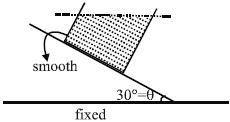
$A$ container of liquid is released from rest on a smooth inclined plane as shown in the figure. The length of the inclined plane is sufficient. Assume the liquid finally reaches equilibrium relative to the container. The final liquid surface makes an angle with the horizontal of ...... $^o$.
A
$60$
B
$45$
C
$30$
D
None of these
Solution
(C) The acceleration of the container sliding down a smooth inclined plane is $a = g \sin \theta$. Given $\theta = 30^o$,$a = g \sin 30^o = g/2$.
In the non-inertial frame of the container,a liquid particle on the surface experiences a pseudo-force $ma$ directed up the incline and gravity $mg$ directed downwards.
The effective acceleration $\vec{g}_{eff} = \vec{g} - \vec{a}$.
The angle $\alpha$ that the liquid surface makes with the horizontal is given by the formula $\tan \alpha = \frac{a \cos \theta}{g - a \sin \theta}$.
Substituting $a = g \sin \theta$:
$\tan \alpha = \frac{(g \sin \theta) \cos \theta}{g - (g \sin \theta) \sin \theta} = \frac{g \sin \theta \cos \theta}{g(1 - \sin^2 \theta)} = \frac{\sin \theta \cos \theta}{\cos^2 \theta} = \tan \theta$.
Thus,$\alpha = \theta = 30^o$.
In the non-inertial frame of the container,a liquid particle on the surface experiences a pseudo-force $ma$ directed up the incline and gravity $mg$ directed downwards.
The effective acceleration $\vec{g}_{eff} = \vec{g} - \vec{a}$.
The angle $\alpha$ that the liquid surface makes with the horizontal is given by the formula $\tan \alpha = \frac{a \cos \theta}{g - a \sin \theta}$.
Substituting $a = g \sin \theta$:
$\tan \alpha = \frac{(g \sin \theta) \cos \theta}{g - (g \sin \theta) \sin \theta} = \frac{g \sin \theta \cos \theta}{g(1 - \sin^2 \theta)} = \frac{\sin \theta \cos \theta}{\cos^2 \theta} = \tan \theta$.
Thus,$\alpha = \theta = 30^o$.
0 likes
View Solution60
DifficultMCQ
When an air bubble of radius $r$ rises from the bottom to the surface of a lake,its radius becomes $\frac{5r}{4}$. Taking the atmospheric pressure to be equal to $10 \ m$ height of water column,the depth of the lake would approximately be ....... $m$ (ignore the surface tension and the effect of temperature).
A
$10.5$
B
$8.7$
C
$11.2$
D
$9.5$
Solution
(D) Let the depth of the lake be $h$. The pressure at the bottom of the lake is $P_1 = P_{atm} + \rho gh$,where $P_{atm} = \rho g(10)$.
Thus,$P_1 = \rho g(10 + h)$.
The pressure at the surface is $P_2 = P_{atm} = \rho g(10)$.
Using Boyle's Law,$P_1 V_1 = P_2 V_2$,assuming temperature is constant.
$\rho g(10 + h) \cdot \frac{4}{3} \pi r^3 = \rho g(10) \cdot \frac{4}{3} \pi \left( \frac{5r}{4} \right)^3$.
$(10 + h) = 10 \cdot \frac{125}{64}$.
$10 + h = \frac{1250}{64} = 19.53$.
$h = 19.53 - 10 = 9.53 \ m$.
Rounding to the nearest value,the depth is $9.5 \ m$.
Thus,$P_1 = \rho g(10 + h)$.
The pressure at the surface is $P_2 = P_{atm} = \rho g(10)$.
Using Boyle's Law,$P_1 V_1 = P_2 V_2$,assuming temperature is constant.
$\rho g(10 + h) \cdot \frac{4}{3} \pi r^3 = \rho g(10) \cdot \frac{4}{3} \pi \left( \frac{5r}{4} \right)^3$.
$(10 + h) = 10 \cdot \frac{125}{64}$.
$10 + h = \frac{1250}{64} = 19.53$.
$h = 19.53 - 10 = 9.53 \ m$.
Rounding to the nearest value,the depth is $9.5 \ m$.
0 likes
View Solution61
DifficultMCQ
$A$ large number of droplets,each of radius $r$,coalesce to form a bigger drop of radius $R$. An engineer designs a machine so that the energy released in this process is converted into the kinetic energy of the drop. The velocity of the drop is ($T=$ surface tension,$\rho =$ density)
A
${\left[ {\frac{T}{\rho }\left( {\frac{1}{r} - \frac{1}{R}} \right)} \right]^{1/2}}$
B
${\left[ {\frac{6T}{\rho }\left( {\frac{1}{r} - \frac{1}{R}} \right)} \right]^{1/2}}$
C
${\left[ {\frac{3T}{\rho }\left( {\frac{1}{r} - \frac{1}{R}} \right)} \right]^{1/2}}$
D
${\left[ {\frac{2T}{\rho }\left( {\frac{1}{r} - \frac{1}{R}} \right)} \right]^{1/2}}$
Solution
(B) When small droplets coalesce to form a bigger drop,the change in surface area is $\Delta A = n(4\pi r^2) - 4\pi R^2$. Since the volume is conserved,$n(\frac{4}{3}\pi r^3) = \frac{4}{3}\pi R^3$,so $n = \frac{R^3}{r^3}$.
The energy released is $\Delta E = T \times \Delta A = T(n 4\pi r^2 - 4\pi R^2) = 4\pi T (\frac{R^3}{r} - R^2) = 4\pi R^3 T (\frac{1}{r} - \frac{1}{R})$.
According to the problem,this energy is converted into the kinetic energy of the big drop: $\frac{1}{2} M v^2 = \Delta E$.
Here,$M = \rho \times \text{Volume} = \rho (\frac{4}{3}\pi R^3)$.
Substituting the values: $\frac{1}{2} (\frac{4}{3}\pi R^3 \rho) v^2 = 4\pi R^3 T (\frac{1}{r} - \frac{1}{R})$.
Simplifying: $\frac{2}{3} \pi R^3 \rho v^2 = 4\pi R^3 T (\frac{1}{r} - \frac{1}{R})$.
$v^2 = \frac{4 \times 3}{2} \frac{T}{\rho} (\frac{1}{r} - \frac{1}{R}) = \frac{6T}{\rho} (\frac{1}{r} - \frac{1}{R})$.
Thus,$v = {\left[ {\frac{{6T}}{\rho }\left( {\frac{1}{r} - \frac{1}{R}} \right)} \right]^{\frac{1}{2}}}$.
The energy released is $\Delta E = T \times \Delta A = T(n 4\pi r^2 - 4\pi R^2) = 4\pi T (\frac{R^3}{r} - R^2) = 4\pi R^3 T (\frac{1}{r} - \frac{1}{R})$.
According to the problem,this energy is converted into the kinetic energy of the big drop: $\frac{1}{2} M v^2 = \Delta E$.
Here,$M = \rho \times \text{Volume} = \rho (\frac{4}{3}\pi R^3)$.
Substituting the values: $\frac{1}{2} (\frac{4}{3}\pi R^3 \rho) v^2 = 4\pi R^3 T (\frac{1}{r} - \frac{1}{R})$.
Simplifying: $\frac{2}{3} \pi R^3 \rho v^2 = 4\pi R^3 T (\frac{1}{r} - \frac{1}{R})$.
$v^2 = \frac{4 \times 3}{2} \frac{T}{\rho} (\frac{1}{r} - \frac{1}{R}) = \frac{6T}{\rho} (\frac{1}{r} - \frac{1}{R})$.
Thus,$v = {\left[ {\frac{{6T}}{\rho }\left( {\frac{1}{r} - \frac{1}{R}} \right)} \right]^{\frac{1}{2}}}$.
0 likes
View Solution62
DifficultMCQ
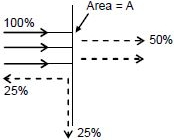
$A$ liquid of density $\rho$ is coming out of a hose pipe of cross-sectional area $A$ with horizontal speed $v$ and hits a mesh. $50\%$ of the liquid passes through the mesh unaffected. $25\%$ loses all of its momentum and $25\%$ comes back with the same speed. The resultant pressure on the mesh will be
A
$\frac{1}{4} \rho v^2$
B
$\frac{3}{4} \rho v^2$
C
$\frac{1}{2} \rho v^2$
D
$\rho v^2$
Solution
(B) Let the mass flow rate be $\frac{dm}{dt} = \rho A v$. The force exerted on the mesh is equal to the rate of change of momentum of the liquid.
For the $50\%$ of liquid passing through: $\Delta p = 0$,so $F_1 = 0$.
For the $25\%$ of liquid that loses all momentum: $\Delta p = (0.25 \frac{dm}{dt})v - 0 = 0.25 \rho A v^2$.
For the $25\%$ of liquid that bounces back: $\Delta p = (0.25 \frac{dm}{dt})v - (0.25 \frac{dm}{dt})(-v) = 0.5 \rho A v^2$.
The total force $F = F_1 + F_2 + F_3 = 0 + 0.25 \rho A v^2 + 0.5 \rho A v^2 = 0.75 \rho A v^2 = \frac{3}{4} \rho A v^2$.
The pressure $P = \frac{F}{A} = \frac{3}{4} \rho v^2$.
For the $50\%$ of liquid passing through: $\Delta p = 0$,so $F_1 = 0$.
For the $25\%$ of liquid that loses all momentum: $\Delta p = (0.25 \frac{dm}{dt})v - 0 = 0.25 \rho A v^2$.
For the $25\%$ of liquid that bounces back: $\Delta p = (0.25 \frac{dm}{dt})v - (0.25 \frac{dm}{dt})(-v) = 0.5 \rho A v^2$.
The total force $F = F_1 + F_2 + F_3 = 0 + 0.25 \rho A v^2 + 0.5 \rho A v^2 = 0.75 \rho A v^2 = \frac{3}{4} \rho A v^2$.
The pressure $P = \frac{F}{A} = \frac{3}{4} \rho v^2$.
0 likes
View Solution63
MediumMCQ
$A$ long cylindrical vessel is half filled with a liquid. When the vessel is rotated about its own vertical axis,the liquid rises up near the wall. If the radius of the vessel is $5 \, cm$ and its rotational speed is $2$ rotations per second,then the difference in the heights between the centre and the sides,in $cm$,will be
A
$2.0$
B
$0.1$
C
$0.4$
D
$1.2$
Solution
(A) The shape of the free surface of a liquid in a rotating cylinder is a parabola given by the equation $y = \frac{\omega^2 r^2}{2g}$,where $y$ is the height difference between the center and the wall at radius $r$.
Given:
Radius $r = 5 \, cm = 0.05 \, m$
Rotational frequency $f = 2 \, rev/s$
Angular velocity $\omega = 2 \pi f = 2 \pi \times 2 = 4 \pi \, rad/s$
Acceleration due to gravity $g \approx 10 \, m/s^2$
Substituting the values:
$y = \frac{(4 \pi)^2 \times (0.05)^2}{2 \times 10}$
$y = \frac{16 \times \pi^2 \times 0.0025}{20}$
Using $\pi^2 \approx 10$:
$y = \frac{16 \times 10 \times 0.0025}{20} = \frac{0.4}{20} = 0.02 \, m = 2 \, cm$.
Given:
Radius $r = 5 \, cm = 0.05 \, m$
Rotational frequency $f = 2 \, rev/s$
Angular velocity $\omega = 2 \pi f = 2 \pi \times 2 = 4 \pi \, rad/s$
Acceleration due to gravity $g \approx 10 \, m/s^2$
Substituting the values:
$y = \frac{(4 \pi)^2 \times (0.05)^2}{2 \times 10}$
$y = \frac{16 \times \pi^2 \times 0.0025}{20}$
Using $\pi^2 \approx 10$:
$y = \frac{16 \times 10 \times 0.0025}{20} = \frac{0.4}{20} = 0.02 \, m = 2 \, cm$.
0 likes
View Solution64
MediumMCQ
Two identical cylindrical vessels with their bases at the same level, each contains a liquid of density $d$. The height of the liquid in one vessel is $h_1$ and that in the other vessel is $h_2$. The area of either base is $A$. The work done by gravity in equalizing the levels when the two vessels are connected is
A
$(h_1 - h_2)gd$
B
$(h_1 - h_2)gAd$
C
$\frac{1}{2}(h_1 - h_2)^2gAd$
D
$\frac{1}{4}(h_1 - h_2)^2gAd$
Solution
(D) The work done by gravity is equal to the decrease in the potential energy of the liquid system.
Initial potential energy $U_i = (m_1 g \frac{h_1}{2}) + (m_2 g \frac{h_2}{2}) = (A h_1 d g \frac{h_1}{2}) + (A h_2 d g \frac{h_2}{2}) = \frac{Adg}{2}(h_1^2 + h_2^2)$.
When connected, the final height in both vessels will be $h_{avg} = \frac{h_1 + h_2}{2}$.
Final potential energy $U_f = 2 \times (A h_{avg} d g \frac{h_{avg}}{2}) = A d g h_{avg}^2 = Adg (\frac{h_1 + h_2}{2})^2$.
Work done $W = U_i - U_f = \frac{Adg}{2}(h_1^2 + h_2^2) - Adg \frac{(h_1 + h_2)^2}{4}$.
$W = \frac{Adg}{4} [2(h_1^2 + h_2^2) - (h_1^2 + h_2^2 + 2h_1h_2)] = \frac{Adg}{4} (h_1^2 + h_2^2 - 2h_1h_2) = \frac{1}{4} Adg (h_1 - h_2)^2$.
Initial potential energy $U_i = (m_1 g \frac{h_1}{2}) + (m_2 g \frac{h_2}{2}) = (A h_1 d g \frac{h_1}{2}) + (A h_2 d g \frac{h_2}{2}) = \frac{Adg}{2}(h_1^2 + h_2^2)$.
When connected, the final height in both vessels will be $h_{avg} = \frac{h_1 + h_2}{2}$.
Final potential energy $U_f = 2 \times (A h_{avg} d g \frac{h_{avg}}{2}) = A d g h_{avg}^2 = Adg (\frac{h_1 + h_2}{2})^2$.
Work done $W = U_i - U_f = \frac{Adg}{2}(h_1^2 + h_2^2) - Adg \frac{(h_1 + h_2)^2}{4}$.
$W = \frac{Adg}{4} [2(h_1^2 + h_2^2) - (h_1^2 + h_2^2 + 2h_1h_2)] = \frac{Adg}{4} (h_1^2 + h_2^2 - 2h_1h_2) = \frac{1}{4} Adg (h_1 - h_2)^2$.
0 likes
View Solution65
MediumMCQ
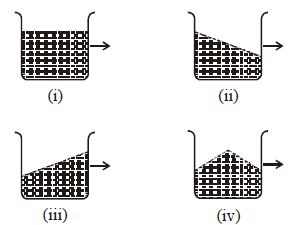
$A$ vessel containing water is moving with a constant speed towards the right along a straight horizontal path. Which of the following diagrams represents the surface of the liquid?
A
$(i)$
B
$(ii)$
C
$(iii)$
D
$(iv)$
Solution
(A) When a vessel containing a liquid moves with a constant velocity (constant speed in a straight line),its acceleration is zero $(a = 0)$.
In the frame of reference of the vessel,there is no pseudo force acting on the liquid because the frame is inertial.
Since the only force acting on the liquid particles is gravity (acting downwards),the free surface of the liquid must remain perpendicular to the effective acceleration due to gravity.
Therefore,the surface of the liquid remains horizontal,just as it would be if the vessel were at rest.
Diagram $(i)$ shows a horizontal liquid surface,which is consistent with this condition.
Hence,option $A$ is correct.
In the frame of reference of the vessel,there is no pseudo force acting on the liquid because the frame is inertial.
Since the only force acting on the liquid particles is gravity (acting downwards),the free surface of the liquid must remain perpendicular to the effective acceleration due to gravity.
Therefore,the surface of the liquid remains horizontal,just as it would be if the vessel were at rest.
Diagram $(i)$ shows a horizontal liquid surface,which is consistent with this condition.
Hence,option $A$ is correct.
0 likes
View Solution66
EasyMCQ
$A$ liquid is kept in a closed vessel. If a glass plate (negligible mass) with a small hole is kept on top of the liquid surface,then the vapour pressure of the liquid in the vessel is
A
More than what would be if the glass plate were removed
B
Same as what would be if the glass plate were removed
C
Less than what would be if the glass plate were removed
D
Cannot be predicted
Solution
(B) The vapour pressure $(V.P.)$ of a liquid is a characteristic property that depends solely on the temperature of the liquid and the nature of the liquid itself.
It is independent of the surface area of the liquid exposed to the vapour phase or the presence of any inert objects (like a glass plate) floating on the surface.
Since the temperature of the system remains constant,the vapour pressure will remain the same regardless of whether the glass plate is present or removed.
It is independent of the surface area of the liquid exposed to the vapour phase or the presence of any inert objects (like a glass plate) floating on the surface.
Since the temperature of the system remains constant,the vapour pressure will remain the same regardless of whether the glass plate is present or removed.
0 likes
View Solution67
MediumMCQ
Consider the following two statements $A$ and $B$,and identify the correct choice in the given answers.
$A :$ The excess pressure inside a small liquid drop is more than that of a big drop.
$B :$ As the aeroplane moves fast on the runway,the pressure is more on the upper surface of its wings and less on the bottom surface of the wings.
$A :$ The excess pressure inside a small liquid drop is more than that of a big drop.
$B :$ As the aeroplane moves fast on the runway,the pressure is more on the upper surface of its wings and less on the bottom surface of the wings.
A
Both $A$ and $B$ are true
B
$A$ is true but $B$ is false
C
$A$ is false but $B$ is true
D
Both $A$ and $B$ are false
Solution
(B) Statement $A$ is true. The excess pressure inside a liquid drop is given by $P = \frac{2T}{R}$,where $T$ is the surface tension and $R$ is the radius of the drop. Since $P \propto \frac{1}{R}$,the excess pressure is inversely proportional to the radius. Therefore,a smaller drop has higher excess pressure than a larger drop.
Statement $B$ is false. According to Bernoulli's principle,for an aeroplane wing,the shape is designed such that air flows faster over the top surface than the bottom surface. Higher speed results in lower pressure on the top surface and higher pressure on the bottom surface,which creates the lift force. Thus,the pressure is actually less on the upper surface and more on the bottom surface.
Statement $B$ is false. According to Bernoulli's principle,for an aeroplane wing,the shape is designed such that air flows faster over the top surface than the bottom surface. Higher speed results in lower pressure on the top surface and higher pressure on the bottom surface,which creates the lift force. Thus,the pressure is actually less on the upper surface and more on the bottom surface.
0 likes
View Solution68
MediumMCQ
$Assertion :$ $A$ thin stainless steel needle can float on a still water surface.
$Reason :$ Any object floats when the buoyancy force balances the weight of the object.
$Reason :$ Any object floats when the buoyancy force balances the weight of the object.
A
If both $Assertion$ and $Reason$ are correct and the $Reason$ is a correct explanation of the $Assertion$.
B
If both $Assertion$ and $Reason$ are correct but $Reason$ is not a correct explanation of the $Assertion$.
C
If the $Assertion$ is correct but $Reason$ is incorrect.
D
If both the $Assertion$ and $Reason$ are incorrect.
Solution
(B) The $Assertion$ is correct because a thin stainless steel needle can float on a still water surface due to the surface tension of water.
The $Reason$ is also a correct statement in physics,as an object floats when the buoyant force equals its weight (Archimedes' Principle).
However,the $Reason$ is not the correct explanation for the $Assertion$. The needle floats not because of buoyancy,but because the surface tension force acts upwards to balance the weight of the needle.
Therefore,both are correct,but the $Reason$ does not explain the $Assertion$.
The $Reason$ is also a correct statement in physics,as an object floats when the buoyant force equals its weight (Archimedes' Principle).
However,the $Reason$ is not the correct explanation for the $Assertion$. The needle floats not because of buoyancy,but because the surface tension force acts upwards to balance the weight of the needle.
Therefore,both are correct,but the $Reason$ does not explain the $Assertion$.
0 likes
View Solution69
Medium
Fill in the blanks using the word$(s)$ from the list appended with each statement:
$(a)$ Surface tension of liquids generally . . . with temperatures (increases / decreases)
$(b)$ Viscosity of gases . . . with temperature,whereas viscosity of liquids . . . with temperature (increases / decreases)
$(c)$ For solids with elastic modulus of rigidity,the shearing force is proportional to . . .,while for fluids it is proportional to . . . (shear strain / rate of shear strain)
$(d)$ For a fluid in a steady flow,the increase in flow speed at a constriction follows (conservation of mass / Bernoulli's principle)
$(e)$ For the model of a plane in a wind tunnel,turbulence occurs at a . . . speed for turbulence for an actual plane (greater / smaller)
$(a)$ Surface tension of liquids generally . . . with temperatures (increases / decreases)
$(b)$ Viscosity of gases . . . with temperature,whereas viscosity of liquids . . . with temperature (increases / decreases)
$(c)$ For solids with elastic modulus of rigidity,the shearing force is proportional to . . .,while for fluids it is proportional to . . . (shear strain / rate of shear strain)
$(d)$ For a fluid in a steady flow,the increase in flow speed at a constriction follows (conservation of mass / Bernoulli's principle)
$(e)$ For the model of a plane in a wind tunnel,turbulence occurs at a . . . speed for turbulence for an actual plane (greater / smaller)
Solution
(A) Decreases: The surface tension of a liquid is inversely proportional to temperature.
$(b)$ Increases; decreases: Viscosity of gases increases with temperature due to increased molecular collisions,while viscosity of liquids decreases with temperature due to decreased cohesive forces.
$(c)$ Shear strain; rate of shear strain: For solids,the shearing force is proportional to shear strain (Hooke's Law),whereas for fluids,it is proportional to the rate of shear strain (Newton's Law of Viscosity).
$(d)$ Conservation of mass: The increase in flow speed at a constriction is primarily a consequence of the continuity equation,which is based on the conservation of mass.
$(e)$ Greater: For a model in a wind tunnel,the characteristic length is smaller,so to maintain the same Reynolds number as the actual plane,the flow speed must be greater.
$(b)$ Increases; decreases: Viscosity of gases increases with temperature due to increased molecular collisions,while viscosity of liquids decreases with temperature due to decreased cohesive forces.
$(c)$ Shear strain; rate of shear strain: For solids,the shearing force is proportional to shear strain (Hooke's Law),whereas for fluids,it is proportional to the rate of shear strain (Newton's Law of Viscosity).
$(d)$ Conservation of mass: The increase in flow speed at a constriction is primarily a consequence of the continuity equation,which is based on the conservation of mass.
$(e)$ Greater: For a model in a wind tunnel,the characteristic length is smaller,so to maintain the same Reynolds number as the actual plane,the flow speed must be greater.
0 likes
View Solution70
Medium
Explain why:
$(a)$ To keep a piece of paper horizontal,you should blow over,not under,it.
$(b)$ When we try to close a water tap with our fingers,fast jets of water gush through the openings between our fingers.
$(c)$ The size of the needle of a syringe controls flow rate better than the thumb pressure exerted by a doctor while administering an injection.
$(d)$ $A$ fluid flowing out of a small hole in a vessel results in a backward thrust on the vessel.
$(a)$ To keep a piece of paper horizontal,you should blow over,not under,it.
$(b)$ When we try to close a water tap with our fingers,fast jets of water gush through the openings between our fingers.
$(c)$ The size of the needle of a syringe controls flow rate better than the thumb pressure exerted by a doctor while administering an injection.
$(d)$ $A$ fluid flowing out of a small hole in a vessel results in a backward thrust on the vessel.
Solution
(N/A) According to Bernoulli's principle,as the velocity of a fluid increases,its pressure decreases. Blowing over the paper increases the air velocity above it,reducing the pressure above compared to below,which creates an upward lift to keep the paper horizontal.
$(b)$ According to the equation of continuity,$A_1v_1 = A_2v_2$ (Area $\times$ Velocity = Constant). When we partially close the tap with our fingers,the cross-sectional area of the opening decreases,causing the velocity of the water to increase significantly,resulting in fast jets.
$(c)$ The flow rate is governed by the equation of continuity. The needle has a very small cross-sectional area compared to the syringe barrel. Even a small change in the needle's diameter significantly affects the flow velocity,making it a more dominant factor in controlling the flow rate than the thumb pressure.
$(d)$ As fluid exits the hole with high velocity,it carries momentum. According to the law of conservation of momentum,to keep the total momentum of the system zero,the vessel must experience an equal and opposite momentum,resulting in a backward thrust.
$(b)$ According to the equation of continuity,$A_1v_1 = A_2v_2$ (Area $\times$ Velocity = Constant). When we partially close the tap with our fingers,the cross-sectional area of the opening decreases,causing the velocity of the water to increase significantly,resulting in fast jets.
$(c)$ The flow rate is governed by the equation of continuity. The needle has a very small cross-sectional area compared to the syringe barrel. Even a small change in the needle's diameter significantly affects the flow velocity,making it a more dominant factor in controlling the flow rate than the thumb pressure.
$(d)$ As fluid exits the hole with high velocity,it carries momentum. According to the law of conservation of momentum,to keep the total momentum of the system zero,the vessel must experience an equal and opposite momentum,resulting in a backward thrust.
1 likes
View Solution71
MediumMCQ
$A$ tank with a square base of area $1.0 \; m^{2}$ is divided by a vertical partition in the middle. The bottom of the partition has a small hinged door of area $20 \; cm^{2}$. The tank is filled with water in one compartment and an acid (of relative density $1.7$) in the other,both to a height of $4.0 \; m$. Compute the force (in $N$) necessary to keep the door closed.
A
$72.36$
B
$46.32$
C
$68.24$
D
$54.88$
Solution
(D) The base area of the tank is $A = 1.0 \; m^{2}$.
The area of the hinged door is $a = 20 \; cm^{2} = 20 \times 10^{-4} \; m^{2}$.
The density of water is $\rho_{1} = 10^{3} \; kg/m^{3}$.
The density of acid is $\rho_{2} = 1.7 \times 10^{3} \; kg/m^{3}$.
The height of both liquid columns is $h = 4.0 \; m$.
The pressure exerted by the water column at the bottom is $P_{1} = h \rho_{1} g = 4 \times 10^{3} \times 9.8 = 3.92 \times 10^{4} \; Pa$.
The pressure exerted by the acid column at the bottom is $P_{2} = h \rho_{2} g = 4 \times 1.7 \times 10^{3} \times 9.8 = 6.664 \times 10^{4} \; Pa$.
The pressure difference between the two columns is $\Delta P = P_{2} - P_{1} = (6.664 - 3.92) \times 10^{4} = 2.744 \times 10^{4} \; Pa$.
The force required to keep the door closed is $F = \Delta P \times a = 2.744 \times 10^{4} \times 20 \times 10^{-4} = 54.88 \; N$.
The area of the hinged door is $a = 20 \; cm^{2} = 20 \times 10^{-4} \; m^{2}$.
The density of water is $\rho_{1} = 10^{3} \; kg/m^{3}$.
The density of acid is $\rho_{2} = 1.7 \times 10^{3} \; kg/m^{3}$.
The height of both liquid columns is $h = 4.0 \; m$.
The pressure exerted by the water column at the bottom is $P_{1} = h \rho_{1} g = 4 \times 10^{3} \times 9.8 = 3.92 \times 10^{4} \; Pa$.
The pressure exerted by the acid column at the bottom is $P_{2} = h \rho_{2} g = 4 \times 1.7 \times 10^{3} \times 9.8 = 6.664 \times 10^{4} \; Pa$.
The pressure difference between the two columns is $\Delta P = P_{2} - P_{1} = (6.664 - 3.92) \times 10^{4} = 2.744 \times 10^{4} \; Pa$.
The force required to keep the door closed is $F = \Delta P \times a = 2.744 \times 10^{4} \times 20 \times 10^{-4} = 54.88 \; N$.
0 likes
View Solution72
Difficult
$(a)$ It is known that the density $\rho$ of air decreases with height $y$ as $\rho = \rho_{0} e^{-y / y_{0}}$,where $\rho_{0} = 1.25 \; kg \, m^{-3}$ is the density at sea level,and $y_{0}$ is a constant. This density variation is called the law of atmospheres. Obtain this law assuming that the temperature of the atmosphere remains constant (isothermal conditions). Also,assume that the value of $g$ remains constant.
$(b)$ $A$ large $He$ balloon of volume $1425 \; m^{3}$ is used to lift a payload of $400 \; kg$. Assume that the balloon maintains a constant radius as it rises. How high does it rise?
[Take $y_{0} = 8000 \; m$ and $\rho_{He} = 0.18 \; kg \, m^{-3}$]
$(b)$ $A$ large $He$ balloon of volume $1425 \; m^{3}$ is used to lift a payload of $400 \; kg$. Assume that the balloon maintains a constant radius as it rises. How high does it rise?
[Take $y_{0} = 8000 \; m$ and $\rho_{He} = 0.18 \; kg \, m^{-3}$]
Solution
(N/A) Let $P$ be the pressure at height $y$. The change in pressure $dP$ for a small change in height $dy$ is $dP = -\rho g dy$.
Since the atmosphere is isothermal,$PV = nRT$,which implies $P = \frac{\rho RT}{M}$,where $M$ is the molar mass of air.
Thus,$\rho = \frac{PM}{RT}$. Substituting this into the pressure equation: $dP = -\frac{PM}{RT} g dy$,or $\frac{dP}{P} = -\frac{Mg}{RT} dy$.
Integrating from $y=0$ (where $P=P_{0}$) to $y$ (where $P=P$): $\ln(\frac{P}{P_{0}}) = -\frac{Mg}{RT} y$.
So,$P = P_{0} e^{-y/y_{0}}$,where $y_{0} = \frac{RT}{Mg}$. Since $\rho \propto P$ at constant temperature,$\rho = \rho_{0} e^{-y/y_{0}}$.
$(b)$ The balloon rises until its density $\rho$ equals the density of the surrounding air.
Total mass of the balloon system $M_{total} = m_{payload} + m_{He} = 400 + (1425 \times 0.18) = 400 + 256.5 = 656.5 \; kg$.
Density of the balloon $\rho = \frac{M_{total}}{V} = \frac{656.5}{1425} \approx 0.4607 \; kg \, m^{-3}$.
Using the law of atmospheres: $\rho = \rho_{0} e^{-y/y_{0}} \implies 0.4607 = 1.25 e^{-y/8000}$.
$\ln(\frac{0.4607}{1.25}) = -\frac{y}{8000} \implies \ln(0.36856) = -\frac{y}{8000}$.
$-0.998 \approx -\frac{y}{8000} \implies y \approx 8000 \; m = 8 \; km$.
Since the atmosphere is isothermal,$PV = nRT$,which implies $P = \frac{\rho RT}{M}$,where $M$ is the molar mass of air.
Thus,$\rho = \frac{PM}{RT}$. Substituting this into the pressure equation: $dP = -\frac{PM}{RT} g dy$,or $\frac{dP}{P} = -\frac{Mg}{RT} dy$.
Integrating from $y=0$ (where $P=P_{0}$) to $y$ (where $P=P$): $\ln(\frac{P}{P_{0}}) = -\frac{Mg}{RT} y$.
So,$P = P_{0} e^{-y/y_{0}}$,where $y_{0} = \frac{RT}{Mg}$. Since $\rho \propto P$ at constant temperature,$\rho = \rho_{0} e^{-y/y_{0}}$.
$(b)$ The balloon rises until its density $\rho$ equals the density of the surrounding air.
Total mass of the balloon system $M_{total} = m_{payload} + m_{He} = 400 + (1425 \times 0.18) = 400 + 256.5 = 656.5 \; kg$.
Density of the balloon $\rho = \frac{M_{total}}{V} = \frac{656.5}{1425} \approx 0.4607 \; kg \, m^{-3}$.
Using the law of atmospheres: $\rho = \rho_{0} e^{-y/y_{0}} \implies 0.4607 = 1.25 e^{-y/8000}$.
$\ln(\frac{0.4607}{1.25}) = -\frac{y}{8000} \implies \ln(0.36856) = -\frac{y}{8000}$.
$-0.998 \approx -\frac{y}{8000} \implies y \approx 8000 \; m = 8 \; km$.
0 likes
View Solution73
Medium
Liquid and gas both are fluids; distinguish between them and state which property is common between them.
Solution
(N/A) Liquid and gas are both classified as fluids. The fundamental differences are as follows:
$1$. Liquids are generally considered incompressible,whereas gases are highly compressible.
$2$. $A$ liquid has a fixed volume and a free surface,while a gas occupies the entire volume of its container and has no free surface.
The common property between them is that both can flow easily and offer very little resistance to shear stress.
$1$. Liquids are generally considered incompressible,whereas gases are highly compressible.
$2$. $A$ liquid has a fixed volume and a free surface,while a gas occupies the entire volume of its container and has no free surface.
The common property between them is that both can flow easily and offer very little resistance to shear stress.
0 likes
View Solution74
Easy
Write two parts of fluid mechanics and what studies are made in them?
Solution
(N/A) $(1)$ Fluid Statics: In this branch of fluid mechanics,the forces and pressures acting on a stationary fluid are studied.
$(2)$ Fluid Dynamics: In this branch of fluid mechanics,the motion of fluid and properties related to it as a result of forces acting on the fluid are studied.
$(2)$ Fluid Dynamics: In this branch of fluid mechanics,the motion of fluid and properties related to it as a result of forces acting on the fluid are studied.
0 likes
View Solution75
Medium
What is fluid statics? $OR$ What is fluid mechanics?
Solution
(N/A) Fluid mechanics is the branch of physics that deals with the behavior of fluids (liquids and gases) at rest and in motion. It is broadly divided into two main branches:
$1$. Fluid Statics: This is the study of fluids at rest. It focuses on the properties of fluids in equilibrium,such as pressure distribution and buoyancy,where there is no relative motion between fluid particles.
$2$. Fluid Dynamics: This is the study of fluids in motion. It deals with the forces acting on fluids and the resulting flow patterns,including concepts like viscosity,turbulence,and Bernoulli's principle.
$1$. Fluid Statics: This is the study of fluids at rest. It focuses on the properties of fluids in equilibrium,such as pressure distribution and buoyancy,where there is no relative motion between fluid particles.
$2$. Fluid Dynamics: This is the study of fluids in motion. It deals with the forces acting on fluids and the resulting flow patterns,including concepts like viscosity,turbulence,and Bernoulli's principle.
0 likes
View Solution76
Medium
What is dynamic lift?
Solution
(N/A) Dynamic lift is the force that acts on a body,such as an airplane wing,a hydrofoil,or a spinning ball,by virtue of its motion through a fluid.
It occurs when a body moves through a fluid (like air or water) and experiences a pressure difference due to its shape,orientation,or rotation (the Magnus effect).
In many sports such as cricket,tennis,baseball,or golf,dynamic lift is observed when a spinning ball deviates from its expected parabolic trajectory due to the interaction between its spin and the surrounding air.
It occurs when a body moves through a fluid (like air or water) and experiences a pressure difference due to its shape,orientation,or rotation (the Magnus effect).
In many sports such as cricket,tennis,baseball,or golf,dynamic lift is observed when a spinning ball deviates from its expected parabolic trajectory due to the interaction between its spin and the surrounding air.
0 likes
View Solution77
EasyMCQ
Why is skating possible on ice?
A
Due to the high friction of ice.
B
Due to the formation of a thin water layer under pressure.
C
Due to the low temperature of ice.
D
Due to the hardness of the ice surface.
Solution
(B) Skating is possible on ice because of the phenomenon of 'Regelation'.
When a skater stands on ice,the pressure exerted by the skates on the ice surface is very high due to the small surface area of the blade.
According to the phase diagram of water,an increase in pressure lowers the melting point of ice.
As a result,the ice directly beneath the skate blade melts into a thin layer of water,which acts as a lubricant.
This reduces the friction significantly,allowing the skater to glide smoothly over the surface.
Once the pressure is removed,the water refreezes into ice.
When a skater stands on ice,the pressure exerted by the skates on the ice surface is very high due to the small surface area of the blade.
According to the phase diagram of water,an increase in pressure lowers the melting point of ice.
As a result,the ice directly beneath the skate blade melts into a thin layer of water,which acts as a lubricant.
This reduces the friction significantly,allowing the skater to glide smoothly over the surface.
Once the pressure is removed,the water refreezes into ice.
0 likes
View Solution78
EasyMCQ
Why can liquids flow?
A
Because the intermolecular forces are very strong.
B
Because the intermolecular forces are weak and molecules can move past each other.
C
Because the molecules are fixed in a rigid structure.
D
Because the kinetic energy of molecules is zero.
Solution
(B) Liquids can flow because the intermolecular forces between their molecules are weaker than those in solids.
This allows the molecules to slide over one another,providing the property of fluidity.
Unlike solids,where molecules are held in a fixed position,liquid molecules have enough kinetic energy to overcome the weak attractive forces,enabling them to take the shape of their container.
This allows the molecules to slide over one another,providing the property of fluidity.
Unlike solids,where molecules are held in a fixed position,liquid molecules have enough kinetic energy to overcome the weak attractive forces,enabling them to take the shape of their container.
0 likes
View Solution79
Medium
Give the limitations and uses of turbulence.
Solution
(N/A) Turbulence dissipates kinetic energy,usually in the form of heat.
Racing cars and planes are engineered to precision in order to minimize turbulence.
On the other hand,turbulence is sometimes desirable. Turbulence promotes mixing and increases the rates of transfer of mass,momentum,and energy.
The blades of a kitchen mixer induce turbulent flow,which helps in preparing thick milkshakes and beating eggs into a uniform texture.
Racing cars and planes are engineered to precision in order to minimize turbulence.
On the other hand,turbulence is sometimes desirable. Turbulence promotes mixing and increases the rates of transfer of mass,momentum,and energy.
The blades of a kitchen mixer induce turbulent flow,which helps in preparing thick milkshakes and beating eggs into a uniform texture.
0 likes
View Solution80
Medium
Write the uses of turbulence.
Solution
(N/A) Turbulence is a complex fluid motion characterized by chaotic changes in pressure and flow velocity. While often considered a nuisance in engineering due to increased drag,it has several practical applications:
$1$. Mixing: Turbulence is highly effective at mixing fluids,such as in chemical reactors or in the atmosphere,where it helps disperse pollutants.
$2$. Heat Transfer: Turbulent flow significantly enhances heat transfer rates between a fluid and a solid surface,which is essential in heat exchangers,radiators,and cooling systems.
$3$. Combustion: In internal combustion engines and gas turbines,turbulence is used to mix fuel and air rapidly,ensuring efficient and complete combustion.
$4$. Aerodynamics: In some cases,such as on the surface of a golf ball,controlled turbulence (via dimples) is used to reduce drag by delaying flow separation.
$1$. Mixing: Turbulence is highly effective at mixing fluids,such as in chemical reactors or in the atmosphere,where it helps disperse pollutants.
$2$. Heat Transfer: Turbulent flow significantly enhances heat transfer rates between a fluid and a solid surface,which is essential in heat exchangers,radiators,and cooling systems.
$3$. Combustion: In internal combustion engines and gas turbines,turbulence is used to mix fuel and air rapidly,ensuring efficient and complete combustion.
$4$. Aerodynamics: In some cases,such as on the surface of a golf ball,controlled turbulence (via dimples) is used to reduce drag by delaying flow separation.
0 likes
View Solution81
Medium
Fill in the blanks:
$(i)$ The cohesive force between the molecules of liquid is more than the adhesive force between the molecules of the plate, then the angle of contact obtained is ...... (acute/obtuse) and the free surface has a shape of ...... (concave/convex).
$(ii)$ The cohesive force between the molecules of liquid is less than the adhesive force between the molecules of the plate, then the angle of contact obtained is ...... (acute/obtuse) and the free surface has a shape of ...... (concave/convex).
$(iii)$ $A$ large pressure is exerted on the surface of a liquid having a shape of .......... (concave/convex).
$(i)$ The cohesive force between the molecules of liquid is more than the adhesive force between the molecules of the plate, then the angle of contact obtained is ...... (acute/obtuse) and the free surface has a shape of ...... (concave/convex).
$(ii)$ The cohesive force between the molecules of liquid is less than the adhesive force between the molecules of the plate, then the angle of contact obtained is ...... (acute/obtuse) and the free surface has a shape of ...... (concave/convex).
$(iii)$ $A$ large pressure is exerted on the surface of a liquid having a shape of .......... (concave/convex).
Solution
(D) $(i)$ When cohesive force $ > $ adhesive force, the liquid does not wet the surface. The angle of contact is obtuse $( > 90^{\circ})$ and the meniscus is convex.
$(ii)$ When cohesive force $ < $ adhesive force, the liquid wets the surface. The angle of contact is acute $( < 90^{\circ})$ and the meniscus is concave.
$(iii)$ Due to surface tension, the pressure on the concave side is always greater than the pressure on the convex side. Therefore, a large pressure is exerted on the concave side of the liquid surface.
$(ii)$ When cohesive force $ < $ adhesive force, the liquid wets the surface. The angle of contact is acute $( < 90^{\circ})$ and the meniscus is concave.
$(iii)$ Due to surface tension, the pressure on the concave side is always greater than the pressure on the convex side. Therefore, a large pressure is exerted on the concave side of the liquid surface.
0 likes
View Solution82
Medium
Explain why bullets of a gun are cylindrical in shape.
Solution
(N/A) spinning cylinder moves in a straight path along the direction of its rotational axis. Because of this symmetry,the Magnus effect (which causes lateral force on a spinning object moving through a fluid) is effectively neutralized or balanced,preventing the bullet from deviating from its intended trajectory. For this reason,bullets are designed to be cylindrical.
0 likes
View Solution83
Medium
State whether the following statements are True or False:
$(i)$ In incompressible flow,the density of a fluid changes with time and position.
$(ii)$ Non-viscous flow can be a streamline flow.
$(iii)$ In a steady flow,the velocity of the fluid at each point remains identical with time.
$(i)$ In incompressible flow,the density of a fluid changes with time and position.
$(ii)$ Non-viscous flow can be a streamline flow.
$(iii)$ In a steady flow,the velocity of the fluid at each point remains identical with time.
Solution
(A) $(i)$ False. In an incompressible flow,the density $\rho$ of the fluid remains constant throughout the flow.
$(ii)$ False. $A$ non-viscous fluid has a coefficient of viscosity $\eta = 0$. From the Reynolds number formula $R_{e} = \frac{\rho v D}{\eta}$,as $\eta \to 0$,$R_{e} \to \infty$. Such a flow is typically turbulent and cannot be a streamline flow.
$(iii)$ True. By definition,in a steady flow,the velocity of the fluid particles at any given point in space does not change with time.
$(ii)$ False. $A$ non-viscous fluid has a coefficient of viscosity $\eta = 0$. From the Reynolds number formula $R_{e} = \frac{\rho v D}{\eta}$,as $\eta \to 0$,$R_{e} \to \infty$. Such a flow is typically turbulent and cannot be a streamline flow.
$(iii)$ True. By definition,in a steady flow,the velocity of the fluid particles at any given point in space does not change with time.
0 likes
View Solution84
Medium
State whether the following statements are True or False:
$(i)$ The Bernoulli equation can be considered to be a statement of the conservation of energy.
$(ii)$ The angle of contact between a drop of water and the material of a raincoat is an acute angle.
$(iii)$ The absence of roughness between two consecutive layers of fluid is the definition of viscosity.
$(i)$ The Bernoulli equation can be considered to be a statement of the conservation of energy.
$(ii)$ The angle of contact between a drop of water and the material of a raincoat is an acute angle.
$(iii)$ The absence of roughness between two consecutive layers of fluid is the definition of viscosity.
Solution
(N/A) $(i)$ True. The Bernoulli equation is derived from the work-energy theorem,representing the conservation of energy for an incompressible,non-viscous,and steady flow of fluid.
$(ii)$ False. Raincoats are made of hydrophobic materials to repel water. The angle of contact between water and a hydrophobic surface is an obtuse angle (greater than $90^{\circ}$),which prevents the water from wetting the fabric.
$(iii)$ False. Viscosity is actually the measure of the internal friction or resistance to flow between adjacent layers of a fluid moving at different velocities. It is the presence of internal friction,not its absence,that defines viscosity.
$(ii)$ False. Raincoats are made of hydrophobic materials to repel water. The angle of contact between water and a hydrophobic surface is an obtuse angle (greater than $90^{\circ}$),which prevents the water from wetting the fabric.
$(iii)$ False. Viscosity is actually the measure of the internal friction or resistance to flow between adjacent layers of a fluid moving at different velocities. It is the presence of internal friction,not its absence,that defines viscosity.
0 likes
View Solution85
Medium
State whether the following statements are True or False:
$(i)$ If the weight of a body is greater than the buoyant force of the liquid,the body floats on the surface of the liquid.
$(ii)$ The velocity of water at the bottom of a river is always slower than at the surface.
$(iii)$ The angle of contact increases with an increase in the temperature of the liquid.
$(i)$ If the weight of a body is greater than the buoyant force of the liquid,the body floats on the surface of the liquid.
$(ii)$ The velocity of water at the bottom of a river is always slower than at the surface.
$(iii)$ The angle of contact increases with an increase in the temperature of the liquid.
Solution
(N/A) $(i)$ False. If the weight of the body is greater than the buoyant force,the body will sink in the liquid.
$(ii)$ True. Due to the viscosity of water and the friction between the water and the riverbed,the velocity of water is lowest at the bottom and highest near the surface.
$(iii)$ False. The angle of contact generally decreases as the temperature of the liquid increases because the surface tension of the liquid decreases with an increase in temperature.
$(ii)$ True. Due to the viscosity of water and the friction between the water and the riverbed,the velocity of water is lowest at the bottom and highest near the surface.
$(iii)$ False. The angle of contact generally decreases as the temperature of the liquid increases because the surface tension of the liquid decreases with an increase in temperature.
0 likes
View Solution86
Medium
Fill in the blanks:
$(i)$ The lines of flow and streamlines coincide with each other in ...... flow.
$(ii)$ The formula for the horizontal velocity of water coming from a hole at the bottom at a height $h$ from the surface of the water is ......
$(iii)$ $1 \ Pa = ...... \ dyne/cm^{2}$
$(iv)$ The relative velocity of two parallel layers of water is $6 \ cm/s$. If the perpendicular distance between the two layers is $0.1 \ mm$,then the velocity gradient will be ......
$(i)$ The lines of flow and streamlines coincide with each other in ...... flow.
$(ii)$ The formula for the horizontal velocity of water coming from a hole at the bottom at a height $h$ from the surface of the water is ......
$(iii)$ $1 \ Pa = ...... \ dyne/cm^{2}$
$(iv)$ The relative velocity of two parallel layers of water is $6 \ cm/s$. If the perpendicular distance between the two layers is $0.1 \ mm$,then the velocity gradient will be ......
Solution
(N/A) $(i)$ In steady flow,the path of a particle (line of flow) and the streamline coincide.
$(ii)$ According to Torricelli's law,the velocity of efflux is $v = \sqrt{2gh}$,where $g$ is the acceleration due to gravity.
$(iii)$ Since $1 \ Pa = 1 \ N/m^{2} = 10^{5} \ dyne / 10^{4} \ cm^{2} = 10 \ dyne/cm^{2}$.
$(iv)$ Velocity gradient $= \frac{dv}{dx} = \frac{6 \ cm/s}{0.1 \ mm} = \frac{6 \ cm/s}{0.01 \ cm} = 600 \ s^{-1}$.
$(ii)$ According to Torricelli's law,the velocity of efflux is $v = \sqrt{2gh}$,where $g$ is the acceleration due to gravity.
$(iii)$ Since $1 \ Pa = 1 \ N/m^{2} = 10^{5} \ dyne / 10^{4} \ cm^{2} = 10 \ dyne/cm^{2}$.
$(iv)$ Velocity gradient $= \frac{dv}{dx} = \frac{6 \ cm/s}{0.1 \ mm} = \frac{6 \ cm/s}{0.01 \ cm} = 600 \ s^{-1}$.
0 likes
View Solution87
Medium
Fill in the blanks:
$(i)$ The surface tension of water at critical temperature is ......
$(ii)$ Bernoulli's equation is based on the conservation of ......
$(iii)$ The energy would be ...... if $1$ large drop of water splits into $8$ small drops of water.
$(iv)$ When strong wind passes over a building,the force acting on the building is in the ......
$(i)$ The surface tension of water at critical temperature is ......
$(ii)$ Bernoulli's equation is based on the conservation of ......
$(iii)$ The energy would be ...... if $1$ large drop of water splits into $8$ small drops of water.
$(iv)$ When strong wind passes over a building,the force acting on the building is in the ......
Solution
(A) $(i)$ At the critical temperature,the interface between liquid and vapor disappears,so the surface tension is $0$.
$(ii)$ Bernoulli's equation is derived from the work-energy theorem,which is based on the law of conservation of energy.
$(iii)$ When a large drop splits into smaller drops,the total surface area increases. Since surface energy is proportional to surface area $(U = T \cdot A)$,the energy is absorbed (or the system requires energy),but in the context of surface tension problems,splitting a drop increases the surface energy,meaning energy is absorbed. However,if the question implies the change in energy,it is positive (absorbed).
$(iv)$ According to Bernoulli's principle,high wind speed over the roof creates low pressure,resulting in an upward lift force.
$(ii)$ Bernoulli's equation is derived from the work-energy theorem,which is based on the law of conservation of energy.
$(iii)$ When a large drop splits into smaller drops,the total surface area increases. Since surface energy is proportional to surface area $(U = T \cdot A)$,the energy is absorbed (or the system requires energy),but in the context of surface tension problems,splitting a drop increases the surface energy,meaning energy is absorbed. However,if the question implies the change in energy,it is positive (absorbed).
$(iv)$ According to Bernoulli's principle,high wind speed over the roof creates low pressure,resulting in an upward lift force.
0 likes
View Solution88
EasyMCQ
Different processes are given in Column-$I$ and their reasons are given in Column-$II$. Match them appropriately.
| Column-$I$ | Column-$II$ |
|---|---|
| $(a)$ Rain drops move downwards with constant velocity. | $(i)$ Viscous liquids |
| $(b)$ Floating clouds at a height in air. | $(ii)$ Viscosity |
| $(iii)$ Less density |
A
$(a-ii), (b-iii)$
B
$(a-i), (b-ii)$
C
$(a-i), (b-iii)$
D
$(a-iii), (b-ii)$
Solution
(A) Rain drops falling through the atmosphere reach a terminal velocity because the viscous drag force of the air balances the gravitational force. This is due to the property of viscosity. Thus,$(a-ii)$.
$(b)$ Clouds float at a height because their density is less than the density of the surrounding air,allowing them to remain suspended due to buoyancy. Thus,$(b-iii)$.
Therefore,the correct match is $(a-ii), (b-iii)$.
$(b)$ Clouds float at a height because their density is less than the density of the surrounding air,allowing them to remain suspended due to buoyancy. Thus,$(b-iii)$.
Therefore,the correct match is $(a-ii), (b-iii)$.
0 likes
View Solution89
DifficultMCQ
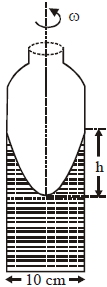
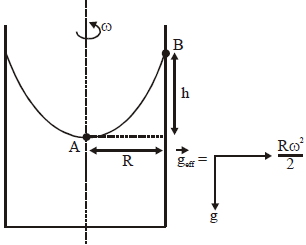
$A$ cylindrical vessel containing a liquid is rotated about its axis so that the liquid rises at its sides as shown in the figure. The diameter of the vessel is $10 \, cm$ and the angular speed of rotation is $\omega \, rad \, s^{-1}$. The difference in the height,$h$ (in $cm$),of the liquid at the centre of the vessel and at the side will be
A
$\frac{25 \omega^{2}}{2 g}$
B
$\frac{2 \omega^{2}}{5 g}$
C
$\frac{5 \omega^{2}}{2 g}$
D
$\frac{2 \omega^{2}}{25 g}$
Solution
(A) The surface of a rotating liquid takes the shape of a paraboloid defined by the equation $z = \frac{\omega^2 r^2}{2g}$.
Here,the diameter of the vessel is $10 \, cm$,so the radius $R = 5 \, cm$.
The difference in height $h$ between the center $(r=0)$ and the side $(r=R)$ is given by:
$h = \frac{\omega^2 R^2}{2g}$
Substituting $R = 5 \, cm$:
$h = \frac{\omega^2 (5)^2}{2g} = \frac{25 \omega^2}{2g}$.
Here,the diameter of the vessel is $10 \, cm$,so the radius $R = 5 \, cm$.
The difference in height $h$ between the center $(r=0)$ and the side $(r=R)$ is given by:
$h = \frac{\omega^2 R^2}{2g}$
Substituting $R = 5 \, cm$:
$h = \frac{\omega^2 (5)^2}{2g} = \frac{25 \omega^2}{2g}$.
0 likes
View Solution90
DifficultMCQ
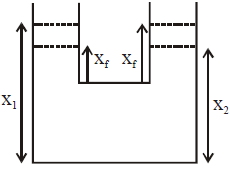
Two identical cylindrical vessels are kept on the ground and each contain the same liquid of density $d.$ The area of the base of both vessels is $S$ but the height of liquid in one vessel is $x_{1}$ and in the other,$x_{2}$. When both cylinders are connected through a pipe of negligible volume very close to the bottom,the liquid flows from one vessel to the other until it comes to equilibrium at a new height. The change in energy of the system in the process is
A
$gdS(x_{2}+x_{1})^{2}$
B
$\frac{3}{4} gdS(x_{2}-x_{1})^{2}$
C
$\frac{1}{4} gdS(x_{2}-x_{1})^{2}$
D
$gdS(x_{2}^{2}+x_{1}^{2})$
Solution
(C) The initial potential energy of the system is given by the sum of the potential energies of the liquid in both vessels:
$U_{i} = (dSx_{1})g \cdot \frac{x_{1}}{2} + (dSx_{2})g \cdot \frac{x_{2}}{2} = \frac{dSg}{2}(x_{1}^{2} + x_{2}^{2})$
By the principle of conservation of volume,the total volume of liquid remains constant:
$Sx_{1} + Sx_{2} = S(x_{f} + x_{f}) = 2Sx_{f}$
$x_{f} = \frac{x_{1} + x_{2}}{2}$
The final potential energy of the system is:
$U_{f} = 2 \times (dSx_{f})g \cdot \frac{x_{f}}{2} = dSgx_{f}^{2} = dSg \left( \frac{x_{1} + x_{2}}{2} \right)^{2}$
The change in potential energy is $\Delta U = U_{f} - U_{i}$:
$\Delta U = dSg \left[ \left( \frac{x_{1} + x_{2}}{2} \right)^{2} - \frac{x_{1}^{2} + x_{2}^{2}}{2} \right]$
$\Delta U = dSg \left[ \frac{x_{1}^{2} + x_{2}^{2} + 2x_{1}x_{2}}{4} - \frac{2x_{1}^{2} + 2x_{2}^{2}}{4} \right]$
$\Delta U = dSg \left[ \frac{2x_{1}x_{2} - x_{1}^{2} - x_{2}^{2}}{4} \right] = -\frac{dSg}{4}(x_{1} - x_{2})^{2}$
The magnitude of the change in energy is $\frac{1}{4} gdS(x_{2} - x_{1})^{2}$.
$U_{i} = (dSx_{1})g \cdot \frac{x_{1}}{2} + (dSx_{2})g \cdot \frac{x_{2}}{2} = \frac{dSg}{2}(x_{1}^{2} + x_{2}^{2})$
By the principle of conservation of volume,the total volume of liquid remains constant:
$Sx_{1} + Sx_{2} = S(x_{f} + x_{f}) = 2Sx_{f}$
$x_{f} = \frac{x_{1} + x_{2}}{2}$
The final potential energy of the system is:
$U_{f} = 2 \times (dSx_{f})g \cdot \frac{x_{f}}{2} = dSgx_{f}^{2} = dSg \left( \frac{x_{1} + x_{2}}{2} \right)^{2}$
The change in potential energy is $\Delta U = U_{f} - U_{i}$:
$\Delta U = dSg \left[ \left( \frac{x_{1} + x_{2}}{2} \right)^{2} - \frac{x_{1}^{2} + x_{2}^{2}}{2} \right]$
$\Delta U = dSg \left[ \frac{x_{1}^{2} + x_{2}^{2} + 2x_{1}x_{2}}{4} - \frac{2x_{1}^{2} + 2x_{2}^{2}}{4} \right]$
$\Delta U = dSg \left[ \frac{2x_{1}x_{2} - x_{1}^{2} - x_{2}^{2}}{4} \right] = -\frac{dSg}{4}(x_{1} - x_{2})^{2}$
The magnitude of the change in energy is $\frac{1}{4} gdS(x_{2} - x_{1})^{2}$.
1 likes
View Solution91
DifficultMCQ
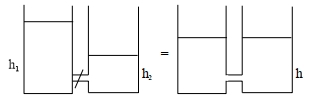
Two cylindrical vessels of equal cross-sectional area $16\,cm^{2}$ contain water up to heights $100\,cm$ and $150\,cm$ respectively. The vessels are interconnected so that the water levels in them become equal. The work done by the force of gravity during the process is $......J$. [Take density of water $= 10^{3}\,kg/m^{3}$ and $g = 10\,m/s^{2}$]
A
$0.25$
B
$1$
C
$8$
D
$12$
Solution
(B) The initial heights are $h_{1} = 1.0\,m$ and $h_{2} = 1.5\,m$. The cross-sectional area is $A = 16\,cm^{2} = 16 \times 10^{-4}\,m^{2}$.
When interconnected,the final height $h$ in both vessels will be the average of the initial heights: $h = \frac{h_{1} + h_{2}}{2} = \frac{1.0 + 1.5}{2} = 1.25\,m$.
The work done by gravity is equal to the decrease in potential energy: $W = U_{i} - U_{f}$.
Initial potential energy $U_{i} = (m_{1}g \frac{h_{1}}{2}) + (m_{2}g \frac{h_{2}}{2}) = \rho A h_{1} g \frac{h_{1}}{2} + \rho A h_{2} g \frac{h_{2}}{2} = \frac{\rho A g}{2} (h_{1}^{2} + h_{2}^{2})$.
Final potential energy $U_{f} = (m_{1}+m_{2})g \frac{h}{2} = (2 \rho A h) g \frac{h}{2} = \rho A g h^{2} = \rho A g (\frac{h_{1}+h_{2}}{2})^{2}$.
$W = \frac{\rho A g}{2} [h_{1}^{2} + h_{2}^{2} - 2(\frac{h_{1}+h_{2}}{2})^{2}] = \frac{\rho A g}{4} [2h_{1}^{2} + 2h_{2}^{2} - (h_{1}+h_{2})^{2}] = \frac{\rho A g}{4} (h_{1}-h_{2})^{2}$.
Substituting the values: $W = \frac{10^{3} \times 16 \times 10^{-4} \times 10}{4} (1.5 - 1.0)^{2} = \frac{16}{4} (0.5)^{2} = 4 \times 0.25 = 1\,J$.
When interconnected,the final height $h$ in both vessels will be the average of the initial heights: $h = \frac{h_{1} + h_{2}}{2} = \frac{1.0 + 1.5}{2} = 1.25\,m$.
The work done by gravity is equal to the decrease in potential energy: $W = U_{i} - U_{f}$.
Initial potential energy $U_{i} = (m_{1}g \frac{h_{1}}{2}) + (m_{2}g \frac{h_{2}}{2}) = \rho A h_{1} g \frac{h_{1}}{2} + \rho A h_{2} g \frac{h_{2}}{2} = \frac{\rho A g}{2} (h_{1}^{2} + h_{2}^{2})$.
Final potential energy $U_{f} = (m_{1}+m_{2})g \frac{h}{2} = (2 \rho A h) g \frac{h}{2} = \rho A g h^{2} = \rho A g (\frac{h_{1}+h_{2}}{2})^{2}$.
$W = \frac{\rho A g}{2} [h_{1}^{2} + h_{2}^{2} - 2(\frac{h_{1}+h_{2}}{2})^{2}] = \frac{\rho A g}{4} [2h_{1}^{2} + 2h_{2}^{2} - (h_{1}+h_{2})^{2}] = \frac{\rho A g}{4} (h_{1}-h_{2})^{2}$.
Substituting the values: $W = \frac{10^{3} \times 16 \times 10^{-4} \times 10}{4} (1.5 - 1.0)^{2} = \frac{16}{4} (0.5)^{2} = 4 \times 0.25 = 1\,J$.
0 likes
View Solution92
AdvancedMCQ
$A$ bubble of radius $R$ in water of density $\rho$ is expanding uniformly at speed $v$. Given that water is incompressible,the kinetic energy of water being pushed is
A
zero
B
$2 \pi \rho R^{3} v^{2}$
C
$2 \pi \rho R^{3} v^{2} / 3$
D
$4 \pi \rho R^{3} v^{2} / 3$
Solution
(B) Let a bubble of radius $R$ expand such that its surface moves with speed $v$. Consider a spherical shell of radius $x$ $(x \ge R)$ and thickness $dx$ in the water.
Due to the incompressibility of water,the volume flow rate across any spherical surface must be constant.
At the bubble surface (radius $R$),the flow rate is $4 \pi R^{2} v$.
At a distance $x$ from the center,the flow rate is $4 \pi x^{2} v_{x}$,where $v_{x}$ is the velocity of the water at distance $x$.
Equating these,$4 \pi x^{2} v_{x} = 4 \pi R^{2} v$,which gives $v_{x} = \frac{R^{2} v}{x^{2}}$.
The mass of the spherical shell of thickness $dx$ is $dm = \rho (4 \pi x^{2} dx)$.
The kinetic energy $dK$ of this shell is $dK = \frac{1}{2} dm v_{x}^{2} = \frac{1}{2} (4 \pi x^{2} \rho dx) \left( \frac{R^{2} v}{x^{2}} \right)^{2}$.
Simplifying,$dK = 2 \pi \rho R^{4} v^{2} \frac{dx}{x^{2}}$.
The total kinetic energy $K$ is the integral from $x = R$ to $x = \infty$:
$K = \int_{R}^{\infty} 2 \pi \rho R^{4} v^{2} \frac{dx}{x^{2}} = 2 \pi \rho R^{4} v^{2} \left[ -\frac{1}{x} \right]_{R}^{\infty} = 2 \pi \rho R^{4} v^{2} \left( 0 - (-\frac{1}{R}) \right) = 2 \pi \rho R^{3} v^{2}$.
Due to the incompressibility of water,the volume flow rate across any spherical surface must be constant.
At the bubble surface (radius $R$),the flow rate is $4 \pi R^{2} v$.
At a distance $x$ from the center,the flow rate is $4 \pi x^{2} v_{x}$,where $v_{x}$ is the velocity of the water at distance $x$.
Equating these,$4 \pi x^{2} v_{x} = 4 \pi R^{2} v$,which gives $v_{x} = \frac{R^{2} v}{x^{2}}$.
The mass of the spherical shell of thickness $dx$ is $dm = \rho (4 \pi x^{2} dx)$.
The kinetic energy $dK$ of this shell is $dK = \frac{1}{2} dm v_{x}^{2} = \frac{1}{2} (4 \pi x^{2} \rho dx) \left( \frac{R^{2} v}{x^{2}} \right)^{2}$.
Simplifying,$dK = 2 \pi \rho R^{4} v^{2} \frac{dx}{x^{2}}$.
The total kinetic energy $K$ is the integral from $x = R$ to $x = \infty$:
$K = \int_{R}^{\infty} 2 \pi \rho R^{4} v^{2} \frac{dx}{x^{2}} = 2 \pi \rho R^{4} v^{2} \left[ -\frac{1}{x} \right]_{R}^{\infty} = 2 \pi \rho R^{4} v^{2} \left( 0 - (-\frac{1}{R}) \right) = 2 \pi \rho R^{3} v^{2}$.
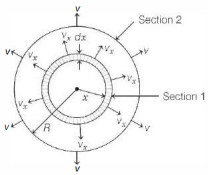
0 likes
View Solution93
DifficultMCQ
We are able to squeeze snow and make balls out of it because of
A
anomalous behaviour of water
B
large latent heat of ice
C
large specific heat of water
D
low melting point of ice
Solution
(A) The correct answer is $A$.
When we exert pressure on snow,the solid snow melts into liquid because the melting point of ice decreases with an increase in pressure. This phenomenon is a consequence of the anomalous behaviour of water,where water is less dense in its solid form (ice) than in its liquid form.
Because liquid water occupies less volume than the equivalent mass of ice,applying pressure shifts the equilibrium towards the liquid phase. When we release the pressure,the melted water refreezes,binding the snow crystals together into a ball.
When we exert pressure on snow,the solid snow melts into liquid because the melting point of ice decreases with an increase in pressure. This phenomenon is a consequence of the anomalous behaviour of water,where water is less dense in its solid form (ice) than in its liquid form.
Because liquid water occupies less volume than the equivalent mass of ice,applying pressure shifts the equilibrium towards the liquid phase. When we release the pressure,the melted water refreezes,binding the snow crystals together into a ball.
0 likes
View Solution94
AdvancedMCQ
The Karman line is a theoretical construct that separates the Earth's atmosphere from outer space. It is defined as the height at which the lift on an aircraft flying at the speed of a polar satellite $(8 \, km/s)$ is equal to its weight. Taking a fighter aircraft of wing area $30 \, m^2$ and mass $7500 \, kg$,the height of the Karman line above the ground will be in the range of .............. $km$. (Assume the density of air at height $h$ above the ground to be $\rho(h) = 1.2 e^{-h/10} \, kg/m^3$,where $h$ is in $km$,and the lift force to be $\frac{1}{2} \rho v^2 A$,where $v$ is the speed of the aircraft and $A$ is its wing area.)
A
$25-50$
B
$75-100$
C
$125-150$
D
$175-200$
Solution
(B) For equilibrium,the lift force must equal the weight of the aircraft:
$mg = \frac{1}{2} \rho v^2 A$
Given:
$m = 7500 \, kg$
$v = 8 \, km/s = 8000 \, m/s$
$A = 30 \, m^2$
$\rho(h) = 1.2 e^{-h/10} \, kg/m^3$ (where $h$ is in $km$)
$g \approx 9.8 \, m/s^2$
Substituting the values into the equilibrium equation:
$7500 \times 9.8 = \frac{1}{2} \times (1.2 e^{-h/10}) \times (8000)^2 \times 30$
$73500 = 0.6 \times e^{-h/10} \times 64 \times 10^6 \times 30$
$73500 = 1152 \times 10^6 \times e^{-h/10}$
$e^{-h/10} = \frac{73500}{1152 \times 10^6} \approx 6.38 \times 10^{-5}$
Taking the natural logarithm on both sides:
$-h/10 = \ln(6.38 \times 10^{-5})$
$-h/10 \approx -9.66$
$h \approx 96.6 \, km$
This value falls within the range of $75-100 \, km$.
Therefore,the correct option is $(B)$.
$mg = \frac{1}{2} \rho v^2 A$
Given:
$m = 7500 \, kg$
$v = 8 \, km/s = 8000 \, m/s$
$A = 30 \, m^2$
$\rho(h) = 1.2 e^{-h/10} \, kg/m^3$ (where $h$ is in $km$)
$g \approx 9.8 \, m/s^2$
Substituting the values into the equilibrium equation:
$7500 \times 9.8 = \frac{1}{2} \times (1.2 e^{-h/10}) \times (8000)^2 \times 30$
$73500 = 0.6 \times e^{-h/10} \times 64 \times 10^6 \times 30$
$73500 = 1152 \times 10^6 \times e^{-h/10}$
$e^{-h/10} = \frac{73500}{1152 \times 10^6} \approx 6.38 \times 10^{-5}$
Taking the natural logarithm on both sides:
$-h/10 = \ln(6.38 \times 10^{-5})$
$-h/10 \approx -9.66$
$h \approx 96.6 \, km$
This value falls within the range of $75-100 \, km$.
Therefore,the correct option is $(B)$.
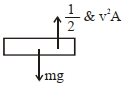
0 likes
View Solution95
EasyMCQ
Which of the following is not the property of an ideal fluid?
A
Fluid flow is irrotational
B
Fluid flow is streamline
C
Fluid is incompressible
D
Fluid is viscous
Solution
(D) The correct answer is $D$.
An ideal fluid is defined by the following properties:
$1$. It is non-viscous (i.e.,it has zero viscosity).
$2$. It is incompressible (i.e.,its density remains constant).
$3$. Its flow is steady (streamline).
$4$. Its flow is irrotational.
Since an ideal fluid is non-viscous,the statement that it is viscous is incorrect.
An ideal fluid is defined by the following properties:
$1$. It is non-viscous (i.e.,it has zero viscosity).
$2$. It is incompressible (i.e.,its density remains constant).
$3$. Its flow is steady (streamline).
$4$. Its flow is irrotational.
Since an ideal fluid is non-viscous,the statement that it is viscous is incorrect.
0 likes
View Solution96
MediumMCQ
An air bubble rises from the bottom of a lake to the surface. If its radius increases by $200 \%$ and the atmospheric pressure is equal to a water column of height $H$,then the depth of the lake is ..... $H$.
A
$21$
B
$8$
C
$9$
D
$26$
Solution
(D) Let the initial radius of the air bubble at the bottom be $r_1 = r$.
The final radius at the surface is $r_2 = r + 200\% \text{ of } r = r + 2r = 3r$.
Let the depth of the lake be $h$. The atmospheric pressure is given as $P_{atm} = \rho g H$.
The pressure at the bottom of the lake is $P_1 = P_{atm} + \rho g h = \rho g H + \rho g h = \rho g(H + h)$.
The pressure at the surface is $P_2 = P_{atm} = \rho g H$.
Assuming the temperature remains constant,we use Boyle's Law: $P_1 V_1 = P_2 V_2$.
Since the volume of a sphere is $V = \frac{4}{3} \pi r^3$,we have:
$\rho g(H + h) \times \frac{4}{3} \pi r^3 = \rho g H \times \frac{4}{3} \pi (3r)^3$
$(H + h) r^3 = H \times 27r^3$
$H + h = 27H$
$h = 26H$.
Thus,the depth of the lake is $26H$.
The final radius at the surface is $r_2 = r + 200\% \text{ of } r = r + 2r = 3r$.
Let the depth of the lake be $h$. The atmospheric pressure is given as $P_{atm} = \rho g H$.
The pressure at the bottom of the lake is $P_1 = P_{atm} + \rho g h = \rho g H + \rho g h = \rho g(H + h)$.
The pressure at the surface is $P_2 = P_{atm} = \rho g H$.
Assuming the temperature remains constant,we use Boyle's Law: $P_1 V_1 = P_2 V_2$.
Since the volume of a sphere is $V = \frac{4}{3} \pi r^3$,we have:
$\rho g(H + h) \times \frac{4}{3} \pi r^3 = \rho g H \times \frac{4}{3} \pi (3r)^3$
$(H + h) r^3 = H \times 27r^3$
$H + h = 27H$
$h = 26H$.
Thus,the depth of the lake is $26H$.
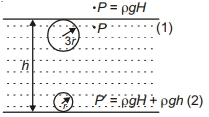
0 likes
View Solution97
MediumMCQ
$A$ vessel containing a liquid has a constant acceleration of $19.6 \, m/s^2$ in the horizontal direction. The free surface of the water gets sloped with the horizontal at an angle of ..........
A
$\tan^{-1}[1/2]$
B
$\sin^{-1}[1/\sqrt{3}]$
C
$\tan^{-1}[\sqrt{2}]$
D
$\sin^{-1}[2/\sqrt{5}]$
Solution
(D) When a vessel containing liquid is accelerated horizontally with an acceleration $a$,the free surface of the liquid tilts at an angle $\theta$ with the horizontal.
The effective acceleration acting on a fluid particle is the vector sum of the acceleration due to gravity $g$ (acting downwards) and the pseudo-acceleration $a$ (acting backwards in the frame of the vessel).
The angle $\theta$ that the free surface makes with the horizontal is given by the relation:
$\tan \theta = \frac{a}{g}$
Given:
$a = 19.6 \, m/s^2$
$g = 9.8 \, m/s^2$
Substituting the values:
$\tan \theta = \frac{19.6}{9.8} = 2$
To express this in terms of $\sin \theta$,we use the trigonometric identity $\sin \theta = \frac{\tan \theta}{\sqrt{1 + \tan^2 \theta}}$:
$\sin \theta = \frac{2}{\sqrt{1 + 2^2}} = \frac{2}{\sqrt{1 + 4}} = \frac{2}{\sqrt{5}}$
Therefore,$\theta = \sin^{-1}\left[\frac{2}{\sqrt{5}}\right]$.
The effective acceleration acting on a fluid particle is the vector sum of the acceleration due to gravity $g$ (acting downwards) and the pseudo-acceleration $a$ (acting backwards in the frame of the vessel).
The angle $\theta$ that the free surface makes with the horizontal is given by the relation:
$\tan \theta = \frac{a}{g}$
Given:
$a = 19.6 \, m/s^2$
$g = 9.8 \, m/s^2$
Substituting the values:
$\tan \theta = \frac{19.6}{9.8} = 2$
To express this in terms of $\sin \theta$,we use the trigonometric identity $\sin \theta = \frac{\tan \theta}{\sqrt{1 + \tan^2 \theta}}$:
$\sin \theta = \frac{2}{\sqrt{1 + 2^2}} = \frac{2}{\sqrt{1 + 4}} = \frac{2}{\sqrt{5}}$
Therefore,$\theta = \sin^{-1}\left[\frac{2}{\sqrt{5}}\right]$.
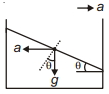
0 likes
View Solution98
MediumMCQ
An air bubble of volume $V_0$ is released by a fish at a depth $h$ in a lake. The bubble rises to the surface. Assume constant temperature and standard atmospheric pressure $P$ above the lake. The volume of the bubble just before touching the surface will be (density of water is $\rho$):
A
$V_0$
B
$V_0(\rho g h / P)$
C
$\frac{V_0}{1 + \frac{\rho g h}{P}}$
D
$V_0(1 + \frac{\rho g h}{P})$
Solution
(D) According to Boyle's Law, for a constant temperature, the product of pressure and volume remains constant $(PV = \text{constant})$.
At depth $h$, the total pressure on the bubble is $P_1 = P + \rho g h$, and its volume is $V_1 = V_0$.
At the surface, the pressure is $P_2 = P$, and let the volume be $V_2$.
Applying the equation $P_1 V_1 = P_2 V_2$:
$(P + \rho g h) V_0 = P V_2$
$V_2 = V_0 \frac{P + \rho g h}{P}$
$V_2 = V_0 (1 + \frac{\rho g h}{P})$.
At depth $h$, the total pressure on the bubble is $P_1 = P + \rho g h$, and its volume is $V_1 = V_0$.
At the surface, the pressure is $P_2 = P$, and let the volume be $V_2$.
Applying the equation $P_1 V_1 = P_2 V_2$:
$(P + \rho g h) V_0 = P V_2$
$V_2 = V_0 \frac{P + \rho g h}{P}$
$V_2 = V_0 (1 + \frac{\rho g h}{P})$.
0 likes
View Solution99
MediumMCQ
An air bubble of volume $1\,cm^3$ rises from the bottom of a lake $40\,m$ deep to the surface at a temperature of $12^{\circ}C$. The atmospheric pressure is $1 \times 10^5\,Pa$,the density of water is $1000\,kg/m^3$,and $g = 10\,m/s^2$. There is no difference in the temperature of water at the depth of $40\,m$ and on the surface. The volume of the air bubble when it reaches the surface will be $..........\,cm^3$. (in $,cm^3$)
A
$5$
B
$2$
C
$4$
D
$3$
Solution
(A) Given:
Initial volume $V_1 = 1\,cm^3$
Depth $h = 40\,m$
Atmospheric pressure $P_0 = 1 \times 10^5\,Pa$
Density of water $\rho = 1000\,kg/m^3$
Acceleration due to gravity $g = 10\,m/s^2$
Temperature is constant.
Pressure at the bottom of the lake is given by:
$P_1 = P_0 + \rho gh$
$P_1 = 1 \times 10^5 + (1000 \times 10 \times 40) = 1 \times 10^5 + 4 \times 10^5 = 5 \times 10^5\,Pa$
Since the temperature is constant,we use Boyle's Law:
$P_1 V_1 = P_0 V_2$
$5 \times 10^5 \times 1 = 1 \times 10^5 \times V_2$
$V_2 = 5\,cm^3$
Therefore,the volume of the air bubble when it reaches the surface is $5\,cm^3$.
Initial volume $V_1 = 1\,cm^3$
Depth $h = 40\,m$
Atmospheric pressure $P_0 = 1 \times 10^5\,Pa$
Density of water $\rho = 1000\,kg/m^3$
Acceleration due to gravity $g = 10\,m/s^2$
Temperature is constant.
Pressure at the bottom of the lake is given by:
$P_1 = P_0 + \rho gh$
$P_1 = 1 \times 10^5 + (1000 \times 10 \times 40) = 1 \times 10^5 + 4 \times 10^5 = 5 \times 10^5\,Pa$
Since the temperature is constant,we use Boyle's Law:
$P_1 V_1 = P_0 V_2$
$5 \times 10^5 \times 1 = 1 \times 10^5 \times V_2$
$V_2 = 5\,cm^3$
Therefore,the volume of the air bubble when it reaches the surface is $5\,cm^3$.
0 likes
View SolutionFluid Mechanics and Surface Tension — Mix Examples-Fluid Mechanics and Surface Tension · Frequently Asked Questions
1Are these Fluid Mechanics and Surface Tension questions useful for JEE and NEET?
Yes. All questions in this section are mapped to JEE Main and NEET exam patterns. Previous year questions from JEE Main, NEET, GUJCET and state-level exams are included with full solutions.
2Can I switch to Hindi or Gujarati for these questions?
Yes. Use the language tabs in the hero section or the sidebar to view the same questions and solutions in English, Hindi or Gujarati.
3How do I generate a question paper from this subtopic?
Use the Vedclass Exam Paper Generator — select the chapter and subtopic, set difficulty, and generate Sets A, B, C, D automatically. First 3 chapters of every subject are free.
Vedclass Products
For Students
Vedclass Test Series
Mock tests in real JEE/NEET style with performance analysis. 5-day free trial.
Start Free TrialFor Teachers
Exam Paper Generator
Generate Set A/B/C/D papers from this chapter in 2 minutes. 3 chapters free.
Try FreeFor Institutes
Online Exam Module
Live online exams with unlimited students, 360° analytics & white-label branding.
See DemoFor Teachers & Institutes
Generate a Fluid Mechanics and Surface Tension Exam Paper in 2 Minutes
Select subtopic & difficulty — Sets A, B, C, D auto-generated with No Repeat logic.
First 3 chapters of every subject are free — no payment required.