
A English
Relative Velocity (river boat, rain, wind) Questions in English
Class 11 Physics · 3-2.Motion in Plane · Relative Velocity (river boat, rain, wind)
185+
Questions
English
Language
100%
With Solutions
Showing 50 of 185 questions in English
101
Easy
Match Column-$I$ with Column-$II$ correctly.
| Column-$I$ | Column-$II$ |
|---|---|
| $(1)$ Velocity of $A$ relative to $B$ if $A$ and $B$ are moving perpendicular to each other | $(a)$ $\vec{v}_{rm} = \vec{v}_r + \vec{v}_m$ |
| $(2)$ Velocity of rain drops relative to a man | $(b)$ $\vec{v}_{AB} = \vec{v}_A + \vec{v}_B$ |
| $(c)$ $v_{AB} = \sqrt{v_A^2 + v_B^2}$ |
Solution
(1-C, 2-A) For $(1)$: If $A$ and $B$ move perpendicularly,the relative velocity $\vec{v}_{AB} = \vec{v}_A - \vec{v}_B$. Since they are perpendicular,the magnitude is $v_{AB} = \sqrt{v_A^2 + (-v_B)^2} = \sqrt{v_A^2 + v_B^2}$. Thus,$(1)$ matches with $(c)$.
For $(2)$: The velocity of rain relative to a man is given by $\vec{v}_{rm} = \vec{v}_r - \vec{v}_m$. However,in standard vector notation for relative motion,$\vec{v}_{rm} = \vec{v}_r + (-\vec{v}_m)$. Given the options provided,$(a)$ represents the vector addition form often used in relative velocity problems where the direction is accounted for. Thus,$(2)$ matches with $(a)$.
For $(2)$: The velocity of rain relative to a man is given by $\vec{v}_{rm} = \vec{v}_r - \vec{v}_m$. However,in standard vector notation for relative motion,$\vec{v}_{rm} = \vec{v}_r + (-\vec{v}_m)$. Given the options provided,$(a)$ represents the vector addition form often used in relative velocity problems where the direction is accounted for. Thus,$(2)$ matches with $(a)$.
0 likes
View Solution102
Easy
If the velocities of object $A$ and $B$ are $v_A$ and $v_B$ respectively,then write the equation of the relative velocity of $A$ with respect to $B$.
Solution
(N/A) The relative velocity of an object $A$ with respect to an object $B$ is defined as the rate of change of the position of $A$ as observed from $B$.
Mathematically,the relative velocity of $A$ with respect to $B$,denoted as $v_{AB}$,is given by the vector difference of their velocities:
$v_{AB} = v_A - v_B$
Here,$v_A$ is the velocity of object $A$ and $v_B$ is the velocity of object $B$ with respect to a common reference frame (usually the ground).
Mathematically,the relative velocity of $A$ with respect to $B$,denoted as $v_{AB}$,is given by the vector difference of their velocities:
$v_{AB} = v_A - v_B$
Here,$v_A$ is the velocity of object $A$ and $v_B$ is the velocity of object $B$ with respect to a common reference frame (usually the ground).
0 likes
View Solution103
EasyMCQ
When is the relative velocity of two moving cars greater than the individual velocity of both cars?
A
When they move in the same direction.
B
When they move in opposite directions.
C
When they move in perpendicular directions.
D
Never.
Solution
(B) The relative velocity of two objects $A$ and $B$ moving in opposite directions is given by $v_{rel} = v_A + v_B$.
Since $v_A$ and $v_B$ are positive magnitudes,$v_{rel}$ will be greater than either $v_A$ or $v_B$ individually.
Therefore,when two cars move in opposite directions,their relative velocity is the sum of their individual velocities,making it greater than the velocity of either car.
Since $v_A$ and $v_B$ are positive magnitudes,$v_{rel}$ will be greater than either $v_A$ or $v_B$ individually.
Therefore,when two cars move in opposite directions,their relative velocity is the sum of their individual velocities,making it greater than the velocity of either car.
0 likes
View Solution104
EasyMCQ
When is the relative velocity of two cars moving with unequal velocities less than the individual velocity of either car?
A
When they move in opposite directions.
B
When they move in the same direction.
C
When they move at right angles to each other.
D
Never.
Solution
(B) Let the velocities of the two cars be $v_A$ and $v_B$. The relative velocity of car $A$ with respect to car $B$ is given by $v_{AB} = v_A - v_B$.
If both cars move in the same direction,the relative velocity is the difference between their individual velocities,i.e.,$|v_A - v_B|$,which is less than the individual velocity of either car (assuming $v_A, v_B > 0$).
If they move in opposite directions,the relative velocity is $|v_A + v_B|$,which is greater than the individual velocity of either car.
Therefore,the relative velocity is less than the individual velocity when both cars move in the same direction.
If both cars move in the same direction,the relative velocity is the difference between their individual velocities,i.e.,$|v_A - v_B|$,which is less than the individual velocity of either car (assuming $v_A, v_B > 0$).
If they move in opposite directions,the relative velocity is $|v_A + v_B|$,which is greater than the individual velocity of either car.
Therefore,the relative velocity is less than the individual velocity when both cars move in the same direction.
0 likes
View Solution105
Medium
What do you mean by the term relative velocity?
Solution
(N/A) Relative velocity is the velocity of an object as observed from a specific frame of reference.
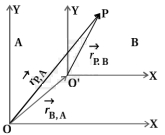
Consider two frames of reference,$A$ and $B$,moving with a constant velocity with respect to each other. Let $P$ be a particle.
From the figure,the position vector of particle $P$ with respect to the origin $O$ of frame $A$ is $\vec{r}_{P,A} = \vec{OO'} + \vec{O'P}$.
Since $\vec{OO'} = \vec{r}_{B,A}$ (position of origin $O'$ of frame $B$ w.r.t. origin $O$ of frame $A$) and $\vec{O'P} = \vec{r}_{P,B}$ (position of particle $P$ w.r.t. origin $O'$ of frame $B$),we have:
$\vec{r}_{P,A} = \vec{r}_{P,B} + \vec{r}_{B,A}$
Differentiating this equation with respect to time $t$:
$\frac{d}{dt}(\vec{r}_{P,A}) = \frac{d}{dt}(\vec{r}_{P,B}) + \frac{d}{dt}(\vec{r}_{B,A})$
$\vec{v}_{P,A} = \vec{v}_{P,B} + \vec{v}_{B,A}$
Here,$\vec{v}_{P,A}$ is the velocity of particle $P$ with respect to frame $A$,$\vec{v}_{P,B}$ is the velocity of particle $P$ with respect to frame $B$,and $\vec{v}_{B,A}$ is the velocity of frame $B$ with respect to frame $A$.
Consider two frames of reference,$A$ and $B$,moving with a constant velocity with respect to each other. Let $P$ be a particle.
From the figure,the position vector of particle $P$ with respect to the origin $O$ of frame $A$ is $\vec{r}_{P,A} = \vec{OO'} + \vec{O'P}$.
Since $\vec{OO'} = \vec{r}_{B,A}$ (position of origin $O'$ of frame $B$ w.r.t. origin $O$ of frame $A$) and $\vec{O'P} = \vec{r}_{P,B}$ (position of particle $P$ w.r.t. origin $O'$ of frame $B$),we have:
$\vec{r}_{P,A} = \vec{r}_{P,B} + \vec{r}_{B,A}$
Differentiating this equation with respect to time $t$:
$\frac{d}{dt}(\vec{r}_{P,A}) = \frac{d}{dt}(\vec{r}_{P,B}) + \frac{d}{dt}(\vec{r}_{B,A})$
$\vec{v}_{P,A} = \vec{v}_{P,B} + \vec{v}_{B,A}$
Here,$\vec{v}_{P,A}$ is the velocity of particle $P$ with respect to frame $A$,$\vec{v}_{P,B}$ is the velocity of particle $P$ with respect to frame $B$,and $\vec{v}_{B,A}$ is the velocity of frame $B$ with respect to frame $A$.
0 likes
View Solution106
Medium
Consider two observers observing a single moving object,and one observer observing two moving objects. Explain the concept of relative velocity in these scenarios.
Solution
(N/A) Consider two inertial frames of reference $A$ and $B$ moving with constant velocity relative to each other.
Suppose one observer in frame $A$ and another observer in frame $B$ study the motion of a particle $P$.
Let the position vectors of the moving particle $P$ at time $t$ with respect to the origins of frames $A$ and $B$ be $\overrightarrow{r_{P,A}} = \overrightarrow{OP}$ and $\overrightarrow{r_{P,B}} = \overrightarrow{O'P}$ respectively,and the position vector of $O'$ with respect to $O$ be $\overrightarrow{r_{B,A}} = \overrightarrow{OO'}$.
From the geometry of the vectors,$\overrightarrow{OP} = \overrightarrow{OO'} + \overrightarrow{O'P}$.
Therefore,$\overrightarrow{r_{P,A}} = \overrightarrow{r_{B,A}} + \overrightarrow{r_{P,B}}$.
Differentiating with respect to time $t$:
$\frac{d}{dt}(\overrightarrow{r_{P,A}}) = \frac{d}{dt}(\overrightarrow{r_{P,B}}) + \frac{d}{dt}(\overrightarrow{r_{B,A}})$.
Thus,$\overrightarrow{v_{P,A}} = \overrightarrow{v_{P,B}} + \overrightarrow{v_{B,A}}$.
Here,$\overrightarrow{v_{P,A}}$ is the velocity of particle $P$ relative to frame $A$,$\overrightarrow{v_{P,B}}$ is the velocity of particle $P$ relative to frame $B$,and $\overrightarrow{v_{B,A}}$ is the velocity of frame $B$ relative to frame $A$.
Suppose one observer in frame $A$ and another observer in frame $B$ study the motion of a particle $P$.
Let the position vectors of the moving particle $P$ at time $t$ with respect to the origins of frames $A$ and $B$ be $\overrightarrow{r_{P,A}} = \overrightarrow{OP}$ and $\overrightarrow{r_{P,B}} = \overrightarrow{O'P}$ respectively,and the position vector of $O'$ with respect to $O$ be $\overrightarrow{r_{B,A}} = \overrightarrow{OO'}$.
From the geometry of the vectors,$\overrightarrow{OP} = \overrightarrow{OO'} + \overrightarrow{O'P}$.
Therefore,$\overrightarrow{r_{P,A}} = \overrightarrow{r_{B,A}} + \overrightarrow{r_{P,B}}$.
Differentiating with respect to time $t$:
$\frac{d}{dt}(\overrightarrow{r_{P,A}}) = \frac{d}{dt}(\overrightarrow{r_{P,B}}) + \frac{d}{dt}(\overrightarrow{r_{B,A}})$.
Thus,$\overrightarrow{v_{P,A}} = \overrightarrow{v_{P,B}} + \overrightarrow{v_{B,A}}$.
Here,$\overrightarrow{v_{P,A}}$ is the velocity of particle $P$ relative to frame $A$,$\overrightarrow{v_{P,B}}$ is the velocity of particle $P$ relative to frame $B$,and $\overrightarrow{v_{B,A}}$ is the velocity of frame $B$ relative to frame $A$.
0 likes
View Solution107
Medium
Find the expression for the relative velocity of any two particles moving in a frame of reference.
Solution
(N/A) Consider two particles $A$ and $B$ in a frame of reference with velocities $\vec{V}_{A}$ and $\vec{V}_{B}$ respectively.
The velocity of particle $A$ with respect to particle $B$ is given by the vector difference:
$\vec{V}_{AB} = \vec{V}_{A} - \vec{V}_{B}$
Similarly,the velocity of particle $B$ with respect to particle $A$ is given by:
$\vec{V}_{BA} = \vec{V}_{B} - \vec{V}_{A}$
From these expressions,we can observe that:
$\vec{V}_{AB} = -\vec{V}_{BA}$ and $|\vec{V}_{AB}| = |\vec{V}_{BA}|$.
In a general frame of reference $X$,if particles $P$ and $Q$ have velocities $\vec{V}_{PX}$ and $\vec{V}_{QX}$ relative to frame $X$,then the relative velocity of $P$ with respect to $Q$ is:
$\vec{V}_{PQ} = \vec{V}_{PX} - \vec{V}_{QX}$.
The velocity of particle $A$ with respect to particle $B$ is given by the vector difference:
$\vec{V}_{AB} = \vec{V}_{A} - \vec{V}_{B}$
Similarly,the velocity of particle $B$ with respect to particle $A$ is given by:
$\vec{V}_{BA} = \vec{V}_{B} - \vec{V}_{A}$
From these expressions,we can observe that:
$\vec{V}_{AB} = -\vec{V}_{BA}$ and $|\vec{V}_{AB}| = |\vec{V}_{BA}|$.
In a general frame of reference $X$,if particles $P$ and $Q$ have velocities $\vec{V}_{PX}$ and $\vec{V}_{QX}$ relative to frame $X$,then the relative velocity of $P$ with respect to $Q$ is:
$\vec{V}_{PQ} = \vec{V}_{PX} - \vec{V}_{QX}$.
0 likes
View Solution108
Medium
If the velocities of particles $A$ and $B$ with respect to the ground are ${\overrightarrow v _A}$ and ${\overrightarrow v _B}$ respectively,then:
$(a)$ Write the formula for the velocity of $A$ with respect to $B$.
$(b)$ Write the formula for the velocity of $B$ with respect to $A$.
$(c)$ Is the relation ${\overrightarrow v _{AB}} = -{\overrightarrow v _{BA}}$ correct?
$(a)$ Write the formula for the velocity of $A$ with respect to $B$.
$(b)$ Write the formula for the velocity of $B$ with respect to $A$.
$(c)$ Is the relation ${\overrightarrow v _{AB}} = -{\overrightarrow v _{BA}}$ correct?
Solution
(C) The velocity of particle $A$ with respect to particle $B$ is given by: ${\overrightarrow v _{AB}} = {\overrightarrow v _A} - {\overrightarrow v _B}$.
$(b)$ The velocity of particle $B$ with respect to particle $A$ is given by: ${\overrightarrow v _{BA}} = {\overrightarrow v _B} - {\overrightarrow v _A}$.
$(c)$ Yes,the relation is correct. Since ${\overrightarrow v _{AB}} = {\overrightarrow v _A} - {\overrightarrow v _B}$ and ${\overrightarrow v _{BA}} = {\overrightarrow v _B} - {\overrightarrow v _A}$,we can see that ${\overrightarrow v _{AB}} = - ( {\overrightarrow v _B} - {\overrightarrow v _A} ) = - {\overrightarrow v _{BA}}$.
$(b)$ The velocity of particle $B$ with respect to particle $A$ is given by: ${\overrightarrow v _{BA}} = {\overrightarrow v _B} - {\overrightarrow v _A}$.
$(c)$ Yes,the relation is correct. Since ${\overrightarrow v _{AB}} = {\overrightarrow v _A} - {\overrightarrow v _B}$ and ${\overrightarrow v _{BA}} = {\overrightarrow v _B} - {\overrightarrow v _A}$,we can see that ${\overrightarrow v _{AB}} = - ( {\overrightarrow v _B} - {\overrightarrow v _A} ) = - {\overrightarrow v _{BA}}$.
0 likes
View Solution109
Medium
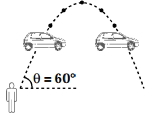
$A$ boy throws a ball in the air at $60^{\circ}$ to the horizontal,along a road with a speed of $10 \, m/s$. Another boy sitting in a passing car observes the ball. Sketch the motion of the ball as observed by the boy in the car,if the car has a speed of $18 \, km/h$. Give an explanation to support your diagram.
Solution
(N/A) The boy throws the ball at an angle of $60^{\circ}$ with a speed of $10 \, m/s$.
The horizontal component of the ball's velocity is $v_x = v \cos \theta = 10 \cos 60^{\circ} = 10 \times 0.5 = 5 \, m/s$.
The speed of the car is $18 \, km/h = 18 \times \frac{5}{18} = 5 \, m/s$.
Since the horizontal component of the ball's velocity $(5 \, m/s)$ is equal to the speed of the car $(5 \, m/s)$,the relative horizontal velocity of the ball with respect to the car is $v_{rel,x} = 5 - 5 = 0 \, m/s$.
Therefore,the boy in the car will observe the ball moving only in the vertical direction,which appears as a straight vertical line path.
The horizontal component of the ball's velocity is $v_x = v \cos \theta = 10 \cos 60^{\circ} = 10 \times 0.5 = 5 \, m/s$.
The speed of the car is $18 \, km/h = 18 \times \frac{5}{18} = 5 \, m/s$.
Since the horizontal component of the ball's velocity $(5 \, m/s)$ is equal to the speed of the car $(5 \, m/s)$,the relative horizontal velocity of the ball with respect to the car is $v_{rel,x} = 5 - 5 = 0 \, m/s$.
Therefore,the boy in the car will observe the ball moving only in the vertical direction,which appears as a straight vertical line path.

0 likes
View Solution110
Medium
$A$ bird is flying to and fro between two cars moving towards each other on a straight road. One car has a speed of $18 \,km/h$ while the other has a speed of $27 \,km/h$. The bird starts moving from the first car towards the second car with a speed of $36 \,km/h$ when the two cars are separated by $36 \,km$. What is the total distance covered by the bird?
Solution
(D) Given:
Speed of the first car $v_{1} = 18 \,km/h$.
Speed of the second car $v_{2} = 27 \,km/h$.
Since the cars are moving towards each other,their relative speed is $v_{rel} = v_{1} + v_{2} = 18 + 27 = 45 \,km/h$.
The initial distance between the cars is $d = 36 \,km$.
The time taken for the cars to meet is $t = \frac{d}{v_{rel}} = \frac{36}{45} = 0.8 \,h$.
The bird flies continuously at a constant speed $v_{b} = 36 \,km/h$ until the cars meet.
Therefore,the total distance covered by the bird is $D = v_{b} \times t = 36 \times 0.8 = 28.8 \,km$.
Speed of the first car $v_{1} = 18 \,km/h$.
Speed of the second car $v_{2} = 27 \,km/h$.
Since the cars are moving towards each other,their relative speed is $v_{rel} = v_{1} + v_{2} = 18 + 27 = 45 \,km/h$.
The initial distance between the cars is $d = 36 \,km$.
The time taken for the cars to meet is $t = \frac{d}{v_{rel}} = \frac{36}{45} = 0.8 \,h$.
The bird flies continuously at a constant speed $v_{b} = 36 \,km/h$ until the cars meet.
Therefore,the total distance covered by the bird is $D = v_{b} \times t = 36 \times 0.8 = 28.8 \,km$.
0 likes
View Solution111
Medium
$A$ girl riding a bicycle with a speed of $5 \, m/s$ towards the north direction observes rain falling vertically down. If she increases her speed to $10 \, m/s$,the rain appears to meet her at $45^o$ to the vertical. What is the speed of the rain? In what direction does the rain fall as observed by a ground-based observer?
Solution
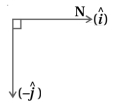
(A-D) Let the north direction be $\hat{i}$ and the vertically downward direction be $\hat{j}$.
Let the velocity of the rain be $\vec{v}_r = a\hat{i} + b\hat{j}$.
Case $1$: The girl's velocity is $\vec{v}_g = 5\hat{i} \, m/s$.
The velocity of the rain relative to the girl is $\vec{v}_{rg} = \vec{v}_r - \vec{v}_g = (a-5)\hat{i} + b\hat{j}$.
Since the rain appears to fall vertically downward,the horizontal component must be zero: $a - 5 = 0 \Rightarrow a = 5$.
Case $2$: The girl's velocity is $\vec{v}_g = 10\hat{i} \, m/s$.
The velocity of the rain relative to the girl is $\vec{v}_{rg} = (a-10)\hat{i} + b\hat{j} = (5-10)\hat{i} + b\hat{j} = -5\hat{i} + b\hat{j}$.
Since the rain appears to fall at $45^o$ to the vertical,$\tan 45^o = |\frac{\text{horizontal component}}{\text{vertical component}}| = |\frac{-5}{b}| = 1$.
Thus,$|b| = 5$. Since the rain is falling downwards,$b = -5$.
The velocity of the rain is $\vec{v}_r = 5\hat{i} - 5\hat{j} \, m/s$.
The speed of the rain is $|\vec{v}_r| = \sqrt{5^2 + (-5)^2} = \sqrt{50} = 5\sqrt{2} \, m/s$.
The direction of the rain as observed by a ground-based observer is at an angle $\theta$ with the vertical,where $\tan \theta = \frac{|a|}{|b|} = \frac{5}{5} = 1$,so $\theta = 45^o$ towards the north.
Let the velocity of the rain be $\vec{v}_r = a\hat{i} + b\hat{j}$.
Case $1$: The girl's velocity is $\vec{v}_g = 5\hat{i} \, m/s$.
The velocity of the rain relative to the girl is $\vec{v}_{rg} = \vec{v}_r - \vec{v}_g = (a-5)\hat{i} + b\hat{j}$.
Since the rain appears to fall vertically downward,the horizontal component must be zero: $a - 5 = 0 \Rightarrow a = 5$.
Case $2$: The girl's velocity is $\vec{v}_g = 10\hat{i} \, m/s$.
The velocity of the rain relative to the girl is $\vec{v}_{rg} = (a-10)\hat{i} + b\hat{j} = (5-10)\hat{i} + b\hat{j} = -5\hat{i} + b\hat{j}$.
Since the rain appears to fall at $45^o$ to the vertical,$\tan 45^o = |\frac{\text{horizontal component}}{\text{vertical component}}| = |\frac{-5}{b}| = 1$.
Thus,$|b| = 5$. Since the rain is falling downwards,$b = -5$.
The velocity of the rain is $\vec{v}_r = 5\hat{i} - 5\hat{j} \, m/s$.
The speed of the rain is $|\vec{v}_r| = \sqrt{5^2 + (-5)^2} = \sqrt{50} = 5\sqrt{2} \, m/s$.
The direction of the rain as observed by a ground-based observer is at an angle $\theta$ with the vertical,where $\tan \theta = \frac{|a|}{|b|} = \frac{5}{5} = 1$,so $\theta = 45^o$ towards the north.
0 likes
View Solution112
Medium
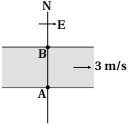
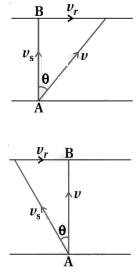
$A$ river is flowing due east with a speed $3\, ms^{-1}$. $A$ swimmer can swim in still water at a speed of $4\, ms^{-1}$ (figure).
$(a)$ If the swimmer starts swimming due north,what will be his resultant velocity (magnitude and direction)?
$(b)$ If he wants to start from point $A$ on the south bank and reach the opposite point $B$ on the north bank,
$(i)$ In which direction should he swim?
$(ii)$ What will be his resultant speed?
$(c)$ From the two different cases as mentioned in $(a)$ and $(b)$ above,in which case will he reach the opposite bank in a shorter time?
$(a)$ If the swimmer starts swimming due north,what will be his resultant velocity (magnitude and direction)?
$(b)$ If he wants to start from point $A$ on the south bank and reach the opposite point $B$ on the north bank,
$(i)$ In which direction should he swim?
$(ii)$ What will be his resultant speed?
$(c)$ From the two different cases as mentioned in $(a)$ and $(b)$ above,in which case will he reach the opposite bank in a shorter time?
Solution
(N/A) Given: Speed of the river $V_r = 3\, ms^{-1}$ (east),Speed of the swimmer in still water $V_s = 4\, ms^{-1}$.
$(a)$ When the swimmer swims due north,the resultant velocity $V$ is the vector sum of $V_r$ and $V_s$.
$V = \sqrt{V_r^2 + V_s^2} = \sqrt{3^2 + 4^2} = \sqrt{9 + 16} = 5\, ms^{-1}$.
The direction $\theta$ with respect to the north is given by $\tan \theta = \frac{V_r}{V_s} = \frac{3}{4} = 0.75$.
$\theta = \tan^{-1}(0.75) \approx 36.87^{\circ}$ east of north.
$(b)$ To reach point $B$ directly opposite to $A$,the swimmer must swim at an angle $\theta$ upstream (west of north) such that the horizontal component of his velocity cancels the river's velocity.
$(i)$ $\sin \theta = \frac{V_r}{V_s} = \frac{3}{4} = 0.75 \Rightarrow \theta = \sin^{-1}(0.75) \approx 48.6^{\circ}$ west of north.
$(ii)$ The resultant speed $V$ is the vertical component: $V = \sqrt{V_s^2 - V_r^2} = \sqrt{4^2 - 3^2} = \sqrt{16 - 9} = \sqrt{7} \approx 2.65\, ms^{-1}$.
$(c)$ Let $d$ be the width of the river. Time taken in case $(a)$ is $t_a = \frac{d}{V_s} = \frac{d}{4}$. Time taken in case $(b)$ is $t_b = \frac{d}{V} = \frac{d}{\sqrt{7}}$. Since $\sqrt{7} < 4$,$t_b > t_a$. Thus,the swimmer reaches the opposite bank in a shorter time in case $(a)$.
$(a)$ When the swimmer swims due north,the resultant velocity $V$ is the vector sum of $V_r$ and $V_s$.
$V = \sqrt{V_r^2 + V_s^2} = \sqrt{3^2 + 4^2} = \sqrt{9 + 16} = 5\, ms^{-1}$.
The direction $\theta$ with respect to the north is given by $\tan \theta = \frac{V_r}{V_s} = \frac{3}{4} = 0.75$.
$\theta = \tan^{-1}(0.75) \approx 36.87^{\circ}$ east of north.
$(b)$ To reach point $B$ directly opposite to $A$,the swimmer must swim at an angle $\theta$ upstream (west of north) such that the horizontal component of his velocity cancels the river's velocity.
$(i)$ $\sin \theta = \frac{V_r}{V_s} = \frac{3}{4} = 0.75 \Rightarrow \theta = \sin^{-1}(0.75) \approx 48.6^{\circ}$ west of north.
$(ii)$ The resultant speed $V$ is the vertical component: $V = \sqrt{V_s^2 - V_r^2} = \sqrt{4^2 - 3^2} = \sqrt{16 - 9} = \sqrt{7} \approx 2.65\, ms^{-1}$.
$(c)$ Let $d$ be the width of the river. Time taken in case $(a)$ is $t_a = \frac{d}{V_s} = \frac{d}{4}$. Time taken in case $(b)$ is $t_b = \frac{d}{V} = \frac{d}{\sqrt{7}}$. Since $\sqrt{7} < 4$,$t_b > t_a$. Thus,the swimmer reaches the opposite bank in a shorter time in case $(a)$.
0 likes
View Solution113
MediumMCQ
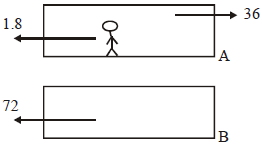
Train $A$ and train $B$ are running on parallel tracks in opposite directions with speeds of $36 \, km/h$ and $72 \, km/h$,respectively. $A$ person is walking in train $A$ in the direction opposite to its motion with a speed of $1.8 \, km/h$. The speed (in $m/s$) of this person as observed from train $B$ will be close to:
(take the distance between the tracks as negligible) (in $.5$)
(take the distance between the tracks as negligible) (in $.5$)
A
$30$
B
$29$
C
$31$
D
$28$
Solution
(B) Let the direction of motion of train $A$ be positive $(+)$ and the direction of motion of train $B$ be negative $(-)$.
Velocity of train $A$ $(V_A)$ = $+36 \, km/h$.
Velocity of train $B$ $(V_B)$ = $-72 \, km/h$.
Velocity of the person with respect to train $A$ $(V_{m/A})$ = $-1.8 \, km/h$ (since the person is walking opposite to the motion of train $A$).
Velocity of the person with respect to the ground $(V_m)$ = $V_{m/A} + V_A = -1.8 + 36 = 34.2 \, km/h$.
Velocity of the person with respect to train $B$ $(V_{m/B})$ = $V_m - V_B = 34.2 - (-72) = 34.2 + 72 = 106.2 \, km/h$.
To convert $km/h$ to $m/s$,multiply by $\frac{5}{18}$:
$V_{m/B} = 106.2 \times \frac{5}{18} = 5.9 \times 5 = 29.5 \, m/s$.
Velocity of train $A$ $(V_A)$ = $+36 \, km/h$.
Velocity of train $B$ $(V_B)$ = $-72 \, km/h$.
Velocity of the person with respect to train $A$ $(V_{m/A})$ = $-1.8 \, km/h$ (since the person is walking opposite to the motion of train $A$).
Velocity of the person with respect to the ground $(V_m)$ = $V_{m/A} + V_A = -1.8 + 36 = 34.2 \, km/h$.
Velocity of the person with respect to train $B$ $(V_{m/B})$ = $V_m - V_B = 34.2 - (-72) = 34.2 + 72 = 106.2 \, km/h$.
To convert $km/h$ to $m/s$,multiply by $\frac{5}{18}$:
$V_{m/B} = 106.2 \times \frac{5}{18} = 5.9 \times 5 = 29.5 \, m/s$.
0 likes
View Solution114
DifficultMCQ
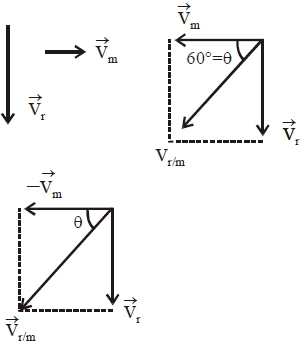
When a car is at rest,its driver sees rain drops falling on it vertically. When driving the car with speed $v$,he sees that rain drops are coming at an angle $60^{\circ}$ from the horizontal. On further increasing the speed of the car to $(1+\beta)v$,this angle changes to $45^{\circ}$. The value of $\beta$ is close to...
A
$0.41$
B
$0.50$
C
$0.37$
D
$0.73$
Solution
(D) Let the velocity of rain be $\vec{v}_r = -v_r \hat{j}$ and the velocity of the car be $\vec{v}_m = v_m \hat{i}$.
When the car moves with speed $v$,the relative velocity of rain with respect to the car is $\vec{v}_{r/m} = \vec{v}_r - \vec{v}_m = -v_r \hat{j} - v \hat{i}$.
The angle $\theta$ with the horizontal is given by $\tan \theta = \frac{|v_r|}{|v_m|}$.
Given $\theta = 60^{\circ}$ and $v_m = v$,we have $\tan 60^{\circ} = \frac{v_r}{v} = \sqrt{3}$,so $v_r = v\sqrt{3}$.
When the car speed increases to $(1+\beta)v$,the new angle is $45^{\circ}$.
Thus,$\tan 45^{\circ} = \frac{v_r}{(1+\beta)v} = 1$.
Substituting $v_r = v\sqrt{3}$,we get $\frac{v\sqrt{3}}{(1+\beta)v} = 1$.
$\sqrt{3} = 1 + \beta$.
$\beta = \sqrt{3} - 1 \approx 1.732 - 1 = 0.732$.
Therefore,the value of $\beta$ is close to $0.73$.
When the car moves with speed $v$,the relative velocity of rain with respect to the car is $\vec{v}_{r/m} = \vec{v}_r - \vec{v}_m = -v_r \hat{j} - v \hat{i}$.
The angle $\theta$ with the horizontal is given by $\tan \theta = \frac{|v_r|}{|v_m|}$.
Given $\theta = 60^{\circ}$ and $v_m = v$,we have $\tan 60^{\circ} = \frac{v_r}{v} = \sqrt{3}$,so $v_r = v\sqrt{3}$.
When the car speed increases to $(1+\beta)v$,the new angle is $45^{\circ}$.
Thus,$\tan 45^{\circ} = \frac{v_r}{(1+\beta)v} = 1$.
Substituting $v_r = v\sqrt{3}$,we get $\frac{v\sqrt{3}}{(1+\beta)v} = 1$.
$\sqrt{3} = 1 + \beta$.
$\beta = \sqrt{3} - 1 \approx 1.732 - 1 = 0.732$.
Therefore,the value of $\beta$ is close to $0.73$.
2 likes
View Solution115
MediumMCQ
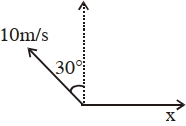
$A$ person is swimming with a speed of $10\, m/s$ at an angle of $120^{\circ}$ with the flow of the river and reaches a point directly opposite on the other side. If the speed of the river flow is $x\, m/s$,find the value of $x$ to the nearest integer.
A
$5$
B
$4$
C
$10$
D
$8$
Solution
(A) Let the velocity of the swimmer with respect to the river be $\vec{v}_{sr} = 10\, m/s$ and the velocity of the river be $\vec{v}_r = x\, m/s$.
The swimmer swims at an angle of $120^{\circ}$ with the flow of the river.
To reach a point directly opposite,the resultant velocity of the swimmer with respect to the ground $(\vec{v}_s = \vec{v}_{sr} + \vec{v}_r)$ must be perpendicular to the river flow.
Let the river flow be along the $x$-axis. The swimmer's velocity vector $\vec{v}_{sr}$ makes an angle of $120^{\circ}$ with the positive $x$-axis.
The component of the swimmer's velocity along the $x$-axis is $v_{sr,x} = 10 \cos(120^{\circ}) = 10 \times (-0.5) = -5\, m/s$.
For the swimmer to move directly across (perpendicular to the flow),the net velocity along the $x$-axis must be zero.
Therefore,$v_{net,x} = v_{sr,x} + v_r = 0$.
$-5 + x = 0$.
$x = 5\, m/s$.
The swimmer swims at an angle of $120^{\circ}$ with the flow of the river.
To reach a point directly opposite,the resultant velocity of the swimmer with respect to the ground $(\vec{v}_s = \vec{v}_{sr} + \vec{v}_r)$ must be perpendicular to the river flow.
Let the river flow be along the $x$-axis. The swimmer's velocity vector $\vec{v}_{sr}$ makes an angle of $120^{\circ}$ with the positive $x$-axis.
The component of the swimmer's velocity along the $x$-axis is $v_{sr,x} = 10 \cos(120^{\circ}) = 10 \times (-0.5) = -5\, m/s$.
For the swimmer to move directly across (perpendicular to the flow),the net velocity along the $x$-axis must be zero.
Therefore,$v_{net,x} = v_{sr,x} + v_r = 0$.
$-5 + x = 0$.
$x = 5\, m/s$.
0 likes
View Solution116
DifficultMCQ
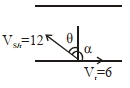
$A$ swimmer can swim with a velocity of $12 \, km/h$ in still water. The water flowing in a river has a velocity of $6 \, km/h$. The angle with respect to the direction of flow of the river water at which the swimmer should swim in order to reach the point on the other bank just opposite to his starting point is ........$^{\circ}$. (Round off to the Nearest Integer)
A
$30$
B
$120$
C
$60$
D
$150$
Solution
(B) Let $V_{sw} = 12 \, km/h$ be the velocity of the swimmer in still water and $v_r = 6 \, km/h$ be the velocity of the river flow.
To reach the point directly opposite to the starting point,the swimmer must swim at an angle $\theta$ with the normal to the river flow such that the component of his velocity cancels the river flow velocity.
$V_{sw} \sin \theta = v_r$
$12 \sin \theta = 6$
$\sin \theta = \frac{6}{12} = \frac{1}{2}$
$\theta = 30^{\circ}$ (angle with the normal).
The angle $\alpha$ with respect to the direction of the river flow is given by $\alpha = 90^{\circ} + \theta = 90^{\circ} + 30^{\circ} = 120^{\circ}$.
To reach the point directly opposite to the starting point,the swimmer must swim at an angle $\theta$ with the normal to the river flow such that the component of his velocity cancels the river flow velocity.
$V_{sw} \sin \theta = v_r$
$12 \sin \theta = 6$
$\sin \theta = \frac{6}{12} = \frac{1}{2}$
$\theta = 30^{\circ}$ (angle with the normal).
The angle $\alpha$ with respect to the direction of the river flow is given by $\alpha = 90^{\circ} + \theta = 90^{\circ} + 30^{\circ} = 120^{\circ}$.
0 likes
View Solution117
MediumMCQ
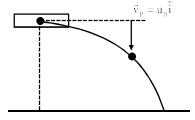
$A$ bomb is dropped by a fighter plane flying horizontally. To an observer sitting in the plane,the trajectory of the bomb is a:
A
hyperbola
B
parabola in the direction of motion of the plane
C
straight line vertically down from the plane
D
parabola in a direction opposite to the motion of the plane
Solution
(C) Let the velocity of the plane be $\vec{v}_{P} = u_{0} \hat{i}$.
When the bomb is dropped,its initial velocity is the same as that of the plane,so $\vec{v}_{B, initial} = u_{0} \hat{i}$.
At any time $t$,the velocity of the bomb relative to the ground is $\vec{v}_{B} = u_{0} \hat{i} - gt \hat{j}$.
The velocity of the plane at any time $t$ is $\vec{v}_{P} = u_{0} \hat{i}$.
The velocity of the bomb relative to the observer in the plane is $\vec{v}_{B/P} = \vec{v}_{B} - \vec{v}_{P} = (u_{0} \hat{i} - gt \hat{j}) - u_{0} \hat{i} = -gt \hat{j}$.
Since the relative velocity is always directed vertically downwards,the trajectory of the bomb as seen by an observer in the plane is a straight line vertically downwards.
When the bomb is dropped,its initial velocity is the same as that of the plane,so $\vec{v}_{B, initial} = u_{0} \hat{i}$.
At any time $t$,the velocity of the bomb relative to the ground is $\vec{v}_{B} = u_{0} \hat{i} - gt \hat{j}$.
The velocity of the plane at any time $t$ is $\vec{v}_{P} = u_{0} \hat{i}$.
The velocity of the bomb relative to the observer in the plane is $\vec{v}_{B/P} = \vec{v}_{B} - \vec{v}_{P} = (u_{0} \hat{i} - gt \hat{j}) - u_{0} \hat{i} = -gt \hat{j}$.
Since the relative velocity is always directed vertically downwards,the trajectory of the bomb as seen by an observer in the plane is a straight line vertically downwards.
0 likes
View Solution118
DifficultMCQ
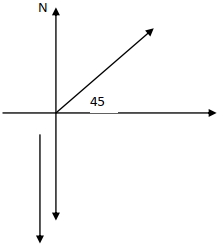
$A$ butterfly is flying with a velocity $4 \sqrt{2} \, m/s$ in the North-East direction. The wind is blowing at $1 \, m/s$ from North to South. The resultant displacement of the butterfly in $3 \, s$ is $.... \, m$.
A
$15$
B
$122$
C
$3$
D
$20$
Solution
(A) Let the East direction be along the $\hat{i}$ axis and the North direction be along the $\hat{j}$ axis.
The velocity of the butterfly relative to the air is $\vec{V}_{BA} = 4\sqrt{2} \cos(45^\circ) \hat{i} + 4\sqrt{2} \sin(45^\circ) \hat{j} = 4\hat{i} + 4\hat{j} \, m/s$.
The velocity of the wind is $\vec{V}_W = -1\hat{j} \, m/s$.
The resultant velocity of the butterfly with respect to the ground is $\vec{V}_B = \vec{V}_{BA} + \vec{V}_W = (4\hat{i} + 4\hat{j}) + (-1\hat{j}) = 4\hat{i} + 3\hat{j} \, m/s$.
The displacement of the butterfly in $t = 3 \, s$ is $\vec{S} = \vec{V}_B \times t = (4\hat{i} + 3\hat{j}) \times 3 = 12\hat{i} + 9\hat{j} \, m$.
The magnitude of the displacement is $|\vec{S}| = \sqrt{12^2 + 9^2} = \sqrt{144 + 81} = \sqrt{225} = 15 \, m$.
The velocity of the butterfly relative to the air is $\vec{V}_{BA} = 4\sqrt{2} \cos(45^\circ) \hat{i} + 4\sqrt{2} \sin(45^\circ) \hat{j} = 4\hat{i} + 4\hat{j} \, m/s$.
The velocity of the wind is $\vec{V}_W = -1\hat{j} \, m/s$.
The resultant velocity of the butterfly with respect to the ground is $\vec{V}_B = \vec{V}_{BA} + \vec{V}_W = (4\hat{i} + 4\hat{j}) + (-1\hat{j}) = 4\hat{i} + 3\hat{j} \, m/s$.
The displacement of the butterfly in $t = 3 \, s$ is $\vec{S} = \vec{V}_B \times t = (4\hat{i} + 3\hat{j}) \times 3 = 12\hat{i} + 9\hat{j} \, m$.
The magnitude of the displacement is $|\vec{S}| = \sqrt{12^2 + 9^2} = \sqrt{144 + 81} = \sqrt{225} = 15 \, m$.
0 likes
View Solution119
MediumMCQ
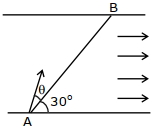
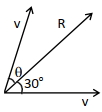
$A$ swimmer wants to cross a river from point $A$ to point $B$. Line $AB$ makes an angle of $30^{\circ}$ with the flow of the river. The magnitude of the velocity of the swimmer is the same as that of the river. The angle $\theta$ with the line $AB$ should be in degrees,so that the swimmer reaches point $B$.
A
$30$
B
$60$
C
$90$
D
$120$
Solution
(A) Let the velocity of the river be $\vec{v}_r$ and the velocity of the swimmer with respect to the river be $\vec{v}_{sr}$.
Given that the magnitudes are equal,let $|\vec{v}_r| = |\vec{v}_{sr}| = v$.
The resultant velocity $\vec{v}_s = \vec{v}_{sr} + \vec{v}_r$ must be directed along the line $AB$ to reach point $B$.
Since the magnitudes of the two vectors $\vec{v}_{sr}$ and $\vec{v}_r$ are equal,their resultant vector $\vec{v}_s$ bisects the angle between them.
Let the angle between the river flow (horizontal) and the line $AB$ be $\alpha = 30^{\circ}$.
Let the angle between the swimmer's velocity $\vec{v}_{sr}$ and the line $AB$ be $\theta$.
Then the angle between the swimmer's velocity $\vec{v}_{sr}$ and the river flow $\vec{v}_r$ is $(\theta + 30^{\circ})$.
Since the resultant $\vec{v}_s$ (which is along $AB$) bisects this angle,the angle between $\vec{v}_s$ and $\vec{v}_r$ must be equal to the angle between $\vec{v}_s$ and $\vec{v}_{sr}$.
Therefore,$30^{\circ} = \theta$.
Thus,the required angle $\theta$ is $30^{\circ}$.
Given that the magnitudes are equal,let $|\vec{v}_r| = |\vec{v}_{sr}| = v$.
The resultant velocity $\vec{v}_s = \vec{v}_{sr} + \vec{v}_r$ must be directed along the line $AB$ to reach point $B$.
Since the magnitudes of the two vectors $\vec{v}_{sr}$ and $\vec{v}_r$ are equal,their resultant vector $\vec{v}_s$ bisects the angle between them.
Let the angle between the river flow (horizontal) and the line $AB$ be $\alpha = 30^{\circ}$.
Let the angle between the swimmer's velocity $\vec{v}_{sr}$ and the line $AB$ be $\theta$.
Then the angle between the swimmer's velocity $\vec{v}_{sr}$ and the river flow $\vec{v}_r$ is $(\theta + 30^{\circ})$.
Since the resultant $\vec{v}_s$ (which is along $AB$) bisects this angle,the angle between $\vec{v}_s$ and $\vec{v}_r$ must be equal to the angle between $\vec{v}_s$ and $\vec{v}_{sr}$.
Therefore,$30^{\circ} = \theta$.
Thus,the required angle $\theta$ is $30^{\circ}$.
0 likes
View Solution120
MediumMCQ
$A$ girl standing on a road holds her umbrella at $45^{\circ}$ with the vertical to keep the rain away. If she starts running without an umbrella with a speed of $15 \sqrt{2} \; kmh^{-1}$,the rain drops hit her head vertically. The speed of rain drops with respect to the moving girl is ........... $kmh^{-1}$
A
$30$
B
$\frac{25}{\sqrt{2}}$
C
$\frac{30}{\sqrt{2}}$
D
$15$
Solution
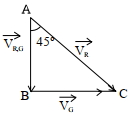
(C) Let $\vec{V}_R$ be the velocity of rain with respect to the ground and $\vec{V}_G$ be the velocity of the girl with respect to the ground.
When the girl is standing,she holds the umbrella at $45^{\circ}$ with the vertical,which means the direction of rain with respect to the ground makes an angle of $45^{\circ}$ with the vertical.
From the vector triangle,$\tan 45^{\circ} = \frac{|\vec{V}_G|}{|\vec{V}_{R,G}|}$,where $\vec{V}_{R,G}$ is the velocity of rain with respect to the girl.
When the girl starts running with velocity $\vec{V}_G = 15 \sqrt{2} \; kmh^{-1}$,the rain hits her head vertically. This means the relative velocity of rain with respect to the girl,$\vec{V}_{R,G} = \vec{V}_R - \vec{V}_G$,is vertical.
From the geometry of the velocity triangle,$|\vec{V}_{R,G}| = \frac{|\vec{V}_G|}{\tan 45^{\circ}}$.
Since $\tan 45^{\circ} = 1$,we have $|\vec{V}_{R,G}| = |\vec{V}_G| = 15 \sqrt{2} \; kmh^{-1}$.
The speed of rain drops with respect to the moving girl is $|\vec{V}_{R,G}| = 15 \sqrt{2} \; kmh^{-1}$.
Wait,checking the options provided: $15 \sqrt{2} \approx 21.21$. None of the options match. Let's re-evaluate: If the rain hits her vertically when she runs,then $\vec{V}_{R,G}$ is vertical. The horizontal component of $\vec{V}_R$ must be equal to the girl's speed $V_G = 15 \sqrt{2}$.
Thus,$V_R \sin 45^{\circ} = 15 \sqrt{2} \Rightarrow V_R \frac{1}{\sqrt{2}} = 15 \sqrt{2} \Rightarrow V_R = 30 \; kmh^{-1}$.
The vertical component of rain is $V_{R,G} = V_R \cos 45^{\circ} = 30 \times \frac{1}{\sqrt{2}} = \frac{30}{\sqrt{2}} \; kmh^{-1}$.
Thus,the correct option is $C$.
When the girl is standing,she holds the umbrella at $45^{\circ}$ with the vertical,which means the direction of rain with respect to the ground makes an angle of $45^{\circ}$ with the vertical.
From the vector triangle,$\tan 45^{\circ} = \frac{|\vec{V}_G|}{|\vec{V}_{R,G}|}$,where $\vec{V}_{R,G}$ is the velocity of rain with respect to the girl.
When the girl starts running with velocity $\vec{V}_G = 15 \sqrt{2} \; kmh^{-1}$,the rain hits her head vertically. This means the relative velocity of rain with respect to the girl,$\vec{V}_{R,G} = \vec{V}_R - \vec{V}_G$,is vertical.
From the geometry of the velocity triangle,$|\vec{V}_{R,G}| = \frac{|\vec{V}_G|}{\tan 45^{\circ}}$.
Since $\tan 45^{\circ} = 1$,we have $|\vec{V}_{R,G}| = |\vec{V}_G| = 15 \sqrt{2} \; kmh^{-1}$.
The speed of rain drops with respect to the moving girl is $|\vec{V}_{R,G}| = 15 \sqrt{2} \; kmh^{-1}$.
Wait,checking the options provided: $15 \sqrt{2} \approx 21.21$. None of the options match. Let's re-evaluate: If the rain hits her vertically when she runs,then $\vec{V}_{R,G}$ is vertical. The horizontal component of $\vec{V}_R$ must be equal to the girl's speed $V_G = 15 \sqrt{2}$.
Thus,$V_R \sin 45^{\circ} = 15 \sqrt{2} \Rightarrow V_R \frac{1}{\sqrt{2}} = 15 \sqrt{2} \Rightarrow V_R = 30 \; kmh^{-1}$.
The vertical component of rain is $V_{R,G} = V_R \cos 45^{\circ} = 30 \times \frac{1}{\sqrt{2}} = \frac{30}{\sqrt{2}} \; kmh^{-1}$.
Thus,the correct option is $C$.
0 likes
View Solution121
MediumMCQ
$A$ boat crossing a river moves with a velocity $v$ relative to still water. The river is flowing with a velocity $v/2$ with respect to the bank. The angle with respect to the flow direction with which the boat should move to minimize the drift is (in $^{\circ}$)
A
$30$
B
$60$
C
$150$
D
$120$
Solution
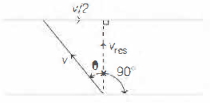
(D) To minimize the drift,the boat must be steered such that its resultant velocity is perpendicular to the river bank.
Let the boat be directed at an angle $\theta$ with the normal to the river flow,as shown in the diagram.
From the velocity triangle,the component of the boat's velocity $v$ along the river flow must cancel the river's velocity $v/2$.
Thus,$v \sin \theta = v/2$.
$\sin \theta = 1/2$,which gives $\theta = 30^{\circ}$.
The angle with respect to the direction of flow is $90^{\circ} + \theta = 90^{\circ} + 30^{\circ} = 120^{\circ}$.
Let the boat be directed at an angle $\theta$ with the normal to the river flow,as shown in the diagram.
From the velocity triangle,the component of the boat's velocity $v$ along the river flow must cancel the river's velocity $v/2$.
Thus,$v \sin \theta = v/2$.
$\sin \theta = 1/2$,which gives $\theta = 30^{\circ}$.
The angle with respect to the direction of flow is $90^{\circ} + \theta = 90^{\circ} + 30^{\circ} = 120^{\circ}$.
0 likes
View Solution122
DifficultMCQ
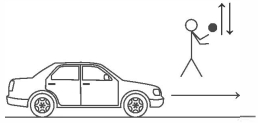
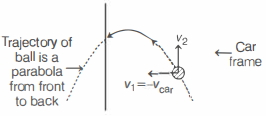
$A$ boy standing on the footpath tosses a ball straight up and catches it. The driver of a car passing by,moving with uniform velocity,sees this. The trajectory of the ball as seen by the driver will be:
A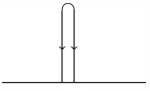
B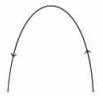
C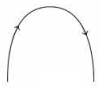
D
Solution
(B) The velocity of the ball is measured relative to a fixed frame of reference. When the frame of reference is moving (like the car),the object appears to have an additional velocity equal and opposite to the velocity of the frame.
Let the velocity of the car be $\vec{v}_{c}$. In the frame of the car,the ball has:
$(i)$ $A$ vertical velocity component due to the toss.
$(ii)$ $A$ horizontal velocity component equal to $-\vec{v}_{c}$ (opposite to the motion of the car).
Since the ball has both a constant vertical acceleration (gravity) and a constant horizontal velocity relative to the car,the path of the ball in the car's frame of reference is a parabola. Therefore,the correct option is $(b)$.
Let the velocity of the car be $\vec{v}_{c}$. In the frame of the car,the ball has:
$(i)$ $A$ vertical velocity component due to the toss.
$(ii)$ $A$ horizontal velocity component equal to $-\vec{v}_{c}$ (opposite to the motion of the car).
Since the ball has both a constant vertical acceleration (gravity) and a constant horizontal velocity relative to the car,the path of the ball in the car's frame of reference is a parabola. Therefore,the correct option is $(b)$.
0 likes
View Solution123
DifficultMCQ
An airplane airspeed indicator reads $100 \, m/s$ and its compass shows that it is heading $37^{\circ}$ east of north. The meteorological information provided to the navigator is that the wind velocity is $20 \, m/s$ towards east. The speed of the airplane relative to the ground is closest to ............ $\, m/s$.
A
$111$
B
$113$
C
$115$
D
$120$
Solution
(B) Let $\vec{V}_p$ be the velocity of the airplane relative to the air and $\vec{V}_w$ be the velocity of the wind relative to the ground.
Given: $|\vec{V}_p| = 100 \, m/s$ at $37^{\circ}$ east of north,and $\vec{V}_w = 20 \, m/s$ towards east.
The velocity of the airplane relative to the ground is $\vec{V}_g = \vec{V}_p + \vec{V}_w$.
In vector components:
$\vec{V}_p = 100 \sin 37^{\circ} \hat{i} + 100 \cos 37^{\circ} \hat{j} = 100(0.6) \hat{i} + 100(0.8) \hat{j} = 60 \hat{i} + 80 \hat{j} \, m/s$.
$\vec{V}_w = 20 \hat{i} \, m/s$.
$\vec{V}_g = (60 + 20) \hat{i} + 80 \hat{j} = 80 \hat{i} + 80 \hat{j} \, m/s$.
The speed relative to the ground is $|\vec{V}_g| = \sqrt{80^2 + 80^2} = 80\sqrt{2} \approx 80 \times 1.414 = 113.12 \, m/s$.
Thus,the speed is closest to $113 \, m/s$.
Given: $|\vec{V}_p| = 100 \, m/s$ at $37^{\circ}$ east of north,and $\vec{V}_w = 20 \, m/s$ towards east.
The velocity of the airplane relative to the ground is $\vec{V}_g = \vec{V}_p + \vec{V}_w$.
In vector components:
$\vec{V}_p = 100 \sin 37^{\circ} \hat{i} + 100 \cos 37^{\circ} \hat{j} = 100(0.6) \hat{i} + 100(0.8) \hat{j} = 60 \hat{i} + 80 \hat{j} \, m/s$.
$\vec{V}_w = 20 \hat{i} \, m/s$.
$\vec{V}_g = (60 + 20) \hat{i} + 80 \hat{j} = 80 \hat{i} + 80 \hat{j} \, m/s$.
The speed relative to the ground is $|\vec{V}_g| = \sqrt{80^2 + 80^2} = 80\sqrt{2} \approx 80 \times 1.414 = 113.12 \, m/s$.
Thus,the speed is closest to $113 \, m/s$.
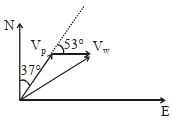
0 likes
View Solution124
DifficultMCQ
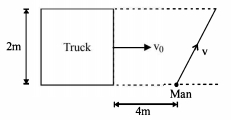
$A$ $2\,m$ wide truck is moving with a uniform speed $v_0=8\,m/s$ along a straight horizontal road. $A$ pedestrian starts to cross the road with a uniform speed $v$ when the truck is $4\,m$ away from him. The minimum value of $v$ so that he can cross the road safely is $...........\,m/s$.
A
$2.62$
B
$4.6$
C
$3.57$
D
$1.414$
Solution
(C) Let the man start crossing the road at an angle $\theta$ with the perpendicular to the road. The width of the road is $d = 2\,m$. The distance the man needs to travel to cross the road is $d/\cos\theta = 2/\cos\theta$. The time taken by the man is $t = (2/\cos\theta) / v$.
In this time $t$,the truck travels a distance $x = v_0 t = 8 \times (2 / (v \cos\theta)) = 16 / (v \cos\theta)$.
For the man to cross safely,the truck must have passed the point where the man reaches the other side. The initial distance of the truck from the man's path is $4\,m$. The man reaches the other side at a horizontal distance of $d \tan\theta = 2 \tan\theta$ from his starting point.
Thus,the truck must cover a total distance of $4 + 2 \tan\theta$. Therefore,$v_0 t = 4 + 2 \tan\theta$.
Substituting $t = 2 / (v \cos\theta)$,we get:
$8 \times (2 / (v \cos\theta)) = 4 + 2 \tan\theta$
$16 / (v \cos\theta) = 4 + 2 (\sin\theta / \cos\theta)$
$16 / v = 4 \cos\theta + 2 \sin\theta$
$v = 16 / (4 \cos\theta + 2 \sin\theta) = 8 / (2 \cos\theta + \sin\theta)$.
To minimize $v$,we maximize the denominator $f(\theta) = 2 \cos\theta + \sin\theta$.
$f'(\theta) = -2 \sin\theta + \cos\theta = 0 \implies \tan\theta = 0.5$.
For $\tan\theta = 0.5$,$\sin\theta = 1/\sqrt{5}$ and $\cos\theta = 2/\sqrt{5}$.
$v_{\min} = 8 / (2(2/\sqrt{5}) + 1/\sqrt{5}) = 8 / (5/\sqrt{5}) = 8 / \sqrt{5} \approx 3.57\,m/s$.
In this time $t$,the truck travels a distance $x = v_0 t = 8 \times (2 / (v \cos\theta)) = 16 / (v \cos\theta)$.
For the man to cross safely,the truck must have passed the point where the man reaches the other side. The initial distance of the truck from the man's path is $4\,m$. The man reaches the other side at a horizontal distance of $d \tan\theta = 2 \tan\theta$ from his starting point.
Thus,the truck must cover a total distance of $4 + 2 \tan\theta$. Therefore,$v_0 t = 4 + 2 \tan\theta$.
Substituting $t = 2 / (v \cos\theta)$,we get:
$8 \times (2 / (v \cos\theta)) = 4 + 2 \tan\theta$
$16 / (v \cos\theta) = 4 + 2 (\sin\theta / \cos\theta)$
$16 / v = 4 \cos\theta + 2 \sin\theta$
$v = 16 / (4 \cos\theta + 2 \sin\theta) = 8 / (2 \cos\theta + \sin\theta)$.
To minimize $v$,we maximize the denominator $f(\theta) = 2 \cos\theta + \sin\theta$.
$f'(\theta) = -2 \sin\theta + \cos\theta = 0 \implies \tan\theta = 0.5$.
For $\tan\theta = 0.5$,$\sin\theta = 1/\sqrt{5}$ and $\cos\theta = 2/\sqrt{5}$.
$v_{\min} = 8 / (2(2/\sqrt{5}) + 1/\sqrt{5}) = 8 / (5/\sqrt{5}) = 8 / \sqrt{5} \approx 3.57\,m/s$.
0 likes
View Solution125
DifficultMCQ
$A$ boat covers a certain distance between two spots in a river taking $t_1$ hours going downstream and $t_2$ hours going upstream. What time will be taken by the boat to cover the same distance in still water?
A
$\frac{t_1+t_2}{2}$
B
$2(t_2-t_1)$
C
$\frac{2 t_1 t_2}{t_1+t_2}$
D
$\sqrt{t_1 t_2}$
Solution
(C) Let $d$ be the distance between the two spots,$v$ be the speed of the boat in still water,and $u$ be the speed of the river current.
For downstream motion,the effective speed is $(v+u)$. Thus,$t_1 = \frac{d}{v+u} \Rightarrow d = (v+u)t_1 \dots (i)$
For upstream motion,the effective speed is $(v-u)$. Thus,$t_2 = \frac{d}{v-u} \Rightarrow d = (v-u)t_2 \dots (ii)$
Equating $(i)$ and $(ii)$,we get $(v+u)t_1 = (v-u)t_2$.
$vt_1 + ut_1 = vt_2 - ut_2 \Rightarrow u(t_1+t_2) = v(t_2-t_1) \Rightarrow u = v\frac{t_2-t_1}{t_1+t_2}$.
Substituting $u$ into equation $(i)$,$d = (v + v\frac{t_2-t_1}{t_1+t_2})t_1 = v(\frac{t_1+t_2+t_2-t_1}{t_1+t_2})t_1 = v(\frac{2t_2}{t_1+t_2})t_1$.
The time taken in still water is $t = \frac{d}{v}$.
Therefore,$t = \frac{v(\frac{2t_1t_2}{t_1+t_2})}{v} = \frac{2t_1t_2}{t_1+t_2}$.
For downstream motion,the effective speed is $(v+u)$. Thus,$t_1 = \frac{d}{v+u} \Rightarrow d = (v+u)t_1 \dots (i)$
For upstream motion,the effective speed is $(v-u)$. Thus,$t_2 = \frac{d}{v-u} \Rightarrow d = (v-u)t_2 \dots (ii)$
Equating $(i)$ and $(ii)$,we get $(v+u)t_1 = (v-u)t_2$.
$vt_1 + ut_1 = vt_2 - ut_2 \Rightarrow u(t_1+t_2) = v(t_2-t_1) \Rightarrow u = v\frac{t_2-t_1}{t_1+t_2}$.
Substituting $u$ into equation $(i)$,$d = (v + v\frac{t_2-t_1}{t_1+t_2})t_1 = v(\frac{t_1+t_2+t_2-t_1}{t_1+t_2})t_1 = v(\frac{2t_2}{t_1+t_2})t_1$.
The time taken in still water is $t = \frac{d}{v}$.
Therefore,$t = \frac{v(\frac{2t_1t_2}{t_1+t_2})}{v} = \frac{2t_1t_2}{t_1+t_2}$.
0 likes
View Solution126
MediumMCQ
Two trains,each of length $100 \, m$,are moving parallel towards each other at speeds of $72 \, km/h$ and $36 \, km/h$ respectively. In how much time will they cross each other (in $, s$)?
A
$4.5$
B
$6.67$
C
$3.5$
D
$7.25$
Solution
(B) The length of each train is $L = 100 \, m$. The total distance to be covered to cross each other is $D = 100 \, m + 100 \, m = 200 \, m$.
Since the trains are moving in opposite directions,their relative speed is the sum of their individual speeds.
Convert speeds from $km/h$ to $m/s$:
$v_1 = 72 \times \frac{5}{18} = 20 \, m/s$
$v_2 = 36 \times \frac{5}{18} = 10 \, m/s$
Relative speed $v_{\text{rel}} = v_1 + v_2 = 20 + 10 = 30 \, m/s$.
The time taken to cross each other is $t = \frac{D}{v_{\text{rel}}} = \frac{200}{30} \approx 6.67 \, s$.
Since the trains are moving in opposite directions,their relative speed is the sum of their individual speeds.
Convert speeds from $km/h$ to $m/s$:
$v_1 = 72 \times \frac{5}{18} = 20 \, m/s$
$v_2 = 36 \times \frac{5}{18} = 10 \, m/s$
Relative speed $v_{\text{rel}} = v_1 + v_2 = 20 + 10 = 30 \, m/s$.
The time taken to cross each other is $t = \frac{D}{v_{\text{rel}}} = \frac{200}{30} \approx 6.67 \, s$.
0 likes
View Solution127
EasyMCQ
The velocities of $A$ and $B$ are $\vec{v}_A = 2 \hat{i} + 4 \hat{j}$ and $\vec{v}_B = 3 \hat{i} - 7 \hat{j}$. The velocity of $B$ as observed by $A$ is:
A
$5 \hat{i} - 3 \hat{j}$
B
$\hat{i} - 11 \hat{j}$
C
$-\hat{i} + 11 \hat{j}$
D
$2 \hat{i} - 3 \hat{j}$
Solution
(B) The velocity of $B$ with respect to $A$ is given by the formula: $\vec{v}_{BA} = \vec{v}_B - \vec{v}_A$.
Substituting the given values:
$\vec{v}_{BA} = (3 \hat{i} - 7 \hat{j}) - (2 \hat{i} + 4 \hat{j})$
$= (3 - 2) \hat{i} + (-7 - 4) \hat{j}$
$= \hat{i} - 11 \hat{j}$.
Substituting the given values:
$\vec{v}_{BA} = (3 \hat{i} - 7 \hat{j}) - (2 \hat{i} + 4 \hat{j})$
$= (3 - 2) \hat{i} + (-7 - 4) \hat{j}$
$= \hat{i} - 11 \hat{j}$.
0 likes
View Solution128
MediumMCQ
$A$ bus appears to go with a speed of $25 \, km/hr$ to a car driver,driving at the rate of $7 \, km/hr$ northwards. If the bus actually travels in the east direction,its speed is ......... $km/h$.
A
$24$
B
$23$
C
$26$
D
$30$
Solution
(A) Let the velocity of the bus be $\vec{V}_B = V_B \hat{i}$ (eastward) and the velocity of the car be $\vec{V}_C = 7 \hat{j}$ (northward).
The relative velocity of the bus with respect to the car is given by $\vec{V}_{BC} = \vec{V}_B - \vec{V}_C = V_B \hat{i} - 7 \hat{j}$.
The magnitude of the relative velocity is given as $25 \, km/hr$.
$|\vec{V}_{BC}| = \sqrt{V_B^2 + (-7)^2} = 25$.
Squaring both sides,we get $V_B^2 + 49 = 625$.
$V_B^2 = 625 - 49 = 576$.
$V_B = \sqrt{576} = 24 \, km/hr$.
The relative velocity of the bus with respect to the car is given by $\vec{V}_{BC} = \vec{V}_B - \vec{V}_C = V_B \hat{i} - 7 \hat{j}$.
The magnitude of the relative velocity is given as $25 \, km/hr$.
$|\vec{V}_{BC}| = \sqrt{V_B^2 + (-7)^2} = 25$.
Squaring both sides,we get $V_B^2 + 49 = 625$.
$V_B^2 = 625 - 49 = 576$.
$V_B = \sqrt{576} = 24 \, km/hr$.
0 likes
View Solution129
MediumMCQ
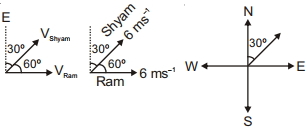
Ram moves in the east direction at a speed of $6 \, m/s$ and Shyam moves $30^{\circ}$ east of north at a speed of $6 \, m/s$. The magnitude of their relative velocity is ........ $m/s$.
A
$3$
B
$6$
C
$6\sqrt{3}$
D
$6\sqrt{2}$
Solution
(B) Let $\vec{V}_R$ be the velocity of Ram and $\vec{V}_S$ be the velocity of Shyam.
Given,$|\vec{V}_R| = 6 \, m/s$ (along East) and $|\vec{V}_S| = 6 \, m/s$ (at $30^{\circ}$ East of North).
The angle $\theta$ between $\vec{V}_R$ and $\vec{V}_S$ is $90^{\circ} - 30^{\circ} = 60^{\circ}$.
The magnitude of relative velocity is given by:
$|\vec{V}_{RS}| = \sqrt{V_R^2 + V_S^2 - 2 V_R V_S \cos \theta}$
$|\vec{V}_{RS}| = \sqrt{6^2 + 6^2 - 2 \times 6 \times 6 \times \cos 60^{\circ}}$
$|\vec{V}_{RS}| = \sqrt{36 + 36 - 72 \times 0.5}$
$|\vec{V}_{RS}| = \sqrt{72 - 36} = \sqrt{36} = 6 \, m/s$.
Given,$|\vec{V}_R| = 6 \, m/s$ (along East) and $|\vec{V}_S| = 6 \, m/s$ (at $30^{\circ}$ East of North).
The angle $\theta$ between $\vec{V}_R$ and $\vec{V}_S$ is $90^{\circ} - 30^{\circ} = 60^{\circ}$.
The magnitude of relative velocity is given by:
$|\vec{V}_{RS}| = \sqrt{V_R^2 + V_S^2 - 2 V_R V_S \cos \theta}$
$|\vec{V}_{RS}| = \sqrt{6^2 + 6^2 - 2 \times 6 \times 6 \times \cos 60^{\circ}}$
$|\vec{V}_{RS}| = \sqrt{36 + 36 - 72 \times 0.5}$
$|\vec{V}_{RS}| = \sqrt{72 - 36} = \sqrt{36} = 6 \, m/s$.
0 likes
View Solution130
EasyMCQ
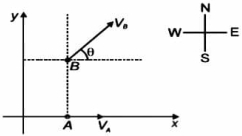
The figure shows two ships moving in the $x-y$ plane with velocities $V_A$ and $V_B$. The ships move such that $B$ always remains north of $A$. The ratio $\frac{V_A}{V_B}$ is equal to ........
A
$\cos \theta$
B
$\sin \theta$
C
$\sec \theta$
D
$\operatorname{cosec} \theta$
Solution
(A) For ship $B$ to always remain north of ship $A$,their $x$-coordinates must remain the same at all times. This implies that the velocity components of both ships along the $x$-axis must be equal.
Let the velocity of ship $A$ be $V_A$ along the positive $x$-axis.
Let the velocity of ship $B$ be $V_B$ at an angle $\theta$ with the horizontal ($x$-axis).
The $x$-component of the velocity of ship $A$ is $V_{Ax} = V_A$.
The $x$-component of the velocity of ship $B$ is $V_{Bx} = V_B \cos \theta$.
Since $V_{Ax} = V_{Bx}$,we have:
$V_A = V_B \cos \theta$
Therefore,the ratio is:
$\frac{V_A}{V_B} = \cos \theta$
Let the velocity of ship $A$ be $V_A$ along the positive $x$-axis.
Let the velocity of ship $B$ be $V_B$ at an angle $\theta$ with the horizontal ($x$-axis).
The $x$-component of the velocity of ship $A$ is $V_{Ax} = V_A$.
The $x$-component of the velocity of ship $B$ is $V_{Bx} = V_B \cos \theta$.
Since $V_{Ax} = V_{Bx}$,we have:
$V_A = V_B \cos \theta$
Therefore,the ratio is:
$\frac{V_A}{V_B} = \cos \theta$
0 likes
View Solution131
MediumMCQ
$A$ car with a vertical windshield moves in a rainstorm at a speed of $40 \, km/h$. The raindrops fall vertically with a constant speed of $20 \, m/s$. The angle at which the raindrops strike the windshield is .........
A
$\tan^{-1} \left(\frac{5}{9}\right)$
B
$\tan^{-1} \left(\frac{9}{5}\right)$
C
$\tan^{-1} \left(\frac{3}{2}\right)$
D
$\tan^{-1} \left(\frac{2}{3}\right)$
Solution
(A) First,convert the speed of the car from $km/h$ to $m/s$:
$v_m = 40 \times \frac{5}{18} = \frac{200}{18} = \frac{100}{9} \, m/s$.
The velocity of the rain is $v_r = 20 \, m/s$ (vertically downwards).
The relative velocity of the rain with respect to the car is the vector sum of the velocity of the rain and the negative velocity of the car.
The angle $\theta$ with the vertical at which the rain strikes the windshield is given by:
$\tan \theta = \frac{v_m}{v_r}$
Substituting the values:
$\tan \theta = \frac{100/9}{20} = \frac{100}{9 \times 20} = \frac{5}{9}$.
Therefore,$\theta = \tan^{-1} \left(\frac{5}{9}\right)$.
$v_m = 40 \times \frac{5}{18} = \frac{200}{18} = \frac{100}{9} \, m/s$.
The velocity of the rain is $v_r = 20 \, m/s$ (vertically downwards).
The relative velocity of the rain with respect to the car is the vector sum of the velocity of the rain and the negative velocity of the car.
The angle $\theta$ with the vertical at which the rain strikes the windshield is given by:
$\tan \theta = \frac{v_m}{v_r}$
Substituting the values:
$\tan \theta = \frac{100/9}{20} = \frac{100}{9 \times 20} = \frac{5}{9}$.
Therefore,$\theta = \tan^{-1} \left(\frac{5}{9}\right)$.

0 likes
View Solution132
MediumMCQ
Two particles $A$ and $B$ start moving from the origin in the $xy$-plane. Particle $A$ moves with a velocity of $20 \, m/s$ along the $x$-axis,and particle $B$ moves with a velocity of $30\sqrt{2} \, m/s$ at an angle of $45^{\circ}$ with the $x$-axis. The relative velocity of $B$ with respect to $A$ is ........... $m/s$.
A
$(10 \hat{i} + 30 \hat{j})$
B
$(30 \hat{i} + 10 \hat{j})$
C
$(30 \hat{i} - 20\sqrt{2} \hat{j})$
D
$(30\sqrt{2} \hat{i} + 10\sqrt{2} \hat{j})$
Solution
(A) Given:
Velocity of particle $A$,$\vec{v}_A = 20 \hat{i} \, m/s$.
Velocity of particle $B$,$\vec{v}_B = 30\sqrt{2} \cos 45^{\circ} \hat{i} + 30\sqrt{2} \sin 45^{\circ} \hat{j} \, m/s$.
Since $\cos 45^{\circ} = \sin 45^{\circ} = \frac{1}{\sqrt{2}}$,we have:
$\vec{v}_B = 30\sqrt{2} \left( \frac{1}{\sqrt{2}} \right) \hat{i} + 30\sqrt{2} \left( \frac{1}{\sqrt{2}} \right) \hat{j} = 30 \hat{i} + 30 \hat{j} \, m/s$.
The relative velocity of $B$ with respect to $A$ is given by $\vec{v}_{BA} = \vec{v}_B - \vec{v}_A$.
Substituting the values:
$\vec{v}_{BA} = (30 \hat{i} + 30 \hat{j}) - (20 \hat{i}) = (30 - 20) \hat{i} + 30 \hat{j} = 10 \hat{i} + 30 \hat{j} \, m/s$.
Velocity of particle $A$,$\vec{v}_A = 20 \hat{i} \, m/s$.
Velocity of particle $B$,$\vec{v}_B = 30\sqrt{2} \cos 45^{\circ} \hat{i} + 30\sqrt{2} \sin 45^{\circ} \hat{j} \, m/s$.
Since $\cos 45^{\circ} = \sin 45^{\circ} = \frac{1}{\sqrt{2}}$,we have:
$\vec{v}_B = 30\sqrt{2} \left( \frac{1}{\sqrt{2}} \right) \hat{i} + 30\sqrt{2} \left( \frac{1}{\sqrt{2}} \right) \hat{j} = 30 \hat{i} + 30 \hat{j} \, m/s$.
The relative velocity of $B$ with respect to $A$ is given by $\vec{v}_{BA} = \vec{v}_B - \vec{v}_A$.
Substituting the values:
$\vec{v}_{BA} = (30 \hat{i} + 30 \hat{j}) - (20 \hat{i}) = (30 - 20) \hat{i} + 30 \hat{j} = 10 \hat{i} + 30 \hat{j} \, m/s$.

0 likes
View Solution133
EasyMCQ
Out of the two cars $A$ and $B$,car $A$ is moving towards the east with a velocity of $10 \, m/s$,whereas car $B$ is moving towards the north with a velocity of $20 \, m/s$. The velocity of $A$ with respect to $B$ is ......... $m/s$ (nearly).
A
$30$
B
$10$
C
$22$
D
$42$
Solution
(C) Given:
Velocity of car $A$,$\vec{v}_A = 10 \hat{i} \, m/s$
Velocity of car $B$,$\vec{v}_B = 20 \hat{j} \, m/s$
The velocity of $A$ with respect to $B$ is given by $\vec{v}_{AB} = \vec{v}_A - \vec{v}_B$.
$\vec{v}_{AB} = 10 \hat{i} - 20 \hat{j}$
The magnitude of the relative velocity is:
$|\vec{v}_{AB}| = \sqrt{(10)^2 + (-20)^2}$
$|\vec{v}_{AB}| = \sqrt{100 + 400} = \sqrt{500}$
$|\vec{v}_{AB}| \approx 22.36 \, m/s$
Rounding to the nearest integer,we get $22 \, m/s$.
Therefore,the correct option is $C$.
Velocity of car $A$,$\vec{v}_A = 10 \hat{i} \, m/s$
Velocity of car $B$,$\vec{v}_B = 20 \hat{j} \, m/s$
The velocity of $A$ with respect to $B$ is given by $\vec{v}_{AB} = \vec{v}_A - \vec{v}_B$.
$\vec{v}_{AB} = 10 \hat{i} - 20 \hat{j}$
The magnitude of the relative velocity is:
$|\vec{v}_{AB}| = \sqrt{(10)^2 + (-20)^2}$
$|\vec{v}_{AB}| = \sqrt{100 + 400} = \sqrt{500}$
$|\vec{v}_{AB}| \approx 22.36 \, m/s$
Rounding to the nearest integer,we get $22 \, m/s$.
Therefore,the correct option is $C$.
0 likes
View Solution134
DifficultMCQ
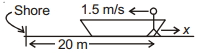
$A$ man of mass $60 \,kg$ is standing on a boat of mass $140 \,kg$,which is at rest in still water. The man is initially at $20 \,m$ from the shore. He starts walking on the boat for $4 \,s$ with a constant speed of $1.5 \,m/s$ towards the shore. The final distance of the man from the shore is .......... $m$.
A
$15.8$
B
$4.2$
C
$12.6$
D
$14.1$
Solution
(A) Since there is no external horizontal force acting on the system (man + boat),the center of mass of the system remains stationary.
Let $m_m = 60 \,kg$ be the mass of the man and $m_b = 140 \,kg$ be the mass of the boat.
The man walks a distance $d = v \times t = 1.5 \,m/s \times 4 \,s = 6.0 \,m$ relative to the boat.
Let the boat move away from the shore by a distance $x$ due to the man walking towards the shore.
By the principle of conservation of the center of mass,the displacement of the center of mass is zero:
$m_m \Delta x_m + m_b \Delta x_b = 0$
Taking the direction towards the shore as negative,the displacement of the man relative to the ground is $-(6.0 - x)$ and the displacement of the boat is $+x$.
$60 \times -(6.0 - x) + 140 \times x = 0$
$-360 + 60x + 140x = 0$
$200x = 360$
$x = 1.8 \,m$
The man's displacement relative to the ground is $-(6.0 - 1.8) = -4.2 \,m$.
The initial distance from the shore was $20 \,m$.
Final distance $= 20 - 4.2 = 15.8 \,m$.
Let $m_m = 60 \,kg$ be the mass of the man and $m_b = 140 \,kg$ be the mass of the boat.
The man walks a distance $d = v \times t = 1.5 \,m/s \times 4 \,s = 6.0 \,m$ relative to the boat.
Let the boat move away from the shore by a distance $x$ due to the man walking towards the shore.
By the principle of conservation of the center of mass,the displacement of the center of mass is zero:
$m_m \Delta x_m + m_b \Delta x_b = 0$
Taking the direction towards the shore as negative,the displacement of the man relative to the ground is $-(6.0 - x)$ and the displacement of the boat is $+x$.
$60 \times -(6.0 - x) + 140 \times x = 0$
$-360 + 60x + 140x = 0$
$200x = 360$
$x = 1.8 \,m$
The man's displacement relative to the ground is $-(6.0 - 1.8) = -4.2 \,m$.
The initial distance from the shore was $20 \,m$.
Final distance $= 20 - 4.2 = 15.8 \,m$.
0 likes
View Solution135
MediumMCQ
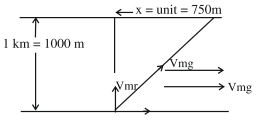
The speed of a swimmer is $4\,km\,h^{-1}$ in still water. If the swimmer makes his strokes normal to the flow of a river of width $1\,km$,he reaches a point $750\,m$ downstream on the opposite bank. The speed of the river water is $.........\,km\,h^{-1}$.
A
$3$
B
$2$
C
$1$
D
$30$
Solution
(A) Let the width of the river be $w = 1\,km = 1000\,m$. The speed of the swimmer in still water is $v_{sm} = 4\,km\,h^{-1}$.
Since the swimmer swims normal to the river flow,the time taken to cross the river is $t = \frac{w}{v_{sm}} = \frac{1\,km}{4\,km\,h^{-1}} = 0.25\,h$.
During this time,the swimmer is carried downstream by the river current. The drift $x$ is given as $750\,m = 0.75\,km$.
The drift is caused by the river velocity $v_r$,so $x = v_r \times t$.
Substituting the values: $0.75\,km = v_r \times 0.25\,h$.
Therefore,$v_r = \frac{0.75}{0.25} = 3\,km\,h^{-1}$.
The speed of the river water is $3\,km\,h^{-1}$.
Since the swimmer swims normal to the river flow,the time taken to cross the river is $t = \frac{w}{v_{sm}} = \frac{1\,km}{4\,km\,h^{-1}} = 0.25\,h$.
During this time,the swimmer is carried downstream by the river current. The drift $x$ is given as $750\,m = 0.75\,km$.
The drift is caused by the river velocity $v_r$,so $x = v_r \times t$.
Substituting the values: $0.75\,km = v_r \times 0.25\,h$.
Therefore,$v_r = \frac{0.75}{0.25} = 3\,km\,h^{-1}$.
The speed of the river water is $3\,km\,h^{-1}$.
0 likes
View Solution136
MediumMCQ
$A$ passenger sitting in a train $A$ moving at $90\,km/h$ observes another train $B$ moving in the opposite direction for $8\,s$. If the velocity of the train $B$ is $54\,km/h$,then the length of train $B$ is $..........\,m$.
A
$80$
B
$200$
C
$120$
D
$320$
Solution
(D) Velocity of train $A$,$V_A = 90\,km/h = 90 \times \frac{5}{18} = 25\,m/s$.
Velocity of train $B$,$V_B = 54\,km/h = 54 \times \frac{5}{18} = 15\,m/s$.
Since the trains are moving in opposite directions,the relative velocity of train $B$ with respect to train $A$ is $V_{BA} = V_B - (-V_A) = 15 + 25 = 40\,m/s$.
The time taken to cross is $t = 8\,s$.
The length of train $B$ is given by $\ell = V_{BA} \times t$.
$\ell = 40\,m/s \times 8\,s = 320\,m$.
Velocity of train $B$,$V_B = 54\,km/h = 54 \times \frac{5}{18} = 15\,m/s$.
Since the trains are moving in opposite directions,the relative velocity of train $B$ with respect to train $A$ is $V_{BA} = V_B - (-V_A) = 15 + 25 = 40\,m/s$.
The time taken to cross is $t = 8\,s$.
The length of train $B$ is given by $\ell = V_{BA} \times t$.
$\ell = 40\,m/s \times 8\,s = 320\,m$.
0 likes
View Solution137
DifficultMCQ
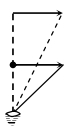
$STATEMENT-1$ For an observer looking out through the window of a fast-moving train,the nearby objects appear to move in the opposite direction to the train,while the distant objects appear to be stationary.
$STATEMENT-2$ If the observer and the object are moving at velocities $\vec{V}_1$ and $\vec{V}_2$ respectively with reference to a laboratory frame,the velocity of the object with respect to the observer is $\vec{V}_2 - \vec{V}_1$.
$STATEMENT-2$ If the observer and the object are moving at velocities $\vec{V}_1$ and $\vec{V}_2$ respectively with reference to a laboratory frame,the velocity of the object with respect to the observer is $\vec{V}_2 - \vec{V}_1$.
A
$STATEMENT-1$ is True,$STATEMENT-2$ is True; $STATEMENT-2$ is a correct explanation for $STATEMENT-1$.
B
$STATEMENT-1$ is True,$STATEMENT-2$ is True; $STATEMENT-2$ is $NOT$ a correct explanation for $STATEMENT-1$.
C
$STATEMENT-1$ is True,$STATEMENT-2$ is False.
D
$STATEMENT-1$ is False,$STATEMENT-2$ is True.
Solution
(B) $STATEMENT-1$ is True. When an observer moves with velocity $\vec{V}_1$,the relative velocity of a nearby object (stationary in the lab frame,$\vec{V}_2 = 0$) is $\vec{V}_{rel} = \vec{V}_2 - \vec{V}_1 = -\vec{V}_1$. Thus,nearby objects appear to move in the opposite direction.
$STATEMENT-2$ is True. By definition,the relative velocity of an object with respect to an observer is $\vec{V}_{rel} = \vec{V}_{object} - \vec{V}_{observer} = \vec{V}_2 - \vec{V}_1$.
However,$STATEMENT-2$ is not the explanation for $STATEMENT-1$. The observation that distant objects appear stationary is due to the angular velocity $\omega = v/r$ being very small for large $r$ (distance),not just the relative velocity formula.
$STATEMENT-2$ is True. By definition,the relative velocity of an object with respect to an observer is $\vec{V}_{rel} = \vec{V}_{object} - \vec{V}_{observer} = \vec{V}_2 - \vec{V}_1$.
However,$STATEMENT-2$ is not the explanation for $STATEMENT-1$. The observation that distant objects appear stationary is due to the angular velocity $\omega = v/r$ being very small for large $r$ (distance),not just the relative velocity formula.
0 likes
View Solution138
AdvancedMCQ
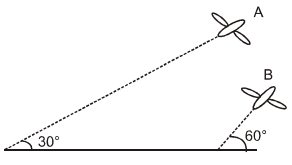
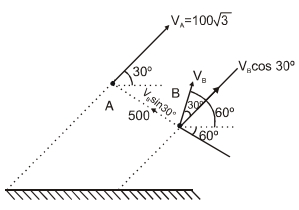
Airplanes $A$ and $B$ are flying with constant velocity in the same vertical plane at angles $30^{\circ}$ and $60^{\circ}$ with respect to the horizontal,respectively,as shown in the figure. The speed of $A$ is $100 \sqrt{3} \ m/s$. At time $t=0$,an observer in $A$ finds $B$ at a distance of $500 \ m$. This observer sees $B$ moving with a constant velocity perpendicular to the line of motion of $A$. If at $t = t_0$,$A$ just escapes being hit by $B$,then $t_0$ in seconds is:
A
$5$
B
$6$
C
$7$
D
$8$
Solution
(A) Let the velocity of airplane $A$ be $\vec{V}_A$ and that of $B$ be $\vec{V}_B$. The angle of $A$ with the horizontal is $30^{\circ}$ and that of $B$ is $60^{\circ}$.
Given,$V_A = 100\sqrt{3} \ m/s$.
The observer in $A$ sees $B$ moving perpendicular to the line of motion of $A$. This means the component of the relative velocity of $B$ with respect to $A$ along the direction of $A$'s motion is zero.
Let $\vec{V}_{BA} = \vec{V}_B - \vec{V}_A$. The component of $\vec{V}_{BA}$ along the direction of $\vec{V}_A$ is $V_{B} \cos(60^{\circ} - 30^{\circ}) - V_A = 0$.
$V_B \cos(30^{\circ}) = V_A = 100\sqrt{3}$.
$V_B (\frac{\sqrt{3}}{2}) = 100\sqrt{3} \implies V_B = 200 \ m/s$.
The relative velocity of $B$ perpendicular to the line of motion of $A$ is $V_{BA, \perp} = V_B \sin(60^{\circ} - 30^{\circ}) = V_B \sin(30^{\circ}) = 200 \times \frac{1}{2} = 100 \ m/s$.
The initial distance perpendicular to the line of motion is $d = 500 \ m$.
The time taken to cover this distance is $t_0 = \frac{d}{V_{BA, \perp}} = \frac{500}{100} = 5 \ s$.
Given,$V_A = 100\sqrt{3} \ m/s$.
The observer in $A$ sees $B$ moving perpendicular to the line of motion of $A$. This means the component of the relative velocity of $B$ with respect to $A$ along the direction of $A$'s motion is zero.
Let $\vec{V}_{BA} = \vec{V}_B - \vec{V}_A$. The component of $\vec{V}_{BA}$ along the direction of $\vec{V}_A$ is $V_{B} \cos(60^{\circ} - 30^{\circ}) - V_A = 0$.
$V_B \cos(30^{\circ}) = V_A = 100\sqrt{3}$.
$V_B (\frac{\sqrt{3}}{2}) = 100\sqrt{3} \implies V_B = 200 \ m/s$.
The relative velocity of $B$ perpendicular to the line of motion of $A$ is $V_{BA, \perp} = V_B \sin(60^{\circ} - 30^{\circ}) = V_B \sin(30^{\circ}) = 200 \times \frac{1}{2} = 100 \ m/s$.
The initial distance perpendicular to the line of motion is $d = 500 \ m$.
The time taken to cover this distance is $t_0 = \frac{d}{V_{BA, \perp}} = \frac{500}{100} = 5 \ s$.
1 likes
View Solution139
DifficultMCQ
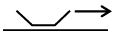
The maximum speed of a boat in still water is $27 \,km/h$. Now this boat is moving downstream in a river flowing at $9 \,km/h$. $A$ man in the boat throws a ball vertically upwards with a speed of $10 \,m/s$. The range of the ball as observed by an observer at rest on the river bank is . . . . . . $cm$. (Take $g = 10 \,m/s^2$)
A
$2000$
B
$1000$
C
$3000$
D
$4000$
Solution
(A) The velocity of the boat with respect to the ground is the sum of the boat's speed in still water and the river's flow speed: $v_b = 27 \,km/h + 9 \,km/h = 36 \,km/h$.
Converting this to $m/s$: $v_b = 36 \times \frac{5}{18} = 10 \,m/s$.
Since the ball is thrown vertically upwards from the moving boat,its horizontal velocity relative to the ground is equal to the velocity of the boat,$v_x = 10 \,m/s$.
The time of flight $T$ for a ball thrown vertically with initial vertical velocity $u_y = 10 \,m/s$ is given by $T = \frac{2u_y}{g} = \frac{2 \times 10}{10} = 2 \,s$.
The horizontal range $R$ as observed by an observer on the bank is $R = v_x \times T = 10 \,m/s \times 2 \,s = 20 \,m$.
Converting the range to centimeters: $R = 20 \,m = 2000 \,cm$.
Converting this to $m/s$: $v_b = 36 \times \frac{5}{18} = 10 \,m/s$.
Since the ball is thrown vertically upwards from the moving boat,its horizontal velocity relative to the ground is equal to the velocity of the boat,$v_x = 10 \,m/s$.
The time of flight $T$ for a ball thrown vertically with initial vertical velocity $u_y = 10 \,m/s$ is given by $T = \frac{2u_y}{g} = \frac{2 \times 10}{10} = 2 \,s$.
The horizontal range $R$ as observed by an observer on the bank is $R = v_x \times T = 10 \,m/s \times 2 \,s = 20 \,m$.
Converting the range to centimeters: $R = 20 \,m = 2000 \,cm$.
0 likes
View Solution140
DifficultMCQ
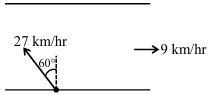
$A$ river is flowing from west to east with a speed of $9 \ km \ h^{-1}$. $A$ boat, capable of moving at a maximum speed of $27 \ km \ h^{-1}$ in still water, crosses the river in half a minute. If the boat moves at an angle of $150^{\circ}$ to the direction of the river flow, then the width of the river is:
A
$300 \ m$
B
$112.5 \ m$
C
$75 \ m$
D
$112.5 \sqrt{3} \ m$
Solution
(B) The velocity of the boat in still water is $v_b = 27 \ km \ h^{-1}$.
The angle with the river flow is $\theta = 150^{\circ}$.
The component of the boat's velocity perpendicular to the river flow is $v_{\perp} = v_b \sin(150^{\circ}) = 27 \times \sin(150^{\circ}) = 27 \times \sin(180^{\circ} - 30^{\circ}) = 27 \times \sin(30^{\circ}) = 27 \times 0.5 = 13.5 \ km \ h^{-1}$.
To convert this to $m \ s^{-1}$, we multiply by $\frac{5}{18}$:
$v_{\perp} = 13.5 \times \frac{5}{18} = 3.75 \ m \ s^{-1}$.
The time taken to cross the river is $t = 0.5 \ \text{minute} = 30 \ s$.
The width of the river $d$ is given by $d = v_{\perp} \times t$.
$d = 3.75 \ m \ s^{-1} \times 30 \ s = 112.5 \ m$.
The angle with the river flow is $\theta = 150^{\circ}$.
The component of the boat's velocity perpendicular to the river flow is $v_{\perp} = v_b \sin(150^{\circ}) = 27 \times \sin(150^{\circ}) = 27 \times \sin(180^{\circ} - 30^{\circ}) = 27 \times \sin(30^{\circ}) = 27 \times 0.5 = 13.5 \ km \ h^{-1}$.
To convert this to $m \ s^{-1}$, we multiply by $\frac{5}{18}$:
$v_{\perp} = 13.5 \times \frac{5}{18} = 3.75 \ m \ s^{-1}$.
The time taken to cross the river is $t = 0.5 \ \text{minute} = 30 \ s$.
The width of the river $d$ is given by $d = v_{\perp} \times t$.
$d = 3.75 \ m \ s^{-1} \times 30 \ s = 112.5 \ m$.
0 likes
View Solution141
DifficultMCQ
Two cities $X$ and $Y$ are connected by a regular bus service with a bus leaving in either direction every $T$ min. $A$ girl is driving a scooty with a speed of $60 \ km/h$ in the direction $X$ to $Y$ and notices that a bus goes past her every $30$ minutes in the direction of her motion,and every $10$ minutes in the opposite direction. Choose the correct option for the period $T$ of the bus service and the speed (assumed constant) of the buses.
A
$9 \ min, 40 \ km/h$
B
$25 \ min, 100 \ km/h$
C
$10 \ min, 90 \ km/h$
D
$15 \ min, 120 \ km/h$
Solution
(D) Let $V_B$ be the speed of the bus and $V_S = 60 \ km/h$ be the speed of the scooty.
Let $d$ be the distance between two consecutive buses,given by $d = V_B \times T$.
When the girl moves in the same direction as the bus,the relative speed is $(V_B - V_S)$. The time interval between buses passing her is $t_1 = 30 \ min = 0.5 \ h$.
Thus,$d = (V_B - V_S) t_1 \implies V_B T = (V_B - 60) \times 0.5$ --- $(1)$
When the girl moves in the opposite direction,the relative speed is $(V_B + V_S)$. The time interval is $t_2 = 10 \ min = 1/6 \ h$.
Thus,$d = (V_B + V_S) t_2 \implies V_B T = (V_B + 60) \times (1/6)$ --- $(2)$
Equating $(1)$ and $(2)$:
$0.5(V_B - 60) = \frac{1}{6}(V_B + 60)$
$3(V_B - 60) = V_B + 60$
$3V_B - 180 = V_B + 60$
$2V_B = 240 \implies V_B = 120 \ km/h$.
Substitute $V_B$ into $(1)$:
$120 \times T = (120 - 60) \times 0.5$
$120 \times T = 60 \times 0.5 = 30$
$T = 30/120 = 0.25 \ h = 15 \ min$.
Let $d$ be the distance between two consecutive buses,given by $d = V_B \times T$.
When the girl moves in the same direction as the bus,the relative speed is $(V_B - V_S)$. The time interval between buses passing her is $t_1 = 30 \ min = 0.5 \ h$.
Thus,$d = (V_B - V_S) t_1 \implies V_B T = (V_B - 60) \times 0.5$ --- $(1)$
When the girl moves in the opposite direction,the relative speed is $(V_B + V_S)$. The time interval is $t_2 = 10 \ min = 1/6 \ h$.
Thus,$d = (V_B + V_S) t_2 \implies V_B T = (V_B + 60) \times (1/6)$ --- $(2)$
Equating $(1)$ and $(2)$:
$0.5(V_B - 60) = \frac{1}{6}(V_B + 60)$
$3(V_B - 60) = V_B + 60$
$3V_B - 180 = V_B + 60$
$2V_B = 240 \implies V_B = 120 \ km/h$.
Substitute $V_B$ into $(1)$:
$120 \times T = (120 - 60) \times 0.5$
$120 \times T = 60 \times 0.5 = 30$
$T = 30/120 = 0.25 \ h = 15 \ min$.
0 likes
View Solution142
MediumMCQ
$A$ man is running on a level road with a speed of $10 \ m/s$. He feels that the rain is falling vertically downward with a speed of $10 \sqrt{3} \ m/s$. If he runs in the opposite direction with the same speed,then the speed of the rain relative to him will be:
A
$20 \ m/s$
B
$10 \sqrt{3} \ m/s$
C
$10 \sqrt{7} \ m/s$
D
$\frac{10}{\sqrt{3}} \ m/s$
Solution
(C) Let the velocity of the man be $\vec{V}_m = 10 \hat{i} \ m/s$.
The velocity of the rain relative to the man is $\vec{V}_{rm} = -10 \sqrt{3} \hat{j} \ m/s$.
The velocity of the rain $\vec{V}_r$ is given by $\vec{V}_{rm} = \vec{V}_r - \vec{V}_m$,so $\vec{V}_r = \vec{V}_{rm} + \vec{V}_m = 10 \hat{i} - 10 \sqrt{3} \hat{j} \ m/s$.
Now,the man runs in the opposite direction,so his new velocity is $\vec{V}_{m'} = -10 \hat{i} \ m/s$.
The new relative velocity of the rain with respect to the man is $\vec{V}_{rm'} = \vec{V}_r - \vec{V}_{m'} = (10 \hat{i} - 10 \sqrt{3} \hat{j}) - (-10 \hat{i}) = 20 \hat{i} - 10 \sqrt{3} \hat{j} \ m/s$.
The magnitude of this relative velocity is $|\vec{V}_{rm'}| = \sqrt{(20)^2 + (-10 \sqrt{3})^2} = \sqrt{400 + 300} = \sqrt{700} = 10 \sqrt{7} \ m/s$.
The velocity of the rain relative to the man is $\vec{V}_{rm} = -10 \sqrt{3} \hat{j} \ m/s$.
The velocity of the rain $\vec{V}_r$ is given by $\vec{V}_{rm} = \vec{V}_r - \vec{V}_m$,so $\vec{V}_r = \vec{V}_{rm} + \vec{V}_m = 10 \hat{i} - 10 \sqrt{3} \hat{j} \ m/s$.
Now,the man runs in the opposite direction,so his new velocity is $\vec{V}_{m'} = -10 \hat{i} \ m/s$.
The new relative velocity of the rain with respect to the man is $\vec{V}_{rm'} = \vec{V}_r - \vec{V}_{m'} = (10 \hat{i} - 10 \sqrt{3} \hat{j}) - (-10 \hat{i}) = 20 \hat{i} - 10 \sqrt{3} \hat{j} \ m/s$.
The magnitude of this relative velocity is $|\vec{V}_{rm'}| = \sqrt{(20)^2 + (-10 \sqrt{3})^2} = \sqrt{400 + 300} = \sqrt{700} = 10 \sqrt{7} \ m/s$.
0 likes
View Solution143
MediumMCQ
$A$ swimmer can swim in still water with $5 \,m/s$. If a river is flowing with $4 \,m/s$, then find the time to cross the river of width $300 \,m$ if he has to reach the exactly opposite point.
A
$60$
B
$75$
C
$100$
D
$200$
Solution
(C) To reach the exactly opposite point, the swimmer must swim at an angle against the river current such that the resultant velocity is perpendicular to the river bank.
Let $v_s = 5 \,m/s$ be the speed of the swimmer in still water and $v_r = 4 \,m/s$ be the speed of the river flow.
The effective velocity $v_{eff}$ perpendicular to the bank is given by $v_{eff} = \sqrt{v_s^2 - v_r^2}$.
$v_{eff} = \sqrt{5^2 - 4^2} = \sqrt{25 - 16} = \sqrt{9} = 3 \,m/s$.
The time $t$ taken to cross the river of width $d = 300 \,m$ is $t = \frac{d}{v_{eff}}$.
$t = \frac{300}{3} = 100 \,s$.
Let $v_s = 5 \,m/s$ be the speed of the swimmer in still water and $v_r = 4 \,m/s$ be the speed of the river flow.
The effective velocity $v_{eff}$ perpendicular to the bank is given by $v_{eff} = \sqrt{v_s^2 - v_r^2}$.
$v_{eff} = \sqrt{5^2 - 4^2} = \sqrt{25 - 16} = \sqrt{9} = 3 \,m/s$.
The time $t$ taken to cross the river of width $d = 300 \,m$ is $t = \frac{d}{v_{eff}}$.
$t = \frac{300}{3} = 100 \,s$.
0 likes
View Solution144
EasyMCQ
Two trains, each $30 \,m$ long, are travelling in opposite directions with velocities $5 \,m/s$ and $10 \,m/s$. They will cross each other after: (in $\,s$)
A
$4$
B
$3$
C
$2$
D
$1$
Solution
(A) The relative velocity of one train with respect to the other, since they are moving in opposite directions, is $V_{rel} = V_1 + V_2 = 5 \,m/s + 10 \,m/s = 15 \,m/s$.
To cross each other completely, the total distance covered must be equal to the sum of the lengths of both trains.
Total distance $L = 30 \,m + 30 \,m = 60 \,m$.
The time taken to cross is given by $t = \frac{L}{V_{rel}}$.
Substituting the values, $t = \frac{60 \,m}{15 \,m/s} = 4 \,s$.
To cross each other completely, the total distance covered must be equal to the sum of the lengths of both trains.
Total distance $L = 30 \,m + 30 \,m = 60 \,m$.
The time taken to cross is given by $t = \frac{L}{V_{rel}}$.
Substituting the values, $t = \frac{60 \,m}{15 \,m/s} = 4 \,s$.
0 likes
View Solution145
MediumMCQ
Two boys are standing at points $A$ and $B$ on the ground,where distance $AB = x$. The boy at $B$ starts running perpendicular to $AB$ with velocity $v_1$. The boy at $A$ starts running simultaneously with velocity $v$ and meets the other boy in time $t$. The value of $t$ is:
A
$\frac{x}{\sqrt{v^2 - v_1^2}}$
B
$\frac{x}{\sqrt{v_1^2 - v^2}}$
C
$\frac{x}{v - v_1}$
D
$\frac{x}{v + v_1}$
Solution
(A) Let the boy at $A$ be at the origin $(0, 0)$ and the boy at $B$ be at $(x, 0)$.
The boy at $B$ moves along the $y$-axis with velocity $v_1$. His position at time $t$ is $(x, v_1 t)$.
The boy at $A$ moves with velocity $v$ to meet the boy at $B$ at time $t$. His position at time $t$ is $(v_x t, v_y t)$ such that $\sqrt{(v_x t)^2 + (v_y t)^2} = vt$.
Since they meet at $(x, v_1 t)$,we have $v_x t = x$ and $v_y t = v_1 t$.
Using the velocity magnitude condition: $(v_x t)^2 + (v_y t)^2 = (vt)^2$.
Substituting the values: $x^2 + (v_1 t)^2 = v^2 t^2$.
Rearranging for $t^2$: $v^2 t^2 - v_1^2 t^2 = x^2$.
$t^2 (v^2 - v_1^2) = x^2$.
$t = \frac{x}{\sqrt{v^2 - v_1^2}}$.
The boy at $B$ moves along the $y$-axis with velocity $v_1$. His position at time $t$ is $(x, v_1 t)$.
The boy at $A$ moves with velocity $v$ to meet the boy at $B$ at time $t$. His position at time $t$ is $(v_x t, v_y t)$ such that $\sqrt{(v_x t)^2 + (v_y t)^2} = vt$.
Since they meet at $(x, v_1 t)$,we have $v_x t = x$ and $v_y t = v_1 t$.
Using the velocity magnitude condition: $(v_x t)^2 + (v_y t)^2 = (vt)^2$.
Substituting the values: $x^2 + (v_1 t)^2 = v^2 t^2$.
Rearranging for $t^2$: $v^2 t^2 - v_1^2 t^2 = x^2$.
$t^2 (v^2 - v_1^2) = x^2$.
$t = \frac{x}{\sqrt{v^2 - v_1^2}}$.
0 likes
View Solution146
MediumMCQ
Two girls are standing at the ends $A$ and $B$ of a ground where $AB = b$. The girl at $B$ starts running in a direction perpendicular to $AB$ with velocity $V_1$. The girl at $A$ starts running simultaneously with velocity $V_2$ and meets the other girl in the shortest possible time $t$. The value of $t$ is:
A
$\frac{b}{\sqrt{V_1^2 + V_2^2}}$
B
$\frac{b}{V_1 + V_2}$
C
$\frac{b}{V_2 - V_1}$
D
$\frac{b}{\sqrt{V_2^2 - V_1^2}}$
Solution
(D) Let the position of girl at $A$ be $(0, 0)$ and girl at $B$ be $(b, 0)$.
The girl at $B$ moves with velocity $\vec{V_1} = V_1 \hat{j}$. Her position at time $t$ is $\vec{r_B}(t) = b \hat{i} + V_1 t \hat{j}$.
The girl at $A$ moves with velocity $\vec{V_2}$ such that $|\vec{V_2}| = V_2$. Let $\vec{V_2} = V_2 \cos \theta \hat{i} + V_2 \sin \theta \hat{j}$.
Her position at time $t$ is $\vec{r_A}(t) = (V_2 \cos \theta) t \hat{i} + (V_2 \sin \theta) t \hat{j}$.
For them to meet,$\vec{r_A}(t) = \vec{r_B}(t)$,so $V_2 \cos \theta t = b$ and $V_2 \sin \theta t = V_1 t$.
From the second equation,$\sin \theta = V_1 / V_2$. Thus,$\cos \theta = \sqrt{1 - (V_1/V_2)^2} = \frac{\sqrt{V_2^2 - V_1^2}}{V_2}$.
Substituting $\cos \theta$ into the first equation: $V_2 \left( \frac{\sqrt{V_2^2 - V_1^2}}{V_2} \right) t = b$.
Therefore,$t = \frac{b}{\sqrt{V_2^2 - V_1^2}}$.
The girl at $B$ moves with velocity $\vec{V_1} = V_1 \hat{j}$. Her position at time $t$ is $\vec{r_B}(t) = b \hat{i} + V_1 t \hat{j}$.
The girl at $A$ moves with velocity $\vec{V_2}$ such that $|\vec{V_2}| = V_2$. Let $\vec{V_2} = V_2 \cos \theta \hat{i} + V_2 \sin \theta \hat{j}$.
Her position at time $t$ is $\vec{r_A}(t) = (V_2 \cos \theta) t \hat{i} + (V_2 \sin \theta) t \hat{j}$.
For them to meet,$\vec{r_A}(t) = \vec{r_B}(t)$,so $V_2 \cos \theta t = b$ and $V_2 \sin \theta t = V_1 t$.
From the second equation,$\sin \theta = V_1 / V_2$. Thus,$\cos \theta = \sqrt{1 - (V_1/V_2)^2} = \frac{\sqrt{V_2^2 - V_1^2}}{V_2}$.
Substituting $\cos \theta$ into the first equation: $V_2 \left( \frac{\sqrt{V_2^2 - V_1^2}}{V_2} \right) t = b$.
Therefore,$t = \frac{b}{\sqrt{V_2^2 - V_1^2}}$.
0 likes
View Solution147
DifficultMCQ
$A$ train is moving slowly on a straight track with a constant speed of $2 \,ms^{-1}$. $A$ passenger in that train starts walking at a steady speed of $2 \,ms^{-1}$ to the back of the train in the opposite direction of the motion of the train. To an observer standing on the platform directly in front of that passenger, the velocity of the passenger appears to be:
A
$4 \,ms^{-1}$
B
$2 \,ms^{-1}$
C
$2 \,ms^{-1}$ in the opposite direction of the train
D
zero
Solution
(D) Let the velocity of the train with respect to the ground be $v_T = 2 \,ms^{-1}$ (taking the direction of motion as positive).
The velocity of the passenger with respect to the train is $v_{P/T} = -2 \,ms^{-1}$ (since the passenger is walking towards the back of the train).
The velocity of the passenger with respect to the ground (observer on the platform) is given by the relative velocity formula:
$v_P = v_{P/T} + v_T$
$v_P = -2 \,ms^{-1} + 2 \,ms^{-1} = 0 \,ms^{-1}$.
Therefore, the velocity of the passenger appears to be zero to the observer on the platform.
The velocity of the passenger with respect to the train is $v_{P/T} = -2 \,ms^{-1}$ (since the passenger is walking towards the back of the train).
The velocity of the passenger with respect to the ground (observer on the platform) is given by the relative velocity formula:
$v_P = v_{P/T} + v_T$
$v_P = -2 \,ms^{-1} + 2 \,ms^{-1} = 0 \,ms^{-1}$.
Therefore, the velocity of the passenger appears to be zero to the observer on the platform.
0 likes
View Solution148
MediumMCQ
$A$ motorboat covers a given distance in $6 \,h$ moving downstream on a river. It covers the same distance in $10 \,h$ moving upstream. The time it takes to cover the same distance in still water is (in $\,h$)
A
$9$
B
$7.5$
C
$6.5$
D
$8$
Solution
(B) Let $v_{b}$ be the velocity of the motorboat in still water and $v_{w}$ be the velocity of the river water.
When moving downstream,the effective velocity is $(v_{b} + v_{w})$. The distance $x$ covered in $6 \,h$ is:
$x = (v_{b} + v_{w}) \times 6$ ---$(i)$
When moving upstream,the effective velocity is $(v_{b} - v_{w})$. The distance $x$ covered in $10 \,h$ is:
$x = (v_{b} - v_{w}) \times 10$ ---(ii)
Equating the two expressions for distance $x$:
$(v_{b} + v_{w}) \times 6 = (v_{b} - v_{w}) \times 10$
$6v_{b} + 6v_{w} = 10v_{b} - 10v_{w}$
$16v_{w} = 4v_{b}$
$v_{w} = \frac{v_{b}}{4}$
Substituting $v_{w}$ back into equation $(i)$ to find $x$ in terms of $v_{b}$:
$x = (v_{b} + \frac{v_{b}}{4}) \times 6 = (\frac{5v_{b}}{4}) \times 6 = 7.5v_{b}$
The time $t$ taken to cover distance $x$ in still water (where velocity is $v_{b}$) is:
$t = \frac{x}{v_{b}} = \frac{7.5v_{b}}{v_{b}} = 7.5 \,h$
When moving downstream,the effective velocity is $(v_{b} + v_{w})$. The distance $x$ covered in $6 \,h$ is:
$x = (v_{b} + v_{w}) \times 6$ ---$(i)$
When moving upstream,the effective velocity is $(v_{b} - v_{w})$. The distance $x$ covered in $10 \,h$ is:
$x = (v_{b} - v_{w}) \times 10$ ---(ii)
Equating the two expressions for distance $x$:
$(v_{b} + v_{w}) \times 6 = (v_{b} - v_{w}) \times 10$
$6v_{b} + 6v_{w} = 10v_{b} - 10v_{w}$
$16v_{w} = 4v_{b}$
$v_{w} = \frac{v_{b}}{4}$
Substituting $v_{w}$ back into equation $(i)$ to find $x$ in terms of $v_{b}$:
$x = (v_{b} + \frac{v_{b}}{4}) \times 6 = (\frac{5v_{b}}{4}) \times 6 = 7.5v_{b}$
The time $t$ taken to cover distance $x$ in still water (where velocity is $v_{b}$) is:
$t = \frac{x}{v_{b}} = \frac{7.5v_{b}}{v_{b}} = 7.5 \,h$
0 likes
View Solution149
EasyMCQ
Rain is falling vertically with a speed of $12 \ ms^{-1}$. $A$ woman rides a bicycle with a speed of $12 \ ms^{-1}$ in the east to west direction. What is the direction in which she should hold her umbrella?
A
$30^{\circ}$,towards east
B
$45^{\circ}$,towards east
C
$30^{\circ}$,towards west
D
$45^{\circ}$,towards west
Solution
(D) The velocity of rain is $\vec{v}_r = -12 \hat{j} \ ms^{-1}$.
The velocity of the woman is $\vec{v}_w = -12 \hat{i} \ ms^{-1}$ (since she is moving from east to west).
The relative velocity of rain with respect to the woman is $\vec{v}_{rw} = \vec{v}_r - \vec{v}_w = -12 \hat{j} - (-12 \hat{i}) = 12 \hat{i} - 12 \hat{j} \ ms^{-1}$.
To protect herself from rain,the woman must hold her umbrella in the direction of the relative velocity of the rain,which is opposite to $\vec{v}_{rw}$.
The angle $\theta$ with the vertical is given by $\tan \theta = \frac{|v_w|}{|v_r|} = \frac{12}{12} = 1$ .
Therefore,$\theta = \tan^{-1}(1) = 45^{\circ}$.
Since the woman is moving towards the west,the relative velocity vector points towards the west,so she must hold the umbrella at an angle of $45^{\circ}$ towards the west to counteract the rain.
The velocity of the woman is $\vec{v}_w = -12 \hat{i} \ ms^{-1}$ (since she is moving from east to west).
The relative velocity of rain with respect to the woman is $\vec{v}_{rw} = \vec{v}_r - \vec{v}_w = -12 \hat{j} - (-12 \hat{i}) = 12 \hat{i} - 12 \hat{j} \ ms^{-1}$.
To protect herself from rain,the woman must hold her umbrella in the direction of the relative velocity of the rain,which is opposite to $\vec{v}_{rw}$.
The angle $\theta$ with the vertical is given by $\tan \theta = \frac{|v_w|}{|v_r|} = \frac{12}{12} = 1$ .
Therefore,$\theta = \tan^{-1}(1) = 45^{\circ}$.
Since the woman is moving towards the west,the relative velocity vector points towards the west,so she must hold the umbrella at an angle of $45^{\circ}$ towards the west to counteract the rain.
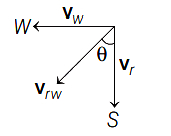
0 likes
View Solution150
MediumMCQ
Two particles having position vectors $r_1 = (3 \hat{i} + 5 \hat{j}) \text{ m}$ and $r_2 = (-5 \hat{i} - 3 \hat{j}) \text{ m}$ are moving with velocities $v_1 = (4 \hat{i} + 3 \hat{j}) \text{ m/s}$ and $v_2 = (a \hat{i} + 7 \hat{j}) \text{ m/s}$. If they collide after $2 \text{ s}$,then the value of $a$ is:
A
$2$
B
$4$
C
$6$
D
$8$
Solution
(D) For two particles to collide,their positions at time $t$ must be equal: $r_1 + v_1 t = r_2 + v_2 t$.
Rearranging the equation: $r_1 - r_2 = (v_2 - v_1) t$.
Given $r_1 = (3 \hat{i} + 5 \hat{j})$ and $r_2 = (-5 \hat{i} - 3 \hat{j})$,the relative position vector is $r_1 - r_2 = (3 - (-5)) \hat{i} + (5 - (-3)) \hat{j} = (8 \hat{i} + 8 \hat{j}) \text{ m}$.
The relative velocity is $v_2 - v_1 = (a \hat{i} + 7 \hat{j}) - (4 \hat{i} + 3 \hat{j}) = (a - 4) \hat{i} + 4 \hat{j}$.
Substituting these into the collision condition with $t = 2 \text{ s}$:
$8 \hat{i} + 8 \hat{j} = ((a - 4) \hat{i} + 4 \hat{j}) \times 2$.
Dividing by $2$: $4 \hat{i} + 4 \hat{j} = (a - 4) \hat{i} + 4 \hat{j}$.
Comparing the coefficients of $\hat{i}$: $4 = a - 4$,which gives $a = 8$.
Rearranging the equation: $r_1 - r_2 = (v_2 - v_1) t$.
Given $r_1 = (3 \hat{i} + 5 \hat{j})$ and $r_2 = (-5 \hat{i} - 3 \hat{j})$,the relative position vector is $r_1 - r_2 = (3 - (-5)) \hat{i} + (5 - (-3)) \hat{j} = (8 \hat{i} + 8 \hat{j}) \text{ m}$.
The relative velocity is $v_2 - v_1 = (a \hat{i} + 7 \hat{j}) - (4 \hat{i} + 3 \hat{j}) = (a - 4) \hat{i} + 4 \hat{j}$.
Substituting these into the collision condition with $t = 2 \text{ s}$:
$8 \hat{i} + 8 \hat{j} = ((a - 4) \hat{i} + 4 \hat{j}) \times 2$.
Dividing by $2$: $4 \hat{i} + 4 \hat{j} = (a - 4) \hat{i} + 4 \hat{j}$.
Comparing the coefficients of $\hat{i}$: $4 = a - 4$,which gives $a = 8$.
0 likes
View Solution3-2.Motion in Plane — Relative Velocity (river boat, rain, wind) · Frequently Asked Questions
1Are these 3-2.Motion in Plane questions useful for JEE and NEET?
Yes. All questions in this section are mapped to JEE Main and NEET exam patterns. Previous year questions from JEE Main, NEET, GUJCET and state-level exams are included with full solutions.
2Can I switch to Hindi or Gujarati for these questions?
Yes. Use the language tabs in the hero section or the sidebar to view the same questions and solutions in English, Hindi or Gujarati.
3How do I generate a question paper from this subtopic?
Use the Vedclass Exam Paper Generator — select the chapter and subtopic, set difficulty, and generate Sets A, B, C, D automatically. First 3 chapters of every subject are free.
Vedclass Products
For Students
Vedclass Test Series
Mock tests in real JEE/NEET style with performance analysis. 5-day free trial.
Start Free TrialFor Teachers
Exam Paper Generator
Generate Set A/B/C/D papers from this chapter in 2 minutes. 3 chapters free.
Try FreeFor Institutes
Online Exam Module
Live online exams with unlimited students, 360° analytics & white-label branding.
See DemoFor Teachers & Institutes
Generate a 3-2.Motion in Plane Exam Paper in 2 Minutes
Select subtopic & difficulty — Sets A, B, C, D auto-generated with No Repeat logic.
First 3 chapters of every subject are free — no payment required.