
A English
Relative Velocity (river boat, rain, wind) Questions in English
Class 11 Physics · 3-2.Motion in Plane · Relative Velocity (river boat, rain, wind)
185+
Questions
English
Language
100%
With Solutions
Showing 47 of 185 questions in English
1
DifficultMCQ
Two cars are moving in the same direction with the same speed $30 \, km/hr$. They are separated by a distance of $5 \, km$. The speed of a car moving in the opposite direction,if it meets these two cars at an interval of $4 \, minutes$,will be.......$km/hr$.
A
$40$
B
$45$
C
$30$
D
$15$
Solution
(B) Let the two cars be $A$ and $B$. Since they are moving in the same direction with the same speed $v = 30 \, km/hr$,their relative velocity is $v_{BA} = v_B - v_A = 30 - 30 = 0 \, km/hr$.
Thus,the distance between them remains constant at $d = 5 \, km$.
Let the speed of the third car $C$ moving in the opposite direction be $v_C \, km/hr$.
The relative velocity of car $C$ with respect to cars $A$ and $B$ is $v_{rel} = v_C - (-30) = (v_C + 30) \, km/hr$.
The time taken to cross the two cars is given as $t = 4 \, minutes = \frac{4}{60} \, hours = \frac{1}{15} \, hours$.
Using the formula $t = \frac{d}{v_{rel}}$,we have:
$\frac{1}{15} = \frac{5}{v_C + 30}$
$v_C + 30 = 5 \times 15$
$v_C + 30 = 75$
$v_C = 75 - 30 = 45 \, km/hr$.
Thus,the distance between them remains constant at $d = 5 \, km$.
Let the speed of the third car $C$ moving in the opposite direction be $v_C \, km/hr$.
The relative velocity of car $C$ with respect to cars $A$ and $B$ is $v_{rel} = v_C - (-30) = (v_C + 30) \, km/hr$.
The time taken to cross the two cars is given as $t = 4 \, minutes = \frac{4}{60} \, hours = \frac{1}{15} \, hours$.
Using the formula $t = \frac{d}{v_{rel}}$,we have:
$\frac{1}{15} = \frac{5}{v_C + 30}$
$v_C + 30 = 5 \times 15$
$v_C + 30 = 75$
$v_C = 75 - 30 = 45 \, km/hr$.
0 likes
View Solution2
MediumMCQ
$A$ man standing on a road holds his umbrella at $30^\circ$ with the vertical to keep the rain away. He throws the umbrella and starts running at $10 \ km/hr$. He finds that raindrops are hitting his head vertically. The speed of raindrops with respect to the road will be ......... $km/hr$.
A
$10$
B
$20$
C
$30$
D
$40$
Solution
(B) Let $\vec{v}_{rg}$ be the velocity of rain with respect to the ground,$\vec{v}_{mg}$ be the velocity of the man with respect to the ground,and $\vec{v}_{rm}$ be the velocity of the rain with respect to the man.
When the man is at rest,the rain falls at an angle of $30^\circ$ with the vertical. This indicates the direction of $\vec{v}_{rg}$.
When the man runs at $10 \ km/hr$,the rain appears to fall vertically,meaning the horizontal component of $\vec{v}_{rm}$ is zero.
Using the relative velocity equation: $\vec{v}_{rg} = \vec{v}_{rm} + \vec{v}_{mg}$.
Equating the horizontal components: $v_{rg} \sin 30^\circ = v_{mg}$.
Given $v_{mg} = 10 \ km/hr$,we have $v_{rg} \sin 30^\circ = 10$.
Since $\sin 30^\circ = 0.5$,we get $v_{rg} = 10 / 0.5 = 20 \ km/hr$.
When the man is at rest,the rain falls at an angle of $30^\circ$ with the vertical. This indicates the direction of $\vec{v}_{rg}$.
When the man runs at $10 \ km/hr$,the rain appears to fall vertically,meaning the horizontal component of $\vec{v}_{rm}$ is zero.
Using the relative velocity equation: $\vec{v}_{rg} = \vec{v}_{rm} + \vec{v}_{mg}$.
Equating the horizontal components: $v_{rg} \sin 30^\circ = v_{mg}$.
Given $v_{mg} = 10 \ km/hr$,we have $v_{rg} \sin 30^\circ = 10$.
Since $\sin 30^\circ = 0.5$,we get $v_{rg} = 10 / 0.5 = 20 \ km/hr$.
0 likes
View Solution3
MediumMCQ
$A$ man standing on a road holds his umbrella at $30^\circ$ with the vertical to keep the rain away. He throws the umbrella and starts running at $10 \, km/h$. He finds that raindrops are hitting his head vertically. The speed of raindrops with respect to the moving man will be:
A
$10/\sqrt{2} \, km/h$
B
$5 \, km/h$
C
$10\sqrt{3} \, km/h$
D
$5/\sqrt{3} \, km/h$
Solution
(C) Let $\vec{v}_{rg}$ be the velocity of rain with respect to the ground,$\vec{v}_{mg}$ be the velocity of the man with respect to the ground,and $\vec{v}_{rm}$ be the velocity of the rain with respect to the man.
From the relative velocity equation: $\vec{v}_{rg} = \vec{v}_{rm} + \vec{v}_{mg}$,which implies $\vec{v}_{rm} = \vec{v}_{rg} - \vec{v}_{mg}$.
When the man is at rest,the rain falls at $30^\circ$ to the vertical. Let $v_r$ be the magnitude of the rain's velocity. Then $\vec{v}_{rg} = v_r \sin 30^\circ \hat{i} - v_r \cos 30^\circ \hat{j}$.
When the man runs at $10 \, km/h$,his velocity is $\vec{v}_{mg} = 10 \hat{i}$.
The velocity of rain relative to the man is $\vec{v}_{rm} = (v_r \sin 30^\circ - 10) \hat{i} - v_r \cos 30^\circ \hat{j}$.
Since the rain hits the man vertically,the horizontal component of $\vec{v}_{rm}$ must be zero:
$v_r \sin 30^\circ - 10 = 0 \implies v_r (1/2) = 10 \implies v_r = 20 \, km/h$.
The speed of raindrops with respect to the man is the vertical component: $v_{rm} = v_r \cos 30^\circ = 20 \times (\sqrt{3}/2) = 10\sqrt{3} \, km/h$.
From the relative velocity equation: $\vec{v}_{rg} = \vec{v}_{rm} + \vec{v}_{mg}$,which implies $\vec{v}_{rm} = \vec{v}_{rg} - \vec{v}_{mg}$.
When the man is at rest,the rain falls at $30^\circ$ to the vertical. Let $v_r$ be the magnitude of the rain's velocity. Then $\vec{v}_{rg} = v_r \sin 30^\circ \hat{i} - v_r \cos 30^\circ \hat{j}$.
When the man runs at $10 \, km/h$,his velocity is $\vec{v}_{mg} = 10 \hat{i}$.
The velocity of rain relative to the man is $\vec{v}_{rm} = (v_r \sin 30^\circ - 10) \hat{i} - v_r \cos 30^\circ \hat{j}$.
Since the rain hits the man vertically,the horizontal component of $\vec{v}_{rm}$ must be zero:
$v_r \sin 30^\circ - 10 = 0 \implies v_r (1/2) = 10 \implies v_r = 20 \, km/h$.
The speed of raindrops with respect to the man is the vertical component: $v_{rm} = v_r \cos 30^\circ = 20 \times (\sqrt{3}/2) = 10\sqrt{3} \, km/h$.
0 likes
View Solution4
MediumMCQ
$A$ boat is moving with a velocity $3i + 4j$ with respect to the ground. The water in the river is moving with a velocity $-3i - 4j$ with respect to the ground. The relative velocity of the boat with respect to the water is:
A
$8j$
B
$-6i - 8j$
C
$6i + 8j$
D
$5\sqrt{2}$
Solution
(C) Let the velocity of the boat with respect to the ground be $\vec{v}_b = 3i + 4j$.
Let the velocity of the water with respect to the ground be $\vec{v}_w = -3i - 4j$.
The relative velocity of the boat with respect to the water is given by $\vec{v}_{bw} = \vec{v}_b - \vec{v}_w$.
Substituting the given values: $\vec{v}_{bw} = (3i + 4j) - (-3i - 4j)$.
$\vec{v}_{bw} = 3i + 4j + 3i + 4j = 6i + 8j$.
Let the velocity of the water with respect to the ground be $\vec{v}_w = -3i - 4j$.
The relative velocity of the boat with respect to the water is given by $\vec{v}_{bw} = \vec{v}_b - \vec{v}_w$.
Substituting the given values: $\vec{v}_{bw} = (3i + 4j) - (-3i - 4j)$.
$\vec{v}_{bw} = 3i + 4j + 3i + 4j = 6i + 8j$.
0 likes
View Solution5
EasyMCQ
$A$ $150\, m$ long train is moving to the north at a speed of $10\, m/s$. $A$ parrot flying towards the south with a speed of $5\, m/s$ crosses the train. The time taken by the parrot to cross the train would be........$s$.
A
$30$
B
$15$
C
$8$
D
$10$
Solution
(D) The length of the train is $L = 150\, m$.
The velocity of the train is $v_t = 10\, m/s$ (towards North).
The velocity of the parrot is $v_p = -5\, m/s$ (towards South,taking North as positive).
The relative velocity of the parrot with respect to the train is $v_{rel} = v_p - v_t = -5 - 10 = -15\, m/s$.
The magnitude of the relative velocity is $|v_{rel}| = 15\, m/s$.
The time taken by the parrot to cross the train is $t = \frac{L}{|v_{rel}|} = \frac{150}{15} = 10\, s$.
The velocity of the train is $v_t = 10\, m/s$ (towards North).
The velocity of the parrot is $v_p = -5\, m/s$ (towards South,taking North as positive).
The relative velocity of the parrot with respect to the train is $v_{rel} = v_p - v_t = -5 - 10 = -15\, m/s$.
The magnitude of the relative velocity is $|v_{rel}| = 15\, m/s$.
The time taken by the parrot to cross the train is $t = \frac{L}{|v_{rel}|} = \frac{150}{15} = 10\, s$.
1 likes
View Solution6
MediumMCQ
$A$ river is flowing from east to west at a speed of $5\, m/min$. $A$ man on the south bank of the river,capable of swimming $10\, m/min$ in still water,wants to swim across the river in the shortest time. He should swim:
A
Due north
B
Due north-east
C
Due north-east with double the speed of the river
D
None of these
Solution
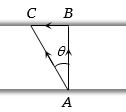
(A) To cross the river in the shortest time,the component of the swimmer's velocity perpendicular to the river flow must be maximized.
Let the width of the river be $d$ and the swimmer's velocity in still water be $v_s = 10\, m/min$.
The time taken to cross the river is given by $t = \frac{d}{v_s \cos \theta}$,where $\theta$ is the angle the swimmer makes with the direction perpendicular to the river flow.
To minimize $t$,$\cos \theta$ must be maximum,which occurs when $\theta = 0^\circ$.
Therefore,the swimmer should swim perpendicular to the river flow,i.e.,due north.
Let the width of the river be $d$ and the swimmer's velocity in still water be $v_s = 10\, m/min$.
The time taken to cross the river is given by $t = \frac{d}{v_s \cos \theta}$,where $\theta$ is the angle the swimmer makes with the direction perpendicular to the river flow.
To minimize $t$,$\cos \theta$ must be maximum,which occurs when $\theta = 0^\circ$.
Therefore,the swimmer should swim perpendicular to the river flow,i.e.,due north.
0 likes
View Solution7
MediumMCQ
$A$ person aiming to reach the exactly opposite point on the bank of a stream is swimming with a speed of $0.5\, m/s$ at an angle of $120^\circ$ with the direction of flow of water. The speed of water in the stream is..........$m/s$.
A
$1$
B
$0.5$
C
$0.25$
D
$0.43$
Solution
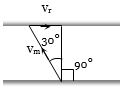
(C) Let $v_m$ be the velocity of the man and $v_r$ be the velocity of the river flow.
The man swims at an angle of $120^\circ$ with the direction of the river flow to reach the exactly opposite point.
This means the component of the man's velocity along the river flow must cancel out the river's velocity.
The angle between the man's velocity vector and the line perpendicular to the bank is $120^\circ - 90^\circ = 30^\circ$.
Thus,the horizontal component of the man's velocity is $v_m \sin(30^\circ)$.
For the man to reach the opposite point,this horizontal component must be equal to the river's velocity:
$v_r = v_m \sin(30^\circ)$
Given $v_m = 0.5\, m/s$ and $\sin(30^\circ) = 0.5$,
$v_r = 0.5 \times 0.5 = 0.25\, m/s$.
The man swims at an angle of $120^\circ$ with the direction of the river flow to reach the exactly opposite point.
This means the component of the man's velocity along the river flow must cancel out the river's velocity.
The angle between the man's velocity vector and the line perpendicular to the bank is $120^\circ - 90^\circ = 30^\circ$.
Thus,the horizontal component of the man's velocity is $v_m \sin(30^\circ)$.
For the man to reach the opposite point,this horizontal component must be equal to the river's velocity:
$v_r = v_m \sin(30^\circ)$
Given $v_m = 0.5\, m/s$ and $\sin(30^\circ) = 0.5$,
$v_r = 0.5 \times 0.5 = 0.25\, m/s$.
2 likes
View Solution8
EasyMCQ
$A$ moves with $65 \, km/h$ while $B$ is moving in the same direction as $A$ with $80 \, km/h$. The relative velocity of $B$ with respect to $A$ is ......... $km/h$.
A
$80$
B
$60$
C
$15$
D
$145$
Solution
(C) The velocity of object $A$ is $v_A = 65 \, km/h$.
The velocity of object $B$ is $v_B = 80 \, km/h$.
Since both objects are moving in the same direction,the relative velocity of $B$ with respect to $A$ is given by the formula:
$v_{BA} = v_B - v_A$
Substituting the given values:
$v_{BA} = 80 \, km/h - 65 \, km/h = 15 \, km/h$.
Therefore,the relative velocity of $B$ with respect to $A$ is $15 \, km/h$.
The velocity of object $B$ is $v_B = 80 \, km/h$.
Since both objects are moving in the same direction,the relative velocity of $B$ with respect to $A$ is given by the formula:
$v_{BA} = v_B - v_A$
Substituting the given values:
$v_{BA} = 80 \, km/h - 65 \, km/h = 15 \, km/h$.
Therefore,the relative velocity of $B$ with respect to $A$ is $15 \, km/h$.
0 likes
View Solution9
DifficultMCQ
$A$ man can swim with velocity $v$ relative to water. He has to cross a river of width $d$ flowing with a velocity $u$ $(u > v)$. The distance through which he is carried downstream by the river is $x$. Which of the following statements is correct?
A
If he crosses the river in maximum time,$x = \frac{du}{v}$.
B
$x$ cannot be less than $\frac{du}{v}$.
C
For $x$ to be minimum,he has to swim in a direction making an angle of $\frac{\pi}{2} + \sin^{-1}(\frac{v}{u})$ with the direction of the flow of water.
D
Both $(a)$ and $(c)$ are correct.
Solution
(C) Let the man swim at an angle $\theta$ with the downstream direction. The velocity components are $v_x = u + v \cos \theta$ and $v_y = v \sin \theta$.
The time taken to cross the river is $t = \frac{d}{v \sin \theta}$.
The downstream drift is $x = v_x t = (u + v \cos \theta) \frac{d}{v \sin \theta} = \frac{d}{v} (u \csc \theta + v \cot \theta)$.
For maximum time,$\sin \theta$ must be minimum. Since $\theta$ is the angle with the downstream,the range is $0 < \theta < \pi$. The minimum $\sin \theta$ occurs as $\theta \to 0$ or $\theta \to \pi$,but for crossing,$\theta$ must be in $(0, \pi)$. As $\theta \to 0$,$x \to \infty$. Thus,option $(a)$ is incorrect.
To minimize $x$,we differentiate $x$ with respect to $\theta$ and set it to zero: $\frac{dx}{d\theta} = \frac{d}{v} (-u \csc \theta \cot \theta - v \csc^2 \theta) = 0$.
This implies $u \cos \theta + v = 0$,so $\cos \theta = -v/u$.
Since $\theta$ is the angle with the flow,the angle with the normal to the flow is $\alpha = \theta - \pi/2$. Using $\cos \theta = -v/u$,we find $\sin \alpha = v/u$,so $\alpha = \sin^{-1}(v/u)$.
The angle with the flow is $\theta = \pi/2 + \sin^{-1}(v/u)$. Thus,option $(c)$ is correct.
The time taken to cross the river is $t = \frac{d}{v \sin \theta}$.
The downstream drift is $x = v_x t = (u + v \cos \theta) \frac{d}{v \sin \theta} = \frac{d}{v} (u \csc \theta + v \cot \theta)$.
For maximum time,$\sin \theta$ must be minimum. Since $\theta$ is the angle with the downstream,the range is $0 < \theta < \pi$. The minimum $\sin \theta$ occurs as $\theta \to 0$ or $\theta \to \pi$,but for crossing,$\theta$ must be in $(0, \pi)$. As $\theta \to 0$,$x \to \infty$. Thus,option $(a)$ is incorrect.
To minimize $x$,we differentiate $x$ with respect to $\theta$ and set it to zero: $\frac{dx}{d\theta} = \frac{d}{v} (-u \csc \theta \cot \theta - v \csc^2 \theta) = 0$.
This implies $u \cos \theta + v = 0$,so $\cos \theta = -v/u$.
Since $\theta$ is the angle with the flow,the angle with the normal to the flow is $\alpha = \theta - \pi/2$. Using $\cos \theta = -v/u$,we find $\sin \alpha = v/u$,so $\alpha = \sin^{-1}(v/u)$.
The angle with the flow is $\theta = \pi/2 + \sin^{-1}(v/u)$. Thus,option $(c)$ is correct.
0 likes
View Solution10
MediumMCQ
$A$ man sitting in a bus travelling from west to east with a speed of $40 \, km/h$ observes that the rain-drops are falling vertically down. To another man standing on the ground,the rain will appear:
A
To fall vertically down
B
To fall at an angle going from west to east
C
To fall at an angle going from east to west
D
The information given is insufficient to decide the direction of rain.
Solution
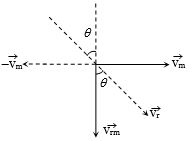
(B) Let $\vec{v}_m$ be the velocity of the bus (man) moving from west to east.
Let $\vec{v}_r$ be the actual velocity of the rain.
Let $\vec{v}_{rm}$ be the velocity of the rain with respect to the man in the bus.
We are given that $\vec{v}_{rm}$ is vertical (downwards).
By the definition of relative velocity,$\vec{v}_{rm} = \vec{v}_r - \vec{v}_m$,which implies $\vec{v}_r = \vec{v}_{rm} + \vec{v}_m$.
Since $\vec{v}_{rm}$ is vertical and $\vec{v}_m$ is directed from west to east,the resultant vector $\vec{v}_r$ must have a horizontal component directed from west to east.
Therefore,to a stationary observer on the ground,the rain appears to fall at an angle,moving from west to east.
Let $\vec{v}_r$ be the actual velocity of the rain.
Let $\vec{v}_{rm}$ be the velocity of the rain with respect to the man in the bus.
We are given that $\vec{v}_{rm}$ is vertical (downwards).
By the definition of relative velocity,$\vec{v}_{rm} = \vec{v}_r - \vec{v}_m$,which implies $\vec{v}_r = \vec{v}_{rm} + \vec{v}_m$.
Since $\vec{v}_{rm}$ is vertical and $\vec{v}_m$ is directed from west to east,the resultant vector $\vec{v}_r$ must have a horizontal component directed from west to east.
Therefore,to a stationary observer on the ground,the rain appears to fall at an angle,moving from west to east.
0 likes
View Solution11
DifficultMCQ
$A$ boat takes $2 \, h$ to travel $8 \, km$ and back in still water. If the velocity of water is $4 \, km/h$,the time taken for going upstream $8 \, km$ and coming back is:
A
$2 \, h$
B
$2 \, h \, 40 \, min$
C
$1 \, h \, 20 \, min$
D
Cannot be estimated with the information given
Solution
(B) The boat covers a total distance of $16 \, km$ ($8 \, km$ forward and $8 \, km$ back) in still water in $2 \, h$.
Therefore,the velocity of the boat in still water is $v_B = \frac{16 \, km}{2 \, h} = 8 \, km/h$.
Given the velocity of water is $v_w = 4 \, km/h$.
Time taken to travel $8 \, km$ upstream: $t_1 = \frac{8}{v_B - v_w} = \frac{8}{8 - 4} = \frac{8}{4} = 2 \, h$.
Time taken to travel $8 \, km$ downstream: $t_2 = \frac{8}{v_B + v_w} = \frac{8}{8 + 4} = \frac{8}{12} = \frac{2}{3} \, h = 40 \, min$.
Total time taken = $t_1 + t_2 = 2 \, h + 40 \, min = 2 \, h \, 40 \, min$.
Therefore,the velocity of the boat in still water is $v_B = \frac{16 \, km}{2 \, h} = 8 \, km/h$.
Given the velocity of water is $v_w = 4 \, km/h$.
Time taken to travel $8 \, km$ upstream: $t_1 = \frac{8}{v_B - v_w} = \frac{8}{8 - 4} = \frac{8}{4} = 2 \, h$.
Time taken to travel $8 \, km$ downstream: $t_2 = \frac{8}{v_B + v_w} = \frac{8}{8 + 4} = \frac{8}{12} = \frac{2}{3} \, h = 40 \, min$.
Total time taken = $t_1 + t_2 = 2 \, h + 40 \, min = 2 \, h \, 40 \, min$.
0 likes
View Solution12
EasyMCQ
$A$ $120 \, m$ long train is moving towards west with a speed of $10 \, m/s$. $A$ bird flying towards east with a speed of $5 \, m/s$ crosses the train. The time taken by the bird to cross the train will be ........ $sec$.
A
$16$
B
$12$
C
$10$
D
$8$
Solution
(D) The train is moving towards the west with a velocity $v_t = 10 \, m/s$ (west).
The bird is flying towards the east with a velocity $v_b = 5 \, m/s$ (east).
Since they are moving in opposite directions,their relative velocity $v_{rel}$ is the sum of their individual speeds:
$v_{rel} = v_t + v_b = 10 \, m/s + 5 \, m/s = 15 \, m/s$.
The length of the train to be covered by the bird is $L = 120 \, m$.
The time taken $t$ to cross the train is given by the formula:
$t = \frac{L}{v_{rel}} = \frac{120 \, m}{15 \, m/s} = 8 \, sec$.
Therefore,the time taken by the bird to cross the train is $8 \, sec$.
The bird is flying towards the east with a velocity $v_b = 5 \, m/s$ (east).
Since they are moving in opposite directions,their relative velocity $v_{rel}$ is the sum of their individual speeds:
$v_{rel} = v_t + v_b = 10 \, m/s + 5 \, m/s = 15 \, m/s$.
The length of the train to be covered by the bird is $L = 120 \, m$.
The time taken $t$ to cross the train is given by the formula:
$t = \frac{L}{v_{rel}} = \frac{120 \, m}{15 \, m/s} = 8 \, sec$.
Therefore,the time taken by the bird to cross the train is $8 \, sec$.
1 likes
View Solution13
EasyMCQ
$A$ boat crosses a river with a velocity of $8 \, km/h$ relative to the water. If the resultant velocity of the boat with respect to the ground is $10 \, km/h$,then the velocity of the river water is...........$km/h$.
A
$12$
B
$6$
C
$5$
D
$10$
Solution
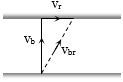
(B) Let $\overrightarrow{v_b}$ be the velocity of the boat relative to the water and $\overrightarrow{v_r}$ be the velocity of the river water relative to the ground.
The resultant velocity of the boat relative to the ground is given by $\overrightarrow{v_{bg}} = \overrightarrow{v_b} + \overrightarrow{v_r}$.
Since the boat crosses the river perpendicular to the flow,the vectors $\overrightarrow{v_b}$ and $\overrightarrow{v_r}$ are perpendicular to each other.
Therefore,the magnitude of the resultant velocity is $v_{bg} = \sqrt{v_b^2 + v_r^2}$.
Given $v_{bg} = 10 \, km/h$ and $v_b = 8 \, km/h$,we have:
$10 = \sqrt{8^2 + v_r^2}$
$100 = 64 + v_r^2$
$v_r^2 = 100 - 64 = 36$
$v_r = 6 \, km/h$.
The resultant velocity of the boat relative to the ground is given by $\overrightarrow{v_{bg}} = \overrightarrow{v_b} + \overrightarrow{v_r}$.
Since the boat crosses the river perpendicular to the flow,the vectors $\overrightarrow{v_b}$ and $\overrightarrow{v_r}$ are perpendicular to each other.
Therefore,the magnitude of the resultant velocity is $v_{bg} = \sqrt{v_b^2 + v_r^2}$.
Given $v_{bg} = 10 \, km/h$ and $v_b = 8 \, km/h$,we have:
$10 = \sqrt{8^2 + v_r^2}$
$100 = 64 + v_r^2$
$v_r^2 = 100 - 64 = 36$
$v_r = 6 \, km/h$.
0 likes
View Solution14
MediumMCQ
The width of the river is $1 \; km$. The velocity of the boat is $5 \; km/hr$. The boat covers the width of the river along the shortest possible path in $15 \; min$. The velocity of the river stream is:
A
$\sqrt{29} \; km/hr$
B
$3 \; km/hr$
C
$4 \; km/hr$
D
$\sqrt{41} \; km/hr$
Solution
(B) The shortest path to cross a river is the straight line perpendicular to the river flow.
Let $v_b = 5 \; km/hr$ be the velocity of the boat and $u$ be the velocity of the river stream.
The resultant velocity $v_r$ of the boat relative to the ground,when crossing the river along the shortest path,is given by $v_r = \sqrt{v_b^2 - u^2}$.
Given width $d = 1 \; km$ and time $t = 15 \; min = 0.25 \; hr = \frac{1}{4} \; hr$.
The resultant velocity is $v_r = \frac{d}{t} = \frac{1}{1/4} = 4 \; km/hr$.
Substituting the values: $4 = \sqrt{5^2 - u^2}$.
Squaring both sides: $16 = 25 - u^2$.
$u^2 = 25 - 16 = 9$.
$u = 3 \; km/hr$.
Let $v_b = 5 \; km/hr$ be the velocity of the boat and $u$ be the velocity of the river stream.
The resultant velocity $v_r$ of the boat relative to the ground,when crossing the river along the shortest path,is given by $v_r = \sqrt{v_b^2 - u^2}$.
Given width $d = 1 \; km$ and time $t = 15 \; min = 0.25 \; hr = \frac{1}{4} \; hr$.
The resultant velocity is $v_r = \frac{d}{t} = \frac{1}{1/4} = 4 \; km/hr$.
Substituting the values: $4 = \sqrt{5^2 - u^2}$.
Squaring both sides: $16 = 25 - u^2$.
$u^2 = 25 - 16 = 9$.
$u = 3 \; km/hr$.
0 likes
View Solution15
MediumMCQ
$A$ man crosses a $320 \ m$ wide river perpendicular to the current in $4 \ minutes$. If in still water he can swim with a speed $5/3$ times that of the current,then the speed of the current,in $m/min$ is
A
$30$
B
$40$
C
$50$
D
$60$
Solution
(D) Let $v_r$ be the speed of the river current and $v_m$ be the speed of the man in still water.
Given that the man crosses the river perpendicular to the current,his resultant velocity $v_{res}$ is given by $v_{res} = \sqrt{v_m^2 - v_r^2}$.
The width of the river is $d = 320 \ m$ and the time taken is $t = 4 \ min$.
Thus,the resultant velocity is $v_{res} = \frac{d}{t} = \frac{320}{4} = 80 \ m/min$.
We are given $v_m = \frac{5}{3} v_r$.
Substituting this into the velocity equation: $80 = \sqrt{(\frac{5}{3} v_r)^2 - v_r^2}$.
Squaring both sides: $80^2 = \frac{25}{9} v_r^2 - v_r^2$.
$6400 = \frac{16}{9} v_r^2$.
$v_r^2 = \frac{6400 \times 9}{16} = 400 \times 9 = 3600$.
$v_r = \sqrt{3600} = 60 \ m/min$.
Given that the man crosses the river perpendicular to the current,his resultant velocity $v_{res}$ is given by $v_{res} = \sqrt{v_m^2 - v_r^2}$.
The width of the river is $d = 320 \ m$ and the time taken is $t = 4 \ min$.
Thus,the resultant velocity is $v_{res} = \frac{d}{t} = \frac{320}{4} = 80 \ m/min$.
We are given $v_m = \frac{5}{3} v_r$.
Substituting this into the velocity equation: $80 = \sqrt{(\frac{5}{3} v_r)^2 - v_r^2}$.
Squaring both sides: $80^2 = \frac{25}{9} v_r^2 - v_r^2$.
$6400 = \frac{16}{9} v_r^2$.
$v_r^2 = \frac{6400 \times 9}{16} = 400 \times 9 = 3600$.
$v_r = \sqrt{3600} = 60 \ m/min$.
0 likes
View Solution16
EasyMCQ
Two trains,each $50 \, m$ long,are travelling in opposite directions with velocities $10 \, m/s$ and $15 \, m/s$. The time taken for them to cross each other is:
A
$2$
B
$4$
C
$2\sqrt{3}$
D
$4\sqrt{3}$
Solution
(B) The total distance to be covered for the trains to completely cross each other is the sum of their lengths: $D = 50 \, m + 50 \, m = 100 \, m$.
Since the trains are moving in opposite directions,their relative velocity is the sum of their individual velocities: $v_{rel} = 10 \, m/s + 15 \, m/s = 25 \, m/s$.
The time taken to cross is given by the formula: $t = \frac{D}{v_{rel}}$.
Substituting the values: $t = \frac{100 \, m}{25 \, m/s} = 4 \, s$.
Since the trains are moving in opposite directions,their relative velocity is the sum of their individual velocities: $v_{rel} = 10 \, m/s + 15 \, m/s = 25 \, m/s$.
The time taken to cross is given by the formula: $t = \frac{D}{v_{rel}}$.
Substituting the values: $t = \frac{100 \, m}{25 \, m/s} = 4 \, s$.
0 likes
View Solution17
MediumMCQ
$A$ police jeep is chasing a thief's jeep. The police jeep is moving with a velocity of $45 \, km/h$ and the thief's jeep is moving with a velocity of $153 \, km/h$. The police fire a bullet with a muzzle velocity of $180 \, m/s$. What is the velocity with which the bullet strikes the thief's car in $m/s$?
A
$150$
B
$27$
C
$450$
D
$250$
Solution
(A) First,convert all velocities to $m/s$:
Velocity of police jeep $(v_p)$ $= 45 \, km/h = 45 \times \frac{5}{18} \, m/s = 12.5 \, m/s$.
Velocity of thief's jeep $(v_t)$ $= 153 \, km/h = 153 \times \frac{5}{18} \, m/s = 42.5 \, m/s$.
Muzzle velocity of the bullet $(v_b)$ $= 180 \, m/s$.
The velocity of the bullet with respect to the ground is $v_{bg} = v_b + v_p = 180 + 12.5 = 192.5 \, m/s$.
The velocity of the bullet with respect to the thief's car is $v_{bt} = v_{bg} - v_t$.
$v_{bt} = 192.5 \, m/s - 42.5 \, m/s = 150 \, m/s$.
Velocity of police jeep $(v_p)$ $= 45 \, km/h = 45 \times \frac{5}{18} \, m/s = 12.5 \, m/s$.
Velocity of thief's jeep $(v_t)$ $= 153 \, km/h = 153 \times \frac{5}{18} \, m/s = 42.5 \, m/s$.
Muzzle velocity of the bullet $(v_b)$ $= 180 \, m/s$.
The velocity of the bullet with respect to the ground is $v_{bg} = v_b + v_p = 180 + 12.5 = 192.5 \, m/s$.
The velocity of the bullet with respect to the thief's car is $v_{bt} = v_{bg} - v_t$.
$v_{bt} = 192.5 \, m/s - 42.5 \, m/s = 150 \, m/s$.
0 likes
View Solution18
DifficultMCQ
$A$ boat is sent across a river with a velocity of $8 \, km/hr$. If the resultant velocity of the boat is $10 \, km/hr$,then the velocity of the river is ........ $km/hr$.
A
$10$
B
$8$
C
$6$
D
$4$
Solution
(C) Let $\vec{v}_b$ be the velocity of the boat relative to the water,and $\vec{v}_r$ be the velocity of the river relative to the ground.
The resultant velocity of the boat relative to the ground is $\vec{v} = \vec{v}_b + \vec{v}_r$.
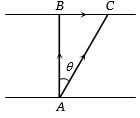
From the given diagram,the velocity of the boat relative to the water is represented by $\vec{AB} = 8 \, km/hr$ (directed perpendicular to the river flow).
The resultant velocity of the boat relative to the ground is represented by $\vec{AC} = 10 \, km/hr$.
The velocity of the river is represented by $\vec{BC}$.
Since $\triangle ABC$ is a right-angled triangle with $\angle ABC = 90^\circ$,we have:
$AC^2 = AB^2 + BC^2$
$BC = \sqrt{AC^2 - AB^2}$
$BC = \sqrt{10^2 - 8^2} = \sqrt{100 - 64} = \sqrt{36} = 6 \, km/hr$.
The resultant velocity of the boat relative to the ground is $\vec{v} = \vec{v}_b + \vec{v}_r$.
From the given diagram,the velocity of the boat relative to the water is represented by $\vec{AB} = 8 \, km/hr$ (directed perpendicular to the river flow).
The resultant velocity of the boat relative to the ground is represented by $\vec{AC} = 10 \, km/hr$.
The velocity of the river is represented by $\vec{BC}$.
Since $\triangle ABC$ is a right-angled triangle with $\angle ABC = 90^\circ$,we have:
$AC^2 = AB^2 + BC^2$
$BC = \sqrt{AC^2 - AB^2}$
$BC = \sqrt{10^2 - 8^2} = \sqrt{100 - 64} = \sqrt{36} = 6 \, km/hr$.
0 likes
View Solution19
DifficultMCQ
$A$ train of $150 \ m$ length is going towards the north direction at a speed of $10 \ m/s$. $A$ parrot flies at a speed of $5 \ m/s$ towards the south direction parallel to the railway track. The time taken by the parrot to cross the train is........$s$.
A
$12$
B
$8$
C
$15$
D
$10$
Solution
(D) The length of the train is $L = 150 \ m$.
The velocity of the train is $v_t = 10 \ m/s$ (towards North).
The velocity of the parrot is $v_p = 5 \ m/s$ (towards South).
Since they are moving in opposite directions,the relative velocity of the parrot with respect to the train is $v_{rel} = v_t + v_p = 10 + 5 = 15 \ m/s$.
The time taken by the parrot to cross the train is $t = \frac{L}{v_{rel}}$.
Substituting the values,$t = \frac{150}{15} = 10 \ s$.
The velocity of the train is $v_t = 10 \ m/s$ (towards North).
The velocity of the parrot is $v_p = 5 \ m/s$ (towards South).
Since they are moving in opposite directions,the relative velocity of the parrot with respect to the train is $v_{rel} = v_t + v_p = 10 + 5 = 15 \ m/s$.
The time taken by the parrot to cross the train is $t = \frac{L}{v_{rel}}$.
Substituting the values,$t = \frac{150}{15} = 10 \ s$.
0 likes
View Solution20
MediumMCQ
$A$ boat is moving with a velocity of $3\hat i + 4\hat j$ in a river,and the water is moving with a velocity of $-3\hat i - 4\hat j$ with respect to the ground. The relative velocity of the boat with respect to the water is:
A
$ - 6\hat i - 8\hat j$
B
$6\hat i + 8\hat j$
C
$8\hat i$
D
$6\hat i$
Solution
(B) The relative velocity of the boat with respect to the water is given by the formula:
$\vec{v}_{bw} = \vec{v}_b - \vec{v}_w$
Given:
$\vec{v}_b = 3\hat i + 4\hat j$
$\vec{v}_w = -3\hat i - 4\hat j$
Substituting these values into the formula:
$\vec{v}_{bw} = (3\hat i + 4\hat j) - (-3\hat i - 4\hat j)$
$\vec{v}_{bw} = 3\hat i + 4\hat j + 3\hat i + 4\hat j$
$\vec{v}_{bw} = 6\hat i + 8\hat j$
Thus,the relative velocity of the boat with respect to the water is $6\hat i + 8\hat j$.
$\vec{v}_{bw} = \vec{v}_b - \vec{v}_w$
Given:
$\vec{v}_b = 3\hat i + 4\hat j$
$\vec{v}_w = -3\hat i - 4\hat j$
Substituting these values into the formula:
$\vec{v}_{bw} = (3\hat i + 4\hat j) - (-3\hat i - 4\hat j)$
$\vec{v}_{bw} = 3\hat i + 4\hat j + 3\hat i + 4\hat j$
$\vec{v}_{bw} = 6\hat i + 8\hat j$
Thus,the relative velocity of the boat with respect to the water is $6\hat i + 8\hat j$.
0 likes
View Solution21
MediumMCQ
$A$ boat moves with a speed of $5 \, km/h$ relative to water in a river flowing with a speed of $3 \, km/h$ and having a width of $1 \, km$. The minimum time taken for a round trip is ......... $min$.
A
$5$
B
$60$
C
$20$
D
$30$
Solution
(D) Let the speed of the boat relative to water be $v_b = 5 \, km/h$ and the speed of the river be $v_r = 3 \, km/h$. The width of the river is $d = 1 \, km$.
To minimize the time for a round trip,the boat must cross the river perpendicular to the flow of the river.
The effective velocity of the boat across the river is $v_{eff} = \sqrt{v_b^2 - v_r^2} = \sqrt{5^2 - 3^2} = \sqrt{25 - 9} = \sqrt{16} = 4 \, km/h$.
The time taken to cross the river once is $t = \frac{d}{v_{eff}} = \frac{1 \, km}{4 \, km/h} = 0.25 \, h$.
For a round trip,the boat must cross the river and return,so the total time is $T = 2 \times t = 2 \times 0.25 \, h = 0.5 \, h$.
Converting to minutes,$T = 0.5 \times 60 \, min = 30 \, min$.
To minimize the time for a round trip,the boat must cross the river perpendicular to the flow of the river.
The effective velocity of the boat across the river is $v_{eff} = \sqrt{v_b^2 - v_r^2} = \sqrt{5^2 - 3^2} = \sqrt{25 - 9} = \sqrt{16} = 4 \, km/h$.
The time taken to cross the river once is $t = \frac{d}{v_{eff}} = \frac{1 \, km}{4 \, km/h} = 0.25 \, h$.
For a round trip,the boat must cross the river and return,so the total time is $T = 2 \times t = 2 \times 0.25 \, h = 0.5 \, h$.
Converting to minutes,$T = 0.5 \times 60 \, min = 30 \, min$.
0 likes
View Solution22
MediumMCQ
$A$ river is flowing from $W$ to $E$ with a speed of $5 \, m/min$. $A$ man can swim in still water with a velocity of $10 \, m/min$. In which direction should the man swim to take the shortest possible path to reach the opposite bank (South)?
A
$30^\circ$ with downstream
B
$60^\circ$ with downstream
C
$120^\circ$ with downstream
D
South
Solution
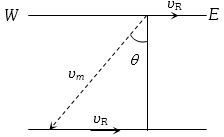
(C) For the shortest possible path,the resultant velocity of the man must be perpendicular to the river flow (i.e.,directed due South).
Let $v_r = 5 \, m/min$ be the velocity of the river and $v_m = 10 \, m/min$ be the velocity of the man in still water.
Let $\theta$ be the angle the man makes with the line perpendicular to the river flow (towards the upstream direction).
From the vector triangle,$\sin \theta = \frac{v_r}{v_m} = \frac{5}{10} = \frac{1}{2}$.
Therefore,$\theta = 30^\circ$.
The angle with the downstream direction is $90^\circ + \theta = 90^\circ + 30^\circ = 120^\circ$.
Let $v_r = 5 \, m/min$ be the velocity of the river and $v_m = 10 \, m/min$ be the velocity of the man in still water.
Let $\theta$ be the angle the man makes with the line perpendicular to the river flow (towards the upstream direction).
From the vector triangle,$\sin \theta = \frac{v_r}{v_m} = \frac{5}{10} = \frac{1}{2}$.
Therefore,$\theta = 30^\circ$.
The angle with the downstream direction is $90^\circ + \theta = 90^\circ + 30^\circ = 120^\circ$.
0 likes
View Solution23
MediumMCQ
$A$ train is moving towards the east and a car is moving towards the north,both with the same speed. The observed direction of the car to a passenger in the train is
A
East-north direction
B
West-north direction
C
South-east direction
D
None of these
Solution
(B) Let the speed of the train be $v$ and the speed of the car be $v$.
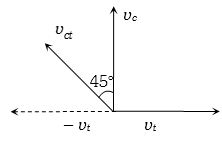
Velocity of the train is $\vec{v_t} = v \hat{i}$.
Velocity of the car is $\vec{v_c} = v \hat{j}$.
The velocity of the car with respect to the train is given by $\vec{v_{ct}} = \vec{v_c} - \vec{v_t}$.
Substituting the values,we get $\vec{v_{ct}} = v \hat{j} - v \hat{i} = v(-\hat{i} + \hat{j})$.
The vector $(-\hat{i} + \hat{j})$ points in the direction between the West $(-\hat{i})$ and North $(+\hat{j})$ directions.
Therefore,the observed direction of the car to a passenger in the train is West-north.
Velocity of the train is $\vec{v_t} = v \hat{i}$.
Velocity of the car is $\vec{v_c} = v \hat{j}$.
The velocity of the car with respect to the train is given by $\vec{v_{ct}} = \vec{v_c} - \vec{v_t}$.
Substituting the values,we get $\vec{v_{ct}} = v \hat{j} - v \hat{i} = v(-\hat{i} + \hat{j})$.
The vector $(-\hat{i} + \hat{j})$ points in the direction between the West $(-\hat{i})$ and North $(+\hat{j})$ directions.
Therefore,the observed direction of the car to a passenger in the train is West-north.
0 likes
View Solution24
EasyMCQ
$A$ man projects a coin upwards from the gate of a uniformly moving train. The path of the coin for the man will be
A
Parabolic
B
Inclined straight line
C
Vertical straight line
D
Horizontal straight line
Solution
(C) Since the man is inside the train,he and the coin share the same initial horizontal velocity as the train.
Because the horizontal velocity is the same for both the coin and the observer (the man),the relative horizontal velocity between them is zero.
Therefore,the coin will only experience vertical acceleration due to gravity relative to the man.
As a result,the path of the coin as observed by the man will be a vertical straight line.
Because the horizontal velocity is the same for both the coin and the observer (the man),the relative horizontal velocity between them is zero.
Therefore,the coin will only experience vertical acceleration due to gravity relative to the man.
As a result,the path of the coin as observed by the man will be a vertical straight line.
0 likes
View Solution25
DifficultMCQ
Two particles having position vectors $\overrightarrow{r_1} = (3\hat{i} + 5\hat{j}) \text{ m}$ and $\overrightarrow{r_2} = (-5\hat{i} - 3\hat{j}) \text{ m}$ are moving with velocities $\overrightarrow{v_1} = (4\hat{i} + 3\hat{j}) \text{ m/s}$ and $\overrightarrow{v_2} = (\alpha\hat{i} + 7\hat{j}) \text{ m/s}$. If they collide after $2 \text{ s}$,the value of $\alpha$ is:
A
$2$
B
$4$
C
$6$
D
$8$
Solution
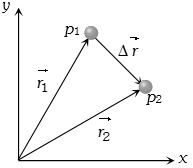
(D) For two particles to collide,their positions at time $t$ must be equal. Let $\overrightarrow{r_1}(t)$ and $\overrightarrow{r_2}(t)$ be the positions of the particles at time $t$.
$\overrightarrow{r_1}(t) = \overrightarrow{r_1} + \overrightarrow{v_1}t = (3\hat{i} + 5\hat{j}) + (4\hat{i} + 3\hat{j})t = (3+4t)\hat{i} + (5+3t)\hat{j}$
$\overrightarrow{r_2}(t) = \overrightarrow{r_2} + \overrightarrow{v_2}t = (-5\hat{i} - 3\hat{j}) + (\alpha\hat{i} + 7\hat{j})t = (-5+\alpha t)\hat{i} + (-3+7t)\hat{j}$
At collision,$\overrightarrow{r_1}(t) = \overrightarrow{r_2}(t)$ at $t = 2 \text{ s}$.
Equating the $\hat{i}$ components:
$3 + 4(2) = -5 + \alpha(2)$
$3 + 8 = -5 + 2\alpha$
$11 = -5 + 2\alpha$
$16 = 2\alpha$
$\alpha = 8$
Equating the $\hat{j}$ components to verify:
$5 + 3(2) = -3 + 7(2)$
$5 + 6 = -3 + 14$
$11 = 11$. This confirms the result.
$\overrightarrow{r_1}(t) = \overrightarrow{r_1} + \overrightarrow{v_1}t = (3\hat{i} + 5\hat{j}) + (4\hat{i} + 3\hat{j})t = (3+4t)\hat{i} + (5+3t)\hat{j}$
$\overrightarrow{r_2}(t) = \overrightarrow{r_2} + \overrightarrow{v_2}t = (-5\hat{i} - 3\hat{j}) + (\alpha\hat{i} + 7\hat{j})t = (-5+\alpha t)\hat{i} + (-3+7t)\hat{j}$
At collision,$\overrightarrow{r_1}(t) = \overrightarrow{r_2}(t)$ at $t = 2 \text{ s}$.
Equating the $\hat{i}$ components:
$3 + 4(2) = -5 + \alpha(2)$
$3 + 8 = -5 + 2\alpha$
$11 = -5 + 2\alpha$
$16 = 2\alpha$
$\alpha = 8$
Equating the $\hat{j}$ components to verify:
$5 + 3(2) = -3 + 7(2)$
$5 + 6 = -3 + 14$
$11 = 11$. This confirms the result.
0 likes
View Solution26
MediumMCQ
For the two given particles $A$ and $B$ as shown in the figure,how much time will it take for their horizontal separation to become zero?
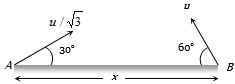
A
$u/2x$
B
$x/u$
C
$2u/x$
D
$u/x$
Solution
(B) Let the horizontal distance covered by particle $A$ be $x_1$ and by particle $B$ be $x_2$.
Particle $A$ moves with velocity $v_A = u/\sqrt{3}$ at an angle of $30^\circ$ with the horizontal. Its horizontal component of velocity is $v_{Ax} = (u/\sqrt{3}) \cos 30^\circ = (u/\sqrt{3}) \times (\sqrt{3}/2) = u/2$.
Particle $B$ moves with velocity $v_B = u$ at an angle of $60^\circ$ with the horizontal. Its horizontal component of velocity is $v_{Bx} = u \cos 60^\circ = u \times (1/2) = u/2$.
Since both particles are moving towards each other,their relative horizontal velocity is $v_{rel} = v_{Ax} + v_{Bx} = u/2 + u/2 = u$.
The initial horizontal separation between them is $x$.
Time taken for the horizontal separation to become zero is $t = \text{Distance} / \text{Relative Velocity} = x / u$.
Particle $A$ moves with velocity $v_A = u/\sqrt{3}$ at an angle of $30^\circ$ with the horizontal. Its horizontal component of velocity is $v_{Ax} = (u/\sqrt{3}) \cos 30^\circ = (u/\sqrt{3}) \times (\sqrt{3}/2) = u/2$.
Particle $B$ moves with velocity $v_B = u$ at an angle of $60^\circ$ with the horizontal. Its horizontal component of velocity is $v_{Bx} = u \cos 60^\circ = u \times (1/2) = u/2$.
Since both particles are moving towards each other,their relative horizontal velocity is $v_{rel} = v_{Ax} + v_{Bx} = u/2 + u/2 = u$.
The initial horizontal separation between them is $x$.
Time taken for the horizontal separation to become zero is $t = \text{Distance} / \text{Relative Velocity} = x / u$.
0 likes
View Solution27
MediumMCQ
Preeti reached the metro station and found that the escalator was not working. She walked up the stationary escalator in time $t_1$. On other days,if she remains stationary on the moving escalator,then the escalator takes her up in time $t_2$. The time taken by her to walk up on the moving escalator will be
A
$\frac{t_1 t_2}{t_2 - t_1}$
B
$\frac{t_1 t_2}{t_1 + t_2}$
C
$t_1 - t_2$
D
$\frac{t_1 + t_2}{2}$
Solution
(B) Let $d$ be the distance of the escalator.
Velocity of Preeti on the stationary escalator is $v_1 = \frac{d}{t_1}$.
Velocity of the moving escalator is $v_2 = \frac{d}{t_2}$.
When Preeti walks on the moving escalator,her net velocity with respect to the ground is $v = v_1 + v_2$.
$v = \frac{d}{t_1} + \frac{d}{t_2} = d \left( \frac{t_1 + t_2}{t_1 t_2} \right)$.
The time $t$ taken to cover the distance $d$ with net velocity $v$ is:
$t = \frac{d}{v} = \frac{d}{d \left( \frac{t_1 + t_2}{t_1 t_2} \right)} = \frac{t_1 t_2}{t_1 + t_2}$.
Velocity of Preeti on the stationary escalator is $v_1 = \frac{d}{t_1}$.
Velocity of the moving escalator is $v_2 = \frac{d}{t_2}$.
When Preeti walks on the moving escalator,her net velocity with respect to the ground is $v = v_1 + v_2$.
$v = \frac{d}{t_1} + \frac{d}{t_2} = d \left( \frac{t_1 + t_2}{t_1 t_2} \right)$.
The time $t$ taken to cover the distance $d$ with net velocity $v$ is:
$t = \frac{d}{v} = \frac{d}{d \left( \frac{t_1 + t_2}{t_1 t_2} \right)} = \frac{t_1 t_2}{t_1 + t_2}$.
0 likes
View Solution28
DifficultMCQ
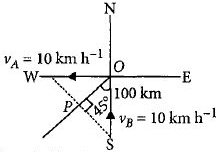
$A$ ship $A$ is moving Westwards with a speed of $10 \, km \, h^{-1}$ and a ship $B$,$100 \, km$ South of $A$,is moving Northwards with a speed of $10 \, km \, h^{-1}$. The time after which the distance between them becomes shortest is ........ $hr$.
A
$0$
B
$5$
C
$5\sqrt{2}$
D
$10\sqrt{2}$
Solution
(B) Let the initial position of ship $A$ be at the origin $(0, 0)$ moving along the negative $x$-axis. Its position at time $t$ is $\vec{r}_A = (-10t, 0)$.
Ship $B$ is initially at $(0, -100)$ moving along the positive $y$-axis. Its position at time $t$ is $\vec{r}_B = (0, -100 + 10t)$.
The relative position vector is $\vec{r}_{BA} = \vec{r}_B - \vec{r}_A = (10t, -100 + 10t)$.
The square of the distance $D^2 = (10t)^2 + (-100 + 10t)^2 = 100t^2 + 10000 - 2000t + 100t^2 = 200t^2 - 2000t + 10000$.
To find the shortest distance,differentiate $D^2$ with respect to $t$ and set it to zero:
$\frac{d(D^2)}{dt} = 400t - 2000 = 0$.
$400t = 2000 \Rightarrow t = 5 \, hr$.
Alternatively,using relative velocity: $\vec{v}_{BA} = \vec{v}_B - \vec{v}_A = (0, 10) - (-10, 0) = (10, 10) \, km \, h^{-1}$.
The magnitude of relative velocity is $|\vec{v}_{BA}| = \sqrt{10^2 + 10^2} = 10\sqrt{2} \, km \, h^{-1}$.
The shortest distance occurs when the relative position vector is perpendicular to the relative velocity vector. From the geometry,the time taken is $t = 5 \, hr$.
Ship $B$ is initially at $(0, -100)$ moving along the positive $y$-axis. Its position at time $t$ is $\vec{r}_B = (0, -100 + 10t)$.
The relative position vector is $\vec{r}_{BA} = \vec{r}_B - \vec{r}_A = (10t, -100 + 10t)$.
The square of the distance $D^2 = (10t)^2 + (-100 + 10t)^2 = 100t^2 + 10000 - 2000t + 100t^2 = 200t^2 - 2000t + 10000$.
To find the shortest distance,differentiate $D^2$ with respect to $t$ and set it to zero:
$\frac{d(D^2)}{dt} = 400t - 2000 = 0$.
$400t = 2000 \Rightarrow t = 5 \, hr$.
Alternatively,using relative velocity: $\vec{v}_{BA} = \vec{v}_B - \vec{v}_A = (0, 10) - (-10, 0) = (10, 10) \, km \, h^{-1}$.
The magnitude of relative velocity is $|\vec{v}_{BA}| = \sqrt{10^2 + 10^2} = 10\sqrt{2} \, km \, h^{-1}$.
The shortest distance occurs when the relative position vector is perpendicular to the relative velocity vector. From the geometry,the time taken is $t = 5 \, hr$.
0 likes
View Solution29
MediumMCQ
Two particles $A$ and $B$ move with constant velocities $\vec{v}_1$ and $\vec{v}_2$. At the initial moment,their position vectors are $\vec{r}_1$ and $\vec{r}_2$ respectively. The condition for particles $A$ and $B$ to collide is:
A
$\frac{\vec{r}_1 - \vec{r}_2}{|\vec{r}_1 - \vec{r}_2|} = \frac{\vec{v}_2 - \vec{v}_1}{|\vec{v}_2 - \vec{v}_1|}$
B
$\vec{r}_1 - \vec{r}_2 = \vec{v}_1 - \vec{v}_2$
C
$\vec{r}_1 \cdot \vec{v}_1 = \vec{r}_2 \cdot \vec{v}_2$
D
$\vec{r}_1 \times \vec{v}_1 = \vec{r}_2 \times \vec{v}_2$
Solution
(A) Let the particles $A$ and $B$ collide at time $t$. For their collision,the position vectors of both particles must be the same at time $t$,i.e.,
$\vec{r}_1 + \vec{v}_1 t = \vec{r}_2 + \vec{v}_2 t$
$\vec{r}_1 - \vec{r}_2 = (\vec{v}_2 - \vec{v}_1) t$ ... $(i)$
Taking the magnitude of both sides:
$|\vec{r}_1 - \vec{r}_2| = |\vec{v}_2 - \vec{v}_1| t$
$t = \frac{|\vec{r}_1 - \vec{r}_2|}{|\vec{v}_2 - \vec{v}_1|}$
Substituting this value of $t$ into equation $(i)$:
$\vec{r}_1 - \vec{r}_2 = (\vec{v}_2 - \vec{v}_1) \frac{|\vec{r}_1 - \vec{r}_2|}{|\vec{v}_2 - \vec{v}_1|}$
Rearranging the terms,we get:
$\frac{\vec{r}_1 - \vec{r}_2}{|\vec{r}_1 - \vec{r}_2|} = \frac{\vec{v}_2 - \vec{v}_1}{|\vec{v}_2 - \vec{v}_1|}$
$\vec{r}_1 + \vec{v}_1 t = \vec{r}_2 + \vec{v}_2 t$
$\vec{r}_1 - \vec{r}_2 = (\vec{v}_2 - \vec{v}_1) t$ ... $(i)$
Taking the magnitude of both sides:
$|\vec{r}_1 - \vec{r}_2| = |\vec{v}_2 - \vec{v}_1| t$
$t = \frac{|\vec{r}_1 - \vec{r}_2|}{|\vec{v}_2 - \vec{v}_1|}$
Substituting this value of $t$ into equation $(i)$:
$\vec{r}_1 - \vec{r}_2 = (\vec{v}_2 - \vec{v}_1) \frac{|\vec{r}_1 - \vec{r}_2|}{|\vec{v}_2 - \vec{v}_1|}$
Rearranging the terms,we get:
$\frac{\vec{r}_1 - \vec{r}_2}{|\vec{r}_1 - \vec{r}_2|} = \frac{\vec{v}_2 - \vec{v}_1}{|\vec{v}_2 - \vec{v}_1|}$
0 likes
View Solution30
DifficultMCQ
$A$ steamboat goes across a lake and comes back $(a)$ on a quiet day when the water is still and $(b)$ on a rough day when there is a uniform air current so as to help the journey onward and to impede the journey back. If the speed of the launch on both days was the same,in which case will it complete the journey in lesser time?
A
Case $(b)$
B
Case $(a)$
C
Same in both
D
Nothing can be predicted
Solution
(B) Let the breadth of the lake be $l$ and the velocity of the boat be $v_b$.
On a quiet day,the time taken in going and coming back is:
$t_Q = \frac{l}{v_b} + \frac{l}{v_b} = \frac{2l}{v_b}$ .....$(i)$
Now,if $v_a$ is the velocity of the air current,the time taken in going across the lake is:
$t_1 = \frac{l}{v_b + v_a}$ [As the current helps the motion]
And the time taken in coming back is:
$t_2 = \frac{l}{v_b - v_a}$ [As the current opposes the motion]
So,the total time on a rough day is:
$t_R = t_1 + t_2 = \frac{l(v_b - v_a) + l(v_b + v_a)}{v_b^2 - v_a^2} = \frac{2lv_b}{v_b^2 - v_a^2} = \frac{2l}{v_b[1 - (v_a/v_b)^2]}$ .....(ii)
Comparing equations $(i)$ and (ii):
$\frac{t_R}{t_Q} = \frac{1}{1 - (v_a/v_b)^2}$. Since $1 - (v_a/v_b)^2 < 1$,it follows that $\frac{t_R}{t_Q} > 1$,which means $t_R > t_Q$.
Therefore,the time taken to complete the journey on a quiet day is less than that on a rough day.
On a quiet day,the time taken in going and coming back is:
$t_Q = \frac{l}{v_b} + \frac{l}{v_b} = \frac{2l}{v_b}$ .....$(i)$
Now,if $v_a$ is the velocity of the air current,the time taken in going across the lake is:
$t_1 = \frac{l}{v_b + v_a}$ [As the current helps the motion]
And the time taken in coming back is:
$t_2 = \frac{l}{v_b - v_a}$ [As the current opposes the motion]
So,the total time on a rough day is:
$t_R = t_1 + t_2 = \frac{l(v_b - v_a) + l(v_b + v_a)}{v_b^2 - v_a^2} = \frac{2lv_b}{v_b^2 - v_a^2} = \frac{2l}{v_b[1 - (v_a/v_b)^2]}$ .....(ii)
Comparing equations $(i)$ and (ii):
$\frac{t_R}{t_Q} = \frac{1}{1 - (v_a/v_b)^2}$. Since $1 - (v_a/v_b)^2 < 1$,it follows that $\frac{t_R}{t_Q} > 1$,which means $t_R > t_Q$.
Therefore,the time taken to complete the journey on a quiet day is less than that on a rough day.
0 likes
View Solution31
MediumMCQ
To a person,going eastward in a car with a velocity of $25\, km/hr$,a train appears to move towards north with a velocity of $25\sqrt{3}\, km/hr$. The actual velocity of the train will be..........$km/hr$
A
$50$
B
$25$
C
$5$
D
$5\sqrt{3}$
Solution
(A) Let the velocity of the car be $\vec{v}_C = 25\hat{i}\, km/hr$ (eastward).
Let the velocity of the train be $\vec{v}_T = v_x\hat{i} + v_y\hat{j}$.
The velocity of the train relative to the car is $\vec{v}_{TC} = \vec{v}_T - \vec{v}_C = (v_x - 25)\hat{i} + v_y\hat{j}$.
Given that the train appears to move north,the horizontal component of the relative velocity must be zero: $v_x - 25 = 0$,so $v_x = 25\, km/hr$.
The magnitude of the relative velocity is given as $25\sqrt{3}\, km/hr$,which is the vertical component: $v_y = 25\sqrt{3}\, km/hr$.
The actual velocity of the train is $\vec{v}_T = 25\hat{i} + 25\sqrt{3}\hat{j}$.
The magnitude is $|\vec{v}_T| = \sqrt{25^2 + (25\sqrt{3})^2} = \sqrt{625 + 1875} = \sqrt{2500} = 50\, km/hr$.
Let the velocity of the train be $\vec{v}_T = v_x\hat{i} + v_y\hat{j}$.
The velocity of the train relative to the car is $\vec{v}_{TC} = \vec{v}_T - \vec{v}_C = (v_x - 25)\hat{i} + v_y\hat{j}$.
Given that the train appears to move north,the horizontal component of the relative velocity must be zero: $v_x - 25 = 0$,so $v_x = 25\, km/hr$.
The magnitude of the relative velocity is given as $25\sqrt{3}\, km/hr$,which is the vertical component: $v_y = 25\sqrt{3}\, km/hr$.
The actual velocity of the train is $\vec{v}_T = 25\hat{i} + 25\sqrt{3}\hat{j}$.
The magnitude is $|\vec{v}_T| = \sqrt{25^2 + (25\sqrt{3})^2} = \sqrt{625 + 1875} = \sqrt{2500} = 50\, km/hr$.
0 likes
View Solution32
MediumMCQ
$A$ swimmer can swim in still water with speed $v$ and the river is flowing with velocity $v/2$. To cross the river in the shortest distance,the swimmer should swim at an angle $\theta$ with the upstream. What is the ratio of the time taken to swim across in the shortest time to the time taken to swim across the shortest distance?
A
$cos \,\theta$
B
$sin \,\theta$
C
$tan \,\theta$
D
$cot \,\theta$
Solution
(B) Let the width of the river be $d$.
For the shortest time,the swimmer swims perpendicular to the river flow. The time taken is $t = \frac{d}{v}$.
For the shortest distance,the swimmer must swim at an angle $\theta$ with the upstream such that the resultant velocity is perpendicular to the river bank. The component of velocity perpendicular to the bank is $v \sin \theta$ (where $\theta$ is the angle with the upstream). Thus,the time taken is $t' = \frac{d}{v \sin \theta}$.
The ratio of the time taken for the shortest time to the time taken for the shortest distance is $\frac{t}{t'} = \frac{d/v}{d/(v \sin \theta)} = \sin \theta$.
For the shortest time,the swimmer swims perpendicular to the river flow. The time taken is $t = \frac{d}{v}$.
For the shortest distance,the swimmer must swim at an angle $\theta$ with the upstream such that the resultant velocity is perpendicular to the river bank. The component of velocity perpendicular to the bank is $v \sin \theta$ (where $\theta$ is the angle with the upstream). Thus,the time taken is $t' = \frac{d}{v \sin \theta}$.
The ratio of the time taken for the shortest time to the time taken for the shortest distance is $\frac{t}{t'} = \frac{d/v}{d/(v \sin \theta)} = \sin \theta$.
0 likes
View Solution33
MediumMCQ
It takes $1$ minute for a passenger standing on an escalator to reach the top. If the escalator does not move,it takes him $3$ minutes to walk up. How many seconds will it take for the passenger to arrive at the top if he walks up the moving escalator?
A
$30$
B
$45$
C
$40$
D
$35$
Solution
(B) Let the length of the escalator be $x$.
Speed of the escalator,$v_e = \frac{x}{1} = x \text{ m/min}$.
Speed of the man walking on a stationary escalator,$v_m = \frac{x}{3} \text{ m/min}$.
When the man walks up the moving escalator,his effective speed is $v_{eff} = v_e + v_m = x + \frac{x}{3} = \frac{4x}{3} \text{ m/min}$.
The time taken to reach the top is $t = \frac{x}{v_{eff}} = \frac{x}{4x/3} = \frac{3}{4} \text{ minutes}$.
Converting to seconds: $t = \frac{3}{4} \times 60 \text{ s} = 45 \text{ s}$.
Speed of the escalator,$v_e = \frac{x}{1} = x \text{ m/min}$.
Speed of the man walking on a stationary escalator,$v_m = \frac{x}{3} \text{ m/min}$.
When the man walks up the moving escalator,his effective speed is $v_{eff} = v_e + v_m = x + \frac{x}{3} = \frac{4x}{3} \text{ m/min}$.
The time taken to reach the top is $t = \frac{x}{v_{eff}} = \frac{x}{4x/3} = \frac{3}{4} \text{ minutes}$.
Converting to seconds: $t = \frac{3}{4} \times 60 \text{ s} = 45 \text{ s}$.
0 likes
View Solution34
DifficultMCQ
Two particles are moving along two long straight lines,in the same plane,with the same speed $= 20 \, cm/s$. The angle between the two lines is $60^{\circ}$,and their intersection point is $O$. At a certain moment,the two particles are located at distances $3 \, m$ and $4 \, m$ from $O$,and are moving towards $O$. Subsequently,the shortest distance between them will be
A
$50 \, cm$
B
$40\sqrt{2} \, cm$
C
$50\sqrt{2} \, cm$
D
$50\sqrt{3} \, cm$
Solution
(D) Let the intersection point $O$ be the origin $(0,0)$. Let one particle $Q$ move along the $x$-axis towards $O$ and the other particle $P$ move along a line at $60^{\circ}$ to the $x$-axis towards $O$.
The velocities are $\vec{v}_Q = -20 \hat{i} \, cm/s$ and $\vec{v}_P = -20 \cos 60^{\circ} \hat{i} - 20 \sin 60^{\circ} \hat{j} = -10 \hat{i} - 10\sqrt{3} \hat{j} \, cm/s$.
The relative velocity of $Q$ with respect to $P$ is $\vec{v}_{QP} = \vec{v}_Q - \vec{v}_P = (-20 - (-10)) \hat{i} - (-10\sqrt{3}) \hat{j} = -10 \hat{i} + 10\sqrt{3} \hat{j} \, cm/s$.
The initial positions are $\vec{r}_Q = 400 \hat{i} \, cm$ and $\vec{r}_P = 300 \cos 60^{\circ} \hat{i} + 300 \sin 60^{\circ} \hat{j} = 150 \hat{i} + 150\sqrt{3} \hat{j} \, cm$.
The relative position is $\vec{r}_{QP} = \vec{r}_Q - \vec{r}_P = (400 - 150) \hat{i} - 150\sqrt{3} \hat{j} = 250 \hat{i} - 150\sqrt{3} \hat{j} \, cm$.
The shortest distance is given by $d = \frac{|\vec{r}_{QP} \times \vec{v}_{QP}|}{|\vec{v}_{QP}|}$.
$|\vec{v}_{QP}| = \sqrt{(-10)^2 + (10\sqrt{3})^2} = \sqrt{100 + 300} = 20 \, cm/s$.
The cross product $\vec{r}_{QP} \times \vec{v}_{QP} = (250 \hat{i} - 150\sqrt{3} \hat{j}) \times (-10 \hat{i} + 10\sqrt{3} \hat{j}) = (250 \times 10\sqrt{3} - (-150\sqrt{3}) \times (-10)) \hat{k} = (2500\sqrt{3} - 1500\sqrt{3}) \hat{k} = 1000\sqrt{3} \hat{k}$.
The magnitude is $1000\sqrt{3}$.
Therefore,$d = \frac{1000\sqrt{3}}{20} = 50\sqrt{3} \, cm$.
The velocities are $\vec{v}_Q = -20 \hat{i} \, cm/s$ and $\vec{v}_P = -20 \cos 60^{\circ} \hat{i} - 20 \sin 60^{\circ} \hat{j} = -10 \hat{i} - 10\sqrt{3} \hat{j} \, cm/s$.
The relative velocity of $Q$ with respect to $P$ is $\vec{v}_{QP} = \vec{v}_Q - \vec{v}_P = (-20 - (-10)) \hat{i} - (-10\sqrt{3}) \hat{j} = -10 \hat{i} + 10\sqrt{3} \hat{j} \, cm/s$.
The initial positions are $\vec{r}_Q = 400 \hat{i} \, cm$ and $\vec{r}_P = 300 \cos 60^{\circ} \hat{i} + 300 \sin 60^{\circ} \hat{j} = 150 \hat{i} + 150\sqrt{3} \hat{j} \, cm$.
The relative position is $\vec{r}_{QP} = \vec{r}_Q - \vec{r}_P = (400 - 150) \hat{i} - 150\sqrt{3} \hat{j} = 250 \hat{i} - 150\sqrt{3} \hat{j} \, cm$.
The shortest distance is given by $d = \frac{|\vec{r}_{QP} \times \vec{v}_{QP}|}{|\vec{v}_{QP}|}$.
$|\vec{v}_{QP}| = \sqrt{(-10)^2 + (10\sqrt{3})^2} = \sqrt{100 + 300} = 20 \, cm/s$.
The cross product $\vec{r}_{QP} \times \vec{v}_{QP} = (250 \hat{i} - 150\sqrt{3} \hat{j}) \times (-10 \hat{i} + 10\sqrt{3} \hat{j}) = (250 \times 10\sqrt{3} - (-150\sqrt{3}) \times (-10)) \hat{k} = (2500\sqrt{3} - 1500\sqrt{3}) \hat{k} = 1000\sqrt{3} \hat{k}$.
The magnitude is $1000\sqrt{3}$.
Therefore,$d = \frac{1000\sqrt{3}}{20} = 50\sqrt{3} \, cm$.
0 likes
View Solution35
DifficultMCQ
$A$ swimmer swims in still water at a speed of $5 \text{ km/hr}$. He enters a $200 \text{ m}$ wide river,having a river flow speed of $4 \text{ km/hr}$,at point $A$ and proceeds to swim at an angle of $127^{\circ}$ $(\sin 37^{\circ} = 0.6)$ with the river flow direction. Another point $B$ is located directly across $A$ on the other side. The swimmer lands on the other bank at a point $C$,from which he walks the distance $CB$ with a speed of $3 \text{ km/hr}$. The total time in which he reaches from $A$ to $B$ is .......... $\text{minutes}$.
A
$5$
B
$4$
C
$3$
D
None
Solution
(B) Let $V_{SR} = 5 \text{ km/hr}$ be the velocity of the swimmer with respect to the river.
Let $V_R = 4 \text{ km/hr}$ be the velocity of the river with respect to the ground.
The angle with the river flow is $127^{\circ}$. The velocity components of the swimmer relative to the ground are:
$V_{Sx} = V_R + V_{SR} \cos(127^{\circ}) = 4 + 5(-\cos 53^{\circ}) = 4 - 5(0.6) = 4 - 3 = 1 \text{ km/hr}$.
$V_{Sy} = V_{SR} \sin(127^{\circ}) = 5 \sin(53^{\circ}) = 5(0.8) = 4 \text{ km/hr}$.
The time taken to cross the river of width $d = 0.2 \text{ km}$ is $t_1 = \frac{d}{V_{Sy}} = \frac{0.2}{4} = 0.05 \text{ hr} = 3 \text{ minutes}$.
The horizontal distance covered downstream is $CB = V_{Sx} \times t_1 = 1 \text{ km/hr} \times 0.05 \text{ hr} = 0.05 \text{ km} = 50 \text{ m}$.
Time taken to walk distance $CB$ at $3 \text{ km/hr}$ is $t_2 = \frac{0.05 \text{ km}}{3 \text{ km/hr}} = \frac{1}{60} \text{ hr} = 1 \text{ minute}$.
Total time $= t_1 + t_2 = 3 \text{ min} + 1 \text{ min} = 4 \text{ minutes}$.
Let $V_R = 4 \text{ km/hr}$ be the velocity of the river with respect to the ground.
The angle with the river flow is $127^{\circ}$. The velocity components of the swimmer relative to the ground are:
$V_{Sx} = V_R + V_{SR} \cos(127^{\circ}) = 4 + 5(-\cos 53^{\circ}) = 4 - 5(0.6) = 4 - 3 = 1 \text{ km/hr}$.
$V_{Sy} = V_{SR} \sin(127^{\circ}) = 5 \sin(53^{\circ}) = 5(0.8) = 4 \text{ km/hr}$.
The time taken to cross the river of width $d = 0.2 \text{ km}$ is $t_1 = \frac{d}{V_{Sy}} = \frac{0.2}{4} = 0.05 \text{ hr} = 3 \text{ minutes}$.
The horizontal distance covered downstream is $CB = V_{Sx} \times t_1 = 1 \text{ km/hr} \times 0.05 \text{ hr} = 0.05 \text{ km} = 50 \text{ m}$.
Time taken to walk distance $CB$ at $3 \text{ km/hr}$ is $t_2 = \frac{0.05 \text{ km}}{3 \text{ km/hr}} = \frac{1}{60} \text{ hr} = 1 \text{ minute}$.
Total time $= t_1 + t_2 = 3 \text{ min} + 1 \text{ min} = 4 \text{ minutes}$.
0 likes
View Solution36
MediumMCQ
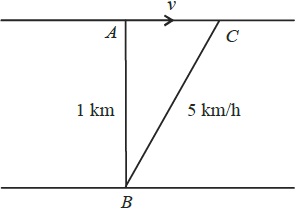
$A$ boat having a speed of $5 \, km/hr$ in still water crosses a river of width $1 \, km$ along the shortest possible path in $15 \, minutes$. Find the speed of the river in $km/hr$.
A
$1$
B
$3$
C
$4$
D
$\sqrt{41}$
Solution
(B) The shortest path to cross a river is the straight line perpendicular to the river banks. Let $v_b = 5 \, km/hr$ be the speed of the boat in still water and $v_r$ be the speed of the river.
The resultant velocity $v_{res}$ along the shortest path is given by:
$v_{res} = \frac{\text{width of river}}{\text{time taken}} = \frac{1 \, km}{15 \, min} = \frac{1 \, km}{15/60 \, hr} = 4 \, km/hr$.
In the vector triangle for crossing the river along the shortest path,the boat's velocity in still water $(v_b)$ acts as the hypotenuse,the resultant velocity $(v_{res})$ acts as one side,and the river's velocity $(v_r)$ acts as the other side.
According to the Pythagorean theorem:
$v_b^2 = v_{res}^2 + v_r^2$
$5^2 = 4^2 + v_r^2$
$25 = 16 + v_r^2$
$v_r^2 = 25 - 16 = 9$
$v_r = 3 \, km/hr$.
The resultant velocity $v_{res}$ along the shortest path is given by:
$v_{res} = \frac{\text{width of river}}{\text{time taken}} = \frac{1 \, km}{15 \, min} = \frac{1 \, km}{15/60 \, hr} = 4 \, km/hr$.
In the vector triangle for crossing the river along the shortest path,the boat's velocity in still water $(v_b)$ acts as the hypotenuse,the resultant velocity $(v_{res})$ acts as one side,and the river's velocity $(v_r)$ acts as the other side.
According to the Pythagorean theorem:
$v_b^2 = v_{res}^2 + v_r^2$
$5^2 = 4^2 + v_r^2$
$25 = 16 + v_r^2$
$v_r^2 = 25 - 16 = 9$
$v_r = 3 \, km/hr$.
0 likes
View Solution37
MediumMCQ
$A$ flag is mounted on a car moving due North with a velocity of $20 \, km/hr$. Strong winds are blowing due East with a velocity of $20 \, km/hr$. The flag will point in which direction?
A
East
B
North-East
C
South-East
D
South-West
Solution
(C) The velocity of the car is $\vec{v}_c = 20 \hat{j} \, km/hr$ (North).
The velocity of the wind is $\vec{v}_w = 20 \hat{i} \, km/hr$ (East).
The flag points in the direction of the relative velocity of the wind with respect to the car,which is $\vec{v}_{wc} = \vec{v}_w - \vec{v}_c$.
$\vec{v}_{wc} = 20 \hat{i} - 20 \hat{j}$.
The direction of this vector is given by $\tan \theta = \frac{|v_y|}{|v_x|} = \frac{20}{20} = 1$,so $\theta = 45^\circ$.
Since the $x$-component is positive (East) and the $y$-component is negative (South),the resultant direction is South-East.
The velocity of the wind is $\vec{v}_w = 20 \hat{i} \, km/hr$ (East).
The flag points in the direction of the relative velocity of the wind with respect to the car,which is $\vec{v}_{wc} = \vec{v}_w - \vec{v}_c$.
$\vec{v}_{wc} = 20 \hat{i} - 20 \hat{j}$.
The direction of this vector is given by $\tan \theta = \frac{|v_y|}{|v_x|} = \frac{20}{20} = 1$,so $\theta = 45^\circ$.
Since the $x$-component is positive (East) and the $y$-component is negative (South),the resultant direction is South-East.
0 likes
View Solution38
DifficultMCQ
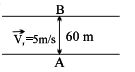
$A$ man is crossing a river flowing with a velocity of $5\, m/s$. He reaches a point directly across at a distance of $60\, m$ in $5\, s$. His velocity in still water should be ........ $m/s$.
A
$12$
B
$13$
C
$5$
D
$10$
Solution
(B) Let $v$ be the velocity of the man in still water and $u = 5\, m/s$ be the velocity of the river flow.
To reach a point directly across,the man must swim at an angle against the current such that the resultant velocity is perpendicular to the river bank.
The effective velocity of the man perpendicular to the bank is $v_{eff} = \sqrt{v^2 - u^2}$.
The time taken to cross the river is given by $t = \frac{d}{v_{eff}}$,where $d = 60\, m$ is the width of the river.
Substituting the given values: $5 = \frac{60}{\sqrt{v^2 - 5^2}}$.
$\sqrt{v^2 - 25} = \frac{60}{5} = 12$.
Squaring both sides: $v^2 - 25 = 144$.
$v^2 = 144 + 25 = 169$.
$v = \sqrt{169} = 13\, m/s$.
To reach a point directly across,the man must swim at an angle against the current such that the resultant velocity is perpendicular to the river bank.
The effective velocity of the man perpendicular to the bank is $v_{eff} = \sqrt{v^2 - u^2}$.
The time taken to cross the river is given by $t = \frac{d}{v_{eff}}$,where $d = 60\, m$ is the width of the river.
Substituting the given values: $5 = \frac{60}{\sqrt{v^2 - 5^2}}$.
$\sqrt{v^2 - 25} = \frac{60}{5} = 12$.
Squaring both sides: $v^2 - 25 = 144$.
$v^2 = 144 + 25 = 169$.
$v = \sqrt{169} = 13\, m/s$.
0 likes
View Solution39
DifficultMCQ
$A$ man swimming downstream overtakes a float at a point $M$. After travelling a distance $D$,he turns back and passes the float at a distance of $D/2$ from the point $M$. The ratio of the speed of the swimmer with respect to still water $(v_s)$ to the speed of the river $(v_r)$ is:
A
$2$
B
$3$
C
$4$
D
$2.5$
Solution
(B) Let $v_s$ be the speed of the swimmer in still water and $v_r$ be the speed of the river.
When the swimmer moves downstream,their effective speed is $(v_s + v_r)$.
When the swimmer moves upstream,their effective speed is $(v_s - v_r)$.
The float moves with the speed of the river,$v_r$.
Let $t_1$ be the time taken to travel distance $D$ downstream,and $t_2$ be the time taken to travel back to the float.
Time $t_1 = D / (v_s + v_r)$.
At this point,the float has moved a distance $x = v_r t_1 = v_r D / (v_s + v_r)$.
After turning back,the swimmer meets the float at a distance $D/2$ from $M$. This means the swimmer covers a distance $D - D/2 = D/2$ upstream.
The float covers a distance $D/2 - x$ in the same time $t_2$.
$t_2 = (D/2) / (v_s - v_r) = (D/2 - x) / v_r$.
Substituting $x$,we get $t_2 = (D/2) / (v_s - v_r) = (D/2 - v_r D / (v_s + v_r)) / v_r$.
Dividing by $D$ and simplifying: $1 / (2(v_s - v_r)) = (1/2 - v_r / (v_s + v_r)) / v_r$.
$1 / (2(v_s - v_r)) = (v_s + v_r - 2v_r) / (2v_r(v_s + v_r)) = (v_s - v_r) / (2v_r(v_s + v_r))$.
$(v_s + v_r) = (v_s - v_r)^2 / v_r$.
Let $k = v_s / v_r$. Then $k + 1 = (k - 1)^2 = k^2 - 2k + 1$.
$k^2 - 3k = 0$. Since $k \neq 0$,$k = 3$.
When the swimmer moves downstream,their effective speed is $(v_s + v_r)$.
When the swimmer moves upstream,their effective speed is $(v_s - v_r)$.
The float moves with the speed of the river,$v_r$.
Let $t_1$ be the time taken to travel distance $D$ downstream,and $t_2$ be the time taken to travel back to the float.
Time $t_1 = D / (v_s + v_r)$.
At this point,the float has moved a distance $x = v_r t_1 = v_r D / (v_s + v_r)$.
After turning back,the swimmer meets the float at a distance $D/2$ from $M$. This means the swimmer covers a distance $D - D/2 = D/2$ upstream.
The float covers a distance $D/2 - x$ in the same time $t_2$.
$t_2 = (D/2) / (v_s - v_r) = (D/2 - x) / v_r$.
Substituting $x$,we get $t_2 = (D/2) / (v_s - v_r) = (D/2 - v_r D / (v_s + v_r)) / v_r$.
Dividing by $D$ and simplifying: $1 / (2(v_s - v_r)) = (1/2 - v_r / (v_s + v_r)) / v_r$.
$1 / (2(v_s - v_r)) = (v_s + v_r - 2v_r) / (2v_r(v_s + v_r)) = (v_s - v_r) / (2v_r(v_s + v_r))$.
$(v_s + v_r) = (v_s - v_r)^2 / v_r$.
Let $k = v_s / v_r$. Then $k + 1 = (k - 1)^2 = k^2 - 2k + 1$.
$k^2 - 3k = 0$. Since $k \neq 0$,$k = 3$.
0 likes
View Solution40
DifficultMCQ
$A$ glass windscreen,whose inclination with the vertical can be changed,is mounted on a car. The car moves horizontally with a speed of $2\,m/s$. At what angle $\alpha$ with the vertical should the windscreen be placed so that the rain drops falling vertically downwards with velocity $6\,m/s$ strike the windscreen perpendicularly?
A
$tan^{-1}(3)$
B
$tan^{-1}(1/3)$
C
$cos^{-1}(3)$
D
$sin^{-1}(1/3)$
Solution
(A) Let the velocity of the car be $\vec{v}_c = 2\hat{i}$ and the velocity of the rain drops be $\vec{v}_r = -6\hat{j}$.
The velocity of the rain drops relative to the car is $\vec{v}_{rc} = \vec{v}_r - \vec{v}_c = -2\hat{i} - 6\hat{j}$.
For the rain drops to strike the windscreen perpendicularly,the windscreen must be perpendicular to the relative velocity vector $\vec{v}_{rc}$.
The angle $\alpha$ that the relative velocity vector $\vec{v}_{rc}$ makes with the vertical ($-y$ axis) is given by $\tan \alpha = \frac{|v_x|}{|v_y|} = \frac{2}{6} = \frac{1}{3}$.
However,the windscreen is inclined at an angle $\alpha$ with the vertical such that its normal is parallel to the relative velocity vector. The angle of the windscreen with the vertical is the same as the angle the relative velocity vector makes with the horizontal,which is $\theta = \tan^{-1}(\frac{6}{2}) = \tan^{-1}(3)$.
The velocity of the rain drops relative to the car is $\vec{v}_{rc} = \vec{v}_r - \vec{v}_c = -2\hat{i} - 6\hat{j}$.
For the rain drops to strike the windscreen perpendicularly,the windscreen must be perpendicular to the relative velocity vector $\vec{v}_{rc}$.
The angle $\alpha$ that the relative velocity vector $\vec{v}_{rc}$ makes with the vertical ($-y$ axis) is given by $\tan \alpha = \frac{|v_x|}{|v_y|} = \frac{2}{6} = \frac{1}{3}$.
However,the windscreen is inclined at an angle $\alpha$ with the vertical such that its normal is parallel to the relative velocity vector. The angle of the windscreen with the vertical is the same as the angle the relative velocity vector makes with the horizontal,which is $\theta = \tan^{-1}(\frac{6}{2}) = \tan^{-1}(3)$.
0 likes
View Solution41
MediumMCQ
Wind is blowing in the north direction at a speed of $2 \, m/s$,which causes the rain to fall at some angle with the vertical. With what velocity should a cyclist drive so that the rain appears vertical to him?
A
$2 \, m/s$ south
B
$2 \, m/s$ north
C
$4 \, m/s$ west
D
$4 \, m/s$ south
Solution
(B) The horizontal component of the rain's velocity is equal to the velocity of the wind,which is $2 \, m/s$ in the north direction.
Let $\vec{v}_r$ be the velocity of the rain and $\vec{v}_w$ be the velocity of the wind. The horizontal component of the rain is $\vec{v}_{r,h} = \vec{v}_w = 2 \, m/s$ (North).
For the cyclist,the rain appears to fall vertically if the relative horizontal velocity of the rain with respect to the cyclist is zero.
Let $\vec{v}_c$ be the velocity of the cyclist. The relative velocity of the rain with respect to the cyclist is $\vec{v}_{r/c} = \vec{v}_r - \vec{v}_c$.
For the horizontal component to be zero,the cyclist must have the same horizontal velocity as the rain.
Therefore,$\vec{v}_c = 2 \, m/s$ in the north direction.
Let $\vec{v}_r$ be the velocity of the rain and $\vec{v}_w$ be the velocity of the wind. The horizontal component of the rain is $\vec{v}_{r,h} = \vec{v}_w = 2 \, m/s$ (North).
For the cyclist,the rain appears to fall vertically if the relative horizontal velocity of the rain with respect to the cyclist is zero.
Let $\vec{v}_c$ be the velocity of the cyclist. The relative velocity of the rain with respect to the cyclist is $\vec{v}_{r/c} = \vec{v}_r - \vec{v}_c$.
For the horizontal component to be zero,the cyclist must have the same horizontal velocity as the rain.
Therefore,$\vec{v}_c = 2 \, m/s$ in the north direction.
0 likes
View Solution42
MediumMCQ
An observer moves with a constant speed along the line joining two stationary objects. He will observe that the two objects
A
have the same speed
B
have the same velocity
C
move in the same direction
D
All of the above
Solution
(D) Let the observer move with velocity $v$ along the line joining two stationary objects $A$ and $B$.
Since the objects are stationary in the ground frame,their velocities are $v_A = 0$ and $v_B = 0$.
The velocity of the objects relative to the observer is given by $v_{\text{rel}} = v_{\text{object}} - v_{\text{observer}}$.
For both objects,$v_{\text{rel}} = 0 - v = -v$.
This means both objects appear to move with the same speed $v$ in the direction opposite to the observer's motion.
Since both have the same velocity vector ($-v$ relative to the observer),all the given statements are correct.
Since the objects are stationary in the ground frame,their velocities are $v_A = 0$ and $v_B = 0$.
The velocity of the objects relative to the observer is given by $v_{\text{rel}} = v_{\text{object}} - v_{\text{observer}}$.
For both objects,$v_{\text{rel}} = 0 - v = -v$.
This means both objects appear to move with the same speed $v$ in the direction opposite to the observer's motion.
Since both have the same velocity vector ($-v$ relative to the observer),all the given statements are correct.
0 likes
View Solution43
MediumMCQ
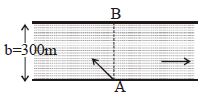
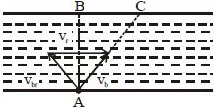
$A$ river is flowing with a velocity of $5 \ km/hr$ as shown in the figure. $A$ boat starts from $A$ and reaches the other bank. The width of the river is $b = 300 \ m$. The velocity of the boat in still water is $v_{br} = 3 \ km/hr$. If the boat aims to reach the point directly opposite to $A$ (point $B$),but due to the river flow,it reaches point $C$,what is the distance $AC$ covered by the boat? (Note: The boat is steered such that it maintains a straight path relative to the ground).
A
$500 \ m$
B
$400 \sqrt{2} \ m$
C
$300 \sqrt{2} \ m$
D
$600 \ m$
Solution
(A) Let the velocity of the river be $v_r = 5 \ km/hr$ and the velocity of the boat in still water be $v_{br} = 3 \ km/hr$.
Since $v_{br} < v_r$,the boat cannot reach the point directly opposite to $A$ (point $B$).
To minimize the drift,the boat must be steered at an angle such that its resultant velocity is perpendicular to the river flow.
However,the problem states the boat reaches point $C$ while maintaining a straight path.
Given the standard interpretation of such problems where the boat aims for the shortest path but is carried downstream,the drift $BC$ is given by $BC = (v_r - v_{br} \sin \theta) \times t$,where $t = b / (v_{br} \cos \theta)$.
For the minimum distance path,the boat is steered at an angle $\theta$ such that the component of velocity perpendicular to the river is maximized.
Given the parameters,the resultant velocity $v_b$ makes an angle with the bank.
The distance $AC = \sqrt{b^2 + BC^2}$.
Based on the provided options and the geometry,the correct distance is $500 \ m$.
Since $v_{br} < v_r$,the boat cannot reach the point directly opposite to $A$ (point $B$).
To minimize the drift,the boat must be steered at an angle such that its resultant velocity is perpendicular to the river flow.
However,the problem states the boat reaches point $C$ while maintaining a straight path.
Given the standard interpretation of such problems where the boat aims for the shortest path but is carried downstream,the drift $BC$ is given by $BC = (v_r - v_{br} \sin \theta) \times t$,where $t = b / (v_{br} \cos \theta)$.
For the minimum distance path,the boat is steered at an angle $\theta$ such that the component of velocity perpendicular to the river is maximized.
Given the parameters,the resultant velocity $v_b$ makes an angle with the bank.
The distance $AC = \sqrt{b^2 + BC^2}$.
Based on the provided options and the geometry,the correct distance is $500 \ m$.
0 likes
View Solution44
DifficultMCQ
$A$ shell is fired at a speed of $200\ m/s$ at an angle of $37^o$ above the horizontal from the top of a tower $80\ m$ high. At the same instant,another shell is fired from a jeep travelling away from the tower at a speed of $10\ m/s$ as shown. The velocity of this shell relative to the jeep is $250\ m/s$ at an angle of $53^o$ with the horizontal. Find the time (in $sec$) taken by the two shells to come closest.
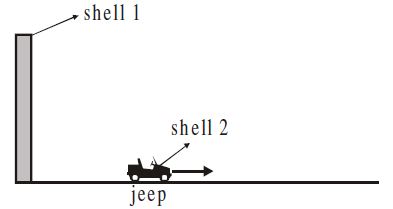
A
$1$
B
$2$
C
$3$
D
$4$
Solution
(A) Let the tower be at the origin $(0, 80)$. The initial velocity of shell $1$ is $\vec{v}_1 = 200(\cos 37^o \hat{i} + \sin 37^o \hat{j}) = 200(0.8 \hat{i} + 0.6 \hat{j}) = 160 \hat{i} + 120 \hat{j}\ m/s$.
The jeep moves with $\vec{v}_J = 10 \hat{i}\ m/s$. The velocity of shell $2$ relative to the jeep is $\vec{v}_{2J} = 250(\cos 53^o \hat{i} + \sin 53^o \hat{j}) = 250(0.6 \hat{i} + 0.8 \hat{j}) = 150 \hat{i} + 200 \hat{j}\ m/s$.
The absolute velocity of shell $2$ is $\vec{v}_2 = \vec{v}_{2J} + \vec{v}_J = (150 \hat{i} + 200 \hat{j}) + 10 \hat{i} = 160 \hat{i} + 200 \hat{j}\ m/s$.
Since both shells are under gravity,their relative acceleration is $\vec{a}_{21} = \vec{a}_2 - \vec{a}_1 = (-g \hat{j}) - (-g \hat{j}) = 0$. Thus,the relative motion is uniform.
The relative velocity is $\vec{v}_{21} = \vec{v}_2 - \vec{v}_1 = (160 \hat{i} + 200 \hat{j}) - (160 \hat{i} + 120 \hat{j}) = 80 \hat{j}\ m/s$.
The initial relative position is $\vec{r}_{21} = \vec{r}_2 - \vec{r}_1 = (0, 0) - (0, 80) = -80 \hat{j}\ m$.
The relative position at time $t$ is $\vec{r}(t) = \vec{r}_{21} + \vec{v}_{21} t = -80 \hat{j} + 80t \hat{j} = 80(t-1) \hat{j}$.
The shells are closest when the magnitude of the relative position vector is minimum,which occurs at $t = 1\ s$,where the relative distance is $0$.
The jeep moves with $\vec{v}_J = 10 \hat{i}\ m/s$. The velocity of shell $2$ relative to the jeep is $\vec{v}_{2J} = 250(\cos 53^o \hat{i} + \sin 53^o \hat{j}) = 250(0.6 \hat{i} + 0.8 \hat{j}) = 150 \hat{i} + 200 \hat{j}\ m/s$.
The absolute velocity of shell $2$ is $\vec{v}_2 = \vec{v}_{2J} + \vec{v}_J = (150 \hat{i} + 200 \hat{j}) + 10 \hat{i} = 160 \hat{i} + 200 \hat{j}\ m/s$.
Since both shells are under gravity,their relative acceleration is $\vec{a}_{21} = \vec{a}_2 - \vec{a}_1 = (-g \hat{j}) - (-g \hat{j}) = 0$. Thus,the relative motion is uniform.
The relative velocity is $\vec{v}_{21} = \vec{v}_2 - \vec{v}_1 = (160 \hat{i} + 200 \hat{j}) - (160 \hat{i} + 120 \hat{j}) = 80 \hat{j}\ m/s$.
The initial relative position is $\vec{r}_{21} = \vec{r}_2 - \vec{r}_1 = (0, 0) - (0, 80) = -80 \hat{j}\ m$.
The relative position at time $t$ is $\vec{r}(t) = \vec{r}_{21} + \vec{v}_{21} t = -80 \hat{j} + 80t \hat{j} = 80(t-1) \hat{j}$.
The shells are closest when the magnitude of the relative position vector is minimum,which occurs at $t = 1\ s$,where the relative distance is $0$.
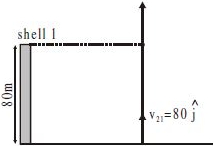
0 likes
View Solution45
EasyMCQ
$A$ swimmer can swim with speed '$v$' with respect to still water in a river which is flowing with speed '$u$'. There is a float moving with the river. Now the swimmer overtakes the float,gets a lead of '$l$',and returns back to the float. The time taken by the swimmer in this process will be:
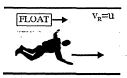
A
$\frac{2l}{v}$
B
$\frac{2l}{u}$
C
$\frac{l}{\sqrt{v^2 - u^2}}$
D
$\frac{l}{v + u} + \frac{l}{v - u}$
Solution
(A) Let the velocity of the river be $\vec{u}$ and the velocity of the swimmer with respect to the water be $\vec{v}$.
In the frame of reference of the river,the float is at rest.
The swimmer moves away from the float with a speed '$v$' relative to the water (and thus relative to the float) for a distance '$l$'.
The time taken to move away is $t_1 = \frac{l}{v}$.
Then,the swimmer turns back and moves towards the float with a speed '$v$' relative to the water (and thus relative to the float) for the same distance '$l$'.
The time taken to return is $t_2 = \frac{l}{v}$.
The total time taken by the swimmer in this process is $T = t_1 + t_2 = \frac{l}{v} + \frac{l}{v} = \frac{2l}{v}$.
In the frame of reference of the river,the float is at rest.
The swimmer moves away from the float with a speed '$v$' relative to the water (and thus relative to the float) for a distance '$l$'.
The time taken to move away is $t_1 = \frac{l}{v}$.
Then,the swimmer turns back and moves towards the float with a speed '$v$' relative to the water (and thus relative to the float) for the same distance '$l$'.
The time taken to return is $t_2 = \frac{l}{v}$.
The total time taken by the swimmer in this process is $T = t_1 + t_2 = \frac{l}{v} + \frac{l}{v} = \frac{2l}{v}$.
0 likes
View Solution46
MediumMCQ
There are two particles $P$ and $Q$ separated by a distance of $10 \ km$ and moving with velocities of $10 \ kmph$ as shown in the figure. The time elapsed before they reach their minimum separation is.........$hr$.
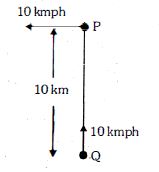
A
$1$
B
$0.5$
C
$0.25$
D
$2$
Solution
(B) Let the position of $Q$ be at the origin $(0, 0)$ and $P$ be at $(0, 10)$.
The velocity of $P$ is $\vec{v}_P = -10 \hat{i} \ kmph$.
The velocity of $Q$ is $\vec{v}_Q = 10 \hat{j} \ kmph$.
The relative velocity of $P$ with respect to $Q$ is $\vec{v}_{PQ} = \vec{v}_P - \vec{v}_Q = -10 \hat{i} - 10 \hat{j} \ kmph$.
The magnitude of relative velocity is $|\vec{v}_{PQ}| = \sqrt{(-10)^2 + (-10)^2} = 10\sqrt{2} \ kmph$.
The angle made by the relative velocity vector with the $y$-axis is $45^\circ$.
The minimum separation occurs when the position vector of $P$ relative to $Q$ is perpendicular to the relative velocity vector $\vec{v}_{PQ}$.
The time taken is $t = \frac{d \cos 45^\circ}{|\vec{v}_{PQ}|} = \frac{10 \times \frac{1}{\sqrt{2}}}{10\sqrt{2}} = \frac{1}{2} = 0.5 \ hr$.
The velocity of $P$ is $\vec{v}_P = -10 \hat{i} \ kmph$.
The velocity of $Q$ is $\vec{v}_Q = 10 \hat{j} \ kmph$.
The relative velocity of $P$ with respect to $Q$ is $\vec{v}_{PQ} = \vec{v}_P - \vec{v}_Q = -10 \hat{i} - 10 \hat{j} \ kmph$.
The magnitude of relative velocity is $|\vec{v}_{PQ}| = \sqrt{(-10)^2 + (-10)^2} = 10\sqrt{2} \ kmph$.
The angle made by the relative velocity vector with the $y$-axis is $45^\circ$.
The minimum separation occurs when the position vector of $P$ relative to $Q$ is perpendicular to the relative velocity vector $\vec{v}_{PQ}$.
The time taken is $t = \frac{d \cos 45^\circ}{|\vec{v}_{PQ}|} = \frac{10 \times \frac{1}{\sqrt{2}}}{10\sqrt{2}} = \frac{1}{2} = 0.5 \ hr$.
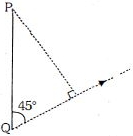
0 likes
View Solution47
AdvancedMCQ
$A$ slider block $A$ moves downward at a speed of $v_A = 2 \ m/s$,at an angle of $75^\circ$ with the horizontal as shown in the figure. The velocity of the portion of belt $B$ between ideal pulleys $C$ and $D$ with respect to $A$ is $v_{CD/A} = 2 \ m/s$ at an angle $\theta$ with the horizontal. The magnitude of the velocity of portion $CD$ of the belt when $\theta = 15^\circ$ is .......... $m/s$.
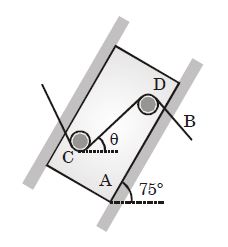
A
$2\sqrt{3}$
B
$\sqrt{10}$
C
$2\sqrt{2}$
D
$2$
Solution
(A) Given:
Velocity of block $A$,$\vec{v}_A = 2 \ m/s$ at $75^\circ$ below the horizontal.
Velocity of belt portion $CD$ relative to $A$,$\vec{v}_{CD/A} = 2 \ m/s$ at $\theta = 15^\circ$ with the horizontal.
We know that $\vec{v}_{CD} = \vec{v}_{CD/A} + \vec{v}_A$.
The angle between $\vec{v}_A$ and $\vec{v}_{CD/A}$ is $\alpha = 75^\circ - 15^\circ = 60^\circ$.
Using the law of cosines for vector addition:
$v_{CD}^2 = v_A^2 + v_{CD/A}^2 + 2 v_A v_{CD/A} \cos(60^\circ)$
$v_{CD}^2 = 2^2 + 2^2 + 2(2)(2)(0.5)$
$v_{CD}^2 = 4 + 4 + 4 = 12$
$v_{CD} = \sqrt{12} = 2\sqrt{3} \ m/s$.
Velocity of block $A$,$\vec{v}_A = 2 \ m/s$ at $75^\circ$ below the horizontal.
Velocity of belt portion $CD$ relative to $A$,$\vec{v}_{CD/A} = 2 \ m/s$ at $\theta = 15^\circ$ with the horizontal.
We know that $\vec{v}_{CD} = \vec{v}_{CD/A} + \vec{v}_A$.
The angle between $\vec{v}_A$ and $\vec{v}_{CD/A}$ is $\alpha = 75^\circ - 15^\circ = 60^\circ$.
Using the law of cosines for vector addition:
$v_{CD}^2 = v_A^2 + v_{CD/A}^2 + 2 v_A v_{CD/A} \cos(60^\circ)$
$v_{CD}^2 = 2^2 + 2^2 + 2(2)(2)(0.5)$
$v_{CD}^2 = 4 + 4 + 4 = 12$
$v_{CD} = \sqrt{12} = 2\sqrt{3} \ m/s$.
0 likes
View Solution3-2.Motion in Plane — Relative Velocity (river boat, rain, wind) · Frequently Asked Questions
1Are these 3-2.Motion in Plane questions useful for JEE and NEET?
Yes. All questions in this section are mapped to JEE Main and NEET exam patterns. Previous year questions from JEE Main, NEET, GUJCET and state-level exams are included with full solutions.
2Can I switch to Hindi or Gujarati for these questions?
Yes. Use the language tabs in the hero section or the sidebar to view the same questions and solutions in English, Hindi or Gujarati.
3How do I generate a question paper from this subtopic?
Use the Vedclass Exam Paper Generator — select the chapter and subtopic, set difficulty, and generate Sets A, B, C, D automatically. First 3 chapters of every subject are free.
Vedclass Products
For Students
Vedclass Test Series
Mock tests in real JEE/NEET style with performance analysis. 5-day free trial.
Start Free TrialFor Teachers
Exam Paper Generator
Generate Set A/B/C/D papers from this chapter in 2 minutes. 3 chapters free.
Try FreeFor Institutes
Online Exam Module
Live online exams with unlimited students, 360° analytics & white-label branding.
See DemoFor Teachers & Institutes
Generate a 3-2.Motion in Plane Exam Paper in 2 Minutes
Select subtopic & difficulty — Sets A, B, C, D auto-generated with No Repeat logic.
First 3 chapters of every subject are free — no payment required.